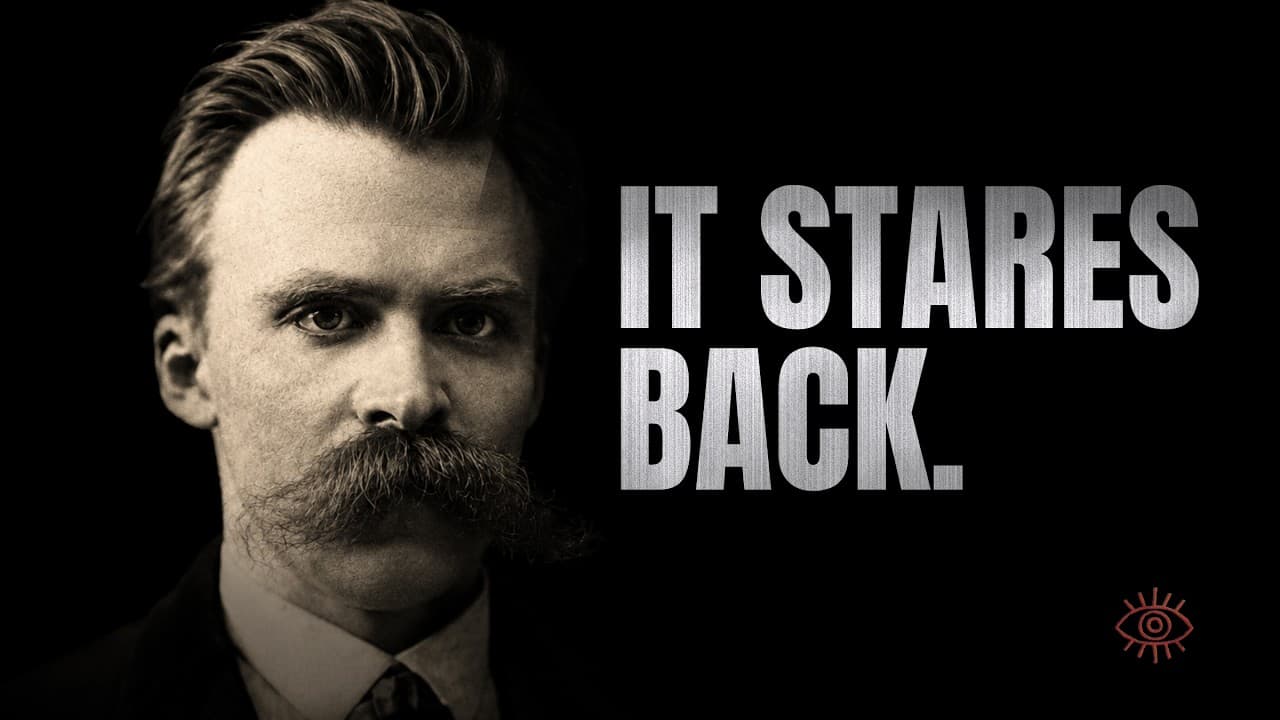
When Life Suddenly Feels Meaningless | The Existential Crisis
Why do people who have everything still wake at three in the morning certain that none of it means anything?
This is a long, unhurried history of the moment the floor of ordinary life gives way. It begins with a celebrated novelist who, at the height of his fame and fortune, quietly hid a rope from himself, and from that single human crisis it opens outward across the centuries.
We follow the confrontation with meaninglessness through the oldest scriptures and the calm arguments of antiquity, through a believer terrified by an infinite and silent cosmos, through the philosopher of endless striving, and into the thinkers who made this dread the very center of their work.
We sit with the death of God, with radical freedom, with the absurd, with a survivor who found a reason to endure the unendurable, and with a tradition that meets the void by loosening its grip on the self. The episode closes not with a tidy answer but with the quiet question of how a person comes back to life.
The full episode is on YouTube and Spotify. Please listen only in safe, restful contexts.
Enjoying the episode?
Occasional letters on philosophy, reading, and the examined life. No spam, ever.
By subscribing you consent to receiving occasional emails. Unsubscribe any time via the link in every email or at /unsubscribe.
Timestamps
- 0:00:00Chapter 1: When the Floor Gives Way
- 0:13:20Chapter 2: Everything Under the Sun
- 0:20:22Chapter 3: The Ancient Art of Facing Death
- 0:28:47Chapter 4: The Silence of Infinite Spaces
- 0:34:56Chapter 5: The Will That Never Rests
- 0:45:07Chapter 6: The Dizziness of Freedom
- 0:58:20Chapter 7: The Underground and the Inquisitor
- 1:07:37Chapter 8: The Death of God
- 1:21:39Chapter 9: When the Abyss Looks Back
- 1:30:13Chapter 10: The Sick Soul
- 1:36:59Chapter 11: Anxiety and the Nothing
- 1:48:56Chapter 12: At the Limits
- 1:55:06Chapter 13: Condemned to Be Free
- 2:07:02Chapter 14: The Absurd and the Refusal
- 2:17:15Chapter 15: The Weight of Ambiguity
- 2:23:55Chapter 16: The Courage to Be
- 2:32:09Chapter 17: A Reason to Endure
- 2:44:24Chapter 18: The Denial of Death
- 2:53:08Chapter 19: The Noonday Listlessness
- 2:59:24Chapter 20: The Self That Lets Go
- 3:08:18Chapter 21: The Return of the Ordinary
- 3:15:14Chapter 22: Why the Abyss Remains
For the record
Full Transcript
Chapter 1: When the Floor Gives Way
There was a man who, at the very summit of his life, with nearly everything a person is told to long for already gathered into his hands, found that he no longer dared to be alone in a room with a length of rope. He was in his fifties. He was wealthy, famous across the whole of Europe, sound in body, married, the father of a large and thriving family, the master of a wide country estate with its fields and horses and servants. And he had begun to hide a certain cord away from himself, so that he would not hang himself from the beam between the two cupboards in his room, and he had given up carrying his gun on his hunting walks, so that he would not, in some unguarded moment among the birches, turn the barrel on himself.
The man was Leo Tolstoy. By any measure the world keeps, he had arrived. He had written the two enormous novels that made him perhaps the most celebrated living writer on earth, the vast war novel he finished around eighteen sixty-nine, with its hundreds of characters and its armies moving across a frozen country, and then the great novel of a married woman and her ruin, finished around eighteen seventy-seven, a book so exact about the human heart that people read it now and feel he has somehow been reading their own letters. He had money, reputation, love, work, children at his table, strength in his arms. He was not poor. He was not ill. Nothing in his outward circumstances had gone wrong. And in the middle of all of it, quietly, without any disaster to explain it, his life simply stopped.
That is the strange word for it, and the right one. It stopped. He could still rise and dress and speak to his wife and walk his land, but the engine underneath the day had cut out. He found himself arrested by a question he could not push aside and could not answer, and the question was very simple. Was there any meaning in his life that the death waiting for him at the end of it would not undo, and cancel, and wipe away as though it had never been. Whatever he had done, whatever he might still do, the great novels and the children and the estate, all of it sat under a sentence already passed. He would die. They would die. The estate would pass to strangers. In time no one would remember that any of it had mattered to him. And if that was so, he could not see what the point of the next hour could possibly be, or why he should reach for it.
He set all of this down, a few years later, in a short and very bare book that he called simply a confession, the plain account of how a man who had every visible reason to live had come within reach of taking his own life. It is one of the most honest things ever written, in part because he refuses to make himself interesting. He does not pose. He reports. He tells how the questions first came as small moments of bewilderment, little stoppages, as if he had forgotten what he was doing and stood blinking in the middle of the room, and how those moments came more and more often, and gathered, and hardened at last into one great standing question that would not move off.
In that book he reaches for an old traveler's tale to say what he felt. A man, caught in open country by a beast, scrambles down into a dry well to escape it, and there at the bottom sees a dragon waiting with open jaws. He cannot climb out, for the beast is above, and he cannot drop down, for the dragon is below, so he catches at a branch growing from a crack in the wall and hangs there by his hands. His arms begin to tire. And he sees that two mice, one white and one black, are quietly gnawing the branch all the way round, and that soon it will give and he will fall. While he hangs there, he notices a few drops of honey on the leaves, and he stretches out his tongue and licks them. Tolstoy says that he had become that man. The dragon was death, certain and waiting. The two mice were the days and the nights, eating steadily through the branch. The drops of honey were the loves of his life, his family and his work, the sweet things that had always held his eyes, and now he could no longer taste them at all, because he could not stop looking at the dragon and the mice.
Now widen the frame, away from the one man and out toward the thing itself, because what seized Tolstoy is not his alone. What happened to him has happened, in some form, to a great many people who never wrote a word about it, and it is worth naming with care. We can call it an existential crisis, and by that we mean something quite specific. It is the sudden collapse of the meaning a person has always taken for granted. It is the moment the floor of ordinary life gives way underfoot, and the questions that a busy and healthy life normally keeps at a safe distance come flooding in all at once, with no answer ready for any of them. Why go on? What is the point of any of it? Why is there something here at all, rather than nothing, and why am I the particular something that has been made to sit and ask?
It helps to be precise about what this is and what it is not, because it is easily confused with sorrow, and it is not sorrow. Ordinary grief has an object. We lose a person, a home, a piece of our health, and we mourn that loss, and the grief, however heavy, has edges, a shape, a name. What overtook Tolstoy had no single object. It was not grief over any one thing he had lost. It was the loss of the very ground beneath all losses, the sudden conviction that the whole enterprise of a life, the entire project of being a person who wants things and works for them, was somehow without warrant, unjustified, resting on nothing. A particular grief says that this good thing is gone. The crisis says something far stranger and far colder. It says that there may have been no good in the having of anything, that the ledger was empty from the very start.
And here is the feature that makes it so frightening, and so hard for others to understand. It does not, as a rule, arrive in disaster. We might expect such a darkness to fall on the ruined and the bereaved, and sometimes it does. But very often it comes instead in the middle of comfort, in the full noon of a successful life, to the person who has just gotten everything settled, the work secure, the house paid for, the family well. The trap springs precisely when the last excuse for unhappiness has been taken away. While a person is still climbing, still wanting the next thing, the wanting itself hides the question. It is when the climbing stops, when there is nothing left to reach for that the reaching had promised, that the silence comes in and the question can finally be heard. Tolstoy heard it at the top of the mountain, not at the bottom.
Why should a creature be built so that its greatest success can open a pit beneath it? The answer is the hinge of this whole long inquiry, and it is worth stating plainly. This particular suffering is the price of a particular kind of consciousness. A horse in Tolstoy's stable does not lie awake wondering whether the life of a horse is worth living. A bird in his birches is wholly inside its own flying. The animal that simply lives is spared all of this, because it cannot step outside its own life and look back at it as a whole and ask whether the whole is worth anything. We can. We are the creature that can stand a little apart from its own existence and put it on trial, and that power, which is also the power that lets us plan and remember and imagine and love across time, is the very same power that lets us doubt the worth of the entire arrangement. The lifted vantage that lets a person see his life whole is the vantage from which he can also see that it ends, and ask what it was all for. To be able to ask the question is already to be able to fall. The crisis is not a malfunction in such a creature. It is one of the things such a creature is, by its very nature, able to do.
There is a plain image for what opens at that moment, and this whole long reflection will lean on it, so it is worth setting down simply, without borrowing anyone's fine phrase. When meaning withdraws from a life, what it leaves behind feels like an emptiness with no bottom, a groundlessness, a sense of standing at the lip of something that falls away forever and gives nothing back. We will call that the abyss. It is not a place, and not a thing. It is the experience of the ground being gone, the felt absence of any floor under the question of why we are here at all and why it should matter. Tolstoy stood at the edge of it in a warm and well-furnished house. That it can open in such a house, and not only in a prison or a sickroom, is the first thing to understand about it.
It is also, and this is the last piece of the foundation, very old. It can feel like a peculiarly modern complaint, the affliction of people with too much time and too few real troubles, and there is something in our own age that has sharpened it. But the experience itself is far older than any tidy word for it. It cries out already in the oldest scriptures, in voices we will come to, that weighed all human achievement and found it as fleeting as the wind, and in the figure of a blameless man who, stripped of everything, demands to know why he was ever born. It is reasoned at, calmly and at length, by the philosophers of the ancient world, who built whole disciplines for the facing of death and the cold indifference of the heavens. What is true is that in the modern world the thing has spread and deepened, because the old shared certainties that once caught a falling person, the inherited faith, the fixed place in a fixed order, the sense that the universe itself had some use for you, have thinned out and in many lives fallen away entirely. When the net is gone, the fall is longer. In that sense the crisis that nearly killed Tolstoy in his comfortable house has become something close to a defining affliction of the age, a private catastrophe quietly repeated in a great many rooms.
So what lies ahead is not a cure offered in a sentence, and not a clever argument that makes the abyss simply go away, because no such argument exists, and anyone who sells one is lying. What lies ahead is something better and more honest. It is a long human confrontation with this single experience, carried out across many centuries by some of the most serious minds that ever lived. It runs from the oldest texts, where the question is first screamed and first endured, through the thinkers who made this very darkness the center of their work and refused to look away from it, and on to those who tried, in clinics and in prison camps and at their own kitchen tables, not merely to understand it but to live through it and come out the far side still standing. They disagree with one another, often fiercely. They will not all be right. But they were all there, at the edge, and they reported back.
And that is the one thing worth carrying out of this beginning and on into everything that follows. The abyss is terrible. There is no use pretending otherwise, and we will not pretend. But it is also, strangely, the place where the most serious thinking a human being can do actually begins. The questions that open under a person when the floor gives way are not childish questions, and they are not sick ones. They are the deepest questions there are, and the comfortable life that keeps them at bay keeps a kind of truth at bay along with them. The people who went furthest down into this particular dark, who refused the easy answers and stayed with the question until it had taught them something, are for that very reason the ones most worth hearing. Tolstoy hid his rope and lived, and wrote his bare confession, and that turning toward the question, rather than away from it, is exactly where we begin.
Chapter 2: Everything Under the Sun
The confrontation with futility is not a modern invention. It is one of the oldest experiences we have any record of, and it was set down in writing long before anyone thought to call it a crisis or to build a philosophy around it. Two voices in the Hebrew scriptures stand at the head of this lineage, and both of them stare straight into the thing that later thinkers would circle for centuries. One is weary and clear-eyed, a man who has had everything and found it empty. The other is ruined and furious, a man who has lost everything and refuses to keep quiet about it. Between them they map the whole country of the abyss, and they did it thousands of years before our word for it existed.
The first voice belongs to the book we call Ecclesiastes, and its speaker introduces himself as a gatherer, a teacher who has assembled a crowd to tell them what he has learned. He is a man of enormous means. He has built houses and planted vineyards, laid out gardens and orchards and pools of water to feed them. He has gathered silver and gold, the treasure of kings. He has owned slaves and herds, and he has gathered wisdom too, more than anyone who came before him in his city. And then, having had all of it, he turns and looks at the whole of it and delivers his verdict. All of it, he says, is vapor. A breath. A chasing after wind. The word he reaches for, again and again, is the word for the mist that shows on a cold morning and is gone by noon, the breath you can see and never hold. Everything he built, everything he won, has exactly that much substance.
His sayings are hard, and he does not soften them. The wise man and the fool, he observes, come to precisely the same end. Both die, and after a little while no one remembers either of them, so what has the wise man gained by his wisdom. The same fate that takes the human being takes the beast in the field as well. Both have the same breath, both return to the same dust, and who can truly say that the one rises and the other does not. He watches the rivers, how they all run down into the sea, and yet the sea is never full, and the water returns and the rivers run again, the same circuit forever, arriving nowhere. There is nothing new under the sun. Whatever has been is what will be, and whatever has been done is what will be done again. And there is no remembrance of those who came before, just as there will be none of those who come after. Toil all you like. Whatever you make, you leave to someone who did not work for it, and the work itself buys nothing that finally lasts.
The second voice is angrier, and it comes from the book of Job. Job is described as a blameless and upright man, prosperous and good, and then in a single stroke he is stripped of everything. In one day messengers arrive one after another, and by the end of them his livestock are gone, his servants are dead, and his sons and daughters have all been killed together when the house fell on them. Then his health is taken too, and he is left sitting in the ashes, scraping his sores, a man who has done nothing whatever to deserve any of it.
His friends come to comfort him, and their comfort turns out to be the worst part. They carry a tidy theology, and it runs like a machine. God is just, they reason, and a just God does not punish the innocent. Therefore Job must have sinned. Therefore his suffering is earned, and all he has to do is admit the fault, repent, and the books will balance again. It is the cheapest of consolations, the insistence that the world is fair and that everyone, in the end, gets what is coming to them. And Job will not have it. He knows he has done nothing to warrant this, and he refuses to lie about himself in order to make his friends comfortable or to make God look reasonable. He would rather argue with God to his face than mouth a piety he knows to be false. He demands an answer. He wants the one who did this to come down and explain.
And here is the strange and overwhelming thing. The answer comes. Out of a storm, out of the whirlwind, a voice finally speaks to him. But it is not an argument. It offers no reason, no ledger, no account at all of why the innocent suffer. Instead it asks Job a long series of questions, and the questions are about the sheer wild scale of the world. Where were you when the foundations of the earth were laid. Have you walked the springs of the sea, or commanded the morning, or watched the wild goats give birth in the high rocks. Can you bind the stars, or feed the lion, or meet the great beasts of the deep without flinching. The voice does not justify the world. It displays it, in all its vastness and ferocity and indifference to human accounting, and it turns the question back upon the man who asked it. Job wanted the world to make moral sense. What he is given instead is the world itself, immense and untamed and far beyond him.
Notice what these two ancient voices have in common. Neither of them takes the easy way out. Neither will say that everything works out in the end, that suffering is always deserved, that the wise are rewarded and the wicked punished and the books always balance. The preacher looks at a world where the same fate swallows the wise and the foolish alike, and he calls it vapor. The ruined man looks at a world where the blameless are crushed for no reason, and he refuses to pretend otherwise. They meet the void honestly. And crucially, neither of them meets it with a system. They hand us no theory, no proof, no neat resolution. What they have is something older and rawer than any theory. They meet it with a cry.
That cry is the beginning. Everything that follows in this long human conversation, across the centuries and across the cultures, is in one way or another the attempt to think the cry through. To take the honest wail of the man in the ashes and the tired sigh of the man who had everything, and to make of them something a person can actually live inside. The philosophers will build their arguments. But the arguments are answers, and the question came first, and the question was a cry.
Chapter 3: The Ancient Art of Facing Death
Antiquity met the fear of death not with a cry but with a method. Where a later age would treat the dread of dying as a wound to be confessed, the philosophers of Greece and Rome treated it as a problem to be solved, a confusion in the mind that careful thinking and steady practice could loosen and finally release. They did not deny that death was coming. They denied that it had any right to ruin the life that came before it. And they built, out of argument and exercise, a set of tools for taking the terror apart.
The cleanest of these tools belongs to Epicurus, who taught in a garden on the edge of Athens more than three hundred years before the common era, and who left his followers a single startling claim. Death, he said, is nothing to us. The reasoning behind it is almost mathematical in its neatness. Everything we fear about death we fear as something that will happen to us, some state we will be in, some harm we will suffer. But harm requires a person to be harmed, a someone who is present to feel it. And death is precisely the end of that someone. While we exist, death is not here. Once death has arrived, we are no longer here to meet it. The two never occupy the same moment. They pass each other like travelers on a road who are never in the same place at the same time, and so they never actually meet. Death, on this view, is not a dark experience waiting at the end of the corridor. It is the closing of the corridor itself, and a thing that is not an experience cannot be a misfortune. The fear of it, Epicurus insisted, is a kind of error, a mistake the imagination makes when it smuggles us into our own absence and asks us to feel what it would be like, when there will be no us left there to feel anything at all.
Three centuries later his Roman follower Lucretius took this dry argument and set it into a long and ardent poem on the nature of things, a work that tried to free its readers from fear by showing them how the world is actually made, of small particles falling and combining, with no gods watching over the result and no judgment waiting at the end. And to the Epicurean case Lucretius added an image of his own, one so simple that it has never quite lost its force. He asks us to consider the vast stretch of time before we were born. Whole ages rolled on without us. Empires rose and fell, the seasons turned and turned again, and we were absent from every moment of it, and that absence never troubled us for an instant. No one grieves for the centuries he missed by being born too late. The time after our death, Lucretius says, is nothing but the mirror of that earlier emptiness, the same nothing seen from the other side. If the darkness before our birth holds no terror, then the darkness after it, its exact reflection, has no more right to frighten us. We are asked only to look honestly at the one and to recognize its twin in the other.
The Stoics worked the same ground with a different set of hands. Where the followers of Epicurus reasoned the fear away, the Stoics trained themselves against it, treating the mind as something that could be exercised and toughened like a body. Seneca, the Roman statesman and writer who advised an emperor and was in the end ordered by that same emperor to take his own life, spent his last years composing patient letters to a younger friend named Lucilius, letters that read less like lectures than like the steady counsel of a man who has thought hard about how to live. Again and again he returns to one piece of counsel, that a person should rehearse his own death and hold it daily before the mind. Not to brood on it, not to sink into gloom, but to do the very opposite, to let the plain fact of our ending burn away the triviality and the false urgency from our days. The man who has truly accepted that this evening might be his last, Seneca thought, stops postponing his life and stops trembling at shadows. He holds each day as a thing complete in itself. Practiced rightly, the thought of death is not a poison but a medicine, a discipline that returns the mind to the present hour and strips away the small fears that crowd it.
Marcus Aurelius carried the same practice into the strangest of settings, for he was an emperor, the most powerful man in his world, and yet the brief notes he set down were never meant for any reader at all. He wrote them privately, to himself, often on military campaigns at the cold edges of the empire, as reminders he needed to hear once more. And what he reminds himself of, over and over, is his own smallness. The cosmos is vast, he tells himself, and forever changing, a great river of substance that gathers things up and dissolves them again without malice and without rest. He is a small and passing part of that turning, here for a brief while and then folded back into the whole. The wise response is not to rage against this or to beg for an exception, but to accept the role he has been given and the order of nature that gave it, to play his part well and to let go without complaint when the time comes to let go. There is a deep calm in those notes, the calm of a man who has decided to want what the universe is going to do in any case.
Set side by side, these thinkers reveal the shape of a single ancient strategy. The way to meet the abyss is with reason and discipline. The fear of death is not a fate to be suffered but a habit of mind to be retrained, and the mind can be retrained, through clear argument on the one hand and steady daily exercise on the other, until the dread loosens its grip and a person can look at his own ending with something close to level eyes. It is a noble and a genuinely useful inheritance. People have steadied themselves with these arguments for two thousand years, and the arguments steady people still.
But the whole structure rests on a foundation that is easy to miss precisely because the ancients took it so completely for granted. Every one of these consolations assumes that the universe is, at bottom, rational and ordered. Epicurus assumes a world of stable nature whose workings can be understood, and whose understanding brings peace. Lucretius assumes that to see how things truly are is already to be freed. The Stoics assume something stronger still, a cosmos shot through with reason, a nature with a logic in it that a person can study and align himself with and trust. Their medicine works by handing the frightened soul a larger order to belong to. They teach that once a person accepts his place in the rational whole, the fear of losing his small life eases, because the whole goes on and the whole makes sense.
And that is exactly where the ancient cure meets its limit. It calms the fear of death for a person who already believes the universe is the kind of thing that makes sense. It has far less to offer the one who has begun to doubt that there is any order there to belong to. For the consolation to work, the cosmos must first be trusted, and that trust is the very thing a later world would lose. When the confidence in a rational order itself begins to fail, when the universe comes to seem not a reasoned whole but something blank that returns no answer to our questions, the old medicines lose their footing. The arguments still stand, neat as ever. But the ground beneath them has shifted, and the fear they were built to soothe comes back with nothing left to hold it.
Chapter 4: The Silence of Infinite Spaces
There is a kind of fear that did not exist before a certain moment in history, a fear that needed a new universe to be born in. Blaise Pascal felt it. He was a Frenchman of the seventeenth century, a mathematician of the first rank, an inventor, a man of fragile health and ferocious mind, and a believer who never stopped thinking. He lived at the hinge of a great change. The old picture of the heavens, the closed and comfortable world that had cradled human beings for a thousand years, was quietly coming apart. In that older picture the earth sat at the center of everything, ringed by neat spheres, roofed by stars that felt near and meaningful, and the whole arrangement was built to a human scale and seemed made with human beings in mind. The new science took that roof off. It opened the sky into an expanse without edges, a darkness that ran on past every star into distances the mind could not hold. And Pascal, peering into that opened sky, set down one of the most naked sentences in the history of thought. The eternal silence of these infinite spaces frightened him.
That word, silence, is the heart of it. The old cosmos spoke. It was full of order and message and care. The new one said nothing back. Pascal saw the human being stranded in the middle of it, suspended between two infinities that both reach away past all comprehension. Look outward, and space runs on without end, world beyond world, until our whole earth is less than a speck and we are nothing at all against the immensity. Then look the other way, look down into the smallest grain of matter, and there is no floor there either. Every tiny thing can be divided again, and within it opens another endless smallness, worlds inside worlds with no bottom. So the human being is caught between the infinitely large and the infinitely small, nothing compared to the vastness above and everything compared to the nothingness below, lost in the middle, unable to grasp either end. We can see that both abysses exist. We cannot reach the floor of either. We hang between them.
This could be a simply crushing picture, and Pascal felt its weight. But out of it he drew an image of strange tenderness, and it is the thing for which he is most loved. The human being, he said, is only a reed, the weakest thing in nature, a thin stalk by the water that the wind bends. There is no need for the whole universe to arm itself to crush him. A wisp of vapor, a single drop of water, is enough to kill. We are that frail. And yet, Pascal said, we are a reed that thinks. When the universe crushes him, the man is still nobler than the thing that kills him, because he knows that he is dying, and he knows the advantage the universe has over him, while the universe knows nothing of any of it. The star does not know it is a star. The flood does not know it drowns. Only the reed knows. All our dignity, then, lies in thought, in this one strange power to hold our own smallness in view. The same awareness that opens the abyss and makes the fear possible is the only greatness we have. We are wretched because we can see our condition. We are great for exactly the same reason.
And here Pascal turned to his sharpest and most uncomfortable insight, the one that reaches straight into ordinary life. He asked why human beings can almost never sit still. Why we cannot bear to stay quietly alone in a room with ourselves, with nothing to do and no one to talk to, for even a little while. He decided that nearly the whole of human activity is built to keep us from that quiet. The amusements, the games, the gossip, the hunting and the gambling and the wars, the endless errands of business, the hunger for noise and company and novelty, all of it, he thought, is one vast machinery of diversion raised up against a single thing. Against being left alone with our own condition. For if a man truly sat still and looked, he would have to see his smallness, his boredom, the slow approach of his death, the silence waiting under all the noise. So he keeps the noise going. He calls it pleasure or duty, but underneath it is flight. Distraction is the universal evasion, the thing we do instead of looking. And this gives the crisis its shape. The crisis is what happens when the machinery fails. When the diversions run out or lose their savor, when the room finally goes quiet, the silence Pascal heard gets in, and a person is left face to face with the very thing the whole apparatus was built to hide.
Pascal did not leave himself without an answer, though his answer was a wager rather than a proof. He knew that reason could not settle the largest question, whether there is a God behind the silence or only the silence. Reason here, he judged, reaches its limit and cannot decide. So he proposed to bet. Faced with a question the mind cannot close, he staked his life on the side of God, reasoning that the wager cost little and might gain everything. That was his resolution, set down plainly and left there. Whether it persuades is another matter. What he saw before the wager, the opened sky, the thinking reed, the room we cannot bear to sit in, was already permanent.
Chapter 5: The Will That Never Rests
Arthur Schopenhauer was the first philosopher to treat suffering not as an unhappy accident that befalls some lives and spares others, but as the very ground of existence, the soil out of which every living thing is made. Thinkers before him had grieved over the pain of the world and gone looking for consolation, or for some door marked escape. He did something stranger and more thorough. Working in the early part of the nineteenth century, often alone and largely ignored, he built an entire system, careful and architectural, upon a single conviction, that to be alive is to suffer. And he followed that conviction wherever it led him, without flinching, without reaching for the comforts a gentler mind would have offered along the way.
His central vision can be stated plainly, though it took him a long book to earn it. Behind all the appearances of the world, behind the orderly surface of things that we see and measure and arrange, there is, he held, one inner reality, and it is not a mind, not a reason, not a benevolent design. It is a blind striving. He called it, in plain English, the will, meaning by that word not the deliberate choosing we do when we pick one thing over another, but a deeper and more impersonal force, the same force that drives the seed to crack open in the dark soil, that pushes the root downward and the shoot up toward the light, that makes the animal hunt and flee and mate, that beats in the heart and rises in us as wanting. It is one thing wearing a thousand masks. It strives without aim and without rest. It wants nothing in particular and everything in general. It wills only itself, only more of its own striving, forever. There is no goal at the end of it, no final satisfaction toward which all this hunger is climbing. There is only the hunger, repeating itself in every form that lives.
And here is the turn that makes his philosophy so unsettling. In us, in the human being, this blind striving wakes up. It becomes conscious of itself. The same nameless force that drives the plant and the animal, in us opens a pair of eyes and looks out and knows that it is wanting. We tend to imagine ourselves as calm spectators who happen, now and then, to feel a desire. Schopenhauer reverses the picture entirely. We are the desire. We are that hungry force itself, looking out through a face, telling ourselves a flattering story about reason and freedom while the old striving underneath does what it has always done, which is to want, and want, and want again.
From this everything follows, and what follows is suffering. Consider what wanting actually is. Every desire begins in a lack. To want is to feel the absence of something, and that absence, that gap between what is and what the will reaches for, is by its nature a kind of pain, a small ache or a large one, a discontent that will not leave us alone until it is answered. So we suffer until the want is satisfied. We chase, we labor, we get the thing. And then comes the cruelest part of the mechanism. The satisfaction, when at last it arrives, is thin and brief. The relief lasts a moment and then drains away, and in its place a new want is already rising, or worse, when no fresh want presents itself, when for once the striving has nothing to chase, we do not find ourselves at peace. We find ourselves face to face with boredom, that peculiar and bottomless emptiness that opens up the instant desire falls quiet, the dull horror of having nothing to want and not knowing what to do with the silence.
This gives us his single most unforgettable image, and it is worth holding still to feel its weight. Human life, he said, swings like a pendulum, back and forth, between pain and boredom. On the one side stands the suffering of unsatisfied desire, the wanting that hurts. On the other side stands the emptiness of desire satisfied, the boredom that follows when the wanting stops. We are flung from the one to the other and back again, our whole lives long. Want, and we are in pain. Get, and we are soon bored. And the contentment we are forever chasing, the lasting rest, the place where the pendulum finally comes to a stop in the middle and stays there, is the one thing the will is built never to grant us. It is precisely what we seek and precisely what we cannot keep. Even our pleasures, looked at honestly, are mostly the mere ceasing of a pain, the scratching of an itch, not a positive good but the brief absence of a particular suffering, after which the great background restlessness resumes.
From all of this Schopenhauer drew a hard conclusion, and he stated it soberly, as a sum honestly added up rather than a cry of despair. If you weigh a life as it really is, he thought, if you set the genuine, lasting satisfactions on one side of the scale and the labor, the dread, the boredom, the disappointment, the sickness, the slow losses on the other, the scale comes down on the side of suffering. Existence does not pay for itself. The pleasures are too few and too fleeting to balance the long account of pain. And so he arrived at a thought that most philosophies are built specifically to keep at bay, the thought that it would have been better never to have been born into this striving at all, better for the will, in us, to have stayed asleep and never woken into the misery of conscious wanting. He did not say this to shock. He said it as the quiet, terrible bottom line of an argument he believed he had earned. We do well to hold the thought without sensationalizing it, to let it sit as he meant it to sit, not as a wish for the end of one's own life, but as a verdict on the whole arrangement, on the very fact of having been thrown awake into the hunger.
And yet, having pushed his pessimism as far as it would go, Schopenhauer did not leave us entirely without air. He found two ways, and only two, in which the grip of the will loosens, two narrow places where the hunger falls silent and we are, for a while, set free. He was careful, and we should be careful too, to call these reliefs and not cures. They do not abolish the will. They suspend it.
The first is the contemplation of beauty, and above all the experience of art. When we stand truly absorbed before a great painting, or a landscape, or most purely of all when we are lost inside a piece of music, something extraordinary happens to the restless wanting. It goes quiet. For those moments we are no longer the grasping creature calculating what the thing can do for us, no longer hungry, no longer afraid. We become, in his lovely phrase rendered into plain words, a clear and still eye upon the world, a pure looking that wants nothing and lacks nothing. The pendulum hangs motionless. Music he prized above all the other arts because it seemed to him to speak the language of the will itself, to give voice to all our longing and grief directly, and yet to let us feel it without being tormented by it, our own striving handed back to us as something we can contemplate in peace.
The second way is compassion, and it cuts deeper. Ordinarily each of us lives walled inside the self, taking the boundary between me and everyone else to be the most solid fact there is, my wanting set against yours, my survival the thing that matters. Schopenhauer thought this separation was in the end a kind of illusion, a surface appearance laid over one underlying reality, and here he drew openly on the ancient philosophy of India. Now and then the wall thins. We see another creature suffering and we feel that suffering as genuinely our own, not as a problem to be managed but as a pain that is simply, immediately ours. In that moment the tyranny of the grasping self relaxes its hold. The will that drives us each to push for our own advantage is, for once, turned against itself and softened into mercy. This, for him, was the root of all real goodness, and it was also a release, a loosening of the very hunger that is the source of our suffering.
Neither beauty nor compassion stops the wheel for good. The concert ends, the self closes back around us, the wanting returns. But Schopenhauer had done something that would not be undone. He had given the modern crisis its first complete and systematic philosophy, had argued, with a rigor no one could simply wave away, that the world is at bottom blind, that life is suffering, and that meaning is not handed to us by the nature of things. He cast a long shadow forward, over the artists who would set his vision to music and to verse, and over the young thinkers who came after him, some of whom would spend their whole lives wrestling with the dark inheritance he left, accepting his diagnosis and refusing his despair.
Chapter 6: The Dizziness of Freedom
Before Kierkegaard, philosophy mostly looked outward. It asked after the order of nature, the structure of the cosmos, the great system that might hold all of reality together in a single rational scheme. The Danish writer Soren Kierkegaard, working in the eighteen forties, turned the whole enterprise inward. He insisted that the most important thing a person can examine is not the heavens and not the system but the trembling, anxious, deciding self that does the examining. With him, the lived inner experience of the crisis moves from the margin to the very center of philosophy, and it has never quite left.
He was, by every account, a strange and solitary man. He lived almost his entire life in Copenhagen, walking its streets, watching its people, sharpening his sentences. He was brilliant, mordantly funny, and burdened from youth by a heavy melancholy he traced back to his stern and guilt-ridden father. He never held an ordinary job. He lived on his inheritance and wrote at a furious pace, producing in a handful of years a shelf of books unlike anything written before. Many of them he published not under his own name but under invented authors, each a kind of character with a distinct temperament and outlook. He did this on purpose. He wanted the different ways of living to argue with one another on the page, so that no single voice, least of all his own, could simply hand the reader a conclusion to be accepted and filed away.
There was also a wound at the center of his life that he never fully explained. As a young man he fell in love with a young woman named Regine, became engaged to her, and then, after long inner torment, broke the engagement off. He loved her still. He seems to have gone on loving her for the rest of his life. Yet he had become convinced that he could not give himself both to her and to the strange vocation he felt pressing on him, and so he wounded her, and himself, deliberately. The episode marked everything he wrote afterward, a constant reminder that the most serious choices cannot be made for us by any rule, and that they cost.
Kierkegaard set himself fiercely against two comfortable things. The first was the respectable, lukewarm Christianity of his city, the Sunday religion of people who called themselves believers because everyone around them did, who had quietly reduced an agonizing demand into a pleasant social habit. The second was the grand system-building philosophy fashionable in his age, the confident attempt to enclose all of history and nature and spirit inside one vast logical architecture. Against both he made the same protest. Truth that matters, he insisted, is not a finished system you stand back and contemplate from a safe distance. It is something a person lives, in fear and in passion, with his whole existence at stake. This is what he meant by saying that inwardness is truth. The point was never that facts do not matter or that anything goes. The point was that the truths that decide a life, the truths about how to live and what to love and whether existence has any meaning, are not held at arm's length like objects on a table. They are true only in the way they are lived, in the inward intensity with which a person takes them up and stakes himself on them.
And so what finally counts, for Kierkegaard, is not the crowd and not the system but the single individual, alone, inward, facing the ultimate questions without anyone to answer them in his place. The crowd, he said, the anonymous public, the comfortable averaged-out opinion that lets each person avoid that solitude, is untruth. Not mistaken on this point or that. Untruth as such, because it exists precisely to spare us the one thing that makes a life genuine, the having to stand alone and decide.
Out of this conviction came his first great contribution, his analysis of anxiety, which he called the dizziness of freedom. He drew an image that has never been improved upon. Imagine a man standing at the edge of a high cliff, looking down. He feels, first, an ordinary fear, the plain animal fear of falling, of the drop and the rocks below. But Kierkegaard noticed a second feeling rising underneath the first, stranger and deeper, and harder to name. It is the dawning awareness that nothing in the world physically prevents him from throwing himself over. The edge does not hold him back. Only he holds himself back, and the leap is a possibility entirely his own, there, available, his to take or to refuse. That second feeling, that swimming vertigo, is what he meant by anxiety.
Here he drew a distinction that runs through everything that came after him. Fear always has an object. We are afraid of the dog, of the dark, of the examination tomorrow. Anxiety has no object. It is not afraid of any particular thing in the world, because what it confronts is not a thing at all but possibility itself, the sheer open and undetermined field of what one might do and what one might become. Anxiety is the dizziness that freedom feels when it looks down into its own depth and sees no floor, no script, nothing that decides in advance. A creature that could not choose would never feel it. A stone at the cliff edge feels nothing. Only a being condemned to choose what it will make of itself feels that particular reeling of the head, and for Kierkegaard that reeling is not a disorder to be cured. It is the honest sensation of being free.
Beneath anxiety he found something quieter and far more pervasive, which he called despair, the sickness unto death. Here we have to set aside the everyday meaning of the word. For him despair is not mainly a passing mood, not the black afternoon that lifts by evening. It is a misrelation inside the self, a failure to be the self one is truly meant to be, a self somehow out of true with itself. And because it lives at that depth, it can be entirely unconscious. A person can be in despair, on his account, without feeling in the least bit sad, can be in it most deeply at the very moment of feeling most content.
He mapped its forms with a terrible patience. There is, first, the despair that does not know it is despair at all, that calls itself ordinary contentment and goes whistling through life, busy and pleasant and never once asking what the life is for. There is the despair of weakness, the despair of a person who does not want to be himself, who finds the self he has been given too heavy or too painful and wishes quietly to be someone else entirely, to slip out of his own existence into another. And there is the defiant despair, harder and prouder, the despair of one who does want to be a self but insists on building it purely on his own terms, who will be the sole author of himself and acknowledge no power above him, and who clenches that refusal into rebellion. Almost everyone, Kierkegaard thought, lives in some quiet, unnoticed version of one of these. The tragedy is not mainly the loud unhappiness of a few. It is the calm, smiling, unaware despair of the many who never once suspect that anything is wrong.
To show what genuine existence might cost, he sketched three whole ways of living. The first is the life given over to pleasure and the passing moment, the life that chases the interesting, the beautiful, the next sensation, that refuses to be tied down and treats each day as something to be enjoyed and then discarded. It can be charming, even brilliant. But it has no center that lasts, and over time it empties out. The pursuit of the next delight curdles into boredom, and the boredom, if it is followed honestly, opens onto despair. The second way is the life of duty, commitment, and moral seriousness, the life of a person who chooses to take responsibility, to keep promises, to marry, to work, to become a settled and reliable self with obligations he will not abandon. This is genuinely higher than the first. It has a continuity the pleasure-seeker never finds. And yet, Kierkegaard believed, even this cannot by its own power quiet the deepest anxiety, because the earnest moral self eventually runs up against its own failures, its own limits, the demands it cannot fully meet, and discovers that duty alone does not reach the bottom of the trouble.
Beyond both lies a third way, the life of faith. And here is the crucial point. These three are not tidy steps that a person climbs by argument, not positions reasoned into as one might solve a problem. They are whole modes of existing, entire ways of being a person, each with its own air and its own horizon. No one can be argued out of one and into the next, because the difference between them is not a difference of information but a difference of life. The passage from one to another is never a proof. It is a leap.
Which brings us to the leap of faith, his answer to the crisis he had described so well. Reason, Kierkegaard held, can carry us a certain distance and no further. It cannot build a bridge across the final gap, the gap between a finite, uncertain human life and any ultimate meaning that would redeem it. At that edge thought simply runs out. There is no argument that crosses, no proof waiting on the far side to make the crossing safe. What is asked instead is a passionate commitment made without guarantee, a venture of the whole self staked on something it can never demonstrate, a leap into the arms of a God who cannot be produced as the conclusion of any proof. Faith, for him, is not the calm holding of an opinion. It is this leap, made in trembling, over an abyss that does not close.
He found his model in an old and terrible story, the story of the father commanded to sacrifice his own son. The patriarch Abraham, having waited a lifetime for the child of the promise, hears a voice telling him to take that son to a mountain and offer him up, and he sets out to obey. Kierkegaard turns this story over and over, refusing every comfortable reading of it. What strikes him is that Abraham must suspend the ordinary moral understanding that any decent person would cling to, the plain certainty that a father must not raise his hand against his child, for the sake of a trust beyond reason, a relation to the absolute that he cannot justify to anyone, not even to himself. He goes in fear and trembling, in silence, unable to explain himself to his family or his neighbors or even his own mind. For Kierkegaard this is the very shape of faith, this solitary and anguished obedience that no argument supports and no community can share. It is offered, plainly, as his own answer to the void, the one thing he believed could carry a person across.
It is an answer that many have found magnificent and many have found impossible, and Albert Camus would later reject precisely this leap as an evasion, a flinching away from the abyss rather than an honest crossing of it. That argument can wait its turn. What Kierkegaard leaves us, before any of his answers, is the map itself. He was the first to say with full seriousness that the crisis is not a problem out there in the cold machinery of the cosmos but a condition in here, in the dizzy, despairing, deciding self, and that whatever is going to be done about it must be done by the single individual, awake and alone, with everything that he is at stake.
Chapter 7: The Underground and the Inquisitor
Some thinkers map the inner life of the crisis in concepts and careful argument. Fyodor Dostoevsky did something stranger and harder to forget. He gave the crisis a face and a voice. He put it inside living men who talk and rage and contradict themselves on the page, and through them he showed that the deepest threat to a human being might not be death, and might not be futility, but freedom itself.
The first of these voices belongs to the nameless narrator of a short, bitter book he called notes from underground. The man is sick, spiteful, sleepless, and brilliant, a retired clerk who has withdrawn from the world into a cramped room and a cramped soul, and who addresses an imagined audience with a mixture of confession and attack. He is not a hero. Dostoevsky means him to be unpleasant, a man whose intelligence has curdled into resentment. And yet out of that underground room comes one of the most penetrating protests ever written against the great promise of the modern age.
That promise, in his century, was confident and bright. The men of progress believed that science and reason would one day arrange human happiness the way an engineer raises a sound and well-lit building. Show people their true interests, they said, teach them what genuinely benefits them, and they will behave sensibly, because no one knowingly acts against his own advantage. Order the world correctly, and contentment will follow as surely as a sum worked out on paper. Everything would add up. Two and two would make four, and in that clean arithmetic the whole future of mankind was supposed to rest.
The underground man cannot bear it. Against the smug certainty that two and two make four, he sets the awkward, stubborn truth of what people actually do. A human being, he insists, may deliberately choose suffering. He may will his own ruin. He may want the foolish thing, the unprofitable thing, the thing that wrecks his comfort and serves no purpose anyone can name, and he may want it precisely because it is foolish and unprofitable. Why would a creature do such a thing? For one reason only, the underground man says. To prove that he is a man and not a key on a piano, struck by the laws of nature and sounding the note those laws assign. If everything he wants can be calculated in advance, if his desires can be charted like the path of a planet, then he is not a person at all but a mechanism, and against that reduction he will rebel even if rebellion costs him everything.
Reason, the underground man argues, is only one part of a person, and a small part at that. Reason knows how to reason, and that is the whole of what it knows. But the wanting, the willing, the whole restless life of a man, draws on the entire person, and it runs far deeper than any sum of advantages. He would rather keep his own free and disreputable wanting than be fitted into someone else's blueprint for his happiness, however reasonable that blueprint, however kindly meant. He would rather suffer as himself than be made content as a thing. Better the freedom to ruin one's own life than a flawless order in which one is no longer the author of anything.
This is the crisis turned outward into a character. The underground man is small and ridiculous, and that is exactly the point. The craving he names is not noble. It is human, and it appears in the meanest of us. And once Dostoevsky had given that craving a voice, he spent the rest of his life following it into larger and darker rooms.
Its largest room is his final novel, the brothers Karamazov, and at the center of that book stands a story told by one brother to another. Ivan, the cold and clever one, recites to his gentle brother Alyosha a poem he has invented, set in Spain in the worst years of the burnings for heresy. Christ returns to earth, quietly, and the people know him at once, and he heals and blesses among them. And the old Grand Inquisitor, the churchman who has only that day sent heretics to the fire, has him arrested and thrown into a cell. That night the old man comes to the prisoner alone, and he speaks, and Christ says nothing at all. The whole story is the old man's accusation, delivered to a silent listener.
His charge is astonishing. He accuses Christ of having loved human freedom too much. You came, the old man says in effect, and you offered people the freedom to choose good or evil for themselves, with nothing to lean on but their own conscience, and you imagined you were giving them the greatest of gifts. But you asked too much of them. Most people do not want that freedom. Freedom is a torment they cannot carry. What they want is bread, and someone to bow down to, and someone to take the unbearable weight of their own conscience off their shoulders and decide for them what is good and what is forbidden. We have corrected your work, the old man says. We have taken the dangerous gift of freedom from them and given them security and bread and certainty in its place, and now they are calm, and now they are grateful, and now, for the first time, they are happy. They will lay their freedom at our feet and say, only make us your slaves, but feed us.
Dostoevsky does not let this be a cartoon villain. The terrible force of the old man is that he believes he is acting out of love, that he has looked clearly at what people are and chosen to spare them a burden too heavy for them to bear. He is the underground man's insight raised to the scale of history. Where the man underground said only that he himself would refuse to be a contented piano key, the Inquisitor says that the mass of mankind longs to be relieved of choosing, and that someone, out of pity, must do the relieving. Freedom, in his mouth, is not a blessing but a wound, and the church has come to bind it.
There is a third strand, and it is the most dangerous of all, and Dostoevsky lays it through Ivan himself. If there is no God, Ivan reasons, and no immortality of the soul, then everything is permitted. The thought is quiet and it is patient. It says that without an eternal ground beneath right and wrong, the whole distinction between good and evil loses its anchor and floats free. Virtue and cruelty become only preferences, habits, arrangements that might have been otherwise, with nothing above them to make the one binding and the other forbidden. Take away the eternal judge, and the words good and evil do not vanish, but they go weightless. Nothing is commanded any longer. Nothing is truly out of bounds.
It is crucial to see that Dostoevsky does not say this lightly, and he does not say it with approval. He dramatizes it as a slow poison, and then he follows the poison through the body of the novel to the place where it leads. Ivan only thinks the thought. He does not act on it. But another man in the house has been listening, a servile and damaged half-brother, and that man takes Ivan's clever idea and does with it what Ivan would never do, and a father lies dead, and Ivan must live knowing that his abstraction has put on flesh and committed murder. The idea that everything is permitted is shown not as a doctrine to be argued but as a force that gets loose in the world and kills.
This is what Dostoevsky contributes that no one before him had. Others had reasoned about meaning and despair from a distance. He made the crisis a lived human drama, set it in cramped rooms and family quarrels and a prison cell, and let it walk and speak and bleed. And in doing so he uncovered something the philosophers had largely passed over. The danger is not only that we must die, and not only that the universe may be silent and indifferent to us. The danger is freedom itself. To be free is to be unfinished, to be handed a weight that many people would give almost anything to set down, to face the open question of one's own life with nothing beneath it but oneself. Dostoevsky saw that this freedom is at once the thing the human creature most deeply needs and the thing it most secretly dreads, and that the two can never be pulled apart.
Chapter 8: The Death of God
Friedrich Nietzsche did not merely describe the modern crisis. He named what he believed to be its deepest cause. Where others had registered only the symptoms, the dread, the emptiness, the strange new homelessness of the educated soul, he pointed to the thing that had quietly given way beneath all of it. The ground that had held Western meaning in place, the foundation upon which a whole civilization had rested its sense of purpose, had crumbled, and most of those standing on it had not yet noticed. Earlier voices had felt the foundation give way without quite knowing why. Nietzsche claimed to know why. What others had described as a private affliction was, in his telling, a public event, perhaps the largest event in the history of the modern world, and almost no one had yet understood that it had already taken place.
He was an unlikely prophet for so vast a claim. A former professor of the ancient languages who had given up his university chair while still young, broken by relentless headaches and failing eyes, he spent his most fertile years as a wanderer in poor health, moving between cheap rooms in the Swiss mountains in summer and the warmer coast of Italy in winter, often alone, often in pain, composing his thoughts in pencil in small notebooks on long solitary walks. From that obscurity, in the early eighteen eighties, he wrote a short passage that would outlast almost everything else from his century, and gave the modern crisis its defining image.
He imagined a madman who lights a lantern in the bright hours of the morning, when the sun stands high and no lamp is needed, and who runs into the marketplace and cries out, again and again, that he is seeking God. He is seeking God. Around him stand many who no longer believe in any such thing, and they are amused. They laugh. They jeer. One asks whether God has simply lost his way, like a child. Another wonders aloud whether he is hiding, whether he is afraid of them, whether he has boarded a ship and sailed off, or emigrated to some far country. They make a great show of merriment, these modern people who have already let the old faith slip from their hands without ceremony and without grief.
Then the madman turns on them, and the laughter dies under his stare. He tells them the truth they have been joking around the edge of without ever grasping it. Where has God gone, he cries out to them. He will tell them. God is dead. God remains dead. And they have killed him. He and they together, every one of them, are his murderers. But how could they have done such a deed. How were they able to drink the sea dry. Who handed them the sponge to wipe away the whole horizon. What were they doing when they unchained this earth from its sun. Where is the earth moving now. Where are they all moving now. Away from every sun, falling continually, backward, sideways, forward, in every direction at once. Is there still an up and a down. Are they not straying as if through an endless nothing. Does empty space not breathe its cold upon them. Has it not grown colder. Is night not closing in, and more night, all the while.
And then comes the strangest moment of the scene. The madman falls silent, and he looks at the faces around him, and they too have fallen silent, and they stare back at him without understanding. At last he flings his lantern to the ground, so that it shatters and its flame goes out. He has come too early, he tells them. His hour is not yet. This tremendous event is still on its way, still travelling, still making its long approach toward the ears of men. The light of the most distant stars takes ages to reach the eyes that look up at it. A star can burn out entirely, and its light go on arriving long afterward, so that men gaze up at a brightness whose source is already gone. So it is with this deed. It has been done already. It has been done by their own hands. And yet it is still further from them than the farthest star they can see, and they have done it themselves, and they do not yet know that they have.
This is the death of God, the phrase forever fixed to his name, and from the first it has been misunderstood. It is not, in the first place, a claim about whether a divine being exists somewhere in the heavens or does not. In this passage Nietzsche is not trying to win an argument against the existence of God. He is a physician reading the body of a whole civilization, and the death of God is the name he gives to his diagnosis. For many centuries the entire structure of Western life, its morality, its laws, its conviction that a single human being has worth, its confidence that history was going somewhere and meant something, its trust in truth and in progress, had been propped up, knowingly or not, by a religious foundation. Belief in God was the keystone of the arch. Pull out the keystone and the arch should fall. But the curious thing, the thing the madman saw and the crowd did not, was that the keystone had already been removed, and the arch still stood, as if held up by habit alone.
For people in the educated modern world had quietly stopped believing. Not all at once, and not with any great drama, but gradually, almost courteously, the old conviction had drained out of them. They kept the churches and the holidays and the moral vocabulary. They went on speaking of right and wrong, of human dignity, of the meaning of it all, as though the support for those things were still firmly in place beneath their feet. They had let go of the root and continued to admire the flower. And because the building still stood, they assumed that nothing fundamental had happened, that one could subtract the faith and leave everything else exactly as it was. They had not yet felt the loss. They could not yet imagine what the loss would finally cost them. That gap, between the deed already done and the consequences not yet arrived, is the entire meaning of the madman's strange complaint that he has come too soon.
Consider what had rested on that vanished support. The conviction that every person, the beggar no less than the king, carries an equal and immeasurable worth. The seriousness of conscience, the sense that the voice telling a man he has done wrong speaks with real authority and not merely as the echo of his upbringing. The belief that suffering is not pointless, that the books are somehow balanced in the end, that the universe leans, however slowly, toward justice. The expectation that history is a story going somewhere rather than one thing after another. None of these had been understood as borrowed. They had felt like simple perceptions of the way things are, as plain as the ground underfoot. And every one of them had quietly depended on the foundation that the modern mind had let go.
For the working out of those consequences Nietzsche had a single name, and it is worth setting down with care. He called it nihilism. The word can be made to sound like a pose, the sulk of an adolescent who announces that he believes in nothing. He meant something far more precise and far more serious. Nihilism is the condition that sets in once the foundation is genuinely gone, the state in which the highest values devalue themselves from within. The ideals that once stood at the summit of a life, the goals a person would have suffered and even died for, lose their power to command. Nothing topples them from outside. They simply cease to compel. The question a small child asks and an adult slowly learns to stop asking, the question why, the question what all of this is finally for, is put to the world, and the world gives back no answer at all. A person can still rise, still work, still move through the hours of the day, yet can no longer say toward what end, or on whose authority, or for the sake of what that might outlast them. Every answer that once stood waiting has quietly withdrawn. It is not the loud despair of the man who curses the heavens. It is something quieter and more corrosive, the slow discovery that one no longer knows why one rises in the morning, that the words meaning and purpose have begun to sound hollow in one's own mouth, that the things one does are done because they have always been done and for no reason that survives a second question.
Nietzsche saw this coming the way a man on a hill sees weather coming across the plain. He called nihilism the uncanniest of all guests, the visitor who already stands at the door, whose knock has not yet been heard but whose arrival is certain. And he made a prediction that has the cold ring of accuracy about it. The working through of this loss, he said, would be the history of the next two centuries. Not a season of doubt to be crossed and forgotten, but a long ordeal, a slow unspooling, a winter of the spirit lasting generations, in which the deepest assumptions of a culture would come apart by degrees, and the people living through it would sense, without always understanding, that the ground beneath ordinary life had gone unstable. Whole peoples, hungry for a new certainty to replace the one that had failed, would reach for substitutes, manufactured faiths and political religions promising to fill the empty place where the old conviction had been, and some of those substitutes would prove monstrous. He did not live to see it. But he had read the logic of the loss, and the logic was merciless. He was writing in the eighteen eighties. He was describing, with terrible patience, the century that would follow him, and the one we are still living inside.
He knew, of course, that he was not the first to feel the chill. Others had already glimpsed the same loss, a Russian novelist among them, who had shuddered at where it pointed. But Nietzsche's peculiar greatness, and his peculiar hardness, was that he refused every consolation those others, and the respectable thinkers of his own age, were quietly arranging for themselves. This is the place where he turns most unforgiving, and the place where we must leave him standing.
For there was a whole class of modern minds who wished to have the matter both ways. They had given up God, privately, in the quiet of their own reason, congratulating themselves on their honesty and their freedom from old superstition. And then, having pulled out the root, they fully expected the flower to go on blooming. They wanted to keep the morality, the tenderness toward the weak, the sense that life was meaningful and that history was just, the whole inherited furniture of value, precisely as it had always been, as though none of it had ever depended on the belief they had just set down. They removed the foundation and went on living comfortably in the upper rooms, admiring the view, and they called this enlightenment. Nietzsche found it contemptible. Not wicked, but soft, and dishonest, and above all unserious. They wished to enjoy the fruits of faith while letting its roots rot unseen in the ground. They had simply not done the arithmetic of their own unbelief.
His insistence, the hard thing he would not soften for anyone, was that the loss was total, and so had to be faced as total. If the foundation was truly gone, then everything raised upon it was thrown into question, all the way down, every value, every comfort, every quiet assumption about what a life was for. There could be no keeping the morality while discarding only the doctrine, no warming oneself at the old fire while denying that it had ever been lit. The honest course, the only course he respected, was to follow the loss all the way to the bottom, to let the cold reach into every room, to stand in the cleared and broken ground where the great structure had stood and to refuse to pretend that anything still rose there which in truth had fallen. Only one willing to face the emptiness completely, without flinching, without smuggling the old comforts back in under new and secular names, had earned the right to ask what, if anything, might be honestly built upon that ground.
And that is where he leaves the matter, in the cold, at the edge of the cleared ground, with the lantern shattered on the stones and the long winter only just beginning. What a human being is to do now, awake to all of this and unwilling to look away, he does not yet say. The question simply hangs there, unanswered, in the dark.
Chapter 9: When the Abyss Looks Back
The diagnosis was the easy part. To announce that the old foundation had collapsed, to name the death of God and the long nihilism that follows from it, took daring, but it was still only the work of the doctor who reads the chart and pronounces the disease. The harder labor, the one Friedrich Nietzsche set himself for the rest of his thinking life, was to answer the question the diagnosis forced into the open. How does a person go on living once the ground is gone. And more than go on, how does a person come to bless life, to say a full yes to it, on ground that can no longer be trusted to hold, without flinching from what is true and without telling himself a comforting lie.
He knew the danger of the attempt, and he left a warning for anyone who would make it. Whoever fights with monsters, he wrote, should take care that he does not thereby become a monster himself. And whoever gazes long into an abyss should know that the abyss gazes back into him. The line is the dark center of this whole inquiry, and it repays a slow reading. It is not a warning about the monsters out in the world. It is a warning about the confrontation itself. To stare into meaninglessness is not a safe act performed by a spectator who walks away untouched. The void is not a passive emptiness that waits to be inspected and then left behind. It is something that works upon the one who looks. The fighter who spends his strength against the abyss can be hollowed out by it, emptied of the very thing he meant to defend, and turned at last into a version of the thing he set out to face. The danger is not only that one fails to find meaning. The danger is that the search itself can corrode the searcher.
And yet Nietzsche did not turn back from the edge. He went further in, and he devised a test to measure whether a person could bear what waited there. He called it the heaviest weight, and he framed it as a thought experiment rather than a doctrine. Picture the scene as he drew it. Late at night, in the loneliest loneliness a person has ever known, a demon steals into the room and speaks. This life, the demon says, the life now being lived, down to its smallest detail, will have to be lived once more and countless times more, with nothing new in it ever. Every pain and every joy, every thought and sigh, everything unspeakably small and everything great, all of it will return, in the same sequence, in the very same order. The spider in the corner will return, and the moonlight falling between the trees, and this very moment, and the demon himself. The whole of existence will be turned over again and again like an hourglass, and the one living it turned with it, a speck of dust among the rest.
Then comes the question that gives the experiment its edge. Would he throw himself down and grind his teeth and curse the demon who spoke this way. Or has he once known a single moment so full, so enormous, that he would answer the demon as though a god had spoken, and call the message divine, and want nothing more than for the whole of it to come back. This is the crucial thing to understand. The idea of return is not offered as a claim about physics, not a theory about how time actually works or whether the universe truly circles back upon itself. It is a measure laid against a life. It asks how a person stands toward his own existence. It asks whether one can want this life, the actual one, with its losses and its waste and its stupidities left in, and not some other life, cleaned up and corrected and improved. To crave the return of the real thing, unchanged, forever, is the highest possible yes. To recoil from it is to confess that somewhere, quietly, one wishes one had never lived at all.
The condition in which a person could meet that demon with joy, Nietzsche gave a name that means the love of one's fate. It is among the most demanding ideas he ever set down, and it is easy to mistake for something smaller and more bearable than it is. It is not resignation. It is not the tired wisdom that says what cannot be changed must simply be accepted, the shrug of a man who has given up the fight. The love of one's fate asks for the opposite of a shrug. It asks that a person come to love his life so completely, including the wounds it dealt him and the griefs it cost him and the years it threw away, that he would will the entire course of it to happen again exactly as it did, wanting not one detail removed. Not to tolerate the past, but to want it. Not merely to endure existence, but to embrace it with open eyes, in full knowledge of what it costs, and to speak a ringing yes to the whole of it.
But affirmation alone is not the whole of his answer, because a yes spoken into an empty world would be only a brave noise. The constructive heart of what Nietzsche proposed lies in what he asked a person to do with a world that hands out no meaning of its own. The mistake, he thought, was to go on hunting for a meaning that had been hidden in things all along, waiting to be discovered, as if the collapse of the old foundation were merely a delay before some truer foundation was uncovered underneath. There is no such buried treasure. The response to a world without given meaning is not to find value but to create it, to become the source from which value flows, to be the one who gives the earth a meaning by an act of the will rather than receiving it ready-made. This is what he meant by self-overcoming, the continual labor of surpassing what one has been, of breaking and remaking oneself, until a person becomes, as he put it, what he already is. The self is not a thing to be dug up. It is a thing to be made.
Beneath all of this Nietzsche placed a single drive, which he believed ran through everything that lives, and which is almost always misheard. He did not mean a lust to rule over other people, the appetite of the tyrant for thrones and obedience. He meant something far wider and quieter and more fundamental. He meant the urge of everything living to grow, to extend itself, to press against resistance and overcome it, to spend its strength rather than merely to keep itself alive. The plant cracking the stone, the child struggling to stand, the thinker wrestling a hard idea into shape, all of it is the same pulse, life reaching past its present limit toward more life. This is the will to power rendered plainly. Not domination, but the deep tendency of the living to expand and to overcome, the very pulse of existence straining beyond itself.
And here is the turn he performs, the move that sets him apart from nearly everyone who looked into the same darkness. He takes the crisis and refuses to treat it as a wound to be healed or a misfortune to be survived. He converts it into a task. The loss of the old ground becomes the occasion to create. The demon's terrible question becomes the standard by which a life is weighed. The abyss that gazes back becomes the very thing a person must somehow learn to love. Whether that task can be carried by an ordinary human being, by someone without his ferocity and without his isolation and, in the end, without his own eventual collapse into silence, is another question, and the thinkers who come after will test it hard. He hands over not a consolation but a demand. To make of one's life something one could will to live again, exactly as it was, forever.
Chapter 10: The Sick Soul
William James did something with the existential crisis that no one before him had quite managed. He took it out of the realm of metaphysics, where it had lived as a question about God and the cosmos and the deep order of being, and he set it down in the realm of psychology, where it became a condition of a particular mind in a particular body, something that happened to a person on a given evening in a given room. And the cure he offered matched the diagnosis. It was not a proof. It was not an argument that defeated the darkness by force of logic. It was a decision, an act of will, a thing a person does rather than a thing a person concludes.
He knew the territory from the inside. As a young man, around the year eighteen seventy, James sank into a dread so heavy that he could barely leave his room. He was the son of a wealthy and restless family, gifted in too many directions, trained as a physician but unsure what to do with his life, and the unease in him slowly thickened into something closer to terror. One evening that formless dread gathered itself into a single image. He remembered a patient he had once seen in an asylum, a young man with greenish skin, sitting motionless against the wall, knees drawn up against his chest, entirely vacant, a creature from whom every trace of will and hope and ordinary humanity had drained away. And as the memory rose, James was seized by a conviction that struck like a physical blow. There was nothing whatever standing between himself and that condition. The same fate could swallow him in an instant. The universe held out no security at all, no guarantee that the floor beneath a comfortable life would go on holding. That shape, he felt, was himself, potentially. He had glimpsed, in one vacant figure against a wall, what he himself might at any moment become. He came very close to giving up entirely.
What pulled him back was not a discovery that the dread had been mistaken. The dread was never refuted. The asylum patient was real, and the fragility he disclosed was real. Instead, sometime later, reading a philosopher who argued for the reality of human freedom, James made a wager with himself, and recorded it in his private journal as a turning point. He resolved that his first act of free will would be to believe in free will. He would act, from that day forward, as though his choices were genuinely his, as though his life were something he could shape rather than merely something that happened to him. And he would treat that belief not as a conclusion he had proved but as a stake driven into the ground, a position chosen and then held because holding it made a livable life possible. He could not demonstrate that he was free. He could decide to live as a free man would live, and let the living itself become a kind of evidence. The recovery, in other words, did not come through thinking his way past the abyss. It came through resolving to stand somewhere and refusing to be moved.
Out of his own ordeal, and out of the many cases he later gathered and studied, James drew a distinction that has never lost its force. In his great survey of the varieties of religious experience, he described two fundamental temperaments, two different ways a human being can be built. There are the healthy minded, who seem born into a kind of inner sunshine. The shadow side of existence barely touches them. They meet the world with a natural buoyancy, find the day good and the future open, and pass over death and cruelty and waste as though these were minor blemishes on a fundamentally sound creation. And then there are the sick souls, who cannot manage that ease. The sick soul sees the skull beneath every living face. He feels the death and the evil that are woven into the very fabric of things, threaded through the food we eat and the bodies we love, and he cannot rest, he cannot call life good in any honest way, until he has somehow reckoned with that darkness rather than glanced away from it.
It would have been easy to treat the cheerful as the healthy ones and the brooders as the afflicted, to recommend sunshine and leave it there. James did the opposite. His quiet verdict came down on the side of the sick souls. They see more, he judged. Their vision is the wider and the more complete, precisely because it refuses to exclude. The healthy minded purchase their serenity by not looking, by keeping whole regions of reality out of view, and a peace bought at that price is a narrow and a brittle thing. The sick soul takes in the suffering and the death along with the joy, and any peace he reaches afterward has been earned across the whole of experience rather than over a corner of it. The darker temperament, James thought, is simply the more honest. It knows what the cheerful spend their lives not letting themselves know.
And here his deepest idea comes into focus, the one that holds his crisis and his recovery together. For James, meaning is not only something we find lying ready in the world, like a stone to be picked up. In certain cases it is something we partly make. There are beliefs whose truth depends in part on our holding them, where the believing itself helps to bring about the very fact believed in. A man who is convinced he can clear a difficult leap is more likely to clear it than the man paralyzed by doubt. Faith in a worthy outcome can be one of the conditions that allow the outcome to occur. So with the largest question of all. A life firmly held to be worth living becomes, by the strength of that holding, more worth living than it was before. The conviction does not merely describe the value of a life. It adds to it. This was no evasion of the abyss James had stared into. It was the discovery that, faced with a universe that promises nothing, a human being still keeps one decisive power, the power to throw the weight of his own believing onto the scale, and so to help create the meaning he could never simply prove.
Chapter 11: Anxiety and the Nothing
Martin Heidegger took the crisis that Kierkegaard had described in the language of faith, and quietly stripped the God out of it. The anxiety the earlier thinker had called the dizziness of freedom, the despair he had named the sickness unto death, Heidegger kept all of it, and turned every bit of it back toward this world rather than toward heaven. In nineteen twenty-seven he published a difficult and enormous book on the meaning of being, a book that a great many people own and very few people finish, and at its center he set down two things that most of us spend our whole lives avoiding. He set down the mood of anxiety. He set down the fact of our own death. He did not treat them as dangers to be managed or wounds to be healed. He treated them instead as the rare events that can wake a person out of the long sleep of ordinary life and hand that person back a real one.
To understand the claim, we have to start where he starts, with a fresh picture of what a human being is. The older philosophy had tended to imagine a person as first of all a mind, a thinking thing, a small private theater of awareness that looks out through the eyes at a world spread before it, and only afterward decides to step down into that world and deal with it. Heidegger thought this picture was almost exactly backwards. We do not first exist as detached observers and then choose to enter the world. To be human is already to be thrown. We are flung, without being asked and without being consulted, into a particular moment of history, a particular country and language, a particular body and family and tangle of accidents, none of which we selected and most of which we could not have refused. We wake up, so to speak, already in the middle of things, already busy, already handling the cup and the door and the tool and the conversation, absorbed in a thousand small tasks. Consider an ordinary morning. A person rises, fills the kettle, answers a message, walks to the station, nods at a familiar face, and steps onto the train, and in all of that fluent activity the world is present not as a riddle but as a set of handles, things to be reached for and used and got through. We are so caught up in the ordinary business of the day, so taken up with what is near and useful and pressing, that we almost never stop to notice the sheer strangeness of being here at all, the plain and astonishing fact that we exist, and that anything exists rather than nothing. The strangeness is not far away and exotic. It is hidden precisely by how close it is, the way the eye cannot see the lens it looks through.
And in that absorption something quiet and enormous happens to us. Most of the time, Heidegger says, we are not truly ourselves. We are a kind of average, anonymous self, a self with no face of its own. We do what one does. We say what one says. We want what a person is supposed to want, enjoy what is generally enjoyed, hold the opinions that are already in the air, feel the feelings that the situation seems to call for. There is a faceless everyone that quietly governs all of this, a vague and powerful authority that is at once all of us and no one in particular, and we dissolve ourselves into it without ever deciding to. It is not a villain. It is comfortable. It lifts an unbearable weight off our shoulders, because as long as we live the way the anonymous everyone lives, no choice is fully ours, and no life is fully ours to answer for. We are carried along. This is not quite the crowd that Kierkegaard had condemned. Heidegger is pointing at something even more basic and harder to escape. The faceless everyone is not first of all a sin. It is the default. It is simply the way we exist before we have ever woken up, the ground-level condition of a creature that handles the world long before it thinks to question it. It is, in the plainest words, a kind of sleep.
And then, every so often, the sleep breaks. A mood rises in us that we did not choose and cannot quite explain, and Heidegger is careful to set it apart from ordinary fear. He sharpens the same contrast Kierkegaard had drawn. Fear fastens onto something nameable. It can point to the thing that threatens us, and in naming it can begin to deal with it, to flee it or fight it or wait it out. But this other mood has no object, or rather its object is nothing in particular and everything at once. Nothing specific is wrong. No single thing is closing in. And yet the whole world seems to go flat and strange, to tilt into a kind of uncanniness, as if a familiar room had quietly become the room of a stranger. The busy significance drains out of things. The meanings we had been living inside, the importance of the errand and the plan and the appointment, all of it falls silent and lets go, and we are left standing before the bare and groundless fact that we exist and did not have to, that we are here and might just as easily never have been. This is the mood he places at the very heart of his book, and he insists it is not a malfunction. It is a disclosure. It shows us something true that the daylight of busyness had kept carefully hidden.
What it discloses, above all, is that the comfortable world of the anonymous everyone gives no shelter. In that strange and groundless mood the faceless everyone simply collapses. The things one says and the things one does no longer steady us, because the whole network of ordinary meaning has gone quiet, and there is suddenly nobody there to be the anonymous everyone on our behalf. We are thrown back upon ourselves. We stand exposed as the one creature that has to be, that cannot simply coast along the rails of what is generally done, that has to take up this existence, this single life that no one else is living, and make something of it. The mood that seems at first only to empty the world turns out to be the mood that returns us to ourselves. It is terrible, and it is a kind of gift, because it reveals that we are free, and that the life we had been treating as automatic was ours to answer for the whole time.
The partner of that mood, the thing it brings us face to face with, is death, and here Heidegger says something that sounds obvious and is not. Death, in the ordinary way of speaking, is an event far off at the end of the road, a thing that happens to other people, the news that reaches us about someone else. We file it under the general truth that everyone dies eventually, and that very general truth becomes a way of not thinking about it, because if everyone dies then no one in particular dies, and certainly not now, not here, not me. Heidegger pulls death out of that comfortable distance. It is not, he says, merely a future appointment. It is a possibility we carry with us at every single moment, woven into the fabric of being alive at all, the standing chance that this could be the last hour, the last breath, the last ordinary afternoon. And it is the one thing in the whole of a life that is utterly and only ours. No one can do it in our place. No one can take it over for us, or share it, or stand in for us the way another person can finish our errand or speak our line when we falter. It is the limit that belongs to each of us alone, the one event that can never be handed off, our innermost and our final boundary.
To live in honest awareness of this, rather than fleeing into the soothing murmur that everyone dies someday and so no one need think of it today, is to be woken into one's own singular existence. When death stops being a rumor about other people and becomes instead the near and certain edge of my own life, time itself changes its character. The hours stop feeling like an endless supply. The life takes on a shape and a measure, a finite span with a far wall, and for the first time it becomes possible to choose a life rather than merely drift through one. A person who has long meant to begin some piece of work, or to mend some old quarrel, and has told himself there will always be time, discovers in such a moment that the supply of time was never guaranteed and is quietly running out. A person who truly grasps that the days are numbered, not as a saying repeated at funerals but as a fact pressing on this very afternoon, is a person who can finally ask what those days are for. Avoidance of death and avoidance of one's own self turn out to be the very same flight. To face the one honestly is to be returned to the other.
This is where his quiet and difficult hope appears, in what he calls the call of conscience. He does not mean by conscience a voice that tells us which acts are right and which are wrong, a rulebook whispered down from somewhere above. He means something stranger and far more silent. In the midst of the endless chatter of the anonymous everyone, the steady hum of what one says and what one thinks and what one is supposed to want, there comes a soundless summons. It says nothing in words. It calls us out of the chatter and back toward the self that is ours and no one else's to be. It is, in a way, the self calling to the self, the buried and genuine existence summoning the scattered and absorbed one home. And what it calls us home to is not a set of instructions but a way of holding our own lives. It calls us to own the existence we were thrown into, to take up this particular, finite, dying life as mine, with all its accidents and its limits and its short measure, and to live it as something I have claimed rather than something that is merely happening to me while I look away.
That owning is what he means by living an authentic life, and the word in his hands has nothing to do with being colorful or original or true to some bright inner spark. To live authentically, in his sense, is simply and wholly this. It is to own one's own being. It is to stop letting one's life be lived, by default and by drift, by no one in particular, and to take it up instead as the single, limited, mortal thing that it is. The anxiety that empties the world and the death that no one can die in our place are not, in the end, the enemies of such a life. They are its conditions. They are the two hard events that break the sleep, that strip away the faceless comfort, and that hand a person back the one existence that was always, underneath all the borrowed wanting and the borrowed saying, his alone to live.
Chapter 12: At the Limits
Of all the thinkers who tried to describe the existential crisis, Karl Jaspers gave it the clearest map. He did not treat it as a vague mood or a private misfortune. He treated it as a structure built into the very shape of a human life, and he named, more plainly than anyone before him, the exact places along the edge of existence where the crisis is born.
Jaspers called these places limit situations. The phrase is almost architectural. He imagined a life as a space we move through freely most of the time, solving what comes, until we reach the walls at its boundary, the conditions we run into at the very edge and can never get behind. We cannot climb over them. We cannot dismantle them. We cannot reason our way around to the far side. A trained physician before he became a philosopher, Jaspers had watched people meet exactly these walls in hospital wards, and he knew the difference between a problem and a wall.
There are several such walls, and each marks an edge no one escapes. The first is death, the plain fact that this life ends and no cleverness postpones the ending forever. The second is suffering, the serious kind, the illness or loss or pain that arrives unbidden and cannot simply be cured or talked away. The third is struggle, the way our existence sets us against other people, so that to live and to want anything at all is already to come into conflict, to take what someone else might have had. The fourth is guilt, the debt we incur by acting in a tangled world, the harm we cause and then cannot undo, the choices that close off the lives we did not lead. And the fifth is chance, the sheer accident that governs so much of what becomes of us, the birth we did not pick, the timing we did not arrange, the falling stone that lands here and not there.
These are not problems with solutions. That is the heart of what Jaspers saw. A problem is something we stand outside of and work on until it yields. A limit situation is something we are inside of, that will not yield at all. We cannot think death away, or work off our guilt, or strike a bargain with chance. We can only meet these walls, stand before them, and let them be what they are.
Now the strange thing about being human is how skillfully we avoid them. Most of the time we live with our backs to these walls, busy and forgetful. We treat existence as if it were nothing but a long sequence of solvable problems, one task after another, the next errand, the next repair, the next plan. We keep the boundaries comfortably out of view, and the arrangement holds for years. A person can pass a great deal of an ordinary life without once turning to face the edge.
The limit situation, in Jaspers' precise sense, is the moment the wall becomes suddenly and unavoidably present. A death we cannot reverse. A ruin we cannot repair. A guilt we cannot pay off no matter how we try. Something stops us in our tracks and refuses to move aside, and for once the usual methods fail completely. We push, and nothing gives. We reason, and the wall stays. This is the crisis named exactly, not as a feeling that visits us but as the experience of running hard into the limit of what a life can do.
Here Jaspers makes the turn that sets him apart, and it is a hopeful one. He had a word for running aground on these limits, for being wrecked against them. He called it shipwreck. The image is of a vessel driven onto rocks it cannot avoid, broken open by what it cannot pass. And his claim, the quiet center of his whole thought, is that this wreck is not only a catastrophe. It is also the very occasion on which a person may at last become genuinely themselves.
The reasoning is worth following slowly. As long as we live among solvable problems, we never have to find out who we are. We can drift along as one more competent manager of tasks, borrowing our responses from habit and from everyone around us. But a wall that will not move strips all of that away. It asks something the problems never asked. It asks how we will bear what we cannot change, and there is no borrowed answer, no technique, no expert to hand the question to. We discover, and in the same motion we forge, who we truly are, precisely in the manner of our standing before the thing we cannot defeat. The shipwreck breaks the vessel and reveals the sailor.
So the crisis, in Jaspers' hands, is reframed. It stops being only a pit that opens beneath a person and becomes a threshold, the narrow place where a genuine existence either wakes up or is refused. The wall that ends one kind of life is also the doorway to another. Faced honestly, the limit does not merely crush. It calls.
This is the quiet hinge of the long story the older thinkers have been telling, the turn the whole inquiry has been moving toward. The abyss is not only something to fall into. It is also something to stand in, a place where a person can come awake. Jaspers does not pretend the standing is easy, and he does not promise that everyone who is wrecked is thereby saved. He only insists that the doorway is real. What it actually takes to walk through it is a question for later, and a hard one. For now it is enough to see that the door is there.
Chapter 13: Condemned to Be Free
Jean-Paul Sartre took the bare logic of a world without God and followed it all the way to its end, refusing every comfort that might soften the descent. Where others had glimpsed the abyss and reached for a rope, he climbed down into it deliberately, and what he found at the bottom was not despair alone. It was a terrible and clarifying freedom. The conclusion he arrived at is among the most radical in the whole history of the question, and it can be stated in a single strange phrase that he made famous in the middle of the twentieth century. Existence precedes essence.
The words sound like a riddle, so let me unfold them slowly, because nearly everything else depends on them. Consider first an ordinary made thing, a paper knife, the small flat blade once used to slit open envelopes and uncut pages. Before any such knife exists, the idea of it already exists, in the mind of the person who will make it. The maker knows what the thing is for, knows it must be thin and rigid and carry an edge, and produces the object precisely to fit that prior idea. The purpose comes first. The definition comes first. The object is then manufactured to match. For the paper knife, in Sartre's terms, the essence, the what it is and what it is for, comes before the existence, before the actual thing lying on the desk. And this, he observed, is exactly how nearly every civilization has quietly imagined the human being as well, as an article made by a divine craftsman who knew in advance what people were for.
Take that craftsman away, and the order reverses. If there is no God, then there is no maker who held the idea of humanity in mind before making us, and so there is no blueprint, no design, no purpose stamped into us beforehand. We are not articles built to a specification. We first simply exist. We find ourselves here, and only afterward, by living, by choosing, by acting, do we make ourselves into anything definite at all. The coward makes himself a coward by his acts. The hero makes himself a hero. There is no fixed human nature waiting inside us to be expressed, and no hidden true self to be uncovered by patient searching. We are, Sartre says, nothing other than the sum of what we do. First we exist, as a kind of blank and burning question, and the essence comes last, written by a whole life of deeds, and finished only at death.
This is exhilarating until one feels its weight, and then it becomes almost unbearable. For if nothing made us and nothing assigned us a purpose, then there is no authority anywhere above us to issue commands, and, just as importantly, no authority to issue excuses. We are wholly, dizzyingly responsible for what we make of ourselves. More than that, Sartre presses the claim to its furthest edge. We are responsible even for the meaning the world wears, since it is our choices that carve significance into a universe that arrived with none. We did not ask to be born. No one consented to existence. But existing all the same, we are answerable for every single thing we do with the life, with no nature to fall back on, no stars to blame, no God to petition, no one at all to carry the burden in our place. This is what he means by the hard and beautiful phrase, that the human being is condemned to be free. Condemned, because we did not choose freedom and cannot hand it back. Free, because once we are here, everything we become flows from what we choose. We are sentenced to a liberty we can never return.
The dizziness that comes over a person when this truth is fully felt, Sartre calls anguish. It is worth setting it carefully apart from the anxiety that Kierkegaard had described before him as the dizziness of freedom at the cliff edge, and from the dread that Heidegger had placed at the heart of existing. Sartre's anguish is its own thing, narrower and sharper. It is not the fear of falling from a height. It is the deeper vertigo of seeing clearly that nothing outside my own act of choosing licenses anything I do, that there is no rule written in the sky to which I can appeal for permission. And it carries a second twist that makes it heavier still. When I choose for myself, I am never only choosing for myself. In choosing, I hold up a picture of what a human being ought to be, I declare by my action that this is worth doing, and so I choose, in a sense, for everyone. The full responsibility for that image rests on me alone, and the awareness of it is anguish. It is the quiet horror of the person who realizes that there is no one above him signing off on his life.
Most of us, most of the time, flee this. The flight has a name in Sartre's thought, bad faith, and it is the most ordinary thing in the world. Bad faith is the lie we tell ourselves in order to escape the unbearable weight of our own freedom. It is the soothing pretense that we are fixed objects after all, that our role, our nature, our circumstances, our past simply determine us and let us off the hook. The person in bad faith says, in effect, that he cannot help it, that this is just how he is, that this is what he was made to be, and so converts a free choice into a fact of nature he can hide behind. It is comfortable. It is a refuge. And it is a lie, because the very act of settling into it is itself a choice, freely made.
Sartre's most famous picture of this is a man at work in a cafe. Watch the waiter, he says, and notice how his movements are a little too precise, a little too rapid, a touch too eager. He bends toward the customer a shade too attentively, balances the tray with exaggerated care, returns with a step that is just slightly too quick. He is performing. He is playing at being a waiter, acting the role with such concentrated zeal that you sense he is trying to coincide completely with it, to become a waiter the way a stone is a stone or an inkwell is an inkwell, a thing with a single fixed essence. And that is exactly the point. By throwing himself so wholly into the part, he hides from himself the fact that he is not the part, that underneath the apron he remains a free consciousness who chose this morning to come to work and could, in principle, set down the tray and walk out the door. He performs the waiter in order not to face the freedom beneath the performance. Bad faith is precisely this, the comfortable refusal to admit that we are free, and therefore that we are answerable.
Before Sartre gave these ideas their cool philosophical form, he dramatized the raw experience at the root of them in an early novel, whose English title is Nausea. Its main character is a man who finds himself gripped, without warning, by a strange sickness at the mere existence of things. The crisis reaches its height in a public garden. He is sitting on a bench, and his eyes fall on the exposed black root of a chestnut tree, pushing up out of the ground near his foot. And as he looks, the ordinary word root, and the ordinary use of the thing, the whole familiar net of names and functions, peels away and falls off. What is left is the bare thing itself, a dark, knotted, swollen mass, soft and monstrous, simply and stupidly there. He is overcome by its sheer thereness, by the fact that it exists at all and exists in just this way for no reason whatever. Nothing required this root to be. Nothing explains why there is something rather than nothing. Existence, he sees, is not a tidy property that things politely possess. It is a soft excess, an overflowing, a superfluous and unearned fullness with no ground beneath it. This is what the word contingency names, the discovery that nothing whatever had to exist, that everything that is might just as easily not have been, and that no reason anywhere accounts for the difference. The root was absurd, naked, and contingent, and the sight of it made him sick because it stripped the comfortable meaning from the world and showed him the raw being underneath.
There is one more turn, and it concerns the place of other people, which Sartre handled with great subtlety, though he is most remembered for a single line about it. My freedom, he saw, is not the only freedom in the world. When another person looks at me, that gaze does something to me. It catches me as I am in that instant, perhaps caught listening at a keyhole, perhaps caught in some small shameful act, and it fixes me, pins me, turns me into an object in the field of their seeing. Under the look of the other I become a thing with a definite shape, the coward they see, the fool they see, the type they have decided I am, and I feel my own free, fluid self hardening into the picture they hold. This is the collision of two freedoms, each able to turn the other into an object. And this is the real meaning behind the line for which he is endlessly quoted, that hell is other people. It is not the complaint of a man who simply dislikes company, not a sour contempt for the human race. It is a precise observation about how we imprison one another in the images we carry, how the other person can become a mirror that fixes me in a shape I did not choose, just as I do the very same to them.
So we come to the hard gift at the center of all of it. Sartre stripped away every excuse, one after another, the divine plan, the fixed nature, the role, the circumstances, the alibi of being merely what we were made to be, until there was nothing left to stand between a person and the full weight of his own existence. And when every excuse is gone, everything we are falls back onto us. This is terrifying, and Sartre never pretended otherwise. But it is also, strangely, a kind of dignity, perhaps the only kind available in a silent universe. For if nothing about us is decided in advance, then nothing about us is finished, and nothing is fated. The same emptiness that denies us an excuse hands us a freedom that nothing can take away. We are not the helpless products of a nature we were issued at birth. We are, at every moment, the authors of what we are becoming. And that means that whatever we have been until now, everything we might still be remains, terribly and wholly, ours to make.
Chapter 14: The Absurd and the Refusal
Albert Camus began not with an answer but with a question so blunt that most of philosophy had quietly learned to step around it. There is, he wrote in his essay on the ancient king condemned to roll a stone, only one truly serious philosophical problem, and that is suicide. The judgment whether life is or is not worth living, he said, is the fundamental question of philosophy. Everything else, whether the world has three dimensions, whether the mind reasons in nine categories or in twelve, comes only afterward. These are games. First one must answer.
We should resist the urge to soften this into metaphor. Camus meant it in the most literal way. He had watched a continent tear itself apart, he had seen friends executed, and he wrote in the plain knowledge that ordinary people, in ordinary kitchens, do in fact decide each morning whether to go on. The question is not academic. It is the very question the crisis forces upon a person who has stopped pretending, the one left standing in the doorway when the comforting stories have fallen silent. A man kills himself, Camus observed, because he has judged that life is not worth the trouble. Philosophy, if it is honest, must begin where that judgment is actually made.
To reach the question rightly we have to understand the experience that provokes it, and for this Camus gave us a word he used with great care. The absurd. It is easy to get this word wrong, to think it means that the world is ridiculous, or that nothing matters, or that life is a cruel joke. He meant something exact and much stranger. The absurd is not a property of the world by itself. A universe of silent rock and burning gas is not absurd; it simply is. Nor is the absurd a flaw inside the human mind. A mind that hungers for meaning is not, on its own, absurd. The absurd is the relation between the two. It is the divorce between a human being who insists on meaning, on unity, on clarity, who reaches out and demands that the world make sense, and a world that meets that demand with nothing, with silence, with indifference.
Picture a person who calls out, expecting an echo, and hears only the wind. The absurd lives in that gap, and only in that gap. It is born at the point of collision. Take away the human demand for meaning, leave only the indifferent world, and there is no absurdity, only matter going about its business. Take away the world's silence, grant that the heavens really do answer, and again the absurd dissolves, this time into religion. The absurd needs both terms at once, the longing and the silence, held together in the same instant. It is not a thing we find lying about in the world. It is a confrontation, and it lasts exactly as long as we are willing to keep both sides of it alive.
This is the difficulty, because most of us cannot bear to keep them alive. The tension is too great, and so we look for a way out. Camus identified two exits, and he refused them both. The first is the one the famous question names. Physical suicide. At first it looks like the honest response, the logical conclusion. If life has no meaning, then end it. But Camus saw that suicide does not answer the question at all. It abolishes the one who was asking. It does not resolve the contradiction between the human demand and the world's silence. It simply removes one of the two terms by removing the human being. Suicide is not a confrontation with the absurd. It is an escape from the confrontation, a way of fleeing the very tension that had made a person honest in the first place. The absurd asks to be lived, not to be liquidated.
The second exit is subtler, and Camus thought it far more common among thoughtful people. He called it a kind of philosophical suicide. Here a person does not kill the body. He kills the question. Unable to bear the silence, he smuggles in some hidden meaning, some God or absolute or cosmic consolation, and persuades himself that the gap has been closed when in truth it has not. He takes the very silence that wounded him and reinterprets it as a mystery full of love, a hidden order, a promise. This is the leap, the move by which the mind, standing at the edge of the meaningless, throws itself across into a comforting certainty rather than remain at the edge. Camus pointed directly at Kierkegaard's religious leap as exactly this evasion, a flight from the unbearable tension into faith. He admired the honesty with which such thinkers had stared into the abyss, and then he charged them with losing their nerve at the last moment, with closing their eyes precisely when lucidity was hardest. The leap may save a man from despair. But it does so by abolishing the absurd, by pretending that the divorce has somehow become a marriage. Both exits, the physical and the philosophical, end the confrontation. One kills the questioner. The other kills the question.
What, then, is left? Camus answered with a third way, and it is the heart of everything he wrote. Revolt. Not revolt in the sense of barricades, but a stance of the spirit, a refusal to accept either of the two consolations. The absurd man, as he called him, chooses to keep the confrontation alive. He goes on living, fully aware that the world will give him no final answer, and he refuses to lie to himself about it. He lives, in Camus's own phrase, without appeal. He does not cry out to a heaven that will not respond, and he does not deceive himself with invented meanings. He stares steadily at the silence, and he goes on anyway. That is revolt, the constant confrontation of a man with his own obscurity, the daily insistence on staying awake when sleep would be easier.
And here is the surprising turn. Out of this refusal Camus drew not gloom but a fierce and earthbound happiness. To live without appeal is to be given back the whole of this life, this single life, with nothing held in reserve for some other world. The man who expects nothing from beyond is free to pour everything into what is here, into the warmth of an afternoon, the taste of salt water, the face of someone he loves, the work of his own hands. He does not resolve the tension between his longing and the silence. He holds it open, and that very refusal to resolve it becomes his freedom and his dignity. He is no longer waiting to be rescued. He owns his life precisely because he has stopped asking the universe to justify it.
Camus gathered all of this into a single image, the one that gives his essay its name. He reached back into the old stories of the gods and found a figure of pure futility, the ancient king Sisyphus, whom the gods had condemned to roll an enormous stone up a mountain, only to watch it roll back down the far side the moment it reached the top, and then to descend and begin again, forever. The gods had reasoned, Camus noted, that there is no more dreadful punishment than useless and hopeless labor. It is the perfect picture of a life that goes nowhere, every effort undone, every day the same weary climb toward the same certain defeat at the summit.
And yet Camus tells us we must imagine Sisyphus happy. The whole strange wager of his philosophy rests on that sentence. He asks us to watch not the climb but the descent, the moment when the stone has rolled away and the king walks back down the slope to begin once more. In that pause Sisyphus is conscious. He knows exactly what his fate is. He knows the stone will always fall, that no labor of his will ever be finished, and he is not crushed by this knowledge. He looks at his rock, and it is his rock, his whole world, the thing he has chosen to own. The lucidity that ought to be his torture becomes instead his victory, because a fate that is fully seen, fully acknowledged, and still refused the power to break a man, is a fate already half overcome. There is no destiny, Camus wrote, that cannot be surmounted by scorn.
So the king is greater than his stone. His superiority lies in nothing more than his open eyes, in his refusal to look away or to pretend. The struggle itself toward the heights, Camus concluded, is enough to fill a human heart. We do not need the summit. We do not need the labor to add up to anything beyond itself. The climb, faced consciously, without appeal and without illusion, is its own reward, and a man who grasps this carries his happiness with him down the mountain and back to the stone. That is the answer Camus gives to the only serious question. Life is worth living, not because the universe says so, but because a clear-eyed human being, standing inside the silence, can decide that it is, and go on climbing.
Chapter 15: The Weight of Ambiguity
Simone de Beauvoir took the lonely freedom at the heart of the existential crisis and showed that it was never lonely at all. The solitary self, standing over the abyss and forced to make its own meaning, looks in her hands like a half-truth. From the very beginning that self is woven into other lives. We are born to other people, raised by them, given our language by them, and we make every choice we ever make inside a world already crowded with other freedoms. The crisis is real, she agreed. But the picture of a single individual forging value alone in a void is a fantasy, and a dangerous one.
Her starting point is what she called ambiguity, the doubleness that sits at the core of being human. Each of us is two things at once that do not fit together. I am a free consciousness, the thing that weighs and chooses and throws meaning onto a world that has none of its own. And I am also an object among objects, a body that can be counted and pushed and broken, a thing other people see from the outside. I am sovereign over my choices and at the same time utterly dependent, on a body I did not ask for, on circumstances I did not arrange, on the care and the cruelty of other people. I reach toward an open future, full of projects not yet finished, and I am certain to be cut off by death before the reaching is done.
Most philosophies, she argued, lose their nerve before this tension and try to escape it by denying one half. Some flatten the human being into pure freedom, a spirit so sovereign that the body and the world become mere illusions to rise above. Others flatten us the other way, into pure thing, a bundle of matter and instinct with no real choice in it at all. Both are evasions. Both buy peace by cutting away one side of what we plainly are. The honest life, for de Beauvoir, does neither. It refuses both denials and consents to live inside the ambiguity, holding the freedom and the dependence together without pretending either one away. This is harder than any escape, because it offers no resting place.
From this comes her decisive turn, the move that sets her apart in the whole tradition. Freedom, she insists, needs others. The lonely hero making meaning in an empty universe cannot actually exist, because my freedom is only real in a world shared with other free people. Consider what a project even is. I throw myself toward some future, I write, I build, I teach, I love, and every one of these acts reaches past my own death and depends on there being others left free to receive it, to take it up, to carry it forward or let it fall. A meaning I make that no one could ever inherit is barely a meaning at all. So to will myself genuinely free is, in the same breath, to will the freedom of others, because without them my freedom has nothing to land on and nothing to outlast me. The crisis, on her account, cannot be honestly solved in solitude. Meaning is made between people or it is not made at all.
She gave this insight its sharpest and most concrete form in her long study of the lives of women, the book she called The Second Sex. Her most famous sentence there is deceptively simple. One is not born, she wrote, but rather becomes, a woman. What her society called womanhood was not a fixed nature written into the body at birth. It was a role, pressed onto a free human being from the outside, taught and enforced and rewarded until it felt like destiny. And the role had a particular shape. Woman was cast as the other, the second one, the mirror against whom man could define himself as the essential one, the standard, the real human being. She was made into the inessential, defined always in relation to him and never in her own right.
What interested de Beauvoir most was the terrible temptation hidden inside this arrangement. Freedom is heavy. To stand inside one's own freedom is to feel that vertigo the tradition calls anguish. And the role offered to woman came with a quiet bribe. Sink gratefully into the part assigned, accept being the other, let someone else carry the burden of choosing, and the anguish goes quiet. This is the flight from freedom the tradition already named in the language of bad faith. But de Beauvoir showed it on a scale the men before her had not seen. Here the flight is not only a private weakness. It is given a social and political body. Freedom is denied not merely by the self that flinches from it, but by a whole structure of law and custom and expectation built to keep one half of humanity in the inessential place. The escape is offered by the world, and the world punishes those who refuse it.
This is why her work turns the entire crisis toward ethics, and gives it a direction the others had only gestured at. She titled one of her books The Ethics of Ambiguity, and the title is the argument. If our condition is genuinely double, free and dependent at once, and if meaning has no guarantee handed down from any height above us, then meaning must be made, and it cannot be made alone. It must be made with others and for others, in the shared and unguaranteed world that is the only one we have. My liberation is bound to yours. I cannot be free in a way that requires you to be a thing. The abyss that opens when the old certainties fail is not a private pit each of us stares into by ourselves. It opens under all of us at once. And so it is something we face together, building what fragile meaning we can in the space between our freedoms, or it is something we never honestly face at all.
Chapter 16: The Courage to Be
Paul Tillich did something for the existential crisis that few of its great describers managed. He gave it a map. Where others had stared into the single dark word anxiety and found there only an unmeasured depth, he took that one word and sorted it into three distinct dreads. He named each of them. He traced which had pressed hardest on which age of human history. And he showed, with a quiet and unsettling confidence, which of the three our own age suffers most.
To draw that map, he leaned on a distinction we have already met. Fear has an object and can be fought or fled. Anxiety has none. That is the source of its peculiar power to unsettle. What anxiety knows is the bare fact that we are finite, that we came out of nothing and press constantly against the possibility of returning to it. Tillich had a stark phrase for this in plain words. Non-being, he said, leans against our existence at every point. We are creatures with an edge on every side, a beginning we did not witness and an end we cannot see past, and some part of us registers that edge at all times, even in the middle of an ordinary afternoon. This is why anxiety cannot be reasoned away the way a fear can. There is no enemy to fight, no door to lock, no fact to check. The threat is not in the room. The threat is that we are the kind of thing that ends.
And here Tillich made his most steadying move. This anxiety, he said, is not a sickness. It is not a disorder to be medicated out of a person, not a flaw in the wiring, not a sign that something has gone wrong. It is a permanent structural feature of being a creature that knows it must die. A being that did not know its own finitude could not feel this. The dread is the shadow of the knowledge itself. To be human at all is to carry it. The question is never how to be rid of it, because it cannot be shed. The question is what to do with it once it is admitted.
Tillich answered that this anxiety takes three great forms, and that across the long span of history each age has been gripped above all by one of them. The first is the anxiety of fate and death. This is the dread that we will simply cease, that the self with all its memories will go out like a lamp, and that blind chance rules the little span between the two darknesses, dealing out fortune and ruin with no regard for what we deserve. This was the anxiety that pressed hardest on the ancient world, on people who looked up at an indifferent wheel of fortune and tried, through discipline and reason, to meet death without flinching.
The second is the anxiety of guilt and condemnation. This is a different dread, turned inward rather than outward. It is the fear not that we will end but that we have failed, that we stand before some final judgment and are found wanting, that the account of our life will not balance and the verdict will go against us. This anxiety pressed hardest, Tillich said, on the age of the great religious reformations, on people who lay awake asking not whether they would die but whether they could ever be counted good enough to be forgiven.
The third is the anxiety of emptiness and meaninglessness. This is the dread that nothing matters at all, that there is no center to things and no answer to the simplest and most devastating question, the question what for. It is the suspicion that the causes we pour our lives into are finally arbitrary, that we could have chosen others with as much or as little reason, and that behind all our striving there is no point that would make the striving worth it. This, Tillich said, is the special and defining burden of the modern age. The old wheel of fortune and the old courtroom of judgment have grown faint for many people, and into the space they left has come this third and stranger dread, the feeling that the floor of meaning itself has thinned to nothing.
He was careful to add that no age suffers only one of these. Every human being knows all three. The fear of death, the weight of guilt, the suspicion of emptiness, all of them live in every life. But in each age one of them rises and presses hardest, sets the tone, becomes the dread that the art and the thought of the time keep circling. And ours, he judged, writing in the middle of the twentieth century after two wars had emptied so many of the old certainties, is the age of meaninglessness above all.
Tillich had earned the right to say it. As a young chaplain in the trenches of the First World War he had buried more men than he could count and had watched the confident, comfortable God of his childhood dissolve in the mud. Later the new regime in Germany drove him from his university and his country, and he rebuilt a life across the ocean. When he came to gather these ideas into the lectures that became his book, which in plain English carries the title the courage to be, he was not describing a dread he had read about. He was describing one he had lived through and come out the far side of.
His answer is in that title, and it is not what a reader braced for theology might expect. The courage to be is not an argument. It does not defeat the anxiety by proving it mistaken, because no argument can do that. We cannot reason our way to the conclusion that our lives have a guaranteed meaning, and Tillich never pretends otherwise. The courage to be is something else. It is a courage that takes the anxiety up into itself, that absorbs the dread instead of denying it. It is the act of affirming one's own existence in spite of the threat of non-being, of saying yes to life while fully feeling the no. Where there is no given meaning left to lean on, no inherited answer that doubt has not already eaten, courage becomes the bare willingness to exist anyway, to go on living and seeking without any promise that the search will be rewarded. The yes is spoken not because the no has been refuted but in the teeth of it.
And this is where Tillich arrived at his strangest and most quietly radical thought, which has to do with what faith might mean for a person who can no longer believe in the old way. Faith, he said, is not the believing of propositions. It is not the act of holding certain statements about the universe to be true against the evidence. Faith is the state of being grasped by something that concerns us without limit, a concern so total that everything else in a life arranges itself around it. He called this being grasped by our ultimate concern. And because every particular picture we form of the divine, every image a mind can hold, can be dissolved by doubt, Tillich pointed past all of them. He pointed past the familiar God of the religious imagination, the figure on the throne, toward something he could only call the ground of being itself, a depth that shows itself precisely in the courage to keep going when every old certainty has burned away. The most haunting form of his idea is this. The truest meaning appears, paradoxically, only on the far side of doubt, only after the conventional God of the picture books has been swallowed whole, when what remains is not a belief a person holds but a courage that holds the person up.
Chapter 17: A Reason to Endure
There is a kind of conviction about life that can only be earned in the worst place a life can go. Viktor Frankl tested the whole question of human meaning in the harshest laboratory anyone could ever devise, and he came out of it holding a single belief above all others.
He was a psychiatrist from Vienna, a doctor of the mind who had already begun, before the catastrophe, to ask what makes a person want to go on living. Then the last great war swept him into the camps, where he was imprisoned for years. He lost almost everyone he had. His father, his mother, his brother, and his young wife all died in that machinery of murder. He lived day after day in conditions designed, with terrible deliberateness, to reduce a human being to a number marked on the skin and a body to be worked until it failed. Nothing in that place was meant to leave a man his dignity, his name, or his hope.
When he was first brought in, he carried hidden inside his coat the manuscript of a book he had not yet finished, the work of years, the thing he most wanted to say to the world. It was taken from him and destroyed along with the coat, and the loss struck him as the loss of his very self. In the weeks that followed he found himself, on scraps of paper begged and stolen here and there, beginning to reconstruct it from memory, a remembered line at a time. He understood only later what that small, stubborn act had been. The unfinished book was a thread thrown forward into a future he had no rational reason to expect, and holding that thread was part of what held him to life.
And yet, even there, Frankl went on being a doctor. He watched. With the trained eye of someone who had spent his life studying the human mind, he observed closely who endured and who gave way. What he saw did not match the simple expectation that the strongest bodies would last the longest. Survival, in the narrow range where it lay at all within a prisoner's own power, seemed to depend less on physical strength than on something harder to see. It depended on whether a man still had something to live for. Some task left unfinished. Some person waiting for him beyond the fences. Some meaning that reached forward into a future he could not yet touch and quietly pulled him toward it. The prisoners who kept that inner hold could bear astonishing deprivation. The ones who lost it, who came to feel that nothing and no one awaited them, tended to collapse from within. Frankl saw it happen. A man would stop rising in the morning, would lie where he was and refuse to move, and within days he was gone. The body followed the surrender of the spirit.
He noticed something stranger still about the way hope and time were bound together. In the winter he lived through, the death rate in his camp climbed sharply in the week between Christmas and the new year. No epidemic explained it, no deepening of the cold, no cut in the meager rations. The prisoners had quietly told themselves they would be home by Christmas, had pinned their endurance to that single date, and when the day came and went and the gates did not open, something in them let go. They had run out of future, and the body, robbed of the thread that led forward, simply stopped. It was as plain a demonstration as he ever saw of his deepest conviction, that a man who can find no goal ahead of him begins to die.
Out of that watching came his hardest and most luminous observation, the one he returned to for the rest of his life. Everything, he realized, could be taken from a person in such a place. The work, stolen. The family, murdered. The clothing, the warmth, the food, the name, the most basic privacies of the body, all of it stripped away. Everything could be taken except one thing. They could not reach inside and seize the freedom to choose what attitude a man would take toward what was being done to him. The inner stance he held toward his own unavoidable suffering remained, to the very end, his own. Frankl had seen the proof walking the huts with his own eyes. There were men, even there, even starving, who moved among the others offering comfort, who gave away their last crust of bread to someone weaker. They were few, he admitted. But they were enough to settle the question forever. They were living evidence that this last inward freedom cannot be taken by force, that it can be kept whole when all else is lost.
He learned the same lesson from the inside, in a moment he never forgot. Stumbling through the dark one morning on the long march to a work site, prodded along by the guards, his feet raw inside broken shoes, he found his mind turning, without his willing it, toward the image of his wife. He saw her face, her look, more vividly than he could have seen her had she been standing before him. He did not know whether she was still alive, and in truth, though he could not know it, she was already dead. It made no difference to what he understood in that moment. He grasped, with a force the misery around him only sharpened, that love reaches further than the living presence of the beloved, that a man who has nothing left in this world may still know a deep and sustaining joy, if only for the space of a thought, in the contemplation of the one he loves. He understood there, in the cold and the dark, the thing the poets and the old scriptures had always said and that he had perhaps never quite believed until then, that the salvation of a human being is through love and in love.
And there were other moments, almost unbearable in how they cut against the surroundings, when something like beauty broke through. He remembered prisoners, worked past speech and half dead on their feet, being called out of the hut one evening simply to look at a sunset, the whole western sky burning through ranks of torn cloud, and standing there in silence before it, and one man murmuring to another how beautiful the world could be. That such a thing could still be felt, in such a place, told him something about the stubbornness of meaning, about how it survives in the smallest cracks of even the most engineered cruelty.
From all of this came the idea that organizes everything Frankl later taught, the idea he called the will to meaning. There was a school of thought, powerful in his own profession, that read the human being as a creature driven at bottom by the pursuit of pleasure, forever seeking gratification and the easing of its tensions. There was a rival school that read us instead as driven by a craving for power, for mastery and standing over others. Frankl did not spend his energy refuting them point by point. He simply reported what the extremity had shown him, and placed a different engine at the center of the human person. What a man needs most deeply, he held, is neither pleasure nor power but a reason. A sense, a purpose, a meaning large enough to make his life worth its suffering. Deny a person that, leave him convinced that his existence points to nothing, and no amount of comfort will keep him whole. Give him that, and he can endure almost anything.
He was fond of a single line from Nietzsche, which he found confirmed in the camp on more days than he could count. A person who has a why to live, the line runs, can bear with almost any how. Frankl had watched it prove itself in the cruelest possible form. The men with a why, a face to return to, a book left unwritten, a debt of love unpaid, carried weights that broke the men who had no why at all. The reason did not have to be grand. It only had to be truly theirs, and it only had to point ahead.
So where is such meaning actually found? Here Frankl stayed stubbornly concrete, refusing to let the question drift off into abstraction. He answered that meaning is not one thing discovered once and kept, but something met again and again, in three broad regions of a life. The first is in the work we give ourselves to, in what we make and do and bring into the world, the deed accomplished, the thing created, the task that has our name on it. The second is in love, in the meeting with another particular human being, in the experience of someone in their full and irreplaceable uniqueness, the beloved face that no number and no average can ever stand in for. And the third region is the strangest and the most demanding. When suffering simply cannot be avoided, when the situation cannot be changed and the loss cannot be undone, meaning can still be found in the attitude one chooses to take toward it, in the dignity and the courage with which a person bears what he cannot escape. A man facing an unalterable fate, Frankl said, is given a last chance to make of his suffering an achievement, to carry it in a way that turns even his agony into a kind of inner victory. This is not a glorification of pain. He never asked anyone to seek out suffering. He only insisted that when it arrives unbidden and will not leave, even then a final freedom remains, and meaning has not deserted the field.
There is a quiet reversal hidden in all of this, and it is the heart of what he wanted to leave behind. We are accustomed to standing before existence like petitioners, asking what life is going to give us, demanding that it justify itself, that it explain what the point of all our striving could possibly be. Frankl asks us to turn the whole posture around. It is not we who put the question to life and wait for life to answer. It is life that puts the question to us. Each day, each situation, each particular person who needs something from us, each unavoidable hardship that lands on our particular shoulders, is a question addressed to us by name. And we do not answer it with arguments or theories. We answer it with our conduct, with what we actually do, with the way we live this hour and meet this person and carry this burden. Meaning, on this account, is never handed down ready-made from the cosmos, waiting to be found like a coin in the road. It is composed, response by response, by the way a single life replies to what is asked of it.
That was the conviction Frankl carried out of the worst place human beings have ever built. Not that suffering is good, and not that the universe is kind, but that a person can find a reason to endure almost anything, provided the reason is genuinely his own and reaches beyond himself. The man who knows that he is needed, by a person, by a task, by the simple unrepeatable hour in front of him, holds something no guard and no hunger and no abyss can finally take. He has been asked a question only he can answer. And in the answering, even there, even then, he remains a human being and not a number, free in the one way that cannot be revoked.
Chapter 18: The Denial of Death
Ernest Becker believed he had found the hidden engine beneath everything human beings do, and he located it in a fear that almost no one ever consciously feels. It is the fear of one's own death. Becker was an anthropologist who spent his life moving between disciplines, gathering what he needed from psychology and religion and the study of human societies, and near the end of that life, dying of cancer while still in his forties, he set down the argument that would make his name. The argument is simple to state and hard to bear. The whole vast structure of human culture, he claimed, is a defense against a single unbearable fact, that we know we are going to die.
Begin with the creature who carries this knowledge. A human being, in Becker's account, is split down the middle, made of two things that do not fit together. On one side there is a mind that can imagine eternity, that can survey the stars and count backward through the ages of the earth and picture a universe that existed long before it was born and will go on long after it is gone. On the other side there is a body, and the body is meat. It hungers and tires, it ages, it leaks, it breaks down, and one day it will stop and rot in the ground like any other dead animal. A creature half symbol and half animal, Becker called us, a god lodged in the body of a worm, a self that reaches toward the infinite housed inside a small heart that will one day quit.
Other animals die, but they do not know it. We alone carry the knowledge with full clarity, the certainty that our own turn is coming and that nothing can finally be done about it. And the knowledge is too much. Held steadily in view, looked at without flinching every waking hour, it would freeze us where we stand. No one could shop for groceries or raise a child or fall in love while staring without pause into personal extinction. So we do the only thing we can. We push the knowledge down, below the surface of daily awareness, into a place where it goes on working without our noticing. This is the repression at the center of Becker's picture. It is not the repression of some shameful wish, but the repression of the plain fact of death, kept down so that life can go on.
And then, on top of the repression, we build. The thing we build is culture itself. Every society, in Becker's reading, is a structure of meanings and values and roles that quietly assures its members that they matter, that a human life counts for something inside a scheme larger and more lasting than perishable flesh. At the heart of this structure is what he called our craving for heroism. He did not mean heroism only in the narrow sense of the soldier or the rescuer. He meant the deep and constant human need to feel that one is a person of significance, that one's life is making a contribution of lasting worth to something that will endure. Each of us wants to be, in some private accounting, the hero of a story that counts.
That craving takes concrete forms, and Becker gave them a name. He called them immortality projects, the various ways we arrange to outlast our own deaths. There is the work we hope will survive us, the book or the building or the business that will stand when we are gone. There are the children who carry our name and our blood forward into a future we will not see. There is the nation or the faith or the cause into which we pour ourselves, merging the small mortal self with something huge and undying so that some part of us seems to slip past the grave. There is fame, the thin promise that our name at least will be spoken after the body has failed. None of these, in Becker's eyes, is an idle vanity. They are the very engines of civilization. Every cathedral and every empire and every monument is, beneath its stated purpose, a way of refusing to be merely mortal.
For a long time this remained a grand and unprovable vision, the kind of sweeping claim a careful reader admires and then sets aside. But after Becker's early death a group of psychologists set out to test it, and what they found is quietly astonishing. In study after study they would remind people of their own mortality, sometimes only in passing, sometimes with a single question buried in a longer form. And then they would watch what changed. Reminded that they would someday die, people clung harder to their worldview. They defended their own group and its values more fiercely, judged outsiders more harshly, and reached more anxiously for some sense of their own worth. In one early experiment, judges asked first to reflect on their mortality set far steeper penalties for a minor offender than judges who had not been so reminded. The death had been mentioned only a moment before, and consciously forgotten, yet it pressed on the judgment all the same. Across hundreds of such studies the pattern held, quiet evidence of how much of ordinary life is organized, beneath awareness, around keeping the terror down.
This gives the existential crisis a precise place in Becker's scheme. An immortality project works only as long as we believe in it. While the meanings hold, the buffer stays intact, and the terror stays where we put it, out of sight. A crisis is what happens when the buffer fails. When the work comes to seem pointless, when the faith goes hollow, when the cause is exposed or the love withdraws or the role we built our worth upon falls away, the structure that stood between us and the knowledge of death loses its power. And the knowledge, which was never gone, only buried, surges back up into the light. What a person feels in that moment, the dread, the sense that nothing means anything, the bare fact of mortality suddenly naked and close, is the repressed truth returning. This is not the waking limit one thinker named being toward death. This is death breaking back in through a wall that was built to keep it out.
Becker saw a double edge in all of this, and it is the hardest part of what he left us. The denial of death is what makes ordinary life livable. Without the buffer, without the immortality projects and the heroism and the comforting structure of meaning, no one could function, and the terror would swallow everything. And yet that same denial is what makes us most dangerous. Because our defense against death is symbolic, because it lives in our worldview and our group and our cause, anything that threatens that symbolic system threatens us at the deepest level, as though our very survival were at stake. This is why human beings will kill for a flag or a doctrine, and die for them too. The other person's different god, the rival nation, the unbeliever, becomes a living argument that our own immortality project might be false, and we would sooner destroy the threat than feel the terror it stirs. The bloodiest pages of history, in Becker's reading, are written by frightened animals defending their denial.
And to see through the denial, finally, is both a wound and a waking. It is painful, because it strips away the comfort that let us not think about the thing we most fear. But it is also clarifying. To recognize the immortality projects for what they are, to feel how much of our striving has been a flight from a single fact, is to stand for a moment in a colder and clearer air, awake to the real terms of the life we are living. Becker did not pretend this was a cure. He offered no way to live wholly without illusion, no door out of the human condition. But he thought it mattered, even so, to know what we are doing, and why we are so driven, and at what cost we keep the abyss from view.
Chapter 19: The Noonday Listlessness
There is a form of the crisis that does not arrive as an earthquake. It comes instead as weather, a low and continuous grey that settles over a life and does not lift, and it is far more common than the sudden collapse. The sharp version breaks a person in a single afternoon. The quiet version asks nothing so dramatic. It simply drains the color out of the days, one after another, until a person who has lost nothing and suffered no disaster finds that nothing seems worth the trouble. This condition is older than it looks, and its oldest portrait was drawn by men who had gone into the desert precisely to find meaning, and found this waiting for them instead.
The early Christian monks who withdrew into the deserts of Egypt knew it well, and they described it with unsettling precision. It struck, they said, in the middle of the day, when the sun stood still and the heat pressed down and the hours stopped moving. A heaviness would come over the monk. He grew restless and listless at once, unable to sit at his work and unable to care about anything he might do instead. The cell he had chosen became unbearable. The life he had freely embraced, and genuinely loved, turned to ash in his mouth. He longed to be anywhere but here, doing anything but this, and yet no other place and no other task held any promise either. He would glance toward the door, hoping someone might visit, and resent the hours for crawling. They called this affliction the noonday demon, the thing that comes at midday and empties a person out.
What they had named was the crisis sounded in a different key. Not dread, but boredom. Not terror before the abyss, but a slow leaking away of care, an indifference so complete that even one's own salvation no longer seems to matter. And this is the first thing worth saying plainly. Deep boredom is not a trivial complaint. We use the word lightly, for the fidgeting of a child on a long afternoon, but there is a graver thing that wears the same name. In it the world is fully present and says nothing to us. Everything is exactly where it was, and none of it speaks. Food keeps its taste and loses its savor. Time, which usually carries us along without our noticing, becomes a dead weight, a stretch of hours to be gotten through rather than lived. Boredom of this depth is one of the moods, like that sharper cousin, the dread that drains the world of its familiarity, in which the groundlessness underneath an ordinary life quietly shows through. There is no sudden fall. The ground simply goes transparent for a moment, and we see that there was never anything holding it up but our own continued caring, and that the caring has, for now, stopped.
The monks met this alone, in a bare room, as a personal trial. What is strange about our own age is that the same condition has spread to the scale of a whole society. In a prosperous modern world that has quietly lost its shared religious horizon, that no longer hands each person a ready story about what a life is for, the noonday heaviness is no longer the private burden of a few hermits. It has become a common climate. And the old human reflex against it, the turning away toward distraction that one French thinker diagnosed long ago, has been built into something the desert monk could never have imagined. It has become a permanent industry. An entire economy now exists to keep the larger question at a comfortable distance, an unbroken stream of novelty and consumption and noise, of screens that refresh and shelves that restock and entertainments that never quite end. Whether anyone intends this or not, the effect is the same. It ensures that the silence in which the question might be heard almost never falls.
The result is a peculiarly modern complaint, and a great many people recognize it in themselves without ever finding words for it. These are not the desperate or the destitute. They are people who are busy and comfortable and provided for, who have what an earlier century would have called the marks of a good life, and who nonetheless carry a faint sense that something near the center is missing. They do not doubt that their days are full. They doubt only what the fullness is for. They work and acquire and move from one engagement to the next, and somewhere underneath it runs a question they cannot quite bring to the surface, about what all this striving is finally in service of. It is the noonday demon again, no longer in the cell but in the open city, no longer at midday only but at any hour the noise happens to thin.
And here is the cruelest turn in the whole condition, the thing that makes it so hard to see and so durable once seen. This cultural emptiness is at once the disease and its own anesthetic. The restlessness that signals the missing meaning is the very same restlessness that keeps us too occupied to feel the lack all the way down. We are bored, and so we reach for the next distraction, and the distraction holds the boredom at arm's length without ever touching its source, and so we reach again. The hunger and the thing we feed it are the same motion. To feel the emptiness fully we would have to stop, and the whole arrangement is built so that we never quite do. The noonday demon, in its modern dress, no longer needs to drive us out of our cell in despair. It only needs to keep us moving, comfortably, indefinitely, so that the question it raises is never refused and never answered, but simply, endlessly, postponed.
Chapter 20: The Self That Lets Go
One of the oldest contemplative traditions in the world meets the same abyss by a road the Western thinkers rarely traveled, and at the end of that road it turns the whole problem inside out. It does not labor to fortify the self that stands trembling at the edge of the void. It does not steel that self against its fear, nor rescue it with a promise, nor hand it the lonely task of inventing values in a silent universe. It does something stranger and quieter. It turns and looks directly at the self, calmly and for a very long time, and asks whether the one so frightened of being annihilated was ever as solid and as single as it had always assumed.
It begins, though, on familiar ground, and the fairness of the comparison depends on seeing that clearly. The contemplative philosophy that grew out of the teaching of the Buddha opens, much as the crisis itself opens, with an unflinching look at suffering and at the passing of all things. Nothing we love holds still. The people we lean on are aging from the moment we meet them. The pleasures we reach for thin out and vanish even as we close our hands around them. The body that feels so reliably ours is changing under us with every breath. The certainties on which we try to build a settled life are crumbling already beneath the foundation. And the ordinary business of grasping after what cannot be held leaves behind it a low, restless dissatisfaction, a faint ache that no fresh possession ever wholly quiets. Stated only that far, this is very nearly the same diagnosis the Western thinkers gave when they looked into the abyss and found existence shadowed everywhere by loss. Schopenhauer heard in this tradition an echo of his own thought.
But here the roads part, and they part decisively. The Western confrontation, for all its courage, kept its eyes fixed on the void and its back to the one who was doing the looking. It asked how the self should endure the threat, how it should bear the weight, how it should wring meaning from a universe that offered none. This tradition turns the other way entirely. It turns its attention back upon the frightened one itself. It goes looking for the solid, separate, unchanging self that is supposed to sit at the center of a person, the small ruler behind the eyes who owns each experience and stands to lose everything when the end arrives. And it reports, soberly and without drama, that when one looks for it in earnest, carefully, again and again, over months and years of patient watching, no such ruler is anywhere to be found. What one finds instead is a flowing process. Sensations arise and fall away. Thoughts appear and dissolve. Perceptions, moods, intentions, memories, each one comes into being and passes, one after another and many at once, and nowhere among them, nowhere behind them, sits a fixed owner surveying it all from a throne. The self that the abyss threatens is, on this account, less a thing than a story, a story the mind tells itself without pause and then mistakes for the solid teller of the tale.
Now, this could easily sound like a fresh horror rather than a relief. To be told that the self is in some sense a fiction might seem only to confirm the very worst the abyss had whispered. Yet the tradition offers it, with great care, as liberation, and the reason is worth following slowly. The terror at the heart of the crisis is the terror of my extinction, the dread that I, this particular center, will be blotted out forever. But if no fixed, separate I was ever truly seated there to begin with, then that dread has quietly lost a great part of its target. The fear is not so much argued away as gently come unstuck, because the my and the I in the phrases my death and my annihilation are seen at last to be far less solid than they had always felt from the inside. What was feared turns out never to have been the simple, single thing the fear took it for.
From this opens the teaching the tradition calls emptiness, a word that misleads almost everyone who meets it for the first time. It does not mean that nothing exists, nor that life is hollow and not worth living. It means that nothing whatever carries a fixed, separate essence of its own, sealed off and standing alone in itself. Everything arises in dependence on everything else, the wave upon the water and the wind, the person upon the parents and the food and the language and the ten thousand quiet conditions that made them what they are. To see this is not to topple into a void over which to despair. It is to step into a kind of openness, a spaciousness, the very room in which compassion can begin to move, because the hard wall between this self and all the rest has grown thin. When the boundary between oneself and the world is felt as porous rather than absolute, the suffering of another is no longer something foreign, met across a wall, but something near, almost one's own, and from that nearness a steadier kindness can grow. In that same openness a far lighter way of carrying one's own life becomes possible.
None of this, it must be said very plainly, is a clever trick that makes the difficulty vanish in a single afternoon. It is not one bright insight to be grasped and pocketed and carried home. It asks a long and patient discipline of attention, a willingness to watch the workings of the mind for years on end without flinching, and even then it makes no pretense that grief stops being grief or that pain stops hurting. The one who has seen through the solid self still weeps at a graveside. The point is not to feel less but to be deceived less, to stop defending a fortress that was never quite where the maps had placed it. What the tradition claims is at once more modest and more radical than a cure. It claims that the crisis rests upon an assumption, the assumption of a separate, enduring self with everything to lose, and that this assumption, which the Western confrontation almost always granted without ever noticing it had done so, is precisely the thing this other great tradition simply declines to grant. Take that one stone out of the foundation, and a great deal of what was built upon it settles into a different shape.
Even the two words this tradition has lent to everyday English carry the shape of the whole within them. There is karma, the working out of action and its consequence, the long moral arithmetic by which what we do returns in time to form what we become, a word the English-speaking world now uses without a second thought. And there is nirvana, whose root image is a flame going out, the blowing out of the fire of craving into a great peace, the coolness that arrives when the burning of endless wanting is at last allowed to die down. Those two borrowed words, worn smooth by long common use, already hold in miniature the heart of what the rest of the unspoken vocabulary teaches, that conduct slowly shapes the self over time, and that the self's deepest rest comes not from getting more and more but from the fire of grasping guttering quietly out.
So two answers to the abyss now stand side by side, facing in opposite directions. One is the great Western defiance, the self planted firmly at the cliff edge, refusing the void, bearing the weight, forging its meaning by sheer act of will. The other is this contemplative letting go, the self examined until its hard edges blur, the grip on existence loosened until the old fear has far less left to hold. They could hardly look more unlike each other. And yet between them they frame the question toward which this whole long inquiry has been quietly moving, the last and most practical question of all, which is simply what it truly takes for a living person to come through the crisis, not in theory but in fact, and to find the way back into an ordinary life.
Chapter 21: The Return of the Ordinary
No one has ever reasoned their way out of the abyss. There is no argument, however elegant, that a person can set down on paper, follow to its conclusion, and rise from the desk cured. The thinkers who went furthest into the dark knew this better than anyone. They built their great systems, and then they went on living by other means, by friendship and work and the small repairs of an ordinary day. What lifts a person out of the crisis is almost never the discovery of a missing premise, the one proof that finally answers the silence. It is something slower and harder to name, a gradual change in the whole way a life is being lived, a quiet reattachment to existence that happens somewhere beneath the level of thought, where no conclusion is ever reached and none is needed.
This is the deflating truth at the center of every recovery. The medicine is not an idea. The medicine is the ordinary itself.
The return tends to arrive through small and concrete and humble things. Through work taken up again, the hands busy with a task that asks for attention and gives a little back. Through the body simply moving, a walk taken in cold air with the blood waking in the limbs. Through the care of another person, or of an animal that needs feeding whether or not the universe has a purpose. Through a meal cooked and carried to a table and shared. Through attention given fully, for once, to some particular thing outside the self, a line of music, a patch of garden, the face of a friend mid-sentence. Meaning, it turns out, is not found by staring harder and harder into the void until it yields. It is found by turning away from the void for a while and toward the plain particular thing in front of one, and letting that thing matter again. The great question does not get answered. It loosens its grip. And it loosens precisely when a life is being quietly rebuilt out of small acts of care, each one too modest to count as a philosophy, all of them together enough to carry a person forward. There is rarely a single moment of cure to point back to. There is only a morning that comes a little easier than the one before it, and then a week, and then a season, until a person notices, almost with surprise, that life has quietly become livable again.
Two roads run back from the edge, and both are humble. The first is attention. By attention I mean the patient and generous and unhurried looking at what is actually there, the willingness to let a thing be itself and to take its measure without hurrying to use it or judge it. A drained world is a world half seen, flattened by the very despair that says there is nothing to see. Attention slowly repopulates that world with reality. The leaf, the lamplight, the stranger on the bus, all of it thickens back into presence under a gaze that is willing to wait. The second road is love, by which I mean the bond with particular people and particular places and particular tasks, the ties that give an ordinary day a shape and a stake. To love something is to have a reason to get up that needs no cosmic warrant. The dog still has to be walked. The child still has to be met at the gate. Neither attention nor love answers the grand question of whether the universe means anything at all. What they do, for stretches at a time, is something quieter and more useful. They make that question stop being the only question a person can hear.
Seen from the far side, the crisis itself begins to look different. It looks less like a pure catastrophe and more like a passage, even a kind of initiation. The meaning a person carried into the abyss was very often inherited, secondhand, taken for granted, handed down and never tested, a set of answers held the way a coat is held that someone else chose. The crisis breaks that. It strips away the borrowed certainties and leaves the person standing in the cold without them. This is real loss, and it should not be prettied up. But the same stripping that feels like ruin is also a clearing. The ground is bare now, and on bare ground something can finally be built that belongs to the one who builds it, a meaning that is more honest because it has been doubted, more self-owned because it was chosen, more lived because it grew from the actual soil of a particular life rather than being set on top of it. The disillusionment, painful as it is, is also a making-room.
This is not the consolation of one school. It is the thing the deepest witnesses kept confirming from their different directions, and they rarely agreed about anything else. Viktor Frankl, who found that a person endures by holding to a reason that reaches beyond himself. Albert Camus, who taught a fierce and clear-eyed happiness in revolt against the silence. Friedrich Nietzsche, who spoke of learning at last to love one's fate, to want what is exactly as it is. And the long contemplative tradition of letting go, which loosened the grip of dread by loosening the grip on the self. Four very different answers, and underneath them one shared instinct. The way through is not a proof. It is a practice, taken up again each morning.
And here is what is observably true of the ones who come through. They rarely return to exactly who they were before. The person who walks back out of the crisis is not the person who walked in, and the difference is not only loss. They come back changed, carrying fewer illusions, less willing to be comforted by what they no longer believe. But very often they come back, as well, with something they did not have going in. A deeper and more grateful attachment to the plain unrepeatable fact of being alive at all. The morning light on the wall. The taste of bread. The voice of a person they love, saying their name. None of it explained, none of it guaranteed, all of it suddenly and almost unbearably worth having. The abyss did not give them an answer. It gave them back the ordinary, and taught them, the hard way, what the ordinary was worth.
Chapter 22: Why the Abyss Remains
The existential crisis is not a passing mood of one nervous century. It is the signature condition of the modern self. It is at once the price we pay and the proof we carry of a consciousness that lost its inherited meaning and had to learn, slowly and at great cost, to make its own. Other ages had their sorrows, their plagues and their famines and their wars, but they were handed a world already furnished with purpose, a place in a fixed order, a story that told them where they came from and where they were going. A laborer in an older world might suffer terribly and still never once doubt that the suffering meant something, that it sat inside a larger order which knew his name and held his place. To inherit a meaning is to be spared the labor of making one. What marks the modern person, and what the modern centuries have been circling from the start, is precisely the loss of that inheritance, and the strange new freedom and the strange new dread that came rushing into the empty space it left behind.
It helps to see the whole arc at once, not as a march of separate doctrines but as a single human wound that kept changing its language across the centuries, crying out again and again in whatever words its age could find. It cried out first in ancient scripture, in the weary voice that found everything under the sun to be only vapor and breath, and in the innocent sufferer who refused every easy comfort offered him. It was reasoned at and disciplined by the philosophers of antiquity, who tried to argue the fear of death out of the mind and to school the soul into accepting an indifferent cosmos. It returned as a colder and stranger dread when the universe suddenly grew vast and silent, and a single frightened mind felt itself suspended between immensities too large to hold. It was built into a complete and unflinching system by the philosopher of blind striving and endless suffering, who taught that the will at the root of the world can never be satisfied. It was made the very center of philosophy by the lonely Dane who placed our dizziness before our own freedom at the heart of everything he wrote. It was dramatized in living flesh and fevered argument by the novelists, in the bitter man who spoke from underground and in the parable of the inquisitor who took freedom away in exchange for bread. It was diagnosed to its root in the terrible announcement that God was dead, and in the careful naming of the nihilism that would follow, the slow devaluing of the highest values and the question of why left hanging without an answer.
From there the same wound passed to the thinkers of existence and of freedom, who looked at it without the comfort of religion and refused to look away. There were those who spoke of being thrown into a world we never chose, and of the bare strangeness that anxiety uncovers, and of living always toward our own death. There were those who mapped the walls a person strikes at the limits of life, the walls of death and guilt and chance. There were those who declared us condemned to be free and answerable for everything, and those who insisted that our freedom is forever tangled with the freedom of others. There was the one who named the absurd quarrel between our longing for meaning and the silence that meets it, and who chose revolt over surrender. The same confrontation was carried down into the death camps and brought back out again by the man who found that a reason to live could survive even there, in the one freedom no captor could take, the freedom to choose one's own attitude. And at last the ancient wound was handed over to the psychologists and to ordinary people, to the physician of the sick soul who saved himself by an act of will, to the student of our long denial of death, to the theologian who asked for courage in the very teeth of meaninglessness, and to the old contemplative path that taught the self to loosen its grip and let go. What began as the cry of prophets ended as a condition to be lived with rather than a doctrine to be won.
And it will not simply pass. This is the hard thing to say plainly, and it must be said. The existential crisis is permanent now, not because we are weaker than our ancestors but because we live in a different kind of world, a world that can no longer hand its members a ready-made meaning. The old shared horizon, the sky of common belief under which nearly everyone once stood, has thinned in the modern age to almost nothing. Where there was once a single story large enough to hold a whole people, there is now a crowd of competing stories and, beneath them, the quiet suspicion that none of them was simply given, that each was made by human hands. This is what it means to live in a disenchanted world. A person may move through a whole week of work and errands and small bright screens and never once be handed, by anyone, a reason for any of it that does not finally rest on a choice they themselves must make. The world has not grown crueler. It has grown quieter, emptier of built-in purpose, and it leaves each person, to a degree no earlier age ever asked of ordinary men and women, to find or to forge the worth of their own existence.
And here is the part we are least willing to admit. That very burden is the underside of a freedom we would never agree to give back. We do not want the old order returned to us with its fixed stations and its narrow obedience. We want to choose our work, our loves, our beliefs, the shape and the direction of our days. But the freedom to make our own meaning is the same freedom that can find no meaning ready-made, and so it is the freedom that opens the abyss beneath our feet. Nearly every age that promised relief from the dread asked, in return, that we hand back some portion of that freedom, and each time the modern self has refused the bargain. The crisis is not an accident that befalls the modern self from outside. It is the shadow cast by a liberty we have no intention of surrendering. To keep the freedom is to keep the shadow. The two arrive together, and they leave together, or not at all.
What, then, has all this long looking actually taught? It would be dishonest to pretend it adds up to one tidy answer, a formula a person could memorize and be cured. The thinkers we have followed disagree sharply, and on the deepest questions they cannot all be right. What they leave us is not a single doctrine but two slow harvests, a set of hard-won refusals and a set of fragile affirmations. The refusals are nearly unanimous, and they are the easier of the two to state. There is the refusal of cheap consolation, of the comfortable lie that papers over the wound without healing it. There is the refusal to look away from death and from the plain fact that our days run out, since a life that will not face its own ending never fully wakes up. And there is the refusal to let distraction quietly stand in for a life, to let the endless small busyness of the world, the noise and the errands and the bright flicker of the hours, fill every moment so completely that the real question is never once allowed to be asked. These are not cheerful conclusions, but they are honest ones, and honesty is very nearly the only ground the modern self has left to stand on.
The affirmations are quieter, and harder, and more easily doubted, which is why honesty calls them fragile. Yet what is striking is that thinkers who agreed on almost nothing else arrived at them from many different directions, as travelers from distant countries meet at last on the same high ridge. There is the affirmation that meaning can be made, even though it can never be proved, that the worth we give our lives is not weaker for being chosen rather than found. There is the affirmation that the confrontation itself can deepen a person rather than destroy them, that to be broken open is not always to be broken for good. And there is the strange and recurring discovery, reached again and again by people who began in very different places, that the ones who travel furthest into the dark are often the ones who return the most awake, carrying back a clarity that those who never left the lighted rooms never come to know. None of these is a proof. Each is a wager, made with the eyes open, by someone who had seen the worst and chose to go on anyway.
Which brings us, at the end of all of it, to the thing worth carrying away. To stare into the abyss honestly is a real risk, and there is no use pretending otherwise. It can hollow a person out. It has hollowed some out. But there is a stranger truth folded inside that danger, one nearly every voice in this long tradition stumbled upon in its own way. The same honest look that threatens to empty us can also give something back, and what it gives is a sharpened, almost unbearable sense of the brief and unrepeatable fact of being here at all. When the comfortable backdrop falls away, what stands out against the darkness is the sheer improbable gift of a single conscious morning, the weight of another's hand held in our own, the ordinary light on an ordinary street. The very emptiness that threatens every meaning turns out to be the cleared ground on which a person can finally stand and choose. Nothing is handed to us there, and so, for the first time, everything is ours to give.
And so the abyss, looked at without flinching, can do more than threaten. It can return us, changed and clear-eyed and no longer asleep, to the ordinary daylight world and to the people who share it with us. The dread and the wonder, it turns out, were never two different things, but one thing seen from two sides. We do not climb back into the light by being told the dark was never dark. We climb back by carrying with us the one thing the dark made plain, that nothing here was ever owed to us, and that this is exactly what makes it astonishing. What looks back at us out of the dark is, in the end, partly ourselves, the face of our own freedom and our own fear, asking what we mean to do with the little while we are given. And the answer, if there is one, is not spoken into the abyss. It is lived, here, in the returned and unremarkable light of a single day.
Sources & Works Cited
- 1.Leo Tolstoy. A Confession (Penguin Classics)
- 2.Soren Kierkegaard. The Sickness unto Death (Princeton University Press)
- 3.Fyodor Dostoevsky. Notes from Underground (Vintage Classics)
- 4.Friedrich Nietzsche. The Gay Science (Vintage Books)
- 5.Jean-Paul Sartre. Existentialism Is a Humanism (Yale University Press)
- 6.Albert Camus. The Myth of Sisyphus and Other Essays (Vintage International)
- 7.Viktor Frankl. Man's Search for Meaning (Beacon Press)
- 8.Ernest Becker. The Denial of Death (Free Press)