Essays
Einstein Consoled a Grieving Family by Telling Them Time Does Not Pass. Parmenides Argued It First.
Heraclitus said you cannot step into the same river twice, Parmenides argued at almost the same hour that change is impossible and the senses are lying, and the block universe of modern physics has reopened their quarrel rather than closing it.
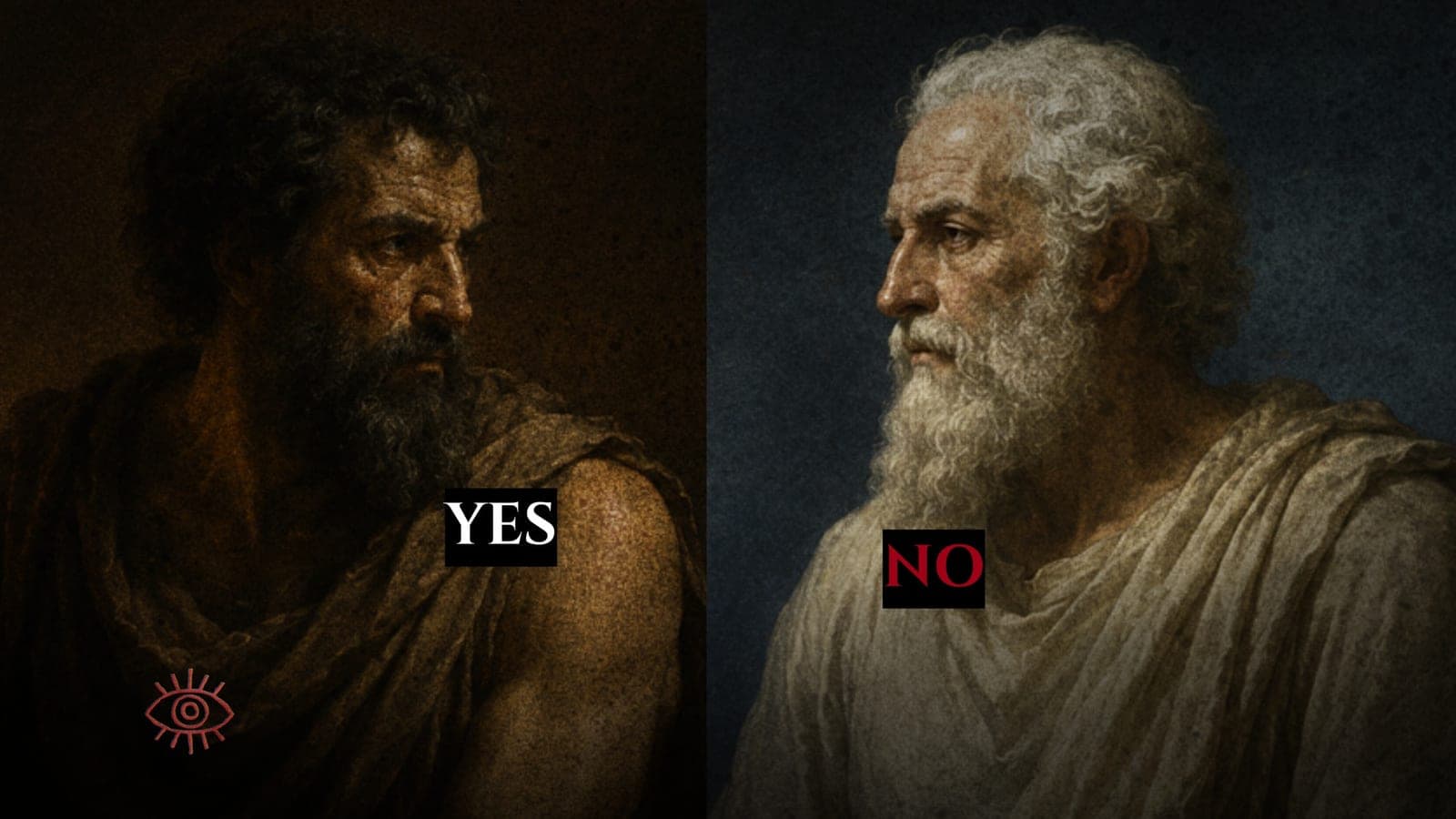
Sometime around 500 BC, a man carried a single roll of papyrus up the steps of the largest building in the Greek world.
The temple of Artemis at Ephesus was a forest of stone columns taller than any house, decades in the building, heavy with the offerings of kings, and counted by later ages among the seven wonders. Like the great sanctuaries of its day it doubled as a strongroom, a place where precious things could be laid up under the protection of the goddess. He had come to put his book away among the treasures, not to make an offering or ask a favour, where the ordinary citizens of Ephesus would have trouble reaching it, since he did not think they deserved to read it.
His name was Heraclitus. He was an aristocrat, born in Ephesus around 540 BC, who had handed his hereditary office to a younger brother out of something close to contempt. The book he was depositing argued that nothing in the world holds still, that everything anyone leans on is passing away beneath them. He left that message inside a mountain of white marble raised to outlast the centuries.
The book did not outlast anything. What survives is a little over a hundred broken sentences, quoted and puzzled over by other writers across twenty-five centuries. One of them has travelled better than the rest. You cannot step into the same river twice now turns up printed under photographs of mountain streams, a soft piece of consolation about how nothing lasts.
It was one half of a fight: at almost the same hour, on the coast of southern Italy, in a small city called Elea founded by refugees who had abandoned their homeland rather than live under Persian rule, a second man was writing a second book about the whole of things, and it said the reverse. Change is impossible. Unable to happen, and unable even to be thought without collapsing into nonsense. The flowing world the eyes report is a waking dream, and what is stands complete, motionless and entire, whatever the senses insist. His name was Parmenides.
Two or three generations earlier, in Miletus, a few men had begun asking what the world is made of, and answering water, or air, or a boundless something with no familiar qualities. Heraclitus and Parmenides asked a different thing and split over it: whether the world has a history at all, whether becoming belongs to reality or only to the creatures observing it. That is where metaphysics starts: the first recorded disagreement about the structure of the world rather than its ingredients, and it has never been closed. In the twentieth century much of physics came down on the side of the man who said nothing moves.
The Same Rivers, Ever Different Waters
The proverb is a sigh. The wording that survives is a piece of engineering. What Heraclitus seems to have written, in the version scholars trust most, is closer to this: upon those who step into the same rivers, there flow ever different waters.
The sentence does not say the river changes. It says the river is the same river, the one with a name and a place on the map, and that the water crossing the feet is never for one instant the same water. Sameness and difference are asserted of one thing, in one breath, and both are true. A river is not a thing that happens to be changing. A river is change. The only reason there is a river at all is that the water never stops pouring through it. Stop the flow and what remains is a pond, then a puddle, then bare stone. The permanence is built out of the flowing.
Once it is seen in the river it is meant to be seen everywhere. A whirlpool is an object anyone can point at and find again tomorrow, nothing but water passing through a shape. A body performs the same trick more slowly: almost none of the matter that made a person years ago remains, and the person is still recognisably the same one. Heraclitus is said to have called the sun new every day.
What keeps this from collapsing into churn is that the flowing runs by a rule, and the first face it shows is opposition. The road up and the road down, he said, are one and the same road, depending on where the walker stands. A physician cuts and burns his patient and is paid gladly for it, because the wounding and the healing are one event seen from two sides.
Then the image at the centre of everything he believed. There is a hidden fitting-together, he wrote, a connection that pulls in opposite directions at once, visible in the bow and in the lyre: a curved length of wood and a taut string forced against each other, the wood straining to spring back straight, the string straining to haul it further bent. The object keeps its shape and does its work only because those two pulls are locked in a standoff. Loosen the string and there is no bow and no lyre, only a stick and a limp cord on the ground. War, he wrote, is the father of all and the king of all, meaning conflict itself: a world brought to perfect peace would be no paradise but a slack string.
Something has to keep the score in a war held at a permanent draw, and Heraclitus believed he could hear it, one quiet ratio fixing how far the hot may advance before the cold pushes back. He called it, using the plainest word his language had, the account. This world-order, the same for all, was made by no god and no man, but it always was, and is, and will be, an ever-living fire, kindling in measures and going out in measures.
Parmenides Reasons His Way to a Motionless Sphere
Parmenides was born in Elea around 515 BC, into money and standing, and unlike the recluse of Ephesus he stayed a public man to the end, remembered as the city's lawgiver, whose code the Eleans swore an annual oath to keep.
His book is a poem, written in the rolling meter of the heroic epics, opening with a chariot ride: a young man carried as far as his longing can reach, to a gate where the paths of Night and Day divide, its key held by Justice, stern and much avenging. The doors swing back, and a goddess takes his hand and promises to teach him two things: the unshaken heart of truth, and the beliefs of mortals, in which there is no trust at all. The coldest argument in early Greek thought arrives dressed in the oldest clothes available.
There are two roads a searching mind can take, the goddess says. The first: it is, and it cannot not be. The second: it is not, and it must not be. She closes the second at once, and not by decree. What is not cannot be known, pointed out, or spoken of, because to think is always to think of something, and what is not is precisely not a something.
Try it: not empty space, a vast dark room with distances in it; not darkness, a quality anyone can picture; not zero, a perfectly good idea. Bring sheer nothing before the mind and hold it there, and the mind hands back a something every time.
There is a third road, walked by every human being without noticing. Ordinary belief holds that things come to be, meaning they first were not and then were, and pass away, meaning the reverse. The fire is out. Every was and every will be is stitched out of is-not, and if the second road is closed, any road running partly along it closes with it.
That leaves the senses in an impossible position, reporting nothing but the forbidden road, all day, without pause. Parmenides chose the argument over them: do not steer by the aimless eye and the ringing ear and the tongue, judge by reason alone. Every thinker since who has said something must be so whatever it looks like is walking on the road he opened.
Then she builds, with a single tool used over and over: nothing that is can have any not-being in it anywhere. So what is never came to be: it would have had to come from what is not, and nothing could mark one instant rather than another as its birthday. It cannot perish, by the same logic reversed. It has no parts, since parts need gaps and a gap is a stretch of not-being. It cannot change, because to become what it was not is to admit a was-not. It cannot move, because there is no empty elsewhere to move into. It has no past and no future, only an is, whole and all at once. Those are the signs of what is, gathered into an image that has haunted philosophy ever since: like the bulk of a well-rounded ball, poised evenly from the middle in every direction, everywhere equal to itself.
Zeno's Tortoise and Aristotle's Acorn
The Greek world laughed. Of course things move, of course there are many of them, just open your eyes. The reply came from a younger man of Elea named Zeno, who set out to show that the ordinary world of many things in motion falls apart in the hands of anyone who reasons about it carefully. For Achilles to overtake a tortoise given a head start, he must first reach the place where the tortoise began, by which time the tortoise has crawled a little further on, and so without end: the fastest runner in Greece never closes the gap. The paradox went unanswered, in any rigorous way, for more than two thousand years, until mathematicians worked out how an endless series of shrinking steps can add up to a finite distance.
Parmenides never denied that the world appears. The second half of his poem lays out a full cosmology of light and night, the best available account of the world mortals believe in, faulted at its first step: the moment it named two forms instead of one, it laced the world through with is-not. What he denied was that any of it is what is. Drawing that line between appearance and reality opened a crack in philosophy nobody has since managed to close.
Plato inherited the quarrel and refused to choose. As a young man he had studied with a follower of Heraclitus named Cratylus, who pushed the flowing world into its grave: you cannot step into the same river even once, since in the instant of stepping both have already become something else. Cratylus stopped speaking altogether and answered questions by moving one finger. Total flux destroys knowledge, which needs something stable to fasten onto. So Plato gave each Greek a world of his own. Down here, among perishable things, Heraclitus was right. Above, among the changeless Forms that only reasoning reaches, Parmenides was right, and every Form carries every mark the goddess gave to what is: ungenerated, deathless, motionless, complete. Then Plato broke his own father's ban to rescue ordinary speech, showing that not-being can also mean simple difference, that a horse fails to be a cow without being nothing at all.
Aristotle spent twenty years in Plato's school and came to think his teacher had cheated, explaining one puzzling world by inventing a second one to stand behind it. Parmenides had forced a choice between being and not-being with nothing in between. Being, Aristotle answered, is spoken of in many ways, and one state sits exactly in the gap: the potential. An acorn is not an oak, and not unrelated to one the way a stone is: it is potentially an oak. Change is the potential becoming actual, with no nothing smuggled in anywhere along the way. In every change something abides and something is gained, the bronze staying while the shape is new. That settlement held in the West for two thousand years, with being keeping the place of honour over becoming.
The Block Universe and a Letter Written in 1955
Then it came apart. Hegel opened his logic by showing that pure being, emptied of every quality, cannot be told apart from pure nothing, and that the truth of the pair is becoming; he said there was no thought of Heraclitus his own system had not absorbed. Nietzsche charged the opposing tradition with cowardice: philosophers worshipped a motionless being because they could not bear that everything they loved would die. The sciences changed sides too, finding the ground adrift, the species unfixed, the stars born and dying, the whole universe flying apart.
Then relativity handed the argument back to Parmenides: two observers moving differently through the world disagree, correctly, about which distant events happen at the same time, with no fact able to settle it between them, and there is no universal present sweeping everyone forward together. Without an objective now, the division of time into a vanished past, a present that alone exists, and a future not yet arrived turns out to depend on the observer rather than the world, the way a horizon looks like the edge of the earth from wherever a person stands.
The conclusion many physicists have drawn is called the block universe. All of space and all of time exist together as a single four-dimensional whole. Every moment that has been or will be is equally real, laid out permanently like towns along a road, there whether or not anyone drives through them. Picture a life as a strip of film with every frame already on the reel, then take away the lamp that seemed to light one frame at a time. The sense that a single moment is now, and glowing, is the one thing this physics cannot locate anywhere out in the world.
In the spring of 1955, near the end of his life, Einstein wrote to console the family of Michele Besso, his closest friend, who had just died. What he offered them was his physics. People like us, who believe in physics, he wrote, know that the division between past, present and future is only an illusion, however stubborn. Besso had not passed away, because in the reality physics describes, nothing passes.
The reply from the other side is every bit as stubborn: an illusion is an event, and there is no experience of time passing unless time passes for it to occur in. Physics turns a witness against itself here too. Heat spreads out and never gathers itself back, a cup shatters and never leaps whole into the hand, and the universe runs one way, from order toward disorder, without exception. If time were a frozen block, all directions alike, nature would not care so absolutely which way it runs. Serious physicists and philosophers argue exactly that today: the universe is an unfinished process whose future is not written anywhere yet.
Twenty-five centuries on, neither man has beaten the other. Reason, followed to its end, still freezes the world solid. Experience, as it is lived, still breaks the argument in the hand. The two instruments the mind uses to correct each other point in opposite directions on this one question, which is why the quarrel has outlived every settlement. Heraclitus and Parmenides were the first to give clear voice to the two things a person feels at once and cannot reconcile: that everything passes, and that nothing is ever lost.
Adapted from a longform audio episode on Heraclitus vs Parmenides, produced for Sleepy Philosophy Radio.
The Newsletter
New essays and episodes, delivered quietly.
By subscribing you consent to receiving occasional emails. Unsubscribe any time via the link in every email or at /unsubscribe.
Reflections
Loading...
Related Episodes
The Odyssey Explained: The Full Story and What It Really Means | For Sleep
A man is offered immortality by a goddess, and turns it down in order to go home. Beginning with that refusal, then entering the mystery of Homer and the firelit halls where singers carried the poem in memory, this longform episode follows Odysseus through the great trials of his return. It explores the dangerous power of names, the guest law, the cost of knowledge, the voices of the dead, and the fragile line between justice and revenge. Along the way, Penelope emerges as the wanderer's intellectual equal, while the scar, the bow, the orchard, and the bed rooted in a living olive tree reveal how recognition survives disguise and time. The oldest questions remain unchanged. What makes a finite life worth choosing, what do we owe a stranger, and can anyone return to a home altered by absence. The closing movement follows the Odyssey through Dante, Tennyson, and Joyce, showing how every age remakes the wanderer in its own image. The full episode is on YouTube and Spotify. Please listen only in safe, restful contexts.
On Plato and the Cave You Never Left | Complete Philosophy For Sleep
Forms, the Cave, the Republic & the Soul | 3 Hours
What if everything you have ever seen, touched, or believed was just a shadow on a wall? Plato shaped Western civilization for more than two thousand five hundred years. This episode traces his thought from its origins in the death of Socrates through the Theory of Forms, the Allegory of the Cave, the vision of the philosopher king in The Republic, the epistemology of recollection, Diotima's ladder of love in the Symposium, and the arguments for the immortality of the soul in the Phaedo. It also examines the political philosophy of The Republic, its controversial vision of a just society governed by those who have seen the Good, and the late dialogues where Plato turned a critical eye on his own theory of Forms. The full episode is on YouTube and Spotify. Please listen only in safe, restful contexts.
Why Pythagoras Believed Everything Was a Number | Philosophy for Sleep
The Ancient Wisdom of Pythagoras
Around 600 BCE, on the island of Samos, a man was born whose ideas would echo through mathematics, music, and mysticism for over two thousand years. Pythagoras left almost nothing in writing, and the boundary between the historical figure and the legend built around him remains impossible to draw with certainty. This episode traces what we can reconstruct: his travels through Egypt and Babylon, the secretive community he founded at Croton, the discovery that musical harmony follows mathematical ratios, and the doctrine of the transmigration of souls. We examine the Pythagorean way of life, the famous theorem and its deeper significance, the concept of cosmic harmony, and the violent end of the brotherhood. Pythagoras believed the universe was built on number, and that understanding its structure was a path to the divine. The full episode is on YouTube and Spotify. Please listen only in safe, restful contexts.