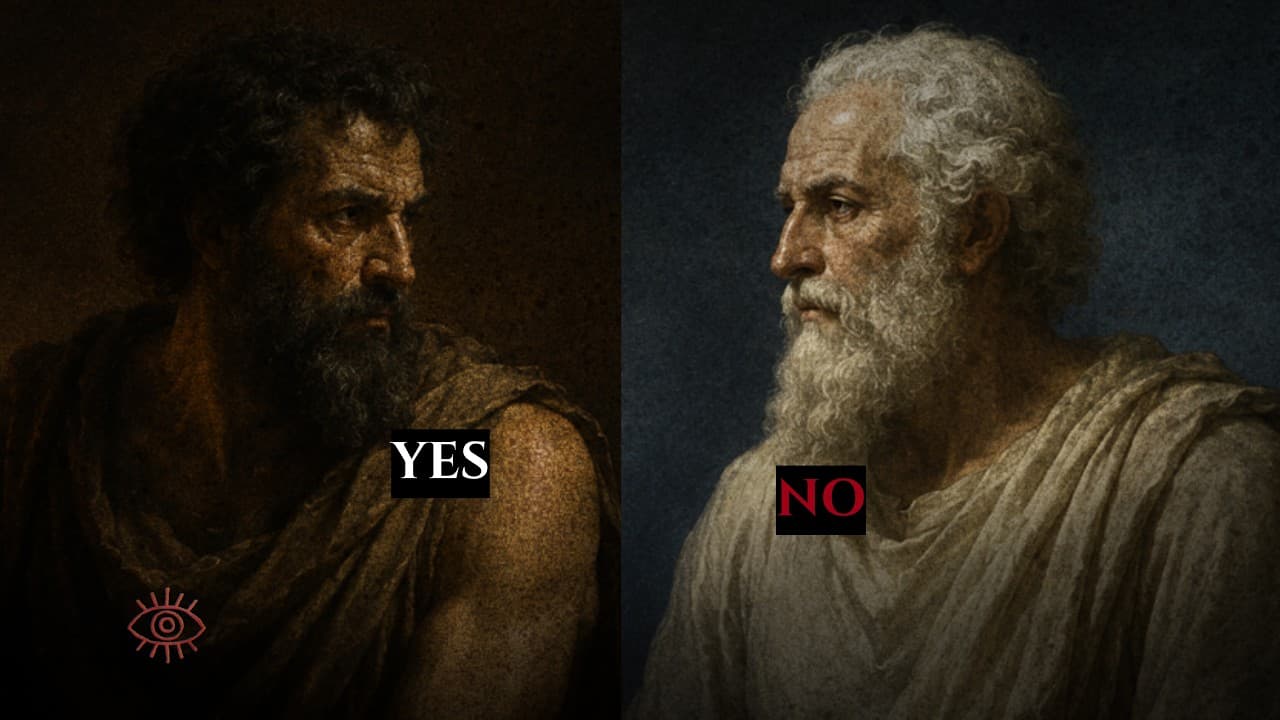
Is Change Real? | Heraclitus vs Parmenides | Philosophy for Sleep
Two Greeks at opposite edges of the ancient world gave opposite answers to the same question, and nearly every philosopher since has stood somewhere between them.
This episode follows the quarrel from its beginning. We meet Heraclitus, the lonely riddler of Ephesus who hid his one book in a temple and taught that everything flows, that the world is a river and a living fire held in tune by a hidden measure. We cross the sea to meet Parmenides, the calm lawgiver of the Greek west who used pure reason to argue that change is impossible, and that whatever truly is must stand motionless and one.
We follow their collision through the famous paradoxes of Zeno, through Plato's daring attempt to give each thinker a world of his own, through Aristotle's quieter answer, and into our own age, where the same argument lives on in physics and in the felt passing of time. It is a walk through the two deepest things we feel: that everything changes, and that nothing is ever truly lost.
The full episode is on YouTube and Spotify. Please listen only in safe, restful contexts.
Enjoying the episode?
Occasional letters on philosophy, reading, and the examined life. No spam, ever.
By subscribing you consent to receiving occasional emails. Unsubscribe any time via the link in every email or at /unsubscribe.
Timestamps
- 0:00:00Chapter 1: The Riddler
- 0:12:58Chapter 2: The Man from the West
- 0:21:03Chapter 3: Into the Same River
- 0:26:39Chapter 4: The Bow and the Lyre
- 0:35:38Chapter 5: The Hidden Account
- 0:47:03Chapter 6: The Gates of Night and Day
- 0:53:18Chapter 7: What Cannot Not Be
- 1:05:20Chapter 8: The Well-Rounded Sphere
- 1:14:14Chapter 9: The World of Seeming
- 1:19:55Chapter 10: Achilles and the Tortoise
- 1:28:20Chapter 11: Becoming Against Being
- 1:34:51Chapter 12: The Two Worlds
- 1:47:51Chapter 13: How Change Was Saved
- 1:55:01Chapter 14: The World Flows Again
- 2:04:43Chapter 15: The Stubborn Illusion
For the record
Full Transcript
Chapter 1: The Riddler
Sometime around the year five hundred before the common era, in the largest and most famous temple in the Greek world, a man climbs the marble steps with a single roll of papyrus held against his chest. He has not come to make an offering, or to ask the goddess for a favor, or to lose himself in the crowds that fill the great courts on a festival day. He has come to put something away. In his hands is his only book, the one work he will ever write, and he means to leave it here, in the keeping of the temple, where the ordinary people of his city will not easily find it or read it. He has written, he believes, the truth about everything, the single hidden order that runs through the whole of the world. And he has written it in language so dense, so folded and knotted, that almost no one who unrolls it will understand a word. This is on purpose. He does not think most people deserve to understand.
There is a strangeness here worth stopping over. The man laying his words inside that temple is about to tell the world that nothing in it ever holds still, that everything we lean on is quietly and constantly passing away beneath us. And he is entrusting that message to the most solid thing his civilization knew how to build, a mountain of white marble raised to outlast the centuries. The philosopher of endless change, hiding his book in a monument to permanence. He wrote for all time, and hid from his own. He offered what he took to be the deepest truth there is, and made certain that almost no one alive could reach it.
His name was Heraclitus, and the city was Ephesus, on the coast of what we now call Turkey, in the Greek world of the eastern Aegean. The temple was the temple of the goddess Artemis, so vast and so famous that later ages counted it among the seven wonders of the world. It was a forest of stone columns taller than any house, a sanctuary decades in the building and heavy with the offerings of kings, and like the great temples of its day it served the city as a kind of treasury and strongroom, a place where precious things could be laid up under the protection of the goddess. It was there, among the treasures, that Heraclitus chose to leave his book. The book itself has not survived. What we have instead is a little over a hundred broken sentences, quoted and puzzled over and fought about by other writers across the twenty-five centuries since. Those fragments are enough. They hold one of the two great answers that the very beginning of Western thought gave to a single enormous question. And this whole long night is the story of that question, and of the other man, far away, who gave the opposite answer.
Because at almost the same time, a world to the west, in a small Greek town on the shin of Italy, a second man was composing a second book, also about the whole of things, and it said very nearly the reverse of everything Heraclitus held. Where Heraclitus saw a world of ceaseless change, this other man argued, with a cold and startling rigor, that change is impossible. Not merely rare, not merely hidden, but impossible, unable even to be thought without falling into nonsense. The flowing world our eyes report to us, he would say, is a kind of waking dream. What truly is can never move, never begin, never end. His name was Parmenides, and his town was Elea. The two men may never have met. It is not certain that either one read a single line the other wrote. And yet between them they drove two stakes into the ground at the opposite ends of a question so basic that every thinker who came after would have to stand somewhere in the field between them. Is the deepest truth of things change, or is it permanence? Is the world forever becoming something it was not, or is all that becoming a veil laid over something that never alters at all?
To understand how two intelligent men could look at the same world and see such opposite things, we have to step back a little further still, to the strange new habit of mind that made both of them possible. Only two or three generations earlier, in another Ionian city, a city called Miletus a little to the south, a few men had begun to ask a genuinely new kind of question. They stopped asking which god had made the world, or what the gods wanted from us, and started asking instead what the world is actually made of. The first of them, a man named Thales, is said to have answered that everything, at bottom, is water, that beneath all the variety of things there lies a single element out of which they are all somehow formed. His successor, Anaximander, found that too simple, and proposed instead a vast boundless something, no familiar substance at all, out of which all the opposites separate out and into which they dissolve again. A third, Anaximenes, said the underlying stuff was air, thinning into fire and thickening into wind and cloud and stone. Their particular answers hardly matter now. What mattered, what changed the world, was the shape of the question. They had begun to suspect that behind the endless shifting crowd of things there might be one nature, one principle, and that the human mind, by thinking hard and carefully, might actually find it.
That is the inheritance both of our two men received. The question had been set. Behind the many, look for the one. And Heraclitus and Parmenides took that question and gave it two answers so opposed that philosophy has been arguing about them ever since.
Heraclitus was born in Ephesus, most likely around the year five hundred and forty before the common era, which is to say into the generation just after those first Milesian thinkers. Ephesus was a rich and powerful port, one of the great cities of the Greek east, and Heraclitus was born near the top of it. His family was among the oldest and most distinguished in the city, and it held an ancient hereditary office, a kind of priest-kingship left over from older days, a dignity passed down from eldest son to eldest son. Heraclitus was that eldest son. The honor was his by birth. And he gave it away. He handed the office to his younger brother and stepped out of public life entirely, and he did it, as far as we can tell, out of something close to contempt. He did not want to rule the people of Ephesus. He did not think much of them at all.
This contempt for the crowd runs through everything the ancients remembered about him. Most people, he thought, were fools, moving through the world without once troubling to understand it, gorging and breeding and grabbing like cattle in a field. Even the poets and the famous teachers everyone admired, even the men reputed wisest in all of Greece, Heraclitus dismissed as mere collectors of scraps of information who had never once understood a single real thing. When the Ephesians drove into exile the one man among them he actually respected, a friend of his, he is supposed to have said that the grown men of Ephesus would do well to hang themselves, every one, and leave the city to the children. He would rather, the story goes, play at dice with the boys in the temple precinct than sit in council with the important men of his city.
It helps to know what was happening around him. The cities of Ionia, Ephesus among them, had once been the most brilliant in the whole Greek world, the very places where this new philosophy had been born and much else besides. But in Heraclitus's lifetime they had lost their freedom. They had fallen first under the kings of Lydia, next door, and then under the far greater power of the Persian empire to the east, whose governors and client rulers now stood over the old Greek towns. And the cities were torn from within as well, the ancient aristocratic families like his own struggling against ambitious strongmen and against a restless common people who wanted their share of the power. When Heraclitus was a grown man, the Ionian cities rose together in a great revolt against the Persian king, and were beaten, and crushed. Miletus itself, the birthplace of philosophy only two generations before, was stormed and burned, and its people were killed or carried off into slavery. A man of the old ruling order, watching the wisest cities of the Greek world tear at one another and then break against a foreign empire, might well conclude that the many could not be trusted with their own affairs, let alone with the truth.
So he withdrew. He gave up the office, he turned his back on the assembly and the marketplace, and he lived more and more alone. In his last years, the tradition says, he left the city altogether and went up into the mountains, living on wild plants and whatever the hillsides gave him. And in his solitude he wrote his one book, the compressed and difficult thing he would leave in the temple, a book unlike anything written before it. Where the Milesians had written plain accounts of how the world worked, Heraclitus wrote in flashes, in short hard sayings that turn back on themselves like riddles, sentences you can read twenty times and still feel closing just as you think you have opened them. He wrote, it seems, the way an oracle speaks, in signs that both reveal and conceal at once. For this the ancient world gave him a nickname that stuck to him forever. They called him Heraclitus the Obscure, the dark one, the man you cannot quite make out.
Later ages added a second image. Setting him beside another early philosopher who was said to laugh at the follies of mankind, they made Heraclitus the one who wept at them, the weeping philosopher, forever mourning the blindness of the human race. It is almost certainly a later invention, a neat pairing dreamed up centuries after his death. But like the first nickname it caught something true. Here was a proud, severe, and desperately lonely man, convinced that he alone in all his city had woken up, and that everyone around him was sleepwalking through a world whose real nature only he had seen.
Even his death came down to us as a riddle, and we should hold this last story most lightly of all, because it has the too-perfect shape of a tale invented after the fact. He fell ill, they said, with a disease that swelled the body with fluid. And trusting his own strange wisdom over any physician, he tried to cure himself by a method no one else would have thought of, burying himself in the warm dung of cattle in the hope that the heat would draw the water out of him. It did not work. He died there, so the story goes, undone in the end by his own riddling cleverness, as obscure in his dying as in his living.
That is the man. What did he actually see, this figure who believed that he alone had understood the world, while everyone around him lived in a kind of blindness? What was the hidden order he thought he had found, the order he wrote down in the dark and left in the temple for whoever might one day be worthy of it? That is the work of the chapters ahead. But we cannot yet go straight to his answer. First we have to cross the sea to the west, to the young Greek towns on the coast of Italy, and meet the other man. Because while Heraclitus was withdrawing into his mountains, a very different kind of thinker, calm where Heraclitus was fierce, a lawgiver where Heraclitus was a hermit, was quietly preparing to build, out of the very same inheritance, the exact and total opposite of everything Heraclitus believed.
Chapter 2: The Man from the West
Parmenides is the still point at the center of this whole story, and in some ways its strangest figure, because he is the man who used reason, and reason alone, to prove a conclusion that no one, himself included, could ever actually live by. To meet him, we have to leave the crowded and quarrelsome cities of the Greek east, where we found the first man, and sail west, past Greece itself, all the way to the far edge of the Greek world.
In the century before Parmenides was born, bands of Greeks had been sailing out in every direction to plant new cities on foreign coasts, and among them was a group of refugees from an Ionian town called Phocaea, who chose to abandon their homeland rather than live under the Persian advance that was swallowing the Greek east. They sailed west, and after long wanderings they came to rest on the coast of southern Italy, where they founded a new city and called it Elea. It was never a large or powerful place. But it would lend its name to one of the most influential currents of thought in the history of the world, the school we still call the Eleatics, and the founder of that school was Parmenides.
It is worth picturing that western world for a moment, because it was very different from the one we have just left. While the Greek cities of the east lay under the shadow of Persia, the Greek colonies of the west were young and rich and restless with new ideas. Southern Italy and Sicily were so thick with thriving Greek towns that the whole region came to be called Great Greece. And this western world had become, above all, the home of the followers of Pythagoras, who had left the eastern island of Samos a generation earlier and scattered into these Italian cities. They gathered in close brotherhoods, secretive and severe, devoted to mathematics and music and to the belief that the soul never dies but passes from one body to the next. They taught that the deepest truths of the world are not things you can touch or see but numbers and ratios, hidden patterns that only the mind can reach. It was into that atmosphere, thoughtful and mystical and half in love with the invisible, that Parmenides was born.
He was born in Elea, most likely around the year five hundred and fifteen before the common era, into a wealthy and well-placed family. So both of our men began life as aristocrats, born to comfort and to standing in their cities. But where the first turned his rank into a reason for withdrawal, Parmenides seems to have stayed a respected public man to the end. The most telling thing the tradition remembers about his life among his fellow citizens is that he wrote the laws of Elea, a code so admired that, we are told, the Eleans swore an oath every year to go on living by the laws that Parmenides had given them. Whether or not that detail is exactly true, it tells us how he was regarded. Not as a hermit or a raving oracle, but as a wise and trusted lawgiver, the sort of man to whom a city hands its constitution.
Two older influences shaped him, and the tradition names them both. The first was a wandering poet and thinker named Xenophanes, who had come, like the founders of Elea, out of the Ionian east into the Greek west, and who had spent a long life attacking the ordinary religion of the Greeks. Xenophanes ridiculed the idea that the gods are born, and wear clothes, and steal and lie and quarrel like the people in the old poems. If horses and oxen had hands and could draw, he said, they would draw their gods as horses and oxen. Behind that mockery lay a positive vision, and it is the part that matters here. Xenophanes glimpsed, beyond the crowd of humanlike gods, a single god, greatest of all, in no way like a mortal in body or in mind, who stays forever in one place without ever moving, and who sets all things trembling by the pure thought of his mind alone. In that one unmoving god you can already hear, faint and far off, the first note of what Parmenides would build into an entire philosophy.
The second influence, the tradition says, was a man named Ameinias, a follower of Pythagoras, who turned the young Parmenides away from the life of politics and pleasure and toward a life of stillness and contemplation, of sitting quietly and thinking hard. So Parmenides stood where several streams of the early Greek mind ran together. The fierce religious criticism of Xenophanes on one side, the number-mysticism and the contemplative discipline of the Pythagoreans on the other. And out of that meeting he made something wholly new.
Like the first man, Parmenides wrote a single work, and like his, it survives only in fragments. But the two books could not be less alike. Where Heraclitus wrote in dark and broken sentences, Parmenides wrote in verse, in the grand old rolling meter of Homer and Hesiod, the meter of heroic epic. It is a strange choice, and worth holding onto. Here is the most rigorous chain of logical argument anyone in Greece had yet forged, arguably the birth of pure step-by-step reasoning itself, and its author chose to deliver it not as a dry proof but as a poem, and not merely as a poem but as a religious revelation, the story of a young man carried up out of the world to the house of a goddess who tells him the truth. We will make that journey with him in a later chapter. For now, hold onto the oddness of the pairing. The coldest logic in all of early Greek thought, wrapped in the warm and ancient clothes of myth.
One more story fixes Parmenides's place in the memory of those who came after. Generations later, the philosopher Plato wrote an entire dialogue in which an aged Parmenides, visiting Athens as an old man of around sixty-five, meets a very young Socrates and gently takes his ideas apart. The dates do not really work. If any such meeting happened at all, it strains the calendar close to breaking, and many scholars think Plato simply imagined it. But Plato did not arrange such scenes carelessly. To sit Socrates himself, the wisest figure of Plato's own tradition, at the feet of old Parmenides as a nervous beginner, was Plato's way of confessing a debt. Parmenides was the one among the early thinkers whom Plato treated not as a rung on a ladder but as a kind of father, a formidable ancestor whose arguments had to be faced and answered before philosophy could take another step. Near the end of our night together, we will see just how hard Plato found that answer to give.
So now we have both of our men. In the east, the fierce and solitary riddler, writing in the dark that nothing ever holds still. In the west, the calm lawgiver and seer, preparing to argue that nothing moves at all, that change itself is a kind of dream from which the mind can wake. Two aristocrats, two single books, two opposite readings of the one truth hidden behind the many. It is time now to stop circling them and to hear what each of them actually said. And we begin back in the east, with the one idea of Heraclitus that nearly everyone has heard, and that nearly everyone gets wrong.
Chapter 3: Into the Same River
Everyone has heard the saying, even people who could not tell you who first said it, or when. You cannot step into the same river twice. It has become a kind of proverb, the sort of line printed beneath a photograph of a mountain stream, and in becoming a proverb it has lost nearly everything that made it worth saying. So let us take it back from the greeting cards and set it down again where Heraclitus left it, because folded inside this one small image is the whole of his vision of the world.
The words that actually survive are stranger and more precise than the proverb they became. What Heraclitus seems to have written, in the version scholars trust most, is closer to this. Upon those who step into the same rivers, there flow ever different waters. Notice what that sentence quietly does. It does not simply say the river changes. It says the river stays the same, that it is the same river you are stepping into, and yet the water moving over your feet is not for one single instant the same water. The sameness and the difference are both true at once, and they are true of the very same thing, in the very same breath.
This is the key that unlocks the man, and it is almost the reverse of the way the proverb is usually heard. People take "you cannot step into the same river twice" as a lament, a soft sigh about how everything slips away from us, how nothing lasts, how sad it all is. But Heraclitus was not sighing. He was pointing at something exact, and even a little thrilling. A river is not a thing that happens to be changing. A river is change. Its entire existence, the only reason there is a river there at all, is that the water never stops pouring through it. Stop the flow, and you do not get a more lasting river. You get no river. You get a pond, and then a puddle, and then bare stone. The river keeps its shape, its name, its place on the map, its whole identity as this river and no other, precisely by never once keeping its water. Permanence and flow are not enemies here. The permanence is built out of the flow.
And once you have seen it in the river, Heraclitus wants you to see it absolutely everywhere, because for him the river is not one charming special case. It is the plain truth about every single thing there is. The whirlpool turning in the current looks like an object. You could point at it, and name it, and come back tomorrow to find it still there. And it is nothing at all but water passing through a shape, a pattern that holds while its substance races on and is gone. Your own body is the same. The person resting here now is not made of the matter that made you a few years ago. Almost all of it has been swapped out, eaten and breathed and shed and rebuilt, and yet here you still are, recognizably yourself, a pattern that keeps its form while the material of it flows through and is replaced. A wave that crosses an ocean without carrying a single drop of water with it. A cloud, a flowing crowd, a living creature, a city, a family. What look to us like solid, settled, finished things are, when you look harder at them, far more like standing waves, shapes that last only because something is forever streaming through them.
Heraclitus pushed this thought further than most of us find comfortable. If everything is flowing, always, all the way down to the bottom, then the tidy world of separate and stable objects, the world our very language is built to name and hold still, begins to look like a convenience rather than the truth. We say "the sun" as though it were one settled object hanging up there year after year, and Heraclitus is supposed to have said, no, the sun is new every day. Later thinkers would take this river of his and push it until it swallowed everything, until it seemed you could not step into the same river even once, because in the time it takes to speak of it, the river and the one who steps have both already become something else. Heraclitus himself may not have gone quite so far. But he had opened the door, and others would walk through it.
The core of it, though, is already here, in the plain image of a person standing in moving water. The world is not a collection of things that now and then happen to change. It is a process that now and then, briefly, takes on the look of a thing. That is the ground floor of everything he believed. But if that were the whole of it, Heraclitus would be merely the philosopher of flux, the man of the flowing river and nothing more, and he was a great deal more than that. Because the astonishing part, the part that rescues his world from being pure formless chaos, is that all this restless change turns out to be exactly ordered. It runs by a hidden rule. And the first face that rule shows us is a strange one. It is that the world is woven, everywhere and at every level, out of opposites at war with each other.
Chapter 4: The Bow and the Lyre
We ended in a puzzle. If the world of Heraclitus is pure flow, forever pouring out of one state and into another, what keeps it from collapsing into chaos, a churn of change signifying nothing? His answer is among the most original ideas in all of early philosophy, and among the hardest to hold steady in the mind, because it asks us to think two contradictory things at the same moment and to call the result not confusion but truth. His answer is that the world is held together by opposition itself. That the things we take to be opposites, and treat as enemies, are secretly, at the root, one.
He put it, as he put everything, in riddles. The road up and the road down, he said, are one and the same. And of course they are. There is a single track cut into the mountainside, and whether it is the road up or the road down depends entirely on where you happen to be standing and which way your feet are pointed. The path itself never changes. Up and down, two words we keep at opposite ends of our imagination, turn out to name one thing seen from two sides. He collected such cases the way another man might collect coins. The same seawater, he said, is at once the purest thing there is and the foulest. To the fish it is clean, drinkable, the very medium of life. To a man dying of thirst on a raft it is poison. So which is it, pure or foul, life or death? Both, at once, depending. The water has not got two natures. It has one nature, and the opposites live inside it together.
Day and night. Winter and summer. Hunger and fullness. Sickness and health. Waking and sleeping. In each pair, ordinary sense sees two combatants. Heraclitus saw one thing wearing two faces, and each face meaningless without the other. There is no meaning to the word well for a creature that could never be sick. You know your health only as health, only feel it as a gift, against the remembered background of illness. The same single life carries you from one to the other and back, and it is one continuous life that holds them both. The opposites do not merely sit side by side. They need each other. They give each other meaning. Take one away and its partner silently vanishes along with it.
He was drawn especially to the cases where we call one and the same act by two opposite names, depending only on where we happen to stand. Think of the surgeon, or the physician of his own day, who cuts into the body and burns the flesh and causes real agony, and then asks to be paid for the privilege. By any ordinary reckoning, to cut and burn a person is to do them grievous harm. And yet we hand over the fee gladly, because the very act that is torture is also cure. The wounding and the healing are not two separate events. They are one event, seen from two sides. Or picture a circle drawn on the ground. Where does it begin, and where does it end? The beginning and the end are the same point. On the rim of a circle, start and finish meet and are one. The opposites we are so certain of, Heraclitus is telling us, are all like that. It is only our narrow standing-place, each of us peering at the world from a single spot, that splits it into good and bad, just and unjust, up and down. To a wider view, to what he called the view of the god who sees the whole at once, all things are beautiful and good and one, and it is only human beings, each stuck at a single point, who carve the seamless world into warring pairs.
Now, this could all sound like a clever man pointing out that hot and cold are relative, a play on words and nothing more. But Heraclitus meant something far stronger and far stranger than that. He meant that the opposition itself, the live tension between the two poles, is the very thing that brings anything into being and holds it there. And to say so he reached for the image that gives this chapter its name. There is, he said, a hidden fitting-together, a connection that does its work by pulling in opposite directions at once, and you can see it in the bow and in the lyre.
Sit with that a moment, because it is the center of his thought. A bow and a lyre are built the same way. You take a curved length of wood and a taut string, and you force them against each other. The wood strains its whole life to spring back straight. The string strains its whole life to haul the wood further bent. And the object, the bow, the lyre, exists at all, keeps its shape, does its work, only because those two opposed pulls are locked forever in a standoff. Loosen the string and there is no bow and no lyre, only a stick and a limp cord lying on the ground. The arrow flies, the music sounds, precisely out of the tension. The thing is not held together in spite of the opposed forces straining inside it. It is held together by them. Its very being is a war that never ends, a war so evenly matched that from the outside it looks exactly like rest.
This is why he said the hidden connection is stronger and better than the obvious one. The unity of the bow is not in the wood, and not in the string, but in the invisible tension strung between them, and that, he believed, is the deep pattern of the entire world. Everywhere you look, the stability of a thing is a balance of opposed pressures. The apparent stillness of anything settled is really a war being held, moment by moment, at a perfect draw.
And so Heraclitus said the thing that shocked the ancient world and has kept some of its power to unsettle us. War, he wrote, is the father of all and the king of all. Not war meaning one more human catastrophe among the many. War meaning conflict itself, opposition, strife, named as the source and the parent of everything that is. Most people dream of an end to all strife, a world brought at last to perfect peace and rest. Heraclitus thought such a world would be no paradise. It would be nothing whatsoever. Take away the tension and you do not arrive at harmony. You arrive at the slack string, the flat calm, the drying puddle, the end of all things. Strife, he even dared to say, is justice. The ceaseless pushing back of opposite against opposite is not a flaw in the world that some better arrangement would cure. It is the very thing that holds the world upright, the deepest fairness there is, the justice of a balance eternally kept and eternally restored.
You can see now how this locks together with the flowing river we spoke of before. The reason nothing ever holds still is that everything is a tension of opposites, and a tension is a living thing, always tipping one way and being hauled back the other, the hot cooling and the cold warming, the living dying and their dying feeding new life, in an exchange that never pauses and yet, taken as a whole, never loses its balance. Change is not the enemy of order after all. The swing of opposite into opposite is the way the order stays alive.
But if the world is a perpetual war of opposites held at a perfect draw, then something is keeping the score. There is a measure running through it, a rule that fixes how far the hot may advance before the cold must push it back, a proportion that survives unbroken through every exchange. And Heraclitus believed he could hear it. Underneath the roar of the world's unending conflict, he heard a single quiet ratio holding the whole of it in tune. He called it, using the plainest word his language had, simply the account. It was, he thought, the one thing truly worth knowing. And it was the one thing that almost no one who had ever lived had managed to hear.
Chapter 5: The Hidden Account
This is the deepest and the most difficult of Heraclitus's ideas, the one the other two were leading toward all along, and it turns on a single word that his language could carry but ours cannot quite hold. The word he used means, all at the same time, a word, a speech, a story, an account, a reckoning, a ratio, a measure, a law. We have no one word that does all of that work, so throughout this night we will simply call it the account. It is the hidden order that runs through the whole of the world, the measure that governs every change and every exchange, the single law that everything obeys. And it is also, at the very same time, the truth that a wise person would speak if they ever managed to understand that order. The account is both the pattern in the world and the true description of the pattern. That double meaning is not sloppiness. For Heraclitus it was the whole point. The order out there in things and the order in a mind that has finally woken up are, at the deepest level, the same order.
He opened his book with it, and the opening is one of the most arresting things in early philosophy. This account, he wrote, holds true forever, and yet people fail to understand it, both before they have heard it and after they have heard it for the first time. Everything comes to pass in accordance with this account, and still they are like people with no experience of it, even when they meet the very words and deeds through which he is trying to explain it. Read that slowly. He is saying that the truth is right there, in front of everyone, all the time, built into every event, and that people walk straight through it their whole lives without once seeing it. It is not hidden in some far-off place. It is hidden in plain sight, which is the hardest place to look.
This is where his famous scorn for ordinary people comes from, and it is less snobbery than diagnosis. Most human beings, he thought, live as though they were asleep. The waking, he said, have one single world in common, but each sleeper turns aside into a private world of his own. A dreamer is shut inside his own head, and the images there belong to him alone; only when you wake do you step into the one shared world that everyone awake inhabits together. And that, said Heraclitus, is exactly the condition of most people even when their eyes are open. They live shut inside their private assumptions, their small routines, their unexamined opinions, each in a little closed dream, never waking up into the one real, common, ordered world that the account describes. They hear it and do not understand. They look and do not see. Nature, he said, in one of the most beautiful of all his sayings, loves to hide. The truth of things does not lie on the surface waiting to be picked up. It withdraws, it conceals itself, it has to be hunted and dug for, and almost no one is willing to do the digging.
He was fierce, too, about not wanting the credit. Do not listen to me, he said, but to the account. It is not my private cleverness I am offering you. Listen instead to the law itself, and when you have heard it, it is wise to agree that all things are one. That last phrase is the summit of his whole philosophy. All things are one. Beneath the endless flowing, beneath the war of opposites, beneath the dazzling variety of the world, there is a single order, a single account, and to understand it is to see that everything is bound together into one.
And to make that order visible, to give it a face, Heraclitus reached for the one thing in the world that shows the truth most plainly. He reached for fire. It is easy to misread this and think he meant fire was the basic building block of everything, the way an earlier thinker had said everything was water. But that is not quite it. Fire mattered to Heraclitus because a fire is the clearest thing there is that exists only as a process. A flame is never a settled object. It endures only by consuming, by turning wood and oil into light and smoke and ash, forever taking in new fuel and giving off what it has burned. It keeps its shape, the shape of a flame, only by never keeping its substance. It is change made visible. And yet, and this is the other half, a fire is also measure made visible. It burns at a certain rate, in fixed proportions, giving out just so much heat for just so much fuel. It is at once the most changeable thing you can point to and the most exactly ordered.
So Heraclitus said the thing that gathers his whole vision into a single sentence. This world-order, he wrote, the same for all, was made by no god and no man, but it always was, and is, and will be, an ever-living fire, kindling in measures and going out in measures. Hear everything that is packed into that. The world was made by no god and no man. It has no beginning, no creator, no moment of birth. It always was and always will be, burning. It is alive, an ever-living fire. And it burns in measures, kindling and dying down according to fixed proportions, so that for all its restless blazing it never once breaks its own law. The whole of things is like a living flame, always burning, never for an instant the same, and yet forever holding its measure. All the world's exchanges run by this rule, he said, the way goods are traded for gold and gold again for goods, everything turning into everything else at a fixed and honest rate, nothing ever lost from the account, nothing ever added.
If all of this begins to sound like religion, that is because Heraclitus stood right on the border between the old world of the gods and a new world of natural law, with a foot planted in each. The account governs everything, steers everything, the way a mind steers the body it lives in. Wisdom, he said, is really only one thing: to grasp the single plan by which all things are steered through all things. There is one intelligence running the whole show, and the flashing fire of the world is guided by it the way a hand guides a tool, so that even the lightning bolt, that sudden blaze that splits the night sky, is the account making itself visible for an instant, steering the whole universe as it strikes. This is as close as he ever comes to speaking of a god. But it is a strange sort of god, and he knew it. The one wise thing, he said, is both unwilling and willing to be called by the name of Zeus. Unwilling, because it is nothing at all like the Zeus of the old stories, the jealous, thundering figure on the mountaintop who schemes and rages and can be flattered with sacrifices. Willing, because it truly is the highest power there is, the law above every law, the intelligence that holds the whole of things in order. What Heraclitus offers, in place of the crowded heaven of the poets, is a single faceless wisdom, everywhere at once, that does not sit above the burning world barking commands down at it, but simply is the orderliness of the fire itself. The reason living inside the flames.
And then he did the thing that makes him more than a student of the sky, the thing that reaches across the centuries and touches us where we lie. He turned the account inward. The same law that governs the flaming world, he said, governs the soul. You could travel every road there is, he wrote, and you would never find the boundaries of the soul, so deep is the account it contains. The self, too, is measureless, ordered, a piece of the same hidden law. And so the way to knowledge is not only to study the heavens. It is to look inward. I went in search of myself, he said, in four plain words that no philosopher before him had thought to say. To find the account that runs through all things, look into your own depths, because the same measure is written there. He believed the soul was at its best when it was dry and warm and bright, most like the fire it came from, and that a soul grown wet and heavy, dulled by drink or sunk in appetite, loses its clarity and its measure, the way a drunk man has to be led home, not knowing where he is going, his soul gone damp. And he said the hardest and most memorable thing of all about a human life. A person's character, he wrote, is their fate. Not the stars, not the gods, not blind chance, but the settled pattern of your own soul is the thing that shapes your destiny. What happens to you, in the end, is bound up with what you are.
So now the whole vision stands before us, complete. A world that flows without rest. A world woven at every point out of opposites in tension. A world burning like a measured, ever-living fire. And running through all of it, one hidden account, one law, that is at once the order of the cosmos and the deepest truth of the self, so that to know the world and to know yourself turn out to be the same act. It is a vision of unity, and Heraclitus reached it by plunging straight into the many and the changing, into the flux and the war, and finding, down at the bottom of all that motion, that everything is one.
And here is the thing that should make us sit up, the thing that turns two separate thinkers into a single quarrel. Far to the west, at almost the same hour of the world, another man was about to arrive at that very same conclusion, that all things are one, by traveling the exact opposite road. Where Heraclitus found the one by diving headlong into change, Parmenides would find it by proving that change is impossible and that nothing moves at all. Two roads to the same word, unity, pointing in opposite directions across the whole of the Greek world. It is time now to take the second road, and to climb, in a chariot drawn by the daughters of the Sun, to the gates where the paths of night and day divide.
Chapter 6: The Gates of Night and Day
Parmenides did not begin by arguing. That is the first surprising thing about him, and it never stops being surprising, because what he is about to give us is the most relentless piece of logical reasoning that had ever been set down in Greek, a chain of deduction as hard and cold as iron. And he opens it with a dream. He opens with a chariot ride into the sky, to the house of a goddess, told in the grand old verse of the heroic poems. The coldest thought in early philosophy arrives wrapped in the warmest and most ancient of forms, a religious vision, a revelation. We should let ourselves take that ride before we ask what it means.
The poem begins with its narrator, a young man, being carried. Mares draw his chariot, straining, carrying him as far as his longing could ever reach, and maidens lead the way. They are the daughters of the Sun, and they have just left the house of Night, throwing back their veils from their faces as they hurry toward the light. The chariot moves faster and faster, the axle glowing white-hot in its sockets and screaming like a pipe as the wheels spin at either end, and still the daughters of the Sun urge it on, up out of the world of ordinary day, toward something the young man has never seen.
They come at last to a great gate. It is the gate where the paths of Night and Day divide from each other, a towering doorway of stone set with a lintel above and a threshold below, closed with high doors. And the key to those doors is held by a goddess, Justice herself, stern and much-avenging, who decides what may pass and what may not. The daughters of the Sun go to her and coax her with soft and knowing words, and she is persuaded. She swings the great doors back, opening a yawning gap where they had been, and the chariot drives straight through, onto the wide road that lies beyond.
And there, past the gate, a goddess receives the young man kindly. She takes his right hand in hers, the old gesture of welcome and of trust, and she begins to speak. She tells him he has come by no evil fate but by right, carried far from the beaten track that other human beings tread. And she promises to teach him two things, two things he must learn together. He will learn the unshaken heart of truth, the truth that carries its own conviction and cannot be moved. And he will learn, as well, the beliefs of mortals, the opinions of ordinary people, in which there is no true trust at all. Both, she says. The truth, and the great tissue of falsehood that human beings live inside. You must come to know them both.
Now, what are we to make of all this? Later readers have argued about it for centuries. Some say the myth is only a convention, the expected costume of the age, the way any serious poem in that tradition had to dress itself, and that we should strip it off and get to the argument underneath. But that is too quick, because the story is shaped, in every detail, to fit the philosophy it introduces. Look at what the journey actually is. It is a passage out of the ordinary human world, the world of day and night and the senses, up and away from the road that all other people walk, to a place beyond, where truth is revealed by a power greater than any human mind. The young man does not reason his way to the goddess. He is carried there, lifted out of the world of appearances, and given the truth as a gift from above. The imagery is telling us, before a single argument has been made, that the truth Parmenides is about to reveal does not come from looking harder at the world around us. It comes from somewhere else entirely, from leaving that world behind and listening to reason alone.
There is another echo in the journey, one his first listeners would have caught immediately. All across the Greek world, people sought out secret sacred rites, initiations in which a seeker was led through darkness and dread into a sudden flood of light and shown a holy thing that changed them for good. Parmenides, who had been turned toward the life of quiet contemplation by a follower of Pythagoras, casts his moment of insight in exactly that shape. The search for truth, he is telling us, is an initiation. It is a passage out of the ordinary and into the sacred, something that happens to you when you are finally ready for it, and that leaves you a different person on the far side. What waits at the end of his road, though, is no warm and comforting mystery. It is the hardest, coldest clarity the human mind can be made to bear. And the goddess hands it over without a shred of mercy.
Even the gate matters. It stands at the exact place where the ways of Night and Day part, the threshold between the two great roads, and it is guarded by Justice, by law, by necessity, the very forces that will hold the coming argument together. To reach the truth you must pass through that threshold, leave the divided world of light and dark behind you, and receive what lies past it whole.
Then the goddess begins to speak in earnest. And what she says next, in a handful of plain and forbidding lines, is one of the true hinges of human thought, the place where a whole way of thinking is born. She begins with something that sounds almost too simple to be worth saying, a remark about the difference between the words is and is not. But out of that small seed the entire structure of Western reasoning about reality would grow. It is time to hear the first and greatest of her lessons.
Chapter 7: What Cannot Not Be
The goddess begins with a fork in the road. There are, she tells the young man, only two ways of inquiry that can even be thought of, two roads a searching mind can take, and he must understand both before he chooses. The first road says this. It is, and it is not possible for it not to be. The second road says the opposite. It is not, and it is right that it should not be. Two roads. On one, the thing you are asking about is, and cannot fail to be. On the other, it is not, and cannot be at all. Everything that follows in Parmenides, the whole strange tower of it, is built on choosing between these two.
And the goddess chooses at once, and forbids the second road absolutely. That second way, she says, the way of is not, is a path from which no news can ever come, a track of total darkness, because you cannot know what is not, and you cannot point it out, and you cannot even speak of it. This is the hinge of everything, so let us slow all the way down and make sure we feel the force of it, because at first it sounds like a trick and it is not a trick.
Try, right now, to think about nothing. Not empty space, because empty space is something, a vast dark room with dimensions and distance in it. Not darkness, because darkness is something too, a quality you can picture. Not the number zero, which is a perfectly good idea. Try to bring before your mind sheer nothing at all, the total absence of anything whatever, and to hold it there and think about it. You will find that you cannot. The moment you reach for it, your mind hands you some thing, some faint image, some place, some stuff, and that is not nothing, that is something. Nothing slips out of every net you throw. You can say the word. You cannot think the thing, because there is no thing there to think. That is Parmenides's discovery, and he was perhaps the first person ever to state it clearly. What is not cannot be thought, and cannot be spoken of, because to think or to speak is always to think of or speak of something, and what is not is precisely not a something. It is nothing, and there is nothing there to catch hold of.
So the second road is closed, not by a rule the goddess invents but by the nature of the mind itself. You cannot travel the road of is not, because you cannot so much as get onto it. Every attempt to think about what is not collapses back into thinking about what is. Never, she says, never shall this be forced through, that things that are not, are. Keep your thought back from that road. Hold the mind away from it.
There is also, she warns, a third road, and it is the most dangerous of all, because it is the one that ordinary people actually walk without ever noticing. It is the road of those who let a thing both be and not be at the very same time, who mix being and non-being together and call the mixture the world. These are the mortals who know nothing, she says, the two-headed ones, helpless and confused, carried along like the deaf and the blind. Think of what ordinary belief actually holds. We believe that things come into being, which means they first were not and then were. We believe that things pass away, which means they first were and then were not. We believe a log becomes ash, that a child becomes an old man, that what is here today is gone tomorrow. Every one of those beliefs mixes is and is not together. Every one of them steps, without knowing it, onto the forbidden road, the road that says a thing can both be and not be. And Parmenides forbids it. If the road of pure is not is closed, then any road that even partly runs along it is closed as well.
You can hear that forbidden road running through almost everything we say. When you say the fire is out, you are saying that something which was is now not. When you say your grandfather is gone, or that the house you grew up in is no longer standing, or simply that things used to be otherwise, you are treating a sheer not-being as a plain matter of fact, handing your mind an is-not and asking it to hold the absence as something real. All our talk of past and future is woven from exactly that thread, from was and will be, from no longer and not yet, from things that are not. To ordinary ears none of this is strange. It is simply how the world is, shot through everywhere with loss and change and absence. To Parmenides it was the proof of his whole case, the sign that ordinary people spend their entire lives wandering confidently down a road that cannot really be walked, saying, without a flicker of doubt, things that fall to pieces the moment you try to think them all the way through.
So set the three roads side by side, because everything that follows rests on them. There is the road of what is. There is the road of what is not, which cannot be thought and so cannot be traveled at all. And there is the mortal road that mixes the two together, which closes the instant the second one does. That leaves standing exactly one road, the road of what purely and simply is, with no shadow of is-not lying anywhere upon it. And it is down that single road that the goddess now walks, and asks the young man to walk beside her.
Now watch what he does with this, because it is one of the boldest moves in the history of the mind. He has already told us that whatever can be thought must be something that is, since you cannot think what is not. Turn that around and it becomes a key that opens everything. Thinking and being belong together, he says. They are, in a sense, the same. To think is always to think of what is; there is no thinking of what is not, because there is nothing there to think. So thought does not float free of reality, inventing whatever it likes. Thought is bound, at every step, to what is. There is a deep and startling faith buried in this, a faith that has driven philosophy ever since. It is the faith that reality is, all the way through, exactly the kind of thing a mind can grasp, that being and knowing are cut to a single size, so that there is no dark corner of what is that thought could never reach, and nothing genuinely thinkable that fails, somewhere, somehow, to be. Whatever truly is, can be thought. Whatever cannot be thought, is not. Reality and the mind's power to grasp it turn out, for Parmenides, to be two names for one and the same thing. And this means that if reason, thinking carefully and honestly, arrives at a conclusion about what is, that conclusion holds, no matter what anything else may seem to say. Even, and here is the shock, even if our own eyes flatly contradict it.
Because our eyes do contradict it, constantly. The senses show us nothing but that forbidden third road. They show us things being born and dying, coming and going, changing every instant, being and then not being. If the senses are to be believed, the world is exactly the mixture of is and is not that the goddess has just ruled out as impossible. So one of them has to give way. Either the argument is wrong, or the senses are lying. And Parmenides makes the choice that founds a whole tradition of thought. He trusts the argument. Do not let habit drag you back onto the road of the senses, the goddess warns, do not steer by the aimless eye and the ringing ear and the tongue. Judge by reason alone. Judge by the argument, and let the argument overrule the eyes.
Stop and notice how new this is. Before Parmenides, a thinker who wanted to know the world went and looked at it. He watched the stars, he studied the sea, he reasoned from what he could see. Parmenides does the reverse. He starts from a single bare thought, that what is, is, and what is not, is not, and he follows that thought by strict steps of logic wherever it leads, and when it leads him somewhere that no eye has ever seen or could ever see, he does not turn back. He plants his feet and says, then the eyes are wrong. This is the birth of a certain kind of reasoning that has been with us ever since, the idea that pure thought, moving carefully, can reach truths that are more certain than anything the senses report, and can sit in judgment over them. Every later philosopher who has ever said, I know this must be so, whatever it looks like, is walking on the road Parmenides opened.
It is worth pausing to feel how strange this demand really is, because it cuts against the deepest grain of the living mind. Every creature alive trusts its senses; that trust is the very thing that keeps it alive from one moment to the next. And here is a man saying, calmly, in the measured verse of the old poets, that when careful reasoning and your own two eyes fall into flat disagreement, you should side with the reasoning and call the eyes liars. If you have ever followed an argument, step by patient step, to a conclusion you could not bring yourself to accept, and gone back over it hunting for the flaw, and failed to find one, and felt the floor tilt very slightly beneath you, then you have stood, for a moment, on the ground where Parmenides asks us to live all the time. He had found exactly such an argument. He did not look away from where it was pointing. And where it pointed was a world so unlike the ordinary one that most people who heard it simply laughed out loud. Parmenides did not laugh. He followed.
He has given us, then, only a seed. One word, really. It is. What is, is, and cannot not be, and cannot be thought to fail. It sounds like almost nothing. It sounds like a thing too obvious and too empty to build anything on. But the goddess is about to take that single seed and draw out of it, by nothing but patient and relentless argument, a complete portrait of what truly exists. And she will not glance at the world even once to do it. She will simply ask, over and over, what must be true of anything that really is, if it is, and cannot in any way not be. The answer she reaches will be the strangest thing in the whole history of thought, a reality that contradicts, at every single point, the flowing and crowded world our eyes report to us. What kind of thing is this, that truly is? That is the question her next lesson answers.
Chapter 8: The Well-Rounded Sphere
Now the goddess builds. She has one tool, and only one, and she will use it over and over until the whole strange edifice stands. The tool is the thing we established last time. There is no such thing as what is not. Nothing that truly is can have any not-being in it anywhere, because not-being cannot be thought and cannot be. Watch what happens when she presses that single rule against the world, feature by feature. Out of it, step by step, she draws a portrait of what truly is, and every line of that portrait contradicts the world your eyes report.
Begin with birth and death. Could what truly is ever have come into being? To come into being is to pass from not-being into being, to have first not been and then to be. But there is no not-being for it to have come out of, and nothing can come from nothing. So it never came to be. And there is a second edge to the same argument, sharper still. Suppose it had come to be at some moment. Why that moment and not another? For a thing coming out of sheer nothing, there is nothing to mark one instant as its birthday rather than any other, no reason it should start now rather than a thousand years earlier or later. A beginning with no possible reason for its timing is no beginning at all. So what is never began. And by exactly the same logic it can never end, because to perish would be to pass from being into not-being, into that nothing which is not there to receive it. What is, then, was never born and can never die. It is ungenerated and deathless. Strike birth and death from the world.
Next, parts. Is what is divided up into pieces, here a bit and there a bit, the way our world seems chopped into separate things? To have separate parts, you would need something to separate them, gaps between them, regions of not-being holding this piece apart from that one. But there is no not-being to make the gaps. So there are no gaps. What is presses seamlessly against itself everywhere, with nothing to divide it, all continuous, all full. It is whole, a single unbroken thing. And is it perhaps denser here and thinner there, more fully existing in one place and less in another? No, and for the same reason. To be less here would be to have a little not-being mixed in, a shortfall of being, and there is no not-being to mix. So it is perfectly even, all alike, exactly as much itself in every place as in every other. Strike from the world all its parts and pieces and degrees.
Now the hardest one, the one this whole quarrel turns on. Can what is change? To change is to become something you were not, to take on a being you did not have, or to lose one you did. But every change, looked at closely, smuggles in not-being. To become what you were not is to admit that a moment ago you were not that, and there is no was-not. So change is impossible. What is cannot alter in any way at all. And motion, the change of place, is impossible too, and here the argument is almost physical. Where would it move to? There is no empty place for it to move into, because empty place would be a stretch of not-being, and there is none. What is fills everything, leaving no elsewhere to go. So it cannot stir. Parmenides pictures it held fast, gripped in the bonds of a mighty Necessity, motionless in the same place, staying by itself and remaining where it is, unable to be otherwise. Strike change and motion from the world.
Strike, too, the past and the future. What is never was, and never will be, because was would mean it is not now what it once was, and will be would mean it is not yet what it is going to be, and both of those are not-being creeping back in through the door of time. There is only is. All of it, the whole of what is, exists at once, now, together, with no earlier and no later, no ticking away of moments, no was, no shall be. A single everlasting present, entire and all at the same time. Strike from the world the flow of time itself.
It is worth trying to picture that, even though the argument warns us that picturing is exactly what we cannot really do. We tend to imagine something eternal as something that lasts an enormously long time, going on and on down the endless years without ever stopping. But that is not what Parmenides means, and what he means is far stranger than mere unending duration. He means that what truly is does not last through time at all, because to last is already to have a past lying behind you and a future waiting ahead. It simply is, gathered into one single undivided present, a little the way we sometimes fall into a moment of such complete absorption that the clock seems to drop away and there is only the now. Not a long time. No time. An is with no was pressing at its back and no will-be pulling at its front, whole and finished and perfectly still.
And so, at the end, the goddess reaches her image, the one that has haunted philosophy ever since. What is, she says, is complete. It lacks nothing, because to lack something would be to fall short of being, to have a little not-being where the missing thing should go, and there is no not-being. So it is finished, perfect, wanting nothing, whole on every side. And because it is complete and equal in every direction, reaching just as far and being just as full toward every point, she compares it to the one shape that is the same from its center outward no matter which way you turn. It is, she says, like the bulk of a well-rounded ball, poised evenly from the middle in every direction, neither greater nor smaller here than there, everywhere equal to itself, resting complete within its own limit. That is the face of what truly is. A single, seamless, changeless, motionless, timeless, perfect whole, balanced like a great sphere, one thing, with no inside seams and no outside edge that opens onto anything else, because there is nothing else for it to open onto.
Step back now and look at what she has made, because it is worth seeing whole. What truly is has no birth and no death, no parts and no gaps, no change and no motion, no past and no future. It is one, and still, and complete. And every single one of those marks is the flat contrary of the world we actually live in. Our world is nothing but births and deaths, a crowd of separate things with spaces between them, endless change, endless motion, a river of past flowing into future. If Parmenides is right, then the world we see, the whole moving, shattered, teeming show of it, cannot be what truly is. It can only be a kind of dream laid over the one motionless real. He has followed his argument to its end, and its end is that reality is the exact opposite of appearance, and that the eyes, and the ears, and common sense, and the entire testimony of the senses, are simply and completely wrong.
Which leaves one enormous loose thread, and Parmenides, to his lasting credit, does not pretend it is not there. If the moving world is unreal, if the truth is a single changeless sphere, then why did the goddess, at the very gate, promise to teach the young man two things and not one? Why promise him not only the truth, but also the beliefs of mortals, the whole false and flowing world she has just proved impossible? Why spend a single breath describing a lie? That question is the subject of the strangest part of the poem, and we turn to it now.
Chapter 9: The World of Seeming
Here is the loose thread we left hanging. The goddess has just proved, by an argument the young man cannot fault, that the moving, changing, many-colored world is not what truly is, that the truth is a single motionless whole. And then she does something that has puzzled readers for two and a half thousand years. She clears her throat, in effect, and announces that she will now describe that very world, the false one, in loving detail. From this point on, she says, you will hear the opinions of mortals. Learn them too, she tells him, so that no one alive will ever get past you in these matters. And she launches into a full account of the cosmos as ordinary people believe it to be.
It is a real cosmology, and by the standards of its day a sophisticated one. She tells how mortals have built their whole picture of the world upon two basic forms, two opposed principles that between them make up everything. One is light, bright and fine and gentle, the stuff of fire. The other is night, dense and dark and heavy. From the mingling of these two, light and night, the mortal account explains it all, the blazing sun and the ring of the stars, the moon borrowing its glow, the earth and the warm heavens, the coming to be of living things, even the workings of human thought. It is a complete and orderly physics of the visible world, the kind of thing the earlier thinkers had been producing for a century.
So why does Parmenides bother? Why write a magnificent proof that the changing world is unreal, and then calmly hand us a physics of that unreal world, as though it mattered? The answer begins with the single fatal flaw the goddess quietly plants at the root of the whole account. Mortals went wrong, she says, at the very first step, the moment they decided to name two forms instead of one. For to name light and night as two is already to have swallowed the forbidden idea. It is to say that light is not night and night is not light, to lace the world through with is-not, with difference, with opposition, with the very not-being she has spent the first half of the poem forbidding. The original sin of ordinary thought is not some detail down in the physics. It is right there at the start, in the decision to see two things where the truth allows only one. Everything built on that decision, however clever, however carefully worked out, is a tower raised on sand.
Why include it, then? Readers have offered several answers, and the poem does not settle the matter, so we should hold all of them in mind at once. Perhaps the goddess gives the young man the best possible account of the false world precisely because it is the best possible, the least mistaken map of appearances there could be, so that if he must live among appearances, as every human being must, he will at least do it more clear-sightedly than anyone else. Perhaps it is a warning, a specimen, the two-principle way of thinking laid out in full so that he will recognize the trap forever after by its shape. Or perhaps it is a kind of mercy, an admission that no one can actually live by the naked truth of the changeless One, that you cannot sow a field or steer a ship or raise a child by saying only it is, and that a person who has seen the truth must still come back down and dwell in the world of seeming, and had better know his way around it.
Whatever the reason, notice what it tells us about Parmenides, because it saves him from a charge that is often laid against him. He is not a madman who denies that the world appears. He knows perfectly well that the sun seems to cross the sky, that fires burn and people are born and grow old and die. He describes all of it, carefully, at length. What he denies is something much more precise and much more disturbing. He denies that any of this, real as it is as appearance, is the truth of what actually is. The seeming is genuinely there, as seeming. It is simply not being. And in saying that, in drawing for the first time a clean hard line between the way things appear and the way things truly are, Parmenides opened one of the deepest divisions in all of philosophy, the crack between appearance and reality that thinkers have been falling into, and building over, ever since.
A truth that makes the whole visible world dissolve into mere appearance was never going to be welcomed warmly, and it was not. People found it not just false but ridiculous, an insult to plain sense, and they said so. But Parmenides was not left to face the mockery alone. He had a follower, a younger man from his own small city, sharp and cold and fearless in argument, who would take up the master's cause with a weapon no one had seen before. He would not try to prove to the scoffers that all is one. He would do something far more unsettling. He would take the ordinary world of many things and motion, the world they were so sure of, and show that it led straight into a nest of impossibilities. His name was Zeno.
Chapter 10: Achilles and the Tortoise
Zeno was a younger man of Elea, Parmenides's own city, and by every account his devoted follower, close enough that the tradition pictures the two of them traveling together. He was, in a way the ancient world never forgot, the first great master of a certain kind of argument, and the philosopher Aristotle would later credit him with inventing the whole art of reasoning by which you defeat an opponent using nothing but the opponent's own assumptions. Zeno did not try to prove that all is one. He did something cleverer and more unsettling. He took the ordinary world that everyone found so obvious, the world of many separate things moving about in space, and he tried to show that it is riddled with contradictions, that if you take it seriously and reason carefully, it falls apart in your hands.
You have to picture the situation to feel why this mattered. Parmenides had told the Greek world that nothing moves and all is one, and the Greek world had laughed. Of course things move, they said. Of course there are many of them. Just open your eyes. Your master's One is a fine absurd riddle, but the real world is right here in front of us. And Zeno's reply, in effect, was this. You think our view is absurd? Let me show you that your view, the plain commonsense world of many things in motion, is far more absurd than anything Parmenides ever said. If your own everyday assumptions lead straight into impossibility, then perhaps you should laugh a little less loudly at ours. He wrote a whole book of these arguments, and a handful of them have come down to us, and they are so sharp that people are still arguing about them today.
Take the simplest first, the one about crossing a racetrack. To run from the start of the track to the finish, Zeno points out, you must first get to the halfway point. Fair enough. But before you can reach the halfway point, you must reach the point halfway to it, the quarter mark. And before that, the point halfway to the quarter, the eighth. And so on, without end, because between any point and the start there is always another halfway point still closer to the start. So to cross the track at all, you would have to pass through an endless series of points, one after another, with no first step small enough to be the first. And you cannot complete an endless series, because it has no end to complete. So, Zeno concludes, you can never cross the track. You can never even begin to move. And yet you cross the room to close the window every night of your life.
His most famous version dresses the same idea in a story. Imagine a race between swift-footed Achilles, the fastest of all the Greek heroes, and a tortoise, which is given a small head start. Common sense says Achilles wins in a heartbeat. Zeno says he can never catch the tortoise at all. For Achilles to overtake it, he must first reach the place where the tortoise began. But in the time it takes him to get there, the tortoise has crawled a little way forward. So Achilles must now reach that new place, and in the time that takes, the tortoise has crawled a little further still. Every time Achilles arrives at where the tortoise was, the tortoise has moved on, by a smaller and smaller amount, but always by something. He draws closer and closer forever, and, by this reasoning, never quite closes the gap. The fastest runner in the world cannot overtake a tortoise. The conclusion is plainly false, and the argument is maddeningly hard to fault.
And then the strangest of them, the one about the arrow. Consider an arrow in flight. Freeze it at any single instant of its flight. At that instant, the arrow occupies a stretch of space exactly its own length, no more and no less. But to fill a space exactly equal to yourself, taking up just that much room and no other, is precisely what it means to be at rest, to be standing still. So at that instant the arrow is motionless. And the same is true of every instant of its flight, each one a frozen moment in which the arrow is exactly where it is and therefore still. But if the arrow is motionless at every single instant, when does it move? Its whole flight is made of such instants, and in not one of them is there any motion. The flying arrow, Zeno says, does not move. Motion turns out to be a thing that is not happening at any moment, yet somehow happens over time.
Now, Zeno did not really prove that Achilles stands still or that arrows hang frozen in the air. What he proved is subtler and more lasting. He proved that the everyday world, the world of motion and of many things spread out in endlessly divisible space and time, hides deep contradictions the instant you start to reason about it with care. The confident, eye-opening common sense that had laughed at Parmenides was not standing on such solid ground after all. And in doing this, Zeno gave philosophy a permanent new instrument, the paradox, an argument that marches by steps you cannot easily deny, from premises you accept without a second thought, to a conclusion you cannot possibly believe, and then dares you to find which innocent-looking step was secretly poisoned. These particular paradoxes were not truly answered, in a rigorous way, for more than two thousand years, until mathematicians finally learned how an endless series of ever-smaller steps can add up to a finite distance, and even now philosophers argue about whether the deepest puzzle in them has really been laid to rest.
There was one more member of this small, formidable school, and he came, strangely enough, from the opposite end of the Greek world, from an island in the east. His name was Melissus, and he carried the doctrine of the changeless One forward in plain prose, not verse, and defended it ably. But he changed one great thing, and the change is worth knowing, because it shows that even the loyal Eleatics did not agree on everything. Parmenides had said that what truly is must be complete and bounded, finished and whole, held within its own limit like a perfectly balanced ball. Melissus argued the exact reverse. What is, he said, must be unlimited, stretching on without any boundary at all. For if it had a boundary, something would have to lie beyond that boundary to mark it off, and the only thing that could lie beyond what is would be what is not, and there is no what is not. So nothing can bound it, and it must reach out forever, infinite in every direction. In Melissus's hands the motionless One lost its neat spherical edge and became a boundless, endless fullness, and the school that agreed the world was one and changeless could not quite agree on its shape.
Between the three of them, the seer, the paradox-maker, and the man who made the One infinite, the Eleatics had built something the Greek world could no longer simply wave away. A rigorous, stubborn, deeply reasoned case that the moving world of many things is impossible and the truth is a single changeless whole. And so, by the middle of the fifth century before the common era, the two great answers stood finished, and stood facing each other across the width of the Greek world. On one side, everything flows. On the other, nothing moves at all. It is time now to stop walking around them and to stand in the space between, and ask what this quarrel truly comes down to.
Chapter 11: Becoming Against Being
We have heard both men out now, in their own terms and at their own length. So let us do the thing this whole night has been moving toward. Let us set the two visions down side by side and look hard into the space between them, because the quarrel between Heraclitus and Parmenides is deeper and stranger than it first looks, and understanding what it is really about is the key to nearly everything that came after.
On the surface, the opposition could not be sharper. For Heraclitus, the deepest truth of things is change. Nothing stays, everything becomes, and the closest thing to permanence is the hidden measure that holds the flowing world in tune. For Parmenides, the deepest truth is the exact reverse. What truly is stands complete and motionless and one, and all the becoming our eyes report is a kind of waking dream. One man says the world is at bottom a verb. The other says it is a noun. And they cannot both be right, because there is no comfortable middle ground between change being real and change being an illusion. At the very start of Western thought, before it had properly found its feet, it was handed a fork it could not walk around.
But here is the first surprising thing, the thing you only notice when you hold the two of them close together. For all that they contradict each other flat out, these two men are built the same way. Both are radical believers in unity. Each looked at the crowded, jostling world of separate things and declared that underneath it, in the end, all is one. Both held that ordinary people live as though asleep, fooled by the surface of things, and that the real truth lies hidden underneath, where only a rare and difficult mind can reach it. Both wrote for the few and had nothing but scorn for the many. They are twins in temperament and opposites in doctrine, two proud solitaries each insisting that the world is nothing like what it seems, and disagreeing utterly about what it is instead. Even their final word is the same word, one, called out from opposite ends of the earth. They differ only, but completely, about where that oneness lies. For the first, it lives inside the changing, the unity of a fire that keeps its measure even as it burns. For the second, it lives in the denial of all change, the unity of a whole in which nothing whatever can happen.
And beneath even that, there is a deeper split still, the one that makes this old fight the parent of so many later ones. It is a disagreement about how truth is found at all. Heraclitus found his truth by looking, by gazing so hard and so long at the world, at rivers and flames and bent bows, that he saw straight through the surface to the pattern hidden underneath. For him the world, rightly read, tells the truth, and the senses do not lie; they are only misread by lazy minds. Parmenides found his truth the opposite way, by refusing to look, by turning his back on the whole deceiving show of the senses and following a chain of pure argument to a conclusion no eye could ever confirm. For him the senses do nothing but lie, and only bare reason reaches what is. So the quarrel is not, in the end, only about whether the world changes. It is about whether we come to know reality by opening our eyes wider or by closing them altogether, by trusting the evidence of experience or by trusting the deductions of the mind. And that question never once went away. The long argument between the thinkers who put their faith in what the world shows us and the thinkers who put their faith in what reason can prove, an argument that runs through the whole history of philosophy, is at heart this same argument, still burning, first struck between a man who watched a river and a man who would not.
This was never merely a puzzle for specialists, and it never felt like one. Which of these two a person believes, down in the bones, quietly shapes the whole feeling of a life. If Heraclitus is right, then each of us is a process and not a thing, a pattern the world is briefly holding together, and there is nothing anywhere to clutch that will not slip away, and wisdom must be some art of flowing with the current instead of fighting it. If Parmenides is right, then all this changing is only the surface, and something, in us or behind the whole shifting world, stands outside of time and cannot be reached by any loss at all. One vision asks us to make our peace with impermanence and let everything go. The other whispers that impermanence is not the final word. If you have ever lain awake grieving a change you could not undo, and then, in the very same hour, felt a quiet and unaccountable certainty that something in it all was untouched and safe, then you have felt both of these ancient philosophies at war inside you, long before you ever knew their names.
The thinkers who came after saw at once that this was the fork in the road, and that they could not go forward without facing it. Already in the following century, the great philosophers of Athens spoke of the followers of the flowing world and the followers of the motionless one as the two camps that any serious mind had to reckon with. You could take your stand with becoming, or with being. You could choose the river, or the sphere. What you could not do was pretend there was no choice to make. And yet the greatest of all their heirs found a way to refuse it. Faced with the river on one side and the sphere on the other, and unwilling to surrender either one, he did something so audacious that it set the direction of philosophy for the next two thousand years. He gave each of them a world of its own. His name was Plato.
Chapter 12: The Two Worlds
Plato stood at the fork, looked down both roads, and refused to choose either one. That refusal is one of the most consequential decisions in the history of thought, and to understand it we have to see the trap he was in, because he felt the pull of both these dead Greeks with a force that nearly tore his philosophy apart before it began.
As a young man, before he ever met Socrates, Plato is said to have studied with a follower of Heraclitus named Cratylus, and Cratylus had taken the flowing river and pushed it straight off the edge of a cliff. Heraclitus had said you cannot step into the same river twice. Cratylus said that was far too timid. You cannot step into the same river even once, he argued, because in the very instant of stepping, the river has already flowed on and become a different river, and you have already changed and become a different you, so there is no stable river there to step into and no stable person there to do the stepping. Everything is sliding so continuously that nothing holds still long enough even to be named. And Cratylus followed this to its bitter end. If everything is changing utterly, all the time, then nothing can truly be said, because by the time you reach the end of a sentence its subject has become something else, and your words no longer fit. So Cratylus, the story goes, stopped speaking altogether. When asked a question, he would only raise his hand and move one finger, pointing, because a pointing finger at least does not claim that anything stays put. Here was the flowing world taken to its logical grave. If Heraclitus is completely and only right, then knowledge is impossible, language is impossible, and the wisest thing a person can do is wag a finger and hold his tongue.
Plato saw the danger clearly, and he saw the equal and opposite danger on the other side. He was convinced, to the depths of his being, that knowledge is possible, that some things really can be known, with perfect certainty, and never more so than in mathematics, where the truths stand fixed and flawless and eternal. But knowledge needs something stable to fasten onto. You cannot know what will not hold still. If the whole of reality is a Heraclitean flood, there is nothing steady enough to be known, and Cratylus wins, and we are all reduced to pointing. And yet, and here is the vise, the world our senses show us plainly is a Heraclitean flood. Everything we can see and touch is born, changes, decays, and dies; nothing down here stays. So Plato faced a genuine dilemma. The senses show a world in flux, where no knowledge is possible. Reason demands objects that do not change, or knowledge collapses. How can both be satisfied at once?
His answer was as bold as anything in philosophy. Both, he said. Both are true, because there is not one world but two. There is the world we meet with our eyes and hands, the world of this particular tree and that particular horse, of every changing, perishable thing, and about this world Heraclitus was exactly right. It is many, it is always becoming and never simply being, it is grasped by the senses, and it is never fully real, because a thing forever in the middle of changing into something else never quite manages to be anything at all. It hangs, Plato said, halfway between being and not-being, a world of shadows and reflections. But that is not the only world. Above it, or behind it, invisible to the eye and reachable only by the mind, lies a second world, and about that world Parmenides was exactly right. It is the world of what Plato called the Forms.
The Forms are the perfect, changeless, eternal originals of which all the things we see are only fleeting and imperfect copies. Think of a circle. Every circle you have ever seen, drawn on paper or turned on a wheel or traced in sand, is flawed, a little bent, a little rough, and every one of them is changing and decaying even as you look. And yet you know, with perfect clarity, what a circle truly is, a line every point of which stands exactly equal from the center, a thing no drawn circle ever perfectly achieves. That perfect circle you grasp with your mind but have never seen with your eyes, the Circle itself, is a Form. And there is a Form for each kind of thing, Plato held, the Beautiful itself, the Just itself, the Equal itself, each one single, perfect, eternal, changeless, and utterly real, more real than any object down here, and known not by the senses at all but by pure reason. Which is to say, the Forms are Parmenides's changeless One, broken into a whole heaven of changeless ones. Each Form has every mark the goddess gave to what truly is. It does not come to be or pass away. It does not change. It does not move. It is complete and whole and one. Plato took the motionless sphere and made it the very furniture of the real.
You can watch the two Greeks change places inside a single ordinary thing. Take anything beautiful, a face, a painting, a summer evening. It is beautiful, yes, but it is also, in some way, not beautiful. It is beautiful beside one thing and plain beside another, beautiful now and faded within a year, lovely to one eye and dull to the next. It both is and is not beautiful, wavering endlessly between the two, and that wavering is exactly the Heraclitean flux, the mark of the lower world, the very reason no changing thing can ever be an object of certain knowledge. But Beauty itself, the Form, is nothing like that. It is not beautiful in one respect and plain in another. It does not grow more or less beautiful with the years. It simply is beautiful, wholly, always, absolutely, the same from every side and in every age, precisely as Parmenides said that what truly is must be. Every particular thing, for Plato, is a little Heraclitus. Every Form is a little Parmenides. And all knowledge is the mind's climb from the one to the other.
What has he done here? He has given Heraclitus the visible world and Parmenides the invisible one, and told each of them he was right, and only mistaken in thinking his world was the whole of things. The river is real. It flows exactly as Heraclitus said, down here, in the realm of the senses. The changeless being is real too, exactly as Parmenides said, up there, in the realm of thought. The senses report truly on the world of becoming. Reason reports truly on the world of being. And knowledge is saved, because it was never meant to be knowledge of the flowing things around us, which cannot be known, but of the changeless Forms behind them, which can. When you truly know what beauty is, or what justice is, or what a circle is, you have turned away from the shifting copies and laid hold of the eternal original. The great quarrel dissolves into a ranking. Being stands above becoming. Reason stands above the senses. The changeless world of the Forms stands above the flowing world of the shadows, as the sunlit originals stand above their reflections in moving water. Each Greek is honored, and each is put in his place.
It was a breathtaking solution, and Plato was far too honest a man to leave it standing without testing both halves of it to destruction. He tested the Heraclitean half first. In a long and searching dialogue on the nature of knowledge, he took up the tempting idea that to know something is simply to perceive it, and he tied that idea to the old doctrine that all things flow, and then he showed, patiently and without mercy, that it destroys itself. If everything really were in total flux, if nothing held still for so much as an instant, then no word could stay fastened to its meaning, no thing would remain itself long enough to be perceived or known or even pointed at, and we would all be driven back to the silent wagging finger. Total flux cannot be the whole truth, because if it were, this very sentence could not be spoken. So the flux had to be penned into the lower world of the senses where it belonged, and kept well away from the Forms, where knowledge lives. Then Plato turned and tested the other half, the half he had inherited from Parmenides, and that test drove him to an act he himself called, through the mouth of one of his speakers, a kind of killing of a father. The trouble was this. Parmenides had forbidden not-being utterly. You cannot say what is not, he had ruled; the words is not lead nowhere but into the dark. And Plato realized, turning it over, that if you take that ban seriously, ordinary speech becomes impossible. Every time we say that a horse is not a cow, that this color is not that one, that a thing is not beautiful, we are using the forbidden words is not. If not-being is truly unsayable, we can never say what anything is not, and so never mark it off from anything else, and never, ever say anything false, since to speak falsely is to say of what is that it is not. Language itself, it turned out, runs entirely on not-being. And so Plato did the thing he called laying hands on father Parmenides. He showed that the old man had confused two utterly different things under the single word. There is not-being as sheer nothing, the pure blank absence that Parmenides had rightly said cannot be thought, and there is not-being as mere difference, as otherness, which is everywhere and is perfectly real. When we say a horse is not a cow, we do not mean the horse is nothing at all. We mean the horse is other than a cow, different from it. And difference, otherness, is not nothing. It is one of the most real and most necessary things there is, woven through the whole of the world, the very thing that lets there be many distinct beings at all. With that one stroke Plato broke the iron ban, and let not-being back into the world in the respectable clothing of difference, and so rescued speech, and falsehood, and the whole plural world of many distinct things, all without surrendering the changeless reality of the Forms. He honored the father and struck him down in the very same gesture.
The two worlds of Plato became something far larger than one man's solution to one Greek quarrel. They became the deep grammar of Western thought for the better part of two thousand years, this fundamental division between a higher realm that is eternal and perfect and real and known by the mind, and a lower realm that is fleeting and flawed and shadowy and known by the senses. Whole religions would pour their heaven and their earth into that mold. But not everyone was willing to buy the peace at Plato's price. His own greatest student looked at the two worlds and saw not a solution but an extravagance, a man who had explained one puzzling world by inventing a second one to stand behind it, doubling reality when he could not account for it. There must, this student thought, be a way to settle the war between flux and permanence without fleeing into a second world at all, a way to make change thinkable right here, in the only world there is. His name was Aristotle, and he had been in Plato's school for twenty years.
Chapter 13: How Change Was Saved
Aristotle spent twenty years in Plato's school, and he came to think his teacher had solved the great quarrel by cheating. To explain the one world we live in, Plato had conjured a second world to stand behind it, a whole invisible heaven of perfect Forms. To Aristotle this was not a solution but an evasion, a doubling of reality that only pushed the mystery upstairs. Surely, he thought, there must be a way to make change thinkable right here, in the single world we actually inhabit, without fleeing to another one. And he found it, by going back to the very argument that had started all the trouble and locating the flaw the others had missed.
Recall the trap Parmenides had built. Whatever comes to be, he had reasoned, must come either from what already is, in which case it does not come to be, since it already is, or else from what is not, which is impossible, since nothing can come from nothing. Being or not-being, with nothing in between, and either way change is ruled out. Aristotle looked hard at that clean, airtight either or, and he saw what was wrong with it. The whole trap depends on treating being as a single flat thing that you either simply have or simply lack, like a switch that is on or off. And being, said Aristotle, is not like that at all. Being is spoken of in many ways. There are many different ways for a thing to be, and, above all, there is a state that sits precisely in the gap Parmenides swore was empty, the gap between fully being something and not being it at all.
Here is the distinction that broke the deadlock, and it is one of the most useful ideas anyone has ever had. Between being hot and not being hot, there lies being potentially hot. Between being an oak and not being an oak, there lies being potentially an oak. An acorn is not actually an oak tree; you cannot shelter under it or build with its timber. But neither is it simply nothing-to-do-with an oak, the way a stone is. The acorn is potentially an oak. The oak is really there in it, not as a fact but as a possibility, waiting. A block of marble is not actually a statue, but it is potentially one. Cold water is not actually hot, but it is potentially hot. And now watch what happens to change. When the acorn grows into the oak, when the marble becomes the statue, when the cold water warms, nothing has come from sheer nothing, so Parmenides was right about that. And nothing that already fully was has come to be, so he was right about that too. What has happened is that something which was potentially so has become actually so. Change is simply the passage from potential being into actual being, the drawing out into daylight of something that was really there all along, folded up, waiting to unfold.
And with that single move the prison door swings open. Parmenides had forced a choice between being and not-being and, finding no room between them, had concluded that nothing can ever change. Aristotle slipped a third thing quietly between the two, the potential, the not-yet-but-could-be, and suddenly change is not only possible but perfectly intelligible, with no nothing smuggled in anywhere and no second world required to house it. Motion, growth, birth, decay, all of it becomes the endless conversion of the potential into the actual, right here, in the one world there is.
He had a second way of saying the same thing, and it let him give both of the old Greeks their due inside a single object. Every ordinary thing, Aristotle said, is a compound of matter and form. The matter is the stuff that persists through a change; the form is what that stuff comes to be. When a lump of bronze is cast into a statue, the bronze stays, and the shape is new. So in every single change there is something that abides and something that is gained or lost, something permanent and something altered, bound together in the very same thing. And there, in that one insight, Heraclitus and Parmenides are both allowed to be right at once, with no heaven of Forms needed to keep them apart. The flux is real, in the coming and going of forms. The permanence is real, in the matter that carries through. Change and stability are not two worlds. They are two faces of every changing thing.
There is something quietly restorative in this, after the vertigo of the Eleatics. Parmenides had made the growing, breathing world an illusion to be reasoned away. Aristotle handed it back. Change was no longer a scandal to be explained but the most natural thing there is, the plain way that living things unfold what lies folded up inside them. A seed becomes a plant, a child becomes an adult, a learner becomes a builder, and in every case something merely possible is being made actual, in its own time, according to its own nature. This is why Aristotle, alone among the great minds of that age, could also be a patient and tireless naturalist, dissecting shellfish and watching birds and cataloguing the growth of living things, seeing in all that ceaseless change not a dream to be dispelled but an order to be studied and loved.
With that, Aristotle handed the West its long peace. For the better part of two thousand years, this was simply the answer, the settled treaty between the man of the river and the man of the sphere. Being still kept the place of honor; the changeless was reckoned nobler than the changing, the fully actual nobler than the merely potential, and at the summit of everything Aristotle placed a being of pure actuality that never changes at all. But becoming was no longer an embarrassment or a scandal. It had been made reasonable. Permanence sat quietly above change in the order of things, and there the matter rested, more or less, for a very long time. Being had won the long argument, and it would go on winning it, until an age arrived that was no longer so sure the victory had ever been deserved, and began to wonder whether the whole tradition, from Parmenides through Plato to Aristotle himself, had backed the wrong Greek.
Chapter 14: The World Flows Again
For two thousand years the verdict held. Being sat above becoming, the changeless above the changing, and the whole of the Western tradition arranged itself under that ranking. The Christian world took it up and made the eternal and unchanging God the highest reality, with our flowing, perishing world of time hung far below, a place of shadows and pilgrimage. Parmenides had lost the battle of common sense but won the long war of philosophy. The permanent was the real, and the flowing was the lesser thing. And then, beginning a little more than two centuries ago, the balance began, slowly and then suddenly, to tip the other way, and thinkers of the first rank started to suspect that the whole long tradition had backed the wrong Greek.
The great turning came with Hegel, in the early nineteenth century, and he did something no one had dared since the Eleatics. He put becoming at the very foundation of reality. He began his logic with the emptiest idea there is, pure being, being with no quality or content whatsoever, and he showed that being so utterly empty cannot be told apart from pure nothing; the two collapse into each other, indistinguishable. And their truth, he said, the thing that holds them together and is more basic than either, is becoming, the restless passage of being into nothing and nothing into being, the coming to be and passing away that never stops. Becoming, for Hegel, is not the problem. It is the answer. It is the deepest and most basic truth of all, prior to being and prior to nothing. He saw the whole of reality and the whole of history as one vast unfolding process, moving forward by contradiction, opposites calling up their own opposites and forcing their way to higher and richer wholes, forever. He said, quite openly, that there was no thought of Heraclitus he had not taken up into his own logic. Two and a half thousand years after the man of Ephesus withdrew into his mountains, the flowing world and the deep unity of opposites stood restored, at the very heart of the most ambitious philosophy of the modern age.
Then came Nietzsche, later in the same century, and he embraced Heraclitus not as a source to be quarried but as a kindred spirit, almost the only philosopher for whom he felt something like love. He revered the man of Ephesus, felt closer to him than to anyone, and made him a banner. And he turned that banner against the whole opposing tradition, the tradition of Parmenides and Plato, which he accused of a deep and telling sickness of the soul. Why, Nietzsche asked, had so many philosophers hated and feared change so much, and worshipped a motionless, timeless being set safely behind the world? Because, he answered, they could not bear that everything passes, that everything they loved would die, and so they invented a changeless true world to flee into, and called the flowing world of the senses an illusion, out of sheer failure of nerve. Their reverence for changeless being was not wisdom but flinching, a hatred of life dressed up as the love of truth. For Nietzsche the changeless world was the fiction and the flowing world the only reality there is, and the whole task of a strong and honest mind was to say yes to it, to becoming and perishing and the innocence of endless change, without the comfort of a single fixed thing to hold onto.
Others pressed the flowing world further still. One of the most influential thinkers of the early twentieth century argued that time itself, real time as we actually live it from the inside, is nothing like the tidy time of the clock and the physicist. The clock chops time into a row of identical, separate instants, laid out side by side like beads on a string, a thing you can measure and reverse in an equation. But that, he said, is a spatial ghost of the real thing. Lived time, the time of a melody heard, of a feeling that swells and fades, of a life felt from within, is a seamless, indivisible flowing in which each moment melts into the next and nothing is ever cleanly separate. The intellect freezes that flow into snapshots only by falsifying it. Reality at its deepest is not a sequence of stills but a pure continuous becoming, and the frozen world of exact science is the convenient distortion. Heraclitus could not have put it in those terms, but he would have known the tune.
And a whole school of thought set out to rebuild the picture of reality from the ground up on Heraclitus's side. Where the old tradition had assumed the world is made of fixed things, of substances that endure and merely happen to undergo change, these thinkers proposed the reverse. The world is made, most basically, of events, of happenings, of processes. What we call a thing, a stone, a star, a person, is not a fixed substance at all but a long, stable pattern woven out of countless momentary happenings, a standing shape in a ceaseless flow. On this view the deepest words for reality are not nouns but verbs. The universe is not a collection of things that do things. It is a vast tissue of doings, of goings-on, in which the seeming things are only the slow eddies. Heraclitus's oldest intuition, that the world is a process that now and then takes on the look of a thing, had become a rigorous modern account of everything there is.
And it was not only the philosophers who were changing sides. Over the same two centuries, science itself was quietly turning Heraclitean, in a way that would have astonished the ancient world. Once, the heavens had been the very emblem of permanence, the fixed stars wheeling in their unchanging order, each kind of animal and plant created once and holding its form forever, the mountains and the seas the stable furniture of a stable earth. One by one, the modern sciences took all of that fixity away. The students of the rocks found that mountains rise and wear away and rise again, that the ground itself is adrift, that the earth has a deep and violent history reaching back further than the mind can hold. The students of living things found that the species are not fixed at all, that every living kind has slowly become what it is and is even now becoming something else, that life is one vast unfinished process of change. And the students of the sky found, in the end, that the universe as a whole has a history, that it had a beginning, that it is flying apart, that the fixed stars are furnaces that are born and burn and die. The whole settled, permanent world that Parmenides had defended and the ages after him had loved dissolved, within a few generations, into process and history and flux. Everywhere science turned its eye, from the stone underfoot to the farthest smudge of light in the sky, it found not changeless being but restless becoming, a world with a story, a world that had been born and was still on the move. Heraclitus, it seemed, had won everything.
And yet, in the very same century, Parmenides too came back to life, not as an answer but as a question. One of the age's most influential philosophers built his entire life's work on reopening the one question Parmenides had been first to ask and that almost everyone since had thought long settled or simply forgotten. Not the question of what particular things exist, but the far stranger question underneath it, the question of what it even means for anything to be at all, the sheer astonishing fact that there is something rather than nothing. He went back behind Plato and Aristotle, back to the first Greek thinkers, to Heraclitus and Parmenides themselves, convinced that they had stood closest to the true question, and that the whole history of thought since was a long forgetting of the wonder they had felt. The oldest philosophy had become, once again, the newest.
So by our own age the ancient quarrel was fully awake again, no longer a settled peace but an open question, with becoming's champions and being's defenders facing each other across the width of modern thought exactly as the two Greeks had faced each other across the Greek world. And then the argument did something none of them could have foreseen. It walked out of philosophy altogether and into physics, into the hard science of space and time itself, where the war between Heraclitus and Parmenides is being fought at this very moment, and where, of all the strange turns in this long story, it may be Parmenides who is quietly winning.
Chapter 15: The Stubborn Illusion
The deepest descendant of Parmenides's motionless whole was not born in a philosophy lecture. It came out of physics, out of the work on space and time that Albert Einstein set in motion in the early twentieth century, and it arrived at Parmenides's conclusion by a road he could never have imagined, and could not have followed, and would probably have loved.
Einstein's theory of relativity showed something that overturns the most basic way we picture the world. There is no single universal now. Two observers moving differently through the world will disagree, and disagree correctly, with no fact able to settle it between them, about which distant events are happening at the same time, about what counts as happening now. The present moment, that thin bright line we imagine sweeping forward through the universe and carrying everyone along together, turns out to have no place in the physics. There is no cosmic present ticking ahead for all things at once. And if there is no objective now, then the whole division of time into a past that has vanished, a present that alone is real, and a future that does not yet exist, cannot be a feature of the world itself. It can only be a feature of our own narrow local viewpoint, the way the horizon looks like the edge of the earth only from where we happen to stand.
The conclusion many physicists have drawn from this is called the block universe, and it is one of the most staggering ideas in modern science. All of space and all of time, they say, exist together, at once, as a single vast four-dimensional whole. Every moment that has ever been or will ever be is equally real, laid out permanently in that block like the towns along a road that all go on existing whether or not you are driving through them. Nothing comes into being. Nothing passes away. The birth and the death, the first day and the last, are all simply there, fixed features of an unchanging landscape. The flow of time, on this view, is not something the universe does. It is something that happens in us, a trick of consciousness creeping along its own thread of the block and mistaking its own motion for a motion of the world. Time does not pass. We pass.
It helps, and it also unsettles, to picture it. Imagine the whole of a life as a strip of film, every frame already there, the first and the last and every unremarkable afternoon between them, all of it equally present on the reel at once. We live that life as a moving picture only because the frames seem to be lit one at a time, in order, the bright now sliding forward from birth toward death. But in the block universe there is no lamp travelling down the strip, no single frame specially lit while the others wait in the dark. Every frame is equally real, and always. The overwhelming sense that one particular moment is now, and glowing, while the rest are gone or not yet arrived, is the one thing our physics says it cannot locate anywhere out there in the world at all.
Sit for a moment with how uncanny this is, because it is Parmenides, returned after twenty-five centuries in the language of mathematics. A single, complete, changeless whole. A reality in which nothing truly comes to be and nothing truly perishes. A world where past and future are every bit as real and as fixed as the present, where all of it simply is, together, at once. The goddess told the young man that what truly is was ungenerated, deathless, motionless, whole, and all at once, and that the flowing world of birth and death was a deception of the senses. And here is our finest physics, arriving by pure equation at the very same portrait, a universe in which becoming is the illusion and changeless being is the truth. The most rigorous argument of the ancient world and the most rigorous science of the modern one shake hands across the gulf of time and say the same forbidding thing.
Einstein said it himself, as plainly as it can be said, and the phrase gives this chapter its name. In the spring of nineteen fifty-five, near the very end of his own life, he wrote to console the family of Michele Besso, the closest friend he had, who had just died. And what he offered them was not the usual comfort but his physics. People like us, he wrote, who believe in physics, know that the division between past, present, and future is only an illusion, however stubborn. His friend had not really passed away, because in the deep reality that physics describes there is no passing. The moment of Besso's life is as real, and will always be as real, as any other moment there is. It may be the most Parmenidean sentence ever set down by a scientist, a man consoling the grieving by telling them, in effect, that the death they mourn did not truly happen, because nothing ever truly happens, because time does not truly flow.
And yet. The matter is nothing like settled, and Heraclitus has defenders of his own, and they make a point as stubborn as Einstein's illusion. Whatever the equations may say, they answer, the passing of time is the most immediate and undeniable fact of our whole existence. We do not conclude that time passes by reasoning about it. We live it, at every instant, more directly than we know anything else at all. And to be told that this passing is a mere illusion invites a simple, deadly question. An illusion of what, and occurring where? An illusion is itself an event. It is something that happens, that occurs, that takes place in time. You cannot have the experience of time seeming to pass unless time is actually passing for that very experience to occur in. So perhaps, they argue, it is not our experience that is deceived but our physics that is incomplete. Perhaps the equations, so beautiful and so powerful, have done what a map does when it flattens a living countryside onto a sheet of paper, mistaking the frozen diagram for the moving world it describes. Perhaps, in learning to freeze the flow in order to measure it, physics simply forgot that it had frozen anything. And they can point to physics turned against itself. For all that relativity dissolves the flowing present, another and equally solid part of physics insists that time has a real and unmistakable direction. Heat spreads out and never gathers itself back. A cup shatters on the floor and never leaps whole again into the hand. The whole universe runs, without exception and without reverse, from order toward disorder, and that one-way slide marks a genuine difference between past and future, written into the deepest laws of matter, an arrow that points and does not turn around. If time were truly a frozen block, all directions alike, why should nature care so absolutely which way it runs? The passing of time, they argue, is not painted on afterward by the mind. It is out there, in the melting of the ice and the cooling of the stars, as real and as physical as anything science has ever found. A number of serious physicists and philosophers in our own day argue exactly this, that becoming is real and fundamental, that the present truly is privileged, that the universe is not a finished block but an unfinished and genuinely open process, still happening, its future not yet written anywhere. On their side stands not an equation but the whole weight of lived experience, which insists, against all the mathematics in the world, that things really do change.
So here we are, two and a half thousand years down the road, and the two Greeks are still standing at their opposite ends of the one question, and neither has been able to defeat the other. On the one side, the authority of our deepest physics and its changeless block, in which nothing passes. On the other, the authority of our most immediate experience and its ceaseless flow, in which everything does. Reason, following the argument to its end, still leans toward Parmenides. The senses, reporting the world as we actually meet it, still cry out for Heraclitus. And there is something almost vertiginous in that deadlock, because it means the two finest instruments the human mind possesses, patient reason and direct experience, the two things we trust above everything else when we want to know what is real, point on this one question in flatly opposite directions. The tool we normally use to correct the errors of the other cannot correct this. Follow the argument to its end, and the world freezes solid. Trust the world as you feel it, and the argument breaks in your hands. It is the very same fault line that opened at the beginning of this story, the mind against the world, being against becoming, and it has not closed in all this time, and it may be that it never can, because it may run straight through the middle of what a human being is.
For this was never a quarrel we could watch from a safe distance, and that, in the end, is why it will not die. We are, each of us, both of these visions at once, and cannot let go of either. We know, with Heraclitus, that everything flows, that we are changing even now, breath by breath, that nothing we love will stay, that we are ourselves only a passing pattern the world is briefly holding together. And we feel, with Parmenides, some deep and wordless pull toward the thought that beneath all the changing something holds, that what we have lived is not annihilated but only left behind us on a road that still, somehow, exists, that the moments of a life are not erased but kept. These two old men, who wrote so little, whose books survive only as a scatter of broken sentences and fragments of verse, have never quite released their grip on us, because they were the first to give clear voice to the two things we most deeply feel and can never reconcile. That everything passes. And that nothing is ever truly lost.
Lying here now, in the dark, you are the passing itself, this breath giving way to the next, nothing in you standing still. And lying here now, you are also the silent one to whom all this passing happens, the witness that has watched every moment of your life and does not itself seem to move. Heraclitus and Parmenides, the river and the sphere, becoming and being, are not finally two theories set out on a table for you to choose between. They are the two halves of what it is to be awake in the world and to know that you will not always be. And so we can let the long argument rest at last, unfinished, as it has always been, and let the night carry us gently on its current, down toward the stillness that waits underneath.
Sources & Works Cited
- 1.G. S. Kirk. J. E. Raven, and M. Schofield, The Presocratic Philosophers, Cambridge University Press
- 2.Jonathan Barnes. Early Greek Philosophy, Penguin Classics
- 3.Charles H. Kahn. The Art and Thought of Heraclitus, Cambridge University Press
- 4.Alexander P. D. Mourelatos. The Route of Parmenides, Yale University Press
- 5.Patricia Curd. The Legacy of Parmenides, Princeton University Press
- 6.Plato. Complete Works, edited by John M. Cooper, Hackett Publishing
- 7.Lee Smolin. Time Reborn, Houghton Mifflin Harcourt
Related Episodes
On Plato and the Cave You Never Left
Forms, the Cave, the Republic & the Soul | 3 Hours
What if everything you have ever seen, touched, or believed was just a shadow on a wall? Plato shaped Western civilization for more than two thousand five hundred years. This episode traces his thought from its origins in the death of Socrates through the Theory of Forms, the Allegory of the Cave, the vision of the philosopher king in The Republic, the epistemology of recollection, Diotima's ladder of love in the Symposium, and the arguments for the immortality of the soul in the Phaedo. It also examines the political philosophy of The Republic, its controversial vision of a just society governed by those who have seen the Good, and the late dialogues where Plato turned a critical eye on his own theory of Forms. The full episode is on YouTube and Spotify. Please listen only in safe, restful contexts.
On Heidegger and the Meaning of Being
Dasein, Being-Toward-Death & Technology | Complete Philosophy for Sleep
Everything exists, and we almost never wonder why. This three-hour episode explores the complete philosophy of Martin Heidegger, beginning with Husserl's phenomenology and moving through the existential analytic of Being and Time: Dasein, thrownness, being-toward-death, anxiety, authenticity, and the call of conscience. The second half follows Heidegger's turn toward language, technology, and dwelling, examining why he believed modern civilization had forgotten the question of Being entirely, and what it might mean to learn to dwell poetically on the earth. The episode also addresses his involvement with National Socialism and the unresolved questions it raises about the relationship between a thinker and their thought. The full episode is on YouTube and Spotify. Please listen only in safe, restful contexts.