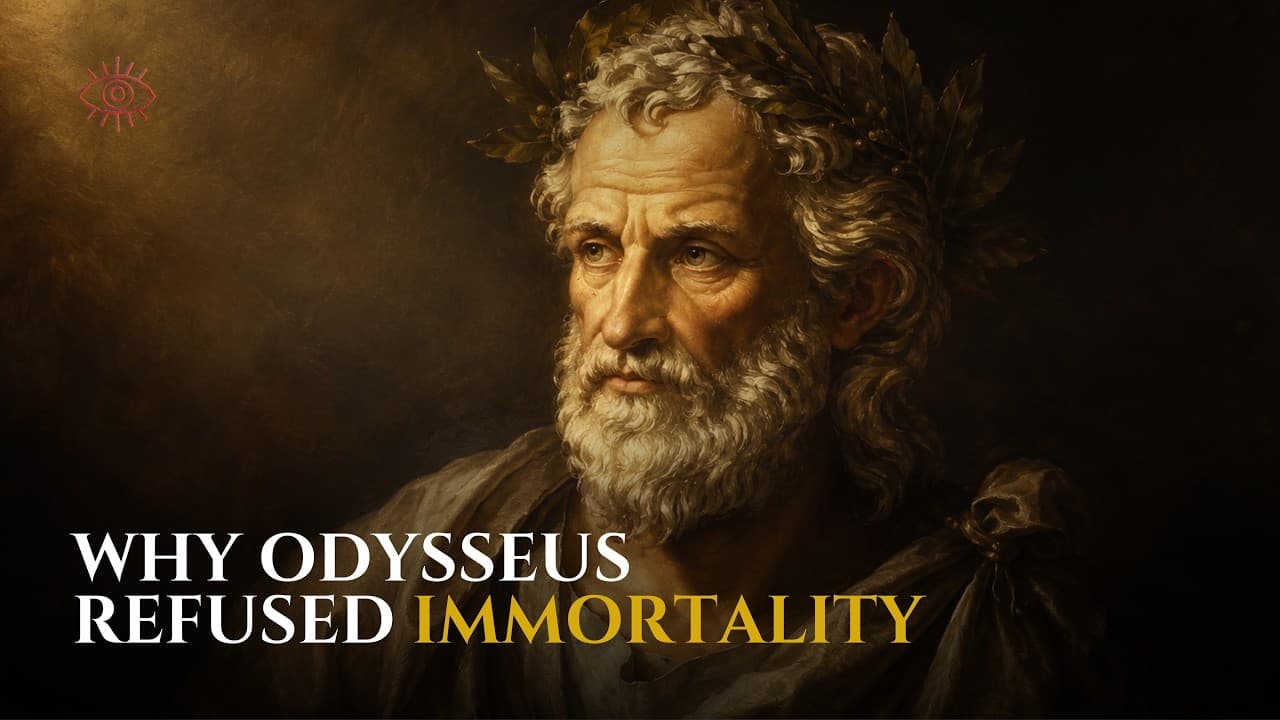
The Odyssey Explained: The Full Story and What It Really Means | For Sleep
A man is offered immortality by a goddess, and turns it down in order to go home.
Beginning with that refusal, then entering the mystery of Homer and the firelit halls where singers carried the poem in memory, this longform episode follows Odysseus through the great trials of his return. It explores the dangerous power of names, the guest law, the cost of knowledge, the voices of the dead, and the fragile line between justice and revenge.
Along the way, Penelope emerges as the wanderer's intellectual equal, while the scar, the bow, the orchard, and the bed rooted in a living olive tree reveal how recognition survives disguise and time. The oldest questions remain unchanged. What makes a finite life worth choosing, what do we owe a stranger, and can anyone return to a home altered by absence. The closing movement follows the Odyssey through Dante, Tennyson, and Joyce, showing how every age remakes the wanderer in its own image.
The full episode is on YouTube and Spotify. Please listen only in safe, restful contexts.
Enjoying the episode?
Occasional letters on philosophy, reading, and the examined life. No spam, ever.
By subscribing you consent to receiving occasional emails. Unsubscribe any time via the link in every email or at /unsubscribe.
Timestamps
- 0:00:00Introduction: The Mortal Choice
- 0:01:23Chapter 1: The Singer Called Nobody
- 0:10:19Chapter 2: The Empty Throne
- 0:18:39Chapter 3: The Mortal Shore
- 0:27:10Chapter 4: The Hero Tells Himself
- 0:35:21Chapter 5: Nobody in the Cave
- 0:48:04Chapter 6: The Shape of Appetite
- 0:59:38Chapter 7: Voices Under Earth
- 1:13:34Chapter 8: Knowledge and Hunger
- 1:21:56Chapter 9: The Stranger at Home
- 1:30:32Chapter 10: Signs That Remember
- 1:37:58Chapter 11: The Patient Equal
- 1:46:51Chapter 12: The Quiet Reckoning
- 1:54:45Chapter 13: The Rooted Bed
- 2:05:28Chapter 14: The Inland Oar
- 2:14:58Chapter 15: Every Age Returns
For the record
Full Transcript
Introduction: The Mortal Choice
On an island where nothing dies, a man is building a boat. He is not escaping by force. The way before him has finally been opened, and the goddess who rules the island has begged him to stay. He is not fleeing a monster. Nothing there threatens his body. The goddess loves him, and she has offered the oldest human wish, youth without end, life without death. He has refused. Each morning he sits beside the sea and weeps, not for paradise, but for a rocky island and a wife who is growing old. His name is Odysseus.
Why would any man refuse to live forever?
The poem that answers this question is nearly three thousand years old. It is one of the oldest sustained arguments in Western literature about what a human life is for, and its answer remains unsettling. One mortal life on a plain island, beside an aging wife, chosen freely, can outweigh eternity.
That answer will carry us through storms, monsters, ghosts, and a house under siege. First, however, the Odyssey asks us to listen. Behind the absent hero stands another absence, the singer whose voice still carries his name.
Chapter 1: The Singer Called Nobody
The poem begins with a request. Its speaker asks the divine power of song to tell of the man who wandered, suffered, learned the minds of others, and struggled to bring his companions home. This invocation does more than decorate the opening. The singer does not claim to manufacture the story alone; memory must arrive from beyond one private mind. Human craft shapes the performance, but the past exceeds the person performing it.
The request also refuses a simple celebration. Odysseus will be resourceful, but he will not save his companions. The opening gives part of the ending away and assigns some responsibility before the adventures begin: the men destroy themselves through reckless acts. Suspense moves from what happened toward how choice, ignorance, appetite, leadership, and divine power combined to make it happen.
Nor does the song begin at the beginning of Odysseus's life, the war, or even the voyage home. It enters when Troy is already memory, most warriors have returned or died, and one man remains absent. The poem starts inside consequence. Its form asks the listener to reconstruct a broken route from stories told in different houses and by speakers whose knowledge is incomplete.
The Odyssey comes to us under the name of Homer, but almost everything that name appears to promise dissolves when examined. Ancient tradition pictured a blind singer. Seven cities competed for the honor of his birthplace, and later biographies supplied journeys, parents, teachers, and deaths. None can be proved. Perhaps one extraordinary poet shaped the work close to the form we know; perhaps generations of performers refined its episodes before a decisive act of composition. Homer remains the name of the poem's maker, but not a recoverable life.
Long before anyone could take the Odyssey from a shelf, singers carried heroic tales in disciplined memory. Their audiences already knew that Troy had fallen, Odysseus had wandered, Penelope had waited, and a son had grown up in an absent father's house. Suspense did not depend on ignorance of the ending. It lived in the path taken tonight, the place where the singer paused, the comparison that brightened a familiar action, and the changed voice in which a known sorrow returned.
Imagine the setting. A hall after dark. Fire moving across timber, bronze, faces, and cups. Wine passes from hand to hand. A singer holds a lyre and enters the story at one point within an immense web of stories. Familiar phrases accompany a ship entering the sea, dawn appearing, a meal being prepared, or a careful reply. The audience recognizes the road while listening for what will happen along it.
Such poetry did not need to be stored word for word like a printed page. It could be composed in performance from inherited rhythms, scenes, phrases, and groups of lines. Repetition gave the singer firm ground, then left room for choice. Memory worked less like a warehouse of finished sentences than a knowledge of roads: how a feast begins, how a ship is launched, what shape a plea takes, and which rhythm will carry a thought safely to its end. Originality lay in bringing the inheritance fully to life.
We cannot watch the moment when performance became text. The poem may have passed through dictation, several stages of recording, or later revision. Around the eighth century before Christ, the Greek alphabet made preservation on this scale possible, though writing did not suddenly silence the singers. That long history helps explain why the Odyssey feels carefully designed and older than any single designer. Its scenes answer one another across great distances, while customs from different eras occupy the same imaginative house.
That house belongs to a maritime world. Islands face one another across water that can join a community or erase a ship without leaving a trace. Political life is intimate enough to gather in an assembly, and the disorder of one household can become a public crisis. Wealth appears as animals, grain, metal cups, woven cloth, and the number of people a table can feed. Power sits in a chair, portions meat, receives petitioners, guards the storeroom, and keeps the fields productive while ships are away.
Moral life is equally close. No distant institution receives the stranger who arrives wet with salt. Someone must decide whether to offer a seat, bring bread, and postpone questions until hunger has passed. A ruler's failure appears in missing animals and frightened servants. Every decision inside the house travels outward into the island, and every storm beyond the island eventually reaches the table.
The uncertainty around Homer therefore suits a poem preoccupied with names. We use an author's name to gather a work into one accountable mind, yet Homer does not tell us whether that mind was solitary or collective, whether the decisive making required years or centuries, or whether the singer could write. The hero will save himself by becoming Nobody. His story reaches us from a poet who is, in the strict historical sense, nobody we can securely identify. The symmetry gives the poem a different kind of authority: it endured because many voices carried it and many rooms found that it could carry them.
Those listeners entered a world living after disaster. Troy has fallen, and most survivors have gone home. The Iliad moved toward the battlefield where a warrior's name might outlast his body; the Odyssey reverses that direction. It moves away from war, across uncertain seas, toward a household where a famous name must become human again.
Ten years of war have been followed by almost ten years of wandering. Children have become adults. Parents have died. Servants have changed allegiance, and a wife has spent half her marriage without knowing whether she is still a wife. The victors learned how to take a city; now they must remember how to enter a house.
Odysseus is suited to that harder passage. He is intelligent, patient, deceptive, proud, tender, ruthless, and extraordinarily adaptable. He changes clothes, names, stories, posture, and rank, surviving because he can become someone else without entirely losing the person who wants to return. Athena favors the strategic intelligence that resembles her own. Poseidon turns an injured son's grievance into a father's pursuit. The gods alter the field, but mortal choices still determine how suffering is met and often how it is increased.
The wonders ahead are therefore tests of recognizable questions. What remains of a person when his name disappears? What does a stranger deserve at the door? Can knowledge be desired without limit? Does suffering make someone wise, or only skilled at survival? Can a home survive while the absent person changes? When justice comes, can it restore order without creating another ruin?
Above all, what is home? Ithaca is rocky, provincial, and difficult to farm. Odysseus does not love it because it offers the greatest advantages. A home is a world made particular by commitment; its imperfections are where that commitment has taken form.
The old audiences knew that Odysseus would reach his island, yet they returned to hear the poem again. Knowing an ending is different from dwelling inside its meaning. Fire moves across the hall. The singer begins. What no performance can know in advance is what the return will ask of the people listening tonight.
Chapter 2: The Empty Throne
In the Odyssey, absence becomes an active force. It occupies rooms, alters loyalties, consumes property, and teaches everyone left behind to build a life around uncertainty.
Ithaca has a king whom no one can prove alive and no one has the authority to declare dead; this suspended fact has infected the whole island. Young men from powerful families have installed themselves in Odysseus's house as suitors to Penelope; they do not visit with the formality of guests and then depart. They remain; each day they order animals killed from the absent king's herds. They drink his wine, command his servants, and turn his hall into a prolonged feast whose cost falls on a household they hope to possess.
Their waste is more than greed; it is a method of government. By consuming the substance of the house, they make restoration less possible with every meal; by refusing to leave, they transform courtship into siege. Penelope cannot choose without accepting that her husband is dead, yet she cannot postpone forever without provoking men whose families hold influence across the island; the suitors exploit the interval between knowledge and decision. Their power grows in the space where no one can say what has happened.
They also reverse the relation between host and guest; a guest depends upon the household and therefore observes restraint. The suitors behave as though prolonged dependence has given them ownership; they take generosity as proof that more may be taken, and the host's inability to expel them as permission to remain. The disorder is visible at the table before it is visible anywhere else; portions are demanded, cups refilled, servants summoned, while the person whose authority once gave those gestures meaning has become a rumor beyond the sea.
Telemachus has grown up inside that interval; his father left when he was an infant, so he does not remember Odysseus as a person. He remembers him as other people remember him, through stories, comparisons, expectations, and the shape of a household built for a man who is not there; to inherit an admired father under such conditions can feel like inheriting a judgment. Every weakness becomes evidence that the son is not the father; every attempt at authority reveals how little authority he has.
At first Telemachus sits among the suitors and watches them consume his future; anger has not yet become action. He can imagine Odysseus returning to scatter them, but this wish keeps him dependent on the very absence that has made him powerless; he waits for a father to solve the problem of learning how to become a man.
Athena interrupts that waiting; she comes to the house disguised as a family friend, accepts the offered welcome, and speaks to Telemachus as if a capable adult were already present inside him. Her counsel is practical; call the island to assembly. Tell the suitors to leave; find a ship. Ask the older survivors of Troy whether they know how Odysseus's journey ended; if the father lives, wait with purpose. If he has died, mourn him properly and then let the household move out of paralysis.
The goddess does not give Telemachus certainty; she gives him a sequence of actions that can be undertaken without it. This is the beginning of his education; adulthood is often imagined as the possession of answers that childhood lacks. Telemachus discovers something harder; maturity begins when action can no longer be postponed until every answer arrives.
The assembly exposes the distance between speech and power; Telemachus calls the people together and publicly names what is happening in his house. He even astonishes himself; the old men hear in him an echo of Odysseus, and the suitors hear a challenge. Yet a true accusation does not enforce itself; the community pities him, interprets omens, trades blame, and disperses. No collective strength gathers around the injured household; Ithaca still has language for order, but the will behind that language has weakened.
This failure is not proof that speaking was useless; until Telemachus addresses the island, his suffering can be treated as a private quarrel between an uncertain heir and unwanted guests. Public speech gives the disorder its proper name; it also teaches him that a claim must sometimes be voiced before anyone is ready to honor it. He leaves the assembly with no army and no verdict, but he is no longer merely the boy seated at the edge of his own inheritance.
His voyage for news is modest beside the journeys that fill the poem; he does not face monsters or command seasoned sailors. He visits men who returned from Troy and listens to the scattered knowledge of an older generation; some memories are useful. Others reveal only how differently the victors were broken on their way home; the search does not deliver the fact he wants most. It gives him examples of households restored, households destroyed, and sons forced to act within the unfinished business of their fathers.
The first household he reaches is orderly, ceremonial, and crowded with children. Its old king welcomes the unknown young traveler before learning his name, seats him beside the feast, and only afterward asks why he has come. The host can describe the war and the departures from Troy, but he cannot supply the missing fact. Telemachus receives hospitality, counsel, and memory, while certainty remains beyond the table.
In another palace, wealth has returned but peace has not. The king came home only after years of wandering, carrying treasure through rooms still haunted by those who never returned. He recognizes in Telemachus the face of Odysseus and tells how the absent father once endured danger for others. The praise offers the son an image of the man he seeks, but it also increases the weight of comparison.
These visits place two possible homecomings before him. One household has preserved continuity through age, children, ritual, and rule. Another possesses abundance while grief enters every conversation. He also hears of a commander murdered after reaching his own house, and of the son who answered that murder. The story is offered as an example of decisive adulthood, but its violence makes the example dangerous. A son can inherit a duty from his father; he can also become trapped inside a model of manhood built from another family's disaster.
News therefore arrives as more than information. Each host selects a past, interprets it, and offers Telemachus a possible future. He learns to receive stories without surrendering himself to them. The journey cannot tell him exactly who his father is now, but it begins teaching him which inheritances deserve continuation and which should remain warnings.
Telemachus sets out hoping to discover whether Odysseus is alive; what he begins to discover is that his own life cannot remain an appendix to that question. The empty throne must first become visible as empty before anyone can decide who is capable of standing beside it.
While the son searches for news, the father is alive beyond the reach of every witness. The poem now turns from a young man learning to act without certainty to an older man facing a choice no mortal was meant to receive.
Chapter 3: The Mortal Shore
Calypso's offer is the philosophical center of the Odyssey because it turns mortality from an unavoidable sentence into a freely accepted condition.
Odysseus has been on her island for seven years when the poem finds him; this is not one enchanted afternoon extended beyond measure. Seven years are long enough for captivity to acquire routine, for resistance to become quiet, and for the world beyond the horizon to begin to seem less like a place than a memory; Calypso's home is beautiful, fertile, sheltered, and sufficient. Water runs near her dwelling; birds nest in the woods. Vines bear fruit; no army approaches, no harvest fails, and no political demand interrupts the stillness.
Yet the island's perfection has no future; nothing needs to be founded there because nothing can be lost. Nothing needs to be handed down because time does not gather into generations; Calypso can promise Odysseus an endless present, but she cannot give him a human tomorrow. The distinction is easy to miss because eternity appears to contain every possible future; in the poem, it contains no future at all. It is duration without development, safety without history, life detached from the pressure that gives choices their shape.
Calypso is not a simple villain guarding the door of a prison; she loves Odysseus, desires him, cares for him, and can truthfully claim that she offers more beauty and security than Penelope or Ithaca can provide. She also possesses him; he has no ship and no crew. The sea around the island is not an open road for a solitary mortal; whatever tenderness exists between goddess and man is enclosed by a difference in power so complete that his continued presence cannot prove his consent.
The poem refuses the comfort of making captivity emotionally simple; Odysseus shares Calypso's bed, yet spends his days looking toward the sea and grieving. Desire, habit, dependence, and coercion occupy the same island; a relationship can contain genuine care and still deny one person's freedom. Love does not cease to be love merely because it has become possessive, but neither does the name of love make possession just.
When the gods finally decide that Odysseus must be released, a messenger carries Zeus's order to the island; Calypso's response is morally intelligent. She accuses the male gods of a double standard; they take mortal women when they wish, yet become indignant when a goddess chooses a mortal man. The complaint is justified, and the poem allows it to remain justified even though she must let Odysseus go; a person can be wronged by the rules and still exercise unjust power over someone weaker. Calypso's grievance does not cancel his.
Calypso's offer contains no hidden trick. If Odysseus stays, she says, age and death will lose their claim on him. She asks him to compare that certainty with Penelope, a mortal woman already altered by grief and time.
People usually imagine immortality as more mornings, conversations, and chances to repair what has been damaged. They preserve the familiar world while removing its end. Calypso offers a deeper change. Age would no longer mark Odysseus, courage would lose its final risk, and patience would face no approaching limit. Penelope would pass into the completed past while he continued unchanged. The individual survives, but every mortal relation that formed him is eventually left behind.
Odysseus answers without pretending that the comparison is equal. Calypso possesses the unchanging beauty of a goddess; Penelope cannot. Yet only Penelope can grow old with him. Their marriage contains remembered choices, injuries survived, private knowledge, and obligations reaching beyond the pair. To share one direction of time is to witness changes the other cannot see from within. Its value comes from exposure, not perfection.
The goddess offers endless life to an individual. Odysseus chooses to remain a husband, father, son, king, and inhabitant of a particular island. His life on Ithaca will be shorter, but it will belong to more people than himself. This is no rejection of the unknown by an unimaginative man; he has crossed the boundaries of ordinary experience, and curiosity remains part of both his greatness and his danger. He refuses a condition in which every unknown has been removed and every promise has lost its deadline.
The messenger's order changes the conditions of departure; Calypso provides what the voyage requires, and Odysseus commits himself again to the sea. Food, water, cloth, timber, and skill can make a craft capable of leaving shore, but not capable of mastering what lies beyond it; the raft carries no heroic certainty. It carries a mortal choice into an element that may erase the chooser.
For many days the voyage holds; then Poseidon sees Odysseus upon the water and raises the storm that divine agreement had only postponed. The sea closes the distance between philosophy and consequence; it is one thing to prefer a finite life while standing on firm ground. It is another to cling to that preference when the means of reaching it comes apart beneath the wind.
Odysseus is nearly destroyed; the gifts intended to sustain him become heavy, and even the remaining wood can threaten the body that holds it. He must decide what to release, what to trust, and when to abandon the last support; survival is not a single heroic act but a series of revisions made under pressure. The man of many turns lives because he can change his relation to the things that saved him a moment before.
The storm does not prove that his choice was wise by the ordinary measure of safety. It makes the measure visible. Odysseus would rather risk death on the way home than preserve himself by ceasing to be the person for whom home matters.
If mortality gives life meaning, why struggle so fiercely to survive? Because accepting death as a limit is different from making it a purpose. Living remains the first condition of every promise. Captivity, violence, grief, and hunger are not valuable merely because they are human; the narrower claim is that some limits give agency consequence. Mortality is terrible, but removing it may remove more than terror.
Ithaca offers no guaranteed reward. Penelope may not welcome him, Telemachus may not know him, and the household may be lost. Calypso offers certainty; home offers the right to face what time has done. Odysseus chooses responsibility for whatever remains.
Her island is therefore more than a delay in the plot. It changes homecoming from instinct or nostalgia into a judgment about value. Odysseus has faced mortal and deathless existence as available lives, then chosen the world in which love can age, promises can fail, and time cannot be called back.
He reaches land with almost nothing; the choice of mortality has not restored his name, his rank, or his household. It has left him exposed on an unfamiliar shore, alive enough to begin again; that is all a mortal choice can promise. It does not guarantee arrival; it makes arrival worth attempting.
Chapter 4: The Hero Tells Himself
The Odyssey makes a strange and decisive choice when its hero reaches safety; it stops telling his adventures and gives him the power to tell them himself.
The change begins beside a river, where Odysseus wakes after the storm with no clothing, companions, ship, or socially recognizable place; the young princess who finds him has every reason to flee. He is a large unknown man emerging from wild cover near a group of unmarried girls; the poem holds caution and generosity together. He remains at a distance, covers himself as best he can, and speaks without touching her knees in the formal gesture of a plea; she listens without pretending that danger is impossible.
Her help restores him by stages; he receives clothing, oil, food, directions, and advice about how to enter her parents' house without compromising her reputation. These are small civilizing acts; none identifies the stranger, and no one demands a name before performing them. The body is fed before the biography is examined; in a poem where bad hosts ask what they can take from a visitor, the kind strangers begin by asking what the visitor needs.
At their court, Odysseus becomes a guest without yet becoming Odysseus; he speaks skillfully, receives protection, and accepts the promise of passage home. His hosts sense nobility in him, but they do not know what nobility, for once he is safe enough to withhold identity without using a false one. Namelessness becomes a place of rest.
The king even imagines a permanent place for him. If the stranger wished to remain, a marriage and household could bind him to this prosperous country; if he still wished to leave, the promised ship would carry him onward. The offer resembles Calypso's only at a distance. It includes a genuine exit and therefore allows hospitality to remain hospitality. A good host may hope that a guest stays, but must not turn gratitude into captivity.
Odysseus declines without insulting the life before him. This court is generous, peaceful, and capable of receiving him with honor; precisely because it is a real human home, its attraction cannot be dismissed as enchantment. Yet belonging cannot be transferred by comfort alone. The stranger wants the difficult web of relations that already claims him, not simply the best available place in which to begin again.
The court does not treat hospitality as naive trust; questions will come, and the household keeps its own order while receiving him. Its generosity is disciplined by ceremony; a seat is found, portions are given, speakers take turns, and the stranger's request is heard before a public promise is made. Such forms do not eliminate danger; they make danger negotiable. Civilization here is the creation of enough peaceful time for an unknown person to become known without force.
Even here, dignity has to be negotiated; during athletic games, a young man mocks the stranger as someone concerned with cargo rather than competition. Odysseus answers by throwing farther than the others and calmly naming the contests in which he would meet them; the display is controlled but revealing. His body possesses a past his hosts cannot yet read; he can conceal a name more easily than he can conceal the standards by which he has learned to judge himself.
Then the court's blind singer performs a story from Troy; Odysseus hears events from his own life made public in another man's voice, and he weeps while hiding his face. This is one of the poem's quietest inquiries into fame; the heroic name has traveled more successfully than the hero. It can fill a hall with pleasure while the man who earned it sits nearby in pain.
The blind singer is honored, guided to his place, and given his portion of the feast. Once the lyre sounds, he can summon armies, arguments, and a vanished city more completely than any warrior present. Odysseus, who once directed the action, must now receive it as song. The audience hears significance; the survivor remembers cost. A truthful story can still fail to contain the truth of having been there.
That reversal prepares Odysseus to become a singer in his own way. He performs a sustained account before people gathered after food and wine, placing one storyteller inside another while the larger voice of the Odyssey surrounds them both. No speaker owns the past completely; each gives it a shape the next listener must judge.
The king notices the concealed grief and asks who the stranger is; only now does Odysseus give his name. The revelation does not occur when he proves his physical ability or receives fine clothing; it occurs when a story has found the wound that connects the anonymous guest to a shared past. Identity returns through recognition of suffering before it returns through biography.
Odysseus then begins the long account of his wanderings; the poem opens a second stage inside itself. The external singer tells us that Odysseus speaks, but Odysseus supplies the adventures in his own voice; the famous islands, temptations, monsters, and losses reach both the court and every later listener through a narrator celebrated for deception.
Can he be believed? His companions are dead, the strange places cannot be revisited, and the tale is perfectly shaped for the needs of the moment. Odysseus must explain why a commander who left Troy with ships and men has arrived naked and alone. He must also hold the attention of the people whose ship can carry him home.
That need does not make the adventures lies. It reveals that narrative truth is never a bare list of events. Odysseus chooses where to begin, which motives to disclose, how much blame to assign his companions, and how to present his own mistakes. He admits curiosity, pride, and costly delay, but confession can display mastery too; the teller who names his fault first partly controls the judgment that follows. A life has no natural chapter breaks. The teller creates them.
His hosts choose to believe enough. They cannot certify every impossible detail, and they need not surrender judgment. They must decide whether the stranger's account establishes a claim upon their care. A refugee, traveler, or returned soldier often brings experiences no listener can verify from within; perfect proof would make compassion impossible, while belief without judgment would make it reckless. The court finds a middle ground of attentive trust.
Identity is more than whichever story succeeds. Odysseus has a body, history, household, and obligations that resist invention. Yet these become socially real only when someone receives his account; a name spoken into an empty room restores no one. The castaway becomes a person in the shared world when listeners grant his losses a place within it.
The kind strangers will carry Odysseus to Ithaca because they have heard him; their ship is made possible by an act of attention. Before homecoming can become a journey through space, it must become a story another household is willing to trust.
Chapter 5: Nobody in the Cave
The first great dangers in Odysseus's tale reach beyond the body. They threaten the purpose that allows a person to remain someone and continue toward home.
The lotus eaters offer no violence; they receive some of the crew and give them a plant whose sweetness dissolves the wish to return. The men do not become irrational or visibly ill; they simply cease to care about the journey that had organized their lives. Odysseus must take them back to the ships against their will and bind them there until distance restores the possibility of desire.
Forgetting appears here as mercy; the past contains war, dead companions, fear, and years of separation. To lose the need for Ithaca would remove much of the pain of not reaching it; the lotus does not prevent homecoming by building a wall. It makes the wall unnecessary; a destination disappears when no one remembers why it mattered.
This is more disturbing than an ordinary temptation because the men who accept the lotus no longer experience themselves as tempted; they have found contentment by subtracting a part of the self. If happiness means only the absence of felt distress, they have succeeded; if happiness must belong to a person who remains answerable to promises made before the pleasant moment, their peace is a kind of erasure.
Memory in this episode is not simply the storage of facts; the affected men may still know how to walk, speak, and eat. What disappears is orientation, the thread connecting present action to an absent good; a remembered home is not only a picture of a house. It is the power that lets a distant and difficult future outweigh an available sweetness; remove that power and intelligence can continue while purpose collapses.
Odysseus preserves their identities without their consent; he acts as keeper of the desires they possessed before the drug altered them. Such action would be dangerous as a general rule; people often claim to know another person's true wishes in order to control him. Yet the scene asks whether freedom can survive when the present self has been chemically severed from every prior commitment; sometimes rescue feels like captivity from inside the condition that makes rescue necessary.
The Cyclops offers the opposite danger; nothing on his island is softened into forgetfulness. The world is immediate, physical, and ruled by the power of the isolated household; the Cyclops does not live among citizens, attend assemblies, cultivate fields with shared skill, or submit disputes to common judgment. Each member of his kind rules his own cave and family without concern for neighbors; natural abundance supplies food without requiring the habits of cooperation.
Odysseus enters the cave while its owner is away; his companions urge him to take food and leave. He refuses because he wants to meet the inhabitant and receive the gift that custom owes a guest; curiosity and expectation combine. Odysseus assumes that the forms governing a human hall will reach even here; he waits for hospitality in a place whose entire organization denies it.
When the Cyclops returns, he closes the entrance with a stone no group inside can move; Odysseus identifies his men as survivors of Troy and appeals to the sacred duty toward strangers. The claim has no force; the Cyclops fears neither Zeus nor any law above his appetite. He treats the guests as available property and begins consuming what has entered his cave.
Before revealing all his intentions, the Cyclops asks where the visitors left their ship; Odysseus senses the danger and lies that Poseidon destroyed it against the rocks. The deception preserves the men who remained by the shore; it also creates a dark irony. Odysseus uses Poseidon's name to hide a ship from the son whose injury will soon make Poseidon the enemy of his return; cunning can arrange immediate safety without seeing the larger pattern into which its words will fall.
The horror can be stated without dwelling upon it; men who expected bread and a parting gift discover that they have been received as food. The guest law does not merely regulate manners; it marks the boundary between recognizing a stranger as a person and treating him as a thing that has happened to arrive.
Odysseus cannot answer immediate brutality with immediate force; killing the Cyclops in sleep would leave the stone sealed across the entrance. Survival requires him to preserve the very being who threatens them until that being performs the labor of release; this is the peculiar intelligence of patience. It does not confuse delay with passivity; it keeps the desired end visible while refusing an action that would satisfy anger and destroy hope.
Odysseus offers the Cyclops strong wine carried from the ship; the drink belongs to a cultivated world of measured mixing, shared cups, and ritual exchange. In the cave it becomes concentrated appetite; the Cyclops drinks without measure and asks the stranger's name, promising a guest gift after more wine.
Wine itself is neither civilized nor savage; its meaning depends on the form around it. At a common table it is diluted, poured in an order, and joined to conversation; it teaches that pleasure can be intensified by measure. The Cyclops receives the same substance as one more thing to consume alone; his drunkenness is not merely a weakness Odysseus exploits. It is the bodily expression of a life in which nothing must be portioned with equals.
Odysseus says that his name is Nobody.
The answer is more than a clever sound; a personal name lets suffering travel from the private body into the social world. It enables a cry to identify who is harmed and who is responsible; by becoming Nobody, Odysseus temporarily steps outside that network. He sacrifices recognition in order to make the Cyclops's own language useless.
Names ordinarily shorten explanation; a single word can summon kinship, reputation, debts, promises, and remembered deeds. Nobody does the reverse; it sounds like a name inside the cave and like the absence of a name outside it. Odysseus creates two audiences from one answer, knowing that the Cyclops will hear a person while his neighbors hear an empty place; the weapon is not false information. It is the unstable border between a word and the grammar surrounding it.
While the giant sleeps, Odysseus and the remaining men carry out the plan they have prepared with a sharpened length of wood; they destroy his sight and withdraw beyond the reach of his hands. The Cyclops cries out; neighbors gather outside and ask who is attacking him. He answers that Nobody is harming him; they hear a denial where he means an identification, conclude that no human enemy is present, and leave him to whatever suffering the gods have sent.
The plan succeeds because solitude has already emptied the Cyclops's words of trust; his neighbors do not enter. They accept the convenient surface of the answer and return to their separate households; a community in name only has gathered around the cave. Nobody defeats the Cyclops because, in a deeper sense, nobody is willing to help him.
At morning the blinded Cyclops opens the entrance for his flock and feels the back of each animal as it passes; Odysseus binds his men beneath the sheep and clings beneath the largest ram. The searching hands touch wool above while human bodies move silently below; strength guards the expected path. Cunning survives by changing where a person can be found.
Once the men have reached the ship, the episode appears complete; they possess distance, oars, and open water. The Cyclops can throw stones but cannot see where they are; Odysseus has saved his companions by surrendering his name at exactly the right moment.
Then he takes the name back.
From the departing ship he tells the Cyclops who defeated him; his crew begs him to be silent, but silence now feels intolerable. To survive as Nobody is one achievement; to let Nobody receive the credit is another. Odysseus wants the deed attached to the identity that has accumulated honor since Troy; he wants the enemy to know that the victory belonged to a particular man.
The demand is understandable; a nameless action cannot enter reputation, and heroic society treats reputation as the part of life that may continue after death. Odysseus has risked everything and created a plan no one else could create; if he remains anonymous, the story survives while its author disappears. His boast insists that intelligence deserves a name.
But the price of that insistence will not fall upon him alone; the companions who beg for silence have also survived the cave. They pulled the wood, held the animals, rowed the ship, and now depend upon the leader's restraint; Odysseus turns their shared escape into evidence for his individual fame. Leadership fails at the moment when the leader treats collective survival as material for a personal name.
It also gives the Cyclops what the plan had denied him; with a name, the injured host can make a meaningful appeal to his father, Poseidon. He asks that Odysseus never reach home, or arrive only after long suffering, alone, on another's ship, to find trouble in his house; the curse gives direction to divine anger. Nobody could not be pursued; Odysseus can.
This conflict between cunning and glory cannot be neatly resolved; cunning depends on flexibility. It knows when to hide, yield, wait, lie, and become small; glory depends on public continuity. It joins action to an enduring name and refuses to let achievement vanish into circumstance; Odysseus requires both. Without cunning he dies in the cave; without the name he saves the body but abandons the heroic self that tells him what the body is for.
The error lies not in possessing a name but in demanding recognition from the one being it was safest to leave ignorant; Odysseus confuses the truth of identity with the enemy's acknowledgment of it. Yet the poem does not mock him from a safe distance; human beings do not merely want to live. They want their lives to be attributable, remembered, and understood; we build the raft of survival from anonymity, then call back across the water because survival without a witness seems unfinished.
The lotus threatened to remove the desire that carried Odysseus home; the Cyclops draws out the desire that will delay him. Between forgetting the name and proclaiming it too loudly lies the difficult work of remaining a person among others.
A name must be remembered, but it must also know when to fall silent; if it disappears entirely, obligation has no enduring subject. If it demands recognition in every dangerous moment, it sacrifices the lives that gave it meaning; Odysseus leaves the cave with his identity intact, yet his voyage is now burdened by the moment when identity became more urgent than restraint.
Chapter 6: The Shape of Appetite
Appetite becomes dangerous in the Odyssey at the moment desire loses the measure that tells it where to stop.
After further wandering, Odysseus reaches the island of the keeper of the winds, for a month the keeper receives him generously and listens to the story of Troy. When the time comes to leave, he confines every hostile wind inside a leather bag and leaves only the breeze that will carry the ships toward Ithaca. It is an extraordinary gift because it turns the most changeable element in the sailors' world into something ordered and portable.
Odysseus keeps control of the ship for days without rest; at last the fires of Ithaca become visible. Home is close enough to be recognized by light; then exhaustion overtakes him.
His companions have watched him guard the sealed bag throughout the voyage; they have not been told clearly what it contains. They decide that their commander received private treasure and intends to keep it from them; while Odysseus sleeps, they open the bag. The released winds seize the ships and carry them away from the island already in sight.
The disaster is usually described as the crew's foolishness, and it is foolish, yet suspicion has a history. Odysseus possesses information the others do not possess and guards an object whose value appears to be his alone; a leader may know that secrecy is necessary, but secrecy asks followers to trust a difference they cannot inspect. After war and wandering, that trust has become thin.
Unequal knowledge is not the same as unjust power; the crew has good reason to let Odysseus direct a difficult voyage. Still, authority cannot depend forever on superior understanding kept invisible; the bag holds winds, but socially it holds accumulated doubt. Once opened, it releases every grievance the men have attached to the privilege of command.
The scene does not explain what Odysseus could safely have told them, and that uncertainty is part of its strength; complete openness can expose a fragile plan. Complete secrecy can make obedience indistinguishable from submission; leadership lives between those risks. It must preserve information without allowing mystery to become resentment; the crew's act is wrong, but the ease with which they imagine betrayal shows that command has failed to become a common project.
The ships return to the keeper of the winds, and Odysseus asks for help again; the request is refused. A man driven back after receiving such complete assistance must be hated by the gods, the keeper concludes; this judgment is severe because it treats misfortune as evidence of guilt. It is also a warning about exhausted generosity; even a generous host may decide that repeated need reveals something aid cannot repair.
The fleet then reaches a harbor that appears to solve every problem of exposure. High cliffs surround still water, and a narrow entrance shields the ships from wind. The other captains take their vessels inside and moor them close together. Odysseus alone keeps his ship beyond the enclosed basin, fastening it near the outer shore. No prophecy tells him to do this; caution preserves a small distance from the safety everyone else accepts.
The harbor belongs to a people whose size and appetite turn enclosure into a trap. Scouts do not return with an offer of welcome. Alarm passes through the settlement, and the heights above the water fill with attackers. Stones fall upon the crowded vessels; the narrow mouth that excluded storms now prevents escape. Every ship inside is destroyed. Only the vessel waiting beyond the entrance can cut its line and reach open water.
The loss changes the scale of the voyage. A fleet becomes one ship, and a dispersed community becomes a single crowded remnant. The scene offers no triumph to Odysseus. His separation saves those aboard his vessel, but it also leaves him watching from outside as every other route closes. Prudence often appears unsociable before danger arrives; afterward, the margin it preserved may be all that remains.
This disaster also reverses the promise of shelter. The open sea looked dangerous, while the enclosed harbor looked secure; appearance was correct under ordinary weather and fatal under human threat. Safety depends not only on walls, stillness, and a narrow gate, but on the character of those who control them. The surviving ship reaches Circe's island carrying fewer illusions about refuge and almost no room for another mistake.
Circe's island presents appetite in a more intimate form; a scouting party reaches her house and hears her singing at a loom. She invites the men inside, offers a meal, and mixes into it the power that changes their bodies into swine; their minds remain human. They understand what they have become while lacking the speech and form through which that understanding could be shared.
The transformation is not simply a punishment for eating; guests are supposed to accept food, and hunger after a voyage is not a moral failure. The scene gives outward shape to a fear that human dignity may be thinner than it appears; remove familiar posture, language, clothing, and ceremony, and appetite remains immediately visible. Yet the preserved mind insists that a person cannot be reduced to appetite, even when others can see nothing else.
Their condition separates inner identity from every public sign; each man remembers his name, companions, and destination, but cannot present any of them. To an observer he is an animal among animals; this is imprisonment at the level of recognition. The mind knows itself while the social world has lost the means to know it; the terror lies less in having a different shape than in being unable to correct what the shape tells others.
At the same time, the poem makes the animal form an accusation; human beings use ceremony and speech to place distance between themselves and bodily need. They portion food, give thanks, invite others, and make rules about who eats first; Circe strips away those forms and displays the creature beneath them. The companions remain human because they remember those forms, not because they have never been creatures of hunger.
One man escapes and brings the news to Odysseus; on his way to Circe's house, Odysseus receives protective aid from the messenger god, a herb that prevents her mixture from controlling him. When Circe expects transformation, Odysseus remains standing; the balance of power changes at once. He compels her to swear that she will not harm him and refuses comfort until his companions have their human bodies restored.
His resistance depends on help he did not create, but the use of that help is his own; the herb would mean nothing without the courage to enter the house. Courage would mean little without the discipline to make the companions' release a condition of peace; Odysseus does not merely defeat Circe. He converts a contest of domination into an agreement.
Circe keeps the agreement; the men are restored, washed, clothed, fed, and made stronger than before. The dangerous house becomes a place of abundance, for the first time in a long while, the crew can sleep without taking turns at an oar or watching an unfamiliar coast.
They remain for a year.
The length of the stay is not imposed by magic; no visible barrier prevents departure. Circe has become a host and adviser; Odysseus, who speaks constantly of home, accepts food, wine, warmth, and the goddess's company until his companions remind him that their journey has stopped. The rescuer must be recalled to the purpose for which he rescued them.
This reversal complicates the simple division between wise leader and foolish crew; the companions opened the bag and destroyed a nearly completed return. Odysseus now allows comfort to suspend the same return; their failures differ in circumstance but share a lost proportion. One appetite seeks imagined treasure; another accepts real pleasure. Both let the immediate good become larger than the life to which it belongs.
There is also a quiet justice in the companions becoming the ones who recall Odysseus to himself; command does not mean that wisdom travels only downward. A leader may carry the larger plan and still need others to notice when he has ceased to follow it; the crew that could not be trusted with the bag becomes trustworthy enough to name the forgotten purpose. Shared failure has not abolished the possibility of mutual correction.
Circe's transformation makes appetite visible as an animal shape; the year on her island reveals a subtler truth. A man can keep his human body, intelligence, speech, and reputation while living as though satisfaction were enough; nothing external needs to degrade him. He need only forget to ask whether the feast serves the journey or has quietly replaced it.
Measure does not require hostility toward pleasure; The Odyssey is full of meals, baths, clean clothing, music, sleep, and desire. Its travelers need restoration, and a life without enjoyment would give them little reason to return; the problem begins when a temporary refuge claims the authority of a destination. Pleasure becomes destructive not because it feels good, but because it stops time without openly declaring that time has stopped.
When the crew finally speaks, Odysseus is capable of hearing; this capacity separates his failure from the closed appetite of the Cyclops. He can be recalled to a purpose larger than the present table; Circe tells him that the way home will require an even stranger departure. Before he can sail toward the living, he must seek counsel among the dead.
The sealed winds and the enchanted meal expose two sides of self-command; we must sometimes distrust the desire to open what promises hidden abundance. We must also distrust the desire to remain where abundance has already been given; enough is not a quantity. It is the moment when receiving well becomes the freedom to leave.
Chapter 7: Voices Under Earth
The voyage to the dead educates Odysseus in everything action cannot reverse. He enters the other realm to ask questions, not to conquer it.
Odysseus follows Circe's directions beyond the familiar paths of ships, toward a boundary where light thins and ordinary geography loses authority; he does not descend as a triumphant hero armed to overcome death. He arrives as a questioner who must perform the prescribed offering and wait for voices that can no longer reach the living by themselves.
The dead gather around the blood of the sacrifice; without it they are dim presences, conscious but unable to speak with the full identity they possessed in life. When a shade drinks, memory and language return for a time; the image is strange, yet its emotional logic is exact. The dead depend upon what the living are willing to give them; their names, stories, and unfinished meanings do not enter the present without an act of attention.
The first familiar voice belongs neither to a king nor an ancient hero. It belongs to a young companion who was alive when the crew prepared to leave Circe's island. After drinking heavily, he had fallen asleep on the roof. Startled awake by the noise of departure, he missed the ladder, fell, and died before anyone understood that he was gone. His shade has reached the boundary ahead of the ship that left his body behind.
He asks for burial. The request is modest and exact: burn the body with its equipment, raise a marker by the shore, and place upon it the oar he used among the living. Odysseus had sailed to seek knowledge of his own future; before any prophecy can speak, an overlooked companion asks him to turn back and complete an obligation from the immediate past.
The encounter removes the grandeur that might have protected a voyage to the dead from ordinary guilt. Death arrived without monster, battle, or divine judgment. A tired man fell in the dark, and a hurried crew failed to count everyone before departure. Leadership is measured here by attention to the person whose absence did not stop the ship. Odysseus promises to return, and later keeps that promise; the dead cannot be restored, but neglect can still be answered by care.
Ordinary remembrance has the same asymmetry without the ritual; a dead person's letter, tool, habit, or sentence remains inert until someone living pauses over it. Attention gives the trace a temporary voice; the past cannot demand that attention with bodily force, so remembrance is vulnerable to fatigue and choice. What survives does not survive alone; it enters a kind of partnership with those who still have mornings in which to remember.
This dependence reverses the apparent power of the underworld; death is final, but the dead are weak. They know that life has gone on without them and cannot take part in it; the living visitor has less knowledge than they do, but he possesses the one good no dead person can recover. He can still choose what to do next.
Among the waiting shades, Odysseus sees his mother; when he left for Troy, she was alive. No messenger has reached him with news of her death, for years he has carried an image that remained unchanged because distance protected it from fact. The underworld corrects him without warning; one of the people included in his idea of home is no longer there.
He cannot immediately speak with her; the blind prophet must drink first, because Odysseus has come seeking knowledge of the road ahead. Even grief has to wait upon the order of the ritual; the restraint is painful. His mother stands near enough to see, yet he must keep her from the blood until the future has spoken.
The blind prophet tells him that Poseidon's anger still follows the injury to the Cyclops; home may be reached, but only through discipline. On a sacred island the crew will encounter cattle that must not be harmed; if the command is broken, the companions and ship will be lost, and Odysseus will return late and alone to trouble within his house.
Prophecy does not give him control; it transforms uncertainty into responsibility. Before hearing the warning, he could meet disaster as something unforeseen; after hearing it, knowledge will stand inside every later decision. The future remains conditional, divided between restraint and violation, yet knowing the conditions does not guarantee that a group under pressure can obey them; information increases the burden of freedom more reliably than it increases power.
Then the prophecy moves beyond the return that has governed every mile; after order is restored on Ithaca, Odysseus must leave again carrying an oar. He must walk inland until he reaches people who know nothing of the sea and mistake the object on his shoulder for a tool used in farming; there he will make peace with Poseidon. Only after that distant obligation may old age close around him and death approach quietly.
For now, the oar remains an announced future rather than an explained one; its presence is enough to alter the shape of homecoming. Ithaca will not cancel the voyage; even success will leave a debt whose payment requires another departure.
When his mother finally drinks, Odysseus asks how she died; he wants to know whether sickness took her, or whether death came gently. Her answer turns his heroic absence into a domestic cause; she died from longing for him, worn down by grief while his father withdrew from ordinary life and Penelope endured the household's uncertainty.
The poem does not accuse Odysseus of intending this harm; he did not choose the war alone, and no effort could have carried him home from every obstruction. Yet intention does not contain the full moral weight of absence; the wanderer's suffering is visible because the story travels with him. The suffering left behind accumulates in rooms the hero cannot see; his mother's death reveals that a delayed return is not only something that happens to the traveler. It happens to everyone whose life remains tied to his arrival.
Her presence also destroys the fantasy that home waits outside time; Odysseus has often spoken as though reaching Ithaca would reconnect him to the moment of departure. His mother makes that impossible; even if every remaining wall stands and every field is known, one relationship has been removed from the place forever. Homecoming cannot mean restoration of the past; it can only mean entering the altered present without turning away from what alteration has cost.
Odysseus tries to embrace her; three times he reaches forward. Three times his arms close on nothing substantial, and the shade slips away like a shadow or a dream; he asks whether some deception has been sent to increase his grief. His mother explains that this is what death is; when life leaves the body, sinew and bone no longer hold the person where loving hands expect to find her.
The repeated failure is more powerful than any speech about immortality; Odysseus can converse with the dead, recognize them, and receive knowledge from them, but he cannot restore touch. Language crosses the boundary for a moment; the body does not. Grief is partly the persistence of a physical expectation after the world can no longer fulfill it; the arms remember a person in a form reality has withdrawn.
If you have ever reached for someone in the first instant after waking, before memory completed its work, you know the small version of this movement; the mind may understand absence long before the body agrees. Odysseus's three embraces enact that disagreement until even hope must accept the nature of what stands before him.
The underworld contains many heroic dead, but none speaks with greater force than Achilles; in the Iliad, Achilles faced a defining choice. He could accept a long, obscure life or die young at Troy with a name that would not disappear; he chose glory, and the heroic tradition built its highest image around that decision.
Odysseus meets him where the bargain has already been completed; hoping to comfort him, Odysseus says that no one has been more fortunate. Achilles was honored like a god among the living and now holds authority among the dead; the praise repeats the values by which heroes have made danger meaningful. Fame endured; rank endured. Song carried the name exactly as promised.
Achilles refuses the consolation; he would rather labor as a hired servant for a poor man with little land than rule over all the dead.
The statement takes back the whole heroic bargain; not because glory proved false. Achilles is famous, honored, and remembered; the promise was kept. What he denies is that remembrance can compensate the dead person for no longer living; the lowest place under the sun contains possibilities that the highest rank beneath the earth cannot supply. A poor laborer can feel fatigue, hunger, weather, and hope for tomorrow; the king of shades cannot.
This is the greatest reversal in Greek literature because it comes from the man most qualified to judge; a cautious survivor might always have suspected that long life was better than a glorious death. Achilles chose the opposite and received everything the choice promised; only then does he discover that the value of life was not exhausted by the amount of honor it could produce.
His judgment has a tragic limitation; he can now imagine the poor laborer's life as better, but he cannot exchange his glory for it. Wisdom arrives as a counterfactual, a clear view of the road not taken after every crossing has closed; the living hear regret as advice. The dead experience it only as knowledge.
His regret does not make courage meaningless; people may still risk death for friends, communities, and goods they rightly value above safety. The point is not that survival should defeat every other claim; it is that death cannot be imagined as a condition in which the rewards of sacrifice are privately enjoyed. Honor belongs to the living who remember; the dead may be its subject, but they are not its beneficiaries.
The words also clarify Odysseus's refusal of endless life from the opposite side; Calypso offered existence without death, but detached from mortal relation and change. Achilles possesses fame after death, but detached from existence; Odysseus seeks the difficult middle where life remains finite and still belongs to a world of shared obligations. Neither eternity nor glory can substitute for being alive among particular people.
There is a cruelty in learning this from the dead; they possess the clarity of those for whom no revision is possible. The living often gain wisdom because consequences can still be altered; the shades gain it when alteration has ended. Their knowledge is complete in proportion to its uselessness for themselves.
The underworld thus distributes time in three painful directions; the prophet speaks of a future he cannot enter. The mother reveals a past Odysseus did not witness; Achilles judges a choice that can no longer be changed. Odysseus stands among them as the only person whose present remains open; he cannot repair all that he learns, but learning can still become conduct.
Only the living can turn an understood consequence into a different act.
Odysseus can carry it away; this is the one privilege of the visitor who returns from the boundary. He cannot embrace his mother, restore Achilles, or give the other shades more than a brief voice; he can let their completed lives change his unfinished one. To remember the dead well is not to pretend that they continue unchanged; it is to receive from their absence a sharper sense of what remains possible before absence becomes our own.
When Odysseus leaves, the underworld does not release its meaning; the prophecy travels with him, his mother's missing body changes the home he seeks, and Achilles has stripped glory of its power to answer death. The ship turns again toward the living world; its destination is the same, but life has become more valuable because the dead have described, with terrible authority, what life alone contains.
Chapter 8: Knowledge and Hunger
Knowledge, necessity, and appetite make different claims upon freedom, and the Odyssey judges them by asking whether desire can accept a boundary before crisis removes the power to choose.
The Sirens do not promise ordinary pleasure; their song offers knowledge. They know what happened at Troy, they say, and everything that occurs across the fertile earth; the temptation is directed precisely at Odysseus's intelligence. A man who has survived through alertness is asked whether any truth could be worth refusing.
Their promise joins perfect understanding to perfect isolation; no one who reaches the source of the song returns to share what he has learned. Knowledge that cannot reenter a human conversation may satisfy curiosity, but it cannot become wisdom for a community; the Sirens offer the fantasy of knowing everything to a listener who will have no future in which that knowledge can matter.
He does not simply avoid the song; he arranges to hear it without being able to obey it. His companions stop their ears with wax; they bind him upright against the mast under orders not to release him, no matter what he says once the voices reach him. As the ship passes, he commands and pleads for freedom; the crew responds by tightening the ropes.
Odysseus divides himself across time; the earlier self, informed and calm, limits the later self who will possess more immediate experience but less judgment. This is the logic of a promise, a law, or any serious resolution made before temptation arrives; freedom protects itself by choosing a boundary it will later experience as constraint.
The arrangement also recognizes that knowledge has conditions; the Sirens offer truth joined to destruction. Odysseus refuses the idea that a desire becomes sacred merely because its object is knowledge; he hears within a structure built by trust, wood, wax, and rope. Wisdom is not the consumption of every truth; it is knowing which truths require a mast.
Only Odysseus hears the song. The companions perform the labor that saves him while remaining unable to judge what he risked them to obtain; they watch his face change, feel the force of his body against the ropes, and keep rowing through a danger that reaches them only through his commands. When silence returns, no shared experience can equalize the crew. He possesses whatever the voices gave him, while they possess the knowledge that they had to disobey their leader in order to preserve him.
This asymmetry is part of the price. A truth may be pursued under safe conditions and still separate the person who hears it from those who made the hearing possible. Knowledge becomes wisdom only if the listener returns from private intensity to the common deck, where explanation, gratitude, and responsibility begin.
Scylla presents a harder limit because no preparation can make the passage innocent; the ship must travel between her reach and a whirlpool that could destroy everyone. Circe has advised Odysseus to keep moving past Scylla, accepting a smaller certain loss rather than risk the entire ship; he does not tell the crew what will happen, knowing that terror may empty the oars at the moment they are needed.
Six men are taken as the ship passes; no choice they made earned that fate. Odysseus chooses the route, yet the alternative would have exposed all of them to destruction; necessity does not make the loss good, and innocence does not make the leader free of responsibility. Some decisions are right only in the limited sense that every available decision is worse.
His silence toward the crew remains troubling; if he tells them, panic may doom everyone. If he does not, he denies the chosen few even the dignity of knowing the risk they bear; there is no position outside the harm from which a perfect procedure can be designed. The scene gives authority its bleakest task, deciding under conditions where fairness and survival no longer point in the same direction.
The poem offers no formula that washes such choices clean; leadership sometimes requires acting with knowledge that cannot be fairly distributed in the moment. The survivor may explain afterward that more lives were saved, but an explanation does not return the people used by the calculation; moral seriousness begins where necessity stops sounding like an excuse.
The cattle of the sun create a different crisis; the warning has been unmistakable. Odysseus tells his companions that the animals must remain untouched, and they swear obedience; storms then trap the crew on the island. Provisions diminish; fishing fails. Hunger strips the sacred command of the distance from which it once looked simple.
While Odysseus sleeps away from the group, one companion makes the argument for violation; every death is hateful, he says, but starvation is the worst. Better to kill the cattle, eat, and later build a rich place of worship in repayment; if the gods remain angry, a quick death at sea is preferable to wasting away on shore.
The reasoning is not foolish; it acknowledges the command, proposes compensation, compares possible deaths, and chooses the action that preserves life now. Its flaw lies in imagining that a boundary can be bought back after being knowingly crossed; repayment becomes a story appetite tells about a future it may never have to face.
Hunger changes the moral field without erasing it; a starving person is not situated like a comfortable person considering theft. Bodily need narrows thought and makes distant punishment feel unreal; the poem grants the force of that condition and still allows consequence to arrive. Explanation can reduce blame without transforming violation into obedience.
This distinction is easy to state from a full table and difficult to inhabit when the body has begun consuming itself; the companions do not reject the sacred order in principle. They reach the point where any future judgment seems less real than present weakness; their failure is therefore not evidence that warnings are useless. It shows that a command must survive in imagination when suffering makes the future almost impossible to picture.
Odysseus is absent at the decisive moment because sleep takes him; the detail prevents him from standing outside bodily limitation as a perfect commander. He had been warned, had warned the others, and had secured an oath, yet exhaustion removes him when vigilance matters most; human plans do not fail only through vice. They fail because no person can remain awake forever.
The cattle are killed and eaten; when the ship finally leaves, Zeus answers. The last vessel is destroyed, and every remaining companion dies; Odysseus alone survives, carried back across the sea without the community whose weaknesses and courage have shaped his story.
The Sirens were heard because desire accepted restraint in advance; Scylla was passed because unavoidable loss was faced, though not made pure. The cattle were taken when desperation persuaded the crew that a known limit could be settled later; in each case, freedom is smaller than anyone wishes. Yet even a narrow freedom remains visible in the form chosen before the need becomes absolute.
Chapter 9: The Stranger at Home
Homecoming continues after arrival. A place remembered for twenty years must first become strange before it can become home again.
The kind strangers carry Odysseus across the final stretch of sea while he sleeps; they place him on the shore of Ithaca with the gifts he has received and depart without waking him. The moment he has desired for so long occurs outside consciousness; there is no first sight of the coastline from the prow and no shout of recognition. Home is given to him while he is unable to know it.
When he wakes, Athena has covered the landscape in mist; Odysseus looks around and believes he has been left in an unknown country. He fears that the sailors deceived him; the earth beneath his body is the earth he would have chosen over immortality, yet desire alone cannot identify it. A homeland is not recognized by some inward instinct; it must appear through signs, memory, and the trust that appearance has not been manipulated.
This failure protects home from becoming an idea too easy for reality; Odysseus has carried Ithaca inward for years, but inward Ithaca contains no weather, mist, political disorder, or aging face. The actual island is not obliged to resemble the image that sustained him; return begins when memory yields enough authority for the present place to correct it.
Athena approaches in disguise, and Odysseus immediately invents a story about who he is and how he came there. He does not know that the stranger before him is his greatest divine ally, and he will not risk truth until he understands the ground; cunning has become more than a tool he selects in danger. It is the posture from which he meets reality.
The goddess reveals herself and takes pleasure in the lie; she recognizes a likeness between them. Both can delay disclosure, read motives, and arrange appearances toward a later end; her affection is not based on Odysseus's innocence. She admires the intelligence that keeps working even when the longed-for island should have allowed it to rest.
Then she removes the mist and names the harbor, the mountain, the cave, and the tree; Odysseus touches the soil with gratitude. The recognition is factual, but it is not yet social; Ithaca as land has returned. Ithaca as household remains occupied by people who would kill him if he entered openly.
He and Athena hide the gifts in a cave before planning the next movement; the action is practical, but it marks a separation between possession and identity. Odysseus has regained wealth without regaining the social power that makes wealth secure; treasure can be stored behind stone. A household cannot; it consists of living loyalties, and those must be discovered one person at a time.
Athena disguises him as an old beggar; his skin, hair, clothing, and posture are altered until the famous king looks like someone from whom powerful men expect nothing. This reduction is severe, but it gives him a form of knowledge rank would prevent; he can enter his own society from below and discover how people behave when they believe the owner of the house is dead.
A king ordinarily learns through reports shaped by fear and favor; a beggar sees what no official visitor sees. He notices who shares a meal when no reward is likely, who speaks respectfully when no powerful listener is present, and who treats dependence as permission for contempt; disguise turns vulnerability into an instrument of judgment.
It also gives political knowledge an ethical test; information gathered from weakness may help Odysseus restore authority, but it can do so only if he remembers what weakness felt like. A ruler who uses the beggar's view merely to identify enemies has learned less than one who lets that view alter how rule itself is understood; the lowest place in the household is not only a window upward. It is part of the household for which the king is responsible.
The first person to receive him is the swineherd; the servant lives away from the palace among the animals he protects from the suitors' appetite. He has little to offer by royal standards, yet he brings the stranger inside, prepares food, gives him a place near the fire, and later offers a cloak against the cold. He does not know that every act is being witnessed by the master whose return he doubts.
The scene reverses visible rank; the palace, full of noblemen, has become a place where a rightful guest is mocked and property is consumed. The poor hut observes the order the palace has abandoned; kingship survives there not as a title but as a habit of care practiced by a servant.
The swineherd speaks with grief about Odysseus; he believes his master is probably dead, and he has heard too many wandering strangers offer false reports in exchange for food. The disguised Odysseus nevertheless predicts that the king will return; the servant refuses easy hope but continues to host the man who offers it. His goodness does not depend on believing the story.
Odysseus tests him through invented biography and careful questions; this can seem manipulative, especially toward a loyal man already burdened by loss. Yet open trust would endanger both of them; the disguise creates a moral experiment whose subject does not know he is being examined. What the swineherd reveals is therefore more reliable than a declaration of loyalty made before a restored king.
Such testing has its cost; people become evidence in another person's plan. Their grief is prolonged so that the returning man can protect his strategy; cunning gathers truth, but it rarely does so without controlling what others are allowed to know. The poem admires Odysseus's patience while letting us feel the loneliness his patience imposes.
Telemachus returns from his search and comes to the hut; the swineherd welcomes him with the affection of someone who watched him grow. The beggar observes his son before revealing himself; Telemachus has become a young man during the years that Odysseus remained bound to an infant remembered from departure.
When they are alone, Athena briefly restores Odysseus's strength and appearance; Telemachus recoils, believing a god stands before him. Odysseus tells him that he is his father; even then, the claim is too large to enter at once. Telemachus has lived among false stories of return; he must be persuaded that this transformation conceals a human being rather than reveals a divine one.
Their embrace joins two men whose relationship has existed mostly as absence; the father has imagined the child. The son has imagined the father; neither imaginary figure can survive the meeting unchanged. They do not recover years they never shared; they begin from the fact that those years are gone.
Father and son then turn toward the practical danger in the house; emotion becomes planning because recognition does not remove circumstance. Odysseus remains outwardly a beggar, and Telemachus must return without disclosing that the balance of the island has changed.
Stripped of command, wealth, youth, and public name, Odysseus still possesses patience, judgment, and the capacity to receive truth without demanding immediate honor; the disguise suggests that these, rather than visible power, are the remaining substance of kingship. Before he can sit again in his own hall, he must learn whether he can enter it as the person no one is required to respect.
Chapter 10: Signs That Remember
Recognition in the Odyssey begins when the body reveals a continuity that speech has learned to hide, before anyone declares a name.
As the disguised Odysseus approaches his house, an old dog lies neglected on a heap of dung outside the gate; in youth the animal had been swift and valued for the hunt. During the master's absence, usefulness faded, care disappeared, and age reduced him to a body no one expects to rise.
The dog sees the beggar; his ears fall, his tail moves, and he recognizes Odysseus without needing the face Athena has changed. He is too weak to cross the small distance between them; Odysseus turns aside to conceal a tear and asks the swineherd about the animal, preserving his disguise even in the moment of being known.
After Odysseus passes, the dog dies; he has waited through twenty years of absence and survives long enough to see his master once more.
The scene is brief because explanation would weaken it; the animal cannot report which sign defeated the disguise. Perhaps scent remains beneath altered skin and clothing; perhaps movement, voice, or an accumulation of small habits forms a pattern older than conscious judgment. Recognition occurs before interpretation.
Human beings often imagine that they know one another through statements, names, and remembered facts; the dog suggests a quieter knowledge formed through repeated presence. A familiar person is a rhythm in space, a way of entering, pausing, looking, and carrying the body; such knowledge may persist after social identity has been made unrecognizable.
The death also measures the cost of absence without accusation; the dog has no speech with which to blame Odysseus, and Odysseus cannot pause to restore the years of neglect. The smallest member of the old household recognizes first and receives least; homecoming arrives in time for sight, not in time for renewed life.
Neglect has turned the animal into a record of political disorder; a household is judged not only by the condition of its hall but by what happens to beings whose usefulness has ended. The suitors can maintain a feast while an old dependent lies outside uncared for; abundance at the center hides abandonment at the edge. The dog's body shows what power has chosen not to notice.
The hall confirms that judgment. Odysseus enters as a beggar and asks for portions from the men consuming his estate. Some give reluctantly, others answer with mockery, and one throws a stool that strikes him. The insult is politically revealing because no advantage can be gained from it. The stranger appears powerless; contempt is offered for its own pleasure.
Odysseus must remain inside the disguise. The warrior who survived monsters now proves himself by refusing the immediate satisfaction of retaliation. His anger becomes information: each insult identifies the character of the person who gives it, while endurance protects the larger plan. Strength here is the capacity to postpone its own display.
Telemachus faces a parallel test. He watches his father degraded in the father's own house and cannot defend him openly without destroying their advantage. Recognition has joined them, but it cannot yet become public loyalty. Father and son must accept the appearance of separation until action can succeed.
Inside the house, a second recognition comes through touch; the old nurse who cared for Odysseus when he was young is asked to wash the stranger's feet. He tries to avoid the danger, but the ordinary duty of care brings her hands to a scar on his leg.
The scar comes from a hunt in his youth; before Troy, before kingship was tested by absence, and before cunning became his permanent defense, a wild boar marked his body. Family members tended the wound and welcomed him home; the scar carries a complete earlier return within the later one.
The old nurse knows its shape; her hands recognize what altered clothing, aged features, and a fabricated life story have concealed. The basin falls, and water spills; she looks up with the knowledge Odysseus has worked to prevent.
A scar is a peculiar sign because it records both injury and survival; the wound is gone, yet healing has not restored the body to its earlier condition. Skin keeps a visible remainder of the event that threatened it; in this sense, the scar resembles memory itself. The past is absent as an occurrence and present as a changed form.
He stops her cry and covers her mouth, insisting that she keep silent; the gesture is severe, but disclosure would endanger the plan and everyone included in it. Recognition, which we usually imagine as liberation, must remain hidden; to know the truth does not always create the right moment to speak it.
The nurse's joy therefore becomes a burden; a moment earlier she was performing a simple duty for an unknown guest. Now every word and glance must protect the identity she has recovered; knowledge changes her role without changing what anyone else can see. Recognition creates not only intimacy but responsibility for the danger truth may bring.
The nurse's discovery differs from the dog's; the dog knows a living pattern no disguise can fully suppress. The nurse knows a wound, a place where the body's history became permanent; one recognizes continuity of presence. The other recognizes continuity of damage.
Odysseus can invent ancestors, voyages, losses, and names faster than suspicion can test them; he cannot invent away the scar beneath the rags. The body is an archive that does not arrange itself for the audience; it preserves incidents without deciding whether they support the current story.
Yet bodily evidence alone is not enough; a stranger could possess a similar scar. What makes the mark decisive is the nurse's memory of the child, the wound, and the care that followed; recognition joins matter to relationship. The sign proves identity because someone has kept its meaning.
The palace still sees a beggar; within that appearance, an animal and an old woman have recovered the king by forms of knowledge that public power would overlook. The great return advances through a moving tail and a hand passing over damaged skin; we are known most securely not by the grand account we give of ourselves, but by the small signs another life has remembered.
Chapter 11: The Patient Equal
Penelope stands at the other center of Odysseus's story. Her intelligence preserves the possibility of return by turning delay into action.
Her position is almost impossible; if she accepts that Odysseus is dead and marries, she restores a public order at the cost of ending her first marriage by decision rather than knowledge. If she refuses every suitor forever, she cannot prevent powerful families from occupying the house and consuming the inheritance of Telemachus; hope may be faithful, but hope alone cannot govern a household under siege.
Penelope answers with the loom; she announces that she must finish a burial shroud for Odysseus's old father before choosing a new husband. By day she weaves where the work can be seen; by night she secretly undoes what the day has made. For three years, progress becomes a performance and reversal becomes the truth beneath it.
The strategy is often praised as evidence that she is as cunning as Odysseus; the resemblance is real, but their conditions differ. Odysseus changes stories while moving through unfamiliar worlds; Penelope must create movement while remaining in the same rooms. He uses disguise to escape those who would hold him; she uses apparent obedience to prevent those around her from forcing a decision.
The choice of a burial shroud is itself exact; the suitors cannot openly dismiss a duty owed to an aging father without exposing their contempt for the household they hope to enter. Penelope places her resistance inside a value they must publicly honor; she does not oppose custom from outside. She makes one obligation restrain another claim that custom also seems to support.
Their desire to appear honorable becomes the cord by which her threatened household holds them back.
For a while, it works.
The loom gives Penelope a form of time she can control. Each visible thread tells the suitors that the promised end is approaching; each hidden unweaving returns that future to uncertainty. Her delay requires labor, secrecy, wakefulness, and a new decision every night. She cannot stop her own aging or her son's growth, but she can prevent a social deadline from presenting itself as nature.
The work remains effective only while it looks like dutiful domestic labor. Odysseus gains renown when his intelligence is displayed; Penelope survives because hers is concealed. She cannot command the men to leave, but she can keep pressure from becoming legitimacy and preserve the conditions under which a return could still matter.
Eventually a servant reveals the deception; the suitors catch Penelope at the loom and force her to finish the shroud. Her plan fails as every plan bound to repetition must eventually fail; its value lies in the years it created. Telemachus grew older; the household remained legally unsettled. The memory of Odysseus retained a claim that no new marriage had yet erased.
Penelope also turns the suitors' desire against their consumption. Proper courtship should bring gifts rather than live indefinitely from a woman's household, so she prompts them to compete in generosity. Fine clothing and precious objects enter the house they have been emptying. Working without official power, she finds leverage in expectation, shame, and the men's need to appear worthy of her.
The marriage itself remains unequal. Odysseus's relations with goddesses do not disqualify his return, while Penelope's sexual loyalty is treated as essential to the house. Her achievement does not make that structure fair. Their equality lies elsewhere: in alertness, endurance, and the refusal to accept another person's story without a test. The poem gives their matched minds different freedoms and different rooms.
When the disguised Odysseus sits with Penelope, the poem brings its two masters of guarded speech face to face; she sees a stranger who may possess news. He sees the wife for whom he rejected a deathless life; neither can safely speak as though the situation were simple.
Penelope asks who he is and where he comes from; Odysseus answers with an invented life, then claims to have received Odysseus long ago. She tests the story by asking what clothing her husband wore and who accompanied him; the beggar describes details with enough precision that memory breaks through her control, and she weeps.
Truth reaches Penelope inside a lie. Odysseus is present, but the biography is false; his description of himself is accurate while placing that accuracy safely in the past. She weeps at genuine knowledge without knowing its source, then refuses to treat his promise of an imminent return as proof.
Their methods differ. Odysseus fills uncertainty with a detailed invented past; Penelope protects herself by withholding conclusion. She can listen, feel, and reward a speaker without granting the verdict he wants. Twenty years of false reports have trained her to resist the news she most desires. The returning man now meets a defense his own absence helped create.
Penelope then describes a dream in which an eagle destroys her household geese and declares itself to be Odysseus returned against the suitors. Even this direct interpretation does not settle her. Dreams, she says, can lead toward fulfillment or deception; an omen must face the same judgment as every other claim.
Her own desire is part of the evidence. If the dream expresses a wish, the wish still matters; if it carries knowledge, she must decide what action that knowledge permits. Penelope knows that the person weighing the sign is also the person who most needs it to be true.
Then she announces the contest of the bow; the weapon belonged to Odysseus and has remained in the house during his absence. The man she will marry must string it and send an arrow cleanly through a row of twelve axe heads; the test appears to accept that waiting has ended. It gives the suitors the decision they demanded.
The contest translates marriage into knowledge of the absent man. The bow has a curve, a balance, and a degree of force familiar to the practiced hand; the axes belong to the old household's customs. Any new husband must enter through a form established by the man he would replace. Strength matters, but habit becomes evidence.
The suitors try and fail; they warm and grease the bow, strain against it, and watch one another's confidence turn into embarrassment. Telemachus nearly succeeds, then stops; the contest begins separating those who merely consume the king's possessions from the person who understands how those possessions answer to the hand.
The beggar asks to try. The suitors fear the shame of being surpassed by a man they have treated as inferior, but Penelope answers that stringing the bow will not allow him to carry her away. A test means nothing if rank decides in advance who may take it.
Telemachus sends his mother from the hall and claims authority over the bow; Penelope returns to her rooms while the test she created moves beyond her sight. This departure can feel like the poem narrowing a woman's agency at the decisive moment; it also preserves the uncertainty surrounding what she knows. She has placed the right object in the right room before the right stranger; whether intention, intuition, providence, or exhausted hope guides her remains open.
Penelope and Odysseus have spent the night measuring one another through stories, signs, and controlled disclosures. Each understands identity as something proved through intelligent testing, never granted by appearance or demand. The bow now passes toward the stranger, and the final answer will begin with an object that remembers its proper hand.
Chapter 12: The Quiet Reckoning
The deaths in the hall draw their force from years of violated order arriving at once. The Odyssey presents a reckoning, not an invitation to delight in violence.
The beggar takes the bow, strings it, and sends an arrow through the aligned axe heads; the test is complete. Before the suitors can absorb what has happened, he turns the weapon toward the leading man among them; the first death occurs while that man still expects the feast to continue.
Odysseus then names himself; the doors have been secured, weapons removed from easy reach, and loyal members of the household placed beside him. His disguise falls at the same moment that escape becomes impossible; recognition enters the hall not as an embrace but as judgment.
For years the suitors have acted as though consequence were absent because the king was absent; they killed his animals, emptied his stores, mocked his son, pressured his wife, mistreated strangers, corrupted servants, and plotted to prevent Telemachus from returning alive. Each act seemed to disappear into the next day's meal; the closed hall gathers them into one account.
One suitor tries to separate the group from its dead leader; that man caused the worst offenses, he argues. The others will repay everything they consumed and add gifts until Odysseus's anger is satisfied; the offer treats the disorder as a debt that can still be priced.
The attempt to transfer guilt onto one leader raises a permanent problem of collective wrongdoing; not every participant invents the policy of a corrupt group. Some follow because resistance is costly, because the feast is pleasant, or because everyone nearby has made the same compromise, yet repeated participation creates responsibility even where responsibility is unequal. A group can distribute a wrong so widely that each member feels only a small share while the person harmed receives the whole.
Odysseus refuses; the refusal is severe, yet it identifies what money cannot restore. The suitors did not merely reduce the household's inventory; they lived inside its uncertainty, exploiting the hope that kept Penelope from remarriage and the weakness that kept Telemachus from rule. They attempted to convert prolonged hospitality into ownership; repayment after the owner returns would leave the structure of that contempt untouched.
The guest law carries unusual weight here because a stranger at the door depends upon forms stronger than immediate power; a host feeds before questioning, and a guest accepts without consuming the house. The suitors have inverted both sides; as guests they became masters. When the disguised owner appeared as a vulnerable stranger, they treated vulnerability as permission for insult; their failure is complete because they violated the very order that might have protected them once the doors closed.
Still, moral explanation does not turn every death into uncomplicated justice; the suitors differ in character and degree of guilt, even if all participated in the occupation. The household itself acts as court, injured party, and instrument of punishment; there is no detached authority before whom evidence can be separated and sentences measured. Restoration comes through the power that has returned.
The poem's ancient world does not share every modern expectation of law, but discomfort is not merely a modern intrusion. The scene darkens as it proceeds; pleas are refused. People who had laughed together now face the cost of belonging to the group together; the hall that sustained endless noise becomes still.
Even within the closed hall, however, the poem preserves distinctions. A singer who had performed for the suitors begs for his life, insisting that he served under compulsion rather than loyalty. A household messenger has hidden nearby after trying to warn Telemachus of danger. Telemachus speaks for both men, and Odysseus spares them.
Their survival matters because it prevents the reckoning from becoming entirely blind to circumstance. Presence at a corrupt table does not prove equal consent, and service under power may conceal resistance, fear, or the lack of any safe alternative. The spared men do not make the judgment system complete, but they show that the poem can imagine participation without identical guilt.
They also preserve two social functions the restored house will need. The messenger carries truthful speech between people; the singer carries memory beyond the room. A victory that killed every witness and every voice would leave power with no means of becoming common knowledge except the victor's account.
Athena's support places divine authority behind Odysseus, but divine support does not answer every ethical question for a human listener; the gods in the poem protect an order of households, offerings, rank, and reciprocal duty. Their judgment can establish who prevails without explaining whether each act performed by the victor deserves approval; power from above may settle a conflict while leaving conscience below at work.
The treatment of enslaved women is the deepest disturbance; some had aligned themselves with the suitors or shared their beds under conditions the poem does not pause to disentangle. After being forced to cleanse the hall, they are killed; their lack of freedom makes any simple language of betrayal inadequate. A person held within a household cannot be judged as though every relation inside it were freely chosen.
The poem includes their fate within the restored order, and we should not make it vanish because it troubles admiration for the hero; nor does careful judgment require turning the entire work into this one horror. Ethical reading can hold both facts; the suitors created a predatory occupation that had to end. The authority that ends it also punishes people whose agency and responsibility cannot be cleanly known.
Justice in the hall is therefore real and compromised; it stops coercion, returns the house to its family, and answers an attempted destruction of Telemachus. It also shows how easily restored power treats its own injury as sufficient knowledge of everyone else's guilt.
No punishment can return the cattle, wine, youth, sleep, or years consumed during the occupation; violence ends the present offense, but it cannot reverse the time in which the offense became ordinary. Restoration must begin with that limit; the house can be recovered. The untouched house cannot.
When order has been absent for years, its return may feel like release to those protected by it and terror to those caught beneath it; The Odyssey does not leave a polished courtroom. It leaves a room that must be washed, a family not yet reunited, and an island where the dead have relatives; the bill for disorder has arrived, but payment does not make the house innocent.
Chapter 13: The Rooted Bed
The final recognition between Odysseus and Penelope rests on a secret built into the house itself, beyond anything that can be carried away or displayed before strangers.
After the hall is quiet, the old nurse tells Penelope that Odysseus has returned; Penelope comes down and sits across from the man whose appearance Athena has restored. She studies him and says little; the nurse is frustrated. Telemachus accuses his mother of having a heart harder than any other woman's; everyone expects recognition to complete itself now that disguise is gone.
Penelope refuses the expected performance; she has spent years hearing reports, interpreting dreams, and protecting herself from appearances designed to move her. A transformed stranger surrounded by the results of extraordinary violence is not exempt from the discipline that kept her household intact; if this is Odysseus, she says, the two of them possess signs that no one else knows.
Her caution is not emotional coldness; it is the final form of fidelity. To embrace the wrong man because he resembles the hoped-for husband would betray the same marriage that hope claims to honor; Penelope protects Odysseus from replacement even when the possible replacement presents himself as Odysseus.
She gives the old nurse an order; prepare the marriage bed for the returned man outside the chamber. Move it from the place where it stands.
Odysseus reacts at once; who has moved the bed, he asks. No ordinary person could do so; its construction began with a living olive tree that grew where the marriage room would stand. Odysseus cut and shaped the trunk into one post, built the walls of the room around it, and completed the bed with careful joinery and ornament. To move it, someone would have to cut the rooted wood or destroy the structure that encloses it.
This knowledge is the sign Penelope sought; she goes to him, embraces him, and explains that caution was necessary because deception has always threatened the lives of separated husbands and wives. The test has not discovered whether he remembers a fact; it has discovered whether he becomes the person who helped create their shared world when that world is falsely described.
Odysseus's anger is part of the proof; a spy might learn that the bed involved an olive tree. Only the maker understands the impossibility of the command as an injury to the structure itself; the suggestion that the bed has moved implies that the marriage, room, tree, and labor joining them have all been violated. His response comes from inside the knowledge, not from rehearsed information about it.
Recognition opens time rather than closing it. The night is extended by divine favor, giving the couple room to tell what happened while they were apart. Odysseus recounts the roads, islands, losses, and temptations that delayed him. Penelope describes the pressure inside the house, the strategies that bought time, and the fear that every decision might destroy the future she was trying to preserve.
Neither account can transfer experience completely. Odysseus will never have lived the years of siege from inside Penelope's rooms, and she will never possess the sea as he remembers it. Their stories do something more modest: they let each suffering enter the shared history of the marriage. The years remain separate in experience but no longer remain private in meaning.
This exchange differs from the performance before the kind strangers. There, Odysseus shaped catastrophe into a public identity capable of winning passage. Here the listener already knows his deepest sign and can answer with an equally difficult story. Home becomes the place where the great narrator must also listen.
The bed is one of literature's most complete images because it joins things usually separated; it is natural and constructed. The tree was alive before the room existed, yet skilled hands gave it a human use; it is rooted and made. It belongs to the earth while holding the intimate life of two people above it.
Most furniture enters a completed room and can leave it again; this bed reverses the order. The room exists around the bed, and the bed exists around the rooted trunk; the center is established before the enclosure. Home is therefore not represented as a container into which marriage has been placed; the house has taken shape around the relation it is meant to protect.
The construction also distinguishes use from possession; Odysseus may call the bed his work, but he cannot own the life of the tree in the way he owns a cup or weapon. His craft cooperates with something older and more deeply placed than his intention; marriage likewise contains another person who can never be reduced to material for one's design. The structure holds because making has respected what it did not make.
Marriage in this image is neither pure feeling nor pure institution; feeling changes, and an institution without feeling can become empty form. The bed represents a third thing, a shared construction that uses what neither partner created and requires labor neither could replace with declaration alone; love becomes inhabitable because a world has been built around it.
Its immovability does not mean that a good marriage never changes; the central post was living wood. Roots extend, seasons pass, and the people who sleep above them age; what cannot move is not every habit or emotion. It is the history that makes change belong to these two people rather than to interchangeable roles.
This is why the recognition differs from the scar; the scar belongs to Odysseus's body and can be recognized by someone who cared for him before marriage. The bed belongs to a relation; its secret is not privately possessed, even though Odysseus built it, because Penelope knows what the construction means and knows how to test it. Recognition becomes mutual rather than observational.
Mutual recognition is harder than identification; to identify a person is to establish that the same individual stands here. To recognize a spouse is also to acknowledge the world that individual can rightfully ask one to remember; Penelope does not merely verify Odysseus. She calls him back into a shared account of what they built, and he answers from within it.
The rooted bed also answers the wandering that defines Odysseus; he has survived by changing names, appearances, stories, and positions. The capacity to move has kept him alive, yet movement has meaning because something does not move with it. Without a fixed point, flexibility becomes mere drift; the great wanderer is recognized by his knowledge of the one object in his world that cannot be relocated without ceasing to be what it is.
Their reunion is full of relief, but it is not the recovery of youth; Penelope has endured two decades of pressure. Odysseus has returned carrying losses she did not witness; they know each other through an old secret while meeting as altered people. The bed preserves continuity without pretending that continuity means sameness.
Their aging matters because the promise of recognition is not that time has spared them; it is that time has changed them without making every earlier commitment unintelligible. The young pair who established the room cannot be recovered, but the older pair can still understand why it was established and choose what its meaning will become now.
The poem compares Penelope's relief to that of a shipwrecked person who finally reaches land; the image quietly gives her a voyage equal in emotional scale to his. Odysseus crossed literal water; Penelope lived inside uncertainty while her household filled with hostile men. Each now becomes shore for the other.
There is no need to decide whose suffering was greater; comparison is not the purpose. The image allows waiting to appear as an ordeal with its own weather, exhaustion, and risk; staying can require as much orientation as traveling when the world around the stationary person refuses to remain still.
Even this recognition does not seal the couple outside consequence; Odysseus must tell Penelope that duties remain beyond the room. The families of the dead are still on the island, his old father has not yet received him, and a prophecy extends responsibility beyond the peace of this night; homecoming does not eliminate unfinished life. It creates a place from which unfinished life can be faced together.
The bed therefore supports more than sleep and marriage; it supports the poem's answer to mortality. A human life cannot be made permanent, but it can be rooted through work, memory, and promises that survive long alteration; the tree will one day die. The house will one day fall; their finitude does not make the structure meaningless. It makes the nights spent there unrepeatable.
Odysseus refused eternity for this, not for an abstract ideal of home but for a particular world that could recognize and resist him; Penelope does not reward his arrival by abandoning judgment. She brings him home by testing whether he still knows what home is made of; the answer is not Ithaca in general. It is living wood shaped by labor, enclosed by a room, and known between two aging people as the center that their years apart could not move.
Chapter 14: The Inland Oar
The prophecy beyond homecoming turns return from an ending into the beginning of a final responsibility.
Before looking toward that final journey, the poem completes two obligations on Ithaca. Odysseus goes to the farm where his old father has withdrawn from the damaged household. The former king works the soil in worn clothing, carrying age and grief far from the hall his family once governed. Although the son has finally returned, he does not reveal himself at once.
Odysseus begins with another invented story. He claims to be a traveler who once welcomed the missing king and offers details designed to awaken hope without satisfying it. The test is painful to watch. His father collapses into grief, pouring dust over his head, while Odysseus discovers again that cunning can continue after necessity has ended. The habit that protected him among enemies now wounds someone whose love required no proof.
He stops the deception and names himself. Words alone are insufficient, so he shows the scar already recognized by the old nurse. Then he offers a sign belonging to no other relationship: as a child, he walked through the orchard asking which trees would one day be his, and his father named them. Pears, apples, figs, and vines became a future inheritance through that conversation. The aged man recognizes his son through a landscape they once counted together.
The orchard gives recognition a generational form. The scar belongs to Odysseus's body, and the bed belongs to his marriage. The trees belong to time shared between parent and child, planted before the boy could inherit them and still bearing fruit after both men have grown old. A household survives through such transfers, when care given in one season becomes responsibility in another.
Private recognition cannot by itself restore the island. The relatives of the dead suitors gather in anger, and the logic of vengeance begins to reproduce itself. From their side, armed men have taken sons and brothers inside a locked house; the history that justified Odysseus does not erase the grief created by his justice. Another battle threatens to turn return into civil destruction.
The gods finally impose peace. Weapons are lowered, and a divinely granted forgetfulness loosens the claim of bloodshed upon the surviving families. Odysseus is allowed to rule without the island dividing endlessly around the dead. The settlement arrives abruptly because no private victory can generate public legitimacy by itself. In the poem's world, an authority beyond the rival households imposes the limit that neither side could secure alone.
Only after father, son, and island have been brought within the return can the inland prophecy be understood properly. Odysseus will not leave a home still collapsing behind him. He will depart from a restored center because reconciliation with Poseidon remains unfinished.
The blind prophet gave Odysseus a command that seemed almost like a riddle; after restoring his house, he must take an oar and walk inland. He must continue until he reaches people who know nothing of the sea, who never salt their food from it, recognize no ships, and cannot name the object carried on his shoulder.
At last a stranger will mistake the oar for a tool used to separate grain after harvest; that mistake will mark the destination. Odysseus must plant the oar in the earth, make an offering to Poseidon, and then return home to honor the gods; afterward, in prosperous old age among his people, death will come quietly.
The command asks a sailor to carry the sea beyond the reach of maritime memory; an oar has meaning only inside a network of water, boats, rhythm, weather, and common labor. Removed from that world, its shape becomes available for another interpretation; what one culture sees as the instrument of a voyage, another sees as the instrument of a harvest.
The unknown traveler who makes the mistake is not ignorant in a simple sense; he recognizes a tool and places it within the life he knows. His error becomes an act of translation; the same length of worked wood can belong to two systems of survival, one moving over water and the other separating grain on land.
Meaning resides neither in the wood alone nor entirely in the observer; it arises between shape, use, memory, and need. Odysseus knows what the object has done; the inland stranger sees what it could do here. Their encounter does not force one meaning to defeat the other; it lets a shared material thing reveal the distance between their worlds.
That distance is peaceful; the prophecy does not send Odysseus inland to conquer, instruct, or prove the superiority of the seafarer. He waits for a question formed by another person's experience; only then does the offering become possible. Understanding begins with the stranger's mistaken but intelligent guess.
Odysseus must not explain the oar in advance or stop among people who already understand it; he has to walk until his identity as a seafarer reaches its limit. The man whose fame depends upon ships and islands must enter a place where the object that shaped his life has no established name.
There he plants the oar; the gesture changes an instrument of movement into a fixed marker. Wood designed to push water becomes upright in soil; the wandering life is not rejected, but set down where a different life can gather around it.
Making peace with Poseidon in that inland place completes an unfinished relation; Odysseus cannot undo the injury to the Cyclops or the boast that attached his name to it. Reaching Ithaca proves that he survived divine anger; it does not prove that survival has reconciled him with the power he opposed.
The offering carries Poseidon's honor beyond the shore; a god of the sea is acknowledged among people who do not know the sea, and Odysseus becomes the point at which two worlds meet. Reconciliation is therefore not a private apology whispered at the site of injury; it enlarges the field of recognition. The sailor learns where his world ends, and the inland community receives a sign from beyond it.
The journey differs from the wandering that delayed him; it is not caused by curiosity, appetite, storm, captivity, or the need to win a name. It is undertaken after home has been secured and because a debt remains; Odysseus leaves not because Ithaca has failed to satisfy him, but because returning has made responsible departure possible.
This distinction matters; restlessness can turn every home into an obstacle and every obligation into confinement. Duty can also require movement; the value of home is not proved by never leaving it again. It is proved when departure no longer means abandonment, and when the traveler knows what relation he must restore before coming back.
The prophecy of death carries a final ambiguity; its wording can suggest a gentle death arriving from the sea, or a death far from the sea after the inland task has been completed. The uncertainty is fitting; Odysseus receives no final map of the moment he will die. He receives the assurance of age, peace, and a community flourishing around him.
That promise is modest beside immortality, and precisely for that reason it belongs to the poem; death remains death. Its gentleness lies not in being escaped but in arriving after estrangement has been answered and the people around the dying person are not scattered by unfinished war.
An oar mistaken for a farm tool is the last great recognition in the Odyssey, and it succeeds through misrecognition. The scar proved a person, the bed proved a marriage, and the strange name for the oar proves that one world has reached another. Odysseus will know he has gone far enough when his experience no longer explains the object to the person before him.
Homecoming, then, is not the closing of a circle that leaves the traveler exactly where he began. It is the ability to leave from a restored center, carry the meaning of one life into an unfamiliar country, and return without confusing endless motion with freedom; the oar rests in the earth. The sea has found its boundary; only then can the wanderer grow old.
Chapter 15: Every Age Returns
The Odyssey has survived for nearly three thousand years because later ages keep arguing with its hero. They alter his destination and use his voyage to discover what their own lives make difficult to see.
In later Western literature, Odysseus often appears under the name Ulysses; the change is more than a matter of pronunciation. It marks a passage through Roman memory and into cultures that knew the Greek hero by indirect routes, fragments, translations, and retellings; a name made for travel acquires another form while traveling.
Dante places Ulysses deep within the Divine Comedy; his voyager does not end in the rooted peace of Ithaca. Domestic love cannot hold him; neither his old father, his son, nor Penelope overcomes his desire to know the world and the varieties of human excellence and failure.
He speaks from within a divided flame, punished among those whose gifted counsel served deception; the setting changes how his final speech must be heard. The words can genuinely awaken courage while using courage to lead companions toward a limit they cannot survive; eloquence does not become harmless because it inspires the speaker too.
This Ulysses gathers his aging companions and sails beyond the boundary placed upon human travel; he urges them to treat their remaining life as a final chance for knowledge. The appeal has grandeur because it honors intelligence, courage, and the refusal to spend old age passively; it is also a temptation. The desire to know has ceased to recognize any mast, law, or home as a rightful limit.
The ship crosses the forbidden line and enters an unknown sea; at last the sailors glimpse a mountain no living traveler in their world is meant to approach. A storm rises, the vessel turns, and the sea closes over it; Dante gives Ulysses a last voyage that ends not in discovery but in judgment.
The medieval poet did not possess the direct Greek text as a modern reader can; his distance freed him to imagine a continuation opposed to Homer's central movement. The result is not a mistaken appendix to the Odyssey; it is an argument with the idea of return. Dante asks what happens when cunning and curiosity no longer serve the difficult work of going home, but make home appear too small for the mind that escaped so much.
Centuries later, Tennyson gives the old king a voice in the dramatic poem Ulysses; the hero has reached Ithaca, yet ordinary rule feels empty after the scale of his wanderings. He looks at domestic life with impatience, entrusts steady government to Telemachus, and imagines setting out once more with the companions who remain.
Tennyson's king is inspiring and dangerous in the same breath; he refuses to let age become mere decline. Experience has enlarged his appetite for experience, and the horizon still appears to promise a form of life unavailable at home, yet his eloquence can conceal the people who must bear the cost of his grandeur. The island needs a ruler; the aging wife has already endured absence. Telemachus receives responsibility partly because his father finds responsibility less vivid than departure.
The dramatic form gives Ulysses the whole field of speech; Penelope does not answer, Telemachus does not correct his father's portrait, and the people being ruled remain a distant mass. This solitude makes the poem's persuasive force ethically uncertain; we hear a brilliant man interpret everyone around him as an element in his own need to move. A monologue can be honest and still arrange the silent world to favor its speaker.
The poem's power lies in refusing to settle whether the old king's restlessness is noble perseverance or a beautiful form of evasion; each reading exposes something true. A life can shrink when safety becomes its only aim; a life can also scatter itself by treating every stable duty as an enemy of freedom.
With Joyce, the heroic name enters one ordinary day in Dublin; Ulysses follows an advertising salesman through streets, offices, a funeral, meals, arguments, private memories, and a late return home. A young teacher wanders through the same city on a different inward course; the ancient voyage is compressed into the sixteenth of June, nineteen hundred four.
There are no literal Sirens or Cyclops requiring belief; the correspondences appear through music, appetite, prejudice, language, grief, temptation, and the unstable feeling of being at home in one's own city. A newspaper office can carry the noise of heroic contest; a public house can become an island of dangerous song. A familiar street can open into the distance between one mind and every person passing it.
Joyce's transformation does not make the Odyssey smaller; it tests whether epic significance depends on warriors, kings, and visible wonders. The modern wanderer survives through curiosity, tolerance, memory, and a stubborn decency that receives little public honor; returning to a flawed marriage after a day of minor humiliations becomes an act with its own quiet scale.
The final movement belongs not to the wanderer alone but to his wife's unpunctuated current of memory, desire, irritation, and consent; home is no longer an object one man reaches. It is another consciousness that cannot be reduced to the traveler's account; the modern epic ends by allowing the person once treated as destination to become a world of her own.
The single day also reveals how far any person travels without leaving a city; memory crosses decades in a moment. Grief returns a dead child to the living mind; desire invents futures, shame revises the past, and a chance encounter changes the route by which night will end. Geography alone never measured Odysseus's distance from home; Joyce makes inward distance the country of the modern epic.
Dante, Tennyson, and Joyce do not form a sequence of improvements; each selects a pressure already present in the ancient work and lets it expand. Dante isolates transgressive knowledge; Tennyson isolates heroic restlessness. Joyce isolates the dignity of ordinary endurance; the source remains alive because it can survive the removal, reversal, or enlargement of its apparent answer.
Translation performs the same work more quietly; every English Odyssey decides how formal a king should sound, how plainly violence should be named, how much sympathy a goddess or servant receives, and whether repeated phrases feel ceremonial or familiar. No translation is a transparent pane; each is a form of hospitality in which an old stranger is given the clothing of a new language.
This does not imprison the poem inside endless subjectivity; some translations are more exact than others, and the ancient text resists wishes placed upon it. But fidelity cannot mean pretending that English words carry no history; to translate is to choose which relation, force, or ambiguity must remain most audible when not everything can cross at once.
The Odyssey's legacy is therefore not the prestige of an untouchable monument; it is a continuing disagreement about the shape of a worthy life. Readers return because home and freedom still pull against each other, because intelligence still becomes pride, because a stranger's need still tests a household, and because no final success removes the knowledge that time has passed.
Every age makes an Odysseus from what it fears losing; one age preserves the warrior's name. Another distrusts the wanderer's appetite; another places heroism inside kindness offered by an unnoticed citizen. The changing hero reveals the changing audience.
This is why the poem belongs so naturally to the sleepless; sleeplessness is a modest wandering in which the room remains still while the mind crosses old conversations, unfinished duties, imagined futures, and places no longer reachable. The body has not left home, yet attention cannot remain there.
A long story gives that movement a shore; it does not command the mind to be still. It lets thought travel within a form that has returned before and can return again; somewhere a voice enters a familiar tale. Somewhere an unknown listener receives it; the distance between them closes for a while, and an ancient wanderer, changed by every telling, finds one more quiet harbor in the dark.
Sources & Works Cited
- 1.Homer. The Odyssey, translated by Emily Wilson, W. W. Norton & Company
- 2.Homer. The Iliad, translated by Emily Wilson, W. W. Norton & Company
- 3.Gregory Nagy. Homeric Questions, University of Texas Press
- 4.M. I. Finley. The World of Odysseus, New York Review Books
- 5.Sheila Murnaghan. Disguise and Recognition in the Odyssey, Princeton University Press
- 6.Dante Alighieri. The Divine Comedy, translated by Allen Mandelbaum, Everyman's Library
- 7.Alfred Tennyson. Selected Poems, Penguin Classics
- 8.James Joyce. Ulysses, Oxford University Press