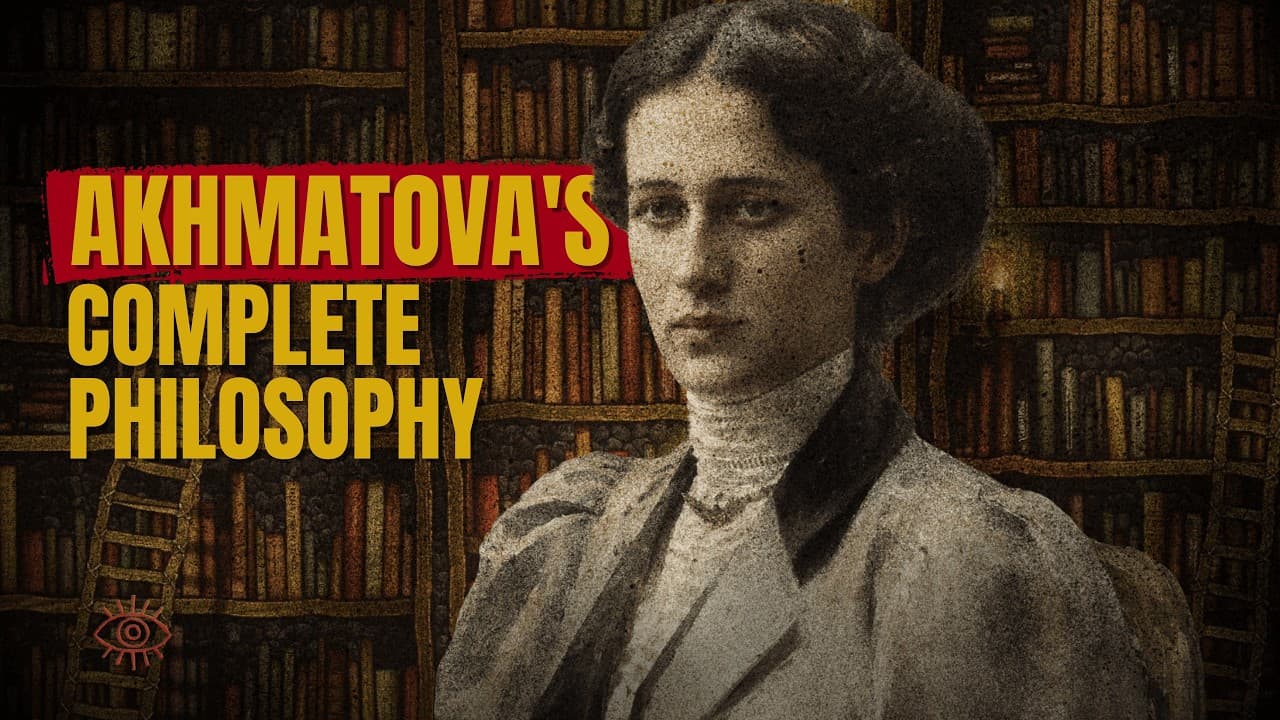
Akhmatova: The Poet Who Outlived the State
She answered terror with a poem too dangerous to write down, and the poem outlived the state that banned it.
This episode follows Anna Akhmatova from a childhood in Pushkin's town outside Petersburg, through the cellar cabarets where a new Russian poetry was made, to the love lyrics that made her the most famous woman in Russian literature before she was thirty. Then the century turns. A husband is executed, a son is taken, and an unofficial ban erases her name from print for fifteen years.
We trace how a banned poet composed her greatest work without ever writing it down, how a cycle of short poems became the memorial for a generation of the disappeared, and what it means to treat memory itself as a form of resistance. The episode ends among honors that arrived forty years late, a difficult masterpiece three decades in the making, and a bronze figure standing by a river, looking at a prison.
The full episode is on YouTube and Spotify. Please listen only in safe, restful contexts.
Enjoying the episode?
Occasional letters on philosophy, reading, and the examined life. No spam, ever.
By subscribing you consent to receiving occasional emails. Unsubscribe any time via the link in every email or at /unsubscribe.
Timestamps
- 0:00:00Chapter 1: The Woman in the Queue
- 0:12:50Chapter 2: Pushkin's Town
- 0:18:51Chapter 3: The Unknown Italian
- 0:26:52Chapter 4: The Cellar of the Stray Dog
- 0:37:59Chapter 5: The Glove on the Wrong Hand
- 0:46:52Chapter 6: Anna of All the Russias
- 0:52:48Chapter 7: White Flock
- 0:59:58Chapter 8: The Voice She Refused
- 1:06:19Chapter 9: August Nineteen Twenty-One
- 1:16:59Chapter 10: The Unwritten Decade
- 1:24:58Chapter 11: Fountain House
- 1:31:14Chapter 12: The Mandelstams
- 1:40:45Chapter 13: Three Hundredth in Line
- 1:51:16Chapter 14: Hands, Matches, an Ashtray
- 1:59:57Chapter 15: Requiem
- 2:13:12Chapter 16: The Word as Witness
- 2:19:48Chapter 17: Courage
- 2:30:38Chapter 18: The Guest from the Future
- 2:38:41Chapter 19: Half Nun, Half Harlot
- 2:50:10Chapter 20: The Masquerade
- 2:59:27Chapter 21: The Box with the Triple Bottom
- 3:06:07Chapter 22: The Booth at Komarovo
- 3:15:10Chapter 23: The Monument by the Prison
For the record
Full Transcript
Chapter 01: The Woman in the Queue
It is the late 1930s, in Leningrad, in the cold. A line of women stands along a prison wall, waiting in the grey light for news of the men inside. One of them has stood here, on and off, for months, in frost and in thaw, among strangers who have learned to know her face. A woman with blue lips, recognizing her, leans close and asks in a whisper whether she can describe this. And she answers, with a single word, that she can. Then something like a smile passes over what had once been the woman's face.
How does a person arrive at that wall. How does a fashionable love poet of old Petersburg, a woman whose early verses young people once recited to each other across drawing rooms, end up standing in a queue outside a prison, promising a stranger that she will find the words for it. The answer is a life, and the life is worth telling plainly, because almost everything that made her famous and almost everything that nearly destroyed her is already folded into that one exchange against the wall.
She was born Anna Gorenko in June of 1889, near Odessa, on the shore of the Black Sea, the daughter of a naval engineer. While she was still an infant the family moved north, to Tsarskoye Selo, a small ornamental town outside Petersburg built around the summer palaces of the tsars, a place of parks and statues and long straight avenues. She would carry that town inside her for the rest of her life. She began writing verse at 11, in the ordinary way of a clever child who has fallen in love with rhythm, except that in her the habit never loosened its grip.
Her father did not approve. When he understood that his daughter meant to publish poems and to be known for them, he forbade her to shame the family name, declaring that he would not have a decadent poetess parading the name of Gorenko in print. So she took another name. There had been, in the family's account of itself, a great-grandmother descended from a Tatar prince, and the girl borrowed that ancestral name and signed herself Akhmatova. She was 17. It is a small thing and an enormous one, a teenager choosing the name under which she would become one of the most important poets her country produced, inventing the public person before the work that would fill it existed. The woman at the prison wall and the schoolgirl renaming herself are the same act, seen from opposite ends of a life. Both are a refusal to disappear quietly.
There was schooling in Kyiv, and after the secondary years a stretch of law courses, the sort of practical study a young woman of her class might undertake without anyone quite expecting it to lead to a career. What it led to, instead, was poetry and a marriage. In 1910 she married the poet Nikolai Gumilyov. Theirs was a union of two writers, and the fact of it matters here less for itself than for where it placed her. The marriage set her down at the center of the most ambitious literary circle of her generation, among people who believed that the right arrangement of plain words could matter more than anything else in the world, and it was in that company, more than in any drawing room, that she became the poet the rest of this story is about.
In October of 1912 a son was born, named Lev. He was raised for the most part not by her but by Gumilyov's mother, in the countryside near the small town of Bezhetsk, an arrangement common enough among the literary and the poor and the distracted, and one that would have consequences neither parent could have read at the time. The poems, meanwhile, were beginning to do their work. Her first books appeared in those years and made her suddenly, almost violently famous, famous in a way that attached to her person as much as to her writing. The character of that fame, what it was made of and what it cost her, is its own large subject. For now the fact is simply that by her middle twenties she was known across literate Russia, quoted, imitated, copied in dress and manner, a name that meant something the moment it was spoken.
Then the ground moved. The revolution of 1917 swept away the world her early poems had assumed, the drawing rooms and the summer towns and the whole apparatus of imperial life. Many of the people she knew left the country, scattering toward Paris and Berlin and points further west, and she could have gone with them. She stayed. The reasons she stayed, and the moral weight she placed on staying, form one of the central arguments of her life. The bare fact is the hinge. She remained inside the country that was becoming the Soviet Union, and so she remained available to everything that country would later do to her.
Her marriage to Gumilyov had cooled into friendship and then into divorce. For a brief period afterward she was married to Vladimir Shileiko, a scholar of ancient Mesopotamia, a man of formidable learning and difficult temper who is said to have fed her poems to the stove and set her to copying out his translations from dead languages. By her own later account she had walked from one kind of confinement into another, exchanging the household of a poet for the household of a man who could not forgive her for being one. The marriage did not last, and Shileiko leaves the story almost as quietly as he entered it, a strange interval between the catastrophes, the kind of figure a long life accumulates and then mislays. The first true catastrophe came in 1921, when Gumilyov was arrested and shot by the new state. They were no longer married, but in the eyes of officialdom she became, and remained for the rest of her life, the widow of an executed enemy, a status that clung to her like a mark. The full account of that year, of the man and his death and what it did to her, is a story large enough to need its own slow telling.
From the middle of the 1920s onward, an invisible weight settled over her. She was not arrested and not tried, but her name slowly vanished from print, the result of a decision taken somewhere above her and never explained to her face. For roughly 15 years one of the most celebrated poets alive published almost nothing of her own. How a person lives inside that kind of silence, and what she made of the time, is a question worth holding in mind. During these years she shared her life with the art critic Nikolai Punin, a brilliant champion of new painting, in a long unmarried union conducted under conditions of shortage and crowding that were themselves a portrait of the age. That household, and the strange courtesies it demanded, were a small theater of everything the age did to private life.
And then came the years that put her against the prison wall. In the great terror of the late 1930s, when the state was devouring its own citizens by the hundreds of thousands, it did not arrest her. It arrested her son. Lev, grown now, a gifted student of history and the child of an executed father, was taken, and the taking of him was the precise instrument of her suffering, a cruelty aimed at her through the person she could least protect. For 17 months she stood outside the prison among the other women, in every season, waiting for any word of him. What that waiting was actually made of, hour by hour, is not the matter of these pages. What matters here is its shape. A mother stood in a line for a year and a half, and out of that standing, held entirely in memory because a single sheet of paper could have killed her, came the poem that is the reason much of the world still says her name.
That is the center of the life, but it is not the end. War arrived, and with it an unexpected reprieve, the state briefly needing the very voice it had silenced, and she was evacuated far to the east before returning to a ruined city. The reprieve did not last. In 1946 the state turned on her again, formally and publicly, in a denunciation that expelled her from literary life and made her once more a non-person, while her son, released and then seized a second time, vanished again into the camps. She survived even that. In her last decade the wheel turned once more, slowly, and the honors arrived, foreign prizes and an old university's robe, recognition come 40 years late to a woman in her seventies who received it with the dry composure of someone who had stopped expecting anything from the world. She died in March of 1966, an old woman who had outlived the revolution, the terror, the war, and very nearly the entire society that had tried to erase her.
Set out like that, in a single breath, the life can seem to be mostly a record of things done to her, arrests and bans and deaths arriving from outside. But that is the view from the outside, and it is the wrong view. The deeper truth is the one the woman with blue lips asked her to confirm. Through all of it she was doing something, steadily, in conditions designed to make the doing impossible. She was describing. She was finding the exact words for the cold, for a gesture that gives a heart away, for a verdict that lands like a blow, for the look on a face that has forgotten how to smile. She took the small private instrument of the love lyric, the poem about one person's longing for another, and she carried it intact through the whole twentieth century, until it had learned to speak for one woman, and then for a whole line of waiting women, and then for a country full of the disappeared.
So the question this life keeps asking, how a love poet of old Petersburg ended up promising a stranger that she could describe a prison queue, turns out to contain its own answer. She ended up there because describing was never, for her, a decoration laid over experience. It was the thing itself, the one act that remained possible when everything else had been taken, the work she was doing in the drawing rooms at twenty and the work she was doing at the wall at fifty, the same work under unimaginably different weather. The biography supplies the facts. It tells us where she was born and whom she married and when the men around her were killed and when her name was struck from the lists. But the facts, lined up in order, are only the outline of a person. They are the empty chair after the sitter has gone, accurate about the shape and silent about the warmth. They cannot tell us what it was like, from the inside, to be this particular consciousness moving through this particular century, holding its gaze steady on the things everyone else had learned to look past, refusing to look away.
For that we have to go to the poems. They are still here, every one of them that survived, and they remember things the biography cannot reach. They remember the imperial gardens of her childhood and the bright dangerous company of her youth, the choice to stay when staying meant standing in the path of history, the long silence and the years at the wall. They hold the whole life, not as dates but as the living weight of having lived it. The woman in the queue said she could describe this, and what remains is simply the proof of that claim, poem by poem, the record she made of a time that meant to leave no record at all. The life produced the work. It is the work, in the end, that knows more than the life does.
Chapter 02: Pushkin's Town
Tsarskoye Selo means the tsar's village, and for Russians it means one thing above all, the town where Pushkin went to school. It sat a short way south of the capital, a settlement that existed because the rulers of Russia had built their summer palaces there and surrounded them with parks. To grow up in that town was to grow up inside a stage set for empire. There were avenues of clipped limes and long ornamental lakes, pavilions in the taste of three different centuries, marble figures of gods and nymphs standing pale among the trees, and gravel paths raked smooth for feet that mostly belonged to the imperial household. A child could walk all morning under the planes and oaks and meet a bronze emperor at every turning. The air smelled of damp leaves and cold stone. In autumn the statues wore caps of wet gold.
It was a manufactured paradise, and it was also an ordinary provincial place with a railway. A short line ran from the town straight into Petersburg, the first passenger railway the country ever built, so that the same little girl who played among the imperial swans could be carried in under an hour to the great grey city on the water. She lived between the two worlds, the garden and the capital, and both of them entered her sense of what a poem was allowed to contain. But the thing that mattered most about the town was older than the railway and grander than any palace. Inside the park stood a school. In 1811, some 78 years before she was born, the imperial government had founded an academy there for the sons of the nobility, a place meant to manufacture statesmen, and into its first class had come a restless boy who would instead manufacture the Russian language as we now have it. His name was Alexander Pushkin, and he had walked these same lanes as a schoolboy, scribbling verses, falling in love, learning to hear his own ear.
This was the inheritance she felt before she could have named it. She believed all her life that she walked where he had walked, that the cold avenues kept the print of his feet, that a poet of this town was answerable to the one who had defined it. Pushkin was for her not a national monument to be saluted but a living presence, the measure against which every line could be tested. Where the poetry of her own youth tended toward fog and incense, his was clear, exact, and unafraid of plain speech, and that clarity became her standard. Early on she wrote a small poem set in the very park of her childhood, and it pictures him there as a boy, the dark-skinned youth who had wandered these avenues a century before, grieving by the edge of the lakes, and across the distance of all those years, the poem says, we can still faintly hear the rustle of his steps. She was claiming kinship. She was saying that the town had two children who heard the same silence.
That kinship was easy to romanticize and harder to live. The full meaning of it would not arrive until decades later, in the worst stretch of her life, when her own poems had been quietly driven out of print and she needed work that the state could not call hers. In those years she turned scholar. She read Pushkin not as a worshipper now but as an investigator, going through his manuscripts and his library, and she did real research that specialists still cite. In one study she traced the strange tale he had told in verse of a golden cockerel that crows to warn a king of danger, following it back past the obvious sources to a story by the American writer Washington Irving, a tale of an astrologer and a brass talisman, which Pushkin had read in a French translation. In another she examined his late dramatic poem about a stone guest, the version he made of the legend of the seducer pulled down to hell by a statue. This was not a detour from her own art. Reading his censored and harassed life, the duel forced on him, the watch the authorities kept over every word, she was reading a mirror of her own predicament, and learning from the man who had survived the same machine in an earlier reign exactly how a poet endures a state that fears him.
For that is the deepest thing the town gave her, deeper than the parks and the statues. Pushkin had established something in Russia that has no exact equal elsewhere, the idea that the poet is a kind of second sovereign, an authority that runs parallel to the throne and outlasts it. In a country where the official record was so often a lie, people learned to trust the poets to hold the truth in safekeeping, to say in memorable speech what could not be printed in the newspapers, to stand for a conscience the government did not supply. Pushkin had founded that office almost single-handed, and dying young at the hands of the same court society that had built her childhood paradise, he had sealed it. She inherited the office whole. It is why the regime that came to power in her lifetime treated a woman who wrote short poems as a genuine adversary, worth banning, worth watching, worth breaking, and it is why she accepted that estimate of her own importance without vanity and without flinching. She had been raised, after all, in his town. From the beginning she understood that to be a Russian poet was to be answerable to everyone, alive and dead, and to be answerable to no tsar at all.
Chapter 03: The Unknown Italian
In the spring of 1910 and again in 1911, in Paris, a penniless Italian painter drew a young Russian woman nobody had heard of, 16 times. Neither of them was anyone yet. She was a thin girl of 21, newly married, in the city for the first time, with a few poems written and not one book to her name. He was Amedeo Modigliani, a few years older, beautiful and broke, known in the cafes of the painters' quarter and almost nowhere else. The world that would later fight over his canvases had not arrived. The legend that would later gather around her had not begun. What happened between them happened in that blank space before either name meant anything, which is exactly why it matters, and why she guarded the memory of it for the rest of a very long life.
She came to Paris the first time on her honeymoon, having married the poet Nikolai Gumilyov earlier that year. Of the marriage itself little needs saying here, only that the wedding trip carried her to a foreign city where, by some chance never fully explained, she met the Italian. They saw each other a little that spring. Then she went home to Russia. Over the following winter he wrote to her, and she kept his letters, and in the early summer of 1911 she returned to Paris alone, or nearly so, and the real friendship took place across those few months. She was not yet the woman the photographs would fix in the public mind. She was simply herself, watchful, amused, already carrying the particular gravity that people would later mistake for hauteur.
Everything we know of those months comes filtered through her own recollection, written down only at the very end of her life, half a century after the fact. So the Paris she gives us is a remembered Paris, soft at the edges, lit by the knowledge of everything that came after. In that remembered Paris they had no money for anything. When they walked in the Luxembourg Gardens they could not afford to rent the chairs set out for paying visitors, so they sat together on a public bench instead, and from that bench, she recalled, they recited French poetry to each other, both of them knowing a great deal of it by heart. They had read the same poets without ever meeting, which is its own kind of intimacy. When the rain came they did not run for shelter. They stayed and shared one large old black umbrella, sitting close beneath it, and went on reciting Verlaine from memory while the rain fell around them. It is a small scene and it asks for nothing. Two young people, no money, a borrowed roof of cloth, poetry in a language native to neither of them, said aloud for the pleasure of saying it.
She told one other story about him that she clearly loved, because she returned to it. She had gone to bring him roses, and arrived to find him out, his studio empty. Rather than carry the flowers away or leave them at the door, she threw them in through the open window, one after another, so that they scattered across the floor of the room. When he came back and learned what she had done, he refused to believe she had simply tossed them. He was certain someone must have arranged them, because they had fallen so beautifully, lying just so across the boards as if placed by a careful hand. That was the whole of it. A handful of roses thrown through a window by a young woman who could not wait, and a young man insisting on the impossible, that chance had composed them. The story survives because it tells you what the two of them were like together, both of them inclined to find design in accident, both a little in love with beauty arriving by surprise.
And he drew her. Again and again, across both of those Paris seasons, he made drawings of her, and she said there were 16 of them in the end. He did not draw her as a Parisian girl of the moment, with the fashions and the fringe. He drew her, she said, as if she were an Egyptian queen, the long neck and the severe line of the body rendered with that ancient stillness, the head held in profile the way the old tomb painters held a head. He had been looking hard at Egyptian art in those years, at the sculpture and the wall paintings, and he saw in this Russian girl a face that belonged to that older, graver world. She accepted the comparison and seems to have been quietly proud of it. It is worth pausing on the strangeness of the exchange. A poor Italian in Paris draws an unknown Russian as a figure out of ancient Egypt, and decades later she is one of the most important poets of her century and he is one of the most expensive painters in the world, and at the time it was only two people in a cold room, one looking and one being looked at, with nothing riding on it at all.
Of the 16 drawings, 15 are gone. They were lost in the wars and the moves and the confiscations and the sheer attrition of a Russian life lived across revolution, siege, and terror, the kind of life in which paper does not survive. Only one came through. A single drawing, the nude line of a seated woman with her head bowed, the one he is supposed to have given her or that she somehow kept. That one drawing she hung on the wall of whatever room she was living in, and she moved many times and owned almost nothing, and through all of it the drawing went with her. It hung in her room in every home she ever had, until she died. Think of what passed beneath it. The fame, the silence, the queues, the war, the denunciations, the small late honors. Through all of that, on the wall, the lost girl of 1911, drawn by a man who was nobody when he drew her.
He did not live to see any of it. Modigliani died in Paris in 1920, poor and sick, just before the world decided it wanted his paintings, which it then wanted with an appetite that would have astonished him. He never knew that the Russian girl on his bench had become a great poet. She outlived him by nearly half a century. And near the very end, an old woman who had buried almost everyone, she sat down and wrote a short memoir of those Paris months, setting the bench and the umbrella and the roses and the drawings into careful prose, so that the friendship would not vanish the way the other 15 drawings had vanished.
That memoir is the reason any of this is recoverable, and it is worth asking what she wanted it to preserve. Not a romance, exactly. She was guarded about that and we should be too. What she preserved instead was a record of herself before the legend hardened around her, a portrait of the poet as an unknown girl, taken by another unknown, at the one moment when neither of them was anything but a person of talent and no reputation. Two people who would each become a name, meeting before they were names, and recognizing in each other something that the world had not yet certified. She kept the one surviving drawing on the wall because it remembered her as she had been before the rest of it happened, and because it was proof that she had once been seen clearly, for nothing, by someone who had no reason to flatter her and every reason to look.
Chapter 04: The Cellar of the Stray Dog
Every revolution in poetry begins as an argument about what a word is for, and the argument that made Akhmatova begins with the Symbolists. To understand what she and her friends were rebelling against, you have to picture the reigning taste of Russian verse in the years before the first world war, because it was a taste of extraordinary refinement and ambition, and for a young writer it was the air itself. The Symbolists were the masters of that air. They had taught two generations of readers that a poem was not a description of the visible world but a doorway out of it. For them a word was always a veil. Behind the ordinary thing the word named, there was supposed to stand a higher, hidden reality, and the poet's task was to point past the surface toward that secret order of being.
This had real grandeur, and it is worth taking seriously before it is set aside. The Symbolists treated poetry as a kind of sacred music, an occult art that worked by suggestion and incantation rather than by statement. A rose, in such a poem, was never simply a rose on a table. It was a sign, a cipher for the eternal feminine, for divine love, for the soul, for whatever lay beyond the door. The most gifted of them, men like Alexander Blok, could make this music shimmer with genuine mystery, so that a reader felt the floor of the everyday world go soft underfoot. But a doctrine that turns every object into a symbol of something else has a hidden cost. It can never let a thing simply be itself. The visible world becomes a screen of hints, and the poet, forever gesturing at the invisible, begins to lose his grip on the only world his readers actually live in. By about 1910 the younger poets had started to feel this loss as a suffocation. They wanted the rose back.
The rebellion organized itself in 1911, and it organized itself, tellingly, not as a manifesto first but as a workshop. There was something almost modest about its beginning, a few poets meeting in apartments to read their work aloud and to criticize it openly, line by line, without the reverence the older school demanded for its visions. Akhmatova's husband, the poet Nikolai Gumilyov, together with another young poet named Sergei Gorodetsky, founded a society they called the Guild of Poets. The name was the whole idea in miniature. Where the Symbolists spoke of the poet as a priest or a prophet receiving visions, the Guild borrowed its language from the medieval crafts, from the worlds of the stonemason and the goldsmith and the maker of shoes. A guild has masters and journeymen and apprentices. It assumes that the work can be taught, that there are standards of competence, that a poem is a made object whose joinery can be inspected and whose flaws can be named. Poetry, on this view, was not a trance to be entered but a trade to be learned. The young Akhmatova served as the guild's secretary, keeping its records, and among its members was the one contemporary she would acknowledge for the rest of her life as her equal, the poet Osip Mandelstam, though the long story of that friendship belongs elsewhere.
Out of the Guild came the school, and the school needed a name. They called the new movement Acmeism, from a Greek word meaning a peak or a high point, the moment of fullest ripeness. The name was a small flag planted in plain sight. Against the Symbolist habit of dissolving the world into hints, Acmeism stood for the clear word and the solid thing. A rose was to be beautiful in itself, for its weight and its scent and its particular red, and not because it stood in for some abstraction behind it. The Acmeists prized the earthly, the concrete, the well-built. They admired architecture, the cathedral that holds its shape against gravity, the craftsman who respects his materials. Where the Symbolist looked through the object toward the infinite, the Acmeist looked hard at the object and trusted that looking hard was itself a form of reverence. Years later Mandelstam gave the movement the definition that has outlived all the others. Acmeism, he said in effect, was a homesickness for world culture, a longing for the whole inheritance of human making, for Greece and Rome and the cathedrals and the poets of every nation, gathered up and carried forward. It was not a turning away from the sacred. It was a refusal to let the sacred excuse a poet from the discipline of the actual.
A doctrine, however, is only the skeleton of a literary moment. The flesh of it, the part that people remembered with a catch in the throat decades later, was a cellar. Off one of the squares of Petersburg, down a flight of steps below street level, there was a small cabaret that the poets and their friends called the Stray Dog. It was a basement room, low and warm and crowded, its walls painted with bright birds and flowers and strange figures by one of the artists of the circle, so that the whole place had the feeling of a child's storybook gone slightly feverish. The Stray Dog opened late and stayed open until dawn. Poets came, and actors, and dancers, and the painters who decorated the walls, and around them a fringe of admirers and idlers and the merely curious, the people the regulars half mockingly called the pharmacists, meaning everyone who was not an artist but wanted to breathe the same smoke. There was a little raised stage. Wine was drunk, verses were declaimed, music was played, and the talk ran on until the candles guttered and the morning came up grey over the canals.
Akhmatova belonged to this room as much as anyone, and the room helped invent the public image of her. She would read from the small stage, tall and very thin, in a tight skirt, with the dark fringe of hair cut straight across her forehead that would soon be imitated by young women all over Russia. She had a way of standing still and reading her short, exact poems in a low voice, and the cellar would go quiet to hear them. The room had its own private rituals and its own private grandeur, the grandeur of a place where being penniless and being celebrated were somehow the same condition. The wine was cheap and the talk was not. People who could barely pay for their bread came down those steps to argue about meter and Italy and the future of the art, and to watch each other perform, and to be young together in a city that still felt like the center of the world. She wrote one poem in 1913 that has become the very signature of the place, and its tone tells you almost everything about the mood of those nights. In it she says, in effect, that all of them gathered there are drunkards and revelers, that the women among them are loose and lost, and that for all the gaiety there is no joy in it, only a shared and glittering unhappiness. That is the strange double note of the Stray Dog. It was the headquarters of a movement dedicated to clarity and craft and the love of the solid world, and it was also a late-night room full of beautiful people living as if the gaiety would never end, with the faint smell of doom already mixed into all that brightness. The brightness and the dread were the same brightness. There was no joy in it, she had written of those very nights, and that note of dread sat under the laughter like a stone resting under shallow water.
One encounter from those years deserves to be told for its own sake, because it shows how the new poet stood toward the old masters she was displacing. Among the Symbolists, the supreme figure was Alexander Blok, the most musical and magnetic poet of the older generation, a man whose very name carried an aura of doom and beauty. Blok and the young Akhmatova exchanged poems in the courtly old manner, the way poets once paid each other compliments in verse. Blok wrote her a little poem in which he tells her, in effect, that beauty is a frightening thing, and advises her, with an ambiguous smile, to throw a Spanish shawl across her shoulders and a red rose in her hair. She answered with a poem of her own in the same key, returning his image, telling him that it is not beauty but something simpler and graver that frightens, the two poets circling each other with wary, mutual admiration, each acknowledging the other's power while conceding nothing. Out of this exchange, and out of a few meetings, the reading public built a legend of a great romance between them. It was the kind of story the age wanted to be true. Akhmatova denied it flatly for the rest of her life, and there is no good reason to doubt her. What actually passed between them was rarer than a love affair. It was the formal salute of one kind of poetry to another, the old music nodding gravely to the new clarity that had come to take its place.
What was being founded in that cellar, beneath the painted birds, was not just a fashion or a fringe of bohemian nightlife. It was a particular faith about language that Akhmatova would carry, unbroken, through everything that came after. The Symbolists had asked the word to be a window onto another world. The Acmeists asked it to be true to this one, to name the lamp and the doorway and the cold stair with such precision that the naming itself became an act of fidelity. It is easy to see this as a quarrel among aesthetes, a dispute about roses, conducted by elegant young people in a warm room while the snow fell on the square above them. But the stakes turned out to be enormous. A poet trained to look hard at the actual thing, to render the real with exactness and to trust the plain word, is a poet equipped to bear witness. The discipline learned for the sake of a rose would one day be turned on a prison wall and a line of waiting women, and it would hold. The clear word, beautiful in itself, would prove strong enough to carry the worst that a century could deliver.
Chapter 05: The Glove on the Wrong Hand
Her first book was called Evening, it appeared in March 1912 in an edition of 300 copies, and it contained a discovery about how feeling gets into words. 300 copies is almost nothing. It is the size of a private gift, a handful of slim grey volumes passed among friends and a few reviewers, and yet inside that small printing there worked a method so precise that it would outlast the empire it was printed in. The book carried a short preface by the poet Mikhail Kuzmin, an elder of the circle, who recognized at once that something exact had arrived. Many of the poems had been written in the summers at the family estate near Bezhetsk, where she kept her son and her notebooks at a distance from the capital. The poems are brief. Most could be read aloud in under a minute. And the thing they do, they do so quietly that a careless reader might take them for the diary of a sad young woman and miss the engineering underneath.
Here is the discovery, stated plainly. Feeling does not enter a poem most powerfully when it is named. It enters when it is shown as a physical act, a small wrong gesture of the body, left for the reader to translate back into the emotion that produced it. The reigning manner of the day went the other way. It preferred the grand abstraction, the named and elevated emotion, the manner whose name was Symbolism. Against all that she set a method of almost cold accuracy. She would not tell you that the heart was breaking. She would show you the hand that the breaking heart had betrayed.
The clearest demonstration is the poem readers came to call the song of the last meeting. A woman is leaving a house. A love affair has ended inside it, and she walks out into the cold. The poem does not explain what was said or who was at fault. It gives instead a single sensation, that her breast had gone helplessly cold, and then it gives one gesture, and the whole poem turns on that gesture. She is wearing gloves, and without noticing, she pulls onto her right hand the glove that belongs on her left. That is all. She does not weep in the lines. She does not curse the man or the house. She simply puts the glove on the wrong hand, and every listener understands at once, because every listener has at some moment of shock done exactly this, fumbled a small ordinary task because the mind was elsewhere and ruined. The body keeps the books that the speaker will not open. The wrong glove carries the entire psychology of the scene, the numbness, the disbelief, the refusal of the catastrophe to feel real yet, and it carries it without a single word for any of those things.
The poem deepens the trick once more before it ends. As the woman goes down the steps from the house, she registers that there were only a few of them, and yet they seemed to her like very many, an endless flight. Three small steps stretched into a staircase that would not end. Again the inner state is rendered as a fact about the outer world, a distortion in how the body measures distance, and again the reader is trusted to do the final work. This is the bargain the whole book proposes. The poet supplies the exact object, the cold breast, the reversed glove, the steps that multiply, and the reader supplies the grief. Because the reader has done the supplying, the grief feels like the reader's own. That is why these short pieces strike so much harder than the long laments they replaced. A named emotion stays on the page. An emotion you have decoded for yourself has already entered your body before you can defend against it.
The same instinct governs the poem about the grey-eyed king. It opens with a strange salute, a greeting addressed to pain itself, hail to you, everlasting pain, and then delivers, in the flat tone of someone passing along the day's news, the report that the grey-eyed king died yesterday. What follows is given in the same level voice. The autumn evening was close and red. Her husband, coming home, remarked offhandedly that the king had been found dead out hunting, brought back from the woods near an old oak. And the woman thinks of her small daughter, and notes that the child has grey eyes. The poem never says that the dead king was the speaker's lover, never says that the grey-eyed child is his. It does not need to. The whole secret history is folded into one withheld fact and one repeated colour, and the ballad form, with its old air of rumour and ordinary report, lets a private adultery and a private grief travel hidden inside what sounds like a piece of evening gossip. Once again the feeling is never stated. It is buried in a detail and left for you to find, and finding it, you feel the floor of the poem drop away.
This brevity was her signature from the start. Poems of 8 lines, of 12, that imply a whole novel they decline to write. Readers later said that she had compressed the entire nineteenth-century novel, its affairs and betrayals and slow ruin, down into the length of a sigh. The remark is exact. In place of 300 pages of a marriage going wrong, she gives the wrong glove and trusts you to reconstruct the 300 pages yourself, and you do. The economy is not coldness. It is a wager that the reader is intelligent and has lived, that a single true detail will summon more than any quantity of explanation. A long poem tells you how to feel and risks your boredom. A short one of hers hands you one object, steps back, and lets the silence around it fill with everything unsaid. The poems also tend to break off rather than conclude. They stop on the cold staircase, on the grey-eyed child, on a gesture caught in the act, refusing the tidy final sentiment that a lesser poem would supply. That refusal is part of the method too. Life does not announce its endings, it merely continues past them while we stand in the doorway with the wrong glove on, and the poems keep faith with that. They leave the wound open because the wound, in fact, stays open, and a closed last line would be the first lie in an otherwise truthful poem.
There is one more invention in Evening, and it would shape the rest of her life in ways she could not yet have measured. The woman who speaks these poems, abandoned, watching, fumbling her glove on a cold staircase, is not simply Anna Akhmatova writing down her own afternoon. She is a made figure, a lyric heroine, an instrument tuned to register feeling at the finest scale, and the poet built her the way a novelist builds a character who is and is not the author. But the poems were so intimate, so precisely observed, that readers could not believe they were anything but confession. They assumed each piece reported a real night in the writer's real life, that every absent lover had a name she knew, that the cold breast and the reversed glove were a transcript. And she did not correct them. She let the mask and the face blur into each other, let the line between the invented heroine and the living woman go soft, because that blur was itself a kind of power. The reader who believes a poem is a true diary reads it leaning forward, hungry, certain of access to a real heart. That belief would cost her a great deal in the years to come, and would also let her become something larger than a private poet, though all of that lay far ahead of the young woman in the spring of 1912. Here at the beginning it is enough to see what she had found. She had learned to put the whole of a feeling into the smallest physical wrongness, the glove on the wrong hand, and to make a reader complete the gesture and so complete the grief. Everything she would later do, the speaking for thousands, the witness against a state, would be built on that small and merciless accuracy first proven in 300 grey copies in the spring of 1912.
Chapter 06: Anna of All the Russias
There are poets who wait decades for their readers, and there are poets the readers seem to have been waiting for. Akhmatova's second book, Rosary, reached the shops in March 1914, and within months an unknown 24 year old was the most famous woman in Russian poetry. The book was thin, the poems were short, and the subject was old as song, a woman in love and a woman left. Yet something in the timing or the voice caught a whole reading public at once. Her first book had found admirers among other poets and a few sharp critics. This second book found everyone. It went into edition after edition, 9 printings before the decade was out, selling steadily even after the war began and paper grew scarce and the country had every reason to think of other things. A book of love poems kept reprinting through years of mass death, which tells you something about what people needed, and something about what she had made.
What she had made was not a confession, though it was read as one. The quiet discovery of her first book, the one remembered ever after for the glove pulled onto the wrong hand, was now perfected and repeated and varied across a hundred small scenes. Readers did not analyze the method. They simply felt that here at last was a woman speaking the truth about her own heart, plainly, without ornament, in the very words a person might use. That the truth was a made thing, an effect built by a craftsman, did not occur to most of them, and she did not always trouble to correct it.
The fame that followed was unlike the fame of other poets, because it left the page entirely. A parlor game spread across Russia that season, played in drawing rooms in Petersburg and Moscow and in provincial towns where her name had only just arrived. One person would recite a line of hers, and the next was bound to continue it from memory, and the next, until someone faltered and lost. Her poems had become a common possession, the way folk songs are, known by heart by people who could not have said where they first heard them. Young women copied more than the lines. They copied the woman. They wore their hair in the heavy dark fringe she wore, draped themselves in a particular shawl the way she draped hers, practiced the tall, still, faintly mournful bearing that photographs had fixed. Reviewers gave the whole phenomenon a name, calling the look and the manner and the borrowed sorrow a kind of Akhmatova lace, a delicate thing everyone could now buy and wear.
From far off, another poet watched and paid the highest tribute of all. Marina Tsvetaeva, a stranger to her then, wrote of her from a distance with open adoration, and in those poems she set a crown on her head, naming her Anna of all the Russias, as though she were not a writer at all but a sovereign, the one ruler the country had freely chosen. The phrase stuck because it named something true. In a land where the official ruler sat in a palace, here was a woman whose dominion was the memorized line, an authority no decree had granted and none could revoke, ratified only by the fact that millions held her words in their heads.
She gave that public exactly what it wanted and slightly more than it understood. In one of the poems they loved best she writes that she has taught herself to live simply and wisely, to look at the sky and to pray to God, and to walk a long while before evening so as to wear out a needless anxiety. It reads like a page from a diary, the private resolution of a woman calming herself, and her admirers read it precisely that way, as news of her own inner life. But the simplicity is learned, she says so in the first breath, taught to herself, a discipline and not a temperament, and what looks like artless candor is the hardest art there is, the art that hides itself. They took the mask for the face, which is what they were meant to do.
There was a price, and she came to feel it as one. The mask, worn long enough, hardens onto the skin. The public had decided who she was, the lovely melancholy woman of the love poems, the one forever being abandoned at the end of an affair, and it wanted her to remain that woman permanently, to keep supplying the same exquisite grief. Critics fixed the label on her too, the love poet, the poetess of the boudoir, and it sounded harmless enough in 1914. In other decades the same word would be turned into a weapon and used to dismiss her, to say that a woman who wrote of broken hearts could have nothing to say about a country breaking apart. She grew impatient with the jilted lover the public would not let her retire. She had more to say, and she could feel the cage of her own image closing around the saying of it.
So the fame was the first of her prisons, though it was a velvet one and she would learn what the other kind was like. It is worth saying plainly. Adoration is a form of confinement. To be loved by everyone for one thing is to be forbidden the rest of yourself, and a portrait painted by a million strangers is still a wall. She had wanted to be read, and she was read as no Russian poet of her time. She had wanted to be understood, and that is a different wish, and it would wait.
Chapter 07: White Flock
White Flock was published in September 1917, between two revolutions, and in it the love poet learned to speak for more than two people in a room. The first two books had perfected a chamber art. A man and a woman, a parting, a single exact gesture caught in passing, the whole apparatus of feeling tuned to the scale of a single afflicted heart. The third book keeps all that skill and then opens a window in the wall of the room, and through the window comes a war, a country, a sky over a country, and the cold that was beginning to settle on a whole civilization. The instrument is the same. The thing it is asked to play has grown enormous.
The change has a date behind it, and the date is the summer of 1914, when the first world war began and Russia marched east and west into a slaughter it did not understand. The poems written across the next three years carry that war the way a field carries the weather. It is rarely the foreground. It is the light everything stands in. Men leave for the front in these poems and do not always come back. Bells ring for the dead. A woman who once measured grief by the loss of one beloved now hears grief multiplied across every house on the street, and the multiplication changes the arithmetic of what a poem is for. The private wound is still there. But it has been set inside a public catastrophe, and the two have begun to bleed into each other, so that you cannot always tell whether the speaker mourns a lover or a nation, and that uncertainty is the discovery of the book.
The clearest sign of the turn is a short prayer she wrote in 1915, and it is a frightening thing to read once you know what came after. The poem offers a bargain to whatever power presides over the fate of a country. She is willing to give up the things a person holds most precious. She offers, in effect, her illness burned away in fever, her child, her companion, even the mysterious gift of song that was her one possession and her one defense. She will surrender all of it, she says, if only the heavy storm cloud hanging over Russia might break and pass and turn at last into a cloud lit with glory. It is a young woman's prayer, exalted and sincere, the kind of offering that feels noble in the moment of making it. And then the century took her up on every clause. The child would be taken from her into the prisons. The companions would be shot or would die in camps. The gift of song would be banned and driven underground for decades. Reading the poem later, after all of it had happened, it looks less like a prayer than like a contract whose terms the future enforced to the letter, a bargain offered in good faith and accepted by a buyer she could not see.
Standing inside the book, addressed by many of its finest poems, is a particular man, and his name is Boris Anrep. He was a cavalry officer in those war years, and he was also an artist, a maker of mosaics, a man who set small hard pieces of colored stone into floors and walls to compose faces that would outlast the people who walked over them. She met him through a mutual friend, and she loved him, and the feeling ran through White Flock like a vein of bright metal through rock. Many of the love poems of the book are spoken toward him, or away from him, or into the space he was about to vacate, because almost from the start the love was shadowed by his leaving. He moved between Russia and England in those years, carrying out a courier's errands, and the war and then the revolution made the leaving permanent.
In 1917, with the old world coming apart around them both, Anrep chose. He chose England, safety, and the chance to go on making his art in a country that was not setting fire to itself. He left Russia, and he did not come back, and he lived a long life abroad among his stones and his patrons while she stayed behind to be ground down by everything that staying would cost. Before he went she gave him a ring, a black ring, an heirloom she valued, and the gift became one of the small fixed legends of her life, the talisman handed to the man walking out the door toward the rest of the twentieth century. She kept the poems. He kept the ring. The country closed between them like water.
And then there is the coda, which arrived more than three decades later and which belongs to his story and so to this one. In 1952, in London, Boris Anrep finished a great mosaic floor in the entrance hall of the National Gallery, a sequence of figures representing the virtues a human life might be measured against. For the figure of Compassion he used a face he had not seen in person for many years, the face of the woman he had loved and left in Petersburg before the revolution. He set her there in the floor, in chips of colored stone, eyes lowered, eternal, walked over every day by strangers who had never heard her name, the very image of mercy bending toward human suffering. She learned of it. The poet whose own country had banned her and pulped her books was, without her knowledge and across a sealed border, becoming a permanent fixture in the floor of a museum in the enemy West, fixed in stone among the virtues by a man who had saved himself by leaving. They would meet once more, very briefly, in the last summer of her travels abroad, an old woman and an old man saying little, but for the shape of their story the ring and the mosaic are the true ending, the talisman handed across and the face set in a foreign floor.
Anrep matters here for more than the love. He is the first of the departures, and the departures are a pattern that will define Akhmatova by contrast for the rest of her life. Again and again the people closest to her would face the same fork in the road that he faced in 1917, the choice between leaving and staying, between the safety of exile and the danger of the homeland, between art made in comfort abroad and art made in peril at home. He chose to leave, and he lived, and he prospered, and he set her face in a museum floor. She would choose the other road. White Flock is the book in which that contrast first comes clear, the book in which the woman who would stay watches the man who would go, and learns, by watching him pack, what kind of poet she was going to have to become.
Chapter 08: The Voice She Refused
In 1917 a voice spoke to her, in a poem, and offered her a clean escape from a dying country, and the poem exists because she said no. The voice is the poem's invention, but the choice behind it was real, and she made some version of it many times over the years that followed, each time more dearly than the last. This is the moral act that stands at the root of everything she became, the decision that made the witness possible long before there was anything she could not bear to watch.
Consider first what the offer was, because it was not a small thing. Around her the old world was coming apart. The war had bled the country white, the monarchy had fallen, and the second revolution of that autumn was turning the city she loved into something she did not recognize. Hunger arrived, then cold, then fear. Friends were already packing. Over the next few years a great part of the educated class she belonged to would leave, scattering toward Paris and Berlin and farther, carrying their languages and their grievances into furnished rooms abroad, and many of them would urge her to come. They were not foolish. They could see what was coming, and a number of them saved their lives by going. The door was open, and through it lay safety, and very likely comfort, and an admiring audience of exiles who would have received her as a queen.
The poem of 1917 stages exactly this temptation and answers it. A voice comes to her, consoling, almost tender, and it says, come here, leave your deaf and sinful land, leave Russia forever. It promises to wash the blood from her hands, to lift the black shame from her heart, to make her clean. And in the poem she does not argue, she does not debate the voice or refute it. She simply raises her hands and covers her ears, so that her grieving spirit will not be stained by those unworthy words. That gesture is the whole of her answer. The temptation is real, the voice is gentle, the offer is good, and she refuses to let herself even hear it to the end. She treats the invitation to leave as a kind of pollution, a thing she must shut out of her body before it can do its work.
Five years later she set the same conviction down more coldly and more completely. In a poem of 1922 she declares that she is not with those who abandoned their land to be torn to pieces by its enemies. She will not listen to their coarse flattery, will not hand them her songs. And then, having drawn that hard line, she does something more generous and more difficult. She turns and looks at the ones who left, the exile, and instead of contempt she offers pity. The exile in her poem is pitied like a prisoner, like a sick man, a figure to be mourned rather than scorned, and she says directly that dark is the road of the wanderer, that foreign bread smells of wormwood. She does not pretend that staying is comfortable and leaving is easy. She says the opposite. She says that those who left have chosen a road that runs through wormwood, and that she, who stayed, has chosen something harder still and would not trade it.
Underneath both poems lies a single idea, and it is worth stating plainly, because it is the argument she spent her life proving. For her, to emigrate was to perform an amputation on oneself. A poet is not a portable thing. A novelist might carry his world in a trunk, but a lyric poet is made entirely of a language, and a language lives only where it is spoken, in the mouths of the people who suffer and quarrel and pray in it. To leave Russia was to cut herself off from the one element in which her art could breathe, to keep the body alive at the cost of the thing the body was for. The exiles she pitied had saved their persons and lost their ground. They would write, some of them beautifully, but they would write into an echo, addressing a country that could no longer hear them, in a tongue slowly going stale in their mouths. She would rather stand inside the catastrophe and speak from within it than describe it correctly from a safe distance.
And so staying became, for her, a form of witness, though she could not yet have known how much there would be to witness. This is the part that turns a stubborn loyalty into something larger. When she covered her ears against the tempting voice, she did not know about the queues that lay ahead, or the friends who would vanish, or the decades of silence and fear. She chose to remain among her people before she had any idea what remaining would cost, and that is precisely what gives the choice its weight. It was not endurance after the fact. It was a wager made in the dark, a decision to be present for whatever her country was about to suffer, made at the one moment when she could still honorably have walked away.
The price of that wager should be named without softening it. Many of those who left lived. Many of those who stayed did not. This is simply true, and she knew it, and she never dressed it up as a guarantee of virtue rewarded. Staying did not protect her or the people she loved. It exposed them. What it gave her instead was standing, the right to speak, the authority that comes only from having been there when speaking was dangerous and leaving was free. She had decided to keep her place among her people in their suffering before that suffering had a name or a season, when nothing yet compelled her to prove the decision and she could still have chosen otherwise. When the years finally demanded that she answer for that decision with her body, she had already answered, in a poem, by covering her ears against a kindly voice and choosing the harder ground.
Chapter 09: August 1921
There is one month in which the old Petersburg of poets actually died, and for Akhmatova it had two funerals. The month was August of 1921, and to understand why it broke her so completely you have to follow the longer story of the man whose death gave the month its second grave, because she had loved him, married him, divorced him, and outlived him, and the state would insist for the rest of her life on calling her his widow.
Nikolai Gumilyov found her when she was still a thin schoolgirl in Tsarskoye Selo, the town outside Petersburg where both of them went to the gymnasium, a girl with a long spine and a way of holding herself that people remembered before they remembered her face. She did not move to the Kyiv region until several years later, after her parents parted, and finished her schooling there. He was a poet already, or determined to be one, and he courted her for years with a persistence that crossed into desperation. She refused him and refused him. He is said to have tried more than once to take his own life over her, traveling abroad and staging the gesture in foreign cities, returning, proposing again. It was not a courtship so much as a siege, and what finally ended it was less her surrender than her exhaustion, a sense that this furious devotion was a fact of her life she could neither return in kind nor escape. They were married in a church near Kyiv in the spring of 1910, and his own family did not come. They stayed away on purpose, certain the marriage was doomed, and in this one judgment the relatives were right.
The two of them went to Paris on their honeymoon, where she would meet the painter Modigliani. What matters for the marriage is what it became once it was a marriage. It was unhappy almost at once. They were two poets in one small life, and neither could become the wife or the audience the other half wanted. There is a particular cruelty in this kind of union, where each partner is too much the same shape as the other to fit. He had spent years willing her to be his, and now that she was, he seemed to discover that what he had wanted was the pursuit and not the having. She, for her part, had married a man whose feeling for her had always been a kind of weather she stood under rather than a thing she shared, and the marriage did not change that. He went off on long expeditions to Africa, hunting and collecting, returning with skins and stories and a restlessness that no domestic room could hold, and the absences were almost a relief to them both. She wrote, and then her writing began to be read, and then it was read everywhere, and her fame rose past his and kept rising, which is a hard thing between two people who have measured themselves by the same yardstick since they were young. Their son was born and sent to live mostly with Gumilyov's mother in the countryside, raised at a distance from both of them. By 1918 they had divorced, and the divorce was, by the standards of such things, amicable. They had stopped being married long before they signed the paper.
What did not change was the kind of man he was. When the first world war came he volunteered, and he was brave in the way he wanted to be brave, decorated, a cavalry officer who seemed to enjoy the danger. When the revolution came and the old world fell, he did not adjust himself to the new arithmetic of survival. He wore his monarchism in the open. He crossed himself before churches in the street. He made no secret of his contempt for the regime that now governed everything, and he behaved, in a city learning daily what the regime could do, as though the regime were beneath his notice. People who loved him called it courage. People who feared for him called it folly. In the end the distinction did not matter, because the state did not care which it was.
The month began with the other death. Alexander Blok, the great Symbolist master, the poet the whole city had revered as the voice of an age, died on the seventh of August, worn down and starved and broken, gone at 40 in a Petersburg that could no longer feed or heal its own. He had been the older master to whom she had once been linked in the cabaret years, a connection that belongs to that earlier world and not to this month. What belongs to this month is the funeral. All literary Petersburg walked behind his coffin through the streets, the poets and the actors and the readers, the whole world that had made the city a capital of verse, and as they walked many of them understood that they were not only burying a man. They were burying the era he had stood for, the silver brilliance of the years before everything, and the procession had the feel of a civilization following itself to the grave.
She walked in it, and within days she learned that the same month would take Gumilyov too. He had been arrested in the first days of August, swept up in what the new authorities called a conspiracy, a tangle of accusations built around a Petersburg professor named Tagantsev and an alleged plot against the government. The charges against Gumilyov amounted to little more than that he had known of the thing and had not informed, that he had kept some printed pages, that he was who he was. He had not hidden himself, had not fled, had carried on living as the open and unbending man he had always been, and that openness, which in another country would have been merely a temperament, was in this one taken as proof. There was no real trial in any sense the word can bear. The machinery moved quickly and in secret, the kind of proceeding that has its verdict before it has its evidence. 61 people were shot in connection with the affair. He was among them, executed in the last days of the month, somewhere outside the city, and there was no grave. She never learned the exact date. For the rest of her life the day of his death was a blank she could not fill, a man taken into the dark with no marker and no ceremony, the opposite in every way of the great public funeral that had opened the same August.
And so the city that had walked behind one coffin in daylight had no coffin at all for the other. The two deaths bracketed the month like its two hinges, one mourned by everyone and one that could barely be spoken of, and between them the old Petersburg of poets, the city of guilds and cabarets and madrigals, simply ceased to exist. She was 32 years old. She had been divorced from Gumilyov for three years. None of that protected her. From that August forward she carried a title the state had assigned her and would never let her set down, the widow of an executed man, a status more binding than the marriage had ever been, a mark that attached to her and, more dangerously, to their son.
She published twice that season, and the two books stand on either side of the catastrophe like a before and an after. In the spring there had been a small collection she called by a plain green word for the roadside weed that heals, poems still half belonging to the older world. Then, at the very end of the terrible year, came the other book, the one she named with the old church formula for reckoning time, the year of the Lord 1921, as though to fix the date in stone and consecrate it. In that title you can hear the grief beginning to harden into something permanent, the private wound taking on the weight of a public record, the year itself becoming a name she would carry.
The poems of that autumn show the change at the level of the nerve. There is one in which terror itself becomes the subject, fear moving through a house in the dark like a living thing, turning over the objects on the table, fingering the familiar shapes of a life as if to mark them for removal, and beyond the window, in the paraphrase that survives, the gleam of an axe waiting. This is not the language of a love poet. It is the language of someone who has learned that the door can open at any hour and that the man behind it will not be a lover leaving or arriving but the state arriving to take. The fear in the poem is not the old delicious dread of a lover's footstep on the stair. It is the new fear, the impersonal kind, the fear of a power that does not know your name and does not need to, that will come for you on a clerk's schedule and leave no record of where it put you. She had felt that power close its hand once already, in August, on a man she had stopped loving and could not stop being bound to, and the poem is what it felt like to live afterward in a house where the door had a new meaning.
And that is the deepest thing this month did to her. For a decade she had been the supreme poet of a small and intimate vocabulary, the words of parting and absence, a man at a gate, a letter left unanswered, a love affair ending in a cold room. She had made that vocabulary carry more feeling than anyone thought it could hold. In August of 1921 that whole instrument was seized and reforged. The man gone was now a man shot. The absence was now an unmarked grave. The parting was now a parting enforced by a pistol in a wood outside the city, with no date and no body and no one to ask. Her language of private loss was converted, against her will and in a single month, into a language fit to speak of murder by the state, and once it had been converted it never converted back. Everything she would write for the next 40 years drew on that exchange rate, set in the August when her city had its two funerals and she stood, divorced and unprotected, at the edge of both.
Chapter 10: The Unwritten Decade
From the middle of the 1920s to 1940, one of the most famous poets alive published almost nothing, and the silence was not hers. It was imposed. It came not as a sentence read out in a courtroom or a knock at the door in the dark, but as something quieter and stranger, a withdrawal of permission that was never written where she could see it. There was no arrest in those years, no charge, no trial, nothing she could answer or appeal. There was only the slow disappearance of her name from the places where a poet's name is supposed to appear, the journals, the new editions, the announcements of readings, until the absence itself became a kind of statement.
Somewhere in the middle of the decade the party machinery had reached a resolution about her. It was the sort of document that circulated among editors and officials and was understood without being announced, a decision to let her existing books sell out and not be reprinted, to let her go quietly out of print and stay there. She was never shown this paper. No one read it to her or handed her a copy. She inferred it the way one infers a wall in the dark, by walking into it again and again. A manuscript would be praised privately and then declined. An editor who had been warm would grow vague. The machinery did its work without ever needing to explain itself, which is the most efficient cruelty a bureaucracy knows, to punish by omission, to erase rather than condemn, so that there is nothing for the punished to push against.
The practical effects were ordinary and grinding. Royalties stopped, because there were no new printings to pay them. For years she lived on a pension so small it barely deserved the name, granted grudgingly and always at risk of being forgotten. She lived in rooms that belonged to other people, in corners of other households, dependent on arrangements she had not chosen. Her dresses dated from a decade earlier and were mended past the point where mending shows. Friends came carrying food, a parcel of bread, a little sugar, a fish wrapped in newspaper, the small economy of love that keeps a person fed when the state has decided she should not earn. Visitors who had known her in her fame were startled by the contrast, the woman who had been copied and imitated across Russia now sitting in a cold room in a frayed shawl, and startled again by how little she seemed to mind the appearance of it.
There was one kind of writing the state permitted a banned poet, and that was the rendering of other poets into Russian. Translation was the work assigned to the silenced, a way of keeping them at the desk and out of the conversation at the same time. She translated, as such writers had to, the verse of other nations and other centuries, the poems of countries she would never see, and she did it with the exact ear that had made her own lines famous. But she resented it deeply, and said so to the few she trusted. To spend her gift carrying another writer's meaning across into Russian, while her own meanings were treated as contraband, felt to her like being made to eat her own time alive, to grind down the hours of her one talent on errands for the dead, hours that would never come back and would never produce a line that was hers.
Around all of this she built a way of carrying herself that those who saw it never forgot. She received her poverty like a sovereign receiving in a smaller palace. The dignity was not performed, exactly, though it had something of performance in it, an old actress's instinct for how to hold a room with nothing but bearing. She behaved as if the ban were not a humiliation but a form of recognition, and in a way she was right to, because the state does not trouble to silence a voice it does not fear. To be forbidden was to be measured. The regime had read her closely enough to decide she was dangerous, and there is a bitter compliment buried in that, which she understood perfectly and refused to refuse.
The watching was constant, and she treated it the way one treats the weather, as a condition of the air rather than an event. She assumed that among any two guests one was reporting, that letters were read before they reached her, that the room itself had ears in the plaster and the walls passed everything along. She did not dramatize this assumption or grow frantic with it. She simply lived inside it, choosing her words as a person chooses clothing for the cold, with the surveillance taken for granted the way damp and frost are taken for granted in a northern city. It was the permanent climate of the unfree, and she had acclimatized.
The decade was not empty of work, only empty of publication, and the distinction is the whole point. In these silent years she turned to scholarship, to long patient study of Pushkin, and she read and she thought and she made things that no printer would ever touch. The poems she could not publish did not therefore cease to exist. They were written, or held, or carried forward in some condition short of print, waiting. A voice ordered out of the public air does not stop sounding. It only stops being heard by anyone the authorities are willing to count.
And here is the conviction she arrived at in those years, worked out slowly across a decade of being made to vanish, the thought that the whole rest of her life would prove. A poet, she came to believe, cannot be unwritten. A poet can only be unpublished, and the gap between those two words is the entire game. The state controlled the presses, the paper, the ink, the distribution, every visible channel by which a poem reaches the people for whom it is meant. What the state did not control, what it could not reach with any resolution or any pension or any informer, was the moment of making itself, the arrival of the line in the mind, and the line's lodging in the memory of whoever heard it. Publication is a permission. Composition is not. The authorities could keep her name off every page in the country and still not prevent a single poem from coming into being, because a poem comes into being first as breath and thought and rhythm, in a place no resolution can be enforced.
So the silence of those years was, from the outside, total. A famous poet went dark and stayed dark for the better part of 15 years, and to the world it looked like an ending, a talent shut down by the weight of the new order. From the inside it was something else, a steady accumulation in the only vault the state could not search. She was not waiting to write again. She was writing the whole time, in the only currency that mattered, which is the made thing itself, and saving it where it could not be confiscated. The ban had taken the easy half of a poet's life, the printing and the praise and the bread that comes with them. It had left the hard and essential half exactly where it was. She had grasped the one fact that made the rest of what was coming survivable, that they could stop her from being read, and they could not stop her from being a poet, and that these had never been the same thing.
Chapter 11: Fountain House
For almost 30 years her address was a wing of a palace, and the palace had a motto on its gates that her life would test, God preserves everything. The building was the old Sheremetev family seat, a long ochre house set back from one of the embankments of Petersburg, behind a courtyard closed off from the street by an iron fence. The Sheremetevs had been among the richest aristocrats in Russia, and the carved words above the gate were their family device, a promise of permanence cut into stone by people who assumed that what they had would last. By the time Akhmatova came to live there, the family was scattered or dead, the rooms had been divided and subdivided into communal apartments, and the motto presided over a kind of permanence its makers had never imagined, the long endurance of people with almost nothing.
A communal apartment in those years meant strangers sharing a kitchen, a corridor of closed doors, a single stove, voices through the walls at every hour. Several families would be packed into rooms built for one household, each room a country with its own border, the shared spaces neutral and contested at once. Into this the great palace had been converted. But the bones of the older world were still visible if you knew where to look. There was the courtyard, and a garden behind the house, and from her window she could see an old maple, a tree she watched through every season for years, one of the few fixed companions of a life that kept losing everything else. The maple became, in time, almost a character in her poems, the witness at the window, leafing and bare and leafing again while the human world below was arrested and deported and shot.
She did not come to Fountain House alone, and she did not come to a room of her own. She came because of Nikolai Punin. He was a brilliant art critic, one of the first serious champions of the new painting in Russia, a man who could talk about a canvas until it opened, who brought her close to the world of artists and the argument over what modern art was for. Their involvement began in the middle of the 1920s, in the years when her name was vanishing from print, and by the end of that decade she had moved into his apartment in the palace wing. It was not a simple move. Punin's apartment already contained his first wife and their daughter, and Akhmatova came to live among them, the new attachment folded into the old family rather than replacing it.
So the household that formed there was one of the strangest domestic arrangements of an age that specialized in strange arrangements. The former wife stayed. The daughter grew up in the rooms. The new companion lived alongside them, and for years they all sat at the same table, sharing food that was never quite enough, sharing a kitchen and a corridor and the awful intimacy of poverty. There was jealousy in it, of course, the slow friction of a woman and the woman she had succeeded living within arm's reach. There was shortage, the constant Soviet arithmetic of who ate what and how much. And there was, strangest of all, a kind of courtesy, an elaborate civility maintained across the fault lines, because there was nowhere else for any of them to go and no privacy in which to break down. It was the most Soviet of love affairs, conducted in a crowd, love itself divided and rationed like bread.
For Akhmatova this was, on its surface, a comedown almost too sharp to credit. She had been the most celebrated woman in Russian poetry, copied and imitated across the country. Now she was the unofficial third adult in a divided apartment, a guest who never left, dependent on a man for the roof over her head and on the goodwill of his former wife for peace at the table. And yet she stayed for years, because the alternative was worse and because the union with Punin, for all its impossible geometry, was real. He gave her the company of a first-rate mind and a foothold in the one world still partly open to her, the world of painters, who were watched but not yet silenced as the poets were.
The relationship did not end in any dramatic way. It ended the way most long unions actually end, by cooling in place until the warmth was simply gone. In 1938 she left him. Leaving, in those rooms, did not mean leaving the building or even the apartment. It meant moving one room over. She took a separate room in the same communal flat and went on living a few steps from the man she had stopped loving, the two of them passing in the corridor, sharing the kitchen, the affair over but the address unchanged. There is something almost unbearably ordinary in this, the grand passion reduced to a question of which door, the end of love registered not as a departure but as a slight shift along a hallway.
What gives the picture its weight is the motto on the gate, presiding over all of it. God preserves everything, the Sheremetevs had carved, meaning their estate, their name, their world, none of which God preserved. The aristocracy was gone, the palace was a tenement, the marriage within it had failed quietly in a single room. And yet the words turned out to be true in a way no Sheremetev could have meant. What was preserved at Fountain House was not property or lineage but something the carvers would not have valued. It was the watching maple, and the ordinary endurance of people who had been stripped of nearly everything, and a poet who lived in those crowded rooms and kept the lines that would outlast the whole arrangement, somewhere they could not be searched. The palace preserved her, and through her it preserved far more than it knew.
Chapter 12: The Mandelstams
Of all her friendships, one stands apart, the poet Osip Mandelstam, the only contemporary she fully acknowledged as her equal, and the first of her circle the terror ate alive. She knew many gifted people, loved some of them, quarreled with others, outlived nearly all. But Mandelstam she set on the same shelf as herself, and she did not put many there. They had met when both were young, in the same guild of poets that gathered the two of them among its members. From those early years a particular kinship formed between them, the kinship of two people who could hear what the other was attempting before it was finished. For a quarter of a century they read their new work to each other. A small dark man with his head tilted back, reciting from memory because he composed in his head and rarely wrote a poem down until it was done, and the tall woman listening with the stillness of someone weighing every word against a standard only she could see. Each was, for the other, the reader who mattered. They could be harsh with one another in the way only equals can afford, refusing the praise that costs nothing, and the harshness was itself a kind of respect, the assumption that the other could bear the truth about a line and would want it. Through every change of regime and fortune the visits continued, in cramped rooms and borrowed ones, over weak tea, two people who had agreed without ever stating it that the work was the one thing not subject to the times.
He was reckless in a way she was not. She measured her risks and chose them. He seemed unable to stop himself, as though the danger were a kind of music he could not help humming. In 1933 he composed an epigram about the man who ruled the country, a short, savage thing that he never wrote down and recited only to a handful of people in rooms he trusted. It described, in effect, the leader in the Kremlin with the thick fingers fat as worms, whose every pronouncement fell on the listener like an iron weight, and whose mustache the poem likened to a cockroach. To say such a thing aloud, even once, even among friends, was to hand someone a rope. Akhmatova understood this perfectly. Mandelstam recited it anyway. Somebody who heard it carried it where it was meant to go.
She was in their apartment in May of 1934, on the night they came for him. The agents arrived in the dark and stayed until morning, turning the small rooms over inch by inch, pulling books from shelves, slitting cushions, scattering the loose pages of a poet who kept almost nothing on paper, looking for the thing that had never been written. She and Nadezhda, his wife, sat through the hours of it. There is a particular helplessness in watching a search, the way the searchers own the room and you do not, the way an apartment you have eaten and laughed in becomes evidence under their hands. By dawn they took him. He was sentenced to internal exile, a removal from the cities to a provincial place, and after a stretch of further misery he and Nadezhda came to rest in Voronezh, a town south of Moscow where he was permitted to live but not to leave.
She went to see him there in February of 1936. It was no small thing to travel to the place of a disgraced man and sit at his table, and she did it, and out of the visit she made a poem she called Voronezh. Most of it walks through the frozen town, the ice, the poplars, the old battlefields buried under snow. Then at the end it turns, suddenly and quietly, to the man she had come to see, and says that in the room of the banished poet fear and the muse stand watch by turns, and that the night comes on with no hope of a dawn. When the poem was first printed those final lines were cut, because they said too plainly what the room actually held. That was the whole of their situation in a single image. The muse had not left him. Fear had not left him either. They took the watch in shifts, and there was no morning coming. It was, in a way, a portrait of both their lives in those years, the gift and the dread occupying the same small room, neither able to drive out the other, the work going on under a fear that never lifted and a sky that never lightened.
In 1938 they arrested him a second time, and this time there was no exile to a town, no table to sit at. He was sent east, far east, toward the camps near the Pacific, and somewhere in a transit camp on that far coast, in the cold of that December, he died. The official cause was given as illness. The truth was the cold and the hunger and the work and the chemicals and the standing in the freezing barrack, the slow industrial killing the camps performed without needing a single dramatic act. The news did not arrive as news. It arrived as rumor, then as a fuller rumor, the date uncertain, the place uncertain, the body gone into a common grave whose location no one could name. For years his widow did not know with any precision when her husband had ceased to exist. That uncertainty was not an accident of bad record keeping. It was the method. The state did not merely kill people. It tried to dissolve the fact of them, to make even the moment of death a thing that could not be located or said.
Mandelstam had once made a remark that his widow preserved and that became, in time, almost a motto for what their generation had endured. He said, in effect, that only in Russia is poetry truly respected, since only there are people killed for it. It is a bitter joke, and like the best bitter jokes it is also simply true. In a country indifferent to verse, no one bothers to shoot the poet. He made the remark lightly, the way he said most things, but he was the proof of it, and within a few years he would pay the whole of the price the joke named. The line had the shape of a man who had measured exactly what his words could cost and had gone on saying them. He had written four lines about the man in the Kremlin and was sent first to the edge of the country and then off it altogether, into the cold that swallowed him. The respect he spoke of was the respect of a hand at the throat. It valued the poem enough to destroy the man who made it, and Mandelstam, who joked about that respect, did not live to see his own work survive him.
What kept Mandelstam's work alive was a woman with a memory. Nadezhda Mandelstam, his widow, set herself to learn his entire body of poetry by heart, every line he had made, so that the work would survive even if every page were destroyed. And after his death she and Akhmatova drew close in a way that lasted the rest of their lives, the two widows of Russian poetry, one widowed by a bullet decades before and one by a camp. They had known each other since the early years, and the catastrophe had now bound them with a second thread that no ordinary friendship carries. They saw each other through decades of poverty and suspicion, sharing rooms when there were rooms to share, comparing what each remembered against what the other did, so that nothing important would be lost between them. Between them they kept the memory of the dead and a record of what had been done, two women who had decided, without ever announcing it, that they would carry the account forward. They were unsentimental about each other and absolutely loyal, which is the rarest kind of friendship. Each had become the other's witness, the person who could confirm that a vanished world had in fact existed, and that its best people had been real. Near the end of her own life Akhmatova wrote pages of recollection about Mandelstam, setting down what she had seen, because she had outlived nearly everyone who could.
She placed him, always, among the very few. When she spoke of the great poets of her century she named him without hesitation and without the qualifications she applied to almost everyone else, including herself. He was the equal she had been waiting for and the proof of what the age would do to such men. His death was the first in her circle to teach her the shape of the thing that was coming, the method that took the gifted and the harmless alike and erased not only their lives but the evidence that they had lived. She had loved him as a friend and admired him as an artist, and now she had a third relation to him, the one the century specialized in producing. She had become a survivor of him. It was a role she would be made to play again and again, until at last there was almost no one left to survive.
Chapter 13: Three Hundredth in Line
The terror, when it finally came for her, did not arrest Anna Akhmatova. It arrested her son. And she came to understand, slowly and then completely, that this was the precise and intended cruelty, the form of punishment most exactly fitted to her. A regime that wished to break a poet who would not be silenced did not need to touch the poet at all. It needed only to take the one hostage against whom she had no defense, no argument, no shield of fame, and then to make her watch. The state had learned that the surest way to a mother is through her child, and it applied the lesson to her with patience.
To understand why the boy was already marked, you have to understand who his father was. Lev had been raised mostly away from her, in the countryside near Bezhetsk, by his grandmother, while his mother lived her literary life in the city. The arrangement was practical and it was also a fact the son would carry like a grievance for the rest of his life, the early sense that his mother had been a visitor in his childhood rather than a presence in it. He grew nonetheless into a brilliant student of history, drawn to the steppe peoples and the long migrations of Asia, to the rise and fall of nomad empires, a mind of real and restless originality that would survive everything the century did to it. But he was also the son of an executed man. His father, the poet Nikolai Gumilyov, had been shot in 1921, and under the new order that fact was not a private grief. It was a heritable crime. To be the child of an enemy of the people was itself a category, a stain carried in the blood and written in the files, and it meant that Lev entered every classroom, every application, every interrogation already convicted of something he had not done. Wherever he went, the file went ahead of him and arrived first. He was twice abandoned, as he came to feel it, once by the bullet that took his father and once by a mother whose vocation kept her at her desk and in her queues rather than at his side. That resentment would harden over the long decades into something colder still, and it would shape the rest of their lives together long after the prisons released him.
The arrests came in stages, and each stage taught the family a different and crueler lesson. He was briefly taken in 1933 and let go. Then in October of 1935 he was arrested again, this time together with Nikolai Punin, the man under whose roof his mother then lived. Two men seized at once, a son and the companion who stood in a father's place. Akhmatova did something that, in that year, a person could still do and sometimes be answered. She wrote directly to Stalin, a short letter pleading for the release of both men, the appeal of a mother and not of a poet. Boris Pasternak added his own voice in support. And within weeks both men were let go. It was a reprieve, and it carried a lesson that turned out to be a trap. The lesson was that a letter could still work, that the machine, however vast, still had a man at the top who might lift a pen and write release them, that intercession was possible if you knew how to ask. She would spend years afterward acting on that lesson, and the machine would spend years teaching her that the lesson had expired.
Because in March of 1938 the arrest came that stuck. There was no reprieve this time, no pen lifted, no answer to any letter. The world had changed in the three years between the two arrests, and the terror that had been selective in 1935 had by 1938 become a flood that swallowed men by the hundred thousand, on charges no one bothered to make plausible. There were months of interrogation, the standard apparatus of sleepless nights and circular questions and confessions extracted by exhaustion until a man would sign almost anything to be allowed to stop. At the end of it came a sentence dispatching him to the camps of the far north, to Norilsk, above the Arctic Circle, where the cold itself was a sentence and the work was meant to use a man up. The son was gone into the system. The mother was left outside it with nothing to do but stand, and standing, it turned out, would become her whole occupation.
Where she stood has a name. He was held, during the long process of his case, in the great Leningrad remand prison on the far bank of the Neva, a heavy brick fortress of cells built in two enormous blocks laid out in the shape of crosses, so that from above the plan is two crosses set side by side. The people of the city called the place by the shape of those blocks. They called it the Crosses. It is a name with a terrible aptness, a prison named for the instrument of an execution, a place of crucifixion that did not trouble to disguise itself, and the women who waited outside its walls said the name plainly, the way you say the name of a disease.
And it is the waiting that must be described, because the waiting was the whole of her experience of the terror, the part she lived in her own body. There was a procedure, and the procedure was the point. Before dawn, in every season, in the white nights of summer and in the iron cold of the Leningrad winter when the breath froze on a scarf, the women gathered outside the prison wall. Hundreds of them. They were the mothers and wives and sisters of the men inside, and they came not to visit, for visits were not permitted, but to take a place in a line. Numbers were chalked on coats or on the backs of hands, or called out along the line in low voices, a fragile self-governing order the women kept among themselves so that the place you had held since four in the morning would still be yours at noon. You waited for the chance to reach a small window. At the window you could do one thing. You could hand over a parcel, a little food, a little money, for the man you were not allowed to see.
Everything hung on what happened at that window, and the women had learned to read it like a verdict. If the parcel was accepted, it meant that he was alive, and that he was still here, in this prison, on this day. That was the good news, the only good news the place dispensed, and the women carried it home like a treasure, the knowledge that yesterday at least he had been alive to receive what they brought. But if the parcel was refused, it meant something else, and no one at the window would tell you what. A refusal might mean he had been transferred to another prison, or sent on to a camp a continent away, or it might mean worse, the thing no one said aloud and everyone in the line understood. The window gave no reasons. It belonged to a system that had made the withholding of information into an instrument, that punished the families along with the men by keeping them in a permanent fog where hope and dread had equal standing and neither could be confirmed. The clerk simply took the parcel or pushed it back, and you were left to stand in the street and assemble a meaning from a single motion of a stranger's hand. You handed over money for a man you could not see and could not be certain still breathed, money you could barely spare, and then you went home and rose again before dawn and took your place in the line once more, and the next morning, and the morning after that.
This was her life for 17 months. Not a scene, not an episode, but a season of her life stretched across more than a year, the daily pilgrimage to the wall, the numbered place, the hours on the stone, the small window and its verdict. 17 months of standing among women who had become, without anyone choosing it, a society of their own, bound by the one thing they shared and could not name to anyone outside the line. They came from every quarter of the city and every condition of life, the wives of arrested engineers and the mothers of arrested students and the daughters of arrested old men, all of them flattened by the same machinery into a single grey congregation outside a single grey wall. They did not speak much. To speak was dangerous, since an informer might be standing at your shoulder in the line as easily as anywhere else, and besides there was little to say that the situation did not already say for them. They learned each other by sight without learning each other's names. They held places for one another, and minded one another's parcels, and exchanged the small mercies that strangers exchange when they are enduring the same unendurable thing. And in that standing the most famous love poet of old Petersburg became indistinguishable from any other woman at the wall, a mother with a parcel, stripped of every distinction the world had ever granted her and reduced by the state to exactly the condition the state intended, helpless, anonymous, and present.
It was there, in that line, that another woman once asked her whether she could describe all this. What matters here is the ground on which such a question could even be asked, the cold and the wall and the window and the 17 months, the long ordinary horror that the regime built so carefully and administered so quietly. The poems would come from this. But first there was simply this, a woman standing in a queue before a prison shaped like crosses, holding a parcel, waiting to learn from the motion of a stranger's hand whether her son was still alive.
Chapter 14: Hands, Matches, an Ashtray
The most dangerous object in Leningrad at the end of the 1930s may have been a scrap of paper in a poet's handwriting, and the poem that became Requiem was composed so that the paper never had to exist. This is not a figure of speech. A poem about the terror, written down, was not literature. It was an exhibit. It was the kind of thing that could be photographed, filed, read aloud at a tribunal, and used to end the life of the person who wrote it and the lives of everyone in whose pocket or stove or floorboard it was found. So the most remarkable fact about the greatest poem of those years is a fact about its physical absence. For two decades it had almost no body at all.
Consider what she was actually making. Between 1935 and 1940, in the years her son was inside the prison whose blocks she could name, the poem arrived the way grief arrives, not all at once and never on schedule. A line would come to her standing in a line, in the gray hour before the gate opened. A few words would assemble on the tram across the city. A whole stanza might form at night and have to be held until morning. She was assembling a long work out of these fragments, a sequence of short poems that would eventually lock together into a single rite of mourning. But she could not assemble it on a desk, because a desk leaves evidence, and a manuscript of this poem was a confession to a crime the state was inventing daily. The composition and the concealment were therefore the same act. She was not writing the poem and then hiding it. She was writing it in a form that required no hiding, because it was never set down at all.
The method by which she did this is the most famous backstage scene in her whole life, and it survives because one person was there to record it. Lydia Chukovskaya was a writer, the daughter of a celebrated man of letters, and she became across these years Akhmatova's closest witness, keeping private journals that would later let the world watch this room from the inside. She would come to visit the wing of the old palace where Akhmatova lived, the household on the embankment that everyone who knew her simply called by the name of its fountains. And in that room a strange double performance would unfold. Akhmatova would talk out loud, brightly, about nothing. She would remark on the weather. She would offer tea, comment on how raw the spring was, on a piece of gossip, on the price of something. The voice carried on its small bright errand for the benefit of the walls. And while it talked, her hands would be busy with a different task entirely.
She would have written a few new lines onto a scrap of paper. She would hand the scrap across to Chukovskaya without a word, and Chukovskaya would read it, and read it again, until the lines were fixed inside her own memory and would not slip out. Then Akhmatova would take the scrap back. She would strike a match. She would burn the paper over an ashtray and watch it curl to nothing, and only then, the lines now lodged in a second living head, would the bright conversation about the weather come to its natural close. Akhmatova herself gave the scene its final shape in a phrase, calling it a ceremony made of hands, matches, an ashtray, a ritual she described as beautiful and bitter at once. Beautiful because it worked, because nothing was lost. Bitter because a country had been built in which a poem could be transmitted only the way a fugitive passes a message, mouth to mouth, with the evidence destroyed behind it.
There was a gesture that went with this life, and it told the whole story without a syllable. When something truly could not be said, when even the bright talk about tea was not cover enough, she would lift her eyes or her finger toward the ceiling. It meant the room is listening. It meant that the plaster above their heads might as well have had an ear set into it, that the apparatus of the state was assumed to be present in the air of every private room, that there was no inside left to retreat to. The gesture was not paranoia. It was an accurate reading of the architecture of the age, in which the wall between two friends and the wall of a cell were understood to be the same wall.
What this produced, over the years, was a work of literature with a body unlike any other. The poem did not live on paper. It lived in people. Across two decades Akhmatova distributed it, piece by piece, among a small circle of trusted memories, perhaps a dozen in all, each carrying the lines they had been given, each a chamber in which a portion of the poem was kept alive simply by being remembered. The thing existed as a manuscript made of people. If a single page is dangerous, then the safest page is the one that is also a person, who can walk through a checkpoint with the poem inside her skull and nothing in her hands, who can be searched to the skin and yield nothing, because what she is carrying cannot be confiscated without killing her, and even then it survives in the next keeper. The poem was scattered across this human archive precisely so that no one raid, no one arrest, no one fire could ever destroy more than a fraction of it.
There is an old logic running underneath this, and it is worth seeing plainly. Writing was invented to make memory unnecessary, to put a thought outside the fragile head and into a durable object that could outlast the one who thought it. Akhmatova's situation reversed that bargain completely. For her the durable object was the fatal one, and the fragile head was the safe one. The very permanence that makes writing valuable is what made it lethal here, because a permanent record is a permanent accusation. So she went back behind writing, to the older way, the way poems were carried before there were pages, held in rhythm and rhyme inside the mind, which is exactly the kind of vault that a search warrant cannot open. The terror had pushed her, and the poem, into a condition that predates the written word.
The poem stayed in that condition for an astonishing length of time. It was not until December of 1962, more than twenty years after the first fragments came, that the cycle was at last committed in full to paper, when the political weather had thawed just enough that a typescript might survive the night instead of damning whoever owned it. And here the human archive proved itself in the most moving way imaginable. The keepers were gathered, and they recited their portions back, the lines they had carried in silence for decades, and the versions agreed. Across all those separate memories, sealed off from one another for years, the text came back almost perfectly the same. The poem had been kept without a master copy, and yet there was no drift, no corruption, no forgetting. Memory, set to music and shared among the faithful, had done the work that paper does, and had done it through a span of years in which paper could not have lived.
Step back from the mechanics and the strangeness of the achievement comes clear. For roughly twenty years one of the central works of the century had no fixed existence in the world of objects. It was not in any drawer, not in any archive, not on any shelf. It existed the way a piece of music exists between performances, present in full but located nowhere you could point to, real only in the moment it was sounded and then folded back into the memories that held it. A masterpiece kept itself alive by refusing to become a thing, by living only in the act of being passed from one human being to the next, in a room where the words said aloud were about the weather, and the words that mattered went silently from hand to scrap to ash.
Chapter 15: Requiem
Requiem is a cycle of short poems that together run to only a few hundred lines, and they are the closest thing the Soviet dead of the terror have to a tomb. There is no field of crosses for them, no roll of names cut into granite, no day appointed for grief. The graves were unmarked or were not graves at all, ditches and frozen ground and the cold water under the camps. What stands in place of all that is a sequence of fragments composed across several years, in a woman's memory, in a language that had to carry the weight of a missing cemetery. To read it now is to walk through that cemetery, stone by stone, and to find that each stone is a person and that the person is also a country.
The work opens with a movement of dedication, and it begins by measuring grief against the largest things the poet can name. She says that before such grief the mountains bow down, and the great river no longer flows. The image is not decoration. It is a claim about scale, that the suffering gathered here is heavier than mountains and stops the motion of nature itself. And then, against that immensity, she sets the smallest and hardest fact. The mountains may bow, the river may halt, but the prison bolts hold fast. The whole tragedy is in that contrast. The natural world can be moved by sorrow, but the locks made by men do not yield. Behind those locks, she says, are the convict holes and the deadly anguish, and the women who came each day not knowing whether they were still among the living. The dedication is addressed, quietly, to those women, the companions of her two frenzied years, and it carries their footsteps and their breath into the poem as into a shared grave.
From there the cycle reaches back to the time before the worst, to the early days of the arrests, and the tone turns strange and flat, the tone of a city emptied of feeling. She writes that in those days only the dead could smile, glad at last to be at rest. The living had no such peace. Leningrad itself, the proud city of the river and the palaces, hangs in these lines like a useless ornament beside its own prisons, a pendant of no value swinging next to the places where its people were held. The regiments of the condemned go marching, and the engines of the railways sing a short song of parting, the song of those being carried away. Above it all the stars of death stand fixed, and the country she loved writhes beneath boots that do not feel it and beneath wheels that do not stop. The poet who once measured a love affair by a single overheard word now measures a nation by the shadow of the prison vans crossing it.
Then the poem narrows to a single room and a single hour, the hour before dawn when the arrests came. She renders her own night as if it were the night of every household in the land, and that gesture, the private made common, is the engine of the whole work. They took you away at daybreak, she says, and I followed you as the mourners follow a coffin. In the dark room the children were crying. The candle by the holy image had guttered and swum. On your lips, she says, was the chill of the little icon, and across her own memory lies the cold of that final touch. She tells herself she will not forget it, that she will howl beneath the towers of the prison wall as the soldiers' wives once howled in the old chronicles, the women of a Russia centuries dead keening for their men. The arrest is given the shape of a funeral, and the funeral is her own as much as his, because something in her is carried out of the door with him and does not come back.
What follows is the long body of the waiting, and here the poem speaks the line that gives the cycle its terrible center of gravity. For 17 months she has been calling her son home, throwing herself at the feet of the executioner. Everything, she says, has become confused forever, and she can no longer tell who is the animal and who is the man, nor how long she must wait before the killing is done. She stands among the women beneath the prison wall, and she places herself in the line by number, as the 300th, with her parcel, beneath the cross-shaped blocks of the prison whose name the city knew by its towers. The number is not chosen for drama. It is testimony, the literal arithmetic of a queue that began before light and stretched along the wall, and into that arithmetic she folds the whole of her condition in a handful of words. The husband is in the grave, the son is in prison. The husband in the grave is the poet shot long before in the bad August she does not stop to retell here, and the son in prison is the boy taken for the crime of being that man's child. Pray for me, she says, and that is all. The entire biography, the marriage, the execution, the motherhood, the terror, is pressed into nine plain words and then offered up as a request for prayer.
The 17 months go on, and the poem records what they did to the mind that endured them. She describes how she has learned to watch life come apart, the screaming that has gone on so long it no longer sounds human, the calling out to a son who cannot hear. Time itself loses its footing. And then, after the waiting, comes the verdict, and the poem meets it with one of the most precise images in the language. The sentence falls. She calls it the stone word, and she says it landed on her still living breast. She had been ready, she tells herself, she had been preparing for this, somehow she will manage. And then she sets out, almost calmly, the program of survival that the verdict demands of her. Today there is much to be done. She must kill memory utterly, she must turn her soul to stone, she must learn to live again. The horror is that survival itself requires a kind of self-murder, the deliberate killing of the very faculty by which she loves and remembers, and the poem knows that this is the bargain and refuses to pretend the bargain is anything but monstrous.
Because she cannot kill memory, she turns instead to death, and addresses it directly, almost with longing, as a guest she would gladly welcome. You will come in any case, she says to death, so why not now. She is waiting, she tells it, things have grown very hard. She has put out the light and opened the door for it, and she invites it to enter in whatever form it pleases. Let it come as a poisoned shell, or as a thief in the night with a weight in his hand, or as the fever of the camps. Let it come even as the top of a fairy tale she is by now sick to death of knowing, the one in which the blue cap of the secret police appears at the door and the building superintendent goes pale. Anything, she says, would do. The point is not a wish to die so much as the exhaustion of a person for whom death has become the one door not locked against her, the one mercy the state has left available.
Past that door waits something the poem fears more than death, and the next movement gives it a name. Madness has already covered half her soul with its wing, she says, and it is offering her a drink of fire and beckoning her into a black valley. And she understands that she must surrender to it, that the victory belongs to the madness, because she can hear its voice already as if it were another person's, a delirium speaking in her own mouth. The terror of the section is that madness comes disguised as relief. It promises to take away from her exactly the things that are unbearable, the son's eyes turned to stone in their suffering, the day the storm broke over them, the hour of the prison visit, the cool touch of his hands, the shadow of the lindens, the far light sound of consoling words. Forgetting is held out as a gift. And she will not take it. To forget would be to lose him a second time and to lose the truth of what was done, and so the poem chooses the agony of remembering over the comfort of going mad, because memory, however it burns, is the only thing she has that the state cannot reach.
At the center of the cycle she sets a Crucifixion, two short stanzas, and with them she lifts the whole private ordeal into the oldest story her culture knows. The choirs of angels glorify the great hour, she writes, and the heavens dissolve in fire, and the dying son speaks to his father, asking why he has been forsaken, and to his mother he says, words to the effect that she must not weep for him. But the poem does not linger on the son or the father. It turns, in its second stanza, to three figures at the foot of the cross. Mary Magdalene beat her breast and wept aloud. The beloved disciple stood frozen, turned to stone in his grief. And toward the place where the mother stood in silence, no one so much as dared to lift their eyes. That is the boldest stroke in the whole work. The grief that cannot be looked at is not the dying man's but the silent mother's, and in that silent mother every woman in the prison line is written into scripture. The queue beneath the wall becomes the foot of the cross, and the mute, unbearable suffering of the mother becomes the suffering no one in 2,000 years has had the courage to face directly.
The cycle closes with two epilogues, and the first of them looks at what the waiting has done to the faces of the women. She has learned, she says, how faces fall and wither, how fear looks out from beneath the lowered eyelids, how suffering carves its hard pages into the cheeks the way an ancient script was cut into clay, the cuneiform of pain pressed into living skin. She has watched dark hair turn ashen overnight. She has seen the smile fade from the lips of the meek and the fright tremble in a dry small laugh. The faces of the line have become a record, and she reads them as a scholar reads a dead language, and she commits the reading to the poem so that the record will not perish with the faces.
The second epilogue turns to the future and makes a request, and the request is the most extraordinary thing in the cycle because of what it asks for. She imagines that her country might one day decide to honor her with a monument, as countries do for their poets. And she gives her instruction. She will permit it, she says, only on one condition. Let the monument not be raised by the sea where she was born and where her cradle once stood. Let it not be set in the tsar's garden among the statues and the lindens of the imperial town. Set it here, she says, where she stood for three hundred hours and where the bolt was never drawn back for her, before these prison gates. Her reason is given plainly. Even in blessed death she is afraid that she might forget the thunder of the black vans, might forget the hateful slam of the closing door and the old woman who howled like a wounded animal. And so she asks that from her motionless bronze eyelids the melting snow run down like tears, and that a prison dove call softly somewhere far off, and that the ships go on moving quietly along the river. She asks, in other words, to be turned into a witness made of metal, planted at the exact place of the worst, so that the bronze will keep the watch the woman kept and the thaw will keep weeping for those the living forgot.
So the parts come together. Fragments shaped in different years, each its own small whole, assemble themselves into a single liturgy with a dedication, a prologue, the stations of an arrest and a sentence and a near madness, a crucifixion at the heart, and a closing prayer over a grave that is also a country. Private grief has been given the form of a public rite, the form of the mass for the dead from which the cycle takes its name, and the mass is sung not for one son but for all the sons and for the mothers who stood beneath the wall and could not save them.
Chapter 16: The Word as Witness
Late in her life Akhmatova set four lines at the front of Requiem, and they are as close as she ever came to a philosophy. They are not a poem about the terror. They are a statement of position, the place from which the whole cycle is spoken, and they carry the argument the rest of the work only enacts. The lines say, in plain English, no, not under a foreign sky, not sheltered by the wing of a stranger, I was with my people then, there, where my people, in their misfortune, were. That is the entire epigraph. It names no event and accuses no one. It simply fixes the speaker in a single spot of ground and refuses to be moved from it.
Read slowly, those four lines are an ethics in miniature. They are the older and harder form of a refusal she had spoken decades earlier, when she chose her ruined country over escape. The epigraph carries that same choice into the years of the terror. It does not argue. It reports a fact about where she stood. The moral weight is loaded entirely into one preposition repeated, with, with my people, there, in the place of their misfortune. To be a witness, the lines suggest, is first of all a matter of location. You have to have been present. You cannot testify to a grief you watched from a safe distance, under another sky, beneath a kinder wing. The poet earns the right to speak for the suffering only by having suffered in the same line.
And here the small machine of her early art is turned to a use no one foresaw. She had made her name on the first-person poem, the intimate voice of one woman in one room, feeling rendered through a single exact gesture, a glove pulled onto the wrong hand. That instrument was built to hold a private life. In Requiem it is enlarged without being broken. The same I that once meant only herself begins to mean the woman beside her in the cold, and then all of them, and then the country. The pronoun does not abandon its owner. It widens. When she says I in these poems, she is still the particular mother with the particular son, and she is also three hundred women standing at a wall, and she is finally the voice of everyone the state tried to silence by making them disappear. The love poet's single first person becomes a collective one, and the privacy that was once her subject becomes the channel through which a whole people speaks.
That word, disappear, is the key to why the cycle takes the shape it does, because the terror worked by erasure. Its power rested on the vanished list, on the records that could not be found, on the man taken in the night about whom no office would tell you anything at all. In the first epilogue Akhmatova writes straight into that machinery of forgetting. She says she would like to call them all by name, every one of the women who stood with her, but the list has been taken away, and there is nowhere left to find it out. That is the center of her whole understanding of what she is doing. The state's strength was its power to subtract people from the record. So the poem answers with the one thing the state could not confiscate, which is memorable speech. She cannot recover the names. She can build a form so durable that the fact of the names, the fact that there were names and that they were stolen, can never again be lost.
This is why the meter and the rhyme matter, and why it would be a mistake to hear them as mere decoration. In Requiem, form is memory technology. A poem that rhymes and keeps a beat can be carried in the body of a person who owns no paper and dares own none. It can be held in living memory and passed from one trusted keeper to the next without leaving a trace an investigator could seize. Akhmatova reached back, under the most modern of terrors, to the oldest function of verse, older than writing itself. Before there were manuscripts there was meter, and meter existed precisely so that what mattered could be remembered exactly and recited without change. She did not invent a new poetics for the camps. She recovered the original one. The rhyme is not ornament. It is the hook that lets the line hold in a human mind for twenty years.
There is an even older thing underneath. In the Russian villages there was a rite of mourning performed by women, the keening woman who stood over the dead and wailed on behalf of the whole community, who gave the family's private loss a public and patterned voice. Akhmatova takes that ancient role and makes it literate. She is the wailing woman of her century, but her lament is composed, shaped, and built to last, so that it mourns not one death in one house but a nation of unmarked deaths, and mourns them permanently. The keening that once faded on the air the moment it was uttered is fixed here into something that cannot fade. She made the oldest women's rite of grief into literature, and in doing so she gave the form a permanence the village mourner never had.
All of this gathers, at last, behind the two words she once spoke when she was asked whether what was happening could be described, the words I can. It sounds in the moment like courage, and it is, but it is also something more precise than courage. It is a poetics stated in two words. Behind that answer stands the whole conviction these lines have been tracing, that to name what cannot be officially named, to hold in durable speech what the lists were built to erase, to stand with one's people and put their misfortune into a form that outlives the men who caused it, is not commentary on a deed. It is the deed. When she said I can, she was claiming that describing is itself an act, perhaps the only act left to her, and the work she spent her life on is the proof that she was right.
Chapter 17: Courage
War, when it came in June of 1941, did something no one expected. It briefly returned Akhmatova to her country's embrace. For nearly two decades she had been an internal exile in her own city, a name the state preferred not to print, a woman who lived on the charity of friends and the labor of translating other people's verse. Then the German armies crossed the border, and the regime that had spent years trying to forget her discovered, almost overnight, that it needed her voice. The very qualities it had condemned, her grief, her gravity, her refusal to lie, became suddenly useful. A nation under invasion does not want cheerful slogans. It wants someone who already knows how to speak about loss, because loss is what is coming. And she knew.
Just before the catastrophe, in the first days of that same June, there occurred the only meeting of her life with Marina Tsvetaeva. They were the two greatest poets their generation had produced, women of almost exactly the same age, and across the decades they had written poems to one another, sent admiration back and forth like letters across a frontier, and never once stood in the same room. Tsvetaeva had spent long years abroad, in Prague and in Paris, a fierce and impoverished exile, and had lately returned to a country that had no use for returning exiles. Akhmatova was the one who had never left. They spent two days together in a flat on a quiet Moscow street, two long private conversations, and no one wrote down what passed between them. We have only the fact of it. Two opposites who had each spent a lifetime imagining the other, finally facing the actual person across a small table, with the war already gathering at the edge of everything. It is one of the great unrecorded conversations in literature, and its silence feels almost deliberate, as though some encounters are too charged to survive being written down.
Weeks later the war had begun in earnest. Tsvetaeva was evacuated east, into a desperate provincial poverty, and at the end of August, in a small town on the Kama river, she hanged herself. She had reached the bottom of what a human being can be asked to bear and found nothing under it. Akhmatova never judged her for this, not once in the years that followed, though she came to feel the weight of it as a question she could not put down. She understood, perhaps better than anyone alive, the exact distance between enduring and not enduring, and how thin the wall is that separates them.
Then came the siege. By September the German armies had closed their ring around Leningrad, and the city Akhmatova loved beyond all others began the slow strangulation that would kill hundreds of thousands within its own walls. And here the strangeness of the war years reached its sharpest point. The banned love poet of old Petersburg was put on the radio to address the women of the city. She spoke to them not as a celebrated artist but as one of them, a fellow citizen who had buried things and would bury more, telling the housewives and the firewatchers and the women digging trenches that the city of Peter would not fall, that it had survived too much to surrender now. She herself dug trenches at the edge of the city. She sewed sandbags. A poet of the drawing room and the muffled private heartbreak, stitching sandbags in a doomed city. Before the ring closed completely she was flown out, over the German lines, into the long uncertainty of the east.
The evacuation ended in Tashkent, far to the south in Central Asia, and there she spent two and a half years. It was a hard, crowded, feverish exile, a city swollen with refugees from every part of the country, families sleeping in corridors, strangers sharing walls, the war's whole displaced population pressed together under an unfamiliar sun. She knew heat she had never known, and a foreign light, and the smell of dust and irrigation ditches and ripening fruit. In 1942 she nearly died there of typhus, lying for weeks at the edge of her own death in a borrowed room, and when she rose from the fever she was, by her own sense of it, a different and more weathered woman. But something opened in her too. It was her first real sight of Asia, and the deserts and the poplars and the strange dry brilliance of the place began to enter her late poems, giving them a new spaciousness, a horizon her northern verse had never had. The poet of cold Petersburg interiors found herself writing under the enormous southern stars, and the landscape took her partway out of her own grief. She read to the wounded soldiers in the military hospitals, boys far from home with their bodies broken, and what they asked for, again and again, were not the patriotic war verses but the old love lyrics, the slender songs of partings and longing she had written when she was young and famous and the century was still innocent. They wanted the poems of ordinary heartbreak, because ordinary heartbreak was the life the war had taken from them, the thing worth surviving for. It told her something she would not forget, that even in the middle of a national catastrophe what the human heart reaches for is the private feeling, the love and the loss of one ordinary person, and that this, not the slogan, is what poetry is finally for.
And in this period the state did the thing that defines the whole bitter irony of the war years. In the early spring of 1942, the party's own central newspaper, the front page of official truth, printed a poem of hers called Courage. The poet they had unpersoned was suddenly there, in the one place in the country every literate person read, the most public surface the regime possessed. The poem is austere and almost without ornament. It begins by saying that we know now what lies in the scales and what is being accomplished in this hour, that the hour for courage has struck upon the clock, and that courage will not desert us. It is not frightening, the poem insists, to lie dead beneath the bullets, it is not bitter to be left without a roof over one's head. And then it turns to the thing she had decided was worth everything. We will preserve you, it says, addressing the Russian language itself, we will preserve the Russian word, the great Russian speech, and we will carry you onward, free and clean, and give you to our grandchildren, and save you from captivity forever.
Read it slowly and the irony becomes almost unbearable. The state needed exactly the voice it had spent twenty years trying to silence. It needed her gravity, her authority, her unbought seriousness, because no slogan could do the work that a real poet's word could do. And what she chose to defend, when finally handed the largest platform in the nation, was not the state at all. It was the language. Not the government, not the party, not the leader, but the Russian word itself, which is older than any regime and would outlast this one as it had outlasted others. She located the true homeland in speech. A country can be occupied, a city can be starved, a poet can be banned and unbanned at the convenience of frightened officials, but the language passed mouth to mouth from grandmother to grandchild is the one territory that cannot be confiscated. In the very poem the state printed to rally its citizens, she quietly named the thing she had always served, and it was not them.
In June of 1944 she returned to Leningrad. The city she came back to was not the city she had left. It was scarred and gutted and emptied, marked everywhere by what the siege had done, a place where the survivors moved among absences and the silence in certain streets was the silence of people who were no longer there to fill them. She walked through it as through a face she loved that had aged a lifetime in a few seasons, recognizing everything and finding nothing quite as it had been. She had survived the war. She had been, for a few astonishing years, useful to the very power that despised her, and she must have understood that the reprieve was temporary, that the embrace would not last, that the state's gratitude was a season and not a settlement.
There was a private wound waiting for her too, folded inside the public homecoming. Through the long siege a man had been writing to her, Vladimir Garshin, a distinguished physician of an old and honored family, and across those letters an understanding had formed between them, an agreement that they would marry when she returned. She came back to Leningrad expecting to begin a life with him. He met her at the station. And there, on the platform, in the first moment of return, he withdrew the offer. Whatever had changed in him during the years of separation, he could not or would not explain it, and she did not ask him to. She simply went back through her poems and removed his name from the lines where she had set it, erasing him from the record as cleanly as he had erased himself from the promise. She never spoke about it, never accounted for it, never let it become a story she told. She absorbed the blow with a strange and almost frightening calm, the calm of a woman who had already learned, in the queues and the silences and the long unwriting of her life, that the worst things arrive without warning and must be carried without complaint. She had stood for her son before a prison wall. She had defended a language from the front page of a hostile newspaper. A man taking back his name at a railway station was a small private grief by comparison, and she set it down beside the larger ones and went on.
Chapter 18: The Guest from the Future
In November 1945 a young British diplomat climbed the staircase at Fountain House, and a single night of conversation became, in her private mythology, the hinge of the age. The man was Isaiah Berlin, a philosopher of Oxford then attached to the British embassy in Moscow, sent up to Leningrad on a minor errand about books. He had been born in Riga and carried away as a child through the revolution, so that Russian was his first language and the literature of Russia the thing he had grown up worshiping from a safe distance. He was 36 years old. He knew her poems the way an exile knows the songs of a country he can no longer enter, by heart and from very far off, and he had assumed, like most readers abroad, that the woman who wrote them was long dead.
The visit came about almost by accident, through a literary acquaintance in a bookshop who mentioned, as if it were nothing, that Akhmatova was alive and living a short walk away and might receive a visitor. Within the hour Berlin was standing in her bare upper room. She was 56, grey, unhurried, dressed in a way that turned poverty into a kind of severe ceremony, and she received him with the stiff courtesy of a woman who had not been treated as a person of consequence by anyone official for twenty years.
What happened next has the shape of farce before it has the shape of history. While the two of them were beginning to speak, a voice rose up from the great courtyard below, an English voice, bawling her guest's name again and again. It belonged to Randolph Churchill, the son of the wartime prime minister, in the city as a journalist and badly in need of an interpreter, who had learned that Berlin was somewhere in the building and had simply come to find him by shouting like a tipsy undergraduate hailing a friend across a college quad. The effect, in that place and that year, was catastrophic. For the son of Winston Churchill to stand under a poet's window in Leningrad calling out the name of a British official was to write a denunciation in the air. Berlin fled down to silence the noise, the evening collapsed, and the visit had to be abandoned and arranged again, in secret, for later that same night.
Then came the night itself, and it ran from the evening until the cold morning. They talked, the two of them alone, for the better part of twelve hours. He brought her the world she had been cut off from for twenty years, the exiled Russia scattered across the cities of the West, the friends of her youth grown old in Paris and London and New York, who had married and quarreled and died abroad while she stayed. She had heard almost nothing of any of them for two decades, and he was able to tell her who was living and who was gone. He spoke of Oxford and of the life of the mind being carried on, undisturbed, in places where books were not evidence and a poem was not a crime. And she gave back her own life in return. She recited, first from Byron, in English she pronounced in a way he could barely follow but would not stop, and then from her own work, and at her own lines she wept. She spoke to him through the night of the marriage and the execution and the son in the camps, naming them quietly without dwelling on them, and she read to him from poems that no foreigner had been allowed near and that almost no one inside the country had been permitted to see.
To understand what the visit became for her, one has to understand what he was to her in that room. He was the first messenger in twenty years from the civilization she belonged to and had been sealed away from for twenty years. He was proof that the other half of the world still existed and still remembered her. And so, in the poems that gathered afterward, she gave him a name that was also a verdict on time itself. She called him the guest from the future. The phrase had been waiting in her imagination, it seems, before she ever met him, a figure half expected, and his arrival felt to her like the keeping of an old appointment she had made with someone not yet born.
A short sequence of poems came from the meeting, five of them, in which the conversation of one night is treated as a meeting that will go on echoing across years and that the ordinary calendar cannot contain. Around that small cycle a larger one slowly accreted, the long burnt-notebook sequence she would call Sweetbriar in Blossom, poems of a rose that flowers again from a charred root, circling for years around the man who had come and gone in a single night. In her telling the encounter was never merely personal. She built around it a conviction, and she held it with perfect seriousness into old age, that this meeting had caused everything that came after. She believed the visit brought down upon her the punishment of the following year, the public unmaking that the state was already preparing. And she went further than that, with a calm that allowed no argument. She came to say, in so many words, that two private people talking through one night in a closed room had set the two halves of the world against each other, that her guest from the future and herself had between them begun the long cold quarrel of the nations, the Cold War itself. It is a wild claim, and she knew it was wild, and she meant it. She had decided that poetry and history were the same substance, and that what passed between two poets, or a poet and a philosopher, was an event on the scale of armies.
There was, on the other side, the verdict of the man in the Kremlin. Word came down, reported rather than recorded, that Stalin had been informed of the meeting and had remarked, with heavy contempt, that so the nun was now receiving visits from foreign spies. Whether he said it in those exact words cannot be proved, but the report carries the cold logic of the regime, which could not imagine a conversation that was not an operation, or a guest who was not an agent. To the state, the only possible meaning of an Englishman in that room was espionage, and the only possible meaning of her welcome was treason of the spirit.
The episode has one last movement, and it is the strangest. Eleven years later, in 1956, with the worst over and her son barely returned, Berlin came back to Russia. He let her know that he was there. She would not see him. There was a single telephone call between them, brief and constrained, and that was all she would permit. To meet him again in the flesh, in a thawing and ordinary present, would have been to drag the guest from the future down into mere time and make him an old acquaintance passing through. The meeting of 1945 had become a fixed star in her cosmology, the pivot on which she had decided her whole late fate turned, and a fixed star cannot be revisited. The future, she seemed to understand, can only arrive once. Received a second time it would no longer be the future, only the past wearing a familiar face, and she had built too much upon that one night to let it be diminished into a reunion. So she kept the door closed, and kept the legend whole, and let the man she had crowned the guest from the future remain exactly where she had placed him, ahead of her, on the far side of everything that had happened in between.
Chapter 19: Half Nun, Half Harlot
On the fourteenth of August 1946 the Central Committee of the Communist Party turned its full attention to two literary magazines, and through them to one woman. The magazines were called Star and Leningrad, and their offense was that they had printed her. The war was barely a year over. The city of Leningrad had survived a siege that killed hundreds of thousands, and for a brief season the state had needed her voice, had let it onto the front page, had let the banned poet speak again to a country fighting for its life. That season was over. The peace had arrived, and with the peace came the old machinery of suspicion, sharpened now and looking for a target. It found her.
The denunciation was not a quiet bureaucratic note. It was delivered in person, in halls, to assemblies of writers who were made to sit and listen. The man who delivered it was Andrei Zhdanov, the party's chief enforcer in matters of culture, a heavy, fluent, merciless administrator who treated literature as a department of the state to be disciplined like any other. He toured the writers' organizations of Leningrad and then of the wider union, and in speech after speech he described her to her colleagues. The phrase he used has outlived almost everything else he ever said. He called her, in effect, half nun and half harlot, a creature flitting between the bedroom and the chapel, and he said her poetry mixed those two registers, the prayer and the seduction, into something rotten. She was a relic of the dead bourgeois world, he told them, a poetess of the boudoir whose narrow, perfumed verses about private love and private God could only poison Soviet youth. There was nothing of the people in her. There was nothing of the future. She was the past, and the past was an enemy.
What followed was not arrest. It was something the state had learned to do instead of arrest, when arrest was not yet what it wanted. It was unpersoning. She was expelled from the writers' union, which in that country was not a club but the institution that gave a writer the right to exist, to be published, to be fed. Her ration card was withdrawn, the document that turned an abstract sentence into hunger, and then, after an interval calculated to make the point, it was quietly restored, because the goal was not to kill her body but to teach her exactly how completely her life was held in other hands. A new collection of her poems, already printed, was pulped before it could be sold. Her name went back into the dark it had half emerged from during the war.
The cruelest part of the procedure was the part that used other people. Meetings were called across the literary world, and at these meetings writers who knew her, who had read her for thirty years, who in some cases loved her, were required to stand and speak their agreement with the verdict and vote for it with their hands. Most did. To refuse was to volunteer for the same fate, and they had families, and they had seen what happened to people who hesitated. So the denunciation was ratified again and again by the very community she belonged to, which is a particular kind of loneliness, to be condemned not by strangers but by your peers performing their fear in front of you. The campaign was thorough in a way that only a frightened state can be thorough. Her work vanished from the libraries. Critics who had praised her produced new articles explaining that they had been mistaken. Editors who had fought to print her learned to spell her name only in their apologies. On the street, acquaintances she had known for decades found reasons to be looking elsewhere, to cross to the far side, to not have seen her at all. For two years she was followed openly, without disguise, by two men in heavy coats who stood where she could see them, because the point of that surveillance was not to gather information but to be noticed, to remind her at every doorway and on every tram that she was watched and that the watching would not stop.
Those who came to her in those years, the few who still came, remembered something that did not match the campaign against her. They remembered that her bearing did not bend. She received them as she had always received guests, with a courtesy that had something royal in it, and they remembered that she asked first about their lives, their troubles, their children, before anything was said about hers. She did not perform her own suffering. She had a long training in poverty and in being watched, and she met this newest version of both with a stillness that unnerved the people sent to break her, because there was nothing in it to break. She behaved, as she had through the long unofficial silence of earlier years, as though the state's hatred were a form of attention she had earned, which in its way it was.
Then the campaign deepened into something that reached past her into the people she loved. In the worst stretch of those years two men close to her were taken. Nikolai Punin, the art critic who had shared her life and her household for the better part of two decades, the man who more than any other had taught Russia how to look at modern painting, was arrested, and his story ends in the cold, in a camp in the far north, where he died in 1953. He had given his country a new way of seeing, and his country gave him a numbered grave somewhere above the Arctic Circle. And in the November of 1949 her son Lev was arrested again. He had already lost years to the camps once. He was the son of an executed father and a condemned mother, and under that state both of those were heritable conditions, crimes a child inherited at birth and could never put down. Now he was sentenced to 10 years and sent back into the system that had already taken so much of his youth, punished a second time, as he understood with great bitterness, not for anything he had done but for who his parents were. The state had found the most efficient way to hurt her. It did not need to touch her at all. It only had to take the person she could not protect and let her watch.
It is here, in the pit of these years, that she did a thing that frightens her admirers more than any arrest. She destroyed her own work. In her room at the old palace where she lived, she burned papers in the stove, season after season, anything that could be turned into evidence against her or against anyone named in it. Notebooks went into the fire. Letters went into the fire. And an entire play she had written during the war years in evacuation went into the fire, a verse drama about a writer dragged before a tribunal, tried by a court out of nightmare, a work she had labored over and believed in, gone in an afternoon of smoke. Years later, when it seemed survivable, she tried to reconstruct fragments of it from memory, but most of it was simply ash. This was no measured precaution against a single danger. This was a bonfire, the wholesale burning of the evidence of a life, a writer feeding her own archive to the stove because the archive had become a weapon that could be used against her and against her child. A life on paper is a confession waiting to be read, and so the paper went, season after season, until the safest version of her past was the one that existed nowhere at all.
And there is one more thing she did in these years, the hardest thing to set down, and it must be set down without the easy comfort of judgment. In 1950, in a weekly picture magazine, the kind of glossy national publication that millions saw, there appeared over her name a cycle of poems called In Praise of Peace. The verses praised the Soviet system. Some of them praised Stalin directly, the man whose machinery held her son in a cell. They were everything her real work was not, public where hers was private, loud where hers was exact, false where hers had staked everything on being true. She wrote them, and there is no honest way to pretend she did not, and there is also no honest way to read them as anything but what they were, which was a ransom note. She wrote them for one reader, and that reader was not the public and not the leader but the system that decided whether Lev lived or died in the camps. She paid in the only currency the state would accept. She offered her voice, the thing they had tried for years to silence, suddenly singing their song, in exchange for her son.
It did not work. Lev stayed in the camps. The ransom was paid and the prisoner was not released, which is the particular humiliation the state reserved for such gestures, to take the payment and keep the hostage. Afterward she carried the cycle the way a person carries a thing they cannot undo. She asked that it never be allowed to stand among her collected poems, that it be kept out of the body of her real work, and on the whole her readers and editors have honored that asking, printing it, when they print it at all, as a document rather than as poetry. She did not want it forgotten, exactly. She wanted it understood for what it was.
The decade that broke over her in that August of 1946 asks a question that the rest of her life answers slowly. She was the poet who had refused exile when exile was offered, who had refused silence when silence was safer, who had built her whole moral standing on the claim that a witness does not look away and does not lie. And here, in the end, she consented to a lie. She wrote praise she did not feel for a power she despised. A reader who wanted her to be a saint will not find one in these years. But the lie is itself part of the witness, because it records, more exactly than any defiance could, the precise weight the state could bring to bear, the one pressure point it had found, a mother and a son. It shows what could be extracted from her, and it shows, by contrast, what could not. For even in those years, while she was writing odes to the man who held her child, the poem that told the truth about his terror stayed hidden. She surrendered the false verses to the state and kept the true ones beyond its reach, and that division, the lie given up and the truth withheld, is the whole shape of what she was and what she would not become.
Chapter 20: The Masquerade
A poem arrived that Akhmatova said she had not summoned, coming to her on the twenty-seventh of December 1940, and it kept arriving for the next 25 years. She described it afterward less as something she made than as something that came to her, a visitor that climbed the stairs uninvited and then would not leave. She was past 50. She had been silenced for most of two decades, she had stood in the queues, she had memorized the unwritten cycle that the terror forced her to keep inside other people's heads. And on that winter night, in her wing of the old palace on the Petersburg embankment, beneath the carved motto on the gates that her years had so bitterly tested, the first fragment came to her whole, fully formed, in a meter she had never used before, as if dictated. She wrote it down and assumed it was finished. It was not finished. For the rest of her life it would go on expanding, sending new stanzas, demanding new revisions, until she came to speak of it as a presence with a will of its own, something that had chosen her rather than the other way around. She told friends that she had not invited it and could not be rid of it, that it pursued her, that she would think a passage complete and wake to find it had altered in the night. There is no false modesty in this account, and there is no mysticism either, only the recognition of a poet who had learned that the deepest work does not feel like invention. It feels like being found. The thing that found her that December was not a subject she had decided to treat. It was the return of everyone she had buried.
What it brought her was a New Year's Eve, but not the one outside her window. The poem opens on the eve of 1913, the last full year before the first world war, the last year of the old world. In the scene she alone sits with a candle, waiting for a guest who is late. There is a knock. The door opens. And instead of the person she expected, the room fills with mummers in masks, figures in costume, the maskers of an old holiday revel, except that these maskers are the dead. They are the people of her youth, the brilliant and doomed company of the cabaret years, the poets and actors and beauties who once gathered with her in the famous cellar, the circle that lived as if the century would never present its bill. They come back wearing dominoes and harlequin suits, and they come back to her because she is the one who is still alive to receive them. The whole poem proceeds from that arrival. It is a masquerade, and the masks are death masks, and the party is a reckoning held a quarter of a century after the music stopped.
At the center of the masquerade stands a woman the poem treats as its heroine, Olga Sudeikina. She was Akhmatova's closest friend of those early years, an actress and a famous beauty, the kind of woman whose face a whole city carries as an image of itself. On the stage she played Psyche and she played Confusion, and Petersburg loved her the way it loves a perfect and fragile thing, calling her its doll, its living porcelain, the spirit of the age in a costume. She was charm without ballast, and the poem does not condemn her for that. It sets her at the heart of the dance because she was the heart of the dance, the figure around whom the doomed brilliance organized itself, and because what happened around her became, in Akhmatova's hands, the emblem of an entire generation that mistook glitter for permanence.
For something did happen around her, and the poem raises it from private scandal into the meaning of an age. There was a young officer named Vsevolod Knyazev, a cornet who wrote verses, and he was in love with Sudeikina past all reason. She did not choose him. In 1913, when it became certain she never would, he shot himself. He was 22 years old. At the time it was a small catastrophe, the sort of thing the city absorbed between one season and the next, a beautiful boy dead over a beautiful woman who could not love him back, a footnote to the gaiety. Akhmatova kept it for 27 years and then made it the hinge of everything. In the poem the young man's death is not a footnote. It is a prophecy. The boy who fell on the threshold for love, in the last year before the war, becomes the first of all the dead who would fall afterward, the private bullet rhyming forward into the public ones. A generation danced on the lip of the abyss, the poem says in effect, and one of them stepped over early, and his fall was a rehearsal that none of them could read.
That is why the masquerade is also a tribunal. The dead do not simply visit. They arrive with a question, and the question is addressed to the one who survived. They want to know why she is still here when they are not, why the music chose her to keep playing it, by what right she goes on breathing in a later and worse year while they stay fixed forever in 1913. This is the engine of the whole work, an old and merciless feeling that the poem refuses to soften, the guilt of the survivor standing before the company of those who did not survive. And her answer, when it comes, is not an excuse. It is an acceptance of a duty. She lived, she says in effect, because someone had to carry them, because the dead need a living mouth or they vanish twice, and she is the one left who can hold the whole vanished circle inside a single poem and walk it forward into the future. She did not escape the masquerade. She agreed to become its keeper. The feeling has a long lineage, the sense of a survivor that she owes the unliving an accounting, that her own pulse is somehow stolen from theirs. What is rare in Akhmatova is that she does not try to pay the debt off and be free of it. She accepts that it cannot be discharged, that the dead will keep arriving as long as she keeps breathing, and that the only honest response is to give them a house to arrive in. The poem is that house. It is built to be haunted, and she furnishes it on purpose, and she opens the door herself.
Behind the masked figures stands the city itself, and the city is the largest character in the poem. This is Petersburg in its last innocence, the imperial capital of 1913, gaslight on the frost, sledges on the snow, the river bound in ice, the bridges and the palaces and the cold clear nights of a place that did not yet know what was coming to it. Everything this episode has already recounted lay ahead of that city and was invisible to it. The war, the revolutions, the executions, the famines, the queues, the camps, all of it was loaded and waiting, and the people in their dominoes could not see the loaded thing, and that blindness is the city's beauty and its guilt at once. Akhmatova writes the place as a condemned man who does not know the verdict, dancing in the corridor of the prison while the sentence is already signed. She loved that Petersburg without illusion. She knew it was awaiting punishment, and she knew that she had danced there too, and the poem grants no one, least of all its author, the comfort of having stood apart.
So the visitor that came on a December night carried the whole of her lost youth and asked her to answer for having outlived it. She took the assignment and never put it down. The poem that began as a single fragment would grow into three parts and decades of revision, a thing she went on rebuilding until the last years of her life. But the vision was there from the first night and never changed. The masquerade, the dead at the door, the boy fallen on the threshold, the doll at the center of the dance, the doomed and shining city standing behind them all. That much arrived whole, and that much she could describe, and she spent the rest of her years tending it. She had set a candle in the window of an old year and let the dead come in, and once they had come she did not send them away. She kept the door open and she kept the watch, and the masquerade went on inside her for as long as she lived, the company in their dominoes turning slowly in the cold light of a Petersburg that no longer existed anywhere but in her keeping.
Chapter 21: The Box with the Triple Bottom
Readers told Akhmatova to her face that they could not understand Poem Without a Hero, and she took it as evidence the poem was working. This was not vanity, and it was not contempt for the reader. It was a precise statement about what the poem was for. She had spent a lifetime perfecting clarity, the single exact gesture that carries a whole feeling, and now, at the center of her work, she built something that withheld itself on purpose. The difficulty was not a flaw she failed to remove. It was the meaning. A poem that could be understood at once, by anyone, in the years she was writing it, would have been a poem that could be reported, and a poem that could be reported was a sentence waiting to be served.
She had her own images for this concealment, and they are worth holding in the mind. She said the poem had a triple bottom, like a smuggler's box, the kind built so that an inspector who opens it and finds it empty has not in fact reached the bottom at all. Below the false floor lies another floor, and below that, the thing actually being carried. She said, too, that she had written it in mirror writing, the way a word held up to a glass reverses into something only the glass can read back. Both images describe the same method. The surface says one thing, a New Year's masquerade, an old friend, a candle, a city. Underneath sits a second meaning, the dead of a particular year. And underneath that, a third, the whole century pressing up against the page. You read the box by knowing it has more than one bottom. You read the poem by refusing to believe it has told you everything.
The most literal sign of this method is the strangest thing on the page. In several places whole stanzas are simply gone, replaced by rows of dots, a printed silence where the lines should be. A reader meets a run of dots and is meant to feel the shape of what is missing, a stanza that was there, or could have been there, and is now withheld. Sometimes the gap stands for something the censor would never have allowed. Sometimes it stands for something she would not say even to herself. The device was not new. Pushkin had set rows of dots into his own verse where chapters and stanzas had been removed, and every Russian reader knew the convention as the visible scar of censorship. Akhmatova took that scar and made it a feature of the architecture, a way of telling the truth about how much could not be told.
This is why the poem has no hero. The title is exact. We are trained to look for a person at the center of a long poem, a figure whose fortunes we follow, and the poem refuses to supply one. The friends and lovers and ghosts who pass through it are not the subject. They are the costumes. The true actor is time. The poem advances the strange claim that not persons but the age itself moves the events, that the dead of one year and the living woman of a later year can stand in the same room because both are being handled by the same enormous hand. A year that danced toward catastrophe and a year that received the catastrophe are not separate scenes. They are one scene, seen twice. When the hero of a poem is a stretch of history rather than a man or a woman, the ordinary machinery of character has nothing to grip, and the reader is forced to listen for something larger and slower underneath.
The poem grew for the rest of her life. She began it in the last winter before the war and she was still altering it more than twenty years later, adding, cutting, moving the rows of dots, letting variant versions circulate so that no two friends held quite the same text. She would not declare it finished. A book that is finished is a book that has stopped listening, and this one went on listening to a century that would not stop happening. Its final part she wrote far from home, in evacuation in Tashkent during the war, and from that distance the haunted northern city she was describing changed character. Seen from Asia, across deserts and a war, the city was no longer simply a place on a map. It had become someone she could address directly, a presence she spoke to as you speak to a person who has wronged you and whom you cannot stop loving. The epilogue carries that estrangement and that tenderness at once.
Beside this central work she set the Northern Elegies, the late poems in unrhymed lines where she looked back across her own life and century in a plainer, graver voice, autobiography turned into meditation. They stand near the long poem like a quieter annex. But she left no doubt about which building mattered. She said in effect that Poem Without a Hero was her central work, the thing the rest had been leading toward, and that the early love poems the world had taken to its heart, the ones that made her famous before she was 25, were only the porch of the real house. The public had fallen in love with the entrance and never gone inside.
There is a temptation to treat the difficulty as a puzzle, a lock with a single key, as if the right footnote would dissolve it and leave the poem clear. That mistakes the case. Some books are difficult because their author is careless or cruel to the reader. This one is difficult for the opposite reason. The truth it carries could not have survived in clear speech. Clear speech, in those years, was confiscated and destroyed, and the people who held it were destroyed with it. A meaning folded three times, written backward, broken by deliberate silences, could pass where an open statement could not. The obscurity was the poem's safe-conduct, the papers that let it cross the border of a murderous time and arrive, intact, on the far side. When readers complained that they could not follow it, she heard the report that the disguise was holding. The box had reached them with its deepest bottom still sealed, still carrying its cargo, waiting for an age safe enough to open it.
Chapter 22: The Booth at Komarovo
Stalin died on the fifth of March 1953, and the thaw that followed gave Akhmatova back almost everything except the years. The man whose word had unmade her world was gone, and the machine he had built began, slowly and without apology, to loosen its grip. The change came the way weather changes, without announcement. Editors who had refused to print her name for years began to write again. The ban that had never been printed and never been lifted simply thinned, the way fog thins, until one morning her name could appear in a magazine and nothing happened. She was in her middle sixties by then, and she received the change with the wariness of someone who has learned that the state gives in order to be thanked. She had outlasted the men who silenced her. That was the first fact of her last decade, and the rest grew from it.
The thaw returned her son, and that was the wound it could not heal. Lev was released from the camps in May 1956, after years she had spent writing letters and waiting in the cold of other people's offices. She had imagined the reunion for so long that the real one could only disappoint. He came back convinced that her fame had cost him his youth, that her vocation had been a kind of theft, that her efforts on his behalf had been too few and too late, and that she had loved her poems more than she had loved him. Some of this was the bitterness of a man who had lost half his life to a sentence he had not earned. Some of it never went away. There were quarrels, and then there were the years of silence between them, a coldness that settled in place and was never fully repaired. He built a life of his own, becoming a celebrated and disputed historian of the nomad peoples of the steppe, and the distance between mother and son held until the end. She had spent years pleading for him, wearing herself thin at the doors of the men who held his fate, and the man who finally came home could not forgive her for the very devotion that had kept his name alive in her mouth.
The state offered its slow half-apology in the only language it knew, which was print. Her poems were published again. A volume gathering the work of her last years appeared under a title taken from her own sense of how everything passes, the flight of time, and her name returned to the shelves it had been swept from. Fame came back like weather, unbidden and impersonal, and she watched it arrive with the detachment of a woman who had been famous before and knew exactly what it was worth. The literary fund, the body that managed the comforts and humiliations of Soviet writers, granted her a small green summer cabin in a writers' village on the shore of the gulf near Leningrad, a place called Komarovo, among pines and sandy paths. She called the cabin the Booth, a plain word for a plain thing. Inside there was a single bed, and a desk that was a door laid flat across trestles, a writing surface made from the most ordinary object of any house. She had spent her adult life in rooms that belonged to other people, in shared apartments and borrowed corners, and now at last she had walls of her own, however thin. The cabin was modest to the point of poverty, and that suited her, because she had long ago learned to wear shortage as a kind of dignity. She received guests there as if it were a court, and in a sense it was, the last court of a vanished literature, presided over by its only surviving sovereign.
The guests who mattered most in those years were young. Four poets in their twenties came to her in the early sixties and attended her like grandsons, bringing their own poems for her verdict and carrying her firewood when the evenings turned cold. Their names were Joseph Brodsky, Anatoly Naiman, Yevgeny Rein, and Dmitri Bobyshev, and to be near her became, for them, an education that had nothing to do with technique. She taught by anecdote and by judgment, a remembered line here, a dismissal there, a story about a dead poet that carried a whole ethics inside it. She was a living link to a Russia that had been erased, the last of the cabaret poets, the friend of the murdered, and the young men understood that what she was giving them was not a method but a standard. Years later one of them would say that what they took from her room was the experience of becoming better people in her presence. She did not flatter them. That was part of the gift. She would tell a young poet plainly when a line was dead, and the plainness was itself a form of respect, the respect of one craftsman for the apprentice she believed could learn. They had grown up under a culture that praised loudly and lied constantly, and her refusal to praise without cause was, to them, a window onto an older and harder honesty.
The youngest of them she called the redhead, and his case brought the old machinery briefly back to life. In 1964 Joseph Brodsky was put on trial in Leningrad for the crime of social parasitism, the charge a state invents for a man who writes poems instead of holding a job it recognizes. The judge demanded to know who had enrolled him among the poets, who had given him permission to call himself one. He answered, in words later passed from hand to hand, that he had supposed the rank came from God, that no one on earth had assigned it. The court was not moved. He was sentenced to exile in the north, to hard labor in a cold place, for the offense of existing as a poet without a license. Akhmatova campaigned for him with letters and telephone calls, spending the small influence her returning fame had bought her, and she watched the absurdity of it with a clear and bitter eye. She remarked, dryly, that they were making quite a biography for their redhead, that the state in its stupidity was building him the very legend of persecution that would secure his greatness. She had earned the right to that irony. She had been the redhead once, in her way, the poet the state could not leave alone.
Then came the honors, 40 years late and arriving from abroad, as such things did. In December 1964 she traveled to Sicily to accept a literary prize, her first journey outside Russia since before the first war. In June 1965 she went to England, to Oxford, where she was given an honorary doctorate, and the woman whom her own country had denounced and unpersoned stood in a foreign gown beneath a foreign ceiling and listened to applause that should have come decades earlier. On the way she stopped in Paris, the city of her youth and her 16 drawings, and there she saw Boris Anrep once more, the man whose face had set hers in stone, two old people meeting where two young ones had loved. And in England she met again the guest from the future, the visitor of one long night twenty years before, the man she had decided was the hinge of the age. These reunions had the quality of accounts being closed. She was gathering in the scattered pieces of a life, and she knew it.
The end came quickly after that, as if the gathering had been a preparation. She suffered the fourth of her heart attacks in November 1965, and she was sent to recover in a sanatorium outside Moscow, where the body that had carried so much finally began to set down its burden. She died there on the morning of the fifth of March 1966. The date is the kind of fact she would have noticed and weighed, because it was exactly 13 years to the day since the death of the man who had banned her, jailed her son, and tried to erase her name from the language. The tyrant and the poet left the world on the same morning of the calendar, 13 years apart, and the arithmetic of it has the shape of one of her own poems, a private rhyme hidden inside a public catastrophe. She had outlived him by 13 years, and then she had matched his exit to the day, the last small act of a woman who had spent her whole life turning what was done to her into form. The thaw had given her back her readers, her young poets, her honors, and her son in body if not in peace. It could not give her back the years, and on that March morning the account was finally, exactly settled.
Chapter 23: The Monument by the Prison
Anna Akhmatova was buried twice, once in the earth at Komarovo, and once, slowly, over 40 years, in the conscience of her country. The first burial took only days. The second took the rest of the century, and it is the truer story, because it is the story of what happens to a poet's words after the poet has stopped being able to defend them, when the state that feared those words is still standing and the woman who made them is not.
The body lay first in Moscow, in an open coffin, the old custom of letting the living look a last time on the face. Then it was brought north to the city that had made her and broken her, and a service was held in a cathedral named for Saint Nicholas, an Orthodox rite for a woman the authorities had spent decades trying to render invisible. Thousands came. They filled the church and then they filled the streets outside it, standing in the raw March cold with nowhere to go and no intention of leaving, an enormous silent crowd that the loudspeakers and the watching officials could neither acknowledge nor disperse. There is a quiet irony in the shape of it. Her city had once made her stand in line, among the women who waited outside a prison in the worst years. Now it assembled itself in lines for her one last time. The crowd filed slowly past the open coffin, and this final waiting ended not in dread but in homage, and the thing they had come to confirm was simply that she had lived and that they had been there.
She was taken to Komarovo, the village on the gulf shore where the literary fund had once granted her the small green cabin she called her booth. They buried her among the pines, in the sandy soil, near the cabin where she had kept a single bed and a desk made from a door. And here her son did something that requires no commentary, because it is itself a complete sentence. Lev, the estranged son, the one she had lost to the camps and never quite recovered in the years that were left, helped to build her grave marker. What he built was a low wall of rough stone, and into that wall he set a small barred opening, a window with bars across it. Anyone who had read her knew at once what it was. It was the prison wall. It was the barred window she had stood before, month after month, in the years when her son was the man held somewhere on its far side. He had been on the other side of such a window himself, on the inside, the prisoner she could not reach. Now he set its image over her bones, so that the place where she lay would forever face the same opening she had faced for him. Whatever lay unresolved between mother and son, he understood her central subject perfectly, and he answered it in stone.
But the grave is not where her witness went to live. Her witness lived in the great poem of the terror, and that poem had no body of its own for a very long time, because it had been kept for years in living memory rather than on paper, held safe inside a small circle of people who could be trusted to remember. After her death those memories began, cautiously, to become ink. Hand copies passed from reader to reader through the underground, retyped on thin paper, smuggled, hidden, recited. The first time the full text appeared in print, it appeared abroad, in Munich, in 1963, while she was still alive and without her consent, an event she could neither prevent nor safely celebrate. To have applauded a foreign edition of such a poem would have been to confirm every charge the state had ever invented against her, and she had spent a lifetime learning the cost of confirming charges. So the poem went out into the wider world while its author, at home, could only pretend not to have noticed. In her own country the poem stayed contraband. It was not printed there until 1987, more than two decades after her death and roughly half a century after the lines first began arriving in the prison queue. By then the state that had driven the poem into hiding was visibly coming apart, loosening its grip on what could be said, and the appearance of those few hundred lines in a Soviet magazine was one small measure of how far that coming apart had gone. A regime can be judged by what it finally permits to be printed. The terror's tomb was allowed into the light only when the power that had dug the graves had begun to dig its own.
The places filled in behind the words. The wing of the old palace where she had lived for almost 30 years, the rooms behind the gate with its carved motto, was opened to the public as a museum in 1989, the hundredth anniversary of her birth. It is a strange transformation, the communal apartment of a hunted woman turned into a place where strangers walk softly and read labels and try to feel what the walls had once held. On the wall of her room hangs the Modigliani drawing, the one image of her young face that outlasted every move and every confiscation, restored now to a place where it can finally be looked at without fear. The room where she had lived under a state that wished her silent and unseen is now a room where strangers travel deliberately in order to attend to her, to read her walls and keep her company, which is the only revenge available to the dead and a complete one.
Her witness also lived in the people she had taught. The youngest of the poets who had attended her in her last years, Joseph Brodsky, was himself driven out of the country, and abroad he became one of the most honored poets of his age, awarded the Nobel Prize in 1987. He spent a good part of his fame explaining her. He argued that her greatness lay in a particular fusion, the most private grief set into the most impersonal and ancient forms, personal suffering given the architecture of liturgy, so that one woman's loss became a vessel large enough to hold a nation's. He called her the keening muse, a phrase that fixed her, in a few words, as the voice that mourns on behalf of everyone who cannot. And when he tried to say what she had given the young poets who carried her firewood, he did not reach for craft or technique. He said, in words to that effect, that simply by being in her presence one became a better human being, that the lessons were lessons in scale and in conduct as much as in verse. That is a strange thing to claim about a teacher of poetry, and it is the highest thing he could have said.
What remains is a body of work read now as a single thing. For a long time the world wanted only the early Akhmatova, the love poet of the wrong glove and the grey-eyed king, and treated the rest as an unfortunate descent into politics and grief. The young love poet was easy to love and easy to keep at the size of a love affair. The old woman who had stood at the wall was harder, and for a while readers preferred to pretend the two were almost separate people, the slender lyric poet and her grieving successor. That division has collapsed. The slight, exact love lyrics of her youth and the terrible public poem of her age are read today as one continuous act, the same instrument tuned first to a quarrel between two people in a room and later to the fate of three hundred women at a wall, the same refusal to look away. She is translated into every major language. She has become the standing example, the case everyone reaches for, in the oldest argument about whether poetry can matter against the full weight of a tyranny, whether memorable speech is any answer to organized forgetting. Her life is the argument's strongest evidence, and the verdict it returns is not comforting and not simple, but it is not nothing.
And then, in 2006, the rarest event in the history of literature took place, an event so rare it has almost no companions. On the embankment of the Neva, on the side of the river that faces directly across the water toward the remand prison called the Crosses, the city raised a bronze figure of a woman. She is turned, her head turned, toward the prison. She stands on exactly the ground she had named, in the closing lines of the great poem, as the only place a monument to her should ever be permitted to stand. She had asked for this one site against all the gentler sites her life might have suggested. It is the ground before these gates, where she had waited and looked at this wall. Most poets who ask for a monument are indulging a private dream that history quietly ignores. She gave history an instruction, in verse, decades before history was ready to obey, and history obeyed it to the letter, set the bronze woman down on the appointed stones and pointed her face the appointed way. The poem wrote its own memorial and then waited for the world to catch up, and the world caught up.
So the account closes where she asked it to close. The state that banned her is gone, dissolved into the past tense, its decrees void. The men who kept the lists, who decided whose name would vanish and whose parcel would be refused, are themselves forgotten, anonymous now in the way they had meant her to be anonymous. The poem they could not confiscate is printed in every country and learned by heart in her own. And on the river bank, above the moving water, with the prison at her back and her face fixed toward it, the woman from the queue keeps her watch, in metal, permanently, because long ago she had said that she could describe all of this, and she was right, and she could.
Sources & Works Cited
- 1.Anna Akhmatova. The Complete Poems of Anna Akhmatova (trans. Judith Hemschemeyer, ed. Roberta Reeder, Zephyr Press)
- 2.Lydia Chukovskaya. The Akhmatova Journals, Volume One (Farrar, Straus and Giroux)
- 3.Roberta Reeder. Anna Akhmatova: Poet and Prophet (St. Martin's Press)
- 4.Elaine Feinstein. Anna of All the Russias: A Life of Anna Akhmatova (Alfred A. Knopf)
- 5.Isaiah Berlin. Personal Impressions (Princeton University Press)
- 6.Nadezhda Mandelstam. Hope Against Hope: A Memoir (Modern Library)
- 7.Joseph Brodsky. Less Than One: Selected Essays (Farrar, Straus and Giroux)
- 8.Amanda Haight. Anna Akhmatova: A Poetic Pilgrimage (Oxford University Press)