Essays
Soma Goes Before the FDA. Huxley Wrote the Good Version in 1962.
Psilocybin is months from an FDA decision, and the Huxley novel that explains what is at stake is his last one, Island, where an entire society builds itself around a psychedelic and stays free.
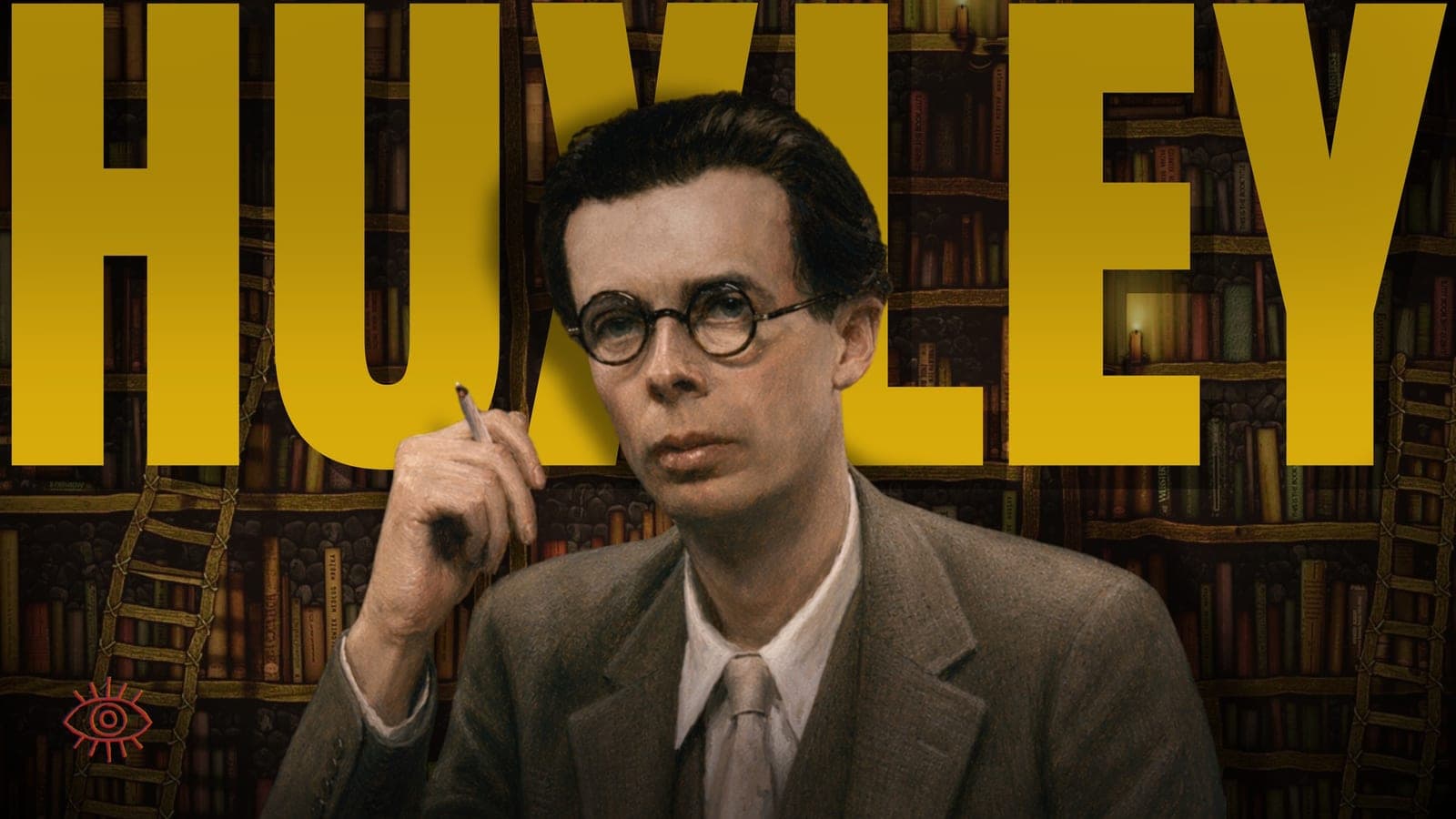
In 1961 a brush fire came up through the Hollywood Hills and took the house on Deronda Drive where Aldous Huxley was living. It took roughly forty years of paper with it. Letters from D. H. Lawrence and from his brother Julian, the diaries of the long trips, notebooks, photographs, manuscripts in progress, the documentary record of a working life reaching back to the First World War. His wife Laura got out with the typescript of the novel he was in the middle of writing. Almost nothing else survived. Huxley was in his late sixties, already being treated for the laryngeal cancer that would kill him, and his reported reaction to the loss was that the experience had been instructive: he had spent two decades in print recommending detachment from personal history, and had now been made to practice it under conditions that left no room for cheating. He did not claim to have practiced it well.
The book that came out of the car was published the following year as Island. Critics largely filed it as an ambitious failure, and it has spent six decades since as the least-read major work by one of the most-quoted novelists of the twentieth century. It is also, more or less alone in English fiction, a working description of a society organized around the supervised use of a psychedelic drug.
That has stopped being a literary curiosity. On 18 April 2026, President Trump signed Executive Order 14401, "Accelerating Medical Treatments for Serious Mental Illness," which directs the FDA Commissioner to issue National Priority Vouchers to psychedelic drugs holding Breakthrough Therapy designation, tells the FDA and the DEA to open a Right to Try pathway for psychedelics including ibogaine along with the Schedule I authorizations physicians and researchers would need to use it, puts at least fifty million dollars of existing federal money behind state programs, and instructs the Attorney General to review any Schedule I product that has finished Phase 3 trials so that rescheduling can proceed "as quickly as practicable." Within a week the agency had issued three of those vouchers, two of them for psilocybin in severe depression and one for a compound aimed at post-traumatic stress disorder. The voucher compresses a standard review of around ten months into one or two. Compass Pathways has reported six-month Phase 3 data from 581 dosed participants, with 39 percent of the 25 mg arm cutting their score on the standard depression scale by at least a quarter at week six and holding that gain on average through week twenty-six. Its rolling application is under review, final submission is due in the fourth quarter of this year, and launch is expected in the first half of 2027 if the approval and the rescheduling both land.
The reflex, whenever a psychedelic gets near a regulator, is to reach for Brave New World and say the word soma. The reflex is ninety-four years old and it is pointed at the wrong book. Huxley spent three decades dissatisfied with the novel everyone quotes, and then wrote the correction himself: the same drug, the same conditioning, the same engineered childhood, and a population that comes out of it free.
Pala Runs on the Same Machinery as the World State
Pala is an island in the Indian Ocean that the colonial powers never got around to annexing. Its society is the result of an accident in the middle of the nineteenth century, when a Scottish surgeon named Andrew MacPhail arrived there, stayed, and fell into a long collaboration with the reigning Raja. The doctor supplied Western medicine and science. The Raja supplied Buddhist contemplative practice and Tantric technique. Neither was permitted to swallow the other. By the time the novel opens in the early 1960s the arrangement has been running for four generations.
Into it Huxley drops Will Farnaby, an unhappy English journalist on retainer to an oil company that wants Pala's newly discovered petroleum. He wrecks his boat on the coast, is carried inland with a head wound, and wakes in a hammock hearing a voice repeating two phrases at intervals: attention, and here and now. It takes him some time to work out that the voice belongs to a bird. Pala's mynahs have been trained across generations to say those words all day, everywhere, so that anyone drifting into a mood or a worry gets called back into the present by the local wildlife. Farnaby spends his first days on the island concussed, hostile, and addressed at intervals by birds.
Then the apparatus comes into view. Palanese children are conditioned from infancy, deliberately, by trained adults, using techniques the society has refined for over a century. Reproduction is managed: contraception is universal and free, and the novel is frank about artificial insemination from selected donors as a program of voluntary genetic improvement. The nuclear family has been dissolved and replaced with Mutual Adoption Clubs, groupings of around twenty households in which every child has a few dozen adults to draw on and can decamp to another house when home becomes unbearable. Sexuality is taught as a discipline rather than left to instinct, under the name maithuna. Hypnosis is used clinically, including in childbirth. And every young person, once, at the end of adolescence, is given a psychoactive drug by the community as a rite of passage.
Set that list beside the World State and the overlap is close to total. Industrialized conditioning of the young. Reproduction removed from private hands. The family abolished as an institution. Sex managed by policy. Ambient repetitive messaging saturating daily life. A drug distributed by the society to its own members with full official approval. Huxley did not build his good place out of different equipment. He built it out of the same equipment, and he knew what he was doing, because he had spent the previous thirty years being congratulated for the version where the equipment destroys people.
Soma and Moksha-Medicine Are the Same Kind of Drug
Soma, in Brave New World, is the thing that makes the World State work. It removes distress reliably, at any dose, with no cost the next morning. Citizens take it daily, on demand, forever. There is no ceremony around it, no preparation before it, no reckoning afterwards, and nothing a person is expected to do with what it showed them, because it is not designed to show them anything. Its function is to close a gap: the gap between what someone happens to be feeling and what the schedule requires them to feel. It exists to make sure nothing happens inside a human being that the society would then have to accommodate. Mustapha Mond, defending the arrangement in the novel's seventeenth chapter, is candid about this, and John, the outsider raised on Shakespeare, refuses the whole bargain by claiming back the right to be unhappy, to grow old, to be afraid, to lose things. "I claim them all," he says, and shortly afterwards the civilization kills him anyway.
The moksha-medicine of Pala is a mushroom derivative, and by every metric that matters to a chemist it belongs to the same family of interventions. It alters perception. The society issues it, legally and to everyone. Everything else about it is inverted. It is taken a handful of times in a life rather than several times a week. The first dose is prepared for over months and administered as an initiation, paired with a physical ordeal and with teaching about what the experience means. It is supervised. It is followed by a long stretch in which the young person is helped to make sense of what they saw. Pala treats the dose as a glimpse of what a lifetime of contemplative attention delivers more slowly and more durably, offered once, early, so that the practice afterwards has something to aim at.
Huxley had been circling this correction since at least 1946, when he wrote a foreword to a new edition of Brave New World conceding that he had rigged the case. He had offered John a choice between two kinds of insanity, the reservation and the civilization, and no third thing. At the age he wrote the book he could not imagine the third thing. It took him another thirty years to write it down, and the typescript nearly went up with the house.
The difference Island draws is architectural rather than chemical or moral. Two societies dose their entire populations. One issues the drug continuously, to prevent experience, and expects nothing back. The other issues it once, to provoke experience, and expects a lifetime of work in return. Nothing in the molecule decides which of those a society ends up with.
The Note Huxley Wrote on 22 November 1963
By the autumn of 1963 the laryngeal cancer had taken his voice. Huxley lay in the bedroom of the house on Mulholland Highway, unable to swallow, unable to speak above a whisper, drifting in and out of clarity while Laura and a few others took turns beside him. At some point on the morning of 22 November he wrote a request on a piece of paper and handed it to his wife. Accounts of the exact wording differ slightly, but the substance is not in dispute: LSD, 100 micrograms, intramuscular. She read it, went to the medicine cabinet, prepared the dose, and gave him the injection. Not long afterwards, at his silent request, she gave him a second.
Then she sat by the bed and read to him from the Bardo Thodol, the Tibetan Book of the Dead, which reads as a set of instructions for the dying: meet what comes without grasping at it and without fear of it, and take the appearances the mind produces on the way out for what they are. He was conscious. His eyes were open. He died at about twenty past five in the afternoon, Pacific time. Both doctors and the nurse present reportedly said afterwards that they had never seen anyone in that physical condition go without pain and without struggle.
He had been preparing for this for a decade. In May 1953, at fifty-eight, he had taken four-tenths of a gram of mescaline in his dining room while the psychiatrist Humphry Osmond, who would later coin the word psychedelic, sat across the table taking notes. Huxley did not take it for pleasure. He took it to test a hypothesis borrowed from Bergson, that the brain works less as the producer of consciousness than as a filter, trimming an enormous incoming flood down to the ration required to stay alive. The Doors of Perception, published the following year, argued that what came through when the filter was widened was not hallucination but subtraction reversed, the world as it stands when perception stops editing it for usefulness. His follow-up book, two years after that, described the same widened filter producing terror instead of clarity.
Which is what makes the note more than biographical color. Huxley used the drug in the Palanese configuration. He did not take it to be spared his death. He took it to be present for it, with a text read aloud to steady him, a companion beside him, ten years of preparation behind him, once, at the only moment it could serve that purpose. Island contains a long sequence in which an old woman named Lakshmi is talked through her dying by her husband and daughter-in-law, who keep returning her to the discipline the mynah birds have been teaching her since she was a girl: attention, here and now, without struggle. It is the finest writing in the book. The year after it was published, its author was given that death in a bedroom above Los Angeles, and almost nobody noticed, because John F. Kennedy had been shot in Dallas that day and C. S. Lewis had died at Oxford within the same few hours.
Psilocybin Reaches the Market Without an Island Around It
A sixty-four-year-old novel now describes a regulatory problem. The clinical protocol that produced the Compass results runs as a course: screening, preparation sessions, a long supervised dosing day with trained monitors present throughout, and integration therapy afterwards to make the experience usable. Strip any of that out and the intervention becomes a different intervention. But the FDA approves products, not practices. Analysts at the University of Pennsylvania's Leonard Davis Institute flagged this gap after the executive order, together with the question of whether an agency this inexperienced with psychedelics can review such applications properly in one or two months. Some of the scaffolding can be written into a risk evaluation and mitigation strategy, the safety framework the FDA is able to attach to an approval. Who is qualified to sit in the room for a long dosing session, and who pays them for those hours, gets settled later by insurers and state legislatures.
Legal scholars at Harvard have raised the adjacent worry. In a discussion of the order published the day it was signed, I. Glenn Cohen called FDA approval "necessary but not sufficient for access," arguing that reimbursement and the delivery mechanism will decide how many Americans ever reach the drug. Mason Marks questioned whether ibogaine, named in the order, has cleared the basic safety bar the Right to Try statute assumes, given that the FDA has resisted ibogaine research partly over heart-related risks and most of the work has been done abroad. One of the Penn analysts was blunter about the politics, calling a White House that steers a drug regulator toward particular compounds "pretty egregious." The FDA has scheduled a public hearing on the potential future therapeutic use of psychedelic drugs for 14 September 2026. Its comment docket closes on 6 October.
Huxley worked all of this out in fiction and refused to make it comforting. Pala's drug is inseparable from everything built around it: the birds, the schooling, the adoption clubs, the meditation practiced daily by people who were taught it as children, the whole slow apparatus that gives the experience somewhere to go. Take the mushroom out of that context and what remains is a mushroom. And the novel does not end with the island vindicated. It ends with the oil concession, a neighboring colonel's soldiers moving in overnight, and the loudspeakers that once carried contemplative instruction switched over to martial music. Four generations of patient work come apart in a night because of what is under the ground. Huxley had watched enough of the century to know that good arrangements are small and fragile, and that the forces which dismantle them are large and well financed.
The scorecard question, whether Huxley beat Orwell, has run for forty years and obscures the more useful fact: Huxley wrote two futures, and both of them run on the same hardware. One is cheap, scales beautifully, requires nothing of anybody, and is already most of the way here. The other needs an entire civilization of supporting practice around a single dose, and cannot be bought or approved into existence. What the FDA is about to license is a compound with strong Phase 3 data behind it and, for the moment, a careful protocol wrapped around it. What happens to that protocol once the compound is a product on a market is the question Island was written to ask, by a man who then arranged his own death as a demonstration of the answer.
---
Adapted from a longform audio episode, Aldous Huxley | The Prophet Who Predicted Our Modern World, produced for Sleepy Philosophy Radio.
The Newsletter
New essays and episodes, delivered quietly.
By subscribing you consent to receiving occasional emails. Unsubscribe any time via the link in every email or at /unsubscribe.
Reflections
Loading...