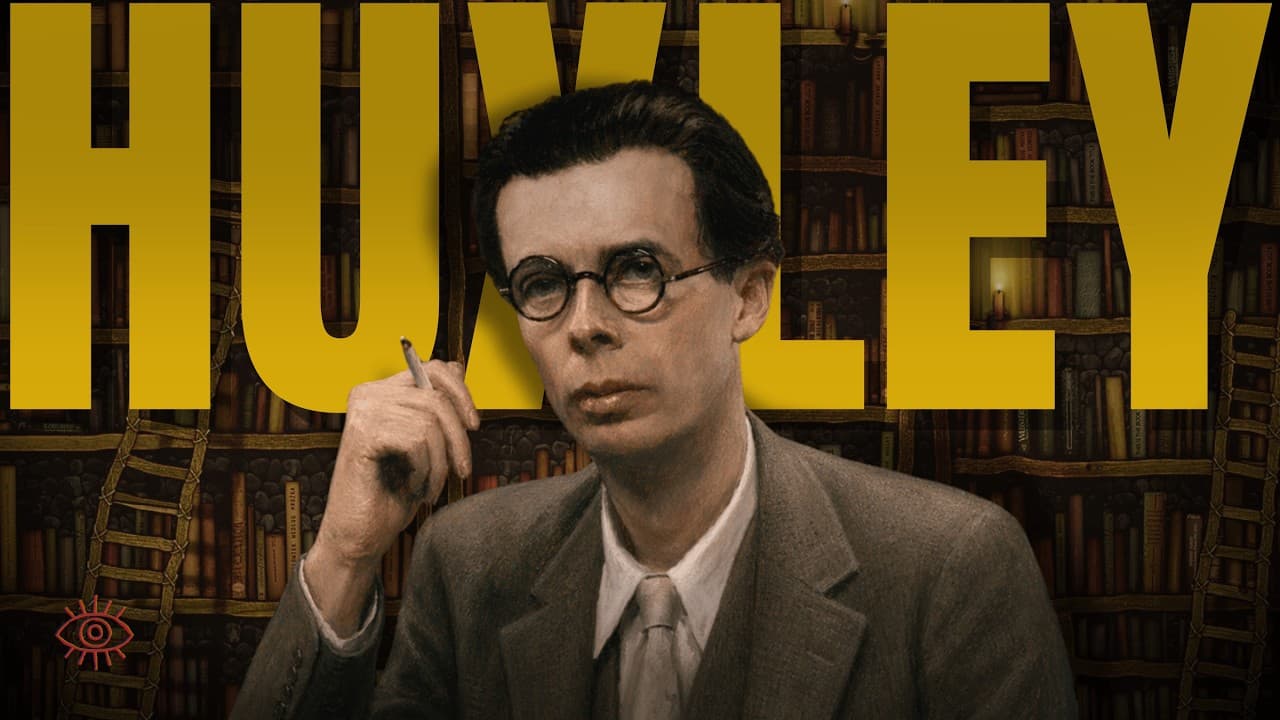
Aldous Huxley | The Prophet Who Predicted Our Modern World
Aldous Huxley's Complete Philosophy
The real danger was never the boot on the face.
The episode runs from the prophecy he delivered in Brave New World to the afternoon of his death in Los Angeles, on the day John F. Kennedy was shot. We follow him from Godalming to Eton, from the eye infection that nearly blinded him at sixteen to the satirical novels of the 1920s that made him the cleverest young writer in England.
We enter Brave New World not as a plot to be summarized but as a philosophical argument about what humanity would sacrifice for comfort. We address, honestly, the famous comparison with Orwell, and ask which of the two prophets has turned out to be more accurate for the liberal democracies of the twenty-first century.
We follow Huxley through his turn toward pacifism in the 1930s, his move to California, his long engagement with the mystical traditions of East and West in The Perennial Philosophy, his mescaline experience of 1953 and the argument of The Doors of Perception, and his strange, ambitious last novel Island. We close with the question he leaves behind: in a world that offers infinite comfort and infinite distraction, what happens to the human capacity for meaning?
The full episode is on YouTube and Spotify. Please listen only in safe, restful contexts.
Enjoying the episode?
Occasional letters on philosophy, reading, and the examined life. No spam, ever.
By subscribing you consent to receiving occasional emails. Unsubscribe any time via the link in every email or at /unsubscribe.
Timestamps
- 0:00:00Chapter 1: The Last Warning
- 0:14:23Chapter 2: The Huxley Inheritance
- 0:28:47Chapter 3: The Satirist
- 0:43:08Chapter 4: Brave New World
- 0:57:06Chapter 5: Orwell Got It Half Right
- 1:12:30Chapter 6: The Pacifist
- 1:27:12Chapter 7: The Perennial Philosophy
- 1:42:15Chapter 8: The Doors of Perception
- 1:56:50Chapter 9: Island
- 2:11:55Chapter 10: The Prophet in the Desert
For the record
Full Transcript
Chapter 01: The Last Warning
There is an image of tyranny that the twentieth century burned into the collective memory. It is the image of the boot, or of the knock at the door in the middle of the night, or of the gallows standing ready at dawn. It is the image of pain made into policy, of a state that controls its people by hurting them, of cells and camps and the slow erasure of anyone who has displeased those in charge. For most of the last hundred years, this is what we have meant when we have spoken of totalitarianism. A regime of fear. A regime of deprivation. A regime of silence enforced by threat.
Aldous Huxley did not see it this way.
Writing in the early 1930s, at almost the same moment that George Orwell was beginning to find the voice that would one day produce Nineteen Eighty-Four, Huxley looked ahead at the coming century and saw something different. He saw that the real threat to human freedom was not the boot on the face but the drug in the bloodstream. Not the prison cell but the pleasure palace. Not the dictator who forbids but the system so exquisitely tuned to human desire that forbidding becomes unnecessary. He imagined a world in which people would be controlled not by what they feared but by what they loved, not by what hurt them but by what satisfied them, not by the absence of things they wanted but by the abundance of things they had been carefully taught to want. And he gave this world a name that has since entered every language on earth. He called it Brave New World.
The phrase has been used so many times since 1932 that it has lost some of its original edge, softened into a kind of cultural shorthand for anything that feels futuristic and slightly unsettling. But the idea behind the phrase was not soft. It was one of the most radical claims ever made by a modern writer about the nature of political power. Huxley was saying that the great danger facing the liberal democracies was not going to come from men in uniforms demanding obedience. It was going to come from something gentler, cleverer, and far more difficult to resist. It was going to come from a system that gave people what they wanted, and went on giving it to them, until they forgot that there had ever been anything else to want.
You can see the force of this claim most clearly if you set it beside the alternative. The twentieth century produced two great warnings about the future, and they were written within a few years of each other by two English writers who were not temperamentally similar but who were observing the same historical situation. Orwell imagined a boot stamping on a human face forever. Huxley imagined a pill that would make the face smile. Orwell imagined a regime of hatred. Huxley imagined a regime of desire. Orwell imagined books being burned. Huxley imagined a world in which there would be no need to burn them, because no one would want to read them. Both men were trying to warn us about the same underlying problem, which is the problem of what happens when human beings lose the conditions of their own freedom. But they disagreed, deeply, about how that loss would be organized.
We will come back to this comparison later, in its own chapter, because it is too important to settle in a single paragraph. For now it is enough to say that the twenty-first century, as it has actually unfolded in the wealthy parts of the world, looks increasingly like the scenario Huxley described. Books are not banned. They are ignored. Information is not suppressed. It is drowned in an ocean of other information, most of which is engineered to be more immediately satisfying than anything difficult could ever be. Freedom of speech is protected. It is also irrelevant, because attention has become scarcer than speech, and the systems that organize our attention are owned by people whose interest in our freedom is at best incidental. Huxley saw all of this, or something close to all of it, nearly a century before it happened.
It is worth pausing on the strangeness of that fact. In 1931, when Huxley sat down in a rented villa in the south of France to write the book that would become Brave New World, there were no televisions in private homes. There were no personal computers. There were no smartphones, no feeds, no algorithmic recommendations, no infinite scrolls, no engineered dopamine loops, no platforms that tracked attention by the second in order to sell it to advertisers by the thousand. The technologies that have come closest to realizing his vision did not yet exist. The language for describing them did not yet exist. And yet he looked up from the draft of a satirical novel about London literary life and saw a society in which reproduction had been industrialized, emotion had been pharmaceutically managed, entertainment had become continuous, and the idea of a private inner life had been quietly retired as an inefficiency. How did he know. How did any of this arrive, so precisely, in the imagination of a nearly blind Englishman who had never seen a computer and would never see one, and who died in the year that the first commercial communications satellite was launched.
But he did not say any of this as a theorist in an armchair. He said it as a specific human being, living a specific life, shaped by experiences that most of the other novelists of his generation did not share. And the life is the key. Because one of the things that makes Huxley's prophecy so strange is that it came from a man who did not, on the face of it, seem especially well placed to deliver it. He was not a political activist. He was not a prisoner of any regime. He was not a journalist in the trenches of some unfolding disaster. He was a writer, a satirist, an essayist, and for the last twenty-five years of his life an American by residence if not by passport, a man who lived in the hills above Hollywood and read Sanskrit philosophy in the afternoons and took his tea at regular hours and wrote, always wrote, with a kind of quiet relentlessness that seemed almost out of step with the century he was describing.
Picture him there for a moment, because the image is the beginning of everything that follows. It is the late 1950s. The house is in the hills above Los Angeles. The windows look out over a city that is already becoming what cities would become everywhere, a grid of small lights flickering in every direction, and inside each window the blue glow of a television set catching the same programs at the same hours. Huxley is sitting at his desk. He is sixty-four years old. He has been nearly blind since a teenage illness left him with scarred corneas, and he reads by holding pages close to his face or by using a large magnifying glass that he keeps on the desk beside him. He is typing the essays that will become Brave New World Revisited, the book in which he will look back at his own novel, written a quarter-century earlier, and argue that everything in it has been arriving faster than he expected. His wife Laura is somewhere in the house. The light is failing. The city below him is alive with the flicker of a thousand small pleasures, and he is trying, with the patience of a man who has thought about this for a very long time, to say what it will cost.
The man in that scene had a history that would have marked him as English intellectual aristocracy even if he had never written a word. He was born on July 26, 1894, in Godalming, Surrey, into a family that stood near the center of the Victorian scientific and literary establishment. His grandfather was Thomas Henry Huxley, the biologist who had made himself famous in the 1860s by defending Darwin against the bishops. His brother Julian would become one of the leading biologists of the next generation and eventually the first Director-General of UNESCO. His half-brother Andrew, born later, would win a Nobel Prize in physiology. Aldous went to Eton, and then to Balliol College, Oxford, and then into the London literary world of the 1920s, where he became the sharpest young satirist of his generation almost before he had decided what to do with the sharpness. None of this was unusual for a man of his class. What was unusual was that he never stopped revising, never got comfortable with his own cleverness, and never quite trusted the English literary world that had adopted him.
There is a paradox in the life, and it is worth naming now because it will run through everything that follows. An English aristocrat who left England. A satirist who turned into a mystic. A man who was nearly blind for most of his life and who spent that life trying to see more clearly than anyone else. A writer who produced one of the most famous novels of the twentieth century and then spent the next thirty years trying to say what his own novel had not quite managed to say. A pacifist who moved to America in 1937 and watched from California as the war he could not bring himself to endorse consumed the continent he had left. A man who took mescaline at fifty-eight because he wanted to understand what consciousness was, and who died five years later, on November 22, 1963, receiving an injection of LSD from his wife while John F. Kennedy was being shot in Dallas and C.S. Lewis was dying quietly in Oxford. Three deaths in one day. Huxley's was the one that nobody noticed.
And this is the place where the warning begins to sharpen into a question. If the real danger to human freedom is not pain but pleasure, not deprivation but abundance, not censorship but distraction, then the question that Huxley leaves us is not the question we are used to asking. We are used to asking how we can prevent bad things from happening. His question is different. His question is how we can recognize a bad thing when it feels good. How do we notice the loss of something when the loss is masked by comfort. How do we stay awake in a world specifically engineered to put us pleasantly to sleep. These are not political questions in any ordinary sense. They are questions about attention, and about meaning, and about what we are willing to trade for a quiet life.
The chapters that follow will take this question slowly. They will begin with the family, with the eye that would not heal, with the boy who learned to read the world by holding it an inch from his face. They will trace the rise of the satirist in 1920s London, and the crisis that turned him away from satire toward something larger. They will enter Brave New World itself, not as a plot to be summarized but as a philosophical argument to be taken seriously. They will return to the Orwell comparison and ask, honestly, which of the two prophets has turned out to be more right. They will follow Huxley through his turn to pacifism in the 1930s, his move to California, his long engagement with the mystical traditions of East and West, his encounter with mescaline in 1953, his final novel Island, which tried to imagine what a good version of human society might actually look like, and his strange, conscious, unafraid death on the afternoon Kennedy fell.
By the end of this journey you will have met a man who spent fifty years trying to answer one question with increasing precision: what happens to the human capacity for meaning when the conditions of meaning are removed, not by force but by kindness. You will not be required to agree with all of his answers. Huxley himself did not agree with all of his answers; his thinking moved continuously, and he was honest enough to say so. But you will come away, I hope, with a clearer sense of why a nearly blind Englishman writing in the California sunlight deserves to be read now, more than sixty years after his death, with something closer to the attention we usually reserve for prophets.
And we will come back, again and again, to the image with which he started. The boot is not the only threat. Sometimes the threat is the drug. Sometimes the threat is the comfort. Sometimes the threat is the system that loves us into submission and calls the submission happiness. The real danger is not that people will be forbidden to read. The real danger is that no one will want to. The real danger is not that we will be locked out of reality. The real danger is that we will forget it was ever there.
That is the warning Huxley left. And before we try to say whether he was right, we need to know who he was, and where the warning came from, and why, of all the intelligent men and women living in the early 1930s, it was this particular nearly blind Englishman, grandson of Darwin's Bulldog and brother of the biologist who would help found UNESCO, who saw it coming.
We need to go back to the family.
Chapter 02: The Huxley Inheritance
On a warm Saturday afternoon in June of 1860, in a crowded hall at the University Museum in Oxford, a bishop rose to speak against the theory of evolution. His name was Samuel Wilberforce, and he was known in the newspapers as Soapy Sam because his opponents found his rhetoric slippery and his convictions surprisingly flexible for a man of the cloth. Charles Darwin had published On the Origin of Species seven months earlier. The book was selling well. The bishop had read enough of it to object, and the occasion of the meeting of the British Association for the Advancement of Science seemed as good a venue as any for the objection to be delivered in person. At the end of his speech, Wilberforce turned to one of the younger scientists in the room and asked him, in the jocular tone that Oxford debating society treated as a sign of good manners, whether it was through his grandfather or his grandmother that he claimed descent from a monkey.
The younger scientist was Thomas Henry Huxley, and he was thirty-five years old. He was not, by training, a theorist of evolution. He was a comparative anatomist who had spent years at sea in the Royal Navy studying marine invertebrates, and who had come to Darwin's theory not through ideology but through the slow accumulation of evidence that the species are not fixed. When Wilberforce finished his remark, Huxley turned to the man sitting next to him and said, quietly, that the Lord had delivered him into his hands. Then he stood up and replied. The exact words of his reply have been disputed for a hundred and fifty years, and the various witnesses who wrote down their recollections afterward did not entirely agree. But the gist of it is undisputed. Huxley said that he would rather be descended from an ape than from a cultivated man who used his intellect in the service of ridicule and dishonesty. The hall erupted. A woman in the audience is said to have fainted. The bishop left humiliated.
The man who became known ever after as Darwin's Bulldog was the grandfather of the boy who would one day write Brave New World. This is not a trivial piece of biography. It is the frame within which the entire Huxley family understood itself. They were, by the time Aldous was born in 1894, the leading dynasty of English science, and they wore the title with a mixture of pride and obligation that shaped every member of the clan. Thomas Henry Huxley had helped to break the hold of the Church of England on scientific education. He had coined the word agnostic to describe his own religious position. He had championed the public teaching of evolution and served on the government commissions that laid the groundwork for modern science education in Britain. When he died in 1895, a year after Aldous was born, he left behind a name that opened doors and set expectations.
His son Leonard, Aldous's father, was a literary man rather than a scientist, an editor and essayist and schoolmaster who never quite matched his own father's eminence but who kept the family's intellectual traditions alive in the household where Aldous grew up. Leonard's first wife, Julia Arnold, came from a no less distinguished line. She was the niece of the poet Matthew Arnold and the granddaughter of Thomas Arnold, the famous headmaster of Rugby. She was also, by all accounts, the presence that made the Huxley house a place where a certain kind of intellectual seriousness was simply assumed. Julia founded her own school, Prior's Field, in Godalming, and ran it with a combination of strictness and warmth that her students remembered for the rest of their lives. Aldous was her third child. The eldest was Julian, born in 1887, who would grow up to become one of the most influential biologists of the twentieth century, a popularizer of evolutionary theory, a founder of the modern synthesis, and the first Director-General of UNESCO. The second was Trevenen, who everyone called Trev, and who was in many ways Aldous's closest companion through childhood.
Aldous Leonard Huxley was born on July 26, 1894, in Godalming, in the green Surrey countryside south of London. The house, called Laleham, sat on the grounds of his mother's school. He was a quiet child and an early reader, precociously verbal in the way that children in houses full of books often are. Photographs from the period show a long, solemn face and enormous eyes that seemed to absorb everything in front of them. He learned French before he could write properly in English. He memorized long passages of poetry. He was the kind of boy about whom adults said, approvingly, that he was old for his age, and his parents and brothers and teachers all expected that he would one day do something distinguished with the mind that was so obviously forming in him. What no one could predict was that the instrument of his distinction would turn out to be neither the lab bench nor the lectern, but the sentence.
The first great disruption of his life came in November of 1908, when he was fourteen. His mother, the steady center of the household, died of cancer. She had been ill only a short time, and her decline was rapid enough to leave the family stunned. Aldous went up to his room and did not come out for most of a day. The letters he wrote afterward to the elder sister who had shared the loss are the letters of a child trying, with a precocity that was both a gift and a defense, to make philosophical sense of something he was not yet old enough to feel in full. The death of Julia Huxley was the first lesson, delivered early and without warning, that the world was not arranged around the wellbeing of the people one loved.
The second lesson came three years later. In 1911, at Eton, where he had been sent for a classical education that the Huxley family regarded as automatic for its sons, Aldous contracted an eye infection. The condition, which the doctors called keratitis punctata, involved an inflammation of the cornea, and it left him for a period of weeks essentially blind. When the acute phase passed, the long-term damage remained. He could see, but only with great effort and only intermittently. The scarring on his corneas meant that he could read ordinary print only with magnification, and even then only in short bursts before the eyes gave out. For nearly two years, through the middle of his adolescence, he lived in a condition closer to blindness than to sight. He had to abandon his plan to study medicine; it was simply not possible to learn anatomy from textbooks he could not see. He learned to type by touch. He learned Braille. He learned to hold books an inch from his face and extract their meaning one labored phrase at a time.
A great deal of what Huxley would later become was shaped by those two years. You can see it in the direction his attention takes. A boy who cannot see the physical world properly will, if he is intellectually serious, start to ask what the physical world is. He will begin to wonder whether the surface of things is really where things are. He will start to take seriously the possibility that perception itself is a construction, a report assembled by the mind from unreliable sources, and that what we call the world is only what we have managed to read off a surface we cannot fully trust. Huxley was not the first Englishman to think along these lines. But most of the Englishmen who had thought this way had been philosophers first. He was going to be a writer, and he was going to spend his whole writing life circling back to the question of what it means to see clearly, whether through the eye or through some other faculty that the eye has nothing to do with.
There was a third lesson waiting for him in 1914. His brother Trev, the second of the three boys, suffered a breakdown during his studies at Oxford and, in August of that year, at a small hotel where he had gone to recover, hanged himself. He was twenty-four. Aldous, who was then at Balliol College on a scholarship and still recovering partial use of his eyes, received the news in a telegram. Whatever he said about it in public over the following decades, and whatever he wrote about it in the novels that would come out of this period, there is no question that Trev's suicide left a scar on him comparable to the scar on his corneas. A mother dead at fourteen. A brother dead at twenty. An eye that would never heal. By the time Aldous Huxley was twenty years old, he had already lost more of the ordinary supports of human life than most men lose by sixty, and he had learned, with an intelligence that was not the less painful for being precocious, that the ordinary supports are not to be counted on.
He went on to Oxford. He went on to Balliol, the college of his family. He read English Literature, which he had chosen because the sciences his brother and his father had assumed he would pursue were closed to him by his sight, and he took a first in 1916. The war was in its second year when he graduated. He was exempted from military service because of his eyes, an exemption that would shape the rest of his life as a kind of quiet debt. Most of his contemporaries were in the trenches or in the graves, and he knew it. The generation that returned to London after 1918 came back a small and damaged cohort, thin in the places where its best young men should have been, and the young writers of the early twenties were writing partly to make sense of the absences. Huxley was one of them. Unlike most of them, he had not seen the trenches with his own eyes. But he had been learning for most of his life to see things his eyes could not.
At Balliol he had begun to read in the way that would mark him for the rest of his life, which is to say omnivorously and without respect for the boundaries between disciplines. His essays, even as an undergraduate, move with a kind of restless sideways motion between literature and biology and political theory and comparative religion and the history of art, as though the man writing them could not quite believe that any one of these subjects was allowed to claim him and was hoping, by refusing to specialize, to escape the sentence of being merely one thing. It was a temperament that had been given to him by his family and sharpened by his illness. An eye that could not read for long had to read efficiently, and an efficient reader learns quickly that the useful books are the ones that open onto other books, and the useful sentences are the ones that teach you how to think rather than merely what to think. Huxley developed, in those Oxford years, the habit of mind that would later make him one of the great essayists of the twentieth century, a writer whose nonfiction is almost always more interesting than his fiction because it is the natural medium for a mind that wants to move and to keep moving.
He also developed, though he did not yet know what it was, the first glimmer of the concern that would eventually produce Brave New World. It was the concern that the intellectual life as he was being trained to live it might be beside the point. It might be a very elegant way of failing to notice what was actually happening to the world. He could not yet say exactly what was happening to the world. But he had begun, in his slow, nearly blind, unusually attentive way, to suspect that the usual tools for describing it were not going to be enough.
He spent some time teaching at Eton, without much success, and some time at the offices of the Athenaeum and other London magazines, where he reviewed books and wrote essays and tried to decide what kind of writer he was going to be. He had already begun to publish poetry, though he would later dismiss most of it. He was moving, gradually and then not so gradually, into the orbit of the English literary world of the 1920s, where the generation that had survived the war was trying to work out what could be said that was not a lie and what could be believed that was not a nursery story. Out of that world, and out of his own long apprenticeship in seeing the invisible, the satirist would emerge.
We should follow him there next. But it is worth pausing, before we do, to notice what the inheritance has given us. A boy from a family in which intellectual seriousness was not a choice but a climate. A mother who ran her own school and who died before she could see what her third child would make of himself. A grandfather who had broken the bishops by telling them the truth about the apes. A brother whose mind would not hold. An eye that would not heal. And through all of it, a long, patient, painful education in the idea that what the surface of the world shows us is not the whole of what is there. Huxley would spend the rest of his life looking beneath surfaces. He had been trained to, whether he wanted the training or not. And the first thing he would see beneath the surface of his own London, in the years immediately after the war, was a society that had lost its bearings and did not yet know it.
Chapter 03: The Satirist
The house was called Garsington Manor, and it sat on a low hill outside Oxford, surrounded by gardens that had been laid out with the kind of deliberate eccentricity that only the very rich can afford. Its mistress was Lady Ottoline Morrell, a tall, angular woman with red hair and a taste for bright silks who had decided, in the years leading up to the First World War, that what England needed was a country house in which intelligent people could come and be themselves without the usual pressures of respectability. Conscientious objectors were welcome at Garsington. Pacifists were welcome. Artists and writers and philosophers and undergraduates with difficult reputations were all welcome, and for a period of about seven years, from roughly 1915 to 1922, the house was one of the places where the English literary world of the twentieth century was rehearsing itself. Bertrand Russell came and went. D.H. Lawrence arrived, stayed for a time, and repaid the hospitality by writing a novel in which Lady Ottoline appeared as a thinly disguised and unflattering figure. Virginia Woolf visited and recorded her impressions in her diary with a combination of admiration and private irony. And Aldous Huxley, nearly blind and twenty-one years old when he first came to Garsington in 1915, walked into the drawing room, fell quietly in love with almost everyone in it, and began to take the notes that would become his first novels.
He did not take the notes the way a journalist takes them. He took them the way a man who cannot rely on his eyes takes everything, which is slowly and with enormous attention. He listened. He watched the way people occupied a room. He noticed which of the intellectuals were posing and which were thinking, and he noticed, with the particular cruelty of a young writer still finding his voice, that the difference between the two was usually smaller than the people in the room believed it was. Huxley had a satirist's eye from the beginning. What made the eye unusual was that it came attached to a memory trained by necessity, and to a vocabulary that had been accumulated over years of slow, difficult reading, and to a kind of detachment that his friends sometimes found chilling. He could reproduce a conversation on the page with the accuracy of a phonograph, and he could arrange the conversation so that everyone in it revealed, without quite meaning to, the precise shape of their own vanity.
Out of Garsington and out of the London literary world that orbited it came the first novels. Crome Yellow was published in 1921, when Huxley was twenty-seven. It is a short book, a kind of country-house comedy with almost no plot, in which a young man spends a weekend at a large estate and listens to a collection of brilliant, self-absorbed, and mildly ridiculous guests talk past one another. The book was a success. It established Huxley as one of the most promising young writers in England, and it established a certain tone that would be his signature for the next decade. The tone is one of amused, slightly superior attention. It watches the foolishness of educated people with a precision that the educated people themselves could not muster, and it extracts from that foolishness a quiet, unrelieved pleasure in the exposure.
Antic Hay followed in 1923. It is a larger and more ambitious book, set in postwar London rather than the countryside, and it has a harder edge. The characters are drifting. They are clever and bored and unhappy in ways they cannot quite describe. They pursue love affairs that come apart before they begin, and they attend parties at which everyone is waiting for something to happen that never quite happens, and they deliver monologues on religion and art and sex with a fluency that seems to exhaust them rather than satisfy them. The book caused a small scandal in 1923 because it was frank about sexuality in ways that the English literary establishment was not yet quite prepared to tolerate in a Huxley. But the scandal faded and the reputation grew, and by the mid-1920s Huxley was one of the four or five writers whose names were reliably invoked when people wanted to describe what the younger generation was doing.
In 1928 came Point Counter Point, the longest and most ambitious of the satirical novels and the book that many people still consider his masterpiece in that mode. It is a sprawling novel of ideas, with more than a dozen major characters, and it is structured, as the title implies, like a piece of music, with different voices taking up different themes and passing them back and forth without any of them quite winning the argument. The central character, Philip Quarles, is a writer who cannot live with his own intelligence. He is kind, he is thoughtful, he is articulate, and he is paralyzed. He cannot feel with the directness that his wife needs, and he cannot act with the conviction that the times demand, and he lives at a distance from his own life even when he is describing it with perfect precision. Quarles was, by Huxley's own admission, something close to a self-portrait, and the book is at its most devastating when it allows Quarles to look at his own condition and fail to know what to do about it.
There is a scene in Point Counter Point that has stayed in readers' minds for almost a century, and it is worth describing because it shows where Huxley's satirical method was beginning to crack open into something larger. One of the characters has a young child. The child becomes sick. The child dies. The scene in which the child dies is written without satire, without irony, without any of the slightly amused distance that has been the voice of the novel up to that point. It is written with a plainness that is almost unbearable, and what it reveals, in the middle of a long witty book about the vanities of the English intellectual class, is that Huxley had always known what satire could not reach. Satire can diagnose. It cannot cure. Satire can show you that the people around you are absurd. It cannot tell you what to do with your own absurdity. Satire can describe a civilization that has lost its bearings. It cannot give the civilization its bearings back.
By the end of the 1920s, something was shifting in Huxley's work, and it was shifting because something was shifting in him. He had become famous doing a particular kind of thing. He had become famous for being clever, for being acid, for being the writer you read when you wanted the foolishness of your own class described back to you with elegance. And he was starting to suspect that cleverness was not enough. He was starting to suspect that his generation had been handed a tool, the tool of ironic observation, that might be precisely the wrong tool for the moment. Irony describes a situation. It does not change it. Irony allows you to feel superior to the culture you are describing. It does not give you anywhere else to stand. And what Huxley could see, in the years between 1928 and 1932, was that the culture he had been describing was not going to stay where it was long enough to be merely satirized. Something larger was coming, and the satirist in him did not have the vocabulary for it yet.
There were concrete events behind the shift. In 1926 he had taken a long trip around the world, passing through India and Burma and Malaya and the Philippines and Japan and the United States, and the trip had forced him to see English literary culture as a small regional phenomenon rather than the center of anything. He wrote about the journey in a book called Jesting Pilate, and what is striking about the book, when you read it now, is how often Huxley stops being amused and starts being worried. He is worried about India, where he finds a colonial administration that has hardened into a kind of elegant cruelty. He is worried about the Pacific, where he can already feel, though he cannot quite name, the approach of the war that would come fifteen years later. He is worried about America, which he reaches at the end of the trip, and which strikes him as the most important and the most ominous country in the world. It is in America that he first encounters, with full force, the machinery of mass production, mass advertising, mass entertainment, and the mass shaping of human wants that the American twentieth century had perfected. He does not like what he sees. He does not like it because it is crude. He especially does not like it because it is efficient, and because he can tell, looking at it, that the efficiency is going to travel.
The trip did another thing. It pushed him into a period of sustained reading that had very little to do with English literature. He read Henry Ford's My Life and Work, the book in which the great American industrialist described the assembly line as a philosophical achievement rather than a mere industrial technique, and he noticed, with growing unease, that Ford's language about the worker was almost indistinguishable from the language a scientist might use about a well-trained animal. He read the behavioral psychologists who were then promising to reshape human nature through conditioning, and he read the early sociologists of advertising who were promising to turn consumer demand into a predictable science. He read H.G. Wells, whose utopian novels of the same decade imagined a future organized around rational planning and benevolent expertise, and he found himself, despite his respect for Wells, recoiling from the vision Wells offered. He read the literature of eugenics, which was then still respectable, and which was describing the possibility of improving the human stock through selective breeding in a tone that was both confident and frighteningly casual. All of this material went into him and did not come out the same.
In 1929 the American stock market collapsed, and the financial system that had been keeping the postwar settlement together began to unwind. By 1931 Hitler was rising in Germany, the English economy was in crisis, and the satirical novel as Huxley had been writing it was beginning to feel almost offensively small in the face of what was happening. He needed a larger form. He needed a book in which the whole of what he could see could be said at once. And he began, slowly, to find it.
The turn was also internal. Huxley had been reading, in the late twenties, more and more widely outside the literary field. He was reading biology, and he was reading political theory, and he was reading the psychological literature of behaviorism and conditioning that the laboratories of the 1920s had begun to produce. He was paying close attention to the developments of industrial mass production, which was transforming American manufacturing and would soon transform everything else. He was paying close attention to what radio and film were doing to the attention of the ordinary person. He was watching, with the concentration of a man whose sight had trained him to watch, the way that modern technique was reshaping what it was possible to do with a human being. And he was starting to ask, because he could not help asking, what would happen if all of this went far enough.
What would happen if you could engineer a society so completely that there was no longer any suffering in it. What would happen if you could condition children so effectively that they grew up wanting exactly what the state wanted them to want. What would happen if you could provide a drug that reliably erased anxiety without any side effects. What would happen if you could make reproduction industrial, entertainment continuous, and the category of unhappiness essentially obsolete. Would this be good. Would it be bad. Would we even be able to tell the difference, once the conditioning had done its work. These are the questions Huxley was asking himself in the last months of 1931, and he was asking them in a rented villa on the Mediterranean coast, and he was typing them with a magnifying glass held in one hand and a pencil in the other, and he did not yet know, as he began the first chapter, that the book he was about to write would become one of the few novels of the twentieth century that a reader in any country would be able to identify by its title alone.
The satirist was about to do something no satirist had done before. He was about to stop describing the present and start describing a future that the present was only beginning to make possible. And the future he saw coming was not the one everyone was afraid of. It was gentler than that. It was more attractive than that. It was, in some ways, more humane than anything the satirists had ever diagnosed. And that, Huxley was starting to understand, was precisely the problem.
Chapter 04: Brave New World
The book begins in a room. The room is long and low and bathed in a pale light that does not come from any sun. It is the Central London Hatchery and Conditioning Centre, and a group of students is being led through it by the Director, who is explaining, with the patient pride of a man showing off the family jewels, how human beings are made. They are made in bottles. The bottles move along a slow assembly line, and at measured intervals the embryos inside are fertilized, subdivided, treated with chemicals, exposed to heat or cold, and allowed to develop into one of five castes that will determine everything about their future lives. The Alphas are given the best of everything. The Epsilons are given just enough oxygen to keep them functional for the work they will do. None of them, at any point, has the capacity to object to what is being done to them, because the capacity to object has been removed from the design. This is the opening scene of Brave New World, and it is the scene that announces, with a clarity that nothing else in the novel will match, what kind of book this is going to be.
It is not, despite its reputation, primarily a story. It has a plot, and the plot moves, and there are characters in it who are written with enough care that some of them remain in your memory long after you have finished reading. But if you approach Brave New World expecting the experience of a novel in the ordinary sense, you will be slightly disappointed. The book is something closer to a philosophical argument dressed in the clothing of fiction, and it is most powerful when you let it work as an argument. Huxley was not, at this point in his career, interested in writing the kind of novel that delivers its meanings through psychology. He was interested in constructing a civilization on the page and then forcing the reader to decide, moment by moment, whether it was a place they would be willing to live in.
The civilization is called the World State, and it has abolished war. It has abolished poverty. It has abolished disease, in the sense that most illnesses have been eliminated and the remaining ones are managed with something close to perfect effectiveness. It has abolished old age, or something like it, through a program of careful physical maintenance that keeps the citizens looking and feeling young until a precisely scheduled and painless death in their early sixties. It has abolished religion, or rather replaced religion with the worship of Henry Ford, whose assembly line is treated as a kind of industrial Last Supper and whose initials substitute for the initials of the Almighty in casual speech. It has abolished the family, which is regarded as a primitive and slightly obscene institution. It has abolished romantic love, though not sex, which is continuous, casual, and officially encouraged. It has abolished serious literature and replaced it with what the Controllers call the feelies, full-sensory entertainments in which the audience can feel on their own skin whatever the actors on the screen are feeling. It has abolished unhappiness itself, because it has produced a drug called soma that takes unhappiness away reliably and without hangover.
Every one of these abolitions is an achievement. Every one of them solves a problem that human beings have been trying to solve for as long as there have been human beings. War is genuinely terrible. Poverty is genuinely terrible. Disease is genuinely terrible. The pain of growing old and watching the people you love grow old with you is genuinely one of the harder things that human lives are asked to bear. And for most of the history of thought, the imagined good society has been the one in which as many of these things as possible have been removed. That is what good societies are for. Huxley took this idea perfectly seriously. He did not write a book in which the abolitions were bad because they failed. He wrote a book in which the abolitions had succeeded, completely and permanently, and in which the success was the horror.
Because something else had been abolished, and this was the thing that the citizens of the World State had not been told about when the contract was signed. What had been abolished was the capacity for depth. The capacity for longing. The capacity for any experience strong enough to reshape a life. The capacity to love another person the way one person can actually love another, which is with a fierceness that carries the possibility of loss. The capacity for religious or philosophical seriousness. The capacity, finally, for the specific kind of suffering out of which the best of human culture has always come. The citizens of the World State do not suffer, and because they do not suffer, they cannot produce anything that matters. They cannot write King Lear, because the conditions that produce King Lear have been removed from the world. They cannot write the Bhagavad Gita, because the conditions that produce the Bhagavad Gita have been removed from the world. They cannot even miss these things, because the memory of them has been carefully and thoroughly erased.
This is the central philosophical move of the book, and it is more subtle than it is usually given credit for. Huxley is not saying that suffering is good. He is not sentimentalizing pain. He is making a much more difficult claim. He is saying that certain kinds of human value are bound up, in ways we do not fully understand, with the possibility of certain kinds of human difficulty, and that if you remove the difficulty you may also, without meaning to, remove the value. If you give people everything they want, they may stop being the kind of being that can want anything important. That is the risk. That is what has happened in the World State. The people in it are not miserable. On the contrary, they are cheerful, productive, and well adjusted in a way that the citizens of real democracies have never been. But they are cheerful at the cost of being, in any meaningful sense, anyone at all.
Into this world Huxley drops a character who has not been produced by it. His name is John, and he has grown up on a Savage Reservation in what used to be New Mexico, a preserved zone in which the old ways of life have been allowed to continue for the instruction and occasional entertainment of the civilized visitors. John's mother, Linda, was a woman of the World State who got lost on a holiday visit to the Reservation and was never retrieved, and who bore her son there under conditions of great difficulty. John has grown up reading the one book the Reservation possesses, which happens to be a volume of the complete works of Shakespeare. He has read it and reread it until it has become the scaffolding of his entire inner life. He knows whole plays by heart. He speaks, when he speaks seriously, in a language built out of Shakespearean cadences and Native American ritual and the hybrid Christianity of his mother's childhood, and the combination produces a kind of human being the World State has never seen.
John is brought to London as a kind of anthropological curiosity, and the climax of the novel is his encounter with Mustapha Mond, the Resident World Controller for Western Europe. Mond is not a villain. He is one of the most interesting figures Huxley ever created. He is a man who has read all the forbidden books, who has thought through all the arguments against the civilization he rules, and who has decided, with perfect consciousness and without any bad faith, that the civilization is worth defending. The conversation between John and Mond, which occupies most of the seventeenth chapter of the novel, is the philosophical spine of the whole book, and it is the reason Brave New World has continued to be read for nearly a century.
Mond lays out the case for the World State. He explains that the conditioning is necessary because without it people would be miserable. He explains that the suppression of great art is necessary because great art requires suffering and the society has chosen to abolish suffering. He explains that science itself has been restricted, because science, left to its own devices, tends to produce change, and change is incompatible with a society that has achieved perfect stability. He explains that God is still there, in some sense, but that God is of a kind that does not manifest himself in a society where everything goes well and nothing is ever wanting, and that therefore the citizens of the World State will live and die without ever having had the occasion to believe in him. He is not denying the reality of religion. He is only pointing out that religion belongs to a certain stage of human development, a stage characterized by want and fear and uncertainty, and that the World State has moved past that stage, and that you cannot have religion without the conditions that produced it any more than you can have medicine without disease. He offers the case with the intelligence and the honesty of a man who is not hiding anything, and the case is stronger than one might expect. John listens, and then, with a force that has made the passage famous, he refuses.
He refuses the whole bargain. He does not want the drug that takes away the pain. He does not want the comfort that comes at the price of everything that made him who he is. He does not want the continuous shallow pleasure that the civilization is offering him in exchange for the deeper thing he has lost. He tells Mond that he is claiming the right to be unhappy. He is claiming the right to grow old and ugly and impotent. He is claiming the right to have syphilis and cancer. He is claiming the right to have too little to eat. He is claiming the right to be lousy with worry about tomorrow, the right to fear that his children will die, the right to experience anything that he has been deprived of in the name of his own wellbeing. There is a silence. And then, in a line that generations of readers have found difficult to forget, he says: I claim them all.
It is a speech that sounds on the first reading like a protest and on the second reading like a prayer. What John is claiming, when he claims the right to be unhappy, is not unhappiness for its own sake. He is claiming the conditions under which a human life can be his own. He is claiming the possibility of an existence that is not managed into meaninglessness by a kindly Controller who has read more books than he has and who knows, or believes he knows, what is best. He is claiming, on behalf of every person who has ever lived, the right to carry the whole weight of being alive, including the parts that hurt. The speech is not an argument for suffering. It is an argument for a kind of dignity that cannot be separated from the possibility of suffering, and that disappears, without a trace, when the possibility of suffering is taken away.
What happens to John after this speech is the one thing in the book Huxley did not quite know how to resolve. He cannot live in the World State, and he cannot go back to the Reservation, and he retreats to an abandoned lighthouse on the coast of England to try to live a life of prayer, penance, and self-mortification. The civilization will not leave him alone. Tourists come. Reporters come. A crowd gathers, demanding the spectacle of an authentic human being, and under the pressure of that demand he breaks, and he kills himself. The book ends with his body swinging quietly from a beam, and with the World State, entirely untroubled, continuing its perfect operation around him.
We might ask, as Huxley himself asked in the 1946 foreword to a new edition, whether this ending is right. He came, late in life, to think that it was not. He thought he had offered John only two choices — the insanity of the Reservation or the insanity of the civilization — and that somewhere between those two there should have been a third, a genuinely human possibility that he had failed, at thirty-seven, to imagine. He would spend the next thirty years trying to imagine it. He would not finish the attempt until his last novel, Island, which we will come to in its own chapter. But the absence of the third possibility is part of the force of Brave New World. It is the novel of a man who could see, with unusual clarity, what was going wrong with his civilization, and who could not yet see, with anything like the same clarity, what might go right.
The question the book leaves the reader with is the question it has been leaving readers with since it was published on February 4, 1932. It is the simplest question in the world and it is also the hardest. Would you take the drug.
Chapter 05: Orwell Got It Half Right
There is a comparison that we cannot avoid, and there is no point in trying. If you have spent any time with the literature of twentieth-century dystopia, you already know that the two great warnings of the period were written within seventeen years of each other, that they were written in English, and that they were written by men who shared a concern for human freedom but who disagreed, sharply, about the form the threat was going to take. Brave New World came first, in 1932. Nineteen Eighty-Four followed in 1949, when George Orwell was already dying of the tuberculosis that would kill him a few months after the book appeared. The two novels have been arguing with each other ever since, and most of what there is to say about Huxley's philosophy cannot be properly said without saying it in the light of the argument.
The simplest way to put the difference is this. Orwell was afraid of those who would deprive us of information. Huxley was afraid of those who would drown us in it. Orwell was afraid of those who would ban books. Huxley was afraid of those who would turn books into something nobody wanted to read. Orwell was afraid of those who would hide the truth. Huxley was afraid of those who would produce so much distraction that the truth became invisible in the noise. Orwell was afraid of the knock at the door in the middle of the night. Huxley was afraid of the soft, pleasant sound of a people being amused into passivity. Both were afraid of the same thing in the end, which is the loss of the conditions that make a human life worth the trouble of living it. They simply disagreed about how the loss would arrive.
The formulation has become famous, and the most elegant version of it is the one Neil Postman produced in 1985, in a book called Amusing Ourselves to Death. Postman was a media theorist writing at a moment when American television had become the dominant medium of public life, and he set the Huxley-Orwell comparison down in the foreword to his book with a clarity that has never been improved upon. What Orwell feared, Postman wrote, was that books would be banned. What Huxley feared was that there would be no reason to ban a book, for there would be no one who wanted to read one. Orwell feared those who would deprive us of information. Huxley feared those who would give us so much that we would be reduced to passivity and egoism. Orwell feared that the truth would be concealed from us. Huxley feared that the truth would be drowned in a sea of irrelevance. In 1984, people are controlled by inflicting pain. In Brave New World, they are controlled by inflicting pleasure. In short, Orwell feared that what we hate will ruin us. Huxley feared that what we love will ruin us.
It is worth saying out loud that Orwell was not wrong. He was describing a real kind of political evil, and the twentieth century produced more examples of the evil he described than anyone had expected it to produce. The Soviet Union did knock on doors in the middle of the night. Nazi Germany did burn books and imprison writers and kill those who would not stop writing. The totalitarianisms that followed, in China, in Cambodia, in Argentina under the generals, in Iran under the mullahs, in a hundred smaller places under a hundred smaller tyrants, did most of the things Orwell said they would do. His vision was not a fantasy. It was a documentary, written before the fact about regimes that had not quite finished existing yet. To this day there are places on the map where Nineteen Eighty-Four is the more useful book, because the regime in question is still controlling its people through pain and through fear, and because the citizens of that regime need a language for what is being done to them. Orwell gave them that language.
But Huxley was describing something else. He was describing what would happen to the liberal democracies if they were left to develop along their own logic without the interruption of a catastrophe from outside. He was describing what it looks like when a rich, comfortable, technologically advanced society gradually forgets what freedom was for, because the pleasures available to its citizens become so continuous and so fine-grained that the capacity for any other kind of experience quietly atrophies. That is not what happened in Stalin's Russia. That is not what happened in Mao's China. But it is, with disturbing precision, a description of what has happened in much of the developed world over the last sixty years, and it is a description we have been slow to recognize because we have spent most of the century worrying about the other kind of tyranny.
The difficulty is that the Huxleyan form of unfreedom does not feel like unfreedom from the inside. The citizens of the World State are not prisoners in any sense they themselves would recognize. They have everything they want. They are cheerful most of the time and not distressed on the rare occasions when they are not cheerful, because soma takes care of the distress. If you asked them whether they were free, they would say of course they were free, and they would be telling you the truth about what they believed. They do not feel the loss of the capacities that have been taken from them, because the capacities have been taken from them completely and before they had learned to use them. You cannot miss a language you never knew. You cannot mourn a form of experience that nothing in your life has ever given you. The World State is a civilization in which the condition of servitude has been so thoroughly naturalized that there is no word for it in any of the languages the citizens still speak, and there is no feeling in any of their bodies that might prompt the coining of such a word.
This is why the Huxleyan warning has been so much harder to hear than the Orwellian one. An Orwellian society knows it is an Orwellian society. Its citizens feel the weight of it. Its dissidents know what they are dissenting from. Its writers, when they can publish, produce a literature of resistance. A Huxleyan society is a society in which the resistance has been built out of the material that the resisting would have to be made of, and in which the citizens, when asked, will tell you without any irony that they are happy, and will be correct.
Huxley himself returned to this question in 1958, twenty-six years after the original novel, in a book called Brave New World Revisited. It is a series of essays rather than a novel, and its tone is less playful than the original. Huxley is sixty-four. He has been watching the postwar decades unfold. He has been watching the development of television, the techniques of mass advertising, the new sciences of persuasion that had emerged out of the American marketing industry, and the political uses to which all of these were being put in the democracies of the West. And he writes, in a voice that is both calmer and more urgent than the young satirist's voice had been, that things are arriving faster than he had expected. He had set Brave New World six hundred years in the future. He had picked the distance to give his civilization a margin for development. And he is now watching the features of that civilization arrive, one after another, in the America of the 1950s. The time-scale, he says, has compressed. The trajectory, he says, has not.
The essays in Brave New World Revisited are worth naming because they read, at this distance, like a prophecy index. There is a chapter on overpopulation and the way in which demographic pressure will tempt governments toward increasingly total forms of management. There is a chapter on what Huxley calls over-organization, the tendency of modern life to subsume the individual in bureaucratic and corporate structures whose internal logic has nothing to do with human flourishing. There is a chapter on propaganda in a democratic society, which observes, with a kind of tired precision, that the techniques of public persuasion developed by the advertising industry are now being used to sell candidates and wars as well as soap. There is a chapter on subliminal messaging and the scientific study of the unconscious mind. There is a chapter on chemical persuasion — the use of drugs, legal and otherwise, to produce desired emotional states in whole populations — that reads like a preview of the pharmacological present. And there is a chapter, near the end, called The Arts of Selling, in which Huxley describes a civilization that has learned to manufacture human desires as efficiently as it manufactures anything else, and in which the citizens are being asked to regard their own wants as the most private and inviolable thing about them, at the precise moment when those wants have become the least private thing about them.
None of these essays is hysterical. All of them are calm and short and unbearable. Huxley is not pounding on the table. He is doing what he had been doing all his life, which is watching carefully and reporting what he saw, and the report is that the civilization he had invented as a satirical thought experiment in 1931 was, by 1958, visibly arriving in the country where he lived. He thought at that time that there might be a few decades of warning left. He was probably right about that. The warning went unheeded because the arrival was so pleasant that nobody was willing to notice it.
He was right about this in ways that even he could not fully have predicted. The decades since Brave New World Revisited have produced technologies of distraction that would have looked like science fiction to the Huxley of 1958. The smartphone, the algorithmic feed, the attention-capture industry, the engineered dopamine loop, the frictionless ordering of any pleasure at any moment, the social systems that reward us for producing ourselves as continuous public performances, the hours of daily consumption that the average citizen now gives, without complaint and often without noticing, to screens whose content has been designed by large corporations whose interest in that citizen's wellbeing is strictly commercial: all of this has arrived, and it has arrived in a shape that corresponds much more closely to Huxley's vision than to Orwell's. We have not been made to love Big Brother. We have been made to love the feed. The distinction matters, because the cures are different, but the underlying diagnosis is one that Huxley laid out in advance.
It would be a mistake to score the comparison and declare a winner, as though the point of reading these books were to find out which dead Englishman was more accurate. Both men were right. They were right about different things. They were right about different kinds of societies and different failure modes of the modern project, and the twenty-first century has produced enough examples of both to keep both books necessary for the foreseeable future. But it would also be a mistake to pretend the comparison is a wash. In the particular corner of human history we actually occupy, in the rich democracies of the early twenty-first century, it is the Huxleyan warning that has turned out to describe our situation most exactly, and it is Huxley who deserves, if nothing else, the belated honor of being read now with the attention he was not quite given while he was alive.
There is one more thing worth saying about the comparison before we leave it, and it has to do with the two men themselves. Huxley had briefly taught Orwell at Eton in 1917, when Orwell, then fourteen years old and still named Eric Blair, was a scholarship boy and Huxley a young temporary French master struggling with his nearly unmanageable students. Orwell did not remember much about him as a teacher. But in 1949, when Brave New World's author was sixty-four and Nineteen Eighty-Four had just been published, Huxley wrote Orwell a letter. He congratulated him on the book. And then, with the polite firmness of a man who has been thinking about these questions for a long time, he said that he disagreed, in the end, about the direction the future would take. The boot on the face, he told his former pupil, was not a permanent form of government. It was too inefficient. Over the longer run, he predicted, the ruling oligarchies of the world would find less arduous and less wasteful ways of keeping their populations in line, and those ways would look more like the pharmacological and behavioral conditioning of Brave New World than like the naked violence of Big Brother. He was not saying Orwell was wrong about the present. He was saying that the present would not last. Orwell, who was dying, had no time to respond. The letter stands, now, as the closest thing we have to a direct exchange between the two men about the comparison we have been drawing, and it is a small historical irony that the teacher who could barely control his classroom had, in the end, the sharper instrument for reading where his former pupil's century was actually going.
Which is why the rest of this episode is going to leave the comparison behind. We have paid it the respect it deserves. We have named what it teaches. From here we need to follow Huxley himself, because the part of his thought that has been least attended to is not the dystopia but what came after the dystopia, and what came after the dystopia is the longest and strangest and most important phase of his work. Having written Brave New World, he did not sit down to write Brave New World again. He set out, instead, to ask whether there was a way out of the trap he had described, and the search for the way out would take him through pacifism, through mysticism, through mescaline, and through the last novel of his life, which tried to imagine a civilization organized around consciousness rather than consumption. The warning was only the beginning. The search that followed the warning is what we have mostly forgotten.
Chapter 06: The Pacifist
In June of 1936, four years after the publication of Brave New World, Huxley brought out a novel called Eyeless in Gaza. The title comes from the last of Milton's late poems, Samson Agonistes, in which the blinded hero of the Philistines stands in the mill grinding corn for his captors and says, in a line that has never lost its force, that he is eyeless in Gaza at the mill with slaves. The line was Huxley's own, in a way that few titles can claim to be. He had been nearly blind since he was sixteen. He had been watching the civilization around him grind itself toward another war with the desperate industry of a machine that had forgotten it was supposed to be a community. And he had reached the point, at the age of forty-two, at which the detached irony of the earlier books no longer felt sufficient to the thing he was trying to say.
Eyeless in Gaza is a strange, uneven, sometimes brilliant book, and the reason it is strange has to do with the method Huxley chose to tell its story. The chapters are arranged not in chronological order but in a deliberate scrambling of time, so that the reader moves back and forth across the forty years of the protagonist's life, seeing the young man of 1914 beside the middle-aged man of 1933 beside the boy of 1902, and gradually assembling, out of the fragments, a picture of a person whose life has been shaped by losses and betrayals and compromises he has never quite managed to face. The protagonist is Anthony Beavis, and Beavis is more obviously a self-portrait than Philip Quarles had been in Point Counter Point. He is a clever, detached, slightly cold English intellectual who has lived his life at a distance from his own feelings, and who arrives, in the middle of the 1930s, at a point where the distance is no longer tenable and the detachment is no longer defensible.
The climax of the novel, in the book's present tense, is Beavis's conversion to pacifism. He meets a man named Miller, a doctor who has spent years working among the poor of rural England and who has arrived, through a combination of clinical observation and religious conviction, at a view of human violence that Beavis finds, at first, almost embarrassing in its simplicity. Miller's view is that violence does not end violence. Miller's view is that the means a movement uses to achieve its ends eventually become the ends themselves, and that a movement that uses cruelty to win will find, when it has won, that cruelty is all it knows how to do. Miller's view is that the choice to do harm, even for a good reason, deforms the person who makes the choice in ways that he cannot fully measure until it is too late. Miller is not a saint in any conventional sense. He is a practical man who has been looking at human behavior for a long time. And he is the figure in the book who offers Anthony Beavis, at the end, the only escape from the detached life he has been leading, which is a commitment to nonviolence that is not primarily an ethical theory but a discipline.
Huxley was not Beavis. But the conversion in the book mirrored a conversion that was happening in the writer himself. By 1935, a year before the book was published, Huxley had joined the Peace Pledge Union, the English pacifist movement founded by the Anglican clergyman Dick Sheppard. The Peace Pledge was a simple document. It asked its signatories to affirm that they would never, under any circumstances, support or participate in another war. By the middle of the decade, a hundred thousand people in England had signed it, and Huxley had become one of its most visible literary spokesmen. He wrote pamphlets. He gave lectures. He argued, in print and in person, that the only way to prevent the next war was for a critical mass of ordinary people to refuse, absolutely and in advance, to be conscripted into it.
The argument was simpler than it sounds, and it was also, in its way, more difficult. The simpler part was the logic of means and ends. If you believed, as Huxley did, that modern warfare had become a kind of industrial process in which the actual political aims of the war were subordinated to the demands of the industrial process itself, then you believed that a war, once begun, could not be controlled by the people who began it. You believed that it would produce, at its end, a political settlement shaped more by the techniques of destruction it had deployed than by the justice of the cause it had served. The methods, Huxley kept saying, make the world you end up in. If you fight a totalitarian war, you get a totalitarian peace. If you defeat fascism with mass bombing, you will discover, when the bombing ends, that mass bombing has entered the vocabulary of the governments you have saved, and that it will not easily be removed. You cannot, in the long run, use the methods of your enemy against him without turning into a version of him. This was Huxley's argument, and it had the austere elegance that arguments built on the formula of means and ends always have.
The more difficult part was the application of the argument to the actual circumstances of 1936. The circumstances were that Hitler was in power in Germany. Mussolini was in power in Italy. Franco was fighting his way toward power in Spain. Japan was tearing its way through China. The pacifism of the Peace Pledge Union, however intellectually coherent, was being asked to stand against a set of regimes whose existence seemed to require the abandonment of every principle the pledge was built on. Huxley's pacifism was genuinely tested in these years, and he would later acknowledge, in the private letters and in the public essays, that it had not survived the test intact. What he said at the time was that the argument still held, that the means still made the ends, and that even a defensive war against the worst imaginable regime would produce a peace whose victors had learned to do the things the defeated had been condemned for doing. The Second World War, he suggested before it happened, would end with the democracies having absorbed, whether they wanted to or not, a significant portion of the techniques and the habits of mind of the fascism they had been fighting. He was not entirely wrong about this. But he was not right in the way he had hoped to be, either, because the argument that violence breeds violence does not, in the end, tell you what to do in the moment when a neighbor is being beaten to death in your own street.
In 1937, in the same months when the novel was reaching its pacifist readers, Huxley published a long book of essays called Ends and Means, which was the systematic statement of the position he had arrived at. It was subtitled An Enquiry into the Nature of Ideals and into the Methods Employed for their Realization, and it went through the main problems of the day one by one — war, economic injustice, nationalism, the organization of work, the structure of education — and it asked, in each case, whether the methods being proposed for the solution were consistent with the ideals the solution was supposed to serve. The book's answer, again and again, was no. It argued that the political movements of the twentieth century had been built on a kind of moral accounting error in which means and ends were being treated as separable entities, and in which the cruelty of the means was being written off as a temporary cost that the success of the ends would eventually redeem. Huxley did not think the redemption would arrive. He thought the cruelty of the means would travel forward into the ends and would eventually become indistinguishable from them. This was not a fashionable argument in 1937, and it became even less fashionable in the years immediately following, but it was the argument he was prepared to defend, and he defended it until it became clear, around the time of the German invasion of Poland, that the argument had been lost.
In April of 1937, Huxley left England with his wife Maria and their son Matthew and moved to the United States. He did not make the trip alone. Traveling with him, as he had been traveling with him intellectually for several years already, was a man named Gerald Heard, an Anglo-Irish historian and popular philosopher who had become Huxley's closest friend and closest interlocutor during the middle 1930s. Heard was an extraordinary figure, a writer and broadcaster of wide-ranging curiosity who had come, somewhat before Huxley had, to the conviction that the crisis of the century was spiritual as much as political, and that the only real response to the coming war would have to begin with a transformation of the individual human mind. He had been feeding Huxley books and arguments for several years. He would continue to feed them for the rest of their lives. Without Heard, the turn Huxley was about to make might not have happened at all, or might have happened in a form less definite, and it is worth marking the friendship now because it was one of the shaping relationships of Huxley's second half. The move has been described, variously, as an escape, a retreat, a health decision, and a form of cowardice, and it is probably some combination of all of these depending on which day of his life you ask about. His eyes had been getting worse in the damp English climate, and the bright California light was said to be good for them. He had been introduced to a man named William Horatio Bates, an American ophthalmologist who had developed a series of exercises for improving visual function without surgery or corrective lenses, and Huxley had become an enthusiastic, and possibly exaggerated, believer in the Bates Method. He would write a short book about it in 1942, called The Art of Seeing, in which he claimed that the method had allowed him to recover a significant degree of visual function. Modern ophthalmology has been largely skeptical of these claims. What is more interesting is the metaphor. A man whose eyes had been failing him for twenty-five years was now in California pursuing a method of visual re-education, of learning to see more accurately by relaxing the muscles around the eye and changing the mental habits with which the eye was being used. It is hard to avoid reading The Art of Seeing as a metaphor for the larger project he was beginning to undertake, which was the project of learning to see the world more clearly by changing the habits of mind with which the world was being perceived.
Because the move to California was also the beginning of the most important transition of Huxley's intellectual life. The pacifism had not quite worked. The satire had not quite worked. The dystopia had not quite worked, in the sense that writing the warning had not been enough to prevent the thing being warned about. He was going to need a different method entirely. He was going to need to stop analyzing the civilization from outside and start investigating, with the same relentless attention he had brought to everything else, the possibility that the problem was not only in the institutions but also in the kind of perception the institutions had been shaping. Perhaps the reason no one was listening to the warning was that the faculty with which one would have to hear the warning had itself been damaged. Perhaps the first task was not political but perceptual. Perhaps the question was not how to change the world but how to see it.
This is the turn that took him, in the late 1930s and early 1940s, away from the political essays that had made him a public figure and toward the long, patient, sometimes exasperating investigation of mystical and contemplative traditions that would occupy the rest of his working life. The pacifist had discovered, without entirely giving up the pacifism, that the means-and-ends argument was incomplete. Yes, the methods make the ends. But the methods are chosen by people, and the people are shaped by what they can perceive, and what they can perceive is shaped, at the deepest level, by the quality of the attention they have learned to bring to their own experience. If you want to change the methods, you have to change the perception. If you want to change the perception, you have to work, quietly and for a long time, on the machinery by which perception is formed. It was not an argument against politics. It was an argument that politics alone could not reach the place where the real work had to be done, and that any attempt to change the world that did not also attempt to change the seeing of the world was going to end up, one way or another, producing more of the same.
And so the pacifist, without any fanfare and without announcing the transition to anyone, became a student of the mystics. He began to read Meister Eckhart and St. John of the Cross and the Bhagavad Gita and the Tao Te Ching and the writings of the Christian contemplatives of the Middle Ages and the Buddhist sutras and everything else he could find on the traditions that had claimed, for as long as there had been human beings, that a different kind of seeing was possible. He was going to report back on what he found. The report, when it came, would not be called The Art of Seeing. It would be called The Perennial Philosophy.
Chapter 07: The Perennial Philosophy
In the summer of 1945, when the war in Europe had just ended and the war in the Pacific was about to end in a way that almost no one had expected, Huxley brought out a book that almost nobody was prepared for. It was called The Perennial Philosophy, and it was unlike anything he had published before. It was not a novel. It was not a political essay. It was not a satire of the English intellectual class or a warning about the direction of modern civilization. It was, as the subtitle made clear, an anthology with commentary, a gathering of quotations from the mystics and contemplatives of every major religious tradition in human history, arranged thematically and annotated by a writer who had spent the previous decade teaching himself how to read such material from the inside rather than from the outside. The book was six hundred pages long. It was built out of passages from Meister Eckhart and Ruysbroeck and St. John of the Cross and St. Teresa of Avila and Julian of Norwich, from the Upanishads and the Bhagavad Gita and the Buddhist sutras, from Lao Tzu and Chuang Tzu, from Rumi and Ibn Arabi and the Sufi masters of Central Asia, from the Christian contemplatives of every century since the desert fathers, and from a few more recent witnesses who had come, through disciplines of attention, to the same place the older witnesses had come to. Huxley's own prose appeared around and between the quotations, not to summarize them but to show, as carefully as he could, the pattern that emerged when they were laid side by side.
The pattern was the book's central claim. The claim was that beneath the doctrinal differences of the world's great religious traditions, beneath the quarrels over ritual and metaphysics and scripture that have divided the traditions from one another for as long as they have existed, there lay a common experiential core. The core was the claim of direct apprehension, the claim that a human being could, under certain conditions, perceive the ultimate nature of reality without the mediation of concepts or the interference of the ordinary self. The witnesses in the book called this core by different names. The Christians called it the direct knowledge of God. The Hindus called it the recognition of Atman as Brahman. The Buddhists called it the experience of emptiness or of the clear light of mind. The Sufis called it fana, the extinction of the self in the divine presence. The Taoists spoke of the Tao, that which could not be named. Huxley's argument was that these were not simply variant descriptions of different experiences. They were variant descriptions, shaped by the cultural vocabulary available to each witness, of what was recognizably the same experience, and that the recurrence of the experience across traditions that had never been in contact with one another was evidence that the experience was reporting on something real.
He called the position the perennial philosophy because the phrase had a history. It had been used in the Renaissance by Agostino Steuco, an Italian scholar who had argued, in a book published in 1540, that all the great philosophical traditions of the ancient world shared a common wisdom. The phrase had been picked up later by Leibniz, who used it in the same sense. Huxley borrowed it, and sharpened it, and made it stand for a claim that was both historical and experiential. Historically, the perennial philosophy was the thread that ran through the mystical writers of every major culture. Experientially, it was the state of consciousness those writers were trying to describe, which they could describe only indirectly, because the state of consciousness in question was by its nature not the kind of thing that could be fully captured in concepts.
This is the moment to notice how Huxley's new book stands in relation to his old one. Brave New World had ended with a young man named John refusing the bargain of engineered happiness and taking his own life in an abandoned lighthouse. The refusal had been heroic. It had also been suicidal. Huxley had offered John no third possibility, no genuinely human alternative between the shallow pleasures of the World State and the harsh penances of the Reservation, and the absence of the third possibility had been the silent ache at the end of the book. Thirteen years later, The Perennial Philosophy was, among other things, an attempt to describe what the third possibility might look like. If the problem with the modern world was that it had sealed its citizens inside a reduced form of perception, and if the cost of that sealing was the disappearance of any form of meaning that went beyond the engineered pleasures of consumption, then the way out had to involve the recovery of a kind of perception that could see beyond the seal. The mystics claimed that such a perception was available. They claimed it could be cultivated. They claimed it did not require any particular metaphysical belief, only a certain kind of work on the self. The Perennial Philosophy was Huxley's report on their claim, and it was also his quiet suggestion that the report deserved to be taken seriously.
The book is divided into chapters by theme rather than by tradition, which is a small but decisive editorial choice. Instead of a chapter on Christianity followed by a chapter on Hinduism followed by a chapter on Buddhism, the book has a chapter called That Art Thou, and a chapter called The Nature of the Ground, and a chapter called God in the World, and a chapter on suffering, and a chapter on humility, and a chapter on prayer, and a chapter on the uses and limits of ritual. Within each chapter the quotations from the various traditions sit next to each other, and the effect is of a long, slow conversation across centuries and continents, in which witnesses who never met and who would not have recognized each other's theological vocabulary turn out to be saying, with eerie precision, the same thing. Huxley's commentary between the quotations is usually modest. He is not trying to argue the reader into anything. He is letting the voices do most of the work, and trusting that the accumulation of voices will carry the claim that any single voice alone might not carry.
There are criticisms one can make of the book, and it is worth naming them. Huxley's selection of texts was not comprehensive, and his interpretive framework was not innocent. He read the mystical traditions through a particular lens, one shaped by the universalist assumptions of early twentieth-century comparative religion, and he downplayed, sometimes systematically, the dogmatic and institutional dimensions of the traditions he was quoting. A Catholic theologian reading The Perennial Philosophy might object that Huxley had stripped Meister Eckhart of his Catholic context and reduced him to a generic mystic; a Hindu scholar might object that he had done the same to the Upanishads; a Zen teacher might note that the non-dual experience Huxley was describing could not be separated, in practice, from the specific disciplines of a specific tradition, and that the attempt to abstract the experience from the discipline was itself a kind of category mistake. These criticisms are fair. They do not, however, undermine the book's central insight, which is that something recurs across the mystical traditions and that the recurrence is not an accident and deserves to be investigated by anyone who takes the question of consciousness seriously.
It is also worth saying where Huxley was getting his practical instruction during these years, because the book did not arrive out of nowhere. In Los Angeles he had fallen in with the small but influential Vedanta Society founded by Swami Prabhavananda, a Bengali monk of the Ramakrishna Order who had settled in Hollywood in 1930 and was teaching a form of Advaita Vedanta to whoever was willing to come and listen. Prabhavananda's circle included, at various points, Christopher Isherwood, the novelist who had recently left Berlin and who would become a lay member of the Vedanta community for the rest of his life, and Gerald Heard, who had followed Huxley across the Atlantic and was running his own small contemplative community called Trabuco College in the hills south of Los Angeles, and a number of writers and actors who had come to California for reasons other than spiritual practice and had found themselves, somewhat to their own surprise, sitting on cushions in a small temple on Ivar Avenue trying to learn to meditate. Huxley was part of this world. He was not, by temperament, an easy practitioner; the Bates Method had been hard enough for him, and the still longer discipline of meditation was harder. But he went. He listened. He read the texts Prabhavananda was translating, and he eventually collaborated with Isherwood and the Swami on a version of the Bhagavad Gita that was published in 1944, for which Huxley wrote an introduction that doubles, in effect, as a preview of The Perennial Philosophy that was already taking shape in his notebooks.
The introduction to that Gita is a small miracle of condensed thought. Huxley lays out, in about thirty pages, a framework for understanding what mystical experience is and how it relates to the ordinary concerns of moral and political life. He names what he calls the four fundamental doctrines of the perennial philosophy: that the phenomenal world is the manifestation of a divine ground, that human beings can know this ground not merely by inference but by direct experience, that human beings possess a double nature in which the eternal self is obscured by the ego, and that the purpose of a human life is to bring about the identification of the ego with the eternal self. He attributes these doctrines to no particular tradition. He shows that each of them appears, in recognizable form, across all of the traditions. And he suggests that a reader who finds the vocabulary unfamiliar should not be deterred; what matters is the experience the vocabulary is pointing at, and the experience, if the mystics are to be believed, is available to anyone who is willing to stop and look.
This is a practical claim. It is not a metaphysical speculation. Huxley is saying that the perennial philosophy is not a theory to be debated but a possibility to be tested, and that the testing can be done by anyone, in any place, with equipment no more elaborate than a quiet room and a willingness to sit still for a while. The claim would have sounded strange coming from the Huxley of Antic Hay. From the Huxley of 1945 it was the considered position of a man who had spent ten years looking at the mystical literature as hard as he had once looked at the intellectual vanities of the English literary class, and who had come away convinced that the literature was describing something real.
What The Perennial Philosophy was quietly saying, under the texture of its six hundred pages of quotations and commentary, was that the problem Brave New World had identified was not ultimately political. It was perceptual. The civilization of the World State had not abolished freedom by imposing a tyranny from above. It had abolished freedom by closing down the interior space in which a human being could look at the world directly and see what was there. The citizens of the World State did not miss that space because they had never been taught to enter it, and because the rewards of not entering it had been so carefully engineered. Huxley, now fifty-one years old and living in the California sun, was offering the mystics as evidence that the interior space was real, and that it could still be entered by anyone who was willing to do the patient work of learning to see again.
This was not, he kept insisting, a matter of escape. He was not recommending that anyone retreat from the world into a private spirituality that would leave the world's problems untouched. He was arguing, on the contrary, that the political and the contemplative were inseparable. A civilization whose members had never learned to see their own minds would produce the kinds of institutions whose failures Huxley had been cataloguing for twenty years. A civilization whose members had learned, even in small numbers, to perceive directly, would produce something different. He did not, in 1945, know exactly what the difference would look like. He knew only that the work was possible, that the witnesses had been reporting on it for at least three thousand years, and that the report had been consistent enough across cultures to deserve a different kind of attention than the Western intellectual tradition had recently been prepared to give it.
The book was not a bestseller, and the reviewers who read it did not quite know what to make of it. Some of them praised it as a work of synthesis. Some of them treated it as a departure from the Huxley they had liked, the cool satirist of the twenties, and found the new piety uncongenial. Almost all of them missed the point. The point was not that Huxley had become a mystic. He had not become a mystic. He had become a student of the mystics, which is a different thing, and he was taking down notes on a discipline he believed could be practiced by anyone, regardless of creed, regardless of training, regardless of whether one believed in any particular theology. The notes were for anyone who was willing to entertain the possibility that ordinary perception was not the whole of what the human mind could do.
And then, nine years later, he would test the hypothesis directly, with a chemistry he had not expected to discover, in an afternoon that would change everything.
Chapter 08: The Doors of Perception
On a bright Monday morning in May of 1953, in the dining room of his house on North Kings Road in Los Angeles, Aldous Huxley swallowed four-tenths of a gram of mescaline dissolved in a glass of water and sat down to wait for whatever was going to happen. He was fifty-eight years old. His wife Maria was in the kitchen, and the doctor who had brought the mescaline with him was sitting across the table, watching carefully. The doctor's name was Humphry Osmond, and he was a young British-Canadian psychiatrist who had been working in a hospital in Saskatchewan on the hypothesis that mescaline, because it produced states of consciousness that resembled certain features of schizophrenia, might offer a laboratory window into the biochemistry of mental illness. Huxley had read Osmond's papers. He had written to the author. He had proposed, with the patient courtesy of a man who had been thinking about these questions for a long time, that he might be a useful subject for observation. Osmond had agreed. That was how the morning had been arranged.
Mescaline is the active alkaloid of the peyote cactus, a small, spineless, button-shaped plant that grows in the deserts of northern Mexico and the southwestern United States and that has been used, for something between two and four thousand years, in the religious ceremonies of the indigenous peoples of those regions. The Huichol and the Tarahumara and, more recently, the members of the Native American Church had been eating the buttons in ritual contexts for as long as anyone could remember, and they had developed, around the plant, an elaborate cosmology in which peyote was understood as a teacher, a healer, and a medium for contact with the sacred. None of this was a secret in 1953. But the material had only recently begun to pass into the hands of Western researchers, and the question of what mescaline did to consciousness, and what the answer meant for any larger theory of what consciousness was, was an entirely open one. Osmond was one of the few psychiatrists in the world who was prepared to take the question seriously. Huxley was one of the few writers in the world equipped to make something of the answer.
What followed was not a drug experience in any ordinary sense. It was a philosophical investigation conducted under conditions that Huxley had arranged with considerable deliberation. He had not taken the mescaline for pleasure. He had taken it because he wanted to test, from the inside, a hypothesis about consciousness that he had been quietly developing for years and that he did not believe could be tested in any other way. The hypothesis had been borrowed, in part, from the French philosopher Henri Bergson, whose book Matter and Memory, published in 1896, had argued that the brain was not in fact the producer of consciousness that most scientists assumed it to be. The brain, Bergson had suggested, was better understood as a filter, an instrument whose main function was to reduce the flood of information impinging on the nervous system to a manageable trickle that would be useful for the practical business of staying alive. Consciousness, on this view, was not generated by the brain but was selected by it. The mind had access, potentially, to a great deal more than the brain let through; the brain let through only what was needed for the immediate tasks of survival. If this was right, Huxley had wondered, then what would happen if the filter were temporarily disabled? What would come through?
He reported the answer in a short book called The Doors of Perception, published in 1954, and the book's title was a quotation from William Blake. If the doors of perception were cleansed, Blake had written, everything would appear to man as it is, infinite. Huxley borrowed the line because it said, in eight words, exactly what the book was going to be about. The book is very short. It is seventy pages long. It is the report of a single afternoon, and the afternoon is described with the patient specificity of a man who has trained himself for thirty years to watch carefully, and who has chosen, for the occasion, to watch something closer to home than he had ever watched before.
What he saw, when he looked at the small vase of flowers on the table — a pink rose, a magenta carnation, a pale purple iris — was not the flowers he had been looking at for decades. It was what the flowers had always been, underneath what he had been letting himself see. The colors were more intense than he could remember colors ever being. The petals of the iris seemed to be constructed out of something more solid and more alive than matter as he had previously understood it. The flowers were not symbols of anything. They were not beautiful in the way a painting is beautiful. They were, he wrote, what Adam had seen on the morning of his creation. The miracle, moment by moment, of naked existence. He repeated a phrase that came to him several times during the afternoon: the Istigkeit, the isness, of what was in front of him. The flowers were not standing for anything. They were simply being, with an intensity that ordinary perception had been filtering out for as long as he had been alive.
He looked at other things. He looked at the legs of a bamboo chair in the corner of the room and saw them, suddenly, as miracles of pattern and light. He looked at the folds of his own gray flannel trousers and noticed that they were no longer cloth but a kind of living architecture, the draperies of a Cezanne or a Botticelli come to full phenomenological presence. He looked at his own hands and saw them for what they were, and what they were was not quite what the hands he had been using for fifty-eight years had been. He looked, at various points, at books and at light fixtures and at the backs of other people's chairs, and the report in each case was the same. Whatever was in front of him was more fully present, more intensely itself, more saturated with a quality that ordinary English did not have a word for, than he had ever allowed himself to see it before. The reduction valve had been temporarily opened. The trickle had become a flood. And the flood had not been a hallucination. It had been, as far as Huxley could tell, perception without subtraction.
Some of the afternoon was difficult. Osmond had brought a tape recorder, and Maria, who was taking notes in between the recordings, saved a number of Huxley's observations that made it into the final essay. One of the passages that has stayed with readers is the moment when, partway through the session, Huxley and Osmond went outside to walk in the garden. The California light was intense. The plants were, from Huxley's newly cleared point of view, almost too much to bear. He looked at a bed of flowers and had a brief panic about their sheer aliveness, a feeling that the beauty was so overwhelming that it was about to tip over into terror. He recovered, and the afternoon went on, and he remembered the moment afterward as a lesson about the dangers of the opened filter. Reality, delivered without the reductions that practical life imposes on it, is not necessarily easy to receive. The filter is a form of mercy as well as a form of limitation, and anyone who interferes with the filter without knowing what they are doing is in genuine danger of being unable to put it back.
Then, later in the afternoon, he and Osmond drove to a small art store in West Hollywood so that Huxley could look at some books of reproductions. He wanted to test what had happened to his response to visual art under the new conditions of seeing. He looked at Botticelli and Cezanne and Vermeer, and what he found was not what he had expected. The paintings were still beautiful. But the beauty of the paintings was now in a fair competition with the beauty of the ordinary objects around them — the bookshop itself, a stack of folders on a counter, the late sunlight coming through the storefront glass — and the competition was not an unequal one. The paintings had been constructed, at their best, as attempts to capture and preserve a kind of attention that was now freely available to him in the things the paintings were of. He did not conclude from this that art was unnecessary. He concluded that art was, among other things, a set of technical instructions for a kind of perception that mescaline had temporarily delivered to him without any instructions at all.
This is the philosophical claim of The Doors of Perception, and it is a more serious claim than the book's reputation in the subsequent sixty years has always acknowledged. Huxley was not saying that mescaline had shown him a world that did not exist. He was saying, on the contrary, that mescaline had shown him the world that always exists, the world as it would appear to a consciousness that had not been edited down to the practical minimum required for biological survival. The filter, he argued, was useful. Without the filter, a human being could not pay attention long enough to avoid being run over by a streetcar, could not sustain the relatively crude cognitive operations that ordinary life requires, could not function in the way that the species has evolved to function. The filter was there for a reason. But the reason was efficiency, not accuracy. The filter was not showing us the truth. It was showing us the trimmed version of the truth that was useful for keeping us alive. And what the mescaline had done, for a few hours on a May afternoon, was to pull the filter back just enough for him to see what was on the other side.
The implications of the hypothesis, if you follow it all the way through, are considerable. It means that ordinary consciousness is not a passive recording of reality but a heavily processed and heavily curated edit of it. It means that the interior life we all assume to be ours is actually a much smaller version of something much larger. It means that the mystics have not been describing an exotic and inaccessible state but a state that is, in principle, simply what perception looks like when it is no longer being trimmed for utility. And it means that the boundaries of what a human being can experience are not set by the structure of the brain in any final way but are set by the current settings of a filter that, in theory at least, admits of adjustment.
Huxley was careful about the last point. He was not recommending mescaline as a route to enlightenment. He was not suggesting that anyone should take the drug without preparation, or without supervision, or without the kind of temperament and training that he himself had brought to the experience. He published a follow-up essay in 1956 called Heaven and Hell, in which he described the darker possibilities of the opened filter: the flood of unmediated reality could just as easily produce terror and disintegration as it could produce beauty and understanding, and the difference lay, to a great extent, in who the person was before the drug was taken. The experience was not for everyone. What it was, for those who could make sense of it, was a proof of concept. It demonstrated, within the space of a single afternoon, that ordinary perception was not everything. And if ordinary perception was not everything, then the civilization of Brave New World was not, after all, a closed system. Its citizens were sealed inside a reduced form of experience. But the sealing was not permanent. The reduction could, in principle, be reversed.
The popular reception of the book, when it came, ran in a different direction. In the decade that followed its publication, and especially after 1966, when the novelist Jim Morrison named his rock band after it, The Doors of Perception became a founding document of the psychedelic counterculture that Huxley had neither predicted nor, when he saw it arriving, entirely endorsed. He was not against the counterculture. He had, through his later correspondence with Timothy Leary and his continued friendship with Osmond, a certain cautious sympathy for what the younger generation was trying to do. But the argument of the book was not the argument the counterculture extracted from it. The argument was a philosophical argument about the nature of perception, and the philosophical argument was continuous, step by step, with everything Huxley had been writing since the first page of Brave New World. Both books were about the same thing. They were about what human beings could see, and what was being filtered out of their seeing, and what the filtering was costing them. The first book was the warning. The second book was the evidence that the warning had a solution, or at least that the solution was in principle available, if we were willing to look for it in the right place.
Huxley had come a long way from the young satirist of the 1920s. He had come, by 1954, to the position that the human mind, properly used, was the most important instrument on the planet, and that the civilization that learned to use it well would be the only civilization worth calling a civilization at all. The question now was whether such a civilization could actually exist. He would try to answer that question, in his strange last novel, eight years later.
Chapter 09: Island
For the last six years of his life, Huxley worked on a novel he had been trying to write, in one form or another, ever since the publication of The Perennial Philosophy. The novel was called Island, and it was, by any ordinary literary standard, the most difficult book he had ever attempted. It was difficult because it was trying to do something that almost no novel in the European tradition had managed to do successfully, which was to describe a good society from the inside. The good societies of the Western literary canon are almost all failures. More's Utopia is a sketch, not a novel. Bacon's New Atlantis is a fragment. Bellamy's Looking Backward is a lecture. The twentieth century had produced, on the dystopian side, the great triple-crown of Zamyatin's We, Huxley's own Brave New World, and Orwell's Nineteen Eighty-Four, each of which worked because the failure of the imagined society gave the novelist the tragic shape that novels need in order to function. The utopian side had produced almost nothing comparable. It is easier to write a society whose logic is going wrong than a society whose logic is going right. The first kind of society provides conflict, which is the engine of narrative. The second kind provides harmony, which is the death of it.
The book was written under the pressure of losses that would have finished almost any writer. Huxley's first wife Maria, who had been his reader and his practical companion for thirty-six years, had died of cancer in 1955, and he had married Laura Archera the following year partly out of the recognition that he did not know how to live alone. He was, by the time he was finishing Island, being treated for the laryngeal cancer that would kill him. In May of 1961, while he was in the middle of the novel, a brush fire swept up the hills of Los Angeles and destroyed his house on Deronda Drive. He lost forty years of papers. He lost the letters from his brother Julian and from Maria and from D.H. Lawrence and from Christopher Isherwood and from every other correspondent of a long literary life. He lost photographs, notebooks, the manuscripts of work in progress, the diaries of the trips. He was not at home at the time of the fire, and Laura had been able to rescue the typescript of Island from the car on her way out, but almost nothing else. Huxley's reaction, when he surveyed what was left, was extraordinary. He told friends that the experience had been an instructive one; he had been forced, under the least ambiguous conditions possible, to practice the detachment from personal history that he had been writing about for twenty years. He did not think he had practiced it perfectly. He was grateful for the lesson anyway. The novel he finished a few months later was written, whether or not the reader of it is told so, by a man whose own past had recently been taken from him and who had discovered that he could still function without it.
Huxley knew this, and he tried, from the beginning, to give the book enough conflict to hold together while keeping the imagined society essentially good. He succeeded at the first task about halfway and at the second task almost completely, and the result is a novel that is, depending on your tolerance for long speeches and plot contrivance, either an underrated masterpiece or a beautiful, flawed, philosophically ambitious failure. The scholarly consensus tends to lean toward the second verdict. The readers who love the book, and there are many of them, tend to insist that the first is closer to the truth. They are probably both right.
The novel is set on a fictional island called Pala, somewhere in the Indian Ocean, which has been left more or less alone by colonial powers for long enough to develop a society of its own. Pala is the result of a historical accident, an encounter in the mid-nineteenth century between a Scottish doctor named Andrew MacPhail, who had been shipwrecked on the island and stayed, and a local king, Murugan Mailendra Sen, who had invited MacPhail to collaborate on a long-term project of social reform. The project had been simple in intention and very difficult in execution. The doctor would offer the best of Western science and medicine. The king would offer the best of the local traditions of Buddhist contemplation and Tantric meditation. Together they would build a society in which the two lineages could contribute what they knew without either of them colonizing the other. The experiment had been running, by the time the novel opens in the early 1960s, for about four generations.
Into this society Huxley drops a contemporary visitor. His name is Will Farnaby, and he is a cynical, bored, unhappy English journalist who has taken on a commission from an oil company to get access to Pala's newly discovered petroleum reserves. He has sailed toward the island on a pretext, has wrecked his boat on its coast, and has washed up, half-conscious and bleeding from a head wound, on the shore of a place he has been sent to betray. The setup is frankly artificial. Huxley needed a witness who was not already a Palanese, and he needed the witness to be a character whose cynicism the society's calm could interrogate, and he did not try especially hard to conceal the machinery by which the witness had been deposited in place. The machinery is clumsy. The observations that follow are not.
The first thing Farnaby notices, as he lies in a hammock recovering from his injuries, is a sound he cannot identify. Something nearby is saying, with considerable clarity, two words. Attention. Here and now. Attention. Here and now. It takes him a while to realize that the words are being spoken not by a human being but by a bird. The mynahs of Pala have been trained, over many generations, to repeat these phrases at intervals throughout the day, so that anyone who is becoming absorbed in a thought or a worry or a mood can be gently summoned back, by the birds, to the actual present moment. It is a small detail, and it is a very large metaphor. The central discipline of Palanese civilization is the cultivation of attention. The birds are a kind of ambient teacher. The teacher is available to everyone. The teacher does not demand anything, does not scold, does not interpret; it simply reminds. Attention. Here and now.
Out of this small discipline grows a civilization that is strange to Farnaby and strange, in a different way, to Huxley's reader. The Palanese have worked out, through long trial and error, how to raise children so that the children become adults who can pay attention to their own experience without needing the protections that psychological damage usually requires. They have worked out how to integrate sexuality into the rest of life without treating it as either a sacred mystery or a trivial appetite. They have worked out how to organize economic life so that the technological advantages of modernity can be used without allowing those advantages to become ends in themselves. They have worked out a form of schooling in which every subject is taught with attention to the actual mind of the actual child being taught. And at the center of all of these practical arrangements they have placed a practice, inherited from the Buddhist tradition but stripped of its sectarian apparatus, of sustained meditative attention to the present moment.
The Palanese also use a psychedelic. It is called moksha-medicine, and it is derived from a mushroom that grows on the island, and it is offered to every young person, once, at the appropriate age, as a kind of initiation into the possibility of the direct perception that Huxley had been writing about since The Doors of Perception. The ceremony is not casual. It is prepared for carefully. It is accompanied by teaching, and it is followed by an integration period during which the young person is helped to make sense of what they have seen. The moksha-medicine is not treated as a shortcut to enlightenment. It is treated as a glimpse, given once, of what a mature contemplative practice can deliver more slowly and more reliably over a lifetime of training. The glimpse is there to motivate the practice. It is not there to replace it.
All of this is described in long conversations between Farnaby and various Palanese characters who take him through their philosophy of life with a patience that strains the narrative in ways Huxley himself knew it was straining. The conversations are sometimes tedious. They are also, in passages, almost unbearably beautiful. There is a long sequence describing the death of an old woman named Lakshmi, in which her husband Robert and her daughter-in-law Susila talk her through her dying by reminding her, again and again, of the same discipline the mynah birds have been teaching her since she was a child: attention, here and now, without struggle, without grasping, without fear. The scene is one of the finest things Huxley ever wrote, and it shows what Island could do when the machinery of the novel got out of the way and the philosophical material was allowed to speak in its own voice.
Farnaby is also given, by one of his hosts, a small book called Notes on What's What, and on What It Might be Reasonable to Do about What's What, attributed to the late Old Raja of Pala, who had been one of the architects of the society. The book is a device. It is Huxley's way of inserting, into the novel, short philosophical passages that do not require the characters to deliver long speeches in their own voices. The passages from the Old Raja's book are some of the most direct and least varnished statements of Huxley's late position, and they are worth reading even by those who otherwise find the novel heavy going. One of them reads, in essence, that we cannot reason our way to a good life any more than we can reason our way to a good meal; the work of living well is done by the whole organism, not by the argumentative part of the mind, and the first task of any decent education is to teach children to be present to their own experience without interference from the inner commentator who usually spoils it. This is pure late Huxley. It is the position he had earned, over forty years of reading and writing and losing things, and it is what Island exists to illustrate.
But the book is not, finally, a book about how a good society lives. It is a book about how a good society dies. From the first chapter, Huxley has been setting up the destruction of Pala. Oil has been discovered on the island. The oil is valuable. The company Will Farnaby has been sent to represent wants access to it. A neighboring dictator, Colonel Dipa, has his own designs on Pala, and he has been cultivating the island's young heir, the pathetic and empty-headed Murugan, as an ally. By the end of the novel, the dictator's soldiers are coming. The broadcasting system that the Palanese have been using to teach their children contemplative attention is now blaring martial music. The good society that has taken four generations to build is being destroyed in a night. Farnaby, who has undergone his own conversion during the course of the novel under the guidance of Susila, can do nothing to stop it. He can only witness it, and hold the experience he has been given, and try to carry it forward into whatever comes next.
The ending has struck many readers as bitter. It is bitter. It is also, when you think about it, the most philosophically honest ending Huxley could have written. He was not going to let himself imagine that a good society, once constructed, would survive the pressures of the world around it. Pala is small. The modern state system is large, well-armed, and committed to its own logic. Good communities are fragile in the face of that system, and Huxley had watched enough twentieth-century history to know that the fragility is not an accident but a structural feature of the arrangement. The question the book is asking, at the end, is not whether Pala will survive. The book is asking whether the experiment was worth running even though it would not survive, and whether the experience of a Palanese life, brief and interrupted though it might be, was different enough from the experience of life in the civilizations around it that the difference mattered. Huxley's answer, in the quiet voice he had learned to use in his last decade, was yes. The experiment was worth running. The difference mattered. And the fact that the soldiers were coming did not cancel what the island had been, even for a few generations, for the people who had managed to live there.
Island was the answer to Brave New World. Where the earlier book had shown what goes wrong when pleasure replaces meaning, Island tried to show what might go right when pleasure and meaning are integrated into a single disciplined way of life. The earlier book had offered its protagonist only two bad choices. The later book tried, as honestly as it could, to imagine a third. It did not claim that the third would last. It claimed only that it was possible, for a while, in the right place, among the right people, with the right training. The claim is not the claim of an optimist. It is the claim of a man who has spent thirty years watching the wrong civilizations arrive and who still believes, with a quiet conviction he has earned, that a better one is thinkable, even if it cannot be built to last.
Chapter 10: The Prophet in the Desert
On the morning of November 22, 1963, Aldous Huxley was lying in bed in his house on Mulholland Highway in Los Angeles, too weak to speak. He had been diagnosed with cancer of the larynx two years earlier, and the last stages of the disease had arrived with the speed that laryngeal cancer often arrives at. He could not swallow. He could not speak above a whisper. He had been, for a number of days, slipping in and out of clarity, and the people around his bedside — Laura, his second wife; Gerald Heard, who had been his friend since the early 1930s; a few others — had been taking turns with him, not because there was anything to do, but because a man in his position should not be alone.
Sometime in the early afternoon he wrote a note on a piece of paper. The note said: LSD, 100 micrograms, intramuscular. It was addressed to Laura. She read it, understood what it meant, and did what her husband had asked her to do. She went to the medicine cabinet, prepared the dose, and administered the injection. He was almost fifty-nine years old, and he had been writing about the nature of consciousness for three decades, and he had taken mescaline and LSD and psilocybin in carefully supervised settings over the course of the previous ten years, and he had concluded, in his calm and careful way, that the last hours of a life were the last opportunity for anything that a life could still be used for. He did not want to be stupefied into his death by the drugs that the hospital would normally have offered him. He wanted to be awake for it. He wanted to see. He was, after all, the man who had been trying to see for as long as he had been alive.
Laura gave him a second injection a few hours later, at his silent request. She sat by the bed and read to him from the Bardo Thodol, the Tibetan Book of the Dead, which contains instructions for the dying on how to meet the experience of dying without grasping, without fear, and without becoming attached to any of the appearances that the mind may throw up at the moment of its dissolution. The book had been translated into English half a century earlier, and Huxley had known it for years, and the instructions in it had always struck him as among the most practical and least sentimental descriptions of dying that any culture had produced. Now they were being read to him, in a voice he knew, in the afternoon light of his own bedroom, at a distance of about eighteen inches from his face. He was conscious. His eyes were open. He was, as far as Laura could tell, receiving what she was saying.
Outside the house, in a world from which he had already begun his departure, things were happening that he had no way of knowing about. In Dallas, at around the same hour local time, John F. Kennedy was riding in an open motorcade along Elm Street, and a man named Lee Harvey Oswald was firing a rifle from a sixth-floor window of the Texas School Book Depository. By the time Huxley was receiving his second injection, Kennedy was already dead. The news was beginning to travel outward from Dallas in the halting way that news traveled in 1963, with radio announcements interrupting broadcasts and telegrams clattering into offices and strangers stopping one another in the streets to confirm what they had just heard. And in Oxford, at almost the same hour, the writer C. S. Lewis, the author of The Screwtape Letters and The Chronicles of Narnia and a dozen other books of Christian apologetics, was dying quietly in his bedroom at the Kilns, his home on the outskirts of the city. Three deaths on the same day. A British Christian popularizer, an American president, and a nearly blind English aristocrat who had spent the last third of his life trying to open the doors of perception from the inside.
Huxley died at about five-twenty in the afternoon, Pacific Time. Laura was with him. The second injection was still doing whatever it was doing, and the passage, according to her later account, had been as calm as she had hoped it would be. There was no struggle. There was no fear that she could detect. There was something that she described, in the book she wrote about the experience several years later, as the opposite of what she had been taught to expect of a dying — a sense that the man in the bed was not fighting the leaving but welcoming it, moving toward whatever came next with the attention that he had been cultivating for forty years.
The news did not travel widely the next day. The newspapers and the broadcasters were, as anyone who lived through that weekend will tell you, consumed with Kennedy. The small obituary notices of Huxley and Lewis were printed on inside pages of the papers that printed them at all. The front pages, the radio bulletins, the television specials, the somber tones of the grave men reading the bulletins to the nation, were all about the dead president. The intellectual prophet of the pleasure state and the Christian storyteller of Narnia slipped out of the world on a day when the world was not paying attention to any death but one. It was, in a small and perhaps unintended way, appropriate. Huxley's whole career had been spent trying to draw attention to things the world was not inclined to notice. There was a certain symmetry, an almost gentle irony, in the way that the world had failed, at the last moment, to notice him.
His influence did not travel widely at first. It traveled quietly, and it traveled through channels that the official obituaries could not easily track. In the decade after his death, the counterculture that would emerge out of the American West would claim him as one of its patron saints, and would read The Doors of Perception and Island with a devotion that he himself would have been startled and in some ways uncomfortable to witness. Timothy Leary, who had met Huxley in 1960 and who had received, in those meetings, some careful and largely unheeded advice about the dangers of a public campaign for psychedelics, went on to do the opposite of what Huxley had recommended, and the results were more or less the results Huxley had predicted. The psychedelic movement rose, crested, crashed, and entered the long underground phase from which it has only recently begun to re-emerge. When it re-emerged, in the clinical trials of the 2010s and 2020s, the papers being published about the therapeutic uses of psilocybin for depression and end-of-life anxiety contained, buried in the discussions, quiet citations to a book called The Doors of Perception, published in 1954 by an Englishman who had died on the day Kennedy was shot.
A year before his death, in March of 1962, Huxley had given a lecture at the University of California at Berkeley that has since become the closest thing we have to a final statement from him on the subject of his own warning. The lecture was called The Ultimate Revolution, and in it he laid out, with a calm that was startling under the circumstances, the argument that the twentieth century's various revolutions in economics and politics were all going to be overshadowed by a revolution in the technologies of persuasion. He predicted that a combination of pharmacology, behavioral conditioning, and mass media would, within a generation or two, make it possible for ruling elites to keep their populations in line without any of the inefficient and embarrassing apparatus of traditional repression. He predicted that the populations thus managed would, for the most part, like being managed, because the management would be pitched at precisely the register of the pleasures they already wanted. And he predicted that the resistance to this arrangement, if there was to be any resistance, would have to come from individuals who had trained themselves, by whatever means, to notice what was happening to them and to prefer the difficult pleasures of consciousness over the easy pleasures of the managed life. The lecture is available in audio. You can listen to it. The voice is the voice of a man in his late sixties with cancer developing in his throat, speaking slowly, choosing his words with the care of someone who knows he is running out of time. It is the voice of the prophet delivering the warning for the last time. It is the voice, if the recording is any guide, of a man who had made a kind of peace with the fact that the warning was unlikely to be heeded, and who was delivering it anyway, because delivering it was the only thing left that he knew how to do.
The larger legacy is harder to measure because it has become part of the air we breathe. Every time someone quotes Neil Postman on the difference between Orwell and Huxley, every time a newspaper column observes that the soft totalitarianism of distraction has turned out to be more effective than the hard totalitarianism of fear, every time a critic of social media or of algorithmic recommendation or of attention-capture technology reaches for the phrase brave new world to describe the world we are actually living in, Huxley is being used, whether the user knows it or not, as the primary vocabulary for a problem the twentieth century did not know it had. The vocabulary is his. The analysis is his. The warning is his. The fact that so few people read the books anymore does not mean that the books have been forgotten. It means that the books have been absorbed into the common stock of ideas that a literate person is now expected to know without remembering where they came from, which is the highest and strangest honor that can be paid to a writer whose ideas have done their work.
What Huxley leaves us, after all the chapters have been traced, is not primarily a philosophical system in the way that Kant's or Hegel's or Heidegger's philosophies are systems. He did not construct an architecture of arguments that could be taught as a course and defended in a seminar. What he left us is a body of attention. A way of noticing what is happening to us, especially in the domain where modern civilization has been least critical of its own assumptions, which is the domain of the pleasures it offers its citizens and the cost of those pleasures to the inner life. He noticed, before almost anyone else noticed, that the threat to human freedom in a rich society would come not from the state but from the culture, not from coercion but from enticement, not from a regime that hated its citizens but from a regime that loved them, or seemed to love them, in a way that was indistinguishable, from the outside, from the thing itself. He spent fifty years teaching himself to see this clearly, and he spent the same fifty years teaching his readers to see it if they were willing to learn.
And the question he leaves is the question with which we opened. In a world that offers infinite comfort and infinite distraction, what happens to the human capacity for meaning? He did not give the question a final answer, because he did not believe the question had a final answer. But he did believe that the question had to be asked, and that the asking of it was the beginning of the work. The work was the recovery of a kind of attention that the civilization around us has been systematically dissolving, the kind of attention that the mynah birds of Pala were trained to call back into existence by repeating their simple phrase at intervals through the day: attention, here and now. He would have said — he did say, in a dozen different formulations over a dozen different books — that the hardest thing in a life arranged to be easy is the work of staying awake. The hardest thing in a life arranged to be comfortable is the work of feeling the full weight of being alive. The hardest thing in a life arranged to be full is the work of noticing the quiet space behind the fullness, the space that is not being filled, the space that the civilization has forgotten is there.
He lived, and he wrote, and he died trying to wake up. That was the project. That was the whole of the project. And the warning he left, the warning that has turned out to be the most accurate warning any modern writer has ever issued about the civilization we actually live in, was really a single long invitation, patient and unfinished, to the only work that a human life has ever been able to do entirely on its own terms. To see clearly. To pay attention. To refuse, while there is still time to refuse, the slow and comfortable sleep that the world is offering us in exchange for every capacity that made us worth being awake in the first place.
Whether we accept the invitation is, in the end, a decision that no prophet and no philosopher and no nearly blind Englishman dying in Los Angeles on the afternoon a president was shot can make for us. He told us what the choice was. He left it where it had to be left, which is with the people who would come after him. And the people who came after him, for as long as there have been people, are the people reading this now.
Sources & Works Cited
- 1.Aldous Huxley. Brave New World (1932)
- 2.Aldous Huxley. The Doors of Perception and Heaven and Hell (1954)
- 3.Aldous Huxley. The Perennial Philosophy (1945)
- 4.Aldous Huxley. Island (1962)
- 5.Aldous Huxley. Brave New World Revisited (1958)
- 6.Nicholas Murray. Aldous Huxley: An English Intellectual (2002)
- 7.Sybille Bedford. Aldous Huxley: A Biography (1973)