Essays
The Small Fish Was Never a Metaphor for Your To-Do List
In a China convulsed by five centuries of war, effortless action was written to stop rulers from wrecking what they touched, not to help modern people relax into their calendars.
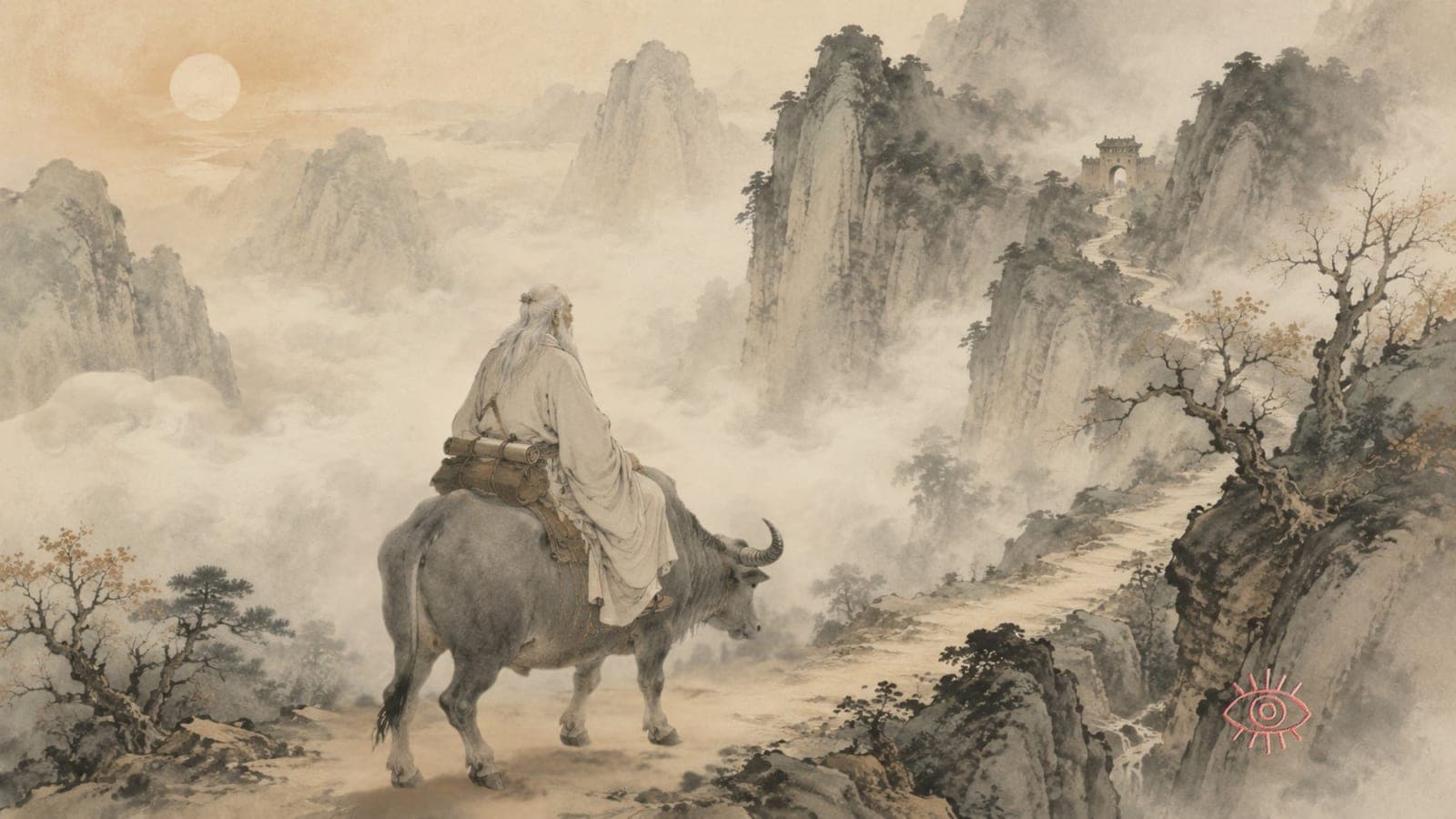
In October 1993, in Jingmen, in the Chinese province of Hubei, archaeologists opened a tomb that had lain sealed for roughly twenty three centuries. Tomb number one at Guodian belonged, most likely, to an elderly nobleman who had tutored a crown prince of the state of Chu. Inside, among the grave goods, lay bundles of bamboo strips, once bound together with cord that had rotted to dust long before anyone opened the lid. Eight hundred and four slips survived intact enough to read. Three of the bundles carried something identifiable: fragments of the book we now call the Book of the Way, traditionally credited to a court archivist named Laozi, though nobody, including the earliest Chinese historian to try, has ever been able to confirm that he existed. Its fuller traditional name is the classic of the Way and its power, and in the West it usually goes by its standard title, the Tao Te Ching. The Guodian bundles preserved only a fraction of the finished work: thirty one chapters out of an eventual eighty one, scattered through the earlier portion of the book, with nothing from its final dozen or so chapters. The book, it turned out, had not always been whole.
What had already made it onto bamboo by around 300 BCE, though, is the material that matters here. Among the earliest strips are lines describing a ruler who governs by doing nothing at all, and a small country whose people can hear a neighboring village's roosters and dogs and never feel the need to go and see it. It was addressed, in large part, to the kind of person who commanded armies, not to anyone seeking devotional calm, and it survived in the tomb of a man who had spent his career advising one.
The term most associated with that book gets rendered here as effortless action, or not forcing, and in recent decades it has had a second career as a personal technique. Find your flow. Stop forcing your calendar. Let go of the outcome and the outcome improves. Somewhere in that transfer the sentence lost its object. Effortless action was formulated, and its companion book compiled into something close to its present shape, during the Warring States period, five centuries in which rival states such as Qin and Chu fielded armies that ancient counts put at a million infantry each, and a single battle could leave, by one widely cited if disputed ancient count, two hundred and forty thousand dead. The tradition later generations would call Taoism did not begin as advice for a tired professional looking for calm. It addressed a ruler, and its argument was that a ruler who cannot stop interfering will wreck exactly what he is trying to build.
Cooking a Small Fish in a Country at War
The clearest statement of that argument sits inside a single kitchen image. Governing a large country, the book says, is like cooking a small fish. Anyone who has cooked a small fish knows what happens if it gets turned, prodded, checked every few seconds to see whether it is done: it falls apart in the pan. The competent cook mostly leaves it alone. The competent ruler, the passage argues, governs the same way, and it goes on to rank rulers by exactly how little they interfere. The best ruler is one the people barely know is there. Next comes the ruler the people love and praise, which sounds like success until it is read as visibility rather than virtue, a leader who has made himself the center of the story instead of letting the country run itself. Below him comes the ruler people fear, and at the bottom the ruler people despise. The best of them finishes the work so quietly that when it is done, the people look around at their own good lives and credit no one but themselves.
Behind the ranking sits an actual argument about cause and effect, not a mood. The more laws and prohibitions a state passes, it claims, the poorer its people become. The more sharp weapons a state stockpiles, the more disorder follows. The more cunning the legislation, the more thieves and outlaws appear, partly because the laws keep inventing new categories of crime for people to fall into. So the ruler who understands this reverses the whole machinery of governing. "I do nothing," the text has him say, "and the people transform themselves. I love stillness, and the people set themselves right. I stop interfering, and the people grow prosperous on their own." This is not a claim that no one should govern. It is a claim that most governing, in an age when courts kept multiplying statutes and lords kept multiplying conscripts, was actively producing the disorder it claimed to be curing.
That put the book on a collision course with the era's other great answer to the same crisis, the school built around the teacher Confucius, which proposed to save the state by drilling everyone in their duties, their rituals, and the celebrated virtues of loyalty and devotion. The book answers that a society loudly praising benevolence and loyalty is a society that has already lost them, the way a body only starts talking about health once it is ill. Its own utopia, sketched near the end, is not an empire at all. It is a small country with few people, boats and carts nobody bothers to use, and a neighboring village close enough that its roosters and dogs can be heard, which its people, growing old and dying in their own homes, never feel any need to visit. No warring state ever tried to govern itself this way. That was rather the point being made against it.
From a Warning to Rulers to a Technique for Individuals
The book is not only about the abstract machinery of law and punishment. It also names three treasures it asks a person, and above all a person with power, to hold onto: compassion, restraint, and a refusal to push to the front. Restraint is described as a kind of economy, a refusal to spend a state's people and resources recklessly, which is what gives a ruler lasting reach in the end, because what is held back is not lost but kept in reserve. Refusing to push to the front is framed as the one quality that qualifies someone to lead, on the reasoning that a person scrambling for the top place cannot be trusted with it once he arrives there. Courage without the compassion behind it, or largesse without the restraint behind it, the text warns, lead to the same place. They arrive there faster.
None of this reads like a manual for personal serenity. It reads like a warning issued to people who had armies, treasuries, and the power to conscript a village's men in an afternoon, telling them that their own appetite for control was the largest threat to what they were trying to hold onto. In that context, restraint was something asked specifically of the person holding power.
The modern use of effortless action drops that target almost entirely. Flow, in the vocabulary of contemporary self-improvement, describes a state an individual enters in order to work better, not a limit a ruler places on his own reach. Letting go of the outcome becomes advice for hitting a deadline with less anxiety. Not forcing becomes, itself, one more thing to force, a skill acquired so a person can produce more, faster, with a calmer face while doing it. The book that told a ruler to stop grasping at a kingdom now gets excerpted in guides aimed at employees chasing a quota.
The book's own picture of a satisfied life cuts against that transfer too. Its preferred image for a person who has stopped forcing things is the uncarved block, a piece of wood before the carpenter has touched it, valuable exactly because nothing has been cut away or added. Its advice is to reduce wanting, not to manage wanting more efficiently: few desires, plain food found delicious, simple clothes found beautiful, a home a person is content to stay inside rather than a horizon he needs to keep expanding. That is a harder sell to a productivity culture than the word flow ever was, and it may be why so much of the borrowing stops at the technique and never reaches the target the technique was built to hit.
The Tree Too Gnarled to Be Worth Cutting Down
A second, later figure took this suspicion of power and made it personal. Zhuang Zhou, generally known as Zhuangzi, lived roughly two centuries after Laozi was supposed to have lived, in the small state of Song, and for a time held a minor post overseeing a plantation of lacquer trees. When the king of a large and powerful state sent two officials to offer him the government of the whole realm, they found him fishing on a riverbank and delivered the offer in full. Zhuangzi did not turn around. He asked them about a sacred tortoise the king kept, dead for three thousand years, wrapped in silk and honored in the ancestral temple, and asked whether the tortoise would rather be dead and venerated or alive and dragging its tail through the mud. Alive, the officials admitted, dragging its tail through the mud. "Then go away," Zhuangzi told them, still fishing, "and leave me here to drag my tail in the mud."
He wore his poverty without apology. Visiting a king once in a patched coat with his shoes tied on with string, he corrected the king's pity on the spot. "Ragged clothes are merely poverty," he said. To hold the Way and its power and be unable to live by them, that would be ruin in the fuller sense.
His signature argument runs through a tree standing beside a village shrine, so wide a crowd could shelter under it, so old that a passing carpenter dismisses it without a second look. Useless wood, the carpenter says. A boat built from it sinks, a coffin rots, a tool handle snaps, and that very uselessness is why nobody has ever bothered to cut it down. That night the tree visits him in a dream and points to the fruit trees the carpenter admires instead, stripped and broken every season the moment their fruit ripens, their usefulness the exact reason their branches never live out a natural span. Zhuangzi presses the same logic into the language of state ritual elsewhere in the book that carries his name. When priests go looking for an ox to sacrifice to the river god, he notes, they choose the one with the fine white forehead and the noble bearing, and lead it away to be drowned. The scrawny, blemished ox is passed over and lives.
He carries the point into a human life. A man he calls only the cripple, his body bent and his spine twisted, sews and washes to feed himself. When the state's officers sweep through conscripting able bodied men for war, he walks among them untouched, waving his crooked arms, because no one wants him. When forced labor gangs are called up, he is passed over again. When grain and firewood are handed out to the sick, he receives a full share. The deformity the world pities is the thing that keeps him fed and keeps him out of a war he never chose.
Whether the Fish Are Happy, and Which Way the Dream Ran
Zhuangzi's most quoted passage runs about four sentences. He dreamed he was a butterfly once, flitting about pleased with itself, knowing nothing of being Zhuang Zhou at all, and then he woke, solid and unmistakable, himself again. And now, he wrote, he did not know: had a man dreamed he was a butterfly, or was a butterfly now dreaming it was a man? He never resolves it. Between the man and the butterfly, he adds, there must surely be some difference, and then he leaves the sentence sitting there, offering the uncertainty itself as the lesson rather than an answer to it. The passage has outlived every gloss written about it since, mostly by refusing to supply the one thing readers keep reaching for, which is which way round the dream ran.
He plays a version of the same trick, more combatively, with his friend Huizi, a logician who spent their long friendship trying to pin him down. Crossing a bridge together, Zhuangzi looks at the water and says the fish darting below look happy. You are not a fish, Huizi objects, so how could you possibly know what a fish enjoys. Zhuangzi answers that Huizi is not Zhuangzi, so how could he know what Zhuangzi does or does not know. Huizi thinks he has recovered his footing: he cannot know Zhuangzi's mind, granted, but by the identical logic Zhuangzi cannot know a fish's. Zhuangzi springs back to the start of the exchange. Huizi had asked how he knew, which already assumed there was something to know. The answer, Zhuangzi says, is that he knows it standing right here, on the bridge, over the water.
None of this was written to help anyone unwind after work. It came out of a stretch of history when the people with the most reason to stop forcing things were the ones least inclined to, and the people with the least power had to get inventive about staying out of the way of that grasping. Laozi's book took the argument to the throne room, warning rulers that a state prodded like a small fish falls apart in the pan. Zhuangzi took it to the riverbank and the shrine tree, then followed it down to the conscription line, showing an ordinary person how to go uncounted by a machine built to use up anything it could measure. Centuries later, both books ended up read mostly by people with no armies and no conscription notices to worry about, hunting the same pages for something to take the edge off an ordinary evening. The books let them. They were not written for that, not first.
Adapted from a longform audio episode on Taoism (Laozi), produced for Sleepy Philosophy Radio.
The Newsletter
New essays and episodes, delivered quietly.
By subscribing you consent to receiving occasional emails. Unsubscribe any time via the link in every email or at /unsubscribe.
Reflections
Loading...