The Way That Cannot Be Named | Taoism for Deep Sleep
Five thousand words, handed to a border guard by an old man who then vanished into the mountains, and the tradition they founded outlasted every empire that ignored it.
More than two thousand years ago, in a China torn apart by endless war, that small book of verses began its life. We start with its legendary author and the strange little classic he left behind, then move into the heart of the teaching: the nameless Way beneath all things, the art of accomplishing much by forcing nothing, and the quiet strength of water, emptiness, and the low places.
We meet the second great teacher, a poor and brilliant man who taught through wild and funny stories, dreamed he was a butterfly, and met death without fear. From there we follow the tradition as it grows into a vast religion, flows into painting and poetry and the birth of Zen, and travels at last across the world to speak to our own restless and exhausted age.
The full episode is on YouTube and Spotify. Please listen only in safe, restful contexts.
Enjoying the episode?
Occasional letters on philosophy, reading, and the examined life. No spam, ever.
By subscribing you consent to receiving occasional emails. Unsubscribe any time via the link in every email or at /unsubscribe.
Timestamps
- 0:00:00Chapter 1: The Old Man at the Pass
- 0:12:13Chapter 2: Five Thousand Words
- 0:18:08Chapter 3: The Way That Cannot Be Named
- 0:29:26Chapter 4: Doing Without Doing
- 0:37:38Chapter 5: The Use of Emptiness
- 0:43:06Chapter 6: The Spirit of the Valley
- 0:50:26Chapter 7: Ruling a Great State
- 0:59:44Chapter 8: The Butterfly and the Man
- 1:11:33Chapter 9: Whether the Fish Are Happy
- 1:20:06Chapter 10: The Usefulness of the Useless
- 1:25:51Chapter 11: The Cook and the Ox
- 1:35:27Chapter 12: The Pivot of the Way
- 1:43:58Chapter 13: Sitting in Forgetfulness
- 1:50:22Chapter 14: When the Way Became a Church
- 1:59:43Chapter 15: The Meeting of the Rivers
- 2:05:45Chapter 16: Water Finds Its Level
For the record
Full Transcript
Chapter 1: The Old Man at the Pass
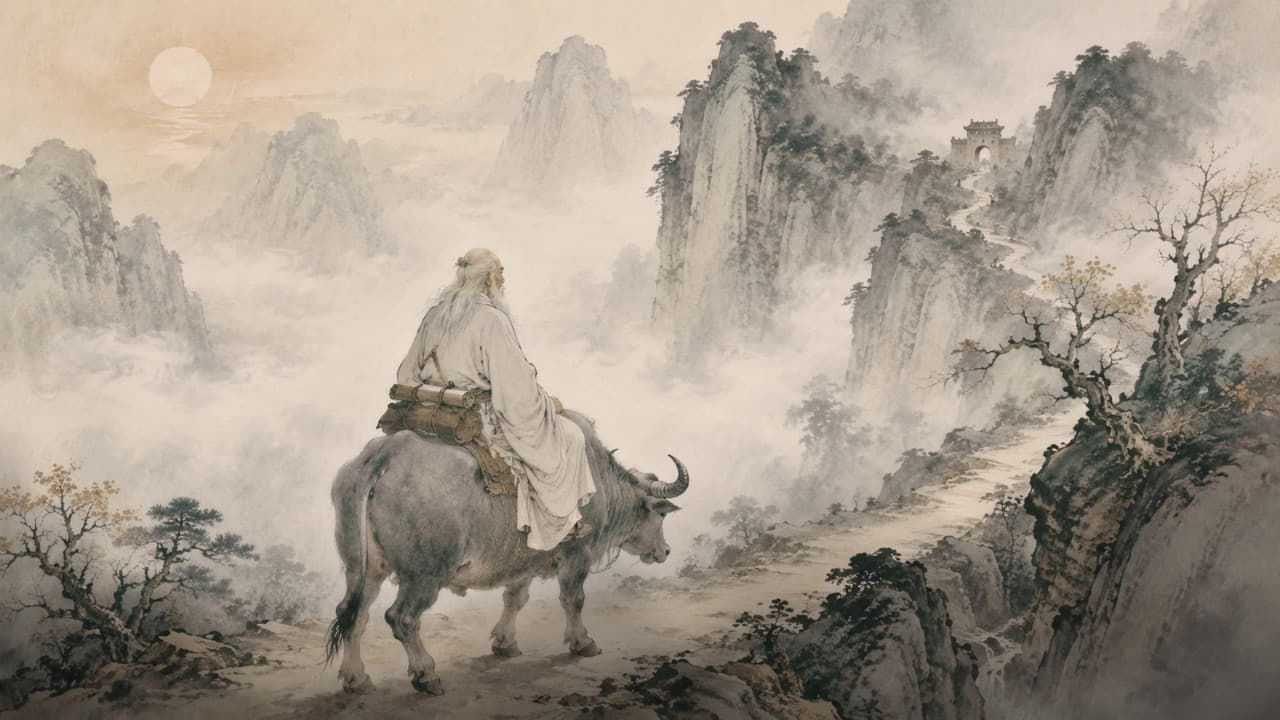
It is late autumn, more than two thousand years ago, and an old man is riding west, away from everything he has known. He sits on the broad back of a slow grey ox, swaying with its gait, following a road that climbs out of the settled country toward the mountains and the frontier beyond them. He is leaving the civilized world on purpose. He carries almost nothing with him. There are no disciples walking behind him, writing down his sayings. There is no crowd to see him off, no monument to mark where he has been, no record of the hour he set out. He is not fleeing a crime. He is not being sent into exile. He is not riding toward a fortune, or an army, or a temple, or a god. He is simply old, and worn down by a world that has stopped listening, and he has decided to ride out past the last gate of the empire and vanish into the wild country, and not come back.
At a pass high in the hills, where the road pinches between cliffs and a single gate decides who may leave, a keeper stops him. This keeper is not an ordinary soldier. He has spent his life watching the sky and reading the signs in it, and when he looks at the shabby old rider on the ox, he sees, so the story goes, that he is in the presence of a great sage about to slip out of the world forever. He will not let him pass so cheaply. Stay a while, he says, and before you disappear, write something down. Leave us something to keep. And the old man, who has spent his whole life teaching that the deepest truth cannot be put into words at all, gets down off the ox, and over the next days he takes a brush and writes. He writes about five thousand characters, a small string of short verses, dense and strange and quiet. He hands the bundle to the gatekeeper. Then he climbs back onto the animal, rides through the gate, and is gone. No one knows where he went. No one records where he died. He rides west out of history and leaves behind only that small book and the empty road.
There is a knot buried in that scene, and this whole episode exists to work it loose. The book the old man left at the gate opens by announcing that it cannot do the thing it is about to do. The very first lines warn that the truth it points to can never be caught in speech, that the moment you name the great mystery you have already lost it, that words are nets too coarse to hold the water they are dipped into. And then, having said this, the old man writes five thousand words. The teacher who prized silence above everything left the one string of sentences that would make him impossible to forget. The man who spent his life trying to become small, and quiet, and unnoticed, and finally to disappear altogether, disappeared so completely that he became one of the most translated and most quoted human beings who has ever lived. That is the first paradox of this tradition, and it will not be the last. At its heart is a teacher who taught by pointing away from teaching, and a book that is suspicious of books.
His name, as it has come down to us over the centuries, was Laozi, and it is barely a name at all. It means something close to the Old Master, or the Old Child, or simply the Old One, an honorific more than a person. And here we meet a difficulty that is not a flaw in the story but is somehow the very point of it. We do not really know who he was. We are not sure that he existed. The earliest attempt at a life of him was written down long after he was supposed to have lived, by a great historian of the Han court, a careful and honest man whose task was to record the past of his people. And when this historian came to Laozi, he had to admit that he was working with smoke. He set down what he had heard, that the Old Master had been a man called Lao Dan, keeper of the archives at the royal court, a librarian of sorts, a guardian of the records and rituals of a fading dynasty. But then the historian added, with unusual frankness, that others told the story differently, and named a different man, and still others a third, and that he honestly could not say which of them, if any, was the real one. He could not even settle when the man had lived. He left the question open, and it has stayed open ever since. The founder of this way of seeing the world is a figure glimpsed through fog, and the fog will not lift, and after a while you begin to suspect that the fog is part of the teaching.
To understand why such a book was written, and why it struck so deep, we have to see the world it came out of, because it was not a calm world at all. It was a world coming apart. For centuries the lands we now call China had been loosely held together under a single royal house, the house of Zhou, whose kings were thought to rule with the blessing of heaven itself. But by the time our story begins that house had rotted from the center. The king in his capital had become a shadow, a figure who performed the old ceremonies while real power drained away into the hands of dozens of local lords. Those lords fought each other without pause. Small states swallowed smaller ones. Alliances formed and broke and reformed. Armies grew until they numbered in the tens of thousands, and then the hundreds of thousands, and the fields were trampled and the roads filled with refugees and the century wore on in a grinding music of war that would give the age its name. Later historians would call it the age of the warring states, and it lasted, in one form or another, for the better part of five hundred years.
Out of that long emergency came something astonishing. When an old order collapses, people are forced to ask, from the ground up, how a human being ought to live and how a society ought to be run, and in those centuries of ruin the thinkers of China asked those questions with a depth and a variety that has rarely been matched anywhere. Teachers walked from court to court, offering rival cures for the sickness of the times. There were so many of them, arguing so fiercely, that the period is remembered as the flowering of a hundred schools of thought. The most powerful of these schools, the one that would eventually shape the whole civilization, was founded by a sober and dignified teacher we call Confucius, who believed that the way out of the chaos was back through it, by restoring the old rituals, the old family duties, the old bonds of respect between ruler and subject, parent and child. Order, for Confucius, was something you built with great care and effort, through education and ceremony and a lifetime of moral work. And it is against exactly that idea, the idea that you save the world by trying harder to civilize it, that the quiet book left at the mountain pass pushes back with all its strength.
There is a story, and it may be only a story, that the two men once met. The younger teacher, Confucius, earnest and full of questions about the proper forms of ritual, is said to have come to the old archivist to learn. And the old man, so the tale runs, was not impressed. He told his eager visitor to give up his pride and his endless ambitions and his busy schemes, because they were doing him no good. Then Confucius went away, and was silent, and when his own students asked him what the old man had been like, he did not answer with the usual measured praise. He said something closer to awe. Other men, he told them, he could understand. The bird he knew could fly, the fish he knew could swim, the beast he knew could run, and runners could be snared and swimmers netted and fliers shot down. But the old master was like a dragon, riding the wind and the clouds, rising beyond reach into the sky. He could not be caught, or measured, or understood. Whether or not the meeting ever happened, the image is exactly right, and it has clung to Laozi ever since. Everyone else can be pinned down. He cannot.
Think about what it might mean that this teacher was remembered, above all, as a keeper of archives. He had spent his life among the records, the ceremonies, the accumulated paperwork of a dynasty, watching the officials come and go, watching the careful documents pile up while the actual kingdom fell to pieces around them. A man in that position might come to a bitter and liberating conclusion. He might decide that all the striving and recording and organizing, all the moral lectures and elaborate rituals, all the human effort to grip the world and force it into shape, was not the solution to the disorder but was part of the disease. He might come to believe that the harder people grasped, the more everything slipped, and that the wisest thing a person could do was to stop grasping, to loosen the hands, to stop fighting the current and learn instead to move with it. That intuition, that the way to live is to stop forcing life, is the seed of everything that follows.
As for the book itself, the honest truth is that it was almost certainly not written in a few days at a mountain pass by a single vanishing sage. Scholars who have studied it closely believe it took shape slowly, gathered and polished over generations, a collection of sayings from many mouths that finally settled into the form we have a good two or three centuries after the Old Master was supposed to have lived. But legends are not undone by facts like these, and this one least of all, because the legend and the truth say the same thing. Both tell us that the author does not matter, that the finger pointing is nothing and the moon it points to is everything, that a teaching this impersonal was never going to have a face. The man dissolved into the work. The work became a river running down through the centuries, and countless later hands dipped into it, and it is still moving.
He rides off the edge of the map, then, and leaves us holding the book. But he is only the first of two great founders, and the story that grows from that small bundle of verses will become far larger than one legendary rider. It will grow a second teacher, a real one this time, wilder and funnier and stranger than the first. It will grow a religion of temples and gods and priests straining after eternal life, which is close to the opposite of anything the old man seems to have meant. And in time it will ride west again, out past its own frontier and into other centuries and other languages, and wash up at last on the far side of the world, where tired people who had never heard of a Zhou archivist would open a small book about yielding and feel something in them loosen. All of it begins here, at the pass, with an old man on an ox, handing over his small bundle of verses and disappearing into the mountains.
Chapter 2: Five Thousand Words
Set the legend of the pass aside, and look only at the thing it left behind. It is astonishingly small. You could read the whole of it in an afternoon, and hold it, in most editions, in one hand. It is not a treatise. It does not build an argument, brick by brick, from first principles to conclusions, the way a work of philosophy in the Western tradition usually does. It has no chapters of the kind you would expect, no chains of reasoning, no examples patiently worked through. Instead it is a string of about eighty-one very short passages, some only a few lines long, most of them under a hundred words, written in a compressed and rhythmic language that sits much closer to poetry than to prose. Many of them rhyme. Many of them fold back on themselves, saying a thing and then its opposite in the same breath. They are less like lectures than like riddles, or proverbs, or the worn smooth stones of some very old riverbed, and they were clearly made to be spoken aloud, and turned over, and carried around in the mind for years.
The fuller name of the book tells you how the tradition itself divided it. It is usually called the classic of the Way and its power, and those are its two great subjects and, in the received arrangement, its two halves. The first movement circles around the Way, the deep source and pattern of things. The second circles around power, though not power in the sense of force or command. It means something closer to the particular strength, the inner virtue, that flows into a person or a thing when it lives in harmony with that source. The Way, and the power that comes of keeping to it. A book about what reality is, and a book about how to move through it well. We will spend most of this episode inside those two questions, but here it is enough to notice the shape of the container.
Who wrote it is a question with no clean answer, and the more closely scholars have looked, the less it seems to have been written by anyone at all, in the way we usually mean that word. The style is uneven. The same phrases surface again and again, in slightly different clothes. Sayings that must once have circulated on their own, passed mouth to mouth among wandering teachers, seem to have been gathered together over a long stretch of time, sorted, rhymed, and stitched into the collection we now have. It reads, in other words, less like the work of a single mind on a single afternoon and more like the sediment of a whole tradition of quiet wisdom, settling slowly into a book. The legendary Old Master is the name the tradition gave to that long anonymous process, a single face painted onto a crowd.
For most of its history this was simply a matter of educated guessing, because the oldest copies anyone could point to were themselves many centuries younger than the text they carried. And then, twice in living memory, the ground gave up its secrets. In nineteen seventy-three, archaeologists opening a tomb that had lain sealed for more than two thousand years found, among the grave goods, two copies of the book written in ink on silk, so old that they predated by a wide margin every version scholars had been working from. They held a surprise. In these silk copies the two halves come in the reverse of the familiar order, the power before the Way, which told scholars that even the arrangement everyone had taken for granted was not fixed, but had once been fluid, still settling.
Then, twenty years later, in nineteen ninety-three, came something older still. In another tomb, sealed around three centuries before the common era, diggers found strips of bamboo, once bound with cords long since rotted away, and inked on the bamboo were passages from the book, in an early and partial form, only about a third of the whole. This was the oldest witness anyone had ever seen, close enough to the supposed lifetime of the Old Master to reach back toward the very beginnings of the text. And it too suggested a work still in motion, still growing toward the shape it would finally take. The book we hold, it turns out, had a life before it was a book. It grew the way a stream grows, gathering water as it goes.
And it never stopped moving. From that small and shifting seed, this handful of cryptic verses became one of the most translated books on the whole of the earth. It has been carried into English alone well over a hundred times, and into other tongues more often, by some counts, than any book except the Christian scriptures. Poets have translated it who could not read a word of the original, working from other translations, drawn by something they could feel through all the layers of glass. Scholars have given their whole careers to a single line of it. It has been printed as a pocket companion for soldiers, a manual for rulers, a guide for the dying, and a coffee-table ornament. Five thousand words, left at a mountain gate by a man who may never have existed, and the world has not been able to put them down. It is worth asking what is inside them that holds on so hard, and that is where we turn next, to the strange and nameless thing the whole book is trying, and failing, and trying again, to say.
Chapter 3: The Way That Cannot Be Named
Everything in this tradition hangs on a single word, and the word is the Way. It is the source the book keeps circling, the reality it keeps reaching for, the thing that all its quiet advice about how to live finally rests upon. And the very first thing the book tells us about this all-important word is that the word is wrong. The Way that can be spoken of, it begins, is not the eternal Way. The name that can be named is not the eternal name. Before we are told anything at all, we are warned that whatever we are about to be told will be, in some deep sense, false, or at least a shadow of the truth, a pointing rather than a possessing. It is one of the strangest and most honest openings of any book ever written. Imagine a guide who begins by telling you that the map is not the country, that every word he is about to say will lead you slightly astray, and that his real teaching lives in the silence between his sentences.
Why would the deepest truth refuse to be spoken? The tradition's answer is that words work by cutting. To name a thing is to draw a line around it, to fence off this piece of the world from that piece, to say here is a tree and there is the sky and these are two different things. And for getting through an ordinary day, that fencing is useful, even necessary. But the Way is not a thing among things. It is not one item in the world that you could pick out and label, the way you pick out a tree. It is the whole, the seamless source from which every separate thing arises, the pattern running through all of it at once. And you cannot fence the whole. The moment you throw a word around it, you have made it small, you have turned the boundless into one more object with a name and an edge, and the living thing has slipped away and left you holding the label. A name is a fence, and you cannot fence the open field of everything.
So the book resorts to hints, to images, to circling and circling the thing it cannot say. In one of its most beautiful passages it describes the Way like this. There was something formless and yet complete, it says, born before heaven and earth. Silent. Empty. Standing alone and unchanging. Moving in great circles and never wearing out. It might be thought of as the mother of all beneath the sky. I do not know its name, the passage goes on, and so I simply call it the Way, and if you press me to say more, I will only say that it is great. Notice what that does. It gives us a picture, formless, silent, older than the world, endlessly turning, and then it takes even the picture back, admitting that Way is only a stand-in, a placeholder, the least wrong of all the wrong words. This is the source. It came before heaven and earth. It has no name. It made everything, and it goes on quietly turning underneath everything, and we call it the Way for lack of anything better to call it.
It is important to feel how different this is from the idea of a god, because that is the closest thing most of us have to reach for, and it will mislead us. The Way is not a person. It does not think, or choose, or command, or love, or judge. It issued no laws and hears no prayers and has no plan for you. It did not decide to make the world, the way a craftsman decides to make a chair. The world simply arises out of it and returns into it, the way waves arise out of the sea and sink back into it, without the sea ever intending anything at all. The Way is closer to a pattern than to a maker, closer to the grain in a piece of wood than to the carpenter, closer to the current of a river than to anyone steering. It is how things are and how things go, the deep course that everything follows when nothing is interfering. And because it wants nothing and forces nothing, it can be trusted completely, which is a thought we will come back to again and again.
The book presses this point to a place that can still take the breath away. The Way is empty, it says, and yet no amount of use will ever drain it. You may draw on it forever and it will never run dry, because it is not a store of stuff that could be used up but the very wellspring of there being anything at all. And then it dares something bolder still. This bottomless source, it suggests, seems to have been there before any god. Whatever a people might worship as its highest lord, whatever power might sit enthroned at the top of heaven, the Way was already there beneath it, older, deeper, nameless, the ancestor out of which even the gods arose. This is not meant as an insult to the sacred. It is meant to locate it. It reminds us that the gods too are among the ten thousand things, waves on the same sea, and that under every face we have ever given to the holy there is a facelessness that came first. The Way is not the greatest being in the world. It is what being itself pours out of, and it is not a being at all.
Now watch what the book does with the problem of language, because it does something subtle. It notices that our words do not just come one at a time, they come in pairs, and each half of the pair calls up the other. The instant you decide that something is beautiful, you have created ugliness in the same stroke, because now there is a standard, and whatever falls short of it. Say that a thing is long, and you have conjured shortness. Say high, and you have made low. Being and non-being, the book says, give birth to each other. Difficult and easy complete each other. Before and after follow each other in an endless ring. The opposites we treat as simple facts about the world are really two ends of one stick that our own naming has whittled. We think we are describing reality when we sort it into good and bad, gain and loss, success and failure. But these are not out there in the seamless whole. We bring them with us. We carve the world into opposites and then suffer over the halves we do not like, forgetting that we made the knife.
And yet, out of that same wholeness, everything that exists somehow pours. The book offers a kind of hushed account of how the many come from the one, and it is worth hearing slowly. The Way gives birth to the one, it says. The one gives birth to the two. The two give birth to the three. And the three give birth to the ten thousand things, which is the old phrase for the entire teeming multitude of the world, every creature and stone and star. From an undivided source comes a first stirring, and from that first stirring a split into two great tendencies, the shadowed and the sunlit, the receptive and the active, and from the play between those two comes a third thing, their offspring, their harmony, and from that the whole endless population of existence unfolds and unfolds. Everything that lives, the book adds, carries the shadow on its back and holds the sunlight in its arms, and blends the two in its own breath, and that blending is what we feel as harmony. It is a vision of a world that was not built but born, that flowered out of a single silent root and is flowering still. And we are in it. That is the part worth pausing on, lying here in the dark. You and I are among the ten thousand things, late leaves on that same branching, carrying the shadow on our backs and the sunlight in our arms, blending them in the breath going in and out of us right now. We did not enter the world from outside it. We grew up out of it, the way a wave is not a thing set down upon the ocean but a gesture the ocean is making, briefly, before it smooths again. Whatever the Way is, we are not separate from it, looking on. We are one of the shapes it is taking tonight.
You cannot reason your way to this root. That is the last hard thing the chapter has to say. Ordinary knowing works by grasping, by separating and defining and pinning down, and every one of those motions carries you further from a whole that can only be met undivided. So the book points, oddly, toward a different way of seeing, a way that comes not from clutching but from letting go. When you are free of craving, it says, you can see the mystery itself. When you are full of wanting, you see only the outer shells of things, the surfaces, the labels. The mystery and the surfaces come from the same place, it goes on, and that sameness is a kind of darkness, and here the language grows almost dizzy. Darkness within darkness, it says, the gateway to all understanding. Not the darkness of despair, but the fertile dark of the ground before the seed breaks it, the dark of a depth that light has not yet divided into shapes. The Way is found there, in that gateway, by a mind quiet enough to stop naming and simply let the whole be present.
All of which can sound impossibly far off, a cloud of lovely abstractions with nowhere to stand. But the genius of this little book is that it never stays in the clouds for long. Having gestured at the nameless source, it turns, almost at once, to the ground under our feet, to water and clay and doorways and the running of a state and the raising of a child, and it asks a very practical question. If this is what reality is, a seamless self-moving whole that forces nothing and accomplishes everything, then how should a person live inside it? What would it mean to stop fighting the current of such a world, and to move, instead, the way the Way itself moves? That question is the bridge from the mystery to the life, and it leads straight to the idea that the whole tradition is most famous for, the strange and freeing art of doing without doing.
Chapter 4: Doing Without Doing
At the center of this whole way of living sits an idea so easy to misread that we had better clear away the misreading before we touch the idea. The tradition teaches something usually translated as non-action, or non-doing, and the moment we hear those words we picture a person lying still and letting the world fall apart around them, a philosophy of the shrug, an excuse for doing nothing at all. That is almost the exact opposite of what is meant. The teaching is not about inaction. It is about a particular quality of action, action without force, action without strain, action that has stopped fighting the situation it is in. It is doing that does not feel like doing, because the friction has gone out of it. The clearest picture of it is your own body, which right now is beating your heart, filling your lungs, digesting your dinner, and healing a dozen small hurts, all without your trying, all without your interfering. You are doing all of it, and you are doing none of it on purpose. That effortless, unforced accomplishing is the thing the book is pointing at, and it holds up the Way itself as the great example, saying that the Way never acts, and yet there is nothing it leaves undone.
To act in this spirit is to move with the grain of things rather than against it. A skilled sailor does not fight the wind. A good cook does not force the knife through the bone but finds the space where the joint already wants to open. Anyone who has learned a craft knows the moment when effort turns into ease, when you stop muscling the task and start letting it happen through you, and the work suddenly gets better as it gets lighter. That moment, made into a whole approach to living, is what the tradition prizes above almost everything. Do your part, but do not force. Push where the world gives, and yield where it resists. Add nothing extra, no showing off, no clenching, no anxious over-managing. And trust that a great deal of what needs doing will do itself, if you can only stop getting in its way.
For its master image of this, the book reaches, again and again, for water, and the choice is perfect. The highest good, it says, is like water. Water benefits everything and competes with nothing. It asks for no credit and takes no stand. And above all, it flows downward, seeking out the low places, the ditches and hollows that everyone else avoids, the humble ground nobody is fighting over. In a world of people straining upward, clawing toward the high seats and the honored names, water simply goes down, and settles, and by settling low it comes to nourish everything that grows. That, the book says, is why water is so close to the Way. It achieves everything precisely by not asserting itself, by taking the shape of whatever holds it, by being content with the places pride refuses.
And yet, for all its softness, water is not weak, and here the teaching turns and shows its edge. Nothing in the world, the book says, is softer or more yielding than water. And nothing is better at wearing down what is hard and strong. Set water against stone and the stone will win every single day, and lose over ten thousand years, ground into sand and carried off to the sea. The soft outlasts the hard. The yielding defeats the rigid. Look, the book says, at what is alive. A living body is soft and supple, warm and bending. A dead one is stiff. A green plant is tender enough to lay flat in the wind and spring back; a dead branch is brittle and snaps. So hardness and rigidity, it concludes, are the companions of death, and softness and yielding are the companions of life. The strong oak that will not bend is the one the storm breaks. The grass that lies down under the same storm is standing again in the morning. What looks like weakness is often the deeper strength, the strength that survives.
From this comes the tradition's steady suspicion of force, of grabbing, of trying to seize and control. Whoever grasps at the world, the book warns, will lose it, and whoever tries to hold it will let it slip, because the world is a living thing and not a lump of clay to be squeezed into shape. There is a wonderful small image for how forcing defeats itself. Stand on your tiptoes, the book says, and you cannot stand for long. Take great striding steps to hurry, and you cannot really walk. The very effort to rise higher and move faster undermines the thing it is reaching for. We have all felt this. The harder you try to fall asleep, the more awake you become. The tighter you grip the delicate thing, the more surely you crush it. The more desperately you chase a person's love, the faster it retreats. In whole regions of life, effort is exactly the wrong tool, and the striving self is the one obstacle that most needs to get out of the way.
None of this means the sage sits idle waiting for the world to arrange itself. It means the sage acts early, and lightly, and small. Deal with the hard thing, the book advises, while it is still easy. Handle the great thing while it is still small. Every huge trouble was once a tiny one that could have been solved with a word or a gesture, before it hardened and grew roots. A tree you can barely reach around began as a shoot you could have pinched between two fingers. A tower nine storeys high began as a single basket of earth. And a journey of a thousand miles, the book says, in its most famous line of all, begins under your feet, with the ground you are standing on right now. The point is not grand and heroic effort. The point is the small, well-timed, unforced move, made so early and so quietly that it barely looks like action at all, and yet it turns the whole course of what follows.
So the person who has learned this does not look impressive. That is almost the definition of it. They are not straining, not announcing, not visibly triumphing over obstacles, because they met the obstacles while the obstacles were small, and dissolved them before anyone noticed there was anything to dissolve. Their life has a quality of ease that the striving mistake for luck. They seem to accomplish a great deal without hurry and to arrive without having rushed. And this same art, the book insists, scales all the way up. The unforced hand that works so well on a single life works on a family, on a village, and, most delicate and dangerous of all, on the running of a whole state, where the temptation to force and grasp and control is strongest, and the damage worst. We will come to that harder case in its own time. For now it is enough to have the core of it, the strange, freeing discovery that lies at the heart of the whole tradition. You do not have to force the river. Much of the good you are straining after would arrive on its own, if you would loosen your grip and let it. And the same wisdom that finds its strength in yielding finds, next, its usefulness in the strangest place of all, in emptiness itself.
Chapter 5: The Use of Emptiness
We are trained, all of us, to notice the solid things. We count what we can hold. We value the material, the substance, the part of the world we can point to and weigh and own. And so it takes a strange little turn of attention, one that this tradition makes better than almost anyone, to see that the useful part of a great many things is not the solid part at all. It is the empty part, the hollow, the gap, the nothing carved out in the middle. The book makes this point with three plain images, drawn from the ordinary crafts of its time, and once you have seen them you cannot unsee them.
Take a wheel, it says. Thirty spokes are set into a single hub, radiating out to the rim, and all that careful carpentry, all that solid wood, is arranged around one thing, the empty socket at the center where the axle sits. It is the hole in the middle of the hub, the part that is not there, that lets the wheel turn. Fill in that emptiness and you have a beautiful useless disc of wood. The whole point of the wheel lives in its hollow center. All the substance exists to serve the space.
Take a clay pot, it says next. A potter works the clay, throws it on the wheel, shapes the walls, and fires it hard. But no one wants the clay. What people want is the emptiness the clay surrounds, the hollow that holds the water or the grain. You do not fill a jar with pottery. You fill it with what the pottery leaves room for. The clay is only the border drawn around a useful piece of nothing.
And take a house, the book says, a simple room. You cut doors into the walls so that you can come and go, and you cut windows so that the light and the air can enter. And it is the cut-out spaces, the doorway that is a gap in the wall, the window that is a hole where the wall is not, that make the room a place you can actually use. Nobody lives inside the bricks. We live in the emptiness the bricks enclose. The solid walls give the house its edges, but the space inside is where the life happens.
So the book draws its quiet conclusion, and it is one of the most useful sentences it contains. What is there gives a thing its advantages, it says. But what is not there is what makes it useful. The being provides the profit. The emptiness provides the use. The two need each other, the rim and the hollow, the wall and the room, but we are forever staring at the rim and the wall, the things we can grasp, and forgetting that they exist to shelter and shape an emptiness that is doing the real work.
It is not hard to feel how far this reaches beyond wheels and pots. A great deal of what makes a life good is empty in exactly this way. The pause that lets a spoken sentence land. The quiet morning hour before anything is scheduled into it. The open, unplanned afternoon. The silence in which a friend finally says the true thing. The rest a body needs, which produces nothing and makes everything else possible. These are all hollows, and like the hollow of the pot they are easy to despise, because they cannot be counted or shown off or sold. And so we fill them in. We cram the day so full that there is no space left to move in it, the way a cup filled to the very brim can no longer receive a single drop, the way a room stacked to the ceiling with possessions is no longer a room you can live in. We keep adding substance to a life that was suffering from a shortage of space.
There is a gentle correction hidden in these three little pictures. It is not that the solid things are bad. The spokes are real work, the clay is real skill, the walls keep out the rain. The tradition is not asking us to throw our belongings away or to sit in a bare room doing nothing. It is only asking us to notice the other half of the equation, the half our getting-and-keeping minds are built to overlook. Leave some emptiness. Do not fill every hour, every wall, every silence. Keep an open center for the axle of your life to turn in, because a life without any hollow in it cannot turn at all, and a self stuffed too full has nowhere left to receive whatever the day might bring.
The tradition returns to this fertile emptiness constantly, and it finds it in unexpected places, not only in wheels and jars but in the low ground where water gathers and in the dark receptive hollow out of which living things are born. There is, it turns out, a whole face of the Way that is empty and yielding and quietly generative in just this way, a face the book calls, without embarrassment, the female and the valley. And it is to that low, dark, life-giving emptiness that we turn next.
Chapter 6: The Spirit of the Valley
There is a preference running all through this book that would have sounded, in its own warlike age, close to scandalous, and can still sound strange to us. In a world that admires the strong, the high, the bright, the assertive, the masculine, the tradition quietly places its bet on the opposite. It exalts the soft over the strong, the low over the high, the dark over the bright, the receptive over the forceful, and it does this so insistently that it gathers all of these preferred qualities under one great symbol, which it calls, without any embarrassment, the female, and the valley. The spirit of the valley never dies, the book says, in one of its oldest and most haunting lines. It is the mysterious female. And the gateway of the mysterious female is the very root of heaven and earth.
Sit with the image of the valley for a moment, because everything is in it. A valley is a low place. It is a kind of emptiness, a hollow between the hills, and it is exactly its lowness and its hollowness that make it what it is. Rain runs down into a valley. Rivers gather there. Soil collects there, and so the valley is green while the proud peaks above it are bare rock. The valley does nothing, asserts nothing, climbs nowhere. It simply stays low and open and receptive, and because it receives, everything comes to it, and life flourishes in it. The high mountain grasps at the sky and gets only wind and stone. The low valley keeps to the bottom and gets the water, the richness, the growth. To be like the valley is to understand that receiving is a power, that the open hollow is not a lack but a fertility, and that the position everyone scrambles to escape, the low one, the humble one, the yielding one, is secretly the strong one.
This is why the tradition keeps pointing us toward the feminine, and it means something specific by it, something that has nothing to do with weakness. It means the strength that works by yielding and enduring rather than by conquering. The female, the book observes, overcomes the male through stillness, and through being willing to take the lower place. And so it gives a piece of advice that turns the ordinary rules of ambition inside out. Know the masculine, it says, but keep to the feminine. Understand power, drive, brightness, all the qualities the world rewards, know them well, but do not make your home there. Make your home in their opposites. Keep to the receptive, the quiet, the low. Become the valley of the world, and let things flow to you rather than seizing them.
And when you have become the valley, the book says, something happens. You return to a state it names with one of its most beloved images, the uncarved block. Picture a piece of wood before the carpenter has touched it. It is still whole. It has not yet been cut into a spoon or a bowl or a handle. It is plain, and simple, and full of every possibility precisely because it has not yet been forced into one shape. The tradition thinks that a human being starts out something like that, whole and simple and undivided, and that the whole machinery of civilization, all its titles and ambitions and refinements, is a set of knives that carve us into narrow, clever, complicated shapes, and cut away most of what we were. The wisdom it offers is a returning, a laying down of the knives. Reduce your wanting, it says. See the plain and hold to the simple. Have few desires. Become, once more, like the uncarved wood, and even like a newborn infant, soft and whole and endlessly alive, not yet divided against itself.
Notice the direction of all this, because it points to the deepest law the book knows. The movement it keeps recommending is not forward and up, toward more, but backward and down, toward the source. And it believes that this is not merely good advice but the actual pattern of reality, the way the whole universe moves. Returning, it says, is the movement of the Way. Everything that rises will fall back. Everything that goes out will come home. The ten thousand things grow and flourish, the book says, and then each one returns to its root, and returning to the root is called stillness, and that stillness is a kind of homecoming to what a thing most truly is. Watch the year do it, breathing out into summer and back into the bare stillness of winter. Watch the day do it, and the breath in your own chest, going out and returning, out and returning, the whole of life a tide.
And because everything returns, the tradition sees a further truth that the ambitious can never quite believe. Whenever a thing reaches its extreme, it begins to turn into its opposite. The moon, once perfectly full, is already beginning to wane. The sun at its highest noon has already started down toward evening. The empire at the very peak of its power has begun, in that instant, to decline. Push anything to its furthest point and it reverses. This is why the sage is wary of extremes, wary of the summit, wary of getting exactly everything he wants, because he knows that the top of the arc is also the beginning of the fall, and that the safest, most durable place is not the peak but somewhere lower down, with room still to rise, held back from the edge where things flip over into their contraries.
So the person shaped by this teaching does not despise the low, the empty, the simple, the yielding, the way the rest of us are trained to. They seek those places out. They keep something of the valley in themselves, a hollow that receives rather than a peak that grasps. They keep something of the uncarved wood, a simplicity under all their knowledge. And they hold lightly to every height they reach, knowing it is a turning point and not a resting place, trusting the great tide that carries everything out and brings everything home. It is a serene and slightly subversive way to move through a striving world. And when a person who thinks like this is handed power over others, when the one who keeps to the valley is made to sit on a throne, the results are stranger and gentler than anything the age of warring states expected, and it is to that unlikely ruler that we turn next.
Chapter 7: Ruling a Great State
Remember the world this book was born into, a world of warring states, of ambitious lords and vast armies and rulers straining every nerve to control their kingdoms and swallow their neighbors. Into that world, the tradition brings the most unlikely political advice imaginable, and it follows directly from everything we have seen. If the wisest way to live is to stop forcing, then the wisest way to rule must be to stop forcing too, and the book says so in an image no one who hears it ever quite forgets. Governing a great state, it says, is like cooking a small fish. Anyone who has cooked a small fish knows exactly what this means. If you keep poking it, turning it, prodding it to see how it is coming along, it falls to pieces and you are left with a mess in the pan. You cook a small fish by mostly leaving it alone. And you govern a great nation, the book says, the same way, with a light hand, with restraint, by resisting the constant itch to interfere.
The tradition sketches a whole ladder of rulers, from best to worst, and it is not the ladder we would expect. The very best ruler, it says, is one whose people barely know he is there. His hand is so light, his interference so slight, that the country seems to run itself. A step below him is the ruler the people love and praise, which sounds fine until you realize that a beloved ruler is one who has made himself very visible, done grand and memorable things, and taught the people to look up to him rather than to themselves. Below that is the ruler the people fear. And at the very bottom is the ruler the people despise. The best of them governs so quietly that when the work is finished and the country is at peace, the people do not thank him or credit him at all. They look around at their good lives and they say, we did this ourselves. That, for this tradition, is the summit of leadership, to do so much good so invisibly that no one even notices it was done.
Behind this lies a genuine social theory, and a startling one. The book looks at the machinery rulers reach for, more laws, more prohibitions, more inspectors, more sharp weapons, more clever schemes, and it argues that every one of these tools tends to produce the very thing it was meant to prevent. The more rules and restrictions there are, it observes, the poorer the people become. The more sharp weapons a state keeps, the more trouble breaks out. The more cunning and clever the laws, the more thieves and outlaws appear, partly because the laws themselves invent new crimes, and partly because a people managed and manipulated and mistrusted will start behaving like something that needs managing. So the sage-ruler reverses all of it. I do nothing, he says, and the people transform themselves. I love stillness, and the people set themselves right. I stop interfering, and the people grow prosperous on their own. I let go of my own wanting, and the people drift back, by themselves, toward simplicity. It is the art of not forcing, which we have already seen at the heart of this whole way of living, carried up to the scale of a kingdom, and its wager is that a society, like a body or a garden, has a natural health it will find if you stop wounding it.
This puts the tradition on a direct collision course with the great rival school of the age, the followers of Confucius, who wanted to save society by teaching everyone their duties, drilling them in the proper rituals, and cultivating the celebrated virtues, benevolence, righteousness, correct behavior between ruler and subject and parent and child. And here the book says something that must have sounded almost blasphemous. All those beautiful virtues, it suggests, are not signs of health at all. They are symptoms of sickness. When the great Way was whole, it says, and people simply lived in harmony without thinking about it, no one needed to preach kindness, because everyone was kind. It was only when the Way was lost that people began to talk about virtue. Only when families fell into conflict did anyone start praising devoted parents and dutiful children. Only when the state fell into disorder did loyal ministers become famous. The very fact that a society is loudly celebrating a virtue, the book implies, is proof that the society has lost it, the way a body only talks about health once it is ill. So it draws a shocking conclusion. Drop the preaching of wisdom and morality, it says, abandon the campaign to make everyone virtuous, and the people will return, on their own, to a natural goodness deeper than any that can be taught. The Confucian tries to carve people into good shapes. The tradition answers that the carving is the wound.
But do not mistake this for a cold or heartless doctrine, because at the center of it the book places three things it calls its treasures, the qualities it holds and guards above all others. The first treasure is compassion, a deep tenderness toward others, which the book says is the true source of courage, because a person who genuinely loves will find bravery that mere aggression never can. The second treasure is restraint, a kind of economy or frugality, not spending yourself and your resources and your power recklessly, and this, it says, is what gives a person real reach and generosity in the end, because what is held back is not lost but saved. And the third treasure is not daring to be first, not pushing to the front, not scrambling for the top place, and this, in the book's great paradox, is exactly what makes a person fit to lead, because the one who does not grasp at leadership is the only one who can be trusted with it. Compassion, restraint, and humility. Give these up, the book warns, chase courage without love, reach without thrift, and the front place without humility, and you are simply rushing toward your own ruin.
And out of all this comes the book's small, strange, shining picture of the good society, which is not a great empire at all. Let there be a small country, it says, with few people. Let them have tools and not bother to use them, boats and carriages they never trouble to ride. Let them find their plain food delicious and their simple clothes beautiful, let them be content in their homes and take pleasure in their own customs. And here is the final touch, the line that gives the whole vision its flavor. The neighboring country is so close, it says, that you can see its rooftops, and on a still evening you can hear its roosters crowing and its dogs barking. And yet the people grow old and die without ever once feeling the need to go over there and see it. There is no craving in them to acquire the next valley, to travel, to conquer, to compare. They are simply, deeply content with what is near and small and enough. In an age of insatiable expansion, in our age no less than the ancient one, it is almost unbearably quiet, a vision of human beings who have finally stopped wanting more.
We should be honest that no warring state ever governed itself this way, and no nation has since. As a practical manual for running a kingdom it was ignored in its own time and has been ignored ever since, because it asks the one thing power can never quite do, which is to let go. But it was perhaps never really meant as a manual. It is closer to a mirror, held up to every ruler and every striving heart, showing us how much of our controlling and improving and interfering only makes the mess it means to clean, and how much good might quietly arise if we could learn to stop. That was the vision the Old Master left behind at the pass before he rode into the mountains. It would take a second teacher, born several generations later, restless and brilliant and funny, to pick up these quiet paradoxes and set them loose, and to write them not as calm advice but as wild and unforgettable stories. To him, and to the butterfly he dreamed, we turn now.
Chapter 8: The Butterfly and the Man
The Old Master, if he lived at all, left five thousand words and a legend and no face. The second great teacher of this tradition is a different kind of figure altogether. He was almost certainly a real man, he left a large and dazzling book, and far from having no personality, he has one of the most vivid personalities in the whole history of thought, sharp, funny, irreverent, tender, and strange. His name was Zhuang Zhou, and we usually call him Zhuangzi, which simply means Master Zhuang. He lived perhaps two centuries after the Old Master was supposed to have, deep in the age of warring states, in a small state called Song, and he is the one who took the quiet paradoxes of the little book about the Way and blew them wide open, turning them into stories that people have been laughing at and puzzling over ever since.
We know only a little about his life, but the little we know is telling. He was poor, and seems to have been content to be poor. For a time he held a minor and unglamorous government post, an overseer of a plantation where the lacquer trees were grown and tapped, a modest keeper of a modest patch of trees. He was not, by the standards of his ambitious age, a success, and the striking thing is how completely he did not care. The world around him was full of clever men racing between the courts of the warring lords, selling their advice, angling for position, dreaming of high office. Zhuangzi watched all of it with amusement and wanted no part of it, and there is a famous story about just how firmly he wanted no part of it.
The king of a large and powerful state, having heard of his brilliance, once sent two high officials to find him, bearing gifts and a magnificent offer. They came upon Zhuangzi where he was fishing, calmly, on the bank of a river, and they delivered their message. The king wished to hand him the whole burden of the government. He was to become chief minister of the realm. Zhuangzi did not even turn around. He kept hold of his fishing pole and asked them a question. He had heard, he said, that the king kept the shell of a sacred tortoise, dead now for three thousand years, wrapped in silk and stored in a beautiful box in the ancestral temple, where it was honored and consulted and treasured. Now tell me, he said, this tortoise. Would it rather be dead, with its bones venerated in a temple for three thousand years? Or would it rather be alive, and dragging its tail in the mud? The two officials answered that, of course, it would rather be alive and dragging its tail in the mud. Then go away, said Zhuangzi, still fishing. Leave me here to drag my tail in the mud. He would not trade one hour of his free and useless riverbank for all the honored, embalmed, imprisoned glory the world could offer. He would rather be a live nobody than a magnificent dead somebody.
His poverty was real, and he wore it without a trace of shame. There is a story that he once went to visit a king dressed in a robe of coarse patched cloth, his shoes tied on with string because they had fallen apart. The king looked him over and said, with some pity, how has a great thinker come to such a sorry, worn-out state? And Zhuangzi corrected him at once. This is poverty, he said, not sorry wornness. To have the Way and its power and be unable to live by them, that would be the sorry, worn-out state. Ragged clothes and broken shoes are merely poverty. They are the wrong time and the wrong ruler, nothing more. He would not let the king pity the wrong thing. A torn robe was just a torn robe. A life out of tune with the deep pattern of things, however finely it was dressed, was the only ruin worth the name. He was, in his patched coat, one of the freest men of his age, and he knew it.
He was not, however, a hermit or a sour recluse. He had friends, and one friendship in particular runs all through his book like a bright thread. His great companion and rival was a philosopher named Huizi, a famous logician, a man of exactly the opposite temperament, precise where Zhuangzi was wild, literal where Zhuangzi was playful, a lover of tight arguments and clever paradoxes and careful distinctions. The two of them argued endlessly. Huizi is forever popping up in the book to object, to quibble, to tell Zhuangzi that his ideas are grand and useless, and Zhuangzi is forever running rings around him, delighting in tying his logical friend into knots. But there is real love under the sparring. They were the sharpest minds either of them knew, and each needed the other to strike against. There is a story that shows the flavor of it exactly. Huizi, unlike Zhuangzi, had climbed high, and had become the chief minister of a powerful state. When word came that Zhuangzi was traveling to visit him, someone whispered to Huizi that his brilliant friend must be coming to scheme him out of his post and take the ministership for himself. Huizi panicked, and set the guards to searching the whole city for three days and three nights to head him off. Zhuangzi heard about it, walked in on his own, and told him a little story. In the far south, he said, there lives a great and noble bird, a kind of phoenix, that rises from one sea and flies to another, and along the whole enormous journey it will perch on no tree but one rare and perfect tree, eat nothing but the sweetest fruit, and drink nothing but from the purest spring. And one day, as this phoenix passed overhead, an owl who had just found a dead and rotting rat looked up, clutched its filthy prize, and screeched at the great bird to keep away. Now, said Zhuangzi, you have the whole state in your hands. Are you screeching at me over it? He did not want the rat. He could not imagine wanting the rat. And that was the abyss between them, and the joke that held them together. It was, in the deepest sense, a philosophical friendship, two people thinking better together than either could alone.
The book that carries Zhuangzi's name is one of the treasures of world literature, and it is nothing at all like the terse and solemn verses of the Old Master. Where the little book of the Way is compressed almost to silence, Zhuangzi's book overflows. It is enormous, exuberant, and gloriously funny. It teaches almost nothing directly. Instead it teaches through story, through fable, through joke, through wild flights of imagination and impossible conversations. In its pages, gnarled old trees speak, and skulls give lectures, and shadows argue with their own outlines, and cooks and cripples and madmen turn out to be sages, and long-dead worthies hold debates they never had in life. Zhuangzi loved, especially, to put words into the mouth of Confucius, the great solemn sage of the rival school, sometimes to mock him and sometimes, mischievously, to make him voice the very ideas he opposed. Scholars believe that only the first seven chapters, the ones called the inner chapters, come directly from Zhuangzi's own hand, and that the rest were added over time by his followers and admirers, students carrying on in the master's key. But those seven inner chapters are enough to place him among the greatest writers who have ever lived, in any language, anywhere.
To feel the man, take two of his most famous moments, one about grief and one about a dream. When Zhuangzi's wife died, his friend Huizi came to the house to offer his condolences, and found a scene that shocked him. There sat Zhuangzi on the ground, his legs sprawled out carelessly, banging on an overturned basin like a drum and singing a song. Huizi was appalled. This woman lived with you, he said, raised your children, grew old with you. That you do not weep is bad enough. But to drum and sing, is this not going too far? And Zhuangzi answered gently. When she first died, he said, of course I grieved, how could I not. But then I looked back to the beginning, before she was born, before she had a body, before she was even the faintest breath. And in the great formless mixture of things, something shifted, and there was breath, and the breath became a body, and the body became a life, and now another shift has come and she has passed back into death. It is all one turning, he said, like the round of the four seasons, spring giving way to summer, autumn to winter. She is lying down now, at peace, in the vast room of the whole world. If I were to follow her with sobbing and wailing, it would only show that I understood nothing of the way things are. So I stopped. He had thought his way clean through his own grief, not by denying his loss but by seeing it as one more turn in the endless turning of things, and coming out the other side into a terrible, tender peace.
And then there is the dream, the single most famous thing he ever wrote, four or five sentences that have haunted people for more than two thousand years. Once, Zhuangzi wrote, I dreamed I was a butterfly. I was a butterfly flitting and fluttering around, happy with myself, doing as I pleased, and I knew nothing about any Zhuang Zhou. Then suddenly I woke, and there I was, solid and unmistakable, myself again. And now I do not know. Was I then a man dreaming that I was a butterfly? Or am I now a butterfly, dreaming that I am a man? Between the man and the butterfly, he wrote, there must surely be some difference. And this, he said, this uncertainty, this shimmer where one thing turns into another, this is what we may call the transformation of things. He does not answer the question. That is the whole point. He leaves us hanging in the soft doubt of it, no longer quite sure which side of the dream we are standing on, no longer quite sure that the tidy line we draw around the self is real. If you cannot even be certain whether you are a man who dreamed a butterfly or a butterfly dreaming a man, then how much of everything else that you are so sure of might also be a kind of dream? That question, playful and bottomless, is where Zhuangzi truly begins, and it opens onto a whole vision of how little we can really know, which is where we go next.
Chapter 9: Whether the Fish Are Happy
Zhuangzi and his friend Huizi are walking one day across a bridge over a river, and Zhuangzi looks down at the water and says, lightly, look how the little fish dart about, free and easy. That is what fish truly enjoy. Huizi, the logician, pounces at once. You are not a fish, he says. So how could you possibly know what fish enjoy? And Zhuangzi answers, quick as anything, you are not me, so how do you know that I do not know what fish enjoy? Huizi presses on, pleased with himself. I am not you, he admits, so of course I cannot know what you know. But by the very same reasoning, you are not a fish, and so it is perfectly settled that you cannot know what fish enjoy. He thinks he has won. And then Zhuangzi springs the trap. Let us go back to your first question, he says. You asked me how I knew what fish enjoy. So already, when you asked, you knew that I knew, or you would not have asked how. And I will tell you how. I know it from up here, standing above the river.
It is a small, funny, dizzying exchange, and people have argued about who really wins it for two thousand years, which is itself part of the joke. But underneath the wordplay is one of Zhuangzi's deepest convictions. He is endlessly fascinated by the way our knowledge depends on where we happen to be standing, on the accident of our own particular viewpoint, and by how little we can ever truly climb out of ourselves to see things as they really are. Huizi wants a clean rule, a fixed boundary between what can be known and what cannot. And Zhuangzi keeps dissolving the boundary, keeps showing that it bends, that from the bridge you might indeed share in the ease of the fish, that the walls we build around each separate mind are not as solid as the logician needs them to be.
He drives this home with a vision of sheer scale that opens his whole book. Far in the northern ocean, he says, there lives a fish so vast that no one knows how many miles long it is. And this fish changes into a bird, a bird so huge that its back is like a mountain range and its wings are like clouds hanging across the whole sky. When this bird decides to fly to the far southern sea, it beats up a storm on the water and climbs on the wind to a height that no one can imagine, and from up there the whole world below is just a blue haze. Now, says Zhuangzi, down in the reeds there are little birds, a sparrow and a quail, and when they see the great bird laboring up into the heights, they laugh. Why go to all that trouble, they chirp. We flit up from this branch to that one, and sometimes we do not even make it and just flop back down in the grass, and that is perfectly good flying. What on earth does that monster think it is doing? And the little birds, Zhuangzi says, simply cannot conceive of the great bird's journey. It is too big for them. Small understanding cannot reach up to large understanding. The short-lived cannot grasp the long-lived. A mushroom that lives one morning knows nothing of the month. A summer insect knows nothing of the winter. Each creature is sealed inside the size of its own life and calls that the whole of reality.
We are, all of us, more like those little birds than we would like to think. We take the narrow round of our own experience, our own era, our own habits and assumptions, and we mistake it for the way things simply and obviously are. What we happen to know looks to us like knowledge itself. What we happen to value looks like value itself. And so we laugh, like the sparrow and the quail, at whatever is too large or too strange or too distant to fit inside our small frame. Zhuangzi is forever trying to crack that frame open, to give us, just for a moment, the vertigo of the great bird's height, from which all our confident certainties look very small indeed.
This makes him wonderfully suspicious of winning an argument, because winning proves nothing about the truth. Suppose you and I have a dispute, he says, and you defeat me. Does that really mean you are right and I am wrong? And if I defeat you, am I right and you wrong? Might we not both be partly right, or both wrong? We cannot know, he says, just from who won. And if we call in someone else to judge between us, whom shall it be? If we pick someone who already agrees with you, how can he settle it fairly? If we pick someone who agrees with me, the same problem. If we pick someone who disagrees with both of us, or agrees with both of us, he is no use either. Round and round it goes, and the disputing only sinks the two of them deeper into the mud of their own positions. The love of being right, Zhuangzi saw, is not the same as the love of truth. It is often its enemy. The person desperate to win the argument has stopped looking at the thing itself and started looking only at the scoreboard.
So he arrives at a startling attitude toward language and knowledge, which is that they are tools, and like all tools they are meant to be used and then set down. He puts it perfectly. The fish-trap exists because of the fish, he says. Once you have caught the fish, you can forget the trap. The rabbit-snare exists because of the rabbit. Once you have caught the rabbit, you can forget the snare. And words exist because of their meaning. Once you have caught the meaning, you can forget the words. Where, he asks, with real longing, can I find a person who has forgotten words, so that I might have a word with him? It is one of the loveliest things anyone has ever said about the limits of speech. Words are the snare, not the rabbit. They are there to carry a meaning across to you, and once the meaning has arrived, clinging to the exact words, fighting over them, worshipping them, is like carrying the empty trap around forever after the fish is long since eaten. The person who truly understands does not need to keep proving it in speech. He has caught the fish. He can let the trap go.
There is a last turn to all this, and it is a sad and beautiful one. For all his teasing of Huizi, for all the endless arguments, Zhuangzi loved the man more than he could say, and needed him. Years after Huizi died, Zhuangzi was walking past his old friend's grave, and he stopped, and he told the people with him a story. There was once a builder, he said, so skilled with his axe that when a speck of plaster no thicker than a fly's wing landed on the tip of a friend's nose, the friend would stand perfectly still and let the builder swing the great axe and shave the plaster clean off without leaving a scratch on the skin. The two of them trusted each other that completely. But when the friend died, the builder laid down his axe, and never performed the trick again. Since the death of my one partner, he said, I have had no material to work on. I have had no one to talk to. And that, said Zhuangzi, standing by the grave, is how it is with me now. Since Huizi died, I have had no one to sharpen myself against. There is no one left in the world I can really talk to. The great skeptic, who doubted whether we can ever truly know another mind, spent his life talking to one particular mind, and when it was gone, so was the joy of the argument. Even for the man who saw through everything, it turned out, the deepest thing was not being right. It was having someone worth talking to.
Chapter 10: The Usefulness of the Useless
A master carpenter is traveling with his apprentice through the countryside when they come upon an enormous old tree standing beside a village shrine. It is a giant, so wide that many men could not reach around it, so tall its highest branches seem to brush the clouds, so vast that a crowd could shelter in its shade. The apprentice stops and stares, amazed, but the master carpenter does not even slow his step. He glances at it and walks on. When the astonished apprentice catches up and asks how he could pass by such a magnificent tree without a second look, the carpenter is dismissive. It is worthless, he says. Useless wood. Make a boat from it and the boat will sink. Make a coffin and the coffin will rot at once. Make a tool and the handle will snap. Make a door and the door will ooze sap. Make a pillar and the pillar will be eaten by worms. It is a tree good for nothing at all, and that, he says, is exactly why it has grown so old and so huge. Nobody has ever had a reason to cut it down.
That night the great tree comes to the carpenter in a dream, and it speaks. What are you comparing me to, it asks him. Those useful trees you admire, the pear and the orange and the apple, the ones that bear sweet fruit? Look at what happens to them. The moment their fruit is ripe, they are stripped, their branches torn and broken, their limbs wrenched down. Their own usefulness makes their lives bitter and cuts them short, so that they never live out the years that nature gave them. They bring the abuse on themselves by being good for something. I, on the other hand, said the tree, have spent my whole long life trying to be useless, and now, at the very end of it, I have succeeded, and my uselessness has become the most useful thing in the world to me, because it is the reason I am still standing here, immense and unharmed, while the useful trees are firewood. If I had been of any use, the tree said, do you think I would ever have grown this large?
Zhuangzi loved this thought and returned to it again and again, because it turns our whole scale of value upside down. We spend our lives making ourselves useful, sharpening our skills, proving our worth, becoming the tree that bears the sweetest fruit, and we rarely stop to notice that the useful are precisely the ones the world uses up. He points to the customs of his own violent age to prove it. When the priests go looking for an animal to sacrifice to the river god, he says, they inspect the oxen carefully, and the one they choose, the fine one, the prize one, the ox with the pure white forehead and the noble bearing, is the one led away to be drowned in the river as an offering. The scrawny, blemished, unremarkable ox is passed over, and lives. Its very unworthiness is its salvation. To be excellent, in a world like that, is to be selected for slaughter. To be overlooked is to be spared.
And he says the same of human beings, most movingly of all in the figure of a man he calls simply the cripple. Here is a man whose body is bent and broken, his chin sunk to his navel, his shoulders higher than his head, his spine twisted so that his whole shape is wrong. And yet, Zhuangzi says, look how well he does. He can still sew and wash to feed himself. And when the ruler's officers come sweeping through the district conscripting every able-bodied man to march off and die in the wars, the twisted man walks among them freely, waving his arms, because no one wants him. When they come pressing men into brutal forced labor on the public works, he is passed over again, because he cannot do the work. And when the government hands out grain and firewood to the sick and the disabled, he receives a full share. The very deformity that the world pities is the thing that keeps him home and alive and fed while the sound, straight-limbed men are marched into the ground. If keeping the body whole can bring a man such advantages, Zhuangzi asks quietly, imagine what keeping the soul unnoticed and unemployed might do.
None of this is a lazy man's excuse, though it can sound like one. Zhuangzi is not telling us to be idle or good-for-nothing out of sloth. He is making a piercing observation about the price of a certain kind of success. In a world that runs on using people, on grinding value out of them until they are spent, there is a deep and secret freedom in slipping out of the machinery, in not being quite valuable enough to be consumed, in keeping some part of yourself off the market and out of the ledger. Everyone knows the use of the useful, he says, in the line that sums it all up. But nobody knows the use of the useless. The tree that is good for nothing lives a thousand years. The person the powerful have no use for gets to keep their own life, whole and quiet and their own, and to sit, if they like, in the great cool shade of their own uselessness, watching the fruit trees get stripped, and growing slowly, hugely old.
Chapter 11: The Cook and the Ox
A cook is butchering an ox for his lord, and it is one of the strangest and most beautiful scenes in all of philosophy, because it is written as if it were a dance. Every touch of the cook's hand, every push of his shoulder, every step of his foot and thrust of his knee glides into the next, and the great carcass falls open under his blade with a rhythm, the text says, like music, like an ancient sacred dance, the whole bloody work performed with the grace of a ceremony. The lord, watching, is astonished. How, he cries, can any skill possibly reach such heights? And the cook lays down his knife and explains, and his explanation is really a teaching about how to move through the whole of life.
What I care about, the cook says, is the Way, which goes beyond mere skill. When I first began cutting up oxen, all I could see was the ox, the whole solid overwhelming animal, a wall of flesh and bone with no way in. After three years, I no longer saw the whole ox. I began to see its structure, its openings, the natural divisions inside it. And now, he says, now I do not look at all. I meet the ox with my spirit instead of my eyes. My senses know when to stop, and my spirit moves where it wants. I follow the natural lines of the animal, sliding the blade through the great hidden spaces where the joints already come apart, guiding it through the openings that are already there. I never touch a ligament or a tendon, never mind the big bones. A good cook, he says, changes his knife once a year, because he cuts. An ordinary cook changes his knife once a month, because he hacks. But I have had this same knife for nineteen years, and it has carved up thousands of oxen, and its edge is as sharp as if it had just come from the grindstone. Because between the joints there are spaces, and the edge of the blade has no real thickness, and if you slip what has no thickness into the space that is already open, there is room, and to spare, for the blade to wander. That is why after nineteen years my knife is still as keen as new.
Then the cook admits the one thing that saves the whole speech from arrogance. Whenever I come to a difficult place, he says, a knot, a tangle, a spot where the structure is hard to read, I slow right down. I fix my eyes on it. I move with great care, I barely stir the blade, and then, with the smallest movement, the piece falls apart, thump, like a clod of earth crumbling to the ground. And I stand there holding the knife, and I look around, and I am filled with a quiet satisfaction, and then I wipe the blade clean and put it away. The lord, hearing all this, says the line that unlocks the story. Excellent, he says. I have listened to my cook, and I have learned how to live. He came for a lesson in butchery and received a lesson in existence. Meet the world with your trained spirit rather than forcing it with your eyes and your will. Find the openings that are already there. Do not hack against the bone of things, and your edge will stay keen through a long life. And when you reach the hard knots, and you will, slow down, attend, and let them come apart under the lightest touch.
The tradition tells other versions of this same truth, and the next is a warning to everyone who thinks wisdom can be handed over in a book. A duke is sitting up in his hall reading the works of the ancient sages, and down in the courtyard below an old wheelwright is chiseling a wheel. The wheelwright sets down his mallet, climbs the steps, and dares to ask the duke what he is reading. The words of the great sages, the duke replies. Are they still alive, asks the wheelwright. Long dead, says the duke. Then what you are reading, says the old man, is nothing but the leavings of dead men, the dust they left behind. The duke is furious and demands that the wheelwright justify such insolence or be put to death. And the wheelwright answers from his craft. When I chisel a wheel, he says, if I go too slow and gentle, the chisel slides and does not bite, and the wheel is loose. If I go too fast and hard, it catches and jams, and the wheel is tight. Not too slow, not too fast. My hand finds it and my heart answers, but I cannot put it into words. There is a knack in it, a feel, that lives somewhere words cannot reach. I could not teach it even to my own son, and he could not learn it from me, and so here I am, seventy years old, still chiseling wheels myself. The old sages knew things like this, things that could not be passed on in speech, and when they died, the real thing died with them. What they wrote down, what you are reading, is only the part that could be put into words, which is the husk, the leavings, the dust. The living kernel went into the ground with them.
And there is one more, gentler still. A man is watching a great waterfall crash down a gorge, a torrent so violent that no fish or turtle can live in it, and he suddenly sees an old man tumbling in the churning water at the foot of it, and is sure the man is drowning himself in despair. He sends his students running along the bank to pull the body out, but a few hundred paces downstream the old man simply climbs out on his own, water streaming from his hair, and strolls along singing to himself. The watcher hurries over, amazed, and asks him his secret. Is there a special way to survive water like that? And the old man says no, there is no special trick, no method. I go in with the swirl, he says, and I come out with the flow. I follow the way of the water, and I do not try to impose my own way upon it. I go down with the whirlpools and up with the surging, and I never think about myself at all. That is how I stay alive. This, said the tradition, is the deepest skill of all, and it is barely a skill, more an act of trust. The swimmer does not fight the terrible water, and he does not surrender to it either. He joins it. He gives himself over to its power so completely that its power carries him, and its violence, which would smash anyone who struggled, simply passes him through and sets him down, singing, in the calm. There is a thread joining all three, and it is worth drawing out slowly, because it touches something you already know in your own body. If you have ever learned to do anything truly well, to play an instrument, to drive, to swim, to cook, to throw a pot, you will remember the change that came over it. At first it was all effort and attention, every motion clumsy and deliberate, your mind straining to direct each separate step, and the results were stiff and poor. And then, after long practice, something shifted, and the skill sank down out of your thinking mind and into your hands, and you found you could do the thing without watching yourself do it, could let it flow through you while your attention rested easy, and in that very moment the work became not only easier but far better than it had ever been while you were trying. That shift, from forcing to flowing, from the head to the trained hand, is exactly what the cook and the wheelwright and the swimmer are describing, and the tradition takes it to be a small window onto the deepest way of being alive.
For the wisdom in that trained hand cannot be written down, and this is the crucial point, the one the duke had to learn from his wheelwright. It is not the kind of thing you can get from a book, or a rule, or a lecture, because it does not live in words at all. It lives in the doing, laid down slowly, through years, by the body itself. You cannot read your way to it any more than you can read your way to knowing how to keep your balance on a bicycle. Words can point you toward the practice, but only the practice can carry you across. And so the tradition holds up these humble masters, the butcher and the wheelwright and the old man in the flood, above all the learned men with their scrolls, because they possess a knowing that the scholars only talk about, a knowing that has gone all the way down into the flesh and become one with the moving body.
The cook, the wheelwright, the swimmer. Three plain workers who understood, in the wordless wisdom of their own hands and bodies, what a shelf of philosophy books can point at but never quite hold.
Chapter 12: The Pivot of the Way
Zhuangzi's playfulness rests on a serious foundation, and this is where we reach it, the strangest and most liberating of all his ideas. He noticed that the judgments we live by never come alone. There is no this without a that. There is no right without a wrong to set it against, no acceptable without a forbidden, no good this way of seeing without a bad that way of seeing to make it good by contrast. Each of the pair calls the other into being in the very same instant. The moment you affirm something as correct, you have created its opposite as incorrect. The two are born together, like the two faces of a coin that cannot exist apart, and what one person calls this from where they stand, another person, standing elsewhere, calls that. Right and wrong, Zhuangzi saw, are not fixed features of the world. They are positions taken up within it, and every position generates its own contrary.
Most of us spend our whole lives caught inside that spinning wheel of opposites, forever affirming and denying, taking this side against that side, arguing our this against someone else's that, and never noticing that the wheel is turning and that we are being turned with it. But there is, Zhuangzi says, another place to stand. He calls it the axis, or the hinge, of the Way. Picture a great ring, and picture all the endless pairs of opposites arranged around its rim, this and that, right and wrong, yes and no, chasing each other around and around forever. Now find the center. There is a still point at the middle of the ring, the empty socket the whole wheel turns upon, and whoever can find that still center is no longer flung around the rim. From the hinge at the heart of the circle, Zhuangzi says, you can respond to the turning of the opposites without end, because you are no longer any one of them. You are at the pivot, where this and that have not yet split apart, and from there you can meet whatever comes, affirming when affirming is called for and letting go when it is not, endlessly flexible, because you are not nailed to any single point on the rim. To find that pivot is to step out of the exhausting war of opinions and into a great calm.
He has a joke to show how trapped in the rim we usually are, and it is one of his most piercing. A man kept monkeys, and every day he fed them chestnuts. Times grew hard, and he had to cut back their food, so he gathered the monkeys and announced the new arrangement. From now on, he said, you will get three chestnuts in the morning and four in the evening. The monkeys flew into a rage. They screamed and bared their teeth and would not have it. So the keeper thought for a moment and said, very well then, you will get four chestnuts in the morning and three in the evening. And the monkeys were delighted. They chattered with joy and settled down, entirely satisfied. Now, says Zhuangzi, dryly, the sum was exactly the same. Seven chestnuts either way. Nothing real had changed at all. Only the order, only the framing, only the words had changed, and yet the monkeys went from fury to joy on the strength of it. And then he delivers the quiet blow. We are all, he suggests, very often exactly like those monkeys, raging and rejoicing over arrangements that come to precisely the same thing, whipped from misery to delight and back again by nothing but the shape of the frame, while the real total sits there, unchanged, seven chestnuts, and we never look at it. The wise keeper did not argue with the monkeys about the true nature of chestnuts. He simply gave them the frame they wanted, and let them be happy, and kept the peace, and lost nothing.
Underneath all these separate voices and viewpoints, Zhuangzi believed, there is a single source, and he reaches for it with his loveliest image, the piping of heaven. Have you ever heard the wind, he asks, when it really rises and rushes through a forest or a mountainside? It moves across a landscape full of hollows, the mouths of caves, the knotholes in old trees, the gaps between rocks, hollows shaped like noses and mouths and ears and cups and mortars, and as the one wind pours over all of them, each hollow sings. Each one gives the wind a different voice. This one roars, that one whistles, another sobs, another hums or shrieks or murmurs, a vast wild chorus of ten thousand different sounds. And when the wind dies down, all the hollows fall silent together. Now, Zhuangzi asks, here is the question. All those countless different voices, who is making them? The hollows each make their own particular cry, it is true, that roar and that whistle really are different. But something is blowing through all of them, one single moving thing giving rise to the whole endless variety of sounds. The voices are many. The wind is one. And he lets the image stand for everything, for all the clamor of the world, all the arguing philosophers and quarreling schools and contending opinions, each one convinced its own note is the true one. They are the hollows, each singing its own shape. And the Way is the wind, the one silent source moving through all of them, indifferent to their disputes, giving each its voice and belonging to none.
This gives the sage a peculiar freedom that Zhuangzi describes as walking two roads at once. The ordinary disputer must choose. He plants himself on his this and does battle against every that, and having chosen a side he is now half-blind, committed to seeing only what his position allows him to see. The sage at the pivot does not have to choose in that grasping way. He can let a thing be right from where it stands and also see how, from elsewhere, it is wrong. He can hold the yes and the no together in view, letting each light up the other, using whichever the moment actually calls for and then setting it down again. Zhuangzi calls this using the light, or illuminating things in the light of plain seeing, rather than forcing them through the narrow gate of one fixed opinion. It is not that the sage believes nothing. It is that he is no longer imprisoned in a single angle of belief, and so the whole turning wheel of this and that becomes something he can move through freely, the way a person who is not attached to any one room can walk the whole house.
To live from the pivot, then, is to hear the whole chorus as the sound of one wind. It is to hold your own opinions a little more lightly, knowing they are the particular cry of your particular hollow, true to your shape but not the whole of the truth. It is to stop being a monkey, enraged and delighted by the mere reshuffling of the same seven chestnuts. And it is to find, at the still center of all the turning opposites, a place of rest that the endless war on the rim can never reach. This is not indifference, and it is not the claim that nothing matters. It is something harder and freer, a way of moving with the whole turning world without being broken on its wheel. But to actually reach that still center, Zhuangzi knew, takes more than clever ideas about it. It takes a kind of inner emptying, a quieting of the grasping, arguing self, and it is to that quiet inner practice, and to the last thing it prepares us for, that we come now.
Chapter 13: Sitting in Forgetfulness
All of Zhuangzi's ideas finally point inward, toward a change in the person who holds them, and he describes that change as a kind of emptying. The grasping, calculating, arguing self, the one forever sorting the world into this and that and defending its own opinions, is exactly the self that has to grow quiet before the deeper way of seeing can arrive. He calls the practice the fasting of the mind, and he explains it, mischievously, by putting the words in the mouth of Confucius, the great rival sage, teaching it to a favorite student. Do not listen with your ears, the master says, but listen with your mind. Then stop listening with your mind, and listen with your very breath, with the empty openness of your whole being. The ears can only hear. The mind can only match things against its ideas. But the empty openness can receive whatever comes. The Way, he says, gathers only in emptiness, and that emptiness, that fasting of the busy heart until it is a clear and open space, is the beginning of everything.
He tells another story of the same emptying, and this one he calls sitting in forgetfulness. The devoted student comes to his teacher and reports, with excitement, that he is making progress. What do you mean, asks the teacher. I have forgotten benevolence and righteousness, the student says, all the fine moral rules I used to prize. Good, says the teacher, but not enough. The student comes back later. I have forgotten rituals and music, he says, all the elaborate ceremonies. Good, says the teacher, but still not enough. Then the student returns transformed, and says, now I sit and I forget everything. And the teacher, startled, leans forward and asks what he means. I let my limbs and body fall away, the student says. I dismiss my sharp eyes and ears. I leave my form behind and cast out my cleverness, and I merge myself with the great flowing thing that runs through all, until there is no separate me standing apart from it. This, he says, is what I mean by sitting and forgetting. And the teacher, humbled, admits that the student has now surpassed him and asks to become his follower. To forget the self, to let the anxious separate ego dissolve back into the whole, is, for Zhuangzi, the highest wisdom there is, higher than all the rules and all the learning.
There is a haunting little scene of a man who has reached this state. A master is found sitting perfectly still, leaning on his low table, gazing up at the sky and breathing softly, his body like withered wood, his mind like cold ashes, so utterly emptied that he seems to have left himself behind entirely. His companion, alarmed, asks what has happened to him, for surely a living body is not supposed to become like dead wood, nor a living mind like dead ashes. And the master looks up and says something very quiet and very strange. Just now, he says, I lost myself. Do you understand? I lost myself. He is not sick. He is not dying. He has, for a moment, let go of the small hard knot of self that each of us carries and defends, and slipped free into the great openness, and it is the most alive that a person, in this tradition, can ever be. To lose yourself, here, is not to be destroyed. It is the opposite.
And this inner emptying prepares a person for the last letting go of all, which Zhuangzi met, when his own time came, with a serenity that has never stopped astonishing people. As he lay dying, his students gathered close and began to plan a magnificent funeral for their beloved master, a rich coffin, fine grave goods, everything proper and grand. When Zhuangzi understood what they intended, he forbade it. I will have heaven and earth themselves for my coffin, he told them. The sun and the moon will be the pair of jade discs laid beside me. The stars and planets will be my pearls and jewels. And the whole teeming world, all ten thousand things, will come as gifts to see me off. What could possibly be missing? What funeral could be more splendid than that? His students were distressed, and they protested. Master, they said, we are afraid that if we do not bury you properly, the crows and the hawks will come and eat you. And Zhuangzi answered them with one last joke, gentle and unanswerable. Above the ground, he said, I will be eaten by crows and hawks. Below the ground, I will be eaten by the ants and the worms. You want to snatch me away from the one only to hand me over to the other. Why show such favoritism to the insects?
There is nothing forced in that peace, and that is what makes it land so deep. It is not the grim courage of a man clenching his teeth against death. It is the natural ease of a man who has genuinely stopped seeing his own death as a catastrophe, because he has come to feel himself as one passing shape among countless shapes. He had thought his way to this peace long before, at the death of the wife he loved, and now he lived it out on his own account. The breath that gathered for a while into the thing called Zhuangzi was loosening again, returning to the great process that lends every creature its brief form and quietly takes it back. He did not need a fine coffin to hold him. The whole turning world was already holding him, and always had been, and would go on holding him after the shape let go. It is one of the most peaceful deaths in all of philosophy, and the truest possible ending to a life spent learning how to loosen the grip.
Chapter 14: When the Way Became a Church
Here the story takes a turn so sharp that it can be hard to believe we are still following the same road. Everything we have heard so far has been a philosophy of letting go, of yielding, of accepting the turn of things and the return of every life to its source, a teaching whose two founders both met death with an almost unearthly calm. And now we watch that same tradition grow, over the following centuries, into a vast organized religion whose central passion was the refusal of death, an enormous, centuries-long effort to cheat mortality and live forever in the flesh. The philosophy of accepting the way things are became a technology for making them otherwise. It is one of the great ironies in the history of religion, and to understand the tradition as it was actually lived by millions of people, we have to follow it into that strange second life.
The first thing that happened is that the shadowy Old Master, the legendary rider on the ox, was slowly lifted up out of history altogether and turned into a god. Over a few hundred years he stopped being a wise archivist who wrote a book and became an eternal, cosmic being, a deity who had existed before the world, who descended into different ages under different names to teach humankind, and who now sat among the highest powers of heaven, worshipped in temples, prayed to, and depicted in statues. The man who had tried so hard to become small and nameless and invisible was enthroned as one of the supreme lords of the universe. The teaching that had pointed away from all gods toward a nameless pattern acquired, at its very center, a personal god with a face and a throne and a priesthood to serve him.
That priesthood began at a particular moment. In the second century of the common era, in the mountains of the west, a man named Zhang Daoling declared that the deified Old Master had appeared to him directly and had granted him a sacred authority to found a new movement and heal a sick world. This was the beginning of the first great organized Taoist church, which called itself the Way of the Celestial Masters. It had congregations, and dues, and officials, and rites of confession and healing. Leadership passed down through Zhang Daoling's own family, generation after generation, in a line of hereditary masters that would continue, remarkably, for the better part of two thousand years. What had been a loose current of wisdom, carried in two books and a handful of stories, now had an institution, a clergy, a hierarchy, and a following, and it spread across the land and rooted itself deep in the life of the people.
But the beating heart of religious Taoism, the thing that drove its greatest energy and its strangest experiments, was the quest to conquer death and become one of the immortals, the deathless ones, beings who had refined themselves so completely that they would never die but would live on forever, light and free, wandering the mountains and the heavens. And the seekers pursued this on two fronts at once. The first was a discipline of the body from the inside. They practiced elaborate techniques of breathing, drawing the breath deep and circulating it through the body to nourish the life within. They followed special diets, giving up ordinary grains, eating rare herbs and minerals thought to preserve the flesh. They performed slow exercises and stretches to keep the life-force flowing. All of this was a serious and patient effort to purify the body from within until it became something finer than ordinary mortal matter, something that death could not touch.
The second front was stranger and more dangerous, and it was called alchemy. The alchemists believed that if they could only find or compound the right substance, a golden elixir, a pill of deathlessness, then swallowing it would make the body immortal at a stroke. They labored over furnaces for years, heating and cooling and combining rare ingredients, searching for the perfect recipe. And the ingredients they prized most, tragically, were among the most poisonous substances on earth. They were drawn to cinnabar, the brilliant red ore of mercury, precisely because it seemed magical, a stone that could be transformed by fire into shining liquid metal and then, astonishingly, back again, a thing that appeared to conquer change itself. They prized mercury, and lead, and arsenic, the very metals that a modern chemist keeps under lock and key. And so the elixir of eternal life was, very often, a slow and certain poison.
The result was a long procession of the worst kind of irony. Emperors and noblemen and devoted seekers, some of the most powerful people of their age, swallowed these shining pills in the hope of living forever, and were killed by them. Several rulers of one of the greatest dynasties are believed to have died exactly this way, poisoned by the mercury elixirs their court alchemists had brewed to make them deathless. They chased immortality and swallowed death. They reached so hard for the one thing they could not have, the escape from mortality, that they threw away the ordinary years they did have. It is difficult to imagine a more perfect illustration of everything the original teaching had warned against, the futility of forcing, the way that grasping at a thing drives it further off, the folly of struggling against the deep current of nature instead of moving with it.
We should not be too quick to sneer, though, because the impulse is a deeply human one, and the tradition was not all furnaces and poison. Out of the same centuries came genuine goods, a rich body of medical knowledge about breath and diet and the movement of the body, an immense and carefully preserved collection of scriptures, and a whole world of temples and festivals and rituals that gave ordinary people comfort, structure, and hope across the hardest of lives. In time, many of the seekers themselves turned away from the poisonous outer alchemy of the furnace and toward an inner alchemy, no longer trying to brew a physical pill at all, but working to cultivate and refine the energies within their own bodies through meditation and breath, seeking the immortal elixir inside themselves rather than in a crucible. That inward turn was healthier, and subtler, and it drew the religion back, a little, toward the spirit of its origins.
And for ordinary men and women, far from any furnace, the religion became something warmer and simpler than any quest for a golden pill. It filled the heavens with a great crowded family of gods and immortals and local spirits, powers who could be prayed to for a good harvest, a safe birth, a cure, a blessing on the dead. It made certain mountains holy, and sent streams of pilgrims climbing their stone stairways to the shrines at the summit, up among the clouds where earth seemed to lean closest to heaven. It gave the year its festivals and the village its rites, and it sent robed priests to the doors of the sick and the grieving to chant, to burn offerings, and to set the broken world back in order. For most people, across most of the centuries, this was Taoism, not a subtle book about a nameless Way but a living, breathing folk religion, woven straight into the fabric of birth and marriage and death, and much of it survives, still chanted and still climbed, to this day.
Still, a great gap had opened between the quiet books left by the two old teachers and the elaborate, death-defying religion that now carried their names. The founders had counseled acceptance. Their followers built an empire of techniques for refusal. And yet the deepest currents of the tradition were not finished. Even as the priests tended their temples and the alchemists tended their furnaces, the original spirit of the Way, the naturalness, the emptiness, the yielding, the love of the ordinary, was quietly seeping outward into everything around it, into painting and poetry, into another great religion arriving from beyond the mountains, into the whole texture of life across a continent. It is that quieter and more beautiful inheritance, the one that shaped how a civilization sees a mountain and an empty space and a moment of stillness, that we turn to next.
Chapter 15: The Meeting of the Rivers
While the priests tended their temples and the alchemists ruined themselves at their furnaces, the older and quieter spirit of the Way was doing something far more lasting. It was soaking, slowly and invisibly, into the whole imaginative life of a civilization, into how people painted, and wrote, and moved, and saw the world in front of them. And its most famous adventure of all began when it met a great river flowing in from somewhere else, the vast tradition of Buddhism, carried over the mountains and the deserts from India across the early centuries of the common era.
At first the two seemed strange to each other, the Indian religion with its intricate philosophy and its long ladders of disciplined meditation, and the native Chinese love of naturalness, spontaneity, and the plain wisdom of the ordinary. But over several centuries they mingled, and out of that mingling came something genuinely new, a form of Buddhism unlike anything in India, which the Chinese called Chan and which the wider world now knows by its later Japanese name, Zen. You can hear the spirit of the Way running all through it. Zen distrusts words and doctrines and elaborate scriptures, exactly as the old book did, and points instead beyond them to a direct, wordless seeing. It finds the sacred not in some far-off heaven but right here, in the most ordinary acts, in chopping wood and carrying water, in washing the bowl after the meal. It prizes spontaneity, the natural response that arises when the calculating self gets out of the way, the very thing the cook and the swimmer knew in their hands. Zen was the child of that marriage, the discipline of one tradition wedded to the naturalness of the other, and it became one of the most beautiful things either culture ever produced.
The same spirit remade the way the East saw a landscape. Think of the great tradition of ink painting that flowered over the following centuries, those tall silk scrolls of mountains and water. In them, enormous misty peaks rise and vanish into cloud, rivers wind away into distance, and somewhere down in a corner, almost too small to find at first, there is a single tiny human figure, a fisherman in a boat, a traveler on a path, a hermit in a hut. The proportion tells the whole philosophy. The human being is not the center and master of the scene but a small, at-home part of something immeasurably larger. And most striking of all is how much of the painting is simply empty, vast stretches of pale untouched silk standing for mist and sky and water and air. That emptiness is not a blank the painter failed to fill. It is the most important part of the picture, the silence out of which the mountains emerge and into which they dissolve, the visible presence of the nameless source. These painters understood the use of emptiness completely. They left the space open, and the space is where the whole thing breathes.
Poetry drank from the same well. A whole tradition of beloved poets built their art around the dream of leaving the dusty world of ambition and office behind and returning to a small farm, a mountain hut, a life of few wants and long quiet. They wrote of drinking wine under the moon, of watching clouds and herons, of the deep contentment of the plain and the near, of an old man perfectly happy with a hoe and a thatched roof and the changing of the seasons. Their poems have the flavor of the small contented country from the old book, the sense that a life pared down to what is simple and real is not a poverty but the richest thing there is. For centuries a cultivated person in that world lived, in effect, by two philosophies at once, dutiful and orderly in the office and the family, following the rival sage of ritual and obligation, and then, in the garden, on the mountain, in old age, or in a cup of wine, becoming a follower of the Way, loose and natural and free.
Even the body learned the lesson. Out of the old cultivation of breath and movement grew gentle, flowing arts of health, and you can still see them today, at dawn, in a thousand parks across the world, where people move through a slow, graceful dance of balance and breath, shifting their weight like water, soft and unhurried and rooted, a kind of meditation performed on the feet. It is the teaching of yielding and softness made into a physical practice, the philosophy of not forcing turned into the way a person stands and turns and breathes.
So the Way became something larger and humbler than a set of doctrines. It became an atmosphere, the very air a whole culture breathed, the quiet counterweight to all its striving and its rules, the thing people turned to when they wanted to remember how to rest, how to yield, how to feel themselves a small part of a vast and self-moving whole. It had long since stopped being only a book, or only a religion. It had become a way of seeing a mountain. And in time, this way of seeing would set out on one more journey, the longest of all, across the widest water, into languages and lands the old archivist could never have imagined, where it is still, quietly, doing its work.
Chapter 16: Water Finds Its Level
The old man rode west out of the empire and vanished into the mountains, and for two thousand years the little book he left at the gate kept traveling in the same direction, west and west again, until it crossed the whole of the world and arrived, at last, among people who lived as differently from a court archivist of ancient China as it is possible to imagine. And there, in the restless, striving, industrial societies of the modern West, this quiet teaching about yielding and stillness and not forcing found, improbably, one of its largest and most grateful audiences. There is a lovely irony in that. The most driven and impatient civilization in human history fell, in its exhaustion, for a book that told it to stop pushing.
It arrived in stages. The first Westerners to render the book into English, in the closing decades of the nineteenth century, were mostly missionaries and scholars, learned and serious men who often did not quite know what to make of it. They translated it faithfully but through the thick glass of their own assumptions, forever hunting for the God they already believed in, or judging the text against their own moral certainties, and something of its strange lightness was lost in their careful, heavy prose. But the words got out. And in the twentieth century a different kind of translator took it up, writers and poets with an ear for how it ought to sound, who understood that this was not a treatise to be construed but a piece of music to be played, and in their hands the English at last began to sing. From there the book became one of the most translated works on earth, carried into English alone more times than almost anyone can count. Poets who could not read a single character of the original made their own versions anyway, working from the translations of others, drawn across all the barriers of language by something they could feel pulsing underneath, and some of those versions, made from the heart rather than the dictionary, are among the most beloved of all. One celebrated novelist kept a battered copy of the book at her side for her entire life, first met in her father's study when she was a girl, and only near the end of her long life did she sit down and make her own English version of it, not as a scholar but as a lover of sixty years' standing, wanting simply to hand on the companion that had kept her company since childhood. That is how this book has usually traveled, not imposed by institutions but passed quietly from hand to hand, from one person who found comfort in it to the next, like a stone worn smooth by being carried in many pockets.
Then, around the middle of the twentieth century, the trickle became a flood, because the times were suddenly ready for it. A generation in the West had grown weary, weary of war, weary of a relentless machinery of getting and spending, weary of a culture that measured every life by its output and its speed, and it went looking for another way to live. And here was this ancient, patient voice, telling them that the striving itself was the sickness, that there was a deep natural order they could trust and fall back into, that the wisest action was often no forced action at all. Gifted writers became the carriers of it, explaining the Way and its close cousin, the wordless spontaneity of Zen, to enormous new audiences hungry for exactly this. The teaching that had been left at a mountain pass became, quite suddenly, part of the modern search for a gentler and less frantic existence.
It jumped, too, into the bloodstream of popular culture, sometimes in charmingly unlikely forms. One much-loved little book explained the whole spirit of the Way through the character of a child's storybook bear, a soft, slow, empty-headed, contented creature who, precisely by not being clever and not striving and not forcing, floated through life getting everything right, a perfect small emblem of effortless action. Another linked the ancient vision to the strangest discoveries of modern physics, arguing that the deep new picture of reality, a world of flowing energies and dancing relationships with no solid separate things in it, sounded uncannily like what the old mystics had been saying all along. Some of this was shallow, and some of it was profound, but all of it showed the same thing, that this two-thousand-year-old book had somehow become a living presence in the modern imagination, quoted on posters and in boardrooms and at bedsides, endlessly useful, endlessly alive.
And there was one arena where its relevance stopped being charming and became almost frighteningly serious. As the modern world began to reckon with what it had done to the natural environment, the old teaching started to read less like poetry and more like prophecy. For here was a philosophy that had said, from the very beginning, that nature is a vast self-running whole, an intricate order that maintains itself perfectly well without our management, and that the human urge to conquer it, to dam it and drain it and force it to produce, is a kind of violence that must eventually rebound on the one who commits it. Whoever tries to seize the world and improve it, the book had warned, will ruin it. To a civilization discovering the hard way that its poisoned rivers and its heating skies were exactly such a rebound, the ancient warning against forcing nature sounded less like mysticism and more like a law of the world it had ignored at its peril. The teaching of moving with the grain of nature rather than against it turned out to be, among other things, a piece of ecological wisdom twenty-five centuries early.
For a long time it was the Old Master's solemn little book that the West knew best, and the second great teacher came more slowly, and more quietly. But those who found him tended to love him with a special warmth, because his voice offers something the modern reader may need even more than stillness, which is laughter. Where the first book counsels calm, the wild storyteller who dreamed he was a butterfly does something rarer. He refuses to take anything too seriously, least of all wisdom itself, least of all the self we defend so grimly. He punctures the pompous, deflates the certain, and turns the great fearful questions of meaning and death into occasions for a joke that somehow consoles more than any solemn answer could. To a culture that treats even its relaxation as a project and its spiritual life as one more thing to achieve, his laughter is a kind of medicine. The tradition, it turns out, brought the exhausted West not one gift but two, the deep stillness of the one teacher and the liberating humor of the other, the quiet and the laughter, and between them they cover a great deal of what a tired mind needs.
Why does it reach us so, this small strange book? Perhaps because it speaks most directly to the precise sickness of a life like ours. We are taught, from the very beginning, to strive, to push, to optimize, to seize control, to fill every hour and measure every outcome, and many of us arrive, sooner or later, at a kind of exhaustion that has no obvious cure, a sense of having pushed very hard for a very long time and lost, somewhere in the pushing, the simple ground under our feet. And to that exhaustion the Way says something almost no other voice in our culture will say. It says that we may stop now. It says that much of our striving is not only useless but the very source of our trouble. It says that there is a deep current beneath our lives that we did not create and do not have to manage, that will hold us if we let it, and that the highest wisdom may be to loosen our grip and let ourselves be carried. If you have ever lain awake at the end of a hard day, unable to stop the machinery of your own mind, still straining at problems you cannot solve by straining, then you already know the exhaustion this book is speaking to, and you can perhaps feel, even now, the quiet relief of being told, by a voice this old and this sure, that you are permitted to set the striving down.
The old man himself would surely find it strange, all of it, the temples raised in his name, the millions of printed copies, his few thousand words argued over on the far side of the earth. He wanted, above everything, to be small and quiet and to disappear, and instead he became one of the most enduring voices our species has ever produced. But perhaps that is the last and deepest expression of the very thing he taught. He did not push his book upon the world. He simply left it at a gate and rode away, asserting nothing, forcing nothing, and in the twenty-five centuries since, that small soft thing has quietly outlasted empires and dynasties and every loud and forceful certainty of every passing age. He would not have been surprised. He had always trusted that the soft and the patient outlast the hard and the loud, the way water, given only enough time, finds its way through anything and around anything and comes at last to exactly the level it was seeking. And that water has not stopped moving. It is still finding the cracks and the hollows, still seeking its level, still arriving, quietly, wherever there is someone tired enough, and open enough, to let it in.
Sources & Works Cited
- 1.Lao Tzu. Tao Te Ching, translated by D. C. Lau, Penguin Classics
- 2.Lao Tzu. Tao Te Ching, translated by Ursula K. Le Guin, Shambhala
- 3.Zhuangzi. The Complete Works of Zhuangzi, translated by Burton Watson, Columbia University Press
- 4.Arthur Waley. The Way and Its Power, Grove Press
- 5.Alan Watts. Tao: The Watercourse Way, Pantheon Books
- 6.Benjamin Hoff. The Tao of Pooh, Penguin Books
- 7.Holmes Welch. Taoism: The Parting of the Way, Beacon Press
Related Episodes
Life Is Suffering | Buddha's Complete Philosophy
There is a story that begins with a man who had everything, and who walked away from all of it on a single night. Twenty-five centuries ago, a prince in the foothills of the Himalayas left three palaces, a wife, and a newborn son because he had seen three things on a road that made the comfort of his life intolerable. Six years later, sitting under a fig tree in what is now northern India, he claimed to have understood something that no accumulation of pleasure could reach, and he spent the next forty-five years explaining it to anyone who would listen. We walk through ten chapters of his life and his thought, from the diagnosis that life is suffering, through the Four Noble Truths and the Eightfold Path, into the radical doctrines of no-self and impermanence, through the twelve links of dependent origination, and out into a comparison with Heraclitus, Hume, and Schopenhauer. This is not a devotional piece. It is a careful, philosophical reading of the Buddha as one of the great systematic thinkers of any civilization, a physician of the mind whose prescription can still be tested today. The full episode is on YouTube and Spotify. Please listen only in safe, restful contexts.
Nothing Lasts, and That Is the Point
Marcus Aurelius' Complete Philosophy
Marcus Aurelius ruled the Roman world and spent his nights writing to himself about how little any of it mattered. This three-hour episode explores Stoic physics, the dichotomy of control, virtue ethics, death, impermanence, and the discipline of perception, from Marcus's education under the finest teachers in Rome to the grinding years of frontier warfare and the devastation of the Antonine Plague. The Meditations, composed in Greek during military campaigns on the Danube frontier, was never intended for publication. It is a philosophical journal, a record of one man's attempt to hold himself to the demands of Stoic virtue while governing an empire in crisis. We present Marcus Aurelius's philosophy as a serious system, not a collection of motivational quotes: its physics, which held the universe to be a single living rational organism; its epistemology, which located moral failure in judgments rather than events; and its ethics, which declared virtue the only genuine good and everything else indifferent. The full episode is on YouTube and Spotify. Please listen only in safe, restful contexts.