Essays
William James Published His Own Breakdown Under a Stranger's Name
William James coined the modern vocabulary of inner life, then quoted his own worst night in The Varieties of Religious Experience and credited it to a Frenchman who did not exist.
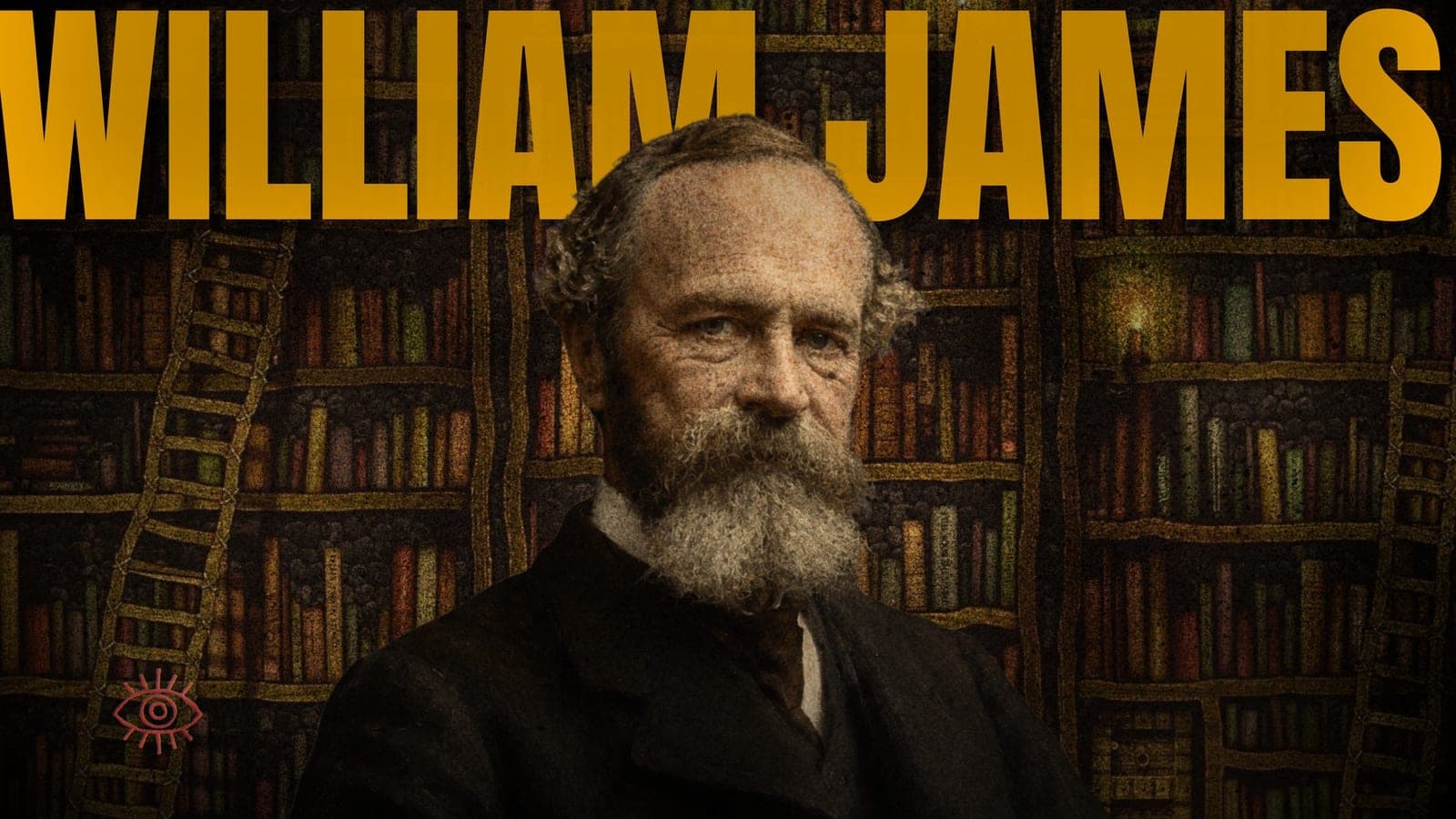
In the sixth lecture of a book published in 1902, readers of the Harvard philosopher and psychologist William James arrived at a passage he introduced with unusual care. "Here is an excellent example," he wrote, "for permission to print which I have to thank the sufferer. The original is in French... I translate freely." What followed was an account of a young man who, walking into a dressing room at twilight, felt a horror of his own existence fall on him without warning. Into his mind came the memory of a patient he had once seen in an asylum, an idiotic youth with greenish skin and black hair, sitting for hours with his knees drawn up against his chin inside a coarse gray undershirt that was his only garment. "That shape am I," the correspondent wrote, "I felt, potentially." For months afterward he could not be left alone in a room.
The correspondent did not exist. James invented the Frenchman and filed his own crisis, from more than thirty years earlier, inside The Varieties of Religious Experience as testimony supplied by someone else, disguised well enough that generations of readers took the byline at face value. Only after his death in 1910 did it become clear that the sufferer of Lecture VI and the author of the book were the same person.
That fact changes how the rest of the career reads. James is the man usually credited with the phrase stream of consciousness, the founder of American psychology, the philosopher who argued for a right to believe ahead of the proof. Each achievement looks different once it is clear that the scientist who insisted psychology describe only what could be observed and checked chose, at the one moment his own evidence mattered most, to check it in under a false name. The more useful question is what he thought counted as evidence, and what it cost him to keep the belief that had saved his life usable in public.
The Twilight Terror of Eighteen Seventy
James was born in 1842 in a New York hotel, the eldest of five children raised inside a fortune his grandfather had built after arriving from Ireland with almost nothing. The money bought his descendants freedom from work, which his father, a restless religious writer loyal to no fixed creed, spent on a childhood shuttled between London, Paris and Geneva, never in one school long enough to finish it. Henry, a year younger, became one of the great novelists in the language. Alice kept journals from an invalid's couch still read for their own merits. Two younger brothers fought in the Civil War, but William and Henry did not.
He tried painting first, seriously, and gave it up, partly at his father's urging and partly from a private verdict that he would only ever be good at it and not great. He tried natural science next, joined a collecting expedition up the Amazon, and fell ill there with a mild form of smallpox that swelled his eyes shut for weeks. He earned a medical degree from Harvard in 1869 and never practiced a day of medicine. Behind it all sat a body that would not settle, a bad back, weak eyes, a rebelling stomach, and beneath the complaints a mood that sank further than any of them could explain.
The collapse came around his twenty eighth birthday. He later gave the fullest account of it to an invented Frenchman, but the bones of the story are plain: months of waking each morning with dread already sitting in his stomach, unable to be left alone in a room, certain that nothing separated him from the vacant patient in his memory but luck. What pulled him back was not treatment but an argument. Reading the French philosopher Charles Renouvier on the freedom of the will, James found a definition of freedom he could act on without lying to himself, freedom as the choice to keep holding a thought when he might have let it slip. On 30 April 1870 he wrote in his diary that his first act of free will would be to believe in free will. It was a wager, not a proof, and he spent the next four decades finding out whether a life could be built on one.
The crisis mattered for more than survival. Watching his own mind come apart, and then hold together again, gave James a working knowledge of inner life that laboratory scientists of his day, timing reactions with stopwatches, had no reason to develop. His textbook, The Principles of Psychology, finished in 1890, contains the chapter that made him famous, arguing that consciousness has no joints at all, that the mind older psychology pictured as beads on a string is in fact a current with no stopping points, which he named the stream of consciousness. Credit for the exact phrase is contested, since the logician Alexander Bain had used similar words decades earlier. What belongs to James beyond dispute is the description itself, developed from years of close attention to his own mind under strain.
A French Correspondent Who Never Existed
Between 1901 and 1902, James travelled to Edinburgh to deliver the Gifford Lectures, turning the psychology he had built toward religion. The result, The Varieties of Religious Experience, published in 1902, set aside churches and doctrine entirely, which he called the cooled residue of something once alive, and went looking instead for personal religion: the raw experience of an individual alone with whatever they take to be divine, gathered from memoirs, letters and confessions as data for a science of religion.
Out of that material he built the book's central distinction. Some people are healthy minded, born reconciled to existence, able to let darkness slide past unregarded. Others are what he called sick souls, unable to look away from what is wrong, for whom the fact of death sits underneath every pleasure and drains it while it lasts. James did not treat the sick soul as a lesser case waiting to be cured. He argued it sees more, because it leaves nothing out, while the healthy minded reach their peace by looking away from a genuine feature of the world. A faith that has passed through that darkness and out the other side, he wrote, is deeper than one that never had to reckon with it.
His public example of a sick soul was Tolstoy, who at the height of fame and comfort found himself unable to answer why he should go on living. His private example, never named as such, appears in the same pages, offered as the testimony of a stranger, framed as a document James had permission to print, translated freely from a foreign original, one specimen among dozens gathered from mystics, penitents and the merely afraid. Nothing in the surrounding pages signals that the specimen is the collector. A scientist assembling the founding casebook of a new field included his own worst night as an anonymous exhibit, almost certainly because a confession printed under the name of a Harvard professor building the psychology of religion would have compromised the authority the book needed to carry.
He was equally firm against a habit he named medical materialism, the trick of dismissing a religious experience by pointing to its physical cause, an apostle's vision written off as a nervous fit. Every state of mind has some bodily condition under it, James pointed out, including the soundest scientific reasoning, so tracing an experience to the nerves proves nothing about its value. That argument, made to defend the mystics he was studying, was quietly also a defense of his own withheld name. An account does not become false because it can be traced to a body under strain. By the same logic, an unsigned account is not automatically more trustworthy either.
The Right to Believe Before the Evidence Arrives
By 1896, in a lecture that became the essay The Will to Believe, James built the case that would let a person act on a conviction the evidence could not yet settle. He was answering the mathematician William Kingdon Clifford, who had argued in 1877 that it is wrong, always and for anyone, to believe anything on insufficient evidence. James thought the rule correct for most of life and false for one narrow, consequential class of cases.
He drew the boundary with some precision. A choice counted, in his terms, as a genuine option only if it was living, meaning both sides were live possibilities to the person facing them, forced, meaning there was no way to defer the decision without the deferral itself deciding the matter, and momentous, meaning something irreversible was at stake. Where a question met all three conditions, and no evidence could arrive in time to settle it, James argued that refusing to believe was itself a decision, made in the direction of no and dressed up as patience. Waiting forever for proof that may never come is one more way of choosing.
He pressed the point with cases where belief helps produce the fact it claims. A climber stuck on a mountain ledge who believes he can make an uncertain jump finds strength in his legs that doubt would have drained from them. A stranger approached with warmth tends to become a friend; approached with suspicion, tends to justify the suspicion instead. Faith in a fact, James wrote, can help create the fact. He extended the same logic to the largest question available, whether the universe has meaning at its center, arguing that a person for whom this counts as a genuine option has the standing to let the whole of their nature, not the intellect alone, settle it.
Set beside the disguised confession, the doctrine reads less like an argument in a lecture hall and more like an account of what had already saved its author. A man who had spent months unable to be left alone in a room, and who pulled himself back by deciding to believe in his own freedom before he had any proof of it, had personal reasons to distrust a rule that made every unproven belief a moral failure. The Will to Believe is careful, hedged, and addressed mainly to religious faith. Its author had staked his own life on the same method a quarter century earlier, at a desk in 1870.
A Squirrel, a Tree, and What Pragmatism Asks
In 1907 James published Pragmatism, carrying an old idea out of a small Cambridge discussion club into general circulation. He credited the method to his friend Charles Sanders Peirce, who had proposed decades earlier that the entire meaning of an idea lies in its practical consequences. Trace what a belief would change about experience or conduct, Peirce had argued, and that sum is the whole of what the belief means. Two positions that produce no difference in what anyone could experience or do are not in dispute at all, whatever the words suggest.
James illustrated the method with a story told against himself. On a camping trip, a squirrel clings to one side of a tree trunk while a man circles it trying to see the animal, and the squirrel matches his movement exactly, always keeping the trunk between them. Does the man go around the squirrel? His camping party had split into a genuine argument over it. The answer, James said, depends entirely on what going around means. Tracing north, then east, then south, then west of the animal, the man plainly does. Passing in front of the squirrel's face, then its side, then its back, he never does, since the animal keeps the same side turned toward him throughout. Once the two meanings are separated, there is nothing left to argue about.
Applied to larger disputes, the method asked each side to name the practical difference its answer would make to a life. Applied to truth itself, it produced James's most provoking claim, that a belief becomes true not by matching a finished reality out there but by being verified, by leading a person through experience without letting them down. Critics on two continents heard this as a license for wishful thinking and said so at length. James spent much of his last decade explaining that an idea only counts as working, in his sense, if it survives the whole of experience over the long run.
The connection to the disguised confession is not incidental. A philosophy that measures a belief by what it does, rather than by its resemblance to a finished fact, is the same philosophy that would let a scientist treat his own recovery as usable evidence, provided it worked, whatever name was attached to it. Pragmatism gave James a public theory of truth. Lecture VI shows what he had already been doing with that theory in private, years before it had a name.
What He Counted as Evidence
Put the pieces together and the shape of the choice comes into focus. James built a scientific reputation on checkable observation, then, at the one point where observation mattered most to him personally, withheld the name that would have let readers check it. He did not fabricate the experience. Every detail in the correspondent's account matches what his family and later biographers confirmed about his own crisis. What he fabricated was the witness.
The decision reads less like cowardice than like a judgment about what a new science could carry. A professor building the founding casebook of a discipline meant to study religion without mocking or worshiping it had reason to fear that a confession of his own breakdown would be read as disqualifying, proof that the author was too damaged to be trusted with the subject rather than proof that he understood it from the inside. Disguising the source let the material do its work as data, at a cost that became visible only after his death, when the disguise was no longer his to control.
That cost is the actual price of the will to believe, easy to miss if the doctrine is read only as a defense of religious faith. James spent his career arguing that a person facing a forced, living, momentous question has the standing to decide with the whole of their nature rather than wait for proof that may never arrive. He exercised that right first on the question of his own survival, at a desk in 1870, and again on what a scientific book about religion could responsibly include. Both decisions required him to act without the guarantee he would have preferred. Both cost him something, the first years of fear, the second the acknowledged authorship of the passage later readers have found most moving in his entire body of work.
What remains is a founder of American psychology who never fully separated the observer from the observed, and a philosopher of belief who understood, better than his critics allowed, that some evidence a person carries will not survive being signed. He gave it to the world anyway, disguised enough to be usable, honest enough that the disguise eventually failed. The book he was afraid to sign under his own name is now the one most often read as his most personal.
Adapted from a longform audio episode on William James, produced for Sleepy Philosophy Radio.
The Newsletter
New essays and episodes, delivered quietly.
By subscribing you consent to receiving occasional emails. Unsubscribe any time via the link in every email or at /unsubscribe.
Reflections
Loading...
Related Episodes
There Are No Accidents | Sigmund Freud's Complete Psychology
He set out to be the coldest of scientists, and ended by telling the strangest story modern people had ever heard about themselves. This is the life and the mind of Sigmund Freud. We begin in his consulting rooms in Vienna, among the ancient statues he could not work without, and follow him from a provincial childhood to the discovery that made his name, the claim that most of the mind is hidden, and hidden on purpose. We move through his masterwork on dreams, his scandalous account of childhood, the drama he found buried in every family, and the movement that made him famous and cost him his dearest friends. We watch his vision darken, after a war, into a theory of the wish for death and the permanent discontent of civilization. And we follow him to the end, through illness, exile, and a death met on his own terms, into the strange afterlife of ideas that science keeps rejecting and no one can quite escape. The full episode is on YouTube and Spotify. Please listen only in safe, restful contexts.
The Art of Loving by Erich Fromm
A quiet reading of Fromm's demanding claim that love must be learned like an art. This episode follows The Art of Loving in the order of Fromm's own argument. It begins with the book's startlingly practical question, whether love is an art that requires knowledge and effort, then enters the theory of love as the mature answer to human separateness. The reading moves through Fromm's account of parent and child, the distinct objects of love, brotherly love, motherly love, erotic love, self love, and love of God, before turning to the chapter on modern society and the ways market life distorts intimacy. It closes with the book's final demand for discipline, concentration, patience, faith, courage, and a life organized around the practice of love. The full episode is on YouTube and Spotify. Please listen only in safe, restful contexts.
The Fear of Death Is Controlling Your Life | Ernest Becker for Sleep
Everything we build, he argued, our characters, our loves, our nations and our wars, is an elaborate refusal to admit that we die. In a hospital bed on the Canadian coast, a dying man agreed to be recorded talking about death, the subject he had spent his whole life studying. This episode follows Ernest Becker, the anthropologist and outsider who was pushed from one university to the next and died at forty-nine, only weeks before his masterwork won the Pulitzer Prize. We trace his single great argument, that human beings are the animals who know they will die, then follow him through the vital lie of personality, the immortality projects by which we reach for a symbolic eternity, the hidden roots of human evil, and the quiet, lucid way he faced his own end. The full episode is on YouTube and Spotify. Please listen only in safe, restful contexts.