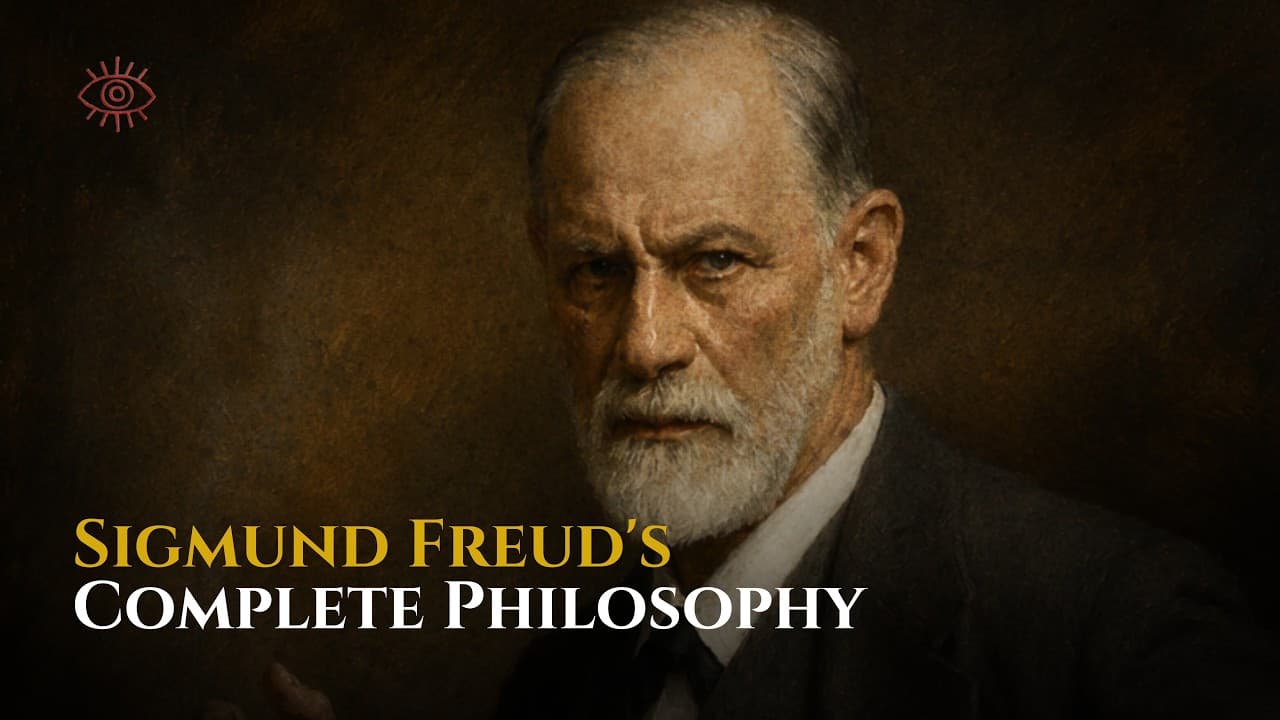
There Are No Accidents | Sigmund Freud's Complete Psychology
He set out to be the coldest of scientists, and ended by telling the strangest story modern people had ever heard about themselves.
This is the life and the mind of Sigmund Freud. We begin in his consulting rooms in Vienna, among the ancient statues he could not work without, and follow him from a provincial childhood to the discovery that made his name, the claim that most of the mind is hidden, and hidden on purpose.
We move through his masterwork on dreams, his scandalous account of childhood, the drama he found buried in every family, and the movement that made him famous and cost him his dearest friends. We watch his vision darken, after a war, into a theory of the wish for death and the permanent discontent of civilization. And we follow him to the end, through illness, exile, and a death met on his own terms, into the strange afterlife of ideas that science keeps rejecting and no one can quite escape.
The full episode is on YouTube and Spotify. Please listen only in safe, restful contexts.
Enjoying the episode?
Occasional letters on philosophy, reading, and the examined life. No spam, ever.
By subscribing you consent to receiving occasional emails. Unsubscribe any time via the link in every email or at /unsubscribe.
Timestamps
- 0:00:00Chapter 1: The Life
- 0:11:50Chapter 2: A Cure by Talking
- 0:20:10Chapter 3: Not Master in the House
- 0:26:21Chapter 4: The Lamp Turned Inward
- 0:34:05Chapter 5: The Royal Road
- 0:46:20Chapter 6: What the Tongue Betrays
- 0:51:26Chapter 7: The Child's Secret Life
- 0:58:38Chapter 8: The Drama in the Nursery
- 1:09:36Chapter 9: The Difficult Patients
- 1:15:48Chapter 10: The Cause and Its Heretics
- 1:24:25Chapter 11: The Crime at the Origin
- 1:30:27Chapter 12: The Undertow
- 1:38:57Chapter 13: The House Divided
- 1:44:52Chapter 14: The Consoling Illusion
- 1:52:30Chapter 15: The Price of Civilization
- 2:05:08Chapter 16: The Fire and the Flight
- 2:13:33Chapter 17: A Climate of Opinion
For the record
Full Transcript
Chapter 1: The Life
It is an ordinary working morning in Vienna, in the first years of the new century, and in a set of ground-floor consulting rooms on a quiet street a man is sitting down to begin his day among the dead. His writing desk is so crowded that he can barely find a clear space to set down a pen. Ranged across it in close rows, and along the shelves, and on the cabinets that line the walls behind him, stand hundreds of small figures of bronze and stone and fired clay, and every one of them was dug out of the grave or the rubbish of some civilization that ended thousands of years ago. There are gods here from the banks of the Nile, kings from Rome, little demons and animal-headed spirits from lands whose languages no living person speaks. He greets them when he comes in. He is known to pick one up and turn it in his hands, or to carry a new arrival to the dinner table and set it before his plate like a guest. He has spent a great part of what he earns on them, more than he can comfortably afford, and he cannot seem to work without them.
And this is the strange thing, the thing worth pausing on before we go any further. The man at that desk is not a priest and not a believer. He is a physician and a man of science, a declared unbeliever who holds that every god ever worshipped was only a human wish wearing a mask. In an hour his first patient will arrive, lie down on the couch behind him, and be told, in effect, that there is no free will as we imagine it, that reason is a thin and anxious crust over something dark and churning, that the tidy self each of us presents to the world is a kind of front office that does not know what happens in the back rooms of its own house. He is about to spend his life disenchanting the human soul, stripping it of its comforts one by one. And he cannot begin the day's work until he has greeted his own small crowd of buried gods.
His name was Sigmund Freud, and that contradiction is the knot this whole episode exists to untie. Here was a man who wanted, more than almost anything, to be a cold and exact scientist, to drag the human mind onto the anatomist's table and explain it the way one explains a circulation or a reflex. And what he produced instead was the strangest and darkest story that modern people had ever been told about themselves. That the clear reasoning self we take ourselves to be is not the one truly in charge. That we are strangers to our own wanting. That a buried past goes on working in each of us in the dark, and that underneath the will to live there runs, quieter and just as strong, a wish to stop. He was, by his own favorite comparison, a kind of archaeologist, and the little statues on his desk were the emblem of his method. He dug in the mind the way those other diggers dug in the ground, and he believed the same thing they did, that nothing is ever truly gone, that the past is only covered over, and that what is covered over does not rest. To understand how a man arrives at a vision like that, we have to go back, as he always insisted we must, to the beginning, to a childhood in a small town far from the great capital.
He was born in the spring of eighteen fifty-six, in a small market town in Moravia, in the region that is now the eastern edge of the Czech lands. His father, Jakob, was a wool merchant, a gentle and not very prosperous man, already middle-aged, with grown sons from an earlier marriage. His mother, Amalia, was Jakob's much younger wife, quick and vivid and strong-willed, and from the moment her first child arrived she was certain he was destined for greatness. She called him her golden Sigmund, and she believed in him with a fierceness he never forgot and never quite stopped trying to deserve, a mother's absolute early faith that would leave its mark on him for the whole of his life.
The family he was born into was a tangled one, and the tangle would sit at the back of his mind for the rest of his life. Because his father had married before, and married late, the household arithmetic came out strangely. His father was old enough to be his grandfather. One of his grown half-brothers was about the same age as his young mother. And that half-brother had a son, a nephew older than Sigmund himself, who became the boy's first playmate and first rival, so that the child grew up puzzling over how an uncle could be smaller than his nephew, and where exactly in this crowd he himself belonged. Most children would have forgotten it. He turned it, in the end, into a theory of the family that would unsettle the century.
There was little money, and the wool trade in the provinces was failing, and while he was still a small child the family pulled up its roots and moved to Vienna, the glittering, overcrowded capital of a vast and aging empire. He would live in that city for nearly eighty years. He always claimed to dislike it, to feel the weight of its suspicion of men like him, for the Freuds were a Jewish family in a place where that fact quietly closed doors. And yet he stayed, decade after decade, rooted to its streets, and in the end it took an invading army to pry him loose. Vienna made him and Vienna resented him, and he returned the feeling exactly.
One memory from his boyhood he carried all his life, and it tells us something about the man he became. His father, he recalled, had once described being accosted on the street in his younger days by a man who knocked his new fur cap down into the gutter and shouted at him to get off the pavement, because he was a Jew. And what did you do, the boy asked. I stepped into the road and picked up my cap, his father answered, mildly. The answer appalled the child. He had wanted his father to be a hero, to strike back, and instead the man had lowered his head and stooped for his hat. From that small disappointment, Freud came to think, grew a lifelong determination of his own never to be the one who steps meekly aside, a stubbornness and an appetite for the unwinnable fight that would serve him well in the long decades when the whole respectable world lined up to tell him he was wrong.
He was, from the start, a spectacular student. He sat at the top of his class year after year, read widely and hungrily in several languages, loved the great poets and the ancient historians, and for a time imagined a life in law and public affairs. What turned him toward medicine was not, by his own account, any tender wish to heal the sick. It was a hunger to understand the human creature as a piece of nature, to know how the machine of a person actually worked. He had fallen under the spell of the new biology, the shocking idea that human beings were not a separate and sacred creation but one animal risen among the animals, and he wanted in. In eighteen seventy-three, at seventeen, he entered the University of Vienna to study medicine, and there he found his first true home in the laboratory of a stern and revered physiologist named Ernst Bruecke.
He loved that laboratory. He would happily have stayed in it forever, bent over the nervous tissue of fish and the fine structure of nerve cells, hunting, in one long and patient study, for the reproductive organs of the eel, which no one had yet been able to find. This was the life he wanted, the pure and unhurried pursuit of knowledge for its own sake. But it was a rich man's life, and he was not rich, and the path to a professorship was slow and, for a Jew, half-blocked. And then, in his mid-twenties, he fell in love, deeply and impatiently, with a slight, composed young woman named Martha Bernays. They were engaged in eighteen eighty-two, and then kept apart for four long years while he scrambled to make himself able to marry, and across those years he wrote her letters by the hundred, tender and jealous and demanding. To earn a living he gave up the laboratory he loved and went into the hospital, and then into private practice, taking up the treatment of what were then called nervous diseases.
It was in these hungry, ambitious years that he made his first grab at fame, and it went badly. He had become interested in a little-known drug, cocaine, and convinced himself it might be a wonder medicine. He took it himself and felt his troubles lift. He praised it in print. And he pressed it on a suffering friend, a brilliant colleague addicted to morphine, hoping to free him, only to watch the man become enslaved to the new drug instead. Meanwhile the one genuinely great use of the substance, its power to numb the eye for surgery, was noticed and made famous by someone else, while Freud was away visiting Martha. He had been close to something and had let it slip, and the lesson in the costs of ambition and the ironies of desire was one he did not forget.
The turning point of his early life came in eighteen eighty-five, when he won a small traveling fellowship and went to Paris to study under the most celebrated nerve doctor in Europe. In a vast Paris hospital, its wards full of women whose bodies had failed them in ways no injury could explain, women who were blind or paralyzed or convulsed with no damage anywhere in the flesh, he watched the great man do something that overturned his whole picture of medicine. Under hypnosis, with nothing but words, the master could make a healthy subject's arm go rigid and dead, and then, with more words, bring it back to life. An idea, a thing that existed only in the mind, could reach down into the body and cripple it, and could just as easily release it. Freud had gone to Paris a student of nerves and tissue. He came home haunted by the mind.
In eighteen eighty-six he married his Martha at last, and over the next years they filled a household with six children, the youngest of whom, a daughter named Anna, would grow up to be his closest companion, his nurse, and the keeper of his work. He settled into practice in Vienna as a doctor of the nervous and the unhappy, and there he drew close to an older, kindly, well-established colleague, a man named Josef Breuer, who had been carrying a peculiar story for several years and did not quite know what to make of it. It was the story of one of his patients, a gifted and desperately ill young woman, and of a cure that had been worked, impossibly, by nothing but talking. Everything that follows in this life, the couch and the dream book, the fame and the broken friendships, the buried gods and the long dying, begins with that story, and with a young doctor leaning in to hear it.
Chapter 2: A Cure by Talking
Before there was any theory, before the couch and the movement and the famous hard words, there was a single sick young woman and a doctor who was willing to listen to her for as long as she needed to talk. Everything Freud built rests on that first strange episode, and it is worth telling plainly, because it shows the whole method in miniature, at the moment before anyone understood what it was.
The doctor was not Freud. He was Josef Breuer, the older, kindlier, more successful colleague we left him with, a respected family physician of the city with a gift for winning a patient's trust. In the early eighteen eighties, some years before Freud was ready to make anything of it, Breuer had taken on the case of a brilliant young woman we know by the false name he later gave her to protect her, Anna O. She was clever, cultured, full of unspent energy, and she was falling apart. Her body was betraying her in a bewildering series of ways that no examination could account for. At times her right arm and both legs went stiff and lifeless. Her sight blurred and swam. She was seized by a violent nervous cough. For weeks she could not bring herself to drink a glass of water, though she was tormented by thirst. She drifted, for hours a day, into a clouded, absent state, a kind of waking dream. And for a period she lost her own language, and could make herself understood only in English.
Breuer did the thing that turned out to matter. He came to her, day after day, and he let her speak. In her clouded states she would begin to murmur, to tell fragments of stories, and he found that if he encouraged her, and later if he helped her along with light hypnosis, she would follow a symptom back to the moment it had first appeared. And something astonishing happened when she did. As she arrived at that first scene and put into words the feeling that had gripped her there, the feeling she had been unable to express at the time, the symptom would lift. Once, having traced her horror of drinking back to a memory of watching a dog, an animal she loathed, lap water from a glass, and having finally let out the disgust she had swallowed to be polite, she asked for water and drank without difficulty. The revulsion, spoken at last, released its hold.
She had a name for what they were doing, and the name was better than any Breuer could have invented. She called it, in her English, the talking cure. She also called it chimney-sweeping, the clearing out of a foul and clogged passage. And that homely image holds the whole discovery. Each symptom, it seemed, was tied to a memory that had never been allowed its natural outlet. Some feeling of fear, or grief, or disgust, or desire had arisen, and had been choked off instead of expressed, and the undischarged feeling had not simply gone away. It had gone underground, and it had turned itself into a thing of the body, a paralysis, a cough, a blindness. The memory, robbed of its release, spoke through the flesh instead. And the cure was to find the buried scene and let the strangled feeling out in words, so that the body no longer had to carry it.
Breuer, to his lasting credit, saw that this was extraordinary, and to his lasting discomfort, he backed away from it. The treatment had been enormous, exhausting, intimate labor, and the intensity of it seems to have unsettled him deeply. He was a settled and cautious man, and there was something in the whole business, something about the current that ran between a patient and the physician who becomes the sole vessel of her secrets, that he did not wish to look at too closely. He set the case aside. It was Freud, hearing the story and turning it over for years, who understood that Breuer had stumbled onto a vein of gold and then walked away from the mine.
The two men worked together long enough to write a book about it. In eighteen ninety-five they published their Studies on Hysteria, and in its pages is the sentence that opens the door to everything after. Hysterics, they wrote, suffer for the most part from reminiscences. That is, these patients are made ill not by anything in their present life but by a past that will not stay past, by memories that keep their charge because that charge was never spent. The illness is a message from an earlier time, written in the only language the buried feeling has left to it, the language of the symptom. Cure the reminiscence, let it finally speak, and you cure the patient.
But Freud was already pulling away from Breuer, and the direction he pulled in made all the difference. He came to distrust hypnosis. Not every patient could be hypnotized, and he found he was not especially good at it, and the cures it produced seemed to lean on the doctor's spell rather than on the patient's own understanding. So he began, by trial and error, to strip the method down. For a while he would simply press his hand on the patient's forehead and insist that a memory would come. And then he let go even of that, and arrived at the deceptively simple procedure that would carry his name into the world. He would have the patient lie down, on a couch, with himself seated behind, out of the line of sight. And he would give a single instruction, which he came to call the fundamental rule. Say whatever comes into your mind. Say all of it. Do not select, do not tidy, do not hold anything back because it seems trivial, or irrelevant, or embarrassing, or improper, or cruel. Follow the thread of your own thought wherever it wanders, and speak every link of it aloud.
It sounds like nothing. It is one of the hardest things a person can be asked to do, because we are built to edit ourselves, and the whole force of our upbringing runs against saying the shameful thing out loud. But Freud had noticed that it was precisely at the shameful thing, precisely where the patient balked and fell silent and said this is stupid, this cannot matter, that the important material lay. The stumble in the speech, the sudden reluctance, marked the spot where something buried was pushing toward the surface and being pushed back down. Free association, this method was called, and it made the patient, rather than the hypnotist, into the one who did the work of discovery. The doctor's task was mostly to listen, with a strange, even, patient attention, and to notice where the talk snagged.
This is the ground floor of the whole edifice, and it is worth being clear about what had and had not yet been claimed. Freud did not yet have a map of the mind. He had a phenomenon and a technique. The phenomenon was that people are made ill by things they cannot remember and would not want to, and that the illness is meaningful, a disguised statement and not mere random damage. The technique was that if you let a person talk freely and follow the snags in the talking, you can reach the buried thing and, by bringing it into the light of speech, drain its power. What the technique kept turning up, patient after patient, was a whole region of the mind that the patient did not know was there, and did not control, and would fight to keep hidden. Making sense of that region, giving it a shape and a set of laws, was the work of the years to come.
Chapter 3: Not Master in the House
The sick young woman and the others like her had shown Freud something he could not confine to the sick. If a person can be ruled by a memory she cannot summon, driven by a feeling she does not know she has, then the mind is not the thing we take it for. We imagine that to have a mind is to be more or less aware of its contents, that thinking is something we do in the light, that the self is a house whose rooms we may walk through at will. Freud came to believe that this picture is not merely incomplete but almost exactly backward. The lit room of awareness is small. The house is enormous and mostly dark. And the person at the desk in the lit room, the one who feels himself to be in charge, does not know what is being decided in the rooms he cannot enter.
This is the true center of everything he thought, and it is worth stating in its barest form. The greater part of mental life goes on outside of consciousness, and it goes on there not by accident but because it is kept there, actively, against pressure. Freud came to picture the mind as having, roughly, three regions. There is the narrow zone of what we are aware of at this moment. There is a wider zone just behind it, an antechamber of things we are not thinking of now but could call up easily, a phone number, the name of a street, what we ate yesterday. And then there is the vast, sealed region he called the unconscious proper, which is not merely out of mind but held out of mind, and cannot be summoned by any effort of will, because a force stands at the door and refuses it entry.
That force he named repression, and it is the hinge of the whole system. Repression is not forgetting. Forgetting is passive, a fading. Repression is an act, a continuous exertion, the mind's refusal to let certain wishes and memories into awareness because to admit them would be unbearable. The wishes that get this treatment are, in his account, the ones we cannot square with the person we need to believe we are, and they cluster, above all, around desire and around hatred, the two currents in us that decent life demands we disown. So they are pushed down and held down. But, and this is the crucial turn, they are not destroyed by being pushed down. They keep their energy. They go on wishing in the dark. And, like water behind a wall, they press without rest against the barrier, seeking any crack, any way back up to the surface.
Because the wish cannot return openly, it returns in disguise. This is the single idea that unlocks the strange bulk of Freud's work, the reason a doctor of the mind would spend his life on such unlikely material as dreams and jokes and the small mistakes of speech. All of these, in his eyes, are the disguised returns of what was pushed under. The symptom that cripples a limb, the dream that visits us at night, the name that suddenly will not come to the tongue, the word that slips out wrong, each is a compromise, a smuggling of the forbidden thing past the guard by dressing it in a form the guard will let through. Nothing that has been forced under ever gives up its striving, and the whole visible life of the mind is patterned, underneath, by its ceaseless effort to climb back into the light.
Freud understood exactly how large a demotion of the human being this was, and toward the end of his life he set it in a line that has never been bettered. He said that in the history of science, humanity's pride had suffered three great wounds. The first was delivered by the astronomers, who took the earth out of the center of the heavens and set it spinning, one small planet among many, around an ordinary star. We were not, after all, the point around which creation turned. The second was delivered by the students of life, who showed that we are not a separate and special creation set above the beasts, but one animal risen among the animals, kin to everything that crawls and breathes. We were not, after all, above nature. And the third wound, he said, the most wounding of the three, was the one his own work delivered. It is the discovery that the conscious mind, the reasoning self we are so proud of, is not even the master of its own house. It does not know its own depths. It is pushed and steered by forces below it that it cannot see and does not govern, and its serene sense of being in command is the last and most stubborn illusion of all.
There is something almost unforgivable in that claim, and Freud knew it, and part of him relished it. He was telling people that they did not know why they did what they did, that the reasons they gave were often polished covers for motives they would be ashamed to name, that the self is a government which does not control its own country and issues confident proclamations about events it cannot see. Nearly everything the world found offensive in him, and nearly everything it could not stop borrowing from him, flows from this one demotion. Once you accept that the mind is mostly hidden, and hidden on purpose, then the ordinary surface of a life, the things we say and choose and dream and forget, becomes a coded text, and the whole of Freud's career is the attempt to learn to read it. Learning to read it, patiently and against every instinct we have to look away, was the work he now set himself, and the first person he turned that unforgiving attention upon was himself.
Chapter 4: The Lamp Turned Inward
In the autumn of eighteen ninety-six, Freud's father died. Jakob had been old and failing for a long time, and the death was no surprise, and still it went through his son like nothing he had expected. Freud wrote that the death of the father is the most important event, the most wounding loss, in any man's life, and he was measuring from his own experience. Something in him came loose. He found himself dreaming strange dreams about the old man, turning over childhood memories he had not visited in decades, ambushed by feelings he could not have predicted, tenderness and guilt and a buried, shocking flicker of triumph, all tangled together in a way that unsettled the tidy account he kept of himself. And because he was who he was, he did the one thing almost no one had ever seriously attempted. He decided to turn his new method on the one patient he could never dismiss and never fully see. He decided to analyze himself.
There has never been anything quite like it, before or since. He had no one to lie down in front of, no listener seated behind him, no couch but his own solitude. He worked on himself through his dreams above all, writing them down on waking and pulling patiently at their threads, and through the sudden memories and the slips and the small irrational feelings of his days. He was at once the doctor and the patient, the one holding the lamp and the dark room the lamp was searching. It should not have been possible, and in a strict sense it was not, for a man cannot be his own surgeon. But he needed to do it, because he had followed his patients down into a country he did not yet have a map of, and the only way to make the map was to go down himself.
He did not go entirely alone. Through these most isolated years, when the respectable medical world of Vienna regarded his ideas with distaste and he felt himself shut out and talked about, he had one friend who mattered above all others, a doctor in Berlin named Wilhelm Fliess. Fliess was a specialist of the nose and throat, brilliant, magnetic, wildly speculative, and for more than a decade he was Freud's closest confidant, the one mind he could pour himself into without reserve. They wrote each other constantly, long letters thick with half-formed ideas, and they met when they could for what Freud playfully called their private congresses. Fliess was the sounding board against which Freud worked out the boldest of his early thinking. He was, in a sense, the analyst Freud did not have, the necessary other person a mind seems to need in order to hear itself.
It was, seen from outside, a strange friendship, and Fliess held some genuinely strange beliefs. He was convinced of a deep hidden link between the nose and the sexual organs, and of a numerology of the body, secret cycles of so many days that supposedly governed health, illness, and the very date of a person's death. Freud, who could be so ruthlessly skeptical about everyone else's illusions, swallowed a good deal of this, and at one low point his loyalty to his friend led to something close to a catastrophe, when Fliess operated on the nose of one of Freud's patients on these peculiar theories and, through sheer carelessness, left a length of surgical gauze packed in the wound, nearly killing the young woman. That Freud went on defending his friend even then tells us how much he needed him. The friendship cooled, at last, as friendships of that intensity often do, in the years around the turn of the century, souring into disputes over who had thought of what first, and Freud, more independent now and more sure of his ground, let it go. But he never quite replaced it, and the pattern of it, the passionate attachment to an admired other man, then the disillusion and the break, would repeat itself in his life more than once.
Out of these years of grief and self-searching and long confessional letters came the single most consequential decision of Freud's intellectual life, and it is one that still divides people who study him. When he had first begun to trace his patients' illnesses back to their roots, he had arrived at a shocking and specific conclusion. Again and again, at the bottom of a case, he seemed to find a scene of real sexual violation in early childhood, an adult, often someone within the family, imposing on a small child. He announced this finding boldly. Hysteria, he claimed, was the buried scar of actual abuse. And then, within about a year, he took it back. In the autumn of eighteen ninety-seven he wrote to Fliess a sentence that changed the direction of everything that followed. I no longer believe in my theory of the causes, he said. He no longer thought that all these scenes had literally happened.
His reasons, as he gave them, were several. He could not bring himself to believe that abuse was so nearly universal as his method seemed to imply, that fathers by the score, including, the logic threatened, figures in his own family, were secret monsters. He had noticed that the unconscious does not label its contents true or false, that a wish imagined with enough force leaves the same kind of trace as a thing endured. And so he made his fateful turn. What he had taken for buried memories of real events were, he now decided, often something else, the buried wishes and fantasies of the child itself, the child's own forbidden desires dressed up as things done to it. The cause of the suffering moved, in that turn, from the outside to the inside, from what was done to the child to what the child itself wanted. And from that single reversal the whole of his mature theory would grow, the daring and offensive idea that the small child is not an innocent to whom things happen but a creature seething with desires of its own.
It was, depending on whom you ask, either the liberating discovery that made psychoanalysis possible or the great betrayal at its foundation. Later critics have charged, with real force, that Freud lost his nerve, that some of what he heard was surely the truth, that in reclassifying real violations as childish fantasies he taught a whole profession to disbelieve the accounts of the abused, and that the harm of that has been long and real. Defenders answer that he had discovered something genuine and easy to miss, that the inner life of wish and fantasy has a power of its own and shapes us whether or not it matches the record of events. The honest position is probably that both things are true at once, that children are indeed sometimes violated and that children also fiercely imagine, and that Freud, having glimpsed the first, swung hard toward the second and did not look back. What is certain is that the swing gave him his subject. He came up out of his own self-analysis carrying a new and scandalous picture of childhood, and a book was already forming around the dreams he had used to get there.
Chapter 5: The Royal Road
Of all the books Freud wrote, this is the one he loved most and rated highest, and near the end of his life he said, without false modesty, that insight such as this falls to a person but once in a lifetime. It appeared at the very close of the eighteen hundreds, and its subject was the most unpromising material imaginable, the one region of experience that serious people had always agreed meant nothing at all. Dreams. The scraps and absurdities that drift through the sleeping mind, that we wake up and shake off and forget by breakfast. Freud proposed to take them with complete seriousness, and he claimed that if you learned to read them properly they were the single clearest window ever found into the hidden depths of a human being. He called the interpretation of dreams the royal road to the unconscious, the best and straightest way in, and the book he built on that claim is the foundation of everything else he did.
The central thesis can be put in a single sentence, and Freud put it in one. A dream is the disguised fulfillment of a wish. Every dream, however strange, however frightening, however far from any wish it may look, is at bottom the mind granting itself something it wants and cannot have. To see the idea in its simplest and nakedest form, he said, look at the dreams of small children, because in a child the wish is still allowed to show its face. A little one sent to bed in disgrace, denied some longed-for treat, will dream that night, out loud sometimes, of eating exactly the thing that was refused. Freud's own small daughter, kept from food for a day because of an upset stomach, called out in her sleep a joyful little list of the strawberries and cakes she had been denied. There is no puzzle there, no disguise, because a child of that age has no wishes so shameful that she must hide them even from herself. The dream simply says, plainly, I want this, and gives it.
But adult dreams are seldom so plain, and the reason is the whole reason there is a science here at all. The wishes of a grown person are not all innocent. Among them are the desires and hatreds that we have spent a lifetime pushing down, the forbidden currents that cannot be admitted to the daylight mind without shame or horror. And these wishes, held under all day, press upward at night, when sleep loosens the guard that keeps them down. Yet the guard does not sleep entirely. It weakens, but it stays at its post. And so the forbidden wish, if it is to get through at all, must get through in disguise, dressed in a form the guard will not recognize and refuse. This is why grown-up dreams are riddles. The disguise is not decoration. It is the whole condition of the wish being allowed to appear.
From this Freud drew the distinction that organizes the entire book, the difference between the dream we remember and the dream we really had. There is, on the one hand, the surface, the strange little film that plays on waking, the one we could describe to someone at breakfast, the images and the events as they seemed. He called this the manifest content, the dream as shown. And there is, underneath it, hidden and needing to be dug for, the real matter of the dream, the true wish and the tangle of thoughts and feelings around it. This he called the latent content, the dream as meant. The surface is a translation of the depths, and a deliberately misleading one, and the labor of interpretation is to work back from the shown to the meant, from the harmless-looking picture to the forbidden thing it was invented to smuggle past the guard.
The machinery that does the translating, that turns the raw hidden wish into the acceptable surface story, Freud called the dream-work, and describing its tricks is some of the most brilliant analysis he ever did. There is, first, a great squeezing-together, in which several different thoughts are compressed into a single image. A face in a dream may belong to no one person but be assembled from three or four, a composite carrying the meanings of all of them at once, so that a single figure does the work of a crowd. There is, second, a sly shifting of importance, in which the feeling that belongs to the thing that really matters is slid quietly off it and onto something trivial, so that the dream appears to fuss over a small and pointless detail while the charged and dangerous matter sits in a corner, unremarked, disguised precisely by seeming not to matter. This shifting is the censor's favorite tool, because it hides the important thing in plain sight by draining it of its apparent weight. There is, third, the demand that everything become a picture, for the dream cannot argue or state, it can only show, and so an abstract thought, a relation, a because or an although, has to be turned into a concrete image, a staircase, a journey, a locked door. And there is, last, a tidying-up that happens as we wake, in which the mind, embarrassed by the nonsense, smooths the fragments into something with the rough shape of a story, papering over the seams.
The first dream Freud ever took completely to pieces was one of his own, dreamed on a summer night in the eighteen nineties, and it became the specimen on which he taught the whole method. In it a patient of his whose treatment had not gone well, a young woman he was privately afraid he had mishandled, appeared before him, and in the winding events that followed, the dream set busily to work producing reason after reason why her continued illness could not be his fault. The blame lay with the patient herself for not accepting his ideas, or with another physician, or with a colleague who had used a dirty needle. Read on its surface it was a jumble of medical worry. Read for its wish it was beautifully simple. It was a long, ingenious argument for his own innocence, a night court convened by the sleeping mind for the sole purpose of acquitting him of the guilt he was carrying by day. He wished to be blameless, and the dream, patiently and from several directions at once, found him blameless. Once he had seen the shape of that wish beneath that muddle, he had his key, and he set about trying it in every lock he could find.
There was a further part to the theory, and for anyone listening on the edge of sleep it may be the most companionable thing Freud ever proposed. The dream, he said, is the guardian of our sleep. All through the night the buried wishes go on pushing upward, and a disturbance strong enough would break the surface and wake us. The dream is the mind's ingenious answer to that danger. By granting the troublesome wish a disguised and harmless little fulfillment, it bleeds off just enough of the pressure to keep the sleeper from rising into waking. The hunger, the worry, the forbidden longing that might otherwise jolt us upright at three in the morning is quietly satisfied in pictures instead, and we are permitted to sleep on. Far from being an intrusion upon our rest, the dream is the very thing that protects it, a small nightly theatre staged for an audience of one, for the single purpose of letting that one stay safely and deeply asleep.
Because all of this is going on, Freud insisted that dreams cannot be read from a book of fixed meanings, the kind of cheap key that says water means this and a falling tooth means that. That is fortune-telling, not interpretation, and he had no patience for it. The meaning of a dream image is personal, rooted in the particular life and the particular associations of the one who dreamed it, and the only way to reach the hidden thought is to take each piece of the dream and let the dreamer follow his own chains of association out from it, saying whatever it brings to mind, exactly the free and unedited talking that was his whole method, until the trail leads back down to the wish. A dream is not a public symbol. It is a private letter, written by one part of a person to another, in a code that only that person's own life can unlock.
An honest listener raises the obvious objection at once. If every dream fulfills a wish, what are we to do with the nightmare, the dream of terror and falling and pursuit, the dream that no one on earth could be said to want? Freud did not dodge it. The wish being fulfilled, he answered, is a forbidden one, and the very part of us that forbids it stands guard even in sleep, and when the buried wish forces its way up toward the light, that guardian part recoils in alarm, and the recoil is felt, from the inside, as dread. The fear in a nightmare is not evidence against the hidden wish. It is the sound of the guard catching the wish in the act. And some dreams, he added, fulfill a darker wish still, the wish to see oneself brought low and punished, so that a night of suffering can be, at its root, a sentence that some severe corner of the self is satisfied to see carried out. The theory bent and stretched to cover even the dreams that seemed most to defy it.
What made the book so much more than a manual for reading dreams is that it was, underneath, the proof of the hidden mind. Everyone dreams. If the ordinary nightly dream of an ordinary healthy person is, when decoded, a disguised forbidden wish held down by a censor, then the whole apparatus Freud had built to explain the sick turned out to describe the well, to describe everyone. We are all of us, every night, quietly staging the return of what we have buried. The dream was the universal evidence, available to anyone with the patience to write down what they saw on waking and pull at the threads. And there was another gift buried in the method, which Freud made much of, that the book grew directly out of the long, lonely self-analysis of his father's grieving years. The dreams he took most fearlessly apart in its pages were his own. He had used himself as the specimen, laid his own nights open on the table, and in doing so had made the book at once a scientific treatise and a strange, veiled confession.
The world's response, at first, was very close to silence. The book came out at the turn of the century in a small printing, and it sold, by the most generous count, only a few hundred copies in the better part of a decade, and drew reviews that ranged from puzzlement to contempt. The great capital of medicine went about its business as though nothing had been published at all. Freud felt the neglect keenly, but it did not shake him, because he knew what he had. He had taken the most worthless coin of mental life, the thing every reasonable authority agreed was mere noise, and he had shown it to be the most valuable currency there was, minted fresh each night by the hidden self and stamped, if you could only read it, with the truth about what a person most deeply wants. The book was ignored, and the book was the door. Everything walks through it.
Chapter 6: What the Tongue Betrays
The dream is a private thing, seen only by the dreamer, and easy enough to dismiss on that account. So the year after the dream book, Freud pressed his claim into territory no one could pretend was private. He wrote a book about the small blunders that everyone makes in the plain light of an ordinary day, the slip of the tongue, the forgotten name, the mislaid key, the letter we meant to post and carried in a pocket for a week. Common sense calls these things accidents, the harmless friction of a tired brain. Freud called them something else. He called them confessions.
His claim was that these little failures are not random noise but meaningful acts, each one a place where a hidden wish has slipped past the guard in a moment when its attention wandered. Consider the slip of the tongue, the one everyone now knows by his name. You intend to say one word and another comes out, and the wrong word is very often the true one. The official who dreads the meeting he must lead opens it by announcing, to general laughter, that the session is hereby closed. The man raising a glass to a rival he cannot stand hears himself wish the fellow something other than the health he meant to offer. In each case the buried feeling, held down all through the polite performance, has seized on a half-second of inattention and jumped out into the open, wearing the shape of a mistake. The mistake is the wish, undressed.
Forgetting works the same way, and Freud thought it the most revealing of all, because we imagine forgetting to be purely passive, a thing that merely happens to us. But watch what gets forgotten, he said. We forget the appointment we did not want to keep. We mislay the gift meant for the person we secretly resent. We leave our umbrella behind at the house we would like an excuse to visit again. The name that will not come to the tongue, however hard we strain for it, turns out to be tangled up with some other name, some association, that we would rather not touch, and the forgetting is the mind quietly steering us away from a sore place. Even the clumsy accident, the vase from a disliked relative that somehow slips from the hand and shatters, can be, underneath, an errand run on behalf of a wish we would never have carried out on purpose.
All of this is simply the hidden mind at its daily work, the buried wish taking its small revenges and satisfactions in the gaps of our attention, the same return of what we have pushed down that we have already met in the symptom and the dream, only now in a form so common that no one is exempt. Every one of us, dozens of times a day, is quietly betrayed by our own tongue and hands and memory. The hidden self does not wait for sleep. It is talking all the time, in the cracks of ordinary speech, to anyone who has learned to listen.
There is one more everyday channel Freud opened, and it is the most pleasant of them. He wrote a whole book on the joke, and on why we laugh. A joke, in his account, is another leak from the depths, but a special one, because it is licensed. It gives us permission to say the forbidden thing, the cruel thing, the indecent thing, the truth about power or desire that could never be spoken straight, and to say it out loud in company, provided only that it is clever enough to pass as wit. The cleverness is the disguise that gets the forbidden thought past the guard. And the laughter, that sudden helpless bark of it, is the discharge, the release of all the effort we normally spend holding the forbidden thing down, spent at last in one delicious burst. We laugh hardest, he noticed, at exactly the things we are least permitted to say, which is why the best jokes are so often about death, and authority, and sex. For a moment the guard is off duty and the buried self gets to speak, and the pleasure of the joke is the pleasure of that brief and giddy holiday from the labor of repression.
It is a curious inheritance he left us with all this. Before Freud, a slip of the tongue was an embarrassment and nothing more, a forgotten name was just a lapse, a joke was only a joke. After him, none of it was ever quite innocent again. He taught us to listen to one another, and to ourselves, with a suspicious third ear, cocked for the truth that leaks out sideways, and the gift was double-edged, because it also made it very hard, ever again, to trust one's own tongue.
Chapter 7: The Child's Secret Life
If the dream book was met with silence, the book Freud published in nineteen oh five was met with something closer to disgust, and it did more than any other to make his name a byword for the indecent. It was a short work with a dry title, three linked essays on the theory of desire, and its central claim struck at one of the tenderest beliefs of respectable life. Freud announced that childhood is not innocent. The small child, he said, is not the pure and sexless being that sentiment demands, a clean page waiting to be written on. It is, from very early, a creature of bodily desire, seeking pleasure through its own body with an appetite that is already, in his broad sense of the word, sexual.
The reaction was immediate and furious, and it dogged him for the rest of his life. He was called obscene, a man with a filthy mind who saw his own corruption everywhere and now had the indecency to smear it onto helpless infants. Polite society recoiled. And Freud, characteristically, took the very violence of the recoil as a kind of confirmation. His whole theory held that we defend most fiercely the doors we least want opened, that the loudness of a denial is a fair measure of the truth it is straining to keep down. The more furiously the world insisted that childhood was pure, the more certain he grew that he had touched the buried thing. People do not calmly discuss what they have spent a lifetime burying. They shout it down.
Everything turns on that broad sense of the word, and it is the first thing to get straight, because without it the theory sounds far more lurid than it is. When Freud spoke of the sexual life of children he did not mean that infants have adult lusts. He meant something wider and stranger. He proposed to call sexual the whole reaching of a living body after pleasure, the seeking of satisfaction through the flesh, in all its forms, from the very beginning of life. Desire, in this enlarged meaning, is not a thing that switches on at puberty. It is present in the cradle, a single current of pleasure-seeking energy that he pictured flowing through a person's life, attaching now to this part of the body, now to that, now to this person or that ambition, capable of being dammed, diverted, and put to a hundred uses. This flowing energy of wanting is the engine of the whole developing self.
He traced its journey through childhood in a sequence of stages, and the sequence became one of the most repeated pieces of his whole system. In the beginning, he said, the infant's world is centered on the mouth. Its first and fiercest pleasures are the pleasures of feeding and sucking, of taking the world in through the lips, and its first great love is bound up with the one who feeds it. Then, as the small child is taught, often through a long battle of wills, to control its own body and its habits of cleanliness, the center of the drama shifts, and pleasure and struggle gather around holding on and letting go, around what the child can give up or withhold, around obedience and glorious defiance. Here, Freud thought, in this first negotiation between a child's will and the demands of the people who love and correct it, the seeds of whole adult characters are sown, the tidy and the stubborn, the miserly and the generous, the traits we carry to the grave. And then, later, somewhere around the age of three to five, the current turns again, outward now, toward the difference between the sexes and toward the parents themselves, and with that turning the stage is set for the drama that would become the most famous and the most fiercely disputed idea he ever conceived, which is the matter of the chapter to come.
Two further ideas from this book have to be carried forward, because the whole of his later thought leans on them. The first is that the desire of the small child is, at the start, wonderfully unfocused, open in every direction, not yet narrowed into any single respectable channel. The infant will take its pleasure wherever the body offers it, without shame, without the sharp adult divisions between the permitted and the forbidden. The long work of growing up, in this account, and the long work of civilizing a child, is largely the work of damming and narrowing that wide early flood, forcing the scattered pleasures of the body into the one narrow socially approved form, and teaching the child to be ashamed of the rest. We are not born into our limits. We are pressed into them, and the pressing leaves marks.
The second idea is the one Freud came to lean on most heavily of all, and it is the notion that this energy of desire can be lifted off its bodily aim entirely and rechanneled into something that looks nothing like it. The child's raw curiosity about the body can become, redirected, the grown scientist's curiosity about the stars. The pleasure once taken in messing and smearing can become, redirected, the painter's joy in his colors. Desire refused its first object does not simply die. It can be converted, raised, put to work on higher things, and this conversion of low energy into high achievement Freud held to be nothing less than the hidden engine of human culture. Much of what is finest in us, the art and the science and the patient work of the world, is in his account desire that has been talked out of its first hunger and set to grander tasks. We will see, near the end, what he thought this costs us.
Behind all the particular claims stood one great reversal of how a life is pictured. We like to imagine that we grow up and out of childhood, leaving it behind us like an outgrown coat, becoming at last new and rational adults. Freud said the opposite. The adult is not a fresh creature who has escaped the child. The adult is the child, grown large and grown quiet, carrying the whole buried history of those early hungers and battles folded up inside, and shaped at every point by how they went. Wherever the current of desire was bruised or frightened or stuck in the early journey, there the grown person will bear a lasting mark, in the pattern of their loves, the shape of their troubles, the particular things that can and cannot give them peace. The nursery is not a place we leave. It is a place we become, and then carry with us, unknowing, for the rest of our lives.
Chapter 8: The Drama in the Nursery
Here is the idea that most people, if you say the name Freud, will reach for first, and it is the one he himself regarded as the foundation stone of the whole structure, the single discovery without which nothing else in his system would stand. He believed he had found, hidden in the ordinary tenderness of family life, a drama of desire and jealousy that every child passes through, a drama so charged and so forbidden that we bury it completely and spend the rest of our lives unknowingly shaped by it. He borrowed its name from the oldest of stories, and he called it the Oedipus complex.
The name comes from a Greek tragedy more than two thousand years old, in which a man named Oedipus, abandoned as an infant and raised far away, grows up and, without ever knowing who they are, kills a stranger who is in truth his father and marries a widowed queen who is in truth his mother. When at last the horror of what he has done is uncovered, he puts out his own eyes. Freud asked a question about that play that no one had quite asked before. Why does it still work? Why, after so many centuries, does an audience sit gripped by the fate of an ancient king, when the whole machinery of prophecy and curse it rests on is one no modern person believes? His answer was that the play grips us because it is about us. It gives shape to a wish that each of us once had and has since buried so deeply that we no longer know it was ours. Oedipus does openly, on the stage, the two things every small child once darkly wished, and the shiver we feel is the shiver of recognition we dare not admit.
He found the same buried drama at work in the greatest of modern plays as well, and his reading of it became nearly as famous as the theory itself. In the ancient tragedy the hero does the deed out in the open. In the modern one, the hero cannot act at all. Freud fastened on the old puzzle that readers had worried over for centuries, the question of why the prince who is commanded by his murdered father's ghost to take revenge, and who is more than clever and brave enough to do it, delays and hesitates and lacerates himself and cannot strike, through the whole long torment of the play. The answer, Freud proposed, lies in the identity of the man he is asked to kill. The prince must strike down the uncle who murdered his father and took his mother to bed, which is to say a man who has done, in fact, the very things the prince himself, in the buried depths of his own childhood, once wished to do. To raise a sword against that man is to raise it against his own hidden guilt, and so his arm hangs useless, paralyzed by a revulsion he cannot explain to himself, because its true source is a wish he has never once allowed himself to see. The hesitation that had baffled the world was, for Freud, the plainest possible proof of his theory, written across the most famous character in the language.
The drama, as Freud reconstructed it, unfolds in the years he had already marked as the turning point of early childhood, somewhere around the ages of three to five, when the current of a child's desire first reaches outward toward other people. Take the little boy, whom Freud made his model. His first and deepest love, from the very beginning of life, is his mother, the source of all warmth and food and comfort, the center of his small world. As his desire ripens, it fastens on her, and he wants her, wholly and jealously, for himself alone. But she is not his alone. She belongs, already and overwhelmingly, to another, to the large and powerful figure of the father, who commands her attention and shares her bed and stands, in the child's eyes, squarely in the path of everything he wants. And so the boy is caught in an unbearable knot. Toward the same man he feels love and need and admiration, and also a hot, secret, murderous jealousy, a wish to push him aside, to have him gone, to have him dead. To love a person and to wish him dead, at once, with a child's whole undivided heart. That knot, Freud said, sits at the center of every one of us, and around it every later trouble of the soul is wound.
He did not arrive at this from a comfortable distance. He arrived at it, in part, by finding it in himself, in the long self-examination of his grieving years, when the death of his own father stirred up feelings far older and stranger than simple sorrow. And he had felt, from the other side, the particular power of the mother's love, for he had been his own mother's adored and undisputed favorite. A man who has been the undisputed favorite of his mother, he once wrote, keeps for life the feeling of a conqueror, that confidence of success that so often calls real success after it. He was writing a piece of theory, and he was also writing his own history, describing the golden certainty his mother had poured into him and that he never lost.
The most ingenious and the most disputed part of the whole account is how Freud thought the drama ends, how the child gets out of the impossible knot, because in the getting out he located the birth of the moral self. The little boy, he said, does not renounce his forbidden wish out of kindness or reason. He renounces it out of fear. He comes to dread the vengeance of the towering rival he has been wishing dead, and the dread takes a specific and bodily form, the terror that the father could rob him of the very part of his body in which his new desires have come to center. Under the pressure of that fear, the boy at last gives up his claim on the mother. But he does something cleverer than simply surrender. Rather than only fear the father, he takes the father inside himself. He identifies with him, resolves to become like him, to grow into a man who will one day have a love of his own, and in doing so he swallows the father's authority whole, the rules, the prohibitions, the great booming No. And that swallowed father, set up now as a garrison inside the child's own mind, becomes the core of his conscience, the inner voice that will praise and forbid and punish him from within for the rest of his life. The rival, defeated outside, is installed as the judge inside. Morality itself, in Freud's daring claim, is the buried monument to a childhood murder that was wished but never done.
You can see why he thought this was the keystone. It was the point where the private history of desire turned into the public fact of the moral order. The prohibition on incest, the voice of conscience, the capacity to feel guilt, the whole invisible government that lets human beings live together at all, he traced to this single storm in the nursery and its forced settlement. We become moral beings, he was saying, not by being taught good principles but by loving and hating our parents so violently, so young, that we have to build a wall inside ourselves to contain it, and that wall is the conscience we then mistake for the voice of heaven.
And the drama, though it is buried, is never quite finished. Freud held that we go on replaying it for the rest of our lives, in the shapes of our loves and our quarrels with authority. The grown man who cannot help measuring every woman he meets against the remembered warmth of his mother, or who takes flight each time a love grows too tender and close, or who bristles at every superior and elder as though at the old towering rival, is, in this account, still acting out the nursery drama he can no longer remember, still bound by a bargain he struck before he had the words to know he was striking it. What is settled in those few early years is never truly reopened. It is only lived out again, in disguises we do not recognize as our own.
Honesty requires facing the place where the whole beautiful construction cracks, and Freud, to his credit, half-admitted it. The story he told is a boy's story from beginning to end, built on the boy's desire and the boy's particular bodily fear, and when he turned to ask how any of it could apply to the girl, he faltered, and he never stopped faltering. The engine that drove the boy out of the drama, the dread of bodily loss, could not work the same way for the girl, and Freud's attempts to find her a different motor grew ever more strained and ever less convincing, resting at last on the notion that a girl is driven by envy of the boy's body and by a sense of her own lack. It satisfied almost no one, and it did not really satisfy him, and it is the part of his system that has aged the worst and drawn the fiercest and most deserved attack, above all from the women who came after him and recognized, in his account of their inner lives, a portrait drawn entirely from the outside by a man who had simply assumed the boy was the human standard and the girl a puzzle to be solved.
And still, when the flaws are all admitted, the central perception lands like a blow, and it is why the idea will not go away. Freud looked at the most sentimental scene our civilization has, the loving family gathered around the child, and he saw underneath it a theatre of desire, rivalry, and buried violence. He said that the softest and most formative experiences of our lives are made of longings we would be horrified to name, that we are each the survivor of a love story and a murder story played out before we could speak, remembered by no one, and never entirely left behind. Whether or not he got the mechanism right, and in the details he very likely did not, he had put his finger on something no one has since been able to fully shake off, the strangeness and the darkness folded inside the most ordinary love there is.
Chapter 9: The Difficult Patients
Freud built his theories on air, his critics have always said, on speculation and self-analysis and the reading of ancient plays. But he did not think so, and the reason he did not think so was the patients. Day after day, year after year, real and suffering people lay on his couch and talked, and it was in the tangle of their particular lives that he believed he was reading his laws off the world. He presented his findings, characteristically, not as tables of data but as long, absorbing narratives of individual treatments, the case histories, which he half-apologized for because they read, he admitted, like short stories rather than sober science. They are among the most gripping things he wrote, and four of them became famous.
There was the clever, unhappy young woman he called Dora, brought to him by her father, caught in a suffocating web of adult desire and deceit that the grown-ups around her all preferred not to see. Freud pressed his interpretations on her hard, perhaps too hard, and after only a few months she stood up and walked out of the treatment, and he never finished it. He counted it a defeat, and, more valuably, he learned from the defeat. There was the small boy, terrified of horses, who would not go into the street for fear that one might bite him or fall down in front of him, and whom Freud treated at a distance, through the boy's own father, reading the dread of the horse as the drama of the nursery in disguise, the fear of the powerful father shifted safely onto a large and dangerous animal. He took the little boy as living proof, straight from a real child, of what he had pieced together by digging backward through grown patients. There was the young man besieged by monstrous intrusive thoughts he could not stop and did not want, and by elaborate private rituals he was compelled to perform to keep some imagined disaster at bay, through whom Freud mapped the strange civil war of the obsessed mind, love and hatred for the same person locked in an endless, exhausting draw. And there was the wealthy young foreigner whose whole later life had been shadowed by a childhood dream of several white wolves sitting silent and motionless in a tree outside his window, a single dream that Freud unwound, over years of costly analysis, back into the deepest roots of the man's fear.
Through all of them, case after case, ran the single clinical discovery that may be the most useful thing Freud ever found, more useful, certainly, than most of his grander theories, because it is the one that working therapists still cannot do without. He noticed that his patients did not treat him as what he was, a middle-aged physician they had known for a matter of months. They treated him as someone else. They fell in love with him, helplessly and completely, or they came to hate and defy him, with a heat entirely out of proportion to anything that had passed between them. And he came to understand what was happening. The patient was taking the old, buried, unfinished dramas of childhood, the love and the rivalry and the longing first felt toward a mother or a father, and was living them out again, now, in the consulting room, with the analyst standing in for the original players. He called it transference, this carrying of ancient feeling onto a present and largely innocent figure, and at first it looked like nothing but an obstacle, a contamination that got in the way of the real work.
Then he grasped that it was not the obstacle. It was the work. The transference took the buried past, which was otherwise only a matter of faded memory and guesswork, and made it present, alive, and hot, right there in the room, where at last it could be seen and named and understood. The analyst became a kind of blank screen onto which the patient projected the ghosts of the nursery, and by playing the old drama out with this stand-in, and then coming slowly to see what he was doing and why, the patient could work the ancient thing through to a finish it had never been allowed. What could not be remembered was instead repeated, and in the repeating it could finally be caught. The whole cure came to turn on this. The couch was a stage on which the forgotten past was performed again, so that it might at last be laid to rest.
But Freud was equally clear, and later therapists learned the lesson in blood, that transference is as dangerous as it is powerful. The feelings it raises are not pretend. The patient who falls in love with the analyst is genuinely, achingly in love, and the analyst who mistakes that love for something meant for him personally, or worse, who takes advantage of it, wrecks the patient and the treatment together. And the current runs both ways, for the analyst too has a buried life that the patient can stir, feelings of his own that rise up unbidden in response. This, Freud realized, was very likely what had so unsettled kindly Breuer all those years before, the force of the thing that had passed between him and his first talking patient and had sent him fleeing from the whole discovery. Breuer had felt the current and been frightened of it. Freud named it, and turned it into the central instrument of the cure. And he had learned its raw power, in part, from his own failure, from the clever young woman who had walked out on him, because he had been slow to see that all along she had been playing out her buried dramas upon him, and he had missed his cue.
Chapter 10: The Cause and Its Heretics
For years Freud had worked in near-isolation, the lonely possessor of a set of ideas the respectable world found distasteful. Then, slowly, from about the turn of the century, others began to come to him. It started with a handful of doctors who gathered in his apartment on Wednesday evenings to smoke and argue and talk through the new psychology, a small society meeting in a waiting room among his books and his ancient statues. Within a decade that little circle had swelled into an international movement, with societies in several countries, its own journals, its own yearly congresses, and a growing band of followers who looked to Vienna as the source. Psychoanalysis had become a cause.
And here we meet one of the sharpest ironies of the whole story. The great disenchanter, the man who had taught that every faith is a wish and every authority a father-figure in disguise, presided over his movement in a way that came more and more to resemble a religion. It had a founder, whose word was final. It had a body of sacred doctrine that could not be tampered with. It had apostles who carried the message into far countries, and it had, before long, heretics. When the strains grew bad, a small ring of the most trusted followers, six devoted men, banded together in secret to stand guard over the purity of the teaching and to defend the founder against all comers. Freud gave each of them a ring, an antique carved gem of the kind he prized, to mark them as a sworn brotherhood, the inner guard of the cause. There is something almost comic in it, the ruthless analyst of everyone else's illusions arming his own loyal knights with signet rings, and Freud was not wholly blind to the comedy, but he wanted the thing protected, and he trusted very few.
To be inside the movement was to live at a strange and constant pitch. The Wednesday gatherings had their rituals, and a heady, oppressive sense of being among the few who had glimpsed a great truth the world was not yet fit to hear, and that atmosphere bred fierce devotion and fierce suspicion in equal measure. Freud had a particular way of meeting anyone who strayed from the doctrine, and it is the thing his followers found hardest to forgive. He did not, as a rule, answer the objections of a wavering disciple. He interpreted them. A man who began to doubt the central place of sexuality was not a colleague with an argument but a patient with a symptom, his doubt a form of resistance, his independence a little neurosis to be diagnosed. It was a formidable weapon, because it turned every disagreement into fresh evidence of the very theory under dispute, and it let Freud keep his doctrine pure at the price of scarcely ever having to defend it in open combat. It held the movement together, and it slowly poisoned the trust inside it.
In the autumn of nineteen oh nine he made the one long journey of his life, across the Atlantic to America, invited to give a series of lectures at a university in Massachusetts. It was the widest recognition his ideas had yet received, and he brought them, in a handful of clear talks, to a whole new continent, and came home with an honorary degree, the first official honor of his career. Yet he never warmed to the place. As the ship came into the harbor of New York, with the great city rising ahead of them, he is said to have turned to the companion at his side and remarked, dryly, that these good people had no idea they were bringing them the plague. Whether or not he said it in just those words, it caught something true about how he saw himself, as the bearer of a subversive infection, a set of ideas that would get into the bloodstream of a civilization and change it from within, whatever the welcome at the dock. America embraced him, and he distrusted the embrace, suspecting it of shallowness and a love of money, and it was one of the century's neat ironies that this suspect country would become, in time, the great stronghold and the great marketplace of the movement he founded.
But the deepest and most painful pattern of these years was not the winning of followers. It was the losing of them. Again and again Freud drew to himself a brilliant younger man, marked him out as a favorite, sometimes all but named him the heir, and then, when the younger man began to think for himself and to depart from the doctrine on some point that mattered, broke with him, bitterly and for good. It happened first with one of the very earliest and ablest of the Viennese circle, a physician who came to believe that Freud had put desire at the center of human life where something else belonged. The true engine of the psyche, this man argued, was not sex but the striving for power and mastery, the long effort of a small and helpless creature to overcome its feeling of inferiority and make itself count. He gave weight, too, to the social world, to a person's place among others, which Freud's inward-looking theory tended to ignore. To Freud this was not a fair disagreement but a desertion, an attack on the cornerstone, and the man was cast out, taking a band of his own with him to build a rival school.
The second break cut far deeper, because Freud had invested far more. The younger man this time was the rising star of a famous Swiss hospital, the crown prince Freud had chosen with particular care, and chosen in part for reasons of strategy, because he was not Viennese and not Jewish, and could therefore carry psychoanalysis out of its narrow origins and make it a universal science rather than, as its enemies sneered, the local obsession of one city and one people. For several years Freud loved him like a son and groomed him for the succession. Twice in these increasingly strained years, in the younger man's very presence, Freud fainted clean away, and came round each time half-convinced that his chosen heir secretly wished him dead. The great analyst of everyone else's buried wishes had found himself ambushed, helplessly, in his own body, by his own. And then the crown prince, too, began to pull away. He could not accept that the deepest current in us is sexual, and widened it, against Freud's fierce resistance, into a more general energy of life. And he would not do what Freud most wanted, which was to treat all religion and all yearning for the spirit as a sickness to be cured. When the break came, around nineteen thirteen, it was cold and cruel and final, and it cost Freud the man he had most hoped would carry his work into the future.
The whole world of psychoanalysis has never stopped noticing the shape of these quarrels, because the shape was one Freud himself had drawn. He was the man who had told the century that the story of every son is the story of a buried wish to overthrow the father, and here he was, cast permanently in the role of the father, watching son after chosen son rise up, challenge him, and be driven out, and taking each departure as a wound and a treachery. He had described the drama of the nursery, the love that curdles into rivalry between the generations, and then he had lived it out, from the father's side, for the rest of his life. He ended famous, honored, ringed round with loyalists who would defend his memory to the grave. But the road there was littered with the friendships he had made and could not keep, and there is no reading of his life that does not find, in that long trail of broken sons, something both very sad and very much in keeping with everything he taught.
Chapter 11: The Crime at the Origin
Having mapped the hidden drama at the heart of every family, Freud grew bolder still, and reached past the individual altogether, back toward the very beginning of the human race. If the buried rivalry of the nursery was truly universal, present in every child in every age, then perhaps it was not only the private history of each of us. Perhaps it was also the secret at the origin of society itself. In a strange and audacious book, he set out to explain where law and conscience and religion first came from, and he explained them all with a single, terrible story about a murder.
Picture, he said, the earliest human beings, before there was any society at all, living in small bands dominated each by one powerful male. This primal father kept all the women of the band for himself, and as his sons grew into rivals he drove them out or beat them down, so that they lived on the margins, excluded and resentful, hungry for the very things the old man hoarded. And then one day, Freud imagined, the brothers, who alone were weak but together were strong, banded together and did the unthinkable. They fell upon the father and killed him. And being savage and having no better way to take his power into themselves, they ate him, devouring in one act the man they had both hated with a murderous jealousy and loved and admired with all their hearts.
What happened next is the heart of the theory, because what happened next, in Freud's telling, was the birth of everything we call civilization. With the father dead, the brothers were flooded with a remorse they had not expected, as the love for him, so long buried under the hatred, came surging back over the deed. And they faced a practical trap as well, for if any one of them now tried to seize the father's place, the others would fall on him, and the killing would never end. So, out of guilt and out of necessity together, they made the two great renunciations that founded the human world. They forbade the killing, setting up a horror of shedding a kinsman's blood. And they gave up the women they had committed the murder to possess, imposing on themselves the ban against taking their own, the prohibition on incest that stands, in some form, at the base of every human society there has ever been. They denied themselves, in remorse, the whole prize the crime had won.
And they did one thing more, the strangest and most consequential of all. They took the murdered father and they raised him up. Dead, he became more powerful than he had ever been alive, an object of awe and obedience and terror, and the sons bound themselves to honor him and to obey the very commands they had risen up to defy. Here, Freud claimed, is the origin of religion. The first god is the murdered father, restored and enthroned in the sky, now beyond all reach of harm, now all-seeing and all-powerful, receiving forever the submission the brothers had once refused him in the flesh. God the Father is exactly that, the primal father killed and then, out of unbearable guilt, worshipped. And the sacred meal that sits at the center of so many faiths, in which the faithful solemnly eat the body of the god, is in Freud's reading the endless echo and repetition of that first cannibal feast, the killing and the eating of the father commemorated down the ages, forever confessed and forever disguised.
The other half of the book turned the same lens on the nature of the forbidden itself. Freud was gripped by the strange doubleness of the things that ancient societies most dreaded to touch, the objects and persons that were at once holy and unclean, revered and shunned, ringed round with an awe that pulled toward them and a horror that drove away. Why should the sacred and the polluted feel so nearly the same? Because, he answered, they are made of the same stuff. A thing becomes untouchable not when we are indifferent to it but when we are drawn to it too fiercely to be trusted anywhere near it, and so what wears the face of pure holiness, or of pure disgust, is underneath a longing and its dread locked together and turned to stone.
It is, one has to say plainly, almost certainly false. It rests on a picture of early humanity that the anthropologists of Freud's own day were already dismantling, on a single imagined event for which there is not a shred of evidence, and on the peculiar idea that a specific guilt could be passed down in the blood across countless generations, an inheritance of memory that biology gives no warrant for. As history, the book does not stand. Freud half-knew it, and could not let the idea go, because underneath the shaky machinery he was certain he had seen something true. He was certain that civilization is built on renunciation, that we became human only by denying ourselves what we most wanted, and that underneath the whole edifice of law and worship and morality lies a buried violence and an ancient, inextinguishable guilt. That conviction was not a passing fancy. It was the seed of the darkest and greatest book of his old age, still years ahead of him. The story of the murdered father is a myth, and a myth its author could not stop believing, because he thought it told, in the only language grand enough for it, the truth about the price of being civilized at all.
Chapter 12: The Undertow
For the first twenty years of his theorizing, Freud had built everything on a single, reasonable-sounding foundation. The mind, he assumed, is governed at bottom by the pursuit of pleasure and the avoidance of pain. Whatever we do, however twisted the route, we are ultimately seeking satisfaction and fleeing distress. The symptom, the dream, the slip, all the disguises he had spent his life decoding, were in the end so many crooked paths toward a buried pleasure. He called this bedrock assumption the pleasure principle, and it seemed as solid as anything in his science. Then, in a short, strange, groping book published in nineteen twenty, an aging Freud, in the shadow of a catastrophic war, proposed that the bedrock was not bedrock at all, that something in us reaches beyond the pleasure principle, and works against it, and pulls us the other way.
Two observations had cracked the old foundation. The first came out of the war that had just torn the world apart. Doctors were seeing great numbers of soldiers who had survived unspeakable experiences at the front, and these men did not behave as the pleasure principle said they should. A mind that sought only pleasure and fled only pain would, given the chance in sleep, dream itself away from the horror, into safety and comfort. Instead these men returned, night after night after night, to the precise scene of their terror, reliving in dream the very moment that had shattered them, waking in dread only to be dragged back to it the next night, and the next. Why would a mind compel itself, over and over, to suffer again the worst thing that had ever happened to it? There was no pleasure anywhere in it. Something was driving these men to repeat their agony that had nothing to do with the seeking of satisfaction.
The second observation was gentler, and Freud drew it from watching a small child at play, his own little grandson. The boy had a wooden reel on a length of string, and he had invented a solemn and tireless game with it. He would throw the reel away from himself, over the edge of his cot, until it vanished, letting out as he did a long, satisfied sound that meant, more or less, gone. And then he would haul it back into view by the string, and greet its return with a bright there. Gone, and there. Away, and back. Over and over, for as long as anyone would let him. Freud understood what the child was doing. His mother kept leaving him, as mothers must, and each leaving was a small helpless grief the boy could not prevent. In the game, he took that unbearable, passive experience of being abandoned and he made himself the master of it, throwing the beloved thing away by his own hand, on his own terms, and bringing it back at his pleasure. But there was still the question that gnawed at Freud. Why did the child rehearse the painful half at all? Why stage, again and again, the very departure that hurt him?
Out of these puzzles, and others like them, Freud named what he came to call the compulsion to repeat, the strange and powerful drive to live the same painful thing over and over. We see it everywhere once he has pointed it out, in the person who marries the same wrong partner in five different faces, who re-stages the same defeat in job after job, who seems fated, as we say, to keep stepping into the same hole. Something in us is not trying to move toward pleasure and away from pain at all. Something in us is trying, compulsively, to return, to go back, to repeat.
And from this Freud drew the darkest inference of his career, the one that many of his own most loyal followers could never bring themselves to accept. If there is in living things a deep pull toward repetition, toward return, then perhaps what it is ultimately trying to return to is the state that came before life itself, the stillness of the inorganic, the peace of no tension at all. Perhaps, he said, the goal of all life is death. Perhaps every living creature carries within it, alongside the urge to grow and join and continue, a countervailing urge to wind down, to dissolve, to cease, an undertow beneath the current of life that is forever drawing us back toward the quiet we came from. This he called the death drive, and with it his whole picture of the human being changed shape.
He reached all the way back to the origin of life to justify it. Life, he speculated, had begun as some improbable disturbance stirred up in lifeless matter, a tension raised in what had been at perfect rest, and ever since, every living thing has carried within it a dim urge to discharge that tension and sink back into the calm of the inorganic from which it came. On this strange view, even the drive toward life is not simply the opposite of death. It bends, in the end, toward it. For the organism fights so hard to protect itself precisely so that it may die only in its own way, at its own hour, by no road but its own. Life becomes a long detour toward death, insisting only on taking the scenic route.
For now there were two great forces at war, not just within the mind but within all of life. On the one side stood the drive toward life, the power that binds and unites and builds, that reaches out in desire and love and connection, that makes one thing out of many and holds the world together. On the other stood the drive toward death, the power that loosens and separates and tears down, that works toward dissolution and the end. Everything a person does, Freud now thought, is some mixture of the two, and the death drive, when it is turned outward, away from the self, shows itself to the world as aggression, cruelty, the wish to destroy, while turned back inward it becomes self-punishment, and the longing to be gone. That inward and outward turning of our destructiveness would become, in his final major work, the key to the unhappiness of whole civilizations.
There is something in the idea that each of us can recognize, whatever the biologists finally make of it. Underneath the daylight will to live and to strive and to hold on, there does seem to run in us a quieter counter-longing, a wish now and then to lay the whole effort down, to stop wanting, to be relieved at last of the tiring labor of being someone. We feel it at the edge of sleep, in the strange sweetness of the thought of a rest without end, in the pull of stillness that even a happy life never entirely talks us out of. Freud took that undertow and gave it a name and made it one half of what we are, and once it has been named, it becomes oddly difficult to deny.
It was, everyone agreed, Freud at his most speculative, reaching far beyond anything the clinic could show him, sounding at times less like a scientist than like a tragic philosopher of the oldest kind. But whatever its standing as science, the death drive marked a permanent darkening of his vision. The hopeful young doctor had once believed that if you could only free the dammed-up desire, health and happiness would follow. The old man had come to believe something bleaker and, he thought, truer. That we are divided against ourselves at the very root, torn between a force that wants to live and a force that wants to stop, and that no cure will ever end that war, because the war is not a sickness we have. It is what we are.
Chapter 13: The House Divided
By the early nineteen twenties Freud had come to feel that his first map of the mind was no longer enough. That first map had been a map of depth, a matter of what lay in the light of awareness and what was pushed down into the dark beneath it. It was a picture of floors, an upstairs and a hidden cellar. But it did not capture the thing he now most wanted to describe, which was not depth but conflict, the sense that the mind is not so much a house with a buried basement as a household of three quarreling members, each with its own nature and its own demands, forever negotiating an uneasy peace. So in a short book of nineteen twenty-three he drew the self again, and this time he drew it as three.
The oldest and deepest of the three he called, with deliberate plainness, the it. The it is the raw reservoir of wanting we are each born with, a dark cauldron of drives and appetites, bodily, inherited, and utterly blind. It knows nothing of time, nothing of reason, nothing of contradiction, nothing of right and wrong or possible and impossible. It knows only one thing, and says only one thing, endlessly. I want. I want it now. It presses toward satisfaction with a total and infantile urgency, indifferent to every consequence, and it never grows up and never falls silent. It is the engine of the whole apparatus, the source of all the energy the other parts must somehow manage, and left to itself it would destroy the person in a day.
Growing up out of the it, formed where the raw wanting meets the hard edges of the world, is the second member, which Freud called simply the I, the part each of us means when we say the word. The I is the manager, the negotiator, the reality-facing self. Its task is to serve the it, to get it what it craves, but to do so safely, by the possible routes, checking each blind demand against what the world will actually allow, delaying, planning, steering the vast pressure of desire toward outlets that will not get the person killed or cast out. The I is the home of reason and prudence and everything we are proud to call ourselves. And here is the demotion Freud never tired of delivering. The I is not the ruler of this household. It is its servant, and it has more than one master to obey.
For above the I stands the third member, formed last, the internalized voice of the parents and, through them, of the whole moral world, which Freud called the over-I. This is the inner judge, the conscience and the ideal, the garrison whose strange birth in the nursery drama we have already watched. It looks down on the I and it watches, ceaselessly, and it measures the self against standards it can never fully meet, and when the self falls short it punishes, with guilt, with self-reproach, with a severity that can far outrun anything a real parent ever showed. The over-I is why we feel bad for things no one saw, why we punish ourselves for wishes we never acted on, why a person can be, quite genuinely, his own cruelest tormentor.
And so the plight of the poor I, the reasonable self we take ourselves to be, comes clear. It is caught, at every moment, serving three harsh masters at once. Below it, the blind and bottomless wanting of the it. Above it, the stern and punishing demands of the inner judge. And all around it, the unyielding facts of a world that gives way to none of our wishes. The I must somehow satisfy all three, and it is perpetually failing all three, and the anxiety of that impossible position is, Freud thought, simply the ordinary background weather of being a person. He caught the whole predicament in a single image that says more than a chapter of argument. The I, he wrote, is like a rider on a horse far stronger than himself. The horse is the it, all that surging animal power, and the rider must guide it, but is often reduced to steering the beast where it already wanted to go, all the while telling himself that he chose the direction.
It would be easy to hear in all this a counsel of despair, and many have. But Freud drew from it, instead, a modest and almost stubborn hope, and it is the nearest thing his whole science has to an ethic. The point of the long, patient work of analysis, he said, is to strengthen the rider. It is to extend the small domain of the reasonable self, to win back a little ground, inch by inch, from the blind wanting and the buried past, so that where once there was only dark compulsion there might come to be a margin of knowledge and choice. Where it was, he wrote, there I shall come to be. Not the conquest of the depths, which is impossible, but the slow enlargement of the lit clearing, the patient reclaiming of a few acres of the self from the forces that own the rest. It is not a promise of happiness. It is something graver and more grown-up than happiness. It is the offer of a little more command over a life we did not design, in a house we do not rule, among powers we did not choose and cannot evict.
Chapter 14: The Consoling Illusion
Freud had already told his strange story about where religion came from in the deep past of the species, the tale of the murdered father raised up into a god. But that was an account of origins, of the buried prehistory of belief. In a short and unsparing book of nineteen twenty-seven, he turned to a different and more pressing question. Never mind where religion began. What does it do, here and now, for the living person who believes it? Why does it hold so many billions of people so tightly, generation after generation, century after century? And his answer was that religion holds us because it answers the oldest and most desperate wish we have.
Look, he said, at the situation a human being actually finds himself in. We are small, soft creatures set down in a vast and overwhelming nature that is entirely indifferent to us. It sends us earthquakes and floods and disease, it decays our bodies, and in the end, without fail, it kills every one of us, and it does all this without the slightest concern for our hopes or our deserving. To be conscious of that situation is almost unbearable, a helplessness so total that a mind can hardly stand to face it. And now recall, Freud said, that every one of us has met total helplessness before, at the very beginning, when we were small children genuinely unable to protect ourselves, and were sheltered from a frightening world by our parents, above all by the towering, powerful father who comforted us, defended us, and set the frightening things right.
We grow up. But we do not stop being helpless, for against nature and death we are as powerless as we ever were, and we do not stop longing for the great protector who once stood between us and the dark. So we do the thing the mind always does with a longing too strong to bear and too impossible to satisfy. We project it outward, and we make it real in imagination. We take the remembered father of our infancy, magnified now to the size of the universe, and we set him up over all of creation. An almighty Father in heaven, who watches over each of us, who governs the terrifying forces of nature, who sees our suffering and gives it a purpose, who guarantees that justice will be done at the last, and who cancels even death itself with the promise of another life beyond it. God, in Freud's account, is the exalted father, and religion is the fulfillment of the deepest wish of humankind, the wish that we are not, after all, alone and unguarded in a cosmos that does not care.
Everything turns on the word he chose for this, the word illusion, and he used it with great precision. He did not simply mean that religion is false. He meant something more exact and more interesting. A belief is an illusion, in his sense, when we hold it not because the evidence has led us to it but because we deeply, achingly wish it to be true. An illusion is a wish mistaken for a fact. It need not even be false, for now and then a wish does come true, but that is not the point. The point is that the wishing, and not the weighing of evidence, is what is doing the believing. And the doctrines of religion, he observed, are illusions of exactly this kind. They answer our longings so perfectly, so completely, giving us precisely the protecting father and the final justice and the conquest of death that we most desperately crave, that their very perfection ought to make us suspicious. When a belief hands you everything you cannot bear to live without, you are entitled to ask whether you believe it because it is true, or because you could not survive the alternative.
What is striking is that Freud wrote all this not with the sneer one might expect from the century's most famous unbeliever, but with something closer to gravity, and even to tenderness. He understood the depth of the need. He knew that religion had comforted the dying, restrained the violent, and given meaning to lives that would otherwise have had none, and he did not pretend these were small things. But he thought that religion was, in the end, a consolation bought at too high a price, the price of never growing up, of remaining forever the frightened child clinging to an imaginary father rather than facing, as an adult faces a hard truth, the real and indifferent universe as it is. Humanity, he believed, had to give it up, painful as the giving up would be, exactly as each of us must one day surrender the childhood faith that a parent can make everything all right.
He knew the strongest objection to all this, and rather than dodge it he put it into the mouth of an imagined opponent within the book and let it strike as hard as it could. Take religion away, the objection runs, and you knock the foundation out from under all of morality. It is religion that has tamed our violence, bound the multitude to their duties, and held the dangerous animal of humankind in check, and if you strip it away, civilization itself collapses into savagery. Freud's answer was calm and unshaken. Religion has had many thousands of years in which to civilize us, he replied, and the results do not flatter it, for we remain very nearly as cruel and as unhappy as we ever were. And there is a hidden peril, he went on, in resting our decency upon a story that is not true, because a morality propped against a falsehood can stand only so long as the falsehood stands, and on the day the illusion finally cracks, as he was sure in time it must, the whole structure of duty built upon it threatens to come down along with it. Far safer, he argued, to teach people to be good for honest and human reasons, out of a clear sense of what we plainly owe to one another, on ground that no discovery can ever wash away.
And what would take its place? Here Freud set down his own faith, and he was honest enough to admit that it was a faith, and a fragile one. He believed in reason, in the patient, truth-seeking work of the mind, as the only guide that does not flatter us and does not lie. He knew how weak that voice can sound. The voice of reason is soft, he admitted, and it is easily drowned out by the roar of what we wish were so. But it is persistent, and it does not stop, and it does not give up, and across the long ages, he trusted, it is the only voice that finally gets a hearing. Perhaps, he conceded, that trust was an illusion of his own. But if so, it was an illusion of a wholly different kind from the religious one, because it asked only to be tested, and it stood ready to be corrected by the facts, and a hope that submits itself to correction is not a delusion. It is the most grown-up thing we have.
Chapter 15: The Price of Civilization
In nineteen thirty, old and famous and already gravely ill, Freud wrote the book that gathers his whole life's thinking into a single dark vision, and it is, for many readers, his masterpiece. It is short, and it is grave, and it sets out to answer the largest question a person can ask. Why, with all our progress, all our power over nature, all our wealth and comfort and knowledge, are human beings so far from happy? Why does civilization, the great machine we built to protect and improve ourselves, leave us so deeply, so permanently uneasy? The answer he gave is the sum of everything that came before it, and it offers no comfort at all.
The book opens, curiously, with a feeling that Freud confessed he could not share. A friend had written to him proposing that the true source of all religion is neither fear nor wish but a sensation, a feeling of being at one with the whole of existence, limitless and unbounded, an oceanic feeling, the friend called it, of belonging to everything there is. Freud, ever the skeptic, admitted that he could find no such feeling anywhere in himself. But being unable to feel a thing had never once stopped him explaining it, and the explanation he offered is oddly moving. That sense of boundless oneness, he suggested, is a survival from the very dawn of each life, from the time before the infant has learned where it ends and the world begins, when it floats in an unbroken unity with everything around it, and above all with the mother it does not yet feel as separate. Before there is a self, there is no border, and no loneliness. And that lost, borderless wholeness leaves a trace in us, a faint and lifelong homesickness for a unity we cannot remember and can never return to.
He begins by clearing away the easy assumption. People behave, he notes, as though the purpose of life were to be happy, to gather pleasure and avoid pain. But happiness of the intense kind, he observes with cool precision, was never part of the plan. It comes only in brief flashes, the sudden easing of a need that has built up, and by its nature it cannot last, for a satisfaction that continued would soon stop being felt at all. We are built to be content only in contrast, only in the moment of relief, and never for long. And meanwhile we are threatened with suffering from three directions at once, from our own bodies, which decay and fail and die, from the outer world, which can crush us with forces beyond all reckoning, and, most painful of the three, from our relations with other human beings.
Against this triple threat, Freud observed, we have devised all our familiar strategies for happiness, and not one of them quite works. Some people numb the pain chemically, buying moments of bliss with intoxication and paying for them afterward. Some withdraw from other people as far as they can, purchasing a little peace at the price of loneliness. Some pour their whole energy into work and art and the life of the mind, which is the surest of the methods and yet open only to the gifted few. Some stake everything on love, which offers the most intense happiness of all and, for that very reason, exposes us to the sharpest suffering there is, since we are never so defenseless as when we have made another fragile person the entire condition of our joy. And some flee the world altogether, into private fantasy or into the shared fantasy of a faith. Each is a partial shelter, a way of stealing a little happiness from a universe that was never built to provide it, and each, in the end, leaves the underlying trouble exactly where it stood. And it is that last and sharpest source of suffering, other people, that the whole apparatus of civilization exists to manage, and it is there that Freud makes his hardest discovery.
Civilization, in his account, is everything by which we raise ourselves above the beasts and live together in groups, the laws and the institutions, the arts and the sciences, the whole web of rules and restraints that lets a crowd of dangerous animals share a city without tearing one another apart. It exists to protect us, from nature and above all from each other. But it can only do this by exacting an enormous and continuous price from every one of us. To live together in safety, each person must give up a great share of his own instinctual freedom, must agree not to take what he wants, not to strike the ones he hates, not to follow his desires and his rages wherever they lead. Civilization runs on renunciation. Much of the desire we surrender is not simply lost but diverted, channeled, as we have seen, into work and art and the building of the world, which is why we are able to have a civilization at all. But the renunciation is real, and it is permanent, and it leaves us chronically, obscurely dissatisfied, like men who have made a bargain they cannot unmake and cannot quite live with.
Freud drove the point home with an image that has only grown sharper with the years. Look, he said, at everything civilization has handed us in the way of power. We have grown limbs we were never born with. With one instrument we hear a voice from across a continent, with another we keep the faces the grave has taken from us, with our engines and our flying machines we move over the earth and through the air as no living creature ever could. Man has made himself, in Freud's phrase, a kind of god with artificial limbs, magnificent indeed when he straps on all his aids and tools. And yet those aids have not grown onto him. They do not make him happy. We are more powerful than any human beings who have ever lived and no more content than the least of them, and the strange, nagging modern suspicion that all our marvels have somehow failed to deliver what they promised is, in Freud's account, no accident of this invention or that one. It is written into the whole arrangement.
And then Freud names the thing that civilization must cage above all others, and it is not desire. It is aggression. Here he turns and faces the gentlest and most cherished commandment our civilization has produced, the instruction to love your neighbor as yourself, and he calls it, in effect, a beautiful lie, a demand so contrary to human nature that it does more harm than good by asking of us what we cannot give. Because the truth about human beings, he says, the truth we spend enormous effort hiding from ourselves, is that we are not gentle creatures who wish only to be loved and who defend ourselves only when attacked. We are creatures among whose deepest endowments is a powerful measure of aggression, of destructiveness, of the wish to dominate and humiliate and hurt. Our neighbor is not only someone who might help us or be loved by us. He is also, always, a temptation, someone on whom we are tempted to satisfy our aggression, to exploit for our own gain, to use, to injure, to kill. Man is a wolf to man, Freud wrote, borrowing the old grim proverb, and civilization is the permanent, exhausting, never-finished labor of muzzling that wolf, in every one of us, every day.
Now comes the deepest turn of the whole book, the point where the great themes of his life lock together into one terrible mechanism. What becomes of all that aggression, all that destructiveness which civilization forbids us to discharge upon the people around us? It does not evaporate. It cannot be destroyed. It is turned back against the only safe target left, which is the self. The aggression we are not permitted to aim outward is taken over by that inner judge we met before, the conscience installed above the self, and it is aimed inward, at our own person, where it appears as guilt. Conscience, in this astonishing account, is our own caged cruelty turned around upon ourselves. And Freud draws out the merciless irony hidden in it. The more instinct we renounce, the better we behave, the harsher and hungrier the inner judge grows, because every aggressive urge we deny an outward outlet is simply handed over to the conscience, which uses that very energy to punish us the more. So it is the most restrained, the most decent, the most civilized person who is often the most savagely tormented from within, wracked with guilt for sins never committed, precisely because he has renounced so much and thereby fed his inner tormentor so well. This, at last, is the discontent named in the book's title. Not a passing mood, not a dissatisfaction that better arrangements could cure, but a structural, permanent unease built into the very foundation of living together. Civilization advances by making us feel worse. It purchases its order and its safety with our happiness, and it collects the payment in the coin of guilt.
At the end Freud lifts the whole grim argument to the scale of the species and the sweep of history, and here the two great forces of his late thought come onto the stage together for their final act. The entire story of human civilization, he says, is the theatre of an eternal struggle between the drive toward life, which strains to bind human beings into ever larger unities, the family, the tribe, the nation, and at last the dream of all humanity joined as one, and the drive toward death, the aggression that works ceaselessly to loosen every bond and tear the whole thing apart. Civilization is the great project of the life drive, the building of the scattered human animal into a single body. And it is opposed at every step, from within, by the destructiveness that lives in each of our own hearts. The two immortal adversaries are locked together across the whole of our history, and the outcome, Freud insists, is not decided.
And so he ended the book, in a darkening world, on a note of genuine and ominous doubt. He was writing as a new barbarism was visibly gathering across Europe, and he knew that the human animal had now armed itself with the power to wipe itself from the earth entirely. The one question that mattered, he wrote near the close, was whether the human race would succeed in mastering the aggression that lived inside it, or whether that aggression would master us first, now that we had gained the means of our own extinction. He would not answer it. He would not predict. He raised the question of which of the two great powers would prevail, and then, with a restraint more frightening than any prophecy, he laid down his pen and left the answer hanging in the air. It was as far as a man could travel from the hopeful young doctor who had once believed that to free the dammed-up desire was to make a person well. He had begun by trying to cure the individual patient of a private sickness. He ended by diagnosing the permanent condition of the species, and the diagnosis was that our unhappiness is no curable disease but the very signature of what we are, the mark left on the one animal that had to wound itself in order to live together at all.
Chapter 16: The Fire and the Flight
While Freud was writing those last dark books about the divided self and the discontents of civilization, his own body had begun, quietly and then horribly, to act out his bleakest theory. In nineteen twenty-three, at the age of sixty-seven, he was found to have a cancer in his jaw and palate, and there was no mystery about its cause. He had smoked cigars all his adult life, some twenty a day, and could not do without them. Here, at last, is the irony we have held in reserve, the one that sits at the very center of the man. The thinker who taught the whole modern world that we are driven by cravings we do not choose and cannot master proved the lesson, in the end, on his own flesh. He knew exactly what the cigars were doing to him. He went on smoking them anyway, through the diagnosis, through the operations, to nearly the end. He could analyze the compulsion with perfect clarity. He could not obey his own analysis. No one ever demonstrated his central claim more completely than he did, against his own will, in his own mouth.
What followed was sixteen years of pain borne with a stoicism that awes everyone who reads of it. He underwent more than thirty operations. Surgeons removed part of his upper jaw and the roof of his mouth, and to fill the gap and let him eat and speak at all he had to wear a large, crude, ill-fitting device, a plate that separated his mouth from the cavity above it, which he hated and which hurt him constantly and which he called, simply, the monster. It made his speech hard to follow and his life a daily labor of adjustment and infection and fresh surgery. And through all of it he kept working, kept seeing his patients, kept writing the books we have just walked through, and he refused, almost to the last, the strong drugs that would have dulled the pain, because they would also have dulled his mind, and he had decided he would rather think clearly and suffer than be comfortable and confused.
Grief came for him too, in those years, in the ordinary and unanswerable way it comes for everyone. In nineteen twenty a beloved daughter, Sophie, died young and suddenly in the great wave of influenza that swept the world after the war, leaving small children behind. And three years later one of those children, a grandson named Heinele, a bright and fragile little boy whom Freud loved beyond all his other grandchildren, sickened and died at the age of four. It broke something in him that never mended. He said afterward that this was the only time in his life he had truly wept, that with the child's death he had lost all joy, that he could care about people still but could no longer feel real pleasure in anything. The great theorist of loss and mourning was, when it reached his own house, as helpless and as flattened by it as any other grieving man.
And then, as he entered his eighties, the world he lived in turned openly murderous, and it came for him and for his people. Freud was a Jew, the most famous one in Vienna, in a Europe where being a Jew was becoming a death sentence. In nineteen thirty-three, when the Nazis took power in Germany, they made public bonfires of the books they hated, and Freud's writings were thrown onto the flames in the squares of Berlin along with so many others. When he was told of it, he produced the dry, glancing joke that has followed him ever since. What progress we are making, he said. In the Middle Ages they would have burned me. Nowadays they are content with burning my books. He was underestimating them, and before long he understood that he had been.
In the spring of nineteen thirty-eight the Nazi annexation of Austria brought the terror to Vienna itself, into his own street and his own home. Gangs and secret police came to search his apartment. And then they summoned his daughter Anna, who by now was his closest colleague, his nurse, and the keeper of everything he had built, and took her away for a day of questioning by the secret police, a day in which Freud paced and smoked and did not know whether his child would be returned to him alive. She came back. But the message was unmistakable. They had to get out, and quickly. Freud, who had refused for a lifetime to leave the city he claimed to hate and could not leave, was persuaded at last, an old and dying man, to flee. It took the efforts of powerful and devoted friends to pry him loose, among them a princess who had once been his patient and disciple, and pressure from admirers around the world. The Nazis extorted a heavy price, a tax on the property of the Jew they were expelling, before they would sign his release. He was made to put his name to a statement that the secret police had treated him correctly, and, the story goes, he asked whether he might add a line of his own, that he could warmly recommend the secret police to anybody. In June of that year he left Vienna forever, and made his way to London, to a quiet house where he could work in peace at last, his ancient statues, carried out of the country after him by loyal hands, ranged around him once more.
Not everyone could be carried out. Four of his sisters, all elderly women, remained behind in Vienna, and a few years later, after his own death, they were murdered in the Nazi camps, sent to their ends while their brother's name was honored across the free world. He did not live to learn how they died, but the shadow of what was closing over the people of Europe lay heavy on his final work.
For in these last exiled years, dying by inches, he finished the strangest book he ever wrote, a book about Moses. In it he argued a thesis that could only wound the very people he belonged to, that Moses, the founder and father of the Jews, had not been a Jew at all but an Egyptian, and that the people he had forged in the wilderness had at length risen up and murdered him, and then, overwhelmed by the guilt of it, had buried the memory and bound themselves forever to the law of the leader they had killed. It was, plain to see, the old story of the murdered father returning one final time, now written across the history of his own people, and written at the precise moment that people was being hunted toward annihilation. It was the last, difficult, love-and-anguish-tangled word of a godless Jew on what it had meant to be a son of Moses.
By the summer of nineteen thirty-nine the cancer had eaten its way into an open and inoperable wound, and the pain had become constant and served no purpose any longer. Long before, Freud had secured a promise from his personal physician, that when the time came and there was no more sense left in the suffering, the doctor would not abandon him to a pointless agony. Now, a few weeks after a second world war had broken over Europe, Freud reminded him of their old agreement. It is only torture now, he said, and it no longer makes any sense. The doctor kept his word, and gave him enough of the drug to carry him quietly out of reach of the pain, and Freud slipped into a sleep from which he did not wake. He died in London, in the autumn of nineteen thirty-nine, at the age of eighty-three. The man who had spent his whole life insisting that we look the hardest truths in the face without the mercy of illusion met his own end in exactly that spirit, clear-eyed, unconsoled, and by his own deliberate choice. It was the last thing he ever proved, and perhaps the purest.
Chapter 17: A Climate of Opinion
No thinker of the modern age is at once so thoroughly discredited and so completely inescapable. To take the true measure of Freud, you have to hold two opposite facts in your mind at the same time and refuse to let either one go. The first is that a great deal of what he specifically claimed has been weighed by the world that came after him and found wanting, rejected as unproven, unprovable, or simply wrong. The second is that we nonetheless think about ourselves, all of us, every day, in words and shapes that he invented. He lost the argument, comprehensively, and he won the world. Working out how both of those can be true is the whole task of judging what he left behind.
Begin with the winning, because it is the more astonishing. Freud's way of seeing soaked so completely into ordinary thought that we now speak him constantly without knowing we are doing it. We say that a person is in denial, that someone has a big ego or an inferiority complex, that a revealing mistake was a slip, that a feeling is repressed or lurking in the subconscious, that a tidy man is anal about his desk, that we ought to consider somebody's real motives underneath the ones they admit. That is all his vocabulary, and it has become simply the language. And underneath the words lies something deeper, a whole set of assumptions that no educated person now questions and that almost no one questioned before him. That beneath the reasons we give for what we do there run other motives, hidden and less flattering. That the child we were shapes the adult we become. That desire threads its way through everything, even the places we would least expect to find it. That our dreams and our stray errors carry meaning. That speaking our troubles aloud to a trained and patient listener can somehow heal them. Every one of those ideas was strange when Freud began, and every one is common sense now. He did not just add some theories to the modern mind. He rebuilt the room it thinks in.
One small and startling example shows how far the reach ran. Freud had a nephew who settled in America, and this nephew took his uncle's theory of hidden desire and turned it, coolly, into a business. If human beings are ruled by wishes they do not consciously know, then you do not persuade them by appealing to their reason. You reach past the reason, to the buried wish, and you attach your product or your candidate or your war to it. That insight became the foundation of modern advertising and public relations, the whole vast apparatus by which desire is manufactured and crowds are moved by appetites they cannot see. It is one of the century's darker jokes. The disenchanter's science, meant to free us by making the hidden conscious, was turned inside out and made into the enchanter's toolkit, a means of ruling people precisely by keeping them in the dark about themselves.
The same long reach ran through the whole of modern art, and there its effect was liberating rather than sinister. Freud handed the writers and painters of the new century a subject and a method together. If the truest things about a person are the hidden ones, then the proper business of art is to turn inward, past the polite surface, down into the dream and the buried memory and the unspoken wish. The painters who built their canvases out of the logic of dreams, the novelists who threw away the tidy plot to follow instead the loose, drifting, associative current of a character's inner voice, the poets who mined their own depths for exactly the material that everyone before them had labored to hide, all of them were working, knowingly or not, in the country he had opened. He gave the modern imagination permission to take the inner life as seriously as the outer one, and it has never handed that permission back.
Now turn to the losing, because it is just as real. Set against the standards of science, Freud's system has taken blow after blow, and two of them strike at the root. The first is an objection to the very shape of the theory. A theory earns the name of science, the argument runs, only if it stakes something on the evidence, only if there is some result the world could show us that would prove it false. And Freud's theory, examined closely, seems built so that nothing could ever prove it false, because it can absorb every possible outcome and its opposite with equal ease. A man who hates his father confirms the theory. A man who adores his father confirms it too, by the mechanism of defense. A man indifferent to his father confirms it a third time, by repression. A system that explains every result, and the reverse of every result, has told you nothing you could ever check, and by that measure Freud built not a science but something closer to a faith, or an art of interpretation that could never lose. The second blow is plainer still. When his famous cases are examined with a cold eye, the triumphant cures turn out to be far shakier than he let on, some of them no cures at all, and the treatment he founded, set beside others and actually measured, has never shown itself reliably to work, while costing more time and money than almost anyone can bear. The grand machinery, the stages and the drives and the economics of buried energy, floats above the evidence, unsupported and probably unsupportable.
And there is a further reckoning, delivered by the women who came after him, and it lands on the part of his system that was always the weakest. His account of women, built as an afterthought onto a theory made entirely from the boy, describing the female as a kind of incomplete male, defined by lack and by envy and destined for passivity, was not simply mistaken. It was the prejudice of his time and his place dressed up in the robes of science, and it did real and lasting harm, teaching more than one generation to hear a woman's discontent as a failure to accept her own nature. It is the least defensible thing he left behind, and the long, patient demolition of it has been entirely deserved.
So psychoanalysis, which once sat on a throne, especially in the middle of the last century and especially in America, where it ruled the treatment of the troubled mind, has largely been dethroned. It has given way to therapies that are briefer and cheaper and that submit their results to measurement, and to medicines that treat the suffering mind as a matter of chemistry. The couch, the silent listener, the years of daily talk, have become for most people a scene from a period drama, an emblem of how our grandparents imagined the mind.
And yet. Just as he seemed most thoroughly buried, the very science that had dismissed him began, in its own hard language, to circle back toward his central intuition. Modern research into the brain has established beyond any doubt that the greater part of what the mind does happens entirely outside of awareness, that we are in fact run, moment to moment, by processes we never see, that the conscious reasoning self is a small and frequently misled corner of a vast dark machine, and that our feelings and our drives steer our choices long before our reasons are invented to explain them. Nearly every particular thing Freud said about that hidden country has been discarded. The one enormous thing he insisted on, that we are not the masters of our own minds, that we are moved by what we cannot see, has been confirmed so thoroughly that it now sounds less like a scandal than like a platitude. He got the map almost entirely wrong. He was almost entirely right that there was a country there to be mapped.
This is how to hold the two facts together at last. There were always two Freuds. There is the clinical Freud, the man who claimed to have founded an exact science and a dependable cure, and that Freud the laboratories have largely, and fairly, set aside. And there is the cultural Freud, the man who permanently changed how the human creature imagines itself, and that Freud is not going anywhere at all, because a way of seeing cannot be un-seen. He handed us a set of questions we have never since been able to stop asking, a suspicion of our own motives we can no longer put down, a sense of the depths beneath the smooth surface of a life that has simply become the way thoughtful people think. When he died, in the first dark month of the war, a great poet wrote an elegy for him and found the phrase that fixes it forever. He is no longer a person now, the poet wrote, but a whole climate of opinion. That is exactly the right word. We no longer read his theories as settled truth. We live inside the weather they made.
And so the final verdict on him is a paradox worthy of the man who spent his life uncovering them. He was wrong in a thousand details, unscientific in his method, unjust in his account of half of humankind, and more right than any of his careful, sober critics about the single thing that matters most. That the human being is a stranger to itself. That we are divided at the root, driven by what we will not look at, haunted by a past we cannot remember, and never anywhere near as free or as reasonable as we insist on believing. He may not have been a scientist. He was something rarer, and much harder to be rid of. He was the one who taught the modern world to distrust its own mind, and a doubt like that, once it has been planted in us, does not come out.
Sources & Works Cited
- 1.Sigmund Freud. The Interpretation of Dreams, Basic Books
- 2.Sigmund Freud. Three Essays on the Theory of Sexuality, Basic Books
- 3.Sigmund Freud. Beyond the Pleasure Principle, W. W. Norton
- 4.Sigmund Freud. The Ego and the Id, W. W. Norton
- 5.Sigmund Freud. The Future of an Illusion, W. W. Norton
- 6.Sigmund Freud. Civilization and Its Discontents, W. W. Norton
- 7.Peter Gay. Freud: A Life for Our Time, W. W. Norton
- 8.Ernest Jones. The Life and Work of Sigmund Freud, Basic Books
Related Episodes
Man Is Not a Piano Key | Dostoevsky's Notes from Underground
Literature's first anti-hero opens by telling us that he is sick, that he is spiteful, and that he will see no doctor out of pure defiance. In the winter of a year that would take almost everyone he loved, a broke and grieving writer set loose the strangest voice in Russian literature. This episode stays inside that single short book, Notes from Underground, and follows its narrator all the way down. We begin at the desk where it was written, then enter his war on reason, on the science of happiness, and on the gleaming palace of the perfect future. We follow him out of his head and into the world, to a humiliating dinner, a snowbound street, and an encounter with a young woman that becomes the truest and cruelest scene he ever lived. Along the way we uncover the chapter a censor quietly cut, and the buried answer it removed. What remains is the first modern confession, and a mind we still recognize as our own. The full episode is on YouTube and Spotify. Please listen only in safe, restful contexts.
Is Life Worth Living? | Nietzsche vs Schopenhauer | Philosophy for Sleep
One of them concluded that the only wise response to life is to want less of it. The other spent his life arguing for wanting all of it back, forever, exactly as it was. As a lonely student, Friedrich Nietzsche found a dead philosopher's book on a bookshop table and fell under a spell that would shape everything he became. This episode follows the long, strange bond between Nietzsche and his first master, Arthur Schopenhauer, from devotion to open war. We meet the bitter, solitary Schopenhauer and his vision of a blind striving world where life is suffering. We watch the young Nietzsche pour that vision into his first book, then slowly turn against it, until he answers the darkest case ever made against existence with the wildest possible affirmation of it. Along the way we trace the will, pity, the death of the hidden true world, and the thought that measures whether a life could be loved enough to live again. The full episode is on YouTube and Spotify. Please listen only in safe, restful contexts.