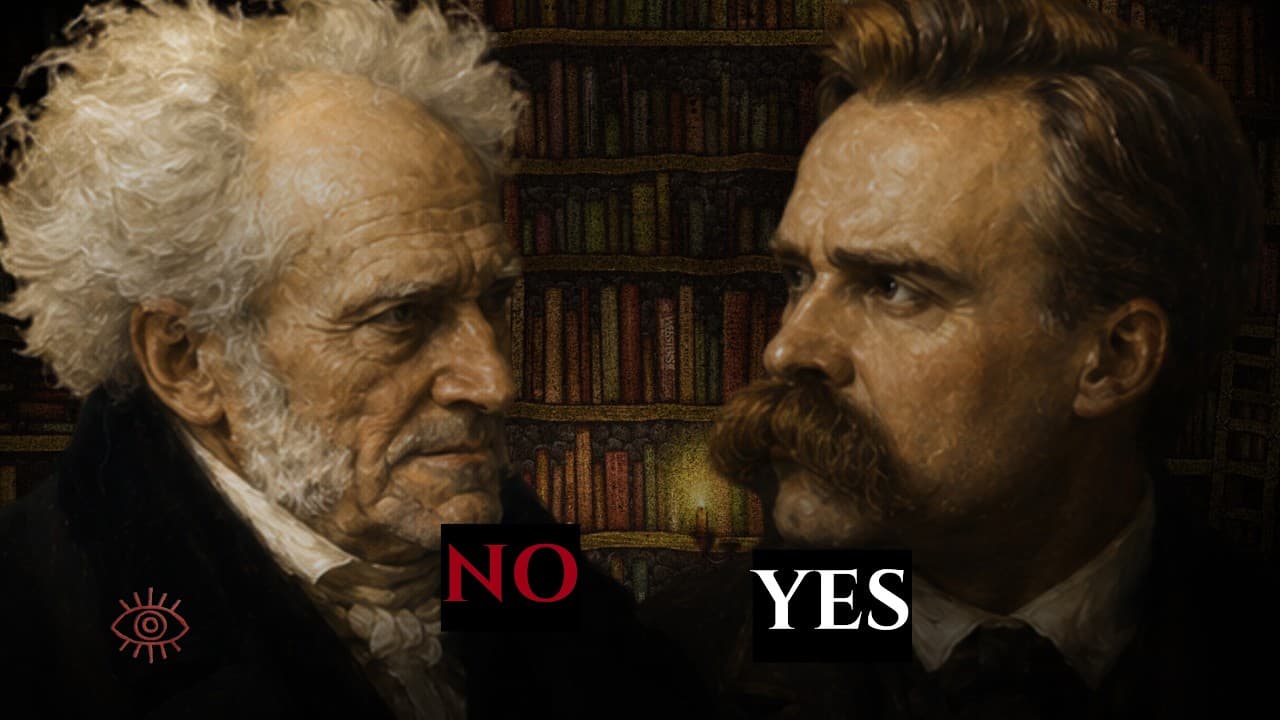
Is Life Worth Living? | Nietzsche vs Schopenhauer | Philosophy for Sleep
One of them concluded that the only wise response to life is to want less of it. The other spent his life arguing for wanting all of it back, forever, exactly as it was.
As a lonely student, Friedrich Nietzsche found a dead philosopher's book on a bookshop table and fell under a spell that would shape everything he became. This episode follows the long, strange bond between Nietzsche and his first master, Arthur Schopenhauer, from devotion to open war.
We meet the bitter, solitary Schopenhauer and his vision of a blind striving world where life is suffering. We watch the young Nietzsche pour that vision into his first book, then slowly turn against it, until he answers the darkest case ever made against existence with the wildest possible affirmation of it. Along the way we trace the will, pity, the death of the hidden true world, and the thought that measures whether a life could be loved enough to live again.
The full episode is on YouTube and Spotify. Please listen only in safe, restful contexts.
Enjoying the episode?
Occasional letters on philosophy, reading, and the examined life. No spam, ever.
By subscribing you consent to receiving occasional emails. Unsubscribe any time via the link in every email or at /unsubscribe.
Timestamps
- 0:00:00Chapter 1: The Discovery
- 0:12:06Chapter 2: The Man He Never Met
- 0:21:17Chapter 3: The Blind Force Beneath
- 0:32:53Chapter 4: The Case Against Existence
- 0:41:31Chapter 5: The Teacher Above Him
- 0:47:05Chapter 6: Born From Music
- 0:58:42Chapter 7: A Shared Idol
- 1:06:12Chapter 8: The Idol Cracks
- 1:12:08Chapter 9: The Cold Light
- 1:20:18Chapter 10: What the Will Wants
- 1:31:39Chapter 11: The Danger of Pity
- 1:40:10Chapter 12: Sickness or Abundance
- 1:45:30Chapter 13: The Weight of Return
- 1:55:09Chapter 14: The True World Vanishes
- 2:03:03Chapter 15: Everything He Owed
- 2:08:49Chapter 16: The Quarrel That Remains
For the record
Full Transcript
Chapter 1: The Discovery
It is the autumn of eighteen sixty-five, in a secondhand bookshop in the German city of Leipzig, and a young student is standing at a table of unwanted volumes with something heavy in his hands. It is not a new book. Two thick volumes, bound together, the pages already yellowed, the author some decades dead and very nearly forgotten. Nobody has recommended it to him. No professor has set it, no friend has praised it, no fashion of the day has carried it to this table. He would later say that some voice inside him whispered, take this book home with you. He did not know the man who wrote it. He would never meet him. And yet he would spend the next ten years of his life worshipping this book as if it were scripture, and then spend the rest of his life trying to take apart everything it said, sentence by sentence, without ever once stopping to love the strange and bitter man who had written it.
That is the knot this whole episode exists to untie. A young man finds his master in a dead philosopher he can never argue with, gives himself to that master completely, and then grows into the most dangerous critic that philosophy would ever send against him. He owed him everything. He forgave him nothing. The student's name was Friedrich Nietzsche. The dead man on the table was Arthur Schopenhauer. And the book was called The World as Will and Representation.
To understand why the book struck him so hard, you have to understand how alone he already was. Nietzsche was born on the fifteenth of October, in the year eighteen forty-four, in a small village called Röcken, in the flat farming country of what was then Prussian Saxony. His father was a Lutheran pastor, a gentle and musical man, and for the first years of the boy's life the world was the ordered world of the parsonage, the church bells, the hymns, the quiet routine of a country minister's family. Then it broke. When Friedrich was four years old, his father began to suffer from a disease of the brain. He declined slowly, in pain and in confusion, and he died before the boy was five. A few months later the family buried the pastor's youngest child as well, Friedrich's baby brother, dead in infancy. The boy later wrote that he dreamed of his father rising from the grave and returning to the church, and then coming back to the tomb carrying the small body of the child in his arms.
After the deaths the family left the parsonage, because it belonged to the church and not to them, and moved to the nearby town of Naumburg. There the boy grew up in a household made entirely of women. His mother, his younger sister, his grandmother, and two unmarried aunts. He was the only male in the house, a serious and formal child, so correct in his manners that other boys mockingly called him the little pastor. He read scripture aloud so movingly that he could reduce listeners to tears. Everyone who met him expected that he too would enter the church, that the son would take up the father's calling, and for a long time it seemed that he would.
He was clearly gifted, and at the age of fourteen he won a place at one of the most demanding schools in Germany, a famous old boarding school called Schulpforta, set in a former monastery. The days there were long and severe and filled with Greek and Latin from early morning. It was the kind of education that either breaks a boy or forges him, and it forged Nietzsche into a scholar of the ancient world with a memory and an ear that his teachers found almost frightening. But somewhere in those years the faith began to quietly drain out of him. He was reading the ancient historians, and reading the new criticism that questioned whether the gospels were reliable records at all, and by the time he left the school the certainties of the parsonage had gone soft in his hands. He did not announce it with a great crisis. He simply found, one term, that he could no longer honestly pray.
He went first to the university at Bonn, enrolled to study theology and classical scholarship together, as if keeping one foot in his father's world. It did not last. Within a year he had dropped theology entirely, to the grief of his devout mother, and thrown himself into the study of ancient texts, of philology, the painstaking science of reconstructing what old writers actually wrote and meant. When his brilliant teacher moved from Bonn to the university at Leipzig, Nietzsche followed him there. He was, by any measure, a spectacular success. His work was so accomplished that his professor spoke of him as the finest student he had seen in forty years of teaching. And yet the young man was restless and privately miserable, drowning in footnotes, unsure whether a life spent proving which century a fragment came from was a life worth having.
There was one thing that had never left him through all of this, and that was music. Where his faith had faded and his scholarship had turned to ash in his mouth, music remained the one language in which he felt entirely at home. He played the piano for hours, he improvised, he composed songs and small pieces of his own, and he believed, with a seriousness that never left him, that music reached a place in a person that argument could not touch. Keep that in mind, because it matters later. The dead philosopher he was about to discover had said something extraordinary about music, had given it a higher place than any thinker before him, and part of what drew the young man in so completely was that here at last was a philosophy that took seriously the thing he already loved most.
His body, too, was already beginning to betray him in small ways that would one day grow enormous. Even as a schoolboy he had suffered from crushing headaches and from eyes that ached and watered when he read too long, which for a scholar was a cruel affliction indeed. He pushed through it, worked past it, read by candlelight until the pain forced him to stop. The pattern of his whole life is visible already in the boy at the desk, the fierce mind driving the fragile body harder than it could bear, paying in migraines and half-blindness for every page he conquered.
That is the state he was in on the autumn afternoon when he lifted the two heavy volumes from the table. He took the book home to his lodgings, and by his own account he could barely put it down for a fortnight. He read it walking, he read it at meals, he slept only a few hours and rose at two in the morning to read it again. Here was a philosopher who did not comfort. Here was a man who looked at the whole of existence and pronounced it, calmly and without flinching, a kind of catastrophe, a mistake that would have been better never made. To a young scholar who had lost his God and gained only footnotes, this bleak honesty felt like the first true thing anyone had ever said to him. He had found, he believed, a mirror in which he could see the greatness and the misery of his own life reflected at full size.
What he loved was not only the argument. It was the figure behind the argument. Schopenhauer had written as a free man, owing nothing to any university, any church, any government, any fashion. He had held his terrible conclusions without softening them to please anyone. To Nietzsche, sick of the timid, careful, well-fed scholars around him, this was the image of what a philosopher ought to be. Not a professor with a pension and a set of safe opinions, but a solitary who tells the truth as he finds it and pays the price alone. For a few years the young man called himself, proudly and openly, a follower of Schopenhauer, and he tried to gather a small circle of friends who would take the dead master as seriously as he did.
Then his outward life leapt forward with astonishing speed. Nietzsche had not even finished his doctorate when the University of Basel, in Switzerland, offered him a full professorship in classical philology. He was twenty-four years old. This almost never happened, then or now. His old teacher wrote a letter of recommendation so glowing that the university simply arranged for the degree to be granted without the usual examination, and installed him in the chair. In the spring of eighteen sixty-nine he crossed into Switzerland, gave up his Prussian citizenship, and became, on paper, one of the youngest professors in Europe. He should have been triumphant. He was, in fact, already half a stranger to the profession he had just conquered.
Because the truth was that classical scholarship was no longer where his heart lived. He performed his duties, he lectured on Greek poetry and drama, he was conscientious and admired. But at night and in his letters he was somewhere else entirely, wrestling with the questions the dead philosopher had opened in him. What is this striving thing that we are. Why does existence hurt so reliably. Is there any way to say yes to a life that seems built out of suffering. These were not questions a philologist was supposed to ask. They were the questions of the man he was becoming, and the answers would eventually cost him his career, his health, his friendships, and finally his mind.
He carried Schopenhauer with him into all of it, the way you carry the person who first taught you to see. And here is the paradox that will run underneath everything that follows. The more Nietzsche grew, the more clearly he began to see that the master's answer was, to him, unlivable. Schopenhauer had looked at the suffering of the world and concluded that the only wisdom was to want less, to quiet the striving, to turn away from life as gently and completely as one could. Nietzsche would come to believe, with his whole being, the exact opposite. That the task was not to escape life but to affirm it, all of it, the pain included, to say yes so completely that you would choose the same life again without changing a single hour of it.
Two men, then, standing at opposite ends of the same insight. Both of them had stared without blinking at a universe with no God in it, no plan, no justice, no promise of reward. Both had refused every easy comfort. And from that same cold starting point one of them walked toward resignation and the other toward a wild and difficult joy. The young professor in Basel did not yet know that this was the argument of his life. He only knew that he could not stop reading the book, and that somewhere in its two heavy volumes lay both the truth he needed and the enemy he would have to defeat.
To follow that argument, we first have to meet the man on the table. Not the myth Nietzsche made of him, but the actual living philosopher, as strange and difficult and solitary a human being as the modern age produced, whose whole life was in a sense the proof of his own dark philosophy.
Chapter 2: The Man He Never Met
The philosopher whose book had conquered the young Nietzsche had been dead for five years, and had spent most of his life almost entirely unread. To understand what Nietzsche fell in love with, and what he would later fight, you have to meet Arthur Schopenhauer as he actually was, not as a system of ideas but as a difficult and solitary man whose whole life looked like an argument for his own bleak conclusions.
He was born on the twenty-second of February, in the year seventeen eighty-eight, in the free trading city of Danzig, on the Baltic coast. His father was a wealthy merchant, proud, strong-willed, and worldly, a man of business who wanted his son to be a man of business too. His mother was clever, sociable, ambitious in her own right, and much younger than her husband. From the beginning there was something cold in the house. The father intended Arthur to inherit the firm and pushed him toward the counting house, even taking the boy on long journeys across Europe as a kind of practical education, so that Schopenhauer grew up seeing a great deal of the world and a great deal of its misery. He would say later that the sight of human suffering on those travels had marked him for life, that he had seen, while still young, what most people spend their whole lives avoiding.
When Arthur was seventeen, his father was found dead in the water of a canal beside one of the family warehouses. It was almost certainly a suicide, though the family never said so plainly. The father had grown fearful and low in his last years, and one day he was simply gone, drowned. The death freed the son from the counting house but darkened him permanently. He inherited, in time, a portion of the fortune large enough to make him independent for the rest of his life, and this financial freedom is one of the quiet keys to everything he became. He never had to teach for a living, never had to please a patron, never had to trim a single opinion to keep a salary. He could afford to tell the truth as he saw it, however unwelcome, and he did.
His relationship with his mother went from cold to poisonous. After the father's death she moved to the city of Weimar, then the brilliant center of German literary life, and set herself up as a hostess and a writer. She became, in fact, a genuinely successful novelist, more famous in her own lifetime than her son would be in his. But mother and son could not be in a room together without wounding each other. She found him gloomy, arrogant, and impossible. He found her shallow and vain. After one final quarrel she wrote to him that he was unbearable and burdensome, and that she did not wish to see him again. They never met after that. For the last twenty-four years of her life they did not speak. It is worth pausing on the fact that the philosopher who would make human sympathy the very heart of morality could not sustain a single close relationship, and lived and died essentially alone.
He studied at the universities, took a doctorate in philosophy for a work on the roots of reasoning, and then, over a few concentrated years, wrote the book that would contain his entire vision. He published it before he was thirty-one, convinced that he had solved the fundamental riddle of existence, that the work was final and complete and would make his name immortal. The world responded with near total silence. The first edition barely sold. Most of the copies, he was told, were eventually pulped as waste paper. He had poured everything into it, and it landed in a void.
What made the silence unbearable was that the German philosophy of his day belonged to other men entirely, men he despised. The reigning star of the age was the philosopher Hegel, whose enormously elaborate system of history and spirit dominated the universities and drew the crowds. Schopenhauer regarded him as a charlatan, a peddler of impressive-sounding fog, and he made a decision that reveals his whole prickly, combative character. When he took up a position lecturing at the University of Berlin, he deliberately scheduled his own lectures at the exact same hour as Hegel's, as if daring the students to choose. They chose. They filled Hegel's hall and left Schopenhauer speaking to a nearly empty room. The gamble was a humiliation. He gave up university lecturing and never seriously tried again.
So he withdrew. In the year eighteen thirty-three he settled in the city of Frankfurt, and there he stayed, in rented rooms, for the last twenty-seven years of his life, in a routine of almost monastic regularity. He rose, he wrote in the morning, he played the flute with real skill before lunch, he ate at the same inn, he took a long brisk walk every afternoon in every weather, and he kept, as his one steady companion, a series of poodles, one after another as each died and was replaced. He gave them a name that meant, in an old sacred language, the world-soul, a small private joke that said everything about how he preferred the company of the animal to the company of most people. He read the London newspapers. He slept with loaded pistols by his bed. He was suspicious, vain about his growing reputation, quick to take offense, and convinced that the world had failed to recognize him.
And then, near the very end, the recognition came. In the year eighteen fifty-one, an old man now, he published a book of essays and shorter reflections on everything from the wisdom of life to the state of the world, written in a clear, sharp, readable style that anyone could follow. This was the book that finally found readers. Its very lack of grand system, its worldly and often bitter wisdom about how actually to live, caught the mood of a Europe that had grown tired of vast philosophical schemes and had lived through a wave of failed revolutions. Almost overnight, in his sixties, Schopenhauer became famous. Visitors made pilgrimages to Frankfurt to see him. Articles were written, his portrait was painted, disciples appeared. He enjoyed it enormously, this late sunshine after a lifetime in shadow, and he was honest enough to admit that it delighted his vanity.
He died in Frankfurt on the twenty-first of September, in the year eighteen sixty, sitting on his sofa one morning, alone, of a failure of the heart. He was seventy-two. Within five years a lonely young student in Leipzig would find his great book on a table and take it home.
One thing about him matters more than any biographical detail, and it is the thing that first bound Nietzsche to him and would later make their quarrel so deep. Schopenhauer was an atheist, completely and without apology, at a time when almost no respectable thinker in Germany would say so plainly. There was no God in his universe, no providence, no divine plan working itself out in history, no promise that the suffering of the world would be balanced by any reward. He had looked at existence with that comfort removed and reported honestly what he saw. This was the courage the young Nietzsche worshipped, the refusal to flinch, the willingness to stand in a cold and empty cosmos and describe it truthfully.
But look closely, because here already, in the temperament of the man, is the seed of the whole argument to come. Schopenhauer looked at the godless world and was filled with a vast pity for everything alive in it, and concluded that the only wisdom was to want less, to strive less, to turn away. He built a hermit's life out of that conclusion, alone with his flute and his dog and his contempt. The young man who found his book would begin from the very same godless honesty and be driven, in the end, to the opposite response entirely. But to understand why, we first have to understand what exactly Schopenhauer thought he had seen when he looked beneath the surface of the world. He thought he had found the one thing that everything else is made of, and he called it, of all strange things, the will.
Chapter 3: The Blind Force Beneath
The whole of Schopenhauer's philosophy rests on a single startling claim, and once you have it clearly, everything else in his thought and in Nietzsche's long war against him falls into place. The claim is this. The world you perceive, the ordered world of solid objects in space and time, connected by cause and effect, is not the world as it truly is. It is a kind of appearance, a show staged by your own mind. And behind that show, underneath it, driving it, there is one single thing, blind and restless and without purpose, and that one thing is what you yourself most deeply are.
Start with the appearance, because that is where we all live. When you open your eyes, you do not experience raw reality. You experience a world already sorted into objects laid out in space, arranged in time, and bound together by cause and effect. Schopenhauer took this idea from the great philosopher who came before him, Immanuel Kant, who had argued that space, time, and causation are not features of things in themselves but the built-in structure of any mind that perceives. They are the lens, not the landscape. We can never take the lens off and look around it. Everything we see through it is, in Schopenhauer's word, representation, the world as it appears to a knowing subject, the world as picture.
Now Kant had said something humbling and frustrating about what lies beyond the lens. He called it the thing in itself, reality as it is apart from our perception, and he insisted that we can never know it. It is forever hidden behind the appearances. This is the wall that Kant built, and most philosophers accepted that the wall could not be climbed. Schopenhauer's audacity, the move on which his entire reputation rests, was to say that there is one single place where we can get behind the appearance, one crack in the wall. And that place is our own body.
Consider how you know your own body. You know it, as you know everything else, from the outside, as an object in the world, a thing with weight and shape that you could see in a mirror or feel with your hands. But you also know it from the inside, in a completely different way, a way you know nothing else. You know it as wanting, as striving, as reaching. When you raise your arm, you do not first form a plan and then watch your arm obey as if it were a stranger's. The willing and the moving are one thing, felt from within. Your own inner life is not a calm picture. It is a ceaseless wanting, a hunger, a craving, a fear, a reaching toward and a shrinking away. Schopenhauer's great leap was to say that this inner wanting, this striving that you feel your own body to be, is the thing in itself finally showing its face. And he gave that striving a name. He called it will.
Then he took the boldest step of all. If the inner reality of my own body is this blind striving, he reasoned, and if my body is simply one piece of the natural world, then why should the rest of the world be any different underneath. Perhaps everything, all of it, is at bottom the same blind striving that I feel in myself. And so he arrived at his vision of the whole. The single reality behind all appearances is one vast, aimless, striving force, and every object in the universe is that one force made visible in a particular shape. The pull of gravity holding a stone to the earth, the blind push of a plant's roots toward water, the hunger of an animal, the ambition of a man, the churning of your own restless heart at three in the morning, all of it is the one will, objectified, taking form at level after level, from the crudest matter up to the human being.
It is crucial to feel how strange and dark this idea is, because the word will can mislead us. We usually think of will as something that belongs to a person, a deliberate choosing, a plan, a decision made for a reason. Schopenhauer means almost the opposite. His will has no reason and no goal. It does not will anything in particular. It is not trying to get anywhere. It is simply an endless striving that strives for the sake of striving, a wanting with no possible final satisfaction, because there is nothing outside it that it could reach and be at rest. It is closer to a blind pressure than to a purpose. It is closer to the mindless surge of hunger than to the careful making of a plan. And you are it. That is the part that lands like a blow. The thing that thinks of itself as a reasonable person with intentions and ideals is, at its core, a knot of this same purposeless striving, wearing the thin mask of a mind.
This is why Schopenhauer inverted the entire hopeful tradition of Western thought. For most philosophers before him, the deepest thing in a human being had been reason, or the soul, or some spark of the divine, and the body and its desires were the lower part to be governed by the higher. Schopenhauer turned that upside down. The striving is what is real and fundamental. The intellect, the reasoning mind, is a latecomer, a tool that the will grew for itself the way it grew claws and eyes, in order to find what it blindly wants. Reason does not sit in the driver's seat. It runs errands for a master that never explains itself. We imagine we are choosing our lives with our minds, when in truth the striving has already decided, and the mind arrives afterward to invent the reasons. Anyone who has watched themselves fall in love against all their good judgment, or cling to a desire they know is ruinous, has felt the truth of this from the inside.
It helps to make this concrete, because stated in the abstract it can sound like a mere play of words. Watch an insect in late summer beating itself against a lit window, again and again, driven by something it does not understand toward a light that will do it no good. It does not know why. It simply must. There is no plan in it, no reasoning, only the blind pressure to move toward what draws it. Schopenhauer would say that this is the will showing itself almost naked, without the mask of intellect that we human beings wear over the same machinery. Watch a seed crack a paving stone as it swells, or a vine turn slowly through a whole season to reach a patch of sun, and you are watching the same striving working in a form too slow and too silent for us to notice it as kin. And when a man lies awake at four in the morning, his mind racing through plans and grievances and hungers he cannot switch off, he is that same pressure grown a brain, and no less driven for all his cleverness. The striving is one. Only the disguises differ.
The disguise in our case is the disguise of reasons. Because we can talk, we can always supply a reason for what the will has already decided, and this is one of Schopenhauer's most unsettling observations. We do not want a thing because it is good. We call it good because we already, blindly, want it. The mind is forever running behind the wanting with an explanation, like a servant inventing dignified excuses for a master's appetites. This is why arguing someone out of a deep desire almost never works, and why we so often surprise ourselves, doing the very thing we had resolved against, then hearing our own voice smoothly justify it after the fact.
Notice too what has happened to the comfort of religion in this picture. There is no God directing the striving toward any good end. There is no plan being worked out. The will did not set out to produce human beings or beauty or meaning. It simply strives, and in the endless churning it throws up, here and there, temporary forms, this galaxy, this forest, this person reading these words, and then it dissolves them again and strives on, indifferent to every one of them. The whole magnificent, terrible spectacle of nature, the predator and the prey, the flower and the rot, is the one hungry force feeding on itself forever, wearing a million faces, wanting nothing but to keep wanting.
There is one more consequence of this vision that we should hold onto, because it will matter greatly later. If the world as we see it, divided into separate things, is a product of the lens of space and time, then the countless separate beings we perceive are, at the deepest level, not truly separate at all. They are one striving force wearing many masks and mistaking each mask for a self. You and the person across from you feel like two closed and finished individuals, each the center of a private world, each the one that truly matters. Schopenhauer thought this feeling was, in a sense, an illusion produced by the lens. Underneath the many faces there is a single thing, straining against itself, wounding itself, consuming itself, in the shape of a billion creatures that do not recognize their own reflection in one another. From this strange and haunting idea he would later draw his entire account of why we ought to be kind, and Nietzsche would one day attack that account with everything he had. But the metaphysics comes first, and the metaphysics says we are all, secretly, the same hungry thing.
Now you can see why the young Nietzsche was so overwhelmed. Here was a picture of the world with every consolation stripped away and a fierce, unsentimental honesty in its place, and at the center of it a single powerful idea, that beneath all the surfaces there beats one blind striving, and that we are made of it. Nietzsche would keep the striving at the very center of his own philosophy to the end of his life. The will never left him. What he could not accept was the conclusion Schopenhauer drew from it, because from this single dark premise the older man deduced something devastating. If we are nothing but this endless, goalless wanting, then he believed he could prove that life must be, by its very nature, a form of suffering. And that proof is the darkest and most complete case against existence that any philosopher has ever set down.
Chapter 4: The Case Against Existence
From the single dark premise that we are blind striving, Schopenhauer drew a conclusion that no serious philosopher had ever stated so completely. Life, by its very structure, is suffering. Not sometimes. Not by accident. Not because of bad luck or bad government or original sin. Suffering is built into what we are, and it could not be otherwise, and this is the heart of what we mean when we call him a pessimist.
Follow the logic, because it is tighter than it first appears. To will, to want, to strive, is by definition to lack. You desire only what you do not have. Desire is a kind of pain, a felt absence, a tension that will not leave you alone. So as long as you are willing, and you are always willing, you are in a low or high state of suffering, a permanent condition of not-yet. Now, what happens when you finally get the thing you wanted. For a moment the tension releases and you feel satisfied. But the satisfaction cannot last, because the will does not rest. Almost at once a new want rises to take the place of the old one, and you are striving again, lacking again, suffering again. The relief was only ever the brief silence between two hungers.
And suppose, for a moment, that you managed to satisfy all your wants and no new one came. You would not find happiness there. You would find the other face of the same misery, which Schopenhauer identified with terrible accuracy as boredom. When we are not being driven by wanting, we are oppressed by emptiness, by the sheer weight of time with nothing pressing to fill it, and we go looking for new desires simply to have something to strain toward. This is his famous verdict on the shape of a human life. It swings like a pendulum between pain and boredom, between the suffering of wanting and the suffering of having nothing to want, and it never comes to rest in the middle where we imagine happiness must live. Look honestly at a day, he says, and you will find it made of small versions of this swing, the itch and the scratch, the craving and the flatness after.
From this comes his most quietly devastating point about happiness itself. We speak of happiness as if it were a positive thing, a presence, a fullness we could reach and hold. Schopenhauer says it is nothing of the kind. What we call happiness is merely the absence of some particular pain, the moment the ache stops, the hunger is fed, the fear passes. It is a negative, a subtraction, felt only against the background of the suffering it briefly interrupts. Pain is the real and positive thing, the thing we feel directly and cannot argue with. Pleasure is only its temporary lifting. Which is why, he observes, a single sharp pain can ruin a day that had a hundred small comforts in it, and why we notice our health only when we lose it. The good is the mere absence of the bad, and the bad is always waiting.
Draw the account to its conclusion and you reach the darkest thought in his philosophy, which is that on balance it would have been better not to be. If you weigh the suffering of the world against its pleasures honestly, without flattering yourself, the suffering wins, and it is not close. He points to the animal being slowly eaten alive and asks what pleasure anywhere could balance that one creature's terror. He looks at a human life and sees mostly want, effort, disappointment, decline, and loss, lit here and there by pleasures that are merely pains briefly stilled. Existence, for him, is a debt that should never have been contracted, a business that does not cover its costs. This is the case against being alive in its most complete form, and remember it, because Nietzsche will one day set himself the task of answering it not with an argument but with his whole life.
And yet Schopenhauer was not a man who simply despaired and stopped. His philosophy is dark, but it is not empty, because he believed there were ways to loosen the grip of the striving, ways to find a kind of peace inside a world of suffering. He offered, in effect, three doors out, and each one matters for the story to come.
The first door is beauty. When we lose ourselves in a great painting, a landscape, a piece of music, something remarkable happens. For a while we stop wanting. We are no longer straining toward the object as something to use or possess. We simply contemplate it, and in that contemplation the restless willing falls silent, and we become, for a moment, a pure and painless seeing eye. Art, for Schopenhauer, is a temporary release from the tyranny of desire, a brief holiday from being a creature that wants. And of all the arts he gave the highest place to music, because he thought music did not merely picture the world of appearances but spoke directly in the voice of the will itself, tracing its longings and resolutions without a single object in the way. That is the idea that had thrilled the young Nietzsche at the piano, and it is worth marking here where it stands in the master's system.
The second door is compassion. If, as we saw, all beings are secretly one striving wearing many masks, then the barrier between me and another suffering creature is, at the deepest level, an illusion. The person who truly grasps this, not as a theory but as a lived recognition, feels another's pain almost as his own, and from that recognition flows all genuine kindness. Schopenhauer built his entire ethics on this feeling of fellow-suffering, this seeing through the illusion of separateness to the shared misery underneath. Morality, for him, is not obedience to a law or a calculation of consequences. It is compassion, the melting of the boundary between self and other. Hold that thought with special care, because it is precisely this, the enthronement of pity as the root of all goodness, that Nietzsche will one day attack more fiercely than anything else in the whole of Schopenhauer.
The third door is the most extreme, and it is where his philosophy points in the end. If willing is suffering, then the deepest release would be to stop willing altogether, to turn the will against itself and quiet it entirely. Schopenhauer saw this in the saints and ascetics of every religion, the ones who renounce desire, who want nothing, who withdraw from the endless striving until the self almost dissolves. This is not suicide, which he thought was actually an act of will, a raging against a particular life. It is something stranger and calmer, a letting go of the will to live at its root, a great and quiet No said to existence itself. For Schopenhauer this saintly renunciation was the summit of wisdom, the nearest a human being can come to peace.
So there stands the completed vision. A world of blind striving, a life of unavoidable suffering, and three ways to loosen the grip, through beauty, through pity, and finally through the renunciation of desire itself. It is coherent, it is honest, and it is a philosophy that says, at its core, that the wisest response to life is to want less of it. This was the gospel the young Nietzsche embraced. And the astonishing thing is that he would keep the dark diagnosis almost intact, the godless world, the centrality of striving, the reality of suffering, and then reject every single one of the three doors, and go looking for a fourth that Schopenhauer had never imagined and would have called madness.
Chapter 5: The Teacher Above Him
In the year eighteen seventy-four, Nietzsche published a long essay in praise of the dead philosopher, and it is one of the most revealing things he ever wrote, though not for the reason he intended. He meant it as a tribute to his master. It reads, in the end, as a portrait of the kind of man Nietzsche himself was straining to become. And if you look closely at what he actually praises, you find the first quiet clue to why the discipleship could not last.
The essay carries Schopenhauer's name in its title, but here is the strange thing about it. It contains almost nothing about the will, almost nothing about pessimism, almost nothing about the three doors out of suffering. It barely engages the philosophy at all. What Nietzsche celebrates is not a set of doctrines. It is a human example. He praises Schopenhauer as a man who stood alone, who owed nothing to the state or the church or the university, who told the truth as he found it and did not soften it to be liked, who treated the life of the mind as a matter of the deepest seriousness rather than a comfortable profession. What thrilled the young Nietzsche was the spectacle of a free and honest man in an age of timid, salaried thinkers.
This tells us something important about the whole relationship. Nietzsche had never really been a disciple of Schopenhauer's conclusions in the way a follower signs on to a creed. He had been captured by Schopenhauer's character, by the courage of the stance, by the image of the solitary who refuses every comfort and pays for it. A philosopher, in this essay, is valuable not because his system is correct but because of what his existence proves is possible. He is a living demonstration that a human being can stand upright without any of the usual supports and think without flinching. That is a strange thing to love in a man whose actual teaching was that we should want less and turn away from life. Nietzsche was drawn, without quite noticing it yet, to the strength in Schopenhauer rather than to the resignation, and strength and resignation would eventually pull him in opposite directions.
At the center of the essay is one idea that Nietzsche would carry, transformed, for the rest of his life. He writes that your true self does not lie hidden deep inside you, waiting to be uncovered like a buried treasure. Your true self, he says, lies high above you, or at least immeasurably above what you ordinarily take yourself to be. It is not a thing to be found by looking inward at what you already are. It is something to be reached by climbing, an achievement, a height. And how do you find it. You ask what you have truly loved and revered so far in your life, what has drawn your soul upward, and you read your real self off from those things, because what a person genuinely reveres reveals what he could become. The educator, in this vision, is not someone who pours information into you. The true educator is a liberator, someone who helps you become what you already, at your best, are reaching toward.
You can hear in that idea the whole later Nietzsche stirring in its shell. The self as a task rather than a possession. Greatness as something climbed toward, not something owned. Life understood as self-overcoming, as the constant surpassing of what you currently are. None of this fits comfortably inside Schopenhauer's philosophy of renunciation, where the goal is not to climb higher but to quiet the striving altogether and want nothing. And that is the deep irony of the essay. In the very act of praising his master, Nietzsche was already sketching a philosophy that would point the other way, toward more life rather than less, toward ascent rather than release.
He did not see the contradiction yet. He was thirty years old, a professor still, though increasingly at odds with his profession, and he still called himself a Schopenhauerian and meant it. But an attentive reader of this essay could have predicted the break years before it came. When you love a teacher for his strength and honesty rather than for his teaching, you have already, secretly, kept the right to disagree with everything he says while still revering the man who said it. That, in a single sentence, is the whole future relationship between these two. Nietzsche would spend his maturity dismantling Schopenhauer's every conclusion, and he would go on praising, to the end, the honest and solitary courage of the man who had reached them. He had learned from Schopenhauer, above all, how to be the kind of thinker who could one day turn against Schopenhauer.
Before that turn came, though, he would first pour his master's philosophy into a book of his own, a wild and beautiful and deeply flawed first book that tried to see the whole of ancient Greek culture through Schopenhauer's eyes, and through the music of a living composer who had become the second great master of his young life.
Chapter 6: Born From Music
In the year eighteen seventy-two, the young professor published his first book, and it scandalized the world of classical scholarship that had raised him. It was called The Birth of Tragedy. It was supposed to be a work of philology, a study of ancient Greek drama, and instead it was a passionate, strange, half-wild philosophy of art and existence, written under the double spell of Schopenhauer and of a living composer. His colleagues were appalled. One of them wrote a savage pamphlet declaring that Nietzsche had disqualified himself from serious scholarship, and students began to avoid his lectures. It nearly ended his academic career on the spot. And yet inside this flawed and feverish book, if you know where to look, the future rebel against Schopenhauer is already quietly at work.
The book begins with a question that had haunted educated Europe for a century. Why did the Greeks, who seem to us so serene, so full of sunlit balance and calm, produce tragic drama, the darkest and most terrible art the ancient world made. Nietzsche's answer was that the serenity was a mask, and a magnificent achievement, laid over an abyss. The Greeks, he argued, saw more deeply into the horror of existence than any people before or since. They knew that life was cruel, that it destroyed the innocent, that suffering had no final justice behind it. There is an old story Nietzsche loved, in which a wise companion of the gods, captured and forced to speak, tells a king that the very best thing for a human being is never to have been born, and the second best is to die soon. The Greeks knew that dark wisdom, Nietzsche said. Their genius was that they did not collapse under it. They created beauty precisely as a way to live with a truth that should have crushed them.
To explain how, Nietzsche described two opposing powers that he saw at work in all art, and he named them after two Greek gods, Apollo and Dionysus. It is worth stating what he meant in plain terms, because the whole book turns on it. The Apollonian is the power of form, of measure, of the beautiful image, of the clear boundary. It is the impulse that makes the dream, the sculpture, the shining individual figure standing out sharp and complete against the world. It is the art of the surface, of appearance made luminous and bearable. It draws a clean line around each thing and says, here you are, separate and whole and beautiful. It is, in a sense, the great illusion that makes ordinary life livable, the veil of lovely forms thrown over the depths.
The Dionysian is the opposite power, and it is the one that matters more for our story. It is the impulse of intoxication, of ecstasy, of the dissolving of boundaries. It is what happens in the dance and the festival and the surge of music, when the separate individual forgets himself, when the hard line around the self softens and a person feels himself merge with others and with the whole surging life of the world. Where the Apollonian makes the beautiful individual, the Dionysian breaks the individual open and floods him with something larger and older and wilder. It is terrifying and it is joyful at once. It is the truth of the underlying oneness of things breaking through the lovely surface, and it comes to us most directly, Nietzsche said, through music, which speaks beneath all images straight to the depths.
It helps to picture the two powers rather than only to define them. Imagine standing at the edge of a great festival at night, a crowd gathered around fires, drums and pipes rising, and the people beginning to move together, to sing, to lose the sense of where one body ends and another begins, until the shy and separate self of daylight melts and something enormous and shared moves through the whole crowd at once. That surge, that self-forgetting, that joy that has fear folded inside it, is the Dionysian. Now imagine the morning after, the clear cold light, a single perfect statue standing in a temple, calm and complete, each edge distinct, the very image of order and repose. That is the Apollonian. One is the dream of beautiful form. The other is the intoxication that dissolves all form. Human beings, Nietzsche thought, need both, and the Greeks were great because for one astonishing stretch of history they held both together at full strength instead of letting one starve the other.
Greek tragedy, in his account, was the miraculous marriage of these two powers. On the stage the beautiful Apollonian figures act out their doomed stories in clear and noble form, while underneath, in the music and the chanting chorus, the Dionysian flood surges, dissolving the audience out of their separate selves and into the shared dark truth of existence. The spectator sees the hero destroyed, sees the worst that life can do, and yet does not despair, because the music carries him beneath the individual tragedy to a place where life itself goes on, indestructible, surging up again through every death. Tragedy takes the most unbearable facts of existence and makes them not merely bearable but exhilarating. This is Nietzsche's great early idea, and he compressed it into a phrase he never entirely abandoned. It is only as an aesthetic phenomenon, he wrote, that existence and the world are eternally justified. Not by God. Not by reason. Not by any promise of reward. Only art can say yes to a life this terrible, and it does so not by hiding the horror but by transfiguring it into beauty.
Now here is where you must listen carefully, because this is the hinge, the point where the disciple begins, without quite knowing it, to slip out from under his master. Both Schopenhauer and Nietzsche agree that existence is terrible and that art suspends the suffering. But look at what each of them thinks art is for. For Schopenhauer, as we have seen, the value of art was that it gives us a rest from willing, a brief holiday from desire, a quiet in which the striving falls silent. Art, for him, is a turning away, a sedative, a small foretaste of the great renunciation that is wisdom's final goal. It calms the will. It points toward the exit.
Nietzsche's Dionysian art does the opposite. It does not calm the will. It intensifies it. It does not offer rest from life but a wild and overflowing yes to life, an ecstatic plunge deeper into existence rather than a gentle withdrawal from it. The tragic Greek does not contemplate his suffering from a cool distance and feel the desire drain away. He is swept up, flooded, made to feel the terrible fullness of being alive more intensely than ever, and to find that intensity glorious. Already, in his first book, Nietzsche's instinct is running the wrong way for a good Schopenhauerian. He is using his master's language, the world as blind striving, art as the answer to suffering, and he is bending it toward affirmation, toward more life, toward a joy that embraces the horror instead of escaping it. The seed of everything he would later become is right there on the page, wearing borrowed clothes.
It is worth sitting for a moment with that phrase about existence being justified only as a work of art, because it is one of the boldest sentences Nietzsche ever wrote, and it aims a blow at the whole tradition behind him. Most attempts to justify the suffering of the world had been moral or religious. The pain is a punishment, or a test, or a stage on the way to some final good, and behind it all stands a God who will one day balance the books. Nietzsche throws every one of those consolations away. There is no moral justification for the world, he is saying. There is no cosmic court that will make the suffering worthwhile. There is only this. That existence, terrible as it is, can be beheld the way we behold a tragedy on the stage, and found, in spite of everything, beautiful, and worth having watched. It is a shocking thought, that the only thing that redeems life is not goodness or truth but beauty, and that we are, in the end, less like defendants awaiting a verdict than like an audience at a play that breaks our hearts and that we would not have missed for anything. Hold that thought lightly for now. Years later, stripped of its early theatrical language, it will return as the deepest thing Nietzsche has to say.
There is one more figure in the book worth naming, because Nietzsche makes him the villain, and the choice of villain tells us where the young man's heart already lay. Greek tragedy, he argued, did not simply fade. It was killed, and its murderer was reason itself, in the person of the philosopher Socrates and the relentless, questioning rationalism he stood for. Socrates, in Nietzsche's telling, was the man who believed that everything could be understood, that the world was fundamentally reasonable, that knowledge could cure all ills and that the unexamined life was not worth living. Against the deep tragic wisdom that knew existence to be dark and beyond full understanding, Socrates set a bright, shallow confidence that thinking could master everything. And under that confidence the tragic sense died. The Dionysian music went silent. Culture grew clever and lost its depth.
You may agree or disagree with this as history. As a confession, it is priceless. The young professor of philology, the man whose whole training was in careful rational scholarship, had written a book blaming reason itself for the death of the highest art, and siding with the dark ecstatic wisdom against the clear light of understanding. He was already, at twenty-seven, choosing life over knowledge, intensity over safety, the yes over the no. He just did not yet see how far that choice would eventually carry him from the master he thought he was serving. And there was another man he was serving too, a living one this time, whose music seemed to Nietzsche the Dionysian power reborn in the modern world, and to whom this whole strange book was dedicated.
Chapter 7: A Shared Idol
There was a second master in the young Nietzsche's life, and this one was alive, magnetic, and thirty-one years his senior. His name was Richard Wagner, the composer, and for a period of about eight years Nietzsche loved him with something close to a son's love for a father. What bound them at the start, more than anything else, was the dead philosopher they both revered. Two men, a generation apart, had each been overwhelmed by the same two heavy volumes, and they found in each other the rare joy of a shared devotion.
Nietzsche first met Wagner in the year eighteen sixty-eight, before the professorship, and the meeting electrified him. Here was a great artist who could talk brilliantly about philosophy, who quoted Schopenhauer, who seemed to embody the very Dionysian power that Nietzsche was beginning to write about. When Nietzsche took up his chair at Basel, he discovered that Wagner was living not far away, across the Swiss border, at a house on a hillside above a lake, a place called Tribschen. Over the next three years Nietzsche went there again and again, more than twenty times, and those visits became the happiest of his life. He had a room kept for him. He was folded into the household. He ran errands, fetched Christmas gifts, and joined the family circle as a kind of adopted younger brother or favored disciple.
At the center of that household was Wagner's wife, Cosima, brilliant and formidable and devoted to her husband's genius, and Nietzsche adored her too, with a careful, reverent, unspoken tenderness that would ache in him for the rest of his life. The three of them talked of art and philosophy and the sorry state of German culture, and above all of Schopenhauer, whose portrait might as well have hung over the whole enterprise. Wagner had come to Schopenhauer somewhat as Nietzsche had, as a revelation that reorganized everything, and he had absorbed in particular the master's exalted view of music as the deepest of the arts, the one that speaks straight from the heart of the world. For a composer with vast ambitions, to be told by a philosopher that music was the highest and most metaphysical of all human activities was intoxicating, and Wagner built a good deal of his self-understanding on it.
It is worth dwelling on how much the friendship gave him, because the later break is only as painful as the closeness that preceded it. Nietzsche was a lonely man by temperament, formal, easily wounded, more comfortable on paper than in a room, and at Tribschen he was, for a few years, simply happy. He remembered those days for the rest of his life as an island of warmth, and even after everything had turned to bitterness he would write that he would not give up those hours with Wagner for anything in the world. He had been taken seriously by a great man. He had been loved, or had believed he was loved, by the two people he most admired. For someone who had grown up the only boy in a house of grieving women, and who had never quite found his place among his fellow scholars, this was a homecoming he had not known he was looking for.
You can see why the young Nietzsche felt he had arrived at the very summit of his age. He believed he was witnessing the rebirth of the tragic spirit itself, the Dionysian power returning to the modern world in the form of Wagner's music dramas, those vast works that fused music and myth and poetry into a single overwhelming flood. His first book, the one that scandalized the scholars, was in large part a philosophical argument for exactly this, that Wagner was doing for modern Germany what the tragic poets had done for ancient Greece, giving a people a way to face the darkness of existence and be strengthened rather than broken by it. The book was dedicated to Wagner. The disciple had found, it seemed, a living god to serve, and a mission worthy of his gifts.
But look at the shape of the young man's life in these years and something troubling comes into view. Nietzsche was, in this period, a disciple twice over. He revered a dead philosopher and he served a living artist, and he had arranged his whole inner world around the two of them. He was orbiting other men's suns. His energies went into promoting Wagner's cause, defending Wagner's genius, laboring for the great festival that Wagner was planning to build, a temple of a theater where his mighty works could be staged as sacred events. Nietzsche wrote and argued and exhausted himself in the service of another man's dream. And a person of his particular strength cannot live indefinitely as a servant, however much he loves the master. Something in him was being asked to bow that did not, by its nature, bow well.
There was another cost, quieter and harder to admit. Nietzsche was himself a composer, or longed to be one, and he cared about music as much as he cared about anything on earth. To live in the shadow of the greatest musical dramatist of the age was to have that private ambition gently but permanently overshadowed. When Nietzsche once showed a composition of his own to the household, it was met with something less than enthusiasm, and the sting of it stayed with him. To love a genius closely is also, sometimes, to be reminded daily of the ceiling above your own gifts. A part of him that needed to create on his own terms was being kept folded up and quiet, and it would not stay folded forever.
There was a philosophical fault line under the friendship too, though it took Nietzsche years to feel it. Wagner's art, for all its Dionysian power, was moving in a direction that would eventually horrify his young admirer. It was growing more solemn, more moralistic, more entangled with ideas of redemption and pity and holy renunciation, ideas drawn straight from the Schopenhauerian gospel of turning away from life. The very thing Nietzsche would come to reject in Schopenhauer, the exaltation of pity and renunciation, was seeping ever more deeply into the music of the man he loved. For now he did not let himself see it. He was inside the enchantment, and the enchantment was made partly of his own youth, his own need for a father, his own hunger to belong to something great.
The years at the house above the lake could not last, and when they ended, they took more than a friendship with them. The break with Wagner and the break with Schopenhauer would turn out to be, at the deepest level, a single event, one long act of separation in which Nietzsche tore himself free of both his masters at once and became, painfully and for the first time, a philosopher who belonged to no one but himself. And the place where the enchantment finally cracked was the very festival he had labored to bring into being.
Chapter 8: The Idol Cracks
In the summer of eighteen seventy-six, the great festival that Nietzsche had labored for finally opened in the small town of Bayreuth. Wagner's temple of a theater was built. The mighty cycle of music dramas was performed for the first time in the way its creator had always dreamed. Royalty came. All of cultured Europe turned its eyes to the little Bavarian town. It should have been the triumph of Nietzsche's cause, the vindication of everything he had written and worked for. Instead it was the beginning of the end, and he fled from it.
He arrived, and almost at once he felt something like nausea. The sacred rebirth of tragic culture that he had imagined turned out to be, when he stood inside it, a fashionable spectacle. It was a crowd of well-dressed patrons and gossiping notables and imperial hangers-on, come to be seen at the event of the season. The temple was a theater after all, and the worshippers were an audience, and the god they had come to admire seemed to Nietzsche to be performing for them. Wagner, the free Dionysian force he had loved, now looked to his young disciple like a showman who had conquered exactly the respectable German public he claimed to despise, and who was well pleased to have done it. Nietzsche developed violent headaches, could not bear the noise and the company, and left in the middle of it to hide in a nearby forest, sick in body and sicker in spirit.
What broke was not merely his taste. It was his faith. He had begun to see, and could no longer unsee, the thing that had been growing in Wagner's art all along, the drift toward Christian piety, toward redemption through renunciation, toward the exaltation of pity and holiness and the meek turning away from life. Wagner's final great work, still to come, would place a holy fool and the redeeming power of compassion at its very center, a pure gospel of Schopenhauer's renunciation set to overwhelming music. To Nietzsche this looked like a betrayal and a collapse. The man he had taken for the reviver of a life-affirming pagan strength had sunk, in the end, to his knees before the cross. And the poison in it, Nietzsche now saw, was the very Schopenhauerian gospel he had once shared, the teaching that the highest thing is to want less, to pity, to renounce, to turn away.
There is a hard lesson buried in that summer, and Nietzsche learned it in his own flesh. It is one thing to admire strength and honesty from a distance, as he had admired them in a dead philosopher and a living composer. It is another to watch your living idol court the applause of the very crowd he taught you to scorn, and to recognize, with a lurch, that devotion had made you blind. He had wanted so badly for Wagner to be the thing he needed him to be that he had not let himself see what the man was actually becoming. Disillusionment, in the exact sense of the word, is the losing of an illusion, and it is painful precisely because the illusion was dear. Nietzsche would carry a lifelong suspicion of his own enthusiasms out of that forest, a wariness of anything he found himself worshipping.
So the two separations became one. To break with Wagner was to break with the philosophy that had made Wagner what he had become, and to break with that philosophy was to lose the master of his youth. Nietzsche had loved two men, and he now had to tear himself free of both at once, and the tearing very nearly destroyed him. He did not stage a public quarrel. He simply, over the following two years, withdrew, went silent, and began to write a book that would announce, to anyone who could read the signs, that the disciple was dead and something harder and lonelier had been born in his place.
His body broke along with his beliefs. The headaches that had shadowed him since boyhood grew monstrous. His eyes failed him so badly that reading and writing became a torture, and he could work only in short bursts before the pain drove him from his desk. He suffered days of blinding migraine, vomiting, near-total collapse, sometimes for weeks at a stretch. In the year eighteen seventy-nine, at the age of thirty-four, he gave up the professorship at Basel entirely. The brilliant young scholar who had held a university chair at twenty-four walked away from the profession forever, a half-blind invalid with a small pension, no institution, no master, and no settled home.
What followed was one of the strangest and most productive exiles in the history of thought. For the next ten years Nietzsche became a wanderer, drifting between cheap boarding houses in the mountains of Switzerland in summer and the shores of the Mediterranean in winter, chasing the weather and the light levels that his ruined nerves could tolerate, always alone, often in pain, writing in pencil in small notebooks on his long walks because his eyes could no longer bear the page. He had lost his teachers, his health, his profession, and nearly his eyesight. And in that stripped and solitary state, with everything external taken away, he finally began to think entirely for himself. The first blow he struck was against the whole idea of the comforting other world, and he struck it in a book that turned deliberately cold.
Chapter 9: The Cold Light
In the year eighteen seventy-eight, while his old friendship was dying and his body was failing, Nietzsche published a book that was a deliberate act of self-transformation. It was called Human, All Too Human, and everything about it announced that the passionate young disciple of art and metaphysics was gone. Where his first book had been feverish, poetic, and drunk on Dionysian depths, this one was cool, dry, skeptical, and analytic. He dedicated it, in spirit, to the memory of Voltaire, the great French champion of reason and enemy of superstition, and the choice was a message written in large letters. The man who had once blamed the rationalist Socrates for murdering tragedy now enlisted himself under the banner of reason. He had changed sides.
The form of the book announced the change too. Instead of a single sweeping argument, it was built out of hundreds of short, sharp observations, aphorisms and paragraphs, each one turning some human belief or feeling over in the light and examining what was really inside it. This became his characteristic way of writing for the rest of his life, and it suited both his ruined eyes, which could only manage short bursts, and his new suspicion of grand systems that claimed to explain everything at once. A great system, he had come to think, was often just a beautiful cage a thinker built for himself. The aphorism kept him free, let him strike and move on, let him contradict himself from one page to the next as an honest mind exploring rather than a prophet decreeing.
But the deepest change was in what the book set out to do. Nietzsche had decided to become a kind of psychologist of the ideals human beings hold most sacred, and to trace them coldly back to their unglamorous origins. Where do our lofty moral feelings actually come from. What is really going on underneath our talk of virtue, of the good, of the pure and the noble and the selfless. He suspected that our highest values were not handed down from any heaven, and did not descend from any realm of pure reason, but had grown, slowly and accidentally, out of very human and often very lowly sources. Fear, vanity, habit, the need of the weak to protect themselves, the long pressure of custom. He wanted to take the sacred things down from their pedestals and show the all too human material they were quietly made of. The title says it all. What we call divine or noble in ourselves is, on closer inspection, human, and then human again, and human all the way down.
A single example shows the method at work. Take the way we admire a purely selfless act, a kindness done with no thought of reward. We treat it as the moral summit, proof of something noble and disinterested in human nature. Nietzsche slows the film down and looks at the frames. Is the kind act really free of self, he asks, or does the person doing it enjoy the feeling of their own goodness, the warmth of being the sort of person who gives, the quiet superiority over the one who receives, the pleasure of power in being the one able to help. He does not say every generous act is secretly selfish in a crude way. He says the clean line we draw between selfish and selfless is far blurrier than our moral pride wants to admit, and that if we watched ourselves honestly we would catch the self smuggled into a hundred deeds we had filed under virtue. This is what he meant by human, all too human. Not that we are villains, but that our haloes are made of ordinary earthly stuff, and that we would understand ourselves far better if we stopped pretending otherwise.
He leaned, in these years, on the hard new sciences of his century, on the study of history and of the human animal, as tools for this unmasking. If our morals have a history, if they grew and changed over time like languages and customs, then they were not eternal commandments dropped from above but human things with human causes, and they could be studied like any other human thing. This was the cold light of the book's title made into a method, the patient tracing of a sacred feeling back through time to the ordinary needs and fears that first gave rise to it. It was unglamorous work, and Nietzsche knew it lacked the intoxication of his first book. He compared himself in this period to someone recovering from a fever, a little weak, a little disenchanted, but seeing clearly for the first time in years.
Now you can measure the distance he had traveled from his master. Schopenhauer, for all his darkness, had still been a metaphysician. He still believed there was a single hidden reality behind the world of appearances, the blind striving that he had claimed, boldly, to have glimpsed through the crack of his own body. He still trafficked in the thing behind the curtain. And Nietzsche, in this book, quietly walks away from the whole enterprise. He grows suspicious of any claim to know a reality behind the appearances. He suspects that the very idea of a true world hidden behind this one is itself a human invention, a comfort, a thing we made because we could not bear the world we actually have. The crack in the wall that Schopenhauer had been so proud to find, Nietzsche now regards with a raised eyebrow. Perhaps there is no behind. Perhaps there is only this, the world of appearances, and our endless hunger to believe in something truer and deeper hiding just out of sight.
He gave a name, in these years, to the figure he was becoming, and the name was the free spirit. The free spirit is the one who has cut himself loose from the consoling beliefs, who can look at the world without the metaphysical safety net, who has given up the hidden true world and the immortal soul and the moral order of the cosmos, and who can bear to live in the open air of a universe that promises nothing. It is a lonely condition, and Nietzsche did not pretend otherwise. The free spirit has lost a great deal, all the warmth and shelter of the old certainties. But he has gained something too, an honesty, a lightness, a clear cold morning air in which, for the first time, he can think without flinching and see what is actually there.
Read one way, this cold book is a farewell letter, and it is addressed to two men at once. It is a farewell to Wagner, whose romantic art and creeping piety now looked to Nietzsche like exactly the kind of beautiful illusion a free spirit must give up. And it is a farewell to Schopenhauer, or at least to the metaphysical Schopenhauer, the one who claimed to have found the reality behind the veil. Nietzsche was clearing the ground, throwing out the inherited furniture, making himself empty and free and alone. But clearing the ground is not the same as building on it. He had said his great No to the comforting other world. He had not yet found his great Yes. And to reach it, he would have to go back to the one thing he had never given up, the thing that stood at the center of both his master's philosophy and his own, and ask it a question Schopenhauer had never thought to ask. What does the will actually want.
Chapter 10: What the Will Wants
Here is the hinge of the whole quarrel, the single turn on which Nietzsche flips his master's philosophy inside out. Both men had built their thought around the will, that blind striving at the root of everything. They agreed it was there, they agreed it was fundamental, they agreed we are made of it. And then they asked, or rather Nietzsche asked, a question that Schopenhauer had never quite put to himself directly. When this striving strives, what is it actually reaching for. Answer that differently, and everything downstream changes. The diagnosis of suffering, the verdict on existence, the whole question of whether to say yes or no to life, all of it turns on this one point.
Schopenhauer's implicit answer was survival. The will, in his picture, is fundamentally a will to live, a blind drive to keep existing, to persist, to preserve itself and reproduce itself. That is why the whole natural world claws and strains and clings so desperately to being. And that is precisely why life is suffering, in his account, because this will to persist can never be finally satisfied. It only wants to keep going, on and on, feeding and fleeing and breeding, a treadmill with no destination, and the creature caught on it can never arrive anywhere or rest. Existence is a bare, grim holding-on, and the wisest thing is to loosen your grip.
Nietzsche looked at the same striving and said, no, you have misread it at the root. Life does not want merely to survive. Watch what living things actually do, he said, and you will see that mere survival is far too small and too timid a word for it. A living thing does not simply try to preserve itself. It reaches out, it grows, it expands, it seeks resistance so that it can overcome the resistance, it wants to master, to shape, to discharge its strength, to become more than it is. Survival is only a side effect, a precondition. What life fundamentally wants is not to persist but to grow, to increase, to extend its power over itself and its world. And he gave this deepest drive a name. He called it the will to power. Not power in the crude sense of tyranny or brutality, though it can take those forms, but power as growth, as mastery, as the overflowing expansion of a living thing straining to become greater.
Ground it in something you can watch. Consider a small child learning to walk. Nothing forces the child to do it. Crawling is safer and easier and gets the toys just as well. Yet the child hauls itself up on the furniture, falls, cries, and hauls itself up again, driven by something that clearly is not a calculation of comfort and is not mere survival, since survival was already assured on the floor. The child wants to do what it cannot yet do, to master the thing that resists it, to become capable, to grow. Or watch anyone absorbed in a difficult craft, a musician working the same hard passage a hundred times, a climber choosing the harder route up the rock precisely because it is harder. None of this is explained by a will to persist. It is explained by a drive to extend one's power, to meet resistance and prevail over it, to feel oneself becoming more. Nietzsche's claim is that this, and not bare survival, is what the striving has been reaching for all along, in the plant and the animal as much as in us, and that we have simply mistaken the deepest thing in life for one of its shallower symptoms.
And notice that the will to power hides inside even our gentlest-seeming activities, which is part of why Nietzsche found it everywhere. The pursuit of knowledge is a drive to master the world with the mind, to bring the unknown under our power by understanding it. Even love, even generosity, even the making of beautiful things, are forms of a self reaching beyond its present limits, discharging its strength, shaping some corner of the world in its own image. This is not a cynical reduction of the higher to the lower, the way it might first sound. It is closer to the reverse. Nietzsche is trying to show that the same great creative energy runs through the highest human achievements and the humblest struggle of a root toward water, and that its name is not survival and not even happiness, but growth, the overcoming of resistance, the will to become more.
Feel how much turns on this. If the deepest thing in us is a mere will to survive, then life really is the grim treadmill Schopenhauer described, and its suffering really is pointless, and the sane response really might be to want off. But if the deepest thing in us is a will to grow, to overcome, to expand, then suffering wears a completely different face. Because you cannot grow without resistance. You cannot become stronger without something to strain against. You cannot overcome without there being something difficult to overcome. On this view, difficulty and pain are not simply the enemy of a good life. They are the necessary material of it, the resistance a living thing needs in order to discharge its strength and become more. The very suffering that Schopenhauer counted as the case against existence, Nietzsche recounts as the price and even the sign of a life that is growing.
This is why Nietzsche could write the astonishing sentence that what does not destroy me makes me stronger, and mean it not as a comforting slogan but as a piece of biology and psychology. A challenge that does not break you feeds the will to power, becomes strength, becomes growth. He does not deny for a moment that life is full of suffering. On that raw fact he and Schopenhauer never disagreed. He denies that suffering is an argument against life. He turns it into something closer to the resistance a climber needs in the rock, the weight a body needs to grow strong, the difficulty without which there is no achievement and no ascent. Take away all resistance and you do not get happiness. You get the flat, slack, purposeless comfort that Nietzsche found more contemptible than any pain.
Now watch what this does to Schopenhauer's three doors out of suffering. Every one of them was a way of quieting the will, of wanting less, of turning down the striving toward its lowest possible flame. But if the will is fundamentally a drive to grow and overcome, then quieting it is not wisdom at all. It is a kind of dying. To want less, to renounce, to still the striving, is to shrink, to give up the very thing that makes a life ascend. What Schopenhauer called salvation, Nietzsche called decline. The saint who has extinguished his desires is not, for Nietzsche, the summit of wisdom. He is a case of life turning against itself, strength going out like a lamp, and calling its own exhaustion peace.
Picture the two philosophers watching the same scene, a person straining against some great difficulty, a long illness borne, a hard work carried through year after year against resistance. Schopenhauer sees a creature caught on the wheel of willing, suffering because it cannot stop wanting, and he pities it and wishes it release. Nietzsche sees a creature discharging its strength against the world, growing by what it endures, and he does not pity it at all, because to pity it would be to wish away the very struggle that is making it great. Same scene, two entirely opposite readings, and the difference between them is nothing more than the answer each man gave to the small question of what the striving is for. That is how much can hang on a single word.
You can see now that the two philosophies share a skeleton and reverse every muscle on it. Same godless universe. Same fundamental striving at the root of everything. Same clear sight of how much suffering existence contains. And then, from that identical starting point, one man concludes that the striving is a curse to be quieted and the other concludes that the striving is the glory of life to be affirmed and intensified. One says the wise turn the will down toward silence. The other says the strong turn it up toward growth. It is the same note played once as a dirge and once as a call to march, and everything Nietzsche wrote afterward is, in one way or another, the working out of that single reversal.
There is a personal edge to it, too, that we should not miss. Remember who was making this argument. Not a robust, comfortable man theorizing about strength from a position of ease, but a half-blind invalid wracked by migraines that could flatten him for days, wandering alone from one cheap room to the next, in near-constant pain. It was this man, of all people, who insisted that suffering could be the making of a soul rather than the ruin of it, who refused to let his own considerable misery become an argument against living. He was, in a sense, testing his philosophy on his own body, staking his answer to Schopenhauer on whether he himself could take a life full of pain and, in spite of everything, say yes to it. The will to power was not, for him, a cold abstraction. It was the name he gave to whatever it was in himself that kept climbing when every reason he could see told him to lie down.
But affirming life in principle is one thing. Nietzsche knew that the real test lay elsewhere, in the concrete moral vision that follows from it. For Schopenhauer had built, on his philosophy of renunciation, an entire ethics with pity at its center, and Nietzsche understood that if he wanted to overturn the master, this was the ground he would have to take. He would have to make the case that the very compassion Schopenhauer had crowned as the root of all goodness was, in truth, one of the deepest dangers a human being could face.
Chapter 11: The Danger of Pity
Of everything Nietzsche attacked in his old master, nothing drew his fire more fiercely than this. Schopenhauer had made compassion the root and ground of all morality, the one feeling from which every genuine good deed flows, the melting of the wall between self and other into a shared recognition of suffering. It was the noblest thing in his whole dark philosophy. And Nietzsche came to regard it as one of the most dangerous errors a human being could make. He called pity, without exaggeration, a temptation to be resisted, and he spent a great deal of his later work explaining why the thing his age treated as the height of goodness looked to him like a slow poison.
You have to state his objection carefully, because it is easy to hear it as mere cruelty, and it is not that. Nietzsche is not saying be heartless, enjoy the suffering of others, trample the weak. His argument runs on a different track entirely, and it follows directly from what we have already seen about growth and resistance. If suffering can be the material out of which a person grows, if difficulty is what a living thing strains against in order to become stronger, then rushing in to remove every pain, to smooth every difficulty, to spare every struggle, may be to rob a person of exactly the resistance they needed. Pity, on this view, tends to preserve what is weak and to soften what should be allowed to grow hard. It keeps the treadmill turning. It says, above all else, that suffering is bad and must be reduced wherever it is found, and in saying that, it quietly sides with Schopenhauer's whole verdict against life.
Anyone who has loved someone through a long struggle has felt the edge of this, even if they would put it far more gently than Nietzsche does. There is a kind of help that heals and a kind that quietly keeps a person small. To do everything for someone, to shield them from every consequence, to rush in at the first sign of pain, can be its own subtle way of telling them they are not strong enough to bear their own life. The hardest and most loving thing is sometimes to stand back and let a person struggle through what only they can struggle through, to trust their strength rather than to spare them the test of it. Nietzsche pressed that ordinary intuition to an extreme and turned it into a charge against an entire morality, but the seed of it is something most people have felt in their own homes. Kindness that cannot bear to let anyone suffer can end by keeping everyone weak.
There is a second charge, more psychological and more unsettling. Pity, Nietzsche observed, is contagious. When you truly share another's suffering, you do not lessen the amount of suffering in the world. You increase it, by adding your own to theirs. A whole culture that makes fellow-suffering its highest value is a culture training itself to feel more pain, not less, spreading weakness from the weak to the strong by way of sympathy, until the sight of any suffering anywhere becomes unbearable and the reduction of suffering becomes the only thing anyone can imagine wanting. Such a culture, he feared, would slowly lower itself to the level of its most fragile members, would come to prize comfort and safety above greatness and growth, and would lose the capacity to produce anything high or difficult or demanding at all. He saw in the modern worship of pity the seed of a great leveling, a flattening of humanity into a herd whose only shared commandment was that no one should be allowed to suffer.
To dig out the roots of this morality, Nietzsche wrote one of his most powerful late books, a study of where our moral feelings came from, and its central idea gives his critique of pity its full weight. He argued that there had been, long ago, two utterly different ways of valuing things. The first belonged to the strong, the confident, the flourishing, who called their own power and fullness and health good, and called weakness and lowliness simply bad, without much thought, the way the healthy think of sickness. But then, he argued, there arose among the weak and the downtrodden a second and opposite way of valuing, born not out of strength but out of a deep, buried, impotent resentment against those who had power. Unable to strike back in deed, the powerless struck back in the realm of values. They declared that the strong were evil precisely because they were strong, and that the meek, the humble, the suffering, the ones who did not or could not assert themselves, were the truly good. Weakness was rechristened as virtue. The inability to take revenge became the merit of forgiveness. Fear of one's betters became humility. And this reversal, this revolt of the powerless in the realm of the spirit, became, Nietzsche claimed, the moral world we now take for granted.
The English word that comes closest to the poisoned root he was describing is resentment, but he meant something deeper than ordinary grudge-bearing. He meant a settled, festering hostility that cannot discharge itself in action and so turns inward and creative, and invents an entire morality whose secret purpose is to condemn the strong and console the weak. And the highest flower of that whole long development, the most refined and spiritual form of this revolt, was precisely the exaltation of pity, of self-denial, of turning the other cheek, of counting your own suffering as somehow holy. When Schopenhauer crowned compassion as the essence of goodness, Nietzsche thought, he was giving philosophical dignity to the oldest revenge of the weak against life itself. He was taking the instinct that says suffering must be pitied and reduced, and elevating it into the final truth about morality.
And underneath all of it Nietzsche saw a single vast phenomenon that he found more troubling than any other, a way of taking the energy of life and turning it back against life. In the ideal of the saint who denies himself, in the exaltation of the meek and the suffering, in the whole machinery of guilt and self-punishment and renunciation, he saw living beings using their own strength to war upon their own instincts, to call their desires sinful, their bodies base, their striving shameful. It was life saying no to itself, and finding a terrible, backhanded satisfaction in the no. Schopenhauer's philosophy of renunciation was, to Nietzsche, simply the most honest and philosophical version of this same ancient sickness, the will to live turned around at last to face itself and quietly wish itself gone.
So the gentlest-seeming feature of the master's thought turned out, under Nietzsche's scalpel, to be the most revealing. Compassion was not the innocent summit of goodness. It was the place where a whole civilization's exhaustion, its secret weariness with existence, its longing to stop striving and be at peace, gathered and called itself virtue. To attack pity was, for Nietzsche, to attack the deepest form of the No that Schopenhauer had said to life. But an attack, however fierce, is still only a clearing away. Behind the critique lay a question Nietzsche kept asking, not just of Schopenhauer's pity but of any idea at all. Where does it come from in the person who holds it. Is it the overflow of a strong life, or the whisper of a sick one. And that question would become the sharpest instrument he ever turned against his master.
Chapter 12: Sickness or Abundance
Nietzsche's deepest blow against his master was not an argument at all. It was a question, and it was aimed not at Schopenhauer's conclusions but at the man himself. Rather than asking whether pessimism was true, Nietzsche learned to ask something stranger and more disarming. What kind of person needs to believe this. What does a philosophy reveal about the health of the one who holds it. He had come to suspect that our grandest ideas about the world are often confessions in disguise, and that if you want to understand a thinker's system, you should look less at his arguments and more at his condition.
This was a genuinely new way of doing philosophy, and it is one of Nietzsche's lasting inventions. Behind every philosophy, he came to think, stands a particular living body, with its own vitality or exhaustion, its own health or sickness, and the philosophy is in large part an expression of that underlying state. A thinker overflowing with strength and life will tend to produce ideas that affirm the world, that say yes, that find existence good even in its terror. A thinker who is depleted, weary, sick in body or in instinct, will tend to produce ideas that turn against the world, that find reasons to reject it, that call the whole of existence a mistake. The philosophy is downstream of the physiology. Ideas have a color, and the color often comes from the blood.
So Nietzsche put his master to this test, and the question he asked was blunt. This pessimism of yours, this vast weariness with existence, this longing to quiet the will and turn away from life, where does it actually come from. Is it the calm report of a strong soul that has seen the truth and can bear it. Or is it the complaint of a life running low, dressing up its own exhaustion as cosmic wisdom. Is your No to life the verdict of strength, or the symptom of weakness. And Nietzsche's suspicion, stated without cruelty but without mercy either, was that Schopenhauer's darkness was in the end a kind of sickness that had learned to philosophize, an ebbing vitality that had mistaken its own low tide for the true depth of the sea.
The governing question, he came to think, that we should put to any thinker, and to any ideal, and even to ourselves, is this one. Does it come from hunger, or from overflow. Are you drawn to this idea because you are full and strong and it lets you pour out your strength, or because you are empty and weak and it consoles you for what you lack. A person can want the very same thing, peace, or stillness, or an end to striving, out of two opposite conditions. The exhausted want rest because they have nothing left. The overflowing can want stillness as a held breath before the next great expenditure of strength. The same idea can be a sunset or a dawn depending entirely on the life that produced it. And so you cannot judge a philosophy by its content alone. You have to ask after its source.
This is why Nietzsche is sometimes called a physician of culture, though the plainer word is simply doctor. He approached ideas the way a physician approaches symptoms, asking not only is this true but what does this reveal about the health of the one who suffers it. A whole age that turns pessimistic, that loses its appetite for life, that comes to prize comfort and pity and rest above growth and greatness and risk, is an age he would want to examine the way a doctor examines a patient, looking for the underlying weakness that the fashionable gloom is really expressing. He wanted to take the temperature of the century, and he did not like the reading.
There is something audacious and something troubling in this move, and it is worth naming both. The audacity is that it refuses to meet Schopenhauer on his own ground of argument at all, and instead steps behind him and asks about his health, which is a devastating thing to do to a philosopher who believed he had proven his case. The trouble is that the same weapon can be turned around and pointed straight back. If pessimism might be the symptom of a sick life, then so might the relentless affirmation of a suffering invalid be the symptom of something too. Nietzsche knew this. He knew he was a sick man preaching health, and he took the risk knowingly, staking everything on the claim that his yes to life came not from weakness but from a strength that had passed through weakness and out the other side. Whether he was right about himself is a question we cannot answer for him. But the question he taught us to ask, the question of whether an idea rises from hunger or from overflow, is one of the sharpest instruments philosophy has ever been handed, and he forged it in order to use it on the man he had once loved most.
Chapter 13: The Weight of Return
We come now to Nietzsche's own answer to the case against existence, the great Yes he set against his master's great No. It arrived in a place and a moment he never forgot. In the month of August, in the year eighteen eighty-one, he was walking by a lake in the high mountains of the Engadine valley in Switzerland, near a village called Sils-Maria, where he spent his summers in a small rented room and where the thin bright air seemed to suit his ruined nerves better than anywhere else on earth. He stopped beside a great pyramid of rock rising from the water. And a thought came to him with such force that he wrote of it as an inspiration, a thing that seized him rather than something he reasoned out. He would spend the rest of his working life trying to say what it meant.
The thought is best approached the way he first presented it to his readers, not as a cosmic theory but as a test. Imagine, he wrote, that late one night, in your loneliest loneliness, a demon were to steal in and say to you, this life as you now live it and have lived it, you will have to live once more and countless times more, and there will be nothing new in it, but every pain and every joy and every thought and sigh, everything unspeakably small and great, must return to you, all in the same succession and sequence, this very spider and this moonlight between the trees, and this very moment, and I myself. The hourglass of existence is turned over again and again, and you with it, a speck of dust. How would you respond. Would you throw yourself down and curse the demon who spoke this way. Or have you once experienced a moment so tremendous that you would answer him, you are a god, and never have I heard anything more divine.
This is the thought of the eternal return, and you must be careful about what kind of thought it is. It does not matter, for the test, whether time really does circle back and repeat itself forever. That is not the point, and Nietzsche mostly leaves it aside. The point is the question the demon forces on you. Is your life, exactly as it has been, with nothing edited out, nothing improved, no single hour of suffering removed, something you could will to have again, endlessly, without change. It is the most demanding question anyone has ever put to a human life. It takes the whole of your existence, the failures and the shames and the losses along with the joys, and asks whether you can say yes to all of it at once, so completely that you would choose to live every moment of it over again forever.
Set this beside Schopenhauer and you see what Nietzsche has done. Schopenhauer looked at a life of suffering and concluded that the wise response was to want it to end, to want less of it, and ultimately to want existence itself undone, better never to have been. Nietzsche answers with the exact opposite and most extreme possibility a mind can conceive. Not merely to accept your life, not merely to endure it, but to want it back in full, again and again, forever, suffering and all. Where Schopenhauer's wisdom pointed toward the door marked exit, Nietzsche's points toward an embrace so total that it would will the whole thing to recur eternally. It is the great No answered by the greatest imaginable Yes.
It is important not to mistake this for ordinary optimism, because it is the furthest thing from it. The optimist says the world is basically good, that things tend to work out, that the suffering is outweighed by the joys or will be redeemed in some final accounting. Nietzsche says none of this. He agrees with Schopenhauer, all the way down, that existence is shot through with pointless suffering and that no God is coming to balance the books. His yes is not the yes of a man who has decided the world is nice. It is the yes of a man who has looked at the world in its full horror, agreed that it is terrible, and then chosen to love it anyway, precisely as it is, precisely because it is his. This is a far stranger and far harder thing than optimism. The optimist affirms life by softening it. Nietzsche affirms it without softening it at all, which is the only kind of affirmation that can survive an honest look at the world.
He gave this affirmation a name, and the name is love of fate. Not resignation to fate, not grim acceptance of what cannot be changed, but love of it, the active willing of one's own life exactly as it is. His formula was that he wanted to reach the point where he would not merely bear what is necessary in his life, still less conceal it, but love it, so that he would want nothing to be different, not forward, not backward, not in all eternity. To read one's whole existence, including its wounds, as something one would choose again, is to defeat pessimism not by refuting it but by outgrowing it, by becoming the kind of person for whom the case against existence simply no longer has any grip.
Notice how much this asks, and how it connects to everything we have seen. You could only love your fate this way, could only will the return of every hour, if you had truly come to believe that suffering is not simply an evil to be minimized but part of the material out of which a life is made and grows. If pain were only pain, pure loss, you would edit it out the instant the demon let you. The whole thought of the eternal return depends on having already answered the earlier question about what the will wants, on having already come to see the resistance and the difficulty as belonging to the meaning of a life rather than as arguments against it. The love of fate is what the will to power feels like from the inside when it turns to face its own past.
There is a quiet practical power in the thought, once you sit with it, and it is easy to miss under all the talk of demons and eternity. To ask of any moment whether you could will its eternal return is to ask whether you are living in a way you could bear to have made permanent. It turns the whole weight of eternity onto the present hour and asks you to live it as though you were choosing it forever, because in a sense the thought says you are. A life lived carelessly, in resentment, in constant wishing to be elsewhere, fails the test at every moment. A life lived fully, so that even its hard hours are somehow claimed as one's own and not merely suffered, begins to pass it. In this way the strangest and most metaphysical-sounding idea in all of Nietzsche turns, on closer inspection, into something almost like a discipline of attention, a way of measuring whether you are truly inhabiting your life or only enduring it while you wait for it to improve.
It is worth saying plainly that Nietzsche did not offer this as an easy comfort, and it is anything but a soothing thought. It is a hammer. Most lives, held up against that demon's question, would flinch, and Nietzsche knew it. He knew that to be able to say yes to the eternal return would require becoming a very different sort of person, stronger, harder, more whole, less at war with your own past. That is why he did not present it as a fact to be believed but as a goal to be grown toward, an ideal that measures how much of your own life you have actually managed to affirm. It is a scale you can weigh yourself on at any moment. If you have ever lain awake wishing one thing in your past had gone differently, wishing away a single loss, you already know how far most of us stand from being able to answer that demon with joy.
He poured this vision into the strange, beautiful, prophetic book that many take to be his masterpiece, the one written in the voice of a wandering teacher who comes down from his mountain solitude to bring humanity a new gospel with no God in it, a gospel of the earth, of the body, of self-overcoming, of a humanity that might one day grow beyond its present form. Across the mid-years of the eighteen eighties he wrote it in bursts of feverish inspiration, alone, half-blind, moving between his mountain village and the southern sea, often desperately lonely, sometimes convinced he was writing the most important book in the world and that no one was reading it. In it, the love of fate and the eternal return become almost a religion of pure affirmation, an answer flung in the face of every philosophy that had ever counseled turning away. And it was, at the deepest level, his answer to the two heavy volumes he had carried home from a bookshop as a boy. The disciple had finally written the anti-scripture.
Chapter 14: The True World Vanishes
To defeat the pessimist completely, Nietzsche understood that he had to go beneath the pessimism and pull out the foundation it stood on. And that foundation was a very old and very deep idea, one that Schopenhauer had inherited and that most of Western philosophy had taken for granted for more than two thousand years. It is the idea that behind this changing, suffering, imperfect world there lies another world, a true one, more real and more valuable than the one we live in. Nietzsche came to believe that this idea, the idea of a true world hidden behind the apparent one, was the single greatest error in the history of thought, and that pessimism was only its bitter aftertaste.
You can see the idea everywhere once you know to look. In religion it is the eternal heaven behind the passing earth. In philosophy it is the realm of perfect and unchanging forms behind the shifting world of the senses. And in Schopenhauer it survives in his own way, in that bold division we traced earlier between the world as it appears to us and the one real thing hidden behind all appearances, the striving he claimed to have glimpsed through the crack of his own body. Schopenhauer had kept the ancient two-world structure. There is the mere show, and there is the reality behind it, and the reality is what truly counts. He had simply painted the hidden real world black instead of gold, made it a blind striving rather than a divine order, but the basic shape was the same. This world, a veil. The true world, behind it.
Nietzsche's mature philosophy takes an axe to that whole structure. There is no true world behind this one, he came to insist. There is only this world, the one we actually live in, the world of change and becoming and appearance, and the notion of a truer reality hiding behind it is something human beings invented because they could not bear the world they had. Think about what the two-world idea always does. It takes everything we find hard about existence, the change, the loss, the suffering, the impermanence, and it says, ah, but that is only the apparent world, the lesser one. The real world, the one that matters, is elsewhere, stable and perfect and untouched by all this. The hidden true world is, every time, a way of devaluing the only world there is, of holding up a fantasy of something better and using it to call actual existence a mere shadow.
It is worth making this concrete, because the two-world habit is so deep that we practice it without noticing. Think of the way people speak of the real world as somewhere they are not, of their actual daily life as a thing to be gotten through until the real living begins, later, elsewhere, once conditions are finally right. Think of how easily we treat the present as a rough draft of some cleaner life to come, and measure every ordinary afternoon against an imagined better one and find it wanting. That is the two-world reflex in miniature, running quietly through an individual life the way Nietzsche thought it had run through the whole history of the West. Always the true and worthy thing is elsewhere, and always the place you actually stand is demoted to a mere waiting room. Nietzsche's whole effort was to break that reflex at its root, to bring the whole of a person's care and hunger and reverence back down into the single world they were actually living in, and to let the waiting room be the house.
He traced this as a kind of long disease of the Western mind, and he thought he was living at the moment of its cure. The most famous words he ever wrote belong to this diagnosis. God is dead, he announced, and we have killed him. He did not mean it as a triumphant boast, and he did not mean it as simple atheism. He meant that the whole framework that had given the true world its authority, the belief in a divine order standing behind and above the world of the senses, had quietly collapsed in the modern mind, and that most people had not yet grasped the enormity of what had happened. When the true world goes, everything that leaned on it goes too. Every value that had drawn its warrant from that higher reality is suddenly hanging in the air with nothing beneath it. This is the event Nietzsche thought the coming century would have to reckon with, the removal of the floor that Western meaning had stood on, and he expected it to be both a catastrophe and a liberation.
And here is the elegant turn, the moment where his history of that long error reaches its end. Once you have killed the true world, once you have seen that there is no perfect reality hidden behind this one, then the word apparent loses its meaning too. For the apparent world was only ever apparent by contrast with a true one. If there is no true world behind it, then this world is not a mere appearance of anything. It is simply the world, the only one, no longer a shadow of something realer, no longer a lesser copy, but the whole of what there is. Nietzsche put it with great compression. The true world, he said, we have finally abolished. And then the sharp second half. But in getting rid of the true world, we have also gotten rid of the apparent one. What is left is neither true world nor mere appearance. What is left is just here, this, everything, standing on its own with nothing behind it and nothing above it.
This is why the demolition of the two worlds and the great Yes of the eternal return are really one and the same act, seen from two sides. You cannot fully love this life, cannot will its endless return, so long as some part of you still believes in a truer and better world elsewhere against which this one will always look like a poor and suffering copy. The love of fate requires that this world be the only world, so that there is nothing left to long for beyond it and nothing left to measure it against and find it wanting. Killing the true world is what clears the ground. It removes the elsewhere. And once the elsewhere is gone, the only options left are Schopenhauer's, to reject the one world we have and want it undone, or Nietzsche's, to turn and embrace it as all there is and all there will ever be.
So the final move in the long argument was metaphysical after all, or rather anti-metaphysical. Nietzsche defeated the case against existence not by proving that life contains less suffering than Schopenhauer claimed, but by knocking away the imaginary better world that had made this one look like a failure by comparison. Take away the fantasy of the perfect elsewhere, and existence is no longer on trial, because there is no higher court and no better defendant to be measured against. There is only what is, asking to be affirmed or denied. And Nietzsche, having cleared away everything his master leaned on, the pity, the renunciation, the will that only wants to survive, and now the true world itself, stood at last in the empty open air he had spent his life walking toward, and said yes.
Chapter 15: Everything He Owed
We have watched Nietzsche take apart, one by one, nearly every conclusion his master ever reached. The verdict against existence, the exaltation of pity, the wisdom of renunciation, the whole idea of a truer world hidden behind this one, all of it dismantled and reversed. And yet it would be a grave misreading to think that Nietzsche therefore left Schopenhauer behind, or outgrew him, or ceased to need him. The truth is stranger and more moving than that. He carried the old man with him to the very end, and the war he waged was itself the deepest form of the debt.
Consider what he never gave up, what he took from Schopenhauer and kept for life. He kept the godless universe, stared at without flinching, no providence, no plan, no cosmic justice. He kept the striving at the center of everything, the will as the root of the world, even as he turned its meaning inside out. He kept, above all, the refusal to lie, the insistence that a philosopher must look at the worst without reaching for a single comforting fiction, must earn every conclusion in the cold. This was not a small inheritance but the largest of them all. In an age when most serious thinkers still found some quiet way to smuggle the old comforts back in through a side door, the promise of progress, the march of spirit, the reasonableness of the whole, Schopenhauer had simply refused, and Nietzsche learned that refusal from him and never unlearned it. That honesty was the first thing that had drawn the young man to the two heavy volumes, and it remained the ground he stood on even while he tore down everything Schopenhauer had built on it. Nietzsche's yes to life is only as impressive as it is because he refused, exactly as his master had taught him, to soften the horror it was answering.
He kept, too, the seriousness about suffering. This is easy to miss, because they drew such opposite conclusions from it, but on the fact itself they never disagreed. Both men rejected every cheerful philosophy that waved suffering away as a minor thing, a mere absence of enlightenment, a problem to be solved by better arrangements. Both insisted that pain is real and central and woven into the structure of existence, and that any honest thinking has to begin there. Nietzsche's whole life's work is a wrestling with the very problem Schopenhauer had handed him, the problem of how to respond to a world full of suffering once you have given up all the old consolations. He spent thirty years answering a question that his master had been the one to pose with full force. You do not spend your life answering a question unless the person who asked it changed everything for you.
And he kept the thing that had first bound them, before any doctrine, the conviction that art and music reach deeper into existence than argument can, and that the aesthetic response to life is not a decoration but something close to its justification. Schopenhauer had given music the highest place of any philosopher, had said it spoke straight from the heart of the world, and Nietzsche, the lonely man at the piano, had felt the truth of that before he understood a word of the metaphysics. To the end he thought in music, wrote in a prose that aimed at the condition of music, and measured philosophies by whether they sang or merely reasoned. That, too, was an inheritance.
Even the image of the philosopher he lived by was Schopenhauer's gift. The solitary, unhoused thinker who owes nothing to any institution and tells the truth alone and pays for it alone, the figure the young Nietzsche had praised in that early essay, became the figure Nietzsche himself grew into, more completely and more painfully than Schopenhauer ever had. He out-Schopenhauered Schopenhauer in solitude, in independence, in the price he paid for thinking freely. In becoming the great enemy of his master's philosophy, he became the fullest example of the kind of human being his master had taught him to admire.
So when we say that he owed him everything and forgave him nothing, we are not describing a contradiction to be resolved but the actual shape of the deepest kind of intellectual love. To forgive would have been to stop taking the man seriously, to pat him gently on the head and move on. Nietzsche never did that. He argued with Schopenhauer as you argue only with the people who have marked you most, fiercely, endlessly, without mercy and without release, because their thought has gotten so far inside you that fighting it is a way of fighting yourself. He kept the quarrel alive because the quarrel was the relationship. A dead man on a bookshop table had given a lonely student a way of seeing the whole of existence, and the student repaid that gift in the only coin worthy of it, which was to spend his life proving the teacher wrong. That is the last and strangest thing these two share, that their opposition binds them more tightly than agreement ever could. And it is the reason that, more than a century later, you still cannot think hard about one of them for very long without finding yourself thinking about the other.
Chapter 16: The Quarrel That Remains
In the first days of January, in the year eighteen eighty-nine, in the northern Italian city of Turin, the mind that had waged this whole long war against despair finally gave way. The story that has come down to us, whether or not it happened exactly so, is that Nietzsche saw a horse being beaten in the street, ran to it, threw his arms around its neck to protect it, and collapsed. Whatever the truth of that scene, in those weeks he broke, suddenly and irreversibly, into a madness from which he never returned. He was forty-four years old. He had perhaps eleven more years to live, and he would spend all of them silent, uncomprehending, cared for first by his mother and then by his sister, a vacant shell where one of the fiercest minds of the century had been. He never knew that he was about to become famous. The recognition he had hungered for all his life arrived only after the man himself was gone, exactly as it had for the master he fought.
There is a bitter irony here that we should not soften. The philosopher who had made the affirmation of suffering his life's work, who had insisted that a strong soul could take the worst that existence offered and say yes to it, was struck down by an affliction against which no philosophy could stand, and lived out his last decade unable to affirm or deny anything at all. It is possible to read his collapse as the final defeat of his optimism, the proof that the will he trusted could simply shatter. It is also possible to read the work he left behind as standing entirely on its own, untouched by the wreck of the body that produced it. Both readings have been made. The argument between them is really the old argument between him and Schopenhauer, breaking out one last time over his own silent head.
What happened to his work after that is a cautionary tale in its own right. His sister, who took control of his manuscripts and his reputation, was a woman of narrow and ugly politics, and she set about shaping her brother's legacy to suit herself. From the mass of notes and fragments he had left unpublished, she assembled and released a book under a grand title he had considered and abandoned, and presented this stitched-together thing as his crowning masterwork, his final system. It was nothing of the kind. It was an editor's construction, arranged to serve her ends, and in the decades that followed his philosophy of strength and self-overcoming was twisted, by her and by others, into a crude gospel of racial cruelty and political violence that the real Nietzsche, who despised nationalism and loathed the anti-Jewish hatred of his sister and her circle, would have found repugnant. It took the better part of the twentieth century, and the patient work of honest scholars, to strip away the forgery and recover what he had actually written and meant. This is what can happen to a thinker who dies into silence and leaves his reputation in the wrong hands.
And yet, recovered and cleaned of that distortion, his influence turned out to be almost without limit. The idea that our loftiest values might be masks for baser drives, that we do not know ourselves as well as we think, that beneath our reasons lie forces we do not control, ran straight into the new science of the mind and helped shape the whole modern suspicion of the self. The idea that with the death of the old certainties human beings would have to create their own values, alone, in a universe that guaranteed nothing, became the starting point for a century of thought about freedom and meaning and dread. Writers, psychologists, artists, and philosophers who never accepted a word of his positive teaching still could not think without the questions he had forced open. He had wanted to be a piece of destiny, and in a way he could not have foreseen and would not have chosen, he became one.
His reach ran especially deep into the ways the twentieth century learned to think about human freedom. The thinkers who came to be called existentialists, wrestling with what a person should do and be in a world that hands down no ready-made meaning, were working ground that Nietzsche had broken. His insistence that we are thrown into a universe without guarantees, and that we must either invent our own values or collapse into emptiness, set the terms for decades of philosophy about anxiety, choice, and the search for meaning in an age when the old religious certainties had loosened their hold. Even those among them who found his answers too harsh could not get around his questions.
Schopenhauer, meanwhile, kept his own quieter afterlife, and it was a remarkably rich one for a man who had spent most of his life unread. His influence flowed less through universities than through artists and writers, the ones who felt the truth of his vision of a blind striving world and his exaltation of art and music as the only refuge from it. Great novelists absorbed his sense of desire as an engine of suffering. The pioneers of the new psychology of the hidden mind found in his account of a blind will beneath our reasons an anticipation of their own idea that we are driven by forces below the surface of awareness. And every reader who has ever recognized the shape of their own restless, never-satisfied heart in his description of desire has felt why his dark book keeps finding new hands to fall into, generation after generation.
There is a further reason the two of them still travel together in our minds, beyond the drama of the discipleship and the revolt. Between them they mapped the two great responses available to anyone who has lost the old faith and refuses to pretend otherwise. Once you no longer believe that the universe was made for you, or that your suffering will be repaid, or that a better world waits behind this one, there are really only these two roads open. You can conclude, with the older man, that a world like this is not worth the wanting, and set about wanting less. Or you can conclude, with the younger, that a world like this is the only one there is, and set about loving it without conditions. Nearly every serious modern attempt to live without illusions is a variation on one of those two answers, or a struggle somewhere in the tension between them. And the deepest question the two of them fought over never closed. It cannot close, because it is not the kind of question that evidence can settle. Is existence, on the whole and in the end, something to be affirmed or something to be refused. Is a life of suffering a gift or a burden, a thing to be embraced down to its last hour or a thing it would have been better never to have begun. Every thoughtful person meets this question sooner or later, usually in the dark, usually alone, and when they do, they are standing exactly where these two men stood, at the fork where the same clear sight of the same hard world sends one traveler toward renunciation and the other toward a fierce and difficult joy.
That is why the quarrel remains alive, more than a century after both men fell silent. It was never really a dispute about technical philosophy. It was the oldest and most personal question there is, argued out at the highest level by two people who refused every comfort and looked at existence without a single illusion, and who came, from the very same honesty, to opposite answers. Between the man who said the wisest thing is to want less, and the man who said the greatest thing is to want it all back forever, there is no neutral ground to stand on. There is only the question, handed now to you, in whatever hour you happen to be hearing this. Could you love your life enough to live it again. The two of them spent everything they had, one arguing that you should not even try, the other that you must. And the fact that you cannot easily answer either of them is the surest sign that both are still, in the quiet, waiting for your reply.
Sources & Works Cited
- 1.Arthur Schopenhauer. The World as Will and Representation, translated by E. F. J. Payne, Dover Publications
- 2.Friedrich Nietzsche. The Birth of Tragedy, translated by Walter Kaufmann, Vintage Books
- 3.Friedrich Nietzsche. Untimely Meditations, translated by R. J. Hollingdale, Cambridge University Press
- 4.Friedrich Nietzsche. The Gay Science, translated by Walter Kaufmann, Vintage Books
- 5.Friedrich Nietzsche. Thus Spoke Zarathustra, translated by R. J. Hollingdale, Penguin Classics
- 6.Friedrich Nietzsche. On the Genealogy of Morals, translated by Walter Kaufmann and R. J. Hollingdale, Vintage Books
- 7.Bryan Magee. The Philosophy of Schopenhauer, Oxford University Press
- 8.Rüdiger Safranski. Nietzsche: A Philosophical Biography, W. W. Norton and Company
Related Episodes
Best of All Is Never to Be Born | Antinatalism for Sleep
The oldest, strangest verdict in philosophy, that it might be better never to have been born. Long before the word existed, the wisest voices of the ancient world kept arriving at the same strange verdict, that it might be better never to have been born at all. This episode follows that thought across the centuries, from a captured satyr and the chorus of a Greek tragedy to the systematic pessimism of Schopenhauer, who made suffering the ground note of existence. From there it moves through the strangest corners of the tradition, a philosopher who imagined a God who chose to die, a Norwegian who called consciousness an evolutionary mistake, and a sleepless Romanian who turned despair into aphorism. At its center stands the modern argument that made the idea respectable again, David Benatar's claim that coming into existence is always a harm, with the questions of consent, suffering, and the harm we do woven around it. Along the way it gives the other side a full hearing, including its greatest adversary, the thinker who answered the ancient verdict by daring to love his fate. The full episode is on YouTube and Spotify. Please listen only in safe, restful contexts.
When Life Suddenly Feels Meaningless | The Existential Crisis
Why do people who have everything still wake at three in the morning certain that none of it means anything? This is a long, unhurried history of the moment the floor of ordinary life gives way. It begins with a celebrated novelist who, at the height of his fame and fortune, quietly hid a rope from himself, and from that single human crisis it opens outward across the centuries. We follow the confrontation with meaninglessness through the oldest scriptures and the calm arguments of antiquity, through a believer terrified by an infinite and silent cosmos, through the philosopher of endless striving, and into the thinkers who made this dread the very center of their work. We sit with the death of God, with radical freedom, with the absurd, with a survivor who found a reason to endure the unendurable, and with a tradition that meets the void by loosening its grip on the self. The episode closes not with a tidy answer but with the quiet question of how a person comes back to life. The full episode is on YouTube and Spotify. Please listen only in safe, restful contexts.