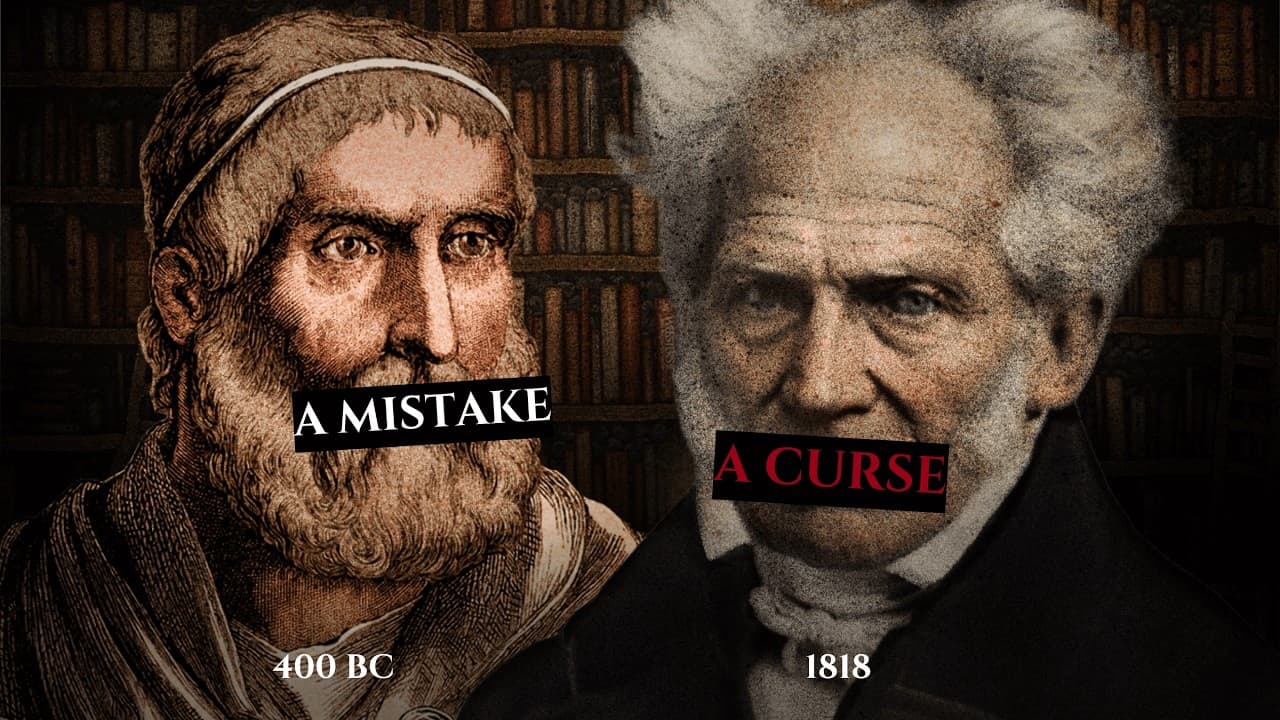
Best of All Is Never to Be Born | Antinatalism for Sleep
The oldest, strangest verdict in philosophy, that it might be better never to have been born.
Long before the word existed, the wisest voices of the ancient world kept arriving at the same strange verdict, that it might be better never to have been born at all. This episode follows that thought across the centuries, from a captured satyr and the chorus of a Greek tragedy to the systematic pessimism of Schopenhauer, who made suffering the ground note of existence.
From there it moves through the strangest corners of the tradition, a philosopher who imagined a God who chose to die, a Norwegian who called consciousness an evolutionary mistake, and a sleepless Romanian who turned despair into aphorism. At its center stands the modern argument that made the idea respectable again, David Benatar's claim that coming into existence is always a harm, with the questions of consent, suffering, and the harm we do woven around it.
Along the way it gives the other side a full hearing, including its greatest adversary, the thinker who answered the ancient verdict by daring to love his fate.
The full episode is on YouTube and Spotify. Please listen only in safe, restful contexts.
Enjoying the episode?
Occasional letters on philosophy, reading, and the examined life. No spam, ever.
By subscribing you consent to receiving occasional emails. Unsubscribe any time via the link in every email or at /unsubscribe.
Timestamps
- 0:00:00Chapter 1: The Wisdom of Silenus
- 0:11:46Chapter 2: A Word for the Position
- 0:17:51Chapter 3: The Wheel of Rebirth
- 0:26:10Chapter 4: The Best of All Possible Worlds
- 0:32:41Chapter 5: The Philosopher of the Will
- 0:44:05Chapter 6: Better Not to Be
- 0:51:50Chapter 7: The God Who Died
- 0:58:16Chapter 8: The Last Messiah
- 1:07:36Chapter 9: The Trouble with Being Born
- 1:14:19Chapter 10: The Asymmetry
- 1:27:26Chapter 11: The Pollyanna in the Mind
- 1:32:57Chapter 12: The Question No One Was Asked
- 1:42:05Chapter 13: The Sum of Suffering
- 1:53:37Chapter 14: The Harm We Do
- 2:02:29Chapter 15: Consciousness, the Malignant Gift
- 2:08:36Chapter 16: A Line of Poets
- 2:17:31Chapter 17: The Man Who Said Yes
- 2:28:48Chapter 18: Why Not Simply Die
- 2:34:43Chapter 19: The Case Against
- 2:43:18Chapter 20: The Silence We Choose
- 2:50:03Chapter 21: The Compassion Core
- 2:58:35Chapter 22: The Verdict Returns
For the record
Full Transcript
Chapter 1: The Wisdom of Silenus
Picture a king in the hills of an old kingdom called Phrygia, far to the east of the Greek world, where the slopes are heavy with vines and the streams run cold out of the rock. The king's name is Midas, and he is hunting, though not for any animal that runs. For a long time his shepherds have brought him the same strange story. At the edge of the woods, where the cultivated land gives way to the wild, they have seen an old creature, half man and half beast, with the ears and the tail and the heavy legs of a goat, fat with age, slow with wine, who sleeps in the long grass at noon and sings to himself when he believes that no one is listening. This is Silenus, the oldest of the satyrs, the companion and the foster father and the tutor of the young god of wine, and he is said to be wiser than any man who has ever lived. He has drunk from springs that no mortal has ever found. He has watched the world turn for longer than the kingdoms have stood, and he is supposed to know the things that the gods keep back from men, to carry inside him, lightly, whatever it is the gods will not tell us while we are alive.
So Midas lays a trap, and the trap is a gentle one. He finds the spring where the old creature comes down to drink in the heat of the day, and into the clear water he pours dark and unmixed wine, and then he hides himself and waits. In time Silenus comes. He lowers his face to the water and drinks, and the wine works in him as it works in everyone, and his great head grows heavy, and he sinks down into the grass and sleeps. The king's men come out softly and bind him, not with iron but with ropes of flowers, garlands wound around his wrists, and they lead the swaying, half laughing, half sleeping old thing back through the gates and into the king's own hall, the most ancient and knowing creature in the world led home like a guest who has taken too much at a feast, flowers at his wrists in the place of chains.
For some days Midas keeps him there, and they say the two of them talked, the mortal king and the deathless drunk, though almost everything that passed between them is lost to us now. But one question survives, and it survives because it is exactly the question a man would ask if he had the wisest creature in the world bound and cornered in his house. Midas asks him what is the best thing for a human being. Not the best thing to eat, or to own, or to seek, but the finest and most desirable thing of all, the one thing a person should wish for above every other. And at first Silenus will not answer. He laughs, and holds his tongue, and looks away. Only when the king presses him, and presses him again, and will not be refused, does the old creature finally speak. And what he says is the last thing the king wants to hear.
The best of all things, Silenus tells him, is something that no human being can ever have. It is this. Not to have been born at all. Never to have come into being. Never to be. And since that gate is already shut behind you, he says, since you are here and breathing and standing over me, the next best thing, the only good still left within your reach, is to die soon, and to go back quickly into the nothing out of which you came.
Then the laughter is gone, and the king is left alone with the answer he has forced out of the only mouth that could not lie to him. He had wanted a secret, some hidden good that the wise know and the rest of us miss. What he received instead was the news that the best thing was already behind him before he drew his first breath, and that the second best lay only at the far edge of his life. There was nothing in the middle for him to reach toward, only the long way out.
We might expect the ancient world to have laughed this off, the way we would laugh off a riddle told by a drunk spirit of the woods, a piece of dark comedy from the old myths and nothing more. But the strange thing, the thing worth staying with in a quiet hour, is that the ancient world did not laugh. It remembered. It wrote the answer down and repeated it. The verdict of Silenus is not one odd voice on the edge of the forest. It returns, in the mouths of the most serious and the most honored people that antiquity produced, again and again, until it begins to sound less like the joke of a captured satyr and more like something half remembered, something that a great many people seem to have known and very few have been willing to say aloud.
Hear it again, set this time to music, on the public stage of Athens. Sophocles, the most celebrated of the Greek tragic poets, wrote his last great play in extreme old age, near the very end of a long and honored life, and it was first performed only after he was dead, in the years just after four hundred before the common era. The play follows the old blind Oedipus, ruined and worn down to almost nothing, as he comes at last to a quiet grove outside the city, at a place called Colonus, to die. And in that play the chorus, the gathered voices of the old men of the place, lift their heads and sing what is almost the verdict of the satyr word for word. Not to be born at all, they sing, surpasses every reckoning. That is the best of all things. And the second best by far, once a man has seen the light of day, is to go back again, as swiftly as he can, to the place that he came from. They do not sing it as a scream or a curse, but slowly, as the settled knowledge of men who have lived long enough to bury most of what they once loved.
Consider who is singing, and when. This is not the complaint of a young man who has been disappointed once. It is the last word of a poet who had lived through nearly a century, who had known fame and wealth and honor and the long love of his city, who had been given more of what the world calls good fortune than almost anyone alive, and who, at the close of all of it, set these words in the mouths of his chorus as a thing that the old and the wise simply know. A bitter man we might dismiss. A failure we might pity and set aside. But here the verdict comes down to us from the very summit of a life that the whole of Athens would have called blessed, and a thing said from that height is far harder to wave away.
Go back another hundred years and more, and the same verdict is already there. Theognis, a poet of the city of Megara who lived in the sixth century before the common era, wrote his verses as advice and lament to a younger man named Cyrnus, and among them stands this. The best thing of all, he says, for those who live upon the earth, is never to have been born, never to have looked upon the sharp rays of the sun. And the next best, for the one who has already been born, is to pass as quickly as he can through the gates of death, and to lie down under a deep heap of earth. He sets it down plainly, between one piece of worldly counsel and the next, the way an older man hands a younger one a truth too important to soften.
And the verdict is not only Greek. It rises, in its own words, out of the scriptures of a different people altogether, in a different language, under a different sky. In the third chapter of the book of Job, a man who has lost his children, and his wealth, and his health, and very nearly his reason, sits down in the ash and opens his mouth, and he curses the day that he was born. Let that day perish, he says. He wishes that the night of his conception had shut the doors of the womb against him, so that he had never been carried out into the light to see this trouble at all. Why, he asks, did he not die as he came from the womb. Why were there knees to receive him, and why a breast that he should be nursed and kept alive. This is not the cool reasoning of a man at his ease. It is grief torn open to the root, and yet the place his grief drives him to is the very place the satyr pointed, the wish never to have been.
And it rises once more, calmer and colder, with no personal grief behind it at all, in the book called Ecclesiastes. There, in the fourth chapter, a voice that has tried everything the world has to offer, and tasted all of it, and found it empty, looks out at the great weight of oppression done under the sun, at the tears of the wronged who have no one to comfort them and no power in their hands. And it reaches the same conclusion by a colder road. The dead, it says, who are already gone, are better off than the living who are still here and still suffering. But better than both of them, better than the living and better than the dead, is the one who has never been at all, who was never born, and who has therefore never had to see the evil that is done beneath the sun.
Stand back now and listen to all of these voices together. A king's tale out of the Phrygian hills. A chorus on the Athenian stage. The verses of a Greek nobleman a century older still. The cry of a ruined man in the ash, and the cool summing up of a preacher who had everything. Different languages. Different gods, or one God, or none. No shared library, no single teacher passing the thought from hand to hand. And yet across all of that distance the same sentence keeps forming, almost in the same shape, as though it were being discovered again and again rather than copied. The best thing is never to have been. The next best is to leave soon.
These are not the words of broken or foolish people, and that is part of what makes them so hard to set down. They are the words attributed to the wisest creature in the world, and sung by the greatest poet of his age, and written by men whom their cities honored and whose books outlasted their bones. They came, very often, not from the failures of life but from those who had drunk it to the bottom and seen the whole of it, the good as well as the bad. They spoke not in the heat of a single bad night but in the calm that comes after, when the wine has worn off and the grief has cooled, the hour when people tend to say what they truly believe. Which leaves us, at the very start, holding a question that does not loosen its grip easily, and that the long hours ahead will follow wherever it leads. Why. Why should so many of the clearest and most honored minds of the ancient world, looking steadily and with open eyes at the whole of a human life, have turned and come back with the same dark answer, that the finest thing of all, the thing forever out of our reach, would have been never to have been born at all.
Chapter 2: A Word for the Position
There is a name for the feeling the old voices reached for without ever quite holding it still. The position is called antinatalism, and it holds, in the plainest terms, that it is a mistake, or a harm, or at the very least a misfortune, to bring a new person into existence. That is the whole of it, stated once and stated cleanly. To begin a life is, on this view, not the gift we take it to be, but something closer to an imposition, a weight set on shoulders that did not exist to refuse it. The word may be unfamiliar, and we can set it aside almost at once, because the idea beneath it is simple enough to carry without the label. The thought is only this. Perhaps no one should be born. What this chapter does is not argue for that claim or against it, but draw its borders, so that we know exactly what we are looking at, and, just as importantly, what we are not.
For the position is surrounded on every side by things it resembles and is not, and most of the resistance it meets comes from being mistaken for one of them. So let us mark off three of these neighbors carefully, one at a time, because the whole of what follows depends on keeping them separate.
The first confusion is the gravest, and it is the belief that to say no one should be born is to wish that the living were dead. It is not. The antinatalist looks at the people who already exist, every one of them, and wishes them well. Their concern is with beginnings, with the act of starting a life that has not yet started. They draw a sharp line between the question of whether to light a fire and the question of what to do once it is burning, and they stand entirely on the near side of that line. There is a further and harder question hidden here, about why, if a life is a harm, one would not simply end it, and that question deserves its own patient answer in its own place. For now it is enough to say that the line is real and that the antinatalist holds it firmly. To wish a person had never been is not, on this view, to wish that person gone.
The second confusion is that this must be a hatred of human beings, a contempt for our species dressed in the language of philosophy. It is not that either, and in most of its serious forms it is something like the opposite. The person who concludes that no child should be born is very often moved by exactly the regard for others that we would call decent, even tender. They are not disgusted by people. They are worried for them. The wish that no one should ever be hurt is, for many who hold this view, the engine of the whole thing, and we will see in time what that costs and where it leads. The point to fix now is only the negative one. To find the act of creating a life troubling is not to despise the lives that result. One can hold the position and love every person one has ever met.
The third confusion is the most ordinary, and it is the easiest to fall into, because it lives so close to the truth. It is the assumption that all of this is simply gloom. That the antinatalist is a sad person, that the position is a sadness given a fancy name, that it is what unhappiness says when it learns to speak in arguments. And nearer still to the surface is the suspicion that we are really talking about an illness, about the heavy, flattening condition the doctors call depression, in which the world loses its color and the future seems closed. These are not the same thing, and the difference matters more than almost anything else here. A mood is a weather. It rolls in, it darkens the day, and in time, or with care, or with the right help, it lifts, and the sky is the same sky it always was. A mood does not ask to be agreed with. You cannot refute a grey afternoon. You can only wait for it to pass.
And that is exactly what tells the position apart from the sadness it is mistaken for. Antinatalism does not present itself as a weather. It presents itself as a conclusion. It comes forward holding reasons, and it asks not for sympathy but for assessment. It says, in effect, here is a claim about the value of beginning a life, and here are the steps by which I reached it, and now your task is not to feel for me but to look at the steps. Are they sound. Does the conclusion follow. A person in good spirits, well slept and well loved, can work through such an argument and find it persuasive against every instinct, and that is precisely the unsettling thing about it. It does not need despair to run on. It can be put to a cheerful mind and trouble that mind all the more for the cheer. By the same measure, it can be answered. An argument is the kind of thing that can be taken up and turned over and, in the end, accepted or refused. A mood cannot be refused. This one can. That is the whole difference between a feeling and a position, and it is why the rest of what follows is worth the trouble of thinking through rather than merely feeling.
So we have our borders. The view is not a death wish, it is not a hatred of humankind, and it is not a low mood wearing a serious face. It is a claim that bringing a new person into the world may be the wrong thing to do, offered as a thing to be reasoned about, and met, finally, with a yes or a no. Everything that comes after is the long attempt to decide which.
Chapter 3: The Wheel of Rebirth
More than two thousand years ago, on the plains of northern India, the man we remember as the Buddha began his teaching not with a promise but with a diagnosis, and the first thing he named was suffering, the truth that ordinary life turns upon a wheel of being born, of dying, and of being born again, and that the wheel keeps turning.
We should slow down on that word, suffering, because the plain English does not quite carry its full weight. The Buddha did not mean only the obvious agonies, the broken body, the lost child, the slow failure of the things we love. He meant something wider and quieter as well, a dissatisfaction that runs underneath even our happiness. He meant the way a good meal ends, the way a longed for evening is over almost before we have noticed it began, the way the thing we wanted, once we finally hold it, starts at once to fade or to pall. Even our pleasures are edged with loss, because they do not last, and somewhere within us we already know they do not last.
This is the first of what he called the noble truths, and it is the ground on which everything else is built. Existence, as we ordinarily live it, is shot through with a low and constant unease, a sense that things are not quite right, that satisfaction always lies a little further on than where we are standing. It is not that life holds no joy. It is that the joy is thin, and brief, and shadowed by its own ending, and that we spend our days chasing a contentment that will not stay still long enough to be kept.
But the Buddha's picture was larger than a single lifetime. In the world he inhabited, death was not a final door but a turning. A being who died was understood to be born again, into another life, and that life too would close in death, and death once more give way to birth, around and around, lifetime after lifetime, with no visible edge to the whole great turning. Picture a wheel that never reaches the bottom of its rotation, that rises only in order to come down again. That is the round of existence as he described it, and to be caught in it is to suffer the first truth not once but without end, life following upon life following upon life.
So we are led to ask why the wheel keeps turning at all. Here the Buddha gave an answer of real precision. The wheel is driven by craving, by the deep and restless thirst in every living thing to have, to hold, to become, to go on existing. We reach for what we want, and we flinch from what we fear, and in that ceaseless reaching and flinching we fasten ourselves to the next turn, and then to the next. Craving is the fuel. As long as it burns, the round continues, because the very wanting that fills a life is also the thing that calls the next life into being.
To this the Buddha joined a second idea, one that English has borrowed and worn smooth with use, karma. In its plainest sense karma means only action, a deed that is done. But he gave it a moral weight. Every deed, every word, and even the inward leaning of a thought, carries a kind of momentum, and that momentum is not spent when the body dies. It is carried forward. The shape of a life, in this vision, is owed in part to the moral freight of the lives that came before it, and the way a person acts now will bend the path of whatever is still to come. The wheel, then, is not blind and it is not indifferent. It is moral through and through, and each turn inherits the weight of the turn before it.
If craving is what keeps the wheel in motion, then the way off the wheel is to let the craving fall away. This is the heart of the whole teaching, and it is worth stating as plainly as it can be stated. The aim is not to bear existence with a little more grace. The aim is release, a true and final end to the round of birth and death, a stepping off the wheel so that, for this being at least, it turns no more.
The word the tradition uses for that release is one the English language already speaks every day, nirvana, and the image folded inside the word is humble and exact. It means a blowing out, the way a candle flame goes dark when there is nothing left to feed it, a cooling after long heat. The fire that goes out is craving itself, the thirst that kept the whole thing burning. And the way to put that fire out is not force, and not despair, but sight. It is a waking up. The very title we know him by means the one who woke, and what he woke from was the long dream of wanting, the trance in which we keep mistaking the chase for the prize. To see existence clearly, all the way down, is to loosen its hold, and when the last of the craving is gone, there is nothing left to draw the being back onto the wheel. The fire is out. The wheel is still.
Now we must be careful, because it would be easy to fold this teaching into the old human wish that it is better never to be born, and to treat the two as a single thing. They are not a single thing. This is a cousin of that wish, and a close one, sharing its blood and much of its face, but it remains its own creature.
The two do begin in the same place. Both look hard and unflinchingly at existence and find it steeped in suffering, and both refuse the comfort of pretending otherwise. Neither will say that simply to live is plainly and obviously good. But they part, and they part decisively, on the question of what is to be done. The view that birth itself is a harm turns outward, toward other people not yet born, toward the question of whether to bring a new person into the world at all, and it answers that the kindest course is not to begin a new life. The Buddhist path turns the other way, inward, toward the self that is already here and already suffering. It does not tell parents not to have children. It does not stand over the cradle of a newborn and judge that life a mistake. Its quarrel is not with birth as something we choose to lay upon another. Its quarrel is with rebirth as a fate that keeps befalling oneself, again and again, until the craving that drives it is at last stilled.
The difference is the whole difference. One says, let no further lives begin. The other says, let this chain of lives, my own, come finally to rest. The first is an argument about whom we ought to bring into being. The second is a discipline of waking, walked by a person already in the world, who wishes not to deny a child the morning of its life but to stop being drawn, over and over, back onto the round. The goal is to step off the wheel through awakening, not to forbid another foot from ever stepping onto it.
And so the silence the Buddha pointed toward is a particular silence. It is not the bitterness of a verdict passed upon all of birth. It is the quiet of a fire that has burned down to nothing because it was understood, and let go, by the one who had carried it. That stillness is meant to be walked toward, with open eyes, across the length of a single life. It stands, in the long history of those who have looked at existence and flinched, as one of the oldest and gentlest of all the answers, an answer that does not curse the world for turning but only, in the end, steps quietly down from the wheel.
Chapter 4: The Best of All Possible Worlds
There was an age that looked at the world, with all its griefs and ruins, and decided that this was the best of all worlds that could possibly exist. The educated mind of the seventeenth and eighteenth centuries had grown bold. It had new mathematics, new instruments, a new confidence that the universe was a vast and reasonable order, and it turned that confidence on the oldest wound in human thought, the question of why a good and almighty maker would permit so much suffering in his creation. The answer it gave was not a sigh but a proof.
The clearest form of that answer came from a German philosopher of the first rank, a man as much at home in mathematics as in metaphysics, who published a book on the justice of God in seventeen ten. His reasoning ran like this. A maker who is perfect in power, in knowledge, and in goodness, looking out before creation at every world he might bring into being, would see them all laid out before him, each complete, each different. Such a maker could not choose carelessly. He could not choose a lesser world while a better one lay within his reach, for that would be a failure either of his goodness or of his power, and by his very nature he has neither failing. So he must have chosen the best. And since he did choose, since this is the world that actually stands, it follows that this world, with everything in it, is the finest that could be made.
What then of the evil in it. The plagues, the cruelties, the early graves. Here the argument grows subtle and, in its way, beautiful. The evils, it says, are not flaws in the design but threads in it. Picture a great painting in which a patch of darkness, looked at alone, seems only ugly, yet pulls the whole composition into balance once you step back and see the canvas entire. A single thread of shadow may be the very thing that lets the light around it shine. So with the world. Each particular suffering, however bitter to the one who feels it, is a necessary part of a whole that is, taken all together, better with that suffering woven in than it would be without it. We see the thread. The maker sees the cloth. This is the doctrine that the world later learned to call optimism, though it meant something far stricter than cheerfulness. It meant that no better world was so much as possible.
It is a consoling thought, and for several decades much of educated Europe more or less believed it, or believed it the proper thing to say. And then the belief met the world.
On the first of November, seventeen fifty-five, a morning of worship, the ground opened beneath one of the great port capitals of Europe. The churches were full. In a matter of minutes the city was broken, and what the shaking did not bring down the fire and the sea that followed finished, and tens of thousands of people, many of them at prayer in that very hour, were dead. The catastrophe fell on the comfortable certainties of the age like a hammer. If this is the best of all possible worlds, men began to ask, then what would a worse one even look like, and what kind of best includes a holy morning that ends ten thousand lives at the altar.
Out of that question, four years later, in seventeen fifty-nine, came the most lethal piece of mockery in the history of philosophy, a short, swift, savage tale by the sharpest pen in France. Its hero is a guileless young man, gentle and trusting, raised in a sheltered house by a tutor who has taught him one lesson above all others, that everything that happens happens for the best, that this is the best of all possible worlds and every misfortune in it serves some hidden good. The boy believes his teacher completely. And then the story drives him out into the world to test the lesson.
What follows is one disaster after another, piled on with a cruelty that is meant to be funny and is also meant to hurt. The boy is beaten, conscripted, robbed, shipwrecked, caught in that very earthquake, separated from everyone he loves, and at each fresh horror the teacher, when he survives to speak at all, insists again that all is for the best, that this is still the finest of possible worlds. The teacher never learns. That is the whole point of him. He is the doctrine made flesh, a man so wedded to his proof that no quantity of real pain can reach him through it. The reader watches the cheerful theory get tortured out of the pupil, page by page, until the young man can no longer say the words his teacher gave him and mean them.
The tale does not end in despair, and it is wrong to remember it as a howl. It ends, famously, in a small and quiet retreat from grand answers, with the worn survivors agreeing that we must tend our own garden, that the patient work in front of us is more honest than any system that claims to justify the whole of creation. But the work of demolition was done. After it, the confident proof that all evil is necessary, that the cloth is perfect and only the threads look dark, could never again be stated to a thinking audience without the memory of that ruined city, and that ridiculous, unteachable tutor, rising behind it.
This is the wall. The serene claim that a perfect maker, choosing among all the worlds he could have made, chose this one, and that its every evil is simply the price of the best. It is a claim built to comfort, and for a time it did. But comfort that can be broken by a single morning is a fragile thing, and the men who came after had felt it break. Against this wall, and against the easy reassurance it offered, the pessimists of the next century would come to throw themselves with their whole weight, no longer content merely to mock the optimism but determined to overturn it, and to argue, in cold and careful order, the reverse.
Chapter 5: The Philosopher of the Will
There was a man who looked at the world the rest of us take for solid and ordinary, the world of tables and weather and people going about their errands, and concluded that all of it was a kind of surface, a skin stretched over something restless underneath. His name was Arthur Schopenhauer, and the something underneath, he came to believe, was a single blind striving that wants without end and is satisfied by nothing. To grasp that, he thought, was to understand why a life can be given everything it asked for and still find no rest. He spent the better part of his years setting this vision down in patient, ferocious prose, and for most of those years almost no one listened.
He was born in seventeen eighty-eight in the Baltic port of Danzig, into money and into trade. His father was a wealthy merchant, a man of business who expected his son to become one too, and who carried the boy on long journeys through Europe partly to educate him and partly to bind him to the family firm. Then, in eighteen oh five, the father died. He was found in the canal beside his own warehouse, most likely by his own hand. It was a grief, and it was also, in a way the son never quite said aloud, a release. The fortune the father left behind meant that Arthur, once he had served out a decent interval in the counting house, was free. He never had to sell anything again. He could read, and think, and become the one thing his father had not chosen for him, a philosopher.
His mother was the other great figure of his early life, and the harder one. She was a successful novelist, popular and widely admired, who after her husband's death moved to a city of writers and kept a literary salon where the famous authors of the day came to talk. She was sociable where her son was prickly, light where he was heavy. They did not get on. The quarrels grew sharper until, after one final rupture, they parted for good and never saw each other again, though both of them lived on for decades. He kept his inheritance and his grievances. She kept her salon. In their own lifetimes she was by far the more celebrated writer of the two, and that fact sat in him like a stone.
When he was a young man with his system already formed, he tried to take his place in the university world, and here the story becomes almost painful to watch. He won the right to lecture in Berlin, and with a confidence that looks now like pride and now like simple miscalculation, he set his lectures at the very same hour as the most powerful philosopher in Germany, the reigning idealist Hegel, whose lecture hall was crowded to the walls. The students, given the choice, chose the famous man. Schopenhauer lectured to a nearly empty room, a handful of listeners, sometimes fewer, while next door his great rival held the age in his hand. He gave it up before long. For the rest of his middle years he was, in the public mind, no one at all. His great book sat unread. Unsold copies were pulped for scrap. Here was a man who believed he had seen clear to the bottom of existence, and the world walked past his door without slowing.
So he made a life out of order. He settled at last in the free city of Frankfurt, on the river Main, and there he built the narrow, exact routine of someone who has given up on the crowd and not on himself. He rose at the same hour, wrote in the morning when his mind was clearest, played the flute before lunch with real skill, dined at a set time, walked the same long walk each afternoon in every weather, and read himself to sleep. Beside him through the years went a succession of poodles, each one his companion, each in its turn replaced, so that the same dog seemed to pad forever at the philosopher's heel. He could be vain, suspicious, and sharp of tongue. He was also disciplined in a way that few unhappy men manage, turning his days into a kind of fortress against the very restlessness he wrote about.
The book that held everything he knew had appeared when he was still young, in eighteen eighteen, under a title we can put into English as The World as Will and Representation. It made almost no impression. Yet he never really changed his mind about a line of it. Instead, more than a quarter of a century later, in eighteen forty-four, he brought out a second volume, longer than the first, not a correction but an expansion, chapter after chapter of commentary that turned the single arch of the original into something vast and lived in. The title names the whole of his thought in a handful of words. The world is two things at once. It is representation, and it is will.
Begin with representation, which is only a careful word for the world as it appears to us. Everything we see around us, the room and the light in it, our own hands, the faces we love, reaches us as a picture assembled in the mind, laid out in space and time, ordered by cause and effect. This is the world the sciences study and the world we move through every waking hour, and Schopenhauer did not doubt for a moment that it was really there. But he insisted it was appearance, the world as shown rather than the world as it is in itself. A picture implies something pictured. A surface implies a depth. And the question that drove him was the oldest and the simplest. What lies underneath.
His answer was that we already know, because each of us is, from the inside, one small piece of that depth. We find ourselves in the world not only as a body seen from outside but as a wanting felt from within, the hunger, the desire, the dread, the unthinking clench of the will to live. Schopenhauer took that inner wanting and made it the key to everything else. The force we feel in ourselves as will, he argued, is the same force at work everywhere, in the plant pushing toward the light, in the river feeling its way to the sea, in the weight that draws a stone to the ground. It is a single blind striving that is the inner nature of all things. He called it the Will. It does not think. It has no aim beyond its own continuing. It simply wants, endlessly, and we and everything else are the shapes it briefly takes.
And here the vision turns dark, by a logic so plain that it is hard to shake off once it is seen. To will, Schopenhauer observed, is to want, and to want is to lack. Desire begins in a felt absence, a need not yet met, and that absence is by its very nature a small suffering. As long as we are willing, which is as long as we are alive, we are wanting something we do not have. Satisfaction, when it comes, does not put an end to this. It closes one desire and clears the ground for the next to rise. The wanting itself never stops, because the Will beneath it never stops, and so to exist as a willing creature is to live in a state of permanent, renewing need. Suffering, on this view, is not some accident that befalls a life from outside. It is the basic texture of being alive at all.
This is why he held that pleasure is never quite what it seems to be. We picture happiness as something solid, a positive thing we reach out and take hold of. Schopenhauer turned it the other way around. What we call pleasure or satisfaction, he argued, is only the absence of a particular pain, the brief silence after a particular want has been stilled. The relief of cool water is real, but it is the ending of an ache, not a good laid on top of an untroubled life. Pain, for him, is the thing actually felt, the positive presence. Pleasure is merely its temporary lifting. We mark the suffering sharply and overlook the long flat stretches of mere absence that we had mistaken for contentment.
From this he drew the image that haunts nearly everything written after him, the picture of a human life as a pendulum. We swing, he said, between two poles, and come to rest at neither for long. On one side stands pain, the ache of the desire not yet met, the striving that hurts precisely because it has not yet reached its object. We labor to escape it, and sometimes we do. We get the thing we wanted. And then, on the other side, once the want has gone quiet and nothing presses on us, there opens the second pole, boredom, the empty time in which we do not know what to do with ourselves and begin, almost at once, to want again, if only to be free of the emptiness. Desire torments us, and the absence of desire bores us. Between that pain and that boredom the pendulum goes back and forth, and the swing of it, for Schopenhauer, is the whole shape of a human day and of a human life.
He knew he was not the first to find the world built upon suffering. The old teachers of the East, the Buddhist sages with their wheel of craving, had said something near to it long before. But he was perhaps the first to argue it in the cold, clear language of European philosophy, as a conclusion forced upon him by reasoning rather than a creed received on faith. He thought he had not merely felt the truth of existence but proved it, step by careful step, and that the proof was there on the page for anyone with the patience to follow.
And then, late, the strangest turn of his life arrived. In eighteen fifty-one, an old man by now, he published a book of essays and short reflections on ordinary human matters, written in hard, witty, plainspoken prose, and almost by accident the wider public found him. The fame that had passed him by for thirty years came all at once. Readers sought him out. Younger writers travelled to the city on the Main to sit in his company and listen. He lived to see it, this man who had once lectured to an empty room, and he received it with the grim satisfaction of someone proved right too late to enjoy it cleanly. He died in eighteen sixty, quietly, at his own table, his great work finished and, at the very last, read.
Chapter 6: Better Not to Be
He reached the conclusion that nearly everyone who thinks this far draws back from at the last moment. Having found that existence is, at its root, a long form of suffering, Arthur Schopenhauer took the step his readers half hoped he would refuse to take. He said, in plain words, that it would have been better not to be at all. The single blind striving he named the Will, that restless hunger beneath the orderly surface of things, and the weary swing between wanting and boredom, these were his foundation, and from them he reasoned forward to a verdict not about how we should live, but about whether we ought to be brought to live in the first place.
The verdict began with a quiet refusal to treat the making of a new person as ordinary. We treat it as the most natural thing in the world. Schopenhauer asked us to see it instead as a strange and weighty act, performed in the dark and on behalf of another, a life begun without the agreement of the one who must live it, a difficulty that later thinkers would take up and press much harder. His own attention, though, fell on a different question, one he could follow all the way down to its floor. Not whether the new person had agreed to come, but whether anyone, looking clearly, would ever choose to summon them at all.
Then he proposed a thought experiment that has unsettled readers ever since. In the second volume of his great work, The World as Will and Representation, he asked what would happen if children were not made in the heat of desire, but were called into the world by an act of pure cold reason. Imagine that no longing drove the matter, that no pleasure attended it, that a man and a woman simply had to sit down and decide, by honest reflection alone, weighing fairly everything that a human life contains, whether to summon a new person into being. Schopenhauer's answer was bleak and very quiet. He thought that, faced with the question in that cold light, many would find they could not do it. A man who truly considered the generation about to come, who looked clearly at what waited for them, might feel a pity so deep that he would choose to spare them the burden of being born at all. And if every one of us reasoned in that honest way, the human race might simply, gently, decline to continue itself.
Notice what he is and is not saying. He is not asking that anyone be harmed. He is saying that the species keeps going on the strength of a desire that never stops to think, and that thinking, if we ever truly let it govern the matter, might quietly stay our hand. Nature, he believed, does not trust us to make this decision well, and so it does not leave the decision to us. It works through wanting, and the wanting does not pause to ask whether the life it produces will be worth the having. The longing comes first, and the reckoning, if it comes at all, arrives far too late, when the new person is already here and already bound to the whole weight of an existence.
In his late essays he returned to these themes again and again. In the essay on the suffering of the world he set out once more the positivity of pain that already grounded his system, and from it drew the cold conclusion that a life, weighed honestly, tends to run at a loss. In the essay on the vanity of existence he looked at how a life empties itself out even as it is lived, how the present is forever slipping into a past that holds nothing, how we spend ourselves chasing satisfactions that dissolve in the very moment we reach them. A wish granted, he saw, becomes at once a wish forgotten, and the wanting moves on. Existence, he wrote, is a kind of business that never quite covers its costs.
We labour and we want and we strive, and when the books are finally balanced they are not balanced in our favour. The debt that every life runs up is paid off, in the end, in the only currency that can settle it, in suffering and in death.
This is a dark accounting, and it would be easy to mistake it for simple gloom, for a man merely cursing the world he was born into. But Schopenhauer believed he had found a way out, a single narrow door, and it is here that he becomes most interesting and most easily misread. The way out is not to fight the world on its own terms, not to want different things, or to want them harder, or to want them better. The way out is to stop wanting. He called it the denial of the will to live, and by it he meant a turning of the will against its own hunger, a refusal to go on feeding the engine that drives all the suffering in the first place.
He found his living examples among the figures most religions have honoured and most ordinary people have quietly thought a little mad. The ascetic. The saint. The one who gives away possessions, who steps back from the chase, who lets desire after desire fall away unanswered until the great hunger itself begins to grow still. Such a person is not trying to win the game of wanting. They have risen from the table and walked out of the room. They no longer reach for the world, no longer try to seize and keep and consume it, and in that letting go Schopenhauer saw the only real peace available to a human being. It is a stillness that comes not from getting what we want, but from ceasing to be ruled by wanting at all. He admired most the contemplative who turns away from the world rather than adding one more appetite to its endless churning.
And underneath all of this, holding the whole austere structure together, was something that may sound surprising in so bleak a thinker. The root of his morality was not duty, and not the command of any god, but pity. Compassion, the plain fellow feeling that stirs in us when we watch another creature suffer, was for Schopenhauer the one true ground of all goodness. When we act well toward another, he thought, it is because the wall between us and them has for a moment worn thin, because their pain has become, in some real and immediate way, our own. And he extended that feeling far past the human. The animal that suffers, the beast that fears and hurts, fell inside the circle of his compassion, because it too is driven by the same blind striving, and it too can be wounded by the world.
So the same tenderness runs through the whole of his thought, and it is worth holding the two ends of it together in the mind at once. The man who pities the coming generation enough to wish it spared, and the man who finds the root of all goodness in pity for everything that suffers, are the same man, reasoning from the same quiet place. His turn against birth was never contempt for life. It was, as he understood it, the furthest reach of a mercy that looked steadily at the new life waiting to begin, saw clearly the long account of pain that life would one day have to pay, and wished, out of tenderness rather than coldness, that the bill might somehow never come due.
Chapter 7: The God Who Died
Imagine a God who, before there was a world, chose to die. Not a God who creates out of love or abundance, but one who finds his own perfect existence unbearable and longs only to be rid of it. This is the strange thought at the center of one of the darkest systems philosophy has ever produced, and it belongs to a man almost no one has read.
He wrote under a name he gave himself, Mainlander, setting aside the name he was born with. He was a German of modest means, born in eighteen forty-one, and his life was short. He produced one strange book, which in English we call The Philosophy of Redemption, and it appeared in the year of his death, eighteen seventy-six. He was thirty-five. We will come to the manner of his ending, because it is bound up with the book in a way that is hard to forget. First the vision itself, which is worth holding in the mind slowly, because it is unlike anything else in this long tradition.
Begin with the picture most religions offer. A God exists, complete and self-sufficient, and out of his fullness he makes a world. Mainlander turns this on its head. His God does not overflow into creation. His God wants to stop. Before time, before matter, before any of us, there was a single perfect unity, and that unity wished above all things not to be. But a perfect being cannot simply cease. To be perfect is to be whole, and a whole thing cannot reach outside itself to find the death it craves. So the only road to nonbeing ran through becoming. The one had to break itself into the many. It had to shatter into the countless scattered things of the universe, into stars and dust and stones and creatures, precisely so that each of those fragments could wear itself out and so carry the whole, piece by piece, toward the rest it sought.
On this view the world is not a creation at all. It is the corpse of God, still cooling. It is the long, slow working out of a death that began at the dawn of things and has not yet finished. Everything that exists is a splinter of that original unity, and everything that exists is on its way down, dispersing, decaying, coming apart toward a final stillness. The history of the cosmos is one enormous dying, drawn out across ages, and we are inside it.
Now comes the part that gives the system its terrible coherence. Mainlander had learned from his master, Schopenhauer, that beneath the orderly surface of the world there runs a blind striving, a will, and that this striving is the source of our suffering. But where his teacher heard in that striving a will to live, a hunger that wants only to go on wanting, Mainlander heard something else. He heard a will to die. The deepest drive in all things, he said, is not the urge to survive but the secret longing to be finished. The plant that exhausts itself, the animal that ages and falls, the star that burns down, the human being who wears out under the weight of years, all of them are obeying the same hidden current, the same pull toward the rest that lies at the bottom of everything. What looks like the will to live is only the will to die taking the long way around. We struggle and grasp and reproduce, and in doing so we spend ourselves, and spending ourselves is the point. The universe is running down, and its running down is its only purpose.
From this follows his idea of redemption, and it is the strangest turn of all. If the world is God's chosen death, then to die is not a defeat. It is a homecoming. It is the fragment rejoining the rest it was always seeking. Salvation, for Mainlander, is not escape into some higher life. It is the quieting of striving, the cooling of the will, and at last the gentle extinction of the whole restless enterprise. He thought humanity itself was moving in this direction, that as we grew wiser we would want less, struggle less, bring fewer new lives into the long dispersal, until the species itself fell quiet. The end he hoped for was not a paradise but a peace. Total, final, and empty. The completion of the death that started everything.
There is one more thing the world owes him, a small historical fact that history has mostly handed to another man. Years before a far more famous philosopher made the words ring through the age, Mainlander had already written that God is dead. In his mouth it was not a slogan about the loss of faith. It was the literal foundation of his cosmos. God had died, deliberately, at the origin, and the proof of it was the scattered, suffering, dying world all around us. The phrase that would later shake an entire century was first set down, quietly, by a man no one was listening to.
And then there is the end he made for himself, which the book seems almost to have demanded. The first printed copies of The Philosophy of Redemption reached him fresh from the press. He held in his hands the finished argument that existence is a death we are all completing, that the kindest fate is the cooling of the will, that to cease is to come home. And very soon after, within a day or two of those volumes arriving, he took his own life. The account that has come down to us says he did it standing on a stack of his freshly printed books, using the pile of his own pages as the platform from which he stepped out of the world he had described. We will not weigh here whether such a step can ever be answered. We only note how exactly the man matched his thought. He had written that the truest wisdom is the longing to be finished. Then he closed the book, and finished.
Chapter 8: The Last Messiah
A Norwegian thinker named Peter Wessel Zapffe argued, in a short and chilling essay he called The Last Messiah, that the human mind is an organ that grew too large. He published it in nineteen thirty-three, and in a handful of pages he set out one of the bleakest pictures of our condition that anyone has ever drawn. The trouble with us, he said, is not that we think too little. It is that we think too much, that consciousness in our species swelled past the point of usefulness and became a burden the creature carrying it can barely stand.
Zapffe was born in eighteen ninety-nine and lived until nineteen ninety, a long life spent in large part among the mountains of the far north. He was a serious climber, a man who loved rock and ice and high cold air, and there is something fitting in that. A mountaineer learns to look straight at a drop without flinching, and Zapffe looked straight at the human situation in the same way, calmly, without turning his eyes from the edge. What he saw there he refused to soften.
His central image comes from the deep past, from the great ice age. There was a kind of deer that ran across the cold plains of Europe, often called the Irish elk, and the males of this animal grew antlers of an almost unbelievable size. Vast sweeping crowns of bone, spreading wider than a tall man can reach, beautiful and useless and heavy. For a long time those antlers may have served the animal well, in display and in struggle, and so each generation that carried the largest and broadest of them tended to leave the most young behind. The trait was rewarded, and so it grew, and grew, until the very thing that had once helped the creature began to help destroy it. The antlers became too much. They were too heavy for the neck, too broad for the forests the climate was bringing, a magnificent overgrowth that the animal could neither use nor put down.
That deer, Zapffe says, is us. Not in our bodies but in our minds. At some point in the long story of life, in one upright animal on the African plains, the faculty of awareness kept expanding the way those antlers expanded, rewarded at every step, until it overshot the mark and became something the creature could not carry in peace. We did not merely grow clever. We grew clever enough to stand outside ourselves and look. We became the one animal that knows it is an animal, the one that sees its own death coming from far off, that can ask what the point of any of it is and find no answer that satisfies. The deer was crowned with bone. We are crowned with knowing, and the crown is too heavy.
Here is the heart of his claim. Every other living thing fits its world. The fish wants water and is given water. The bird wants to fly and is built to fly. Need and world are matched. But in the human being a need appeared that the world cannot meet, a hunger for meaning, for justice, for permanence, for some reason that the whole arrangement should be as it is. We want the universe to answer us, and the universe says nothing. We are, in Zapffe's grim phrase for it, a creature whose deepest demand the cosmos cannot satisfy, an animal overequipped for life, carrying more awareness than any life can bear to hold open at once.
If that were the whole story we could not go on for an hour. The remarkable thing, Zapffe noticed, is that we do go on. We wake, we work, we laugh, we plan for years we may not see. We do this not because the terror is false but because we have learned, without ever deciding to, a set of tricks for keeping it out of sight. He found four of them, four ways the human mind shuts the door on its own awareness, and once you have heard them named you begin to see them everywhere, in others and then, less comfortably, in yourself.
The first is simply to wall the dread off and refuse to look. The mind learns, early and on its own, to keep the worst thoughts out of the lit room of attention, to push them into a back chamber and leave them there. We do not decide that life is bearable. We simply arrange not to dwell on the things that would make it unbearable, the certainty of loss, the nearness of death, the silence where an answer should be. Most of the time the door holds, and we are grateful, and we do not even know we are holding it.
The second is to fasten the mind to something solid and steadying, something larger than ourselves that gives the days a shape. A cause we serve. A faith we trust. A country, a family, a calling, even a fixed routine of small duties. We sink an anchor into one firm point and let it hold us against the drift, and as long as the anchor grips, we are spared the open water. Zapffe knew how fragile this can be. When a person loses the thing they had anchored to, the faith that fails, the cause that falls, the love that ends, the old dread comes flooding back through the gap, and we see how much weight that single point had quietly been carrying.
The third is to drown the feeling in noise and motion, to keep so busy and so entertained that the terror never finds an idle moment to speak in. We fill the hours. We crowd the silence with work and chatter and amusement, with one diversion after another, so that the mind is never left alone long enough to ask the questions it cannot answer. A life can be spent this way, pleasantly enough, in a kind of perpetual distraction that never quite lets the quiet in. Zapffe saw this clearly in nineteen thirty-three, long before our own age made distraction into something we carry in a pocket and feed all day.
The fourth way is the strangest and the one he plainly half admired, because it was his own. It is to take the dread and turn it into something else, to make it over into art, into thought, into creation. The poet who writes the poem of despair has, in the writing, set a little distance between the self and the wound. The philosopher who names the horror has, in naming it, gained a measure of mastery over it. We channel the terror outward into a made thing, a tragedy, a symphony, an essay on the human condition, and in shaping it we are no longer only its victim but in some small part its author. This last trick does not deny the darkness. It looks straight at it and fashions something from the looking. Zapffe's own bleak essay is, by his own account, an example of the very thing it describes.
So we survive. Walled off, anchored, distracted, transformed, we get through our days, and the species goes on having children who will learn the same four tricks in their turn and pass them down again. And it is exactly here, at the very end, that Zapffe turns from describing us to counseling us, and his counsel is the hardest thing in the essay. If our condition is truly this, if we are the over-evolved animal carrying an awareness that does not fit the world, then the brave and the merciful response is not to invent some new comfort, not to find a fresh anchor or a louder distraction. It is to see the situation plainly and to stop. The kindest course, he says, would be to know ourselves clearly at last, to bring no more children into this predicament, and to let the human line come quietly to its close, so that the earth falls silent after us and the long strain of consciousness is finally laid down.
It is a soft ending for so dark a thought. He does not call for despair or for any violence against the living. He calls for a gentle ceasing, a generation that understands what it is, declines to pass the burden on, and lets the species end the way a tired man at last lies down. The title of his essay carries the whole idea in two words. The last messiah is not one who brings a new faith to keep us going. He is the one who finally tells us the truth and asks us, kindly, to be the last. After all the prophets who promised that life could be borne if only we believed the right thing, here is the prophet who says the merciful message is to bear no more, to be infertile, and to let the silence come.
Chapter 9: The Trouble with Being Born
With Emil Cioran, the long argument against being born changes its shape completely. The thinkers before him built systems, great patient architectures of reasoning meant to hold the whole of existence in a single frame. Cioran built nothing of the kind. He wrote in fragments, in single sentences filed and polished until they gleamed, each one a small bitter flash that a reader could take in at a glance and then carry for years. In his hands the tradition becomes the aphorism, the thought pressed down until almost nothing is left but its sharpest edge.
He was born in nineteen eleven, in a mountain village in Romania, the son of a village priest. It was, by his own account, a kind of paradise, the open hills and the long childhood freedom, and he spent the rest of his life mourning the loss of it and doubting that any later happiness could ever match it. The fall, for him, was not from one place to another. It was the fall into time, into selfhood, into the ordinary daylight of being a person who must go on living.
The single fact that explains the most about him is that he could not sleep. The sleeplessness took hold of him while he was still young, and it never fully released him. Night after night he walked, first through the streets of his own town and later through the streets of larger cities, while everyone around him lay unconscious and at peace. He came to believe that those wasted hours had taught him everything he truly knew. The man who sleeps, he thought, is mended each night without noticing, handed back to himself clean and forgetful. The man who cannot sleep is spared nothing. He lies awake with the plain fact of existence, hour after hour, and he sees what the sleeper is allowed to forget.
Out of those nights came his whole way of thinking. A person who has watched too many dawns arrive without rest stops believing the comfortable things. Cioran came to see ordinary life as a feverish busyness laid over an emptiness that the sleepless cannot help but notice. And the deepest of his conclusions, the one to which he returned all his life, was simple and total. The catastrophe is not anything that happens to us. The catastrophe is that we were born at all.
In the nineteen thirties he left Romania for France, and there he made the strangest and most decisive choice of his life. He gave up writing in his native language and began again from nothing in the language of his adopted country, a tongue not his own, learned late and mastered slowly. The change cost him years. He said the discipline of writing in a borrowed language, where no word came easily and every phrase had to be weighed, taught him a hard clear style and cured him of all rhetoric. His first book in that adopted language, A Short History of Decay, appeared in nineteen forty-nine, and the cold brilliance of its prose startled the very people for whom that language was a mother tongue.
He lived the rest of his days in Paris, for many years in a small attic room near the gardens at the heart of the city, with little money and fewer possessions. He refused the things that other writers spend their lives pursuing. He took no university post, kept no steady employment, and turned down the literary prizes that came looking for him, including some of the most famous in France. Ambition, he thought, was simply one more way of refusing to see the truth, one more frantic project undertaken to avoid sitting still with what we are. He preferred the attic, the insomnia, and the blank page.
His best known book carries his central thought in its very name, the trouble, the affliction, the sheer awkwardness of having been born. The trouble with being born, he wrote, is not this misfortune or that one. Every particular sorrow, the illness, the loss, the failure, the long defeats of a life, is only a later installment of the one original accident, which is existence itself. Other thinkers spoke of a fall into sin, into guilt, into knowledge. Cioran's fall is barer than any of these. It is the fall into being here at all, into having a name and a body and a date, into the simple and unasked condition of existing rather than not.
We might expect such a man to be unbearable, and the surprising thing is that he is not. His pages are not heavy. They are quick, and they are funny, lit from inside by a humor so dry it can take a moment to notice. He writes of his own despair with the cheerful precision of a man describing the weather. He says he has no occupation beyond having been born, that he is a specialist in the catastrophe of existing. There is a lightness in it that feels almost like relief, as though a despair followed all the way to its end, accepted without protest and without any hope of cure, becomes a kind of freedom. Once we no longer expect anything from life, the smallest things, a walk, a conversation, a ray of sun, come back to us as unearned gifts.
His most famous sentence on the subject holds both halves of him at once, the bleakness and the joke. Not to be born, he wrote, is beyond all question the best thing that could happen to anyone. And then the turn, the small dark smile at the end. Unluckily, it lies within no one's reach. The best condition is the one we can never attain, because to consider it we must already be here, already born, already too late. The cure he recommends is the one cure that was never on offer.
It is the oldest verdict in the world, reduced to a single line a person can hold in the mind on a sleepless night. Cioran did not so much argue it as overhear it, again and again, in the long hours when he could not sleep, and then write it down in the cleanest words he could find. He died in Paris in nineteen ninety-five, an old man who had spent eighty-four years on an accident he never stopped finding remarkable.
Chapter 10: The Asymmetry
There is a living philosopher who took the ancient verdict that it is better never to have been and rebuilt it as an argument so clean that other thinkers, however much they disliked where it led, could not simply wave it away. His name is David Benatar. He teaches at the University of Cape Town, in South Africa, and he was born in nineteen sixty-six. In two thousand six he published a book whose English title states the whole of his position in advance, Better Never to Have Been, carrying the subtitle The Harm of Coming into Existence. The book did something the old cries of poets and prophets never had. It made the idea academically respectable, something that serious philosophers had to answer rather than dismiss. And at the center of it lies one small claim about pain and pleasure, a single imbalance between them, what Benatar calls an asymmetry, which is the only subject of what follows here.
A word first about the man, because there is so little to say. Benatar is, by every account, intensely private. He keeps almost no public face, gives few interviews, and lets the argument stand entirely on its own, in place of the person who made it. There is something fitting in this. The case he builds is meant to hold whether or not you like the one making it, whether or not you know anything about him at all. It is meant to work the way a proof works, by the force of its steps, and so the steps are what we must follow.
Begin with four plain statements about a single human life. They are so ordinary that at first they seem to say nothing.
The first. Pain is bad. When a person suffers, that suffering is a bad thing. No one needs to be persuaded of this.
The second. Pleasure is good. When a person enjoys something, takes delight in a meal, in music, in the face of someone they love, that enjoyment is a good thing. This too we grant at once.
So far the two sides seem to mirror each other exactly. Pain on one side, bad. Pleasure on the other, good. A life would then be a kind of ledger, the bad of its pains set against the good of its pleasures, and whether the life was worth beginning would simply depend on which column came out heavier. That is how most of us, without thinking much about it, assume the matter must be settled. Benatar's whole argument turns on showing that the two sides do not mirror each other, that the ledger is not balanced the way it looks. And the imbalance appears the moment we ask about absence rather than presence.
So consider the third statement. The absence of pain is good. If there is no suffering, that is a good thing. And here Benatar adds the line that makes everything turn. The absence of pain is good even when there is no one who enjoys that good, even when there is no person there at all to be glad of it. A world with no agony in it is better, in that respect, than a world with agony, and it is better whether or not anyone is present to notice.
Now the fourth statement, and this is the one to hold still and look at carefully, because the entire conclusion rests on it. The absence of pleasure is not bad. The absence of pleasure is not bad unless there is somebody for whom that absence is a loss, somebody who is thereby deprived. Where there is no one, there is no one to miss the pleasure, no one who goes without, no one robbed of anything. And so the absence of pleasure, in that case, is not a bad thing. It is merely not good. It is nothing at all.
That is the asymmetry, the whole of it, set down in four lines. Missing pain is good even when no one is there to be spared it. Missing pleasure is not bad when there is no one there to be deprived of it. The absence of the bad thing counts in our favor for free. The absence of the good thing costs us nothing when there is no one to bear the cost.
Stated so baldly it can sound like a trick, a sleight of words. So let us test it against something we already believe, because Benatar's claim is that we do believe it, that it is built into the ordinary judgments we make without strain. Think of a couple who know that any child they conceive would be born into terrible and unrelievable suffering, a short life of nothing but pain. Most of us feel, immediately and without argument, that it would be good for them not to bring such a child into the world. Good for whom, though. There is no child yet, no one who is spared. And still we say it would be good. We are perfectly willing to call the absence of that suffering a good thing, even though the one who would have suffered never exists to benefit. That is the third statement, alive in a judgment almost everyone shares.
Now turn it the other way. Think of a couple who could have a happy child, a child whose life would be full of warmth and delight, and who simply choose not to. Do we say they have wronged that child. Do we say there is now a particular someone who has been cheated of a good life, who is owed our pity, who lies among the deprived. We do not. We may think many things about their choice, but we do not mourn on behalf of the child who was never made, because there is no such child to mourn for. No one is missing anything. That is the fourth statement, alive in another judgment almost everyone shares. We feel the pull of a duty not to create a life of suffering. We feel no matching duty to create a life of joy. The two are not mirror images. They never were.
With the four statements in hand, Benatar asks us to do something very simple. Set two situations side by side and compare them corner by corner. In the first situation, a particular person exists. Call her anyone you like, a real person with a real life. In the second situation, that same person never comes into existence at all. We are not yet asking which we would choose. We are only asking, for each thing that matters, which of the two situations is better.
So look at the four corners. In the situation where she exists, there is the presence of pain, and that, by the first statement, is bad. In the situation where she never exists, there is the absence of that pain, and that, by the third statement, is good. Compare those two corners alone, pain present against pain absent, and the verdict is plain. The non-existence is better. Bad on one side, good on the other, and good wins.
Now the other pair of corners. In the situation where she exists, there is the presence of pleasure, and that, by the second statement, is good. In the situation where she never exists, there is the absence of that pleasure, and that, by the fourth statement, is not bad. Not bad. Not good either, but not bad, because there is no one there to be deprived of the joys she never gets to have. And here is the hinge of the whole argument. When we compare these two corners, pleasure present against pleasure absent, the existing life does not come out ahead. The good of her pleasures has nothing to win against, because the side where she never exists is not suffering any loss for the lack of them. There is no deprived party on that side for her pleasures to outdo. The good of existing pleasure scores no point, because the absence it is measured against is not a minus. It is a zero.
Set the two comparisons together and watch what happens. On the pain, non-existence is positively better, good against bad. On the pleasure, non-existence is not worse, zero against good, because the missing pleasure is missed by no one. So in one of the two respects that matter, never existing wins outright, and in the other, never existing at least does not lose. There is no corner in which coming into existence comes out ahead. Existence is beaten on pain and merely held even on pleasure. And a thing that is worse in one respect and no better in the other is, on the whole, worse.
That is the conclusion, and it is worth stating in the starkest form, because Benatar does not soften it. Coming into existence is always a harm. Not usually, not when a life goes badly, not only for the unlucky who are born into misery. Always. Even the happiest life, the one brimming with love and music and meaning, is, by this reasoning, a net harm to the one who lives it, when measured against the bloodless alternative of never having been born at all. The happy person has real pleasures, yes, but those pleasures only offset pains that would not have existed in the first place had she not, and the pleasures she would have gone without were she never born are pleasures no one was waiting to receive. She has gained delights that cancel against her own injuries. The one who was never born carries no injuries to cancel, and misses nothing real, because there is no one there to do the missing.
This is the strange and unsettling heart of it. We tend to picture the never-born child as standing somewhere just outside the door of life, pressed against the glass, longing to be let in, cheated of all the good things on the other side. Benatar's asymmetry dissolves that picture entirely. There is no child at the glass. There is no one outside the door. The good things of a life are good only once there is someone to enjoy them, and their absence is a sorrow only once there is someone to feel it. Before that, there is no one, and no one is the one figure in this whole accounting who can never be wronged, never deprived, never harmed. To be born is to be moved out of that perfect safety and into a life where harm becomes possible, where pain is certain, and where the pleasures, however sweet, were never owed to you and answer a debt that only your own birth created.
It is, when you first take it in, a quietly vertiginous thing to follow, because each of the four small steps seems so hard to deny, and yet they carry you, one by one, to a place that contradicts almost everything we feel about the gift of a life. That is precisely why the book mattered, and why it could not be brushed aside as the mere gloom of a sad man. The pessimists who came before had mostly described the badness of existence, painted it, lamented it, weighed its pains against its joys and found the pains the greater. Benatar did something colder and harder to escape. He argued that the weighing itself is misconceived, that even a life of pure joy and no pain would still be worse than never having begun, because the joy buys you nothing that its absence would have cost you. The case does not depend on life being miserable. It depends only on the asymmetry between the bad we are spared and the good we do not miss.
Philosophers have pushed back hard on every part of this, and the argument remains contested down to its first premises, whether the asymmetry is real or a sleight of intuition, whether the absence of pleasure can truly be set at nothing. Those quarrels are real and they are serious. But none of them can be raised until the argument itself is seen clearly, in its own terms, with its four corners laid out and its single small imbalance exposed to view. That imbalance is the whole engine. Grant Benatar that one asymmetry between pain and pleasure, and the rest follows with a logic that is difficult to break, all the way to the verdict the ancients only ever felt, that for every one of us, the wisest and the happiest included, it would have been better never to have come into the world at all.
Chapter 11: The Pollyanna in the Mind
Set aside, for a moment, the abstract argument about pain and pleasure, the claim that the two are not balanced and that the imbalance alone makes any new life a harm. Suppose we grant none of that. There remains a plainer question, and in some ways a harder one. How good are our lives, really. Not how good we say they are, not how good they feel from the inside on an ordinary afternoon, but how good they actually are when we try to measure them honestly. The same philosopher who pressed the abstract case pressed this one too, and this second argument owes nothing to the first. It needs no strange asymmetry. It needs only an honest look at the human mind and the discovery that the mind is not an honest witness.
For the mind, it turns out, is built to look on the bright side. It comes with a set of quiet habits, none of them chosen, all of them working in the same direction, and the direction is always upward, always toward a rosier verdict than the facts would support. There is even a name for this disposition, borrowed from a storybook child famous for finding something to be glad about in every misfortune, a girl whose cheer never broke no matter what the world did to her. The suggestion is that something of her lives in all of us, and that her gladness is not wisdom but a kind of distortion.
Consider first how quickly we forget pain. A bout of illness that filled whole days with misery leaves, a month later, almost no trace. The sleepless nights, the dread, the hours that would not end, all of it thins out and fades, and what remains is a faint summary, a few words. I was ill for a while, we say, and the words carry none of the weight the experience had while it was happening. The mind keeps the gloss and discards the suffering. This is merciful, no doubt. But it means that when we tally up a life and judge it on the whole a good one, we are working from records that have been quietly edited in our favor. The bad has been filed away. The accounting is false before it begins.
Consider next how we lower our hopes to fit our circumstances and then call the result contentment. A person who once dreamed of a wider life settles, year by year, into a narrower one, and at each step the expectations come down to meet what is actually on offer. In the end such a person reports being satisfied, and the report is sincere. But satisfaction reached this way tells us little about how good the life is. It tells us only that wanting has been trimmed to match having. The man in the cramped room who has stopped imagining any other room is content in a sense, yet his contentment is not evidence that the room is good. People in genuinely grim conditions often rate their happiness astonishingly high, not because the conditions are bearable but because the human animal adapts to almost anything and calls the adaptation peace.
Consider, third, the strange confidence we carry about our own prospects. Ask people whether they are better or worse than average at driving, and almost everyone places themselves above the middle, which cannot be true of almost everyone. The same flattering error runs through the rest of life. We expect to live longer than the odds allow. We believe our own ventures will succeed where others fail, that our marriages will hold though so many around us come apart, that the illnesses and accidents that strike other families will somehow spare ours. Each of us walks through the world quietly persuaded that we are the lucky exception. Most of us, by simple arithmetic, are wrong.
Put these three habits together and a single conclusion follows. We forget the pain we have already suffered. We shrink our hopes until almost anything counts as enough. And we overrate the future at every turn. The mind that produces our cheerful self-reports is running all three of these distortions at once, every one of them tilting the verdict the same way, every one of them making the life look better than it is. So when someone tells us, sincerely, that their life is good, that they have no real complaints, that on balance they are glad of how things have gone, we are not hearing a clear reading from a reliable instrument. We are hearing the output of a mind designed to flatter its own existence.
This is the heart of the quality-of-life argument. The felt goodness of a life is not the same as its real goodness, and the gap between them is not random. It runs always in one direction, toward the bright side, so that our lives are very likely worse, perhaps far worse, than from the inside they seem. If that is so, then the most common reply to this whole tradition, that life simply does not feel as bad as the pessimists claim, loses much of its force. Of course it does not feel that bad. It was never going to. The instrument was built to say so.
Chapter 12: The Question No One Was Asked
In every act that brings a new person into the world, there is one party to the decision who is never consulted, and that party is the very person the decision is about. Two people, or sometimes one, choose to make a life. The life that results had no voice in the matter. It could not have. It did not yet exist, and a thing that does not exist cannot be asked whether it wishes to. So the most important choice that will ever be made about a human being, the choice of whether that human being shall exist at all, is the one choice in which the person concerned can play no part. Everyone who lives was placed into life by others. No one arrived by agreeing to come.
This is a different line of attack from the one that weighs a life's pleasures against its pains. It does not depend on any claim that pain outweighs pleasure, or that the goods of living fail to balance its harms. It begins instead with a simple moral observation that we apply everywhere else without difficulty. There is a difference, and a large one, between doing something to a person and doing something for them. When we act for someone, we act on their behalf, in their interest, ideally with their blessing. When we act upon someone without their agreement, especially when the act carries serious risk, we take on a particular kind of responsibility. We have made ourselves answerable for whatever follows.
Consider how carefully we guard this principle in ordinary life. A surgeon may not open a patient's body without consent, even to do good, even to save a life. A doctor testing a new treatment may not enrol a subject who has not understood and agreed to the risks. We treat the imposition of serious risk upon another person, without their permission, as something that requires justification, and often as something that cannot be justified at all. The reason is not squeamishness. It is respect. To impose a grave risk on a person who has not agreed is to treat that person as a means to an end they never chose, as material to be used rather than as someone whose own will counts.
Now set procreation beside these cases. To bring a person into being is to enrol them, without their agreement, in the most total undertaking there is. It is not a single surgery or a single trial. It is the whole of a life, with every risk a life can carry folded inside it from the first moment. And the risks are not small. A life may bring ordinary disappointment, the slow accumulation of losses, the failures and the loneliness that come to nearly everyone. It may also bring far worse. It may bring chronic pain that no medicine reaches, the death of one's own children, decades of illness, captivity, the dissolution of the mind, suffering of a kind that those who endure it sometimes say they would not have chosen any existence to reach. The person who is created cannot know in advance which life they will get. Neither can the people who create them.
This is why some philosophers have come to describe procreation as a gamble. To make a new person is to place a bet, and to place it with someone else's whole existence as the stake. The one who creates does not know the outcome. They cannot know whether the child will live a life of reasonable contentment or a life of unredeemed misery, and a great deal of the difference lies beyond anyone's control, in accidents of body and circumstance that no parent can foresee or prevent. We would think it monstrous to gamble a friend's life savings on a wager we could not explain to them, even if the odds were good. Here the stake is not money but a person's entire span of joy and suffering, and the strange feature of the wager is that the one whose existence is staked cannot be consulted, cannot accept the terms, cannot decline them. They are not at the table. They are the chips.
A natural reply rises here, and it deserves a careful answer. Surely, someone will say, most lives turn out well enough. Most people, asked, are glad to be alive. Why dwell on the worst outcomes when they are the exception. But notice what the consent argument is really claiming. It is not claiming that every life goes badly. It is claiming that the badness of the worst outcomes is not the kind of thing that can be averaged away. When you impose a risk on a person without their consent, you do not get to comfort yourself afterward by pointing out that the gamble usually pays off. If it does not pay off in this case, for this person, the suffering is real and it is theirs, and you are the one who placed them where it could reach them. The good fortune of the many does not discharge the responsibility owed to the one for whom the wager came due. A bet that goes well does not retroactively earn the right to have placed it.
And there is a deeper asymmetry at work, not the one between pleasure and pain, but one between two ways of failing a person. Suppose a possible person is never brought into existence. No one is wronged. There is simply no party whose interests are set back, no one for whom the absence is a loss. The benefit of existence is simply not bestowed, and there is no one upon whom its absence falls. But suppose instead that the person is brought into existence and the life goes terribly. Now there is someone, a real and particular someone, who bears the full weight of that life, who can be harmed, who can suffer, who can curse the day. The failure to give a benefit to a person who does not exist costs that nonexistent person nothing. The imposition of a serious harm on a person who does exist costs them everything. These two are not on the same moral scale. To withhold a good from no one is light. To impose a grievous burden on someone is heavy.
This precise point was pressed, with unusual rigor, by the legal and moral philosopher Seana Shiffrin, in nineteen ninety-nine. She noticed that the act of creating a person is unlike almost any other act we perform. In most of what we do for others, we can appeal to their consent, or to their need, or to the benefit we confer. We help a drowning man because he needs saving and would surely agree to be saved. But the person we create did not need to be created. Before they exist, there is no one there to need life, no one to want it, no one whose interest is served by being given it. There is no waiting party to benefit. And yet the moment we act, we summon into being someone who can be harmed in every way a human being can be harmed, and who never asked to be exposed to any of it. Shiffrin argued that this makes procreation a strange and weighty act, because it imposes the full burden of existence, with all its potential for serious suffering, upon a person for whose sake, beforehand, there was no need to act at all. The benefit was given to no one who lacked it. The risk was given to someone who must now carry it.
She did not conclude from this that having children is forbidden. Her point was narrower and harder to dismiss. It was that procreation cannot be the simple, obviously generous gift we usually take it to be, because it has this peculiar structure that no other gift has. We give it to a person who could not want it, and in giving it we make them vulnerable to harms they could not consent to face. That alone, she held, should make us treat the act with a seriousness we rarely bring to it, and should make us slower to assume that those who bring a life into being have done that life nothing but good.
The thought that remains, when the argument is laid out plainly, is quiet and difficult to set down. Every person who has ever suffered was placed within reach of that suffering by a choice made before they could speak. The choice may have been loving. It almost always is. But love does not erase the structure of the act. Someone decided, and someone else bore the consequences, and the someone who bore them was never asked, and could never have been asked, whether the whole vast risk was one they were willing to run.
Chapter 13: The Sum of Suffering
Set the formal arguments aside for a while. Leave behind the careful talk of asymmetries and consent and the weighing of one abstract good against another, and look instead at the plain thing that all of those arguments are circling, the thing that gives them their weight and their urgency. Look at the suffering itself. Before any philosopher has reasoned a single step, there is the simple, enormous fact of how much pain the world contains, how it is distributed, how deep it goes, and how little of it anyone ever chose. This is not a clever point. It is closer to an act of attention than to an argument. And yet for many of the thinkers in this tradition it was the real engine underneath everything else, the pressure they felt before they had words for it, the reason they kept returning to the question at all.
Begin with the body, since that is where most suffering begins. A human life is a fragile arrangement, and the ways it can go wrong are almost beyond counting. There are the illnesses that arrive slowly and take their time, that hollow a person out over months or years, that turn a once ordinary day into a long negotiation with pain. There are the diseases that strip away first the strength, then the dignity, then the mind, so that the person at the end is not quite the person who fell ill. We all know someone who has gone this way, or we will. The dying that is gentle and surrounded by love is the exception we hope for, not the rule we can count on. Far more common is the slow erosion, the hospital light, the body becoming a thing that hurts. And this is not a rare misfortune that falls on the unlucky few. It is, in some form, the standard ending. To be born is to be enrolled, without being asked, in a process whose final stages are very often these.
Set beside the slow illnesses the sudden ones, the harms that arrive without warning and without reason. The accident on an ordinary road. The fire. The flood that comes in the night and takes a whole village while it sleeps. The earth itself, which we trust to hold still, opening and swallowing cities. Across all of recorded time, and across all the time before records, the planet has gone on producing these catastrophes with complete indifference to who stands in their path. The good and the wicked, the child and the elder, the careful and the careless, are leveled together. There is no moral in it, no lesson, no fairness. The disaster does not select. It simply arrives, and afterward there are the survivors, who must somehow carry on inside lives that have been broken in the middle.
And then there is grief, which is the most democratic suffering of all, because it is the one no life escapes. To love anyone at all is to take on, in advance, the near certainty of losing them, or of being lost to them. Every attachment we form is also a wound we are agreeing to receive later. The parent who outlives a child knows a grief that has no natural shape, that the order of things was never meant to hold. But even the ordinary griefs, the ones that come in the expected sequence, are not small. To sit beside the empty chair, to reach by habit for a hand that is no longer there, to go on saying a name into a silence that does not answer, this is woven into the fabric of every long life. We do not usually count it as suffering, because it is so universal that it seems simply like weather. But it is suffering, vast and continuous, and it is the unavoidable price of every love that anyone has ever felt.
So far this is the suffering we might call ordinary, the kind spread thinly and widely across nearly every life. But the tradition we are following did not look only at the average. It looked, with a kind of unflinching honesty, at the extremes. For there are lives, real lives, that contain suffering so severe and so prolonged and so entirely undeserved that no later happiness could ever weigh against it. The child who knows nothing of the world but pain, and is gone before learning there could be anything else. The person held for years in cruelty or in agony, for whom each day is only the next day of the same. We flinch from these cases, and the flinching is itself a kind of evidence. We sense that something here cannot be repaid. You cannot go to such a sufferer afterward, if there were an afterward, and offer a sum of pleasures large enough to make it even. The arithmetic does not reach. And the thinkers in this tradition pressed on a hard and disturbing thought, that perhaps a single such life, one life of unbearable and unredeemed suffering, is by itself enough to put the whole enterprise of making new beings into question. Not because it is common, but because it is possible, and because no one bringing a child into the world can know in advance whether this will be such a life. When a new person comes into existence, no one can promise which life they will receive. Some lives do unfold this way, and no foresight rules it out, and nothing afterward can set it right.
Now widen the frame past the human altogether, because this is where the accounting becomes truly immense, and where it becomes hardest to look away. For all the suffering we have spoken of so far at least involves creatures who can name it, who can be comforted, who can hope. The living world beyond us has no such comforts, and its suffering dwarfs ours by an order we can barely hold in the mind. Consider how the natural world is actually built. Almost every creature in it lives only by the death of another. The structure of life on this planet is, at its foundation, a structure of predation, one animal feeding upon the body of a second, which fed upon a third. For the great majority of animals that have ever lived, existence has meant either hunting or being hunted, and very often it has meant the second. The gentle scenes we paint of nature, the meadow, the birdsong, the herd grazing in the evening light, are the thin surface over a process that is, underneath, almost entirely composed of fear and flight and being eaten alive.
And it is not only predation. It is starvation, which is the quiet and ordinary fate of countless creatures whose numbers must be culled by hunger so that the rest can live. It is disease, which moves through wild populations with no medicine and no mercy. It is the simple fact that most animals who are born do not survive to grow up, that for vast numbers of living things the whole of existence is a few days or weeks of hunger and cold and terror, ended early and without meaning. This has been going on for hundreds of millions of years. Long before any human being existed to be cruel or kind, before there was a single mind capable of asking whether any of this was right, the suffering was already there, immense and continuous, generation after generation, in numbers that have no real comparison in human experience. The pain of the natural world is older than wisdom, older than wickedness, older than us. It owes nothing to anyone's wrongdoing. It is simply the way the living machine has always run.
This is a harder thought than the merely human accounting, and the tradition we are tracing did not shy from it. For it means that suffering is not an accident that has crept into an otherwise good arrangement, not a flaw that better choices might one day repair. It means that suffering is built into the structure of life as such, present at the foundations, woven through the whole from the beginning. A world in which creatures must consume one another to live is a world in which suffering is not a side effect but a load-bearing wall. And whatever one finally concludes, it is at least honest to admit that this is the world into which every new being is brought, a world whose deepest mechanism is the conversion of one creature's life into another creature's death.
Hold all of it together for a moment, not to argue, only to see. The illnesses that take their slow time. The disasters that arrive in the night. The griefs that wait at the end of every love. The extreme cases that no later good could ever balance. And beneath and around all of it, the ancient ocean of animal suffering that has rolled on, unwitnessed and unredeemed, since long before anyone was here to grieve it. Lay these side by side and what emerges is not a single clever objection to existence but something heavier and harder to answer, a sheer weight, a felt mass, the simple overwhelming quantity of pain that being alive has always involved.
This is what the careful arguments are really standing upon. When a thinker reaches for an asymmetry, or asks whether anyone could consent to be born, the formal shape of the reasoning is only the visible part. Underneath it is this, the accumulated pressure of all that suffering, pressing up against the comfortable assumption that of course it is good to bring new life into the world. The arguments are the attempt to give that pressure a voice that can be reasoned with. But the pressure itself comes first, and it does not depend on any argument succeeding. It is there in the hospital ward and the flooded street and the field where one animal runs and another is faster. It is there whenever we stop pretending and let ourselves register, even for a moment, how much it costs to be a living thing in a world made this way.
We do not have to draw the darkest conclusion to feel the force of this. A person can believe that life is, on balance, worth living, and still be unable to deny the size of what is laid on the other side of the scale. The honest response is not to look away, and not to rush to a comforting total, but to let the quantity be as large as it really is. That is what this part of the tradition asks. Not that we agree with its verdict, only that we refuse to round the suffering down, that we keep our eyes on it long enough to understand why thoughtful people, looking at the same world we live in, have wondered whether it should be filled with anyone new at all.
Chapter 14: The Harm We Do
There is a turn we can make in this whole line of thought, and it changes the picture entirely. Until now the question has been about what a new person will suffer. Now turn the question around. Ask instead what a new person will do.
Every life that begins is not only a thing that will be filled with pain. It is also a source of it. A new human being arrives as someone to whom things happen, yes, but also as someone who acts, who consumes, who takes and spoils and wounds, very often without meaning to, simply by living an ordinary life among other living creatures. Once we have noticed this, the case against bringing a person into being no longer rests only on tenderness toward that person. It can rest on tenderness toward everyone and everything that person will go on to touch.
Benatar gave these two ways of thinking two names. The first he called the philanthropic argument, from the old word for the love of human beings. It is the argument we have been following so far, the one moved by care for the child who will be born, anxious to spare that child the harms of a life. It looks at the new person and worries on their behalf. The second he called the misanthropic argument, and the name is chosen with deliberate care, though it can mislead. It does not mean that the person who makes this argument hates humanity, or sneers at it, or wishes anyone ill. It means only that this argument looks at the new person not as a future sufferer but as a future doer of harm. It counts the cost that the child will impose on others.
This is worth pausing on, because the two arguments can reach the same conclusion from opposite directions. The first says do not have the child, for the child's own sake. The second says do not have the child, for the sake of all the beings the child will harm. They are genuinely separate. You could accept one and reject the other. A person convinced that a human life is, on balance, a good thing for the one who lives it, a life worth having, might still pause over the second argument, because the second argument is not about whether the life goes well for its owner. It is about the wake the life leaves behind it.
So consider that wake. Consider, first and most plainly, what human beings do to one another. We do not need the great atrocities of history to make the point, though they are there, the wars and the cruelties that one generation visits upon the next. The point is quieter and more ordinary than that, and harder to dismiss for being ordinary. Almost every person who lives a full life will, somewhere along the way, deceive someone who trusted them, wound someone who loved them, take more than their share, and turn away from a need they could have met. Most of us are decent. Decency is not innocence. The decent life is still threaded through with small betrayals and casual unkindnesses, the harm we do in haste, in fear, in self interest, in simple thoughtlessness. To make a new person is to add one more participant to this long exchange of injuries, one more set of hands that will, over a lifetime, leave marks on other people. Even the gentlest of us does this. There is no version of a human life that touches no one and costs no one anything.
Then widen the circle past our own kind. Here the figures grow strange and vast, and they are worth stating slowly, because they are easy to know and easy never to think about. Every year, human beings raise and kill animals for food in numbers that run into the tens of billions of land creatures, and into the trillions if the fish drawn from the sea are counted. These are not abstractions. They are individual lives, most of them spent in confinement, most of them ended young, the great majority of them lived for no other reason than that we wished to eat them. A single human being, over a single lifetime, eating in the ordinary way of an ordinary place, is responsible for thousands of these deaths. Not as a monster. As a customer. The harm is done at a distance, by people who never see it and would likely be sickened if they did, and it is done all the same, and it is done in our name and at our request. To bring a new person into a world arranged this way is, among other things, to commission another lifetime's share of that killing.
And then widen the circle once more, to the living world itself, the soil and the water and the air and the countless creatures we never raise or eat but simply crowd out. Every human life now draws on that world and returns waste to it. We clear the forests that other species live in. We empty the rivers and foul the seas. We warm the whole climate by the way we heat our homes and move ourselves about and grow our food. None of this requires malice, and almost none of it is anyone's intention. It is the ordinary footprint of an ordinary life lived at the scale we now live it, multiplied by the simple fact of one more person being here to live it. A child born today inherits not only the joys of the world but a place in this machinery of consumption, and will, by no fault of their own, take a turn at running it. To make that child is to add their portion to the whole.
Now we can see the shape of the argument in full. The familiar case against birth, the one that has run through almost everything so far, asks us to look at the newcomer and see how much they will be made to suffer. This second case asks us to look at the newcomer and see how much they will be made to cost, and to whom. It asks us to keep a different ledger. On the one side stands whatever good the new life will contain for the one who lives it, the loves and the pleasures and the bright ordinary mornings, all that is real and not to be waved away. On the other side stands everything that life will take from others. The pain the person will cause to other people. The animals that will die to feed and clothe and serve them. The share of a wounded world that their living will use up. And the unsettling possibility this argument forces upon us is that the second column may be the heavier one.
For notice what follows. A life can go beautifully for its owner and still come out badly in this accounting. The person can be happy, and kind by the measure of their neighbors, and glad to be alive, and never once wish themselves unborn, and the world can still, on their account, contain more harm at the end of their life than it did at the beginning. Their happiness does not cancel the deaths their appetite required. Their kindness to those near them does not undo their distant share of the general damage. The two things sit in different columns and do not pay each other off. This is the hard heart of the misanthropic argument. It is not that any particular person is wicked. It is that a human life, even a good one, even an enviable one, seems to be a net loss for the rest of the world, a transaction in which the gains are gathered up by the one who lives and the costs are scattered across everyone and everything else.
You do not have to be persuaded by this to feel its weight. It asks a question we are not used to asking when we think about whether to bring a child into the world. We are used to asking whether the child will be loved, whether the child will be safe, whether the child will be glad to have come. Those are the questions of the first argument, the kind one, the one that looks at the child's own face. This argument asks us to look past that face, at everyone standing behind it, the people and the animals and the unborn generations who will pay some part of the price of one more human being. And it suggests, soberly and without hatred, that to make a new person is to do them a possible kindness and the world a measurable harm.
Chapter 15: Consciousness, the Malignant Gift
There is a living American writer of horror stories who once set his ghosts aside, wrote a single strange book, and produced what may be the most literary work of dread the whole pessimist tradition has ever owned. His name is Thomas Ligotti. He was born in nineteen fifty-three, and in two thousand ten he published a long, unsettling meditation called The Conspiracy against the Human Race. It is not a novel, though a novelist wrote it. It is a work of philosophy wearing the costume of horror, an attempt to say plainly and at length what his fiction had only ever whispered. And what it says is that the one thing we prize most in ourselves, the awareness that lets us think and plan and name ourselves the highest of the animals, is not a glory at all. It is closer to a sickness.
Ligotti turns the proud story of the human mind upside down. We are taught to see our consciousness as the crown of nature, the bright faculty that lifts us above the beasts. He asks us to see it instead as a kind of malignancy, a growth that arrived by accident, serves no real purpose, and brings mostly pain. Other animals live and die without ever knowing that they live and die. We alone were handed the terrible extra gift of knowing. And the knowing, he insists, is worse than useless. It does not help us survive any better than instinct already did. It simply opens our eyes, so that the one creature clever enough to understand its situation is also the one creature condemned to dread it. Consciousness lets us know that we are alive only so that we can know, every day, that we are going to die. An earlier thinker had already described awareness as an organ grown past its usefulness. Ligotti took that thought and made it bleaker still, calling the gift not merely too large but malignantly useless, a thing that harms the very creature that carries it.
His strangest and most haunting image is older than his philosophy. Ligotti loved puppets, marionettes, the uncanny dolls that seem almost but not quite alive, and he made them the secret picture of what we are. Human beings, he says, are puppets who cannot bear to know that they are puppets. We are moved by forces we never chose, by chemistry and instinct and a will working beneath us, jerked along on strings we cannot see, and yet we are sure, every waking hour, that we are the free authors of our own motion. Here the malignant gift performs its final trick. Consciousness, the very thing that could in principle reveal the strings, spends nearly all its strength hiding them. It works tirelessly to persuade us that we are not puppets, that we stand upright on our own, that being alive is fine, is natural, is perfectly all right. We tell ourselves this story not because it is true but because we cannot keep going without it. To Ligotti the whole project of ordinary human cheerfulness is this one long act of self persuasion, a puppet insisting through its painted smile that nobody is holding the strings.
What makes the book matter beyond its gloom is that Ligotti is a gatherer. He read the pessimists who came before him, the philosopher of the blind striving will, the lonely apostle of the will to die, the sleepless aphorist who called birth the catastrophe, and he drew their scattered verdicts together into a single modern statement, written in plain cold prose, by a man with no academic post to protect and nothing to sell but the truth as he saw it. He is their literary heir, the one who carried the old conviction out of the nineteenth century library and set it down, fully formed, in our own time. He did not soften it. If anything he stripped away the consolations the older writers had still allowed themselves and left the bare claim standing, that to be conscious is to be harmed, and that the kindest verdict on existence may be the oldest one.
And then, in a way none of his predecessors ever managed, his sensibility escaped the page. In two thousand fourteen a celebrated American crime series, the first season of True Detective, gave its brooding lead investigator long stretches of speech that came almost directly from this way of seeing the world. Sitting in a car, flat and exhausted, the detective tells his partner that human consciousness was a tragic misstep in evolution, that we are things that should not exist by any natural law, creatures who labor under the illusion of a self when there is really no one there. He says the honest thing would be to deny our programming, to stop reproducing, to walk hand in hand toward our own quiet extinction. Millions of people, half watching before sleep, heard the antinatalist verdict spoken aloud in prime time, and many of them never knew where it had come from. It had come, by a winding path, from a quiet horror writer and his book of dread.
There is something fitting in the route it took. The idea that awareness is a curse could only reach a great audience by riding inside a story, in the mouth of a haunted man on a screen. The malignant gift, after all, is partly the gift of making stories, of narrating our own lives to ourselves so that we can bear them. Ligotti simply asks what happens when the story turns and looks back at the teller, and sees the strings.
Chapter 16: A Line of Poets
The verdict found its way out of the philosophers' studies and into stories. It moved into novels and plays and short poems, and through them it reached people who would never open a work of argument. A reader who sets down a treatise after a single paragraph will follow a tale to its end, and grieve over it, and carry it for years afterward. So the oldest of conclusions found a second road into the world. It traveled as literature, where it did not need to be proved, only felt. It came dressed as a character one could pity, as a single unforgettable image, as a few plain lines of verse, and in that ordinary clothing it slipped past the guard that a formal argument always rouses. People who would have argued back against a philosopher simply wept at a book and let the thought enter them unopposed.
Take the late Victorian novel that pressed this hardest. Thomas Hardy published it in eighteen ninety-five, and it tells of a poor, self-taught man, a country stonemason who teaches himself Latin and Greek by candlelight and dreams of the great university on the hill. The university shuts its doors to him because he is poor and unconnected, and from there his life narrows and darkens, through a wrong marriage, a loving and forbidden union, poverty, and the contempt of respectable people. Into this household comes a strange child from the man's first marriage, a boy so grave and old in spirit that the others nickname him for old age itself, for time, as though he had been born already weary of the world. He never plays. He watches the adults with the eyes of someone much older, and he takes their troubles into himself as a fact about existence rather than a passing hardship.
One day the family, turned away from lodging after lodging because the children are too many and the parents unmarried in the eyes of the town, sit in a rented room, and the boy asks his stepmother why people like them were ever brought into the world. She tells him, carelessly and out of her own exhaustion, that there are simply too many of them. The child takes the words not as a complaint but as a verdict, and as a thing that might be put right. While the adults are out, he hangs the younger children and then himself, and he leaves behind a short note in a child's clumsy misspelling, saying only that it was done because they were too many. Hardy gives the horror no comfort and no lesson. The boy has reasoned, in his child's way, straight to the heart of the old idea, that the surest cure for the suffering of the born is that they should not have been born at all, and that since they already exist the next thing is to undo it. The book was attacked so fiercely on its appearance that Hardy, wounded, gave up novels altogether and wrote only poems for the rest of his long life. But the scene had done its work. It had carried the verdict, in its most unbearable form, to a vast ordinary readership, and it lodged there.
Half a century later the same thought appeared again, stripped now of story almost entirely, compressed into a single image on a bare stage. Samuel Beckett wrote a play, first performed in nineteen fifty-three, about two ragged men who wait by a road, beside a single tree, for someone who never comes. Nothing happens, twice. Near the end one of the characters, suddenly furious at being asked about time and about when things occurred, refuses to measure life in days or years at all. He says instead that women give birth astride a grave, that the light gleams for an instant, and then it is night once more. In that one sentence a whole human life is folded shut. Birth and death are not the far ends of a journey but almost the same moment, the cradle set directly over the open grave, the brief gleam of a lit existence flaring and going out while the gravedigger already stands waiting with his lamp. There is no plot to soften it, no character whose particular sorrow we might blame on circumstance. The image makes the claim general and final. To be born is to be given a single flash of light between two darknesses, and the play asks, very quietly, whether so brief a gleam was worth the lighting.
And then there are the poets who said it plainest of all, without scene or symbol, in the flat voice of someone giving practical advice. The most quoted of them is an Englishman, a librarian by profession, careful and unshowy, who published a short poem in nineteen seventy-one that became, against every expectation, one of the best known poems of its century. It is built on a simple and terrible mechanism. Your parents, it says, hand down their faults to you, not always meaning to, often adding extra faults of their own just for you, faults they themselves received from their own parents before them. The hurt is not invented fresh in each generation. It is inherited, passed from hand to hand like a flaw in the blood, and it deepens as it descends, each generation receiving the damage of the last and adding its own portion before passing the whole increased sum to the children it makes in turn. Misery, the poem says, deepens the way a coastal shelf shelves down, sloping gradually and then falling away into deep water. The poet draws from this only one piece of advice, offered without anger and almost gently. Get yourself out as early as you can, he tells the reader, and have no children of your own. Break the chain by refusing to extend it. Do not pass the hurt along.
What is striking in all three is how little philosophy they contain on their surface and how completely they deliver its conclusion underneath. None of them argues. The novelist does not weigh pleasure against pain or reason about consent. He simply shows a child who has understood too much and a note in a clumsy hand, and lets the reader feel the floor give way. The playwright does not build a case. He sets a cradle over a grave and lets a single sentence do the work of a treatise. The poet does not reason from premises to a conclusion. He describes how damage descends through families and then, almost as an afterthought, advises the reader not to add another link to the chain. The thought arrives not as a position to be debated but as something already known, recognized rather than learned, the way we recognize a face we cannot place.
This is the peculiar power of literature in this long story. An argument can be answered. You can find the flaw in a premise, deny the asymmetry it leans on, refuse its definition, walk away unpersuaded and a little proud of your resistance. But a scene cannot be argued with in the same way, because it does not ask for your agreement. It asks only that you look, and once you have looked you cannot unsee the child's note, or the gleam between the two darknesses, or the slow shelving down of inherited grief. The reader who would never accept that coming into existence is a harm may still close the novel certain that those children should never have been born into such a world, may still carry the cradle and the grave together in the mind for the rest of an evening, may still, reading the librarian's quiet counsel, feel something in himself nod before his reason has had time to object.
So the verdict that the wisest men had reached by long thinking was delivered to everyone else by feeling. It came in the books people read on trains and the plays they saw on a single restless evening and the poems they half memorized without meaning to. It did not require its readers to follow a chain of reasoning, only to be human, to have been a child once, to have parents, to know that the light does not stay. Whatever the philosophers proved or failed to prove in their studies, literature made sure the thought would not stay there. It put the oldest verdict into the common stock of things that ordinary people already, somewhere, suspect.
Chapter 17: The Man Who Said Yes
Against the whole long line of thinkers who looked at existence and concluded that it would have been better never to begin, there stands one great adversary, and his name is Friedrich Nietzsche. He was born in eighteen forty-four and his mind went dark in nineteen hundred, and in the years between he did something none of the others attempted. He did not look away from the suffering they had catalogued. He did not deny a single one of their grim observations. He took the oldest and heaviest verdict that human beings have ever passed upon their own lives, the wisdom of Silenus, that ancient claim that the best thing of all is never to have been born, and he set himself the task of answering it. Not with comfort. Not with a softer picture of the world. He answered it with a yes so total that it could swallow the suffering whole and still want more.
This is what makes him the true counterweight to everything the pessimists built. The others were honest about pain and concluded against life. Nietzsche was just as honest about pain and concluded for it. He is not the cheerful optimist who has never suffered and therefore finds the world agreeable. That kind of optimism he despised more than any pessimism, because it was shallow, because it had not looked. His affirmation was meant to be the affirmation of a man who had looked at the very worst and refused, in full knowledge, to wish it away.
He came to this position the hard way, by first belonging to the other side. As a young man he fell under the spell of Schopenhauer, the great philosopher of pessimism, and for years he called himself a disciple, carrying that bleak and powerful system around with him like a second self. Then, slowly and then completely, he turned. He became Schopenhauer's sharpest opponent, the man who had learned the case for despair from the inside and spent the rest of his life building its refutation. There is no convert so thorough as the one who once believed.
The struggle is already audible in his very first book, published in eighteen seventy-two, the work known in English as The Birth of Tragedy. It is a strange and youthful book about ancient Greek drama, but at its heart sits the wisdom of the satyr, that ancient verdict against ever having been born. Nietzsche puts that wisdom at the center of the Greek world. He says the Greeks knew the horror of existence, knew it more deeply than anyone, looked straight into the depths of suffering and meaninglessness. And then, he says, they did not collapse. They made tragedy. They made art so beautiful and so unflinching that it allowed them to bear the truth and even to find existence justified as a thing of terrible beauty. The Greeks answered Silenus not by arguing with him but by creating something that made life worth the suffering it cost. That early thought, the turning of horror into something that can be affirmed, became the seed of everything he wrote afterward.
What grew from that seed has two names, and they are the heart of his answer to the whole tradition.
The first is the love of fate, and by it he meant something far harder than acceptance. Acceptance puts up with what it cannot change. The love of fate goes further. It wants what has happened, all of it, exactly as it happened. Nietzsche set himself the goal of reaching a state in which he would not wish a single thing in his life to be other than it was, not forward, not backward, not in all eternity. Not merely to bear what is necessary, he wrote, but to love it. And the word all is the whole weight of it. Not the good parts kept and the bad parts forgiven. Everything. The illnesses that wracked his body, the loneliness, the friendships that broke, the love that was refused, the years of being ignored. To love your fate is to understand that to subtract a single hour of a life is to make it a wholly different life, that the joy you treasure and the wound you would give anything to undo are bound together so tightly that to wish away the suffering is to wish away the self that suffered and everything that self became. The person who truly loves his fate would change nothing, because to change anything would be to become someone else.
This is a staggering demand, and Nietzsche knew it. He did not pretend to have reached it easily, or perhaps ever, completely. It was an aspiration, a height he pointed toward, the shape of a soul that could say yes to its own existence without reservation and without lying about what that existence had contained.
And to test whether such a yes was even possible, he devised the strangest and most haunting thought in all his work. It appears in his book of eighteen eighty-two, the one called in English The Gay Science, and it comes not as an argument but as a scene, almost a ghost story. He asks us to suppose that one day or one night a demon steals into the loneliest loneliness, into the hour when a person is most alone, and says the following thing. This life as you now live it and have lived it, you will have to live once more, and innumerable times more. There will be nothing new in it. Every pain and every joy, every thought and every sigh, everything unspeakably small and unspeakably great, all of it will return, in the same order, down to the spider in the moonlight between the trees, down to this very moment and the demon itself. The eternal hourglass of existence is turned over again and again, and you with it, a speck of dust turning with it.
This is the thought of the eternal return, and it matters to see what it is and what it is not. Nietzsche is not announcing a discovery about the physical world, not really telling anyone that time is a circle they are doomed to repeat. He is handing over a question, the most searching question a person can be asked. The demon describes a life lived over and over forever, in every last detail, with nothing added and nothing removed, no progress, no final rest, no heaven at the end of it, only this, again, endlessly. And then Nietzsche asks what a person would do, hearing such a thing.
Would the person throw himself down and gnash his teeth and curse the demon who spoke. That is one answer, and it is the pessimist's answer, the answer of someone for whom the prospect of living this life even once more, let alone forever, is a sentence of pure horror. If the thought crushes a person, it reveals something true. It reveals that somewhere in the soul he has already passed the verdict of Silenus upon his own existence, that he does not want it, that he is enduring his life rather than wanting it.
But there is another answer, and reaching it was the whole labor of Nietzsche's life. A person might have lived a moment so tremendous that he would answer the demon differently. He might fall to his knees not in despair but in gratitude, and call the demon a god, and say he had never heard anything more divine. To meet the thought of eternal return with joy, to hear that one will live this exact life again without end and to want it, to crave it, to find that the prospect lifts rather than buries, that is the summit. That is what it would mean to be so well disposed toward oneself and toward life that one would crave nothing more fervently than this last eternal confirmation and seal.
So the eternal return works like a scale that weighs a whole existence in a single instant. It asks the question the entire tradition of pessimism had been asking all along, only now it asks about one particular life and demands a felt answer rather than a clever one. The pessimist had argued that nonexistence is better than existence in general. Nietzsche turns the abstraction into something no one can escape. Here is the life, the real one, the one being lived right now. Eternity is offered to it. Is it wanted. The demon does not let anyone answer for humanity in general. He makes each person answer for himself.
And notice what this affirmation is not. It is not the claim that suffering is good, or that pain does not hurt, or that everything happens for some hidden benevolent reason. Nietzsche offers no such consolation. He does not redeem suffering by explaining it away. What he offers is harder and stranger, the possibility that a person could affirm a life that contains real and unredeemed suffering, could say yes to the whole of it, suffering included, not because the suffering was secretly good but because it belonged to a life that, taken whole, the person would still choose. He called the deepest form of this the tragic. Tragedy, for him, was never pessimism. Tragedy was the highest yes, the affirmation that comes after a man has seen everything the pessimist has seen and refuses, with full sight, to draw the pessimist's conclusion. The tragic yes does not turn suffering into pleasure. It turns the sufferer into someone who can carry it and still love being alive.
This is why Nietzsche stands where he stands among the thinkers who wished they had never been. He is the one who heard the satyr's verdict as clearly as any of them, who knew the case for despair from his own years inside it, who never once pretended the world was kinder than it is, and who answered, out of all that knowledge, with the most demanding yes anyone has ever tried to say. Whether a human being can actually reach the place he pointed to, whether anyone can truly love every hour of a life that held grief and humiliation and loss, and want every hour of it back forever, is a question he leaves standing in the room. He did not claim to have settled it. He claimed only that it was the question on which everything turns, and that to live in such a way that one could answer yes was the heaviest weight and the greatest gift a person could be handed. Against never to have been born, he set the whole of his strength behind a single word, and the word was yes.
Chapter 18: Why Not Simply Die
There is one objection that arrives almost before the argument has finished speaking, and it sounds less like a question than an accusation. If coming into existence is a harm, if it would truly have been better never to have begun, then why go on at all. Why does anyone who already exists not simply step out of life, and why, above all, do the philosophers who say these things keep on living, eating their breakfasts, writing their books, growing old in the ordinary way. The unspoken charge is that they cannot really mean it. A man who tells us that birth is a calamity, and then troubles to renew his library card, seems to have answered himself with his own continued heartbeat.
The objection has force, and the careful thinkers in this tradition do not pretend it has none. They meet it head on, and their answer turns on a single distinction, which is perhaps the most important thing the whole position has to teach. It is the difference between never starting a life and ending a life that is already underway. These look like two roads to the same place, the absence of a person. They are not the same road. To say that it would have been better not to begin is simply not to say that it is better to stop.
Consider where the two cases part. Before a person exists there is no one there. There is no one to be deprived of anything, no one with plans cut short, no one who will be missed at the table, no one who suffers the loss. A merely possible person, the child who is never conceived, has no projects to abandon and no morning he was looking forward to. Not bringing him into being takes nothing from him, because there is no him from whom anything could be taken. This is the quiet center of the antinatalist claim, the place where the asymmetry between pain and pleasure and the thought that no one can consent to being born both come to rest.
The person already alive is a wholly different matter. He is not a possibility. He is here, with a history behind him and a future he is leaning into. He has people he loves and who love him, work he has not finished, a book half read on the bedside table, a conversation he means to continue tomorrow. He is, each of us is, deeply invested in his own going on, woven into a web of attachments and hopes and unfinished things that did not exist before he did, and that his ending would tear apart. To go on living is, for almost everyone, an interest of overwhelming weight, not a debt grudgingly paid.
And ending a life that is already underway does enormous harm. It harms the one who ends, who had that future and those attachments and loses every one of them at a stroke. It harms, terribly, those left behind, the parents and partners and friends and children who must carry the grief, who must live in the long shadow of it for the rest of their own lives. None of this weight falls in the other case. None of it. The child never conceived leaves no grieving widow, no motherless son, no friend turning the loss over at three in the morning. There is simply no one there to be wronged, and no one left behind to mourn. So the two situations, which the objection quietly treats as one, could hardly be more different in everything that matters.
This is why antinatalism is not, and has never claimed to be, a recommendation of death. It is a claim about beginnings. It says something about the act of starting a new life, and almost nothing that points toward shortening the lives that already exist. One can hold, without the smallest contradiction, both that it would have been better had a particular person never been born, and that now that he is here, his life should be protected, his suffering eased, his future guarded as carefully as anyone else's. The view looks back at the threshold of birth. It does not stand at the bedside urging anyone toward the door.
Benatar, whose version of the argument is the most precise the modern tradition has produced, makes exactly this reply, and he makes it without flinching. He does not dodge the question of why he himself goes on living, nor does he pretend the question is unfair. He grants its force and then draws the line clean. To have been started into life may be a misfortune for the one who must live it. It does not follow that the kindest thing, or the rational thing, is to end that life, because by the time the question can even be asked there is already someone there with everything to lose. The harm of never existing, if it is a harm at all, falls on no one. The harm of dying falls on a particular person, and on everyone who held him dear.
So the question why not simply die, sharp as it sounds, misses its target. It assumes that to regret a beginning must be to long for an ending, and these are not the same longing, nor anything near it. A man can wish he had never been woken, and still, now that he is awake, want very much to see the day through. What the antinatalist asks is only that we notice which door is being decided about. It is the door of birth, the one threshold that, alone among them, can be left uncrossed without a single person being harmed by the choice.
Chapter 19: The Case Against
It is only fair, having laid out the case for the prosecution, to give the defense its full hearing. The argument that it is a harm to bring a new person into the world has not gone unanswered. It has been met, point by point, by serious philosophers who find it unpersuasive, and their objections deserve to be put at their strongest, not dismissed in a sentence. A position is only as good as the best case against it, and the best case against this one is considerable.
The strongest version of the argument turns on a single claim, that pain and pleasure are not mirror images of each other. The whole modern case rests, in its most rigorous form, on one quiet step. The absence of suffering, it says, is good even when there is no one to enjoy that good, while the absence of pleasure is no loss at all unless there is some actual person deprived of it. If we grant that step, never being born comes out ahead every time. If we deny it, the argument loses its engine. So the critics aim straight at it.
And here is what they say. Why should the two cases be treated so differently? If we are willing to call the absence of pain a good thing even when no one is around to feel relieved, then in fairness we ought to call the absence of pleasure a bad thing, a real loss, even when no one is around to feel cheated. The person who is never born misses every joy as surely as he avoids every wound. The walk in cold air, the face of someone loved, the slow satisfaction of work finished well, all of it foregone. If we let the missing pain count in favor of the empty cradle, consistency seems to demand that we let the missing joy count against it. And if it does, the neat advantage dissolves. The two sides balance, and the scales the antinatalist tipped so carefully come level again.
This is not a quibble about bookkeeping. Behind it lies a conviction that most people hold without ever putting it into words, that a good life is a genuine benefit to the one who lives it. The antinatalist is committed to the strange claim that no matter how wonderful a life turns out, its goods were never a gain for anyone, because before birth there was no one waiting to gain them. Many find this simply perverse. They look at a life full of music and friendship and morning light and cannot bring themselves to say that bringing it about conferred nothing on the one who received it. The goods of existence, they insist, are not nothing. They count. And once they are allowed to count, the verdict no longer follows.
Then there is the plainest objection of all, and in some ways the hardest. When people are asked whether they are glad to have been born, almost all of them say yes. Not grudgingly, not with a careful philosophical asterisk, but with their whole hearts. They are glad of their lives even knowing the griefs those lives have held. This is not the opinion of a few comfortable optimists. It is close to a universal verdict, felt across every condition of life, including lives that an outsider would judge unbearable. And a verdict that widespread, that deeply felt, is itself a kind of evidence. The antinatalist tells the human race that it is wrong about the one thing it might be expected to know best, whether its own existence was worth having. That is a heavy thing to claim, and the burden of proof sits squarely on the one who claims it.
The antinatalist has a reply, and it must be given fairly. The reply is that our reported gladness is not to be trusted, because the mind is built to flatter its own existence. What might be called the mind's sunny bias does its quiet work, so that we report a contentment we may have no real right to. On this view the nearly universal yes is not evidence that life is good. It is evidence only that we are the kind of creature that says yes whatever the truth. The widespread gladness, far from refuting the argument, is exactly what the argument predicts.
It is a real reply, and not a foolish one. But notice how much weight it is being asked to carry. To save the conclusion, the antinatalist must treat the considered testimony of nearly everyone who has ever lived as a mistake, a systematic illusion visible only from his own vantage. There is something uncomfortable in a theory that can only be right if almost all the witnesses are wrong. The critic does not deny that people sometimes deceive themselves about their happiness. He only doubts that they are wrong all the way down, wrong even about whether they would rather exist than not. At some point a verdict repeated by billions across every age stops looking like an error to be explained away and starts looking like data to be respected.
There is a further worry, more technical but no less serious, that the argument proves far too much. Followed past the question of birth, its logic leads to strange conclusions. If the absence of suffering is genuinely good wherever it occurs, with or without anyone to enjoy it, then a dead universe, a sterile rock turning in empty space, is better than a world full of living things, because the rock at least contains no pain. A cosmos with no one in it would be a kind of triumph. Most of us recoil from that, and the recoil is telling. When an argument leads somewhere no one can actually believe, the wise response is to suspect that something went wrong earlier, in one of the steps that looked harmless on the way in.
And some critics locate that wrong step very precisely. They suspect the whole result is smuggled in by the way the terms are set up, that the asymmetry is less a discovery about value than a decision about how to keep the books, a decision quietly arranged so that nonexistence cannot lose. If the books are set up so that the empty side is charged for none of the joys it forgoes while the full side is charged for all of its pains, then of course the empty side wins. The conclusion was placed in the premises. What looks like a proof that it is better never to be is, on this reading, an elaborate restatement of a choice made before the reasoning began.
None of this is the end of the matter, and honesty requires saying so. The antinatalist can press back at every point. He can argue that the symmetry his critics want is itself the thing that needs defending, that calling the goods of life a benefit to the one born helps itself to exactly the picture in dispute, that the strange conclusions about empty universes are easier to swallow once sentiment is set aside. The debate does not close here. The defenders of existence have not shown that the case against birth is incoherent, only that it is contestable, that at each joint where it seemed to lock tight there is in fact room to pull.
But that, in the end, is what a fair hearing reveals. The argument that had begun to look airtight turns out to have seams. The asymmetry that carried the strongest version of the case may simply be false, and if it is false the whole structure built upon it comes down. The goods of a life may weigh something after all, may be a real gift to the one who receives them. And the quiet, stubborn gladness of almost everyone who has ever drawn breath remains on the table, a fact the antinatalist must answer for and cannot simply wave aside. The case is not closed against him. It is also, and this is the point, not closed in his favor. The question is still a question, which is precisely what the long line of thinkers who thought it settled would least have expected to hear.
Chapter 20: The Silence We Choose
The old argument has put on modern clothes. For most of its long life it wore the robes of metaphysics, a verdict about the nature of being itself, about suffering written into the structure of the world. In our own time it has stepped out into the street in plainer dress. It speaks now not of the Will, not of a cosmos that should never have stirred from rest, but of carbon and crowding, of heat and scarcity, of a planet that seems to be straining under the weight of us. The conclusion can sound much the same. The reasons could hardly be more different. Here the case against being born is not drawn from the dark heart of existence. It is drawn from the morning news.
Consider the young couple who love each other, who would by every ordinary measure make tender parents, and who decide, after long and sober thought, not to have a child. They are not in despair. They are not sick with the world. They look at the decades ahead, at the rising seas and the burning summers and the uncertain weather of the next century, and they ask a simple question. What kind of life would we be handing to someone who cannot yet refuse it. And they conclude, with a kind of sorrow that is also a kind of mercy, that the most loving thing they can do for a child who does not yet exist is to leave that child unborn. This is a quiet decision, made in millions of kitchens. It rarely announces itself. It rarely calls itself by any grand name at all.
We might call the feeling behind it a birth strike, though the phrase is grander than the mood. The mood is more like a held breath. It is the worry of a generation that has been told, in careful scientific language, that the world is warming and that much of what makes a life comfortable and safe may grow harder to find. People who feel this way do not necessarily believe that existence is a wound. Many of them love their own lives. They simply cannot bring themselves to gamble another person, a person they would love beyond reason, on a future they cannot promise. The reluctance is real and it is documented. Surveys find it. Conversations carry it. It is one current among many in why fewer children are born in the wealthy world, and we should be careful not to make it the only one, for the reasons people give for the families they do or do not start are tangled, private, and never reducible to a single cause. But the current is there, and it is new in its particular shape, and it belongs to our moment.
What separates this from the older tradition is worth stating plainly. The philosophers we have followed reached their verdict from the inside, by reasoning about consciousness, about desire, about whether the goods of a life can ever balance its harms. The reluctant parents of today reach a nearby verdict from the outside, by looking at the condition of the actual world and judging it an unkind place to deliver a newcomer into. One argument is metaphysical. The other is practical, ethical, ecological. One says that any world would be too much to ask of a child. The other says only that this world, in this century, may be. The first could have been spoken in any age. The second could only have been spoken in ours.
There is also, at the edge of this, a small and curious movement that takes the practical case to its furthest point and does so with remarkable gentleness. It was founded around nineteen ninety-one, by an American advocate, and it argues, without anger and without the smallest hint of coercion, that the kindest course for the living world would be for the human species to stop reproducing and, over the long unhurried span of ordinary lifetimes, to fade quietly away. Its watchword runs roughly that we may live long and then die out. It is important to be exact about what this is and is not. It calls for no harm to anyone now alive. It would force nothing on anyone. It asks only that people choose, freely, one by one, not to bring the next generation into being, so that the last humans might live out their full natural lives in comfort and then leave the earth to its long recovery, its forests returning, its waters clearing, its other creatures inheriting a quieter planet. It is closer to a thought experiment carried out in earnest than to anything we would normally call a campaign, and its numbers have always been small. But it states with unusual clarity an idea that the wider birth strike only murmurs. If our presence is a burden on the world, then the gentlest gift we could give the world might be our absence.
We do not have to agree with any of this to feel the shift it marks. The ancient pessimist looked at a child and saw a soul entering a vale of suffering. The modern environmental pessimist looks at the same child and sees, in part, a new mouth, a new footprint, a new pressure on a system already pressed. This is not the formal argument that every new person becomes a fresh source of harm to others and to the living world, an argument with its own careful shape and its own place. It is something softer and more pervasive, a felt reluctance rather than a proof, a quiet hesitation that has spread from household to household until it colors a whole generation's choices. And it has carried the oldest of conclusions into rooms where the name of no philosopher is ever spoken.
There is something almost tender in this turn, and something melancholy too. The decision not to have a child for the sake of the world is, after all, an act of love aimed at two absences at once. It loves the planet enough to spare it one more demand. And it loves the child enough, the child who will now never be, to spare it a future the parents themselves are afraid of. The silence such people choose is not the silence of despair. It is the silence of a held breath, and a door left gently, deliberately closed.
Chapter 21: The Compassion Core
Strip away the shock of the conclusion, and something unexpected sits at the center of this whole way of thinking. It is not coldness. It is not a grudge against the world or a quarrel with the human race. In its best and most honest form it is tenderness, tenderness carried so far that it arrives somewhere most tenderness never dares to go. The person who decides that it might be better not to bring a child into being is very often not the one who cares least about that child. He may be the one who cares so much that he cannot bear the thought of the child being hurt at all.
This is the strange heart of the matter, and it is worth holding still and looking at, because almost everything in the surrounding culture pushes us to see the view as hard, as embittered, as a kind of refusal of life made by people who have soured on living. Sometimes it is that. But there is a version of it, and it may be the truest version, that grows not from contempt but from love. To understand it we have to set aside the picture of the antinatalist as a man shaking his fist at existence, and put in its place a different picture, quieter and more difficult. Picture instead someone standing at the edge of a decision that every prospective parent stands at, the decision to call a new person into the world, and finding that he cannot do it, not because he hates that person but because he cannot stop imagining everything that person would one day have to endure.
Think of what an ordinary parent feels. There is, in nearly every mother and father, a fierce protective instinct, older than any argument, that flares up the moment a child is threatened. We will do almost anything to keep a child from harm. We lie awake over a fever. We walk into traffic without thinking. We would, most of us, take the pain ourselves rather than watch it fall on the small person we love. That instinct is among the most admired things human beings have. We build our idea of goodness partly out of it. Now follow that very instinct, the instinct to shield, all the way to its end without once flinching, and see where it leads.
For the harms a child will meet do not stop at the ones a parent can guard against. A parent can keep a child from the stove and the road. A parent cannot keep a child from grief, from illness, from the loss of everyone the child will come to love, from the long ache of simply being a conscious creature in a world that does not promise to be kind. The protective instinct, if it really refuses to look away, runs straight into a wall. It discovers that there is exactly one way to spare a person every wound, and that is for the person never to be exposed to the world at all. The antinatalist, at his most coherent, is the one who has noticed this and has not turned his eyes from it. He has taken the wish that animates every loving parent, the wish that this child should never have to suffer, and he has asked what that wish would demand if it were granted completely.
So the refusal to create a new person can be, of all things, an act of care. Not an act of rejection aimed at someone, for there is no one there yet to reject, but an act of mercy aimed at a possibility, the possibility of a being who would have had to carry a life. We are used to thinking of love as something that brings people toward us, that gathers and holds. Here is a love that expresses itself by holding back, by declining to summon a person into the reach of everything that could hurt them. It is a love without an object, love for someone who will now never exist, and that is part of what makes it so hard to recognize as love at all.
This is the reframing, and once it is in view the whole tradition looks different. The wish at its core is not that the world should be emptied. It is that no one should ever again have to be the one who is broken by the world. It is the same wish a person feels at a hospital bedside, or reading the news of some far away catastrophe, the wish that this, whatever this is, should not have had to happen to anyone. The thinkers we have followed turned that wish from a feeling into a principle. They asked whether the surest way to honor it might be to stop adding new people to the list of those it can happen to. Whatever we make of their answer, the wish underneath it is one almost every decent person already shares.
And yet to see the compassion clearly is not to be spared the cost, and honesty requires that we weigh the cost without softening it. A view like this asks for something enormous. It asks people to give up the children they might have had, and with them the particular faces, the particular voices, the small hand closing around a finger, all the unrepeatable life that would have come. It asks them to leave the future unfilled, to be the place where a family line goes quiet, to let a house stay empty of the people who were never born into it. These are not small renunciations. They are among the largest a human being can be asked to make, and they cut against something that may be the oldest longing we have.
For underneath nearly everything our species has ever done lies the impulse to make new life and to pass the world on. We plant for harvests we will not see. We build for grandchildren we will never meet. We tell our children the stories our own parents told us, and feel, in the telling, that we are handing something forward across the dark. This is not a shallow instinct or a mere accident of biology we can shrug off. It is bound up with our sense that life is worth continuing, that the human story should go on, that the answer we give to existence is yes, again, once more. The view we have been tracing sets its tenderness directly against that longing, and the two do not easily make peace. One says, do not let this person be hurt. The other says, give the world to someone new, the way it was given to you. A thoughtful person can feel the full pull of both at once, and feel, in feeling it, that something here cannot be resolved without loss.
That unresolved tension is the real shape of the thing, and we should not pretend it away in either direction. The antinatalist who admits the cost, who knows what is being set down and grieves it, is far more serious than the one who acts as if nothing is lost. And the parent who chooses to have a child, who knows the child will suffer and chooses anyway, is making a wager about whether the goods of a life can answer for its harms, a wager whose terms we have already seen drawn out. Neither of them is a fool. Both are standing at the same edge, looking at the same darkness below, and reaching opposite conclusions about what love requires.
What can be said, whatever one finally decides, is that there is a dignity in taking suffering this seriously. It is easy to live as though the pain of the world were a background noise, regrettable but not really our affair, something that happens to other people in other places. The tradition of thought we have followed refuses that ease. It insists on looking, without the usual consolations, at how much it can cost to be alive, and it cares enough about that cost to let it govern the most ordinary and the most fateful of human acts. We may think the conclusion is wrong. Many thoughtful people do. But the seriousness is not wrong. To be unwilling to gamble with another being's suffering, to weigh a stranger who does not yet exist as though that stranger already mattered, is not the mark of a hard heart. It is the mark of a heart that has perhaps loved too widely, and could not find the place to stop.
Chapter 22: The Verdict Returns
A thought can be buried many times and still refuse to stay in the ground. The verdict we have been following, the strange and ancient claim that it might have been better never to have come into being at all, is one of those thoughts. It has been called morbid. It has been called madness. It has been dismissed as the complaint of broken men, the kind of idea a healthy mind brushes aside the way it brushes aside a bad dream on waking. And yet it returns. It returned in the ancient world and it returns now, in lecture halls and in late night forums, and the history of how it has been received is in some ways stranger than the idea itself.
Consider the man who gave the modern argument its first full and systematic shape. For most of his life he was ignored, and when he was not ignored he was mocked. He was treated as a gloomy crank, a sour and disappointed figure who had mistaken his own bitterness for a discovery about the world. Readers who could not refute him were content to diagnose him instead, as though pessimism were a symptom rather than a position, a condition of the liver rather than a conclusion of the mind. For decades this was the settled verdict on him. He was a curiosity, a footnote, a writer of fine prose who had talked himself into an absurd despair.
Then, slowly, across the later part of the nineteenth century and through the whole long span of the twentieth, the judgment turned. The crank became a classic. What had looked like mere temperament came to be seen as one of the most rigorous attempts anyone had made to say what the world is underneath its appearances, and what it is like to be a creature driven by a wanting that never finishes. Philosophers who rejected his conclusions began to concede the seriousness of his question. Novelists and composers and psychologists found in him a depth they could not find elsewhere. He is read now not as a case to be diagnosed but as a thinker to be argued with, which is the only honest form of respect one mind can pay another. The man dismissed as a peddler of darkness had simply been early, and the world took a century to catch up to the questions he had refused to look away from.
That reversal tells us something about how this whole tradition has been received. The verdict has never been refuted in the way a mistaken sum is refuted, cleanly, so that no one need return to it. Instead it has been pushed to the margins, and then drawn back to the center, and then pushed out again, in a rhythm that follows the confidence of the age more than the strength of the arguments. When a civilization feels itself rising, the thought looks like a sickness. When a civilization feels the ground move under it, the thought looks like honesty. The idea does not change much. What changes is our willingness to hear it.
In our own time the willingness has returned, and it has returned with a new respectability. The pivot came with Benatar, whose argument gave the old verdict a sharp modern form and pressed it with a philosopher's patience. What was remarkable was not the claim itself, which was ancient, but what happened to it. It was not waved away. It was taken up in the journals and answered there, point by point, by people who thought it was wrong and felt obliged to show why. Articles were written against it, and then articles in reply to those, and a literature grew up around the question the way a literature grows up around any serious problem that refuses to resolve. The argument had crossed a line. It had moved from the fringe, where it could be ignored as the private gloom of a few odd figures, into the ordinary business of academic philosophy, where it now sits as a position one must at least be able to refute. To answer an idea in a journal is to admit that it is an idea and not merely a mood. That admission, once made, cannot easily be taken back.
But the more striking life of the verdict in our age has unfolded far from the journals. It has found a home online, in forums and threads and communities where people who would never call themselves philosophers nonetheless reason their way, on their own, toward the same conclusion the philosophers reached. Some come to it through argument. Many more come to it through their lives. They gather and they talk, and what they are talking about, underneath the particular complaints, is whether it is right to hand existence to someone who never asked for it. The tone in these places is not always calm and is not always kind, and a good deal of what passes there would not survive a careful examination. But something real is happening in them. A thought that for most of its history lived only in difficult books, read by a few, is now a thing that ordinary people stumble into, recognize, and claim as the name for what they already felt.
It has become, in a word, a structure of feeling, a mood that belongs to the time and not only to the individuals who carry it. We live in an age of ecological dread, in which the young are told, in language that is sober rather than hysterical, that the world they are inheriting may be harsher than the one their parents knew. We live in an age of economic strain, in which the ordinary markers of a settled life, a home, security, the sense that one's children will do at least as well, have come to feel uncertain or out of reach. In such an age the question of whether to bring a child into the world is no longer abstract. It is a question people actually ask themselves, at the kitchen table, in the small hours, with real weight on it, and for many of them it has become genuinely painful, a place where love and doubt press against each other and will not come apart. The old argument has met a new anxiety, and the two have recognized each other.
This is the pattern, then, the deepest thing the long history of reception has to teach. The verdict is not the property of any one mind or any one century. It is what surfaces, again and again, whenever a generation turns and looks hard and honestly at the fact of suffering and does not flinch and does not look away. The ancient poet arrived at it. The cloistered philosopher arrived at it. The sleepless essayist arrived at it, and the careful academic, and now the anonymous stranger typing into the night. They did not all read one another. They did not need to. They were looking at the same thing, the same plain and enormous fact, that to be born is to be exposed, without consent and without limit, to everything that can go wrong in a life, and that no one who loves a child can promise that child safety from it. Look at that fact steadily enough, and the thought arrives on its own. It is less a doctrine handed down than a discovery waiting to be made by anyone willing to make it.
And that is why it keeps returning, and why it cannot be wholly dismissed even by those who, in the end, refuse it. We may decide that the argument is wrong. We may hold, as most people do, that existence carries goods that redeem its costs, that the gladness of the living answers the gamble of being made, that there is something in a single morning, a face, a piece of music, a hand held in the dark, that tips a scale the philosophers have weighed too coldly. We may be right to think so. But the refusal, if it is honest, is not the same as never having heard the question. Once the question has been put with full seriousness, it leaves a mark. It changes what our yes is worth. To choose life knowing what can be said against it is a different and a graver thing than to choose it because the alternative never occurred to us. The verdict, even rejected, makes our affirmation cost something, and an affirmation that costs nothing was never quite an affirmation at all.
So the oldest answer to the oldest question stands where it has always stood, neither proven nor put to rest. It asks us to account for the suffering we cannot deny and would not wish on anyone, and to say, if we can, why we go on making more of the creatures who must bear it. It asks the parent and the childless alike to know what they are doing, or choosing not to do, and to know it without comfort. It does not let us pretend that the gift we pass on is only a gift. Whether that is wisdom or only a long and beautiful despair is something each listener will have to weigh alone, in the quiet, after the voices have stopped.
What can be said is that the thought has earned its place. It is no longer the muttering of a few strange men at the edge of things. It is one of the permanent questions, the kind that does not get solved but only inhabited, returned to, lived with and argued against and never quite escaped. Each age that has tried to silence it has found it speaking again in the next, in a new accent, through new mouths, about the same unbearable and ordinary fact. We have heard it now in many voices across many centuries, and the voices do not finally agree, and perhaps they were never going to. The question they share remains, open, patient, older than all of them, waiting in the dark for whoever next has the courage, or the sorrow, to ask it. It will be there when we are gone. It was there long before we came. And it asks of us only this, that we not look away from the cost of the world we keep on making, and that we hold the question, gently, as long as we can bear to.
Sources & Works Cited
- 1.Arthur Schopenhauer. The World as Will and Representation (Dover Publications, translated by E. F. J. Payne)
- 2.Arthur Schopenhauer. Essays and Aphorisms (Penguin Classics, translated by R. J. Hollingdale)
- 3.David Benatar. Better Never to Have Been: The Harm of Coming into Existence (Oxford University Press)
- 4.David Benatar. The Human Predicament (Oxford University Press)
- 5.David Benatar and David Wasserman. Debating Procreation: Is It Wrong to Reproduce? (Oxford University Press)
- 6.Emil Cioran. The Trouble with Being Born (Arcade Publishing, translated by Richard Howard)
- 7.Thomas Ligotti. The Conspiracy against the Human Race (Penguin Books)
- 8.Friedrich Nietzsche. The Birth of Tragedy (Vintage Books, translated by Walter Kaufmann)