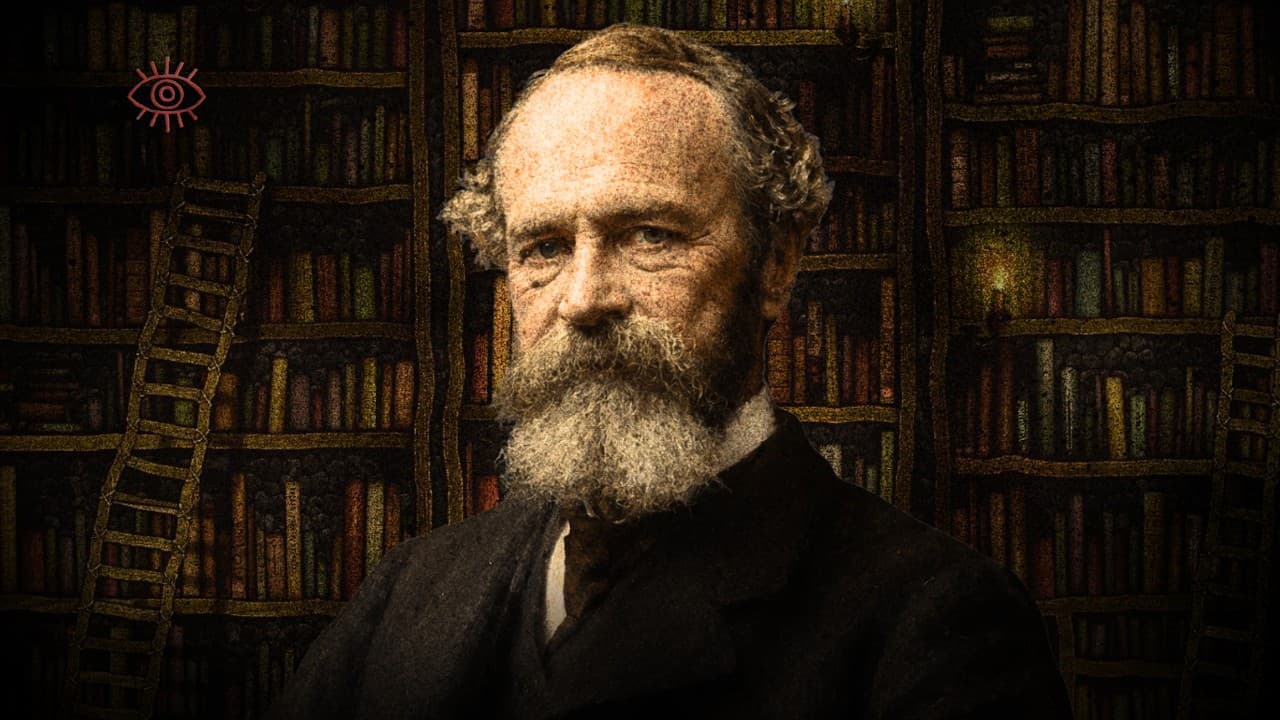
The Universe Is Still in the Making | A Complete William James for Sleep
He insisted to his last breath that the universe is unfinished, and that our own small efforts help decide how it turns out.
As a young man William James was so ill in body and mind that he could barely leave his room, and one spring evening he made a private decision that would shape everything after it. This episode follows the whole arc of his life and thought, from a wandering childhood in the most gifted family in America, through the collapse that nearly ended him, to the years when he founded a new science of the mind and taught the world to picture consciousness as a flowing stream.
We move with him from psychology into philosophy, through his defense of the right to believe, his tender study of the religious experience of ordinary people, and the practical theory of truth that made him famous and infamous at once. And we follow him to the end, a public conscience in a warring age.
The full episode is on YouTube and Spotify. Please listen only in safe, restful contexts.
Enjoying the episode?
Occasional letters on philosophy, reading, and the examined life. No spam, ever.
By subscribing you consent to receiving occasional emails. Unsubscribe any time via the link in every email or at /unsubscribe.
Timestamps
- 0:00:00Chapter 1: The Life and the Turn
- 0:11:43Chapter 2: A Natural History of the Mind
- 0:21:34Chapter 3: The Stream That Never Stops
- 0:29:58Chapter 4: The Great Flywheel
- 0:35:48Chapter 5: Because We Tremble
- 0:47:29Chapter 6: The Right to Believe
- 0:56:28Chapter 7: The Sick Soul
- 1:08:32Chapter 8: By Their Fruits
- 1:17:24Chapter 9: One White Crow
- 1:23:31Chapter 10: What Difference It Makes
- 1:34:57Chapter 11: Truth Happens to an Idea
- 1:44:09Chapter 12: A World of Pure Experience
- 1:50:30Chapter 13: A Universe Still Unfinished
- 2:00:50Chapter 14: What Makes a Life Significant
- 2:12:22Chapter 15: The Temper That Remains
For the record
Full Transcript
Chapter 1: The Life and the Turn
It is the last week of April, in the year eighteen seventy, and in a rented house in the town of Cambridge, in Massachusetts, a young man of twenty-eight is sitting at a desk with a private diary open in front of him, about to do the one thing he has come to believe he can no longer do. He is going to make a choice, and mean it. He is a trained physician who cannot imagine himself practicing medicine for a single day. He is gifted, everyone agrees, in half a dozen directions at once, and he has committed himself to none of them. For the better part of a year he has been afraid to be left alone in a room, afraid of a certain feeling that arrives when his guard is down, the sense that the floor of the world is not solid, that at any moment it might simply give way beneath him. He has spent the day, as he has spent many days lately, reading a difficult French essay on the freedom of the will. And now, near the bottom of a page, he takes up his pen and writes a sentence that reads less like a philosophical conclusion than like a man talking himself back from the edge of something. My first act of free will, he writes, shall be to believe in free will.
The young man was William James, and that quiet, almost desperate resolution, made privately to himself in the spring of his twenty-ninth year, is as good a doorway as any into one of the strangest and most generous minds his country has produced. Here is the contradiction that the whole of his long life would work to resolve. This trembling, sleepless, half broken young man, who could barely trust himself to sit alone, would become the great philosopher of energy and action and hope, the thinker who taught a whole nation the courage of the active life, who argued that we have the right to believe in things we cannot yet prove, who preached the health of the outward turning soul. And yet he would never once forget the pit he had climbed out of. The same man who became the apostle of healthy mindedness wrote the deepest book of his age on the sick and suffering soul, because he had been that soul, and knew from the inside exactly how thin the screen is that separates a settled life from the terror underneath it. To understand how the one became the other, we have to begin with the most remarkable family in the America of that century.
He was born in the winter of eighteen forty-two, in a hotel in New York City, into a family made comfortable by one of the great fortunes of the young republic. His grandfather, another William James, had come from Ireland with almost nothing and died one of the richest men in the state, having turned money and land and shrewdness into an estate large enough to keep his descendants free of the need to earn a living for two generations. That freedom was a gift and a curse, and no one wore it more strangely than the philosopher's father, Henry James the elder. He was a man of enormous talk and no fixed occupation, a religious thinker of his own private and unclassifiable kind, who had lost a leg to an infection as a boy and spent the rest of his life restlessly seeking a spiritual system that would finally hold still. He never found it, and so the family never held still either.
The household that grew up around him was one of the most gifted and most anxious in the country. There was the second son, Henry, younger than William by a year, who would become one of the supreme novelists in the language. There was a sister, Alice, whose private journals, written from an invalid's couch, are now read as a small masterpiece of wounded intelligence. There were two younger brothers, Wilkinson and Robertson, ordinary boys born into an extraordinary and demanding house, who went off as very young men to fight in the great war between the states. One of them was badly wounded leading soldiers of one of the first Black regiments of the Union army, carried home on a stretcher and laid in the front hall. The two older brothers, William and Henry, did not serve, and something of that difference, the guilt and the distance of the watcher, stayed with them both.
Above all it was a household in motion. The father had convinced himself that no single country could give his children the education their minds deserved, and so he moved them, again and again, back and forth across the Atlantic. William spent stretches of his childhood in London and Paris, in Geneva and in Germany, in tutors' rooms and foreign schools and rented apartments, learning to speak French and German like a native, learning to be at home everywhere and rooted nowhere. He grew up quick, charming, curious about everything, and quietly unsure what he was for. A boy who is never in one place long enough to become a particular person can grow into a man haunted by all the persons he might have been. That was the shadow side of so much brilliance.
The first thing he genuinely loved was painting. As a young man he wanted more than anything to be an artist, and he studied for a while under a respected American painter, filling sheets with portraits and studies that show real, uncommon talent. Then, abruptly, he gave it up. Partly his father disapproved, believing art too narrow a vessel for a serious soul. Partly the young man looked hard at his own gifts and decided he would never be more than very good, and could not bear to spend a life being very good at something without being great. It was the first of many self cancellations, the first time he stood at a door he loved and closed it himself. He turned instead to science, which promised certainty, and enrolled at the scientific school at Harvard, studying first chemistry and then the anatomy of living things, before moving on to the medical school.
Science did not cure his restlessness. In eighteen sixty-five, still a student, he joined a famous naturalist on a long collecting expedition up the Amazon, imagining a life of discovery, and found instead that he loathed the endless labor of sorting and pickling fish, and that he was, temperamentally, no field scientist at all. He fell ill with a mild form of smallpox that swelled his eyes shut for weeks and left him fearing he might go blind. He came home shaken. Two years later he went to Germany, partly to study the new laboratory science of the body that the Germans were pioneering, and partly in the endless, hopeless pursuit of his own health, for he was by now a catalogue of ailments, a bad back that made sitting a torment, weak eyes that made reading a rationed pleasure, a stomach that would not settle, and beneath all of it a deepening blackness of mood. He read, he attended lectures, he took the fashionable water cures, and he sank. He took his medical degree from Harvard in eighteen sixty-nine, and never practiced medicine for a single day of his life.
Then came the pit. In the years around his twenty-eighth birthday he descended into a depression so complete that he could see no reason to go on. He left, buried in a later book and disguised as another man's confession, a description of its worst moment, so that we know exactly what it felt like from the inside. One evening, at twilight, a horror of his own existence fell on him without warning, and in the same instant there rose in his memory the image of a patient he had once seen in an asylum, a young man with greenish skin and vacant black eyes, knees drawn up against his chest, sitting motionless as a carved figure, entirely emptied of mind. And the thought came with the force of a revelation. That shape is what I am, potentially. Nothing I possess can keep me from becoming that. For months afterward he woke each morning with a knot of dread in the pit of his stomach, and could not be left alone.
What pulled him out was not a doctor and not a drug but an idea, met at exactly the right moment. Reading the essays of a French philosopher on the freedom of the will, he found a way of defining freedom that he could believe without lying to himself, freedom as the power to hold on to a chosen thought when you might have let it slip away. And out of that he made the private wager we began with, the decision to treat his own will as real and to act as though his choices mattered, not because he had proved it, but because believing it was the first thing his recovery required. It was not a philosophical proof. It was a man deciding to live. And slowly, unevenly, over the following years, he began to climb.
The climb was helped, as such climbs often are, by useful work. In eighteen seventy-two the president of Harvard, who had once taught him chemistry, offered him a post teaching the physiology of the body, and he took it, still frail, and found that teaching steadied him. Within a few years he was offering something new, a course on the ground where the body meets the mind, and he set up a small room of instruments and demonstrations that has a fair claim to being one of the first laboratories anywhere devoted to studying the mind as a part of nature. He liked to say, with the self mockery that never left him, that the first lecture on psychology he ever heard was the first one he ever gave. In eighteen seventy-eight he married a steady, intelligent Boston woman named Alice Howe Gibbens, who gave him the ground beneath his feet that the wandering years had never provided. The black moods came back all his life, in waves, but he was no longer facing them alone.
That same year he agreed to write a textbook of the new psychology. He thought it would take him two years. It took him twelve, and it grew under his hands into one of the strangest and greatest works of its century, a book we will come to shortly. And when it was finally done, this man who had trained as a scientist did the most characteristic thing of his whole restless life. He turned away from the science he had mastered and walked toward the largest and least settled questions there are, questions about faith and truth and whether the universe is one thing or many, and spent the rest of his years as a philosopher. First the psychologist, then the philosopher. First the patient description of how the mind works, then the passionate defense of how a person might live and believe inside an unfinished world. The invalid had become a professor. The man who had chosen to believe in his own freedom was about to spend twenty years teaching a country how to think. And underneath all of it, always, sat the memory of the greenish faced youth in the asylum, and the thin screen, and the floor that might give way.
Chapter 2: A Natural History of the Mind
The book that made William James famous is a book he came to hate while writing it. In eighteen seventy-eight, newly married and newly steadied, he signed a contract with a New York publisher to produce a textbook of the new psychology, and he estimated that the work would take him two years. It took him twelve. He wrote it in the gaps between teaching and illness and travel, revising and expanding and doubling back, until the thing had swollen into two enormous volumes running to nearly fourteen hundred pages, far too long for any student to use as intended. When it was finally done, in eighteen ninety, he wrote to his publisher that the finished mass proved only two things. First, that there was no such thing as a science of psychology. And second, that its author was incapable of producing one. It was a joke, but like most of his jokes it was carrying something true. The Principles of Psychology is the founding document of American psychology, and it was written by a man who did not quite believe that the science he was founding yet existed.
He knew the alternative intimately, because he had watched it being built. In the German laboratories he had visited as a young man, a new and genuinely rigorous psychology was taking shape, one that tried to measure the mind the way physics measures a falling stone, timing to the fraction of a second how long a sensation takes to register or a choice to be made, breaking mental life into small, countable pieces. James admired this work, and he set up one of the first rooms of its kind in his own country. But he also joked that the method was so tedious it could only have been invented by people patient enough to endure being thoroughly bored, and underneath the joke sat a real judgment. All that careful measuring, he came to feel, however useful, was capturing the mind only by first killing it, cutting the living, moving, seamless thing into fragments small enough to lie still under an instrument. What he wanted was to describe the living creature itself, in motion, in one piece, as it is actually felt from within. And that ambition set the whole shape of his book.
What makes the book great is the decision that organizes it, a decision so simple it is easy to miss how radical it was. James decided to study the mind as a part of nature. Not the soul as the theologians had described it, not the logical machinery of ideas as the philosophers had diagrammed it, but the mind as it actually occurs, which is always in a living body, an animal body, that has to find food and avoid danger and act in a world that will not wait. A mind, on this view, is not a spectator seated behind the eyes, calmly registering a show. It is an organ. It evolved, like a hand or a stomach or an eye, because it helped the creature that carried it to survive and to do things. And the first question to ask about any piece of mental life is therefore not what it is made of, but what it is for. That is the naturalist's question, the question you ask about a fin or a claw, and James asked it about attention, about memory, about feeling, about the will. It is why the book, for all its length, feels alive. He is watching the mind the way a patient field observer watches an animal in its element.
This put him at war with the two great schools that had owned the subject before him, and it is worth seeing clearly what he was rejecting, because his whole later philosophy grows out of it. On one side stood the old spiritual psychology, which explained the unity of a mind, the fact that all your experiences seem to belong to one owner, by placing behind them a soul, a simple, permanent, indivisible spiritual substance that has the experiences and holds them together. James did not go out of his way to deny that such a soul exists. His objection was sharper and more practical. He said that naming the soul explains nothing. To say that your experiences hang together because a soul is having them is only to give the fact a title, not a cause. It adds no knowledge, predicts nothing, and does no work. And a science, he insisted, should set such idle explanations aside and describe what can actually be observed, which is the flow of experience itself, not a hidden owner behind it.
On the other side stood a subtler and more modern opponent, the tradition that had tried to build the mind out of atoms. This was the great line of British thinkers who explained the mind by association, the idea that experience is assembled out of simple elements, single sensations and single ideas, which combine and recombine according to fixed laws, the way bricks are stacked into a wall or letters into a word. Learning, on this picture, is just the gluing together of atoms that have often occurred together. James thought this was not merely incomplete but backward. He said the atoms are a fiction, a thing you arrive at only by analysis, and that you then mistake for the raw material you started from. Nobody has ever actually had a bare, separate, atomic sensation lying loose in the mind, waiting to be joined to another. What we actually live through is nothing like a row of separate beads. What it is like instead, when you stop dissecting it and simply attend to the texture of your own passing experience, is the subject of the chapter that made him most famous, and we will come to it next. Here it is enough to say that he had cleared the ground of both the soul above and the atoms below, and meant to describe the mind as it is really given, from the inside, without either scaffolding.
Underneath both quarrels lay a single conviction that would become the seed of everything he wrote afterward. It is the conviction that thinking is for the sake of doing. The mind did not evolve to mirror the universe. It evolved to help an animal cope with the universe, to guide it toward what it needs and away from what will harm it. And so mental life, James observed, is soaked through with interest and selection at every level. Out of the roaring flood of everything the senses deliver, we are always, ceaselessly, picking out the few things that matter to us and ignoring the rest, and what makes a thing matter is what we want and what we are trying to do. Attention is choosing. Perception is choosing. Even the plainest act of noticing the world is shot through with preference. The mind is not a passive mirror but an interested agent, forever emphasizing, foregrounding, caring. This idea, that our knowing is always in the service of our acting, is quiet here, buried in a psychology textbook among the diagrams of the nervous system. But it is the same idea that would later grow into his whole philosophy of truth, and we will watch it grow.
There is one more thing that has to be said about the Principles, because it is so unlike what a founder is supposed to do, and so like the man who wrote it. Having produced the most influential book on the mind that his country had ever seen, James ended it by confessing that psychology was not yet a science at all. It was, he said, only the hope of a science. What he had gathered in his fourteen hundred pages was a heap of raw description, a great deal of careful observation, and some hopeful gossip about the brain, but not one genuine law of the kind that physics or chemistry could boast, and none of the deep questions, about how the physical brain gives rise to a felt inner life at all, so much as touched. He refused to pretend otherwise. He would rather leave the reader standing honestly at the edge of the unknown than sell a false completeness. And that refusal, that preference for an open and unfinished truth over a tidy and premature one, is not a flaw in the book. It is the beginning of his philosophy. The same temperament that could not lie to a reader about the state of a science would spend the next twenty years arguing that the universe itself is unfinished, and that honesty about that fact is the beginning of wisdom.
The Principles went out into the world in eighteen ninety and was read by everyone, translated, argued over, taught. Two years later James boiled it down into a shorter version for students, a book the profession came to speak of, with some affection, as the little one beside the big one. But it was the big one that mattered, the sprawling, personal, contradictory masterpiece, because in it a whole way of looking at the human mind had been born. In the chapters that follow we will take up its greatest single discoveries one at a time, beginning with his most famous of all, the one that gave us a wholly new way to picture the movement of a thinking mind.
Chapter 3: The Stream That Never Stops
The hardest thing in the world to observe is the instrument you are observing with. To catch your own mind in the act of thinking, not the thoughts themselves but the thinking, the movement by which one state gives way to the next, is nearly impossible, and William James came closer to it than anyone before him. What he found there overturned centuries of assumption about what a mind is like. The tradition had pictured thought as a series of separate items, ideas arriving one after another like beads on a string or cars in a train. James looked, and saw nothing of the kind. No beads, no cars, no joints at all. He saw a flow.
The words we ordinarily use, he pointed out, betray us. We speak of a chain of thought, or a train of thought, and both pictures are wrong in the same way, because both are made of separate links, rigid pieces coupled end to end. But consciousness is not jointed. It does not come in pieces that are later connected. It runs. And so, he wrote, we should stop calling it a chain and call it something that actually moves. A river. A stream. Let us call it, he said, the stream of thought, of consciousness, of the inner life. The phrase was new, and it has never left us, because the moment you hear it you recognize it as true. Your inner life is not a row of stones. It is a current.
Two things about that current struck him hardest, and both quietly demolish the old picture of the mind as a heap of atoms. The first is that the stream is continuous, with no real breaks in it. Even when it is interrupted, by sleep, by a blow, by a gap of hours, what comes back afterward is felt as belonging to the same owner, warm and familiar, picked up like a sentence resumed. And within any stretch of waking life there are no clean edges between one thought and the next. Nothing is ever presented to us bare and alone. When a clock strikes in a silent house, the sound you hear is not a pure isolated bang. It is a bang that comes out of the silence just before it and carries that silence in it, shaped by what preceded it and already leaning toward what will follow. Every moment of consciousness is soaked in the moments around it. There is no such thing as a single, separate mental brick.
The second thing is that the stream is never twice the same. No thought you have ever had comes back to you unchanged. You may think of the same thing on Monday and on Friday, the same person, the same word, the same fear, but you never think of it in the same way, because the whole surrounding state of your mind is different, and the thing is always colored by everything around it. We imagine that ideas are like furniture, permanent objects that can be brought out and put back identical. James said no. The mind is a stream, and you cannot step into the same stream twice, because by the time you return the water has moved on. What returns is never the old thought. It is a new thought of an old object, arriving in a mind that has itself changed.
Then came the observation that was entirely his own, the one the atom builders had completely missed. When we look back at our own consciousness, James said, we notice only the resting places, the vivid images, the clear ideas, the solid nameable things, and we overlook everything in between. But the in between is most of it. Thought, he wrote, is like the flight of a bird, made of alternating flights and perchings. The perchings are the resting places, the definite images we can hold still and point to. The flights are the transitions between them, the swift passages of relation, and these are just as real, just as much a part of experience, even though they are almost impossible to catch. For here is the strange thing. There is a feeling of and. There is a feeling of but. There is a feeling of if, and of by. When you say the word but, something happens in your consciousness, a particular felt shape of expectation and reversal, as real as the taste of salt, and yet it is over before you can turn and examine it. Trying to inspect these transitions, he said, is like trying to turn up the light quickly enough to see the darkness, or seizing a spinning top to study its motion. The moment you grasp them they are gone, replaced by the very stillness you were trying to see past. But their vanishing does not mean they were never there. It means the mind is subtler than the crude tools of the atom theory could ever register.
His favorite proof of this was something everyone has felt. When you reach for a name that has slipped away, a name right on the tip of the tongue, the place where it should be is not empty. It is filled by a vivid, aching, wholly specific gap, an active want with a definite shape, that beckons in a particular direction and rejects the wrong guesses as they come. The gap left by one forgotten name feels completely different from the gap left by another, though both are, on the atom theory, simply the absence of a word, which should feel like nothing at all. That difference, that shaped emptiness, is a feeling of pure tendency, a consciousness of relation and direction with no solid image in it whatever. And once you have noticed it, you cannot unsee how much of your mental life is made of exactly this, of fringes and halos of dim relation surrounding every clear thought, a whole atmosphere of felt connection and anticipation that the old psychology had no room for and simply threw away.
There is one more feature, and it is the most intimate of all. The stream is always someone's. It never runs loose in the world, ownerless. Every thought that has ever occurred has occurred as somebody's thought, felt from the inside as mine, belonging to a particular life and to no other. You cannot have half of one of your thoughts and I the other half. They arrive already owned, wrapped in a warmth of belonging that James thought was the most basic fact in all of psychology, more basic than the self we will later learn to build on top of it. Before there is any theory of who you are, there is simply this. The stream, running, and running as yours.
This is why the chapter matters far beyond the study of psychology. James had described the mind not as a thing but as a movement, not as a structure but as a life, personal and continuous and forever flowing and never for one instant at rest, always leaning into what comes next. It is a picture that fits your experience the moment you check it against the inside of your own head. And it planted a seed that would grow, years later, into the strangest of his philosophical claims, that those felt transitions, those experienced relations of and and but and toward, are not just facts about our minds but the very fabric of the world, the seams by which reality holds itself together. That is a thought for much later. For now it is enough to have seen the mind truly, perhaps for the first time in the history of the subject. It is a stream. It has been running since before you woke this morning, it is running now, beneath these words, and it will still be running, quietly, long after the words have stopped.
Chapter 4: The Great Flywheel
Of all the chapters in that enormous book, the one readers have most often torn out and carried with them is the short one on habit, because in it James does something he does nowhere else so plainly. He takes a dry fact of the body and turns it, without raising his voice, into a rule for how to live. The fact is this. Living tissue is plastic. It yields to pressure and it keeps the shape the pressure gave it. A sheet of paper once folded falls open along the same crease forever after. Water running down a hillside cuts a channel, and the next rain follows the channel it cut. Our nervous system, James said, is matter of exactly this kind, endlessly impressible, and every action we perform wears its pathway a little deeper, so that the act becomes easier to repeat and harder to avoid. We do not have habits. We very largely are habits, bundles of them, worn into the flesh by repetition until they run themselves.
From this ordinary fact he drew first a large social truth and then an intimate personal one. The social truth is contained in his most famous sentence on the subject. Habit, he wrote, is the enormous flywheel of society, its most precious conservative agent. It is habit that keeps the fisherman at sea through the winter and the miner in the dark and the clerk at the ledger, that holds each of us to the difficult calling we were shaped to, that keeps the poor from rising against the rich and keeps every person, more or less, within the bounds of the life they were born into. A flywheel is the heavy turning mass that keeps an engine running smoothly between the strokes, that resists sudden change and carries the whole machine steadily forward on its own momentum. Society runs on that momentum. Without the deep grooves of habit, holding millions of people to their stations and their tasks, the whole thing would shake itself apart. Habit is what makes a settled world possible, for better and for worse.
Then he turned it inward, and the tone sharpened. If character is simply a bundle of habits, and if the nervous system hardens as we age, then the habits we lay down while we are still young and soft are the habits we will be made of for the rest of our days. In most of us, he wrote, by the age of thirty the character has set like plaster, and will never soften again. This is a frightening thought and he meant it to be, but he offered it as a spur, not a sentence. Make your nervous system your ally, he urged, and not your enemy. Get as many of the useful and necessary actions of life as you can onto the automatic track early, so that they run themselves without effort and leave your higher powers free for the work only they can do. And he gave plain, practical counsel for laying down a new habit. Begin it with as strong and decided a beginning as you can manage, so the new self starts with momentum. Never allow a single exception until the habit is rooted, because each lapse undoes many acts of faithfulness, the way a ball of string once dropped unwinds more in a moment than many turns will wind back up. And seize the very first chance to act on every good resolution, for a resolution never acted on withers, and teaches you only how to feel without doing.
There was one more piece of advice, and it is the strangest and the most his. Keep the faculty of effort alive, he said, by a little gratuitous exercise every day. Do something difficult for no reason other than that you would rather not do it. Give up a small comfort you could keep, take the harder path when the easy one is open, not because the act itself matters but because the capacity to make yourself act, when the day comes that everything depends on it, is like a muscle that wastes without use. The person who has practiced a daily discipline of small unnecessary efforts will stand, when the great trial arrives, while their untrained neighbor is swept away. He called it, only half in jest, a gymnastics of the will.
Beneath all the practical counsel lay a single conviction that is either the most sobering or the most hopeful thing in the whole book, depending on the day you hear it. Nothing we ever do is wiped out. Every act leaves its trace in the tissue, every repetition deepens its groove, and the record is kept whether we attend to it or not. We are spinning our own fates, he wrote, good or evil, and never to be undone. The drinker who tells himself that this once will not count is wrong, because his nerve cells are counting even when he is not, and the tally is being kept in a ledger that does not forgive and does not forget. But the same terrible law is also a quiet mercy, for the person who is patiently building a self, one faithful act at a time, is also never doing that in vain. Every small effort is being saved, deposited, compounded in the flesh, so that one day the good act costs nothing at all, because the difficulty has been permanently solved, and the self it built stands ready without being summoned. The flywheel, once you have set it turning in the right direction, will carry you.
Chapter 5: Because We Tremble
Two of the strangest ideas in the Principles concern the two things a person feels most sure of, their own feelings and their own self. We assume that both are given to us, inner and spiritual and whole, a soul that simply has emotions the way a room has furniture. James, watching more closely, found that neither is a given at all. Both, he discovered, are built, moment by moment, out of the body and out of the flowing life we met a moment ago, and seeing how they are built changes what it means to be a person.
Begin with the emotions, because there his claim is so contrary to common sense that most people refuse it at first hearing. Common sense says that emotion comes in the middle of a sequence. A man meets a bear on a path. He sees the bear, and the seeing frightens him, and because he is frightened his heart pounds and his breath goes shallow and his legs carry him away. First the perception, then the feeling of fear, then the bodily uproar. James turned that order around. What actually happens, he argued, is that the man sees the bear, and his body reacts at once, the heart already pounding and the legs already running before any feeling has had time to form, and the emotion he calls fear simply is his awareness of all that bodily commotion. We do not tremble because we are afraid. We are afraid because we tremble. In his own words, we feel sorry because we cry, angry because we strike, afraid because we tremble, and not that we cry, strike, or tremble, because we are sorry, angry, or fearful. The feeling is the felt body. A Danish thinker arrived at nearly the same conclusion at nearly the same moment, so the idea carries both their names, but the voice that made it unforgettable was James's.
He offered a simple test that is hard to argue with. Take any strong emotion and try to imagine it stripped of every bodily sensation. Imagine fear with no quickened heartbeat, no catch in the breath, no cold in the stomach, no weakness in the limbs, no impulse to run. What is left? Not a paler fear, he said, but no fear at all. What remains is only a cold, neutral judgment that a bear is present, an intellectual perception with nothing felt about it. Subtract the body and the emotion goes with it, every time, which means the emotion was never floating free above the body in the first place. It was the body, felt from inside. Our inner weather, the whole spectrum of joy and grief and rage and tenderness, turns out to be the reverberation of physical states we usually never notice as such.
This sounds deflating until you see what James did with it, which was to turn it into one of the most hopeful practical ideas he ever had. If the feeling follows the bodily state, then we have a handle on our feelings that we did not know we held. We cannot simply order ourselves to feel brave, or calm, or glad, by direct command. But we can govern the body, and the feeling will tend to follow the form we give it. Sit all day in a slumped and sighing posture, he observed, speak in a dead voice, let the face fall, and gloom will settle in and stay. But smooth the forehead, brighten the eye, straighten the spine, and speak and move as a cheerful person would, and cheerfulness itself tends to come creeping in behind the performance. Act the emotion you wish to have, and often enough you will end by having it. The body is not the prisoner of the feeling. Very often the feeling is the echo of the body, and the body is something we can choose.
Then he turned to the self, and performed the same dissolving trick on the thing we cling to hardest. What is this self, this me, that each of us guards and feeds and worries over? James refused to answer with a soul, that simple spiritual substance he had already set aside as an explanation that explains nothing. Instead he described what the self actually amounts to when you lay it out, and found that it is not one thing but a wide and layered collection. There is the material self, which is not just my body but everything I feel as mine, my clothes, my home, my possessions, so that when a fortune is lost or a house burns down a man feels the loss as a real shrinkage of himself, as though a part of his body had been amputated. There is the spiritual self, the inner faculties I feel to be the living core of me, my will and my conscience. And between them there is the social self, and here James said something that has never stopped being true. A man has as many social selves, he wrote, as there are individuals who recognize him and carry an image of him in their minds. You are one self to your mother and another to your employer, one to your oldest friend and another to your child, and these selves are genuinely different, sometimes so different that they would be ashamed to meet. We are not a single person wearing masks. We are a loose federation of selves, each one alive in the eyes of the people who hold it, and the strain of keeping them from open war is a great deal of what we feel as the difficulty of a life.
From this dependence on others he drew a darker observation about how completely we are held in being by their notice. The deepest craving of a human being, he thought, deeper almost than hunger or safety, is simply to be recognized, to be counted by others as real. No more fiendish punishment could be devised, he wrote, than to be turned loose in a society of people and remain absolutely unnoticed by every one of them. If no one turned to look when we came into a room, if no one answered when we spoke, if everyone we met behaved as though we were not there at all, a rage and a hopeless despair would rise in us before long from which the cruelest bodily torture would be a relief, because the torture, at least, would be an admission that we exist. We are kept in being, socially, by the attention of others, and to be denied it utterly is a form of erasure. It is a measure of how much of the self lives outside the skin, in the minds of other people.
Out of this description he drew one observation so useful it is worth carrying to sleep. Our self regard, the daily barometer of how we feel about ourselves, does not depend on our achievements alone. It depends on the ratio between what we have achieved and what we demanded of ourselves, our successes divided by our pretensions. A man who wanted to be the second best boxer or oarsman in the world feels no shame at losing to the one man who can beat him, while another is crushed at falling short in a thing he never seriously trained for, because he had staked his self image on it. And this means there are always two roads to peace, not one. You can labor to increase the successes, which is slow and uncertain and mostly out of your hands. Or you can lower the pretensions, surrender a claim you have been failing to meet, and feel the same relief. To give up a pretension, James said, is as blessed a relief as to have it gratified. How pleasant is the day, he wrote, when we give up striving to be young, or slender. There is a whole quiet wisdom folded into that line, the discovery that a good part of our unhappiness is simply the distance between our life and a self image we could, if we chose, lay gently down.
But if the self is this sprawling collection of things owned and selves shown, what holds it together? What makes all of it mine? Here James gave his subtlest answer, and it needs the stream we spoke of before. There is no separate owner sitting behind the experiences, no little self holding the reins. The unifying is done by the stream itself. Each passing pulse of thought, as it arises, inherits the thoughts that came just before it, gathers them up, and calls them its own, the way each new owner of a herd takes over the animals the last owner gathered, and passes them on in turn to the owner that follows. The self that owns your life is simply the present moment of your thinking, reaching back to claim everything behind it as mine, and then handing the whole bundle forward to the next moment, which claims it again. There is no thinker behind the thought. The thought is the thinker. The self is not a thing you have. It is a thing that is happening, right now, and will have moved on before you can turn to look at it.
All of which brought James, by his own path, to the will, and to the most personal idea in the whole book, because his own life had been saved by it. We imagine the will as a special force, a push we give ourselves in a moment of decision. James looked and found something quieter and stranger. In almost every hard choice, the difficulty is not really about force at all. It is about attention. The easy option, the tempting one, keeps flooding into the mind and crowding out the harder, better one, which is pale and thin by comparison and keeps slipping from view. The entire labor of willing, he said, is the labor of holding the difficult thought still in the center of the mind, keeping it there against the constant pull of easier thoughts, until it fills the attention completely, and once it fills the attention the action follows of itself. Effort of attention, he wrote, is the essential phenomenon of will. The strong willed person is not the one with more inner muscle. It is the one who can keep the hard thing in view. And so the freest, most decisive act a human being ever performs is also the quietest, invisible from outside, a matter of consenting to keep looking at a truth that everything in you would rather let go of. Which is, though he does not say so here, exactly what a frightened young man once did, alone at a desk, when he chose to keep his grip on a single thought about his own freedom and would not let it slip. The self, the emotions, the will, none of them handed to us finished, all of them made, from the body and the stream and the direction of our gaze. It is a frightening thought, because nothing is guaranteed. And it is a freeing one, because a thing that is made can always, with effort, be made otherwise.
Chapter 6: The Right to Believe
In eighteen ninety-six, William James stood before a gathering of students and delivered the most notorious argument of his life, a defense of something that the serious minds of his age regarded as very close to a sin. He defended the right, in certain rare and specific cases, to believe something before the evidence is in. He called the lecture The Will to Believe, and he spent years afterward wishing he had not, because the title made it sound as though he thought a person could believe anything at all by simply wanting to, which he never for a moment held. What he was defending would have been better named the right to believe. It is narrower than it sounds, and far harder to dismiss.
He was arguing against a rule that the confident science of his century had made almost sacred, stated in its purest and sternest form by an English mathematician who declared that it is wrong always, everywhere, and for anyone, to believe anything upon insufficient evidence. On this view, believing ahead of proof is not merely unwise. It is immoral, a betrayal of a duty we owe to one another to keep the common stock of human belief clean and honest. James took this seriously. He respected the demand for evidence more than most, and in the ordinary run of life he agreed with it completely. His quarrel was with the claim that it holds always and everywhere, without exception, because he had noticed a class of cases where it quietly breaks down.
To find them he first drew a careful line around the only kind of question where his permission would apply. Call a choice between two beliefs a genuine option, he said, when it is three things at once. It must be living, meaning both possibilities are real, breathing options for the person facing them, not dead hypotheses they could never seriously entertain. It must be forced, meaning there is no way to sidestep it, no comfortable third ground of not choosing, because the situation itself will make one choice or the other for you whether you speak or not. And it must be momentous, meaning something real is at stake, the chance is unique, the decision matters. Most of what we believe or doubt fails this test, and for all of it the rule to wait patiently for evidence is exactly the right rule. But a few of the largest questions in any life pass the test, and are at the same time questions that no evidence can settle, at least not in the time we have to answer them. There, James said, everything is different.
The heart of his argument is a single observation that, once seen, is hard to unsee. When a question is forced, refusing to decide is not a way of escaping the decision. It is one of the ways of deciding. Imagine a question you cannot answer on the evidence, but on which you must, by living, act one way or the other. The cautious counsel says, believe nothing yet, wait, keep your mind open until proof arrives. But while you wait, you are not suspended safely above the question. You are living, and your living is already answering it, in the direction of no. To withhold belief, in a forced case, is simply to fall off the fence on the skeptic's side while telling yourself you are still sitting on it. And so the great rule of evidence, which presents itself as pure and passionless, turns out to carry a passion of its own hidden inside it, the passion to avoid error above all things. But there are two duties for a mind, not one. We must shun error, yes. We must also seek truth. And these two commandments do not always point the same way. A person so frightened of ever believing something false that they will believe nothing until it is certain may keep their hands perfectly clean and let every truth that could only be reached by a little courage slip past them untouched. The fear of being duped, James said, is not the deepest or the finest thing a thinking being can feel. To treat it as the whole of intellectual duty is to choose the loser's caution, the safety of the person who will not risk a possible mistake even at the cost of a certain loss.
The cases that moved him most were the ones where believing in advance actually helps to make the thing true. These are commoner than we think. Picture a train full of passengers held up by a mere handful of robbers, which happens only because each passenger, unsure whether the others will resist, sits still and does nothing, so that the few command the many. If each one believed that the rest would rise, all would rise at once and the robbery would fail. The saving fact depends on a faith held in advance, on trust extended before there is any proof that it will be returned. Or think of ordinary human affection. Whether a stranger becomes your friend often turns on whether you believe, before you have grounds, that they will, for a person approached with warmth and trust tends to become warm and trustworthy in return, while the same person met with suspicion turns cold, and proves your suspicion right. Faith in a fact, James wrote, can help create the fact. Or picture a climber caught on a mountain ledge, who can escape only by a leap he has never attempted and cannot be sure of making. If he believes in his own feet, hope and energy flow into his legs and he clears the gap. If he stands there demanding a guarantee before he will move, the doubt itself makes his legs unsteady, and he hesitates, and falls. In all these cases the belief is not a report on a fact that sits there finished, waiting to be discovered. The belief is one of the conditions that brings the fact into being, and to demand the evidence first is to guarantee that the evidence never comes.
It was to the largest question of all that James finally applied this, the religious one. Whether the universe has a meaning at its heart, whether something eternal underlies the passing show and whether we are the better for trusting that it does, is for a great many people a genuine option in his exact sense. It is living, because they can feel the pull of it. It is forced, because there is no neutral way to live, and the person who suspends judgment and waits has in practice already bet their one life against it. And it is momentous beyond anything else. It is also, notoriously, a question that proof cannot reach. For such a person, James argued, facing such a question, the demand to believe nothing until the evidence compels them is not neutral and not noble. It is simply a decision, dressed as caution, to let one whole side of life go unlived. And so they have the right, in that narrow and genuine case, to let their whole nature decide, the heart and the will and the deep leanings of the self, and not the intellect alone, standing paralyzed forever before a question it was never equipped to answer.
None of this was permission to believe whatever one pleased, and James was tired all his life of being read that way. It was permission for a single, disciplined exception, in the special case where a question is real, and unavoidable, and beyond the reach of proof, and where believing may itself help make the answer true. Underneath it lay his oldest conviction, that the future is not yet fixed, that it is still being decided, and that our beliefs and our acts are among the forces deciding it. In a finished and determined world, courage would be theater and hope a comfortable lie, because nothing we felt could change what was already settled. But in an unfinished one, to believe in a better possibility is to add your own small weight to its coming true. James would always rather risk being wrong in the direction of hope than be safely, correctly, and permanently paralyzed. It was the same wager, grown into a philosophy, that a frightened young man had once made alone at a desk, betting on his own freedom because a person has to bet on something in order to go on living at all.
Chapter 7: The Sick Soul
In the last two years of the old century's turning, William James crossed the Atlantic to Edinburgh to deliver a celebrated series of public lectures, and out of those evenings came the book that many readers love above all his others, and that he may have loved most himself. It is called The Varieties of Religious Experience, and its subject is not what its title might lead you to expect. It is not a book about God, or about the truth of any creed, or about the history of churches. It is a book about a certain kind of human experience, studied with the patience and the refusal to look away that James had learned as a naturalist, turned now upon the inner life of the religious soul.
The decision that shapes the book is announced at the start, and it is characteristically bold. James set aside institutions completely. He was not interested, for these purposes, in churches or clergy or doctrines or the machinery of organized worship, all of which he regarded as second-hand religion, the cooled and hardened residue of something that had once been alive. What he wanted was the living thing itself, at its source, which he located in what he called personal religion, the experience of the individual human being alone with whatever they take to be divine. The conversions and the terrors, the prayers answered and unanswered, the moments of ecstasy and the long nights of despair, the felt presences and the felt abandonments. He gathered hundreds of first-hand accounts, from the memoirs of saints and the letters of ordinary believers and the confessions of half-cracked enthusiasts, and he laid them out and studied them as specimens, as real facts of human nature, as data for what he called a science of religions. And he did something a scientist is not supposed to be able to do. He suspended his own considerable doubt. James was no orthodox believer, but he approached the believer's experience with complete seriousness, insisting that whatever we finally think of its causes, the experience itself is as real and as consequential a fact about human beings as anything in the laboratory, and that any honest account of our nature has to reckon with it.
He was equally firm about a fashionable way of dismissing such experiences that was gaining ground in his scientific age, a habit of mind he named medical materialism. This is the trick of discrediting a religious state by pointing to its bodily cause, of announcing that the apostle's vision on the road was merely a fit of some nervous disorder, that the mystic's rapture was a symptom of an overheated constitution, that the saint's fierce austerity was a disease of the nerves or the glands. James thought this reasoning worthless, and he disposed of it in a single stroke. Every state of mind whatever has some bodily condition underneath it, he pointed out, including the soundest scientific reasoning and the coldest, most skeptical common sense. If having a physical cause were enough to discredit a state of mind, it would discredit our sanity exactly as thoroughly as our raptures, and nothing would be left standing at all. You cannot judge an experience by its origins, by where it came from or what was happening in the body when it struck. Where you judge it is by something else entirely, and to that test he would come in time.
When he sorted his specimens, a great division appeared, and it organizes the whole book. There are, he said, two fundamental religious temperaments, two ways of being a soul in the world. The first he called the healthy-minded, or the once-born. These are the people for whom happiness comes naturally, almost as a birthright, who find the world good and its author benevolent without having to struggle for the conviction, who are built to look on the bright side and to let the darkness slide off them unregarded. In its extreme forms this becomes a whole deliberate practice, and James found a vivid example close to home, in the popular healing movements of his own day, the enthusiasts who taught that dwelling steadily on bright, healthy, courageous thoughts could cure the body and free the soul, and that evil is best handled not by fighting it but by simply refusing it your attention until it withers for lack of notice. James treated this with more respect than you might expect. He saw that it genuinely works for those it fits, that a resolute turning away from what is morbid can produce real health, real energy, real effectiveness in a life. The once-born are not fools. They are the constitutionally reconciled, the people who never needed a second birth because they arrived already at peace with existence.
But James's own deepest sympathies lay with the other type, and he gave it the more unforgettable portrait. He called them the sick souls, or the twice-born, and they are the people who cannot look away from what is wrong. For them the evil in the world is not a shadow to be ignored but the central and most real fact of all, and no amount of natural good fortune can silence it. Behind everything, he wrote, stands the great specter of universal death. The sick soul feels, under the pleasures of the moment, the certainty that all of it is passing, that the skull grins behind the face, that every road ends in the grave, and that this drains the present of its sweetness even while the sweetness lasts. And James made a claim about these two types that is the moral center of the book. The sick soul, he argued, though far more miserable, sees more. The healthy-minded achieve their peace by leaving something out, by averting their eyes from a genuine and permanent feature of the world. The sick soul leaves nothing out. And so a religion that has passed through the sick soul and come out the other side is the deeper of the two, because it has taken the measure of the whole of experience, the horror included, and made its peace with all of it rather than with a carefully edited part.
His supreme example of the sick soul was Tolstoy, the great novelist who, at the very summit of fame and health and wealth, with a loving family and work that would outlast him and every reason a person could name to be content, was overtaken in middle age by the conviction that his life was meaningless, brought to the point of hiding the means of his own death from himself, unable to answer the single small question that had risen up and would not be quieted, the question, simply, of why. And Tolstoy was saved, when he was saved, not by an argument, because the reasoning intellect had nothing to offer against the abyss, but by something more like a change of the whole man, a return to a kind of faith beneath the level of proof, that let him go on living without ever really answering the question that had stopped him. James understood that case from the inside, and we now know exactly how far inside, because of a confession he buried in his own book.
In the pages on the sick soul, James included one account more harrowing than all the rest, which he presented as a document sent to him by a French correspondent, a young man overtaken one evening at twilight by a sudden and total horror of his own existence, into which there rose the memory of a vacant, ruined figure he had once seen in an asylum, and the annihilating thought that he himself was, potentially, that very figure, that nothing he possessed could keep him from becoming it. It is the same twilight terror we heard at the very beginning of this episode. The French correspondent did not exist. The young man was James, the experience was his own, from the worst season of his own long crisis, and he disguised it as a foreigner's testimony because he could not bring himself to sign the worst thing that had ever happened to him and print it under his own name. Only after his death was the disguise lifted. The greatest student the sick soul has ever had was writing, in that passage, a report from his own descent. It is why the book has the authority it has. He was not describing the country of despair from the safety of the border. He had lived there, and come back, and never forgotten the way in.
Between the once-born and the twice-born, James described the mechanism that carries a person from one to the other, and it is here that the psychologist and the student of religion become one. Many people, he observed, live for years as what he called a divided self, a house divided against itself, two natures pulling in opposite directions, the higher aims and the lower habits at war, the person unhappy, incomplete, ashamed, unable to become whole. Religious conversion, stripped of its theology and described simply as it happens, is the process by which such a divided self becomes unified, its warring parts suddenly or slowly resolved into a single settled center, so that the person is at peace, at one, remade. And James, true to his science, offered a natural account of how this can happen without any need to deny that it happens. In a person laboring toward this unity, he suggested, the resolution is often being assembled out of sight, below the threshold of waking awareness, in the hidden workshop of the mind, until one day it is ready and breaks through into consciousness all at once, ripe and complete, arriving with such suddenness and such a sense of coming from beyond the self that the person naturally experiences it as grace, as something done to them from outside. The convert feels the hand of God. The psychologist sees the subconscious mind delivering, in a rush, what it has quietly been building for months or years. And James insisted, against the partisans on both sides, that these two descriptions do not cancel each other out. That a thing rises from the deep parts of your own mind does not prove that it is only your own mind, and that it can be described by a psychologist does not prove that nothing real has happened. He left the door standing carefully open.
That open door is the whole spirit of the book. James did not write it to prove that religion is true, and he did not write it to explain religion away. He wrote it to insist that the religious life, in all its wild variety, is one of the great and undeniable facts about human beings, that the sunny soul and the suffering soul both belong in any honest portrait of our nature, and that the person who has known the worst and come through has seen something the untroubled never will. If you have ever woken in the small hours with the sense that something is wrong at the root of things that no daylight success will ever put right, then you have stood, for a night, in the country the sick soul inhabits, and you know that James is not exaggerating. What he found on the far side of that country, in the reports of the mystics and the saints who had gone furthest into it, is where we turn next.
Chapter 8: By Their Fruits
If the sick soul is the darkest country in the Varieties, mysticism is its highest, and it was to the mystics that James went with the question standing behind the whole book. Is any of this true, or is it only a fact about the human nervous system? His answer is one of the most careful things he ever wrote, and it neither believes too much nor dismisses too easily.
First he had to say what a mystical experience is, and here his gift for plain description served him perfectly. Sorting through the reports of the great contemplatives of every tradition, and of ordinary people surprised by a moment of the same kind, he found that such experiences are marked by four features that recur everywhere. The first is that they are beyond words. The person who has been through one insists that it cannot be told, only undergone, that reporting it is like describing a color to someone born blind or the taste of a fruit to someone who has never eaten it. The second feature is the strange one, and it is what makes mysticism matter. Although the experience is beyond words, it does not feel like a mere mood or a rush of emotion. It feels like knowledge. It arrives with an overwhelming sense of insight, of seeing into the depths of truth, so that the person comes back not merely stirred but convinced, certain they have touched reality itself and not just had a feeling about it. The third feature is that these states are brief. They rarely last more than a few minutes, and they cannot be held or prolonged, though their authority can color a whole life afterward. And the fourth is that they cannot be summoned. A person can prepare the ground, through prayer or discipline or stillness, but the state itself comes as a gift or an invasion, arriving from beyond the will, as though the person were seized and held for a while by something greater than themselves.
James took all of this with complete seriousness, and he had a private reason to. He was convinced, on the ground of experiments he had made at the very borders of his own consciousness, experiments we will come to shortly, that the ordinary waking mind is not the only kind of consciousness there is. It was in this book that he set down the sentence that has echoed ever since. Our normal waking consciousness, he wrote, rational consciousness as we call it, is but one special type of consciousness, whilst all about it, parted from it by the filmiest of screens, there lie potential forms of consciousness entirely different. We may live our whole lives without suspecting that they are there. But apply the right stimulus, and at a touch they appear in all their completeness. And he drew the conclusion that governs everything after it. No account of the universe in its totality, he said, can be final if it leaves these other forms of consciousness entirely disregarded. Reality may have whole rooms in it that we ordinarily never enter, doors in the mind we pass every day without seeing, and the mystic is simply a person who has, once or twice, found one of them open.
But do the mystics see truly through those doors, or only dream? Here James drew a line as precise as a surgeon's, and it is the balance point of his whole philosophy of religion. Mystical states, he concluded, are and by rights ought to be completely authoritative for the person who has them. No one who has been through such an experience can be reasoned out of its reality afterward, and they are under no obligation to try, because for them it is more certain than any argument could ever be. But those same states have no authority whatever to compel belief in anyone standing outside them. They cannot prove to the rest of us what they reveal to the one who lives them. What they can do, and this is not small, is break the monopoly of the ordinary rational mind. They show that our everyday waking consciousness is only one kind of consciousness among possible others, that it may not be the widest or the truest, and that the universe is under no obligation to be exhausted by what fits inside it. Mysticism opens a possibility. It does not close a case. It is permission to hope, not proof of the thing hoped for.
Then James asked the question that was always, for him, the deciding one. Never mind for a moment whether these experiences are true. What are they good for? What kind of human being do they produce? He turned to the study of saintliness, the character that religious experience shapes when it works, marked by a sense of a wider life beyond the selfish little interests of the day, by a conviction of a friendly power at work in things, by an immense elation and freedom as the boundaries of the ordinary self dissolve, and by a shifting of the emotional center of the person toward tenderness and love. And he laid down the test by which religion should finally be judged, borrowing the old words of the Gospel and giving them a sharp new point. By their fruits ye shall know them, he wrote, not by their roots. Do not weigh a faith by where it came from, by the temperament or the nervous condition or the odd experience that seeded it. Weigh it by what it grows into, by the life it produces. A religious experience that makes a person more loving, more alive, more patient, more capable of bearing what has to be borne, has proved something real about itself, whatever we decide about its theology. James weighed the saints honestly, and did not spare their excesses, the fanaticism, the useless self-punishment, the way an unworldly holiness can leave a person helpless in a hard and practical world. But he concluded that at its best the saintly character is one of the highest things our species has produced, and a genuine force for good, a leaven quietly raising the whole moral level of the world.
What, in the end, did James himself believe? He was too honest to claim more than his evidence allowed, and too generous to claim less. Beneath all the differences of the creeds, he thought, the religious experience of humankind has a common core. It is the sense, first, that there is something wrong about us as we naturally stand, and, second, that we are saved from that wrongness by making a connection with a higher power, with something more, something larger than ourselves on whose further side our best ideals seem to live and from which, at times, real help seems to flow. The particular doctrines that each tradition wraps around this core, the specific God, the specific heaven, the specific law, James called our over-beliefs, the extra convictions we add beyond what the bare experience delivers, and he treated them with respect while refusing to arbitrate between them. And he offered a hypothesis of his own about where that connection is made. It is made, he suggested, through the subconscious, through that hidden margin of the self we met in the story of conversion, the submerged region below our waking awareness, which is the natural doorway through which the more, whatever it finally is, makes its contact with a human life. Beyond that he would give only his own over-belief, offered tentatively and marked plainly as a private faith rather than a proven result, that the more is genuinely real, that there is in fact a wider spiritual universe with which we are continuous through that subconscious door, and that in prayer and religious experience real transactions occur and real energy comes in. He would not pretend it was demonstrated. He set it down as his own honest wager, and left the reader wholly free to make another. It is the most beautiful modesty in all his work, a man who had gone as far into the question as evidence could carry him, marking the exact spot where the known country ends, and pointing, without insisting, toward what he believed lay beyond.
Chapter 9: One White Crow
For twenty-five years, alongside all the philosophy and all the psychology, William James pursued something that quietly embarrassed his colleagues and openly delighted his critics. He investigated mediums and séances, telepathy and apparitions, the whole disreputable borderland of claims about minds touching each other and the dead speaking to the living. He helped found and lead the American branch of a society devoted to the scientific study of such things. To many sober observers it looked like a great mind wandering into the fog. To James it was the same mind doing exactly what it had always done, which was to refuse to settle a question before he had looked at the evidence.
His position was the hardest one to hold, because it satisfied no one. He was disgusted by the credulous, the people who would swallow any rapping table or glowing ectoplasm because they wanted so badly to believe. But he was equally disgusted by the scientists who pronounced the entire subject impossible in advance and would not so much as examine a single case, which he regarded not as science but as prejudice wearing the costume of science. The only honest course, he insisted, was the tedious one. Investigate. Sit through the fraudulent séances, expose the cheats, and then, in the rare case you cannot explain away, admit that you cannot, and let the question stay open.
His one unexplained case had a name. For years he studied a quiet Boston housewife named Leonora Piper, who in a trance state seemed, again and again, to know things about strangers that she had no ordinary way of knowing. James investigated her with every safeguard he could devise, and at the end of it he did not claim she had proved the survival of the soul, or telepathy, or anything so grand. He claimed only this, that he could not account for her by fraud or by lucky guessing, and that a single genuinely unexplained case was enough to change everything. He put it in an image that has outlived almost everything else he said on the subject. If you wish to upset the law that all crows are black, he wrote, you must not seek to show that no crows are. It is enough if you prove one single crow to be white. And his own white crow, he said, was Mrs Piper. One real exception is enough to break a universal denial. You do not have to prove that the mind survives death. You have only to find one case that the confident theory cannot swallow, and the theory can no longer claim to be the whole truth. Keeping questions open against people in a hurry to close them was the cause of his life, and here it was distilled to a single pale bird.
He had, besides, gone to the border himself, chemically. As a younger man he had experimented on his own consciousness with an anesthetic gas, breathing it in and attending to what happened. What happened was overwhelming. Under the gas he felt flooded with revelation, gripped by the certainty that the deepest secret of the universe was being placed directly in his hands, that every contradiction and opposition was melting into a single reconciling truth, and in his exaltation he scribbled the revelations down as fast as they came. In the morning he read the notes. They were nonsense. Grand, solemn, empty nonsense, the sort of thing that sounds like the key to everything and means nothing at all, one of them announcing gravely that there are no differences but differences of degree between different degrees of difference and no difference whatever. And yet the experience left a permanent mark on him, not for what it said but for the bare fact that it had happened. He could never again believe that our ordinary reasoning mind was the whole of consciousness, because he had stepped just past its edge and found something on the other side, wordless and useless and impossible to bring back, but unmistakably a form of awareness, a real room he had entered and left. It was the ground of the conviction he would later set down in his great book on religion, that our waking mind is only one kind, fenced off from the others by the thinnest of screens. The gas proved nothing about the universe. It proved, to him, that the door was real, even though he always came back through it with empty hands.
He never got his proof. Not from the medium, not from the gas, not from a lifetime of patient sittings in darkened rooms. The soul's survival was not established, the mind's stranger powers were not confirmed, and he knew it and said so. Near the end of his life he wrote a last summing-up of the whole long pursuit, and confessed, without bitterness, that after a quarter of a century he stood almost exactly where he had started, as baffled on the last day as on the first, the facts refusing either to be proved or to be swept away, and that he had made his peace with the possibility that some questions simply outlast the lifetime of the person asking them. But he thought that keeping the question honestly open, in the face of an age that wanted it slammed shut in the name of a science that had not actually looked, was itself a service to the truth. It is a small and stubborn kind of courage, the willingness to be laughed at rather than to close a door you have no right to close. It was very much his.
Chapter 10: What Difference It Makes
In nineteen hundred and seven, William James published the book that made a philosophy famous and gave a word to the language. The book was called Pragmatism, and it turned an obscure technical idea into something ordinary people argued about at dinner. What is striking, and very like him, is that he spent the opening of it insisting that the central idea was not his own. He had taken it, he said, from an old and difficult friend, a logician of genius named Charles Sanders Peirce, a man too prickly and too original ever to hold a proper academic post, and James gave him the credit loudly and repeatedly, even as the world handed the glory to James.
The idea had been born decades earlier, in the eighteen seventies, in a small club of brilliant young men who met in Cambridge to argue philosophy, among them Peirce, and a future justice of the highest court, and James himself. Out of those arguments Peirce had drawn a rule, which he later published in an essay on how to make our ideas clear. To find the whole meaning of any idea, Peirce said, ask what practical difference it would make if the idea were true. Trace out the concrete effects the idea would have on your future experience and your possible conduct, and the sum of those effects is the entire meaning of the idea, all of it, with no remainder. If two ideas that sound completely different would lead to exactly the same experiences and the same actions, then despite the difference in words they mean the same thing. And if an idea would make no experiential difference at all, whether it were true or false, then it means nothing whatever. Peirce had offered this as a modest tool for clearing up confusion. James took it, thirty years on, and made it the key to everything.
Peirce was not entirely grateful. He had minted the word pragmatism for a narrow and rigorous doctrine in logic, and when he saw the loose, warm, popular use his friend was making of it, he was so dismayed that he publicly disowned the term and renamed his own version pragmaticism, a word, he said, ugly enough to be safe from kidnappers. The kidnapper he had in mind was James. It is one of the small comedies of philosophy, the severe logician watching in horror as the charming popularizer runs off with his idea and makes the whole world love it. And James, for his part, always insisted the doctrine was nothing new. He gave the book the subtitle a new name for some old ways of thinking, because he believed pragmatism only made plain and conscious the method that working scientists and sensible people had used all along without a name for it, the plain habit of asking what an idea is good for and judging it by what it does.
He introduced it, in the lectures, with a homely little story that has become the most famous thing in the book. On a camping trip in the mountains, James returned from a walk to find the whole party locked in a ferocious metaphysical dispute. The problem was this. A live squirrel was clinging to one side of a tree trunk, and on the other side of the trunk stood a man who wanted to see it. The man moved quickly around the tree, trying to get a look at the squirrel, but the squirrel moved just as quickly in the same direction, scrambling around the far side of the trunk, so that the tree stayed always between them and the man never caught sight of the animal at all. Now, the question that had the camp at war was simply this. Does the man go round the squirrel, or not? He plainly goes round the tree, and the squirrel is on the tree. But does he go round the squirrel? Half the party swore yes and half swore no, and they had been at it a long time when they appealed to the newcomer to settle it.
James settled it, and in settling it he showed his whole method in miniature. The answer, he said, depends entirely on what you practically mean by the words go round. If you mean passing from the north of the squirrel to the east, then to the south, then to the west, and back to the north, then of course the man goes round the squirrel, because he does occupy each of those positions in turn. But if you mean passing first in front of the squirrel, then to its right side, then behind it, then to its left, and so to the front again, then the man never goes round it at all, because the squirrel turns with him the whole time and keeps its belly toward him and its back always away. Make that one distinction, and the great dispute simply evaporates. There was never any fact in question, only two different meanings hiding inside a single loose phrase, and the moment you ask what practical difference each meaning would make, there is nothing left to argue about. Both sides were right, depending on what they meant, and once that was clear they had nothing to quarrel over but a word.
That, James announced, is the pragmatic method, and it can be turned loose on the largest questions in philosophy. When a dispute seems endless, when the same arguments have been traded for centuries with no side able to defeat the other, bring each position down out of the clouds and ask it a single hard question. What concrete difference would it make to anyone's actual experience if this were true rather than that? Follow each grand abstraction, spirit or matter, fate or freedom, the one or the many, down to the practical consequences it would have in a life that is lived. If the rival answers turn out to make no difference at all to anything you could ever experience or do, then the dispute is idle, a quarrel about words dressed in the robes of deep philosophy, and it can be dismissed. A great many of the ancient battles of metaphysics, James believed, are exactly this, verbal disputes that dissolve the instant you demand that they show their practical cash-value, and clearing them away is itself a liberation.
But the method could do more than dissolve empty quarrels. It could also show which disputes are real, by finding the genuine practical difference hidden inside them, and James gave one example that has stayed with readers. Take the old quarrel between those who say the universe is at bottom nothing but matter and those who say it is the work of a mind, or of God. Looked at backward, over a world already finished and done, James argued, the dispute makes no practical difference at all. If the whole show were over, then whether blind matter or a purposeful spirit had produced it would change nothing we could point to, for the past would be exactly the same either way. But look forward, and the difference becomes total. If matter is all there is, then the story ends in ruin, the sun cooling, the last life freezing, everything any human being ever loved or made undone at last as if it had never been. But if a mind stands behind things, then the ideal is somehow preserved, safe, eternal, and our deepest hopes are backed by the grain of reality rather than mocked by it. Two beliefs that make no difference whatever to the dead past make all the difference in the living future, in what we may hope and what we may promise ourselves, and that forward-looking difference, James said, is their real and entire meaning.
Why did this catch fire the way it did? James thought it answered a hunger built into the human temperament, and he described that temperament with a famous division. There are, he said, two kinds of thinker, running down the whole history of philosophy and, really, down the middle of the human race. On one side stand the tender-minded, who go by principles rather than facts, who love system and abstraction and elegance, who tend to be idealist, optimistic, religious, who need to believe that the universe is at bottom rational and good and on our side. On the other stand the tough-minded, who go by facts rather than principles, who trust only the concrete and the observed, who tend to be materialist, pessimistic, skeptical, irreligious, who would rather have a bleak truth than a comforting story. And most of us, James saw, are torn, because we want what each camp offers and are told we cannot have both. We are made to feel we must choose, either to be scientific and hard-headed about the facts at the cost of every hope, or to keep our hopes at the cost of our intellectual honesty. Pragmatism, he offered, was a way out of that cruel choice. It was as loyal to facts and evidence as the toughest science, and yet, by measuring ideas through their consequences in a life, it left the door open to the moral and religious beliefs that the tough-minded usually had to cut away. A philosophy as scientific as you please and as human as you need. That promise, to the divided modern person, was electric.
Underneath the method lay a picture of what ideas actually are, and it was the old insight from his psychology, grown to full size, that thinking exists for the sake of doing. Ideas and theories, on this view, are not copies of a finished reality, not a mirror we hold up to a world already complete. They are instruments, tools we forge and use to move through experience, to predict what is coming, to link one part of life to another, to act with success. A true idea is one that works as an instrument, that carries us where we need to go and does not betray us when we lean our weight on it. And James pressed the practical question relentlessly, asking of any idea what its cash-value is, what it is actually worth in the hard currency of concrete experience, what owning it would buy you that you would otherwise lack. An idea with no cash-value, that changes no expectation and guides no action and would leave your life exactly as it was whether true or false, is not really a belief at all but an empty sound. This picture of ideas as working instruments with a value you can cash out is the hinge of his whole philosophy, and it was about to swing open onto the most explosive claim he ever made, a claim about the nature of truth itself that would bring the philosophers of two continents down on his head. That is where we turn.
Chapter 11: Truth Happens to an Idea
The method was one thing. The theory of truth James built on top of it was another, and it brought down on him the loudest storm of his career, because it seemed to lay hands on the one thing philosophers had always treated as sacred and untouchable. James proposed that truth is not a fixed property that an idea simply has, sitting inside it forever like a jewel in a box. Truth, he said, is something that happens to an idea. It is an event, a process, a thing that gets made.
To see what he was rejecting, picture the ordinary notion of truth we all carry. On that notion, a belief is true when it copies or corresponds to a reality that stands out there on its own, finished and complete and waiting, and the belief is true by passively matching it, the way a portrait is a good likeness by resembling the face. James pressed on that word, agreement, and asked what it actually comes to when you look closely. It cannot be a simple resemblance, because most of our true ideas do not resemble their objects in the least. Your idea of the hidden machinery inside a clock looks nothing like the machinery. Your idea of past time, or of a distant galaxy, or of another person's grief, resembles nothing at all. So what can it possibly mean, in real practice, for an idea to agree with its object, if not by looking like it? That was the crack he drove the whole theory into.
His answer was that an idea agrees with reality when it leads you, successfully, to deal with that reality. A true idea is one that guides you through experience without letting you down, that carries you to the object it points at, or into the useful relations with it that you expected, that fits smoothly with the rest of what you know and does not smash against the facts when you act on it. Truth, in other words, is the name we give to ideas that verify themselves, that pay their way, that work as guides across the country of experience. And this means an idea is not simply true or false from the start, once and forever. It starts as a mere claim, a hypothesis, neither true nor false yet, and then, as experience confirms it, tests it, cashes it out, it becomes true, is made true, by the process of its verification. The truth of an idea, James wrote, is not a stagnant property inside it. Truth happens to an idea. It becomes true, is made true, by events. Truth is not found lying about, finished. It is made, in the traffic between the mind and the world. And he summed the whole doctrine in a sentence built to provoke. The true, he wrote, is only the expedient in the way of our thinking, just as the right is only the expedient in the way of our behaving.
That sentence went off like a bomb. The great philosophers of England and Europe fell on it in fury, and what they heard in it was a scandal. If truth is just what works, just the expedient, then, they cried, any comforting falsehood becomes true the moment it makes you feel better. A man could believe he is loved when he is not, believe the world just when it is cruel, believe whatever soothed him, and call it all true because it worked for him. James, they charged, had abolished the whole difference between believing a thing because it is so and believing it because you happen to like it. He had reduced the noblest idea humans possess, the idea of truth, to money and convenience, a shopkeeper's philosophy, a philistine creed that handed every wishful thinker a license to call his wishes true. To them it looked like the death of intellectual honesty itself.
James was stung, and he spent a good part of his last years defending himself, gathering his replies into a book on the meaning of truth. His defense was simple, and it was mostly a matter of begging his critics to read the rest of the sentence. They had seized on the words works and expedient and heard them to mean gives me a pleasant feeling, or is convenient just now. He had meant nothing of the kind. An idea works, in his sense, only if it leads you into satisfying and consistent relations with the whole rest of your experience, and above all with the hard facts that will not bend to anyone's wishes. A belief that comforts you today and shatters against reality tomorrow does not work in the long run and on the whole, and so, on his theory, it is not true. He had said expedient in the long run and on the whole, and the long run is a merciless judge. Reality constrains every act of verification. You cannot in fact verify a falsehood, because the world pushes back against ideas that do not fit it, and pushes back harder the longer you lean on them. Far from licensing wishful thinking, James argued, his theory hands the wishful thinker straight over to the sternest examiner there is, which is experience itself, the actual course of a life lived among facts that answer back. His critics, he felt, had refused to read past the provocation to the careful argument underneath. He was mostly right about that. But the provocations were real, and reckless, and he had invited a great deal of the trouble down on his own head.
There was a further piece to the account that answers an obvious objection, and it is one of his happiest images. If truth is verification, someone will protest, then almost nothing we believe is true, since we verify almost none of it ourselves. You believe there is a country on the far side of the world you have never seen, that the heart pumps blood, that a man once lived named Julius Caesar, and you have checked none of these things personally. James agreed at once, and folded the objection into the theory. Most of our truths, he said, live on a credit system. They pass as true, and function as true, and are true, so long as nothing anywhere challenges them, exactly as a banknote passes from hand to hand and does all the work of money so long as no one marches to the bank and demands the gold behind it. We take the vast bulk of our beliefs on trust, verified by others, or verifiable by us in principle should the need ever arise, and they circulate freely on that credit. But the credit, he insisted, has to be backed somewhere by real verifications, real cashings-in, or the whole currency would collapse into counterfeit. Our truths float on a great sea of unchecked belief, and the sea rests on a floor of actual experience, on ideas that did, somewhere, at some time, get led all the way home to their objects and proved. It is a wonderfully democratic picture of knowing, an economy of trust in which we all deal daily in truths we have never personally tested, sustained by the labor of the few who, somewhere, did.
Underneath the technical quarrel lay a vision of our whole situation, and it is the vision that makes the fight worth remembering. The old picture of truth as copying makes truth something inhuman and already finished, a matching of our beliefs against a reality that is complete without us, in which the knowing mind is a passive mirror and has nothing to do but reflect. James's picture makes truth something human and unfinished and alive, made and remade in the long negotiation between mind and world, never final, always being extended as fresh experience arrives and new ideas prove themselves in the field. Our truths, on this view, are not photographs of a closed reality. They are our hard-won, working, endlessly revisable maps of an open one, and we are not spectators of a finished truth but genuine participants in its making, with the responsibility that participation brings. It fits everything else he believed, the mind that acts rather than mirrors, the world still being decided, the future genuinely open. And it is why the charge that he cheapened truth always seemed to him exactly backward. To say that truth is made, and not merely found, is not to make it worth less. It is to give us a hand in it, and a stake in it, and a duty toward it, that the old picture of the passive mirror never could.
Chapter 12: A World of Pure Experience
Beneath the pragmatism and beneath the philosophy of religion there was a deeper and stranger layer to James's thought, the most technical thing he ever attempted and the least widely known, which he called radical empiricism. It is the foundation the rest of the building stands on, and its heart is a single claim, simple to state and hard to absorb, that quietly overturns three centuries of philosophy. The claim is that the relations between things are every bit as real, and every bit as directly experienced, as the things themselves.
To feel the force of that, look at what it corrects. The empiricists before him had taught that all our knowledge comes from experience, that the mind holds nothing the senses did not bring it. But they carried a cramped picture of what experience actually delivers. It delivers, they thought, separate little atoms of sensation, the disconnected data we met long ago in the argument against building a mind from bricks, a scatter of isolated points, red here, hard there, a sound now. And on that picture the connections between things, that this one causes that one, that this belongs with that, that this moment flows into the next, are not given in experience at all. They have to be added afterward by the mind, or else they are simply illusions we throw over a world that has none. This is the assumption that wrecked the old empiricism, that drove it again and again into a corner where the self dissolves, cause and effect become a superstition, and the world falls into disconnected fragments in your hands. And it is why the great rationalists felt forced to summon some higher power, some world-mind or Absolute standing above experience, whose job was to glue all the loose atoms back together from above.
James said the whole catastrophe was manufactured, produced entirely by a false assumption smuggled in at the start. Experience does not come as disconnected atoms. Go back and look, honestly, at any actual stretch of your experience, and you find it arriving already joined, its transitions and relations included in the flow, felt as directly as the things they join. The connective tissue is given. When you follow a spoken sentence, you do not receive a row of separate words and then manufacture the links between them. The running-together, the leading-on, the sense of and and of toward, is there in the hearing itself, as much a part of what is given as the words. Experience comes in one continuous piece, joints and all. To be a radical empiricist is simply to take experience whole, connections and all, and to refuse to throw the connections in the bin. And the instant you keep them, the ancient crisis evaporates. You no longer need any transcendent glue, any Absolute from on high, to bind the world together, because the world was never in pieces to begin with. It holds itself together, by its own experienced transitions, the way a melody holds together not by staples driven between the notes but by the movement of the music through them. Reality, James said, is a kind of mosaic, but a mosaic with no cement between the tiles. The pieces hold to one another directly, edge to living edge, by transitions that are themselves part of the experience.
Then he pushed to the stranger claim, the one that gave an essay of nineteen hundred and four its scandalous title. Does consciousness exist? His answer was no, at least not as a thing. We have inherited a picture of the universe as built from two utterly different materials, physical matter spread out there, and mental consciousness in here, a kind of inner substance or container in which the outer world gets mirrored. James denied that there are two materials at all. There is only one primal stuff in the world, which he called pure experience, and consciousness is not a second substance made of some ghostly mind-material. It is a function, a relation, a role that a piece of pure experience can play. One and the same patch of experience, the room around you, counts as physical when it is taken in one set of relations, as part of the history of a building, obeying the laws of solid things, and counts as mental, as your consciousness of the room, when the very same patch is taken in another set of relations, as a passage in the story of your life. One fabric, sorted two ways. Consciousness is not the container that holds the world. It is one of the patterns into which the world's single stuff can be arranged. And with that, the oldest wall in philosophy, the wall between mind and matter, thins into a single continuous tissue that we take now in one direction and now in another.
This is the driest and the least loved of all his doctrines, and he never finished it. The essays were gathered and printed only after his death. But it is the keel beneath the whole ship. Because relations are real and given, the world requires no Absolute to unify it, and that freedom is exactly what lets him argue, as he was about to, that the universe is genuinely loose, genuinely many, genuinely unfinished. And because there is in the end only one fabric, the mind and the world are not two alien kingdoms staring at each other across a gap that can never be crossed, but one continuous cloth, taken this way here and that way there, which is why he could take seriously the thought that a self might shade off, at its hidden margins, into the wider more he had glimpsed in the religious life. The strangest and most abstract of his ideas turns out to be the quiet ground on which the most human of them stand.
Chapter 13: A Universe Still Unfinished
In nineteen hundred and eight, in his late sixties and with his heart already failing, William James crossed the Atlantic one last time to give a series of lectures at Oxford, published afterward as A Pluralistic Universe, and in them he fought the final battle of his intellectual life against the most imposing philosophy of the age. The reigning system in the English-speaking universities was a grand idealism descended from the German philosophers, which taught that reality is at bottom a single, seamless, perfect whole, one great mind or spirit, often called the Absolute, of which every rock and hill and person and passing event is only a partial expression, and in which every separateness and every conflict is finally reconciled and every detail is eternally necessary. Against that towering One, James, almost alone, defended the Many.
He had a name for the thing he was fighting. He called it the block universe. Picture reality as a single solid block, in which every event sits eternally fixed in its appointed place, past and future all equally settled and equally frozen, nothing genuinely open, nothing genuinely new, nothing that could possibly have been otherwise. Everything hangs together with iron necessity, and the whole is timelessly complete. James's objection to this was not, at bottom, a matter of logic. It was moral, and it was fierce. In a block universe, he argued, our sense of real effort and real risk and real choice is a lie, because everything is already, from eternity, decided. Worse, evil becomes not a genuine enemy to be resisted and perhaps someday defeated, but a necessary part of the perfect whole, eternally required, eternally justified, woven by the Absolute into the flawless design. James found that idea close to obscene, a philosophy that, in order to save the perfection of the totality, was forced to pronounce every actual agony necessary and every actual struggle a foregone conclusion. And it made persons unreal. If only the Absolute truly exists, then you and I are not real, separate individuals at all, but momentary ripples on the one great surface, our distinctness a passing illusion. The lifelong defender of the individual could not live in a universe that dissolved individuals into a totality.
He pressed a sharper difficulty as well. The Absolute was said to know all things at once, wholly, in a single timeless act of perfect and complete knowledge. But we plainly do not know in that way at all. We know in pieces, slowly, one thing after another, our understanding growing and stumbling and correcting itself as it feels its way forward in the dark. And these two ways of knowing cannot simply be one and the same knowing. So the monist faces a hard fork. Either our partial, groping, growing knowledge is somehow unreal, a mere appearance flickering inside the Absolute's finished and eternal vision, which flatly contradicts the most obvious fact of our lives, that we really are finding things out as we go. Or else the Absolute does not, after all, contain and complete our knowing, and the perfect seamless unity has sprung a leak. James thought the honest course was to give up the flawless One and admit that knowing, like everything else in the world, is genuinely partial, genuinely unfinished, and genuinely on the move.
The most formidable champion of that totality in America happened to be the man in the next office. Josiah Royce was James's colleague at Harvard, his neighbor, and his dearest friend in philosophy, and he was also the great American defender of the Absolute, James's opponent on the deepest question there is. For nearly thirty years the two of them argued it out, in their books and across the fence between their summer houses, the pluralist and the absolutist, and their friendship never so much as cracked. James said he needed Royce to sharpen himself against, that an enemy this good was a gift. Royce said their long opposition was one of the closest bonds of his life. It is one of the great friendships in the history of thought, two men who disagreed about the very nature of reality and loved each other steadily across the whole width of the disagreement, each making the other better.
What did James put in the place of the block? A universe that is genuinely, irreducibly many. Not one all-swallowing unity, but a vast, loose company of distinct things, really connected to some of their neighbors and not to others, strung along and hanging together without ever being fused into a single whole. He called it the each-form as against the all-form. Reality exists distributively, he said, in the shape of a set of eaches, and not collectively in the shape of one all. In such a world the connections are real but partial, like a long chain in which every link holds the next but no single link holds them all at once, and no place stands above the whole from which the whole can be grasped. The pluralistic world, he liked to say, is built more on the plan of a federal republic than of an empire. It has many centers and no single throne, many partial and local unions and no total one, its parts cooperating where they happen to touch and going their own way where they do not, held together not from above by one sovereign but from within and sideways, by the countless small connections the parts keep making with one another. And a world of this kind is, above all, unfinished. It is really growing, open at its edges, still being made, with a future that is not yet written and to which genuinely new things are really being added. The universe, James said, is still in the making. Novelty is real. Chance is real. Loss is real. And effort is real, because the story is not over, and its ending has not been decided in advance.
He found help in two unexpected places. From an eccentric German thinker named Gustav Fechner he borrowed a haunting speculation, that consciousness might exist at many levels of scale, that the earth itself, or wholes larger still, might possess a wider consciousness of which our small minds are parts, so that we are cradled inside greater mental lives much as the cells of the body are cradled inside us, aware of their own small existence and never dreaming of the person they compose. Here was a way to have the wider more that the religious life had glimpsed, a spiritual reality larger than ourselves that we are continuous with, without any need for a single all-devouring Absolute that swallows every difference. And from the French philosopher Henri Bergson he took a weapon against the whole intellectual habit that had produced the block universe in the first place, the habit of freezing the living, moving flow of reality into fixed, dead concepts, and then mistaking those frozen concepts for the reality itself. Real life, the two of them agreed, is a flowing, interpenetrating movement that our logic chops into static slices and can never afterward put back together, and to know it truly you must in some measure plunge back into the current rather than stand outside it clutching your diagram.
Out of all this came the doctrine that is the moral of his entire philosophy, and he gave it a plain name. Meliorism. It is not optimism, which promises that the world's salvation is already guaranteed. It is not pessimism, which sighs that salvation is impossible. Meliorism says that the betterment of the world is genuinely possible but genuinely not assured, that things may be made better, or may be made worse, and that the outcome depends, really and truly and in part, on what we do about it. In an unfinished, pluralistic universe we are not spectators watching a settled story unroll. We are workers on a world still under construction, and our small efforts are among the forces that will decide how it turns out. This is why the shape of the universe was never, for James, an idle or academic question. A block universe makes our striving into theater, a show whose end is already fixed. A pluralistic one makes our striving matter. He staked his whole philosophy on the universe that made it matter. He was even willing to follow the thought to its boldest end, and to suggest that the God who fits such a world is not the infinite, absolute, all-powerful ruler of the theologians, but something more like a finite God, immensely greater than we are and yet not all-powerful either, a larger fellow-worker laboring beside us in a world that neither he nor we completely control, on an outcome that is not yet won. A universe still being made, and we, and perhaps a struggling God as well, among the hands that are making it. It is the most hopeful and the most demanding picture he ever drew, and he drew it as his own strength was running out.
Chapter 14: What Makes a Life Significant
By the opening years of the new century William James was famous in a way few philosophers ever are, beloved far beyond the universities, a public figure whose opinion the whole country wanted on everything. And in his last decade he turned much of his remaining strength outward, from the lecture hall to the public square, becoming something like a national conscience. What he said there was not a departure from his philosophy. It was that philosophy, brought home to the way a person ought to live and a nation ought to behave.
He was the least professorial of great professors. He hated pomposity and pedantry and the machinery of credentials, and he once wrote a stinging little essay against the way the academic world was learning to strangle young talent under a monstrous apparatus of degrees and examinations, which he called, with disgust, the doctoral octopus. He wrote in a warm, quick, personal prose that sounds like a brilliant man talking directly to you, unlike any other philosopher of his century. He treated his students as equals and sent them off to become people who changed the world. And he was extravagantly generous with his attention, forever lifting up the unknown and the unfashionable, the difficult friend whose logic no one would publish, the French thinker no one had translated, the faith healers and the ghost hunters, anyone he felt had been unjustly ignored by the confident and the respectable. His brother Henry, the novelist, said that William had the gift of making everyone around him feel more alive. The old darkness never entirely left him, and some of his restless energy was surely a way of outrunning it, but what people felt in his presence was light.
He and that brother made one of the strangest and closest pairs in the history of letters. William, the philosopher, wrote in a warm, darting, concrete prose that reads like the best of novels. Henry, the novelist, wrote in long, subtle, endlessly qualified sentences that read like the finest philosophy. People joked that between them the two brothers had somehow got their gifts crossed, the thinker who wrote like an artist and the artist who thought like a metaphysician. They did not always understand each other's work, and William could be openly impatient with the maddening refinements of the later novels. But the bond beneath the teasing never loosened, from the shared and wandering childhood we began with to the very end. They wrote to each other across the ocean all their lives, in a private language of affection and argument, two halves of one extraordinary inheritance.
The moral heart of his public teaching is contained in an essay that may be the most beautiful thing he ever wrote, on what he called a certain blindness in human beings. There is a blindness, he said, built into all of us, a blindness with regard to the feelings and the inner worth of lives and creatures different from our own. We look at another person's existence from the outside, a laborer's, a stranger's, a foreigner's, and we see only its surface, and we pronounce it dull, or empty, or wrong, because we cannot feel from the inside the vivid and particular meaning it carries for the one who is living it. Every life, seen from within, is lit with an intensity, a significance, a rush of the worth of things, that is almost entirely invisible from outside. And that blindness, James thought, is the root of most human cruelty and nearly all human arrogance, our terrible confidence that we already know the value of a life we have only ever seen from without. The beginning of wisdom, and of justice, is a certain humility about it, a willingness to believe that the inner life of the other, however closed and opaque it looks to us, is as real and as full and as burning as our own.
He paired that essay with another, asking what it is that makes a human life significant, and he arrived at the answer by way of a confession. He had spent a week at a famous summer resort, a place of perfect wholesome comfort, health and culture and safety and good cheer, an earthly paradise of the respectable middle class. And to his own surprise he came away from all that comfort desperate to escape it, hungry for something with an edge of difficulty and risk and heroism, something the paradise entirely lacked. From which he drew his lesson. A significant life is not made by comfort, and not even by goodness alone. It is made by the marriage of two things, some ideal held worth living for, and the courage and effort and endurance to pursue it against real difficulty. The ideal without the struggle is thin and safe and forgettable. The struggle without an ideal is mere brute endurance. But where a genuine ideal meets a genuine effort, there is significance, and it can be found anywhere, in the humblest laborer as surely as in the celebrated hero, wherever a real ideal is being served with real cost. Which brings the two essays together, for the reason we so often miss the significance of an ordinary life is exactly the blindness, our inability to see the ideals that a quiet and unremarkable person may be pouring their whole courage into.
James turned this vision into political action in the great fight of his final years. When his country, fresh from a victorious war, moved to seize the Philippine Islands and to crush by force the Filipinos' own struggle for independence, James was appalled, and he became one of the loudest voices against it, throwing himself into the movement opposed to the new imperialism. His argument was the blindness essay made political. Here was a powerful nation, unable to see the inner life and the rightful hopes of a distant people, preparing to trample them in the name of civilization and progress, and convinced, with exactly the arrogance he had warned against, that it knew what was good for them better than they knew themselves. In destroying their independence, he insisted, the conquering nation was destroying something in its own soul, and no talk of duty or destiny could disguise the plain fact of a strong people crushing a weak one and calling it kindness.
Out of the same honesty came his most famous and most far-sighted public idea. James worked for peace, and hated war, but he was too clear-eyed to pretend that war had no virtues, and he thought the peace movement of his day was losing precisely because it did pretend so. War, he admitted plainly, calls out real and admirable things in people, courage and discipline and self-sacrifice, devotion to something far larger than oneself, the willingness to suffer and endure for a common cause. A pacifism that offers in exchange only comfort and safety will always lose, because human beings, and the young above all, hunger for exactly the hardness and the heroism that war provides. And so the real task, he argued, is not to preach softness against war but to find what he called a moral equivalent of war, some great peaceful undertaking that can summon all those same virtues without the killing. He proposed, in concrete terms, that the whole youthful population might be conscripted for a term of years into an army enlisted not against other human beings but against nature itself, against poverty and hardship and the hard, necessary, dangerous physical work the world requires, so that the young would win the same toughness and solidarity and earned pride that soldiering confers, but in the service of life instead of death. He even named the labors he had in mind, and the naming has a rough poetry to it, the sons of the comfortable classes sent off for their term to the coal mines and the iron mines, to the fishing fleets out in December, to the foundries and the stoke-holes and the building of roads and the digging of tunnels and the raising of the steel frames of towers, and returning to their families with harder hands and humbler hearts, having paid at last, in honest labor against the earth, the tax of danger and endurance that until then only soldiers had ever been asked to pay. It was a genuinely new idea, and the century after him would return to it again and again.
And to the very end he preached his oldest theme, that we live far inside our limits. In a late lecture on the energies of men he argued that most people use only a small fraction of the vitality and the capacity they actually possess, held back by habits of fatigue and discouragement that are far more mental than real, and that there are reserves of energy in us we can learn to reach, second and third winds that lie beyond the first exhaustion, if only we push through the false wall where we usually stop. Coming from a man who had spent his whole life battling his own frailty and his own despair, it was more than a psychological theory. It was a testament, the invalid insisting to the last that a human being is capable of far more than they believe.
Then the body he had driven so hard began, finally, to fail. Years before, climbing in the Adirondack mountains he loved, he had badly overstrained his heart, and the injury deepened all through his last and most productive decade, even as he wrote the greatest of his philosophy. He kept working anyway, kept traveling and lecturing against every medical warning, racing to finish the books that were in him. In the summer of nineteen hundred and ten, worn out and short of breath, he went home with his wife to the family's summer house among the hills at Chocorua, in New Hampshire, the place on earth he loved best. His brother Henry, to whom he had been bound since the crowded and wandering childhood we began with, crossed the ocean to be near him at the end. And there, on the twenty-sixth of August, nineteen hundred and ten, at the age of sixty-eight, William James died of heart failure, in the house among the mountains, his wife at his side. The frightened young man who had once decided, alone at a desk, to believe in his own freedom because he had to believe in something in order to go on, had gone on, for forty more years, and had used his one uncertain and hard-won life clear out to its edge. He had made of his own long suffering a philosophy for everyone who suffers and still strives, and he died, at the last, having quietly become the very thing he had once merely chosen to believe.
Chapter 15: The Temper That Remains
The century that followed William James treated him strangely. First it crowned him a founder, then it filed him away as an embarrassment, and then, slowly, it came back to him as a kind of prophet. His long afterlife is a lesson in how a certain sort of thinker survives, because James founded no school and built no system, and that, in the end, is exactly why he keeps returning. A system can be refuted and shelved. A temper cannot.
In the decades right after his death, his way of thinking became the American way of thinking. Carried forward above all by John Dewey, who extended it into education and democracy and the practice of science, pragmatism grew into the working philosophy of a whole hopeful era, the native voice American thought had been waiting for, practical and forward-looking and impatient with grand European cathedrals of the mind. For a while it seemed that the future belonged to it.
Then the tide went out. Around the middle of the century a new and severe philosophy swept into the universities, imported from Europe, in love with logic and formal precision and the cool dismantling of language, and to its practitioners James looked hopelessly soft. His warmth, his openness to religion, his talk of what beliefs are good for, all of it seemed loose and unrigorous and faintly disreputable, and his theory of truth was quoted mainly as a punchline, truth is what works, held up as the slogan of a man who had not thought hard enough. He was remembered as a wonderful psychologist and a charming essayist, but set gently outside the circle of serious philosophy. The door he had worked so hard to hold open was, for a generation, quietly pushed shut.
And then, late in the century, it swung open again, pushed this time by philosophers raised inside the very tradition that had dismissed him. One of them announced that the whole ancient project of making the mind into a mirror of reality had collapsed, and that James and Dewey were the ones who had seen it collapsing first. Another, more soberly, kept circling back across a long career to James's insights, that truth and value cannot be cleanly pulled apart, that there is no view of the world from nowhere, that our concepts are instruments and not photographs. What had looked like softness was starting to look like foresight. A great many of the freshest ideas of the century's end, that knowing is a kind of doing, that facts and values bleed into each other, that no one holds a God's-eye view, turned out to be his ideas, come home at last. He had not been wrong. He had only been early.
But his deepest influence never lived in the philosophy departments at all, and that is the surest measure of his size. The phrase he had coined in a psychology textbook for the movement of the mind escaped into literature and became a whole method, as the great novelists who set out to pour the flow of inner life directly onto the page found that he had already described the thing they were trying to render, and kept his name for it, so that we still call that technique in fiction by the words he gave it. His book on religious experience became the founding text of an entire science of the psychology of religion, and then it did something its careful author could never have foreseen. It went to work in ruined lives. When a despairing stockbroker and a doctor set out, in the nineteen thirties, to build a way for hopeless drunkards to recover, they took the psychological heart of their method straight from his pages on surrender and conversion and the transforming power of a second birth, and the vast worldwide fellowship that grew from that beginning still rests, at bottom, on things James was the first to see clearly. His patient, unjudging attention to the experience of the desperate turned out, decades after his death, to save lives by the thousand. Even Ludwig Wittgenstein, the towering philosopher of the analytic century, who might have been expected to have no use for him, kept James's books close and read them over and over, and said that here at last was a philosopher he could learn from as one human being learns from another.
He is remembered, too, as the founder of psychology in his own country, the man who made it a living discipline there, and more than a hundred years on his enormous book remains one of the very few from the science's beginnings that people still read for pleasure and not merely out of duty, because it was written by an artist about the thing he loved most. And his reach crossed oceans. The young thinkers in Europe who were about to remake philosophy by turning it back toward the patient description of lived experience found in his psychology a liberation and a model, and said so plainly. Wherever, in the century after him, someone set out to describe consciousness honestly from the inside instead of explaining it away from the outside, they were walking on ground that he had cleared.
And there were the students, who may be the best argument of all. Out of his Harvard classroom walked a generation that went on to shape the age. Gertrude Stein, who would crack English prose open and set the sentence flowing, studied the mind under him first, running experiments in his laboratory as a young woman and calling him, ever after, the great teacher of her youth. The scholar and activist W. E. B. Du Bois, who became a conscience of Black America, called James his friend and his guide, and his famous idea of a double awareness, of forever seeing yourself through the eyes of a world that looks down on you, owes something to the psychology he first learned in James's classroom, and that he carried into a lifetime's fight for justice on behalf of the reality and the worth of every single individual. George Santayana, who became his most brilliant and most ungrateful heir, turned against him with exquisite contempt and yet never entirely escaped him. And a young Walter Lippmann passed through his orbit and went out to half-invent the modern craft of political commentary. Teachers are judged, in the end, by what their students become, and by that measure James stands very nearly alone.
His reach ran wider still, into the very temper of his country. The cast of the American mind, practical and hopeful and restless, suspicious of authority and half in love with the possibility of remaking oneself, open to a hundred varieties of faith and impatient with any church that claims to hold the only key, found in James its truest philosopher, the one who gave its instincts a shape and an argument. You can hear him, faintly, behind a whole national tradition of self-improvement and second chances, behind the stubborn American conviction that a person is never simply finished, that reserves of energy and change lie waiting in anyone willing to reach for them. Not everything built in his name would have pleased him, and some of it he would have found shallow. But the family resemblance is real. More than any other thinker, he put into careful words what his restless country already half believed.
What is it, then, that lasts? Not a doctrine, because he left none to memorize. Not a method sealed against doubt, because he distrusted every such fortress on principle. What lasts is a temper, a way of holding the mind in the presence of a world too large for it. James believed that reality always overflows the theories we make of it, that no one ever gets the last word, that every belief we live by is a wager we remain responsible for, and that the world is not finished but still, genuinely, being decided, with our own small efforts among the forces that will decide it. In an age like his and like ours, thick with people who are certain they hold the whole truth and feel entitled to press it on everyone else, that humility of his is not a weakness. It is the rarest and most difficult kind of courage, the courage to give your whole heart to a faith you know you cannot prove, and to leave the person beside you free to give their heart to another.
He had earned the right to say it the hard way. He had begun as a young man who could barely rise from his bed, who could find no proof that his own striving would ever come to anything, and who decided, without any guarantee at all, to live as though it might. He spent the next forty years turning that private and desperate wager into a gift, offered to everyone who has ever lain awake in the dark wondering whether any of their effort makes a difference to anything. His answer was not a promise, because he was too honest for promises. His answer was that it might, that the outcome is truly open and our part in it truly real, and that the might, faced squarely and taken up with a whole heart, is enough to build a life on. That is what he left us. Not a resting place, but a door held open, and the nerve to walk through it into a world that is still, tonight, being made.
Sources & Works Cited
- 1.William James. The Principles of Psychology, Harvard University Press
- 2.William James. The Will to Believe and Other Essays in Popular Philosophy, Dover Publications
- 3.William James. The Varieties of Religious Experience, Penguin Classics
- 4.William James. Pragmatism, Hackett Publishing Company
- 5.William James. A Pluralistic Universe, University of Nebraska Press
- 6.William James. Essays in Radical Empiricism, University of Nebraska Press
- 7.Robert D. Richardson. William James: In the Maelstrom of American Modernism, Houghton Mifflin
- 8.Louis Menand. The Metaphysical Club: A Story of Ideas in America, Farrar, Straus and Giroux
Related Episodes
Blaise Pascal | The Mathematician Who Found God
Pascal's Complete Philosophy
The man who proved that nature does not abhor a vacuum, and then wrote the most honest account ever given of why the universe terrifies us. Blaise Pascal lived only thirty-nine years, and in those years he changed mathematics, physics, probability theory, and the history of Western prose. But at the center of his life was a night in November of 1654 that he could never describe, only remember. After that night he turned from the world of scientific triumph toward a book he would never finish, a book about what it means to be a human being suspended between two infinites, looking for a God who chooses to remain hidden. This episode follows Pascal from the Paris household where he taught himself geometry in secret as a child to the small room in which he died, with the record of his conversion sewn into the lining of his coat. The full episode is on YouTube and Spotify. Please listen only in safe, restful contexts.
Life Is Not A Problem To Be Solved
Kierkegaard's Philosophy to Sleep To
This episode is a long, gentle walk through the thought of Soren Kierkegaard, the Danish philosopher who believed existence is not a puzzle to be solved but something lived inwardly, one anxious choice at a time. Writing under a constellation of pseudonyms, each embodying a different mode of life, Kierkegaard staged philosophical dramas rather than building systems. We explore his three stages of existence, the concept of anxiety as the dizziness of freedom, despair as the sickness unto death, and the radical leap of faith. From his broken engagement to Regine Olsen to his fierce attack on institutional Christianity, and from the indirect communication of Either/Or to the raw devotion of Works of Love, Kierkegaard's ideas resonate with striking force for anyone lying awake wondering what it all means. The full episode is on YouTube and Spotify. Please listen only in safe, restful contexts.