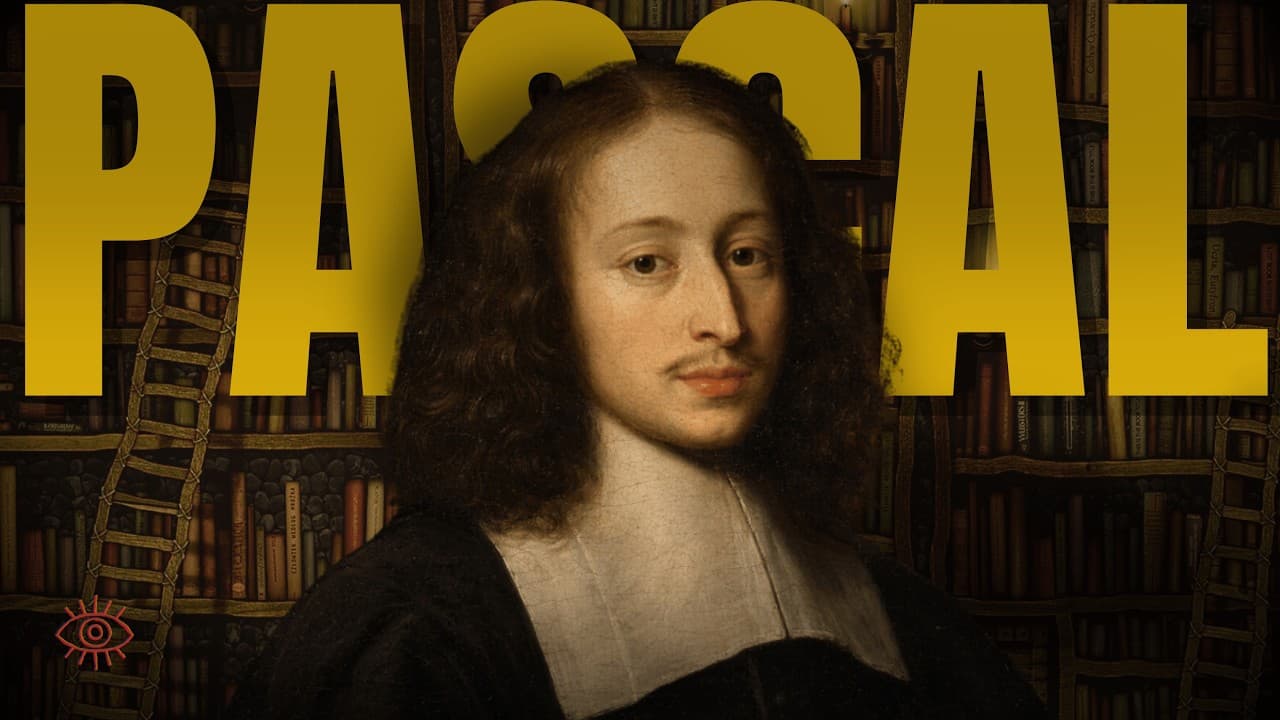
Blaise Pascal | The Mathematician Who Found God
Pascal's Complete Philosophy
The man who proved that nature does not abhor a vacuum, and then wrote the most honest account ever given of why the universe terrifies us.
Blaise Pascal lived only thirty-nine years, and in those years he changed mathematics, physics, probability theory, and the history of Western prose. But at the center of his life was a night in November of 1654 that he could never describe, only remember.
After that night he turned from the world of scientific triumph toward a book he would never finish, a book about what it means to be a human being suspended between two infinites, looking for a God who chooses to remain hidden. This episode follows Pascal from the Paris household where he taught himself geometry in secret as a child to the small room in which he died, with the record of his conversion sewn into the lining of his coat.
The full episode is on YouTube and Spotify. Please listen only in safe, restful contexts.
Enjoying the episode?
Occasional letters on philosophy, reading, and the examined life. No spam, ever.
By subscribing you consent to receiving occasional emails. Unsubscribe any time via the link in every email or at /unsubscribe.
Timestamps
- 0:00:00Chapter 1: The Prodigy
- 0:17:02Chapter 2: The Calculator and the Vacuum
- 0:33:53Chapter 3: Probability and the Gambler
- 0:51:15Chapter 4: The Night of Fire
- 1:08:33Chapter 5: Port-Royal and the Jansenists
- 1:26:04Chapter 6: The Provincial Letters
- 1:43:42Chapter 7: The Pensees Take Shape
- 2:00:48Chapter 8: The Hidden God and the Wager
- 2:17:29Chapter 9: Reason and the Heart
- 2:34:12Chapter 10: The Thinking Reed
For the record
Full Transcript
Chapter 01: The Prodigy
The house on the Rue de la Tissanderie stood in a Paris quarter where tax officials and merchants lived quietly with their families. In one of its rooms, sometime in the year sixteen thirty-one, a widowed father was beginning an experiment in education that would change the history of Western thought. The father was Etienne Pascal. He was a lawyer, a minor provincial aristocrat, and an amateur mathematician of real ability. His wife Antoinette had died five years earlier in Clermont-Ferrand, leaving him with three small children. The oldest was a girl named Gilberte. The youngest was a girl named Jacqueline. Between them stood his only son, Blaise, a boy of eight whose mind was already beginning to frighten the adults around him.
Etienne had made a decision. He would not send his children to the schools of Paris. He would educate them himself. He believed that most education proceeded in the wrong order, forcing children to memorize facts before they understood why those facts mattered. His method would be different. The children would learn Latin first. They would learn languages. They would learn the grammar of ideas before they learned the ideas themselves. Mathematics, which Etienne loved above all other subjects, would come last, after the mind had been disciplined by the more verbal arts. Blaise, he decreed, would not study geometry until the age of fifteen or sixteen. The boy was too young. Mathematics, Etienne believed, would consume him otherwise, and the consumption would be total.
This is worth pausing over. A father who loved mathematics was forbidding his only son from studying it. The prohibition was not a casual rule. It was an act of protective love. Etienne had seen what mathematics did to the minds it owned, and he did not want his son owned. Not yet. There would be time.
The boy had other plans.
What happened next is one of the most remarkable episodes in the history of education, and we have it on good authority. Gilberte, Blaise's older sister, wrote a memoir of her brother's life after his death, and the story she tells has the unmistakable ring of family memory, repeated and refined over decades of household conversation. The boy, she writes, kept asking his father about geometry. What was it? What did it study? Etienne, honoring his own rule, refused to say much. Geometry, he told Blaise, was a science that taught one how to make figures and how to find their proportions. He said no more than that.
It was enough.
Blaise began to work in secret. In the hours when he was supposed to be playing, he retreated to a corner of the house with a piece of charcoal and the tiled floor of his room. He began to draw figures. He did not know what they were called. He invented his own vocabulary. A straight line he named a bar. A circle he named a round. He drew these bars and rounds and studied the relationships between them. He asked himself questions. What happens when two bars meet? What happens when a round is cut by a bar? And then, with no teacher and no book and no guide, he began to answer these questions by pure thought. He demonstrated propositions. He proved them. He discovered, on his own, the equality of the angles of a triangle, which Euclid had proved two thousand years earlier and which every schoolboy in Europe was taught in its classical formulation. Blaise had never seen Euclid. He did not know the name of the angle, or the name of the triangle. He knew only what he had proven.
Gilberte tells us that he worked through the first thirty-two propositions of Euclid in this way, entirely on his own. The thirty-second proposition is the proof that the angles of a triangle sum to two right angles. It is a nontrivial result, and Blaise had reached it by an independent path before his twelfth birthday. Skeptical historians have questioned the story. It seems too good, too perfectly shaped. But the skeptics have never been able to explain the conic sections treatise four years later, and the conic sections treatise is indisputable. Whatever the exact chronology of the discovery, the underlying fact is solid. There was a child, and the child did not need a teacher. He needed only not to be forbidden.
Then one day his father walked in.
Etienne had come to his son's room without announcing himself, and he found the boy on the floor, surrounded by charcoal figures that Etienne, a skilled mathematician, recognized immediately. He saw what the figures were. He saw what the boy was doing. He understood what it meant. And he, the formidable father, the disciplined educator, the man who had forbidden this very thing, did not speak. According to Gilberte, he went out of the room and wept. He walked to the house of a friend, a man named Le Pailleur, and told him what he had found. The two men discussed what it meant. Etienne said that he had been wrong. The prohibition was over. The boy was going to be given every book on geometry in Paris, and he was going to be given them now.
Blaise was eleven or twelve years old. The great experiment had ended because the experiment had been surpassed by the subject. He was no longer a son who needed to be protected from mathematics. He was a mind that mathematics needed to be released into.
From that moment onward, his education accelerated. Etienne brought him to the meetings of a circle of scholars and mathematicians who gathered weekly at the house of Marin Mersenne, a Minim friar who was the central node of French intellectual life in the sixteen thirties. Mersenne corresponded with every important thinker in Europe. He knew Descartes. He knew Fermat. He knew Hobbes. The conversations at his salon ranged over the newest problems in mathematics and physics and natural philosophy. And into this company came Etienne Pascal, with his extraordinary son trailing behind him, wide-eyed and silent and absorbing everything.
You have to imagine the room. Candles. Old leather-bound books on the tables. Men in clerical robes and men in doublets, speaking over each other in French and Latin. Arguments about whether a line can be divided infinitely, about whether the planets move in circles or ellipses, about whether Galileo's telescope was showing what it appeared to show. And in the middle of this learned commotion, a boy of thirteen, listening. Trying to understand. Asking, eventually, the kind of questions that made the adults around him fall quiet and trade glances over his head. This was a mind they did not expect. It was sharp in the way a scalpel is sharp. It went where it intended to go, and nothing soft was left in its wake.
It is worth dwelling for a moment on what the sixteen thirties sounded like to a listening child. The old Aristotelian physics, which had ruled European universities for four centuries, was visibly crumbling. Galileo had spent the past decade publishing work that contradicted it, work that would culminate in his condemnation by the Roman Inquisition in sixteen thirty-three, the year Blaise turned ten. News of the condemnation reached Paris and was discussed nervously at Mersenne's table. The men around Mersenne were not just doing mathematics. They were inventing a way of thinking. They were asking what a proof was, what an experiment was, what it meant to establish something as true. The old authorities were no longer accepted simply because they were old. A new kind of inquiry was beginning to form, an inquiry that did not trust the classical texts, that insisted on experiment, that demanded numerical precision. Blaise was growing up inside this transformation, overhearing the foundational conversations that would, within a few decades, become the foundations of modern science. By the time he was old enough to contribute to it, he would be ready in a way no other child of his generation was ready, because he had been present in the room when the adults first began to say out loud that the ancients might have been wrong, and that a new method was needed to find out who was right.
Blaise did not remain silent for long. By the time he was sixteen, he had written his first mathematical treatise. The subject was conic sections, the curves you get when you slice a cone with a plane. This is an old subject, studied since antiquity, and by the seventeenth century it had become the proving ground for several of the most advanced mathematical minds in Europe. Blaise proved a theorem that has been known ever since as Pascal's theorem, a result about hexagons inscribed in conic sections that a professional mathematician would be proud to have discovered. He then wrote it up in a short paper, the Essay pour les coniques, which his father circulated.
Descartes read it. Descartes was then the most famous philosopher and mathematician in France, the author of the Discourse on Method and the Geometry, the man who had reduced the geometric to the algebraic by the invention of the coordinate system. Descartes looked at the essay and refused to believe that a sixteen-year-old had written it. He suggested that the real author must have been Etienne. The son, he implied, was a cover for the father. Descartes was not easily impressed, and he had an aging philosopher's skepticism toward prodigies. He was wrong about the authorship. The paper was the boy's. But his reaction tells us something important about the world Blaise Pascal was entering. His achievements were so remarkable that the greatest minds of the age could not believe they were possible.
Here we should pause again, because the story so far reads like a fable. The genius is discovered. The prohibition is lifted. The prodigy is crowned. Life rewards early brilliance with continuing brilliance, and everyone applauds. But if we are going to understand Pascal, we have to notice what this story cannot yet show us, because it lies in the future. The boy on the floor, drawing bars and rounds, working out Euclid in secret, is going to grow up into the man who writes that the sciences are not enough. That all the knowledge he had acquired, and all the theorems he had proved, and all the treatises he had written, could not answer the question that would eventually come to seem to him the only question that mattered.
What is that question? We can formulate it in several ways. It is the question of what to do with a life. It is the question of whether the universe is the kind of place in which a human being can find rest. It is the question of whether the mind that can prove theorems can also save the heart that must live with its own mortality. Pascal, as a boy, did not yet feel the weight of this question. He felt only the joy of discovery. But something was being built in those years, something that would eventually have to be confronted. The more the mind could do, the sharper its limits would eventually become, and the sharper those limits, the more unbearable would become the thought that the most important things lay on the other side of them.
Think of it this way. A child who builds a small tower is delighted that the tower stands. A child who builds a large tower becomes aware of gravity. The larger the tower, the more acutely the child understands the forces that will one day bring it down. Pascal, from a very young age, was building a very large tower. He would eventually know more about gravity than anyone of his century. And gravity, in the form he would come to understand it, was not just a physical force. It was a spiritual condition. The weight of existence. The pull of death. The downward tendency of every ambition toward its own failure. The prodigy who was celebrated in Mersenne's salon would grow into the man who wrote that the eternal silence of these infinite spaces terrifies him.
But all of that was still in the future. For now, the boy was eleven, and then twelve, and then fifteen, and his life was a continuous acceleration of understanding. He accompanied his father to mathematical gatherings and scientific discussions. He listened as Mersenne and his friends debated the work of Galileo and the claims of the new experimental philosophy. He absorbed the intellectual currents of an age that was, at that moment, inventing modern science. And he was doing so in the house of a man who had insisted that his son was not to study mathematics until sixteen. Etienne had planned to delay the river. The river had simply reversed its course and come up through the floor.
One more detail from this period is worth mentioning, because it anticipates everything that comes later. Etienne Pascal, during these Parisian years, had invested his family's capital in government bonds issued by the city of Paris. In the late sixteen thirties, the French government defaulted on the interest payments on these bonds, and Etienne lost most of his money. He protested publicly. He joined a group of investors who demanded that the government honor its obligations. Cardinal Richelieu, the de facto ruler of France, considered this act of protest seditious and ordered Etienne's arrest. Etienne went into hiding. The family fortunes collapsed. The widowed father who had been building a philosophical home school for his three brilliant children was suddenly a fugitive from the state.
What saved him was a theatrical performance. Jacqueline Pascal, Blaise's younger sister, had been writing poetry since she was a small child. She was ten when her father went into hiding. When Cardinal Richelieu attended a performance by a children's theatre group, Jacqueline was cast in one of the roles. After the performance, she spoke directly to the Cardinal, asking him to forgive her father. The Cardinal, charmed and moved, did so. Etienne was pardoned. More than that, he was given a new position by the royal government as tax commissioner in the city of Rouen.
Jacqueline, ten years old, had saved the family with a performance and a plea. It is the kind of moment that the Pascal family would never forget. It also established something about the dynamic among the three siblings. Jacqueline was not just a younger sister. She was a figure of moral authority, of directness, of startling courage. She would be the first of the Pascals to turn seriously toward religious life, and her decision would have consequences for her brother that nothing in his mathematical training had prepared him for.
The family moved to Rouen in sixteen forty. Etienne took up his new post. Blaise, now seventeen, carried with him his growing reputation as one of the most formidable young minds in France, his treatise on conic sections circulating in scholarly circles, his father's cautious pride at last giving way to outright amazement. The stage was set for the next phase of his life, the phase in which he would take the abstract power he had built during his boyhood and try to apply it to the world. He would build a machine that could calculate. He would prove that the air has weight. He would do things that no one before him had done. And he would begin, slowly and almost without noticing it, to suspect that even these things were not enough.
Chapter 02: The Calculator and the Vacuum
Rouen in the sixteen forties was a city of stone and fog. It sat on the Seine, sixty miles upriver from the sea, a trading town with a great cathedral and a royal tax office. Etienne Pascal arrived there in sixteen forty to take up his new post as a commissioner charged with assessing and collecting taxes for the crown. The work was enormous. It involved endless arithmetic, the reconciliation of ledgers, the tallying of sums that stretched into the tens of thousands and had to be checked and rechecked by hand. Etienne was a capable administrator, but he was also a man who loved mathematics for its elegance, and the drudgery of tax computation was the opposite of elegance. His son watched him suffer over the ledgers and decided to do something about it.
Blaise was nineteen. He had been working on a new kind of problem, not the pure geometry of his early years but the possibility of mechanizing arithmetic itself. The idea came from a very practical observation. Numbers were added by human hands, one digit at a time, and human hands made mistakes. If you could replace the hand with a mechanism, a set of gears and wheels engineered to carry the one when a column overflowed, you could get sums that were perfect every time. The idea was not entirely new. Others had imagined calculating machines before. But no one had built one that actually worked. Blaise decided to try.
He spent the next two years on the project. He designed. He failed. He redesigned. He hired clockmakers and metalworkers in Rouen and argued with them about specifications. He built prototypes, and the prototypes broke, and he built new prototypes. He made about fifty of them, or somewhere near fifty, before he had one that could reliably add a column of figures and carry the overflow to the next column. The machine was called the Pascaline. It was about the size of a shoebox. It had a row of small wheels on its top face, one wheel per digit, and underneath the wheels there was a mechanism of gears and cogs that handled the carrying. You set the wheels to the numbers you wanted to add, and the machine did the rest.
It worked. It did not, in the commercial sense, succeed. The Pascaline was expensive to manufacture. Each unit cost more than the annual salary of the clerk it was designed to replace. The French market for mechanical calculators turned out to be small. Pascal managed to sell only a handful of the machines, mostly as curiosities to wealthy buyers who wanted a clever toy. Commercially it was a failure. Philosophically it was a landmark.
Think about what the Pascaline meant. Here was a machine that could add. The operation of addition, which had been considered for most of human history as one of the fundamental operations of the rational mind, could be performed by brass and wood. The mind, it turned out, was not essential to arithmetic. The arithmetic was in the structure. If you built the structure correctly, the answers came out. Thought had been partially mechanized.
This is philosophically important, and Pascal himself was acutely aware of it. Years later, in the Pensees, he would return to the question of what machines can and cannot do. He would write that the Pascaline performed operations that we call intelligent, and yet the Pascaline had no mind, no will, no desire. It was simply gears. What this proved to him was that arithmetic, for all its power, could not be what makes a human being human. The most human thing about us must be something else. Something a machine could not imitate. He was twenty years old, and he was already sketching out, in the shadow of his own invention, the argument that would eventually become the heart of the Pensees.
But we are getting ahead of ourselves. The Pascaline occupied his late teenage years and his early twenties. While he was building it, he was also beginning to turn his attention to the larger questions of natural philosophy. The experimental science of the seventeenth century was exploding. Galileo had died in sixteen forty-two, and his work on motion and falling bodies was now being extended and tested by a new generation of researchers across Europe. In Florence, a student of Galileo named Evangelista Torricelli had performed a strange experiment with mercury. He had filled a long glass tube with mercury, closed the bottom end with his finger, inverted the tube in a bowl of mercury, and released his finger. The mercury fell down the tube until it reached a height of about thirty inches, and there it stopped. Above the column of mercury, inside the sealed top of the tube, there was nothing. No air. No mercury. Nothing.
Who was Torricelli, and how did his experiment reach Pascal in Rouen? Evangelista Torricelli had been Galileo's secretary and mathematical assistant during the final three months of the old master's life in early sixteen forty-two, when Galileo was blind and confined to his house near Florence by order of the Inquisition. Torricelli inherited Galileo's position as mathematician to the Grand Duke of Tuscany. He inherited also the unsolved problems that Galileo had been thinking about. One of those problems concerned the behavior of suction pumps. Well-diggers in Tuscany had noticed that a suction pump could lift water only about thirty-three feet and no higher, and no one could explain why. Galileo had suspected that the weight of the water itself was the limiting factor. Torricelli went further. He conducted the mercury experiment in sixteen forty-three, the year after Galileo's death, and his result was circulated in a letter to a mathematical colleague named Michelangelo Ricci. Ricci shared it with other correspondents. Mersenne heard of it. Mersenne wrote to the Pascal family in Rouen. Etienne and Blaise began repeating the experiment themselves, refining the apparatus, looking for what the Italian had missed. This is how seventeenth-century science actually worked. There were no journals. There were no conferences. There were only letters, passed from one scholar to another across long distances, carrying news of the latest experiments and the latest arguments. A discovery made in Florence could take a year to reach Paris, and another year to reach Rouen, but it did reach, and when it reached a mind that was prepared to act on it, the consequences could be enormous. Pascal's mind was prepared. Torricelli had given him the opening. He walked through it.
This was a problem. Classical physics, since Aristotle, had held that nature abhors a vacuum. A truly empty space could not exist, because as soon as you tried to create one, the surrounding matter would rush in to fill it. Torricelli's tube appeared to contain something that should not exist. A vacuum above the mercury. Torricelli himself proposed a different explanation. He suggested that the mercury was not being held up by any horror of vacuum. It was being held up, from below, by the weight of the air pressing on the surface of the mercury in the bowl. Air had weight. We were at the bottom of an ocean of air, and the pressure of that ocean supported the column of mercury in the tube. If that were true, Torricelli reasoned, then the height of the mercury should vary with the amount of air above it. If you carried the tube to a high altitude, where there was less air overhead, the column of mercury should fall.
This was a testable hypothesis. No one had tested it. In sixteen forty-seven, Blaise Pascal, now twenty-four, decided to test it.
He could not climb a mountain himself. His health, always fragile, was not up to the task. So he wrote to his brother-in-law, Florin Perier, a man who lived in Clermont-Ferrand at the foot of a mountain called the Puy de Dome. The mountain rose about three thousand feet above the plain. Pascal asked Perier to perform an experiment. Take two barometer tubes, Pascal wrote, filled with mercury in the standard way. Leave one at the base of the mountain, in the care of a reliable witness. Carry the other to the summit. Measure the height of the mercury column at both locations. If the air pressure theory is correct, the column at the summit should be significantly shorter than the column at the base.
Perier performed the experiment on September nineteenth, sixteen forty-eight. He had witnesses. He followed Pascal's instructions precisely. The column at the base of the mountain stood at twenty-six inches and three and a half lines. The column at the summit stood at twenty-three inches and two lines. The difference was about three inches. It was exactly what the air pressure theory predicted.
Pascal published the results. The experiment became famous. It was, in its way, one of the most decisive moments in the history of modern science. Aristotle had been overturned. The vacuum was real. Nature did not abhor it. Nature simply obeyed the laws of physics, and one of those laws was that a fluid at the bottom of a column of heavier fluid will rise to a height determined by the weight of the column. Pascal went on to do more work in hydrostatics, eventually formulating what is now called Pascal's principle, the fundamental law that pressure applied to a confined fluid is transmitted undiminished through the fluid in every direction. It is the principle behind every hydraulic lift ever built. It is why a small force can raise a great weight, if the geometry is right.
A twenty-five-year-old had demonstrated that reality contained things classical philosophy had insisted were impossible. That ought to have been a triumphant moment. In many ways it was. Pascal was celebrated throughout Europe. His name was mentioned alongside the greatest experimentalists of the age. And yet if we read his letters and his later writings carefully, we can see that something else was happening underneath the triumph. The vacuum was a result, but it was also a metaphor. It was beginning to lodge in his imagination as a picture of the universe itself.
Here is what the picture looked like. Reality was mostly empty. The objects we think of as solid, the ones we can touch and hold and call by their names, were islands floating in a great sea of nothingness. The stars, which seemed so numerous at night, were separated from each other by distances so vast that the spaces between them could hardly be imagined. The air, which had seemed like a kind of substance, turned out to be mostly nothing as well, a thin layer of weight pressing on our shoulders only because the earth's gravity held it there. And if you could remove the air, as Pascal's experiments showed you could, you would find that what was left was not a fullness of some finer substance. It was emptiness. Nothing. A void.
Older philosophy had a comfort built into it. Aristotle's universe was full. Every spot in space was occupied by some kind of substance, air or water or aether or the crystalline spheres of the heavens. A full universe is a hospitable universe. There is no place in it where a person could feel radically alone. Pascal's experiments were taking this comfort away. They were showing that reality was not full. It was mostly vacancy. And a mostly vacant reality is a reality in which the small bright island of human consciousness begins to look very small indeed.
You can feel this turn in Pascal's writings of the late sixteen forties. The scientific triumphs are real, but they are shadowed by a growing discomfort. In private letters, he begins to speak of the vanity of worldly activity, of the emptiness of the pursuits that occupied his contemporaries, of the difficulty of finding any rest in a world that kept receding from him the closer he looked at it. He had not yet had his conversion. The night of fire was still six years away. But the ground was being prepared. The vacuum above the mercury in his experimental tubes was beginning to whisper to him about a larger vacuum, the one he could not measure, the one that seemed to open up whenever he stopped working long enough to notice it.
One more scene from this period. In the autumn of sixteen forty-six, Pascal's father Etienne had slipped on ice and broken his leg. The leg was set by two local bone-setters who lived in the house for three months while Etienne recovered. These men were Jansenists, devout followers of a rigorous Catholic reform movement that we will discuss in detail in a later chapter. They brought books into the Pascal household. They spoke about religion with the calm seriousness of men for whom it was the only thing that finally mattered. Blaise read their books. His father read them too. The whole family underwent what later biographers have called the first conversion, a gentle turning toward a more serious Catholic practice. It was not yet the night of fire. It was not yet the intensity that would seize Pascal in sixteen fifty-four. But it was the beginning. A seed had been planted in the house in Rouen by two bone-setters who had come to heal a father's leg and had left behind, without knowing it, the religious orientation that would shape the rest of the son's life.
Pascal was twenty-three years old when he first encountered Jansenism in this quiet way. He would not act on it for another eight years. The scientific work went on. The Pascaline was still being built. The vacuum experiments were still being conducted. But the man who would eventually write the Pensees had begun to form, though he did not yet know it, the spiritual dissatisfaction that would make everything he had built up to that point feel, eventually, inadequate to the weight of being alive.
The decade of the sixteen forties closed for him with the death of his father in sixteen fifty-one. Etienne had been the presiding mind of the Pascal household for as long as any of the children could remember. His death was not only a personal loss. It was a structural one. With the father gone, the family had to reorganize itself, and the reorganization would push each of the three children toward the choices that defined the rest of their lives. Jacqueline would enter Port-Royal. Gilberte would continue with her husband Florin Perier and their growing household in Clermont-Ferrand. And Blaise would return, temporarily, to the distractions of worldly Paris, where he would spend three or four years in the social swirl of the capital, trying to figure out what a man of his abilities should be doing with his life. The vacuum had opened in him, and he had not yet found the thing that could fill it. The answer, when it came, would not come through any of the tools he had used up to that point. Not mathematics. Not physics. Not the engineering of small brass machines. It would come through something stranger, something he had not been trained to expect, and it would come at an hour of the night he would remember for the rest of his days.
Chapter 03: Probability and the Gambler
The sixteen fifties opened with Pascal at the height of his scientific fame and at the beginning of his spiritual unease. His father Etienne had died in sixteen fifty-one. His sister Jacqueline, who had been living at home, entered the convent of Port-Royal the following year as a novice, against her brother's initial objections. Blaise himself was thirty years old. He had been working for over a decade at the frontier of mathematics and physics. His name was known throughout Europe. And he was, by his own later admission, profoundly unhappy.
The unhappiness was not dramatic. It was not the kind of crisis that interrupted his work. He was still producing. He was still corresponding with the great mathematicians of the age. He was still welcomed in the best salons of Paris. But something was failing underneath. The achievements were not producing the satisfaction he had expected from them. He would finish a proof and feel nothing. He would be praised for a discovery and feel nothing. The feeling of nothing was becoming, gradually, the most consistent feeling he had.
In the meantime, he moved in circles that did not share his unease. Paris in the sixteen fifties was a city of aristocratic leisure, of salons and gambling houses and long conversations about love and philosophy and the latest plays. Pascal, whose health was fragile but whose mind was still ravenous, spent some of his energy in these worldly settings. He kept the company of men and women for whom religion was a formal observance and intellectual life was a kind of sport. Among these companions was a French nobleman named Antoine Gombaud, who went by the title the Chevalier de Mere. De Mere was a man of the world. He gambled. He wrote elegant letters. He thought of himself as a philosopher of polite conversation. And he had a problem he could not solve.
The problem involved dice. Or more precisely, it involved what happens when a game of dice is interrupted before it is completed. Suppose you are playing a game where the first player to win six rounds takes the pot. You have won four rounds and your opponent has won three, and then the game is interrupted and cannot be finished. How should the pot be divided? The natural answer, the one everybody gave, was to divide the pot in proportion to the rounds already won. Four to three. You get four-sevenths, your opponent gets three-sevenths. This felt intuitive. It also, de Mere suspected, was wrong. Because the pot is not about what has already happened. It is about what was going to happen. The question is, how likely was each player to win if the game had continued? That question could not be answered by looking at the past. It had to be answered by looking at the future, and the future is exactly the thing that cannot be seen.
De Mere posed this puzzle to Pascal. Pascal took it seriously. He began to think about it, and then, because the problem was hard, he wrote to another mathematician to compare notes. The mathematician was Pierre de Fermat, who lived in Toulouse in the south of France. Fermat was a jurist by profession and a mathematician by passion. He had been corresponding with Mersenne's circle for years and was considered, with Descartes, one of the great French mathematicians of his generation. Pascal had never met him. But he knew his work, and he knew that if anyone could see into the problem of the interrupted game, Fermat could.
The letters between Pascal and Fermat began in the summer of sixteen fifty-four. They exchanged perhaps half a dozen of them, maybe a few more. The exchange is one of the most important in the history of mathematics. Because in these letters, Pascal and Fermat, working together, invented probability theory.
It is worth understanding what that means. Mathematics before sixteen fifty-four had made extraordinary progress in many areas. Geometry was ancient. Algebra had been imported from the Arab world and refined by Italian and French mathematicians during the Renaissance. Calculus was about to be invented, first in primitive forms and then, a generation later, by Newton and Leibniz in the forms we still use today. But one whole domain of human experience had resisted mathematical treatment. The domain of chance. The domain of what might happen. The domain of the uncertain.
Gamblers had long noticed that certain things were more likely than others. Rolling a two with one die was less likely than rolling a three, because there are more ways to add up to three than to two. But this was folk wisdom. There was no systematic theory. No one had a way of calculating, in general, how likely a given outcome was, or how the likelihoods of several outcomes should be combined. The great mathematicians of the ancient world had not touched the problem. Euclid did not write about dice. Archimedes did not write about lotteries. The idea that the future itself could be a subject of rigorous mathematical analysis was foreign to their way of thinking.
Pascal and Fermat, over the course of the summer of sixteen fifty-four, broke through this barrier. Their approach was different, but they reached the same results. Pascal used a combinatorial method, thinking about the number of ways that a given outcome could occur. Fermat used a method based on the possible completions of the game, counting how many of those completions favored each player. Both methods yielded the same answer to the problem of the interrupted game, and the answer was not four-sevenths and three-sevenths. It was eleven-sixteenths and five-sixteenths. Because if the game had continued, the player who was ahead would have had a much higher chance of winning, not just a slightly higher chance. The lead was worth more than it looked.
More importantly, the letters did not just solve one problem. They laid out a whole new way of thinking. They introduced the concept of expected value. The expected value of a gamble is the value of each possible outcome multiplied by the probability of that outcome, summed together. It is a measure of what you should expect to get, on average, if you could play the game many times. It is also a way of pricing uncertain futures. If an outcome is very valuable but very unlikely, its expected value is small. If an outcome is modestly valuable but very likely, its expected value may be much larger. The whole theory of rational decision under uncertainty, which would go on to underwrite modern economics and modern statistics and modern game theory, was taking its first breaths in the correspondence between two French mathematicians in the summer of sixteen fifty-four.
Pascal was pleased with this work. He wrote to Fermat in terms of real affection. He acknowledged the brilliance of Fermat's approach. Fermat responded in kind. There is something moving about reading these letters now, two great minds gently admiring each other across a country and laying the foundations of a science that neither of them would live to see fully developed. Pascal died eight years later. Fermat died three years after that. Neither of them published the letters during their lifetimes. The correspondence was preserved by Pascal's nephew and printed after his death, and its full significance was not appreciated for generations. But the work had been done. Probability theory existed.
It is tempting to think that probability theory must have existed in some form before Pascal and Fermat, because the idea seems so natural once you have it. But the history shows otherwise. The Greeks had atomistic theories of chance, and some ancient commentators had speculated about why certain throws of the knucklebones came up more often than others, but none of this rose to the level of mathematics. The first thinker to come close was Gerolamo Cardano, an Italian physician and gambler who wrote a treatise on games of chance in the fifteen hundreds. Cardano had noticed some of the basic regularities. He had talked about the odds of rolling a particular number with two dice. But his work was not systematic, and it remained unpublished for nearly a century after his death. Galileo, in his spare time, had sketched a short note on dice problems at the request of a courtier, but he did not develop it. The field was inert. It was waiting for someone to take it seriously. Pascal and Fermat were the ones who did. Their letters are the moment when a scattered set of folk observations became a science.
There is also something poignant about the timing. Pascal was writing to Fermat in the same summer that he was beginning to consider, in his private thoughts, the possibility of a total reorganization of his life around religion. The correspondence ends, roughly, in early autumn of sixteen fifty-four. The night of fire comes about two months after the last letter. The interval between them is the last intellectually carefree period of Pascal's life, the last time he will work on a problem purely because the problem is interesting, without the weight of his spiritual crisis bearing down on every move of his pen. The letters to Fermat have a lightness to them. They are the letters of a man enjoying his own mind. After November, the lightness is gone. The mind is still there, as powerful as ever, but it is at work on questions that will not let it rest. Probability theory was Pascal's last great gift as a pure mathematician. He did not know it at the time, but we can see it from here.
There is a detail in the correspondence that is worth pausing over. Pascal, near the end of the exchange, remarks that the truths of mathematics are timeless and certain in a way that nothing else in the world is. Once you have proved that eleven-sixteenths is the correct share, no one can take that proof away from you. It will be eleven-sixteenths forever. This certainty was, for Pascal, one of the most beautiful things about mathematics, and he says so in the letter. But you can already sense, underneath the praise, a restless qualification. The certainty of mathematics is real, but it is certainty about the wrong things. Dice. Games. Abstract structures. The important questions, the ones that actually shape a life, are not like this. They do not have provable answers. And the person who tries to live a human life by seeking mathematical certainty about it will find themselves, as Pascal was finding himself, in a position that the mathematics cannot reach.
Here is where the story becomes important for our purposes. Pascal had now, at the age of thirty-one, developed a new intellectual tool, a way of reasoning about uncertainty. And he was about to face the greatest uncertainty of his life.
Because the summer of sixteen fifty-four was also the summer of his final turning toward religion. Jacqueline, from her convent at Port-Royal, was writing to him urgently. His unhappiness in worldly society had been deepening. His health, never good, was worsening. And the question that had been forming in the background of his consciousness for years was now pressing itself upon him with a new urgency. The question was not an academic question. It was the question of what to do with the rest of his life. Should he continue as a scientific celebrity in Paris, praised by Mersenne's circle, trading witticisms with the Chevalier de Mere? Or should he turn, finally and completely, toward the God whom his sister had already embraced?
This is a decision under uncertainty. It is exactly the kind of decision that his new theory of probability had been designed to handle. Because he could not prove that God existed. He could also not prove that God did not exist. He was confronting two possible states of the world, each with its own expected value, and he had to choose how to live without knowing which state obtained. Pascal, the inventor of probability theory, was about to turn his own tools on himself. The wager, which he would formulate some years later in a fragment of the Pensees, was not going to come out of nowhere. It was going to come directly out of the letters he was writing to Fermat about dice. The same mind that had analyzed the interrupted game of chance was going to analyze the interrupted game of a human life. The same mathematics that priced the value of an uncertain future was going to price the value of eternity.
There is a kind of strange beauty to this. Pascal had been led by a nobleman's question about gambling to invent a theory about chance. The theory about chance would eventually become the tool by which he would justify the most serious decision a human being can make. What began as an amusement for bored aristocrats became the framework for the deepest religious argument of the seventeenth century. The gambler's question, reframed, was the philosopher's question. What should a rational person do when they cannot see what is coming?
Think for a moment about how unlikely this confluence was. De Mere was, by every account, a shallow man. He was not a philosopher. He did not suspect that his little puzzle was going to become the origin of the modern science of risk. He simply wanted to know how to settle a dispute among gamblers. And yet the question he happened to ask was the question that opened, in Pascal's hands, a door that no one had opened before. This is the kind of accident that makes intellectual history feel like a story someone is telling rather than a sequence of random collisions. A minor aristocrat, a brilliant mathematician, a scholarly provincial jurist, a handful of letters exchanged between Paris and Toulouse, and the whole foundation of modern probability theory is laid. Everything that comes afterward, every insurance contract, every actuarial table, every stock market model, every weather forecast expressed as a percentage, every statistical study of disease or of elections or of gene frequencies, is downstream of what Pascal and Fermat worked out in letters about dice.
All of that was still ahead. In the autumn of sixteen fifty-four, Pascal was still a man in between. He was still writing to Fermat. He was still appearing in Parisian salons. He was still making jokes with the Chevalier de Mere. But the work was almost finished. The probability theory was largely in place. The decision was about to be forced. And then, one November night, it would be forced in a way that no one, including Pascal himself, had expected.
On the evening of November twenty-third, sixteen fifty-four, Pascal had an experience that lasted for about two hours. What happened in those two hours would redefine the rest of his life. He would never again speak of it in any detail. But he would write about it on a piece of parchment that he would sew into the lining of his coat, and he would carry it with him for the remaining eight years of his life. The parchment was the Memorial. The experience was the night of fire. And after it, the man who had calmly developed decision theory with Fermat would find that he had decided, in an instant, something that all his decision theory could not have told him to decide.
Chapter 04: The Night of Fire
We know the date. We know the approximate time. We do not know much else. And this is the single most important fact about Pascal's life, because everything that came after it was shaped by something he refused to describe except in a few ecstatic words.
The date was November twenty-third, sixteen fifty-four. It was a Monday. Pascal was living in Paris. He was thirty-one years old. He had spent the previous months corresponding with Fermat about probability, circulating in the intellectual salons of the capital, and struggling with a persistent spiritual restlessness that his worldly friends did not understand. His younger sister Jacqueline, from her cell at Port-Royal, had been writing to him with increasing urgency, begging him to take his spiritual condition more seriously. He had not yet listened. On the evening of November twenty-third, something changed.
Between the hours of approximately ten thirty in the evening and half past midnight, Pascal had an experience. We do not know what he saw, or what he heard, or what he felt. We know only what he wrote afterwards, and what he wrote afterwards was not an explanation. It was a record. A set of words hurriedly inscribed on a small piece of parchment, in handwriting that shakes and crowds and pushes against the margins. The parchment was later called the Memorial. Its contents are some of the most concentrated religious language ever set down by a European writer.
The document begins with a single word in large letters.
FIRE.
Below the word, Pascal has written the date and the time. The year of grace sixteen fifty-four. Monday, the twenty-third of November, day of Saint Clement, pope and martyr, and of others in the martyrology. From about half past ten in the evening until about half past midnight. Two hours. He wanted to remember.
Below the date, the central lines.
FIRE. God of Abraham, God of Isaac, God of Jacob, not of the philosophers and the scholars. Certainty, certainty, heartfelt, joy, peace. The God of Jesus Christ. My God and your God. Your God will be my God. Forgetting the world and everything, except God.
These are not sentences. They are pulses. Each line is its own breath, and there is no connective tissue between them. It is not the kind of writing a person produces when they are trying to communicate. It is the kind of writing a person produces when they are trying to hold onto something that is happening to them and that they fear will escape as soon as their attention drifts. Pascal is transcribing, in the middle of it, what it is like to be inside it. The result is unlike anything else in Western literature. It is closer to a prayer than a prose passage. It is closer to a poem than a prayer. It is closer to a scream than a poem. But the scream is not of pain. It is of recognition.
What did Pascal see? We can make inferences from the language. The phrase God of Abraham, God of Isaac, God of Jacob, not of the philosophers and scholars is a direct rejection of the kind of abstract theology that the Cartesian and scholastic traditions had been producing. Pascal is saying that the God he has encountered is not the God of philosophical argument. It is not the first cause of Aquinas or the infinite substance of Descartes. It is the personal God of the Hebrew patriarchs, the God who walks with specific human beings in specific places and speaks to them as persons to a person. This God cannot be proved. This God must be met. And Pascal, whatever happened on that evening, believed that he had met him.
The phrase certainty, certainty, heartfelt, joy, peace tells us something else. Pascal, the mathematician, had known the certainty of a proved theorem. He had known the pleasure of a demonstration that could not be contradicted. What he experienced on the night of November twenty-third was also certainty, but of a different kind. It was a certainty that was felt, not deduced. It lived in the heart, not the intellect. And it carried with it a joy that his geometric proofs had never carried. This is the beginning of the most important distinction in Pascal's mature thought, the distinction between the reasons of the heart and the reasons of the mind. He had just experienced, directly, a reason of the heart. Whatever he had known before about the difference between head and heart, he now knew because he had lived it.
The phrase forgetting the world and everything, except God suggests the scale of the experience. Whatever was happening to him, it was making everything else disappear. The scientific career. The family fortune. The admiration of his peers. The elegant conversations. All of it was receding. There was only one thing left, and the one thing was enough, and it was also somehow more than enough, filling the space that the receding world had left behind.
He wrote. He kept writing. The Memorial includes a quotation from the Gospel of John, from chapter seventeen, where Jesus prays to the Father and says that they may all be one. It includes the phrase the joy, the joy, the tears of joy. It includes references to the Psalms. It ends with the words renunciation total and sweet and eternally in joy for a day of exercise on the earth. I will not forget your word. Amen.
Then, at some point, the experience ended. He stopped writing. The room was quiet. It was after midnight. Pascal was alone.
What he did next is the detail that has made this episode immortal. He took the piece of parchment on which he had written the Memorial. He took a sewing needle and thread. And he sewed the parchment into the lining of his coat. He did not tell anyone. He did not announce what had happened. He did not write a public account. He simply took the record of his experience and hid it inside his clothing, where it would stay close to his body.
He wore that coat every day. When the coat wore out, he took the parchment out of the old coat and sewed it into the new one. He did this for the remaining eight years of his life. No one knew. His servants did not know. His sisters did not know. His closest friends did not know. For eight years, Pascal walked around Paris with the most important document of his interior life stitched invisibly into his clothing, pressed against his chest.
When he died in sixteen sixty-two, a servant found the parchment while going through his effects. The servant recognized that it was important. The family was summoned. They read it. They made a copy. They put the original in a safe place and eventually published a transcription. Only after Pascal's death did anyone outside his own mind know what had happened on the night of November twenty-third, eight years earlier.
Pause here and think about what this means. Pascal, the most brilliant prose stylist of his century, had an experience that he considered the central event of his life. And he chose never to speak about it. Not in his letters. Not in the Pensees, which were supposed to be his great work on the Christian faith. Not in conversation with his dying sister. Never. The only written record was the parchment he hid, and the parchment he hid was not a theological argument, not a spiritual autobiography, not a mystical treatise. It was a set of broken phrases scratched down in the middle of the experience itself.
Why? One reason is that Pascal believed, deeply, that certain things cannot be spoken of without being falsified. The moment you try to explain an experience of this kind, you turn it into something it is not. You reduce it to an argument, or a story, or a lesson. You make it available to other people, which sounds good, but in making it available you also make it small. You fit it into the categories they already have, and those categories cannot hold it. The honest thing, for Pascal, was to keep the experience inviolate. To let it do its work on him without exposing it to the acid of external interpretation.
Another reason, I think, is that Pascal understood something about belief that few other philosophers have understood. Belief is fragile. It is not a conclusion that you reach and then keep indefinitely, like a theorem. It is a state that has to be maintained. It is always at risk of evaporating under the pressure of the ordinary world. Pascal knew that if he tried to put his experience into public language, he would begin to doubt it. He would begin to ask whether he had really seen what he thought he had seen. He would begin to wonder if it was a hallucination, a trick of exhaustion, a byproduct of his illness. The experience would dissolve under the acid of his own analytical mind. The only way to protect it was not to examine it. To hide it. To sew it into a coat and carry it next to the body and feel it pressing against the chest as a reminder that something had happened.
It is worth saying something about what a religious experience like this meant in the seventeenth century, and about how Pascal's contemporaries would have understood it. The Catholic world of the sixteen fifties was still shaped by the great mystical writers of the previous century. Teresa of Avila had died in fifteen eighty-two, leaving behind detailed accounts of her encounters with Christ and the various grades of prayer she had progressed through. John of the Cross had described the dark night of the soul and the luminous way that led through it. These writers had established, for Catholic readers, that encounters with God were not confined to the biblical past. They could happen now. They could happen to living people. A well-read Catholic of Pascal's time would have understood immediately what Pascal was describing when he wrote of fire and joy and certainty. They would have placed it within a known genre of spiritual experience.
But Pascal did not place himself within that genre. He did not describe his experience as a mystical union, as Teresa had done. He did not compare himself to any of the saints. He did not even write about it in a letter to his confessor, which would have been the normal thing to do. He wrote a record, in the privacy of his own handwriting, and then he hid the record. The gesture rejected the genre. It said, in effect, that what had happened to him could not be placed inside a category without being diminished, and that the existing categories, however venerable, were not going to do justice to what he had seen. He was going to keep the experience as his own, unassimilated to any tradition, untranslated into any shared vocabulary. This is, among other things, an extraordinarily modern stance. Pascal is insisting on the particularity of his encounter, its irreducible specificity, its refusal to be treated as an instance of anything more general. The insistence runs through all of his mature work. It is one of the things that makes him feel like our contemporary, rather than a man of his own century.
This is a very modern insight. Centuries later, William James would write about how religious experience has to be protected from the corrosive action of rationalization. Pascal had reached the same conclusion not by theory but by practice. He was protecting his own experience with a kind of contemplative silence.
There is also something almost physically tender about the gesture of sewing. Pascal was a celebrated intellectual, a mathematician and a writer and a public figure. Sewing was women's work in seventeenth-century France, associated with domestic labor and female patience. That Pascal himself, or perhaps one of the women in his household though tradition has it that he did it himself, took needle and thread and carefully stitched this paper into his coat is the kind of small gesture that reveals more about a person than their published works. He wanted the parchment close. He did not trust that he would remember otherwise. Eight years of wearing a coat with a stitched-in secret is eight years of never being able to forget that you once met God on a Monday night in Paris, and that the meeting had changed everything.
What changed? Everything downstream of that night would be shaped by it. The work on probability theory continued for a while but gradually tapered off. The mathematical correspondence slowed. The scientific publications became fewer and more occasional. Pascal began spending more time at Port-Royal, the Jansenist convent where his sister Jacqueline was now a nun. He began reading works of Catholic theology with a new intensity. He began drafting the Provincial Letters. He began accumulating the notes that would eventually become the Pensees. And he began walking more slowly, because his health, which had been bad, was now beginning to fail him in earnest.
The night of fire had not healed him. It had not solved his physical problems. It had not made his life easier. If anything it had made his life more difficult, because it had aligned him permanently with a religious cause that would cost him his worldly friends and would consume what little energy his failing body had left. But the night had given him something that his mathematics and his science had not given him. It had given him certainty. Not the certainty of a proof, but the certainty of a presence. And for the rest of his life, he would organize everything around the task of being faithful to what he had experienced during those two hours that he would never describe and never explain and never, until the day of his death, tell anyone else about.
A postscript. Some modern readers, trying to understand the night of fire from outside any religious framework, have suggested that Pascal may have been in a state of heightened neurological activity, perhaps a seizure or a migraine aura, that produced the subjective impression of divine contact. This is possible. We cannot rule it out. But notice what the explanation does not explain. It does not explain why the experience continued to be regulative for the rest of Pascal's life. A neurological event lasts as long as the event lasts. It does not shape eight years of subsequent behavior unless the person who had it interprets it as meaningful, and the interpretation is not a part of the event. It is a separate thing, done with a different faculty, and it is the interpretation that matters for the biography. Whatever Pascal experienced on November twenty-third, he understood it as a meeting with God, and he organized his whole future around that understanding. The understanding is the fact that demands to be taken seriously, regardless of what the physiological substrate might have been.
The coat is gone now. The parchment survives, transcribed and preserved and studied by scholars for three and a half centuries. What it tells us is limited. What it suggests is vast. And what it implies about the kind of man Pascal became after November twenty-third, sixteen fifty-four, is the subject of everything that follows.
Chapter 05: Port-Royal and the Jansenists
To understand what Pascal turned toward after the night of fire, you have to understand Port-Royal, and to understand Port-Royal, you have to understand Jansenism, and to understand Jansenism, you have to understand how strange it was in the middle of the seventeenth century to believe that your own goodness could not save you.
Start with the place. Port-Royal-des-Champs was a Cistercian convent located about twenty miles southwest of Paris, in a valley called the Vallee de Chevreuse. The original abbey had been founded in twelve oh four. By the early seventeenth century it had become, like many Catholic religious houses in France, rather lax in its observance. Nuns came and went. Discipline had loosened. The surrounding region was damp and marshy and unhealthy, and the community had begun to consider moving. Then in sixteen oh eight, a young woman of eleven years old was appointed abbess. Her name was Angelique Arnauld, and she belonged to a powerful Parisian family of lawyers and magistrates. She had not wanted the position. Her father had forced it on her as a way of securing a church appointment for a daughter. She was, in most ways, a child.
The Arnauld family deserves a closer look, because Port-Royal was in many ways an Arnauld project. The patriarch, Antoine Arnauld the elder, had been a lawyer famous for his court arguments against the Jesuits in the late fifteen nineties. He had twenty children. Several of them entered religious life. Several became significant theologians. One became a bishop. The whole family was known for their intellectual seriousness, their polemical courage, and their willingness to stand against power when power seemed to them to be wrong. Port-Royal, under the reform of the young Angelique, became the gathering point for the family's religious energy. Her brothers supported her financially and legally. Her sisters joined her in the convent. Her nephews and nieces were educated in the Little Schools. By the time Pascal became associated with Port-Royal in the sixteen fifties, the Arnauld family had been shaping the community for nearly half a century, and the great theological battles being fought on its behalf were, for the Arnaulds, as much family struggles as doctrinal ones. Pascal was not marrying into the family, but he was allying himself with them, and the alliance was total. He attended their retreats. He stood by them during the persecutions. When Antoine Arnauld the younger, the theologian and chief defender of Jansenism, was expelled from the Sorbonne in sixteen fifty-six, Pascal wrote the Provincial Letters in his defense. When the formulary controversy erupted a few years later, Pascal helped Jacqueline find the words to resist. The Arnaulds gave Pascal a community. He gave them a voice. It was, for a few years, one of the most productive alliances of minds that seventeenth-century France produced.
Four years later, at the age of seventeen, Angelique experienced a religious awakening. She decided that the laxity of her convent was a scandal. She resolved to reform it. She imposed strict enclosure, cut off contact with outsiders including her own family, and insisted that the community return to the rigorous observance that the original Cistercian rule had demanded. When her father and brothers came to visit, she refused to see them. They beat on the door. She sent a message through the grille. She would not open. The family was furious. They understood, eventually, what had happened. The daughter they had forced into the convent for political reasons had chosen God with a seriousness they could not compete with.
Angelique's reform was successful beyond anyone's expectations. Port-Royal became known throughout France as a place of rigorous Catholic devotion. Other women joined. The community grew. A second house was established in Paris, called Port-Royal-de-Paris, to accommodate those who could not live in the damp conditions of the original site. And a circle of laymen began to gather around the two houses, men who were inspired by the example of the nuns and who wanted to participate in some version of their seriousness without becoming monks themselves. These men were called the Solitaires, the Solitary Ones. They lived in small cottages near the convents. They prayed. They studied. They wrote. They educated children in what became known as the Little Schools of Port-Royal, which would produce some of the most distinguished French intellectuals of the seventeenth century, including, eventually, the playwright Jean Racine.
Into this world, in the early sixteen thirties, came a new kind of theological influence from the Low Countries. A bishop and theologian named Cornelius Jansen, professor at the University of Louvain and later bishop of Ypres, had been working for many years on a massive study of Saint Augustine. Jansen believed that Augustine, the great African church father of the late fourth and early fifth centuries, had understood something about human nature that later Catholic theology had forgotten. Augustine had taught that human beings, after the fall of Adam, were corrupted to the core. They could not will the good on their own. They could not save themselves by their own efforts. Everything depended on the grace of God, and God gave his grace to some and withheld it from others according to a mystery that human reason could not penetrate. This was not a comforting doctrine. It meant that you could not earn your salvation. You could only hope that God had chosen to save you. And if he had not chosen to save you, no amount of effort on your part would change the outcome.
Jansen's book was called Augustinus. It was published in sixteen forty, two years after his death. It caused an immediate controversy in the Catholic world. The Jesuits, who had become the most influential theological order in Catholicism and whose views on grace were very different from Jansen's, objected strongly. The Jesuits taught a more moderate view in which human cooperation with grace was essential and in which a person's own choices and efforts could contribute to their salvation. The Jesuit position was more appealing to ordinary Catholics. It gave people a role in their own destiny. Jansen's position, by contrast, made the destiny depend almost entirely on God, and the God in question was one whose choices were inscrutable.
The theological dispute quickly became political. Rome, under pressure from the French Jesuits, condemned a set of propositions that were said to be drawn from Augustinus. The Jansenists insisted that either the propositions were not in the book or that they had been misinterpreted. The controversy dragged on for decades. Port-Royal, which had become the intellectual center of Jansenism in France under the leadership of Angelique Arnauld's brother Antoine, was in the middle of it all. The Jansenists were not heretics. They considered themselves the most orthodox Catholics in France, the ones who had actually read Augustine and taken him seriously. But their opponents accused them of reviving the errors of the Protestant reformers, and this accusation, in a seventeenth-century French Catholic context, was dangerous. Protestants were enemies of the state. Catholics who sounded too Protestant were political liabilities. Port-Royal was under constant threat of suppression.
This was the world into which Jacqueline Pascal entered in sixteen fifty-two. She had wanted to become a nun for years, but she had stayed at home to care for her father. When Etienne died in sixteen fifty-one, Jacqueline became free to follow her calling. She entered Port-Royal-de-Paris as a novice the following year. Blaise, at the time, was not pleased. He asked her to wait. He even used his authority as her brother and her surviving guardian to try to delay the decision. Jacqueline refused. Her commitment was total. Within a few years she would become the mistress of novices at Port-Royal-des-Champs, responsible for the spiritual training of new nuns, a role of significant authority within the community.
Blaise's resistance to Jacqueline's decision is telling. It shows that, before the night of fire, he was still hoping to keep some of his own world intact. He needed his sister. He loved her. He did not want to lose her to a rigorous religious community that he himself was not yet ready to embrace. His attempts to delay her were a small act of spiritual selfishness that he would later regret. By the time of the night of fire in sixteen fifty-four, Jacqueline had been at Port-Royal for two years. She had tried, gently but firmly, to bring her brother closer to the kind of seriousness she had herself achieved. She had largely failed. Then, suddenly, she did not have to try anymore. Because after November twenty-third, Blaise did not need to be persuaded. He went to Port-Royal voluntarily, and frequently, and he stayed.
He did not become a monk. He did not become a Solitaire in any formal sense. But he became, for the rest of his life, a close associate of the community. He attended retreats there. He spoke with the leading theologians. He became personally close with Antoine Arnauld, the head of the Jansenist movement in France, and with several other members of the extended Arnauld family. He absorbed the Jansenist understanding of grace and the Jansenist sense of moral rigor. And he began to think, for the first time, that the mathematical and scientific achievements of his youth had been, in an important sense, a distraction from what actually mattered.
Here is what Jansenism taught that Pascal took into the core of his philosophy. It taught that human beings are not fundamentally good. They are fallen. They are corrupted. Their own intelligence, their own virtue, their own best intentions, are not enough to save them. What saves them is God's grace, given freely and mysteriously, not earned. This might sound like a grim teaching, and in one sense it is. It destroys any comfortable picture of human moral progress. It says that the self you are trying to perfect is the wrong self. But it also has a peculiar kind of freedom in it. If you cannot earn your salvation, then you are released from the exhausting project of earning it. You can stop trying to be good enough and start trying to be honest about not being good enough. You can let go of the illusion that you are the author of your own redemption. Whatever redemption you receive will come from outside you. Your job is to be open to it.
For Pascal, coming out of a decade of intellectual triumph, this was exactly the medicine he needed. He had been the author of his own success. He had proved theorems. He had built machines. He had overturned Aristotle. He had been praised by everyone, and the praise had left him empty. Jansenism offered him a different story about himself. The story was that his achievements, whatever their worth in the eyes of the world, did not touch the things that mattered. Only grace touched those things. And grace was not something he could produce.
This changed the meaning of his life's work without requiring him to abandon it. He did not have to throw away the mathematics. He did not have to pretend he had not built the Pascaline. He only had to see these things in a new proportion. The mathematics was real, but it was not the deepest thing. The science was real, but it was not the last word. There was another register of human existence, the register on which grace and damnation and salvation operated, and that register was higher than the one he had been working on. He could still work on the lower register when his mind demanded it. But his heart, from now on, would live on the higher one.
Consider, for a moment, the temperamental fit between Pascal and the Jansenist vision. Jansenism is a philosophy of extremes. It makes the human condition stark. Either you are lost, or you are saved, and the difference between the two is not a matter of degree. It is a sharp line. Nothing about this would have suited a philosopher of moderation, of middle paths, of balanced accommodation. It suited Pascal exactly. His mind worked in clean contrasts. He had proved theorems that were either correct or incorrect, with nothing in between. He had experimented with vacuums that either existed or did not. He had invented a calculator that either worked or did not. The binary crispness of Jansenist theology felt native to him. It was the kind of theology that his geometric mind recognized as serious. You could argue about it without drowning in qualifications. You could either commit to it or not. And Pascal, once he committed, committed completely.
Jacqueline herself, inside the convent, was Pascal's bridge to the community. She was his conduit for news, his interpreter of the Jansenist theologians he was meeting, his confidante about his own evolving spiritual state. The siblings had always been close, but in these years after the night of fire their relationship took on a new quality. They were not just brother and sister. They were fellow travelers on the same difficult road. Jacqueline had arrived at her conviction earlier and by a different path, but she recognized in her brother, for the first time, a companion rather than a protective older relative. The tone of her letters to him shifts noticeably. Where once she had been pleading, now she was consulting. Where once she had been asking for his approval, now she was offering him her counsel. It is a beautiful change, and it is one of the quietest parts of the whole Pascal story, because Jacqueline is so easy to overlook behind her more famous brother.
This meant, among other things, that Pascal was now aligned politically with a movement that was under siege. Port-Royal's enemies, chiefly the Jesuits and their allies at the French royal court, were circling. In sixteen fifty-five, the theological faculty of the Sorbonne began proceedings against Antoine Arnauld, who had just published a defense of Jansenism. The faculty voted to censure him. Arnauld was about to be formally expelled from the Sorbonne, an enormous blow to the Jansenist movement. The Jansenists needed someone to make their case in public, to defend them before a wider audience, to embarrass the theological faculty into reconsidering. Arnauld himself, a scholarly and cautious writer, was not the right voice for this task. The right voice would have to be someone who could write with wit and elegance and popular appeal. Someone who could turn a technical theological dispute into a drama that ordinary educated French readers would want to follow. Someone who could, if necessary, be devastating.
They turned to Pascal. And Pascal, the newly converted, the man who had just pledged his interior life to a strict Augustinian theology, was exactly the right person. He agreed. Within a few weeks he had begun the series of letters that would become his first great work of public prose. The Provincial Letters would be his introduction to the French reading public. They would also be the hinge on which his public reputation turned from mathematician to moralist. After the Provincial Letters, no one would think of Pascal as primarily a scientist. After the Provincial Letters, he was a writer. And what he wrote, he wrote with the full fire of his new conviction.
Chapter 06: The Provincial Letters
The first letter appeared in Paris in January of sixteen fifty-six. It was printed as an anonymous pamphlet, of the sort that circulated freely in the capital in those years, passed hand to hand and read aloud in cafes and salons. It was short. It was written in a casual, almost confidential voice. It purported to be a letter from a Parisian friend to a gentleman in the provinces, explaining what was going on in the theological controversy at the Sorbonne. The author wrote in the first person. He said he had been curious about the dispute. He had gone to consult theologians from various parties to find out what was at stake. And he was going to report to his friend, in plain language, what he had discovered.
The letter was signed Louis de Montalte, a pseudonym. It was, in fact, written by Blaise Pascal, working in close collaboration with Antoine Arnauld and Pierre Nicole, two of the leading Jansenist intellectuals. Arnauld and Nicole supplied the theological research. Pascal supplied the voice. The voice was the key to everything.
The voice was not the voice of a theologian. It was the voice of an intelligent, slightly baffled, slightly amused layman who was trying to figure out why everyone was so worked up. It asked basic questions. It reported what the experts said, with deadpan accuracy. It noted, always politely, when what one expert said seemed to contradict what another expert said. It invited the reader to draw their own conclusions. It was devastating, because it refused to be devastating. It simply let the people it was describing condemn themselves out of their own mouths, while the narrator looked on with the innocent puzzlement of a man who did not realize how much damage he was doing.
There would be eighteen such letters in total, appearing at irregular intervals between January of sixteen fifty-six and March of sixteen fifty-seven. Each one was printed immediately and passed around Paris. The authorities tried to track down the author. They could not. Pascal changed lodgings repeatedly. He worked under cover of night. His manuscripts were smuggled to a secret printing press. The government censors caught a few copies but could not stop the distribution. By the third or fourth letter, the Provincial Letters were the most talked about publications in France. Everyone was reading them. Everyone was trying to figure out who was writing them. The Jesuits, who were their primary target, were furious and embarrassed and increasingly unable to respond effectively. When they tried to reply, they sounded ponderous and defensive. When they tried to ignore the letters, the silence looked like a concession. They were caught.
What was the argument? The early letters dealt with the technical theological dispute over grace that had led to the condemnation of Arnauld. But the later letters, from about the fifth letter onward, turned to a different target, and this is where Pascal did his most memorable work. The target was Jesuit moral theology, specifically the practice of casuistry, the application of moral principles to particular cases.
Casuistry, in its original form, was a respectable and necessary activity. Moral theologians had to help priests and confessors apply general moral principles to the specific situations that came up in real life. A general rule like thou shalt not steal does not tell you, by itself, whether a starving man is allowed to take a loaf of bread from a wealthy merchant. You need some way of reasoning from principles to cases. Casuistry was the name for this reasoning. Every tradition of moral theology has had to do it in some form. There was nothing inherently wrong with the idea.
Pascal's complaint was not with casuistry as such. It was with what certain Jesuit casuists had done with it. He accused them of having developed an elaborate system of moral reasoning whose main effect was to make sin practically impossible. Any action, no matter how self-evidently corrupt, could be justified through sufficiently clever casuistical reasoning. You could kill a man and be blameless, if you killed him for the right kind of reason. You could lie and not be lying, if you used the technique of mental reservation, silently adding qualifications in your mind while speaking words that meant something different out loud. You could take bribes and not be corrupt, if you received the payment in the right circumstances. You could break a promise and not be an oath-breaker, if you had made the promise with a secret intention not to keep it. On and on. The Jesuits had turned moral theology, Pascal argued, into a kind of legal defense practice. Their job was not to help people become good. It was to help people feel comfortable about not being good.
The brilliance of the Provincial Letters lay in how Pascal exposed this. He did not editorialize. He did not rant. He simply quoted the Jesuit authorities themselves, with precise citations to their own works. He would introduce a scenario. He would ask what a strict theology would say about it. He would report what the Jesuit casuists said. And he would let the disparity speak for itself. The disparity was so enormous, so self-evidently scandalous, that no editorializing was needed. Readers could see it. And once they had seen it, they could not stop seeing it.
The fifth letter introduces the technique. Pascal pretends to be fascinated by the learning of the Jesuit casuists. He asks his fictional Jesuit friend to explain what the casuists permit. The friend obliges. The cases come pouring out. A man who is offended may take revenge with the sword, under certain conditions. A priest may break the seal of confession in certain situations. Usury may be committed without being usury, if the money is transferred under the right name. Even murder can be permitted, if it is done for honor. The Jesuit in the dialogue presents these permissions with pride, as achievements of sophisticated moral reasoning. The narrator, wide-eyed, thanks him for the education. And the reader, of course, is appalled.
By the tenth letter, Pascal had warmed to his subject so thoroughly that he began dropping the fictional frame and speaking directly. The voice of the later letters is more urgent, more indignant, more willing to name the stakes. Pascal accused the Jesuits of destroying Christian morality. He accused them of turning the confessional into a farce. He accused them of making a mockery of the simple, demanding ethics that Jesus had preached. And he did all of this with a prose that was sharper than anything French literature had yet produced. Voltaire, writing a century later, said that the Provincial Letters were the first book of genius to be written in the French language. This is an exaggeration, but it is not a large one. French prose had been heavy, Latinate, ornate, for most of its history. Pascal wrote sentences that were short, quick, and precise. He left out anything that could be left out. He made paragraphs move. He could transition from a joke to a devastation in a single clause. His wit had real teeth, but it was always in the service of an argument, never just for show.
Here is the famous joke, the one that has echoed through three hundred and fifty years of French literary history. It appears in the sixteenth letter. Pascal, after a long exposition, writes that he has made this letter longer than usual only because he has not had time to make it shorter. The sentence is perfect. It captures something true about writing that every writer since Pascal has quoted. It is also, in context, a sly comment on his own method. The brevity of the letters, their precision, their refusal to ramble, is not natural. It is the product of immense labor. Pascal is making sure his readers know this. The elegance is earned.
Let me give one more specific example, because it shows Pascal's method at its most characteristic. In the seventh letter, Pascal turns to a Jesuit doctrine called the direction of intention. The idea, as articulated by certain Jesuit casuists, was that a morally dubious action could be rendered permissible if the agent directed their intention toward a legitimate goal rather than the illegitimate one. So, for example, a man who wanted to kill his enemy for revenge could, according to these casuists, carry out the killing lawfully if he directed his intention not at the revenge but at the defense of his honor. The external act was the same. The internal intention was what mattered, and the internal intention could be adjusted by an act of will. Pascal quotes this doctrine from Jesuit authorities with calm precision. He then lets the narrator respond. The narrator, puzzled, asks whether this really means that a man can commit murder and be blameless as long as he is thinking about the right thing while doing it. The Jesuit character replies, in effect, yes, that is exactly what it means. The narrator, still polite, thanks him for the clarification. And the reader, of course, is horrified. Pascal has not said anything direct. He has simply reported what the casuists claim and let the report sit. The horror is in the reader's own recognition.
This technique, of letting a doctrine hang itself by its own rope, is harder than it looks. It requires the writer to have complete trust in the reader's moral intelligence. Pascal had that trust, and he knew when to stop. He did not editorialize because editorializing would have insulted the reader, as though the reader could not see what was in front of them. The seventeenth-century French public, whatever other virtues or failings it had, was capable of recognizing moral outrage when it was placed before them unadorned. Pascal counted on this, and the count paid off. The Provincial Letters became the most widely read moral argument of the century because their author had more faith in his readers than his opponents did.
The response of the Jesuits was vigorous but ineffective. They published replies. The replies were long and dense and lacked the grace of Pascal's originals. The Jesuits tried to have the letters banned. The king issued an order against them. Copies continued to circulate. The Jesuits appealed to the Pope, who eventually placed the Provincial Letters on the Index of Forbidden Books. Catholics were forbidden to read them. They read them anyway. The ban enhanced the reputation of the letters rather than reducing it. People wanted to see what could not be said.
Pascal was never officially identified as the author during his lifetime, though the secret was widely suspected. After his death, the attribution became definite. By then the letters had done their work. They had not saved Jansenism. The movement was eventually suppressed, and Port-Royal itself would be physically destroyed in the early eighteenth century, the buildings razed and the bodies in the cemetery dug up and dispersed. The Jesuits outlasted their opponents in the narrow sense that they remained a legitimate order in the Catholic Church, while the Jansenists were declared heretical. But the Provincial Letters had attached a stain to Jesuit casuistry that never fully came off. For three centuries afterward, when a writer wanted to refer to disingenuous moral reasoning, the word to reach for was jesuitical, and the reason the word had that meaning was Pascal. A literary demolition had outlasted the institutional victory of the targets.
What does this episode tell us about Pascal's mind? Several things. First, it shows that the post-conversion Pascal was not a withdrawn mystic, inward-turned and indifferent to the world. He was capable of extreme engagement. He was willing to fight in public, anonymously and at real personal risk, for a cause he believed in. The man of the Memorial was also a polemicist of the first rank, and the two aspects of him were not in contradiction. They were complementary. The mystic and the polemicist were the same person. What he saw in his night of fire gave him the conviction that fueled the public combat.
Second, it shows his gift for thinking at the level of ordinary readers. Pascal did not talk down to his audience. He respected their intelligence. But he also did not assume they would follow him through theological technicalities. He found ways to make the stakes concrete. He used scenarios. He used humor. He used stories. This was the same approach he would take in the Pensees, where abstract philosophical arguments would be grounded in images from ordinary life. The man who had taught himself geometry in secret as a child had become, in his early thirties, the best popular writer in France. And he had done it without sacrificing rigor. The rigor was still there. It was just disguised, now, as ease.
Third, the Provincial Letters reveal Pascal's temperamental seriousness about moral life. He was not playing a game. He believed that the Jesuits were teaching people to justify their own corruption, and he believed this mattered, because he believed that a human life was short and that how you lived it was the most important thing about you. A moral theology that helped you evade the demands of being good was not an academic mistake. It was a spiritual catastrophe. People were going to die believing they had been living well when in fact they had been taught elaborate tricks for excusing themselves from being good. Pascal took this personally. It is the same earnestness we see in the Pensees, where he will write about the difficulty of belief with a gravity that makes it impossible to read him casually.
Fourth, and finally, the Letters show us something about the shape of Pascal's commitment. He was not interested in winning points. He was interested in telling the truth. When the truth happened to be funny, he let it be funny. When it happened to be devastating, he let it be devastating. He did not inflate. He did not exaggerate. He was almost surgical in his accuracy. The Jesuit responses accused him of misrepresentation, but scholars who have gone back to check his citations have found that his quotations are overwhelmingly accurate. He chose his targets carefully and then quoted them faithfully, and the accuracy was half the devastation. You cannot dismiss as unfair a critic who is simply reading the page aloud. This is a standard of polemical honesty that has been rarely matched. It is the standard Pascal imposed on himself because he believed that telling the truth was, finally, what his new life required of him.
The eighteenth letter was the last of the series. In it, Pascal wrote as himself, not as Montalte, and closed the project with a direct address to the reader. He did not triumph. He did not celebrate. He simply said that the letters had been written in defense of truth, and that truth would have to defend itself from here on out. In March of sixteen fifty-seven, the voice fell silent. Pascal put down the pen he had used to write the Provincial Letters, and he took up a different project, and this project would occupy the rest of his short life. It would not be finished. It would not even be, in any formal sense, begun. But it would become, in the end, the work by which he is most remembered. The project was the Pensees.
Chapter 07: The Pensees Take Shape
Pascal began the Pensees without knowing he was beginning them. That is the first thing to understand. There was no day on which he sat down and said, today I will start my apology for the Christian faith. The project accumulated. It formed itself around him out of the notes and fragments and paragraphs he was writing for other purposes. It revealed itself, gradually, as a coherent thing. And then, when it had become coherent enough in his mind to be named, he began working on it more deliberately, and he continued working on it until his health gave out and his life ended.
The Pensees, as we have them, is a book. But it is a book in the way that the ruins of a building are a building. What Pascal left behind when he died was a large set of papers. Some of the papers contained finished paragraphs, polished and organized. Some contained notes in shorthand that no one has ever fully deciphered. Some contained single sentences scribbled in the margins of other texts. Some contained lists of points he intended to develop. The papers were in disarray. Pascal had made one attempt to organize them, and that attempt had been partial and inconclusive. After his death, the family gathered the papers together and tried to make them into a book. They succeeded, after a fashion. The book they produced, published in sixteen seventy under the title Pensees de M. Pascal sur la religion et sur quelques autres sujets, was a version. It was not the book Pascal would have written if he had lived to finish it. It was the book that could be made from the materials he left behind.
Scholars have been arguing ever since about how those materials should be arranged. Different editors have proposed different orders. The Lafuma numbering, based on a manuscript from the late seventeenth century, is one standard. The Sellier numbering, based on another manuscript, is another. When you see a fragment of the Pensees cited by number, the number will usually belong to one of these systems. The arrangements differ in detail but agree on the essentials. The Pensees is a book about why belief in God is difficult, why it is worth taking seriously anyway, and what a human being is, seen in the light of the difficulty.
What kind of book was Pascal trying to write? The evidence suggests he intended a classical work of apologetics, a defense of the Christian faith aimed at intelligent skeptics. But it was going to be apologetics of a new kind. Pascal did not believe that you could argue someone into belief by proving the existence of God or the truth of the Bible or the historical reliability of the Gospels. He thought those kinds of arguments, while not worthless, were beside the point. The problem of unbelief was not a problem that could be fixed by better evidence. It was a problem that lay deeper than evidence. It lay in the structure of the human being itself. People did not disbelieve because they lacked information. They disbelieved because they were, for various reasons, oriented away from belief. The task of apologetics was to reorient them, and reorientation was a different thing from argument.
So Pascal planned a book that would proceed in two main stages. The first stage would be about the human condition. It would describe what it is like to be a human being in the universe Pascal's science had revealed, a universe of vast empty spaces and indifferent physical laws, a universe in which our consciousness seems small and accidental and doomed. This section of the book would not mention God. It would be an exercise in sustained honesty about our situation. Pascal believed that if you let the human condition show itself clearly, without the usual distractions and flatteries, it would reveal a kind of wound in the middle of human experience. A wound of incompleteness. A hunger that nothing in the natural world could satisfy. The first stage of the apology was meant to bring the reader face to face with this wound. To stop covering it with amusements. To force the question, what am I?
The second stage would then bring Christianity forward as the answer. Here Pascal would argue that the Christian doctrine of the fall and redemption fits the shape of the human wound as no other doctrine does. The Christian story says that we are broken and that the brokenness is not our fault, in the sense that we inherit it rather than cause it. But the Christian story also says that we are broken and that the brokenness is our fault, in the sense that we participate in it and consent to it at every moment. Christianity, Pascal argued, is the only religion that takes the full measure of our contradictions. Other systems either flatter us by saying we are basically good or crush us by saying we are basically nothing. Christianity says both, at the same time, and insists that we live in the tension between them. A book that honored this was the book Pascal was trying to write.
He never got there. The second stage of the book was barely begun at the time of his death. Most of what survives belongs to the first stage, and the first stage is where his most famous fragments come from. This is why the Pensees reads the way it reads. It is a book about the human condition, with flashes of Christian argument appearing like lightning against the dark background, but never quite coalescing into the sustained theological case that Pascal had intended. The architecture is missing. What remains is the raw material, and the raw material is, in many places, more powerful than any finished architecture could have been.
There is a question that naturally arises here. If the Pensees as we have them is a ruin, should we wish that Pascal had lived to finish them? Would a completed apology have been better than the scattered fragments? Scholars have argued both ways. Some insist that a finished Pensees would have been more systematic, more persuasive, more capable of converting skeptics in the way Pascal intended. Others argue that the fragmentary form is exactly right for what Pascal was trying to do, that a polished apology would have smoothed away the jagged edges where the reader is supposed to feel uncomfortable. I lean toward the second view, but it is a preference rather than a certainty. What is certain is that the book we have is not the book Pascal meant to write, and that the book we have has become canonical despite not being what its author intended. Few works of philosophy can say this. The Pensees is one of them. And the discrepancy between intention and result is part of the power. It makes the Pensees feel less like a polished argument and more like a voice caught mid-sentence, speaking urgently to us from across a gulf of centuries, about things that both the speaker and the listener know are running out of time.
Consider the fragment about the two infinities. Pascal asks the reader to consider themselves in the universe. Look outward. The stars are immensely far away. Beyond the stars there are other stars. Beyond those, others still. The universe, as Pascal's contemporary astronomers were beginning to understand, stretches out in every direction further than the mind can follow. Now look inward. Imagine the smallest thing you can think of, a grain of dust, a mite. Inside that mite, imagine the still smaller particles that compose its body. Inside those particles, imagine still smaller parts. The division can go on indefinitely. There is, at the very small scale, no bottom, just as at the very large scale there is no top. The universe is infinite in both directions. And the human being, Pascal writes, is suspended exactly in the middle. Not at the center, which would be a place of dignity, but in the middle, which is a place of vertigo. We are too large to see the small and too small to see the large. We are held in a narrow band of perception between two immensities that we cannot comprehend. Nothingness is on one side of us. Totality is on the other. And we are, in proportion to both, nothing.
Pascal draws a conclusion from this. He says that our native situation is incomprehensible to us. We cannot understand what we are, because we cannot see the scales between which we are suspended. Every attempt to understand ourselves by comparing ourselves to other things runs up against the problem that the other things extend out of the range of our sight. We are, in our very constitution, limited beings who were made for a universe too large for us. And Pascal observes, in a famous line, that the eternal silence of these infinite spaces terrifies me. The spaces have nothing to say to us. They do not know we are here. Our crying and our laughter and our philosophy and our science all take place inside a silence that does not acknowledge them. The silence is eternal, meaning it has always been this way and always will be. It is infinite, meaning it fills the universe. And the only response Pascal can report, looking at it honestly, is terror.
This is a remarkable passage to find in a work of Christian apology. Most apologists would try to soothe the reader, to reassure them that the universe is friendly or meaningful or a hospitable home. Pascal does the opposite. He tells the reader that the universe is silent and terrifying and that we are tiny and lost in it. And then, having brought the reader to this point, he turns and asks the crucial question. Given this situation, what are you going to do? What is the appropriate response to being a small conscious being suspended between two infinites, in a universe that does not know we exist?
One response is distraction. Pascal names this and analyzes it with unusual precision. He calls it divertissement, which translates roughly as diversion or distraction but which carries more freight in the French. Divertissement is what we do to avoid facing our condition. We fill our days with activities that prevent us from sitting still and noticing where we are. We hunt. We play games. We start businesses. We pursue love affairs. We gossip. We watch entertainments. We are constantly in motion, and the motion is necessary, because the moment we stop, we feel the abyss beneath us. Pascal observes that the purpose of these activities is not the activities themselves but the forgetting they enable. A king with all the pleasures in the world is more miserable than anyone, he says, if the king is ever without a companion or an amusement, because then the king has nothing to distract him from his kingship, and his kingship does not comfort him in the face of death.
The diagnosis of divertissement is, in my view, one of the most penetrating things ever written about ordinary human behavior. It is not a moral condemnation. Pascal does not blame us for running from ourselves. He is too honest for that. He knows that the self we are running from is unbearable. He only asks us to notice what we are doing, and to ask whether the running is working, and to consider whether there might be some other response available to us.
Take a specific scene that Pascal gives us. A man who has lost his only son, a man who has been destroyed by grief that morning, goes out to hunt in the afternoon. Why? Because the hunt requires his whole attention. The rabbit or the deer or the fox must be caught, and catching it is difficult, and the difficulty fills the mind and leaves no room for grief. If you asked the man directly why he is hunting, he might say that he enjoys the sport. He might not recognize that what he is actually doing is using the sport to survive the afternoon. Pascal says that almost everything we do is of this kind. We are not enjoying our entertainments. We are being rescued by them. The rescue is urgent, and the urgency is why the entertainments have to keep coming.
The other response, for Pascal, is to turn and face the wound directly. To stop running. To sit still. To let the silence of the infinite spaces become fully audible. And then, in the middle of that silence, to ask what the human condition reveals about what we need. This is the hinge of the Pensees. Pascal believes that if you are honest about what you are, you will find in yourself a hunger that nothing in the visible world can satisfy. A craving for a meaning that the universe does not provide. A need for a love larger than the loves available to you. An intimation of something that should be there and is not. This hunger, Pascal argues, is not a delusion. It is evidence. It is evidence that human beings were made for something they are not currently in contact with. The something is God, and the being-out-of-contact with God is the wound we have been walking around.
Whether or not you agree with this conclusion, the argument is worth taking seriously. It is not an argument from evidence to God, the way traditional apologetics tries to argue. It is an argument from experience to God. Pascal says, look at what you are. Look at what you want. Look at the gap between the two. That gap is telling you something. Listen to it. The listening is the beginning of the religious life, not the conclusion of a proof.
The Pensees contains many other things. It contains arguments about prophecy and miracle. It contains criticisms of various philosophical traditions. It contains meditations on the psychology of belief. It contains the argument that will become known as the wager. But underneath all of this, the spine of the book is the analysis of the human condition that we have just been tracing. Pascal believes that if you see yourself as you actually are, you will be open to the Christian message in a way you cannot be if you continue to hide from yourself. The whole task of the book is to interrupt the hiding. It is a book designed to stop its readers in their tracks and force them to look at what they have been strenuously avoiding. Whether the strenuous avoidance was a personal tendency or a cultural one, Pascal believed that the seventeenth century was full of it, and that the work of an honest writer was to name it and halt it and point to where it was coming from.
He was still working on this when he died. The book was unfinished. The book is unfinishable. The fragments are what we have. And the fragments, even in their unfinished state, have had an influence out of all proportion to their incompleteness. Every generation rediscovers them. Every generation finds that Pascal had already named the particular species of evasion that generation had been perfecting. The silence of the infinite spaces is the silence of every age that forgets its own mortality. The diversion is our diversion, whatever forms it happens to take in the decade we are living through. The reed that thinks is always us. We keep meeting Pascal on the road because he was standing on the road waiting for us, and the road has not changed as much as we like to think it has. More on that in the chapters ahead.
Chapter 08: The Hidden God and the Wager
Of all the fragments in the Pensees, two have achieved a status approaching myth. They have been quoted and misquoted for three and a half centuries. They have been used in sermons, in classrooms, in popular books about religion, in objections to religion, in conversations between believers and skeptics trying to understand each other. They are the argument of the hidden God and the argument of the wager. Pascal did not invent either of them in a single sitting. They emerged from his long meditation on the difficulty of belief. But they are the two places in the Pensees where that difficulty takes its sharpest form, and they are the reason Pascal is still read by philosophers today.
Start with the hidden God. Pascal takes it as a given that God, if God exists, has chosen not to make his existence obvious. This is a striking claim, because most believers throughout history have wanted to say the opposite. Most believers have wanted to say that God's existence is evident, that the heavens declare the glory of God, that anyone who looks at the world with open eyes can see the hand of its maker. Pascal does not deny that there are traces of God in the world. He denies that the traces are unambiguous. What he observes, as a Christian and a scientist and a student of the human condition, is that the world is capable of being interpreted in entirely different ways. A religious person can look at the world and see signs of divine presence. A skeptic can look at the same world and see nothing of the kind. Both responses are possible. If God wanted everyone to believe in him, God could have arranged the world so that belief was unavoidable. God chose not to do this. And the choice, for Pascal, is significant.
Why would a God who wants to be worshipped choose to remain hidden? Pascal suggests several reasons. One is that visible divinity would compel belief, and compelled belief is not the kind of relationship a personal God wants. If God appeared in the sky and spoke with a voice of thunder, everyone would believe, but no one would have chosen to believe. They would believe because they were forced to believe. A God who is interested in freely given love does not want to coerce his creatures into acknowledging him. He wants them to seek him. He wants them to turn toward him of their own will. Hiddenness makes seeking possible. Obviousness would replace seeking with mere submission.
Another reason Pascal offers is that hiddenness serves as a kind of test. A person who is indifferent to God will not seek a God who is hidden. That person will go about their life and never think about religious questions, and they will be the kind of person Pascal describes in his analysis of divertissement, someone who fills the time with activities and dies without ever having asked the most important question. A person who is not indifferent, who has some capacity for spiritual attention, will sense the absence that the hiddenness creates, and will be drawn to investigate. The hiddenness thus sorts the population. It separates those who are prepared to take the religious question seriously from those who are not. And the sorting, Pascal implies, is itself a kind of judgment. You cannot be saved against your will. You have to want to be looking.
The hidden God is therefore not an objection to Christianity. It is a feature of Christianity, for Pascal. It is what you would expect a certain kind of God to do. The God of the philosophers would perhaps not behave this way, because the God of the philosophers is a conclusion of argument, and conclusions of argument are by their nature obvious once the argument is finished. But the God of Abraham, the God Pascal met in the night of fire, is not a conclusion of argument. He is a presence, and presences can be absent. Absences can be partial. Hiddenness is part of the repertoire of personal beings. It is what you do when you want to be found rather than seen.
All of this is very sophisticated, and it sets up the wager, which is the argument that people usually know Pascal for. Here is how the wager appears, in an abbreviated form. Pascal addresses a skeptic. You cannot know whether God exists, he says. You cannot prove it and you cannot disprove it. Reason has brought you to a standstill. But you must nevertheless decide how to live, because life itself is a decision that cannot be postponed. You have to place a bet. Not placing a bet is itself a bet, on the side of the world as if there is no God. So. Given that you must bet, what is the rational bet?
Pascal sets up the possible outcomes. If you bet on God and God exists, you win an infinite reward, namely eternal happiness. If you bet on God and God does not exist, you lose a finite amount, namely the worldly pleasures you would have enjoyed if you had lived as an unbeliever. If you bet against God and God does not exist, you win a finite amount, namely those same worldly pleasures. And if you bet against God and God exists, you lose an infinite amount, namely eternal happiness, which is now forever out of reach.
The math of this is not close. When you have one finite amount on one side of the scale and an infinite amount on the other, the infinite always wins. No matter how small the probability that God exists, as long as it is not literally zero, the expected value of betting on God is infinite, and the expected value of betting against God is finite. A rational decision maker, Pascal argues, has only one course of action available. Bet on God. Not because God's existence is proven, but because the structure of the decision itself requires it.
This is the wager in its most compressed form. It is a serious argument, and it has been debated by philosophers and mathematicians and theologians for three hundred and fifty years. Let us walk through some of the objections, because Pascal anticipated many of them, and the anticipations show the quality of his thinking.
The first objection is that you cannot simply choose to believe something. Belief is not a voluntary act. You cannot, by an effort of will, convince yourself of something you think is probably false. The wager, this objection says, asks the impossible. You can rationally see that betting on God would be the right bet if you could make the bet, but you cannot make the bet, because belief is not a bet. It is a state that happens to you or does not happen to you, depending on how the evidence strikes you. Pascal is offering a cure that we are constitutionally unable to take.
Pascal anticipated this objection directly. His response is famous and startling. He tells the skeptic, I understand that you cannot now simply will yourself to believe. But believing is not entirely out of your hands. You can approach it indirectly. You can begin by acting as if you believed. Attend Mass. Take the sacraments. Live among believers. Do the things that believers do. You will find, Pascal says, that the actions will gradually change the person performing them. Belief will follow the actions, not the other way around. The practices of the faith will, over time, produce the feeling of the faith. Your machine, as Pascal puts it, will be aligned with the belief, and the belief will then come to inhabit the aligned machine.
This is a radical and very modern insight. It anticipates, by two and a half centuries, the psychological theories of William James and others who argued that emotions and beliefs are partly produced by the behavior associated with them. We smile, and the smiling makes us happier. We stand tall, and the standing makes us more confident. Pascal is making this case about belief itself. You do not have to wait until you believe to act as a believer. You can begin with the action, and the action will create the space for the belief to enter. The belief, when it arrives, will seem to have come from outside, which is how grace, for Pascal, always arrives.
The second objection is that the wager assumes a very specific picture of the outcomes. It assumes that if you bet on God and are right, you get infinite happiness, and if you bet against God and are right, you get only finite happiness. But what if the God who exists is not the God of Christianity? What if the true God is angry with Christians for getting him wrong? What if the true God rewards atheists for their honesty? The wager assumes that betting on the Christian God is the right kind of bet, but there are many gods one could bet on, and the bet is only clear if we know which one is in question. Pascal's argument, this objection says, has smuggled in a specific religion by the back door while pretending to offer a neutral decision framework.
Pascal was aware of this objection too, though his answers to it are less fully developed. He believed that the Christian God was the God most consistent with the human condition he had been describing, and that a thoughtful skeptic, reading the whole Pensees, would come to see that Christianity fit the shape of our need in a way that other religions did not. The wager, in this view, is only one part of the larger argument. It is the final push at the end of a much longer line of reasoning that has already narrowed the options to one. If you read the wager in isolation, it looks arbitrary. If you read it as the capstone of the Pensees as a whole, it feels more like a conclusion than an assumption.
The third objection is that the wager is crass. It turns the religious life into a bet. It reduces the love of God to a self-interested calculation. It asks the believer to approach God as a gambler approaches a roulette wheel, wondering what the odds are and what the payout is. Surely, this objection says, if there is a God, that God will not be impressed by such an approach. Surely the genuine religious life requires a love that is not calculating, a faith that is not looking for its own benefit. The wager, on this view, is not just philosophically questionable. It is spiritually offensive.
Pascal would, I think, have agreed that the final state of religious life is not calculation. But he would have pointed out that the final state of religious life is not where most people start. Most people are in a condition of spiritual indifference or confusion. They are not, at the beginning, capable of the pure love of God that the objection holds up as the standard. They need a way in. The wager is a way in. It gives a skeptic who is stuck in indifference a reason to take the first step. The first step is not the whole journey, but without the first step there is no journey at all. Pascal is offering a door, not a destination. Once you have walked through the door, the love of God will take care of itself. The calculation can be set aside, because it has done its work. It got you across the threshold.
This is a more sympathetic reading of the wager than the one it usually receives. And it is worth emphasizing that Pascal is not, in the wager, talking to a saint. He is talking to a specific kind of reader. The reader is an intelligent French aristocrat, probably much like the people Pascal had known in the salons of Paris before his conversion. The reader is not hostile to religion, but is not religious either. The reader is stuck. The reader has considered the arguments and concluded that the question cannot be settled by reason. The reader has moved on to other things. The wager is an attempt to reach such a reader, to break through the intelligent fatalism that had left them parked in indifference, and to get them to take one small step in the direction of possible belief. The step is not the whole journey. But it is the only kind of step the reader, in their current state, can actually make. Pascal is meeting them where they are.
There is one more thing to say about the wager. It assumes that the decision is forced. You cannot decline to play. You cannot say, I will wait until the evidence comes in and then make up my mind. Life will not give you that option. You have to live, and how you live will reflect, whether you intend it to or not, some default stance on the religious question. If you live without reference to God, you are betting against. If you live with reference to God, you are betting for. There is no neutral position. The wager is Pascal's way of making visible a decision that most of us make implicitly every day without realizing it. We are always already wagering. The question is only whether our wager is considered or thoughtless.
You can feel how much this insight owes to the probability theory that Pascal and Fermat had worked out just before the night of fire. The letters about dice had taught Pascal that every unfinished game has an expected value, a mathematical description of what each player has to hope for given the position on the board. The wager is the same insight applied to a life. A life is an unfinished game. You cannot see how it ends. But you can still compute, in a certain sense, what each way of playing it is worth, and the computation is enough to guide your move. This is not the full richness of religious life, but it is a handhold for a mind that needs one. Pascal had spent his twenties and early thirties pricing chance, and now he was pricing eternity. The same mathematics. The same mind. A different subject, and vastly different stakes.
This is where the wager connects back to the hidden God. God is hidden, Pascal argues, because the decision has to be real. If God were obvious, there would be no bet. There would be only compelled acknowledgment. The hiddenness is the space within which the bet becomes possible. And the bet is how a finite being takes a position on an infinite question. The two fragments, the hidden God and the wager, are not separate arguments. They are two sides of a single vision. We are creatures who must decide how to live in a universe whose ultimate structure we cannot see. The decision is unavoidable. The stakes are total. And the method we use to make the decision, Pascal argues, can only be a method that acknowledges both the weight of the question and the finitude of the one who is asking it. Probability theory, which he had invented for dice, turned out to be the method. The wager is probability theory applied to the situation of the soul. It is Pascal's final gift to the reader who does not yet know how to believe but is willing, if shown the reason, to consider taking the first step.
Chapter 09: Reason and the Heart
If the wager is the most famous of Pascal's arguments, the distinction between two kinds of mind is his most influential philosophical contribution. It appears throughout the Pensees, sometimes directly and sometimes by implication, and it has shaped the way Western thinkers have understood the structure of knowledge ever since. Pascal called the two kinds the esprit de geometrie and the esprit de finesse. These terms are usually translated as the geometric mind and the intuitive mind, or sometimes the calculating mind and the discerning mind. The translations all lose something in transit, but the idea behind them is one of the clearest things Pascal ever articulated, and it is worth grasping in detail.
The geometric mind is the mind of proof. It works from clearly defined terms and moves by explicit steps from premises to conclusions. Every move is visible. Every move can be checked. The geometric mind is the mind that makes mathematics possible, and by extension it is the mind that makes modern science possible. It is what Pascal himself had been using for his entire intellectual life up to the age of thirty. He knew this mind from the inside, better than almost anyone. He had used it to prove theorems in geometry and to develop probability theory and to overturn Aristotle in physics. He had tremendous respect for it.
The intuitive mind is different. It does not work from defined terms and explicit steps. It grasps complex wholes at once. It reaches conclusions that it cannot fully justify in explicit reasoning. It operates by recognition rather than by inference. The intuitive mind is what you use when you judge a person's character, when you sense that a room is tense, when you pick up the tone of a poem, when you recognize a face. You cannot explain, step by step, how you knew that the person was trustworthy or that the poem was beautiful. You knew it because you saw it. The knowing was direct and whole.
Pascal insists that both kinds of mind are genuine forms of knowledge. This is his first important point. He is not saying that the geometric mind is the real mind and the intuitive mind is an imperfect shadow. He is saying that they are parallel capacities, each appropriate to different subject matter. Mathematics is the proper domain of the geometric mind, because in mathematics you can define your terms precisely and reason from them explicitly. Human affairs are the proper domain of the intuitive mind, because in human affairs you cannot define your terms precisely and you cannot reason from them explicitly without losing the reality you were trying to capture. The person you are judging is too complex to be reduced to an explicit list of attributes. The situation you are trying to read is too multidimensional to be decomposed into discrete premises. You have to grasp the whole at once, or you do not grasp it at all.
The second important point is that the two minds rarely coexist in the same person in high degrees. People tend to have one or the other. A great mathematician often has a weak intuitive mind. They can prove theorems but they cannot read a room. A great novelist or a great judge of character often has a weak geometric mind. They can see people with devastating accuracy but they cannot follow a proof. Pascal, who possessed both capacities to an extraordinary degree, saw this as an observation about the human mind in general. Most minds specialize. To have both is rare.
The third important point, and the one with the most implications for philosophy, is that the modern world is making a mistake. The mistake is the mistake of trying to reduce the intuitive mind to the geometric mind, to treat all knowledge as if it had to be modeled on mathematical proof to be legitimate. Pascal was writing in the middle of a century that had invented this reduction. Descartes had published his Discourse on Method in sixteen thirty-seven, when Pascal was fourteen. Descartes had argued that the proper method for any inquiry was to proceed by clear and distinct ideas, to reject whatever could not be proved with certainty, and to build up knowledge from self-evident first principles. This was a revolution in philosophy, and it was largely the model that modern science would end up following. Pascal respected Descartes and learned from him. But Pascal also saw, more clearly than almost anyone, what the Cartesian method left out. It left out everything that could not be made explicit. It left out most of what a human being actually knows about the world and about other human beings. It left out the intuitive mind entirely.
This is the context in which we need to understand Pascal's most famous sentence. The heart has its reasons that reason knows nothing of. The French original is even more pointed. Le coeur a ses raisons que la raison ne connait point. Pascal is not saying that the heart is irrational. He is saying that the heart has reasons of its own, reasons that are not the same as the reasons of the analytical mind, but reasons nevertheless. The heart reasons. It reasons about things that the analytical mind cannot reach, by methods the analytical mind cannot follow. And these reasons of the heart are, for the most important questions, the only reasons that can get you to the answer.
Let me give an example that Pascal himself uses. How do you know that you are not dreaming right now? The question sounds absurd, but Descartes had taken it seriously and had argued that only a proof, based on the existence of a non-deceiving God, could establish that your waking experience is reliable. Pascal, in effect, says that this is nonsense. You know you are not dreaming because you know. The knowing is immediate. It is the kind of knowledge that no argument can give you and no argument can take away. Your heart, your intuitive sense of things, reports that you are awake, and this report is more reliable than any proof Descartes could construct. If you tried to argue yourself into doubt about your wakefulness, the argument would fail, not because it was logically weak, but because your direct knowledge overrides it. This is not an abandonment of rationality. It is a recognition that rationality comes in different forms.
Pascal applies the same idea to religious knowledge. Faith, he argues, is not irrational. But it is also not a conclusion from premises. It is something that the heart grasps when the heart is rightly disposed. When a person encounters the Christian story and senses, directly and wholly, that it fits the shape of their own longing, they are not making a logical inference. They are recognizing something. The recognition is itself a form of knowledge, and it is the only form of knowledge appropriate to the subject. If you tried to reduce religious belief to an explicit argument, you would not get faith. You would get propositional assent, which is not the same thing. Faith is a response of the whole person to the whole revelation. It cannot be broken into parts.
Some readers have taken this view as a kind of fideism, a retreat from reason into pure emotion. That is not what Pascal is saying. Pascal is not opposed to reason. He was one of the greatest reasoners of his century. His whole life had been spent in the pursuit of explicit argument. What he is saying is that explicit argument has limits, and that the most important questions lie outside those limits, and that we have other faculties designed for those questions. The heart is not a substitute for the mind. It is a different organ, for different problems. And a mature philosophy will use both.
This idea has had enormous influence. You can trace it forward through the whole tradition of continental philosophy. It runs through Rousseau, who insisted that the moral sense was a form of knowledge independent of reasoning. It runs through Kierkegaard, who developed the Pascalian theme of the incommensurability of reason and faith into the whole of his existentialism. It runs through the German romantics, who made the heart the center of their philosophy of the self. It runs through William James, whose psychology of religious experience is openly indebted to Pascal. It runs through Henri Bergson, whose distinction between analytical intellect and intuitive duration is a direct descendant of the Pascalian distinction between geometry and finesse. It runs through phenomenology, which tried to describe the structures of conscious experience in their own terms rather than reducing them to the terms of the natural sciences. And it runs, I would argue, through our contemporary suspicion of algorithmic thinking, our sense that the most important things about human life cannot be captured by an equation, our unease with the reduction of judgment to calculation.
Pascal saw the reduction coming. He saw it in its earliest forms, in the work of Descartes and the early modern scientists, and he saw that it was going to be one of the great temptations of the age. He also saw that the reduction could not actually succeed, because the things it was trying to reduce would always spill over the edges of the reduction. You cannot put a human soul inside a differential equation. You cannot capture the love of a friend with a chemical formula. You cannot explain the sense of the sacred by mapping neural firings. Pascal knew this the way only a great mathematician can know it. He had done the explicit work. He had been inside the equations. And he had come out of them knowing that there were real things outside, things his equations could not touch.
The practical implications of this are subtle. Pascal is not saying that we should stop doing science. He is not saying that we should distrust proof. He is saying that we should know what proof is for, and we should know what it is not for. Proof is for the kind of question that can be framed in terms of clearly defined concepts. Most of life is not that kind of question. For most of life, we need a different kind of attention. We need the sensitive, holistic perception that Pascal called the esprit de finesse. And we need to cultivate it, which is a different kind of work from learning mathematics. It is closer to the work of learning to read a poem, or learning to recognize a friend's mood, or learning to pray. You cannot do it by following rules. You can only do it by practice, by immersion, by a slow attunement of the whole self.
There is a further point that Pascal does not make explicitly but that follows from what he says. If the esprit de finesse is the faculty we use for human affairs, and if it cannot be cultivated by following rules, then the question of how one becomes wise about human life cannot be answered in the style of a manual. You cannot become wise by reading a book about wisdom. You can only become wise by spending time with wise people, by watching how they handle situations, by absorbing the tacit knowledge that cannot be made explicit. This is why, throughout history, the transmission of judgment about human affairs has happened through apprenticeship rather than through instruction. A young judge learns from an older judge. A young physician learns from an older physician. A young parent learns from their own parents, often in ways neither party could articulate. Pascal did not have a word for tacit knowledge, but he was describing exactly what later thinkers would call by that name. He was saying that the most important kinds of knowing happen in a register that resists formulation. You can only catch them by being near someone who already has them. Modern education has often forgotten this. We have tried to reduce every kind of knowing to the kind that can be written down and tested. Pascal's argument is that this reduction loses most of what we actually know, and that the losses are hidden because the things being lost cannot, by their nature, be listed.
Here is a way to feel the distinction from the inside. Think of someone you have known for many years, a close friend or a family member. Now try to say what it is that makes them who they are. You cannot list their attributes and get the answer. You can name their height and their hair color and their jobs and their favorite foods and their political opinions and their hobbies, and at the end of the list the person will not be there. The list describes someone who resembles them, but misses what actually makes them themselves. You know your friend the way the esprit de finesse knows things. You know them by a whole that none of the parts capture. And this kind of knowing is not less rigorous than a list. It is more rigorous, because it is accountable to a reality that the list cannot reach. If you added the wrong detail to a description of your friend, you would notice it immediately. You would know it was wrong. How would you know? Not by checking against a definition. By checking against a presence. The presence is what you know, and the knowing of the presence is the work of the heart.
This is why, in the Pensees, Pascal is always trying to show things rather than to prove them. He gives us images. He gives us scenarios. He gives us fragments of human experience that are supposed to trigger recognition, not conclusion. The two infinites, the silence of the spaces, the diversion that fills our days, the reed that thinks. These are not premises. They are objects of perception. They are offered to the reader so that the reader may see them and, in seeing them, grasp something that no argument could have conveyed. Pascal is trying to engage the esprit de finesse, not the esprit de geometrie. He is using the Pensees the way a great painter uses a canvas, to put something in front of us that we can only understand by looking at it.
And this brings us back to the heart. The heart has its reasons, and one of its reasons is the recognition of truths that cannot be put into argument. When we read Pascal and feel something move in us, some answering sense that yes, this is what it is like to be alive, we are having the kind of experience Pascal believed was foundational to the religious life. We are using the faculty that was made for this. We are not being taken in by rhetoric. We are being called into our own deeper knowing, the knowing that we already had but had forgotten, the knowing that requires only the right objects to activate it. Pascal believed that the right objects were all around us, and that we had been trained to look past them. His work, in the Pensees and elsewhere, was to hold the right objects up and to ask us to look again. Look harder. Look from the heart this time, not just from the mind. Because if you only look from the mind, you will miss what is actually there.
Chapter 10: The Thinking Reed
The last years of Blaise Pascal's life were a slow dismantling of his body while his mind continued to work at full strength. This is a painful combination, and there is something both terrible and instructive about watching it happen. The man who had depended on his intellect all his life now had to learn what it was like to live in a body that could not keep up with what the intellect was demanding of it. The lesson took the last seven or eight years, and it ended with his death in August of sixteen sixty-two.
His health had always been bad. We do not know exactly what he suffered from. The records describe chronic digestive problems, severe headaches, difficulty swallowing, weakness in the legs that worsened gradually, fatigue that could flatten him for days. Modern physicians who have looked at the symptoms retrospectively have suggested various diagnoses, including stomach cancer, tuberculosis, and various autoimmune conditions. None of these diagnoses can be confirmed, because the seventeenth century did not have the tools to make them. What is clear is that Pascal was in nearly constant physical distress from his mid-twenties onward, and the distress grew worse each year. By his late thirties, he could rarely eat a full meal without violent pain. He could no longer take long walks. He struggled to sit upright for long periods. The body in which he was trying to finish the Pensees was slowly closing around him like a tightening cell.
He responded to the decline in two ways, one of which we would recognize as religious devotion and one of which we would find alarming. The first response was a radical simplification of his life. He gave away most of his possessions. He dismissed his servants except those absolutely necessary. He refused the comforts that his wealth had always made available. He would not have a fire in his room except in the coldest weather. He would not taste food for pleasure, only for necessity. If a meal was offered to him that he enjoyed, he would rebuke himself for enjoying it. The enjoyment itself, he believed, was a distraction from the things that mattered. He was trying to discipline his desires down to the bare minimum required for continued life, so that his attention could be fully given to God and to the book he was writing.
The second response was a practice that modern readers find more difficult to understand. Pascal wore a belt of iron spikes against his skin. When he felt himself becoming prideful, or enjoying his own wit, or taking satisfaction in a well-turned phrase, he would press the spikes hard into his side, causing pain. The idea was that the pain would interrupt the prideful thought and turn his attention back toward humility. This is a form of mortification with a long history in Catholic asceticism, but its appearance in the life of one of the most celebrated prose stylists in European history is startling. Pascal the polemicist, who had eviscerated the Jesuits with his wit in the Provincial Letters, was also Pascal the penitent, who considered the very wit that had made him famous a spiritual danger that had to be physically beaten back.
It is easy to be repelled by this, and many readers have been. But I think it is worth trying to understand it on Pascal's own terms. He believed that the self was a machine of endless self-regard, constantly tilting everything back toward itself, converting every experience into an occasion for pride or self-pity. He knew himself to be gifted, and he knew that the gift made him especially vulnerable to the temptation of self-admiration. The belt was a tool for disrupting the feedback loop. When he caught himself in a moment of complacency, the sharp pain was a reminder that the complacency was not what he had been made for. The reminder was extreme because he believed the danger was extreme. We can disagree with his estimate of the danger. We have to recognize that his estimate was based on a serious reading of his own interior life and of what he thought a serious Christian had to do about it.
There is also a small but important loss in this period. Jacqueline Pascal, his younger sister, the brave child who had once pleaded for their father in front of Cardinal Richelieu, died in October of sixteen sixty-one inside the convent at Port-Royal. She was thirty-six years old. She had been sick, and she had also been under the enormous strain of a new wave of persecution against the Jansenists by the French crown. The nuns at Port-Royal had been required to sign a formulary denouncing Jansenist positions, and Jacqueline had helped the community find the strength to refuse. The refusal had cost her. When she died, her brother was devastated. She had been, since their childhood, the person who knew him best. And she had been, since the night of fire, the companion on his spiritual road. He survived her by ten months. In that final year, we can see him gathering himself toward his own death with the conviction that she had gone before him and that the road continued on the other side.
There is one more scene from these years that is worth telling in detail, because it captures something essential about the man. A poor family in Paris had a child who had contracted smallpox. Smallpox in the seventeenth century was often fatal and was certainly contagious. The family had nowhere to go. Pascal took them into his own house. His servants objected. They said that the family would spread the disease to the rest of the household. Pascal listened to the objections and then said, quite simply, that the family would stay. He would rather accept the risk of infection than turn them out. He himself was already dying, he knew that, and the time he had left he would spend as someone who cared for other people rather than as someone who protected himself. The family stayed. The child survived. Pascal, at least for the moment, did not catch the disease.
This is the same man who wore the belt of spikes. That is the thing to hold in mind. The two gestures belong to the same interior life. They are not contradictions. They are expressions of a single commitment. The commitment was to a life in which the self was no longer the center, in which suffering and comfort, pride and humility, reward and renunciation, all had to be ordered toward a different goal. The goal was God, and the belief was that God was not served by the kind of self-protective virtue that middle-class religion encouraged. God was served, Pascal believed, by a more radical kind of self-forgetting, of which taking a sick family into your house and wearing spikes under your shirt were equally authentic expressions.
In the spring of sixteen sixty-two, his condition worsened sharply. He moved into the house of his sister Gilberte and her husband Florin Perier, the same brother-in-law who had carried the mercury up the Puy de Dome fourteen years earlier. Gilberte nursed him in his last months. He was in frequent pain. He could no longer work at the Pensees. He received the sacraments. He spoke, when he could speak, about the religious questions that had preoccupied him. He asked for the poor to be brought to him so that he could die among them rather than surrounded by his own family. Gilberte, gently, did not accommodate this request. She kept him at home.
His last reported words were May God never abandon me. He died on the nineteenth of August, sixteen sixty-two, at around one in the morning. He was thirty-nine years old.
What happened next is one of the famous small dramas of literary history. A servant, going through Pascal's clothing a few days after his death, discovered a small lump sewn into the lining of a coat. The servant unpicked the stitching. Inside was a piece of parchment. On the parchment, in Pascal's hand, were the words that began with FIRE and ended with renunciation total and sweet. Eternally in joy for a day of exercise on the earth. The family realized what it was. The Memorial had survived its author. For eight years Pascal had carried it invisibly next to his body, and now, finally, it was going to speak to people other than himself.
The Pensees also survived him. His family gathered the papers and began the long task of preparing them for publication. The first edition came out in sixteen seventy, eight years after Pascal's death. It was an edited version. The Port-Royal editors, concerned about the delicate theological situation, smoothed over some of the rougher fragments and imposed an order that Pascal himself had not fully worked out. But it was enough to give the reading public its first real encounter with Pascal as a religious thinker. The book was an immediate success. It has never been out of print since.
Over the centuries, the scholarly reconstruction of the Pensees has revealed more and more of what Pascal intended. Better editions have been produced. Different manuscript traditions have been compared. The structure of the projected book, never finished, has been partially recovered by careful analysis of his notes. And the fragments that were only fragments when he left them have come to seem, in some ways, more powerful than the finished book would have been. They are what you get when a great mind is caught in the middle of its own thinking, unable to smooth over its own uncertainties, forced to leave everything in the raw state of inquiry. They have the immediacy that finished books usually lack.
What should we take from all of this? Pascal's legacy is unusual, because he is one of the few thinkers in Western history whose influence extends simultaneously into mathematics, physics, computer science, probability theory, religious philosophy, literary prose style, and the philosophy of mind. Each of these fields claims him as a founder or a major contributor. No other figure of the seventeenth century has as wide a reach. And yet Pascal himself would have been uninterested in this kind of scoreboard. What he cared about was a very small number of things. He cared about whether a person could live honestly in the world. He cared about whether the mind could carry us the whole way or had to be supplemented by something deeper. He cared about whether it was possible to believe in God in an age that had learned to doubt. And he cared about these things not as academic questions but as personal ones. He was trying to figure out how to live his own life, and in the process, almost accidentally, he figured out things that would be useful to other people trying to live theirs.
The thinking reed passage is where he compressed all of it into a single image. Man is only a reed, the weakest thing in nature. The entire universe need not arm itself to crush him. A vapor, a drop of water, suffices to kill him. But even if the universe were to crush him, man would still be nobler than what kills him, because he knows that he dies, and the universe knows nothing of the advantage it has over him. Look at what Pascal is doing in these sentences. He is acknowledging, with complete honesty, our physical fragility. A breath will end us. The universe is immensely more powerful than we are, and the imbalance is not close. No pretense of human strength can survive the comparison. And yet, he says, there is one thing we possess that the universe does not. We know. We know what is happening. We know that we are small and that we will die and that the universe is indifferent. The knowing is itself a kind of dignity that the universe cannot touch, because the universe has no knowing of its own. It is large and blind. We are small and seeing. And seeing, even when what we see is our own destruction, is a greater thing than being.
This is Pascal's final answer to the question that had haunted him since the night of fire. The answer is not that we should pretend we are greater than we are. The answer is not that we should cultivate illusions to make our condition bearable. The answer is that we should face what we are, the whole of what we are, and find in the facing a kind of nobility that was not available to us when we were running from the truth. The thinking reed is nobler than the stone that crushes it because the thinking reed knows. The knowing is the whole of the human difference. And the knowing, for Pascal, includes the knowing of God, if God gives us the grace to know him. Whether or not that last step is taken, the preceding steps stand on their own. We are thinking reeds. We are fragile and conscious. We will die, and we know it. And to live honestly with these facts is the minimum condition for any life worth calling human.
This is why we still read Pascal. The specific theological positions of the seventeenth century are not ours. The Jansenist controversy is a historical curiosity. The Jesuit casuistry he attacked has been reformed. The scientific picture of the universe has moved on, in ways that would have astonished him and that he would have understood only in fragments. But the human condition has not changed. We are still suspended between infinites that we cannot grasp. We are still reaching for meaning that the universe does not supply. We are still running from ourselves with the diversions appropriate to our century, which happen to be more sophisticated than the diversions of his, but which serve the same function. And we still have to decide how to live without being able to prove that our lives mean anything beyond themselves. Pascal, three hundred and sixty years ago, wrote the book that was supposed to speak to this condition, and the book is still speaking. The fragments of the Pensees, with their lightning intensity, can still stop a reader in their tracks the way they were meant to. The wager, properly understood, still poses its question. The heart's reasons still answer questions that the mind cannot frame. And the thinking reed, frail and aware, still stands for the strange kind of creature we know ourselves to be.
Pascal died on a summer night in Paris, far too young, his great book unfinished, his body ravaged, his coat carrying a secret that no one yet knew. His last words were a prayer. He went into whatever comes after this life in the full strength of his conviction that something comes after. Whether he was right or wrong is a question none of us can answer from this side of the threshold. What we can say is that he lived the conviction completely, and that the living of it produced some of the most honest sentences about the human condition that have ever been written in any language. The man who could not solve the problem of being alive, and who knew he could not solve it, left behind the pieces of his attempt, and the pieces are worth more than most solutions. That is the Pascal we remember. That is the thinking reed whose thinking survives him.
Sources & Works Cited
- 1.Blaise Pascal. Pensees (trans. A. J. Krailsheimer)
- 2.Blaise Pascal. The Provincial Letters (trans. A. J. Krailsheimer)
- 3.Ben Rogers. Pascal: Genius in the Age of Reason
- 4.Marvin O'Connell. Blaise Pascal: Reasons of the Heart
- 5.Leszek Kolakowski. God Owes Us Nothing: A Brief Remark on Pascal's Religion and on the Spirit of Jansenism