Essays
The Personal Essay Was Invented in a Tower in 1571 by a Man Who Never Crossed Anything Out
Montaigne retired to a round library above his vineyards on his thirty-eighth birthday, called what he wrote there attempts, and revised only by adding, so the later editions carry the earlier man arguing with himself on the same page.
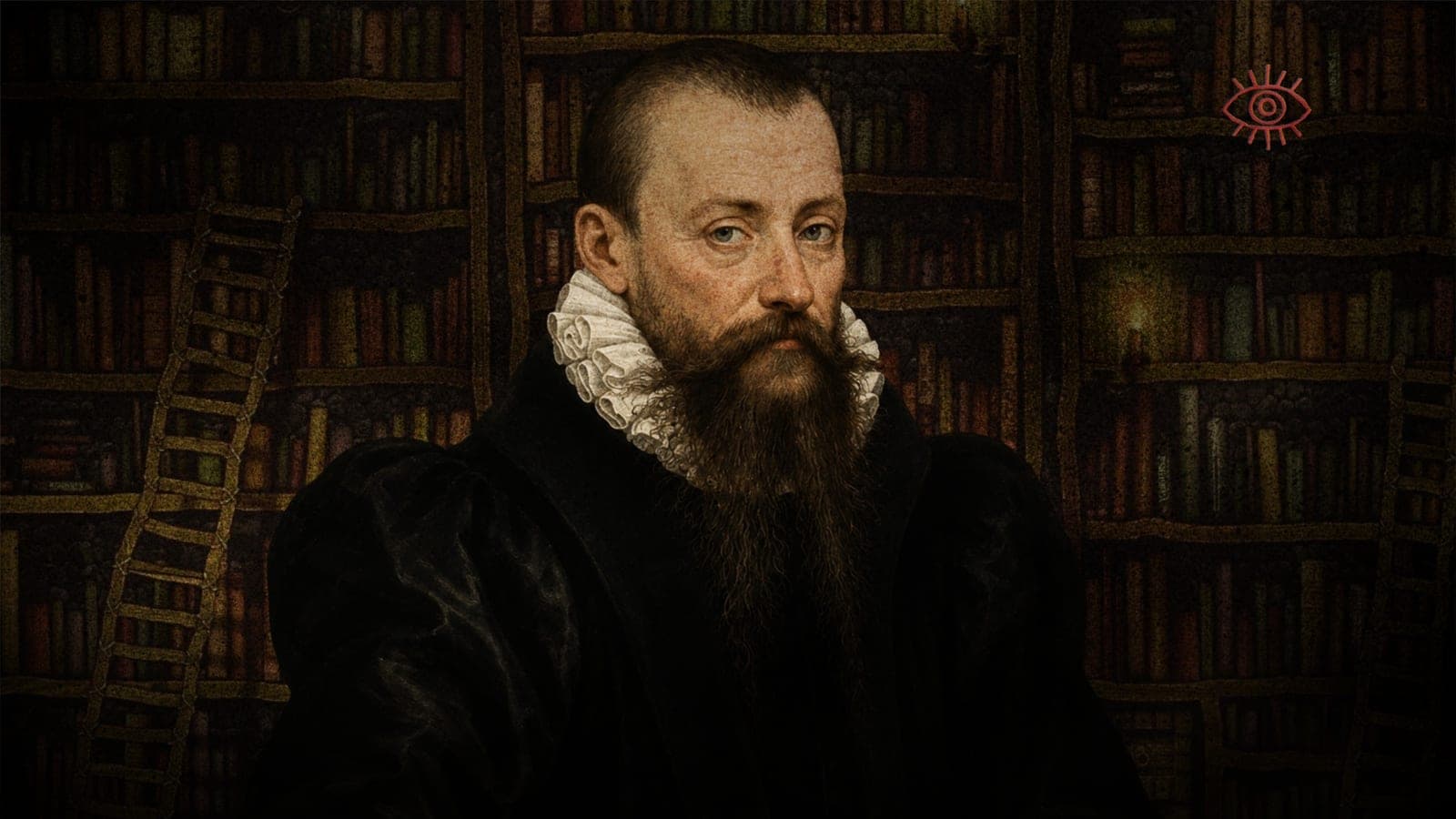
On the last day of February 1571, in a round stone tower standing a little apart from a fortified manor house among the vineyards east of Bordeaux, painters were finishing an inscription on a wall. It was in Latin, formal in tone, and carried a date. It recorded that the owner of the house, on his thirty-eighth birthday, had withdrawn from the servitude of public office and the affairs of the world, and had retired to the quiet of his library and the company of the Muses, where in freedom and peace he intended to spend whatever days were left to him.
The painters climbed down. Michel de Montaigne was left in the room with about a thousand books, a considerable private collection for that century, and with the sentences he had set into the beams overhead: more than fifty of them, in Greek and Latin, copied out of the poets and philosophers he read. Most of them warn against being sure of anything.
Nothing had forced the retirement. He was thirty-eight and healthy, solvent, married, master of the estate since his father's death three years earlier, with thirteen years on the high court of Bordeaux behind him and as much public career ahead as he cared to take. He had sold his seat on the court the year before. By the ordinary reckoning of his rank there was no reason to shut himself in a tower, and he did it anyway, and had the decision painted on the wall.
By his own account, what happened next was a remedy rather than a plan. He had expected a mind released from business to settle into stillness. Instead it bolted like a horse that has thrown its rider, throwing up half formed thoughts, daydreams and worries in no order, one tripping over the next, and he began writing them down in the hope of shaming them into shape. Over the twenty years that followed, the writing became a book whose subject was the man writing it: his habits, appetites, fears, illnesses, cowardice, and changes of opinion, set down as they came. Nobody in European letters had done that at length, in public, without concluding.
What Essayer Meant Before Montaigne Used It for a Book
In the French of his century, essayer meant to attempt, to try, to test. It was the word for tasting something to find out what it was, for assaying a metal to learn its worth, for a first pass at a thing not yet mastered. Montaigne took it and applied it to a piece of writing, and he was the first person to do so. What he called his essais were attempts in exactly that sense: the record of a mind trying itself against a subject, feeling its way, changing direction, arriving nowhere final. Every serious book of his age set out to tell a reader what was true. His set out to show one man in the act of thinking, with the hesitation left in.
The subject is announced at the front, in a note to the reader so disarming that it still catches people off guard. This is a private book, he says. Expect no service from it and no glory to its author. It was written for family and friends, so that when he is gone they will have some trace of who he was. Then the sentence that names the project: "I am myself," he writes, "the matter of my book." Other men wrote about virtue, history, the state, or the soul's business with God. His subject is the man holding the pen. He adds that if custom had allowed it he would gladly have painted himself entirely naked.
One book had come close, twelve hundred years earlier. Augustine had written the story of his own life and his own sins with psychological depth, watching his younger self with a merciless eye. But the Confessions is a prayer, addressed upward from the first line to the last, and it is built as a journey with a destination, every remembered failing a station on the road out of error and into faith. The Essays are addressed to nobody above the author, only to a friend, or a stranger, or whoever happens to be reading over his shoulder, and unlike the Confessions they have no destination.
What looks like vanity in the plan works as its reverse. A general writes his memoirs because he believes his life mattered to the world. Montaigne wrote about himself because he was convinced he was unremarkable, and that conviction was the whole wager: describe one ordinary person deeply enough and what turns up at the bottom is not a private oddity but everybody. Each man, he wrote, carries within himself the entire form of the human condition. The book that resulted runs to three books and 107 chapters, on friendship, cannibals, thumbs, smells, sleep, the education of children, the custom of wearing clothes, and the experience of passing a kidney stone.
The Medal With the Scales and the Question Que Sais-je
The longest chapter in the book is a defence of a Spanish theologian named Raymond Sebond, whose treatise Montaigne had translated out of Latin as a favour to his dying father. Sebond had tried to prove the articles of the Christian faith by natural reason alone. A critic objected that the proofs were weak. Montaigne agreed that they were weak, and then argued that this was no disgrace to Sebond, because every human proof about anything is weak, human reason being a feeble instrument that delivers certainty to nobody. He had been asked to defend one house. He burned down the city so that the house would not look worse than its neighbours.
The demolition is patient and it is thorough. Everything anyone claims to know arrives through the senses, and the senses mislead constantly, differ from person to person, and cannot be audited, because every audit runs back through the same equipment. Reason does no better. If reason could deliver truth, the wisest people who ever lived would by now agree about the deepest questions, and instead they contradict one another endlessly, each of them armed with proofs. A great deal of what passes for knowledge is custom, worn so long that it gets mistaken for the shape of the world. And to establish that a mind is showing the world as it is, a person would have to lay the picture beside the thing itself, which is the one comparison nobody can make, because there is only ever the picture.
Playing with his cat one afternoon, he asked how he could know that she was not passing the time with him rather than he with her. The hierarchy that seats the human above the animal comes apart inside a single sentence, leaving two creatures in a room and no way to say which of them is running the game. The remark sits inside the chapter he had written to defend a proof of God.
Around 1576 he had a medal struck. On it, a pair of scales hanging level, neither pan dipping, and around the balance three words of French, Que sais-je: "What do I know?" The Stanford Encyclopedia of Philosophy notes that the medal carried the Greek epecho as well, meaning "I abstain." The grammar of the motto was chosen with care and the choice is the whole point. He did not have the medal say "I know nothing," because to state that flatly is to claim one certainty and break your own rule in the act of announcing it. A question claims nothing. It hangs where the scales hang.
None of this was a parlour exercise. Montaigne worked through thirty years of religious civil war, including the killings that began in Paris in August 1572 and spread from city to city. What he noticed was who was doing the killing. It was the certain: men who knew beyond any doubt that they held the true understanding of God and that the people across the field held a damnable lie. He named cruelty as the lowest point a human being can sink to, and said his century overflowed with it, dressed up as piety and law. The people who could ask, "What do I know?" and mean it, were not the ones setting the fires.
The Bordeaux Copy, Where a Book Was Revised by Being Added To
The Essays were first published in 1580, in two books. A 1588 edition added a third book and a mass of new material to the first two. A further edition appeared in 1595, three years after the author's death. What makes the sequence strange is the method behind it. Montaigne almost never crossed anything out. He worked on a printed copy of his own book, writing in the margins, between the lines and up the sides of the pages, laying new thought on top of old without removing the old. The sentences the man of sixty added sit next to the sentences the man of forty wrote, and neither one is deleted.
Modern editions mark the layers with letters, A for the 1580 text, B for 1588, C for the last additions, and a reader can watch the strata sit one on another inside a single paragraph. The physical evidence survives. A copy of the fifth edition, carrying the C additions in Montaigne's own hand, is preserved at the municipal library in Bordeaux.
That method is the founding move of the form, and it follows from something he had discovered about the thing he was describing. The self would not hold still to be painted. The same man was brave in the morning and a coward by evening, generous with one hand and grasping with the other, wise about his neighbour's life and a fool about his own. We are all patchwork, he wrote, so shapeless and diverse in composition that every piece plays its own game at every moment, and there is as much difference between a person and himself as between him and somebody else. So he gave up on the finished likeness. "I do not portray being," he wrote. "I portray passing." A truthful picture of a river cannot show still water.
This is why he did not correct. A contradiction between an early essay and a sentence pushed into its margin twenty years later is the book working as designed. He said the most searching thing anyone has said about the practice of writing at length about oneself: he had not made his book any more than his book had made him.
It stopped in the autumn of 1592, when he was fifty nine. He had written years earlier that he wanted death to find him planting his cabbages, indifferent to it and more indifferent still to his unfinished garden. What came instead was an infection that settled in his throat and closed off his speech, so that the most companionable talker of his age had to write his last wishes on paper. He died during a Mass said in his own bedchamber, in the house where he was born. The annotated copy outlived him. Marie de Gournay, who had sought him out in Paris in 1588 as a woman in her early twenties, and whom he called his covenant daughter, was given a copy by his widow and charged with getting it into print. She published the 1595 edition, revised it in 1598, and was still editing him in 1635.
A Platform Built Out of Personal Essays, and the Room They Came From
The form travelled quickly. Within about a decade the Essays were in English, and Gonzalo's speech in The Tempest about the perfect commonwealth, with no riches and no poverty and no magistrates and no service of one man to another, is close to word for word from Florio's translation of the chapter on cannibals. A generation after that, Descartes opened modern philosophy by doubting everything that could be doubted, which was Montaigne's move exactly, and then treated the doubt as a pit to climb out of rather than a place to live. Pascal read the Essays with an attention close to obsession and could never forgive their author his calm, because the same uncertainty Montaigne wore like a comfortable old coat opened beneath Pascal as an abyss. Nearly a century after churchmen in Rome had looked the book over in the author's lifetime and handed it back with a few mild objections, the Church put it on the list of forbidden books. Emerson said that reading it was like opening a volume he must have written himself in some earlier life.
Medium is a platform made almost entirely of personal essays. So is a large share of everything else people now read voluntarily. The basic unit is one person thinking in public about their own experience and trusting a stranger to follow. That unit did not always exist. It was invented, on a specific birthday, in a specific tower.
What has mostly not survived the journey is the founding move. The modern personal essay is under heavy pressure to arrive: the lesson extracted, the takeaway delivered, the closing turn that resolves whatever the opening raised. Montaigne built his to do the opposite of arriving, and named it after the fact. He kept it open by adding rather than fixing, which is why the finished book is one in which the writer can be caught disagreeing with himself on the same page, with the disagreement left standing on purpose. Almost nobody working in the form he invented knows that this is how he worked.
Readers have kept reaching for the same word for the effect, across four hundred years, and the word is friendship. Not admiration, and not instruction: the sense of having been kept company by a particular, funny, flawed, honest person who tells the truth about himself and asks nothing in return. That effect is a direct product of the method. A writer who resolves into one consistent position becomes an authority. A writer who leaves the contradictions in becomes a companion.
The manor burned in 1885 and was rebuilt in a later style. The round tower is the only part of the sixteenth century house left standing. The room at the top of it is the library.
---
Adapted from a longform audio episode on Montaigne, produced for Sleepy Philosophy Radio.
The Newsletter
New essays and episodes, delivered quietly.
By subscribing you consent to receiving occasional emails. Unsubscribe any time via the link in every email or at /unsubscribe.
Reflections
Loading...