
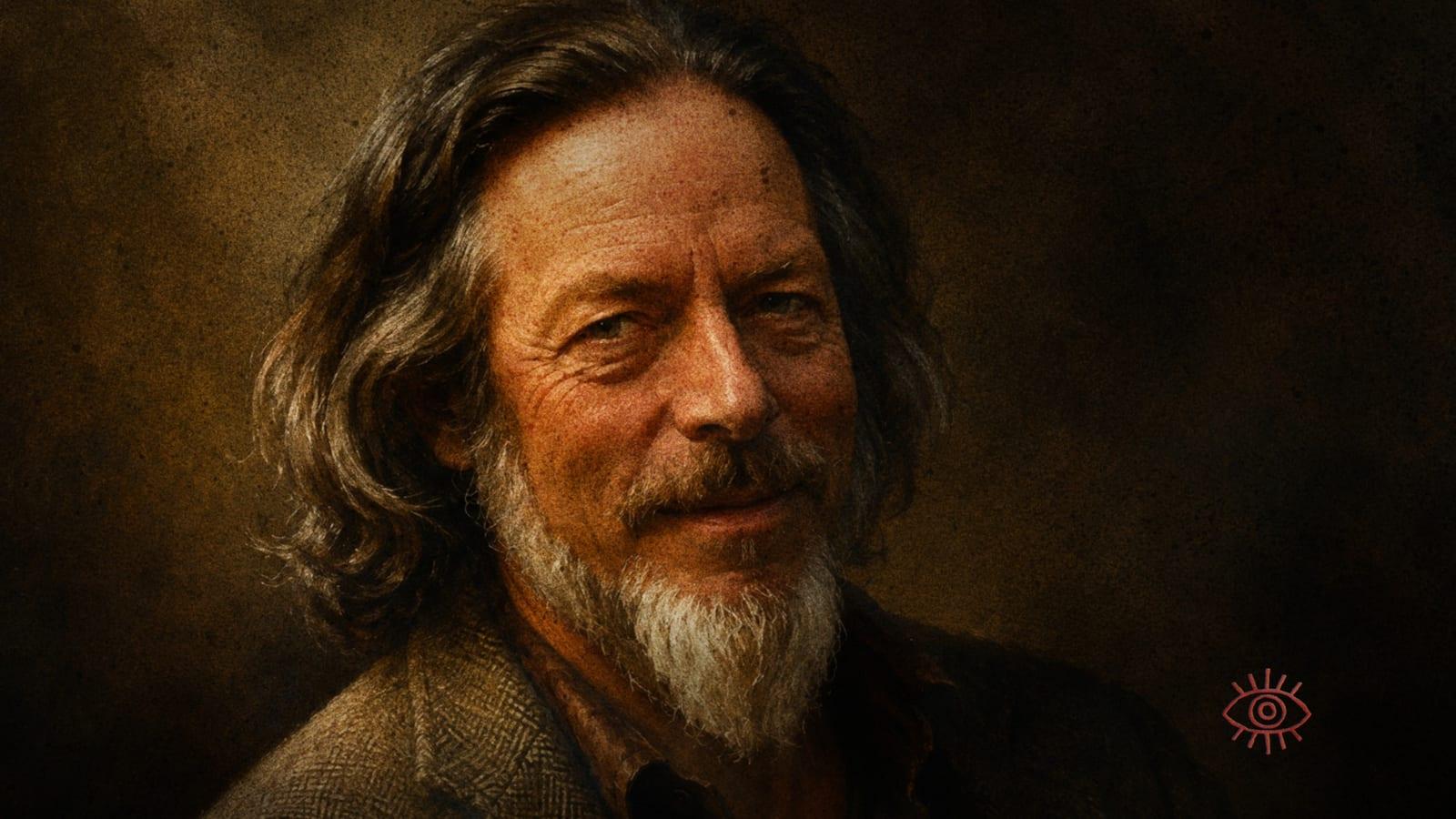
The Wisdom of Insecurity turns seventy-five in 2026, and the fact that its author was drinking hard and dead at fifty-eight without ever managing to follow it is the strongest evidence the book has.
In October 1973 an Englishman came back from a European lecture tour to a cabin at Druid Heights, on a wooded ridge in Marin County, California. He was fifty-eight, a heavy smoker since youth, and had been drinking hard for close to twenty years. On the night of 16 November he went to bed in the Mandala House there and did not wake up. He had been under treatment for a heart condition. In the small room where he worked there were Chinese and Japanese books and a tape machine. Alan Watts had spent about two decades talking into microphones.
His son Mark kept the tapes and built an archive around them, the Electronic University. They sat through the cassette decades as a minor cult before the internet found them. The voice now circulates in a form Watts never designed: laid under ambient music, cut into three-minute clips over drone footage of coastlines, sampled by producers, autoplaying at two in the morning for listeners with no idea that the man speaking so intimately into their ears has been dead for more than fifty years. The recordings run from 1953, when he began broadcasting weekly on KPFA in Berkeley, to the year he died.
The written record has not kept up with the audio. It splits into two piles. One is devotional: quotation cards, reverent explainers, a sage who had arrived. The other is the standard correction, and it is well stocked. No degree. No ordination that lasted, no lineage, no sustained practice. A populariser repackaging Asian traditions for Californians, with a private life that came apart while he explained serenity to strangers. Both piles are handling the same fact and neither knows what to do with it.
The fact is this. In 1951 Watts published The Wisdom of Insecurity: A Message for an Age of Anxiety, which reaches its seventy-fifth year in 2026. It argues that the pursuit of security is the machinery of anxiety, and that the exit is to stop pursuing. Twenty-two years later its author was dead at fifty-eight, having lived at speed and without pause. Whether that disqualifies him is the dull version of the question. The useful version asks what the failure demonstrates.
The 1951 Book That Called Anxiety a Breath-Retention Contest
He was thirty-six the year it appeared, out of the Episcopal priesthood he had entered in 1945 and left in August 1950, newly arrived in California, on his second marriage, with no institution standing behind him. The book is short and it carries one idea.
The idea is that the security a person spends a life hunting does not exist, cannot exist, and that the hunt itself is the injury. Everything is in motion. Every arrangement is dissolving while you stand inside it, and the arranger dissolves fastest of all. To demand a guarantee from that is to demand the one thing the situation cannot supply, and the demand is felt as a low permanent fever. Watts spends most of the book on the demand rather than on the fever.
The move that makes it worth reading is the next one. Most writers on anxiety offer a route to security. Watts closes the route. "The desire for security and the feeling of insecurity are the same thing," he wrote. "To hold your breath is to lose your breath. A society based on the quest for security is nothing but a breath-retention contest in which everyone is as taut as a drum and as purple as a beet." The wanting and the fearing are one event described twice, which turns the ordinary account of the problem upside down. Anxiety is not the condition a person occupies until security is found; it is what looking for security feels like from the inside.
He had been circling the pattern for years, and the preface names it outright as the "law of reversed effort," also called the "backwards law." "When you try to stay on the surface of the water, you sink; but when you try to sink you float. When you hold your breath you lose it."
There is a cruelty folded into the mechanism, and the book describes it with unusual precision. A mind demanding safety tries to buy it by rehearsal. It runs the illness, the bankruptcy, the phone call at an odd hour, the funeral, over and again in advance, as though suffering a thing beforehand were insurance against suffering it later. The policy pays nothing. What it buys is the suffering, disbursed in small daily installments, for catastrophes that mostly never arrive. Over a lifetime the frightened person pays far more than the feared event would ever have charged.
The timing was good. Readers in the early fifties were richer and safer in daily terms than almost anyone who had lived, and more frightened, under a bomb that could cancel a city in an afternoon, with the old religious answers thinning out and nothing solid moving into the vacancy. Comfort had cleared away the small fears and left the large one standing in the open. Vintage still sells the book, which has stayed in print for three quarters of a century.
Why Trying to Sleep Keeps You Awake
That argument walked Watts straight into the hardest problem in his own thinking, and he knew it. If the cure is to stop grasping, how is a frightened person supposed to do that? Instruct an anxious man to relax and you have handed him one more assignment to fail. A clenched hand cannot open itself by clenching harder.
He spent the next decade on the knot. In Psychotherapy East and West, published in 1961, he gave it a name, borrowing the double bind from the psychiatric research going on around him in northern California. Gregory Bateson's Palo Alto group had set the term out in Behavioral Science in 1956, in a paper on schizophrenia written with Don Jackson, Jay Haley and John Weakland. The bind works like this. You are handed an order that can only be obeyed spontaneously. Be natural. Be free. Fall asleep. Stop trying. Every attempt to comply is an attempt, and attempting is what the order forbids.
Everyone has the demonstration available at home, most nights. Lie in the dark wanting to sleep. Concentrate on sleeping, then check whether it is working yet. The checking is arousal, the wanting is arousal, and the harder the will is applied the further the thing recedes, because sleep arrives only for a person who has stopped waiting for it. Clinical sleep medicine now describes chronic insomnia in these terms. Colin Espie and four colleagues set the model out in Sleep Medicine Reviews in 2006 as the attention-intention-effort pathway. Sleep normalcy, they write, "is a relatively automatic process" and "consequently, it is vulnerable, and may be inhibited, by focused attention and by direct attempts to control its expression." Wanting it too much is the disorder. A large part of the treatment consists of persuading patients to stop trying.
The same structure turns up wherever the goal is a kind of naturalness. Determined happiness, monitored hourly, does not arrive, because the monitor stands between the person and the state being monitored. Trying to be charming at a party produces a man watching himself be charming.
Then there is the version that catches the most sincere people of all. Someone understands that the grasping self is the trouble and sets out, with considerable discipline, to be rid of it. Years of practice follow. The whole time, the one keeping score, measuring progress, comparing itself favourably against how it was last year, is the self, fattening on the campaign waged against it. The pursuit of egolessness becomes the ego's proudest project.
Watts's answer was that the trap has no exit by effort, and that the exhaustion of every effort is the point. You go on trying until trying gives out, and what remains once the trier has collapsed is the letting go that could never have been performed on command. It is an elegant answer. It also leaves a teacher with nothing to sell, no ladder and no technique. He went on lecturing for another twelve years anyway.
The Case Against Alan Watts Is Mostly Correct
He had no degree. Sitting the scholarship examination for Trinity College, Oxford, he styled his crucial essay in a way he later said the examiners read as presumptuous and capricious. They turned him down, and one of the most quoted interpreters of Asian thought in English never went to university. He was ordained an Episcopal priest on Ascension Day 1945 and left the church in August 1950, after his first marriage was annulled. He belonged to no lineage and served no living master, and admitted cheerfully that he had meditated very little and disciplined himself less.
The scholarly objection cuts deeper than the biographical one. The Zen that arrived in the West in the 1950s, in Watts's prose and in D. T. Suzuki's before it, has since been shown to be a substantially modern product. Japanese reformers had rebuilt it under Western pressure and reorganised it around private experience, at some distance from the monastic institutions and long training that had carried it for centuries. Robert Sharf, D. H. Chen Distinguished Professor of Buddhist Studies at Berkeley and chair of its Numata Center, argued in a 1995 paper in Numen that the rhetoric of meditative experience was itself largely an artefact of that rebuilding. Read that literature and the charge against Watts writes itself: he offered the view from the summit without the climb, and a whole wellness industry followed him up the same shortcut.
Then the life. Three marriages, seven children, and an absent father by every account that survives. A converted ferryboat called the Vallejo, moored at Sausalito, an elder to a movement, endlessly available in public and unreachable at home. And the drinking, heavy from the middle fifties on, which the people who loved him could not halt, and neither could he. He taught letting go and could not put down a glass.
Monica Furlong, who wrote the first serious biography, called it Genuine Fake when it appeared in 1986. The phrase is widely reported as one Watts had used about himself, though the trail runs out before it reaches him. What he said in public is better documented. He described himself as a philosophical entertainer rather than an academic philosopher, a line he had been using since the early sixties and repeated when students pressed him at Santa Cruz in 1970. He told audiences not to make him a master and not to imagine that he had arrived anywhere they had not.
That is the line between him and a fraud, and it is worth drawing carefully. A con man conceals the con, because concealment is what makes the take possible. Watts published his. He announced the gap between the teaching and the teacher from the stage, repeatedly, and then went on teaching. Nearly every charge his critics bring, he had already entered into the record himself.
Nobody Asks a Physicist to Float
Suppose all of it is true. What follows?
Consider the standard applied to other kinds of expert. A chart of a coastline can be accurate whether or not the cartographer ever lived on it, and the sailors who use it do not ask where he kept his house. A critic with a flawless ear may not be able to play a note. Doctors die of diseases they diagnose correctly in other people, and the prescription that failed in one body goes on working in a thousand others. None of those failures is held against the work.
Wisdom is the single field where the exemption is withdrawn. Let a person speak about how to live, about fear and death and the loosening of the grip, and the demand arrives at once that he be flawless, and if he turns out not to be, that everything he said be thrown out with him. The two verdicts on Watts, saint and charlatan, are the same demand answered in opposite directions. Both insist that the man and the map be one object.
Watts thought he knew why the demand exists, and his answer is unflattering to the people making it. People want somebody who has already done it. A finished person, visibly at peace, whose freedom can be borrowed rather than found, so that the work can be admired at a distance instead of attempted. That is exactly the position he refused to occupy. When he laughed off the title of guru, when he told a full hall that he was not the article they had come looking for, he was not performing modesty. He was declining to carry a thing they were trying to hand him, and the refusal was the least comfortable gift he had.
He borrowed an old Zen image for it. Teachings are a finger pointing at the moon, and the entire nature of a finger is that it is not the object you are meant to be looking at. His worshippers stared at the finger and called it holy. His debunkers stared at the finger and found it dirty. Both camps spent their attention on the hand.
None of which makes the failure less painful to look at, and pretending otherwise would be its own dishonesty. He described the water beautifully. He was drowning while he described it. That puts no error into the description. It makes the description almost unbearable to hear in his own voice.
The Voice on the Tape Is Still Working
Turn the failure around and it becomes the demonstration.
Watts's central claim was that nobody forces their way to ease, that the striving self can never make itself release, and that the harder anyone strains toward peace the faster peace retreats. A calm and orderly life would have illustrated that claim weakly. What his life supplies is the negative case, which is the more convincing kind. Here was a man who understood the mechanism of letting go more finely than almost anyone who has written about it in English, who could describe it in sentences that still stop people scrolling, and who could not do it, and could not do it for the reason he had published in 1951. Understanding a thing is not the same as being it. The knowing mind cannot order the rest of a person to comply. He never once stopped trying, and the trying was the diagnosis, written out in his own case notes.
Anyone who has lain awake at three in the morning knowing exactly what would help and finding themselves unable to do it already understands Watts from the inside, and understands him better than his fiercest critics do. That gap between seeing and doing is one of the most ordinary human experiences there is. His was conducted at scale, on tape, in public, and it ran for about twenty years.
So the seventy-fifth year of The Wisdom of Insecurity arrives quietly, which suits the book. It goes on doing the work it was written to do, which is to reach a frightened person in the dark and suggest that what they are fighting is the fighting.
The voice goes on too, chopped into fragments and set to autoplay for listeners who mostly do not know whose it is. It tells them there is nothing to be afraid of. The man who recorded it was afraid, could not follow his own advice, and said as much at the time. The map is still accurate.
---
Adapted from a longform audio episode on Alan Watts (releases 24 October 2026), produced for Sleepy Philosophy Radio.
Reflections
Loading...
Listen next
The Fear of Death Is Controlling Your Life | Ernest Becker for Sleep
On Ernest Becker
16 chapters · 6 sources
Everything we build, he argued, our characters, our loves, our nations and our wars, is an elaborate refusal to admit that we die.
PlayThere Are No Accidents | Sigmund Freud's Complete Psychology
On Sigmund Freud
17 chapters · 8 sources
He set out to be the coldest of scientists, and ended by telling the strangest story modern people had ever heard about themselves.
PlayLife Is Worth Living | William James and the Sick Soul
On William James
15 chapters · 8 sources
He insisted to his last breath that the universe is unfinished, and that our own small efforts help decide how it turns out.
Play