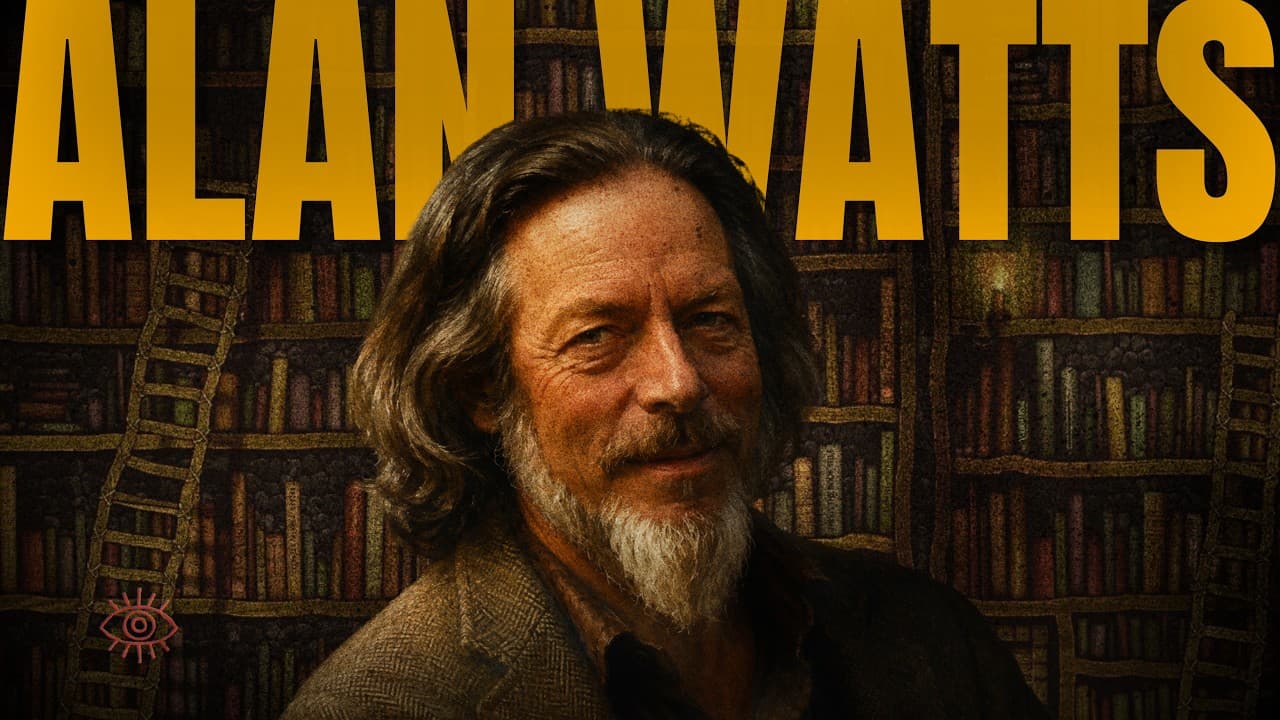
The Wisdom of Insecurity | All of Alan Watts's Philosophy
A self-taught Englishman who spent a brief and surprising career as a priest became the most listened-to interpreter of Eastern wisdom the West has ever known.
Across sixteen unhurried chapters we follow the strange and luminous life of Alan Watts. From a boyhood spent gazing at Chinese landscape paintings, through the collar he eventually set down, to the houseboats and mountain cabins of California, we trace how a restless amateur turned Zen, Taoism, and the old Indian teachings into clear and living English.
We spend time with his best-loved books, on insecurity, on Zen, and on the taboo against knowing who you really are, and with the great question at the center of them all. And we look, without flinching, at the gap between the serene teacher and the troubled man, and at why his gentle voice, decades after his death, still finds people in the dark.
The full episode is on YouTube and Spotify. Please listen only in safe, restful contexts.
Enjoying the episode?
Occasional letters on philosophy, reading, and the examined life. No spam, ever.
By subscribing you consent to receiving occasional emails. Unsubscribe any time via the link in every email or at /unsubscribe.
Timestamps
- 0:00:00Chapter 1: The Painted Mountains
- 0:11:56Chapter 2: The borrowed light
- 0:17:57Chapter 3: The habit and the collar
- 0:26:22Chapter 4: The menu and the meal
- 0:32:27Chapter 5: To hold your breath
- 0:43:01Chapter 6: A finger pointing at the moon
- 0:55:28Chapter 7: Beat, square, and neither
- 1:02:32Chapter 8: The war with nature
- 1:11:34Chapter 9: Two ways of healing
- 1:23:06Chapter 10: The chemistry of consciousness
- 1:30:13Chapter 11: The game of hide and seek
- 1:40:53Chapter 12: The taboo against knowing
- 1:52:45Chapter 13: You cannot live in tomorrow
- 1:59:27Chapter 14: The watercourse way
- 2:08:41Chapter 15: The genuine fake
- 2:19:58Chapter 16: The voice that remained
For the record
Full Transcript
Chapter 1: The Painted Mountains
Autumn, nineteen seventy-three. In a small book-lined cabin on the wooded flank of a mountain north of San Francisco, a man sits before a microphone, and beside him a reel of tape turns slowly on its spindle. He is talking, as he talks most days, in a warm and unhurried English voice, a voice with a laugh always somewhere inside it. He is telling whoever will one day listen that there is nothing, in the end, to be afraid of. That they are not lonely flecks of awareness stranded for a few years in a cold and stupid universe. That each of them, secretly, is the whole of it, looking out for a little while through a single pair of eyes.
He is not a monk. He holds no university degree and no professor's chair. He belongs to no monastery, follows no living master, leads no church. By his own cheerful admission he has meditated very little and disciplined himself less. And yet the voice on that turning tape has become, for a great many people on this side of the world, the most trusted voice they know on the questions that religion used to answer, the questions about death and the self and how to be at peace.
There is a second thing about the man at the microphone, and it is stranger than the first. The voice is serene, but the man is not. He is dying, slowly and by his own hand, of drink. The teacher who has soothed a whole generation's anxiety is himself restless and afraid, and he cannot stop reaching for the bottle that is killing him. In a few weeks he will lie down on this mountain and not wake up. He is fifty-eight years old. And here is the strangest part of all. This voice, recorded in a cabin by a failing man with only weeks to live, will in the decades after his death reach far more people than ever heard it while he breathed.
The man was Alan Watts, and to understand how the voice and the failure belong to the same person, we have to go back to the beginning, to a comfortable house in the south of England and a small boy who fell in love with a range of painted mountains he had never seen.
He was born on the sixth of January, nineteen fifteen, in Chislehurst, a green and orderly suburb southeast of London, into the solid lower reaches of the English middle class. His father, Laurence, worked in the London office of a French tyre company, a steady and gentle man who never made much money. His mother, Emily, kept the house, and she carried in her own history the thing that would shape her son's whole life. Her father had been a missionary, and through the missionary world came gifts from the other side of the earth. The house at Chislehurst held Chinese and Japanese embroideries and prints and small carved things, brought back by people who had gone out to convert the East and had been quietly enchanted by it instead. The boy would sit and stare at the landscape paintings, at the vast misty valleys and the tiny far pavilions and the mountains dissolving into empty silk, and something in him ached toward them. It was, he said later, the first religious feeling he ever had, and it did not come from a church. It came from the mysterious spaces of Chinese art.
He was clever, clever enough to win a scholarship to King's School in Canterbury, the ancient boarding school in the shadow of the cathedral, the oldest in England. He did well there, near the top of his classes, trusted with responsibility. And then, at the gate that should have carried a boy like him on to the university, he stumbled in a way that turned out to define him. Sitting the scholarship examination for Trinity College at Oxford, he wrote his crucial essay in a style so clever and so pleased with itself that the examiners read it as arrogant, as presumptuous and showing off, and they turned him down. There would be no Oxford, no degree, no set of letters after his name. For the rest of his life the most quoted interpreter of Eastern thought in the English-speaking world would be, in the eyes of the universities, an amateur. He came to wear that word almost as a badge. He was, as he and his biographer both agreed, essentially self-taught, an autodidact who had made his own mind out of whatever books he could reach.
So instead of a college he went to work, first in a printing house and then, dully, in a bank. But his real education was happening in the evenings, in a modest set of rooms in London where a small band of Westerners met to study the religions of Asia. This was the Buddhist Lodge, and its guiding spirit was a barrister named Christmas Humphreys, and into this circle the teenaged Watts walked and found his subject and his calling. He read enormously, in philosophy and psychology and the scriptures of the East. He listened to the scholars and eccentrics who passed through. And at the astonishing age of twenty, in nineteen thirty-six, he published his first book, a slim and confident volume on the spirit of Zen. He had found the thing he would do for the rest of his life. He would explain the East to the West, in the West's own language, and he would make it sing.
In that same London Buddhist world he met an American, Eleanor Everett, and married her in nineteen thirty-eight. Her mother, Ruth Fuller, was a formidable woman and a serious student of Zen who would one day run a temple in Kyoto, and it was partly the pull of that connection, and the gathering shadow of war in Europe, that carried the young couple across the Atlantic to New York. Watts was twenty-three, married, a published author, an Englishman starting again in America. And there his life took a turn that surprised everyone who knew him, and that he would spend years explaining and then undoing.
He turned to Christianity. Not casually, but all the way. He enrolled at an Episcopal seminary near Chicago, immersed himself in theology and church history, and in nineteen forty-five he was ordained a priest and took up work as a chaplain at a university. For a few years the man who had made his name on Zen wore a clerical collar and served at the altar. He was trying, in his own way, to find the living mystical heart inside the Western religion, and he wrote a book about that search. But the collar did not hold him. His first marriage came apart, painfully and with scandal, and in nineteen fifty he left the priesthood altogether. He was thirty-five, twice a beginner, and this time he did not start over halfway. He married again, to Dorothy DeWitt, and he went as far west as the country allows, to California, where the rest of his story would be told.
California made him. In San Francisco he joined a small experimental school called the American Academy of Asian Studies, teaching the philosophies of India and China, and before long he was its leading light, its most magnetic teacher. In nineteen fifty-one he published a short book on insecurity that would become one of his most loved. And in nineteen fifty-three he did the thing that mattered most of all, though no one could have known it then. He began speaking into a microphone. A listener-funded radio station across the bay in Berkeley gave him a weekly slot, unpaid, to talk about whatever he liked, and he liked to talk about everything. The recordings began to pile up. The voice was going out into the air.
In nineteen fifty-seven came the book that made him famous, a graceful and readable account of Zen that arrived exactly when a restless postwar America was hungry for it. After that the books came almost yearly, on nature and the body, on psychotherapy and the East, on the drug experiences that were beginning to sweep the culture, on God and the self and the great taboo he believed lay underneath everything. He became a public figure, a lecturer in constant demand, a familiar and beloved presence to the young people who were remaking American culture in the nineteen sixties. He married a third time, to a woman named Mary Jane, whom everyone called Jano, and across his three marriages he fathered seven children, though he was not, by any account, a steady or present father.
He settled at last into the landscape that suited him. He kept an old converted ferryboat moored at Sausalito, just north of the Golden Gate, a floating house full of books and talk and visitors. And higher up, on the wooded flank of the mountain in Marin, he had a small cabin among a bohemian cluster of homes near the redwoods, and it was there he did his last and quietest work. He was at the center of a whole world of poets and seekers and artists, an elder to a movement, a genial host, endlessly generous with his time and his ideas.
But the ease he described so beautifully was not the ease he lived. Somewhere in these years the drinking, which had always been there, began to win. It stopped being the wine of good company and became a daily need, a bottle of vodka worked steadily through the day, and with it the cigarettes he could not give up either. Those who loved him watched it happen and could not stop it, and neither could he. The man who taught millions how to let go could not let go of this. He seemed to burn himself down faster the more the world asked of him, as if the serene public voice and the private hunger were two ends of the same overworked life.
And so we come back to the mountain, and the cabin, and the turning tape of the autumn of nineteen seventy-three. He had been traveling and lecturing hard, and he came home tired. On the sixteenth of November he lay down to sleep and his heart, worn out at fifty-eight, simply stopped. He died on the mountain he loved, in his sleep, without struggle. The voice on all those thousands of reels of tape fell silent.
Except that it did not. That is the last and largest surprise of this life, and we will come to it at the very end. For now it is enough to hold the shape of the man in mind. A self-taught Englishman who fell in love with a painted mountain as a boy. A failed candidate for Oxford who became the most listened-to teacher of Eastern wisdom the West has ever produced. A priest who left the church. A husband three times over and a father seven times who could not quite manage a household. A man who told everyone how to be at peace and drank himself into an early grave. Everything that made him luminous and everything that ruined him grew from a single root, and to find that root we have to look, patiently and one book at a time, at what he actually taught. That is the work of the chapters ahead.
Chapter 2: The borrowed light
Alan Watts invented almost nothing. This is not an insult, and to understand him we have to feel the full weight of it as a plain description. The great ideas he spent his life turning over were not his. They belonged to traditions thousands of years older than he was, worked out in India and China and Japan by people whose names he did not always know. What Watts had was not originality. It was something rarer and, in its way, just as valuable. He could carry a light lit somewhere else and make it shine in a room that had never seen it.
The light he carried came mostly from three sources, and it is worth naming them once, plainly, so that we never have to stop and explain them again. There was Zen, the stripped and wordless form of Buddhism that had grown up in China and flowered in Japan, less a set of beliefs than a way of waking up. There was the older Chinese wisdom of the Way, the tradition of flowing with the grain of nature rather than fighting it. And there was the deep current of Indian thought that says, underneath all the separate selves in the world, there is only one Self wearing all the masks. Zen, the Way, and the one Self. Almost everything Watts ever said was a fresh arrangement of those three inheritances.
He did not draw them out of the air. He drew them, above all, from one man. In the early part of the twentieth century a Japanese scholar had taken it upon himself to carry Zen into the English language, patiently, in book after difficult book, and his name was Suzuki. He was learned and precise and not always easy to read, and he was the pipe through which Zen first flowed properly into the West. The young Watts encountered him in London and never forgot it. Suzuki was the source. Watts, in time, would become the fountain, the one who took what the scholar had carefully dug up and let it run out sparkling where ordinary people could drink.
This is the difference that defines him, and it is worth being exact about. In any tradition of wisdom there are three kinds of people. There are the ones who live it, the monks and hermits who sit through the long silent years under a master until something in them breaks open. There are the ones who study it, the scholars who trace every text and lineage with enormous care. And there are the ones who explain it, the rare communicators who can take what the first two have won and hand it to a stranger in a single unforgettable phrase. Watts was purely and gloriously the third kind. He was not a monk. He never went to Japan to sit the hard years in a monastery, never submitted himself to a master's discipline, never earned the tradition the way its own people earn it. And he was not, in the strict sense, a scholar, though he read like one. He was the explainer. He was possibly the finest explainer of Eastern thought the Western world has ever heard.
Now, this raises a real question, and honest listeners should let themselves feel it, because his critics certainly did. Can you trust a man about a country he has never lived in? Watts described the state of awakening with breathtaking clarity, but he had, by his own account, never fully entered it. He mapped the territory without settling there. To some this made him a kind of fraud, a tourist selling postcards of a place he had only visited. But there is another way to see it, and it may be the truer one. A guide who has walked a country for forty years can sometimes describe it worse than a brilliant reader of maps, because he is too close, too tangled in the particular paths he happens to know. Watts had read every map. He had stood at the border and looked in with a longing that never left him. And he could tell you what he saw in words so clear that you felt, for a moment, that you were seeing it too. Whether that is enough is a question we will come back to at the end, when we look honestly at the gap between the man and his message. For now it is enough to say that the gift was genuine, whatever its limits.
There is something moving, too, in the very fact that the light was borrowed. Watts belonged to a particular moment, the middle of the twentieth century, when the walls between East and West were coming down for the first time in a serious way, and someone was needed who could stand in the gap and translate. Not translate the words only, but the feeling, the flavor, the whole way of seeing. He had been preparing for exactly this since he was a boy staring at those painted Chinese mountains. He had the East in his imagination and the English language at his fingertips, and he arrived precisely when the culture was ready to listen. A borrowed light, carried by the right man at the right hour, can change more minds than a whole library of original genius that no one can read.
So we should not go looking, in the chapters ahead, for a great original philosopher building a system from the ground up. That is not what he was, and measuring him by that ruler only misses him. What we will find instead is a man taking the oldest wisdom of Asia, one strand at a time, and turning it in the light of the English language until it flashed. The ideas were old. The lamp he built to carry them was entirely his own. And nobody, before or since, has built a better one.
Chapter 3: The habit and the collar
Of all the turns in Alan Watts's life, the one that puzzles people most is the collar. Here was a man who had made his name at twenty explaining Zen, a man temperamentally allergic to rules and institutions, and in the middle of his youth he walked into an Episcopal seminary, submitted to years of theology, and came out an ordained Christian priest. It looks like a betrayal of everything he stood for. It was not. It was one of the most revealing things he ever did, because it shows us exactly what he was hunting for, and why no ordinary religion could ever hold him.
He did not become a priest because he had come to believe the Christian story in the way the pews around him believed it. He became a priest because he had a conviction, held early and never really abandoned, that underneath every great religion, at the very bottom, past all the doctrines and the moral rules and the arguments about history, there lies one and the same thing. Not a belief. An experience. The direct, overwhelming, wordless sense of union with the ground of the whole world, the tasting of the sacred at first hand. He believed the East had kept that experience alive at the center of its traditions. And he believed, more daringly, that it was still there in Christianity too, buried under centuries of crust, and that a patient man might dig down through the crust and reach the living water beneath.
That was the project. He would be a mystic inside the Western church. He would recover, from within, the experience that he thought the West had half forgotten it ever had. In nineteen forty-seven he laid the whole vision out in a book on the life of the spirit, and it was a bold piece of work. Christianity, he argued, is not first of all a set of things you are required to believe, nor a code of behavior, nor a report about events in the ancient past. It is, at its heart, the astonishing claim that the divine and the human can become one, here, now, in a living person. The old doctrine that God had become a man was not, to Watts, a piece of history to be defended. It was a promise about everyone. God became human so that humans might wake up to what they always secretly were. Read that way, the most orthodox Christian language suddenly opened onto the same vast space he had found in the mountains of Chinese painting.
Underneath the whole effort was a distinction that would stay with Watts for the rest of his life, and it is the real treasure of these years, so it is worth stating slowly. There are two utterly different things that both go by the name religion. One is religion as belief. It is a matter of clinging, of holding tight to a set of propositions about God and the soul and the afterlife, of being sure you are right and the others wrong, of defending the creed against all comers. The other is religion as experience. It is not about holding any opinion at all. It is about a certain kind of seeing, a direct contact with reality so complete that the question of belief never even arises, the way you do not need to believe in the sun when you are standing in its warmth. Watts became more and more convinced that the West had made a catastrophic exchange. It had taken religion as experience, which it once had, and traded it for religion as belief, which is only a nervous imitation of the real thing. It had swapped the tasting of God for opinions about God. The collar was his attempt to win the tasting back from the inside.
It is worth pausing on what those years actually looked like, because the man in the collar was not a reluctant one. Watts threw himself into the part with real delight, and the part he loved most was the ritual. He was drawn to the ornate, sacramental, incense-and-candlelight wing of the church, the wing that keeps the old ceremonies elaborate and beautiful, and he performed the ancient rites with the care of a man who found them genuinely magical. He was a natural in the pulpit, too. Students at the university where he served as chaplain crowded in to hear him, because his sermons did not sound like anyone else's. Into the framework of a Christian service he would quietly smuggle the whole East, until a congregation that had come for a familiar Sunday found itself contemplating the unity of all things and hardly noticing where the change had happened. For a few years it worked, and it was, in its way, a beautiful thing to watch, a man decorating the plain Western altar with the colors of Asia. But it depended on nobody looking too closely at what he actually meant.
It could not last, and the reasons it could not last tell us as much as the reasons he tried. Part of it was simply the wreckage of his private life. His first marriage collapsed in these years, painfully and publicly, and a man in the middle of a scandal cannot easily stand at an altar. But the deeper reason was not personal at all. Watts slowly came to feel that the institution itself could not hold what he was after. A church, by its nature, runs on belief. It needs members who assent, clergy who defend the doctrine, a boundary between the faithful and the rest. It asked him, in the end, to be a professional believer, to stand up and argue for a particular set of ideas about God as though they were the final truth. And that was the one thing the mystic in him could not do. He did not want to argue about God. He wanted to point past every idea of God toward the thing itself, and a church cannot pay a man to do that, because the moment he does it thoroughly the boundaries dissolve and the institution has nothing left to defend. The collar, which he had put on to free the experience, had become a cage around it. So in nineteen fifty he took it off.
What is striking is what he did not do next. He did not become one of those bitter ex believers who spend the rest of their lives kicking at the church that disappointed them. He kept, to the end, a real tenderness for Christianity, for its music and its incense and its old solemn words, for the beauty of the ritual even after he had let go of the claims. He loved the form long after he had walked out of the content. What he lost was not affection for the West's religion but the illusion that any single religion could contain the thing he was chasing. He came out of the seminary years with a settled conviction that never afterward left him. All the great traditions, he decided, are saying one thing in many different languages, and the thing they are saying is not a doctrine you can sign but an experience you have to undergo. The words differ. The tasting is the same.
That conviction set him free, and it set the shape of everything that came after. Once you believe that the sacred is an experience and not a belief, you no longer need a pulpit or a creed or a collar to reach for it. You can reach for it anywhere, in any words, without asking anyone's permission. And so the man who left the priesthood did not leave the search. He simply carried it out of the church and into the open, onto the radio and into the paperback books and out under the wide California sky, where he could spend the rest of his life pointing at the sacred without ever again having to defend a single official statement about it. He had needed the church to discover that he did not need the church. Now he was ready to begin the real work.
Chapter 4: The menu and the meal
Alan Watts believed that most of human unhappiness rests on a single confusion, one so basic and so universal that we almost never notice we are making it. We have mistaken the symbol for the reality. We have confused the description of a thing with the thing itself. And so, he said, we spend our lives in the strange condition of people who sit down hungry in a fine restaurant and then try to make a meal of the menu.
That image was his favorite, and it repays a slow look, because everything else he taught grows out of it. Think of what a menu is. It is a list of words and prices that stands for food. It is useful. You could not order dinner without it. But no one has ever been nourished by reading one. You cannot taste the word roast, you cannot be warmed by the printed price of soup. The menu points to the meal. It is not the meal. And this, Watts said, is the exact shape of our trouble, only we have spread the confusion across the whole of life. We are handed, from the moment we can speak, an enormous menu. It is made of words and numbers and names and ideas, a vast system of symbols that stands for the actual living world. And the menu is a magnificent thing, one of the glories of being human. The mistake is not having it. The mistake is trying to eat it.
Look at how far the confusion runs once you start to see it. We hold money in our hands and feel that we are holding wealth, when money is only a promise, a set of symbols that stands for real things, and you cannot eat a coin or shelter under a bank note. We watch a clock and feel that we are watching time, when the clock is only a row of marks and a moving hand, and time itself, whatever it is, is not in the clock at all. We look at a map and feel we have known a country, when the map is paper and the country is mountains and rain. We read the word water, and however long we stare at it, it will not make us wet. In every case the same slip has happened. The pointer has been mistaken for the thing it points at. The sign has swallowed what it was meant to signify.
And here is where it becomes serious, because the deepest menu of all is the one we can never put down. It is thought itself. All day long a running commentary flows through the mind, a stream of words laid over everything we do, naming and judging and describing each moment as it passes. That commentary is a menu too. It is a description of life, endlessly muttered, and it is not life. And most of us have become so hypnotized by it that we can barely taste the meal anymore. We eat dinner while thinking about dinner, or worse, while thinking about something else entirely. We hold someone we love while the mind is busy labeling the moment, filing it, comparing it, worrying about the next one. We live our whole lives at one remove, inside the description, and then wonder why we feel oddly starved in the middle of so much plenty. We are surrounded by the meal and we keep on chewing the menu.
The West, Watts thought, is the civilization that has carried this confusion further than any other. We have built a world of almost pure abstraction. We measure everything, we count everything, we turn every solid thing into a number and every experience into information, and we have become so dazzlingly good at handling the symbols that we have half lost touch with what they were symbols of. We are the richest people in history in menus, in money and data and words about words, and a great many of us are quietly starving for the meal. That is the paradox at the center of the modern condition as he saw it. Not that we have too little. That we have mistaken the account of the feast for the feast.
But there is a mercy hidden in all of this, and it is the whole reason the diagnosis matters. The meal never went anywhere. The reality that all the symbols point to has not been lost, cannot be lost, is not even slightly diminished by our confusion about it. The water is still wet whatever we call it. The food is still warm on the plate while we read about it. This very moment, the actual living texture of right now, the weight of your own body, the sound in the room, the breath going in and out, is going on exactly as it always has, completely untouched by the ceaseless commentary about it. The reality was never the problem. Only our fixation on the menu keeps us from it. And the cure is not to throw the menu away, because you still need it to order, you still need words and money and clocks and maps to live in the world. The cure is only to remember, once the food has arrived, to put the menu down and eat.
This is the master key, and it is worth carrying into everything that follows. Almost every idea Watts ever offered is, at bottom, another form of this one insight. When he talks about the self, about God, about anxiety, about time, he is always, in one way or another, trying to get us to set down the description and taste the thing. Symbol is not reality. The map is not the country. The menu is not the meal. Hold that single distinction lightly in your mind, and the rest of his thought begins, quietly, to open.
Chapter 5: To hold your breath
In nineteen fifty-one, newly arrived in California and newly out of the church, Alan Watts published a short book that would become, for many readers, the one they loved best. It carried a single idea, hard and clean and strangely liberating, and the idea was this. The security we spend our whole lives searching for does not exist, cannot exist, and the very search for it is the thing that makes us suffer. He called the book a message for an age of anxiety, and the age heard him.
It was the right idea at the right moment. The world of the early nineteen fifties was frightened in a new way. A war had ended, but it had ended with a bomb that could erase a city in a flash of light, and everyone now lived under the quiet knowledge that the whole human experiment could be called off any afternoon. The old religious certainties that had once told people where they stood were thinning out, and had not been replaced by anything solid. People were richer and safer, in ordinary daily terms, than almost any people who had ever lived, and they were somehow more anxious, not less. They could not understand it. Watts could. He saw that comfort had simply cleared away the smaller fears and left the great one standing there in the open, with nothing to distract us from it. And the great fear is very simple. We know, in a way no other animal knows, that everything we have is going to be taken away.
Here is the diagnosis in its plainest form. A human being wants to feel secure. We want a guarantee that we will be safe, that the people we love will not be lost, that the ground will not shift, that we ourselves will not one day simply stop. And no such guarantee is available anywhere at any price. Life is change. It is flow, movement, perpetual vanishing. Everything we love is temporary, every situation is dissolving even while we stand in it, and we ourselves are the most temporary thing of all. So we live in a permanent low fever, clutching at things that are melting in our hands, trying to hold still a world that will not hold still, and calling the ache of that impossible effort by the name anxiety.
Most people, hearing this far, expect the speaker to offer a way to finally get secure, some technique or belief that will make the fear go away. Watts did the opposite, and this is the turn that makes him worth listening to. He said that the craving for security and the feeling of insecurity are not two different things. They are one and the same thing seen from two sides. To want to be safe is already to feel unsafe. The very reaching for a guarantee is the anxiety, in motion. And this means that our whole strategy has been backwards from the start. We have believed that we feel anxious because we have not yet found security, and that if we could only find it the anxiety would stop. But it is the other way around. We feel anxious because we are looking for security, because we are demanding of life the one thing it can never give. The search is not the cure for the disease. The search is the disease.
There is a cruel mechanism inside this that Watts saw clearly, and it explains why anxiety is so much heavier than the misfortunes it fears. The mind that demands security tries to make itself safe by preparing for every possible disaster in advance. It rehearses the loss, the illness, the failure, the death, running each catastrophe again and again in imagination, as though by suffering the thing beforehand it could take out an insurance policy against ever having to suffer it for real. But the policy is a swindle. All it buys is the suffering itself, paid out in endless small installments, day after day, for calamities that in most cases never arrive at all. The frightened person dies a thousand deaths in dread of the one death they will actually die. They pay, over a whole lifetime of worry, far more than the feared event would ever have charged them, and they pay it for nothing. This is the strange arithmetic of anxiety. In trying to protect ourselves from a pain that might come once, we inflict on ourselves a lesser version of it continuously. The demand for security does not prevent the wound. It only makes us bleed in advance.
He had a handful of images for this, and they are worth holding onto, because an image goes deeper than an argument. The first is the breath. Try, he said, to make your breath secure. Try to keep it, to hold onto it, by taking a deep lungful of air and then refusing to let it go. Clamp down. Keep it safe. What happens? Within moments the held breath goes stale and useless, your chest begins to ache, and far from keeping your breath you are losing it, suffocating on the very air you were trying to hoard. You keep your breath only in one way, and that is by giving it away. You breathe out, you let the old air go completely, and you trust, without any proof, that the next breath will come. And it does. Life, Watts said, is exactly like breathing. You possess it only so long as it flows through you. The instant you try to seize it, to make it stand still and be permanently yours, you strangle it, the way a clenched fist cannot hold water. To keep your life you have to keep letting it go.
The second image is water of a different kind. Imagine someone who has fallen into a deep lake and does not know how to swim. Every instinct screams at them to fight, to thrash, to beat at the water and claw their way up, and every one of those instincts is wrong, because the thrashing is exactly what drives them under. The one thing that would save them is the one thing terror will not let them do, which is to stop fighting, to spread out, to go soft and still and let the water do what water does, which is to hold a relaxed body up. We drown by struggling. We float by letting go. And a whole human life, Watts suggested, is lived in that lake. The person consumed by the demand for security is the one thrashing in the water, and the thrashing is drowning them. The person who has finally accepted that they cannot make the water solid, who has stopped fighting it, discovers that they are held, that they were always held, that the letting go they were so terrified of was the only safety there ever was.
So we arrive at the strange wisdom that gives the book its name. To be secure, Watts said, is to understand that you cannot be secure, and to make your peace with that all the way down. The only real security a human being can have is the willingness to live without it. This sounds, at first hearing, like a bleak joke, a way of dressing up defeat. It is not. It is the doorway to a completely different way of being alive. Because the person who is eaten by the demand for a guarantee never actually lives. They are always bracing, always defending, always a half step into the imagined future where the feared thing waits, and they miss the actual world going on around them, which is the only world there is. Whereas the person who lets the demand fall, who accepts that there is no solid ground to be had and never was, is suddenly free. Free to stop defending. Free to stop bracing. Free, at last, to touch the real texture of being alive, which is fleeting and unrepeatable and, precisely because it cannot be held, unspeakably precious.
There is nothing resigned about this, and that is the part people miss. It is not a counsel of despair, a shrug, a giving up. It is closer to the courage of someone who steps onto a dance floor knowing the music will end, or picks up a child knowing the child will grow, or loves a person knowing that one of them will have to bury the other, and does it anyway, does it fully, precisely because the impermanence is what makes it matter. Insecurity, once you stop running from it and turn and face it all the way, stops being a horror and becomes something more like an adventure. You have a single brief turn at being alive, unrepeatable and already passing, and you can spend it braced in dread of the moment it will end, or you can spend it wholly here, giving yourself to it completely. The facts are the same either way. Only the grip is different.
And yet, having said all this so beautifully, Watts had walked himself straight into the hardest problem in his entire body of thought, and he knew it. Because if the cure is to let go, then everything depends on a single question. How do you let go? Can a frightened person simply decide to relax? Is not the effort to stop grasping just one more form of grasping, the clenched hand trying to force itself open by clenching harder? Tell an anxious man to stop being anxious and you have only given him one more thing to fail at. That knot, the sheer impossibility of trying to let go on purpose, is not a flaw in Watts's thinking. It is the entrance to its deepest chamber, and it is where, in time, he would have to go.
Chapter 6: A finger pointing at the moon
In nineteen fifty-seven Alan Watts published the book that carried his name around the world, a clear and graceful account of Zen written for people who had never encountered it. It arrived at exactly the right moment, into a postwar America that was prosperous and restless and quietly starved for something its own traditions had stopped providing, and it did what no book in English had quite managed before. It made Zen make sense to ordinary Western readers. But to do that, Watts had to begin with a difficulty that sits at the very heart of the subject. Before he could say what Zen is, he had to spend a long time saying what it is not.
Zen is not a religion, at least not in any sense the West would recognize. It has no god you are required to believe in, no sacred book whose statements you must accept, no creed, no doctrine to be defended against the doctrines of rivals. It is not a philosophy either, if a philosophy means a system of ideas that explains the world. It is not even, quite, a technique, a method you could practice for results the way you practice the piano. Zen is Buddhism with almost all the words boiled away, boiled down until what remains is not a teaching about reality but a direct pointing at it. And the instant you try to trap that pointing inside a set of statements, you have lost it, because Zen is precisely about the thing that no statement can contain.
This is where Watts reached for the image that gives the tradition its deepest self-understanding, an old image the Zen teachers themselves had used for centuries. All words, all scriptures, all teachings, all sermons, are like a finger pointing at the moon. The finger has its use. It tells you where to look. Without some finger, some word, you might never lift your eyes at all. But the whole danger, the perennial human danger, is that we fall in love with the finger and forget the moon. We stare at the pointing hand. We memorize its exact position. We argue about whose finger points most truly, we build institutions around the finger, we go to war over the finger, and all the while the moon, the actual silver thing the finger was only ever trying to indicate, hangs there in the open sky, entirely ignored. Religions, Watts thought, are full to bursting with people worshipping the finger. And Zen is the tradition that has organized its whole life around one ferocious refusal. It will not let you mistake the finger for the moon. It will burn its own scriptures, insult its own teachers, do almost anything at all, to keep your eyes on the sky.
That is why Zen behaves so strangely, why it distrusts its own words even as it uses them. It describes itself as a transmission outside the scriptures, something handed down directly from teacher to student, mind touching mind, without finally depending on any doctrine at all. What passes between them is not a set of ideas that could be written on a page. It is a way of seeing, and a way of seeing cannot be told, it can only be caught, the way you catch a mood in a room or the knack of riding a bicycle. No one has ever learned to balance on a bicycle by reading a description of balancing. At some point the words fall away and the body simply finds it. Zen holds that the most important thing a human being can realize is like that. It cannot be handed over in language. It can only be pointed at until, one day, you see it for yourself.
Out of this comes the most famous and most misunderstood of all Zen devices, the strange questions the masters put to their students. What did your own face look like before your parents were born. What is the sound of one hand. People in the West took these for riddles, brain teasers with a hidden clever answer, and spent enormous effort trying to solve them. But they are not riddles and they have no answer, and missing that is missing the whole point. They are instruments designed to do one specific job, which is to exhaust the thinking mind. The student is handed one of these impossible questions and told to live with it, to wrestle with it, to bring an answer to the teacher day after day, and every answer the reasoning mind constructs is thrown back as wrong. And slowly, over months, sometimes years, something extraordinary happens. The calculating, word spinning, endlessly commenting intellect runs itself into the ground against a wall it cannot climb. It tries everything and everything fails. And at last, worn out, it simply stops. It gives up. And in the sudden silence of that giving up, when the machinery of thought has finally ground to a halt, something else becomes visible, a direct and immediate seeing that had been there the whole time, underneath all the noise. The impossible question is a tool for breaking the tool of thought.
What becomes visible in that moment is what Zen calls awakening, and Watts was careful, always, to strip away the fireworks people expected of it. It is not a vision. It is not a trance or a swoon or a flood of cosmic light. It is not a special experience at all, in the way we usually mean. It is much more like the sudden getting of a joke. Think of how it feels when someone explains a joke to you and you do not understand it, and then, a second later, without anything new being added, you suddenly do, and you laugh, because the whole thing has clicked into place at once. Awakening, Watts said, is like that, only it is the universe itself that clicks. The seeker had been searching everywhere, high and low, for reality, for the sacred, for their own true self, straining toward it as toward something far off. And in the flash of awakening they see, with a laugh or with tears, that the one who was searching is the very thing searched for. That there was never the smallest gap. That the seeking itself was the only thing that had ever hidden the answer, the way you cannot find the glasses that are sitting on your own nose. The seeker and the sought fall together and turn out, and always were, to be one. It is not an achievement you add to yourself. It is the collapse of a misunderstanding you were never obliged to have.
And the sign of it, the thing that tells you someone has genuinely seen, is not holiness or otherworldliness. It is a marvelous ordinariness. There is an old Zen saying that before awakening one chops wood and carries water, and after awakening one chops wood and carries water. Nothing exotic is added. The awakened person does not drift about in a haze of bliss, dispensing wisdom. They do the dishes. Zen has an almost allergic horror of the pious, the affected, the spiritually pretentious, the person performing their own enlightenment. What it prizes instead is complete naturalness, action that flows without the endless anxious second guessing of self-consciousness, the ease of a master craftsman whose hands know the work without being told, the absorption we have all tasted in our best moments, when we were so lost in what we were doing that the self who watches and worries had quietly disappeared.
Watts had a homely way of putting the whole thing, and it may be the truest sentence he ever wrote about Zen. Zen, he said, does not mean thinking holy thoughts about God while you peel the potatoes. Zen is just peeling the potatoes. That is the entire teaching in a single line. The point is the collapse of the distance between you and what you are doing, the end of the split between the doer who stands back narrating and judging, and the deed itself going on in front of them. Most of us peel the potatoes while somewhere else entirely, rehearsing an old argument, planning tomorrow, watching ourselves peel and grading the performance. When there is only the peeling, only the walking, only the breath going in and out, with no ghostly commentator standing outside it, that, and nothing more mysterious than that, is the moon all the fingers were pointing at.
This seeing, wordless as it is, left fingerprints all over a civilization, and Watts loved to trace them, because the fingerprints are easier to point at than the seeing itself. You find them in the arts that grew up around Zen in Japan, and they all share a single unmistakable flavor. There is the ink painting that leaves most of the silk empty, a few strokes of a branch or a mountain and then a vast breathing space of nothing, because the empty space is not a background, it is the living heart of the picture. There is the taste for the plain and the imperfect over the polished and the grand, the cracked tea bowl valued above the flawless one, the weathered and the asymmetrical preferred to everything smooth and finished. There is the garden of raked gravel and a few bare rocks, the ceremony built around the simple act of making a cup of tea with complete attention, the single line of brushwork that cannot be corrected once it is laid down and so must come, if it comes at all, straight out of a mind that is not hesitating. In all of it the same thing speaks. Naturalness, spareness, the beauty of what is exactly itself with nothing added, the whole aesthetic of a people who had learned to look at the moon and not the finger.
Which leaves us with the exquisite problem that Watts felt more keenly than anyone alive, because he was, after all, writing a whole book of words about the thing that words cannot hold. To explain Zen is, in a sense, already to betray it, to take the moon and fold it back down into a finger. He knew this perfectly well. It would have been easy for such knowledge to freeze a lesser writer into silence. Instead it produced his particular genius. He learned to write about Zen in a way that kept pointing past his own sentences, that used words to loosen the grip of words, that left the reader holding not a fresh set of beliefs about Zen but a small, delicious loosening of the whole machinery of believing itself. The finest thing a book about Zen can possibly do is quietly make itself unnecessary, and his did. Readers closed it feeling not that they had learned a new doctrine, but that some old and cramping doctrine had let go of them.
The book made Zen a household word in the West, and it made Watts famous. But fame is a strange and dangerous gift for a teaching whose whole message is about letting go, and it came with a consequence he did not fully foresee. Within a year the word Zen was everywhere, drifting through the coffee houses and the poetry readings and the cheap paperbacks, snatched up by a restless young generation who heard in it exactly the permission they had been hunting for. They made it their own, loudly, and not always in ways their reluctant English elder could bless. What they did with his borrowed light, and what he said back to them, is where we turn next.
Chapter 7: Beat, square, and neither
When Zen became fashionable, Alan Watts found himself in an awkward position. He had helped light the fire, and now he had to watch what people did with the flame. By the late nineteen fifties the word he had done so much to spread was drifting through the coffee houses of San Francisco and the poems of a new generation, and the young Americans who seized on it were not always using it the way he would have wished. So in nineteen fifty-eight he wrote a short, sharp essay to draw a line, and the line he drew tells us a great deal about him. There was Beat Zen, he said, and there was Square Zen, and then there was Zen, and the three were not the same.
The Beats were the wild young poets and wanderers of the moment, the generation of Jack Kerouac and Gary Snyder, who had thrown off the gray conformity of postwar America and gone looking for something rawer and more alive. Kerouac had just put a version of that search into a popular novel about two friends bumming across the country in pursuit of a homemade enlightenment, and Zen was everywhere in the scene, in the talk and the poems and the all night arguments. Watts was their local elder, half adopted as a sage. And he understood the appeal completely. To a young person suffocating under a decade of buttoned collars and identical lawns, Zen sounded like the sweetest word imaginable. It sounded like permission. Permission to drop out, to stop striving, to live spontaneously and follow the moment wherever it went.
But there, Watts thought, the Beats made their mistake. They took the Zen idea that awakening is beyond all rules and turned it into a license to have no rules at all. Because everything is empty, because nothing finally matters, because the awakened person acts spontaneously, the reasoning went, then I may do exactly as I please and call it freedom. Spontaneity became an excuse. Sloppiness became a style. A certain amount of self indulgence and posturing got itself dressed up in Eastern robes and paraded as liberation. Watts had a real tenderness for all this, and he would not condemn it outright, because a living and messy Zen seemed to him better than a dead and tidy one. But he could see straight through it. The rebel who thinks that because there are no rules he can do whatever he wants has not escaped the rules. He is still defined by them, only now by breaking them instead of keeping them, and that is not freedom, it is just rebellion, which is obedience turned upside down.
Then there was the opposite error, which he called Square Zen, and it was in some ways the more respectable and in some ways the sadder. These were the earnest students, often Western, who went at Zen like a graduate degree or a military discipline. They cared enormously about the correct way to sit, the correct lineage, the correct certification from the correct master. They collected authenticity the way other people collect stamps. They wanted, above all, to get it right, and to be able to prove that they had gotten it right. And in their earnestness they managed to take the freest tradition on earth and turn it into one more anxious system of passing the examination, one more set of credentials to be polished and displayed while the living freedom they were meant to serve went quietly ignored. Watts, who had never earned anyone's certificate and never would, watched the certificate hunters with a rueful eye. They had the discipline the Beats lacked. They had missed the point just as completely.
And the real thing, the plain Zen he set against both, belonged to neither camp. It was not the beatnik's license and it was not the square's discipline. It was the humble, ordinary, uncertifiable seeing itself, which cannot be worn as a costume and cannot be earned as a merit badge, which looks from the outside like nothing special at all. You could not spot it by a person's clothes or their vocabulary or the temple they trained at. It had no uniform. That was rather the whole idea.
What makes the essay so revealing is where it left Watts standing, which was, as usual, nowhere and everywhere. He was a genuine father figure to the Beat scene and yet never truly one of them. He loved their vitality, their irreverence, their refusal of a stifling and soul deadening conformity. But he was an Englishman of an older generation, courtly in his manners, fond of good wine and good conversation and beautiful objects, and something fastidious in him drew back from the grubbiness and the noise and the performed wildness. He was too unruly for the squares and too civilized for the Beats. He fit in neither room, and he spent his whole life like that, standing in the doorway between camps that each thought he half belonged to the other.
But the essay reaches past the local quarrels of one decade, and that is why it still matters. It caught a law that governs every liberating teaching the moment it becomes popular. The teaching splits, always, into the same two betrayals. There are the ones who hear the word freedom and take it to mean doing whatever they like. And there are the ones who hear the word practice and take the practicing to be the point. The rebel and the conformist, the beatnik and the square, look like opposites, and they are secretly the same, because both of them have their eyes fixed on the rules, one busy breaking them and one busy keeping them, and neither one is actually free. Real freedom, the thing Watts was always pointing at, is a third position that both of them are quietly running from, harder to name than either, because it asks you to stop performing altogether, whether the performance is rebellion or obedience.
Watts spent the rest of his life in that third position, and it cost him. It left him, more and more, without a tribe, too spiritual for the worldly and too worldly for the spiritual, beloved by millions and genuinely at home with almost no one. But it also kept him free to keep moving, and in the years just ahead he turned from Zen toward other and older questions. The first of them was a quarrel as old as Western civilization itself, the long and bitter war between the body and the soul.
Chapter 8: The war with nature
In nineteen fifty-eight Alan Watts turned his attention away from the East for a while and aimed it straight at the West, at a sickness he believed lay under the whole of Western life. He wrote a book about the relations between nature, and man, and woman, and its real subject was a war. Not a war between nations or classes, but an older and more intimate one, fought inside every Western person and across the whole of Western history. The war between the spirit and the flesh, the soul and the body, humankind and nature. Watts thought this war was a catastrophe, that its two sides had never truly been enemies, and that learning to lay down its weapons might be the most urgent task we have.
The split runs very deep, so deep we mistake it for reality itself. Somewhere near the foundations of Western civilization, shaped by a particular reading of its religion and its philosophy, the human being was cut in two. On one side was placed the spirit, the soul, the mind, the higher part, imagined as pure and eternal and good, and quietly identified as the real you. On the other side went the body, the flesh, the animal, the lower part, imagined as corrupt and temporary and dangerous, a prison to escape or a beast to be broken. And the whole of physical nature, the entire living world, was filed away on the lower side of that line, as dead matter, as something fallen, as raw territory to be mastered and put to use. The soul was set against the body, the higher against the lower, man against nature, and we have been fighting on those terms for so many centuries that most of us never think to ask whether the battle was real.
The cost of the war is enormous, and Watts insisted we count it. It costs us our own bodies. We come to live almost entirely in our heads, treating the body as a kind of vehicle we drive around, useful but slightly disgraceful, ignored until it breaks down, distrusted most of all in its desires and its appetites. It costs us love, because when the flesh is shameful, the meeting of bodies becomes either a thing to feel guilty about or a mere itch to scratch, and almost never the profound and sacred encounter it might be. And beyond all this, it costs us the earth. This was Watts's most far seeing point, and he made it before there was a movement or even a common word for it. Once nature has been declared dead matter, an enemy and an object, there is no inner limit at all on how far we may exploit it. A civilization that has taught itself to despise the body will end, sooner or later, by wrecking the planet, and for exactly the same reason, because the planet is simply the larger body, and the same contempt that falls on our own flesh falls, in the end, on the flesh of the world.
And there is a deeper absurdity in the war that Watts wanted us to feel, because it is the thing that makes the whole enterprise hopeless from the start. The war against nature is a civil war. We speak as though man stood outside nature and did battle with it, a conqueror facing a foreign country, but this is precisely the illusion. We are not outside nature. We are nature, grown to the point where it can think and worry and build machines, but nature all the same, made of the same water and carbon and salt as the sea and the soil. So when we make war on the natural world we are making war on ourselves, the way a hand might turn and attack the arm it grows from. Every victory in that war is also a wound. Every forest felled, every river fouled, every acre paved is the organism damaging its own flesh in the belief that it is subduing an enemy. This is why the conquest of nature can never be won, only lost more and more expensively, because the conqueror and the conquered were one body the whole time. A species at war with its own habitat is a species quietly committing suicide and calling it progress.
Against all of this Watts set another vision, one he found alive in the East and buried, not quite dead, in the West's own mystical corners. In this other vision, spirit and nature are not two things but one. The physical world is not the opposite of the sacred. It is the sacred, wearing a face. The divine is not a pure spirit sitting above the world and frowning down at the mess of matter. The divine is the world, expressing itself, pouring itself out into these particular shapes, this tree, this river, this animal, this body. And so your body is not the prison of your soul. In a real sense your body is your soul, made visible, the form your spirit takes in space and time. The desires of the flesh are not enemies of the spiritual life sent to trip you up. Rightly understood, they are the spiritual life, in its concrete and living form. There is no higher and lower. There is one seamless reality, and the division we drew through the middle of it was a bad idea, not a fact.
This is why the book was daring enough to place love and sex at the center of a work of philosophy, not as a scandal and not as a weakness of the flesh, but as one of the clearest places where the wall between spirit and nature simply falls down. In the full meeting of two people, in desire that is welcomed instead of feared, the divided self can become, for a few moments, whole again, can stop standing guard over itself and simply be. Watts was pointing, quietly and without prurience, at the body's own way of knowing, at a wisdom that has nothing to do with the calculating mind and everything to do with presence and trust. He was suggesting that the flesh, which the West had spent so long trying to master and suppress, might have been a teacher all along.
For that was the deepest turn in his argument. The body, he said, is wiser than the anxious mind that presumes to run it. Consider how much the body does without any instruction from the fretting self, how it heals its own wounds, grows itself from a single cell, breathes all night while you sleep, digests and repairs and balances a thousand things at once, none of it managed by the little voice in the head that takes itself to be in charge. We have the relationship exactly backwards. We imagine that the planning, worrying ego is the master and the body its dumb machine, when in truth the body is doing the vast and intelligent work of being alive, and the anxious mind is a small and frequently unhelpful passenger, forever grabbing at a wheel that was steering fine without it. To relax that grip, to trust the body's knowing instead of constantly overriding it, is part of what it means to end the inner war.
And so the two healings turn out to be a single healing. You cannot learn to love the earth while you go on despising your own flesh, because they are the same substance and the same contempt divides you from both. The person who has made peace with the body, who no longer experiences themselves as a soul marooned in a hostile animal, will not be able to go on experiencing the planet as a dead thing to be strip mined either. The reconciliation is one movement, inward and outward at once. Heal the split inside, and the war with the world outside begins, quietly, to end.
But this beautiful picture of a self woven seamlessly into nature was pressing Watts toward a question he had not yet fully faced. If I am not a soul locked inside a suspect body inside a dead world, if I am continuous with the whole of nature, then what, exactly, am I? Where do I stop and the rest begin? He would spend the coming years bringing that question slowly into focus. And the first place he took it was somewhere unexpected, into the consulting rooms of the people who make it their business to repair the human self, the healers of the mind in the East and in the West.
Chapter 9: Two ways of healing
In nineteen sixty-one Alan Watts wrote a book comparing two great traditions of repairing the human soul, the psychotherapy of the modern West and the ways of liberation of the ancient East. He came to it with a genuine question. Both traditions take a person who is suffering, tangled, bound up inside themselves, and both promise to set that person free. On the surface they look like allies working the same territory from different directions. But Watts found that beneath the surface they disagree about something so fundamental that it changes the whole meaning of healing. They disagree about what a person actually is.
Consider what Western therapy, in its classic form, sets out to do. It meets a person whose sense of themselves, whose ego, has somehow gone wrong. They are anxious, or depressed, or at war with themselves, unable to work or love or function in the ordinary world. And the aim of the treatment is to repair that ego, to smooth out its conflicts, to help it cope, to adjust it to the demands of society so that it can take its place among the well and the productive. The goal, stated simply, is a healthy, well adjusted, smoothly functioning self. The therapy takes the individual as given and tries to make that individual work.
The Eastern ways of liberation begin from a completely different place, and once you see it the difference is startling. They do not try to adjust the ego at all. They try to dissolve it. They aim to wake the person up from the illusion of being a separate ego in the first place. For them the anxious, grasping, isolated self is not the patient to be cured. It is the illness. And this means the whole project runs the opposite way. Western therapy, for the most part, takes the separate individual for granted, assumes that you really are the isolated somebody you feel yourself to be, and asks only how to make that somebody less miserable. The Eastern traditions say that the isolated somebody is precisely the mistake, a fiction, a kind of hypnosis, and that no amount of adjusting a fiction will ever make it well. You cannot cure the loneliness of the separate self by supplying it with a more comfortable loneliness. The suffering does not come from a flaw in the separate self. It comes from the separateness itself, and that can only be healed by seeing through it.
So where does it come from, this overwhelming sense of being a self set apart, a lonely and separate somebody, walled off from a world of strangers? Watts's answer, which he drew from the East and from a hard look at the way children are actually raised, was that it is not something we are born with. It is something we are taught. It is a role we are trained into from our first days, a mask we are handed and then told, again and again, until we can no longer doubt it, that we are. From the beginning we are addressed as a separate somebody. We are given a name and told it is us. We are praised as a somebody and blamed as a somebody, made responsible, held to account, fitted out with an identity assembled almost entirely from what other people have reflected back to us about who we are. The ego, in other words, is not a fact of nature. It is an idea, a social image, built up out of the opinions and expectations of others, and then quietly mistaken for our own innermost being. We are hypnotized into it so early and so thoroughly that we spend the rest of our lives certain that this borrowed image is the real and solid thing we are.
And here the matter takes a genuinely strange turn, because when you go looking for this self that you take so seriously, you cannot actually find it. Try it. Try to know yourself directly, to turn attention around and catch the self in the act of being a self, to make your own innermost I into an object you can inspect. Something impossible happens. The one doing the looking can never quite become the thing looked at. It slips away exactly as fast as you reach for it, because it is the reaching. It is like trying to see your own eyes without a mirror, or grasp your own hand with the same hand, or, in the phrase Watts liked best, like trying to bite your own teeth. The self you are so anxious to protect and improve and defend turns out, when examined closely, to be something you can never once lay hold of. And a thing that cannot even be located when you look for it is a very peculiar thing to have organized an entire life of fear around.
Now we reach the deepest idea in the book, and it is the one that answers a question left hanging earlier, the question of how a frightened person could ever simply let go. The ways of liberation want you to become spontaneous, natural, free, to release your grip on the ego. But there is a trap folded inside that instruction, and the Eastern teachers knew it perfectly well. You cannot let go of the ego on purpose, because the one attempting to let go is the ego. You cannot make yourself spontaneous by trying, because trying is the very opposite of spontaneity. It is like being ordered to be free, or commanded to love someone on the spot, or told to relax this instant or face the consequences. The command cancels itself. The harder you strain to obey it, the more tense and watchful and self-conscious you become, which is to say the less free.
You already know this trap from the inside, because life is full of small versions of it. Consider what happens when you cannot sleep. You lie in the dark and you want, more than anything, to fall asleep, and so you try. You concentrate on sleeping. You will yourself toward it. And the trying is exactly what keeps you awake, because sleep comes only when you stop reaching for it, when you let go and drift and cease to care whether it comes at all. The effort to sleep is the enemy of sleep. It is the same with happiness. The person who sets out grimly determined to be happy, monitoring their own mood, checking whether they are enjoying themselves yet, has guaranteed that they will not, because the watching self stands forever between them and the ease it is watching for. It is the same at a party when you try to be charming, the same when you try to be interesting, the same when someone says do not think of a white bear and the bear appears at once and will not leave. Whenever the goal is a kind of naturalness, effort is precisely the thing that spoils it. You cannot get there by force, because force is the wrong direction. Watts called this the double bind, and his great insight was that the ways of liberation place the student inside it deliberately. They hand the seeker an impossible assignment, free yourself by your own effort, not because it can be done but precisely because it cannot. The seeker tries everything. Every effort fails. And the failing is the point, because it drives the seeker, at last, into the wall of a single realization. There is no separate self here who could perform the letting go. The one who was going to get liberated was the illusion all along.
This is the answer to the knot we tied earlier, the puzzle of how you can relax on command when the command is just one more form of tension. The answer is that you cannot, and that discovering you cannot, following it all the way down until you genuinely and completely give up, is itself the letting go. It is not something you accomplish. It is what remains when the one who was trying to accomplish it has quietly dissolved. The seeker was the whole problem, and when the seeker is finally seen through, you find that the problem was never really there to begin with.
There is a bitter irony hidden here that Watts pointed out with some relish, because it catches out the most earnest seekers of all. The cruelest form of the double bind is the spiritual search itself. Picture the person who has understood that the ego is the trouble and sets out, with tremendous sincerity, to get rid of it, to become selfless, to attain enlightenment, to conquer their own pride. Year after year they meditate and discipline and strive. And the whole time, the one who is keeping score, who is measuring the progress, who compares itself hopefully to the masters and glows with quiet satisfaction at each small advance, is the ego, thriving, growing sleek and pleased on a diet of spiritual achievement. The pursuit of egolessness becomes the ego's proudest and most self flattering project. The harder such a person works to lose themselves, the more solidly they are there, presiding over the whole campaign. This is why Watts distrusted spiritual ambition of every kind. The self cannot be defeated by the self. It can only, when every weapon has been tried and has failed, be seen through.
Watts's verdict on the two traditions was fair minded and sharp at once. Western therapy, at its best, does real and honorable good. It relieves genuine agony, it restores broken people to work and love, and there is nothing whatever to sneer at in that. But, he thought, it usually stops too soon. It repairs the prisoner and leaves the prison standing. It smooths and adjusts the mask without ever once asking whether you might be something other than the mask. The Eastern ways aim the knife deeper. They are not in the business of handing you a better, happier, more successful self. They are in the business of freeing you from the whole exhausting illusion of being a self cut off from everything else in the first place.
Which leaves the question he had been circling for years, clearing away the false answers one at a time and never quite stating the true one. If you are not the separate self, then what on earth are you? He had been saving that answer, and in exactly these years he stumbled onto a doorway that seemed, to him and to a great many others, to swing open on the whole vista at once, without effort and without warning. It was a controversial doorway, and it came in the unlikely form of a few drops of a new chemical on the tongue.
Chapter 10: The chemistry of consciousness
In the early nineteen sixties Alan Watts did something that would widen his fame and shadow his reputation for the rest of his life and long after it. He took the new psychedelic drugs, seriously, repeatedly, and under careful conditions, and then he wrote about what they had shown him. In nineteen sixty-two he published a small shimmering book about the experience. And his verdict, which almost nobody on either side wanted to hear, was double. The drugs could show you something genuinely real. And the drugs could not, by themselves, ever give it to you.
It is worth remembering the moment, because it was not then what it later became. In those first years these chemicals were not yet illegal. They were being studied in universities and hospitals by respectable researchers, and a handful of writers and thinkers were experimenting with them thoughtfully, in quiet rooms, with attention and intent. Watts came to them not as a thrill seeker but as a philosopher with a hypothesis to test. For years he had been describing, in words, a certain way of seeing, a state in which the hard boundary between self and world softens and falls away. Now here was a substance that people said could open that very door in an afternoon. He wanted to know whether it was the same door.
To his genuine astonishment, it seemed to be. Under the influence of these chemicals the ordinary feeling of being a separate ego, sealed off inside the body and set over against a foreign world, would thin and dissolve, and in its place would come precisely the vision he had met in the old Eastern writings. The sense that everything is a single seamless happening. That the line between oneself and the rest of the world is arbitrary, drawn in the wrong place, or drawn nowhere at all. That one is not a lonely item set down in the universe but woven into it past all separating. The drug taught him nothing new. That was the striking thing. It did not add a single idea to what he already knew. What it did was show him, with an overwhelming and undeniable vividness, the reality that all his careful words had only pointed toward. For a few hours the description he had lived inside became the thing itself.
The book he made of it is some of his most beautiful and most difficult writing, a description of consciousness turned up past its usual brightness until everything blazes with meaning, the folds of a curtain in the sun, the back of a hand, the face of a friend, all of it charged and luminous and unbearably significant, time loosening its grip, the whole world revealed as a kind of vast and playful dance. He called it a book of adventures in the chemistry of consciousness, and as a piece of writing about what the mind can become, it has few equals.
And yet here is exactly where Watts parted company with the drug enthusiasts who wanted to crown him their prophet, and the parting is the most important thing about the whole episode. He refused, flatly and permanently, to make the drug the point. The chemical, he insisted, is not the destination. It is at the very most a doorway. It is a ferry across a river, a telephone call, a message delivered. And he compressed the whole of his caution into a single line that outlived the fashion that provoked it. When you get the message, he said, hang up the phone. The drug may indeed deliver a message. It may show you, past all your doubting, that the walls of the separate self are nothing like as solid as you believed. But once the message has arrived, to go on taking the drug is like sitting and listening to the empty dial tone long after the call has ended, or riding the ferry endlessly back and forth and never once stepping off onto the far bank. The experience is not the realization. It is a borrowed glimpse of the realization, a glimpse you did not earn and cannot hold, and it drains away the moment the chemical drains away, leaving you standing exactly where you began, only now with a bright memory and the first thin edge of a craving.
That craving was what made him wary. He watched people mistake the glimpse for the goal. He watched them take the drug again, and again, chasing a vision that grew paler and more elusive with every repetition, clutching at the doorway instead of walking through it, until what had promised liberation delivered only dependence. The vision the drug hands you is real, he never denied that. But it is borrowed, temporary, chemically bought, and it fades. The actual task, the honest and difficult one, is to find your own way to that same seeing without the chemical, to earn it by a slower and truer road so that it becomes genuinely yours and does not vanish when a substance wears off. The drug can point. It cannot carry you there and leave you standing.
The irony is that the association clung to him anyway, and clings still. To the psychedelic generation he became a kind of patron saint, his voice quoted at their gatherings and printed on their record sleeves. To his critics he became the respectable Englishman who lent his beautiful voice to a reckless and dangerous fad. And both of them, as usual, missed where he actually stood, which was more subtle and more interesting than either wanted him to be. He was not the prophet of the drug and he was not its enemy. He was the man who had walked through the door, looked around, and then turned back to tell the crowd still pushing to get in that the door, however marvelous, is not the room, and that no one has ever lived in a doorway.
The chemical had shown Watts, in a few unforgettable hours, the very vision he had staked his life on describing. But a glimpse is not an understanding, and a vision borrowed from a substance still had to be earned back in the sober light of ordinary awareness. He still owed the world, and himself, a clear and patient account of what that vision actually was. What is this reality, exactly, in which the separate self comes undone? In the middle of the decade he set himself to say it plainly, and he chose to begin not with the small mystery of the self but with the largest question there is, with God, and the universe, and a game that every child already knows how to play.
Chapter 11: The game of hide and seek
To say what the universe actually is, Alan Watts believed, you have first to clear away two false pictures that have ruled the Western mind for a very long time. Only then can you see the third picture, which is far older and far stranger, and which he was convinced comes much nearer the truth. The universe, he said, is not a thing that was made, and it is not a machine that runs itself. It is a game of hide and seek that reality is playing with itself, and you are one of the places it is hiding.
Start with the first false picture, the one the West inherited from its religion. In this picture the universe was made. There is a maker, a potter, an architect who stands outside the world and fashions it, and there is the raw material the world is made from, formless stuff, clay, dead matter with no life or order of its own. The maker imposes shape on this dead stuff from the outside, the way a potter presses form into clay, and gives it laws to obey the way a king hands down laws to his subjects. Watts called this the ceramic model of the universe, the world as a piece of pottery. Notice what it assumes. It assumes that matter is fundamentally dead and stupid, that any order or beauty it has was stamped into it from outside by an intelligence that is not itself part of the world, and that God, the maker, stands forever above and beyond the thing he has manufactured. The world becomes an object, and you, a small manufactured item within it, stand before your maker like a pot before the potter who threw it.
Then came modern science, and it kept most of this picture while throwing away one piece of it. Science said, in effect, yes, the universe is made of dead matter obeying laws imposed from outside, precisely as the old religion taught, only there is no maker who imposed them. The laws simply hold. The matter simply is. The whole vast apparatus is an automatic mechanism, grinding forward blindly and without purpose, and life and consciousness are chance sparks that happened to fly up out of the machinery and will, in time, go dark again. Watts called this the fully automatic model. And his sharp observation was that it is really just the ceramic model with the best part cut out. It keeps the dead matter and the external, indifferent laws, the two bleakest features of the old religious picture, and merely deletes the maker, leaving behind a machine that runs for no reason and feels nothing about anything. It is perhaps the loneliest vision of the world ever devised, and most modern people, whatever they claim to believe on a Sunday, carry its chill somewhere deep in the body.
And here is the thing to notice, the thing both pictures secretly share. Both of them make you a stranger here. In the first, you are a creature shaped by an outside God, standing always at a distance from your maker. In the second, you are an accident coughed up by a mindless mechanism, a brief flicker of feeling in a universe that has no feeling of its own. Either way you do not belong. Either way the intelligence and the life are placed on one side and the dead stuff of the world on the other, and you find yourself marooned, a visitor who wandered in by mistake, or an intruder the universe never asked for and will not miss. Whether you are a manufactured pot or a chemical accident, you are, at the deepest level, alone.
Against both of these Watts set a third picture, one he drew from the oldest philosophy of India, and it turns the whole thing inside out. The universe, in this vision, was never made at all. It is not a machine and not a piece of pottery. It grew. It is an organism, and it comes into being the way any organism does, from the inside, spontaneously, unplanned, the way a plant unfolds from a seed, or a body assembles itself in the womb, or a single cell divides and divides until it has become a living creature. There is no potter outside pressing form onto dead clay, because the clay was never dead and there is no outside. The order arises from within, exactly as the astonishing order of your own living body arises from within, without anyone supervising it. And if you press further and ask what this living, self growing universe most deeply is, Watts answered with the boldest stroke in all his thought. It is a drama. It is a play being performed. And there is only one actor.
This is the vision, and it deserves to be laid out slowly, because everything he ever said flows toward it. Imagine that behind all the countless separate things and creatures of the world there is, in reality, only one being, one Self, one life, and you may call it God if you wish, though not the potter standing outside but the very substance and energy of the world itself. Now, this one Self is everything and has everything and knows everything, and so there is exactly one experience it can never have, one thing it must forever lack, and that is surprise. Otherness. Adventure. The delight of not knowing what comes next. The thrill of being lost and then found. Ask yourself what you would do if you were the only thing in existence, complete and alone for all eternity. There is really only one good answer. You would play hide and seek. You would pretend, so thoroughly and so convincingly that you completely forgot you were pretending, to be many. You would throw yourself into an endless multitude of separate forms, each one genuinely believing itself to be alone, each one a true and living center of not knowing, and then you would spend forever finding your way back home to yourself through the particular adventure of every single one of them. The one becomes the many, and forgets on purpose that it was ever one, for the sheer joy of the remembering. That, said Watts, is what all this is. Not a world built by a God who stands apart from it, and not a machine clattering along without any God at all, but the divine playing hide and seek, scattered and lost among its numberless masks, secretly seeking itself in every one of them.
For the game to work, the pretending has to be perfect. This is the part that makes it more than a pretty story. If you knew, in some corner of yourself, that you were only playing, that underneath it was all safe and you were really the whole, then it would not be a real game and the adventure would be hollow. So the forgetting must be total. Each separate self must genuinely not know that it is the one Self wearing a disguise. The pretending has to be so absolute and so complete that it feels, from the inside, exactly like being a small and mortal and separate creature adrift in an enormous and indifferent world. Which is to say, it has to feel precisely the way your own life feels to you at this very moment. The hiding is flawless. That flawlessness is the whole art of the game, and it is why the finding, on the day it finally comes, arrives with such an overwhelming shock of recognition.
There is an obvious and serious objection to all this, and Watts met it head on, because a philosophy that cannot look at suffering is worthless. If the universe is the divine playing joyfully at hide and seek, then what of the horror in it, the pain, the cruelty, the grief, the genuinely terrible things that happen to people who did nothing to deserve them? How can that be part of a game anyone would want to play? His answer was drawn from the nature of drama itself, and he liked to say that God, in this vision, has two hands, a bright one and a dark one, and cannot perform the play with only one. Think of any story worth telling, any game worth the name. It requires danger. It requires the possibility of loss, of defeat, of real stakes and real darkness. A drama in which nothing can go wrong, in which there is no villain and no threat and no death, is not a drama at all, it is a bore, and no one would sit through it. The frightening and painful passages of existence are not flaws in the design, not failures of a well meaning maker who somehow slipped. They are the necessary shadow that makes the light mean something, the darkness the game needs in order to be a game and not a lullaby. This does not make the pain hurt any less. But it changes what the pain is. It is not proof that the universe is broken or indifferent. It is the price of the adventure being real.
It is a dizzying and beautiful picture of the whole, of God and cosmos as a single self forgetting play. But Watts had insisted all his life that the sacred is not a belief to be held but an experience to be undergone, and a grand theory of the universe, however gorgeous, is still just another description, another item on the menu. The picture only matters if it comes home. It only matters if it stops being a lovely story about God somewhere out there and becomes, instead, a piece of news about you, here, in this room, tonight. In nineteen sixty-six he wrote the book that brought the whole vision the last step home, that turned it from a cosmology into the most personal announcement imaginable. It is the book he is remembered for above all the others, and its subject is the one secret our entire society is arranged to keep from us.
Chapter 12: The taboo against knowing
In nineteen sixty-six Alan Watts wrote a short book that he meant as the most important thing he would ever say, and he framed it in a touching way. He wrote it, he said, as the book he wished someone had handed him at the very start of his life, a kind of initiation, the talk a parent gives a child about the facts of existence. Except that the fact of life he had in mind was not the one parents usually mean. It was not about where babies come from. It was about who you are. And the title told you at once that something was wrong with the way we live, because it announced that this knowledge, the knowledge of your own identity, is forbidden. It is a taboo. Every society has things its members must not say and must not know, and the deepest taboo in ours, Watts believed, is not about sex or death at all. It is the prohibition against discovering that you are, in your very depths, the whole of it.
Begin with the false self, the one the taboo protects, because you know it intimately. It is the feeling, so constant and so total that it seems beyond question, of being a separate center of awareness located somewhere inside your head, behind the eyes, between the ears, riding around in a body and looking out through its windows at a world that is not you. You feel like a small island of consciousness surrounded on every side by a vast foreign ocean of otherness, a lonely somebody set down among strangers and things. Watts had a name for this. He called it the skin encapsulated ego, the self imagined as a little person shut up inside the bag of the skin, drawing the boundary of identity exactly at the surface of the body, so that everything within the skin is counted as me and everything beyond it as the alien world. And this feeling, he said, however universal it may be, however unshakeable it seems, is simply not true. It is a mistake, a hallucination, a hoax we have all been talked into. We saw already how society installs it, drilling the sense of separateness into every child until the mask feels like the face. The book's task was to take the mask off.
Look, he said, at the very idea that you came into this world. It is built into the language, and it is completely wrong. You did not come into this world from somewhere outside it, a stranger arriving, a soul dropped by parachute into foreign territory. Nothing of the kind happened. You came out of this world, the way a leaf comes out of a tree, or a wave comes out of the ocean, or a flower comes out of a plant. The tree leaves. The sea waves. And this universe, in the fullness of time and in this particular corner of it, peopled. You are not a visitor here who showed up from elsewhere. You are a movement of the whole, a thing the entire universe is doing, right now, at the spot you call yourself, exactly as a wave is a thing the whole ocean is doing at the place where it rises.
And once that lands, the whole relationship turns inside out. You are not a separate little self who happens to have a body and looks out at a world set over against you. You are what the total universe is doing at the point where you stand, the way the wave is what the total ocean is doing where it crests. The boundary of your skin is a real and useful line, but it is not the edge of you, any more than the crest of the wave is sealed off from the deep water rolling underneath it. And so what is behind your eyes, looking out, is not, at the deepest level, a small and frightened somebody. It is the universe itself, looking at itself, through this pair of eyes, as this person, for a while. Through you, the whole thing is looking around at what it has become.
There is an image Watts returned to again and again to steady this thought, because it answers the obvious protest, the one that rises up at once, which is that you are so plainly a separate individual, here and not there, this person and nobody else. Think of a whirlpool in a flowing stream. You can see it perfectly clearly. You can point at it, give it a name, come back the next day and find it still turning in the same place. It is real, it lasts, it has a shape all its own. And yet there is no separate thing there at all. The whirlpool does not own its patch of water. It is something the stream is doing, a pattern the water takes as it flows through, and the water itself is never the same from one instant to the next. You are like that. A real and nameable and lasting pattern, unmistakably yourself, and yet not a separate lump of stuff set down in the world, only the one great flow of things shaped, just here, into the particular swirl that answers to your name. And when a whirlpool at last smooths out and disappears, not a drop of water is lost. Nothing has died. The stream simply goes on, having finished doing that one shape.
This is the meaning packed into the shortest and most startling phrase Watts ever used. You are it. Not a fragment of it, not a piece chipped off it, not a spectator watching it from the cheap seats. You, the deepest you, the bare awareness that is aware of these very words, is the one reality wearing one of its countless disguises, the whole works, gathered and focused for a little while here and now as this particular person with this particular name and history. It is the same discovery we met before as the universe playing hide and seek, only now it is told from the inside, from within one of the hidden ones, at the moment the hiding place begins, very quietly, to give itself away. The thing you have spent your life seeking, worshipping, dreading, straining toward as though it were far off, turns out to be the one who is doing the seeking.
So why is it secret? Why should a whole civilization be arranged, so carefully and from so early, to keep us from a piece of good news? Watts's answer was practical, and just a little mischievous. A society runs on people who are convinced they are separate egos, because a separate ego is a thing that can be managed. It can be flattered and shamed, frightened and reassured, set to compete with its neighbors, made to obey, made to want what it is sold and to dread what it is threatened with, made to fear its own death above all things and so to do whatever it is told to stay safe. But a person who genuinely knew that they were the whole universe playing at being small would be nearly impossible to govern in that way. Hard to frighten, since what could you threaten them with. Hard to shame, hard to bribe, hard to sell things to. And so the truth is not so much outlawed as rendered unthinkable, taught out of us before we can grasp it, filed away in advance under madness or blasphemy or childish nonsense. The taboo does not need police. It only needs a whole world agreeing, without ever discussing it, to keep the game going.
Here Watts had to step very carefully, because the claim, said carelessly, sounds like pure insanity. To announce that you are the universe, that you are it, that you are God, sounds exactly like a lunatic in the grip of the ego swollen to infinity. And he meant the precise opposite of that. He was not saying that your little ego, your personality, your particular self with its name and its opinions and its history, is secretly the almighty lord of all creation. That would just be the separate self blown up to cosmic size, which is madness of the ordinary kind. He was saying that the ego, the personality, the named and dated self, is exactly the disguise, the mask, the local costume, and that what you are underneath the mask, the plain awareness now wearing it, is the very same single reality that is wearing every other mask as well. It is not that you are God and all the rest are your subjects. It is that you, and every other person, and every animal and stone and star, are the one player performing all the parts at once. Far from being the most arrogant thought a person can have, it is the least selfish, because when it is truly seen there is no separate self left over anywhere for anyone to be selfish on behalf of.
If you have ever stood somewhere quite ordinary, on a shore, or in a garden, or at a window very late at night, and felt without any warning that the line between you and everything else had worn thin, that you and the cool air and the far off sound were somehow one single seamless happening, and then dismissed it the next morning as a passing mood or a trick of tiredness, Watts would gently ask you to think again. That was not the illusion. That brief dissolving was the disguise slipping for a second, and the truth underneath quietly looking back out through the gap.
And the reason he wanted so badly to tell you, the whole point of breaking the taboo, is that this is meant to be the best news you will ever receive. If you are only the skin encapsulated ego, then you are a brief and doomed accident, essentially alone, and your death is your complete and final erasure, the snuffing of the one small candle that was you. But if you are what the whole universe is doing here, then you were never separate and never truly alone, and the death of this one mask is no more the end of you than the breaking of a single wave is the end of the sea that raised it. The sea is still there. It is still waving. You are not a passing stranger in the universe, tolerated for a few years and then discarded. You are the universe, being this, for now.
This was the summit of everything Watts thought, the peak that all the other books had been climbing toward. But a vision on that scale leaves an ordinary and unavoidable question hanging in the air, and his listeners asked it constantly. Very well. Suppose I am the whole thing playing at being me. What am I supposed to do with that on a wet Tuesday morning, in a life full of bills and traffic and dishes. How does the wave actually live, once it has begun to remember that it is the sea. Watts's answer was not a discipline or a program of any kind. It was something closer to a complete change in the way a person holds time.
Chapter 13: You cannot live in tomorrow
Watts's answer to the great practical question, what do you actually do once you have glimpsed who you are, came down in the end to a single change, and it was a change in our relationship with time. We live, nearly all of us, nearly all the time, in a future and a past that do not exist. We strain forever toward a tomorrow that never quite arrives, and we let slip the present, which is the one place where anything ever actually happens, the only place the universe is ever to be found.
Consider where your mind actually spends its hours. Almost never here. It is away in the past, replaying old scenes, nursing regrets, polishing arguments that ended years ago. Or it is away in the future, planning, rehearsing, worrying, reaching ahead toward what has not yet come. And the present moment, the only one you are ever actually in, gets treated as a mere corridor, a stretch of hallway to be hurried through on the way to some better room further on. We are trained to live this way almost from birth. Work now, we are told, for the sake of the grade. Get the grade for the sake of the diploma. Get the diploma for the sake of the job, the job for the sake of the promotion, the promotion for the sake of the retirement, and always, always, the reward is somewhere up ahead, and the present is only the price you pay to reach it. So we spend the whole of life leaning forward into a future that is always just about to make everything worthwhile.
And then one day we reach the end of the road, and we discover the trick that was played on us, though we mostly played it on ourselves. The future we were always living for never actually arrives. It cannot arrive, because when it comes it is no longer the future, it is the present, and we never learned how to be in the present. We were always somewhere up ahead. So the long awaited moment slips through our fingers exactly like all the others, while we stand there still looking further on, and one day the music stops and we realize we were never quite in the life we were so busy arranging. We had been getting ready to live without ever quite living.
The mistake rests on an illusion so ordinary we never question it, the illusion that the past and the future are places. They are not. They are abstractions, ideas, and nothing more. You have never once in your life lived in the future. You have never lived in the past. Go looking for the past and all you will ever find is a memory, which is a present event happening now. Go looking for the future and all you will find is an expectation, which is also happening now. There is only ever this, only now, and it is not a thin knife edge trapped between two enormous countries called before and after. It is the whole of it. Everything that has ever happened, happened now. Everything that ever will happen will happen now. The present is not a moment in time. It is the only thing there is, and time runs through it like water through a net.
So if the meaning of a life is not a prize waiting at the finish, then what is it? Watts's favorite answer was music. When you sit and listen to a piece of music, you are not enduring it in order to reach the final chord. If reaching the end were the point, then the finest musicians would be the ones who played fastest, and the greatest composers would write nothing but endings. That is plainly ridiculous. The point of music is not the last note. The point of the music is the music, sounding now, each note as it comes. And the point of a dance is not to arrive at a particular square of the floor. The point of dancing is the dancing. Life, Watts said, is far more like a piece of music than like a journey. We were meant to sing it and to dance it while it was being played, not to treat the whole performance as a tiresome means of getting to the final bar as quickly as possible. We thought life was a journey to some destination that would justify it. All along it was a song, and it was meant to be sung on the way.
None of this is a plea to throw away all foresight, to stop planning, to live recklessly and let tomorrow burn. You still plan. You still work and save and prepare, because a wave that is the sea still has to buy groceries. The change Watts asks for is quieter and deeper than that. It is only to remember, even while you plan for tomorrow, that tomorrow, when it comes, will arrive wearing the face of another now, and that if you cannot taste this present moment, you will not be able to taste that one either, because the present is the only thing there is to taste, ever, in any life. The person who lives always for later is not actually alive, because later, when it comes, is here, and they have long since taught themselves not to be here. Only now ever comes. It is always now.
This is what it finally means, in the plainest daily terms, to live as a wave that has begun to remember the sea. The universe is not rushing toward a deadline. It is not a project straining to be finished. It is playing itself, now, and you are one of the ways it is playing, now, and to fall out of the anxious future and drop back into the present is simply to rejoin the one thing that is really going on.
There is an old and natural image for a life lived that way, at ease in the moment, never anywhere but where it is, never hurried and yet never late. It is the image of flowing water, and it happens to be the one Alan Watts came home to at the very end. In his last years he returned, over and over, to the ancient Chinese wisdom of moving with the grain of things instead of against it, of flowing like water rather than fighting like a swimmer. It was the note his whole life came to rest on.
Chapter 14: The watercourse way
At the very end of his life Alan Watts was at work on a book about the oldest Chinese idea of all, the Way, and about the single image that stands at its heart, which is water. He did not finish it. He died with it half written, and it was completed by a friend and published after his death, and its title named the thing he had been pointing toward all along. He called it the watercourse way, the art of living like flowing water, of moving with the grain of things rather than battering against it. It was his final word, and in a sense his first, because it carried him back toward the misty Chinese mountains and rivers that had called to him when he was a boy. And it offered, at last, the positive answer his whole life had been circling. Not merely how to let go, but how to act.
The central teaching of the old Chinese sages was a way of doing things that we can only translate awkwardly, as not forcing, or effortless action. The words are easy to misunderstand. It does not mean doing nothing, lying about limp and passive while life happens to you. It means, rather, not doing violence to the nature of things. It means acting with the grain instead of against it. Think of how a good carpenter works with a piece of wood, following the grain, letting the material guide the tool, rather than hacking straight across it and splitting everything he touches. Think of how a skilled sailor uses the wind, even a contrary wind, tacking with it rather than cursing it and trying to row against a gale. Think of how water makes its way down a mountainside, not by forcing, but by yielding, flowing around the boulder it cannot move and over the pebble it can, feeling out the line of least resistance, patient and soft and, in the end, utterly irresistible. The person who has learned this does not force their will onto every situation by main strength. They look for the grain in things, the way the situation already wants to go, and they move along it. And so they accomplish what they set out to do with a fraction of the effort, and without leaving behind them the wreckage that force always leaves.
What is this grain, exactly, that the wise learn to move along? It is one of the deepest and most beautiful notions in all of Chinese thought, and Watts rendered it as the organic pattern, the markings of things. Look at the veins spreading through a leaf, the branching of a tree, the way a great river splits into a delta, the grain running through a plank of wood, the marbling in a slab of stone, the eddies that curl in moving water, the shapes of clouds and coastlines and flames. There is order in all of it, unmistakable order, and yet it is nothing at all like the order of a machine or a grid. It is wild, flowing, asymmetrical, never quite repeating itself, and it can never be captured in a straight line or a tidy rule. It is an order that grows outward from within, rather than being stamped on from outside. The Western mind, Watts thought, has a deep old habit of imposing its own order on the world, straightening the river, squaring the field, laying its grid over everything, forcing a mechanical regularity onto a reality that was never built that way. You can see the two instincts standing side by side in their gardens. The grand formal European garden is all straight avenues and clipped hedges and matching beds, nature marched into geometry and made to salute. The old Chinese garden does the reverse, setting its rocks and water and leaning trees so artfully that they look as though no gardener had ever come near them, as though this wild and perfect corner had simply grown that way by itself. One imposes a pattern from above. The other hides its art completely and follows the pattern already running through things. And to follow the grain of the world, instead of fighting to force your own upon it, is the very heart of what it means to move like water.
The supreme emblem of all this, in the wisdom Watts loved, was water, and he never tired of turning it over. Water is the softest and most yielding substance in the world, and yet there is nothing it cannot wear away. Given time, it cuts canyons through solid rock. It never fights and never insists and never holds a shape of its own, and for exactly that reason it cannot be defeated, because there is nothing in it to break. It always seeks the lowest place, the humble place that everyone else scrambles to avoid, and flows down into it, and yet from that lowest place it becomes the source of all life and it always, in its own time, arrives where it is going. Water overcomes by yielding. It conquers by giving way. To live like water, Watts said, is the entire secret, held in a single image. Not to force, not to insist, not to clutch and grasp, but to flow, to find the grain of each passing moment and to move along it wherever it leads.
There was a small saying attached to all this that he loved, and it quietly answered the old puzzle of the double bind, the trap of trying to force your way to a peace that only comes unforced. Muddy water, the old teachers said, is best cleared by leaving it alone. Picture a pool that has been churned up and clouded. If you reach in and try to grab the clarity, if you try to force the mud to settle by pushing it down with your hands, you only stir it worse and cloud the water further. There is nothing you can actively do to clear it. But if you can bear to leave it completely alone, to stop reaching in, to stop interfering at all, then the mud sinks of its own accord and the water clears itself, all by itself, in its own time. The troubled mind is exactly like that. Peace is exactly like that. You cannot force your way to calm, because the forcing is the very disturbance you are trying to end. You can only take your hands out of the water and let it settle, which it will do on its own the moment you stop stirring.
This is why, in his final years, Watts turned toward a slow and flowing art of movement that a Chinese friend and collaborator taught him, an exercise done with complete relaxation and perfect balance, the whole body learning to move without strain. It was effortless action made physical, the body being taught in its own wordless language the very thing the mind finds so hard, how to move without forcing, how to be strong precisely by being soft, how to let a motion flow through you rather than be driven and shoved. In these last years he was quieter than he had been, more turned inward, a little less the dazzling performer on the stage. Something in him was reaching, at the end, to actually live the thing he had spent thirty years so beautifully describing.
And here we come up against the ache that runs underneath this entire story, though we will not turn and face it fully until the next chapter. Because the watercourse way was precisely the thing that Alan Watts, in his own daily life, could not do. He wrote about flowing without force while driving himself without mercy, lecturing and traveling and pouring himself out to audiences until there was nothing left in the glass. He described the art of clearing muddy water by leaving it alone while stirring his own waters, night after night, with the drink he could not put down. The man who taught the whole Western world to yield like water was, in his own person, forcing himself onward to the very end, against his own grain, until it killed him. That gap between the teaching and the teacher is the last and hardest thing we have to look at.
So the watercourse way stands as both the summit of his wisdom and the sharpest possible measure of how far he fell short of it. And that brings us, at last, to the most honest and uncomfortable question this whole life puts to us. What are we to make of a serene and beautiful teaching about ease, and surrender, and letting go, when it is handed to us by a man who, for all his genius, could manage none of those things himself.
Chapter 15: The genuine fake
Now we have to face the thing this whole story has been circling from the very first minute. The man who taught serenity to millions could not find it for himself. The gap between Alan Watts the teaching and Alan Watts the living human being was enormous, and it is the first stone his critics pick up, and no honest account of him can look away from it. So let us look straight at it, because looking at it turns out to be the most illuminating thing we can do.
Set the teaching and the man side by side. He taught the wisdom of insecurity, and he was, by every account of those who knew him, restless and driven and privately anxious, a man who could not sit still, forever in motion, forever reaching for the next thing. He taught that the separate ego is a hallucination, and he built and tended one of the largest and most carefully polished public reputations of his age, loving the applause, the fame, the rooms full of people hanging on his voice. He taught the art of letting go, and he could not let go of the bottle, or the cigarettes, or the punishing schedule of lectures that finally emptied him out. He taught the way of not forcing, of flowing like water, and he forced himself, against his own grain, straight into an early grave. He described so beautifully how to be a fully present and loving human being, and he was a mostly absent husband, across those three marriages, and a distant father to the children who barely knew him. The serene and laughing voice and the disordered, self consuming life belonged to one and the same man.
Those who were close to him in the final years watched this contradiction play out at close range, and it was a painful thing to see. On the stage, or in front of a microphone, the magic almost never failed. He would arrive, sometimes barely holding himself together, and then he would begin to speak, and within a few minutes the old brilliance would come pouring out of him, as clear and warm and effortless as it had ever been, and a room full of strangers would go home certain they had just passed an evening in the company of a wise and happy man. And then the lights would go down, and the private man would return, the one who needed the drink simply to keep going, who was somehow lonely in the very middle of all that adoration, who could soothe thousands of people and not himself. The gift and the wound lived in the same body, and neither one ever healed the other. He could hand a kind of peace to a hall full of people he had never met, and carry almost none of it home with him when the evening was over.
And here is the thing that changes everything, the thing that keeps this from being a simple story about a hypocrite. Watts knew. He was the very first to say it, and he said it without much defense, usually with a rueful laugh at his own expense. He refused, over and over, to be anyone's guru. Do not, he told his audiences, make me into your master. Do not imagine that I have it made, that I have arrived, that I am some model of the enlightened life, because I promise you I am not. He called himself a philosophical entertainer. He called himself a spiritual entertainer. And most revealingly of all, he called himself a genuine fake. It is one of the truest things he ever said about himself, and it deserves to be understood exactly.
A genuine fake is not a con man, and the difference is the whole point. A con man hides the con. He works to make you believe he is the real thing so that he can take something from you. Watts did the opposite. He announced the fakery. He told his listeners, plainly and repeatedly, that he was not enlightened, that he did not manage to practice what he preached, that he was as frightened and greedy and muddled as anyone in the room, and that his one real gift was simply the gift of putting the vision into words that people could feel. He was, he said, a finger pointing at the moon, and the entire nature of a finger is that you are not supposed to be looking at it. Do not examine the messenger too closely, he was warning. Look where I am pointing, not at the hand that points. The error his worshippers made, and the ammunition his despisers found, came from one and the same mistake, the mistake of staring at the finger and forgetting the moon.
But this brings us to the real question, and it would be cowardly to slip past it. Does it matter? Does the failure of the teacher cancel out the teaching? If a man cannot live his own philosophy, is that philosophy worthless, a string of lovely words with nothing standing behind them? Many people feel, deep in the gut, that it must be so, that wisdom which cannot be lived is not really wisdom, that the drink sodden man on the stage explaining how to be at peace is simply a fraud no matter what gentle name he gives himself. It is an honest reaction, and it deserves an honest answer.
The answer this story wants to give is that the teaching is not discredited by the teacher's failure, and that to think it is confuses two entirely different things. Consider a map. A map of a country can be perfectly accurate even if the mapmaker never lived there, even if he drew it from the reports of travelers and a few short visits of his own. The truth of the map does not depend on where the mapmaker kept his house. Or think of a critic with a flawless ear for music who cannot himself play a single note. Think of the coach who could never have run the race he trains champions to win. Think of the doctor whose prescriptions heal a thousand patients and who cannot cure the sickness in his own body. In none of these cases does the failure to embody the knowledge cancel the knowledge. Watts described the water truly and beautifully. That he was drowning even as he described it does not make one word of the description false. It only makes it unbearably sad.
It is worth asking why we demand this of the teachers of wisdom and of almost no one else. We do not require a physicist to float in the air before we will accept what he tells us about gravity. We do not throw away a map because the mapmaker stayed home by his fire. But let a man speak about how to live, about peace and the self and the laying down of fear, and at once we insist that he be flawless, a living saint, or else a total fraud, with nothing whatever permitted in between. Why should that be? Watts believed he knew, and the answer is not a flattering one. We want a savior. We want a perfect person to hand ourselves over to, someone who has already done the hard work so that we will not have to do it, a master whose freedom we can borrow instead of the terror of finding our own. And that is precisely the burden Watts refused to pick up. When he called himself a fake, when he laughed off the title of guru and begged us not to stare at the finger, he was not simply being modest. He was doing us the hardest kindness one person can do another. He was throwing us back upon ourselves, refusing to be the master we were looking for, refusing to let us quietly hand him our own freedom to carry. The demand that the teacher be perfect is itself one of the oldest ways of dodging the work. By being so openly imperfect, he took away our excuse.
And there is something further here, something that comes very close to redemption if we are willing to see it. Alan Watts's own ruined life is the final and most powerful proof of one of his central teachings, the one about the trap of trying, the double bind we looked at long ago. He taught that you cannot force your way to ease, that the striving self can never make itself let go, that the harder you strain toward peace the further it retreats. And his life demonstrates that teaching, in the negative, more devastatingly than any calm and tidy success ever could. Here was a man who understood letting go more deeply, and could describe it more exquisitely, than almost anyone who has ever lived, and who could not do it, and could not do it precisely because understanding a thing is not the same as being it, because the knowing mind cannot simply command the whole divided self to obey, because, exactly as he himself taught, you cannot get there by trying, and he never once stopped trying. His failure is not a refutation of his philosophy. In the cruelest possible way, his failure is his philosophy, written out in the only ink that ever really convinces anyone, the ink of an actual human life. He was the finger that could point straight at the moon and never once touch it, and, to his lasting credit, he told you so himself.
If you have ever known, with perfect clarity, exactly what you needed to do to be well, and then found yourself, night after night, somehow completely unable to do it, then you already understand Alan Watts from the inside, better than his fiercest critics ever will. That helpless gap between the seeing and the doing is not a rare failing of weak and foolish people. It is one of the most common and most human experiences there is, and he lived it out on a grand and public scale, in full view, while pointing all the while at the freedom he could not reach. So we can let him be, at last, exactly what he was, without either kneeling to him or spitting on him. Not a sage. Not a fraud. A brilliant and wounded and enormously generous man who was handed one extraordinary gift, the gift of making the deepest things suddenly clear, and who spent that gift helping millions of strangers stumble toward a peace he was never able to keep for himself. There is real heroism in that, and real tragedy, and in his case they turned out to be the very same thing.
And then, worn out, at fifty-eight, he lay down on his mountain and was gone. At which point the strangest chapter of the entire story began, the one that nobody standing at his grave could possibly have predicted. Because the voice of this genuine fake, this failed and luminous man, did not fade away into silence after his death. It did the opposite. Year after year, it grew.
Chapter 16: The voice that remained
The last surprise of Alan Watts's life is that it did not end when he died. He left behind him thousands of hours of recorded talk, and in the decades after his death that recorded voice became a strange and growing presence in the world, until he had turned into something nobody standing at his grave could have imagined. He became a man more listened to dead than alive, the accidental voice of a digital age he never lived to see.
He had spent some twenty years talking into microphones. On the radio, at lectures, in seminars and weekend gatherings, that warm and amused and unhurried English voice had been captured on tape, over and over, until the archive of it was enormous. After his death his son Mark gathered and preserved all of it, thousands of hours of his father thinking aloud. For a while it remained a private treasure, cassette tapes copied and passed from one seeker to another, a quiet cult kept alive by people who had heard something in that voice they could not find anywhere else.
And then the internet arrived, and Alan Watts turned out to be uncannily suited to it. His voice began to surface everywhere, in clips laid over music and film, sampled by musicians, set against sweeping images of oceans and cities and stars and shared and reshared millions of times, his unmistakable cadence drifting out of countless small glowing screens to people who often had no idea who he was, or that the man speaking so intimately in their ears had been dead for forty years. A whole generation that never opened one of his books met him instead as a voice, a mood, three minutes of unexpected clarity surfacing in the middle of an endless scroll. Against every likelihood, he became more heard in this century than he ever was in his own. The reel of tape that turned so quietly beside him in that mountain cabin had been the small seed of an afterlife no one could have predicted.
There was a reason he fit the new medium so perfectly. Watts had always dealt in the short and luminous passage, the few spoken minutes that turn an idea over in the light and hand you a fresh way of seeing. He was never the builder of vast systems or the writer of the fat and cautious book. He was a talker, an explainer, a maker of the perfect spoken paragraph, and the age of the short clip was tailor made for exactly that gift. The very thing his critics had always held against him, that he was a mere populariser and not a proper scholar, was precisely what allowed him to slip through into a future the scholars never reached.
We should not hand him too easy a triumph, though, because the criticisms did not die with him, and some of them have only grown sharper. There is the charge that Watts made spirituality too easy, that he offered the sweetness of the East without its long disciplines, the view from the summit without the punishing climb, and that he is therefore the grandfather of a whole comfortable industry, of a mindfulness emptied of everything difficult and sold back to us as a technique for being calmer at work. There is the charge that he floated above his own life on grand talk of oneness while it quietly fell apart beneath him, a charge his drinking seems only to confirm. And there is the charge, felt more keenly now than in his day, that he was an Englishman selling a borrowed East, simplifying and repackaging traditions that were never his to sell. These are not foolish objections, and an honest reckoning has to let them stand in the room and be heard.
And yet the voice keeps finding people. It keeps doing something real for them, something that the objections, however fair, do not quite reach. Whatever he simplified and whatever he skated over, Watts did one thing that almost no one before him had managed to do. He made the deepest questions of human existence sayable, in plain English, to ordinary people, with no priest and no professor and no decade of study standing guard at the door. He took ideas that had been locked away inside monasteries and universities and forbiddingly difficult books, and he set them loose in the common language, where a tired and frightened person lying awake at three in the morning could actually reach out and touch them. He was a doorway. It is true that many people walked up to that doorway and mistook it for the room, and got no further, which was the very error he spent his whole life warning against. But many others walked through it and kept walking, and found the real and ancient traditions waiting on the far side, and a good number of them would never have gone looking at all if his voice had not first said, in words they could follow, that there was something there worth the search.
So what finally remains of Alan Watts is not a system, and not a spotless example, and not a philosophy tied off in a neat bow. What remains is a voice, and an invitation. To anyone who stumbles across it, the voice still says the one thing he most wanted us to hear, that you are not a stranger in this world, not a lonely accident flung for a moment into an indifferent dark, but one of the ways the whole of it comes to life and looks around at itself, tonight, as you. He could not live inside that message. But he could say it, more beautifully than almost anyone who has ever tried, and the saying has long outlasted the man. It goes on quietly finding the people who need it, one sleepless night at a time. He never did reach the peace he described so well. But he pointed toward it with such warmth, and for so many, that a great number of people, who might otherwise have spent their whole lives staring at the ground, have, because of him, looked up.
Sources & Works Cited
- 1.Alan Watts. The Way of Zen. Pantheon Books
- 2.Alan Watts. The Wisdom of Insecurity. Pantheon Books
- 3.Alan Watts. The Book, On the Taboo Against Knowing Who You Are. Pantheon Books
- 4.Alan Watts. Nature, Man and Woman. Pantheon Books
- 5.Alan Watts. Psychotherapy East and West. Pantheon Books
- 6.Alan Watts. Tao, The Watercourse Way (with Al Chung-liang Huang). Pantheon Books
- 7.Alan Watts. In My Own Way, An Autobiography. Pantheon Books
- 8.Monica Furlong. Zen Effects, The Life of Alan Watts. Houghton Mifflin
Related Episodes
Aldous Huxley | The Prophet Who Predicted Our Modern World
Aldous Huxley's Complete Philosophy
The real danger was never the boot on the face. The episode runs from the prophecy he delivered in Brave New World to the afternoon of his death in Los Angeles, on the day John F. Kennedy was shot. We follow him from Godalming to Eton, from the eye infection that nearly blinded him at sixteen to the satirical novels of the 1920s that made him the cleverest young writer in England. We enter Brave New World not as a plot to be summarized but as a philosophical argument about what humanity would sacrifice for comfort. We address, honestly, the famous comparison with Orwell, and ask which of the two prophets has turned out to be more accurate for the liberal democracies of the twenty-first century. We follow Huxley through his turn toward pacifism in the 1930s, his move to California, his long engagement with the mystical traditions of East and West in The Perennial Philosophy, his mescaline experience of 1953 and the argument of The Doors of Perception, and his strange, ambitious last novel Island. We close with the question he leaves behind: in a world that offers infinite comfort and infinite distraction, what happens to the human capacity for meaning? The full episode is on YouTube and Spotify. Please listen only in safe, restful contexts.
10 chapters7 sources
Why Desire Causes Suffering | Buddhist Philosophy for Sleep
There is a story that begins with a man who had everything, and who walked away from all of it on a single night. Twenty-five centuries ago, a prince in the foothills of the Himalayas left three palaces, a wife, and a newborn son because he had seen three things on a road that made the comfort of his life intolerable. Six years later, sitting under a fig tree in what is now northern India, he claimed to have understood something that no accumulation of pleasure could reach, and he spent the next forty-five years explaining it to anyone who would listen. We walk through ten chapters of his life and his thought, from the diagnosis that life is suffering, through the Four Noble Truths and the Eightfold Path, into the radical doctrines of no-self and impermanence, through the twelve links of dependent origination, and out into a comparison with Heraclitus, Hume, and Schopenhauer. This is not a devotional piece. It is a careful, philosophical reading of the Buddha as one of the great systematic thinkers of any civilization, a physician of the mind whose prescription can still be tested today. The full episode is on YouTube and Spotify. Please listen only in safe, restful contexts.
10 chapters13 sources