Essays
Schopenhauer Won a Prize for Denying Free Will, Then Made Pity the Whole of Morality
A man can do what he wills but cannot will what he wills. Schopenhauer proved it in 1839, watched blame collapse, and then did the thing no modern hard determinist does: he said what should stand in the empty space.
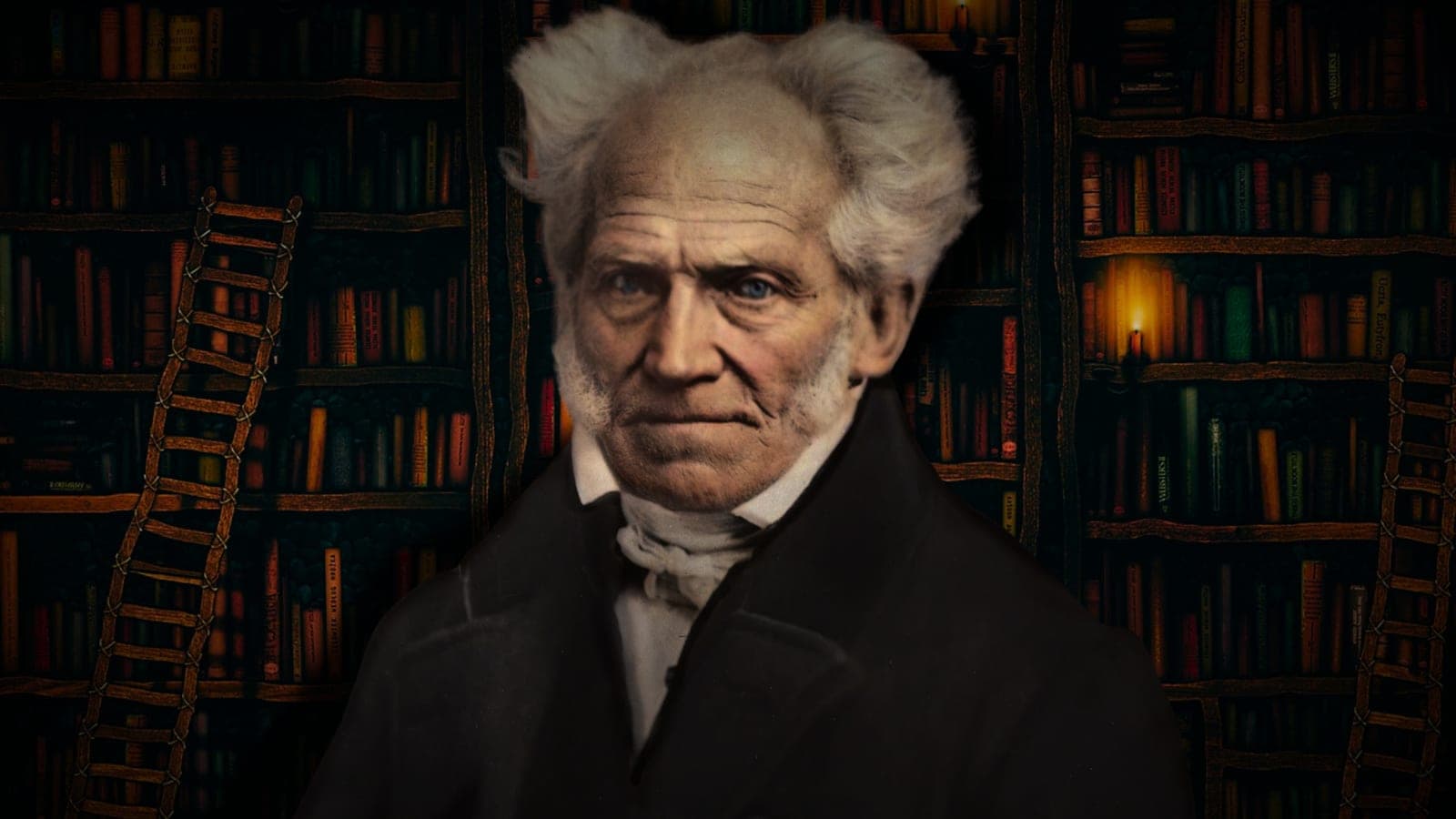
On 26 January 1839 the Royal Norwegian Society of Sciences and Letters in Trondheim awarded its prize to an essay posted from a set of rented rooms in Frankfurt. The author was a fifty-year-old bachelor who had spent two decades being ignored. His masterwork had appeared in December 1818, dated 1819 on the title page, and sold very badly. His single attempt at an academic career had ended in March 1820, when he scheduled his Berlin lectures at the same hour as Hegel's and drew five students. The Trondheim prize was the first public recognition Arthur Schopenhauer's philosophy had received, and the Stanford Encyclopedia of Philosophy records that he was immensely proud of it.
The question the Norwegians set was narrow and technical. Is it possible to demonstrate human free will from self-consciousness? Schopenhauer's answer ran to roughly a hundred pages and amounted to one syllable. No.
He bound that essay together with a second one, on the foundations of ethics, which the Royal Danish Society of Sciences in Copenhagen had refused on 30 January 1840 even though it was the only entry. Schopenhauer printed the refusal on the title page, in the position where an author would normally put an honour. The pairing was deliberate. The first essay removes the thing most people assume their moral life rests on, and the second describes what is still standing afterwards. The volume went to press in September 1840 with 1841 on the title page.
Free will is in one of its public phases. Robert Sapolsky's Determined: A Science of Life Without Free Will (Penguin Press, 2023) argues from neurobiology that every choice is the terminal point of causes reaching back through hormones, childhood, culture and evolution, with no gap anywhere for a self to intervene. It arrived within weeks of *Free Agents* by the Trinity College Dublin geneticist and neuroscientist Kevin Mitchell, which argues that evolution equipped organisms with a working capacity to decide. Behind both stands the compatibilist tradition, whose most prominent defender, Daniel Dennett, died in April 2024.
The sharpest live edge in the argument is criminal justice, and Sapolsky is blunt about it. Stanford Magazine put his position this way in December 2023: "Keep dangerous people from damaging others, but do so as straightforwardly and nonjudgmentally as keeping a car with faulty brakes off the road." Punishment, on this view, is a category error. You do not scold the brakes.
That conclusion was already sitting in a Norwegian prize essay from 1839, reached without a scanner or a genome. What gets left out of the retelling is where Schopenhauer went next.
A Man Can Do What He Wills
The sentence he is quoted for, usually on a black square in a serif font, is that a man can do what he wills but cannot will what he wills. In German it circulates as Der Mensch kann tun was er will; er kann aber nicht wollen was er will. Very few of the people who share it have read the argument underneath, which is one of the cleanest pieces of reasoning in nineteenth century philosophy. Einstein put his own version of it into print in a 1929 interview: we can do what we wish, but we can only wish what we must.
Notice how carefully the Norwegians phrased the question. They did not ask whether free will exists. They asked whether it can be read off from the inside, from the direct testimony of consciousness. That is where everybody's confidence comes from. Nobody believes in free will because of an argument. They believe it because when they lift a hand it feels like something they did.
So Schopenhauer interrogates the witness. Self-consciousness reports that a person can do what he wills: provided nothing physically prevents him, his arm rises when he wills it to rise. That is a true statement about the passage from willing to acting. It says nothing whatever about the willing itself, which is the part the Norwegians had asked about.
What determines the willing is a motive acting on a character, and the relation between the two, Schopenhauer insists, is as strict as the relation between any cause and its effect. Character on this account is individual and inborn, and it holds constant across a life. It cannot be chosen, since choosing would already require the character doing the choosing. A motive supplies the occasion for an act; the character supplies its direction. Present the same motive to two people and you get two different acts.
The illusion of openness has a specific source, and his account of it is the best passage in the essay. Human beings, unlike animals, can hold several abstract motives in mind at once and turn them over, which feels like standing in front of several open doors. In the third chapter he imagines a man standing in the street at six in the evening with the work day over, running through what is available to him: a walk, the club, the tower to watch the sun set, the theatre, a visit to one friend or another. Then the man goes home and sits down to supper with his wife.
He had the sensation of standing before open doors. The sensation was accurate about the motives in play and silent about which of them would move him.
Then comes the image the essay should be famous for. Suppose water could talk. It would say that it can throw up high waves, that it can rush downhill, that it can plunge foaming over a ledge, that it can rise into the air as a fountain, that it can boil away and vanish altogether. Then it would add that it is doing none of these things at present, and is voluntarily lying still and clear in the reflecting pond.
Every claim the water makes is true. Each of those states lies within its nature. None of them lies within its nature under these conditions, at this temperature, in this basin. The word doing the fraudulent work is voluntarily.
Operari Sequitur Esse, and the One Freedom He Kept
The scholastic tag Schopenhauer reaches for is operari sequitur esse, doing follows being. His own formulation, in the fifth chapter of the prize essay, is tighter: "man does at all times only what he wills, and yet he does this necessarily. But this is because he already is what he wills."
Having established that, he does something no hard determinist since has been willing to do. He turns around and takes the feeling of responsibility seriously as evidence. Everybody feels accountable for what they have done, the feeling survives the argument against free will intact, and Schopenhauer refuses to file it under superstition.
His solution moves responsibility off the act and onto the agent. He borrows Kant's distinction between the empirical character, which unrolls in time as a determined sequence of deeds, and the intelligible character, which is what a person timelessly is. Freedom, on that division, has changed address. It does not sit in any particular choice. It sits in the being from which all the choices follow, so that guilt attaches to the discovery of what kind of creature performed the deed.
This is the weakest joint in the essay and should be named as such. A freedom situated outside space and time, and outside causation, is a freedom nobody can exercise on a Tuesday. It cannot be used to deliberate or to do otherwise. Sapolsky would call it a rescue attempt in Kantian vocabulary, and the charge would land. Schopenhauer wanted the determinism total and wanted moral weight to survive it, and the intelligible character is the device he built to have both.
Nothing downstream depends on that device. Every practical conclusion Schopenhauer draws about how to treat another human being follows from the empirical half of the argument alone. Whatever is true about timeless characters, the person standing in front of you did not assemble the one he has. He did not select his temperament, his parents, his century, the injuries done to him before he could speak, or the neural equipment that processes all of it. The metaphysics can be argued over for another two centuries without touching that.
Sapolsky's Faulty Brakes and Schopenhauer's Pity
Blame has a hidden requirement, and it is a counterfactual: this person, being exactly who he was, in exactly those circumstances, could have done something else. Remove that and blame has nothing to fasten to. It becomes an emotion aimed at a possibility that never existed. Sapolsky and Schopenhauer both accept the consequence.
What the two men do next diverges, and the divergence is the whole reason to read the older one. Sapolsky's answer is institutional. Dangerous people should be contained on the model of a quarantine or a product recall, with the machinery of desert and retribution stripped out. It is a coherent position, humane in intent, and it is a policy. It tells legislators and parole boards what to stop doing. It says little about what should happen inside a person standing three feet from someone who has ruined something.
Schopenhauer arrives somewhere else because his metaphysics is stranger. Space and time, on his Kantian inheritance, belong to the lens and not to the landscape: they are the apparatus by which a mind sorts reality into separate objects. If that is right, the division of the world into discrete individuals, each a sealed centre with private interests, is a feature of the apparatus. Underneath it there is one striving, wearing an enormous number of faces and failing to recognise itself in any of them.
Put that together with the free will argument and something unusual happens. The person whose character produced something appalling did not choose that character, and at the deepest level that character is continuous with yours. The barrier that makes his suffering merely his, and yours the only kind that presses on you, is an artefact of perception.
This is the foundation of the second essay, the one Copenhagen turned down. Morality, Schopenhauer argues there, has exactly one non-egoistic source, and it is Mitleid, fellow-suffering, the direct participation in another creature's distress with no calculation of advantage. Duty and the counting of consequences are, on his account, egoism in better clothes. The whole of ethics condenses into a single maxim he takes from the Latin and repeats throughout: *Neminem laede, immo omnes, quantum potes, juva*. Do harm to no one; but rather help all people, as far as lies in your power.
The order of the clauses does the work. Restraint comes first, and the free will argument is what enforces it. Once you accept that nobody could have willed otherwise, the impulse to injure loses its licence, because the licence was always the assumption that the other person deserved it. What fills the space blame used to occupy is pity, in the old unpatronising sense: the accurate perception that the creature in front of you is driven by something it did not install and cannot switch off.
Nietzsche's Objection: Pity Multiplies the Pain
The strongest attack on this came from a man who had once worshipped its author. In 1865 a student named Friedrich Nietzsche read The World as Will and Representation, and he later dated the awakening of his philosophical interest to that encounter. He kept the striving at the centre of his own work for the rest of his life. He rejected almost everything Schopenhauer built on top of it, and nothing drew his fire like the enthronement of compassion.
Cruelty has nothing to do with the objection, and reading it that way misses it. The argument runs through his account of growth. If living things become stronger by straining against resistance, then removing every difficulty from someone's path can amount to robbing them of the material they needed. There is a form of help that heals and a form that keeps a person small.
His second charge is colder and harder to dismiss. Shared suffering is additive. When you feel another's pain, the quantity of pain in the world goes up. A culture that makes the reduction of suffering its highest value is training itself to feel more of it, and will end by calibrating everything to its most fragile members.
A reply is available that does not require siding against Nietzsche on the psychology. His argument concerns what compassion licenses you to do. Schopenhauer's claim concerns what compassion lets you see. The maxim does not say spare everyone every difficulty. It says injure no one, then help as far as you can, and it leaves the content of help entirely to judgment. A parent who lets a child fail at something is still perceiving the child as a fellow sufferer.
Where Nietzsche lands is against the sentimental version, the reflexive tenderness that flatters the person feeling it and does nothing for anyone else. Against the metaphysical version, the one that follows from an argument about causation and ends by making the sight of another person unbearable in a specific and useful way, the objection has less purchase. Schopenhauer is not recommending a mood. He is reporting a consequence.
The Frankfurt Bachelor Who Could Not Manage It
The obvious objection to all of this is the man himself. Schopenhauer made compassion the entire content of ethics and could not maintain a close relationship. He left his mother's house in Weimar in 1814, after she told him he was unbearable and very hard to live with, and her death in 1838 appears to have left him unmoved. He was suspicious, vain and quick to take offence, and he kept a sword and loaded pistols by his bed against thieves. He lived alone with a succession of pet poodles, among them one called Atman and one called Butz. He died in his apartment at Schöne Aussicht 16 on 21 September 1860, aged seventy-two.
The word for this is hypocrisy, and his own prize essay blocks it. If a character is inborn and holds constant, and a man can only ever act out what he is, then the gap between Schopenhauer's ethics and Schopenhauer's manners is the exact species of thing his argument forbids anyone to hold against him. He wrote the case for his own acquittal before the charge was filed, and there is no sign that he found it comforting. The essay that removes blame from murderers removes it from difficult, unpleasant philosophers too, which is a poor consolation and the only one available.
Most free will writing stops at the demolition, gestures at sentencing reform, and leaves the reader with a shrug and a smaller sense of themselves. The 1839 essay treats the demolition as clearing work. Determinism taken all the way down leaves a person with one fewer emotion and one more obligation. The prize essay took away the blame. The essay printed beside it, the one nobody wanted, said what to put in its place.
---
Written alongside a longform audio episode, Is Life Worth Living? | Nietzsche vs Schopenhauer (releases 1 August 2026), produced for Sleepy Philosophy Radio.
The Newsletter
New essays and episodes, delivered quietly.
By subscribing you consent to receiving occasional emails. Unsubscribe any time via the link in every email or at /unsubscribe.
Reflections
Loading...
Related Episodes
The Vanity of Existence | A Quiet Reading of Schopenhauer's Studies in Pessimism
The clearest pessimist in philosophy on suffering, time, death, and the strange consolation of expecting nothing. Studies in Pessimism gathers the darkest and most readable essays of Arthur Schopenhauer, selected from the late miscellany that finally made him famous and translated into English by T. Bailey Saunders. This reading moves through the whole of it in the book's own order. It opens with the great case for pessimism, that suffering is positive and happiness only the absence of pain, and descends through the emptiness of time, the question of suicide, and a strange dialogue in which a frightened man is told what he will be after death. It passes through sharp observations on human nature and three essays that turn the same cold eye on education, on women, and on noise, before closing with a famous parable of porcupines and the long afterlife of a book that refuses every comfort. The full episode is on YouTube and Spotify. Please listen only in safe, restful contexts.
Is Life Worth Living? | Nietzsche vs Schopenhauer | Philosophy for Sleep
One of them concluded that the only wise response to life is to want less of it. The other spent his life arguing for wanting all of it back, forever, exactly as it was. As a lonely student, Friedrich Nietzsche found a dead philosopher's book on a bookshop table and fell under a spell that would shape everything he became. This episode follows the long, strange bond between Nietzsche and his first master, Arthur Schopenhauer, from devotion to open war. We meet the bitter, solitary Schopenhauer and his vision of a blind striving world where life is suffering. We watch the young Nietzsche pour that vision into his first book, then slowly turn against it, until he answers the darkest case ever made against existence with the wildest possible affirmation of it. Along the way we trace the will, pity, the death of the hidden true world, and the thought that measures whether a life could be loved enough to live again. The full episode is on YouTube and Spotify. Please listen only in safe, restful contexts.
That Life Has No Meaning Is the Only Reason to Live | Emil Cioran
Cioran's Complete Philosophy
Emil Cioran wrote for sixty years about the pointlessness of existence, and lived to eighty-four. The gap between what he argued and how he lived is the honest center of his work. This long quiet episode follows him from a Carpathian village where a priest's son ran barefoot among graves, through the cafes of interwar Bucharest, through a dark political period he spent the rest of his life working against, through the small Paris attic he shared with Simone Boue for over fifty years, and into the final afternoons in the Luxembourg Gardens. It is a calm, unhurried portrait of the most rigorous stylist of despair in twentieth century literature, and of the quiet stubborn survival that was his truest answer to his own philosophy. The full episode is on YouTube and Spotify. Please listen only in safe, restful contexts.