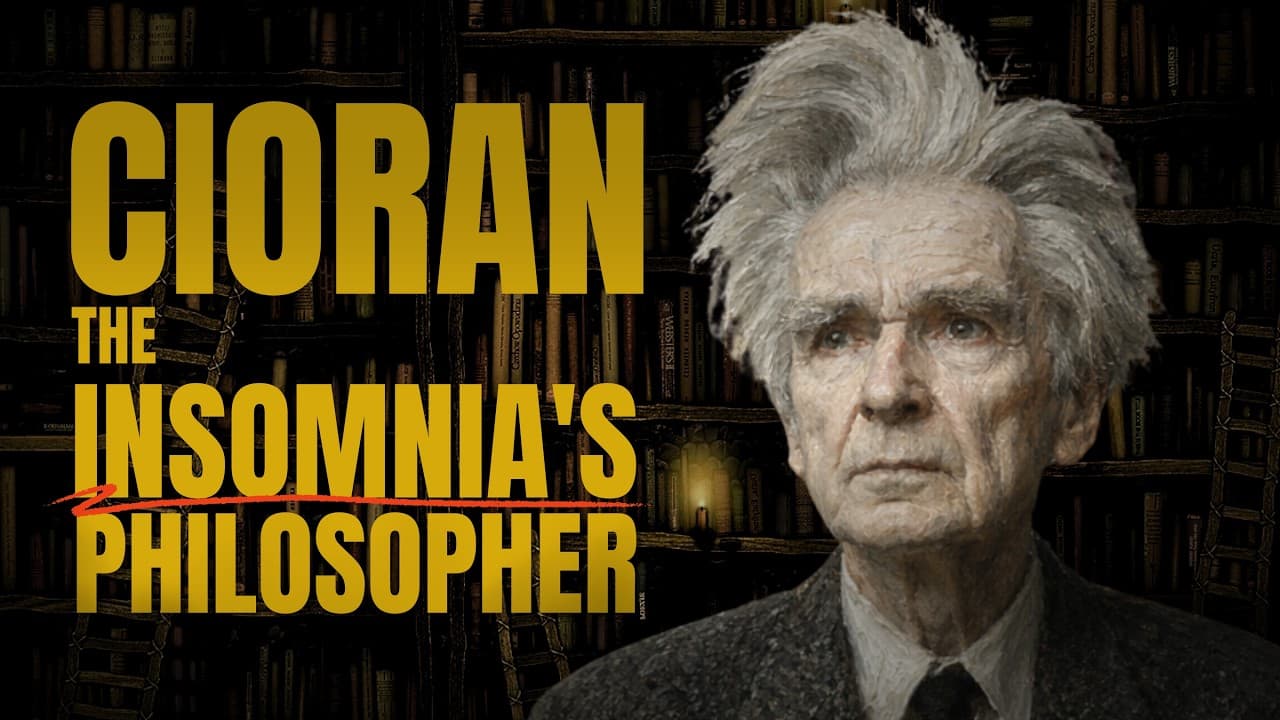
That Life Has No Meaning Is the Only Reason to Live | Emil Cioran
Cioran's Complete Philosophy
Emil Cioran wrote for sixty years about the pointlessness of existence, and lived to eighty-four. The gap between what he argued and how he lived is the honest center of his work.
This long quiet episode follows him from a Carpathian village where a priest's son ran barefoot among graves, through the cafes of interwar Bucharest, through a dark political period he spent the rest of his life working against, through the small Paris attic he shared with Simone Boue for over fifty years, and into the final afternoons in the Luxembourg Gardens.
It is a calm, unhurried portrait of the most rigorous stylist of despair in twentieth century literature, and of the quiet stubborn survival that was his truest answer to his own philosophy.
The full episode is on YouTube and Spotify. Please listen only in safe, restful contexts.
Enjoying the episode?
Occasional letters on philosophy, reading, and the examined life. No spam, ever.
By subscribing you consent to receiving occasional emails. Unsubscribe any time via the link in every email or at /unsubscribe.
Timestamps
- 0:00:00Chapter 1: The Attic on the Rue de l'Odeon
- 0:14:07Chapter 2: The Village and the Boy Who Was Happy
- 0:27:37Chapter 3: Bucharest and the Young Generation
- 0:42:22Chapter 4: The Dark Years
- 0:58:05Chapter 5: Paris, and the Decision Not to Sleep
- 1:12:49Chapter 6: A Short History of Decay
- 1:27:50Chapter 7: The Trouble with Being Born
- 1:41:53Chapter 8: The God He Could Not Quite Lose
- 1:56:41Chapter 9: Style as Salvation
- 2:10:22Chapter 10: The Old Man in the Luxembourg Gardens
For the record
Full Transcript
Chapter 01: The Attic on the Rue de l'Odeon
Paris in the middle of the nineteen eighties. The sixth floor of a narrow building on the rue de l'Odeon in the sixth arrondissement. The street itself is a short one, tilting slightly downhill from the Odeon theater toward the Luxembourg Gardens, and the building at number twenty one is the kind of building a visitor can walk past twice without noticing. A grey stone facade. A small door. Inside, a staircase that is steep and badly lit and becomes more difficult each year. At the top of that staircase is an attic apartment. And inside the attic apartment is an old man in his seventies, sitting at a table in front of a notebook.
His name is Emil Cioran. He is one of the most admired prose stylists alive in the French language, and almost nobody on the street below him has any idea he exists.
He has lived in this apartment for decades. The woman he lives with, Simone Boue, is a schoolteacher of English. They are not married. They have never been married. They will never be married. They share a small kitchen and a smaller bathroom and a smaller study still, and they have done so for so long that the arrangement has taken on the permanence of a monastic vow. There is a narrow bed. There are books. There are shelves that sag. There are papers in every drawer. There is a view out over the grey Paris rooftops and, if you know where to look from the one high window, a slice of the Luxembourg Gardens in the middle distance.
The old man at the table is writing in a notebook because he has almost stopped publishing. The last book he will put out during his lifetime, "Aveux et anathemes" in French, which English readers will come to know as "Anathemas and Admirations," is still a year or two away. In the meantime he writes to himself. He writes in French, a language he did not speak as a child and did not write a word in until he was in his thirties. He writes slowly, in a small sharp hand. Every sentence has been considered the way a jeweler considers a stone. He does not cross out often. He prefers not to begin a sentence he cannot finish.
There is a photograph of him from around this time. He is wearing a dark jacket. His hair is still thick, gone silver. His eyes are pale and quick. He is smiling very slightly, with the corners of his mouth pulled inward, as if he were trying to suppress a joke he had just thought of and did not want to waste on the photographer.
This chapter is not yet about his books. His books will come. This chapter is about the fact that he is still sitting at that table, at seventy, with a pen in his hand, in an attic he will leave mostly only for walks and eventually only by ambulance, in a city he arrived in almost fifty years ago as a scholarship student who was meant to go home.
We have to begin with this because the philosophy he has spent his life writing argues, with a cold and beautiful consistency, that he should not be here.
For sixty years he has been writing books about the uselessness of being alive. Short books. Brutal books. Books in which the word existence almost always carries the quiet weight of an insult. He has written that birth is a catastrophe. He has written that the saints were frauds and that the philosophers were worse. He has written that no thinker should be taken seriously who is still capable of smiling at breakfast. He has written that we should never have been born and that, having been born, the only intelligent response is a mixture of astonishment and disgust.
And then, each morning, more or less reliably, he has put the pen down, picked up his hat, walked down six flights of stairs, and gone out into the light.
Before he leaves the attic for his walk, there is a small ritual. He drinks coffee. He drinks it standing up, near the window, looking out at the rooftops. Simone has made it. It is strong. He does not eat much with it. He will eat more at lunch, which is usually something small she has prepared, or a plate of whatever was cheap that morning at the market. He smokes a cigarette. He smokes it slowly. He has smoked for decades, and he will not stop, and when doctors tell him to stop he agrees politely and then continues. He watches the light move on the roof opposite. He does not speak much in the mornings. Simone is used to this. She is used to a great deal about him by now, and the morning silence is one of the things she has come to value, because the morning silence is when he is working on whatever sentence he will try to get right during the day. He is working on it behind his eyes. She can see him working on it. She knows not to interrupt. After the coffee he takes his hat from the hook by the door. He takes his coat. He takes the stick he has been using for the last year or two. He goes down the six flights of stairs slowly, one step at a time, stopping twice on the way for his knees.
He walks in the Luxembourg Gardens. This is not a minor detail. The Luxembourg Gardens are where he does what he calls, in private, his real work. He walks in long slow circuits around the fountain and the chestnut trees. He stops to watch the children. He watches the old women in their coats. He watches the students on the benches with their books open and unread. He makes notes in his head, and when he gets home he sometimes writes them down and sometimes does not. Simone cooks something small. They eat. He lies down. He does not sleep. The long insomnia that has organized his life for half a century continues. He gets up again. He writes something else. Then he writes nothing. Then he writes a sentence.
This is a rhythm that has held, with variations, for a very long time.
The books he has written have become famous in a particular way. They are not famous the way bestsellers are famous. He has never had a bestseller. But serious readers, in Paris and in a growing ring of cities outside France, know who he is. Susan Sontag has written about him for American readers, and her essay will bring him a small wave of admirers who will come looking for him, notebooks in hand, hoping for wisdom. Young writers knock on his door. He answers it. He offers them wine or nothing at all. He answers their questions in short considered sentences. He refuses to be photographed when he can. He refuses, with a politeness that is almost cruel, every literary prize that is offered to him after the first one.
The first prize he took was the Rivarol Prize in nineteen fifty, for the first book he wrote in French, a short volume called "A Short History of Decay." He took it because he needed the money. Afterwards he stopped. He has turned down every other honor offered to him since. The Paul Morand Prize, with its substantial purse, he declined. The Sainte Beuve Prize, the same. The Roger Nimier, the same. A pattern like that is not an accident. It is a position.
He lives on very little. He has never held an academic post. He has refused to write for money. He has not lectured. He has not taught. His only income is what his books bring in and what Simone earns from her teaching, and the two of them have organized their lives so that this is enough. It is enough because they do not want very much. A room. Food. Books. A window. A pair of shoes that will take him to the garden and back.
All of this is the kind of biographical arrangement that, if you read only his books, you would not expect. His books describe a man who should not be able to get out of bed in the morning. His life describes a man who does get out of bed, drinks his coffee standing up, writes a sentence he has been turning over for three days, puts on a coat, and walks to the garden.
Both of these are Cioran. That is the difficulty. Every honest account of him has to hold both at once.
It would be easy to say that the books are a pose, and that the man is the truth. It would be wrong. The books are not a pose. He meant them. He meant every word. The hatred of existence that runs through them is not performed. He wrote them because he genuinely could not see, from where he sat, how a thinking person could come to any other conclusion.
It would be just as easy to say that the life is a pose, and that the books are the truth, and that the calm old man in the garden is a kind of mask. That would also be wrong. The life is not a mask. He walked. He smiled. He laughed, sometimes loudly, the laugh of a man who has just heard the final line of a very good joke. He was kind to the waitresses at the cafe. He wrote long affectionate letters to his brother Aurel in Romania. He forgot to eat when he was reading.
Both were him. Neither cancels the other. And the strange thing about Cioran, the thing that makes him worth a long careful episode, is that he was one of the very few twentieth century writers who could hold both the argument against life and the living of it in the same hand without visibly shaking.
We need an honest name for this. The simplest one is this. He wrote about giving up, and he gave up on nothing.
He gave up no friendships. He gave up no daily walks. He gave up no sentences. He gave up his country, but that is a different matter, and it was given up on him as much as by him. He gave up a language, Romanian, but only to pick up another one, French, and to begin again at thirty six, which is not giving up but starting over on much harder terms.
The philosophy he produced is not a program. That is the second thing to say at the start. It is not a plan of action. It contains no instruction. If you read him looking for a recommendation about what to do with your Tuesday afternoon, you will come away empty. He tells you nothing about Tuesday. He tells you only, and with tremendous precision, what it feels like to be a thinking animal who has noticed that the whole arrangement is absurd and does not end well.
And then he leaves you to your Tuesday.
This is why readers have kept returning to him for decades. Not because he solves anything. He does not solve anything. He is not in the solution business. He is in the naming business. He writes down, in sentences that seem to have been carved out of hard stone, the feelings you have already had at four in the morning, the feelings you could not have put words to yourself, the feelings you were a little ashamed of, and he hands them back to you with their edges filed sharp. To have one's worst feeling named by a master is a kind of relief. It is a relief that does not fix the feeling. It makes it survivable until morning.
His American admirer Susan Sontag, writing about him in the nineteen sixties, suggested that his books should be read slowly, a few pages at a time, the way one takes a sedative. That was not a dismissal. It was a prescription.
So. The attic. The table. The notebook. The old man who should not, by his own argument, still be here, and yet, stubbornly, quietly, is.
In the chapters that follow we will travel back along the line of his life. Through a Carpathian village where a priest's son ran barefoot among graveyards. Through an old Transylvanian town that ended his first happiness. Through the noisy streets of interwar Bucharest, where a generation of brilliant young Romanians argued about Nietzsche and fascism and God. Through a dark political period he would never fully account for. Through the Latin Quarter in wartime and afterwards. Through the slow and stubborn construction of a French prose style as austere as any in the language. Through the books that made his name. Through his long half argument with the God he did not believe in. And through the last years, when the philosopher of lucidity began to lose his lucidity, and the notebook on the table began to go blank.
The old man in the attic is where we begin because he is where any honest account of Cioran has to begin. Everything else is a path that leads back to him, sitting at the table in front of the notebook, writing another sentence that will not quite kill him.
Outside, below the window, the late Paris afternoon is going gold on the rooftops. Somewhere down in the street a boy is calling to a dog. Somewhere further off, a bell. The old man looks up from the page, watches the light for a moment, and goes back to work.
Chapter 02: The Village and the Boy Who Was Happy
Go back now, across about seventy five years, and across a great deal of ground.
In the spring of nineteen eleven, on the eighth of April, a child is born in a stone house in a village called Rasinari, in the Carpathian foothills, in what is at that moment not yet Romania but the eastern edge of the Austro Hungarian Empire. The child is a boy. He is named Emil. His family name is Cioran, which in Romanian means, roughly, a man with a dark complexion, a mountain man.
The village sits in a narrow valley. Behind it rise the green walls of the mountains. In front of it, a few kilometers down the road, is the old Saxon town of Sibiu, which the Germans who founded it in the twelfth century called Hermannstadt. Rasinari itself is a Romanian village, peasant and Orthodox, full of sheep and horses and the quiet clatter of wooden buckets. The houses are low and whitewashed. The roofs are red tile or grey wood. The church stands at the top of the lane, and next to the church there is a graveyard, and just beyond the graveyard there is a parish house where the boy lives.
The boy's father is the village priest. His name is Emilian Cioran. He wears the full black robes of the Romanian Orthodox clergy. He is the kind of priest who is also a kind of mayor, the kind of priest the village turns to when a marriage fails or a cow dies or a dispute about a fence line needs settling. His wife, the boy's mother, is named Elvira. They have three children: the boy Emil, a younger brother named Aurel, and a sister named Virginia. The household is full in the way rural households were full. There is always something to be done. There are always chickens to be chased and bread to be taken out of the oven and cassocks to be mended.
The boy Emil runs through the hills. This is the single most important sentence in his early biography. The boy runs through the hills. He climbs up among the rocks. He watches the shepherds bringing the sheep down in the evening. He knows every stone of the cemetery his father presides over. He sits sometimes among the graves because it is cool there in summer and because nobody bothers him. He learns the names on the stones. He learns the dates. He learns how long people tend to live in a mountain village, which is longer than you might think if they survive childhood, and a great deal shorter if they do not.
He will say later, at seventy and at eighty, in interviews he half refused to give, that he was genuinely happy for the first ten years of his life and never afterwards. He will say that the happiness of Rasinari was the only real happiness he ever experienced. He will say that he owed everything he was as a writer to the fact that he was born in a village and not in a city. You have to hear this in his voice, with his accent, the rolled consonants and the long vowels, to understand how heavily he meant it. For a man who would spend sixty years writing that nothing had ever been good, the claim that one small thing had been good is worth a great deal.
What was the happiness made of?
It was made, he would say, of physical things. The wind coming down from the mountains. The smell of woodsmoke. The dogs. The bells of the sheep. The bells of the church. The particular light that falls on the Carpathian foothills in October. The coldness of the stream behind the house. The women gossiping at the well. The men smoking in the square. The sound of his mother calling him in for supper and the sound of his own bare feet running across the yard. It was the kind of happiness that does not know it is happiness. It does not need to name itself. It is the ground you stand on, not the view you look at.
He was also, and this is part of the same thing, close to the dead. He ran among graves because the graveyard was where he played. There was nothing morbid in it. The dead were part of the village, in the way the sheep were part of the village and the priest was part of the village. The Orthodox service of the dead, which his father performed over those graves in all seasons, taught him before he could read that death was an ordinary thing, neither hidden nor advertised, simply there, walked past on the way to buy bread. He would later say, with his usual hard humor, that the graveyard of Rasinari was his first school of philosophy. He had been given the great problem very early, in its ordinary form, and he had not been frightened by it. A child who is not frightened by the dead is a child who has the freedom, later, to be frightened by other things.
It is also true that he was a difficult child. He was not the quiet dreamer the cliche of the future pessimist would require. He was restless, loud, full of energy that had nowhere to go once the sun went down. He had nightmares. He was afraid of things he could not name. Even as a small boy, he could sometimes not sleep. His mother once said to him, in one of the conversations he would never let go of for the rest of his life, that if she had known what kind of child she was going to have, she would have had an abortion. She said it in a moment of exhaustion. She probably did not mean it the way the boy heard it. He was about twelve at the time. He remembered it until he was eighty. He would quote it in interviews as one of the formative sentences of his existence. It was, he said, the most honest thing his mother had ever said to him, and it had helped him, in a paradoxical way, to take himself less seriously. If you begin as a mistake, you are excused from having to be a success.
We have to sit with this for a moment. A mother saying such a thing to a child is the kind of wound that does not heal evenly, and a certain kind of person would build a whole grievance around it. Cioran did not. He absorbed it into his humor. That is one of the things that is interesting about him. He had the gift, not always a gift, of turning injuries into jokes. The joke was that the injury was true. The joke was that the world really was the kind of place his mother had briefly admitted it was, and the only sane response was not to pretend otherwise.
And then, in nineteen twenty one, when he was ten years old, the family moved.
They moved because his father had been given a larger post in Sibiu, the Saxon town down the valley. Sibiu was a step up. It was a civilized place, with cobbled streets and a Lutheran church and a Habsburg city hall and a German bourgeoisie and a Romanian intelligentsia in a nervous half relationship with the Hungarians who had been in charge until a couple of years before. For a priest's family it was a promotion. For the boy Emil it was an ending.
You can read his account of this in the scattered autobiographical paragraphs he left in his notebooks. The move to Sibiu was, in his telling, the fall. Not the fall in some vague theological sense, though he was capable of that sort of language. The fall in a specific sense. He had been a peasant boy among peasant boys, running among sheep and graves, speaking the village dialect, living the life that had been lived in Rasinari for centuries, and then one day he was a priest's son in a town where the paving stones were laid straight and the windows had lace and the boys in his class spoke with different accents and made fun of his village vowels. He never forgave the town for this. It was not the town's fault. It was his own dislocation. But he hung the grief on the town anyway, because the grief had to hang somewhere.
He said later that he had left paradise at the age of ten. He meant Rasinari. He meant specifically the life of a boy who did not yet know he was going to have to be someone in particular. In Sibiu he began to know. He began to know that he was a priest's son and not a shepherd's son. He began to know that he was going to go to a good school and learn Latin and read books and become an educated man. He began to know, though he would not have put it in these words yet, that he had entered the condition of self awareness, and that from self awareness there is no path back to the simple happiness of running barefoot in a valley without asking what it was for.
This is one of the oldest stories in human writing. It is the story of Eden in Genesis, and the story of Achilles growing up among the centaurs, and the story of every child who has ever looked back on a summer that cannot be had twice. Cioran is unusual among philosophers in having taken this story so personally and so literally. He really did believe that his life had a single good period, and that the good period had ended precisely on the day the cart loaded with his family's belongings rolled out of Rasinari for Sibiu. He would return to the village later, in his mind, in his notebooks, in occasional letters. He would return to it physically once or twice, and each time he said that returning was worse than not going at all, because the village was still there and he was not the boy anymore and the gap between the two was the whole problem.
He would say, in one of the interviews he reluctantly gave as an old man, that the worst thing about the move was that the cart carrying his family's belongings had been drawn by a particular horse he had known in Rasinari, and that the horse, who had no idea what was happening, was the last piece of the village he had to say goodbye to. Thirty years later, in Paris, in a language the horse had never heard, he still remembered the horse's name. He would not tell the interviewer the name. He said the name was the last thing he had left of the life before the fall, and he was not going to put it into print. It is one of the rare moments in any Cioran interview in which he holds something back out of straightforward tenderness. The rest of the interview, like most of his interviews, is a dry and polite performance. The moment about the horse is not a performance. It is a leak. It tells you, more clearly than almost anything else in his recorded speech, what Rasinari had been for him, and what leaving it had cost.
He went to a good school in Sibiu. He learned German, because everyone in Sibiu learned German, and he learned Hungarian a little, because some of the town did. He read voraciously, the way a certain kind of unhappy boy reads, looking for something he could not have named if asked. He began to be the kind of boy whose teachers noticed him and whose classmates found him peculiar. He was small and dark and sharp tongued. He could be very funny. He could be very cutting. He did not sleep well even then. He walked at night when he could not sleep. Sibiu at night, with its old Saxon towers and its narrow lanes, became his first nocturnal city. Paris would be his second.
Keep this in mind, because it matters. The boy who would become the philosopher of insomnia was already an insomniac at fifteen, walking around a Transylvanian town in the dark, looking up at the stars between the old roofs. The boy who would become the philosopher of despair had already lost his paradise. The boy who would become one of the most famous prose stylists in France had not yet spoken a word of French and was learning German instead.
The chapter should end, though, not with the insomniac boy in Sibiu. It should end with one more scene from Rasinari. Picture it. A summer evening. The sheep are coming down from the hills. The bells at their necks make a slow uneven music that fills the whole valley. A boy of about eight is running between them, not because he has anywhere to be, but because he is a boy and it is a summer evening and running is what his body wants. His father is standing in the doorway of the parish house, watching him, in the full black cassock of an Orthodox priest, with a book in one hand and a glass of something in the other. The boy does not know yet that anything is wrong. Nothing is wrong. The light is going gold on the mountain. The bells are coming closer. Somebody is going to call him in for supper in a minute.
He will remember this evening, or ten like it, for the rest of his life.
Chapter 03: Bucharest and the Young Generation
In the autumn of nineteen twenty eight, at the age of seventeen, Emil Cioran boards a train in Sibiu and travels south to Bucharest. He is going to the University. He is going to study philosophy. He will stay for six years. He will never, in any meaningful sense, come back.
Bucharest in nineteen twenty eight is a city that has decided to become Paris and is not sure how. The shops along the Calea Victoriei sell French perfume and French novels and French newspapers printed the day before in Paris and flown in at great expense. The cafes on the grand boulevards are full of men in suits that have been cut in what their tailors believe to be the French style. The women carry Parisian magazines under their arms. The ministers of the government, when they give speeches, quote Anatole France and Paul Valery. The young intellectuals gathering in the coffee houses quote Nietzsche and Heidegger and Shestov, because they are not ministers and they want something harsher than Anatole France.
Romania in this moment is a young country. In its current form it is only ten years old, stitched together after the Great War out of the old principalities and the liberated Transylvanian lands and Bessarabia in the east. It has a king. It has an army. It has a constitution. It does not quite have a settled idea of what it is. There is a peasant majority, which is poor and religious and close to the old life Cioran had been taken away from as a child. There is an urban minority, which is educated and restless and embarrassed by the peasants and convinced that the peasants are the soul of the nation. Nothing sits still for very long. The arguments that will tear the country apart in the nineteen thirties are already in the air, just below the surface.
Into this city the boy from Rasinari arrives with a small suitcase and a great deal of unspent energy.
He is seventeen. He is small and dark. His hair is already going a little wild. His eyes have an intensity that people remember. He has not stopped being an insomniac. He has not stopped being a reader. He has not stopped being, when he wants to be, devastatingly funny at the expense of people who are trying to say something important. He is, in short, exactly the kind of young man who will find his way almost at once into the circle of young intellectuals who are reshaping Romanian thought.
The circle will later be called the Young Generation. Generatia tanara. The name is slightly misleading, because it sounds like a formal movement, and it was not a formal movement. It was more of a weather system. Young writers and thinkers, most of them born within five years of each other, most of them students or recent graduates of the University of Bucharest, all of them convinced that their fathers' generation had been too cautious and too liberal and too French and that something new had to happen.
The names in the circle are names that will become famous. Mircea Eliade, the historian of religions, who will end up at the University of Chicago and write the standard work on shamanism and the sacred. Eugene Ionesco, who will end up in Paris and write plays about chairs that multiply until they fill a room and about men who turn into rhinoceroses. Constantin Noica, the philosopher of the Romanian language, who will stay behind, and who will spend years in communist prisons for his troubles. Mihail Sebastian, the novelist and diarist, whose wartime journal will become one of the great documents of the Jewish experience under fascism in Eastern Europe. And Cioran.
They read everything. They read it fast and they read it in the original. German was still the second language of educated Romanians in this period, the way French would later become. They read Nietzsche, who was the god of the moment in European letters and who would remain a presence in Cioran's work for the rest of his life. They read Dostoevsky, in Russian or in French translation, and argued about whether Ivan Karamazov was correct. They read Kierkegaard, who was newly available in German. They read Lev Shestov, the Russian philosopher of tragedy, whom Cioran loved with a specific passion. They read Spengler. They read Berdyaev. They read the early Heidegger. They argued about these writers in cafes, in student rooms, on long walks, late into the night.
Cioran in these years is not yet a pessimist in the way he will later become a pessimist. He is something more unstable, more volatile, more recognizable as a young man. He is a nihilist one week and a mystic the next. He is furious at Romania one evening for being a small peripheral country and in love with Romania the following afternoon for being authentically peasant and Orthodox and unspoiled. He wants to burn it down and save it, and he has not yet noticed that these are the same impulse pointing in different directions.
He is also sick. Or if not sick exactly, broken in some way that nobody has a name for. The insomnia that had started in Sibiu has followed him to Bucharest and has gotten worse. He walks at night. He goes whole nights without sleep. He sits in cafes drinking coffee he does not need, then tea, then brandy. He writes in fever. He has the hot thin skin and fast speech of a young man whose body has run ahead of him and whose mind has run ahead of his body.
Among all the writers the young Cioran reads in this period, the one who seems to touch him most personally is Lev Shestov. Shestov was a Russian Jewish philosopher who had fled Russia in nineteen twenty and ended up in Paris, where he taught and wrote until his death in nineteen thirty eight. He was the great European philosopher of what he called the revolt against reason. He believed that the central insight of both the Hebrew Bible and Dostoevsky was that human life could not be explained by reason and should not be asked to justify itself before reason. He was unsystematic. He was intense. He wrote about Job and about Kierkegaard and about Nietzsche as if they were all in the same room arguing about the same thing. Cioran discovered Shestov's books at the University of Bucharest and read them with a kind of hunger. Later, in Paris, he would seek out the old philosopher and attend some of his lectures. The sentence in Cioran's mature work, the sentence that refuses to argue, the sentence that presents rather than proves, owes more to Shestov than to any other single writer. Cioran would acknowledge this, late in his life, in one of the rare moments when he allowed himself to name an influence.
The other influence, harder to name because it is so much part of the air he was breathing, was Mihail Sebastian. Sebastian was a year older than Cioran. He was Jewish. He came from a small town in the Danube delta. He was, even in his twenties, the most elegant prose writer in Romanian among the young generation, and he was also, by temperament, the most suspicious of every romantic or mystical escape from ordinary life. Sebastian and Cioran were close for a while. They argued constantly. Sebastian was the intelligent friend who would not let Cioran get away with any of the grander sentences, and the friendship, while it lasted, was probably a kind of brake on what Cioran would otherwise have written in those years. What Sebastian thought about his old friend, in his private diary, during and after the period of the dark choices, is part of a story we will tell in the next chapter. It is also part of the story of this one, because the brake eventually came off.
Out of this period comes his first book.
He writes it in nineteen thirty three, in a room he is renting somewhere in Bucharest, in a few months, in what he would later describe as a state between ecstasy and illness. The book is called "On the Heights of Despair," Pe culmile disperarii in the original Romanian. It is short. It is wild. It is written in what we might call aphoristic blocks, short paragraphs and meditations, some of them only a few lines long, arranged in no particular order, each of them hammering at the same basic set of ideas. Life is unbearable. Sleep is impossible. Love is a cruelty disguised as tenderness. History is a cemetery of illusions. The religious impulse is real but there is no God to receive it. Music comes closer than philosophy to the truth about suffering. And so on.
If you read the book today you can feel at once how young the writer is. The sentences are too hot. The claims are too total. Every page carries the specific gravity of a young man who has just discovered that he can make language do this kind of work, and who has not yet learned that he does not need to do all of it on every page. But you can also feel, on every page, the voice that will eventually become the Cioran of the French books. The rhythm is already there. The refusal to argue is already there. The willingness to offend by saying the thing that thinking people usually put off saying is already there. And the humor is already there, though in this first book the humor is a little blacker and a little more desperate than it would later become.
The book is published in nineteen thirty four. He is twenty three. Within a few months it wins a literary prize given to young Romanian writers. It is noticed. People begin to know who he is. Older critics shake their heads at the extremity of the claims and then admit that the sentences are unlike anything they have read. He begins to be invited to write for literary journals. He does. The journals want more of what he has been doing. He gives them more. He is beginning, in a quiet way, to make a career.
He is also beginning to make mistakes.
The mistakes will be the subject of the next chapter and it would be dishonest to hurry past them here. But it is important to see that the young Cioran of the early nineteen thirties is not a finished figure. He is, among other things, an unhappy brilliant twenty something looking for something large enough to carry the weight of his unhappiness. He had spent the last years reading books about great causes, and he has noticed that small causes do not match the size of what he is feeling. Romania looks small to him. His own future looks small. The philosophical problems he is working on look, at night, either very small or so vast as to be unbearable. He wants a cause that feels the size of the abyss he has already been writing about.
This is one of the ways a young man can end up in terrible company. Not by being stupid. Not by being cruel. By being in a hurry to match the size of his sadness to the size of a movement.
But we are not there yet. Not in this chapter.
In this chapter, he is still, mostly, a student. He is still going to lectures. He is still arguing with Eliade about whether the sacred can be philosophically defended. He is still arguing with Sebastian about whether Romanian literature has a future. He is still writing letters to his father in Sibiu that are slightly less respectful than his father would have liked. He is still walking at night when he cannot sleep, through the streets of the old Bucharest that has not yet been bombed and has not yet been rebuilt in concrete by the communists, past the yellow fronted eighteenth century houses of the boyars, past the Athenaeum with its round dome, past the Romanian Academy, past the Foreign Ministry, past the little Orthodox churches tucked away in courtyards where you would not expect to find them.
He is still a young Romanian intellectual in a young Romanian country in a nervous decade. He has already done one serious thing, which is to write the first book that is unmistakably his. He has not yet done the things he will spend the rest of his life trying to live down. He has not yet decided to move to Paris. He has not yet decided to abandon his mother tongue. He has not yet met Simone Boue, who has not yet met him, because she is a French schoolgirl in her own country and they have not yet been introduced by the events of history.
You have to picture him at one more moment. A night in nineteen thirty four. He has finished the proofs of his first book. He is walking home across central Bucharest, perhaps along the Calea Victoriei, perhaps through the park around the royal palace. He is exhausted in the way only a young writer just released from a book is exhausted. He thinks, for a moment, that he might actually sleep tonight. A light rain is falling. The trams have stopped running. Somewhere a dog is barking at nothing. He looks up at the yellow windows of the old buildings and feels, for just a second, that everything is possible, and then the feeling is gone, and he remembers that he does not believe this, and he smiles at the remembering, because even the feeling of possibility is a small kind of joke between him and himself, and he walks on.
Chapter 04: The Dark Years
There is a part of this story that cannot be skipped, and that has to be told as carefully as it is told truthfully. It is the part where the young Cioran, in the middle of the nineteen thirties, in his early twenties, in the middle of the most extreme decade of modern European politics, put himself on the wrong side of it.
This chapter has to name what happened. It also has to resist two temptations. The first is to pretend it did not happen, or to treat it as a small aberration that the mature writer quickly grew out of. That would be a lie. The second is to treat the young Cioran's political error as the only interesting fact about him, and to pass judgment on it with the easy confidence of someone who was not alive in Romania in nineteen thirty four. That would also be a lie, and a lazier one. Both lies have been told about Cioran by people with agendas. We will try to avoid both.
Here are the facts.
In Romania in the nineteen thirties, a fascist movement called the Iron Guard was growing rapidly. It was not like the Italian or German fascisms in every respect. It was unusual because it fused an ultra nationalist politics with a mystical Orthodox Christianity. Its founder and leader, Corneliu Zelea Codreanu, presented himself as a kind of warrior monk. His followers wore green shirts and swore oaths and sometimes carried bags of Romanian soil around their necks. They spoke of purity, of sacrifice, of death, of martyrdom. They were also, and this is not a separable fact, violently antisemitic. They organized pogroms. They assassinated government ministers who opposed them. They murdered Jewish shopkeepers. They produced a political violence in Romania that the country had not seen in living memory, and that would culminate, after the period we are discussing, in atrocities during the Second World War that killed hundreds of thousands of Romanian and Ukrainian Jews.
The Iron Guard was, in other words, not a rhetorical movement. It was a movement that killed people.
In the middle of the nineteen thirties, Cioran, like a significant portion of the brilliant young Romanian intellectuals around him, was drawn toward this movement. He was not a party member in any formal sense. There is no record of him wearing a green shirt, or carrying soil, or swearing oaths, or participating in violence. What there is, on the record, is a series of published writings in which he expressed admiration for the Iron Guard's energy, for its mystical nationalism, for its willingness to break with the liberal order that young intellectuals of his kind were finding exhausted.
He also published, in nineteen thirty four, a short article in a Romanian magazine in which he expressed admiration for Adolf Hitler. The article is brief. It is not a policy paper. It is a young writer's impression of the German chancellor as a figure of vitality and will. The admiration in the article is unmistakable. The article exists. It can be read today. Cioran would later, in private, acknowledge that it existed, and would say that writing it was one of the most shameful things he had ever done.
Then, in nineteen thirty six, he published a book. The book was called "Schimbarea la fata a Romaniei," which translates as "The Transfiguration of Romania." It is a book about what Romania needed to do, in Cioran's view, to become a great nation. It is long by his standards. It is unlike anything else he ever wrote in its ambition to diagnose and prescribe. It contains passages of fervent nationalism. It contains passages of open antisemitism, in which Cioran repeats the worst stereotypes that were circulating in the fascist press of the time. It contains passages that imagine Romania being transfigured by violence, by ruthlessness, by a collective willingness to destroy the old in order to build the new. Read today, parts of it are extremely painful. They are painful not because they are subtle, but because they are not. They sound exactly like what they were, which was a young intellectual falling into the gravitational field of the most brutal political current of his time.
The book was published. It was read. It was noticed. It was part of Cioran's public profile in Romania by the time he turned twenty five.
Those are the facts. Now the harder question. How did he get there? And what does it mean for the philosophy that came later?
It would be wrong to treat the error as unique to Cioran. He was part of a generation. The same years saw Eliade writing articles praising the Iron Guard, Noica drifting in similar directions, and other young Romanian intellectuals making choices that they would spend the rest of their lives trying to explain or to bury. Only Mihail Sebastian, the Jewish diarist among them, kept a clear head, and the way he kept a clear head was by writing in his private diary, night after night, his horror at watching his closest friends turn into men he could no longer trust with his life. That diary was published long after his death. It is one of the primary documents of the period. It is also unsparing about Cioran and Eliade in particular.
So the first thing to say is that Cioran did not fall in his own single private way. He fell with a generation. That does not excuse him. It locates him.
The second thing to say is that the reasons for the fall are not mysterious. They were the reasons that always send young intellectuals into the arms of extreme movements. A feeling that the world they had inherited was small, tired, compromised, and ready to die. A hunger for something total, something absolute, something large enough to match the intensity of what they already felt inside themselves. A contempt for bourgeois caution. A romance with violence that was made safer by distance. A belief, which is the specific belief of the young, that one's own existence is a small thing whose meaning can only be redeemed by throwing it into something larger. Cioran had all of these feelings in an unusually concentrated form. He was insomniac. He was brilliant. He was bored. He was furious. He was looking for something to be furious at.
The Iron Guard handed him a target. It handed him Romania as a fallen body that could be transfigured. It handed him the Jews as scapegoats, in the oldest and laziest pattern of Eastern European politics. It handed him violence as a cleansing. It handed him a future that was big enough to hold his rage.
He took it. Not all the way. Not as a soldier. But on the page, in essays and articles and in a long book, he gave his prose to it, and once you have done that, you cannot pretend you did not do it.
It is worth noting, because it will matter later, that Mihail Sebastian, the Jewish friend from the Young Generation circle, kept a diary through these years. The diary is now published. It is one of the primary documents of the period. In it, Sebastian records his growing horror at watching his closest friends turn into people he could no longer trust with his own safety. He records an evening when Cioran and he were walking together in Bucharest and Cioran told him, with an almost embarrassed affection, that he was truly sorry Sebastian was Jewish because it was going to make things so much harder for him in the Romania that was coming. The remark is unbelievable in its tone deafness. It is also, in a strange way, unbelievable in its sincerity. Cioran was not mocking his friend. He was trying to be kind. He was trying to say that he still liked Sebastian, that he did not hold anything against him personally, and that he only regretted the unfortunate accident of his birth. Sebastian writes down the conversation in his diary with a kind of stunned sadness. He does not stop being Cioran's friend. He cannot stop. The friendship is too old. But he begins to see his friend as a stranger, and the diary records the seeing with an honesty that, read now, is almost unbearable. Sebastian would not survive the war. He died in a traffic accident in Bucharest in nineteen forty five, having lived through the worst of the persecution. His diary was saved by his family and published in Romania after communism fell. Cioran was still alive when it came out. He had to read himself in it.
After the war, everything changes. Cioran is in Paris. The war is over. The Iron Guard has been destroyed. Codreanu has been killed, years earlier, murdered by Romanian government agents even before the war began. The ideology that Cioran had briefly given his talents to has been exposed, in Romania and in Germany, for what it was. Millions of dead. Industrial murder. Cities in rubble. A moral wreckage so large that no honest person who had been even peripherally involved could pretend otherwise.
Cioran does not, in any public way, write a confession. He does not publish a book explaining how he came to write what he wrote in the thirties. He does not appear on television weeping. This is one of the things that is most often held against him, and it is worth thinking about carefully.
What he does, instead, is stop. He stops, for the rest of his life, writing anything that could be mistaken for support of a political program. He stops writing anything that could be mistaken for support of any collective project whatsoever. He refuses, with a consistency that is almost obsessive, every ideology on offer, every utopia, every plan for remaking the world, every movement that speaks in the first person plural. When France in the nineteen sixties is boiling with political enthusiasm and intellectuals are signing manifestos and picking sides in every global struggle, Cioran will sign almost nothing. He will write, in his French books, essays against utopia, essays against progress, essays against the kinds of grand historical schemes that thirty years earlier had swallowed him whole.
You can read this as cowardice. Some of his critics have. The argument goes: he committed a sin in his twenties and spent the rest of his life hiding from it, rather than facing it directly. And there is truth in the criticism. Cioran did not do what, say, Gunter Grass would do decades later about his own wartime past. He did not publish a book about it.
But you can also read it another way. You can read the entire mature philosophy of Cioran, the whole body of French work from nineteen forty nine until the early nineteen eighties, as a sustained argument against the young man he had been. Every book he writes is an attack on exactly the kind of thinking that had led him into the Iron Guard's orbit. Every aphorism against enthusiasm is an aphorism against his own former enthusiasm. Every sentence that mocks the hunger for salvation is a sentence about his own former hunger. In this reading, Cioran did not fail to address his fascist past. He addressed almost nothing else. He simply addressed it, indirectly, for forty years, in prose so compressed that most readers missed the autobiographical weight of it.
The truth is probably that both readings are partly right. He did not speak openly about what he had done, and this was a moral failure. And the entire mature philosophy is unintelligible without the memory of what he had done, and this was a kind of ongoing, hidden reckoning.
The philosophical question the chapter has to leave open is this. What is the relation between the fascist temptation of the nineteen thirties and the despair philosophy of the nineteen sixties? One answer is that they are the same impulse. The desire for total destruction is the same desire, whether the target is the liberal order of interwar Europe or the whole arrangement of human existence. In that reading the young fascist and the old pessimist are continuous, and the older Cioran simply shifted the object of his contempt from the Jews and the bourgeoisie to being itself. It is not an easy reading to like. It is also not one that can be dismissed.
The other answer is almost the opposite. The despair philosophy is the corrective. It is what a man writes when he has already seen, from the inside, what the hunger for total transformation actually looks like when it gets power, and has decided that he will never again trust any movement that promises to fix the world. In that reading the old Cioran is the sober aftermath of the young Cioran. He writes against redemption because he once believed in it and saw what it cost.
Both readings are alive in the work. I do not think there is a way to resolve them, and I am not going to pretend that there is.
What I will say, before we leave this chapter and return to the man, is this. Cioran tried, until he was an old man, to suppress "The Transfiguration of Romania." He never allowed it to be reprinted in its original form. When it finally came out in Romania in nineteen ninety, after communism fell, it was in a version he himself had edited down, with the worst passages removed. Some scholars consider this a kind of confession by subtraction. He could not bring himself to say what he had done, but he could at least refuse to let the worst of it circulate in his name. It is not enough. It is also not nothing.
The next chapter takes us away from all of this, to Paris, where the rest of his life begins. We leave the dark years here, where they belong, marked and named.
Chapter 05: Paris, and the Decision Not to Sleep
In the autumn of nineteen thirty seven, a twenty six year old Emil Cioran arrives in Paris on a scholarship from the French Institute in Bucharest. He has a one way ticket home, in the sense that the scholarship includes a return passage, but he is not going to use it. He does not yet know this for certain. It is one of those decisions that a person makes without quite admitting it. The train pulls into the Gare de l'Est. He steps out onto the platform. He is carrying a suitcase and a few books. He is supposed to be studying for a doctorate. He never writes the doctorate. He stays.
For the rest of his life, he will tell people that he has been in Paris ever since, and that the scholarship was the last official thing he ever did.
Paris in nineteen thirty seven is not yet the Paris of the German occupation. The war is two years off. The city is nervous but still itself. The cafes are full. The newspapers run headlines about Spain and about the Popular Front and about whether the next year will bring war or not. Cioran finds himself a room in the Latin Quarter, a small room in a cheap student residence, and begins to do what every Romanian student in Paris has done for a hundred years. He reads in the Bibliotheque Nationale. He walks the streets. He sits in cafes. He tries to understand, physically and in his bones, what it means to be in the city that his entire education has taught him is the center of the world.
He is poor. The scholarship is not generous. When it runs out, he becomes poorer. He moves from room to room. He eats at the student canteens on a meal ticket that he is entitled to only because he is officially still a student, and then, when he is no longer officially a student, on a ticket he keeps using because no one bothers to check. He once said, in an interview much later, that he considered the years he spent eating at student canteens as a semi official non student to be his happiest in Paris. There is something in that remark that is both characteristic and deliberate. He is telling you, with a small smile, that happiness for him is a matter of small unsupervised freedoms, not of comforts.
Then, in nineteen forty, the Germans enter Paris.
Cioran stays. He is not a Jew. He is not politically targeted. He is, in the terminology of the occupation, a foreign national from an allied country, because Romania under Marshal Antonescu has joined the Axis. He could, in theory, go home. He does not. He stays in his small room. He walks less, because the occupation makes walking less pleasant, but he still walks. He reads. He waits. He is in his early thirties now, and he is beginning, slowly, to understand that the life he is going to have is not going to be the life anyone had planned for him.
Somewhere in the war years, in a month and place that is not quite pinned down by his biographers, he meets a young French woman named Simone Boue. She is a schoolteacher of English. She is thin, quiet, intelligent, not easily fooled. She speaks a little Romanian. She has read, or is about to read, what Cioran has written in Romanian. They become involved. The involvement will turn into a relationship. The relationship will turn into a life lived in the same small apartment for over fifty years. They will never marry. They will never have children. They will share everything they have, which will not be much, for longer than most marriages last.
This quiet fact is important. Cioran, the philosopher of loneliness, the writer who describes existence as a cold room one has been locked into by mistake, was in love, reliably and unspectacularly, from his thirties until his death. He did not make it a subject of his books. He mentioned Simone Boue almost never in his published work. But she was there, in the attic, cooking the small dinners and typing the manuscripts and being, for him, the one ordinary fact that did not betray him. The absence of her name from the books is part of his discretion. It is not evidence that the attachment was not central. It is evidence that he did not believe love was the kind of thing you wrote about if you were any good.
The war ends. Romania is lost. Not lost as in destroyed. Lost in the sense that it is now on the wrong side of a new iron line that is being drawn across Europe, and whatever it is becoming, it is not going to be a place where Cioran's kind of writing has a future. The Iron Guard has been crushed. Antonescu will be shot. The communists will take power. Eliade will leave for Paris and eventually for Chicago. Ionesco will leave for Paris. The older Romanian literary culture that Cioran had been writing in will, within a few years, be a culture of prisons and of silence. His father, his mother, his brother, his sister will all be on the wrong side of the new line, and there will be no going back to them, not for visits, not for funerals, not for anything.
In nineteen forty seven, Cioran makes the decision that he will later describe as the most dramatic thing that can happen to a writer. He decides that he will never again write a word in Romanian. Everything from this point on will be written in French.
It is worth pausing on what this means. He is thirty six years old. He has been writing in Romanian since he was a boy. He has written four or five books in Romanian, including the first book he is known by. Romanian is the language of his mother, of his father, of the village, of the hills behind Rasinari, of the graves in the cemetery where he used to play. French is the language of the country he finds himself stranded in. He has read a lot of it, and he has spoken it for ten years, but he has not written in it in any serious sense. Switching a literary language in one's mid thirties is like a concert pianist, at thirty six, announcing that from now on he will play only the violin, and see how it goes.
He gives two reasons, at different points, for the decision.
The first reason is the one he gave most often. He said that Romanian was a language that allowed too much extravagance, too much easy thunder, too much of the rhetorical flourish that he had indulged in as a young man. French, by contrast, was a language of precision. French made you slow down. French made you choose every adjective on pain of looking ridiculous. French, he said in one famous phrase, was like putting on a straitjacket, and the straitjacket was exactly what he needed, because it forced him to stop indulging the parts of himself he could no longer trust.
The second reason, he gave less often, and usually only in private. The Romanian he had written in was the Romanian of a young man who had written in defense of the Iron Guard. If he continued to write in Romanian, every sentence would, in a sense, be haunted by the sentences he was ashamed of. By switching to French, he was giving himself a clean page. Not an innocent page. No one's pages are innocent. But a page that had not been used before.
Both reasons are true. Together, they explain a decision that, from outside, looks like an almost impossible act of literary self mutilation. From inside, it looks like what it was, which was a survival strategy.
There is a story Cioran told about this period, late in his life, about the moment the decision was finally made. He was in Dieppe, on the Normandy coast, for some reason now forgotten. He was translating the French poet Stephane Mallarme into Romanian. Mallarme is one of the most difficult French poets, a writer whose sentences are so compressed and strange that even native French readers have to slow down to follow them. Cioran was working on the translation in a small hotel room, with a dictionary and his own sense of two languages, and he suddenly realized that what he was doing was absurd. He was taking the most intricate French writing he knew and trying to put it into a Romanian that would be read by almost no one, in a country that was being closed off from the rest of Europe, while he himself was sitting in France, eating French food, speaking French to the woman he loved, reading French newspapers every morning. The translation, he said, was the moment the decision was made. He put down the pen. He did not finish the translation. He never wrote in Romanian again. The story is probably too tidy to be literally true, the way autobiographical stories often are. Writers reshape their decisive moments into scenes that can be told. But even if the exact scene in the Dieppe hotel room is shaped in the telling, the underlying decision was real, and it was made somewhere around this time, and the effect of it was what he described.
The first French book, "A Short History of Decay," will come out in nineteen forty nine. We will spend a whole chapter on it. Here, it is enough to say that he spends the years from nineteen forty seven to nineteen forty nine relearning how to write, in a language that is not his, at an age when most writers are settling into their mature style. He writes and rewrites. He hands pages to Simone. She reads them. She tells him, gently, when the rhythm is off, when a word is slightly wrong, when a sentence sounds like a translation from Romanian rather than a sentence written in French. He revises. He revises again. The slow austere French prose that will become his signature is made in this period, under these conditions, in a small room, late at night, by a man who cannot sleep.
Because yes. The insomnia continues. It has been with him since adolescence. It was with him in Sibiu, and in Bucharest, and on the train to Paris, and in every rented room he has ever occupied. It will be with him until the end. It is the central physiological fact of his existence.
Insomnia is a medical condition. It is not a philosophical achievement. It is worth being clear about this, because Cioran, who made insomnia part of his literary identity, sometimes let readers think otherwise. The truth is that he suffered from it in the ordinary bodily sense. He would have given, in his own words, his entire body of work for one good night's sleep, and he meant it. He did not stay awake as a discipline. He stayed awake because his body refused to turn off. Doctors were consulted. Remedies were tried. Nothing worked, or nothing worked reliably.
What he did with the insomnia, on the other hand, is a different matter. Once he had come to terms with the fact that sleep was not coming, he made use of the hours he was given. He read the books that sleepers do not read. He walked the streets at the hours when the city belongs to insomniacs and drunks and bakers going to work. He wrote, or did not write, in the long silences of four in the morning. He developed a theory, half joking and half not, that the lucidity of the insomniac was the lucidity of the truly conscious mind, because a person who cannot sleep cannot lie to himself about what existence feels like when the social consolations have gone off.
We should not romanticize this. It cost him enormously. He said repeatedly that he would not wish his condition on anyone. He said that his best books came out of his worst nights, and that he would gladly have traded the books for the nights. We should take him at his word.
What we should notice, instead of romanticizing, is that he found a way to do serious work under a condition that would have broken most people, and that the work he did has helped other people who cannot sleep to feel less alone at four in the morning. That is a real gift. It is not a gift he gave because insomnia is a blessing. It is a gift he gave because he was a very stubborn man who refused to waste even his suffering.
By the end of the nineteen forties, Cioran is no longer a young man, no longer a Romanian writer, no longer a student in the Latin Quarter. He is a middle aged man in a small apartment with a French partner and a French manuscript and a quiet decision to start over. He does not know yet that he will live another forty five years. He does not know yet that his French books will eventually find readers in every language. He does not know yet that the attic on the rue de l'Odeon is waiting for him, a few streets away, in his future.
What he knows, on a given night in the winter of nineteen forty eight, is that the page in front of him is blank, that the language he has to fill it with is still slightly foreign in his mouth, that his body is going to refuse him sleep again tonight, and that he has every reason to give up, and no intention of giving up. He writes a sentence. He crosses it out. He writes another one. He leaves that one standing. He goes on.
Chapter 06: A Short History of Decay
In nineteen forty nine, in Paris, a small French publishing house called Gallimard brings out a short book by an unknown Romanian emigre. The book is called "Precis de decomposition," which translates awkwardly as "A Short Treatise on Decomposition," and which the American translator Richard Howard, twenty years later, will render in English more gracefully as "A Short History of Decay." The Gallimard edition is slim. The author is thirty eight. He has published nothing in French before. No one outside a very small circle of Parisian literary insiders has any reason to know his name.
The book is, nevertheless, an event. It is reviewed widely, not because anyone has been waiting for it, but because once the reviewers open it they cannot put it down. The prose is unlike anything else being published in France that year. It is harder. It is colder. It is more condensed. It has the quality, as one critic will say at the time, of sentences that seem to have been written not for their own moment but for the moment two hundred years later when someone in another country will finally be able to bear them.
It wins the Rivarol Prize, a French literary award given to writers who were not born in France but who write in French. The prize is not the largest in French letters, but it is respectable. It comes with money. Cioran needs money. He accepts it. He takes the check. He goes home to the small room he shares with Simone. He tells her they can eat at a restaurant for a change, if she wants.
Then, in the years that follow, the strangest thing happens.
Cioran begins to turn down prizes. The Paul Morand Prize is offered to him. He turns it down. The Sainte Beuve Prize is offered. He turns it down. The Roger Nimier Prize. Turned down. Other awards, some of them with substantial sums attached, are offered over the years by various French cultural institutions. He turns them all down. Every one of them. Every single time. Until the day he dies.
The reason he gives, when anyone asks, which is not often, is simple. He does not want to be, as he puts it, decorated. He does not want his books turned into the kind of objects that are held up at ceremonies. He does not want to give speeches. He does not want photographs with officials. He does not want to be, in the French sense of the word, consacre. He would rather be poor.
And so, for the rest of his writing life, he is poor. Not destitute. Not hungry. But genuinely close to the bone, in a way that most successful writers are not. He lives, as we have seen, on Simone's schoolteacher salary and on the very modest royalties his books bring in. He does not lecture. He does not hold a post. He does not write for money. The book that started it all, "A Short History of Decay," established a pattern he will never break. He is going to make his sentences as well as he can and he is going to refuse the rewards that serious sentences ordinarily bring.
The pattern is a position, and the position is philosophical, not merely stylish.
But what is the book actually like?
If you pick it up in any language, the first thing you notice is that it is not a treatise. The title is misleading, though deliberately so. It is not a book that argues from premises to conclusions. It has no thesis in the philosophical sense. It has no main character. It has no plot. It is not even divided into proper chapters. It is divided into sections, and each section is built out of short paragraphs or even single sentences, ranged next to each other like beads on a string. Some of the paragraphs are two pages long. Others are three lines. Some of them circle around a theme. Others interrupt the theme and contradict it on purpose. The book does not build toward a point. It accumulates weight.
The subjects, if you tried to list them, would include the following. The uselessness of philosophy. The impossibility of action. The corruption of every good idea by its own success. The way saints fail by becoming saints. The way reformers fail by getting their reforms. The way love fails by being answered. The way music escapes the problems that philosophy cannot escape. The way history is a landscape of wreckage that no one has the decency to clean up. The specific absurdity of being an intellectual in a world that does not require intellectuals and would be easier to run without them. The specific absurdity of being alive when nobody asked you first.
Reading this list you might think the book is unbearable. It is not. It is strangely exhilarating, and the reason it is exhilarating is the reason most readers miss the first time around.
The reason is that Cioran is funny.
He is funny in a way that is hard to describe to someone who has not read him. His jokes are not jokes in the sense of setup and punchline. His jokes are embedded in the rhythm of his sentences. He will make the most severe statement imaginable, and then, in the next half sentence, puncture it with a small observation that lets all the air out of it, and you find yourself laughing without quite knowing why. He will describe the futility of human effort in a paragraph of real grandeur, and then, in the last line of the paragraph, note that he himself has been contributing to this futility all morning by writing the paragraph in question. The joke is that he knows what he is doing. The joke is that he knows the reader knows. The joke is that both of them are in the room together, trapped in the same absurd situation, and they might as well acknowledge it.
Consider for a moment what the Parisian literary world looked like in nineteen forty nine. The war had ended four years earlier. The intellectual scene was dominated by existentialism, by Jean Paul Sartre and Simone de Beauvoir and Albert Camus, by the cafes of Saint Germain des Pres and the journal Les Temps Modernes. The dominant question was political. The question was what an intellectual should do now, after the occupation, after the camps, after the bomb. The answers on offer were largely programmatic. Engagement. Solidarity. The responsibility of the writer. The construction of a new humanism. Into this scene, with its very specific commitments and its very specific vocabulary, drops a book by an unknown Romanian emigre that says, in essence, none of these answers are answers, every program is a version of the program that just burned down Europe, and the only honest thing a writer can do is refuse to have a platform. The scandal of "A Short History of Decay" was not that it was depressing. Depressing books were common. The scandal was that it was politically unplaceable. Sartre could not claim him. Camus could not claim him. The Christian intellectuals could not claim him. He was useless to every party, which was exactly how he wanted to be. The older French critics who read him first understood this at once, and they admired him for it, even when they could not quite use him.
You have to understand which tradition he belongs to in order to hear the humor.
Cioran is in the French tradition of the moralistes. Not moralists in the English sense, the people who tell you how to behave. Moralistes in the French sense, the writers who describe how human beings actually behave, with a dry irony and a lot of structure. La Rochefoucauld in the seventeenth century, whose "Maximes" took the form of single sentence observations about human self interest, each one carved like a small hard stone. Chamfort in the eighteenth century, whose aphorisms combined worldliness with a deep melancholy. Pascal, who was not strictly a moraliste but who wrote in short punishing units that did the same work. Lichtenberg, the German physicist who kept notebooks full of observations about people and made them funny without quite meaning to. This is Cioran's literary family. He reads them. He rereads them. He lives with them on his shelves. When he writes his French sentences, he is writing inside their tradition, and he expects his readers to hear the echoes.
This matters because the English speaking world does not have this tradition in the same form. Anglo American pessimism tends to be either philosophical and argued, like Schopenhauer's, or literary and atmospheric, like Thomas Hardy's. The French moraliste tradition is a third thing. It is pessimistic, but it is also social. It assumes an audience of intelligent equals who are in on the joke. It assumes that the writer and the reader are sitting together at a slightly elevated table, watching the human comedy, and that the only appropriate gesture, in the face of everything that can be said against human existence, is a small precise sentence of the kind that makes the reader across the table smile, even if the smile is rueful.
Cioran, writing in Paris in nineteen forty nine, is picking up this tradition and using it to say things about existence that neither La Rochefoucauld nor Chamfort would have quite dared. He has the form of the eighteenth century and the subject matter of the twentieth. The result is a book that is unlike almost anything written before it.
A few examples, paraphrased rather than quoted precisely, because Cioran is among the most misquoted philosophers on the internet and the safest thing is to describe the effect rather than to reproduce the sentence inaccurately.
He writes, in one place, that the only serious philosophers are the ones who have lost their illusions about philosophy. He writes, in another, that the man who has never wanted to kill himself or become a saint has not begun to live. He writes that we are only ever interested in the tragedies of others, never our own, and that this is a blessing the tragedies ourselves have done nothing to deserve. He writes that a thinker who has not at some point been tempted to put his fist through a mirror has had nothing interesting to think about.
You can hear, in every one of those, the rhythm that makes Cioran Cioran. The claim is made, and then the claim is turned slightly, and the turn is what gives the sentence its sharpness. You are not being lectured. You are being shown something.
He will practice this form for the rest of his life. "A Short History of Decay" is the first of the French books, but the form of the book is the form of every French book that will follow. Short. Aphoristic. Arranged without system. Beautiful in the sentence and merciless in the content. Each of the later books, "Syllogisms of Bitterness" in nineteen fifty two, "The Temptation to Exist" in nineteen fifty six, "History and Utopia" in nineteen sixty, "The Fall into Time" in nineteen sixty four, "The Trouble with Being Born" in nineteen seventy three, "Drawn and Quartered" in nineteen seventy nine, and the last one "Anathemas and Admirations" in nineteen eighty seven, will follow the same template. Cioran discovered his form in the first year of his French writing life and never needed another one.
This is unusual. Most writers evolve. They find new forms as they age. They experiment. Cioran did not experiment. He polished. He perfected. He drove the form he had found into a denser and denser shape, until by the end the books are almost all bone.
There is a philosophical claim hiding inside this aesthetic decision, and it is worth naming. Cioran believed that argument, in the formal philosophical sense, was useless, because the people who needed to be convinced would not be convinced by it, and the people who did not need to be convinced did not need the argument. What was useful was the sentence. A good sentence could be remembered. A good sentence could circulate. A good sentence could arrive in a reader's head at a bad hour and do something that a long treatise could never do. He wrote in aphorisms because he believed that aphorisms were the only form that could survive the reader's impatience and the world's disorder.
The bet paid off. The books of Cioran are quoted today, all over the world, because the sentences are quotable. They are quotable because he spent his whole life making them so. If you go looking, you will find his sentences on the walls of student rooms, in the epigraphs of novels, in the notebooks of musicians, in the emails of people who are trying to explain to their friends why they cannot get out of bed on a particular morning. The sentences have survived the books. That is the highest compliment the aphoristic tradition can pay a writer.
Cioran knew this, though he was too elegant to say so. He preferred to shrug when asked about his influence. He preferred to insist that he was only a man who wrote when he could not sleep. He preferred, when pressed, to make a small joke about the ridiculousness of having written at all.
The small joke was, of course, part of the work.
Chapter 07: The Trouble with Being Born
Twenty four years after "A Short History of Decay," in the autumn of nineteen seventy three, Cioran publishes the book that many of his readers still consider his best. Its French title is "De l'inconvenient d'etre ne." In English it will become, under Richard Howard's translation, "The Trouble with Being Born." The author is sixty two years old. He has been living in the attic on the rue de l'Odeon for more than twenty years. He has been writing in French for more than twenty five. The book is, in almost every way, a perfected version of what he started doing in nineteen forty nine.
It is also a book whose title tells you the argument in one sentence. Being born was a mistake. Everything that follows is a consequence. The mistake cannot be undone. The consequence must be endured.
That is what the book is about, and that is what the book refuses to soften.
When you open it, you find the form you have come to expect from Cioran. Short paragraphs. Aphorisms. Pieces of writing that range from two lines to a page, each one self contained, each one turning some aspect of the central claim over in the light. There is no preface. There is no conclusion. There is no argument that builds across the chapters. There is only the steady, unhurried accumulation of sentences, each of them returning to the same territory and finding something new to say about it.
What is unusual about the book, and what makes it stand out even from Cioran's other books, is the completeness of its focus. Earlier French books had moved across many subjects. "The Temptation to Exist," from nineteen fifty six, had ranged over history, religion, language, and politics. "History and Utopia," from nineteen sixty, had been, as its title promised, a book about political illusions. The new book is different. The new book is about a single subject. It is about the proposition that consciousness is a bad trick played on matter, that existence is a burden nobody asked for, and that the appropriate response to being alive is an almost grateful astonishment that the catastrophe has not been worse.
The argument is not original to Cioran, and he knows it. He did not invent the idea. The idea has a long and respectable lineage in world literature. You can trace it back, if you want to, to the Greek chorus in the Oedipus at Colonus of Sophocles, which sings that the best thing for a man is never to have been born, and the second best is to die as soon as possible after his birth. You can trace it through the Hebrew Bible, where the book of Ecclesiastes concludes that it is better to be in the grave than to be alive, and the book of Job, where Job curses the day of his birth in a passage Cioran quotes with admiration. You can trace it through Eastern philosophy, through certain strands of Buddhism, through the Hindu acceptance of the wheel of rebirth as itself a problem rather than a solution. You can trace it through Schopenhauer in the nineteenth century, whose "The World as Will and Representation" made the refusal of the will to live into the only honest philosophy. Cioran knew all of these sources intimately. He did not pretend he was saying anything new.
What he did was make the claim his own by refusing to argue for it. This is the distinctive Cioran move, and it is the move that makes "The Trouble with Being Born" the book it is. He does not try to persuade you that being born was a mistake. He simply observes, from a hundred different angles, that this is how it feels when you look at it steadily. He comes at it from love. He comes at it from boredom. He comes at it from the memory of his mother telling him she would have preferred that he not exist. He comes at it from the experience of lying awake at three in the morning in a small room and realizing that no one in the universe is obliged to explain to him what he is for. He does not try to prove his case. He presents it. He turns it. He lets the reader turn it.
And the strange thing is that the book does not leave you, as you might expect it to, in despair.
It leaves you in something harder to describe, something closer to relief. The relief is the relief of having had a forbidden thought said out loud by someone respectable. The thought, which most people have at some point in their lives, is that the whole arrangement is a racket, that nobody signed up for it, that the whole elaborate structure of meaning and duty and love and project that we are supposed to maintain rests on a consent no one ever gave. It is the thought you usually chase away, the thought you write off as a bad mood, the thought you are slightly ashamed of entertaining. Cioran picks the thought up and turns it over calmly, like a stone. He does not wave it around. He does not make it a program. He simply shows you that he has looked at it for a long time and is still, somehow, here, turning it.
And that is the paradox that has to be faced at the center of this book.
Cioran, when he wrote "The Trouble with Being Born," was a man in his early sixties who had been writing this position, or versions of it, for forty years. He had been saying, in Romanian and in French, since he was twenty three, that existence was a bad idea. He had not stopped. He had not changed his mind. He had refined the position, made it sharper, made it funnier, made it more compressed. He had never retracted it.
And he was still there. Still in the attic. Still walking in the Luxembourg Gardens. Still answering his door. Still typing, or having Simone type, the pages of another book. Still, in every practical sense, alive.
You have to hold these two things at once if you are going to read Cioran honestly. The book argues, without compromise, that being born was a mistake. The man who wrote the book had been born, and was still living, and had no intention of hastening his own end. He wrote, somewhere in a later book, that thinking about suicide was the only thing that had made his life bearable, because the possibility of the exit kept him in the room. The thought of the door, always available, allowed him to stay where he was. You do not have to agree with this to see what he is saying. You have to understand that for him the door was a philosophical object, not a practical plan. The idea that one could leave was what made staying possible. He did not leave. He stayed for eighty four years.
This is not a contradiction. It is the center of his work. A philosopher of despair who lived a long life is not refuting himself by the fact of his longevity. He is clarifying himself. He is showing us, by the fact of his stubborn continued existence, that the relation between what you think about life and what you do with your life is not the simple relation that moralists want it to be. You can think almost anything and still get up in the morning. You can believe, with all the seriousness you can muster, that being born was a mistake, and still spend the afternoon writing a sentence that tries to describe, with exactness, why it was a mistake. The writing is not a betrayal of the belief. The writing is how a certain kind of mind keeps going.
There is a passage in the book, or something close to this, in which Cioran says that the thought of suicide is the only idea that has made his life possible. The passage is one of the most quoted in his work, and it is one of the most misread. People read it as advocacy. It is not advocacy. It is confession. He is saying that his relationship to the exit was what allowed him to tolerate the room. Once the exit was there, he did not have to use it. He had to only know it was available. For a certain kind of mind, that is enough. We do not have to find this attractive. We have to understand that he is describing something real, and that the description is not a recommendation.
And then we have to notice, as he does, that most people manage to live without making such an explicit peace with the door. Most people do not think about it. Most people are protected from the full weight of being alive by the ordinary human capacity to not think too precisely about it. Cioran could not do this. He thought too precisely, or could not stop himself from thinking too precisely. What he offered his readers was not a recommendation to adopt his view. What he offered was the company of someone who had already adopted his view, so that the readers who could not quite manage the protective averageness of most people would not have to face their thoughts alone.
That is the service, if it is a service, that "The Trouble with Being Born" provides. The reader who cannot stop thinking about the arbitrariness of existence picks up the book and finds that someone else has been thinking about the same thing for decades, and has arranged the thought into sentences, and has survived the thought, and is still writing. The thought is not made smaller by this. But the reader is made less alone. And being less alone, for the kind of person who reads Cioran, is the beginning of being able to bear what has to be borne.
The book is not a cure. Cioran would have laughed at the word. But it is a companion, and being companionable is one of the things prose can do for a reader in the dark, and Cioran was very good at it.
It is worth saying, too, that the book is full of small moments of affection. He writes, in passing, about the faces of old women on the street. He writes about a cat on a windowsill in the sun. He writes about music, about Bach in particular, about the way a Bach cantata can do, in its four or five minutes, what a long religious argument cannot do in a whole book. These are not incidental. They are part of the texture. Cioran was not a man who had lost the capacity to notice small pleasures. He was a man who had kept the capacity and who built, around it, a philosophy that seemed on its surface to deny it. The denial was the shell. The noticing was the kernel. A reader who reaches the kernel understands, in a way that no summary can convey, why the book has not stopped being read.
The specific rhythm of the book, if you read it straight through, is strange. You do not read it the way you read a novel. You do not even read it the way you read a book of philosophy. You read it in short bursts, and you stop, and you think, and you come back to it. You find a sentence that stays with you and you underline it. You find another sentence a few pages later that says the opposite, or almost the opposite, and you underline that one too. The book does not build. The book circles. The circling is part of its meaning. Cioran was saying, by the form of the book, that the problem the book was about was not the kind of problem you solve by moving forward. It was the kind of problem you live with by walking around it, noticing it from a new angle each time, and letting the noticing be enough.
When "The Trouble with Being Born" came out, some French critics were puzzled. They did not know where to place it. It was not a novel. It was not an argument. It was not quite literature in the usual sense and not quite philosophy in the usual sense. But the readers who mattered, the readers who had been waiting without knowing they were waiting, found it at once. They made it one of the quiet classics of postwar French writing. It has never gone out of print in French. It has been translated into every language a literate country reads. It sits on shelves next to Pascal and La Rochefoucauld and Kafka's diaries and Rilke's letters, which is the company Cioran wanted, though he would never have said so.
The old man on the rue de l'Odeon, the man who argued that it would have been better never to have been born, was in nineteen seventy three still here, still writing, still walking the Luxembourg Gardens in the afternoons, still being, in a quiet way, a kind of consolation to readers he would never meet. The book he published that year was the most complete statement he would ever make of his central claim. It was also, in its very existence, the most complete answer to it. The claim said that being here was a mistake. The book, lovingly made over many years, said that while you were here, a sentence could be polished into something that might outlast you. That was the paradox he lived by. That was the paradox he handed on.
Chapter 08: The God He Could Not Quite Lose
A man's philosophy is usually shaped by the thing he cannot stop arguing with. For Cioran, the thing he could not stop arguing with was God.
This is the most surprising claim in any honest account of his work, because on the surface Cioran was an atheist. A furious atheist. A public and permanent atheist. He did not believe in a creator. He did not believe in providence. He did not believe that prayers were heard or that suffering had a meaning. He wrote dozens of pages attacking religion, and in particular the Christianity of his father's tradition, with a bitterness that sometimes sounded personal. A casual reader might assume that the subject of God was finished for him as soon as he left his father's parish at ten years old.
The casual reader would be wrong.
If you read the French books with any attention, the religious vocabulary is everywhere. Saints. Mystics. Monks. Desert fathers. Angels. Souls. Prayer. Ecstasy. Resurrection. Grace. These are not decorations. These are the words he reaches for when he wants to say the thing that the secular vocabulary cannot say. His favorite writers, the writers he returned to over and over, were in many cases Christian mystics. Meister Eckhart. Angela of Foligno. Saint Teresa of Avila. Saint John of the Cross. He owned their books. He reread them. He took notes on them. He quoted them.
And in nineteen thirty seven, while he was still writing in Romanian, he published a book called "Tears and Saints," Lacrimi si sfinti in the original, which is essentially a long prose meditation on the Christian mystical tradition. It is the book of a young man who is not a Christian, and who knows he cannot become a Christian, and who nevertheless cannot look away from the Christians who took the problem of God most seriously. It is the kind of book a believer and an unbeliever could both find themselves quoted in. Cioran moves across the mystics with a kind of envious patience. He is not admiring them from outside. He is trying to figure out what they had that he does not have, and why he cannot have it, and what to do when you cannot have the thing you most need.
The book was controversial in Romania when it came out. Some of his older readers thought it was sacrilegious, because Cioran writes about God with a lack of reverence that, in a nominally Orthodox country in the nineteen thirties, was still shocking. Others thought it was secretly devout, because the intensity of the attention was itself a form of prayer. Both groups had a point. Both groups missed, or Cioran would say both groups missed, the simpler fact, which was that he was describing something that was actually happening inside him, and the happening was too strange to be placed on either side of the old line.
What was happening inside him?
This is the question the chapter has to try to answer. Not because we can know it with certainty. A man's relationship to God is the least documentable thing about him. But we can read the work, and the work leaves clear marks.
The first mark is this. Cioran believed that the religious impulse was real. He believed that human beings have, built into them, a capacity for something the mystics called God. The capacity is not a mistake. It is not an illusion in the Freudian sense, a wish fulfilment thrown up against the fear of death. It is something more like a real faculty, like the faculty for music or for grief, that responds to something that is not there in any ordinary way. He did not think people who had religious experiences were lying. He thought they were having experiences that were unquestionably happening and that were unquestionably not contingent on the existence of any God in the simple theological sense.
The second mark is this. Cioran did not believe in the theological God of his father. He did not believe in a being who had created the world, who loved its creatures, who intervened in history, who answered prayers, who had a plan. He thought these beliefs were, in the technical sense, not credible. The evidence against them, he thought, was so overwhelming that it required a constant act of looking away to sustain them, and looking away was not something he could do.
These two marks look contradictory. The religious impulse is real, but the God it reaches for does not exist. How can a real impulse have an unreal object? What is the capacity for God a capacity for, if there is no God?
Cioran's answer, not developed systematically but implied across the books, is something like this. The religious impulse is a real capacity of the soul, and it is a capacity shaped like a space. The space has a precise contour. The contour is the contour of everything we most deeply need. When religious traditions say that the soul was made for God, they are describing this contour with a kind of shorthand. The soul is shaped in a particular way. It is a container that is the exact shape of a missing thing. It cannot be filled by anything else. Love will not fill it. Art will not fill it. Success will not fill it. The contour remains even after all of these have been tried.
The question is what happens when you notice this about yourself. Cioran noticed it. He could not pretend to himself that he did not notice it. He was not one of those cheerful atheists who believe that the religious need is a cultural leftover that will disappear when we all have enough therapy and material comfort. He was the kind of atheist who could not sleep because the space inside him was the exact shape of God, and God was not there to fill it, and no substitute was going to work.
This is a specific kind of spiritual position, and it has a name. The name, in the French tradition, is Pascalian. Blaise Pascal, in the seventeenth century, wrote down the most famous version of it. Pascal, who is quoted by Cioran more often than almost any other thinker, said that the human heart has a God shaped hollow that only God can fill. Pascal, unlike Cioran, concluded that one should therefore believe in God, by a kind of pragmatic wager. Cioran could not make the wager. He thought the wager was dishonest. He thought you cannot argue yourself into belief, and that anyone who manages to do it has lied to himself in a way he cannot later undo.
But Cioran agreed with Pascal about the hollow. He agreed with a fierce completeness. And the agreement is one of the most important philosophical facts about him. Cioran and Pascal are the same distance from God, one on each side of a line, and the line is whether you decide to believe or to refuse to believe. Pascal wagered in. Cioran wagered out. The shape of the problem they were staring at was identical.
This is why Cioran kept reading the mystics. He was looking at them the way a paralyzed man looks at people dancing. Not with contempt. Not with disbelief. With an almost unbearable attention to what they had that he did not. The mystics were people who had found a way into the space inside themselves and had found something there. Cioran was a man who had found the space and had found it empty. He could not pretend it was not empty. But he could not stop being interested in the people who said it was not.
Think, for a moment, about what Meister Eckhart offered Cioran. Eckhart was a Dominican friar in the late thirteenth and early fourteenth centuries, a German mystic who preached in both Latin and the vernacular, who taught that God was not a being among beings but the ground of all being, and who developed a vocabulary for the soul's encounter with this ground that was strange enough to get him investigated by the papacy. Eckhart spoke of a place in the soul that was not created, that had always been, that was the place where God and the soul touched without any separation between them. He spoke of the need to let go of God in order to find God, to empty oneself even of the images of the divine that were standing in the way. He spoke of divine darkness, of the namelessness of the real, of the uselessness of every ordinary theological word for describing what was actually going on inside a person who was praying seriously. Cioran read these pages and underlined them. He underlined them because they described, from the inside, the kind of experience that he himself was not having, but that his whole temperament was shaped toward. The description was not an argument. It was a report from someone who had been somewhere Cioran wanted to go. And although Cioran could not follow the report to its destination, he could recognize that the report was real, and that the destination, if it existed, was the only destination that would have been worth the journey.
There is a small famous moment in "Tears and Saints" where Cioran imagines the great female mystics of the Christian tradition, Teresa of Avila and Catherine of Siena and Angela of Foligno, not as embarrassing hysterics but as serious researchers in the only laboratory that matters, the laboratory of the interior life. He calls them scientists of the soul. The phrase is half affectionate and half rueful, because what they discovered, if they discovered anything, is something Cioran could not replicate in his own experiments. He was running the same experiments. He was going in with the same equipment. He was getting different results.
Why?
The question is not rhetorical. Cioran asked it seriously. Why did some people, apparently sincere, with good minds and good hearts, find something in the space inside themselves that they could honestly call God, while other people, also sincere and with good minds and good hearts, found nothing? He did not have a simple answer. He flirted with the idea that it was a matter of temperament, that mystics were built for mysticism the way singers are built for singing. He flirted with the idea that it was a matter of grace, which in the Christian vocabulary is what you call the gift that you cannot earn and cannot explain. He flirted with the idea that the mystics were deceiving themselves, but he never stayed long with that idea because his respect for them was too large.
In the end, he left the question open. He said, in effect, that the difference between the mystic and the unbeliever was not a matter of intelligence or of honesty. It was a matter of what happened when each of them turned inward. Two people could do the same exercise and come up with opposite reports. Cioran was the one who had come up with the report that said, nothing is here. He did not like the report. He did not celebrate it. He held it up as one more piece of evidence that the world was constructed to frustrate the beings it had accidentally produced.
And yet his prose, when he wrote about God or about the mystics or about prayer, had a specific warmth in it that was missing from his prose on almost every other subject. He was never warmer than when he was describing Saint Teresa's struggles with her interior visions. He was never gentler than when he was writing about Meister Eckhart's idea of God as a being beyond being. He was never more tender than when he was describing the disciplined isolation of the desert fathers. He was a man who wanted to be a mystic and knew he could not be one, and this wanting, kept open and unfulfilled for a whole life, is what gave his atheism its peculiar sorrowful shape.
You can say, if you want to be dramatic about it, that Cioran was a medieval mystic who had been assigned the wrong century. You can say, less dramatically, that he was a man with a religious temperament and an irreligious mind, and that the mismatch between them was the fuel his whole work ran on. He would have laughed at both formulations. But he would not have corrected them entirely.
What matters, for a listener trying to understand him at the end of a long day, is that Cioran did not write as a man who had settled the question of God. He wrote as a man who had failed to settle it, and who knew he was going to die without settling it, and who had made peace with that failure to the extent that he could turn it into sentences. The failure was not a secret. It was the weather of his work. His atheism was not triumphant. It was melancholy. It was the atheism of someone who would have preferred to be wrong.
That preference, honestly named, is one of the quiet gifts his work gives to readers who are themselves trying to figure out what they believe. You do not have to believe in order to be drawn, helplessly and completely, toward the thing belief is about. You do not have to have God in order to know what the word means. The knowing, unconsoled, is itself a form of spiritual life. Cioran lived that form for eighty years and made it into prose, and the prose has a particular solace for readers who cannot pretend to belief and cannot pretend to indifference. The old man in the attic, the son of the Orthodox priest, the reader of Saint Teresa, was closer to his father's church than either of them would have admitted. He had simply taken the longer road.
Chapter 09: Style as Salvation
There is an aspect of Cioran's work that his English speaking readers sometimes miss. It is the one that his French readers take for granted, because in France no one who writes in the moraliste tradition can escape it. That aspect is style.
Cioran was, before he was anything else, a stylist. The order of those two words is deliberate. He was a philosopher second. He was a diagnostician of the soul second. He was a connoisseur of despair third. He was a stylist first. He believed that the sentence was the thing a writer could actually save, and he believed that if the sentence was well made, the writer had done his whole job. Everything else was commentary.
This is easier to say than to understand, and it is worth trying to understand it, because it is the key to almost everything Cioran did.
A writer, to begin with, is a person who spends most of his day arranging words. Most of those arrangements do not work. A few of them do. The ones that work are the ones that feel, when you read them back, like they are the only possible arrangement, the way a well placed stone in a dry stone wall seems to be in the only possible place. That feeling is what a writer is trying to produce. The feeling is rare. The feeling is what separates a sentence you remember from a sentence you scroll past. Writers, good ones, spend an enormous amount of their time trying to produce this feeling in the reader, usually by producing it first in themselves and then seeing if it survives being read the next morning.
Cioran took this general fact about writing, which is true of every careful writer, and pushed it to a kind of extreme. He believed that if he could make the sentence right, he had done everything he could do. He did not believe in writing for length. He did not believe in writing for argument. He did not believe in writing for effect. He believed in writing for the sentence, one at a time, until the sentence was as good as he could make it, and then he would let it go and begin another.
When he switched from Romanian to French in nineteen forty seven, this belief became a discipline. French is a language that punishes sloppiness more than Romanian does. Romanian allowed him a kind of rhetorical warmth, a kind of musical spreading out. French did not. French is a language with a classical tradition. It has been polished by three hundred years of writers who believed that clarity and economy and exactness of word choice were the only virtues that mattered. It has Pascal in its past, and La Rochefoucauld, and Madame de Sevigne, and Voltaire, and Chamfort, and Stendhal, and Flaubert. To write in French, at any serious level, is to write in the shadow of people who believed that a single wrong word in a sentence ruined the whole sentence, and that no amount of charm in the next sentence could compensate.
Cioran wanted this. He wanted the shadow. He had decided that the thing that had gone wrong with the young Romanian writer was precisely the absence of this shadow, the absence of a tradition that forced him to slow down. French would give him the tradition. French would make him slow down. French would, as he said again and again in his interviews, put him in a straitjacket, and the straitjacket was exactly what he needed, because it forced him to think before he moved.
He worked at it obsessively. He wrote a page. He left it overnight. He came back in the morning. He rewrote the page. He left it again. He came back. He crossed out a word. He substituted another. He read the paragraph aloud. He listened to the rhythm. He changed the rhythm. He asked Simone to read the paragraph. He asked her whether it sounded like a Romanian trying to write French or like a French writer. She told him the truth. He revised again. This went on, for every page of every book, for forty years.
He consulted native French speakers. This is one of the small details that tells you what he was really doing. He did not trust his own ear, even after he had been writing in French for decades. He would ask a French friend whether a particular phrase was idiomatic, whether a particular rhythm was natural, whether a particular word had connotations he had not intended. The friends were surprised. By the nineteen seventies Cioran was more admired for his French prose than most writers who had spoken the language since childhood. He did not care. He still thought of himself, to the end, as an outsider to the language, and he wanted to be an outsider who had earned his place by craft, not by assimilation.
Simone Boue, his partner, was his first reader. She was a schoolteacher of English by profession, but her French was educated and precise, and she was exactly the kind of intelligent common reader that a stylist needs. She typed his manuscripts. She corrected his small mistakes. She told him when a sentence had gone wrong without being able to say why, which is the most useful thing a first reader can do, because it forces the writer to figure out for himself what the problem is. She did not try to be his editor in the larger sense. She knew he did not want that. She tried to be the pair of eyes he could not be for himself. She was there for almost every page of almost every French book. Her contribution to the work is invisible and enormous, and Cioran acknowledged it only rarely and only in private.
Why did it matter so much to him to get the sentence right?
This is where the aesthetic concern turns into a philosophical claim, and it is the claim this chapter is really about.
Cioran believed that the universe was disordered, that existence had no meaning given to it from outside, that history was a landscape of failures, and that every attempt to impose a large meaning on the whole thing had ended in one kind of catastrophe or another. He believed this deeply. He had reasons to believe it, some of them personal and painful and connected to his own history. He was not going to pretend otherwise.
But he also believed, and this is the hinge of his entire work, that a writer could make a sentence that was not disordered. A writer could arrange eight or ten or fifteen words in a row in such a way that the arrangement was, for the duration of its reading, a small area of order inside the large disorder. The sentence would not fix the disorder. The sentence would not make existence make sense. The sentence would, however, be a thing that had been made well, and being made well was, for the duration of its existence, a real and non trivial fact in the universe.
The well made sentence was, in Cioran's view, the one thing a writer could contribute that was not a lie. Everything else the writer might say about truth or meaning or progress or purpose was suspect, because the writer was only a small animal in a large incomprehensible world and could not really know any of those things. But the writer could know whether his sentence was well made, because the writer had made it, and the sentence was small enough that the writer could inspect it fully.
So the craft of the sentence became, for Cioran, a kind of salvation by work. Not salvation in the Christian sense. He was not being saved from anything. He was not going anywhere. But salvation in the ordinary human sense, the sense in which doing one thing well is its own reason, is its own justification, is its own small answer to the question of why you got out of bed.
He was doing what, in the mystical tradition he loved and could not enter, is called attention. Simone Weil, the French philosopher who was a contemporary of the young Cioran though they never met, wrote that attention was a form of prayer. Cioran would have resisted the word prayer. But he would have recognized the activity. The activity of attending, completely, to a small thing, until the small thing is as good as it can be, and trusting the attention to be its own reward, is the same activity whether you call it prayer or craft.
There is a specific scene, reported by more than one visitor to the attic, that captures the practice. A young writer would come to see Cioran, bringing a question about a passage in one of his books. Cioran would find the passage. He would read it aloud in French. Then he would shake his head, very slightly, and say something like, I should have cut this word. The word would be almost invisible to the visitor. It would be a small conjunction, or a preposition, or an adverb that did nothing the sentence could not have done without it. The visitor would say that the sentence was perfect as it stood. Cioran would say, with a faint smile, that a sentence with one unnecessary word was not perfect, it was almost perfect, and that almost perfect was where most writers stopped and where the job actually began. He was not being precious. He meant it. He had been trained by the moraliste tradition and by his own obsession to feel the weight of every word in a sentence the way a jeweler feels the weight of a stone, and he could not stop feeling it even in the books he had published years earlier. The published books were, for him, not finished. They were only stopped. There is a difference.
Cioran called it craft. He practiced it daily. He wrote his short books slowly and carefully. He produced, on his best days, a few sentences. On his bad days, nothing. On some days he crossed out more than he added. He did not publish often. He waited until a book was as compressed as he could make it. Then he let it go.
The form he chose for this craft was the aphorism, or rather a cousin of the aphorism, the short paragraph that circles a single observation and lets it ring. The aphoristic tradition in French goes back to La Rochefoucauld in the seventeenth century, and Cioran was its last great practitioner in the twentieth. He took the form from the moralistes and from the Germans, from Lichtenberg's notebooks and Nietzsche's late pages, and he refined it further than either of them. By the end, his paragraphs were almost all joints. There was no fat. Every word did two things at once.
A well made sentence, when you read it, holds its shape in your head for a few seconds. For those few seconds, something in you is ordered, because the sentence has given you a small order to live in temporarily. Then the sentence fades and the disorder comes back. But the sentence has been in you, and something has changed, and the next sentence can be a little better than the sentence would have been without it. This is the mechanism by which good prose helps people. It is not by argument. It is by the small orderings that stay with the reader, that collect over years, that become, eventually, part of how the reader's own mind works.
Cioran understood this mechanism completely. He was offering his readers not ideas, which any reader can get elsewhere, but sentences, which are harder to come by. He was offering orderings. He was offering, for the duration of a page, a small area of the universe in which at least something had been made with care.
This is what he meant, if he had ever been willing to put it so plainly, by the claim that style was the only salvation available to a writer. The style was the salvation. Not because style is superior to substance. But because style, for a writer, is what substance becomes when it has been finished. A well made sentence is a finished thing in a world where almost nothing else is finished. A well made sentence is, as Cioran put it once in a gentler mood, a small refutation of entropy that lasts as long as someone is reading it.
That is why the old man in the attic kept writing. Not because he had something to prove. Not because he had something to sell. Because the making of a sentence, one at a time, was the thing he could do well. And doing one thing well, for a long time, quietly, without advertising it, is as close to a meaningful life as the philosophy in the sentences was willing to admit was possible.
Chapter 10: The Old Man in the Luxembourg Gardens
By the middle of the nineteen eighties, Emil Cioran was, quietly and against every intention of his, famous.
Fame had come to him the way he would have preferred it to come, which was slowly and without fanfare. He had refused interviews for most of his life. He had refused photographs. He had refused to give readings. He had refused to appear on television. He had refused every prize after the Rivarol in nineteen fifty. And yet, by the time he was in his seventies, his books were in print in every language that mattered, the young writers of several countries considered him an essential figure, and something like a pilgrimage route had formed, leading to the sixth floor of a building on the rue de l'Odeon.
In America, the pilgrimage had been opened by Susan Sontag. Sontag had written an essay about his book "The Temptation to Exist," which had introduced Cioran to a generation of English speaking readers who had never heard of him. The essay had been the kind of writing that launches a reputation. Sontag was the most respected literary critic in the United States at the time, and when she said that an obscure Romanian emigre writing aphoristic books in French was one of the essential voices of the century, people listened. The American editions began to sell. Young American writers began to arrive in Paris clutching the Richard Howard translations.
Cioran received them in the attic. He received them, usually, with courtesy. He would open the door. He would let them come in. He would offer them a chair, which was sometimes the only chair. He would offer them a cigarette, because he smoked until late in his life. He would let them ask their questions. He would answer in short, considered sentences, occasionally funny, sometimes devastating, always polite. He would listen more than he spoke. When the conversation was over, he would walk them to the door and thank them for coming, as if they had done him a favor.
Almost every visitor left with the same impression, which was that the man in the attic was not the man they had expected. They had expected someone sepulchral. They had expected a wild haired prophet of despair. They had found a small, dark, bright eyed old gentleman with an accent and a quiet laugh, who served them what he had and sent them on their way. They had found, in short, a person. And a person is always stranger than a book, because a book is made of sentences and a person is made of everything.
He walked, as he had always walked, in the Luxembourg Gardens. This was the part of his day he would not give up for anything. The Luxembourg is a large formal garden in the heart of the Latin Quarter, with gravel paths, chestnut trees, a central pool where children push wooden sailboats with sticks, and the old palace of Marie de Medici at one end. It is the most civilized green space in Paris, and it is a five minute walk from the attic. Cioran walked there in the late afternoon, when the light started to change and the shadows began to lengthen. He walked slowly. He stopped often. He watched. He thought. He did not talk to anyone unless they spoke to him first, and then he was happy to stand and talk for half an hour.
Regulars knew him. The old women who sat on the benches with their knitting knew him. The attendants who raked the paths knew him. The mothers with their prams recognized him. None of them knew that he was one of the most admired writers alive. To them he was the quiet Romanian who walked. He liked it that way. He liked being, in his own neighborhood, nobody in particular.
He was also, by the late eighties, beginning to lose things. Small things at first. A name. A word in a language he had spoken for fifty years and could not retrieve for a moment. An appointment he had made and could not remember. The losses were so small, at first, that nobody noticed. He noticed, and did not mention them to anyone, because he did not want to name the thing he was afraid of.
The thing he was afraid of arrived. In the early nineteen nineties, Cioran was diagnosed with Alzheimer's disease.
There are few crueler diagnoses that a philosopher of lucidity could receive. The word lucidity runs through Cioran's whole body of work. He had made lucidity, the willingness to see the truth about existence without flinching, into the central virtue of his philosophy. He had written that the only form of dignity available to a thinking being was to see clearly. He had made clear sight the subject of book after book. And now his own clear sight was beginning to go.
The obituaries, when they came in nineteen ninety five, would all note this irony. They would note it almost uniformly, as if no obituary writer could resist it. The philosopher of lucidity had lost his lucidity. It was the kind of ironic symmetry that he himself would have noticed, with a small bitter smile, if he had still been able to notice such things at the end.
But we should not make the illness into a cruel philosophical joke about him. The illness was an illness. It happens to people whose brains are not capable of sustaining their memories anymore, and it does not care whether the person was a philosopher or a plumber. Alzheimer's does not read its victims' books. It came for Cioran because the tissue in his brain was subject to the same biological processes that everyone's brain is subject to, and eventually those processes came for him, as they have come for many millions of people who did not write a single sentence in their lives. He was, in this final humiliation, ordinary. And he had spent his entire life arguing that being ordinary was the one thing thinking people could not bear. The last chapter of his life was the chapter in which he became, at last, ordinary, and was unable to register it.
Simone Boue took care of him. Of course she did. She had taken care of him, in smaller ways, for fifty years. The small apartment that had been their shared life became a small apartment with a sick old man in it. She fed him when he forgot to eat. She reminded him of things when he forgot them. She read to him, sometimes, from the French books he no longer remembered writing. She did not try to make him into the philosopher she had lived with for half a century. She simply cared for the person who was still there, who was no longer entirely the same person, and who still needed the small daily tendernesses that had been the real content of their life together.
In his final months, Cioran was moved to a hospital in Paris. He could not be cared for at home anymore. The move was a grief for both of them. The attic on the rue de l'Odeon, with its sagging shelves and its view of the rooftops, had been the setting of almost everything he had written. Leaving it, even for a hospital room a few streets away, was the end of a particular world. He went. There was nothing else to do.
He died on the twentieth of June, nineteen ninety five. He was eighty four years old. He had been born in a Carpathian village that was then in Austria Hungary and was now part of Romania. He had lived through two world wars, one fascist movement he had briefly supported and then spent the rest of his life working against, one communist takeover of his country that had made it impossible for him to ever go home, one long love affair he had never formalized, one switch of literary language in his mid thirties that most writers would not have survived, and one long career of prose so compressed that every sentence carried the weight of a page. He had refused every honor that could be refused. He had walked in the Luxembourg Gardens almost every day for fifty years. He had slept badly for every one of them. He had written, by his own count, not enough sentences, though by the count of posterity he had written exactly the right number.
Simone Boue survived him by two years. She lived alone in the attic for those two years, sorting his papers, answering letters from scholars, making sure the notebooks were in order. The notebooks were very large. Cioran had kept them for decades, in French, writing down the things that did not go into the published books. They were the record of a daily mental life that had not been meant for readers. The notebooks would be published after her death, under the title "Cahiers," and would become one more document in his body of work, the most intimate of them.
Simone died in nineteen ninety seven. She was found in the sea, near the French coast where she had gone for a trip alone. The circumstances of her death were not fully clarified. Some of her friends believed she had chosen to go into the water. Others believed it was an accident. She had been, without announcement, the keeper of Cioran's work and of his privacy, and when she left, there was no one left who had known him the way she had known him. The Cioran archive, which she had organized, passed into the Bibliotheque litteraire Jacques Doucet in Paris, where scholars still work through material that had never been published during either of their lifetimes.
Now we come to the paradox the episode has been circling from the beginning, and we can say it plainly.
Cioran wrote for sixty years about the pointlessness of existence. He lived for eighty four years. He did not act on his philosophy. The philosophy consoled his readers precisely because he did not act on it. What he gave them was permission to feel what they were already feeling, and that permission, named and made beautiful, was a kind of survival tool.
Think about what this means. A reader who is having the worst thoughts of her life, alone, at four in the morning, picks up a book by a writer who has been having similar thoughts for fifty years and has arranged them into sentences. The reader is no longer alone in the thoughts. The thoughts are not made smaller. But the reader is in the company of someone who has managed to have these thoughts and to survive them, to not act on them, to continue writing and walking and smiling at the waitress. The survival is the gift. The gift is not in the argument. The gift is in the continued existence of the writer, which is the implicit message of every page he ever published, even the pages that seemed to say the opposite. The message is this. Someone is still here. Someone is still here, writing. It is possible to think these things and to be still here.
That is the gift Cioran gave, and he gave it for almost sixty years, and he gave it without ever once condescending to cheer up.
The image to leave the listener with is not the man dying in the hospital room. It is not the man losing his mind to Alzheimer's. It is not the young fascist, and it is not the sleepless student in Bucharest, and it is not the unnamed visitor in the cemetery of Rasinari. The image to leave is the one that the rue de l'Odeon regulars saw, every afternoon, for decades. A small old gentleman in a coat, walking in slow circuits around the central fountain of the Luxembourg Gardens, stopping to watch a child push a wooden boat across the water, looking up at the chestnut trees, then looking down at his shoes, then walking on. A man who had said, in the most beautiful French sentences of his generation, that it would have been better never to have been born, who was in the middle of the afternoon watching a boy play with a boat. A man who was not a man who had given up. A man who had found, inside the worst thoughts available to a human being, a way to keep going by writing honestly about wanting to stop. He had built the way. He had built it sentence by sentence. He walked home to the attic in the long soft light, and Simone was waiting, and there was soup, and the day ended the way the days had always ended, and that is where we will leave him.
Sources & Works Cited
- 1.Emil Cioran. A Short History of Decay (trans. Richard Howard) (1975)
- 2.Emil Cioran. The Trouble with Being Born (trans. Richard Howard) (1976)
- 3.Emil Cioran. The Temptation to Exist (trans. Richard Howard) (1968)
- 4.Emil Cioran. On the Heights of Despair (trans. Ilinca Zarifopol-Johnston) (1992)
- 5.Emil Cioran. Tears and Saints (trans. Ilinca Zarifopol-Johnston) (1995)
- 6.Ilinca Zarifopol-Johnston. Searching for Cioran (2009)
- 7.Marta Petreu. An Infamous Past: E.M. Cioran and the Rise of Fascism in Romania (2005)