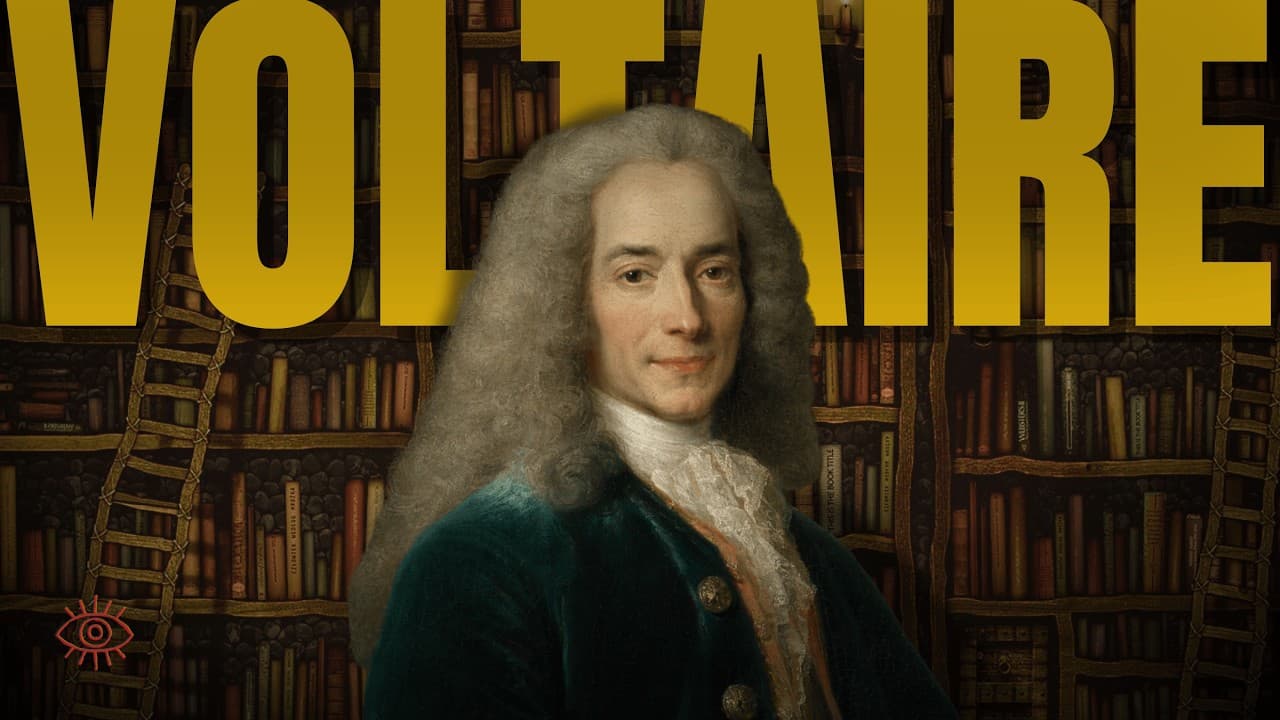
The Writer Who Helped Start a Revolution | Voltaire for Sleep
Enlightenment, Candide, and the War on Fanaticism for Deep Sleep
He wrote twenty thousand letters and made half of Europe afraid of him.
Francois Marie Arouet, known as Voltaire, was the most famous writer in eighteenth century Europe and the most devastating enemy of fanaticism, superstition, and cruelty that the French language has ever produced.
We follow him from his birth in Paris in 1694, through two imprisonments in the Bastille, through his three year exile in England and his discovery of Newton and Locke, through the Lisbon earthquake that destroyed his patience with Leibnizian optimism, through the writing of Candide, through the Calas affair, through the founding of the town of Ferney, through the Philosophical Dictionary, and finally through his triumphant return to Paris in 1778, where he died surrounded by the city that had once exiled him.
The full episode is on YouTube and Spotify. Please listen only in safe, restful contexts.
Enjoying the episode?
Occasional letters on philosophy, reading, and the examined life. No spam, ever.
By subscribing you consent to receiving occasional emails. Unsubscribe any time via the link in every email or at /unsubscribe.
Timestamps
- 0:00:00Chapter 1: The Most Dangerous Man in Europe
- 0:14:11Chapter 2: The Making of Voltaire
- 0:28:57Chapter 3: The English Lessons
- 0:43:29Chapter 4: The Best of All Possible Worlds
- 0:58:56Chapter 5: Candide
- 1:14:23Chapter 6: Crush the Infamous Thing
- 1:28:50Chapter 7: The Garden at Ferney
- 1:43:14Chapter 8: Tolerance
- 1:57:53Chapter 9: The Watchmaker and the Garden
- 2:11:54Chapter 10: The Return to Paris
For the record
Full Transcript
Chapter 01: The Most Dangerous Man in Europe
Before dawn, in the first cold hours of 1759, a thin man stands at a desk outside Geneva and writes the sentences that will get his book burned in three capitals at once. The estate is called Les Delices. The name is a small joke. There is not much delight in the life of its owner. He is sixty five years old. He sleeps four hours most nights and works twelve. His teeth are mostly gone. He is chronically ill in a dozen quiet ways that he documents with the same dark humor he brings to everything else. He describes himself, in letters to friends, as a corpse who has not yet been informed of his own death. The book in front of him is short. He has been circling it for years. When it leaves his hands in a few weeks, it will travel to printers in several cities at once, a deliberate strategy designed to outrun the censors. By the end of January it will be on sale in Paris, Amsterdam, Geneva, and London. By February the Paris police will have seized every copy they can find. The Geneva Council will condemn it. The Vatican will add it to the Index of Forbidden Books. Three different powers in three different cities, all scrambling at once to suppress a pocket sized novel written by a man they cannot quite catch.
He publishes it anonymously, of course. Everyone knows who wrote it. That is part of the joke. The anonymity is not a cover. It is a small piece of theater in which the author denies the book with one hand while the whole continent points at him with the other, and the denial itself becomes part of the performance. He had done this many times before. He would do it again.
The book is Candide. Its author is Francois Marie Arouet, known to Europe and to history by the name he gave himself in his early twenties: Voltaire. He has been famous for forty years already. He will be more famous after this. The book will sell at a speed that printers in the eighteenth century did not know was possible. Twenty thousand copies in the first year, at a time when a well received novel might move a few thousand. Pirated editions outnumber the authorized ones. Shopkeepers in Paris hide it under the counter. Nuns in provincial convents pass it between themselves wrapped in devotional covers. Within his lifetime it will be translated into every European language. It will still be read when most of the philosophers he argued with have become footnotes.
Stand in the room with him for a moment. The morning is slate gray over the lake. The candles are guttering. He writes standing up, because sitting aggravates whatever is currently wrong with him. His hand is small and precise. By the end of his life he will have written more than twenty thousand surviving letters, and a collected edition of his works will run to seventy volumes. He revises obsessively. He complains about his health in one sentence and tells a joke in the next. He is the most productive writer in Europe, and he is dying for most of that production, and somehow the dying does not slow him down. He works as if the world outside the window is on fire and he alone has noticed.
The house itself sits above the water, a comfortable place by the standards of the era, leased at first and then bought outright when Geneva proved too prim for his tastes. It has a library full of books in four languages. It has a printing press hidden in one of the back rooms, because having your own press shortens the distance between a finished manuscript and a finished book, and shortening that distance is one of the oldest habits of his professional life. A secretary sleeps in a small room off the study. A niece lives in the main house and manages the household. Visitors arrive almost daily and are turned away or admitted depending on how much work there is to do. The servants have been trained to recognize which names open the door and which do not. On this particular morning, the door is closed. The book must be finished. Everything else can wait.
Now pull back from the desk and look at the life behind it.
He has been to the Bastille twice before he turned thirty. The first time, at twenty two, he wrote satirical verses about the Regent of France and spent eleven months in the king's prison for them. He emerged with a new name and a play that made him the most celebrated living dramatist in Paris. The second time, at thirty two, he was beaten in the street by the footmen of a nobleman he had publicly insulted. When he tried to obtain justice, he was imprisoned again. When he was released, he was exiled. A commoner with a sharp tongue was permitted to exist in France, but only at the pleasure of those whose rank protected them from his wit. That lesson never left him.
From that second exile he went to England and stayed for nearly three years. He came back a different kind of writer. He had seen a country in which a scientist could be buried with the honors of a king, in which a parliament debated the crown, in which Protestants and Catholics were not routinely killing each other. The book he produced from the experience, the Letters on the English, was banned and burned in Paris within weeks of publication. He fled the city again.
He went to Cirey, to a chateau belonging to a brilliant young woman named Emilie du Chatelet, and lived there for most of the next fifteen years. They studied physics together. She translated Newton into French while he wrote plays and histories and a running commentary on the follies of Europe. When she died in childbirth in 1749, he was one of the three men in the room. He never entirely recovered from it. He wrote a friend a few weeks later that he had lost half of himself, and the remaining half did not want to be alive without her.
He went to Potsdam at the invitation of Frederick the Great, who had been writing him fan letters for years. He thought he had found, at last, a philosopher king. He stayed three years. He left in bitterness after a quarrel so public that it embarrassed both of them for the rest of their lives. He returned to French territory, found he could not live there, and eventually bought Les Delices on the outskirts of Geneva. Geneva then discovered what hosting Voltaire actually involved and regretted the invitation almost immediately. He would move one more time, in 1758, to a small estate called Ferney on the French side of the border, within walking distance of the Swiss line in case he needed to slip across in a hurry. He kept the horses ready.
Through all of this, the books kept coming. Plays. Poems. Histories. Novels. Scientific treatises. Essays so short and sharp they could be read aloud in the time it took to finish a cup of coffee and so devastating that they reshaped how a generation thought about God, the Church, and the state. The Letters on the English. The Age of Louis the Fourteenth. Zadig. Micromegas. The Essay on the Manners of Nations. And now, this morning in 1759, the novel that will become the most famous satire in the French language.
He is not alone in his opposition to the orthodoxies of his time. The Enlightenment is a movement, and he is one of several brilliant men bending European thought toward reason and tolerance and doubt. Diderot is assembling the Encyclopedie. Rousseau is writing the books that will eventually make Voltaire hate him. Hume is across the Channel. Franklin will soon be across the Atlantic. But Voltaire is the one the crowned heads write to. He is the one the Church fears. When Empress Catherine of Russia needs to demonstrate that she is a modern monarch, she sends money to Voltaire, and he writes back, and their letters circulate in manuscript from Saint Petersburg to Lisbon. When Frederick the Great needs a philosophical companion to prove that a soldier can also be a man of ideas, he begs Voltaire to Potsdam. When a French Protestant is broken on the wheel on a false charge and the family has nowhere to turn, someone tells them to write to the old man at Ferney, and the old man takes the case and spends three years destroying the court that killed him.
The Church wants him silenced. The crown wants him contained. Neither can quite do it. He is a commoner, technically. He has no official protection. He has what protection his fame affords him, and the fame is enormous, and most of that protection comes from the simple fact that arresting him now would create a scandal no minister wants to manage. So he exists in a kind of negotiated space, tolerated because suppressing him would cost more than tolerating him, and he uses the space to write.
What does he want? That is the question the rest of this will try to answer. He wants, in some deep and impatient sense, for the world to be less stupid than it is. He wants people not to be burned for disagreeing about invisible things. He wants priests not to have the power to break a man on a wheel. He wants thought to be free. He wants science to be taken seriously and superstition to be ridiculed out of the public square. He wants the powerful to be afraid of the judgment of the intelligent. He wants, above all, for doubt to be respectable. He believes, with an intensity that has nothing to do with gentle academic skepticism, that a mind willing to say it does not know is healthier than a mind that pretends it does. This is the core of him. Doubt as a virtue. Certainty as a vice. A commitment to the possibility that we might all be wrong about the things we are most confident we are right about.
He is not a systematic philosopher. He built no metaphysical architecture. He had no theory of being, no phenomenology of consciousness, no carefully ordered series of meditations. What he had was attention, and wit, and a prose style that could make a king laugh and then cough at the fishhook concealed in the laugh. He is the most effective public philosopher Europe has produced, precisely because he refused the costume of philosophy. He wrote stories. He wrote letters. He wrote plays. He wrote the Philosophical Dictionary as a series of short entries you could read in any order, each one a small bomb under a comfortable pew. He understood before almost anyone else that you cannot change a mind with an argument it will not finish reading. You change a mind by making it laugh, and by making the laugh dangerous.
It is worth sitting with that point, because it explains almost everything about him. The professional philosophers of his era wrote for each other. Voltaire wrote for the educated reader who had no intention of becoming a philosopher and who would close the book the moment it became tedious. He wrote, in a sense we still recognize, for the lay public. He understood that the fight he was in was a fight for ordinary minds. If an argument against fanaticism could not be read on a stagecoach, it was no use to him. If an indictment of torture required three footnotes to land, it would land in the wrong place or not at all. So he learned to compress. He learned to strike. He learned to make a whole ethical position fit inside a joke that did not feel like a joke until you were already inside the next sentence.
And from his desk at Les Delices, on this morning in 1759, he is finishing the book in which all of these commitments will be concentrated into the shortest and funniest object he ever made. Candide will run to perhaps thirty thousand words. It will savage Leibniz, mock the Inquisition, indict slavery, ridicule war, expose the cruelty of idealists, and end in a garden outside Constantinople with a sentence that has been quoted ever since. We must cultivate our garden. We will come back to that garden several times before we are done. It will turn out to mean less than many readers think and more than most.
For now, the image to hold is this. An old man in ill health, standing at a desk before dawn, finishing the book that will be banned in three capitals within weeks of publication, because he has decided once again that the things he cannot bear to leave unsaid must be said now. He has already outlasted two kings, a queen, most of his enemies, and the woman he loved most. He will outlast more. The pen does not stop. The war on stupidity is a lifetime project, and he has chosen, without apology and without self pity, to make his life the weapon. If there is one thing you should carry with you as we begin, it is that image. A thin man in a drafty room. A candle, a quill, a blank page. And the most dangerous voice in Europe, getting ready for another morning of work.
Chapter 02: The Making of Voltaire
Paris in November of 1694 is a city of perhaps half a million people, muddy, loud, dense with church bells, and organized around assumptions about God, the king, and the natural ordering of men that almost no one thinks to question. On November twenty first of that year, in a house near the Palais de Justice, a notary's wife gives birth to her fifth and last child. The infant is small, thin, and sickly. The family does not expect him to survive the week. He will survive for eighty three years and reshape most of what Europe thinks about almost everything.
His name is Francois Marie Arouet. His father is Francois Arouet, a prosperous notary, a man of the middle bourgeoisie, careful, conservative, devoted to his client list and his account books and his quiet pride in having done better than his own father. His mother is Marie Marguerite Daumard, from a family slightly more distinguished than her husband's, connected by small threads to minor nobility, a woman of some wit and evident warmth. She dies when her youngest son is seven. He will mention her rarely in later life. What he says about her is always tender.
The Arouet household is not a place of rebels. It is a place where the son of a notary is expected to become a notary himself, or failing that, a lawyer, or failing that, something else respectable enough to reflect well on the household. The father looks at his youngest and sees trouble coming. The boy writes verses before he is ten. The boy makes jokes at the expense of visiting clergymen. The boy reads everything, retains everything, and has the kind of memory that will later let him quote Virgil by the page and translate English pamphlets at sight. These are not traits a notary admires in his son. They are traits a father endures, and then, in the appropriate season, tries to educate out of him.
In 1704, when Francois Marie is ten years old, he is sent to the College Louis le Grand, the most prestigious school in France, run by the Jesuits. He stays seven years. Everything that will define him, intellectually and temperamentally, begins to take shape in those classrooms.
Louis le Grand was not a soft place. The Jesuits were the best educators in Europe, and their curriculum was relentless. Latin in the morning. Greek in the afternoon. Rhetoric, logic, theology, history, composition, memorization, recitation, declamation. Punishments were physical. Standards were brutal. A boy with a quick tongue and a sharper mind could find himself both favored and flogged in the same week. Voltaire loved it and hated it at once. He called his teachers the most cultivated men in France, and he spent the rest of his life attacking the institution that trained them. His gratitude was real. His enmity was also real. Both could sit in the same sentence.
The Jesuits taught him three things that stayed with him forever. They taught him how to write. They taught him how to argue. And they taught him, without meaning to, that an institution devoted to the worship of God could nevertheless be arrogant, dishonest, and cruel in exactly the ways ordinary human institutions are arrogant, dishonest, and cruel. It was the third lesson that would do the most damage. A boy who has learned Latin from priests can still love the priests who taught him. A boy who has watched those same priests protect one of their own from the consequences of a moral failure learns that the language of sanctity and the fact of sanctity are not the same thing. That lesson never left him. Every later attack he made on institutional Christianity can be traced back, in some form, to his years at Louis le Grand, where he watched men who preached holiness practice something less than holiness and decided, very young, that the distance between the pulpit and the man behind it was worth measuring carefully.
There was another education running alongside the official one. His godfather was the abbe de Chateauneuf, a cleric in name and a libertine in practice, who took his precocious godson to the salons of the Temple, where free thinking aristocrats and literary men drank wine and made jokes about the Bible and debated whether the soul was really immortal or whether the priests had invented that doctrine to justify their salaries. In these rooms, while he was still a schoolboy, Voltaire absorbed the habits of mind that would define him. Religious skepticism was not a dangerous posture there. It was the default conversational register. He learned to say things out loud that most of his contemporaries would not have dared to think.
He left Louis le Grand in 1711, at seventeen, with a perfect classical education and a mind already halfway to everything his father feared. The father wanted him to study law. He studied law badly and spent his evenings writing verse. The father sent him to The Hague to serve as a page to the French ambassador, hoping distance would cure the habit. Instead, he fell in love with a French Protestant refugee named Olympe Dunoyer, tried to elope with her, was caught, and was shipped back to Paris in disgrace. The father, now exhausted, placed him in the office of a lawyer. He was a terrible apprentice. He was already writing for the theater. He was already writing satirical verses. He was already, in everything but name, the man he was going to become.
The first Bastille came in 1717, when he was twenty two. A series of anonymous satirical verses had circulated in Paris, mocking the Regent, Philippe d'Orleans, and hinting broadly at certain rumors about his private life. The authorities suspected young Arouet of the authorship. They were right about half of it. He had written some of the verses. He had not written all of them. It did not matter. He was arrested, sent to the Bastille without trial, and kept there for eleven months.
The Bastille in 1717 was not the hell of later revolutionary legend. Well connected prisoners could receive visitors, books, decent food. But it was still a prison. It was still a stone room with a window too high to reach and a door that did not open when you wanted it to. Voltaire emerged with two things that would define his public life. He emerged with a finished play, a tragedy titled Oedipe, written largely in his head while he was confined. And he emerged with a new name. He had been Francois Marie Arouet when he went in. He came out as Voltaire. The origin of the name is disputed. It may be an anagram. It may be a reference to a family property. It does not matter. It was a declaration. The man who walked out of the Bastille had decided not to be his father's son anymore.
Oedipe was produced at the Comedie Francaise in November of 1718. It was a sensation. It ran for forty five consecutive performances, which in that era was spectacular. Voltaire, at twenty four, became the most celebrated tragic dramatist in France. He was received in the best houses. He was welcomed by the same Regent whose relatives his verses had mocked. Philippe d'Orleans had a sense of humor. He even gave the young man a pension. Voltaire took the pension and kept writing.
For the next eight years he was a fashionable man in Paris. He produced plays, poems, and an epic on the life of Henry the Fourth called the Henriade, which he worked on for years and which made him, in his own estimation and in much of Europe's, the heir to Virgil. He dined with aristocrats. He dressed well. He made money on the stock exchange, because he had a head for numbers that would eventually make him, in later life, a very wealthy man. He appeared to be integrating into the establishment. He was, instead, accumulating the enemies who would eventually break his illusions about it.
It helps to remember what kind of man he was in that decade. He was not yet the great campaigner against injustice. He was a brilliant young writer who liked being brilliant and young. He enjoyed his fame. He enjoyed the company of duchesses. He enjoyed the small theatrical self presentation of being Voltaire, a name he had invented partly as a mask and partly as a stage. He wanted to be admitted. He wanted the compliments of the Regent. He wanted to be welcomed at court, at opera boxes, at great tables. The commoner who would later ridicule the pretensions of nobility was, in his twenties, a commoner who wanted very badly to be included in them. This matters, because the conversion to outrage had to start somewhere, and it did not start in the abstract. It started in the specific experience of being included one day and beaten the next.
The break came in 1725. At a dinner at the home of the Duc de Sully, a nobleman named the Chevalier de Rohan Chabot made a sneering remark about Voltaire's choice to change his name. The two men exchanged words. Voltaire, as always, had the better line. The chevalier had nothing to say, and so went away embarrassed, but not before storing the embarrassment.
Some weeks later, at the Opera, they met again. Rohan insulted him. Voltaire replied with something to the effect of, I will make my own name illustrious while you are busy forgetting your famous one. It was a perfect blade. The chevalier did not respond with words. He planned.
In February 1726, Voltaire was dining at the home of the Duc de Sully again when he was told that someone outside wanted to see him. He went out into the street and was immediately surrounded by Rohan's footmen, who beat him with cudgels while the chevalier watched from a nearby carriage, calling out instructions about where to strike so as not to damage the head. When the beating was done, Rohan leaned out and told the servants not to hit him in the head, because they might damage something that produced good verses. It was a carefully calibrated humiliation.
Voltaire went back into the house. He was bruised, shaken, and, more than anything, furious in a way he had not been furious before. He turned to his friends. He turned to the other diners. He expected solidarity. He got none. The Duc de Sully, his host, refused to lodge a protest. The other aristocrats found the whole matter distasteful in a way that meant they would not speak to him about it. The message was clear. A commoner had been beaten by nobles, which was, in their world, not exactly a scandal. It was closer to weather.
He took fencing lessons. He practiced for weeks. He announced, more or less publicly, that he intended to challenge Rohan to a duel. This was more than a private matter now. A commoner challenging a nobleman to a duel was a violation of the social order serious enough to concern the crown. Before the duel could take place, Voltaire was arrested and sent to the Bastille for the second time. His detention was short. His exile that followed it was not.
He was given a choice: remain in prison indefinitely, or leave France. He left. In the spring of 1726 he took ship for England, with little money, few friends on that side of the Channel, and a wound he would carry for the rest of his life. Not the bruises. Those healed. The wound was the discovery that a man could outthink an aristocrat, outwrite him, outargue him, outwit him, and still be beaten in the street by his servants without consequence, because rank was a kind of armor that intelligence could not pierce.
He understood then something that would organize the rest of his public life. The hierarchies of his country were not the natural order of things. They were arrangements, built by men, enforced by men, and defensible only by the willingness of other men to pretend they were more than arrangements. If a nobleman could order a commoner beaten and suffer no penalty, then nobility itself, as a system, was a kind of organized violence dressed up in manners. The boy from Louis le Grand had already suspected that the Church was less holy than it claimed to be. The young man humiliated by Rohan now knew that the aristocracy was less noble than it claimed to be. Two of the three great pillars of his world, the Church and the nobility, had revealed themselves to be something other than what they said they were. The third pillar, the crown, would eventually reveal itself the same way, though he would spend decades trying to believe otherwise.
On the ship across the Channel, he carried a grievance and a question. The grievance would outlast him. The question was more useful. What would a country look like, the question went, in which a man could be beaten by a servant of power and find redress? What would such a country look like, and how was it built, and what was its shape?
He was about to find out.
Chapter 03: The English Lessons
He landed at Greenwich in the spring of 1726, walked up the hill to the park, and saw, spread out below him, a country already halfway to being modern. The river was full of ships from every part of the world. The docks were busy with goods and immigrants. London was larger than Paris and growing faster. It had coffee houses on every corner and newspapers in every coffee house. It had a king who could not dismiss Parliament, a Parliament that dared to argue with him, a currency backed by a public bank, and a capital market in which men who had once been farmers could become, through luck and nerve, as rich as lords. He did not speak the language. Within six months he would speak it fluently enough to make jokes in it. Within two years he would be writing it well enough to publish in it.
He had almost no money when he arrived. A friend from Paris had given him a letter of introduction to an English merchant named Everard Fawkener, a quiet, cultivated man who took him in and gave him a room in his house in Wandsworth, south of the river. Voltaire lived there for most of his first year in England. Fawkener was not a literary lion. He was a businessman who read books, the kind of man who might have existed in Paris only as someone's customer, and who in London sat on equal terms with men of title. That detail, small at first, got under Voltaire's skin at once. In France, a merchant was a merchant. In England, a merchant could be a gentleman.
He walked London. He watched it the way a naturalist watches a new species. He went to sermons at Anglican churches and at dissenting chapels, because in England you could hear both in the same day and no one would arrest you. He went to the theater and was startled to find Shakespeare being performed. He found Shakespeare brilliant and barbaric in about equal measure, and he never really resolved his feelings about the English. He admired them and found them rough. He learned from them and mocked their manners. He was never really comfortable in their country and he never stopped being grateful for what it had shown him.
Within months he had met Alexander Pope, the most celebrated English poet alive, and Jonathan Swift, the ferocious Irish satirist whose Gulliver's Travels had just appeared. He met Henry Bolingbroke, the exiled Tory statesman who had been his host in France years earlier and who now, back in England, introduced him to almost everyone worth meeting. Through Bolingbroke he met politicians, clergymen, merchants, mathematicians, playwrights, philosophers. The list of men he knew in London would look, in retrospect, like a roll call of early eighteenth century English thought. He was the most gifted French mind of his generation, and he had been given, by accident, two and a half years in which to absorb everything the most advanced country in Europe had to teach him.
He attended, in March of 1727, the funeral of Isaac Newton. The funeral was held at Westminster Abbey. The body was carried by pallbearers who included the Lord Chancellor and two dukes. The old man had been made Master of the Mint and knighted by the Queen. He was buried beside kings. Voltaire stood in that cold church and tried to understand what he was seeing. In France, a great scientist died and was forgotten. In England, a great scientist was buried like a monarch. You can see him processing the lesson in almost everything he writes over the next decade. A country that honors its thinkers is a country that thinks differently from one that does not.
The other great discovery was Locke. Voltaire read An Essay Concerning Human Understanding in an English that was still new to him, and something cracked open in his head. Locke had argued, with quiet precision, that the human mind begins as a kind of blank page on which experience writes what it writes, and that all our knowledge begins in the evidence of the senses and the reflection the mind makes on that evidence. There is no innate knowledge of God in the infant. There are no built in certainties. There is only what we take in and what we can reason about what we have taken in. The implications were devastating for every system of thought that tried to ground truth in something the mind had brought with it from the womb. If Locke was right, then the Church's claim to possess a priori knowledge of eternal verities was a kind of confidence trick.
Voltaire absorbed Locke and never really stopped being a Lockean afterward. When he writes, decades later, about the soul, he writes as a man who has already decided that the question of the soul is mostly a question about the limits of what the senses can tell us and the reflection upon them, and that anyone who claims to know more is either dishonest or has not noticed the limits. Locke gave him the epistemological foundation for everything. He had already arrived in England suspicious of the Church. He left England with a philosophical account of why suspicion was the only honest posture a thinking person could maintain.
And then there was Newton. Voltaire became, in that English exile, the greatest French advocate of Newtonian physics of his generation. He understood Newton's mathematics well enough to explain them without cheating. He understood the larger meaning better than most. Newton had shown that the same law that made an apple fall from a tree governed the motion of the moon around the earth and the earth around the sun. A single, mathematically precise rule described both. It was the most astonishing intellectual feat of the modern world, and in France, the universities still taught Descartes's discredited theory of vortices and treated Newton as a foreign curiosity. Voltaire wrote the Elements of Newton's Philosophy to introduce his countrymen to what the English already knew, and the book, despite its technical subject, sold out edition after edition. It was one of his proudest achievements. It was also one of the clearest signs of what he had learned in England. A country that could not follow its best minds would lose the race to a country that could.
The Quakers became, for him, a kind of emblem. He visited their meeting houses. He watched them sit in silence, waiting for the spirit to move them, and occasionally rising to speak and occasionally sitting down without speaking. He interviewed them. He asked them, with real curiosity, about their beliefs and practices. And what he found was a Christian community that refused to swear oaths, refused to take up arms, refused to bow to nobility, refused to call their leaders anything but friend, and nonetheless lived peacefully and prospered in a country that had once executed men for refusing to bow. They were, in his eyes, evidence that religious sincerity did not require persecution. A society could hold very different beliefs within it and not tear itself apart. The French Huguenots had been broken on the wheel for believing something only slightly different from their Catholic neighbors. The English Quakers, believing something much stranger than the Huguenots, sat in peace in their meeting houses on Sunday morning. The difference was not theological. The difference was political. France persecuted its minorities because it could. England had stopped because it had learned it could not afford to continue.
Out of all of this came the book. He began writing it during the exile, continued it after his return to France in 1729, and published it, first in an English version and then in a French version, in 1733. The title in English was Letters Concerning the English Nation. In French it became, famously, the Lettres philosophiques, the Philosophical Letters. The book was organized as a series of short, deceptively casual essays on English life. Here is a letter on the Quakers. Here is a letter on the Anglicans. Here is a letter on the Presbyterians. Here is a letter on Parliament. Here is a letter on commerce, in which he observed that an English merchant was not ashamed of his trade and that a younger son of a duke might cheerfully become a merchant without losing his standing. Here is a letter on Locke. Here is a letter on Newton. Here is a letter on inoculation against smallpox, a practice the English had begun using, against the warnings of French physicians who preferred to let the disease kill whoever it killed.
Every letter is a small, polite description of something English. Every letter, read carefully, is also an attack on something French. The book does not argue. It describes. But the descriptions are arranged so that a French reader cannot fail to notice the contrast. The Quakers sit peaceably in their meeting houses. The Huguenots are broken on the wheel. Parliament debates the crown. The French parlements are dismissed when they inconvenience the king. English merchants are respected. French merchants are sneered at by nobles who could not add their own accounts. Newton is buried like a king. Descartes is still taught in French universities. The indictment is complete, and it is delivered without a single sentence of direct accusation. The book was too clever to refute and too obvious to ignore.
The French authorities read it and understood immediately what it was. In 1734 the Paris parlement ordered the book to be burned by the public executioner, which was the ceremonial disposal reserved for the most dangerous writings, as if burning paper could kill the ideas in it. A warrant was issued for Voltaire's arrest. He fled Paris ahead of the officers and took refuge at Cirey, a chateau in Champagne that belonged to a twenty seven year old noblewoman named Gabrielle Emilie le Tonnelier de Breteuil, the Marquise du Chatelet, who was already one of the most formidable minds in France and who would become, over the next fifteen years, both his intellectual partner and the great love of his adult life.
At Cirey she set up a laboratory. She translated Newton's Principia into French, the translation that still stands as the authoritative version in the language. Voltaire wrote the Elements of Newton's Philosophy in a room down the hall, consulting her when his mathematics failed him. They studied the history of the Bible together, taking it apart as a literary document. They worked sixteen hours a day for months at a time. They argued about physics and theology over dinner. They kept a theater in the house and performed plays for their guests. The period at Cirey was, for both of them, one of the most intellectually fertile collaborations of the century. It was also a kind of sustained refuge. The world outside was still arguing about whether the Letters on the English should be suppressed more completely. Inside the chateau, two brilliant people were doing real work.
You should picture it clearly, because it is one of the few long stretches of happiness in his long and mostly uncomfortable life. A country house in Champagne, cold in the winter, remote, with poor roads in every direction. A woman who wrote essays on the concept of force, who kept fireflies in a glass jar to study their luminescence, who beat every gambler at court at calculating the odds of a card game and wrote a treatise on happiness when she was not beating them. A man who could write a tragedy in ten days and a letter to Frederick the Great in twenty minutes. The two of them, together, arguing, collaborating, falling in and out of love, staying friends when the romantic part passed, reading each other's drafts, correcting each other's equations, hosting travelers from every part of Europe who came to see what kind of thing this was. It was the first time in his life he had anything like a home. He knew it. He said so. He wrote of Cirey, in his letters, as if he had stumbled into a world he did not quite believe he had been allowed to enter.
We have to stop for a moment to understand what this meant for him. He had gone to England bruised, humiliated, and poor. He came back with a vision of another way to live. He came back with an education in political liberty, religious tolerance, empirical philosophy, and mathematical science. He came back having seen, with his own eyes, that the world he had been born into was not the only possible one. The rest of his life would be spent trying to describe the alternative and trying to drag his own country, by the hair if necessary, closer to it. The hair dragging would be tiring. Some of it would fail. But the model was fixed in his head now, and the model was English. Not the England of great lords and decorous tea, which he saw through as easily as anyone. The England of Newton and Locke and the Quakers. The England of a society that had learned, at some cost, to let men think what they were going to think and to let them say some of it out loud.
Chapter 04: The Best of All Possible Worlds
To understand what broke in Voltaire in November of 1755, you have to understand what he was breaking with. So here, without fuss, is the argument he had been quietly tolerating for thirty years and which he now decided to demolish in public. It is the argument that Gottfried Wilhelm Leibniz had made, in a book called the Theodicy, published in 1710, and which had become, by the middle of the century, the most respectable philosophical response to the problem of evil in educated European society.
The argument runs like this. God is perfect. This is the starting premise, accepted by nearly every Christian philosopher of the era. A perfect being is omniscient, omnipotent, and perfectly good. A perfectly good being, with the power to choose, will choose the best. Therefore, when God created the world, God chose the best possible world. That world may contain suffering, and it does, but the suffering is not a defect in the world. It is the price paid for a particular kind of goodness that cannot exist without it. Perhaps free will requires the possibility of evil. Perhaps some apparent evils are necessary conditions for greater goods we cannot see. Perhaps the universe as a whole is more beautiful for having shadows in it. Whatever the particular explanation, the structure is fixed. This world is the best of all possible worlds, because a perfect being chose it, and a perfect being would not choose anything else.
Leibniz's argument had a quiet intellectual dignity. It was designed to protect God from the accusation of injustice while acknowledging the evident fact that people suffer. It was also, in Voltaire's eyes, an exquisite insult to human experience. If this is the best of all possible worlds, what on earth are the others like? If this is the optimum that divine wisdom could produce, what sort of God was the wisdom embedded in? The argument, Voltaire thought, bent reality to fit theology, and reality always snapped back, and when it snapped back it broke bones and burned children.
It is worth remembering why the argument had the appeal it did. The eighteenth century was a confident century in some respects. Newton had shown that the universe was mathematically lawful. The natural sciences were making visible progress. The age was impressed with its own capacity to find order where earlier ages had seen only confusion. Leibniz's theodicy fit the temper of that confidence. If the physical universe was orderly, then perhaps the moral universe was orderly too. Perhaps the apparent chaos of human suffering was, seen from high enough, just another pattern we had not yet learned to read. You can understand why a well educated reader in 1740 might find the idea comforting. You can also understand why a less well educated reader in Lisbon in 1755 might find the idea useless, because the stones were still on top of her children, and no arrangement of the cosmic pattern was going to lift them off.
He had been circling this argument for years. He had made quiet jokes about it in letters. He had considered, at various moments, writing something more serious. But the thing that made him actually do it was the ground moving.
On Saturday, November the first, 1755, the feast day of All Saints, the city of Lisbon was full of churches and in the churches were most of the city's population, attending the morning mass. Lisbon was one of the richest cities in Europe. It had gold from Brazil flowing through its port. It had a new cathedral, splendid baroque churches, palaces along the river, a royal library with several hundred thousand volumes. It had about a quarter of a million residents. It was a major Catholic capital and a major commercial power and it was, that morning, as prosperous and confident as any city in the western world.
At nine forty in the morning, the earth shook. The first tremor lasted perhaps three and a half minutes. It was very violent. Witnesses later reported that it felt as if the ground were a sea in storm. Churches collapsed onto the congregations inside them. Palaces fell. The great cathedral came down. Fires started in a hundred places at once, from candles knocked over by the quake and from cooking fires and from whatever open flames had been burning in the half million rooms of the city. A second tremor, less violent, followed. Then a third.
About forty minutes after the first shock, the water in the harbor began to draw back. People ran down to the exposed riverbed to stare. Some picked up fish. Then the tsunami arrived. Three enormous waves, the largest perhaps twenty meters high, crashed over the lower city and swept through the warehouses and the ships and the plazas along the Tagus. Anyone who had gone to the river was killed. Anyone who had taken shelter from the earthquake in an open space near the water was killed. The water retreated and came again.
And then the fires, which had been starting everywhere, began to merge into a single enormous conflagration that burned for five days. It consumed the royal palace, the royal library, and most of the city. When it finished there was no way to count the dead. Modern estimates range from thirty thousand to fifty thousand, out of a population of roughly two hundred and fifty thousand. One in five or six of the people in the city was killed in a morning and the days that followed.
The earthquake was felt as far as Morocco and Ireland. News of it reached Paris within days and reached the rest of Europe shortly after. The entire continent paused and tried to make sense of what had happened. And here the theological problem became sharp in a way that it had not been sharp for a long time. Because this was not a battle. It was not a plague that could be blamed on human vice or divine punishment for a specific sin. It was not an act of war. It was a Catholic city full of Catholic people on the holiest day of the year, killed in the middle of worship, in churches that fell on their heads while they were praying. If the best of all possible worlds was a world in which this could happen, then the phrase itself was an obscenity.
Voltaire was at Les Delices. He read the reports as they came in. He was sixty one years old. He had spent thirty years of his adult life politely not destroying the Leibnizian position in public. Now, in a few weeks, he did.
The Poem on the Lisbon Disaster, or to give it its fuller title, the Poem on the Disaster of Lisbon, or Examination of the Axiom, All is Well, appeared early in 1756. It is a short poem by the standards of eighteenth century verse, a few hundred lines in rhyming couplets, and it is probably the most devastating piece of philosophical poetry in French. It does not argue in the academic sense. It describes. It asks questions. It refuses to accept the easy answers of the theodicy and stays with the questions long enough to make them unbearable.
He begins with the scene itself. Thirty thousand dead in a few hours. Mothers with their infants crushed. Old men buried in their beds. The river in flames. And he turns to the philosophers who would explain this with theory. Will you say, he asks, that this is the result of eternal laws that a free and good God had to impose? Will you say that these poor dead, pulled out from under the rubble with their skulls crushed, were, at the moment they died, participating in the greater good of an ordered cosmos? Will you tell this to the mother looking for her child in the smoking streets of Lisbon? What words will you use?
He refuses the easy comforts. He refuses to say the dead deserved it. He refuses to say the world that killed them is the best one available. He refuses to say that the pain is a necessary part of some larger design that justifies it. He refuses, in short, to do the philosophical labor that theodicy asks him to do, which is the labor of pretending that the suffering you see makes sense if only you look at it from far enough away. No, he says. Look at it from close up. Look at a single child with a crushed rib cage. Now tell me about the best of all possible worlds.
The poem does not land on atheism. Voltaire was never an atheist. It lands, instead, on something harder. It lands on humility. We do not know why this happened. We do not know if there is a reason. We do not know if any account the theologians are giving us is true. We can only say, with certainty, that the account we had been given until Saturday morning does not fit the facts. The poem is an assault on complacency. It is not a refutation of God. It is a refutation of glib confidence in God's arrangements.
The reaction was immediate and furious. Rousseau, still friendly with Voltaire in 1756 but already beginning to diverge from him, wrote back with a long letter defending providence. Rousseau's argument was essentially that the earthquake was not God's fault but man's, for having built tall buildings close together in an area prone to shaking. If the Lisbonites had lived in huts spread over the countryside, as in a more natural state, they would not have died. This is Rousseau doing what Rousseau does, which is turning every question about the human condition into a question about civilization having gone wrong. Voltaire, to his credit, did not try to refute the letter in public. He simply kept his distance after that. But privately he understood what it meant. Rousseau was defending the old confidence in a different costume. It was still the same move. It was still saying, somehow, this is all as it should be.
The Church had a different response. Portuguese Jesuits, including a priest named Gabriel Malagrida who would later die badly for his views, began preaching that the earthquake was a punishment for the sins of Lisbon. The sermons were fierce and specific. The city had been too proud. The city had tolerated Jews and Protestants. The city had not prayed enough. God had sent the ground shaking as a warning. Then, because the warnings of God are rarely taken at the discount price, the Portuguese authorities decided to appease heaven further by holding an auto da fe, a public ceremony of faith, in which several people convicted of heresy were burned alive in the public square a few months after the quake. You cannot invent this. The response to a disaster on which no theology could fit was to stage the oldest theological ritual in the repertoire. Voltaire noted it. He would put it in Candide, almost verbatim. An entire generation of readers would laugh at it, in a way that laughter can sometimes stand in for the scream that would otherwise come out.
Three years later Voltaire took the material of the poem and fed it into a different machine. The poem had been beautiful and sad and grave. But it had not been funny. And he had learned, over a lifetime, that the things he most wanted to say often worked better when they were funny, because seriousness in French letters came with a kind of padded armor that blunted the point and laughter slipped through the visor and struck the face. So he took the problem of Leibnizian optimism, and the Lisbon earthquake, and the general question of whether theodicy could survive contact with reality, and he wrote Candide. The novel was already in his head. He worked on it in secret through the autumn of 1758. It appeared in January of 1759, and it made laughing at Leibniz not just possible but fashionable, and it did more to end the intellectual respectability of the phrase best of all possible worlds than any treatise had ever done. We will walk through the book in its own chapter. For now the point is the connection. The poem was the wound. The novel was the weapon he built out of the wound. Lisbon cracked him open, and Candide was what came out when he had finished being cracked.
The deeper question the Lisbon material pushed him toward is one he never fully answered and never pretended to. If the universe contains gratuitous suffering, suffering for which there is no redemptive explanation, then either God is not what we have been told God is, or the story we have been told about God is incomplete in some way we cannot repair from inside. Voltaire thought the story was incomplete. He thought the institutional Church had been lying about how complete it was. He did not think this meant there was no God. He thought it meant there was less that we knew about God than we had been pretending. Doubt was the only honest posture. The Lisbon earthquake had simply made the dishonesty of the alternative posture unendurable.
That is what broke in him in November of 1755. Not his faith. Not his deism. His patience with the theodicy that had been taught to him since he was a boy at Louis le Grand. The old voices telling him that suffering was part of the plan had finally run out of credit. He had watched too many lives go into the ground for no reason anyone could give. After Lisbon, he refused to pretend that someone owed him an explanation that was never coming. He preferred the honest silence of admitting he did not know to the dishonest eloquence of explanations that did not explain. The difference between him and most of his contemporaries is right there, in that preference, and everything else follows from it.
Chapter 05: Candide
In the autumn of 1758, in a few focused weeks, working at a pace that astonished even him, he wrote it. The book is called Candide, or Optimism, and it is, by common consent, the funniest and cruelest short novel in the French language. It runs to about thirty thousand words. It has thirty short chapters. It can be read in an evening. It has been read in every evening since.
To understand how Voltaire uses the book, you need to understand its basic premise, which is that the hero is a sincere young man who has been taught, by his tutor, that everything in the world happens for a reason, and that the world, for all its apparent problems, is the best of all possible worlds. The tutor is called Pangloss. The hero is called Candide, which is a French word meaning roughly something like trusting or naive or open hearted. He is a young man who believes what his teacher has told him, who takes the teacher's philosophy as a description of reality, and who, over the course of the book, is subjected to almost every horror that the eighteenth century could produce, and who nevertheless keeps finding reasons to believe his tutor.
The joke is that the student believes the philosophy. The deeper joke is that the philosophy requires the student to disbelieve his own eyes. Voltaire's method is very simple. He takes a young man who has been told that all is well, and he then shows us a world in which almost nothing is well, and he watches with a cold and amused attention to see how long the philosophy can last against the facts.
The story begins at the castle of Thunder ten Tronckh, somewhere in Westphalia. It is, the narrator tells us, a very grand castle, because it has both a door and windows. The baron is very grand, because he is of very ancient family. The barony's nobility is so ancient that, the narrator remarks, the baron could prove seventy two quarterings, meaning seventy two generations of unmixed noble blood, the kind of pedigree that Voltaire had been sneered at for not having. Pangloss, the tutor, teaches that this is the best of all possible worlds. He teaches that noses were made to hold spectacles, which is why we have spectacles, and that legs were made to wear breeches, which is why we wear them. Everything has a reason, and the reason is always good.
Candide loves Cunegonde, the baron's daughter. One day, behind a screen, Cunegonde watches Pangloss engaged in what the text politely calls a lesson in experimental physics with a chambermaid, and, being a girl of spirited curiosity, she decides to try the same experiment with Candide. They are seen. Candide is expelled from the castle with great kicks to the behind, sent out into the world with nothing, and the novel begins in the only place a Voltaire novel can begin, which is with the hero homeless and the theory of optimism already under a considerable strain.
From there the book simply does not stop. Candide is conscripted into the Bulgar army, marched, beaten, flogged almost to death, and then sent into a battle that Voltaire describes with hallucinatory precision. He steps through a village afterward. There are women with their throats cut lying in the ashes. There are children dying in the lap of their mothers. There are old men whose limbs have been hacked. This is the first test of the Panglossian philosophy. It fails. Candide decides to desert. He makes his way to Holland, where he is taken in by a Protestant family and fed, and where he meets, to his astonishment, Pangloss, now transformed by disease into a beggar, his nose half eaten away, but still explaining that the present suffering contributes to the greater harmony of the whole.
The ship they take to Lisbon sinks in a storm. They survive. They arrive in Lisbon the morning of the earthquake. They are there for the shaking ground, the tsunami, the fires. They see the city destroyed around them. And when the tremors stop, the Portuguese authorities decide that the earthquake must have been the result of some hidden heresy, and they organize an auto da fe to appease heaven. Pangloss is selected for the ceremony because he has been saying, to anyone who will listen, that the damage to the city cannot have been evil, because everything that happens is for the best. This is, to the inquisitors, a suspicious form of philosophy. They arrest him. They march him through the streets in a yellow robe painted with flames. They hang him, though, Voltaire notes with clinical interest, hanging is not usual at an auto da fe, and Pangloss is half strangled rather than killed outright. Candide is flogged in the same ceremony. The earth shakes again anyway. The ceremony does not prevent the next tremor, because the ceremony was not connected to the earthquake, because the earthquake was not divine punishment, it was rocks moving. Voltaire does not have to say any of this. He just shows you the auto da fe and then shows you the next tremor, and the syllogism writes itself.
Candide escapes with the help of an old woman who is one of the great comic creations of the novel. She tells him her own story, in its own chapter, and it is a brief anthology of the ways a woman could be destroyed in the eighteenth century by war and piracy and fashion. She concludes, having told us about her sufferings, that she has known a great many people in her life whose lives were worse than hers, and that she has met no one who did not curse their existence several times and call themselves the most miserable of all men. The line is played as a joke. It is also sincere. The old woman believes it. She has reason to.
Candide is reunited with Cunegonde, who has herself survived a rape and enslavement and is currently the shared property of two men, a Jew and the Grand Inquisitor, both of whom Candide kills in a sequence so absurd that it becomes, somehow, unbearable. The three of them flee to South America. Cunegonde is taken again, this time by the governor of Buenos Aires. Candide and his servant Cacambo, who is becoming the book's center of sanity, escape into the jungle.
They find a country called El Dorado. El Dorado is the one real surprise in the novel. It is a utopia, and it is not a joke. It is a land of impossible wealth, in which gold and jewels are in the streets, in which nobody bothers to pick them up because they are common, in which the king is polite and the children are cheerful and the food is excellent. There is a university. There is no priesthood separate from the general population. There is no prison. Nobody fights anybody. Voltaire describes it for several chapters with real affection. He means it. This is what a decent society looks like, he says. It is possible to imagine. It is not possible to reach. It is a country you arrive at by accident and leave by choice, because you cannot stay anywhere forever, especially not in a country where the rest of the world cannot reach you.
Candide decides to leave. He leaves because he still cannot find Cunegonde, and because he has begun to feel that his own wealth would mean more in the rest of the world, where it would buy things, than in El Dorado, where nothing needs to be bought. He is, in other words, being human in the ways that humans are flawed. He is loving someone else more than his own safety. He is wanting to be distinguished rather than merely comfortable. He carries with him enough gold and jeweled sheep to make him the richest man in Europe, by a considerable margin. On the way out of El Dorado most of the sheep die. The river rocks destroy most of the treasure. By the time he gets back to the known world, he is rich, but not as rich as he had been.
He is robbed, cheated, and disillusioned on the return. He meets, and hires as his own melancholy companion, a man named Martin, whose philosophical position is the exact opposite of Pangloss's. Martin is a Manichean. He believes the world is more or less governed by an evil principle, that things are as bad as they seem, and that expecting better is a form of self deception. Candide has now heard both sides. He is wealthy, traveling, looking for the woman he loves, accompanied by a cynic.
The search ends in Constantinople. He finds Cunegonde. She has been, in the interval, disfigured by misfortune. She is not the beautiful young woman he left behind. She has grown coarse, sour, and unkind. He marries her anyway, partly out of duty and partly to spite her brother, the baron, who still objects to the match on grounds of ancient family honor. They settle on a small farm outside the city with Cunegonde, the old woman, Martin, Cacambo, Pangloss, and the baron. They sit around the farm with very little to do, and the philosophical discussions that had filled the first half of the book start to resume, and they are all, by now, very tired of philosophical discussions. Pangloss is still explaining that everything happens for the best. Martin is still explaining that everything happens for the worst. Candide has stopped believing either of them and does not know what he believes.
Then one afternoon they see an old Turk working in his garden. They ask him about his life. He answers, with simple friendliness, that he owns only twenty acres, that he cultivates it with his children, that work saves them from three great evils, boredom, vice, and need, and that he has no opinion at all about public affairs because he has never concerned himself with them. The group returns to the farm, and Candide tells Pangloss that the old Turk seems to have a better lot in life than many kings. Pangloss starts to give a historical defense of why kings end badly, a long list of fallen rulers. Candide interrupts him, with a line that is the climax of the book, and says, in French, il faut cultiver notre jardin. We must cultivate our garden.
Now we have to be careful with that line, because more than two centuries of readers have taken it to mean something it does not quite mean, and it is the sort of line that is almost true in many different ways, which is perhaps why it survived. It is not a call to withdrawal. It is not quietism. It is not an argument for giving up on the world. Voltaire, the man who spent the next twenty years at Ferney defending Protestants, writing pamphlets, financing rehabilitation cases, and carrying on a sustained war against European superstition, was not telling his readers to stop caring about the world. What he was telling them is something subtler and harder.
The line is a rejection of the metaphysics. Pangloss's long history of fallen kings is exactly the kind of philosophical speculation that Pangloss always offers and that never leads anywhere. Stop it, Candide says. Stop explaining why the world is what it is. Stop building theories of cosmic order. Come outside and dig the garden. The world's problems will not be solved by theodicy. They will be reduced, if at all, by work. Specific work on specific problems. The tending of an actual, physical garden with your hands. The digging of a specific irrigation ditch. The writing of a specific pamphlet to rescue a specific family from a specific court. The hammering of a specific watch in a specific workshop. Action against the nearest piece of the world you can actually reach. Pangloss is not wrong about philosophy. He is disabled by it. Candide acts. And the last word of the book is the Turkish gardener's word, which is that a man who tends his garden has done more for the world than a man who explains it.
That is Candide. It is, among its other virtues, the best short argument ever written against the idea that thinking about the world is a substitute for doing something with it. It is also, and this is why it has lasted, extraordinarily funny on every page. The laughter is the point. Voltaire had decided, long before, that you could not fight the optimism of the eighteenth century with sadness, because sadness could be accommodated by the optimism. Only laughter could cut through it. The book was banned everywhere and read everywhere. And the man who wrote it went on, at sixty five, to the real work that the book had been arguing for.
One last thing about the book before we leave it. There is a temptation, with Candide, to read it as pure cynicism, as a darkly funny tract about how everything is hopeless and the best we can do is tend a small plot of land and not ask questions. This is not what the book says. Voltaire was not a cynic. He was a reformer whose life had given him many reasons to suspect reform was difficult and a very few to suspect it was impossible, and he wrote Candide when he was already making his plans to begin the most sustained campaign of reform any private European had ever attempted. The garden is not retreat. The garden is the place you return to at the end of the day when the larger fights have exhausted you, so that in the morning you can get up and fight them again. The old Turkish gardener in the final chapter is not a sage who has renounced the world. He is a man who has chosen what part of the world he can actually change and who is not going to be distracted from it by theories of the whole. That is the difference between Candide and the quietism it is sometimes mistaken for. Candide acts. Pangloss theorizes. In every dispute between them, Voltaire stands with Candide, and the garden is the proof.
Chapter 06: Crush the Infamous Thing
There is a phrase he starts to use around 1760, in letters to his closest friends. It is a short phrase in French, three words. Ecrasez l'infame. Crush the infamous thing. He puts it at the end of letters the way other men might put a sign off about giving their regards to the family. For years afterward he uses it again and again, in letters to d'Alembert, to Diderot, to the Marquis d'Argental, to anyone in his circle who will understand what he means and not repeat it to anyone who might not. Ecrasez l'infame. Crush it. Not reform it. Not reason with it. Crush it.
What is the infamous thing? Here we have to be exact, because the phrase has been misunderstood ever since. He did not mean God. Voltaire was never an atheist. He did not mean religion as such. He did not even mean Christianity in general. The infamous thing, in his writing, is specifically the institutional use of religious authority to justify cruelty. It is the machinery. It is the courts that condemn heretics. It is the priests who stoke the mob against Protestants. It is the theologians who defend torture as a means of saving souls. It is the bureaucracy of organized belief when that bureaucracy takes hold of secular power and uses it to break bodies in the name of eternal things. That is the infame. The institutional machinery that uses God to justify cruelty. When he says crush it, he means the machine, not the faith behind it.
He had been opposed to this machinery in a general way for decades. In 1761 the machinery showed up on his doorstep in a specific form, and the general opposition became the central project of the last seventeen years of his life. Everything else he did in his remaining time at Ferney was shaped by a case that he had not been looking for but that, once he knew about it, he could not set down. The case of Jean Calas.
Calas was a Protestant merchant in Toulouse. He was sixty three years old in 1761. He ran a modest cloth shop on a modest street in a city that had become, by the middle of the eighteenth century, one of the most hostile places in France for a Protestant to live. A hundred and fifty years earlier, during the religious wars, Toulouse had been a particularly violent Catholic stronghold. The city celebrated, each year, a festival commemorating the slaughter of Protestants during the wars of religion. The festival was still being held in 1761. It had been held every year since 1562 without interruption. The population of Toulouse, in other words, was reminded each year, officially, that killing Protestants was something its city celebrated. Calas had lived there all his life and run his shop there and raised his children there and endured, quietly, the disabilities and petty cruelties that were the daily weather for a Protestant family in a Catholic city.
He had six children. One of them, Marc Antoine, was in his late twenties. Marc Antoine had wanted to be a lawyer, but the profession was effectively closed to Protestants in France. He had grown despondent. He drank. He read morbid books. He was, by his family's account and by that of the neighbors, a young man sinking into despair.
On the evening of October thirteenth, 1761, the Calas family was sitting down to dinner with a family friend. At some point Marc Antoine excused himself and did not return. When the meal ended, the family began to look for him. They found him hanging in the lower room of the cloth shop, from a bar between two doors. He had, it became clear, committed suicide.
Suicide, in France in 1761, was not a tragedy. It was a crime. The body of a person who had taken his own life was to be stripped, dragged through the streets on a hurdle, hanged from the public gallows, and denied Christian burial. The property of the family could be confiscated. The shame was absolute. A father who had just found his son hanging in the cloth shop had about four seconds to decide whether to tell anyone the truth or to try to conceal it, because the truth would destroy what remained of the family.
The Calas family panicked. They tried, at first, to make the death look like murder by a stranger. They cut the body down and laid it on the floor. They called for help. When the neighbors arrived, the story changed several times in the first hour, because the family was trying to invent one and was bad at inventing. And the neighbors, and the arriving officials, reached a quick and irrational conclusion. Marc Antoine had been murdered. And who had murdered him? The family, of course. And why would the family murder its own son? Here the rumor mill took over. The rumor was that Marc Antoine had been about to convert to Catholicism. His Protestant father had therefore killed him to prevent the conversion. There was no evidence for this. The young man had shown no signs of any religious conversion. But the rumor fit what the city of Toulouse wanted to believe about the Protestants it had been celebrating the slaughter of for a century and a half.
The arrest happened that night. The Calas family was taken. The trial was conducted over the following months. The judges were all Catholics. The testimony was sparse and contradictory. Calas maintained, under examination, that he had not killed his son. Under the law of the time, a defendant could be subjected to judicial torture in order to extract a confession. It was called the question. Jean Calas was, in March of 1762, broken on the wheel, which is to say his limbs were shattered with an iron bar while he was bound to a cart wheel. It was a method of execution designed to last. During the torture, and between the blows, he continued to say that he had not killed his son. He continued to say it when they strangled him afterward to end the spectacle. His last words, as reported by several witnesses, were, I die innocent.
News of the case reached Ferney in late March. Voltaire was sixty eight. He read the reports and at first he was not sure what to think. Perhaps the old man had done it. Perhaps the court had reasons that the pamphlets had left out. He wrote letters of inquiry. He began to contact people who had been in Toulouse. He interviewed, at Ferney, one of Calas's sons, who had escaped the city during the trial. By early April he had become convinced that Jean Calas was innocent, that the court had condemned him on prejudice and rumor, and that a terrible miscarriage of justice had just been carried out in the name of the French crown.
What follows is a story about philosophy becoming action. Voltaire, who had spent his life mocking the institutions of power with words, now decided to use words against the institutions in a different way. He wrote a pamphlet. Then another. Then a dozen more. He wrote letters to everyone he knew at court, at other courts, in Switzerland, in England. He petitioned the king. He petitioned the king's ministers. He set up a legal fund for the Calas family, who had been left destitute by the confiscation of the father's property, and he collected contributions from all over Europe. The royal families of northern Europe sent money. Catherine the Great sent money. Frederick the Great sent money. Aristocrats in Paris who would not have given the Calas family the time of day a year earlier now sent money, because the old man at Ferney had made their indifference socially embarrassing.
Think about what this took. He was a sick old man who had been told, by his physicians, that he had perhaps a year left to live every year for the last decade and who was still, somehow, alive despite the predictions. He was working twelve hour days. He was running a busy estate. He had his regular correspondence to maintain and his ongoing books to finish. And he chose, voluntarily, to add to this schedule a three year campaign on behalf of a family he had never met, for a father he had never known, in a case that had nothing to do with him personally and which offered no reward except the satisfaction of knowing that the machinery had been made to stop for once. He did not have to take the case. Nobody would have thought less of him for not taking it. He took it because he had decided, a long time ago, that the right response to an unjust world is not resignation but action, and the difference between writing about action and acting was the difference between a man who believed his own philosophy and a man who merely wrote it down.
He did not stop at money. He organized the legal challenge. He found the lawyers. He corrected their briefs. He sent them material from his own researches. He wrote, during this campaign, the book that stands as his greatest statement on the question of religious tolerance. The Treatise on Tolerance was published in 1763, while the Calas case was still being argued. It was written specifically to support the effort. The book takes the Calas affair as its central example and works outward from it, into the philosophical and historical argument that religious persecution was irrational, destructive, and incompatible with any honest account of Christianity. It is a short book. It is passionate, organized, and relentless. It is also, in its way, the most Christian book Voltaire ever wrote, because its argument is that the actual moral teachings of Jesus in the Gospels are incompatible with the conduct of the institutional Church as practiced in places like Toulouse. He is not refuting Christianity. He is weaponizing its best parts against its worst parts.
The campaign took three years. In March of 1765, the Royal Council in Paris, after much pressure and many hearings, formally rehabilitated Jean Calas. The original conviction was declared unjust. The family was officially cleared. A modest compensation was ordered. The parlement of Toulouse, which had conducted the original trial, was effectively humiliated, and several of its judges lost their positions. It was a full legal victory. It was posthumous for the old man. But the family was cleared, the children were returned to society, and the court that had killed Calas was, for that moment, broken. When Voltaire heard the verdict, he wept. Witnesses at Ferney described it. The old cynic who had been laughing at Europe for forty years sat at his desk and cried for a man he had never met. Nothing in the long record of his letters is more revealing than those tears.
It is almost impossible to overstate what this meant in its time. A private citizen, without political office, had used his pen and his network to reverse a royal court's verdict. He had forced the French crown to admit, in writing, that its own machinery had executed an innocent man. It was unprecedented. It set a pattern for the rest of his life. After Calas there was the Sirven case, another Protestant family falsely accused of murdering a child to prevent a conversion. Voltaire took that on too, and won it, though it took longer. After Sirven there was the case of the Chevalier de la Barre, a young nobleman tortured and executed in 1766 for supposed blasphemies. Voltaire fought for his memory for the rest of his life. He did not always win. But he changed what was possible.
The philosophical point is in that record. Voltaire did not merely write about tolerance in the abstract. He wrote about tolerance and then walked into specific cases and used the abstract argument as a tool. The Treatise on Tolerance is not a theory detached from practice. It is a theory that was deployed, in real time, to save actual people from actual state violence, and then was found to have been adequate to the task. Philosophy as action. Philosophy as rescue. Philosophy as the specific letter, the specific pamphlet, the specific legal fund for a specific widow whose husband was broken on a wheel in Toulouse for a crime he did not commit and never could have committed. Ecrasez l'infame, he kept writing at the bottom of his letters. Crush the infamous thing. And for three years at least, and again and again after that, he did it. The machine that had killed Jean Calas was made to swallow its own verdict and choke on it. The man who made it choke was a sick old man on a small estate near the Swiss border, working at a standing desk in the early mornings, sending letters and pamphlets into the world and waiting for the courts to follow.
Chapter 07: The Garden at Ferney
In the winter of 1758 he bought a small estate in the Gex, a pocket of French territory tucked between Switzerland and the Jura mountains, a few miles from Geneva. The place was called Ferney. It had a modest manor house, a few fields, a cluster of forty nine inhabitants, and one significant virtue. It was on French soil, so the Genevan authorities had no jurisdiction over it, and it was within minutes of the Swiss border, so the French authorities would have a hard time arresting anyone who slipped across. The geography was the whole point. He had been chased out of enough countries by now to have acquired a fine appreciation of borders and how to live beside one.
What happened next is one of the more unexpected stories of the Enlightenment. The old man who had been harassed and exiled all his adult life, who had described himself as a corpse for decades, who was now sixty four and failing, now did something no one had predicted. He settled. He committed to the place. He began to transform it.
When he arrived, Ferney was a village of forty nine people, most of them desperately poor, most of them sick with a local form of endemic poverty, scrofula, goiter, and generations of malnutrition. The fields were badly drained. The marshes bred mosquitoes. The church was in disrepair. There was no school. The peasants paid feudal dues to their nominal lord and had nothing left over. This was typical of the French countryside in the eighteenth century. Voltaire had been writing about it for years, in an abstract way, as part of his larger indictment of French economic stagnation. Now he had bought a piece of it and could either continue writing about it from a comfortable distance or do something about it.
He did something about it. Over the next twenty years he drained the marshes and turned them into arable land. He planted vineyards. He planted fruit trees. He built houses. He laid out streets. He invited refugees fleeing Geneva, because the Geneva city council had recently cracked down on a group of watchmakers for political reasons and the watchmakers needed somewhere to go. Voltaire offered them Ferney. He built workshops for them. He imported tools. He negotiated distribution routes. He personally wrote letters to Catherine the Great and to the queen of Denmark and to whoever else would listen, asking them to buy watches from the craftsmen at Ferney. He was, in effect, the sales manager for a small luxury goods industry that he had founded by accident and was running by sheer force of correspondence.
By the time he died, Ferney was a town of over twelve hundred people. It had a watchmaking industry that exported across Europe. It had a lace making industry. It had schools. It had a proper church, which he had paid to restore, and for which he had written a deeply ironic inscription across the front, Deo erexit Voltaire, meaning, Voltaire erected this to God, as if placing his own name next to the deity's on the lintel of a country chapel. The phrase appalled the local clergy. It was exactly what he intended. He wanted the parish priest to look up at it every morning and to have to live with it. The streets he laid out at Ferney still exist. You can walk them today. The inhabitants of Ferney in the seventeen sixties knew him as something between a benevolent lord, a philosopher king in miniature, and a dangerously stubborn old man who would not let them be poor in peace. He hectored them. He subsidized them. He argued with them. He stood as godfather to their children. He was, in effect, enacting on a small scale the political and economic ideas he had been trying to push into European thought, and doing it with his own hands and his own money.
You should understand that he paid for all of this himself. He had grown rich over the years, partly through the stock exchange in his younger days, partly through a famous exploit of his twenties in which he and a mathematician friend had identified a flaw in a French national lottery and organized a syndicate to exploit it legally, earning a small fortune before the authorities changed the rules. He had invested that money carefully. He had earned more from his writings. He was, by the time he bought Ferney, a wealthy man by any reasonable measure. He chose to spend much of that wealth on the improvement of his village. He did not believe in asceticism. He liked comfortable beds and good wine and silk dressing gowns. But he had decided, somewhere along the way, that money had no other use except to be converted into the material conditions under which other people could live like free human beings, and he acted on that decision with the same methodical attention he brought to everything else.
The lesson is the Candide lesson, but lived. The garden was literal. The old man who had written, at the end of the novel, that we must cultivate our garden, was now actually cultivating a garden. He was turning swamps into vineyards. He was turning displaced workmen into a trade guild. He was turning an impoverished rural village into a small, prosperous town. And he was doing it while carrying on a second career as the most active intellectual in Europe.
That second career, at Ferney, is almost unbelievable when you try to catalogue it. He had a library of more than six thousand books, one of the largest private collections in Europe. He had a theater in the house. He staged plays there, some of his own and some of others, performed by his niece and her friends and occasionally by distinguished visitors. He had a printing press. He received visitors from every country. Benjamin Franklin sent his grandson. James Boswell came and wrote about the visit afterward. Edward Gibbon came. Casanova came. Mozart's father came. A constant stream of travelers presented themselves at the gate, hoping to be admitted to the presence of the old man, and most of them were admitted, because he liked company, and most of them wrote about the visit in their own memoirs afterward, so we have an unusually detailed picture of what it felt like to walk into his study in the seventeen sixties and meet him.
Boswell's account is one of the best. He describes being received by a thin, animated old man who spoke English, who moved quickly around the room, who was funny in two languages at once, who asked sharp questions about Scotland and about Samuel Johnson, and who was, by turns, warm and dismissive and suddenly earnest. Boswell was a practiced celebrity hunter and had already interviewed Johnson and Rousseau. He still described the conversation at Ferney as one of the high moments of his life. The old man performed for his visitors, in a way, but the performance was not false. It was who he was. He needed to be entertaining, because being entertaining was how his mind worked, and his mind was the whole of his contribution to anything.
And then there was the correspondence. This is the detail about Ferney that is hardest to convey in words, because the numbers are so astonishing that they begin to sound like exaggeration. He wrote, from Ferney, somewhere on the order of ten thousand letters. The surviving total of his correspondence across his whole life is more than twenty thousand. A large fraction of that total was written in his Ferney years, late in life, when he was supposedly finished. He wrote to Frederick the Great. He wrote to Catherine the Great. He wrote to d'Alembert and Diderot. He wrote to every significant intellectual on the continent. He wrote to editors of journals. He wrote to lawyers about specific cases he was trying to win. He wrote to provincial priests who were curious about his theology. He wrote to young writers seeking advice. He wrote to his publishers in half a dozen cities. He wrote to everyone, and the everyone, taken together, was a network that spanned most of educated Europe.
It is worth pausing on this. A single man at a small desk in the Jura foothills was, by his own sustained effort, the nervous system of the European Enlightenment. An idea discussed at Ferney would appear in Paris within two weeks. A rumor from Saint Petersburg would arrive at Ferney in ten days and be answered in eleven. A case of injustice in Abbeville would reach him within a month and become, within the same month, the subject of a pamphlet. A new book by Diderot would travel from the printer to Ferney to be read and reviewed and argued about, sometimes in writing, sometimes in the replies to other letters. The letters crossed each other like shipping lanes. He was the hub. Without him, the movement we call the Enlightenment would still have happened, because its ideas had their own momentum. With him, it happened faster, more coherently, and with more unified focus on specific injustices, because he made it his business to keep the network alive.
More than half of his collected works were written at Ferney. This is not a trivial fact. The collected Voltaire, in the best editions, runs to something like seventy volumes. Most of that content is from the last twenty years of his life. The man who was supposedly dying in 1758 produced, in his supposedly twilight years, a body of work larger than many writers produce in their whole careers.
And then there is the atmosphere of the place. The visitors' accounts describe something unexpected. They describe a busy, cheerful household. Voltaire was not a gloomy figure at Ferney. He was thin, yes, and often ill, and sometimes querulous, and sometimes impossible to deal with. But he was also, according to the people who visited him, often funny, often warm, often in the middle of a joke. He performed his own comedies. He read his own verses aloud. He teased his guests. He laughed at himself. The gaunt old man at the desk before dawn was the same man who, later in the day, would entertain a table of twelve and keep them at dinner until midnight with stories and arguments and the occasional devastating impersonation of Rousseau.
The garden worked on him, too. He loved the physical place. He loved the trees he had planted. He loved the view of Mont Blanc in the distance, which he could see from his windows on clear days. He wrote about the garden in his letters in a tone he did not use for almost anything else, a tone of affection, almost tenderness, about specific rows of lettuce and specific grafted apple trees and the specific new vines he had brought up from the south. The man who had been homeless in every deep sense since his first exile at thirty two had finally built himself a place he intended to stay in, and the place was responding to him, and he knew it.
He called himself, in those years, the innkeeper of Europe, because of the constant flow of visitors. He called himself the patriarch of Ferney, because of his role in the village. He called himself, in letters to Catherine and Frederick, the hermit of Ferney, though he was the least hermit like figure on the continent. He was, in truth, something for which there is no single word. He was a writer, a philosopher, a public advocate, a reformer, a small town mayor, a host, a correspondent, a theatrical producer, and a man who had, very late in life, learned how to love a piece of ground and the people who lived on it. The cosmopolitan who had spent decades writing about all of Europe finally discovered, in his old age, that attending to one specific corner of it in a very particular and demanding way was perhaps what the general project of his life had been pointing toward all along.
Cultivate your garden. He had written the line almost as a rebuke to metaphysics. At Ferney it became the central fact of his daily routine. He rose before dawn. He wrote for several hours. He dealt with his correspondence. He walked the estate. He spoke with his tenants. He inspected the new vines. He oversaw whatever building was underway. He came back to the study in the afternoon and wrote some more. He dined with his guests. He worked in the evening. He slept four or five hours. He got up in the dark and did it again. Year after year, for twenty years, he did this. The garden was real. The metaphor and the literal fact had finally collapsed into each other, and in the collapse you can see the whole of his philosophy made visible, not as argument but as weather and soil and the daily labor of people who had been saved from poverty by the fact that a stubborn old man refused to accept that poverty was the natural condition of the villagers he had inherited.
Chapter 08: Tolerance
The argument for tolerance is shorter than you might think. Voltaire himself, in his best moments, states it in a paragraph or two. We cannot know ultimate truths with certainty. Our most confident metaphysical beliefs, about God, the soul, the afterlife, the right way to worship, are educated guesses. They are guesses even when they are held with conviction. They are guesses even when they have been held for centuries. The conviction of the holder is not the same as the verifiability of the claim. A belief that cannot be proved, and that has to be taken on faith or inference or tradition, is still a guess even if the person holding it would die for it. To enforce such a belief on another person by the threat of violence is to use certainty you do not have in order to coerce behavior you cannot justify. It is not just cruel. It is incoherent. You cannot burn a man for disagreeing with you about something that neither of you can prove. The fire does not settle the question. The fire settles only who is willing to use fire.
That is the argument, stated plainly. The Treatise on Tolerance, written during the Calas campaign, spends about a hundred pages ornamenting it with historical examples and theological discussion, but the argument at the core is exactly as short as that. What we cannot prove, we must not impose. What we can prove, we do not need to impose, because the evidence will do the work. The only things that need imposing are the things that cannot stand on their own merit. And the things that cannot stand on their own merit should not be standing at all.
Now watch how this argument functions. It is deceptively simple. It does not require you to be a skeptic about God. You can believe in God fervently and still accept it. It does not require you to doubt the soul. You can believe in the immortal soul and still accept it. It does not require you to reject Christianity, or Judaism, or Islam, or any particular theological tradition. It does not even require you to think any of these traditions are false. All it requires is the admission that your belief, however confident, is not a kind of thing that can be coercively demonstrated to another mind by any means compatible with human dignity, and that the attempt to do so is therefore a misuse of force. You can go on believing anything you want. You just cannot use the state to burn people who disagree.
Voltaire knew that this simple argument was enough, because he understood his audience. Most of his readers did believe in God. Most of them were Christians, more or less. The challenge was not to convert them out of their beliefs. The challenge was to convince them that their beliefs did not give them the right to kill. The argument is thus tactical as well as philosophical. It meets the reader where the reader is. You do not have to become an unbeliever to reject the auto da fe. You only have to accept that you do not know everything that you thought you knew with quite the certainty you thought you knew it with.
There is a further move embedded in the argument, and it is worth naming. Voltaire is not merely saying that we do not know ultimate truths. He is saying that the refusal to admit this is itself the source of most of the worst cruelty in history. It is not skepticism that produces atrocities. It is misplaced certainty. The people who burn other people for heresy are not tormented by doubt. They are unshakably confident. They are, in fact, more confident than the evidence justifies, and their confidence is what lets them light the fire. Doubt, in Voltaire's account, is not the disease. Doubt is the cure. The disease is the lack of doubt, which hardens in the soul of a man or an institution and turns into the willingness to destroy other souls in the service of a claim that was never more than a guess dressed in ceremony.
After the Calas case, Voltaire decided that the argument needed a different vehicle. The Treatise on Tolerance was a sustained work of reasoned prose. It was powerful. It had done its job in rescuing the Calas family. But a sustained treatise had limits. It was long. It was organized. It could be refuted piece by piece, or at least it could be avoided. What he wanted, as a matter of strategy, was something shorter, faster, more portable. Something that could be carried in a pocket. Something that could be opened at random and absorbed in a few minutes. Something whose structure did not depend on following a long argument, because most readers would not follow a long argument. He wanted, in effect, a book that could be read like a missal, a little at a time, each entry short enough to finish on a winter evening, each entry packing a complete small thought that would stay in the reader's mind.
The result was the Philosophical Dictionary, which appeared in 1764 and was enlarged and reissued in successive editions for the rest of his life. It was structured as an alphabetical collection of short entries, each on some word or concept or question, each a few pages long at most, each written with the same mixture of erudition and irreverence. There are entries on Abraham, on Angels, on the Soul, on China, on Dogmas, on Fables, on Faith, on Fanaticism, on Grace, on Hell, on Idols, on Innocence, on Luxury, on Man, on Matter, on Miracles, on Original Sin, on Pascal, on Peter, on Prayer, on Sect, on Superstition, on Theology, on Tolerance, on Torture, on Tyranny. Each entry is a small self contained argument. You can open the book at the entry on Torture and read five pages and close it again. You can open it at the entry on Miracles and read three pages and come away with a complete and devastating little essay on the subject.
Each entry is, in effect, a small charge planted under a comfortable orthodoxy. The entry on Fanaticism describes a fever of the soul in which men become convinced they are doing God's work and lose all capacity for judgment or pity. The entry on Tolerance begins with the observation that intolerance is a monstrous thing and makes its way, via several historical examples, to the conclusion that any religion compatible with ordinary human decency must accept the right of other religions to exist. The entry on Superstition identifies it as the bastard daughter of religion, born of ignorance and credulity. The entry on Torture notes the French habit of torturing suspects before trial and asks, in a voice of cold civility, whether the practice has ever actually produced reliable information or whether it simply produces confessions from whoever has the lowest pain threshold. These are not neutral descriptions. They are scalpels. He is taking apart the body of received belief piece by piece, entry by entry, letter by letter, and he is doing it in a form that the reader can handle without commitment. Nobody has to read the whole book. Everybody can read three entries. Three entries is enough.
The book was banned everywhere. Paris banned it. Rome placed it on the Index. Geneva burned copies of it in the public square. And yet it was read everywhere. Manuscript copies circulated. Pirated editions multiplied. It was one of the most read books of the decade. Voltaire, writing from Ferney, kept producing new entries, adding to it with each successive edition, so that by the time of his death the Dictionary had become an encyclopedic collection of his mature views on almost everything, presented in the form that was perfectly calibrated to bypass the reader's defenses. It is one of the most effective works of philosophical argumentation in the history of the genre, precisely because it refuses the form of argumentation. It presents itself as a reference book. It reads like a weapon.
Now we have to pause and do something that any honest treatment of Voltaire has to do, which is to address the limits of his own tolerance. Voltaire was not, by the standards of his own principle, fully tolerant. He held a particularly ugly set of prejudices against Jews, which surface at various points in the Philosophical Dictionary and in his other writings. Some of this was the standard anti Jewish prejudice of his class and era, absorbed from a Christian culture that had been saturated in it for centuries. Some of it was more specifically Voltaire's own, tied up with his general hostility toward the Old Testament and his refusal to take it as divinely authored. Some of it was, simply, a failure of imagination. He could not extend to the Jewish community the same presumption of reasonableness he extended to other dissenters. He could write movingly about the right of a Protestant merchant in Toulouse not to be murdered by a Catholic court. He could not consistently write about the Jews in the same spirit. His entries on Judaism contain passages that are embarrassing to read today, and they were embarrassing to some of his own contemporaries as well.
What do we do with this? We hold both things at once. We do not pretend he did not write the ugly passages. We do not pretend the ugly passages contaminate the rest of the work to the point of invalidation. The Treatise on Tolerance is still the Treatise on Tolerance. It is still the book that saved the Calas family. It is still one of the founding documents of the modern idea that religious belief is not a justification for state violence. But the man who wrote it was not, in his own practice, a perfect example of the principle he defended. Tolerance as an ideal and tolerance as a practice do not always align, even in the mind that defined the ideal. That is an uncomfortable fact. It is also an instructive one, because it tells you something about how moral principles actually live in the world. They are articulated, often, by people who do not fully embody them. They then outlive those people and grow into fuller shapes than the original articulators could hold. Voltaire's tolerance is larger than Voltaire's own practice of tolerance. It has been, for two and a half centuries.
It is perhaps useful to say this in a different way. The Voltaire who wrote the Philosophical Dictionary in 1764 was working at the edge of what his historical moment permitted. He could argue for the toleration of Protestants in Catholic France and win the argument. He could argue for the abolition of torture and eventually see the argument taken seriously. He could argue against religious violence in general and shape the next century of liberal thought. These were not small achievements. But he could not, or did not, extend the same principles to every corner of his own prejudice. He was human, in the precise way humans are, which is that he could see clearly only as far as his moment allowed him to see, and sometimes not even that far, because even moments have corners you do not want to look into.
The principle, however, has proved more generous than its founder. The argument for tolerance, once it was stated clearly, could be applied to groups Voltaire himself did not apply it to. Later readers picked it up and ran with it in directions Voltaire would not have run. That is what happens to good arguments. They escape their authors. They get taken more seriously than their authors took them. They grow to meet objections their authors did not see, and they find limits their authors did not find. The Philosophical Dictionary is, in that sense, still doing its work in rooms Voltaire never entered, against prejudices Voltaire himself held. The book is bigger than the man who wrote it. That is not an indictment of the book. It is the mark of a book that is worth anything at all.
We can say one more thing about the philosophy of tolerance as he articulated it. It is, in the deepest sense, a philosophy of epistemic humility translated into political form. The root of tolerance is the admission that our certainty exceeds our evidence. The political form of that admission is the refusal to use force to close questions that reason has not closed. Everything else follows. The rights of conscience. The separation of religious and state authority. The idea that private belief is not the proper business of public power. The principle that a government may concern itself with the conduct of its subjects, but not with their souls. All of these ideas, which we now treat as basic to any decent political order, are downstream of the epistemic point. We do not know enough to coerce each other about the things that matter most, and we never will. That is the deep argument. Voltaire did not invent it. But he wrote it in a prose that a generation of readers could not forget, and he tied it to a specific case in which an innocent man had been broken on a wheel, so that the argument could not be received as abstract. It had a body. The body was Jean Calas. And that gave it a force that no treatise written in the voice of pure theory could have carried.
Chapter 09: The Watchmaker and the Garden
There is a common misconception about Voltaire that needs to be cleared up before we go any further. He was not an atheist. He argued, sometimes fiercely, against atheists, particularly against the new wave of French materialists in the seventeen sixties and seventies who were beginning to claim that the universe could be explained entirely by matter and motion, without any recourse to a creator at all. Voltaire thought they were mistaken. He believed in God. He said so repeatedly. He said so in his letters, in his published works, in his conversations with visitors, in the entry on God in the Philosophical Dictionary, in a poem he wrote on the existence of the supreme being late in life. It was not a pose. It was a sustained philosophical commitment, and we need to understand what it meant to him, because the misunderstanding of his position is one of the main reasons his legacy has been so often contested.
The position is called deism, and in the eighteenth century it was a live and distinct intellectual option between traditional Christianity and outright atheism. A deist believes that a creator exists, that the creator made the universe with intention and order, and that the existence of the creator can be inferred from the evidence of the natural world. But a deist does not believe in revealed religion. A deist rejects the claim that the creator has communicated any specific messages to humanity through particular books, particular prophets, or particular miracles. The creator does not intervene in the operations of the world after creation. The creator does not answer prayers in any observable way. The creator is not the bearded patriarch of the Old Testament, nor the incarnate savior of the New. The creator is the source of the rational order you can see in the universe, and nothing more that you can safely say without crossing into pretending to know things you cannot know.
Voltaire's favorite way of putting it was to invoke the image of a watchmaker. If you walked across a field and found a watch, he said, you would not imagine the watch had assembled itself. You would conclude that someone had made it. The watch is too complex, its parts too carefully fitted, its purpose too evident. The existence of the watch implies the existence of a watchmaker. Now look at the universe. It is vastly more complex than a watch. It operates with laws of astonishing precision. Planets move in ellipses. Matter obeys mathematical rules. The eye, which Voltaire loved to dwell on, seems too perfectly adapted for sight to be the result of accident. Therefore, by the same reasoning, the existence of the universe implies the existence of a creator. Not the details. Not the theology. Just the bare fact of a shaping intelligence behind the whole.
This is the famous line, attributed to him and indeed written by him, that if God did not exist it would be necessary to invent him. The line is usually quoted to suggest that Voltaire thought God was a useful fiction. That is not what he meant. He meant it as a piece of moral reasoning. Without the concept of a divine order, without the idea of a being who holds us accountable in some ultimate sense, the social glue that makes ordinary morality possible would dissolve. Men would have no reason to keep their promises when no one was watching. Kings would have no restraint at all. The existence of God is, in this sense, a kind of necessary scaffolding for human ethics, and even if we could not prove it, the proof would be a thing we had to imagine our way into, for the sake of not falling into the cruelty that unconstrained power always produces. So the line is partly philosophical, partly pragmatic. It does not say that God is an invention. It says that God is necessary enough that, supposing we lacked the concept, we would have to reach for it.
But here is where the trouble starts, and Voltaire knew it as well as anyone. If there is a creator, and the creator is good and wise and powerful, and the creator made this particular universe with intention and not by accident, then the creator is responsible, in some sense, for the suffering in the universe. We are back at Lisbon. We are back at the children crushed under the cathedrals. We are back at the Protestant merchant in Toulouse broken on a wheel. How do we reconcile the existence of an ordered, intelligent, good creator with a world full of gratuitous pain?
Voltaire could not reconcile it. He admitted this. He admitted it honestly, in the Poem on the Lisbon Disaster, in letters, and in the Philosophical Dictionary. He could not tell you why the world contains so much suffering. He did not think anyone else could tell you either. The traditional answers were unsatisfying. The free will answer, that evil exists because God gave us freedom and we have chosen badly, fails to account for natural disasters, which we did not choose. The greater good answer, that apparent evils contribute to a larger harmony, requires a view of the whole that no human being has ever had. The punishment answer, that suffering is deserved, collapses the moment you look at an infant crushed in a church. None of them worked. All of them were still being offered by the Church. All of them amounted to a kind of theological evasion. Voltaire refused to evade.
He also refused the other common dodge, which is to say that the suffering must have some meaning we will understand later, perhaps in another life, perhaps at the end of time. He found this move philosophically empty. To say that we will understand later is to say that we do not understand now, which is true, but then to claim that the future understanding somehow validates the present suffering is to make a promise on behalf of a future you cannot see. The promise is not an argument. It is a hope, and a hope can be honest, but it cannot settle a question. Voltaire was willing to hope privately. He was not willing to call the hope knowledge, and he was not willing to let other people call it knowledge without pointing out what they were doing.
What he was left with, at the end, was a position more honest than comfortable. He believed in a creator. He could not explain the creator's choices. He thought the creator had left the universe to run on its own rules, and those rules sometimes produced suffering, and he could not say why the rules were what they were. He was not going to pretend otherwise. He was going to sit with the unresolved tension and say, out loud and in print, that he did not know. This is the position of a man who has refused the easy options on both sides. He is not an atheist, because he thinks the evidence of natural order points to a creator, and pretending otherwise seems to him to be its own kind of dishonesty. He is not a traditional Christian, because he thinks the accounts the Church gives of who the creator is and what the creator wants are unsupported by any evidence he can accept. He is in the middle, which is an uncomfortable place to be, and he decides, with full awareness, to stay there.
This is where the famous line from the Philosophical Dictionary belongs. Doubt is not a pleasant condition. Certainty is an absurd one. The line is short, two sentences, and it may be the most important thing he ever wrote about the shape of a healthy mind. He is telling us that he understands perfectly well why people reach for certainty. It is more comfortable. It answers the questions. It gives you a place to stand. He understands the appeal. But certainty, if the evidence does not actually support it, is worse than uncomfortable. It is absurd. It is a kind of mental wishful thinking dressed up as knowledge. It pretends to something it does not possess. And the alternative, doubt, is painful, because the mind does not like to be unresolved. But doubt at least has the virtue of being honest. A doubting mind knows what it knows and what it does not know. A certain mind in the absence of proof is a lie the mind is telling itself. The lie may comfort. It is still a lie.
Most thinkers flinch from this. They reach, at some point in their work, for an answer to the questions they cannot answer, and the answer has the form of a conviction they cannot actually support. It is almost a reflex. The mind dislikes suspension. It wants to close the question. Voltaire refused to close it. That refusal is the deepest part of his philosophy, and it is the part that most of his contemporaries could not quite accept. Rousseau could not accept it. Rousseau wanted to believe in a providence that ordered things for the best, and when pressed about the suffering, he fell back on a sentimental account of the natural goodness of man and the corruption of society, which is, in its own way, just a different kind of certainty. The Church could not accept it. The Church demanded a complete account of who God was and what God wanted and what the consequences of disobedience were, and anything less was treated as weakness. The atheists could not accept it. The atheists wanted a clean materialism without ambiguity, and Voltaire's insistence on the inference from natural order to a creator struck them as a failure of nerve.
Voltaire held his ground. He said, repeatedly, that the thing he was defending was not a system but a manner of inquiry. He was defending the right to go on asking, and the right to stop asking, and the right to change one's mind, and the right to say, at the end of it all, that he still did not know. The watchmaker existed. The watchmaker's motives were unclear. The garden had to be tended anyway. Those three claims, held together, are the whole of his metaphysical position. They do not fit neatly. They do not resolve. They are the honest residue of a long mind that had refused to flinch, and they are perhaps the most useful kind of philosophy you can actually take with you into an ordinary day.
Consider how much humility this requires. To say, I believe there is a God, and I cannot tell you what God wants, and I will not pretend to know, and I will go on living and working and trying to reduce suffering around me without the comfort of believing that my suffering is part of a plan or that my work is specially blessed or that the outcome is guaranteed, because none of these things are guaranteed. That is a hard stance to maintain for an hour, let alone a lifetime. It is the stance Voltaire tried to maintain, and mostly did maintain, for fifty years after Lisbon broke something in him. The garden has to be tended regardless of whether the gardener understands the garden. That is what his deism actually amounted to in practice. Not a confident creed. A set of minimal commitments held with unusual honesty, and a willingness to keep working in the absence of the confident creed.
If you remember nothing else about his philosophy, remember that. Doubt is not a pleasant condition. Certainty is an absurd one. A useful faith is one that does not require you to lie about how much you know, and a useful life is one that does not require the lie in order to keep moving. He lived this. He died still living it. And everything else in his long, strange, loud, beautiful, combative life fits around that quiet center.
You can hold this in your mind as a small portable thing. A creator whose purposes are not available to us. A world whose suffering we cannot fully explain. A daily obligation to reduce that suffering where we can, because the work is useful whether or not the creator was watching when we began it. A willingness to say, when asked, that we do not know the answers to the ultimate questions, and a willingness to keep acting anyway. This is what it looks like to be honest about the limits of the mind and still be kind in the limits of the body. It is not a system. It is a posture. Voltaire thought that posture was the only one an adult could maintain without lying, and he thought most of his contemporaries had not yet become adults in that sense. The kindest thing you could do for a grown person, he believed, was to let him become one. The unkindest was to promise him certainties that would make him comfortable at the price of his dignity. He refused to sell those certainties, even when selling them would have been much easier. That refusal is the whole of what he meant by philosophy.
Chapter 10: The Return to Paris
In February of 1778, after twenty eight years of exile, he decided to go home. He had been writing a tragedy called Irene, and the Comedie Francaise was preparing to stage it, and he wanted to be there for the premiere. The reasons he gave to his friends were theatrical. The real reasons were deeper and he did not need to state them. He was eighty three years old. He was sicker than usual, which was saying something. He had the sense, which eighty three year olds tend to have, that the number of journeys left in him was small and shrinking. He had not seen Paris in almost three decades. He wanted, before the end, to see the city in which he had been born and in which he had first become the thing he became. So he packed his carriage, took the reins of one last adventure, and rode down through France toward the capital in the coldest weeks of a hard winter.
The journey nearly killed him. He was weak. The roads were rough. He coughed blood. His servants thought more than once that he would not reach the city. But he held on, and on the afternoon of February tenth he crossed the gates of Paris and entered, for the first time since 1750, the streets in which he had once walked as a fashionable young playwright. The city had changed. He had changed. The fame that had followed him into exile had ripened, in his absence, into something closer to cult status. Parisians had been reading his books for fifty years without being able to see him. They had read Candide, the Philosophical Dictionary, the Treatise on Tolerance, the Elements of Newton's Philosophy, the tragedies, the poems, the letters that had circulated in manuscript. They had watched from a distance as he fought the Calas case and the Sirven case and the de la Barre case. They had held in their minds an image of the old man at Ferney, composed partly from his own descriptions and partly from imagination. Now, suddenly, he was here. The old man had come to them. Paris lost its mind.
The carriage was mobbed as soon as it was recognized. Crowds gathered at the windows. Strangers leaned in to touch his sleeve. In the days that followed he could not leave his lodgings without being surrounded. Delegations called on him at all hours. The Academie Francaise received him with formal honors. The Masonic lodges received him. The salons received him. Old friends, some of whom he had not seen in fifty years, arrived one after another at the door of the townhouse where he was staying. His hosts had to turn visitors away because he was too ill to see more than a few a day. When he did appear in public, he was cheered in a way no French writer had ever been cheered.
On the evening of March thirtieth, the Comedie Francaise put on Irene and Voltaire attended. A bust of him had been placed on the stage in front of the scenery. At the end of the performance, an actor came forward and placed a laurel crown on the bust, while the audience rose and cheered for what the witnesses agreed was many minutes. Voltaire, in a box on the side of the theater, was visibly weeping. He was old and ill and very tired. The city was telling him, with the only instrument it had, that the long and solitary war he had been waging had been noticed. He wept.
A few days earlier, Benjamin Franklin had come to visit him. Franklin was seventy two years old, the American envoy to the French court, trying to negotiate the alliance that would decide the American Revolution. He brought his grandson, a boy of about seven or eight, and asked Voltaire to give the child a blessing. It was, among other things, a small piece of public theater. Franklin knew what he was doing. So did Voltaire. The old French philosopher of tolerance and reason laying his hand on the grandson of an American revolutionary was a moment calculated to circulate, which it did. Voltaire placed his hand on the boy's head and spoke, in English, the three words he wanted carried across the Atlantic. God and Liberty. Franklin bowed. The boy stayed still. The two old men looked at each other with the understanding that passes between people who have spent their lives fighting variations of the same fight.
There is a small detail worth pausing on. When Voltaire spoke the blessing, he spoke it in English. He had come back to French, after his years in England, as a French writer in a French city, defending the French language against the habits he had picked up in London. But for this one moment, for this boy, he reached for the language of his English apprenticeship, the language in which he had first heard the words liberty and toleration used casually at a dinner table without anybody's house being burned down. It was the right language for that particular benediction. Franklin understood the choice. The record of the moment, preserved in Franklin's papers and in other accounts, is tender in a way Voltaire almost never allowed himself to be in his own writing.
The effort of these weeks was too much for him. By the middle of May he was bedridden. His breathing was difficult. He was in pain that he could not quite describe to his doctors. They gave him opium, which was the eighteenth century's standard response to a dying patient in serious pain. He drifted. He rallied briefly, complained about the noise, made a joke at his physician's expense, and drifted again. The Church made one last approach. A priest was admitted to his room and asked him whether he renounced the devil. Voltaire, by some accounts, opened his eyes and said, this is no time to be making new enemies. The line may be apocryphal. Several contemporaries reported it. It is exactly the kind of line he would have made, and the fact that we cannot quite verify it probably means nothing, because even if he did not say it, he is the sort of man about whom stories like this attach themselves by the dozen after death, because they belong to him stylistically whether he spoke them or not.
He also, around this time, signed a statement of belief prepared by a priest, a statement that he wished to die in the Catholic faith in which he had been born. The statement was careful. It did not affirm any specific doctrine. It did not retract any of his books. It said only that he wished to die in the religion of his birth. Some later biographers have treated this as a deathbed conversion. It was not. It was the minimal gesture necessary to secure some form of Christian burial, and it failed even at that, because the Paris clergy decided the statement was not specific enough and refused the burial anyway. Voltaire, we may suppose, would have appreciated the irony. He had tried to give them the smallest possible concession. They had refused even that. The institutional machinery he had spent fifty years fighting was going to treat his corpse with the same rigidity it had shown him in life, and the refusal itself would become part of his indictment of it.
He died on the evening of May thirtieth, 1778.
And then the Church had its final revenge. The parish priest of Saint Sulpice refused to authorize a Christian burial. The refusal was a problem for the family. If a body was denied Christian burial in France in 1778, it could not be placed in consecrated ground, and the usual alternatives were obscure and humiliating. So his nephew, the Abbe Mignot, a minor cleric with family loyalty but no official power, did something clever. He had the body dressed in ordinary clothes. He had it propped up in a carriage, arranged as if it were a sleeping passenger, and he had it driven out of Paris under the noses of the authorities. The journey took several days. The body, slumped against the cushions, crossed the countryside with the pretense of being a tired old man on a long trip. At the Abbey of Scellieres, in Champagne, where the abbot was the nephew's cousin and could not refuse, the body was received and buried in consecrated ground before Paris could intervene. The escape from the city dressed as a sleeping passenger was the last of his dozens of border crossings and, like most of the others, it was successful.
For thirteen years he lay in the abbey. Then the French Revolution happened, and the new National Assembly decided that Voltaire was one of the founding spirits of the new order, and should be moved to a place of honor. In July of 1791 the Assembly ordered the body brought to Paris. A vast procession of perhaps a million people accompanied the coffin through the streets. It was reburied in the Pantheon, the former church of Saint Genevieve, which the Revolution had converted into a mausoleum for the great men of the nation. The inscription placed on his tomb read, he combated atheists and fanatics. He inspired tolerance. He claimed the rights of man against the servitude of feudalism.
He would have laughed at the first clause, because he had no particular ambition to combat atheists, though he thought they were mistaken. He would have accepted the second clause, because he did inspire tolerance and he meant to. He would have been pleased by the third, which captured, better than most posthumous summaries do, what he had actually been trying to do.
And then, after all of this, there is one more footnote, which is that later, during the Restoration, there were rumors that zealots had broken into the Pantheon and stolen the bones of Voltaire and Rousseau and thrown them into a lime pit. The rumors may or may not be true. The sarcophagus was opened in 1864 to check, and bones were found inside, and they were concluded to be the authentic remains, but the evidence was not conclusive. It hardly matters. The man is not in the sarcophagus. The man is in the books, and the books are in every major library in the world, and the arguments are still working.
Think about the shape of the life now. He is born to a notary in 1694 in a city organized by three powers, the Church, the aristocracy, and the crown, each of which claims absolute authority in its own sphere and none of which tolerates serious question. He is educated by the Jesuits, who teach him everything he needs to dismantle them. He is imprisoned twice before thirty for writing things the powers do not like. He is beaten in the street at thirty two because a nobleman can still order a commoner beaten without consequence. He goes to England and learns that a country can be arranged differently. He comes back and spends fifty years trying to drag his own country closer to the English model. He defends Protestants. He defends Jews unevenly but sometimes. He defends anybody he believes has been unjustly treated by institutions too arrogant to examine their own verdicts. He builds a town. He writes seventy volumes. He keeps twenty thousand letters alive as a single working intellectual network across the whole continent. He dies, and his body is smuggled out of Paris dressed as a sleeping passenger, and thirteen years later the city brings the body back and processes with it through the streets and buries it in the mausoleum reserved for the greatest of its dead.
What was the argument of that life? It was an argument against the use of force to settle questions that force cannot settle. It was an argument for the possibility that an ordinary human mind, equipped with doubt and attention and wit and a willingness to say out loud that it did not know, could nevertheless matter more than the grandest institutional certainties that surrounded it. It was an argument that the proper response to an imperfect world was not resignation and not metaphysical explanation but action, small, specific, tireless action on the problems within reach of your hand. It was an argument for the garden. It was an argument, stated in every available form, that doubt is more honest than certainty, and that the honest life is the one built on the first rather than the second. He believed these things. He lived them. He died still trying to state them more clearly, and for two and a half centuries the books have gone on stating them, and they are still being read, because the fight they describe has not ended, because it never does.
Sources & Works Cited
Related Episodes
You Can Never See Reality as It Is | Kant's Philosophy for Sleep
Kant's Complete Philosophy
There is a wall between you and reality. You did not build it. You cannot remove it. It is the structure of your own mind. We follow Kant from his daily walk through the streets of Konigsberg, where neighbors set their clocks by his passing, to a body of work that reshaped every discipline it touched. We explore the crisis that shattered his faith in rationalist metaphysics and the decade of silence that followed. We unpack his Copernican revolution in thought, the claim that the mind does not passively receive the world but actively constructs it. We follow him through the Critique of Pure Reason and the architecture of transcendental idealism, through the thing in itself and the boundaries of human knowledge, through the categorical imperative and his account of morality as rational self-legislation, through the demolition of every classical proof of God's existence and the construction of a moral faith to take their place. We examine his philosophy of beauty and the sublime. And we end where Kant ended, with the starry heavens above and the moral law within. The full episode is on YouTube and Spotify. Please listen only in safe, restful contexts.
Society Made You Miserable | Rousseau's Complete Philosophy For Sleep
Rousseau's Complete Philosophy
What happens when a man looks at civilization and sees not progress, but a catastrophe? Jean-Jacques Rousseau believed that human beings were born free, compassionate, and whole, and that society had made them vain, competitive, and miserable. This three-hour episode traces Rousseau's life and philosophy from his youth as a wanderer through Savoy and Turin to his explosive arrival in Parisian intellectual life. We explore his first great provocation, that the arts and sciences had corrupted rather than improved us, and follow his thought through the Discourse on Inequality, The Social Contract, Emile, and the Confessions. Along the way, we examine his account of human nature, the psychology of amour-propre, his revolutionary ideas about education, his quarrels with Voltaire and the philosophes, his invention of modern autobiography, and his lasting influence on the French Revolution, Romanticism, and democratic theory. The full episode is on YouTube and Spotify. Please listen only in safe, restful contexts.
How Do You Know Anything Is Real? | David Hume for Sleep
David Hume's Complete Philosophy
Reason is not the master. It never was. This three-hour episode traces the life and philosophy of David Hume, the thinker who followed the evidence of the senses wherever it led, even when it overturned the deepest assumptions of Western thought. What he found shook the foundations of philosophy so thoroughly that Kant said Hume woke him from his dogmatic slumber. We explore his empiricist theory of knowledge, his denial of the self, his revolutionary analysis of causation, the is-ought problem, his moral philosophy of sentiment and sympathy, his critique of miracles and natural religion, and the problem of induction that still haunts philosophy and science today. Hume emerges not as a destroyer of knowledge but as one of the most honest and courageous thinkers in the Western tradition. The full episode is on YouTube and Spotify. Please listen only in safe, restful contexts.