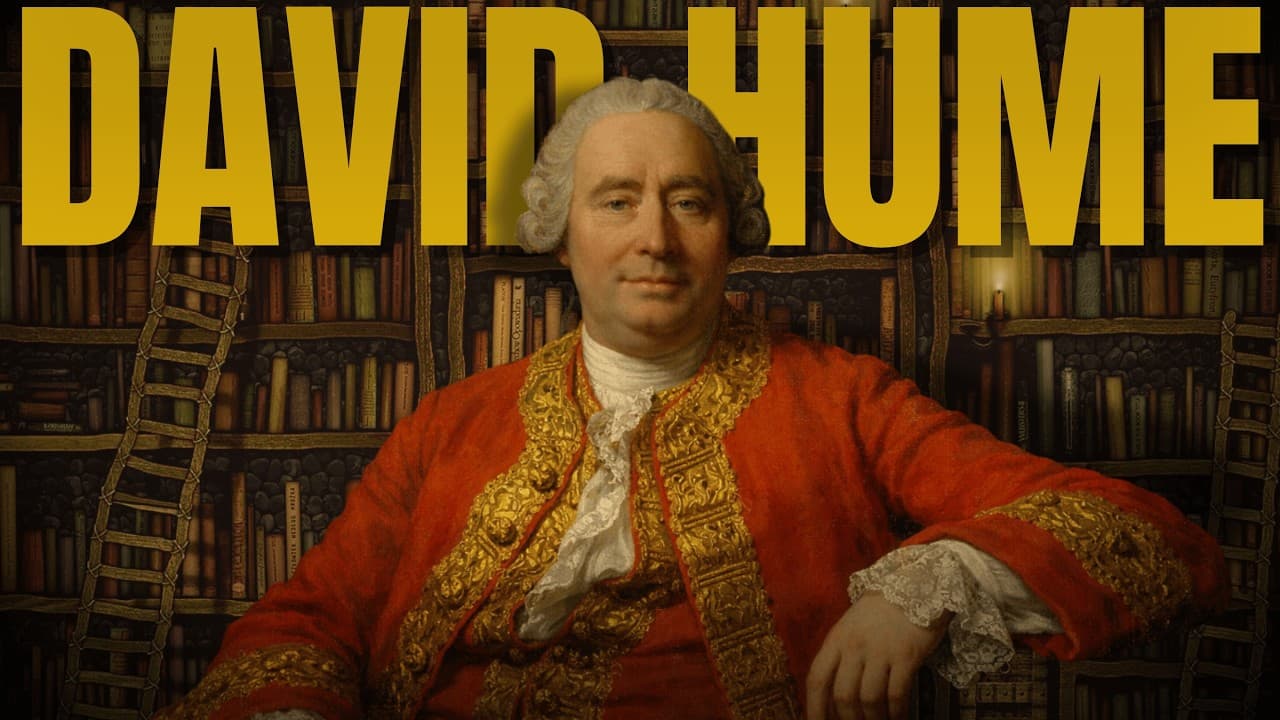
How Do You Know Anything Is Real? | David Hume for Sleep
David Hume's Complete Philosophy
Reason is not the master. It never was. This three-hour episode traces the life and philosophy of David Hume, the thinker who followed the evidence of the senses wherever it led, even when it overturned the deepest assumptions of Western thought. What he found shook the foundations of philosophy so thoroughly that Kant said Hume woke him from his dogmatic slumber.
We explore his empiricist theory of knowledge, his denial of the self, his revolutionary analysis of causation, the is-ought problem, his moral philosophy of sentiment and sympathy, his critique of miracles and natural religion, and the problem of induction that still haunts philosophy and science today. Hume emerges not as a destroyer of knowledge but as one of the most honest and courageous thinkers in the Western tradition.
The full episode is on YouTube and Spotify. Please listen only in safe, restful contexts.
Enjoying the episode?
Occasional letters on philosophy, reading, and the examined life. No spam, ever.
By subscribing you consent to receiving occasional emails. Unsubscribe any time via the link in every email or at /unsubscribe.
Timestamps
- 0:00:00Chapter 1: The Young Philosopher and the City of Enlightenment
- 0:15:25Chapter 2: All Knowledge Begins with Experience
- 0:31:17Chapter 3: The Bundle and the Void, Hume's Denial of the Self
- 0:47:12Chapter 4: Causation, The Habit That Runs the World
- 1:03:07Chapter 5: The Is-Ought Problem
- 1:18:17Chapter 6: Sentiment and Sympathy, Hume's Moral Philosophy
- 1:34:33Chapter 7: Miracles, Religion, and the Limits of Faith
- 1:50:37Chapter 8: The Problem of Induction
- 2:04:39Chapter 9: Reason Is and Ought Only to Be the Slave of the Passions
- 2:20:20Chapter 10: The Shadow That Reaches to Us, Hume's Legacy
For the record
Full Transcript
Chapter 01: The Young Philosopher and the City of Enlightenment
A young man of twenty-three sits in a rented room in the small French town of La Fleche, writing with a furious concentration that borders on obsession. He has abandoned a career in law that bored him, failed at a brief attempt at commerce in Bristol, and now lives in near poverty in a foreign country, pouring everything he has into a philosophical work so ambitious that it aims to rebuild the entire science of human nature from the ground up. He believes he has discovered something extraordinary, a new way of understanding the human mind that will do for the study of thought what Isaac Newton did for the study of the physical world. He is David Hume, and the book he is writing will be called A Treatise of Human Nature. It will be published in 1739, and it will, by his own later admission, fall dead-born from the press. Almost no one will read it. The few who do will misunderstand it. It will take decades for the world to recognize that this obscure young Scotsman, scribbling in provincial France, had produced one of the most important works in the entire history of Western philosophy.
But that recognition will come, and when it does, it will change everything. Hume's ideas will unsettle the foundations of metaphysics, transform moral philosophy, redefine the limits of human knowledge, and provoke a crisis in epistemology so profound that Immanuel Kant will later say it awakened him from his dogmatic slumber. The young man in La Fleche does not yet know any of this. He knows only that he has a vision, and that he must get it down on paper before it escapes him. He writes with the energy of someone who believes he is on the verge of something that matters. He is right.
David Hume was born on the twenty-sixth of April, 1711, in Edinburgh, Scotland, into a family of modest but respectable standing. His father, Joseph Home, was a minor landowner whose family seat lay at Ninewells, a small estate near the village of Chirnside in the Scottish Borders. His mother, Katherine Falconer, was the daughter of Sir David Falconer, who had served as President of the College of Justice. The family was comfortable but not wealthy. When Joseph Home died in 1713, David was only two years old, and Katherine was left to raise three children on limited means. She proved formidable in this task. Hume later described her as a woman of singular merit who devoted herself entirely to the rearing and education of her children.
Edinburgh in the early eighteenth century was a city caught between two worlds. On one side stood the old Scotland of Calvinist rigidity, religious orthodoxy, and fierce theological disputes. The Church of Scotland, the Kirk, wielded enormous social and moral authority, and the General Assembly functioned as something close to a national parliament on matters of doctrine and discipline. Ministers thundered against ungodliness and heresy, and the threat of ecclesiastical censure was real enough to shape the public behavior of even the most skeptical minds. On the other side, a new Scotland was emerging. The Act of Union in 1707 had bound Scotland to England, opening up new economic possibilities and new intellectual horizons. Edinburgh was beginning its transformation into what would become one of the great centers of European thought, a city whose thinkers would reshape philosophy, economics, history, medicine, and the natural sciences in a single extraordinary generation.
This was the world into which Hume was born, and it left its mark on him in ways that went deeper than he perhaps ever fully acknowledged. The tension between the Kirk's demand for orthodoxy and the emerging culture of free inquiry would define the backdrop of his entire intellectual life. He would never be free of the suspicion of the devout, and his philosophical works would be shadowed by accusations of irreligion and atheism from the moment they appeared. Yet he navigated this tension with a temperament so cheerful and a manner so agreeable that even many of his opponents found it difficult to dislike him personally. This was one of Hume's most distinctive qualities. He was a radical thinker with a sociable personality, a man whose ideas threatened the foundations of conventional belief but whose character radiated warmth, humor, and an almost impossible good nature.
Hume entered the University of Edinburgh at the remarkably young age of twelve, which was not unusual for the time. Scottish universities admitted students earlier than their English counterparts, and the curriculum at Edinburgh was broad if somewhat old-fashioned, rooted in the study of classics, natural philosophy, and moral philosophy. Hume later recalled that he passed through the ordinary course of education with some success, but he did not complete a degree. What seized his imagination was not the formal curriculum but the reading he did on his own. He devoured Cicero and Virgil, and somewhere in his teenage years he discovered the writings of the modern philosophers, Locke, Berkeley, and the continental rationalists. By the time he was eighteen, he later wrote, he had found a new scene of thought opening before him, one that made him resolve to seek all his learning from that source alone.
The family expected Hume to pursue a career in the law, as many young men of his station did. He tried. He hated it. The study of law felt to him like a prison after the exhilaration of philosophical inquiry. He could not force his mind to attend to cases and statutes when it was consumed by questions about the nature of belief, the origin of moral judgments, and the limits of human reason. He abandoned law and attempted a career in commerce, traveling to Bristol in 1734 to work for a sugar merchant. This lasted only a few months. Commerce suited him no better than law. What Hume wanted, what he needed, was time and solitude to think. And so he made the decision that would change his life and the history of philosophy. He left for France.
Hume settled first in Rheims and then in La Fleche, a small town in the Loire Valley notable chiefly for hosting the Jesuit college where Descartes had been educated a century earlier. There, living frugally on his small inheritance, he wrote A Treatise of Human Nature. The work consumed him for nearly three years. He was attempting nothing less than a comprehensive account of the human mind, built entirely from the ground up on the principles of observation and experience. He wanted to apply the experimental method of Newton to the study of human thought itself. He wanted to discover the laws that govern the operations of the mind just as Newton had discovered the laws that govern the motions of the planets. It was, by any measure, an astonishing ambition for a man not yet twenty-six years old.
The Treatise was published in two volumes in 1739, with a third following in 1740. Hume had hoped it would make his reputation. Instead, it sank into obscurity. The reviews were few and uncomprehending. Hume's prose in the Treatise was dense and technical, and his arguments were so novel that even sympathetic readers struggled to follow them. He later described its reception with characteristic dry humor in his brief autobiography, My Own Life: never literary attempt was more unfortunate. The work fell dead-born from the press, without reaching such distinction as even to excite a murmur among the zealots. The failure stung, but it did not break him. Hume possessed a resilience that would serve him well throughout his life. He resolved to rewrite his ideas in a clearer and more accessible form, and over the following decade he produced a series of works that gradually established his reputation.
His Essays, Moral and Political, published in 1741 and 1742, found a wider audience and demonstrated that Hume could write with elegance and wit on topics ranging from commerce and politics to the arts and manners. An Enquiry Concerning Human Understanding appeared in 1748, recasting the central arguments of Book One of the Treatise in a form that was shorter, sharper, and far more readable. An Enquiry Concerning the Principles of Morals followed in 1751, and Hume himself considered it, of all his writings, incomparably the best. His six-volume History of England, published between 1754 and 1762, became an enormous popular success and made him, for the first time, genuinely wealthy.
Through these years, Hume also faced repeated disappointments in his attempts to secure an academic position. He was twice passed over for university chairs, at Edinburgh in 1744 and at Glasgow in 1752, largely because of the opposition of the clergy, who regarded his philosophical views as dangerously heterodox. He served instead in a variety of other roles: as tutor to the Marquess of Annandale, as secretary to General St. Clair on a military expedition and later on a diplomatic mission to Vienna and Turin, and as Keeper of the Advocates' Library in Edinburgh, a post that gave him access to the extensive collection he needed to write his History. Later, from 1763 to 1765, he served as secretary to the British embassy in Paris, where he was received with extraordinary enthusiasm by the French philosophes. Voltaire, Diderot, and the Baron d'Holbach all admired him. The salons of Paris lionized him. He returned to Edinburgh in 1766 as a man of international reputation.
The Edinburgh to which Hume returned was itself transformed. The Scottish Enlightenment was now in full flower. The city had developed a rich culture of intellectual sociability, centered on clubs and societies that brought together thinkers from every discipline. The Select Society, founded in 1754, met regularly to debate questions of philosophy, science, economics, and the arts. The Poker Club, of which Hume was a member, took its name from its stated purpose of stirring up the question of a Scottish militia, but in practice its meetings ranged over every topic of intellectual interest. These clubs were not mere social gatherings. They were engines of the Enlightenment, spaces where ideas were tested, refined, and challenged in an atmosphere of vigorous but civil debate. Hume thrived in this environment. His temperament was perfectly suited to a culture that valued sharp thinking and good fellowship in equal measure.
The city teemed with intellectual energy, and Hume stood at the center of a remarkable circle of thinkers. His closest friend was Adam Smith, the moral philosopher and economist whose own Wealth of Nations would appear in 1776. Their friendship was one of deep mutual respect and genuine affection, sustained through decades of correspondence and conversation. Smith would later call Hume the most perfectly wise and virtuous man he had ever known. Other friends and associates included the philosopher Adam Ferguson, the historian William Robertson, the chemist Joseph Black, and the geologist James Hutton. Together, these men and others like them made Edinburgh a center of learning to rival any city in Europe.
Hume spent his final years in Edinburgh, living comfortably in a house on St. Andrew Square in the New Town. He was famous, prosperous, and surrounded by friends. He was also, as he had been for most of his adult life, a bachelor, a man of enormous sociability who never married but who maintained deep and lasting friendships with men and women alike. His personality was one of his most remarkable qualities. He was large, genial, famously good-natured, and possessed of a humor that could disarm even his fiercest critics. He loved good food and good company. He was known in Edinburgh as le bon David, a nickname bestowed on him during his years in Paris and one that followed him home. Even those who found his philosophy dangerous tended to find his company delightful.
In the spring of 1776, Hume learned that he was dying. He had been suffering from a disorder of the bowels, almost certainly cancer, and he knew that his condition was terminal. He faced his death with the same composure and cheerfulness that had characterized his life. James Boswell, the biographer of Samuel Johnson and a man of anxious Christian piety, visited Hume on his deathbed, hoping perhaps to witness a deathbed conversion or at least a flicker of doubt. He found instead a man entirely at peace, joking about the afterlife and refusing to express any fear of annihilation. Boswell left shaken. Hume died on the twenty-fifth of August, 1776, at the age of sixty-five. His death became a public event in Edinburgh. Crowds gathered to watch the funeral procession. The question on everyone's mind was whether the great skeptic had maintained his composure to the end, or whether, in his final moments, he had reached for the consolations of religion. Adam Smith, in a letter that became famous, confirmed that Hume had died as he had lived, with perfect tranquility and good humor, never betraying the smallest anxiety or impatience. Smith's letter provoked outrage among the devout. That a man could die without God and without fear seemed to many an affront to the moral order itself. But it happened. Hume's death was, in its way, as philosophical as his life.
Chapter 02: All Knowledge Begins with Experience - The Empiricist Revolution
The philosophical world that David Hume entered as a young thinker was dominated by a question that had occupied European thought for more than a century: where does human knowledge come from? Two great traditions had crystallized in response. The rationalists, led by Rene Descartes, Baruch Spinoza, and Gottfried Wilhelm Leibniz, held that the deepest truths about reality could be discovered by reason alone, operating independently of sensory experience. The empiricists, beginning with Francis Bacon and most influentially developed by John Locke, argued that the mind at birth is a blank slate and that all knowledge must ultimately derive from experience. This was not a minor academic disagreement. It was a dispute about the very nature and limits of the human mind, and its resolution would determine what philosophy could and could not accomplish.
Descartes had set the terms of the modern debate. Writing in the early seventeenth century, he had subjected all of his beliefs to radical doubt, stripping away everything that could conceivably be false, in search of something absolutely certain. He found it, he believed, in the act of thinking itself. Even if an evil demon were deceiving him about everything, Descartes reasoned, the very fact that he was being deceived proved that he existed as a thinking thing. From this single certainty, cogito ergo sum, he attempted to rebuild the entire edifice of human knowledge through pure reason. He argued that certain ideas, such as the idea of God and the idea of mathematical truths, are innate, implanted in the mind by God and accessible to reason without any need for sensory input. These innate ideas, Descartes claimed, are more reliable than anything the senses can deliver, for the senses are fallible and often deceive us, while clear and distinct ideas grasped by the intellect cannot be wrong.
Leibniz carried this rationalist project further. He argued that the truths of reason are necessary truths, truths that could not be otherwise, and that the mind possesses innate principles that structure all of its experience. The mind, for Leibniz, is not a blank slate but a block of marble whose veins already mark out the figure that the sculptor will reveal. Sensory experience may occasion the recognition of these innate truths, but it does not produce them. The deepest truths about substance, causation, identity, and God are knowable by reason alone.
John Locke mounted the most influential challenge to this rationalist picture. In his Essay Concerning Human Understanding, published in 1690, Locke argued that there are no innate ideas. The mind at birth, he wrote, is white paper, void of all characters. All the materials of reason and knowledge come from experience, and experience comes in two forms: sensation, which provides ideas of external objects, and reflection, which provides ideas of the mind's own operations. From these two sources, and these alone, the mind derives everything it knows. Locke's argument was powerful, but it was also incomplete. He still allowed that reason could achieve genuine knowledge of the external world and of the relations between ideas. He believed that the mind could know with certainty that God exists, that the external world is real, and that certain moral truths hold universally. Locke was an empiricist about the origin of ideas, but he retained a considerable confidence in reason's ability to work with those ideas to reach reliable conclusions about reality.
George Berkeley, the Irish philosopher and bishop, pushed empiricism in a direction that Locke had not foreseen. Berkeley accepted Locke's premise that all knowledge begins with sensory experience but drew from it a startling conclusion. If we only ever perceive our own ideas, Berkeley argued, then we have no grounds for believing in the existence of material substance, an unperceived something that supposedly lies behind our perceptions. To be, Berkeley famously declared, is to be perceived. The physical world exists only insofar as it is perceived by some mind. Berkeley was not denying the reality of ordinary experience. He was denying that there is any need to posit a material world beyond experience to explain it. God, the infinite perceiver, guarantees the continuity and order of the world we experience. Berkeley's idealism was logically rigorous, but most people found it deeply counterintuitive, and it left the empiricist tradition in a peculiar position: having started by insisting that all knowledge comes from experience, it seemed to have ended by denying the very existence of the external world that experience was supposed to be about.
This was the intellectual landscape that Hume surveyed and found wanting. Both the rationalists and his fellow empiricists had, in his view, failed to follow their own principles consistently. The rationalists claimed to derive knowledge from pure reason, but Hume would argue that they had never actually demonstrated that reason alone could tell us anything about the world. The earlier empiricists, Locke and Berkeley, had rightly insisted that experience is the source of knowledge, but they had not been rigorous enough in tracing the consequences of this insight. Hume set out to complete the empiricist project with a thoroughness that neither Locke nor Berkeley had achieved, and the results were revolutionary.
The foundation of Hume's philosophy is a distinction that seems simple but carries enormous consequences: the distinction between impressions and ideas. Impressions, in Hume's terminology, are the vivid, forceful perceptions we have when we see, hear, touch, taste, or smell something, or when we experience an emotion or desire directly. Ideas are the fainter copies of these impressions that remain in the mind when the original impression is no longer present. When you see a red apple, the vivid sensory experience is an impression. When you later recall the red apple in your mind's eye, the faint image you produce is an idea. Every idea, Hume argues, is derived from and is a copy of a prior impression. This is the copy principle, and it is the cornerstone of his entire philosophy.
The copy principle is not merely a psychological observation. It is a philosophical tool of extraordinary power. If every idea must be traceable to an original impression, then any idea that cannot be so traced is suspect. Any word or concept that does not correspond to some identifiable impression is, at best, confused and, at worst, meaningless. This gives Hume a test for the legitimacy of any philosophical concept. When we encounter a term in metaphysics or theology or philosophy of mind, we must ask: from what impression is this idea derived? If no impression can be identified, then the idea has no real content. It is a noise we make with our mouths, not a genuine thought.
Consider the implications. The rationalists spoke freely of substance, of the essential nature of things, of necessary connections in nature, of the immortal soul, of the absolute attributes of God. These were the grand concepts of traditional metaphysics, and they had been debated for centuries with tremendous confidence and very little agreement. Hume's copy principle cuts through all of this with a single question. From what impression is the idea of substance derived? We see colors, feel textures, taste flavors, and hear sounds, but we never perceive substance itself, the supposed something that underlies and supports all of these qualities. The idea of substance, Hume concludes, is nothing but a collection of simple ideas that are united by the imagination and have a particular name assigned to them. The grand metaphysical concept dissolves under empiricist scrutiny into a habit of the mind.
The same analysis applies to other concepts that philosophy had taken for granted. The idea of a necessary connection between cause and effect, the idea of a self that persists through time, the idea of an external world that exists independently of our perceptions: all of these must be submitted to the same test. Hume will address each of these in turn, and in each case he will argue that the idea in question cannot be traced to any impression in the way that traditional philosophy had assumed. The consequences are far-reaching. If the copy principle is correct, then much of what had passed for philosophical knowledge turns out to be either confused or empty.
Hume drew a further distinction that proved equally important: the distinction between relations of ideas and matters of fact. Relations of ideas are propositions that can be known to be true simply by thinking about the ideas involved. The statement that three times five equals fifteen, or that a bachelor is an unmarried man, is true by virtue of the relations between the ideas it contains. No experience of the world is needed to verify such statements, and their denial involves a contradiction. Matters of fact, by contrast, are propositions whose truth depends on how the world actually is. The statement that the sun will rise tomorrow, or that water boils at one hundred degrees at sea level, cannot be established by reasoning about ideas alone. Their truth must be discovered by experience, and their denial never involves a logical contradiction. We can conceive of the sun not rising tomorrow without any inconsistency. It would be surprising, but it would not be self-contradictory.
This distinction has profound consequences for the scope of human knowledge. Everything we know about the actual world, everything we know about nature, about other people, about the past and the future, falls into the category of matters of fact. And matters of fact, Hume will argue, can only be established through experience and the inferences we draw from experience. Reason alone, operating purely on the relations between ideas, can give us mathematics and logic, but it cannot tell us a single thing about the way the world actually is. The rationalist dream of deducing the nature of reality from pure thought is, on Hume's account, impossible. The mind cannot spin knowledge of the world out of itself. It must look outward, to the testimony of the senses, and accept whatever the senses report, even when the report is uncomfortable.
What traditional metaphysics looked like before Hume is worth pausing to consider, because only then can the scale of his challenge be appreciated. For centuries, philosophers had confidently debated the nature of substance, the essence of the soul, the attributes of God, the ultimate structure of reality, and the necessary laws of nature. These were understood to be genuine objects of knowledge, accessible to human reason through careful argument. Descartes believed he could prove the existence of God through pure thought. Leibniz believed he could demonstrate that this is the best of all possible worlds. Spinoza believed he could derive the entire structure of reality from a set of axioms as certain as those of geometry. These were not idle speculations. They were the central achievements of philosophy as it had been practiced for generations. Hume did not set out to mock these achievements. He set out to ask a more fundamental question: are the concepts that these arguments employ actually meaningful? Can we really form a clear idea of substance, or of necessary connection, or of the soul, or of God's infinite attributes? His answer, delivered with the quiet precision of the copy principle, was that in most cases we cannot. The emperor, it turned out, had no clothes.
Hume also applied the copy principle to the idea of God's attributes. Theologians spoke of God as infinitely powerful, infinitely wise, and infinitely good. But what impressions correspond to these ideas? We have impressions of limited power, limited wisdom, and limited goodness in our own experience. We can imaginatively extend these qualities by removing the limitations, but Hume would argue that this process of imaginative extension does not produce a genuine idea. We have no impression of infinity, and therefore no clear idea of it. The concept of an infinite being, on Hume's analysis, is a confused combination of finite ideas with the limitations abstracted away, and abstraction is an operation of the imagination, not a perception of reality. The theological implications were obvious to everyone who read Hume, even when he was careful not to draw them out explicitly.
Yet Hume was not a nihilist about knowledge. He did not claim that we know nothing. He claimed that we know less than we think, and that we know it differently than we suppose. The sciences, rightly conducted, still yield genuine knowledge of the world. Arithmetic and geometry still deliver certain truths about the relations between ideas. What we cannot do is extend our knowledge beyond the bounds of experience into the realm of pure metaphysics. We cannot reason our way to God, or to the soul, or to the ultimate nature of reality. We can observe, we can draw inferences from what we observe, and we can build theories that organize and predict our observations. But we cannot transcend observation. The senses are our only window onto the world, and philosophy must respect their limits. This is the core of Hume's empiricism, and it changes everything that follows. Every subsequent argument he makes about causation, about the self, about morality, about religion, about the limits of reason, grows directly from this root. Once we accept that all genuine ideas are copies of impressions, and that knowledge of the world can only come from experience, the rest follows with a kind of relentless logic. Hume simply had the courage to follow it.
Chapter 03: The Bundle and the Void - Hume's Denial of the Self
There is a question that most people never think to ask, because the answer seems so obvious that the question itself appears absurd. The question is: do you exist? Not your body, not your name, not the social role you play, but you, the inner subject, the self that supposedly persists through all the changes of your life, the same self that was there when you were five years old and is here now reading these words. Every major religious and philosophical tradition in the West had assumed that such a self exists. Descartes built his entire philosophy on it. The Christian doctrine of the immortal soul depends on it. Our legal and moral systems presuppose it. Personal responsibility, moral accountability, the very possibility of making promises and keeping them, all require that there be a continuous self that endures through time. Hume looked for this self. He looked carefully, honestly, and with the full rigor of his empiricist method. He could not find it.
The argument appears in Book One of A Treatise of Human Nature, and it is among the most celebrated passages in the history of philosophy. Hume applies his copy principle directly to the idea of the self. If we have a genuine idea of the self, it must be derived from some impression. But what impression could this be? Impressions are either of sensation or of reflection. Sensations come and go: we see, we hear, we feel warmth or pain, and each of these is a particular, fleeting experience. Reflective impressions, our emotions, desires, and inner feelings, are equally transient. If the idea of the self is to be derived from some impression, that impression would have to be constant and unchanging, since the self is supposed to be something that persists identically through all of our changing experiences. But no impression meets this condition. Our experience is a ceaseless flow of different perceptions, each arising and passing away, no one of them permanent. There is no single impression that corresponds to a persisting self.
Hume then makes his famous declaration. When he enters most intimately into what he calls himself, he always stumbles on some particular perception or other, of heat or cold, light or shade, love or hatred, pain or pleasure. He never catches himself without a perception, and he never observes anything but the perception. What we call the self, Hume concludes, is nothing but a bundle or collection of different perceptions, which succeed each other with an inconceivable rapidity, and are in a perpetual flux and movement. There is no simple, identical self underlying these perceptions. There is only the stream of perceptions itself, bound together not by any real tie but by certain relations that the imagination traces among them: resemblance, contiguity, and cause and effect.
The philosophical context in which Hume was writing makes this argument even more striking. John Locke had already troubled the waters of personal identity decades earlier. Locke argued that personal identity is not grounded in the persistence of a soul, a metaphysical substance we can never directly observe, but in the continuity of consciousness, specifically in memory. You are the same person as the child who fell off a bicycle twenty years ago because you can remember falling off that bicycle. Your consciousness reaches back and appropriates that earlier experience as your own. This was already a significant departure from the traditional view, which located personal identity in the persistence of an immaterial soul. Locke was relocating identity from an unknowable substance to an observable psychological phenomenon.
Joseph Butler, the Anglican bishop and philosopher, raised a sharp objection to Locke's account. Memory, Butler argued, presupposes personal identity rather than constituting it. You can only remember an experience if you are the same person who had the experience in the first place. To say that memory creates personal identity is to argue in a circle. Butler's objection pointed to a real difficulty, and it pushed the debate toward the question of what, if not memory and not substance, constitutes the self.
Hume stepped into this debate and cut the knot by denying that there is a self to be constituted. Both Locke and Butler, Hume would argue, were looking for something that does not exist. Locke tried to ground identity in memory; Butler pointed out that memory presupposes identity; and neither considered the possibility that there is no persisting self at all, that what we call personal identity is a fiction created by the imagination. Hume did consider this possibility, and he found it to be the conclusion that his philosophy demanded.
The bundle theory, as it has come to be called, has implications that reach far beyond academic philosophy. If there is no persisting self, then what are we? Hume's answer is that we are a succession of experiences, a constantly changing collection of perceptions bundled together by the mind's natural tendency to find continuity and connection where none objectively exists. The imagination, confronted with a rapid succession of closely related perceptions, smooths over the transitions and produces the fiction of a single, continuous self that endures through time. Just as we perceive a river as a single thing even though the water flowing through it changes from moment to moment, so we perceive ourselves as single, persisting entities even though our perceptions are in constant flux. The identity we attribute to ourselves is not discovered through introspection. It is constructed by the imagination.
This has profound consequences for religion. If there is no persisting self, then the doctrine of the immortal soul becomes deeply problematic. What exactly would survive the death of the body? Not a unitary self, for Hume has argued that no such thing exists during life. Not a soul understood as a simple, indivisible substance, for Hume has argued that the idea of such a substance cannot be traced to any impression. The bundle of perceptions that constitutes a person during life would simply cease when the body ceases to function. There is nothing left over that could migrate to an afterlife. Hume does not draw this conclusion explicitly in the Treatise, but it follows naturally from his argument, and it is one of the reasons the devout found his philosophy so threatening.
The implications for ethics are equally far-reaching. Moral responsibility typically requires a persisting agent who can be held accountable over time for actions performed in the past. If you committed a crime last year, it seems that you can justly be punished now only if you are the same person who committed the crime. But if personal identity is a fiction of the imagination, if there is no strict sense in which you are the same person you were a year ago, then the foundations of moral and legal accountability become uncertain. Hume does not develop this line of thought in detail, but later philosophers have recognized it as one of the most unsettling implications of his view.
What Hume found when he engaged in introspection is worth considering more carefully, because it is the empirical foundation on which his entire argument rests. He did not find nothing. He found a constantly shifting array of perceptions: thoughts, feelings, sensations, memories, imaginings, all arising and passing away in a continuous stream. What he did not find was something over and above these perceptions, some additional thing that could be identified as the self that has these perceptions. Every time he tried to catch the self in the act, so to speak, he found only another perception. The self eluded his grasp not because it was hiding but because, on his analysis, there was nothing there to hide. The search for the self is like the search for the number among the numerals. There are the numerals, and there are the operations we perform with them, but there is no additional thing called number that exists apart from these. Similarly, there are perceptions, and there are the relations among them, but there is no additional thing called the self that exists apart from the perceptions.
The bundle theory also raises profound questions about what makes a particular bundle a person rather than a mere collection. Hume invokes the relations of resemblance, contiguity, and causation to explain how the imagination binds distinct perceptions into the fiction of a unified self. Successive perceptions resemble one another. They are contiguous in time. And they are causally connected, in the sense that memories cause further memories, desires cause actions, and experiences cause dispositions. These relations give the bundle a coherence and continuity that the imagination seizes upon and interprets as identity. But Hume is careful to note that these relations are themselves perceptions, not something over and above the bundle. The unity of the self is not given. It is constructed, and the construction, however psychologically compelling, rests on the imagination's tendency to confuse qualitative similarity with numerical identity.
The lasting impact on philosophy of mind has been immense. Hume's bundle theory set the terms of the debate about personal identity for the next three centuries. Philosophers who reject the theory still feel obligated to respond to it. Kant attempted to salvage a notion of the self through his doctrine of the transcendental unity of apperception, the idea that there must be an "I think" that accompanies all of our experiences even if that "I" is not itself an object of experience. William James, the American pragmatist, developed his own stream-of-consciousness account of the self that owed much to Hume. Derek Parfit, in the twentieth century, revived and extended Hume's arguments in his influential work Reasons and Persons, arguing that personal identity is not what matters in survival and that the bundle theory, properly understood, has liberating rather than threatening implications.
The implications for memory and psychological continuity are particularly worth considering. If the self is a bundle of perceptions and nothing more, then memory does not connect a present self to a past self. It creates the illusion of such a connection. When we remember a childhood experience, we are not reaching back to an earlier version of a persisting self. We are having a present perception, a memory impression, that resembles an earlier perception, and the imagination, seizing on this resemblance, generates the conviction that both perceptions belong to the same self. The continuity we feel is real as a psychological experience, but it is not evidence of an underlying metaphysical unity. It is a product of the imagination's tendency to smooth over gaps and create narratives of identity where none objectively exists. This insight has proved enormously fruitful for later philosophy. It anticipates the narrative theories of personal identity developed in the twentieth century, which hold that the self is not a substance but a story, a narrative that we construct and continually revise from the raw materials of memory and experience.
There is a striking parallel between Hume's analysis of the self and the analysis offered by Buddhist philosophy, which arrived at remarkably similar conclusions through entirely different methods. The Buddhist doctrine of anatta, or no-self, holds that what we call the self is a conventional designation for a constantly changing process of physical and mental events. Just as Hume argued that the self is a bundle of perceptions, Buddhist philosophers argued that the person is a collection of five aggregates: form, sensation, perception, mental formations, and consciousness. None of these aggregates is the self, and the self is not to be found apart from them. The convergence between Hume's Western empiricist analysis and the Buddhist contemplative tradition is one of the most remarkable instances of cross-cultural philosophical agreement, all the more so because Hume almost certainly had no knowledge of Buddhist thought. He arrived at the doctrine of no-self through the application of his copy principle, not through meditation. But the conclusion is strikingly similar, and it suggests that the bundle theory, far from being a mere philosophical curiosity, may touch on something fundamental about the nature of subjective experience.
Hume himself was not entirely comfortable with his own conclusion. In the appendix to the Treatise, published in 1740, he returned to the problem of personal identity and confessed that he found himself in a labyrinth from which he could see no exit. The problem was this: he could explain why we attribute identity to a succession of related perceptions, but he could not explain what binds the perceptions together into a single bundle in the first place. If perceptions are distinct existences, as he had argued, then each perception is in principle separable from every other. What, then, unites them into the bundle that constitutes a particular person? Resemblance, contiguity, and causation are the relations that the imagination traces among perceptions, but these relations seem to presuppose rather than create the unity of the bundle. Hume acknowledged this difficulty honestly and did not attempt to paper over it. It remains one of the deepest problems in his philosophy, and no one has solved it to universal satisfaction. The problem of what unifies the bundle, of what makes this particular collection of perceptions mine rather than yours or no one's, continues to challenge philosophers of mind to this day. Hume had the intellectual honesty to raise a problem he could not solve, and the courage to leave it standing as an open question rather than pretending it did not exist.
Chapter 04: Causation - The Habit That Runs the World
Every morning the sun rises. Every time a billiard ball strikes another, the second ball moves. Every time a flame is brought near a piece of paper, the paper ignites. We observe these regularities so constantly that we come to regard them not merely as patterns but as necessary connections. The fire does not just happen to burn the paper. It must burn it. The first billiard ball does not merely precede the movement of the second. It causes it. We feel, deeply and instinctively, that there is something binding these events together, a power or force that compels the effect to follow from the cause. Hume's analysis of causation is, by common consent, the single most important argument in his philosophy, and perhaps one of the five or six most important arguments in the entire history of Western thought. It asks a simple question: where does this idea of necessary connection come from? The answer he gives overturns centuries of philosophical assumption and sets in motion a crisis that philosophy has never fully resolved.
Before Hume, philosophers and theologians had treated causation as a real feature of the world, a genuine connection between events that reason could discover and that constituted one of the deepest truths about reality. The Aristotelian tradition distinguished four kinds of cause: material, formal, efficient, and final. The medieval scholastics developed elaborate theories of causal power and causal agency. Descartes and the rationalists held that the causal relation is intelligible to reason: when we truly understand the cause, we can see why the effect must follow. Leibniz argued that the principle of sufficient reason guarantees that everything that happens has a cause and that this cause can in principle be discovered by rational analysis. For all of these thinkers, causation was something real, something objective, something out there in the world. Hume dismantled this entire edifice.
His argument proceeds with characteristic precision. We believe that one event causes another. What is the basis of this belief? Hume identifies three features that we associate with causation. First, the cause and effect are contiguous in space and time: the billiard ball strikes the other ball at the point and moment of contact. Second, the cause precedes the effect: the first ball moves before the second ball moves. Third, and most crucially, there appears to be a necessary connection between them: given the cause, the effect must follow.
The first two features, contiguity and temporal priority, are straightforwardly observable. We can see that the balls are in contact. We can see that one moves before the other. But what about the third feature, the necessary connection? This is where Hume's argument becomes devastating. He asks: from what impression is the idea of necessary connection derived? We observe the first ball moving. We observe the collision. We observe the second ball moving. But do we observe the necessary connection between the collision and the movement? Do we see the power, the force, the compulsion that supposedly links the two events? Hume's answer is that we do not. No matter how carefully we observe the interaction, all we ever see is one event followed by another. We never perceive the connection itself. The power that supposedly binds cause to effect is invisible, not because it is hidden, but because there is nothing there to see.
This is a radical claim, and Hume knew it. He considers and rejects every available source for the idea of necessary connection. Perhaps we derive it from our observation of the physical world. But as we have just seen, observation reveals only succession, not connection. Perhaps we derive it from reason. But reason alone cannot establish that any particular cause must produce any particular effect. There is no logical contradiction in supposing that the first billiard ball strikes the second and the second remains perfectly still. It would be surprising, but it would not be logically impossible. We can conceive it clearly and distinctly, and whatever is conceivable is possible. If the connection between cause and effect were a matter of reason, we would be able to discover it by pure thought, without any experience at all. But we cannot. No amount of reasoning about the properties of the first billiard ball, considered in isolation, will tell us what will happen when it strikes the second. Only experience can tell us that.
Perhaps, then, the idea of necessary connection derives from some impression of our own mental operations. When we will our arm to move and it moves, do we not feel the causal power directly? Hume considers this possibility and rejects it as well. The connection between our will and the movement of our limbs is no more transparent than any other causal connection. We experience the volition. We experience the movement. But we do not experience the connection between them. We have no idea how a mental event, a willing, produces a physical event, a movement. The connection is just as mysterious as the connection between two billiard balls. We simply observe that the one follows the other, and we have grown so accustomed to this sequence that we mistake familiarity for understanding.
So where does the idea of necessary connection come from, if not from the observation of nature, not from reason, and not from introspection of our own will? Hume's answer is one of the great insights of modern philosophy: it comes from custom or habit. When we have observed one type of event followed by another type of event many times, the constant conjunction of the two produces a habit of expectation in the mind. Having seen many billiard balls strike other billiard balls and observed the second ball move every time, our minds develop a propensity to expect the movement of the second ball upon seeing the collision. This expectation is not a rational inference. It is a psychological habit. And it is this habit, this felt expectation, that is the true source of our idea of necessary connection. The necessary connection is not in the objects. It is in the mind. It is a feeling we project onto the world, not a feature we discover in it.
The distinction between constant conjunction and genuine causal connection is the heart of Hume's analysis. Constant conjunction is an observable relation: we have observed events of type A followed by events of type B many times. Genuine causal connection would be something more: a real bond or power that makes B follow from A necessarily. Hume's argument is that we are never justified in moving from the observation of constant conjunction to the assertion of genuine causal connection. All we ever observe is the conjunction. The connection is something we add, something the mind contributes, something that arises from the habit of expectation rather than from the observation of the world. This does not mean that causation is an illusion. Hume is not saying that events are disconnected or that there are no regularities in nature. He is saying that the necessity we attribute to causal relations is a product of human psychology, not a feature of external reality that we perceive directly.
The theological implications were immediate and profound. If we cannot establish genuine causal connections through reason or observation, then the cosmological argument for the existence of God, which rests on the claim that every effect must have a cause and traces the chain of causes back to a first cause, is undermined at its foundation. The argument assumes that causation is a real, rational, necessary connection that can be traced through the world to its ultimate source. Hume's analysis suggests that causation is a habit of the mind, not a ladder that reason can climb to God. Similarly, the argument from design, which infers a divine designer from the orderly causal structure of the universe, is weakened if the causal structure itself is not something we observe in nature but something we project onto it.
Consider how thoroughly this analysis upends ordinary thinking about the natural world. We speak of gravity causing objects to fall, of heat causing water to boil, of viruses causing disease. In each case, we assume that there is a real power or force at work, something that necessitates the effect. Hume's argument does not deny that these regularities exist. It denies that we have any access to the supposed necessity that binds them. We observe the regularity. We feel the expectation. But the necessity is a contribution of our own minds, not a discovery about the world. This distinction between what we observe and what we add is the essence of Hume's critical philosophy, and it runs through every aspect of his thought.
Hume's contemporaries understood the stakes. The reaction to his analysis of causation was immediate and passionate, though it took time to reach its full expression. Thomas Reid, the Scottish common-sense philosopher, argued that Hume's skepticism about causation violated the most basic convictions of common sense and that any philosophy that leads to such conclusions must have gone wrong somewhere. Reid did not deny the force of Hume's arguments. He simply refused to accept the conclusion, insisting that our belief in real causal connections is a natural and rational conviction that philosophy cannot and should not undermine.
But the most consequential response came from Immanuel Kant. Kant later reported that it was Hume's treatment of causation that interrupted his dogmatic slumber and gave a completely different direction to his investigations in the field of speculative philosophy. Kant recognized that Hume had posed a genuine problem. If causation cannot be established by pure reason and is not simply derived from experience, then the very foundations of science and metaphysics are in question. Kant's solution, developed in his Critique of Pure Reason, was to argue that causation is a category of the understanding, a conceptual framework that the mind imposes on experience as a condition of experience being possible at all. We do not discover causation in the world. We bring it to the world. Without the concept of causation, Kant argued, experience itself would be impossible: it would be a mere chaos of disconnected impressions, not the ordered world of objects and events that we actually perceive.
Whether Kant's solution is adequate remains one of the deepest questions in philosophy. Hume had posed the problem with such clarity and force that no subsequent philosopher could simply ignore it. Every theory of causation, every account of scientific reasoning, every epistemological framework developed since the eighteenth century has had to reckon with Hume's challenge, either by accepting his conclusions and working within them, or by offering an alternative account that attempts to restore the rational credentials of causal knowledge. The fact that no consensus has emerged after nearly three centuries of effort is a measure of the problem's depth.
What is not in question is the depth and importance of the problem Hume raised. Before Hume, causation was a given, a bedrock assumption that philosophy, science, and theology all took for granted. After Hume, it became a problem, and it has remained a problem ever since. Modern debates about the nature of causation, about the relationship between correlation and causation in statistical reasoning, about the meaning of physical laws, and about the foundations of scientific inference all trace their roots to the analysis Hume first laid out in the pages of the Treatise.
Hume's analysis also undermines the notion that we can gain causal knowledge through a single observation, an idea that had seemed plausible to many of his predecessors. If we could perceive the necessary connection between cause and effect, then a single instance of the connection should suffice to establish it, just as a single demonstration suffices to establish a mathematical theorem. But this is not how causal knowledge works. We do not conclude that fire causes heat from a single observation. We conclude it from repeated observation of fire accompanied by heat. This repeated observation is what builds the habit of expectation. If the connection were rational and necessary, one instance would be enough. The fact that we require many instances reveals that the source of our belief is not rational insight but accumulated experience, and the psychological habit it produces. This asymmetry between causal belief and rational demonstration is further evidence that causation, as we understand it, is a product of the mind rather than a feature of the world.
The difference between correlation and causation, which Hume did more than anyone to clarify, remains one of the most important distinctions in science and in everyday reasoning. We observe that two types of events tend to occur together. This is correlation. We infer that one type of event produces or brings about the other. This is causation. Hume's point is that the inference from correlation to causation is never logically guaranteed. No matter how many times we observe A followed by B, the observation itself never proves that A caused B. There might be a common cause producing both. The correlation might be coincidental. Or the connection might be real but entirely different from what we suppose. The habit of expecting B upon observing A is psychologically compelling, but it is not logically conclusive. This insight has become foundational in modern science, where the demand for controlled experiments, randomized trials, and rigorous statistical methods all reflect Hume's lesson that mere conjunction is not proof of connection.
Chapter 05: The Is-Ought Problem - Why Facts Cannot Tell Us What to Do
In the final section of Book Three, Part One of A Treatise of Human Nature, Hume makes an observation that occupies barely a single paragraph yet has generated more discussion, more controversy, and more lasting influence than almost anything else he ever wrote. He notices that in every system of morality he has encountered, the author proceeds for some time in the ordinary way of reasoning, establishing facts about the world, about God, or about human nature, and then suddenly, without warning, shifts from statements about what is to statements about what ought to be. The connection of this new relation, Hume writes, is of the last consequence. For as this ought expresses some new relation or affirmation, it needs to be observed and explained, and a reason should be given for what seems altogether inconceivable, how this new relation can be a deduction from others which are entirely different from it.
This passage, often called the is-ought problem or Hume's guillotine, identifies a logical gap between descriptive statements and normative statements that has reshaped moral philosophy from the eighteenth century to the present day. The point is deceptively simple. A statement about what is the case, no matter how detailed, comprehensive, or accurate, cannot by itself yield a statement about what ought to be the case. From the fact that human beings naturally seek pleasure and avoid pain, it does not follow that they ought to seek pleasure and avoid pain. From the fact that societies function more smoothly when people tell the truth, it does not follow that people ought to tell the truth. From the fact that God commands something, it does not follow that we ought to obey, unless we first accept the additional normative premise that we ought to obey God. Every attempt to derive an ought from an is smuggles in an unstated normative assumption. The ought is never contained in the is. It must be added from elsewhere.
The logical structure of the problem can be stated with precision. A valid deductive argument cannot contain a term in its conclusion that does not appear in its premises. If all of the premises are descriptive, containing only is-type relations, then the conclusion cannot introduce a normative ought-type relation without committing a logical error. To move from is to ought, you need at least one premise that is itself an ought. But where does that ought come from? If it comes from another argument, then that argument faces the same problem. Eventually, the chain must either rest on a brute normative assumption that cannot itself be derived from any descriptive fact, or it must rest on a logical fallacy. Hume is pointing out that the entire tradition of moral philosophy, in his day and arguably still in ours, tends to gloss over this step, to assume that the transition from is to ought is unproblematic when in fact it is the deepest problem in ethics.
Consider the kind of moral reasoning that was common in Hume's time and remains common today. Nature designed human beings for a certain purpose. Therefore, acting in accordance with that purpose is good. God wills that human beings behave in certain ways. Therefore, behaving in those ways is obligatory. Human beings are rational creatures. Therefore, acting rationally is the highest good. In each of these arguments, the conclusion contains a normative claim, a claim about what is good or obligatory, that is not present in the premises. The premises describe features of the world: nature's design, God's will, human rationality. The conclusions prescribe behavior. The gap between description and prescription is the is-ought gap, and Hume insists that it cannot be bridged by logic alone.
The implications of this insight extend far beyond academic philosophy. In politics, the is-ought gap means that no arrangement of facts about how society currently works can, by itself, tell us how society should be organized. The fact that a certain distribution of wealth exists does not mean that it should exist. The fact that a certain law is on the books does not mean that it ought to be on the books. Political arguments that move from describing the current state of affairs to prescribing how things should be are committing the same error that Hume identified in moral philosophy, unless they explicitly state and defend the normative premises on which their conclusions depend.
In law, the is-ought gap raises fundamental questions about the relationship between legal norms and moral norms. Legal positivists, following a tradition that traces its roots in part to Hume, argue that the law as it is must be sharply distinguished from the law as it ought to be. The fact that a law exists does not make it just. The fact that an action is legal does not make it right. Conversely, the fact that an action is morally right does not make it legally required. The conflation of legal and moral ought was, and remains, one of the most common errors in public reasoning about justice and governance.
In religion, the is-ought gap strikes at the heart of divine command theory, the view that what is morally right is right because God commands it. Even if we grant that God exists and that God has issued certain commands, the question remains: why ought we obey? The answer cannot simply be that God is powerful, for might does not make right, or that God created us, for the fact that someone created something does not automatically give them moral authority over it, or that God is good, for calling God good already presupposes a standard of goodness independent of God's commands. This line of reasoning, which traces back to Plato's Euthyphro, finds in Hume's is-ought gap its most precise modern formulation. If ought cannot be derived from is, then the mere fact of a divine command, which is a fact about what God wills, cannot by itself generate a moral obligation. Something more is needed, and that something more must itself be normative.
The is-ought gap also poses a challenge to the entire tradition of natural law theory, which had been influential since the medieval period. Natural law theorists, from Thomas Aquinas onward, argued that moral laws are built into the structure of nature and discoverable by reason. Human beings have a natural end, a telos, and acting in accordance with that end is morally good. But this inference, from the claim that human beings have a certain nature to the claim that they ought to act in accordance with that nature, is precisely the kind of inference that Hume's argument challenges. The mere fact that something is natural does not make it good. Many things are natural, including disease, predation, and death, that we do not consider morally desirable. The natural law theorist must smuggle in a normative premise, that natural ends are good, which is itself in need of justification.
It is crucial to understand what Hume is not saying. He is not saying that morality does not exist. He is not saying that moral judgments are meaningless. He is not saying that there is no difference between right and wrong. He is identifying a logical feature of moral discourse: that normative conclusions require normative premises, and that no accumulation of factual knowledge can, by pure logic, generate a single moral obligation. This is a point about the logic of moral reasoning, not about the reality of moral values. Hume, as we shall see, had a rich and substantive moral philosophy. He believed that human beings are capable of genuine moral judgments and that these judgments have real content and real consequences. What he denied was that these judgments could be derived from factual premises by reason alone. The source of moral judgment, for Hume, lies elsewhere: not in reason but in sentiment.
The influence of the is-ought problem on subsequent philosophy has been enormous. G.E. Moore, in the early twentieth century, developed what he called the open question argument, which can be understood as a generalization of Hume's insight. For any natural property you might propose as the definition of goodness, say pleasure, or evolutionary fitness, or social utility, it remains a genuinely open question whether things possessing that property really are good. The fact that something produces pleasure does not settle the question of whether it is good. The question can always be asked again, and this shows that goodness cannot be identical with any natural property. Moore called the attempt to define goodness in terms of natural properties the naturalistic fallacy, and his argument draws directly on the logical gap that Hume identified between descriptive and normative claims.
The logical positivists of the early twentieth century, who explicitly claimed Hume as their predecessor, drew even more radical conclusions from the is-ought gap. A.J. Ayer, in his Language, Truth, and Logic, argued that moral statements are not genuine propositions at all. They do not describe anything, not even our feelings. They are expressions of emotion, more like exclamations than statements. To say that stealing is wrong is not to assert a fact about stealing. It is to express a feeling of disapproval, much as saying "boo" at a bad performance expresses displeasure without making a factual claim. This view, known as emotivism, represents one extreme response to the is-ought problem. If no factual statement can ground a moral conclusion, perhaps moral statements are not in the business of stating facts at all.
Contemporary metaethics continues to grapple with the is-ought problem. Moral realists argue that there are objective moral facts and that the is-ought gap can be bridged, or at least made less threatening, by recognizing that certain natural properties are intrinsically normative. Moral anti-realists argue that Hume was right and that moral claims cannot be grounded in any description of the world. Error theorists go further still, arguing that all moral claims are systematically false, since they purport to describe moral facts that do not exist. Constructivists argue that moral norms are neither discovered in the world nor merely expressed as emotions but are constructed by rational agents through a process of deliberation and agreement.
Each of these positions defines itself in relation to the problem Hume identified. The is-ought gap is not a relic of eighteenth-century philosophy. It is a live issue in every seminar room, courtroom, and legislative chamber where people argue about what we should do and why. Whenever someone says that because things are a certain way, they should be a certain way, or that because human nature is a certain way, morality must take a certain form, the is-ought gap stands as a challenge. The gap demands that we make our normative premises explicit, that we examine them critically, and that we do not pretend that the facts alone can settle moral questions. This is perhaps Hume's most enduring contribution to practical reasoning. He did not destroy morality. He clarified its logic. And clarity, as he would have been the first to insist, is always better than confusion, even when what it reveals is uncomfortable.
Why do so many people resist this conclusion? Partly because it seems to leave morality ungrounded. If we cannot derive ought from is, then where does ought come from? The fear is that without a factual foundation, morality becomes arbitrary, a matter of personal preference or cultural convention with no claim to objectivity. This fear is understandable but, in Hume's view, misplaced. He did not believe morality was arbitrary. He believed it was grounded in human sentiment, in the natural feelings of approval and disapproval that arise when we observe certain kinds of conduct. These sentiments are not random. They are deeply rooted in human nature and widely shared across cultures and individuals. They provide all the grounding that morality needs.
There is a further reason people resist the is-ought gap: it seems to threaten the authority of science over moral questions. If science describes what is and morality prescribes what ought to be, and if the gap between them is unbridgeable by logic alone, then science cannot settle moral disputes. This is a consequence that many find unwelcome, particularly in an age that looks to science for authoritative answers on every question. But Hume's point is not that science is irrelevant to morality. Scientific knowledge about human nature, about the consequences of actions, about the conditions that promote or undermine well-being, is enormously relevant to moral deliberation. What science cannot do, on Hume's analysis, is replace the normative judgment that must come from elsewhere. Science can tell us that a certain policy will increase suffering. It cannot tell us that suffering is bad. That judgment comes from sentiment, from the felt response that human beings naturally have to the contemplation of suffering. Science informs moral judgment by providing the facts on which sentiment operates. But the sentiment itself is not a scientific conclusion. It is a feature of human nature. The next chapter turns to this positive account.
Chapter 06: Sentiment and Sympathy - Hume's Moral Philosophy
Reason, Hume declares in one of his most provocative statements, is and ought only to be the slave of the passions, and can never pretend to any other office than to serve and obey them. This sentence, from Book Two of the Treatise, captures the essence of his moral philosophy. If the is-ought gap established that factual knowledge alone cannot tell us what to do, the question becomes: what can? Hume's answer is that the foundation of morality lies not in reason but in sentiment, in the feelings of approval and disapproval that naturally arise in human beings when they contemplate certain actions, characters, and dispositions.
This was a direct challenge to the dominant moral philosophies of his time. The rationalists held that moral truths are discoverable by reason, just as mathematical truths are. Samuel Clarke, a prominent contemporary of Hume, argued that moral distinctions are eternal and immutable relations that reason perceives in the nature of things, as certain and objective as the truths of geometry. William Wollaston argued that moral evil consists in treating things as being what they are not, a kind of practical falsehood that reason can detect and condemn. These views shared the assumption that morality is fundamentally a matter of cognition: to know the good is to perceive a rational truth.
Hume's objection to moral rationalism is devastating in its simplicity. Reason, he argues, has two functions: it discovers the relations between ideas, as in mathematics, and it discovers matters of fact through experience. Neither of these functions can produce a moral judgment. The relations between ideas are abstract and have no bearing on action. Matters of fact describe what is the case, not what ought to be the case. Reason can tell you that a particular action will cause suffering. It cannot tell you that suffering is bad or that you ought to avoid causing it. That judgment requires something reason cannot provide: a feeling of disapproval toward suffering. Morality is not perceived by the intellect. It is felt by the heart.
Hume illustrates this point with a vivid example. Consider a case of willful murder. Examine it from every angle. Describe all the physical facts: the motion of the body, the weapon, the wound. Describe all the psychological facts: the intention of the killer, the fear of the victim. You will find, Hume argues, nothing that corresponds to the moral badness of the action except a sentiment of disapproval that arises in your own breast when you contemplate the scene. The vice is not in the facts. It is in the feeling. Vice and virtue are not qualities in the objects themselves. They are perceptions in the mind that contemplates them.
If morality is grounded in sentiment rather than reason, then the task of moral philosophy shifts from discovering rational truths to understanding the natural sentiments that give rise to moral judgments. Hume identifies the central mechanism as what he calls sympathy, a natural capacity of the human mind to enter into the feelings of others. When we observe another person experiencing joy, we tend to feel a reflected joy. When we observe another person suffering, we tend to feel a reflected distress. This is not a moral principle that we choose to adopt. It is a psychological fact about how human minds operate. We are so constituted by nature that the feelings of others communicate themselves to us with a vivacity that is proportional to the closeness of our relationship, the vividness of the observation, and the resemblance between ourselves and the other person.
Sympathy, in Hume's account, is not quite the same as what we might today call empathy, though the two are related. Sympathy is a mechanism of psychological contagion by which the affections of one person are transmitted to another through the medium of imagination. When we observe signs of emotion in another, whether through their facial expressions, their words, their situation, or our knowledge of their circumstances, our imagination converts this observation into an impression that resembles the original emotion. The idea of the other person's feeling, enlivened by the imagination, becomes an impression in our own mind. We do not merely know that the other person is suffering. We feel something that resembles their suffering. This felt resonance is the basis of moral judgment.
Virtue and vice, on Hume's account, are not abstract properties of actions considered in isolation. They are qualities of character, dispositions and traits that tend to produce certain feelings of approval or disapproval in observers. A virtue is a quality that is useful or agreeable, either to the person who possesses it or to others. A vice is a quality that is harmful or disagreeable. Hume distinguishes between natural virtues, such as benevolence, generosity, and courage, which we approve of immediately and instinctively, and artificial virtues, such as justice and fidelity, which depend on social conventions and institutions for their existence and their moral authority.
The distinction between natural and artificial virtues is one of the most original aspects of Hume's moral philosophy. Natural virtues are qualities that produce good effects in every individual case. Every act of genuine benevolence benefits someone. Every act of courage serves some good end. Artificial virtues are different. Individual acts of justice may not always benefit anyone in particular. A poor man who repays a debt to a rich miser acts justly, but the individual act seems to produce more harm than good. The value of justice lies not in individual acts but in the general scheme. A society in which people generally respect property, keep promises, and fulfill contracts is better for everyone than a society in which they do not. Justice is an artificial virtue because its value depends on the existence of social conventions, conventions that human beings have developed over time because they serve the common interest.
Hume's account of how artificial virtues arise is an early exercise in what we would now call social contract theory, though with important differences from the versions offered by Hobbes and Locke. Hume does not posit an original contract or a moment of deliberate agreement. Instead, he argues that conventions emerge gradually and naturally from the experience of mutual benefit. People discover through repeated interactions that cooperation serves their interests better than conflict. Rules about property, promises, and exchange develop not through explicit agreement but through a convergence of expectations. Each person follows the convention because they see that others are following it and that the general observance of the convention benefits everyone, including themselves. The convention is maintained not by a single act of will but by an ongoing pattern of behavior that reinforces itself over time.
The objection that sentiment-based morality is arbitrary, that it reduces ethics to mere personal preference, is one that Hume anticipated and addressed. His response rests on the claim that moral sentiments are not random or idiosyncratic. They arise from features of human nature that are widely, perhaps universally, shared. The capacity for sympathy is common to all human beings. The tendency to approve of qualities that are useful and agreeable, and to disapprove of qualities that are harmful and disagreeable, is a natural feature of the human mind, not a quirk of individual temperament. Moral judgments, for Hume, are not arbitrary precisely because they are rooted in the shared psychological constitution of the species.
But Hume recognized a difficulty that arises from the mechanism of sympathy itself. Sympathy operates with variable strength. We sympathize more readily with those who are close to us, who resemble us, or who are connected to us by ties of kinship, friendship, or proximity. We sympathize less readily with strangers, foreigners, or those whose situations are remote from our own experience. If moral judgments are based on sympathy, then they would seem to be partial and biased, favoring those who are near and like us over those who are distant and different. This would undermine the claim that moral judgments are anything more than expressions of partiality.
Hume's solution to this problem is the idea of a general point of view, a corrective standard that we adopt when making moral judgments. When we evaluate a person's character, we do not rely solely on the sympathy we happen to feel from our particular vantage point. We attempt to adopt a general perspective, considering how the person's qualities affect everyone who comes into regular contact with them, not just ourselves. This general point of view is not a view from nowhere. It is an imaginative exercise in which we broaden our sympathies beyond our immediate circle and consider the effects of a person's character on all those who are relevantly affected. The resulting judgment has a generality and stability that mere personal sympathy lacks, and this gives moral judgments their claim to a kind of objectivity, not the objectivity of mathematical truths, but the objectivity of shared human responses considered from a broad and impartial standpoint.
Hume also grappled with the question of why certain virtues are universally admired while others vary across cultures. His answer draws on the distinction between qualities that are universally useful and those whose value is culturally contingent. Benevolence, courage, and honesty are admired in every society because their utility is independent of particular social arrangements. They produce good effects wherever they are found. Other qualities, such as those associated with specific social roles or customs, may be admired in one culture and ignored or deprecated in another, because their value depends on contingent social structures. This allows Hume to maintain that morality has a universal basis in human sentiment while acknowledging the obvious fact that moral codes vary across cultures. The variation is not evidence that morality is arbitrary. It is evidence that the application of universal sentiments is shaped by the particular circumstances in which people live.
Adam Smith, Hume's closest friend and philosophical heir, developed and refined Hume's sentimentalist approach in his own Theory of Moral Sentiments, published in 1759. Smith replaced Hume's mechanism of sympathy with the more nuanced concept of an impartial spectator, an imagined observer whose reactions serve as the standard of moral judgment. Where Hume's sympathy involves a direct psychological contagion, Smith's impartial spectator introduces a deliberate imaginative exercise. We judge our own and others' conduct by asking how an informed, impartial, and sympathetic observer would respond. Smith's refinement addressed some of the difficulties in Hume's account, particularly the problem of partiality, and it brought sentimentalist moral philosophy to a level of sophistication that remains influential today.
It is worth emphasizing that Hume's moral philosophy is not merely a negative thesis. It is a constructive account of how human beings actually navigate the moral world. We observe the behavior of others. We feel approval or disapproval through the mechanism of sympathy. We adopt a general point of view to correct for the biases of personal proximity and self-interest. We develop conventions of justice and fidelity that serve the common good. We praise the virtues and condemn the vices, not because reason commands it but because our nature disposes us to care about the welfare of those around us. This is morality as Hume understood it: not a set of abstract commandments handed down from on high, but a living practice rooted in the felt experience of social beings who must cooperate to survive and flourish.
The connections between Hume's moral philosophy and modern moral psychology are striking. Recent research in neuroscience has confirmed that emotion plays a central role in moral judgment, much as Hume argued. Studies of patients with damage to the ventromedial prefrontal cortex, a brain region involved in emotional processing, have shown that these patients can reason about moral dilemmas but have difficulty making moral decisions. They understand the arguments for and against a course of action, but without the emotional response that normally accompanies moral deliberation, they struggle to reach a judgment. The neuroscientist Antonio Damasio's somatic marker hypothesis, which holds that emotion is essential to practical reasoning, is in many respects a vindication of Hume's claim that reason alone cannot motivate action or ground moral judgment.
Jonathan Haidt's social intuitionist model of moral judgment offers another contemporary parallel. Haidt argues that most moral judgments are made quickly and intuitively, on the basis of immediate emotional reactions, and that the reasons we give for our moral judgments are typically post hoc rationalizations rather than the actual causes of our verdicts. This picture, in which moral reasoning serves the sentiments rather than the other way around, is remarkably close to Hume's account. Hume would have recognized and approved of the claim that we feel first and reason second, that our moral convictions arise from sentiment and are then dressed up in the language of rational argument.
Hume's moral philosophy, then, is not the nihilistic or relativistic position that it is sometimes mistakenly taken to be. It is a positive, substantive account of how moral life actually works, grounded in the natural sentiments of sympathy and approval that human beings share by virtue of their common nature. The is-ought gap does not destroy morality. It relocates its foundation from abstract reason to human feeling. And that relocation, Hume would argue, does not weaken morality but strengthens it, because it grounds it in something real, something observable, something we all experience, rather than in metaphysical speculations that have never produced agreement.
Chapter 07: Miracles, Religion, and the Limits of Faith
Hume's critique of religion is among the most influential and controversial aspects of his philosophy, and it cost him dearly during his lifetime. He never held the university position he sought. He was denied chairs at both Edinburgh and Glasgow largely because the Kirk considered his views dangerous to faith. He was investigated by the General Assembly of the Church of Scotland, though never formally censured. He published some of his most radical work on religion only after his death, understanding that the consequences of publication during his lifetime could have been severe. Yet the arguments he developed have shaped the philosophy of religion more profoundly than those of perhaps any other single thinker.
The most famous of these arguments appears in Section Ten of An Enquiry Concerning Human Understanding, titled "Of Miracles." Hume's argument against the credibility of miracle reports is built directly on his analysis of causation and the nature of evidence. A miracle, Hume defines, is a violation of the laws of nature. And a law of nature is established by a firm and unalterable experience: it is a regularity that has been observed without exception. The evidence for a law of nature is, by definition, as strong as any empirical evidence can be. Now, a miracle report asks us to believe that this law has been violated on the basis of human testimony. The question is: which is more probable, that the law of nature has been violated or that the testimony is false?
Hume argues that it is always more reasonable to believe that the testimony is false. Human beings are known to lie, to be deceived, to exaggerate, to be carried away by enthusiasm and credulity. These are common occurrences, well attested by experience. A violation of a law of nature, by contrast, would be an event without parallel in all of human experience. When we weigh the evidence, we must compare the probability of the miracle with the probability that the testimony is mistaken. Since the evidence for the law of nature is maximal and the evidence for human reliability in reporting extraordinary events is limited, the balance of probability always favors rejecting the miracle report. No testimony, Hume concludes, is sufficient to establish a miracle, unless the testimony be of such a kind that its falsehood would be more miraculous than the fact which it endeavors to establish.
Hume reinforces this general argument with several additional observations. He notes that miracle reports tend to come from people who lack credibility: the ignorant, the barbarous, the credulous. He notes that miracle reports are most common among peoples and in times where education and critical thinking are least developed. He points out that the miracle reports of different religions contradict one another, so that the evidence for the miracles of one religion is also evidence against the miracles of every other religion. And he observes that human beings have a natural love of the marvelous, a psychological tendency to believe and propagate extraordinary stories that flatters their desire for wonder and excitement. All of these factors, taken together, mean that the evidence of testimony for miracles is systematically weaker than it appears.
The logical structure of the argument deserves careful attention. Hume is not making the dogmatic claim that miracles are impossible. He is making a claim about evidence. Given the nature of a miracle as a violation of a law of nature, and given what we know about the reliability of human testimony, no testimony can ever provide sufficient evidence to rationally establish that a miracle has occurred. The evidence against the miracle, drawn from the uniform experience that establishes the law of nature, will always outweigh the evidence for it, drawn from the fallible testimony of human witnesses. This is an epistemological argument, not a metaphysical one. It says nothing about whether God exists or whether miracles can happen in principle. It says that we can never be rationally justified in believing that one has happened, because the evidence for the regularity of natural law will always be stronger than the evidence of any testimony to the contrary.
The political and social consequences of Hume's argument were considerable. The essay on miracles struck at one of the foundations of Christian apologetics. The resurrection of Jesus, the central miracle of Christianity, rests entirely on the testimony of the apostles as recorded in the Gospels. If Hume's argument is correct, then this testimony, no matter how sincere, can never be sufficient to establish the reality of the resurrection, because the prior probability of a dead man returning to life is vanishingly small compared with the probability that the witnesses were mistaken, deceived, or legendary. Hume understood that his argument had this implication, and he was careful in how he presented it. He framed the essay as a contribution to logic and epistemology rather than as a direct attack on Christianity. But the implication was clear to every reader, and it provoked fierce responses from theologians across Britain and Europe.
Beyond the essay on miracles, Hume developed a deeper and more systematic critique of natural religion in his Dialogues Concerning Natural Religion, a work he began writing in the 1750s but withheld from publication during his lifetime. It appeared posthumously in 1779, three years after his death, in accordance with his wishes. Hume chose the dialogue form for a reason. The form allowed him to present multiple perspectives on the question of God's existence without committing himself definitively to any one of them. It also provided a measure of deniability: he could claim that the views expressed by the characters were not necessarily his own.
The Dialogues feature three main speakers. Cleanthes defends the argument from design, arguing that the order and complexity of nature provide strong evidence for an intelligent designer, just as a watch implies a watchmaker. Demea defends a more orthodox and mystical theology, holding that God's nature is entirely beyond human comprehension and that arguments from experience cannot reach the divine. Philo, the philosophical skeptic, raises devastating objections to both positions, questioning whether the analogy between human artifacts and the natural world is strong enough to support the inference to a designer, and pressing the problem of evil as evidence against any benevolent creator.
Which character represents Hume's own view has been debated by scholars for over two centuries. The most common interpretation identifies Philo as Hume's mouthpiece, since Philo's arguments are the most philosophically sophisticated and since they are consistent with the skeptical positions Hume defends in his other writings. But the matter is not straightforward. Philo makes a surprising concession near the end of the Dialogues, acknowledging that the cause or causes of order in the universe probably bear some remote analogy to human intelligence. Some scholars have taken this concession at face value, arguing that Hume was not an atheist but a deist or a minimal theist who accepted some form of the design argument while denying that it could establish anything about God's moral attributes or providential care. Others have argued that Philo's concession is ironic, a concession so thin that it amounts to an effective denial of any meaningful theism. The ambiguity may be intentional. Hume seems to have wanted to leave the question open rather than to close it with a definitive pronouncement.
One of the most powerful arguments in the Dialogues is the problem of evil, which Philo presses with great force. If God is all-powerful, all-knowing, and perfectly good, then why does the world contain so much suffering? Philo catalogs the miseries of human and animal existence: disease, famine, natural disaster, cruelty, the constant struggle for survival. He argues that the actual state of the world is not what we would expect if it were created by a benevolent and omnipotent deity. The distribution of suffering appears random and disproportionate. The good do not prosper and the wicked do not suffer as a moral universe would require. Philo does not claim that the existence of evil conclusively disproves God's existence. He argues, more modestly, that the evidence of the world we actually live in does not support the inference to a benevolent designer. At best, the evidence is consistent with an indifferent or morally neutral cause of order.
Whether Hume was an atheist is a question that continues to generate scholarly debate. The label atheist carries connotations that may not fit Hume's position. He never made a flat denial of God's existence. What he denied was that any of the traditional arguments for God's existence succeed, and that human reason can reach any substantive conclusions about the divine nature. This is consistent with atheism, but it is also consistent with agnosticism, or with a deism so thin as to have no practical consequences. Hume seems to have regarded the question of God's existence as genuinely unanswerable on the basis of the evidence available to human beings. He did not claim to know that God does not exist. He claimed that we cannot know that God does exist, and that the traditional arguments for God's existence fail.
It is worth noting the care with which Hume approached these matters publicly. He lived in a society where open atheism could bring serious social and professional consequences. The Kirk had the power to censure and to influence university appointments. Hume was aware that his views would be scrutinized, and he calibrated his public statements accordingly. He often presented his arguments hypothetically or attributed them to unnamed interlocutors. He framed his critique of religion as a contribution to philosophy rather than as a direct assault on faith. Whether this caution reflected genuine uncertainty about the existence of God or merely prudence in a hostile environment is itself a matter of interpretation. What is clear is that Hume refused to affirm orthodox Christian belief at any point in his life, and that his philosophical arguments systematically undermined every rational foundation that had been offered for such belief.
The Natural History of Religion, published in 1757, offers a complementary perspective on Hume's thinking about religion. Where the Dialogues examine the philosophical arguments for God's existence, the Natural History examines the psychological and social origins of religious belief. Hume argues that religion does not originate in rational reflection on the order of nature. It originates in the fears and hopes of early human beings confronting a world they could not control or understand. The first forms of religion were polytheistic, not monotheistic, and they arose from the tendency to personify the unknown forces that governed human fortune. Monotheism, on Hume's account, is a later development that emerged not from philosophical sophistication but from the human tendency to flatter and elevate the most powerful deity in a polytheistic pantheon until it absorbs all the others. This naturalistic account of religion's origins was, in its own way, as subversive as Hume's philosophical arguments. It suggested that religious belief is a product of human psychology rather than a response to divine revelation.
The controversy surrounding Hume's death brought the question of his religious beliefs into sharp public focus. As noted earlier, Boswell's visit to the dying Hume found a man who denied any belief in an afterlife and expressed no fear of annihilation. Hume reportedly joked that he might ask Charon, the ferryman of the dead in Greek mythology, for a little more time, though he could not think of a good excuse. This composure in the face of death scandalized the devout. The assumption, deeply embedded in the culture of the time, was that a man who denied God and the afterlife could not face death with equanimity. Hume's cheerful death was, for many, more disturbing than his philosophical arguments, because it demonstrated in practice what his philosophy asserted in theory: that a life lived without religious consolation could be a good life, and that a death faced without faith could be a peaceful death.
The question of how Hume ought to be understood on matters of religion is complicated further by the fact that he often expressed himself differently in private than in public. His letters and reported conversations suggest a deeper skepticism about religious claims than his published works always make explicit. Yet even in private, he did not make categorical denials of God's existence. The most we can say with confidence is that Hume found no rational grounds for religious belief and that he regarded the psychological and social explanations of religion as more convincing than the theological ones. Whether he went further, whether he privately denied the existence of any divine principle whatsoever, remains a matter on which the evidence does not permit certainty.
Hume's philosophy of religion, taken as a whole, does not seek to prove that religion is false. It seeks to show that the arguments traditionally offered in support of religious belief do not succeed, and that the acceptance of religious claims on the basis of testimony, authority, or speculative reasoning is not rationally warranted. Hume treats religion as he treats all other claims: with the demand for evidence, the suspicion of unexamined assumptions, and the insistence that the limits of human knowledge be respected. His critique is not contemptuous or dismissive. It is rigorous, careful, and conducted with the same steady temperament that characterizes all of his philosophical work. He does not ridicule the devout. He asks them to examine the foundations of their belief with the same honesty they would apply to any other subject. That this request was experienced as an attack says more about the fragility of those foundations than about any hostility in Hume's approach.
Chapter 08: The Problem of Induction - Why the Future Is a Mystery
Every scientific law, every prediction about the future, every expectation that the world tomorrow will behave as it behaved today rests on an assumption so fundamental that most people never think to question it: the assumption that the future will resemble the past. The sun has risen every morning of recorded history. Water has boiled at one hundred degrees Celsius at sea level in every experiment ever conducted. Unsupported objects have fallen toward the earth every time they have been released. From these regularities, we infer that the sun will rise tomorrow, that water will boil at one hundred degrees tomorrow, and that objects released tomorrow will fall. This inference from past experience to future expectation is called induction, and it is the foundation of all empirical knowledge. Hume's analysis of induction, which follows directly from his critique of causation, reveals that this foundation has no rational support. It is one of the most disturbing results in the history of philosophy, and it has never been adequately resolved.
The connection to Hume's analysis of causation is immediate. We saw that Hume argued that we never observe a necessary connection between cause and effect. All we observe is constant conjunction: events of type A have been regularly followed by events of type B. Our expectation that the next A will be followed by a B is produced not by reason but by the habit of mind that constant conjunction generates. The problem of induction generalizes this point. Our expectation that the future will resemble the past is itself produced by habit, not by reason. We have experienced the regularities of nature in the past. We expect them to continue in the future. But what justifies this expectation?
Hume considers two possible justifications and finds both wanting. The first is that reason alone can establish that the future will resemble the past. But this fails immediately. There is no logical contradiction in supposing that the future will be utterly different from the past. We can conceive, without any inconsistency, of a world in which the sun does not rise tomorrow, in which water freezes when heated, in which unsupported objects fly upward. These scenarios violate our expectations, but they do not violate the laws of logic. Since reason operates by detecting logical relations and contradictions, and since the denial of the uniformity of nature involves no contradiction, reason alone cannot establish the uniformity of nature.
The second possible justification is that experience itself can establish that the future will resemble the past. After all, the future has resembled the past many times before. Every morning the sun has risen, confirming yesterday's prediction. Every experiment has confirmed the regularities we expected. Does this track record not provide evidence that the future will continue to resemble the past? Hume's devastating response is that this argument is circular. To use past experience to justify the expectation that the future will resemble the past is itself to assume that the future will resemble the past. You are assuming the very thing you are trying to prove. The argument says: in the past, the future has resembled the past; therefore, in the future, the future will resemble the past. But the conclusion only follows if we already accept the principle of the uniformity of nature, which is precisely the principle in question.
This circularity is not a minor technicality. It is a fundamental feature of any attempt to justify induction through experience. Every appeal to past success presupposes that past success is a reliable guide to future performance. But that is exactly the principle that needs to be justified. No matter how many times the strategy has worked in the past, its past success cannot justify the expectation that it will continue to work, unless we assume that past success is relevant to future performance, which is the inductive assumption itself. The circle cannot be broken.
It is worth pausing to appreciate the sheer scope of what Hume has demonstrated. Every time we cross a bridge, we are relying on the assumption that the laws of physics that held yesterday will hold today. Every time we take a medication, we are relying on the assumption that the drug's effects, observed in past trials, will be replicated in the present case. Every time we plant a crop, we are relying on the assumption that the soil, rain, and sunlight that nourished plants in the past will nourish them again. These assumptions are so deeply embedded in our thinking that we rarely notice them. Hume's achievement was to make them visible, to reveal the hidden assumption on which the entire edifice of practical and scientific knowledge rests, and to show that this assumption cannot be rationally defended. This does not make the assumption wrong. It makes it, in a precise and technical sense, unjustifiable by reason alone.
The implications for science are profound. Every scientific theory, every physical law, every medical prescription, every engineering calculation rests on inductive inference. When a physicist says that the gravitational constant is such-and-such, the claim is based on past measurements and the assumption that future measurements will yield the same result. When a doctor prescribes a medication, the prescription is based on past clinical trials and the assumption that the medication will have the same effect on the current patient. When an engineer designs a bridge, the design is based on the known properties of materials and the assumption that those properties will not suddenly change. All of these assumptions are instances of induction, and none of them can be rationally justified in the way that a mathematical proof or a logical deduction can be justified. They rest, as Hume saw, on habit, on the psychological tendency to expect the future to resemble the past, not on any rational demonstration that it will.
The long history of attempts to solve the problem of induction is a testament to both its difficulty and its importance. Every proposed solution has either begged the question, by assuming some form of the uniformity of nature, or has failed to provide the kind of justification that the problem demands.
The most influential response came from Karl Popper in the twentieth century. Popper argued that science does not actually rely on induction at all. Instead of moving from particular observations to general laws, science moves from bold conjectures to rigorous attempts at refutation. A scientific theory is never confirmed by its successful predictions. It is merely not yet refuted. The method of science, on Popper's account, is not induction but falsification: we propose hypotheses and then try our hardest to prove them wrong. A hypothesis that survives many attempts at refutation is not thereby shown to be true, but it has demonstrated its resilience, and we are provisionally entitled to act on it until it is falsified.
Popper's falsificationism is elegant, but it does not fully solve the problem. For one thing, even the act of falsification involves inductive assumptions. When a scientist performs an experiment that contradicts a theory, the conclusion that the theory is false depends on the assumption that the experimental results are reliable, that the instruments are functioning properly, and that the same experiment performed tomorrow would yield the same result. These are all inductive assumptions. More fundamentally, Popper's account cannot explain why we are justified in expecting that a well-tested theory will continue to succeed. If the past success of a theory provides no evidence for its future success, then we have no more reason to rely on a theory that has survived a thousand tests than on one that was invented five minutes ago. But this seems absurd. Surely the track record of a theory counts for something. The problem is that explaining why it counts for something requires precisely the inductive principle that Hume showed we cannot justify.
The pragmatist response, associated with thinkers such as Charles Sanders Peirce and William James, takes a different approach. Pragmatists argue that the question of whether induction is rationally justified is less important than the question of whether it works. We use induction because it produces results: it enables prediction, technology, medicine, and the practical mastery of nature. Whether this success can be given a rigorous philosophical justification is a secondary concern. Induction is the best method we have, and the proof of a method is in its fruit. Hume himself might have been sympathetic to this response, since he acknowledged that the habit of induction is indispensable for practical life. But as a philosophical justification, pragmatism merely changes the subject. The question is not whether induction is useful but whether it is rationally justified. Saying that it works does not explain why it works, and it does not address Hume's argument that we have no rational grounds for expecting it to continue working.
Nelson Goodman, in his 1955 work Fact, Fiction, and Forecast, deepened the problem of induction in a way that Hume did not anticipate. Goodman introduced the predicate "grue," defined as follows: an object is grue if it is green before some future time and blue thereafter. All emeralds observed so far have been green. They have also been grue, since we have observed them before the specified future time. The past evidence, therefore, is equally consistent with the hypothesis that all emeralds are green and the hypothesis that all emeralds are grue. If induction tells us to project past regularities into the future, then it equally supports the prediction that emeralds will continue to be green and the prediction that they will turn blue at the specified time. The problem is not just that we cannot justify induction. It is that induction, even as a practice, underdetermines our predictions. Something beyond past regularity must guide our choice of which regularities to project, and explaining what that something is turns out to be extraordinarily difficult.
Goodman's new riddle shows that the problem of induction is not merely about justifying the inference from past to future. It is about the very logic of projection. Which patterns in our experience should we expect to continue? Why do we project green rather than grue? The answer cannot simply be that green is a more natural predicate, because the question of what makes a predicate natural is itself in need of justification. Goodman argued that we project what he called entrenched predicates, those that have a history of successful use in our language and practices. But this solution is itself circular in a way that parallels the original problem: we use entrenched predicates because they have worked in the past, and we expect them to work in the future because they are entrenched.
There is another class of responses to the problem of induction that deserves consideration: the attempt to justify induction probabilistically. Perhaps we cannot prove with certainty that the future will resemble the past, but can we at least show that it is probable? The difficulty, as Hume saw, is that probability itself rests on induction. To say that something is probable is to say that events of this kind have occurred frequently in our past experience. But to infer from past frequencies to future probabilities is itself an inductive inference, and it faces the same challenge. The appeal to probability does not solve the problem. It merely restates it in a different vocabulary. We cannot use induction to justify induction, whether the justification is framed in terms of certainty or in terms of probability. The circularity is inescapable.
Some philosophers have attempted to dissolve the problem rather than solve it. P.F. Strawson, for instance, argued that asking for a justification of induction is like asking for a justification of rationality itself. Induction, on this view, is constitutive of what we mean by rational belief formation. To demand a justification of induction is to demand that we justify rationality by some standard external to rationality, which is incoherent. But Hume could reply that this response simply relabels the problem. Calling induction rational does not explain why it works, or why we should expect it to continue working. It merely asserts that it is the best we can do, which is precisely the pragmatist response in different clothing.
The problem of induction stands as one of the deepest and most intractable problems in philosophy. It is not a problem that can be dismissed as a philosophical curiosity with no practical consequences. It reaches into the foundations of every science, every technology, every practical decision that depends on the expectation that the future will be like the past. Every time a bridge bears the weight it was designed to bear, every time a medication produces the effect it was prescribed to produce, every time the sun rises as expected, the practice of induction is vindicated, but the philosophical problem remains unsolved. Hume saw this more clearly than anyone before him, and his insight has not been superseded. The future remains, in a profound and irreducible sense, a mystery.
Chapter 09: Reason Is and Ought Only to Be the Slave of the Passions
A broader philosophical vision emerges when we step back and consider Hume's arguments not in isolation but as parts of a unified project. His critique of causation, his denial of the self, his separation of is from ought, his analysis of induction, and his sentimentalist moral philosophy are not disconnected provocations. They are components of a single, coherent picture of the human condition, one in which reason plays a far more modest role than the philosophical tradition had assigned it, and in which habit, sentiment, and what Hume calls natural belief do the real work of carrying us through life.
The statement that gives this chapter its title appears in Book Two of the Treatise: reason is, and ought only to be the slave of the passions, and can never pretend to any other office than to serve and obey them. This is not a casual remark. It is the deliberate expression of a view that pervades Hume's entire philosophy. Reason, on his account, is an instrument. It can discover facts and trace the relations between ideas. It can tell us the means by which a desired end can be achieved. But it cannot set ends. It cannot tell us what to desire. It cannot motivate action. Only the passions, the desires, emotions, and sentiments that constitute our affective life, can move us to act. Reason serves the passions by identifying the most effective means to satisfy them. It is a map, not a compass. The compass, the thing that points us in a direction and makes us care about getting there, is always a passion.
This claim has implications far beyond moral philosophy. It recasts the entire relationship between human beings and the world they inhabit. The philosophical tradition, from Plato through Descartes and the rationalists, had elevated reason to the highest position in the hierarchy of human faculties. Reason was the divine spark, the faculty that distinguished human beings from animals, the tool by which we could grasp eternal truths and order our lives according to them. Hume inverts this hierarchy. Reason is not the master but the servant. It is not the captain of the soul but the navigator who serves at the captain's pleasure. The captain is desire, emotion, sentiment, the felt imperatives that arise from our nature as embodied, social, feeling creatures.
One of the most important concepts in understanding Hume's broader vision is what later scholars have called natural belief. Hume's skeptical arguments lead to conclusions that are, by his own admission, impossible to live by. His analysis of causation shows that we have no rational justification for believing that one event causes another. His analysis of the external world shows that we have no rational justification for believing that objects exist independently of our perceptions. His analysis of personal identity shows that we have no rational justification for believing in a persisting self. Yet we believe all of these things. We cannot help believing them. The moment we leave the study and engage with the world, our theoretical doubts vanish and our natural beliefs reassert themselves with irresistible force.
Hume does not regard this as a failure. He regards it as a fundamental feature of the human condition. Natural beliefs are beliefs that nature has implanted in us so deeply that no philosophical argument can dislodge them. We believe in causation not because we have rationally demonstrated that causes and effects are necessarily connected, but because our minds are so constituted that the repeated experience of conjunction produces an expectation that we cannot suppress. We believe in the external world not because we have proved that objects exist independently of perception, but because the stability and coherence of our experience naturally produces this conviction. We believe in our own continued existence not because we have found the self through introspection, but because the mind's natural tendency to smooth over the flux of experience creates the fiction of personal identity with such force that we cannot seriously doubt it.
The tension between Hume the skeptic and Hume the sociable Edinburgher is one of the most fascinating aspects of his character and his philosophy. In the study, following the chain of philosophical argument wherever it leads, Hume arrives at conclusions that are deeply unsettling. The external world may be nothing but a construction of the imagination. Causation may be nothing but a habit of expectation. The self may be nothing but a bundle of fleeting perceptions. These conclusions, taken at face value, seem to dissolve the entire framework of ordinary life. If we cannot know that the external world exists, how can we navigate it? If causation is merely a psychological projection, how can we plan or predict? If the self is a fiction, who is doing the planning and predicting?
Hume's answer is characteristically honest and characteristically humane. He does not pretend that his philosophical conclusions are comfortable. He does not try to water them down or explain them away. He acknowledges that his skeptical arguments, when pursued to their fullest extent, produce a kind of philosophical melancholy and delirium, a condition in which the mind finds itself surrounded by the deepest darkness and utterly deprived of the use of every member and faculty. But this condition is temporary. Nature intervenes. Hume dines with friends, plays backgammon, converses, and is merry, and when, after three or four hours of amusement, he returns to his philosophical speculations, they appear so cold and strained and ridiculous that he cannot find it in his heart to enter into them any further.
This passage, from the conclusion of Book One of the Treatise, is one of the most remarkable in all of philosophy. It is a confession of intellectual humility so complete that it amounts to a new way of understanding the relationship between philosophy and life. Hume is not abandoning his skeptical conclusions. He is acknowledging that human beings are not purely rational creatures and that philosophy cannot and should not attempt to replace the natural beliefs and practical instincts that make life possible. The skeptic who leaves the study and enters the world is not being inconsistent. He is being human. And being human means living by natural beliefs that philosophy can question but cannot destroy.
This relationship between philosophical inquiry and practical life distinguishes Hume from both the ancient skeptics and the modern rationalists. The Pyrrhonian skeptics of ancient Greece, most notably Sextus Empiricus, had argued that suspension of judgment on all matters leads to a state of tranquility, ataraxia, a peace of mind that comes from giving up the fruitless quest for certainty. Hume admired the Pyrrhonists but thought their position was ultimately unlivable. A person who truly suspended judgment about everything, who genuinely doubted whether food nourished, whether fire burned, whether cliffs were dangerous, would not achieve tranquility. He would achieve death. Total skepticism is not a philosophy. It is a recipe for self-destruction.
The Academic skeptics, particularly Cicero, offered a more moderate position: we cannot achieve certainty, but we can achieve probability, and probability is a sufficient guide for practical life. Hume was closer to this tradition, but he went beyond it. His innovation was to ground the legitimacy of our everyday beliefs not in probability, which is itself a rational concept that faces Humean challenges, but in nature. We believe because we must, because our cognitive architecture compels us to form beliefs about causation, the external world, and the self, regardless of whether those beliefs can be rationally justified. This is not a weakness of the human mind. It is its saving grace.
What Hume offers, then, is what might be called a mitigated skepticism, a term he uses himself. The mitigated skeptic does not pretend to have refuted the Pyrrhonist. He acknowledges the force of the skeptical arguments and concedes that they cannot be answered on purely rational grounds. But he recognizes that nature does not wait for philosophy to settle its disputes. The mitigated skeptic is cautious in his claims, modest in his ambitions, and attentive to the limits of human understanding. He avoids the grand pretensions of the metaphysician who claims to know the ultimate nature of reality, but he also avoids the paralysis of the extreme skeptic who claims to know nothing at all. He occupies a middle ground that is defined not by a philosophical principle but by a psychological fact: the fact that human nature will not permit the degree of doubt that pure philosophy demands. This mitigated skepticism is not a compromise. It is a recognition that philosophy is a human activity, conducted by creatures whose nature sets limits on what they can doubt just as surely as it sets limits on what they can know.
The relationship between Hume's mitigated skepticism and his moral philosophy is worth noting. If reason cannot establish the foundations of knowledge, and if our beliefs about causation, the external world, and the self are products of natural dispositions rather than rational demonstrations, then the attempt to ground morality in pure reason is doubly hopeless. Morality, like belief in causation, rests on natural sentiments that philosophy can examine but cannot create or destroy. The whole of Hume's philosophical project, from epistemology through philosophy of mind to moral philosophy, is unified by this single insight: that human nature, with all its limitations, is the only foundation we have, and that any philosophy that ignores this fact will end in confusion.
The practical consequences of Hume's vision are considerable. If reason is the slave of the passions, then the project of organizing human life on purely rational principles, a project that had animated philosophy from Plato to the Enlightenment, is misconceived. We cannot reason ourselves into caring about justice, or benevolence, or the welfare of others. We care about these things because we are so constituted by nature. Morality, politics, and social life are not products of rational design. They are products of human nature, of the sentiments and dispositions that evolution, culture, and individual experience have instilled in us. Philosophy can clarify these sentiments, examine their implications, and propose corrections where they go astray. But it cannot replace them with a purely rational alternative. There is no purely rational alternative. There is only the complex, messy, deeply felt reality of human life as it is actually lived.
There is a further dimension to Hume's account of natural belief that deserves attention. Natural beliefs, on his analysis, are not merely beliefs that happen to be psychologically irresistible. They are beliefs that are adaptive, that serve the practical needs of creatures like us navigating a world like ours. The belief in causation enables prediction and action. The belief in the external world enables stable interaction with our surroundings. The belief in personal identity enables planning, commitment, and social cooperation. Nature, in Hume's account, has equipped us with beliefs that are practically indispensable even though they are theoretically unjustifiable. This is not an accident or a deficiency. It is the way cognition works in creatures who must act before they can prove. Hume's philosophy anticipates, in a remarkable way, the evolutionary perspective on cognition that would not be fully articulated until the twentieth century: the idea that our cognitive faculties are shaped by practical necessity rather than by the demands of pure theoretical knowledge.
Hume's reconciliation of radical skepticism with ordinary life has been interpreted in many ways. Some commentators see it as a failure, an admission that his philosophy leads to conclusions he cannot accept and therefore abandons. Others see it as a triumph, a recognition that philosophy must ultimately answer to life rather than the other way around. The most sympathetic reading is that Hume is proposing a new kind of philosophy, one that is modest in its ambitions, honest about its limitations, and deeply attuned to the realities of human nature. This philosophy does not promise to deliver ultimate truths or solve the riddle of existence. It promises to examine human nature with the care and precision of a scientist, to follow the evidence wherever it leads, and to accept the results with equanimity, even when they are unsettling.
Hume himself embodied this philosophical ideal. He was a man who held the most radical philosophical views of his age and yet lived one of the most balanced, genial, and contented lives of any thinker in history. He was a skeptic who loved company. He was a demolisher of metaphysical certainties who played backgammon with friends. He was a critic of religion who faced death with more serenity than many of the devout. The tension between the philosopher and the man was not a contradiction. It was the point. Hume's philosophy teaches us that the examined life need not be an anxious one, that intellectual honesty does not require existential despair, and that the human condition, with all its limitations, is worth embracing rather than lamenting. Reason has its place, and that place is important. But it is not the whole of life, and the attempt to make it so is a kind of philosophical hubris that Hume, more than anyone, taught us to resist.
Chapter 10: The Shadow That Reaches to Us - Hume's Legacy
When Immanuel Kant published the Critique of Pure Reason in 1781, five years after Hume's death, he acknowledged a debt that has shaped the course of philosophy ever since. Hume's challenge, particularly his analysis of causation, forced Kant to rethink the entire structure of human knowledge from the ground up. Kant agreed with Hume that experience alone cannot justify our belief in necessary causal connections. But where Hume concluded that the idea of necessary connection is a product of psychological habit, Kant argued that it is a condition of the possibility of experience itself. The categories of the understanding, including causation, substance, and unity, are not derived from experience. They are the framework that the mind brings to experience, without which experience would be impossible. We do not find causation in the world. We impose it on the world as a necessary condition of having any experience at all.
Kant's solution is often described as a synthesis of rationalism and empiricism. Like the empiricists, Kant held that all knowledge begins with experience. Like the rationalists, he held that the mind contributes something essential to the process of knowing. The distinctive Kantian claim is that there are synthetic a priori truths, truths that are informative about the world yet knowable independently of experience, because they reflect the necessary structure that the mind imposes on whatever it encounters. The principles of geometry, the law of cause and effect, the persistence of substance through change: these are not matters of empirical discovery but conditions of the possibility of empirical discovery. They are true not because the world happens to conform to them but because the mind cannot represent a world that does not.
Whether Kant actually solved Hume's problem remains a matter of deep philosophical disagreement. Hume could have replied that Kant's categories are themselves in need of justification. Why should we believe that the mind imposes causation on experience? What evidence do we have for the existence of these a priori categories, other than the fact that our experience appears to conform to them? And if the evidence is experiential, then the justification is circular in the same way that all experiential justifications of induction are circular. Kant's followers have offered sophisticated responses to these objections, but the conversation between Humean skepticism and Kantian constructivism continues to this day, and neither side has achieved a decisive victory.
The next great wave of Hume's influence came in the early twentieth century with the logical positivists, a group of philosophers centered in Vienna who sought to place philosophy on a rigorously scientific footing. The members of the Vienna Circle, including Moritz Schlick, Rudolf Carnap, and A.J. Ayer, explicitly claimed Hume as their intellectual ancestor. They adopted his empiricist principle that all genuine knowledge comes from experience and sharpened it into what they called the verification principle: a statement is meaningful if and only if it can be verified by sensory experience. Any statement that cannot in principle be verified, including the grand claims of metaphysics, theology, and traditional ethics, is not false. It is meaningless. It says nothing at all.
The verification principle was, in many ways, the copy principle pushed to its logical extreme. Just as Hume demanded that every idea be traced to an impression, the positivists demanded that every meaningful statement be traced to an observation. The result was a wholesale rejection of metaphysics that went even further than Hume's own. Hume had argued that metaphysical claims about substance, necessary connection, and the soul were confused or empty. The positivists argued that they were literally without meaning, as empty of content as a string of nonsense syllables. This was a radical position, and it generated fierce opposition. But it also energized the analytic tradition in philosophy, driving a generation of thinkers to focus on the analysis of language, the logic of science, and the precise formulation of philosophical problems.
The verification principle ultimately proved too blunt an instrument. It proved difficult to formulate the principle in a way that ruled out metaphysics without also ruling out many legitimate scientific statements, such as universal generalizations that can never be fully verified by finite observation. The positivists' own principle seemed to be itself unverifiable by experience, raising the question of whether it was meaningful by its own standards. By mid-century, the strict verification principle had been largely abandoned. But the spirit of Hume's empiricism lived on in the broader analytic tradition, particularly in the work of W.V.O. Quine, whose rejection of the analytic-synthetic distinction and whose naturalized epistemology bear a clear Humean imprint.
In moral philosophy, Hume's influence has been equally profound and equally contested. The emotivist tradition, from Ayer through Charles Stevenson, drew directly on Hume's claim that moral judgments are expressions of sentiment rather than descriptions of fact. The broader tradition of sentimentalism in ethics, which includes not only Hume and Smith but also contemporary figures such as Simon Blackburn and Allan Gibbard, maintains that moral judgments are fundamentally rooted in affective responses rather than rational intuitions. Even those who reject sentimentalism define their positions in response to Hume's challenge. Moral realists who argue for the objectivity of moral facts must explain how moral knowledge is possible given Hume's is-ought gap. Kantian ethicists who ground morality in pure practical reason must explain how reason alone can motivate action given Hume's argument that reason is the slave of the passions. The debate is shaped by Hume's questions even when the answers diverge from his.
Hume's relevance to modern neuroscience is striking and increasingly recognized. His claim that reason is the slave of the passions, that emotion rather than rational calculation drives human behavior and decision-making, has found substantial empirical support in contemporary research. Antonio Damasio's work on patients with damage to emotion-processing brain regions has demonstrated that the loss of emotional capacity impairs practical decision-making, even when cognitive abilities remain intact. Patients who cannot feel the emotional weight of their options cannot decide effectively among them. They can reason about alternatives endlessly but cannot settle on a course of action. This is precisely what Hume's theory predicts: without the passions to set ends and motivate action, reason spins in circles.
The broader implications for psychology and the social sciences have been considerable. Hume's insistence that human behavior is driven primarily by passion and habit rather than by rational deliberation anticipated the central findings of modern psychology by two centuries. The discovery of cognitive biases, the demonstration that human reasoning is systematically influenced by emotional states, framing effects, and heuristic shortcuts, all of these findings are consistent with the Humean picture of the mind as a feeling organism first and a reasoning organism second. The rational actor model that dominated economics for much of the twentieth century, the assumption that human beings make decisions by rationally calculating costs and benefits, is precisely the kind of model Hume would have rejected. Human beings do not primarily reason their way to decisions. They feel their way, guided by sentiments and habits that operate faster and more powerfully than deliberate calculation.
Research in behavioral economics, particularly the work of Daniel Kahneman and Amos Tversky, has further vindicated Hume's picture of the human mind. Their distinction between System 1 thinking, fast, intuitive, and emotionally driven, and System 2 thinking, slow, deliberate, and effortful, maps remarkably well onto Hume's distinction between the operations of habit and sentiment on the one hand and the operations of reflective reason on the other. Most of our judgments and decisions are made by System 1, by the rapid, automatic processes that Hume identified as custom and habit. System 2, the effortful reasoning that we associate with rationality, is engaged only occasionally and is easily overridden by the quicker, more powerful mechanisms of intuition and emotion. Hume would have found these results entirely unsurprising.
The relevance of Hume's philosophy to artificial intelligence and machine learning is perhaps less obvious but no less real. Modern machine learning systems learn from data in a way that is structurally analogous to the process Hume described in his account of causation and induction. A neural network trained on millions of examples learns to detect patterns, regularities, constant conjunctions in the data. It does not understand why these patterns exist. It does not grasp any necessary connection between input and output. It simply learns that certain inputs are constantly conjoined with certain outputs and generates expectations accordingly. This is induction in its purest form: the projection of past regularities into future cases without any rational understanding of the underlying mechanism.
The philosophical problems that Hume identified are reproduced in the domain of artificial intelligence with startling precision. A machine learning system that has been trained on data from the past will perform well as long as the future resembles the past. But if the underlying distribution changes, if the world shifts in ways that are not represented in the training data, the system will fail. This is the problem of induction in computational form. The system has no guarantee that the patterns it has learned will continue to hold. It has only the habit, encoded in its weights and parameters, of projecting past regularities forward. The philosophical vulnerability that Hume identified in human reasoning is present in artificial reasoning as well, and addressing it is one of the central challenges in the design of robust and reliable AI systems.
Hume's influence extends beyond academic philosophy into the broader culture of intellectual life. His insistence on evidence, his suspicion of dogma, his willingness to follow arguments to uncomfortable conclusions, and his refusal to substitute wishful thinking for honest inquiry represent an intellectual temperament that has become central to the modern world. The scientific method, in its demand for empirical evidence and its rejection of unsupported speculation, embodies principles that Hume articulated with unparalleled clarity. The culture of critical thinking, the insistence on examining the evidence before accepting a claim, the recognition that authority and tradition are not substitutes for reason and observation, all of these owe something to Hume, even when those who practice them have never read a page of his work.
Hume's influence on the philosophy of science extends further still. The demarcation problem, the question of what distinguishes genuine science from pseudoscience, owes much to Hume's analysis of the limits of empirical reasoning. If induction cannot be rationally justified, then the authority of science cannot rest on its method alone. It must rest on something else: perhaps the testability of its claims, perhaps the fruitfulness of its predictions, perhaps the social practices of the scientific community. Each of these proposals carries a Humean echo, a recognition that the foundations of scientific knowledge are more complex and less secure than a naive empiricism would suggest.
Why does Hume remain a lightning rod for controversy? Because his questions are not settled. The problem of induction is unsolved. The nature of causation is disputed. The relationship between fact and value remains one of the deepest puzzles in ethics. The existence and nature of the self is an open question in philosophy of mind, cognitive science, and neuroscience. The arguments for and against the existence of God continue to be debated with as much passion and as little resolution as in Hume's own day. Hume raised questions that subsequent generations of philosophers have refined, elaborated, and reformulated, but that no one has conclusively answered. This is not a criticism of Hume. It is a measure of his depth. The greatest philosophers are not those who provide all the answers but those who ask the right questions, questions that expose genuine problems and that resist easy solutions. Hume was such a philosopher.
What endures above all is the intellectual honesty that animated everything Hume wrote. He did not pursue philosophy as an exercise in system-building or as a defense of predetermined conclusions. He pursued it as an inquiry, a genuine attempt to understand the nature and limits of the human mind. When his inquiries led to conclusions that were uncomfortable, that threatened conventional assumptions, that undermined cherished beliefs, he reported those conclusions honestly and without apology. He did not soften his arguments to avoid controversy. He did not hide behind ambiguity. He laid out the evidence, traced the arguments, and let the conclusions stand or fall on their own merits. This is the quality that Adam Smith honored when he called Hume the most perfectly wise and virtuous man he had ever known. Smith was not praising Hume for his metaphysical acumen. He was praising him for his character, for the integrity and courage with which he conducted his life and his work. Hume showed that philosophy is not merely an academic discipline. It is a way of being in the world, a commitment to seeing things as clearly as possible and to accepting what we see with grace and good humor, even when what we see is that the foundations of our certainty are not as solid as we had supposed. That commitment remains as valuable now as it was in the Edinburgh of the eighteenth century, and the voice that articulated it with such clarity and such warmth continues to speak across the centuries to anyone willing to listen.
Sources & Works Cited
- 1.Hume, David. An Enquiry Concerning Human Understanding
- 2.Hume, David. A Treatise of Human Nature
- 3.Hume, David. Dialogues Concerning Natural Religion
- 4.Ayer, A.J.. Hume: A Very Short Introduction
- 5.Stroud, Barry. Hume
- 6.Harris, James A.. Hume: An Intellectual Biography
- 7.Mossner, Ernest Campbell. The Life of David Hume
Related Episodes

Can Reason Lead Us to God? | Al-Ghazali for Sleep
Al-Ghazali's Search for Certainty
Al-Ghazali held the most prestigious teaching position in the Islamic world when, in 1095, his voice failed him and his body rejected food. Having mastered theology, law, and philosophy, he confronted a devastating question: did he actually know anything, or had he spent his life performing knowledge for the sake of fame? This three-hour exploration follows his journey from orphan in Persia to the summit of medieval Baghdad, through his systematic dismantling of the rationalist tradition in The Incoherence of the Philosophers, his complete psychological collapse, and eleven years of wandering through Damascus, Jerusalem, and Mecca as a humble seeker. His critique of causality anticipated David Hume by six centuries, and his Revival of the Religious Sciences transformed how millions practice their faith. Al-Ghazali asked whether reason alone could lead to truth, and his answer changed two civilizations. The full episode is on YouTube and Spotify. Please listen only in safe, restful contexts.
God or Nature | Spinoza's Complete Philosophy
Spinoza's Complete Philosophy
Deus sive Natura. God or Nature. With these three Latin words, Baruch Spinoza announced the most dangerous idea of the seventeenth century: that God and Nature are one and the same infinite reality. This episode follows Spinoza from Amsterdam's Portuguese-Jewish community through his excommunication at age twenty-three, his quiet years as a lens grinder, to his posthumous influence on Einstein and the Romantics. We trace the geometric arguments of the Ethics through substance monism, mind-body parallelism, the affects, human bondage, and the path to freedom through understanding. The full episode is on YouTube and Spotify. Please listen only in safe, restful contexts.
The Myth of Sisyphus | Albert Camus's Complete Philosophy for Sleep
Albert Camus's Complete Philosophy
What if a man condemned to push a boulder up a mountain for eternity is actually happy? This question opens Albert Camus's philosophy of the Absurd, the confrontation between our need for meaning and the universe's profound silence. Over four hours, we follow Camus from sun-drenched Algeria through wartime France, through The Stranger and The Plague, through his philosophical essays and his break with Sartre. We distinguish absurdism from both nihilism and existentialism, and discover why accepting meaninglessness might liberate us to live more fully than we ever imagined. The full episode is on YouTube and Spotify. Please listen only in safe, restful contexts.