You Can Never See Reality as It Is | Kant's Philosophy for Sleep
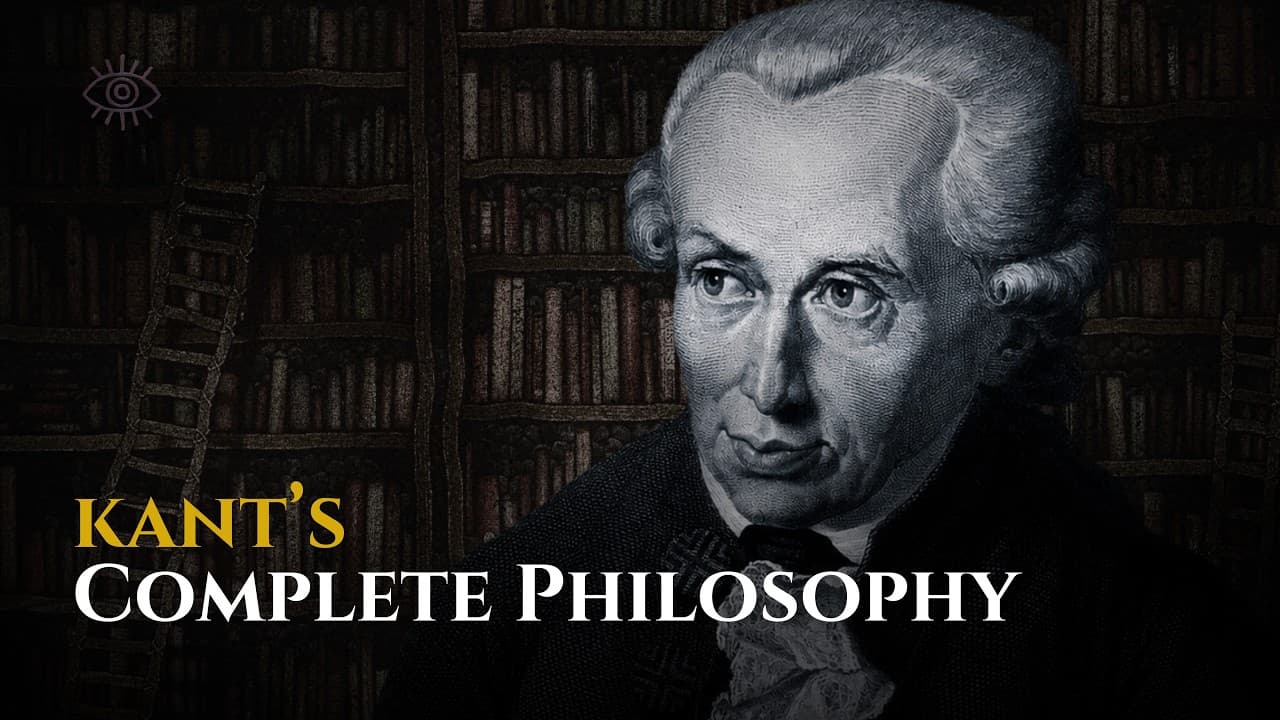
Kant's Complete Philosophy
There is a wall between you and reality. You did not build it. You cannot remove it. It is the structure of your own mind.
We follow Kant from his daily walk through the streets of Konigsberg, where neighbors set their clocks by his passing, to a body of work that reshaped every discipline it touched. We explore the crisis that shattered his faith in rationalist metaphysics and the decade of silence that followed.
We unpack his Copernican revolution in thought, the claim that the mind does not passively receive the world but actively constructs it. We follow him through the Critique of Pure Reason and the architecture of transcendental idealism, through the thing in itself and the boundaries of human knowledge, through the categorical imperative and his account of morality as rational self-legislation, through the demolition of every classical proof of God's existence and the construction of a moral faith to take their place. We examine his philosophy of beauty and the sublime. And we end where Kant ended, with the starry heavens above and the moral law within.
The full episode is on YouTube and Spotify. Please listen only in safe, restful contexts.
Enjoying the episode?
Occasional letters on philosophy, reading, and the examined life. No spam, ever.
By subscribing you consent to receiving occasional emails. Unsubscribe any time via the link in every email or at /unsubscribe.
Timestamps
- 0:00:00Chapter 1: The Clockwork Man of Konigsberg
- 0:16:01Chapter 2: The Dogmatic Slumber
- 0:31:15Chapter 3: The Copernican Revolution
- 0:46:46Chapter 4: The World Behind the World
- 1:02:06Chapter 5: The Moral Law Within
- 1:17:23Chapter 6: The Categorical Imperative
- 1:32:56Chapter 7: Freedom and Duty
- 1:48:47Chapter 8: The Limits of Reason
- 2:03:47Chapter 9: The Beautiful and the Sublime
- 2:19:14Chapter 10: The Starry Heavens Above
For the record
Full Transcript
Chapter 01: The Clockwork Man of Konigsberg
Every afternoon, at exactly half past three, a thin, small man in a grey coat stepped out of his house on Prinzessinstrasse and began to walk. He walked the same route every day, down the same streets, past the same linden trees, at the same unhurried pace. He walked alone. He did not stop for conversation. The citizens of Konigsberg, a modest port city on the Baltic coast of East Prussia, knew his routine so well that they set their clocks by his appearance. When the small man in the grey coat passed your window, it was half past three. You did not need to check. He was more reliable than the church bells. His name was Immanuel Kant, and he was, by the middle of the eighteenth century, the most important philosopher alive. He was also, by almost any external measure, the most uneventful man in Europe. He never married. He never traveled more than fifty miles from the city where he was born. He held no political office, fought in no wars, and conducted no love affairs that history has recorded. He rose at five in the morning, drank tea, smoked a single pipe, prepared his lectures, taught, wrote, received visitors in the afternoon, took his walk, ate dinner, read, and went to bed at ten. He did this for decades. He did it with a regularity that his contemporaries found either admirable or faintly disturbing, depending on their temperament. But the routine was not eccentricity, and it was not compulsion. It was the architecture of a life designed for one purpose: thinking. And the thinking that emerged from that quiet, orderly life would change the course of human intellectual history more decisively than any revolution, any battle, any empire.
Konigsberg in the eighteenth century was a city of bridges and rivers, built on the banks of the Pregel where it widened toward the Baltic Sea. It was not a great European capital. It was not Paris or London or Vienna. It was a commercial city, a university town, a place where merchants traded amber and grain and where professors lectured to modest audiences in draughty halls. The city sat at the northeastern edge of the Prussian kingdom, closer to the forests and marshes of Lithuania than to the cultural centers of western Europe. Seven bridges connected its islands and riverbanks, and the old town clustered around a cathedral whose tower rose above the red-tiled roofs like a finger pointing toward a heaven that Kant would spend much of his life trying to understand. The streets smelled of fish and timber in the summer months, and in winter the Pregel froze solid enough to walk across, turning the waterways that divided the city into paths that joined it together. Ships from England, Holland, and the Scandinavian ports docked at the wharves, bringing goods and ideas from the wider world. It was provincial, but it was not isolated. Its university, the Albertina, founded in 1544, attracted students and scholars from across the Baltic region. Its coffeehouses and salons, modest though they were by the standards of Paris or Berlin, hosted conversations about natural philosophy, theology, politics, and the new sciences that were transforming the European understanding of nature. It was a place where one could live a complete intellectual life without ever needing to leave, and Kant proved this more thoroughly than anyone before or since.
He was born there on the twenty-second of April, 1724, the fourth of nine children in a household that was modest in its means and severe in its piety. His father, Johann Georg Cant, was a harness maker, a craftsman who worked with leather and metal in a small workshop near the river. The family later changed the spelling of their name to Kant. His mother, Anna Regina, was by all accounts the more formidable presence in the household. She was deeply religious, a follower of the Pietist movement that had swept through the Lutheran churches of northern Germany in the early eighteenth century. Pietism emphasized personal devotion, emotional sincerity in worship, and a strict moral discipline that governed every aspect of daily life. It was not a faith of grand cathedrals and elaborate theology. It was a faith of the kitchen table and the evening prayer, of self-examination and moral seriousness, and it shaped the young Kant in ways that would echo through his philosophy for the rest of his life. Even after he moved far beyond the doctrines of his childhood, something of the Pietist insistence on duty, on moral rigor, on the primacy of the inner life over outward display, remained at the core of everything he wrote.
Anna Regina recognized something unusual in her son. She encouraged his education, walking with him through the streets of Konigsberg and teaching him to observe the natural world with care and attention. She pointed out the stars on clear evenings and told him their names. Kant later said that his mother planted the first seeds of his intellectual development and that her influence was the one he most valued. She died in 1737, when Kant was thirteen. He spoke of her for the rest of his life with a tenderness that was unusual for a man who kept most of his emotions at a careful distance from his public persona. She was, he said, a woman of great natural intelligence and genuine goodness, and he never forgot what she had given him.
At the age of eight, Kant was enrolled at the Collegium Fridericianum, a Pietist school whose atmosphere was rigorous to the point of suffocation. The days began before dawn with prayers and hymns and ended with more prayers and hymns. Latin and religious instruction dominated the curriculum. The teachers believed in discipline, in rote memorization, and in the constant surveillance of their students' moral conduct. The boys were watched for signs of spiritual laxity the way sentries watch for approaching enemies. The atmosphere was one of intense, watchful piety, and it left deep marks. Kant endured it for eight years. He excelled academically, particularly in Latin and the Roman classics, developing a love for Lucretius and Cicero that stayed with him throughout his life. But he never looked back on his years at the Fridericianum with warmth. The school's relentless moral oversight, its suspicion of independent thought, its reduction of faith to a set of rules and observances enforced through fear rather than understanding, left him with a lifelong distaste for institutional religion and for any system that demanded obedience without reason. One can see in this early experience the seeds of Kant's later insistence that morality must come from within, from rational conviction, and not from external authority. The boy who had been made to pray on command would grow into the man who argued that genuine moral worth requires freedom.
In 1740, at the age of sixteen, Kant entered the University of Konigsberg. Here, for the first time, his intellectual world opened. The university was not distinguished by European standards, but it had one teacher who mattered enormously: Martin Knutzen, a young professor of logic and metaphysics who introduced Kant to two traditions that would define his philosophical career. The first was the rationalist philosophy of Gottfried Wilhelm Leibniz and his systematic follower Christian Wolff, who had constructed an elaborate metaphysical system that claimed to explain the fundamental structure of reality through pure reason. The second was the new physics of Isaac Newton, whose laws of motion and universal gravitation had transformed the understanding of the natural world. Knutzen was one of the few German philosophers of his generation who took both Leibniz and Newton seriously, and he passed this dual inheritance on to his most gifted student. Kant would spend the next four decades working out the relationship between these two ways of understanding the world: the philosopher's aspiration to grasp reality through reason alone, and the scientist's insistence on grounding knowledge in observation and experience. It was a tension that would eventually produce one of the greatest works of philosophy ever written.
Kant's father died in 1746, leaving the family with almost nothing. Kant had not yet completed his degree, and the next nine years of his life were spent in a kind of genteel poverty that tested his patience but never his resolve. He left the university and took positions as a private tutor for wealthy families in the countryside around Konigsberg, teaching their children mathematics, geography, and the basics of philosophy. He lived in other people's houses, ate at other people's tables, and adapted himself to other people's schedules. It was a humbling existence for a young man who already sensed the scale of his own intellectual ambitions. But the work was not without its compensations. It gave him time to read and to think, and he used that time with an intensity that would characterize everything he did. He read Newton's Principia with the care of a man studying scripture. He read Leibniz and Wolff and began to see the cracks in the great rationalist edifice they had built. He read widely in natural science, in geography, in the literature of travel and exploration. The countryside around Konigsberg was quiet and flat, the sky enormous, and in the evenings Kant could look up at the same stars his mother had once named for him and feel the first stirrings of questions that would take him a lifetime to answer. He returned to Konigsberg in 1755, completed his doctoral dissertation, and received his habilitation, the qualification that allowed him to teach at the university. For the next fifteen years, he worked as a Privatdozent, an unsalaried lecturer who was paid directly by the students who attended his classes. It was a precarious existence. His income depended entirely on his ability to attract students, and he taught an extraordinary range of subjects to keep the numbers up: logic, metaphysics, moral philosophy, natural science, mathematics, physical geography, anthropology, even the theory of fireworks. His lectures were, by all accounts, brilliant. He spoke freely, without notes, with a clarity and vividness that made even the most abstract ideas feel alive. Students packed his lecture halls. He was known not for severity but for wit, for the ability to make philosophy feel urgent and real.
During these years, Kant also developed the social habits that would define his adult life. He was not the recluse that legend sometimes makes him. He dined regularly with friends, enjoyed good food and conversation, and was known for a dry, sharp wit that could light up a dinner table. He was small in stature, barely five feet tall, with a narrow chest and a frame so slight that his tailor had to use special devices to keep his stockings from falling down. But his eyes were extraordinary. Visitors described them as brilliant, penetrating, almost unnervingly clear, the eyes of a man who was always thinking, even when he appeared to be simply listening. He was generous with his friends, loyal in his attachments, and capable of genuine warmth, even if that warmth was always governed by a certain reserve. He would never be a man of passion in the way that Rousseau was, or a man of appetite in the way that Hume was. He was something else entirely: a man whose deepest satisfactions came from the exercise of thought itself.
It was also during this period that Kant was twice offered prestigious professorships at other universities, at Erlangen and at Jena, both of which he declined. He wanted to stay in Konigsberg. He wanted the chair of logic and metaphysics at his own university, the position that Martin Knutzen had once held, and he was willing to wait for it. He waited fifteen years. In 1770, at last, the position was offered to him, and he accepted it with a relief and satisfaction that those who knew him well could plainly see. He was forty-six years old, and he had spent his entire career working toward this moment. Now, finally, he had the security and the standing to devote himself fully to the work that had been growing inside him for decades.
Throughout these years, Kant published widely but had not yet arrived at the ideas that would make him immortal. His early works belong to what scholars call the pre-critical period, a phase of his career in which he was still working within the framework of rationalist metaphysics he had inherited from Leibniz and Wolff. He wrote about the nature of space, about the origins of the solar system, about the existence of God, about the principles of natural science. His Universal Natural History and Theory of the Heavens, published in 1755, proposed a nebular hypothesis for the formation of the solar system that anticipated the later work of Laplace and remains broadly consistent with modern astrophysics. It was a remarkable achievement for a man of thirty-one, and it revealed a mind that was equally at home in the empirical sciences and in speculative philosophy. But Kant was not yet Kant, not yet the thinker who would reshape the foundations of human knowledge. That transformation required a crisis, and the crisis was coming.
He did not know it yet, walking his daily route through the streets of Konigsberg, lecturing to his students, dining with friends in the evening. The small man in the grey coat continued his rounds. The citizens continued to set their clocks. But somewhere beneath the surface of that perfectly ordered life, a question was forming that would take more than a decade to answer, and whose answer, when it finally came, would change everything. The question had been posed by a Scottish philosopher named David Hume, and it struck at the very heart of everything Kant believed about reason, knowledge, and the structure of the world.
Chapter 02: The Dogmatic Slumber
The philosophy that Kant had inherited was a philosophy of supreme confidence. For more than a century, the great rationalist thinkers of continental Europe had been building systems of thought so ambitious that they claimed to explain the entire structure of reality through the power of reason alone. Gottfried Wilhelm Leibniz, the German polymath who had co-invented the calculus and corresponded with nearly every significant thinker in Europe, had constructed a metaphysics of breathtaking scope. He argued that reality consists not of matter but of simple, immaterial substances he called monads, each one a self-contained universe of perception reflecting the whole of creation from its own unique perspective. God, the supreme monad, had arranged the universe in a pre-established harmony so perfect that this was, Leibniz claimed, the best of all possible worlds. It was an extraordinary vision, elegant and totalizing, and it was built entirely from reason. Leibniz did not need to look through a telescope or run an experiment to reach these conclusions. He believed that the fundamental truths of existence could be deduced from first principles, the way a mathematician deduces the properties of a triangle from its definition.
Christian Wolff, Leibniz's most influential follower, took this rationalist project and turned it into a system. Where Leibniz had been brilliant and unsystematic, Wolff was methodical and comprehensive. He organized the whole of philosophy into a vast architecture of defined terms, demonstrated propositions, and logical deductions, covering everything from the nature of the soul to the existence of God to the principles of international law. Wolffian philosophy dominated the German universities for decades. It was taught in the lecture halls of Konigsberg when Kant was a student. It was in the air he breathed as a young intellectual. It formed the framework within which the young Kant first learned to think, and for many years it seemed to him that this framework was essentially correct, that it merely needed refinement rather than replacement. The rationalist tradition offered a vision of philosophy as a discipline that could achieve certainty: certainty about the nature of reality, certainty about the existence of God, certainty about the foundations of morality. All you needed was clear definitions and valid logic, and the entire edifice of human knowledge could be erected on foundations as solid as mathematics.
Kant accepted this framework for years. His early philosophical writings are recognizably Wolffian in their methods, even when they depart from Wolff on specific points. His 1755 dissertation, A New Elucidation of the First Principles of Metaphysical Cognition, works within the rationalist tradition and attempts to clarify its foundations. His Nova Dilucidatio, as it is known in Latin, engages directly with the arguments of Leibniz and Wolff about the principles of sufficient reason and contradiction. These were the tools of rationalist metaphysics, and Kant wielded them with skill. He was, during this period, a conventional metaphysician working within the dominant tradition of his time, refining its arguments, extending its reach, and trusting its fundamental promise: that reason, properly deployed, could tell us the way things really are.
Yet even in these early years, Kant showed a restless independence that hinted at what was to come. His Universal Natural History and Theory of the Heavens, the same work that had proposed a nebular hypothesis for the formation of the solar system, was built not on rationalist deduction but on Newtonian mechanics and observational data. It was the work of a man who took the natural sciences seriously, who believed that the world disclosed itself through observation and not merely through logic. This tension between the rationalist philosopher and the scientific thinker would prove to be the fault line along which Kant's entire intellectual world would eventually crack open.
But across the English Channel, a very different philosophical tradition had been developing, and it carried within it a challenge so powerful that it would eventually shatter the rationalist dream. The British empiricists, beginning with John Locke and continuing through George Berkeley, had argued that all human knowledge begins with experience. The mind at birth is not stocked with innate ideas, as the rationalists had claimed. It is a blank page, a tabula rasa, written on entirely by the senses. Everything we know about the world comes from what we see, hear, touch, taste, and smell. Locke had stated the principle. Berkeley had pushed it in radical directions, arguing that the material world exists only insofar as it is perceived. But neither of them had followed the empiricist argument to its most devastating conclusion. That task fell to David Hume.
Hume, writing in Scotland in the 1730s and 1740s, was the thinker who followed the empiricist method to its most radical conclusions, and in doing so he turned its full force on the concept that held the entire structure of rational inquiry together: causation. We believe that one event causes another. We believe that the sun will rise tomorrow because it has risen every day before. We believe that fire causes heat, that bread nourishes, that a stone released from the hand will fall. These beliefs are so fundamental to our understanding of the world that we rarely think to question them. Hume questioned them. He asked a deceptively simple question: what is the basis for our belief that one event causes another? We observe the fire. We observe the heat. We observe that the heat follows the fire regularly. But do we ever observe the causal connection itself, the necessary link between the fire and the heat? We do not. We observe a pattern, a regular succession. Fire, then heat. Fire, then heat. Fire, then heat. But the idea that there is a necessary connection between them, that the fire must produce the heat, is something we add to the observation. It is a habit of the mind, not a feature of reality. We expect the heat because we have seen it follow the fire many times before. But our expectation is based on custom, not on reason. There is no logical necessity in the connection. We can conceive of fire without heat without contradiction. The belief in causation, Hume concluded, is a psychological habit, not a rational insight.
The implications were catastrophic for rationalist metaphysics. If causation is a habit of the mind rather than a feature of reality, then the entire enterprise of reasoning from causes to conclusions about the fundamental structure of the world collapses. You cannot prove the existence of God by arguing from the existence of the world to the necessity of a first cause, because the concept of a necessary cause is itself ungrounded. You cannot deduce the nature of the soul by reasoning about substances and their properties, because the concept of a substance causing its own states is equally suspect. The whole grand edifice of metaphysics, from Aristotle through Leibniz and Wolff, rested on the assumption that reason could trace the causal structure of reality. Hume had shown that reason cannot even justify the concept of causation on which the whole project depends.
Kant encountered Hume's arguments, and they struck him with the force of a revelation. He would later describe the experience in his Prolegomena to Any Future Metaphysics, published in 1783, with a candor that is rare among philosophers. "I freely admit," he wrote, "that the remembrance of David Hume was the very thing that many years ago first interrupted my dogmatic slumber and gave a completely different direction to my researches in the field of speculative philosophy." The metaphor of sleep is precise. Kant had been dreaming the rationalist dream, the dream that pure reason could unlock the secrets of reality. Hume woke him up. The dream was over. But Kant did not simply accept Hume's conclusions and abandon philosophy, as a lesser thinker might have done. He recognized that Hume had posed a genuine problem, perhaps the most important problem in the history of philosophy. But he also believed that Hume's own solution was inadequate. Reducing causation to mere habit left science without foundations. If causal reasoning is nothing more than psychological custom, then Newton's physics has no more rational authority than a superstition. The laws of nature become mere regularities that we happen to have noticed, not truths about the world that we have discovered. Kant could not accept this. He had spent years studying Newton. He knew that the Principia was not a catalogue of habits. Newton's achievements were real. The sciences were not mere collections of customs and expectations. There had to be a way to vindicate rational inquiry without falling back into the dogmatic metaphysics that Hume had rightly challenged.
This was the problem that consumed Kant for the next decade. Between 1770 and 1781, a period scholars sometimes call the silent decade, Kant published almost nothing of philosophical significance. For a man who had been producing works at a steady pace for twenty years, this silence was remarkable. His friends and colleagues noticed. Marcus Herz, a former student who had become a physician and philosopher in Berlin, corresponded with Kant throughout this period and received letters that hinted at the enormous scope of what Kant was attempting. In one letter from 1772, Kant described the central problem he was trying to solve: how do representations in the mind relate to objects that exist independently of the mind? It was a question that cut to the very heart of knowledge itself. Some wondered whether he had given up. He had not. He was thinking. He was working through the deepest problem he had ever encountered, and he was doing it with a thoroughness that would not allow him to publish until he had found an answer he could stand behind. The question was not simply about causation. It was about the possibility of knowledge itself. How can the human mind know anything about the world? If the rationalists are right that reason alone can reach truth, then why do their systems disagree with one another and produce no settled conclusions? If the empiricists are right that all knowledge comes from experience, then why does mathematics work, and why do the laws of physics seem to hold with a necessity that mere experience cannot justify?
The silent decade was not truly silent, of course. Kant continued to lecture, continued to dine with friends, continued to walk his afternoon route through the streets of Konigsberg. But the writing stopped, or rather, the publishing stopped. The writing itself continued at a furious pace, in notebooks and on loose sheets of paper, in the margins of the books he was reading, in letters to Herz and to other correspondents. He was building something vast, and he would not release it until every piece was in place.
The turning point had come in 1770, when Kant published his Inaugural Dissertation, the work that secured his appointment as professor of logic and metaphysics at Konigsberg, a position he had been seeking for over a decade. The Dissertation marks a crucial moment in his development. In it, Kant drew a distinction between two kinds of knowledge: sensible knowledge, which comes through the senses and deals with things as they appear to us, and intellectual knowledge, which comes through reason and deals with things as they are in themselves. This was already a departure from both the rationalists and the empiricists. The rationalists had claimed that reason gives us access to reality as it truly is. The empiricists had claimed that only the senses give us knowledge, and that reason is merely a tool for organizing sensory data. Kant was beginning to see that both sides had grasped part of the truth but that neither had the whole picture. The senses give us the world as it appears. Reason tells us something about how the mind itself is structured. The question was how these two sources of knowledge relate to one another, and whether there is a way to bring them together that avoids the failures of both traditions.
It would take Kant eleven more years to work out his answer. Eleven years of daily walks along the Pregel, daily lectures to his students at the Albertina, daily dinners with friends, and nightly hours at his desk in the quiet of his study, writing and rewriting, testing every argument, following every implication, refusing to settle for anything less than a solution that could withstand the full force of Hume's challenge. The result, when it finally appeared in May of 1781, was a book of nearly eight hundred pages that Kant himself admitted was dry, obscure, and extraordinarily difficult to read. He called it the Critique of Pure Reason. It is one of the most important books ever written. It changed philosophy the way Newton changed physics, the way Darwin would later change biology. It did not just add new ideas to the existing conversation. It changed the terms of the conversation itself. And it began with a single insight, so simple in its formulation and so radical in its consequences, that once you understand it, you cannot think about the world in quite the same way again.
Chapter 03: The Copernican Revolution
For centuries, astronomers had assumed that the Earth stood still and the heavens moved around it. The stars wheeled overhead, the sun rose and set, and the whole elaborate machinery of the cosmos seemed to revolve around the fixed point where the observer stood. Copernicus reversed the assumption. He proposed that the apparent motion of the heavens could be explained more simply and more accurately if the Earth itself was moving. The observer is not stationary. The observer is in motion, and the motion of the observer shapes everything the observer sees. Kant took this principle and applied it to the human mind. For centuries, philosophers had assumed that in knowing the world, the mind passively conforms itself to objects. We look out at reality, and if our minds are working properly, they receive an accurate picture of what is there. Knowledge is a mirror. The mind reflects what exists. Kant reversed the assumption. He proposed that it is not the mind that conforms to objects but objects that conform to the mind. The structure we perceive in the world, the order, the regularity, the causal connections, the spatial and temporal framework within which everything appears, is not simply given to us by reality. It is contributed by the mind itself. We do not discover structure in the world. We impose structure on the world. Or, more precisely, the mind and the world collaborate in producing experience, and the mind's contribution is so fundamental that we can never subtract it to see what reality looks like without it.
This is the Copernican revolution in philosophy, and it is the central insight of the Critique of Pure Reason. It sounds abstract when stated in general terms. But consider what it means in practice. You are lying in a room right now, and that room exists in space. The bed has a definite position, the walls are at definite distances, and the objects around you are arranged in a three-dimensional framework that feels as solid and objective as anything could be. Space seems like a feature of reality itself, something that would exist whether or not anyone were there to perceive it. Kant's claim is that this is wrong. Space is not a property of the world as it exists independently of you. Space is a form that your mind imposes on all sensory experience. It is the way your mind organizes what it receives through the senses. You cannot experience anything that is not in space, not because everything is in space, but because your mind is incapable of processing experience in any other way. Space is a condition of your experience, not a feature of reality independent of experience.
The same is true of time. Every experience you have ever had occurred in a temporal sequence: before and after, earlier and later, now and then. Time seems like the most basic feature of existence, the medium in which all events unfold. You remember yesterday. You anticipate tomorrow. The present moment flows ceaselessly into the past, and the future flows ceaselessly into the present. This temporal flow seems as objective and mind-independent as gravity. Kant argues that it is not. Time, like space, is not a property of things as they are in themselves. It is a form of human sensibility, a condition that the mind imposes on everything it experiences. You cannot perceive anything outside of time, but this tells you something about the structure of your mind, not about the structure of reality independent of your mind. If you could somehow remove the contribution of the human mind from experience, both space and time would vanish. They are the lenses through which we see, not features of what is seen.
Think about what this means for a moment. The room you are in right now feels spatial in the most obvious and undeniable way. The distance between the walls, the position of the furniture, the three-dimensional shape of every object: these seem like facts about the world, not facts about your mind. Kant is claiming that they are both. They are facts about how the world appears to a mind that is structured to perceive spatially. A different kind of mind, if such a thing could exist, might not experience space at all. It might experience reality in some way we cannot even conceive. But we are the kinds of beings we are, and for us, space is the inescapable framework of all outer experience.
Kant called space and time the pure forms of sensible intuition. The word "intuition" here does not mean a hunch or a feeling, as it does in ordinary English. It means a direct presentation of an object to the mind through the senses. Every time you perceive something, that perception is already structured by space and time before the mind does anything else with it. They are the first layer of the mind's contribution to experience. Kant worked out these claims in the opening section of the Critique of Pure Reason, a section he called the Transcendental Aesthetic. The word "aesthetic" here comes from the Greek for perception or sensation. And the word "transcendental" does not mean mystical or otherworldly. In Kant's specific usage, it means: concerned with the conditions that make experience possible. The Transcendental Aesthetic is the investigation of the conditions of perception. And its conclusion is that space and time are those conditions. They are not learned from experience. They are what make experience possible in the first place.
But space and time are only the beginning. They are the contribution of what Kant called sensibility, the mind's capacity to receive impressions from the world. But the mind does not simply receive a stream of sensations organized in space and time and leave it at that. The mind also thinks about what it perceives. It connects perceptions, organizes them into objects, identifies causal relationships, distinguishes between what is real and what is merely imagined. This is the work of the understanding, and Kant argued that the understanding, like sensibility, makes its own contribution to experience. It contributes what he called the categories: the basic concepts that the mind uses to organize experience into a coherent, intelligible world. Causation is one of these categories. Substance is another. Unity, plurality, necessity, possibility, existence, negation: these are all categories of the understanding. Kant identified twelve of them in total, organized into four groups, and he argued that they correspond to the basic forms of logical judgment. They are not derived from experience. They are not habits or customs or learned associations. They are what the mind brings to experience in order to make sense of it.
Consider causation again, the very concept that Hume had attacked and that had set this entire revolution in motion. Hume argued that we never perceive a causal connection between events. We see one billiard ball strike another. We see the second ball move. We see the sequence repeated many times. And we form a habit of expecting the same sequence in the future. But we never see the force, the power, the necessary link between the impact and the motion. Kant agreed that we never perceive causation as a bare sensory impression. But he drew a radically different conclusion. The fact that we cannot perceive causation through the senses does not mean that causation is merely a habit. It means that causation belongs to a different order of the mind's activity. Causation is a category of the understanding, a concept that the mind applies to experience in order to make experience intelligible. Without the concept of causation, experience would be a meaningless stream of unconnected events. Things would happen, one after another, but nothing would happen because of anything else. There would be no explanation, no prediction, no science, no understanding of why the world behaves as it does. The mind imposes causal order on experience because without causal order, experience would not be experience at all. It would be chaos.
This is Kant's answer to Hume, and it is one of the most powerful arguments in the history of philosophy. Hume was right that causation is not simply read off the surface of experience like a color or a shape. But Hume was wrong to conclude that causation is therefore nothing more than a psychological habit. Causation is a necessary condition of coherent experience. It is something the mind must contribute in order for experience to be possible. This is what Kant means by a synthetic a priori judgment, a piece of knowledge that tells us something genuinely informative about the world, something synthetic, that we can know independently of any particular experience, something a priori. Every event has a cause. This is not an empty logical truth like "all bachelors are unmarried." It tells us something substantial about the world. But we do not learn it from experience. We bring it to experience. It is the framework within which experience becomes possible.
The idea of knowledge that is both genuinely informative about the world and yet knowable independently of any particular experience was perhaps Kant's single most revolutionary contribution to philosophy. It is the hinge on which the entire Critique of Pure Reason turns. The rationalists had claimed that we could have a priori knowledge of reality through pure reason. Hume had denied that a priori knowledge could tell us anything about the actual world. Kant found a middle path, and it was a path that neither side had imagined. We do have knowledge that is independent of experience, but that knowledge is not about reality as it is in itself. It is about the structure of experience, the framework that the mind contributes to everything we perceive. We can know with certainty that every event we experience will have a cause, not because causation is a feature of reality independent of the mind, but because the mind cannot produce coherent experience without applying the concept of causation. We can know with certainty that everything we experience will be in space and time, not because space and time are features of things in themselves, but because space and time are the forms of our sensibility.
This changes the nature of knowledge itself. It is a transformation so profound that philosophy has never fully recovered from it. Before Kant, philosophers had assumed that knowing meant grasping reality as it is. After Kant, knowledge is understood as a collaboration between the mind and whatever reality presents to the mind. We can know the world as it appears to us with genuine certainty and precision. The sciences are valid. Mathematics is valid. The laws of physics are real laws, not mere habits. But they are laws of the world as it appears to human minds, not laws of reality as it exists independent of any mind. The price of saving knowledge from Hume's skepticism is accepting a limit on what knowledge can achieve. We can know how the world appears. We cannot know what the world is in itself, apart from the structures that our minds impose on it.
Kant gave a name to this view of the relationship between mind and world. He called it transcendental idealism. The word "idealism" is misleading if you are accustomed to its ordinary English meaning. Kant is not saying that the world is a dream, or that it exists only in our heads, or that reality is somehow less real than we think it is. He is saying that the world as we experience it, the world of objects in space and time connected by causal laws, is a product of the interaction between the mind and something that exists independently of the mind. The trees outside your window are real. The floor beneath your feet is real. The mind's contribution to how those things appear is also real. What exists independently of the mind is also real. But we can never experience the latter in its pure form, because every experience we have is already shaped by the former. You can never take off the lenses. You can never see what the world looks like without them. You can only know that you are wearing them, and that everything you see bears their imprint.
We might wonder whether this is a limitation or a liberation. Kant believed it was both. It limits what philosophy can claim to know. No more grand metaphysical systems deducing the nature of God, the soul, and the universe from pure reason. Those questions lie beyond the boundary of what human knowledge can reach. But it also liberates the sciences from skeptical doubt. The laws of physics are not mere habits. They are genuine knowledge of the world as it appears to us, grounded in the necessary structures of the human mind. And it liberates philosophy itself from centuries of fruitless argument about questions it was never equipped to answer. The Critique of Pure Reason is, among other things, an explanation of why philosophers have been arguing about the same questions for thousands of years without reaching agreement. They have been trying to use reason to answer questions that lie beyond reason's reach. The solution is not to abandon reason but to understand its proper scope. Reason is an extraordinary instrument, perhaps the most extraordinary instrument any creature has ever possessed. But like any instrument, it has limits. And knowing those limits, Kant would argue, is the beginning of wisdom. What lies on the other side of those limits is a question that the Critique of Pure Reason raises but cannot answer. It is a question about the world behind the world.
Chapter 04: The World Behind the World
If the mind shapes everything we experience, then there is a question that follows with an almost unbearable force: what is the world actually like, apart from the mind's contribution? What would reality look like if we could somehow strip away the structures of space, time, and causation that the mind imposes on it? What is the thing behind the appearance, the reality behind the phenomenon? Kant had a name for this reality. He called it the thing in itself, the Ding an sich. And his answer to the question of what it is like was as honest as it was unsettling. We cannot know. We can never know. The thing in itself is real, as real as anything could be, but it is permanently and necessarily beyond the reach of human cognition. Not because our minds are weak. Not because we need better instruments or more data. But because the very act of knowing involves imposing the mind's own structures on whatever is known, and there is no way to perform that act and at the same time see what the object looks like without those structures. Knowledge is always knowledge of appearances. The thing in itself remains forever on the other side.
This is one of the most frequently misunderstood claims in the history of philosophy. People hear that Kant says we cannot know reality as it is in itself, and they imagine something like a curtain hanging between us and the real world, a curtain that could in principle be pulled aside if only we were clever enough or patient enough. They imagine the thing in itself as a hidden object sitting behind the visible world, like a stage set with the machinery concealed backstage. But this is not what Kant means. The thing in itself is not an object hiding behind another object. It is a concept that marks the limit of human knowledge. It is the recognition that everything we experience is the product of a collaboration between the mind and whatever reality presents to it, and that we can never isolate reality's contribution from the mind's. The curtain metaphor fails because it implies that the curtain could be removed. Kant's point is that the lenses cannot be removed. They are not accessories. They are the eyes themselves.
It is important to understand that Kant's position is not the same as the idealism of George Berkeley, the Irish philosopher who had argued a generation earlier that material objects exist only in the mind, that to be is to be perceived. Berkeley denied the existence of a mind-independent reality altogether. Kant does no such thing. Kant insists that there is a reality independent of the mind. His claim is only that we cannot know what that reality is like in itself, because all of our knowledge is filtered through the mind's own structures. The world is real. The objects we encounter are real. But the way they appear to us is shaped by us. This position is subtle, and it was misunderstood even in Kant's own time. He was so frustrated by the charge of Berkeleyan idealism that he added an entire section to the second edition of the Critique of Pure Reason in 1787, the Refutation of Idealism, in which he explicitly distinguished his position from Berkeley's.
Kant drew a careful distinction between two ways of thinking about objects. An object considered as it appears to us, structured by space, time, and the categories of the understanding, is what he called a phenomenon. An object considered as it might be in itself, independent of any mind's contribution, is what he called a noumenon. The world of phenomena is the world we live in, the world of science, the world of everyday experience, the world in which objects have shapes and colors and causal powers and positions in space. This world is fully knowable. The sciences investigate it with legitimate authority, and their results are genuine knowledge. The noumenal world, by contrast, is not a separate world located somewhere else. It is the same world considered from a perspective we can never actually occupy: the perspective of a mind that does not impose its own structures on what it knows. We can think the noumenon. We can form the concept of a thing as it is in itself. The concept is perfectly coherent as a thought. But we cannot know it, because knowing always involves imposing the forms of sensibility and the categories of the understanding, and these are precisely what the noumenon is defined as being independent of. Thinking and knowing are not the same thing. We can think many things we cannot know. We can think about God, about the soul, about the universe as a totality. But thinking is not knowledge until it is connected to the deliverances of sensory experience, and the noumenon, by definition, never shows up in sensory experience.
This is a position of extraordinary philosophical discipline. It asks us to accept that the world we live in, the world of solid objects and flowing time and reliable causes, is genuine and knowable, while simultaneously accepting that there is something beyond it that we will never reach. It asks us to be satisfied with knowledge of appearances while acknowledging that appearances are not all there is.
This raises a question that Kant's critics have pressed for more than two centuries. If we cannot know anything about the thing in itself, then how do we even know it exists? How can Kant claim that there is something beyond the reach of knowledge if he cannot know anything about it? It seems like a contradiction: to say anything at all about the thing in itself, even to say that it exists, seems to require exactly the kind of knowledge that Kant says is impossible. This objection was raised by some of Kant's most brilliant contemporaries, including Johann Gottlieb Fichte, who would go on to develop German Idealism partly as a response to this problem. Kant's answer, though he never stated it as clearly as his readers might have wished, was that the thing in itself is not so much a positive claim about what exists as a necessary limitation on what we can claim to know. We know that our experience is structured by the mind. Therefore, we know that the world as we experience it is not identical to the world as it is in itself. The thing in itself is not an object of knowledge. It is the marker of a boundary, a concept that functions as a limit rather than as a description. It tells us where knowledge stops. And knowing where knowledge stops is itself a form of knowledge, perhaps the most important form of all.
There is something deeply honest about this position, and something that connects it to the most basic human experience of living in a world that always seems to exceed our understanding of it. We have all had the feeling that there is more to reality than what we can see or measure or describe. We have all looked at the night sky and felt, however fleetingly, that the universe contains depths we will never fathom. Kant is not validating every mystical intuition or religious feeling that trades on this sense of hidden depths. He is making a precise philosophical claim. The mind structures experience according to its own forms. Therefore, the world as it is in itself, whatever that might mean, is systematically beyond the reach of the mind's knowledge. This is not a failure of nerve or a retreat from ambition. It is intellectual honesty pushed to its logical conclusion, the kind of honesty that few philosophers before Kant had the courage to sustain.
One of the most important consequences of this position appears in a section of the Critique of Pure Reason that Kant called the Transcendental Dialectic. If the understanding works legitimately within the bounds of possible experience, applying the categories to the data of the senses, the problems begin when reason tries to go beyond experience and answer the ultimate questions of metaphysics. Reason has a natural tendency to push beyond the limits of experience, to ask about the totality of things, to seek the unconditioned ground of everything that is conditioned. It asks: is the universe infinite or finite? Does it have a beginning in time or has it existed forever? Is there a first cause or does the chain of causes stretch back without end? Is the soul a simple, indivisible substance, or is it composed of parts? These are the questions that traditional metaphysics had spent centuries trying to answer, and reason seems naturally drawn to them. They feel like the deepest and most important questions a thinking being can ask.
Kant's claim is that reason cannot answer these questions, and that its attempts to do so produce a very specific kind of failure. When reason tries to determine whether the world is infinite or finite, it can construct equally valid arguments on both sides. The world must be infinite, because any boundary would require something beyond it. The world must be finite, because an actually infinite series can never be completed. Both arguments are logically sound. Both conclusions are supported by reasoning that follows the rules. But they contradict each other. Kant called these contradictions antinomies, and he identified four of them. The first two concern the extent of the world in space and time and the divisibility of matter. The third concerns freedom and determinism. The fourth concerns the existence of a necessary being. In each case, reason generates a thesis and an antithesis that are equally defensible, and the resulting contradiction cannot be resolved within the framework of pure reason alone.
The antinomies are not just logical curiosities. They reveal something profound about the nature of reason itself. Reason is built to seek the unconditioned, the ultimate explanation, the final ground. This is what reason does. It takes every answer and asks the further question. It takes every cause and asks what caused the cause. It cannot rest in the conditioned. It drives toward the unconditioned with a necessity that feels irresistible. But the unconditioned lies beyond the limits of possible experience. Space and time, as forms of sensibility, are forms of possible experience. The categories of the understanding apply only within possible experience. When reason reaches beyond these limits, it is operating without the constraints that give its conclusions validity. It is like a bird that, feeling the resistance of the air against its wings, imagines it could fly even better in a vacuum. The resistance of experience is not what holds reason back. It is what holds reason up.
The third antinomy is particularly significant and deserves a moment of attention, because it concerns human freedom. The thesis states that there must be a causality through freedom, a power to begin a chain of events spontaneously, without being determined by any prior cause. The antithesis states that there is no freedom, that everything in nature happens according to the laws of necessity. If we live in a purely phenomenal world governed by strict causal laws, then freedom is impossible. Every action we take is the inevitable result of prior causes stretching back to the beginning of time. But if the noumenal world is not subject to the same causal laws as the phenomenal world, then there is room, at least in principle, for a kind of causality that operates outside the chain of natural causes. Kant will return to this idea with full force in his moral philosophy, and it will prove to be one of the most important moves in his entire system.
The solution to the antinomies, Kant argued, lies in recognizing that the questions themselves are malformed. They assume that the world as it is in itself is either infinite or finite, either determined or free, either grounded in a necessary being or not. But these categories apply only to the world as it appears to us, the phenomenal world. The world as it is in itself is not the kind of thing that can be either infinite or finite in the way the question supposes, because the concepts of infinity and finitude are concepts the understanding applies within experience, and the totality of the world is not an object of possible experience. The antinomies dissolve once we stop treating the noumenal world as if it were subject to the same categories as the phenomenal world.
This might sound like Kant is dodging the questions rather than answering them. In a sense, he is. But the dodge is principled. Kant is not saying that these questions do not matter. He is saying that trying to answer them with the tools of pure theoretical reason is like trying to weigh a color or hear a shape. The tools are real. The ambition is understandable. But the application is wrong. The great metaphysical questions are not questions that reason can settle by constructing arguments from first principles. They require a different approach entirely, and Kant believed he had found that approach, not in theoretical reason but in practical reason, in the demands of morality. The world behind the world cannot be known through pure thought. But it can be approached through action, through the moral life, through the exercise of a will that is free precisely because it operates in a domain that the causal laws of nature do not reach. The boundary that theoretical reason draws is not a wall. It is a doorway. And what lies on the other side, what reason alone cannot reach but the moral will can, is the domain of practical philosophy, the philosophy of how we ought to live.
Chapter 05: The Moral Law Within
In the conclusion of the Critique of Practical Reason, published in 1788, Kant wrote a sentence that has become one of the most quoted passages in all of philosophy. "Two things fill the mind with ever new and increasing admiration and reverence, the more often and more steadily one reflects on them: the starry heavens above me and the moral law within me." It is a sentence that captures something essential about Kant's vision of the human condition. We are creatures who look up at the night sky and feel awe at the vastness of the universe, at the countless stars burning across distances we can barely comprehend. And we are creatures who look inward and find, in the depths of our own consciousness, a law that tells us what we ought to do, a law we did not choose, a law we did not create, a law that binds us simply because we are rational beings. The starry heavens remind us how small we are. The moral law reminds us how significant we are. For Kant, both sources of awe point toward the same truth: that human beings occupy a unique position in the order of things, simultaneously part of nature and yet capable of rising above nature through the exercise of reason.
The passage is carved on Kant's tombstone in Konigsberg, and for good reason. It captures the two poles around which his entire philosophical system revolves. The first pole is the natural world, the world of phenomena, the world explored by the sciences and bounded by the limits of human cognition. The second pole is the moral world, the world of freedom and duty and rational self-determination. Kant spent the first Critique mapping the boundaries of the first. He spent the rest of his career exploring the second.
The Critique of Pure Reason had established the boundaries of what we can know. It showed that the human mind shapes all experience and that reality as it is in itself lies beyond the reach of theoretical knowledge. But Kant did not build this boundary only to stand behind it. The limitation of theoretical reason was, in his view, the necessary first step toward making room for something else entirely: the claims of morality. If the natural world is a closed system of causes and effects, governed by the strict laws of necessity that Newton had described with such precision, then there seems to be no room for freedom. No room for genuine moral choice. No room for the idea that we are responsible for what we do. Every action would be the inevitable product of prior causes, and praise and blame would be as meaningless as praising a river for flowing downhill. But Kant had shown that the natural world, the world as it appears to us, the phenomenal world, is not all there is. The noumenal world, the world as it is in itself, is not subject to the causal laws of nature. And it is in the noumenal world, Kant argues, that freedom resides. We are natural creatures, subject to the laws of physics and biology. But we are also rational agents, capable of acting not merely from desire or instinct but from principle. And this capacity for principled action is what makes morality possible.
Kant's moral philosophy begins not with rules or commandments or appeals to divine authority. It begins with a question that anyone who has ever struggled with a moral decision has asked: what makes an action morally good? The answer he gives is deceptively simple. The only thing that is good without any qualification is a good will. Not intelligence, which can be used for evil purposes. Not courage, which can serve a villain as well as a hero. Not happiness, which can result from wrongdoing as easily as from virtue. Not wealth, not power, not talent, not even kindness, which can be misdirected or self-serving. The only thing that is good in itself, in all circumstances and without exception, is the will to do what is right because it is right. This is the good will, and it is the foundation of Kant's entire moral system.
This is a striking claim, and it goes against many of our ordinary intuitions about what makes things good. We tend to think that happiness is the highest good, or perhaps love, or perhaps the well-being of the greatest number of people. Kant argues that all of these are good only conditionally. Happiness is good if it is deserved, but the happiness of a tyrant who takes pleasure in cruelty is not good. Love is good if it is directed wisely, but blind love can cause enormous harm. Even the well-being of the majority is good only if it is achieved through just means. The good will alone is unconditionally good. It shines by its own light, as Kant puts it, like a jewel. Even if the good will accomplished nothing at all, even if by some misfortune it were entirely powerless to achieve its aims, it would still shine by its own light as something that has its full value in itself.
The concept of the good will leads directly to one of the most important distinctions in Kant's ethics: the distinction between acting from duty and acting from inclination. Consider a shopkeeper who gives honest change to every customer. If the shopkeeper does this because it is good for business, because dishonesty would eventually be discovered and would cost him customers, then the action is legal and prudent, but it has no moral worth. The shopkeeper is doing the right thing, but for the wrong reason. The motive is self-interest, not duty. Now consider a shopkeeper who gives honest change even when it would be easy and profitable to cheat, and who does so because honesty is the right thing to do, regardless of the consequences. This shopkeeper acts from duty. The action has the same external appearance in both cases. The difference lies entirely in the motive.
This is a distinction that many readers find initially puzzling and even distasteful. It seems to devalue kindness and generosity and to elevate a cold, mechanical compliance with rules. But Kant is making a subtler point than it first appears. He is not saying that we should never feel good about doing the right thing. He is not saying that emotions have no place in moral life. He is saying that the moral worth of an action depends on its motive, and that the only motive that confers genuine moral worth is the motive of duty. If you help a stranger because you feel a warm glow of sympathy, your action is praiseworthy in a general sense, but it does not have the specific moral value that comes from acting because helping is the right thing to do. The sympathetic person might not help when the warm glow is absent, when helping is inconvenient, when the stranger is unappealing. The person who acts from duty helps because duty requires it, regardless of how they feel, regardless of whether anyone is watching, regardless of whether they will be thanked. This makes duty-based action more reliable than inclination-based action, and it makes it morally superior.
Consider a more challenging example. Imagine a person who is deeply depressed, who finds no joy in life, who feels no natural sympathy for others and no inclination toward generosity or kindness. If this person, despite their depression, despite the complete absence of any inclination to help, nevertheless performs an act of kindness because they recognize it as their duty, then this action, Kant argues, has genuine moral worth. In fact, it has more moral worth than the same action performed by someone who is naturally kind and generous, because the depressed person's action is motivated purely by duty, uncorrupted by any self-serving emotion. This might seem harsh or counterintuitive. Most moral theories prize natural warmth and generosity. Kant is not dismissing these qualities. He is making a precise philosophical point: the moral worth of an action cannot depend on feelings we do not control. We do not choose our inclinations. We do not choose to feel sympathetic or cheerful or generous. These are features of our temperament, shaped by genetics and upbringing, and they come and go without our permission. But we can always choose to act from duty. The will is free. The will can determine itself according to rational principle regardless of what the emotions are doing. And it is this capacity for rational self-determination that gives human beings their unique dignity.
There is a feeling that accompanies the recognition of duty, and Kant gave it a name: respect. Respect for the moral law is not an ordinary emotion like love or fear or desire. It is a unique feeling that arises directly from the awareness that there is something we ought to do, regardless of whether we want to do it. When we recognize a moral obligation, we feel the pull of the law on our will. We feel its authority. And this feeling of authority, this awareness that the moral law commands us simply because we are rational beings, is what Kant calls respect. It is the one feeling that is entirely rational in its origin, because it is produced by reason's own recognition of the law it gives to itself. Every other moral motivation is contingent. Respect for the law is necessary.
Kant's ethics has sometimes been caricatured as a philosophy of grim obligation, a moral system in which joy is suspect and warmth is irrelevant. This is a misreading. Kant is not saying that the morally good person must be joyless or that happiness is the enemy of duty. He is saying something more precise and more defensible: that the moral worth of an action lies in its motive, not in the feelings that accompany it. If you happen to feel joy in helping others, so much the better. But the moral worth of your help does not come from the joy. It comes from the recognition that helping is the right thing to do. The feelings are welcome companions on the moral journey. They are not the engine that drives it.
This leads to a question that Kant knew his readers would ask: what does duty actually require? If the moral worth of an action lies in its motive rather than its consequences, and if the motive must be duty rather than inclination, then what is the content of duty? What does the moral law actually tell us to do? Kant's answer to this question is the categorical imperative, the supreme principle of morality, and it is one of the most important ideas in the history of ethical thought. But before turning to it, it is worth pausing to appreciate what Kant has already achieved. He has located the source of moral value not in the external world, not in the consequences of actions, not in the commands of God, not in social convention, but in the rational will itself. Morality comes from within. It comes from the capacity of a rational being to determine its own actions according to a principle that reason itself supplies. This is a radical claim, perhaps the most radical claim in the history of ethics. It means that morality does not depend on religion. It does not depend on culture or tradition or social agreement. It does not depend on anything external to the rational agent. A being capable of reason is, by that very fact, capable of morality. It does not matter where that being was born, what language it speaks, or what gods it worships. The moral law is not something imposed from outside. It is something that reason discovers within itself, as naturally and as inevitably as the eye discovers light.
Kant laid out these ideas most clearly in his Groundwork of the Metaphysics of Morals, published in 1785, three years before the second Critique. The Groundwork is a short book, barely a hundred pages, but it is among the most densely argued works in the history of philosophy. Every sentence carries weight. Every paragraph advances the argument. It was written in Konigsberg during a period of extraordinary intellectual productivity, when Kant was in his early sixties and at the height of his powers. He had already published the first edition of the Critique of Pure Reason and was now turning to the moral questions that he considered equally important, perhaps more important, than the questions of knowledge and metaphysics. Kant wrote the Groundwork with the explicit purpose of identifying and establishing the supreme principle of morality, and he pursued this goal with the same rigor he had brought to the first Critique. The Groundwork begins with the concept of the good will and the distinction between duty and inclination, works through the formulation of the categorical imperative, and concludes with an account of freedom and autonomy that ties the moral philosophy back to the theoretical philosophy. It is a masterpiece of philosophical architecture, and it remains, after nearly two and a half centuries, one of the most read and most debated texts in ethical theory.
What Kant found when he looked into the nature of moral duty was not a list of rules or commandments handed down from heaven. It was something far more startling. It was a principle, a single test that any proposed action must pass in order to count as morally permissible. A test that any rational being, anywhere, at any time, could apply. A test that depends on nothing but reason itself. That test, and all that it implies, is what comes next.
Chapter 06: The Categorical Imperative
The test that Kant proposed is stated in a single sentence, and it is a sentence that has been debated, defended, attacked, and analyzed for nearly two hundred and fifty years. "Act only according to that maxim by which you can at the same time will that it should become a universal law." This is the categorical imperative, the supreme principle of Kantian morality, and it is one of the most ambitious ideas in the history of ethical thought. It claims to provide a single, universal test for the moral permissibility of any action. Not a rule that applies in some situations and not others. Not a guideline that bends to circumstances. A test that applies everywhere, to everyone, at all times, because it is grounded in the very nature of rational thought itself.
The word "categorical" is crucial, and understanding it requires a moment of philosophical precision. Kant distinguished between two kinds of imperatives, two kinds of commands that reason gives to the will. A hypothetical imperative tells you what to do if you want to achieve a certain goal. If you want to stay healthy, exercise. If you want to pass the exam, study. These imperatives are conditional. They apply only if you have the relevant desire or goal. If you do not care about your health, the imperative to exercise has no force over you. A categorical imperative, by contrast, commands unconditionally. It does not say "do this if you want such-and-such." It says "do this." Period. Its authority does not depend on your desires, your goals, your circumstances, or your feelings. It applies to you simply because you are a rational being. And because it is unconditional, it is universal. It applies to every rational being in the same way.
But what does the categorical imperative actually mean in practice? The formula can seem forbiddingly abstract when you first encounter it. It can sound like a piece of logical machinery that has nothing to do with the messy reality of moral life. But Kant intended it to be used. He intended it as a practical tool, something any rational person could apply in the ordinary course of making decisions. The procedure is straightforward. Before you act, identify the principle on which you are about to act. Kant calls this the maxim of your action. Then ask yourself whether you could will that this principle should become a universal law, a rule that everyone follows in the same circumstances. If you can consistently will the universalization of your maxim, then your action is morally permissible. If you cannot, then it is not.
Consider the example Kant himself used most famously: the lying promise. You need money, and you know you cannot repay a loan. You are considering promising to repay the money with no intention of keeping your promise. The maxim of your action might be stated as follows: whenever I need money, I will make a false promise to repay it. Now ask: can you will that this maxim should become a universal law? Can you will that everyone in need of money should make false promises to repay? If everyone did this, the institution of promising would collapse. No one would believe a promise, because everyone would know that promises are made without any intention of fulfillment. But if no one believes promises, then your own false promise would not work either. You are relying on the institution of promising while simultaneously acting in a way that would destroy it. The universalization of your maxim is self-defeating. It contradicts itself. Therefore, the lying promise fails the test of the categorical imperative, and it is morally impermissible.
Notice what has happened here. Kant has shown that the lying promise is wrong without appealing to God, without appealing to tradition, without appealing to the feelings of the victim, and without calculating consequences. He has shown it through logic alone. The principle of the lying promise destroys itself when universalized. This is not an argument based on consequences. Kant is not saying that lying is wrong because it would have bad results if everyone did it. That would be a utilitarian argument, and Kant's moral philosophy is fundamentally different from utilitarianism. The utilitarian asks: what action will produce the greatest happiness for the greatest number? Kant asks: can the principle of my action be consistently universalized? The difference is crucial. Utilitarianism looks at outcomes. Kant looks at the internal consistency of the agent's own principle. The lying promise is wrong not because universal lying would cause suffering, though it certainly would, but because the principle of universal lying is logically self-contradictory. A world in which everyone makes false promises is a world in which false promises are impossible, because no one would believe them. The wrongness lies in the contradiction, not in the consequences.
Consider another example. You are talented, and you could develop your abilities, but you prefer idleness and comfort. Your maxim might be: I will neglect my talents and devote myself entirely to pleasure. Can you universalize this? Unlike the lying promise, this maxim does not produce a logical contradiction when universalized. A world in which everyone neglects their talents is conceivable. It would be a poor world, a stagnant world, but it is not a logically impossible one. However, Kant argues that you cannot rationally will such a world. As a rational being, you know that you will sometimes need the developed abilities of others, that you will need doctors, farmers, engineers, thinkers of every kind. You cannot consistently will a universal principle that would make those abilities unavailable. And you cannot consistently will your own talent to waste, because your rational nature includes the capacity for growth, and to systematically suppress that capacity is to act against your own rational nature. This is what Kant calls a duty of imperfect obligation: you are not required to develop every talent at every moment, but you cannot adopt as your principle the complete and systematic neglect of all your capacities.
Kant also applied the categorical imperative to the question of suicide. The maxim of the person who commits suicide out of despair might be: when life promises more pain than pleasure, I will end it. Universalized, this principle uses self-love, the very impulse that aims at preserving life, as the basis for destroying life. The principle contradicts itself because it enlists a life-sustaining instinct in the service of self-destruction. Kant concludes that suicide from despair violates the categorical imperative. This example is uncomfortable, and many modern readers find it unconvincing. But it illustrates how Kant uses the universalization test: not as a calculator of consequences but as a detector of internal contradictions in the principles we propose to live by.
Kant formulated the categorical imperative in several different ways, and the relationship between these formulations has been debated extensively. The most important alternative formulation is what scholars call the humanity formula: "Act in such a way that you treat humanity, whether in your own person or in the person of any other, never merely as a means, but always at the same time as an end." This formulation captures something that many readers find more intuitively compelling than the universalization test. It says that every person has an inherent dignity that must be respected, a worth that is not conditional on their usefulness, their productivity, or their contribution to the general welfare. To use a person merely as a means is to treat them as a tool for your own purposes, ignoring their status as a rational agent with their own ends and their own dignity. The factory owner who exploits workers, the con artist who deceives victims, the politician who manipulates voters: all of these violate the humanity formula by treating persons as mere instruments.
The word "merely" in the formula is important. Kant is not saying that we can never use other people as means to our ends. Every time you buy a cup of coffee, you are using the barista as a means to your end of getting coffee. But you are not treating the barista merely as a means, because you are also respecting them as a person: paying for the service, treating them with basic decency, recognizing that they are a human being with their own purposes and not simply a coffee-delivery mechanism. The violation occurs when you treat someone as nothing but a means, when you disregard their rational agency entirely and reduce them to an instrument of your will.
Kant believed that these different formulations of the categorical imperative are ultimately equivalent, that they are different ways of expressing the same fundamental principle. Whether this is truly the case is one of the great ongoing debates in Kantian scholarship. But the convergence of the formulations on a single idea is clear: morality is grounded in the rational nature of persons, and the basic moral requirement is to act in a way that respects and preserves that rational nature, both in yourself and in others. The universal law formula tests for consistency. The humanity formula tests for respect. Together, they define a moral framework in which persons are never expendable, never reducible to their usefulness, never mere instruments of someone else's plan.
Now, the objections. No moral theory survives two and a half centuries without accumulating serious criticisms, and Kant's ethics has been challenged with force and intelligence from the moment it appeared. The most common and most damaging criticism is that it is too rigid. The lying promise example suggests that lying is always wrong, without exception. But what about lying to a murderer who asks where your friend is hiding? Kant addressed this case directly in a late essay, and his answer was uncompromising: even in this situation, lying is wrong. You may refuse to answer. You may attempt to mislead without making a factually false statement. But you may not lie, because lying violates the categorical imperative regardless of the consequences. This position strikes many people as not just rigid but morally perverse. Surely there are situations in which lying is the right thing to do. Surely the moral law cannot require us to hand over our friend to a murderer for the sake of consistency.
This objection has real force, and Kant's defenders have responded to it in various ways. Some argue that the maxim should be formulated more specifically: not "I will lie" but "I will lie to a murderer to save an innocent life." This more specific maxim might pass the universalization test. Others argue that Kant was wrong on this particular point but that his framework is still fundamentally sound. Still others accept Kant's position and argue that the moral life sometimes requires us to make choices that feel wrong because they honor a principle that is more important than any particular outcome. The debate is not settled, and it may never be. But the fact that Kant's framework generates these hard cases is not necessarily a weakness. Any moral theory worth taking seriously will eventually confront situations in which its demands conflict with our intuitions. Utilitarianism, the great rival to Kantian ethics, has its own notorious hard cases: should you sacrifice one innocent person to save five? Should you punish a person you know to be innocent if doing so would prevent a riot? The question is not whether a moral theory produces uncomfortable conclusions, because every moral theory does. The question is whether the framework as a whole provides a better guide to moral reasoning than the alternatives, and whether its uncomfortable conclusions reveal something important about the nature of morality that a more comfortable theory would conceal.
What the categorical imperative gives us, at its best, is a way of thinking about morality that does not depend on luck, on feelings, on cultural conventions, or on calculations of utility that can always be manipulated. It asks a simple question: could everyone do what you are about to do? If the answer is no, then you are making an exception of yourself, you are treating yourself as special, you are claiming a privilege you would deny to others. And that, Kant would argue, is the essence of immorality. The liar depends on a world of truth-tellers. The cheat depends on a world of honest players. The thief depends on a world where property is respected. Each of them relies on the honesty, the trustworthiness, the respect for rules of others, while exempting themselves from the same obligations. The categorical imperative is a tool for exposing this kind of moral free-riding. It demands consistency. It demands that your principles be ones you could share with every other rational being. And in a world that is endlessly creative in finding reasons why the rules should apply to everyone except the person breaking them, that demand has lost none of its power. The categorical imperative is not a warm principle. It does not comfort. It does not flatter. It simply asks: can you will this for everyone? And in that question, it reveals what morality, at its deepest level, has always been about: the refusal to treat yourself as more important than anyone else.
Chapter 07: Freedom and Duty
There is a word at the center of Kant's moral philosophy that is easily misunderstood, because it sounds like one thing and means something very different. The word is freedom. In ordinary usage, freedom means the ability to do whatever you want, the absence of constraint, the open road with no speed limit and no destination. This is not what Kant means. For Kant, doing whatever you want is not freedom at all. It is slavery. If you act on your desires, your impulses, your appetites, then you are not free. You are being pushed around by forces you did not choose: by hunger, by fear, by ambition, by lust, by all the inherited drives and learned habits that make up your psychological nature. The person who always does what they feel like doing is not a free agent. They are a puppet whose strings are pulled by inclination. True freedom, Kant argues, is something else entirely. True freedom is the ability to act according to a law you give yourself through reason. It is not the absence of law. It is the authorship of law. A free being is a being who determines its own actions through rational principles, not through the promptings of desire.
This is the concept Kant calls autonomy, and it is one of the most powerful ideas in the Western philosophical tradition. The word comes from the Greek: auto, meaning self, and nomos, meaning law. Autonomy is self-legislation. An autonomous agent is one who acts according to laws that come from their own rational nature, not from any external source. An autonomous agent is not following orders from God, or from society, or from tradition, or from appetite. An autonomous agent is following the moral law that reason itself generates. The opposite of autonomy is what Kant calls heteronomy: being governed by something other than your own rational will. The person who acts out of fear of punishment is heteronomous. The person who acts out of desire for reward is heteronomous. The person who follows a moral code simply because their parents taught it to them, without ever examining it with their own reason, is heteronomous. Only the person who acts from a principle they have rationally examined and freely endorsed, who has taken ownership of the moral law through their own rational reflection, is truly autonomous, truly free.
The distinction between autonomy and heteronomy is not merely academic. It runs through the deepest questions of human life. Every time you ask yourself whether you are acting on your own principles or merely following the crowd, whether you are making a genuine choice or simply obeying an impulse, whether the values you live by are truly yours or ones you have inherited without examination, you are engaging with the distinction Kant drew. Autonomy is not easy. It requires constant vigilance, constant self-examination, constant willingness to ask whether the principle on which you are acting could survive the test of rational scrutiny. But it is the only path to genuine moral agency.
This connects the moral philosophy back to the theoretical philosophy in a way that reveals the deep unity of Kant's system. The Critique of Pure Reason showed that the mind actively structures all experience. The mind does not passively receive the world. It contributes the forms of space and time and the categories of the understanding to everything it perceives. In the same way, the rational will does not passively receive its moral instructions from nature, from God, or from society. It generates the moral law from within itself, through the exercise of pure practical reason. The Copernican revolution in knowledge and the Copernican revolution in morality are the same revolution, applied to different domains. In both cases, the human subject is not a passive recipient but an active participant. In knowledge, the mind structures experience. In morality, the will structures action. And in both cases, the structures come from reason.
But there is a problem, and it is a problem that Kant recognized was among the most difficult in his entire philosophy. It is a problem that anyone who has ever wondered whether their choices are truly their own has confronted, at least in some form. If the natural world is governed by strict causal laws, if every event in the phenomenal world is determined by prior causes stretching back without end, then how can the will be free? How can we be autonomous agents if our actions are merely the latest links in a causal chain that was forged long before we were born? This is the problem of freedom and determinism, and it is one of the oldest problems in philosophy. Kant's solution draws directly on the distinction between phenomena and noumena that he had established in the first Critique.
As phenomenal beings, as objects in the natural world, we are subject to the same causal laws as everything else. Our bodies are physical objects governed by physics and chemistry. Our brains are organs governed by neuroscience. Our behavior can be explained, at least in principle, by the same kinds of causal laws that explain the behavior of falling stones and rising tides. In this sense, we are not free. We are part of nature, and nature is a closed system of causes and effects. But Kant argues that we are not only phenomenal beings. We are also noumenal beings, rational agents who exist not only in the world of appearances but also in the intelligible world, the world as it is in itself. And in the intelligible world, we are not subject to the causal laws of nature. The categories of the understanding, including causation, apply only to phenomena. The noumenal self is not bound by them. This means that freedom is possible, not as a feature of the phenomenal world but as a feature of the noumenal self. When we act from duty, when we follow the moral law that reason gives to itself, we are acting as noumenal beings, exercising a causality that is not part of the natural order. We are acting from freedom.
This is a remarkable solution. It does not resolve the tension between freedom and determinism by choosing one side over the other. It preserves both. In the world of appearances, determinism holds without exception. Every event, including every human action considered as a physical event, is caused by prior events. Science is not threatened. Newton is not contradicted. But in the world of things as they are in themselves, there is room for a different kind of causality, a causality of freedom, in which the rational will determines itself according to the moral law without being pushed by any prior natural cause.
This dual nature of the human being is, for Kant, what makes morality both possible and difficult. We are natural creatures with desires, instincts, fears, and appetites. We are also rational agents capable of stepping back from those desires and asking: what should I do? The tension between these two aspects of our nature is the fundamental tension of moral life. The person who acts from inclination alone is living entirely in the phenomenal world, driven by natural causes. The person who acts from duty is exercising their noumenal freedom, rising above the causal order to act on a principle that reason has supplied. This is why duty can feel like a struggle. It is a struggle, a struggle between two fundamental aspects of what we are. The desires pull one way. Reason pulls another. And the moral achievement, the thing that gives an action its moral worth, is choosing reason over desire, choosing the law you give yourself over the law that nature imposes on you.
Kant was aware that this picture of freedom is mysterious and perhaps unprovable. He admits in the Critique of Practical Reason that we cannot theoretically demonstrate that we are free. Freedom is not something we can observe or measure. We cannot point to freedom the way we can point to a cause or an effect. But Kant argues that freedom is something we must presuppose in order for morality to make sense. If we are not free, then moral obligation is meaningless. We cannot be obligated to do something we cannot do. The very concept of duty presupposes the capacity to choose. And since we are unavoidably aware of the moral law, since the categorical imperative presents itself to us with an authority that cannot be derived from anything in the phenomenal world, we must conclude that we are free, even if we cannot prove it theoretically. Freedom is what Kant calls a postulate of practical reason: not a theorem that can be demonstrated but a necessary assumption without which the moral life would be unintelligible.
This brings us to one of the most beautiful ideas in Kant's moral philosophy: the kingdom of ends. Imagine a community of rational beings, each one treating every other as an end in themselves and never merely as a means, each one legislating universal moral laws through the exercise of their own reason, each one acting from duty and respecting the autonomy of every other member. This ideal community is what Kant calls the kingdom of ends, and it functions as a kind of moral ideal, a picture of what a fully rational moral community would look like. No such community has ever existed in its perfected form. No such community may ever exist in this world, given the depth of human selfishness and the persistence of human weakness. We are too deeply embedded in our desires, our prejudices, our tribalism, our self-interest, for the kingdom of ends to be fully realized in practice. But the ideal matters, because it gives us something to aim at. It tells us what the moral law is ultimately pointing toward: a world in which every person is treated with the dignity that their rational nature demands.
Kant also tied the concept of the highest good to this vision of moral community. The highest good, in Kant's view, is not just virtue. It is virtue combined with happiness, a state of affairs in which those who are morally good also flourish. Kant recognized that the natural world offers no guarantee that virtue will be rewarded with happiness. Good people suffer. Wicked people prosper. The distribution of happiness in this world bears no reliable relation to the distribution of moral merit. This is one of the oldest and most painful observations in human experience. Kant's response was that we must postulate that there is a moral order to the universe, that ultimately virtue and happiness will be brought into alignment, even if we cannot see how this is possible within the boundaries of our present experience. This is not a theoretical proof. It is a demand of practical reason: we must act as though the universe is ultimately just, because without this faith, the moral life threatens to become unintelligible.
The connection between freedom and dignity is essential to understanding why Kant's moral philosophy has retained its power across the centuries. If human beings are autonomous, if they are capable of self-legislation through reason, then they possess a worth that is not dependent on anything external. You do not earn dignity by being useful or productive or attractive or powerful. You have dignity because you are a rational being capable of moral self-determination. This dignity is unconditional and inalienable. It cannot be taken away by poverty, by imprisonment, by illness, or by any external circumstance. The most wretched person in the most desperate situation retains the same fundamental dignity as the most powerful ruler, because dignity derives from rational nature, and rational nature is not something the world can destroy.
This is a profoundly egalitarian vision. In an age when the divine right of kings was still a living political doctrine, when social hierarchies were accepted as natural and inevitable, Kant was arguing that every rational being has the same moral worth. The servant and the master, the peasant and the philosopher, the woman and the man: all possess the same rational nature and the same capacity for moral self-determination. Kant did not draw all of the political conclusions that his own principles demanded, and later thinkers would fault him for this, particularly regarding his views on women and on colonized peoples. But the logic of his moral philosophy points unmistakably toward equality, toward the recognition that every person counts, that every rational being possesses an inviolable worth, and that no person may be treated as expendable for any reason. The kingdom of ends is, at its heart, a vision of moral equality, and it remains one of the most compelling expressions of that ideal in the history of human thought.
Freedom, for Kant, is not doing what you please. It is not the absence of constraint or the fulfillment of desire. It is being what you are. It is living in accordance with the rational nature that most deeply defines you as a human being. It is difficult, often painful, and always demanding. But it is the source of everything that gives human life its moral significance. Without freedom, there is no duty. Without duty, there is no morality. Without morality, there is no dignity. And without dignity, there is nothing to distinguish a human being from a stone rolling downhill, obeying forces it never chose and arriving at destinations it never intended. Kant understood this. He understood it with the precision of a philosopher and the conviction of a man who had built his entire life around the practice of rational self-determination.
Chapter 08: The Limits of Reason
For as long as human beings have been capable of sustained thought, they have tried to prove the existence of God through reason alone. The arguments are among the most celebrated and most contested in the history of ideas, and by the time Kant took up the question in the Critique of Pure Reason, three major types of argument had been refined over centuries of debate. The ontological argument, first formulated by Anselm of Canterbury in the eleventh century and revived by Descartes in the seventeenth, attempts to prove God's existence from the very concept of God. The cosmological argument, which traces its roots to Aristotle and was developed extensively by Thomas Aquinas, argues from the existence of the world to the necessity of a first cause. And the teleological argument, also known as the argument from design, infers the existence of an intelligent creator from the order and purposiveness visible in nature. Each of these arguments had been defended and attacked by philosophers for generations. Kant demolished all three of them. And he did so not because he was an enemy of religion but because he believed that reason has limits and that recognizing those limits was essential to intellectual honesty and, paradoxically, to preserving the genuine possibility of faith.
The ontological argument is the most purely rational of the three. It requires no evidence from the world at all. It works entirely from the concept of God as the most perfect being, a being that possesses every perfection to the highest degree. Anselm argued that a being that exists only in the mind is less perfect than a being that exists both in the mind and in reality. Therefore, if God is the most perfect being conceivable, God must exist in reality, because a God that did not exist would be less perfect than one that did. Descartes offered a similar argument: existence is a perfection, and since God is defined as the being that possesses all perfections, God must exist.
Kant's objection to this argument is one of the most famous moves in the history of philosophy, and it turns on a single claim: being is not a real predicate. When you say that a thing exists, you are not adding a property to it. You are not saying that it has an additional feature, the way you might say that it is red or heavy or intelligent. You are saying that the concept corresponds to something in reality. Consider a hundred real dollars and a hundred imaginary dollars. Kant used the example of thalers, the silver coins of his day, but the point translates perfectly. The concept of a hundred dollars is the same in both cases: the denomination, the number, the material, every property you could list is identical. The real dollars and the imaginary dollars have exactly the same properties. The difference between them is not that the real dollars have an extra property called existence. The difference is that one set of dollars is actual and the other is not. And you notice this difference not when you list properties but when you open your wallet. Existence is not a property of things. It is the positing of a thing as actual, the affirmation that a concept has a corresponding object in the world. And if existence is not a property, then you cannot include it in the concept of God and then derive God's existence from the concept. The ontological argument treats existence as a perfection, as a property that can be added to the list of divine attributes alongside omniscience and omnipotence. Kant shows that this is a fundamental conceptual mistake. Existence is not that kind of thing. It does not belong on any list of properties at all.
The cosmological argument takes a different approach. Instead of working from the concept of God, it works from the existence of the world. Something exists rather than nothing. Everything that exists has a cause. If we trace the chain of causes backward, we must eventually arrive at a first cause, a necessary being that is the ground of all contingent existence. This necessary being is God. The argument has a powerful intuitive appeal, and it has persuaded many of the finest minds in the Western tradition. It seems to follow logically and irresistibly from the simple observation that things exist and that they depend on causes. But Kant argued that the cosmological argument, when examined carefully, actually depends on the ontological argument at its core. The cosmological argument establishes, at most, that there must be a necessary being. But to show that this necessary being is God, to show that it possesses the attributes traditionally ascribed to God, such as omnipotence, omniscience, and perfect goodness, the argument must appeal to the concept of a most perfect being. And once it does that, it falls prey to the same objection that defeated the ontological argument. It is treating existence as a predicate and deriving conclusions from a concept. The cosmological argument, Kant concludes, is the ontological argument in disguise.
The teleological argument, the argument from design, is the one that Kant treated with the most respect. It points to the extraordinary order and regularity of the natural world, the intricate structures of living organisms, the precise laws that govern the motions of the planets, the astonishing fit between the conditions of the universe and the requirements of life. This order, the argument claims, is best explained by the existence of an intelligent designer. A watch implies a watchmaker. The universe, which is infinitely more complex than any watch, implies a creator of infinite intelligence. Kant acknowledged that this argument has genuine emotional and intellectual force. It is, he wrote, the oldest, the clearest, and the most consonant with common human reason. But logically, it fails. Even if we grant that the order of the universe implies a designer, the argument proves too little and claims too much. It proves, at most, the existence of a very powerful and intelligent architect of the world, not an all-powerful, all-knowing, infinite God who created the universe from nothing. The argument from design can take us from the order we observe to a cause adequate to explain that order. But it cannot take us from that cause to the infinite God of traditional theology. To make that leap, it must again fall back on the concept of a most perfect being, and once again the ontological argument's fatal flaw undermines the whole edifice.
Kant also noted that the teleological argument gains much of its persuasive force from our tendency to project human purposes onto nature. We see the intricate structure of an eye and assume it was designed for seeing, the way a lens is designed for focusing light. But this inference from purposive appearance to purposive design assumes what it needs to prove. The appearance of design in nature might have other explanations entirely. Decades later, Darwin would provide one such explanation in the theory of natural selection. Kant did not anticipate Darwin, but his philosophical critique of the design argument cleared the intellectual space in which Darwin's alternative explanation could eventually take root.
What Kant accomplished in demolishing these three proofs was both destructive and liberating, and he was fully aware of both dimensions. He was not trying to prove that God does not exist. He was trying to show that God's existence cannot be established by theoretical reason. This is an entirely different claim. The confident atheist who says "there is no God" and the confident theologian who says "I can prove that God exists" are both, in Kant's view, overstepping the limits of what reason can legitimately claim to know. God, like freedom and the immortality of the soul, belongs to the noumenal realm, the realm that lies beyond the reach of theoretical cognition. Reason cannot get there. Its categories, its concepts, its forms of argument, all apply only within the bounds of possible experience. God is not an object of possible experience. Therefore, reason cannot determine whether God exists or does not exist. The question is simply beyond its jurisdiction.
Kant expressed this with a line that has become one of his most quoted statements, drawn from the preface to the second edition of the Critique of Pure Reason: "I had to deny knowledge in order to make room for faith." The sentence is often misunderstood. It does not mean that Kant abandoned reason in favor of blind faith. It means that he recognized a limit to what knowledge can achieve and that this limit opens up space for a different kind of relationship with the ultimate questions of human existence. If reason could prove that God exists, then faith would be unnecessary. If reason could prove that God does not exist, then faith would be impossible. By showing that reason can do neither, Kant preserved faith as a genuine possibility, as something that is not irrational but is also not required by theoretical argument. Faith becomes a matter of practical commitment rather than theoretical demonstration.
And this is where the moral philosophy re-enters the picture with decisive force. Kant argues that while theoretical reason cannot prove the existence of God, practical reason gives us compelling grounds to believe in God, in freedom, and in the immortality of the soul. These are what he calls the postulates of practical reason. They are not proofs. They are presuppositions that the moral life requires. We have already seen that freedom is a postulate: without it, moral obligation is meaningless. The immortality of the soul is also a postulate, because the moral law demands complete virtue, and complete virtue is not achievable in a finite life. If morality is to make sense, there must be an afterlife in which moral progress can continue toward its ultimate goal. And God is a postulate, because the moral law demands the highest good, the union of virtue and happiness, and only a being with supreme power, supreme wisdom, and perfect goodness could guarantee that this union is ultimately achievable. We cannot prove that such a being exists. But we must orient ourselves toward the possibility of its existence if the moral life is to retain its full seriousness and its full hope.
These postulates are not theoretical knowledge. Kant is emphatic about this. He is not sneaking God back in through the back door after having evicted him through the front. He is saying that the moral life, which is grounded in the categorical imperative and the autonomy of the rational will, makes certain demands on our practical orientation toward the world. We must act as if God exists, as if the soul is immortal, as if we are free, because without these postulates, the moral law loses its coherence. This is a moral faith, not a dogmatic theology. It is the faith of a person who recognizes the limits of reason and yet finds within the demands of morality a ground for belief that reason alone could never provide. It is the faith, one might say, of a man who walks home through the streets of Konigsberg on a clear evening, looks up at the stars, and chooses to believe that the universe in which those stars burn is not indifferent to the moral struggles of the small beings who observe them.
The picture that emerges from the Critique of Pure Reason and the Critique of Practical Reason taken together is one of extraordinary intellectual integrity. Kant clears away the pretensions of dogmatic metaphysics. He shows that reason cannot answer the ultimate questions about God, the soul, and the nature of reality through theoretical argument. He shows that the traditional proofs of God's existence are logically flawed. But he does not leave the ground bare. He shows that the moral life itself generates a different kind of relationship with these questions, a relationship grounded not in knowledge but in practical commitment, not in proof but in faith. The limitation of theoretical reason is not a defeat. It is a clearing, a space that had been cluttered with bad arguments and false certainties, now opened up for a different kind of engagement with the deepest questions human beings can ask. Kant destroyed a great deal. He dismantled arguments that had been considered unassailable for centuries. He showed that the most celebrated proofs of God's existence were built on a logical error so fundamental that no amount of revision could save them. But what he destroyed deserved to be destroyed, because it was pretending to be knowledge when it was not. And what he built in its place, a moral faith grounded in the demands of practical reason, was, in its own way, more honest and more durable than the dogmatic edifice it replaced. The man who tore down the proofs of God was the same man who wrote that the starry heavens above and the moral law within filled him with awe. For Kant, there was no contradiction. You can acknowledge the limits of reason and still stand in wonder at what lies beyond those limits. That is not irrationality. That is humility.
Chapter 09: The Beautiful and the Sublime
In 1790, nine years after the first Critique and two years after the second, Kant published the work that completed his philosophical system. He called it the Critique of the Power of Judgment, and it addressed a question that might seem surprising after the austere investigations of knowledge and morality: the question of beauty. Why does beauty matter? What happens when we stand before a sunset, or hear a piece of music that moves us, or walk through a landscape so perfectly composed that it seems almost intentional? What is this experience, and what does it tell us about ourselves and about the world? Kant was sixty-six years old when the third Critique appeared, and the philosophical world was still absorbing the revolutions of the first two. But Kant believed these questions were not merely decorative additions to his philosophy. They were essential to its completion. The first Critique had mapped the territory of nature, the realm of necessity and causal law. The second Critique had mapped the territory of freedom, the realm of moral duty and rational self-determination. But these two territories seemed utterly disconnected. Nature operates by necessity. Freedom operates by rational choice. How can a being who belongs to both realms, who is simultaneously a natural creature and a moral agent, experience any connection between them? The third Critique was Kant's attempt to build a bridge.
The bridge he found was aesthetic judgment, the capacity to find beauty in the world. When you perceive something as beautiful, Kant argues, something peculiar happens in the mind. You feel a pleasure that is unlike any other pleasure you ordinarily experience. It is not the pleasure of satisfying a desire, like the pleasure of eating when you are hungry. It is not the pleasure of achieving a goal, like the satisfaction of finishing a task. It is a pleasure that arises from the free play of the imagination and the understanding, a harmony between the cognitive faculties that produces a feeling of rightness, of fitness, of things being as they should be. This pleasure is disinterested, meaning it is not connected to any personal want or practical purpose. You do not find a sunset beautiful because it is useful to you. You do not find a melody beautiful because it advances your goals. You find them beautiful simply because something in their form speaks to something in the structure of your mind, and the result is a pleasure that feels, paradoxically, both deeply personal and universally valid.
Kant also insisted that genuine aesthetic judgment must be free of all interest in the actual existence of the object. If you look at a palace and judge it beautiful, your judgment must be independent of any thought about whether you want to live in it, whether you envy its owner, or whether you disapprove of the labor that built it. If any of these considerations enter into your judgment, it is no longer a pure judgment of taste. It is a judgment contaminated by interest, by desire, by practical concern. Beauty, in its purest form, is apprehended in a state of contemplative detachment. This does not mean that beauty is cold or empty. It means that aesthetic pleasure arises from the form of the object itself, from its shape, its proportion, its internal harmony, not from anything it can do for us.
This leads to one of Kant's most distinctive claims about beauty: that it involves a demand for universal agreement. When you say "this sunset is beautiful," you are not simply reporting your own private feeling, the way you might say "I like chocolate." You are making a claim that you believe others ought to share. You expect that anyone who sees the same sunset, if they are capable of aesthetic judgment, will also find it beautiful. This expectation of agreement is not based on a concept or a rule. You cannot prove that the sunset is beautiful the way you can prove a mathematical theorem. But you feel entitled to claim that your judgment is more than a mere personal preference, that it has a kind of validity that reaches beyond your own subjective response. Kant calls this the subjective universality of aesthetic judgment. It is subjective because it is based on feeling rather than concept. It is universal because it claims validity for all judging subjects.
How is this possible? How can a judgment based on feeling claim universal validity? Kant's answer lies in the idea that aesthetic pleasure arises from the harmonious interaction of cognitive faculties that all human beings share. The imagination presents the object. The understanding recognizes a form, a pattern, a coherence. But in aesthetic judgment, unlike in ordinary knowledge, the understanding does not subsume the object under a definite concept. The imagination and the understanding play freely with each other, and the result is a feeling of pleasure that reflects the basic structure of human cognition. Because all human beings share the same basic cognitive structures, Kant argues, the pleasure that arises from their free play has a claim to universality. We can expect others to feel it too, not because beauty is an objective property of things but because the cognitive faculties that produce aesthetic pleasure are shared across the species.
This account of beauty is remarkable for what it avoids as much as for what it claims. It avoids reducing beauty to a property of objects, because beauty is not in the sunset but in the relation between the sunset and the mind that perceives it. It avoids reducing beauty to mere subjective preference, because the judgment of beauty carries a claim to universal validity. And it avoids making beauty dependent on concepts or rules, because the free play of the faculties that produces aesthetic pleasure operates without being governed by any determinate concept. Beauty, for Kant, exists in a unique space between the objective and the subjective, between the universal and the personal, between nature and freedom. And it is precisely this in-between status that makes it philosophically significant, because it suggests that the gap between nature and freedom, between the world of causal law and the world of moral duty, is not as absolute as the first two Critiques seemed to imply.
But Kant's aesthetics does not stop with beauty. It extends to a very different kind of experience, one that is in many ways more philosophically important: the experience of the sublime. The sublime is what we feel when we encounter something so vast, so powerful, or so overwhelming that it exceeds the imagination's ability to comprehend it. A thunderstorm over the open ocean, the waves crashing against a cliff face with a force that makes the ground tremble beneath your feet. A mountain range stretching beyond the horizon in every direction, ridge after ridge after ridge until the farthest peaks dissolve into sky. The night sky in a place far from any city, filled with more stars than the mind can count, the Milky Way arching overhead like a river of light. The sheer scale of geological time, the awareness that the rocks beneath your feet are older than any human civilization by billions of years. These experiences do not produce the harmonious pleasure of beauty. They produce something more complex and more disturbing: a feeling of being overwhelmed, of being small, of being confronted with something that exceeds the mind's capacity to grasp.
Kant distinguished two forms of the sublime. The mathematical sublime arises from encounters with sheer magnitude: the endless ocean, the towering cliff face, the starry sky that seems to go on forever. The imagination tries to comprehend the vastness and fails. It cannot hold the whole thing at once. It reaches its limit and is defeated. But in that very defeat, something extraordinary happens. Reason steps in. Reason can think what the imagination cannot grasp. Reason can form the concept of infinity, even though the imagination cannot present infinity as a complete image. And in the awareness that we possess a faculty, reason, that surpasses the limitations of the imagination, we discover something about ourselves that is more profound than anything the overwhelming object could teach us. We are small in body. But we are vast in mind. The very fact that we can recognize our own smallness, that we can measure the chasm between our finite senses and the infinite that lies beyond them, reveals a capacity in us that no natural object, however enormous, can diminish.
The dynamical sublime arises from encounters with overwhelming power: the volcano, the hurricane, the raging sea. When we are safe enough to observe these phenomena without direct danger, we feel a mixture of terror and exaltation. The terror comes from the awareness of nature's power to destroy us. The exaltation comes from the awareness that our moral nature, our rational dignity, is independent of anything nature can do to our bodies. Nature can crush us physically. But it cannot touch what makes us morally significant. The person who stands before the storm and recognizes that their body is vulnerable but their moral vocation is inviolable has experienced the dynamical sublime. They have felt, in the most visceral and immediate way possible, the Kantian distinction between the phenomenal self, which is vulnerable and mortal, and the noumenal self, which possesses a dignity that no natural force can diminish.
There is a passage in the Critique of the Power of Judgment where Kant describes the experience of looking at the night sky and feeling simultaneously crushed by its immensity and elevated by the awareness that one's own mind can grasp the concept of immensity itself. It is a passage that connects directly to the line about the starry heavens above and the moral law within. The two sources of awe are not separate. They are different aspects of the same experience, the experience of a finite being who contains within itself something that is not finite.
The sublime, in Kant's analysis, is not just an aesthetic experience. It is a moral experience disguised as an aesthetic one. It reveals to us our own supersensible nature, our capacity to rise above the conditions of physical existence through the exercise of reason and moral will. When we feel the sublime, we feel the boundary between nature and freedom. We feel our dual nature: our physical vulnerability and our rational grandeur. The mountain does not care about us. The ocean does not know we are watching. But we know. And in knowing, in being the kind of beings who can comprehend their own insignificance and find in that comprehension a source of dignity rather than despair, we discover something about what it means to be human that no scientific investigation could reveal.
Kant also explored in the third Critique the idea of purposiveness in nature, the way natural objects seem to exhibit a kind of design or intention without actually being designed. A flower is not made for our enjoyment. An organism is not built according to a blueprint the way a machine is built. And yet living things display an organization, an internal coherence, a fitness of parts to whole, that invites us to think of them as if they were purposive. Kant called this purposiveness without purpose, and he argued that it is a principle that the power of judgment uses to organize its encounter with nature. We cannot prove that nature has purposes. But we cannot make sense of certain natural phenomena, especially living organisms, without thinking of them as if they did. This was a prescient observation. The entire field of biology relies on functional explanations that describe what organs and processes are "for" without implying a conscious designer. Kant saw this logical structure and its philosophical implications more clearly than any philosopher before him.
The third Critique is often the least read of Kant's three great critical works, but it may be the most forward-looking. Its analysis of aesthetic judgment anticipates questions that would dominate philosophy of art for the next two centuries. Its account of the sublime would influence the Romantic movement that swept through European art and literature in the decades after Kant's death. And its treatment of purposiveness in nature laid the groundwork for a philosophical understanding of biology that remains relevant today. But most importantly, the third Critique completed the system. It showed that the gap between nature and freedom, between the world of causation and the world of moral law, is bridged by the human capacity for aesthetic and reflective judgment. Beauty and sublimity are not luxuries or distractions from the serious business of knowing and acting. They are experiences in which the two halves of human nature, the natural and the rational, come together. In the experience of the beautiful, we feel at home in the world, at ease with the forms of nature, as though the world were made for our contemplation. In the experience of the sublime, we feel the pull of what lies beyond the world, the intimation that we belong not only to nature but to something that transcends nature entirely. Both experiences point, in their different ways, toward the same truth that Kant had been articulating from the beginning: that human beings are not merely objects in the natural world but subjects who bring meaning, structure, and value to everything they encounter.
Chapter 10: The Starry Heavens Above
In the last years of the eighteenth century, the small man who had walked the same streets at the same hour for decades began to slow. Kant's health, which had never been robust, deteriorated markedly in the 1790s. His eyesight dimmed. His memory, once formidable enough to compose the entire Critique of Pure Reason in his head before committing it to paper, began to falter. His lectures, which had once drawn crowds and sparked generations of students into philosophical life, grew confused and repetitive. Friends who visited him in these final years found a man whose body was failing even as his mind, the extraordinary instrument that had reshaped human thought, gradually lost its precision. The walks grew shorter and eventually ceased altogether. The dinners grew quieter. The man who had lived by routine found his routine shrinking around him, the circle of his world contracting month by month until it enclosed little more than his study, his armchair, and the view from his window.
He continued to write, or to try to write. In the 1790s he produced several significant works, including Religion within the Boundaries of Mere Reason in 1793 and the Metaphysics of Morals in 1797, which applied his moral philosophy to the concrete domains of law and virtue. But the manuscripts from his final years, published posthumously and known collectively as the Opus Postumum, reveal a mind struggling against its own dissolution, circling back to the great questions of the critical philosophy, seeking new answers to problems he had been wrestling with for decades, sometimes with extraordinary lucidity and sometimes with a painful confusion that shows the marks of cognitive decline. The Opus Postumum is not a finished work. It is a record of a mind that would not stop thinking even as the capacity for thought began to fail.
Kant died on the twelfth of February, 1804, at the age of seventy-nine. In his final days he could barely speak and recognized few of his visitors. His servant, who had attended him for decades, was one of the last faces he knew. His last reported words were "Es ist gut," which can be translated as "It is good" or "It is enough." Both translations are apt for a man who had spent his entire life seeking what is good and knowing when enough has been said. He was buried in Konigsberg, in the city he had never left, and his funeral was attended by an enormous crowd, a remarkable tribute for a man who had spent his entire life in a single provincial city and who had never sought public fame or cultivated political influence. He was buried in what was then the professors' vault of the cathedral, and later a mausoleum was erected over his grave. The inscription on the memorial quotes the passage he wrote about the starry heavens and the moral law. The city he loved would suffer terribly in the twentieth century, devastated by bombing during the Second World War and afterward absorbed into the Soviet Union, renamed Kaliningrad, its German population expelled and its cultural identity transformed beyond recognition. But Kant's grave survived, and it is still there, and visitors still come from around the world to stand before it and read the words that the old professor from Konigsberg wrote about the two things that filled his mind with awe. It was a fitting epitaph for a man who had spent his life mapping the territory between them.
The impact of Kant's philosophy was felt immediately and has never diminished. The generation that followed him took his work as a starting point and tried to go beyond it, often in directions Kant himself would not have approved. Johann Gottlieb Fichte, who had initially been Kant's disciple, developed a system of philosophy that dispensed with the thing in itself entirely and grounded all reality in the self-positing activity of the ego. Friedrich Wilhelm Joseph Schelling pursued a philosophy of nature that sought to reunite the theoretical and practical dimensions of Kant's system through a metaphysics of the absolute. And Georg Wilhelm Friedrich Hegel, the most ambitious and influential of Kant's successors, constructed a system of absolute idealism that claimed to overcome the limitations Kant had identified, to achieve the very kind of metaphysical knowledge that Kant had declared impossible. These three thinkers, Fichte, Schelling, and Hegel, constitute what is known as German Idealism, and their work is unthinkable without Kant. They agreed with Kant on the fundamental insight that the mind is active in constituting experience. They disagreed with him on where the limits of that activity lie. The debate between them and their various followers dominated European philosophy for more than half a century.
Arthur Schopenhauer, writing in the generation after Hegel, would take a very different lesson from Kant. Schopenhauer accepted the distinction between phenomena and noumena but identified the thing in itself with the will, a blind, striving, purposeless force that underlies all of reality. His philosophy of pessimism, which would profoundly influence Nietzsche, Wagner, Freud, and the literary tradition of modernism, was built directly on foundations that Kant had laid. Without Kant's distinction between the world as it appears and the world as it is, Schopenhauer's entire project would have been impossible.
The influence continued in the late nineteenth and early twentieth centuries. The Neo-Kantian movement sought to return to Kant after the speculative excesses of Hegel and his followers, arguing that philosophy should focus on the conditions of knowledge rather than on metaphysical claims about the nature of reality. The Marburg school and the Southwest German school developed Kant's ideas in the directions of epistemology and value theory, respectively, and their work shaped the intellectual landscape in which modern philosophy took form.
Edmund Husserl, the founder of phenomenology, owed a profound debt to Kant's investigation of the structures of consciousness, even as he sought to develop a method that would go beyond Kant's framework. Martin Heidegger, Husserl's most famous student, returned to the Critique of Pure Reason repeatedly throughout his career and regarded his own project of fundamental ontology as a radicalization of questions that Kant had first posed. Heidegger's monumental Kant and the Problem of Metaphysics, published in 1929, argued that the deepest intention of the first Critique was to ground metaphysics in the finitude of human existence, an interpretation that remains controversial but that revealed new dimensions of Kant's thought that earlier readers had overlooked.
In the analytic tradition, Kant's influence is equally pervasive. The logical positivists of the Vienna Circle in the 1920s and 1930s drew on Kant's distinction between analytic and synthetic judgments, even as they rejected his claim that synthetic a priori knowledge is possible. P. F. Strawson's landmark 1966 study, The Bounds of Sense, offered a reconstruction of the first Critique that separated what Strawson regarded as its valuable analytical content from its metaphysical commitments, and the book helped spark a revival of Kantian philosophy in the English-speaking world that continues to this day. John Rawls, whose 1971 Theory of Justice became one of the most influential works of political philosophy in the twentieth century, explicitly drew on Kantian principles of fairness and respect for persons in constructing his theory. Christine Korsgaard, Onora O'Neill, and other contemporary philosophers have developed sophisticated versions of Kantian ethics that address modern challenges while remaining faithful to the spirit of the categorical imperative.
Even outside philosophy, Kant's ideas have proven remarkably fertile. In cognitive science, the idea that the mind actively structures experience rather than passively receiving it has become a foundational assumption of research on perception, attention, and conceptual categorization. Cognitive psychologists and neuroscientists regularly speak of the mind as constructing its representation of the world rather than simply mirroring it. Research on visual perception, for instance, has shown that what we "see" is not a direct recording of light patterns on the retina but a construction assembled by the brain from fragmentary sensory data, shaped by expectations, prior experience, and the built-in processing architecture of the visual system. This is a Kantian insight, even when the researchers demonstrating it have never read a page of the Critique of Pure Reason. The mind is not a mirror held up to nature. It is an active participant in the creation of the world it knows. Kant saw this in 1781. Cognitive science confirmed it two centuries later.
In moral and political philosophy, Kant's influence is perhaps most visible of all. The Universal Declaration of Human Rights, adopted by the United Nations in 1948, rests on a conception of human dignity that is fundamentally Kantian: the idea that every person possesses an inherent worth that cannot be taken away, a worth that exists independently of what they produce, what they contribute, or how they are valued by their society. This is the dignity of rational agency, the dignity that Kant grounded in the capacity for moral self-determination. Every time a legal system protects the rights of the individual against the demands of the collective, it is acting on a principle that Kant articulated more clearly and more forcefully than anyone before him.
What Kant leaves us with, after all the arguments have been traced and all the systems have been evaluated, is a set of questions that refuse to go away. What are the limits of what we can know? How should we live within those limits? What is the source of moral obligation, and does it depend on anything external to reason itself? Is the world we experience the world as it actually is, or is it a construction shaped by the structures of our own minds? These questions did not begin with Kant. They are as old as philosophy itself. But Kant formulated them with a precision and a depth that no one before him had achieved, and no one since has entirely surpassed. Every major philosophical movement of the past two centuries has been either a development of Kant's ideas or a reaction against them. He is the pivot around which modern philosophy turns. To understand any major philosophical movement since 1800, you must first understand Kant. And to understand Kant, you must understand what drove him: the conviction that the human mind is not a passive spectator of reality but an active participant in its construction, and that this fact has consequences for everything we think, everything we value, and everything we do.
And there is something else that Kant leaves us, something that is not a philosophical argument but a model of a human life. He was a man of modest origins who never left his hometown, who lived on a professor's salary, who never married, who owned no property of significance, and who produced work of such depth and power that it reshaped the intellectual landscape of the world. He did this not through genius alone but through discipline, through the daily practice of thinking with absolute rigor and absolute honesty. The routine was the point. The daily walk, the morning tea, the hours at the desk: these were not the eccentricities of a peculiar personality. They were the conditions that a particular kind of mind required in order to do its work. And the work mattered. It matters still. Two centuries after his death, we are still working through the implications of what he discovered, still arguing about the questions he posed, still returning to his texts when the easy answers offered by lesser thinkers prove insufficient.
We might close by returning to the two things that filled Kant with awe. The starry heavens above us are as distant and as silent as they were when Kant looked up at them from the streets of Konigsberg on his evening walk. They tell us nothing about how we should live or what we should value. They are beautiful and they are indifferent. But the moral law within us is not indifferent. It speaks. It demands. It asks us to act in ways that respect the dignity of every rational being, to treat no person as expendable, to give the law to ourselves through reason rather than accepting it passively from tradition, from appetite, or from fear. This is what Kant found when he looked inward, and it is what he spent his life trying to articulate. The world you see is shaped by your mind. The moral law you feel is the voice of your own reason. You are more than a body moving through space, more than a bundle of desires and fears and habits. You are a being who can ask what you ought to do, and in the asking, discover that the answer has been within you all along, waiting to be heard.
If you have made it this far, thank you for spending this time with us tonight, or this morning, or this afternoon, wherever you happen to be in the world. If you feel like it, leave a comment and tell us what time it is where you are and what brought you here. Subscribing helps other people find the channel, and we are always grateful for it. If you enjoyed this episode, you might also enjoy our episode on David Hume, the philosopher who woke Kant from his dogmatic slumber, or our episode on Heidegger, who took up the question of Being that Kant left open. Until next time, rest well.
Sources & Works Cited
- 1.Immanuel Kant. Critique of Pure Reason (1781)
- 2.Immanuel Kant. Groundwork of the Metaphysics of Morals (1785)
- 3.Immanuel Kant. Critique of Practical Reason (1788)
- 4.Immanuel Kant. Critique of the Power of Judgment (1790)
- 5.Immanuel Kant. Prolegomena to Any Future Metaphysics (1783)
- 6.Manfred Kuehn. Kant: A Biography (2001)
- 7.Sebastian Gardner. Kant and the Critique of Pure Reason (1999)
- 8.Roger Scruton. Kant: A Very Short Introduction (2001)
- 9.Allen W. Wood. Kant (2005)
- 10.Henry E. Allison. Kant's Transcendental Idealism (2004)
- 11.Paul Guyer (ed.). The Cambridge Companion to Kant (1992)
- 12.Christine M. Korsgaard. Creating the Kingdom of Ends (1996)
- 13.P. F. Strawson. The Bounds of Sense (1966)
Related Episodes
You Don't Have Free Will | Schopenhauer's Complete Philosophy for Sleep
Schopenhauer's Complete Philosophy
Arthur Schopenhauer believed that the capacity to be alone was the truest mark of intellectual and spiritual development. For him, solitude was not merely the absence of others but the presence of oneself. This three-hour exploration examines Schopenhauer's philosophy from the ground up, tracing his life from the merchant's son in Danzig, through his father's death, his failed academic career, and his decades as a solitary hermit in Frankfurt. We then enter his philosophy: the blind Will that drives all existence, the pendulum of pain and boredom, and why most people cannot bear to be alone with themselves. Finally, we examine his answers, including art, contemplation, the denial of the Will, and the practical wisdom he offered those who chose to remain in the world. The full episode is on YouTube and Spotify. Please listen only in safe, restful contexts.
God or Nature | Spinoza's Complete Philosophy
Spinoza's Complete Philosophy
Deus sive Natura. God or Nature. With these three Latin words, Baruch Spinoza announced the most dangerous idea of the seventeenth century: that God and Nature are one and the same infinite reality. This episode follows Spinoza from Amsterdam's Portuguese-Jewish community through his excommunication at age twenty-three, his quiet years as a lens grinder, to his posthumous influence on Einstein and the Romantics. We trace the geometric arguments of the Ethics through substance monism, mind-body parallelism, the affects, human bondage, and the path to freedom through understanding. The full episode is on YouTube and Spotify. Please listen only in safe, restful contexts.
From Logic to Ethics | Aristotle's Complete Philosophy
Aristotle's Complete Philosophy
Aristotle spent twenty years studying under Plato, then walked away and built a rival system that would dominate Western thought for two millennia. This episode traces his life from the court physician's son in Stagira, through the Academy, his years tutoring Alexander the Great, and the founding of the Lyceum in Athens. It examines his major contributions across logic, metaphysics, ethics, politics, and poetics: the categories of being, hylomorphism, the four causes, the unmoved mover, the function argument, eudaimonia as the highest good, the doctrine of the mean, practical wisdom, and the vision of the good life laid out in the Nicomachean Ethics. Dante called him the Master of Those Who Know, and for centuries no one in the Western or Islamic world could think seriously about the world without first thinking through Aristotle. The full episode is on YouTube and Spotify. Please listen only in safe, restful contexts.