
The same episode in the app, where it keeps playing with your screen off.
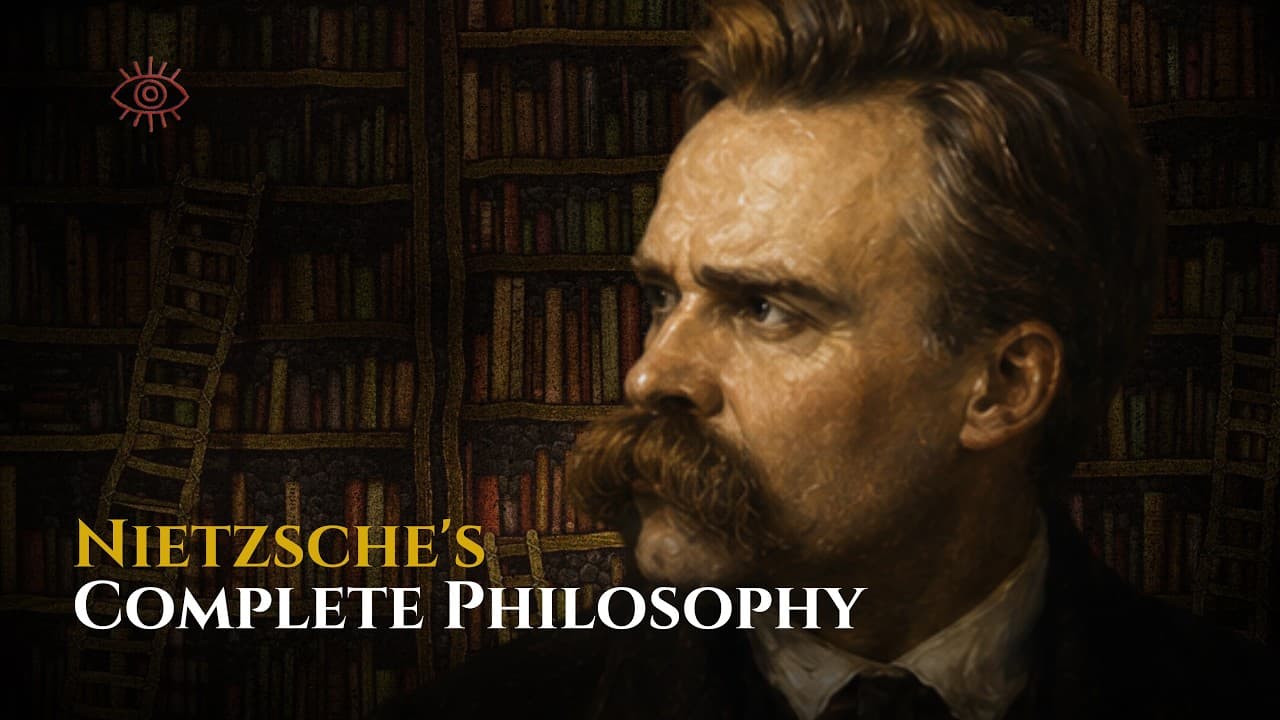
Friedrich Nietzsche diagnosed the death of God not as triumph but as catastrophe, recognizing that the foundation Western civilization had rested on for two thousand years had collapsed. This three-hour exploration traces his journey from pastor's son in Rocken to solitary philosopher, through his masterworks including The Birth of Tragedy, Thus Spoke Zarathustra, Beyond Good and Evil, and On the Genealogy of Morals.
It examines his core concepts in depth: the death of God, will to power, eternal recurrence, the Ubermensch, amor fati, and the distinction between master and slave morality. The episode follows his friendship and break with Wagner, his decade of solitary wandering, his collapse in Turin, and the posthumous distortion of his work by his sister Elisabeth and the Nazi appropriation that followed.
His influence on Freud, Heidegger, existentialism, Foucault, and Deleuze confirms that the questions Nietzsche raised about nihilism, values, and human flourishing remain urgently alive today.
The full episode is on YouTube and Spotify. Please listen only in safe, restful contexts.
Timestamps
Jump into the video
- 0:00:00Chapter 01: God Is Dead and We Have Killed Him
- 0:09:18Chapter 02: Rocken and the Shadow of the Father
- 0:18:57Chapter 03: Schulpforta, Philology, and the Discovery of Schopenhauer
- 0:29:26Chapter 04: Wagner: The Surrogate Father and the Total Artwork
- 0:38:52Chapter 05: The Birth of Tragedy: Dionysus Against Socrates
- 0:48:06Chapter 06: The Break with Wagner: Parsifal and the Wound
- 0:56:48Chapter 07: The Free Spirit: Human, All Too Human
- 1:07:12Chapter 08: The Wanderer and His Shadow: A Decade of Solitude
- 1:17:54Chapter 09: Lou Salome: The Love That Failed
- 1:27:19Chapter 10: Thus Spoke Zarathustra: The Book for Everyone and No One
- 1:39:34Chapter 11: Camel, Lion, Child: The Metamorphoses of the Spirit
- 1:49:13Chapter 12: The Ubermensch and the Last Man
- 2:00:17Chapter 13: Eternal Recurrence: The Greatest Weight
- 2:11:01Chapter 14: Beyond Good and Evil: Master and Slave
- 2:20:20Chapter 15: The Genealogy of Morals: Guilt, Conscience, and the Ascetic Ideal
- 2:32:05Chapter 16: Ressentiment and the Revaluation of Values
- 2:41:15Chapter 17: Amor Fati: Loving One's Fate
- 2:50:42Chapter 18: The Final Year: Twilight, Antichrist, Ecce Homo
- 3:01:06Chapter 19: The Collapse in Turin
- 3:11:20Chapter 20: Elisabeth and the Nietzsche Archive
- 3:21:54Chapter 21: Misreadings: The Nazi Appropriation and Its Refutation
- 3:32:02Chapter 22: Why Nietzsche Still Matters
Sources & works cited
15 in all
- 1.Nietzsche, Friedrich. The Birth of Tragedy (1967)
- 2.Nietzsche, Friedrich. Human, All Too Human (1996)
- 3.Nietzsche, Friedrich. The Gay Science (1974)
- 4.Nietzsche, Friedrich. Thus Spoke Zarathustra (1978)
- 5.Nietzsche, Friedrich. Beyond Good and Evil (1966)
- 6.Nietzsche, Friedrich. On the Genealogy of Morals (1989)
- 7.Nietzsche, Friedrich. Twilight of the Idols and The Antichrist (1990)
- 8.Nietzsche, Friedrich. Ecce Homo (1989)
- 9.Young, Julian. Friedrich Nietzsche: A Philosophical Biography (2010)
- 10.Kaufmann, Walter. Nietzsche: Philosopher, Psychologist, Antichrist (1974)
- 11.Prideaux, Sue. I Am Dynamite! A Life of Nietzsche (2018)
- 12.Nehamas, Alexander. Nietzsche: Life as Literature (1985)
- 13.Magnus, Bernd and Higgins, Kathleen (eds.). The Cambridge Companion to Nietzsche (1996)
- 14.Stanford Encyclopedia of Philosophy. Friedrich Nietzsche
- 15.Internet Encyclopedia of Philosophy. Friedrich Nietzsche
Similar episodes
The Philosophy of Existential Nihilism
On Nietzsche & Camus
15 chapters · 12 sources
Nothing matters. These two words have haunted Western philosophy since the nineteenth century, when the foundations of meaning began to crack and the greatest minds were forced to confront a terrifying possibility: that the universe has no purpose and human life has no cosmic significance.
PlayThe Myth of Sisyphus | Albert Camus's Complete Philosophy for Sleep
On Camus
22 chapters · 12 sources
What if a man condemned to push a boulder up a mountain for eternity is actually happy? This question opens Albert Camus's philosophy of the Absurd, the confrontation between our need for meaning and the universe's profound silence.
PlayYou Don't Have Free Will | Schopenhauer's Complete Philosophy for Sleep
On Schopenhauer
15 chapters · 14 sources
Arthur Schopenhauer believed that the capacity to be alone was the truest mark of intellectual and spiritual development. For him, solitude was not merely the absence of others but the presence of oneself.
Play