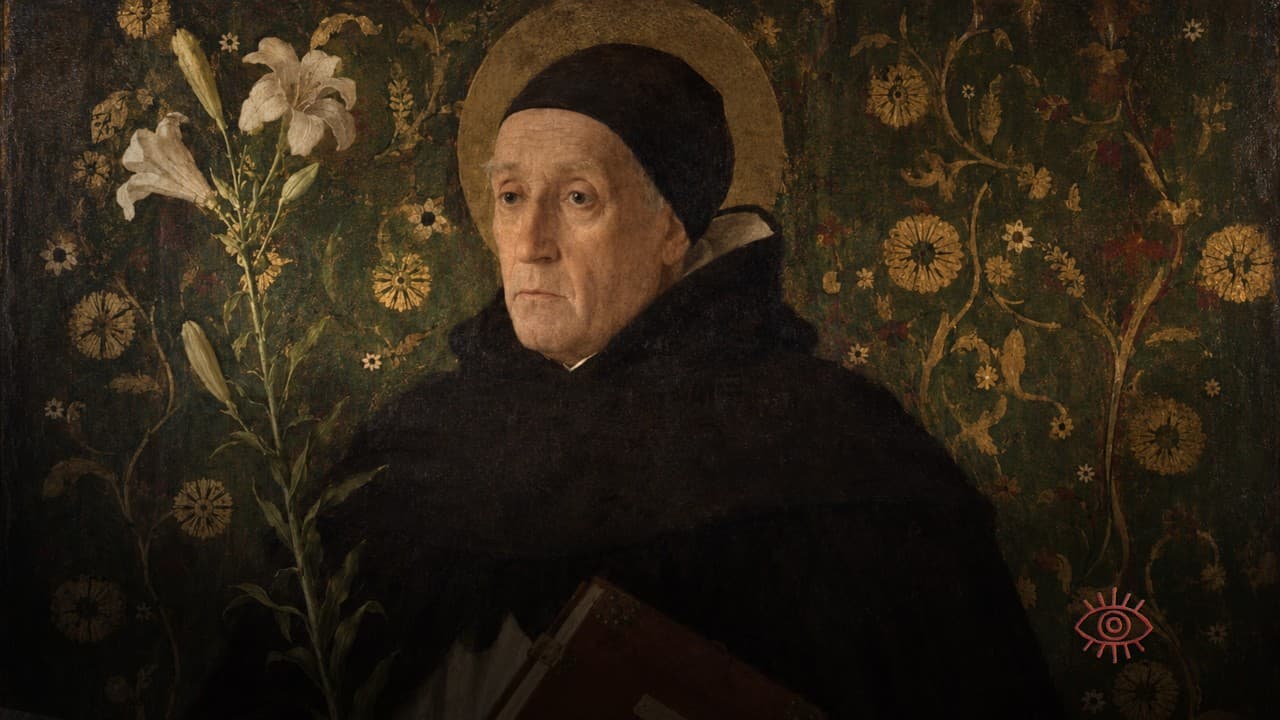
Let Go of God to Find God | Meister Eckhart's Complete Philosophy
He told nuns and weavers and widows that they should pray to be rid of God, and meant it as the deepest compliment his theology could pay.
At the summit of the medieval Church, a Dominican master who governed dozens of religious houses did something no one of his rank had dared. He carried the deepest theology out of the Latin schools and preached it, in plain German, to ordinary working people.
We follow him from an uncertain village in Germany to the heights of the University of Paris, and into the heart of what he taught: a God beyond all names, an uncreated spark at the bottom of the soul, a birth of the divine within us, and a path that runs not by adding but by letting everything go. We trace his tender words to the grieving, his surprising defense of the working life, and the trial that broke over him at the very end, then the long silence after his death and the strange, luminous return that made him a voice for our own restless age.
The full episode is on YouTube and Spotify. Please listen only in safe, restful contexts.
Enjoying the episode?
Occasional letters on philosophy, reading, and the examined life. No spam, ever.
By subscribing you consent to receiving occasional emails. Unsubscribe any time via the link in every email or at /unsubscribe.
Timestamps
- 0:00:00Chapter 1: A German Life
- 0:11:39Chapter 2: The Common Tongue
- 0:20:05Chapter 3: Being Before Doing
- 0:25:45Chapter 4: Being Is God
- 0:34:20Chapter 5: A Pure Nothing
- 0:39:57Chapter 6: The God Beyond God
- 0:51:08Chapter 7: The Spark in the Soul
- 0:59:36Chapter 8: The Eternal Birth
- 1:10:41Chapter 9: The Art of Letting Go
- 1:20:07Chapter 10: Without a Why
- 1:25:56Chapter 11: The Breakthrough
- 1:37:23Chapter 12: The Swiftest Horse
- 1:44:54Chapter 13: Martha in the Kitchen
- 1:50:42Chapter 14: In the Field of the Lord
- 2:01:52Chapter 15: The Long Silence
For the record
Full Transcript
Chapter 1: A German Life
It is the middle of the thirteen twenties, in the city of Cologne, and an old man is being handed a list of his own sentences. He is a friar, well past sixty, a preacher by vocation, and the pages set before him have been copied out of his own sermons and his own books, one line at a time, and arranged in a long column as errors, as things a Christian is not permitted to say. He reads down the column slowly. Many of these sentences he has spoken aloud, from a pulpit, to rooms full of ordinary people who walked in from the street to hear him. Now he is being asked, in effect, to disown them, to agree that the man who spoke them had wandered off the road.
There is nothing wild about him. He has seen no visions and heard no voices. He has fallen into no trances in front of a crowd, shown no wounds opening in the palms of his hands, founded no sect, raised no revolt. He is not a hermit, and he is not an enthusiast half out of his mind with feeling. He is, of all things, a master of the University of Paris, which is the highest rank the study of God can confer anywhere in the world, and he has twice held a chair of theology in that university, a distinction that in the whole history of his order only Thomas Aquinas had earned before him. He has governed nearly fifty religious houses spread across half of Germany. For most of his long life he was the one who sat in judgment on others, who inspected the convents, corrected the erring, and enforced the rule. And here he sits, at the end of everything, on the other side of the table, the accused.
He does not tremble, and he does not grovel. He answers the charges in writing, patiently, at great length, and then he does something stranger than either defiance or surrender. He appeals over the heads of the men judging him to the pope himself, and he sets out, an old man on foot and horseback, on the long road south to the papal court, to be tried again there. How that journey ended, and what Rome finally decided to say about him, is the close of this story and not its opening. What matters here, at the beginning, is only the strangeness of the scene. This is the Church putting one of the greatest teachers its own preaching order had ever produced on trial for his life's work. This is a man who had spent forty years telling other people to let go of everything they clutched, their money, their comfort, their ambition, their pride, and in the end even their own ideas about God, now being asked to let go of a few sentences, and finding that he could not, because he had never quite believed the sentences were his to begin with. And it is stranger still than that. For this most God-filled of preachers had stood in front of plain, unlettered people, in their own rough spoken German rather than the polished Latin of the schools, and had told them that if they truly wanted God, the last and hardest thing they would have to do was pray to God to be rid of God.
His name was Eckhart, and the world remembers him by the title the Church itself had placed in front of that name long before it turned against him. Meister Eckhart. Master Eckhart. Simply, the Master. He is one of the strangest figures in the whole history of Christian thought, and one of the most quietly explosive, a man who took the driest and most technical theology of the medieval universities and set it on fire in the language of the marketplace. He was born in a village so small and so obscure that we can no longer be certain which village it was. He died in a place we cannot name, on a day no record preserves, and he was laid in a grave that has never been found. For the better part of five hundred years after his death his name lay under a shadow and his books went almost entirely unread. And then, in the modern world, he came back, and became perhaps the most widely read Christian mystic who has ever lived, claimed at once by philosophers, by teachers of Zen, and by ordinary people who had never opened a work of theology in their lives. To understand how a pillar of the medieval Church became a condemned man, and how a condemned man became all of that, we have to go back to the beginning, to the German countryside, around the year twelve sixty.
He was born in the region of Thuringia, in the wooded heart of Germany, most likely in a village near the town of Gotha, into a world that had not changed in its essentials for many hundreds of years. This was a landscape of small fields and forests and walled towns, of peasants and craftsmen and lords, held together by the vast presence of the Church, which baptized every child and buried every corpse and rang the hours of every day. We know almost nothing certain about his childhood, not the names of his parents, not whether he had brothers or sisters, not what kind of household raised him. What we know is where the boy ended up, because at some point in his youth he walked through the door of the Dominican house in the city of Erfurt and asked to be received, and gave the rest of his life to the order he found inside.
The Dominicans were still a young order then, barely older than the century, an order of friars founded not to hide from the world in a monastery but to go out into it, to study hard and to preach. A young man of real intelligence who joined them was set on a track of education that was, for its age, extraordinary. Eckhart was clearly such a young man. He was sent to study, almost certainly at the great Dominican school in Cologne, in the intellectual afterglow of Albert the Great, the most learned mind the order had yet produced, and then onward to the very summit, to Paris, where the finest theologians in Christendom argued and lectured and competed. There he did the long work required, and there, around the turn of the fourteenth century, he earned the degree that gave him his name, the mastership in theology, the license of the university itself to teach the highest subject there was. From that day he was Master Eckhart, and he would carry the title for the rest of his life and beyond it.
What is remarkable about the decades that followed is that he lived two full lives at once, and excelled at both. On one side he was the scholar, the man of the lecture hall, who returned to Paris not once but twice to hold the Dominican chair of theology, an honor so rare that, as we have seen, only Aquinas had held it twice before him. On the other side he was a man of affairs, an administrator of the first rank, trusted by his order with heavy and practical responsibility. While still a relatively young man he was made prior of the house at Erfurt and set over the friars of the whole surrounding region. Later he was elected to govern the immense province of Saxony, which stretched across the north of Germany from the Low Countries almost to the Baltic and contained dozens of convents of men, all of which were now his to oversee, to visit, to reform, and to hold to their vows. He was sent, on top of that, to set in order the houses of the order in Bohemia, farther east still. This was not the life of a dreamer lost in the clouds. It was the life of a busy, capable, deeply trusted executive of a great institution, a man forever on the road between one troubled convent and the next, settling disputes, appointing officers, managing money and property and the endless friction of people living together under a rule.
Hold those two lives side by side, the abstract metaphysician and the hard-headed administrator, because the whole riddle of the man is folded into the fact that they were the same person. The mysticism he would become famous for is not the mysticism of someone who fled the world. It is the mysticism of a man who spent his days in meetings and on horseback and in the accounts, and who insisted, against the whole weight of the tradition, that you did not need to leave any of that behind to find God, that a soul could be as close to God in the middle of its work as on its knees in an empty church.
It was in the last stretch of his life, an old man by the standards of his time, that he came to the work for which he is remembered. He was based in these final years in the Rhineland, in the city of Strasbourg and then again in Cologne, and he gave himself above all to preaching. He preached to his fellow friars, and he preached to the many convents of nuns that looked to the Dominicans for guidance, and he preached to gatherings of devout laypeople and of religious women who lived lives of prayer and poverty without ever taking formal vows. And he preached, most of the time, not in Latin but in German, reaching for words in the common tongue that had never been asked to carry ideas this difficult before, inventing the language as he went. People wrote down what he said, as best they could, and it is chiefly through those hurried transcripts, copied and passed from hand to hand, that his voice survives at all.
Those sermons made him beloved. They also made him dangerous. For the things he was saying from the pulpit, in words that any baker or weaver in the room could follow, were things that the guardians of doctrine, when the reports reached them, found alarming in the extreme. He spoke of a nothingness at the heart of God, and of an uncreated something at the heart of the human soul, and of a union between the two so complete that the ordinary distances between a creature and its Creator seemed to dissolve. He told his listeners to want nothing, to know nothing, to have nothing. And slowly, in his final years, the ground began to shift beneath him. The man who had spent a lifetime judging others felt the machinery of the Church, the very machinery he had served and operated, begin to turn in his direction. That is the story this episode has to tell, the shape of a mind that flew higher than the age could tolerate, and what it cost him, and why, seven centuries later, we have never stopped listening. It is the story of what he actually said, and why the same words that struck a frightened Church as poison can fall on a tired and sleepless mind, all these years later, like the promise of a rest deeper than sleep. Everything that follows, the strange God, the empty soul, the trial, the long silence, and the return, grows out of what this one man dared to say aloud.
Chapter 2: The Common Tongue
The most dangerous thing Meister Eckhart ever did was not to think a forbidden thought. It was to say an ordinary one out loud, in the wrong language, to the wrong people. To see why that was dangerous, you have to see the world he was trained in, and the wall that ran down the middle of it, dividing those who were permitted to think about God from those who were only permitted to obey.
Eckhart belonged, as we have seen, to the Order of Preachers, and the name announces the purpose. The order had been founded barely a lifetime before his birth, in a Church frightened by heresy, and its answer to heresy was not the sword but the argument. These were friars trained to go out among people and preach, and to preach well they had to study, so the order prized learning the way older monks had prized silence and fasting. In the two generations just before Eckhart, it had produced the two most formidable minds of the medieval Church. First there was Albert the Great, a friar of almost boundless curiosity who set out to gather the whole knowledge of his age, the philosophy and the natural science together, into one vast survey. Then there was Albert's own pupil, Thomas Aquinas, who took that material and built from it the enormous, orderly structure of thought that remains, to this day, the nearest thing the Catholic Church has ever had to an official philosophy. Albert had taught at the Dominican school in Cologne, and it was in the long afterglow of his learning, very likely in that same school, that the young Eckhart was formed. From there the road led to the University of Paris, the summit of the whole system, where the finest theologians in Christendom lectured and argued and where Eckhart in his turn earned the right to teach.
All of it happened in Latin. Latin was the language of the Church, of the courts, of the universities, the shared possession of a thin lettered class and a closed door to everyone else. To think about God at the highest level was to think in Latin, inside a university, among men who had given fifteen years to learning how. The overwhelming majority of Christians stood on the far side of that door. The farmers, the craftsmen, the merchants, and above all the women, were given the sacraments, the feast days, the painted images on the church walls, and sermons carefully pitched low. The deep matter, the hard questions about the nature of God and the destiny of the soul, was not considered any of their concern, and it was widely assumed that they could not follow it even if it were offered to them.
Eckhart spent the last stretch of his life climbing over that wall from the inside and dragging the deep matter across to the other side. In Strasbourg and in Cologne he preached the most difficult theology there is, the being of God, the ground of the soul, the eternal birth of the Word, and he preached it not in Latin but in German, to rooms full of nuns and laypeople who had never learned a syllable of the schools. This was harder than it sounds, because German at that moment barely had the words. The vocabulary of high thought lived entirely in Latin. So Eckhart had to make his own, bending ordinary German words to carry weights they had never carried, coining new ones, forcing a plain kitchen language to speak about the ground of being. He is, for this reason, one of the founders of German as a language able to think at all, doing for German almost exactly what his contemporary Dante, a few passes of the Alps to the south, was doing in those same years for Italian, proving that the tongue people actually spoke could hold the highest things.
His listeners, to a remarkable degree, were women. The Dominicans had the spiritual care of many convents of nuns, especially in the Rhineland, communities of educated, contemplative women hungry for exactly the depth that the schools kept from them. And beyond the convent walls there was a newer kind of religious woman altogether, laywomen who gathered in houses to live in prayer, poverty, and chastity without ever taking the permanent vows of a nun, supporting themselves by the work of their hands, moving freely in the world, neither ordinary wives nor professed sisters. They were among the most spiritually ambitious people of the age, and they were drawn to Eckhart, and he took them with complete seriousness, and gave them, in their own language, the strong meat that everyone else thought was above them.
To the men who guarded the order of the Church, this was alarming on its face. The whole structure of medieval Christianity ran downward in a chain, from God to the pope to the bishop to the priest, and only through that chain, through the sacraments the priest administered, was the ordinary soul supposed to reach God. Now here was a master of theology telling untrained people, and untrained women at that, that they could find God directly, in the ground of their own souls, without any of that machinery in between. If that were true, what became of the chain? There was even a name for the nightmare version of the idea, the heresy of the Free Spirit, the dreaded notion of people so convinced of their inner oneness with God that they held themselves above sin, above the sacraments, above the moral law entirely, free to do anything because God was doing it in them.
And this fear was not an abstraction, because it had a face and a fire still fresh in memory. In the year thirteen ten, in Paris, a Frenchwoman named Marguerite Porete was burned alive in a public square. She was one of exactly those free, unvowed religious women, and her crime was a book. She had written, in her own French rather than in Latin, a tender and daring account of the soul's love affair with God, in which the soul, dissolved utterly into that love, comes at the last to want nothing and to need nothing, so emptied of its own will that it is moved by nothing but God and stands free even of the practice of the virtues. She was ordered to withdraw the book and to keep silence. She refused, and went on refusing, and so they led her out and burned her, and burned her book with her, and by all accounts she met the fire with a calm that impressed even the crowd that had come to watch.
Eckhart arrived in Paris to take up his second chair of theology within a year or so of that fire, entering the very order some of whose men had helped to condemn her, and he cannot have failed to know the story. And here is the thing that ought to stop us. The idea at the dead center of Marguerite Porete's book, the soul grown so poor and so free that it wants nothing whatsoever, is almost precisely the idea that Eckhart would climb into a pulpit a few years afterward and preach, in German, to rooms full of women very much like her. He had seen what that idea cost. He said it anyway.
Why he was willing to take a risk that had already killed someone is the key to his whole character, and the answer is not recklessness. It is conviction. Eckhart did not believe that the deepest truth about God was the private property of a lettered few who happened to read Latin. He believed it was the birthright of every soul that had ever been born, the poorest servant and the greatest king alike, and that to lock it behind a wall of language was a kind of theft. What he had glimpsed, he could not in conscience keep to himself, and could not water down. So he carried it over the wall, into the common tongue, and set it loose, one dangerous sentence at a time. Those sentences, and the mind that shaped them, are the rest of this story.
Chapter 3: Being Before Doing
Before the great sermons, before the ideas that would put him on trial, there is a small and warm and thoroughly practical book, and it is the finest door into everything that came after. It belongs to the early part of his life, to his years as a young prior at the house in Erfurt, and it is not a treatise at all. It is a set of table talks, evening conversations with the young friars in his care, who came to him with the plain and eternal questions of anyone trying to live a serious inner life. How should I pray. What should I do about my sins. How do I hold on to God through an ordinary day. His answers were written down, and they add up to the gentlest thing he ever taught, and, underneath the gentleness, one of the most quietly radical.
The radical thing is this. He told them to stop worrying so much about what they were doing, and to start attending to what they were being. Most religious effort, then and now, is a matter of doing. We add practices. We say more prayers, keep stricter fasts, perform more good works, and measure our progress by the length of the list. Eckhart turned the whole thing inside out. Do not imagine, he said, that your holiness rests on what you do. Let it rest instead on what you are, because your deeds take all their worth from the ground they grow out of. A good person does not become good by performing good actions. The actions are good because the person is good, in the way that good fruit tells you nothing about how to grow an apple tree, but a good tree will give you good apples without being told. Attend to the tree, he said, and let the fruit take care of itself.
From that single reversal a great deal follows, and all of it is a relief. If what matters is the ground you act from, then you do not need special holy places to find God. It is a common mistake, he warned the young men, to think that God is more present in the church than in the street, more available in this posture than in that one, more at hand in some carefully chosen spiritual technique than in the plain business of the day. Whoever seeks God by a particular method, he said, lays hold of the method and lets God slip away. God is not one more thing to be reached by the right procedure. God is to be found in all things evenly and at once, by a person whose inner disposition is right, and such a person carries that finding into everything, into work and rest and speech and silence, without needing to run anywhere special to get it.
And if that is so, then you do not need to flee the world either. This is already, in seed, the conviction that would set Eckhart apart from so many teachers of the spiritual life. He did not tell his friars that the way to God ran away from ordinary existence and into some purer, quieter, more secluded state. He told them the opposite. What you need is not a change of scenery but a change of ground. Fix the inner disposition, and you can carry God through a crowded and demanding life without losing him. Fail to fix it, and no amount of retreat and solitude will help, because you will only bring the unquiet self along with you into the quiet.
He was equally cool about the thing many earnest people most want from religion, which is a feeling. Do not build your life with God on spiritual sweetness, on the warm glow of consolation that comes and goes, he counselled, because that glow is a gift and not a possession, and it will be taken away, and if your faith was resting on it, your faith will go when it goes. Rest instead on the settled will underneath the feeling, the steady disposition that holds firm whether the sweetness is present or absent. Feelings are weather. Being is climate.
And where does the whole road begin? It begins, he told them, in obedience, in the giving up of your own will, which for a beginner is the first and the hardest and the most fruitful work there is. Wherever a person goes out of what is merely their own, out of the small clutching ego that wants things its own way, there God comes flooding in to take the emptied place, as surely as air rushes to fill any space you clear of it. That surrender of self-will, offered here to novices as a simple beginner's discipline, is the tiny seed of the tremendous thing he would one day exalt above every other virtue, and preach in a way that would frighten the entire Church. But here, at the start, it is presented as nothing more than sane and kindly advice for a young man learning to live.
That is the door. Everything vast and vertiginous that Eckhart would go on to say, about the nothingness of things, about the God beyond God, about the soul that breaks through into the ground it shared before it was made, is in the end only this humble counsel grown to a terrifying size. Stop fussing over what you do. Attend to what you are. Clear yourself out, and let God have the room.
Chapter 4: Being Is God
It is easy, listening to the preacher, to forget that Eckhart was first, and for most of his working life, the professor. Before he was the voice in the German pulpit he was one of the sharpest technical philosophers of his century, a man who had argued the hardest questions in theology at the highest level in Europe, in the schools of Paris, in Latin, against the best minds of the age. The soaring sermons did not come from nowhere. They came from a mind that had spent decades building, in careful Latin prose, an enormous and rigorous system, and if you want to know why the sermons are so strange, you have to look, for a little while, at the scaffolding underneath them.
The system was meant to be vast. He planned a great threefold work, a work in three parts, that would gather his whole vision into one structure. The first part was to be a book of basic propositions, the foundation stones, hundreds of them. The second was to be a book of disputed questions, the hard problems argued through. The third and largest was to be a book of commentaries, close philosophical readings of the books of Scripture, in which he would find, hidden in the plain words of Genesis and the Gospel of John, the deepest truths of metaphysics. He never finished it. What survives is a magnificent ruin, a few of the commentaries, some of the questions, fragments of the rest, like the standing columns of a cathedral whose roof was never raised. But even in ruin you can see the shape of the ambition, and at its heart sits one short sentence that turns the ordinary picture of God inside out.
To feel the force of the sentence you have to know the sentence it was answering. The towering achievement of the Dominican tradition Eckhart inherited, the work of Thomas Aquinas, had given the Church a formula of great beauty and precision. God, Aquinas taught, is being itself. Everything else in the universe merely has being. You and I and the stars and the sea possess existence the way we possess anything, as a gift, on loan, something we were given and could lose. God alone does not have being but simply is being, pure and underived, the act of existing in person. It is a magnificent idea, and Eckhart took it, and did something audacious with it. He reversed the sentence. Not, he wrote, that God is being. Rather, being is God.
That reversal sounds like a small thing, a mere flip of word order, and it is in fact an earthquake. To say God is being keeps God at a certain distance. It makes God the highest and fullest instance of existence, the supreme being at the top of the ladder of things. To say being is God does something far more intimate and far more unsettling. It says that the sheer is-ness of anything whatsoever, the bare fact that it exists at all, is not the thing's own possession but is God, present in it, holding it out of nothingness. Consider the plain fact that you exist. Not your thoughts or your body or your history, but the bare, silent, underlying fact that you are, at all, rather than not being. Eckhart's claim is that this fact, the raw existing under everything you are, is not something you own or produced or can take credit for. It is the nearest edge of God, God touching you at the one point where you are simply real. Wherever anything at all is, God is there as the being by which it is. There is no closer God than that, and no God harder to see, because he is not one of the things you can look at. He is the looking's own light.
He believed he had not invented this but found it, written into Scripture itself, and he pointed to the oldest place of all. In the story of the burning bush, when the voice from the fire is asked its name, the answer it gives is not a name in any ordinary sense. It says only, I am who I am. Generations of readers had heard in that a refusal, a God too holy to be named. Eckhart heard something more precise and more staggering. He heard God declaring that his name simply is being, that to be God is to be, purely and without remainder, existence itself speaking its own nature. And in the strange doubling of the phrase, the I am folded back onto the who I am, he heard the being of God turning upon itself, existing so completely that it needs nothing outside itself to exist, a fountain that is its own source and its own water and its own falling. The plainest words in the oldest book, read closely enough, became for him a lecture in metaphysics.
And then, having gone that far, Eckhart went further, into the strangest move of all, and it happened in the open debates of the Paris schools. He asked what is most basic in God, most fundamental, the very root. Is God, at bottom, existence, sheer being? Or is God something even more original than that? And he gave an answer that startled his colleagues and still startles readers today. At the root of God, he argued, is not being but knowing. Intellect stands higher than existence. God does not understand because he first exists, the way you might first be born and only later learn to think. It is the other way around. God exists because he understands. His knowing is the very ground of his being. Before God is anything, before God so much as is, God is a pure act of knowing, an infinite understanding out of which existence itself pours.
Try to hold the difference in your mind, because it is the hinge of everything. There is a great distance between saying God is the largest and most perfect of all the things that exist, and saying that God is the light in which all things come to exist in the first place. A light is not one more object sitting among the objects it illuminates. It is of a wholly different order. You do not find it by searching harder through the room, because it is not in the room in the way the furniture is in the room. It is the reason you can see the furniture at all. Eckhart's God, at the root, is a knowing of that kind, so prior to everything, so utterly the source, that to call him a being, even the greatest being, is already to have shrunk him down and set him among the very things he made.
This is why Eckhart could say, with a straight face, that in a certain sense God is not. He does not mean that God is absent or unreal. He means the exact opposite. He means that God is so far beyond the whole category of existing things that our ordinary word being, borrowed as it is from tables and stars and human lives, cannot be laid on him without falsifying him. A God who is the ground of being cannot simply be counted as one more being, however exalted. He slips out of the inventory of the world entirely, off the top of the ladder and into a brightness that has no rung.
Here, in the quiet of a Latin lecture hall around the turn of the fourteenth century, is the seed of everything that would one day frighten the men in Cologne. The vertiginous German sermons, the ones about the nameless God and the empty soul, are not the ravings of a man who had left rigorous thought behind. They are this cold, exact, professorial metaphysics carried up into the pulpit and set alight. The scholar and the mystic were the same person, thinking the same thought. And the thought, once you follow it, has consequences not only for God, but for everything God ever made.
Chapter 5: A Pure Nothing
Turn that great sentence over, and its shadow falls across the whole created world. If the being of everything is God's own presence holding it up, then what is left over that belongs to the thing itself? What does a creature possess, on its own account, once you have said that its very existence is on loan? Eckhart's answer was as blunt as it was scandalous, and it is one of the sentences that would later be copied out and held up as proof that he had lost his way. All creatures, he said, considered in themselves and apart from God, are a pure nothing. Not a small something. Not a dim and dependent and shrunken something. Nothing at all. A pure and simple nothing.
It helps to feel the vertigo of this rather than only to hear it. We carry a quiet assumption that existence is a kind of deposit, something handed to us at birth that we then own and hold, ours to keep until it is finally taken away at the end. Eckhart is saying that this is a complete illusion. Existence is not a deposit you were given once. It is a current that must flow through you at every single instant, or you are simply not there. Think of a face in a mirror. The image is perfectly real as long as you stand before the glass. But it owns nothing. It has no being tucked away inside itself. Step aside, and the image does not weaken or grow poor or fall ill. It is just gone, and it never had one scrap of existence of its own to lose. Eckhart's claim is that you and I and every created thing are exactly like that image, held in being from moment to moment by a source we do not control and mostly never notice, possessed, in ourselves, of nothing whatsoever.
Now, that sounds like the darkest possible thing to say about the world. It sounds like a man calling creation a lie, an illusion, a worthless dream to be despised and escaped. That is precisely how his enemies heard it, and it is why the sentence went onto the list of his errors, as an insult to the goodness of everything God had made. But listen again, because it is very nearly the opposite of contempt. Eckhart is not saying the world is fake. He is saying the world is a gift so total that there is not one atom of it that stands on its own. To call the creature a pure nothing in itself is to say that it is, through and through, pure gift, pure God-in-the-act-of-giving, so transparent to its source that when you look at it truly you are looking straight through it at the hand that holds it out. The person who understands this does not love the world less. They love it more truly, as what it actually is, a shimmering, borrowed, wholly dependent radiance. What they can no longer do is make the one catastrophic mistake that most of us spend our lives making, the mistake of treating some created thing, some person, some possession, some achievement, as though it could stand on its own and hold us up and fill the hole at the center of us. Nothing created can do that, because nothing created has, in itself, anything at all.
And so we arrive at a strange and important pair. There is the nothing at the bottom of every creature, the emptiness of a thing that owns no being of its own. And there is, at the other end of everything, the nothing he had already found in God, who is no mere thing among things and so, in his own way, can be called no-thing. These two nothings could not be more different. The nothing of the creature is the nothing of utter poverty, of having nothing. The nothing of God is the nothing of utter fullness, of being so much that no name for a thing will fit. One is empty because it is less than anything. The other overflows because it is more than everything. Between the two of them, poised over the abyss of its own nothingness and open at its summit to the abyss of God's, stands the strangest creature of all, the human soul, and Eckhart had extraordinary things to say about what waits at the center of it.
But hold, first, on the sentence itself, and on what it cost him, because there is a small tragedy folded into it. When the examiners in Cologne wrote out that all creatures are a pure nothing and marked it as heresy, an attack on the dignity of God's good world, they had heard the exact reverse of what he meant. He was not degrading creation. He was making the most extreme statement of dependence that language can carry, insisting that God is so utterly the giver of being that the creature, left to itself for a single instant, would not fall, would not fail, would simply never have been at all. It is the strongest possible affirmation of the one truth their whole faith rested on, that everything comes, ceaselessly and entirely, from God. And they read it as blasphemy. That gap, between what he said and what they heard, is the seed of everything that went wrong at the end.
Chapter 6: The God Beyond God
Here is the idea at the center of everything Eckhart believed, and it is the most vertiginous idea in the whole of Christian mysticism. He said that behind God there is God. Behind the God we name and picture and pray to, the God who made the world and watches over it and hears us, there lies a further depth, a nameless ground out of which even that God arises, and it is, he said, as different from God as heaven is from earth. He had two words for the two things. There is God, and there is what he called the Godhead, the hidden divinity, and the whole of his teaching turns on the difference between them.
Start with the God we know, the God of ordinary religion, and notice how much of him is turned toward us. He is the Creator, which means he is defined by his creation, by the world he stands over and cares for. He is a person, indeed three persons, Father and Son and Spirit, related to one another and to us. He is good, and just, and wise, and merciful. He acts. He loves. He judges. He speaks and is spoken to. Now notice that every one of those things involves a relationship pointing outward, toward the world, toward us. To be a Creator you need a creation. To be merciful you need someone to have mercy on. To be good in any sense we can grasp, you need the scale of good and bad that runs through the world of creatures. This God, the God of the whole religious life, is in a certain way bound up with us, turned in our direction, wearing, if we can put it this way, a face that faces the world.
We know something like this from our own lives, in miniature. Each of us has a self that faces the world, a self with a name and a handful of roles, the parent, the worker, the neighbor, the one others think of as kind or clever or reliable, the self that can be described and related to and leaned on. And beneath all of that, most of us are dimly aware of something wordless, a bare sense of simply being ourselves that no role and no description ever quite reaches, that was there before we collected any of these names and will still be there when they fall away. Eckhart is saying that the difference between God and the Godhead is something like the difference between those two, carried out to infinity. God is the divine turned outward, named and related and describable. The Godhead is the divine as it is in its own wordless depth, before any of that, answerable to nothing, turned toward no one, at home in itself.
And Eckhart says, go behind the face. Behind God as he turns toward us there is God as he is in himself, before and beneath all relationship, and that is the Godhead. He reached for images because plain speech gave out. He called it a desert, a still and silent and trackless waste where nothing stirs and no name is spoken, where, he said, no one is at home. He called it a ground, a bottom beneath the bottom, an abyss. He called it a silence and a darkness, not because it is empty of God but because it is so full of God that no light our eyes are built for can register it. And most daringly of all, he placed it before the Trinity itself. The three persons, Father, Son, and Spirit, in all their life and relation, flow out of this silent ground the way a spring flows out of a hidden depth of the mountain. The Godhead is the source even of God. It is the divine simplicity from which the whole rich, active, relational life of God pours forth.
This led him to say things that sound, on first hearing, like riddles. He said that God becomes and unbecomes. He meant that the name God, in its full relational sense, is in a way born together with the world. Where there is no creation, there is no Creator standing over against it, no one being merciful to anyone, no one being obeyed, no one being prayed to. All of that begins when the world begins. But the Godhead, the silent ground, does not rise or set with the world. It does not become anything, because it was never turned toward anything to begin with. It simply is, or rather it lies beyond the reach of even that small word, the still point that does not move whether or not a universe hangs from it. God, we might say, has a history with us. The Godhead has no history at all.
To speak about this ground at all, Eckhart drew on an old and demanding tradition, the way of unknowing, the way of negation. Its principle is simple to state and almost impossible to hold onto. It is that God is more unlike anything we can say of him than he is like it. Every word we have was made by creatures, for creatures, to describe creatures. When we take one of those words and lay it on God, even our finest and holiest word, we necessarily shrink him down to the size of the word. So the tradition says, having called God good, you must in the same breath unsay it. You must deny of God the very thing you just affirmed, not because it is false but because it is far too small, and then deny the denial, and go on climbing that ladder of unsayings until words fail entirely and you are left standing in a silence that is truer than any sentence.
Eckhart pressed this further than almost anyone had dared. He was willing to say that we should not even call God good. To call God good, he said in one sermon, does him as great an injustice as calling the bright sun black. It is not that God falls short of goodness. It is that our word good, sized as it is for good meals and good people and good weather, is so laughably beneath him that to pin it on him is nearly an insult. God is not good, he said, nor better, nor best, because all of those words belong to the ladder of creatures and God is off the ladder entirely. We saw already that at his very root God is not a thing that exists but a pure knowing that is the source of existence, and so, in a strict sense, we cannot even call him a being without falsifying him. Now the same axe falls on every other name. Good, wise, great, merciful, one by one they are lifted up, honored, and set gently down again as too small, until what is left is not a description of God but a kind of reverent astonished silence in his presence.
There is a name for this strange condition, and Eckhart embraced it. He called the highest knowledge of God a kind of unknowing, a wise ignorance. The nearer you come to God, he taught, the less you are able to say, until at the summit the mind falls silent altogether, not because it has failed but because it has arrived. We are used to assuming that to know a thing is to be able to describe it, to hold it inside a definition. With God it runs the other way. The people who speak most fluently and confidently about God, who have him tidily defined and boxed and explained and can tell you exactly what he wants and thinks, are in Eckhart's view the ones standing furthest off. The person who has drawn genuinely near has lost the power of speech, and stands empty-handed and wordless in a brightness so total it feels like darkness, unable to describe what they are standing in to save their life. Knowing, here, looks exactly like not-knowing, and that is the surest sign you have come to the right place.
This can sound, on first hearing, like a slow and elegant way of emptying God out until nothing is left, a mysticism that dissolves into thin air, almost a polite atheism. It is the exact opposite, and everything depends on seeing that. The person who negates every name for God is not saying there is less there than we thought. They are saying there is infinitely more, so much more that our words, all of them, fall short, the way a thimble falls short of the sea. Imagine someone you revere so deeply that you refuse to let a photograph of them be taken, not because you think little of them but because you know that any flat image would freeze and cheapen a living presence beyond capturing. That refusal is not contempt. It is the highest reverence there is. Eckhart's unsaying of God is like that, raised to infinity. He guards God's greatness by refusing to trap him in any word a human mouth can form, and the empty silence he arrives at is not absence but the fullest presence, too full to be seen, too near to be pointed at, too much to be named.
And this is where the danger begins to gather, quietly, though it would take years to break. For a God beyond all names is a God that no institution can finally fence in and administer. If the deepest truth of God is a nameless ground reached not by learning more but by knowing less, not by acquiring the right doctrines but by falling silent, then the whole apparatus that stood between the ordinary soul and God, the words, the definitions, the offices, the careful gradations of who may know what, begins to look like scaffolding around an emptiness it can never contain. Eckhart did not say this to attack the Church. He said it because he believed it was true, and because he believed that this nameless ground was not far off in some inaccessible heaven but was, astonishingly, reachable, touchable, already secretly present at the very bottom of the human soul. The bare and nameless God, he was convinced, had a strange kinship with something equally bare and nameless hidden in each of us, and it was there, and only there, that the two could meet. What he claimed to find at the bottom of the human soul is bolder still than anything he dared to say about God.
Chapter 7: The Spark in the Soul
If the boldest thing Eckhart said about God was that behind God lies a nameless ground, the boldest thing he said about a human being is its mirror image, and the two claims lock together like a key in a lock. He taught that at the very bottom of the human soul there is a point that is not created, a something untouched by time and untouched by the whole business of being a creature, and that this uncreated point is so like God that it is, at the root, one with him. The nameless ground in God has a twin, and the twin is hidden in you.
He struggled to name it, exactly as he had struggled to name the Godhead, and for the same reason, because it lies deeper than any of our words can reach. So he reached for image after image and let none of them harden into a definition. He called it a spark, a little spark of the soul, a flicker of pure light at the center. He called it a little castle, a citadel so high and so guarded that nothing from outside can force its way in. He called it simply a ground, the bottom of the soul beneath all its floors, or the innermost, or the head of the soul, or, most often, just a something, a something in the soul, refusing to say more. All the ordinary furniture of a person, the senses, the memories, the moods, the thoughts, the will, all of that belongs to the created self that was born and grows and will die. But beneath all of it, he insisted, in the deepest keep of the soul, there is this spark, and it was never born and it does not change and it cannot die, because it does not belong to the created order at all.
That is a staggering thing to say, and Eckhart knew it, and he said it anyway, in the plainest language, from the pulpit. There is something in the soul, he preached, that is uncreated and uncreatable, and if the whole soul were made of this, the whole soul would be uncreated. He is walking, deliberately, right up to the edge of the cliff. For the entire framework of his religion rested on a clean, bright line between the Creator, who alone is uncreated, and the creature, who is made from nothing and utterly dependent. And here he is, saying that at the core of the creature there is a spark of the uncreated, a piece of the soul that stands on God's side of the line rather than ours. He did not mean, if you pressed him, that you are simply God, or that the soul is divine in its own right. He meant that at its deepest point the soul is not shut out from God by its creatureliness, that there is a place in it so bare, so stripped of everything created, that it opens directly onto God with nothing in between, the way the deepest cave, if you go far enough down, opens at last into the rock of the mountain itself.
This is why he could say the single most astonishing sentence in all his preaching, a sentence that ought to be impossible and yet, once heard, is never quite forgotten. God's ground and the soul's ground, he said, are one ground. The bottom of you and the bottom of God are not two places facing each other across an infinite gulf. They are, at the very deepest point, the same place. And from that he drew the line that has echoed for seven hundred years. The eye with which I see God, he said, is the very same eye with which God sees me. My eye and God's eye are one eye, one seeing, one knowing, and one loving.
Sit with that, because it turns the whole ordinary picture of the spiritual life inside out. We tend to imagine ourselves down here, straining upward, trying to catch sight of a God who is far away up there, two beings peering at each other across a vast distance, each wondering about the other. Eckhart says there are not two lookers and there is no gulf. At the deepest point there is a single act of seeing, one gaze, and it is God's knowing of himself and your knowing of God and God's knowing of you all at once, because down in that ground there are no longer two of you to be separate. The very awareness with which you have been seeking God, the attention you turn upward in your longing, is already, at its source, God's own awareness living in you. You have been looking for the thing you were looking with.
Eckhart did not pull this out of the air, and he would have been wounded to hear it called an invention. He was standing at the far end of a long tradition. Centuries before him, Augustine, wrestling with where exactly he had finally found God after looking for him everywhere outside, had arrived at the paradox that God was more inward to him than his own innermost self, nearer to him than he was to himself. The road into God, that older tradition had always said, does not run outward and upward into the sky. It runs downward and inward, past the racket of the surface self, toward a center where the soul quietly opens onto its own source. Eckhart took that ancient intuition and pressed it to the last possible inch, past nearness, past inwardness, into identity, until the center of the soul and the ground of God were not merely close, not merely touching, but one and the same floor. He went further than his teachers had dared. But he went further along a road they had built.
You can hear, in a claim like that, both why the ordinary people in those rooms loved him and why the authorities went pale. For the listeners it was electrifying, and it was a gift beyond price. It meant that the poorest, plainest, most unlettered person in the room, the servant who would never read a book of theology, the widow with worn hands, carried in the depth of her own soul a spark of the uncreated, a private door that opened directly onto the ground of God, needing no learning and no rank and no permission to be found. The dignity of it is almost unbearable. Not that God is near you, though that would be much. But that the floor of you and the floor of God are one floor.
And for the guardians of doctrine it was a nightmare, for the very same reason. If there is an uncreated spark in every soul, one with God's own ground, then the tidy machinery that ran from God down through the Church to the individual soul is not the only road to God, and perhaps not even the deepest one. Worse, the raw sentences, torn from their careful setting and written out in a column, seemed to say the unforgivable thing outright, that a part of the human being is divine and uncreated, that the line between creature and Creator, on which everything depended, could be crossed. When the examiners later drew up their list, this was among the first and gravest of the charges, and it is not hard to see why. He had said, in so many words, that there is something in you that God did not make, because it was never other than God.
But notice what Eckhart has, and has not, said so far. He has told us where the meeting happens, in that bare uncreated ground at the bottom of the soul. He has not yet told us what happens there. And for him the ground is not a quiet museum, a still relic to be admired and left alone. It is the site of an event, the most important event that can occur in a human life, an event he described with an image so intimate and so daring that it became the beating heart of everything he preached. In that silent ground, he said, something is forever being born.
Chapter 8: The Eternal Birth
Of all the things Eckhart preached, there was one he came back to more than any other, one he said was the reason God had made the world and the reason a human being existed at all. It happens, he said, in that bare ground at the bottom of the soul, and it is not a state or a feeling but an event, the most important event that can occur anywhere in the universe. He called it the birth. God, he said, is forever giving birth to his Son in the ground of the soul, and everything else he ever taught was, in the end, only a way of clearing the room for that one thing to happen.
To feel the force of it you have to know what he was building on. At the heart of the Christian picture of God is an eternal act of generation. The Father, from all eternity, brings forth the Son, speaks him, utters him, the way a mind brings forth a perfect thought of itself, and this begetting is not something that happened once long ago but something that is always happening, the endless inner life of God. That much was standard teaching. Then Eckhart took the standard teaching and said the thing that made people catch their breath. That same birth, he preached, the very one, not a copy of it, not a pale reflection of it, but the identical eternal act by which the Father begets the Son, is taking place right now in the ground of your soul. God is begetting his Son in you. And because, as he had already dared to say, the ground of the soul and the ground of God are one ground, there are not two births, the real one in God and a lesser one in you. There is one birth, in one ground, and you are inside it.
This is why Eckhart had so little patience with the idea of religion as imitation, as copying a model from the outside. Most people think of the holy life as a kind of imitation of Christ, studying how he lived and straining to reproduce it, the way an apprentice copies a master. Eckhart did not deny the value of that, but he thought it stopped far too short, on the surface, outside. What he was pointing to was not imitation but generation. You are not called merely to act like the Son of God from the outside. You are called to have the Son of God born in you, so that you become, by grace, what Christ is by nature, an actual child of God, one with the Son and no longer standing apart from him. The Father begets his Son in me, he said, and I am that same Son and not another. It is one of the most extreme statements of human destiny ever spoken from a Christian pulpit, and he spoke it in plain German to ordinary people, and told them it was meant for every one of them.
It is worth saying clearly that Eckhart did not believe he was inventing this, however much it shocked his hearers. The most ancient teachers of the Church had said, in so many words, that God became human so that the human might become God, and they had meant it as the very core of the good news, not as a scandal at its edge. Eckhart stood squarely in that old stream. What was new in him was not the idea but the intensity, how literally he took it, how far down into the ground of the soul he traced it, and, above all, that he would say it out loud in the marketplace language of ordinary people, to weavers and widows and nuns, rather than keeping it safely among the professionals who knew how to hedge it with qualifications. An idea can be perfectly orthodox in a Latin textbook and sound like open heresy when a servant girl hears it in her own tongue and dares to believe that it applies to her. A great deal of what finally happened to Eckhart lives in that gap.
He drove it home with a question that has never lost its edge. What good is it to you, he asked, that Christ was born fourteen hundred years ago in Bethlehem, to a woman named Mary, in a stable in a distant country, if he is not also born now, in you? The whole meaning of that ancient birth, he insisted, was to open the way for this one. The child in the manger is not finally a scene to be admired from far off, a holy event safely sealed in the past and celebrated once a year. It is a promise about what is supposed to happen in the depths of your own soul, in your own lifetime, in the country and the century you actually live in. Christmas, for Eckhart, is not a birthday. It is a diagram of the soul. God became human, he said, so that the human might be born as God, and that birth is not finished until it has happened in you.
He had a startling way of describing the kind of soul in which this can happen. It must be, he said, a virgin who is also a wife. A virgin, because it must be empty, free, and unpossessed, cleared of every image and attachment and prior claim, holding nothing back for itself, belonging, like an unmarried girl, to no one and nothing. But a virgin alone is not enough, and here he refused the easy version of his own teaching, because a virgin, for all her freedom, is barren, and Eckhart had no use for a spirituality that only received and never gave. So the soul must also be a wife, fruitful, carrying the birth to term and bearing it out into the world as good and living works. Emptiness is only half of it. A soul that receives God and then bears no fruit, he said flatly, is of no use at all. The whole point of the birth is not a private sweetness hoarded in the dark. It is a fruitfulness, a life that pours back out, so that the one in whom the Word is born becomes, in turn, a kind of source, giving as freely as they were given to. Mary is the pattern, and Eckhart noticed that she had first conceived the Word in her heart, by her yes, before ever she conceived him in her body. First the birth within, then the fruit without. Always in that order.
And what is it like, to have this birth take hold? Eckhart is oddly quiet about fireworks. He does not promise visions, raptures, or floods of holy feeling, and in truth he is suspicious of all of those, because they belong to the noisy surface and not to the silent ground. What he describes is more like a shift in a person's center of gravity. The one in whom the Son is born begins to live from a new place, no longer from the anxious, calculating, self-protecting self at the surface, but from the ground underneath, where God is already at work. And out of that deeper center a kind of goodness begins to come off them without strain, the way warmth comes off a fire without the fire having to labor at being warm. The exhausting project of holding yourself together and driving yourself to be better grows quiet, and something freer takes its place, a life lived from underneath rather than managed from above.
And when does it happen? Here Eckhart says something that quietly dissolves our whole sense of time. It happens now. Not once in the past, not someday in the future after death, but in an eternal now that is always available, always present, never over. God does not beget his Son and then rest. He begets him ceaselessly, in a single eternal present, and that present is not far away in heaven but is touching this very instant, the one you are living through as you listen. We tend to imagine eternity as an endless stretch of time, a very long duration reaching backward and forward forever. Eckhart means something stranger and closer. Eternity is not a length of time at all. It is the depth of this moment, the now in which past and future both disappear, and it is exactly there, in the naked present, that the birth is forever taking place. If you are ever going to be present at it, it will not be at some better hour later on. It will be now, because now is the only room it is ever in.
But there is a condition, and it is the whole difficulty, and it is where his teaching turns from soaring description to hard demand. The birth happens only in silence. The Word can be spoken in the soul, he said, only where the soul has gone utterly quiet, only in a stillness so complete that every other voice has fallen away. He loved a line from Scripture about how, in the middle of a great silence, when all things were wrapped in quiet and the night was in the midst of its swift course, a secret word came down. That, he said, is the whole thing. The Word is born in the silence at the center of you, and it cannot be born anywhere else, because as long as the soul is full of noise, full of its own wanting and grasping and chattering and doing, full of images and plans and opinions and the endless management of itself, there is simply no room. A word cannot be heard in an uproar. The birth cannot happen in a crowded soul.
And so the most exalted event in Eckhart's universe turns out to wait upon the humblest and hardest of preparations, which is emptiness. Everything comes down to whether a person can become quiet enough, empty enough, unoccupied enough, for God to have the room to act. That emptying is not a single trick or a passing mood. It is a whole discipline, the central discipline of his entire path, the art of getting the clamoring self out of the way, and he gave it a name, and made it the highest of all the virtues, higher even than love. Without it, all the rest is only words, a beautiful description of a birth that never comes. With it, everything he has promised becomes not a doctrine to believe but a thing that actually happens, in the one place it can, which is the silent ground of a soul that has finally learned to let go.
Chapter 9: The Art of Letting Go
There is a single move underneath everything Eckhart taught, one gesture the whole path finally comes down to, and it runs exactly opposite to what most of us quietly assume the spiritual life is. We assume it is a matter of adding. Eckhart says it is a matter of taking away. The way to God is not to add. It is to subtract. You do not get to God by acquiring more, more prayers, more practices, more virtues, more experiences, more knowledge, stacking spiritual possessions higher and higher until you reach him. You get to God by letting go, by emptying, by taking away, until at last there is nothing of your own left standing in the doorway, and God, finding the room finally empty, comes in. He had a word for this emptying, and he built his whole path on it. In English we can call it detachment, or releasement, or simply letting go.
He praised it in terms that startled even his own tradition. There is a treatise that has come down to us under his name, entirely devoted to this one virtue, and in it he does something almost reckless. He ranks detachment above every other virtue, including the two that the whole of Christianity had always placed at the summit, love and humility. That sounds like heresy of a different kind, an offense against love itself, until you see the strange logic underneath it. Love, he points out, always reaches outward. To love is to go out of yourself toward another, to lean toward the beloved. Humility bows, lowers itself, bends down before God. Both are motions, reachings, and both, however beautiful, keep the self busy and in play, still doing something, still moving toward. Detachment does not reach and does not bow. It simply lets go, and stands still, and empties, and in that perfect stillness it comes to rest in nothing at all. And that, Eckhart says, is what makes it supreme. For the motionless, empty soul has become most like God, who is himself unmoved, and it has done the one thing that leaves God no choice.
This is the heart of it, and it is worth slowing down for. Eckhart believed that a truly empty soul does not so much invite God as compel him. He reached for the plainest natural image he could find. Nature, we say, abhors a vacuum. Pump the air out of a vessel and seal it, and the moment you give the smallest opening, the air outside rushes back in with real force, because emptiness pulls. Eckhart says the soul is exactly like that. The emptier you make yourself, the more powerfully God is drawn to rush in and fill you, not because you have earned him but because he cannot help it, because his whole nature is to give himself and the only thing that ever stops him is a soul already full of other things. God is always trying to pour himself into you, he preached, the way water is always trying to run downhill. The only question is whether there is any room. Make the emptiness, and you do not have to chase God at all. You have only to wait, and he will come, because he must.
So the whole art lies in what you are willing to let go of, and the answer is everything. First the obvious things, the grasping after money and comfort and status and the good opinion of others. Then the subtler things, the attachment to your own preferences, your own plans, the endless quiet insistence that life go the way you want. Then subtler still, the images, the mental pictures you carry of everything, including your pictures of God, the God you have made in your own image who is comfortable and familiar and just the size of your own mind. And at the very bottom, the hardest letting go of all, the self-will itself, the deep root that wants to be the one in charge, that wants even holiness on its own terms, that wants the spiritual life as one more possession to have and to show. Detachment, carried all the way down, releases even the wish to be spiritually rich, even the ambition to be good, even your own careful idea of God, so that the real and nameless God can arrive in place of the one you invented. What he had offered the young friars long before as simple beginner's advice, the surrender of your own will, he has now raised into a towering principle, the master key to everything.
It is crucial to see that this letting go is inward, not outward, and Eckhart was insistent on the difference, because people confuse the two endlessly. Detachment is not mainly a matter of how much you own or how little. It is a matter of how tightly you are held. A person can give away every possession, walk out into the desert, keep nothing but a robe and a bowl, and still be entirely undetached, clinging with white knuckles to their own reputation for holiness, their spiritual progress, their hard-won purity, the very emptiness of the bowl. And another person can live in the thick of a full and demanding life, with a house and work and a family and heavy responsibilities, handling money and property from morning to night, and be inwardly free of every scrap of it, holding all of it on an open palm, ready to let any of it go the moment it is asked for. The second person, Eckhart says, is the truly detached one, and the first is not detached at all, only relocated. What has to be emptied is not the house. It is the grip. And a man who spent his own days governing convents and managing lands and settling lawsuits knew perfectly well that you do not have to leave the world in order to be free of it. You have to leave your hold on it.
There is a deep paradox hidden in this, and it turns our whole fear of letting go on its head. We cling to things because we are afraid that if we loosen our grip we will lose them. Eckhart says the reverse is the truth. As long as you clutch a thing in fear, you do not really have it. It has you. You are owned by the very thing you are gripping, at its mercy, quietly organizing your whole life around not losing it. Only when you have let it go on the inside, when your peace no longer hangs on keeping it, do you finally hold it in freedom instead of in dread. This is why he could call the detached soul the richest and freest of all. Not because it has the most, but because it is gripped by nothing, and a soul gripped by nothing is, at last, entirely its own, and for that very reason entirely God's.
Notice how completely this reverses the ordinary shape of religion, and notice, too, what a relief it secretly is. We are taught, most of us, that becoming holy means a lifetime of effortful adding, a heavier and heavier load of duties and disciplines carried uphill. Eckhart says put the load down. That is the way. The spiritual life is not a burden to be shouldered but a clutter to be cleared, not an acquisition but a release, and the poorest and simplest person, who has little to let go of, may find it easier than the learned and accomplished one, who has a whole warehouse of achievements and certainties to release. It is not easy, exactly. Letting go of your own will is the labor of a lifetime, and the grip is strong. But it is a different kind of difficulty than we expected, the difficulty of opening a clenched hand rather than of climbing a mountain.
And it is not emptiness for its own sake. This is where Eckhart parts company with every merely negative wisdom, every counsel of blank detachment as an end in itself. The emptying has a purpose, and the purpose is the birth. You clear the room so that the Word can be born in it. You let go of everything, so that the one thing worth having can arrive. The vacuum is not the goal. The vacuum is the invitation. And the person who has learned this all the way down, who has truly let go, does not become a blank or a void or a person of no account. They become something Eckhart found almost impossible to describe without laughing at the wonder of it, a person who has stopped needing anything at all, and who therefore, for the first time, is entirely free.
Chapter 10: Without a Why
Once a soul has truly let go, once it has emptied itself of its wanting and its grasping, a strange new way of living becomes possible, and Eckhart described it in three of the most quietly revolutionary words he ever spoke. The freed soul, he said, lives without a why.
Consider a genuinely good person, he said, a person who is just all the way through. Ask that person why they act justly, why they are kind, why they do the right thing, and if they are honest, and if the goodness has gone deep enough, they will not really be able to give you a reason. They do not do good in order to get something, not to be rewarded, not to be admired, not even, at the deepest level, in order to be good. They simply pour out goodness the way the sun pours out light, not for a purpose but because that is what they have become. The just person, Eckhart said, does not act justly for the sake of anything. If you press them for the why, the truest answer they can give is that they do it because they do it. The good has stopped being a means to some further end. It has become the free and spontaneous overflow of what they are.
This has a sharp edge, and Eckhart turned it directly against the ordinary way people love God. Most religion, if we are honest, is a transaction. We are good so that we will be rewarded. We love God for the sake of heaven, or to be saved, or to feel the warm consolation of his presence, or to be spared punishment. And Eckhart says, with devastating simplicity, that anyone who loves God for the sake of something is not really loving God at all. They are loving the something, the heaven, the safety, the good feeling, and merely using God to get it. If you love God in order to be saved, then what you actually love is your own salvation, which is to say, yourself. The pure love, the only love worthy of the name, loves God for nothing, for no reward whatsoever, and would go on loving him exactly the same if there were no heaven at the end of it and nothing to be gained at all.
If you have ever caught yourself doing a kindness and then, half a second later, quietly waiting to be thanked for it, you already know the thing he is trying to root out. There is a hook in most of our goodness, a small invoice attached, an expectation of return that we barely notice but that is almost always there. Eckhart wants that hook gone. He wants an action so free that it expects nothing back, a love with no invoice attached, and he insists that this, and only this, is what it means to act from the ground rather than from the calculating surface of the self.
His image for it was life itself. Life, he said, lives out of its own ground and wells up from its own source, and for that reason it lives without a why. It does not live in order to achieve some further thing. It simply lives, because living is what it is, the way a spring rises out of the earth not in order to accomplish anything but because that is what a spring does. A person who has been emptied by detachment comes to live like that, out of their own depth, freely, spontaneously, no longer forever asking what they will get for it, no longer keeping the exhausting accounts of merit and reward that most of us run in our heads from morning to night.
There is a final depth to this, and it reaches all the way up. For God himself, Eckhart believed, acts without a why. God did not make the world in order to get something, to fill a lack, to win praise, or to complete himself, because God lacks nothing and needs nothing at all. He creates out of the sheer overflow of his own goodness, freely, for no reason outside himself, simply because it is his nature to give, the way the sun does not shine in order to be admired but because shining is what it is. God is the great original of acting without a why. And so when a soul learns to live this way, to pour itself out freely and to expect nothing in return, it is not merely becoming well-behaved. It is beginning to act exactly as God acts, from the same groundless freedom, and in that shared freedom the soul and God are doing, at last, one and the same thing.
And that, when you feel the full weight of it, is an astonishing kind of freedom, perhaps the deepest freedom Eckhart offers. It is freedom from the whole marketplace of the spiritual life, the endless buying and selling, the good deeds banked against future payment, the bargaining with God, the anxious tallying of whether we have done enough. All of it falls away. What is left is a life that acts well simply because it has become good, that loves simply because it has become love, that has stopped asking what any of it is for, and in that stopping has finally come home to itself. To live without a why is to stop using your life, and God, and other people, as means to some other end, and to let each thing, at last, be exactly what it is.
Chapter 11: The Breakthrough
We have reached the summit, and it is also the place where Eckhart came closest to the fire. Everything so far has been climbing toward this, and the birth of the Word in the soul might have seemed like the highest thing there could be, God himself brought to life in the ground of a person. And yet Eckhart, in his most daring sermon, went one step further, past even the birth, to a movement he called the breakthrough. To follow him there we have to begin where he began, with a single line from the Sermon on the Mount, four words that everyone thought they understood. Blessed are the poor in spirit.
For most of Christian history that line had been read gently, as a blessing on the humble, on those who hold their possessions lightly and keep a modest heart. Eckhart read it as a demand of terrifying totality, and he broke true poverty of spirit into three parts, each one more extreme than the last. A poor person, he said, is one who wants nothing, knows nothing, and has nothing. And then he explained what he meant by each, and the room, one imagines, went very still.
To want nothing. You might think this means a person who has crushed their desires, who wills nothing but to do the will of God, straining every nerve to obey. Eckhart says no, that is not yet poverty, because such a person still has a will, still wants something, namely to carry out God's will, and is therefore still full, still busy, still holding on. True poverty of will goes further and lets go even of that. The genuinely poor person is so empty of their own wanting that they do not even will to do God's will, but stand as free of all willing as they were before they existed, back when they were not yet anything and wanted nothing at all because there was no one there to want. As long as you still have a will to fulfill God's will, he said, you have not the poverty I am speaking of.
To know nothing. Again, he does not mean stupidity or ignorance. He means that the truly poor person is so empty that they do not even know, do not even notice, that God lives and works in them. The moment you stand back and observe, ah, God is acting in my soul, how holy this is, you have made your own holiness into one more possession, one more thing you have and hold and admire. The poor person is too empty even for that. They do not watch themselves being holy. They do not know they are poor. There is no spectator left inside to keep the accounts.
And to have nothing, which is the most extreme of all, and the hinge of the whole sermon. Here Eckhart says something that sounds, at first, like the opposite of religion. A person must be so poor, he said, that they do not even have a place in themselves for God to act. This is the last and hardest emptiness. As long as there is still a spot in you, a little chamber, a where, in which God can come and do his work, then you still have something, you are still a something with a place in it, and you are not yet truly poor. Perfect poverty is to be so empty that there is no longer any place in you at all, no inner room reserved even for God, so that God, if he is to act, must act not in your ground but in his own.
And it is out of this final poverty that the most famous and most dangerous sentence Eckhart ever spoke arises. Therefore, he said, I pray God to rid me of God. Read it slowly, because it is not the blasphemy it can sound like. He is not asking to be free of the divine. He is asking to be free of the God he has made in his own image, the manageable God who is a person facing him, the God who is a comfortable where in the soul, the God who is one thing set over against another thing. He wants past all of that, past the God we picture and possess, to the nameless ground we heard of before, the silent desert beyond all distinction. To reach the God who is beyond God, he says, I must be rid of God, rid of my small and idol-sized version of him, so that nothing named and nothing pictured stands between the bare ground of my soul and the bare ground of the divine.
You can see, looking back, that this is simply detachment carried to its very last inch. He had taught the soul to let go of possessions, then of preferences, then of mental images, then of self-will itself. Now comes the final and most vertiginous release of all. The last thing the soul is still clutching, after everything else has been set down, is its own idea of God, its grip on the divine as something it can hold and name and keep in its pocket. And Eckhart says, let go even of that. Open even that hand. It is the ultimate poverty, to be so empty that you are not even holding on to God, and it is only into a soul poor enough to have released its grip on God that the real God, the nameless ground, can finally come.
And when the last barrier goes, when even the idea of God is released, then comes the breakthrough. This is the movement Eckhart set even above the birth. In the birth, God flows into the soul. In the breakthrough, the soul flows back, up and in and through, past the persons of God, past the whole relation of Creator and creature, and returns to the still ground it came from and, secretly, never left. He described it in the first person, in words that must have made his examiners drop their pens. In my breaking-through, he said, I stand above all creatures, and I am neither God nor creature. I am what I was, and what I shall remain, now and forever. He spoke of returning to a place before his own creation, to the ground where he had stood in his eternal source, where he willed nothing and lacked nothing and was, he dared to say, the cause of himself, one with the ground of God so completely that there were no longer two of them there to be one, no God on one side and soul on the other, but a single simple ground, a single silence, undivided.
It helps to picture the two movements as one great rhythm, like a breath drawn in and let out. Think of the soul as a wave and of God as the sea. In the going-out, the wave rises up out of the water and takes on its own shape, becomes this particular wave, separate, distinct, a thing with edges and a crest of its own, and this is creation, the soul flung out into its own separate existence, so that every creature who looks at it says its name. In the birth, the sea rises up inside the wave, God coming to life at the very heart of the separate thing. But in the breakthrough, the wave curls back down and returns, and for one moment there is no longer any wave at all, only the sea, only the single water it was always made of, with no edge and no name and nothing set apart. That is the movement Eckhart is straining to point at. Not the smashing of the wave, but its homecoming into the sea it never actually left, the release of the separate shape and the return to the one depth that was underneath it the whole time.
There is something in us that hears this and recoils, that finds it not tender but frightening, a kind of drowning, the loss of the very self we have worked our whole lives to build. Is the wave not simply wiped out? Eckhart's answer is subtle, and it is the quiet consolation at the center of his whole vision. What dissolves in the return is only the illusion that the wave was ever a separate thing in the first place, cut off, alone, standing on its own. What you lose in the breakthrough is not your reality but your isolation, the false and lonely sense of being a stranded scrap of being with nothing underneath you. And what you gain in exchange is everything, the entire ocean, the ground itself, which you find you never left and could never have been cut away from, because you were never, at the deepest level, anything other than it, briefly wearing the shape of a wave.
You can feel, saying these sentences aloud, how the language is straining and cracking under a weight it was never built to carry. Eckhart is trying to point past the very distinctions that words are made of, past the line between God and the self, past the line between the self and its source, and human speech simply has no clean way to say it. He knew that. The mystic who reaches this edge is always reduced to paradox and to sentences that seem to contradict themselves, because the thing being pointed at lies on the far side of everything language can hold. But his examiners were not reading him as a poet at the edge of the sayable. They were reading him as a lawyer reads a contract, line by literal line. And when they came to these lines, a man who says he is neither God nor creature, a man who says he is the cause of himself, a man who prays to be rid of God, they did not see the summit of the soul's return to its source. They saw a preacher telling ordinary people, in their own language, that they were uncreated, that they were their own origin, that they could dissolve the line between themselves and God. They saw, in a word, exactly what had sent a woman to the flames in Paris not many years before, the soul that wants nothing, grown so free it stands beyond God himself. And they began to write it all down.
But before we follow them into the courtroom, notice, underneath all the vertigo, how strangely tender the thing he is reaching for actually is. Strip away the dizzying language, and what Eckhart is telling the weavers and the widows and the nuns is that they are not, at the very bottom, strangers to God, small and separate creatures petitioning a far-off power across an infinite gap. He is telling them that the anxious, striving, defended self they take themselves to be is not the final word about them, and that beneath it lies a ground where they and God have never once been apart. It is a breathtaking gift to hand to ordinary people in their own kitchen language. And it is very close to the thing they would soon put him on trial to answer for.
Chapter 12: The Swiftest Horse
It would be easy to think that a man who preached the nameless God and the breakthrough of the soul into the silent ground had little to say to a person in ordinary pain. The heights are dizzying, and grief is not dizzying. Grief is heavy and dull and close to the floor. But Eckhart came down from the heights, and some of his most human writing was addressed not to seekers of the summit but to a single person in mourning. He wrote a book of consolation, and it seems to have been written for a woman of royal rank who was passing through a hard season of loss, who had seen death take those closest to her. To her, and through her to anyone bent under the same weight, he offered not the usual soft words but something bracing, strange, and, if you can bear it, deeply freeing.
He did not tell her that her loss was small, or that time would heal it, or that it was all for the best. He told her, instead, that the way through was the same way he had been teaching all along, the way of letting go. A person who has truly released their grip on things, he reasoned, who no longer clutches at any created good as though their life depended on keeping it, has, in a quiet sense, nothing left that can be taken away from them. This is not coldness, though it can sound like it from outside. It is a strange and hard-won security. If you have inwardly let go of everything, then fortune has nothing left to rob, because you were no longer holding anything as your own. And more than that, the person who has come to want only what God wants finds that whatever actually happens is, by definition, the thing they want, so that even loss, even the worst of it, cannot finally pit their will against reality, because they have stopped insisting that reality be other than it is. The wound is real. But the second wound, the one we add ourselves, the raging refusal to accept what has happened, that one, he says, we can lay down.
If you have ever sat with a sorrow so deep that every kind word offered to you fell short and slid off, you will understand why Eckhart refused to offer kind words. He offered something harder and, in the end, sturdier. He offered a reason not to be destroyed. And at the center of it he placed one of his most startling images. The swiftest horse to carry you to God, he said, the fastest steed on the whole journey, is suffering. Not comfort. Not success. Not the sweetness of consolation. Suffering, borne rightly, borne without bitterness and without the clenched refusal, will carry you further and faster toward the ground of God than any pleasure ever could, because suffering strips you, empties you, breaks the grip of your attachments one finger at a time, and does by force what the spiritual life struggles to do by choice. The very thing that feels like it is ending you is, if you will let it, the horse beneath you, galloping you home.
It is worth being very clear about what this does not mean, because it would be easy to hear it as a command to feel nothing, to freeze the heart over and call the numbness peace. That is the opposite of what he intends. The detached soul is not the soul that has stopped feeling. Eckhart's own writing is full of warmth, and nowhere does he tell the grieving woman that she should not weep. He tells her that she need not be destroyed. The difference between those two things is everything. You can let the tears come, and grieve fully and honestly, and still not be shattered at the ground, because the ground is deeper than the grief and does not hang on the thing that was lost. To be consoled, in his sense, is not to have gotten past the pain. It is to be held, underneath the pain, by something the pain cannot reach.
He was writing, in this, within an old and honorable tradition. For more than a thousand years, thinkers facing loss and injustice and death had written their books of consolation, reasoning their way toward steadiness, teaching that fortune is fickle and that a wise heart should never rest its weight on her gifts. Eckhart knew that tradition and leaned on it. But he pushed past mere reasoning to something more radical. The old consolers had said, do not depend on what fortune can take from you, because it was never truly yours to begin with. Eckhart said something bolder. Do not depend on what fortune can take, because there is something in you that fortune cannot touch at all, a ground already one with God, and if you can learn to stand there, then no loss anywhere in the world can reach the place where you actually live.
Alongside this book of consolation he set a companion piece, a meditation on what it means to be a noble person, and it turns the whole idea of nobility upside down in exactly the way you would now expect from him. In his world, nobility was a matter of blood, of birth, of the family and the rank you were born into, the very thing that separated the queen he was writing to from the servants who waited on her. Eckhart says that true nobility has nothing to do with any of that. The truly noble person is the one in whom the seed of God hidden in the ground of the soul has been allowed to grow up into the birth, the one in whom the divine image, planted in every human being, has come to life. Nobility is inward, and it is available to anyone, and it takes no account whatsoever of rank. By this measure, he says plainly, the poorest and most unlettered servant, if the birth has taken place in her, is more truly noble than the greatest king in whom it has not. The peasant with God born in her ground outranks the emperor without him. It is the same democratic fire that runs through everything he taught, that the deepest thing about a human being is not their station or their learning or their success but the uncreated ground they carry, and the birth that can happen there, in a hut as easily as in a palace, and more easily, perhaps, in the hut.
There is something moving in the picture of this man, the loftiest and most abstract mind of his age, the one who chased God past every name into the nameless dark, turning all of that formidable machinery to the simple task of helping one grieving woman stay on her feet. It tells you that his mysticism was never meant to be an escape from life into some rarefied elsewhere. It was meant to be lived, at the graveside, in the sickroom, in the ordinary disasters that come to everyone. The nameless God he had found in the silence was not, for him, a way out of the human condition. It was a way of standing inside it without being broken by it, a floor beneath the floor that holds even when everything a person loves has been taken away.
Chapter 13: Martha in the Kitchen
There is a small scene in the Gospels that everyone in Eckhart's world knew by heart, and it had always been read one way, and he read it the other way, and in doing so he rescued his whole mysticism from becoming the very thing it is most often mistaken for. The scene is this. Jesus comes to the house of two sisters, Martha and Mary. Mary sits down at his feet and listens, rapt, drinking in his presence. Martha, meanwhile, is on her feet and busy, working to serve her guest, and at last she complains that her sister has left her to do all the work alone. And Jesus answers, gently, that Martha is anxious and troubled about many things, while Mary has chosen the better part.
For a thousand years that had a single, obvious meaning. Mary, still and silent and gazing at God, is the contemplative, and she is the higher soul. Martha, bustling and distracted in the kitchen, is the merely active life, good and necessary but lower, a rung down. Sit at the feet, the tradition said. Do not be caught in the kitchen. The one thing needful is to stop working and gaze.
Eckhart turned it completely around. In his most striking sermon on the two sisters, it is Martha, the one in the kitchen, who is the mature soul, and Mary who still has growing to do. Mary, he says, is at the sweet early stage, sitting in the warmth of God's presence, enjoying it, held fast by the pleasure of it, and there is nothing wrong with that except that it is not the end of the road. Martha has gone further. Martha has learned to be with God in the very middle of her work, to keep the deep connection unbroken while her hands are busy and the meal is being made, and that, Eckhart says, is harder and higher than sitting still in the glow. Martha is even a little worried about her sister, worried that Mary is so lost in the lovely feelings that she may get stuck there and never learn to carry God out of the quiet and into the day. When Jesus says her name twice, Martha, Martha, Eckhart hears not a rebuke but praise, the naming of a woman who has it all, who holds the eternal and the everyday at once, God in one hand and the serving-dish in the other, and lets neither go.
This is the point on which his entire vision either stands or falls, and he knew it. If union with God were a delicate trance, a fragile stillness that shatters the moment you stand up and get to work, then the deepest life would be available only to those who could withdraw from the world, and it would be lost the instant the world made a demand. Eckhart will not have it. The union he has been describing is not a mood that needs protecting. It lives in the ground of the soul, far below the surface where the day's business runs, and because it lives that deep, it holds. A person who has truly been emptied, who acts from that ground without a why, does not have to choose between God and the world, between the chapel and the kitchen. They are, he insists, as near to God with their hands in the dishwater as on their knees in an empty church, because the nearness never depended on the posture in the first place. It depended on the ground, and the ground goes with you everywhere.
Think of what this means for the shape of an ordinary day. It is not that you stop your work to snatch a few minutes with God and then turn, grudgingly, back to the dishes. It is that the work itself, done from the quiet ground rather than from the anxious surface, done freely and without a why, becomes the very place where the union is lived out. Martha is the fruitful soul we heard of before, the one who does not merely receive God in the stillness but bears him back out into the world as living work. Her serving is not a distraction from her love. Her serving is her love, carried all the way out to its fingertips. And that is a thing open to anyone, over a sink or a workbench or a sickbed, at any hour, without the slightest change of circumstance.
It is not hard to hear, in this, a man quietly defending his own life. Eckhart was no withdrawn hermit. He had spent his years on the road between troubled convents, in the accounts and the disputes and the endless practical labor of running a great swath of his order. He was a Martha, not a Mary, a man of service and office and the working day, and he was insisting, against a tradition that ranked his kind of life second, that God is found there too, fully, in the middle of the work, by anyone whose depths have gone quiet enough to carry him.
And that may be the most useful thing he ever gave to ordinary people, the ones who will never have the luxury of a life of pure contemplation, who have children to raise and fields to work and meals to make and cannot spend their days gazing at anything. To them he says, you do not have to leave any of it. The kitchen is not an obstacle to God. The kitchen is where Martha found him. Whatever is deepest and truest in the spiritual life does not require you to escape your Monday morning. It is waiting to be found inside it.
Chapter 14: In the Field of the Lord
For most of his life, Eckhart had been on the other side of the table. He was a provincial of his order, a man with authority over the discipline of dozens of houses, one of whose duties was to examine, to correct, and where necessary to condemn. And his order, the Order of Preachers, was above all others the order the medieval Church trusted to hunt down heresy, to sit in judgment on the wayward and the strange. The friars in the black and white habit were the inquisitors of Christendom. So there is a bitter symmetry in what happened at the end. The judge became the judged. The old master who had spent his life examining others was, in his final years, hunted line by line through his own words, and the machinery he had served turned, slowly and heavily, to face him.
It began in the city of Cologne, in the middle of the thirteen twenties, and part of what makes it so strange is who brought the charges. It was not his own order that moved against him. It was the archbishop of Cologne, a fierce and determined hunter of heresy, working through an inquisition staffed in large part by friars of the rival order, the Franciscans, the followers of the poor man of Assisi, who had their own long suspicion of the learned and lofty Dominicans. So the scene was set with a peculiar cruelty. A Dominican master, from the very order that ran the Church's heresy trials, was to be tried for heresy by a court of the other order, under a bishop with a reputation for finding it wherever he looked. His own order, to its credit, did not abandon him. The Dominicans protested that a master of theology, a man of Eckhart's rank and standing, ought not to be dragged before such a tribunal at all, and they fought the archbishop's right to try him. But the process ground forward.
To understand why it fell on him, and why just then, you have to remember the fear in the air. These were the years when the Church was gripped by a dread of the heresy of the Free Spirit, the nightmare we heard of before, of ordinary people, and above all of unschooled religious women, claiming a union with God so complete that they set themselves above sin and above the Church entirely. The panic was real, and it was recent, and it had already sent at least one gifted woman to the fire in Paris for writing, in her own tongue, of a soul so joined to God that it wanted nothing and needed nothing. And now here was Eckhart, the most learned and respected preacher of his order, saying things that sounded, taken at the surface, even more extreme than hers, and saying them not in guarded Latin among professionals but out loud, in German, from public pulpits, to precisely the audiences the authorities were most frightened of. He was, in a sense, the most conspicuous man in Germany doing the very thing the Church had decided it could no longer tolerate. That he had said it all in the service of the deepest orthodoxy did not protect him. It may even have made him more dangerous, because people actually listened.
There is a painful detail in how it began. The first whispers against him seem to have come not from strangers but from close to home, from within the very circles he had lived and worked in, perhaps from men who had felt the edge of his authority over the years, or who simply could not follow where his preaching led and mistook the sheer height of it for a fall. It is an old story. The denunciation of the visionary rarely comes from far away. It comes from the next room.
The method was to comb his works and pull out sentences. Two lists were assembled, article after article, drawn from his German sermons and his Latin writings alike, each one a line or a phrase that could be made to sound heretical when lifted clean out of the argument that surrounded it. Many of the sentences we have already heard. That all creatures are a pure nothing. That there is something in the soul that is uncreated. That the truly poor person should be free even of the will to do God's will. That a man should pray to be rid of God. Read in the pulpit, inside the long patient unfolding of a sermon, with the paradox held in its living setting, they had pointed at something real and deep. Read in a column on an inquisitor's desk, stripped of everything around them, they looked exactly like what the examiners said they were, the ravings of a man who had torn holes in the most basic walls of the faith.
Eckhart answered them, and the way he answered tells you everything about the kind of man he was. He did not flee, and he did not crumble. He wrote a long and careful defense, taking the articles one by one and explaining the sound and orthodox sense each of them carried in its proper place. And he drew a distinction that has echoed ever since, a line between two things that his accusers had let blur together. I may well be in error, he said, but I cannot be a heretic. For error is a matter of the intellect, of getting something wrong in the mind, and any honest thinker may do that and stand to be corrected. But heresy is a matter of the will, a stubborn choosing to hold what is false against the teaching of the Church, and his will, he insisted, had never wished anything but what the Church wished. He submitted himself and everything he had ever written to the judgment of the Church, and declared himself ready to take back anything that could be shown to be truly wrong. He was not a rebel. He believed, to the end, that he was a faithful son of the Church who had been badly misread. He simply would not agree that seeking God past every name was the same thing as betraying him.
There is a quiet heroism in that stand that is easy to miss. He was an old man, most likely past sixty-five, at the very end of a long and honored life, and the simplest thing, the safe thing, would have been to bow his head, mumble a full and complete recantation, and be left in peace for whatever time remained. He would not do it. He would submit to the Church in everything, yes. He would take back any specific error that could be shown to him, yes. But he would not concede that his life's work had been a betrayal, and he would not pretend that reaching for God beyond the reach of words was the same thing as deserting him. He held that line, gently and stubbornly, to the last, and it cost him the quiet of his final years and, in all likelihood, hastened the death that was now not far off.
When the archbishop's court would not relent, Eckhart did the one thing still open to him. He appealed over the archbishop's head, to the pope himself, protesting that the local tribunal had no business judging a master of his standing, and he set out, an old man, on the long road south to the papal court, which in those years did not sit in Rome at all but in the town of Avignon, in the south of what is now France. There a papal commission took up the case, went through the articles again, and prepared its findings. And there, somewhere in that foreign town, waiting for a verdict that had not yet come, Meister Eckhart died. We do not know the day. We do not know exactly where. We are not even entirely certain of the year, though it was most likely the very start of thirteen twenty-eight. The man who had preached the loss of the self and the return of the soul into a nameless ground slipped out of the world almost without a trace, and no one recorded where they laid him. He had been born in a village so obscure we cannot name it, and he was buried in a grave that has never been found. The beginning and the end of him both dissolve into silence, which, if you have followed him this far, is a strange and fitting thing.
The verdict, when it came, came too late for him to hear it. In the spring of thirteen twenty-nine, more than a year after his death, Pope John the twenty-second issued a formal decree, known from its opening words as In the Field of the Lord. In it, twenty-eight sentences taken from Eckhart's work were condemned. Seventeen of them were branded as heretical outright. The remaining eleven were called rash, dangerous, and suspect of heresy, evil-sounding even if they might, with enough charitable explanation, be given a defensible meaning. It was an extraordinary document, the only time in the whole Middle Ages that a theologian of such rank was condemned in this way. And yet, tucked into it, there is a small and revealing mercy. The decree records that Eckhart, before he died, had submitted himself to the Holy See and had taken back whatever in his teaching might be found erroneous. In other words, the Church condemned the sentences, but it did not condemn the man. It let him die inside the fold. It was his words that were declared poison, and ordered to be publicly denounced in Cologne, where he had spoken them, so that the ordinary people who had heard him might be warned. The ideas were to be buried. The believer was, quietly, let go.
And so the strange gap we noticed long ago closed at last into a verdict. Everything that went wrong lived in the distance between what Eckhart meant and what his judges could read, between a mystic straining human language past its breaking point to point at something on the far side of words, and careful, worried men reading those same words the way one reads a contract, literally, coldly, one line at a time. Both were doing their jobs. He was trying to say the unsayable. They were trying to guard the faith of simple people from sentences that, taken flat, could wreck it. The tragedy is that both were, in their own terms, right, and a great and faithful mind was crushed between them. But here is the thing the pope and the archbishop could not have known as they sealed their decree and ordered the offending words denounced. You cannot bury sentences like these. They were far too alive. And the burial, when it came, would not hold.
Chapter 15: The Long Silence
The burial did not hold, but for a long time it very nearly did. In the years right after the condemnation, to be caught teaching Meister Eckhart was to invite suspicion, and his boldest sentences went quiet. And yet the fire did not go out. It went underground, and it was carried, at first, by those who had loved him most, his own Dominican pupils. Two of them above all, a pair of younger friars, took what he had given them and passed it on in a softer, warmer, more careful key, draining off the most dangerous heights and keeping the living warmth, teaching the same inwardness and the same letting-go in language that would not get anyone burned. Through them, and through the convents of nuns who treasured his memory, the stream ran on quietly beneath the surface, out of sight of the authorities, kept alive in the one place power finds hardest to reach, the inner life of devout and ordinary people.
Out of that same underground stream, a century or so later, came a small anonymous book, written by no one knows whom, that gathered up much of Eckhart's spirit in plain and humble words. Two hundred years after his death, a rebellious German monk named Martin Luther found that little book, loved it, and had it printed, saying he had learned more from it about God and the soul than from almost anything except the Bible itself. So it happened that the condemned master, by a hidden route he could never have foreseen, helped to feed the great reform that would split the Western Church in two. In the same years, one of the most brilliant churchmen of the age, a cardinal and philosopher, quietly collected Eckhart's works, read them with care, and defended him, insisting that the old man had been misunderstood rather than heretical. The embers were being kept, passed carefully from hand to hand.
And then, for a very long time, they were nearly forgotten. For something like five hundred years, Meister Eckhart was a footnote, a name attached to an old condemnation, a medieval curiosity read by almost no one. The most daring mind the German Middle Ages produced lay in something close to complete silence, and the world got on without him.
What woke him was the modern age itself. In the flowering of German philosophy, when thinkers went looking for the roots of their own tradition, they found, to their astonishment, this figure from six centuries back who had thought the deepest thoughts in their own language before their language was ready for them, the first great philosopher to speak German. The towering minds of that later age claimed him as an ancestor. One of the greatest of them saw in Eckhart a native genius who had grasped, long before anyone else, the profound identity of the human spirit and the divine. Another, a famous pessimist drawn to the wisdom of the East, recognized in Eckhart's emptied soul something that reached across the whole world to the mystics of India and the teachers of the far side of the earth. The condemned man was being read again, and this time not as a heretic but as a pioneer.
There was, at first, a problem, and solving it was a labor of love that took the better part of another century. For hundreds of years no one had been entirely sure what Eckhart had actually written. His sermons had come down in a tangle of manuscripts, the genuine mixed in with the imitations and the misremembered, copied and recopied by hands of varying skill. So a generation of patient scholars set themselves to the slow work of sorting the real from the false, comparing the manuscripts line by line, reconstructing, at last, a reliable text of what the master had truly said. It is thanks to that quiet, unglamorous labor that we can read him today with any confidence at all, and that the full daring of his thought, cleaned of centuries of distortion, could finally stand clear. The man had to be dug out of the ground before he could be heard again.
In the century that followed, the recovery became a flood, and it carried him far beyond the borders of Christianity. One of the most influential philosophers of the modern world, searching for a word to name a way of living that lets things be rather than seizing and mastering them, reached back across six hundred years and borrowed Eckhart's own word, the one we have been translating as releasement, the letting-go at the heart of his whole path. A great Japanese scholar, the man who did more than anyone to bring the teachings of Zen to the West, read Eckhart and was startled, declaring that this medieval Christian friar had come astonishingly close to the very heart of Zen Buddhism, the same emptying of the self, the same ground beneath all distinctions, the same life lived without a why. Through him Eckhart became a bridge between East and West, one of the few figures in whom a Buddhist and a Christian could meet and recognize that they were, perhaps, pointing at the same thing. A famous psychologist of the last century built a whole account of the good life on a distinction he traced straight back to Eckhart, the difference between a life organized around having and a life organized around being. And in the wider culture, among people who had never read a word of medieval theology, his name began to stand for a certain kind of stillness, so that a writer whose books on quiet have sold in their millions took the old master's first name as his own.
Even the Church came, in the end, part of the way back to him. In our own time his own order went to Rome and asked, formally, that his name be cleared and the ancient condemnation set aside. The answer that came back was gentle, and a little paradoxical, and rather in his own spirit. A man whom the Church had never actually condemned as a person, only certain of whose sentences it had faulted, and who had died inside the fold professing his faith, did not, in the strict sense, need to be cleared at all, because he had never truly been convicted. His good name, it turned out, had been waiting for him the whole time. He is read now, without much controversy, as one of the boldest and most original minds the Christian tradition ever produced.
There is a deep irony in the shape of this afterlife. The very thing he was condemned for, the way he dissolved the familiar names and forms and pointed straight past them to a nameless ground, is exactly what has let so many different kinds of people find themselves in him. Because he refused to trap God in any single picture, a Protestant reformer and a Catholic cardinal, a Zen master and a modern philosopher and a grieving unbeliever could each look into his words and see something true. A teaching too particular to survive its own century became, precisely by pointing past all particulars, a meeting place for the whole world. You cannot, in the end, excommunicate the silence he was pointing at.
Why does a preacher of pure emptiness speak so directly to us, seven hundred years on? Perhaps because we are the people he was secretly written for. We live in an age of almost unimaginable having, buried under more possessions, more information, more noise, more choice, more wanting than any people who have ever lived, and we are, by every account, restless, anxious, and unable to be still. We carry in our pockets a small bright device engineered to make certain that we are never, for a single waking minute, empty-handed or left alone with ourselves, and most of us feel, somewhere underneath, that something essential is being crowded out and cannot quite be named. We have become extraordinarily good at filling. We have very nearly forgotten how to be emptied. To such an age, Eckhart's medicine is the strangest and the most needed of all. He does not tell us to acquire one more thing, to add one more practice, to reach for one more experience. He tells us to put it all down. He tells us that the thing we are frantically searching for is not out ahead of us to be gained but underneath us to be uncovered, in a ground we never left, and that the way to it is not more but less, not grasping but releasing, not doing but letting be. He tells us there is a place in us that all our noise cannot reach, a stillness deeper than any we have lost, and that it is nearer than our own breath, waiting, as it has waited the whole time, for us to stop, and empty our hands, and let it have us. It is, in the end, an invitation to a rest far deeper than sleep. And it comes to us in the voice of a man who was born in a village no one can find, and buried in a grave no one can name, and who has, all the same, refused to stay silent.
Sources & Works Cited
- 1.Meister Eckhart. The Essential Sermons, Commentaries, Treatises, and Defense, translated by Edmund Colledge and Bernard McGinn, Paulist Press
- 2.Meister Eckhart. The Complete Mystical Works of Meister Eckhart, translated by Maurice O'C Walshe, Crossroad Publishing
- 3.Meister Eckhart. Selected Writings, translated by Oliver Davies, Penguin Classics
- 4.Bernard McGinn. The Mystical Thought of Meister Eckhart, Crossroad Publishing
- 5.Cyprian Smith. The Way of Paradox, Darton, Longman and Todd
- 6.Marguerite Porete. The Mirror of Simple Souls, translated by Ellen Babinsky, Paulist Press
Related Episodes

Can Reason Lead Us to God? | Al-Ghazali for Sleep
Al-Ghazali's Search for Certainty
Al-Ghazali held the most prestigious teaching position in the Islamic world when, in 1095, his voice failed him and his body rejected food. Having mastered theology, law, and philosophy, he confronted a devastating question: did he actually know anything, or had he spent his life performing knowledge for the sake of fame? This three-hour exploration follows his journey from orphan in Persia to the summit of medieval Baghdad, through his systematic dismantling of the rationalist tradition in The Incoherence of the Philosophers, his complete psychological collapse, and eleven years of wandering through Damascus, Jerusalem, and Mecca as a humble seeker. His critique of causality anticipated David Hume by six centuries, and his Revival of the Religious Sciences transformed how millions practice their faith. Al-Ghazali asked whether reason alone could lead to truth, and his answer changed two civilizations. The full episode is on YouTube and Spotify. Please listen only in safe, restful contexts.
Why Does Evil Exist If God Is Good? | Augustine of Hippo | Complete Philosophy
Augustine of Hippo | Complete Philosophy
Augustine of Hippo asked why we do what we know is wrong, why nothing ever satisfies us, and where evil comes from if God is good. This episode tells the complete story of the philosopher who shaped Western thought more profoundly than almost any other figure. It follows Augustine from his African childhood to the streets of Carthage, through nine years with the Manichaeans, to the garden in Milan where everything changed. The episode explores his revolutionary ideas: evil as the absence of good, the will divided against itself, time existing only in the mind, memory as a palace larger than the world, grace that breaks chains human effort cannot loosen, and the two cities built on two loves that have been at war since the beginning of history. It also confronts the difficult dimensions of his legacy, including his teachings on predestination, original sin, and the endorsement of coercion against religious dissenters. The full episode is on YouTube and Spotify. Please listen only in safe, restful contexts.