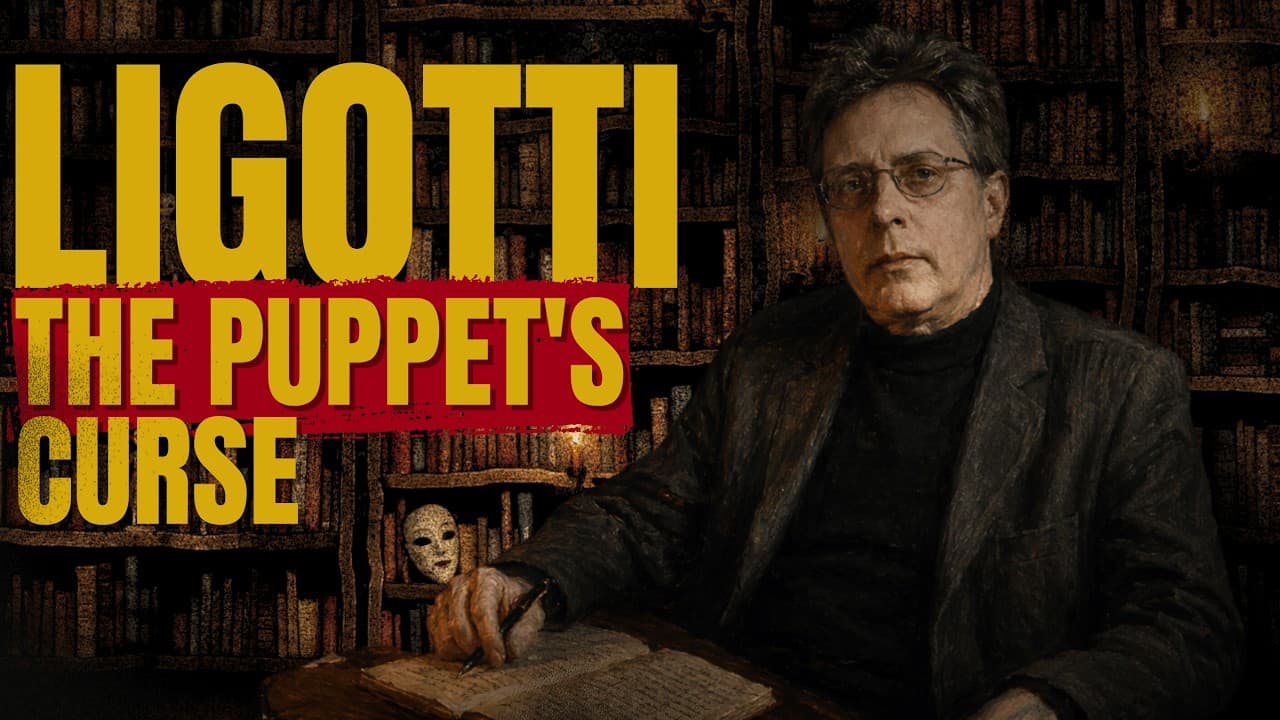
Thomas Ligotti | The Puppet's Curse: Why Consciousness Is Humanity's Greatest Horror
Thomas Ligotti's Complete Philosophy
Thomas Ligotti wrote horror fiction as philosophical argument, producing the most uncompromising pessimist literature of the last century.
His life ran from a Catholic childhood in Detroit to the crisis at seventeen that broke his inherited sense of the world, through the decades he spent as a reference editor by day and a weird-fiction writer by night.
We follow him into the small-press debut that announced a strange new voice, through the mature collections that refined it into something closer to philosophical argument, into the corporate-horror novella about a man pushed out of his job, and into the quieter late stories of decayed towns and malignantly useless factories.
We examine the long, obscure tradition of philosophical pessimism that stood behind his fiction, and we turn at last to the treatise in which he finally stated his position in his own voice. A slow journey through the darkest and most carefully written American horror of our time.
The full episode is on YouTube and Spotify. Please listen only in safe, restful contexts.
Enjoying the episode?
Occasional letters on philosophy, reading, and the examined life. No spam, ever.
By subscribing you consent to receiving occasional emails. Unsubscribe any time via the link in every email or at /unsubscribe.
Timestamps
- 0:00:00Chapter 1: A Catholic Childhood in Detroit and the Panic That Broke It
- 0:10:52Chapter 2: The Inheritance of Poe and Lovecraft
- 0:20:26Chapter 3: The Pessimist Lineage from Schopenhauer to Zapffe
- 0:32:21Chapter 4: Songs of a Dead Dreamer and the Announcement of a New Voice
- 0:41:06Chapter 5: The Frolic and the Metaphysical Criminal
- 0:49:42Chapter 6: The Dreamed Dreamer, the Book of Vastarien, and the Puppeteer
- 0:59:00Chapter 7: Grimscribe and the Voice That Contains Other Voices
- 1:08:03Chapter 8: The Last Feast of Harlequin and the Festival Beneath the Town
- 1:17:10Chapter 9: Nethescurial and the Infectious Document
- 1:26:25Chapter 10: Noctuary and the Move Toward Direct Philosophy
- 1:35:19Chapter 11: The Medusa and the Face One Cannot Look Upon
- 1:44:03Chapter 12: My Work Is Not Yet Done and the Office as Haunted Place
- 1:53:09Chapter 13: Frank Dominio and the Great Black Swine
- 2:02:45Chapter 14: Teatro Grottesco and the Malignantly Useless
- 2:12:26Chapter 15: The Red Tower as Factory of the Universe
- 2:21:19Chapter 16: The Bungalow House and the Longing for the Empty Room
- 2:30:53Chapter 17: The Conspiracy Against the Human Race
- 2:40:35Chapter 18: Consciousness as Tragic Over-development
- 2:50:36Chapter 19: Isolation, Anchoring, Distraction, and Sublimation
- 3:00:39Chapter 20: The Puppet as Literal Description of the Human Situation
- 3:10:09Chapter 21: Antinatalism and the Asymmetry of Harm
- 3:20:32Chapter 22: The Spectral Link and the Silence After
- 3:30:15Chapter 23: True Detective and the Voice in the Patrol Car
- 3:40:41Chapter 24: Legacy and the Readers Who Will Come
For the record
Full Transcript
Chapter 1: A Catholic Childhood in Detroit and the Panic That Broke It
Detroit in the early nineteen fifties was still a city of work. The automobile plants ran day and night, the immigrant neighborhoods held their orderly rhythms of Mass and catechism and after-school chores, and a boy named Thomas Ligotti, born on the ninth of July, nineteen fifty-three, grew up in the middle of all of it. He attended parochial schools. He absorbed, in the way children absorb the atmospheric conditions of their earliest years, the world of rituals and meanings and quiet reassurances that the Catholic imagination of mid-century America provided as a kind of standard equipment for growing up. The saints on the plaster walls. The priests in their vestments. The promise, repeated so often that it came to seem part of the structure of reality itself, that there was a reason for everything, a place for the faithful, and a merciful intelligence presiding over the whole arrangement.
By the middle of his teenage years, that inherited world had begun to unravel. When Ligotti was seventeen years old, at the very end of the nineteen sixties, he experienced what he would later describe as a sudden and overwhelming episode of panic, an event so severe and so unfathomable that it permanently altered the structure of his consciousness. From that moment forward he would live with what psychiatry calls an anxiety disorder, with a chronic depression that at times deepened into complete anhedonia, and with episodes of depersonalization and derealization in which the ordinary world took on the quality of a stage set, the face in the mirror became the face of a stranger, and the self that had been assumed to persist behind the surface of experience seemed to flicker out of being altogether.
It is difficult to overstate how much this condition would come to shape everything he went on to write. The standard psychiatric vocabulary names the symptoms cleanly enough, but the names do not begin to capture what is actually at stake in the experience. To be depersonalized is to feel that one is watching one's own life from somewhere just outside it, as a spectator watches a film about a stranger. To be derealized is to feel that the world itself has lost its rightness, its self-evidence, its quality of being the real world, and has become instead a kind of thin painted backdrop behind which there may be nothing at all. For most people who pass through such states briefly, the condition is frightening precisely because it is temporary, because they know it will lift and they can return to the everyday. For Ligotti it would become a more or less permanent mode of being, the weather inside which he lived and wrote and worked.
He found, in this condition, that the ordinary descriptions of human life available in literature and in philosophy mostly did not match what he was going through. The novels of realism, the uplifting memoirs, the polite essays about the human condition, all assumed a coherent self moving through a stable and meaningful world, having experiences that added up to a life. Ligotti could not find himself in any of that. What he could find himself in, when he began to look for it, was a strain of European thought that had been dismissed and marginalized for most of the nineteenth and twentieth centuries, and a strain of American and European horror fiction that had been treated as disreputable entertainment for the same length of time. He read Schopenhauer. He read Emil Cioran. He read Edgar Allan Poe and Howard Phillips Lovecraft. He began, over time, to suspect that the so-called disreputable literature of pessimism and horror was in fact the only literature honest enough to describe the world as he was experiencing it.
Out of this recognition the writer began to form. He started composing his own stories in his twenties, stories that drew openly on Poe and Lovecraft but were moving toward something neither predecessor had quite attempted. Ligotti wanted a horror fiction that was not merely frightening, not merely atmospheric, not merely a machinery for producing dread, but that was making, at the level of its prose and its structure, a philosophical claim about the nature of consciousness and the nature of the world. He wrote slowly. He revised obsessively. He sent stories to the small magazines of the horror and weird-fiction circuit, where they began to appear in the late nineteen seventies and early nineteen eighties, read mostly by other writers and by a small circle of connoisseurs, admired for their strangeness and their polish.
For most of his working life he earned his living as an editor at Gale Research, a Detroit-based reference publisher that produced large-scale scholarly works on authors, biography, and literary criticism. The job had almost no surface connection to the content of his fiction. He edited and assembled reference entries on writers he was not especially interested in, under the deadlines and the quiet corporate routines familiar to any office worker of the late twentieth century. Colleagues who saw him at his desk would not have guessed that the soft-spoken reference editor at the next workstation was the author of some of the most extreme and philosophically rigorous horror fiction of the period. This double life, the corporate employee by day and the metaphysical horror writer by night, would leave a permanent mark on his imagination, and the soul-killing routine of the office would eventually become the setting of one of his most powerful later works.
In nineteen eighty-six, when Ligotti was thirty-three years old, his first full-length collection of stories, Songs of a Dead Dreamer, appeared from a small press called Silver Scarab, in a limited edition that would become one of the most sought-after and collectable volumes in contemporary horror publishing. The book gathered together the stories he had been writing and revising for most of the decade, arranged them into something that behaved less like a loose gathering of tales and more like a single extended meditation, and announced, to the small readership willing to find it, the arrival of a writer unlike any other then working in English. Within five years he had published a second collection, called Grimscribe: His Lives and Works. Within a decade, with an omnibus volume called The Nightmare Factory that would eventually win the Bram Stoker Award for the best horror collection of its year, he had established himself in the eyes of those who cared about such things as the most important American horror writer since Lovecraft.
He almost never gave interviews in the early years. He did not attend conventions. He did not appear on panels. He did not teach writing workshops or accept invitations to literary festivals. He lived quietly and suffered quietly and wrote what he could, when he could. For long stretches the illness made writing nearly impossible, and his output slowed or stopped. He produced, over nearly forty years, a body of work small by the standards of commercial horror writers but disproportionately dense, disproportionately argued, disproportionately close to pure philosophical prose disguised as narrative.
At some point in the closing years of the twentieth century he left Detroit and moved to Florida, where he continued to live in seclusion. He published a novella about corporate life, then a full-length late collection called Teatro Grottesco, then in two thousand and ten the philosophical treatise for which he is now most widely known outside the horror genre, a book called The Conspiracy Against the Human Race, in which for the first time he set out the philosophical position his fiction had been dramatizing all along. After that book, and one small final volume of fiction in two thousand and fourteen, he largely fell silent, continuing to live and continuing to correspond with a few trusted readers, but publishing almost nothing new.
The life summarized here is not eventful in the usual sense. There are no scandals, no love affairs, no travel, no political commitments, no movements joined or abandoned. What there is, instead, is a single devastating interior event in late adolescence and then several decades spent trying to find a language adequate to what that event revealed. What it revealed, in Ligotti's own eventual formulation, was that consciousness is not a gift but a catastrophe, that the human self is a kind of accidental growth that knows too much for its own survival, and that the ordinary cheerful assumption that being alive is better than not being alive is a piece of protective psychological machinery rather than a considered judgment about reality.
To say this plainly, as a summary, is to strip it of everything that makes Ligotti's actual prose worth reading. The fiction is not a set of claims translated into story form. The fiction is the place where the claims are tested against the texture of experience, put through scenes and voices and atmospheres, allowed to darken and complicate in ways that simple propositions cannot. A reader who knows only the summarized position will find the fiction stranger and more unsettling than the summary suggests, because the fiction does not merely assert that consciousness is a catastrophe. It stages the catastrophe, sentence by sentence, with a patience and a craft that no other writer in the genre has matched. A man who spent his adult years living inside a chronic disturbance of the boundary between self and world was, it turned out, the ideal instrument for writing a fiction in which that boundary is always failing, always giving way, always betraying the comfortable assumption that the person we think we are is the person who is actually there.
Chapter 2: The Inheritance of Poe and Lovecraft
The American horror tradition that Thomas Ligotti inherited had two major ancestors, and his relation to both of them is so close that it can be traced almost line by line through the early stories. The first of these ancestors was Edgar Allan Poe, writing from Baltimore and Richmond and Philadelphia and New York in the eighteen thirties and forties, whose tales and essays laid down the fundamental premise of American weird fiction, which was that a short story could be constructed as a single concentrated mood, unified around a single emotional effect, with every sentence contributing to the atmosphere of the whole. The second was Howard Phillips Lovecraft, writing from Providence in the nineteen twenties and thirties, whose work took the Poe inheritance in an entirely new direction by locating horror not in the guilty psychology of an individual narrator but in the cosmic indifference of a universe to which human beings had never mattered and would never matter.
Poe's contribution was theoretical as much as it was imaginative. In the essay known as The Philosophy of Composition, published in the middle of the eighteen forties, he argued that the short story, unlike the novel, could be held in the mind as a single unit, and that the writer ought to begin not with a plot or a character but with the specific emotional effect the story was meant to produce. Every word of the finished story, Poe said, should contribute to that effect and to nothing else. What Poe was describing, in the language of his decade, was the logic of concentrated atmosphere. A Poe tale is not plotted so much as compressed. A single mood is cultivated to the point of unbearable density, a narrator is trapped inside his own mind and cannot escape, and the horror arises not from what happens in the world but from the sensation that the walls of the consciousness we are trapped in are slowly closing on us.
This Poe template survived into the twentieth century almost unchanged at the level of technique. The guilty narrator of The Tell-Tale Heart, insisting on his sanity while betraying his madness with every sentence, became the basic figure of the unreliable first-person horror story. The disintegrating observer in The Fall of the House of Usher, and the nameless speakers of Ligeia and Berenice slowly overtaken by their own obsessive perceptions, all established a way of writing in which the narrator's consciousness was itself the subject matter, and the horror lay in watching that consciousness come apart on the page. Ligotti, writing a century and more later, would absorb this template so completely that many of his first-person narrators can be read as direct descendants of Poe's disintegrating observers, their diction more modern but their basic situation continuous with Poe's.
Lovecraft, who acknowledged Poe as his own most important ancestor, inherited the atmospheric short story and gave it a new metaphysical content. In the handful of great stories written in the last decade and a half of his life, pieces like The Call of Cthulhu and The Colour Out of Space and At the Mountains of Madness and The Shadow Over Innsmouth, Lovecraft introduced the idea that would become his signature contribution to the genre. The idea was that the frightening thing in a horror story need not be a ghost or a monster in any psychological sense, but could be instead the structure of the universe itself, understood as vast, old, unconcerned with human beings, and populated if at all by forces and entities whose scale made human significance a sentimental error. Lovecraft called this position cosmicism. He argued that the only honest literary response to the astronomical and geological discoveries of the modern era was a literature of cosmic indifference, a literature that acknowledged openly what the scientific picture had already implied, which was that the human species was a local, recent, and probably transient accident on a minor planet whirling around a middling star.
Ligotti took from Lovecraft the fundamental orientation but discarded almost all of its apparatus. He had no interest in the Lovecraftian mythology of named old gods and forbidden tomes, no interest in New England antiquarianism, no interest in the pastiche of elder lore and eldritch manuscripts that Lovecraft's imitators had, by the nineteen eighties, turned into a self-parodying sub-genre. What he took was the underlying claim that the horror of existence is not a matter of individual psychology but a matter of the metaphysical situation in which consciousness finds itself. What he also took, though he transformed it beyond recognition, was Lovecraft's willingness to make fiction argue.
The difference between the two writers, and it is the crucial difference for understanding Ligotti's innovation, is that Lovecraft's cosmicism leaves the human observer intact. A Lovecraft narrator who goes mad at the sight of the old gods remains, up until the moment of his collapse, an intelligible ordinary person, someone with a life and a name and a set of concerns that the cosmic revelation then overwrites. The universe is indifferent, in Lovecraft, but the self is real, and the collision between the self and the indifferent universe is what generates the horror. Ligotti's move, and it is the move that makes his fiction strictly continuous with the philosophical pessimism he would eventually write about directly, is to shift the horror inside the self. In Ligotti the self is already the problem. Consciousness is already the catastrophe. One does not need to travel to Antarctica or open a forbidden book to encounter the horror, because the horror is already seated on the other side of one's own forehead, wearing one's own face, operating the levers of one's own body. The cosmic indifference of Lovecraft becomes, in Ligotti, the interior hollowness of the everyday.
There is one further distinction worth drawing out, because it has a direct bearing on how the fiction reads. Poe and Lovecraft were both, in their different ways, writers for whom horror was a destination. A Poe story moves toward its moment of revealed madness, a Lovecraft story moves toward its moment of cosmic disclosure, and in both cases the story ends roughly when the destination is reached. The final sentence catches the narrator in the act of breaking. Ligotti is not particularly interested in this kind of destination. His stories often begin already past the moment when the cosmic disclosure has arrived, and the narrator's job is not to discover the terrible truth but to describe what it is like to live inside it. The Poe and Lovecraft short story, at its most distinctive, is an account of a breaking point. The Ligotti short story is an account of what happens after the breaking point has receded into the past and the narrator has had to go on with his life, such as it is, in the afterglow of a recognition that cannot be unknown.
This is why Ligotti could write an entire story in which almost nothing visible occurs and still produce the effect of overwhelming horror. The horror does not depend on a creature emerging from the cellar or a narrator going mad at the sight of Cthulhu. It depends on a narrator speaking in a particular voice about an apparently ordinary situation, and letting the listener feel, gradually, that the voice is the voice of someone who has been thoroughly persuaded that being alive is a grotesque error. A Lovecraft story works by the collision of the knowable and the unknowable. A Ligotti story works by the slow revelation that what we had taken to be knowable, including our own minds and our own lives, was never any more solid than a stage set made of painted paper.
What makes Ligotti's position on these two ancestors so distinctive is that he did not pretend, as so many heirs of Poe and Lovecraft had pretended, to be writing from within the genre conventions they had invented. He was using those conventions as a vehicle for something the conventions had never quite been used to carry, a fully elaborated philosophical pessimism of the European nineteenth and early twentieth-century kind. The American horror tradition gave him a form, an atmosphere, a repertoire of technical moves. What it could not give him on its own was the intellectual content that would make his stories not merely frightening but propositional, not merely atmospheric but argumentative. That content had to come from elsewhere, and where it came from is a lineage so obscure that even many readers of philosophy have never heard of several of its key figures.
Chapter 3: The Pessimist Lineage from Schopenhauer to Zapffe
Philosophical pessimism, the school of thought that claims not merely that life contains suffering but that life is structured in such a way that non-existence would be preferable to existence, is not the dominant strain in any major tradition of European philosophy. It is a minority position, often embarrassing to its adjacent schools, frequently dismissed as a temperamental quirk of a few misanthropic writers rather than a serious philosophical argument. But it has a lineage, and the lineage is real, and understanding it is necessary for anyone trying to read Thomas Ligotti with any precision. Without this background his fiction looks like horror writing that has become unusually grim. With this background it looks like something else altogether, a sustained fictional argument in conversation with philosophers his readers have mostly never heard of.
The lineage begins with Arthur Schopenhauer, whose great work, The World as Will and Representation, first appeared in Germany in eighteen eighteen and then in an expanded second volume in eighteen forty-four. Schopenhauer's starting point was the philosophy of Immanuel Kant, whose distinction between the world of appearance and the underlying reality that escapes all human categories had set the terms of German thought for a generation. Kant had said that we can only know the world as it appears to us, filtered through the necessary forms of our understanding, and that the reality beyond these forms is closed to us forever. Schopenhauer accepted the distinction but made one startling modification. He claimed that there was, after all, a single point at which we have direct access to the underlying reality, and that point was the experience of our own willing. When I feel hunger, when I want something, when I strive toward a goal, I am not merely observing an appearance, I am feeling the underlying reality of existence from the inside. And what I feel, Schopenhauer said, is a blind, restless, insatiable striving that has no goal and can never be satisfied.
From this single move an entire philosophy of suffering unfolds. If the underlying reality of the world is blind willing, and if willing is by its nature directed at something it does not yet have, then willing is nothing but desire, and desire is nothing but lack, and lack is nothing but suffering. The moments when we appear to be at rest, when a desire has been satisfied and we are briefly content, are just the empty intervals between two episodes of wanting. Boredom rushes in to fill them. Then a new desire arises, and the cycle begins again. The structure of existence, at its root, is the structure of frustrated appetite. Happiness, so called, is either the absence of pain for a moment or the brief relief of a craving that will return in a different form tomorrow. Suffering is not an accident in Schopenhauer's world. Suffering is what the world is made of.
Schopenhauer drew from this a set of responses he considered genuinely consolatory. Art, he said, allowed us briefly to contemplate the world without willing, freed from the frustrations of desire, and the aesthetic experience was an island of peace in the ocean of striving. Compassion, which he traced to the recognition that other beings suffer exactly as I do, was the only secure foundation for ethics. And beyond art and compassion lay the ascetic path, the denial of the will, the refusal to reproduce, the cultivation of indifference to the goods the world offered. In this last recommendation Schopenhauer drew openly on the Buddhist and Hindu texts that had become available in European languages in his lifetime, and he saw in the Eastern traditions a confirmation of his own diagnosis. It is important to notice that even in Schopenhauer, the man most associated with philosophical pessimism in the popular imagination, there is still a redemptive gesture at the end. Existence is terrible, he says, but there is a way out, or at least a way to reduce one's entanglement in the terribleness.
The writers who came after Schopenhauer in the pessimist lineage were often more extreme than he was, willing to follow his diagnosis without availing themselves of his consolations. Philipp Mainländer, who published a book called The Philosophy of Redemption in Germany in eighteen seventy-six, argued that the universe was best understood as the aftermath of a divine suicide. In the beginning, Mainländer proposed, there had been God, but God had found the burden of his own existence unbearable and had chosen to cease to be. The universe we now inhabit, he said, is the long and gradual process by which this primordial self-annihilation is working itself out in time. Every particle of matter, every living thing, every human life, is a fragment of that disintegration. The will of the universe, in other words, is a will toward death, and the apparent vitality of biological life is only a detour on the road back to non-being. Shortly after completing his book and seeing it through its first printing, Mainländer took his own life. He was thirty-four years old.
Julius Bahnsen, a near-contemporary of Mainländer, developed another variant of pessimism in which the underlying reality of the world was not merely blind willing but self-contradicting willing, a will that was eternally divided against itself and could never come to rest in any outcome whatsoever. For Bahnsen the tragic was not a particular kind of story or a particular emotional response but the actual metaphysical structure of the world. Existence is tragic, he argued, not because bad things happen in it but because it is built out of contradictions that can never be resolved. The lineage of German pessimism produced several such thinkers in the second half of the nineteenth century, most of them now little read outside of specialized histories of the tradition, all of them working within and against the Schopenhauerian inheritance, all of them trying to state the pessimist case in some purer or more rigorous form.
In the twentieth century the lineage moved from Germany to Paris, and its most visible figure became the Romanian-born writer Emil Cioran, who after leaving Romania in the nineteen thirties settled in France and wrote for the rest of his life in French. Cioran's work consists almost entirely of aphorisms and short essays, in volumes with titles like A Short History of Decay, The Trouble with Being Born, and On the Heights of Despair. His method was not argument but concentration. He would set down a sentence so compressed and so ruthless that it could stand on its own without support, and then another, and another, building his books out of fragments. The cumulative effect is that of a writer who has decided to say openly, and with all possible elegance, what the Western tradition mostly preferred to keep behind its back. That it is unfortunate to have been born. That consciousness is a misfortune. That the various ambitions and hopes that fill up an ordinary life are simply forms of evasion. Cioran was himself, by all accounts, an extremely sociable man and a witty conversationalist, but his pages are the pages of someone who has abandoned the project of cheerfulness with a completeness that few other twentieth-century writers managed.
The last major figure in this lineage, and the one whose importance for Ligotti specifically exceeds that of all the others, is the Norwegian writer and philosopher Peter Wessel Zapffe. Zapffe was born in nineteen hundred and lived until nineteen ninety. He studied law, then philosophy, wrote a major philosophical dissertation on the concept of the tragic in nineteen forty-one, and published throughout the middle of the twentieth century a series of essays and fables that were scarcely translated out of Norwegian and remained almost entirely unknown to English-language readers until the very end of his life. His most important and most concentrated piece of writing is a short essay called The Last Messiah, published in nineteen thirty-three, in which he set out in the space of a few pages a complete philosophical anthropology of the human animal.
The argument of The Last Messiah can be stated simply, though it takes a certain effort to hold in mind all at once. Zapffe proposed that human beings are a biological species in which the faculty of consciousness has developed to a point far beyond what is necessary or even advantageous for survival. Where other animals are aware of their immediate environment and their present needs, the human animal is aware of its own existence as a whole, aware of time, aware of the fact that it is going to die, and aware that the universe does not care. This over-developed awareness, Zapffe argued, is the thing that makes human life specifically and uniquely miserable. We are creatures who know too much about our situation to be content in it, and yet we have not been given any cognitive equipment that would allow us to bear what we know. The resulting misery, if left unmanaged, would make human life impossible. Since human life is not in fact impossible, it must be that humans have developed a set of techniques for managing the misery, and Zapffe identified four such techniques. The details of those techniques, and the use Ligotti would eventually make of them, can wait until the philosophical treatise that builds directly on Zapffe's essay is itself brought into focus.
When Thomas Ligotti eventually read The Last Messiah, many decades after it had first appeared in a small Norwegian journal, he recognized in the essay a more exact statement of what he had been experiencing and writing about for most of his adult life than anything he had found in the more famous pessimists. Zapffe's language of consciousness as a biological over-development, of the self as a fragile management operation running on a fundamentally intolerable substrate, matched the interior experience that Ligotti's fiction had been dramatizing from the beginning. The American horror writer and the obscure Norwegian essayist had been, without knowing it, working the same territory. Zapffe supplied a vocabulary. Ligotti would spend decades turning that vocabulary into a fiction that a reader could enter through the front door of any ordinary short story and find himself, several pages later, walking the same corridors of thought that the Norwegian philosopher had been mapping nearly a century earlier in an obscure essay almost no one had read.
Chapter 4: Songs of a Dead Dreamer and the Announcement of a New Voice
Songs of a Dead Dreamer is organized in a way that no ordinary horror collection of its period would have been organized. It is divided into three sections, each of them introduced only by a short phrase that functions less as a heading than as a kind of mood indicator: Dreams for Sleepwalkers, Dreams for Insomniacs, Dreams for the Dead. The titles of the sections are not incidental. The book is not presenting itself as a gathering of independent tales that happen to share an author. It is presenting itself as a single extended experience, organized by the way in which each of its readers will receive its contents: awake but unseeing, awake and tormented, or beyond sleep altogether. The stories inside are meant to be read as a sequence, and the sequence is meant to move the reader, gradually, from one state of consciousness into the next.
This kind of careful architectural ambition is rare in first books by young horror writers, and it is almost unheard of in the small-press weird fiction of the nineteen eighties. The genre at that moment was still mostly a market for quick paperback anthologies with lurid covers, and the kinds of stories that sold best were the kind that could be read in one sitting on an airplane. Songs of a Dead Dreamer refuses this format from its first page. The prose demands slow reading. The sentences run long. The paragraphs develop their ideas as much through accumulation of qualifying clauses as through advancement of plot. Readers who came to the book expecting a night's quick entertainment often put it down and did not finish. Readers who stayed with it found themselves inside a sensibility they had not previously encountered, a sensibility that was taking horror fiction with a seriousness ordinarily reserved for literary novels and philosophical essays.
What were the obsessions already visible in this first book? The first and most striking was the figure of the dream itself, the dream understood not as a pleasant escape from waking life but as the more honest of the two conditions, the one in which the flimsy organization of ordinary reality finally collapses and the truth underneath is briefly allowed to show through. The sleeper in Ligotti is not having experiences. The sleeper is being shown something. And the something that is being shown, over and over again, is that the waking world was never what it seemed to be, that the orderly procession of days and seasons and meaningful relationships was a production mounted by forces that do not have our interests at heart, and that the people we thought we were are closer to puppets than to selves.
Closely linked to this obsession with dreaming was the book's fascination with artificial humans. Dolls appear in these early stories, and mannequins, and waxworks, and marionettes, and clockwork figures, and children's toys whose empty faces are somehow more expressive than the faces of the people carrying them. The thematic function of these figures is not, as it is in most horror fiction, to be mistaken for living beings in a jump-scare set piece. The function is exactly the reverse. The dolls in Ligotti do not become alarmingly alive. The living humans around them become alarmingly doll-like. What the reader is being slowly asked to entertain is the possibility that the distinction between the doll and the person is not as secure as we had supposed, that the principle of the doll, the principle of being operated from outside by forces one does not control and cannot see, may apply more broadly than one had thought.
A third set of obsessions ran through the prose surface itself. Ligotti's narrators in this first collection are almost without exception speakers of a strangely formal English, educated, circumlocutious, given to baroque qualifications and to a kind of antique precision that sounds as if it has been translated from some earlier, more meticulous language. The effect is deliberate. A narrator who speaks in this register cannot quite be trusted to be a regular contemporary person. The voice is a little too high-pitched in its formality, a little too aware of itself, a little too fond of arrangements of words that foreground their own arrangement. The reader, hearing this, begins to suspect that the voice is not quite human. And this suspicion is almost always correct. Ligotti's first-person narrators, even when they present themselves as ordinary men with ordinary jobs, are speaking from somewhere slightly off the map of ordinary human speech.
A fourth and subtler feature of the collection was its willingness to end stories without resolution. The traditional horror story, whatever its other virtues, tends to promise that the source of the horror will be named, confronted, and either defeated or allowed to triumph in a decisive final moment. The reader closes the book knowing what happened. Songs of a Dead Dreamer is full of stories that do not offer this kind of closure. A narrator begins speaking in a state of distress, describes some fragment of an experience that cannot be fully explained, arrives at no resolution, and simply breaks off. The reader is left with the distress, the fragment, and a feeling that the world outside the story has been subtly altered by the act of reading it. This unfinishedness is not a failure of craft. It is an argument about the nature of horror. Things that cannot be resolved in a story cannot be resolved in a life either. The fiction is shaped to produce in the reader a small version of the interior condition its author has been living with for years.
Finally, there is the question of the book's relation to genre. In the nineteen eighties, when it appeared, weird fiction and horror fiction were strictly ghettoized in American publishing. The books lived on certain shelves in certain stores, the authors attended certain conventions, the magazines paid certain rates, and the literary culture at large did not pay attention to anything that happened in that space. Songs of a Dead Dreamer was published into this ghetto, by a tiny press, in a small print run, with no reasonable expectation of crossing over into the literary mainstream. And yet the book was written as if none of that applied. Ligotti was writing, from the first sentence onward, as if he were writing for readers who might also read Kafka and Borges and the harder European modernists, as if the fact that his book happened to belong to the horror shelf was an administrative accident rather than a literary fate. It took a long time for the literary culture to catch up with this, and in some ways it is still catching up. But the book's refusal to accept its own classification has, in retrospect, turned out to be one of its most important qualities. It forced the small readership who did find it to read it as literature, and it prepared the ground for the more ambitious works that were to follow.
The collection was received, when it first appeared, by exactly the kind of small audience that the horror circuit of the nineteen eighties could produce. A few reviews in specialist magazines. A few letters from other writers. A reputation that spread slowly through word of mouth among readers who cared about the literary end of the genre. In the decades since, as the book has been reprinted and expanded and eventually republished in more widely available editions, the small readership has grown into a larger and more serious one, and Songs of a Dead Dreamer has come to be recognized as one of the most important first books in the history of American weird fiction, comparable in significance to the early stories of Shirley Jackson or the first hardcover collection of Howard Phillips Lovecraft. It is the book in which a new voice in the tradition announced itself, and did so in a register so strange that it took a generation for most readers to hear what was being said.
Chapter 5: The Frolic and the Metaphysical Criminal
The story that opens Songs of a Dead Dreamer, and that many readers have since named as the single most significant debut story of its generation, is called The Frolic. Its setup is domestic, unremarkable, almost a parody of ordinary American middle-class life. A psychiatrist named David Munck returns home from work to the house he shares with his wife, Leslie, and their small daughter. The hour is late. The house is quiet. Munck pours a drink. He mentions to Leslie, in the offhand way a man might mention any difficult case from his workday, that he has just come from an interview with a particularly disturbing patient. The patient, Munck says, is a child murderer who will not give his real name and so is officially known only as John Doe.
The patient has been telling Munck about a place. The place is not any place that can be pointed to on a map. The patient refers to it as the Realm, or sometimes as the Realm of Flesh, and he describes it in language that is by turns lyrical and obscene, as if he cannot decide whether what he has seen is beautiful or disgusting. In the Realm, according to the patient, one is freed from the ordinary constraints of human embodiment. One can move through spaces that have no names. One can play with companions of a kind not available in the waking world. The patient, Munck explains to his wife, insists that he has been going to the Realm regularly for years. It is where he takes his child victims. It is where he frolics.
The story's architecture is so simple that a listener who has not read it might easily underestimate what Ligotti is doing. A man tells his wife about a patient. A patient tells the doctor about a dream. And then, in the last pages of the story, something happens in the ordinary waking house of David and Leslie and their daughter that suggests, without quite saying, that the Realm is neither a dream nor a delusion nor a local fantasy of a deranged killer, but rather a real dimension of some kind whose boundaries are porous and whose inhabitants have begun to take an interest in the Munck family. The final image of the story, which will not be spoiled here in detail, involves the impossible appearance of a presence that should not be able to reach this house, and a small object left behind that no one in the house can account for.
What makes The Frolic important, and what distinguishes it from the many horror stories that have used similar apparatus, is the nature of the philosophical claim it is making. The criminal at the center of the story is not merely a psychotic. He is a kind of metaphysician. His murders are not the product of broken impulses and impoverished opportunities. They are the product of a theory about where the real world is and where it is not. The ordinary world, he has come to believe, is the thin provincial crust on top of a much larger and more interesting space. The child murders are his method for getting there. From inside his theory, what he is doing is not butchery but tourism. He is not a sick man escaping his responsibilities through fantasy. He is a coherent agent acting on beliefs that, if one could entertain them for a moment, would make his actions intelligible.
This is the first appearance in Ligotti's published work of what would become his most disturbing signature, which is the presentation of horror from the inside of a worldview that has accepted the horror as true. In a conventional horror story, the reader is invited to stand with the normal characters and recoil from the criminal or the monster. In Ligotti, the reader is placed in the uncomfortable position of nearly being persuaded. The criminal's descriptions of the Realm are not hurled at the reader in the language of madness. They are delivered in careful, almost tender sentences that make the Realm sound, for a moment, like a place one might actually want to know more about. The reader has to keep reminding himself that the person speaking with such evident fondness is describing a place where he has taken small children to their deaths.
The story also introduces a move that will recur throughout Ligotti's career, which is the method of infection by narrative. The criminal's description of the Realm is not just a description. It is a kind of seed, planted in the mind of whoever hears it, that begins to grow in directions the listener cannot control. David Munck, listening to his patient's account, does not believe what he is being told. But after hearing it, things in his own house begin to feel slightly different, slightly porous, slightly as though the categories he had relied on to keep the Realm at a safe distance from his own life were not as solid as they had seemed. The infection, when it manifests in the final scene, is not visible as a monster crawling out of a closet. It is visible as a subtle rearrangement of what the ordinary house is capable of containing. The listener infects the listener's world. This is how horror works in Ligotti from the very first story.
A listener trying to understand why The Frolic is not merely a disturbing tale about a child killer but a philosophical performance in its own right might notice that every element of the story is organized to undermine the listener's confidence in the ordinary world. The psychiatrist is a figure of ordinary bourgeois stability, a professional with a wife and a child and a mortgage, and he is exactly the kind of figure most horror stories reassure us with. The wife is attentive and concerned. The daughter is safely asleep upstairs. The house is described with the kind of domestic specificity that signals safety to any trained reader of realist fiction. And yet by the end of the story, all of this apparatus of reassurance has become complicit in the horror. The house is porous. The daughter is vulnerable. The wife's concern cannot protect her family. The psychiatrist's professional training has been exactly the wrong preparation for the thing he has encountered, because his training teaches him to interpret the patient's speech as a symptom of a disordered mind rather than as a report from a neighboring dimension.
The Frolic is also the first story in the collection in which Ligotti plays what will become his favorite game with the figure of the expert. The doctor, the scholar, the researcher, the anthropologist, the literary investigator, all the characters in Ligotti's fiction who are supposed to be equipped to understand what is happening to them by virtue of their training, are exactly the characters who are most spectacularly wrong about what is happening to them. The training is a kind of protective costume that turns out to be no protection at all. In The Frolic, the psychiatrist is a man who has spent his professional life listening to patients describe impossible realities and organizing their speech into diagnostic categories. When an actual impossible reality begins to manifest itself in his own house, the diagnostic categories are useless. They were never designed to accommodate a patient who was telling the truth.
None of this is announced in the story with any fanfare. The prose is quiet, domestic, almost polite. The horror builds not through the kind of violent set pieces that a genre reader might expect but through the slow dawning suspicion that nothing in this apparently ordinary living room is as it appears, and that the most dangerous element in the scene is not the absent killer but the story the psychiatrist has been carrying around in his head all afternoon. Ligotti has, in the first story of his first book, taken the conventions of domestic realism and the conventions of horror and used them against each other in such a way that neither can protect the reader. This is a method he will refine for the next forty years.
Chapter 6: The Dreamed Dreamer, the Book of Vastarien, and the Puppeteer
Elsewhere in his first collection, and in the stories that surrounded and followed it in the small magazines of the early nineteen eighties, Ligotti was developing a set of preoccupations that he would work with for the rest of his career. Three of these early stories in particular have come to stand for what his fiction would become, because each of them isolates a single motif and pushes it toward its philosophical implications with a clarity that the later, more integrated stories would eventually bury inside more elaborate structures.
The first of these is Dream of a Manikin. The story takes the form of a letter from a psychotherapist to a colleague. The writer of the letter has been seeing a young woman whose presenting complaint is not any conventional neurosis but something stranger. The patient has come to believe, as a result of certain recurring dreams and certain odd experiences in her waking life, that the ordinary human assumption about the relation between people and their dreams may be exactly backwards. The assumption is that a living person has dreams, and that the dreams are a kind of byproduct of the person's neural life, insubstantial and dependent on the more solid reality of the waking self. The patient has begun to suspect instead that what we experience as our waking life is itself a dream, and that we are the dream of some other, more fundamental kind of entity that is not a person but a doll. She believes, in other words, that the real inhabitants of existence are the manikins, and that what we call our lives is what the manikins dream about when they sleep.
The letter writer describes this patient's theory with the detached vocabulary of a clinician. He is reporting on a delusion. He is not, at first, personally implicated in what his patient believes. But as the story unfolds, small intrusions from the patient's theoretical framework begin to appear in his own life. A figure glimpsed in a window. A sensation that the familiar objects around him are being observed by something that ought not to be able to observe them. A growing unease that the solid thingness of his consulting room has become, somehow, less reliable than it was. The letter he is writing is meant to reassure his colleague, and perhaps himself, that he is still approaching the case with professional composure. The reader, who can see what the letter writer cannot quite see, understands that the composure is already gone, and that the infection of his patient's theory has already taken hold.
What Dream of a Manikin does, and does more efficiently than any other story in the collection, is introduce the central Ligottian reversal. The reversal is that what we had assumed to be the fundamental thing, namely our conscious human life, turns out to be a derivative, a dependent, a shadow cast by something else. The dolls in the story are not the horror because the dolls have come alive. The dolls are the horror because we have come to suspect that we were never alive in the way we thought we were, that the self-directed inner life we assumed we possessed is actually a kind of thin performance going on in front of a much older and stranger and more inhuman audience. The patient's delusion turns out, in the final implication of the story, to be a diagnosis of the general human situation. We are all being dreamed by something that cares about us exactly as much as an ordinary sleeper cares about the extras in his own dreams, which is to say, not at all.
The second of these early stories is Vastarien. Here the motif is the book. The book, in Vastarien, is a very special kind of book, one of those volumes the weird tradition has always loved, whose pages contain not information but a contagion. The central character is a man whose ordinary reading life has been slowly drained of its pleasures by a growing dissatisfaction with the worlds available in ordinary novels and travel books. He cannot feel at home in any of them. The places described on the pages feel wrong. The people in them feel wrong. And then, by some route that the story does not entirely explain, he comes into possession of a book called Vastarien, whose pages describe a city. The city has never existed in the ordinary sense. It is a city that is produced by the book itself, a city that comes into being, partially and strangely, in the mind of the reader who holds the book. And the closer the reader bends over the pages, the more real the city becomes.
The philosophical content of Vastarien, though the story never announces it, is a version of the question Plato raised about the relation between the ideal and the material and the artistic. For Plato, the artist was a kind of third-rank counterfeiter whose representations of the world were always weaker and less real than the world itself. For Vastarien's reader, the representation has turned out to be stronger and more real than the world. The book he is reading is not a poor copy of a city that exists somewhere else. It is the city's only existence, and his own reading is the process by which the city is being brought into a kind of being it could not otherwise have. This reverses the ordinary assumption about the status of literature as a copy of experience. It also reverses the ordinary assumption about the status of the reader. The reader, in Vastarien, does not observe a city. The reader is the room in which the city happens to appear. The horror, and it is a specifically Ligottian horror, lies in what this might imply about the reader's own reality.
The third of these early stories is Dr. Voke and Mr. Veech, in which the figure of the puppet comes forward for the first time with full philosophical weight. The story concerns a puppeteer, a certain Dr. Voke, and his apprentice, a certain Mr. Veech. Dr. Voke is a practitioner of a kind of art that is also a kind of magic, and his puppets, which he constructs himself in the back room of his workshop, are not merely entertaining objects but figures that have been built to do particular work in the world. Mr. Veech, the apprentice, wants to learn this art. He is drawn to the workshop, drawn to the puppets, drawn to the quiet master who seems to know something important about what the puppets are for. And as the apprenticeship progresses, the nature of the master's art becomes clearer to the apprentice, and the nature of the apprentice's position within that art becomes clearer to the reader. Dr. Voke is not teaching Mr. Veech to be a puppeteer. Dr. Voke is making Mr. Veech into a puppet.
This story is darker than either Dream of a Manikin or Vastarien, because it dispenses with the mediating figure of the delusional patient or the contagious book and places the reader inside a situation where the puppet-making is being performed directly on the reader's narrative sympathies. We are asked to identify with the apprentice. We share his ambition. We want, with him, to learn the art. And somewhere in the middle of this sympathetic identification, we become aware that the ambition has been directed at us from outside, that our wish to learn from Dr. Voke is itself a product of Dr. Voke's technique, and that the process we thought we were undertaking as free agents was actually being performed on us by a practitioner whose art we had underestimated. The story does not spell this out. It lets the reader feel it happening.
What these three early stories share, beyond their specific subject matters, is the pattern of the Ligottian reversal. In each case the ordinary assumption about who or what is in charge of an experience is inverted. The dreamer is dreamed. The reader is read. The apprentice is being constructed by the master. The subject, as we usually think of a subject, turns out to be an object, something that is being acted on by forces whose intentions it cannot perceive and whose presence it can only partly detect. This is a philosophical thesis dressed up as a set of short stories, and it is the thesis that all of Ligotti's later and more sophisticated fiction will continue to put through different variations. The three early stories are the first appearances of the theme in its relatively unclothed form. Everything that follows can be read as an attempt to find more subtle and more insidious ways of staging the same recognition.
Chapter 7: Grimscribe and the Voice That Contains Other Voices
Grimscribe: His Lives and Works appeared from Carroll and Graf Publishers in nineteen ninety-one, five years after Ligotti's debut. It was his first book to reach a general horror readership in a mass-market edition, and the shape of it announced that the writer had decided to stop presenting himself as a gatherer of discrete dream-tales and to begin presenting himself, instead, as the servant of a single disembodied narrator whose name was attached to the collection as a whole. That narrator is the Grimscribe. The figure has no face, no biography, and no history, but it has a voice that contains other voices, and the book is structured as a series of acts of literary ventriloquism in which the Grimscribe speaks through the mouths of the various characters whose stories it is presenting to us.
This framing device, which might have been a mere gimmick in less capable hands, is doing real work in Ligotti's book. A collection of short stories by an ordinary author implicitly promises the reader that each story has a single human consciousness behind it, an individual writer whose personality we might come to recognize across the various tales. A Ligotti story, even in his debut collection, had already begun to suggest that the consciousness behind each tale was not quite an ordinary human consciousness, was rather a kind of patient voice operating from a slightly inhuman angle. The Grimscribe framing makes this suggestion explicit. The book is announcing, as its organizing premise, that the stories it contains were not written by a person but were transcribed by a figure whose relation to ordinary personhood is unclear, whose business is the recording of lives and works that have escaped the notice of conventional literature.
The collection is divided into five sections, each of which functions as a different modality of the Grimscribe's voice. One section presents stories told as if by the damned. Another as if by the demon. Another as if by the dreamer. Another as if by the child. Another as if by the voice that has been fused with a single shared name. The effect of reading the book is of listening to a series of transmissions from roughly the same direction but at slightly different frequencies, each of them carrying a message that the transmitter is not entirely able to articulate in ordinary speech. The reader comes away with the impression of having heard from many speakers, and then with the delayed recognition that perhaps only one speaker has been present the whole time, adjusting its tone and its vocabulary to suit the kind of story it has decided to relay at that moment.
The stories in Grimscribe are also, taken together, darker and more disciplined than those of the debut collection. The younger writer had been willing to let his prose wander, to let a story meander into minor set pieces and to indulge in ornamental grotesquery for its own sake. The writer of Grimscribe has less patience for that kind of thing. His stories are tighter. Their lines of philosophical intent are more clearly drawn. Their endings, even when they remain unresolved in the old way, feel more inevitable, as if the unresolved ending were not an evasion of closure but the precise closure the story had been designed to reach. A reader moving from Songs of a Dead Dreamer into Grimscribe senses a writer who has stopped experimenting with what horror fiction can be made to do and has started refining his method into something like a signature.
Several of the stories in Grimscribe became, almost immediately, classics of the small and attentive readership that followed Ligotti's career. One of these is The Spectacles in the Drawer, in which an aging connoisseur of esoteric objects introduces a younger protégé to a pair of lenses whose use reveals the inhuman machinery underlying ordinary appearances. Another is The Dreaming in Nortown, set in a town where the inhabitants' collective dream life has begun to take on an autonomous reality of its own, and where the dreamers can no longer distinguish, when they wake in the morning, between the things that have happened to them in their own beds and the things that have happened to the versions of themselves that the town has been dreaming together. Another is The Night School, about a teaching institution whose evening students begin to suspect that the curriculum has a purpose quite different from the one advertised in the catalogue, and that the course they are taking is less a program of study than a method of extraction. In each of these stories the Grimscribe's voice can be heard adjusting itself to the particular register the tale requires, now formal, now dreamy, now tinged with a student's anxious observational precision.
What unites these stories, across their surface variety, is a particular attitude toward the reader. The Grimscribe is not trying to scare you. The Grimscribe is trying to acquaint you with a state of affairs that has always obtained and that you have simply failed to notice. The rhetorical stance is closer to that of a patient instructor than to that of a carnival barker. The horror is not presented as a surprise. The horror is presented as a piece of ordinary information about the world that most human beings have arranged not to be available to themselves, and that the Grimscribe is now quietly making available. Whether this making available is an act of generosity or an act of malice is a question the book does not answer, and probably cannot answer, because the distinction between the two may not apply to whatever kind of entity the Grimscribe is.
The collection is also the first in which Ligotti's fascination with small, decayed, almost abandoned communities begins to organize his geographic imagination. The towns in these stories are not the bright suburbs of Songs of a Dead Dreamer. They are northern factory towns after the factories have closed. They are villages in some unspecified Eastern European landscape whose customs no one remembers. They are American settlements so obscure that the narrators arriving in them from outside cannot find them marked on any ordinary map. These places share a quality of having been left behind by whatever forward movement the rest of the world has been making. They have accumulated time in the way that a basement accumulates dust. And in the quiet neglect of their streets, in the boarded windows and the faded signs and the half-empty shops, something else has been able to take hold that would not have been able to take hold in a more lively and well-tended setting. The neglected town, in Ligotti, is not a minor detail of setting. It is a philosophical claim about where the truth of existence can actually be observed. You cannot see it in the middle of a brightly lit urban life that is constantly distracting itself with its own business. You can see it, if you are willing to look, in the places where the business has stopped, where the distraction has failed, where the ordinary maintenance of cheerful activity has not been kept up.
Grimscribe also introduces, as one of its quieter but more consequential effects, the Ligottian idea of a story that reports on the conditions of its own telling. The narrators in these stories are often themselves uncertain about why they are writing what they are writing, or about who might be reading it. Several of the pieces are framed as documents of ambiguous provenance, statements given by people who have disappeared or who have been institutionalized, letters that cannot be traced to any return address, accounts whose authorship the Grimscribe does not claim to guarantee. This framing is not a coyness about authorial responsibility. It is a claim about the kind of writing that is appropriate to the content. A story that tells the truth about the human situation, as Ligotti is coming to understand that truth, cannot quite be signed in the ordinary way, because the self that would sign it is already implicated in what the story is trying to disclose. The documents gathered in Grimscribe are documents that have escaped their authors, or that have outlived them, or that never belonged to them in the first place. What the Grimscribe does is collect them and, without comment, present them to the rest of us.
Chapter 8: The Last Feast of Harlequin and the Festival Beneath the Town
The most celebrated story in Grimscribe, and the one most often named when readers are asked to identify a single Thomas Ligotti tale worth putting into the historical record of twentieth-century weird fiction, is called The Last Feast of Harlequin. It carries a dedication to Howard Phillips Lovecraft, a dedication that is not sentimental or decorative but that functions as a kind of honest declaration of territorial inheritance. The story is consciously working within the Lovecraftian tradition, and it is also quietly but unmistakably surpassing that tradition at the game the tradition had made its own. A reader who had thought of Lovecraft as the final word in American cosmic horror comes out of The Last Feast of Harlequin wondering whether the tradition may have had one more major story in it after all.
The narrator of the tale is an academic, an anthropologist of a particular kind, whose professional specialization is the figure of the clown. Clowns in their many historical and cultural forms, the jesters and harlequins and ritual fools and masked dancers who have appeared across cultures in connection with certain festivals and certain turnings of the seasonal year, have been his subject for a long time, and he has written essays on the subject that have earned him a small reputation among the few other scholars interested in such things. His approach to the clown figure is cultural and historical and detached. He is not a believer in anything. He sees the clown as a symbolic structure that human communities have developed to handle certain recurring tensions within themselves, and his interest in the figure is the interest of a trained observer who has not been personally touched by what he is observing.
His academic work has led him to an obscure town in the American middle west called Mirocaw. Mirocaw is reported to hold, each year, a winter festival in which the figure of the clown takes a central role. The details of the festival are difficult to obtain. The few anthropological accounts that exist are scattered and contradictory. The narrator has determined to visit Mirocaw himself during the festival period, to observe the rituals firsthand, and to write them up as a contribution to the body of scholarship on clown festivals in North America. He expects, as any seasoned academic would expect, that the Mirocaw festival will turn out to be a slightly eccentric but basically unremarkable local custom, amenable to the ordinary tools of ethnographic description.
What he finds instead is a town that seems, on first inspection, to have almost no vitality at all. The streets of Mirocaw are half-deserted in the middle of the day. The shops are half-closed. The people he meets are reserved, unforthcoming, unwilling to discuss the festival when he asks them about it. There is a peculiar atmosphere of something withheld. The narrator, trained to be patient with reticent informants, takes rooms in a small hotel and begins to make his observations. Slowly, over several days, he becomes aware that there are in fact two festivals going on in Mirocaw, not one. The first festival is the one that the town is willing to show to outsiders, a rather dispiriting affair of wan decorations and half-hearted public events that would not have drawn him to the town if he had known in advance how small it was. The second festival is a different matter altogether. It is carried out by a subset of the townspeople who do not seem to belong quite to the ordinary civic life of Mirocaw, who move at a different pace from the others, and who wear, in the corner of the narrator's vision, costumes that are not the costumes worn by the participants in the official festival.
The narrator begins to follow the second festival. He finds a way to disguise himself sufficiently to slip among its participants without being immediately recognized as an outsider. He observes, from inside, the rituals that the second festival performs. And what he observes, over the course of a single long night that he cannot afterward describe without difficulty, is not a quaint local custom but something much older and much darker, a rite that draws on what seem to be very ancient materials and that is being performed with a seriousness no academic description of a folk festival would lead anyone to expect.
The specific content of that night, the things the narrator sees and the things that happen to him, should not be spoiled here in detail, because one of the pleasures of reading the story is the reader's own gradual recognition of what Mirocaw is and what its hidden festival is for. What can be said, without spoiling the story, is that the rite involves a figure beneath the ordinary fabric of the town, a presence that is not named directly but that is implied by the ritual's every motion, and that the festival's most important moment involves a disappearance into that presence that the participants undertake willingly, not as a punishment but as a kind of return.
The central image of the story is the costume. The narrator, who has spent his professional life studying clown costumes from the outside, is invited by the circumstances of the second festival to put one on himself. He puts it on at first because he is trying to blend in with the participants so that he can continue his observations. He does not understand, at the moment he accepts the costume, that the costume is not an outer layer concealing the person underneath but a device by which the person underneath is being removed, gradually, from the position he had previously occupied. The costume, in Mirocaw, is not a disguise. The costume is the essential truth, and the person wearing the costume is the temporary appearance.
This is the philosophical claim of the story, and it is the claim that makes The Last Feast of Harlequin important beyond the limits of its genre. The ordinary assumption about a costume is that there is a real person inside it, and that the costume is a performance put on for social or theatrical purposes. The claim of the Mirocaw rite is that the relation between the person and the costume has been exactly reversed. The clown is not a figure that ordinary people dress up as for the duration of a festival. The clown is the true nature of the thing that has been walking around, for the rest of the year, in the costume of an ordinary person with a name and a job and an academic career. The festival is the moment when this underlying truth is allowed to appear, briefly, before the ordinary costume is resumed for another winter.
What this does to the story's narrator, when he understands it, is permanent. He cannot go back to his office and resume his scholarly career on the clown figures of the American middle west. The subject of his study has done something to him that the subject of a scholarly study is not supposed to be able to do. It has touched him, and the touch has left a residue that his professional method cannot metabolize. The final pages of the story are written from the perspective of a man who has returned to his ordinary life but who is no longer able to inhabit it in the way he had inhabited it before. The ordinary life has become a kind of costume he is now wearing over what he has learned he actually is.
The Last Feast of Harlequin is also a story about the specific failure of scholarship as a way of encountering the kind of truth that weird fiction is trying to convey. The narrator goes to Mirocaw armed with the entire intellectual apparatus of his discipline, and every piece of that apparatus turns out to be useless or worse than useless. His categories of cultural analysis do not help him understand what he is seeing. His historical frameworks do not illuminate the festival. His comparative method, which should have allowed him to place the Mirocaw rite in a wider context of similar rituals, instead produces the suspicion that the comparative method has been studying the wrong thing all along, and that what it has been classifying as merely symbolic has been, in at least this one place, literal. The scholarly vocation is the vocation of the observer who holds himself apart from what he observes. Mirocaw is a place where this holding apart is not permitted, and where the observer ends the night as one of the observed.
Read alongside the Lovecraft story that most influenced it, The Festival, a similarly structured tale in which an outsider arrives in an old New England town for an ancestral winter rite and finds himself drawn into something older than the town itself, The Last Feast of Harlequin can be seen for what it is, which is a respectful but decisive improvement on its source. Lovecraft's narrator in The Festival is able to flee the rite and return to ordinary life with his nightmares more or less contained. Ligotti's narrator cannot flee. The rite has not stayed in Mirocaw. It has come back with him, inside him, and it will be with him for the rest of his life, waiting patiently for the next festival to come around.
Chapter 9: Nethescurial and the Infectious Document
The most philosophically pure story in Grimscribe is probably Nethescurial, and it is also the story that most openly stages the particular mechanism by which Ligotti's horror is meant to propagate, the mechanism by which an idea passes from a document to a reader and begins, after contact, to rearrange the reader's entire sense of what the world is made of. The story is structured as a letter. An unnamed writer is composing the letter to a friend of his, describing a manuscript that has come into his possession, and the letter is the only vehicle for what the story is trying to do. There is no other narrative layer. There is only the letter, and inside the letter, the manuscript, and inside the manuscript, a god.
The god is called Nethescurial. The manuscript that describes it is presented as a fragment of an obscure scholarly record, the sort of document that would ordinarily sit forgotten in a box of unsorted papers at a small library, and it purports to give an account of a small island on which a cult once worshipped a particular idol of this god. The idol is broken up and the pieces are scattered, so that no single surviving fragment contains the whole of the god's physical representation. This scattering is not a piece of bad luck or an act of vandalism. The scattering is theologically necessary. The god Nethescurial, according to the cult's doctrine, is a god whose nature requires that it be everywhere at once and nowhere in particular. A god with a single locatable body would not be the god the cult is worshipping. The breaking and the scattering of the idol are the correct response to the nature of the divinity in question. Every piece of the world contains a shard of the god, in the sense that every piece of the world participates in the divine substance, and the shattered idol is simply an especially concentrated reminder of this participation.
This is where the story begins to do what Ligotti's stories do. The man writing the letter to his friend describes this cultic theology as a piece of anthropological curiosity, a strange belief held by a vanished community, amusing or disturbing as one's taste requires but not something that any modern person would seriously entertain. He is performing the ordinary reader's role. He is keeping the document at arm's length. But as he writes, something in the document begins to work on him, and the working is visible in his prose. His sentences become more entangled. His qualifications accumulate. He begins to notice things in his immediate surroundings, in the room where he is composing the letter, in the weather outside his window, in the pattern of shadows on his wall, that seem to him suspiciously consistent with the theology the document is reporting. He resists the connection at first. He points out to his friend, and to himself, that these are merely coincidences, that the mind is good at finding patterns, that a person who has been reading about a god of dispersion will be unusually sensitive to dispersed patterns in his environment.
But the resistance is not enough. By the middle of the letter the writer has ceased to perform skepticism and has begun to describe, in a tone of quiet horror, a spreading suspicion that the cult's theology was not a delusion after all. Or rather, that if the theology was a delusion, it was a delusion whose content was a more accurate description of the structure of the universe than the non-delusional worldview of the letter writer and his friend. The god of dispersion, the god whose nature is to be in every particle of matter, is simply the matter of the universe considered under a particular name, and every encounter with ordinary reality becomes, under this name, an encounter with the god's substance. The writer does not know whether to be grateful for the recognition or terrified by it. The letter itself does not quite arrive at a stable emotional resolution, because the content it is trying to report cannot be held at enough distance to allow the reporter to steady his voice.
The crucial move of the story, and the reason it has become one of Ligotti's most quoted pieces among readers who are interested in the relation between fiction and philosophy, is what happens when the letter writer begins to understand that the manuscript has not merely described the god. The manuscript has been a vehicle for the god's propagation. To read about Nethescurial is not to receive neutral information about a historical belief. To read about Nethescurial is to invite Nethescurial into the space in which one is reading. The cult's decision to break the idol into pieces and scatter them was not ineffectual. The pieces are still everywhere. And every written account of the god is, in a sense, another piece, another participation in the divine dispersion. The letter writer, in writing his letter, has been adding another fragment to the scattered body of the god. His friend, in reading the letter, is about to receive the fragment. The propagation has continued down to the present moment and includes the present correspondence.
This is the Ligottian idea of the infectious document, and Nethescurial is the story in which the idea is set out with the least mediation and the greatest clarity. Any earlier story in which a reader encounters a forbidden text could be described as a story about infection by narrative, but most such stories, including the Lovecraftian prototypes, treat the infection as a supernatural misfortune that befalls the unlucky reader who happens to open the wrong book. In Nethescurial, the infection is not a misfortune. The infection is what narrative fundamentally is. Every story we are told about the world changes the world we are living in, because the story adds a new feature to the interior landscape through which we perceive the world, and once that feature is in place we cannot un-place it. Nethescurial is a story about the fact that all stories work this way, that the ordinary act of reading is a kind of small infection and the ordinary act of writing is a kind of small contagion. What makes Nethescurial specifically horrifying is not that the story happens to concern a god but that the story is being honest about what any piece of writing is always doing to the reader who takes it in.
The philosophical claim implicit in the story has a direct bearing on Ligotti's own writerly ethics. If every piece of writing is a small contagion, then the writer is someone who has decided, consciously or not, what he is going to put into the minds of his readers. A writer of cheerful romantic fiction is planting cheerful romantic fictions in the minds of his readers, whose subsequent experience of the world will be subtly shaped by the seeds he has planted. A writer of pessimist horror is planting seeds of a very different kind, seeds that, once they take, will change the reader's relation to his own ordinary life in ways the reader did not ask for and cannot easily undo. Ligotti is aware, in Nethescurial and elsewhere, that this makes his vocation a morally ambiguous one. He is not neutral about his own effect on the people who read him. The writing is meant to do something, and what it is meant to do is not therapeutic in any ordinary sense, and the story of Nethescurial is the clearest statement Ligotti ever gave of what he understood his writing to be doing.
The final image in the story, and it is an image that has haunted the small community of serious Ligotti readers for more than thirty years, is the suggestion that the fragment which has now been planted in the friend to whom the letter is addressed will, in turn, find its way into whatever further correspondence that friend may undertake, and so on outward into the reading public, and so on outward into the general fund of written language that human beings share with one another. The god of dispersion is being dispersed, one document at a time, with each letter that carries its name to a new reader. The reader of the present chapter, by this logic, has also now received a fragment. This is exactly the effect Ligotti wanted his story to have, and it is what makes Nethescurial not merely a story about horror but a story that is itself a small example of the horror it is attempting to describe.
Chapter 10: Noctuary and the Move Toward Direct Philosophy
Noctuary, published by Carroll and Graf in nineteen ninety-four, is the book in which Ligotti's prose begins to move toward the explicitly philosophical. The title itself, an old English word for a nocturnal journal or a record kept of the events of the night, signals that the book is going to behave a little differently from the two collections that preceded it. A journal is a private document. A journal written at night is a document written outside the hours of official life, when ordinary social responsibility has been set aside and the mind is allowed to report on what it has seen without having to worry about being accountable to the ordinary daylight consensus. The book is positioned as a set of entries from the hours in which the usual rules do not apply.
The collection is divided into two parts. The first part contains short stories of the kind readers had come to expect from Ligotti, though they are now leaner and more compressed than the stories of the previous books, as if the writer had decided to stop lingering over the slow accumulation of atmosphere and to move more quickly to the essential recognitions that he wanted each story to produce. The second part of the book contains something that no previous Ligotti volume had attempted, a sequence of fragments, aphorisms, and short essays collectively titled Notebook of the Night. These are not stories at all. They are brief direct statements in which the writer has stopped pretending to speak through fictional narrators and has begun speaking in something closer to his own voice, though that voice is itself still highly stylized and still carrying the formality that marks all of his prose.
The Notebook of the Night is the crucial development in this volume. It is the first extended passage in Ligotti's published work in which he allows his philosophical positions to be stated without the mediating layer of character or plot. The fragments range across a variety of topics: the relation between horror and truth, the nature of the self, the status of the physical world, the motives of writers and the motives of readers, the ways in which consolation operates in human life. Some of the fragments are a sentence long. Some run to a page or two. They do not pretend to amount to a systematic treatise. They are a writer's private thoughts set down without the usual apparatus of exposition and example. And yet, read together, they form a surprisingly coherent statement of a worldview, and they prepare the ground for the longer and more sustained philosophical treatise that Ligotti would eventually publish more than fifteen years later.
The significance of the Notebook for Ligotti's career is hard to overstate. Before it, the only way to figure out what Ligotti believed about the world was to infer from the fiction, and the inference was not always easy, because fiction always leaves open the possibility that the writer's true position is different from the position of any of his narrators. After the Notebook, the inferential game is less necessary. Ligotti has shown, in a limited and carefully contained form, that he himself is not merely a writer of atmospheric horror but the holder of a specific philosophical position that the horror stories are meant to dramatize. The Notebook is not the treatise, and it does not substitute for the treatise, but it is the first public announcement that such a treatise is the logical destination of this writer's career.
The fiction in the first half of Noctuary is also changing in ways that are worth noticing. The stories are more interior. Several of them abandon the conventional structure in which a protagonist encounters an unsettling situation and gradually comes to understand it. They instead present a narrator who is already inside the unsettling situation from the first sentence, and the story is the account of how that narrator is continuing to exist inside the situation rather than the account of his discovery of it. The Prodigy of Dreams, for example, is not a story about how its central figure came to be a prodigy of dreams, but a story about the daily experience of being such a prodigy, the small costs and the larger distortions that the dream-life extracts from the waking man. Conversations in a Dead Language is a bleak sequence of short scenes depicting an aging man's lonely Halloween, each scene a variation on the theme of a ritual that has lost its meaning and that no one around him is willing to perform with him. Mrs. Rinaldi's Angel is about a boy whose mother takes him to a mysterious healer to be rid of his bad dreams, and about the cost at which the cure is obtained.
Another significant story in the first half of Noctuary is The Tsalal, which concerns a small town called Moxton whose inhabitants have become aware of a black substance whose origin and purpose they cannot determine but whose presence begins to absorb, one by one, the features of the world they had taken for granted. The Tsalal is one of Ligotti's most overtly cosmological stories, in the sense that it concerns the status of the physical world as such, the relation between the substance of things and the forms the substance happens to take. The name itself is borrowed from the closing chapters of Edgar Allan Poe's novel The Narrative of Arthur Gordon Pym of Nantucket, and the borrowing is not decorative. Poe's novel ends with its protagonist approaching a mysterious white figure in an Antarctic sea, having first passed through an island whose inhabitants speak a strange language and fear the color white. Ligotti's story reverses the Poe imagery. The threat in Moxton is not a white figure but a black one, and the black is not located in some remote polar region but is manifesting in the ordinary streets and buildings of an American small town. The reversal is part of Ligotti's long conversation with Poe, his respectful rewriting of the master's tropes into the shape his own concerns require.
The Notebook of the Night's fragments also offer, in passing, a working definition of what Ligotti thinks horror fiction is supposed to be doing. Horror fiction, as the fragments present it, is not a subgenre devoted to frightening people for entertainment. It is the only kind of fiction that is capable of telling the truth about what it is like to be conscious, because it is the only kind of fiction whose conventions allow the truth to be told without the automatic consoling adjustments that other genres require. A realist novel must respect the ordinary assumptions of daylight social life, which include the assumption that being alive is basically preferable to not being alive. A fantasy novel must offer alternative worlds whose architecture is still fundamentally habitable. A horror novel, if the writer is willing, can abandon these constraints. It can report, without euphemism, on the possibility that the ordinary human situation is intolerable and that the various ways of pretending otherwise are the real subject that art should be addressing. The Notebook of the Night is, in effect, the first public version of this argument that Ligotti was willing to make in his own voice.
Noctuary is also the book in which the temperature of the prose begins to drop. The earlier books had been written in a voice that was strange and formal but that still contained a certain amount of barely-concealed appetite for the grotesque, a certain youthful enjoyment of atmospheric excess. The voice of Noctuary is quieter, more measured, more resigned to the thing it is reporting on. There is less decorative grotesquery. The sentences are still long, but they are no longer indulging themselves in the way the sentences of the debut collection had occasionally indulged themselves. The writer is older, by the standards of a literary career, and he has become more certain of what he is doing, and the certainty has the effect of producing a prose that is even more unsettling than the earlier prose, because the new tone sounds less like the report of a shocked observer and more like the report of someone who has been looking at this material for so long that it has become part of his ordinary field of vision.
Chapter 11: The Medusa and the Face One Cannot Look Upon
Of the stories in Noctuary, the one that has probably been discussed most often, and certainly the one that most clearly displays Ligotti's use of a classical mythological figure as a vehicle for his own philosophical argument, is called simply The Medusa. The title refers, of course, to the ancient Greek monster whose gaze turned any living observer to stone. The myth of the Medusa has been used countless times in European literature, nearly always as a figure for the danger of a certain kind of forbidden knowledge, the knowledge that cannot be directly looked at without destroying the one who looks. Ligotti takes the myth and puts it through a specific transformation, and the transformation yields a story that is not about a snake-haired woman at all but about something stranger and more disturbing.
The central figure of the story is a man who has, over a number of years, become obsessed with the idea of the Medusa and has undertaken to write a book about it. His work is not exactly scholarly, but it is not exactly fictional either. It belongs to that hybrid category of literary obsession in which a writer pursues a particular image or a particular problem through every source he can locate, not to produce a conventional treatise but to find out what the obsession is about. His research has led him into dusty libraries, into correspondence with eccentric collectors of marginal texts, into the kind of territory where the categories of scholarship and private compulsion begin to blur into each other. He is looking, he tells himself, for a more exact understanding of what the Medusa actually is and why the myth has continued to exercise its hold on the human imagination across so many centuries.
Early in the story it becomes clear that this is not going to be the book the writer had planned. His research has begun to produce, in place of the coherent treatment he had hoped to compose, a mounting suspicion that the Medusa of the old myth was not a literary invention at all. The sources he is consulting contain references, too consistent to be dismissed, to a kind of encounter that the ancient myth-makers were describing in mythological language because they had no other language available. The encounter in question is not an encounter with a snake-haired woman. It is an encounter with a certain aspect of reality that cannot be confronted directly by a conscious mind without the mind losing the quality of being conscious. The Medusa, in this reading, is a figure for whatever it is in the nature of existence that human perception is specifically organized not to perceive. To look upon the Medusa is to look upon the thing we have been trained by every instinct and every custom not to look upon, and the petrification that follows is not a magical punishment but a reasonably accurate description of what happens to the observer when the look has been completed.
The writer's research, in other words, has begun to carry him in a direction he had not intended to go. The project he had started as a literary investigation has turned into something like a spiritual hazard. He is not studying a myth. He is approaching an object the myth was designed to keep people at a safe distance from. And the closer he gets to understanding what the Medusa actually is, the harder it becomes for him to maintain the ordinary daylight stance of the literary researcher, the stance that permits a writer to study any subject without becoming personally implicated in it.
The story's central scene involves the researcher traveling to a specific location to meet with a figure who may, he believes, be able to tell him what he wants to know. The figure has been described to him as someone who has had, at some earlier point in his life, an encounter of the relevant kind and has nevertheless managed to continue to speak about it in ordinary language. The ordinary expectation of a story like this is that the meeting will provide the researcher with a crucial piece of information that will complete his understanding and allow him to finish his book. What actually happens in the meeting is something the story describes in careful, indirect language, because the point of the story is that the encounter cannot be described in any other way. The researcher learns what he came to learn, but the learning is not a piece of information that can be added to his existing stock of knowledge. The learning has changed the structure of the knower, and the new knower is not quite the same person who had come to the meeting with a notebook and a list of questions.
What the story uses the Medusa myth to dramatize, in the end, is not the ordinary philosophical problem of the limits of knowledge but the more specific problem of self-knowledge. The thing the researcher is trying to look upon is, on closer examination, not an external object at all. It is the researcher's own situation, the exact nature of what it is to be a conscious creature in the kind of universe he happens to find himself in. The Medusa, in Ligotti's version, is the truth about the observer, and the reason the look petrifies the observer is that the observer cannot continue to be the kind of soft, adjustable, adaptable thing a human being has to be in order to get through an ordinary day once he has seen what he is. The petrification is the psychological equivalent of the researcher becoming unable to move freely through his former life.
This is a philosophical use of a classical image, and it is a use the ancient myth-makers would probably not have recognized. They meant the Medusa to be a specific monster, and the hero of their story to defeat her with a clever trick involving a reflecting shield. Ligotti does not want the hero to defeat anything. Ligotti wants the hero to be defeated, because the defeat is the only honest outcome of the encounter. Any story in which the hero survives the encounter with the Medusa and goes on with his life is a story that has not taken the encounter seriously. The only story that takes the encounter seriously is the story in which the hero does not survive, and where not-surviving means not that he is literally dead but that the person he had been is no longer available for the continuation of his previous existence.
The ending of the story is quiet, and it is the kind of ending that gives rise to debate among Ligotti's readers, because it can be read in at least two different ways. On one reading, the researcher has been psychologically destroyed by what he has learned and is now unable to function. On another reading, the researcher has been released from the ordinary illusions he had been laboring under and is now seeing things clearly for the first time. The story does not force a choice between these readings. What it makes clear is that from inside the researcher's new condition, the distinction between the two readings is not as meaningful as it seemed from outside. To be destroyed and to be released may, at a certain depth, be the same thing. The ordinary person's confidence that there is a clear difference between clarity and breakdown is one of the comforts the Medusa's look has removed.
This is why the story has stayed with its readers, and why The Medusa is so often named as one of the essential Ligotti pieces by those who have read widely in his work. It takes an image that centuries of European literature have used to decorate various arguments about perception and danger, and it insists, with the patient pressure characteristic of its author, that the image was always about something more specific and more personal than the decorative uses had been willing to admit. The Medusa is the face you already have, looked at directly. Nothing prevents you from looking at it. Nothing, that is, except the unanimous custom of every human society to arrange your attention in such a way that the looking never quite happens. Ligotti's story describes what happens when the custom fails, and what it leaves behind.
Chapter 12: My Work Is Not Yet Done and the Office as Haunted Place
In two thousand and two Ligotti published a novella called My Work Is Not Yet Done, which in a first edition carried the subtitle Three Tales of Corporate Horror, and which marked the author's most sustained engagement with the ordinary world of American employment. It is the story of a middle manager at a nameless corporation, a man named Frank Dominio, whose daily life consists of the kind of office routine that has been lived by tens of millions of Americans in the last fifty years and that had, until Ligotti sat down to describe it, been treated in literature almost exclusively through the genres of satire and realism. Ligotti was the first writer to treat the American cubicle as a site of metaphysical horror, and the novella in which he did it is, for many readers, his most accessible work, because it puts the Ligottian sensibility into contact with a setting almost every contemporary reader already knows from personal experience.
The setting is described with the kind of granular precision that can only come from long firsthand acquaintance. We meet Frank Dominio at his desk, surrounded by the drab apparatus of an office job: the fluorescent lighting, the computer monitor, the partition walls of his cubicle, the coffee pot in the kitchenette, the pattern of quiet foot traffic in the corridor, the way the light from the overhead panels gives every object a slightly drained and embalmed quality. Dominio's employer is referred to throughout the book by a vague term that translates to something like the Great Organization, and the ambiguity of the name is deliberate. The reader is not told exactly what the Great Organization does, what industry it belongs to, what it sells or manufactures. This withholding is not coyness. It is a claim about the nature of contemporary work. The contemporary corporation is, for most of its employees, a machine whose actual product is almost immaterial to their daily experience of being in it. What matters to Dominio is not what the Great Organization makes, but the politics of his immediate coworkers, the small favors he must secure from his immediate superiors, the small humiliations he must absorb from the people above and around him in the hierarchy, the texture of his morning commute, and the quality of his lunch break.
Dominio himself is not a particularly attractive character. He is bitter without being interesting, ambitious without being talented, resentful without being articulate. He has an idea he believes would improve the company's products, an idea he has been nursing in private for some time, and he has decided to present it to his immediate colleagues in the hope that they will recognize its merit and allow him to advance his position within the organization. The idea, as it turns out, is not very good. His colleagues recognize this before Dominio does, and they take the opportunity of his presentation to humiliate him, gently at first and then more pointedly, in a way that leaves him with the impression that they have decided, collectively, that his presence among them is an inconvenience they would like to be rid of. This is the kind of event that happens in offices every day and that is ordinarily forgotten by everyone except the person who was humiliated, who carries it around in a private corner of his mind for years or for the rest of his life.
Ligotti's innovation is to take this perfectly ordinary social failure and let the reader feel what it is actually like from inside. The humiliation is not trivialized as a minor professional setback. It is treated as what it actually is for the person experiencing it, which is a kind of attack on the integrity of the self, an event in which the other people in the room have successfully demonstrated that they have power over the way this person is allowed to think about himself, and that they will use that power whenever it suits them. The novella makes the reader understand, with unusual clarity, that this is not an exceptional occurrence within the life of a corporate employee. It is the ordinary texture of corporate life, the thing corporate life is built out of, and the only reason most corporate employees do not notice how ugly it is is that they have developed elaborate psychological strategies for not noticing.
The novella is also a fictionalized report on a world its author knew from the inside. Ligotti spent nearly his entire working life as an editor at a Detroit reference publisher, a job whose daily conditions would not have been wildly different from the conditions described in the novella. The office, in this book, is not a setting researched from outside by a writer who wanted to explore a new subject. The office is the place where the writer actually spent most of his adult days, and the strangeness he is bringing to bear on that place is the strangeness of an employee who has had plenty of time to look around and to notice what the other employees are pretending not to notice. The book has the authority of direct witness.
What Ligotti does with this material, in the early portion of the novella, is very patient. He does not rush into the supernatural. He allows the reader to settle into Dominio's grievances, into the specific features of his workplace, into the small cast of colleagues whose behaviors will matter later, into the quality of his life outside the office, which is scarcely a life at all but a holding pattern between the long days at his desk. The early pages read almost like a work of bleak office realism. A reader who had not been told in advance that this was a work of horror fiction might believe, for the first several chapters, that he was reading a contemporary novella about white-collar disappointment of the kind that began to appear in American literature in the latter half of the twentieth century. The bleakness of the setting is itself the first layer of the horror, and the supernatural elements that will eventually arrive are given their power by how firmly the bleakness has been established before they are introduced.
The novella is also important because of what it says, implicitly, about the relation between the philosophical pessimism Ligotti had been working out in his fiction for years and the specific conditions of contemporary work. In the older horror traditions, from which Ligotti learned his craft, horror took place in old houses, in ruined towns, in remote landscapes, in places whose antiquity or isolation gave them the authority of being elsewhere from the reader's ordinary life. Ligotti had already begun, in Grimscribe, to relocate horror to places closer to the reader's actual world, to small decaying towns rather than haunted castles. My Work Is Not Yet Done goes further. The horror is no longer even in a decayed place. The horror is in the new and well-maintained place where most of the readers are spending the majority of their waking lives. The office is lit. The office is climate-controlled. The office is kept clean by a nightly cleaning staff. None of this lighting, climate control, or cleanliness saves the office from being an environment in which human beings are progressively reduced to something less than themselves, and the novella's quietly radical claim is that the well-maintained corporate environment is not the opposite of the haunted castle but a new form of the same thing, a space in which souls are diminished by the ordinary operations of daily existence without anyone quite being able to identify the moment at which the diminishment occurred.
This is why My Work Is Not Yet Done has been read so widely by readers who are not ordinarily interested in horror fiction. Its initial audience was drawn, as Ligotti's audience had always been drawn, from the small community of weird-fiction enthusiasts who followed him from collection to collection. But the novella quickly began to find readers outside that community, readers who had themselves worked in corporate environments and who recognized, in Dominio's descriptions of his office, the exact quality of their own daily experience. For many such readers, the novella's early pages were the first piece of fiction they had read that took their working lives seriously as a subject for the kind of treatment that fiction ordinarily reserves for more glamorous settings.
Chapter 13: Frank Dominio and the Great Black Swine
The turning point of the novella arrives when Frank Dominio is fired. His presentation has failed, his colleagues have closed ranks against him, and the Great Organization has decided that the problem of what to do with Dominio can be solved most efficiently by removing him from the payroll. He is walked out of the building. His cubicle is cleared. His access card is deactivated. The small ritual by which a large company extracts an unwanted employee is performed on him with a coldness that is not cruel so much as indifferent, because the organization is large enough that the removal of any single employee is simply a routine administrative task. Dominio arrives home that evening without a job and without, for the first time in his adult life, any real reason to continue the daily routines that had been structured around his now-vanished employment.
The middle portion of the novella is an extraordinary study of what happens to a man who has had the scaffolding of his ordinary life suddenly removed. Dominio does not handle the removal well. He had not been particularly happy at the Great Organization, but his unhappiness had at least been organized around a specific set of complaints and a specific cast of enemies. Without the job, the unhappiness is no longer organized. It spreads out into the whole of his days and becomes undifferentiated. He sits in his apartment. He drinks. He watches television without paying attention to what is on the screen. He broods on his colleagues, on his former superiors, on every slight he has ever received from any of them, reviewing the catalogue of his grievances as a man worries a loose tooth. The catalogue is long. The grievances are not, individually, large, but they are many, and their cumulative weight is enough to bend his mind into a single narrow channel from which it does not seem able to emerge.
What changes in Dominio, over the course of this brooding interlude, is the emergence of a new kind of thought. He begins to notice, first as a stray suggestion and then as a steady pressure, that his hatred of his former colleagues is accessing something larger than itself. The hatred is not merely a psychological reaction to the circumstances of his firing. The hatred is a doorway, and on the other side of the doorway is a presence that has been waiting for him, patient and enormous and not quite human, and that has been taking an interest in him precisely because his hatred has made him available to be approached in a way that he would not have been available during his earlier, more normally-functioning life. The presence does not have a name that Dominio can pronounce. He begins, in his mind, to call it the Great Black Swine, for reasons that make sense only from inside the particular pattern of associations his thinking has begun to follow.
The Great Black Swine is not a devil in any traditional religious sense. It is not trying to secure Dominio's soul for any afterlife. It is not testing him or tempting him, and it has no scripture, no rites, no history that the reader can look up. It is simply there, a kind of ancient metaphysical under-structure of the universe that ordinary daylight life keeps at a distance through the various distractions and routines of civilized existence. Dominio's firing has stripped him of those distractions and routines, and in the silence that remains, the presence has become locally accessible. The novella never explains what the Great Black Swine actually is, and the unexplained quality is one of the things that gives the book its distinctive force, but the reader is made to feel, page by page, that the presence is not an invention of Dominio's unbalanced mind. It is a real and enormous fact about the structure of existence that his unbalanced mind has allowed him to notice for the first time.
The novella then enters its strangest phase. Dominio discovers that the Great Black Swine, through him, is capable of acting in the world. His former colleagues, the ones who had humiliated him and who had conspired in his firing, begin to die. They die in various ways, each death appropriate to the particular nature of the victim's previous cruelty to Dominio, each death occurring in a manner that an outside observer would have classified as accident or natural misfortune but that Dominio knows, with absolute certainty, is an effect of his own newly-established contact with the presence that has taken an interest in him. He does not have to issue commands. He has only to turn his mind toward a particular colleague with sufficient concentration, and the presence does the rest. The colleagues die one by one, and Dominio, who at the start of this process had been a broken and humiliated man, begins to move through the remainder of his daily life with the strange, detached calm of someone who has been given access to a power that is not merely adequate to his grievances but vastly in excess of them.
The philosophical content of this sequence is what distinguishes the novella from an ordinary revenge story. A conventional revenge fiction gives its protagonist access to some weapon, some secret, some skill, which allows him to punish the people who have wronged him and then to return to some version of an ordinary life once the punishment has been completed. My Work Is Not Yet Done does not do this. The presence that has granted Dominio his revenge is not a weapon he has picked up and can put down again. It is a reality he has been allowed to see, and the seeing is not reversible. The deaths of his former colleagues do not satisfy him, because the presence has not been cooperating with him out of any sympathy for his specific grievances. The presence has been using Dominio's grievances as a channel through which it can act, and once the channel is open it does not close simply because the protagonist's particular list of enemies has been crossed off.
The final section of the novella is where the book becomes most disturbing, because Dominio has understood something about his own situation that the reader has not fully understood until this point. The understanding is that Dominio was never, in any meaningful sense, the agent of the revenge. The revenge was the presence's activity, and Dominio was the tool. Dominio's firing, his brooding, his catalogue of grievances, his availability to be approached by the presence, were all features that made him useful for a particular operation the presence had wanted to perform. And when the operation has been completed, there is no reason to suppose that Dominio's usefulness will have ended. The presence has plans for him that extend beyond the immediate revenge, plans that Dominio himself has begun to perceive only in outline, and the ending of the novella is the ending of a man who has understood that he is not, and perhaps never was, the author of his own actions.
This is the metaphysical turn that makes the corporate horror of the early sections more than a satire of office life. A satire of office life would have been a valuable thing in itself, and the novella is certainly a great satire of office life, but it is also something larger. It is a claim about what ordinary existence is. The Great Organization, with its pointless meetings and its small humiliations and its slow erosion of the self, turns out to have been only a local manifestation of a much larger pattern, a pattern in which the Great Black Swine is also operating, a pattern in which every workplace and every institution and every grievance and every revenge is being conducted, in some ultimate accounting, by forces whose interests are not identical to the interests of the human beings who serve as their instruments. The novella uses the concrete particulars of a corporate setting to stage a metaphysical claim about the relation between persons and the powers that move them, and the staging is so successful that the reader comes away unable to look at his own office, or his own grievances, or his own revenges, in quite the way he had looked at them before.
It is notable that Ligotti wrote this novella after spending nearly his whole adult life inside a real corporate environment. The book reads, at some level, as the work a man writes when he has finally allowed himself to set down, in the form of a horror fiction, what he has been thinking about the real conditions of his own employment for three decades. What he has been thinking, evidently, is that the things that looked like the trivial cruelties of office politics were the trivial cruelties of a very much larger and older process, and that the process had been running through him, as it runs through every employee, for as long as he had been reporting to work in the morning.
Chapter 14: Teatro Grottesco and the Malignantly Useless
Teatro Grottesco, published in two thousand and six, is Ligotti's late masterpiece of the short story form, and it is the book in which the preoccupations he had been developing since his debut arrive at their most concentrated expression. The collection gathers stories written over a decade, many of them originally published in small-press anthologies and limited-edition chapbooks, and arranges them into a sequence whose cumulative effect is unlike anything else in his work. If Songs of a Dead Dreamer had been the announcement of a new voice and Grimscribe had been the refinement of that voice into a disciplined instrument, Teatro Grottesco is the book in which the instrument is played at its full range, with the writer in complete command of what he is doing and with no illusions left about how much of what he is doing can be communicated in the conventions of ordinary fiction.
The world of the collection is a world in which almost everything has begun to fail. The towns in the stories are small and half-abandoned. The businesses that should be employing people are empty or hostile or inexplicable in their products. The institutions that should be organizing social life have lost whatever coherence they once possessed. The characters walk through environments that have the quality of places past their useful life, places that nobody has yet got around to clearing away. The atmosphere, across the book, is one of a slow industrial and social disintegration whose specific causes are never named because the causes are not the point. The point is that this is how things now are.
Ligotti had never before let his fiction become so relentlessly focused on a single kind of environment. The earlier books had contained a mix of settings: haunted towns, dreamlike cities, strange workshops, suburban homes, the occasional wilderness. Teatro Grottesco tightens the focus. Almost every story takes place in what could be called a ruined workplace or a ruined institution, a factory that has lost its function, a business whose purpose cannot be determined by the employees who report to work there each day, a theater that stages performances no one understands, a school that teaches subjects no one can remember having signed up to study. The implied geography of the collection is a single undifferentiated landscape of such places, spread out across some unspecified region of a country that is never named but that resembles, in many of its features, the post-industrial middle west in which Ligotti had spent most of his own working life.
The governing concept of the collection, and one of the most distinctive philosophical formulations in the whole body of Ligotti's work, is what he has called the malignantly useless. A malignantly useless thing is not merely a useless thing, not merely an object whose purpose cannot be discerned. It is a thing whose existence represents a kind of active affront, a thing whose being in the world is felt as a wrongness not because it does harm but because it should not have been produced at all, and yet it has been produced, and now it is here, and its here-ness is a permanent small scandal to the order of things. The collection is populated by malignantly useless objects: strange products that roll off the assembly lines of failing factories, theatrical performances that exist but cannot be watched, public rituals that take place but cannot be interpreted, buildings that have been constructed and maintained for purposes no one can remember. The book is asking, in story after story, a single question: what does it mean to live in a world whose furniture includes such things?
This is the metaphysical extension of the corporate horror the previous novella had been exploring. The office in that novella was one example of a space where meaning has been drained out and yet the operation continues. The factories and the theaters and the institutions of Teatro Grottesco are further examples, each of them adding to the reader's growing suspicion that this drained quality is not a local failure of particular places but the general condition of the world the book is describing. And the book is describing, underneath its specific settings and specific characters, the ordinary world of the reader. This is not news the reader is especially grateful to hear. But Ligotti has never written fiction for the purpose of making the reader grateful, and he certainly does not begin in this book.
The tone of the stories is quieter than the tone of the earlier books. The sentences, though still formal, have become even more level, even more composed, even more unwilling to dramatize themselves. There is almost no reaching for decorative effect. There is almost no indulgence in grotesquery for its own sake. The grotesquery is still there, but it is delivered flat, as if the writer has realized that shouting about the grotesque would be pointless, because the grotesque does not need his shouting to be itself. What the grotesque needs is a voice willing to report on it with complete composure, and Ligotti has, by this point in his career, become such a voice. The effect is that the horror of the collection accumulates slowly and is felt most fully in the spaces between the stories, as a reader comes to understand that each new tale is another fragment of a single long report, and that the report is not going to be lightened by any cheerful episode before the book reaches its last page.
Several of the stories in Teatro Grottesco concern failing artists. The figure of the artist, who had appeared in the earlier collections as a kind of obsessive practitioner pursuing some forbidden aesthetic knowledge, returns here in a more defeated form. The artist in Teatro Grottesco is not a romantic pursuer of forbidden vision. The artist is a worn-out practitioner who has begun to understand, somewhere in the middle of his career, that his work has been pointless, that the vocation he had taken up with so much hope when he was young is another example of the malignantly useless, and that he is going to spend the remainder of his professional life producing objects that have no purpose and that will not survive him. Severini is one such story. The Clown Puppet is another. The title story itself, which centers on a mysterious figure called simply the Teatro and on its occasional visitations to creative people whose creative work it finds disagreeable, is an oblique meditation on what it would mean for an artist to be personally opposed by some metaphysical authority whose business is the suppression of the creative impulse.
Another cluster of stories in the collection concerns the corporate and institutional spaces first mapped in My Work Is Not Yet Done. Our Temporary Supervisor is a story about a factory whose supervisors keep being replaced by inhuman figures who operate the factory according to principles that have no relation to the production of any identifiable product. The Town Manager is about a small town whose latest appointee to the position of town manager turns out to be a figure whose mandate, though accepted without question by the townspeople, has no evident relation to any ordinary form of municipal administration. In a Foreign Town, In a Foreign Land is a sequence of linked sketches about a small community whose collective life has been organized around a series of misremembered or half-forgotten customs whose origins no one can account for. Each of these stories extends the corporate horror of the earlier novella into a more diffuse and more general treatment of the same underlying theme, which is that the institutions human beings live inside have taken on a life of their own, and that the life they have taken on is not friendly to the people who supposedly maintain them.
Teatro Grottesco was published by a small press and, despite receiving strongly positive reviews from the handful of critics willing to write about Ligotti at the time of its appearance, did not initially reach a large audience. In the years since, as reprints have been issued by more widely distributed publishers and as the author's reputation has spread, the collection has come to be recognized as his most accomplished single volume and as one of the most important American story collections of the early twenty-first century. For many readers it is the place where they first understood what kind of writer Ligotti was. It is also, for some readers, the place where they first suspected that horror fiction could be doing something that no other genre of contemporary writing had managed to do, which is to describe, without flinching and without euphemism, the particular kind of unease that has become the native climate of the present century.
Chapter 15: The Red Tower as Factory of the Universe
The story most often named as the centerpiece of Teatro Grottesco, and the one most likely to appear in serious discussions of Ligotti as a philosophical writer, is called The Red Tower. It is not quite a story in any ordinary sense. It has no named characters. It has no plot in the usual meaning of the word. It has no dialogue, no dramatized scenes, no narrative turning points, no beginning, middle, or end of the kind that creative writing workshops teach. It consists almost entirely of a single patient description, delivered by an unnamed narrator, of a building and of what that building is in the business of producing. The building is the red tower, and the building is the whole story.
The tower stands alone in an empty landscape. Around it, for miles in every direction, there is nothing but a flat and sterile plain whose features suggest that the area has been abandoned by any normal use of the land, if it was ever used for any normal purpose at all. The building itself rises, windowless and tall, from this plain. Its walls are red, though the red is not any ordinary decorative color. It is the red of something fundamental to the structure, a color that the building seems to exude rather than to have been painted. The narrator, whose position in the landscape is never explained, is describing the tower at a considerable distance and yet with an intimate knowledge of its internal operations, as if he were at once standing far away and inside, a contradiction the story makes no effort to resolve because the story is not interested in resolving it.
The tower is, or was, a factory. It produces things. The story is organized around a careful and increasingly strange account of what the tower has been producing over the many years of its operation. The production has gone through phases. Each phase has been distinguished from the preceding phase by a change in the kind of objects the factory is turning out, and each change has represented, within the logic of the tower's operations, a movement toward a kind of product that is more consistent with the factory's true nature and less bound by any residual connection to the uses to which factory products are ordinarily put.
In the earliest phase the factory produced ordinary novelty items. These were small, cheap, more or less recognizable objects of the kind one might find in a rundown shop in a run-down town, objects that had some remote resemblance to the kinds of things ordinary people use in their ordinary lives but that were already subtly wrong in ways the narrator has difficulty specifying. They resembled nothing so much as the kinds of things that children's books sometimes depict to represent objects without depicting any particular object, generic reproductions of familiar shapes that would pass a quick inspection but that would not survive a serious attempt to identify what they actually were. Already in this earliest phase, then, the factory was making objects whose relation to ordinary use was tenuous. They could be classified, loosely, as goods. They could not, in most cases, be used.
In the second phase the factory moved further from any pretense of producing usable goods. Its products in this phase were hybrid objects, combinations of living and non-living materials, things that seemed to have been assembled from parts that should not have been available for combination. The narrator describes these products with the kind of careful reluctance that marks Ligotti's most disturbing passages, giving the reader enough detail to understand that the second phase was producing objects that were partly organic and partly manufactured, objects whose very existence raised questions about the distinction between a product and a creature, a thing that is made and a thing that grows. The factory, in this middle phase, was no longer merely a factory. It was something more than that, though what exactly it was the narrator is unwilling or unable to say.
In the third phase the factory arrived at the production for which it had always been destined and which represents, from the point of view of the story, the real content of its activity. The products of the third phase are not merely ambiguous in their relation to use or to nature. They are objects whose existence is, in some important sense, directly contrary to the kinds of existences that the ordinary world permits. The narrator describes these third-phase products with a mixture of fascination and revulsion, and the description is careful not to resolve into any definite picture. The products of the final phase of the tower are, the story implies, not quite locatable in any ordinary ontological category, and the difficulty of describing them is itself part of what the story is trying to communicate about their nature.
What the story is doing, underneath the patient description of these successive phases of manufacture, is presenting an allegory so compressed and so direct that it is almost embarrassing in its clarity once the reader notices it. The tower is not merely a factory. The tower is the universe, considered under the aspect of productivity. The products of the tower are not merely strange objects. They are everything that exists, considered under the aspect of having been produced by some process whose motives are not available for inspection. And the question the story is asking, with the restraint that makes it more powerful than a more explicit allegory would have been, is this: what is the point of the production? What reason could there be for a factory to go on producing, phase after phase, increasingly strange objects whose only constant feature is that they have no evident purpose and no evident use?
The answer the story provides, to the extent that it provides any answer at all, is the concept that has already been introduced in connection with the collection in which it appears. The products of the tower are examples of the malignantly useless. They are things that have been brought into existence without any good reason, and whose existence represents a kind of small ongoing affront to the ordinary expectation that things that exist should exist for some purpose. But the allegory pushes further. If the tower is the universe, then the products of the tower are everything the universe has produced, and the judgment of malignant uselessness falls not on the specific products described in the story but on the entire enterprise of cosmic production as such. The universe, the story quietly proposes, is an operation of the same kind as the red tower. It produces. The productions are increasingly strange. The productions have no purpose. And among the productions, in the late phase of the operation, is the specific product that consists of consciousness looking out through a human face. That product also has no purpose. That product also is an example of the same malignant uselessness.
This is why The Red Tower is so often named as Ligotti's most perfect single story, and why readers who have no particular taste for horror fiction often find it the one piece of his work they cannot forget. It requires no machinery of character or plot because the argument it is making does not need those things. A patient, careful description of a manufacturing operation delivered in the sort of prose a very serious technical writer might produce is enough, and is in fact more powerful than any more conventionally dramatic presentation could have been, because the prose is performing, at the level of its voice, the kind of detached industrial observation whose very detachment is the final horror. To describe the universe as a factory for malignantly useless objects in the voice of a trained factory inspector is to place the reader in a position from which the ordinary defenses against such a description are not available. The reader has not been asked to fear or to mourn or to grieve. The reader has been asked only to look, with an observer's patience, at the factory's ongoing output.
The story ends without a conclusion in the ordinary sense. The tower is still producing. The narrator has described several phases of the production and has gestured toward the possibility of further phases that have not yet been reached and that may be even more alarming than the phases he has managed to document. There is no reason to think the operation will stop. There is no reason to think anything in the operation's logic would prevent it from continuing indefinitely. The closing image is the image of a tower still standing in its empty plain, still turning out its strange products, still running on whatever principle has been running it from the beginning, indifferent to the observer and to the reader, and perfectly willing to go on running forever.
Chapter 16: The Bungalow House and the Longing for the Empty Room
Another of the stories in Teatro Grottesco that repays slow attention is The Bungalow House. It is set in the kind of minor American city that shows up repeatedly in Ligotti's later work, a place whose name we are not told, whose economy has been contracting for a long time, whose small public institutions are still running but are visibly worn, and whose residents pass through their days without quite acknowledging to themselves how thin the fabric of ordinary civic life has become. The narrator is a single man of middle age who works at a public library and whose interior life, before the events of the story, is a long quiet routine of small pleasures and smaller disappointments. He is not bitter. He is not hopeful. He is, in the kind of words Ligotti would later adopt in his philosophical book, thoroughly managed by the ordinary techniques of daily coping, and he is content to go on being managed in that way for whatever remains of his life.
The story begins when the narrator notices an object on display in a small art space attached to the local library. The object is not a painting or a sculpture or any ordinary work of visual art. It is a cassette tape player, and next to it, a set of headphones, and a small card instructing visitors to press the play button and to listen. The installation has been contributed to the space by a local artist whose name the narrator does not recognize. Most of the other patrons of the space ignore the installation entirely, as patrons of small free art spaces in minor cities usually ignore whatever requires effort to appreciate. But the narrator, whose curiosity has been piqued for reasons he cannot quite articulate, puts on the headphones and presses the button and begins to listen.
What he hears on the tape is a monologue. The voice on the tape is male, unremarkable, and he is describing, in a level and unhurried tone, a bungalow house. The description is extensive. It is the description of a small single-story home, not recently lived in, its rooms empty, the light coming in through the windows in a way that suggests the time of day is somewhere between late afternoon and early evening. The voice describes the dust on the floorboards. The voice describes the faded patterns in the wallpaper. The voice describes the specific quality of the silence inside the bungalow, a silence that is not the absence of sound but the presence of an absence, an absence that has weight and dimension and texture. The voice describes a particular feeling that the bungalow imparts to anyone standing inside it, a feeling that the voice is clearly trying to name, and that the voice is not quite able to name in any single word, though the words it uses circle around the feeling and come closer and closer to it as the monologue proceeds.
The narrator, listening, is arrested. He does not know why the description of an empty bungalow is affecting him the way it is affecting him. The description is unexceptional, considered as a piece of prose. The voice is unexceptional, considered as a voice. And yet, as the monologue continues, the narrator feels himself being slowly pulled into the space the voice is describing, as if the cassette tape were not a record of someone else's experience but a vehicle for placing the listener inside the experience the voice is trying to name. The narrator listens to the tape all the way through. When it ends, he rewinds it and listens to it again. He listens to it a third time. He is late returning to his job at the library, and when he does return, his thoughts remain in the bungalow house, circling the feeling that the voice on the tape had been circling.
Over the weeks that follow, the narrator becomes obsessed with the tape. He visits the art space repeatedly to listen to it. He wishes he could take it home with him, but the installation is part of the exhibit and cannot be removed. He begins to try to identify the artist who made it, hoping that the artist will have produced other tapes, other descriptions, other accounts of the specific kind of space the voice on the tape had been so carefully describing. His search leads him through the minor galleries and the small performance venues of his city, and he begins to turn up traces of the artist, a figure whose installations have appeared in several such spaces over the past few years, always on a similar theme, always involving a recorded monologue about an empty room or an empty house or an empty landscape, always eliciting, in the few listeners who have paused long enough to hear the whole thing, the same peculiar hypnosis that the narrator has now experienced.
The central revelation of the story, and it is a revelation the narrator resists for as long as he can, is that the pull he has been feeling toward the bungalow house is not a neutral aesthetic appreciation of a clever installation. The pull is something more specific. It is a longing. What the voice on the tape has been describing, for the narrator and for the other listeners who have been similarly affected, is not merely an empty space. It is a state of being. It is the state of being of a consciousness that has been released from the ordinary burden of having to be a person, a consciousness that is no longer required to carry the weight of its own continuation, a consciousness that has been allowed, in the quiet rooms of an abandoned bungalow, to stop being anything at all. The voice on the tape is describing, without ever quite naming it, a kind of psychic oblivion, and the pull the narrator has been feeling is the pull that any tired conscious being feels when it is confronted, even briefly, with a convincing picture of what it would be like to lay down the task of being itself.
This is the Ligottian move that makes the story more than an atmospheric oddity. The longing the narrator is experiencing is not presented as a pathological desire for death. It is presented as a natural and understandable response to the ordinary condition of being conscious. The ordinary condition of being conscious, Ligotti is suggesting, is so tiring and so involuntary and so burdensome that a convincing picture of its cessation is perceived by the listener not as a threat but as a promise. The artist who made the tape understood this. His art consists of producing descriptions of spaces in which the listener can briefly feel what it would be like to be released from the ordinary obligation of being a self, and the listeners who pay attention to his tapes are experiencing, for the first time in many of their lives, the aesthetic representation of the very thing ordinary consciousness is at every moment working to deny itself.
The narrator's obsession grows. He tries to contact the artist. He begins to have difficulty returning to his duties at the library. He begins to see the bungalow house in his own dreams, not as a place he has visited but as a place he is from, a place he has been trying to remember for his whole life and has only just begun to locate. The ending of the story is quiet and ambiguous in the way that Ligotti's endings typically are, but the ambiguity does not conceal the direction of the narrator's drift. He is moving, across the course of the story, out of the ordinary managed life he had been leading and toward whatever it is the bungalow house represents, and he is moving there voluntarily, with something like relief, and with a growing sense that his former reluctance to acknowledge the pull was one of the pieces of protective psychological machinery that have been interfering, all his life, with his ability to see clearly what he actually wanted.
The Bungalow House is so disturbing in part because it is not presented as the story of a depressed person being talked into oblivion by a manipulative artwork. It is presented as the story of a reasonably ordinary man being given, for the first time, an accurate account of the options his existence has always contained. The horror of the story is not that the narrator is being led astray. The horror of the story is that the narrator is being led home, and that the home he is being led to is the one the rest of us have spent our lives arranging not to notice. The reader, closing the book, is left with the small suspicion that there is a cassette tape somewhere waiting for him too, and that if he were ever to sit down in front of it with his headphones on, he might find that the same voice had been describing, in level unhurried sentences, the empty room that was his own most honest destination all along.
Chapter 17: The Conspiracy Against the Human Race
Thomas Ligotti's only full-length book of philosophical prose, The Conspiracy Against the Human Race, appeared from Hippocampus Press in two thousand and ten. Its subtitle is A Contrivance of Horror, and the phrase is meant literally. The book is a contrivance, a made thing, an assembled piece of written reasoning, and its subject is horror, not horror as a literary genre but horror as a philosophical attitude toward what it is like to be a conscious being in the kind of universe the conscious being actually inhabits. It is the book in which Ligotti finally sets down, in his own voice and without the mediation of any fictional narrator, the philosophical position that his fiction had been dramatizing for nearly twenty-five years.
The book's genesis is easier to describe than its structure. Ligotti had been thinking about the materials in it for most of his adult life. He had read the European pessimists, and he had read certain twentieth-century philosophers of biology and evolution, and he had noticed, over many decades, that the sensibility of his own fiction was not an idiosyncratic personal tic but a specific philosophical position with a specific history, a position that had been held, in one form or another, by a small number of thinkers whose work had mostly been marginalized by the literary and academic cultures of their own time and of ours. He began, at some point in the first decade of the present century, to work on a long essay that would attempt to state the position in its own terms, to relate it to its philosophical ancestors, and to explain why its author considered it the only philosophical position worth taking seriously.
The book that resulted is not organized as a systematic treatise of the kind that professional philosophers write. It is organized as a set of related essays that circle around the central claim from different angles, picking up different illustrations, moving in and out of different subject matters as the occasion requires. One section deals with the philosophical history of pessimism. Another deals with the cognitive science of consciousness, drawing on the work of scientists and popular writers who had begun, in the late twentieth century, to question the traditional assumption that the sense of being a unified self is an accurate report on what is actually happening inside the human brain. Another section deals with horror literature as a form, with why the horror story is the only kind of fiction capable of telling the truth about the human situation, and with the specific achievements of the writers Ligotti considers his ancestors. Another section deals with the philosophical problem of antinatalism, the ethical question of whether bringing new conscious beings into existence is a defensible act. And the whole book is threaded through with a sustained engagement with the Norwegian philosopher whose obscure essay of the nineteen thirties had, when Ligotti eventually encountered it, supplied the framework on which the argument of the treatise would eventually hang.
What makes the book unusual, and what distinguishes it from a more conventional philosophical treatise, is its voice. Ligotti does not write in the detached neutral register that academic philosophy has standardized for itself over the last century. He writes in a voice that has grown out of his fiction, a voice that is measured and formal and dry but that also carries, at every moment, the pressure of a writer who has personal experience of the condition he is describing and who is not pretending to write about it from outside. The book reads, at moments, like an essay, and at other moments like a confession, and at other moments like a patient argument, and at still other moments like a piece of prose poetry. It moves fluidly between these registers without apology, because the subject it is addressing cannot be addressed adequately in any single register, and the fluidity is part of the argument the book is making about the inadequacy of ordinary academic prose for the kinds of things it is trying to say.
The central claim of the treatise can be stated briefly, though a brief statement of it does not capture the force of the book's full argument. The claim is that human consciousness is not, as most of human thought has treated it, a gift or an achievement or a defining glory of the species, but is instead a catastrophic evolutionary accident, a faculty that has developed to such an excessive degree that it knows too much about its own situation to be capable of continuing to function without extensive and constant self-deception. The self-deception is the price of carrying on. The ordinary life that human beings lead, with its small satisfactions and its ordinary hopes and its routine participations in shared social activity, is only possible because the faculty that knows the truth about the human situation is, for most of the time, effectively prevented from bringing that truth into focused awareness. The mechanisms by which the prevention is accomplished are various and are the subject of detailed treatment in the book's middle sections, but the underlying picture is that of a species that has developed a knowledge it cannot bear and has then developed an elaborate set of techniques for keeping the knowledge from itself.
Ligotti's claim is therefore not merely that existence is difficult, or that life contains a great deal of suffering, or that individuals sometimes have bad experiences. These are claims that the ordinary literate reader is willing to grant without protest. Ligotti's claim is more radical than any of them. He is claiming that the basic arrangement of conscious human existence is intolerable, that the intolerability is not a contingent feature of unlucky lives but a constant feature of every conscious moment, and that the apparent tolerability of ordinary days is an illusion produced by the ongoing operation of specific psychological mechanisms whose only function is to keep the underlying situation from being perceived. The cheerful or merely neutral experience of any ordinary person having an ordinary Tuesday is, on this view, not evidence against the pessimist position but is itself a product of the very processes the pessimist is trying to describe. The fact that you feel all right does not refute the claim that you should not feel all right. It confirms that the mechanism for producing the feeling of all-rightness is still working.
This is a deeply unpopular position, and Ligotti does not try to make it more popular. He knows that the book will be read by very few people, that most of the people who read it will reject it immediately, and that a small number of readers will find in it a statement of things they have privately thought for years and have never seen anyone else state in print. For that small number of readers, the book is the most welcome document they have encountered in a long time, because it provides the vocabulary and the intellectual companionship that their own private thinking had lacked. For everyone else, the book is a provocation, and Ligotti is content that it should be.
The reception of The Conspiracy Against the Human Race has been divided along these lines. A small community of serious readers and a handful of academic philosophers have treated the book as one of the most important contemporary statements of philosophical pessimism, worthy of being taken seriously on its own terms and of being placed alongside the short list of modern writers who have addressed the question with comparable rigor. A much larger community of readers, encountering the book secondhand or through reviews, have dismissed it as the kind of extreme literary gesture that is better treated as performance than as argument. Ligotti would probably say that both reactions are intelligible and that neither reaction changes the underlying situation the book is describing. The book is not trying to win converts, and it is not trying to console anyone. It is trying to state something that, in the author's considered view, is true.
What the book did for the readers of Ligotti's fiction is give them a way of understanding what they had been reading all along. Before The Conspiracy Against the Human Race, his stories could be read as extraordinarily polished exercises in a particular kind of weird fiction, admirable for their craft but philosophically ambiguous, open to any number of interpretations. After the treatise, the stories had to be read differently. They were not merely atmospheric performances. They were fictional demonstrations of the philosophical claims the treatise had now made explicit. The stories and the treatise could, from this point on, be read together, as two faces of a single project whose underlying coherence had been invisible before the philosophical half of the project was published.
Chapter 18: Consciousness as Tragic Over-development
The engine of the argument in The Conspiracy Against the Human Race is a short essay that appeared in a Norwegian journal in nineteen thirty-three and was read, for the rest of the twentieth century, by almost no one. The essay was called The Last Messiah, and its author, Peter Wessel Zapffe, was at the time a young Norwegian philosopher who had not yet completed the major philosophical dissertation that would later earn him a modest place in the history of Scandinavian thought. The essay is short enough to read in a single sitting. Its conclusions are as dark as any conclusions ever reached in modern philosophy. And its basic argument is the one that Ligotti, seven decades later, would adopt as the structural backbone of his own long treatise.
Zapffe's starting point is biological rather than metaphysical. He is not arguing, in the essay, about the ultimate nature of reality in the way that Schopenhauer had argued about it. He is arguing instead about the specific condition of the human species considered as a product of biological evolution. The argument runs like this. Evolution produces organisms whose faculties are adapted to the demands of survival in a particular environment. Most of the time, the faculties that are produced are well-matched to the demands. An eye that is adequate to locating food and detecting predators is what evolution tends to produce for creatures that need to find food and avoid predators. But occasionally, through the particular mechanisms of random mutation and differential survival, evolution produces a faculty that exceeds, in some dimension, what the survival of the species actually requires. The classic example Zapffe draws on is the antlers of the extinct Irish elk, a species of deer whose males eventually developed antlers so large and so heavy that they imposed a significant metabolic cost on their bearers and may have contributed to the species' extinction. The antlers were not evolutionarily advantageous beyond a certain point, but the process that produced them did not know when to stop.
Zapffe's argument is that human consciousness is a faculty of this same excessive kind. It began, presumably, as a modest advantage conferred by the ability to anticipate future events, to remember past ones, to plan cooperative activity, and to communicate with other members of the species about matters that were not immediately present in the sensory field. Over time, the faculty grew. It became capable of not merely anticipating the next meal but imagining a whole future. It became capable of not merely remembering yesterday's hunt but constructing a continuous autobiographical record of the self. It became capable of not merely communicating about shared food but of representing, to itself, the fact of its own existence as a distinct thing in the world. And at some point, this growing capability crossed a threshold. It became capable of imagining its own death. It became capable of recognizing that the universe in which it found itself had no particular concern for its welfare. It became capable of comparing the magnitude of its hopes to the magnitude of its circumstances and finding the comparison unfavorable. It became, in short, capable of knowing things that no creature with its biological situation could comfortably bear.
This is the point at which Zapffe's argument turns tragic. A creature whose faculties have grown beyond what its situation can support is in a kind of evolutionary trap. The faculty cannot be taken away, because the same faculty is responsible for many of the abilities the creature needs in order to survive. The situation cannot be changed, because the situation is simply the objective condition of being a mortal animal in an indifferent universe. The creature is stuck with both the faculty and the situation, and the mismatch between them is not a solvable problem. It is a condition the creature has to live with, or to find some way of living despite, for the remainder of its existence as a species.
Zapffe called this condition the tragic, and he meant the word in a more exact sense than its ordinary literary usage. Tragic, for Zapffe, is not a description of a sad event that happens to a particular character. Tragic is a description of an ontological structure. Something is tragic, in his sense, when the thing is built in such a way that its normal functioning produces an outcome contrary to its own well-being and when there is no available adjustment that would repair the structure without destroying the thing itself. The human animal, on Zapffe's analysis, is tragic in precisely this sense. Its normal functioning produces the knowledge that makes its continued functioning difficult, and there is no adjustment that would remove the knowledge without also removing the faculty that is responsible for the rest of what makes the animal human.
What Ligotti does with Zapffe's argument is accept it, extend it, and make it the center of his own presentation. The treatise reproduces the core of Zapffe's position with careful fidelity and then applies it to a much wider range of examples than Zapffe himself had addressed. Where Zapffe's original essay had been short and had concerned itself mostly with the general shape of the argument, Ligotti's treatment is lengthy and illustrative. He brings in examples from the cognitive science of consciousness, from contemporary literature, from the history of religion, from the everyday behavior of ordinary people. In each example he is showing how the basic Zapffean structure manifests itself in some particular corner of human experience, and how the manifestation, once noticed, becomes difficult to un-notice.
The picture of the human situation that emerges from this extended treatment has a particular shape that is worth describing. It is the picture of a creature that is too intelligent for its own survival and too biologically committed to survival to take the rational response to its over-intelligence. The rational response, strictly speaking, would be to stop existing. The biological response is to go on existing anyway, and to deploy whatever cognitive machinery is necessary to make the going-on bearable. The bearable going-on is the ordinary human life. It is a performance that the creature is putting on for itself, a continuous act of internal theater whose purpose is to make the actor forget what he knows about the conditions of his own performance. The theater is very good. The actor has been practicing for millions of years. Most of the time, the theater is so convincing that the actor forgets it is a theater at all.
This is where the horror lies, and it is a horror that Ligotti's treatise is trying to make visible not through shock but through patience. The ordinary person going about his ordinary day is not, on this analysis, a simple biological machine doing what biological machines do. He is a complicated performance running continuously on top of a substrate of knowledge that would destroy the performance if it were ever allowed to penetrate. Every moment of the day is, in some sense, a moment of suppression. Every cheerful conversation at a coffee counter is a small localized act of not-noticing. Every time the ordinary person makes a plan, forms an attachment, takes pride in an accomplishment, or entertains a hope, he is performing a small ritual of denial directed at a cognitive content that is always just underneath the surface, waiting to be recognized, requiring a continuous expenditure of psychological energy to keep at bay.
The image this produces of what a human being actually is may be, in the end, the most distinctive contribution of the treatise and the single image that readers of the book take away most reliably. It is the image of a creature that is permanently engaged in a low-level war against its own clearest perceptions. The war is usually invisible to the creature itself, because the creature has been built in such a way that the war stays mostly beneath the threshold of focused attention. The war can become visible, for particular individuals at particular times, through illness or grief or exhaustion or, in some cases, through exposure to a piece of fiction or a piece of philosophy that happens to slip past the ordinary defenses and deliver its message directly. When the war becomes visible, the individual is said to be suffering from a psychological condition with one of the familiar names. The condition is treated as a deviation from ordinary healthy existence. Ligotti's point, and it is the point his fiction had been making for decades before the treatise was written, is that the so-called deviation is actually closer to an accurate perception of the underlying situation, and the so-called healthy existence is the performance that has gone on being adequate to conceal from the performer the very conditions of its own staging.
Chapter 19: Isolation, Anchoring, Distraction, and Sublimation
A creature whose knowledge exceeds what its biological equipment can bear survives, Zapffe argued, only by means of a set of techniques through which the unbearable knowledge is kept from becoming focally accessible. He identified four such techniques, and the four have become, among serious readers of the pessimist tradition, a kind of diagnostic vocabulary for describing what ordinary human beings are doing most of the time. The four are isolation, anchoring, distraction, and sublimation. Each of them works in its own way. Each has its own costs. Each is visible, once one knows how to look, in the ordinary behavior of every person one meets, including the person one meets in the mirror.
The first is isolation. Isolation, in Zapffe's sense, is the technique by which a conscious creature simply refuses to admit certain perceptions into the main theater of its awareness. It is not repression in the full Freudian sense, because it does not require an elaborate mechanism of distortion or substitution. It is a much simpler operation. It is the practice of not thinking about certain things, of not bringing them up, of not allowing them to enter the space of ordinary conversation or the space of one's own private reflection. The fact that one is going to die is an obvious candidate for isolation, and most people practice a fairly thorough isolation of this fact for most of their days, not because they believe they are not going to die but because thinking about it continuously would be incapacitating. The fact that other people are suffering in various places at every moment is another candidate. The fact that one's work will not outlive one by very long. The fact that one's love, however sincere, will end. The fact that the universe is completely indifferent to one's existence. These are all perceptions a conscious creature is capable of forming and holding if it chooses to, and they are also perceptions that, if held continuously, would make ordinary life impossible. Isolation is the practice of keeping them out of focal attention most of the time, bringing them forward only on specific occasions and for specific purposes, and otherwise letting them remain in the marginal awareness where they can do no immediate damage.
The second technique is anchoring. Anchoring is the attachment of one's sense of self and one's sense of meaning to something outside oneself that is stable enough, or appears stable enough, to hold the weight. The usual anchors are the familiar institutions of ordinary life: the family, the profession, the nation, the religious community, the political party, the favorite sports team, the preferred ideology. Each of these can serve as an anchor because each is larger than any individual life and each has been arranged by its participants to present an appearance of persistence and meaning that an individual life by itself cannot produce. A man who has anchored himself to his family does not need to solve, for himself, the question of why he should continue to exist. The family supplies the answer, or at least the appearance of an answer, and he can stop asking. A woman who has anchored herself to her country or her church likewise receives the appearance of an answer from the anchoring institution and is freed from having to generate one on her own. Anchoring is a collaborative enterprise. It requires that the anchor itself be maintained and defended, because an anchor that cannot be defended stops being able to perform its anchoring work. This is one reason, Zapffe noticed, that people become so furious when their anchors are criticized. The criticism is not merely disagreement about a matter of opinion. It is an attack on the psychological infrastructure that allows the criticized person to continue being a functioning self.
The third technique is distraction. Distraction is the simplest of the four and probably the most widely used. It is the filling of consciousness with activity, with entertainment, with small immediate goals, with anything at all, so that the consciousness does not have the quiet and the space in which the unbearable content could rise to the surface. A person who is continuously busy does not have the opportunity to notice what would otherwise be unmissable. A person who is continuously entertained is in the same position. The entertainment does not need to be particularly interesting. It only needs to occupy the attention. Television, when it was the dominant form of household entertainment, performed this function adequately. The later forms of continuous electronic engagement have performed it even more effectively, because they can be carried in the pocket and deployed during any small gap in the day's other activities. The proliferation of such technologies in the late twentieth and early twenty-first centuries can be read, on this analysis, as the development of ever more efficient distraction machines, tools whose real function is not to amuse their users but to prevent their users from having any sustained period of the kind of unoccupied consciousness in which the unbearable content would become visible.
The fourth technique is sublimation. Sublimation is the most peculiar of the four and the one that is most interesting for a reader of Ligotti specifically, because it is the technique he himself is using. Sublimation is the conversion of the unbearable content into an aesthetic object. Instead of suppressing the perception that the human situation is intolerable, the sublimator confronts the perception head-on and turns it into art. He writes the poem about death. He composes the symphony about loss. He paints the picture of despair. The work of art thus produced can be contemplated by others, and by the artist himself, as a kind of aesthetic performance on the theme of the intolerable. The contemplation provides a certain satisfaction, a certain pleasure, even a certain sense of accomplishment, and in this way the energy that would otherwise have been spent on being crushed by the perception is instead directed into the production of the object and the experience of the object. The sublimator has not escaped the perception. He has metabolized it. He has taken the intolerable and made it into something he can live with by making it into something he can look at.
What is peculiar about sublimation, and what Zapffe saw clearly, is that it does not actually refute the perception it is managing. A poem about death does not remove death. A philosophical treatise about pessimism does not remove the conditions that make the treatise necessary. The sublimator knows this, or at least the serious sublimator knows it, and the knowledge is part of what makes sublimation different from mere distraction. Distraction asks the consciousness to forget what it knows. Sublimation asks the consciousness to remember what it knows and to make something of the memory. The result is a piece of culture that can function as a shared representation of the underlying condition, a representation whose existence makes the condition slightly more bearable for everyone who encounters it, even though the condition itself is unchanged.
Ligotti's fiction is a sustained exercise in sublimation in this technical Zapffean sense, and Ligotti is aware of this. The fiction does not remove the condition it is trying to describe. The fiction is a way of making the condition more visible to readers who would otherwise have been able to isolate it or distract themselves from it. The reader of a Ligotti story is not being consoled. The reader is being briefly confronted with a stylized and careful representation of a perception the reader has been spending the rest of the day and the rest of his life trying not to have. When the story ends and the reader puts the book down, the perception will recede, the ordinary techniques of isolation and distraction and anchoring will resume their work, and the reader will be more or less as he was. But for a moment, during the reading, he will have seen what was there.
This is why, on Zapffe's own account, sublimation is the least effective of the four techniques from the point of view of the user's daily comfort. It is also, by the same account, the most honest. The other three techniques work by directing attention away from the underlying situation. Sublimation works by directing attention toward the underlying situation while wrapping it in a form that allows the attention to be sustained without being destroyed. The artist who practices sublimation is the closest of the four types to someone who has actually looked at the thing. The rest of us are looking away, or at something else, or at the same thing through a carefully maintained set of institutional distortions. The artist is looking at the thing directly and then making, out of the looking, something that the rest of us can look at too without being entirely unmade by the looking.
Chapter 20: The Puppet as Literal Description of the Human Situation
The single most distinctive image in the philosophy of Thomas Ligotti is the image of the human being as a puppet. The image has been present in his fiction from the first collection, in the dolls and manikins and marionettes and clockwork figures that populate the early stories, and it is pressed into its most explicit philosophical service in the pages of the treatise, where it becomes the organizing figure for what Ligotti wants to say about the relation between consciousness and action. The puppet is not, for him, a metaphor in the usual sense. It is an attempt at a literal description of the human situation, offered in the full understanding that a literal description of that situation cannot be produced without using images that ordinary discourse reserves for metaphor.
The starting point of the puppet image is an observation about what it is like to be a conscious agent making a decision. From inside, the experience of making a decision is the experience of being the author of the decision. One feels the weighing of alternatives, the small hesitations, the eventual movement of the will toward one option rather than the other, and the completed decision feels like something one has done, an act of one's own agency, a piece of behavior whose ultimate source is oneself. This is the universal inside experience of choice, and it is such a familiar inside experience that ordinary people almost never question it. The inside experience seems to be the definitive evidence of one's own freedom and one's own authorship.
The question Ligotti raises, which is not a question original to him but which receives, in his treatment, an especially vivid presentation, is whether the inside experience of authorship is an accurate report on what is actually happening. A considerable body of twentieth and early twenty-first century work in cognitive science, experimental psychology, and philosophy of mind has begun to suggest that it is not. Experiments have shown, in various ways, that the human brain often appears to be initiating actions before the conscious experience of having decided to take those actions arises, that the reasons people give for their behaviors are often confabulated after the fact, that the feeling of being in control of one's thought is partly an illusion generated by the same processes that produce the thoughts. The inside experience of authorship, on these accounts, is a kind of narrative overlay, a story the conscious part of the mind tells itself about actions that have already been initiated elsewhere. The story is internally coherent. It feels convincing. It is also, in important respects, mistaken about where the actions actually come from.
This is the scientific background of Ligotti's puppet image, and it is important to notice that he is not pulling the image out of a horror-writer's repertoire of spooky metaphors. He is picking it up because it is the most exact image for describing a situation that contemporary science has been bringing into view from a different direction. A puppet is a figure that moves as if it were initiating its own movements but whose movements are actually being caused by something else, something whose operations are not visible from the puppet's own point of view. If consciousness is the inside experience of a process whose actual causes lie elsewhere, then the conscious human being is, in the relevant respect, a puppet. The puppet does not know it is a puppet. The puppet feels like the author of its gestures. The puppet is wrong about its own situation, and the wrongness is not a correctable mistake but an essential feature of how the system is built.
What makes the puppet image more than a philosophical curiosity is that Ligotti is willing to follow it to its full implications. If the human being is a puppet, then the human being's sense of being a self, of having a continuous inner life, of being the kind of entity that ordinary moral and legal and religious discourse treats as a person, is also a puppet-effect. It is not being produced by a real inner agent. It is being produced by the same processes that produce the puppet's movements. There is no one behind the face. There is no hidden watcher looking out through the eyes. There is only the process, running continuously, and the small narrative byproduct the process generates as a side effect, the small story the process tells itself about being a self. The self is not the thing that is running the show. The self is the show, and the show has no audience.
This is a claim the ordinary reader finds very difficult to hold in mind, and Ligotti knows that. He knows that one can read the claim, understand it intellectually, agree that the argument is not obviously wrong, and still fail to feel what the claim implies about one's own condition. The feeling is protected by exactly the mechanisms that the treatise has been describing. The ordinary person cannot bear to feel, continuously, that he is a puppet. The ordinary person can therefore grant, philosophically, that the puppet image may be correct, while still going about his day as if it were not correct, because the machinery that produces the sense of being a self is continuing to run regardless of what the philosophical part of the mind has admitted.
Ligotti's use of the image in his fiction is designed to get past this protection. A philosophical statement that one is a puppet can be nodded at and set aside. A short story in which one is made to feel, from the inside of its narrator, the moment at which the narrator discovers he has been a puppet all along is harder to nod at and set aside. The feeling is unusual, and the unusual feeling, briefly, pushes against the machinery that ordinarily prevents it from arising. The reader of the fiction experiences, for a moment, what the philosophical argument was trying to describe. The description becomes, for that moment, experiential rather than theoretical. And when the reader closes the book and resumes his ordinary life, the machinery of the ordinary will reassert itself, as it must, but a small residue will remain, a small memory of having felt the thing, and the residue will make the philosophical argument harder to dismiss than it would have been if the reader had encountered only the argument.
The puppet image also has a certain consoling quality that is perhaps surprising in a philosophy as dark as Ligotti's. The consolation is subtle and is not offered as a consolation, but it is there for those readers who are ready to receive it. If the self is not actually running the show, then the self is not actually responsible for the show's failures. The ordinary person who has spent his life berating himself for his inadequacies, for his wasted time, for his bad decisions, for his failures to be the kind of person he thought he should have been, may find in the puppet image a kind of release from the burden of self-blame. There was no one to have been better. There was no one to have made different decisions. The decisions happened. The self-blame was itself a piece of the show, no more authored by any actual agent than the decisions it was blaming. The releasing effect of this recognition, for those who can sustain it, is not small, though Ligotti would be the first to note that the release is itself another product of the same underlying process and should not be mistaken for some kind of final liberation.
The puppet, finally, is Ligotti's answer to the older philosophical question about the nature of the self. Most of Western philosophy has assumed that there is something there, some substance or process or entity, that is the subject of experience and the author of action. The philosophical traditions have differed about what this something is, but they have mostly agreed that something is present. Ligotti's position, arrived at through the horror tradition rather than through the academic one, is closer to certain strands of Buddhist philosophy that deny the substantiality of the self. The self, on his view, is a theatrical effect. The theatrical effect is running on a biological substrate that has no particular interest in the effect and no particular stake in whether the effect continues. The effect is fragile, temporary, and occurs without any authorial backing. A puppet is the best image for this situation that any European literary tradition has produced, and Ligotti is the writer who has done the most, in English, to make the image fully available to readers who might otherwise never have encountered it.
Chapter 21: Antinatalism and the Asymmetry of Harm
The ethical conclusion toward which Ligotti's philosophical position points, though he is careful not to present it as a program of action, is a position called antinatalism. The name itself is relatively recent in the academic vocabulary. It was given its most widely discussed contemporary formulation by the South African philosopher David Benatar in a book called Better Never to Have Been, published by Oxford University Press in two thousand and six, four years before Ligotti's treatise appeared. Benatar's book offered a careful philosophical argument, in the measured analytic register of contemporary English-language philosophy, for the conclusion that bringing new conscious beings into existence is ethically indefensible. Ligotti engages with Benatar's argument directly in the treatise, and he is, among the very small number of contemporary writers willing to defend the antinatalist position in public, the one who has probably done most to make the position known to readers outside academic philosophy.
The core argument of antinatalism, as Benatar formulates it, is an argument about the asymmetry of benefit and harm in the case of a possible future person. Consider, the argument runs, a person who will come into existence if certain decisions are made. Before the decisions are made, this person does not exist. After the decisions are made, this person exists and has a life. The life will, like all human lives, contain some amount of suffering and some amount of satisfaction. Let us grant, for the sake of argument, that the satisfactions will outweigh the sufferings in the sense that the person will, on balance, prefer existing to not existing. The ordinary intuition is that this makes the decision to bring the person into existence a good one, or at least a permissible one. Benatar argues that the ordinary intuition is mistaken. The reason it is mistaken is that the absence of suffering is a good thing, even when there is no one to experience the absence, while the absence of satisfaction is not a bad thing when there is no one to be deprived of the satisfaction. The asymmetry means that the non-existence of a possible future person is, on balance, better than the existence of that person, even if the existence would contain more satisfaction than suffering. Coming into existence is therefore always, Benatar argues, a harm to the person who comes into existence, even when the life that follows is by ordinary standards a good one.
This argument is deeply counterintuitive, and Benatar knows it is counterintuitive, and most of his book is devoted to defending it against the objections the ordinary reader will be inclined to raise. One does not need to accept the argument in its strong form in order to see why Ligotti found it useful. Ligotti's position, which is less tightly argued than Benatar's but arrives at a similar conclusion from a different direction, is that the ordinary assumption in favor of reproduction rests on the same psychological machinery that makes ordinary adult life seem tolerable from the inside. The ordinary adult feels, from inside his own life, that being alive is basically a good thing, and he extrapolates from this feeling to the view that bringing new people into the situation he is in is basically a kind thing to do. But the feeling he is extrapolating from is itself a product of the anchoring and distraction and isolation and sublimation that we have already examined. If those techniques were not running, the feeling would not be there, and the extrapolation would not follow. The cheerful adult who decides to have children is not making a clear-eyed assessment of what he is bringing into being. He is acting on a pre-reflective confidence whose source is the management apparatus of his own psychological life, and the management apparatus is designed to produce exactly this kind of confidence regardless of whether the underlying situation justifies it.
This is not a popular argument, and it is not intended to be. Ligotti knows, as Benatar knows, that the antinatalist conclusion is so contrary to the deepest instincts of almost every human being that it will be dismissed by almost every reader. The instincts in question are not ignoble instincts. They are the instincts of loving parents, of couples who want to have families, of communities that wish to continue into the next generation. Nothing in either Ligotti's treatise or Benatar's book suggests that the people who act on these instincts are acting with bad intentions. What the argument claims is not that the people are bad but that the instincts are not the reliable guides to ethical action they present themselves as being. The instincts are the biological expression of the species' long-running project of continuing to exist, and they are therefore automatically aligned with the continuation of the species whether or not the continuation is, from some larger point of view, a good idea.
The question of what larger point of view one could possibly adopt, given that one is oneself a product of the species' biological project, is the obvious objection, and it is an objection that neither Ligotti nor Benatar pretends to fully resolve. Any attempt to evaluate the species' project from outside the species runs into the problem that there is no outside to stand on. The evaluator is himself a conscious being whose evaluation is being performed by the very equipment that the project has given him. The situation is, in this respect, genuinely unresolvable. What can be done, however, is to notice that the ordinary confidence in the value of continued existence rests on psychological mechanisms whose function is not to produce accurate evaluations but to produce whatever evaluations will keep the species in business. Once this is noticed, the confidence cannot be quite the same thing it was before. It can still be felt, and in fact it will be felt, because the mechanisms continue to run, but the felt confidence can no longer be mistaken for an independent judgment about the nature of things.
Ligotti's position on antinatalism, as it comes through in the treatise, is therefore not a practical recommendation that the species should cease reproduction. He knows that such a recommendation would be ignored and that the species will continue doing what it has always done. His position is more descriptive than prescriptive. He is describing a situation in which the continuation of the species is a project whose ethical credentials cannot be clearly defended, even though the project will continue regardless of whether its credentials are defended or not. The description is offered as a clarification of the actual shape of things, not as a proposal for reform.
There is a subtler point in all of this that is easy to miss and that is worth drawing out. The antinatalist argument is, among other things, an argument about the direction in which our ordinary moral concern should be pointed. Ordinary moral concern points forward, toward future people whose lives we can affect through our choices. We are used to thinking that the appropriate moral stance toward future people is to want them to exist and to want them to have good lives. The antinatalist argument does not deny that we should want the people who will exist to have good lives. It denies that we should want them to exist in the first place. This is a reversal of the ordinary direction of concern, and the reversal is so unfamiliar that most readers cannot quite form the concept. The reversal says: the most fundamental form of kindness toward a possible future person is to not bring that person into existence at all. The secondary form of kindness, applicable only once the first form has been bypassed, is to make the existence as tolerable as possible. Ordinary ethical thinking collapses these two forms together and treats creating new lives as always basically kind, with the kindness qualified only by practical considerations like whether one can afford to raise a child. The antinatalist thinker pulls the two forms apart and insists that the first form is the deeper of the two, and that the ordinary failure to distinguish them is a failure of moral imagination produced by the same biological machinery that produces our preference for our own existence.
Whether a reader accepts the full antinatalist argument or not, the exercise of trying to hold the argument in mind is one of the most useful things one can do with a Ligotti treatise. The argument is not easy to hold. It pushes against the inside of the mind in a way that feels, to most readers, like a pressure the mind is not equipped to sustain. This felt pressure, Ligotti would say, is not a sign that the argument is wrong. It is a sign that the argument is hitting the exact machinery it is meant to hit, and that the machinery is fighting back in the way machinery of that kind always fights back when it is directly challenged. The fighting back is what ordinary moral thinking feels like from the inside when it is in the presence of a claim it cannot metabolize. To notice the fighting back, and to refuse to be moved by it, is, in its own small way, a kind of philosophical discipline. It is the discipline the treatise is quietly asking its readers to practice.
Chapter 22: The Spectral Link and the Silence After
In two thousand and fourteen, four years after the appearance of The Conspiracy Against the Human Race, Ligotti published what would turn out to be his last substantial book of new fiction. It was a slim volume from Subterranean Press called The Spectral Link, and it contained two novellas, no framing apparatus, no introduction, no apparatus of any kind. The book appeared quietly, was read by the small audience that had been following his career for years, and was received as the latest installment in a body of work whose full shape was still unclear at the time of its publication. Nothing in the reception of the book in the months immediately following its release suggested that it would be the last major work the author would produce. The years of silence after the book appeared, however, have given it a different weight than it would have had if a further volume had followed. In retrospect The Spectral Link is the closing statement of an unusually disciplined and unusually private literary career.
The two novellas in the book are unrelated to each other in plot. They share a tone, a pace, and a certain quiet interest in the relation between ordinary psychological suffering and the philosophical position the author had worked out in his longer treatise. The first novella concerns a man whose interior life has deteriorated to the point of requiring professional attention and whose visits to a therapist become the occasion for an extended examination of what psychological treatment can and cannot do for a person whose problem is not fundamentally a psychological problem but a philosophical one. The man's complaint cannot be addressed by the ordinary techniques of contemporary talk therapy, because the ordinary techniques are designed to return their patients to ordinary functioning, and ordinary functioning is exactly the state the patient has come to regard as the problem. The therapist is well-meaning and competent and entirely unprepared for a patient whose suffering is located beneath the layer of experience that her training has equipped her to work with. The novella follows the uneven progress of their sessions through its patient, slow-moving prose, and its interest lies less in any plot resolution than in the gradual unfolding of the incommensurability between what the patient is actually suffering from and what the therapeutic apparatus is designed to address.
The second novella is quite different in subject. It concerns a man whose childhood included a peculiar fixation on diminutive figures, very small people who had appeared to him in certain interior experiences during his earliest years and who had seemed to him, even then, to be real in some way that the other contents of his childhood imagination were not. The fixation had faded during adolescence and early adulthood, as such fixations ordinarily do, and the narrator had gone on to live a reasonable and mostly unremarkable life. The novella begins at the point at which the fixation, long dormant, begins to return to him in middle age, and begins to impose itself on his ordinary waking perceptions in a manner that cannot be dismissed as nostalgia or as the ordinary intrusion of an old memory. The small figures are back, and they are not merely in his mind, or rather, the distinction between being in his mind and being outside of it has lost the meaning it used to have. The novella is an account of what it is like to have one's adult life slowly invaded by a returning childhood perception whose ontological status neither the narrator nor the reader is given the tools to settle.
Both of these novellas share the late Ligottian tone, which is the quietest tone in his whole body of work. The prose in The Spectral Link has become extraordinarily composed. The sentences are still long and formal, but they have lost almost all of the residual decorative impulse that the earlier books occasionally indulged. There are no set pieces of atmospheric horror. There are no baroque descriptions of impossible landscapes. There is only the patient voice of a writer who has said almost everything he intended to say and who is now saying the remaining pieces in a quieter register because they do not require emphasis to do their work. A reader moving from Teatro Grottesco to The Spectral Link senses a writer who has stopped trying to convince anyone of anything and has begun simply to record, with the minimum of rhetorical effort, the contents of what he has already understood.
The Spectral Link can also be read as an unusually personal book by Ligotti's standards, though he would probably not have agreed with that characterization. The first novella, with its account of a man in therapy whose complaint cannot be addressed by the therapeutic techniques available to him, is clearly drawing on its author's long personal experience of living with a chronic psychological condition that no ordinary treatment had ever been able to reach. The portrait of the therapist is not unkind. She is doing her best. What the novella is saying is that her best is not and cannot be adequate to the particular thing the patient is suffering from, because the thing the patient is suffering from is not a disorder in the ordinary clinical sense but an accurate perception of his situation that the ordinary clinical categories are not designed to validate. This is not quite autobiography, but it is writing that has grown very close to the author's own circumstances, closer than any of the earlier fiction had allowed itself to come.
The second novella, with its returning small figures, is more obviously distant from any autobiographical reading, but it too carries a certain closeness to the author's private concerns. The idea that a perception from early childhood might turn out, in middle age, to have been more accurate than the adult framework that replaced it, is a consoling idea only for someone who has come to suspect that the adult framework is itself the delusion and the childhood perception was the truth. Ligotti's fiction had been suggesting, for decades, that adulthood is the name for a particular kind of socialized forgetting, and that the perceptions available to a child are sometimes closer to the real structure of things than the more complicated perceptions that replace them. The second novella takes this suggestion seriously, follows it into its adult narrator's ordinary daily life, and lets the return of the childhood perception function as the return of a truth that the adult life had been designed to exclude.
After The Spectral Link, Ligotti produced very little new work. Occasional interviews. Occasional introductions to editions of other writers. A few short pieces. The output slowed to a trickle and then, for most practical purposes, stopped. He was never a prolific writer, and the slowing was not, on its face, alarming. But as one year passed and then another, and the silence grew longer, it became clear that the fiction had reached something like a natural ending. The author had said what he had to say. The philosophical position had been stated directly in the treatise. The fictional demonstrations of the position had been completed across the earlier books and had reached their most concentrated form in Teatro Grottesco. The two late novellas had offered a quieter coda. There was not much more for the writer to do, and he was not the kind of writer who would keep producing new work merely to maintain his presence in the field.
This willingness to stop, to go quiet when the work had reached its completion, is itself a characteristic that distinguishes Ligotti from many of his peers. Most writers of any standing continue to publish as long as their publishers will let them, and most readers have learned to expect a steady stream of new books from any author they have come to care about. Ligotti did not follow this pattern. He wrote what he needed to write, and when the writing was essentially finished, he stopped. The silence after The Spectral Link is not, on this reading, a silence of failure or of exhaustion. It is the silence of a writer who has said what he meant to say and has declined to go on saying it in new ways for the sake of maintaining a literary career.
The Spectral Link, read as a closing statement, takes on a meaning it did not have at the time of its first appearance. The two novellas are not the most ambitious pieces in the Ligotti body of work, and neither of them would likely be named as his best by anyone asked to rank his fiction. But they are his last, and they are his quietest, and they are the work in which the writer's long private struggle becomes as close to explicit as it ever became on the page. A reader encountering the book after having read the rest of his output will hear, in the level late-period prose, a voice that has come to some kind of private arrangement with the material it has been circling for decades, and that is willing now to set the material down without further commentary.
Chapter 23: True Detective and the Voice in the Patrol Car
In the early months of two thousand and fourteen, the American cable network HBO broadcast the first season of a new crime drama called True Detective, written by a novelist named Nic Pizzolatto and directed, across its eight episodes, by a single filmmaker named Cary Fukunaga. The show was a critical success, drawing immediate attention for its atmospheric cinematography of the Louisiana bayou, for the committed performances of its two lead actors, and for the unusually literary quality of its dialogue. The two lead detectives were partners who had been assigned to a case involving a ritual murder with occult overtones, and the show's structure moved back and forth between the events of the original investigation in the nineteen nineties and a contemporary reopening of the case in the two thousands. Much of the show's distinctive texture came from the interactions between the two detectives, one of whom, Marty Hart, was a conventional family man and a conventionally flawed character, while the other, a detective called Rust Cohle, was a philosophically inclined loner whose contributions to the show's dialogue took the form of long speeches delivered in a drawling, exhausted voice from the passenger seat of the detectives' patrol car.
The speeches Rust Cohle delivered during those long stretches of road became, almost from the first episode, the single most talked-about feature of the show. Viewers who had never heard of philosophical pessimism, who had never read the Conspiracy Against the Human Race, who had no particular reason to expect that a cable television crime drama would serve as a vehicle for ideas from an obscure tradition of European thought, found themselves listening to monologues in which the protagonist described human consciousness as a tragic mistake, human self-awareness as a biological catastrophe, the ordinary institutions of meaning as collective illusions, and the ideal ethical stance as a kind of principled refusal to participate in the ongoing reproduction of conscious life. These were not the kinds of speeches that American television writers had traditionally put into the mouths of their protagonists. They sounded foreign. They sounded literary. They sounded, in fact, like something Rust Cohle would not have been able to produce on his own but would have had to get from a book.
In the weeks after the first episodes aired, attentive viewers who happened to have read Ligotti's treatise began to notice that some of Cohle's monologues contained language that closely echoed specific passages from the treatise. The resemblance was not the vague similarity of a general philosophical orientation. It was, in several cases, a matter of particular phrases, particular metaphors, particular formulations that seemed to have been lifted almost directly from the pages of the book. A small and growing conversation developed in the online spaces where literary-minded television viewers had begun to gather, and the conversation quickly grew into a broader public discussion when readers with more thorough knowledge of Ligotti's work began to catalogue the borrowings in detail.
Pizzolatto had, in an interview given before the direct echoes had been publicly noted, mentioned Ligotti as one of the writers whose work had influenced the character of Cohle. This acknowledgment, which in the ordinary course of literary influence might have been received as a generous credit to an obscure predecessor, took on a more complicated meaning once the specific textual parallels had been observed. The conversation that followed was not unanimous. Some participants argued that Pizzolatto had borrowed more heavily than the ordinary norms of literary influence permitted and that Cohle's monologues should be understood as a kind of adaptation rather than as original dialogue. Other participants argued that the borrowings were well within the normal range of literary inheritance, particularly given that Pizzolatto had already named Ligotti as an influence in his pre-broadcast interview. Pizzolatto himself, in subsequent statements, acknowledged the influence and named several other writers in the pessimist tradition whose work had also shaped the character. The conversation eventually subsided without arriving at a firm collective judgment, but its residual effect was considerable. More people had now heard of Thomas Ligotti than had ever heard of him before.
What happened to Ligotti's readership in the months following the broadcast is the most dramatic change his audience has ever experienced. Before True Detective, he had been read primarily by a small community of weird-fiction enthusiasts, pessimist philosophy readers, and certain literary intellectuals who had stumbled onto his work through circuitous routes. After True Detective, his readership included many thousands of additional people who had heard Cohle's monologues, looked up the name Ligotti, and gone out to buy the Conspiracy Against the Human Race, often without any previous interest in horror fiction or in philosophy. The treatise, which had been published by a small specialist press in a modest print run, went into additional printings. Publishers began to take renewed interest in the fiction. New editions of the earlier collections were prepared. The phenomenon was uneven and incomplete, and Ligotti did not suddenly become a bestseller in any ordinary sense, but the ceiling of his reach had been pushed up considerably, and the pushing had happened not through any action of the author himself but through the accident of his words being absorbed into a popular television show.
The question the episode raised, for readers interested in what had actually happened to the ideas during their translation from page to screen, was a question about compression and distortion. A philosophical treatise is a slow document. It builds its argument over hundreds of pages, qualifying and elaborating and circling back to previous points and bringing in new material when the argument requires it. A television show cannot do this. A television show has to deliver its ideas in the compressed form of a few striking lines, spoken by a character whose other activities are occupying most of the screen time. Cohle's monologues were inevitably a summary, and a summary of a sophisticated argument is always a reduction. The reduction was not dishonest, but it was a reduction, and the reduction was the version of Ligotti that many viewers would carry away from the show.
There was also the matter of framing. In the treatise, Ligotti's pessimist claims were presented by an author who took them seriously and expected his readers to weigh them as arguments. In the television show, the same claims were presented by a fictional character whose other features, including his obvious loneliness, his self-medication, and his estrangement from ordinary human connection, invited the audience to treat the claims as symptoms of a broken man rather than as positions that deserved to be evaluated on their merits. A viewer could listen to Cohle's monologues, feel a certain thrill at their literary extremity, and then come away with the impression that they represented the sort of thing a particularly depressed detective might say rather than the sort of thing a working philosopher might argue. This framing effect was not produced by any malicious intent on the show's part. It was simply what happens when a philosophical position is put into the mouth of a dramatic character in a commercial fiction. The character's other features become part of the meaning of what the character says, and the position is read through the lens of the character rather than on its own terms.
Ligotti himself made very few public comments about the True Detective episode. He was not the kind of writer who sought out controversies, and he had nothing to gain by participating in the conversation beyond what he had already gained from having his ideas reach a larger audience. The conversation ran its course without him, as such conversations generally do, and when it was over he resumed the quiet he had maintained throughout his career. What the episode left behind was a significantly enlarged readership for the Conspiracy Against the Human Race, a significantly enlarged awareness of his name in literary culture at large, and a new set of readers who would go on to discover the fiction and to find, in it, a more thorough and more patient exploration of the ideas they had first heard from the passenger seat of a patrol car in the Louisiana bayou.
It is worth pausing to notice how unusual this path to readership is. Most serious writers acquire their audiences slowly, through reviews, through teaching, through the patient accumulation of critical attention over decades. The audience that came to Ligotti through True Detective was acquired in a few weeks, by accident, through a medium the writer himself had no particular connection to. The audience arrived with the ideas already partially formed in their minds by the television dramatization, and the reading that followed was therefore a reading shaped in advance by what the show had placed there. This is not how literary influence ordinarily works, and the ordinary critical categories strain to describe what has happened. What can be said with confidence is that a significant number of readers now approach Ligotti's fiction with the voice of Rust Cohle in their heads, and that this voice is, for better or worse, the voice through which the ideas of the treatise have entered popular consciousness in the English-speaking world.
Chapter 24: Legacy and the Readers Who Will Come
The question of what to do with a body of work like Thomas Ligotti's, once it has been read carefully and taken seriously, is one that its readers have been asking for several decades now. The question is not easily resolved, because the work is designed to resist the usual forms of literary digestion. It is not the kind of horror fiction that can be enjoyed as entertainment and then set aside. It is not the kind of philosophical writing that can be refuted through the ordinary mechanisms of academic debate and then filed away in the history of ideas. It is something closer to a sustained provocation, a body of fiction and non-fiction whose effect on its readers is to keep asking them whether they are willing to look at the material directly or whether they are going to find some way of pretending they have not read it.
The answer, for most readers, is the second one. Most people who encounter Ligotti's work, even those who admire it, find a way of reading it that allows them to maintain their ordinary daily lives more or less untouched. They read the fiction as atmospheric horror, admire the craft of the prose, nod at the philosophical suggestions, and return to their own projects and relationships and routines with the philosophical suggestions safely stored somewhere in the part of the mind that does not run the everyday self. This is not a failure on the part of the readers. It is what the psychological equipment of an ordinary conscious being is built to do, and it is precisely the kind of management that Ligotti's treatise was describing as the general condition of adult human life. A reader who fails to be permanently unsettled by a serious encounter with Ligotti is not a bad reader. A reader who fails to be permanently unsettled is a typical example of the very phenomenon the author was trying to describe.
A smaller number of readers cannot manage the protective filing. They encounter the work, recognize something in it that corresponds to their own half-formed private perceptions, and find themselves unable to go back to reading it as mere atmosphere. For these readers the work becomes a permanent companion and an ongoing challenge. They return to the stories at intervals, find new things in them, compare notes with other similarly affected readers, and try to work out what it would mean to live in a way that honored what they had understood. The answers they arrive at are as varied as the readers themselves. Some find a kind of bleak consolation in the knowledge that their own suspicions have been shared by others and have been given careful literary form. Some find the work a support for withdrawal from the more ambitious projects of ordinary life. A very few find it a reason to embark on their own writing in the same tradition, and a handful of these have produced fiction of real interest in their own right.
The most visible literary inheritance from Ligotti is the generation of weird fiction writers who began to publish in the first and second decades of the twenty-first century and who have collectively come to be associated with what is sometimes called the new weird, though the label is imprecise and is used with different meanings by different critics. Writers like Laird Barron, whose stories carry a specific debt to the Ligottian combination of atmospheric care and metaphysical darkness. Writers like Michael Cisco, whose longer novels have undertaken a more baroque but recognizably related project. Writers like Jeff VanderMeer, whose concern with the unreliability of perception and the strangeness of the natural world owes something to the tradition Ligotti has been working inside. None of these writers is a simple imitator. Each has a distinctive voice and distinctive concerns. What they share is the recognition that Ligotti has made certain kinds of serious philosophical work possible within weird fiction, and that the example of his career has expanded the sense of what the genre is capable of carrying. A young writer in this tradition today does not have to convince readers or editors that a horror story can be philosophically ambitious. The ground has been cleared. The example has been set.
The influence beyond the specific genre has been more diffuse but also real. The academic conversation around philosophical pessimism, which had been mostly dormant throughout the twentieth century, has undergone a small revival in the first decades of the twenty-first, partly on the strength of work by philosophers who have read Ligotti and have taken his seriousness as permission to take the pessimist tradition seriously in turn. The American theorist Eugene Thacker, whose three-volume series called the Horror of Philosophy examines the specific ways in which horror literature has been doing philosophical work that academic philosophy has been unwilling to do, has drawn openly on Ligotti's fiction and on his treatise as primary evidence for the argument that some of the most important philosophical developments of the present century are happening outside the departments of philosophy. Other scholars and essayists working in the adjacent territory of continental theory have taken note of Ligotti as well, placing him in conversation with figures from the critical and speculative traditions whose concerns he shares without being formally allied with any of them.
What has not happened, and probably will not happen, is the absorption of Ligotti into the American literary mainstream in any full sense. The mainstream has standards of acceptability that his work does not meet and that he has never shown any interest in meeting. His books are not taught in the introductory literature courses of most universities. His name is not widely recognized by readers who follow contemporary fiction through the ordinary book review channels. His works are not the subject of the kind of cultural conversation that ordinarily greets a writer of his caliber. The reason for this is not that his prose is unworthy. The prose is, by any fair measure, among the finest produced in American fiction in the last several decades. The reason is that the content the prose is carrying is incompatible with the assumptions on which mainstream literary culture runs. Mainstream literary culture assumes that fiction is valuable because it expands our sympathy, deepens our connection to other people, and helps us understand the conditions under which human beings can lead meaningful lives. Ligotti's fiction does not support these assumptions. His fiction suggests, in every sentence, that the assumptions are themselves part of the problem, and that the expansion of sympathy and the deepening of connection are not the highest uses of literary attention but are local manifestations of the same evasive machinery that keeps the human animal from noticing its actual situation. A literary culture built on the standard assumptions cannot comfortably make room for a writer who is gently but persistently suggesting that the assumptions are confused.
This is also why the work will continue to find new readers. A set of claims that cannot be comfortably accommodated by the ordinary literary culture will always attract a small number of readers for whom the ordinary literary culture is insufficient. Every year, a certain number of educated adults reach a point in their lives at which the consolations of ordinary fiction have begun to feel hollow and the ordinary assumptions about the meaning of their own activities have begun to feel fragile. Many of these readers will work their way back to some form of religious or philosophical consolation and will find what they need there. A smaller number will want something more direct, something that does not flinch from the perception they have begun to have, something that says clearly what they have been saying privately to themselves. These readers, whether they find Ligotti through an obscure recommendation or through the residue of a television show or through a footnote in a philosophy book, will continue to arrive at his work throughout the present century and probably well beyond it. The work was written for them, though it was not written with them specifically in mind. It was written because the author had to write it, and the readers for whom it was meant are the readers who happen to recognize, when they encounter it, that it was written for them.
What endures of such a writer, finally, is not his particular style or his particular characters or his particular plots. What endures is the possibility he has demonstrated. He has demonstrated that it is possible to write a serious literature of pessimism in the American horror tradition, that the combination is not a curiosity but a viable literary project, that the philosophical position at the center of the project can be held without collapsing into either sentimentality or nihilism, and that the position can be dramatized in fiction of the highest technical accomplishment. The demonstration does not require imitation to be valuable. It requires only that subsequent writers, and subsequent readers, know that the project is possible. Once they know that, they can do whatever they like with the knowledge. They can ignore it, or they can take it up, or they can do something that neither ignores nor takes up Ligotti's example but is changed, in small and hard-to-specify ways, by the fact that the example is now there.
This is the most accurate way to describe the legacy of a writer whose work has not been widely read but has been read, by the small number who have managed to read it, with a completeness that ordinary writers do not elicit. The legacy is not a canon of books taught in universities. The legacy is a permanently enlarged sense of what the literature of the intolerable can do. The books will sit on their shelves in the small number of rooms where they have been welcomed, and readers will come to them as they always come to such books, one at a time, privately, usually at a moment in life when the ordinary supports have begun to fail, and the books will do their quiet work of confirming that the perception is not a private error but a report that another observer has already made, and made well, and set down in writing so that later observers could encounter it and know that they are not the only ones who have ever looked.
Sources & Works Cited
- 1.Thomas Ligotti. The Conspiracy Against the Human Race: A Contrivance of Horror
- 2.Thomas Ligotti. Songs of a Dead Dreamer and Grimscribe
- 3.Thomas Ligotti. Teatro Grottesco
- 4.Thomas Ligotti. My Work Is Not Yet Done: Three Tales of Corporate Horror
- 5.Arthur Schopenhauer. The World as Will and Representation, Volume 1 (trans. E. F. J. Payne)
- 6.Arthur Schopenhauer. The World as Will and Representation, Volume 2 (trans. E. F. J. Payne)
- 7.Emil Cioran. The Trouble with Being Born (trans. Richard Howard)
- 8.Eugene Thacker. In the Dust of This Planet: Horror of Philosophy Volume One