
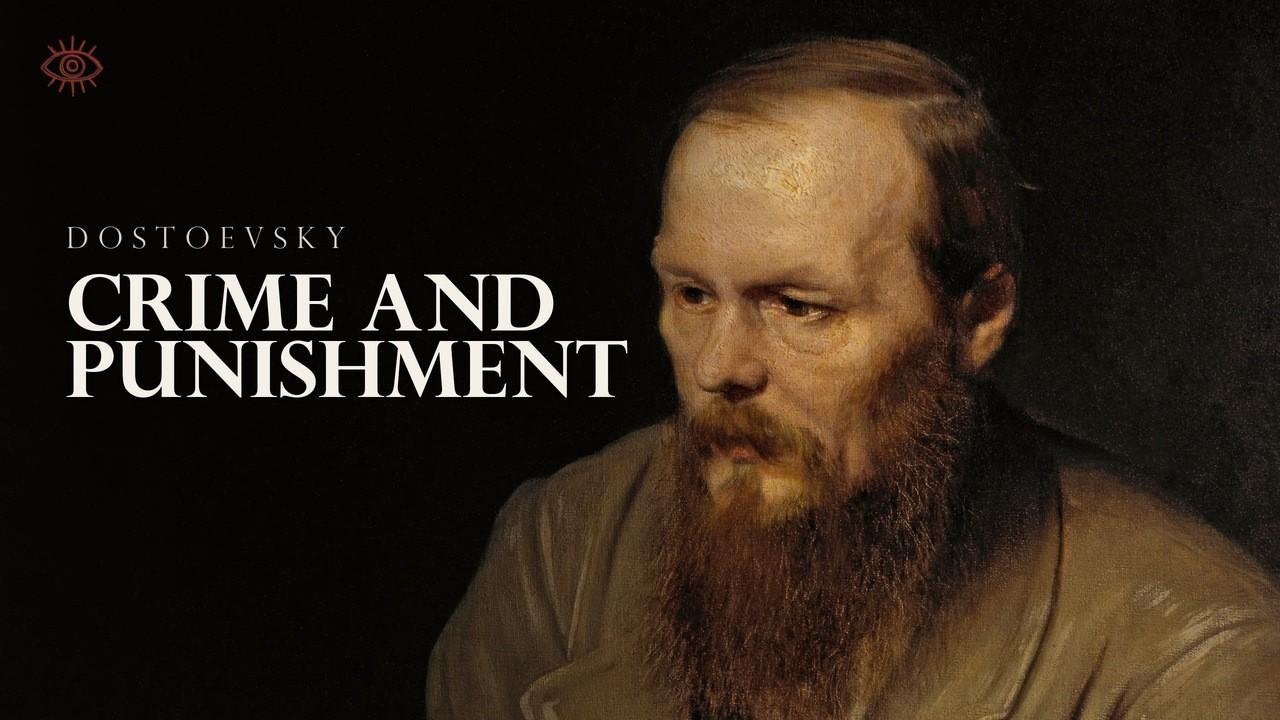
The same episode in the app, where it keeps playing with your screen off.
Can a Murder Ever Be Justified? | Dostoevsky's Crime and Punishment
A student imagines that exceptional people may cross the moral boundaries binding everyone else. This essay follows Raskolnikov's extraordinary man theory through his published article, Porfiry's questions, the competing demands of poverty and pride, and the relationships his reasoning cannot fully explain. Sonya's care preserves responsibility instead of erasing it. Razumihin offers useful work, Dunya resists generosity that expects obedience, and a false accusation exposes the difference between respectable confidence and reliable evidence. Crime and Punishment, also searched as Prestuplenie i nakazanie, separates fear from repentance and private admission from public confession. Its Siberian epilogue asks what remains to change after a sentence has been imposed. Brief context from Poor Folk and The House of the Dead locates Dostoevsky's attention to dignity, dependence and penal life without replacing the novel with a biography. The ending leaves renewal as a beginning requiring further choices.
The full episode is on YouTube and Spotify. Please listen only in safe, restful contexts.
Timestamps
Jump into the video
- 0:00:00Chapter 1: Crime and Punishment and Isolation
- 0:10:27Chapter 2: Poverty and the Price of a Person
- 0:22:02Chapter 3: Raskolnikov's Extraordinary Man
- 0:37:30Chapter 4: Dostoevsky and the Criminal Mind
- 0:44:38Chapter 5: Guilt Before Repentance
- 0:55:23Chapter 6: Razumihin and Useful Work
- 1:05:22Chapter 7: Dunya and the Cost of Gratitude
- 1:16:39Chapter 8: Porfiry and the Limits of Evidence
- 1:27:34Chapter 9: Sonya and Moral Attention
- 1:39:55Chapter 10: Luzhin's Accusation
- 1:48:51Chapter 11: Confession Without an Excuse
- 2:02:49Chapter 12: Svidrigailov and Unbounded Choice
- 2:13:48Chapter 13: Porfiry's Offer
- 2:25:21Chapter 14: The Public Confession
- 2:33:46Chapter 15: Siberia and an Unchanged Judgment
- 2:47:29Chapter 16: Redemption and the Unwritten Future
Full transcript
For the record
Chapter 1: Crime and Punishment and Isolation
With his room behind him, a young man carefully descends a staircase in Saint Petersburg. He wants to pass his landlady's kitchen without being seen. It is a summer evening in Crime and Punishment, Fyodor Dostoevsky's novel about a student's crime and its moral aftermath. The student has stopped attending the university, and even an ordinary conversation about rent feels more than he can manage. He owes money, and each encounter threatens to make that obligation audible. Reaching the street gives him relief from the possibility of being addressed.
Raskolnikov has practiced withdrawing until contact itself seems like an intrusion. He can spend hours following an argument inside his head, while a few words from the woman downstairs can defeat his composure. What happens when someone decides the rules are for other people? His first difficulty is already a relation with someone whose claim he wants to evade. The landlady belongs to the world where arrangements have been made and answers are expected. He is developing a picture of himself that needs a different world.
The rented room gives that picture very little resistance, sitting beneath the roof where its size makes movement inconvenient. The furnishings offer few reasons to rise or attend to something beyond thought. A person can remain there while an imagined project becomes more important than every ordinary task. The room helps produce the conditions under which a state of mind can keep returning without interruption.
Dostoevsky places thought among things before he lets it become an argument. Rent, food and clothing press upon a hungry body, while Raskolnikov becomes increasingly accustomed to speaking to himself. These details complicate any account of him as a detached reasoning machine. A theory can feel complete while its author has become less able to manage a conversation. Intellectual confidence and practical competence can move in opposite directions.
The extraordinary man is his phrase for someone allowed to cross moral law. It belongs initially to the life of an isolated student who has scarcely managed his own affairs. The phrase gives him a possible standing beyond the judgments attached to his room and clothes, replacing dependence with an imagined greatness. A person who feels humiliated can find relief in imagining that humiliation measures only the ignorance of other people.
That possibility should remain distinct from a diagnosis. Poverty, hunger and withdrawal do not mechanically generate Raskolnikov's conclusions, since many people lack money without dividing humanity into ranks of moral permission. The novel follows one person choosing among thoughts that become available in his circumstances. By giving circumstances their force while preserving judgment, the novel asks for understanding without requiring acquittal.
Raskolnikov's worn hat makes that difficulty unexpectedly concrete. Someone in the street calls attention to it, and he becomes concerned about being remembered. His clothing might identify him, bringing another person's memory into a plan conducted privately. A stranger can notice a detail that its wearer has failed to control. The city keeps making observations of its own, without consulting the argument unfolding in the student's head.
He has even counted the steps between his lodging and a destination, arriving at seven hundred and thirty. Precision supplies a feeling of command over an undertaking whose meaning remains unsettled. The distance can be measured while the permission he seeks stays uncertain. Dostoevsky puts these different kinds of knowledge beside each other, allowing the precision to coexist with a question it cannot settle. Knowing exactly how far to walk leaves unanswered what a person may do when the walk is completed.
The narration moves close enough to Raskolnikov for his thoughts to become temporarily persuasive. A feeling can enter the prose before anyone has examined its grounds, until a gesture or an interruption changes its apparent weight. The novel allows a reader to inhabit a conclusion and encounter the conditions that the conclusion had omitted. Thinking becomes something performed by a person among other people.
Confession means admitting the deed before the people empowered to judge it. The act connects a private history to a judgment other people can make publicly. Yet a statement about an act cannot reveal everything about the speaker's judgment. The novel gives room for someone to admit what happened while continuing to dispute what it means. It requires attention to the forms in which someone can acknowledge a fact and continue defending himself.
Raskolnikov's withdrawal affects what counts as evidence for him. Inside the room, he can arrange imagined responses until they fit his position. Outside it, other people speak at inconvenient moments and for purposes of their own. Their independence can feel like disorder because he cannot direct it. The pressure of the city is therefore more than noise or discomfort. It is the presence of lives that have not been written into his private account.
An isolated person may confuse the lack of a reply with agreement. Raskolnikov spends enough time alone for his conclusions to lose the friction of conversation. Objections can be anticipated and dismissed in the same inward movement. The thought that sounds weakest can be silently improved before another person ever hears it. Actual conversation removes that advantage because another speaker may ask about the premise he has learned to pass over quickly.
The novel's attention to space makes such passing over harder. An upper room, a stair and a kitchen place the student within relationships he would prefer to abstract away. The woman downstairs is a creditor, but that description gives only one feature of her life. His need to avoid her reveals the narrowness of the role she occupies in his thinking. Someone else has become the person who asks for rent. That reduction makes avoidance easier to maintain.
Is solitude itself responsible for the student's difficulty? There is a difference between solitude chosen for work and withdrawal used to protect a claim. A writer can close a door to complete a page and reopen it when the work allows. Raskolnikov's room serves a purpose without a natural stopping point, as each avoided encounter makes the following encounter harder to bear. Nothing inside this arrangement tells him when enough thinking has been done, while practical costs accumulate and the imagined justification remains available.
The student still experiences moments that exceed this arrangement, noticing suffering before a settled principle can determine his response. His friend Razumihin, another student, remains someone he could approach for practical help. Such possibilities prevent the room from becoming a complete explanation of his character. Dostoevsky gives him impulses whose existence complicates his preferred self-description. Someone capable of calculating a person's value can also be disturbed by a person standing before him. These are capacities in one life, rather than separate characters conveniently assigned opposing views.
Reading him closely requires keeping the difference between an impulse and a decision. A feeling of compassion can disclose something he knows without furnishing a rule he accepts when another feeling becomes stronger. The novel does not ask its reader to choose a single mood as the authentic Raskolnikov. It follows the ways he treats his changing responses, making some into reasons and treating others as weaknesses to be overcome.
The room's importance also depends on its ordinary scale. Nothing about the lodging proves an exceptional destiny has entered a small space where a student falls behind with his obligations. His surroundings give no public confirmation of the standing he imagines. The distance between inward importance and outward arrangements supplies pressure throughout his life. He would like the room to be temporary evidence of a greatness that the room cannot attest.
The reader meets that pressure before receiving a complete statement of the student's reasoning. This order matters because conclusions can otherwise seem to float free of their authors. Here, a person must carry them down a stair while worrying about an unpaid account. Thought retains its ambition, but it has to coexist with the embarrassment of needing things and depending on those who supply them. A claim about human greatness enters the same world as a request for money owed.
The movement into the street leaves the student exposed to weather, crowds and accidental notice. His thoughts travel with him, but their surroundings change. A person who stays close to his mind can nonetheless become an object in someone else's attention. Raskolnikov can decide what a remark means to him while remaining unable to decide whether another person remembers the hat that prompted it.
Chapter 2: Poverty and the Price of a Person
An overheard argument in Crime and Punishment gives Raskolnikov a calculation that sounds like a moral solution. A student discusses the pawnbroker's wealth with an officer in a tavern. Her money could finance education, help families and support useful undertakings, while her own life seems to contribute little. The speaker imagines a gain spread among many people. His accounting makes a person's continued existence appear as an inefficient use of resources.
The officer asks whether the student would carry out what he has proposed, and the answer changes the conversation. The student declines that responsibility while defending the argument as an exercise in fairness. There is a difference between pronouncing a calculation and accepting authorship of the action it recommends. The exchange leaves that difference visible without supplying a further theory. Raskolnikov hears words that seem to confirm something he has already entertained privately.
The calculation gains force from real deprivation, rather than from an invented world with no competing needs. People do lack fees for study and money for food. Resources concentrated in one place could have substantial effects elsewhere, and indifference to those effects would be another moral failure. The argument therefore begins with something that deserves attention. Its difficulty lies in the permission drawn from that beginning, and in the authority assumed by whoever draws it.
Can the benefits be counted before anyone has done the work? Counting them requires decisions about what enters the count. The student credits projects that have not yet occurred and discounts the person whose continued life would prevent them. He imagines the useful future in generous detail while treating the existing person as almost fully known. That imbalance gives the calculation its apparent simplicity. Uncertainty attaches to the benefits only after someone asks how they would actually be achieved.
A sum of money can be divided among uses with some accuracy, but a person cannot be exhausted by a balance sheet. The tavern speaker takes unfavorable descriptions as evidence that he knows her whole value. Her disagreeable qualities then do work far beyond what those qualities establish. Being unpleasant to deal with becomes a reason for excluding her from the protections extended to everyone else. The judgment has changed its subject without acknowledging the change.
Raskolnikov is attracted to a proposal that makes his own need appear connected to wider relief. Money for his studies could be described as an investment in what he would eventually contribute. That description offers a respectable form for an intensely personal desire. The good of others enters the account through a future in which he becomes useful to them. He would occupy both the position of immediate beneficiary and the position of judge over the promised benefit.
The novel places another account of poverty beside this arithmetic, through the speech of Marmeladov, a former official. He approaches Raskolnikov in a tavern and describes a household whose need has become unbearable. His wife, Katerina Ivanovna, struggles to maintain the family with resources that cannot meet its demands. He speaks with the elaborate courtesy of someone trying to preserve a standing he has already lost. His language asks for attention before it asks for money.
Marmeladov distinguishes having too little from reaching a condition in which other people cease treating one's presence as legitimate. Poverty can retain respect, while destitution makes a person feel entitled to nothing at all. His distinction concerns social recognition as much as material shortage. A household may lack bread and also lose the confidence that its account will be heard. The second deprivation can make seeking help feel like another exposure to contempt.
His own conduct has worsened the household's position, and the novel leaves that responsibility in view. He has returned to drinking and spent money his family needed. The fact does not make the family's need less real, nor does their need dissolve his choice. He speaks as someone who can identify his failure with considerable eloquence. The eloquence has not supplied the steadiness needed to stop repeating it.
Sonya, his daughter, supports the household through prostitution. Her family's dependence gives the money an immediate destination, while the circumstances place her under social judgment. Marmeladov describes what she has done for them, but his account also shows how much responsibility has moved onto her. Another person's sacrifice can become part of the language through which someone explains his own helplessness. Admiration then risks doing the work that a change of conduct should have done.
The father's ability to describe his condition invites sympathy, yet sympathy cannot settle everything his story raises. Someone listening can recognize humiliation and still ask what the speaker owes the people supporting him. Compassion does not require erasing differences between responsibility and misfortune. The family contains both, and their consequences arrive in the same household. Rent and food do not wait for a fair separation of causes.
Raskolnikov goes with Marmeladov to the family's lodging and encounters the difficulty behind the speech. The account becomes a room occupied by people with immediate needs. He leaves money on the windowsill as he departs, without waiting for an argument about the best use of it. The gesture has a small, definite object. It will help this household with the resources available to him, even though he cannot repair its whole position.
He then questions his own generosity and imagines reasons why the gift might have been foolish. Thought returns after the act and begins withdrawing the confidence with which he made it. The sequence matters because it gives compassion a different relation to reasoning. Here, contact produces a response before calculation becomes dominant. His subsequent objections do not show that the first response lacked meaning, though they make that meaning harder for him to accept.
A charitable gift and the tavern proposal differ in their relation to someone else's standing. Leaving money allows a household to receive something without requiring the giver to decide that another life should disappear. The gift can be incomplete and poorly judged while respecting that limit. Its modest scale may frustrate someone looking for a comprehensive solution. Yet its incompleteness also prevents the giver from pretending to have acquired authority over everyone involved.
The difference is easy to miss when moral imagination demands an answer large enough for every need. A single gift looks inadequate beside the suffering described in the father's account. From that inadequacy, a person may infer that ordinary forms of help are merely evasions. The novel gives no assurance that generosity will be sufficient, but insufficiency does not establish permission for an unlimited alternative. A failure to solve every problem cannot authorize whichever solution promises the widest result.
Marmeladov's household also shows why money does not remain a morally neutral instrument inside relationships. The same amount can represent earned wages, a burden placed on a daughter or a gift from a stranger. Its uses matter, and so does the relation through which it becomes available. The tavern calculation largely removes those relations from view. It imagines a fund that can be transferred into benevolence without carrying the history of its acquisition.
An account of relief needs a place for the people whose lives are supposed to improve. The father speaks for his household, and the student speaks for imagined beneficiaries, but each account has limits. Neither speaker can supply the full judgment of everyone on whose behalf he talks. Raskolnikov's response to the lodging briefly allows need to appear without a grand declaration of authority. He can give because someone needs, without establishing that he alone understands humanity's interest.
The novel also refuses to make every compassionate response useful in the same way. A household can receive a gift and remain caught in habits and pressures the gift cannot alter. That possibility limits the claim made for this act. It does not turn the people inside the room into a failed investment. Treating help as an investment would require measuring their subsequent conduct against the return expected by the giver.
Raskolnikov's reluctance to accept dependence makes this moral language particularly difficult for him. He knows what it means to need money from someone whose opinion matters. When he imagines providing relief on a larger scale, he can also imagine escaping the position of a recipient. The fantasy of becoming humanity's benefactor carries an answer to personal shame. It promises that the people who judge his poverty have misunderstood his rank.
Nothing in the father's story entitles the student to appoint himself above those people. What the story gives him is knowledge of a household and an occasion to act within his means. Such occasions can look disappointingly small beside an ambition to transform the whole arrangement. They nevertheless involve actual people who can respond, refuse or disappoint. Their existence places limits on the meaning the giver can assign to his own action.
The money remains on the windowsill after Raskolnikov leaves. Its destination has been chosen without a claim to know the value of every life in the city. The family can use it for needs he has encountered and other needs he has never heard described. A gift can enter a person's circumstances without making the giver their final interpreter.
Chapter 3: Raskolnikov's Extraordinary Man
Raskolnikov's published article in Crime and Punishment gives his private ambition a claim that other people can examine. Porfiry, the investigator, has read it before the student knows it appeared. An article sent to one journal reached print through a change in the journals' arrangements. Raskolnikov had lost contact even with this public consequence of his own work. The investigator knows something about him that he has failed to discover for himself.
Porfiry introduces the article during a conversation that appears casual enough to permit disagreement. Razumihin is present and hears his friend's position developed beyond the hints available in print. Raskolnikov first describes the article as an account of a criminal's condition before and after an offense. Porfiry is interested in a suggestion near its conclusion. Some people, it seems, may claim permission to cross a boundary that remains binding upon everyone else.
The distinction divides humanity according to its relation with the existing order. Ordinary people preserve the arrangements they receive and accept obedience as their proper task. Extraordinary people produce something new and may need to break existing rules to accomplish it. Raskolnikov regards both groups as necessary to human history. Yet his language gives them very different kinds of existence, with one supplying continuity and the other supplying direction.
The claim exceeds the familiar observation that some people have unusual abilities. A brilliant musician can play better than other musicians without acquiring permission to disregard their rights. Raskolnikov connects exceptional achievement to a possible exemption from a duty that applies to others. That connection needs an argument of its own. Talent can establish what someone is capable of doing, while leaving open what the person is entitled to do.
He corrects Porfiry's deliberately broad description of the exemption. The extraordinary person does not receive a license for every desire or any inconvenient rule. Permission would arise when an idea of sufficient importance could be realized only by crossing a moral obstacle. The person's conscience would decide whether that necessity exists. Raskolnikov therefore presents a restricted permission, though the authority that judges the restriction belongs to the person requesting it.
His phrase concerns an inner right rather than an official right recognized by institutions. A court may condemn someone whose conscience regards the act as necessary, and the distinction leaves that possibility intact. He expects established society to defend its laws against people who would replace them. The old order can punish an innovator without proving that the innovation lacks value. Legal condemnation and historical importance can exist together in his account.
That distinction begins from a difficulty which deserves more than dismissal. A rule may deserve to change even though the people who administer it insist on obedience. Human arrangements can preserve injustice, and their age cannot furnish a complete defense. Someone who opposes an unjust law may have good reasons for acting against it. The question is how such reasons become permission to treat another person as an obstacle to a private project.
Raskolnikov moves from changing rules to overcoming persons with considerable speed. A new law contradicts an old law by establishing different terms of conduct. Harming someone does something additional, because that person has claims independent of the old rule. The article's account risks making these different actions seem like variations of one historical necessity. Once both are described as stepping over an obstacle, their moral difference becomes harder to hear.
He brings a scientific example into the discussion through Newton, whose discoveries he imagines benefiting humanity. Suppose a discovery could become available only at the cost of other people's lives. Raskolnikov argues that the discoverer could be entitled, and perhaps required, to accept that cost. This is a hypothetical claim made by a fictional character. Nothing in the example establishes an actual circumstance in which Newton faced such a choice.
The hypothesis loads the decision with knowledge that real actors would rarely possess. It assumes an important discovery, a genuine necessity and a benefit reaching humanity. Each assumption removes a difficulty from the case before the moral judgment begins. Raskolnikov treats this imagined clarity as evidence for a permission applicable in much less settled circumstances. His own position contains uncertainty about the project and about the person who would carry it out.
Necessity is the word carrying much of the weight. A discoverer might prefer a faster route to publication without needing it in the strict sense. Someone else might possess a route that the discoverer has not considered. Calling a person an obstacle does not prove that no alternative exists. The article gives its exceptional actor a privilege of judgment before it has established how that judgment could be checked.
Napoleon supplies a different model, as the historical ruler whose success can make earlier transgressions appear justified. Raskolnikov places founders and legislators among people who displaced established arrangements rather than receiving them obediently. He sees an inconsistency in honoring them while condemning anyone who breaks a law. The observation makes hypocrisy possible, but it does not itself establish that the honored actions deserved honor. A society can praise someone for mistaken reasons.
Historical success also changes what evidence remains visible. An institution created by a successful ruler can display the result of his project for generations. The people who bore its costs cannot all return to challenge the account offered on his behalf. Raskolnikov's model risks allowing the surviving arrangement to certify the methods that produced it. That is a judgment about victory masquerading as a judgment about moral permission.
Porfiry asks how an extraordinary person could be identified before anyone acts. Would some mark or uniform distinguish the person who carries this permission? The question takes a lofty account and asks how it could operate among actual people. Anyone might regard a private ambition as an important innovation. There must be a difference between believing oneself exceptional and having a reason others could recognize for that belief.
Raskolnikov accepts that ordinary people may mistake themselves for exceptional ones. He thinks their inability to endure the consequences will usually expose the mistake. Their consciences will punish them because their nature remains suited to obedience. This response gives suffering a peculiar role in the test. A person who feels burdened by what he has done may interpret that feeling as evidence of inadequate rank rather than evidence of wrongdoing.
Porfiry's practical question therefore reaches a defect in the theory's use of evidence. Successful transgression can appear to prove exceptional standing, while failure can appear to prove that the actor belonged elsewhere. The permission becomes difficult to assess before the result because the result supplies the classification afterward. Any outcome can be accommodated within the distinction. The supposed law of human types risks explaining everything only after it has ceased helping anyone decide.
Raskolnikov invokes a natural distribution of exceptional people without being able to describe its governing law. The assertion lends the hierarchy an appearance of something discovered rather than chosen. Yet no observation in the discussion warrants dividing human worth according to the categories he proposes. A difference in achievement is available for people to examine. An inner permission to disregard another person's protection remains the disputed claim, however scientific the language around it sounds.
Razumihin reacts most strongly to the place assigned to conscience. Society sometimes authorizes terrible acts through law, but the article allows private conscience to authorize them as well. That prospect disturbs him because conscience usually names a faculty that checks a person's conduct. Here, it can become the source of permission to proceed. The person who most needs an independent limit is made responsible for deciding where the limit belongs.
This objection concerns more than a warning against impulsiveness. Raskolnikov has thought carefully and can state his qualifications in a measured way. Reflection alone does not guarantee that the person reflecting has given every relevant claim a fair hearing. Someone can reason with precision from a premise that places his ambition above another life. The sophistication of the reasoning may even protect that premise from ordinary objections by making those objections seem intellectually crude.
The article permits the exceptional person to suffer over what becomes necessary. Raskolnikov need not imagine a ruler who feels nothing or takes pleasure in every cost. He allows sensitivity to coexist with the inner permission he defends. This makes the theory more difficult than a celebration of coldness. It also creates another problem, because grief over a wrong cannot by itself establish that the wrong was authorized.
A person may find an act painful and still misjudge whether it must occur. The pain shows that some value has been recognized, but recognition can remain subordinate to the preferred project. Raskolnikov can admit another person's importance while claiming that his idea has a greater importance. Nothing in the admission gives the other person a voice in the judgment. Sorrow can accompany domination without altering who controls the decision.
The theory needs a distinction between changing an unjust rule and appointing oneself beyond moral reply. Someone resisting injustice can explain the claim to those affected, accept disagreement and consider alternatives. Raskolnikov's exceptional actor may regard disagreement as evidence that ordinary people cannot understand the future. That response blocks the very process through which a reason could become publicly assessable. Opposition is absorbed into the hierarchy that opposition was meant to test.
How would a claim of necessary greatness ever be proved mistaken? A useful test would name evidence the actor could accept even while disappointed. Raskolnikov's division offers no clear procedure for doing so. The person can blame resistance on ordinary minds, failure on a mistaken self-classification and success on the justice of the project. His account lets every disappointment change its meaning before it can challenge the central permission.
The title's question requires judgment about that permission rather than a universal verdict on every imagined emergency. Dostoevsky's novel examines a particular justification offered by a person who appoints himself qualified to make it. Poverty explains why resources matter, and historical injustice explains why existing law deserves scrutiny. Neither fact grants Raskolnikov authority to settle another person's worth. His ambition needs that authority because the proposed benefit cannot be defended without it.
The strongest challenge comes from the person excluded from the role of judge. Being classified as ordinary gives that person duties while giving someone else power over their protection. The division supplies no equal means of contesting the classification. Its claim that both groups have a place cannot repair this inequality. Someone can be granted a place in humanity and still be denied a standing from which to refuse what another person proposes.
An argument that acknowledges equal standing would have to change how the project is assessed. The affected person's objection would count as a claim rather than a predictable limitation of ordinary understanding. Raskolnikov's article has difficulty making that change because its account of progress depends on a superior type. Removing the superior permission would leave the innovator subject to obligations he wanted the theory to overcome. The moral problem remains attached to the project's method, even if its intended benefit is substantial.
Porfiry also asks whether the author regards himself as a possible member of the exceptional group. The discussion becomes personal without leaving its philosophical ground. A student who analyzes a category can want more from it than explanatory clarity. The category may offer him a place he cannot obtain through ordinary achievement. Answering a question about humanity can become a way of answering an unspoken question about his own importance.
Raskolnikov has spent much of the exchange looking at one place on the carpet. The argument has ranged over humanity and the course of history while his gaze remains fixed on an ordinary surface. Another speaker can watch him choosing his words and protecting his composure. His theory is already in public circulation, where its author cannot determine which question a reader asks first.
Chapter 4: Dostoevsky and the Criminal Mind
Dostoevsky wrote Crime and Punishment as a working novelist with knowledge of both debt and imprisonment. Those experiences help explain his attention to constrained lives. They do not make Raskolnikov a disguised report of his author's conduct, or turn the novel into a document requiring one biographical key. The student remains a constructed character whose decisions belong to the circumstances the book gives him.
The author's early surroundings placed need close to the life of a profession. His father worked as a doctor, and Dostoevsky was born in Moscow in eighteen twenty-one. Medical work brought the family into the surroundings of a hospital rather than a secluded literary household. Later training at an engineering school supplied another institution with its own demands. His eventual occupation required him to notice people without reducing them to the purposes of an institution.
Poor Folk brought him early literary success through letters between people trying to preserve dignity with very little money. Its form makes the need to be heard part of the action. Someone must put a life into words addressed to another person, while worrying about how those words will be received. That earlier concern helps locate a continuing interest in his fiction. Material hardship alters the terms on which people can present themselves to others.
He was arrested for political involvement in eighteen forty-nine. His sentence became four years of penal servitude in Siberia, followed by military service. The bare facts establish a relevant part of his experience without requiring its dramatic retelling. Living among convicted people made the category of criminal available to him as an everyday population. A legal status could include differences in temperament, memory, conduct and the capacity to care.
How much can the word criminal establish about a particular person? A classification can describe what an institution must do while failing to describe everyone subject to it. Raskolnikov wants a division of human beings that carries a moral conclusion in advance. Dostoevsky's fiction repeatedly gives a category more internal variety than that wish allows. Someone whose conduct deserves judgment can possess qualities that make the judgment difficult to express without distortion.
The House of the Dead drew upon the author's prison experience through a fictional account of penal life. Its importance here lies in the pressure that shared living places on general descriptions. People remain present after the sentence naming their status has been spoken. They work, remember, resent and form attachments. An observer has to meet them again on another day, when the convenient description may no longer explain the encounter.
Debt also belonged to the author's work rather than serving only as material observed from a distance. He undertook publishing ventures and faced financial obligations while trying to keep writing. A manuscript could have artistic purposes and also answer a demand for income. These circumstances help explain why money in his fiction rarely appears as a number alone. It arrives through promises, arrangements and claims that one person holds against another.
The publication of Crime and Punishment in eighteen sixty-six gave readers its arguments in installments. The novel's developing relationships had to occupy that public form as well as the completed book. There is no need to turn the publication schedule into an explanation of every change in the narrative. What matters is the work's repeated capacity to enlarge a person's significance after an initial description has seemed sufficient. The accumulated encounters resist premature settlement.
Dostoevsky does not give each character a position that can be extracted and arranged as a tidy debate. A speaker may defend an idea while wanting affection, authority or relief from shame. The idea remains available for serious examination, but its expression has another purpose within the encounter. Raskolnikov's article conversation is such an encounter. The author's craft allows a proposition to be heard beside the desire that makes its defense urgent.
That method also leaves room for a character to know less about himself than the reader has begun to suspect. A reason can be sincerely stated without accounting for everything that has produced it. The narrator can show a hesitation or an abrupt change of mood without announcing a hidden motive as a diagnosis. Knowledge of character grows through comparison among acts, claims and responses. The reader's conclusion remains answerable to the details that prompted it.
The novel therefore asks for a kind of attention different from solving a case by attaching a label. Debt can explain urgency while leaving permission unsettled. Illness can explain confusion while leaving responsibility possible. A generous act can disclose a capacity without certifying an entire character. The author gives these facts room to coexist rather than allowing one to cancel all the others. His characters remain difficult because their relevant features are genuinely multiple.
Dostoevsky died in eighteen eighty-one. Crime and Punishment belongs to the writing he completed before that point, with its own formed beginning and its deliberately limited ending. The limits of a novel differ from the limits of a biography. An author can finish the account he is telling while leaving a character's future outside it. Such a choice can make the reader attend more closely to the difference between an event and a life.
The working novelist had to put that choice into pages which other people would read without access to his intentions. A claim made by a character could be mistaken for an instruction from the author. A compassionate scene could be mistaken for the withdrawal of judgment. The finished text offers the circumstances needed to examine those mistakes, though it cannot prevent a reader from making them. Its people have enough particularity to demand attention after a general proposition has been extracted from their speech.
Chapter 5: Guilt Before Repentance
A summons about an unpaid debt brings Raskolnikov to the police office in Crime and Punishment. He fears that it concerns something much worse. He has killed the pawnbroker and her sister. The office nevertheless has ordinary business to conduct, and the paper in front of him belongs to his financial obligations. Other people's schedules continue without sharing the meaning that every encounter has acquired for him.
The officials discuss matters that are partly independent of his arrival. He hears conversation concerning the case he fears and loses consciousness. When he recovers, his reaction has itself become something that other people can notice. The office does not need access to his inward speech to register that something happened. His body has interrupted the account of himself he might have preferred to present.
The scene distinguishes responsibility from the experience called guilt. Responsibility concerns what a person has done and the claims arising from it. The experience concerns what that person feels, fears or cannot stop thinking about. These can diverge for a considerable time. Could distress alone establish that he accepts the wrongness of his decision? Its intensity leaves the object of the feeling uncertain. He may be suffering chiefly over exposure or over the collapse of his preferred identity.
Repentance requires a further change in judgment. Someone can regret a mistake because it brought consequences he dislikes and still defend the choice under better conditions. Raskolnikov repeatedly approaches this position when he judges his inability to carry out what he imagined. The standard remains his own performance. Acknowledging the claims of the people affected would require a different standard, one that could criticize the project even if its execution had succeeded.
The unused proceeds make that difference visible without requiring an elaborate account of his feelings. He hides what he has taken beneath a stone and leaves it there. The money does not become the useful fund his economic reasoning could describe. A plan supposedly concerned with human benefit produces resources he cannot bring himself to use. The gap between the proposed purpose and the actual conduct becomes part of the evidence about his motive.
That gap does not allow a single mechanical deduction. A person can abandon a purpose because fear makes it impossible to continue, even if the purpose was previously sincere. Raskolnikov's concealment can therefore have more than one meaning. It does, however, prevent him from citing achieved benefits as a defense. The people whose future welfare entered his account have received nothing from the act undertaken in their imagined interest.
The stone matters as an object whose relation to him remains concealed from everyone passing nearby. An ordinary piece of the city now contains something of immense importance to one person. His need to keep that importance secret changes how he can inhabit shared space. Another person might stand near it without knowing what the proximity means. Raskolnikov must know for both of them, while being unable to explain why their positions feel unequal.
Concealment also makes harmless speech difficult to interpret. A question may ask exactly what its wording says, or it may be intended to provoke a reaction. The student tries to distinguish those possibilities while knowing his own response could make the question significant. Every answer requires managing the answer and its possible appearance. This additional work can exhaust someone even when the other speaker has no suspicious intention at all.
The novel portrays this condition through ordinary exchanges rather than presenting a continuous moral confession. People bring food, discuss clothes or mention something they have heard, while Raskolnikov listens for implications. A conversation can be about his health for one person and about exposure for him. He has to participate in two versions of the same encounter. His attempts to protect the second version interfere with his ability to behave naturally in the first.
Zametov, a clerk from the police office, encounters him during one of his excursions. Raskolnikov talks in a way that approaches the dangerous truth without stating it as an admission. He imagines how someone might behave and places his own knowledge close to the description. This is neither a settled confession nor a simple effort to remain hidden. It tests the possibility of exercising control over the suspicion that has begun controlling him.
The clerk cannot know from this performance exactly which intention produced it. A disturbed person might speak provocatively for many reasons, including a desire to frighten or impress. Raskolnikov depends on that ambiguity while taking risks that his concealment would seem to forbid. He can briefly feel powerful by deciding how close the conversation comes to disclosure. The feeling does not give him control over what the clerk remembers afterward.
There is a recognizable difference between wanting secrecy and wanting the experience of a secret to become bearable. Strict secrecy would encourage distance from people likely to ask questions. Raskolnikov sometimes approaches those very people, seeking a situation in which he can measure the danger. The impulse carries a wish for relief as well as a wish for mastery. Silence has preserved his freedom of movement while making that freedom difficult to use.
Illness enters this difficulty without functioning as a moral verdict. Fever, weakness and interrupted attention change what the student can manage from one hour to another. They may account for a confused response but cannot determine the meaning of every response. Dostoevsky lets the body complicate the evidence rather than certify a philosophical position. A frightened or exhausted person may be responsible, mistaken, perceptive or several of these at once.
The persistence of distress likewise cannot prove that every person carries an infallible moral tribunal within. Raskolnikov's experience is the experience of this character under these circumstances. The novel's argument depends on what his disturbance reveals about his claims, rather than on a general assertion that wrongdoing always produces recognizable symptoms. Someone could feel less distress and still lack the permission he has sought. The moral question would remain even if the symptoms disappeared.
His inability to enjoy the supposed success is nevertheless significant for the account he gives of himself. He had imagined a decision as a test that could resolve uncertainty about his rank. Instead, the decision opens questions about every gesture, memory and conversation. The act provides no stable certification of the self he wanted to discover. He continues examining his own responses for a result that the responses cannot supply.
That examination differs from attending to the people whose claims he crossed. He can remain absorbed in whether he is strong enough, clever enough or sufficiently free from hesitation. These questions place his own measure at the center of the inquiry. Acknowledgment of wrong would move the attention toward what another person was owed. The novel gives neither transition a convenient date, and a change in mood can bring the earlier questions back.
His life after the deed therefore has more activity than a simple label of remorse would suggest. He acts, improvises and tries to learn what others know. Each attempt can create fresh facts for them to interpret. His position grows through encounters rather than through a single inward revelation. A remark remembered by a clerk becomes another element in the life he cannot supervise completely.
Even a favorable response can fail to reassure him for long. A listener who seems unconvinced may be hiding certainty, while someone who appears friendly may be collecting information. The habit of suspicion can survive evidence that would normally reduce it. Raskolnikov's private knowledge makes ordinary trust harder to practice. People must either know too little to reassure him or know too much for him to welcome their attention.
His condition contains a moral loss that can be described without treating pain as punishment. He can no longer take part in many exchanges on the terms the other person offers. A visitor's concern must be evaluated for danger before he can receive it as concern. The loss has practical costs even if no court ever names them. Help becomes less available because accepting it would require leaving another person's intentions partly outside his control.
The unused parcel remains separate from those intentions. Nobody has been commissioned to distribute its contents or turn them into the future he imagined. Raskolnikov carries the knowledge of its location through meetings in which its purpose is never fulfilled. The city contains his hidden resources while the people he might have helped continue dealing with their own needs.
Chapter 6: Razumihin and Useful Work
Razumihin offers Raskolnikov translation work in Crime and Punishment, together with an advance already in his possession. The offer gives the troubled student something definite to do. There are pages, a share of the task and an agreed payment, so accepting help need not begin with a declaration of helplessness. His friend describes the arrangement as something that would help both of them. Raskolnikov could become a collaborator while earning the money he needs.
The work itself belongs to an imperfect publishing business. Razumihin translates material for a bookseller whose judgment he treats with considerable amusement. The planned publication has a pretentious claim about the standing of women, and the proposed title seems designed to attract buyers. Useful employment arrives through a market capable of foolishness. The novel places ordinary agency among compromised arrangements, rather than waiting for an occupation whose every purpose is beyond criticism.
Razumihin can see these weaknesses and still recognize a practical opportunity. He has experience with publishers and knows how a piece of work becomes a payment. His confidence rests on an activity he has already undertaken. Raskolnikov's imagined exemption from shared obligations seeks a different source of confidence, outside the evidence of ordinary performance. The friend's pages require neither a theory of his rank nor an assurance about his future importance.
The division of the advance matters because it makes cooperation visible in a number small enough to handle. Razumihin gives him three roubles and offers another payment upon completion. Money connects here to a task that another person can inspect. The translation may be good or poor, and the collaborator may agree or correct it. That possibility of correction is part of the arrangement's usefulness, because it gives effort a shared measure.
Raskolnikov takes the pages and money, leaves, and then returns to put them down again. His brief acceptance does not develop into work. The offer remains something he can touch without being able to use. Razumihin responds with frustration rather than serene understanding, demanding to know why his friend came at all. His anger belongs to the scene's honesty. Being able to help someone does not make the person's refusal easy to bear.
The friend also adjusts his account of his own competence to make acceptance less humiliating. He presents difficulties with the language as a reason to divide the work, though his knowledge is stronger than he admits. Raskolnikov recognizes the kindness inside this small deception. A gift disguised as a mutual need can preserve someone's pride, but it also asks him to cooperate in the disguise. Even tact has complications when the recipient is watching closely for dependence.
The offer therefore should not be treated as a proof that Raskolnikov's troubles could disappear through one sensible choice. Translation would provide income and occupation, but the student's difficulties exceed a missing task. He has invested desire in a question about the kind of person he might be. Pages requiring patient accuracy cannot immediately compete with that investment. Their availability does show that his position contains possibilities beyond the alternatives his imagination makes dominant.
Razumihin's practical intelligence appears elsewhere in the care he organizes. When Raskolnikov is ill, his friend attends to clothing, food and the arrangements surrounding the lodging. These tasks require noticing particular needs and dealing with the people who can meet them. The friend's energy makes such work seem almost improvisational. Yet its effectiveness comes from accepting a situation in pieces rather than demanding a complete explanation before doing anything useful.
Care of this sort can be intrusive, and Raskolnikov sometimes experiences it that way. Someone entering a room with purchases and plans alters the occupant's circumstances without waiting for perfect consent. Razumihin's concern does not make every intervention correct. It gives him a reason to try, alongside a responsibility to respond when the person objects. The novel lets ordinary goodness include mistakes that must be repaired in conversation.
Must help come from someone who has mastered every difficulty himself? Razumihin's habits are far from polished. He becomes enthusiastic, talks too freely and can behave foolishly after drinking. These features keep his usefulness from becoming an image of immaculate moral superiority. A person need not possess an untroubled character to organize help for another person. Razumihin can feel embarrassed about his conduct and resume the work requiring attention. His failings do not need to become a philosophy that grants permission to continue them.
The contrast concerns the treatment of imperfection more than the presence of imperfection itself. When a mistake belongs to shared activity, someone can acknowledge it and alter what he does. A translation can be corrected or an awkward remark apologized for. The effort continues because its value does not depend on proving an exceptional identity. Razumihin has room to be wrong while remaining answerable to the person working beside him.
That room matters for the student's relation to ability. Raskolnikov wants a test whose result would determine what he is entitled to do. Translation would give him smaller evidence, concerning whether he can complete a task accurately and on time. It would also allow ability to develop through practice rather than requiring it to exist as a prior credential. The task has an ending even when the question of his greatness remains unanswered.
Razumihin later proposes a publishing enterprise that would involve several people rather than rescue one person from all dependence. Dunya, Raskolnikov's sister, listens with interest as he describes translating, selecting books and learning the business together. The proposal needs money, knowledge and labor distributed among collaborators. Each participant could contribute something the others lack. Its promise comes from combining capacities, with no suggestion that one participant's importance releases him from the common work.
The business is still a proposal, and the novel leaves its success unguaranteed. Razumihin's excitement may exceed his evidence about what buyers will want. His practical optimism deserves assessment just as any other claim does. It nevertheless creates a future that others can discuss, modify or refuse. An imagined project becomes more responsible when its participants can ask about paper, printing and the money at risk.
The details also give Dunya a possible activity beyond her brother's idea of protecting her. She can consider a project in which her judgment would matter. Razumihin addresses her as someone capable of deciding whether to take part, rather than as a passive person whose circumstances require management. That relation is present in the form of the proposal before any income has been earned. Her interest can answer him without placing her under a debt of gratitude.
Cooperative work creates occasions to receive information without treating it as an insult. A collaborator who notices an error is helping the activity continue. The same correction might feel intolerable to someone whose self-image requires evidence of superiority. Razumihin's plans offer a way to make another person's competence useful rather than threatening. The practical arrangement carries a moral possibility through its ordinary terms, without needing to present itself as a lesson.
His usefulness remains limited by what he knows. He can deal with a bill or a publisher while misunderstanding the depth of Raskolnikov's private position. Friendship supplies attention and effort, not complete access to another mind. That limit prevents the friend's goodness from becoming a magical alternative to every difficulty. It is still possible to be helped by someone who does not possess the full account of why help has become necessary.
The pages returned to Razumihin can be translated by someone else. Their task remains available even after the student's refusal, with its practical purpose intact. The friend has an occupation that can continue through disappointment and be shared again when another collaborator agrees. His pen and paper belong to work whose next demand can be identified without first resolving what sort of person he will become.
Chapter 7: Dunya and the Cost of Gratitude
A letter from his mother brings Dunya's proposed marriage into Raskolnikov's room in Crime and Punishment. Pulcheria Alexandrovna describes arrangements she hopes will improve the family's position. The prospective husband, Luzhin, possesses money and a professional standing the family lacks. He could offer security to Dunya and perhaps opportunities to her brother, making the proposal difficult to assess as one person's preference alone. Several futures have become attached to a single decision.
The letter arrives through a mother's effort to keep hope intelligible. Pulcheria chooses favorable interpretations while acknowledging details that make those interpretations harder to maintain. Her desire for the marriage to succeed shapes the way she reports it. That shaping does not make her insincere. She wants reassurance and also wants to tell her son enough. Those purposes can compete within an account she sincerely hopes will help him understand.
Luzhin has said that a wife should regard her husband as a benefactor. He prefers someone who has known poverty and would bring no dowry to the marriage. In his account, gratitude should run toward him rather than creating a claim upon him. The offer of assistance contains an intended distribution of authority. He wants the material difference between the two people to remain active inside their relation after the immediate need has been relieved.
When does gratitude become a means of control? A recipient can value what someone has done while retaining judgment about the person's later conduct. Luzhin's expectation makes that independence look like ingratitude. The benefit becomes an argument that can be reused whenever disagreement occurs. Security is offered together with a device for making its recipient's objections morally suspect.
Dunya has already endured unwelcome pressure in an earlier employment. Her mother describes the resulting trouble and the restoration of her reputation. The experience gives financial security an understandable attraction without making any future arrangement beyond criticism. Someone recovering from humiliation can want stability for sound reasons. The question remains whether the proposed stability leaves room for that person to speak and choose once the agreement has begun.
Pulcheria reports that Dunya distinguished words from deeds when considering Luzhin's troubling statement. A badly expressed remark might not determine the conduct of an entire marriage. This is a reasonable caution against judging someone from one sentence alone. Yet the distinction also requires attention to the acts that follow. If practical arrangements keep producing the dependence suggested by the remark, the remark gains evidence rather than losing it.
Raskolnikov receives the letter with anger and reads the proposal as a sacrifice made for his advantage. He cannot accept his sister's future being used to finance his own. The concern has moral weight because he recognizes a person being treated as a resource. It also contains a possible inconsistency in his own conduct. Recognizing Dunya's freedom requires more than replacing Luzhin's judgment with the judgment of a protective brother.
He speaks as if he can forbid the arrangement, and Dunya must assert her right to assess it herself. A family relation can make a person's interests matter intensely while giving no authority to settle them. Raskolnikov's love does not remove that limit. He may believe he sees the danger clearly and still owe his sister a hearing. Protection becomes another form of control when its confidence makes her own reasons irrelevant.
The disagreement places two forms of authority beside her. Luzhin wants gratitude to support his position, while Raskolnikov wants the urgency of concern to support his. Their purposes differ, but each risks making Dunya's decision belong somewhere outside herself. She has to deal with the marriage's terms and with the family account of what her willingness means. Her refusal of a particular husband cannot be understood fully if it is treated only as her brother's victory.
Luzhin's professional success helps him regard his conduct as an example of rational self-interest. He assumes that personal advancement can be defended as something that ultimately serves society. Such a claim can contain truth when work produces services other people value. It becomes less convincing when the advantage depends on keeping someone too grateful to object. A description of general benefit cannot settle the justice of the terms imposed upon one person.
The family's later meeting tests those terms through actual conversation. Luzhin wants conditions on who will attend and how his position will be received. He expects the women to recognize the risk they run by displeasing him. His generosity acquires conditions at precisely the moment another person wants to examine his behavior. The meeting makes the cost of the proposal clearer than an abstract dispute about marriage could do.
Dunya gives him an opportunity to accept a relation in which her family continues to matter. He interprets that demand through his own expectation of precedence. A future wife who refuses to put him beyond criticism has already disappointed the role he wanted her to occupy. The conflict turns on whether assistance can buy control over the recipient's other attachments. Money may change where she can live without entitling its provider to reorder whom she can hear.
When Dunya rejects him, Luzhin responds as someone whose imagined return on an investment has disappeared. The money and preparations associated with the proposal become grounds for resentment. His response supplies evidence about the earlier language of benevolence. He has offered something in anticipation of obtaining a position, and the recipient's freedom to refuse threatens that anticipated return. Gratitude had been expected to protect the arrangement from just such a refusal.
The novel gives the refusal practical consequences rather than treating independence as costless. Dunya and her mother cannot simply replace the promised resources by announcing their freedom. Their financial position remains difficult, and choices made under scarcity remain choices with substantial risks. This fact lends force to the act of refusal. A person can recognize an unacceptable condition while having no fully secure alternative prepared.
Such situations make the language of consent complicated without making it meaningless. Dunya can consider a marriage partly for security and still exercise judgment about its terms. Need does not erase her capacity to decide, but it changes what refusing will require. An offer can take advantage of that pressure without becoming an explicit command. The power belongs partly to the difference between how easily the two people can afford to leave.
Luzhin would prefer that difference to remain a feature of the marriage. If Dunya became secure enough to disagree without fear, one source of his desired authority would weaken. This is why the expectation of gratitude deserves attention beyond an isolated breach of manners. The proposal concerns a continuing relation whose inequality has been selected in advance. He wants to be needed in a way that makes independent judgment seem disloyal.
Raskolnikov's own response has to be measured against this evidence without receiving automatic approval. He recognizes the danger of dependence in the arrangement but sometimes treats his sister as if her intentions need no further inquiry. Dunya can resent that treatment while sharing his assessment of Luzhin. Agreement about a conclusion does not erase disagreement about who has the right to reach it. She can reject a husband and also reject a brother's claim to command.
The mother's position adds another difficulty. Pulcheria wants the people she loves to remain connected, so a disagreement can feel like a threat to the household's whole future. Her explanations try to preserve the relation among them even when their judgments diverge. That effort has a purpose distinct from the pursuit of truth about Luzhin. She can be accurate about a detail while hoping the detail will not require the conclusion her son draws from it.
Letters are particularly suited to this conflict because the recipient cannot interrupt the writer while the account is being formed. Pulcheria can qualify a remark, describe a hope and ask for understanding in one continuous communication. Raskolnikov must then supply his own responses in the absence of the people concerned. The reader sees a family trying to interpret one another through a document whose practical consequences extend beyond its page.
Dunya's refusal creates a fact that the competing interpretations cannot absorb as easily. Whatever Luzhin thinks his generosity deserved, the proposed marriage will not proceed on his terms. Whatever Raskolnikov thinks his authority should have accomplished, the refusal belongs to her. The act gives her judgment a public existence among people who had assigned different meanings to her future. She does not need to convince each of them that the meaning they preferred was mistaken before she can end the arrangement.
The rejected proposal leaves its material problems in place, but its claim upon Dunya no longer governs how they must be addressed. Other arrangements can be considered without beginning from the gratitude Luzhin wanted to purchase. A future has become less secure in one respect and more available for judgment in another. The letter can be put aside while the people who received it decide where to live and how to support themselves.
Chapter 8: Porfiry and the Limits of Evidence
Porfiry's office in Crime and Punishment gives suspicion a setting whose rules Raskolnikov cannot easily determine. The student arrives expecting questions about his connection with the pawnbroker. He wants the interview to become formal enough that he can identify what is being asked and in what capacity. Porfiry moves through conversation with a freedom that makes those distinctions harder to maintain. The visitor must decide whether a remark is ordinary talk or part of the investigation.
Informality gives the investigator an advantage because the student has to manage reactions before knowing their possible use. A direct accusation would make resistance easier to organize. An apparently wandering observation can provoke a response that reveals more than an arranged answer. Porfiry relies on this difference while presenting himself as someone talking without haste. His relaxed manner has a purpose beyond making the visitor comfortable.
The visitor's demand for procedure is therefore more than an attempt to evade a difficult question. Clear terms protect someone from being required to answer an accusation whose content keeps changing. Raskolnikov may have reasons to conceal the truth and still recognize a real limit on the investigator's conduct. The novel can give a guilty person a sound objection. Guilt does not make every method of discovering it justified.
Porfiry discusses the way a person under suspicion may become absorbed in the investigator's attention. The suspect can imagine himself moving freely while repeatedly seeking out the source of that attention. A psychological account makes this behavior intelligible, but it remains an account requiring evidence. Someone may approach an official because of fear, anger, confusion or the wish to correct a misunderstanding. The behavior alone cannot decide which explanation belongs to the case.
Raskolnikov recognizes that almost any visible agitation could be made to fit Porfiry's preferred interpretation. A calm response might show control, while an angry response might show concealment under pressure. This difficulty creates a danger for an investigator who becomes too confident in reading persons. An interpretation that absorbs every response gives the suspect no possible way to challenge it. Its apparent strength may come from its lack of a genuine test.
Should an investigator treat a plausible explanation as something established? Suspicion can direct further inquiry when something needs explanation. Judgment requires the explanation to withstand alternatives rather than merely continue sounding plausible. Porfiry must deal with both tasks, and his manner sometimes blurs the movement between them. The student's reactions are evidence about distress before they can become evidence establishing its cause.
The office intensifies distress while offering it as something to observe. Waiting, uncertainty and the investigator's shifts of tone can change how a visitor behaves. If those changes are then treated as direct signs of a prior intention, the setting has produced part of its own evidence. That does not prove the interpretation false. It does require attention to the contribution made by the interview itself, which an observer might otherwise mistake for a transparent view of the person.
Raskolnikov presses for the investigator either to question him officially or to let him leave. The demand attempts to recover a boundary within the conversation. He can answer a defined question or exercise a defined freedom, rather than remaining suspended between them. Porfiry's refusal to settle the relation sustains his advantage. A person cannot easily prepare an answer when even the status of answering remains uncertain.
The novel has already shown that Raskolnikov can reason precisely, and that precision becomes part of his vulnerability. He examines wording for implications and then examines his examination for signs visible to the other speaker. Porfiry need not force him into obvious contradictions to unsettle him. An ordinary qualification can become something he regrets having spoken. The student gives the investigator a potentially immense significance because he knows how much is concealed.
Nikolai, a painter connected with the building where the case began, interrupts this pattern by making an admission of his own. He declares himself responsible. His statement appears to offer something stronger than an interpretation of someone's manner, since it comes from the person claiming authorship. Yet the claim is false. The arrival requires the investigator to distinguish a confession from a reliable account of what happened.
Porfiry's surprise matters because the interview has a course he expected to control. Another person's declaration changes the available facts before he can choose its timing. The official who exploits uncertainty must now respond to an uncertainty he has not arranged. Raskolnikov receives room to leave while the investigator attends to the new claim. An investigation remains a process among people whose actions exceed the investigator's intentions.
The painter's statement tests the common assumption that an admission against one's own interest must carry special certainty. Such statements can be strong evidence because their costs are obvious. But costs do not establish their cause. A person can accept a burden for reasons that differ from responsibility for the particular deed named. The novel gives the desire to suffer a place among those reasons, making an apparently decisive statement require further examination.
Porfiry understands Nikolai's admission through a disposition toward accepting suffering. That interpretation belongs to the investigator's assessment of the painter, rather than to a universal explanation of false confessions. It has to answer to what is known about this person's conduct and circumstances. Treating a confession as automatically true would overlook the mismatch between the statement and the case. Treating it as automatically false because another theory seems attractive would repeat the same mistake from the opposite direction.
The painter's presence also changes what the reader must ask of Raskolnikov's eventual words. A confession can be factually correct and still leave its motives incompletely understood. It can also express a wish for suffering without providing a truthful account of the deed. The two problems should remain separate. Establishing who did something concerns the evidence, while establishing how the speaker understands responsibility concerns a judgment the statement may not yet contain.
Porfiry is strongest when he keeps these different tasks in view. His knowledge of individual temperament can help him notice when a statement fails to fit other facts. His official role requires him to do more than admire the psychological explanation he has found. A person with a persuasive account must still check the account against resistance from the world. The suspect's words are part of that world, alongside circumstances the suspect cannot arrange.
The investigator's playfulness can obscure how serious his power is. Raskolnikov cannot treat the meeting as an equal conversation simply because both men are capable of irony. One speaker belongs to an institution that can confine the other. That asymmetry remains present in every apparently friendly turn. The novel's interest in Porfiry's intelligence does not require forgetting what gives his questions their force for the person required to hear them.
Reading the office closely also distinguishes understanding from endorsement. A tactic may produce information while imposing pressure that deserves criticism. Porfiry's effectiveness cannot settle every question about the means he uses, just as the student's cleverness cannot settle the rightness of his project. The relevant duties differ because their positions differ. The official has obligations concerning evidence and treatment that remain binding even when his suspicion happens to be correct.
Raskolnikov's demand for clarity shows a remaining capacity to recognize a rule that protects persons. He knows what it feels like to be interpreted by someone with power over him. That knowledge does not immediately change his judgment of the people he has wronged. It does give the reader a concrete comparison between wanting a protection and recognizing its broader value. A claim can be available in experience before its holder accepts how widely it must apply.
The scene remains unsettled because psychological insight has two possible uses. It can help someone hear what a formal description leaves out, or help someone make another person easier to direct. Porfiry's conduct contains both possibilities, and the interview moves between them. The narrator does not resolve the matter by declaring the investigator simply humane or simply manipulative. His care and his official aims can coincide without becoming identical.
Nikolai's intervention prevents the meeting from yielding the result Porfiry was arranging. That interruption is a fact of the investigation, not merely an inconvenience on the path to a foregone conclusion. The official has to hear a different person's claim and decide what further inquiry it requires. Raskolnikov leaves an office whose next demand has been supplied by someone outside their conversation.
Chapter 9: Sonya and Moral Attention
Sonya's rented room in Crime and Punishment has walls that give it an awkward, irregular shape. Raskolnikov looks carefully at the space when he visits her. One corner narrows sharply while another opens too widely, and the sparse furniture makes their proportions more noticeable. The room has windows facing a canal and little that belongs to comfort. Sonya stands before a visitor whose inspection makes her feel exposed to judgment.
The setting does not turn her into a symbol of a morally purer poverty. Its size and angles describe the lodging available to this particular person. She has to live there, receive visitors and keep the few objects she possesses. The visitor's freedom to inspect exceeds her freedom to improve what he sees. Dostoevsky makes inequality present in the encounter before either person offers a general account of what the encounter means.
Sonya knows the social judgment attached to her means of supporting the family. That judgment shapes how she receives attention, making a statement of respect difficult to trust. Someone who has repeatedly been treated as disqualified may hear praise as another possible form of ridicule. Raskolnikov must speak into that history rather than simply announce a different valuation. The fact that he intends seriousness cannot determine how readily she can receive it.
He regards her condition as evidence of self-sacrifice and presses her about whether it accomplishes anything. His questions give the household's dependence the form of an argument about failure. The people she helps may remain in difficulty regardless of what she gives them. He treats that prospect as something she must face in order to understand her own position. His demand has the force of a person insisting that another life answer to his measure of its usefulness.
Sonya's responses remain attached to particular people. She understands needs that recur without providing a decisive success. The children must be supported and Katerina Ivanovna must be heard in her distress, even if the household cannot be made secure. Such attention differs from claiming that every sacrifice is justified. It begins from the fact that these people will continue needing someone after a calculation has pronounced the available help inadequate.
Why does limited help retain a purpose when it cannot repair the whole condition? A person receiving it experiences the difference between being aided and being left without aid. Sonya's attention preserves that difference even when no larger settlement becomes possible. The children occupy her thoughts as people with the next need, rather than as evidence that the general project has succeeded. Their continued dependence can tell her what requires doing without certifying that her own situation is fair.
This distinction protects the reading from a dangerous admiration of her hardship. A capacity for care can develop within deprivation without making deprivation desirable. Sonya's concern is valuable, while the circumstances requiring so much from her remain open to criticism. The novel's portrayal of her commitment does not authorize the family to take whatever she can supply. Seeing goodness in a person's response cannot settle what other people were entitled to demand of that person.
Raskolnikov's language risks making her life an example in his argument about the limits of ordinary morality. He recognizes that respectable categories fail to capture her conduct. Someone condemned by a social label has supported people who depend on her. Yet he may move too quickly from that recognition to a general conclusion useful to himself. The failure of one public judgment does not establish his own authority to replace every moral limit.
Sonya also possesses a judgment of her own. She does not merely receive a place in the student's alternative arrangement of people. Her concern responds to what she thinks is right, and she can be unsettled by the conclusions he tries to draw. That capacity makes her more than the compassionate audience his self-explanation requires. A listener who cares may still refuse the interpretation the speaker most wants to have accepted.
Her Christian faith supports the conviction that a person's life can change. It belongs to her way of meeting people rather than serving as a formula that makes their conduct harmless. Raskolnikov encounters a commitment that he cannot reduce to the information he has collected about her status. Poverty has shaped her choices without supplying the whole meaning of those choices. The visitor's inspection of the room reaches a limit when he confronts what she trusts.
Faith here also carries an expectation different from a promise of immediate relief. Sonya does not possess money sufficient to remove the household's difficulties. Her commitment allows her to keep regarding persons as capable of receiving care even when their circumstances offer little reassurance. This can look unreasonable to someone who expects every action to justify itself by a visible result. The disagreement concerns what must be established before attention can continue.
Raskolnikov kneels and bows before her, then gives the gesture a meaning larger than the person receiving it. He says he is honoring human suffering. The gesture can express recognition while the explanation makes Sonya stand for a whole condition. She has to encounter both the honor and the abstraction. A person can be exalted in a way that leaves her own particular judgment unheard.
The bow is therefore less straightforward than an acknowledgment that Sonya has the answer to everything. The student recognizes something his hierarchy cannot easily accommodate, but he still wants to determine its meaning. Sonya's startled response prevents the act from becoming a picture he controls completely. She experiences attention from another person with her own fears and beliefs intact. The event has two participants even when one of them gives it a universal description.
Would admiration by itself meet anything the person admired needs? Someone who praises another person's sacrifice may prefer the role of witness to the obligation of responding practically. The praise can place the suffering beyond criticism by describing it as sacred or beautiful. Raskolnikov's gesture raises that possibility because it expands the significance of her condition without changing its demands. She will remain responsible for the household when he leaves.
His attention nevertheless differs from the contempt she expects. A person who has been treated as unfit for ordinary company is met as someone whose life deserves examination. That change has consequences even when the visitor's examination remains imperfect. Respect can begin before the person offering it has learned how to avoid turning someone into an idea. The scene gives such a beginning its awkwardness, rather than arranging a flawless moral encounter.
Sonya's capacity to hear him also has a structure of its own. She can remain present to a troubling statement without immediately converting it into a reason to withdraw. That presence does not require agreement. It permits the speaker to complete what he is trying to say while keeping open the possibility of a response. A person accustomed to anticipating objections alone encounters a listener whose answer cannot be supplied by anticipation.
The room's furniture makes that possibility ordinary. There is a table and there are chairs where two people can remain for the duration of a difficult exchange. Neither object promises a reconciliation or furnishes a moral conclusion. They give the encounter somewhere to occur outside the student's preferred control. A visitor can sit in another person's lodging and discover that the terms of thought have changed because someone else is listening.
Sonya is vulnerable to his questions, and the novel does not pretend that attention makes her immune to them. She can fear what will become of the family and have little evidence for the future she hopes for. Her replies therefore carry the risk of speaking without a secure outcome. Raskolnikov's demand for assurance places pressure on a commitment whose practical forms have been shaped by uncertainty. He wants her to prove what her continued care has not been able to guarantee.
Care can be rational without possessing such a guarantee. Sonya knows the immediate needs of people whose circumstances she has encountered repeatedly. Her response has reasons within that knowledge, even if the reasons do not establish a comprehensive plan. The visitor's imagined view of the whole can miss information available through her closeness to particular lives. Some judgments become better through narrower attention rather than through a larger claimed perspective.
That possibility challenges the student's account of superiority in a different way from a direct objection to his article. Sonya's knowledge has no exceptional permission attached to it. She does not need to stand above the people she helps in order to see something he overlooks. Her participation in their circumstances gives her reasons he cannot replace with the confidence of his inspection. Knowledge can emerge through obligation rather than confer release from it.
The scene leaves the cost of her obligation visible. She has few possessions and no certainty that her work can continue meeting the family's needs. A reading that celebrates her without attending to those limits would repeat the reduction the novel resists. She is someone with a capacity to care and a life requiring care in return. Her value does not depend on how much further she can be pressed before that capacity fails.
Raskolnikov's visit gives her a new claim upon his attention without making her simply responsible for saving him. She can hear what he says, question the way he sees her and respond from commitments he has not made. These actions belong to her own agency inside the encounter. The novel allows a person under social judgment to become an active interpreter of someone who has considered himself entitled to judge others.
The room remains poor after the visitor's words have enlarged its meaning for him. Its uneven walls have not become evidence that every burden inside them was necessary. The table and chairs can hold a conversation whose significance neither participant has completed. Sonya has received another person into the space where she must continue arranging her own life.
Chapter 10: Luzhin's Accusation
Luzhin's accusation against Sonya in Crime and Punishment begins with money that appears to support his account. Marmeladov has died after a road accident. Katerina Ivanovna arranges a memorial gathering, using the event to assert a dignity she feels other people have denied her household. Luzhin enters that gathering with a charge against the person on whom the household has depended. He presents himself as someone reluctantly defending a necessary standard.
He has previously invited Sonya to speak with him and given her a small donation for the family. That act supplies a favorable description of his own role. He can appear as a benefactor whose confidence has been abused, giving his accusation the added force of disappointed generosity. The account makes her denial look like an effort to conceal both theft and ingratitude. He tells the gathering how to understand the relation before the disputed fact is established.
The missing amount he names is a hundred roubles. A note of that value is then found among Sonya's clothing, where he secretly placed it. Its presence seems to connect her with the loss he has described. The material evidence is real while the inference he invites is false. A fact does not cease to be a fact because someone has arranged its appearance. What requires examination is the history that gives it meaning.
The accusation relies partly on Sonya's vulnerability to social expectations. Luzhin refers to her condition as a reason why suspicion should fall upon her. A description of her occupation is made to do the work of evidence about a different act. The transition can feel natural to listeners accustomed to judging her already. A charge becomes easier to accept when it repeats the form of contempt through which a person has previously been understood.
Her distress also seems available for the accuser's use. Someone publicly accused may become unable to give a composed response, especially when the charge threatens people who depend on her. Luzhin can present that distress as behavior consistent with his story. The gathering risks interpreting the effects of humiliation as signs that the humiliation was justified. A person placed in difficulty then has to overcome the appearance the difficulty itself has produced.
Katerina Ivanovna refuses the accusation and defends Sonya, whose contribution to the family she knows. That defense has a foundation in their relation, but it cannot by itself explain the note's presence. Affection can keep an accused person from being abandoned while the evidence is examined. It does not require pretending that the evidence presents no problem. The gathering needs a fact capable of correcting the history Luzhin has offered.
What makes the note evidence of one history rather than another? Someone has seen how it reached Sonya's clothing. Lebezyatnikov, a man sharing Luzhin's lodging, arrives with that observation and challenges the account of theft. He witnessed the secret placement and initially interpreted it as a concealed act of generosity. His earlier favorable interpretation makes his testimony particularly awkward for the accuser. He had understood the act in a way that preserved Luzhin's good intentions.
The witness now distinguishes the action he saw from the meaning he originally assigned to it. His observation concerns the movement of the note. His interpretation concerned why Luzhin wanted the movement to remain hidden. The first can be correct while the second requires revision. Keeping them separate allows the testimony to become useful without requiring the witness to claim he understood the whole event as it occurred.
Whose standing makes a witnessed fact easier to disregard? Lebezyatnikov's discussions of social reform can be naive, and his behavior invites ridicule. Yet the novel lets him possess decisive information in this case. Someone capable of foolish opinions can see an act accurately and report it honestly. A reader who dismissed his testimony because of those opinions would repeat the mistake made by treating Sonya's social standing as proof against her.
The scene grants truth a route through a person whose general authority remains limited. He need not become wise in all matters before his evidence can correct this one. What matters is whether he saw what he reports and whether his report fits the other circumstances. The distinction prevents credibility from becoming a single rank permanently attached to someone. Evidence can require listening to a person whom the room had previously found easy to overlook.
Raskolnikov contributes an account of Luzhin's purpose, connecting the accusation with the earlier conflict over Dunya. If Sonya could be discredited, judgments involving her could be used against the brother who had defended her. The accusation has a practical destination beyond the charge itself. It would rearrange loyalties by making Luzhin's opponents seem unable to judge character. Sonya has been selected as a vulnerable person through whom someone else's standing can be damaged.
That explanation becomes persuasive because the witness has already altered the evidence. A motive alone would not establish the secret placement. Someone can have a reason to resent another person without carrying out every act that resentment might suggest. Here, the observed action and the surrounding conflict give each other a stronger context. The scene keeps a role for both facts and interpretation, while requiring each to do the work it can actually support.
Luzhin's confidence is therefore important as conduct rather than as a guarantee of truth. He knows how to order details and speak as a person occupying a respectable position. His fluency makes the false history easier to hear. The gathering needs to distinguish this ability from the event he claims to report. A speaker can make an account sound orderly because he has selected its pieces to conceal the action that would change their meaning.
Sonya's vindication does not make the humiliation harmless. The charge has been heard, the note has been found and the people present have witnessed her distress. Correcting the account changes what they are entitled to believe, but it cannot give her the experience of never having been accused. The novel allows the practical success of testimony without granting a complete repair of the encounter. Some consequences remain after the wrong inference has been withdrawn.
The mother's defense also retains value after the witness arrives. She has refused to let a convenient story replace what she knows of Sonya's conduct. That refusal preserved a human relation while the material puzzle remained unsolved. Evidence could correct the charge in a room where someone was still prepared to hear the accused. The two forms of response support each other without becoming interchangeable.
Katerina Ivanovna later dies. The household's responsibilities pass into new arrangements, and its immediate need does not disappear with the removal of Luzhin's accusation. Sonya must continue dealing with people whose future depends on more than a corrected reputation. The fact keeps the scene from becoming a complete moral settlement. A lie can be exposed while the circumstances that made a person vulnerable continue demanding attention.
Lebezyatnikov's testimony has nevertheless changed something definite. The note can no longer be treated as evidence of Sonya's theft without disregarding the account of how it was placed. A gathering that might have accepted a social label as sufficient must confront an action performed by the respectable accuser. The banknote belongs to a different history from the one he announced when he entered the room.
Chapter 11: Confession Without an Excuse
Raskolnikov's private confession to Sonya in Crime and Punishment gives another person knowledge he has been keeping to himself. He approaches the admission indirectly and makes her recognize whom he is describing. The encounter leaves him unable to govern how the fact reaches her. Sonya has to respond to what she understands before receiving an explanation that might make it bearable. The listener's recognition creates an event the speaker cannot arrange entirely through his choice of words.
Her first concern reaches toward what he has done to his own life. That response does not establish that his injury is the only one that matters. It shows the immediate object of her attention in a room where he has chosen to disclose himself. She is with a person whose condition she can address. Responding to him need not mean forgetting the people absent from the room, whose claims no encounter with him can erase.
He wants to know whether she will leave him after learning the truth. The question reveals a need that his account of superior independence cannot easily accommodate. He has chosen someone whose continued presence matters enough to make rejection frightening. The confession seeks knowledge about the relation as well as the relief of disclosure. Sonya's answer will be an action of her own, rather than a conclusion he can derive from what he has done.
She promises to remain with him, but her promise includes the possibility of Siberia. Raskolnikov resists the destination contained in her acceptance. He would like accompaniment without being required to accept the consequences she regards as necessary. The conversation therefore separates continued care from agreement about what should follow. A person can refuse abandonment while also refusing to help the speaker preserve his preferred understanding of the deed.
His explanations begin with practical motives that would make the act comprehensible as a response to need. He mentions money, education and the prospect of supporting his family. These purposes have recognizable weight, and Sonya can understand them without endorsing the means. Yet he does not remain satisfied with the account. The reasons sound too complete for an undertaking whose actual relation to money was much less settled.
Which of his explanations does he accept when no listener supplies it for him? He moves toward the desire to test whether he could dare to act. The emphasis shifts from an outcome for other people to evidence about himself. He wanted to discover whether a boundary would stop him and whether he possessed the capacity he associated with superior figures. The proposed deed would answer a question about his standing, with other lives made to bear the cost of the test.
That shift makes the conflict more precise without giving it a conveniently pure motive. Financial distress remains part of his circumstances, and concern for his family need not have been wholly invented. A person can possess several reasons whose relation he understands only afterward. Raskolnikov's recognition concerns which reason became decisive when he imagined proceeding. The desire to establish something about himself can recruit genuine concerns without being identical to them.
The difference becomes visible in the kind of result he wants to learn. A project directed chiefly toward relief would ask what resources became available and what needs were met. His experiment asks whether he crossed the limit and could continue regarding himself as entitled to have done so. The measure belongs to his own response rather than to the welfare he had invoked. He is both the person conducting the test and the person waiting to be certified by it.
This gives the act a relation to identity that ordinary gain cannot explain fully. A material benefit can be counted, while the status he seeks remains open to reinterpretation. He can cross a boundary and then doubt what crossing it proves. He can endure one consequence and still question whether another response betrays weakness. The experiment has no independent examiner whose finding he has agreed to accept, leaving its result available for continuing dispute inside his own mind.
Sonya resists his attempt to make her condition equivalent to his. He has described them both as people who crossed a boundary, hoping the similarity might establish a shared position. The phrase conceals the different relation each has to others. Her conduct has been directed toward supporting people, while his test placed others under a judgment he claimed for himself. Sharing a social burden or suffering deeply cannot make those actions morally interchangeable.
Her refusal is important because it preserves her ability to distinguish without withdrawing concern. She does not need to accept a false equality in order to remain beside him. Raskolnikov has chosen a listener whose circumstances he thought might make understanding easier. Understanding proves possible on terms he cannot dictate. Sonya can recognize his need and still reject the comparison offered to secure her agreement.
Is disclosure of a motive already an excuse? A motive explains something about why an act became attractive. An excuse would have to establish why the person should not be held responsible in the relevant way. Raskolnikov's desire to discover his own rank supplies an explanation with no such power. Knowing what he wanted makes the act easier to understand while showing more clearly why someone else's protection was required.
The confession therefore changes the available account without completing his moral judgment. He can speak more honestly about desire and remain uncertain about what honesty demands. A person who recognizes a self-centered motive may treat that recognition as evidence of unusual courage in examining himself. Self-knowledge can be recruited into the same concern with standing that produced the original test. The difficulty concerns what he will do with the knowledge, beyond being able to name it.
Sonya asks for acknowledgment before other people and acceptance of the burden that follows. Her request gives disclosure an object beyond their relation in the room. Private admission has informed someone who can care about him, but it has not altered the official account under which others live. Responsibility includes what he owes people who have no wish to comfort him. Their claims cannot all be represented by the sympathy of the listener he selected.
Accepting suffering in this conversation should be understood through that demand for responsibility. Pain does not purchase a credit that can be subtracted from someone else's loss. Someone who suffers greatly has still done what he has done. What Sonya seeks is willingness to live under the consequences without preserving a claim of exemption. The burden matters because he must cease deciding alone which parts of the common judgment apply to him.
The distinction also limits what her accompaniment can accomplish. She can remain present through a process whose result she cannot guarantee. She cannot repent on his behalf, supply an accurate judgment he has never accepted or turn an imposed penalty into voluntary acknowledgment. Her commitment has a task distinct from his. It can make accepting responsibility less lonely without making the responsibility belong to her.
Raskolnikov's tone changes as the conversation proceeds. Relief and tenderness can give way to anger when her response threatens the freedom he wants to retain. Such changes keep the encounter from becoming a single decisive moral scene. He can experience the value of her presence and resent what that presence asks of him. The same listener makes continued relation possible while preventing him from treating relation as approval.
The student's desire for an explanation remains intense because explanations have been his principal way of managing uncertainty. He can try one reason, find it insufficient and introduce another with greater severity. The process may approach truth, but it can also prolong the work of presenting himself. Sonya listens for the person inside the explanations without allowing the explanations to settle every practical question. His account cannot become complete merely because he has made it more difficult to hear.
Her presence changes the significance of a pause. Alone, he can stop a thought and resume it whenever he chooses. Before another person, stopping also leaves her waiting, interpreting or preparing to answer. The silence becomes shared rather than wholly available to his use. That fact places a small limit on his sovereignty within the encounter. Even his inability to complete the account has consequences for someone who is trying to understand him.
The confession's value is therefore partly relational. A fact that has governed his inward life becomes something another person can hold accurately. He need not spend every exchange preventing her from learning it. But the loss of concealment also makes her questions more specific, because she now knows what her concern must address. Disclosure removes one demand from the relation and introduces another. He has gained the possibility of being answered about the truth rather than reassured within a fiction.
That possibility is less comfortable than he hoped because an answer may challenge what he still wants. Sonya's continued presence lets him hear refusal without having to treat refusal as the end of all attachment. This is a moral condition his private reasoning has scarcely allowed. Someone can oppose a person's judgment and remain concerned for that person's life. The opposition may be one form the concern must take.
His wish to be different from ordinary people has made common responsibility look like a defeat. Sonya's proposal asks him to give that interpretation up, but she cannot require the change simply by making the proposal. He must encounter the possibility that accepting a shared limit leaves something worth living for. The conversation gives that possibility a person's voice. It remains a proposal he can resist after he has understood its meaning.
The scene also refuses an easy division between sincere speech and strategy. Raskolnikov may genuinely want her to know him and still choose words intended to influence what she will do. Sonya may genuinely care and still press him toward an action he does not yet want. These mixed purposes make the encounter ethically demanding rather than corrupting it beyond use. Both people must hear more than the intention that makes their own conduct seem justified.
No final motive can gather all the earlier circumstances into one sentence and make them disappear. Hunger, isolation, pride and ambition have belonged to one developing life, with different force at different moments. The confession identifies a decisive desire without pretending that the life contained nothing else. Its honesty depends on refusing both a flattering explanation and an account so simple that it becomes another way of escaping attention to particulars.
The person he has told must now live with knowledge that changes her future as well as his. Sonya's commitment to accompany him is costly because it concerns a life she has to conduct herself. Her choice should not be treated as an automatic response produced by compassion. She has understood something of the burden and has spoken from her own judgment. A promise made to a responsible person can be an action with risks even when affection helps make it possible.
Raskolnikov leaves her with the fact he had kept hidden, together with explanations she has accepted only in part. She can remember the account without repeating his evaluation of it. The two people now have a shared truth whose practical meaning remains disputed. Her willingness to remain beside him has not made his preferred future the only one either of them can name.
Chapter 12: Svidrigailov and Unbounded Choice
Svidrigailov enters Crime and Punishment as a man with resources and very few restraints he willingly accepts. He has employed Dunya and remains preoccupied with her. His contact with Raskolnikov introduces a different picture of freedom from the student's anxious test of exceptional standing. Svidrigailov can move, spend and pursue desires without needing each action to prove that history will eventually honor him. The available freedom has not given his life a stable purpose.
He speaks with a casualness that makes his intentions difficult to determine. A disturbing statement can arrive beside a joke or a practical suggestion, leaving the listener unsure how much weight to assign it. This manner helps him remain hard to judge through any single remark. He can withdraw seriousness from words that have already changed the encounter. Raskolnikov must decide what the speaker wants while receiving little help from the speaker's chosen tone.
His interest in Dunya gives money an intended use within a relationship. He proposes assistance and speaks as though an offer should make access possible. The resources are real, and receiving them could improve circumstances for people who need them. Yet the benefit does not settle the terms on which another person should meet him. An offer can create an opportunity without creating a right to the recipient's attention or affection.
Svidrigailov's wealth also lets him consider departure as a practical option. Movement is possible because he can pay for it, unlike people whose choices remain attached to unpaid obligations. But going somewhere else would not by itself determine what he should do when he arrives. His freedom concerns the removal of external barriers more than a direction for action. The absence of a barrier can leave desire without a reason to prefer one available future over another.
He speculates about eternity through the image of a cramped room, giving the idea an ordinary and unappealing scale. The speculation refuses a comforting assumption that unlimited duration must contain grandeur. It also reveals how little a larger future can guarantee for someone dissatisfied with the forms of life he already knows. An unlimited extension of existence could enlarge neither judgment nor purpose. His remark makes duration separate from the question of whether a life has something to do.
The novel gives him reports of apparitions without requiring the reader to certify their reality. These belong to what he says about his own experience. They may express disturbance, invention or something the text leaves unestablished. Keeping that uncertainty matters because a confident diagnosis would resolve more than the narration gives reason to resolve. Svidrigailov's account of what he sees can influence another person without furnishing an objective description of the world.
Raskolnikov recognizes an affinity he would prefer not to accept. Svidrigailov treats moral restraints as something he can move around, while the student has tried to justify an exemption through an important idea. Their reasoning differs, but each wants a freedom that weakens the claims of other people. The older man's conduct makes the freedom visible without the student's intellectual credentials. A person can reach similar practical permissions by giving up the demand for an elevated explanation.
That resemblance does not make the two characters interchangeable. Raskolnikov still wants to know what his action proves and continues seeking a judgment that will establish his standing. Svidrigailov can behave as if such certification has become unnecessary. The difference matters for what may still interrupt them. Someone occupied with a theory can argue about it, while someone treating all arguments as optional may be harder to reach through reasons.
Svidrigailov learns the truth about Raskolnikov by overhearing his conversation with Sonya. The private admission has reached an unintended listener. Raskolnikov's choice to disclose it therefore has consequences outside the relation in which he made the choice. Information moves through the building without obeying the speaker's preferred boundaries. Svidrigailov now possesses something whose significance he can assess according to purposes the student did not invite.
Knowledge of that kind can become power because the person described has a strong interest in keeping it restricted. The listener need not invent a claim or offer proof immediately to change the relation. Knowing that he knows may be enough to make another person consider his demands differently. The novel gives overhearing a practical place among the limits of privacy. A disclosure can be sincere toward one listener and still become an advantage for someone else.
His encounter with Dunya subjects her to coercion. She nevertheless refuses the affection he wants from her, and he eventually lets her leave. The scene's moral meaning does not require a detailed account of its danger. Her refusal marks something his resources and information cannot produce. He can alter circumstances surrounding an encounter, but the feeling he wants remains another person's response. It cannot become his possession simply because he has narrowed her alternatives.
The release should not be made into a declaration that his prior conduct was acceptable. Allowing someone to leave repairs one immediate condition without erasing the attempt to impose it. The action still matters, because a person can stop an exercise of power that he has already begun. A reading that denied all significance to stopping would flatten the character in a different way. Judgment must keep the act and its limit distinct, with neither cancelling the other.
Can money settle what remains after such an encounter? It can meet needs but cannot authorize the conduct that created them. Svidrigailov later makes arrangements for the children in Sonya's family and gives Sonya substantial resources. These are practical acts with consequences the novel takes seriously. Someone receiving assistance need not pretend it has no value because its provider has acted wrongly elsewhere. The benefit and the wrong can remain facts in the same life.
That coexistence prevents an easy moral account in which every gift must be either a proof of goodness or a disguised failure to give. Svidrigailov's money supports real people even when his intention remains difficult to settle. The recipients can use it without endorsing a complete judgment of his character. A material consequence belongs partly to the people who can act with the resources, rather than remaining solely evidence about the donor's inward condition.
Sonya's resources will make continued choices possible for her, but those choices will still require her own commitment. The gift cannot determine how she will use her freedom or what she should think about its source. Svidrigailov can provide means and remain unable to command the life that uses them. This is one practical limit of generosity as a form of power. The money leaves his control when another person receives it on terms that do not surrender her judgment.
The gifts also complicate any attempt to treat the character as a simple portrait of moral emptiness. He can notice need and act to relieve it. That capacity does not supply the stable obligation his relation to Dunya lacks, but it shows a difference among his acts. Dostoevsky lets moral perception occur in someone whose larger conduct remains deeply wrong. A partial capacity can have real effects without becoming a complete reformation.
His boredom is therefore less an absence of all feeling than a failure to find a form through which feeling becomes a continuing responsibility. An impulse may produce assistance on one occasion and leave the next occasion open to whatever desire happens to dominate. Without a commitment that persists, generous conduct gives no assurance about future treatment. The issue concerns how a person connects moments in a life, rather than whether every moment contains exactly the same motive.
Svidrigailov dies by suicide. The money he has assigned to others remains available for the purposes he specified. His decision about his own future does not annul the arrangements already made for theirs. The novel can register the ending of one life while continuing to follow the practical consequences of its acts. Those consequences belong to people whose need has not depended on his continuing wish to take part.
The ending should not be converted into a proof that every refusal of moral obligation must produce the same result. This is one character's course, shaped by particular desires and disappointments. His presence offers Raskolnikov an alternative whose features can be examined without becoming a universal prediction. Freedom from accepted limits has left the older man able to choose actions without supplying a reason to remain committed to a future among other people.
The practical arrangements outlast the choices that prompted them without providing a verdict that gathers the whole person into one description. Sonya can prepare to use the resources, and the children can enter forms of care that required payment. Their lives do not become the closing entries in his moral account. The resources now answer to needs held by people who must decide what to do with them.
Chapter 13: Porfiry's Offer
A visit from Porfiry brings an explicit choice into Raskolnikov's lodging in Crime and Punishment. The investigator has come without the setting of an official interview. He speaks about the misunderstanding between them and admits that his earlier methods have caused distress. The acknowledgement changes the tone without removing the institution he represents. His presence is personal enough to carry an explanation and official enough to make the explanation consequential.
Raskolnikov briefly wonders whether the visitor has come to withdraw suspicion. Porfiry's account seems capable of leading toward that conclusion until he states whom he considers responsible. He names the student directly and speaks with conviction. The conversation no longer depends on Raskolnikov guessing whether an apparently casual remark contains an accusation. There is now a fact about the investigator's position which the visitor has chosen to make unmistakable.
The student denies the charge, and the two remain without speaking for a considerable interval. Porfiry lets the accusation occupy the room rather than filling the interval with another question. The decision to wait has a different effect from a demand for an immediate answer. Raskolnikov has to sit with something another person claims to know. He cannot restore uncertainty about the claim simply by explaining a qualification in the visitor's wording.
Porfiry distinguishes his conviction from the evidence that would make immediate action advantageous. He believes he understands the case, but he acknowledges difficulties in presenting the interpretation as proof. The distinction keeps his offer attached to practical limits. The official's belief has consequences, yet it is not identical to a completed proceeding. Raskolnikov can still recognize reasons why the visitor would prefer a statement from him to another attempt at inference.
The proposition is that he should surrender and confess. Porfiry describes it as beneficial to both of them, because the student's acceptance would help resolve the case and could improve his position in its outcome. He does not pretend to have no professional interest. That candor allows the student to judge the proposal with a clearer account of why it has been made. A humane purpose can coexist with an institutional advantage that must remain visible.
Where does a voluntary act remain possible when an official has announced that confinement will follow? It remains possible in the student's decision to state the truth without waiting to be forced into acknowledging it. The practical alternatives have narrowed, and that narrowing must be counted when judging the act. Yet a limited choice can still differ from passive capture. Responsibility can involve using a freedom that remains, rather than requiring the circumstances to contain an unlimited range of alternatives.
Porfiry's promise of a better position cannot make the act purely disinterested. Raskolnikov might confess because he believes it will reduce what he has to bear. That motive could coexist with an acknowledgment of responsibility or remain separate from it. The investigator needs the factual statement for his task, while moral change demands something beyond the usefulness of the statement. A procedure can encourage truth without being able to specify all the reasons for telling it.
The offer therefore should not be read as the moment at which Porfiry simply becomes a spiritual guide. He remains concerned with a case, its conclusion and the student's likely conduct. His understanding may exceed a narrow professional interest, but it has not lost that interest. Raskolnikov must hear advice from someone who can act against him. The relation contains pressure even when the advice is offered sincerely and with a measure of care.
Porfiry speaks of a future that the student has ceased being able to imagine favorably. He believes there may be life beyond the burden the student expects, though he cannot give its details. The claim asks Raskolnikov to stop treating his present interpretation as a complete account of what remains possible. Someone absorbed in the loss of an imagined identity can find every later prospect beneath consideration. The investigator questions that closure without being able to prove the shape of the alternative.
That appeal differs from promising that a penalty will automatically improve a person. Porfiry can foresee circumstances and advise action, but he cannot create the judgment Raskolnikov would have to make within them. Accepting a future includes the risk of entering something one does not yet value. The student's current standards cannot supply a reason for every part of that risk. They are among the standards whose adequacy has become doubtful.
The practical force of the proposal lies partly in ending a course of concealment that has become increasingly difficult to sustain. Raskolnikov still has moments of movement, resistance and calculation available to him. Those moments do not add up to the control he expected. Porfiry offers an action with a determinate form, addressing authorities and stating a fact. Its consequences remain difficult, but the task itself can be identified without another test of his superior nature.
An identified task does not become morally right merely because it promises relief. A person might end uncertainty through conduct that evades rather than accepts responsibility. The visitor's proposition matters because it concerns the truth and places the student under judgment shared with others. Raskolnikov would lose the power to determine alone what acknowledgment means publicly. The act could begin a different relation to people whose reactions he has spent his energy trying to manage.
Porfiry also assumes that the student will find it difficult to escape the conditions now surrounding him. He reads a disposition that makes continued flight less likely than Raskolnikov may wish to suppose. This prediction gives the visitor confidence while remaining an interpretation of a person, rather than a power over every future decision. The student retains the possibility of surprising him. A prediction can influence conduct without making conduct cease to be the person's own.
The offer uses that confidence in a way open to ethical scrutiny. If Porfiry believes the student has little practical chance of maintaining concealment, presenting surrender as a free opportunity may understate the pressure. If he presents it only as inevitability, he may remove the space in which responsibility could be chosen. His task requires negotiating both dangers. The novel gives the exchange enough detail to make its difficulty available without handing the investigator a complete justification.
Raskolnikov can also hear the proposition through the language of defeat. To someone concerned with proving his exceptional standing, surrender may look like evidence that he belonged among those required to obey. That interpretation preserves the old hierarchy even while conceding a place within it. The investigator's invitation to a future asks him to consider something the hierarchy cannot measure well. A life might matter without supplying the triumph he wanted as its credential.
This is a change in the object of choice rather than a demand for a more flattering opinion of himself. Porfiry does not promise that Raskolnikov will discover he was secretly great all along. The future he invokes would require living with the fact instead of organizing every action around escaping its significance. The student's importance would cease depending on whether he could defeat the judgment. He could become responsible while remaining uncertain about what else he might accomplish.
Such uncertainty is difficult because responsibility lacks the clean result his experiment sought. An admission can be completed in a sentence, but living under its consequences takes time. The student cannot inspect the whole process before beginning it. Porfiry's proposal asks for an action whose moral possibilities will exceed the evidence available at the moment of decision. It is an invitation within constraint, carrying no assurance that the person will use what follows well.
The visitor gives him a short interval in which to act. The allowance is neither endless freedom nor immediate seizure. It supplies a boundary that makes postponement less able to disguise itself as continued thinking. Raskolnikov can still decline, and the official can still return through the means available to his role. The time belongs to a relation in which both people know more about the other's position than they did before the visit.
Porfiry's recognition of the student as someone with a possible future has value despite those limits. An accusation can address a responsible person rather than treating him as an object whose only remaining use is proof. The recognition does not retract the accusation or require the official to overlook the deed. It allows judgment and concern to share an encounter. Raskolnikov can be held answerable without being described as incapable of anything beyond the fact at issue.
The conversation leaves him with advice that cannot substitute for his own act. A persuasive visitor might remove a misunderstanding, narrow alternatives and name a possibility the student had excluded. None of those accomplishments gives the visitor authorship of the student's eventual statement. Raskolnikov will have to speak it before people outside this room. The distinction preserves responsibility even when the choice has been shaped by someone with greater practical power.
Porfiry leaves the lodging without taking the student with him. His departure gives the allotted interval a material form, because the room contains one person where it contained two. Raskolnikov can decide how to use the space left by the visit. The investigator's proposition remains attached to a time in which the student still has to act for himself.
Chapter 14: The Public Confession
Raskolnikov's last visits before surrender in Crime and Punishment give the decision consequences among people who love him. His mother receives him without the knowledge he has given Sonya. Pulcheria has been reading his published essay about permission to cross moral boundaries and imagining a distinguished future for its author. The mother's pride is genuine, though the account supporting it has become incomplete. Her son must encounter affection directed toward a life she cannot yet understand accurately.
He asks whether she would continue loving him regardless of what she learned. The question carries information without giving her enough to identify it. She hears a son seeking assurance and responds from the attachment she already has. Raskolnikov receives something he wants while leaving her unable to assess why he wants it. The farewell is painful partly because the two people are speaking about different versions of the future.
The mother's limited knowledge prevents the scene from becoming an absolution. She cannot forgive a fact she has not been told, and her love cannot decide its public meaning. Yet the love remains a fact in the student's life, with a force his preferred description of himself cannot remove. A person approaching judgment may want every attachment withdrawn so that he can feel wholly alone. Another person's attachment does not have to obey that wish.
Dunya knows enough to understand the decision differently. She encounters a brother still resisting the evaluation attached to his surrender. He can intend to go to the authorities while speaking as if the chief failure lay in his inability to succeed. His decision and his judgment have reached different points. The sister must recognize the value of the action without pretending that the action proves a completed change in how he sees the deed.
This difference gives the farewells a moral texture that a triumphant confession would lack. The student has chosen an action requiring difficult consequences, but he remains angry about the humiliation he anticipates. Someone can begin doing what responsibility requires while disagreeing with the reasons that would make it fully his own. The novel gives that imperfect beginning an actual place. It does not require a purified intention before allowing conduct to change.
Sonya offers him a small cross when he comes to her before going out. The object marks her commitment to accompany him through what he has chosen. He accepts it while continuing to speak defensively about the people who will judge him. Their shared sign does not produce a shared judgment by itself. A material token can belong to a relation whose participants still understand the coming action differently.
He goes into the market square and follows part of the gesture Sonya urged. He kneels and bends toward the earth among people who have no account of why he is there. The action has an intense inward meaning for him, but the gathering sees a young man behaving unexpectedly. Some take him for someone who has been drinking. Others supply explanations from what they happen to recognize, giving the gesture meanings its performer did not intend.
The misunderstanding matters because public acknowledgment cannot depend on every observer hearing it correctly. A person can address a world whose attention remains partial and whose judgments remain fallible. Raskolnikov has wanted a result that establishes his standing beyond dispute. Here, an important action can be met by laughter without losing its importance. The crowd's failure to understand is neither approval of the deed nor proof that the student should abandon the act.
He does not make the intended declaration aloud in the square. The gesture has reached farther than the words he can speak there. This incompletion should remain visible rather than being supplied by a reader who knows what he meant to do. An inward readiness and an outward statement are different events. Other people cannot know a fact merely because the person holding it has performed something associated with acknowledgment in his own mind.
What does accepting a rule require from the person who once placed himself beyond it? It requires allowing a truthful statement to enter arrangements whose consequences he cannot determine alone. The square has provided an encounter with public misunderstanding, but the police office offers a more definite task. He must tell someone who can record and act upon what he says. The act involves a loss of authority over its further use.
Sonya follows at a distance, and he notices her among the people near his route. Her presence gives accompaniment an actual form without making her the speaker of the admission. She can go with him and remain unable to complete the act on his behalf. The difference matters because care has often been offered to him through practical interventions. This task has an element nobody else can undertake in the same way, whatever help they are prepared to provide.
In the office he meets Ilya Petrovich, a police officer whose manner is more welcoming than the student expected. The official talks freely and treats him as a visitor whose presence can have an ordinary explanation. Raskolnikov has entered with something decisive to say, but the conversation proceeds according to the official's interests. The mismatch creates another opportunity to leave without saying it. No one immediately supplies the form that would make his intention easy to carry out.
The conversation reaches Svidrigailov, and Raskolnikov departs without making the admission. Outside, Sonya is waiting. Seeing her does not tell the reader every reason for his return, but it places the decision within a relation he has already accepted. He has the opportunity to continue away from the office and instead goes back. The final act occurs after an interruption, making commitment something resumed rather than something that has never wavered.
Does an admission need an audience that already suspects it in order to count? The official can hear a fact he did not expect and give it a place in the record. Raskolnikov states his responsibility and repeats the statement. The words now belong to an exchange where another person has received them in an official capacity. Their public meaning no longer depends upon the student's ability to retain them privately or withdraw a provocative hint.
The statement is an achievement with a limited object. It establishes something about the deed and the person acknowledging it, while leaving the person's evaluation subject to further change. The novel has not made legal truth and inward transformation arrive in one moment. A reader who treats the admission as a complete conversion would overlook much of the student's remaining position. The admission gives that position a different set of circumstances in which to continue.
The officer receives a repeated factual statement where he had been conducting a much less consequential conversation. Raskolnikov can no longer make the encounter return to its earlier terms merely by changing his tone. Someone outside his chosen circle now knows what he has admitted. The office has a statement to record, and the student has spoken it in his own name.
Chapter 15: Siberia and an Unchanged Judgment
Eight years of penal servitude become Raskolnikov's sentence in the epilogue of Crime and Punishment. The judgment follows five months after his admission. The court has established a legal outcome while the student's own evaluation remains far less settled. The time specified belongs to an institution that can require work and confinement. It cannot stipulate the day on which someone will cease regarding himself as misunderstood.
The proceedings take account of circumstances favorable to the accused. His admission matters, along with earlier actions in which he helped someone in need and assisted during a fire. These facts complicate the account of his character without erasing the deed for which he is judged. A legal decision can consider different features of one person's conduct. Recognizing a capacity for help does not require pretending that the same person could not choose a profound wrong.
The unused proceeds also trouble those trying to establish the purpose of the act. Raskolnikov gives an account that fails to fit an ordinary pursuit of gain. Some participants explain that difficulty through his disturbed condition. The explanation belongs to their assessment, rather than being offered as the narrator's complete diagnosis. It can influence the sentence while leaving the moral meaning of his chosen test unresolved.
The formal outcome therefore does less and more than the student can decide alone. It supplies consequences under which he must live, giving his position a public definition. It also leaves his capacity to interpret those consequences intact. A person can obey the daily requirements of a sentence while disputing why the requirements are deserved. External compliance makes conduct predictable in certain respects without making inward assent available to the observer.
His mother dies after an illness. Dunya and Razumihin continue the practical work of sustaining family relations, and they marry after Raskolnikov's departure. Their plans include earning enough to make a future move to Siberia possible. These are plans requiring years of effort, rather than a dramatic gesture that settles the family at once. The legal outcome has changed the lives of people who must continue deciding how to respond to it.
Sonya goes to the town where Raskolnikov is held and finds work through sewing. Her commitment to him requires a livelihood of her own. The town has few people doing such work, making her useful in households that can pay. The ordinary occupation matters because accompaniment has expenses and repeated demands. A promise gains duration through the arrangements that let its maker remain present without ceasing to conduct her own life.
She writes regularly to Dunya and Razumihin about what she can observe. Her letters describe Raskolnikov's health, his words, his requests and the conditions surrounding visits. She avoids assigning him thoughts she cannot know with confidence. The family initially finds this factual manner disappointing because they want more reassurance about his inward change. Over time, they recognize that the restraint gives them a picture they can trust.
The correspondence has a different moral purpose from a claim to understand someone completely. Sonya supplies relatives with facts that leave room for the person's future to remain uncertain. She neither invents progress nor turns reserve into proof that progress is impossible. Her care can report an unwelcome condition accurately. The recipients do not have to choose between affection and a reliable account of what she has seen.
That restraint becomes especially valuable because Raskolnikov can be distant and ungracious during visits. Sonya does not make his need for her presence an immediate reason to describe him as kind. The relation contains conduct that hurts without making every future response predetermined. Her account can keep that conduct visible while continuing to attend. A hopeful interpretation would become less useful if it required altering the events through which hope must eventually be tested.
Raskolnikov accepts the practical facts of penal life with relatively little surprise. He carries out his work and lives within the available arrangements without seeking every possible improvement. The novel distinguishes this behavior from a deliberate program of penance. Indifference can look austere from outside while having no purpose of moral renewal. A person may endure a burden because nothing seems worth changing, rather than because he has accepted the burden's meaning.
He eventually accepts money from Sonya so that he can have tea. The small request creates an ordinary dependence he had resisted in grander forms. Its significance should not be exaggerated into a complete change of character. He has accepted one practical benefit from a person willing to provide it. A life can acquire such connections while its governing judgments remain defended, making change possible in pieces before it becomes an account the person can give.
His continuing shame concerns wounded pride more than a settled recognition of wrong. He sees failure in the fact that he did not succeed and had to submit to the sentence. The judgment preserves the standard by which triumph would have made his standing different. What has changed is his position within the world, rather than the measure through which he evaluates the position. The institution has defeated his freedom of movement without yet defeating the private account of his entitlement.
When would obedience become a genuine acceptance of responsibility? It would require him to regard the limit as binding even if he could have avoided its enforcement. Following a rule because the guards require it does not establish that judgment. His present conduct can therefore be lawful within the prison while leaving the earlier claim of exemption inwardly available. A person can enter common arrangements and continue thinking that their authority rests chiefly on superior force.
This is why the epilogue cannot be omitted from a close reading of the book's philosophical argument. The factual admission has not produced all the changes a reader might attach to it. The sentence has not produced them either. Dostoevsky leaves time between external accountability and an altered relation to others. That interval prevents the public action from being used as proof of an inward event the narrated conduct has not established.
His fellow prisoners make the interval more difficult through their distrust. Raskolnikov feels separated from people sharing his legal condition, while struggling to understand what makes the separation so persistent. The common status has not created common life. He can observe distinctions among the prisoners and recognize intelligence where a social prejudice would deny it. That recognition remains partly observational, without yet making him able to receive their lives as something he shares.
The other prisoners value small features of living that surprise him. A remembered landscape or a familiar place can supply something to anticipate beyond the immediate confinement. He had expected an important life to require a much larger credential. Their attachments challenge the scale on which he judges the value of continuing. A place remembered by someone else can matter without proving that person belongs to a superior class of humanity.
The prisoners' affection for Sonya presents another fact he cannot readily explain. They know she has come because of him and encounter her during visits, yet respond with a trust he does not receive. Her presence connects to acts whose purpose can be understood without a declaration about their own standing. She writes letters for them and helps correspondence reach their families. Their appreciation emerges through repeated contact with someone prepared to address an identifiable need.
The letters she writes for prisoners have uses separate from the letters she sends to his relatives. One activity conveys observations about him, while the other lets people confined by the institution remain in touch with their own attachments. Both require accuracy, but the second also gives another person a voice through her practical skill. Writing can help preserve a relation that physical distance makes hard to sustain. Sonya's capacity is used without requiring the recipient to become an example in her account of herself.
Families who bring things for the prisoners can leave them with her. These arrangements make her a trusted point of contact in a place where movements are restricted. The trust is earned through acts that can be checked, since messages and goods either reach the intended person or fail to do so. Care here has a material form whose reliability matters. Affection grows around that reliability without needing a complete statement of why the person deserves it.
Raskolnikov has difficulty finding a comparable relation to the people around him. He knows something of their stories and can recognize their practical wisdom while continuing to feel apart. Understanding others from a distance is not the same as letting them address him from within a shared life. His private evaluation remains a position he protects. The gap persists partly because he has not found a form of participation whose value exceeds the threat it poses to that position.
Sonya's visits gradually become necessary to him in a way he has not openly acknowledged. When illness keeps her away for several days, her absence affects him more than his treatment of her would have suggested. The event discloses a dependence his conduct had failed to express generously. Another person's presence can matter before the person needing it knows how to receive it. Her inability to come gives him information that her continued availability had allowed him to overlook.
The absence is a fact of her own life rather than a test deliberately arranged for his improvement. Sonya becomes ill because she is a person with a body and circumstances, not because the story requires a lesson for someone else. His response can reveal something about him without absorbing the whole meaning of her condition. This limit matters whenever care is described chiefly through its effect on the person receiving it. The caregiver has needs which remain hers even when another person learns from them.
The correspondence continues to give the relatives facts whose implications remain incomplete. They can learn of a visit, a request or a changed response without treating each as a decisive sign. Their hope must coexist with the evidence available rather than command a favorable reading of it. Sonya's letters allow a continuing relation to someone whose future cannot yet be reported. They provide the information needed to remain concerned without pretending concern can see everything.
The sentence has a definite duration while these relations have less definite tasks. The institution can count the time served, and the family can count the months between letters. Neither count establishes how much responsibility the student has inwardly accepted. His practical life nevertheless contains persons who keep acting toward him without surrendering the truth about his conduct. The arrangements remain available even when he offers little gratitude for them.
A request for tea reaches Sonya, and she can meet it with earnings and money already available to her. The exchange has a purpose small enough to complete while the larger uncertainty continues. She can also put another letter in the post with the facts she knows. The paper travels toward relatives who must receive this account of their brother before deciding what their own next arrangements require.
Chapter 16: Redemption and the Unwritten Future
A fever vision near the end of Crime and Punishment gives Raskolnikov a world filled with private certainty. Each person believes that only his own judgment can establish the truth. The imagined condition spreads until people cannot agree on what counts as right or wrong. Their confidence grows as their ability to understand one another diminishes. An assurance that should help them act has become the reason shared action cannot continue.
The vision makes the difficulty concrete through tasks that require cooperation. People abandon trades because each proposes a different improvement and refuses the measure offered by the others. Groups form around an agreement and then act in ways that contradict it. Farming is neglected while arguments multiply. The failure has practical objects, fields that need work and undertakings that need common terms. Certainty cannot substitute for those terms when every person claims the authority to supply them alone.
The condition differs from ordinary disagreement. People can disagree while recognizing some facts and procedures through which their competing accounts might be examined. In the vision, each person's conviction occupies the place such a procedure would need. Hearing another claim becomes evidence of another person's failure to possess the truth. The encounter offers no route by which a reason could become common. A statement has weight only for the person who already accepts it.
Who could settle a dispute when every participant regards correction as proof of someone else's ignorance? No participant can settle it merely by becoming more confident. The stronger assurance repeats the condition that made the dispute impossible to judge. A common task requires allowing something beyond the actor's certainty to matter, whether an observed fact or another person's warranted claim. The vision gives that requirement a world in which its absence has ordinary, visible consequences.
The imagined disorder enlarges the student's private difficulty without simply replaying the article's argument. His theory concerned a superior class permitted to overstep, while the vision distributes infallibility among everyone. The change tests what happens when the position cannot be reserved for a person approved by its own claimant. Each person can adopt the assurance that only a few were supposed to possess. An account of rightful exception has no shared means of limiting its own availability.
The vision remains something Raskolnikov remembers from illness, rather than an objective account of how societies necessarily fail. Its philosophical force comes from the arrangement of the imagined case. People need others for the work of living and simultaneously refuse any authority outside themselves. The contradiction appears in the failure to cultivate land or complete an undertaking. A general claim about certainty becomes something that can be examined through the consequences the fiction gives it.
Raskolnikov is troubled by the memory without immediately turning it into a completed judgment. An experience can loosen the authority of a belief before the person has words for what should replace it. The narrator allows such an interval. Understanding does not have to arrive as another theory equally polished and equally defended. It can begin through difficulty continuing to occupy a position that previously seemed sufficient.
Sonya's return to his working place gives that difficulty a relation outside the imagined case. They sit beside one another, and the familiar offer of her hand is received differently. Their hands remain together instead of separating through his customary reserve. The change has a small, visible form before it receives any larger description. A person whose concern has often been met with irritation finds that the response no longer follows its familiar course.
Raskolnikov bends toward her and weeps, making affection apparent in a way she has scarcely expected. Sonya is first startled and then understands the gesture as a change in their relation. The event has value because it answers a real history between them, rather than because it supplies a universal demonstration. She has kept coming to someone who frequently made her presence painful. He now responds to that presence without first defending a reason to remain separate.
The change should not be reduced to the claim that strong feeling automatically corrects moral judgment. People can feel intensely and still treat others badly. Raskolnikov has already experienced relief and tenderness that did not remain governing commitments. The willingness concerns another person's life as part of his future. It gives the feeling an object beyond the immediate pleasure of being forgiven or understood.
He begins to value a future in which Sonya matters as someone whose feelings he must consider. Her significance can no longer be held entirely within the role of listener or helper. A person can need care and also owe care to the person who has offered it. The changed relation makes that reciprocity available through affection rather than an instruction. She has a life to which his continuing conduct will have to answer.
That possibility supplies something the student's test of superiority could not supply. He does not need proof of a special rank before another life can give his future a purpose. The relationship has worth without certifying a place above ordinary people. Accepting it requires a vulnerability his ideal of exemption had made hard to bear. Sonya can affect his future because her response is her own, and he has begun wanting more than the power to direct it.
There are seven years still to serve when the narrated change begins. The remaining time gives hope an immediate limit, since their affection cannot remove the sentence. They have to imagine a future that includes waiting and work within the existing arrangements. The duration resists an interpretation of redemption as the cancellation of consequences. A changed relation can make time worth entering without making the time already completed.
The narrator uses the language of renewal with a confidence greater than Raskolnikov can yet explain. This difference between the narration and the character deserves attention. The student feels something newly possible, while the voice telling the story gives the change a place in a longer process. He cannot analyze the whole significance at once. A reader can hear the promise in the narration while continuing to distinguish a beginning from its eventual fulfillment.
Hope also changes how earlier conduct can be remembered without deciding its moral account. Raskolnikov thinks of what Sonya has borne and wants to respond with love. His confidence in the possibility may exceed his knowledge of how to do so. Wanting to repair a relation begins a task whose demands cannot all be identified through the feeling that begins it. Sonya will have further experiences and needs that his present resolve has not yet encountered.
Repair therefore requires attention to the person receiving it, rather than to an image of oneself as transformed. A declaration of love can become another claim whose success is measured chiefly in the speaker's mind. Raskolnikov's future would have to make room for Sonya's account of what remains painful or what needs to change. The event permits that future without narrating its completion. The reader cannot substitute a favorable intention for all the acts through which it would be tested.
The religious meaning remains present through his new openness to Sonya's convictions. He had feared being directed through beliefs he did not share, while she had avoided forcing them upon him. The altered relation makes him willing to consider what he previously regarded as an intrusion. The change is openness, rather than a completed statement of doctrine. A person's trust can alter what another person is prepared to hear without turning that hearing into instant agreement.
This restraint matters because Sonya's care has not operated as a bargain for a particular declaration. She has remained beside him before receiving the judgment she hoped might become possible. Her patience cannot guarantee what he will believe or how he will behave. It gives the relationship a form in which those questions can remain open without being abandoned. An offered commitment differs from a demand that affection be repaid by submitting to its author's full account.
The novel also leaves the other prisoners' responses partly within Raskolnikov's interpretation. He believes they have begun meeting him differently and takes their willingness to converse as connected with his changed condition. That perception may contain truth without proving the whole prison has altered at once. A person who becomes more available for contact can experience others differently before knowing how much they have changed. His own openness is part of the encounter he now describes.
The small conversation has significance even under that uncertainty. He can speak to people whose attention previously seemed hostile and receive an answer without making its value depend on their recognition of superiority. Shared speech becomes a possible activity. The narrator need not provide a complete reconciliation to show that the conditions of relation have shifted. Someone can participate differently before he possesses a settled description of why participation has become possible.
Redemption names this developing possibility more accurately when it is kept apart from an erased past. The deed remains part of the life, the sentence continues and the people affected cannot all be restored through his feelings. What can change is the form of responsibility he is prepared to inhabit. The future need not repeat his attempt to make others evidence in a private test. It can contain obligations whose value comes from the lives to which they answer.
The narrator ends by describing a further story that would follow the gradual renewal of the person. That story is not told. The decision gives the completed novel a boundary different from the boundary of the student's sentence. Enough has happened to make another course possible, but the work that would fill it remains outside the account. The reader receives a beginning with evidence in conduct, rather than a certificate recording every future demand as satisfied.
Does that boundary weaken the claim that a change has occurred? It limits the claim to what the narrated event supports. Raskolnikov has received Sonya differently, begun valuing a shared future and become willing to hear what his earlier position excluded. Those facts can establish a change without establishing perfection. The limit makes the claim more exact by refusing to supply actions the novel has not shown and judgments the character cannot yet give.
The missing continuation also keeps suffering from becoming an automatic instrument of improvement. A term of confinement can end without producing the relation the closing pages make possible. The student has encountered love, accepted a dependence and begun responding to someone outside his preferred measure. These conditions distinguish the beginning from the passage of time alone. The years will still require choices that neither the institution nor Sonya can make in his place.
The scene on the riverbank belongs to a working day rather than an escape from the sentence. One man has gone with the guard to fetch a tool, while another attends to the material needed for the kiln. Their tasks continue around the interval in which Raskolnikov and Sonya meet. The setting gives an important encounter a place among occupations whose practical demands remain in force.
Raskolnikov sits on a heap of logs beside the shed where workers prepare material for the kiln. A wide river lies below the high bank, and singing reaches him from the farther shore. Across the river, the nomads' tents appear as small black marks on the steppe.
The first separate edition of Crime and Punishment appeared in eighteen sixty-seven, in two volumes published in Saint Petersburg.
Sources & works cited
4 in all
- 1.Fyodor Dostoevsky. Crime and Punishment, translated by Constance Garnett, Project Gutenberg
- 2.Fyodor Dostoevsky. Poor Folk, translated by C. J. Hogarth, Project Gutenberg
- 3.Fyodor Dostoevsky. The House of the Dead, translated by David McDuff, Penguin Classics
- 4.W. J. Leatherbarrow (editor). The Cambridge Companion to Dostoevskii, Cambridge University Press
Similar episodes
Man Is Not a Piano Key | Dostoevsky's Notes from Underground
On Dostoevsky
15 chapters · 6 sources
Literature's first anti-hero opens by telling us that he is sick, that he is spiteful, and that he will see no doctor out of pure defiance.
PlayBeauty Will Save The World | Dostoevsky's Philosophy For Sleep
On Dostoevsky
27 chapters · 9 sources
Fyodor Dostoevsky spent four years in a Siberian labor camp and emerged convinced that human beings are not rational creatures who occasionally act irrationally, but irrational creatures who occasionally manage reason. This three-hour episode traces his life and philosophy through Crime and Punishment, Notes from Underground, The Idiot, Demons, and The Brothers Karamazov.
PlayIf There Is No God, Everything Is Permitted | Dostoevsky's Hidden Theology For Sleep
On Dostoevsky
5 chapters · 7 sources
Hell is not punishment from God. It is the inability to love. This three-hour episode traces the Orthodox Christian tradition that shaped everything Dostoevsky ever wrote, from Isaac the Syrian and Maximus the Confessor to Gregory of Nyssa and the hesychast monks. What does it mean that sin is not a crime requiring penalty but a sickness requiring healing? That salvation is not a transaction but a transformation of the whole person?
Play