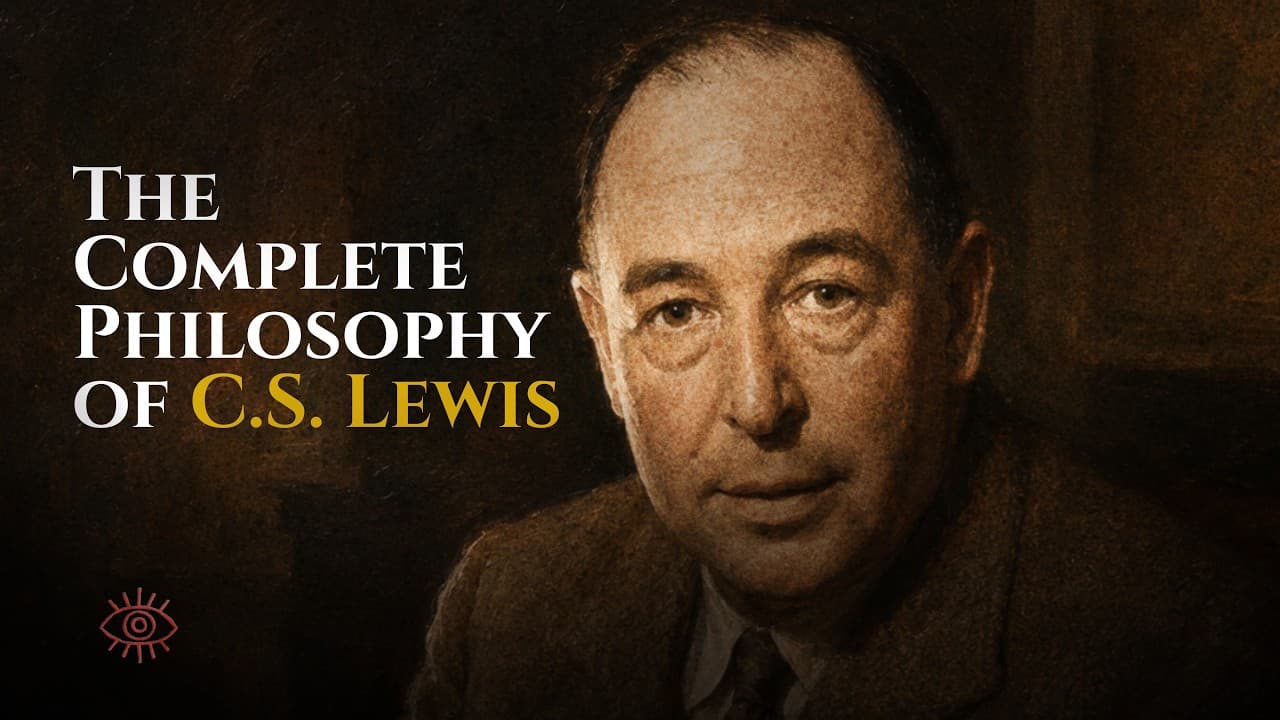
The Most Reluctant Convert | C.S. Lewis for Sleep
The most reluctant convert in England wrote children's books, letters from a devil, and one of the coldest, clearest arguments of the last century.
This episode traces the whole arc of a remarkable life and mind. We begin in a cold Belfast childhood and a wartime trench, follow a brilliant young atheist through the long, reluctant argument that led him back to belief, and settle in among the Oxford friendships that shaped him.
From there we move slowly through the great works: the stab of longing he called Joy, the plain wartime broadcasts that made him famous, the fierce little book on objective value that secular readers still admire, the letters of a tempting devil, the bus ride to the edge of heaven, the lion in the snowy wood, and the pagan myth he retold as his masterpiece. And we end where his own life ended, in a late and unexpected love, a shattering grief, and a quiet death.
The full episode is on YouTube and Spotify. Please listen only in safe, restful contexts.
Enjoying the episode?
Occasional letters on philosophy, reading, and the examined life. No spam, ever.
By subscribing you consent to receiving occasional emails. Unsubscribe any time via the link in every email or at /unsubscribe.
Timestamps
- 0:00:00Chapter 1: The Most Reluctant Convert
- 0:16:11Chapter 2: The Stab of Longing
- 0:24:40Chapter 3: The Night on Addison's Walk
- 0:31:01Chapter 4: The Kingdom of Courtesy
- 0:39:14Chapter 5: The Megaphone of God
- 0:45:43Chapter 6: A Hall With Many Doors
- 0:55:55Chapter 7: The Cardinal Difficulty
- 1:04:00Chapter 8: Men Without Chests
- 1:15:37Chapter 9: The Silent Planet
- 1:23:35Chapter 10: Letters From the Enemy
- 1:29:32Chapter 11: The Bus to Heaven
- 1:37:19Chapter 12: The Wardrobe and the Lion
- 1:49:29Chapter 13: The Face Beneath the Veil
- 1:58:45Chapter 14: When Love Becomes a God
- 2:06:11Chapter 15: The Slammed Door
- 2:12:43Chapter 16: The Man Who Would Not Fade
For the record
Full Transcript
Chapter 1: The Most Reluctant Convert
Night after night, through the spring of nineteen twenty-nine, in a set of college rooms in Oxford, a man in his early thirties sat late at his desk and could not keep his mind on his work. Something was approaching him. Each time his attention lifted from the page for even a moment, he felt it again, steady and unhurried and impossible to argue away, the approach of the one presence he had spent his whole adult life proving could not be there. And then, on one of those nights, he did the thing he had sworn he would never do. He got down on his knees on the floor of his room, and he admitted that God was God, and he prayed.
There was no joy in it. This was not the glad surrender of the pilgrim who has searched for years and at last arrived, because he had not been searching, and he did not want to arrive. He knelt the way a cornered creature gives in, angry and grudging and glancing to the very end for some way out, and he would later describe himself, kneeling there, as the most dejected and reluctant convert in all of England. He had not gone looking for God. God, as he put it afterward, had been the hunter, patient and relentless, and he was the quarry, run to ground at last against his will.
Here is the strange thing, the contradiction this whole episode exists to explain. The man on the floor of that room, who had come to belief dragging his feet, who resented the God he was surrendering to and half hoped the whole business was a mistake, would become the most persuasive and best loved defender of the Christian faith the twentieth century produced. The hardened atheist, trained from boyhood in cold logic, who had built himself an airtight case against religion and lived comfortably inside it for years, would spend the next three decades taking that case apart from the inside, and would do it so plainly and so warmly that millions of people who had never opened a work of theology would feel, reading him, that someone had finally told them the truth.
His name was Clive Staples Lewis, though almost no one ever called him Clive. To his friends, and to the readers who came to feel like friends, he was Jack. And to understand how a man arrives at that reluctant midnight on the floor of a college room, and at everything that came after it, we have to go back to a house in Belfast, and to the first great wound of his life.
He was born on the twenty-ninth of November, eighteen ninety-eight, in Belfast, in the north of Ireland, the younger of two sons in a prosperous, bookish, argumentative household. His father, Albert, was a solicitor, warm and rhetorical and easily wounded. His mother, Flora, was his balance, a clergyman's daughter, cool and clear and gifted in mathematics and logic, and from her, Lewis believed, he had inherited the steadiness of mind his temperament so badly needed. And there was his brother Warren, three years older, known to the family as Warnie, his first ally and his last companion, present at both ends of his life.
When he was four, a dog he loved, a dog named Jacksie, was run over in the road. The boy took the news without tears, then announced that his own name was now Jacksie and that he would answer to nothing else. The name wore down over the years to Jack, and Jack he stayed until the day he died. It was the first sign of a will that looked mild and was in fact immovable.
The house they moved to on the eastern edge of the city was a tall, dark, rambling place with long corridors and more books than a child could count, and the two brothers read their way through all of them and drew maps of imaginary countries and were, for a few years, entirely happy. Then, in the summer of nineteen oh eight, when Jack was nine, his mother fell ill with cancer. The boy prayed for her recovery with all the earnest, mechanical faith of a frightened child, and she died anyway, in the August of that year, and the failed prayer taught him something bleak about God that he would spend thirty years unlearning.
When she was gone, something in the family closed like a fist. His father, undone by a grief he had never learned to show plainly, drew back into his own sorrow and grew distant from his sons at the very moment they most needed him. Lewis set it down, half a lifetime later, in a sentence with the finality of a shutting door. With his mother's death, he wrote, all settled happiness, all that was tranquil and reliable, disappeared out of his life. The two brothers turned to each other, and that alliance would outlast everything else that happened to them.
Within weeks of the funeral, the nine-year-old was put on a boat to a boarding school in England, and here the story darkens from grief into nightmare. The first school was run by a headmaster who beat the boys so savagely that he was eventually declared insane, and the school was closed; Lewis, looking back, could not bring himself to name the place except by the name of a Nazi concentration camp. He survived it, moved through other schools, and ended at a great English public school he loathed with a steady, articulate hatred, a place of bullying and fashionable cruelty where a bookish boy who wanted only to be left alone with the things he loved was taught, day after day, that there was something wrong with him for wanting it.
The one great mercy of his education came when his father, despairing of the schools, sent him at fifteen to be tutored privately in the quiet of the English countryside, by a retired schoolmaster named William Kirkpatrick, whom the boys had nicknamed the Great Knock. Kirkpatrick was a merciless logician who treated a schoolboy's every idle remark as a claim to be cross-examined, pounced on loose words, demanded evidence, and would not let a vague sentence pass. Under him, over three years, Lewis became what he would remain for life, a formidable reasoner who loved a clean, well-built argument the way other men love music. Kirkpatrick was also a cheerful atheist, and in that clear cold air the boy's own unbelief hardened from a mood into a system. Lewis was, by his own later account, a consistent atheist with one glaring inconsistency, for he was also, he admitted, very angry at God for not existing.
He won a scholarship to Oxford and went up to the university in nineteen seventeen. But the world was at war, and he had barely arrived before he was in uniform. Commissioned as a very young officer in a light infantry regiment, he reached the front-line trenches in France on his nineteenth birthday, in the November of nineteen seventeen, and there met the full obscene machinery of the First World War, the mud and the corpses and the constant nearness of death, an experience he would rarely write about directly, as though it were a room in his memory he preferred to keep locked. In the April of nineteen eighteen he was wounded, struck by fragments of an English shell that had fallen short and killed the sergeant standing beside him. He carried a splinter of that shell in his body, and the memory of that man's death, for the rest of his life.
The war left him one more thing, a debt he would spend thirty years repaying. In the training camp he had made a close friend, a fellow young officer named Paddy Moore, and the two had promised each other that if either was killed, the survivor would look after the other's family. Paddy was killed. Lewis kept the promise with a completeness that astonished everyone who knew him. He took Paddy's mother, a woman old enough to be his own, into his life and eventually his home, and cared for her in an arrangement he never once explained and never let anyone question, for more than thirty years, until her death.
When the war released him, he went back to Oxford and did the thing he did best. He took the highest honours three times over, in the classical languages, in philosophy and ancient history, and in English literature, a rare and dazzling triple achievement, and in nineteen twenty-five, at the age of twenty-six, he was elected a Fellow of Magdalen College, a tutor in English, a post he would hold for twenty-nine years. He was a young Oxford don with a brilliant, well-defended mind, a firm unbelief, a private household to support, and, though he did not yet suspect it, an enemy already established inside the walls of his own certainty.
For the return of God to his life came not as a single stroke but as a long retreat, a losing game of chess in which every move he made to defend his atheism was patiently answered, until the board closed quietly around him. The authors he most admired kept turning out, inconveniently, to have been Christians. The friends whose minds he most respected kept turning out to believe. One by one his materialist positions gave way beneath him, until, in the spring of nineteen twenty-nine, he knelt in his college rooms and admitted a God he still did not love. Two years later he took the further and harder step, from a bare belief in God to the Christian faith itself. He was not yet thirty-three. The most reluctant convert in England had become, of all the things he might have become, a Christian.
What he became then was not a monk but something stranger, a scholar of old books who was also, increasingly and before the whole country, an amateur theologian with an extraordinary gift for the plain, homely word. Around him gathered a loose circle of writers and dons who met on weekday evenings in his college rooms and on weekday mornings in the back parlour of an Oxford pub, drinking beer and reading aloud the things they were writing. They called themselves, half in joke, the Inklings. At the heart of that circle, for many years, was the friendship that mattered to him most, with a shy, brilliant scholar of languages who was slowly building an entire invented world of his own, a man named Tolkien; and the two of them argued and needled and encouraged each other into writing some of the most widely read books of the century.
By then he had bought a house, a rambling place at the foot of a wooded hill just outside Oxford, called the Kilns, and there he settled into a domestic life that would have puzzled his readers, sharing it with the now elderly Mrs. Moore and, for much of it, with Warnie, who had left the army and come home to live, and served his brother as secretary and companion, and wrestled all his life with drink. Lewis guarded the household's privacy fiercely, and worked inside it at a furious pace.
Then came the second war, and it made him famous. In its darkest years, with Britain under nightly bombardment and the outcome of everything in doubt, the national broadcaster asked this Oxford tutor to give a series of radio talks explaining, in ordinary language, what Christians believed and why anyone might. He turned out to be extraordinarily good at it, and his calm, reasonable, unhurried voice, coming over the wireless into blacked-out sitting rooms across the country, made him a public man, the closest thing wartime England had to a national explainer of the faith. The fame, which he found mostly a nuisance and sometimes a danger to his soul, never entirely let him go.
His own university, oddly, was slower to honour him than the wider world had been. Oxford passed him over, more than once, for the senior chairs he had plainly earned, and many believed the reason was a certain academic distaste, a feeling that a serious scholar had lowered himself by writing popular religion and children's stories and letters supposedly composed by a devil, that he had made himself, unforgivably, accessible. It was Cambridge, the rival university down the road, that finally gave him his due, creating for him in nineteen fifty-four a professorship in exactly the medieval and Renaissance literature he loved best, which he held, travelling home to the Kilns when he could, for the rest of his working life.
And then, late, when he had long since arranged his existence as a confirmed bachelor and expected nothing further from it, love arrived, and very nearly destroyed him. An American writer named Joy Davidman, a sharp, combative woman, once a communist and once an atheist, who had come to belief in part through his books, began writing to him, came to England, and became, by slow degrees neither of them quite admitted at first, the great love of his life. He married her, at first only quietly and legally, so that she and her two young sons could stay in the country, and then, when she was found to be dying of cancer in the bone, wholly and religiously, at her hospital bedside, with a prayer said over her for healing. And then, astonishingly, she began to get better. The cancer drew back, and the two of them were granted a few years of a happiness Lewis had never expected to taste. And then it returned, and in the summer of nineteen sixty she died, and left him standing alive in the wreckage of the thing he had waited his whole life to be given.
He did not long outlive her. His own body was failing now, heart and kidneys giving way together, and he resigned his Cambridge chair and came home to the Kilns to be looked after by Warnie, the brother beside whom he had first faced the cold world more than fifty years before. On the afternoon of the twenty-second of November, nineteen sixty-three, one week short of his sixty-fifth birthday, Jack Lewis collapsed in his bedroom and died, and his brother was in the house. It should have been news around the world. But on that same afternoon, in a city in Texas, a young American president was shot dead in an open car, and the grief and attention of the whole earth rushed toward Dallas; and on that same day, in California, the novelist Aldous Huxley also died. And so the death of one of the most widely read Christian writers who ever lived slipped past almost unnoticed, a few short lines swallowed by an enormous day. There is something quietly fitting in it. The man who had been dragged so unwillingly into belief, and who never quite got over his astonishment at where his life had gone, left the world through a side door while everyone was looking the other way. He was buried in a country churchyard outside Oxford, under a single line his brother chose from an old play, words that had hung on the family calendar on the day their mother died more than half a century before, men must endure their going hence. And the books remained.
Chapter 2: The Stab of Longing
Long before Lewis had a system, or a faith, or even a settled unbelief, he had a feeling, and everything he later wrote grows out of it. It came to him first in childhood, and it kept coming, all his life, unbidden and uncontrollable, a sudden sharp stab of desire for he knew not what, so intense and so fleeting that it was almost a kind of pain, and yet a pain he would not have traded for any pleasure on earth. He called it, for want of a better word, Joy, though the word is nearly a trap, because it was not happiness and it was not contentment. It was closer to a wound. And the argument he built on that wound is the deepest and most personal thing he ever thought.
The first time he could remember it, he was a very small boy, and the trigger was almost absurdly slight. His brother had brought into the nursery the lid of a biscuit tin, and had filled it with moss and twigs and flowers to make a tiny toy garden, a little green world in a metal tray. Looking at it, the boy was pierced, without warning, by a longing he had no name for and no object for, an ache toward something enormous and far away that the toy garden had somehow opened a window onto and then closed again before he could see through. He never forgot it. As long as I live, he wrote near the end, my imagination of Paradise will retain something of my brother's toy garden. A whole theology, in the end, would grow from a handful of moss in a tin.
It came again, and always the same way, sidelong, through small things. It came through the idea of Autumn, met in a children's picture book, the season itself somehow unbearably desirable. It came through three lines of verse he read as a boy about a northern god, beautiful and slain, that filled him with a sense of vast cold northern skies, spacious and pale and remote, and left him sick with a desire he could not attach to anything he could actually have. Music did it. Certain landscapes did it. What they had in common was not their content but their effect, the way each one seemed to lift a curtain for half a second on a country he had never visited and could not stop wanting to reach.
Now here is the strange thing about the longing, the thing that took him decades to understand. The desire was itself more desirable than any satisfaction. It was not that he wanted the toy garden, or the picture, or the music. Those were only the occasions. He wanted the wanting. He wanted the ache to go on aching, because the ache seemed to be in touch with something that ordinary satisfied desires never touched. Lewis called it, in one of his best phrases, the inconsolable secret in each one of us, the secret we cannot hide and cannot tell, the news from a country we have never yet visited. Every human being, he came to believe, carries this secret, though most of us learn to ignore it or to explain it away.
And for years he did exactly the wrong thing with it. He tried to possess the stab itself, to reproduce it, to hold it still and study it, and every time he grasped at it, it died in his hands. He chased it through the very things that had first delivered it, through northern myth and music and poetry, and found that when he went back to the well deliberately, wanting the thrill, the thrill was gone. He made the oldest mistake there is with this kind of longing. He mistook the messenger for the message. He kept trying to feast on the road sign instead of following where it pointed.
Because it was, he decided at last, a road sign. This is the argument that Lewis is most known for among philosophers, and it is disarmingly simple. A creature, he observed, is not normally born with a desire unless satisfaction for that desire exists. A baby feels hunger, and there is such a thing as food. A duckling wants to swim, and there is such a thing as water. Men feel sexual desire, and there is such a thing as sex. The desires point to real objects that can, in principle, meet them. But here was a desire that nothing in the whole world could satisfy, a longing that every earthly thing promised and no earthly thing delivered, a hunger for which there seemed to be no food anywhere in the visible universe. And if that is so, he reasoned, then the most probable explanation is not that the desire is a cheat, but that it is a desire for something outside the world altogether. If I find in myself a want that no experience in this world can satisfy, the likeliest reason is that I was made for another world.
It is not a proof, and Lewis knew it was not a proof, and honest readers have always raised objections to it. But as a description of a real human experience it has moved an enormous number of people, because they recognize the thing he is describing. In a sermon he preached in a crowded university church during the war, he put the practical side of it as sharply as he ever put anything. We are half-hearted creatures, he said, fooling about with drink and sex and ambition when infinite joy is offered us, like an ignorant child who wants to go on making mud pies in a slum because he cannot imagine what is meant by the offer of a holiday at the sea. We are far too easily pleased. That is the whole of it. The longing is not too strong. It is too weak. We settle, again and again, for the mud pies, because the sea is more than we dare to want.
He told the entire history of that longing, from the toy garden onward, in the autobiography he wrote in his late fifties and titled, with deliberate irony, after the very thing, calling it Surprised by Joy. It is not a normal life story. It leaves out most of what a biography would keep and keeps only the inner thread, the recurring stab and his long misreading of it, tracing how the pursuit of Joy led him, by a winding road, to the God he had spent so long denying. And at the very end of that book he says the thing that completes the argument and, in a way, dissolves it. Now that he had found the thing the longing was for, he wrote, the longing itself had lost the overwhelming importance he once gave it. It had never been the point. It had only ever been a signpost. When you are lost in the woods, a signpost matters enormously. But once you are on the road, and passing signposts every few miles, you no longer stop and stare at each one, because now you know where you are going. He had spent his youth worshipping the signpost. The rest of his life was the road.
There is a small private joke folded into all of this, and Lewis, who loved a good joke, surely saw it. The thing he had chased his whole life under the name of Joy turned out, in his last years, to share its name with a person, an American woman named Joy, who would become his wife and then his grief. The longing that had pointed him beyond the world delivered him, near the end, straight into the most human love of his life. We will come to her. For now it is enough to hold on to the experience itself, because it is the seed of everything, the stories no less than the arguments, and because it is not only his. If you have ever heard a few bars of music, or seen a certain slant of evening light, and felt for a moment an unbearable homesickness for a place you have never been, then you already know the thing he spent his life trying to name, and you know it was not nothing.
Chapter 3: The Night on Addison's Walk
By the time Lewis had been reasoned into believing in God, one barrier still stood between him and the Christian faith, and it was not the barrier you would expect. It was not a doubt about the evidence or a difficulty with miracles. It was a wound in his imagination, and in the end it was healed not by an argument but by a friend, in the small hours of a single autumn night.
The wound was an old contradiction he had carried since boyhood. He had always loved the ancient pagan stories of gods who die and rise again, the god sacrificed and buried in the winter and returning with the corn in spring. Those stories moved him more deeply than almost anything, reached a place in him that ordinary daylight facts never touched. And yet, as a strict rationalist, he had filed them all under a single cold heading. They were lies. Beautiful lies, lies breathed through silver, but lies all the same, primitive inventions with no more truth in them than a nursery tale. So he was left divided against himself, thrilled by the very myths his intellect despised.
Years before, as a boy of sixteen, he had bought a secondhand fantasy novel by a Scottish minister named George MacDonald, and reading it something had happened to him that he could never quite undo. It gave him, he said later, a taste of holiness before he believed in anything holy at all. It baptized his imagination, while leaving his reason, for the time being, exactly where it was. He came to think this was no accident, but a clue to how the mind actually works. Reason, he decided, is the organ by which we lay hold of truth. But imagination is the organ by which we lay hold of meaning. And a thing can be rich with meaning long before we have decided whether it is true.
Then came the night. It was the nineteenth of September, nineteen thirty-one. After dinner in his college rooms, Lewis went out walking with two friends, one of them the philologist Tolkien and the other a man named Dyson, along the quiet tree-lined path beside the river that the college calls Addison's Walk. They talked, as such men do, late into the darkness, and at one point a sudden warm gust of wind came rushing through the leaves and stopped them all where they stood. And the thing they were talking about was myth.
Lewis made his old objection. Myths, he said, however lovely, are finally lies. Tolkien answered him, and the answer changed his life. No, said Tolkien. The myths of the dying gods are not lies. They are gleams of real truth, splinters of a true light, scattered by God through the imagination of the whole human race, hints and rumors of something that was really coming. Man is not simply inventing when he makes those stories; he is remembering, dimly, and prophesying without knowing it. And the Christian story, Tolkien went on, is precisely one of these myths, the myth of the god who dies and rises to bring life to his people, with one shattering difference. This one actually happened. It came down out of the world of imagination and into the world of history, into a real country, under a real governor, in the body of a real man. God, who had been telling the story in fragments through a thousand pagan myths, at last told it once as hard fact. The myth had become fact, and in becoming fact it had not stopped being myth. That, said Tolkien, was the miracle.
For Lewis this was like a lock turning. It meant he did not have to choose between the two halves of himself. He did not have to kill the boy who thrilled to the dying gods in order to satisfy the man who demanded logic. In this one story, the thing that gripped him as myth was also, uniquely, true as fact, so that the deepest longings of the pagan imagination and the strict demands of the reasoning mind pointed, for once, in the same direction. The old contradiction dissolved. What he had loved in all the myths turned out to be a true rumor of what had, in a single case, really occurred.
The last step, when it came, was almost comically undramatic, which is exactly why he trusted it. Nine days after the conversation, he climbed into the sidecar of his brother's motorcycle to be driven out to a zoo in the countryside for the day. He wrote about it later in one of the plainest sentences he ever composed. When we set out, he said, I did not believe that Jesus Christ is the Son of God, and when we reached the zoo I did. There was no vision on the road, no thunderclap, no rush of feeling. He could not even locate the moment of decision. It had come over him the way you sometimes realize, lying still in the morning, that you have already been awake for some time without noticing the change. That was how the long retreat ended, and the man who had run from God for so many years finally crossed the last line, sitting in a motorcycle sidecar on an ordinary autumn morning, on his way to look at the animals.
And the idea that carried him across, that reason and imagination are not enemies but two hands of the same mind, that a great story can hold a truth the intellect alone can never quite reach, would shape everything he wrote for the rest of his life. He would go on being an arguer, as sharp and combative as Kirkpatrick had ever made him. But he would also become a maker of myths, a teller of tales, and he would never again feel that the two were at war, because one September night on a path by a river had taught him, once and for all, that they were not.
Chapter 4: The Kingdom of Courtesy
The public knew Lewis as a defender of the faith and, later, as the man who wrote about a lion and a wardrobe. But that is not how he knew himself, and it is not how he earned his living. First and last, for nearly forty years, he was a scholar of old books, a tutor and then a professor of medieval and Renaissance English literature, and he thought that work more important than all his fame. Everything else he wrote grew out of the soil of that scholarship, and if we want to understand the man, we have to spend an evening in his actual profession, which was the loving study of a world that had vanished.
The book that made his name in that world appeared in nineteen thirty-six, and its subject was love, or rather a very particular idea of love. It won a major prize and established him, at a stroke, as one of the finest literary scholars in England. Its argument was startling then and is startling now. We tend to assume that romantic love is simply a fact of human nature, that men and women have always fallen in love in the way we mean by those words, the beloved becoming suddenly the center of the world, love felt as a kind of noble devotion, almost a religion, that ennobles and transforms the lover. Lewis set out to show that this is not so. This particular feeling, he argued, was in a real sense invented, and we can very nearly name the place and the century. It was made by a small group of poets in the south of France in the twelfth century, who took the raw human facts of desire and marriage, which the ancient world had understood quite differently, and spun from them a wholly new emotion, the worship of the unattainable lady, love as humble service and courtesy and near-sacred longing.
That new feeling spread out from those courts across the whole of Europe, into poem after poem and eventually into the way ordinary people expected their own hearts to behave, until it sank so deep that we no longer see it as an invention at all. We mistake it for nature. And this is the quietly radical thing Lewis was doing, this scholar who is so often thought of as a defender of permanent things. He was showing that even our most intimate emotions have a history, a birthplace, a date, that the feelings we assume are timeless were once new, and were made, by particular people, at a particular time, out of the materials they had.
To read the poems where this happened, he had to teach modern readers a lost art, the art of allegory. The medieval mind loved to draw the inner life as an outer landscape, to take the confused traffic inside a single human heart and set it out as a country peopled by figures with names, Hope and Despair and Fear, Courtesy and Danger and Desire, all moving through a garden or laying siege to a castle. To us this can seem like a dry and mechanical game. Lewis showed that it was something richer, an early and serious attempt to map the human soul from the inside, a psychology written in pictures long before anyone had the word psychology. He made these strange old poems live again, and he did it by refusing to look down on them.
The scale of his learning was itself a kind of marvel. For the great official history of English literature he took on the volume covering the sixteenth century, a doorstop of a book that seemed to require him to read everything, every surviving poem and pamphlet and sermon of an entire century, the famous works and the forgotten ones alike, and to hold them all together in a single ordered mind. He came out of it with judgments that scholars still argue over, sorting the poetry of the age into what he called the drab and the golden, not as insult and praise but as plain names for two different ways of writing. His colleagues were a little frightened of the range of his reading. He seemed to have read not only every important book but every unimportant one, and to remember all of them, and to be able to quote them by the yard. It was this, as much as any argument, that gave his voice its peculiar authority. When Lewis told you a thing was so, you felt the weight of ten thousand pages standing behind the sentence.
Underneath all of it lay a temperament. Lewis was a man who felt more at home in the old world than the new one, and not out of mere nostalgia, but because he thought the old world had held on to something the modern world had thrown away. That something comes clearest in the last book he wrote, published only after his death, a set of lectures on the medieval picture of the universe. The people of the Middle Ages, he explained, did not look up at the night sky and see what we see. They saw a great ordered structure, the earth still and central, wrapped around by vast transparent spheres that carried the moon and the sun and the planets and the fixed stars, each sphere alive, each one guided by a mind, the whole enormous system turning in a music too high for human ears. Their universe was finite, and full, and everywhere charged with purpose and light. It was, in Lewis's lovely phrase, tingling with life. Every point in that sky was somebody.
Lewis knew, of course, that this Model was not true, that the spheres are not there and the stars are not minds. But he pressed a point that should unsettle any confident modern person. Our own picture of the universe, he said, the cold one, dark and nearly empty and utterly indifferent, mostly dead matter falling through mostly dead space, is also a Model. It too is a construction, built out of the assumptions our age happens to hold, and it is no more certain to be the final word than the medieval one was. Every age walks out under the same stars and sees the picture that its deepest beliefs allow it to see. He did not ask his readers to believe the old Model. He asked them to notice that they were living inside a Model of their own, and to hold it a little more humbly.
At the very end of his life, taking up at last the professorship that Cambridge had made for him, he gave an opening lecture in which he described himself with a smile that had some sadness in it. He was, he told the young scholars in front of him, a kind of living fossil. The old Western civilization that had formed him, the world of the ancient and medieval books he loved, had quietly died within his own lifetime, and he was one of its last surviving specimens, an Old Western Man stranded in a new age. Do not think of me as your teacher, he as good as told them. Think of me as a dinosaur. You will not meet many more of my kind. Use your chance. Come and look at me while I am still here, and study the creature before it is gone.
It was a joke, and it was not a joke. This medieval scholarship was never a hobby off to one side of the real Lewis. It was the root system of the whole tree. The man who would defend an ancient faith to a modern world, and who would fill invented countries with talking beasts and living stars, was drawing, always, on the deep old well he went down into every working day. He believed the past was not a lesser place than the present, only a different one, and that a mind which had truly lived in another age was harder to fool about its own.
Chapter 5: The Megaphone of God
In nineteen forty, with the second war just begun, a publisher asked Lewis to write a short book on the oldest and hardest objection to belief in God, the fact of suffering. He agreed, and the book that resulted was his first real work of apologetics, the beginning of his long second career as a defender of the faith. He stated the problem at the outset with a bluntness that has never been improved on. If God were good, he wrote, he would want to make his creatures perfectly happy, and if God were almighty he would be able to do what he wanted. But the creatures are not happy. Therefore God lacks either the goodness, or the power, or both. That, in its simplest and most brutal form, is the problem of pain, and Lewis had no interest in pretending it was anything less than formidable.
His first move went after the word almighty. We imagine, he said, that omnipotence means the power to do absolutely anything at all, and then we ask why God could not have made a world of free creatures with no possibility of pain in it. But omnipotence does not include the power to do what is meaningless. God can do all things that are truly things, but a square circle is not a thing, it is a collection of words, and putting the phrase "God can" in front of nonsense does not turn it into sense. Now suppose God wants creatures who can freely love him and one another, since love that is not free is not love at all. Then those creatures must be free to choose wrongly, to hurt as well as to help. And for free beings to meet at all, there must be a shared and stable world between them, a neutral nature with fixed laws that runs the same for everyone whatever they happen to wish. But a world with fixed laws is exactly a world in which the fire that warms can also burn, and the wave that carries the boat can also drown the swimmer. The very steadiness that makes a real world possible is what makes pain possible. You cannot, he argued, have the one without opening the door to the other.
And a great deal of the worst suffering, Lewis was quick to add, has nothing to do with fixed laws at all. It is inflicted by human beings upon other human beings. The whips and the chains, the prisons and the bombs, the cruelties great and small that fill the pages of human history, are not sent down by God and are not the fault of nature. They are the work of the very same free will that alone makes love possible. When we ask why God permits them, we are really asking why he made us free, and the honest answer is that a world of puppets who could not choose cruelty could not choose kindness either, and would not have been worth the making. Only a fraction of all human pain, Lewis reckoned, comes from nature at all. The greater part of it we do to one another.
His second move went deeper, after our idea of goodness itself. Much of the objection, Lewis thought, secretly assumes that a good God would be what he called a senile benevolence, a doting old grandfather up in the sky who wants nothing more than for the young people to enjoy themselves, and who asks at the end of each day only that a good time was had by all. But that is not love. That is indifference wearing the mask of kindness. Real love wants the true good of the beloved, and the good of a person is not the same thing as their comfort. He reached, as he always did, for homely pictures. An artist will take endless pains over a picture he loves, scrape it back and redo it a hundred times, precisely because he loves it too much to leave it botched, while he would not trouble himself so over an idle doodle. We discipline the dog we intend to keep and love. A father wants his son to grow into a good man, not merely to stay a contented boy. God's love, Lewis said, is of that demanding and costly kind, a love that would rather we became lovable than that we were left comfortable as we are, and a love like that, turned on creatures as unfinished as ourselves, is bound sometimes to hurt.
And this is where suffering does its strange work. Pain, Lewis wrote, in the line the book is remembered for, is God's megaphone to rouse a deaf world. God whispers to us in our pleasures and speaks in our conscience, but he shouts in our pains, because pain is the one thing a comfortable person cannot manage to ignore. It shatters the illusion that all is well, that we are the secure masters of our own lives, that the world exists to keep us pleased. A bad man, happy, may never once suspect that anything is wrong. The same man in agony at least knows that something is wrong. Pain is not good in itself, but it can break open a soul that easy contentment would have kept sealed shut forever.
It is a tight and forceful book, and for a long time it plainly satisfied its author. But there is one sentence buried in it that reads very differently once you know the rest of the story. Lewis admitted, in the middle of all his confidence, that it is an easy thing to be brave about another man's toothache, that a book on suffering comes most easily to a man who is not at that moment suffering, and that if ever real pain came for him, all this fine reasoning might turn out to be worth very little. He wrote the book the way a healthy man writes about illness, from the outside, with everything in order. He did not yet know that the whole argument would one day be handed back to him in the dark, by a grief of his own, and made to prove itself or break. That reckoning was still twenty years away. For now he had built the house, beam by careful beam. Whether he would be able to live inside it when the storm finally came was a question that the book, for all its strength, could not answer, and did not try to.
Chapter 6: A Hall With Many Doors
The book that made Lewis the voice of Christian England was not written as a book at all. It began as talk, spoken aloud into a microphone. In the darkest stretch of the second war, the national broadcaster asked him to give a series of radio talks explaining, to a frightened and exhausted country, what Christians actually believed. He gave four such series over the wireless, and years later they were gathered into a single volume that became the most widely read popular defense of the Christian faith the century produced. Its argument, and the reason it has lasted, are worth taking slowly.
Lewis's great gift, the one that made those talks work, was translation. He was convinced that most religious writing failed for a simple reason. It spoke a private language, a dialect of technical terms that meant nothing to the ordinary listener, and then blamed the listener for not understanding. Lewis set himself the discipline of turning every piece of theology he wanted to convey into the plain words that people used at home and at work. If you could not say a thing in the language of a reasonably intelligent person who had never been to church, he believed, then either you did not really understand it yourself, or you did not really believe it. He tested his talks against the hardest audience he knew, and by his own account he trusted a doctrine's phrasing only once he could imagine saying it to the man who dug his garden. That homely plainness is the whole secret of his style, and it is harder than it looks.
He began, in the first of the talks, not with God at all, but with an odd fact about human beings. We are always quarreling. And when we quarrel, listen to what we actually say. We do not simply say, I am stronger than you and I will take what I want. We say, that is not fair, or, you promised, or, that is my share. We appeal, every time, to a standard of decent behavior that we expect the other person to know about and to accept. The remarkable thing is that the other person hardly ever answers, I have never heard of your standard. He argues instead that the case is somehow different, that he did keep the promise, that his share was really larger. In other words, both parties in every quarrel are appealing to a rule they both already acknowledge. And where, Lewis asked, does that rule come from?
We did not invent it, he argued, because we cannot get free of it. We break it constantly, and wish it were otherwise, and still it stands there judging us. It is not simply an instinct, because we feel it umpiring between our instincts, telling us to follow the weaker impulse of two, which no single instinct would ever do. And it is not merely the custom of our particular society, because we all believe that some societies have better rules than others, that the men who abolished a cruelty were right and those who kept it were wrong. But to say one moral code is better than another is to measure them both against a standard higher than either, a real right that stands above every human custom. So here is something strange, a law of how human beings ought to behave, pressing in on every one of us from somewhere outside, which we did not make and cannot escape and are always falling short of. And a law, Lewis reasoned, is much more like a mind than like a lump of matter. Commands and obligations are the kind of thing that come from a person, not from atoms and gas. The moral law, then, is the clearest clue we are given that behind the universe there stands something more like a mind than like a machine, something that is intensely, insistently interested in how we behave. It is not yet the whole of God. But it is a footprint, and it points somewhere.
From that opening he narrowed the road toward a sharper claim. Suppose, he said, you come upon the record of a man who went about forgiving sins. Not forgiving wrongs done to himself, which any of us might do, but forgiving all sins, as though he were the party chiefly injured in every offense ever committed, the one everybody had really wronged. Suppose that same man said he had existed before the world was made, and that he would return at the end of it to judge the living and the dead. Now, what are we to do with him? The fashionable thing, then as now, is to say that he was a great human teacher of morals, but of course not divine. And that, Lewis said, is the one thing we are not permitted to say. A man who was merely a man and who said the sort of things this man said would not be a great moral teacher. He would be a lunatic, on the level of someone who announces that he is a poached egg, or else he would be the Devil out of hell. You must make your choice. Either this was, and is, the Son of God, or else a madman or something worse. You can shut him up for a fool, you can spit at him and kill him as a demon, or you can fall at his feet and call him Lord and God. But let us not come with any patronizing nonsense about his being a great human teacher. He has not left that option open to us.
It is a famous argument, and Lewis knew even at the time that clever people found it too neat. They pointed out that it seems to skip a possibility, that the reports themselves might be exaggerations grown up long after, or that a genuinely good man might be sincerely mistaken about his own nature. Lewis had read the ancient records closely for a living, and he judged them too odd, too particular, too unlike legend to be waved away as myth grown in the dark, and too sane in their central figure to be the ravings of a madman. Whether he was finally right is a question we will leave open. What matters is the shape of the challenge he pressed, which is that the comfortable middle position, admiration without commitment, is the one place the evidence will not let you comfortably stand.
Now we come to the image that gives the book its enduring name. Lewis called his subject mere Christianity, a phrase he borrowed from a Puritan writer named Richard Baxter who had used it centuries before. By it he meant the vast common ground shared by almost all Christians across all the divisions and all the centuries, the central agreed core of the thing, as opposed to the particular doctrines that mark off one church from another. He refused, on principle, to argue for his own denomination or against anyone else's. He compared the faith to a great house. His book, he said, was like a hall out of which many doors open into many rooms. He could perhaps bring a person into the hall. But he could not tell them which room to enter, which particular church to make their home, for that was a further question to be settled by conscience and prayer, not by his cleverness. And he added the warning that has outlasted most of the book. The hall, he said, is a place to wait in, a place from which to try the various doors, not a place to live in. It is in the rooms, not in the hall, that there are fires and chairs and meals. Do not, he was telling his readers, set up house in the bare lobby of a vague, undecided religion. But equally, do not stand in the hall sneering at the people who have gone into the rooms.
Of everything in that book, the passage that has unsettled the most readers is his chapter on the sin he thought worse than all the rest, the one sin that no one ever believes they have. Pride. Not vanity, exactly, not the simple pleasure of being praised, but the cold competitive core of the self that wants to be above other people, that cannot endure a rival, that takes no real joy in having a thing but only in having more of it than the man next door. Pride, Lewis said, is essentially competitive, and that is why it is the complete anti-God state of mind. It sets the self up in the center, on the throne, and looks down, and a mind fixed on looking down can never see the thing that is above it. This, in his reading, was the sin that first turned a bright angel into the Devil. And its final cunning is that it is invisible to the one it owns. We detect it in an instant in other people and are wholly blind to it in ourselves, and the man most confident of his own humility is very often the proudest of all. It was the vice, Lewis believed, that fed on all the others and organized them, and it was the one he most feared in himself, all the more as his own fame grew and the temptation to sit on the throne grew with it.
That, in the end, is why the book has lasted while a thousand cleverer works of theology have gone quiet on the shelf. It asks almost nothing of the reader except honesty. It does not demand that you join Lewis's church, or even that you agree with him, only that you walk in out of the weather, stand in the hall, and start, without pride, to try the doors. The most reluctant convert in England had turned, without ever quite meaning to, into the most welcoming of guides, a man holding the door of a warm house open to strangers in the dark, and saying, only, come in out of the cold, and see for yourself.
Chapter 7: The Cardinal Difficulty
In nineteen forty-seven Lewis published a book on miracles, and buried in it, under a forbidding chapter heading, is the hardest and most purely philosophical argument he ever made. It has almost nothing to do with faith and almost everything to do with a stranger question, whether we have any right to trust our own thinking at all. It is also the argument that led, two years later, to the most famous intellectual defeat of his life, and perhaps to the turning of his whole career.
He began by clearing away a lazy objection. Miracles are impossible, people say, because they would break the laws of nature. But a miracle, Lewis answered, does not break any law. The laws of nature only tell you what will happen if nothing interferes. They do not promise that nothing ever will. If I put a coin in a drawer tonight, and another tomorrow night, the laws of arithmetic tell me there should be two coins there. If I open the drawer and find only one, arithmetic has not been broken; a thief has simply reached in. A miracle is exactly that, a power beyond nature reaching into the drawer and adding a new event that nature, left to itself, would not have produced. And the moment the new event is there, nature takes it up and carries it forward in the ordinary lawful way. So the real question is never whether miracles violate the rules. The real question is whether there is anything at all outside nature that could reach in. Is nature the whole of reality, a closed and locked box of cause and effect? Or is it not?
And here Lewis produced his knife. Suppose, he said, that nature really is all there is, that every event without exception is the product of blind physical causes. Then every thought in your head is also such an event, the last link in a long chain of mindless happenings, atoms shifting, chemistry firing, nerves discharging, each state of your brain fixed entirely by the state of the matter an instant before. Now take the thought naturalism is true. On the theory itself, that thought was not produced in you because it is reasonable. It was produced because the atoms were arranged so, and they would have produced it just the same whether it was true or false. But a belief that is fully accounted for by irrational causes gives us no reason to trust it. A conclusion reached only because the machinery clicked that way is worth no more than a conclusion reached by rolling dice. And this applies, fatally, to the belief in naturalism itself. If naturalism is true, then the reasoning that led you to believe it is only more blind machinery, and you have no ground for trusting it, which means you have no ground for believing naturalism. The theory, taken seriously, saws off the branch it is sitting on. It quietly destroys the very act of reasoning that was supposed to establish it.
The only way out, Lewis argued, is to admit that human reason is not merely one more product of blind causes, that when a mind genuinely follows an argument and sees that a conclusion must be true, something is happening that the closed box of nature cannot contain. Thought, at least, has one foot outside the machine. And if even one thing in the universe stands partly outside nature, then nature is not the sealed and total system that the objection to miracles assumed. The door it had bolted turns out to have been standing open all along.
Lewis was proud of this argument, and rightly. And then, at a debating society in Oxford where believers and skeptics met to test their ideas, a society that Lewis himself chaired, a young philosopher rose one evening in the February of nineteen forty-eight to answer him. Her name was Elizabeth Anscombe, and she was no atheist looking to score a point against religion. She was a devout Catholic and one of the most rigorous logical minds of her generation, trained under the great philosopher Wittgenstein. She was not attacking Lewis's faith. She was attacking his argument, precisely as a good philosopher should, and she had found a real crack in it. There is a difference, she pointed out, between a cause that is positively irrational and a cause that is merely non-rational, and a difference between explaining how a belief arose in someone's brain and asking whether that belief is grounded in good reasons. To give a full physical account of what the nerves are doing when a man reasons does not, all by itself, prove that his reasoning is worthless. The two kinds of explanation might both be true together. She pressed him hard on his loose handling of the word valid, and by most accounts in the room, she had the better of the exchange.
What happened afterward has grown into a small legend, and the legend has swollen well past the facts. Some who were present, and some of Lewis's own friends, said he was badly shaken, even crushed, that he came away convinced his great argument was in ruins and his days as a public reasoner finished. Others, Anscombe herself among them, thought all of that wildly overblown, that it had been a strong, fair, philosophical disagreement and no more. The sober facts are these. Lewis did not bluster and did not dismiss her. Years later, when the book was reprinted, he went back and substantially rewrote the whole chapter to meet her objection, making the argument more careful and more guarded, which is exactly what an honest thinker does when a better thinker has found a genuine flaw. And it is true that from around this time he turned away, decisively, from head-on argument, and toward story. Within a year or two he had begun writing about four children, a wardrobe, and a lion. Whether the one thing truly caused the other, no one can say for certain. But it makes a satisfying shape, and there may be something in it.
It is tempting to tell the whole episode as the tale of the man of faith humbled by cold logic, but that is not what it was. It was two Christians, both of them formidable, doing philosophy honestly in a room, and one of them locating a real weakness in the other's proof. Anscombe went on to become one of the towering philosophers of the century. Lewis went on to write the books for which the world would remember him. The encounter did not break him. If anything it set him free, pushing him gently back toward the thing he could do better than almost anyone alive, which was not to prove a truth but to show it.
And the underlying argument survived the bruising. That reason cannot be merely a trick of the atoms without cancelling itself out remains one of the most discussed things Lewis ever wrote, still argued over by professional philosophers who care nothing at all for his religion. But the deepest lesson of that February night is not in the argument. It is in the man. Here was someone who cared so much more for the truth than for winning that he would let an opponent take apart his finest weapon in public, go home, and quietly set about making it better. He had learned, long before, that the point was never to be right in front of a room. The point was only ever to get nearer the thing itself.
Chapter 8: Men Without Chests
Of all the books Lewis wrote, the one that professional philosophers still assign and still respect is a slim volume, barely more than a pamphlet, that grew out of three lectures he gave in nineteen forty-three. They respect it because, alone among his major works, it makes no appeal whatever to religion. It argues as pure philosophy, and it argues that a small change in how we teach children may, if we let it run to the end, unmake the human race. It begins with something as dull as a schoolbook and ends somewhere genuinely frightening.
Lewis had been reading an English textbook written for schoolchildren, a book meant to teach them how to write clearly. In it the authors told an old story about the poet Coleridge standing at a waterfall, overhearing two tourists. One called the waterfall sublime; the other called it pretty. Coleridge silently approved the first word and was disgusted by the second. And the textbook drew a lesson for the children from this. When the tourist called the waterfall sublime, the authors explained, he seemed to be saying something about the waterfall, but he was not. He was really only saying something about his own feelings. He meant, I have sublime feelings. All our talk of value, the children were being taught, is like that. It is never about the world outside us. It is only ever a report on the emotions inside us.
It looked like a small point of grammar. Lewis saw a quiet catastrophe. For what the children were actually being taught, under cover of a lesson in composition, was that nothing outside them is really worth anything, that when they call an act noble or a deed vile they are merely making a noise about their own insides, that no object in the whole world genuinely deserves their love or their reverence or their contempt. And a generation raised on that lesson from the cradle would grow up numbed, unable to feel that anything truly mattered, quietly immune to the very idea that some things deserve devotion and others deserve disgust. The textbook was debunking, in advance, the entire emotional life of the child, and calling it education.
Against this Lewis set the oldest and most widely shared conviction of the human race, that value is not simply a fog inside our heads but is really out there in the nature of things, that the universe is the kind of place in which some responses fit and others do not. Grief really is the fitting answer to a death, and horror the fitting answer to cruelty, and awe the fitting answer to something great and good, and a man who felt delight at torture or boredom at heroism would not merely have unusual tastes. He would be wrong, wrong in the way a man is wrong who looks at a distant mountain and thinks it is actually small. And this conviction, Lewis pointed out, belongs to no single people and no single creed. The ancient Greeks and Romans held it, and the sages of China, and the scriptures of India, and the prophets of Israel, and the Christian saints, all of them, across every division, teaching that there is a real order of worth to which our feelings ought to conform. Rather than dress it in the colors of any one tradition, Lewis gave it a deliberately plain and neutral name. He called it simply the Way, the common road of moral wisdom that the whole species has walked down under a hundred different names.
And here is the thing that sets this book apart from everything else he wrote. He does not argue for the Way from God. He does not even try. A person of no religion at all, he insists, can see perfectly well that some things deserve love and others deserve loathing. This is not a sermon. It is a defense of plain human sanity, and that is exactly why readers who want nothing to do with his Christianity have honored it for eighty years.
He knew the obvious objection, and he met it head on. Surely, someone will say, morality has to grow and change with the times; surely we cannot be chained forever to the values of dead men. Lewis answered that real moral development is not only possible but good, and yet it happens only from inside the Way, in the manner of a musician who first masters a tradition completely and then, from within it and in its own spirit, carries it somewhere new. That is an entirely different thing from what the modern debunker attempts, which is to step outside all inherited value and build a fresh morality up out of nothing. And the fatal trouble is that there is no outside. There is no neutral platform, hanging in empty space beyond every value, from which a person might survey the whole of morality and begin again from scratch. Every principle the innovator reaches for, the good of the community, the survival of the species, the greatest happiness of the greatest number, is itself only a single plank torn out of the old ship and waved about as though it were the whole vessel. No heap of mere facts about the world will ever add up, by itself, to a single ought; you cannot squeeze a duty out of a description. So the dream that science will one day simply hand us a new and better set of values is empty at the root. Strip the Way away completely and you are left with no reason to prefer anything to anything at all, not even the survival of the human race to its extinction, because the very instant you ask why survival should matter, you are already reaching back for a value that only the Way can give you. The reformer who imagines he has climbed high above the old morality is in truth still standing squarely upon it, and if he ever genuinely stepped off, he would find that he had nowhere left to stand and nothing left to want.
Now comes the image that gives the book its title and its strange power. A human being, in the old picture Lewis was defending, has three parts. There is the head, which reasons. There is the belly, the seat of raw appetite and animal instinct. And between them there is the chest, the seat of the trained emotions, the settled loves and hatreds and loyalties that a good upbringing plants in a person and a bad one fails to. The chest is what makes a man more than a clever animal. It is, in Lewis's fine phrase, the home of the liaison officers between the reasoning head and the hungry belly, the disciplined feelings through which reason actually keeps its hold on appetite. And an education that sets out to debunk all value, that teaches children every noble feeling is nothing but a feeling, does not liberate them. It hollows them out. It cuts away the chest. It produces what Lewis called men without chests, people whose heads and bellies are in perfect working order but whose hearts have never once been taught to love what is good. And then, he wrote, in a sentence that turns like a key, we are astonished at what we have made. We laugh at honor and are shocked to find traitors in our midst. We geld the animal and command it to be fruitful. We make men without chests and demand of them virtue and courage and enterprise. We cut out the organ and are surprised that the function is gone.
The contrast with the older idea of education could not be sharper. The teachers of the past had believed their first task was to train the young to feel rightly, to like and dislike as they ought, to be moved by the things that really are worthy and repelled by the things that really are base, so that when reason and duty at last spoke, the trained heart would already be standing on their side. Their work was a kind of irrigation, the patient watering of deserts, the slow growing of proper responses in a child who did not yet have them. The newer teachers, without ever quite grasping what they were doing, had turned that whole ancient aim on its head. Where the old education was a bird teaching its young to fly, the new was closer to a poultry-keeper raising birds for the table, clipping the very wings it was supposed to be strengthening, and then giving the injury a fine name and calling it freedom.
Then, in the last lecture, Lewis followed the logic all the way down, and the bottom of it is very dark. The great modern dream, he said, is the conquest of nature, the endless extension of human power over everything around us, until at last human nature itself is laid out on the table to be redesigned by science according to plan. But someone must do the redesigning. A small number of planners, conditioners, the few who hold the power to shape all the rest. And by the time we reach that final stage, those conditioners will themselves have been thoroughly taught, by the very philosophy that brought us here, that all values are only feelings, that there is no real good to aim at and no Way to follow. They will stand outside every morality, having explained it all away, and they will remake the human race according to nothing but their own impulses of the moment, their own arbitrary appetites, which are now the only things left in a universe swept clean of worth. And so the long triumphant story of man's conquest of nature turns out, at the very last page, to be the conquest of most men by a few, and of those few by their own blind wants. The total victory of the human will over nature dissolves the very humanity that was supposed to be doing the conquering. Man's final conquest proves to be the abolition of man. Lewis gave the same nightmare a body, later, in the last of his three space novels, where it walks and talks and wears the face of a research institute. But the argument needs no story to stand up. It is cold and clear on its own, and it has grown only more urgent as our power to remake our own nature has grown.
The whole book would fit in an afternoon's reading, and Lewis suspected it might be the most important thing he ever set down. It preaches nothing and asks for no faith. It asks only that we notice a single thing, that if we school ourselves and our children to believe that nothing is really worth loving, we will slowly lose the power to love at all, and then the power to be fully human, and that the road into that emptiness is paved, at the start, with lessons as innocent-looking as one dull chapter in a book about writing.
Chapter 9: The Silent Planet
All through the years he was writing his arguments for the faith, Lewis was also writing something far stranger, three science fiction novels, published just before and during the second war. And in them he pulled off something audacious. He took the entire modern mythology of outer space and turned it completely inside out.
Consider the picture of space we have all inherited. Ever since the telescope, we have been taught to see it as a vast, cold, black, empty gulf, dead matter scattered thinly through dead distance, the whole thing utterly indifferent to the speck of life clinging to one small rock. Our imaginations shiver at the silence of those infinite spaces. And the science fiction of Lewis's day ran on exactly this fuel, plus one more idea, the dream of humanity pouring outward from the Earth to conquer world after world, the glorious destiny of our species among the stars.
Lewis thought both halves of that picture were not merely wrong but poisonous, and he set out to undo them in a story. His hero is a mild philologist named Ransom, a scholar of languages modeled in part on his friend Tolkien, who is kidnapped by two other men and carried off in a spaceship to Mars. And on the voyage out, the first great shock arrives. Space is not dead, and it is not empty. It is drenched in light, warm, tingling, brimming with an unseen life so intense that Ransom stops thinking of it as space at all and begins to call it what the older world called it, the heavens. Deep Heaven, Lewis names it, an ocean of glory and life through which the planets swim like islands. The cold dead void, it turns out, was only ever a bad dream of the modern mind. And the reader who knows Lewis's day job will recognize what he is doing. This is the living, ordered, light-filled cosmos of the medieval scholars he studied, the universe that was everywhere alive, lifted out of his lecture notes and rebuilt as a place you can actually travel through.
Then comes the second reversal, the one that gives the trilogy its name. Ransom learns the truth about his own planet. Every world, he discovers, has its guiding spirit, its ruling intelligence. But the one that governs the Earth went wrong in the deep past, turned rebel and bent and cruel, and because of that our whole world has been sealed off, placed under a kind of quarantine, cut clean out of the great conversation of the living heavens. To all the other worlds, the Earth is the silent planet, the dark and occupied country, the one place where something has gone terribly wrong, so terribly that the unfallen worlds can hardly bear to think of it. We are not the center of a dead universe. We are the one sick room in a house full of light.
And the third reversal is the sharpest of all. In the ordinary space story, the humans are the heroes and the aliens are the menace. Lewis turns it exactly around. The two men who carried Ransom off, a brilliant and ruthless physicist named Weston, intoxicated by the idea of mankind's right to spread across the universe forever, and a greedy schemer named Devine who is only after the gold, are the true monsters of the book. The creatures of Mars, by contrast, are peaceable and rational and unfallen, three different kinds of thinking being living side by side without war or greed. And when Weston delivers his grand speech about the destiny of Man to seize planet after planet, to carry the sacred spark of human life ever onward whatever innocent thing he has to wipe out to do it, the whole vision is quietly exposed for what it is. Not glory. Infection. The will of a fallen creature to spread its own fallenness outward, like a disease going from body to body looking for something new to spoil. The dream of conquering the stars is unmasked as a nightmare.
The second novel is the one many readers love best, and it does something almost no other book attempts. It carries Ransom to Venus, a warm ocean-world of golden skies and floating islands that rise and sink on the long swell of a planet-wide sea, a place still in the freshness of its first morning, unfallen, ruled by a green Lady who is its Eve, its first mother. And the tempter comes there too, in Weston's body, now wholly given over and hollowed out, a walking un-man, to tempt her exactly as our own first mother was once tempted, to talk her into breaking the single command her God has laid on her. For most of the book Ransom argues against the tempter and slowly grasps that he is losing, because the tempter never tires and never sleeps and simply returns, forever, with the same soft poisons. And then Ransom understands, with dawning horror, what he was really sent to do. This world will not be saved by argument. He must stop the thing with his hands. He must fight it, and kill it, in the body it has stolen. And he does. And so, on that one world, this time, Paradise is not lost. The Fall does not come. It is among the strangest and most haunting things Lewis ever wrote, a patient imagining of the innocence our own world threw away.
The third novel comes back down to our own silent planet, and it is the darkest of the three. Its subject is a sinister research institute, wrapped in the shining language of science and progress and the future, which intends to take hold of human life itself and remake it, to do away with the merely human and manufacture in its place something managed and conditioned and obedient, calling in, to finish the job, powers far older and worse than any laboratory. It is the fictional shape of Lewis's darkest argument, the nightmare of the men without chests risen up and given a headquarters and a payroll, the planners who would remake mankind after first hollowing out every value in themselves. Around this Lewis wraps old British legend, a reawakened Merlin, and a small ragged company of the faithful in a country house, into a sprawling, overloaded, unforgettable book.
The trilogy is not perfectly made, and Lewis knew it; the last book in particular bursts its own seams. But what it does, as almost nothing else in its genre even tries to do, is let you feel an old truth under a new sky. That the universe might be not empty but full, not indifferent but alive and taking sides, not a dead machine grinding on in the dark but a vast inhabited country with a long history and a real war going on inside it. He had taken the coldest and most modern subject he could find, the black gulf of outer space, and smuggled back into it the warm, crowded, morally charged heavens of the ancient world he loved. And he had done it the way he now did everything, not by proving a case, but by telling a story and letting you walk around inside it.
Chapter 10: Letters From the Enemy
In nineteen forty-two, in the middle of everything else, Lewis published the book that made him a household name, and that he half came to regret being famous for. It was called The Screwtape Letters, and the trick at its heart is one of the cleverest things he ever did. It teaches you about your own soul by letting you read a devil's mail.
The book is thirty-one letters, and every one of them is written by a senior devil named Screwtape to his young nephew Wormwood, a junior tempter out in the field who has just been handed his first human soul to ruin, an ordinary young Englishman living through the war. The uncle is coaching the nephew in the fine craft of damnation, letter by letter, advising him how to keep his man away from God and steer him quietly downward. Lewis dedicated the whole thing, with a straight face and a private joke, to his friend Tolkien.
Everything in the book is seen from the far side, and so everything comes to us upside down. God is never named as God; throughout, he is only ever the Enemy. Hell is the family business, and its ruler is Our Father Below. Virtue is the catastrophe to be prevented, and sin the achievement to be worked for. And this one simple reversal does something remarkable. Because you are watching perfectly ordinary temptation through the eyes of the tempter, you see your own small daily corruptions from the outside for the first time, and you recognize them with a jolt of guilty laughter. It is the most disarming moral teaching imaginable, because it never once preaches at you. It simply lets you overhear, and leaves you to feel the sting.
And what the devils are hunting for is not at all what you would expect. Screwtape is frankly bored by spectacular wickedness. The great dramatic sins, he explains, are actually rather dangerous to Hell's cause, because they might wake a man up, make him see all at once what he has become, and drive him to repent. Far safer is the small, dull, patient drift. The safest road to Hell, Screwtape says, in the line the book is remembered for, is the gradual one, the gentle slope, soft underfoot, without sudden turnings, without milestones, with nothing at all to mark the way. Souls are hardly ever lost in a single plunge. They are lost an inch at a time, through nothing in particular, through comfort and distraction and the slow cooling of everything that once seemed to matter, until a man arrives at the very bottom without ever once recalling that he decided to go there.
The letters are crowded with shrewd, uncomfortable advice about how this quiet ruin is worked. Keep the man's mind, Screwtape counsels, forever on the future or forever on his grievances, anywhere at all except the present moment, because it is only in the present that he can actually meet the Enemy. Make his prayers vague and self-admiring. Encourage him, above all, to feel that his own little circle of the truly religious is the real thing, and everyone outside it a fool, because there is no corruption sweeter or more useful to Hell than spiritual pride. Every single tactic is something the reader has felt from the inside, now held up and turned over from the outside, in the cold light of the enemy's own workshop.
One insight rises above the rest. Screwtape warns his nephew about what he calls the low periods, the dry, flat seasons of the inner life when all warmth of feeling drains away and God seems simply absent. The young devil imagines these must be golden opportunities. His uncle, far wiser, knows they are a trap for Hell, because it is exactly in those troughs, when a man goes on obeying and praying though he feels nothing whatever and gets nothing back, that the Enemy does his deepest and most dangerous work. God wants the man to walk on his own legs, Screwtape complains, and so he sometimes lets go of his hand and lets him stumble on alone through the dark. And a single stumbling step taken with no help and no comfort, still trying, pleases the Enemy more than any easy triumph. Hell wants the reverse of all that. Hell wants to take everything a man has and give him nothing in return.
Lewis found the book easy to write and disliked writing it. Twisting his own mind into the cramped, sneering, airless shape of a devil was, he said, no fun, or at least not for long; it gave him a kind of spiritual cramp, and he kept having to come up for air. He never managed a real sequel. And the book made him famous, more famous than all his careful arguments together, put his face on the cover of a great American magazine, and left him faintly rueful for the rest of his days at being known, before anything else he had done, as the man who wrote the letters from the devil.
What lasts, in the end, does not depend on believing in devils with pens at all. Anyone who has ever watched a good intention quietly die in them, or felt their own life cool by slow degrees into something smaller and meaner than they once meant it to be, has walked a little way down the gentle slope that Screwtape describes with such professional relish. Lewis's small, funny, frightening book simply holds up a mirror, tilted at exactly the angle that lets you catch yourself in it.
Chapter 11: The Bus to Heaven
The Great Divorce is a short, strange, luminous book, published near the end of the war, and it rests on one idea that is at once terrifying and oddly liberating. No one, it says, is in hell who has not finally chosen it. The doors of hell are locked on the inside.
The title is a deliberate answer to the poet William Blake, who had written a book suggesting a marriage of heaven and hell, the notion that good and evil are two energies to be balanced and wed. No, said Lewis. There is no marriage of heaven and hell. There is only a divorce. You cannot keep both. In the end you must choose the one or the other, and in truly choosing one you lose the other altogether, and every attempt to keep a foot in each world is a lie we tell ourselves.
The book opens in a grey town, drab and rainy and endless, caught in a dreary perpetual twilight, where the sour inhabitants quarrel and move house and drift steadily farther apart from one another down empty streets. This is hell, or for those who might still leave it, something more like its waiting room. And into this town a bus comes, and offers a ride up and out to anyone who cares to board. The narrator climbs on, and the bus rises through a vast crack in the sky and sets down at daybreak in the bright foothills of heaven. And there the passengers make a dreadful, comic discovery. They are ghosts. Against the massive reality of that country they are smudges of smoke, faint and see-through, and the place is simply too real for them. The grass does not bend beneath their feet but pierces them like wire. A single fallen leaf is too heavy to lift. The morning light shines straight through their bodies. Heaven is more solid than they are, and at first it hurts them.
Then bright figures come down from the mountains to meet them, spirits they had known on earth, and each one begs a ghost to stay, to walk with them toward the high country and the sunrise, promising that the walking, agony though it is at first on tender unreal feet, will make each ghost more solid with every mile, will slowly make them real. All they need to do is come away and begin. And here is the aching center of the whole book. Almost none of them will. One after another they turn back to the bus and the grey town, and each turns back, at bottom, for the very same reason. Each is clutching something, a grievance, a pride, a possession, a version of himself, that he will not set down even to walk into heaven, and heaven is precisely the one place where that thing cannot be carried in.
Lewis gives us portrait after portrait, and their force is that we know these people, and worse, that we are them. There is the ghost who has been ill-used, or is sure he has, and who would rather nurse his sense of injury forever than accept a joy he has not earned; he demands his rights, sneers at being offered charity instead, and stumps back to the bus rather than go in as a pardoned beggar. There is the mother whose love for her son was so fierce and so possessive that it has curdled into a hunger to own him, and who cannot be given him back until she is willing to love God first and her boy second, which she flatly refuses to do; she would sooner have her son on her own terms in the grey town than lose him into a joy she cannot control. There is the ghost who was once a bishop, a smooth and reasonable man, invited into heaven and discovering that he does not really want to go, because to enter he would have to admit that some questions actually have answers, and he has come to prefer the having of questions to the finding of any answer at all. He speaks warmly of the free play of the mind, of honest, open, enquiring doubt, and he cannot see that his open mind has quietly become a prison, that he has used his endless questioning for years as an excuse never to arrive anywhere. He has a little paper to read to a theological society back in the grey town, and he hurries off to catch the bus and deliver it, mistaking his own evasion for courage. And there is the most famous of them, the ghost with a little red lizard perched on his shoulder, whispering, whispering, a shabby lizard of lust, and a bright angel offers to kill it, and the ghost says yes, then no, then bargains and stalls in terror, because though he loathes the creature he cannot imagine being alive without it. And when at last he lets the angel take hold and break its back, the thing does not merely die. It is transfigured, remade into a great shining stallion, and the man, now solid himself, springs onto its back and rides away into the mountains. What we hand over to be killed, Lewis is saying, is not simply destroyed but transformed and given back to us greater than before. But first it has to really die.
Through all of this the narrator walks beside a guide, and Lewis gives that role, as an act of love, to the dead writer he revered above all others, the old Scottish minister whose one strange book had, long before, baptized his imagination. It is this master who speaks the theology of the whole vision, and who says the sentence the book turns on. There are finally only two kinds of people, he tells the narrator. Those who say to God, thy will be done, and those to whom God says, at the last, thy will be done. All who are in hell chose it, and without that self-choosing there could be no hell at all. No one is ever dragged through its gates. They are barred, always, from the inside.
And there is one last turn that stays with a reader. The whole of hell, the guide explains, for all its endless grey miles, is in truth almost nothing at all, so small that it could slip whole into a single crack in the soil of heaven and be lost there, smaller than one pebble of the real world. For hell is less a place than a shrinking, a soul curling in tighter and tighter upon itself until there is very nearly nothing left. And heaven, he says, works the other way, and works backward, so that once a soul is safely home, the joy reaches back down the length of its life and turns even its old agonies into part of the glory, until the saved look back and find that even their sorrows had been, from the start, the first faint beginnings of their joy.
From its first page to its last, the book refuses the comfortable modern hope that we might somehow keep our darling faults and our heaven together, that everything can be reconciled and nothing given up. It says the reverse. It says that at the core of every human life waits a choice that cannot be dodged forever, between the small hard self and the enormous joy that asks the surrender of that self. And it says that the most dreadful thing about being lost is not that God shuts anyone out in the cold, but that a soul can go on, right to the very end, preferring its own grey town to the mountains, and be left perfectly free to keep it.
Chapter 12: The Wardrobe and the Lion
Of all the millions of words Lewis wrote, the ones that travelled farthest were written for children. The seven Chronicles of Narnia have sold well over a hundred million copies and carried his name into countless houses that never held a single one of his arguments. And behind their apparent simplicity lies one of the most deliberate strategies of his entire career, a plan to smuggle the oldest truths past the guards that keep them out.
Lewis always insisted that the books did not begin with a message. They began with pictures in his head. One in particular had haunted him since he was a boy of sixteen, a picture of a faun, a creature half man and half goat, hurrying through a snowy wood at nightfall, carrying an umbrella in one hand and an armful of brown-paper parcels in the other. He had no idea who the faun was, or where he was going, or what the parcels held. Decades later, well into his fifties, he decided at last to find out, and he sat down to build a story around the picture. The story became a world, and the one book became seven, written in a great rush of energy, the first appearing in nineteen fifty and the last in nineteen fifty-six.
In the first and most famous of them, four children are sent away from a city under wartime bombing to the great rambling country house of an old professor, and one of them, a girl exploring on a wet afternoon, climbs into an old wardrobe full of fur coats. She pushes through toward the back, and finds that the back is not there. The soft coats give way to prickling fir branches, and the floor to crunching snow, and ahead of her a single lamp-post burns in the middle of a winter wood, and there is the faun with his umbrella and his parcels, and a whole country called Narnia, held fast under the spell of a White Witch who has made it always winter and never Christmas.
And into that frozen country comes the figure who is the beating heart of all seven books. His name is Aslan, and he is a great golden Lion, the true King of Narnia, the son of the Emperor beyond the sea. He is entirely good, and he is not the least bit safe. Is he quite safe, one of the children asks nervously, and is told, no, of course he isn't safe, but he's good; he's not a tame lion. And in that first book Aslan does the deed that the whole series turns upon. One of the four children, the boy Edmund, has betrayed the others to the Witch, and by the deep and ancient law of that world his life is now forfeit to her. And Aslan, without fuss, offers himself in the traitor's place. He lets the Witch and her foul crew bind him, and shave off his great mane, and muzzle and mock him, and kill him with a knife upon a huge slab called the Stone Table, while the boy he is dying for sleeps safe and knows nothing of it. And then, in the cold hour after dawn, the Stone Table cracks in two, and the Lion is alive again, larger and more radiant than before. For the Witch had known only the deep magic of that world. She had not known that there is a deeper magic still, from before the dawn of time, which says that when a willing victim who has done no wrong is killed in a traitor's place, death itself begins to work backward.
Now, any reader can see at once what that death and rising echo, and readers have forever wanted to call the Narnia books an allegory, a coded retelling of the Christian story with a lion cast in the leading part. Lewis firmly and repeatedly denied it, and the distinction he drew is worth pausing on. An allegory, he said, is essentially a puzzle. This figure stands for that idea, and the reader decodes it, swapping each symbol back for the concept it hides. Narnia, he insisted, is nothing of the kind. Aslan does not stand for Christ. What Lewis was doing was something he called supposal. Suppose, he said, that there really were a world like Narnia, a world of talking beasts which had, like our own, gone wrong and needed saving. And suppose the Son of God chose to enter that world to save it, exactly as, in our world, he entered ours. What would he be like over there? He would not walk in as a man. In a world of beasts he might well come as a great Beast, the noblest and most terrible of them, a Lion. Aslan, then, is not a symbol pointing at Christ. He is an imagining of what Christ himself might actually be, if there were a Narnia and he went there in person. It is a fine distinction, but it is the whole difference between working out a code and making a genuine act of the imagination.
And this points straight to the deepest thing Lewis was up to, which he explained in a marvellous short essay. He remembered how, as a boy, he had found himself quite unable to feel anything real about the Christian story, and unable precisely because he had been told that he ought to feel a great deal. The solemn stained-glass associations, the hushed and dutiful voices, the sense of heavy obligation, had between them frozen all his feelings stiff. One was supposed to feel reverent, and being supposed to feel it killed the feeling stone dead. And out of that memory he asked the question that became the master key to the Chronicles. Suppose, he thought, one could take those same truths and steal them away into an imaginary world, and strip off the stained glass and the Sunday-school associations, and let a reader meet them there fresh, for the first time, without ever being told what they were or how he was meant to feel about them. Might one not, that way, steal past the watchful dragons, the sleepless sentries of forced reverence and dutiful boredom that stand guard at the doors of the heart, and slip the real thing inside while the guards were looking the other way, so that it could strike at last with its full and original force? That is what Narnia is for. It is not religion watered down for infants. It is a patient attempt to make a reader feel, newly and nakedly, the very thing Lewis had spent his own life chasing, that sharp involuntary stab of longing for a joy beyond the edges of the world, and to press it, now, into the hands of children.
Lewis let the purpose show through only once, and very gently. Near the close of a voyage to the world's eastern edge, two of the children are told they have grown too old to return to Narnia and must go home to their own world for good, and they weep, because they cannot bear to leave the Lion behind. But Aslan tells them that he is in their world too, that there he goes by another name, and that this was the whole reason they had been brought into Narnia in the first place, so that by knowing him for a little while as a Lion, they might come to know him, once they were home again, under the name he wears there. It is the entire secret of the seven books, spoken plainly for a single moment, and then the story closes softly over it once more and hurries on.
Not everyone loved the results, and the sharpest objection came from the friend who mattered to him most. Tolkien, who was labouring over his own vast, seamless, endlessly consistent invented world, disliked the Narnia books with real feeling. To his exacting eye they were slapdash, a careless jumble, fauns out of Roman legend and English talking beasts and a Witch and, worst of all, an appearance by Father Christmas himself, all thrown together into one small world with no thought for how such things could ever belong to a single reality. He thought Lewis had written far too fast and taken far too many liberties. And the disagreement was one strand in a slow and quiet sadness, the gradual cooling between two old friends who had once argued each other toward God and toward their life's work, and who drifted, in their later years, into a certain distance, over this and over other things they did not say aloud.
The seven books range far beyond that first snowy wood. One is a voyage in a painted ship out to the very eastern edge of the world, where the sea turns to sweet water and floating lilies and the sky bends down to meet it. One tells of a talking horse and two runaway children crossing a great desert toward a freedom they have never known. One goes back before the beginning, to the empty dark where Narnia did not yet exist, and shows the Lion singing the whole country up out of nothing, star by star and beast by beast, calling a living world into being with a song. Each book stands on its own feet, and yet together they build a single unbroken history, from a world's first morning to its last night, all of it watched over by the Lion who is never quite tame and never quite gone.
Lewis wrote his way, across seven books, all the way to the end of the world. The last of them is about the end of Narnia itself, its final battle and its passing away into the dark, and then the sudden discovery that the real Narnia had been standing behind and within the old one all along, brighter and more solid and more true, and that the children could walk on into it and need never leave. And he closed the whole series with words that are, very quietly, about death, and are among the most hopeful he ever set down. For the children in the story, he wrote, this was the end of all the stories, and they could all truly say that they lived happily ever after. But for them it was really only the beginning of the true story, which no one on earth has ever read, which goes on forever, and in which every chapter is better than the one before. There is a single shadow on that ending, which honest readers have argued over ever since. One of the four original children, the girl Susan, is by the final book no longer counted a friend of Narnia, having grown into a young woman interested, as the book rather sharply puts it, in nothing but lipstick and invitations and being thought grown-up, and so she is simply not among those who go on at the end. Many have felt a real coldness there, and something narrow in Lewis about girls and growing up, and the complaint is not without justice.
But whatever their flaws, and they have flaws, the Chronicles did the one thing Lewis wanted any work of his to do above all others. They got past the guard. Children who would never in their lives open a page of his theology met a dying and rising Lion in a snowy wood, and felt something they could not have named, a longing and a joy and a grief all braided together, and carried it, very often, for the rest of their lives. He had taken the oldest story in the world, folded it small, and hidden it in the back of a wardrobe, and let it out again on the far side, in a country where the sentries of the heart were not standing guard, and could not stop it.
Chapter 13: The Face Beneath the Veil
In nineteen fifty-six, at the height of his fame as a children's author and a defender of the faith, Lewis published the book he himself considered his finest, and almost nobody read it. It is a novel called Till We Have Faces, a retelling of an ancient myth, and it is at once the least obviously Christian and the most artistically ambitious thing he ever made. It also contains the deepest and most painful thing he ever came to understand about love.
The story he retold was very old, a tale from the ancient world of a mortal girl so beautiful that a god falls in love with her and takes her secretly for his bride, on a single condition, that she must never look upon his face. But Lewis retells it from an angle no one had tried before. He tells it not from the side of the beautiful girl, but from the side of her plain older sister, an ugly, clever, ferocious woman named Orual, who grows up to become the queen of a small, harsh, half-barbarian kingdom on the edge of the civilized world. Orual narrates the entire book herself, and she narrates it as an accusation.
Orual loves her beautiful younger half-sister, a girl named Psyche, with all the concentrated force of a nature that has been given very little else in the world to love. And when plague and famine fall upon the kingdom, the priests decree that Psyche must be offered up, given to the dark god of the grey mountain, and she is chained on the mountainside and left there to die, or to be taken. But when Orual climbs the mountain afterward to gather and bury her sister's bones, she finds Psyche alive, radiant, unharmed, and happy, telling an impossible tale. The god, she says, took her not as a victim but as his bride. She lives now in a vast and beautiful palace. She eats wonderful food and sleeps each night in the arms of a husband she is forbidden ever to see. And Orual, standing beside her, can see none of it. Where Psyche sees a shining palace, Orual sees nothing but bare rock and a cold mountain stream. Either her beloved sister has gone mad, or there is a whole invisible world of the divine standing right in front of her that she cannot enter and cannot see, and she cannot tell which it is, and she cannot bear either answer.
Orual had been raised between two teachers who could not both be right. The first was a Greek slave her father had bought to tutor his daughters, a gentle, reasonable man she called the Fox, who had taught her that the gods were only old stories, that the world was a rational and fundamentally kindly order, and that all the talk of sacrifices and sacred mountains was the superstition of frightened, ignorant people. The second was the old priest of the grey mountain, who smelled of blood and incense and holiness, and who knew, in his dark and unshakable way, that the god was real and terrible and hungry, and that the tidy Greek explanations were themselves a kind of blindness. All her life Orual had stood between these two, between the clean daylight of reason and the bloody dread of the holy, and now, on the mountain, neither teacher could account for what she had seen, a palace that was there and not there, a sister at once sane and radiant and impossible. The book refuses, to the end, to let either teacher simply win, and that refusal is a great part of its wisdom.
And here the knife slides in. Orual cannot endure that Psyche now belongs, body and soul, to someone Orual cannot see and will not believe in. She tells herself that she is rescuing her sister from a monster, or from a madness. But underneath the noble reasons, what she truly cannot bear is something much smaller and much older. It is that Psyche is happy without her. That she has been replaced. That something has taken what was hers. And so she forces Psyche, by pressing a knife to her own arm and threatening to kill herself on the spot, to do the one thing that is forbidden, to carry a lamp to the bedside that night and look upon her sleeping husband's face. Psyche obeys, weeping, out of love for the sister who is blackmailing her, and in that instant everything is destroyed. The god is revealed and lost, the palace vanishes, Psyche is driven out to wander the earth alone in exile, and Orual is left standing in the ruin, having annihilated the one thing she loved most in all the world, and having done it, she was quite certain at the time, purely out of love.
Orual becomes queen, and a formidable one, just and hard and victorious in war. But from that time she takes to wearing a veil across her face, always, and never again lets it be seen, and behind that veil she rules well and grows old and nurses, for decade upon decade, her deep grievance against the gods. And at the last she writes it all down, the very book we are reading, as a formal complaint, a legal case laid before heaven, charging the gods with cruelty and, above everything else, with silence. Why did they take her sister from her? Why did they show her just enough of the divine to torment her forever and never enough to let her believe? Why, when she cried out to them across the whole length of a lifetime, did they never once trouble themselves to answer? The gods feed on us, she charges, and give us nothing back, and worst of all, they will not speak.
And then, at the very end, in a vision that is half a dream, Orual is at last brought before the gods to have her case heard, and she is commanded to read her complaint aloud. She unrolls the book and begins, and makes a terrible discovery. The polished, reasonable, dignified accusation she believed she had spent her life composing is not there on the page at all. What comes out of her mouth instead is a small, shrill, ugly thing, the real complaint that had been hiding underneath the reasonable one, and it says, over and over, that Psyche was hers, hers, that she would sooner have had her sister dead than watch her belong to another, that she could not endure to share her, that she wanted to be the only one Psyche ever loved. She reads it out again and again, unable to stop, until at last she runs dry and falls silent, hollowed out, and finally understands. She had never truly wanted the gods to answer her. She had wanted them to surrender to her. And in the same moment she understands her veil, and the meaning of the title of the whole book. How can the gods meet us face to face, she asks, until we have faces of our own? They had not answered her because, until that very moment, there had been no real self there to answer, only masks, only the noble story she endlessly told about her own great love, and a person made entirely of self-justification has no face for the truth to meet. The long silence of heaven had lasted exactly as long as it took to dig the true word out of her, and not one moment longer.
Lewis wrote this book in the same years that he was falling, late and astonished, into the one great love of his own life, and the woman he was about to marry sat with him and helped him shape it. And it is surely no accident that the thing he had never before managed to reach the bottom of, and reached it here, was the difference between loving a person and needing to possess them. Orual's love for her sister is entirely real, and it is at the very same time a devouring thing, a hunger wearing the clothes of devotion, and the whole tragedy is that she cannot tell the two of them apart, and that neither, most of the time, can we. That is the deep and frightening water this book wades out into, and it is why Lewis thought it the best thing he had done, and why the readers who had come to him wanting another lion, or another clean and comforting argument, so often set it down unfinished. It does not console. It does the far harder thing. It holds up our own face, the one under the veil, and asks us, quietly, whether we would even recognize it.
Chapter 14: When Love Becomes a God
In nineteen sixty, in the last full year of his marriage and near the end of his own life, Lewis published a small book that simply takes love apart to see how it is made, not romantic love only, but all the kinds of love a human being can feel. And the whole book turns on a single warning. The highest and best of our natural loves, the moment we make it into a god, turns into a demon.
He sorted human love into four kinds. The first he called affection, the humble, comfortable, unglamorous love of the familiar. It is the love between a parent and a small child, between people who have shared a house for years, between a person and an old and shabby dog. It asks for no reason and notices no special merit; it simply grows up quietly, like moss, between creatures who have been near each other a long time. It is the broadest and homeliest of the loves, and it has a dangerous underside. It can curdle into a hunger to be needed, into the smothering care that says, I only want what is good for you, while quietly refusing ever to let the loved one go free. It is the very sickness we watched devour Orual, love turned into a way of owning, and Lewis names it plainly here as a thing that can happen to the gentlest affection in any ordinary home.
The second love is friendship, and Lewis believed the modern world had all but forgotten how to value it. It is the least instinctive of the loves, the least necessary to survival, the one nature could most easily do without, and for that very reason, he thought, the most freely chosen and in some ways the most fully human. Friendship, he said, is not two people gazing into each other's eyes. That is the posture of lovers. Friendship is two or three people standing shoulder to shoulder, looking together at some third thing they both care about, a shared truth, a common passion, a question that has taken hold of them both. Its first moment is almost always the same, one person saying to another, what, you too? I thought I was the only one. It is born the instant someone discovers that another human being sees the same truth, and cares about it as much as he does.
The third love is being in love, the state Lewis discusses under the old name of desire. This is the condition in which the beloved suddenly becomes the entire world, in which a man would honestly rather be unhappy with her than happy with anyone else. Lewis honored it, its self-forgetfulness, its readiness to give everything away. But it is here that he sounded his warning most sharply, because this love speaks with the voice of a god. It makes promises it has no power to keep, that it will last forever unchanged, that it is a law to itself, that whatever is done in its name is somehow holy. And a love that speaks like a god will, if we go on obeying it as a god, slowly turn into a devil. The lovers who set their love above every duty and every other person and every restraint do not thereby honor it. They destroy it, and very often themselves along with it.
Underneath the four kinds, Lewis drew a deeper line, between what he called need-love and gift-love. Need-love comes out of our emptiness and reaches for what will fill it, the child running to its mother, the frightened man reaching in the dark for company. Gift-love overflows out of fullness and pours itself out, the mother sitting up all night, the love that seeks the good of another at its own expense. We are tempted to look down on need-love, to call it mere selfishness, and Lewis flatly refused to. A child's need for its mother is not a vice; it is simply the truth of what a child is. And our love for God himself, he pointed out, must begin in need, in our helplessness and our hunger, and there is no shame whatever in that. But the highest love, the one that most resembles God's own nature, is gift-love, the love that does not even need to be needed, that can go on loving what gives it nothing at all in return.
Which brings him to the fourth and final love, the divine one, charity, the gift-love that God pours into a person, the love that can love the entirely unlovable, that is not drawn out by any worth in its object but simply flows toward what has no worth to earn it. And here is the thread that ties the whole book together, and ties it to nearly everything else Lewis ever wrote. Each of the natural loves is truly good, a real and shining image of the divine. And each of them, left to rule itself, will try to become a god. A natural love that sets itself up as a god, he wrote, does not stay a love. It begins to be a god, and it begins to be a demon. The loves are glorious precisely because they are not the Absolute, precisely because they are meant to point beyond themselves to their source. The instant we treat any one of them as the highest and final thing, it turns tyrant, and we get the devouring mother, the jealous friend, the lover who would set the whole world alight sooner than give the beloved up. They stay sweet and life-giving only so long as they are ruled by, and gathered up into, the one love that can safely be made absolute, which is the love of God.
And then, in the most quoted lines he ever set down, lines that land differently once you remember who wrote them and when, Lewis says the thing the whole book has been circling. To love at all, he wrote, is to be vulnerable. Love anything, and your heart will certainly be wrung, and very possibly be broken. If you want to be sure of keeping it whole, you must give your heart to no one, not even to an animal. You must wrap it round carefully with little comforts and hobbies, and lock it away safe in the coffin of your own selfishness. And there, in that casket, safe and dark and motionless, it will not be broken. It will become unbreakable, and impenetrable, and beyond all hope of redemption. The only place outside heaven, he wrote, where you can be perfectly safe from all the dangers and disturbances of love, is hell. And he wrote that as a man well into his sixties who had, against every expectation of his careful bachelor life, finally taken his own guarded heart out of its casket and given it entirely away, to a woman he already knew was dying, understanding to the last penny what it was going to cost him. He had chosen the wound on purpose. And within the year, the bill came due.
Chapter 15: The Slammed Door
Twenty years after he wrote his calm and well-built book on suffering, the suffering came for him, and it came as the death of his wife. And out of it Lewis wrote the least composed, most naked thing he ever published, a small book that is really only the record of a man's grief, held up against everything he had ever claimed to believe.
When Joy died, in the summer of nineteen sixty, Lewis began writing, half to keep himself from going out of his mind, in whatever empty notebooks he could find about the house. He filled four of them with the raw daily traffic of his sorrow, and then he published them, but he could not bring himself to put his own name on the cover. It was too exposed, too far from the confident public voice the whole country knew, and so it appeared under a false name, offered to the world as the grief of some unknown man. Only after Lewis himself had died was it allowed to carry his name at last.
And the first thing the book does is turn on his own earlier work. The man who had written so ably about why a good God permits pain now found out, from the inside, what pain actually does to belief. You never discover how much you really believe a thing, he wrote, until its truth or falsehood becomes a matter of life and death to you. His faith, he saw now, had been in some part a house of cards, and grief had come through and knocked the whole structure flat. And he decided that this was good. If it was a house of cards, the sooner it was knocked down the better, and only real suffering could have done it. He would rather know.
He set down, with a novelist's exactness, what grief was actually like, the things no one had thought to warn him about. No one ever told me, he wrote, that grief felt so like fear. The same flutter in the stomach, the same low, ceaseless restlessness. He wrote of its strange laziness, how he could hardly bear to do the smallest ordinary thing. And he wrote of a sharper terror still, that he was already forgetting her, that he could no longer clearly summon her face, and that his own memory would slowly paint over the real, surprising, difficult woman with a smoothed and flattering portrait of his own making, until he might end up mourning nothing but a doll he had built himself.
Then comes the deepest fear in the book, and it is not the one you would expect. He did not, he discovered, seriously fear that his grief would prove there was no God. He feared something far worse. He feared coming to believe monstrous things about the God who was undoubtedly there. The conclusion I dread, he wrote, is not, so there is no God after all, but, so this is what God is really like; deceive yourself no longer. What if God were not good at all? What if we were like rats in a laboratory, and the figure in the white coat, the Cosmic Sadist, the eternal experimenter, worked us over precisely because our screams were what he was after? For a few black pages he stares straight at that possibility. And then, slowly, he draws back from it, recognizing it in the end not as a discovery but as the raving of his own pain, the sort of thing a man shrieks under the knife and does not mean.
He keeps returning to one image above all. When you are happy, he wrote, and turn to God with praise, you are welcomed with open arms. But go to him when your need is desperate, when every other help is vain, and what do you find? A door slammed in your face, the sound of bolting and double bolting within, and after that, silence. That is the wound at the center of the book. But as the notebooks go on, the image quietly changes. He comes to suspect that the door was never truly locked at all, that his own frantic, drowning, clutching need had been the very thing jamming it shut, because a hand clenched in desperation cannot take hold of anything that is offered to it. The answer, when something like an answer finally came, was not a door in the face, and it was not words either. It was more like a silent, and certainly not unkind, look. As though God only shook his head, not in refusal, but the way you would to a child too young to understand, as if to say, peace; you do not understand.
And there is a loosening, though never a tidy one. He notices that the moment he stops grasping frantically after Joy, after the felt sense of her presence, she seems to come back to him more truly, more herself, and less a mere figure of his own need. And the greatness of the little book, the reason it has sat on the bedside tables of the grieving for more than sixty years, is exactly that it refuses to resolve into a lesson. It does not end with grief solved and packed away. It ends only with grief loosened, a little, and honestly carried, and that has been worth more to more suffering people than any neat consolation ever offered.
He ends it, this most argumentative of men, not with an argument but with an image, taken from an old poem he loved. At the very summit of heaven, in Dante's great vision, the woman who has led the poet all the long way up turns from him at the last to gaze into the eternal fountain of God. And that, Lewis felt, was the truth of his own loss. Joy was not his possession any longer, not the center of his small world. She had turned to look at something infinitely greater, and his last act of love was to let her go and look. The final words he wrote in those four notebooks are about her, at the end, turning toward God and away from him. She smiled, he wrote, but not at me. And with that the man who had spent his life explaining things laid down his pen, and let the thing be larger than his understanding of it.
Chapter 16: The Man Who Would Not Fade
He died almost unnoticed, his passing swallowed whole by an assassination and a more famous death on the same enormous afternoon. And that would seem to be the end of the story. But the strange thing about this man is that he has grown steadily larger ever since, so that he is now read more widely, and argued over more seriously, than at any single moment of his own lifetime. And a life that ends more brightly than it was lived is worth one last question, why a writer so thoroughly at home in the old world has refused, decade after decade, to fade out of the new one.
The plain numbers are astonishing. His books sell in the millions every year, year upon year, without pause. His short popular case for the faith is regularly voted the most influential religious book of the entire twentieth century. His children's stories have become films watched by millions who could not tell you he ever wrote a page of anything else. And half a century to the very day after that quiet death at the Kilns, his country did for him the thing it does only for its immortals. It set a memorial stone in his honor in the poets' corner of Westminster Abbey, among the writers the nation means to keep forever. The man for whom the headlines had no room on the day he died now holds a permanent place in the memory of his people.
It was not always so, and the change is worth marking. In his own lifetime the intellectual fashion often ran hard against him. Clever people found him faintly embarrassing, a clubbable Oxford man playing to the cheap seats, a serious scholar who had squandered his gifts on radio talks and talking animals. That condescension has largely burned away. His imaginative books are now studied in universities that would once have sniffed at them, his letters and essays are combed over by serious readers, and even philosophers who flatly reject his conclusions treat his arguments as worth the trouble of answering. Time has been a great deal kinder to the amateur than to many of the professionals who looked down on him, and the reputation his own age could never quite make up its mind about has settled, in the years since his death, into something solid and lasting.
What makes his reach so strange is that he belongs cleanly to no one. He is claimed most loudly, in our own day, by earnest and sometimes narrow believers, and yet he would have made an awkward guest at their table. He smoked a pipe to the end and loved his beer and his broad jokes. He was a high-church Anglican who prayed for the dead and quietly believed in something like purgatory. He had no appetite at all for policing the small rules that some of his most fervent admirers care about most. He is read straight across the divisions of the faith, by people who agree with one another on almost nothing else, precisely because he spent his life aiming past all the divisions at the plain shared center. And he is read, too, by people who want no part of his religion whatever, who come to him for his literary scholarship, or for that cold, clear little book on objective value that argues for no God at all. He slips quietly out of every box we try to shut him in.
He is not above criticism, and the criticism deserves its hearing, because he would have insisted on it. His most famous arguments can look, to a trained philosopher, too tidy by half. The stark three-way choice he offered about the person of Christ, and the elegant claim that our deepest longing must have a real object somewhere, are not the airtight proofs they can sound like when he lays them out; each has a door he closed a little too quickly, an option he waved past a little too fast. His picture of women can be stiff and dated, and the girl he shut out of heaven at the end of his great children's story still troubles many readers who love everything around it. And the deepest charge of all is that he was never really an original thinker, that he founded no school and discovered no new philosophy, that he was in the end a populariser, a borrower, a translator of other men's ideas. To which the honest answer is that this is largely true, and that Lewis got there long before his critics and said it about himself, cheerfully, more than once. He called himself a translator, a smuggler, a middleman carrying goods from the scholars to the street. His originality was never in the doctrine. It was in the translation, and in the pictures, and in the voice.
And that, in the end, is exactly why he has outlasted cleverer and more original men. He wrote for the one reader none of the professionals were writing for, the ordinary, intelligent human being lying awake in the dark with the permanent questions, the ones that owe nothing to fashion or training. Why do we suffer. What are we to do about the fact that we die. Why do we go on aching for something that the whole world, for all its beauty, never quite manages to give us. How can we love another person with our whole heart and not destroy them, or ourselves. He took those questions with complete seriousness, and he took the reader with equal seriousness, and he answered in plain, warm, picture-filled English that never once demanded a diploma to follow. And he did one thing more, which may be his truest signature. He refused, all his life, to believe that the reasoning mind and the dreaming imagination are enemies. He argued like a barrister and he dreamed like a child, and he was quite certain the two belonged together, and a great many people, reading him, have felt some old quarrel between their head and their heart go quietly still.
There is one more thing, small and easy to overlook, that helps explain why so many came to trust him. For most of his adult life Lewis answered his letters, all of them, by hand. Fame brought him a daily flood of mail from strangers, the doubting and the dying, the lonely and the frightened, schoolchildren and cranks alike, and he sat down each morning, often grumbling at the burden of it, and replied to them one by one, taking a worried stranger's question or a small child's letter about Narnia with exactly the same seriousness he would give a philosopher's objection. He believed, and he lived as though he believed, that there is no such thing as an ordinary person, that every single one he passed in the street or answered at his desk was an everlasting thing, of more weight than any nation or civilization, which are mortal and pass away. The books carry that conviction down in their bones, and readers feel it there, and it is no small part of why they keep coming back to him.
He would not have wanted this to end in praise of him, because he thought the worst thing that could happen to a road sign was for the travelers to gather round and admire the sign. He never wished to be believed on his own authority, and he never wished to be the place anyone stopped. He wanted only to make the reader turn his head and look where the finger was pointing, out past Lewis himself, toward that old sharp stab of longing that had started the whole thing in a Belfast nursery long ago, the wordless suspicion that there is a door somewhere in the wall of the world, and that it is not painted on, and that it might, if we ever came to it, actually open. He spent his whole life pointing at that door. And the reason he has not faded, more than half a century after the world forgot him for an afternoon, is that a great many people, following the line of his outstretched arm, have looked where he pointed, and have found that they cannot quite say, for certain, that the door is not there.
Sources & Works Cited
- 1.C.S. Lewis. Surprised by Joy, Geoffrey Bles
- 2.C.S. Lewis. Mere Christianity, Geoffrey Bles
- 3.C.S. Lewis. The Abolition of Man, Oxford University Press
- 4.C.S. Lewis. The Screwtape Letters, Geoffrey Bles
- 5.C.S. Lewis. Till We Have Faces, Geoffrey Bles
- 6.C.S. Lewis. A Grief Observed, Faber and Faber
- 7.Alister McGrath. C.S. Lewis: A Life, Tyndale House Publishers
- 8.George Sayer. Jack: A Life of C.S. Lewis, Crossway
Related Episodes
Why Does Evil Exist If God Is Good? | Augustine of Hippo | Complete Philosophy
Augustine of Hippo | Complete Philosophy
Augustine of Hippo asked why we do what we know is wrong, why nothing ever satisfies us, and where evil comes from if God is good. This episode tells the complete story of the philosopher who shaped Western thought more profoundly than almost any other figure. It follows Augustine from his African childhood to the streets of Carthage, through nine years with the Manichaeans, to the garden in Milan where everything changed. The episode explores his revolutionary ideas: evil as the absence of good, the will divided against itself, time existing only in the mind, memory as a palace larger than the world, grace that breaks chains human effort cannot loosen, and the two cities built on two loves that have been at war since the beginning of history. It also confronts the difficult dimensions of his legacy, including his teachings on predestination, original sin, and the endorsement of coercion against religious dissenters. The full episode is on YouTube and Spotify. Please listen only in safe, restful contexts.
Blaise Pascal | The Mathematician Who Found God
Pascal's Complete Philosophy
The man who proved that nature does not abhor a vacuum, and then wrote the most honest account ever given of why the universe terrifies us. Blaise Pascal lived only thirty-nine years, and in those years he changed mathematics, physics, probability theory, and the history of Western prose. But at the center of his life was a night in November of 1654 that he could never describe, only remember. After that night he turned from the world of scientific triumph toward a book he would never finish, a book about what it means to be a human being suspended between two infinites, looking for a God who chooses to remain hidden. This episode follows Pascal from the Paris household where he taught himself geometry in secret as a child to the small room in which he died, with the record of his conversion sewn into the lining of his coat. The full episode is on YouTube and Spotify. Please listen only in safe, restful contexts.