
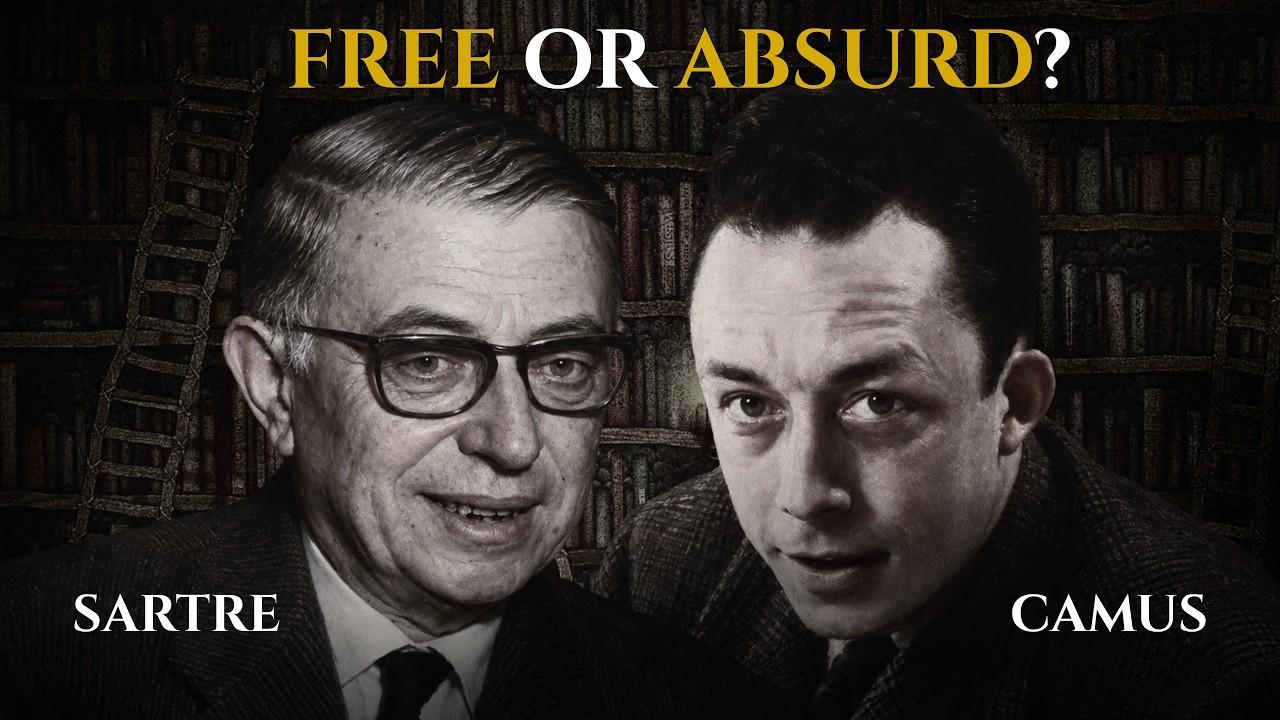
Camus and Sartre began as friends and became public opponents over The Rebel. Their argument reaches deeper than the quarrel: Camus starts with the absurd and insists on revolt with limits; Sartre starts with radical freedom and asks what commitment to history requires. The reading follows their wartime friendship, the break, and the strongest version of each view. It asks how a person acts when no final authority can decide in their place.
The full episode is on YouTube and Spotify. Please listen only in safe, restful contexts.
Timestamps
Jump into the video
- 0:00:00Chapter 1: Camus Reads Sartre's Nausea
- 0:02:19Chapter 2: Camus and Sartre Become Friends
- 0:14:00Chapter 3: Camus's Absurd and Sartre's Contingency
- 0:25:43Chapter 4: Sartre's Freedom Without Excuse
- 0:38:02Chapter 5: Camus at the Combat Newspaper
- 0:48:41Chapter 6: Sartre's Student and the Choice
- 1:00:47Chapter 7: Camus's Plague and Shared Happiness
- 1:13:39Chapter 8: Sartre's Literature of Freedom
- 1:26:41Chapter 9: Camus's Rebel and Its Limits
- 1:40:40Chapter 10: Sartre's Commitment to History
- 1:52:53Chapter 11: Camus and Sartre on Human Nature
- 2:04:57Chapter 12: Camus and Sartre's Break of 1952
- 2:14:28Chapter 13: Camus and Sartre's Nobel Choices
- 2:22:34Chapter 14: Camus and Sartre After the Quarrel
Full transcript
For the record
Chapter 1: Camus Reads Sartre's Nausea
Albert Camus reviewed Jean-Paul Sartre's first novel nearly five years before they met.
The review appeared in an Algiers newspaper in nineteen thirty-eight, when Camus was twenty-four. Sartre was teaching philosophy when Nausea appeared, his first novel about a narrator unsettled by the ordinary things around him. Camus admired its descriptions but questioned how its philosophy entered the fiction. His objection was about the novel as a work of art.
A critic must distinguish what a book achieves from what he wishes it achieved. Camus had to weigh the force of Sartre's descriptions against his reservations about their place in the novel. No established rule could make that literary judgment for him. How do you act when no one can decide for you?
Camus believed a novel could express philosophy through images, through what its people noticed and endured. In Nausea, he found both the descriptive writing and the philosophical thinking convincing when considered separately. Their joining troubled him. The novel seemed to move between them too quickly, without making their connection artistically convincing. This was an objection to the way two strong elements formed one book, not a denial of either element's force.
Camus also worked as a reporter in Algiers. Reporting attends to particulars that another person can inspect; fiction can give particulars a meaning that a report cannot. That comparison helps explain what a critic might ask of the novel, though Camus did not present his newspaper work as the source of his objection. He judged the book's form on the page.
Sartre would later use the word "condemned" for a freedom no one can hand back. The review came before that public formulation.
A critic who asks fiction to carry its ideas through images must submit his own fiction to the same test.
Chapter 2: Camus and Sartre Become Friends
Before meeting in person, Camus and Sartre each read the other's novel. Camus's novel The Stranger appeared in nineteen forty-two, narrated by a clerk in Algiers. Sartre wrote about the novel the following February. He read it as a literary work whose ordinary language and difficult subject belonged together. Each man had now considered the other's writing, although neither had yet spoken to the other.
The narrator's way of telling his story resists the reader's usual expectations. Sartre's essay took that unusual manner seriously. He tried to understand why its spare sentences felt so different from an ordinary account of a life. His interest was more than courtesy toward another writer. A philosophical disagreement could begin with exact attention to what another person's work actually did.
The Myth of Sisyphus, Camus's essay from the same year, ends by imagining the bearer of a boulder happy. That sentence had a place in a sustained inquiry about living without an ultimate explanation. Here it also marks a difference in literary form. Camus placed a claim about human life beside a figure whose task could be pictured. Sartre's response to the novel showed his own willingness to let a literary method carry thought. Their books made an acquaintance possible before a social introduction did.
Sartre was older, already a philosophy teacher and the author of Nausea. Camus was a younger novelist and journalist with a reputation still forming beyond Algeria. These differences mattered less than their shared sense that writing was an act of judgment. A review can flatter its subject while leaving the book untouched. Each had instead attended to another's sentences. The attention created a basis for friendship that agreement alone could not have supplied.
Camus and Sartre met at a dress rehearsal of Sartre's play The Flies in June nineteen forty-three. Camus introduced himself there, according to the account preserved by the French national library. A dress rehearsal is work in progress rather than a settled public triumph. Actors, author, and invited spectators encounter a play while its performance can still be judged. The record establishes the meeting but does not preserve a conversation that would explain the friendship in a convenient line.
The Flies uses an ancient story to examine action and responsibility. Its Paris production belonged to a city living under occupation. That setting gives the meeting its historical weight, though it cannot tell us what either man thought while it happened. They were writers whose work faced a present that demanded decisions. Books and a stage offered ways of thinking in public, even when ordinary public speech had narrow limits.
Sartre had returned to France after about nine months as a prisoner of war. Camus had moved into the Paris literary world with a different history behind him. The meeting could not erase the difference between their paths. The companionship took shape through writing, theatre, and the people who worked around both. Friendship here was less a shared doctrine than a repeated willingness to enter another person's unfinished work.
The next documented scene came in March nineteen forty-four. Camus directed a reading of a play by Pablo Picasso in the apartment of the writer Michel Leiris. Sartre and Simone de Beauvoir, his fellow writer and lifelong companion, were among its readers. Picasso attended as a spectator, a distinction that matters to the account of the reading. A reading requires several people to carry one text aloud, but it gives none of them ownership of every sentence.
The play was called Desire Caught by the Tail. Its strange title and unusual form belonged to Picasso, not to either philosopher's theory. Camus directed the event; Sartre and Beauvoir participated in it. The precise arrangement lets the moment remain itself without an invented exchange between the men. Their presence in a collaborative reading already shows an intimacy between writers who were making distinct work.
There is a familiar photograph of members of this circle, but it was taken at a later June gathering. It does not document the March reading, a difference between the two occasions is easy to lose because a photograph seems to give a story a face. Yet the reading's meaning does not need a borrowed image. It was a gathering in which a work existed through several readers' voices, under Camus's direction, with Sartre among them.
During those years Camus wrote four literary letters addressed to an imagined German friend. The first two appeared in Resistance reviews before the four were collected after the war. The addressee was a device for arguing about moral differences under occupation. He was not Sartre. Their full argument about meaning belongs with Camus's philosophy, but their existence shows that Camus was already joining public circumstances to literary form.
Sartre was writing drama and philosophy during the same period. Being and Nothingness had appeared in nineteen forty-three, while his plays reached audiences under occupation. The two men did not need identical vocabularies to see writing as more than a private accomplishment. A printed essay or a performed play entered a world where other people might accept, refuse, or misunderstand it. The writer could shape a work, but could not determine its whole public life.
The friendship developed amid that incomplete control, since a critic reads without governing an author's next book. A participant in a reading speaks another author's words without becoming their source. Those facts give the early relationship a modest form. One man could take another's thought seriously without surrendering his own judgment. The later disagreement would test that practice, but the early meetings do not need to be read backward through their end.
Camus moved within Sartre's postwar circle, which also included Beauvoir. Their association became public enough that their names could be joined in descriptions of new French writing. A shared label, however, could conceal real differences. In an interview in nineteen forty-five, Camus rejected the word existentialist for himself. Sartre accepted that name for the position he was publicly explaining. Camus also resisted the idea that a philosophical system should settle every question in advance.
The refusal was a factual difference, not proof that the friendship had already failed. People can object to a name used for them and continue speaking to those who use it. Camus wrote fiction, essays, and journalism; Sartre wrote in those forms too, alongside formal philosophy. Their work often occupied the same cultural space, although each chose a different way of describing what the work meant. The distinction mattered precisely because readers were tempted to merge them.
The label also affected how an audience might hear their disagreement. If both writers were introduced as exponents of one philosophy, a difference in their works could look like inconsistency within a school. Camus's refusal made a simpler reading impossible. Readers had to consider what each writer actually claimed, even when they used the same forms and knew the same people. A circle of friends can create a public impression of unity that no participant has promised.
Their early criticism of one another's fiction is especially useful for understanding this relation. A favorable notice can pass over the structure of a book, and an unfavorable one can reduce it to a slogan. Camus's review and Sartre's essay did something more demanding: each treated literary decisions as parts of a philosophical work. The men did not begin with a formal debate over rival systems. They began as readers who granted that the other's sentences deserved sustained attention. That is a narrower bond than doctrinal agreement, but it can be a stronger basis for honest disagreement.
The March reading suggests a similar distinction between participation and possession. Sartre could speak lines written by Picasso under Camus's direction without those lines becoming Sartre's philosophy. Beauvoir's presence gave the occasion another writer's voice, yet it did not collapse her work into theirs. The event belonged to a literary circle where people could assist in bringing a work before others. Each person remained answerable for a different part of that work. Collaboration was possible because difference did not have to be settled beforehand.
An intellectual friendship can have more substance than a list of shared positions. It gives each person repeated occasions to test his thought against another's books, judgments, and public acts. Camus and Sartre had already reviewed each other's fiction before they met. They then worked in the same literary circle under conditions that made writing consequential. That sequence gives their later disagreement a human scale. The arguments belonged to people who knew what it was to be read by one another.
Neither man's later philosophy should be read back into these first meetings. The rehearsal shows only that they met. The reading shows that they worked together, and the shared circle of friends shows that they were close. None of it settles what either thought about freedom or history, and those limits make the record more trustworthy. A friendship can begin with small acts of attention and leave the deepest questions open.
Camus's rejection of the existentialist label also kept those questions alive within the friendship. He did not deny that human beings must act without a final guarantee. Sartre would make that condition central to his public philosophy, though the men gave it different meanings. In the early years, they could let books and work carry the difference without requiring a formal settlement. Their friendship had room for two unfinished accounts of the same human task.
Chapter 3: Camus's Absurd and Sartre's Contingency
The absurd, for Camus, begins with a demand for an explanation of life as a whole. Sartre's Nausea presents a different difficulty through a narrator's encounter with ordinary things. Both writers describe a world without a ready answer, although they do not mean exactly the same thing by that description, and their different starting points shape what follows.
For Camus, the absurd arises between a human longing and the world's failure to satisfy it. A person wants events to make sense together, perhaps through a purpose beyond the events themselves. The world supplies many local explanations, as a doctor can explain an illness and a historian can explain a decision. Neither explanation makes existence as a whole answer the wish for an ultimate reason. The distance between the wish and that silence is what Camus names.
This account has two sides: a human being asks for unity, while the world offers no final reply. Remove the questioner, and there is no frustrated demand. Remove the world, and there is no resistance to that demand. Camus's term therefore describes a relation, not a strange property hidden inside trees or stones. The distinction matters because it leaves room for clear knowledge within particular fields. The failure of a final explanation does not make an ordinary explanation false.
A timetable can tell a traveler when a train is due. It cannot say why any life should have a destination worth choosing. Camus did not dispute the usefulness of the timetable, but he disputed the move from useful knowledge to a promise of ultimate order. A person might work, love, and learn while still meeting a question none of those activities can finally settle. The absurd is heard in that mismatch, not in a rejection of work or love.
Sartre's novel begins its philosophical pressure elsewhere. Its narrator, an independent scholar, grows unsettled by the way familiar objects appear to him. One decisive moment comes before the root of a chestnut tree in a garden. The root no longer seems explained by the ordinary names and purposes through which people usually handle things. It is there, yet its existence need not have been. The encounter makes the philosophical idea of contingency visible in a particular object.
Contingency means that a thing exists without being required by some deeper necessity. The root does not have to be there for the universe to be complete. It can be described, named, and studied, but none of those operations proves that it had to exist. Sartre's narrator feels the force of that fact in a particular object. The novel makes an abstract claim arrive through the stubborn presence of something before his eyes.
The root belongs to Nausea, and its image should remain with the novel. It is not Camus's illustration of the absurd, since Sartre's narrator is struck by existing things without a necessary reason, while Camus asks what happens when a person seeks a final explanation and finds no answer. These accounts can touch, and Camus noticed the resemblance when he read Sartre. Their shared word should not hide the different work it performs.
Camus's demand is a demand made by a mind confronting the world. Sartre's contingency concerns the existence of things within the world, including the person who sees them. The difference changes the shape of the question. Camus can ask how to live lucidly while continuing to want an impossible unity. Sartre can ask what a person becomes when no fixed account of being supplies a ready role. Neither inquiry requires the claim that everyday meanings are worthless.
The distinction matters when someone asks for a cause. A cause can explain why one event followed another without making either event necessary in an absolute sense. The rain may explain why a garden is wet; it does not establish that this garden had to exist. Sartre's narrator presses past familiar causes to the sheer presence of things. Camus accepts the local usefulness of causal inquiry while questioning whether its success can satisfy a different longing. An explanation of rain does not answer the desire to know why the whole of life has one final meaning.
Their different inquiries also change what counts as an honest response. Camus asks a person to hold the demand for meaning in view without claiming the world has met it. The account can therefore resist a consolation that announces a hidden purpose too easily. Sartre's novel asks a reader to notice the contingency beneath ordinary descriptions. The account resists another reassurance: that things are exactly as they must be because familiar names make them feel secure. Each writer takes away a different kind of premature certainty.
The difference can be heard in the ordinary act of naming. A gardener calls something a root because that name helps describe its place in a plant. The name does not explain why this particular object exists. Sartre's novel presses on that gap. Camus would ask another question: why should the whole of what exists satisfy the human demand for a single justification? His answer begins by refusing to disguise the unanswered demand.
The two questions can also produce different temptations. A person might suppose that the lack of a final purpose cancels every smaller purpose. Camus thought that conclusion moved too quickly, because care for another person is a real human fact even if the universe never certifies it. A person might instead suppose that every object, role, and character was fixed in advance. Sartre's novel makes that certainty difficult, since the familiar shape of a thing does not guarantee its necessity.
Camus's fourth Letter to a German Friend is useful here because it was written in the midst of public crisis. The title addresses an imagined opponent rather than Sartre, and Camus argues there that the absence of ultimate meaning does not erase human significance. If no final answer has been given, human beings still have to decide what claims they will honor. The letter refuses to let a philosophical statement about the universe become indifference toward people.
That point protects Camus's thought from a common misunderstanding. To say that the world lacks a final explanation is not to say that a promise has no meaning. A promise can matter because one person has made it to another. Its force belongs to human relations, not to a proof of cosmic purpose. Camus could therefore write about a silent world and still insist that conduct toward others matters greatly.
Sartre's contingency does not forbid human significance either, since the narrator's discovery concerns the absence of necessity behind existence, not a command to stop caring. Nausea is a novel, and its disquiet belongs to a character's experience. It cannot be reduced to a doctrine that every ordinary undertaking is pointless. Sartre's later account of freedom will give human choices their own weight. The novel first removes the expectation that the world must have been arranged to justify those choices.
A novel can make this difficulty felt without supplying a rule for conduct. The narrator sees the root and cannot recover its earlier obviousness merely by naming it again. The reader follows a change in attention rather than a formal proof. Camus's essay works differently, with a direct inquiry into the human demand for clarity. That difference of form helps explain why their claims are sometimes grouped together too quickly. Both trouble a settled picture of the world, but they ask the reader to examine different parts of that picture.
Both positions leave a person without an external guarantee. Yet a missing guarantee need not produce the same response in every philosophy. Camus directs attention to the relation between longing and silence. Sartre directs attention to things whose being cannot be deduced from a plan. The distinction prevents a false contest over which man discovered meaninglessness first. They were diagnosing different failures in a demand for necessity.
The language of the absurd can tempt a writer toward a dramatic claim about everything. Camus's own account is more exact than that. A particular inquiry can succeed, and a particular act can matter, while the whole remains without a final explanation. The world has not promised an answer to every question humans can ask of it. Camus holds onto both the force of the question and the lack of such a promise.
Sartre's novel works by making a familiar thing lose its assumed place in a settled account. The root remains a root; the narrator's understanding of its existence changes. Its presence cannot be derived from a description of what roots are for. A purpose can explain why a gardener tends a tree, but it cannot make the whole fact of existence necessary. That thought can disturb without making the garden unreal.
Camus and Sartre therefore offer two ways of meeting an unprovided answer. One concerns the reach of human longing; the other, the unrequired presence of what exists. Both are compatible with exact descriptions of the ordinary world. Neither gives anyone permission to treat another person's needs as unreal. Their practical philosophies will differ, but the shared absence of a final guarantee does not yet decide how either man must act.
The fourth letter makes Camus's position particularly clear, since its argument was written for a public struggle in which words about meaning could affect conduct. Human significance had to be defended without pretending it was secured by a hidden design. Camus did not solve the silence of the world by filling it with a new promise. He insisted that the people who hear that silence remain significant to one another.
Chapter 4: Sartre's Freedom Without Excuse
Sartre's public lecture in nineteen forty-five put human freedom before an overflowing audience in Paris. He argued that people have no purpose assigned to them before they exist. Simone de Beauvoir later recalled that more people came than the room could contain. That report gives the occasion scale without making the lecture's argument depend on a crowd. Its lasting force lies in an ordinary difficulty: people want a prior rule for becoming themselves.
The lecture is known in English as Existentialism Is a Humanism. Sartre was answering critics who thought his philosophy left people helpless or indifferent. He called it a philosophy of action because, without a divine maker's plan, the work of giving a life its shape falls to the person living it. This claim begins with an account of existence, before it becomes advice about any particular decision.
Sartre compared a person with a paper knife, whose maker already knows what it is meant to do. Its purpose exists as a plan before the object is made. If a human being had been made according to a divine plan, a similar purpose might precede that person's life. Sartre denied that such a plan could be assumed, so the person is there first, and a life is shaped afterward through action.
His compact formula is that existence precedes essence. Essence here means a fixed account of what a thing is for. A manufactured object can be understood through the maker's design. A person cannot be given that kind of finished description before living. The formula does not deny the biological facts of a human body or the history into which someone is born. It denies a prewritten purpose that settles what a person must become.
This is why the comparison is more than a clever reversal of two words. A maker can explain an object by referring to an idea that existed before the object itself. The maker wanted something that would cut paper and fashioned an object accordingly. Sartre sees no corresponding maker's intention behind human life. Descriptions of human needs, capacities, and limits remain possible, but none is a completed instruction for one life. A person's conduct contributes to any account of who that person is.
An occupation can show the difference, since the word teacher describes work with students, a body of knowledge, and institutional duties. It does not tell a teacher how to respond to every student or what to do when two duties conflict. Those questions arise within a life already underway. Sartre's formula says no total description of the role can replace the person who must live it. The role gives real material for judgment, while leaving the judgment itself unfinished.
The paper knife makes the contrast easy to picture, but it has a strict limit. People are not manufactured objects waiting for an owner to explain their use. Nor can a person instantly remake every circumstance by deciding to be different. Sartre's point concerns the absence of an assigned human purpose, not a magical power over the world. A person acts from a place in the world, with a past that remains part of the situation.
The phrase for this condition sounds severe: a person is "condemned to be free." Sartre did not mean freedom was a punishment imposed by a court. He meant that no one chose to come into existence, yet no one can hand back the responsibility of acting. The word "condemned" marks the lack of an appeal beyond the human situation. Even a refusal to act leaves a person's conduct and its consequences to be owned.
The lack of an appeal does not mean a person must decide in isolation from advice. Friends can speak, books can offer reasons, and institutions can set demands. Yet choosing whose advice to trust already involves a judgment about those sources. A person may follow a teacher's recommendation because the teacher knows a field well. That reason can be sound without making the teacher the author of the follower's life. Sartre separates the value of help from the fantasy of transferring responsibility altogether.
It is easy to mistake this for a cheerful promise of limitless possibilities. Sartre's formulation is harder because a person may be frightened, constrained, or unsure, and still have to respond to what is there. The freedom he describes is not a guarantee that a desired result will follow. It is the inescapable involvement of a person in what that person does. The full cost of a choice becomes clearer when actual claims compete.
Sartre's reasoning begins by rejecting a familiar defense. Someone might say that a role, a temperament, or a general rule has already decided the matter. Those things can describe pressures and habits, but they cannot turn a human life into the completed product of a maker's design. A teacher may have obligations attached to a job, but the job title cannot settle every conflict the teacher meets. Applying a rule is itself an act that takes place in a particular situation.
The claim also reaches inward when a person insists that character is entirely fixed can use that story to avoid seeing a possible change. Yet Sartre did not think freedom required denying everything that has happened. Past actions are real, and other people can remember them. Freedom appears in the way a person takes up those facts and acts from them. No account of a past life can perform the next act in that person's place.
Being and Nothingness, Sartre's larger philosophical book from nineteen forty-three, gave this account a more difficult form. The lecture carried some of its themes to a broad audience. That is why its plain sentences could sound both liberating and accusing. They removed a final design, then left responsibility close to the person who must act. A listener could welcome the first movement and resist the second.
Sartre sometimes called evasion of this condition bad faith. The phrase names a refusal to face both one's possibilities and one's circumstances honestly. It does not mean every mistake is deliberate deceit or that a person is at fault for having a difficult past or a restricted present. The evasion lies in presenting one part of a situation as though it erased the other. A fixed role can become an excuse, and an imagined pure freedom can become one too.
The word freedom therefore needs care because, in ordinary speech it may mean having many options or facing no interference. Sartre was speaking first about a more basic feature of human life. A person cannot become a thing whose conduct is completely explained by a prior design. This does not show that every person has the same options. It shows why options, unequal as they are, still confront people who must respond.
The lecture also distinguishes Sartre's atheism from mere indifference. If there is no God with a conception of humanity, no finished human purpose can be read from that source. A person has to make a life through conduct, and those acts happen among other people. Sartre's account does not make every act equally thoughtful or equally defensible. It removes one proposed guarantee before any moral argument begins.
The absence of a divine design does not erase the difference between a claim and an excuse. Someone who says a particular act was required by an assigned nature offers one kind of explanation. Sartre asks that person to look again at the act itself and the situation in which it occurred. A purpose inherited without examination cannot settle the matter simply by being old or familiar. The pressure of the philosophy lies in this return from an imagined blueprint to actual conduct.
Camus declined to call himself an existentialist. That difference in label cannot do the philosophical work by itself. Camus also wrote about living without an ultimate explanation, as his earlier inquiry made clear. Sartre pressed a distinct claim about what a person is before any chosen aim. The two men could agree that no final authority would decide a life for them while disagreeing about the ground and reach of freedom.
Sartre's title stresses that his claim is about human beings. A world with no divine plan does not abandon human lives. It makes those lives the place where purposes are made. Think of a commitment made with no promise that it will succeed. A person can give that commitment meaning through action, even though nothing decided in advance confirms the choice. The meaning is not a label stuck on from outside, and it is not a forecast of how things will turn out.
There is a tension between a universal statement about freedom and the unequal situations people inhabit. Sartre's stronger account must hold both: everyone lacks a preassigned purpose, while no one acts from a blank starting place. The person with secure work and the person without it face different possibilities. Freedom describes their involvement in those possibilities, not an equality of resources or a promise of success.
The lecture's popularity could encourage a simpler reading. A short formula travels more readily than an argument about circumstances and responsibility. Sartre later expressed reservations about the lecture as published. That fact does not withdraw every claim he made there, and it does not license treating the occasion as his final word. It reminds us that a public sentence can become detached from the reasoning that gave it force.
The phrase about condemnation is easy to repeat because it is memorable. Its argument is less easily exhausted because no one wrote a complete purpose for a person before that person arrived. A life nevertheless unfolds among material facts, other people, and the consequences of earlier acts. Sartre asks each person to acknowledge that involvement without claiming an outside source has already decided its meaning.
The paper knife has a function before its maker cuts a sheet of paper. A person can only be described through a life being lived among others. Sartre's comparison does not supply a ready moral verdict. It prevents an appeal to a prior design from replacing the work of judgment.
Chapter 5: Camus at the Combat Newspaper
During the Liberation of Paris, Camus's newspaper emerged openly. Sartre wrote reports for it at Camus's request, adding his work to a public enterprise the younger writer helped edit. The paper was called Combat, a name that carried the history of clandestine publication, but the visible issue now addressed readers who could examine its claims. Camus's editorial work gave his ideas a daily test.
A newspaper does not enjoy the slow time of a philosophical book. It must decide what can be said about an event while the event remains unsettled. A report can name a place, a person, and an action; an editorial must also judge their significance. The reader may receive both on the same sheet of paper. Camus had known journalism in Algeria, but the new paper made that work part of a wider public argument.
Pascal Pia, Camus's newspaper colleague and mentor, brought him into the clandestine Combat enterprise in late nineteen forty-three. The paper already existed when Camus joined it, and he did not found it, and the exact day he received an editorial title need not be invented. These limits make the record clearer because he entered an ongoing collective effort and then helped give its public voice a distinctive moral pressure.
The occupation formed the paper's background as a bare historical fact. When publication became open in August, a writer had to face another kind of difficulty. What should be said once secrecy no longer determines every sentence? Victory does not make a public claim true, since the force of an editorial depends on whether it can be examined by people who did not share the writer's private intentions.
Camus contributed many editorials, some without his name attached. Anonymous work can make authorship hard to count, but it does not remove responsibility for a paper's position. An editorial speaks as part of a continuing publication. Its readers can compare one issue with another and ask whether its judgment is consistent. Camus's contribution therefore belongs to the repeated labor of public explanation, not to one famous line printed above his signature.
The difference between a report and an editorial is useful for understanding this labor. Reporting asks whether a described event can be supported by what witnesses and records show. Editorial writing asks what judgment readers might reasonably draw from such events. Neither task can replace the other, for if the facts are weak, a confident moral sentence does not repair them. If the facts are sound, a writer may still need to explain why one consequence matters more than another. Camus worked where these demands met on the same printed page.
Sartre's reports for the paper included work on the Liberation of Paris and later on America. His presence complicates any picture of the two men as enemies from the start. Camus invited a writer whose philosophy he would later challenge to give readers observations of public events. A report has its own discipline, requiring it to describe what happened before it can suggest what those events mean. The collaboration gave each man a practical relation to the other's work.
The newspaper also shows a difference between being engaged and being certain. A writer may feel obliged to speak about a public matter without claiming to know how history will end. A printed claim can be corrected by another report or disputed by a reader. Camus's choice to write editorials did not place him above error. It placed his judgments where others could answer them, and that exposure is part of the action the newspaper made possible.
Consider the ordinary shape of a correction when a paper prints a claim in one issue and learns more before the next. Its earlier words cannot simply be erased from the public record. The writer can acknowledge the new information and change the claim. Journalism makes intellectual responsibility visible in that sequence. Truth telling is not a claim to have escaped time; it is a willingness to let a statement meet facts as they arrive.
Camus's wartime letters had used a literary addressee to test moral differences. The newspaper required another method because it faced readers who were present, skeptical, and able to compare the statement with events. A sentence about justice could no longer remain at the level of a character's imagined exchange. It had to answer to particular decisions, institutions, and effects. The change of form mattered to Camus's practice as a writer.
The form also resisted a comforting idea of pure innocence. An editor chooses what to print, what to omit, and when a claim is ready. A choice made under pressure may be imperfect, yet refusing every judgment would leave the public page to someone else. Camus did not treat the need for limits as a reason to withdraw from public speech. His work at Combat put his standards into a medium where every standard had to be used.
In nineteen forty-six he published a series called Neither Victims nor Executioners. The title rejects two positions that can seem to exhaust public life when force dominates it. Its publication in the newspaper is as important here as its wording. Camus offered the argument to readers amid continuing disagreement, where it could be challenged as a proposal for conduct. He was writing about what people might refuse and what they might undertake together.
The series did not make Camus a writer outside politics. It placed a moral argument inside a public dispute, a distinction matters because later accounts of the quarrel with Sartre can turn Camus into a witness who only says no. At Combat he made affirmative choices about subjects, claims, and an audience. Readers may dispute his judgments, but they cannot make the practical labor vanish by calling it withdrawal.
The title of the series also refuses an easy division of people into pure sufferers and pure agents. Camus was trying to think about conduct in circumstances where actions had consequences beyond a writer's intention. A newspaper could place the argument before people who faced those circumstances directly. Its medium made disagreement likely and useful. An argument in public gains seriousness when the people to whom it is addressed can reply with facts the author has neglected.
This helps explain why leaving the paper did not imply leaving its concerns. An editor has a place in an institution, with particular resources and limits. The questions that made the editor write can outlast the arrangement that gave him a daily column. Camus's later books used slower forms, but the newspaper years had tested the relation between a public claim and the people asked to live with its consequences. The test was practical even when the sentence on the page was philosophical.
Sartre, too, valued public writing, though he would give its commitment a different philosophical account. His reports show that cooperation did not await agreement on those accounts. A newspaper can contain reporting by one writer and editorials by another without resolving every tension between them. The reader receives the particular work. The broader theory of what writing demands may still be argued afterward.
Camus's main editorial involvement ended in nineteen forty-seven amid financial difficulties and a change of ownership. This was a change in one institution, not an end to his public thought. He continued to write about moral and political questions. The paper had given him a form in which a philosophical claim met the short interval between public events. Leaving the form did not erase the demands it had taught him to face.
Working on a newspaper taught a practical lesson. An editor cannot make an event unhappen, and a reporter cannot decide what readers will conclude. Both can stick to what can be checked and explain why a judgment follows from it. Camus's public work joined those tasks, without pretending that facts alone give orders. It asked a writer to decide how much the evidence allowed him to say.
The shared work of Camus and Sartre at Combat also gives the friendship a different texture from the literary reading. There, several people lent voices to a single play. Here, different kinds of writing reached an unknown public through one paper. Camus asked Sartre to report because his work could help readers understand events. The request recognized another writer's ability without asking him to think exactly as Camus did.
A daily paper is read, contested, and replaced by a later issue. That transience does not make the editor's judgment trivial. The people affected by public claims live within their immediate consequences. Camus used the paper to say what he thought those consequences demanded, knowing that another person could put the same facts to a different test. Public truth telling began for him with the discipline of making a claim that could be answered.
Chapter 6: Sartre's Student and the Choice
Sartre's wartime student, in the lecture, faced two claims he could neither satisfy together nor dismiss. His mother depended on his company, while he wanted to join the Free French. The story asks what choosing means when good reasons pull in different directions. Sartre did not present the young man as a model whose biography a listener could independently verify. He presented a case in which advice itself would have to be chosen.
The student's brother had died during the war. His mother depended on the young man's presence, and he knew that his leaving would matter to her. She could feel the benefit of his staying every day. Joining the Free French offered another duty, directed toward people beyond the household. Its effects would be uncertain, while the absence from home would be immediate. The difficulty lay in the force of both claims.
A rule that says honor your family sounds decisive until a public obligation competes with it. A rule that says serve the greatest number sounds decisive until its possible results remain unknown. Sartre described the student looking for an answer that would stand above his own decision. Yet every proposed principle required him to decide how it applied here. No principle reached down and moved his feet for him.
Suppose a friend advised him to remain with his mother. The student would still have selected that friend as someone likely to give such counsel. Suppose instead he visited a teacher known for urging public service. Choosing that adviser would already express an inclination. Advice may reveal reasons the student had overlooked. It cannot remove his responsibility for accepting one reason as decisive.
Sartre's point was not that counsel is worthless. A mother can speak of her needs, and an experienced organizer can describe the work awaiting a volunteer. Each gives the student information he ought to hear. Neither can supply an order whose authority cancels his own judgment. The person who asks for guidance remains involved in deciding what sort of guidance he seeks.
This is harder than a claim that everyone may simply follow a preference. A preference can be examined, and the student might discover that he calls a wish to escape home a public duty. Or he might discover that his fear of leaving has been presented to himself as care. These possibilities do not prove that one path is right. They make honesty about motive part of the work of choosing.
The student's mother could reasonably ask what her son owed her. People he had never met could reasonably ask what he might do with them. Sartre gave no numerical method for weighing a daily, certain presence against a distant, uncertain contribution. The person choosing must acknowledge the difference between those kinds of claim. He cannot turn the absence of a formula into the absence of a decision.
Even remaining at home would be a choice with a history. Its consequences might be welcomed or regretted later. The student could describe his act as obedience to family feeling, but that description would not make him a passive object. He had considered another course and stayed. In Sartre's account, declining a possible action also belongs to the conduct by which a person takes a position.
That inference can sound cruel when a person's options are narrow. Sartre's argument does not create more options by naming a choice. It asks how a person responds among the possibilities actually available. A student cannot promise to protect his mother and undertake distant service at the same time. Saying that he must choose recognizes a constraint rather than dissolving it.
There is another burden in the lecture that is easy to miss. Sartre argues that choosing oneself also presents a picture of what a person may rightly choose. An act does not remain wholly private merely because one person performs it. The student who stays gives care for a dependent parent public weight through his conduct. The student who leaves gives public service weight. His act proposes a way of ranking claims in a situation like his.
Sartre does not mean that the student controls every other person's decision. The mother may disagree with his reasons. Another student may face different needs and reach another conclusion. The broader reach of a choice lies in the value the chooser affirms. When he asks whether his decision is defensible, he cannot pretend that its reasons matter only because they are his.
The claim can be tested against a small promise. Someone who keeps a promise because promises are worth keeping implicitly treats that reason as available to others. The act carries a judgment about trust beyond one exchange. That does not make all promises identical or remove the need to consider their circumstances. It means a person cannot make a serious reason for conduct while declaring that the reason has no bearing on human conduct at all.
The student's two obligations put this public dimension under pressure. If he chooses care at home, he has to live with the claim that such care can outweigh a wider duty. If he chooses wider service, he has to live with the claim that public need can outweigh intimate dependence. He cannot have the moral authority of both paths while performing only one. Sartre's language of responsibility includes that unavoidable exposure of a reason to other people.
The example also tests what feelings can tell him. Affection for his mother is real information about a relationship; it is not a general rule proving he must remain. The desire to serve a wider cause may also be sincere without proving that he must leave. Sartre asks the student to act while these feelings are still being understood. The chosen act may reveal which attachment he has given practical authority, but it cannot establish that the other attachment was false.
The uncertainty includes the future of each path. At home, the student could help his mother in ways he understands, yet he cannot know every effect of his presence. In distant service, he might contribute to a shared effort without ever seeing the result. A calculation that assigned each path a reliable total would conceal the very difficulty Sartre presents. The young man has to choose a course whose full consequences he cannot inspect beforehand.
This does not make reasons disappear. He can compare what is certain, what is probable, and what he merely hopes. He can hear his mother's account of daily need and learn what service would require. He can ask whether a motive he calls generous is partly an escape from another obligation. Reasoning may improve his judgment without producing a proof that settles the case from outside his life.
There is a risk of turning this into a test of heroism. The young man might be frightened on either path. He might choose for mixed reasons and understand them better only afterward. Sartre's argument does not require a pure feeling before action. It refuses a comforting story in which uncertainty itself proves that no one can answer for the act.
Camus's public writing had also placed judgments where other people could answer them. His newspaper asked writers to make claims in the face of incomplete knowledge. Sartre's student faces a more intimate problem, since there is no public page on which a later correction can restore a missed visit or an unused chance. The comparison shows why both men took imperfect knowledge seriously without deriving the same theory from it.
Sartre carried the ethical claim further than the student's isolated dilemma. In the same lecture, he argued that one cannot will one's own freedom without also willing the freedom of others. A person who asks to be treated as able to choose has reason to recognize that capacity in those whose lives meet his. The freedom at issue is more than permission to pursue a private aim while others serve as instruments.
The connection is not automatic approval of every act someone chooses. Another person's liberty can be damaged by what I do, and calling my action free does not make that damage acceptable. Sartre's argument presses the chooser to ask whether the chosen course also affirms other people as choosers. A mother is not merely a need to be calculated; those alongside a volunteer are not merely a cause to be used.
This ethical demand differs from the claim that a choice sets an example. An example concerns the reasons a chooser offers as fit for human conduct. Willing others' freedom concerns the people whose independent agency those reasons must respect. The student may try to make a defensible decision and still owe careful attention to the mother and to those with whom he might serve. A principle about choosing does not finish the relationship.
His mother has a view of their relation that he cannot replace with his own account of duty. If he stays, he must still listen to how she understands the help he offers. If he leaves, explaining the decision cannot erase her independent judgment of it. The other people involved in public service likewise remain more than a stage for his moral self-description. Sartre's appeal to their freedom checks the temptation to make every other life a supporting part of one person's choice.
The lecture leaves a crucial difference between owning a choice and claiming that choice was flawless. Responsibility includes the possibility of later criticism, especially from people who carried a cost the chooser did not foresee. The student might learn that his mother needed a different kind of help, or that his public contribution was smaller than hoped. Such discoveries would not prove that he should have found a rule before acting. They would require him to answer for the decision as knowledge changed, without pretending he had been able to know everything in advance.
Sartre's lecture therefore offers neither a secret rule nor a permission slip for whim. It gives the young man the work of deciding among actual claims, accepting that his reasons speak beyond himself, and recognizing others as free. These demands do not remove his uncertainty. They tell him what cannot be handed to an adviser, an institution, or a ready phrase when he acts.
Chapter 7: Camus's Plague and Shared Happiness
Oran closes its gates during an epidemic in Camus's The Plague. The doctor Rieux, who narrates the novel, goes on treating patients while residents make different choices about their lives there. One of them is Rambert, a journalist separated from the woman he loves. Their disagreement over leaving the city gives Camus a demanding way to consider happiness and obligation together.
The city is sealed, and many people die. Camus keeps attention on the ordinary work that people can still undertake. A doctor can visit a patient, organize care, and return to work the next day. Those acts cannot promise the city's safety or supply an account of why the epidemic occurred. They can answer a need that stands before the doctor.
Rieux does not describe his work as a grand moral achievement. He treats it as the task of a doctor. This modest description matters because it leaves room for fatigue, uncertainty, and limited results. If a task had to be heroic before it counted, most of the care in the city would disappear from view. Camus gives the repeated medical routine its own moral weight.
Rambert's claim is different and serious. He did not come to Oran to belong to its crisis. He wants to leave and rejoin the woman from whom the closed city separates him. A reader can understand that desire without treating it as a failure of character. The relationship existed before the epidemic, and the gates have interrupted a life to which he has made commitments. He is asking whether a public emergency may claim all of him.
That question resists a quick answer because the cost is personal. If Rambert stays, the people he can help will be near him. The person he loves will remain elsewhere. A public argument for staying cannot make her absence imaginary. Nor does the private claim settle what he owes people now sharing the city. Camus lets the two claims remain audible at once.
Rieux will not shame the journalist for seeking happiness. He recognizes that a person has reason to want a life with someone loved. His medical work gives him no authority to declare such happiness trivial. The distinction matters in a novel about collective care, since a call to serve others can become harsh when it treats every private attachment as a selfish distraction. Rieux's sympathy prevents that shortcut.
Rambert eventually decides to remain and help. His choice does not revise the value of the person outside the city. He has not discovered that love was an illusion or that public duty is the only honest motive. He recognizes that living among others has placed a claim on him which he can no longer set aside. Camus makes the decision his, rather than the automatic result of Rieux's example.
Rambert gives a reason of his own: happiness pursued alone, while others share this condition, would trouble him. The thought belongs to the journalist, not to the doctor who has already defended the legitimacy of happiness. Their remarks are often flattened into a single sermon against private joy. Keeping the speakers distinct reveals a conversation in which care for others and the desire for joy both retain their force.
The journalist's reversal also differs from a lesson in obedience. He has tried to leave and has learned more about the city through that effort. His eventual decision emerges from a changed relation to the people around him. Someone can arrive at solidarity without having begun from it. The novel gives time to that change, allowing judgment to grow through shared days rather than appearing complete at the gate.
This delay gives the decision a kind of honesty. Rambert does not announce a public duty on his first day and make every later action confirm it. He presses his own claim first. The people he encounters during that effort gradually cease to be only the background against which his separation feels painful. They become particular partners in a task he might share. A choice made after that recognition differs from a slogan adopted before meeting those whom it would serve.
The story also gives Rieux a useful limit as a moral guide. A doctor can tell Rambert that happiness is legitimate, but cannot live the journalist's relationship for him. Nor can he order Rambert to adopt the doctor's own daily work as an identity. His response leaves space for the other man to decide. The eventual solidarity is credible because it does not arise from humiliation imposed by the person already serving.
There is a practical asymmetry in the two men's positions. Rieux has a medical role with clear tasks that only trained people can perform. Rambert has a profession and a personal claim outside the city. The doctor's work is not simply a ready template for the journalist. Rambert must discover what he can offer as a person who was not assigned to the city's medical life. That difference keeps their choices individual within a common need.
The doctor cannot stop every loss. The journalist cannot repair his separation merely by deciding to stay. Their actions therefore belong to a moral world without guaranteed results. Camus gives neither man the comfort of a calculation proving that the sacrifice will pay. What changes is the set of people whose lives each is willing to regard as a claim upon his own conduct.
The sealed gates make the question visible. They separate Rambert from the woman he loves, while bringing him into daily contact with people he did not choose to meet. The same fact of confinement produces both claims. To describe only the public obligation would hide the cost of his decision. To describe only the private loss would hide the neighbors whose needs have become impossible for him to ignore.
Sartre's student had to choose between his mother and a wider service, without a formula that could do the choosing. Rambert faces another conflict between a loved person and people farther from the center of his life. Camus's novel gives this difficulty time and other voices. It asks what shared experience does to a claim that began as a private wish. The decision grows through the story, rather than being solved by a principle announced above it.
It would be easy to say that Rambert stays because he has become a good person. That description tells too little. He has come to see that joining the city's work can be part of the life he wants to live, even while he still wants the absent woman. A person may act from solidarity without ceasing to have particular loves. Camus's account asks that the two motives be taken seriously together.
Rieux's own words about happiness guard against a demanding but narrow ideal. If the doctor thought no one deserved private joy during public suffering, his work might look like service to an abstraction. Instead he treats individual lives as the very reason for the work. The reunion Rambert seeks is one of the ordinary goods that care tries to preserve. The novel does not need to condemn that good to explain why Rambert remains.
The novel also resists a sentimental picture of agreement. A doctor and a journalist can recognize one another's reasons while choosing different paths at different moments. Rieux's refusal to shame Rambert does not require Rieux to abandon his patients. Rambert's decision to stay does not require him to pretend that the separation no longer hurts. Their exchange permits a shared undertaking without making their motives identical.
Much of the city's response consists of work repeated without certainty. A visit is followed by another visit; a conversation must be had again as circumstances change. The importance of these acts does not depend on a final victory announced in advance. Camus is attentive to the interval in which people act because they can help someone before them. That interval is where a common life is made or neglected.
The difference between a single admirable decision and a continuing practice matters here. Rambert can choose to stay once, yet the work that follows asks for fresh attention on each day. Rieux can describe himself as doing his job, but a job is made of individual encounters that cannot all be settled by its title. Camus keeps the scale human. A claim about solidarity takes form in tasks that must be done again when no audience is present to admire them.
Rieux's role as narrator adds another restraint. He recounts people whose choices he witnessed, while his own work is part of the same account. The narrative does not turn one person's motive into the official meaning of the city. Rambert's private attachment remains intelligible even after he joins the shared effort. The doctor's telling can make room for that difference because he has already recognized the worth of happiness outside his own routine.
Happiness in this story is neither a prize awarded after enough service nor an excuse from every common task. Rambert's hoped for reunion matters before he chooses to help, while the people inside the city matter before he feels at home among them. Camus does not arrange the two claims in a simple order where one must vanish for the other to become genuine. A person can acknowledge both, make a costly decision for the moment at hand, and continue to value what the decision has postponed.
The word shared also needs care. Rieux and Rambert do not share the same skill, history, or personal cost, and the city cannot make them interchangeable. Their solidarity consists in bringing different capacities to needs neither can meet alone. That account leaves room for disagreement over how much a person can give. It asks for participation without making identical sacrifice the measure of every person's worth.
Near the novel's close, Rieux warns that such a calamity can return. The warning belongs to the book's literary understanding of human vigilance. It does not cancel the particular acts that have taken place or turn every future day into a threat. It reminds the reader that care cannot be discharged by a single decision. The doctor's routine has mattered because the need for human attention does not end when one person has behaved well once.
This is one way Camus answers the worry that concern for limits leaves a person passive. Rieux works, Rambert reconsiders, and both take other lives into account under conditions they did not choose. Their actions have different motives and different costs. The common undertaking gains its substance from those differences rather than requiring one pure form of duty.
Rambert's happiness remains a legitimate aim after he chooses to stay. The decision gives the people around him a place in his conduct, while his love gives that conduct an irreplaceable personal cost. Camus lets solidarity be chosen by someone who still wants a private life.
Chapter 8: Sartre's Literature of Freedom
Sartre's postwar magazine began with a claim about what writing asks of the world. Its founding preface described literature as a public commitment, made by a writer situated among other people. Camus's newspaper work provides a nearby example of public words, but Sartre wanted an account of the relation between writer and reader. A written work discloses something, and a reader remains free to answer it.
The magazine's first issue appeared in nineteen forty-five. Sartre directed it while his philosophy was reaching a wider audience through a public lecture. A magazine joins essays, arguments, and reviews in a continuing conversation. Each issue enters a setting the editor did not create from nothing. The subjects, disputes, and readers already have histories. Choosing to publish is one way of entering them.
Sartre's idea of committed literature does not start by ordering every novel to state a party line. He asks what a writer does when choosing a piece of the world for a reader to look at. To describe a situation is to open it to judgment. A description can show that an arrangement people accepted as natural has in fact been kept in place by choices. Once that is seen, the arrangement can be questioned.
Imagine a reader encountering a novel about a workplace. The sentences show who sets a rule and who must live under it. The writer can arrange those details so their relation becomes visible. Yet the reader has to connect them, judge them, and decide what weight they carry. The text cannot literally make the reader agree. The power of disclosure depends on a free response to what has been shown.
This dependence can seem like a weakness in Sartre's case for commitment. A writer with a public purpose might wish to secure an effect. A published page can persuade one reader, leave another unmoved, and be misread by a third. Sartre treats that uncertainty as part of literature's condition. The writer addresses someone who can refuse the invitation, and that freedom is what makes a response meaningful.
What Is Literature? develops this relation. Sartre examines prose as an action that reveals features of the world through language. A writer has made choices about what to show, but the work reaches completion through someone else's attention. The reader is not a container into which the author pours a finished verdict. Reading involves joining words to a situation and deciding what has been disclosed.
A map can guide a traveler only when the traveler reads its markings and relates them to a place. Sartre's account of literature gives the reader still more independence. A story does not merely label a fixed route. It presents human situations whose meaning has to be taken up by a person with a history and aims of their own. The writer can guide attention without becoming the owner of another person's judgment.
There is a difference between persuasion and control here. A writer may want a reader to recognize an injustice, and may use every skill to make the case clear. The reader's agreement would count as judgment only if refusal remained possible. A text that tried to eliminate that possibility would undermine the very freedom to which committed writing appeals. Sartre's account gives literature an ethical difficulty inside its artistic form.
The writer's freedom is limited in another way. A page is composed within a language and a world shared with readers. Its words carry meanings acquired before the writer chose them. A description of a street or a job may call up experiences the author never had. Writing exposes a position to those who can test it against what they know. The reader's independence is therefore practical, not an abstract compliment.
Sartre's claim also makes a literary work different from a private diary never meant for another eye. Publication asks another person to complete an act of understanding. The author can revise the sentences before release, but cannot govern each later encounter with them. A magazine makes this vivid because the issue is placed among other arguments. Readers can turn the page, compare claims, and answer in their own words.
The relation need not be friendly to be serious. A reader may object to a description as incomplete. That objection can reveal a missing fact or a faulty inference. The possibility of disagreement is part of what Sartre values about addressing free readers. If the writer assumes an audience of passive receivers, the work no longer treats them as partners in a judgment about the world.
The reader's freedom also puts a burden on the prose itself. A writer who leaves out the conditions needed to understand a judgment cannot repair that omission by saying the cause was worthy. The scene has to let another person see enough to test the claim. This need for clarity can be demanding when the writer feels certain already. An audience that may disagree forces the author to distinguish what the work shows from what its author hopes the audience will conclude.
Nor does disclosure require a voice without conviction. Sartre's writer may hold a strong view of the world being described. The freedom of the reader is preserved through the invitation to examine that world, not through pretending every judgment is equally good. A novel can make one course look cowardly or generous. The reader still has to ask whether the shown conduct supports the judgment the form encourages.
Camus and Sartre had each read the other's fiction closely before meeting. Their early criticism showed that a literary work could be examined rather than merely applauded. Sartre's later account places such examination within a larger view of human freedom. The act of reading asks the reader to do something with the world a writer has disclosed. That act may include praise, resistance, or a changed understanding that the writer never predicted.
Sartre does not claim that a reader who understands a book must imitate its author. The reader may recognize what the book reveals and still disagree about a course of action. Literature can make a condition visible without settling every decision it raises. A story about a workplace may show unequal power clearly, while leaving readers to argue about remedies. Disclosure begins public judgment; it does not finish it.
This is why the word commitment has a wider meaning than declared allegiance. A writer commits by choosing to speak from within a situation and accepting that the speech has effects. Silence can also have effects, though a writer cannot describe every event at once. Selecting one scene or one claim gives it a place before readers. Sartre's argument asks the author to recognize that selection as part of public life.
The claim does not require all writing to sound like an editorial. A character's hesitation can disclose a difficulty more exactly than an order printed in large type. A scene can let readers feel the weight of incompatible reasons while leaving them to judge the choice. Sartre's point concerns the freedom involved on both sides of the page. The author chooses a form; the reader meets that form as someone able to judge.
The magazine's founding claim gains force from this ordinary relation. Its writers entered public disputes through prose, but the publication could only invite readers into those disputes. Even a confident preface could not determine the meaning each reader would make of later articles. A durable commitment had to accept the audience as people whose assent could neither be assumed nor compelled.
There is a temptation to measure a committed work solely by whether it produces the change its author desired. Sartre's account is subtler. A book can show a social arrangement in a way that makes evasion harder, even when its readers take different positions. Its success as disclosure is not identical with a single political outcome. The author is answerable for the act of showing, while others remain answerable for how they receive it.
This division of responsibility matters for criticism too. A critic can question whether a book has made its subject intelligible without first agreeing with the author's public allegiance. Readers may share an aim and still find the work unconvincing. They may reject the aim while learning from the description. Such responses do not cancel the writer's commitment. They show that public writing enters an exchange among people whose judgments cannot be collapsed into one intention.
The magazine's continuing form made room for that exchange across time. An issue could raise a question, and a later issue could answer an objection or change an emphasis. This did not make every article provisional in the sense of lacking conviction. It placed conviction in a forum where other writers and readers could contest it. Sartre's account of literary freedom gains a material setting in that repeated act of publication.
There is a cost to this view for a writer who wants certainty about the work's effect. An author may spend months making a situation visible, then discover that a reader attends to another feature entirely. The author can respond with another book or argument, yet cannot revise the first encounter in the reader's mind. Sartre's commitment therefore involves an exposure to other people's uses of the page. That exposure is consistent with taking responsibility for the work, because responsibility does not require control of its reception.
The reader, in turn, cannot claim that every meaning arose solely from the author's intention. A scene may show a social relation the author handled without full understanding. Readers bring knowledge of their own work and lives to its description. They can explain what the scene reveals and where it distorts. The literary relation becomes a continuing test of what can be shared through words when neither side possesses the other's mind.
So when a careful reader disagrees, that can be a sign that the invitation to judge has worked, even if the writer rejects the reader's conclusion. The disagreement matters because the book has entered another person's mind, where it has to face reasons its author never supplied.
The distinction also protects the reader from becoming a tool of the writer's virtue. An author cannot claim moral credit simply for having chosen a worthy subject. The prose must make something available to understanding, with enough care for a reader to assess it. A poorly drawn person in a novel may be too thin to support the author's judgment. Literary craft and public responsibility meet in the work's power to let another mind see.
Sartre's magazine and his essay on literature put this encounter at the center of writing. The page comes from one person's choices and depends on another person's freedom. A writer can disclose a world, then must leave the reader room to judge what has been shown.
Chapter 9: Camus's Rebel and Its Limits
The Rebel, which Camus published in nineteen fifty-one, asks what resistance may do in pursuit of justice. Sartre would approach public action through a different account of commitment, but the two questions touch whenever a chosen means threatens the people a cause claims to defend. Camus wanted revolt to remain answerable to its first refusal. A person can reject an injustice without granting every action taken against it the same moral standing.
Revolt begins, in Camus's account, when someone meets a demand and says no. The refusal also implies that something in a person deserves respect. That value has a reach beyond the solitary rebel, though its detailed ground belongs to another part of the argument. Here the practical issue is how someone can resist a wrong while continuing to recognize the value that made resistance necessary.
A limit is easy to affirm while the desired change seems possible without cost. It becomes difficult when delay leaves a harmful arrangement in place. People seeking change may be urged to accept a cruel means for the sake of a better future. Camus asks whether the promised future can erase what happens to actual people on the way. The question belongs to conduct now, not merely to an imagined result.
The Rebel distinguishes revolt from a revolution that gives itself permission to use unlimited means. Camus does not condemn every collective transformation or deny that social arrangements must change. He is testing a specific claim: that history will eventually make any present action innocent if the final outcome is desirable. A future verdict cannot be inspected by those made to bear the present cost. That asymmetry gives restraint its urgency.
The phrase limits can sound like a preference for comfort. Camus did not write from a position of having avoided public action. He had edited a Resistance newspaper and put arguments before readers who could answer them. The book asks how action can preserve the reason for acting when pressure grows. Its limit is a demand on the person who resists, not an instruction to leave every institution untouched.
Consider a group seeking a fairer rule in a workplace. It may organize, argue, withdraw cooperation, and challenge a decision through people affected by it. Those acts can be firm and disruptive. It would be different to declare one worker expendable because an eventual victory will make the loss worthwhile. The issue is not whether change is gentle. It is whether people cease to count as people when they stand in the way of a desired end.
Camus's test is severe because the temptation to excuse a means is strongest when the goal is real. If an injustice were trivial, few would be tempted to set every restraint aside. The book takes seriously the force of the grievance and the wish to end it. Then it asks the rebel to carry that seriousness into the choice of methods. A noble aim does not do that work by itself.
The distinction can be obscured by calling every restraint a surrender. Sometimes refusing one method requires more work on another. A movement may have to persuade people it cannot command, hold a fragile coalition together, and accept partial progress without pretending the work is finished. None of that guarantees success. Camus's limit can therefore leave the agent with a harder task than the promise that necessity has already settled the means.
The argument is also vulnerable to a serious objection. A person facing a harmful system may ask whether restraint simply allows the system to continue. Camus cannot answer by pointing to an immediate proof that measured action always wins. His claim is moral: the means remain part of what a movement is, even when its goal has not been reached. A movement that erases the worth of people in action cannot recover that worth merely by naming it in its aim.
The objection grows stronger when those already harmed are asked to wait. They may hear a call for limits as advice from someone who bears little of the delay. Camus's argument has to face that unequal burden rather than hiding behind a serene word. The demand for restraint is credible only when joined to serious work for change. It cannot become a reason to make those facing the wrong explain, yet again, why action is needed.
This is why a limit requires judgment about what it actually prohibits. It is not a ban on urgency, conflict, or collective pressure. A determined group may disrupt established routines because those routines protect an unfair arrangement. The question is how the group treats persons while applying pressure. Camus asks its members to name the cost to others without declaring that a later victory will transform every cost into justice.
One of Camus's plays, The Just Assassins, gives a revolutionary's refusal to harm innocents in a single decision. The play concerns a political killing. Its moral force here lies in a boundary maintained under pressure, after which the choice still has to be borne. Camus does not convert that boundary into a machine that solves every case. He shows that a cause must be judged by what it asks its agents to do.
The play can be misheard as a simple proof that one refusal makes a person innocent. Camus's question is more difficult. A person may avoid one forbidden act and still be implicated in hard choices. Restraint does not wash away every cost of resistance. It prevents the agent from treating a desirable outcome as a universal excuse. Moral attention must continue after the dramatic moment of saying no.
The book's language about history requires similar care. History can mean the real sequence of events in which people act, remember, and learn. Camus could not have edited a newspaper without attending to that sequence. He objects when history becomes an imagined absolute court whose eventual judgment releases people from present limits. A worker affected by a decision cannot wait for that court to certify whether the means were acceptable.
This difference helps preserve the force of Camus's criticism. If he were simply against history, any public action would contradict his position. Instead he asks people acting within history to refuse a claim made in history's name. What will happen later remains unknown. What an agent does to people now is already part of the record. The future cannot be made responsible for a means it did not choose.
Sartre's account of choosing also insists that a person owns a decision. Camus adds pressure at the point where the decision is defended by an anticipated social result. The two claims should not be made into a crude division between an active Sartre and a passive Camus. Both men took public conduct seriously. Their strongest disagreement concerns what may justify the means by which a commitment is carried out.
An appeal to necessity often offers relief from doubt. The agent can say that events required a certain step and that private scruple must yield. Camus thinks the word required can conceal a choice. Circumstances may narrow what is possible and make delay costly, but they do not turn every available method into the same method. Naming a limit preserves the difference among acts that a story of inevitability might blur.
There is no comfort in this preservation. A person may refuse a means and lose an opportunity. Another person may then ask whether the refusal had its own cost. Camus's argument does not spare the rebel from answering that question. It says the cost of restraint must be considered alongside the cost imposed by abandoning it. Neither side of the comparison can be hidden behind the word purity.
The book also challenges a form of distant sympathy. It is easy to speak of humanity in broad terms while overlooking one person whom a policy makes expendable. Camus's limit asks a movement to notice the particular human being who would bear its means. The claim is practical rather than merely emotional. If the movement cannot describe that cost honestly, its account of its own goal has already become unreliable.
The distinction between a firm refusal and an unlimited revolution does not give a complete manual for action. Camus offers a criterion that must be applied anew when circumstances change. A public claim may need revision; a coalition may disagree over whether a proposed step crosses the line. These disagreements do not make the criterion empty. They show that moral judgment stays active inside political action instead of being suspended until a promised conclusion.
An agent can disagree with another agent about the line and still accept the duty to argue for it. That duty is itself a restraint on power. It requires reasons that people affected by an action can hear and examine, rather than a claim that the future has already ruled in the agent's favor. The argument may remain unresolved. Camus would rather keep that difficulty visible than dissolve it in a story where the goal certifies each step automatically.
The criterion also reaches an agent's description of failure. If a restrained effort does not achieve its aim, the loss does not prove restraint was foolish. If an unrestricted effort succeeds in one respect, the gain does not make every means sound. Results matter, and Camus does not ask people to ignore them. He asks that results be judged together with the conduct that produced them. Otherwise success becomes a word that shields whatever a movement prefers not to examine.
The proposed limit must also survive contact with opponents. A movement can make firm claims against another group and still recognize that its members have lives beyond the disputed position. Camus's restraint becomes hardest where anger offers an easy description of the opponent as nothing but an obstacle. That description can simplify action for a moment, but it strips the movement's own argument of its reach. A claim made in the name of people has to withstand the sight of people on every side of a conflict.
This does not require treating opposing claims as equally sound. A person may judge one rule unjust and work steadily to replace it. Respecting a person's standing is different from accepting the person's reasons or preserving the person's authority. The difference allows sharp criticism without the fiction that criticism has canceled the humanity of its target. Camus asks rebels to keep that difference available even when a dispute becomes bitter and its outcome remains uncertain.
Restraint can therefore be a form of accuracy. It makes an agent describe the means being used in terms that the affected people could recognize, rather than hiding the cost inside a noble name for the result. A slogan may speak of liberation while a decision places a burden on someone unable to consent. Camus wants the burden named as part of the decision. The name alone will not solve the case, but concealment would make responsible judgment impossible.
Camus's argument can sit uneasily beside urgent demands for change, and that unease is part of its seriousness. The rebel wants a wrong to stop. The rebel also wants the people affected by the struggle to retain a standing that no victory can later confer retroactively. A limit holds those concerns together without promising that either will be easy to satisfy.
The Rebel makes resistance answerable to what it claims to protect. Camus asks for means that can be faced by the people who live with them, while the future remains unsettled. The restraint is part of the action itself, exercised before anyone can know whether the cause will prevail.
Chapter 10: Sartre's Commitment to History
Sartre's public commitments met conditions inherited from the postwar world, not conditions he could choose in advance. Camus faced those conditions too, while drawing different conclusions about how to act within them. The question for Sartre was how freedom could matter when a person's decision entered institutions, alliances, and events with directions of their own.
A person may decide to take a job, yet cannot decide by that act what work the employer will offer. A group may organize for a change, yet cannot determine how everyone affected will respond. Sartre's freedom belongs to the decision and its continuing revision. It does not grant command over the world into which the decision goes. An undertaking can be chosen without its outcome being chosen.
This distinction is especially important when the undertaking is shared. In private deliberation, a person can settle what intention to form. In a collective effort, even the next step may depend on several people. Each brings knowledge, attachments, and limits that another cannot simply erase. An agreement to work together creates a new field of possible action, along with reasons for disagreement about its direction.
Sartre's account of situated freedom begins with such facts. People receive a language, a past, and material circumstances before deciding what to make of them. A worker may choose to leave an occupation but still need another income. An author may decide to speak publicly while relying on a publisher and readers. These circumstances do not dictate every act. They give acts their actual setting and help explain why a chosen aim can remain unrealized.
There is a tempting but weak version of Sartre's view in which every obstacle becomes an excuse to try harder. That version mistakes responsibility for control. A decision may be courageous and still fail because other agents make different decisions or because resources are absent. Sartre's philosophical claim asks how someone takes up a situation. It does not promise that taking it up will make any desired result available.
Consider a committee formed to change a rule that harms some of its members. One person can propose a revision and argue for it carefully. The committee may reject it, delay it, or adopt only a part. The proposal remains that person's action, while the decision of the committee is a further event made by several people. Calling the proposer free cannot transfer the committee's power into one pair of hands.
This is not a small qualification placed after the stirring claim about choice. It changes what responsible action sounds like. A person can explain why a proposal was sound and also acknowledge that the group was not persuaded. A group can study the reasons for its failure without declaring that every member lacked conviction. The world answered an action through other agents and conditions, not through a hidden law confirming its worth.
In the early nineteen fifties, Sartre became a fellow traveler of the French Communist Party for several years. That relation is a background fact about a writer choosing a public alignment, not proof of membership or of success. An existing organization had members, aims, and disputes before Sartre drew near it. His commitment entered that history rather than creating a new one by philosophical declaration.
Such an alignment raises a difficulty for any writer who prizes independent judgment. An organization can make coordinated action possible because its members agree on priorities. It can also ask a participant to defend decisions the participant did not make alone. The philosophical problem does not vanish when the common aim is compelling. To act with others is to accept the need to argue over means, reasons, and the authority each person has surrendered.
Sartre's account gives a strong reason for entering those arguments. A writer who sees a public condition and thinks it can be changed cannot make personal clarity the only measure of action. Other people may have practical knowledge the writer lacks. They may already be doing work from which the writer can learn. An alliance can turn one person's judgment into a contribution to a shared effort, even though it makes the contribution less exclusively his own.
Camus's concern about limits remains a serious pressure here. A collective project cannot be justified merely by saying that its end is shared. The people who bear its methods may not have agreed to them. Sartre's strongest case does not require claiming that membership in a movement makes every act permissible. It requires taking seriously the social conditions that no isolated writer can change by an excellent argument alone.
The camps were part of the period's political record. Their existence challenged public alignments that seemed to ask for trust without sufficient scrutiny. That fact does not by itself explain every choice Sartre made, nor does it settle the philosophical question of collective action. It gives the question a concrete weight. A writer's declared aim and the practices of an allied institution can be compared, and the comparison may require a change of position.
Judging an institution is very different from imagining that one can stand outside all institutions. A school, a newspaper or a union may give someone the very means to act effectively. Its decisions may also call for protest. Staying inside can be a deliberate effort to change its course, and leaving can be a deliberate refusal to lend it one's name. Neither choice becomes innocent just because of where it stands.
The pressure of revolutionary violence also shaped arguments of the time. Sartre's commitment to history should not be translated into an automatic permission for force. The issue is how a person judges actions undertaken with others when the hoped for change is uncertain. A participant may believe delay has costs, while another sees unacceptable costs in a proposed method. Freedom here includes the burden of answering that disagreement rather than announcing that history has answered it already.
Dirty Hands, Sartre's play, tests how political action can involve motives that an agent does not fully understand. Its question about a political killing is carried as a fact of the plot. What matters for this argument is the difference between the stated public reason for an act and the private motive that may accompany it. A person can enter a common cause from conviction and still bring pride, rivalry, or a need for recognition into the decision.
The play does not turn a mixed motive into a simple verdict on every collective cause. It asks why the agent acted as he did. If the public reason was genuine, a private wish need not erase it. If the private wish governed the act, a noble statement afterward cannot automatically cleanse it. Sartre's drama puts the uncertainty inside the agent as well as in the future result.
That inner uncertainty matters because a group can mistake a person's confidence for reliable judgment. A decisive speaker may insist that only one course is possible while privately fearing loss of influence. Another may hesitate because the evidence is incomplete, not because the common aim means little to her. Institutions need ways to hear those differences, although no procedure can reveal motives perfectly. The responsible participant must remain open to criticism that reaches beyond declared intention.
Sartre's earlier student had to own a choice among claims no rule could rank for him. Public commitment enlarges the difficulty because the chooser now joins people who can change both the means and the outcome. A student deciding between home and service can seek advice, while a political participant also has to negotiate the action itself. The original decision may become only the beginning of a sequence that calls for further judgment.
His account of literature had given readers their own power to judge what a writer disclosed. In organized action, other people possess more than the power of interpretation. They can approve a plan, refuse to cooperate, change its terms, or undertake another plan entirely. The writer enters a world made by their actions as much as his. Collective freedom has no single author who can guarantee its meaning.
One could object that this makes commitment too fragile. If every act depends on others and its motives remain open to question, why choose any public course? The answer lies in the difference between uncertainty and futility. A teacher may not know whether a student will use an explanation, yet teaching can still be responsible work. A group may not secure its reform, yet its members can still make a reasoned attempt and learn from what follows.
Sartre's view asks for a commitment that can meet resistance without pretending resistance was impossible. The proposal must be specific enough to be judged. Its advocates must be willing to hear how others experience its costs. When it fails, they cannot exchange the failure for an imagined triumph in which their intentions were enough. When it succeeds, they still have to examine the arrangement they made.
That demand can seem less dramatic than a declaration of absolute freedom. It is also more exact. A person takes up inherited circumstances through acts whose effects are partly outside the person's reach. Commitment means returning to those effects and continuing to answer for the course one has helped set. It is a practice carried among other agents, each of whom may alter the direction of the work.
Camus's limits give one test of a method; Sartre's situated action gives another test of the belief that a good limit can act by itself. A writer may refuse a harmful means and still need colleagues, resources, and a plan for changing the underlying condition. A writer may join a movement and still need to challenge its means. Neither demand disappears by taking the other seriously.
An organization can record a decision in its minutes, but the record cannot include every later effect. Members return to the table with new information and find that yesterday's agreement now asks another judgment of them.
Chapter 11: Camus and Sartre on Human Nature
Work, life among others, and mortality give Sartre a shared human condition without a fixed human purpose. Camus places a different claim beside it: a refusal of indignity can reveal a value common to persons. Their disagreement concerns where that value comes from, not whether people live among one another or need one another's care.
Sartre's lecture denies that a maker has assigned humanity a finished nature. It does not deny that people encounter conditions with wide reach. Everyone must live in a world with other people, find ways to sustain life, and face the fact of a finite span. Those conditions do not tell a particular person which occupation to choose or which promise to make. They make such choices intelligible across different lives.
A person in a distant country may not share another person's customs or work. Both can still understand what it is to depend on someone else's labor. One may judge the other's course harshly, yet the judgment occurs across a common field of needs and relations. Sartre's shared condition supports understanding without providing a list of required ends. It explains why other lives are recognizable rather than interchangeable.
That distinction matters because a denial of fixed essence can sound like a denial of anything people share. Sartre says a human life begins without an assigned definition. He does not say each person inhabits a private universe beyond anyone else's comprehension. People act within conditions that make comparison and criticism possible. Their choices disclose how they take up those conditions, but the conditions do not choose for them.
Camus begins from a different event. In The Rebel he examines a person who has endured an order and then refuses it. The order may come from someone with more power. At a particular point, the person says that a boundary has been crossed. A bare preference would say only that this demand displeases me. Camus hears something stronger: there is something in a person that should not be treated this way.
The passage about a rebel slave sharpens the claim. The rebel objects to a treatment imposed on him, yet the value asserted cannot remain his private privilege. If the same treatment would be wrong when imposed on another person, the refusal already has a common reach. Even the person giving the order remains a person to whom that reach applies. The rebel's no reveals a yes to a standing that neither side can possess alone.
This does not make every refusal morally correct. Someone may reject an ordinary request out of impatience or pride. Camus is describing the kind of revolt that appeals to a limit on domination, and the appeal can be examined. The demand refused and the value claimed must both be named. The rebel must also recognize that value when another person invokes it. Those tests distinguish a moral protest from mere resistance to inconvenience.
As one translation puts it, "I rebel, therefore we exist." The English rendering varies, but the movement of thought is clear. The declaration begins with one person's refusal and reaches a shared existence. Camus does not derive the claim from a survey of everyone's opinions. He reads a common value in the logic of a protest that asks to be taken seriously beyond the protester's own case.
The word therefore carries the difficult step. A person might say that a mistreatment of him is wrong because he dislikes it. Why should anyone else accept the claim? Camus answers that a serious rebellion appeals to a worth others can recognize. The protest would lose its moral force if its speaker accepted the same indignity for everyone else. It asks for a standard larger than the protester's immediate advantage.
Camus accordingly speaks of a human nature. By this he does not mean identical characters or the same life plan for all people. His claim is that there is something worth preserving in each person which revolt uncovers rather than invents at will. The rebellion is evidence because the person risking a refusal behaves as though the value has authority even before anyone grants the request.
An objection comes quickly. People can agree that indignity is wrong while disagreeing deeply over what counts as indignity. A worker may call a rule humiliating, while an employer calls it necessary to keep an enterprise running. Camus's claim about common value cannot settle that dispute merely by naming it. It obliges both sides to argue about actual treatment in terms that acknowledge the people who bear it.
The objection grows when the rebel's own conduct is questioned. A protest may identify a real wrong while its leader fails to treat colleagues fairly. Camus's common value is then a standard the leader has failed, not a guarantee that every rebel acts well. The value is demanding precisely because it can be invoked against the person who first announced it. A claim to solidarity cannot be reserved for one's supporters.
Sartre could accept that a protest asks others to judge it without accepting Camus's account of what the protest discovers. On his view, the shared conditions of human life make the protest intelligible, while its value still has to be affirmed in action. A person chooses to treat another's freedom as worthy of respect. That commitment reaches beyond one preference, but it does not prove a fixed essence assigned to humanity beforehand.
Sartre's lecture makes the ethical reach explicit when it joins one's own freedom to the freedom of others. The claim is brief here because its work has already appeared with the student's decision. It is enough to notice that Sartre has a way to criticize someone who treats other people merely as tools. The absence of a fixed essence does not leave him without concern for their agency.
Camus would press a different question about that concern. If it is chosen, what prevents another agent from choosing the opposite? Sartre can answer that choices take place among others and make claims that extend beyond the solitary chooser. An act that denies another person's freedom has to face that relation. Yet Camus wants the prohibition grounded in a value that the act of refusal has already disclosed. This comparison is an editorial inference from their arguments, not a recorded exchange between them.
The disagreement is therefore narrower and more fruitful than a simple yes or no to solidarity. Both men have reasons to reject an account of persons as disposable material. Camus believes a moral refusal uncovers a common standing. Sartre believes agents encounter common conditions and take responsibility for the values their actions affirm. Their different verbs matter: one discovers a value in revolt; the other commits to a value through conduct.
There is a risk in each account that its defender must face. If Camus speaks of human nature too confidently, a critic may ask whose experience supplied the definition. A person whose protest was ignored might hear the phrase as another authority speaking over her. Camus's own argument resists that use when it begins with a refusal made by someone under a demand. The claim should remain answerable to those who must live with its application.
If Sartre speaks of choice too confidently, a critic may ask whether value then depends on whoever has power to impose a choice. Sartre's attention to shared conditions and others' freedom keeps that worry from being dismissed as a misunderstanding. A person's act takes place before people who can reject its reasons. The freedom of the agent is no license to make those people vanish from the account.
The relation between a common condition and a common value is subtle. Sharing a need for work does not by itself show which distribution of work is fair. Sharing mortality does not make every demand on another person's time acceptable. Sartre can acknowledge the facts without deriving a completed moral code from them. Camus can say that protest reveals a value without pretending every difficult application has already been solved.
Imagine two people arguing over a rule that leaves one bearing a burden the other never sees. The first says the treatment is beneath a person. Camus would ask what common standing that sentence claims and whether the speaker grants it to both. Sartre would ask what each person's chosen position affirms for everyone affected, and whether it respects their freedom. The arguments take different routes through the same actual disagreement.
The routes can meet in practice while remaining philosophically distinct. The rule might be changed because both people accept the claim, yet one understands the change as recognition of a prior value. The other understands it as a commitment they have now undertaken and must keep. Agreement on an action does not erase the question of its ground. That question becomes urgent when the next disagreement is harder.
Camus's argument places a burden on the rebel's own side. The appeal to common standing cannot be held only until the rebel gains authority. If the protest succeeds, the formerly powerless person must still recognize the humanity of those whose power was challenged. Sartre's argument places a burden on every chooser who claims freedom. The act must be defensible among other free people, not merely intelligible as an expression of one person's will.
Neither account lets a word do the work of judgment. Human nature is not a measurement that can be read from a person like height. Freedom is not a certificate that approves whatever an agent manages to do. The terms matter when they force attention back to a demand, a refusal, and the people whose lives the decision will change.
Camus's rebel begins with a no addressed to a particular demand. The value within that refusal becomes visible when another person can say the same no and be heard on the same terms.
Chapter 12: Camus and Sartre's Break of 1952
In May nineteen fifty-two, a review of Camus's The Rebel appeared in the magazine Sartre directed. Francis Jeanson, a younger philosopher writing for that magazine, wrote the criticism. Camus answered with a letter to Sartre as its director. The published exchange followed in August, when the magazine printed the letter and replies from both Jeanson and Sartre.
The order matters. The Rebel had appeared the previous year, and its arguments could be read independently of the quarrel they provoked. Jeanson's review was a published judgment of the book, not a private message passed between friends. Camus's answer addressed the director of the publication. Sartre then answered in his own name. Three writers took distinct positions across two issues, while the friendship between two of them came under public strain.
Jeanson criticized the book's account of rebellion and history. He regarded Camus's position as too static to meet the demands of changing social conditions. That is the critic's charge, rather than a sentence to put in Sartre's mouth. A review can identify a weakness without representing every judgment of the editor who publishes it. Sartre's decision to print it gave the criticism a forum, but the written argument first belonged to Jeanson.
The reviewer was reading a book that asked people to restrain their means while resisting a wrong. He pressed the possibility that such restraint could turn into a fixed stance while circumstances changed. A principle may protect people from a harmful method. It may also be invoked too quickly to avoid a difficult collective task. The criticism had philosophical force because it asked whether a moral limit could remain practical in history rather than merely admirable on a page.
Camus had a substantial answer available from his book, though the exchange must not be rewritten as a conversation no source records. He had argued that a movement's means affect the people in whose name it acts. Historical circumstances cannot turn every method into the same method. His earlier newspaper work had also shown that he accepted the need for public judgment under changing conditions. A charge of withdrawal therefore required careful argument, not a label.
Camus's letter was dated the thirtieth of June and addressed to Sartre as the review's director. It was not a letter to an imagined friend, like his earlier literary work. It was a reply to criticism issued in a magazine with its own readers. Addressing the director made Sartre responsible for answering as the person who oversaw the forum. The form of the letter turned a disputed review into a dispute over how that forum judged Camus's work.
The August issue printed Camus's letter and the replies by Jeanson and Sartre. That arrangement matters more than any imagined exchange of remarks in a cafe. Readers could inspect the sequence on paper. They could ask whether Jeanson had fairly read the book, whether Camus had answered the strongest criticism, and whether Sartre's response addressed the argument or the injured relation between the writers. The publication kept the conflict open to readers beyond the men involved.
Sartre's reply began by regretting a friendship that had never been simple. The thought is best paraphrased because its English wording depends on translation. Regret did not settle the philosophical argument. It showed that the response came from someone who had shared years of literary and public work with Camus. An editor answering a contributor might defend a magazine. Sartre was also answering a former friend whose book he thought had gone wrong.
The difference between those roles can make the reply difficult to read. A defense of Jeanson's criticism would concern the claims in The Rebel. A defense of the magazine would concern its decision to publish a sharp review. A response to a friend would concern trust and injury. Sartre's printed answer carried all those pressures at once. Reducing it to a personal slight would obscure the philosophical dispute; treating it as pure theory would erase the relationship that made it consequential.
The same caution applies to Camus. A writer whose book has been criticized may feel wounded, yet a wound does not refute his reasons. Camus had an argument about present means and future promises that deserved a careful answer. His letter also challenged the setting in which the book had been judged. That choice widened the dispute from a reviewer's reading to the magazine's public authority. One can assess the move without pretending to know every private feeling behind it.
The journal issue made disagreement durable in a particular way. Speech between friends may be corrected by tone, pause, or a later conversation. A printed letter enters a record that readers can return to without either writer present. Its author chooses words for a public audience as well as for the addressee. The addressee replies before that same audience, which can preserve every distinction and every misreading. Friendship cannot govern such a record once it exists.
Sartre and Camus had each written about choices made without a final authority. Their own exchange was a case in which each had to choose what to answer. Sartre could take Jeanson's review as part of a continuing magazine argument. Camus could take it as a serious misreading of a book about limits. Both choices had consequences for how readers would understand the other writer. Neither position gives the historian permission to invent a decisive private scene behind the printed words.
The philosophical difficulty was not a simple contest between action and inaction. Camus had acted as an editor and argued for resistance. Sartre's account of others' freedom did not make him an advocate of every means. The disagreement concerned how to judge an action within history when its hoped for result and its present cost made different demands. A review of a book could test that question without supplying a final rule for it.
Jeanson's criticism deserves its own identity in that question. If the reviewer thought Camus's revolt remained static, he was asking how a principle changes when the people invoking it meet new obstacles. Camus's answer could insist that change of circumstances requires fresh judgment, while a prohibition on treating persons as expendable retains its force. Sartre could then ask whether the prohibition had been applied with enough attention to the circumstances. This is an editorial reconstruction of the issue at stake, not dialogue quoted from the letters.
An argument conducted through a magazine also has a practical limit. Each writer can answer the article in front of him, but cannot control the title readers give the conflict afterward. A reader may see a personal rupture where the authors thought a political argument was primary. Another may see a political alignment and miss the private cost. The published sequence permits a more careful reading because it gives separate dates and separate authors to the claims.
The break belongs to nineteen fifty-two. The later Algerian war cannot be its original cause. That chronology prevents a dramatic explanation from swallowing the documented one. The Rebel was published, Jeanson reviewed it in May, Camus wrote to the director in June, and the replies appeared in August. The sequence is enough to understand how a dispute about rebellion and history became a public end to their friendship.
This was no proof that their earlier friendship had been false. Their meetings and shared work had been real, and so was the difference in judgment that the issue exposed. The friendship had allowed each man to read the other's work with unusual seriousness. The journal's pages show how that seriousness could become criticism neither man accepted from the other. Respect for another mind does not ensure that a public argument will preserve a private bond.
The August publication left more than an exchange of positions. It gave readers three writings whose order matters: a review, an answer, and replies. A claim made in one could be tested against the next without making any single text the whole story.
Chapter 13: Camus and Sartre's Nobel Choices
The Nobel Prize offered Camus and Sartre the same public honor, and each made a different choice about it. Camus accepted the prize for literature in nineteen fifty-seven. Sartre declined it in nineteen sixty-four. Neither decision can stand as a simple measure of courage or independence, since each writer gave reasons concerning what an author owes to the work and its readers.
Camus received the award for his literary work as a whole. It was not a prize for one book. Accepting meant allowing a public institution to recognize a body of writing that had appeared across novels, essays, plays, and journalism. It also meant speaking from a ceremonial platform. Camus used that occasion to describe obligations he believed a writer could not set aside merely because the work had been honored.
In his banquet speech, Camus treated art as a search for understanding rather than an exercise in sentencing other people. He spoke of truth and resistance to oppression as demands on the writer. These ideas belong to the speech's stated argument, though their precise English wording depends on a translation. The award did not make him claim a final authority over others. It gave him another public setting in which to account for his vocation.
The setting matters because a prize can alter how a writer is heard. A reader may approach a novel as the work of someone now certified by an institution. A critic may find it harder to separate the work's actual strengths from its laureate's status. Camus could not prevent those effects by accepting, nor could he control every judgment made in the prize's name. He could state what he thought the artist's task remained after receiving it.
There is a difference between recognition and exemption. A student whose work is praised must still answer a careful objection to it. An author honored for many books must still make the next sentence answerable to readers. Camus's speech did not suggest that an award solved the moral questions his work had raised. Its account of art pointed beyond the ceremony to the continuing need for attention to other people.
Camus also wrote after the award to Louis Germain, his primary school teacher. Germain had helped him continue his education when he was a child. The letter connected a public honor with a particular person whose earlier help had mattered. It did not make the teacher the author of the books or reduce Camus's work to a story of personal gratitude. It acknowledged that a writer's education had depended on another person's decision to take him seriously.
The letter's scale differs from the banquet's. One addressed a teacher who had known the child before any literary standing existed. The other addressed an audience listening to a laureate speak for his work. Camus could take both occasions seriously without treating the prize as the source of his worth. The contrast shows what acceptance could permit: public responsibility in one setting, and an acknowledgment of a particular debt in another.
Sartre's refusal seven years later followed an established view about the author and institutions. He had declined a French state honor before the Nobel was offered. In explaining the later refusal, he argued that a writer should not allow himself to be turned into an institution. The point was not a judgment that every person accepting such a prize had surrendered judgment. It was Sartre's account of what accepting would mean for his own position.
An institution gives a name an official place. A Nobel laureate may be introduced by the award before a reader opens a book. Sartre feared that such recognition could give his writing an authority it ought to earn through argument and form. The refusal was therefore an act within a public relationship, not a disappearance from it. He made the decision visible and supplied reasons that readers could assess.
Sartre also wished to avoid being placed on one side of an East against West contest through the prize. That concern belongs to his stated explanation. It need not turn the refusal into a full account of international politics. The significant point for the writer's role is that an honor can attach meanings its recipient did not choose. Refusing can be one way of resisting those meanings, even though the refusal itself becomes public and acquires meanings of its own.
This is the difficulty in treating refusal as an escape from institutions. The Nobel committee made an offer. Newspapers reported his decision. Readers discussed it in relation to his books. Sartre could decline the formal status, but he could not make the social fact of the offer vanish. His choice was made within a network of readers and institutions that continued to act. That is consistent with his broader claim that a person chooses from a situation rather than from nowhere.
Camus's acceptance likewise need not be read as submission to that network. He could take the honor and use the address to speak of the responsibilities he believed remained. A public institution may offer a platform without acquiring ownership of every word spoken from it. The person accepting still has to decide how to speak. The choice carries risks, but the risks alone cannot tell us whether the speech met them well.
The two decisions are asymmetrical in time. Camus never faced Sartre's later offer and explanation as a question to answer. Sartre's refusal did not retroactively judge Camus's acceptance. Their choices are set beside each other because they make different judgments about the same form of recognition. The comparison should remain a comparison, not a conversation invented after their friendship had ended.
A writer who accepts an award may ask whether its audience can hear a difficult claim inside a celebration. A writer who refuses may ask whether the public will read the refusal as a claim to greater purity. Neither can dictate the audience's answer. Camus's speech and Sartre's explanation are themselves the acts each could govern. Readers retain the task of judging what those acts say and how the writers lived with their consequences.
The choices also resist a familiar ranking in which action always means saying yes. To refuse an honor is an action with reasons and effects. To accept it can be an action that preserves a place for criticism rather than ending it. The difference between the men is not who acted and who merely received. It lies in what each thought the institutional title would do to his relation with readers.
Camus's letter to Germain gives his acceptance a final human scale. The prize named an author to a large public, while the letter named a teacher to whom he owed an opportunity to learn. The honor could travel under one man's name. The education behind the writing had involved another person's care.
Chapter 14: Camus and Sartre After the Quarrel
Camus and Sartre had each explained why the other's public judgments seemed inadequate, yet their quarrel did not remove the difficulty they shared. A reason can be serious without settling another person's choice. After the printed exchange of nineteen fifty-two, neither man could treat the other's argument as a rule to follow. Nor did disagreement make the other writer's work disappear. The practical question was how to judge an opponent's claim without asking the quarrel itself to do the judging.
The disagreement had been public, and that mattered. Each had written for readers who could examine the words, compare the claims, and refuse a verdict offered by reputation alone. A friendship could end without giving either man ownership of the other's meaning. The published arguments remained available to people who had not been part of the friendship. They could ask where Camus had drawn a limit too early, or where Sartre had trusted a course of action too far, while keeping both questions open to evidence.
There is a difference between taking a position and claiming that no reasonable person could resist it. Camus could insist that a proposed means be judged by what it did to people in the present. Sartre could insist that refusing an imperfect collective choice also had consequences in the present. Each demand makes the other harder to dismiss. The first keeps a promised future from excusing whatever is done now. The second keeps an appeal to restraint from becoming a way of avoiding the costs of inaction. Neither demand alone tells someone how to decide every case.
Their writings also show how little an author's intention can settle the reading of a book. A writer may know what argument he intended, while another reader notices a pressure he has not answered. The reader may be wrong, or the author may have missed something in his own account. Criticism asks both to specify the claim at issue. It becomes less useful when the writer's public standing is allowed to decide in advance who understood the text. Camus and Sartre knew how to make such judgments of books. Their quarrel tested whether they could accept them from one another.
Camus died as a passenger in a car accident in nineteen sixty, aged forty-six. His unfinished novel The First Man was published in nineteen ninety-four. The book's later appearance gives readers another part of his writing, but it cannot supply a reply from him to the dispute that had already become public. A text can be read after its author can no longer clarify it. That leaves an obligation of accuracy with the people who describe it, including a former friend.
Sartre wrote about Camus in the weekly France-Observateur shortly after his death. The article did not announce that their disagreement had been resolved. Sartre described Camus as an heir to the French moralists and recognized the persistence of his humanism. He also treated The Fall, Camus's novel, as a notable and difficult work. These judgments did not require him to retract his earlier reply. They required a different act: to say what he saw in the writing of a man with whom he had argued.
That distinction is easy to flatten. A tribute after a quarrel can sound like an apology when it is actually an assessment made under changed circumstances. It can also sound like a settled verdict when its author is still one reader among others. Sartre's article deserves to be read as his own writing, with its particular claims and its limits. Camus's books do not become whatever Sartre said they were. But a former opponent's willingness to describe their force matters because he had reason to know how costly an easy compliment would be.
Sartre's description of Camus as a moralist identifies something more precise than a generally admirable character. In that tradition, a writer studies conduct through particular people, sentences, and situations. A moral judgment must be put into words that can be tested against a life. Sartre could recognize that discipline in Camus even while disputing the principles Camus brought to public action. The recognition makes their argument less symmetrical than a contest of two labels. It attends to a practice of thought that continued through the disagreement.
The article also invites a question about criticism itself. To take an opponent seriously is not to split the difference automatically. It is to let the opponent's strongest claim place a burden on one's own reasoning. The burden may leave one's conclusion intact. It may change the grounds on which one reaches it. A reader of Camus and Sartre need not decide which name deserves loyalty. The useful work is more exact: identify the action under consideration, the people it affects, the future it hopes to make possible, and the harm that cannot be set aside as a mere step toward that future.
The absence of a final rule does not reduce a judgment to taste. One can ask what is known, what remains uncertain, and who must bear the cost if the judgment is wrong. Camus would press the question of a present limit. Sartre would press the question of what abstention permits. Neither can choose in place of the person facing a particular decision. Their arguments offer demands that a decision must face, rather than a machine that produces the decision. To act is to give reasons that remain answerable after the choice has been made.
Sartre died in Paris in nineteen eighty. A large crowd attended his funeral. Those bare facts mark a public relationship with readers shaped by books, journalism, political commitments and repeated argument. The number of people present cannot establish the soundness of a philosophical claim. It does show that the writer who had insisted on engagement had lived in an extended exchange with others. The readers were many, and their judgments need not have been the same.
The distance between the two writers can be preserved without turning it into a puzzle that must be solved by a posthumous friendship. Camus's limits and Sartre's commitments were not interchangeable. Nor were their ways of meeting readers, from an editorial in a daily paper to an essay in a review. Their disagreement was sharpest where each asked the other to account for what his own principle allowed him to overlook. The question stays practical because a new case may make either warning urgent. One must judge that case, rather than cite the quarrel as a verdict already reached.
Sartre's reply to Camus and his later article about him entered the same collection. The first belongs to the printed dispute. The second belongs to a tribute written years afterward. They do different work, and a reader can attend to each without making the later article erase the earlier one. Sartre put both texts under his own name. The two pieces share a volume in Situations Four.
Begin with Camus's review of Nausea, then read Sartre's tribute. Each writer had to describe work that belonged to someone else.
Sources & works cited
6 in all
- 1.Ronald Aronson. Camus and Sartre: The Story of a Friendship and the Quarrel That Ended It (University of Chicago Press, 2004)
- 2.David A. Sprintzen and Adrian van den Hoven (editors). Sartre and Camus: A Historic Confrontation (Humanity Books, Amherst, New York, 2004)
- 3.Albert Camus. The Rebel: An Essay on Man in Revolt, translated by Anthony Bower (Knopf, 1954; Vintage, 1956)
- 4.Albert Camus. The Plague, translated by Stuart Gilbert (Knopf, 1948; Vintage); newer versions by Robin Buss (Allen Lane, 2001) and Laura Marris (Knopf, 2021)
- 5.Albert Camus. Between Hell and Reason: Essays from the Resistance Newspaper Combat, 1944 to 1947 (Wesleyan University Press, 1991)
- 6.Jean-Paul Sartre. Existentialism Is a Humanism, translated by Carol Macomber, edited by John Kulka (Yale University Press, 2007)
Similar episodes
On Sartre, Nothingness, and the Life You Pretend to Live | Philosophy for Sleep
On Sartre
10 chapters · 6 sources
You are condemned to be free. There is no human nature to fall back on, no God-given essence waiting to unfold, no script written in advance. You exist first, and only then do you become what you make of yourself. Sartre's thought runs from his early encounter with phenomenology in prewar Paris, through the monumental arguments of Being and Nothingness, to his later engagement with Marxism and political commitment.
PlayThe Myth of Sisyphus | Albert Camus's Complete Philosophy for Sleep
On Camus
22 chapters · 12 sources
What if a man condemned to push a boulder up a mountain for eternity is actually happy? This question opens Albert Camus's philosophy of the Absurd, the confrontation between our need for meaning and the universe's profound silence.
Play