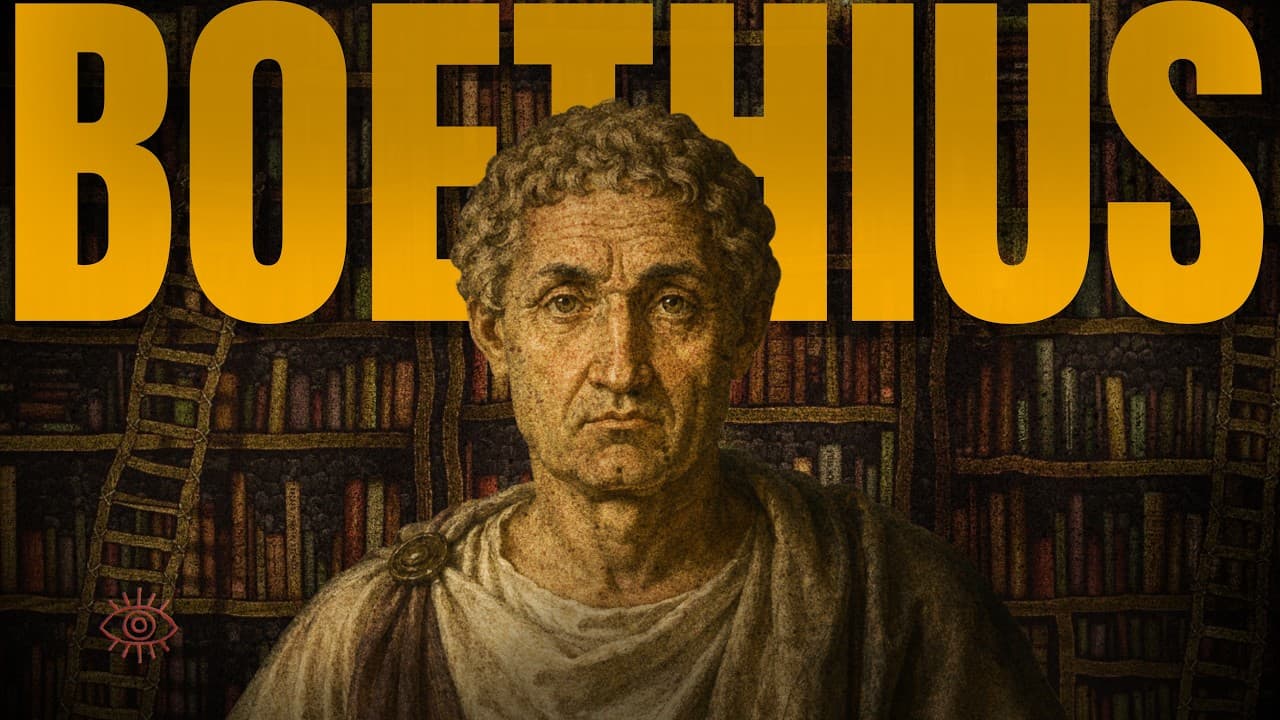
How to Stay Calm When Fortune Takes Everything | Boethius’s Complete Philosophy
A book written in a death cell, reaching for nothing but reason, went on to console a thousand years of readers.
In a prison in the north of Italy, fifteen centuries ago, one of the most powerful men in the kingdom sat condemned and did something no one expected. He wrote a long conversation with Philosophy herself.
We trace Boethius from the heights of Roman honor to his fall on a false charge, through the vast project by which he tried to carry the thought of Greece into a darkening West, and into the cell where, facing the end, he reached not for rescue but for the light of reason. We sit with Lady Philosophy as she confronts the wheel of fortune, the goods that never satisfy, the one good that all things seek, the puzzle of why the wicked prosper, and at last the great question of how a person can be free under a God who sees all of time at once.
The full episode is on YouTube and Spotify. Please listen only in safe, restful contexts.
Enjoying the episode?
Occasional letters on philosophy, reading, and the examined life. No spam, ever.
By subscribing you consent to receiving occasional emails. Unsubscribe any time via the link in every email or at /unsubscribe.
Timestamps
- 0:00:00Chapter 1: A Roman Life
- 0:11:16Chapter 2: A Bridge Over the Ruins
- 0:16:54Chapter 3: The Only Aristotle
- 0:25:10Chapter 4: The Reality of Kinds
- 0:30:34Chapter 5: The Four Roads to Wisdom
- 0:38:58Chapter 6: Faith Put to Reason
- 0:45:49Chapter 7: A Book Made in Chains
- 0:56:59Chapter 8: The Woman Who Is Wisdom
- 1:04:23Chapter 9: The Turning of the Wheel
- 1:15:38Chapter 10: The Gifts That Fail
- 1:24:23Chapter 11: The Good All Things Seek
- 1:35:52Chapter 12: The Powerlessness of Evil
- 1:42:44Chapter 13: The Pattern Behind the World
- 1:51:06Chapter 14: The Eternal Present
- 2:03:03Chapter 15: A Thousand Years of Readers
For the record
Full Transcript
Chapter 1: A Roman Life
It is the autumn of the year five hundred twenty-three, in a cell in the north of Italy, and a man who until a few months ago was one of the most powerful men in the kingdom is sitting with a wax tablet balanced on his knees. He has not been tried in any court he would recognize as a court. He has not been allowed to stand before his accusers and answer them. He is writing, but not the thing a condemned man in his position might be expected to write. Not a confession that could shorten his suffering. Not a letter to the king who could still, with a single word, let him live. Not a will, and not a farewell to the wife and the two grown sons he will almost certainly never see again. He is writing a conversation. And the person he is speaking with is not in the room, and was never in the room, and is not, strictly speaking, a person at all.
She is Philosophy herself, and in the world of the book she has come to his cell to argue him out of his despair. Here is the strange thing, the thing this whole episode exists to explain. The book he is making in that cell, with the axe already promised to his neck, contains not one line of bitterness. Not one curse against the men who framed him. Not one cry of the kind you would forgive any prisoner for making. And from a man who was a devout Christian, who had written careful defenses of the faith in his comfortable years, it contains not one mention of Christ, not one line of scripture, not one promise of heaven. Facing death, he reaches instead for reason alone, and out of that reason he builds one of the most serene and consoling books ever written. His name was Anicius Manlius Severinus Boethius, and to understand how a man could do such a thing, we have to go back to the beginning, to a world that was already ending when he was born.
He came into that world around the year four hundred seventy-seven, in the city of Rome, into one of the oldest and grandest families of the old Roman aristocracy, a house heavy with consuls and wealth and the memory of a greatness that had mostly passed. It is worth pausing on when this was. Only the year before, more or less, the last emperor to rule from Italy, a boy with the grand name of Romulus Augustulus, had been quietly pushed off his throne by a Germanic commander, and no one had bothered to replace him. The Western Roman Empire, the thing that had ordered the lives of Boethius's ancestors for centuries, had simply stopped existing as a going concern. The forms remained. There was still a Senate in Rome, still consuls appointed each year, still the whole elaborate machinery of Roman office. But real power now lay with Germanic kings, and everyone knew it. Boethius was born a Roman nobleman into a Rome that was no longer the capital of anything.
His father, who had himself risen to the consulship, died while Boethius was still a boy. The orphan was taken into the household of another great senator, a man named Symmachus, learned and upright and devoted to the old learning, who raised the boy as his own and in time gave him his daughter, Rusticiana, in marriage. It was, by every account we have, a genuinely happy match, and Symmachus became the fixed point of Boethius's life, father and teacher and model all at once. In that household the boy received the kind of education almost no one in the Latin West could still get. He learned Greek, and learned it deeply, which by then was already a rare and dying accomplishment among Latin-speaking Romans. Most of his educated countrymen could no longer read the Greek philosophers and scientists in the original at all. Boethius could, and that single skill, the ability to read the ancient masters in their own words while the door to that world was slowly closing, would shape everything he did.
He rose, as a man of his birth and gifts was expected to rise. In the year five hundred ten he was made consul, the highest traditional honor the old Roman order still had to give, even if the office was by then more dignity than power. But politics was never the whole of him, and this is the first thing that makes him unusual. Most men of his rank treated learning as an ornament, a thing to gesture at between the real business of estates and appointments. Boethius treated it as the real business. In the hours he could steal from public life he was translating, and commenting, and building, page by patient page, a project so vast that no one had ever completed it and no one, as it turned out, ever would. We will come to that project. For now it is enough to know that the consul of five hundred ten was living a double life, honored in the daylight world of Roman office and, in private, quietly trying to rescue the entire inheritance of Greek thought before it slipped away.
For a long time the two lives ran side by side without collision, and they carried him upward together. The height of it came in the year five hundred twenty-two, and it was the kind of day a Roman father could scarcely have dreamed of. In that year his two sons, both still young men, were made consuls together, sharing between them the office their father and grandfather had held. Boethius sat in the seats of honor and watched his boys ride in procession, and he delivered a public speech in praise of the king, and he scattered gifts to the crowd in the open games, as consuls had done for centuries. He wrote, later, that he had been happy. It was the summit. And in the same season he accepted the most important post of his career, becoming what we might call the head of the royal administration, the official who stood at the center of the government, controlling access to the throne and the flow of business through the court. He had reached, at last, the very top of both his worlds at once.
The throne he now served so closely belonged to Theodoric, king of the Ostrogoths, a Germanic people who had taken Italy and ruled it from the city of Ravenna. Theodoric was, by the brutal standard of his age, an unusually able and even enlightened ruler. He kept the Roman laws, employed Roman officials, protected the old institutions, and for decades gave Italy a stability it had not known in living memory. But there was a fault line running under everything, and it was partly a matter of faith. Theodoric and his Goths were Christians of a kind the Roman church counted as heretics, followers of a teaching, called Arian, that denied the full divinity of Christ. The Roman aristocracy, Boethius among them, held to the orthodox faith of the wider church, the faith whose center of gravity now lay in the surviving Eastern empire, ruled from Constantinople. For years these differences had been managed. Then, near the end of Theodoric's reign, the long quarrel between the churches of Rome and Constantinople was healed, and the Roman East and the Roman senators of Italy were suddenly, warmly, dangerously aligned. To an aging Gothic king watching from Ravenna, every friendly letter that crossed the sea between an Italian senator and the emperor in the East began to look like the first thread of a conspiracy.
The fall, when it came, came fast, and it came through loyalty rather than through any crime. A senator named Albinus was accused of writing treasonous letters to the emperor in Constantinople. Boethius, present at court, rose to his defense. He said the charge was false. And then, in the sentence that undid him, he said more than caution allowed. If Albinus was guilty, he declared, then he himself was guilty too, and so was the whole Senate, for they had all wished the same things. It was a noble thing to say and a catastrophic thing to say. His enemies, and a man in his position had many, turned the words against him at once. Now it was Boethius who stood accused of plotting to restore the freedom of Rome, of secret dealings with the East, and, for good measure, of practicing forbidden magic, a charge that clung easily to any man known for strange and difficult learning. He was arrested, carried north, and shut away. The Senate he had tried to shield, cowed and frightened, voted his condemnation without ever letting him speak in his own defense. The bitterness of that, that the very body he fell trying to protect signed the paper against him, sits at the center of the book he would write.
They held him in the northern city of Pavia, and it was there, in confinement, waiting for a sentence everyone knew would end in death, that he wrote the book we still read, the Consolation of Philosophy. Sometime around the year five hundred twenty-four, perhaps a little after, the sentence was carried out and he was put to death. He was somewhere in his mid-forties. His old guardian and father-in-law, Symmachus, the fixed point of his whole life, was executed not long after him, apparently for the crime of grieving too openly for his son. Within two years the king who had ordered it all, Theodoric, was himself dead, and the fragile Gothic peace in Italy began to come apart for good.
That is the outward shape of the life, and by the ordinary measure it is a tragedy without remainder. A brilliant man, born to the highest place, raised to the summit of honor, and then thrown down and destroyed by the very loyalty that was his finest quality, dying in a cell far from home for a crime he did not commit. But the ordinary measure misses the thing that matters. Because in that cell, in the ruin of everything he had built, this man did not break. He sat down with a wax tablet and, calmly, patiently, as though he had all the time in the world instead of almost none, he set out to reason his way to peace. Everything that follows is an attempt to understand what he was reaching for, and whether he found it. To do that we have to leave the prison for a while and go back to the great work of his mind, the enormous, unfinished project that he had been laboring at, in stolen hours, for most of his adult life.
Chapter 2: A Bridge Over the Ruins
The project that consumed his private hours was, on its face, absurd. One man had decided to save an entire civilization's thought by himself, before it disappeared. To see why that was the shape of his life, you have to picture the peculiar crisis of learning into which he had been born. For most of the long life of the Roman world, an educated person in the West had been at home in two languages. Latin was the tongue of law and government and daily business, but Greek was the tongue of philosophy and science and medicine, the language in which the deepest thinking had been done, and no one considered himself truly cultivated who could not move between the two. That double fluency was the bridge on which the whole inheritance of the ancient mind travelled from one generation to the next.
By Boethius's day the bridge was falling in. The two halves of the old empire had drifted apart, politically and then culturally, and in the Latin West the knowledge of Greek was quietly dying out. Educated Romans who once read the Greek masters in the original were becoming Romans who could only read about them, at second and third hand, in thinning summaries. The great philosophers of Greece were on their way to becoming famous names attached to books that almost no one in the West could any longer open. A whole world of thought, the most sustained and careful thinking the human race had yet produced, was sliding out of reach, not because anyone had decided to abandon it, but through simple neglect, the way a language dies when the last people who speak it stop teaching it to their children.
Boethius could see this happening, and he could read the Greek, and he seems to have concluded, with a confidence that is either magnificent or slightly mad, that it fell to him to stop it. In one of his own works he set down the plan in plain words. He intended, he wrote, to translate into Latin every work of Aristotle that he could lay his hands on, and to write a commentary on each one, explaining it for readers who could no longer reach the original. Then he meant to do the same for the dialogues of Plato, the whole of them, one by one. And having carried both masters across into Latin, he would attempt the boldest thing of all. He would show that Plato and Aristotle, the two supreme authorities of Greek philosophy, so often treated as rivals pointing in opposite directions, did not truly contradict each other at all. He would prove that beneath their differences of language and emphasis the two agreed, that their wisdom was in the end a single wisdom, and he would hand that unified inheritance, entire and reconciled, to the Latin-speaking future.
Consider the size of that ambition. It was not the ambition of a scholar hoping to add a book to a shelf already crowded with books. It was the ambition of a man who had looked at the coming darkness and decided to be, personally, the bridge across it, the single mind through which a thousand years of Greek thought would pass on its way to whatever came next. He was not trying to be original. That is worth saying clearly, because we tend to prize originality above almost everything, and by that measure we might undervalue him. He was trying to be a conductor, a faithful carrier, a man who effaces himself so that greater men can go on speaking after their own world has ended. There is a particular kind of courage in that, the courage to spend your one life preserving other people's thoughts rather than broadcasting your own.
And then, of course, he ran out of time. The arrest came, and the cell, and the sentence, and the vast plan was left where all such plans are left, unfinished. He never translated the dialogues of Plato. The great work reconciling the two masters was never written, and we can only guess at what it might have said. Of the enormous structure he had drawn in his mind, he completed one wing before the roof came down. He finished the logic. He carried across the works in which the Greeks had taught the human race how to reason step by careful step, how to define a term, how to draw a valid conclusion, how to tell a good argument from a bad one, and he wrapped those works in commentaries and textbooks of his own. That was the fragment that survived the wreck of the plan.
It is tempting to read this as pure loss, a great project cruelly cut off, and in one sense that is exactly what it was. But the fragment turned out to be no ordinary fragment. The single wing he managed to build did not stand empty for a few centuries and then fall. It became the foundation on which almost the entire intellectual life of medieval Europe was raised. The narrow slice of Greek thought that this condemned man rescued in his stolen hours would do more to shape how the West reasoned, argued, and understood the world than the finished works of far more famous philosophers. He set out to save everything and saved, in the end, one thing. That one thing was enough to make him, for the next six hundred years, the schoolmaster of the Western mind.
Chapter 3: The Only Aristotle
The wing he finished before the roof came down was logic, and it is worth being precise about what that word meant to him, because it is not quite what it means to us. For Boethius, logic was not a narrow specialty tucked away in a corner of philosophy. It was the instrument of all the rest, the discipline that teaches the mind how to move correctly from one thought to the next, how to define exactly what you are talking about, how to draw a conclusion that truly follows from its premises, and how to catch the moment when an argument that sounds convincing has quietly cheated. It was, in short, the art of thinking without error, and the ancient Greeks, above all Aristotle, had been the first to lay it out as a system rather than leave it to instinct. This was the treasure Boethius managed to carry across the failing bridge before it collapsed.
He took the works in which that art was contained and rendered them into Latin one by one. There was a short introduction to the whole subject written by a later Greek philosopher named Porphyry, a kind of beginner's doorway into the system, and Boethius translated it and then wrote not one commentary on it but two, a simpler one for newcomers and a longer, harder one for readers ready to go deeper. There were Aristotle's own foundational treatises, the one that sorts out the basic kinds of things we can say about anything at all, and the one that examines the statement itself, the sentence that asserts something is or is not the case, which is the atom out of which every argument is built. These too he translated and wrapped in careful commentary, explaining line by patient line what the master had meant, for readers who could no longer reach the Greek behind the Latin.
He did not stop at translation. He wrote handbooks of his own, textbooks that took the raw materials and turned them into something a student could actually learn from. He wrote on how a valid argument is put together, on the way two general claims can lock together to force a third, on the kind of reasoning that runs by conditions, if this then that. He wrote on how to take a broad idea and divide it correctly into its parts, and on how, when you need to prove something, you go about finding the argument that will do it. Taken together these works form a complete elementary course in reasoning, the sort of thing that could be handed to a young person who had never thought carefully about thinking, and could carry that person from confusion to competence.
To do any of this, he had to solve a problem that sounds dull and was in fact enormous. The Greek philosophers had spent centuries building up a precise technical vocabulary, exact words for the subject of a sentence and the thing said about it, for the proposition, for the parts and joints of an argument. Latin had no such words ready to hand. So Boethius, over and over, had to reach into his own language and either fix an existing word to a new and exact meaning or forge a new one to carry the Greek idea. He was, in effect, teaching Latin how to do philosophy, giving it the tools it did not yet have. And here is the quiet marvel of it. When Europeans centuries later sat in their schools and argued in Latin about the finest points of reason, many of the very words in their mouths were words this one man had settled into place. They were thinking, without knowing it, in a vocabulary he had built.
Now set that achievement against what happened to the rest of Aristotle in the West, and the true scale of it appears. After Boethius, the knowledge of Greek went on dying, and most of Aristotle went dark. The great works on nature, on the soul, on the first principles of being, on how a good life is lived, all of it became, for the Latin West, a rumor of books rather than the books themselves. For roughly six hundred years, from Boethius's death until the twelfth century, what Europe possessed of the most systematic mind the ancient world had produced was, essentially, the slim course in logic that this condemned prisoner had translated in his stolen hours. Scholars gave it a name. They called it the old logic, and the old logic was the spine of education. In the cathedral schools and the first universities, generation after generation of students learned to define, to distinguish, to argue, to reason, out of these texts and no others. When a young man in the ninth century or the eleventh wanted to learn how to think, he learned it from Boethius, whether or not he ever knew the name.
It is worth pausing on what that education actually felt like from the inside, because it was not abstract. A student would take one of these texts and work through it slowly with a master, learning to say precisely what a thing is before saying anything else about it, learning to tell the part of a sentence that names the thing from the part that makes a claim about it, learning to test whether a conclusion is forced by what came before or has merely been smuggled in. The training was a discipline of attention as much as of cleverness. It taught a young mind to slow down, to distrust the sentence that flatters, to refuse to move to the next step until the present step is secure. Whole lifetimes of European thinking were built on habits first drilled into students out of these few translated pages.
For those six centuries, then, Boethius was not merely a translator of Aristotle. To the entire Latin-speaking world, he was Aristotle, the sole voice through which the master could still be heard, the single narrow channel down which that whole river of thought had to pass. It is hard to think of another case quite like it, one man serving for half a millennium as the irreplaceable conduit of another man's mind. And then, from the twelfth century onward, the rest of Aristotle came flooding back, recovered through fresh translations, a great deal of it travelling into Latin by way of the Arabic-speaking world that had preserved what the West had lost. The long-missing works on nature, on the soul, on the first principles of being, on how a good life is lived, all of it returned at last. Among the recovered writings were the harder treatises on logic itself, the advanced parts of the art that Boethius had never managed to carry across, and scholars called these the new logic, to set them apart from the old logic that had held the ground alone. But the old had held that ground for six hundred years. Without it there would have been no trained minds ready to receive the flood when it came.
There is something almost unbearable in the anonymity of this. A man is destroyed by the state on a false charge and dies in a cell far from home, and for the next six centuries the sharpest minds of Europe are quietly formed by his labor, learning to reason in his words, standing on a foundation he laid, and most of them never knowing his story, never pausing over the strange fact that the schoolmaster teaching them to think clearly had done his last clear thinking while waiting to be killed. The discipline he preserved, this art of holding a thought steady and following it without flinching wherever it leads, was the driest and most practical of all his gifts. It would also prove the most enduring. And it was, though he could not have known it as he worked, the very discipline he would one day turn upon his own terror, in the dark, with nothing left to lose.
Chapter 4: The Reality of Kinds
Somewhere in the longer of his two commentaries on that beginner's introduction, in the course of explaining a text meant for students, Boethius paused over a question so deep that the author of the introduction had raised it only to back away, calling it too hard for a work of that level. Boethius did not entirely back away. He took a few careful paragraphs to lay the question out, and to offer a cautious answer, and in doing so he lit a fuse that would burn, without going out, for the next seven hundred years.
The question is easy to state and strangely hard to settle. When we speak, we constantly use general words. We say human being, and animal, and tree, and each of these words gathers up countless separate individuals under a single heading, as though they all shared one common nature. The question is whether that common nature is real. When I point to this oak and that willow and call them both trees, is there something genuinely out there, a treeness, that the two of them actually share? Or is the word tree merely a label, a convenience of the mind, thrown like a net over a crowd of individuals that happen to resemble one another, with nothing truly shared beneath the resemblance at all? Do the general kinds exist in the world, or only in our heads? And if they somehow exist in the world, are they solid things you could in principle locate, or something else, and do they live inside the particular oaks and willows or somewhere apart from them?
It sounds like a puzzle for specialists, and it is anything but. Almost everything hangs on the answer. If there are no real kinds, only individuals and the names we group them by, then the order we think we see in the world may be something we impose rather than something we find, a grid laid over a reality that is really just a heap of unrepeatable particulars. But if the kinds are real, if there truly is a shared nature that makes an oak an oak and a human a human, then the world has a structure of its own, independent of our naming, and our general words are not mere habits but genuine discoveries about how things are. Whether knowledge reaches the world or only rearranges our impressions of it turns, in the end, on this.
Boethius handled the question the way he handled everything, with balance and care. He worked toward an answer he drew from Aristotle. The common natures, he suggested, are real, but they do not float in a world of their own. They exist only in the particular things, in this oak and that willow and no third place, genuinely present in each. The mind, however, is able to do something the things themselves cannot. It can consider the shared nature on its own, thinking treeness apart from any single tree, holding the common thing in view without the particulars that clothe it. So the kind is thought as something universal and general, but it exists only as something particular and embedded. He offered this quietly, and, being honest, he added that it was not the only view a reasonable person might take.
That caution did nothing to contain what he had started. For the next seven centuries the thinkers of Europe divided and fought over precisely this ground. On one side stood those who insisted the kinds were fully, robustly real, some of them holding that the universal nature was in a sense more real than the passing individuals that came and went beneath it. On the other stood those who insisted the opposite, that the kinds were nothing but names, mere sounds and conventions, and that only individuals truly existed. Between these poles ran every subtle position in between, and the argument drew in the sharpest minds of the age, generation after generation, because everyone could feel that something enormous rode on it. The whole long medieval debate over the reality of kinds, one of the most consequential quarrels in the history of thought, uncoiled from the few paragraphs a condemned man had written to help students through an elementary book.
It is a pattern we have already seen in him and will see again. He set out only to explain, to carry a small thing faithfully across, and in the explaining he opened a door onto something vast. But notice, too, the shape of the question he could not leave alone. He wanted to know whether the order we seem to perceive is really out there in the world or only a construction of the mind. That is not, in the end, a narrow technical worry at all. It is a form of the deepest question a person can ask, and it is the very question he would face, stripped of all its scholarly calm, when he sat in his cell and looked at a life that had collapsed into apparent chaos, and asked whether there was any real order behind it, or none.
Chapter 5: The Four Roads to Wisdom
Logic was the art of reasoning, but reasoning has to reason about something, and Boethius believed that the mind climbs toward truth along a particular set of roads. Alongside the logic, and with the same ambition to hand the Greek inheritance to the Latin future, he gave the West both the shape and the very name of its higher education. He took a conviction as old as the followers of Pythagoras and as deep as Plato, the conviction that the path to wisdom runs through mathematics, and he built it into a fourfold course of study, four roads that together carry the mind from the shifting world of the senses toward the changeless truths that lie behind it.
The four roads were these. First, number in itself, the study of quantity pure and simple. Second, number laid out in space, which is the study of shapes and figures. Third, number moving through time, which is the study of the heavens, the stars and seasons turning in their fixed measures. And fourth, most surprising to us, number made audible, which is the study of music. Boethius wrote textbooks to lead students down these roads, and though not all of them have survived, the ones on number and on music came through, and they did more than teach their subjects. They fixed the map of learning that Europe would follow for the better part of a thousand years.
Behind the whole scheme lies a single beautiful idea, and it is worth slowing down for, because it explains why a serious man would give his life to arithmetic. The things we meet through the senses are always in flux. They are born and they perish, they are this size today and that size tomorrow, they are never quite exact, never twice the same. You cannot build lasting knowledge on such shifting ground. But number and proportion are different. The relations between numbers are exact, unchanging, the same in every place and every age, untouched by decay. To train the mind on mathematics, in this tradition, is to wean it off the flux of appearances and turn it toward what does not change. Mathematics is not a bag of techniques for measuring fields and counting coins. It is a ladder, the discipline that lifts the soul from the visible toward the invisible, from things that pass toward things that abide.
Of the four roads, he held that the first, the study of number in itself, was the mother of the others, the root from which the rest grow. Take away number and there is no measuring of shapes, no reckoning of the motions of the sky, no counting of the beats and intervals of a song. Number comes first in the order of learning because it comes first in the order of things, the simplest and most fundamental of all quantities, present wherever there is any order at all. So he set the roads in a deliberate sequence, from number bare and alone, outward to number spread through space, and onward to number carried through the heavens and through sound, each road leaning on the ones before it. This was not a loose collection of subjects thrown together. It was a single graded ascent, and the name he attached to the grouping, the fourfold way to wisdom, stuck to the curriculum of Europe so firmly that scholars were still using it a thousand years later without always remembering who had first bound the four together.
The strangest road, to modern ears, is the one that treats music as mathematics. For us music is the art of feeling, the least mathematical thing imaginable, the very opposite of a sum. For Boethius, following the Greeks, music simply was a branch of mathematics, the study of proportion made audible. He would have pointed to a plucked string. Stop that string at exactly half its length and it sounds the same note again, higher and clear. The concords that please the ear, the intervals that sound sweet rather than harsh, turn out to correspond to simple ratios of whole numbers, small and clean. So the beauty we hear when two notes agree is not a mystery of mere taste. It is number, heard. Music is arithmetic that has become audible, proportion striking the ear directly, and its power over us is the power of hidden order revealing itself in sound.
From this came his single most influential idea in the field, the teaching that music exists on three levels, of which we usually notice only the last. The first and greatest is the music of the cosmos, the ordered motion of the whole heaven, the stars and the seasons and the turning spheres wheeling in their vast unchanging proportions. It is a harmony so immense and so constant that no ear can catch it. It is heard, if it is heard at all, only by the reasoning mind that grasps the proportions behind the motion. The second is the music of the human being, the harmony that binds soul to body and part to part within a single person, the inner proportion that makes a life well-tuned or badly out of tune. This too is silent to the ear and audible only to thought. And the third is the music we actually hear, the music of instruments and voices, of the plucked string and the sung note. Only this third kind reaches the ear at all. Yet all three are, at bottom, the same thing, proportion showing itself at three different scales, in the sky above us, in the self within us, and in the sounding string between our hands.
There is a further claim in the book that tells you everything about the man. Boethius insisted that the true musician is not the performer. The singer and the player, however dazzling their skill, are in a sense only servants of the art, working by habit and instinct with something they do not fully understand. The true musician is the one who grasps the proportions, who can judge by reason why this sounds right and that sounds wrong, who understands the mathematics that the performer merely enacts. Understanding ranks above doing. The mind that comprehends the order is master of the art, and the hands that merely produce the sound are its instrument. It is a thoroughly Boethian judgment, this raising of the one who understands above the one who performs, and it ran through European thinking about music for centuries.
The book carried all of this into the heart of European education and held its place there with astonishing persistence. Long after Boethius himself had become a half-legendary name, students learning what music was, learning that it was a science of number and not merely a pleasure of the ear, were learning it from him. But the deepest thing in all of it is the vision underneath, the vision that made him group these four roads together in the first place. It is the conviction that a single order, expressible as number and proportion, runs through everything that is, binding the wheeling of the outermost stars to the tuning of a human soul to the humblest note struck on a string, so that all of it, the vast and the tiny, is one harmony. To study these things was to glimpse the pattern of the whole. It was to believe, with the whole force of one's reason, that the universe is at bottom ordered, proportioned, and good. What it would mean to hold that belief when your own life had been thrown, without warning or justice, into total disorder, is a question he did not yet have to answer.
Chapter 6: Faith Put to Reason
Before we can understand the silence at the heart of his prison book, we have to establish something the book itself never mentions. Boethius was a Christian. Not a nominal one, not a man who wore the faith as a badge of respectability, but a serious and committed believer who thought hard about what he believed. We know this because he left behind a handful of short theological essays, dense and difficult little works in which he turned his whole intellectual power onto the central mysteries of the Christian faith. He wrote on the Trinity, on the ancient problem of how God can be genuinely three and genuinely one at the same time. He wrote on the person of Christ, on how a single individual could be at once fully divine and fully human without becoming a contradiction. He wrote on how the things God made can be called good. These are not the writings of a doubter. They are the writings of a man laboring, from the inside, to understand his own faith more exactly.
But it is the way he wrote them that matters, because it was something close to new. Most Christian writers before him had defended and explored their faith by appealing to scripture, to the authority of the church, to the acceptance of holy mystery. Boethius did something different. He brought the cold, exact tools of the logician to bear on the hot mysteries of belief. He asked what the words precisely meant. He defined his terms with the care of a man translating Aristotle. He tried to show, as far as reason could possibly go, how the doctrines held together without contradiction, where an apparent paradox dissolved once a term was pinned down exactly. He treated theology almost as an extension of logic, a field where careful definition and valid argument could do real work. In doing this he pointed forward, across many centuries, to the great enterprise of the medieval schools, the patient application of reason to the content of faith, and he is often named the first of that line, the earliest thinker to reason about God with the full apparatus of the logician. The bridge he built ran not only from Greece to the Latin West but from the ancient art of reasoning into the heart of Christian thought.
One fruit of that labor outlived everything around it. Struggling to say exactly what it meant for Christ to be one person in two natures, Boethius was forced to define the slippery word person itself, to say precisely what a person is. The definition he produced was this. A person is an individual substance of a rational nature. An individual, single and undivided, not a general kind but this particular one. A substance, a thing that stands in its own right rather than a mere quality of something else. Of a rational nature, the kind of being that can think and reason. That one carefully machined sentence, forged to solve a knot in Christian doctrine, escaped its occasion entirely. It became the standard account of what a person is for the next thousand years, quoted and leaned on and argued over by generation after generation, and its influence still runs, quietly, through the way we speak of persons and individuals even now. A man defined a word to settle a technical dispute about Christ, and the definition outlived the dispute by a millennium.
Now hold all of this steadily in mind, because it makes what comes next almost incredible. Here is a man who did not merely believe but reasoned about his belief, who wrote learned and rigorous defenses of the deepest Christian mysteries, who had the entire vocabulary of the faith at his fingertips and had spent his intellect in its service. And then this man is stripped of everything, carried to a cell, and left to wait for his execution. It is the exact situation in which we would expect a believer to reach, instinctively, for his faith. To pray. To fix his eyes on heaven. To console himself with Christ, with the promise of resurrection, with the ancient assurance that this life and its injustices are not the final word. That is what the moment seems to demand. And in the book he actually wrote there, none of it appears. There is no Christ in it. No scripture is quoted. There is no cross, no heaven, no prayer to the God who suffered and rose. Instead he calls up Philosophy, and he consoles himself by reason alone, with arguments that a thoughtful unbeliever could have followed from beginning to end and, for the most part, accepted.
This silence has puzzled and unsettled readers for as long as the book has been read. Some have wondered whether his faith simply failed him at the end, whether in the shadow of the axe the Christian fell away and only the philosopher was left standing. Others doubted that he had ever truly been a Christian at all, a doubt that lingered until firm evidence surfaced linking him beyond question to those very theological essays, which settled the matter. He believed. The explanation most thoughtful readers now favor is quieter and, I think, far more interesting. He did it on purpose. He chose, deliberately, to write a work of philosophy rather than a work of theology. He set himself to see how far unaided human reason could carry a soul toward peace, to build a consolation that stood on nothing but what any mind, in any age, could in principle reach on its own, without revelation, without scripture, without the comforts that belong to faith alone.
Whatever moved him, the choice had a consequence he may or may not have foreseen. A consolation that leans on no particular revelation can be picked up by anyone, believer or doubter, of this creed or that or none, and this is part of why the book would reach so far past its own century and its own religion. But the deepest point is simpler than any explanation of it. A Christian, facing the end of everything, chose reason as his companion in the dark. It is time, at last, to open the book he wrote there.
Chapter 7: A Book Made in Chains
What he made in that northern cell, in the last months of his life, was not a diary and not a lament, though it grows out of the material of both. It was a carefully built work of art, one of the most artful books to survive from the whole late ancient world, and before we follow its arguments we have to understand its form, because the form is not a container for the thought. The form is part of the thought.
The book is a dialogue, a conversation between two voices. One is the prisoner, a version of Boethius himself, sunk in grief and speaking for every soul that has ever been crushed by undeserved misfortune. The other is his visitor, the figure who comes to console and to cure him. But the conversation is written in a way that no ordinary dialogue is. It alternates. A passage of close, reasoned prose gives way to a poem, and the poem gives way to more prose, which gives way to another poem, and so on, back and forth, some thirty-nine poems in all, threaded through the argument from the first page to the last. The prose carries the hard work of reasoning, the definitions and distinctions and step by step arguments. Then a poem lifts the same truth out of the argument and sets it to song, distilling it into image and rhythm, letting the mind rest and feel what the reasoning has just proved, before the next stretch of prose begins. The whole book breathes, in and out, thinking and then singing, arguing and then contemplating, two different ways of knowing taking turns, each doing precisely what the other cannot.
That alternation is not decoration, and it is worth seeing why. You cannot reason a grieving person out of grief in one straight unbroken march of logic. The heart will not be marched. What actually heals a mind in pain is something more patient, a rhythm of argument and rest, a little reasoning and then a pause to let the feeling settle and the new thought sink below the surface, and then a little more. The passing back and forth between prose and poem enacts exactly that rhythm. It is the shape of how a person is really brought back from despair, not by force but by alternation, the head and the heart worked in turn. Boethius the logician, of all people, understood that logic alone does not console, and he built a book that thinks and sings by turns because that is how a soul is actually mended.
The poems are doing something worth pausing over. They range across every mood, from the prisoner's bitter opening lament to calm meditations on the natural world, the turning of the seasons, the sea that rages and then lies still, the long patience of the things that grow and fade and grow again. Their purpose is not to prove anything. A poem cannot prove. Their purpose is to make the reader feel the truth the prose has just established, to plant it below the level of argument, in the place where convictions actually live. A truth you have merely followed can be argued away again by the next morning. A truth you have felt move through the lines of a poem has sunk deeper, down into the ground from which a person acts and endures. Boethius uses the two forms the way a physician uses two different medicines, one for the reasoning mind and one for the suffering heart, knowing that a cure which reaches only one of them is no cure at all.
The deepest architecture of the book, though, is medical. The whole thing is constructed as a course of treatment. The prisoner is a patient, sick not in body but in mind, and the visitor who comes to him is a physician who has arrived to make him well. She begins, as any good physician does, by examining him and naming his disease. Then she applies her remedies in order, the gentle ones first, the mild consolations a weakened patient can tolerate, and only later, as he grows stronger under her care, the stronger and more bracing medicines, the harder truths that would have overwhelmed him at the start. The book is laid out as a graded recovery, a slow climb from the depths of despair up toward clear understanding, dose by dose, each stage preparing the patient for the next. To read it in order is to be treated in order, to be led by careful degrees from the sickness of grief toward the health of a mind that sees things as they truly are.
And the treatment has a shape you can trace from one end to the other. It starts in the dark, with a man who has forgotten every reason he ever had to hope. From there the physician leads him, stage by stage, up a long ascent. First she works to loosen the grip of the very thing that has broken him, the fickle power that lifts people up and throws them down. Then she turns him away from the hollow rewards he had spent his life chasing and toward the one true good that all of them only imitate. And then, when he is strong enough to bear it, she takes him into the hardest country of all, the questions that torment anyone who has suffered unjustly, why the wicked so often flourish, whether the world is governed at all, and whether a person can truly be free in a world that God foresees from the beginning. Each of those is a further step up out of the pit, and by the last of them the prisoner is standing, in his mind, in a place immeasurably higher than the one where he began. The book is that climb, and every rung of it is fitted to the strength of the patient at that moment, never asking of him more than the previous step has made him able to bear.
And it begins at the very bottom. When the book opens, the prisoner is as low as a man can be. He is writing, but what he is writing is a poem of pure self-pity, a lament for his ruined fortunes and his lost honors and the death now closing in on him, a long cry against the injustice of it all. Grief has aged him before his time. He describes himself as suddenly old, his hair gone gray, his skin loose on his bones, and he says that tears are the only thing that still comes to him easily, that weeping has become his one fluent speech. Gathered around him, in the fiction of the book, are the spirits of poetry, the muses of verse, who bend over his sickbed and help him say beautifully just how wretched he is. They feed his sorrow. They flatter it. They hand him lovely words for his misery so that he can sink more deeply and more comfortably into it. This is the sickness at its very worst, and Boethius draws it with terrible accuracy. It is grief that has grown comfortable, sorrow that has learned to enjoy its own eloquence, despair dressed up in fine language and settling in to stay. The prisoner is not merely sad. He is taking a bitter pleasure in the music of his own ruin.
Into that scene, without announcement, a presence enters. The prisoner becomes aware that someone is standing over him, at the foot of his bed, looking down. A woman, though not, he senses at once, an ordinary woman, of a bearing he can hardly take in and can barely bring himself to describe. He tries to look at her, but his eyes are dim with all the weeping he has done, and at first he cannot make her out at all, and half takes her for some stranger who has wandered into his cell. Grief has not only broken his spirit. It has clouded his very sight, so that the one who has come to save him is at first no more than a blur standing over his bed. This is exact, and it is meant. A mind sunk deep in self-pity cannot at first even recognize the wisdom standing directly in front of it. He will have to be led slowly back toward himself before he is able to see her for what she is. She waits, and lets him steady himself, and only then does the figure above him begin to come clear. She stands there in silence for a moment, and then she turns her gaze on the little crowd of poetry-spirits clustered around his bed, feeding his grief, and her expression changes, and hardens. Something in the room is about to shift. The comfortable despair is about to meet the one thing that will not indulge it. We will meet her properly in a moment. For now it is enough to feel the change of pressure in the cell, the arrival of a power that has come, not to weep with him, but to cure him whether he likes the medicine or not.
Step back and consider what Boethius has actually done here, because it is stranger and more moving than it first appears. The master logician, facing his own death, did not sit down to write a treatise. He wrote a drama. He split himself in two and put himself on the stage as the broken patient, and then he put the wisdom he most needed into the mouth of another figure, a healer who comes from outside to save him. But the healer does not truly come from outside. She is the reason he had spent his entire life cultivating, the whole discipline of thought he had built up in those stolen hours over all those years, now turned around at last to face him in his worst hour and take him firmly by the hand. He had, though he could not have known it, been training this physician his whole life. And note the one thing she does not bring with her into that cell. She carries no scripture and wears no priestly office. She comes armed with nothing but the light of unaided reason, which is the companion, and the only companion, he had chosen for the dark. Now, at the end of everything, he would find out what that companion was worth. There is a quiet daring in the whole design that is easy to miss. A man who has lost his freedom, his fortune, his good name, and soon his life, sits down and, out of the one thing they cannot confiscate, the order of his own reasoning mind, builds the most orderly and beautiful thing he ever made. The making of the book is itself the first argument of the book, the proof, offered before a single point is proved, that something in him remains free and unbroken even here. The healer has not yet said a word. But the fact that he could write her at all is already the beginning of his cure.
Chapter 8: The Woman Who Is Wisdom
When his sight finally clears and he can see the figure standing over him, the prisoner beholds something no ordinary description can hold. The woman is of a commanding and almost frightening presence, and her age is impossible to fix. Her face is full of life and fresh with vigor, and yet she is plainly ancient, older than any mortal could be, as though she had been alive since the beginning of things and had seen everything there is to see. Strangest of all is her height, which will not stay still. At one moment she seems no taller than an ordinary person, meeting him at his own level. At the next her head seems to rise and pierce the very sky and pass beyond it, out of sight, into regions he cannot follow. In one hand she carries books, and in the other a scepter, and this pairing tells you what she is, for she both teaches and rules, both instructs the mind and governs it. She is Philosophy herself, wisdom given a face and a voice, the love of truth walked into his cell in the shape of a woman.
Look closely at her robe, because Boethius has written a whole philosophy into it. She wove it herself, of the finest and most enduring thread, and into the cloth she worked a design. Along the bottom hem is a mark standing for the practical wisdom of active life, the everyday knowledge of how to act and how to live well among others. At the very top is a mark standing for the highest kind of thought, the pure contemplation of ultimate things, truth sought for its own sake and nothing else. And running between the two, from the lower mark up to the higher, is a ladder of steps, a stairway stitched into the fabric, marking the long ascent the mind must climb from practical wisdom at the bottom up to the contemplation of truth at the top. The robe is her own self-portrait, the whole path of a thinking life woven into a single garment.
But the robe is damaged. The lower edge is torn, and there are places where whole pieces have been ripped away and are simply gone. She explains the wounds without bitterness. Over the long centuries, she says, rival schools of thought, quarreling sects each convinced that it alone possessed the whole of wisdom, had come to her and each torn away a shred of her robe, and each had gone off clutching its scrap and boasting that it had carried away Philosophy entire, when in truth it had seized only a rag, a single torn strip mistaken for the whole cloth. It is one of the most exact images in the book. Every partial philosophy that grabs one piece of the truth and calls it the entire truth has, in the picture, literally torn wisdom herself, and marched away proud of a fragment. The robe is ragged at the hem because human beings keep doing this, keep confusing their favorite corner of the truth with the whole of it.
Her first act in the cell is not gentle. She turns to the poetry-spirits she has found gathered at his bed, and names them for exactly what they are. She calls them the muses of the theater, sweet poison, sirens who sweeten a man's sorrow until it destroys him. These, she says, do not heal grief. They cultivate it. They teach a sick mind to love its own symptoms. And so she drives them out. She banishes them from the bedside, and in their place she sets her own muses, spirits of a sterner kind, who will not flatter the man's misery but will strengthen him toward health. This is the true first step of any cure. Before the healing can begin, the room has to be cleared of the comforts that keep the patient ill.
Only then does she turn to the diagnosis, and her diagnosis is not what he expects. His disease, she tells him, is not really his misfortune at all. The loss of his fortune and his freedom and his good name, terrible as it is, is not the sickness. The sickness is something underneath it. He has forgotten. In the shock of his fall he has lost his grip on the two things he most needs to know, and everything else has followed from that. He has forgotten who he is, forgotten the true nature of a human being and what a person essentially is beneath all the accidents of rank and fortune. And he has forgotten what governs the world, lost his hold on the nature of the power that rules all things and directs them to their end. He has not truly lost this knowledge, she insists. He still has it, somewhere, buried. He is like a man who has fainted, or a sleeper who must be shaken awake and reminded of what he knew perfectly well before he slept. And this changes everything about the cure. She will not need to pour new truths into him from outside. She will only need to draw out what is already there, to wake him back into possession of what he already, in the depths of himself, knows. There is a strange comfort hidden in this diagnosis, if he could hear it yet. It means his ruin has not actually reached the core of him. The things Fortune took were never the deepest things. What matters most is still intact, only forgotten, and forgetting can be undone. A man who has been robbed of everything he owned is being told, gently, that the one possession worth having was never among the stolen goods at all.
That is why she works the way she works. She does not stand over him and lecture. She asks him questions. Small ones at first, easy ones, things he can still answer even in his weakened state, and from his own answers, one careful admission at a time, she builds toward the things he has forgotten, leading him to see each truth for himself rather than handing it to him finished. She draws the wisdom out of him instead of imposing it, so that at every stage he is not being told what to think but discovering that he already thought it. And, keeping her promise, she begins with the gentlest questions of all.
Consider what Boethius is telling us by making his healer this figure and no other. The cure for the very worst that can befall a human being, the thing he offers a man in a death cell, is not a drug and not a distraction and not, in this book, even a prayer. It is the disciplined love of truth, wisdom herself, who comes to us wearing a torn robe because we will not stop tearing her, and who heals us not by adding anything we lacked but by returning us to what we already are and already know. And the very first thing she means to make him remember, the first forgotten truth she will draw back out of him, concerns the power that has done all the damage, the fickle goddess the world calls Fortune.
Chapter 9: The Turning of the Wheel
The first real medicine Philosophy administers concerns the power the prisoner blames for everything, the power the ancient world called Fortune. She does not begin by denying that he has suffered. She begins by changing his relationship to the thing that made him suffer, and her opening move is so fair to his enemy that it disarms his complaint before he can finish making it.
Fortune, in the old picture, is the goddess of luck and change, the one who hands out the good things of this world. Wealth, power, high office, success, reputation, all the prizes people spend their lives pursuing, she distributes as she pleases, not according to who deserves them but according to her own whim, giving to this one and passing over that one for no reason anyone can name, and taking back whenever she likes what she has given. The prisoner, like almost everyone who has ever lived, had made one quiet assumption about the good things he enjoyed. He had assumed they were his. His honors, his rank, his wealth, his standing, he thought of them as possessions, as belonging to him the way his own hands belonged to him. That single assumption, Philosophy shows him, is the whole root of his despair.
Fortune's emblem, her great symbol, is a wheel, and she turns it without ceasing. Human beings are bound to the rim of that wheel, and as it turns, those who were at the top are carried down to the bottom, and those who were at the bottom are lifted to the top, and this rising and falling never stops, because a wheel that stopped turning would not be Fortune's wheel at all. To be on the wheel is to be subject to its motion. There is no seat on a turning wheel that stays where it is. For years the prisoner had ridden high on that wheel, up near the top, garlanded with honors, his sons made consuls, his hand on the levers of the kingdom. Now the wheel has turned, as wheels do, and it has carried him down into the pit, and he is crying out that he has been wronged. But Philosophy makes him see the contradiction hidden in his outrage. The very wheel that lifted him is the wheel that dropped him. They are the same wheel and the same motion. A man who gladly accepts the rising has no standing to cry betrayal at the falling, because the rising and the falling are one thing, and you cannot keep the half you like and reject the half you do not.
Then Philosophy does something remarkable. Rather than go on speaking against Fortune in her own voice, she stops, and she puts on Fortune's voice, and she lets Fortune rise up and defend herself. Suppose, she says, that Fortune herself were standing here to answer your accusations. Hear what she would say. And then Fortune speaks, and her defense is merciless in its sheer justice. Why do you blame me, she asks the prisoner. What have I taken from you that was ever truly yours? You came into this world naked and owning nothing. Everything you have ever had, I gave you. The wealth, the rank, the honors you grieve for, all of it was mine, and I lent it to you, freely, to enjoy for a while. It was a loan, never a gift, and now I am simply taking back what belonged to me all along. You have no more right to rage at me than a man who borrowed something and then grew furious when the owner came to collect it. Did I ever sign a promise that you could keep these things forever? Did I ever pretend that I would stay? Inconstancy is my nature. This turning, this lifting up and casting down, is not some betrayal of what I am. It is exactly what I am. It is the one thing about me that never changes, the game I have always played in the open, in full view. If it was permanence you wanted, you should never have come to me for it.
She presses harder, and every word lands. You enjoyed my favors longer than most, she says. You stood among the fortunate for a long span of years, higher than almost anyone. And now that I turn my face away, as I always eventually do, you call me cruel, when all I am doing is the very thing I have always done, and doing it to you no differently than I do it to every soul who has ever climbed onto my wheel. The sea does not promise to stay calm. The year does not promise that spring will never end. The day gives way to night without apology. Why, of all the changing things in a changing world, should Fortune alone be expected to hold still? Look around you, she says. The moon does not stay full but wanes to nothing and swells again. The tide comes in and draws back out. Rivers run to the sea and never once flow backward to their springs. Everything that lives grows and ripens and declines. Change is not my private cruelty. It is the common law of every earthly thing, written into the deepest grain of the world, and you, one small man on the rim of my wheel, are asking to be made the single exception, the one thing in all creation exempted from the rule that binds the seas and the seasons and every other creature that has ever drawn breath. I will not make you that exception, because I cannot, and because it would be no kindness if I could.
The truth Philosophy is leading him toward is that the error was never Fortune's. The error was his. It was the error of trusting Fortune in the first place, of resting his whole happiness on things that by their very nature arrive and depart, of mistaking what was loaned to him for what was his. If you place your peace in things that can be taken, then you have handed the keys of your peace to someone else, and you should not be astonished when they use those keys. The only way to be genuinely free of Fortune's power is to stop wanting anything that lies within her gift. A man who wants nothing she can give has nothing she can take, and against such a man her wheel turns in vain.
And now Philosophy makes a claim that must have sounded, to a man in a death cell, close to madness. Bad fortune, she tells him, is actually better for you than good fortune ever was. Good fortune lies. When it smiles on you, it pretends to be solid and lasting, it flatters you and binds you close and hides its own fickle nature, and in doing so it lulls you into exactly the trust that will one day destroy you. Bad fortune, by contrast, tells the truth. When the wheel carries you down and the smiling illusion falls away, you see Fortune's real face at last, and you understand, finally, that all of it was always passing. So good fortune enslaves, and bad fortune sets free, because bad fortune teaches you, as nothing else can, what was really yours and what was only ever borrowed. And it does one more thing beyond price. It shows you your true friends. When you were rich and powerful, you could never be entirely certain which of the people around you loved you and which loved only your fortune. The instant the wheel turned, the false ones scattered and fled, and the few who stayed are proven, tested, real. In ruining you, Fortune has handed you the one gift her smiling face could never give, the certain knowledge of who actually loves you. She has shown you, by taking everything else, where your true wealth was all along.
There is a cheap version of this consolation, and Philosophy is careful not to offer it. The cheap version says, take heart, the wheel never stops, so your turn will come again, you are at the bottom now but the same motion that dropped you will one day carry you back up. That is true, as far as it goes, and it is exactly the wrong comfort, because it leaves you still bound to the rim, still riding the wheel, still pinning your hopes on its turning, still at the mercy of the next revolution. Philosophy wants something far better for him than a place near the top. She wants him off the wheel entirely. The point is not to hope for a better spin. The point is to stop staking your happiness on the spinning at all, to climb down from the rim and stand on ground that does not turn, so that whether the wheel rises or falls becomes, at last, a matter of indifference to the one thing in you that actually counts.
Underneath the whole argument lies the principle on which the entire consolation turns, and it is worth saying plainly. Nothing is wretched unless you think it so, and no lot in life is happy unless the one who lives it is content with it. Misery and happiness are not simply poured over us by our circumstances. They depend, always, on the judgment we bring to those circumstances. The same fall that one person suffers as unbearable ruin, another meets as release. Two men can lose the identical thing on the identical day, and one is destroyed by it while the other is quietly set free, and the whole difference lies not in what happened to them but in what they made of it inside themselves. Fortune may arrange the outward facts of your life however she pleases. The one thing she cannot reach, unless you surrender it to her, is the verdict you pass, in the privacy of your own mind, on what she has done. That verdict is yours. It was always the only thing that was fully yours.
If the prisoner can loosen his grip, even a little, on the things Fortune gave and took, the first medicine has done its work. It is a hard teaching to swallow whole, and Philosophy does not pretend otherwise, but it is the ground on which everything still to come will be built. And a natural question rises straight out of it, the question Philosophy turns to next. If the gifts of Fortune are not to be trusted, not truly ours, not the place where happiness lives, then what are they, these things that nearly everyone chases from the cradle to the grave? What are wealth and power and fame and pleasure, really, and why is the whole human race so utterly convinced that they are the road to a happy life?
Chapter 10: The Gifts That Fail
Having loosened the prisoner's grip on Fortune herself, Philosophy turns to the specific things Fortune deals in, the actual prizes that human beings chase from the cradle to the grave, and she takes them up one at a time to show that not a single one of them can deliver what it promises. Underneath every human pursuit, she says, lies one desire. Everyone, in everything they do, is finally reaching for happiness, for a life that is complete and lacks nothing and cannot be shaken. And people believe they will reach that life through a small handful of goods. They chase wealth, or high position, or power, or fame, or bodily pleasure, convinced that one of these is the road home. Philosophy walks down each road and shows that it ends at a wall.
Take wealth first. People pile up riches in order to be self-sufficient, to reach the point where they lack nothing and need no one. But riches do the exact opposite of what they promise. The more a man has, the more he has to lose, and the more he lies awake afraid of losing it. Wealth has to be guarded. It attracts thieves and flatterers and lawsuits. It breeds a gnawing anxiety that the poor man sleeping in his bare room has never known. The rich man is not the one who needs nothing. He is the one who now needs locks and guards and stewards and good fortune, who has manufactured a hundred new dependencies and a hundred new fears in the very act of trying to escape need. Wealth cannot even provide the security that is its entire selling point.
Consider high office and honors next. People seek positions of rank in order to be respected, to be publicly marked out as worthy and good. But an office cannot make anyone good. Hand a high position to a corrupt man and you have not improved him in the slightest. You have only handed his corruption a larger stage and a longer reach. The office does not dignify the man. The man exposes the office. And the respect that titles are supposed to bring depends entirely on the opinion of other people, which shifts like weather. The very rank that commands deep honor in one country is a joke in the next, and the office revered in one generation is despised in the one that follows. Honor cannot confer real worth on anyone, because worth is something that has to rise from within, and no title has ever reached inside a person to put it there.
Then there is power, the prize the prisoner himself once held. People seek power in order to be safe and to be able to do whatever they will. Yet the powerful are the least safe human beings alive. The higher a person climbs, the more people below him fear him, envy him, and plot against him. Kings live ringed by guards precisely because they are ringed by enemies, and the man on the throne often trembles worse than the beggar at his gate. And power over other people, however vast, gives no power at all over the one thing that finally matters, which is oneself. A ruler who cannot govern his own terror and his own craving governs nothing that counts, though a thousand armies answer to his word. The prisoner had learned this in the hardest possible way. All his power had not been able to keep him out of the cell where he now sat.
Fame is next, and Philosophy demolishes it with two strokes. People long for fame in order to spread their name, to be known widely, to live on in the mouths of others. But look, she says, at the size of the stage. Set the whole earth against the vastness of the heavens and the earth shrinks to a mere point, a dot with no measurable size at all. And of that dot, only a portion is inhabited by human beings, and across that inhabited portion run barriers of sea and mountain and language and custom, so that a reputation blazing in one country is a total blank in the next. Your world-famous man is, across most of the actual world, a person no one has ever heard of. That is the first stroke. The second is worse. However long a name endures, it is nothing set against the reach of time. A reputation that lasts a thousand years is still, measured against the endless ages, a single candle flickering for an instant in an enormous dark, and in the end every name without exception is forgotten utterly, worn away as though it had never been spoken at all. Fame is a small noise, in a small place, for a short time, mistaken by the vain for something like immortality.
And last, bodily pleasure, sought for the sheer sweetness of it. But the pleasures of the body are brief by their very nature, and their aftertaste is so often regret, or sickness, or shame. They arrive and they are gone, leaving behind them nothing but a memory and, frequently, a bill to be paid in the coin of health or peace. Followed far enough, the pursuit of pleasure devours the very well-being it was supposed to serve. Pleasure cannot be the good we are looking for, because it does not last and it does not fill. The instant it is seized it has already slipped away, and the hunger simply returns, a little sharper than before.
There is a further cruelty in these five that Philosophy does not let pass. They do not merely fail one by one. They actively work against each other. The wealth a man gathers to feel secure is the very thing that draws the envy and the plots that make him unsafe. The power he seizes to protect himself paints the target on his back. The fame that spreads his name spreads it to his enemies as fast as to his admirers. Each supposed good, pursued hard enough, breeds the destruction of the others, so that the man who chases all of them at once is not building a fortress but assembling, piece by piece, the instrument of his own downfall.
Now Philosophy gathers the whole survey into a single insight, and this is the hinge on which everything turns. These five pursuits are not merely five separate mistakes. Look again at what people are actually reaching for in each one. In wealth they are reaching for self-sufficiency, to lack nothing. In office they are reaching to be honored and esteemed. In power they are reaching for security and mastery. In fame they are reaching to shine, to be known and to matter. In pleasure they are reaching for joy and delight and contentment of heart. And here is the revelation. Self-sufficiency, honor, security, renown, and joy are not five different goals at all. They are five faces of one single thing. They are exactly what happiness would be if you possessed it whole and entire. Each of these pursuits is a genuine fragment of the true good, a real ray broken off from one light, and people chase them so desperately because they are reaching, without ever quite realizing it, for the one complete good of which all five are only shattered pieces.
So the error was never in wanting these things. The error is in taking a fragment for the whole. It is in seizing one splinter of the good and treating it as if it were the entire good, and so setting off toward happiness down a road that cannot possibly arrive, because a mere part can never give what belongs only to the whole. The whole negative work of the argument is now complete. Not one of the five can make us happy, and yet every one of them is a true glimpse of the thing that could. Which leaves the prisoner, and us, staring at the question the whole book has been climbing toward from the beginning. If these scattered fragments are all broken pieces of one complete good, then what is that good, entire and unbroken? Where does it live? And what would it mean to hold in your hands, not a splinter of it, but the thing itself?
Chapter 11: The Good All Things Seek
The prisoner has been shown that all the things people chase are only broken fragments of one complete good. The obvious question is what that complete good actually is, and in answering it Philosophy leads him up the steepest and most dazzling stretch of the whole climb, to a summit from which the view changes everything.
Start with what the complete good would have to be. It would have to be the state that, once you truly possessed it, left nothing at all to be desired. It would be self-sufficient, needing nothing from outside itself. It would be secure, not able to be taken from you by any turn of fortune. And it would gather up into a single whole all the good things that the fragments had offered only in scattered pieces, so that in having it you would have, together and at once, the sufficiency and the honor and the security and the renown and the joy that people had chased separately and never caught. Call that complete good perfect happiness. If it exists anywhere, it is what every human being has really been reaching for the whole time, under all the wrong names.
Now Philosophy makes her decisive move, and it is worth following slowly. This perfect, complete, self-sufficient good, she argues, cannot be a mere idea. It must actually exist, and it must be God. Consider how the imperfect points beyond itself. When we call something imperfect, we mean that it falls short, that it is a lessened, watered-down version of something. But a shortfall only makes sense measured against a full measure that genuinely exists. You cannot have a diminished, partial good unless somewhere there is a whole and perfect good for it to be a diminishment of. So the very existence of all these partial goods, these fragments, is itself proof that a perfect good exists, the full and undivided source from which they are all broken pieces. And this highest good can lack nothing, for if it lacked anything it would not be highest. Nothing can be greater than it, and nothing can come before it, since it is the source of everything else. But a perfect good, than which nothing is greater, lacking nothing, the source of all things, is precisely what human beings have always meant by the word God. And so the perfect good and God turn out to be one and the same.
If that reasoning feels abstract, it rests on something we all quietly do. We could not call a hand-drawn circle lopsided unless we already carried in our minds the idea of a true circle it fails to match. We could not call a performance flawed unless we sensed the flawless version it fell short of. And we could not feel, as every human being sooner or later feels, that our lives and our loves and our achievements are somehow incomplete, that they never quite arrive at the fullness they seem to promise, unless there really were a completeness against which we measure the shortfall. The permanent human ache of not-quite-enough is not a delusion. It is a kind of evidence. It is the perfect good making itself felt as an absence, the way hunger is the felt shape of the food that is missing.
Put the two halves together and something extraordinary appears. Perfect happiness, approached from below by asking what would finally satisfy the human heart, and God, approached from above by asking what is the source of all good, turn out to be the identical thing, met by two roads climbing the same mountain from opposite sides. To possess perfect happiness is to possess the highest good, and to possess the highest good is to possess God. Happiness is not something God grants from a distance, like a gift handed down. Happiness is God, and to have it is to have him.
And from this follows a conclusion that ought to stop us where we stand. If happiness is nothing other than the possession of divinity itself, then whoever truly reaches happiness becomes, in that very reaching, a kind of god. Not God by nature, for of that there is only one, the single source of all the rest. But god by participation, by sharing in the divine, the way a piece of cold iron thrust into a fire takes on the fire's heat and glow and light, and shines, and burns, without ever ceasing to be iron or becoming the fire itself. Every human being who attains true happiness is in exactly this way lifted into the divine, made a partaker of the very thing that God is fully and by nature. Hear that claim as the man in the cell would have heard it. He has lost everything the world can lose. And he is being told that the happiness worth having was never any of that, that it is instead a share in God himself, and that this is a possession no cell can bar, no sentence can revoke, and no executioner can reach.
This quietly overturns the whole way we usually think about a good life. If happiness is a share in the highest good, then the great task of a life is not to acquire but to become. It is not to gather more of the fragments, more wealth, more standing, more of anything Fortune deals, but to be transformed, to move ourselves closer to the good and so closer to the happiness that is a share in it. And that road runs entirely inward. No one can block it, no one can seize the ground you gain on it, because the movement is a movement of what you are, not of what you have. It also heals a division the world takes for granted. We tend to assume that being good and being happy are two different aims, often at war, so that we must choose between the decent life and the satisfying one. But if happiness simply is the possession of the good, then to grow in goodness is to grow in happiness by the very same motion. The two are not a trade to be balanced against each other. They are one direction, and every step toward the one is a step into the other.
Philosophy presses further still, to show that this good is not merely what human beings happen to want, but what everything that exists is straining toward, whether it knows it or not. Look at any living thing. It seeks, by its whole nature, to go on existing, to hold itself together, to persist in being rather than dissolve into nothing. The plant drives its roots down and its leaves up to stay alive. The animal flees what would harm it. Even lifeless things hold their shape and resist being scattered and broken apart. Everything that is, without exception, strains to keep on being, and to stay whole, and to remain one thing rather than fly apart into many. And here is the quiet depth of it. To exist at all is to be one, a single undivided thing. The moment something loses its unity, the moment it breaks up and scatters, it stops being what it was and slides toward not existing at all. So everything that strives to persist in being is, at the same time and by the same act, striving to remain one. And the source of all unity, the One from which every whole thing draws its wholeness, is the very same as the source of all good. Which means that the good is quite literally what all things desire, woven into the very fabric of existence itself. To be, to be one, to endure, and to reach toward the good all turn out, at the root, to be a single striving, and its true object, however dimly, is God, the one good and the one source from which all being and all unity forever flow. Down to the humblest speck of matter, everything that exists is leaning, blindly or knowingly, toward the same good the prisoner has been seeking all his life.
It is exactly here, at the hinge of the whole book, at the turn from the false goods to the true, that Philosophy stops arguing and begins to sing. She breaks into the greatest of all her poems, a hymn addressed to the maker and ruler of the world. It praises the one who governs all things by reason, who binds the warring elements of the world into a working peace, who, moved by nothing but his own goodness and needing nothing, shaped the whole vast order after a perfect changeless pattern, and who draws every created thing back toward himself as both its beginning and its end. And the poem turns, at its close, into a prayer, a prayer for precisely the thing the argument has been climbing toward all along, that the clouded mind might be lifted and cleared and allowed to rest its gaze at last on the source of all good, on the light itself, because that vision, and nothing less, is the true home and the final rest of every soul. It is the emotional summit of the entire work, the moment the reasoning catches fire and becomes worship. And notice what the prayer does not ask for. It does not beg for rescue, or for the sentence to be lifted, or for the enemies to be struck down, or for a single day added to the prisoner's life. It asks only to see. It asks that the mind be cleared enough to look upon the source of all good, as though that seeing were itself the whole of what a person could want, the one request that, granted, would make every other request pointless.
The ascent has reached its height. The good that all things seek is God. To possess it is to share in the divine. And it is a good that Fortune can neither give nor take, that no prison can shut out and no death can bring to an end. The broken man of the opening pages has been led, one careful step at a time, from the floor of his despair to the very summit of what human reason can see. But at that summit a shadow falls across the bright view, and it is the oldest and heaviest objection there is, the one that has broken more faith than any argument ever made. If God is the perfect good, and if God truly governs the world, then why, in that world, do the wicked so often flourish while the good are ground down? Why is the very man who has just reasoned his way to this shining summit sitting in a cell, condemned to die, while the men who lied him into it walk free in the sunlight? Philosophy has raised a tower of light. Now she has to face the question that seems to pull the whole thing to the ground.
Chapter 12: The Powerlessness of Evil
This is where the prisoner pushes back hardest, and he has earned the right to. He grants the shining argument. He accepts that the good all things seek is God, and that happiness is a share in it. And then he throws down the oldest objection there is. If the world is governed by a good God, then where does evil come from, and why does it not merely exist but thrive? Why do the wicked hold the power and the good get crushed beneath it? He is not asking as a philosopher toying with a puzzle. He is the good man in the cell, and the men who put him there are the wicked men in the palace, comfortable and unpunished. The question has his own blood in it.
Philosophy's answer is not the one anyone expects. She does not explain why God permits evil. She does something far stranger. She attacks the hidden assumption inside the complaint, the assumption that the wicked are powerful and flourishing at all. They only appear to be, she says. Look harder, and you find the reverse of what the world believes. The wicked are utterly powerless, the good are all-powerful, and no wrongdoer ever truly escapes his punishment.
The argument runs straight out of what has already been established. Everyone, good and wicked alike, is really after the same thing, the good, the happiness that all desire. They differ only in the road they take. The good pursue it by the one road that arrives, the practice of goodness itself, and they reach it, because goodness simply is what possessing the good consists in. The wicked pursue it by roads that do not arrive, grasping at the fragments, and so they never reach it at all. Now ask what power actually is. Power is the ability to get what you are really after. By that measure the good, who reach the very thing every heart most wants, are the strong ones, and the wicked, for all their offices and armies and the fear they inspire, never once lay hold of the single thing they are actually chasing. They are failures at the only enterprise that finally counts. The man who arrives at his goal is powerful. The man who never arrives, however loud and heavy his tread, is weak, and the wicked never arrive.
But it is worse for them than mere failure, and here Philosophy turns the knife. To be good is to fulfil your nature as a human being. To turn wicked is to fall away from that nature, to become something less than a person, so that the one who abandons everything human in himself becomes, in the old and exact image, a kind of animal wearing a human face. The man consumed by greed is a wolf. The man who lives to deceive is a fox. The man ruled by rage is a wild beast. In doing evil the wicked get precisely what they were reaching for, and that getting is itself their sentence, because what they have made of themselves is the punishment. The wicked man is punished by the plain fact of being a wicked man. He does not need to be caught. He carries the prison inside him, and he is already, in the truest sense, serving out his term.
There is a depth beneath even this. Since to be good is bound up with being itself, to turn away from the good is to turn toward nothing, to slowly un-make yourself, to slide away from full existence as the thing you were meant to be. The wicked, in this sense, barely are. Their power to do harm is real enough, but that power is not a strength. It is a symptom, the way a fever is not a sign of the body's vigor but of its sickness. The capacity for evil belongs in the column of weakness, a measure of how far a soul has fallen from solid being into something thin and coming apart.
From all of this follow two conclusions that stand ordinary moral feeling on its head, and Philosophy states them without a flicker of hesitation. The first is this. The wicked man who escapes all punishment is more wretched, not less, than the one who is caught and made to pay. For punishment carries within it at least a grain of the good, a first small restoration of order, a medicine that can begin, even against the sufferer's will, to heal him. The one who gets away is left whole and undisturbed in his disease, rotting quietly, with nothing to interrupt the ruin. To go unpunished is not a mercy. It is the deepest misfortune of all. And the second conclusion is harder still. The person who commits an injustice is more to be pitied than the person who suffers it. Every instinct we have runs the other way. We pity the victim and we resent the thriving wrongdoer. Philosophy reverses it completely. The one who is wronged has suffered damage only to his outer circumstances, and may even be ennobled by it. The one who does the wrong has damaged the single thing that truly matters, his own soul, his own being, and has made himself less than he was. On this accounting it is better, immeasurably better, to be the one who is wronged than the one who wrongs. It is among the hardest things anyone has ever said, and the man who first wrote it down was sitting in a cell, wronged by men who were at that moment walking free in the sun, in the one position on earth from which its truth could really be tested.
This is the first of Philosophy's answers to the injustice of the world, and it works entirely from the inside, from what good and evil do to the one who chooses them. But a larger question is still standing. Even granting that the wicked are secretly wretched and the good secretly triumphant, the world, seen from down where we live in it, still looks like a scene of disorder, the innocent broken and the guilty thriving, events tumbling out as if by blind chance. Is that appearance the final truth of things? Or is there an order running behind it that we simply cannot make out from where we sit? To answer that, Philosophy has to lift the view higher than any single soul, up to the government of the whole world.
Chapter 13: The Pattern Behind the World
To answer the appearance of disorder, Philosophy lifts the view. She has shown, from the inside, that the wicked are secretly wretched and the good secretly whole. Now she raises her eyes from the single soul up to the government of the entire world, and there she draws the distinction on which the whole answer turns, the distinction between providence and fate.
There is, she says, one single order by which God governs everything that is. One plan, one design, embracing all things. But that one order can be regarded in two ways, from two different distances, and it wears a different name depending on where you stand. Seen as it exists in the mind of God, gathered up whole and entire and all at once, complete in a single unbroken view, it is called providence. Providence is the plan held in the simplicity of the divine understanding, the way a great architect holds the whole finished building in his mind at once, entire and motionless, before a single stone has been laid. But seen as it plays out, unrolled and spread through time and space and the motion of things, worked through step by step in the long chain of unfolding events, that very same order goes by another name. It is called fate. Fate is providence in action, the single plan dispersed into the sequence of causes and moments, the blueprint becoming the building. They are not two orders competing. They are one order seen from two distances, the still design in the mind and the moving construction in time.
To make it seen, Philosophy offers one of the most beautiful images in the whole book. Picture a set of circles set one inside another, turning around a single fixed center, all of them sharing one still point at the middle. At the very center is a point that does not move at all, and that is providence, the changeless plan of God. The innermost circles, close in around the center, turn gently and travel only a little way. The outer circles, far from the center, whirl fast and sweep through enormous arcs. Now imagine everything that exists as riding somewhere on one of those circles, at some distance from the center. The things closest to the divine center, the simplest things and the souls most turned toward God, are carried in the calm near the middle, barely moved, the least tossed about by fate, the most stable and the most free. The things farthest out, most tangled in the churning world of bodies and change and appetite, are flung around on the racing outer edge, swept along helplessly by the speed of the turning, most fully subject to fate. Fate is that outer whirl. Providence is the still point at the heart of it. And here is the part that matters for a human life. The closer a thing draws toward the center, the more it is released from the spinning of the outer edge and taken up into the quiet of the middle. A soul that fixes itself on God moves inward, toward the still point, and to exactly that degree it is lifted out of the reach of fate. A soul that scatters itself among the outer, changing things is thrown around on the fast, far edge, at the mercy of every turn.
Now comes the payoff, and it reaches all the way back to the prisoner's complaint. What looks, from our position out on the whirling rim, like sheer disorder, like cruelty and blind chance, the good man struck down and the wicked man lifted up and the senseless blow falling out of a clear sky, is not disorder at all. It only looks that way because of where we are standing. We are inside the pattern, down among the threads, able to see only a single strand of it at a time, one event torn out of an immense and intricate weave. And from inside one thread you cannot possibly see the tapestry. What seems to us a hopeless tangle is, seen from the center, a design of perfect order. Everything that happens, without a single exception, even the events that strike us as most senseless and unjust, is woven into the one good order that providence holds entire and complete. There is no loose thread. There is no event that falls outside the plan, no true accident in the sense of something uncaused and meaningless. What we call chance is only the meeting of causes whose deeper connection runs back further than our sight can follow. Boethius gives a homely example to make it plain. Imagine a man digging in a field who strikes, to his amazement, a hoard of gold buried there long ago by someone else. We call that luck, pure chance, the very picture of a random event. But look closer and there is nothing uncaused in it at all. One man had his reasons for burying the gold in that spot. The other had his reasons for digging in that spot on that day. Two entirely separate chains of cause, each perfectly explicable on its own, happened to cross at a single point, and it is only that crossing, unforeseen by either man, that we name chance. Chance is not a gap in the order of causes. It is a knot in it that we did not see being tied.
Philosophy is careful and honest here, and this is what keeps the answer from being a cheat. She does not claim that we can read the plan. She does not stand over the prisoner and explain why this particular good man is in this particular cell, or why those particular liars prosper in that particular palace. Her claim is at once more modest and more daring than that. It is simply that there is a reason, that the one who governs the world is good and wise, and that a good and wise governor turns even the suffering of the innocent toward some end we cannot see, sometimes strengthening a soul by the very hardship that seems to break it, sometimes sparing it a worse fate hidden further down the road, sometimes for reasons that lie wholly and permanently beyond the reach of a human mind. The order is real even where it is invisible. To insist that we be shown the entire reason, here and now, is to insist that we, out on the spinning rim, take up the position of the still center, which is to insist that we be God. That we will never be. And so the consolation is not that we can see the pattern. It is that there is a pattern, held whole in a mind that is good, and that our failure to see it is a limitation of our place in the design, not a flaw or a cruelty in the design itself.
But this beautiful answer, the moment it is fully stated, springs the deepest trap in the entire book. For if everything that happens is woven into a single fixed plan, held complete and entire in the mind of God, then God has, so to speak, already seen the whole tapestry, every thread of it, from the first to the last, including every choice that you and I will ever make. And if my tomorrow is already there, finished, in the divine view, then in what sense is tomorrow still mine to decide? How can what I do next be genuinely up to me, if it has already been seen, complete, before I have done it? The very wholeness of providence, the thing that was meant to console, now seems to close like a snare around human freedom itself. Philosophy has one last mountain to climb, the highest and the sheerest of them all, and everything in the book has been quietly moving toward it from the start.
Chapter 14: The Eternal Present
The book has saved its hardest problem for the end, and it is a problem that has troubled thoughtful believers ever since. Lay it out in full, because its whole force lies in how tight the knot is pulled. God, being the perfect governor of all things, knows everything, and everything must include the future, every event that has not yet happened, every choice you have not yet made. But suppose God knows today, with perfect certainty, exactly what you will choose to do tomorrow. Then your choice tomorrow seems already fixed, already settled, before you come to make it. For if God knows it, it cannot fail to come to pass, since God cannot be mistaken. And if it cannot fail to come to pass, then when tomorrow arrives you are not truly free to do anything else. You will seem to deliberate, seem to choose, but the outcome was locked in place before you were ever born.
And the damage does not stay in the study. If we are not really free, then goodness and wickedness lose their meaning, because no one can fairly be praised or blamed for doing what he could never have avoided. Reward and punishment become a cruelty, handed out for what was never up to us. And prayer, the lifting of the human heart toward God, becomes an empty gesture, since nothing can be altered in a future already complete. The entire moral world and the entire religious world seem to fall together at a single blow. Boethius states this objection with such power that many readers, down the centuries, have felt he put the case against freedom more forcefully than anyone who ever argued for it.
He clears away the easy escapes first. You might try to say that God's knowing a thing does not cause it, and that is true, as far as it goes. My knowing that the sun has risen does not make it rise. But it is not enough, because the problem was never really about causing. It is about certainty. Even if God's knowledge does not force my act, if that knowledge is certain, then my act still cannot turn out otherwise than he knows, and so it still seems bound, still seems unable to be free. The easy answer fails, and the knot has to be cut far deeper, at the root.
The key that finally opens it is a principle about the nature of knowledge itself, and it must be taken slowly. Everything that is known, Philosophy says, is known not according to its own nature, but according to the nature and power of the one who knows it. Take a single object, and hand it to different kinds of knower, and each grasps it differently. The senses catch only its surface. A higher power of the mind grasps it more deeply. A still higher power sees more truly again, taking in at a glance what the lower powers could only fumble at piece by piece. The same thing is known dimly by a dim knower and fully by a full one. Knowledge takes the shape of the mind that knows, not the shape of the thing that is known. Hold that principle firmly, and then ask the decisive question. What is the nature of the mind that is God?
The answer is that God is eternal, and here we have to be more careful than almost anyone ever is, because nearly everyone misunderstands the word. Eternity does not mean lasting forever in time. It does not mean endless duration, time stretching on without beginning or end. That is not eternity at all. That is merely everlasting time, and even a time without end is still time. It is still a matter of a past that has slipped away and a future that has not yet come, still lived one fleeting moment after another, never held all together, never possessed whole. Real eternity is something else entirely, something we can barely equip our minds to imagine. And here Boethius sets down the definition that would echo for more than a thousand years. Eternity, he says, is the complete, and simultaneous, and perfect possession of unending life. The whole of life, held all at once, entire, with nothing lost behind and nothing still to come, everything present together in a single changeless now.
The way we live and the way God lives could not be more different. We are strung out along the line of time, and we possess only this one thin instant, the razor's edge of the present. The past has fallen away behind us and cannot be reached. The future has not arrived and cannot be touched. We have only ever the passing moment, gone as soon as it is grasped. God does not live like that. God possesses the whole of his life, and with it the whole of all time, together, at once, in one standing present that never passes into a past or waits in a future. For God there is no "was" and no "will be." There is only a single, boundless, all-embracing "is." All of time, from the first beginning to the last end, lies open before him at once, present, entire, in one unmoving glance.
Bring the two halves together now, and the knot falls open. God does not foreknow the future in the way the objection assumed. The mistake was hiding inside a single word, the word "before," the little "fore" tucked into foreknowledge, which smuggles our time into God's eternity. God does not sit in some present moment, peering ahead at a future that has not yet happened. God, in his standing eternal present, sees all of time spread before him at once, what to us is long past and what to us is happening now and what to us lies a thousand years ahead, all of it equally and simply present to his sight, exactly the way you see the things that are directly in front of your eyes at this moment. And that changes everything, because of what seeing does and does not do. My watching you walk across the room, right now, as you actually walk, does not force you to walk, does not make your walking necessary, does not reach in and rob the act of its freedom. You walk freely, and I simply see you doing it. In precisely the same way, God's seeing the choice you will make tomorrow, present to him in his eternal now, does not make that choice forced or unfree. He is not reading a fixed future off a page already written. He is seeing a present act, the free act that it is, in the very moment of its being freely done. His knowledge is not a forecast that locks tomorrow shut. It is a vision that beholds all things in their own present, each of them freely being and doing exactly what it freely is and does. Providence watches. It does not compel.
Philosophy seals it with one last fine cut, a distinction between two kinds of necessity. There is absolute necessity, which belongs to things that simply could not be otherwise, as the sun must rise, as a triangle must have three sides. And there is a weaker, conditional necessity, which holds only on a condition. It is a plain truth that whatever is happening, at the moment it is happening, cannot at that same moment also not be happening. While you are in fact walking, it is necessary, in this thin sense, that you are walking, for you cannot both walk and not walk at once. But that necessity does not reach backward to take away your freedom to have sat down instead. It is only the small, harmless necessity that a thing is what it is for as long as it is. God's knowledge lays no more than this weaker necessity upon what he sees. Because he beholds your act as present, it is, while he beholds it, certainly happening, and yet in its own nature it stays the free act that you freely perform. The certainty belongs to God. The freedom belongs to you. And the two never collide, because they stand on different levels and were never in the same place to begin with.
So everything the dilemma had threatened to smash is handed back, whole and unbroken. Human freedom is real. Goodness and wickedness mean exactly what we always took them to mean, and praise and blame are just, because our choices are truly and fully our own. And prayer is not empty after all, for we live and act beneath the gaze of a God who holds all things in his single eternal present, and to him our hopes and our prayers are not noise flung into a finished machine but the real acts of free creatures, seen and gathered into the one good order of his providence. On this the whole book ends, and it does not end in a sigh of resignation. It ends in a charge. Since all that we do is done in the sight of a judge who beholds everything, past and present and to come, in one unchanging glance, we are not the toys of a blind fate but free beings living always before the eyes of God. And therefore, Philosophy says, in nearly the last words of the book, turn away from what is base and love what is good, lift up your hearts in hope, send up your prayers, for a great necessity of goodness is laid upon you, since you live and act before the eyes of a judge who sees all things.
That is where the book leaves the prisoner. Not comforted with a lie. Not promised rescue. Not told the sentence would be lifted or the cell unlocked. Told instead that he was free, that his goodness was real and weighed something, and that he lived, even there, even in that hour, in the sight of a good and all-seeing God. And then the book simply stops. There is no execution written into its pages, no last farewell. The argument has finished its work, and the man who built it has been carried, by nothing but the strength of his own reasoning, from the floor of the first page up to a place from which even death itself looked different than it had. This argument, worked out by a condemned man in a cell fifteen centuries ago, is still today one of the answers that thoughtful people reach for when they wrestle with human freedom and a God who knows all things, and the definition of eternity he set down in that cell became, for the next thousand years and more, simply the definition. Whatever one finally makes of the theology, there is something almost unbearable in the sight of it, a man spending the last strength of his mind, in the last weeks of his life, not to curse and not to beg, but to think his way through to clarity, and then to leave the result behind for strangers he would never live to meet. What became of that book, and of the man who wrote it, after the door of the cell closed for the last time, is the one thing left to tell.
Chapter 15: A Thousand Years of Readers
He was put to death, and by the ordinary logic of history that should have been the end of him. A disgraced official, executed for treason, in a collapsing corner of an empire that had already ceased to exist in the West. Such men vanish. The records close over them and they are forgotten within a lifetime. Instead, the book he wrote in that cell became one of the most read, most loved, and most translated works of the next thousand years, and its author became one of the quietly decisive minds in the whole history of Western thought. How that happened, and why it still matters, is the last thing to tell.
The turn began almost at once. Within a generation or two the judgment on him had reversed. He came to be seen not as a traitor but as something closer to a martyr, a good and learned man destroyed by a frightened king on the word of liars, and in the northern city where he died he was in time honored as a saint. The treason that killed him faded into an embarrassment. The Gothic kingdom that condemned him fell apart within a few decades, swept away in the wars that followed. But the book only spread, carried from monastery to monastery, copied and recopied, until it had reached every corner of literate Europe. The kingdom that had the power to kill the man had no power at all over the thing he made.
He is often described, in a phrase worth pausing on, as the last of the Romans and the first of the scholastics. The last of the Romans, because he was among the final few in the West who still breathed the air of the classical world and read its language as a native, who stood inside the old civilization rather than looking back at it across a gulf. And the first of the scholastics, because he was the earliest of the long line of medieval thinkers who would reason about God and the world with exactly the tools he had rescued and passed on. He stands on the hinge between two ages, the ancient and the medieval, belonging fully to neither and joining them together. In his death, as in his life's work, he was a bridge. For six centuries his logic taught Europe how to reason, and the fourfold map of study he drew gave the schools their shape, but it was the prison book above all that carried his name down the years.
The proof of that is in the extraordinary list of hands that reached for it. The Consolation became one of the most translated books of the entire Middle Ages, turned again and again into the everyday tongues of one people after another by readers who could not bear to leave it locked in Latin. Look only at England, and the pattern is astonishing. In the ninth century, King Alfred the Great, in the very midst of a desperate war to save his kingdom from invasion, judged this book important enough to have rendered into the English of his own day. Five hundred years after him, Geoffrey Chaucer, the father of English poetry, translated it once more into the English of his time, and its meditations on fortune and fate and providence run like a watermark through all his greatest verse. And two centuries after Chaucer, Queen Elizabeth the First, at the height of her power, sat down and translated the whole thing yet again, for her own private consolation, reportedly finishing it in a matter of days. The meaning of that is worth weighing. Across seven hundred years, in a single country, a warrior king, a great poet, and a reigning queen each felt the pull of this one book strongly enough to carry it over into their own language with their own hands. For a thousand years it was simply one of the books that educated Europe assumed every serious person had read.
The supreme poet of the Middle Ages paid him the highest honor of all. When Dante had lost the woman he loved and sank into grief, it was to Boethius's book that he turned for comfort, and he never forgot the debt. In his great vision of paradise, Dante placed the soul of Boethius among the shining lights of wisdom in the sphere of the sun, set beside the greatest teachers of the faith, and described him as a spirit who, coming out of exile and martyrdom, had come at last into peace. The man who died condemned, stripped of everything, disgraced, was lifted by the medieval imagination into the company of the blessed. And centuries later still, when a famously skeptical historian, no friend to the piety of the age, came to survey the wreck of the Roman world, even he stopped to call the Consolation a golden volume, not unworthy of the leisure of Plato or of Cicero. Praise like that, from a man who admired almost nothing about the centuries he was describing, tells you something a mere reputation cannot.
Which brings us back, at the end, to the strange silence at the heart of the book, the missing Christ, the absence of scripture that puzzled readers for so long. What once looked like it might be a failure of faith turns out, very probably, to be the secret of the book's astonishing reach. Because it consoles by reason alone, because it binds itself to no single creed and quotes no one church's holy book, it could be picked up and loved by almost anyone. The devout read it as entirely at home with their faith. The doubter read it as pure philosophy, owing nothing to belief. Readers across a thousand years and a hundred different convictions each found in it something meant for them, because it had chosen, deliberately, to speak in the one language they all had in common, the language of reason itself. A book that had rested its whole weight on one revelation would have belonged to one people only. A book that rested on thought alone belonged to everyone. And as for the old worry that his faith had deserted him at the end, most readers now see very nearly the reverse. It took a rare kind of faith, and a rarer kind of nerve, to set revelation gently aside in his darkest hour and stake everything on the question of whether unaided reason could bear the weight. He wagered that it could. The book is the record of his winning the bet.
Strip away the honors and the translators and the long chain of influence, and one thing remains that no turn of fashion has ever managed to wear down. The Consolation is the record of an experiment carried out under the most extreme conditions a human life can supply. It asks the question that everyone, sooner or later, in some form, is forced to ask. When everything has been taken from you, when the worst has arrived and cannot be undone, is there anything left that the mind and the spirit can hold onto? Is philosophy only a pastime for the comfortable, a pleasant game for people whose lives are going well, or can it actually carry weight when the weight becomes unbearable? Most books that raise that question raise it from a safe distance. This one was written by a man who had the answer demanded of him in the most literal way imaginable, with his own execution only weeks or days ahead of him, and he sat down at his little table and did the work, and he did not look away, and what came out was not a scream and not a plea for rescue but a long, patient, closely reasoned argument that climbs, in the end, all the way up to freedom and something close to joy. You need not accept a single one of its conclusions for the act itself to stand. A man used the last strength of his mind to walk himself out of terror, step by step, to the very end, and then he left the map behind for everyone who would come after. Fifteen centuries later, people who will never face what he faced still open that book and find, to their surprise, that the map holds. That, in the end, is why he is still read. Not because he finally solved the hardest problems there are, though he came nearer than most ever have. Because he proved, with his own life laid down as the evidence, that the attempt is possible. That a human being can meet the very worst with nothing in his hands but the light of a clear and steady mind, and not be broken by it.
Sources & Works Cited
- 1.Boethius. The Consolation of Philosophy, translated by Victor Watts, Penguin Classics
- 2.Boethius. The Consolation of Philosophy, translated by P. G. Walsh, Oxford World's Classics
- 3.Boethius. The Theological Tractates and The Consolation of Philosophy, translated by H. F. Stewart, E. K. Rand, and S. J. Tester, Harvard University Press, Loeb Classical Library
- 4.Henry Chadwick. Boethius: The Consolations of Music, Logic, Theology, and Philosophy, Oxford University Press
- 5.John Marenbon. Boethius, Oxford University Press
- 6.John Marenbon. editor, The Cambridge Companion to Boethius, Cambridge University Press
Related Episodes
Nothing Lasts, and That Is the Point | Marcus Aurelius' Complete Philosophy For Sleep
Marcus Aurelius' Complete Philosophy
Marcus Aurelius ruled the Roman world and spent his nights writing to himself about how little any of it mattered. This three-hour episode explores Stoic physics, the dichotomy of control, virtue ethics, death, impermanence, and the discipline of perception, from Marcus's education under the finest teachers in Rome to the grinding years of frontier warfare and the devastation of the Antonine Plague. The Meditations, composed in Greek during military campaigns on the Danube frontier, was never intended for publication. It is a philosophical journal, a record of one man's attempt to hold himself to the demands of Stoic virtue while governing an empire in crisis. We present Marcus Aurelius's philosophy as a serious system, not a collection of motivational quotes: its physics, which held the universe to be a single living rational organism; its epistemology, which located moral failure in judgments rather than events; and its ethics, which declared virtue the only genuine good and everything else indifferent. The full episode is on YouTube and Spotify. Please listen only in safe, restful contexts.
Why Does Evil Exist If God Is Good? | Augustine of Hippo | Complete Philosophy
Augustine of Hippo | Complete Philosophy
Augustine of Hippo asked why we do what we know is wrong, why nothing ever satisfies us, and where evil comes from if God is good. This episode tells the complete story of the philosopher who shaped Western thought more profoundly than almost any other figure. It follows Augustine from his African childhood to the streets of Carthage, through nine years with the Manichaeans, to the garden in Milan where everything changed. The episode explores his revolutionary ideas: evil as the absence of good, the will divided against itself, time existing only in the mind, memory as a palace larger than the world, grace that breaks chains human effort cannot loosen, and the two cities built on two loves that have been at war since the beginning of history. It also confronts the difficult dimensions of his legacy, including his teachings on predestination, original sin, and the endorsement of coercion against religious dissenters. The full episode is on YouTube and Spotify. Please listen only in safe, restful contexts.