Ancient Philosophy
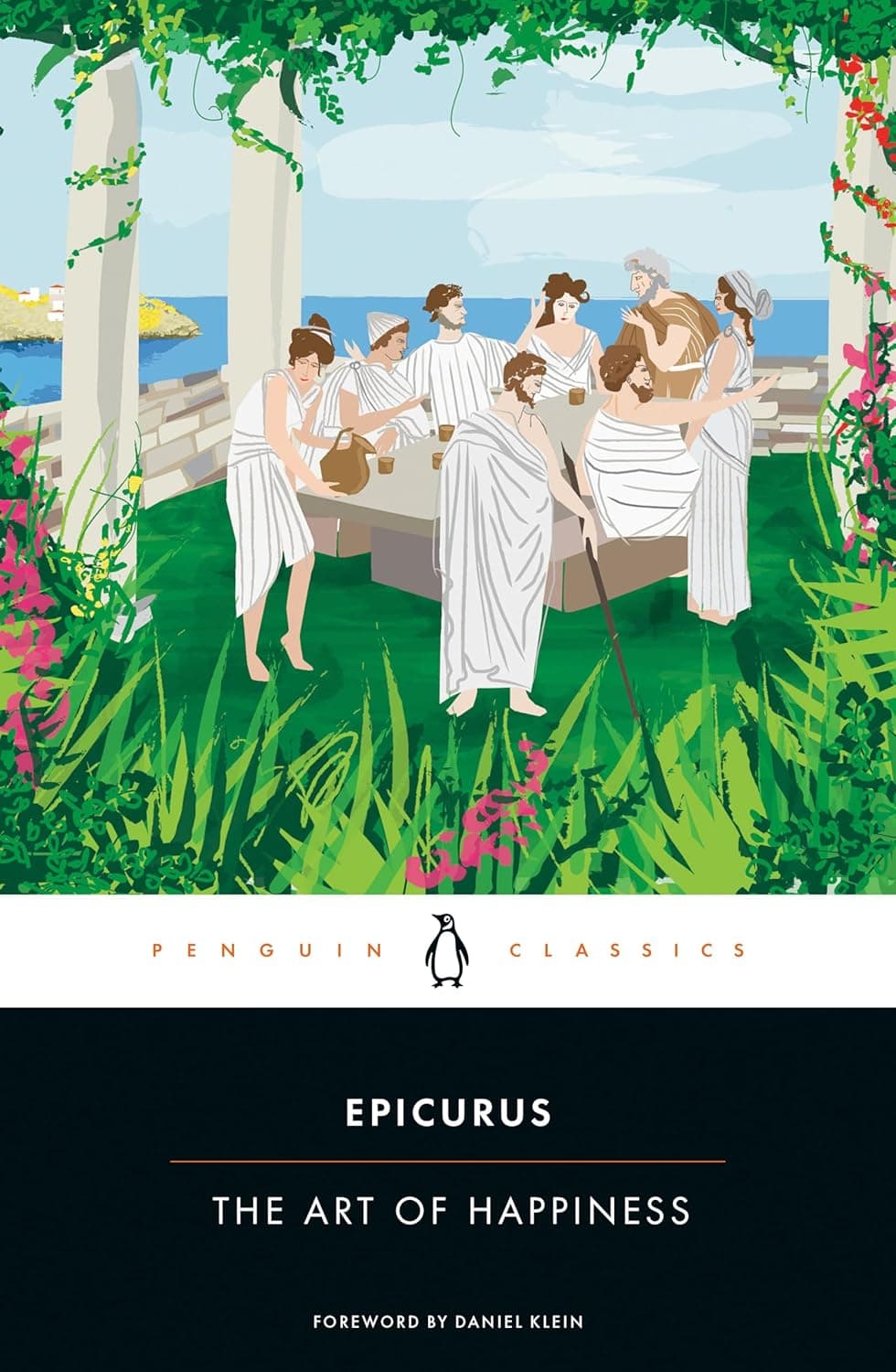
The Art of Happiness
by Epicurus (trans. George K. Strodach)(2012)
A modern Penguin Classics translation of all that survives of Epicurus' writings: the Letters, Principal Doctrines, and Vatican Sayings. The most direct way to encounter the philosopher in his own words.
Some links are affiliate links. Purchases help support the channel at no extra cost to you.
Episodes featuring this book
Epicurus Was Not a Hedonist | Pleasure, Death and Fear for Sleep
The Real Philosophy of Pleasure, Death, and Fear for Sleep
Almost everyone has Epicurus wrong. The word "epicurean" has come to mean indulgence, luxury, and fine dining, but the real philosophy is almost the opposite: a quiet life, simple food, trusted friends, and freedom from fear. It begins with a displaced young man on the island of Samos and ends with a philosophy that twenty-three centuries of persecution could not destroy. We explore his radical atomism, his argument that the gods do not care about human affairs, his claim that death is nothing to us, the most misunderstood concept in the history of philosophy (Epicurean pleasure as tranquility, ataraxia), the tetrapharmakos, the Garden as a community that admitted women and slaves as philosophical equals, and the survival of his ideas through Lucretius. We ask the question Epicurus leaves behind: what would it actually look like to live without fear? The full episode is on YouTube and Spotify. Please listen only in safe, restful contexts.
10 chapters6 sources
The Problem of Evil: Why Does God Allow Suffering? | Philosophy for Sleep
An innocent man, a burned fawn, and the hardest question ever asked of God. This episode follows the problem of evil from its oldest telling to its newest defenses. It begins with a man who loses everything in a single afternoon and refuses every easy explanation, then traces the great answers, evil as absence, the best of all possible worlds, and the earthquake and the novel that broke optimism's public standing. From there the argument sharpens into the twentieth century, a charge of outright contradiction, the celebrated defense that answered it, a theodicy of growing souls, and a dying fawn that changed the question from proof to evidence. The second half belongs to skeptical theism, the claim that human minds cannot survey the reasons a God might have, and to the objections that press it, moral paralysis, spreading doubt, horrendous evils, animal pain, and divine silence. The episode ends where the argument now stands, between a rock and a rope. The full episode is on YouTube and Spotify. Please listen only in safe, restful contexts.
23 chapters8 sources
Why Desire Causes Suffering | Buddhist Philosophy for Sleep
There is a story that begins with a man who had everything, and who walked away from all of it on a single night. Twenty-five centuries ago, a prince in the foothills of the Himalayas left three palaces, a wife, and a newborn son because he had seen three things on a road that made the comfort of his life intolerable. Six years later, sitting under a fig tree in what is now northern India, he claimed to have understood something that no accumulation of pleasure could reach, and he spent the next forty-five years explaining it to anyone who would listen. We walk through ten chapters of his life and his thought, from the diagnosis that life is suffering, through the Four Noble Truths and the Eightfold Path, into the radical doctrines of no-self and impermanence, through the twelve links of dependent origination, and out into a comparison with Heraclitus, Hume, and Schopenhauer. This is not a devotional piece. It is a careful, philosophical reading of the Buddha as one of the great systematic thinkers of any civilization, a physician of the mind whose prescription can still be tested today. The full episode is on YouTube and Spotify. Please listen only in safe, restful contexts.
10 chapters13 sources
On Plato and the Cave You Never Left | Complete Philosophy For Sleep
Forms, the Cave, the Republic & the Soul | 3 Hours
What if everything you have ever seen, touched, or believed was just a shadow on a wall? Plato shaped Western civilization for more than two thousand five hundred years. This episode traces his thought from its origins in the death of Socrates through the Theory of Forms, the Allegory of the Cave, the vision of the philosopher king in The Republic, the epistemology of recollection, Diotima's ladder of love in the Symposium, and the arguments for the immortality of the soul in the Phaedo. It also examines the political philosophy of The Republic, its controversial vision of a just society governed by those who have seen the Good, and the late dialogues where Plato turned a critical eye on his own theory of Forms. The full episode is on YouTube and Spotify. Please listen only in safe, restful contexts.
10 chapters7 sources
From Logic to Ethics | Aristotle's Complete Philosophy
Aristotle's Complete Philosophy
Aristotle spent twenty years studying under Plato, then walked away and built a rival system that would dominate Western thought for two millennia. This episode traces his life from the court physician's son in Stagira, through the Academy, his years tutoring Alexander the Great, and the founding of the Lyceum in Athens. It examines his major contributions across logic, metaphysics, ethics, politics, and poetics: the categories of being, hylomorphism, the four causes, the unmoved mover, the function argument, eudaimonia as the highest good, the doctrine of the mean, practical wisdom, and the vision of the good life laid out in the Nicomachean Ethics. Dante called him the Master of Those Who Know, and for centuries no one in the Western or Islamic world could think seriously about the world without first thinking through Aristotle. The full episode is on YouTube and Spotify. Please listen only in safe, restful contexts.
17 chapters10 sources
Beyond the Empty Will | Murdoch and Moral Vision
Iris Murdoch finds moral freedom in the patient work of seeing reality beyond the self. This episode follows The Sovereignty of Good as a triptych of moral inquiry. It begins with the inner change that occurs when a person learns to see another more justly, even without any outward action. It then follows Murdoch's account of prayer, Freud, grace, and the possibility of retaining moral transcendence after the traditional idea of God has faded. The final movement enters Plato's images of the sun and the cave, before turning to beauty, art, love, death, chance, and humility. Throughout, Murdoch challenges the picture of morality as a series of isolated choices and proposes attention as the patient activity through which consciousness becomes more truthful, less selfish, and more responsive to the real world. The full episode is on YouTube and Spotify. Please listen only in safe, restful contexts.
7 chapters6 sources