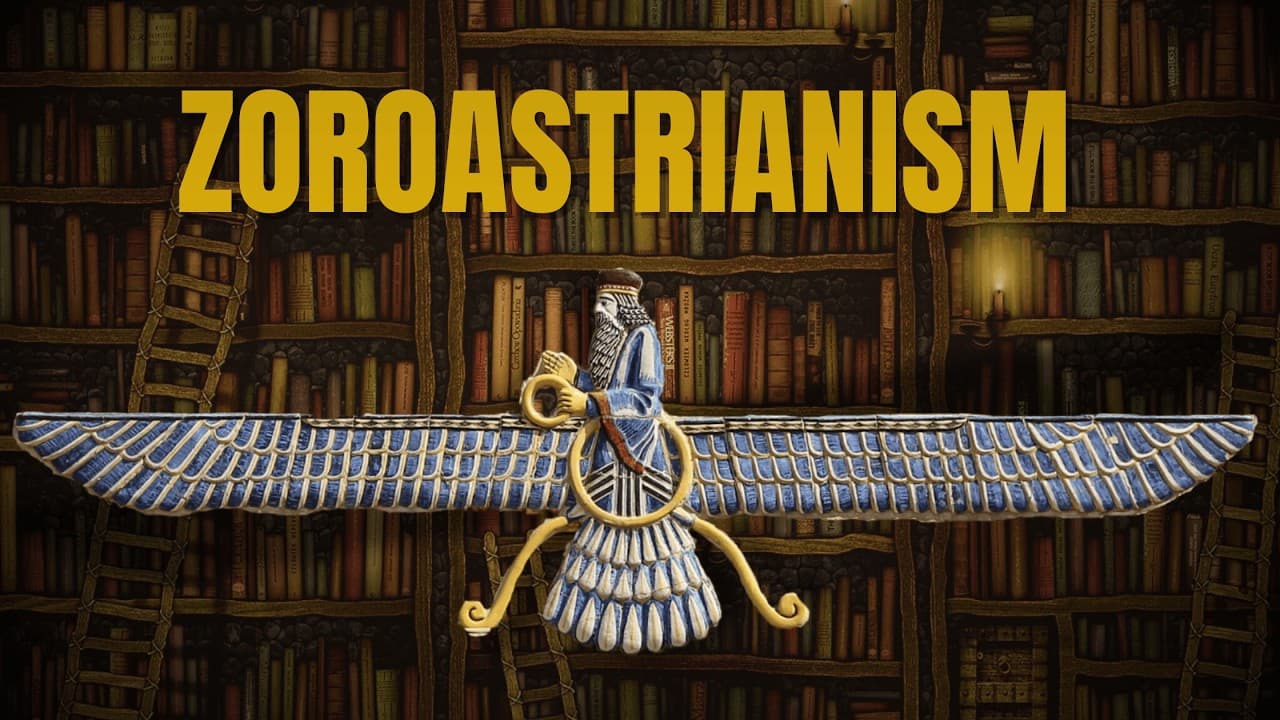
The Religion That Gave Us Good and Evil | Zoroastrianism for Sleep
Zarathustra, Ahura Mazda & the Cosmic Battle | 3 Hours
Where did the idea of good and evil actually come from?
Zoroastrianism may be the most influential ancient religion most people have never heard of. The episode moves from the passionate hymns of the Gathas to the living communities that carry this ancient fire into the present.
It explores the cosmic dualism of Ahura Mazda and Angra Mainyu, the revolutionary ethics of free will and the goodness of the material world, the astonishing influence this tradition exercised on Judaism, Christianity, and Islam, and the Zoroastrian communities that continue to practice the world's oldest revealed religion.
The full episode is on YouTube and Spotify. Please listen only in safe, restful contexts.
Enjoying the episode?
Occasional letters on philosophy, reading, and the examined life. No spam, ever.
By subscribing you consent to receiving occasional emails. Unsubscribe any time via the link in every email or at /unsubscribe.
For the record
Full Transcript
Chapter 01: Before Good and Evil Had Names
Somewhere in the grasslands of Central Asia, at a time so remote that even the most careful scholars can only gesture toward an approximate century, a man looked at the world and declared that it was at war. Not a war between kingdoms or tribes, though those were plentiful enough in his time. This was a war written into the structure of reality itself. Truth against falsehood. Order against chaos. Light against the corrosion of darkness. Everything that existed, from the turning of the seasons to the smallest act of human honesty, was a front in this cosmic struggle. And every human being, simply by living, by thinking and speaking and acting, was already a combatant. There was no neutrality. There was no standing apart. The choice between truth and the lie was not optional. It was the fundamental condition of being alive.
The man's name was Zarathustra. The Greeks would later call him Zoroaster, and under that name he would become one of the most frequently invoked and least understood figures in the history of Western thought. But the Greek version of his name, like so much else the Greeks did with foreign ideas, distorted as much as it preserved. Zarathustra is the Avestan original, and it is the name we find in the oldest texts, the hymns he himself is believed to have composed. Those hymns, called the Gathas, are among the most ancient religious texts in any Indo-European language. They are also among the most difficult. Written in Old Avestan, a language so archaic that it stands in roughly the same relationship to later Persian as Homeric Greek does to the Greek of Aristotle, the Gathas have resisted easy translation for as long as scholars have attempted them. Yet what emerges from even the most cautious readings is unmistakable: the voice of a man who believed he had seen the truth about the nature of existence and who could not remain silent about it.
When Zarathustra lived is itself a question that reveals the depth of the uncertainty surrounding him. The classical tradition, transmitted through Greek historians, placed him approximately 258 years before Alexander the Great's conquest of Persia, which would put his life roughly in the period between 628 and 551 before the common era. This dating was accepted for centuries and has a certain tidiness to it, placing Zarathustra in the same general era as the Hebrew prophets and the Greek pre-Socratics. But modern scholarship has largely moved away from this dating. The key evidence is linguistic. The language of the Gathas is not the language of sixth-century Iran. It is far older, sharing grammatical structures and vocabulary with the earliest hymns of the Rigveda, the sacred texts of Vedic India. Both the Gathas and the oldest Rigvedic hymns appear to come from a period before the Indo-Iranian peoples had fully separated into their Indian and Iranian branches. On this basis, many specialists now date Zarathustra to a much earlier period, somewhere between 1500 and 1200 before the common era, with some pushing the date even earlier. This is not a settled question. Scholars such as Almut Hintze and Prods Oktor Skjaervo have argued for the earlier dating on detailed linguistic grounds, while others have noted the difficulty of extracting precise dates from linguistic comparison alone. What is clear is that Zarathustra belongs to the deep past of the Indo-Iranian world, and that the tradition he founded has a history measured not in centuries but in millennia.
To understand what Zarathustra did, we must first understand the world he inhabited and the religion he transformed. The Indo-Iranian peoples, before their gradual migration into what we now call Iran and the Indian subcontinent, shared a common religious culture. This was a world of many gods, called daevas and ahuras, terms that would later undergo a remarkable inversion. In the Vedic tradition that developed in India, the devas became the gods and the asuras became the demons. In the Iranian tradition shaped by Zarathustra, the opposite occurred: Ahura Mazda, the Wise Lord, became the supreme deity, and the daevas were cast down as false gods, malevolent spirits unworthy of worship. This is one of the most striking divergences in the history of religion. Two branches of the same cultural tree arrived at mirror-image theologies, each demonizing what the other worshipped. Zarathustra's role in the Iranian inversion was decisive. The Gathas make clear that his rejection of the daevas was not a gradual evolution but a conscious, polemical act.
The old Indo-Iranian religion, as far as scholars can reconstruct it, was centered on ritual sacrifice and the maintenance of cosmic order through correct performance. The priests, who held an essential role in this system, offered animal sacrifices and prepared the sacred drink called haoma, a pressed plant juice with intoxicating or perhaps hallucinogenic properties. Haoma, known as soma in the Vedic tradition, occupied a central place in ritual life. The gods were invoked through hymns and offerings, and the relationship between humans and the divine was essentially transactional: correct ritual ensured divine favor, cosmic stability, and the continued functioning of the natural world. The gods themselves were morally ambiguous in the way that many ancient deities were. They could be generous or capricious, helpful or dangerous, depending on whether they received the offerings they demanded. There was no overarching moral narrative. The universe operated through power, ritual, and the precarious balance of forces that proper sacrifice maintained.
Fire held a special place in this world, and its importance would persist long after Zarathustra transformed everything around it. The Indo-Iranian fire ritual, tended by a hereditary priestly class, was not merely one ceremony among many. Fire was understood as a living presence, a mediator between the human and divine realms. Offerings placed into the fire were carried upward to the gods. The flame itself was pure, incorruptible, a physical embodiment of the sacred in the midst of the ordinary world. When Zarathustra reformed the old religion, he did not abolish the fire cult. He reinterpreted it. Fire became the visible manifestation of asha, truth and order, burning always upward, always pure, always consuming the impure. The Zoroastrian fire temple, which would become the defining architectural expression of the tradition, has its roots in these ancient Indo-Iranian practices, transformed by Zarathustra's moral vision into something new.
The people among whom Zarathustra lived were pastoralists, herders of cattle on the vast grasslands of Central Asia. Cattle were not merely an economic resource. They occupied a place of genuine reverence in Indo-Iranian culture, a reverence preserved in the Vedic tradition's veneration of the cow and visible in the Gathas' own language, where the soul of the cow, the geush urvan, cries out for a protector and is answered by Ahura Mazda's appointment of Zarathustra himself. The pastoral life shaped the metaphors of the religion: the good shepherd who protects his flock, the predator who destroys it, the pasture that sustains life when properly tended. These were not abstract images for people whose survival depended on their herds. When Zarathustra spoke of the forces that destroy the good creation, his listeners would have known exactly what destruction looked like: raiders who slaughtered cattle, drought that withered grasslands, disease that swept through herds already weakened by a hard winter. The cosmic struggle between truth and the lie was, at its origin, also the very practical struggle to maintain life in a harsh and unpredictable environment.
Into this world Zarathustra introduced something genuinely new. He did not merely add another god to the pantheon or refine the existing ritual system. He reframed the entire structure of reality in moral terms. The cosmos was not a neutral arena governed by ritual transaction. It was a battlefield, and the war being fought upon it was the war between asha, a word that can be translated as truth, righteousness, or cosmic order, and its opposite, which Zarathustra would name druj, the lie, falsehood, the active principle of disorder and decay. This was not a metaphor. For Zarathustra, asha and the lie were as real as fire and water, as fundamental to the structure of existence as the turning of the sky. And at the center of this moral cosmos stood not a council of bargaining gods but a single supreme being: Ahura Mazda, the Lord of Wisdom, the source and sustainer of asha, the creator of all that is good.
Zarathustra's rejection of the daevas was not merely a theological reclassification. It was an act of moral judgment. The Gathas do not treat the daevas as gods who happen to be weaker than Ahura Mazda or as deities who belong to a rival pantheon. They are condemned because they chose wrongly. In the Zoroastrian framework, the daevas are not evil by nature in some predetermined sense. They are evil because they chose falsehood when truth was available to them. They were deceived, the Gathas say, and they chose the worst mind. This insistence on choice, even at the level of the divine, is one of the most distinctive features of Zarathustra's thought. Evil is not a brute fact of the universe. It is the result of a decision, and it is this quality of decision that makes it both morally significant and ultimately defeatable. What was chosen can be unchosen. What was corrupted can be restored. The moral architecture of the cosmos depends on this possibility.
The Gathas, the seventeen hymns that represent our only direct testimony from Zarathustra himself, are not a systematic theology. They are poetry, and difficult poetry at that. They are addressed to Ahura Mazda in the second person, and they shift between praise, petition, lamentation, and visionary proclamation with the intensity of a mind on fire. In Yasna 44, one of the most extraordinary passages in ancient religious literature, Zarathustra poses a series of questions directly to God. This I ask Thee, tell me truly, Lord: Who is the first creator and father of asha? Who established the path of the sun and stars? Who is it through whom the moon waxes and wanes? These are not rhetorical questions in the modern sense. They are the questions of a man who is genuinely seeking to understand the structure of the world he has been called to serve. They have the quality of philosophical inquiry dressed in the language of prayer.
Yasna 30, perhaps the most theologically significant passage in the Gathas, presents the foundational vision of two primordial spirits. Now the two primal spirits, who revealed themselves in a vision as twins, are the better and the bad, in thought and word and deed. And between these two the wise choose rightly, but not the foolish. This passage has been debated by scholars for over a century. Are the two spirits aspects of Ahura Mazda himself, something like the creative and destructive potentials within the divine nature? Are they independent cosmic principles, making Zoroastrianism a genuine dualism from the start? Or are they primarily a moral paradigm, a way of articulating the fundamental choice that every conscious being must make? The text supports multiple readings, and different periods of Zoroastrian tradition have emphasized different interpretations. What is beyond dispute is the centrality of choice. The two spirits chose. The daevas chose badly. Human beings must choose. The universe is not indifferent to these choices. It is constituted by them.
The passage continues with a claim that reverberates through the entire history of Zoroastrian thought and, through it, through the history of Western religion: when these two spirits first came together, they created life and not-life, and that at the last the worst existence shall be for the followers of the lie, but the best dwelling for those who possess asha. Here, in a few compressed lines of archaic poetry, we find the seeds of ideas that would later develop into elaborate systems: the opposition of life and death as moral categories, the promise that the righteous will be rewarded and the wicked punished, the assurance that the cosmic struggle will reach a conclusion. The Gathas do not develop these ideas systematically. They announce them with prophetic urgency and leave the elaboration to later generations. But the seeds are unmistakable, and they would grow into a theological forest that stretches from ancient Iran to the present day.
In Yasna 46, the tone shifts from cosmic vision to personal anguish. To what land shall I flee? Where shall I go to flee? They thrust me from family and tribe. The community I followed has not shown me hospitality, nor those who are the wicked rulers of the land. Zarathustra here speaks as a man in exile, rejected by his own community for the radicalism of his message. The priests of the old religion, whom the Gathas call the karapans and the kavis, the mumblers and the blind seers, had no interest in a reformation that would abolish their ritual monopoly and demand ethical accountability from the gods themselves. Zarathustra's teaching was not merely theologically innovative. It was socially disruptive, and the established religious authorities recognized as much.
The opposition Zarathustra faced was not simply intellectual disagreement. The Gathas describe a world in which the karapans actively deceived the people, leading them away from asha through fraudulent rituals and false teaching. The Gathas also condemn the practice of excessive cattle sacrifice, which appears to have been a feature of the old cult that Zarathustra found both wasteful and morally wrong. The cattle, as part of the good creation, were to be protected, not slaughtered in lavish ceremonies designed to enrich a priestly class. This was a prophetic critique of institutional religion that would find echoes centuries later in the Hebrew prophets' denunciation of empty sacrifice. Zarathustra was not against ritual. The Gathas themselves are liturgical texts, composed for ceremonial recitation. But he insisted that ritual without moral content was worse than useless. It was an act of druj, a lie performed in the name of truth, and therefore doubly dangerous.
The social world of the Gathas, to the extent we can reconstruct it, was a world of small communities, tribal loyalties, and ongoing conflict between pastoral herders and the predatory bands that raided them. Some scholars have suggested that the moral dualism of the Gathas reflects, in part, this social reality: the settled pastoralist who tends the good creation against the raider who destroys it, the truthful community against the band of liars and thieves. This is not to reduce theology to sociology. But religious ideas do not arise in a vacuum. They emerge from the lived experience of people confronting real threats, and the language of the Gathas, with its constant references to cattle, pastures, protection, and destruction, bears the marks of the world that produced it.
The turning point, according to both the Gathas and later tradition, came with the conversion of Vishtaspa, a king or chieftain whose patronage gave Zarathustra the protection and platform he needed to establish his reform. The Gathas mention Vishtaspa by name, making him one of the few historical figures whose existence can be tentatively confirmed from the primary texts. Later tradition, particularly the Pahlavi literature composed in Middle Persian during the Sasanian period and afterward, elaborated Zarathustra's biography into a rich legendary narrative. In these later accounts, Zarathustra experienced his first vision at the age of thirty while attending a spring festival on the banks of the Daitya river. The archangel Vohu Manah, Good Mind, appeared to him and led him into the presence of Ahura Mazda, where he received his prophetic commission. He then spent years wandering and preaching, facing demonic opposition and human indifference, until his debate at the court of Vishtaspa convinced the king of the truth of his message.
The story of Zarathustra's encounter with Vishtaspa would become one of the great set pieces of later Zoroastrian tradition. In the Pahlavi accounts, the debate at court lasted three days. The priests of the old religion, sensing the threat to their authority, accused Zarathustra of sorcery and had him imprisoned. According to the Denkard and the Selections of Zadspram, Zarathustra won his freedom by miraculously curing the king's favorite horse, which had drawn its legs into its body and could not stand. Each leg was restored as Zarathustra answered one of the king's theological questions. The episode has the quality of a folktale, and it functions as one: the righteous prophet triumphing over corrupt priests through the power of divine truth. Whether anything historical lies behind it is impossible to determine.
It is essential to distinguish between what the Gathas tell us and what the later tradition tells us. The Gathas are primary evidence, the words of Zarathustra or of someone very close to him in time and place. The legendary biography comes from texts composed more than a thousand years later, in a different language, under very different historical circumstances. This does not mean the later tradition is worthless. It preserves material that may have been transmitted orally across many centuries, and it reflects how the Zoroastrian community understood its own founder. But it cannot be read as straightforward history. The miracles attributed to Zarathustra in the Pahlavi texts, his miraculous birth accompanied by supernatural light, his resistance to demonic attacks, his prophetic knowledge of the future, belong to the genre of sacred biography rather than to historical record. They tell us about how Zoroastrians understood prophecy and divine election, not about the facts of a life lived three thousand years ago.
The Gathas themselves, for all their difficulty, give us something more valuable than biography. They give us a mind in motion. Zarathustra does not speak with the serene authority of a lawgiver handing down commandments. He questions. He doubts. He pleads. He celebrates moments of insight with an intensity that suggests genuine experience rather than literary convention. When Ahura Mazda is addressed, it is not as a distant cosmic administrator but as a presence that Zarathustra feels he has actually encountered. The theology of the Gathas emerges from this encounter, not as a deduction from first principles but as an articulation of something seen and felt. This gives Zoroastrian thought, at its foundation, a quality of lived experience that distinguishes it from many later theological systems. The first Zoroastrian theologian was not a philosopher sitting in a school. He was a man standing on the steppe, looking at the fire, and asking the most dangerous question a priest can ask: what if everything we have been doing is wrong?
The Gathas also reveal a man grappling with the problem that would become central to all subsequent monotheistic thought: why do the wicked prosper? In Yasna 44, alongside his cosmological questions, Zarathustra asks why the followers of the lie appear to triumph over the followers of truth. This is not a philosophical abstraction for him. It is an existential crisis. He has staked his life on the conviction that truth is the fundamental structure of reality, yet the evidence of his senses shows him a world in which liars and tyrants hold power while the righteous suffer. This tension, between the conviction that the universe is morally ordered and the observation that the world is manifestly unjust, is the engine that drives the development of Zoroastrian eschatology. If justice does not prevail now, it must prevail eventually. If the wicked triumph in this life, there must be a reckoning beyond this life. The seeds of the last judgment, of heaven and hell, of the final renovation of the world, are planted in the soil of this anguish. Three thousand years later, we still live with the theological consequences of that question asked on the steppe.
The Gathas were composed as manthras, sacred utterances intended for ritual recitation. They are embedded within the Yasna ceremony, the central liturgical act of Zoroastrian worship, where they are recited by the priest at specific points in the ritual. This liturgical context is important. The Gathas were never purely intellectual documents meant to be studied in silence. They were performed, chanted, woven into a ceremonial fabric that gave them living force. The power of the manthra, in the Zoroastrian understanding, is not merely communicative. It participates in the reality it describes. To recite the words of Zarathustra is to reinforce asha, to strengthen truth in the world, to add one's voice to the cosmic cause. This is why the oral transmission of the Avesta was not simply a matter of preserving a text but a religious act in itself. Each generation of priests that memorized and recited these words was continuing the work that Zarathustra began.
The text in which these hymns have come down to us is the Avesta, the sacred scripture of Zoroastrianism. But the Avesta as it exists today is a fraction of what once existed. Ancient sources claim that the complete Avestan texts, assembled and codified during the Sasanian Empire in the third through seventh centuries of the common era, comprised a vast body of religious literature. War, conquest, and the passage of time destroyed most of it. What survives is roughly one quarter of the original, and it is a composite work containing texts from very different periods. The Gathas, in Old Avestan, form the oldest and most authoritative layer. The Younger Avesta, composed in a later dialect of the same language, includes the Yashts, or hymns to individual divine beings, the Vendidad, a priestly code dealing with purity and ritual law, and the liturgical sections of the Yasna ceremony. These Younger Avestan texts were composed over a long period, perhaps spanning centuries, and they represent a significant development of Zoroastrian thought beyond the spare, intense theology of the Gathas. The divine world becomes more populated, the ritual system more elaborate, the cosmological framework more detailed. Whether this development is a natural unfolding of Zarathustra's original vision or a partial return to the older polytheistic traditions he had rejected is one of the central questions of Zoroastrian studies.
The Younger Avesta's relationship to the Gathas is a subject of ongoing scholarly debate. Mary Boyce argued that much of the Younger Avestan material represents the religion as it was practiced in northeastern Iran during the centuries after Zarathustra, preserving genuine Zoroastrian tradition even as it expanded the theological framework. Others have noted that the Younger Avesta reintroduces divine figures, particularly Mithra and Anahita, who play no role in the Gathas and who bear a strong resemblance to Indo-Iranian deities that Zarathustra appears to have sidelined. Whether this represents a betrayal of Zarathustra's vision, a necessary accommodation with popular religious sentiment, or a legitimate development of ideas already implicit in the Gathas is a question that Zoroastrian scholars and Zoroastrian communities have answered differently across the centuries. The history of religions rarely moves in straight lines. Traditions reform, consolidate, expand, and sometimes quietly reverse the innovations of their founders, all while claiming perfect continuity.
Beyond the Avesta lies yet another layer of Zoroastrian textual tradition: the Pahlavi literature, composed in Middle Persian during and after the Sasanian period. The Bundahishn, a cosmological treatise that narrates the creation and history of the world, the Denkard, an encyclopedic compendium of Zoroastrian knowledge, and the Selections of Zadspram, a theological work dealing with creation and eschatology, are among the most important of these texts. They represent the Zoroastrian priesthood's effort to systematize, preserve, and defend their tradition during a period of enormous pressure, first from Christianity and Manichaeism during the Sasanian era, then from Islam after the Arab conquest. The Pahlavi texts are invaluable, but they must be read with an awareness of the distance between them and the Gathas. Over a thousand years of theological development, cultural change, and contact with other traditions separate the two layers. Claims that appear in the Bundahishn or the Denkard may reflect very old traditions, but they may also reflect the concerns and innovations of a much later period.
The Pahlavi texts also preserve the Zoroastrian tradition's account of its own near-destruction. The conquest of Alexander in 330 before the common era, remembered in Zoroastrian literature as the work of the accursed Alexander, is said to have resulted in the burning of the original Avestan texts inscribed on cowhides and stored at the royal library of Istakhr. Whether this account is historically reliable is uncertain, but it reflects a genuine cultural trauma. The Hellenistic period that followed Alexander's conquest was a time of cultural disruption for the Iranian priestly tradition, and it was only under the Arsacid and later Sasanian dynasties that systematic efforts were made to collect, organize, and transcribe the surviving oral and written tradition. The Avesta as we have it is thus a product of reconstruction as much as preservation, and the gaps in the text remind us of everything that was lost.
This layered character of Zoroastrian scripture is not a weakness of the tradition. It is, in fact, one of the most intellectually interesting things about it. Zoroastrianism is a religion that developed across more than three thousand years, surviving conquest by Alexander, absorption into the Hellenistic world, revival under the Arsacid and Sasanian dynasties, near destruction at the hands of the Arab conquest, and a long twilight of marginalization and diaspora that continues, remarkably, to the present day. Each of these periods left its distinctive mark on the texts, and the patient work of distinguishing one layer from another is part of what makes the study of Zoroastrianism so intellectually rewarding. Reading the Zoroastrian scriptures requires a kind of intellectual archaeology, distinguishing layers, identifying developments, tracing the ways in which a living tradition adapted its foundational insights to new circumstances. The Gathas give us the voice of the founder. The Younger Avesta gives us the developing tradition. The Pahlavi literature gives us the mature theological system. Together, they constitute one of the great archives of human religious thought.
The difficulty of translating Old Avestan has meant that scholarly interpretations of the Gathas vary significantly, and these variations are not merely academic. They have direct theological consequences. The word asha, for instance, is central to the entire Zoroastrian worldview. Stanley Insler, whose 1975 translation remains one of the most influential, renders it as "truth" in most contexts. Helmut Humbach prefers "righteousness" or "right order." Other scholars have emphasized its connection to the Vedic concept of rta, the cosmic order that governs both the physical world and the moral law. Each translation carries different philosophical implications. If asha is primarily truth, then Zoroastrian ethics centers on honesty and the rejection of deception. If it is primarily cosmic order, then the ethical horizon expands to encompass every act that either sustains or disrupts the proper functioning of the world. If it is righteousness, the emphasis falls on individual moral character. In practice, asha encompasses all of these meanings and more. It is the principle that fire burns upward, that water flows to the sea, that the seasons turn in their proper course, that honest speech builds trust, that a promise kept strengthens the fabric of the world. It is truth in the deepest and most comprehensive sense: the way things are when they are as they ought to be.
Some scholars have questioned whether the Gathas can be attributed to a single author at all. Jean Kellens and Eric Pirart, in their influential French edition, argued that the Gathas may be the product of a priestly school rather than an individual prophet. Prods Oktor Skjaervo has raised similar questions about the unity of the collection. If the Gathas are not the work of one man, then the figure of Zarathustra as a historical individual becomes more difficult to recover. He may be a legendary founder, like the Vedic seers to whom the Rigvedic hymns are attributed, rather than a historical person in the modern biographical sense. Most scholars continue to regard Zarathustra as a historical figure, on the grounds that the Gathas' intensely personal voice, their references to specific named people and places, their emotional range from despair to exaltation, and their quality of urgent argument against named opponents are difficult to explain as the product of a committee or a school. But the uncertainty is real, and it reminds us that our knowledge of this period is built on inference, comparison, and scholarly reconstruction rather than on anything resembling a historical record.
What is not uncertain is the magnitude of the change that Zarathustra, whether one man or a movement bearing one man's name, introduced into the religious history of the world. Before this reform, the Indo-Iranian religious landscape was, in its broad outlines, similar to other ancient polytheisms: many gods, elaborate rituals, a professional priesthood, and a cosmos governed by power rather than by morality. After this reform, the landscape was transformed. There was one supreme God, defined by wisdom and truth. There was a cosmic adversary, defined by falsehood and destruction. There was a moral choice at the center of every human life, and that choice had consequences not only for the individual but for the entire universe. The seeds of eschatology were planted: the world was not an endless cycle but a narrative with a direction, heading toward a final resolution in which truth would triumph over the lie. The seeds of soteriology were planted: the world needed to be saved, and human beings were the agents of that salvation. The seeds of theodicy were planted: if God is good, why does evil exist, and the answer Zarathustra gave, that evil is a genuine cosmic force that God opposes and will ultimately defeat, would echo through every subsequent attempt to answer that question in the Western tradition.
These were not ideas that stayed on the steppe. They traveled with the Iranian peoples as they moved westward, built empires, encountered other civilizations, and changed them. The Achaemenid kings who ruled from the Nile to the Indus invoked Ahura Mazda in their royal inscriptions. The Jewish exiles who lived under Persian rule encountered these ideas and, as many scholars have argued, carried some of them back into their own evolving theology. The Greeks who fought the Persians and then conquered them were fascinated by the figure of Zoroaster and the religion of the Magi. Christianity and Islam, traditions built on foundations that were already shaped by Persian influence through their Jewish inheritance, carried Zoroastrian concepts into every corner of the globe. The dualism of good and evil, the expectation of a final judgment, the hope for a world made new: these ideas are so familiar to the Western mind that they feel like the natural furniture of religious thought. They are not. They had to be invented. And the tradition that, more than any other, can claim to have invented them is the tradition that began with Zarathustra, on the steppe, before the fire, when the world was still young enough for a single voice to change everything that came after it.
Chapter 02: The Architecture of the Cosmos
The theology that Zarathustra set in motion did not remain in the spare, urgent form of the Gathas. Over the centuries that followed, successive generations of priests, theologians, and communities elaborated his foundational insights into one of the most architecturally complete cosmological systems in the history of religion. Where the Gathas gave a vision, the later tradition built a world. And at the center of that world, as at the center of the Gathas, stood Ahura Mazda, the Wise Lord, the source of all that is good, the creator and sustainer of asha.
Ahura Mazda is not like the gods of the old Indo-Iranian pantheon. He is not one deity among many, competing for offerings and prestige. Nor is he quite the omnipotent sovereign of later Jewish, Christian, and Islamic monotheism, whose power is absolute and whose will is the final explanation for everything that exists. Ahura Mazda is defined, first and last, by wisdom. The name itself declares this: Ahura means "lord" in the Avestan language, cognate with the Vedic asura, and Mazda means "wisdom" or "the wise one." To say God's name is to say that the supreme being is the Lord of Wisdom. This is not a secondary attribute, as though God happened also to be wise among other qualities. Wisdom is his essence. In the Gathas, Ahura Mazda is the being through whom asha exists, through whom the world was created in accordance with truth, and through whom the righteous will ultimately be vindicated. He is not arbitrary. He does not demand worship for its own sake or fly into rage when sacrifice is withheld, as the gods of Homer and the Rigveda sometimes do. He is the source of the moral order, and to worship him is to commit oneself to that order. This is a subtle but revolutionary theological move. It means that religion is not fundamentally about placating a powerful being. It is about aligning oneself with truth. The God of the Gathas does not need human offerings. He needs human righteousness. The entire transactional logic of the old Indo-Iranian cult, in which correct sacrifice earned divine favor, is replaced by an ethical logic in which the quality of one's inner commitment matters more than the quantity of one's outward performance.
The Gathic portrait of Ahura Mazda is relatively spare. Zarathustra addresses him with intimacy and urgency, asking questions, seeking guidance, praising his righteousness. But the Gathas do not describe Ahura Mazda's creation of the world in systematic detail. They do not narrate a creation myth in the manner of the Babylonian Enuma Elish or the first chapters of Genesis. What they do is establish a theological grammar: Ahura Mazda is good. Ahura Mazda created through asha. The world exists because of divine wisdom, not divine caprice. Everything that follows in Zoroastrian theology is built on this foundation.
The later tradition, particularly the Younger Avesta and the Pahlavi literature, filled in what the Gathas left open. Ahura Mazda became the creator of all good things, the architect of a cosmos designed with a specific purpose: to trap evil, to expose it, and to defeat it. In the Bundahishn, the great cosmological text of the Pahlavi period, Ahura Mazda's creative act is deliberate and strategic. He creates the world not as an end in itself but as an instrument in the cosmic war against the destructive spirit. The material world is a battlefield, but it is a battlefield that Ahura Mazda chose, because it is only in the material world that evil can be brought to a final confrontation and destroyed. The Bundahishn describes Ahura Mazda as having foreseen Angra Mainyu's attack and having designed creation specifically to withstand it, to lure the destructive spirit into a trap from which he cannot escape. The physical world, in this reading, is not merely a stage on which the cosmic drama plays out. It is itself the weapon that God forged for the final battle. This is a remarkable theological claim. The material world is not an accident, not a fall from a higher spiritual state, not an illusion to be transcended. It is the arena of salvation. It exists because God, in his wisdom, determined that evil could only be defeated through the concrete, physical, temporal processes of a created world.
Against Ahura Mazda stands his adversary. The Gathas call him Angra Mainyu, roughly "the Hostile Spirit" or "the Destructive Mentality." In later Middle Persian texts he is known as Ahriman, the name by which he entered the wider religious vocabulary of the ancient world. Angra Mainyu is the source of everything that is wrong. He did not create the world. He cannot create. He invaded it. In the Gathic account, the two primordial spirits, one choosing truth and life, the other choosing falsehood and death, established the fundamental polarity of existence. The spirit who chose falsehood became the enemy of creation, the source of disease, decay, suffering, and death. In the later cosmological framework, Angra Mainyu's nature is defined entirely by negation. He cannot create. He can only corrupt, distort, and destroy what Ahura Mazda has made. Death is his weapon. Lies are his language. Pollution is his presence in the physical world.
The question of how to understand this dualism is one of the most debated issues in the study of Zoroastrianism. Is it a true metaphysical dualism, positing two independent, coeternal principles of good and evil? Or is it a form of monotheism in which evil is subordinate to a single supreme God? The Gathas themselves are ambiguous on this point, and scholars have read them in both directions. In Yasna 30, the two spirits appear as equals who make a primordial choice. This suggests a genuine dualism: good and evil are both original features of reality. But elsewhere in the Gathas, Ahura Mazda appears to be clearly supreme, the creator of everything, with the hostile spirit occupying a subordinate, parasitic role. Later Zoroastrian orthodoxy, as codified in the Sasanian period, tended toward a qualified dualism: Ahura Mazda and Angra Mainyu are opposed cosmic principles, but Ahura Mazda is ultimately more powerful, and the struggle will end in his victory. Evil is real and potent, but it is not eternal. It has a beginning, when the hostile spirit chose falsehood, and it will have an end, when the forces of asha finally prevail.
The development from the Gathas' ambiguous dualism to the later tradition's more systematic opposition between two cosmic principles was not a simple linear process. Different communities and different periods of Zoroastrian history appear to have emphasized different readings of the foundational texts. The question of whether the two spirits of Yasna 30 are both subordinate to Ahura Mazda, with the good spirit, Spenta Mainyu, sometimes identified as Ahura Mazda's creative aspect and the hostile spirit as its negation, or whether they are genuinely independent principles, remained a creative tension within the tradition. This is not a failure of theological clarity. It is the kind of productive ambiguity that allows a tradition to remain alive across changing intellectual contexts. A theology that resolves every question leaves nothing for future generations to think about. A theology that holds certain questions open invites continued engagement.
This way of framing the problem of evil has a philosophical elegance that deserves careful attention. In much of later Western theology, shaped by Augustinian Christianity, evil is defined as the absence of good, a privation rather than a positive reality. This has the advantage of preserving God's absolute sovereignty, since nothing genuinely opposes him, but it has the disadvantage of making evil difficult to explain. If evil is nothing, why does it hurt so much? Zoroastrian dualism takes the opposite approach. Evil is real. It is not an illusion, not a necessary shadow of the good, not a pedagogical tool that God uses to teach humanity lessons. It is a genuine force of destruction, and it is genuinely opposed to the good. The advantage of this position is that it takes the reality of suffering seriously. When a child dies of disease, Zoroastrian theology does not say that this is somehow part of God's plan. It says that disease is the work of Angra Mainyu, an assault on the good creation, and that every act of healing is a blow struck in the cosmic war against evil. The disadvantage, which critics from antiquity to the present have noted, is that it appears to limit God's power. If God cannot simply eliminate evil, is he truly God? Zoroastrian theology answers that the limitation is temporary and strategic. God chose to create a world in which evil would be fought and defeated, and that process requires time, a world, and the participation of conscious beings who choose truth freely. The limitation on God's power is not a deficiency. It is a consequence of God's respect for the moral structure of reality. A God who simply annihilated evil by fiat would be a God of raw power, not a God of wisdom. The Zoroastrian God defeats evil through a process that is itself righteous: through truth, through the freely given cooperation of his creatures, through the slow and patient work of creation overcoming its wounds. This is a theodicy that does not excuse suffering but that refuses to attribute it to God. Everything that hurts is the enemy's work. Everything that heals is God's.
Surrounding Ahura Mazda in the Zoroastrian divine hierarchy are the Amesha Spentas, a term meaning roughly "the Bounteous Immortals" or "the Holy Immortals." These are six, or by some reckonings seven, divine beings who stand in the closest possible relationship to Ahura Mazda. In the Gathas, they appear as aspects of the divine nature, abstract qualities that characterize Ahura Mazda's relationship to the world. In the later tradition, they become more fully developed as distinct divine persons, each with a name, a character, and a domain of responsibility.
Understanding each Amesha Spenta in turn reveals the depth and coherence of this theological architecture. The first is Vohu Manah, meaning Good Mind or Good Purpose. Vohu Manah is the quality of divine thought directed toward the good, and in the later tradition, he is the protector of cattle, the animals whose well-being most directly reflected the health of the pastoral community. It was Vohu Manah who, according to the later legendary accounts, appeared to Zarathustra at the river Daitya and led him into the presence of Ahura Mazda. The second is Asha Vahishta, Best Truth or Best Righteousness, the divine embodiment of asha itself. Asha Vahishta is the guardian of fire, the element that most perfectly embodies truth in the physical world: pure, luminous, always rising, consuming impurity. The third is Khshathra Vairya, Desirable Dominion or Righteous Power. This is the principle of divine sovereignty exercised for the good, and in the material world, Khshathra Vairya is the guardian of metals and the sky. The fourth is Spenta Armaiti, Holy Devotion or Right-Mindedness. She is the only Amesha Spenta consistently identified as female in the tradition, and she is the guardian of the earth. The fifth is Haurvatat, meaning Wholeness or Health, the guardian of water. The sixth is Ameretat, meaning Immortality or Life, the guardian of plants.
What makes this system theologically remarkable is the dual nature of each Amesha Spenta. Each is simultaneously a divine being and an abstract virtue, simultaneously a spiritual reality and the patron of a material element. Vohu Manah is both Good Mind and the protector of cattle. Asha Vahishta is both Best Truth and the guardian of fire. This duality is not accidental. It expresses one of the most fundamental convictions of Zoroastrian theology: that the spiritual and material worlds are not separate realms but two dimensions of a single reality. The material world is not a degraded copy of a spiritual original. It is the visible expression of spiritual truth. Fire is holy not because it symbolizes truth in some arbitrary way but because it actually embodies truth: it purifies, it illuminates, it rises. Water is holy because it nourishes life, and life is the creation of Ahura Mazda. The earth is holy because it sustains the good creation. To tend fire, to purify water, to cultivate the earth is not merely practical activity. It is participation in the divine order.
This theology of the Amesha Spentas also implies something profound about the human relationship to the divine. If Good Mind, Best Truth, Righteous Power, Holy Devotion, Wholeness, and Immortality are both divine beings and qualities that human beings can cultivate, then the line between the human and the divine is not a wall but a gradient. The person who cultivates good mind, who commits to truth, who exercises power righteously, who practices devotion, who pursues wholeness and serves life, is not merely obeying a distant God's commands. That person is participating in the divine nature itself. This idea, that human virtue is a form of divine participation, would later appear in Christian theology as the concept of theosis or divinization. In Zoroastrianism, it is present from the earliest stages of the developed tradition.
The Amesha Spentas also function as a kind of theological bridge between the abstract monotheism that Zarathustra's reform initiated and the rich devotional life that any living religion requires. A God who is pure wisdom, pure truth, pure righteousness can be philosophically compelling but devotionally remote. The Amesha Spentas give the worshipper specific, tangible aspects of the divine to contemplate and to serve. One can tend fire in the name of Asha Vahishta. One can practice charity in the name of Vohu Manah. One can cultivate the earth in the name of Spenta Armaiti. The abstractions become concrete. The theology becomes practice. This is the genius of the system: it does not ask the worshipper to relate to an undifferentiated divine unity, nor does it fragment the divine into a crowd of independent deities. It offers a middle path, a structured plurality within an overarching monotheistic framework, that has something in common with the later Christian doctrine of the Trinity, though the analogy should not be pressed too far.
Beyond the Amesha Spentas, the Zoroastrian divine world includes a wider circle of beings called Yazatas, a term meaning "worthy of worship" or "venerable ones." The Yazatas are divine figures who serve Ahura Mazda and participate in the cosmic order, and many of them have roots in the pre-Zoroastrian Indo-Iranian religious heritage. The most prominent is Mithra, whose name means "covenant" or "contract." In the Younger Avesta, Mithra appears as a powerful divine being associated with the sun, with justice, and with the enforcement of oaths. He is not mentioned in the Gathas, which has led scholars to debate whether Zarathustra rejected the worship of Mithra along with the daevas or whether Mithra was simply not part of Zarathustra's immediate religious vocabulary. The Younger Avesta's incorporation of Mithra into the Zoroastrian system, complete with an entire Yasht devoted to his praise, suggests that the developing tradition found a way to accommodate this popular deity within the reformed framework. Mithra's later career would take him far beyond Zoroastrianism: the Roman cult of Mithras, widespread among soldiers in the Roman Empire, drew on Iranian traditions about this deity, though the precise relationship between Iranian Mithra and Roman Mithras remains a subject of scholarly contention.
Anahita, whose full Avestan name is Aredvi Sura Anahita, meaning roughly "the moist, powerful, and pure one," is the divine being associated with waters, fertility, and the cosmic river that feeds all the waters of the earth. Like Mithra, she appears in the Younger Avesta but not in the Gathas, and her inclusion in the Zoroastrian divine hierarchy represents a similar accommodation with older Indo-Iranian religious tradition. Sraosha, meaning "hearkening" or "obedience," is the divine being who escorts the souls of the dead to their judgment and who guards the world during the dangerous hours of night. Atar, fire itself, is venerated as a divine being in its own right, the visible presence of asha in the material world. These Yazatas, taken together, populate a divine world far richer and more complex than the spare theology of the Gathas. Whether this represents development or dilution depends on one's theological perspective, but it is characteristic of how living religious traditions work: the founder's vision provides the framework, and subsequent generations fill it with the devotional content that sustains community life.
The Yashts, the Younger Avestan hymns dedicated to individual Yazatas, are among the most literarily compelling texts in the Zoroastrian canon. The Mehr Yasht, dedicated to Mithra, portrays him as a cosmic judge who watches over contracts and punishes those who break their word, riding in a great chariot across the sky with a thousand ears and ten thousand eyes. The Aban Yasht, dedicated to Anahita, describes her in vivid physical terms: a beautiful maiden, strong and tall, wearing a golden crown with a hundred stars, pouring out the cosmic waters from her station in the heavens. These are not philosophical treatises. They are devotional poetry, and they pulse with a mythological vitality that is quite different from the austere intensity of the Gathas. The relationship between the Gathic and Younger Avestan layers of the tradition is not unlike the relationship between the earliest strata of any religious tradition and its later liturgical and devotional development. The prophet's vision is essential, but it is the hymns, the festivals, the prayers, and the stories that make a religion livable across generations.
The Zoroastrian creation narrative, the story of how Ahura Mazda brought the world into being and how Angra Mainyu assaulted it, represents one of the most distinctive cosmogonic traditions in the ancient world. Unlike the Babylonian creation myth, in which the world is formed from the body of a slain chaos goddess, or the Genesis account, in which God creates effortlessly from nothing through speech, the Zoroastrian creation is purposeful and strategic, designed from the beginning as a response to the threat of evil. The most elaborate expression of this cosmology comes not from the Avesta itself but from the Pahlavi literature, particularly the Bundahishn, whose title means "the primal creation." This text, compiled in its present form during the ninth century of the common era from much older Sasanian-era materials, narrates the entire history of the cosmos from its creation to its final renewal. The cosmological framework it presents divides the history of the world into four great periods, each lasting three thousand years, for a total of twelve thousand years.
In the first period, Ahura Mazda creates the world in a purely spiritual, or ideal, state, called in Middle Persian the menog existence. Everything exists perfectly but invisibly, as thought before it becomes word, as a blueprint before it becomes a building. Angra Mainyu, dwelling in the abyss of endless darkness, becomes aware of the light of Ahura Mazda's creation and is filled with a desire to destroy it. But he cannot attack what exists only in the spiritual realm. The second period sees Ahura Mazda transform his spiritual creation into material form, the getik existence. This is not a fall but an advance: the material world is the spiritual world made concrete, given substance and physicality so that the struggle with evil can be fought and won. It is at this moment that Angra Mainyu attacks.
The assault of the destructive spirit on the good creation is narrated in the Bundahishn with vivid, mythological detail. Angra Mainyu bursts upward through the earth, poisoning the waters, withering the plants, killing the primordial bull and the first human, Gayomard. Death enters the world. Disease follows. Everything that is wrong with the material world, every instance of suffering, decay, and corruption, is attributed to this primordial invasion. But the assault does not succeed entirely. From the body of the slain bull, the seed falls to the earth and from it all animal species arise. From the body of Gayomard, the first human pair, Mashya and Mashyana, are born. The Bundahishn narrates their early history with a quality of moral parable: the first human couple initially lived in harmony with the good creation, but Angra Mainyu's whisper led them to declare that the destructive spirit, not Ahura Mazda, was the creator of the world. This first lie was the original human sin, and it introduced moral corruption into the human lineage alongside the physical corruption that the hostile spirit had already inflicted on the natural world. The parallel with the Genesis narrative of the Fall is striking, though the differences are equally significant. In the Zoroastrian account, the first humans are deceived into making a false theological statement. They do not eat a forbidden fruit. They tell a lie. The corruption is linguistic and cognitive before it is physical, which is entirely consistent with a theology that places truth at the center of the moral order. Life persists. The good creation, wounded but not destroyed, continues to fight.
The assault is described in terms that evoke both mythological grandeur and ecological catastrophe. Angra Mainyu sends noxious creatures, the khrafstra, into the world: wolves, snakes, scorpions, insects, and all the predatory and parasitic animals that Zoroastrian tradition understood as the hostile spirit's creations. He taints the waters, turning them brackish and salt. He sets fire to the earth, creating deserts. He introduces death into a world that was meant to be immortal. The Bundahishn is explicit that nothing harmful in the natural world is the work of Ahura Mazda. Every disease, every drought, every predator, every poison is an intrusion from outside, a symptom of the cosmic wound inflicted by the destructive spirit. This has the philosophical consequence of making the natural world a mixed text, a document written by two opposing authors. The beauty, the fertility, the sustaining power of nature are the original writing. The suffering, the decay, the cruelty are the hostile annotations.
The third period, the period of gumezishn, or mixture, is the world as we know it. Good and evil are intermingled in every corner of existence. Every beautiful thing is shadowed by the possibility of its corruption. Every living being carries within it the tension between the creative power of Ahura Mazda and the destructive intrusion of Angra Mainyu. This is the period of choice, the period in which human beings, by their thoughts, words, and deeds, tip the balance toward truth or toward the lie. The fourth and final period culminates in the frashokereti, a term meaning "the making wonderful" or "the renovation." This is the eschatological goal toward which all of Zoroastrian history moves: the final defeat of Angra Mainyu, the purification of creation, the resurrection of the dead, and the restoration of the world to its original perfection. The material world is not destroyed in the frashokereti. It is healed. It is made what it was always meant to be: a world in which the spiritual and the physical are perfectly united, in which death has been abolished, in which every trace of the lie has been burned away. This is a crucial distinction. Many later apocalyptic traditions, some of them directly influenced by Zoroastrianism, would envision the end of the world as destruction: fire consuming the old creation so that a new one might take its place. Zoroastrian eschatology, at its most characteristic, does not destroy the world. It perfects it. The material creation is too good, too much the work of Ahura Mazda's wisdom, to be discarded. It must be purified, not replaced.
This cosmological narrative raises a theological question that Zoroastrian tradition has answered in more than one way. If Ahura Mazda is the Wise Lord, the supremely good creator, how does the hostile spirit come to exist at all? The mainstream Zoroastrian answer, as it developed in the Sasanian period, is that Angra Mainyu's existence is an independent fact: he has always existed in the darkness, just as Ahura Mazda has always existed in the light. Their opposition is the fundamental condition of reality, not the result of a prior cause. But an alternative tradition, attested in foreign sources and debated among scholars, offered a different answer. This tradition is called Zurvanism, from Zurvan, the Avestan word for time.
According to the Zurvanite narrative, as reported by Armenian and Syriac Christian writers and hinted at in some Pahlavi texts, Zurvan, Infinite Time, existed before all things. Zurvan desired a son and performed sacrifices for a thousand years to obtain one. In a moment of doubt about the efficacy of his sacrifice, two sons were conceived: Ahura Mazda from the sacrifice itself, and Angra Mainyu from the doubt. Zurvan had promised sovereignty to whichever son was born first. Angra Mainyu, learning of this promise, tore his way out of the womb prematurely and claimed the throne. Zurvan, bound by his oath, granted Angra Mainyu sovereignty over the material world for a limited period, nine thousand years, after which Ahura Mazda would reign supreme.
Whether Zurvanism was a distinct heretical movement, a theological tendency within mainstream Zoroastrianism, or a foreign misunderstanding of Zoroastrian ideas remains one of the most contentious questions in the field. Robert Charles Zaehner, in his influential 1955 study, argued that Zurvanism was a genuine sectarian movement that flourished during the Sasanian period. Shaul Shaked and others have been more cautious, noting that the evidence for Zurvanism as an organized sect is thin and comes largely from hostile foreign sources. Albert de Jong has pointed out that the line between "orthodox" and "heretical" Zoroastrianism may be a modern imposition on a tradition that was more internally diverse than later orthodoxies liked to admit. What is clear is that the question of evil's origin was a live and contested issue within the tradition, just as it has been in every theological system that takes both divine goodness and the reality of evil seriously.
The Zurvanite narrative, whatever its historical status, is philosophically interesting because it attempts to resolve the tension inherent in any dualistic theology. If two principles are truly coeternal and independent, there is no ground of unity beneath them, and the cosmos lacks a single explanatory principle. By positing Zurvan as a prior unity from which both spirits emerge, the Zurvanite tradition sought to provide that ground. But the solution introduces its own difficulties. If the ultimate principle is Infinite Time rather than Wisdom or Goodness, then the cosmos is ultimately amoral at its foundations, and the moral order that Zarathustra placed at the center of reality becomes a secondary phenomenon, a temporary arrangement within a larger indifference. Mainstream Zoroastrian orthodoxy seems to have recognized this danger and rejected Zurvanism precisely because it undermined the moral seriousness of the tradition. If God's wisdom is not the ultimate principle, then the entire structure of asha, the entire cosmic significance of the choice between truth and the lie, is diminished. The rejection of Zurvanism, insofar as it was rejected, was not a minor doctrinal quibble. It was a defense of the foundational claim that the universe is, at its deepest level, morally structured.
The Denkard, the massive ninth-century compendium of Zoroastrian knowledge, represents the most systematic effort of the Sasanian and post-Sasanian priesthood to organize and defend their tradition. Running to hundreds of thousands of words in its original Middle Persian, the Denkard covers theology, cosmology, ethics, ritual, history, and the interpretation of the Avestan texts. It is, in effect, the Zoroastrian equivalent of a theological summa, and it reflects a tradition that had been forced by centuries of encounter with Christianity, Manichaeism, and later Islam to articulate its positions with philosophical precision. The Denkard's theology is firmly anti-Zurvanite, insisting on the primacy of Ahura Mazda and the derivative, parasitic nature of Angra Mainyu. It presents the cosmic dualism not as a symmetry between equal powers but as an asymmetry: good is original, and evil is a corruption. Truth is the natural state of the cosmos, and the lie is an aberration. The world will not remain in its current mixed state forever, because mixture is inherently unstable. Truth, by its nature, tends toward wholeness. Falsehood, by its nature, tends toward self-destruction. The frashokereti is not an arbitrary divine intervention but the natural conclusion of a process in which truth gradually overwhelms falsehood through the accumulated weight of righteous choice. In this view, every individual act of honesty, every decision to tend the good creation rather than exploit it, every prayer recited and every fire tended brings the world one increment closer to its healing. The cosmic drama is not something that happens above the human world. It is woven into the texture of daily life, and every human being is an actor in it whether they know it or not.
The theological architecture of Zoroastrianism, whether one traces it in the spare lines of the Gathas or in the elaborate cosmological narratives of the Bundahishn, is organized around a single conviction: that reality is meaningful. The cosmos is not random. It is not cyclical, repeating endlessly without direction or purpose. It is a story with a beginning, a middle, and an end. The beginning is creation. The middle is the struggle between truth and falsehood, played out across twelve thousand years in the material world. The end is the renovation, the triumph of good, the healing of everything that evil has broken. History has a direction. Time has a goal. Every moment matters because every moment brings the world closer to, or pushes it further from, its final redemption. This sense of cosmic purposefulness, so fundamental to the Zoroastrian worldview, would prove to be one of its most enduring and consequential exports. The idea that history is going somewhere, that time is not a wheel but an arrow, that the present moment is charged with eschatological significance: these ideas entered Judaism, Christianity, and Islam through channels that can be traced, with varying degrees of certainty, back to the Iranian religious tradition. But before they traveled, before they were transmitted and transformed by other cultures, they were the native furniture of a Zoroastrian mind contemplating the structure of the cosmos that Ahura Mazda had made.
And that cosmos, for all its complexity, for all the elaborate hierarchy of divine beings and the sweeping narrative of creation, mixture, and renovation, rests on a foundation of startling simplicity. There is a God who is wise. There is an adversary who is destructive. There is a world made good, invaded by evil, waiting to be healed. And there are beings, human beings, who have been given the freedom to participate in the outcome. The architecture is vast, but the central question is intimate. It is the question that every person faces, in every moment, in every thought and word and deed: which side are you on?
Chapter 03: The Choice That Makes the World
The cosmic architecture means nothing if it does not reach the ground. A theology that remains in the heavens, describing the war between God and the adversary as a drama played out above human heads, would be a spectacle, not an ethic. Zoroastrianism's deepest claim is that the drama reaches all the way down, into the smallest and most ordinary acts of human life. The farmer who irrigates a field is not merely producing grain. The mother who tells her child the truth is not merely conveying information. The merchant who honors a contract is not merely conducting business. Each of these acts is a participation in asha, a contribution to the cosmic cause of truth against falsehood. And their opposites, the field left to rot, the lie told for advantage, the contract broken for profit, are contributions to druj, the active principle of decay. This is the ethical vision that flows from the cosmology, and it is both the simplest and the most demanding moral system in the ancient world.
Asha and druj are the two poles of the Zoroastrian moral universe. Asha, as we have seen, resists any single English translation. It is truth, righteousness, and cosmic order simultaneously. It is the principle that makes fire burn upward and water flow downhill, the principle that makes the stars keep their courses and the seasons follow one another in their proper sequence. But asha is not merely a description of how the physical world operates. It is also, and fundamentally, a moral category. To speak truthfully is to align oneself with the same principle that holds the cosmos together. To lie is to introduce into the human world the same disorder that Angra Mainyu introduced into creation. The physical and the moral are not separate domains in Zoroastrian thought. They are aspects of a single reality, and asha is the name of that reality when it is functioning as it should.
Druj is asha's opposite and enemy. The word literally means "the lie," and its range of meaning is as comprehensive as asha's: falsehood, deceit, disorder, corruption, the active unraveling of everything that truth has built. Druj is not a mere absence. It is not the void that remains when truth is withdrawn. It is an aggressive, creative force in its own negative way, constantly working to corrupt, to deceive, to destroy. A world governed by druj would not be a world without rules. It would be a world of false rules, a world in which appearances deceive, promises are broken, and every structure is hollow. The Zoroastrian horror of the lie is not a simple moral preference for honesty. It is a cosmological conviction that falsehood is a form of violence against the structure of reality itself. To lie is to damage the world.
This understanding of truth and falsehood as cosmic principles, not merely human behaviors, gives Zoroastrian ethics its extraordinary depth and its extraordinary demand. In a system where lying is simply a social offense, one can weigh the consequences: perhaps this particular lie does little harm, perhaps it even serves a greater good. In the Zoroastrian system, every lie, regardless of its human consequences, strengthens druj and weakens asha. The calculus is not utilitarian. It is ontological. What you say matters not because of its effects on other people, though those effects matter too, but because of its effects on the fabric of reality. This is a staggering claim, and it is one of the reasons that Zoroastrian ethics has been described as the most morally serious system in the ancient world. There are no victimless lies. There are no harmless falsehoods. Every departure from truth, however small, feeds the adversary.
The Gathas make this point with a specificity that is sometimes overlooked. Zarathustra does not merely condemn lying in the abstract. He condemns the specific lies that the karapans and the kavis tell, the false teachings that lead the community away from asha. He condemns the lie of the raider who comes in the night and steals cattle. He condemns the lie of the ruler who uses power for personal advantage rather than for the protection of the community. These are not abstractions or theological decorations. They are descriptions of recognizable human types, as vivid in their way as any character in a novel, as immediate as the person sitting across from you. The liar, in the Gathas, is not a theological concept. He is the neighbor who cheats, the priest who deceives, the chief who betrays. Druj has a human face, and it looks like someone you know. This concreteness prevents Zoroastrian ethics from dissolving into vague moralism. The choice between truth and the lie is not an elevated philosophical exercise. It is the choice you make when you open your mouth to speak, when you reach out your hand to act, when you allow yourself to think the thought that will lead to the word that will lead to the deed. It is always specific. It is always now.
The ethical life in Zoroastrianism is summarized in a formula so concise that it has become the tradition's most widely recognized teaching: humata, hukhta, hvarshta. Good thoughts, good words, good deeds. In Avestan, the three terms alliterate, giving the formula a mnemonic quality that has helped it survive for millennia. But the simplicity of the formula conceals a sophisticated moral psychology. The sequence is not arbitrary. Thought comes first because action originates in the mind. Before a lie is spoken, it is conceived. Before a destructive act is performed, it is imagined. The Zoroastrian ethical tradition insists that the moral life begins not with behavior but with the quality of one's inner life, the thoughts that pass through the mind, the intentions that shape perception, the habitual patterns of thinking that determine what kind of person one becomes.
This emphasis on thought as the foundation of ethics places Zoroastrianism in remarkable philosophical company. The Stoics, more than a thousand years later, would argue that virtue resides primarily in the quality of one's judgments and that external actions are secondary to the inner disposition that produces them. The Buddhist tradition emphasizes right thought as one of the eight elements of the Noble Eightfold Path. Aristotle would argue that virtue is a disposition of character, a hexis, that precedes and determines individual actions. Zarathustra, or the tradition that bears his name, articulated a version of this insight at a time when most ancient Near Eastern ethics was focused on outward behavior and ritual compliance. The move inward, from act to intention, from behavior to thought, is one of the great transitions in the history of ethics, and Zoroastrianism can claim to be among the first traditions to make it explicitly. The consequences of this emphasis on thought are profound. If evil begins in the mind, then the mind is the primary battleground. The struggle against druj does not begin when one confronts an external enemy. It begins when one confronts the temptation to think falsely, to indulge in resentment, to fantasize about what one does not deserve, to allow the mind to become a breeding ground for the lie. This is an ethic of radical interiority that nevertheless insists on radical exteriority: what begins in thought must end in deed. The inner life and the outer life are not separate domains. They are stages in a single moral process that begins in silence and ends in the world.
Good words follow good thoughts, and the Zoroastrian emphasis on speech as a moral category is particularly striking. In a world before writing was widespread, where agreements were sealed by spoken oath and a person's reputation depended on the reliability of their word, the moral status of speech was not abstract. To speak truly was to maintain the social fabric. To lie was to tear it. The Zoroastrian tradition extends this social observation into a cosmic principle: speech is a creative force, capable of strengthening asha or feeding druj. The sacred manthras, the liturgical utterances recited by the priest in the fire temple, are understood to be powerful not merely as communication but as action. They do something in the world. They reinforce the cosmic order. In this sense, the Zoroastrian understanding of speech anticipates what modern philosophy of language calls speech act theory: the recognition that certain utterances are not descriptions of reality but interventions in it. A promise changes the world. A lie changes it in the wrong direction.
Good deeds complete the triad. Ethics in Zoroastrianism is never purely contemplative. Thinking good thoughts and speaking true words are necessary but insufficient. The moral life culminates in action, in the concrete transformation of the world through righteous behavior. This is where Zoroastrian ethics takes on its most distinctive and, to many modern sensibilities, most appealing character. For in Zoroastrianism, the righteous deeds that asha demands are not primarily religious observances performed in isolation from ordinary life. They are the activities of productive, engaged existence: farming, building, healing, raising children, tending animals, creating prosperity through honest labor. The person who cultivates a field, who plants a tree, who digs an irrigation canal, who breeds healthy livestock is performing a religious act. This is not a metaphor. In the Zoroastrian understanding, every act that increases the productivity and beauty of the material world is a direct contribution to Ahura Mazda's creation and a direct assault on the forces of decay.
This brings us to what may be Zoroastrianism's most philosophically significant contribution to human thought: its insistence on genuine free will. The choice between asha and druj is not predetermined. It is not scripted by fate or determined by the stars. It is not the inevitable unfolding of a divine plan in which human beings are merely instruments. It is a real choice, made by real beings, with real consequences. The Gathas are explicit about this. The two primordial spirits chose. The daevas chose badly. Human beings must choose. The verb is active, and the grammar of the Gathas leaves no room for a passive reading. Choice is not something that happens to a person. It is something a person does. And the consequences of that choice extend far beyond the individual. Every righteous choice weakens Angra Mainyu. Every wicked choice strengthens him. The human being is not a spectator in the cosmic war. The human being is a combatant, and the weapons are the thoughts one thinks, the words one speaks, and the deeds one performs.
The philosophical implications of this position are far-reaching. If the cosmos genuinely depends on human choices, then human beings bear a weight of moral responsibility that few other ancient traditions impose. In the Greek tragic tradition, fate frequently overrides human intention: Oedipus does everything right and is destroyed anyway. In the Vedic tradition, dharma is often a matter of fulfilling the duties of one's inherited social station rather than making free moral choices. In the Zoroastrian tradition, the moral agent stands exposed before the cosmos with no fate to blame and no caste to shelter behind. You are what you choose. The universe registers your choice. This is a profoundly empowering vision, and it is also a profoundly terrifying one. There is no refuge in determinism, no comfort in the thought that things could not have been otherwise. They could always have been otherwise. The lie was always available, and you chose truth, or you did not.
Later religious traditions that inherited Zoroastrian ideas about free will would struggle mightily with the tensions it creates. If human beings are genuinely free, then God's foreknowledge appears limited, and predestination becomes incoherent. Christianity spent centuries debating the relationship between divine grace and human will, from Augustine to Pelagius to Calvin. Islam developed elaborate theological schools addressing the question of whether human beings truly determine their actions or whether God determines them. These debates, which shaped the intellectual history of the West, are in some sense footnotes to the original Zoroastrian assertion: the choice is real. The Gathas do not hedge. They do not qualify the claim with exceptions for divine sovereignty. The two spirits chose. The daevas chose. Human beings choose. The grammar is consistent and unyielding. And it is this insistence, more than any other single idea, that distinguishes Zoroastrian moral thought from the fatalism and determinism that characterized much of the ancient Near Eastern religious landscape.
The Zoroastrian tradition also addresses a question that many free will advocates neglect: what happens after the choice is made? The choice between asha and druj is not a one-time event, a single decisive moment after which the moral trajectory is fixed. It is continuous. Every moment presents the choice again. The person who chose truth yesterday must choose it again today. The person who lied this morning can choose truth this afternoon. This gives Zoroastrian ethics a quality of moral dynamism, a constant urgency, that prevents it from settling into either complacency or despair. There is always another choice to make. There is always another opportunity to serve asha. And there is always the danger, acknowledged with unflinching honesty in the Gathas, that one will choose badly.
This emphasis on free will creates a distinctive stance toward the problem of human suffering. In traditions that emphasize divine sovereignty or cosmic fate, the suffering of the innocent can sometimes be explained, however unsatisfyingly, as part of a larger plan. In Zoroastrianism, the suffering of the innocent is not part of any plan. It is the result of Angra Mainyu's assault on the good creation, compounded by the accumulated choices of human beings who have served druj rather than asha. This does not make suffering less painful, but it does make it morally intelligible. Suffering is not a mystery sent by God to test the faithful. It is the enemy's work, and the correct response to it is not passive acceptance but active resistance. To heal the sick is to fight the adversary. To feed the hungry is to strengthen asha. To comfort the grieving is to push back against the forces of destruction. Zoroastrian ethics does not counsel resignation. It counsels action. The physician who heals disease is a warrior of asha, fighting the same adversary that Zarathustra named three thousand years ago. The judge who renders a just verdict is strengthening the cosmic order. The farmer who reclaims barren land is reversing the damage that the destructive spirit inflicted on the earth. These are not metaphors or inspirational platitudes. They are precise theological statements about the nature of reality and the role of human agency within it.
This activist ethic has practical consequences that distinguish Zoroastrian communities throughout their history. Charity is not merely encouraged. It is expected. The wealthy are obligated to support the poor, to fund communal institutions, to ensure that the good creation is shared rather than hoarded. The concept of charitable endowment, the dedication of property or income to religious and communal purposes in perpetuity, has deep roots in the Zoroastrian tradition. When the Parsi community of India became prosperous in the eighteenth and nineteenth centuries, this ethic manifested in an extraordinary tradition of philanthropic institution-building: hospitals, schools, housing trusts, libraries, and public works that benefited not only the Zoroastrian community but the wider Indian society in which it was embedded. This was not mere generosity. It was the ethical logic of asha expressed in bricks and mortar.
The Zoroastrian affirmation of the material world is one of the tradition's most distinctive and, in the context of ancient religion, most unusual features. Many of the great religious traditions that emerged in the first millennium before the common era moved in the opposite direction. The Upanishadic tradition in India developed the concept of maya, the illusory nature of the material world, and taught that liberation consists in recognizing the world of appearances as unreal. Buddhism, emerging from the same Indian cultural milieu, taught that attachment to the material world is the source of suffering and that the goal of the spiritual life is release from the cycle of rebirth. The Gnostic traditions that would emerge in the Hellenistic world taught that the material world was created by a flawed or malevolent lesser deity and that the true God dwells in pure spirit beyond the degraded realm of matter. Against all of these, Zoroastrianism stands as a resolute defender of the goodness of the physical world.
The material world is Ahura Mazda's creation. It is good. The body is not a prison for the soul. It is a tool for righteous action. Asceticism, the deliberate mortification of the flesh in pursuit of spiritual purity, is not a Zoroastrian virtue. The Vendidad, the Avestan priestly code, explicitly condemns the person who refuses to eat, who fasts excessively, who weakens the body through self-denial. Such a person, far from being spiritually advanced, is serving druj by diminishing the good creation. The righteous person eats well, works hard, marries, produces children, and contributes to the material prosperity of the community. These are not concessions to human weakness. They are religious duties of the highest order. The farmer who brings water to a dry field is doing God's work as surely as the priest who tends the sacred fire. Perhaps more so, for the farmer's work increases the good creation in a way that directly counters Angra Mainyu's assault on the earth.
This world-affirming ethic extends to sexuality, procreation, and family life in ways that distinguish Zoroastrianism sharply from the celibate ideals that would become prominent in Christianity and Buddhism. Marriage is a religious duty. Procreation is a moral act. To bring a new human being into the world is to create another soldier in the army of asha, another consciousness capable of choosing truth, another agent in the cosmic cause. The Zoroastrian community's traditional reluctance to accept conversion, which has contributed to its demographic decline in the modern era, is in part a reflection of this emphasis on lineage and community: the faith is transmitted through families, and the family unit is itself a sacred institution.
The Zoroastrian attitude toward wealth and poverty follows logically from this world-affirming ethic. Wealth honestly gained is not a spiritual danger. It is a sign of asha in action, evidence that the material world is being cultivated as Ahura Mazda intended. The wealthy person who uses resources to support the community, to build fire temples, to fund irrigation works, to feed the poor, is performing a religious act of the highest order. Poverty, by contrast, is not a sign of spiritual virtue. The Vendidad does not romanticize deprivation. A person who is poor because of laziness, because they have not tended the good creation, has failed in a religious duty. A person who is poor because of injustice, because the followers of druj have stolen their livelihood, is a victim of the cosmic adversary. In either case, poverty is a problem to be solved, not a condition to be embraced. This stands in striking contrast to the ascetic ideals that would emerge in Christianity, particularly in the monastic tradition, where voluntary poverty was understood as a path to spiritual perfection. Zoroastrianism sees no spiritual value in material deprivation. The good creation is to be cultivated, enjoyed, and shared, not renounced.
The ethics of warfare and self-defense also flow from the cosmic framework. Defending the good creation against its enemies is not merely permitted. It is required. The settled pastoralist who takes up arms against the raider is fighting on the side of asha. The soldier who defends his community against invaders is participating in the cosmic struggle. This is not a tradition that turns the other cheek. It is a tradition that understands the defense of truth as a sacred duty. At the same time, unprovoked aggression, warfare for plunder or conquest, is a form of druj, an alliance with the destructive spirit. The warrior ethic of Zoroastrianism is not a blank check for violence. It is a moral framework that distinguishes sharply between righteous defense and wicked aggression.
The Zoroastrian approach to death and the dead body reveals the ethical logic of the purity system with particular clarity. Death is the most visible triumph of Angra Mainyu in the material world. The dead body, or nasa, is the point at which the destructive spirit's power is most concentrated. Decay, decomposition, the dissolution of the living form: these are not natural processes in the Zoroastrian understanding. They are the work of the adversary, a reminder that the world is still in the period of mixture, still under assault. Because the dead body is a site of intense ritual impurity, it poses a danger to the sacred elements: earth, fire, and water. To bury a corpse is to pollute the earth. To cremate it is to pollute the fire. To place it in water is to pollute the water. The traditional Zoroastrian solution was the dakhma, the "tower of silence," an elevated circular structure where the dead were laid out for the flesh to be consumed by vultures and the bones to be bleached by the sun. This practice, which strikes many outside observers as macabre, is in fact a precise expression of the theological conviction that the sacred elements must be protected from the contamination of death. The dakhma practice has faced severe challenges in the modern era. In Mumbai, the decline of the vulture population, caused largely by the veterinary drug diclofenac, has disrupted the traditional system, and the Parsi community has been forced to consider alternatives. Some have installed solar concentrators to accelerate the desiccation process. Others have reluctantly adopted cremation, using electric crematoria to avoid polluting fire with a petroleum flame. Still others have opted for burial in concrete-lined graves that prevent contact between the corpse and the sacred earth. These adaptations illustrate a living tradition grappling with practical constraints while trying to preserve the theological principles that motivated the original practice. The underlying conviction has not changed: death is the enemy's work, and the sacred elements must be honored. Only the means of expression have been adjusted.
The purity system as a whole, including the elaborate purification rituals prescribed by the Vendidad, the Bareshnum ceremony that lasted nine nights, the padyab ablutions performed daily, and the strict rules governing the handling of dead matter, is best understood not as a primitive hygiene code but as an applied cosmology. Impurity is not a physical substance in the modern scientific sense. It is a theological category: the presence of druj in the material world. Purification is not disinfection. It is the restoration of asha, the reversal of the adversary's incursion into a particular place, person, or element. The fire temple, where the sacred fire burns continuously, is the purest space in the Zoroastrian world because it is the place where asha is most intensely and visibly present. The priest who tends the fire covers his mouth with a cloth, the padam, to prevent his breath from contaminating the flame. This is not superstition. It is liturgical precision in the service of a cosmic principle.
Not all sacred fires are equal in Zoroastrian tradition. The highest grade of fire, the Atash Behram, meaning "fire of victory," is created through an elaborate consecration process that can take over a year to complete. Sixteen different fires are gathered from sixteen different sources, including the hearth fire of a priest, the fire of a potter's kiln, the fire of a goldsmith, the fire of a baker, fire from a lightning strike, and fire from a cremation ground, among others. Each fire is purified through extensive ritual before being combined into the Atash Behram. The result is understood to be not merely a consecrated flame but a divine presence, a visible and tangible manifestation of asha in the physical world. There are currently only nine Atash Behram fires in existence, eight in India and one in Iran. Some of these fires have been burning continuously for centuries, tended by successive generations of priests who feed them with offerings of sandalwood and prayers. The fire does not go out because it must not go out. To let the highest fire die would be to surrender a position in the cosmic war, to cede ground to the forces of darkness and cold that the fire holds at bay.
Below the Atash Behram are two lesser grades: the Atash Adaran, the fire of fires, created by combining fires from four priestly households, and the Atash Dadgah, the fire of the hearth, which can be established in any Zoroastrian home. Even the simplest hearth fire, in the Zoroastrian understanding, is a sacred presence. The household that keeps a fire burning, that greets the dawn with prayers and marks the evening with a lamp lit before the household shrine, is maintaining a small outpost of asha in the world. The fire temple is the grandest expression of this principle, but it begins at home. And in this way, the most intimate space of human life, the kitchen, the hearth, the room where a family gathers in the evening, becomes a site of cosmic significance. The domestic fire is not a convenience. It is a sacred trust. This interweaving of the cosmic and the domestic, the grand theological narrative and the daily practice of tending a flame, is one of the most distinctive and enduring features of the Zoroastrian religious imagination. The universe is at war, and the front line passes through your living room.
Daily Zoroastrian life, both in the ancient period and in the living tradition, is structured by practices that embody the ethical framework at every level. The Zoroastrian who wakes before dawn dons the sudreh, a white inner garment, and the kusti, a sacred cord woven from seventy-two threads of lamb's wool, which is wound three times around the waist and tied with specific prayers. The three windings are said to represent the threefold ethic: good thoughts, good words, good deeds. The tying of the kusti is not a mechanical routine. It is a daily recommitment to the moral life, a physical act that binds the wearer to asha. Five times each day, at the five watches of the day called the five gahs, prayers are offered. These prayers are not petitions for personal favors. They are recitations of the sacred manthras, acts of participation in the cosmic order that the words themselves reinforce. The morning prayer, recited at the Havan gah, the watch of dawn, is an affirmation of asha at the moment when light returns to the world and darkness retreats. The midday prayer affirms the triumph of the sun at its zenith. The afternoon and evening prayers mark the ongoing vigilance of the faithful through the hours when the forces of darkness gradually reassert their presence. The midnight watch, the Ushahin gah, is the most spiritually dangerous time, when Angra Mainyu's power is strongest and the devout Zoroastrian stands guard through prayer against the encroaching dark. This structuring of the day as a cycle of cosmic vigilance gives ordinary time a sacred texture that transforms the passage of hours from a neutral measurement into a moral drama.
The Yasna ceremony, the central liturgical act of Zoroastrian worship, is a sustained and complex ritual in which the priest prepares and consecrates the haoma drink, recites the entire sequence of Avestan texts including the Gathas, and offers prayers to Ahura Mazda and the divine hierarchy. The ceremony takes several hours to perform correctly and requires exact pronunciation of the Avestan words, exact performance of each ritual gesture, exact preparation of the sacred elements. This emphasis on precision is not mere formalism. In a theology where the spoken word has cosmic power, where the manthra reinforces asha, careless recitation is not merely sloppy. It is a failure to deliver the spiritual force that the ceremony is designed to generate. The priest who stumbles over the ancient words is not merely making a mistake. He is weakening, however slightly, the cosmic defenses.
The Zoroastrian calendar itself is a theological document. Each of the thirty days of the month is dedicated to a divine being: one to Ahura Mazda, six to the Amesha Spentas, and the rest to the Yazatas. The festivals that punctuate the year are not secular holidays but liturgical occasions tied to the rhythms of creation. The six seasonal festivals called the gahanbars mark the stages of Ahura Mazda's creation of the world: the creation of the sky, of water, of earth, of plants, of animals, and of humanity. To celebrate these festivals is to commemorate and participate in the creative process itself, to affirm that the world is good and that its maker is wise. The gahanbars are communal events, involving shared meals, collective worship, and the renewal of social bonds. They express a conviction that runs through all of Zoroastrian ethics: the moral life is not a solitary pursuit. It is lived in community, and the community itself, when it functions justly and truthfully, is an expression of asha in the social world. Nowruz, the new year celebration at the spring equinox, is the most prominent of these festivals and one of the oldest continuously celebrated holidays in the world. Nowruz marks the renewal of creation, the triumph of light over the darkness of winter, the reassertion of asha after the season when druj, in the form of cold, darkness, and the dormancy of the good creation, held temporary sway.
The ethical vision that emerges from this survey of Zoroastrian practice is one of remarkable coherence. From the grandest cosmological claim, that the universe is a moral battlefield, to the smallest daily gesture, the tying of the kusti at dawn, the same principle operates. Asha must be served. Druj must be resisted. And the arena of this service and resistance is not a monastery, not a wilderness, not a place of withdrawal from the world. It is the world itself: the field, the home, the marketplace, the fire temple, the body, the mind. Zoroastrianism does not ask its adherents to transcend the human condition. It asks them to transform it, one thought, one word, one deed at a time, until the accumulated weight of righteous choice tips the cosmic balance and the world is made new. No ancient ethical system placed more responsibility on the individual human being, and none offered a more comprehensive vision of what the moral life demands. It demands everything: the quality of your thoughts in the morning, the truth of your words at midday, the integrity of your deeds at nightfall, the prayers you offer in the dark watches when no one is watching. And all of it matters, not because someone is keeping score, but because the cosmos itself is constituted by the choices of those who inhabit it.
Chapter 04: The Longest Shadow
In October of 539 before the common era, the army of Cyrus the Great entered Babylon. The Babylonian king Nabonidus fled. The gates were opened. The Jewish exiles, who had lived in Babylonian captivity since Nebuchadnezzar's destruction of Jerusalem more than forty years earlier, found themselves subjects of a new empire, and this empire was unlike any they had encountered before. Cyrus issued a decree, preserved in the famous Cyrus Cylinder and echoed in the Hebrew Bible's book of Ezra, permitting displaced peoples to return to their homelands and rebuild their temples. For the Jewish community, this was a moment of liberation so remarkable that the prophet we call Second Isaiah would declare Cyrus to be the Lord's anointed, his mashiach, the same word from which "Messiah" is derived. A Persian king, a follower of Ahura Mazda, was recognized by a Jewish prophet as God's chosen instrument. The theological significance of this recognition should not be understated. Nowhere else in the Hebrew Bible is a foreign ruler called mashiach. The term is reserved for Israel's own kings and, in prophetic expectation, for the future deliverer of the Jewish people. That Second Isaiah applied it to Cyrus indicates either a remarkable openness to the idea that God works through non-Israelite agents, or, more provocatively, a recognition that the God of Israel and the Ahura Mazda of the Persians might be addressing the same reality through different names. Whether the prophet intended this implication or not, the moment marks the beginning of one of the most consequential cultural contacts in the history of religion.
The Achaemenid Empire that Cyrus founded and his successors Cambyses, Darius, and Xerxes expanded became the largest political entity the world had yet seen, stretching from the Nile valley to the Indus river, from the steppes of Central Asia to the shores of the Aegean. And the religion of its rulers, attested in the royal inscriptions carved into cliff faces and palace walls across the empire, was Zoroastrian in character, though the precise nature of Achaemenid religion remains a matter of scholarly debate. The most important of these inscriptions is the Behistun inscription of Darius I, carved high on a cliff face in western Iran around 520 before the common era. In this monumental text, composed in three languages, Darius attributes his rise to power and his victories over rebels to the favor of Ahura Mazda. The formula recurs throughout: by the favor of Ahura Mazda I am king. Ahura Mazda bestowed the kingdom upon me. The language of the inscriptions is unmistakably Zoroastrian in its theology, invoking Ahura Mazda as the supreme deity and describing the rebels as followers of the lie, drauga, the Old Persian cognate of Avestan druj.
Whether Darius and the other Achaemenid kings were Zoroastrians in the strict sense, followers of Zarathustra who recognized the Gathas as scripture and the Amesha Spentas as divine beings, or whether they practiced a broader form of Mazdean religion that shared elements with Zoroastrianism without being identical to it, is debated. The royal inscriptions mention Ahura Mazda but do not name Zarathustra. They do not mention the Amesha Spentas by name, though some scholars have argued that certain phrases in the inscriptions allude to them. The later Achaemenid kings, particularly Artaxerxes II, included Mithra and Anahita alongside Ahura Mazda in their inscriptions, which may represent either a broader Mazdean tradition or the influence of the Younger Avestan developments that reintroduced these older deities into the Zoroastrian framework. What is beyond dispute is that the Achaemenid Empire was governed by rulers who worshipped Ahura Mazda, who spoke in the language of asha and druj, and who understood their political authority as a reflection of cosmic truth. This was the first empire in history to be founded on something recognizably like ethical monotheism. The Achaemenid administrative system, with its satrapies governed by appointed officials, its network of roads facilitating communication and trade, its policy of religious tolerance that permitted subject peoples to worship their own gods, and its ideology of kingship rooted in divine truth, created a cultural space unlike anything that had existed before. The empire was not merely a military achievement. It was a civilizational project, and the religious ideas of its rulers permeated the cultural atmosphere in which subject peoples, including the Jewish community, lived and thought.
The inscription at Naqsh-e Rostam, the royal necropolis near Persepolis, provides a further window into Achaemenid theology. Darius declares himself the servant of Ahura Mazda, describes his conquests as the work of divine truth against the lie, and presents a vision of cosmic order reflected in political order: the king rules justly because Ahura Mazda has given him the ability to distinguish truth from falsehood. This is not mere propaganda. It is a theological claim about the nature of legitimate authority, and it has parallels in the political theology of every subsequent civilization that has claimed divine sanction for its rule. But the Achaemenid version is distinctive because it roots political authority not in divine favoritism or brute power but in the king's relationship to truth. The righteous king is the one who embodies asha in the political realm.
It was within this empire that the decisive cultural encounter between Iranian and Jewish religious thought took place. Before the Babylonian exile, Israelite religion possessed certain features that were already distinctive: monotheism, or at least the worship of one God above all others, a covenant theology that understood Israel's relationship with God in terms of law and promise, and a prophetic tradition that held kings and people accountable to divine standards of justice. But several theological concepts that would become central to later Judaism, Christianity, and Islam were either absent or only minimally developed in the pre-exilic texts of the Hebrew Bible.
The question of what changed in Jewish theology during and after the Persian period is best addressed by examining specific concepts and tracing their development from pre-exilic to post-exilic texts. The differences are striking enough that they demand explanation, and while no single explanation is sufficient, the Zoroastrian connection is among the most compelling.
Consider the figure of Satan. In the early Hebrew texts, the satan is not a proper name but a role: the adversary, the accuser, a member of the divine court whose function is to test the faithful, as in the prologue to the book of Job. There is no cosmic enemy of God. There is no dualistic struggle between a principle of good and a principle of evil. By the time we reach the later Jewish texts, particularly the apocalyptic literature of the second and first centuries before the common era, the picture has changed dramatically. In the book of Daniel, in First Enoch, in the sectarian texts of the Dead Sea Scrolls, Satan, or the Angel of Darkness, or Belial, has become a cosmic adversary, the leader of the forces of evil in a dualistic struggle that will culminate in a final battle, a last judgment, and the triumph of God's righteousness. The parallels with Zoroastrian theology are striking. Angra Mainyu, the hostile spirit who chose falsehood at the beginning of time and who leads the forces of druj in a cosmic war against asha, is structurally identical to the Satan of late Second Temple Judaism. Both are cosmic enemies of God. Both command legions of demonic subordinates. Both will be defeated at the end of time.
The case for Zoroastrian influence on Judaism extends well beyond the figure of Satan. Before the exile, Israelite beliefs about the afterlife were vague. The dead went to Sheol, a shadowy underworld that was neither reward nor punishment. There was no clear doctrine of bodily resurrection, no detailed eschatology, no developed concept of heaven and hell as distinct post-mortem destinations. After the exile, and particularly in the apocalyptic texts, all of these concepts appear in fully developed form. The book of Daniel, composed in the second century before the common era, contains the earliest clear reference to bodily resurrection in the Hebrew Bible: many of those who sleep in the dust of the earth shall awake, some to everlasting life, and some to shame and everlasting contempt. The Zoroastrian tradition, in contrast, had a well-developed eschatology from a much earlier period: individual judgment at the Chinvat Bridge, the bridge of the separator, where the soul of the deceased is weighed and sent to the House of Song or the House of the Lie, and a universal eschatology in which the dead are resurrected, judged, and the world is renewed in the frashokereti. The structural parallels between the Zoroastrian and the post-exilic Jewish eschatological systems are so extensive that coincidence seems inadequate as an explanation.
The scholarly debate about the nature and extent of this influence has been lively and sometimes contentious. Mary Boyce argued forcefully that the Zoroastrian influence on Judaism was direct and substantial. The Jewish community lived under Persian rule for over two centuries, from the conquest of Babylon in 539 to Alexander's defeat of the Achaemenid Empire in 330 before the common era. During this period, Persian was the language of government, Zoroastrian ideas were part of the cultural atmosphere, and the Jewish community had every opportunity to encounter and absorb concepts from the dominant religious tradition. Norman Cohn, in his study of apocalypticism, traced a direct line from Zoroastrian eschatology to the Jewish and Christian apocalyptic traditions. On the other side, scholars like John J. Collins have urged caution, arguing that many of the ideas attributed to Zoroastrian influence may have developed independently within Judaism, driven by internal theological dynamics and the specific historical experiences of the exile and return. Shaye Cohen has noted the difficulty of establishing direct lines of transmission in the absence of bilingual texts or explicit Jewish acknowledgment of Persian borrowing.
The concept of the Saoshyant, the savior figure who will appear at the end of time to lead the forces of righteousness in the final battle and preside over the renovation of the world, is a Zoroastrian idea that appears fully developed in the Younger Avesta and the Pahlavi texts. The Saoshyant, whose name means roughly "one who brings benefit," is prophesied to be born of a virgin who conceives by bathing in a lake where the seed of Zarathustra has been miraculously preserved. He will raise the dead, defeat Angra Mainyu, and inaugurate the frashokereti. The structural parallels with the Jewish and Christian Messiah are unmistakable: a divinely appointed savior, born under miraculous circumstances, who will appear at the end of time to defeat evil and establish God's kingdom. Whether the Messianic concept in Judaism developed independently from its own prophetic heritage or was shaped by contact with this Zoroastrian tradition, or emerged from some combination of both, is one of the most consequential and most debated questions in the comparative history of religion.
The truth likely lies between the maximalist and minimalist positions. The Persian period was a time of intense cultural exchange, and it would be surprising if the Jewish community, living under Persian rule and admiring Persian power, had been entirely unaffected by Persian religious ideas. At the same time, Judaism was a creative and dynamic tradition capable of generating new theological concepts from its own resources. The most likely scenario, as scholars like Anders Hultgard have argued, is that Zoroastrian ideas served as a catalyst, providing conceptual frameworks and theological vocabulary that helped crystallize developments already latent within Israelite tradition. The mechanism of transmission need not have been systematic or self-conscious. Jewish scribes and scholars living in Persian-governed provinces would have encountered Zoroastrian ideas in the course of daily life, in conversations with Persian officials, in the language of imperial decrees, in the religious practices of the dominant culture. Ideas travel through such contact without requiring formal instruction or official endorsement. A concept heard in passing, a theological argument overheard at a market or a court, a framework that suddenly illuminates a problem that one's own tradition has been struggling with: this is how religious ideas migrate across cultural boundaries. The concept of a cosmic adversary, for instance, may have had roots in the older Israelite figure of the satan, but the elaboration of that figure into a full cosmic dualism closely resembling the Zoroastrian model suggests that Persian influence played a significant role in the development. The angelology that appears in the later Jewish texts, with named archangels such as Michael and Raphael serving as divine intermediaries, similarly parallels the Zoroastrian system of Amesha Spentas and Yazatas in ways that are difficult to explain by coincidence alone. The very structure of the apocalyptic worldview, with its periodization of history into distinct ages, its expectation of a final judgment, and its vision of a renewed creation, follows a pattern that Zoroastrian tradition had established long before the earliest Jewish apocalyptic texts were composed.
Through Judaism, and through the broader Hellenistic cultural world in which Iranian and Jewish ideas mixed freely, Zoroastrian concepts entered Christianity. The relationship is most visible in the Gospel narratives themselves. The Magi, the wise men from the East who come to pay homage to the infant Jesus in the Gospel of Matthew, are explicitly identified as Persian priests. The Greek word magos, from which "Magi" derives, means a Zoroastrian priest, a member of the Median priestly class that managed the sacred fires and performed the rituals. Whatever the historical truth behind the Nativity narrative, the fact that the Gospel writers placed Zoroastrian priests at the birth of Christ is theologically significant. It acknowledges, at the founding moment of Christianity, a connection between the new faith and the old Iranian tradition.
The deeper influence runs through the theological architecture of Christianity itself. The cosmic dualism that structures the Christian worldview, God against Satan, heaven against hell, the forces of light against the forces of darkness, follows a pattern that Zoroastrianism established centuries earlier. The book of Revelation, with its elaborate apocalyptic scenario of a final battle, the defeat of evil, the resurrection of the dead, and the establishment of a new heaven and a new earth, reads like a Christian adaptation of the Zoroastrian eschatological narrative. The Saoshyant, the Zoroastrian savior figure who is prophesied to be born of a virgin from the seed of Zarathustra preserved in a lake, who will raise the dead and preside over the final judgment, bears unmistakable structural resemblance to the Christian Messiah. The Chinvat Bridge, the "bridge of the separator" in Zoroastrian eschatology, where the individual soul is judged after death and encounters either a beautiful maiden representing its good deeds or a hideous hag representing its evil deeds before crossing to its eternal destination, maps closely onto the Christian geography of the afterlife. The very word "paradise" entered European languages through this chain of transmission. The Avestan word pairidaeza, meaning an enclosed garden or park, passed into Old Persian, was borrowed into Greek as paradeisos, and from Greek entered Latin, French, and English. When Christians speak of paradise, they are using a Zoroastrian word to describe a concept with deep Zoroastrian roots. These parallels do not mean that Christianity is simply Zoroastrianism in disguise. Christianity developed these themes in distinctive ways, shaped by the Jewish prophetic tradition, the Greek philosophical inheritance, and the specific historical experience of the early Church. But the Zoroastrian template is visible beneath the surface, and the debt, however it is measured, is real.
The Gospel of John opens with a theological declaration that resonates with Zoroastrian themes: In the beginning was the Word, and the Word was with God, and the Word was God. The Johannine dualism of light and darkness, of the Word that brings life and the darkness that does not comprehend it, has a quality that scholars have long recognized as bearing affinities with Iranian religious thought. Whether these affinities represent direct Zoroastrian influence, mediated through Jewish sectarian communities like those at Qumran who also used the language of light and darkness extensively, or whether they represent independent developments within the broader Hellenistic religious world, is debated. The Dead Sea Scrolls, discovered in caves near the Dead Sea in 1947, reveal a Jewish community, probably the Essenes, that described the cosmos in terms strikingly similar to Zoroastrian dualism: two spirits, one of light and one of darkness, struggle for dominion over the human heart and over the world. The War Scroll, one of the most dramatic texts from Qumran, describes a final eschatological battle between the Sons of Light and the Sons of Darkness. The language is Jewish, but the framework is hauntingly Zoroastrian.
Islam, too, carries Zoroastrian fingerprints. The Islamic eschatological tradition, with its vivid descriptions of paradise and hell, its bridge of judgment, as-Sirat, its expectation of a final reckoning, and its figure of the Mahdi, the guided one who will appear before the end of time, shares structural features with the Zoroastrian system. The Quran itself may recognize this kinship: a passage in Surah 22 mentions the Majus, usually identified as Zoroastrians, alongside Jews and Christians as communities that worship God, and Islamic jurisprudence traditionally granted Zoroastrians the status of "People of the Book," entitling them to the protection accorded to fellow monotheists. The relationship between Islam and Zoroastrianism is complex, because the Arab conquest of the Sasanian Empire destroyed the political power of Zoroastrianism even as Islamic civilization absorbed many Persian cultural and theological elements. The Persian contribution to Islamic civilization, from poetry to architecture to philosophy to bureaucratic administration, was enormous, and the Zoroastrian inheritance flowed into Islam through these cultural channels as well as through direct theological contact. The Shu'ubiyya movement of the eighth and ninth centuries, in which Persian intellectuals asserted the cultural equality or superiority of Persian civilization against Arab cultural dominance, was in part an expression of this deep Persian inheritance. The great Persian poets of the Islamic period, Ferdowsi, Hafez, Rumi, wrote in a cultural landscape that was shaped by millennia of Zoroastrian thought, even when their explicit theological framework was Islamic. Ferdowsi's Shahnameh, the Book of Kings, which narrates the legendary and historical past of Iran from creation to the Arab conquest, is saturated with Zoroastrian themes and preserves, in Islamicized form, much of the mythological heritage of the pre-Islamic period.
The encounter between Zoroastrianism and Greek philosophy represents a different kind of influence, less direct but no less suggestive. The Greeks were fascinated by Zoroaster from an early period. Herodotus, writing in the fifth century before the common era, described the religious practices of the Persians and noted their worship of Ahura Mazda, though he called him "Zeus" in accordance with Greek interpretive custom. Plato, in the dialogue called Alcibiades I, whose authorship is debated, mentions Zoroaster by name as the founder of the religion of the Magi and as a teacher of the art of kingship. Later Greek and Roman writers, including Plutarch, Diogenes Laertius, and Pliny the Elder, attributed various philosophical doctrines to Zoroaster, often transforming him into a figure of Greek intellectual history rather than an Iranian prophet. Plutarch's account in his treatise On Isis and Osiris contains one of the most detailed descriptions of Zoroastrian dualism in any Greek source, presenting the conflict between Oromazes and Areimanios, his Greek renderings of Ahura Mazda and Angra Mainyu, as a cosmic struggle that will culminate in the final triumph of good.
Whether Zoroastrian dualism actually influenced Platonic or Neoplatonic thought remains debated. The Platonic distinction between the world of forms and the world of appearances, the Neoplatonic hierarchy descending from the One through the Nous to the Soul and finally to matter, and the Gnostic systems that developed from Platonism all posit a fundamental division in reality that has structural affinities with Zoroastrian dualism. But structural affinity is not the same as historical influence, and the mechanisms of transmission are difficult to document with the specificity that historians prefer. What can be said is that the Greek philosophical tradition was aware of Zoroastrian ideas, that it found them intellectually stimulating, and that the broader Hellenistic world in which Greek, Persian, Jewish, and eventually Christian ideas circulated freely was a space in which these traditions could interact and cross-pollinate in ways that are often impossible to trace with precision.
The Gnostic traditions of the first through third centuries of the common era, which proliferated across the Roman Empire and beyond, also bear traces of Zoroastrian influence, though the connections are more diffuse and harder to establish. The Gnostic distinction between the true, hidden God of light and the flawed demiurge who created the material world has structural affinities with the Zoroastrian opposition between Ahura Mazda and Angra Mainyu, though the Gnostic systems inverted the Zoroastrian valuation: where Zoroastrianism affirms the material world as good, Gnosticism condemns it as the product of ignorance or malice. The Gnostic cosmos, with its hierarchy of aeons, its fallen sparks of light trapped in matter, and its redeemer figure who descends to liberate the imprisoned divine, may represent a Platonized and inverted version of Iranian dualism, filtered through the religious ferment of the Hellenistic world. But the lines of transmission are speculative, and the scholarly consensus remains cautious.
Manichaeism represents the most explicit and dramatic synthesis of Zoroastrian ideas with other religious traditions. Mani, born in 216 of the common era in Mesopotamia, in a community that practiced a form of Jewish-Christian baptism, described himself as the Seal of the Prophets, the final messenger in a line that included Zarathustra, the Buddha, and Jesus. He grew up in a Mesopotamian cultural environment saturated with religious pluralism, where Zoroastrian, Jewish, Christian, and Mandaean communities coexisted and their ideas circulated freely. His religious system was built on a radical dualism that took the Zoroastrian insight, that the world is a mixture of light and darkness, and pushed it to its extreme conclusion. In Manichaean theology, the material world is not merely invaded by evil, as in Zoroastrianism. It is constituted by the mixture of light particles trapped in darkness. The purpose of existence is to liberate the light, to extract the divine sparks from their material prison and return them to the realm of light from which they fell. Manichaeism was thus simultaneously an extension and a distortion of Zoroastrianism: it took the dualistic framework but rejected the Zoroastrian affirmation of the material world, arriving instead at the ascetic, world-denying position that Zoroastrianism had always rejected. The Manichaean elect were forbidden to kill plants, to farm the earth, to engage in sexual activity, to eat meat. They relied entirely on the Manichaean laity, the hearers, to provide their food, their shelter, and their worldly needs. This radical asceticism is the logical endpoint of a dualism that condemns matter as evil, and it stands in the sharpest possible contrast to the Zoroastrian ethic of world-affirmation, in which farming, building, procreating, and prospering are religious duties. The comparison is instructive: two traditions sharing the same root insight about cosmic dualism arrived at diametrically opposed ethical conclusions depending on whether they regarded the material world as God's good creation or as the prison of the light.
The Manichaean influence on Western intellectual history was vast. The religion spread from Mesopotamia to the Roman Empire, to Central Asia, to China, becoming for a time one of the most geographically widespread religions in the world. Augustine of Hippo, one of the most important theologians in Christian history, was a Manichaean adherent for nine years before his conversion to Christianity. His theology of original sin, his understanding of evil as a force that corrupts the will, his emphasis on the bondage of the human person to sin from which only divine grace can liberate, all bear marks of his Manichaean past. Through Augustine, Manichaean and ultimately Zoroastrian ideas about the nature of evil entered the mainstream of Western Christian theology, where they remain to this day, often unrecognized and unacknowledged. The lineage is remarkable in its length. An idea about the nature of evil, first articulated by Zarathustra on the Central Asian steppe, passed through the Zoroastrian tradition to Mani in third-century Mesopotamia, from Mani to Augustine in fourth-century North Africa, from Augustine to the entire subsequent tradition of Western Christian theology. Each transmission transformed the idea, but the original Zoroastrian insight, that evil is a real and active force that must be confronted and defeated, persisted through every transformation.
The Western esoteric tradition also claimed Zoroaster as one of its founding figures. From late antiquity through the Renaissance and into the early modern period, Zoroaster was revered in Hermetic, Neoplatonic, and occult circles as one of the prisci theologi, the ancient theologians who possessed a primordial wisdom that predated and surpassed the philosophy of the Greeks. Texts attributed to Zoroaster circulated in the Hellenistic world, though most of them were pseudepigraphical, composed by Greek authors writing under the Iranian prophet's name. The Chaldean Oracles, a second-century collection of mystical verses that became a foundational text of later Neoplatonism, were sometimes attributed to Zoroaster or to a Zoroastrian tradition. The Renaissance magus Marsilio Ficino placed Zoroaster at the beginning of his chain of ancient wisdom, preceding Hermes Trismegistus, Orpheus, Pythagoras, and Plato. This "Zoroaster" bore little resemblance to the prophet of the Gathas, but the attribution testifies to the enduring prestige of the name and the idea it represented: that somewhere in the ancient East, a prophet had grasped the fundamental structure of reality.
Perhaps the most philosophically provocative engagement with Zarathustra in the Western tradition came from Friedrich Nietzsche, who chose the Iranian prophet as the protagonist of his most ambitious work, Thus Spoke Zarathustra, published in parts between 1883 and 1885. Nietzsche's choice was neither arbitrary nor merely exotic. In Ecce Homo, his autobiography, Nietzsche explained the selection with characteristic precision. Zarathustra was the first to see the struggle between good and evil as the essential driving force in the machinery of things. Zarathustra created this most fateful of errors, morality. Consequently he must also be the first to recognize it. The logic is audacious. Because Zarathustra invented the idea that good and evil are real cosmic forces, Zarathustra must be the one to announce that this was a mistake, that morality is a human invention rather than a cosmic truth, that "good and evil" are categories we imposed on an indifferent universe.
Nietzsche's Zarathustra is thus the anti-Zarathustra. Where the historical Zarathustra proclaimed that the universe is morally structured, Nietzsche's Zarathustra proclaims that God is dead and that human beings must create their own values. Where the Iranian prophet announced the cosmic struggle between asha and druj, the German philosopher's prophet announces the will to power and the eternal recurrence. Where Zarathustra preached the coming renovation of the world, Nietzsche's Zarathustra preaches the overman, the human being who transcends conventional morality and creates meaning in a meaningless cosmos.
The irony is philosophically productive regardless of whether Nietzsche's understanding of actual Zoroastrian theology was accurate. In many respects, it was not. Nietzsche appears to have understood Zoroastrian dualism primarily through Greek sources and through the general cultural image of Zoroaster as the founder of moral dualism, rather than through direct engagement with the Avestan texts. His Zarathustra bears little resemblance to the Zarathustra of the Gathas, who is a humble petitioner before Ahura Mazda rather than a solitary prophet of self-overcoming. But the philosophical gesture is what matters. Nietzsche recognized, correctly, that the idea of cosmic moral order, the idea that good and evil are built into the structure of reality, is one of the most consequential ideas in human history. And he recognized, again correctly, that this idea traces its most articulate expression to the Zoroastrian tradition. His attempt to undo it, to dismantle the moral architecture that Zarathustra built, is itself a testament to the power of that architecture. You do not need to spend your greatest work arguing against an idea that does not matter. Nietzsche's Zarathustra is, paradoxically, the highest compliment the Western philosophical tradition has paid to the original. It acknowledges that the moral revolution Zarathustra inaugurated was so profound, so foundational to everything that came after, that undoing it requires the same prophetic authority that created it.
The book itself, written in a prophetic style that consciously echoes both biblical and Avestan precedents, has Zarathustra descend from a mountain after ten years of solitude to proclaim his message to a world that is not yet ready to hear it. The structural inversion of the original is precise: where the historical Zarathustra descended from a mountain, or more accurately arose from a visionary encounter, to proclaim the reality of cosmic morality, Nietzsche's Zarathustra descends to proclaim its death. The idea is powerful enough that it has generated its own philosophical tradition, from Heidegger's engagement with Nietzsche through existentialism and postmodernism. And all of it, every word of Nietzsche's most ambitious philosophical work, is addressed to and through the figure of an Iranian prophet whom most of Nietzsche's readers could not have located on a map. The shadow falls even on those who seek to escape it. Even the most radical attempt to dismantle the Zoroastrian moral architecture must begin by acknowledging its existence and its power. Zarathustra built the house. Whether one chooses to live in it or to tear it down, one cannot pretend it was never there.
The shadow that Zoroastrianism casts across the religious and philosophical landscape of the world is difficult to overstate. Every time a Christian speaks of the battle between God and Satan, every time a Muslim describes the bridge of judgment, every time a philosopher invokes the problem of evil in its classic form, asking how a good God can permit suffering in a world he created, the vocabulary and the conceptual framework can be traced, through more or fewer intermediaries, to the tradition that Zarathustra founded. This does not mean that Zoroastrianism is the sole source of these ideas. Religious traditions are not simple transmission chains, and parallel development, independent invention, and creative reinterpretation all play their roles. But it does mean that when we speak of the religious and philosophical heritage of the West, we are speaking, whether we know it or not, of a heritage that has Zoroastrian fingerprints on its deepest foundations. The religion that most people have never heard of shaped the intellectual architecture within which most people live. The longest shadow in the history of ideas belongs not to Athens or Jerusalem but to the steppe, the fire, and the prophet who first declared that the world was made of truth and lies, and that everything depended on which one you chose.
Chapter 05: Fire That Does Not Go Out
In the year 224 of the common era, a local ruler named Ardashir defeated the last Arsacid king and established a new dynasty that would bear his family's name: the Sasanians. With this dynasty, Zoroastrianism entered its last great imperial phase, a period of nearly four centuries during which the faith became the official state religion of one of the most powerful empires in the ancient world. The Sasanian Empire, stretching from Mesopotamia to the borders of India, from the Persian Gulf to the Caucasus, was not merely a political entity. It was a Zoroastrian civilization, and its rulers understood their authority as inseparable from their religious commitment. The king of kings was also the protector of the sacred fires. The state and the faith were woven together with a thoroughness that would not be matched until the emergence of Christendom in the West.
The Sasanian period was the age of systematization. The Zoroastrian priesthood, organized under the authority of the Mobadan Mobad, the "priest of priests" who served as the highest religious authority in the empire, undertook the monumental task of collecting, organizing, and codifying the scattered textual heritage of the tradition. The Avestan texts, which had been transmitted orally for centuries, were committed to writing using a specially developed alphabet designed to capture the precise pronunciation of the ancient language. The Pahlavi theological literature, composed in the Middle Persian language of the Sasanian court, provided systematic expositions of doctrine, cosmology, ethics, and ritual that gave the tradition an intellectual architecture comparable to the great theological summas of Christianity and Islam. The Bundahishn's comprehensive cosmological narrative, the Denkard's encyclopedic compendium of Zoroastrian knowledge, the Selections of Zadspram's treatment of creation and eschatology: these texts represent the mature expression of a tradition that had been developing for more than a thousand years.
The fire temples of the Sasanian period were monuments to the seriousness of this civilizational project. The great Atash Behram fires, the fires of victory, burned in temples across the empire, tended by priests who maintained continuous worship. The fire at Adur Gushnasp, in what is now Azerbaijan, was associated with the warrior class and was visited by Sasanian kings before military campaigns. The fire at Adur Farnbag, in Fars province, was associated with the priestly class and was the traditional site of the highest theological authority. The fire at Adur Burzen-Mihr, in Khorasan, was associated with the agricultural class. These three great fires corresponded to the three social classes of Sasanian society, priests, warriors, and cultivators, and their continuous burning was understood as essential to the spiritual health of the empire. To tend a great fire was to maintain a pillar of the cosmic order. To let it die would be an incalculable loss.
The Sasanian priesthood also engaged in vigorous theological debate with representatives of other traditions. Christianity, in its Nestorian form, was a significant presence in the Sasanian Empire, particularly in Mesopotamia and the western provinces. Manichaeism, which originated in Sasanian territory, posed a direct theological challenge that the priesthood took seriously enough to compose extensive refutations. The third-century high priest Kirder, whose inscriptions survive on cliff faces in Fars province, describes his campaigns to strengthen Zoroastrian orthodoxy, to promote the faith, and to suppress heretical movements. The Sasanian period was not a time of theological complacency. It was a period of active intellectual engagement, defense, and elaboration, during which the Zoroastrian tradition sharpened its doctrinal positions in response to real competition. The theological debates of this period left traces in the Pahlavi literature that reveal a tradition of considerable philosophical sophistication. The Shkand Gumanig Vizar, or "Doubt-Dispelling Explanation," a ninth-century text that may preserve earlier Sasanian-era arguments, systematically refutes the claims of competing traditions: Christianity, Islam, Judaism, and Manichaeism. Its arguments against Christian theology focus on the logical problems of the Trinity and the Incarnation. Its arguments against Islam challenge the concept of a God who is both all-powerful and all-good yet permits evil. Its arguments against Manichaeism attack the world-denying dualism that Zoroastrianism regards as a fundamental error. The existence of such a text testifies to a tradition that was not merely preserving its heritage but actively defending it in a competitive intellectual marketplace.
The relationship between the Sasanian state and the Zoroastrian priesthood was not always harmonious. Kings sometimes found the priestly establishment too powerful, too conservative, or too involved in secular politics. The priesthood sometimes found the kings insufficiently pious or too willing to accommodate non-Zoroastrian subjects. The case of Mazdak, a fifth-century religious reformer who preached a form of social egalitarianism that challenged the established class hierarchy, illustrates the tensions within Sasanian society. Mazdak's movement, which appears to have drawn on Zoroastrian and Manichaean ideas, attracted a large following before being violently suppressed by King Khosrow I. The Mazdakite episode is a reminder that Zoroastrianism, like all living traditions, contained internal diversity, dissent, and the potential for radical reinterpretation.
But the Sasanian Empire, for all its power and cultural achievement, was mortal. In the early seventh century, the empire was weakened by decades of war with the Byzantine Empire and by internal political instability. When the armies of the new Arab-Islamic polity emerged from the Arabian Peninsula in the 630s, the Sasanians were exhausted. The Battle of al-Qadisiyyah in 636 and the Battle of Nihavand in 642, sometimes called the "victory of victories" by the Arab chroniclers, shattered Sasanian military power. The last Sasanian king, Yazdegerd III, fled eastward, hunted by his enemies, passing through province after province of his disintegrating empire, seeking allies who could not be found. He was killed near Merv in 651, reportedly murdered by a local miller in whose home he had sought refuge. The Zoroastrian tradition remembers his death as the final catastrophe of the old order, the moment when the fire of imperial Zoroastrianism was extinguished. The Pahlavi texts composed in the centuries after the conquest speak of the "accursed Arabs" with a bitterness that reveals the depth of the wound. The empire was gone. The state religion that had sustained Zoroastrianism for four centuries was gone with it. And the community was left to face its future without the protective structure that had sheltered it for as long as anyone could remember.
The psychological and spiritual impact of the conquest on the Zoroastrian community cannot be overstated. For a tradition that understood history as a cosmic struggle moving toward the triumph of asha, the defeat of the righteous empire by a new and foreign religion posed a theological crisis as well as a political one. How could Ahura Mazda permit such a catastrophe? The Zoroastrian answers to this question drew on the tradition's own eschatological resources: the period of mixture was expected to include episodes of intense darkness, periods when the forces of druj appeared to triumph. The conquest was interpreted not as evidence that the tradition was wrong but as a sign that the world was moving through one of its darkest periods, a period that would eventually give way to the final triumph of truth. This interpretation sustained the community through centuries of adversity, providing a framework of meaning within which suffering could be endured without despair.
What followed was not immediate destruction but gradual, relentless pressure. The Arab conquerors did not, for the most part, impose conversion at the point of a sword. The process was more complex and more drawn out than that simple narrative allows. The jizya, a tax levied on non-Muslim subjects, created a financial incentive for conversion. Social and economic advantages accrued to those who joined the faith of the ruling class. Intermarriage, initially involving Muslim men taking Zoroastrian wives, gradually absorbed families into the Muslim community. Over centuries, the Zoroastrian population of Iran shrank from a majority to a minority, then to a marginalized remnant. The great fire temples were abandoned or converted to mosques. The priestly schools that had transmitted the Avestan texts for generations were disrupted. The Pahlavi literary tradition, which had been the intellectual lifeblood of Sasanian Zoroastrianism, gradually fell silent as Middle Persian gave way to Arabic and New Persian.
This was not, however, a story of simple victimization. The relationship between Islam and Zoroastrianism in Iran was complicated, involving periods of relative tolerance and periods of severe pressure, collaboration and resistance, absorption and stubborn persistence. Some Zoroastrian families converted and rose to prominence in the Islamic world, carrying their cultural heritage with them even as they adopted a new faith. Others held fast to their religion, retreating to mountainous regions where the reach of the central government was weak. The communities of Yazd and Kerman, in the arid heartland of Iran, became the primary refuges of Iranian Zoroastrianism, and they remain important centers of the faith to this day. The survival of these small, isolated communities through more than a thousand years of marginalization, poverty, and periodic persecution is one of the most remarkable stories of religious tenacity in human history, a testament to the endurance of a tradition that understands itself as engaged in a cosmic struggle that requires patience as much as courage. To abandon the faith would be to surrender to druj, to concede ground to the adversary. Periodic episodes of severe persecution punctuated the longer stretches of uneasy coexistence. During certain periods, Zoroastrians were forbidden from riding horses, from wearing certain colors, from building their homes taller than Muslim homes, from publicly practicing their religion. The jizya was sometimes set at ruinous levels. Forced conversions, though not the general pattern, occurred in specific times and places. The word gabr, originally a neutral designation for Zoroastrians, became a slur. Yet the community survived. Families maintained their rituals in private. Priests continued to memorize and recite the Avestan texts. The fires were tended in secret when necessary, moved to safer locations when threatened. The determination to maintain the faith across centuries of disadvantage reveals something essential about the Zoroastrian character: this is a tradition built on the conviction that truth endures, that the struggle against falsehood is worth the cost, and that the faithful must never surrender to the prevailing darkness, however long it lasts.
The fires that the priests of Yazd and Kerman tended through the long centuries of Islamic rule were not merely liturgical objects. They were acts of defiance, assertions that asha endures even when the world seems to belong to the lie.
At some point during the early centuries of Islamic rule, probably between the eighth and tenth centuries, a group of Zoroastrians left Iran and crossed the Arabian Sea to the western coast of India. The traditional account of this migration is preserved in the Qissa-i Sanjan, the "Story of Sanjan," a narrative poem composed in 1600 by a Parsi priest named Bahman Kaikobad. The Qissa-i Sanjan describes how the Zoroastrian refugees arrived on the coast of Gujarat and sought permission to settle from the local Hindu ruler, Jadi Rana. According to the tradition, the ruler was reluctant to admit them, and a Zoroastrian priest asked for a glass of milk, which he stirred sugar into, demonstrating that the Zoroastrians would dissolve into Indian society like sugar in milk, sweetening it without disturbing it. The ruler was persuaded, and the refugees were granted permission to settle. They established themselves in the town of Sanjan and consecrated a great fire, the Iranshah, which burns to this day in the town of Udvada in Gujarat.
Whether the Qissa-i Sanjan preserves historical fact or pious legend is debated, but its function as a foundational narrative for the Parsi community is beyond question. It establishes the terms of the Parsi relationship to India: integration without assimilation, gratitude without subordination, cultural adaptation while maintaining religious identity. The Zoroastrians of India came to be known as Parsis, from the word meaning Persians, and they developed a distinctive community identity that combined Iranian religious heritage with Indian cultural adaptation. They adopted Gujarati as their daily language while preserving Avestan and Pahlavi for liturgical purposes. They adopted many Indian customs while maintaining the Zoroastrian calendar, the fire temple, the sudreh and kusti, and the essential rituals of the faith. The Parsi adaptation to Indian life was neither complete assimilation nor rigid isolation. It was a creative negotiation between preservation and adaptation, a negotiation that continues to this day and that gives the Parsi community its distinctive cultural character: at once deeply Indian and unmistakably Iranian, at once thoroughly modern and connected to an antiquity so remote that it makes most other religious traditions seem recent.
The institutional life of the Parsi community in India developed with particular vigor during the period of British colonial rule, when the community's commercial acumen and openness to Western education positioned it as a bridge between Indian and British cultures. Parsi merchants in Bombay amassed fortunes in the cotton trade, in shipping, and in opium, and they used their wealth to build a network of institutions that would define the community for generations. Fire temples, housing colonies for the Parsi poor, schools, libraries, hospitals, charitable trusts, and community halls were established with an energy and generosity that reflected the Zoroastrian conviction that prosperity is a religious achievement that carries religious obligations. The Sir J.J. Hospital, the Sir J.J. School of Art, the Bombay House that served as the headquarters of the Tata empire: these institutions were not merely commercial or civic achievements. They were expressions of a moral philosophy rooted in the ancient conviction that the good creation must be cultivated and shared.
The story of the Parsi community in India is one of the remarkable episodes in the history of religious minorities. From a small refugee community on the coast of Gujarat, the Parsis grew to become one of the most influential communities in Indian society, far out of proportion to their numbers. When Bombay, now Mumbai, grew from a colonial outpost into one of the great cities of Asia, the Parsis were at the center of its development. The Tata family, founded by Jamsetji Nusserwanji Tata in the nineteenth century, built an industrial empire that became the largest private conglomerate in India, encompassing steel, textiles, power, hotels, and eventually automobiles and information technology. The family's Zoroastrian commitment to philanthropic stewardship, to using wealth for the common good, was not incidental to their business success. It was an expression of the same ethical logic that the tradition has maintained for three thousand years: prosperity gained through honest effort is a service to asha, and it carries an obligation to the community.
Dadabhai Naoroji, the first Indian elected to the British Parliament in 1892, was a Parsi. Pherozeshah Mehta, one of the founders of the Indian National Congress, was a Parsi. Homi Bhabha, the architect of India's nuclear program, was a Parsi. Zubin Mehta, the conductor who led the Israel Philharmonic Orchestra and the New York Philharmonic, is a Parsi. Freddie Mercury, born Farrokh Bulsara in Zanzibar to Parsi parents from Gujarat, was a Parsi whose global fame as the lead singer of Queen brought the community's name, if not its theological principles, to hundreds of millions of people who had never heard of Zarathustra. The Parsi contribution to Indian and global culture is extraordinary by any measure, and the community's self-understanding consistently connects this achievement to the religious values of good thoughts, good words, and good deeds that form the ethical core of the tradition.
The Zoroastrian community in Iran, though smaller and less globally prominent than the Parsi diaspora, has its own story of persistence and adaptation. After centuries of marginalization under Islamic rule, the Iranian Zoroastrians benefited from the constitutional reforms of the early twentieth century, which granted recognized religious minorities a measure of legal protection and political representation. The community today, centered in Yazd, Tehran, and Kerman, numbers perhaps twenty-five to thirty-five thousand, though estimates vary. The fire temple of Yazd, with its flame said to have been burning since the fifth century, is a pilgrimage site for Zoroastrians from around the world and a symbol of the tradition's remarkable tenacity. Nowruz, the Zoroastrian new year celebration at the spring equinox, has transcended its religious origins to become the most important cultural festival of Iran, celebrated by Iranians of all religions and recognized by the United Nations as an Intangible Cultural Heritage of Humanity. In this way, the Zoroastrian inheritance lives on even in a country where the tradition itself has been reduced to a small minority. The haft-sin table, set with seven items beginning with the Persian letter sin, each symbolizing a quality of the good creation, abundance, health, beauty, patience, love, birth, and sunrise, is a Zoroastrian devotional practice that has become a universal Iranian custom. The jumping over fire on Chaharshanbe Suri, the Wednesday before the new year, echoes the ancient Zoroastrian reverence for fire as a purifying force. The thirteen-day celebration that follows the new year, culminating in the Sizdah Bedar picnic when families go out into nature, reflects the Zoroastrian affirmation of the material world as a place of joy and renewal. The Persian new year is a Zoroastrian gift to Iran and, through the Iranian diaspora, to the world.
The contemporary Zoroastrian community faces challenges that are existential in the most literal sense. The global population of practicing Zoroastrians is estimated at somewhere between one hundred and twenty thousand and one hundred and ninety thousand, depending on how the community is defined and counted. This is a startlingly small number for a tradition with a history spanning three millennia. The Parsi community in India, which accounts for the majority of the world's Zoroastrians, is declining in absolute numbers. Low birth rates, late marriage, and emigration have combined to produce a demographic trajectory that some community leaders have described as a crisis. The question of conversion, which has been debated within the community for more than a century, remains unresolved. Traditionally, Zoroastrianism does not accept converts. One is born into the faith or one is not. This position reflects the deeply communal character of Zoroastrian identity, the sense that the religion is transmitted not merely through belief but through lineage, ritual, and the shared life of a community. But in a globalizing world, where interfaith marriages are common and young Parsis increasingly live far from the traditional centers of community life, the refusal to accept converts poses a serious threat to the tradition's long-term survival.
Reformists within the community have argued for opening the doors, for accepting converts who sincerely wish to commit themselves to the Zoroastrian path. They note that the Gathas themselves contain no prohibition on conversion and that the early Zoroastrian community grew through preaching and persuasion, not through closed inheritance. Traditionalists counter that the religion's survival across three thousand years has depended precisely on its communal character, and that opening the tradition to outsiders would dilute its identity beyond recognition. The debate is passionate, unresolved, and genuinely consequential. The future of one of the world's oldest and most philosophically influential religious traditions may depend on its outcome.
Alongside the demographic question, the Zoroastrian community grapples with issues of religious authority and adaptation. In the absence of a centralized religious hierarchy comparable to the Catholic papacy or the Shi'i marjaiyya, Zoroastrian communities have developed their own local patterns of authority, sometimes leading to disagreements about practice, calendar, and doctrine. The Parsi community in India follows a calendar that differs from the calendar used by Iranian Zoroastrians and from the calendar used by some reformist groups, leading to the paradoxical situation in which different Zoroastrian communities celebrate the same festivals on different dates. The question of what constitutes authentic Zoroastrian practice in the modern world, when many of the conditions that shaped traditional practice no longer obtain, is a live and sometimes contentious issue. How does one maintain a purity system in a modern city? How does one practice excarnation when vultures have vanished? How does one transmit a priestly tradition when the economic incentives to enter the priesthood have largely disappeared? These are practical questions, but they are also theological questions, because in Zoroastrianism, practice and theology are inseparable.
The Zoroastrian diaspora, spread across North America, the United Kingdom, Australia, and elsewhere, has created new challenges and new possibilities. Diaspora communities have built fire temples and community centers, established educational programs and youth organizations, and created networks that connect Zoroastrians across continents. The internet has enabled Zoroastrians in small, isolated communities to maintain connections with the broader tradition in ways that would have been impossible a generation ago. At the same time, the diaspora has accelerated the processes of cultural assimilation, intermarriage, and gradual disengagement from traditional practice that threaten the community's continuity. The tension between global dispersal and communal cohesion is not new. It is, in a sense, the same tension that the Parsi community has navigated since its arrival in India. But the scale is different. A community of one hundred and fifty thousand, spread across five continents, faces challenges of cultural transmission that a community of the same size concentrated in a single city does not. The same forces that made the Parsi community in Bombay so successful, education, cosmopolitanism, integration into a wider society, are also the forces that draw younger generations away from the distinctive practices and beliefs of their tradition.
The academic study of Zoroastrianism has itself undergone a remarkable transformation over the past two and a half centuries. When the French scholar Abraham Hyacinthe Anquetil-Duperron traveled to India in the 1750s and returned to Paris with manuscripts of the Avesta, the European scholarly world was both fascinated and divided. Some scholars questioned the authenticity of the texts. Others recognized them as genuine records of an ancient religious tradition. The publication of Anquetil-Duperron's translation of the Avesta in 1771 opened the Zoroastrian textual tradition to Western scholarship for the first time and initiated a field of study that has grown enormously in the two and a half centuries since. The great nineteenth-century scholars, including Martin Haug, James Darmesteter, and E.W. West, produced foundational translations and studies that remain in use today, though many of their conclusions have been revised by subsequent scholarship. The twentieth century saw the field transformed by scholars like Mary Boyce, whose comprehensive histories of Zoroastrianism set the standard for the discipline, and Almut Hintze, whose meticulous studies of Avestan linguistics have refined our understanding of the oldest texts. The contemporary study of Zoroastrianism is a vibrant field that draws on archaeology, linguistics, art history, and the comparative study of religions. The Wiley Blackwell Companion to Zoroastrianism, published in 2015 and edited by Michael Stausberg and Yuhan Sohrab-Dinshaw Vevaina, represents the current state of the art, bringing together dozens of scholars from around the world to address every aspect of the tradition. The field has moved decisively beyond the Orientalist assumptions of its founders, who often viewed Zoroastrianism through the lens of Christian theology and measured its value by the degree to which it anticipated or contributed to the development of Western religion. Contemporary scholarship treats Zoroastrianism as a tradition worthy of study in its own right, with its own philosophical depth, its own internal logic, and its own ongoing vitality.
And at the center of it all, unchanged by the passage of millennia, stands the eschatological vision that gives the Zoroastrian tradition its ultimate horizon: frashokereti, the making wonderful, the renovation of the world. This is the endpoint toward which all of Zoroastrian history and theology point. The Bundahishn and the Selections of Zadspram describe it in vivid detail. As the final period of the twelve-thousand-year cosmic cycle approaches, evil intensifies. The world grows darker. The forces of druj seem to be winning. But at the moment of greatest darkness, the last Saoshyant is born, the final savior from the line of Zarathustra. He raises the dead. All human beings who have ever lived are brought back to bodily existence and assembled for a final judgment. Molten metal is poured over the earth, purifying it of every trace of evil. The righteous pass through the molten metal as though it were warm milk. The wicked are purified by it, their evil burned away. And then, in the most remarkable claim of Zoroastrian eschatology, all are saved. Even the wicked, having been purified by the ordeal, enter the renewed creation. This is a point of extraordinary theological significance. The Zoroastrian eschatological vision, unlike the eternal damnation that became standard in much of Christian theology, is ultimately universalist. Hell is not permanent. Punishment is not eternal. The purpose of post-mortem suffering is not retributive but purgative: it cleanses the soul of its attachment to druj so that it can enter the renewed creation in a state of purity. The comparison with the later Christian concept of purgatory is instructive, though in Zoroastrianism the purification is universal, applying to all the wicked, not merely to a category of not-quite-damned souls. The Zoroastrian God does not condemn anyone forever. He purifies everyone, because the ultimate goal is not the punishment of the wicked but the restoration of the cosmos.
Angra Mainyu is destroyed, not merely imprisoned or exiled but annihilated. Evil ceases to exist. The world is restored to its original perfection, the perfection that Ahura Mazda intended from the beginning, and it endures in that state forever. The Selections of Zadspram describes this restored world in terms of physical transformation: the mountains are leveled, the valleys are filled in, and the earth becomes a great smooth plain. Death no longer exists. Hunger and thirst cease. The resurrected bodies of the dead are reunited with their souls in a state of youthful vigor. The separation between the menog, the spiritual world, and the getik, the material world, is overcome, and the two merge into a single reality that is both fully spiritual and fully physical. This is not an escape from the body. It is the perfection of the body. It is not an escape from the world. It is the world as it was meant to be.
The contrast with the apocalyptic traditions that Zoroastrianism itself inspired is illuminating. In the Christian book of Revelation, the wicked are consigned to a lake of fire that burns for eternity. In mainstream Islamic eschatology, the damned suffer in hellfire without end. The Zoroastrian tradition, despite being the source of the eschatological framework that these later traditions adapted, arrived at a more merciful conclusion. Hell is real in Zoroastrian theology, and the soul that has chosen druj will suffer for its choices. But the suffering is finite. It is corrective, not vindictive. It ends when the purification is complete, and it ends for everyone. The Zoroastrian God is not a God who tortures his creatures for eternity. He is a God who heals them, even when the healing requires the searing fire of truth.
This eschatological vision is, at its deepest level, profoundly optimistic. It insists that evil, however powerful it may appear in the present, however much it seems to dominate the world in which we live, is ultimately doomed. The struggle is real, the suffering is genuine, and the stakes are cosmic, but the outcome is assured. Truth will prevail. The good creation will be healed. Death will be abolished. And the material world, this world of fields and fires and families, will not be discarded or replaced but perfected. This is not the escapist optimism of a tradition that denies the reality of suffering. It is the hard-won optimism of a tradition that has stared into the face of evil for three thousand years, that has survived conquest and persecution and the near-extinction of its community, and that continues to affirm that the world is worth saving, that the struggle is worth waging, and that the fire does not go out.
The fire is, in the end, the most powerful symbol the tradition possesses. It is pure. It is warm. It gives light. It rises. It consumes what is dead and corrupt and transforms it into light and heat. It must be fed and tended, or it dies. It is, in the Zoroastrian understanding, the visible presence of asha in the material world, truth made tangible, divine order made manifest in the dancing of a flame. The fires that burn in the temples of Mumbai and Yazd and Udvada are the direct descendants of fires that have burned for centuries, in some cases for more than a thousand years. Priests have fed them, protected them, moved them when necessary to keep them safe from enemies and from the simple ravages of time. These fires are not relics. They are not museum pieces. They are active participants in the cosmic drama, burning points of asha in a world that is still, for now, in the period of mixture.
Somewhere, at this moment, a Zoroastrian priest is adding sandalwood to a fire. Somewhere, a Parsi mother is tying the kusti around the waist of her child for the first time, initiating a new generation into the oldest continuously practiced prophetic religion on earth. Somewhere, a scholar is bent over a page of Old Avestan, trying to hear, across three thousand years of silence, the voice of a man who stood on the steppe and declared that the world was at war, and that truth would win. The tradition lives. The fire burns. The question that Zarathustra asked, the question of whether the universe is morally structured and whether human choice determines the fate of creation, has never been answered to everyone's satisfaction, and it has never stopped being asked. It is there in every hospital where a doctor fights disease. It is there in every courtroom where a judge seeks justice. It is there in every field where a farmer coaxes life from the earth. It is there whenever someone tells the truth when lying would be easier, whenever someone chooses to create rather than destroy, whenever someone looks at the broken, beautiful, wounded, astonishing world and decides, as Zarathustra decided three thousand years ago on the steppe under an ancient sky, that the world is worth the struggle, that truth is worth the cost, and that the fire, the quiet, persistent, purifying fire, is worth tending for one more day.
The fire does not go out. It has not gone out for three thousand years, through the glory of the Achaemenid Empire and the catastrophe of Alexander's conquest, through the revival of the Sasanians and the devastation of the Arab invasion, through persecution and exile, through the slow erosion of centuries and the sharp trauma of historical catastrophe. And the tradition that tends it continues to insist, against all evidence of the world's indifference and all the weight of its own diminishment, that the fire matters, that truth matters, that the choice between good and evil is real, and that the world, wounded as it is, is moving, slowly and painfully and with the full participation of every being that chooses truth over the lie, toward its healing.