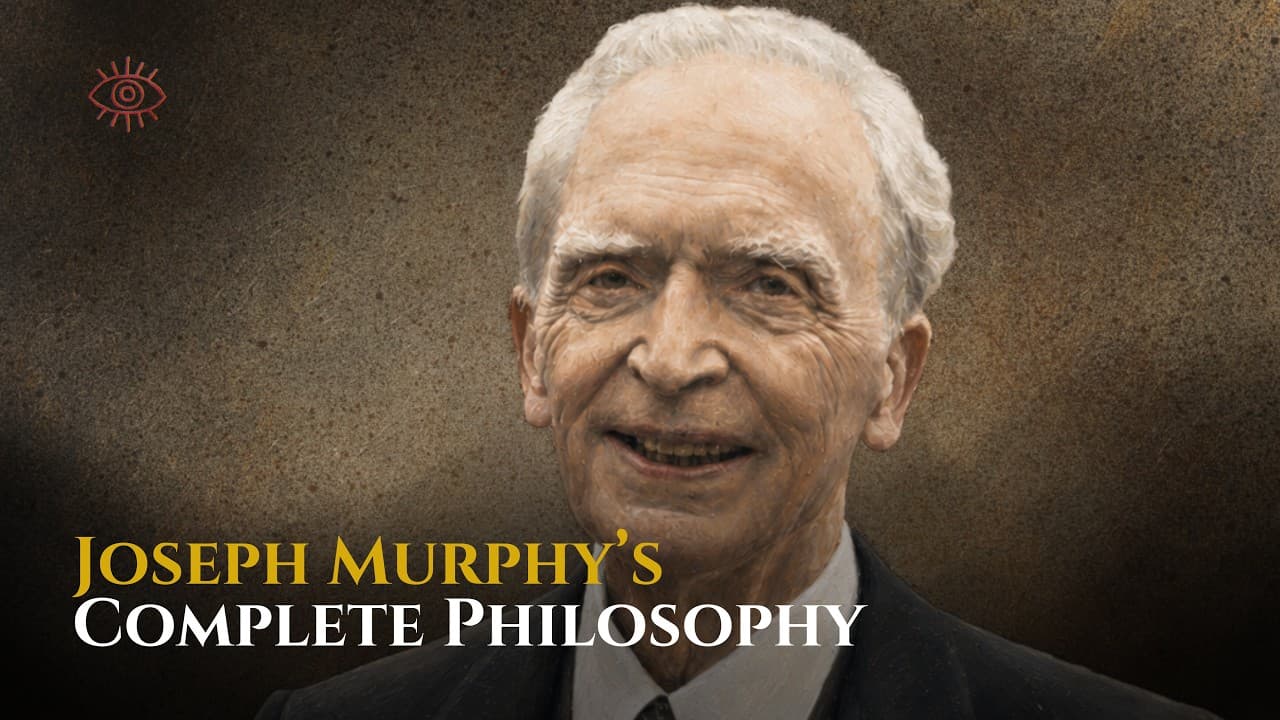
The Man Who Turned Prayer Into a Technique | Joseph Murphy Complete Philosophy for Sleep
An Irish boy left the priesthood, crossed an ocean, and built a new faith out of the human mind.
This is the story of Joseph Murphy, the Irish-born minister whose single book on the subconscious mind has sold in the millions and has never left print. We begin with the boy who trained for the priesthood and lost his faith, the chemist who crossed an ocean, and the quiet preacher who found in a New York congregation a new American religion of the mind.
From there we trace the tradition he inherited, the British judge whose ideas he carried, and the simple, startling model of two minds at the center of his teaching. We follow his redefinition of prayer, his practice at the threshold of sleep, his promises of health and wealth, and the impersonal God he made out of the God of his childhood. And we ask the hard questions in turn, whether the teaching is kind, whether it is true, and why, decades after his death, the world still cannot stop reading him.
The full episode is on YouTube and Spotify. Please listen only in safe, restful contexts.
Enjoying the episode?
Occasional letters on philosophy, reading, and the examined life. No spam, ever.
By subscribing you consent to receiving occasional emails. Unsubscribe any time via the link in every email or at /unsubscribe.
Timestamps
- 0:00:00Chapter 1: The Boy Who Left the Priesthood
- 0:10:42Chapter 2: The American Religion of the Mind
- 0:18:11Chapter 3: The Judge Who Weighed the Soul
- 0:24:34Chapter 4: The Gardener and the Soil
- 0:35:26Chapter 5: The Law of Belief
- 0:41:13Chapter 6: The Book That Would Not Die
- 0:52:42Chapter 7: Prayer Without a Listener
- 1:01:34Chapter 8: The Doorway of Sleep
- 1:07:27Chapter 9: The Body That Believes
- 1:14:57Chapter 10: The Heat of Conviction
- 1:21:32Chapter 11: The Promise of Plenty
- 1:28:47Chapter 12: Rewriting the Self
- 1:39:45Chapter 13: What Became of God
- 1:47:29Chapter 14: The One Mind
- 1:54:04Chapter 15: When the Law Fails
- 2:02:38Chapter 16: How Would We Know
- 2:12:44Chapter 17: The Minister at His Desk
- 2:19:07Chapter 18: The Long Afterlife
For the record
Full Transcript
Chapter 1: The Boy Who Left the Priesthood
There was a young man in the south of Ireland who had given himself to the Catholic Church. He was set on the priesthood, raised in a house where the faith was the air the family breathed, and he had studied toward it with the seriousness of a boy who meant to spend his whole life inside that calling. And then he walked away from it. He turned from the faith he was born into and never went back. The strange thing, the thing worth holding onto from the very start, is that the man who abandoned one faith would spend the rest of his life building another. Not a faith in God as he had been taught God, but a faith in the mind.
He was born in eighteen ninety-eight, in County Cork, in the south of Ireland. It was a quiet, rural, deeply Catholic part of the world, a place of small towns and long Sundays, where the Church stood at the center of every life and the priest stood near the center of every town. His family was devout, with the ordinary serious devotion of Irish Catholics at the close of the nineteenth century, and into that devotion he was raised without question. His father, by the accounts that survive, was an educator, a schoolmaster, a man whose living was made in teaching and whose household therefore valued learning alongside belief. So the boy grew up with two inheritances at once. He had a faith that asked for obedience and a respect for study that asked for thought, and the tension between those two things would shape everything that came after.
He moved, in the natural way of such a household, toward the priesthood. What exactly happened there is not perfectly recorded, and it is better to be honest about that than to invent a clean story. He studied for the priesthood. Whether he left the seminary before he was ever ordained, or was ordained and only later turned away, the sources do not agree, and it would be dishonest to pretend otherwise. What is certain is the shape of the thing. He had committed himself to the religious life, he went a long way down that road, and at some point the belief that had carried him there gave way beneath him. He lost his faith, or perhaps he simply found that he could no longer hold it, and he stepped out of the life he had been preparing for. For a young man of that time and that place, this was not a small adjustment. It was a break with his upbringing, with the expectations of his family, with the entire world that had formed him.
He turned, instead, toward science. He trained in chemistry, the most concrete and testable of disciplines, a field where a claim is proven at the bench and nowhere else. There is something fitting in that turn, a young man who had lost his certainty about the unseen reaching for a kind of knowledge you could weigh and measure and repeat. By his own later account he studied chemistry in the years around the First World War, and chemistry would give him a trade, a way to make a living that had nothing to do with the altar he had left behind.
In nineteen twenty-two he emigrated to the United States. He was a young man in his middle twenties, leaving behind the country, the family, and the religion that had made him, and crossing the ocean to a city that owed him nothing. He settled in New York. There, his training in chemistry found its ordinary use. He worked as a pharmacist, a chemist behind a drugstore counter, measuring out remedies for strangers, weighing powders, filling prescriptions, spending his days among the small ailments and small hopes of the people who came through the door. It is a plain and almost humble picture, the immigrant in his white coat behind the counter, and nothing in it announces the writer and preacher he would become.
But it was in New York that the second turn of his life arrived. He encountered the loose American current of belief that went by the name of New Thought, a way of thinking about the mind and its power that was unlike anything in the Catholicism of his childhood and unlike anything in the chemistry of his trade. He found it through a particular congregation, a New York church in that tradition, where a fellow Irishman preached to large and devoted audiences. What he heard there caught hold of him and would not let go. The man who had abandoned one faith and taken up the cool certainties of science now found a third thing, an idea about the inner life that promised both the consolation he had lost and the lawfulness he had come to trust. It redirected the whole course of his life. The details of that movement and the men who made it will come later. What matters here is only that, behind a drugstore counter in New York, Joseph Murphy found the thing he would give the rest of his years to.
In time he left New York and the East Coast behind and went to the other side of the country, to Los Angeles, a city that in those years drew seekers and new religions the way the older cities drew immigrants. There he became the minister of a Divine Science church, and he led that congregation for many years, for decades, across the long middle stretch of his life. This was his pulpit and his base. From it he lectured, he counseled, he built a following, and he began, slowly at first and then in a flood, to write. The work he did in Los Angeles was the engine of everything else, and he stayed at it with remarkable steadiness through the nineteen forties and fifties and on into old age.
His private life, in those years, held its own losses. He married, and his first wife, whose name has not come down to us with any certainty, died. By the reports that survive, her death came in the middle nineteen seventies, after he was already an old and famous man. He married a second time, a woman named Jean, who had worked closely with him. Her part in that work, the way she labored at his side, will be told later. Here it is enough to mark the simple human facts, a marriage, a death, a second marriage, set against the long industry of his public life.
And that industry was enormous. Over the course of his career he wrote more than thirty books. They are short, plain, practical books, and they circle the same handful of ideas again and again, ideas about the mind, about prayer, about health and money and fear, turned and re-turned across title after title. He was not a man of one masterpiece and a long silence. He was a man who wrote and wrote, who produced volumes the way his father might have set lessons, steadily, year after year, until the catalogue ran to dozens. Most of them sold modestly and would be forgotten if not for the one that did not.
For in nineteen sixty-three came the book that changed his standing entirely. It was his book on the subconscious mind, a slim volume of around two hundred pages, brought out by a New York publisher, and it did what none of his other books had done. It found an audience that kept growing. It sold in the millions. It went on selling, year after year, decade after decade, and it has never gone out of print. With that one book the obscure Los Angeles minister became a name that strangers knew, a fixture of a whole shelf of popular thought, and the fame that arrived in nineteen sixty-three never left him. Everything he had been quietly preaching for years was suddenly in the hands of readers all over the world. The book itself, how it was made and why it endured, will be taken up on its own later. Here it is simply the hinge, the moment the private minister became a public phenomenon.
He kept working into his old age, kept writing and lecturing as the books accumulated through the nineteen sixties and seventies. Late in his life the ministry moved to Laguna Hills, in California, a quieter place for a man now in his eighties. And it was there that he died, in December of nineteen eighty-one, at the age of eighty-three. The boy from County Cork who had trained for the Catholic priesthood and lost his faith ended as an old man in the California sun, the author of more than thirty books and one that the world would not stop reading.
It is worth pausing, before the ideas begin, on the whole arc of it. A life that started inside one faith and ended inside another. A man who set out to be a priest, became a chemist instead, and finished as a kind of preacher after all, though of a gospel his childhood Church would not have recognized. There is a thread running through the whole of it that is easy to miss and important to see. He never stopped being a man who wanted to believe, and who wanted that belief to be true in some testable, dependable, almost mechanical way. The Catholicism gave him the hunger for the unseen. The chemistry gave him the demand that things behave by law. And the faith he built in his American years tried, in its own way, to satisfy both at once, an account of the inner life that spoke of miracles and of laws in the same breath.
Whether that combination holds together, whether it is true, whether it is kind, whether it helped the people who trusted it or quietly harmed some of them, these are the questions the rest of this story has to face. They cannot be answered yet. For now there is only the life itself, the priest who never was, the chemist who crossed an ocean, the quiet minister who became, against all reason, one of the most widely read teachers of his century. The man who left one faith had spent his whole life building another. The question of what exactly he built is where we begin.
Chapter 2: The American Religion of the Mind
Joseph Murphy invented almost nothing. The most useful thing one can say about the man who would sell millions of copies of a book on the mind is that nearly every idea in it was already old when he wrote it down. It had been worn smooth by three generations of American teachers and healers who had said much the same thing in much the same words. He did not discover the power he spent his life describing. He inherited it. What he inherited was a peculiarly American faith, a conviction that took root in the nineteenth century and never quite let go, that the mind heals the body and shapes the world, and that the cure for almost any human trouble is a change of inner conviction. To understand him at all, we have to understand the country of thought he walked into, because he was its child far more than its author.
That country had a name, or rather a loose family of names, gathered under the banner of New Thought. It was never a single church with a single creed. It was a movement, a temper, a shared optimism that spread through lecture halls and pamphlets and small congregations across America from the years after the Civil War onward. Its central wager was simple and enormous. Matter is not master. The mind that thinks is prior to the body that suffers, and a person who corrects his thinking can correct his life. This was the great American mood of the age of progress turned inward, the same confidence that built railroads and raised cities, now applied to the private interior of a single human being. If the country could be remade by will and machinery, so, the teachers said, could a man.
The fountainhead was a clockmaker from Maine named Phineas Quimby, who lived from eighteen oh two to eighteen sixty-six, and who, without a medical degree or a theology, became the most consequential healer of his century. Quimby came to believe, through years of working with the sick, that disease was very often a matter of mistaken belief, and that if he could change what the patient was persuaded of, the body would follow. He was no philosopher and left little finished writing, only notebooks and the memory of his cures. But almost everything that came after flowed from that spring in Maine. Murphy stands very far downstream of Quimby, separated by half a century and an ocean. The connection between them is not personal but a matter of lineage, the way a river town is connected to a distant mountain it has never seen.
From that single source, several distinct streams ran out, and it matters to keep them apart. One of them was Christian Science, the church built by Mary Baker Eddy, who had been Quimby's patient and drank from the same well before founding a movement entirely her own. Christian Science shares the Maine root, but it broke away into its own rigorous and self-contained church, with its own scripture and its own discipline, and it is best understood as a cousin to Murphy's world rather than his home. He did not belong to it. A second stream was Unity, the gentle and enduring movement founded by Charles and Myrtle Fillmore, a sibling branch of the same family, prayerful and practical and beloved, but again not the tradition in which Murphy himself was made.
His own denomination was a third stream, called Divine Science, and it deserves its founders' names. It was brought into being by Malinda Cramer, who began teaching in San Francisco in the middle of the eighteen eighties, after what she described as her own healing. In the same years it was carried forward by Nona Brooks in Colorado, working alongside her sisters Fannie and Alethea. Out of their labor came a college of Divine Science in Colorado in eighteen ninety-eight, and a church in Denver the following year. These were largely women, building a working theology of the indwelling power in parlors and rented rooms, and the movement they made would, decades later and a continent away, become the church Murphy served. The American religion of the mind, for all its talk of cosmic power, was often a homemade and domestic thing, assembled by a clockmaker, a few sisters, and a scattering of ordinary people who had been ill and believed themselves cured.
There was one more figure, and for the young immigrant who had just crossed from Ireland he mattered most of all, because Murphy could actually hear him. His name was Emmet Fox, an Irish-born preacher who lived from eighteen eighty-six to nineteen fifty-one, and who, from the early nineteen thirties, filled one of the largest congregations in New York. Fox was a Divine Science minister, and his church, the Church of the Healing Christ, drew enormous crowds through the worst years of the Depression. Thousands of frightened people came to hear a confident voice tell them that their circumstances were not final, and that the mind could remake the world that had broken them. Into those pews, in those years, came the newcomer Murphy, a chemist behind a counter by day and a seeker by night, and there he found a living example of the thing he would spend his own life doing. One Irishman watched another, and learned.
It is hard, from a colder and more ironic century, to recover how genuinely hopeful all of this was. These were not cynics selling comfort. They were the heirs of a national optimism so deep it amounted to a faith, the belief that the universe was friendly, that the human being was not a worm but a spark of a greater intelligence, and that suffering was a problem to be solved rather than a fate to be endured. They had watched their country conquer distance with the telegraph and the railway, and they could not believe that the inner life alone would remain stubborn and dark while everything outside grew bright. So they turned the optimism inward and called it law. They said that thought was a force as real as steam, that the mind obeyed principles as dependable as the principles of chemistry, and that anyone willing to learn those principles could heal and prosper and be free.
That was the air Murphy breathed before he wrote a single line of his own. The healer in Maine, the cousins and the siblings of the movement, the sisters in Colorado, the great preacher in the New York pulpit, all of it was already there, a finished tradition waiting for a clear and patient voice to gather it up and speak it plainly to the ordinary person at the end of a hard day. His genius, if the word fits, was never invention. It was inheritance, and the gift of saying an old American faith so simply that millions who had never heard of Quimby or Cramer or Fox would feel they were hearing something new.
Chapter 3: The Judge Who Weighed the Soul
Behind Joseph Murphy stands a man he never met, and the largest of his intellectual debts is owed to a retired colonial judge named Thomas Troward. The whole architecture of Murphy's teaching, the deeper mind that receives an impression and returns it as a condition of life, is borrowed, refined, and handed down. Troward was the one who gave it a shape that could be argued. He took the soft, hopeful talk of the mind-cure movement and tried to make it into something with joints, something a serious person could examine. It is fair to say that what Murphy preached for fifty years was, in its bones, Troward's thought translated into the plain speech of a self-help manual.
Troward was born in eighteen forty-seven in the Punjab, in British India, the son of British parents, and he was sent home to England to be educated. He spent the larger part of his working life back in India, serving about a quarter of a century as a judge in the Indian Civil Service, weighing testimony, sifting one man's account against another's, deciding where the truth most likely lay. He retired in eighteen ninety-six, a man of middle age with a settled mind and a settled income. Then he did the strange and quiet thing that makes him interesting. He turned the same habit of weighing evidence, the habit of a lifetime on the bench, onto the deepest questions of the mind and the spirit. He read, he thought, and at last he lectured. His lectures on mental science appeared as books in nineteen oh four and in a later course in nineteen oh nine.
His central idea was simple to state and difficult to exhaust. There is a deeper layer of the mind beneath the reasoning surface, and this layer does not reason at all. Troward called it the subjective mind, and he held that its defining quality was suggestibility. It receives. It takes the impress of whatever the upper, conscious mind hands down to it, much as soft wax takes the shape of a seal, and then it sets to work bringing that impression into form. The conscious mind chooses and judges and decides. The deeper mind, having no power of choice, simply accepts the verdict and obeys. Murphy would later build his entire model of the two minds on exactly this division. Here the point is only that the division began with Troward.
What made Troward more than another enthusiast was the word he kept returning to. Law. He insisted that the mind does not work by miracle, by special favor, by the breaking of nature's order on behalf of a chosen petitioner. It works by an impersonal principle, as reliable and as indifferent as the principle that water finds its level or that like causes bring like effects. The deeper mind does not love you and does not punish you. It answers the impression it is given because that is its nature, the way a faithful instrument answers the hand that plays it. This was the great gift, and it was double. He gave the movement a system, a set of claims that hung together and could be reasoned about. And he gave it a kind of dignity, the dignity of a thing that obeys a law rather than begs for an exception. To a man trained in the courts, lawfulness was the highest compliment one could pay to any part of the world, and he paid it to the mind.
The dignity mattered because it changed what the believer was asking for. Under the old picture, the supplicant pleaded with a personal power outside himself and hoped to be heard. Under Troward's picture, there was nothing to plead with. There was a law to be understood and then used, an order already in place that asked only to be cooperated with. This is the germ of the impersonal divinity that Murphy would later make his own, the God who is less a person than a principle, a transformation with its own depths and its own costs. For now it is enough to see that Troward had already drained the supernatural out of the transaction and left behind something that looked, at least to its admirers, like the workings of a natural science of the soul.
Now comes the fact that must be held carefully, because the legend constantly threatens to swallow it. Murphy never sat at Troward's feet. The two men never met, never corresponded, never shared a room. Troward died in nineteen sixteen, when Joseph Murphy was eighteen years old and still in Ireland, a young man who had not yet crossed the ocean and had not yet found the movement that would claim his life. Whatever passed between them passed entirely through the printed page. Murphy read the books, perhaps for the first time only years later in America, and the books did the teaching. There was no master and no apprentice, only a reader and a writer separated by a generation and by death. To call Troward Murphy's teacher in any closer sense than this is to invent a discipleship that history does not record.
And yet the debt is real, perhaps the deepest single debt in the whole story. Strip away Murphy's warmth, his anecdotes, his tireless reassurance, and what remains at the center is the judge's cool proposition, that the deeper mind is a lawful, suggestible power which gives back the impression it receives. Murphy took that proposition and carried it to millions who would never have opened a lecture on mental science. He was the popularizer. Troward was the architect. The one built the structure in the quiet of his retirement, weighing each claim as he had once weighed evidence. The other furnished it, lit it, and threw open the doors. We cannot understand the warmth of the second man without first acknowledging the cold precision of the first.
Chapter 4: The Gardener and the Soil
Murphy's whole system rests on a single claim about the architecture of the mind. There are not one mind but two, working together yet obeying different laws, and nearly everything a person becomes turns on understanding the difference between them. The first is the mind we know best, the waking, reasoning mind, the one that reads these words and weighs them, that chooses between the morning coffee and the morning tea, that argues, doubts, decides, and remembers having decided. The second is older, deeper, and almost entirely silent. It does not reason. It does not argue. It does not choose. It receives. And what it receives, it sets to work upon, faithfully, tirelessly, without ever once pausing to ask whether the thing handed to it was wise.
The conscious mind, in Murphy's account, is the part that thinks in the ordinary sense. It gathers evidence through the five senses, it compares, it judges true against false and good against harmful, and it reaches conclusions. It is the part that says no. Above all, in his picture, the conscious mind stands at a gate. It is the watchman, the one who inspects what approaches and decides what to admit and what to turn away. When a fearful thought arrives, the conscious mind can examine it, test it against the facts, and dismiss it as groundless. When a hopeful idea arrives, the conscious mind can entertain it, dwell on it, and let it through. This power of selection is, for Murphy, the only freedom we truly have. The whole drama of a life is played out at that gate, in the small unnoticed decisions about which thoughts to keep and which to let go.
The deeper mind behind the gate is a different kind of thing altogether. Murphy calls it the subconscious, and he insists with great firmness that it has no power to reject. It takes whatever passes the watchman and treats it as an instruction. It does not distinguish between a thought that is true and a thought that is merely repeated. It does not separate what we want from what we fear, for both arrive as vivid mental pictures and both are accepted with the same blind obedience. This is the heart of the model and the source of all its hope and all its danger. The conscious mind reasons and the subconscious does not. The conscious mind weighs and the subconscious only works. Whatever the one believes long enough and deeply enough, the other carries out.
To make this graspable, Murphy reached for the oldest image in human work, the image of the garden. The deeper mind, he said, is like rich soil, and our thoughts are like seeds. A gardener walks the rows and presses seed into the ground, and the ground does not deliberate. It does not hold back the weed and favor the rose. It does not test the seed for worthiness before it begins. It simply receives whatever is planted and lends its whole dark fertility to growing it. Plant a seed of wheat and the soil grows wheat. Plant a seed of nightshade and the soil grows nightshade with exactly the same patience and the same generosity. The earth has no opinion about what it is asked to grow. It only grows. And so, in this picture, does the mind beneath our awareness.
The force of the image lies in what it removes. There is no judgment in the soil, and there is no judgment in the deeper mind. We are accustomed to imagining some inner sentinel that protects us from our worst thoughts, some wisdom in the depths that filters out the harmful and nurtures only the good. Murphy denies this flatly. The depths are not wise in that way. They are powerful and they are loyal, but their loyalty is indiscriminate. A thought of poverty, held with conviction, is planted as surely as a thought of plenty, and the same fertile ground brings it to fruit. A persistent fear is a seed like any other. The deeper mind cannot tell that we did not mean it, that we were only worrying, that we would take it back if we could. It has already begun to grow what we gave it. This is why, in Murphy's view, the only safe place to stand watch is at the gate, in the conscious mind, before the seed is ever in the soil. Once a thought has been received below, it is no longer a matter of opinion but a matter of harvest.
It is the conscious mind, then, that bears the gardener's responsibility, and the deeper mind that does the gardener's growing. The watchman chooses the seed. The soil makes it real. And the most quoted sentence Murphy ever wrote about this is also the most exact statement of the whole relation. Whatever you impress on your subconscious mind is expressed on the screen of space as conditions, experiences, and events. Notice the verbs, for they carry the doctrine. We impress, as a seal is pressed into wax or a footprint into wet ground, and the depths express, casting outward what was pressed in. The inner impression becomes the outer condition. Every thought is a cause and every condition is an effect. There is no gap in the chain where the deeper mind might intervene to spare us. It only completes what we began.
What is this deeper mind, considered not as a power to be used but simply as a part of us that does its work whether we attend to it or not. Here Murphy listed its offices, and it is worth naming them once, plainly, as functions rather than as instructions. The deeper mind is the keeper of habit. The thousand actions we perform without thinking, the way we walk, the route we drive without recalling the turns, the gestures and phrases that are unmistakably ours, all of these were once learned by the conscious mind and have since sunk below it, where they run on their own. It is the storehouse of memory, holding far more than we can ever call up at will. It keeps the face from childhood, the smell of a particular kitchen, the whole vast record of a life kept somewhere out of sight. It governs the body's automatic work, the beating of the heart that asks no permission, the slow labor of breath through the night, the healing of a wound, the long patient processes that continue while the waking mind sleeps or attends to other things. And it is the seat of emotion, the place where feeling rises unbidden, where a mood settles over a morning for no reason the conscious mind can name. Habit, memory, the body's quiet machinery, and the tides of feeling, these are not skills to be acquired. They are simply what the deeper mind already does, the proof that such a mind exists and is always at work.
When the offices are laid out this way, the model gains a strange plausibility, because each of these is genuinely a thing we do without conscious decision. No one chooses to remember, the memory arrives. No one wills the heart to beat, it beats. We recognize at once that a great part of our existence is conducted below the level of choice, by a faculty that received its instructions long ago and has been executing them ever since. Murphy's boldness was to say that this same receiving and executing faculty governs not only the inward life of habit and feeling but the outward life of circumstance as well. The conditions of a life are themselves a kind of habit grown from seed, expressed on the screen of space exactly as a heartbeat or a memory is expressed within.
The model is also, for all its strangeness, deeply democratic, and part of its long appeal lies there. It asks no special gift. It does not depend on intelligence or learning or virtue, only on what one consistently impresses on the soil within. The gate stands open to every person equally. The watchman is on duty in the simplest life as much as in the most accomplished. This is why Murphy could address his teaching to anyone, the clerk and the executive alike, for the law he described made no distinctions of station. The deeper mind in a poor man and a rich man works by the same indifferent fidelity, growing whatever each has planted.
Much of this Murphy did not invent. The idea of a deeper mind that takes the impress of the waking mind and creates from it came to him most directly from the British writer Troward, who gave the notion its first half-philosophical frame. Murphy's contribution was less the discovery than the simplification, the carrying of an abstract doctrine of mental science down into the plainest possible language and the homeliest possible image, the gardener kneeling in the dirt. What had been a system for the study became, in his hands, a model a person could hold in mind while standing at a kitchen sink.
What the model does not yet tell us is how the impressing is to be done, by what means a thought is pressed deeply enough to take root rather than merely flitting across the surface and vanishing. Murphy had a great deal to say about that, about the disciplines of attention and the moments when the gate stands most loosely guarded. The two minds are only the ground on which everything else is built. For now it is enough to have the architecture clear. One mind that reasons and stands guard, and one mind that does not reason but accepts. A gardener who chooses the seed, and soil that grows it without judgment, faithfully, into the visible conditions of a life. Everything Murphy ever taught is an elaboration of that single division, and a meditation on the responsibility it lays upon the watchman at the gate.
Chapter 5: The Law of Belief
Beneath every method Murphy ever taught, beneath the affirmations and the bedtime exercises and the long shelf of books, there sits a single principle that the whole structure rests upon, and it is simpler and stranger than any of the techniques built on top of it. The principle is this. What matters is not the thing you believe in, but the bare fact that you believe. The deeper mind, Murphy insisted, does not weigh the truth or worth of an idea before acting on it. It answers conviction itself. It responds to the strength of a settled expectation, not to the merits of the object that expectation happens to be aimed at. Murphy gave this principle the most compact name he could find. The law of life is the law of belief.
Read slowly, that sentence is more radical than it first sounds. It does not say that good beliefs produce good lives and false ones produce ruin, as a moralist might say. It says that belief, as such, is the engine, and that the engine runs the same way whether it is harnessed to a truth or to an error. A man convinced he will fail, in Murphy's account, is obeyed by the same faithful power that obeys the man convinced he will succeed. The deeper mind is not a judge of the case but a servant of the verdict, and it carries out whatever verdict the conscious mind has already handed down. This is why Murphy returned, again and again, to a second wording that he treated almost as a refrain. It is done unto you as you believe. Not according to what is real, not according to what is deserved, but according to what is held with conviction in the quiet rooms of the mind.
To make the abstraction touch the ground, Murphy reached for the one example that nobody in his audience could dismiss, because everybody had lived it. Consider the sick patient and the bottle of medicine. Two people take the same compound, in the same dose, for the same complaint. One of them trusts the remedy completely, has been told by a physician he respects that it will work, and swallows it expecting relief. The other takes it in doubt, sure that nothing will help, and braces for disappointment. The substance is identical in both bodies. Yet the trusting patient, Murphy observed, often improves where the doubting one does not, and the only thing that has changed is the expectation each one carried into the act. For Murphy this was not a curiosity at the edge of medicine. It was the law itself, caught in a clean and ordinary instance. The medicine, he would say, did not do the healing alone. The belief in the medicine did a share of the work, and where the belief was absent the same chemical could lie inert.
He drew from this the conclusion that carries the whole weight of it. The active force, the thing that actually moves, is the belief and not its object. The bottle is a focus for conviction, a place to set the expectation down so that the deeper mind can take hold of it, but the bottle is not finally what cures. Strip away the particular remedy and the principle remains. Whatever a person can be brought to believe with the same unguarded confidence will be taken up by the same power and worked toward the same kind of result. The form is incidental. The faith is essential.
It is worth being precise about what this does and does not claim, because the precision is where the doctrine lives. Murphy is not saying that wishing makes things so, in the loose way the phrase is usually meant. He is saying something narrower and more mechanical. He is saying that within the system of the two minds, the deeper one accepts the impress it is given and brings it to pass, and that the conscious mind's only real power lies in choosing, deliberately, what conviction to hand down. Belief, in this scheme, is not a feeling that floats above events. It is a cause set in motion, and like any cause it has effects whether or not anyone approves of them. That is the unnerving part, the part that the doctrine presses hard against. If belief is the engine, then nothing protects a person from the consequences of believing the wrong thing well, and nothing exempts a true belief held weakly from coming to nothing.
Murphy himself did not dwell on the dark side of his own principle. He stated the law with the confidence of a man announcing good news, and for him it was good news, because if the bare act of believing is what works, then the power was available to anyone who could learn to govern his own convictions, no priest required and no special grace withheld. The medicine that heals the trusting patient is, in this telling, only a small picture of a power that reaches into health and money and circumstance alike, always by the same route, always answering the same question, which is never what do you believe in but only how firmly do you believe it. Everything that grows out of his thought, the redefined prayer, the work done at the edge of sleep, the cures and the promises of plenty, is an attempt to take this one law and put it deliberately to use. The law came first. The law of life, he said, is the law of belief, and it is done unto each of us as we believe.
Chapter 6: The Book That Would Not Die
In nineteen sixty-three a New York publisher working from its offices in New Jersey issued a slim volume of about two hundred pages, and that small book outlived its author, its publisher's first intentions, and very nearly the century itself. It is a book that would not die. By the time its author reached his middle sixties he had been preaching the same handful of ideas for decades, from a Los Angeles pulpit, over the air, and across more than thirty earlier titles that few outside his own circle remembered. What he had not yet done was gather all of it into one place, in plain words, between two covers a stranger could buy in a drugstore and finish in a single evening. That is what this book did, and that is why it became the one title from his whole long shelf that the world kept in its hands and would not set back down.
We should pause on that act of gathering, because it is the real event behind the publication. He had been a working minister and a working writer for years, scattering his message across pamphlets, lectures, and books with overlapping titles and overlapping contents, each a partial restatement of the one thing he believed. None of them had truly broken through. Then, late, he produced the consolidation, the single book in which the whole teaching was set down in order, stripped of repetition, arranged so that a reader meeting it for the first time would need nothing else. It crystallized a lifetime of preaching into one instrument. Whatever was diffuse in the sermons and scattered across the earlier volumes was here pressed into a hard, portable shape. The book did not contain a new idea. It contained the old idea, finally and completely assembled, and that assembly was itself the achievement.
Consider next what kind of object it is. It is short, and its shortness is part of its genius. Two hundred pages is the length of a single sustained argument, not an encyclopedia, and a reader could carry it in a coat pocket and read it on a train without once feeling the weight of a system being imposed. The prose is unadorned to the point of bareness. There is no thicket of citation, no philosophical apparatus, no demand that the reader first master a vocabulary before the help arrives. Everything he had absorbed from the deeper tradition behind him was rendered here into plain speech. There was the long American faith in the healing power of the mind, the borrowed architecture of the conscious and the deeper mind, the single law of belief he had spent his life restating, and all of it was set down in language a tired person could take in at the end of a working day. The book does not argue with the reader. It assures the reader. Its sentences have the cadence of a man who has answered the same question a thousand times and no longer needs to raise his voice to be believed.
In its shape the book is a manual. That word matters, because it tells us what the book was for and why it found the readers it found. It is not a memoir of his own life, which it scarcely mentions, and it is not a treatise that sets out to persuade the unconvinced through chains of reasoning. It is a how-to, organized like a set of instructions, moving from the statement of the principle to the application of the principle, one area of life after another. Health, money, marriage, sleep, forgiveness, fear, the loss of a loved one, the search for the right work, each is given its own treatment, its own short chapter, its own promise that the one method will answer here exactly as it answered there. A reader in trouble did not have to read the whole thing in sequence. He could open to the section that named his particular affliction and find, waiting there for him, the assurance that there was something he himself could do about it. The book is built to be entered at any point, the way a reference shelf is built to be entered, and that hospitality toward the desperate reader who opens to one page is a large part of why it lasted.
What fills those pages, between the statements of principle, is a parade of stories. This is the book's most characteristic feature and its most effective one. On nearly every page some unnamed or barely named figure appears. There is the chemist, the woman with a skin condition no doctor could cure, the salesman who could not close his deals, the young man passed over for promotion, the mother estranged from a daughter, and each of them, having applied the method, is restored. The afflicted are healed. The poor grow prosperous. The estranged are reconciled. The stories are brief, almost interchangeable, and they arrive in such number that their sheer accumulation does the persuading that no formal argument is ever asked to do. The doctrine driving every one of these little narratives is the principle that belief itself shapes the conditions of a life, and the book of course teaches it in full, but our concern here is the literary device, not the claim it carries. He understood, as a preacher understands, that one vivid testimony moves an ordinary reader more than a page of reasoning, and that a hundred testimonies bury doubt beneath their own repetition. The case story is the engine of the book, and he ran that engine without pause from the first chapter to the last.
It is worth marking how unusual this made the book within his own output. The catalogue of his other titles is long and repetitive, variation after variation on the single theme. There are books on riches, books on prayer, books on healing, books on the powers of the mind, each promising in its title some fresh amazing law or hidden dynamic. They sold modestly and they aged quietly. This one book, by contrast, somehow caught the exact balance of brevity, breadth, and plainness that the others missed, and it carried away on its own back a popularity none of its siblings ever knew. A man who wrote so much is remembered, by the wide public, for one slender volume, and the rest of the shelf survives mostly as a footnote to it. There is no obvious reason why this title and not another should have been the one. Its subject was no broader, its prose no finer, its author no more famous when it appeared. Yet something in the combination took hold, and the consolidation succeeded where all the scattering had failed.
We should be honest about why a book of this kind reaches the hands it reaches. It found the reader who was suffering and who had run out of remedies he could afford. It found people who were sick and frightened, people sunk in debt, people whose marriages were quietly failing, people who felt that life had been arranged against them and who could not pay for a long course of treatment or the counsel of an expensive specialist. To all of them the book offered the same thing, and it offered that thing cheaply. It offered the news that the power to change their circumstances lay already inside them, that it required no money and no credential and no one's permission, that it was available tonight, in their own bed, at no cost. Whatever one finally concludes about whether that news is true, and there will be a time to weigh exactly that, it is not difficult to see why it sold. A promise of that kind, made plainly to people in pain, does not have to be true in order to be wanted. It has only to be believed long enough to be pressed into another pair of hands.
And pressed along it was. The book sold in the millions and it has never gone out of print. That is a rare sentence to be able to write about any book, and rarer still about a book of this modest kind, neither great literature nor recognized science, written by a man with no academic standing the scholarly world would honor. Generations of readers have bought it, worn it out, lent it, lost it, given it away, and bought it again. It has migrated from hardcover to paperback to the cheapest mass-market editions and on into recorded voice, surviving every change in how books are made and sold, because the demand beneath it never receded. There will always be more frightened and hopeful people than there are answers for them, and the book speaks straight to that perennial audience. Its endurance is not the endurance of a classic studied in the universities. It is the endurance of a thing that keeps proving useful to ordinary people in trouble, which is a humbler and in some ways a more stubborn kind of life than literary fame.
Its place in the self-help canon is therefore secure, and a little peculiar. He did not invent the genre, and his book stands among the other great mid-century manuals of confidence and prosperity that taught Americans the mind could be marshaled toward success and well-being. But within that crowded shelf his volume holds a particular position, because it is perhaps the purest distillation of the whole mental-healing tradition into pocket-sized practical form. It is the book that took a long current of nineteenth-century American optimism, refined through a chain of preachers and writers who came before him, and reduced it to a single accessible instrument an unschooled reader could pick up and put to work without ever knowing the history behind it. Later movements would borrow its assumptions, repackage its promises, and sell them again to new generations under new names, and there will be a time to trace that long afterlife. The book itself remained, underneath all the later imitations, quietly and continuously in print, the original plain manual from which so much was copied.
There is something almost paradoxical in all of this. A man who had written more than thirty books, repetitive variations on one idea, is remembered by the world for the one in which he said it most simply and most briefly. The shelf of his other titles thinned and faded, while this single volume thickened into a permanent fixture of the publishing trade. He had spent years saying the same thing in many forms and many places. In nineteen sixty-three he at last said it in the form that would not let the world put it down, and the book, having gathered his whole life's preaching into two hundred unhurried pages, went out into the hands of strangers and simply refused to die.
Chapter 7: Prayer Without a Listener
Prayer, in Murphy's hands, ceased to be a message sent upward and became a method turned inward. He kept the word, with all its old solemnity, and emptied it of its old assumption. There is no listener bending an ear from above, no judge of requests deciding which to grant and which to deny, no bargaining with a power that might be moved by sincerity or worn down by repetition. There is only the deeper mind, and the work of impressing upon it what one wishes to become true. He called this scientific prayer, and he meant the adjective seriously, as a claim that the thing could be done by rule, that it followed a procedure as reliable as the steps a chemist follows at his bench, and that anyone who applied the procedure correctly would get the result, whether or not he believed in heaven, whether or not he believed in anything at all beyond the law itself.
The word scientific did a great deal of quiet labor for him. It announced that prayer was not a mood, not a hope flung at the sky, not the desperate improvisation of a frightened person who has run out of other options. It was a technique, with parts that could be named and learned and practiced and got wrong. A petition assumes an audience and an authority, someone who hears, weighs, and decides. Scientific prayer assumes neither. It assumes only the law of belief, already named, the principle that the deeper mind accepts and then enacts whatever is genuinely impressed upon it. Prayer, on this view, is simply the deliberate art of impressing it on purpose, rather than letting the day impress its accidents and its fears at random. The difference between the man who prays scientifically and the man who merely worries is not that one is heard and the other ignored. It is that one has taken the controls and the other has left them to chance.
The simplest of his methods was the affirmation. One settles on a single short statement of the thing desired, phrased as though it were already so, and one repeats it, quietly and without strain, until the deeper mind takes it as a settled fact rather than as a wish. The point of the repetition is not to inform some listener, who would need to be told only once, nor to nag a reluctant power into yielding. The point is acceptance. A statement said once and doubted leaves no impression. A statement returned to again and again, calmly, until the mind stops arguing with it, sinks below the level of argument and becomes a premise from which the mind then proceeds. Murphy was insistent that the affirmation must not contradict what the person actually feels, for a sentence the mind silently denies in the very act of saying it impresses nothing but the denial. The words are a vehicle. What rides in them is conviction, and conviction, the felt certainty rather than the spoken syllables, is the active ingredient in everything that follows.
The second method asks the mind to see rather than to say. One pictures the wish already granted, in concrete and particular detail, as a scene rather than a slogan. A man who wants a house does not repeat that he will have a house. He walks through its rooms in imagination, sets his hand on the railing, hears the door close behind him, until the picture has the texture of memory rather than the thinness of fantasy. Murphy held that the deeper mind does not distinguish sharply between a vivid imagined scene and a remembered real one, and that a picture entertained steadily, with the senses engaged, is taken by it as a description of reality and treated as a thing to be made to match. The visualization is not idle daydreaming, which drifts and dissolves and commits to nothing. It is a single chosen scene, held, returned to, allowed to grow solid, so that the mind begins to take the having for granted and to behave as a person behaves who already possesses what he wants.
The third method is stranger, and it was the one he prized. One gives thanks for the answer in advance, before any sign of it has appeared, in the tense and the tone of a man whose request has already been fully met. Gratitude is ordinarily a backward looking thing, our response to a good already received. Murphy turned it around and aimed it forward. To give thanks for a thing not yet visible is to assert, with the whole feeling of the self and not merely with the lips, that the thing is as good as done, that one is so certain of it that one has moved past asking into the settled ease of having. The thankful state, he taught, is itself a state of acceptance, perhaps the purest there is, because a person cannot feel genuine gratitude for what he still anxiously doubts. The thanksgiving was thus less a technique alongside the others than the emotional proof that the others had worked, the sign that the wish had crossed over from petition into possession somewhere beneath the level of words.
Running beneath all three methods was a single condition without which none of them would take, and that was the quality of the attention itself. The mind must be relaxed and the attention undivided. These are methods of ease, not of force. The will that clenches and strains, that tries to wrestle the result into being, defeats its own purpose, and Murphy warned against that effort again and again. What the methods ask for instead is a quiet, confident, single-minded holding of the one idea, the loosened and untroubled attention a person gives to something already certain rather than to something anxiously wanted.
What he had constructed, beneath the religious vocabulary he never abandoned, was a disciplined practice of suggestion turned upon oneself. The older science of the mind had long described how an idea, accepted without resistance, tends to realize itself in the body and the behavior of the person who accepts it, and how that acceptance can be deliberately induced. Murphy took that mechanism, the planting of a chosen idea in a mind made receptive, and dressed it in the oldest and most consoling word his listeners knew. To affirm, to picture, to give thanks in advance, to hold the relaxed and undivided attention, these were not four separate spiritual exercises but four doors into one room, four ways of arriving at the same end, which was a chosen conviction lodged below the reasoning surface where it could begin to operate. Prayer was suggestion turned upon the self, performed with reverence and called by its sacred name.
There is a strange dignity in this, and also a strange loneliness. The dignity is that nothing is begged. The man who prays scientifically is not a supplicant waiting on the whim of a higher power. He is a worker applying a law, and the law is no respecter of persons, granting nothing as favor and withholding nothing as punishment. The loneliness is that nothing is heard. The traditional believer kneels in the dark and trusts that across the silence someone is attending, that the words go somewhere and land on someone, that the universe contains at least one other listening mind. Murphy's prayer goes nowhere outside the self. It is a closed circuit, the conscious mind speaking to the deeper mind, the surface impressing the depth, the whole transaction sealed within the single person. He would have said this was no loss but a liberation, that the power once imagined as a distant deity had only ever been the deeper self all along, and that to pray to it was simply to learn to speak to oneself with authority. Whether that is a homecoming or an exile, whether a prayer that no one hears is still a prayer or has quietly become something else wearing the word like a borrowed coat, is a question the method itself cannot answer, because the method was built precisely to set such questions aside and get to work.
Chapter 8: The Doorway of Sleep
There is a narrow stretch of time, every night, when the mind is neither awake nor asleep, and Murphy taught that this is the hour when the deeper work is most easily done. He called it a threshold, a doorway, a drowsy borderland, and he returned to it again and again as the most favorable moment for the whole of his method. The waking mind, the one that reasons and weighs and stands at the gate, does not switch off all at once. It loosens by degrees. As the body settles and the breath lengthens and the room goes quiet, the part of us that argues and doubts begins to release its hold. In that loosening, Murphy believed, the deeper mind lies most open to whatever it is given.
His reasoning followed directly from the two minds, which need no fresh explaining here. The guarding mind, alert through the day, examines each suggestion and turns most of them away. It is the doubter, the critic, the one that says this cannot be so. But a guard cannot stay alert forever. As drowsiness comes on, the critic grows tired and careless, and the suggestions that it would have refused at noon slip past it at midnight almost without resistance. The deeper mind, which does not judge but only receives, is then unusually exposed. Murphy thought of the falling asleep state as a kind of unlocked door, and the moment just before sleep as the surest time to pass something through it.
So the practice he urged was the gentlest he ever described. One should choose a single quiet idea, a short settled phrase carrying the thing desired as though it were already true, and let the mind rest on it in the minutes before sleep. Not strained, not repeated with effort, but turned over softly, the way one might hum a few bars of a tune without quite meaning to. The phrasing should be brief, because a tired mind cannot hold a long argument, and it should be calm, because the borderland will not tolerate force. As the words grow faint and the thoughts begin to scatter and the listener slides down toward sleep, the idea is meant to be the last thing carried over the edge, set down in the deeper mind like a single object left on a table in a darkening room.
This is the affirmative method and the rest of the prayer techniques put to their most natural use, and Murphy treated the hour of sleep as the place where those methods worked best of all. He did not invent new instruments here. He simply identified the time when the old ones cut most cleanly. A wish quietly affirmed at the desk in the afternoon must contend with the day's full traffic of doubt. The same wish carried into the drowsy threshold meets almost no resistance, because the resister has gone off duty. That, in his account, is why the bedside is privileged, and why he so often told readers that the few minutes before sleep are worth more than hours of effortful concentration in the glare of the waking day.
There is, in all of this, a tenderness that sets the teaching apart from the harder language he used elsewhere. Much of his work asks for conviction, for a felt certainty pressed down with the whole weight of the will. The sleep practice asks for almost nothing. It asks only that one stop trying, that the body be allowed to soften and the breathing be allowed to slow and the mind be allowed to drift, with one mild thought kept loosely in view as everything else lets go. It is the least strenuous thing he ever recommended, and perhaps for that reason the most humane. The method does not demand that the listener master the mind. It waits for the mind to grow tired and then asks for one small thing while the tiredness does the rest.
And what happens after the door has closed, Murphy left in shadow, as he had to. Sleep, in his picture, is when the deeper mind quietly does its work, untroubled by the daylight self that would only interfere. We surrender the controlling mind every night without choosing to. We lay down the reasoning and the planning and the watching, and pass some hours in a country we cannot describe on waking. Murphy made of that ordinary surrender something deliberate. The idea set down at the threshold, he held, is taken up in the dark and worked upon while the waking self is absent, the way a problem set aside at night is sometimes solved by morning without our knowing how. He did not pretend to explain the machinery of it. He only insisted that the deeper mind does not sleep when we do, and that it labors on quietly through the night over whatever was last entrusted to it.
There is something fitting in a doctrine that locates its central act not in striving but in letting go, not in the bright effort of the day but in the soft collapse of attention that comes when the lamp is out and the head is on the pillow. Whatever one finally makes of the claim, and there will be reasons later to weigh it hard, the picture itself is unusually gentle. A person lies in the dark, no longer fighting the day, holding one calm thought the way a child holds a small stone in a closed hand, and lets the thought and the hand and the day all loosen together. The waking mind goes off its watch. The deeper mind, Murphy believed, stays awake a while longer, listening to the one idea it was given, and carries it down into the night.
Chapter 9: The Body That Believes
The body, Murphy insisted, is a listener. It does not merely carry the mind about like a vehicle carrying a passenger, nor does it wait upon the verdicts of medicine alone. It attends, in its tissues and its rhythms, to what the deeper self holds true, and it arranges itself, slowly or suddenly, around that conviction. This is the boldest and the most dangerous turn in his whole teaching, and he made it without flinching. The same power that he believed shaped circumstance and event he believed also shaped flesh. So health and sickness became, in his account, expressions of an inner state rather than accidents of biology. As you sow in your subconscious mind, so shall you reap in your body and environment. He returned to that sentence as a farmer returns to a familiar field, and it carried for him the weight of a natural law, not a hope.
To understand why he found this credible, one must remember the lineage he stood within. It was a tradition that had begun with Quimby's mental cures decades before Murphy was born, and that had treated illness as a kind of mistaken belief that could be corrected by a truer one. Murphy did not invent the claim. He inherited it, polished it, and pressed it through the same single principle that governs the rest of his thought. That principle is the law of belief, which holds that the deeper mind answers the conviction itself and not the thing believed in. Applied to the body, this meant that the patient's settled expectation, far below the level of argument, was already at work in the cells, either healing or harming. The work of treatment was to change what the body had been quietly told.
His books are full of the evidence he trusted most, which was the story. There is a genre to these tales, and once heard it is unmistakable. A woman is given months to live and lives decades, having nightly affirmed her wholeness until the affirmation became her felt reality. A man's skin clears, a crippling pain dissolves, a stubborn complaint that had defied physicians yields at last to a changed inner picture. The cases arrive with the confidence of a verdict and the warmth of a sermon, never burdened by the names of doctors or the records of clinics. They are told instead in the rounded, reassuring shape of a parable. Murphy offered them not as curiosities but as proof, the accumulated testimony of ordinary people who had, in his telling, simply stopped impressing fear and disease upon themselves and started impressing health. The anecdote was his laboratory, and the satisfied patient was his only instrument of measurement.
He reached, as he reached for everything, into scripture to anchor the claim. The line he leaned on hardest came from the healing stories of the Gospel, where the sick are told, according to your faith be it unto you. For most readers across the centuries this had meant something like a reward, faith answered by a miracle from outside, the suffering body touched by a power not its own. Murphy read it differently, and the difference is the whole of his theology compressed into a phrase. He took the words to describe not a gift bestowed but a mechanism engaged. The faith in question was not trust in an external healer but the deep assent of the patient's own mind. The healing was the cooperation of that deeper self, which, once it accepted wholeness as true, set about producing it in the only territory it governs, the body. The cure, in his reading, was never done to a person from above. It was done within, by a power lodged in the person already, awakened by belief and then left to its quiet work.
There is something genuinely arresting in this, and it would be dishonest to wave it away. The connection between mind and body is real, not magical, and a settled state of calm or terror does register in the pulse, the breath, the slow chemistry of stress and rest. Anyone who has watched dread tighten the stomach or watched relief loosen a clenched jaw knows the body answers the mind in some measure. Murphy seized on that ordinary truth and stretched it to its furthest edge, and the stretching is where the trouble begins. A claim that comfort and expectation can ease a body is modest and defensible. A claim that belief can dissolve a tumor or knit a severed nerve is something else entirely. The skeptic has a reply, that what looks like a cure of belief is often the work of the placebo effect or of an ordinary recovery that would have come regardless, and it is a serious reply the doctrine will have to answer. It is enough now to mark that it stands at the door.
But there is a second danger, quieter and crueler, that lives inside the healing claim itself and cannot be deferred. If health is the harvest of right belief, then sickness, by the same logic, is the harvest of wrong belief, and the conclusion follows with a terrible neatness that Murphy did not always pause to soften. The patient who does not recover has, somewhere in the machinery of this teaching, failed to believe correctly. The implication settles on the most vulnerable person in the room, the one already frightened, already in pain, and adds to the burden of the illness the further burden of guilt. To tell a dying person that recovery was available and was forfeited by insufficient faith is among the most wounding things one human being can say to another, and the doctrine, followed strictly, says exactly that. The full moral weight of this is too heavy to take up in passing, and it will have to be faced squarely on its own. Here it is enough to see that the danger is not an accident of careless phrasing but a shadow cast by the central idea, inseparable from its brightness.
Murphy, to his credit, did not generally wield the doctrine as an accusation. He spoke to the sick as a man offering hope, not assigning blame, and the warmth of his manner blunted the cold edge of his logic. Yet the edge was there, and a careful listener could feel it. The very same sentence that promised the suffering a way out, that the body reaps what the deeper mind has sown, also told them, if they read it honestly, that their suffering had been sown by them. He had built a system in which the patient was never merely unlucky and never merely ill, but always, in some measure, the author of the condition. That is the strange inheritance of a teaching that hands the body over entirely to belief. It offers the dignity of agency and the comfort of hope with one hand, and with the other it quietly removes the innocence of the afflicted, and it never quite admits that it has done both at once.
Chapter 10: The Heat of Conviction
A sentence said often enough becomes furniture in the mind, and furniture changes nothing. This is the quiet problem at the center of Murphy's whole method, the difficulty that anyone who has tried his practice eventually meets. Repetition by itself does not work. A man may say the same hopeful words a hundred times before sleep, may recite them on waking and at his desk and in the long minutes of a train ride, and find at the end of a month that nothing in him has moved. The words were there. The thing the words were meant to carry was not. Murphy understood this early, and it shaped everything he taught about how the deeper mind is actually reached, beneath the prayer techniques he had laid out as method and beneath the law of belief on which the whole structure rested.
His answer was that the active ingredient is not language at all. It is feeling. The subconscious does not read. It does not parse a proposition and weigh whether the grammar is sound. It receives what is felt, the state behind the statement, the emotional weather in which the words were spoken. A claim repeated without conviction is, in his account, a dead thing, a husk, sound without substance. The mind that merely mouths an affirmation while believing nothing has impressed nothing, because there was nothing warm enough to leave a mark. What sinks in and takes hold is the felt certainty, the inward sense that the thing affirmed is already so. Strip the feeling away and you are left with syllables, and syllables alone are inert.
This is why Murphy returned again and again to the difference between knowing a thing intellectually and feeling it as true. A person can agree, with the top of the mind, that he is well or capable or provided for, and go on feeling sick and small and afraid, and the second condition is the one that governs, because the second is the one the deeper mind has actually absorbed. The conscious assent counts for little. It is the emotional conviction, the state genuinely inhabited rather than merely declared, that the lower mind takes as instruction. Murphy spoke of generating the mood that corresponds to the wish fulfilled, of working oneself into the inner certainty before the outer fact arrives. The feeling, in his teaching, comes first, and the conditions follow it the way a shadow follows the body.
There is a warmth in this idea that the dry mechanics of repetition entirely lack. The word he reached for again and again was conviction, and conviction is not a posture one can fake by speaking firmly. It is closer to the heat of a held belief, the kind of settled assurance with which an ordinary person knows the sun will rise, or that a familiar friend will keep his word. We do not strain to believe such things. We simply do, and the belief sits quietly under everything we do without our having to maintain it. That quality of effortless certainty was what Murphy wanted the listener to bring to the wish itself. Not louder words. Warmer ones, or rather words made warm by the state of the one who speaks them.
And here he issued a warning that distinguishes his method from the cruder kinds of mental striving. The deeper mind cannot be forced. It does not yield to pressure, to clenched effort, to the grinding application of the will. The harder one strains to believe, the more one announces, in the very act of straining, that one does not yet believe, and that hidden doubt is the thing that gets impressed. Murphy called this the effort that defeats itself. To bear down on the will, to wrestle the mind into submission, is to set one part of the self against another, and the deeper mind reads the conflict and answers the fear rather than the wish. What he asked for instead was a relaxed and quiet acceptance, a state nearer to drowsy ease than to exertion, in which the conviction is allowed to settle rather than driven in by force. The seed is not hammered into the ground. It is laid down gently and left to take.
This explains a thing that puzzles newcomers to his books, why two people can follow the same instructions and meet opposite results. One says the words and feels, beneath them, the warm and unforced certainty that the matter is already settled, and the deeper mind, taking that feeling as fact, begins to arrange the outer life to match. The other says the very same words while feeling, underneath, anxious and unconvinced, half expecting failure even as the hopeful sentence leaves the lips, and the deeper mind, faithful as ever, reproduces the anxiety rather than the sentence. The technique was identical. The feeling was not, and the feeling was the whole of it. The words were only the vessel. Whether anything moved depended entirely on what was poured into them.
It is a teaching with an obvious appeal and an obvious difficulty, and the difficulty is the more honest thing to notice. To be told that everything depends not on what one says but on what one genuinely feels is to be handed a door without a handle, because feeling is precisely the thing one cannot summon on command. A person in real fear cannot simply decide to feel safe. A person in grief cannot resolve to feel joy and have it appear. Murphy's later methods, the gentle drift toward sleep and the patient rehearsal of a single calm idea, were in large part attempts to coax the feeling into being by indirect means, to arrive at conviction through quiet repetition rather than to demand it outright. Yet the core claim stands plainly at the heart of his system. The deeper mind is not persuaded by argument and not commanded by force. It is moved only by what is felt, and the heat of a thing truly believed is the one current that runs all the way down.
Chapter 11: The Promise of Plenty
Wealth, in Murphy's teaching, begins as an inner condition long before it appears as a sum of money. The surest way to remain poor is to keep thinking like a poor man. This was perhaps the most popular face of his whole system, the part that sold the most pamphlets and filled the most lecture rooms, and it followed with a kind of plain logic from everything he had already laid down. If the deeper mind brings into being whatever is impressed upon it, then there is no reason in principle to stop at health or peace of mind. The same power that mends a body, he argued, can fill an empty purse, and the man who has mastered the one has, without knowing it, mastered the other.
The heart of the doctrine is a single audacious claim about where wealth comes from. Murphy did not locate the source of money in markets, in inheritance, in luck, or in the slow grind of labor, though he never denied that these were the channels through which money arrived. He located the source further back, in the mind itself, in what he called the infinite supply. This was an unfailing reservoir of abundance that the deeper self could draw upon as freely as a man draws breath. Money, in this picture, is merely one of the forms that supply takes when it flows into a life, a symbol of an inner state made visible. The world's riches were not, for Murphy, a fixed quantity to be fought over, a pie of which one man's slice diminished another's. They were an overflow, endless at the source, and the only real scarcity was a scarcity of belief in one's own right to receive.
From this it followed, with a directness that some found bracing and others found troubling, that poverty was not first a condition of the pocket but a condition of the mind. Murphy spoke of it almost as a physician speaks of an illness. He treated lack of money as a kind of mental disease, a disorder of habitual thought, a settled inner conviction of unworthiness and want that the deeper mind then faithfully reproduced in the outer circumstances of a life. The poor man, in this account, was not wicked and not cursed. He was simply, and often unknowingly, rehearsing his own poverty, repeating to himself a quiet liturgy of cannot and never enough until the deeper mind took him at his word. And because Murphy held that any disease of thought could in principle be cured by changing the thought, the diagnosis carried its own consolation. Poverty was not a sentence. It was a habit, and habits could be unlearned.
The cure he prescribed was the same instrument he prescribed for everything, the patient impressing of a chosen idea upon the deeper mind until the mind accepted it as true. For money he offered affirmations, short settled sentences to be repeated until they sank below the surface of conscious doubt. A man was to tell himself that money flowed to him freely, copiously, in avalanches of abundance, that he was forever conscious of his true worth, that wealth was even now circulating in his life. The exact words mattered less than the inner state behind them. As his teaching on the primacy of feeling insisted, a phrase recited without conviction was a dead thing, and the deeper mind answered only to what was genuinely felt. The affirmation was a way of feeling rich before the riches came, of carrying oneself, inwardly, as a man already supplied. And all of it rested on the law of belief, the principle he had already made the spine of his thought, that the deeper mind responds not to the worthiness of a wish but to the certainty with which it is held.
He returned to this theme so often, and across so many slim volumes, that it became almost a genre of its own within his work. He wrote on infinite power to be rich, on miracle power for infinite riches, on attracting money, books with titles that promised abundance on the cover. Inside, they delivered the same handful of ideas dressed in fresh examples. The catalogue was repetitive by design. Murphy was not building an argument that grew more complex with each book. He was restating one conviction in as many keys as the market would buy, confident that a reader who had failed to be persuaded by the first formulation might be reached by the fortieth. Each was short, each was cheap, each could be read in an evening, and each ended where it began, with the assurance that the reader already possessed, in the silent workshop of the mind, everything required to become rich.
It is worth pausing on why this should have consoled so many people who had so little, because the appeal is real and ought to be understood before it is judged. Murphy was writing for ordinary readers, clerks and shopkeepers and housewives and salesmen, people who had lived through hard decades and knew the taste of a thin week and a heavy bill. To such a reader the ordinary explanations of poverty were a closed door. He could not change the economy, he could not summon an inheritance, he could not undo the accident of his birth. What Murphy offered was a door that stood open at all hours and cost nothing to walk through. The remedy lay entirely within reach, in the privacy of his own thought, requiring no permission, no capital, no connection, only the willingness to believe differently about himself. There was a deep democratic optimism in this, a refusal to accept that any life was finally fixed. For a person who had been told all his life that people like him did not rise, the message landed like a reprieve.
That optimism was the engine of the whole prosperity teaching, and it was sincere. Murphy genuinely seemed to believe that no one was meant to be poor, that lack was an error rather than a fate, and that the universe, rightly understood, was generous to the point of extravagance. He spoke of abundance not as a reward grudgingly granted to the deserving but as the natural state of things, the default of a friendly cosmos, withheld only by the sufferer's own unwitting refusal. Whether that picture is true, and at what cost it is purchased, and what it does to those for whom the affirmations never pay out, are questions that press hard and will not be silenced. But they belong to a later reckoning. Here it is enough to see the teaching whole and to feel its pull, the promise, made to people who had been promised very little, that plenty was already theirs and waited only to be claimed.
Chapter 12: Rewriting the Self
A frightened mind is a mind that has practiced fear until fear became automatic. This is the quiet center of Joseph Murphy's thought about the inner life, the place where his teaching turns away from money and miracle and faces the ordinary human trouble of a person who cannot stop dreading, cannot stop rehearsing the bad outcome, cannot quiet the worried voice that runs all night. Here, applying the deeper mind to anxiety and to habit, Murphy came nearer to something defensible than anywhere else in his work. It is worth pausing on that resemblance long enough to see both how real it is and how far it does not reach.
Murphy understood fear as a thing that had been learned. Think of the man who is terrified of speaking before a crowd, the woman who cannot enter the elevator, the patient who lies awake certain that the worst is arriving. None of these, in his account, came into the world afraid of those particular things. They acquired the fear by repetition, by returning to the same dark thought until it wore a groove, and the deeper mind, which he treated throughout as the seat of habit, took the impress and made the response automatic. Fear, on this reading, is simply a habit of attention that has been fed so long it now runs on its own. And what has been built by repetition, Murphy insisted, can be unbuilt by repetition of an opposite kind.
This is the heart of what he owned, the practice rather than the theory of the mind that runs our habits. His method was not to fight the fearful thought directly, not to argue with it or to forbid it, for he saw, sensibly enough, that the harder a person strains against an unwanted thought the more vividly the thought returns. His method was displacement. A destructive mental pattern, he taught, is not defeated by attack but crowded out, slowly, by the steady feeding of a constructive one into the same channel. The mind cannot hold two opposed states with equal force at once, and so the work is to keep supplying the better state until it occupies the ground the worse one held. You do not empty the room of its old tenant by shouting. You move the new tenant in until there is no space left for the old.
Consider how this would look in a single ordinary case. A man dreads a meeting he cannot avoid, and for days beforehand he runs the disaster in advance, sees himself stammering, sees the contempt on the faces across the table, until the dread has been rehearsed so thoroughly that his body answers the mere thought of the room. Murphy's counsel to such a man was not to command himself to stop, which only sharpens the picture, but to give the same restless faculty a different scene to practice. Several quiet times a day, unhurried, the man would rehearse the meeting going well, would let himself feel easy and clear in the chair, would return to that calmer version until it grew as familiar as the catastrophe had become. He was not lying to himself about the outcome, which no one can know in advance. He was choosing which rehearsal to repeat, and trusting that the version practiced most often would be the one the deeper mind made ready to perform. The dread had been built by a thousand small repetitions, carried out without his consent. The composure would have to be built the same way, with his consent, one deliberate repetition at a time. It is unglamorous work, and Murphy was honest that it asks for patience rather than for a single decisive act of will. The groove is not leapt out of. It is slowly recut.
He had a plain formula for this, and it is one of the few sentences of his that deserves to be quoted exactly, because the popular version of it is wrong. Fill your mind with the concepts of harmony, health, peace, and goodwill, and wonders will happen in your life. The verb is fill. Not occupy idly, not distract, but fill, deliberately and to capacity, so that the constructive material becomes the habitual content and the destructive material starves for want of feeding. The instruction is almost agricultural in its patience. It assumes nothing changes in a single stroke. It assumes that the mind is reconditioned the way a field is changed, by what is put into it again and again across many days, until the new growth is simply what grows there now.
For the anxious and the sleepless in particular he had a steadying counsel that follows directly from this. Keep your conscious mind busy with the expectation of the best, and your subconscious will faithfully reproduce your habitual thinking. The worried mind, in his picture, is a mind that has been busy with the expectation of the worst, rehearsing disaster until disaster feels rehearsed and therefore near. The cure is not to think of nothing, which no one can do, but to occupy the same restless faculty with a different expectation until the new expectation becomes the practiced one. The reasoning faculty that frets is given a better task. The deeper mind, doing what it always does, reproduces whatever it is handed most often, and so the labor is entirely in the choosing of what to hand it, repeatedly, especially in the hours when the worried mind would otherwise be left to itself.
It is here that Murphy brushes against the modern science of the mind, and the resemblance is genuine and should be granted without grudging. The idea that fear is conditioned and can be reconditioned, that avoidance feeds anxiety while exposure and rehearsal of a calmer response can weaken it, that habit is a loop laid down by repetition and rebuilt by repetition, that what a person attends to shapes what a person feels, all of this is recognizably the territory that later clinical psychology would map with care. The notion that you cannot simply forbid an intrusive thought but must redirect attention, that depressed and anxious patterns are sustained by automatic interpretations that can be patiently replaced with more accurate ones, sounds, in outline, like the cognitive therapies that came into their own in the decades after his book. Murphy, with no laboratory and no controlled trial, arrived at something that rhymes with what the clinic later confirmed. A great deal of inner suffering is maintained by habits of thought, and those habits are not fixed.
But the honesty this discussion owes is to mark exactly where the rhyme ends, because Murphy and the careful psychologist are not saying the same thing, and the gap is the whole difference between a method and a metaphysics. The modern clinician makes a modest, testable claim. Change the habits of thought and attention, and the felt experience of fear may diminish, because mood and attention and interpretation are bound together inside one nervous system. Murphy makes a far larger claim, that filling the mind with harmony and health and peace will not merely calm the person but rework the world outside the person, summoning the wonders that fill his sentence, bending circumstance and body and fortune to match the inner state. The first claim says your suffering over events can change. The second says the events themselves will change. The first is supported. The second is the same unfalsifiable promise that runs through all his teaching, now wearing the respectable clothes of psychology.
And there is a quieter limit worth naming, one the more generous reading must concede. Reconditioning a habit of fear is genuine and often slow and sometimes incomplete. There are fears that are not habits at all but proportionate responses to real danger, griefs that should not be displaced, anxieties that signal something true about a person's life and ought to be heard rather than crowded out. The method that fills the mind with peace can shade, in the wrong hands, into a refusal to feel what is actually there, a discipline of relentless positivity that treats every dark thought as an enemy to be evicted rather than a message to be read. Murphy rarely paused on that danger. His confidence that the constructive thought should always win left little room for the thought that some painful states are accurate and earn their place.
Still, taken at its best and held within its proper bounds, this is the most usable thing he left. Stripped of the promise that the world will rearrange itself, the practice he described is something close to sane. A person in the grip of dread is not helpless before it. The pattern was learned and can be relearned. Attention is a faculty that can be trained rather than merely suffered. The worried, sleepless mind is not a fixed condition but a habit being practiced, and a different habit can be practiced in its place, patiently, without force, until the new one is simply what the mind does. That is not magic, and where Murphy kept it free of magic it holds up.
What he understood, and understood early, is that the self is not a fixed thing handed to us but a set of grooves worn by repetition, and that the grooves can be worn differently. We are, in large measure, the sum of what we have rehearsed, and rehearsal continues whether we attend to it or not, which means the only real question is whether we choose what we are rehearsing or let it choose itself. Murphy's answer, pressed past the evidence in its grander form but sound in its plainer one, was that the choice is ours to make, day after day, in the small and unglamorous work of feeding the mind one thing rather than another. The fearful man and the calm man may be the same man at different stages of that long, patient work, and the distance between them is measured not in revelation but in repetition. It is the least mystical and the most human idea in all his pages, and it is the one most likely to survive him.
Chapter 13: What Became of God
Of all the changes Murphy worked on the religion he inherited, the deepest was what he did to God. He did not deny God, and he did not argue against the divine the way a village atheist might. He did something stranger and, to a believer, more unsettling. He kept the word and emptied it of the person. The God who had once watched, judged, forgave, and intervened became, in Murphy's mature thought, a power, a principle, a presence woven into the structure of the mind itself. The figure who had stood outside the world and ruled it from above moved inward and downward, until what remained was less a being than a force, as patient and as indifferent as gravity.
The journey began, as journeys of this kind so often do, with a loss. The God of his Catholic upbringing was a God with a face, a will, and a voice. He was a father who could be addressed and who might or might not answer. When that faith fell away, most men who lose such a God put nothing in its place and learn to live in the cooler air. Murphy could not. He spent the rest of his life rebuilding, and the God he rebuilt was one that could never disappoint him by failing to appear, because it was not the kind of thing that appears. It was always already there, beneath thought, running the body and the world, and it asked for nothing but to be used correctly. He did not, in the end, travel away from God. He travelled back toward something he was willing to call by that name, but the road had bent so far that the destination scarcely resembled the place he had left.
The shape of this new divinity owed a great deal to the British judge whose books he read, and whose conception of an impersonal law standing behind all things gave Murphy the philosophical permission he needed. If mind worked by lawful principle rather than by miracle, then the old language of pleading and propitiation was simply a misunderstanding, a child's way of describing something that was actually a mechanism. The intelligence that built the body, that healed the wound, that turned a seed into a tree without consulting anyone, was the same intelligence a man could address within himself. It did not love him in any way he could feel as love. It did not punish. It responded, the way a law responds, without preference and without mercy, to whatever was impressed upon it. This was the law of belief carried all the way up into theology, until the principle that governed a man's small wishes turned out to be the same principle that governed the cosmos.
To make this work, Murphy had to do something audacious with the book at the center of his abandoned faith. He could not simply discard the Bible, partly because his audience would not have followed him, and partly, one suspects, because he could not bear to. So he read it again, and read it as no priest had taught him to read it. The scriptures, he decided, were not history. They were not a record of things that happened to people in the deserts of the ancient world. They were a coded psychology, a manual of inner states disguised as a chronicle of kings and prophets. Every figure in the text was a faculty of the mind. Every miracle was a description of what conviction does. The crossing of the sea, the raising of the dead, the city whose walls fell at a shout, all of these were, to Murphy, dramatized accounts of what happens inside a person when belief and feeling align. The Bible stopped being a window onto God's dealings with men and became a mirror held up to the reader's own consciousness.
There is real ingenuity in this, and there is also a kind of conjuring. A text can be made to mean almost anything once its plain sense is declared a husk and its true sense pronounced hidden. Murphy was not the first to read scripture as allegory, but where the old allegorists found deeper theology beneath the surface, he found method. The story of a man saved by faith became, in his hands, an instruction in how to impress the deeper mind. What had been an encounter became a technique. And so the most personal book of the Western tradition, soaked in the cries and bargains of people addressing a God they believed was listening, was quietly reorganized into a self-help manual whose only real character is the mind of whoever happens to be reading.
We should be honest about what was gained in this trade, because Murphy himself was not pretending to lose anything. He gained a God who could never be accused of cruelty, because an impersonal law cannot be cruel any more than arithmetic can. He gained a God free of the old scandal of unanswered prayer, since the law always answers and any apparent silence is only a fault in the asking. He gained a religion that needed no church, no priest, no sacrament, only attention and conviction, a faith a man could practice alone in a dark room as he fell asleep. For people who had been wounded by the harder doctrines of their childhood, by hell and judgment and the threat of a watching eye, this was a genuine liberation, and the relief in his pages is not feigned.
But the losses run deeper than the gains, and they are the kind that are not felt at once. A law cannot be loved back. It does not know the one who uses it, and it offers no companionship in suffering, only the cold consolation that suffering is a mistake the sufferer could have avoided. The God of his childhood, whatever his terrors, could be wept to, and could be imagined to weep. Murphy's principle has no tears in it. It is an excellent servant and no kind of friend. And there is a subtler loss still. When God becomes a force that obeys the mind, the mind has quietly taken the throne. The human will, which once knelt, now commands. Prayer, which once reached outward toward a someone, now turns inward and addresses a mechanism that is, in the last analysis, oneself. The worshipper and the worshipped have collapsed into a single person sitting alone, and it is not entirely clear that anyone is left to pray to.
This is why his theology is the most serious thing about him, more serious than the prosperity and the healing that made him famous. Those were applications. This was the foundation, and it was the same foundation that other minds of his century were laying in other rooms. It was the idea of one undivided intelligence in which all separate minds participate, an idea his thought leaned toward without ever fully working out. What matters here is the trade itself. Murphy took the oldest object of human longing, a God who is other than ourselves and who cares, and he gave back in its place a brilliant, useful, and finally lonely idea. The divine, he suggested, is not someone we meet but something we are, and the universe contains no listener except the one we have always been talking to.
Chapter 14: The One Mind
There is an Eastern coloring to Murphy's thought, a warmth borrowed from the East, and it is real enough that readers have built whole legends around it. He wrote often of one mind, a single infinite intelligence underlying every separate person, and he spoke of the deeper self in tones that any reader of the old Indian scriptures would recognize at once. The vocabulary of the West sat beside the vocabulary of the East in his pages without apology, and the blend gave his books a flavor that felt ancient and serene, as though the newest American optimism had been quietly married to the oldest wisdom of the world.
The central idea is the one universal mind. Beneath the chatter of individual thought, Murphy held, there is a single boundless intelligence, and every human mind is not a separate thing but an opening into that one ocean. We imagine ourselves shut inside our own skulls, each a small private island of awareness, and Murphy denied it. There is, he insisted, only one mind in the whole of creation, and what we call your mind and my mind are two windows giving onto the same vast room. This is the doctrine that lets his whole system hold together. For if the deeper self in me is the same deeper self that runs the stars, then to reach it is to reach the power that made everything.
The image he reached for, and the image his tradition had long reached for, is the drop and the ocean. A single drop of seawater holds in miniature the same salt, the same nature, the same essence as the whole sea, and is in truth not separate from it at all, only briefly distinguished, like a wave lifted for a moment and then returned. So it is with the individual mind and the one mind. We are the drop that imagines itself alone, forgetting it was never anything but the ocean wearing a momentary shape. To despair of one's own small power is a kind of forgetting, and to remember the ocean is to remember that nothing has ever been beyond reach.
A listener who knows the philosophy of India will hear in this the unmistakable note of monism, the teaching that all things are finally one thing, that the soul within and the absolute without are the same and only seem to be two. Murphy's one mind echoes that ancient claim closely enough that the resemblance cannot be denied. And yet the honest thing to say is that he did not need to cross any ocean to find it. The notion of a single universal infinite mind in which all minds share was already standard furniture in the American movement he came from, a commonplace passed hand to hand among its preachers long before he wrote a word. What looks like an import from the East was, for Murphy, an inheritance from the room next door. The Eastern resemblance is genuine, but it is resemblance, not descent, and it proves a kinship of ideas rather than a journey actually taken.
This matters because of the legend that grew up around him. The story, repeated in countless sketches of his life, is that he spent years in India, that he sat at the feet of sages, that he held a research fellowship at a university there and absorbed his wisdom from the masters themselves. It is a beautiful story, and it fits the serene Eastern tone of the books so neatly that one wants it to be true. But it does not survive a plain look. There is no record of these years, no trace of the studies, and the very institution named in the tale, the grand university where he is said to have been a fellow, does not appear to have existed at all. A man cannot hold a post at a school that was never founded. The likeliest truth is the ordinary one. The legend was inflated, perhaps by admirers, perhaps by the habit promotional writing has of dressing a teacher in borrowed grandeur, until a few weeks of reading and a lifelong fascination had swelled into a robed apprenticeship that never happened.
We can hold both things at once without strain. The Eastern flavor in his work is real, and the story of Eastern study is almost certainly false. He read widely, he was drawn to the wisdom of Asia as countless Westerners of his century were drawn to it, and he wove its language into his own. That is enough to explain everything on the page. It does not require a passport.
The clearest sign of his genuine, bookish fascination is the volume he devoted to the ancient Chinese book of changes, published in nineteen seventy. That old Chinese classic is a manual of divination and counsel thousands of years old, a system for casting and reading patterns in order to find guidance in a changing world, and it has fascinated Western readers for generations as a window onto a wholly different way of seeing time and chance. Murphy took it up and did to it exactly what he had done to scripture in working out his theology, which is to say he read it as a book about the mind. The patterns it casts, in his hands, become messages from the deeper self, the one mind speaking to the surface mind through symbols, answering not by magic but by drawing up what the questioner's own subconscious already knows. He turned an oracle into a conversation with oneself. It was a characteristic move, and it tells us more about the consistency of his system than about any debt to the East, for he made the East say what he already believed.
So the truth is quieter than the legend, and in some ways more interesting. Murphy was not a pilgrim returning from the mountains with secret teachings. He was a Western reader of immense appetite who found, in the monism of the East, a confirmation of the one mind his own tradition had already taught him, and who could not resist the language of oneness because it said so gracefully what he meant. The drop had not traveled to the ocean to learn that it was water. It had only remembered.
Chapter 15: When the Law Fails
There is a cruelty folded quietly inside every teaching that makes the mind the author of its own conditions, and it surfaces the moment we stop looking at the people the doctrine flatters and start looking at the people it cannot reach. A teaching that promises health through belief must, by the plain logic of its own grammar, hand the sick a verdict along with the cure. A teaching that calls poverty a state of mind must, in the same breath, tell the poor that their circumstances are a kind of confession. This is not an objection from outside the system. It is the system's own shadow, the thing that follows directly from the law of belief once you carry it to the people whose lives refuse to obey it. If thought shapes the world, then every unwanted world is a self-portrait, and every sufferer is, however gently the words are chosen, the suspect in the case.
Consider the child. Not the adult who might be coaxed into accepting some responsibility for a habit of fear or a settled pessimism, but the small child in a hospital bed who has not yet had time to think anything at all, whose illness arrived before belief could have formed it. The healing claims that govern the body run aground here, because the child has impressed nothing on any deeper mind, has held no conviction long enough for the world to answer it. And if we say the child's suffering came from somewhere else, from the parents' fear or the family's despair, we have only moved the cruelty one seat over, blaming the mother for the cancer in her son. Consider the famine, where a whole region starves not because a million minds turned toward lack but because the rains failed and the markets closed and the soldiers came. Consider the accident, the car on the wet road, the beam that falls, the diagnosis that arrives without warning to the most serene and grateful person in the room. No belief invited these. No affirmation could have been recited often enough to keep them away. They are the cases the doctrine cannot hold, and a teaching is fairly judged not by how it treats the fortunate but by what it says to the woman whose child has died.
What the doctrine says, when pressed, is rarely said outright. It says it by implication, by the shape of its silence. If wealth begins as a state of mind, then the man on the street has the wrong state of mind. If health follows conviction, then the patient who does not recover lacked conviction, or harbored some buried doubt that sabotaged the work. The teaching almost never declares this in so many words, because declared plainly it is monstrous, but the listener who has absorbed it cannot help completing the thought. The successful are quietly congratulated for their inner discipline. The suffering are quietly indicted for their inner failure. And the indictment is the more wounding for being unspoken, because it leaves the afflicted to pronounce the sentence on themselves, in the dark, adding to the weight of the illness the further weight of having somehow chosen it.
This is the critique that Barbara Ehrenreich made with great force in two thousand nine, in her book against the culture of relentless positive thinking, and she made it not as a distant philosopher but as a patient. Diagnosed with breast cancer, she found herself surrounded by an industry of cheerfulness that told her to think well, to keep her spirits bright, to treat the disease as an opportunity and her own attitude as a kind of medicine. What she noticed, with a clear and angry eye, was the underside of all that encouragement. If a good attitude could heal, then a bad attitude could kill, and the woman whose cancer spread despite her smiling would be left to suspect that she had not smiled hard enough. The promise and the accusation were the same sentence read from opposite ends. To tell the sick that their minds can save them is, unavoidably, to tell the dying that their minds have failed them. Ehrenreich's complaint was not that optimism is unpleasant but that it is unkind, that it isolates the suffering precisely when they most need not to be told their pain is their own doing.
Murphy was not blind to this. He did, in his way, try to answer it, and it is worth weighing his answers rather than pretending he never offered any. Sometimes he softened the blame by insisting that the deeper mind was not consciously chosen, that a person might hold destructive convictions without ever intending to, so that the sufferer was not wicked, merely untrained. Sometimes he widened the cause beyond the single mind, gesturing toward the one universal mind that all share, as if a sickness might flow from a collective current rather than a private fault. Sometimes he simply turned the listener's eyes forward, away from the question of who caused the trouble and toward the more hopeful question of how the trouble might now be mended. There is a real mercy in that last move, the refusal to dwell on guilt, the steady insistence that whatever the cause, the door out is still open.
But each of these answers fails at the place where it is needed most. To say the destructive belief was unconscious removes the malice and keeps the blame, for an unconscious fault is still a fault, and the patient is still its origin. To distribute the cause across the one universal mind only enlarges the accusation into something no single person could ever correct, which comforts no one lying awake in the small hours of the morning. And to turn the eyes forward, toward the cure, works only for those who still have a forward to turn toward. It has nothing to say to the parents at the small grave, except, perhaps, the unbearable suggestion that more faith might have kept it from being dug. The system is built to explain success and to motivate effort, and within that bright and narrow purpose it is genuinely encouraging. It was never built to sit beside the inconsolable, and when it tries, it reaches for the only tools it has, which are tools of cause and correction, and in that setting those tools cut.
The deepest trouble is that the doctrine cannot offer the one thing suffering most often needs, which is the acknowledgment that some pain is simply undeserved. The older faith Murphy left behind had at least the figure of innocent suffering at its center, a God who wept, a cross that meant the worst could fall on the most blameless, a long tradition wrestling with why the just go down to ruin. Whatever its troubles, that tradition never told the leper that leprosy was a verdict on his thinking. Murphy's reformed faith, in trading a personal God for an impersonal law, gained a clean and tidy universe in which every effect has its mental cause. But it lost the very category of the tragic, the event that means nothing, deserves nothing, and answers to no inner state at all. A lawful world is a world without accidents, and a world without accidents is a world in which the victim is always, somewhere, implicated.
So we are left with the plain question, set apart for now from whether any of it is correct. Is the teaching kind. To the striving and the well, it is more than kind. It is generous, energizing, full of a real and infectious hope. But a teaching must be measured at its hardest edge, and at that edge, with the famine and the accident and the child who never had a chance to believe anything, it turns cold. It cannot say, simply, that this was not your fault, because its whole architecture forbids the sentence. And a doctrine that cannot say to the worst-stricken among us that the calamity was not of their making has, whatever its other gifts, a hollow place exactly where compassion ought to live.
Chapter 16: How Would We Know
A doctrine can be generous and still be false, and the harder question is not whether Murphy's teaching is kind but whether it is true. There is a question about the heart of the thing, which asks whether the law is cruel, whether it blames the suffering for their suffering. This is a question about the head. It does not ask what the doctrine costs the people who fail by it. It asks how we could ever know whether it works at all. The answer, once we look at it squarely, is unsettling, because the teaching is built so that no fact in the world could ever count against it.
Consider what would have to happen for Murphy to be wrong. Suppose a man holds an idea steadily in mind, believes in his prosperity, prays in the way the system prescribes, and stays poor. Within the doctrine, this is not evidence that the doctrine is mistaken. It is evidence that his belief was not deep enough, that some buried doubt undid him, that the conscious mind said one thing while the deeper mind held its old conviction. Every success confirms the law. Every failure is reassigned to the believer. The teaching has a perfect alibi. There is no result a person could produce, no outcome however bleak, that the system is obliged to accept as a refutation. This is what philosophers of science mean when they call a claim unfalsifiable. A claim that explains every possible outcome equally well has, in a strict sense, explained nothing, because it has forbidden the world to surprise it. A true account of how things work must be able to say what would prove it false, and then survive the test. Murphy's law cannot say what would prove it false, and so it never has to survive anything.
The healing stories feel like proof, and they are the most persuasive thing the doctrine has, but they are persuasive for a reason that has nothing to do with truth. We hear from the woman whose ailment lifted after she changed her mind. We do not hear from the people who held the same conviction with the same fervor and were not cured, because the dead write no testimonials and the still sick are not invited to the lecture. The cases that confirm the teaching are visible, gathered, retold, printed in the book. The cases that would disconfirm it are scattered, silent, and gone. This is the oldest trap in reasoning from stories, and it has a name. We might call it the survivor's bias. The survivors are the only ones left to speak, so they seem to be everyone, and the multitude who tried the same method and gained nothing leaves no mark on the record. A wall of grateful letters is not the same as evidence, because we are reading only the letters that were kept, and we never count the letters that were never written.
Even the genuine recoveries, the ones that truly happened, do not point where Murphy thought they pointed. There are quieter explanations, and they fit the facts better. Many bodily complaints improve on their own. A fever breaks, an inflammation subsides, a low mood lifts after its season, and the body returns toward health by the ordinary work of being a body, whether or not anyone has held an idea about it. Some serious illnesses, even some that frighten the doctors, recede without treatment, and medicine has a sober word for this. It calls it spontaneous remission, the disappearance of a disease for reasons we cannot trace. And there is the effect that Murphy himself reached for when he argued that the same medicine helps the patient who expects it to. Expectation alone, the belief that one is being helped, can ease pain, steady the nerves, and quiet the body's alarms. Modern medicine takes this seriously and measures it, and calls it the placebo effect, and it is real. But notice what it actually shows. It shows that belief can soothe symptoms and move the felt edges of an illness. It does not show that belief reorganizes the world, dissolves tumors on command, or fills an empty bank account. The placebo is a modest, bounded, well attested thing, and Murphy borrowed its credibility for a claim far larger than anything it can carry.
Underneath all of this lies a single error of reasoning that the doctrine commits again and again. A man changes his thinking and his fortunes improve, and he concludes that the thinking caused the fortune. But two things that happen together are not for that reason cause and effect. The man who grows confident may also, in his confidence, work harder, speak more boldly, take the chance he would have refused, and it is the work and the boldness and the chance that move the world, with the changed mood as their companion rather than their secret engine. Or some third thing lifts both his mood and his fortunes at once. A recovery already underway, or a turn in his circumstances he did not cause, can raise the two together while neither commands the other. To see two things travel side by side and declare that the first drives the second is the most common mistake the human mind makes, and the testimonial literature of this whole tradition is built on it from end to end. Correlation is mistaken for cause, and the mistake is dressed in the language of confidence so that it sounds like discovery.
We should be careful, here, about the word science, which this style of teaching has always loved. Murphy himself, for the most part, spoke the older language of belief and the deeper mind, and his borrowing of the word scientific meant little more than orderly, lawful, dependable. The grander abuse came later and downstream, in the popular law of attraction that followed him, with its talk of vibrations and energy and the universe answering frequencies. It was a borrowed vocabulary of physics used as decoration rather than as physics. That flourish is more the property of the heirs than of the man. But the lesson reaches back to him all the same. Calling a belief a law does not make it lawful. Saying that mind operates by principle, as reliably as gravity, is a claim that would have to be shown the way the law of gravity was shown, by prediction and measurement and the willingness to be wrong, and that showing was never done. The word science was worn as a robe, not earned as a method.
And yet it would be unjust to leave it there, as if nothing in the teaching could survive a clear eye, and the fairest witness against Murphy is also, in part, a witness for him. More than a century ago, in nineteen oh two, the American philosopher and psychologist William James gave a great series of lectures on the varieties of religious experience. In them he turned a careful, sympathetic gaze on exactly this kind of American faith, the cheerful, practical, mind over matter creed he called the religion of healthy-mindedness. James was no easy believer. He was a trained scientist who weighed claims for a living. But he refused to sneer. He saw that this optimism worked for the people who held it, that it lifted them, steadied them, healed some part of them that needed healing, and that for many lives it functioned, in his word, as a genuine cure for the soul. He granted it real therapeutic power and he did not pretend otherwise. What he would not grant was that it told the whole truth, because it bought its serenity by looking away. The religion of healthy-mindedness, he wrote in effect, simply declines to face the facts of evil, the suffering and the tragedy that no cheerful thought dissolves, and a philosophy that cannot look squarely at the worst of life is, however useful, incomplete. That is the precise verdict. The doctrine is psychologically potent and metaphysically false.
So we can say, at the end of the cold inquiry, what survives and what does not. What does not survive is the large claim. It claims that belief is a force in the world like a current in a wire, that thought reaches out and arranges matter and circumstance, that the mind heals the body the way a key turns a lock. That claim cannot be tested, cannot be refuted, rests on stories selected by the very bias it ignores, and explains by correlation what it has no right to call cause. As a science of the world it fails completely. What survives is smaller and quieter and real. Expectation can ease suffering. A settled, hopeful mind acts differently in the world, and sometimes acts better, and reaps what better action sows. Attention shapes experience, and what we dwell on colors what we live. None of that is magic, and none of it needs to be. The tragedy of the teaching, if it is a tragedy, is that it had a true and modest thing to say about the power of the mind over the mind, and could not resist inflating it into a false and enormous thing about the power of the mind over everything. The honest remainder is not nothing. It is simply far less than it was sold as, and a great deal harder to put on the cover of a book.
Chapter 17: The Minister at His Desk
A man is most himself not in the summary of his years but in the ordinary hours that filled them, and Murphy spent his ordinary hours at work. Beneath the doctrines, with all their weight and their dangers, lay a smaller and stranger thing, the daily texture of a life given over to one idea. It is the lecture hall and the microphone and the desk, the sheer industry of a man who believed he had something to say and said it again and again until the saying became a kind of breathing.
Consider a Sunday in the Los Angeles church where he ministered for many years. The room fills. People come tired, come worried, come carrying the small private emergencies that fill an ordinary week. There is the unpaid bill, the failing marriage, the diagnosis, the grown child who will not call. They do not come for theology in the strict sense, and Murphy does not give them theology in the strict sense. He gives them a manner. The voice is warm, unhurried, certain. He tells a story about a salesman who turned his fortunes, or a woman whose pain eased, and the story is short and shaped to land. The room leans toward him because the trouble in the story is their trouble, dressed in someone else's clothes. He is not arguing. He is reassuring, with the practiced calm of a man who has reassured many rooms before this one.
The same manner carried over the air, into the microphone, into the homes of listeners who never saw the church at all. On the radio his gift was intimacy at a distance, the sense that the voice was speaking to one person and that the one person was you. He had learned, somewhere across the long apprenticeship of the platform, that conviction is contagious and that doubt, voiced aloud, infects a room faster than any argument. So he did not voice doubt. He answered. The question and answer style was the heart of it, and it shaped nearly everything he wrote and said. A listener writes in with a real trouble, plainly stated, and Murphy replies in the same plain register. Here is what is happening in your mind, here is the practice, here is the result others have had. There was no hedging, no scholarly qualification, no shadow of perhaps. The format suited the message exactly, for a teaching that rests on belief cannot afford to be heard hesitating.
Out of that habit of plain answer came the books, and the books came in a flood. He wrote more than thirty of them, short volumes mostly, each a variation on the single theme he had found and would not abandon, the deeper mind and what it would do for the one who learned to address it. There were books on prayer and books on riches, books on healing and books on fear, books that promised infinite power and books that promised cosmic mind, and a curious one on the ancient Chinese book of changes. To read the catalogue end to end is to hear one idea turned and turned in the light, the same conviction restated in fresh covers for a public that wanted it restated. This was not the labor of a man searching for what he thought. It was the labor of a man who already knew what he thought and meant to get it into as many hands as the years allowed. The discipline was real, daily, almost mechanical. It was the output of a working writer who treated the desk as a minister treats the pulpit, a place one returns to whether or not the spirit moves.
He did not work entirely alone. Jean, whom he married, was a research collaborator at his side, herself a minister in the same tradition, and the volume of the work is hard to imagine without a second pair of hands. She gathered, she organized, she kept the machinery of authorship turning while he spoke and wrote. The partnership belongs to the working life as much as any lecture or broadcast. Behind the single confident voice on the page there were, in fact, two people keeping the enterprise alive.
And then there is the matter of the title, which honesty obliges us to name. On the covers of those many books the author appears as Doctor, and after his name a small constellation of letters and degrees. His publishers liked the title, for it lent the teaching the borrowed authority of the lecture hall and the laboratory. A doctrine that called itself a science was helped by an author who sounded like a scientist. But the degrees do not survive a close look. They were largely honorary, or simply unverified, the kind of credential that accumulates around a popular teacher without ever being checked. There is no firm record behind most of them. This is not, by itself, a charge of fraud, for the honorary title was common enough in his world, and his readers cared little for transcripts. It is, rather, a small instructive crack in the surface, the place where the marketing of certainty and the plain facts quietly part company. The man who taught that belief makes its own reality was sold to the public with a credential that belief, in part, had manufactured.
That is the working life, then, stripped of its dates and its turning points. There is a voice in a full room on a Sunday. There is a voice in the dark over the radio. There is a desk where the same idea was written out again and again. There is a wife and collaborator keeping the work moving. And there is a title on the spine that promised more than the record could confirm. It is an ordinary picture, in its way, of an extraordinarily productive man, and it tells us as much about him as any doctrine. For it shows us not what he believed but how he lived, which is to say, at his desk, certain, and never quite done.
Chapter 18: The Long Afterlife
A man can leave one faith and spend the rest of his days quietly building another, and the strange thing is how much longer the second one lasts than he did. Joseph Murphy has been gone for more than four decades now, an old minister who had written more than thirty small books and preached the same single idea in all of them. What he could not have measured, from the desk where he worked, was the length of the afterlife waiting for that idea. In the decades since, the books did not fade. They multiplied. The man grew quieter as the work grew louder, until today his name reaches more people in a single year than ever heard his voice from a pulpit in Los Angeles.
The central book is the engine of all of it. What happened to it over the years was stranger than mere long sales. It slipped its original covers and became a kind of common property of the culture. Walk through any market that sells books, the cheap revolving racks at an airport, the discount tables, the endless listings online, and some edition of it is almost certainly there. It is often in a printing so inexpensive it costs less than a sandwich. Recorded voices read it aloud for free in a hundred places. Editions of it are everywhere now, in every format a reader could want, and they reach people who have never once been told who Murphy was or where his ideas came from. The book has outrun its author. That is the rarest fate a book can have, and the one its author would most have wanted, since he believed all along that the idea mattered and the man did not.
He is, in the long view, a forerunner. The most visible heir to everything he taught arrived in two thousand six, when a film and then a book called The Secret swept across the world and sold in numbers that dwarfed even his. It carried the same teaching he had carried, the mind as a shaping power, the belief that draws its object toward it, the universe answering the inner state. It revived, for a new century, the very tradition he had spent his life inside, the American faith in mind over circumstance that he had inherited and refined and never once claimed to have invented. And yet, when that revival looked back for an ancestor, it did not name Murphy. It credited an older book, a slim work on the science of growing rich from early in the twentieth century, and built its legend around that. Murphy is nowhere in the credits. He is a forerunner without a footnote, one of the unnamed channels through which a current passed, recognizable in every line of the new gospel and absent from its acknowledgments. The modern law of attraction speaks in his accent and does not know his name.
The reception of the work has changed shape over the decades, and the change tells its own story. In his lifetime he was read as a practical teacher, a minister with a method, sober and almost clinical in his manner. As the years passed and the culture around positive thinking grew both larger and more suspect, his book drifted into a stranger position. To many readers it is now a beloved classic, quoted and underlined and pressed on friends, treated almost as scripture. To many critics it is a specimen, an early and influential example of everything that troubles them about the promise that thought alone can remake a life. The same pages are received as wisdom and as warning, depending entirely on who opens them, and both readings have grown louder at once. A book that says nothing it did not say in nineteen sixty-three now means something it could not have meant then, because the world it landed in has rearranged itself around it.
After his death the work did not simply coast on its own momentum. Jean carried it forward. She did not let the teaching go silent when the teacher did, and she went on lecturing into the middle of the nineteen eighties, keeping his voice in the room when the voice itself was gone, tending the books and the name and the small permanent flame of the doctrine. It is easy to overlook how much an afterlife depends on someone willing to mind it in the first years, before the momentum becomes its own. The current that runs to this day through cheap paperbacks and free recordings ran first through her, in the ordinary work of keeping a dead man's words in print and in the air.
So what endures, and what does not. What does not endure is the apparatus, the contested honors, the inflated legend of years in the East, the borrowed authority of a system he dressed in the language of science. Those props were never load-bearing, and time has quietly let them fall away, leaving the plain teaching exposed. What does not endure either, for the careful reader, is the largest claim, that belief reliably commands the body and the world, a claim that does not survive the questions a fair mind brings to it. And yet something does endure, stubbornly, and it is not nothing. It is the smaller, older truth folded inside the larger error, that the habitual contents of a mind shape the life lived from it, that attention and expectation are not idle, that what a person rehearses in private has consequences in public. Strip away the cosmic machinery and that residue remains, and millions of readers have found in it something that steadied them. The book is half medicine and half magic, and the reader who can tell which half is which is the reader it serves best.
He put the whole of it, near the end, into a single short sentence that has outlived all his arguments. Change your thoughts, and you change your destiny. There is the entire teaching, compressed past the point where proof or refutation can easily reach it, and there too is the reason it will not die. It promises the one thing that costs nothing and that no one can confiscate, that the inner life is the seat of the outer one, that a person is not finally trapped by circumstance but free, in the privacy of thought, to begin again. Whether that promise is true in the strong form he meant it, the long argument of his work leaves genuinely in doubt. That it answers a permanent human hunger is not in doubt at all.
In the end the symmetry of the life is hard to miss. A boy in the south of Ireland gave himself to one faith, the ancient Church of his family, and then could no longer hold it, and walked out into a century that had loosened its grip on the old certainties. He could have lived as a man without a faith. Instead he found another and gave the rest of his years to it, a faith with no altar and no priest, whose god was an impersonal power lodged in the mind itself, whose scripture was a short book he wrote at a desk, whose sacrament was a quiet thought held at the edge of sleep. He left a religion and built one, and the one he built has now spread further and lasted longer in the world than perhaps he ever dared to imagine. The man is gone, and has been gone a long while. The idea he carried out of the wreckage of his first belief goes on, passing from hand to hand, cheap and tireless and strangely durable, into rooms and ears he never knew, long after the lights in his own church went dark.
Sources & Works Cited
- 1.Joseph Murphy. The Power of Your Subconscious Mind (Prentice-Hall)
- 2.Thomas Troward. The Edinburgh Lectures on Mental Science (DeVorss and Company)
- 3.William James. The Varieties of Religious Experience (Longmans, Green, and Company)
- 4.Barbara Ehrenreich. Bright-Sided: How the Relentless Promotion of Positive Thinking Has Undermined America (Metropolitan Books)
- 5.John S. Haller Jr.. The History of New Thought (Swedenborg Foundation Press)
- 6.Mitch Horowitz. One Simple Idea: How Positive Thinking Reshaped Modern Life (Crown Publishers)