Emily Dickinson on Death, Immortality and the Inner World | For Sleep
She died unknown, leaving eighteen hundred poems in a locked box. This is the mind that hid them.
In May of 1886, a woman almost nobody knew died in a brick house in Amherst, Massachusetts, and her sister found a locked box holding the largest secret in American literature.
This episode begins inside that discovery and follows the whole life that produced it: the girl who would not stand for Christ at Mount Holyoke, the white-dressed woman who chose a locked door as a vocation, the letters that built a world she refused to enter, and the astonishing war years when she wrote nearly a poem a day while her eyesight failed.
We read the great poems slowly and completely, the carriage ride with Death, the fly at the deathbed, the loaded gun, the wild nights and the great renunciation, the slant of winter light, and we end with the editors, lovers, and rivals who fought for decades over her manuscripts, and with the question of why every age remakes her and none has finished with her.
The full episode is on YouTube and Spotify. Please listen only in safe, restful contexts.
Enjoying the episode?
Occasional letters on philosophy, reading, and the examined life. No spam, ever.
By subscribing you consent to receiving occasional emails. Unsubscribe any time via the link in every email or at /unsubscribe.
Timestamps
- 0:00:00Chapter 1: The Locked Box
- 0:12:50Chapter 2: The Soul Selects Her Own Society
- 0:19:21Chapter 3: A Letter Always Feels Like Immortality
- 0:28:49Chapter 4: Dear Mr. Higginson
- 0:40:20Chapter 5: Some Keep the Sabbath
- 0:48:33Chapter 6: The War Years
- 0:57:46Chapter 7: Publication Is the Auction
- 1:04:56Chapter 8: The Books She Sewed by Hand
- 1:13:55Chapter 9: Hymn Meter and the Dash
- 1:21:49Chapter 10: The Carriage Ride
- 1:33:45Chapter 11: The Fly in the Room
- 1:42:07Chapter 12: After Great Pain
- 1:52:36Chapter 13: Across the Hedge
- 2:01:49Chapter 14: The Master Letters
- 2:09:21Chapter 15: Wild Nights
- 2:15:50Chapter 16: I Cannot Live With You
- 2:25:50Chapter 17: A Loaded Gun
- 2:38:18Chapter 18: My Business Is Circumference
- 2:48:39Chapter 19: A Bird Came Down the Walk
- 2:57:22Chapter 20: A Certain Slant of Light
- 3:04:16Chapter 21: The Last Decade
- 3:13:00Chapter 22: The Editors' War
- 3:22:47Chapter 23: Why She Lasts
For the record
Full Transcript
Chapter 01: The Locked Box
On the fifteenth of May, 1886, in a brick house on Main Street in Amherst, Massachusetts, a woman who had spent the last 20 years of her life almost entirely inside that house lay dying. Her name was Emily Dickinson. She was 55 years old. The doctors of the era recorded the cause as Bright's disease, an ailment of the kidneys, and for some days she had drifted in and out of consciousness while her sister sat beside the bed. In the early afternoon her breathing changed, and then it stopped. Outside, the New England spring was at its fullest, the fields beginning to fill with the small yellow heads of buttercups. Almost no one in the world knew that the quiet, vanished woman in the corner room had been, for 30 years, one of the great poets of the language.
The funeral came a few days later, and it was arranged exactly as she had wished. There was no procession through the streets and no hearse. Instead the white coffin was carried out through the back door of the house, into the open air, and across the fields behind the property, through the buttercups and the violets, by a small company of the family's Irish workmen, the men who had tended the grounds and the horses for years. She had asked for this. The dead were to leave by the garden, not the front hall, and the route to the grave in West Cemetery was to cross living ground. A literary man from Boston who had known her only by letter, for more than two decades, stood beside the coffin and read aloud a poem by Emily Bronte, the last lines of which speak of a steadfast soul that does not tremble. Then she was buried, and the small group walked back across the fields, and the house on Main Street settled into its silence.
What happened next, in that house, in the weeks after the burial, is where this whole story turns. Emily had left her sister Lavinia an instruction. The correspondence was to be destroyed. The letters she had received over a lifetime, the accumulated paper of every friendship and family tie, all of it was to be burned. Lavinia was a literal and obedient sister, and grief gives such instructions a terrible authority, and so she did it. She gathered the letters and she fed them to the fire, hundreds upon hundreds of them, the incoming half of a correspondence that had run for decades. Whatever those pages held went up as smoke and was gone. Lavinia believed she was carrying out her sister's last clear wish, and in this she was correct.
But the instruction had named only letters. It had named the correspondence, the things other people had written and sent. It had said nothing whatever about Emily's own writing. And so, when Lavinia opened a locked box made of cherry-wood that belonged to her sister, she found inside it not letters but poems. Not a handful of them. Nearly 1,800 poems, in Emily's own hand, many of them copied out in fair script and gathered into small hand-sewn booklets, others loose, others scribbled on scraps. A lifetime of work, almost none of it ever seen by another living soul, sitting in a box in a bedroom in a small college town. And about this box, about these 1,800 poems, there were no instructions at all. The order had covered the letters. The poems it had simply forgotten, or never imagined, or deliberately left unaddressed. Lavinia stood there holding the largest secret in American literature, and she had been given no idea what she was supposed to do with it.
Hold that moment for a while, because the rest of this story lives inside it. A woman has died almost unknown. Her letters are ash. Her poems survive on the thin technicality that the destruction order named one kind of paper and not the other. And the person now responsible for them is her sister, standing in a quiet room, with no guidance from beyond. Everything we will ever come to understand about Emily Dickinson begins from that hesitation, and from the question of how a life so withdrawn could have produced so vast a hidden labor. The answer is in the life itself, which began in that same house more than 50 years before.
She was born there, in the Homestead, on the tenth of December, 1830. Amherst was then a small farming town in the Connecticut River valley of western Massachusetts, a place of fields and steeples and a young college, set among the hills. The brick house on Main Street had been built by her grandfather, Samuel Fowler Dickinson, a lawyer and a man of fierce public ambition who was one of the founders of Amherst College and who, in his devotion to it, spent himself into ruin and lost the house for a time. That mixture of high purpose and hard cost ran in the family. Emily's father, Edward Dickinson, was the household's granite. He was a lawyer too, the treasurer of the college for many years, and for one term a member of Congress, a stern and dutiful man who governed his family with an undemonstrative gravity. Her mother, also named Emily, was quiet and often unwell, a presence more felt than heard. There were three children. Austin, the eldest, who grew up to practice law beside his father. Emily in the middle. And Lavinia, called Vinnie, the youngest, sharp-tongued and devoted, who never married, who stayed at home all her life, and who would one day stand over that cherry-wood box.
The girl was given a real education, which was not to be taken for granted for a girl of that era. She attended Amherst Academy for some 7 years, where she studied the sciences and composition with genuine seriousness, botany and geology and astronomy alongside the older disciplines, in a town that prized its lectures and its learning. Then, in the autumn of 1847, when she was 16, she was sent a few miles away to Mount Holyoke Female Seminary, a school for young women run by the formidable educator Mary Lyon.
It is at Mount Holyoke that we get the first clear glimpse of the particular firmness that would shape everything. The seminary was steeped in the evangelical fervor of the age, and Mary Lyon took a kind of spiritual census of her students, sorting them into three groups. There were the established Christians, those who had professed their faith. There were those who had hope of it. And there were those who had no hope. One day Lyon asked all the students who wished to commit themselves to Christ to rise from their seats. Emily Dickinson remained seated. She stayed among the ones without hope, and she would not stand. She was not hostile to religion. She was, by every account, drawn to its questions all her life. But she would not perform the conversion that everyone around her was performing, and she would not pretend to a certainty she did not have. She left the seminary after a single year and came home to Amherst, and she would spend the rest of her life at home.
There was one notable exception to that homebound life. In 1855, while her father was serving his term in Congress, she made a long journey to Washington and to Philadelphia, one of the very few extended trips she ever took. She saw the capital and the great cities, and then she returned. After that, the world narrowed, and it narrowed by her own steady choice. Across the 1860s, gradually, she stopped going out. By her mid-thirties she rarely left the house and its grounds. By the 1870s she saw almost no one face to face, often listening to visitors from around a half-open door, present in the house but not in the room. The village decided she was odd, and the village let her be. In her later years she dressed almost always in a single simple white house dress, a plain garment for a plain routine, and that detail, the woman in white, would later harden into legend. Here it is only what it was, a habit of clothing in a life pared down to its essentials.
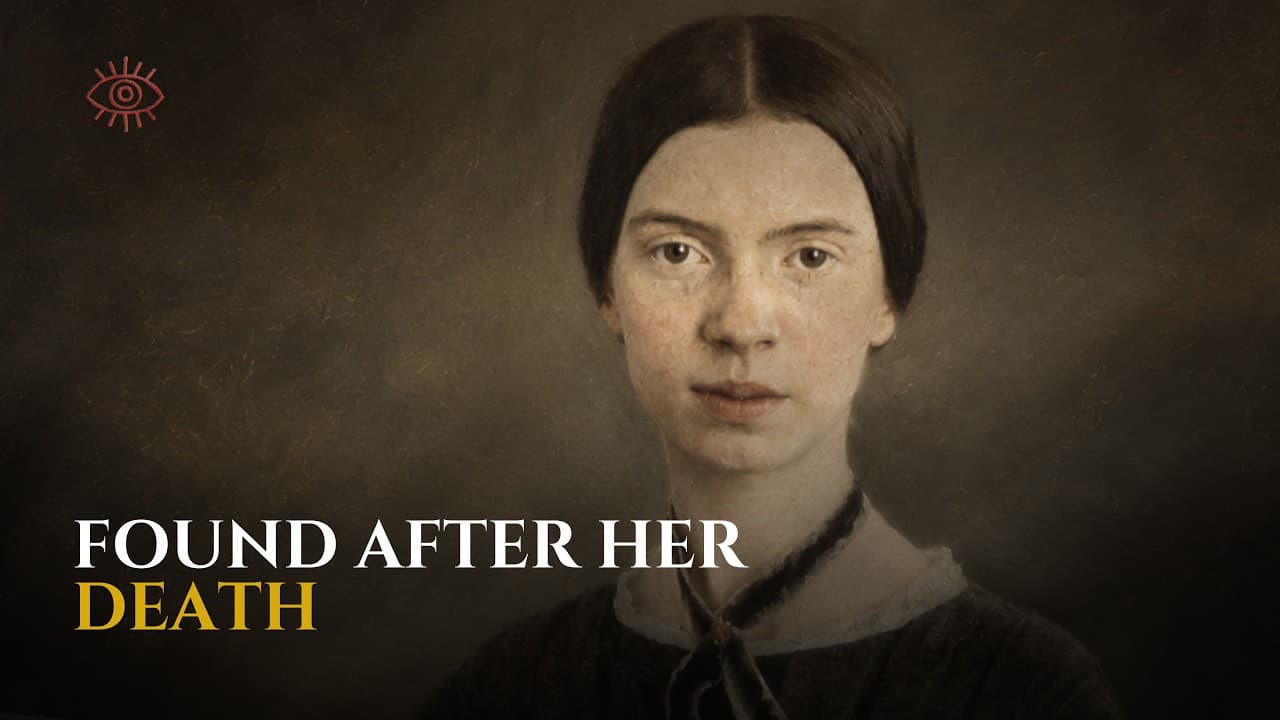
The center of that pared-down life was a corner bedroom on the southwest of the house, with two windows looking out onto Main Street. The room was small and spare. There was a sleigh bed, and a Franklin stove for the cold, and on the wall hung portraits of writers she revered. And there was a writing table, a little square thing about the size of a chessboard, hardly big enough for a sheet of paper and an inkstand. At that tiny table, in that corner room, beside those windows, nearly 1,800 poems were written. We have very little else of her physical self. There is exactly one authenticated photograph, a daguerreotype taken when she was about 16. It shows a thin young face, wide-set eyes, dark hair parted severely in the middle, and a band of velvet ribbon at the throat. That single grave image is the only face the world has of her, and we are obliged to imagine the whole long life from it.
It would be a mistake, though, to picture those years as empty. She was a working member of a busy household, and in particular she was its baker. She made the family's bread, and her round loaf of rye and Indian bread once took second prize at the local agricultural fair. In her later years, when she would no longer come down to greet the children of the neighborhood, she kept a connection to them all the same, lowering small baskets of gingerbread on a string from her bedroom window down to the children waiting in the garden below. That image holds the whole paradox of her in one gesture. She is withdrawn and present at once, unreachable at the front door yet sending sweetness down from the window, hidden and generous in the same motion.
And the deepest paradox is the one the box made plain. In her own lifetime, almost no one knew she wrote poems at all. Her family knew she scribbled, her closest correspondents glimpsed a verse or two folded into a letter, but the scale of the work was a secret she kept perfectly. She asked, at the end, that her papers be destroyed, and she meant it. The poems came through only because the instruction was specific and the box was overlooked, because letters were named and poems were not. A whole body of work, the labor of a lifetime, survived by an accident of wording, by the narrow gap between what she asked to be burned and what she failed to mention.
So we arrive back where we began, in the quiet house in the late spring of 1886, in the weeks after the funeral, with the last decade of her life already darkened by a long sequence of griefs, and with Lavinia standing over the open box. The letters are gone. The poems are saved, for the moment, by sheer chance. The woman who wrote them lies in West Cemetery, under a stone that would in time be cut with the four words she used to close one of her last notes, little cousins, called back. She had sent that note to her young relatives shortly before the end, four words and her name, an announcement that the summons had come. Called back. The phrase reads now like a verdict on the whole strange shape of her life, a woman recalled from the world long before she left it, and recalled into it, line by line, only after she was gone. And the question that hung in that silent room, the question of what these 1,800 poems were, and what they were for, and what the world would ever do with them, is the question that the rest of her story exists to answer.
Chapter 02: The Soul Selects Her Own Society
The legend says she shrank from the world because the world had hurt her. A delicate spinster in white, frightened of strangers, walled inside a single house by some wound we are invited to guess at, growing stranger as the years closed over her. It is a touching story, and it has the matter almost exactly backwards. The withdrawal was not a flinching. It was a decision, made and remade across years, by a woman who knew precisely what she was buying and what she was paying for it. She did not lose the world. She declined it, the way a person with serious work declines an invitation, and for the same reason.
Consider what the word recluse usually implies, a person with no society at all, sealed off, starved of human contact. That is not the woman the record shows. From inside that quiet house she carried on dozens of intense relationships, conducted almost entirely on paper, an enormous traffic of letters running out to friends and family and writers across the country. She ran much of a busy household, baked the family's bread, kept the garden, lowered baskets of gingerbread from her window to the children below. This is not the life of a person who had fled human company. It is the life of a person who had reorganized it, who had decided exactly where the doors would be and who would be let through them.
Her own poem on the subject is the clearest statement of the principle, and it is anything but apologetic. She wrote, the soul selects her own society, then shuts the door. To her divine majority, present no more. Unmoved, she notes the chariots pausing at her low gate. Unmoved, an emperor be kneeling upon her mat. I've known her, from an ample nation, choose one, then close the valves of her attention, like stone. Notice who is acting in those lines. The soul selects. The soul shuts. Emperors kneel at the gate and the soul does not look up. This is not the language of a victim. It is the language of a sovereign, choosing.
The crucial word is attention, and the crucial image is the valve, the part that closes so the pressure can build behind it. Attention is finite. Every person and errand admitted into a day takes some portion of it, and what is spent cannot be spent again. Most of us divide that portion among a great many claims, a little here, a little there, until almost nothing is left whole. What she did was refuse the division. She closed the valves so that her attention could go somewhere else, total and undivided, onto the page and onto the few she loved. The door shuts from the inside. That is the whole reversal. The world did not lock her in. She locked it out, in order to be free for the only work that mattered to her.
We are not used to thinking of solitude as an economy, but that is exactly what it was for her, a careful budgeting of a scarce resource. A face-to-face visit is expensive. It must be answered in real time, in the body, with the nerves exposed, and it spends attention that can never be recovered. A whole afternoon of calls can leave a person depleted and with nothing made. She was not withdrawing from human warmth when she stepped back from the parlor. She was refusing the kind of contact that drained her without return, and keeping the kind that did not. The few she admitted, by letter and at the door, she gave herself to completely. The many she turned away, so that the giving could stay whole.
And the room she shut herself into was not small. This is the part the legend cannot account for, that a life narrowed to a single house and a single corner table somehow opened onto more space than most people ever enter. She said so directly. She wrote, I dwell in possibility, a fairer house than prose, more numerous of windows, superior, for doors. A house with more windows and better doors than the solid house of ordinary speech, of ordinary living. The closer she drew the physical boundaries, the wider the inner ones grew. The poem ends with the gesture that explains everything that came before it, the spreading wide my narrow hands, to gather paradise. Narrow hands, and paradise gathered into them. The smallness is real, and so is the immensity, and they are not in contradiction. The one is the price of the other.
This is why the language of pathology fails her so badly. To call the seclusion a symptom is to assume she was acted upon, that something happened to her and she retreated. But everything in the work points the other way, to a person doing the acting, making a hard trade with open eyes. She gave up the ordinary social life of an unmarried woman of her town and time, the calls and the church and the easy ordinary belonging, and in exchange she got the undivided attention that nearly 1,800 poems require. No one stumbles into that bargain by accident or by injury. It is a vocation, in the oldest sense of the word, a calling answered by closing certain doors so that one door can stand open.
What the legend reads as absence was a fierce kind of presence, turned inward and downward and concentrated to a point. She portioned out her hours the way she portioned out her attention, spending them whole on the work and on the few she loved, withholding them from the many who would have spent them for her. The chariots paused at the gate and she let them pause. The emperor knelt on the mat and she did not rise. From an ample nation she chose, and having chosen, she closed the valves of her attention like stone, and behind that stone she did the thing she had cleared all that room to do.
Chapter 03: A Letter Always Feels Like Immortality
Her letters are not a footnote to the poems. They are a second body of work in the same voice, written with the same pressure, and we have lost something by reading them as biography rather than as art. More than a thousand of them survive, and they were never the casual residue of a life spent writing the real thing in private. They are the real thing too. A reader who knows only the poems knows only half of what she made.
Consider first what a letter was to her, in her own words. A letter always feels to me like immortality, she wrote, because it is the mind alone, without corporeal friend. Hold that sentence for a moment, because it explains the whole enterprise. A letter is the mind set down on paper and sent out into the world without the body that produced it. The voice arrives, the face does not. For a woman who would gradually stop entering the rooms where her friends sat, this was not a limitation to be endured. It was a discovery to be used. The letter let her be wholly present and wholly absent at the same time, which is exactly the condition the poems also seek.
What strikes any reader who turns from the verse to the prose is that the prose is not looser. It is, if anything, more concentrated. A sentence in one of her letters will gather itself, tighten, and break into rhythm without warning, so that the line you are reading as ordinary friendly chatter suddenly stands up and scans like a stanza. She did not relax into prose. She wrote prose as though it might at any second become poetry, and frequently it did, mid sentence, with no seam visible between the two. The distinction we draw between her letters and her poems is partly an accident of how the pages were later sorted. She drew it far less sharply than we do.
The mechanics of her correspondence make this clear. She kept drafts. She wrote a letter the way she wrote a poem, trying a phrase, crossing it out, copying a clean version onto fresh paper. A figure that pleased her in a letter to one friend would surface, slightly altered, in a letter to another, re aimed for a different reader. A striking image was a possession to be spent more than once. The same sentence could be a private joke in one envelope and a small elegy in the next, the wording barely touched, the aim entirely changed. This is not how an ordinary person writes to a cousin. It is how a writer manages a body of material. The same care that produced the fair copies of the poems produced the letters, and the same hand decided what stayed and what was struck through. A phrase tested on one reader and kept was a phrase that had earned its place, and a phrase that failed was quietly retired before it ever reached the page she sent.
And the letters did not travel alone. They went out tucked beside flowers from her garden, wrapped around a piece of gingerbread lowered from the family stores, folded against a pressed blossom that would arrive flattened and faded, the proof of a season already gone. The note and the gift were one gesture. A flower with a few lines pinned to it is a small staged event, and she staged hundreds of them. She also made herself a master of the hardest letter of all, the letter of condolence, the note one writes to a household where someone has just died. These are among the most demanding things a person can compose, because every easy phrase is an insult to real grief, and she found, again and again, the sentence that was strange enough to be true. A conventional letter of sympathy reaches for the ready comfort and the borrowed scripture. Hers refused the ready comfort and went straight at the wound, naming the loss so precisely that the reader felt understood rather than soothed. She treated the bereaved the way she treated everything, with an attention so exact that it became a kind of tenderness, and the bereaved kept those letters, which is part of why so many survive.
The most remarkable formal fact about the letters is how they shrink over the years. The early ones can run for pages, full of news and teasing and the long breath of a young woman with time. The late ones contract until a whole letter is a single sentence, an aphorism sealed in an envelope and posted across town or across the country. A friend would open the paper and find one line, polished to the hardness of a proverb, and nothing else. By the end she was mailing what were essentially poems without lineation, the prose burned down to its last irreducible clause. The correspondence becomes, in its final phase, indistinguishable from the work.
Most important of all, the letters reveal that she did not have a single self that she expressed. She had a self for each correspondent, staged and revised to fit the reader on the other end. To one person she is the playful child, full of mischief and small domestic comedy. To another she is the oracle, dropping a cryptic line and offering no help with it. To a third she is the devoted student, asking for judgment she does not really intend to follow. None of these is a mask over the true face. They are all true, each one calibrated to a particular relationship, the way a poem is calibrated to its occasion. The self that writes is partly made by the act of writing, summoned into being by the particular reader it addresses, and she seems to have known this long before the idea had a name. Each correspondent called a different person out of her, and she met each one with the version of herself the page required. She understood that intimacy on paper is something built deliberately, sentence by sentence, and she built a different intimacy with every reader she kept.
The clearest case of the playful self is the long correspondence with her young cousins, Louisa and Frances Norcross. With them she could be at her most informal, her funniest, her most domestic. The letters to the Norcross cousins are where the household enters, the baking and the weather and the small disasters, all of it rendered with a comic timing that the solemn poems rarely permit. Here is the voice of the older relative who delights in two girls and performs for them, and it sits at the far end of the spectrum from the gnomic late notes she sent to others. The same woman wrote both. That range, from the warm child voice to the chilling oracle, is itself part of the art, evidence of how completely she could become whichever self the page required.
We tend to think of letters as the unguarded place, the spot where the careful artist finally relaxes and tells the truth plainly. With her, the opposite holds. The letters are not where the craft stops. They are where it operates without the protection of the line break, where the same intelligence works under a different constraint and produces, if anything, a more dangerous beauty, because nothing announces that this is poetry and asks to be read slowly. The compression hides inside what looks like correspondence. A reader can pass over a sentence as mere friendliness, and only later feel it detonate.
This is the deepest meaning of the letter as immortality. It is presence at a chosen distance. She could reach a person fully without standing in front of them, could be loved and known and answered while remaining a hundred miles or a hundred feet away inside a house she would not leave. The paper carried everything the body would have carried, and withheld the one thing she did not wish to give, which was her physical presence in a shared room. Intimacy and absence at once. She is there in the words and not there in the flesh, and that double condition was not a sad compromise forced on a sick or frightened woman. It was a form she chose and perfected, the same way she chose and perfected the stanza.
So when the box of poems was found, it was only half of what she left behind. The other half had already gone out into the world, one envelope at a time, into the hands of cousins and friends and the few correspondents she trusted with her mind. Those letters were not the warm up for the poems or the explanation of them. They were the poems by other means, the voice arriving without the body, immortality in its plainest daily form, a folded sheet of paper that said what only she could say and then traveled on without her.
Chapter 04: Dear Mr. Higginson
Emily Dickinson chose her one lifelong literary correspondent on the strength of a single magazine essay, and she chose almost perfectly wrong and almost perfectly right at once. The man was Thomas Wentworth Higginson, and he would prove unable to read her work even as he refused, for 24 years, to stop reading it. Their friendship is the great example of how she wanted to be received, which was not the way any writer is supposed to want. In the middle of April, in the year 1862, a letter in her small, upright, almost printed hand reached his house in Worcester, Massachusetts. Inside were four poems and a few lines of prose, and the prose asked a question so strange that the man who opened it would spend the next quarter of a century failing to answer it. The question was whether the verse was alive.
She had chosen her reader by reading him first. In the spring of that year the Atlantic Monthly had carried an essay of his, a piece of advice addressed to young contributors, a kindly older writer telling the unpublished how to hold a pen. Something in it moved her to break a silence she would otherwise have kept. She did not send him her best four poems, by any later reckoning, and she did not introduce herself by name on the page. She enclosed her name on a separate card, tucked inside a smaller envelope, as if even that much exposure had to be wrapped twice. Then she asked her question.
Are you too deeply occupied, she wrote, to say if my verse is alive? The mind is so near itself, it cannot see distinctly, and I have none to ask. That is the whole of the thing she wanted. Not praise, not correction, not a path to print. She wanted to know whether the thing she made breathed, because she could not get far enough away from her own mind to tell, and there was no one in Amherst she trusted with the question. It is a request a stranger could grant precisely because he was a stranger. The people near her were too near.
The choice was not random, and the measure of it lies in who he was. Higginson was a minister who had left the pulpit for the wider work of letters, a reformer of the most radical kind in an era that did not lack for them. He had marched for the rights of women and for the rights of slaves, and he had not confined himself to marching. He had given money and arms to John Brown's conspiracy, putting himself within reach of the law. Within a year of receiving her first letter he would go south and take command of a regiment of formerly enslaved men, the first of its kind mustered into the Union army. He was, in one person, the established literary culture and its conscience, a man of action and a man of taste. He had stood in front of crowds and in front of muskets, and he had also written essays on flowers and birds and the right way to begin a sentence. To a woman who scarcely left her father's grounds, he was the world she had declined, writing back. She had read his prose in a magazine and decided, on the strength of it, that here was a man who would not laugh, and she was right about that much, whatever else she may have hoped.
And he could not read her. This is the central fact of the friendship, and there is no use softening it. He found the poems extraordinary and bewildering, and his bewilderment expressed itself as instruction. He called her verse spasmodic, a word borrowed from a school of poets then in disrepute, meaning uncontrolled, jerky, given to fits. He told her the rhymes did not close and the grammar wandered. He advised her, gently, to delay any thought of publishing, to let the work settle and discipline itself first. He was offering her exactly what his Atlantic essay had promised the young, the seasoning hand of a professional, and he was offering it to a poet who needed none of it and had asked for none of it.
She answered his corrections by deepening her riddle rather than resolving it. In the letters that followed she built herself a character, small and odd and disarming, and she performed it for him with great care. She told him she was small, like the wren, and that her hair was bold, like the chestnut bur, and her eyes like the sherry in the glass that the guest leaves. She called him her preceptor and signed herself his scholar, taking the posture of a pupil while conceding nothing a pupil concedes. When he asked about her life, her circle, her companions, she gave him an answer that has outlived every fact he was fishing for. Her companions, she said, were hills, sir, and the sundown, and a dog as large as myself that her father bought her. They were better than beings, she told him, because they know, but do not tell.
That last line is the whole of her method folded into a domestic boast. She is describing a hill, a sunset, and an animal, and she is also describing the kind of intimacy she preferred, the kind that receives everything and reports nothing. Higginson wanted to place her. She kept dissolving the categories he reached for. He asked how old she was and she answered in seasons. He asked what she read and she answered with the company of weather. He came to her looking for a young writer he could shape, and he found instead a finished and unaccountable thing, and to his lasting credit he did not stop writing to her when he understood that he could not change her.
He kept the correspondence alive for 24 years, through the war he went to and the long peace after it, through her father's house and his own changing fortunes. He answered her letters, he sent her books, he tried now and then to coax her toward an audience, and he failed at that as he failed at the rest. He confessed, later, in print and in private, that she was the one person he had never been able to reach, an enigma he had finally given up trying to solve. He did not pretend to understand her in order to seem her equal. He admitted the gap. The admission is part of why we still have her, because a vainer man might have edited her into sense and thrown the originals away.
In August of 1870, 8 years into their letters, he came to Amherst to meet her. He had wanted to for years and she had deflected him for years, and when at last she let him climb the stairs to her father's parlor, the meeting unnerved him so thoroughly that he wrote it down twice, once to her and once, the same night, to his wife. He waited in a dim room. He heard a step like a child's, and then a soft, frightened voice. She came toward him holding two day lilies, which she put into his hand, and she said, these are my introduction. Then she said, forgive me if I am frightened, I never see strangers, and hardly know what I say.
What she said, once she began, he could barely keep pace with. She talked, he reported, in a continuous, breathless stream of definition and confession, as if speech long dammed had broken open. She told him how she knew poetry when she met it. If I read a book, she said, and it makes my whole body so cold no fire can ever warm me, I know that is poetry. If I feel physically as if the top of my head were taken off, I know that is poetry. She offered him no theory, no school, no rule of the kind he had been pressing on her by mail. She offered him the body's verdict, the only test she trusted, the chill in the spine and the lifted skull. And then, having described poetry as a kind of bodily catastrophe, she told him the plain opposite about living itself. I find ecstasy in living, she said. The mere sense of living is joy enough.
He left shaken in a way he never fully explained and never forgot. That same night he wrote to his wife the sentence that has followed him into every account of her since. I never was with any one, he wrote, who drained my nerve power so much. Without touching her, she drew from me. I am glad not to live near her. He had come to meet a recluse he half pitied and half hoped to rescue, and he came away feeling robbed of some vital current, depleted by an hour in a quiet room with a small woman holding flowers. In a later private letter he reached for a phrase to file her under, and called her his partially cracked poetess at Amherst, the condescension of a man still trying to make her ordinary and still unable to.
So he failed her as a critic, completely and from the first letter to the last. He misjudged her rhymes, mistook her control for its absence, urged restraint on the least restrained imagination in the language, and confessed at the end that he had never understood her at all. By every measure of criticism, the relationship was a long miscarriage. And yet she had not asked him to be a critic. She had asked him whether the verse was alive, and that is a different office. She wanted a witness, someone outside the house who would register that the thing existed, who would receive the poems and keep them and testify that a person had made them. In that office he did not fail. He kept her letters. He kept her poems. He came when she let him and he wrote down what he saw, and decades later, when the work needed a name the public would trust, his was there.
That, in the end, is what she seems to have chosen in him, with an instinct she could not have fully reasoned through. She did not choose a man who would improve her, because no such man existed and she knew it. She chose a man who would preserve her. She picked, out of all the literary world, the one correspondent generous enough to keep writing to a poet he could not parse, honest enough to admit the failure, and present enough, at the right moments, to bear witness. A better critic might have sanded the strangeness off her lines and let the rest scatter. Higginson, baffled and faithful, held on to everything, and in holding on he did the one thing the verse required of its first outside reader. He kept it alive long enough for the question she had asked him to answer itself. The verse was alive. It outlived his corrections, his condescension, and his confessed defeat, and it is alive still, which is the only answer the question was ever going to accept.
Chapter 05: Some Keep the Sabbath
The town that made her was a Calvinist town, and in a Calvinist town the most important thing a person could do was be saved. Amherst had inherited the old New England faith of a stern and sovereign God, of human nature fallen, of salvation withheld until the soul was seized by grace and could feel itself converted. In the 1840s and 1850s, while she was a girl and then a young woman, wave after wave of revival passed through the Connecticut Valley like weather. A traveling preacher would come, the churches would fill, and night after night the meetings would build toward a single act. To be converted was not a private settling of the heart. It was a public event. You rose before the gathered congregation, you confessed your hope, and the community watched you cross from the company of the lost into the company of the saved. Conversion was the social fact of the place, the thing that decided who you sat with and who prayed for you. One by one, the people closest to her made that crossing. Her father professed his faith. Her sister did. Her brother did. Her friends, the bright girls of her school years, came home one after another from the meetings, changed, relieved, gathered in. And Emily, alone in her family, alone among her friends, would not rise.
This was not a sudden act, and it was not a tantrum. It was a long withholding, repeated over years, in the face of every pressure a loving family and an anxious town could bring. She felt the pull. Her letters from those years are full of it, the loneliness of standing outside while everyone she loved stood inside, the half-wish to give in and feel what they felt. At the seminary, as a girl, she had already declined to rise for Christ, and that refusal followed her home. By her thirties she had stopped going to church altogether. She kept the Sabbath in her own way, in her own house, in her own garden, and she made of that private keeping one of her most disarming poems.
Some keep the sabbath going to church, she wrote. I keep it, staying at home, with a bobolink for a chorister, and an orchard, for a dome. The poem is light, almost playful, a small act of cheerful trespass. The bird sings where the choir would sing. The fruit trees arch where the church roof would arch. She has not abolished worship. She has relocated it, taken the whole apparatus of reverence outdoors and given it to the meadow. And then the close turns the joke into something larger. So instead of getting to heaven, at last, she wrote, I'm going, all along. The churchgoers are working toward a heaven that waits at the end of a life of effort and trembling. She is already there. The orchard is heaven enough, and the road to it is the road she is already walking. It is a quiet refusal of the entire transaction, the bargain of obedience now for paradise later.
It would be easy to mistake this for unbelief, and easy to be wrong. What she refused was not God. What she refused was the closing of the question. The town wanted a decision, a yes spoken once and for all, the soul filed safely on the saved side of the ledger. She would not give the yes, and she would not give the no either. She kept the matter open her whole life, and she conducted the argument where she conducted everything, in verse. God in her poems is not a doctrine. He is a presence she addresses directly, by turns tender and sly and furious. She teases him. She accuses him. She catches him out in his absences and reports them. She misses him the way one misses a person who has gone silent, and she is never quite willing to conclude that the silence means there is no one there. The faith and the doubt are not two phases of her life, an early piety and a later skepticism. They are a single ongoing conversation, and she keeps both voices going at once.
Listen to how the conversation sounds at its most serious. This world is not conclusion, she wrote. A species stands beyond, invisible, as music, but positive, as sound. That is the believer's claim, stated with real conviction. Something stands beyond this life, unseen but as certain as a heard note. And yet the poem does not rest in that certainty. It circles and frets and lists all the things people do to quiet the doubt, the philosophies, the gestures of piety, the brave faces. And it ends on a line that no easy faith could have written. Narcotics cannot still the tooth that nibbles at the soul. The image is unforgettable and almost unbearable. The doubt is not a thought you can reason away. It is a small persistent ache, like a bad tooth, gnawing under everything, and nothing dulls it for long. That is a poem written by someone who wants to believe and cannot stop noticing the reasons not to. It is faith and doubt in the same breath, refusing to resolve.
Part of what kept the question open was the new century pressing in at the edges of the old one. She belonged to the exact moment when natural science entered the New England schoolroom. At Amherst Academy she studied botany and geology and astronomy, real science taught seriously to a girl, and she loved it. She learned to look at a flower as a structure and at the sky as a system. That schooling never left her, and it gave her a second way of seeing that sat uneasily beside the catechism. You can hear the two ways collide in her most famous remark on the subject. Faith is a fine invention, she wrote, when gentlemen can see. But microscopes are prudent in an emergency. It is a small marvel of compression. Faith is fine, she says, in clear conditions, when nothing is at stake and the gentlemen can see their way. But when the situation turns urgent, when something must actually be known, you reach for the instrument that shows you what is really there. The microscope is the new authority, the lens that does not take things on trust. She does not throw faith out. She just notes, with a perfectly straight face, that in an emergency a person consults the evidence.
That line is the whole argument in miniature. She would not choose between the dome of the church and the dome of the orchard, between the soul that stands beyond and the lens that shows the cell. She held them both, and she let the tension produce the poems. A town built on the demand for a decision raised a poet who made her life's work out of declining to decide. Her family crossed over into the company of the saved, and she stayed on the threshold, neither in nor out, and from that threshold she watched God the way she watched everything else, closely, skeptically, and with a love she could neither give up nor fully trust. The argument was never settled because she never wanted it settled. A settled question is a dead one, and she meant to keep this one alive as long as she lived, the tooth still nibbling, the music still standing positive beyond the wall, the bobolink still singing in the only church she would consent to enter.
Chapter 06: The War Years
There is a stubborn picture of Emily Dickinson as a woman who lived outside history, a recluse in a white dress for whom the great public events of her century might as well have happened on another planet. The picture is false, and the simplest way to see how false is to lay her writing life against a calendar of the nation's. Her most productive years, the years when the poems came in a flood that has no equal in American letters, were the years of the Civil War. While the country tore itself in half, a woman in a quiet house in Massachusetts wrote at a rate that still seems hardly possible. The seclusion and the catastrophe were not opposites. They ran on the same clock.
The numbers, even held loosely, are astonishing. By the careful estimates of later editors, who dated her manuscripts by the changing shape of her handwriting, she wrote somewhere near 800 poems during the war years alone. At the crest of it, around 1862 and 1863, she was composing at stretches that approach a poem a day. These dates are reconstructions, not records she kept, and we should say so plainly. She did not number her work or mark when it was made. But the trend is unmistakable, and it points at exactly the same span of months in which young men from her town were marching south and not coming home.
It is tempting to read this as coincidence, the private clock simply happening to tick fastest in those particular years. The town's experience of the war makes that harder to believe. Amherst sent its sons like every New England village, and the war reached into the small world she did know by name. Frazar Stearns, the son of the president of Amherst College, a young man the Dickinson family knew, was killed at the battle of New Bern in March of 1862. He was shot through the side and died on the field, far from the valley where he had grown up, and the news came back to a town that had watched him become a man. The brass cannon his regiment captured was sent home to stand at the college, a trophy and a memorial at once, war made into an object you could walk past on an ordinary afternoon. Her brother Austin, when his own number might have come up, paid 500 dollars for a substitute to serve in his place. This was legal, it was common, and many respectable families did the same, yet in a household built on duty and conscience it could not have sat lightly. To buy your way out of the fight while a neighbor's son lay dead in Carolina was the kind of moral arithmetic the era forced on people who could afford it. The war was not an abstraction reported in the papers. It had a face she had seen, a price her own family had paid in money rather than blood.
She wrote about it, in her way, which was never the way of the newspaper or the patriotic ode. There are no battle scenes in her work, no flags, no generals. What there is, instead, is a line that goes straight to the moral weight of survival. She wrote that it feels a shame to be alive, when men so brave, are dead. One distrusts its worth. The line rewards a slow reading. It is not grief exactly, and it is not protest. It is the strange guilt of the survivor, the suspicion that one's own continuing life has been somehow purchased and may not be worth the purchase. A woman safe in her father's house, who had paid no part of the war with her body, found the words for the unease of everyone who stays behind. That is what her seclusion bought her. Not distance from the suffering, but the silence in which to find its exact moral shape.
While the war pressed on the world outside, a second crisis pressed from within, and this one threatened the very faculty her whole life depended on. Beginning around 1863, she began to suffer from her eyes. There was pain, and there was a fierce sensitivity to light. For a woman who read the way other people breathe, who told a correspondent that books were among her dearest companions, the symptoms carried a particular terror. The thing she stood to lose was sight itself. The sentence hanging over her was blindness.
The treatment took her out of Amherst, which is itself remarkable, for these were among the very few extended absences of her adult life. Twice she traveled to Cambridge to be under the care of a noted eye doctor, boarding with her cousins through the long stays. The first was the longer, some 8 months across 1864. She returned again the following year for months more. We should be careful here, because the exact nature of the affliction was never settled in her time and cannot be settled now, and it would be a cheap trick to hang a modern diagnosis on a few letters and a doctor's silence. What we can say is what happened. The doctor restricted her, sharply, in the way doctors of that day approached a strained or inflamed eye, by ordering it rested and shielded from light. He limited her reading. For a time he limited even her pen. There was a peculiar cruelty in that prescription for such a person, the two activities that made her herself, taking words in and putting words down, being the very things she had to give up to keep her sight.
She hated the exile. The boarding house in Cambridge was not the corner bedroom with its small writing table, and the loss of her books left her stranded among strangers in a city she had no wish to be in. And yet, crucially, the work did not stop. It could not be stopped. Even with reading rationed and writing rationed, the poems kept coming, smuggled out of a half-darkened room by a mind that had learned to compose in any conditions. When she finally came home for good, her sight gradually returned, and the threat receded as mysteriously as it had arrived. The blindness she had braced for never fell. But for two years she had lived as a writer under sentence, working against the possibility that each poem might be among the last she would ever be able to see to make.
Set the two pressures side by side, and the shape of these years comes clear. War outside the door, taking the sons of her town and the conscience of her brother. Possible blindness inside the body, threatening to seal the only window she truly used. And between those two terrors, in the very same span of months, the most concentrated burst of lyric poetry in the history of the country. The natural assumption would be that such circumstances must crush a writer, that fear and grief and the fear of darkness must dry up the well. With her, the opposite occurred. The pressure did not silence her. It compressed her.
That word is worth dwelling on, because compression is the right one for what these years did to her art. Coal becomes diamond under pressure, and the figure is almost too neat, but it points at something real about the poems of this period. They are dense beyond anything in English verse before them, short, hard, charged, every spare word doing the work of three. A poem of 8 lines from these years can carry the freight of an entire essay. It is as though the squeeze of the world, the war she could not stop and the dark she could not prevent, drove everything inessential out of the language until only the burning core remained. She did not write more in spite of the catastrophe. There is a real sense in which she wrote more, and harder, because of it.
This is the fact that should retire the old picture for good. She was not hiding from history in some timeless white room. She was sitting at the dead center of her century's worst convulsion, with her own sight failing, writing the poems that would outlast everyone who pitied her isolation. The poems of pain that belong to these years, the ones that map the mind under unbearable strain, were not the diary of a sheltered nervous spinster. They were field reports, filed from a woman who knew exactly what her age was made of, mortality and fear and the precariousness of the light. The seclusion gave her the quiet. The war and the eyes gave her the stakes. And out of that meeting came nearly a third of everything she ever wrote, in a handful of years she spent half expecting to lose the power to write at all.
Chapter 07: Publication Is the Auction
Publication, is the auction of the mind of man, she wrote, and the surprising thing is how literally she meant it. Not as a complaint about vulgar taste, not as a shy woman's excuse for hanging back, but as a definition. To publish is to put the mind on a block and let it go to the highest bidder. The line is one of her hardest, and the hardness is the point. She is not describing how publishing feels. She is telling us what it is.
Consider first the plain record, because the philosophy grows out of it. In a life that produced nearly 1,800 poems, fewer than a dozen reached print while she lived. Every one of them appeared without her name. Most were altered by the editors who took them, their rhymes tidied, their strange punctuation straightened, a word swapped here and there for a smoother one. Several went into print without her consent at all, lifted from letters by friends who thought they were doing her a kindness. So the woman remembered as the poet who would not publish did, in a narrow and accidental way, publish. She simply never once controlled the act, and never once signed it.
The doorway between her desk and the public world was a single newspaper, the Springfield Republican, the most important regional paper in New England, read at every breakfast table in the valley. Its editor was Samuel Bowles, and Bowles matters here for who he was in her circle. He was brilliant, restless, perpetually traveling, the most worldly man she knew, a person who moved through the rooms of senators and reformers and brought the wide noise of the country home with him. He was her friend, and his paper printed a small handful of her poems over the years, unsigned, often improved into ordinariness by the very competence of the editing. The friend who held the only open door was also the agent of the thing she most distrusted.
What she distrusted was not readers. It was price. Hear the whole of her central poem. Publication, is the auction of the mind of man. Poverty, be justifying for so foul a thing. She allows one exception, almost. If you were starving, the auction might be excused. Then she withdraws even that. But reduce no human spirit to disgrace of price. The word she chooses for selling the mind is disgrace. To assign a number to the inner life is to lower it, no matter how high the number. This is not modesty. It is a theory of value, and it runs exactly against the grain of a century that was learning to measure everything by what it would fetch.
She made the same case lightly, which is harder to do. One of her best-loved poems turns the whole machinery of fame into a children's game. I'm nobody, she wrote, who are you? Are you nobody, too? Then there's a pair of us, don't tell. The secret is shared like a delicious conspiracy, two small people hiding from the celebrated. And then the verdict, delivered as comedy. How dreary, to be somebody. How public, like a frog, to tell one's name, the livelong June, to an admiring bog. To be famous is to be a frog announcing itself all summer to a swamp that only wants more noise. The admiring bog is the auction's other face, the crowd as a wet flat nothing, applauding because applause is what it does.
To the one literary man who corresponded with her for years and gently raised the question of print, she answered with two of the most self-possessed sentences she ever wrote. I smile when you suggest that I delay to publish, she told him, that being foreign to my thought, as firmament to fin. Delay implies an intention eventually to act. She has no such intention; publishing is as alien to her as the open sky is to a fish. And then the deeper claim. If fame belonged to me, she wrote, I could not escape her. She makes fame a thing that either is yours or is not, by some law outside your striving, the way a quality of soul is yours. If it is truly hers, no auction is needed to confirm it. If it is not, no auction can supply it. The marketplace is simply irrelevant to whether the work is alive.
There was one moment, and only one, when the wall came down by a fraction, and it took the era's most determined woman of letters to bring it down. Helen Hunt Jackson had been a schoolmate in Amherst as a girl and had grown into the most celebrated woman writer in the country. She read the poems, and she refused to accept the silence. You are a great poet, she wrote to her old classmate, and it is wrong to the day you live in, that you will not sing aloud. That is not flattery. It is an accusation framed as a duty, an argument that genius owes something to its own time. Jackson pressed, year after year, and at last she extracted the single clear consent of Dickinson's life. The poem was the one beginning, success is counted sweetest, by those who ne'er succeed. To comprehend a nectar, requires sorest need. It appeared in a book of unsigned verse by various hands, anonymous as always, in 1878. One poem, one yes, after a lifetime of declining.
There is a fierce consistency in that one yes, because the poem itself is the doctrine. Success tastes sweetest to those who never have it. To know the nectar fully is to want it from a position of need, not possession. The poet who believed that desire keeps alive what attainment kills would naturally believe the same of fame. To win the auction is to have sold the wanting that made the work worth anything.
So the refusal was never timidity. It was the same intelligence applied to her career that she applied to everything, the conviction that value is destroyed at the moment it is priced. She did not stop the poems from circulating. She circulated them herself, by her own rule, folded into letters, slipped to one chosen reader at a time, an edition delivered hand to hand and never put up for sale. She kept the auctioneer out of the room. The mind, she had decided, was the one possession that must never be reduced to the disgrace of a price, and on that decision she never once wavered.
Chapter 08: The Books She Sewed by Hand
A single sheet of letter paper, the kind a household keeps in a drawer for correspondence, folded once down the middle, makes four pages. A second folded sheet laid inside the first, and perhaps a third, makes a little gathering of leaves nested one within another. Then a needle and thread. Two small holes punched through the fold, near the top and near the bottom, the thread pushed through and tied off on the spine. The result is a book. It has no printed title, no publisher's mark, no cover beyond the paper itself. It was made entirely by one pair of hands, and for years no other pair of hands ever opened it.
This is what Emily Dickinson did, beginning around 1858, with the poems she considered finished. She copied them out in a clean, deliberate hand onto folded stationery, sewed the sheets together with ordinary thread, and set the booklets aside, each one holding roughly 20 poems. She made about 40 of them over six or seven years, and through them passed more than 800 poems, the larger share of everything she ever wrote. Around 1864 the sewing stopped. After that she kept making fair copies and gathering them, but she left the later sheets loose, unbound, as though the binding had been a habit she finally set down. Scholars later gave these sewn gatherings a name, the fascicles, a word that simply means small bundles. She herself left them nameless, as she left almost everything nameless.
The plainest fact about the fascicles is the one easiest to walk past. No one saw them. They were not circulated, not shown, not read aloud to a visitor, not slipped to a sister across the hall. They lived in the locked box where they were eventually found, a private archive assembled with the patience of a craftsman and the secrecy of a miser. And yet the labor in them is precisely the labor of someone preparing work for the world. Consider what a printer does, for the parallel is exact. He selects which pieces will appear, decides the order in which they fall, produces a clean and authoritative copy, and binds that copy into a durable object meant to outlast the writing of it. Dickinson did every one of those things by hand, alone, at her small table. She performed the whole ritual of publication and withheld only the final gesture, the one that lets the book leave the room.
This is why the fascicles are best understood not as a filing system but as publication turned inward, an edition of one. She refused the printed marketplace, the auction she despised, and then quietly built its private mirror. The booklets are her answer to print, made out of the same motions print is made of, selection, arrangement, fair copy, binding, and missing only the reader. We are used to thinking of an audience as the thing a writer needs most. Here is a writer who did all the work that an audience requires and then declined to summon one, who made the vessel perfect and corked it.
What we cannot say, and should be careful not to pretend we can, is exactly what the order inside each booklet means. Some readers find deliberate sequences in the fascicles, poems set beside one another so that one comments on the next, a hidden architecture, a book of verse arranged by its author into movements. Others see something more modest, a working method, a way of keeping finished pages safe and accounted for, the poems entered roughly as they were completed. Both readings have honest evidence, and the truth may differ from booklet to booklet. It is one of the genuine open questions of her work, and the responsible thing is to leave it open rather than to force the bundles into a shape that flatters our taste for design.
There is a second feature of these manuscripts that resists every tidy account, and it goes to the heart of what kind of poet she was. On many of the fair copies, beside a finished line, she did not always settle on a single word. She left alternatives standing. Above or below or beside the word in place, marked with a small cross of the pen, she would set a second candidate, sometimes a third, never striking out the first, never circling the winner. A line might offer two words for the same slot and simply hold them both, the way a hand holds two stones, weighing without dropping either. These are the variants, and they sit on the page as live options, unresolved on purpose.
A printed poem cannot do this, because print is a machine for deciding. To set a poem in type, an editor must choose one word and let the other die, and so every printed version of such a poem is a narrowing, a closing of doors the poet deliberately left ajar. The manuscript keeps the doors open, presenting the poem not as a finished statement but as a field of possibility in which two meanings are equally true and the reader is invited to hold them at once. The unchosen word is not a mistake awaiting correction, but a part of the form itself. The poem, on her page, is the sum of its possibilities, a thing that keeps breathing because it was never required to stop.
That refusal to choose tells us something about the whole enterprise of the sewn books. A printed edition is a verdict. It says, this is the poem, in this order, with these words, settled. Dickinson built objects that looked like editions and behaved like the opposite of verdicts, books whose contents might mean more than one thing and whose words might be more than one word. The craft was real, the needle and thread were real, the clean copies were real. What she would not manufacture was finality.
She had done something like this once before, long before the poems, with a different kind of living thing. As a girl she assembled a herbarium, a leather-bound album in which she pressed and mounted more than 400 plants gathered from the fields and gardens around Amherst. Each specimen was fixed to its page and labeled in her careful hand with its scientific name, the proper botanical Latin, the language a naturalist would use. It is a beautiful and slightly uncanny object, a book of dead flowers kept so that their forms would last. And the impulse behind it is unmistakably the same impulse that would later drive the fascicles. Gather living things, fix them before they fade, arrange them in a deliberate sequence, and bind the whole into a handmade book that no one asked for and that exists only because one mind needed the world held still long enough to be looked at.
Decades separate the album of pressed plants from the bundles of sewn poems, and the materials could hardly be more different, leaf and stem on one side, ink and breath on the other. But the gesture is continuous. In girlhood she practiced on the flowers the very act she would spend her maturity perfecting on language, the collecting, the fixing, the labeling, the binding. The herbarium is the apprenticeship and the fascicles are the masterwork, and both are private books, made by hand, for an audience the maker never intended to admit.
There is a particular kind of confidence in this, easy to miss because it is so quiet. To prepare a life's work in finished form, in one's own clean script, sewn into volumes built to last, and then to lock those volumes away unread, requires a faith in the work that needs no confirmation from anyone living. She trusted the poems enough to give them the full dignity of bound books. She trusted them so completely that she felt no need to show them. The fascicles are the evidence that she knew exactly what she had made, and the evidence, too, that knowing was enough. She finished the books. She tied the thread. And she let them wait in the dark for a reader she would never meet.
Chapter 09: Hymn Meter and the Dash
The most radical verse in American poetry was built on the most ordinary sound in New England, the sound of a congregation singing. Every child raised in a Calvinist town learned the hymns of Isaac Watts before learning much of anything else, and the Dickinson household was no exception. Watts had given English-speaking worshippers a portable music, a way of fitting praise and lament into a few fixed shapes that any voice could carry without a hymnbook in hand. The most common of these shapes alternated a line of 8 syllables with a line of 6, then 8 again, then 6, a pattern so steady that the words of one hymn could be sung to the tune of another. This was called common meter, because it was held in common, the shared property of an entire singing culture. A girl who sat through those services absorbed the rhythm the way she absorbed her own pulse.
What that girl then did with the rhythm is the whole story. She kept the meter and emptied it of certainty. The hymn exists to settle the soul, to deliver it safely to a conclusion the congregation already believes. Dickinson took the identical 8 and 6, the same rocking alternation, and made it carry doubt as readily as praise, dread as readily as comfort. The hymn is still audible underneath, which is precisely the unsettling thing. A listener half expects the consoling turn at the end of the stanza, and instead the floor gives way. She took the music everyone trusted and tuned it to a frequency that no longer reassured.
The rhyme tells the same story of inheritance broken from inside. A hymn rhymes cleanly, because a clean rhyme is a small promise kept, a sound that closes on the sound it was owed. Dickinson learned to write rhymes that almost match and then decline to. Soul leans toward all without quite landing on it. Pearl reaches for alcohol, a famous pairing, and the two words brush past each other rather than meeting. We hear the expectation of a true rhyme and we hear it withheld, and the small dissonance is not a failure of skill but a fact. The world she wrote about almost rhymed and would not close. The off-rhyme, the slant rhyme, became a kind of honesty, a refusal to pretend that things resolve when they do not. A perfect rhyme says the universe agrees with itself. Her near-rhymes say it nearly does, and that the gap is where the truth lives.
Then there are her capitals. In her manuscripts ordinary nouns rise into capital letters where no grammar requires it. A bee becomes Bee. Noon becomes Noon. Eternity, already weighty, is given the standing of a name. By capitalizing a common noun she treats it the way a language treats a person, lifting it out of the crowd of small things and addressing it as a presence with a will of its own. The bee is not merely an insect among insects but a particular power, summoned and faced. This is the grammar of a mind for which the ordinary world was densely populated, every object a potential character who might answer back if addressed by name.
And then the mark that has become her signature, the short horizontal stroke of the pen that her manuscripts use everywhere a comma or a period might be expected, and in many places where no punctuation belongs at all. It is best described as a held breath. The thought arrives faster than punctuation can organize it, so she scores the page with these little strokes, marks of suspension, of a phrase left open rather than shut. They do not divide the sentence into tidy clauses. They keep it provisional, unfinished, alive in the instant before it settles. To read a page in her hand is to feel a voice thinking out loud, refusing to let the meaning click closed. When her work first reached print these strokes were straightened into commas and periods, and something essential went quiet. The hesitation became grammar, the breath became a rule. A great deal of the voltage in her lines runs through exactly those marks, and to regularize them is to ground the current.
Her words came from a small shelf and a single book she read like scripture. Beyond the hymnal and the Bible she lived with Shakespeare above all others, with the novels of George Eliot, the poems of Elizabeth Barrett Browning, the fierce books of the Brontes, and the visionary thunder of Revelation. The portraits she kept on her bedroom wall were the faces of women who wrote, Eliot and Browning among them. But the most surprising of her teachers was a reference book. She told a correspondent that for several years her lexicon was her only companion, and she meant the great Webster dictionary that sat in the family parlor. Its compiler had lived in Amherst and helped found the academy where she studied, so the book was almost a neighbor. She read it not to settle a spelling but as literature, weighing words one at a time. A poet who reads the dictionary for pleasure is a poet who believes that a single word, chosen exactly, can do the work of a paragraph.
That belief shows in a tiny poem about words themselves. She wrote, a word is dead when it is said, some say. I say it just begins to live that day. For Dickinson a word was not a counter passed quickly from speaker to listener and then discarded. It was a living thing, released into the world at the moment of utterance, beginning rather than ending its life. Each entry in the dictionary was a creature waiting to be set loose in the right line.
From these materials she built her most characteristic procedure, the definition poem. She names an abstraction, attaches the small word is, and then completes the equation not with another abstraction but with a concrete image that is slightly, deliberately wrong, and therefore unforgettable. The model of the form is the poem that begins, hope is the thing with feathers, that perches in the soul, and sings the tune without the words, and never stops, at all. What she has done there is quietly audacious. Hope, which has no body, is given feathers. It becomes a small bird that lives inside us, singing wordlessly and refusing ever to fall silent. The image is not a correct account of hope. No bird perches in the soul. But the wrongness is the genius, because the picture lodges in the mind where a definition never could, and it tells the truth about hope by being faithful to its persistence.
That is the engine running underneath the whole body of work. A mind trained on the steady meters of the hymnal and the patient weighing of the dictionary, breaking the clean rhyme into an honest near miss, raising small nouns to the dignity of names, and scoring every line with the breath of a thought that will not quite conclude. She took the most conventional forms her century offered and worked them from the inside until they bent. The forms were everyone's. The pressure was hers alone.
Chapter 10: The Carriage Ride
There is a poem in which death arrives not as a horror but as a gentleman, and its terror lives entirely in its good manners. The poem begins, because I could not stop for death, he kindly stopped for me. Almost everything frightening about the poem is folded inside that one small adverb, kindly. Death is not a reaper here, not a skeleton, not a thief in the night. He is a caller with time on his hands, a suitor who has noticed that the woman he wants is too busy to notice him, and who therefore, courteously, draws up at her door. She could not stop. He could. That is the whole arrangement, and it is presented as a favor.
It is worth pausing on what kind of fear this is. Most of our images of death are loud. They threaten, they snatch, they cut things off. This poem does none of that. It speaks in the register of a polite social occasion, the register of an afternoon in which a respectable man calls for a lady and takes her for a drive. And because the manners are perfect, the horror has nowhere to announce itself. It simply rides along in the carriage, seated quietly between the passengers. The calmest poem about dying in the language is also, by that very calm, the most unsettling, because it refuses to let us brace.
The first stanza fills the carriage. The poem continues, the carriage held but just ourselves, and immortality. Three passengers, then, and only two of them named bodies. Death is the driver, the speaker is his guest, and immortality sits with them as a third presence, unexplained, simply along for the ride. The speaker does not say where they are going. She does not have to. The company tells us. When death calls for someone and immortality is already in the carriage, the destination is understood without a word. There is a strange comfort, too, in that third passenger. We might expect death alone to be terrifying, but death chaperoned by immortality is something stranger, a journey with a guarantee folded into it, though the nature of the guarantee is never spelled out.
The second stanza sets the pace, and the pace is the point. The poem says, we slowly drove, he knew no haste, and I had put away my labor, and my leisure too, for his civility. There is no hurry. Death does not rush his passenger; he has all the time there is, which is precisely the difference between him and her. And she, in return for his courtesy, has set aside everything that filled her days. Her labor and her leisure both, the work and the rest that together made up a life, she has put away the way one puts away sewing when a visitor arrives. The word civility does the quiet damage here. She gives up her entire existence as a matter of etiquette, because it would be rude to keep a gentleman waiting. The poem makes dying into an act of courtesy performed by the dying.
Then comes the stanza that holds a whole life. The poem says, we passed the school, where children strove, at recess, in the ring. We passed the fields of gazing grain. We passed the setting sun. Those three sightings are not random scenery. The children at their game are childhood and morning. The ripened grain in the fields is maturity, the working noon of a life, the harvest standing full. The setting sun is age and evening, the day going down. In the space of three short clauses, the carriage drives past the beginning, the middle, and the end of a human existence. A life that took decades to live is overtaken in the time it takes to read a single stanza. The drive is slow, the poem keeps insisting, and yet it passes everything. That is the second of the poem's quiet cruelties. What feels unhurried from inside the carriage is, measured against a whole life, impossibly fast.
There is a small grammatical tremor in that stanza worth pausing on. The fields are described as gazing grain, as if the grain is watching the carriage go by rather than the other way around. The world looks back. The dead woman is no longer the one who observes; she has become the thing observed, the passenger watched by the fields as she rides out of the living world. It is the lightest possible touch, a single word, and it tilts the whole landscape toward her.
And then, at the sun, time itself turns over. The poem says they passed the setting sun, and then immediately corrects itself, or rather, he passed us. For three lines the carriage has been doing the passing, moving steadily past the scenes of life. Now the sun passes them. The travelers have slowed below the speed of the sun; they have fallen out of the day. This is the precise moment the speaker leaves the living world, and Dickinson marks it not with a thunderclap but with a grammatical correction, a small second thought, or rather. The living move with the sun, through morning and noon and dusk. The dead are passed by it. To be overtaken by the setting sun is to step outside of time, and the poem registers that enormous crossing as a mere adjustment of phrasing, the kind of self-correction a careful speaker makes in ordinary conversation.
After the sun, the cold. The poem says, the dews drew quivering and chill, for only gossamer, my gown, my tippet, only tulle. With the sun gone past, the warmth goes with it, and the dew settles on a passenger dressed in almost nothing. Gossamer is the thinnest cobweb stuff, the threads that float in autumn air. Tulle is fine netting, the gauze of a veil. A tippet is a light shoulder wrap, here made of that same insubstantial netting. She is dressed, in other words, for an occasion, in delicate fabric meant for a ceremony, the sort of thin fine cloth a bride might wear, or a corpse might be laid out in. The two occasions rhyme. The wedding gown and the burial dress are cut from the same gossamer. She set out dressed for a courtship and finds herself dressed for the grave, and the chill that quivers through her is the first honest physical sensation in the poem, the body registering that something has gone wrong with the temperature of the world.
Then the carriage stops, and the destination, so long understood and never named, comes into view. The poem says, we paused before a house that seemed a swelling of the ground. The roof was scarcely visible, the cornice, in the ground. What she has done there is quietly astonishing. The grave is a house. It has a roof, it has a cornice, the decorative molding along its top edge, all the architecture of a dwelling. But it is a house that has sunk, or risen, into the earth, a low mound, a swelling of the ground, with its roof barely showing and its uppermost trim already underground. She does not say grave. She does not say tomb. She describes a home and lets the dimensions tell us it is a burial. The horror, once again, comes dressed in the ordinary. A house is where one arrives at the end of a journey, where one is expected, where one stays. The poem invites us to feel the dreadful homeliness of it, the way a grave is, after all, the last address, the place the carriage was always heading. And the speaker observes her own future tomb with the mild attention of a passenger noting an interesting property along the road. No scream, no recoil. Just, here is a house, low to the ground.
It is worth saying plainly what this poem refuses to do. It never tells us whether anything lies beyond the house in the ground. Immortality rode in the carriage, but immortality never speaks, never opens a door, never confirms its promise. The poem stops at the threshold of the swelling house and does not go in. Whatever waits inside is left exactly where the living always leave it, on the other side of a door we cannot see through. The poem's serenity is not the serenity of someone who knows what comes next. It is the serenity of someone who has stopped needing to ask.
And then the final stanza performs the most astonishing turn in the whole poem, which is that we discover when it is being spoken. The poem ends, since then, 'tis centuries, and yet feels shorter than the day I first surmised the horses' heads were toward eternity. Since then. Centuries have passed since the drive. Which means the voice telling us all of this is speaking from inside the grave, from inside eternity, from the far side of the house in the ground. The whole poem has been narrated by someone already dead, looking back across hundreds of years at the single afternoon of her own death. The calm we have been hearing is not the calm of a woman approaching her end. It is the calm of a woman for whom the end happened centuries ago, who has had all of eternity to grow used to it, and who reports the drive the way we might report a journey from long ago, half remembered, oddly vivid in its details.
And the last cruelty is the cruelty of measurement. The centuries feel shorter than that one day, the day she first realized where the horses were pointed. Eternity has gone by faster than the single afternoon in which she understood she was dying. The instant of comprehension was longer than all the centuries that followed it, because in that instant the whole of time changed its meaning. She surmised, she says, she guessed, she worked it out, that the horses' heads were toward eternity. Not a revelation handed down, but a quiet inference made from the back of a carriage, the slow deduction of a passenger who looks where the horses are facing and understands, too late to stop the drive, where she is being taken.
This is death seen with terrifying calm, and the calm is the terror. There are other faces this subject wears in her work, the housefly that ruins a deathbed, the funeral that takes place inside a single grieving mind. But death is the great preoccupation that runs under everything she wrote, the flood subject of her life, and this is its mildest, most courteous mask. It rides on the plain rocking measure of the hymns she grew up singing, the meter of the meeting-house turned to carry the opposite of consolation. A gentleman caller, a slow drive on a fine afternoon, a chill, a house, and centuries. Nothing in it raises its voice. That is exactly why it does not let go.
Chapter 11: The Fly in the Room
For most of the nineteenth century, dying was something a person did in front of an audience. It was not a private collapse behind a hospital curtain, attended by strangers in uniform, but a domestic event staged in the front bedroom of the family house, with the family gathered close around the bed to watch. They came not only to comfort the dying and not only to say goodbye. They came to witness. The deathbed was understood as the last and most revealing scene of a life, the moment when the soul, on the threshold of leaving, might show by some sign where it was bound. People read that scene the way they read scripture, looking for evidence, attending to every flicker of the face and every word that fell from the failing mouth.
This was the culture of the good death, and it had a script. The dying person was expected to be conscious, composed, and reconciled, to gather the household, to settle accounts both worldly and spiritual, and to speak. Last words mattered enormously. They were collected, copied into letters, repeated at the funeral, and preserved in the family memory for generations, because they were thought to be the truest words a person ever spoke, uttered when there was nothing left to gain by lying and nothing left to fear but the verdict itself. A calm and pious end was taken as a sign of a soul received into grace. A frightened or raving end was a terror to everyone in the room, because it suggested the opposite. The whole performance was a reading of the body for the destination of the spirit.
We should not imagine this as rare or theatrical. In an age before antibiotics, before reliable surgery, before any real understanding of infection, death came early and often, and it came at home. Consumption, the slow wasting of the lungs, carried off the young by the thousand. Fevers swept through whole towns in a season. Childbirth killed mothers, and childhood diseases killed their children. Nearly every family had stood at such a bedside more than once, and most adults had watched several people die before they were old. The deathbed was not an exotic ritual reserved for the great. It was a familiar piece of domestic furniture, as ordinary and as freighted as the kitchen table.
Into that whole tradition Emily Dickinson dropped a single poem, and the poem behaves, at first, exactly as the tradition demands. It begins, I heard a fly buzz, when I died. Already something is strange, because the voice speaking is the voice of the one on the bed, narrating from the far side of an event no one living has ever reported. But set that aside, and the scene assembles itself faithfully. She wrote, the stillness in the room was like the stillness in the air, between the heaves of storm. That is the hush of the practiced deathwatch, the held breath of people who know what they are about to see, the lull that comes between one gust and the next.
Then the watchers themselves. She wrote, the eyes around, had wrung them dry, and breaths were gathering firm, for that last onset, when the king be witnessed, in the room. Every element of the ritual is present and correct. The grieving family has wept until it can weep no more and now steadies itself. They draw their breath and brace for the climax. And notice what they expect to witness. They expect the king. Whether the king means God himself, come to claim the soul, or death in his sovereign majesty, the word announces the great arrival the whole scene has been built to receive. The room is arranged like a throne room awaiting a monarch.
The dying speaker, too, does her part. She wrote, I willed my keepsakes, signed away what portion of me be assignable. This is the settling of accounts, the disposing of worldly goods that the good death requires, the will made at the very edge, the last responsible act of a soul putting its affairs in order before the final transaction. Everything is ready. The watchers are poised, the keepsakes are distributed, the air is charged, the king is due. The poem has built, with complete fidelity, the exact theater that the century expected, and the listener leans toward the climax that the whole apparatus has promised.
And then a fly gets in. She wrote, there interposed a fly, with blue, uncertain, stumbling buzz, between the light, and me. This is the moment the poem was written to deliver, and it is an anticlimax so perfect that it amounts to a kind of violence against the form. In the place where the king should appear, where revelation should arrive and the soul should be received, what actually crosses the dying eye is a housefly. Not a symbol of glory but the dumb insect that hangs about a sickroom, that gathers where flesh begins to fail, that carries no message and means nothing. Its buzz is blue and uncertain and stumbling, three words that drain it of all dignity. It does not soar. It blunders. And it interposes itself precisely between the dying woman and the light, putting the small fact of the body between her and whatever she was straining to see.
Then the poem closes the eye. She wrote, and then the windows failed, and then I could not see to see. The windows are the eyes, going dark, but the word also gives us the literal windows of the room, the daylight withdrawing as vision fails. The failure of the windows is the failure of every promise the scene was built on. There is no parting glimpse of glory, no descending angel, no face of the king, no sign read and no verdict delivered. There is a fly, and then there is darkness, and then the strange last phrase, I could not see to see, which closes vision and the awareness of vision in the same breath, and stops the poem at the exact instant where the revelation was supposed to begin.
The genius of the ending is what it refuses to do. A poem of faith, set in this scene, would have shown the soul rising. A poem of unbelief would have used the fly to mock the whole performance, to declare that the king never comes and the watchers are fools. Dickinson does neither. She does not affirm that there is nothing beyond the windows, and she does not deny it. She simply reports what arrived, and what arrived was a fly. The poem stages the era's central ritual with absolute precision, and then, at the decisive moment, it hands the dying eye an insect and goes dark, and it declines to tell us whether anything was waiting on the other side of the failed glass.
That refusal is the whole achievement. The culture of the witnessed deathbed depended on the conviction that the moment of death could be read, that the body at the end was a text with a legible meaning. Dickinson takes that conviction inside the dying mind, follows it all the way to the threshold, and finds the text illegible. The last thing consciousness records is not a meaning but an interruption, the small carrion fact of the body asserting itself in the place reserved for the soul. She does not say this proves there is no king. She says only that the king did not appear in the report, that the witness witnessed a fly. And by stopping there, exactly there, she leaves the question standing open over the bed, neither closed by comfort nor closed by despair, which is a far more frightening and a far more honest place to leave it than either certainty would allow.
Chapter 12: After Great Pain
She is the great poet of the nervous system. No one before her wrote the inside of collapse with such precision, and few since have come close. Other poets had described grief from the outside, the bowed head, the black dress, the long walk home from the grave. Dickinson went in. She went past the visible signs of suffering and down into the machinery itself, the nerves and their failures, the moment when the mind stops working the way a mind is supposed to work, and she recorded what she found there with the steadiness of an instrument. The poems that come out of this descent are not cries. They are reports. That distinction is easy to miss, because the material is so raw that a listener wants to call it a confession.
It is not a confession. She told us so herself, in plain words, and the warning she left is the key to reading the poems at all. Writing to her literary correspondent in Boston in the early 1860s, she set down a sentence that any reader of these poems should keep close at hand. When I state myself, she wrote, as the representative of the verse, it does not mean me, but a supposed person. The sentence repays a second reading. The I in the poems is a made thing, a figure she constructs to carry the experiment, the way a chemist might pour a reaction into a vessel built to withstand it. The vessel is not the chemist. The supposed person feels the funeral, drops through the plank, sits among the ceremonious nerves, and the woman at the small writing table watches and chooses every word. This is the difference between a scream and a poem about screaming. One escapes the body without thought. The other is composed.
There is one biographical signal she gave, and it deserves to be set down exactly and then left alone. In a letter to the same correspondent she made a confession of a different kind. I had a terror, she wrote, since September, I could tell to none, and so I sing, as the boy does by the burying ground, because I am afraid. We do not know what the terror was. People have guessed for more than a century, and the guesses say more about the guessers than about her. She named no cause, no person, no event. What she named was a method. The terror produced the singing, the way a frightened child whistles past a graveyard, not to deny the fear but to keep moving through it. The poem is the whistling. It is the proof that the mind, even at the edge, can still make a shapely sound, and the making is itself a small victory wrung from the dark.
The most famous of these poems opens with two lines that set the whole method. After great pain, she wrote, a formal feeling comes. The nerves sit ceremonious, like tombs. Something quiet and strange has happened in those two lines. The aftermath of agony is not described as wildness or as weeping. It is described as etiquette. The nerves take their seats and behave, stiff, correct, dressed for an occasion, and the occasion is a funeral, because they sit like tombs. This is the numbness that follows a blow, the strange composure of someone who has just received unbearable news and finds, to their own surprise, that they are calmly answering the door. The poem goes on inside that numbness. The stiff heart questions, she wrote, was it he, that bore, and yesterday, or centuries before. The self has come loose from time. The heart cannot remember whether the wound was recent or ancient, because in the frozen state all moments weigh the same.
Then the body keeps moving on its own. The feet, mechanical, go round, she wrote, and she gives that automatic walking a single hard image, the quartz contentment, like a stone. Contentment made of quartz is not contentment at all. It is the mineral stillness of a person who has stopped feeling and mistakes the absence of pain for peace. The poem ends with a sequence so exact that it reads almost like a clinical note left by someone observing herself. This is the hour of lead, she wrote, remembered, if outlived, as freezing persons recollect the snow. First, chill, then stupor, then the letting go. Anyone who has read about freezing knows that this is true, that the body grows warm and drowsy as it dies, that the letting go feels like rest. She has borrowed the physiology of the cold to map the physiology of grief, and the borrowing is precise. The numbness after great pain is the soul's frostbite. To survive it is to remember it later as a survivor remembers the snow, with a shudder at how peaceful the dying nearly felt.
If that poem maps the shutdown, another maps the breakage. I felt a funeral, she wrote, in my brain, and mourners, to and fro, kept treading, treading, till it seemed that sense was breaking through. Here the architecture of a real ceremony becomes the architecture of a mind coming apart. The mourners pace overhead, the service beats like a drum, kept beating, beating, till I thought my mind was going numb. The repetition is the point. Treading, treading, beating, beating, the words double because the pressure doubles, and the listener feels the throb before understanding it. Then comes the most extraordinary turn in any of these poems. And then a plank in reason, broke, she wrote, and I dropped down, and down, and hit a world, at every plunge, and finished knowing, then. Reason is given a floor, and the floor is made of planks, and one plank gives way. The fall is not into nothing. It is into world after world, each one struck and passed, a descent through layers of consciousness with no bottom, ending where knowing itself ends. She has built the collapse as a structure, and the structure is what makes the terror bearable to read.
A third poem records the split from inside the seam. I felt a cleaving in my mind, she wrote, as if my brain had split. I tried to match it, seam by seam, but could not make them fit. The image is domestic and exact. A mind cracked apart is like a torn garment, and she is the seamstress trying to bring the two edges together, working seam by seam, and finding that the halves no longer correspond. The thoughts behind the crack will not line up with the thoughts before it. Anyone who has tried to resume an ordinary life after a shock knows that failure, the sense that the self is a fabric that has been cut and badly mended, the seams that will not meet. She does not weep over this. She measures it. She holds the two pieces up to the light and reports, with the patience of a craftsman, that they do not fit.
And there is a fourth, the shortest and perhaps the most chilling, which charts pain not in space but in time. Pain has an element of blank, she wrote. It cannot recollect when it begun, or if there were a day when it was not. This is suffering without borders. Great pain erases its own beginning and forbids the imagining of its end, so that the sufferer is trapped in a present with no edges, a country with no coastline. The blank is the cruelty. Memory cannot find the moment before the hurt, and hope cannot picture a moment after it, and the mind is left in a flat eternity of now. She states this in four lines, with no adjectives of anguish, because the structure of the thought carries the whole weight. Pain forgets it was ever absent, therefore it cannot believe it will ever be gone.
These poems belong to roughly the same stretch of her life, the years of her early thirties, the same crowded years that held the distant war and the trouble with her eyes. It would be easy, and wrong, to read them as a diary of a breakdown. They are something rarer and harder. They are acts of attention turned upon the one experience that most destroys attention. To write the funeral in the brain, she had to stand a little apart from the funeral. To name the plank in reason, she had to keep a plank of her own reason intact and steady enough to do the naming. This is the paradox at the center of her achievement here. The poems describe the loss of control, and they are themselves perfectly controlled. The supposed person falls, and the poet does not.
That control is not coldness. It is a form of courage, and finally a form of mastery. To be able to say, with this much accuracy, what catastrophe does to a mind is to refuse catastrophe its final power, which is the power to leave the sufferer mute. The despair has a cousin in her work, the poem about a certain winter light that oppresses without leaving a scar, and there too the method is the same, exactness held against darkness. What she discovered, and what these poems hand to anyone who has been to the same place, is that precision about anguish is itself a way of surviving it. Understanding does not stop the pain. It keeps, inside the wreckage, one clear unbroken instrument that goes on taking the measurements, and that instrument, going on, is the proof that the sufferer is not yet wholly gone.
Chapter 13: Across the Hedge
Emily Dickinson's most important reader lived a hundred yards away, on the far side of a hedge, and her name was Susan. Two houses stood close together on Main Street in Amherst, set on the same family ground. One was the brick Homestead where Emily Dickinson lived her whole adult life. The other was the Evergreens, an Italianate house in the fashionable style, which her father built next door so that his son could marry and stay near. Between them ran a hedge with a worn path threaded through it, beaten smooth by years of crossing. Down that path went more of her poems than ever reached any other person.
Susan Gilbert came to Amherst as an orphan with little to her name. Her father had kept a tavern and died when she was small; her mother died soon after. She was raised by relatives, shuttled among households, a girl with no money and no security but a fierce intelligence that everyone around her noticed. She was educated in mathematics to a degree unusual for a woman of her time, and she carried herself with a formidable, sometimes intimidating composure. Emily met her in their girlhood, and the friendship took hold at once, with the urgency of two clever young women who recognized in each other something the rest of the town did not have.
In the early 1850s they exchanged letters of remarkable heat. Emily wrote to Susan when Susan was away teaching, and the letters reach for her with an intensity that has unsettled and fascinated readers ever since. Then in 1856 Susan married Austin, Emily's older brother, and moved into the Evergreens next door, and the friend of her girlhood became her sister-in-law and her neighbor for the next 30 years. The two were now bound twice over, by love and by law, divided only by a hedge.
The arrangement produced one of the strangest pairings in the history of letters. Susan made the Evergreens the most literary parlor in Amherst, a house of music and conversation and visiting writers, the editor Samuel Bowles among the guests who came and went. She was a hostess, ambitious for culture, drawing the wider world toward her drawing room. And a hundred yards away, through the same hedge, Emily was doing the opposite, withdrawing from rooms entirely, declining to appear, sending her words instead of her body. The two women, so close, were moving in opposite directions, one toward the company of the age, the other away from all company but a chosen few.
Susan was first among those few. Across her life Emily sent her more poems than she sent to any other person, well over 250 of them, slipped across the path folded into notes, handed over for reading, sometimes asking for a verdict. Susan was the standing audience, the reader who was always there, the one trusted with drafts before anyone else saw them. No correspondent, no editor, no literary man received anything like that share of the work. The numbers alone make the case that, among all the people who ever read a Dickinson poem in her lifetime, this neighbor read by far the most. To send a poem to a magazine was unthinkable to Emily, but to send one across the hedge to Susan was the natural motion of her days. If we want to know where the poems went in her lifetime, the truest answer is this traffic between two houses, the standing audience of a single neighbor, renewed for 30 years.
We have, from this exchange, the single documented episode in which Dickinson revised a poem under another reader's criticism, and it concerns Susan. Emily sent her the poem that begins, safe in their alabaster chambers, untouched by morning and untouched by noon, a poem about the meek members of the resurrection, the dead lying asleep in their tombs. Susan praised the first verse. The second verse she balked at; it did not satisfy her. And Emily, who took correction from almost no one and who would shrug off the advice of established literary men, sat down and wrote a new second stanza. When that one too failed to settle the matter, she wrote another. She labored over the poem in response to the one reader whose judgment could move her. To Susan's praise she answered with a line that tells us how much that judgment weighed. Could I make you and Austin proud, she wrote, sometime, a great way off, 'twould give me taller feet. The most independent writer imaginable wanted, from this one reader, to be made taller.
The bond is recorded in her poems and notes from beginning to end. Early on she wrote of Susan in terms of the household itself. One sister have I in our house, she wrote, and one, a hedge away. The line places Susan exactly, kin and neighbor at once, the second sister who lived on the other side of the green. And late in life, with the affection undimmed by decades, she wrote a small ardent thing that reads almost like a prayer. To own a Susan of my own, she wrote, is of itself a bliss. Whatever realm I forfeit, lord, continue me in this. Whatever else heaven might take or withhold, this one possession she asked to keep.
What, exactly, was the bond. The question is the honest center of the relationship, and it should be held open rather than closed. The letters of the 1850s burn with a feeling that goes past ordinary friendship, full of longing, of physical tenderness, of a need that does not read as casual. Some readers find in them, and in the poems Emily sent across the hedge, a lifelong love that sits at the very center of the work, the great attachment of her life. Other readers urge caution. Female friendships in that century ran hot by our standards; women wrote to women in language of devotion that was the common currency of the age, and to read modern categories back into it may distort what was simply the warm idiom of the time. Both readings are readings. What the documents support, and what we can say without overreaching, is that the intimacy was real, sustained, and central, and that it survived everything thrown at it.
And much was thrown at it. The marriage next door grew unhappy over the years. There were long stretches of silence and friction between the two houses, periods when the path went less traveled and the closeness cooled. A bitterness would eventually settle over the families, the kind that fractures households for generations. Through all of it, across 30 years of nearness that might have worn any bond to nothing, Emily's tie to Susan held. The poems kept crossing the hedge. The friendship that began in girlhood outlasted the disappointments of the marriage that had bound the two women together, and it was still alive at the end.
It was Susan who performed the last offices. When Emily died, it was Susan, from across the hedge, who came and washed and dressed the body for burial, the most intimate of services, the kind given by those closest to the dead. And it was Susan who wrote the obituary that ran in the Springfield paper. In it she refused the easy story that the town had told for years, the story of an empty, shrunken life behind closed shutters. She insisted instead that the hidden life had been full, not barren, a life of rich interior abundance that the village had simply failed to see. The first reader of the poems became their first public defender, standing at the grave to argue that the woman behind the hedge had not wasted herself.
There is a fitness to that ending. Of all the people who might have spoken for her, it was the reader nearest at hand, the one who had received more of the poems than anyone alive, who washed her and praised her and sent her into the ground with the right words. The most important reader of her life had lived a hundred yards away the whole time, on the far side of a hedge, at the end of a path worn smooth by 30 years of crossing. The audience Emily Dickinson chose was not the public, and not posterity, and not the magazines. It was, first and longest, a single woman next door.
Chapter 14: The Master Letters
Three drafts of letters in her own hand survive, addressed to no name at all, and they remain the most unguarded prose she ever wrote. Each opens to a single word, Master, and to nothing else. They are not finished documents. They are working papers, scored with corrections, words struck through and replaced, second thoughts crowded above the lines, the kind of pages a writer makes on the way to a version she means to copy out clean. No clean copies survive. No replies survive. There is no envelope, no postmark, no entry in anyone's diary that confirms a single one of them was ever folded, sealed, and sent. By the slant and shape of the handwriting, scholars place them across a few years around the turn of the 1860s, the same stretch in which she was beginning to write at full power. That is nearly the whole of what can be said with certainty, and everything past it is inference.
What the drafts contain is a voice. It is a startling voice to meet in her papers, because it kneels. She asks a man she calls Master to look at her, to forgive her, to tell her what she has done wrong. She speaks of a wound she cannot name and of a love that has gone unanswered, and she does it without the armor of irony that protects almost everything else she wrote. In one of the drafts she gives herself a name to be small inside. She calls herself Daisy, a low flower, a bird-like figure who has been shot and goes on singing. The register is abjection, plain and sustained, a self laid open and asking to be hurt or healed by another's hand. One line can be quoted with confidence, because it survives clearly enough to trust. She wrote, I am older, tonight, Master, but the love is the same. The rest of the drafts are difficult, broken by their own corrections, easy to misquote and easy to sentimentalize, and they are better described than recited.
The obvious question, the one that has powered more than a century of speculation, is who Master was. The honest answer is that nobody knows, and the more interesting fact is how badly readers have wanted to. Three possibilities are usually held open, and none of them has ever closed.
The first is Charles Wadsworth, a celebrated preacher from Philadelphia, a married clergyman known for a kind of magnetic gloom in the pulpit, sorrow worn like a vestment. She may have heard him preach on a journey she made in her twenties, and she corresponded with him over many years, though most of that correspondence is lost. He came to Amherst to see her at least twice, once around the time the drafts were being written and once again two decades later, near the end of both their lives. Those visits are real. What passed between them on either occasion is not recorded, and the leap from a respected spiritual correspondent to the wounded Master of the drafts is exactly that, a leap, made by readers across a silence.
The second candidate is Samuel Bowles, the editor already met in these pages, whom she loved in some register no one has ever managed to fix. He was the sort of figure a sheltered genius might fasten her imagination upon, and she wrote him letters of real intensity. But intensity was her ordinary climate in correspondence, and nothing in the Bowles letters points unambiguously at the Master drafts. He is a candidate because he fits a mood, not because any document names him.
The third possibility is the one most often forgotten, and it may be the most important. Master may have been no single living man at all. He may have been composite, assembled from more than one person, or partly imagined, or wholly so. He may have been a figure of address, a direction in which to throw a voice, the way a poet writes to a beloved who is half real and half invented. We know she made a practice of this kind of staging. The Master drafts may be her supposed person carried over into prose, a self adopted for the length of a letter and then set down. If so, the search for the man behind them is a search for someone who was never fully there.
This is where the drafts become more revealing as art than as biography. What they show about her range is worth pausing over. In her verse she almost never kneels. Her poems guard their power, they keep their distance, they hold the upper hand even when they describe collapse, because the describing is itself a kind of mastery. The owner figure who carries a loaded gun, the speaker who reasons her way out of a love rather than into it, these are voices in control of their own undoing. The Master drafts are the opposite. They give us abjection without defense, a speaker who has surrendered the irony and asks only to be answered. That she could write in this register at all, and write it with such force, tells us the kneeling was within her reach. It was a mode she could enter.
And the drafts read, line for line, like rehearsals for poems. The same fire burns under them that burns in the verse, only here it is held under the lower pressure of prose. The small wounded creature, the unanswerable distance between two people, the love that survives its own refusal, these are the materials she would shape, again and again, into finished lyrics where the heat is mastered instead of poured out raw. Reading the drafts beside the poems, one sees a writer working out in private how much exposure a piece of language can carry, and then, in the poems, choosing exactly how much to let through. The abjection is real on the page. It is also a register she practiced, and having practiced it, she largely refused it in the work she finished.
That refusal is the deeper story the drafts tell. The wars over the recipient, the marshaling of evidence for one man or another, the family quarrels and the scholarly campaigns, all of it reveals something about us more than about her. Readers want a key. They want a real wound and a real man to account for the heat in the poems, because a biography is easier to hold than a body of work that generated its own intensities out of imagination and craft. The Master drafts dangle that key in front of us and then refuse to fit any lock. They are wounded, and they are unsent, and they are anonymous, and they may be addressed to no one who ever drew breath. What is certain is the voice, and what the voice proves is that she could go all the way down into surrender and then climb back out, carrying what she found there into poems that never once asked to be forgiven.
Chapter 15: Wild Nights
Nothing Emily Dickinson wrote is more openly passionate than a poem of three stanzas that begins at the top of its voice and never comes down. The poem opens, wild nights! Wild nights! Were I with thee, wild nights should be our luxury. Then, futile, the winds, to a heart in port, done with the compass, done with the chart. Rowing in Eden, ah, the sea. Might I but moor, tonight, in thee. That is the whole of it, a poem of the bed and the body from a woman the world remembers as bloodless. The heat is real. The interesting question is where the heat lives, and the answer is stranger than the temperature suggests.
The grammar of the longing carries the meaning. The poem does not say, these nights are wild. It says, were I with thee. That is the mood we use for what has not happened and may not. Were I with thee, wild nights should be our luxury. Everything ecstatic in the poem hangs from that little hinge of the unreal. The wildness is conditional. The luxury is hypothetical. She is not describing a night she had. She is describing a night she imagines, and the imagining is so charged that it burns hotter than most poets manage with the real thing in front of them. This is desire at its purest pitch, which is to say desire that has not yet been spent, kept at the trembling edge of the conditional where it can never disappoint.
The second stanza turns that paradox into a picture. Futile, the winds, to a heart in port, done with the compass, done with the chart. Here is a boat that has already come home. It sits in the harbor, safe, the storm shut outside the breakwater, the instruments of travel laid down and useless. Done with the compass, done with the chart. The voyage is over. And yet the poem is not relieved to be in port. It is restless there. It calls the winds futile, but it names them anyway, it keeps the storm in the picture, because the heart in port is still dreaming of weather. This is the secret engine of the poem. It wants the wild night and the safe harbor at once, the danger and the arrival together, and it knows it cannot have both, and it wants them anyway.
Then the last stanza opens the largest space of all. Rowing in Eden, ah, the sea. What she has done to paradise is worth dwelling on. For most of the tradition Eden is a garden, a walled and finished place, something to be kept and then lost. She makes it a sea. Eden becomes water to be rowed across, open, without a fence, without an end. A sea is not tended the way a garden is. It is crossed, and it can drown the one who crosses it. And then the final line, which is also a question and a plea at once. Might I but moor, tonight, in thee. To moor is to tie the boat fast, to end the rowing, to arrive. So the poem that began by wishing for wild nights ends by wishing to stop moving entirely, to come to rest inside the other person. Storm and harbor in one breath, the longing for the open water and the longing to be done with it.
It is worth pausing on what the poem refuses to tell us. It names no person. It gives the beloved no face, no sex, no history, only the word thee. There is no Eden but the sea, no chart but the one laid down, no clue at all to who, if anyone, stood at the end of that longing. The poem is a pure structure of desire with the object left blank, and that blank is not a flaw. It is the design. A reader who hurries to fill it, who insists the thee must be a particular man or a particular woman, is answering a question the poem declined to ask. The same fire runs under the prose of the Master drafts, but a draft addressed to no name proves no name, and this poem proves even less. It needs no biographical key, and it is wiser not to forge one.
The history of the poem's reception tells us more about her century than about her. When the poems were being readied for print after her death, the senior editor confessed that he feared to include this one. He worried, in so many words, that the malignant would read into it more than the virgin recluse had ever dreamed of putting there. That confession is a small monument to the gap between the woman and the work. The editor assumed two things at once. He assumed the woman was a sheltered spinster incapable of the feeling the poem contains, and he assumed the poem contained exactly that feeling, plain enough to alarm him. He could not hold both thoughts steady, so he reached for the word virgin to protect her from her own lines.
That is the gap. On one side stands the woman the nineteenth century imagined, the harmless recluse in white, the maiden aunt who pressed flowers and lowered cake to children. On the other side stand the poems, which know everything about wanting, and rowing, and mooring, and the unbearable charge of the unreal made almost flesh. The editor's nervousness is the most honest review the poem ever received. He felt the heat, doubted its source, and tried to apologize for it in advance. He was wrong about the woman and right about the poem, and the distance between those two judgments is exactly the size of the misunderstanding she has been escaping ever since.
So the poem stands without a beloved and needs none. Its subject is not a night with anyone. Its subject is the wanting itself, held at the pitch of the subjunctive, the heart in port that will not stop dreaming of storm. The luxury is conditional, and that is precisely why it never runs out.
Chapter 16: I Cannot Live With You
Her longest love poem is, from its first line to its last, a list of reasons not to love. It does not court the beloved, it dismisses him, and it does so methodically, the way a lawyer dismisses a case, examining each possible future the two of them might share and finding each one impossible. Living together is impossible. Dying together is impossible. Rising together, on the last morning, is impossible. By the end nothing is left but a refusal, and yet the refusal burns hotter than most poets manage in their declarations. This is the strange achievement of the poem that begins, I cannot live with you. It is a love poem composed entirely of the word no, and it persuades us, line by line, that no can be the most passionate word a person knows.
The opening sets the method. She writes, I cannot live with you, it would be life, and life is over there, behind the shelf the sexton keeps the key to. The reasoning is immediate and absolute. To live with the beloved would be to live at last, fully, and that fullness is not available here. It is shelved, locked away, in the keeping of the sexton, the man who tends the church and digs the graves. Real life, she suggests, is kept where the dead are kept, behind a door we do not hold the key to. The first refusal is not about distaste or distance between two people. It is about the conditions of existence itself. Ordinary domestic life, the cup and the broken china and the housekeeper's quiet round, is too small to hold what she means by living, and what she means by living waits on the far side of death.
So if they cannot live together, perhaps they could die together, two lives ending as one. The poem tests that and refuses it too. She writes, I could not die, with you, for one must wait to shut the other's gaze down. Death, she observes, is not a thing two people can do in unison. Someone has to remain a moment longer, conscious and grieving, to close the eyes of the one who went first. There is no simultaneous death, only a survivor performing a last small office for the dead. The image is unbearably concrete. The hand that closes the eyelids cannot belong to the body whose eyelids are being closed. To die together is a fantasy that the mechanics of dying will not allow. She reaches the refusal not by feeling but by reasoning, the same cool method a geometer uses to prove a thing impossible. There is no weeping in these lines, only the steady demonstration that two people cannot occupy the single instant in which a life goes out. The grief is held at arm's length precisely so that the logic can do its work, and the logic is merciless.
Then she lifts the whole argument out of this world and into the next, and refuses there as well. If not living together, and not dying together, then surely rising together, on the resurrection morning, the two of them stepping out of their graves side by side into eternal light. She refuses even that. She writes, nor rise, with you, because your face would put out Jesus'. Here the love becomes something close to blasphemy, and she knows it. At the moment when every soul is supposed to turn toward the divine face and be flooded by it, she confesses she would be looking at the wrong face. The beloved's features would eclipse the features of the savior. Her gaze would betray her in front of heaven and everyone. The refusal is not modesty. It is the admission that this love is a rival religion, and that she could not be trusted to worship correctly with him standing near.
The logic then runs to its darkest possible terminus. If his presence would block her view of grace, then his salvation and her own are no longer compatible, and she follows that thought all the way down. She writes, and were you lost, I would be, though my name rang loudest on the heavenly fame. If he were damned, she would choose damnation, even at the cost of a glory in heaven so bright that her name would sound above all others. She would rather be lost with him than saved without him. This is the structural center of the poem, the place where its terrible arithmetic becomes visible. Every blessing the universe can offer, life, death made sweet by company, resurrection, the loudest renown among the saved, is weighed against the beloved and found lighter. The love is measured by the size of what it is willing to throw away.
And having thrown away everything, where does the poem arrive? Not at union, and not quite at separation either. It arrives at the most exact image she ever made for the shape of her own desire. She writes the ending, so we must meet apart, you there, I here, with just the door ajar that oceans are, and prayer, and that white sustenance, despair. They will meet, but apart. Between them stands a door, and the door is ajar, neither shut nor open. That ajar door is as wide as oceans, as wide as prayer, the whole distance a person can cast a voice across without ever being answered. It is the perfect figure for a longing that refuses to be either satisfied or extinguished. A closed door ends the matter. An open door ends the longing by ending the distance. Only the door left ajar keeps both the nearness and the impossibility alive at once, forever. It is an image she returns to in spirit again and again, the threshold held open just enough to see through and never enough to cross. Here it becomes the whole architecture of a relationship, two people kept in earshot and out of reach, the gap between them measured not in feet but in oceans and in unanswered prayers.
The last three words are the ones that change everything. She names what fills that gap, and she calls it, that white sustenance, despair. Despair is the food. Despair is what feeds her across the unbridgeable space. This is not the despair of a person who has given up. It is renamed here as nourishment, the only nourishment available to someone who has chosen a hunger over its satisfaction. White, the color of purity and of the blank page and of bone, attaches to it. To call despair a sustenance is to say that the ache itself keeps her alive, that she would rather starve at this particular table than be fed at any other. The poem does not resolve. It feeds on its own irresolution and grows stronger.
This is renunciation working as a virtue, which is one of the strangest moves in her whole body of work. We are accustomed to think of renunciation as a defeat, a giving up of what one wanted because one could not have it. She inverts that. In her hands the choosing against is still a choosing, an act of will as fierce as any embrace. To renounce the beloved is not to stop loving him. It is to love him in the only mode that cannot be spoiled, the mode of perpetual longing, where nothing is ever lost because nothing is ever possessed. She found in refusal a piercing kind of power, the power of the person who keeps the door ajar on purpose, who guards the distance because the distance is where the love lives.
Set beside its opposite, the doctrine comes clear. There is another poem of hers, the great cry of desire toward a beloved imagined near, that rushes hard toward its object and longs to arrive. That one moves toward. This one reasons away. Together they map the two directions her desire could run, and they agree, secretly, on the deeper principle. The one strains toward a union it places always just beyond reach. This one keeps its love behind a door ajar. Both refuse the consummation that would end the wanting, because the wish unfulfilled is more alive than any fulfillment. She seems to have believed, as a settled law of feeling, that possession ends what longing preserves. The thing finally held stops being the thing once reached for. The cup at the lips is no longer the cup of the thirst.
She put that law into a single line elsewhere, and it lights this whole poem from underneath. She wrote that water is taught by thirst. We do not understand water by drinking our fill. We understand it by the parched mouth that has none. By the same logic, love is taught by absence, heaven by exile, life by the locked door the sexton keeps. The renunciation is not a denial of the good. It is the only school in which the good can be learned. So she chooses the thirst over the water, and she calls the choosing not deprivation but sustenance, and she leaves us standing in the doorway with her, you there, I here, fed by the very thing that keeps us apart.
Chapter 17: A Loaded Gun
It is the most argued-over short poem in American literature, and the argument has never been settled, which is itself the best evidence of how much is inside it. Six short stanzas, 24 lines, a single extended figure, and more than a century of readers walking away with incompatible accounts of what it means. The poem begins, my life had stood, a loaded gun, in corners, till a day the owner passed, identified, and carried me away.
Everything in the poem depends on that opening sentence. A life is compared to a gun. Not to a person who owns a gun, not to a hunter, but to the weapon itself, leaned in a corner, fully loaded, doing nothing. The gun has all its power already inside it and no way to release it alone. It waits in idleness, charged and useless, until someone walks past who recognizes what it is. He identifies it, the word she chooses, as though the gun's true nature were a secret only the right owner could read, and he carries it away. From the first line the speaker is an object. She has surrendered the grammar of personhood. The thing that speaks the poem is a thing.
Then the poem accelerates into joy. She wrote, and now we roam in sovereign woods, and now we hunt the doe, and every time I speak for him, the mountains straight reply. The idleness is over. The gun and its owner range through the forest together, and the gun discovers its voice. Yet the strange phrase is, I speak for him. The gun does not speak. The owner pulls the trigger, and the report of the shot echoes off the mountainsides, and the speaker calls that echo speech, her speech, made on his behalf. Her power is real, and it is entirely borrowed. She only sounds when he aims her, and what comes back to her is the mountains answering the noise she was made to make.
The next stanza is where the poem turns frightening. She wrote, and do I smile, such cordial light upon the valley glow, it is as a Vesuvian face had let its pleasure through. The smile of the gun is the muzzle flash, the burst of fire when it discharges. She names that flash cordial light, warm, friendly, hospitable, the language of a welcome. And then she undercuts the warmth completely with a volcano. Vesuvius is the mountain that buried whole towns under ash, and a Vesuvian face is a face with a catastrophe behind it, pleasure that is also annihilation. The smile and the eruption are the same event. Whatever this power is, its happiness and its violence cannot be separated. The poem is letting something through that polite speech usually keeps shut, and it is glad to be doing so.
After the hunting comes the night. She wrote, and when at night, our good day done, I guard my master's head. The verb is now master, not owner, and the relation has deepened from possession into devotion. But look at what she guards against and how. She wrote, to foe of his, I'm deadly foe, none stir the second time, on whom I lay a yellow eye, or an emphatic thumb. The yellow eye is the brass glint of a cartridge, the emphatic thumb the cocking of the hammer. Anyone she fixes does not move again. She is a perfect instrument of his will, lethal, loyal, and the loyalty is indistinguishable from menace. She has no enemies of her own. His enemies are hers, automatically, because she has no self apart from his aim.
And then the last stanza, which is the knot no reading unties. She wrote, though I than he, may longer live, he longer must, than I, for I have but the power to kill, without, the power to die. The lines do not resolve. A gun outlasts its owner. Steel and powder endure while the man who fired them grows old and dies, so in plain fact the instrument may longer live. Yet she says he longer must, he must outlive her, and gives the reason. The gun can kill but it cannot die, because to die a thing must first have been alive, and the gun was never alive. So the speaker is trapped in a contradiction she states as calmly as arithmetic. She will probably outlast him, and she needs him to outlast her, because without him she has no function and no end, only an endless waiting in the corner she came from. The power to kill without the power to die is not a triumph. It is a sentence.
Now the readings, which have circled this poem for generations and never agreed. The first reads it as a poem about poetry itself, a parable of the poet and her language. On this account the gun is the speaker's verbal power, charged and dangerous and dumb until something, call it inspiration or vocation or the owner, comes and carries it into use. The poem speaks for him, and the mountains reply, the way a true poem fires and the world answers. The chill of the ending becomes the chill of every artist who suspects that the work will outlive the maker and yet has no life of its own, that the poem can wound a reader long after the poet is dust, and that this is a strange thing to have made one's whole existence out of.
A second reading is theological. The owner who passes and identifies the gun is God, and the soul is the loaded weapon He claims and aims. This fits her lifelong habit of addressing a God who selects, names, and uses His creatures, and it gives the menace a terrible logic, the soul made deadly in service of a master whose enemies it must adopt as its own. On this reading the last stanza is the oldest theological wound restated, that the creature is owned so completely it cannot even own its own death, that it kills at command and is denied the one act, dying, that would make it fully a living thing rather than a tool.
A third reading hears it as a portrait of a woman's power in a world that would not let such power belong to a woman directly. The gun is force, real and lethal, but force that must be owned by a master before it is permitted to fire. Stood in the corner, the power is wasted, unacknowledged, idle, exactly the fate prescribed for a woman's intensity in her century. Carried away by the owner, it finally acts, but only as his instrument, speaking for him, hunting his quarry, guarding his head. The pleasure of the Vesuvian face is the pleasure of force finally let through, and the ache of the ending is the ache of a power that can do everything except authorize itself.
And a fourth reading simply takes the volcano at its word and calls the poem a study of rage, the long-suppressed fury of someone kept in a corner, now let loose and frankly enjoying the discharge. The cordial light is the joy of destruction admitted without apology, none stir the second time, the satisfaction of being finally, lethally heard.
What is remarkable is that the poem supports all four and refuses to confirm any. The grammar never settles whether the owner is a god, a man, a muse, or the poet's own claimed will. The speaker, the supposed person of her own famous warning, gives nothing away. There is a standing temptation to read the master here as the same figure she addressed elsewhere in her most pleading prose, to make the gun a love poem about being possessed by a beloved, but the poem withholds even that. It identifies no owner. It draws no key. The last stanza, those four lines about killing without dying, has been called the single most contested passage in her work precisely because every reading runs aground on it. The poem-as-poetics reading must explain why language cannot die. The theology must explain why the soul is denied death. The portrait of power must explain why the woman who finally fires is still less alive than the man who aims her. Each interpretation gets four-fifths of the way and then meets a sentence built to stay shut. The honest thing is not to crown a winner but to keep all four in the room and let the contradiction stand, because the poem clearly meant it to.
There is a companion piece that makes the politics of all this explicit, and it is four lines longer than an epigram and sharper than an argument. She wrote, much madness is divinest sense, to a discerning eye. Much sense, the starkest madness. The opening reverses the two words everyone trusts. The thing the world calls madness, seen clearly, is the highest sense, and the thing the world calls sense is, looked at honestly, the most complete madness. Then she names the mechanism that decides which is which. She wrote, 'tis the majority in this, as all, prevail. The majority decides, here as everywhere, not by being right but by being numerous. And then the verdict and its punishment. She wrote, assent, and you are sane. Demur, you're straightway dangerous, and handled with a chain.
That is the whole machinery of who owns the definitions, set down in two sentences. Sanity is not a fact about a mind. It is a ruling handed down by the side with the most votes. Agree with the majority and you are pronounced sane and left alone. Object, demur, stir the second time, and you are not merely disagreed with, you are reclassified as dangerous and restrained, handled with a chain, the literal chain of the asylum and the figurative chain laid on anyone whose seeing departs from the consensus. The poem does not argue that the dissenter is right. It argues something colder, that being right has nothing to do with it, that power names the categories and then enforces the names.
Set the two poems beside each other and they illuminate the same problem from two sides. The gun poem shows power that can only act when it is owned, force that must be claimed by a master before it is allowed to fire and that cannot, in the end, even claim its own death. The madness poem shows definition that can only be enforced by the majority, sense and madness assigned by whoever prevails and clamped on the dissenter as a sentence. In one, the question is who may use the power. In the other, the question is who may name the truth. And both poems give the same answer about the world as it is, that the deciding never belongs to the one inside the experience. The gun does not choose its owner. The dissenter does not get a vote on her own sanity. The terrible composure of both poems, the arithmetic calm of killing without dying, the flat courtroom certainty of handled with a chain, comes from a mind that has looked hard at where the authority actually sits and declined to pretend otherwise. She kept the contradiction loaded and left it in the corner, and it has not gone off and it has not stood down, and every reader who passes still tries to carry it away.
Chapter 18: My Business Is Circumference
Circumference was the single word Emily Dickinson chose to name what her whole art was for. My business is circumference, she wrote to Thomas Higginson, and those four words carry the weight of a life's manifesto. They are the key that turns in every lock she ever made. To grasp what she meant by that one geometric noun is to understand why her poems sound the way they sound, why they stop where they stop, why they will not quite name the thing they are most certainly about. Everything else in her work is a method. Circumference is the aim the methods serve.
Begin with the plain picture the word hides. A circle has a center and a rim. The center is the settled thing, the doctrine, the fact already known, the truth a person can stand in the middle of and feel safe. The rim is the far edge, the line where the known territory stops and the dark country begins. Most thinkers want the center. They want to arrive at the truth and live there. Dickinson wanted the rim. She placed herself not where truth is possessed but where it runs out, at the exact boundary where the comprehensible meets whatever lies past comprehension, and she reported back from that line. The poet's office, as she conceived it, was not to occupy the center and explain it. It was to walk the circumference and describe the edge.
This is why so many of her poems feel as though they are pointing at something just outside the frame. She is not being coy and she is not being vague. She is standing where she said she stood, at the perimeter, where the largest matters, death, God, pain, eternity, the soul, are visible only as a kind of pressure from beyond the line. A center can be stated. A rim can only be traced. To trace it honestly means giving up the comfort of arrival, and she gave it up gladly, because the alternative was to pretend she knew what no one knows. Her companion declaration says the same thing from the other side. My business is to sing, she also wrote, and the singing and the circumference are one act, the voice raised precisely at the place where certainty fails.
She left us the working manual for this in a single short poem, and it is the most direct statement of method she ever published to a friend. Tell all the truth but tell it slant, the poem begins, success in circuit lies. Then the reason, too bright for our infirm delight, the truth's superb surprise. And the close that turns the whole thing into a law of nature, the truth must dazzle gradually, or every man be blind. Read carelessly, that poem sounds like an excuse for evasion, a permission slip for never saying what one means. Read closely, it is the opposite. It is a theory of mercy, and it is a theory of accuracy, and the two turn out to be the same theory.
Consider what she is actually claiming. Truth, she says, is too bright. Not too dark, not too hidden, too bright, an excess of light rather than a shortage of it. The danger is not that we will fail to see truth but that, seen head on, at full strength, it will burn the seeing organ out. The poem gives the homely example built into its own logic. No one explains lightning to a frightened child by holding the child's face to the bolt. It is explained gradually, in a story, kindly, letting the terror arrive in doses the small nervous system can survive. The slant, the circuit, the indirection, these are not the poet hiding the truth. They are the poet stepping the truth's voltage down to a level a living creature can actually bear. A poem, in this picture, is a resistor placed in the line between the dazzle and the eye, lowering the current until light becomes something we can stand to receive.
So circumference is mercy, the kind regard that will not blind us. But it is also strict accuracy, and this is the harder half. To tell it slant is to admit that the truth, as it reaches a mind, never arrives straight. We meet it always at an angle, refracted through a self, glimpsed sidelong, surprising us from the edge of vision rather than the center. The slant report is therefore the only honest report. A poem that claimed to deliver the truth full face, undimmed, head on, would be lying about how truth actually meets a human being. Hers tell it the way it comes, obliquely, in circuit, dazzling by degrees, and that obliqueness is not a distortion of the experience. It is the experience, set down faithfully.
She had a darker poem about the opposite procedure, the procedure of seizing the center by force, and it is one of the cruelest small things she wrote. Split the lark, she writes, and you'll find the music, bulb after bulb, in silver rolled. The image is a vivisection. To learn where the bird's song comes from, the curious hand opens the bird. And there, inside, are the coiled silver bulbs, the anatomy, the mechanism, every physical cause of the music laid bare. The music is found. The lark is also killed, and the song has stopped. The poem is her case against a whole way of knowing, the way that believes a living thing is understood once it has been taken apart. Circumference refuses that. It will not cut into the center to seize what lives there, because the cutting destroys the very thing it meant to grasp. Truth held at the rim stays alive. Truth dissected at the center is a corpse with all its parts correctly labeled.
And yet, against all this caution about the limits of the knowing mind, she also wrote one of the most extravagant boasts in English poetry, and it belongs to the same vision. The brain, she writes, is wider than the sky, for, put them side by side, the one the other will contain, with ease, and you, beside. Set this against the slant poem and it looks like a contradiction. There she warns that truth is too bright for our infirm sight. Here she says the mind is roomier than the heavens, large enough to hold the sky and the person looking at the sky both at once, with room to spare. But there is no contradiction. The circumference is a property of the mind itself. The rim where the known meets the unknowable is not out at the horizon. It runs through the inside of the skull. The brain is wider than the sky because the brain is the thing that contains the sky as an idea, that holds the unbearable truth as a thought even when it cannot stare at the fact. Consciousness is the circle. Its edge is the edge of everything. To stand at the circumference is simply to stand at the working limit of a mind that is, by her astonishing measure, larger than the world it tries to take in.
One last small flash completes the picture, because circumference reorders time as well as knowledge. Forever, she wrote, is composed of nows. Eternity is not a place reached after the present runs out. It is built from present moments, made of them, the way a line is made of points. If the rim of the known is where one lives, then forever is not somewhere else, later. It is assembled here, out of this instant and this one, the infinite stacked up out of the immediate. The poet at the circumference is not waiting for eternity. She is standing inside its raw material.
Now the threads of her whole practice can be gathered into this single hand, because every formal habit she had was one more way of keeping meaning at the rim instead of seizing it at the center. The short stroke of the pen she set where grammar wanted a full stop holds the sentence open at its edge rather than closing it. The alternate words she let stand unchosen on the page keep the poem's meaning hovering, never settled into one final reading. The door she described as left ajar, neither shut nor open, is circumference made into furniture. The rhymes that almost match and then refuse to close are sound itself held at the slant. The refusal to sell the poems at auction kept their value out of the marketplace's grasping center. Even her insistence that the speaker of a poem is a supposed person, not herself, is circumference applied to the self, the truth told at an angle, never head on. These were not six separate eccentricities. They were six expressions of one commitment, the determination never to grab the center and call the matter closed, to keep the meaning always just past the reaching hand, alive because it is never quite caught.
That is what those four words to Higginson contain. Not a hobby, not a mood, but an entire stance toward the real. She would live and write at the edge of the sayable, telling all the truth and telling it slant, lowering the dazzle to a bearable light, leaving the bird unsplit and the door ajar, because the truth she cared about was the kind that dies the moment it is pinned to the center and claimed whole. Her business was the rim, the bright difficult boundary, and she stayed there to the end, singing from the line where what we know gives out and the rest begins.
Chapter 19: A Bird Came Down the Walk
Nature is a haunted house, she once told a correspondent, but art, a house that tries to be haunted. It is one of her most exact sentences, and it tells us how to read everything she ever wrote about the natural world. The house of nature is already full of presences, full of things that move and kill and vanish without consulting us, and we did not build it and cannot evict its tenants. Art is the smaller house we put up beside it, deliberately, and into which we hope something of that wildness will consent to come. The poet does not invent the haunting. She arranges a room and waits for it.
For most of her life the room she waited in opened onto a garden. Long before anyone in Amherst suspected that the second Dickinson daughter wrote poems, the town knew her as a gardener, and a formidable one. She kept the flower beds of the Homestead, and she knew the local botany by its right names, the wildflowers of the fields as readily as the cultivated blooms of the borders. Around the middle of the 1850s her father built a small glass conservatory off the dining room, a heated room of windows where she raised jasmine and gardenias and other tender things straight through the long Connecticut Valley winters. While the snow stood deep against the house, she could walk into a square of summer she had made herself.
That conservatory was her observatory. She studied the natural world the way an astronomer studies the sky, daily, patiently, from a fixed station, watching the same small patch until it gave up its secrets. The schooling helped. As a girl at the academy she had taken botany among the sciences then entering the New England classroom, and she had pressed and named hundreds of plants in a hand-made album years before. She knew a flower as a fact before she ever turned it into an image. She sent her flowers out into the village as messages, a blossom folded into a note, a nosegay carried to a sickbed by a servant, the bloom often saying more than the few words pinned to it. The garden was not a hobby that sat to one side of the writing. It was the same attention, turned on living things instead of words, and it fed the poems a steady supply of exact, unsentimental fact.
She did not walk those grounds alone. For 16 years her companion was Carlo, a great brown Newfoundland her father gave her when she was a young woman, named after a dog in a novel she loved. He was an enormous, patient, silent animal, and he went with her through the fields and the orchard and along the walks while she looked at things. She had taken his name from a faithful dog in a book she admired, and the borrowed name suited a creature who seems, in her descriptions, less a pet than a grave companion in the work of attention. When she described herself to a stranger, she counted the dog among the few beings she preferred to people, because he knew so much and told nothing. Carlo died in the 1860s, and after his death she largely stopped walking out at all. The garden contracted to the beds she could reach and the glass room she could stand in. The great dog had been, in some quiet way, her license to roam, and when he was gone she stayed closer to the house.
What she saw on those walks was never scenery. The bird is her clearest case. The poem begins, a bird came down the walk, he did not know I saw. The first thing the unobserved bird does is commit a small murder. He bit an angleworm in halves, she writes, and ate the fellow, raw. There is no flinching in that line and no relish either, only the plain report of how a bird feeds when it thinks itself alone. Then the creature grows nervous, sensing the watcher. He glanced with rapid eyes, she writes, that hurried all around. They looked like frightened beads, I thought. Courtesy and terror live in the same small body. And then the ending dissolves the bird into pure motion. He unrolled his feathers, she writes, and rowed him softer home, than oars divide the ocean, too silver for a seam. The seam is the line a boat cuts in water, and his flight leaves no such mark. The murderer of the worm becomes a thing too fine to leave a wake. That is the whole shape of her nature in one poem, the casual killing, the frightened eye, the exit into beauty.
The snake works the same nerve. A narrow fellow in the grass, the poem begins, occasionally rides. You may have met him, she goes on, did you not, his notice sudden is. The whole poem is built on the word fellow, the familiar, neighborly word, and on the courtesy with which she declines to name the creature outright. She walks the reader through the grass beside her, and then she springs the ending. But never met this fellow, she writes, attended, or alone, without a tighter breathing, and zero at the bone. Zero at the bone is the coldest phrase in American poetry, the body's own temperature dropping, the marrow going to nothing in an instant of recognition. It is the exact physical sensation of dread, given without a single abstract word.
That poem also carries the clearest record we have of how she felt when print laid hands on her. The regional newspaper edited by her friend ran it, without her name, under a title the editors had supplied, the snake, and they altered her punctuation so that a comma fell where she had not put one. The change, small as it looks, rerouted the sense of a line. She told a correspondent that the poem had been robbed of her, that someone had defrauded her of it. It is a brief, sharp glimpse of a woman watching her work tidied into ordinary sense by people who meant well, and it tells us why she kept the rest of the booklets to herself.
Not all of her nature is fanged. Some of it is intoxication. In one poem she names herself a drinker who needs no tavern, the inebriate of air, am I, she writes, the debauchee of dew. Summer itself is the liquor, and the long bright days are a drunkenness that costs nothing and ruins no one. The same faculty that registered zero at the bone could also register pure, reeling delight at a New England June. This is the heart of the matter. Wonder and dread, in her, are not opposites. They are the same instrument, the same nerve of attention turned all the way up, and what it reports depends only on what comes down the walk.
She saw all of this from one place. I see New Englandly, she once said, claiming her angle of vision as a fixed and local thing, the bobolink and the orchard and the particular slant of her own latitude. She did not travel to find her subjects. She let them come to her glass room and her garden beds, and she watched them with the patience of someone who had decided that one square of ground, watched long enough, contains everything. The bird that eats the worm raw, the snake that empties the blood, the air that makes her drunk, all of it arrived at the same modest grounds and was met by the same unblinking eye.
This is why her nature poems unsettle us even as they delight us. She refused the consoling lie that the natural world is on our side. Her creatures are beautiful and indifferent, a neighbor species of fact going about their business, killing and fleeing and shining, entirely without reference to the woman watching. Nature, in her hands, keeps the strangeness it actually has. It is the haunted house, full of life that owes us nothing. And the poem is the smaller house she built alongside it, arranged just so, lit and quiet and waiting, in the hope that some of that wildness would walk in and stay.
Chapter 20: A Certain Slant of Light
Emily Dickinson built an exact description of despair out of a few minutes of slanted winter sun. The occasion could not be smaller. Late on a winter afternoon in New England, the sun hangs low and the light comes in sideways through a cold window, lying along the floorboards at an angle it never takes in summer. It is thin, almost colorless, and it does not warm the room. For a few minutes everything it touches seems older and farther away than it did an hour before. Then the angle steepens, the light withdraws, and the room goes gray. From that ordinary passage of light she made a poem that has never been bettered as an account of a grief without a cause.
The poem begins, there's a certain slant of light, winter afternoons, that oppresses, like the heft of cathedral tunes. She has done something strange already, in the first breath. Light, the lightest thing there is, is given weight. It oppresses, it presses down, and the thing she compares its pressure to is not another image of weight but a sound, the heft of cathedral tunes. A hymn rolling through a stone church has mass in her hearing. She has made light heavy and made music heavy, and she has done it in four short lines, before we have quite noticed that the senses have begun trading places. This is how the whole poem will work. Nothing happens in it except light arriving and light leaving. Everything that matters happens to the inside of the person standing in that light.
The second movement names the injury. She wrote, heavenly hurt, it gives us. We can find no scar, but internal difference, where the meanings, are. Here is the center of the poem, and perhaps the truest thing anyone has said about a certain kind of suffering. The hurt is real, but it leaves no mark on the body. We can find no scar. There is nothing to show a doctor, nothing to point to, no wound that would prove to another person that anything has happened at all. And yet something has changed, permanently, in the only place that cannot be examined from outside, where the meanings are. The pain is not in the nerves. It is in the part of us that decides what things mean. After the light has passed through, the same world means something different, and there is no way to say why.
That is the difficulty she has caught so precisely. A grief with a cause can be told. A wound with a scar can be shown and pitied and slowly healed. But this affliction has neither. It arrives with the weather and alters the meaning of everything, and it answers to no explanation. She makes that explicit in the next lines. She wrote, none may teach it, any, 'tis the seal, despair, an imperial affliction, sent us of the air. No one can teach it because there is nothing to learn and no lesson to give. It is a seal, a mark stamped down from above, and she gives it its name without flinching, despair. Then she calls it imperial, a word that grants it majesty and authority at once, an affliction that rules. And it is sent us of the air, which is the quiet hinge of the whole poem. The despair does not come from inside her, from some private failure or memory. It comes from the air, from the slant of the light itself, from outside, like weather. Despair here is not an event. It is a climate. It descends on a person the way a cold front descends on a valley, belonging to no one, caused by nothing that can be blamed.
This is why the poem feels less like a confession than like a forecast. She is not telling us what happened to her. She is describing a condition of the air that any of us might stand in. The poem refuses biography. It will not say who hurt her or when. It says only that there are certain afternoons, certain angles of fading light, in which the soul is overtaken by a heaviness it did not invite and cannot trace, and that this is simply one of the things the world does, like rain.
Then comes the ending, where she turns from the inner experience to the world outside the window, and the world does the most unexpected thing. She wrote, when it comes, the landscape listens, shadows, hold their breath. The only verb of attention in the whole poem is given not to the speaker but to the fields and the trees. The landscape listens. The shadows hold their breath. The person inside the room is past speech, frozen under the heft of the light, and so the listening is handed over to the hills and the long shadows of the late day, as though the whole visible world had gone still and attentive in the presence of this affliction. The landscape becomes the only witness, the single listener to a suffering no other person can see.
And then the light goes. She wrote, when it goes, 'tis like the distance on the look of death. The despair lifts the way the slant of light lifts, by degrees, as the sun sinks and the angle fails. But the relief she reaches for is itself a final image of dread. When the heaviness withdraws it is like the distance, the strange remoteness, that settles over the face of someone who has just died. The features are still there, but the person has gone an immeasurable distance away. So the departure of the despair is not a return to life. It is a small rehearsal of death, the look going out of a face, the meaning going out of the world.
This is the shortest distance in all her work between the weather and the soul, between meteorology and metaphysics. A New England February afternoon, a low sun through a cold pane, and out of it a complete theology of depression, an account of suffering that has a season but no cause, a wound but no scar, a name but no cure. She manages it without a single abstract sentence the listener cannot see. The despair is the slant of the light. The witness is the field. And the relief, when it finally comes, wears the face of death looking back.
Chapter 21: The Last Decade
Emily Dickinson made dying her great subject, then spent her final decade watching nearly everyone she loved precede her into it. The losses began with her father and did not stop. They came not as a single blow but as a sequence, each one landing before the last had been absorbed, until grief became less an event than a climate she lived inside. The remarkable thing is what the work did under that pressure. It did not collapse into sentiment, and it did not look away. It thinned and sharpened. The long poems of her great years gave way to short notes, condolences, lines pressed into envelopes, but the voice in them held its strange composure, as if everything she had practiced in imagining death now had its terrible field test, and the practice held.
It began with Edward. In June of 1874 he rose to speak in the Massachusetts legislature, felt suddenly ill, returned to his lodging in Boston, and died there before the day was out, away from the brick house on Main Street he had spent his life defending. He was the household's granite, the stern lawyer and college treasurer who had built and held the family against every weather, and he died in a strange room among strangers, which was the one thing such a man would never have chosen. His daughter did not come down for the service held in the hall below her. She kept to her room and listened to the funeral from the top of the stairs, present and absent at once, which was by then her habitual relation to nearly everything. Afterward she wrote of him in a sentence that no biography has improved upon. His heart was pure and terrible, she wrote, and I think no other like it exists. That is not grief tidied into consolation. It is grief left exactly as sharp as it arrived, the adjective terrible standing beside the adjective pure with no apology, the way she stood beside the facts of death her whole writing life.
Her mother came next, in the slow form. The year after Edward died, Emily Norcross Dickinson suffered a stroke that left her partly paralyzed, and the daughter who had withdrawn from the world became, for seven years, a nurse. The quiet, often unwell woman of the household now needed feeding and lifting and watching, and Emily gave it. When her mother died in November of 1882, the daughter recorded an insight about the relation that had reversed itself under her hands. We were never intimate, she wrote, mother and children, while she was our mother, but when she became our child, the affection came. It is one of the most honest sentences ever written about a difficult parent. There had been no warmth to speak of while the mother held the office of mother. The love arrived only when the roles inverted, when the strong one weakened and the watched one began to watch. Tenderness, the sentence suggests, is sometimes a thing that needs the other person to become helpless before it can be felt at all.
Around these two long sorrows the others fell. Samuel Bowles, the newspaper editor who had been her friend, died in 1878, still in his fifties. Charles Wadsworth, the Philadelphia clergyman she had corresponded with for years, died in April of 1882, within months of her mother. And then came the blow that seems to have gone deeper than any other. Gilbert, the youngest child of her brother Austin and of Susan across the hedge, a bright boy of 8, took typhoid fever and died in October of 1883. The night he was dying, Emily crossed the lawn to the Evergreens for the first time in years, breaking the seclusion of more than a decade to stand in a house she had not entered, and the visit left her physically shattered for weeks. To Susan, the boy's mother, she wrote a line that turns a dead child into pure motion. I see him in the star, she wrote, and meet his sweet velocity in everything that flies. There is no resurrection promised in that sentence and no heaven described. There is only a grieving aunt who has relocated a vanished boy into the speed of birds and the light of a single star, which is the most she would claim and more than most consolation dares.
Helen Hunt Jackson, the friend who had urged her so stubbornly toward publication, died in August of 1885, the last of the great losses before her own. By then Dickinson could measure the decade by its funerals. The dyings have been too deep for me, she wrote, and before I could raise my heart from one, another has come. That is the whole arithmetic of the years in a single clause. Grief had not time to complete itself between arrivals. Each death interrupted the mourning of the death before it, so that she was never once standing on solid ground but always being pulled under again before she had surfaced.
And then, against all of this, the late astonishment. Otis Phillips Lord was a judge of the Salem courts and had been her father's closest friend, a man of Edward's own generation, 18 years older than Emily, severe in public and, in private, evidently not severe at all. After his wife died in 1877, something opened between the judge and the daughter of his late friend. The draft letters that survive in her hand are unlike anything else she wrote, warm and teasing and astonished at themselves. I confess that I love him, she wrote, I rejoice that I love him. Here was the woman whose verse had argued renunciation so fiercely, and here at last was a living man offering her the thing itself. Marriage seems to have been discussed. It was never undertaken. The doctrine she had defended in poems met an actual offer of fulfillment, and she chose, in the end, the position she had always held. Whether that was wisdom or fear or simply the shape of her nature, the letters do not finally say. Lord died in March of 1884, and the late chance that had arrived so unexpectedly was gone.
Two poems hold the decade better than any account of it. In the first she counts her ruptures. My life closed twice before its close, she wrote, it yet remains to see if immortality unveil a third event to me, so huge, so hopeless to conceive, as these that twice befell. Parting is all we know of heaven, and all we need of hell. The closings she means are not deaths but separations so total they amount to dying while alive, and the poem ends by collapsing the whole of religion into a single human experience. Every heaven we can imagine is reunion. Every hell is the goodbye. In the second poem she watches the house the morning after. The bustle in a house, she wrote, the morning after death is solemnest of industries enacted upon earth. The sweeping up the heart, she wrote, and putting love away we shall not want to use again until eternity. There is the whole genius of her late grief in two images, the broom and the drawer, the heart swept like a floor, the love folded and shelved like linen put by for a season that will not come in this life.
She had spent years making death her subject, and the question these losses pose is whether the subject survives the experience. It did. Grief did not refute the work she had done in imagination. It audited it. The poems she had written about dying when dying was still a thing she observed turned out to be true to dying as a thing she endured, and the voice that had reported on death from a watchful distance went on reporting once death had moved inside her own house. The years that buried nearly everyone she loved put her whole imagined knowledge of last hours to the only test that could confirm it, the test of her own grief, and the knowledge proved exact. It held.
Chapter 22: The Editors' War
The poems that survive almost did not survive their own publication. Lavinia held nearly 1,800 of them and not a single instruction for what to do with them, and she decided, almost at once, that they must be printed. It was an extraordinary decision for a woman who had no literary connections of her own and only a sister's conviction that the work was worth saving. She had already burned the correspondence as she had been asked, and she understood that the unburned poems were a thing her sister had never told her to destroy. She took that silence as permission. The rest of her life, and a good deal of other people's, would be consumed by what she did next.
She went first to the one reader who had known the poems longest, Susan Dickinson, across the hedge, the sister-in-law who had received more of Emily's verse than anyone alive. Sue had the literary judgment and the standing to do the work. But Sue moved slowly. She was grieving, and she was uneasy about exposure, about handing her private friend to the printing press and the public eye; she seemed to feel that some things were not meant to be sold by the page. Months passed, then years, and the box stayed where it was, and the poems stayed unread by the world. Lavinia's patience, never deep, ran out.
So she carried the box across town to a woman who had never once seen Emily Dickinson's face. Mabel Loomis Todd had arrived in Amherst in 1881, the young wife of a college astronomer, gifted, ambitious, a painter and a musician and a writer of energy that the small town could barely hold. Within a few years she had become the lover of Austin Dickinson, Emily's brother, an affair that was an open secret and that split the two houses on Main Street into armed camps. Todd had played the piano in the Homestead parlor while the poet listened, unseen, from the dimness of the hall, a voice that thanked her afterward and a presence that never appeared. The strangest fact of the whole textual history is this. The woman who first gave Emily Dickinson to the world had known her only as a sound in another room.
There was one gift that had crossed between them. Todd had painted a small panel of Indian pipe flowers, the ghost-white woodland plant that grows without green and seems half a ghost itself, and sent it to the poet, who loved it and thanked her for it warmly. When the first book was made, that painting of pale flowers became its cover, so that the public met Emily Dickinson behind an image made by her brother's mistress, a woman the poet had never laid eyes on. There is something fitting in it, and something terrible. The face the world has of her on that cover is not a face at all, but a flower painted by a stranger.
The labor that followed was enormous. Todd sat at an early typewriter and transcribed thousands of manuscript pages, deciphering a difficult hand, sorting, dating, and beginning a campaign to find a publisher. She brought in the literary man from Boston who had corresponded with Emily for decades, now in the role of editor, to lend the project his name and his sense of what readers would accept. And what the two of them did to the poems, in the spirit of the age and with the kindest intentions, was to smooth them. They gave the untitled poems titles. They mended the half rhymes into full ones. They exchanged words they found strange for words they found clear. They took her capitalized common nouns down to lowercase, and they took the short strokes of her pen, the marks she had set everywhere that grammar expected a comma or a period, and turned them into commas and periods. They made her sound like a poet her century could already hear.
Every Boston house they first approached refused the manuscript. When the small volume finally appeared in 1890, no one expected much. What happened instead astonished everyone. The book sold, and then sold again; it went through printing after printing within two years, edition chasing edition, a reading public proving hungry for exactly the thing the publishers had judged unsaleable. A second gathering of poems followed in 1891. A volume of her letters came in 1894, edited by the same hand. A third series of poems arrived in 1896. The recluse no one had read in life became, within a decade of her death, one of the most discussed poets in the country.
In that first book stood the poem the world has read ever since as her message to the very readers she never met. This is my letter to the world, she wrote, that never wrote to me. The lines arrive like an envelope discovered after the sender is gone, addressed to everyone and to no one, and the world, opening it, finally wrote back. The reply she had refused to seek in life came pouring in once she was past receiving it.
Then the success curdled into a feud. Austin Dickinson died in 1895, and with him went the fragile peace that had held the two factions apart. A quarrel broke out between Lavinia and the Todds over a strip of Dickinson land that Lavinia claimed had been signed away improperly. It went to court. In 1898 the verdict came down against Mabel Loomis Todd. The bitterness was total. Todd took her share of the manuscripts, the poems and letters still in her possession, and locked them inside a camphorwood chest, where they would remain, unseen, for roughly half a century. The poet's papers were now split between two households that would not speak to one another, and that split hardened into inheritance.
For decades the archive stayed divided into two hostile camps. On one side the descendants of the family, Susan's daughter editing from the trove that had stayed in the bloodline. On the other side Mabel Loomis Todd's daughter, who eventually unlocked the camphorwood chest and answered the family's editions with her own, including a volume in the 1940s of poems that had never been printed at all. Each camp held manuscripts the other camp needed. Each published around the gaps in its holdings, filling the silences with what it had and leaving out what it could not reach. The grudge passed from mother to daughter on both sides, so that a quarrel begun over a strip of land outlived everyone who had stood on it. And so the poems reached the world in fragments, shaped by rivalry, each side guarding its half of a single mind. A reader in those years could not see the whole of Emily Dickinson because no one person was allowed to hold it.
The repair came late, and it came from a scholar with no stake in either family. Thomas H. Johnson gathered the manuscripts from both sides and published, in 1955, an edition of all the poems as she had actually written them. He restored the capitals. He restored the strokes of the pen the first editors had erased. He numbered the poems and dated them by the changing shape of her handwriting across the years, and he printed her variants, the alternate words she had left standing rather than choose between. For the first time, 69 years after her death, a reader could open a book and see something close to what lay in the box Lavinia had carried across town. The smoothing was undone. The strangeness came back.
Even Johnson was not the end of it. Ralph Franklin took the restoration further. In 1981 he published the hand-sewn booklets in facsimile, reassembling the order in which she herself had gathered her poems, the sequences the first editors had broken apart to sort by theme. Then, in 1998, he re-edited the complete poems with still greater fidelity to the manuscripts, and the count of her life's work settled, at last, at one thousand seven hundred eighty-nine poems.
The arithmetic of it is sobering. She died in 1886. The edition that showed the world her own words, her own marks, her own refusals, appeared in 1955, and the fullest restoration came near the close of the century after that. More than a hundred years passed between her death and the poems reaching print in their own clothes. For the better part of those years she was read in a costume the editors had sewn for her, the rhymes squared, the punctuation tamed, the wild marks pressed flat. The poems sold by the tens of thousands while wearing it. What is strange is not that they were altered. It is that they survived the alteration, that the voice came through even muffled, and that the world wanted her so badly it would take her in any condition, and then wait a century to learn what she had really sounded like all along.
Chapter 23: Why She Lasts
The woman who would not let her name be sold to an admiring crowd became one of the most famous poets the world has ever read, and every age that received her has remade her in its own image. This is the final strangeness of her story, and perhaps the deepest. She arranged her life so that almost no one would know what she had done. She refused the auction. She circulated her work one chosen reader at a time, and asked that her papers be burned. And yet within a few years of her death her lines were in thousands of households, and within a few decades she stood at the center of her country's literature, and she has never once left it since. The refusal did not prevent the fame. It shaped the fame, gave it a particular hunger, the hunger to know a person who had deliberately stayed unknown.
Before there was a book, there was a legend. The town had carried it for years, the rumor of the woman in white glimpsed for an instant at an upstairs window, the recluse who sent gingerbread down on a string and saw no strangers, her hair parted and ribboned in the one likeness anyone had. When the poems finally appeared, that figure was already waiting to receive them. The first fame did not grow around the work alone. It grew around a character, the myth of Amherst, the eccentric spinster in her father's house, and from the very beginning readers found it almost impossible to look at the poems without looking through her. The white dress became a costume the public could picture, and the picture half explained, half haunted everything she wrote.
The earliest critics could not agree on what they were holding. The most powerful man of letters in the country at that moment, the novelist William Dean Howells, read the new poems and announced that this was a distinctively American thing, a strange and original contribution that the literature of the whole world would have to reckon with. He saw, very early, that something permanent had arrived. But others heard only the roughness. A fastidious reviewer in the very magazine that had once printed her preceptor's advice dismissed her within a couple of years as an eccentric, half-educated recluse, a writer whose untrained verse would soon sink back into the obscurity it deserved. Two intelligent readers, the same poems, opposite verdicts. The split was not an accident. It was the first sign that her work refused the ordinary tools of judgment, that it would always divide the room, because it had been built to.
For a while the dismissers seemed to have the stronger case. The first wave of enthusiasm cooled. The poems, in the smoothed and titled forms that the early editors had given them, could look like the quaint productions of a gifted amateur, charming, irregular, minor. And then the century turned, and something happened that no one could have predicted. A new generation of poets came up who had thrown out the old machinery of regular meter and tidy rhyme on purpose, who wrote in fragments and silences and broken lines, and they opened these old volumes and discovered, with a shock, that the spinster of Amherst had broken everything first. What had looked like a lack of skill now looked like a method decades ahead of its time. The off-rhymes that the Victorians had wanted to correct were suddenly the most modern thing on the page.
The critics followed the poets. In the years between the wars an influential essay by Allen Tate moved her from the margin to the middle, arguing that her work was not a curiosity but a central achievement, a mind that had compressed an entire crisis of belief into a few stanzas at a time. From that point her position only rose, until she settled into the place she still holds, paired with Walt Whitman as one of the two poles of American poetry. He is the open road, the long unrolling line, the self that contains multitudes and sings them outward to the nation. She is the locked room, the line cut to the bone, the self that withdraws into its chosen circumference and reports inward from the rim. Expansion and compression. The two of them together became the way the country learned to describe its own imagination, the breath out and the breath held.
Then a third age arrived and found yet another Dickinson. In the middle of the 1970s the poet Adrienne Rich went to Amherst, walked through the rooms, and wrote an essay she called Vesuvius at Home, taking the name from the volcano hidden inside one of the most contested poems. Rich refused the old pity. She would not read the seclusion as a sad accident, a life that had failed to happen. She read it as a strategy, the way a general chooses the ground to fight on, an economy a woman of that magnitude had to impose so that the work could be done at all. The closed door was not a wound but a decision. In Rich's hands the poem about the loaded gun became a parable of the woman artist herself, a force that has to be owned before the world will let it fire, and that reading, named here as hers, sent thousands of readers back to the page with new eyes. Around the same time a famous study of nineteenth-century women writers placed her among the figures it called madwomen, locked in attics by a culture that had no room for their power. A later generation of scholars worked to restore Susan, the reader across the hedge, to the center of the story from which the early editors had pushed her. The icon spread outward into the wider culture too, a one-woman play that fixed the white-dressed recluse in the popular mind, and much later a television series that handed her to young viewers as a rebel in revolt against her century. Each portrait was sincere. Each was also a self-portrait of the age that drew it.
While the readers argued over who she was, a quieter revolution was changing what they were reading. A school of scholars came to insist that print itself had betrayed her, that the orderly typeset page, with its single chosen words and its commas standing in for her strokes of the pen, was a translation that lost the original. The real poems, they argued, were the handwritten pages themselves, with their alternative words left standing side by side, their capitals, their marks of suspension, the visual life of the manuscript that no clean edition could carry. The poet Susan Howe wrote a fierce book contending that the wildness lived precisely there, in the hand, and that to regularize it was to tame it. From that conviction grew the late fascination with the strangest documents of all, the poems she pencilled on the flaps and torn seams of used envelopes, late drafts following the odd angles of the paper, published in facsimile in recent years and pored over as if the shape of the envelope were part of the meaning. And now the digital archives have put the manuscripts themselves within reach of anyone, so that a reader anywhere can look past every editor and see the actual hand move across the actual page, the thing that was hidden in the locked box for so long.
So we are left with a crowd of Dickinsons. The mystic who saw eternity from her window. The thwarted lover nursing a secret. The feminist strategist. The rebel. The saint of negation who found a white sustenance in despair. The patient cartographer of the nervous system. Each of these is built from real material in the work, and each tells us, in the end, more about the people who needed her to be that than about the woman who wrote at a table the size of a chessboard. This is not a scandal. It is what happens to a body of work large enough and strange enough to hold a mirror up to whoever bends over it. The poems are deep enough that every age can see its own face in the water and mistake the reflection for the bottom.
And underneath all of it, surviving every frame that has been built around it, is the one thing the myths cannot manufacture, the voice. Strip away the white dress and the legend and the rival theories, and what remains is a way of putting words together that no one mistakes for anyone else, that turns on a single unexpected word, that says the largest things in the plainest terms and then tilts them a quarter turn until they will not sit flat again. The voice is why the arguments never end and why they never matter quite as much as the readers think. The frames change every generation. The voice does not.
There is one fact that no portrait of her has ever managed to absorb, and it may be the truest thing about her. She finished the work without witnesses. She wrote nearly 1,800 poems for no audience, sewed many of them into little books by hand, kept her business out at the rim of the sayable where she said it belonged, and did it all without the encouragement of a single reader who understood the scale of what was happening. There was no public to please, no payment, no fame to lose or chase. There was only the work and the standard she held it to, met in private, over and over, for the whole of a life. That is the part the legends cannot use, because it offers them nothing to dramatize. It is simply the quiet center, a person doing the hardest possible thing for its own sake, alone, in a small bright room.
She once called her poems her letter to the world. That letter has been answered for more than a century now, in praise and in argument, in editions and essays and archives and revisions of her face, and the answering has not stopped, and it is not finished, and it will go on long after every reader now living has gone quiet. The reply is still being composed. She is still being read tonight, in rooms she never imagined, by people she could not have pictured, by a stranger somewhere in the dark who has only just found the voice and is hearing it, as the first readers did, as if no one had ever spoken this way before.
Sources & Works Cited
- 1.R. W. Franklin (ed.). The Poems of Emily Dickinson: Reading Edition (Belknap Press of Harvard University Press)
- 2.Cristanne Miller and Domhnall Mitchell (eds.). The Letters of Emily Dickinson (Belknap Press of Harvard University Press)
- 3.Richard B. Sewall. The Life of Emily Dickinson (Harvard University Press)
- 4.Alfred Habegger. My Wars Are Laid Away in Books: The Life of Emily Dickinson (Random House)
- 5.Lyndall Gordon. Lives Like Loaded Guns: Emily Dickinson and Her Family's Feuds (Viking)
- 6.Helen Vendler. Dickinson: Selected Poems and Commentaries (Belknap Press of Harvard University Press)
- 7.Adrienne Rich. On Lies, Secrets, and Silence: Selected Prose (W. W. Norton)
- 8.Susan Howe. My Emily Dickinson (New Directions)