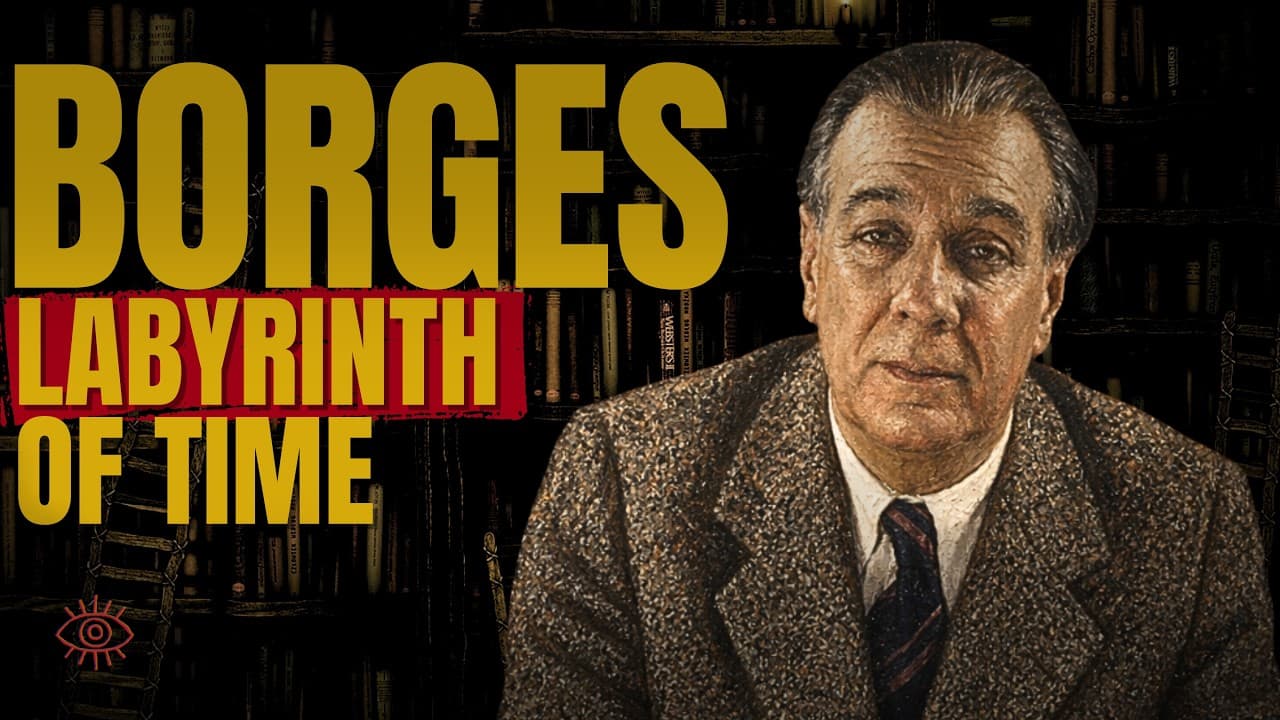
The Infinite Library That Contains the Date of Your Death | Borges for Sleep
Borges's Complete Philosophy
Somewhere in an infinite library, there is a book that contains the date of your death.
This is the mind of the blind Argentine librarian who thought in fictions and dreamed in paradoxes. Jorge Luis Borges was not a philosopher who wrote systematic treatises. He was a storyteller who turned philosophical problems into fables so precise and beautiful that physicists, neuroscientists, and literary theorists are still catching up to him.
We walk through twenty chapters of his life and work, from the childhood library in Palermo to the quiet grave in Geneva, from Funes the Memorious to The Library of Babel to the Aleph in a Buenos Aires basement. These are stories about memory, infinity, identity, dreams, and the suspicion that the universe itself might be a text we are only partially able to read.
The full episode is on YouTube and Spotify. Please listen only in safe, restful contexts.
Enjoying the episode?
Occasional letters on philosophy, reading, and the examined life. No spam, ever.
By subscribing you consent to receiving occasional emails. Unsubscribe any time via the link in every email or at /unsubscribe.
Timestamps
- 0:00:00Chapter 1: The Boy in the Library
- 0:08:25Chapter 2: A Child Between Languages
- 0:16:45Chapter 3: Geneva and the War Years
- 0:25:19Chapter 4: Return to Buenos Aires
- 0:34:29Chapter 5: The Man Who Could Not Forget
- 0:43:37Chapter 6: The Library of Babel
- 0:52:42Chapter 7: Pierre Menard's Quixote
- 1:00:42Chapter 8: Tlon, Uqbar, Orbis Tertius
- 1:09:26Chapter 9: The Garden of Forking Paths
- 1:18:44Chapter 10: The Circular Ruins
- 1:27:22Chapter 11: The Aleph
- 1:35:53Chapter 12: The Immortal
- 1:44:26Chapter 13: The Blindness
- 1:53:14Chapter 14: Death and the Compass
- 2:02:17Chapter 15: Borges and I
- 2:11:04Chapter 16: The Sand and the Forking
- 2:19:19Chapter 17: The Political Wounds
- 2:28:36Chapter 18: Borges Among the Philosophers
- 2:37:36Chapter 19: Geneva, Again
- 2:45:42Chapter 20: The Labyrinth Remains
For the record
Full Transcript
Chapter 01: The Boy in the Library
In Buenos Aires, in a house on Calle Serrano in the neighborhood of Palermo, there was a library. It belonged to Jorge Guillermo Borges, a lawyer and psychology professor who had failed at his own ambition to become a writer. The library held eleven thousand volumes. Books in English, books in Spanish, books in French and German, books with soft leather covers and books with broken spines, books that had been read many times and books that had never been opened. Into this library, sometime around 1905, walks a small boy with thick glasses and an almost painful shyness. He is six years old. His name is Jorge Luis Borges, and he will spend the rest of his life trying to leave this room.
He cannot leave, of course. No one who has lived inside a great library as a child ever truly leaves. The library becomes the first shape the mind ever takes. The first architecture it ever memorizes. For the rest of his life, Borges would describe his childhood not in terms of the streets of Buenos Aires or the games he did not play or the friends he did not have, but in terms of the books he read in that room. The library was his mother tongue before any mother tongue.
Here is a curious fact about him. He read Don Quixote in English before he read it in Spanish. Think about what that means for a moment. The greatest novel in the Spanish language, written by a Spaniard in Madrid in the early seventeenth century, a book that every educated Argentine child was expected to know almost by heart, came to Borges first in the voice of an English translator. When he finally read Cervantes in the original, he said the Spanish sounded like a bad translation. That sentence should stop us. A child's relationship to a book is so total that the original language can come to feel like an impostor.
He read Kipling and discovered India. He read Stevenson and discovered the sea. He read H. G. Wells and discovered the future. He read Chesterton and discovered that a clever English Catholic could make a detective story feel like theology. He read the Grimm brothers and Lewis Carroll and The Arabian Nights, and later he said that he had never left The Arabian Nights, that everything he ever wrote was a footnote to that book. He meant it.
His father was the quiet force behind all of this. Jorge Guillermo was a tired man who had wanted to write and could not, who loved philosophy and taught it poorly, who was slowly going blind from the same inherited condition that would eventually claim his son. But he was a good father in the specific way that mattered most. He did not push. He did not correct. He simply left the library unlocked. When young Georgie, as the family called him, showed unmistakable signs of becoming a reader, his father did something strange and wonderful. He told him not to announce it.
If you want to be a writer, the father said, never say so out loud. Do not speak of your ambition. Do not make it public. Let it live inside you like something private, like something that belongs only to you, and one day, if you are lucky, the thing you have kept quiet about will surprise even yourself. The son followed this advice for the rest of his life. Even at the height of his fame, when universities across the world were giving him honorary degrees and his translators were fighting over the English rights to his stories, Borges spoke about his own writing with the same mild, slightly embarrassed tone, as if he had wandered into literature by mistake and was hoping no one would notice him there.
The library also contained his first encounter with the idea that a book could be more than a story. His father owned a set of the Encyclopedia Britannica, and the young Borges would pull down volumes at random and read entries on whatever happened to catch his eye. A lighthouse in Scotland. The mating habits of the platypus. The history of a forgotten Balkan kingdom. From the Britannica he learned something that would define his imagination for the next eighty years. He learned that the world is too large to fit inside any single mind, and that an encyclopedia is a humble and doomed attempt to squeeze infinity into alphabetical order.
You can trace almost every later story back to this moment. The stories about impossible libraries. The stories about books that contain every other book. The stories about maps so detailed that they cover the territory they are meant to represent. All of them are, in some sense, the child in the Palermo library still trying to read everything at once, still trying to hold the universe inside a room small enough to pace across.
There is a phrase Borges would use many years later. He said that the library was his first universe, and also the only one that ever fully made sense to him. We should sit with that claim. He is saying that the real world, the one made of weather and traffic and other people, never attained the intelligibility of a room filled with books. That is either a confession of loneliness or a statement of faith, and in Borges it is often hard to tell the two apart.
The Palermo of his childhood was not yet the fashionable neighborhood it later became. It was a district of low houses and empty lots, of horse carts and the occasional knife fight in the corners where the compadritos, the tough young men of the slums, still practiced an older kind of honor. The boy with the thick glasses rarely went outside. His mother, Leonor Acevedo, kept him close. His sister Norah, younger and braver, became his first and most constant companion. Together they invented games in the garden. They imagined entire kingdoms. They conducted long conversations with characters from books the rest of Buenos Aires had never read.
The outside world, when he encountered it, confused him. Other children seemed to speak a language he did not know. Sports bewildered him. Physical play terrified him. The street, with its dust and its shouting and its casual violence, was a country he had not been given a passport to. So he returned, again and again, to the library. He returned with a kind of relief that only a very shy child with a very interior imagination can understand. In the library, he was not strange. In the library, everyone was a little strange, because everyone there had been dead for decades and was only speaking through paper.
It is easy to romanticize this and call it idyllic. It was not. A child who lives entirely in books is a child who has trouble belonging to his own body. Borges would struggle with that trouble for the rest of his life. The shyness, the social awkwardness, the long stretches of celibate loneliness, the feeling that other people were a kind of weather he could not predict, all of it was planted early, in the quiet between the shelves. The library gave him his mind and took away, almost in the same motion, some of his ability to live easily outside of it.
Still, every writer needs a first universe. Some are born into the shouting of the street. Some are born into the hush of the church. Borges was born, in the way that matters most, into eleven thousand volumes in three languages on quiet shelves in a house in Palermo. Everything he would later write was already waiting there, in potential, like a book not yet pulled down. He only had to spend the next eighty years discovering which volume was his.
Chapter 02: A Child Between Languages
The Borges household spoke two languages at once. Spanish was the everyday speech, the language of the streets and the servants and the casual conversation with neighbors. English was the private tongue, used with his father and his grandmother and the books they loved most. His grandmother was an English woman named Fanny Haslam, born in Staffordshire, who had come to Argentina in the nineteenth century to marry an Argentine officer and who, after decades on that continent, had still not bothered to learn Spanish properly. She addressed her grandchildren in English. She told them bedtime stories in English. The Bible they read was the King James. The poetry they heard before they fell asleep was Tennyson and Swinburne, Keats and Shelley, lines in an old tongue from an old island half a world away.
Imagine what this does to a child. The same object has two names. The same feeling has two words. The world does not come to you labeled. You have to choose which label to use, and the choice tells you something about who you are in that moment and who you are speaking to. Borges later said he did not know whether he thought in Spanish or in English. Sometimes, he said, a word in one language would arrive in his mouth when he needed a word in the other, and he would have to stop and translate his own thought before he could speak it. This is not a confession of confusion. It is a description of how every sentence he would ever write was built.
Bilingualism gives a future writer a specific gift. It gives him the habit of noticing that language is a choice. Monolingual children take words for granted. They assume the word they know is the real word, and the thing it points to is named by it the way a key fits a lock. Bilingual children learn something different. They learn that the word and the thing are held together by a string, and the string is neither necessarily short nor necessarily straight. The word you use for a knife in one language is not the word you use for it in another, and the knife itself does not seem to mind. That discovery is small. It is also the beginning of literature.
His father Jorge Guillermo had his own relationship with English. He had memorized long passages of Shelley and Keats. He had translated Omar Khayyam's Rubaiyat into Spanish, or tried to, with the help of Edward FitzGerald's famous English version. He loved Hume and Berkeley and the British philosophers who argued about whether the outside world existed at all. When young Borges asked his father one day what the mind was, the father picked up an orange from a bowl and held it out and said something that the son never forgot. The orange is in the mind. The taste of the orange is in the mind. The memory of the orange is in the mind. The only thing we never quite reach is the orange itself. This was Berkeley in a domestic register, offered over breakfast like a simple fact, and the child took it as one.
His mother, Leonor Acevedo, belonged to an old Argentine family with military roots going back to the wars of independence from Spain. She spoke Spanish and did not speak English, but she understood that her son's strangeness was not a defect, and she protected him. She would protect him for the rest of his life. When his father died in 1938, it was she who organized everything. When his eyes began to fail, it was she who read aloud to him. When journalists came to interview him in his eighties, it was still his mother, in her nineties, who answered the door.
There was also his sister, Norah. Two years younger. Braver, more physical, more at home in her own body. She and her brother lived inside a private mythology that no adult ever fully entered. They invented a country together and gave it a history. For years, the country was more real to them than Buenos Aires was, and when the family traveled in 1914 to Europe, the two children carried it with them the way other children carry a toy.
Here is something worth pausing over. The languages in the Borges household did not fight for supremacy. They coexisted. A sentence could start in one and finish in the other. A joke could be funny only because the listener spoke both. The young Borges grew up not as a Spanish speaker who happened to know some English, and not as an English speaker trapped in Argentina, but as something rarer. He grew up as a person for whom translation was not a second activity but a first one. Before he could think, he was already translating his thoughts. Before he could speak, he was already choosing which word to use.
This is the secret of a great deal of his later writing. When Borges describes a character, he is describing him in two languages at once, even when the sentence on the page is only in one. The prose has a strange doubled quality, as if the words are aware of the other words they might have been. English readers who know no Spanish still feel this in the Hurley translations and the Irby translations and the elegant old Yates and Kerrigan versions. There is a coolness to the prose, a shimmer of distance, that is not exactly English and not exactly Spanish. It is the voice of a man who heard both languages in the cradle and never quite committed to either.
You might think that such a background would produce someone paralyzed, unable to choose a tongue and therefore unable to speak freely in any of them. The opposite happened. Borges spoke and wrote with extraordinary economy. The sentences are short when they need to be short. The words are precise to the point of cruelty. He had learned, from the very first, that every sentence was a negotiation between two possible versions of itself, and that the version that reached the page had to earn its place by being better than the version in the other language. The bilingual child becomes the ruthless editor.
When someone asked him why he wrote in Spanish rather than English, Borges answered with a shrug that his Spanish was simply the language he happened to be born into. A writer does not always get to choose. You arrive in the world speaking a certain tongue the way you arrive with a certain color of eyes, and whatever you are going to do, you have to do it with what you were given. It sounds like resignation. It is really a philosophy of limits. For Borges, the limits were a source of freedom. The fact that he spoke two languages meant neither was home. He carried a small exile inside him from the beginning, and he learned to feel at home only in the act of writing, the one place where both languages could meet without fighting.
The lesson the child took from all of this, and took so deeply that it became invisible to him, was that the borders between things are fragile. A word is not a thing. A translation is not a betrayal. A language is not a country. The knife is still a knife whether you call it cuchillo or knife, and yet the two words bring with them different textures of history, different tones of violence, different shadows cast by the object in the lamplight of the mind. When Borges grew up to write stories about mirrors and maps and labyrinths and dreams within dreams, he was only elaborating, with great patience, a discovery he had already made by the age of seven. The boundaries we draw around our lives are drawn by us, they are real while we honor them, and they are always, always less solid than they appear.
Chapter 03: Geneva and the War Years
In February of 1914, the Borges family boarded a steamer in Buenos Aires and set out for Europe. The reason was simple and medical. Jorge Guillermo Borges was losing his sight to the same inherited condition that would eventually take his son's, and the best oculists in the world, or so the family believed, were in the old German university towns. The plan was to spend a year or two consulting specialists, rest in the mild European summers, and return to Argentina with the father's eyes restored or at least stabilized. They would end up staying five years. They would not come back until 1921. And in those years, a small boy who had only ever lived inside a library would meet the wider world for the first time, and the world would pick the worst possible year to introduce itself.
They arrived in Europe just in time for the First World War. By the end of the summer of 1914, the borders of the continent were closing. Returning to Argentina became complicated, then dangerous, then impossible. The family decided to settle, of all places, in Geneva. Switzerland was neutral. The schools were good. The city was small enough to walk across in an afternoon and large enough to contain bookshops in four languages. Fifteen-year-old Jorge Luis enrolled at the College de Geneve and, for the first time in his life, found himself inside an institution with other children his age. He had been mostly taught at home until then. The shock of being dropped into a classroom was considerable.
He did not do well at first. The other boys teased him for his accent, for his thick glasses, for his seriousness, for the fact that he knew too many books and not enough jokes. He was already a foreigner twice over, an Argentine in Europe and an English speaker in a French city, and now he was a third kind of foreigner, a child who thought like an old man in a room full of children. He sat in the back of the classroom and listened. He read in the library after school. He learned Latin with a methodical patience that impressed his teachers, and he began, almost on his own, to learn German.
The German was an accident at first. He wanted to read the Expressionist poets who were making a noise in the German-language journals of the period. He wanted to read Heinrich Heine, whose elegant irony appealed to him. He wanted to read Kafka, who had published a few strange stories in a few small magazines and whose voice, once Borges heard it, never quite left him. He picked up a German grammar and taught himself. Within a year or two he was reading Schopenhauer in the original. Schopenhauer became one of the decisive influences on his entire life.
Schopenhauer left fingerprints on everything Borges would later write. The German philosopher had argued that the visible world was a kind of dream made by the mind, and that behind the dream was a restless striving force he called Will. We experience Will most directly in our own hunger and fear. Art, Schopenhauer said, was the one thing that could briefly lift a human being out of this churn. For a fifteen-year-old boy with failing eyesight, stuck in a foreign city during a world war, this philosophy had obvious appeal. The world was not quite real. Suffering was the rule. Art was the quiet refuge. Borges would remain a Schopenhauerian, in a loose and devoted way, for the rest of his life, and when decades later he wrote stories about libraries and dreams and mirrors, he was often re-staging the old German argument in Latin American costume.
He also discovered Kafka in Geneva. The early Kafka stories were simple on the surface, almost like fairy tales, and yet underneath they pulsed with a dread that could not be named. Borges saw immediately that Kafka had found a new tone, one that combined nightmare with a strange bureaucratic calm. He would later say that Kafka had invented his own precursors, meaning that once Kafka existed, you could go back and read older writers and hear faint Kafkaesque echoes that had been there all along but were now audible because Kafka had tuned your ear to them. That idea, that a new writer can change how we read the past, became one of Borges's great contributions to literary thought. He first learned it reading Kafka in Geneva at seventeen.
The war itself was not visible to the Borges family, not directly. Switzerland was quiet. Food was sometimes scarce. There were refugees in the streets. But the artillery of Verdun did not reach Lake Geneva, and the boy could walk along the Rhone in the evenings without fear. What he felt, rather, was a kind of historical pressure, a sense that the world outside his reading was collapsing in ways that the books on his father's old Buenos Aires shelves had not prepared him for. The certainties of the nineteenth century were dying. Empires were cracking. The literature that had raised him, the Kipling and the Stevenson and the Wells, belonged to a confidence that the trenches were grinding into mud. He had to find a new literature to match a new century. Kafka and Schopenhauer were where he started.
He also wrote his first real poems during these years. They were not published. Most of them have not survived. But they existed, and they taught him something. Poetry was not only a way of making beautiful objects. It was a way of thinking. A line of verse could hold an idea the way a bottle holds wine, and the shape of the bottle changed the taste of what was in it. Borges began to suspect, as he wrote these early poems, that form and content were not separable, that every metaphysical problem had a corresponding rhythm, that philosophy itself was a kind of music played in a minor key.
Something else happened in Geneva that he rarely spoke about. He fell in love, or something like it, with a girl mostly forgotten to history. The experience left him bruised. His father, kind in his awkward way, arranged a visit to a prostitute so that the boy could lose his virginity. The visit went badly, and it left Borges with a lifelong shyness around women that would shape his romantic life in ways that were often unhappy. The same child who memorized encyclopedias and taught himself German would, in his own quiet way, be afraid of that question for decades.
When the war ended in 1918, the family did not return immediately to Argentina. They traveled to Spain instead. In Madrid, the young Borges fell in with a group of avant-garde poets who called themselves the Ultraistas. He joined their movement. He wrote their kind of poetry. He argued in their cafes about imagery and rhythm. He was nineteen, alive, finally among people who read what he read, and the future, for the first time in his life, looked like an open door instead of a closed window. He did not know yet that his best work would not be poetry at all. He did not know that the voice he was developing in Spain would have to be abandoned and rebuilt before it became his own. He only knew that he was a writer now, in some public sense, and the library in Palermo was very far away.
In 1921, finally, the family came home. Borges was twenty-one. He arrived in Buenos Aires with a European mind inside an Argentine body. He had left as a boy who had only read about the world. He returned as a young man who had tried, in his own cautious way, to live in it. The city that greeted him was not quite the city he had left.
Chapter 04: Return to Buenos Aires
Buenos Aires in 1921 was becoming a modern city in the full, noisy, confusing sense of that word. When the Borges family had left in 1914, the capital had still been something like an extended village dressed in the clothes of a European capital. Horses outnumbered cars. The old colonial patios still opened onto cobbled streets. When they returned seven years later, the cars had begun to outnumber the horses. New neighborhoods were rising. Immigrants were arriving by the boatload from Italy and Spain and eastern Europe, and they were bringing their own foods, their own music, their own languages. The tango, which had been a disreputable dance associated with brothels and knife fighters, was becoming the national sound. A new literary scene was forming in the cafes around Florida Street and the Avenida de Mayo. Poets argued about imagery, about politics, about the future of Spanish-language literature, about whether Argentina owed its soul to Europe or to the pampas.
Borges returned into this city with a head full of German philosophers and Spanish avant-garde poets. He was twenty-one. He was unsure of himself. He was not yet the Borges of the famous photographs, the stooped blind librarian with the gentle smile. He was a young man trying to find out what kind of writer he was going to become, and he was going to be wrong about it for a good ten years.
His first literary project was to import the Ultraista movement he had joined in Madrid. Ultraismo was a poetic movement that prized metaphor above all else. The Ultraistas wanted to strip poetry of sentiment and narrative and leave only the clean, startling image. Borges wrote manifestos about it. He helped found little magazines. He pasted poems on walls. One early publication was distributed by the simple method of slipping mimeographed broadsheets into the coat pockets of passers-by on the street. This is not the Borges we know. This is a kid pretending to be an avant-garde agitator, and it is also a reminder that every serious writer once spent some time being ridiculous in public.
In 1923, he published his first book, Fervor de Buenos Aires, a collection of poems. The poems were uneven. Some of them are still worth reading, especially the ones about the corners of the city, the patios at dusk, the small plazas where a man could be alone with his thoughts. But the book did not announce a major voice. It announced a promising and slightly confused young man. Borges would later be embarrassed by these early poems. He tried to suppress them. In old age he wanted to buy up every copy of the first edition and burn them. He could not.
What the early poetry did do, and what he would keep even after he abandoned Ultraismo, was begin a lifelong project of imagining Buenos Aires into a myth. The city on the page was not quite the city in the world. It was a dreamier, quieter, more ancient version. The Buenos Aires of his poems was full of sunsets on white walls, of lonely streetcorners where something important might have happened long ago, of old men who had once been young and were now sitting on benches waiting for night. He was doing for Buenos Aires what the modernists were doing for Dublin or Paris or Saint Petersburg. He was turning a real place into a literary place, a place you could enter only through language.
In the daytime, he worked in a branch of the municipal library, and he walked between neighborhoods, and he haunted bookshops, and he met people. In the evenings, he wrote. In the small hours, he read. He had one close friend in particular named Macedonio Fernandez, a philosopher and eccentric who never published much of his own work but who lived inside his head at a volume so high that conversation with him was itself an education. Macedonio was in his fifties. Borges was in his early twenties. The older man had known the younger man's father. The two of them would meet in cafes and argue about metaphysics until the chairs were being stacked around them and the waiters were asking them politely to leave.
Macedonio is one of the secret figures in the Borges story, a kind of dark star whose influence shows up in almost every later work. Macedonio believed that the self was a fiction. He believed that personal identity was a useful illusion that literature could helpfully deconstruct. He believed that a good writer should rewrite his readers from the inside, undoing their sense of who they were. Borges soaked all of this up, politely, during the long cafe nights. He would later write that everything he knew about thinking, he had learned from Macedonio Fernandez. It is almost certainly an exaggeration. It is almost certainly, also, true in some way.
During these years, Borges also began to write prose essays. Not stories yet. Essays. He wrote about books, about metaphors, about philosophical puzzles that had been bothering him since Geneva. He wrote about Zeno's paradoxes. He wrote about a man who wakes and doubts whether he is the same person who fell asleep. He wrote about the relationship between a dreamer and the dreamed. Looking back, we can see the future in these essays. The essays are basically the stories in their first form, the ideas still in their philosophical clothing, not yet dressed up as narrative. A careful reader in 1930 could have noticed that Borges was only a few steps away from a new kind of short fiction. Most readers in 1930 did not notice.
There was also a woman named Concepcion Guerrero, met on a streetcorner one evening, obsessed over in the slow way he did everything, written poems to for about two years. The relationship did not lead to marriage, or to anything physical of note. It led to another installment of the loneliness that would shadow his private life for a long time. Borges, a man who could imagine universes inside a basement stair, had almost no talent for getting a woman to love him back. He lived with it the way other men live with a chronic pain.
There was his mother, of course. Leonor Acevedo made the household into a fortress around her son and her daughter. She managed the money, dealt with the landlords, arranged the social visits Borges found too exhausting to arrange for himself. His mother was doing almost all the non-literary work of his life, quietly, invisibly, and without complaint. She would keep doing it for another forty years.
The Buenos Aires of the twenties was also a city of strong opinions about what Argentine literature should be. Nationalists wanted poems about gauchos and the pampas. Cosmopolitans wanted engagement with Paris and Berlin. Marxists wanted literature in the service of revolution. Borges disagreed with most of them and slowly developed his own position, a kind of principled uncertainty. He did not believe a national literature needed to be national. He did not believe a writer had to serve any politics. A writer's only real duty was to his own strangeness, to the odd corner of his mind where the images came from.
The twenties and the early thirties passed in this half-public, half-private way. Borges published more poetry. He wrote essays for the literary pages of La Prensa and La Nacion. He translated, from English, from French, from German, because translation paid. He was known as a young literary man of taste and promise, and he was becoming almost famous in a local way, the kind of famous where a few hundred people in a few Buenos Aires cafes have strong opinions about your work and no one else has heard of you. He was not yet writing the stories that would make him world famous. He was still building the voice. The voice was almost ready. It would need one more thing to be finished, and that thing would come, painfully, in the form of an accident in 1938.
Chapter 05: The Man Who Could Not Forget
In 1938, on Christmas Eve, Borges struck his head on the sharp edge of an open window casement while running up a stairwell in Buenos Aires. The wound became infected. He developed septicemia. For days he hovered in delirium, his mother at the bedside, the doctors unsure whether he would live or die or come back with his mind intact. When the fever broke, he was terrified that the injury had damaged his ability to think. He asked his mother to read him something difficult. She did, and he followed it, and he wept with relief that his mind was still there. Then, still convalescing, still afraid, he decided to try writing something he had never written before. Not a poem. Not an essay. A short story, in a new form, about something strange. The result was called Pierre Menard, Author of the Quixote. The Borges we know had just arrived.
There is another story from this same period that has to be understood before any of the others begin to make sense. It is the one that explains why thinking itself is a kind of forgetting.
Its title is Funes el Memorioso, Funes the Memorious in the standard English translation. The scene is a small town in Uruguay, in the countryside, some years earlier. A young man named Ireneo Funes, a compadrito from the local poor, is thrown from a half-wild horse and lands on his head. When he wakes up, he cannot move his legs. He is paralyzed for life. But something else has happened that is harder to explain. His memory has become perfect.
Perfect, in the fullest and most terrifying sense of the word. Before the accident, Funes was like the rest of us. He could remember in the ordinary way. A face. A day. A feeling. Most of it was blurry. Most of it was already fading as soon as it had happened. After the accident, nothing fades. Funes remembers every leaf of every tree he has ever seen. Every shape of every cloud that has ever passed over his head. Every word of every conversation, in its exact tone, with every pause intact. He remembers the shape of his own hand at every angle it has ever taken. He remembers what he was thinking at every moment he has ever thought anything. He remembers the wine he drank at noon yesterday and the wine he drank at noon the day before yesterday and he can tell you, with certainty, that the two wines were subtly different from each other in ways he can now describe for an hour.
At first, reading this, you might envy him. We all complain about forgetting. We lose our car keys. We forget birthdays. We cannot recall the name of the book we loved last year. A perfect memory sounds like a fairy-tale gift. But Borges does something terrible and brilliant in the story. He follows the gift to its consequences. And the consequences are a hell you probably would not survive.
First, Funes cannot sleep. Sleep requires a kind of dropping-away of the day. To fall asleep, the mind has to let go of what it has been holding. Funes's mind cannot let go of anything. Every experience he has had is still happening inside him, all at once, in full detail. At night he lies in the dark and the whole record plays, every leaf and every cloud and every word, and the only relief comes when he remembers nights in his childhood when he was in a room with no window, because those nights contained fewer details.
Second, and this is the deeper thing, Funes cannot think in general terms. Thinking in general terms requires forgetting the particulars. When you or I see a dog, we recognize it as a dog because we have smoothed over the differences between all the dogs we have ever seen. The dog in front of us becomes an instance of a category. This is what we mean by a concept. A concept is a blur, a useful blur, a blur that lets us carry thousands of experiences as a single word. Funes cannot blur. He sees this dog at this angle at this moment, and it is unrelated, in his mind, to the same dog seen a minute ago at a slightly different angle, which was itself unrelated to the dog of yesterday. Every instant is its own isolated event. The word dog is, for Funes, almost meaningless. It tries to cover too much difference.
This is a philosophical argument being made by a story. Take it seriously. Borges is claiming, in the guise of a fable, that thought itself is not a form of remembering. Thought is a form of forgetting. We think because we forget. Every concept is a memory loss. Every word is a simplification. Every judgment is a willingness to let go of the unnecessary in order to keep the essential. Without this willingness, without the blur, without the forgetting, we would not be thinkers at all. We would be Funes, paralyzed by our own memory, unable to speak, unable to sleep, unable to see anything twice.
There is a line in the story that is worth memorizing. The narrator, visiting Funes in his dark room, describes him as a solitary and lucid spectator of a multiform, instantaneous, and almost intolerably precise world. Read that again. A lucid spectator of an intolerably precise world. Borges is saying that precision, past a certain point, is not clarity. It is suffocation. A world with too much detail is a world you cannot live in. A mind with too much information is a mind that cannot make a decision.
Funes dies young, in the story, of pulmonary congestion. He is still a teenager. Borges notes, quietly, that the overworked mind might have contributed to the body's collapse. Then the story ends. There is no moral. There is no lesson delivered in a neat closing paragraph. You are left alone with the image of a paralyzed young man lying in a darkened room, remembering every cloud he has ever seen.
Forgetting is not a bug of consciousness. Forgetting is what consciousness is made of. The memories you do not have are the empty rooms in which the memories you do have can move around. A brain stuffed to the walls is a brain that cannot think. Any theory of perfect knowledge has a similar problem. Knowledge requires selection. Selection requires loss. A complete map is useless. A useful map is one that leaves things out.
The story is also, quietly, about identity. Funes, with his perfect memory, has in a strange way ceased to be a person. He is a recording machine. He has no interior, only storage. When you look into him, you do not find a self. You find a list. Borges is suggesting that the self is a selective narrative we tell about our own past. Take away the selection, leave only the raw data, and the self dissolves into noise. The editor, for Borges, is the ghost in the machine. Without the editor, there is no machine, and there is no ghost.
We all know, somewhere in us, that this is true. We all know that our sense of who we are depends on what we allow ourselves to forget. A grudge held too long becomes a second skin. A memory replayed too often becomes a cage. Funes is the literalization of that fear. He is what you would be if you could never let anything go. And Borges, writing in the aftermath of a head injury that had almost taken his own mind, had good reason to think about what it would mean to lose the ability to edit yourself.
A young man on a horse. A fall. A perfect memory. A paralysis. A story that tells you, if you listen carefully, why your own imperfect mind is the strange, fragile miracle that it is. Funes is what you could have been if the editor inside your head had refused to sleep. He is the ghost story Borges tells about the human condition, and like all his best ghost stories, it is quieter than horror and more patient than grief.
Chapter 06: The Library of Babel
Imagine a library that contains every possible book. Not every book that has been written. Not every book that will be written. Every possible book. Every arrangement of letters and spaces and punctuation marks that could ever appear inside a printed volume of a fixed size. Most of these books are, by sheer statistics, nonsense. A book that consists of the letter M repeated four hundred and ten pages in a row is in the library. A book that says nothing but a string of random consonants is in the library. A book in which a single sensible sentence appears on page seventeen and everything else is chaos is in the library. The library contains them all, and it contains them in every language, and in every code that has ever been invented, and in every code that has not yet been invented, and in every mistake that might plausibly have been made by a careless typesetter.
This is The Library of Babel, published by Borges in 1941. On the surface, it is a short story. In reality, it is one of the strangest philosophical puzzles of the twentieth century, and it keeps getting stranger the more carefully you think about it.
The narrator is a librarian. He has lived his entire life inside the library. He has never seen the outside, because there is no outside, because the library is the universe. The architecture is simple and repeated. Hexagonal galleries, each with the same number of walls, each wall the same number of shelves, each shelf the same number of books. A staircase spirals up and down through the floors, going, as far as anyone can tell, forever. There are bathrooms. There is a place to sleep. There is a little circle of air where a librarian can stand and look up into the shaft between galleries and see the galleries above and below repeating, identically, in both directions, for as far as the eye can follow.
Some of the books, by accident, make sense. A volume contains the phrase O time thy pyramids on one line and nothing else intelligible on any other. Another contains a coherent account of a battle in an unknown war. The librarians have spent centuries looking for the meaningful books, and they have found some, and the finding of each one has been celebrated as a holy event. But the searches are mostly failures. The ratio of gibberish to sense is astronomical.
Now think about what this library contains. Somewhere in it, by the iron logic of possibility, there is a volume that narrates the entire history of the world, correctly, from the first day to the last, with every name and every date in place. Somewhere in it there is a volume that contains your biography, including the hour of your death and the exact last word you will speak. Somewhere in it there is the book that would finally explain consciousness, or the existence of suffering, or why anything exists at all rather than nothing. These books exist. They must exist, by the definition of the library, because the library contains all possible arrangements of letters. And yet the chance of ever finding any of them is so small that the probability, for all practical purposes, is zero.
This is the first layer of the puzzle. The library contains every truth, and yet the truths are inaccessible. Every answer is written down, and no one can read the answers. Having everything is exactly the same, from a human point of view, as having nothing. We will come back to this idea, because Borges loves to return to it. Infinity, for him, is not an abundance. It is a form of silence.
There is a second, deeper problem. Even if you found a coherent book, how would you know it was true? In a library that contains every possible book, there are also millions of books that look coherent and are full of lies. There is a book that tells you it is the true history of your life, and it is a lie. There is a book that tells you the library is finite, and it is a lie. There is a book that tells you a god created the library on a certain date, and it is a lie. There is also, somewhere, the true history of your life, but there is no way to tell which volume contains the truth and which volumes contain the convincing fakes. A meaningful book, in the library, is indistinguishable from a plausible lie. The librarians, after learning this, fall into despair. Some of them go mad. Some of them start burning volumes at random, figuring that most books are worthless and no randomly chosen loss can hurt. Others form sects that worship a single hypothetical volume, the book of books, the Vindication, which if it exists must explain everything, but which no one has ever seen.
Borges is dramatizing a theological problem. If the universe is coherent, if it has been put together for a purpose, then somewhere there is an account of that purpose. Believers have always imagined this account exists and have called it Scripture, the Word, the mind of God. Borges takes the intuition seriously and pushes it to its logical extreme. If the universe contains its own explanation, then the universe is a kind of library, and the explanation is a book on one of the shelves. The problem is practical. How do you find the book? The answer is heartbreaking. You cannot. The library is too big. You will die in the galleries before you have looked at a negligible fraction of them. The meaning is there. The meaning is also, from your point of view, unreachable.
There is a strange comfort in all of this, and that is the third layer of the story. The narrator, a tired old man by the end, says something that stays with you. He says that even if no individual librarian can find the meaningful book, the library as a whole is eternal and symmetrical, and somewhere in it the sense we crave is preserved. This preservation is not useful to any particular soul. But it is there. The universe is not empty of meaning. The universe is full of meaning. The problem is that we are too small to retrieve it, and our lives are too short, and the galleries are too many. If you squint, this is actually a kind of faith. It is not a faith that says the meaning is available. It is a faith that says the meaning is real even when it is hidden. For some people that is not enough. For Borges, on his best days, it was almost enough.
The Library of Babel is also a brutal answer to the dream of the infinite. The twentieth century inherited a romantic love of the infinite. Borges looks at the infinite and sees something else. He sees noise. He sees a vastness that does not protect us but swallows us. His library is not heaven. It is a bureaucracy without end, a promise kept so completely that keeping it has become meaningless.
There is a final turn. The narrator, near the end, writes a sentence that will stay with you if you let it. He suggests that the library is limitless but periodic. Meaning, in theory, it goes on forever, and yet every possible book has to eventually recur. If you walk long enough, you will find the same volume you saw a hundred galleries back. Order and repetition emerge, faintly, from the chaos. This is what he chooses to hope for. Not that the library will yield its secret, but that the library is not, finally, random. There is a pattern. The pattern is inhuman. The pattern is larger than any mind can hold. But the pattern is there, and any librarian, dying in any gallery, is somewhere inside it.
Reading the story for the first time, you may feel crushed. Reading it for the second time, you may feel strangely free. The meaning of your life does not depend on your being able to find it. The book that explains you is already written. You will not find it. Neither will anyone else. But it exists, and somehow, that is a thing.
Chapter 07: Pierre Menard's Quixote
There is a French writer named Pierre Menard who has decided to write Don Quixote. Not to translate it. Not to adapt it. Not to imitate it or to modernize it or to produce a version set in another country. He has decided to write Don Quixote. The same book Cervantes wrote in 1605. Word for word. Sentence for sentence. Comma for comma. And Menard is going to write it on his own, from his own mind, in the early twentieth century, from his own experience of the world. He is not going to copy Cervantes. That would be easy. He is going to arrive at Cervantes's sentences by independent thought, as if they were his own, through a creative process that must land, unbidden, on exactly the words Cervantes chose.
This is the premise of Borges's story Pierre Menard, Author of the Quixote, and if you laughed when you first read it, good. That was one of the intended responses. The story is a joke. It is also one of the most important short pieces of literary theory ever written. It is both, at once, and the fact that it is both is part of what makes Borges Borges.
The narrator is a literary critic, a friend of Menard, writing a kind of obituary essay about his recently deceased colleague's strange and mostly invisible achievement. Menard, the narrator tells us, has completed only a small portion of the project. He has rewritten the ninth chapter and the thirty-eighth chapter of Part One, and a fragment of the twenty-second chapter. That is all we are given. Not the whole Quixote. Just three chapters, reproduced, as it were, from scratch.
And now Borges does the thing that changes everything. The narrator takes two passages that are verbally identical, one from Cervantes and one from Menard, and he quotes them side by side. They are exactly the same. The same words in the same order. And then the narrator claims, with a straight face, that Menard's version is more nuanced, more subtle, more daring, and in many ways richer than the Cervantes original.
Why? Because they were written by different men in different centuries with different histories, and those differences change what the words mean.
Take the phrase history is the mother of truth. When Cervantes writes it in the early seventeenth century, he is participating in a humanist tradition that was then very much alive. He means something relatively straightforward. History, the careful record of what has actually happened, is the source from which our ideas of truth must be drawn. It is a pious line from a pious period. When Menard writes the same phrase in the early twentieth century, the narrator argues, the phrase becomes something else entirely. In the century of William James and historical relativism and the realization that every historical account is written by someone with a point of view, the claim that history is the mother of truth becomes a defiant and almost cynical boast. It is no longer humble. It is provocative. Menard, knowing what has come between Cervantes and himself, cannot write the sentence innocently. The same words mean the opposite, or at least they ring in a different key.
You can see where this is going. The same string of letters, arranged in the same order, delivers a different experience depending on when it was written and by whom. Language is not a container for meaning. Language is a performance that happens inside a context. Change the context and you change the content.
This is one of the core ideas of twentieth-century literary theory. The English critics and the French theorists and the German hermeneuticians would spend the next sixty years arguing about versions of this claim. The idea has many names. In its weakest form, it is called reader response. In a stronger form, it is called the death of the author. In its strongest form, it becomes the whole project of deconstruction. Borges got there first, in 1939, by writing a joke about a forgotten Frenchman.
And here is a deeper layer of the joke. Borges is also making a sly point about what reading itself is. When you read Don Quixote now, in 2026, you are not reading the book Cervantes wrote. You are reading something that has been framed for you by four centuries of commentary, by the experience of modern fiction, by the invention of the novel form, by the history of Spain, by the history of your own language, by every other thing you have ever read that was in any way influenced by Cervantes. You cannot read the book the way its first readers read it. You are incapable of doing so. Your Quixote is a Quixote assembled by time. Your Quixote, in this sense, is Pierre Menard's Quixote. You write the book you read, in tiny continuous ways, by bringing your own century to it. Every reader is, by this logic, a kind of Menard.
Menard's project is also about originality. What does it mean to be an original writer? The simple answer is that you write something new. But Borges, through his ridiculous premise, suggests a stranger possibility. Maybe originality is not about producing new sentences but about producing old sentences in a new mind. Menard is doing nothing a great translator does not already do. He is taking an existing text and reproducing it inside himself, with full ownership, as if it had just been invented. The poem becomes yours. It is still the poem. It is also yours. That is what Menard takes seriously. The self, for Borges, is not fixed. It is something you perform through acts of attention, and the text you are reading is one of the places where the self is constructed. When Menard writes Cervantes, he is becoming Cervantes by rebuilding his mind until Cervantes's sentences emerge from it naturally.
The story ends with the narrator musing about the possibilities opened up by Menard's method. He imagines that one might attribute the Imitation of Christ to Louis-Ferdinand Celine, or the Odyssey to James Joyce. He suggests that the technique of the deliberate anachronism and the erroneous attribution could enrich even the dullest books, because reading the Tao Te Ching while imagining it was written by Ernest Hemingway would produce a totally new Tao Te Ching. It is a silly suggestion. It is also a serious one. It is saying that reading is not a passive reception of fixed content. Reading is a performance, and you can change the performance by changing your assumptions about the author. The text stays still. You move. Meaning emerges from the relationship between the two.
There is something comforting and something disturbing in this. Comforting because it suggests that a book never dies. Every new reader gives it a new life. Disturbing because it suggests that you can never really meet a dead author. You can only meet your own mind bent in the direction of the author, and what comes back to you is partly yours, and you have no clean way to separate the two voices.
Pierre Menard wrote only three chapters of the Quixote. We never learn exactly why. Perhaps the strain of trying to arrive, freshly and naturally, at a text that already existed, was too much for any one mind. The narrator notes that Menard left behind many notes on his methodology but that these notes have been lost. Which is itself a little joke. The methodology of how to write a book you have already read is not, and cannot be, written down. The only way to learn it is to do it. And the only person who ever tried has just died, in a story, invented by a man in Buenos Aires who was quietly reinventing what a short piece of fiction could be.
Chapter 08: Tlon, Uqbar, Orbis Tertius
The story begins with a dinner and a bathroom mirror. Borges and a friend are having a quiet evening at a country house near Buenos Aires. They fall into a conversation about mirrors, which Borges has always found uncanny, and the friend quotes a line from an obscure source about mirrors and fatherhood being abominable because they both multiply the number of men. Borges asks where the line comes from. The friend says it comes from a regional encyclopedia of a country called Uqbar. Borges has never heard of Uqbar. He asks to see the entry. They go to the library. They find the encyclopedia. They look up Uqbar. Nothing. The country is not there.
And yet the friend, it turns out, owns a different edition of the same encyclopedia, an older one, and when they compare the two, there is Uqbar, in one edition, missing from the other. A small country somewhere in central Asia. Vague borders. A history described in cautious, almost evasive terms. A literature characterized, the encyclopedia says, by epics and fantastic stories that never refer to reality but only to two imaginary regions called Mlejnas and Tlon. The encyclopedia entry is only four pages long, and it has a strange, anonymous quality, as if it had been slipped into the reference work by someone who did not want to be identified.
This is the opening of Tlon, Uqbar, Orbis Tertius, first published in 1940, later expanded and recombined. It is one of the strangest short stories ever written, and it is the story that, more than any other, makes people call Borges a prophet.
Here is what happens. Years after this first encounter with the encyclopedia of Uqbar, Borges and his friends find a volume of a different encyclopedia. This one is labeled A First Encyclopaedia of Tlon, Volume Eleven, and it is a thousand-page reference work describing, in patient detail, the entire civilization of a planet called Tlon. Geography. Languages. Biology. Physics. Philosophy. Religion. Literature. Everything. The volume is not a fragment of a larger set you could go buy. It is the only volume that exists. The rest of the set has never been found. No one knows who wrote it. No one knows where it came from. But here it is, in a friend's library, perfectly printed, beautifully bound, and wholly consistent with itself.
As Borges studies the encyclopedia, he discovers that Tlon is not just a made-up place. Tlon is a made-up place with an entirely different metaphysics. The people of Tlon do not believe in space as we believe in space. They do not believe in cause and effect as we believe in it. They do not believe that the self persists through time. Their languages have no nouns, only verbs. Something is not a thing. Something is a happening. A river on Tlon is not an object but an event, and the way it is named in their languages reflects this. Their science is a collection of beautiful conjectures that they are not required to verify, because verification has no meaning for them, because the universe itself is, for them, a continuously occurring dream.
If this sounds dense, slow down and let it land. Borges is not just inventing a strange country. He is inventing a strange philosophy. The people of Tlon are idealists of a particularly radical kind. They believe that only minds exist, and that the world is the continuous product of mental activity. The consequence is that their reality has a soft quality, a pliability, that ours, they would say, has lost. On Tlon, if a coin is lost in a field and no one is looking for it, the coin does not exist in any meaningful sense, because nothing on Tlon exists when it is not being perceived. The Tlonians have built a whole civilization around this assumption.
And then the story turns, and it turns in a way that still makes readers sit up. Borges tells us that objects from Tlon have begun appearing in the real world. Not in the story's fictional frame. In the real world. A compass with Tlonian lettering turns up in the pocket of a drunk man in a border town. A small, impossibly heavy metallic cone, a sacred object of a Tlonian religion, is found in a woman's jewelry case. The evidence is scattered, easy to dismiss, but it accumulates. Slowly, over years, more and more Tlonian objects show up. The imaginary planet is leaking into ours.
And then, at the end of the story, the larger game is revealed. The Encyclopaedia of Tlon was the work of a secret society. The society had been founded centuries earlier by a small group of men who had decided to invent an entire planet, with all its history and philosophy, in the hope that such a detailed invention would eventually supplant reality. That was their theory. A sufficiently thorough fiction, patiently distributed, would infect the world with its assumptions. Over generations, the invented planet would gradually become the actual one, because human beings prefer coherent, well-articulated ideas to messy, contradictory ones. Fiction beats reality in the long run, because fiction is tidier.
And, the narrator tells us, it appears to be working. As he finishes writing his account, the world is beginning to change around him. Schools have begun teaching Tlonian history. Physicists have begun citing Tlonian theories. A generation of children are growing up assuming that the idealist metaphysics of Tlon is the natural way to think about the universe. Within a hundred years, the narrator predicts, the real world will be forgotten, and the world of Tlon will be reality.
And here is the line that will stick with you. The narrator says that he himself, though he can see what is happening, cannot stop it. He cannot return to the old reality. He has already begun to think in Tlonian terms against his own will. The contamination is not an external threat. It is an inside job. The fiction has entered the mind, and once it is inside, there is no clean way to expel it.
You can read this story in several ways. Politically, it is a warning about ideology. A sufficiently detailed and coherent ideology can replace reality, and both Fascism and Communism were doing exactly this in 1940 when Borges was writing. The people living inside those ideologies were beginning to think in the terms their encyclopedias had supplied. Philosophically, it is a meditation on the power of ideas. When enough people think a certain way, that way becomes the default, and the default becomes the natural, and the natural becomes invisible. As science fiction, it is one of the earliest simulation arguments in literature. If reality can be replaced by a sufficiently detailed fiction, how would you know you were not already living in one?
Borges does not answer the question. He does not believe it has an answer. What he does is to place the question inside a story that feels, somehow, like both a thriller and a lullaby. You close the book with a strange buzzing in your ears. The room around you looks slightly less solid than it did when you opened it. This is the Borges effect, and Tlon is the purest form of it. Nothing you can see has changed. And yet everything is now vibrating a little, because the possibility has been planted that all of it was written, by someone, long ago, in an encyclopedia whose other volumes have been lost.
Chapter 09: The Garden of Forking Paths
A Chinese spy named Yu Tsun is working for the Germans in England during the First World War. His cover has been blown. A British officer is hunting him. In a few hours, at most, he will be caught, and when he is caught he will be unable to pass along the one critical piece of information he has learned. He knows the location of a British artillery park on the French coast, a new one, not yet on any map, and his German handlers need this information urgently, and Yu Tsun has no radio, no code, and no safe way to communicate. He has to somehow tell them a place-name using only the public channels available to a man about to be arrested.
The story is The Garden of Forking Paths, published in 1941, and it is constructed around a clever premise and a clever twist. The clever premise is the one that changes the history of ideas. We will come to it. First, the story itself.
Yu Tsun flips through a phone directory. He finds the name of a scholar who lives in the English countryside, a man named Stephen Albert, and he realizes that this man happens to share his name with the French town where the British artillery park is located. Yu Tsun decides, with a cold horror, that he is going to have to kill Stephen Albert. If Albert is murdered by a Chinese man, the German handlers reading the newspapers will understand the message. A Chinese spy killed a man named Albert. The German handlers will connect the name. They will order the bombing. The artillery park will be destroyed. And the message will have been delivered, at the cost of one innocent man's life.
Yu Tsun takes a train from London. He finds the house. He is received, politely, by an old English scholar who, to Yu Tsun's astonishment, turns out to have been a correspondent with Yu Tsun's own great-grandfather, a Chinese official named Ts'ui Pen who had, centuries earlier, renounced public life to work on two enormous projects. The first was to write an endlessly labyrinthine novel. The second was to build an actual labyrinth so complex that no one could navigate it. Ts'ui Pen had retired to a pavilion, spent thirteen years on these projects, and then been murdered by a stranger. After his death, his family had found only the novel, which was incoherent, full of contradictions, and clearly unfinished. No labyrinth had ever been found.
Stephen Albert, a Sinologist by training, has devoted years to understanding why the novel seems incoherent. And he has figured it out. He explains his discovery to Yu Tsun over the course of a calm, patient, and in its own way tender half-hour in the study of a country house, with a nightingale calling from a tree outside.
Here is the discovery. The novel and the labyrinth are not two different projects. They are the same project. Ts'ui Pen did not abandon the novel. He completed it. But he wrote it in a form that no European reader would have recognized. In most novels, when a character reaches a choice point, the writer picks one option, and the story proceeds down that single line. In Ts'ui Pen's novel, every choice point branches. Whenever a character encounters a fork in the road, both paths are taken. The text follows one of them, and then goes back and follows the other. And this happens, not just at major plot points, but at every moment. Every tiny decision. Every sip of tea or not-sip of tea. Every word spoken or not spoken. The novel contains all these branches, inside itself, at once, which is why it seems contradictory. A character dies in one chapter and is alive in another, because in one branch the death happened and in another branch it did not. The novel is not contradictory. The novel is complete. It contains every possibility.
And here is where Borges says what he came to say. The novel is not only a formal experiment. It is an image of the universe. Stephen Albert suggests that Ts'ui Pen believed the actual universe worked this way. At every moment of our lives, when a choice is available, all the possible outcomes are realized. In one branch of reality, you took the job. In another, you refused it. In one branch, you said yes. In another, you said no. All these branches exist, simultaneously, parallel to each other, without interaction. The Ts'ui Pen who wrote the novel wanted to produce an object that would be homeomorphic to the universe itself, in its shape, in its shimmering totality, with every road forked and every fork taken.
If that sounds familiar, it should. In 1957, a physicist named Hugh Everett published his doctoral thesis proposing what is now called the many-worlds interpretation of quantum mechanics. Everett's interpretation says that whenever a quantum event has more than one possible outcome, all the outcomes happen, in parallel universes that split off from the moment of choice. The picture Everett drew in rigorous mathematical terms was essentially the picture Borges had put into a short story sixteen years earlier. Borges was not doing physics. He was writing a spy thriller. But he had arrived, by way of a Chinese novelist and an English scholar in a country house, at an idea that professional physicists would take decades to accept as serious science.
Borges did not predict physics. He dramatized an intuition that was already available in the history of ideas, one discussed by Leibniz in a different form and floating through Hindu and Buddhist cosmologies for much longer. What Borges did was strip the old intuition of its philosophical vocabulary and render it as a simple narrative fact. He made it feel like the kind of thing you might have thought of yourself, if only you had been patient enough.
The story also does something heartbreaking with the premise. While Stephen Albert is explaining Ts'ui Pen's novel to Yu Tsun, we the readers are aware that Yu Tsun has come to this house to murder this gentle old man. Albert does not know. Yu Tsun knows. The conversation is a last kindness. The old scholar is showing the spy a vision of the universe as an infinite garden of branching possibilities, and the spy is listening, and the spy is about to take one specific path, the path in which Albert dies. In every other branch, Albert lives. In this one, because Yu Tsun cannot find another way to send his message, Albert dies.
There is a line near the end, after the murder, that changes the meaning of everything. Yu Tsun is sitting in his prison cell, waiting to be hanged, writing the account we have just been reading. He knows that his German handlers received the message. He knows that the bombing happened. He also knows that he could have, at some earlier point, taken a different path. Some other Yu Tsun, in some other branch, did. That other Yu Tsun did not kill Stephen Albert. That other Yu Tsun became, perhaps, an old man who died in bed. Our Yu Tsun did not. Our Yu Tsun was the version in the one branch where the spy killed the scholar, and he writes, very simply, that he is infinitely sorry, and weary, and guilty.
Many worlds exist, Borges is saying, and you are only in one of them. The consolation that other versions of you live better lives is thin. It is not nothing, but it is thin. You are the path you took. You cannot live the paths you did not take. The labyrinth has millions of corridors, and you are walking down only one of them, and the walls are the walls.
The Garden of Forking Paths is in this sense two stories at once. It is a spy thriller about a desperate man. It is a metaphysical meditation on the structure of time. Both stories arrive at the same destination, which is an old man dead in an English country house and a Chinese spy weeping in a cell. The garden grows in every direction. We walk in only one.
Chapter 10: The Circular Ruins
A man crosses a river one night and enters a ruined circular temple. He is exhausted. His body is marked with the reeds and thorns of the journey. He falls asleep almost immediately, and the rest of the story unfolds as if it were a dream he is having, although it is not a dream, or rather, the question of whether it is a dream is the point of everything that comes next.
This is The Circular Ruins, published by Borges in 1940, and it is the most compact metaphysical story he ever wrote. It is only about four pages long. It is also one of the strangest small objects in twentieth-century literature. If you have ever heard anyone describe Borges as a maker of perfect miniatures, this is the story they have in mind.
The man who has arrived at the temple has a purpose. He has come here to dream another man into existence. That is his plan. He is going to dream a son. Not a real biological son. A son made entirely of his own imagination, conjured in sleep, brought into being by the patient nightly work of a disciplined dreamer. He believes that if he dreams the same man every night, with growing precision, adding organs and bones and a heart and a pulse, the dream will eventually cohere. The dreamed man will become real. He will walk out of the temple and into the world.
The first attempts fail. The man dreams an amphitheater full of students, and he tries to pick out the most promising one, and he tries to train that student, and the student collapses because he is made only of sleep and cannot hold himself together. The dreamer has been too ambitious. He begins again, more patiently. He decides he will dream only one man. He will start from the heart. He will build outward. Night after night, he dreams the heart, first as a crude shape, then with more detail, then with full circulation, until the heart in his dream beats on its own without his attention. Then he adds a brain. Then the bones. Then the muscles. Then the skin. Slowly, across long months of careful sleep, the dreamed man takes shape, complete, human, ready.
There is one problem. The dreamer cannot bring the dreamed man fully into being by himself. He has to ask for help. He calls on the god whose temple he has occupied, the ruined circular temple, whose walls are half-collapsed and whose altar is stained with ancient fires. The god, it turns out, has a name. The god is a fire god. The dreamer makes the request, and the fire god agrees, and the dreamed man begins to breathe on his own, and the dreamer, weeping, kisses his dream-son on the forehead and sends him out into the world.
The son does not know he is a dream. That is the first condition the fire god imposes. The son must believe himself to be real. The son walks out of the temple, and he travels, and we understand from a few spare sentences that he eventually arrives at another ruined circular temple, downriver, and begins his own life as a man in the world, doing whatever a man in the world does. The dreamer, back in the first temple, waits. He is lonely. He misses his son. He worries that the son will one day realize he is not real. The one thing, the fire god has warned, that might give the secret away is fire. A dreamed man cannot be burned, and if the dreamed man ever walks into fire and is not burned, he will understand, in that instant, what he is.
Years pass. The dreamer grows old. The dreamer worries. Then, one night, fire comes to the temple from the north. A great wildfire is moving through the forest. The old dreamer does not run. There is no reason to run. He has completed his task. He has produced his son. He has lived out his lonely purpose. As the fire advances, he stands and faces it, willing to die. The flames arrive. The flames pass through him. They do not burn him. He feels nothing. He understands, in that moment, with perfect clarity, that he too is being dreamed. Someone else, somewhere, has been dreaming him all along. The dreamer is himself a dream. The son he made is a dream of a dream, and the dreamer who made the son was a dream made by another dreamer, and that dreamer may be a dream made by another dreamer, and so on, and so on, in both directions, maybe without end.
That is the whole story. Four pages. One image. And the image does not go away.
On the surface, Borges has written a little allegory about creation, and the echoes of the biblical account of God making Adam are meant to be felt. But the story is arguing something more specific. It is arguing that every creator is also a creation. Every author is also authored. Every parent is the child of someone else. Bringing a being into the world does not make you the source. It makes you a link in a chain that may have no beginning. Borges is not arguing for atheism. He is arguing for something more unsettling. He is arguing that the usual distinction between creators and creations collapses when you look at it closely. A created thing can create. A creator can be created. The categories do not line up the way we wanted them to.
You can read it psychologically. We like to think that we are the thinkers of our thoughts. A thought appears in the mind, and we attribute it to ourselves. But if you watch your own mind for a few minutes, you will notice that thoughts arise without you choosing them. They simply surface. In this sense, every thought is something you are being dreamed by rather than something you are dreaming. The self we take for granted is a dream being dreamed by something more primitive inside us, and we are not the author of ourselves in the way we casually assume.
You can read it as a meditation on fiction. This is maybe the most beautiful reading. The dreamer in the story has the same job the writer has. He is making a person out of nothing. He is sitting alone in a ruined place and using his mind to construct a human being who can walk out into the world and be mistaken for real. That is what every novelist does. Emma Bovary. Don Quixote. Hamlet. None of them ever lived, and yet they are more present in more minds than most of the actual people who have ever existed. Fiction is a kind of dreaming. If fiction is a kind of dreaming, then writers are dreamers in the strong sense. And if dreamers themselves can be dreamed, then novelists may be being dreamed by their characters as much as they are dreaming their characters. The relationship runs in both directions.
And here is the image that will stay with you longest. When the fire moves through the old dreamer without harming him, he understands. He is not afraid. He is not sad. He is, in some quiet way, relieved. The discovery that he is a dream is not devastating. It is clarifying. It places him inside a larger scheme he had not been able to see. He is not the top. He is not the bottom. He is a middle term in a sequence, a man briefly responsible for another man, a dream briefly responsible for another dream. His job was to love what he made, and he did. The fire teaches him only that his loving was itself part of something larger that was loving him back, silently, from somewhere out of sight.
Four pages. One image. One of the deepest stories ever written about what it means to make something and to be made.
Chapter 11: The Aleph
There is a point in space that contains all other points. A single point. Small enough to fit in the palm of your hand, if you could hold it. And yet, when you look into this point, you see everything that has ever existed and everything that will ever exist, from every possible angle, at the same time. Oceans. Deserts. The inside of your grandmother's skull. The faces of strangers a thousand years dead. A specific beetle crawling up a specific blade of grass on a specific morning in a field in Asia. All of it, at once, from every direction, in perfect clarity, without being reducible to any single perspective. That is an Aleph. And one of them, Borges claims in his most famous story, was hidden in the basement of a house on Garay Street in Buenos Aires.
The story is called The Aleph, and it was published in 1945. The narrator, a man named Borges, is mourning a woman he loved named Beatriz Viterbo. She is his Beatrice, named after Dante's guide through Paradise. The narrator never really had her. But he loved her with the hopeless constancy that only a shy bookish man can produce, and after her death he develops a ritual of visiting her family's house on the anniversary, ostensibly to pay respects, actually to be near anything that had once been near her. Each year, the visits get a little longer. Each year, he is less welcome and pretends not to notice. Each year, Beatriz recedes a little further into the past.
In the house lives Carlos Argentino Daneri, Beatriz's cousin, a vain and untalented poet who is working on an enormous epic called The Earth. The poem is supposed to describe, in exhaustive detail, every place on the surface of the planet. It is a bad poem. The narrator is polite enough to pretend otherwise. Carlos Argentino reads him passages, asks for feedback, takes compliments as due. The narrator listens through his teeth. He cannot stand Carlos Argentino. He visits anyway, because the house is the last place where Beatriz's absence can be felt most strongly, and the narrator's grief has become addictive in the way that some griefs do.
One day, Carlos Argentino telephones, hysterical. The landlords of the house are planning to tear it down. He must fight this. Everything depends on it. And in the middle of his panic, he confesses a secret he has been keeping. In the cellar, under the nineteenth step of the stairs, there is an Aleph. A point that contains all other points. Carlos Argentino discovered it as a child. He has used it, secretly, for years, as the source of his epic poem. He has stared into the Aleph and copied down what he saw. This is how he has been able to describe every place on the planet. He has been looking at all of them at once.
The narrator does not believe him, of course. But he goes to the house. He descends to the cellar. Carlos Argentino positions him on the floor, facing a particular step, in a particular posture. He tells him to wait a minute and keep his eyes open. And then he leaves, shutting the cellar door.
The narrator lies in the dark. He is afraid, briefly, that Carlos Argentino is going to kill him. Then he sees the Aleph.
And here Borges does something that I think may be the most extraordinary single passage in all of his work. Having introduced a point that contains everything, Borges has to describe what his narrator sees. But language is sequential. Words come one after another. The Aleph is simultaneous. Everything in the Aleph exists at once, and no single word or sentence can hold that togetherness. Borges solves this problem by giving up. He writes, directly in the text, that language is a successive medium and that what he needs to describe is a simultaneous one, and that he can therefore only give a partial, inadequate list. And then he does the list.
The list goes on for more than a page. It is a catalogue of impossibilities. The narrator sees the sea. He sees dawn and evening. He sees the population of the Americas. He sees a silver spiderweb at the center of a black pyramid. He sees a broken labyrinth in London. He sees, close up, the grains of sand on a certain beach. He sees his own face, in a mirror, weeping. He sees the face of a long-dead ancestor. He sees a cancer in a woman's breast. He sees, from the outside, the room he is in. He sees letters Beatriz had written to Carlos Argentino, intimate letters, letters that prove she had loved her cousin in ways she had never loved the narrator. He sees, in the same instant, the universe, the atoms of his own body, the monstrous and the trivial, all of it held together without cancellation.
Something breaks in him during this vision. The breaking is not about the scale of the universe. It is about the specific things he sees. He sees that Beatriz did not love him. He sees the universe as it is, including this small, private fact, and the universe is too large to care, and yet he, inside the universe, cannot stop caring. The catalogue ends. The narrator stumbles back up the stairs. He lies to Carlos Argentino. He tells him there was nothing, that he saw only the step and the wall. Then he leaves the house, and in the days that follow, he resolves not to think about the Aleph again, because the memory is unbearable.
Why do the things the narrator sees include Beatriz's letters? This is the key. Borges could have chosen any detail, and he chooses the one that wounds most. The Aleph shows how the universe is too big to be held in a mind, but it also shows how the small private cruelties of ordinary life are included in the universe with the same weight as the great cosmic wonders. The stars and the letters are on the same list. The Aleph does not hierarchize. And for a man mourning a woman he could not have, the discovery that his love and her indifference are both cosmic facts is not a comfort. It is a diminishment.
There is a final twist. In a postscript, the narrator considers whether what he saw was really an Aleph or just a hallucination. He mentions, almost casually, that the famous Aleph in Carlos Argentino's basement was perhaps not the true Aleph. The true Aleph was located elsewhere. Perhaps inside a pillar in a certain mosque in Cairo. Perhaps inside a stone in an ancient temple. Perhaps inside a gem, or inside a mirror, or inside an eye. The implication is not that the universe is unknowable, but that there might be many Alephs, scattered throughout history like quiet doorways, any one of which could be opened by any lonely man who happened to lie down in the wrong place at the wrong time.
The story ends, as it began, with Beatriz Viterbo. The narrator confesses that as the years have passed, he has begun to forget her face. He can still remember her name, and the shape of her handwriting, and a few scattered images, but her face is dissolving, and he cannot stop the dissolution. He writes these last sentences as if he is finally ready to let her go. He is not. He never will be. The Aleph showed him everything, including this one small fact, and this one small fact is what he cannot carry.
Chapter 12: The Immortal
A Roman soldier is searching for a river. This is not a real river. This is a river out of rumor. Somewhere in the deserts beyond the farthest outposts of the Empire, there is supposed to be a stream whose waters confer immortality on anyone who drinks them. The soldier has heard the rumor from a dying man. He is a skeptical officer, not a fool, but he is old enough to know that even false rumors sometimes lead to real things, and he is tired enough of his own mortality to go looking.
The search takes him across landscapes that become stranger with every step. The heat destroys his company. His men desert. He presses on alone. Eventually, half-mad with thirst, he arrives at the outskirts of a city built on a cliff, and below the cliff, in a muddy hollow, a thin stream runs. Next to the stream is a cave full of silent, filthy, naked men who lie in the dirt without moving. He drinks from the stream. He collapses. When he wakes, he is, he understands with dawning horror, an immortal.
This is The Immortal, a story Borges published in 1949 and one of the most philosophical things he ever wrote. It is long by his standards. It is also a story where every paragraph is doing more work than its surface suggests, and you have to read slowly to keep up with what is happening underneath.
The city on the cliff turns out to be the City of the Immortals. The soldier, now an immortal himself, climbs to explore it. What he finds is not a paradise. It is a ruin. The immortals built it, thousands of years ago, with elaborate corridors and useless staircases and rooms that open onto other rooms that open onto nothing. The architecture is deliberately senseless. Some rooms have doors that lead to walls. Some rooms have ceilings ten times too high for any human purpose. Some rooms are large enough to contain horizons, as if the immortals had given up on the idea of scale altogether. The city is a labyrinth built for beings who no longer need cities, because they have all the time in the world and no desire to arrive at any particular place.
The immortals themselves are those silent figures below. They do not speak. They do not eat except when they remember to. They lie in the dirt for years at a time, thinking, or not thinking, or thinking in ways the soldier cannot recognize. When he tries to question them, they do not respond. One of them, a sad-looking old man, is able to mumble a few broken phrases. The soldier learns, slowly, that this mumbling old man is Homer. The actual Homer. The author of the Iliad. He has lived so long that his name has become a rumor to himself. He does not remember writing the poems. He does not remember being blind. He does not remember Troy. He is just tired, in a way that ordinary tiredness cannot reach.
Here is the argument Borges is making, and it is the oldest argument against immortality in philosophy, told with a new force. When you live long enough, identity dissolves. The self is held together by the pressure of time. We know who we are partly because we know we will die. Our choices matter because they are the choices of a finite being in a limited span. Our loves matter because they are fragile. Our words matter because they will not come again. Take away death, and the pressure eases. Take away the pressure, and the shape falls out. A being that has lived for ten thousand years has forgotten why it ever wanted anything. It has done everything. It has tried every combination. It has exhausted the stock of possible experiences. And at the end of that exhausting, it lies in the dirt, not because it is lazy, but because it has lived past the usefulness of desire.
The soldier learns more. He learns that the immortals, long ago, decided to test whether there was an opposing river, a river whose waters would restore mortality. Several of them had gone to look for it. None had returned. The soldier himself, after many years among the immortals, eventually sets out to find this second river, and eventually finds it, and eventually drinks it, and becomes mortal again. The restoration of mortality is described with a strange quiet joy. He feels time return to him. He feels his body become breakable again. He feels, for the first time in centuries, the ordinary human sense that a day is a thing to be spent rather than a thing to be endured.
But here is where the story twists. After his return to mortality, the soldier notices something unsettling. He keeps recognizing scenes from his own past that he does not remember living. He remembers the sack of a city he never attended. He remembers the face of a woman he never kissed. He remembers a particular blue at a particular sunset on a coast, and when he asks the local people, they tell him it is the coast where Homer set one of the scenes in the Iliad. He begins to suspect that his long immortality has dissolved his individual memory into the memory of others. He is not sure, anymore, which memories are his. He confesses that some of the sentences in his own account have been lifted word for word from Homer and Pliny, and that he cannot say whether he is remembering his reading, his writing, or the lives of the authors whose words he is using. The self of the story may not really be a self at all.
You will notice, if you have been paying attention, that Borges is now making the same argument he made in Funes the Memorious, but from the opposite direction. In Funes, he said that a self requires forgetting, because without forgetting there is nothing to hold the mind together. Here, in The Immortal, he says that a self requires death, because without death there is nothing to hold the life together. The two stories are twins. One shows you what the mind needs to lose in order to think. The other shows you what the mind needs to lose in order to be anyone in particular. The loss, in both cases, is the very thing we complain about. We complain about forgetting. We complain about dying. Borges answers, patiently, that without both of them there is no you at all.
There is a line in The Immortal that captures the whole argument. The narrator writes that to be immortal is commonplace. To live once, to live briefly, to live with the knowledge that you will not live tomorrow, is the miracle. Read that slowly. Immortality, Borges is saying, is boring because it is too available. A creature that cannot die has no choices. It will, eventually, given enough time, do everything. The drama of a life comes from the constraint. Take away the constraint, and you take away the drama.
The story ends with a kind of peace. The soldier, having drunk the second river, is now going to die. He is writing his account as his last act. He seems relieved. He is finally going to rest. He is not going to remember anything else. He is going to have an end, and the end will give his life a shape, and the shape, for the first time in a thousand years, will be his.
Borges did not want to live forever. Very few thoughtful people do, once they think about it seriously. The Immortal is his patient explanation of why. We envy the idea of unending life because we are afraid of death. Borges loves us enough, as readers, to point out that the cure we are imagining is worse than the disease.
Chapter 13: The Blindness
In 1955, a peculiar thing happened to Jorge Luis Borges. On the same day, more or less, he was appointed director of the National Library of Argentina and he became functionally blind. Nine hundred thousand books, and a man who could no longer read them. Years later, in a public lecture, he would describe this coincidence as God's splendid irony. Not a complaint. A tribute. He said it with the gentle, amused exasperation of someone who had been watching a cosmic joke unfold around him for long enough to see the punch line.
The blindness had been coming for years. It was an inherited condition that had already taken his father's eyes. Borges had begun to feel his own vision dimming in his thirties, a slow fog moving in from the edges of his visual field. By his forties he could no longer read small print. By his early fifties he could read nothing at all unless it was printed very large in very strong light, and even that required the kind of painful concentration that could not be sustained for long. He learned to navigate the world by pattern and memory. He learned to cross streets by sound. He learned to identify people by their voices, their smells, the shape of the air moving around their bodies.
The National Library appointment was partly a political gift and partly a deserved honor. Peron had fallen from power in September of 1955, and the new government, wanting to reward the famous writer who had been publicly humiliated by Peronism, offered him the directorship. Borges accepted. He moved into the director's office. He asked his secretary to read aloud to him the catalogue of the holdings, title by title, because he could not see the spines on the shelves. He presided over meetings. He signed letters he could not read. He gave lectures in the reading room. He walked through the stacks at night, knowing where everything was but unable to verify any of it with his eyes.
The blindness was not the total blackness most sighted people imagine when they hear the word. Borges could still see a yellow-green haze, and sometimes the shape of a bright window, and sometimes a moving silhouette. He said the color he most missed was black. Black had vanished for him. The night, which a sighted person experiences as a black curtain, had become for him a faded and slightly glowing mist. The mist, he said, had taken from him one of his few sources of rest. But he adapted.
And here is what you have to understand about Borges and his blindness. He did not stop being a writer. He did not even slow down much. He adapted by becoming, in some ways, a more rigorous writer than he had been before. When you cannot see the page, you cannot revise easily. You cannot cross out a word and try another word in its place. You have to hold each sentence in your mind until it is ready, and then you have to dictate it whole. This method has advantages, especially for prose. It forces the sentences to be short enough to be held. It forces the rhythms to be clean enough to be memorable. It forces every phrase to have already done its work before it leaves the mouth. Borges's late prose has a strange, tight, musical quality that his earlier prose did not quite have, and part of the reason is that he was composing it the way an oral poet composes, one complete breath at a time.
His mother was at the center of this new way of working. Leonor Acevedo was now in her late seventies and her eighties, and she did for her son what his father's long-ago library had once done. She became his access to text. Every morning and every evening, she would sit with him and read aloud, in Spanish and in English, from the books he asked for. He knew a great deal of what he wanted to hear already. He had been memorizing poems all his life. Now he asked her to read them again, so he could hear them in the language of the original, or so he could check a half-remembered line. She would read for hours without complaint. She was, by all accounts, a woman of enormous and slightly severe love, and this late service to her son was the culmination of a life's worth of service.
Other people helped too. He had secretaries and a rotating staff of young writers and students who came to the apartment to read to him and take dictation. Norman Thomas di Giovanni, the American translator, spent years in the apartment, collaborating on the English versions of the stories. Alberto Manguel, a teenager working at a Buenos Aires bookshop, came to read to Borges in the evenings and later wrote beautifully about the apprenticeship. Maria Kodama, the young woman who would eventually become his second wife, came first as a reader. Borges assembled a small quiet order of readers around his blindness, and the order kept him working until the end.
The blindness also changed the kind of writing he did. The long, heavily footnoted, philosophical stories of the 1940s, the Ficciones and El Aleph stories, required a certain amount of cross-referencing that became impossible when he could no longer check a source. After 1955, he moved toward shorter, more lyrical forms. The little prose pieces of El hacedor, which appeared in 1960, are different in tone from anything he had done before. They are quieter. They are less busy with learned allusion. They sound like the work of a man who is speaking aloud to himself in a dark room. They often are. He dictated most of them as they came to him, in single sittings, without revision.
There is a poem he wrote called Poem of the Gifts, and it is the most famous thing he ever said about his blindness. In the poem, he addresses the coincidence directly. He says that no one should feel pity or bitterness when they hear about the library and the darkness arriving at the same moment. He says that this double gift, books and night, is a gesture of God's, or of something that might as well be called God, and that the only proper response is a kind of grave wonder. Then, in the most remarkable image in the poem, he thinks of another blind library director, the Argentine writer Paul Groussac, who had held the same position decades before him. He imagines Groussac and himself as the same man, walking through the same stacks, unable to read the same books, both given the same vast and useless inheritance. The coincidence, he suggests, is not really a coincidence. It is a shape. The shape keeps happening.
Borges liked to say that his blindness had forced him inward. That is only partly true. It had also set him free. Before the blindness, he had worried, like all writers, about whether his imagination was strong enough to do without the world. After the blindness, the question could not be asked anymore, because the world was gone and the imagination was all he had, and the imagination turned out to be enough. It turned out to have been enough all along. The library he could no longer see had become, by some quiet transaction, the library inside him, the one he had been assembling since childhood, every book he had ever read still present, waiting to be summoned, waiting to speak. He had always carried a library inside. Now it was the only one he had left.
He sometimes joked that he was the only person in the world for whom the National Library was a single very large braille book. He was not really joking. He had found, at an age when most men settle for endurance, a kind of peace. The nine hundred thousand books could not be read. The nine hundred thousand books could still be imagined. And imagining them, for him, had always been the better half of reading anyway.
Chapter 14: Death and the Compass
A detective named Erik Lonnrot is summoned to investigate a murder in a hotel in a city that resembles Buenos Aires without being named as such. A rabbi has been killed in his room at the Hotel du Nord. The obvious explanation is a botched robbery. An unknown man came to steal the rabbi's famous collection of rare sapphires, panicked, stabbed the rabbi, and fled before he could take anything. Everyone on the police force accepts this account except Lonnrot. Lonnrot is a rationalist, a man who believes that every crime has a hidden geometry, that surfaces are a kind of lie, and that his job is to look past them.
He notices a sheet of paper in the dead man's typewriter. On the sheet of paper, the rabbi had typed the first line of a Kabbalistic inscription. The inscription speaks of the first of the four names of God. Lonnrot has read a little Kabbalah. He immediately becomes convinced that the murder was not a botched robbery but a religious killing, carried out to enact some kind of mystical sequence.
This is Death and the Compass, a story Borges published in 1942. It is written as a detective story, and it has all the trappings of the detective story, the sharp-eyed investigator, the crime scene, the clues, the solution. It is also a trap. Not just a trap for the detective. A trap for the idea that reasoning about the world is the same as understanding it. Borges does not have a low opinion of reason. He loves reason the way a grandson loves an old relative. But he knows reason is dangerous when it is admired too much, and in this story he shows why.
A second murder follows. A man named Daniel Simon Azevedo is killed in a western suburb of the city, and on the wall above his body, in chalk, is written the second name of God. Lonnrot is now sure. The killer is working through the Tetragrammaton, the four-letter name of God in Hebrew, and each murder corresponds to one of the four letters. There should be, by Lonnrot's logic, two more murders. The third will be in the east. The fourth will complete some geometric figure that Lonnrot can calculate once he has three points.
A third murder. This time, a man named Gryphius is apparently kidnapped from a hotel in the east, and another inscription appears. The third letter of the name of God has now been written. Three murders. Three directions. Lonnrot, pleased with himself, takes out a map of the city. He plots the three murder sites. They form an equilateral triangle, or nearly so, with a fourth point, the point that will complete the symmetry, waiting to be calculated. Lonnrot calculates it. The fourth point is a villa called Triste-le-Roy, a decaying country house in the south, full of mirrors and columns and a faintly absurd ornamental garden. Lonnrot has found the place where the fourth murder will happen. He travels there alone, to intercept the killer, to be there when the killer arrives, to end the sequence before the fourth name is completed.
He arrives. The house is empty. He explores its mirrored rooms, its doubled staircases, its pointlessly repeated patterns. He waits in an upstairs study. A man steps out of the shadows. The man is armed. Lonnrot finally recognizes him. The man is Red Scharlach, a criminal whose brother Lonnrot had sent to prison years ago, and who had sworn revenge. Scharlach has not been killing people to enact the Tetragrammaton. Scharlach has been killing people to build a puzzle that Lonnrot, and only Lonnrot, would be smart enough to solve. He knew the detective would read Kabbalistic significance into a chance inscription. He knew the detective would plot the murders on a map. He knew the detective would calculate a fourth point and come alone to intercept the finale. The whole trap was designed around Lonnrot's own style of reasoning. The fourth murder is the detective's. It is about to happen.
Lonnrot, at the end, does not fight. He accepts what is coming. But he offers Scharlach one observation. He says, calmly, that next time Scharlach builds a labyrinth to catch him, the labyrinth should be simpler. Scharlach's trap had used a triangle and three points. Lonnrot suggests that Scharlach could have used only a straight line and two points, and the detective would still have come. The labyrinth does not need to be ornate. It needs only to match the mind of the person who will walk into it. Then Scharlach fires. The story ends.
Stop for a moment and consider what has just happened. A story in which a detective is murdered by a man he caught earlier is not, in itself, a remarkable plot. Detective fiction has been doing that for a hundred years. What makes Death and the Compass extraordinary is that the murder weapon, so to speak, is the detective's own intelligence. Lonnrot is not caught because he is stupid. He is caught because he is smart in a specific, predictable way. Scharlach reads Lonnrot's reasoning habits, and then constructs a sequence of events that will appeal to those habits so strongly that Lonnrot will reason his way, step by step, into the killer's arms. The more carefully Lonnrot thinks, the more firmly the trap closes around him. His reason does not save him. His reason delivers him.
This is the core of the story, and it is also the darkest thing Borges ever wrote about reason. Borges believed in reason. He believed in the slow, careful work of thought. But he also knew, with the clarity of a man who had grown up inside a library, that reason has a weakness. Reason likes patterns. It loves finding shapes in data. It is willing, sometimes too willing, to ignore alternative explanations once a satisfying pattern has emerged. A person who knows this about reason can use it against a reasoner. The pattern does not have to be true. The pattern only has to be pretty enough for the reasoner to prefer it to the truth.
The idea has a long afterlife in philosophy. The specific bias Lonnrot falls into is sometimes called confirmation bias, the tendency to notice evidence that supports your hypothesis and ignore evidence that refuses it. Lonnrot has the evidence to reach the right conclusion, the simple one, the robbery gone wrong. He refuses it because his mind has already found a more elegant explanation, and he cannot give up the elegance.
Borges is also asking whether the universe itself might have this quality. When a scientific theory explains a surprising amount of evidence with a simple principle, we take the feeling of elegance as a sign we are on the right track. Elegance is one of the most reliable guides a scientist has. But elegance is also what a mischievous universe would use to lead you astray. A universe with hidden hostility would construct traps that exactly match the shape of the mind trying to understand it, and you would walk in willingly, because the traps would be beautiful.
In this light, Death and the Compass is not only a detective story. It is a ghost story about the epistemology of reason. It is about what happens when the tool you are using to know the world turns out to be the tool someone else has used to hide the world from you. It is about the fragility of confidence. Lonnrot dies not because he is wrong about the world but because he is right about his own assumptions, and his assumptions were the bait.
Here is the quiet gift of the story. Notice your own elegance. When a pattern in your life seems suspiciously neat, when a solution arrives wrapped in a nice bow, be a little less pleased and a little more curious. Elegance is a feeling, and feelings can be stage-managed. Borges is not telling you to stop thinking. He is telling you to keep a few backup thoughts in reserve, just in case the beautiful one you arrived at was placed there for you to find.
Chapter 15: Borges and I
There is a small piece by Borges, two hundred words long, that manages to say more about the nature of the self than most philosophers can say in a hundred pages. It is called Borges y yo in Spanish, Borges and I in English, and it appears in the 1960 collection El hacedor, a book whose title is variously translated as The Maker or Dreamtigers. If you have never read it, you should read it. If you have read it, you already know that there are two Borges in the piece and that the interesting question, in the final line, is which one of them is writing.
The narrator of the piece is Borges. Or rather, it is the man who calls himself Borges for the purposes of the piece. He tells us about another Borges, a more famous one, the public Borges, the one to whom things happen in the world. That other Borges is the writer whose name appears on the covers of books. That other Borges gives interviews. That other Borges receives honorary degrees. That other Borges is discussed in newspapers. The narrator, by contrast, is a private man. He likes certain things. He likes hourglasses, maps, eighteenth-century typography, the taste of coffee, and the prose of Robert Louis Stevenson. He walks through the streets of Buenos Aires, mostly alone, and he would rather not be recognized.
The strange thing is that the two Borges are linked. The private one is the source of the public one. The private one has the experiences. The private one has the memories. The private one walks through the streets. And yet everything that happens to the private one, the narrator tells us, is eventually claimed by the public Borges. The walks become raw material for stories. The memories are tilled into paragraphs. The private pleasures are harvested for use in essays. The public Borges, whose work the narrator admits he sometimes enjoys, has been stealing the private Borges's life, slowly, for decades, and converting it into literature. The narrator feels this as a kind of slow theft. He is being used by the man who shares his name.
Pause on this image. It is a deceptively simple one, and it gets at something most of us have felt at one time or another, though we have never known quite how to say it. There is a version of you that you know from the inside. It has your thoughts, your private habits, your small preferences, the memories you never share. There is also a version of you that other people see. The version that has a reputation. The version your coworkers know. The version your children know. The version your obituary will describe. The two versions are not identical. They sometimes overlap and sometimes diverge. You may love the other version. You may despise it. You may feel that it is using your life as raw material for a performance that no longer belongs to you.
Borges had this feeling acutely, because he had become famous. By 1960 he was already one of the most famous living writers in the Spanish-speaking world. He was an ordinary private man who had been photographed, interviewed, celebrated, parodied, and translated into languages he could not read. He would walk through Buenos Aires at night, alone, half-blind, and he would know that a public figure named Jorge Luis Borges was also walking the earth, becoming a shape too large for the shy man to contain. The two Borges had been the same once. They were the same no longer.
There is a sentence in the piece that is worth slowing down for. The narrator says, in so many words, that he will not be saved, because the private self is doomed to be absorbed by the public self, and when he dies, the only thing that will survive is the public one, who is the one the world cares about. The private Borges, who had the experiences, will vanish. The public Borges, who made the sentences, will remain. This is said without self-pity. It is stated as a fact, almost as a natural law, as if it were something that had to happen and was happening to everyone, not just to famous writers.
Now think about this more broadly. Even if you are not famous, the same thing is happening to you. There is a public version of you that other people know. It exists in their heads and in their descriptions of you and in the stories they tell. When you die, the public version will live on for a little while longer. The private version of you, the one only you knew from the inside, will die first, immediately, in the moment of death. The public version will die last, slowly, over decades. All your life, the public version has been quietly accumulating, built from the material of the private one, without your being able to fully control what goes into it.
Borges is saying that this is the situation of everyone who has ever lived. It is only more visible in the case of a famous writer. But the general pattern is universal. You are two. You are the one who experiences, and you are the one who is remembered. They share a name. They do not share a life.
And now the last sentence. The narrator, having described the two Borges, having explained that the private one is slowly being swallowed by the public one, having expressed a thin, resigned sadness about all of this, finishes with a single line that pulls the ground out from under everything he has said. He writes that he does not know which of the two Borges is writing this page.
Read that again. He does not know which of the two Borges is writing this page.
Notice what this does. The entire piece, up until the final line, has been told as if there is a clear distinction between the private narrator and the public writer. The narrator has been claiming to be the private one, the innocent one, the one being used. In the last sentence, that confidence collapses. Maybe the piece is being written by the private Borges, in which case it is a confession of being plundered. Or maybe the piece is being written by the public Borges, in which case it is itself an act of plunder. The public Borges has taken the private Borges's complaint about being used and turned it into a piece of literature. The complaint has become material. The material has become another sentence on the pile. Even the effort to distinguish the two selves has become a performance that the public self now owns.
This is a philosophical move of the first rank. Borges is suggesting that any attempt to step back from your own public self and say I am not that person is itself immediately absorbed by the public self. You cannot escape the public version by writing about the escape, because the writing is exactly what the public version uses as fuel. The private self cannot defend itself in language, because language is the medium in which the public self operates. As soon as you speak, you are producing material that is no longer yours. The private self, Borges is saying, is condemned to a perpetual silence, because anything it says will be immediately appropriated by the speaker.
And yet, and yet. The piece exists. Somebody wrote it. Somebody, on one side of the line or the other, had the courage to say what both sides of the line were experiencing. Whether that somebody was the shy man or the monument, the private walker or the public writer, the two hundred words on the page hold the paradox together. You read them once and you feel a small sadness. You read them twice and you feel that you have just met the strangest kind of honesty, the kind that admits, at the end, that it does not know who is being honest.
Chapter 16: The Sand and the Forking
In his seventies, already blind for twenty years, already famous across four continents, Borges published a collection called El libro de arena, The Book of Sand. It came out in 1975. The title story is a quiet miniature that may be the most elegant thing he ever wrote, and it deserves to be understood slowly.
An old man lives alone in Buenos Aires. He collects rare books. One afternoon, a stranger knocks at his door selling Bibles. The stranger pulls out a small, heavy volume, bound in cloth, with the pages worn at the edges. The old man opens it. The pagination is strange. He tries to turn to the first page and finds that there is no first page. He tries to find the last page. There is no last page. The end recedes as he approaches it. The stranger explains, calmly, that the book is infinite. You will never see the same page twice, because the pages are generated fresh as you turn them. The book cannot be memorized. The book cannot be catalogued. The old man buys it and the stranger leaves.
For weeks, the old man reads the Book of Sand. He cannot stop. At first, the infinity is beautiful. Then, slowly, it becomes monstrous. He cannot sleep. He cannot see his friends. He cannot read any other book, because every other book is finite, and finite books seem small and sad compared to the one in his study. The Book of Sand has colonized him. It has eaten the shape of his days. Eventually, he understands that if he keeps the book, it will destroy him. He has to get rid of it.
He cannot burn it, he says. Burning a book that contains, by definition, an infinite amount of information would be some kind of cosmic crime. He would be burning everything, because the book contains everything. He thinks about destroying it and decides he cannot. Instead, he takes it, wrapped in newspaper, to the National Library, the vast library where he used to work, the one with nine hundred thousand volumes. He walks into the stacks. He slips the book onto a random shelf in the middle of a forgotten section, somewhere in the dark, where no one will notice it and no one will remember it. The Book of Sand is now hidden among nine hundred thousand other books, and no one, not even the old man, could ever find it again. He walks out. He does not look back. He is finally free.
Reading this story, you understand at once that it is a late self-portrait. Borges by 1975 has spent his life inside the National Library. He knows what it is to be surrounded by more books than one life can hold. He knows what it is to feel that a single volume, if you let it, can take the whole shape of you. He also knows, in a way few writers ever know, that infinity is not always a gift. Sometimes the only sane thing to do with an infinite object is to lose it inside a finite one. A small library is a prison. A large library is a place to hide.
In the same collection, and in earlier collections, Borges had already explored the idea of a story that contains its own ending twice. The most famous example is The South, which he first published in 1953, and which he himself called his best story. It is a story he loved and was quietly proud of, and it is a story that does something no plot summary can fully capture.
A man named Juan Dahlmann works as an administrator in a municipal library in Buenos Aires. He has a family history that runs in two directions. On one side, he descends from a German Protestant pastor who came to Argentina in the nineteenth century. On the other side, he descends from an Argentine soldier who died heroically in the wars of the pampas. Dahlmann, in his own quiet self-image, has chosen the Argentine side of the family as the one he takes pride in. He imagines himself a kind of gentleman gaucho, an educated man with pampas blood, even though his life is that of a tired urban bureaucrat who has never actually been in a fight.
One day, in his hurry, Dahlmann runs up a staircase and strikes his head on a window casement. The wound becomes infected. He develops septicemia. He is rushed to a hospital. If you know the biography, you will recognize this as Borges's own accident, the 1938 head wound that nearly killed him. Borges is writing his own near-death, but slipping a different fate onto it.
In the hospital, Dahlmann recovers. Or does he. The doctors send him on a recuperative trip to the countryside. He takes a train. The ride is described with a strange slow beauty. The train stops at a country inn. Inside, rough-looking young men are drinking. One of them, a drunk, insults Dahlmann. The insult escalates. An ancient gaucho silently tosses Dahlmann a knife. Dahlmann picks it up. He has no idea how to use it. He walks out into the yard to meet his attacker under the open sky. The story ends in the yard, knife in hand, about to fight, about to almost certainly die.
Here is the quiet trick. Nothing in the story tells you explicitly that Dahlmann never left the hospital. But everything in the story tells you, if you are paying attention, that the train ride and the country inn and the absurd knife fight are a dream, a fever vision, a death imagined differently by a man who is actually dying in a hospital bed in Buenos Aires. Dahlmann is going to die one of two deaths. He is going to die in a white room, surrounded by tubes, with his hair stuck to his forehead, having been humiliated by his own body. Or he is going to die in the yard of a country inn, under the sky of the pampas, with a knife in his hand, fighting the way his ancestor fought. The first death is ugly and modern and small. The second death is mythic and old and large. Borges lets Dahlmann, in the privacy of his own dying imagination, choose the second one.
This is what the late Borges is doing. He is writing about the thinness of reality, not as a trick, but as a mercy. The border between what happened and what was imagined becomes, in these stories, the place where a life can quietly reclaim its own shape. Dahlmann does not get to choose whether he dies. He gets to choose which death he dies into. That is not nothing. That, Borges is telling us, may be the only freedom a mortal creature really has. You cannot refuse your ending. You can sometimes, if you are lucky and you are paying attention, select among the endings that are yours.
The late stories are quieter than the early ones. They do not try to dazzle with philosophical puzzles. They do not turn into thought experiments. They sit in armchairs and look out windows and speak in low voices. And yet they are doing the same work the early stories were doing, only with less noise. They are showing us how thin the wall is between the real and the dreamed, and how much of our dignity depends on being allowed to dream our own endings.
Chapter 17: The Political Wounds
To understand the political life of Jorge Luis Borges, you have to begin with something that is almost always left out. He did not want to be political. He was temperamentally unfit for the public brawl. He preferred, by habit, to stay out of it, to write his stories and argue about metaphors in cafes. And yet he could not stay out of it, because the country he lived in would not let him.
In 1946, a populist army officer named Juan Domingo Peron came to power in Argentina. Borges disliked him from the beginning. Part of the dislike was aesthetic. Peron's rallies and posters and his wife Eva's theatrical embrace of the suffering masses offended Borges's sense of quiet good taste. Part of it was philosophical. Borges, a liberal in the old English sense, believed in small states, individual conscience, intellectual freedom, and a reserved public life. Peronism was none of these things. It was loud, emotional, and openly hostile to the cosmopolitan literary culture Borges had grown up inside.
Borges made his disapproval known, in small ways. He signed petitions. He gave a few public speeches. He never went very far, because he did not believe public speech was the way to argue about anything important, but he made enough noise to be noticed. The Peronist government noticed. In 1946, Borges was working a modest but dignified position at a municipal library in Buenos Aires. He arrived one day to find that he had been transferred. His new position was as an inspector of poultry and rabbits at a public market. A poultry inspector. A man who had already published three volumes of essays, two collections of poetry, and the first wave of the stories that would make him famous, was being sent to count chickens.
He understood the message. The transfer was a public humiliation designed to remind him, and by extension all the other intellectuals who disliked Peron, that the regime could do whatever it wanted to them. Borges refused the new position. He resigned instead. He spent the Peronist years, from 1946 to 1955, in a kind of exile within his own country. He gave public lectures in private halls. He traveled. He wrote. He published. He was harassed occasionally, mildly, by a regime that did not take him seriously enough to lock up and that did not like him enough to leave alone.
His mother was harassed too. His sister Norah was briefly detained. The Peronist police visited the Borges apartment more than once. Borges, whose natural relationship with authority was one of quiet distaste, came out of this period with a hardened conviction. He had always believed, in a bookish way, that governments were not to be trusted. Now he believed it in his bones. When Peron was overthrown by a military coup in September of 1955, Borges was relieved. When the new government offered him the directorship of the National Library, a couple of months later, he accepted with what can only be described as a sense of vindication. The chicken inspector had become the head of the country's greatest collection of books. The humiliation was over.
But here is where the story gets more complicated, and where we have to be honest about what Borges did and did not understand about his own country. His hatred of Peronism, which was in its origins a reasonable response to a bully, curdled over the years into something less flattering. By the 1970s, Borges had developed a rigid conviction that any military government in Argentina had to be an improvement on anything Peron's followers might produce. This conviction led him into some of the worst decisions of his life.
In 1976, the Argentine military overthrew the government of Isabel Peron, Peron's widow, and began a period now known as the Dirty War. The military regime would eventually be responsible for the disappearance, torture, and murder of somewhere between ten and thirty thousand people. At the beginning, in 1976, Borges did not know the scale of what was happening. Most Argentines did not know yet. What they knew was that the Peronist period had been chaotic and violent, and that the new military government was promising order. Borges, true to his old loathings, welcomed the new regime. He gave interviews praising it. He attended a state dinner. He expressed public support.
Around the same time, in September of 1976, Borges traveled to Chile to receive a literary honor from the University of Chile. During his visit, he accepted a decoration from the Pinochet government. Pinochet had overthrown the elected socialist government of Salvador Allende three years earlier, and the Chilean military regime was already well known, at least among human rights workers, for its use of torture and execution. Borges's acceptance of the decoration was not only a courtesy to a host. It was a public statement. It said, in effect, that he approved of what Pinochet was doing. It was used, immediately, by the regime and its critics as proof of whichever argument each side wanted to make.
The decision cost him the Nobel Prize. This is the consensus view among his biographers, and it is probably correct. The Swedish Academy had been considering Borges seriously for years. After 1976, the political optics became impossible. You could not, in good conscience, give a Nobel Prize to a man who had publicly accepted an honor from Pinochet. The Academy kept passing him over. Borges never won. He died in 1986, one of the most famous and influential writers in the world, without the prize that many of his lesser contemporaries received.
Here is the harder part of the story. As the scale of the Dirty War became clearer in the late 1970s and early 1980s, Borges began to change his mind. The Madres de la Plaza de Mayo were marching in the square near his apartment every week. Witnesses were willing to speak to him. He listened. What he heard turned his stomach. In 1980, he signed a petition demanding that the junta account for the disappeared. In 1985, he attended the trial of the junta leaders, sitting in the courtroom and listening to the testimony of tortured survivors. Afterward, he wrote an open letter confessing that he had been wrong. He had trusted the wrong people. He apologized, not in the wriggling way of a politician, but in the flat direct way of a man who had realized, too late, that his hatred of one thing had blinded him to another. The damage was real. The apology was also real. He said it himself, in his own voice, as an old man, knowing what it would cost him.
There is a deeper question here. How can the man who wrote Death and the Compass, a story about how reason can be weaponized against the reasoner, fall into exactly that trap in his own political judgments? The answer is that being a great writer about a problem is not the same as being immune to it. Borges was wiser on the page than he was in the world. Most of us are. He knew, in his writing, that elegance could be a trap and that the mind could be led by its preferences into places it would regret. He could not always apply these lessons to his own life. The lessons are much easier to see in a short story than in a newspaper, because in a story the author arranges the facts for you, and in a newspaper you arrange them yourself, almost always to suit what you already feel.
Borges never became a monster. He never became a true believer in any of the ideologies that devoured his century. When he apologized, he apologized. When he was wrong, the wrong was visible. He lived long enough to watch his own blind spots close, at least partly, and had the decency to describe what he saw. That is not enough to call him heroic. It is enough to call him honest.
Chapter 18: Borges Among the Philosophers
Where does Borges fit in the history of philosophy? The easy answer is that he does not fit at all, because he was not a philosopher. He did not write treatises. He did not defend positions. He did not argue with his contemporaries in the professional journals. By the strictest definition, he was not one, and he would have been the first to deny the title.
And yet. When you look at the professional philosophy of the twentieth century, you find that Borges had been there first, usually by way of a story, and usually with a clarity that the professionals had to spend decades catching up to. The stories are not casual amusements next to the real work of thought. They are among the best work of thought their century produced. Borges conducted his arguments the way Plato conducted his, dramatically, through characters in situations, rather than the way Kant conducted his, through definitions and chains of reasoning. Both methods are legitimate. Borges quietly preserved the older one and used it at its highest level.
Consider some of the ideas he put into stories and which philosophers later developed, often without knowing, or without admitting, that he had gotten there before them.
The idea that reality might be a sufficiently detailed fiction, sustained by some form of collective belief, that has taken over from a previous and forgotten reality. This is Tlon, Uqbar, Orbis Tertius, written in 1940. The idea now runs through a substantial philosophical literature on simulation theory, most famously the arguments developed by Nick Bostrom in the early 2000s, and the general question of whether our universe might be a computation running inside some larger universe. Borges did not argue this mathematically. He could not. He dramatized it. The dramatization is, in many ways, easier to absorb than the math, and it raises the emotional stakes in a way the math cannot.
The idea that all possible outcomes of every choice are simultaneously realized, in branching paths that do not interact. This is The Garden of Forking Paths, written in 1941. The many-worlds interpretation of quantum mechanics was formulated by Hugh Everett in 1957. It says essentially the same thing about physical reality that Borges said about literary reality. Philosophers of physics still argue about many-worlds today. None of them argue about it without at some point mentioning Borges.
The idea that a text's meaning is not fixed by its author but is produced, reader by reader, through the specific context each reader brings to it. This is Pierre Menard, Author of the Quixote, written in 1939. Structuralism, post-structuralism, reader-response theory, the death of the author, the entire school of thought that occupied literature departments from the 1960s to the 1990s, was in some sense an academic elaboration of this one Borges story. Roland Barthes never cited Menard explicitly in the essay The Death of the Author. He did not need to. The idea was already in the air, and the air had been arranged by Borges.
The idea that consciousness requires forgetting, that memory must be selective for thought to function. This is Funes the Memorious, written in 1942. The cognitive sciences have since confirmed this claim in many different ways. Working memory is limited. Recognition requires categorization. Categorization requires loss of detail. The classical question of the one and the many has a neuroscientific answer, and the answer is essentially the one Borges sketched in a five-page story about a paralyzed young man in a darkened room.
The idea that a person might continue to exist as the same person only because death gives life a shape. This is The Immortal, written in 1949. Derek Parfit, whose 1984 book Reasons and Persons overturned a great deal of analytic philosophy's thinking about personal identity, developed an argument very similar in structure. Parfit concluded that the self is not a sharp metaphysical thing but a matter of psychological continuity, and that the importance we place on our own survival may be mistaken. Parfit was writing dense academic philosophy. Borges was writing a story about a Roman soldier in a cave. They arrived at similar places, and the question of which of them explained the idea better is genuinely open.
The idea that a detective's own reasoning could be used against him by an enemy who understood his mental habits well enough to construct a trap matching the shape of his mind. This is Death and the Compass, written in 1942. Cognitive psychology has since cataloged dozens of specific biases that work this way, and entire fields of security and intelligence analysis are devoted to the art of shaping an adversary's reasoning without the adversary noticing the shaping. Again, Borges did not invent any of this. He noticed it earlier.
One could go on. The one-paragraph story On Exactitude in Science anticipates contemporary discussions of the relationship between models and the things they model. The Library of Babel anticipates combinatorial semantics, and the question of whether a sufficiently large random collection of symbols would necessarily contain every possible meaningful text. The Circular Ruins anticipates arguments about nested simulations and recursive creation. And the list is misleading if it makes Borges sound like a forecaster who got lucky. He was not. He was doing something older and more interesting than forecasting. He was following the logic of certain images to their conclusions, and the conclusions kept turning out to be the same ones that serious thinkers would later reach by more elaborate means. The images had been there all along, buried in older traditions, often mystical. Borges, who had read everything, recognized them. He gave them sharper edges and put them in motion.
The philosophers and writers and physicists who recognized this read him seriously. Daniel Dennett, the American philosopher of mind, cited Borges repeatedly and used the short stories as rigorous thought experiments. Umberto Eco built his 1980 novel The Name of the Rose as a tribute to Borges, setting it in a medieval monastery whose blind librarian is named Jorge of Burgos, Borges's name in medieval disguise. David Foster Wallace wrote that Borges's stories were dreams in which you were aware you were dreaming, and the awareness did not wake you. The theoretical physicists kept reading him too. Roger Penrose has mentioned him in talks about consciousness. David Deutsch has cited The Garden of Forking Paths. John Archibald Wheeler, who coined the term black hole, held Borges in a kind of quiet reverence. None of them were using him as decoration. They had recognized a fellow worker.
Where does Borges fit among the philosophers? He does not exactly fit anywhere. He is in all of their footnotes and none of their curriculums. He sits at the edge of the professional conversation, a man at a cafe table in Buenos Aires, half-smiling, not quite joining in, but listening closely, and occasionally, when the conversation lulls, saying something so precisely right that everyone else has to pause and take it in. That is a peculiar kind of influence. It is not the influence of a school. It is the influence of a single voice, widely scattered, that shows up wherever serious thinking meets its own limits, offering neither an answer nor a distraction, but a small clean image to think with. He was a philosopher who did not want to be a philosopher. He was one anyway.
Chapter 19: Geneva, Again
In the last months of his life, Borges made a decision that surprised everyone who thought they knew him. He was going to die not in Buenos Aires, the city he had spent his entire career writing about, but in Geneva, the Swiss city where he had been a bewildered teenager during the First World War. The Argentine master of Argentine fiction, the poet of Buenos Aires streets at dusk, the librarian who had walked the stacks of the National Library for a quarter of a century, was going to be buried in a European city where almost no one had known his name and where the street he had lived on as a boy was no longer easy to find.
Why Geneva. The biographers have offered a few explanations, and they are probably all true at once. He wanted privacy. He wanted distance from the journalists and the literary politicians and the old enemies who kept showing up in his Buenos Aires apartment. He wanted to return to the place where he had first become a writer, the place where he had read Schopenhauer in German for the first time and Kafka in the original and the Expressionist poets in the pages of old student magazines. He wanted, in a way he did not quite explain, to close a circle that had been open since 1921.
There was also Maria Kodama. She had come into his life in his seventies, first as a student, then as a reader, then as a traveling companion, then as the person whom he trusted more than he trusted anyone else in the world. Kodama was Japanese Argentine, a younger woman, intensely private, intensely loyal, and by most accounts intensely intelligent in ways that suited Borges's specific turn of mind. They had studied Old English together. They had read the sagas together. They had traveled to Iceland and to Kyoto and to Egypt and to the ends of the world, and she had described the landscapes to him because he could no longer see them, and he had responded with observations that would become essays and poems. Whatever exactly the nature of their relationship had been in the years leading up to the end, by 1985 it had become something that could only be expressed in the form of marriage.
Borges had been married once before, briefly and unhappily, to a woman named Elsa Astete Millan, a marriage partly arranged by his aging mother in 1967 and ended in 1970. The whole episode is best understood as the failure of a decent man to figure out how to be less lonely. Kodama was different. She was someone he could be near without feeling observed. That is a very specific and very rare kind of companionship, and Borges, who had spent a lifetime being observed as a public figure, needed it more than he had ever needed anything else.
In 1985, Borges was diagnosed with liver cancer. He was eighty-six. The disease was progressing. Treatment was possible, but it would have to be aggressive and it would have to be public. Argentine doctors would want to manage his case, Argentine journalists would want to follow it, Argentine friends would want to visit the hospital. He could not face any of this. He and Kodama made a quiet decision to leave.
They flew to Geneva together in late 1985. They settled into an apartment. They went to see old places, to the extent that he could see anything at all. They walked along the Rhone. They sat in cafes where he had sat as a teenager. He told Kodama stories about the boy he had been, the thin awkward Argentine in unfamiliar weather, trying to write his first poems in a language that was not his mother tongue. He was happy, in the particular reserved way of a man who has finally come to the place where he wants to be. He was also dying, and he knew it, and he did not complain.
On April 26, 1986, in Geneva, Borges and Maria Kodama were married. The ceremony was small and legally complicated. The marriage was contested, after his death, by his relatives in Argentina, and it became the subject of long legal battles. But on the day itself, in a small room with a small number of witnesses, a ninety-year-old blind man married the woman he wanted to spend his last weeks with, and the marriage was, on that day, what he needed it to be.
The disease took him quickly after that. He had chosen to enter hospice rather than continue aggressive treatment. He spent his last days in a rented apartment in Geneva, with Kodama at his side, dictating small poems and fragments of prose. He asked for certain books to be read to him. He asked for certain music to be played. He received a few visitors. He dictated a will. He said goodbye to the people he wanted to say goodbye to, and he did not say goodbye to the people he did not want to say goodbye to, and for a famous man at the end of a famous life, this was a kind of luxury most famous men never get.
He died on June 14, 1986. He was eighty-six years old. The cause of death was the liver cancer that had been slowly taking him for months. Maria Kodama was in the room. His body was taken, following his wishes, to the Cemetery of the Kings, the Cimetiere des Rois, in the Plainpalais district of Geneva, where many other writers and thinkers were buried. The grave is simple. The stone is engraved with a quotation from an Old English poem, Borges having been a lifelong student of Old English and having wanted a line from that older literature to mark the end. There is also an image of a warrior on the stone, and a line from Snorri Sturluson, and a short phrase in Old Norse that translates roughly as he took the sword.
It was a strange ending for an Argentine writer. Borges had spent his career making Argentina into literature. And then, when it was time to die, he chose to be buried in Europe, in a country whose language had never been his. You could say, sentimentally, that he had chosen the place where his mind had first been finished. More carefully, he had chosen the place where he could be left alone. Buenos Aires loved him too much, and Buenos Aires would not have let him rest. His tomb there would have become a pilgrimage site, a place for anniversary speeches and schoolchildren brought to look at the stone. Borges, who had disliked public performance all his life, wanted none of it. Argentina was furious when the burial choice broke. Petitions were circulated. Kodama refused. The body stayed in Geneva.
The grave is there now, under the trees, near the graves of Calvin and Jean Piaget and other men who had also ended up in Geneva for their own private reasons. If you visit, you will find a simple stone. You will find a few books left by pilgrims. You will find, sometimes, a small offering of flowers. You will find the silence of an old European cemetery in a small European city, and the silence will be the silence he asked for. The boy who came to Geneva in 1914 had needed a place to hide. The old man who came back in 1985 needed the same thing. The same city had given it to him twice, seventy years apart.
Chapter 20: The Labyrinth Remains
What remains of Borges, four decades after his death, is a quieter question than it might seem. The books are still in print. The stories are still being taught in universities. The influence, as we have seen, runs through philosophy and physics and literary theory and the quieter corners of contemporary fiction, and it is not going anywhere. But none of that is quite the same as saying he is with us, in the sense of an author being alive inside his readers. The real question about a great writer is not whether his books are read. It is whether his images are still working in the minds of the people who encounter them. Whether the ideas he put into circulation are still doing their quiet labor, reshaping the mental furniture of the readers who let them in. By that test, Borges is still very much with us, and the image that is doing the most work, the image that has lasted longer than any other, is the labyrinth.
The labyrinth was his favorite metaphor. He used it so often that it almost became a trademark. Labyrinths appear in dozens of his stories, sometimes as settings, sometimes as plot devices, sometimes as the implicit shape of the story itself. Borges was a man who thought, in his bones, that the human condition was labyrinthine. Not maze-like, exactly, because a maze is something you can solve. Labyrinthine, in the older Greek sense. A structure so complex that you cannot see it whole. A structure inside which you walk without being able to draw its map. A structure that may or may not have a center, and if it has a center, may or may not have a monster at the center, and if it has a monster, may or may not welcome you rather than devour you.
This is not a metaphor he invented. The labyrinth is one of the oldest images in Western culture, going back to Crete and the Minotaur and the ball of string Ariadne gave her lover so he could find his way out. Borges knew all the old versions, the Greek and the medieval and the Sufi and the Buddhist, and he took all of them and made them his.
What he added was something specific. The labyrinth, for Borges, was not only an image for the difficulty of finding a path. It was an image for the difficulty of understanding the structure you are inside. We are inside a labyrinth whether or not we are trying to find an exit. We are inside it when we are asleep and when we are awake. We are inside it when we are doing familiar things and when we are doing strange things. The walls of the labyrinth are the walls of our experience. They define what we can see and what we cannot. They route us down certain corridors and not others. And we did not build the walls. We did not choose the corridors. We are in the middle of something we did not design, following paths that were laid out before us, moving toward a center we cannot verify.
You may find this description frightening. Many people do. But Borges did not present it as a horror. He presented it as a fact, and a fact that could be described precisely, and a fact that had a kind of quiet beauty to it. The beauty is not in the escape. The beauty is in the accuracy of the description. To be inside a labyrinth and to describe the experience with exactness is not freedom, and it is not mastery, but it is something like dignity.
There is a hopeful shift in the late work, though Borges never quite named it directly. The labyrinth, in his later stories, begins to feel more like a garden than a prison. A garden is a labyrinth that has been planted rather than built, whose walls are made of living things, whose paths are meant to be walked without a destination. You do not have to solve your life. You can, if you are careful, enjoy the corridors. You can notice the specific quality of the light on this specific stone. You can let the labyrinth be a garden, and the change is a change in you, not a change in the labyrinth.
What Borges does not offer, and it is important to be honest about this, is comfort. He does not tell you that everything is going to be all right. He does not tell you that there is a God who loves you or a meaning that awaits you or a reunion with the people you have lost. He does not tell you that your life will be easier than it has been. He does not lie to you. The precision is the whole point. The precision is the gift. He describes the maze as accurately as he can, and he trusts you to decide what to do inside it.
You can decide that the maze is terrifying. You are entitled to. The story of the child alone in the library, the story of the paralyzed boy remembering every leaf, the story of the detective walking into his own trap, the story of the man discovering he is being dreamed, all of these are stories you can read as warnings. Borges would not argue with you. He knew they were warnings. He lived long enough to feel the things he was warning about.
Or you can decide that the maze is beautiful. You are also entitled to. Precision is a form of love. When a writer takes the trouble to describe a difficult thing exactly, he is treating you as a grown person, capable of handling the description. He is not soothing you. He is including you. And in the moment you feel yourself being included, something in you rises to meet the description, and the terror and the beauty become almost indistinguishable. You are both of them at once. That is the Borges effect at its deepest. He does not choose for you. He brings you to the point where the choice is yours, and then he is quiet.
Here is the question he leaves you with. If the universe is a book, who is reading it, and in what language is it written?
The question has no answer. That is exactly why it is the right question. Any answer you could hold in your mind would be a cartoon of the real answer, which is larger than any mind, as the Aleph was larger than the words that tried to describe it. The question, held without an answer, is the shape of the only reverence a skeptical modern person can honestly offer. A reverence that refuses to collapse the mystery into a slogan. A reverence that is willing to keep looking at the sentence, knowing the sentence will not become clearer, continuing anyway.
Borges loved that hopeless reading more than he loved any of its possible conclusions. He did not want to be given the meaning. He wanted to keep looking for it. When you read his stories, you are being invited to share the looking, and the invitation is open for as long as you are willing to accept it. The book does not end. The garden forks in every direction. The dream goes on. You are somewhere inside all of it, as he was, and the only thing you owe, in the end, is an honest attention to the particular corner of the labyrinth that has been given to you to walk.
Sources & Works Cited
- 1.Jorge Luis Borges. Ficciones (trans. Anthony Bonner, ed. Anthony Kerrigan)
- 2.Jorge Luis Borges. Labyrinths (Penguin Modern Classics)
- 3.Jorge Luis Borges. Collected Fictions (trans. Andrew Hurley) (1998)
- 4.Jorge Luis Borges. Selected Non-Fictions (ed. Eliot Weinberger) (1999)
- 5.Edwin Williamson. Borges: A Life (2004)
- 6.Jason Wilson. Jorge Luis Borges (2006)