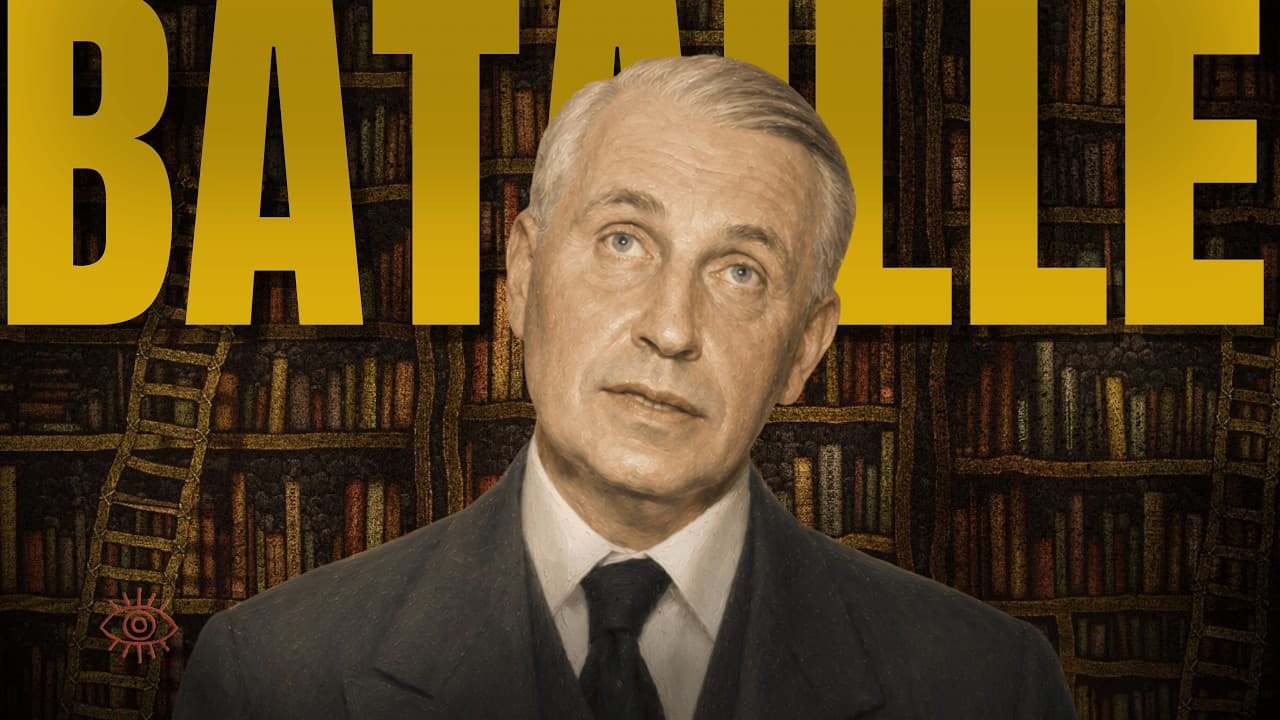
Why Humans Are Drawn to the Forbidden | Georges Bataille for Sleep
By day a mild librarian, by night the philosopher of excess, eroticism, and the sacred where reason ends.
Georges Bataille kept one of the strangest double lives in modern thought. For decades he was a quiet librarian in Paris, courteous and unremarkable, while in private he wrote some of the most extreme and original books of his century.
This episode follows him from a childhood shaped by a blind and dying father, through a lost faith and a notorious first novel, into the feuds and secret societies of the years between the wars. It traces the ideas that made him a hidden source for a whole later generation, the economy of loss and useless expenditure, the sun that gives without return, the sacred glimpsed in transgression, a mysticism with no God at the end of it, and eroticism understood as the meeting place of desire and death.
Along the way it restores the man behind the scandal, the gentle scholar drawn to everything orderly thought leaves out.
The full episode is on YouTube and Spotify. Please listen only in safe, restful contexts.
Enjoying the episode?
Occasional letters on philosophy, reading, and the examined life. No spam, ever.
By subscribing you consent to receiving occasional emails. Unsubscribe any time via the link in every email or at /unsubscribe.
Timestamps
- 0:00:00Chapter 1: The Blind Father
- 0:12:59Chapter 2: The Eye and the Egg
- 0:22:42Chapter 3: The Excremental Philosopher
- 0:29:12Chapter 4: The Low and the Formless
- 0:39:22Chapter 5: The Economy of Loss
- 0:46:20Chapter 6: Hegel's Wound and Nietzsche's Laughter
- 0:56:34Chapter 7: The Headless God
- 1:03:36Chapter 8: The Return of the Sacred
- 1:13:42Chapter 9: Laure and the Silence
- 1:20:00Chapter 10: A Mysticism Without God
- 1:33:08Chapter 11: A Theology Turned Inside Out
- 1:42:03Chapter 12: God in the Brothel
- 1:48:07Chapter 13: Love Among the Graves
- 1:56:30Chapter 14: The Sun That Gives Without Return
- 2:11:27Chapter 15: The Sovereign Moment
- 2:20:13Chapter 16: Desire All the Way to Death
- 2:34:31Chapter 17: Literature Is Not Innocent
- 2:44:02Chapter 18: The Community of Those Who Have Nothing
- 2:50:24Chapter 19: The Tears of Eros
- 2:58:01Chapter 20: The Mild Librarian
- 3:04:24Chapter 21: The Uses of Georges Bataille
For the record
Full Transcript
Chapter 1: The Blind Father
There was a man in a darkened room in Reims who could not see and could not move, and a small boy who watched him. The father's eyes were open but blind, often turned upward so that only the whites showed, and his body sat where illness had fixed it, helpless, attended, beyond reach. The boy learned the world partly through this figure, a presence at once tender and frightening, a face that looked toward nothing. It is a strange thing to begin a life beside a pair of eyes that cannot see, and stranger still when that life becomes one long meditation on eyes, on what they witness, on the moment when seeing tips over into something unbearable. The child who watched that blind face would grow into a writer who could not stop returning to the eye, to ecstasy and horror, to the places where vision fails. Everything in him seems to begin in that room.
He was born in the autumn of eighteen ninety-seven, in a small town in the mountainous heart of France, a region of high country and cold winters far from any capital. The family did not stay there. They moved north to Reims, the cathedral city in the wine country of the northeast, and it was there that the boy passed his childhood. Reims was a place built around its cathedral, a vast pale church of grey stone where for centuries the kings of France had come to be crowned, its front crowded with carved saints and one famous smiling angel above the door. Around it spread a busy provincial city of merchants and soldiers and the cellars where the sparkling wine of the region lay aging in the chalk beneath the streets. A boy growing up there grew up in the shadow of that immense building, in a town that took its whole identity from a thing of stone and faith and history. His father was already ill. The disease that blinded and paralyzed him was a slow one, advancing through the nervous system over years, and it brought with it not only blindness and paralysis but pain, derangement, and episodes that a young child could not understand and would never forget. The household was not a happy one. The mother suffered too, in her own way, sinking at times into a darkness of her own, withdrawing into fits of melancholy so deep that she too seemed to leave the room while sitting in it, so that the boy had a father who could not see and a mother who at times could barely be reached. He grew up among sickness and silence and the particular shame that gathers around a body that has stopped obeying its owner.
The memories he carried from that house were disturbing, and he wrote about them later with a frankness that still unsettles. He recalled the helplessness of the blind man, the upturned eyes, the strangeness of being cared for by a son when the natural order would have it the other way. We need not dwell on the details. What matters is that the earliest material of his imagination was not abstract at all. It was a real person in a real room, and the impressions left there were physical, intimate, and impossible to wash off. He would spend his life insisting that thought begins in the body and in what the body suffers, and he had reason to believe it. The sickroom was his first school, and its lessons were about the flesh and its failures long before they were about anything one could put into a book.
Then came the war. In the summer of nineteen fourteen the armies of Germany pushed into the northeast of France, and Reims lay directly in their path. The city would be shelled and burned over the next four years until its great cathedral stood scorched and broken, its roof on fire, its statues cracked by the heat, the smiling angel knocked from its place. The town that had crowned kings became a ruin of rubble and smoke, one of the most wounded places in all of France. As the German advance came on, the family fled south to safety, and here the life delivers one of its cruelest facts. The father, blind and paralyzed and unable to travel, was left behind. He died there, alone, in the occupied zone, while his family was elsewhere. The son was a teenager when this happened. To leave a helpless father behind and to know he died without you is the kind of wound that does not close, and it sits underneath a great deal of what this writer would later say about abandonment, about guilt, and about the terrible distance between one person and another even at the moment of greatest need.
Out of this grief and disorder came, for a few years, faith. In his late teens the young man converted to Catholicism with real intensity. This was not a lukewarm social religion but a genuine fervor. He was devout, he was serious, and for a time he believed he might give his whole life to the church. He prayed, he confessed, he submitted himself to discipline, and he poured into religion the same wholeness he would later pour into everything he touched. He even took up his pen in praise of the burned cathedral of his city, writing as a young believer a small devotional piece in honor of that wounded church, mourning its ruin and exalting its faith, an act of homage from a boy who still believed the stones could hold the absolute. He went so far as to enter a seminary, to test whether he had a vocation for the priesthood. For a young man whose childhood had been shaped by helplessness and death, the order and the promise of the church must have offered something solid to stand on, a structure, a meaning, a God who saw everything that the blind father could not. But the faith did not last. Within a few years it quietly drained away. He did not stage a dramatic rebellion against God so much as lose the ability to believe, the way a fever passes. What stayed with him, long after the belief was gone, was the shape of religious experience itself, the hunger for the absolute, the language of ecstasy and the sacred. He kept the form and emptied out the content. That emptied-out form would become one of the central problems of his work, a man with a mystic's temperament and no God to receive it.
He had to make a living, and here the life takes a turn that seems almost comic against the rest of it. He trained at the elite national school that produced France's archivists and the keepers of its old manuscripts, a small and demanding institution that admitted only a handful of students each year and drilled them in the patient sciences of the past. There they learned to read the cramped scripts of the Middle Ages, to date a document by its handwriting and its seals, to trace the descent of a charter through the centuries, to handle the brittle parchment that carried the memory of the nation. It was scholarship of the most exacting and unglamorous kind, the work of keeping faith with dead hands. He was good at it. He finished his training around nineteen twenty-two with a serious piece of scholarly work behind him, a study rooted in a medieval text, the labor of a careful young man bent over old pages. This qualification opened the door to the job that would frame the whole of his outward life. He became a librarian. For decades he worked at the national library in Paris, among the catalogues and the reading rooms and the quiet shelves of a great public collection, fetching and ordering and cataloguing, keeping regular hours, drawing a modest salary. This was the mild face he showed the world, a discreet civil servant of letters, courteous, methodical, unremarkable, a man one might pass a hundred times and never notice. Almost no one who passed him in those corridors would have guessed what he was writing in private. The contrast between the gentle librarian and the violence of his secret books is one of the permanent puzzles of his story, and it began here, in the dust and order of the manuscripts.
In nineteen twenty-two, the same year his training ended, he traveled to Madrid, and there he witnessed something that joined itself permanently to the images already lodged in him. He went to a bullfight, and he watched a young and famous bullfighter, a man named Granero, killed in the ring. The bull's horn drove into his face and through his eye. The crowd saw it happen. For most who were present it was a horror and nothing more, but for this particular spectator it fused three things he could never afterward separate, beauty, death, and the eye. The grace of the young man, the public spectacle, the sun and the sand, the bright suit and the roar of the crowd, and then the eye destroyed in an instant, all of it pressed together into a single unbearable image. The blind eyes of his father and the pierced eye of the bullfighter belong to the same dark thread, and that thread runs straight into the first book he would dare to publish.
In the middle of the nineteen twenties he undertook a course of analysis with a doctor named Adrien Borel. This was decisive. Whatever else the sessions did or did not heal, they unlocked him. Before the analysis he was blocked, unable to write the things pressing inside him, full of material that could find no way out. After it, the writing came. Borel seems to have given him permission to descend into his own material rather than flee it, to look at the room in Reims and the eyes and the wounds without turning away. And Borel did one more thing, something that would mark him for the rest of his life. The doctor placed in his hands a set of photographs of a public execution, images of a condemned man, terrible images of suffering and death recorded on film. We will not describe them. It is enough to say that he received them, that he kept them, and that he returned to them in his mind across the decades, never quite free of them. They became, for him, a kind of object of contemplation, equal parts horror and revelation, a face caught between agony and something that looked almost like rapture. The man who had watched a blind father and a dying bullfighter now had a photograph he could not stop seeing.
In nineteen twenty-eight he married. His wife was named Sylvia, and they would have a daughter, Laurence. The marriage would not endure, and there is a curious footnote to it that the story always records, that Sylvia would later share her life with one of the most famous psychoanalysts of the century, Jacques Lacan, the thinker who would reshape the field that Borel had practiced more quietly. So the threads of analysis run through the private life as well as the work, from the doctor who unlocked him to the analyst who would later marry the woman he was marrying now.
All of this had gathered in him by the time he was thirty. The blind father in the upturned light. The father left to die in a burning city. The fierce faith that came and went and left its hunger behind. The librarian's mild routine laid over a violent inner life. The bullfighter's pierced eye in the Madrid sun. The photographs the doctor handed him. A marriage just begun. These were not yet ideas. They were images and wounds, raw and unsorted, waiting for a form that could hold them without lying about them. And in this same year, nineteen twenty-eight, the quiet librarian was preparing to put something into the world that no one would connect to him, a small book, obscene and exact, published in secret behind a false name, in which the eye and the egg and the sun would all become one terrible figure. He stood, at thirty, on the threshold of it. That is where this part of the story leaves him, the unremarkable man at his library desk, about to write the unspeakable.
Chapter 2: The Eye and the Egg
His first published book appeared in nineteen twenty-eight, a short and notorious erotic novel that he called the story of an eye, and he did not put his own name on it. He hid behind a coarse pseudonym, a made-up vulgar name, the sort of name a man might scrawl on a wall, as if to say at once that the book was filth and that its author refused to be found. This was the librarian at the national library, the trained keeper of old manuscripts, publishing in secret a book that would have ended his respectable career had it been traced to him. The doubleness was there from the very first thing he wrote, and it never left him. The mild man of the reading rooms and the author of the unspeakable book were the same person, divided only by a false name.
It would be easy to read the book as pure provocation, and many readers have. The story follows two young lovers and the friend who joins them through a series of sexual acts that grow steadily more extreme, more cruel, and at last murderous, and it withholds nothing. But to leave it there, to file it under scandal, is to miss what makes it strange and what makes it philosophy. Bataille was not writing to arouse. He was writing to think, and he chose the forbidden because the forbidden is exactly where ordinary thinking is not allowed to go. Respectable language has walls. It builds careful fences around desire, around disgust, around death, and around the holy, and it keeps these things in separate rooms so that no one has to feel them touch. The story told through an eye knocks down those walls on purpose. It is an experiment in what becomes thinkable once the fences are gone.
The experiment is carried by a single device, and it is worth describing slowly because everything depends on it. Through the whole book runs a chain of round, pale, glistening objects, and each one slides into the next until they can no longer be held apart. It begins with the eye. Then there is the egg, white and smooth and wet. Then the testicle, which in the slaughterhouse and the bullring the French call by the same homely word they use for the egg. Then, drawn upward and made enormous, the sun itself, the great round eye in the sky that no one can look at directly. Eye, egg, testicle, sun. Each is round. Each is pale. Each can be cracked, or crushed, or put out. By the logic of the book they are secretly one thing, and once the reader has felt them fuse, none of them is ever quite innocent again. The breakfast egg becomes obscene. The sun becomes a wound. The most ordinary object in the kitchen turns charged and faintly unbearable, because the chain has taught the eye to see what desire and violence have in common.
This is the real argument of the book, made not in sentences but in images. Bataille is showing that the categories we keep apart are held apart only by an effort, and that the effort can fail. The clean and the filthy, the sacred and the obscene, the living and the dead, are not opposites fixed at a safe distance. They lie close together, and certain objects, certain acts, can make them collapse into one. An eye and an egg are not alike for any reason a biologist would accept. They are alike in the way the mind associates them when it is frightened and excited at once, the way a dream fastens on a single shape and lets it carry feelings that have nowhere else to go. Bataille trusted that lower kind of likeness more than he trusted the orderly distinctions of waking reason. He thought it told the truth about what a human being actually is.
The book reaches its climax in Spain, in a church, where the worst of its acts are committed in a place that is supposed to be the most protected of all. This is not an accident of plot. For Bataille the holy and the obscene were never far apart, and the deepest transgression is the one that takes place against the sacred, because only the sacred is worth the cost of crossing it. To violate something you do not believe in is meaningless. The horror only matters where the reverence is real. So the calm cruelty of these final pages is also, in his strange logic, a kind of religious act, a black sacrament. The places where desire, disgust, death, and the holy meet are not four places. They are one place, and the book drags the reader to stand inside it.
What raises the book above the merely shocking is the short piece he attached to it, a few pages of confession placed at the end, in which the author steps out from behind the pseudonym just enough to explain where the images came from. He had not invented the eye and the egg from nothing. The appended confession ties the book's chain of images back to his own childhood, and above all to his father, the man already described in the story of his early life. Bataille set down these memories with an unnerving steadiness, neither apologizing for them nor dramatizing them, simply reporting that the most extreme images in his fiction had grown directly out of the most painful facts of his life. Among the private sources he listed for the book was the bullfighter Granero, named there only, the event itself belonging to the story of his life and not retold here.
What the confession lets us see is how the method actually works on the page. The book does not argue that desire and death are linked. It makes the reader feel the link by handing the same round shape from one scene to the next until the shape itself begins to ache. A thing as harmless as an egg on a plate is offered first as food, then as something to be cracked and spilled, then as a stand-in for the body, and by the time the sun appears overhead the reader can no longer meet a pale round object with an innocent eye. The horror is not stated. It is built up object by object, so that the reader carries it out of the book and into the ordinary world, where every smooth round thing now seems to hide a wound. That is the discipline behind the apparent chaos. Each image is placed so that desire, disgust, death, and the holy are made to arrive together, in the same shape, at the same instant, with no wall left standing between them.
The confession also changes how the whole book must be read. It tells us that the obscene chain of images was not a clever literary game but something closer to a symptom turned into a method, a private wound made deliberately into a tool for thinking. Bataille had begun, around this time, the long course of analysis with the doctor who treated him, and the book carries the mark of that work, the willingness to follow an image down into the place it comes from and to refuse to look away from what is found there. The difference is that he did not want to be cured of his images. He wanted to use them. He had decided that the disturbing material a mind throws up was not noise to be cleared away but the very thing philosophy ought to be studying, because it shows where a person is really made and really comes apart.
So the first book already contains, in compressed and violent form, almost everything that the rest of his life would unfold more slowly. There is the conviction that thought reaches its limit not in calm reflection but in extreme states, in arousal and terror and laughter. There is the refusal to keep the high things and the low things in separate rooms. There is the sense that the sacred has not vanished from the modern world but has only gone into hiding, into the very places we are taught to find shameful. And there is the strange, steady tone, calm in the face of what should be unbearable, that would become his signature. He writes about the most disordered things in the most ordered prose, and that contrast is itself an argument. It says that horror and meaning are not enemies, that one can think clearly while standing in the dark.
It is fitting that the book that opened his work was one he could not sign. He would spend decades arguing that the truest things about us are the things we are forbidden to say, the expenditures and excesses that no useful account of life can hold. He began by practicing exactly that, writing in secret what he could not say in his own name, hiding the librarian behind the obscene pseudonym, and proving in the doing of it that the two were never separate to begin with. The eye that watches and the eye that is put out, the man who keeps the books and the man who breaks every law in them, all of it folded into one small, terrible volume that he slipped quietly into the world and let do its work.
Chapter 3: The Excremental Philosopher
In the years when Bataille was first finding his voice, the most powerful man in the French avant-garde turned on him and tried to drive him out of serious company. That man was Andre Breton, the leader of the surrealists, a movement that had set out to remake art and life together. Breton wrote a manifesto, a public document with the weight of a verdict, and in it he singled Bataille out and branded him a sick man, a thinker obsessed with filth and rot, a philosopher who could think only about what is low and foul. The charge was meant to finish him. To understand why it did not, we have to understand what the surrealists believed, and why Bataille could not believe it with them.
The surrealists were dreamers in the most literal sense. They held that the waking mind, with its reasons and its manners, was a kind of prison, and that the way out lay through the dream, through chance, through the strange beauty they called the marvelous. They wrote down their dreams. They let words fall onto the page without the censorship of sense. They believed that if the imagination were truly set free, it would rise, lift the human spirit upward toward a higher and more luminous reality. Their instinct was always to ascend. Love would be transfigured into something pure. The ordinary world would be touched and made radiant. There was real courage in this, and real generosity, and for a young writer in Paris in the late nineteen twenties it was the only game that mattered.
Bataille stood at the edge of that circle, and from the edge he found the whole thing too clean. He thought the surrealist flight upward was a dodge, a refusal to look at the parts of human life that do not rise and do not shine. Where they reached for the noble, he kept turning toward the base, toward what a person would rather not name. He was not the surrealists' enemy from outside. He was the heretic within reach of them, the dissident who used their own tools to insist that liberation through dreams was a beautiful lie, because it kept its eyes turned carefully away from the dirt.
That is what the quarrel was really about. It was a fight between the high and the low, the noble and the base, between a vision of the human spirit lifting free and a counter-vision that found the truth of things in what gets discarded and despised. Breton's insult, the charge of being a philosopher of excrement, was not entirely wrong, and Bataille knew it. The leader of the surrealists thought he was naming a disease. Bataille thought he was naming a wager worth making. The disgust that Breton felt at the low, the way he flinched from it, was for Bataille exactly the flinch worth studying. A philosophy that could not bear the sight of rot was, he suspected, a philosophy still half asleep.
So he did not retreat. He answered. The dissidents who had gathered around him, several of them defectors from the surrealist ranks who had grown tired of Breton's authority, put out a pamphlet of their own, a counterblast that mocked the leader to his face. They treated Breton not as a liberator but as a kind of pope, a man who excommunicated his followers and policed the movement's purity, a moralist in the costume of a rebel. The pamphlet was sharp and personal. It collected the bruised and the cast-out, the writers Breton had insulted or banished, and let each of them return the blow in turn. It turned Breton's own grandeur against him and suggested that the great prophet of freedom had become merely a man defending his throne. The attack had been public, and the answer was public too, and the small Paris world of poets and painters watched the two men trade contempt across the page.
Behind the quarrel stood a journal, and the journal was Bataille's real platform in these years. It was a strange and beautiful thing, a review unlike anything the surrealists produced, and it gathered around him the very writers and scholars who had broken with Breton. Its pages set fine art beside photographs of ancient coins, and ancient coins beside reports from far-off peoples, and all of that beside images and arguments that were frankly ugly. A scholarly note on archaeology might sit next to a meditation on the human foot, or a study of sacrifice, or a picture chosen precisely because it unsettled. The mixture was the point. Bataille, who earned his living as a keeper of old documents, brought that archivist's eye to the review and trained it on things no archive would dignify. He treated a jazz record and a Roman coin and a grim photograph with the same grave attention, refusing the hierarchy that would rank one above the others. Each issue read like a deliberate affront to good taste, a place where the learned and the repugnant were forced to share a table. The journal mixed art and old money and the study of distant peoples and the ugly into a single field, and in doing so it quietly denied that some things are too high to be questioned and others too low to be looked at.
The feud did not last forever, and the journal itself was short lived, folding after only a handful of issues. But the quarrel marked Bataille permanently, and it marked the avant-garde too. Breton had tried to expel him from the company of serious minds by naming him the philosopher of filth. What happened instead is that Bataille accepted the title and made it a position. He had glimpsed, in the fight over the high and the low, the outline of the ideas that would occupy him for years. Those ideas would need their own working out, and they would get it. For now it is enough to see the shape of the wager. The man cast out for loving the low would build, out of the low, a philosophy of his own.
Chapter 4: The Low and the Formless
Against every philosophy that climbs toward the ideal, Bataille proposed a thought that drags everything back down to matter, to the body, and to what we throw away. This was the project of his early nineteen thirties, and it had a name he gave it deliberately, a low materialism, a materialism of the base. The word base did double work. It meant the bottom, the ground, the foundation. It also meant the degraded, the vile, the things we are ashamed to look at. He wanted both meanings at once, and he wanted to insist that they were the same meaning.
To understand why this mattered to him, we have to see what he was fighting. Most philosophy, from its beginnings, has been a movement upward. It starts in the world of bodies and dirt and confusion, and it climbs. It seeks the pure idea behind the messy thing, the soul behind the flesh, the eternal behind the passing. The philosopher looks up. He reaches toward light, toward spirit, toward a clean and orderly truth that floats above the muck of ordinary existence. Even the thinkers who called themselves materialists, who said that matter and not mind was the ultimate reality, had quietly betrayed the body. They turned matter into a tidy system of laws, an obedient servant that did exactly what the equations told it to do. They made matter into another kind of idea, a clockwork that behaved itself.
Bataille refused this. Matter, for him, was not the obedient servant of mind. It was an active, disruptive force, a thing that ruins systems rather than completing them. He wanted a matter that would not climb, that would not be lifted up into a clean concept, that would sit there at the bottom being heavy and base and refusing to mean anything noble. He pointed to the lowest things he could find and said, this is real, and it will not rise. The mud will not become marble. The rot will not become an idea. He wanted a thought loyal to the bottom, a thought that took the side of the ground against the sky.
Alongside this he developed a second weapon, and it may be the sharpest single notion he ever produced. He gave it a name that means, simply, without form. Philosophy loves form. It loves clear shapes and clean categories, the box that each thing belongs in, the outline that tells you where one kind of being ends and another begins. To think, in the usual sense, is to give the world a shape, to say this is that, to fit the buzzing confusion of experience into a frame the mind can hold. The whole dignity of the human mind, on this view, is that it imposes order, that it dresses the world in mathematics and gives every thing its proper form.
The formless was his refusal of all that. It was not the name of a thing. It was a job, a task, an operation. Its job was to declassify, to undo the sorting, to take the things the mind has neatly filed and smear them back together. He once put the idea with a brutal directness, saying that to declare the universe formless amounts to saying that the universe is something like a spider, or like spit. Not a cathedral, not a crystal, not a great clockwork of laws, but a spider, a thing that makes us flinch, or spit, the soft formless stuff the body pushes out and the mind would rather forget. The universe resembles nothing, he insisted, and has no shape, and every philosophy that gives it a shape is a kind of frock coat we have buttoned onto the world to make it respectable, to make it look like us.
These two notions, the base and the formless, came together in a strange little work he produced in this period, a mock dictionary. A dictionary is the most orderly book imaginable. It tells you what each word means, it fixes the world in place, it assigns every thing its proper definition. Bataille's dictionary did the opposite. It defined words not by what they are but by what they do to us, by the disgust or the dread or the secret fascination they stir in the body. It was a dictionary written against the very purpose of dictionaries, a tool for unsettling rather than settling, for opening the trapdoor under each clean concept.
Two of its entries show the whole method in miniature. The first is the entry on the big toe. The big toe, he wrote, is the most human part of the human body, and we treat it with contempt. Consider the arrangement. A human being stands upright. The head lifts toward heaven, toward the stars, toward everything pure and high, and the whole prestige of being human, the whole story we tell about ourselves, lives up there in the dreaming head. But what holds the head up. The foot, and at the front of the foot the big toe, planted in the mud, smeared with the filth of the ground, sweating inside a shoe, the part of us we hide and are ashamed of. The dreaming head depends entirely on the despised toe in the dirt. The most human thing about us is the part we will not look at. That, for Bataille, was the whole truth about human beings, told through a toe. We are creatures who lift our eyes to the ideal while standing in the mud, and we deny the mud that holds us up.
The second entry is the slaughterhouse, and here the toe in the dirt becomes a building on the edge of town. Once, he observed, the killing of animals was a sacred thing. It happened at the center of the community, at the altar, in full view, bound up with the holy. The blood was meant to be seen. Now we eat more meat than any people in history, and we have hidden the killing away. We have pushed the slaughterhouse out to the margins, behind walls, where no respectable person ever goes, the way a sick man hides his disease, the way a clean society hides everything that reminds it of blood and death. We want the meat on the plate and we want to know nothing of the blood on the floor. The slaughterhouse stands at the edge of town as proof of a society that cannot bear its own foundations, that lives off killing and cannot look at it.
The big toe and the slaughterhouse are the same lesson at two scales. In each, the high depends on the low. The clean depends on the filthy. The respectable surface rests on a buried foundation of blood and dirt that it spends all its energy refusing to see. And this refusal, this great work of not looking, became for Bataille a thing worth studying in its own right. He proposed a whole science of it, a science of everything a culture expels and will not think. He coined a name for it, a study of the other, the study of what gets thrown out. Every society, he saw, is built on a sorting. There are the things we keep, the useful, the productive, the clean, the things that fit the system and serve its ends. And there are the things we cast out, the waste, the filth, the corpse, the menstrual blood, the excrement, and strangely, mixed in among them, the sacred itself, the holy thing that is forbidden precisely because it is too charged to touch.
That last pairing was his deepest insight here. The disgusting and the holy sit together in the same expelled pile. Both are untouchable. Both are kept apart from ordinary useful life. The corpse and the god are equally forbidden, equally outside the clean circle of getting and spending, and a society treats them with the same gesture of fearful avoidance. Ordinary thought, the thought that keeps the books and runs the system, can deal only with what is useful and assimilable, with what can be put to work. It has no way to think about what it expels, because expelling it is the very condition of being able to think clearly at all. Clear thought is purchased by throwing out everything that would muddy it. So the cast-out things, the waste and the filth and the sacred and the dead, fall into a blind spot, a darkness the ordinary mind cannot enter without ceasing to be itself.
Bataille wanted to enter that darkness on purpose. The science of the expelled would be a knowledge of exactly the things that knowledge is built to exclude, a thought trained on its own forbidden underside. It was a strange ambition, perhaps an impossible one, a knowing aimed at what unknows us, and he knew it strained against the very nature of thinking. But this is the bedrock under everything he would later build. The assault on usefulness, the meditations on the sacred and on death, the long study of the erotic, all of it grows from this early conviction. Reality is not up there in the pure idea, in the dreaming head, in the clean form. It is down here, in the toe and the blood and the spit, in everything we expel and cannot bear to face. The philosopher who tells the truth must take the side of the low, refuse the comfort of clear shapes, and look steadily at what the whole civilized world is organized to keep out of sight.
Chapter 5: The Economy of Loss
In nineteen thirty-three Bataille published a long essay on expenditure that set out to overturn one comfortable belief above all others, the belief that human beings are creatures of usefulness, governed by the patient arithmetic of getting and saving. Most economic thinking, and most everyday common sense, takes that belief for granted. We work to acquire. We acquire in order to keep. We keep in order to spend wisely, balancing what a thing costs against what it will return. On this view, a person is a careful accountant of means and ends, weighing every effort against its eventual profit. Bataille looked at human life and decided this picture was not merely incomplete. He decided it was false at its very center.
What he saw instead, when he looked honestly, was that the activities people care about most, the ones they would never give up, are precisely the ones that produce nothing and return nothing. They exist in order to spend, to pour out, to lose. Consider what a society actually pours its energy into. Luxury, the goods that serve no purpose except to be magnificent. The rites of mourning, where wealth and labor are lavished on the dead, who can give nothing back. War, the most enormous destruction of life and goods a people can undertake. Lavish public spectacle, the festival that consumes in a night what was hoarded for a year. Games, where stakes are risked for the pleasure of risk. The arts, which feed no one and house no one. The cults and ceremonies that burn offerings into smoke. And the whole of sexual life that makes no children, desire pursued for itself, with no descendant to justify the expense.
Set these side by side and a pattern appears that the language of usefulness cannot explain. None of them is a means to anything beyond itself. None of them saves, accumulates, or returns a profit. Each is a form of loss, and loss, Bataille argued, is not a flaw in human life that good management might one day correct. Loss is the thing itself. The careful, acquisitive, balancing activity that economics describes is real, but it is the servant, not the master. It exists so that there will be something to squander gloriously later. The truth of a society is told not in what it saves but in how it spends what it cannot keep.
He divided human consumption into two orders. There is the consumption that keeps us alive and lets us go on working, food and shelter and the minimum a body needs, all of it a means to something further. And there is the other kind, consumption that serves no end beyond itself, that is its own reason, and finds its fullest expression in deliberate, unproductive loss. It was this second kind that interested him, because it was this kind that the modern world had grown ashamed of and tried to explain away. A civilization built on thrift and productivity had taught itself that spending without return was a vice, a failure of discipline. Bataille answered that such spending is the deepest thing people do, and that a life organized entirely around saving and accumulation is a life that has lost contact with its own meaning.
For his sharpest example he turned to a study he admired greatly, the great work on the gift by Mauss, who had gathered the reports of travelers and observers and drawn from them a strange and powerful pattern. Among the native peoples of the Pacific Northwest coast of America there was a practice that made no sense at all in the language of profit. At great ceremonial gatherings, the chiefs and noble families would give away their possessions on a colossal scale. Blankets, carved goods, canoes, the accumulated wealth of years, handed over to rivals in a single overwhelming display. And the giving did not stop at giving. At the height of the rite a chief might take his own treasures and destroy them outright, breaking precious objects, pouring out stores of oil, even setting his own goods ablaze in front of the assembled guests.
What looks at first like madness was in fact a contest, and the prize was rank. A chief gained standing, honor, authority over others, not by piling up wealth but by proving he could afford to lose it. The man who gave the most, who destroyed the most, who showed the most magnificent indifference to his own possessions, won. His rivals were humiliated not by being robbed but by being outspent, shamed into the role of those who could not match his losses, and bound to answer with an even greater destruction of their own. Wealth here was not something to be hoarded behind walls. It was something to be hurled away in public, and the hurling away was the whole point. Power flowed to the one who could lose the most.
For Bataille this was not a curiosity from a distant shore. It was a window onto something the modern accountant had forgotten. Here was a society that understood, openly and without shame, what his own had buried under the language of investment and return, that the deepest sources of rank and meaning lie in spending, not in keeping. The gift-feast simply made visible a law that runs through luxury and war and festival and sexuality alike, the law of glorious, unrecompensed loss. We give, we burn, we pour out, and in the pouring out we touch something that mere survival and mere accumulation can never reach.
This early essay is a seed, not yet the full system. Bataille had not yet enlarged the idea into a vision of energy on the scale of the whole living world, the vision he would build years later. What he had was the core insight, stated with force, that human life is governed less by the need to gain than by the need to spend, and that the activities we treat as wasteful or irrational, the festival, the offering, the war, the squandered desire, are the very places where life shows what it most deeply is. To understand a people, he was saying, do not ask what they save. Ask what they are willing to lose, and how, and for whom, and you will have the truth of them.
Chapter 6: Hegel's Wound and Nietzsche's Laughter
Two thinkers stood over Georges Bataille for the rest of his life, and he met each of them in a way that was anything but ordinary scholarship. He came to Hegel not by reading him quietly at a desk but by sitting, week after week through the nineteen thirties, in a packed Paris classroom while a Russian exile named Alexandre Kojeve unfolded a single difficult book aloud. He came to Nietzsche not as a system to be mastered but as a fellow sufferer, a man whose words he felt in the body before he understood them in the head. One was a teacher in a lecture hall. The other was a ghost. Between them they shaped everything Bataille would think.
Begin with the lectures. Kojeve was a small, elegant, magnetic man who took one early book of Hegel, the long account of how mind comes to know itself, and read it slowly to a room that included some of the brightest people in France. The lectures became legendary. A whole generation absorbed Hegel through this one charismatic voice, and what they absorbed was not the dry textbook Hegel of the schools but something violent and dramatic, a story about death, desire, and struggle. Bataille was there, and what he heard changed him.
The part that gripped him hardest was the scene Kojeve placed at the center, the struggle between master and slave. The story runs like this. Two beings meet, and each wants to be recognized by the other, wants to be seen and acknowledged as fully human. To prove he is more than a mere animal clinging to survival, each is willing to fight to the death. But here is the turn. One of them, at the brink, draws back. He chooses life over recognition, and in that flinch he becomes the slave. The other, who risked everything and did not flinch, becomes the master. So the human being, in this telling, is born in a wager against death. A man becomes more than an animal precisely by being willing to lose the one thing an animal will never spend, its own life. And the strange thing, the thing Kojeve pressed hardest, is that the loser is not finished. The slave who flinched is set to work, and in the long centuries of his labor he transforms the earth, builds the world, and slowly outgrows the master who only consumes what the slave produces. The one who chose life over honor turns out to carry the future. The master, victorious and idle, falls behind. Bataille never forgot that. The idea that the human is whatever stakes itself against death sat at the root of nearly everything he later wrote, and so did the unsettling reversal in which weakness, given time and labor, becomes the deeper strength.
There was a second idea in those lectures that took hold of him, harder to picture but just as important. Hegel called it the work of the negative, and the plain meaning is this. Mind does not simply receive the world as it is given. Mind cancels the given world, takes it apart, refuses to leave it alone, and by refusing remakes it into something new. A seed is negated by the plant that grows from it. The slave, set to labor, negates the raw stuff of nature and shapes it into tools and cities and culture. Negation here is not mere destruction. It is the engine of all becoming, the power by which what exists is overcome and transformed. To think at all, on this view, is to negate, to say of every given thing that it is not yet enough.
And Kojeve drew from all this a conclusion that fascinated and unsettled his listeners. If history is the long story of this struggle and this labor working themselves out, then history can come to an end. There is a final state, a settled condition in which every human being is at last recognized, the old fight between master and slave resolved, the great work of negation complete. History reaches its goal and stops. The struggles that drove it are over. Humankind, having made the world fully its own, has nothing left to fight for.
For most listeners this was a grand and reassuring vision, the promise that the violence of the past was leading somewhere. For Bataille it opened a wound. He could accept the picture, and yet a question rose in him that he could not put down. What happens to all our power to negate, all our hunger to destroy and overcome and stake ourselves against death, once history is finished and there is nothing left for that power to do. The energy does not vanish simply because the work runs out. The human animal who became human by risking everything cannot stop wanting to risk everything just because the books say the story is over.
This is the thought that became most his own. He named it a negativity with no work left to do, a force of refusal and destruction left unemployed. Picture a man built entirely for struggle, suddenly handed a world with no struggle in it, the muscle of negation still tensed and twitching with nothing to push against. That restless, jobless force of negation, Bataille said, was something he did not merely observe in history. He felt it in himself. It is the surplus of human energy that cannot be used up by any useful task, and it had to go somewhere. Much of his life's work was an attempt to ask where, to find what becomes of the human capacity for excess once it is cut loose from the labor of building the world.
If Hegel gave him the wound, Nietzsche gave him the air to breathe inside it. Bataille loved Nietzsche the way one loves a friend who got there first, who said the unsayable thing out loud and paid for it. At the heart of that bond was the announcement Nietzsche made, that God is dead, and we are the ones who killed him. Bataille refused to hear this as the smug slogan of a man who has simply stopped believing. He heard it as catastrophe and as liberation at once. Take away God and you take away the ceiling of the world, the fixed point that held every value in place and told human life what it was for. What opens is vertigo, the dizziness of standing over an emptiness with no floor. And with the dread comes a terrible freedom, because nothing above us now decides what we may become. The death of God, for Bataille, was not an argument settled in the eighteen eighties. It was an ordeal still to be lived, and he would live it in his own way in the books that came later. Here it is enough to say that he took the announcement as the deepest fact of his age.
From Nietzsche he also took two stranger ideas and bent them to his own ends. One was the thought that at the bottom of all life there is a single striving, a will not merely to survive but to grow, to overflow, to expend and impose itself, a will to power. Bataille heard in this less a doctrine of domination than a vision of life as something that pours itself out, that wants to spend rather than to keep. The other was the vision of the eternal return, the dizzying proposal that this very life, every joy and every agony of it, recurs again and again forever without change, and that the test of a soul is whether it can say yes to that, can love its life enough to will the whole of it back endlessly. For Bataille this was the hardest and purest form of saying yes to existence with no God to justify it, a love of the world that asks for nothing beyond the world.
He guarded Nietzsche fiercely, and in his own time the guarding was urgent. In the nineteen thirties and into the war, the propagandists of fascism had seized on Nietzsche, dressed him in their colors, and paraded him as a prophet of the strong crushing the weak, an ancestor of the new order rising in Germany. Bataille was disgusted, and he said so loudly. He insisted that this was a theft and a lie, that the real Nietzsche was the enemy of the herd in every direction, including the herd that marches in uniform and worships the state and the nation. A thinker who despised mass politics and the cult of the fatherland could not honestly be made the mascot of a mass movement built on exactly those things. Nietzsche, Bataille argued, was not the forerunner of fascism but its opposite, a solitary who would have loathed everything it stood for. To rescue him from that lie became, for Bataille, almost a point of honor.
So the two masters left him with two inheritances that did not quite fit together, and the misfit was productive. From Hegel, by way of a spellbinding teacher in a crowded room, came the human being forged against death and the haunting surplus of a negation with no work left to do. From Nietzsche, met as a wounded brother, came the dead God, the will that overflows, the love of a recurring world, and a duty to defend a friend against those who would use him. Bataille spent his life in the space between these gifts, trying to find what a creature does with all its power to negate once there is nothing left to build, and trying to say yes, all the way down, to a world with nothing above it.
Chapter 7: The Headless God
In the late nineteen thirties, in the years when Europe was sliding toward another war, Georges Bataille gathered a small band of friends into a secret society organized around the image of a man with no head. The emblem came from the painter Andre Masson, who drew it after long conversations with Bataille about what the group should become. The figure stands naked, arms spread, and where the head should be there is nothing. In one hand he holds a flaming heart, in the other a dagger. His belly is not a belly but a maze, a labyrinth of winding passages, and at his nipples or above his shoulders there are stars. The body is alive and powerful, but it has been beheaded, and the missing head is the whole point.
The head, for Bataille, meant reason. It meant the part of a person that commands and calculates and keeps order. It meant authority, the ruler who sits above the body of the people, and it meant God, the supreme head of all things, the final judge who watches from above. To strike the head from the body was to refuse all of that at once. It was to imagine a human being and a human community that lived from the heart and the guts and the labyrinth of desire, with no master overhead, no reason giving orders, no god to obey. The group took the headless man as its name and its sign, and printed it on the cover of the journal it produced, a strange and beautiful publication that mixed Bataille's own writing with essays on Nietzsche and on the death of God and on the sacred.
This was not a club for arguing about ideas, or at least it did not want to be only that. Bataille wanted something closer to a religion without a god, a community bound not by shared belief but by shared experience, by ritual and secrecy and a sense of the sacred recovered in a world that had forgotten it. The members were sworn to silence. They were not to shake hands with anyone who had any sympathy for the existing order, and they were forbidden to speak of the group to outsiders. They met in secret, sometimes in apartments in Paris, and sometimes, more strangely, they traveled out of the city into a forest at night to gather around a single tree that had been struck by lightning. The lightning-struck tree was itself an emblem of the sacred as Bataille understood it, a thing marked and burned by a force from outside, dangerous, set apart from the ordinary trees around it.
Around this society there has gathered a legend, one that is hard to confirm and impossible to ignore. The story is that the group discussed performing an actual human sacrifice. They were serious about the sacred, and they had come to believe that a real community could only be founded on a real act, something irreversible, a death freely given that would bind the survivors together forever. And so, the legend says, members offered themselves as the victim. More than one of them volunteered to be the one who would die. What stopped the plan was the other half of the act. A sacrifice needs not only a victim but an executioner, someone willing to raise the blade and bring it down on a friend. And no one would agree to be that person. Everyone was prepared to die. No one was prepared to kill. The plan dissolved on that refusal.
We should hold this story carefully, neither swallowing it whole nor waving it away. Whether or not the group ever came close to the act, the fact that such a thing could be imagined and discussed tells us how far Bataille was willing to follow his own thinking. He had argued for years that real life, sacred life, lives in loss and waste and death, in everything a sensible society works to avoid. The secret society was an attempt to live that argument rather than merely to write it. And the failure of the sacrifice, if it happened as the legend tells it, is almost more revealing than a success would have been. The community Bataille dreamed of could not quite come into being. It stalled at the threshold, at the moment when the idea would have to become a body bleeding on the ground. There was a wall there that even he could not cross.
It matters that all of this was happening in the late nineteen thirties, with fascism rising across the continent and the headless emblem keeping uneasy company with the worship of leaders and the cult of blood and soil. Bataille was sharply aware of the danger. He had spent these same years engaged in open political work against fascism, work of a very different temper from the forest rituals. In the middle of the decade he helped run an anti-fascist action group, a coalition of writers and thinkers on the left who tried to mobilize against the threat in France and beyond. For a brief and uneasy moment, this common enemy did what little else could. It brought him back into the same room as Andre Breton, with whom he had carried on a long and bitter quarrel. Now, faced with a danger larger than that quarrel, they agreed to stand together. The truce did not last. The action group strained and broke apart, as such alliances did in those years, and the old distance between the two men returned.
So we are left with two faces of Bataille in this period, and they belong to the same man. One is the public anti-fascist, signing manifestos, arguing for resistance, standing shoulder to shoulder even with an enemy when the times demanded it. The other is the secret celebrant, slipping out to a burnt tree in the dark, presiding over a society devoted to a headless god and dreaming of a sacrifice no one could perform. He believed that fascism had seized the sacred, the deep human hunger for ecstasy and belonging and self-loss, and was using it for the worst ends imaginable. His answer was not to deny that hunger but to claim it back, to find a form of the sacred that overthrew authority instead of bowing to it. The headless man was that answer in a single image. A body with no master. A community with no head. And, as the unfinished sacrifice suggests, an experiment that came right up to the edge of what a human being can will, and there stopped.
Chapter 8: The Return of the Sacred
Imagine a small group of men setting out, in the last years before the second world war, to do for the holy what a chemist does for a reaction, to study it coldly, to name its laws, to make a science of the sacred. The phrase sounds almost like a contradiction, and that is exactly what drew Georges Bataille to it. He founded the venture in Paris with the writer Michel Leiris and the thinker Roger Caillois, and they gave it the name of a college, as if it were a sober teaching institution. It was nothing of the kind. It was a lecture circle, a series of public talks held in a rented room, where a handful of serious people met to ask whether the holy could be studied at all, treated as a fact about human societies rather than a private comfort. The same obsession that Bataille pursued in the dark, in the secret society of those years, came out here into the open, lit, argued, and offered to an audience.
To see what they were after, we have to set aside the first meaning that the word sacred usually carries. For most people the sacred means belief. It means a person privately holding that a god exists, that a soul survives, that a wafer is more than bread. Bataille and his friends began from a different place, and they took it from two earlier French thinkers, the sociologist Emile Durkheim and his nephew Marcel Mauss. Durkheim had argued, studying the religions of the simplest societies he could find records of, that the sacred is not first a belief at all. It is a force. It is a charge that a community places on certain things, certain times, certain acts, marking them off from everything ordinary. A stone, a day, a word, a wound can carry this charge. What makes a thing sacred is not anything inside the thing. It is the collective decision, made and felt by a whole group, that this thing stands apart and must be treated apart.
So the sacred, in this understanding, is social before it is personal. It is something a society does together, not something a single soul feels alone in its room. And it has a double face. The thing set apart is at once holy and dangerous, blessed and forbidden, worthy of worship and capable of contaminating whoever touches it wrongly. The same object can draw reverence and dread. This is why the holiest places are also the most fenced. The charge that makes a thing worthy of an altar is the same charge that makes it deadly to approach without care. Bataille seized on this double face, the fusion of the pure and the unclean inside one idea, because it matched everything he already believed about the human animal. The sacred was attractive and repulsive at once. It was the place where awe and horror met.
From this it followed that human life divides into two zones, and the college built much of its thinking on that division. There is the everyday zone, the world of work and usefulness, of getting and keeping, of tools and contracts and the ordinary daylight business of staying alive. In this zone things are valued for what they are good for. A hammer is worth its driving of nails. A field is worth its harvest. Time is measured and spent toward an end. This is the profane world, the level world of means, where every act points beyond itself to some result. And then there is the other zone, the charged and forbidden region, where things are not useful at all but overwhelming, where the ordinary rules are suspended, where contact is both longed for and feared. The two zones must be kept apart, walled off from each other, because the charge of the second would shatter the careful order of the first.
Yet a society cannot simply seal the dangerous zone away forever. It needs, from time to time, to touch the charge, and the name for that deliberate touching is the festival. The festival is the moment a community breaks its own rules on purpose and as a body. What is forbidden on every ordinary day becomes, for the span of the feast, not only permitted but required. The careful order of work is overturned. People spend what they have saved, consume what they have hoarded, do together what no one may do alone. The festival is not a holiday in the weak modern sense, a pause for rest before work resumes. It is a controlled rupture, a sanctioned breaking open, in which the group plunges into the charged zone and comes back. And it is collective above all. One person breaking a rule is a criminal. A whole people breaking it together, at the appointed time, is performing the sacred. The festival is where the forbidden becomes, briefly, the heart of the common life.
This is the meaning of the sacred that the rest of Bataille's thought leans on, and it is worth holding clearly, because the word will return again and again. The sacred is the charged region set apart from useful life, holy and dangerous together, touched in common through rupture. It is not, at bottom, a doctrine about gods. It is a description of how human groups handle the energies that ordinary life cannot contain.
Now we come to the question that gave the college its strange urgency, and its darkness. Durkheim had studied societies that still openly lived by the sacred. Bataille and Caillois were asking about their own world, a modern, secular Europe that believed it had outgrown all of that. The official story of the modern age is that the sacred has drained away, that we are now rational, that work and science and commerce have filled the space where the holy used to stand. The college did not believe it. They suspected that the sacred had not vanished at all. It had only gone unnamed, and erupted now in places no one thought to look. They went hunting for it. They looked for it in crowds, in the sudden fusion of many separate people into one feeling body. They looked for it in power, in the aura that gathers around a leader and makes him more than a man. They looked for it in war, the supreme modern festival of expenditure and death. They looked for it in every moment of collective frenzy where the level daylight world cracks open and something overwhelming pours through.
And the timing of this inquiry was terrible. They were asking where the sacred still erupts in a society that thinks it has outgrown it precisely as the squares of Europe filled with marching crowds, with torchlight, with the worship of leaders, with the deliberate staging of collective ecstasy by the new fascist movements. Bataille and Caillois watched the rallies and saw, with a clarity that frightened them, exactly the forces they had been describing. The fascist regimes had understood something the rational liberal order had forgotten. People hunger for the charged zone. They will follow whoever offers them the festival, the rupture, the fusion into a single body larger than themselves. The dictators had found that hunger and were feeding it the worst possible food. The sacred had returned, in uniform, in the open air, before enormous crowds, and it was being turned to murderous ends.
This put the college in an agonizing position, and it helps explain why the venture did not last. To study the sacred was, in some sense, to be drawn toward the very forces that were arming fascism. Caillois was tempted by the sheer power of what they were uncovering, the dream that a renewed sacred might be deliberately built, an order of committed people who would live at the charged level rather than the profane one. Others in the circle recoiled, hearing in such talk an echo of the thing they most opposed. The college held its lectures for a couple of years and then dissolved as the war came on, its members scattered, its central question left open and more pressing than ever.
But the question survived the college, and it is the lasting gift of those few years of lectures. Bataille had arrived at a way of seeing the sacred that owed nothing to faith and everything to the life of human groups. The holy was not a belief that science had refuted. It was a permanent feature of the human animal, a charge that society lays on the forbidden, an energy that the world of work can never wholly absorb, breaking out in festival and in frenzy, in love and in war, blessing and threatening in the same breath. A world that imagines it has outgrown the sacred has only stopped watching for it, and a world that stops watching is exactly the world in which the sacred returns at its most dangerous. That insight would feed everything Bataille wrote afterward, his books on inner experience, on eroticism, on the great economy of waste, all of them returning to this charged region set apart from useful life, the holy and the forbidden held together in a single trembling thing.
Chapter 9: Laure and the Silence
She wrote under a single name, Laure, though she had been born Colette Peignot into a wealthy and devout family, and she remains one of the strangest and least visible figures in Bataille's life. She was his lover through the middle and late nineteen thirties, and she was his match, not a follower. She wrote in fragments, in bursts of prose that she did not finish and did not publish, scraps of a sacred and violent intensity that she kept hidden and that almost no one saw while she lived. She had been through a Catholic childhood she came to hate, through years of illness and political extremity, through a long entanglement with revolutionary circles, before she came to live with Bataille in a house outside Paris. They shared the same fevers, the loss of God, the pull toward the forbidden, the conviction that the deepest truths lie exactly where ordinary life refuses to look. With her, the obsessions he had circled in print became something lived in a kitchen and a bedroom, between two people who were each, in their own way, dying toward the same idea.
She died of tuberculosis in November of nineteen thirty-eight, still in her thirties, in his arms in the house they shared. Her family, respectable and appalled, wanted nothing of her writings made public. Bataille and his friend Leiris gathered the scattered pages anyway, and in the years after her death they edited and printed what she had left, so that the fragments of a writer who had published almost nothing in her lifetime would survive. It was an act of devotion and of defiance at once. The loss did not give him a doctrine. It broke something open. The man who had spent the decade founding groups and journals and movements was left, after her death, with a grief that none of those collective projects could hold.
And the projects were ending in any case. The headless secret society had dissolved. The college of like minds devoted to the sacred was falling apart in disagreement. The anti-fascist action group had failed to stop anything. Then, in September of nineteen thirty-nine, the second world war began, and within a year the German army had taken Paris and the occupation had settled over France like a lid. The feverish public life of the nineteen thirties, the manifestos, the meetings in forests and cafes, the endless founding of small intense brotherhoods, simply could not continue. The world that had given those experiments their air was gone. What had felt like the edge of a great collective awakening now looked like a set of beautiful failures, and the man who had driven them was alone with a war and a death.
Then his own body turned against him. In nineteen forty-two he was found to have tuberculosis, the same disease that had killed Laure. It was serious enough that he could no longer keep his post. He left the national library, where he had long worked as a librarian, and the leaving was the real wound, for that quiet post had been the stable floor beneath all his wild thinking. He withdrew from Paris to a small town in the hills, to rest, to be ill, to try to recover. There were the slow mornings of an invalid, the long hours when nothing was asked of him. The librarian who had led secret societies became a sick man in the provinces, with time on his hands and no movement to lead.
This is the hinge of his whole life. Everything before it points outward, toward groups, toward action, toward the dream of a shared sacred that many people might enter together. Everything after it turns inward. The illness and the solitude and the grief did not silence him. They changed the direction of his attention. Cut off from the collective, he began a private practice in the nights of that quiet town, a discipline carried out alone, by lamplight, pushing his own mind toward states it could not ordinarily reach. He had spent years asking how a modern society might recover the sacred it had lost. Now, with no society left to ask, he asked the question of himself alone, in his own body, in the dark.
Out of that withdrawal came the books of the war years, the ones that would make his name among philosophers. But those books belong to their own telling. What matters here is the soil they grew in. They did not come from a study, from research, from a confident thinker building a system. They came from a sick man in a borrowed quiet, mourning a woman who had died in his arms, watching the public world he had tried to remake collapse into occupation and silence. The intensity that he had once poured into founding things, into the headless figure and the science of the sacred and the war against fascism, now had nowhere to go but inward.
It is tempting to read this turn as a defeat, the radical of the nineteen thirties beaten down into a private mystic by illness and loss. Bataille would not have accepted that reading, and neither should we. The solitude was not a retreat from his lifelong subject. It was a different way of pursuing the same one. He had always been after the moment when the walls of the separate self give way, the moment of loss in which a person is opened beyond their own limits. He had looked for it in crowds and rituals and conspiracies. Now he looked for it in a single consciousness driven to its edge. The death of Laure and the fall of his public world had stripped away every group he might have leaned on, and what remained was the bare experiment of one mind alone with its own extremity. The quiet of that small town in the hills was not the end of his thought. It was the chamber in which the most demanding part of it was about to begin.
Chapter 10: A Mysticism Without God
In nineteen forty-three, in the middle of the war, Bataille published the strangest of his books, a slim and broken volume he called inner experience. Its ambition was a scandal, and he knew it. He wanted to reach the very states the great Christian mystics had reached, the dissolving of the self, the flood of light, the ecstasy in which a person stops being a separate thing and is carried out beyond the edges of who they are. He wanted all of that. And he wanted it with nothing at the end. No God waiting in the dark. No heaven, no salvation, no doctrine to come home to. Only the experience itself, pushed as far as a human being can push it, and then nothing.
To feel how outrageous this is, we have to remember what the old mystics were doing. When a Spanish nun in the sixteenth century or a Rhineland preacher in the fourteenth wrote of being annihilated, of losing themselves utterly, they were losing themselves into something. The self emptied out so that God could fill it. The darkness was a darkness on the way to a presence. The whole shape of the journey, the stripping away, the agony, the abandonment, made sense only because of where it ended, in union with the divine. Take away the destination and the journey looks like madness. You have a person deliberately tearing the floor out from under themselves for no reason at all.
That is exactly what Bataille proposed. He kept the journey and threw away the destination. The mystic climbs a ladder toward God. Bataille kept the climbing and kicked the ladder over while he was still on it. What is left when you do that is the bare fact of a human being standing open before something they cannot name, cannot reach, and cannot use. He had no church and no God to receive what he was after. So this was a mysticism with no creed and no priest, a contemplation with no object, an inner journey toward a door that opens onto open air.
He gave the strangest part of it a name, and the name is the heart of the book. He called it non-knowledge. The plain idea underneath the term is this. We spend our lives gathering answers. We want to know what things are, what they mean, where they fit. Knowledge is a kind of grasping, a closing of the hand around the world. And Bataille noticed that this grasping never stops, and never can. Every answer opens another question. The mind reaches for the bottom of things and finds no bottom. So he proposed a deliberate experiment. Drive thought as hard as it will go. Ask and ask and ask until every answer is used up, until the mind has chased meaning to the place where meaning runs out. And then, instead of turning back, stay there. Stand in the place where you do not know, and cannot know, and let that not-knowing be the whole of the experience.
This is not laziness or ignorance. Non-knowledge is not the comfortable blankness of someone who never bothered to think. It is what is left at the far end of thinking, when thinking has done all it can and exhausted itself and broken against its own limit. It is knowledge that has consumed itself and left only an open wound where the answer should be. Notice how strange a goal this is. Ordinarily a person who reaches the end of what they understand feels defeated, and reaches for any explanation that will close the gap and let them rest. Bataille asked us to do the reverse, to refuse the closing, to hold the gap open and live inside it. He compared the feeling to the moment before laughter, or to the catch in the chest before tears, those instants when something in us gives way and we are, for a breath, undone. To know nothing in this way is to be flung open. The mind, having spent everything, can no longer protect us with explanations, and we stand naked in front of what simply is.
And the doorway into this, the method, was not peace. Here Bataille parts company sharply with anything that sounds like calm meditation. The way in, for him, was anguish. Dread. The raw fear that comes when the props are knocked away and we glimpse how little holds us up. Most of our lives are arranged to keep that dread at a distance. We fill the hours, we make plans, we stay busy, we look away. Bataille did the opposite. He turned toward the anguish and walked straight into it, because the anguish was the crack in the wall, the one place where the sealed-off self could be breached. And this is why he insisted it was a method at all, a discipline rather than a mood that simply arrives. He would fix his attention on a single point, or on the image of his own death, and hold it until the comfortable distance between himself and the thing collapsed. There is no incense in this practice and no soothing voice. There is a man alone in a room, often a sick man, deliberately letting the floor drop out, because only in that falling did he feel the separate self come apart.
He wrote much of the book in illness and isolation, his body failing him, the war grinding on outside, and the loneliness of those years is pressed into every fragment of it. He had left his work at the great library in the city, and he was living apart, weakened, in a country where the occupier held the streets and the future of everyone he knew had gone dark. The conditions were not incidental to the book. A man with his health and his routines intact might never have been driven this far. It was the sickness and the solitude and the slow catastrophe outside that stripped the ordinary supports away and left him face to face with the bare question. The book does not march. It breaks off. It is made of short pieces, confessions, contradictions, sudden cries, a thought begun and abandoned. That brokenness is not a failure of craft. It is the form the argument demanded. A book about the place where knowledge collapses could not be a smooth and orderly treatise, because a smooth treatise is precisely the kind of closed grasping he was trying to escape. The shattered shape of the thing is the experience itself, written down.
At the center of all this lies an attack on the way we ordinarily live time, and this may be the part of the book a tired modern listener feels most sharply. Bataille watched how human beings treat the present moment. Almost always, he saw, we treat now as a means to later. We work today for the wage on Friday. We study for the exam, train for the race, save for the retirement, endure the meeting for the sake of the project it serves. Each present hour is spent buying some future hour, and that future hour, when it arrives, is spent buying the next. He called this the realm of the project, the endless deferral in which life is always being postponed, always handed forward to a tomorrow that, by the same logic, will hand itself forward again. The whole of existence becomes a corridor we hurry through on the way to a room we never enter. And the cruelty of it, he saw, is that the corridor has no end. There is no last room. The person who lives entirely for the future has arranged never to arrive, because arrival keeps being traded away for the next stretch of corridor, and at the close of such a life there is only the corridor, walked at speed, and never once inhabited.
Against this he set the moment lived entirely for itself. The instant that is not a step toward anything, that buys no future and serves no end, that simply is, burning, complete, and useless. This is what the ecstasy of inner experience was meant to deliver, a now so full that it stops pointing beyond itself. Such a moment cannot be planned, because to plan it is already to make it a means to something. It cannot be saved or stored or spent later. It can only happen, and then be gone. Much of the difficulty and the daring of the book lies right here, in the attempt to seize a thing that vanishes the instant you try to use it.
The book did not pass unnoticed, and the most famous response to it came from a man who was then rising fast into fame. Jean-Paul Sartre reviewed inner experience, and the review was a demolition. Sartre, the philosopher of freedom and engagement, the thinker who insisted that a person makes themselves through their choices and their acts in the world, looked at Bataille's broken volume and saw self-indulgence. He labeled its author a new mystic, and he did not mean it kindly. Here, Sartre suggested, was a man who had retreated from the world into private raptures, who courted his own anguish in a quiet room while history burned outside, who had dressed up a personal collapse in the borrowed robes of the saints. While Europe was at war, while real choices with real consequences pressed on everyone, Bataille was, in Sartre's portrait, gazing into the void and calling it profound.
It was a powerful charge, and it has stuck to Bataille in some quarters ever since. But it misses, I think, what the experiment was really after. Bataille was not fleeing the world for a comfortable inner glow. The states he sought were not pleasant. They were closer to terror than to bliss, reached through dread and ending in a kind of laceration. And the point was never private at all, not in the way Sartre charged. The collapse of the separate self was, for Bataille, the one moment a human being stops being sealed off from everyone else. The wall that keeps each of us locked inside our own skin, the very thing that makes us individuals, was for him also a kind of prison, and the breaking of it, however brief, was an opening toward others as much as a descent into the self. Where Sartre saw a man turned inward and away, Bataille believed he had found the one place where the inward turn breaks through to the outside.
There is a deeper disagreement underneath the quarrel. Sartre wanted human beings to act, to commit, to throw themselves into projects and so make meaning. That word, project, is exactly the word Bataille had put on trial. The whole of inner experience is a revolt against the rule that life must always be for something, must always serve, must always be useful. Sartre's philosophy was, in Bataille's eyes, the most intelligent and honorable version of the very disease, a magnificent argument for spending every present moment in the service of a future that never comes. So the review was not a small literary squabble. It was two men standing on opposite sides of the most basic question a person can ask. Is life a means, or can it, for one burning instant, be lived as an end.
Bataille never claimed to have an answer in the ordinary sense. That was the whole point. He had reached, or said he had reached, the place where answers stop, where the mind has nothing left to grasp, where a person stands open and undone before what cannot be known. He offered no system, no path others could safely follow, no God at the end to make the suffering worthwhile. He offered only the report of a man who had walked to the edge of thought, on purpose, in the dark years, and looked over. The book remains hard to read and harder to live. It asks us to want the one thing most of us spend our lives avoiding, the moment when we do not know, and cannot be told, and have nothing to hold.
Chapter 11: A Theology Turned Inside Out
His book on inner experience never stood alone. Bataille meant it as the first of three books that would stand together, and he gave the trio a name designed to make a reader flinch, a great systematic summary of theology with the God taken out. The phrase is a deliberate scandal. For centuries the grandest ambition of Christian thought was the vast ordered summary, the work that gathered every question about God and creation and the soul into a single towering structure where each part supported the others, a cathedral built of reasoning. Bataille wanted exactly that scale and exactly that seriousness, and he wanted it to enclose nothing at the center. He proposed a theology built around the absence of God rather than his presence. A summary of the divine in which the divine has died and left only the shape of its loss. It is theology turned against itself, a system whose foundation is the hole where the foundation should be.
The three books that make up this project were not written as treatises. They have none of the calm of the systematic summaries they parody. The first is the book on inner experience, with its mysticism that arrives at no God. The other two are stranger still as objects. One is a book on guilt, the other a book on the philosopher who had announced, before Bataille, that God was dead. Both read like notebooks kept by a man at the edge of his composure, fevered notebooks rather than treatises. Aphorisms, broken paragraphs, sudden cries, scraps of diary, a line of poetry, a memory of laughter, a confession of dread, all set down without the connective tissue that would turn them into an argument. The book on guilt circles a sense of debt with no creditor left to pay, the shame of being alive and unjustified, turned over and over without resolution. The book on the philosopher of the dead God is not a study of his ideas from a safe distance but a wrestling match with him, line against line, as though the two men were the same man arguing through a long sleepless night. He wrote all of them through the war, in illness and retreat, and the form is not an accident of those conditions. The form is the content. A summary of theology that actually delivered the death of God could not be a smooth marble building. It had to crack. It had to be written by a man falling.
What Bataille did with the death of God was not to argue it again. The announcement and its terrible cost belonged to the philosopher of the previous century whose name runs all through these books, and Bataille treated both as settled. His work was to live inside them. Most people who say that God is dead report it as a fact and move briskly on, untroubled, to the business of a world without heaven. Bataille thought this was cowardice dressed as courage. He refused to let the loss shrink into a slogan, and he refused above all to stop feeling it. He carried it as a wound that does not close. The loss of God, lived honestly, is a grief that returns each morning, the way a fresh bereavement returns at waking before the day has armed itself, the same emptiness met again at the first light, never softened by habit. This is the lived practice at the heart of the trilogy. Not the opinion that there is no God, which costs nothing, but the daily endurance of his absence, which costs almost everything. A permanent wound, and in the same instant a permanent freedom, because the one who has lost the ground is also released from it.
Out of this comes Bataille's quarrel with the very idea of a plan. A theology builds toward a conclusion, a salvation, a final reckoning where everything is gathered up and accounted for. The ordinary human life imitates this in miniature, arranging each present hour as a means to some hour still to come, a habit the book on inner experience had already attacked. Against all of it Bataille set the throw of the dice. He embraced chance, not as a gambler hoping to win, but as a refusal of the safety that planning promises. To submit to chance is to give up the fantasy that the future can be secured, to stand inside the moment with no guarantee on the far side of it. There is a kind of person who cannot bear an outcome he did not control, and a kind who learns to love the fact that the dice are still in the air. Bataille wanted to be the second kind. The death of God, for him, was also the death of the guaranteed plan, the end of any cosmic insurance, and chance was simply the name for what is left when the guarantees are gone, the bare openness of what might happen. He went further and made chance almost holy. The dice thrown in the dark, with no loaded weighting and no providence steering the roll, were for him the truest image of a world without God, a world that gives and takes without reason and asks to be loved exactly as it is. To plan is to insult that world, to pretend it can be tamed. To throw the dice and stand by the result is to consent to it.
And yet a man who has lost the ground and refused the plan is in danger of being sealed inside himself, alone with his wound. Here the trilogy turns from loss toward something it almost dares to call grace. Bataille noticed that there are moments when the wall around a single person suddenly gives way, when one shut life is opened to another. He gave this a plain and surprising name, communication, though he meant nothing like the exchange of information. He meant the rare instants when separateness fails. Three of them held him. Laughter, first, the helpless kind that breaks over a group and cannot be willed or stopped, in which for a few seconds no one is defended and everyone is exposed together, undone by the same absurdity. Tears, second, grief that opens a person the way nothing reasoned ever could, the weeping that lets one human being pour through the broken edge of another. And the erotic, the third opening, which a later study would map in full and which here is named only as one more instance of the same sudden tearing. What these share is that they cannot be planned, cannot be banked, cannot be turned to use. They arrive like the throw of the dice. They are openings, and they close again, and they leave the person changed and once more alone, waiting for the next.
So the impossible summary holds together after all, not as a building but as a movement. It begins with the wound, the death of God lived as real loss rather than spoken as a clever line. It passes through the refusal of every plan and every guarantee, the surrender to chance. And it arrives at these sudden openings in the wall of the self, laughter and tears and desire, the only communion left when the old communion with God has failed. There is no church at the end of it and no doctrine to recite. There is a practice of staying open, of keeping the wound from closing into a comfortable scar, of meeting chance without flinching and letting the rare openings do their work. A theology turned inside out is one in which the sacred is no longer something held safely above us in a heaven. It is something that happens, briefly and dangerously, between us and within us, in the very places the old theology was built to keep in order. Bataille spent the worst years of the century writing this down in fragments, sick, hidden in the hills, and the fragments were not a failure of the system. They were the system, the only honest shape a summary of theology could take once the God at its center had been taken out and the writer had agreed to feel the whole weight of that absence. The grief returns each morning, the dice stay in the air, and once in a while the wall gives way, and that is the whole of the religion he had left.
Chapter 12: God in the Brothel
During the war he published, in secret and under a borrowed name that was not even the coarse one he had used before, a piece of fiction so short it can be read in a single sitting. It tells of a night encounter between a man and a woman he has paid for, and in the middle of that encounter the woman lifts her body toward him and says, in plain and terrible words, that she is God. The book hides behind a pseudonym, and it hides almost nothing else. It is a few pages of the lowest human transaction, the purchase of a stranger's flesh in a rented room, and out of that transaction it draws the most extreme claim a person can make. Not that God is present in the room despite the squalor. That the squalor is where God is.
We should sit for a moment with how deliberate the offense is. A man pays a prostitute. There is nothing in the scene a respectable reader would call holy. There is drink, there is the smell of the body, there is the cold practicality of money changing hands. And it is precisely here, at the bottom of what a decent society agrees to despise, that the woman announces her divinity. She does not become pure in order to be God. She is God in her nakedness, in her availability, in the very degradation that the world has assigned to her. The narrator's response is not faith in any ordinary sense. It is arousal, and terror, and underneath both something that can only be called worship, three things he cannot pull apart from one another.
This is the seriousness inside what looks like mere provocation. Most religion sends the seeker upward, away from the body, toward a light scrubbed clean of appetite and decay. Bataille turns the whole movement on its head. The divine he is after is not above the world in its purity. It is below, in the most carnal and most shameful place, the place we are taught to hide and to leave. The encounter in the rented room is not a fall away from the sacred. It is the sacred itself, met where no one thought to look for it, in flesh that the world has marked as worthless.
And the feeling the narrator reports is not peace. When the woman makes her claim, he is not soothed. He is shaken to the root, caught between desire and dread, drawn forward and repelled in the same instant. That doubleness is the whole point. The holy here is not the opposite of horror. The holy is horror, and ecstasy, and the pull of the body, all fused into one experience that cannot be sorted into clean and unclean. What religion keeps apart, the radiant and the disgusting, this little book welds together and refuses to separate again.
It is easy to see how this connects to ideas he had already worked out at greater length elsewhere, and the connection is worth naming even though this chapter will not explain those ideas again. There is his long argument that the sacred lives in exactly what a society expels and refuses to look at, the waste and the filth and the bodies it casts to the margin. The prostitute is one of those expelled things, and the book finds the sacred in her precisely because she has been thrown out. And there is his mysticism without a God to receive the prayer, the ecstasy that comes not from rising toward heaven but from being broken open. The woman who says she is God offers no heaven. She offers a wound. The man who hears her reaches something like rapture, but it is a rapture with nothing safe at the bottom of it, no salvation, no comfort, only the bare and shattering fact of contact.
What makes the piece hard to dismiss is that it is not written to titillate. It is too brief, too grave, too cold in its way to be pornography in the ordinary sense, though it borrows the furniture of pornography. The sexual content is not there to excite. It is there because Bataille believed that the moments when we are most exposed, most stripped of the social mask, most given over to the body and its hungers, are the moments when something sacred shows through. The brothel is not a metaphor he reaches for to shock the pious. It is, in his thinking, a genuine temple, the more genuine for being the last place anyone would build one.
We might resist this, and many readers have. To find the divine in the purchase of a woman's body can look like a man gilding his appetites, laying a thin coat of holiness over plain hunger so that his desire might shine like something sacred, making his desire grand by calling it holy. The objection is fair and Bataille does not really answer it. What he does instead is refuse to let us keep the two worlds apart, the high and the low, the worshipful and the obscene. He insists that they were never separate, that the energy we call holy and the energy we call shameful are the same energy, and that we have simply agreed, for the sake of getting through our days, to pretend otherwise.
So the book stands as one of the purest and smallest distillations of everything he thought. A man, a woman he has paid for, a single sentence in which she claims to be God. No church survives that sentence. No comfortable idea of the divine survives it either. What is left is the body, the night, and a holiness that arrives only by way of horror, met not in the heights but in the lowest room a person can rent.
Chapter 13: Love Among the Graves
There is a short novel Bataille drafted in the middle of the nineteen thirties, set beneath a hard noon sky, that he then kept in a drawer for more than twenty years and published only near the end of the nineteen fifties. He wrote it as Europe darkened, when the streets of Paris and Barcelona filled with marching men and the air carried the certainty of a war that had not yet come. Then he locked it away. By the time it reached print, the catastrophe it had foreseen had already happened and passed into history, and the book arrived almost as a relic of a dread that had since come true. It is the most political thing he ever wrote, and also the most despairing, and the two qualities turn out to be inseparable.
The narrator is a man in ruins. He drinks until he cannot stand. He is sick in his body and sicker in his will. He moves across a continent that is sliding toward fascism, through Paris and through a Spain about to tear itself apart, and everywhere he goes he is unable to act. History is happening around him on an enormous scale, the largest events of the age, and he can do nothing but watch, drink, and pursue the women who obsess him. He is paralyzed by disgust, by desire, and by a grief he cannot name. The great public drama and his own squalid private collapse run side by side, and he cannot tell, and we are not meant to tell, which one is driving the other.
This is the heart of what Bataille is doing in the book. He sets a man's most intimate disintegration against the disintegration of a whole civilization, and he refuses to keep them apart. The narrator's trembling hands and his nausea and his helpless arousal are not a distraction from the politics. They are the politics, lived in a single body. The same convulsion that throws nations into war throws this man into the bed of a dying lover and into the gutter outside a bar. Bataille had spent those years writing about energy that cannot be contained, about the surplus a society must somehow burn off, and here he writes a man who is himself a surplus with no use, a quantity of feeling and craving and revulsion that the ordinary world has no place for and cannot absorb.
The women around the narrator carry their own weight of meaning. One of them is dying, wasted and feverish, and her ruined body becomes the most desirable thing in the book, as though sickness and the nearness of death sharpened desire rather than killing it. Another is cold, brilliant, drawn to revolution and to the abyss at once. Through them the narrator's longing is never clean and never simple. It is always shadowed by decay, by the smell of the sickroom, by the sense that what he wants and what he fears have fused into one object. Desire here is not an escape from the horror of the age. It is the same horror, felt from the inside.
And then there is the scene the book is remembered for, the one that fixes its whole vision in a single image. The narrator and his lover go out into a cemetery at night. Below them, down the slope, a funeral is taking place, and the candles of the mourners flicker in the dark among the graves. There, among the tombs, with the dead beneath them and the small lights of grief burning just out of reach, the two of them make love. It is a deliberate, almost unbearable joining of the two things a sane culture keeps as far apart as it can. The bed and the grave. The act that makes life and the ground that holds the dead. The candles meant to honor a corpse become the lamps for an embrace. Bataille does not soften the shock of it, and he does not present it as blasphemy for its own sake. He presents it as a truth that the rest of life works very hard to hide, that the pull toward another body and the pull toward the grave come from the same dark place, and that at certain moments they are the very same pull.
We should be careful here not to unfold the whole machinery of what he would later argue about desire and death, about the way the erotic reaches all the way into dying. That fuller theory belongs to his great study of eroticism, written long after this novel, and it deserves its own patient account. In the novel he is not yet theorizing. He is dramatizing. He puts two living people among the dead and lets the image do the work that an argument would do elsewhere. The graveyard scene is not an illustration of a doctrine. It came first, out of his own obsessions, and the doctrine came afterward, trying to explain what the image already knew.
What makes the book more than a private fever is the way the cemetery opens outward onto the whole continent. The lovemaking among the graves happens in a particular year, in a particular Europe, with a particular war gathering. The dead in the ground and the dead who are about to be made by the armies forming above it belong to the same vast economy of loss. The narrator's compulsions, which he cannot govern, mirror the compulsions of nations that are also rushing toward an expense they cannot stop. He cannot master his desire. Europe cannot master its rage. Both are being carried somewhere terrible by a force older and deeper than any plan or any interest. Private ruin and public ruin are two scales of one event, and the small scale, the man shaking in the dark, lets us feel the large one that is otherwise too big to feel at all.
It matters that Bataille could not bring himself to publish this for so long. He set it aside in those years and turned, in public, to other work, to journals and groups and essays, while the war he had sensed arrived and did its work and ended. Only afterward, an established man by then, did he let the book out under cover of a borrowed name, as he so often did with his fiction. By then its prophecy had become memory. The reader of the late nineteen fifties met a vision of dread that had already been confirmed by everything that happened in between, which gives the book a strange doubled quality, at once a warning and an elegy, a thing that saw the storm coming and a thing that survived the storm to describe it.
What the novel finally offers is not a lesson and not a program. It offers a single sustained image of a man who cannot save himself, set against a world that cannot save itself, the two failures braided so tightly that they become one continuous breakdown. Bataille believed that the deepest things in human life are not the useful ones, not the cautious building and saving and planning, but the moments of loss in which a person or a people spends everything and gains nothing. The narrator of this book is such a moment, stretched out to the length of a novel. He gains nothing. He spends himself entirely, on drink and grief and a love that smells of the grave, while the continent around him prepares to spend itself on a far greater scale. The candles burn down in the cemetery. The funeral ends. The lovers go back into a world that has only a few years left before it answers their private catastrophe with a public one beyond imagining. And the calm of the telling, the steadiness of the prose against the darkness of what it describes, is itself the argument. This, Bataille is saying without raising his voice, is what we are. This is what desire is when you follow it down. This is what history is when you stop pretending it is reasonable.
Chapter 14: The Sun That Gives Without Return
To understand economics, his strange proposal runs, we must begin not with scarcity but with the sun. This is the founding move of the book he published in nineteen forty-nine, the one we may call his book on the accursed share, and everything follows from it. The ordinary science of wealth begins with want. It assumes that there is never enough, that resources are limited, that the central human problem is how to make scarce things go further. Bataille turns this picture on its head. He asks us to lift our eyes from the household budget and the factory ledger and to look instead at the source of all energy whatever, the great burning body in the sky that gives and gives and never asks to be paid back.
The sun pours out its light across the cold of space. A vast portion of that energy falls on the earth, on the leaves and the seas and the soil, and the living things of the earth catch it and store it and pass it along. Nothing is required in return. The sun does not lend its warmth at interest. It does not keep accounts. It expends itself, hour after hour, in a giving that has no expectation of repayment and no end in sight short of its own eventual exhaustion. This, for Bataille, is not merely a fact of physics laid alongside the facts of human life. It is the model of all life, the first and largest instance of the only law that finally matters. The sun is the original spendthrift, the squanderer at the center of everything, and every leaf and beast and city is its heir, living on a gift it can never repay and was never asked to repay. To begin economics with the sun rather than with the empty larder is already to have changed everything, to have replaced a science of getting with a science of losing.
And life on earth, Bataille argues, is shaped from top to bottom by this fact. Living things always receive, in the long run, more energy than they strictly need merely to stay alive. The plant takes in more sunlight than it needs to hold its ground. It uses the excess to grow, to spread, to multiply, to throw out far more seed than can ever take root. The herd that feeds on the plants takes in more than it needs and turns the excess into more bodies, more appetite, more pressure on the same limited ground. Everywhere the living surface of the earth is straining against its own abundance, every organism a small furnace burning more than it can keep, the whole green skin of the planet swollen with an energy it received for nothing and cannot wholly contain.
From this single observation he builds an entire way of looking at the world, which he calls a general economy. The economy we usually study is a restricted one. It looks at a single firm, a single household, a single nation, and within those narrow walls scarcity does indeed rule, because what one person spends another cannot. But widen the frame to the whole living surface of the planet, take in the total flow of energy from the sun through every plant and animal and human society, and the picture inverts. At that scale the problem is no longer how to get enough. The problem is what to do with the too much. Life on earth is awash in a surplus it cannot fully absorb, an excess of energy that presses constantly for release. The restricted economy is not wrong within its walls. It is simply too small, a single accountant adding up one ledger while the great tide of energy that carries the whole enterprise passes unrecorded outside the door. Reckoned over the whole living world, wealth is not something we lack. It is something we are forced, in the end, to get rid of.
A growing thing can use its surplus in only so many ways. It can grow larger, but there are limits to how large a body can become. It can reproduce, flinging the excess into new offspring, but the available space fills, and the new bodies in their turn produce their own surplus. Sooner or later the pressure of the excess can no longer be discharged through growth. And then, Bataille says, it must be spent in another way. It must be burned off, lost, given away, destroyed. The energy that cannot be stored or invested has to be squandered, gloriously or catastrophically, but squandered all the same. This is the heart of the book, and it extends to human societies the logic he had first sketched, years before, in his early essay on expenditure, which we have already met. There he argued that human life is not finally governed by usefulness and saving, that beneath all our careful accumulation there is a deep need to lose. Now he gives that need a cosmic ground. The need to spend is not a quirk of human psychology. It is the law of a living world bathed in a surplus it did not ask for.
So every society, in his account, faces a question it can never quite escape. It produces more than it needs to reproduce itself. What will it do with the remainder. There are, broadly, two answers, and the difference between them is the difference between a civilization that knows itself and one that does not. The surplus can be spent gloriously, consumed in ways that make no profit and serve no further end, in festival, in art, in monument, in gift, in the whole range of things that exist to be lost rather than gained. Or it can be spent catastrophically, in the most violent and wasteful of all human activities, in war. The wealth that a society refuses to give away freely, that it insists on hoarding and turning into yet more production, does not simply vanish. The pressure builds until it finds a darker exit. For Bataille the great wars of the modern age are, among other things, the explosive discharge of an excess that the modern world had no honest way to spend. The choice is never whether to lose the surplus. The surplus will be lost. The only choice is whether the loss will wear the face of the feast or the face of the battlefield.
To make the argument concrete he turns to history, and to three societies that handled their surplus in three very different ways. The first is the sacrificial empire of old Mexico, the world of the Aztecs as the Spanish found it. Here was a people who understood, in their own terms, that the sun must be repaid, though Bataille would say they had the direction of the debt exactly reversed. They believed the sun needed blood to keep rising, and so they fed it, lavishly, with human victims. Their wealth and their captives flowed up the steps of the great temples and were consumed there in a ceaseless expenditure of life. To our eyes it is pure horror, and Bataille does not pretend otherwise. But he insists we see the logic in it. This was a civilization that did not invest its surplus. It did not plow its excess back into endless growth. It gave the excess away in the most absolute manner conceivable, by destroying it before the eyes of the gods. The victim was not a means to anything further. The killing produced nothing and was meant to produce nothing. It was consumption raised to a principle, a whole society organized around the glorious and terrible loss of what it could not use. The Aztecs did not work their captives or settle them on the land. They lifted them out of the world of useful things entirely and burned them, in a single blazing instant, on the altar. In Bataille's reading they had grasped, more clearly than any modern accountant, that the highest wealth is the wealth one consents to destroy.
His second case is the opposite of the first in nearly every way, and that is part of why he chose it. He looks at the monastic society of old Tibet, a country that, as he understood it, had turned away from both war and accumulation and had poured its surplus instead into religion. A great share of the male population entered the monasteries. These monks produced no goods, raised no armies, fathered no children, conquered no neighbors. By the ordinary measures of usefulness they were a dead loss, an enormous body of people consuming the country's wealth and giving back nothing that could be counted. And that, for Bataille, is precisely the point. Tibet had found a way to absorb its excess without violence, by maintaining a vast population devoted to contemplation, a population that existed, in economic terms, in order to consume the surplus and turn it into nothing more productive than prayer. It was a society that chose to spend itself on something with no use at all, and in doing so it bought a kind of peace. Where old Mexico spent its surplus outward, in blood poured upon the altar, Tibet spent it inward, in a sea of idle holiness, a whole country deliberately unbuilt so that nothing should accumulate and turn dangerous. It raised no great army because it had converted the very men who might have formed one into mouths that consumed and hands that did nothing, and so it was almost incapable of war.
Between the empire that fed the sun with blood and the kingdom that fed it with monks, Bataille traces other ways of facing the surplus, including the famous gift-feasts of the peoples of the Pacific Northwest coast, a case we have already considered in detail. But his deepest interest lies closer to home, in the world that had just emerged from the second world war, his own world, the world of the late nineteen forties in which he was writing. For he believed that the same iron logic governed it, and that it too was standing before the same choice, though it scarcely understood that a choice was being made.
The modern industrial world, he saw, had become the most productive in history. It generated a surplus on a scale no Aztec priest or Tibetan monk could have imagined. And it had a powerful instinct to do with that surplus the one thing his whole argument warns against, to reinvest it endlessly, to convert every excess into the means of producing a still greater excess, growth feeding growth without limit. But growth cannot in fact be without limit, and the energy that is not given away accumulates as a pressure that must eventually break. After the war that pressure had a name, and the name was rearmament. The nations could take their vast surplus and pour it into weapons, into the machinery of the next war, which would then discharge the excess in the old catastrophic fashion, in fire and ruin. That was one road open before the world, and Bataille watched the early years of the long standoff between the great powers with the eyes of a man who had a theory of where it led. A world that armed itself was not, in his account, merely being prudent or fearful. It was loading the surplus into the one device built to destroy it, and then waiting, almost in spite of itself, for the device to go off.
But there was, he thought, another road, and what fascinated him was that the modern world had actually, for a moment, glimpsed it. In the years just before he finished the book, the United States had launched its great plan to give wealth away, the enormous program of aid that rebuilt the shattered economies of western Europe. Here, Bataille saw, was something genuinely new and genuinely hopeful, a wealthy society that chose to spend a large part of its surplus not on arms but as a gift, sending its excess across the ocean to restore countries that could offer little in return. He did not read this as simple charity, and he was clear eyed about the self interest mixed into it. But in the structure of the thing he saw the right answer to the question the sun had posed. A society with too much had elected, at least in part, to give the excess away rather than to hoard it or to burn it in war. It had chosen, however imperfectly, the glorious expenditure over the catastrophic one. The richest nation on earth, faced with its own dangerous abundance, had done something almost Aztec in its scale and almost Tibetan in its renunciation, and had done it not on an altar or in a monastery but in the daylight of ordinary statecraft.
This is the wager at the close of the book, and it is a strange and sober one. Bataille is not a moralist telling us to be generous because generosity is good. He is something colder and stranger, a thinker who believes that the loss is coming whether we will it or not, that the surplus must and will be discharged, and that our only real freedom lies in choosing the manner of the discharge. We do not get to decide whether to spend. The sun has already decided that for us, in the first gift of the energy that makes life possible at all. We get to decide only how. Either we find ways to lose our excess that we can bear to look at, in gift and festival and the works that serve no purpose beyond themselves, or the excess will lose us, in the one form of expenditure that asks for no consent and spares nothing. The book begins with a star that gives without counting the cost, and it ends with a question put to a civilization that has forgotten how to give at all. The whole weight of his thought presses on that question. A world that produces without limit must learn, somehow, to waste without war.
Chapter 15: The Sovereign Moment
When Bataille speaks of sovereignty, he does not mean the power of a king, the command of a general, or the authority of any person who rules over others. He means something almost the opposite. The word in his late writing names a quality that a moment can have, not a position that a person can hold. It is the quality of an instant lived entirely for itself, an instant that answers to nothing beyond it, that is not stored up, not invested, not turned into a step toward some later result. Sovereignty in his sense is what happens when a human being, for once, stops serving the future.
To see why this is strange, we have to picture its opposite, and its opposite is most of life. Most of life treats the present as a means, handed over to a result that has not yet arrived. This is the critique he had already pressed in his book on inner experience, the refusal to live the present as a tool for some future project, and here he gives it a name. The instant that is spent for the sake of tomorrow has no value in itself. Its value lies somewhere ahead of it, and so the living moment is always sacrificed to a time that does not yet exist. This, for Bataille, is the condition of being a thing among things, useful, measured, subordinate. He calls it servile, because the worker, however free in the ordinary sense, is bound at every moment to an end outside himself.
The sovereign moment is the moment that refuses this bargain. It is the moment that is not for anything. It belongs to the same family of ideas as the loss for its own sake he had earlier called expenditure, and the great surplus he had traced through the whole living world in his work on the accursed share, but here those vast claims are brought down to the scale of a single human life. Sovereignty is what the squandering feels like from the inside, in one body, in one instant. It is the energy that consents to be lost, not on the scale of nations and centuries, but in the small space of a present that asks nothing of the future.
Now comes the sharp distinction, the one that gives the idea its edge. The ordinary sovereign, the ruler, the master, the man at the top, looks at first like the very image of a life lived for itself. He commands, he is served, he seems to answer to no one. But Bataille regards this figure as a counterfeit, a servile imitation dressed up as freedom. For the ruler is not free of ends at all. He is bound, more tightly than almost anyone, to the keeping of his own power. He calculates, he defends, he maneuvers, he must always look to tomorrow, because tomorrow is when his throne might be taken from him. The master is the slave of his mastery. Everything he does is a means to the preservation of what he holds, and a life spent preserving is exactly the life that sovereignty, in Bataille's sense, leaves behind. The king on his throne is still working. He is working at being king.
This is the heart of the contrast, and it is worth dwelling on, because it overturns the ordinary picture of who is free and who is not. We imagine the powerful man as the one who does as he pleases, and the servant as the one who is bound. Bataille reverses the image. The more a person has to hold, the more thoroughly he is held. The ruler's every glance at the future is a confession that he is owned by what he owns. His grandeur is a long anxiety. He cannot let go, cannot waste, cannot lose, because losing is the one outcome his whole existence is arranged to prevent. And so the figure who looks most sovereign is in truth the most enslaved, chained to his crown by the very fear of losing it.
The truly sovereign self, then, is not the one who accumulates and defends, but the one who spends itself for nothing. Bataille finds it not in palaces but in small, useless, overwhelming instants that escape every account book of usefulness. He finds it in a burst of laughter that produces nothing and is gone. He finds it in tears that gain us nothing and that we would not trade for any gain. He finds it in the glass of wine drunk not to nourish but to dissolve the careful self, in the moment where calculation loosens and the future stops mattering. He finds it in erotic abandon, in the contemplation that forgets its object, in every instant where a person ceases to be a tool and becomes, briefly, an end in himself, or rather an end in no one, an end that is not even an end.
What unites these moments is consent to loss. The man bent on the future preserves himself, defends himself, builds himself up against what is to come. The sovereign self does the opposite. It does not cling. In laughter it loses its composure, in tears its control, in wine its prudence, in love its separateness. And this losing is not a defeat suffered from outside but something the self assents to from within, a willingness to be undone rather than to be kept. The man who has everything to lose can never be sovereign, because he is forever guarding the gate. The man who consents to lose has already walked through it.
We should be careful not to make this sound like a program for happiness, because it is nothing of the kind. The sovereign moment cannot be planned, and that is almost its definition. The instant you try to secure it, to make it last, to draw a benefit from it, you have turned it back into a means, and it dies in your hands. Sovereignty is by nature fragile, unrepeatable, and useless. It cannot be banked. A person cannot decide to be sovereign tomorrow, because tomorrow is precisely the dimension that sovereignty escapes. It exists only in the present or not at all, and the present, in Bataille, is the one thing that work and saving and ruling are forever postponing.
This is the vision he pursued in the later volumes of his great economic project, volumes he left unfinished at his death, returning again and again to the figure of a self that lives in the moment that is good for nothing. The work stayed incomplete, which is perhaps fitting, since a finished theory of the moment that refuses all results would be a kind of contradiction. A doctrine of sovereignty that arrived at conclusions, that built a system, that secured its findings for later use, would have betrayed the very thing it set out to describe. So the unfinished volumes are not merely an accident of illness and death. They are the shape the thought was always going to take, trailing off into the open rather than closing on an answer.
What he leaves us is less a doctrine than a picture. On one side stands the long human labor of accumulation, the building of walls and fortunes and powers, all of it a flight from the present into a future that never quite arrives. On the other side stand the small ungovernable instants when a person stops fleeing, spends what cannot be saved, and is for a moment fully alive precisely because that moment buys nothing and leads nowhere.
The deepest paradox is that what looks like weakness here is, for Bataille, the only real freedom. The man who holds power is not free, because he is owned by what he holds. The man who consents to lose himself in a useless instant owes nothing to the future and is, in that instant, beyond bargaining. He has nothing to defend. That is sovereignty as Bataille means it, not a height above other people but a momentary release from the whole economy of usefulness, a self that, having ceased to count its gains, can at last simply be. It is the briefest thing in the world, and in his eyes the only thing worth the name of freedom.
Chapter 16: Desire All the Way to Death
In nineteen fifty-seven Bataille published the study of eroticism that contains the single sentence by which he is best remembered, the definition that has outlived almost everything else he wrote, that eroticism is the assent to life all the way into death. It is a strange formula, and it repays slow attention. He does not say that eroticism is pleasure, or release, or the satisfaction of an appetite. He says it is a saying yes, a consent, an affirmation. And what it affirms is not safety but its opposite. It affirms life so completely, so without reservation, that the affirmation carries us all the way to the edge where life ends. To want life that much, he is saying, is already to want what lies on the far side of life. The book sets out, patiently and with the gravity of a man who has spent decades circling these questions, to show why desire and death are not enemies but secret partners.
To follow him we have to begin where he begins, with a fact about each of us so basic that we rarely notice it. We are, each one of us, separate. Bataille calls each of us a discontinuous being, and the plain meaning of the phrase is this. I am sealed inside myself. I was born alone, out of a gap between two people who could not finally reach each other either, and I will die alone, and between me and every other living thing there runs a boundary that nothing crosses. You cannot feel my pain in your own nerves. I cannot think your thought from the inside. We pass each other words and gestures across the gap, and the words help, but the gap itself never closes. Two people lying in the same bed in the dark remain two people. This is the wound at the root of the book. We are islands. We are aware of being islands. And we cannot bear it. A pebble or a wave is also a separate thing, but it does not know that it is separate and so it does not suffer the knowing. We alone carry our isolation as a grief. We can name it, brood over it, lie awake inside it, and the very intelligence that makes us persons is the intelligence that measures the distance between us and everything we love.
Against this fact of our separateness Bataille sets a longing for its opposite, for what he calls continuity, the state in which the boundary between one being and another no longer holds, in which the self is no longer sealed but spills over and merges and is lost. We have a memory of it, or something like a memory, because before we were separate selves we were not yet anyone at all, and the dead, who are no longer separate selves, have returned to it. Continuity is the condition of things that are not walled off into individuals, the condition of the ocean rather than the drop. Think of two waves that rise as distinct crests and then fall back into the one water that bore them. The water was never divided. Only the crests, briefly, stood apart. We are the crests, lifted for a few decades into the shape of a person, and continuity is the unbroken water under us and around us and waiting for us, from which each separate life is a momentary swell. And the strange truth Bataille fastens onto is that we want it. Underneath the ordinary wish to survive and to keep our boundaries intact, there runs a deeper and more troubling wish, the wish to be rid of the very separateness that makes us who we are. Eroticism is the name he gives to that wish when it works through the body and through desire. Eroticism is the longing to break the seal, to dissolve for a moment the boundary between two selves and to touch, however briefly, the lost continuity of being.
Now the link to death comes into view, and it is the hardest and most important move in the book. If continuity is the dissolving of the separate self, then the most complete continuity available to a discontinuous being is the one the dead return to. To be fully merged, fully unsealed, fully delivered out of the prison of the single self, is to be dead. The lover who wants to lose himself utterly in another is wanting, at the limit, something that only death fully gives. This is why Bataille insists that the deepest reach of desire and the dread of death are bound together at the root, two branches of a single longing to escape the discontinuity that defines us. He does not mean that desire is morbid, or that lovers secretly wish to die. He means something subtler and more unsettling, that the dissolving we crave in the highest moments of desire is a small taste, a controlled and partial taste, of the total dissolving that death alone completes. The little loss of self we seek in another is shaped like the great loss we fear. That is why the most intense erotic experience carries an undertow of vertigo and even of horror, why it has so often been described in the language of swooning, of melting, of being undone. The self is being asked, for a moment, to stop holding itself together. Bataille points here to what reproduction does to the simplest creature, which splits in two and in splitting ceases to be the one it was, so that life passes on only through the ending of the individual that carried it. The same shadow falls across the human embrace. Where two beings strain hardest to merge, the separate self is precisely what stands in the way and must, for the merging to happen, give itself up. Desire at its height is therefore an attack the self mounts upon its own boundaries, a willing of its own undoing, and this is why pleasure of this depth has always frightened the very people who pursue it.
Around this center Bataille builds his account of the rules by which human beings handle these dangerous energies, and here he gives us the idea that more than any other has passed from his work into the thought of those who came after, the idea of taboo and transgression. Every human society, he observes, fences off certain regions of life with prohibitions. The three great fenced regions are always the same, death, and the violence done to the body, and sex, especially sex in its excessive and disordered forms. Around the corpse there are rules. Around blood and killing there are rules. Around desire there are rules, who may touch whom, when, where, and how. These prohibitions are not, for Bataille, mere social conveniences that a more enlightened age could simply discard. They are the very thing that makes us human rather than merely animal. The animal lives in continuity without knowing it and without fear. We, by drawing the line, by saying this is forbidden, set ourselves apart from raw nature and become the beings who labor, who plan, who keep death and excess at a distance so that the ordinary useful world can go on.
But the prohibition does not destroy what it forbids. It holds it at bay, and in holding it at bay it charges it with an electric significance. The forbidden thing becomes fascinating precisely because it is forbidden. And so beside the prohibition, and depending on it, there arises its necessary companion, the act of crossing the line. This is what Bataille means by transgression. Transgression is not the breaking of the rule in the sense of denying that it exists or wishing it away. It is something far stranger. It is the deliberate, charged, often sacred overstepping of a prohibition that remains fully in force even as it is overstepped. The line is not erased. It is crossed while still standing. The taboo on killing is suspended, with ceremony, for the duration of a war or a sacrifice, and then it closes again. The taboo on the body is lifted, within the bounds of the erotic act, and then the ordinary daylight rules resume. Transgression, Bataille writes, suspends the prohibition without suppressing it. The two belong together like a door and its frame. There can be no thrill in crossing where there is no line to cross, and a line that could never be crossed would not be a human prohibition at all but a wall.
This is the point at which the erotic and the sacred turn out to be the same shape, for the sacred lives by exactly this logic, a fence respected and then ritually overstepped. Eroticism, Bataille is saying, has the structure of a sacred experience, whether or not any god is named in it. It takes the boundary that walls the separate self into its useful daylight life and, for the duration of the act, oversteps it, opening the participants toward the continuity that ordinary life forbids them. The forbidden and the divine and the desired are three faces of one thing, the dangerous outside that the everyday must keep at a distance in order to function, and that the everyday secretly cannot live without.
In the long body of the study Bataille distinguishes three forms that this single movement takes, three doors into the same overstepping. The first he calls the eroticism of the body. This is desire at its most physical, the nakedness in which two sealed individuals press against the boundary of the flesh, the moment in which the dignified separate person consents to become, for a while, mere body, exposed, undone, given over. There is violence in it, he insists, not cruelty but the violence of any act that breaches a boundary, the small death in which the self lets go of itself. Nakedness, for Bataille, is already a kind of crossing, for the clothed person is the guarded and separate person, dressed in the dignity of the daylight world, and to be stripped is to be returned to the bare continuity of the flesh that the daylight world keeps covered. The body laid open to another is the discontinuous being consenting, for a while, to be only the matter it shares with every other living thing.
The second he calls the eroticism of the heart. Here the longing for continuity passes out of the body alone and into the passion of one person for one particular other, the love in which the whole separate world of the beloved seems to open and the lover feels, or hopes to feel, the closing of the gap that ordinarily holds two people apart. It is more tender than the eroticism of the body and no less dangerous, for it stakes everything on a single other person, and the merging it seeks is just as impossible to hold and just as shadowed by loss. The beloved can die. The beloved can turn away. The continuity glimpsed in the eroticism of the heart is as fragile as the discontinuous being who reaches for it.
The third and highest he calls the eroticism of the holy, or the sacred eroticism, in which the longing for continuity no longer fastens on a body or on a single beloved person but reaches directly for being itself, for the lost continuity behind all separate things. This is the eroticism of the mystic, of the ecstatic, of the one who seeks dissolution not in a lover but in the whole. Bataille had spent a war pursuing exactly this in his own way, a mysticism with no God waiting at the end of it, and here he sets it among the forms of desire and shows it to be continuous with the embrace in the dark. The saint reaching past the self toward the infinite and the lovers reaching past themselves toward each other are, for Bataille, doing the same thing in different keys. All three forms are attempts by a sealed and lonely being to cross the line that seals it. All three are assents to life that carry, in their depths, an opening toward death.
What the study of eroticism finally offers, then, is not a theory of sex but a theory of the boundary that makes us individuals and of the longing to be free of it. The sacred is glimpsed inside the erotic, and death is glimpsed inside both, because all three are about the same fence and the same overstepping. We are discontinuous beings who cannot accept our discontinuity. We have built our entire ordinary world on prohibitions that keep death and excess at a distance, and we have built, on top of those very prohibitions, the charged acts that cross them and let the distance collapse for an instant. That instant, terrifying and longed for, in which the separate self loosens its grip and the lost continuity floods back, is what Bataille means by eroticism, and it is why he could set down his famous formula with the calm of a man stating something he had verified in his own flesh and in his own dread, a yes said to life so total that it reaches across into the death that completes it.
Chapter 17: Literature Is Not Innocent
Literature is guilty, Georges Bataille says, and it must plead guilty. It is not innocent, and it should stop pretending to be. The greatest writing is not the wholesome, improving thing that schools and committees would like it to be. It is the place where the forbidden gets its voice, and a literature that hides behind usefulness and good manners has betrayed the very thing that gives it power. He set this claim down in a book of essays on literature and evil, brought out in nineteen fifty-seven, and it opens with a charge so flat and so startling that it sets the tone for everything after.
This is a strange thing for a respectable man to write. Bataille was, by day, a keeper of books. And yet here he turns on the whole pious idea that literature exists to instruct us, to make us better citizens, to teach moral lessons we can carry into the daylight. Against that, he sets a darker and more demanding thought. The literature that matters draws its force from somewhere the daylight cannot reach. It speaks from the zone of the forbidden, the same charged territory of crossing limits that he had mapped in his study of eroticism, and it does not come back from there with its hands clean.
We should be careful here, because it would be easy to mistake this for a celebration of cruelty, and it is not. Bataille is not telling us that wickedness is good or that we should admire monsters. His claim is about where literature's intensity comes from, not about how we should live. The point is that the writer who matters writes from the edge, from the experience of going past what is permitted, and that the value of such writing lies precisely in its refusal to be safe. To be worth anything, he argues, literature must accept its own guilt rather than dress itself up as harmless and instructive. Evil, in his strange sense, is simply the name for that crossing, for the moment when a human being breaks the rule that holds ordinary, careful, future-minded life together.
He builds the book by reading particular writers, and each one shows a different face of this secret subject. He begins, surprisingly, with Emily Bronte, the quiet daughter of an English parsonage who wrote one novel of doomed lovers on the moors and then died young. For Bataille she is the purest case of all. Her lovers do not want comfort or marriage or a settled future. They want a union so total that only death can complete it, a passion that burns through every social bond and refuses every consolation. In her, evil is not viciousness but the absolute demand of desire, the longing for a continuity that ordinary life can never give, paid for with everything. That a sheltered young woman wrote the most uncompromising book of this kind only deepens the mystery for him. The forbidden zone is not the property of the depraved. It opens wherever desire reaches past its own limit.
From Bronte he turns to the poet and engraver William Blake, the London visionary who drew his own mythologies and wrote that the road of excess leads to the palace of wisdom. Blake gives Bataille a different face of evil, the prophetic refusal of the meek, moralized religion of his age. Blake did not believe the energies of the body and the imagination were sins to be tamed. He treated them as holy, as the very substance of vision, and he scorned a reason that only forbids and measures. In Blake, evil becomes the divine seen from the underside, the surplus of life that conventional virtue is forever trying to lock away.
Then comes the hardest case, the one that tests the whole argument, the writer who built a vast and systematic philosophy of cruelty out of a life largely spent in prison. Bataille reads him as the limit of literature, the place where the assertion of the self against every other reaches its coldest and most logical extreme. Here is desire turned wholly into the destruction of others, sovereignty curdled into tyranny, transgression made into a method and a doctrine. In his pages the victim is never a person but only material, a body to be used and discarded so that one will may feel itself absolute, and the cold reasoning that frames each scene is more chilling than any single act. Bataille does not approve of this man. He has spent much of his own life arguing against the kind of solitary mastery that uses other people as mere material, and he sees in it the opposite of the openness between people that he prized. But he insists that we cannot understand what literature is, what its deepest possibilities and its deepest dangers are, if we look away from this writer and pretend he is simply a criminal and not also a thinker who carried one human impulse to its terrible conclusion. To read him honestly is to face, without flinching, where the logic of pure self-assertion ends, and to grant that literature has the courage to follow it there when our daylight morality will not.
After that extremity the book turns to the poet Baudelaire, the great poet of nineteenth-century Paris, who found beauty in the gutter and the crowd and his own self-disgust. Bataille reads him through a famous argument the philosopher Sartre had made, that Baudelaire chose his own damnation, that he willed his failure and his guilt as a way of remaining forever the rebellious child. Bataille half agrees and half resists. What Sartre treats as a flaw, a refusal to grow up and take responsibility, Bataille sees as something closer to the truth of poetry itself. The poet keeps faith with the impossible. He refuses the adult bargain in which we trade the burning present for a useful future, and he will not let his guilt be cured, because the guilt is the proof that he has not gone over to the side of comfort. He pays for that refusal with a wound he carries openly. Evil, in Baudelaire, is the price of staying loyal to the moment that consumes itself.
Around these central figures stand others, each lit from the same angle. There is Proust, the great chronicler of memory and Parisian society, in whom Bataille finds, beneath the long sentences, a quiet complicity with cruelty and a knowledge that the deepest love is bound up with profanation. There is Kafka, who would not defend himself before the obscure tribunal of his own work, who accepted condemnation without ever pleading his case, and who therefore stands for Bataille as a kind of saint of guilt. And there is Genet, the thief and outcast who turned betrayal and theft into a glittering prose and made of his own degradation a sovereign gesture, though Bataille's admiration here is shadowed by doubt about whether such a deliberate cult of evil can keep its force.
What holds these readings together is a single conviction, stated without apology. Literature is the privileged home of evil, of excess, of the sovereign crossing of limits, and this is not a regrettable accident but the source of everything that makes it more than decoration. A book that only confirms what we already approve, that only serves the ongoing business of living and saving and improving, is not, in his demanding sense, literature at all. It is communication, instruction, comfort. Real literature reaches the reader at the place where ordinary safety ends. It says aloud what the careful, productive world spends its energy keeping silent, and in doing so it touches the same sacred and dangerous ground that ritual and sacrifice once touched.
And so the guilt is not to be denied or apologized for. It is to be claimed. The writer stands accused of giving voice to the forbidden, and the only honest answer, Bataille says, is to admit the charge and refuse to repent. To plead innocent, to insist that literature is harmless and good for us, is the one real betrayal, because it surrenders the very intensity that justifies the whole enterprise. Better to accept the verdict and keep the fire. There is a severe kind of moral seriousness in this, easy to miss under the provocation. Bataille is not asking us to do evil. He is asking us not to lie about what we love when we love the books that burn. The lesson, if a man so opposed to lessons can be said to teach one, is that we should know what we are reading when we read at the edge, and that we should not flatter ourselves that the greatest writing leaves us safe and improved. It leaves us, instead, awake to everything we had agreed not to see.
Chapter 18: The Community of Those Who Have Nothing
Of all the friendships in Bataille's later life, the one with the writer Maurice Blanchot was the deepest and the strangest, and it gave him an idea of human closeness unlike any other in his work. The two men met during the war, in occupied Paris, when so much else was falling apart. They were a curious pair, both of them quiet, reticent, almost secretive, each guarding a private intensity behind a calm and careful surface. They recognized each other at once. Blanchot was younger, a novelist and critic of austere brilliance who had come from the political right and had moved, through the catastrophe of those years, toward something far harder to name. Bataille had behind him the failed secret societies, the lost lover, the illness that was emptying out his lungs. What passed between them was not the noisy fellowship of a movement. It was something slower and more thinking, two men turning the same few questions over and over in long conversation, and finding in each other a mind that would not look away.
From that talk Bataille drew a principle he repeated for the rest of his life, that the only authority worth anything is contestation. The word is plain enough once it is unfolded. To contest is to call into question, to refuse to let any answer harden into a final possession. Most of us want our beliefs to settle. We want to arrive somewhere and stay, to hold a truth the way we hold a coin, as a thing safely ours. Blanchot and Bataille distrusted exactly that settling. They held that the moment a thought becomes a fixed property, a doctrine one owns and defends, it has already died a little, hardened into the kind of authority that demands obedience rather than thinking. Real authority, the only kind they would honor, was the opposite movement. It was the endless calling into question of every answer, including one's own, and the refusal to let the self congeal into something finished and complete.
This sounds severe, and in a way it is. But it grew from something they had both lived. Bataille had spent his deepest energies on a mysticism with no God and no church at the end of it, on the state of non-knowledge described in the book on inner experience. Blanchot understood that project from the inside, and he left his mark on the very book where Bataille set it down. The two of them read each other's manuscripts. They argued in the margins. A sentence of Blanchot's would surface in Bataille's pages, reworked, carried forward, the way a phrase passes between two people who have talked so long that neither can say cleanly where his own thinking ends and the friend's begins. That blurring was not a flaw to them. It was the point.
For out of this friendship came an idea of community that runs against almost everything the word usually means. When we speak of a community we tend to mean a group bound by something held in common, a shared faith, a shared homeland, a shared task to build together. We picture people gathered around a center, a project, a future they are making. Bataille and Blanchot turned that picture inside out. The bond that interested them was not what people had in common at all. It was, on the contrary, the bond between those who have nothing in common, and nothing to build.
Consider what that might mean. Bataille had already tried, before the war, to found groups around shared myths and even around the dream of a sacrifice, and they had all come to nothing. The lesson he drew was not that community is impossible but that its true ground had been misnamed. What actually binds one person to another, he came to think, is not a common possession but a common exposure. Each of us is sealed off, a separate creature who will die a separate death, walled away inside a single body and a single life that no one else can enter or share. That separation is absolute. And yet it is precisely there, at the sealed edge where each person is laid bare to the other and to death, that something like a bond appears. Two people do not become one. They cannot. What they share is the impossibility of becoming one, the wound of their separateness held open between them.
This is a community of separation rather than of union. It is founded on nothing, in the strict sense, on no creed and no project and no shared substance, and it founds nothing in return. It builds no institution and leaves no monument. It happens, when it happens, in the sudden ruptures Bataille called communication in the trilogy, moments in which the wall between two people thins almost to nothing without ever quite disappearing. In them the separate self is not abolished but breached, opened for an instant onto someone it can never possess.
There is a tenderness in this that is easy to miss under the difficult words. Bataille was a man who had lost a great deal, a father, a faith, a lover, and much of his own health, and who had watched the political dreams of his generation curdle into terror. What he found with Blanchot was not consolation, exactly, and not agreement. It was something rarer, the companionship of two people who refused together to pretend that the gap between them, or the death waiting for each of them, could be talked away. They would not lie to each other about that. And in not lying, in standing at the open edge of it side by side, they discovered the only community Bataille finally believed in, the bond of those who have nothing, and who, having nothing, have each other in the only way one separate person can ever have another.
Chapter 19: The Tears of Eros
His last book, a history of desire told almost entirely through pictures, appeared in nineteen sixty-one, when his body was already failing him. He called it a study of the tears of desire, and the title is exact, for the book is about the way that longing and grief are bound together, the way that the highest pleasure and the deepest anguish seem to rise from the same root. He was an old man by then, worn down by a series of small strokes, his memory beginning to fray, his energy gone. The book has the quality of a final reckoning. He could no longer write the long, dense, patient prose of his earlier work, and so he made instead something closer to an illustrated lecture, a procession of images with his commentary running alongside them, as if he were walking a visitor slowly through a museum of his own obsessions and explaining, painting by painting, what he had spent his life trying to see.
The procession begins in the deep past, in the painted caves of prehistory, in the darkness where the first human beings pressed their hands against the rock and drew the animals they hunted. For him these caves are not merely the birthplace of art. They are the birthplace of a particular human strangeness, the moment when our distant ancestors began to feel the pull of what was forbidden and the pull of death at the same time. He lingers on a famous scene painted deep in one cave, a man lying as if struck down before a great wounded animal, and he reads in it the oldest knot he knows, the knot that ties killing to the sacred, the spilling of blood to a sense of the holy. From there the book moves forward through the long history of Western images. The gods of the ancient world, the rites in which a god is torn apart and devoured, the figures of agony and intoxication that the old religions placed at the center of their worship.
Then come the martyrs and the saints of Christian art, and here his eye does something that ordinary piety would never permit. He looks at the painted and sculpted bodies of the tortured saints, the arrows, the wounds, the faces lifted upward, and he refuses to separate their holy rapture from their bodily suffering. The saint in the grip of vision and the body in the grip of pain wear, he insists, the same expression. He moves on through the centuries, through the witch and the demon, through Sade, and into the painters and photographers of his own modern age. The history he is telling is not a history of styles or of beauty. It is a history of a single buried fact, that human beings have always found, at the very edge of horror, something that looks unbearably like the sacred.
And the whole long march of images leads to one final picture, placed at the very end of the book, as its climax and its last word. It is a photograph. Not a painting, not a piece of sculpture softened by an artist's hand, but a photograph of a real event, the public execution by torture of a man in China in the first years of the twentieth century. It was the image he had carried since his youth and could never put down, and now, at the close of his own life, he sets it at the summit of his last work, as though everything he had ever written had been leading him back to it.
The photograph shows the condemned man bound to a post, his body already cut, dying slowly under the methodical work of his executioners. By every measure of reason it is among the most appalling things a human eye can rest upon. And yet, when Bataille looks at the man's upturned face, he sees something that should not be there. The face seems, impossibly, to wear an expression close to ecstasy. The head is tilted back, the eyes turned upward, and the look upon it is not only the look of a creature in unspeakable agony but also, unmistakably to him, the look of a saint lifted out of himself in vision. This is the reading he had carried, in private, for nearly forty years, and now he states it plainly. Extreme suffering and extreme rapture meet at a single point. The agony of the tortured man and the transport of the mystic in his vision are, on the evidence of this face, the same human extremity seen from two sides.
We might want to recoil from this, and he knows it. He does not pretend that the photograph is anything other than monstrous, and he does not ask anyone to admire the cruelty that produced it. The cruelty is real and it is evil. What he asks is harder and stranger. He asks us to notice that the human face, pushed past every limit it can bear, does not simply close down into pure horror. At the furthest edge it seems to open onto something else, something that the language of religion has always reached for when it speaks of being seized, ravished, taken out of oneself. The continuity he had worked out at length in his study of the erotic is here compressed into one terrible image and one terrible claim. The point where a person is destroyed and the point where a person is transfigured may be the same point.
That is the book's last word, and it is the last word of his life's thinking. The fusion of the holy and the agonized. He had spent decades insisting that the sacred is not the calm and comforting thing the churches made of it, that the truly sacred is dangerous, that it is found in excess and loss and the breaking of the self, in everything that ordinary useful life walls off and refuses to look at. The photograph is his final proof, offered not as an argument but as a thing seen. Here, he is saying, is where the saint and the victim become indistinguishable. Here is where the deepest religious longing and the most extreme physical anguish are revealed to be branches of one root.
There is something fitting, and something almost unbearably sad, in the fact that this was the book he ended on. A man whose own body was breaking, who could feel his mind loosening, who had only a year or so of life left, gathering the images of a lifetime and arranging them so that they all pointed at a dying face that looked, against all reason, like a face in glory. He did not soften with age. He did not arrive at last at peace or at consolation. He arrived instead at the most concentrated form of the thing he had always believed, that we are creatures who weep at the height of our pleasure and who glimpse the holy at the depth of our pain, and that the tears of desire and the tears of grief are, in the end, the same water. The book closes on that image and offers nothing after it. There is nothing after it. It is the place where his whole long looking had been heading from the beginning, the single point where everything he cared about met, and once he had set it down, the work was finished.
Chapter 20: The Mild Librarian
The man who wrote the most extreme books of his century spent his working days behind a library desk, courteous, soft-spoken, and entirely unremarkable. The visitor who came to consult a manuscript would have met a thin, polite official, careful with the catalogue, helpful in the quiet way of men who have given their lives to the keeping of books. Nothing in that manner announced the author of the novel told through an eye, or the meditations on ecstasy and ruin. The books that carried his deepest obsessions had gone out into the world under invented names, on the covers of small printings, with no famous author attached. And so the divide that ran through his whole existence was not only a matter of ideas. It was a matter of two faces, the public servant and the secret writer, and a listener might wonder how one person held them together.
The orderly face had been there from the beginning. The librarian's desk was the through-line of his entire life, the steady frame around which everything wilder arranged itself. A librarian classifies, preserves, conserves. The work is the opposite of waste. It is the patient defense of order against time, the saving of fragile things so that they will still be there tomorrow. That a man so devoted in his writing to expenditure, to sacrifice, to loss for its own sake should earn his bread by conservation is one of the sharpest ironies a life can offer. He knew it. The orderly surface was not a disguise he merely tolerated. It was part of the meaning. The thought of unmeasured loss is only thinkable from inside a life of measure, and the desk made the abyss legible.
After the war his fortunes settled and rose. In nineteen forty-six he founded a review of ideas that quickly became one of the most respected in France, a serious journal where philosophy, literature, and the human sciences met. It gave him, at last, a place near the center of intellectual life, a platform that was wholly above ground, signed in his own name, and answerable to no pseudonym. The dissident of the nineteen thirties, the man who had quarrelled at the edges of the surrealist movement and gathered small circles around a headless image, became something he had never quite been before, a respectable postwar man of letters. Editors solicited him. Younger writers brought him their work. The review carried weight, and the weight was his.
His private life took on the same settled shape. He married a second time, to a woman named Diane, and late in life a daughter was born to them, a small new beginning for a man already worn by illness. The illness was never far. The chronic weakness of the lungs that had marked him for years never truly released him. He lived, through the nineteen fifties, as a man husbanding a body that kept failing, writing the major late books in the gaps between collapses. Yet the public arc of those years was one of arrival rather than retreat. He moved to the city of Orleans, south of Paris, and there he served as a head librarian, the senior keeper of a provincial collection, a respected municipal official with a fine apartment and a steady post.
Picture the contrast at its fullest. In Orleans, a quiet cathedral city, the head of the public library goes about his rounds. He is mild, ailing, exact. He approves acquisitions and answers the correspondence of scholars. The townspeople who nod to him in the street know him, if they know him at all, as a cultivated man with a weak chest and good manners. And in the evenings, or in the books already written and circulating, the same hand has set down the most unspeakable visions, the brothel as the seat of the divine, the lover laid down among the graves, the assent to life carried all the way into death. The neighbors did not read those pages, and if they had read them they would not have connected them to the gentleman from the library. The two lives ran side by side and almost never touched.
We might be tempted to call this a contradiction, a hypocrisy even, the wild philosopher hiding inside the tame official. But that reading is too easy, and it misses what he was actually doing. The order was the condition of the excess, not its opposite. A festival means nothing without the long ordinary days it interrupts. Transgression has no force unless there is a law standing whole to be crossed. A man who lived in chaos could not have written about the sacred power of ruin, because for him the power lay precisely in the breaking of a limit that was real and respected. The librarian was the limit. The writer was the crossing. Each needed the other, and the same person had to be both, in the same week, sometimes in the same hour. The orderly surface was not a failure of nerve. It was the wall against which everything else broke.
He died in nineteen sixty-two, in Paris, after years of declining health, quietly, in the manner of his outer life rather than his books. There was no spectacle, no scandal at the end, only the slow giving out of a body that had been giving out for two decades. The funeral was modest. Most of the obituaries that noticed him noticed the editor and the man of letters, the founder of a distinguished review, the librarian of Orleans. Few of them grasped what he had really left behind, because so much of it was still half-buried under invented names and out of print. The mild official had finished his rounds. The work he had hidden, signed and unsigned, was about to begin a second life that he did not live to see, and that would carry his name farther than the quiet rooms in which he wrote it.
Chapter 21: The Uses of Georges Bataille
The obscure librarian who slipped his most disturbing books into the world under invented names, who spent his working life among catalogues and old manuscripts, became after his death one of the quietly decisive minds of the twentieth century. In his lifetime he was a marginal figure, read by a small circle, dismissed by the famous, ignored by the academy. He died in nineteen sixty-two with most of his books out of print or barely noticed. Within ten years the most ambitious thinkers in France were measuring themselves against him. The scandal had become a source. The man no respectable system could absorb had turned into something close to a founder.
The first to take him up in a serious way was Michel Foucault, who in the middle nineteen sixties wrote a dense and luminous tribute built around the single idea of crossing a limit, the movement Bataille had spent his life thinking about, the step that touches the forbidden line and in touching it reveals where the line runs. Foucault saw that this was not a taste for shock for its own sake. It was a way of thinking about boundaries themselves, about how a self and a society define what may not be done and then discover their own shape only in the act of approaching that edge. Foucault placed Bataille among the few writers who, he said, mattered most to him, and he carried the older man's obsession with limit and crossing into his own long inquiries into madness, punishment, and the secret history of desire. Through Foucault, a private fixation became a public method.
Jacques Derrida came at him from another side. Derrida fixed on the reckoning of energy on the scale of the whole living world, the economy Bataille had built around the sun pouring out its light for nothing, and he set this against the official philosophy Bataille had wrestled with all his life, the great German system in which every loss is eventually recovered, every death put to work, every negation made to serve a higher result. Derrida argued, in a careful and difficult essay, that Bataille had found the one move that system could not contain, a loss that stays lost, a spending that buys nothing back, a laughter that breaks the chain of meaning rather than completing it. Where the system promised that nothing is ever simply wasted, Bataille insisted that the deepest things are exactly the ones that are wasted, and Derrida saw in that insistence a crack running through the whole edifice of reasoned thought.
The reach went wider still. Roland Barthes, the supple reader of signs, wrote on the early novel told through an eye and showed that its scandalous chain of images was not random filth but a rigorous structure, a grammar of substitution in which one round bright object slides into the next with the cold logic of a poem. Julia Kristeva built an entire theory of horror out of him. Her work on what she called the cast-off, the things a body and a mind must expel to keep themselves clean and bounded, the matter we flinch from because it blurs the line between inside and outside, descends directly from his lifelong attention to refuse, to the low, to everything a culture throws away and refuses to look at. Jean Baudrillard took the logic of spending and loss and turned it on the world of supermarkets and advertising, arguing that a society drowning in goods is still, underneath, governed by the old need to waste, to destroy, to throw away in excess, that consumption itself had become the modern festival of loss.
Across the ocean, Susan Sontag made the case that secured his standing in the English-speaking world. In a famous essay defending the literature of extreme desire, she placed his erotic fiction at the very center of her argument that writing about the body at its most transgressive could be genuine literature and not mere arousal, that there exists an imagination of the obscene as serious as any other, capable of carrying real thought about death, about the holy, about the dissolving of the separate self. She refused to let his fictions be filed away as pornography to be either banned or smirked at. She read them as what he meant them to be, philosophy written in the only language extreme enough to hold it.
Behind all of this stood a quieter labor of recovery. A new avant-garde review, gathered around a younger generation hungry for a thinker the universities had not yet tamed, reprinted his scattered work, argued over it, and made it available to be read whole for the first time. The slow assembly of his complete writings followed. What had been a handful of strange volumes under false names, passed between friends, became a body of work with a shape, and the shape was unmistakable. Here was a single sustained meditation, carried across pornographic novels and economic treatises and broken mystical fragments, on one stubborn theme.
That theme is why he still matters, and why a reader returns to him long after the names of his interpreters have themselves become a syllabus. Bataille is the thinker of everything that useful thought leaves out. He spent his life facing what the optimistic, productive, forward-leaning mind would rather not see, the fact of loss that buys nothing, the excess that has no purpose, the pull toward the sacred in a world that believes it has outgrown the sacred, and the limits of reason that reason cannot think past because it stands inside them. Against a civilization organized around saving, accumulating, planning, and improving, he held up the festival, the wound, the unrepayable gift, the moment lived for itself and spent for nothing. He did not offer this as advice. He was not telling anyone how to live. He was insisting that a true account of the human cannot be built from usefulness alone, that any picture of us which leaves out the hunger to lose, to spend, to be undone, is a picture with the heart cut out.
There is a temptation, now that he is studied and footnoted and assigned, to make him safe, to turn the man who watched a bullfighter die and kept a photograph of an execution on his desk into a tidy figure in the history of ideas. The work resists this. It was written to resist it. Open any of his books and the old danger is still there, the sense of a mind pressing deliberately against the wall that keeps thought respectable, refusing the comfort of a conclusion, refusing to let the reader close the cover feeling reassured. He wanted to take thought to the place where it fails, not as a defeat but as the only honest end, the state of non-knowledge.
This is the strange shape of his afterlife. The scandal became a classic without ever becoming tame. He is read now in the universities he never belonged to, by people in quiet rooms much like the one in which he wrote, and what they find is not a system to be mastered but a pressure to be felt, a continual reminder that the parts of life we are most eager to manage and explain away, the parts that have to do with death and desire and the sacred and sheer waste, are precisely the parts that matter most, and that they will not be managed.
We turn to him, in the end, for the same reason his own century could neither fully accept nor finally forget him. He is the one who refused to look away. In an age that promises us efficiency and improvement and the steady accumulation of more, he stands for the truth that we are also, and perhaps most deeply, creatures of expenditure, who give ourselves away, who are drawn to the very edge of ourselves, who find in loss and excess and the forbidden a kind of contact with life that no account of profit and use could ever reach. He spent his last years naming the way desire reaches all the way into death, and that recognition is the dark thread running through everything he wrote. To read him is to be asked, gently and without comfort, whether we have the courage to say yes to all of it, the loss along with the gain, the darkness along with the light, and to recognize, lying still in the quiet, that the question does not close, and was never meant to.
Sources & Works Cited
- 1.Georges Bataille. Story of the Eye (City Lights Books)
- 2.Georges Bataille. Visions of Excess: Selected Writings (University of Minnesota Press)
- 3.Georges Bataille. Inner Experience (State University of New York Press)
- 4.Georges Bataille. The Accursed Share, Volume One (Zone Books)
- 5.Georges Bataille. Eroticism: Death and Sensuality (City Lights Books)
- 6.Georges Bataille. Literature and Evil (Marion Boyars Publishers)
- 7.Georges Bataille. The Tears of Eros (City Lights Books)
- 8.Michel Surya. Georges Bataille: An Intellectual Biography (Verso)