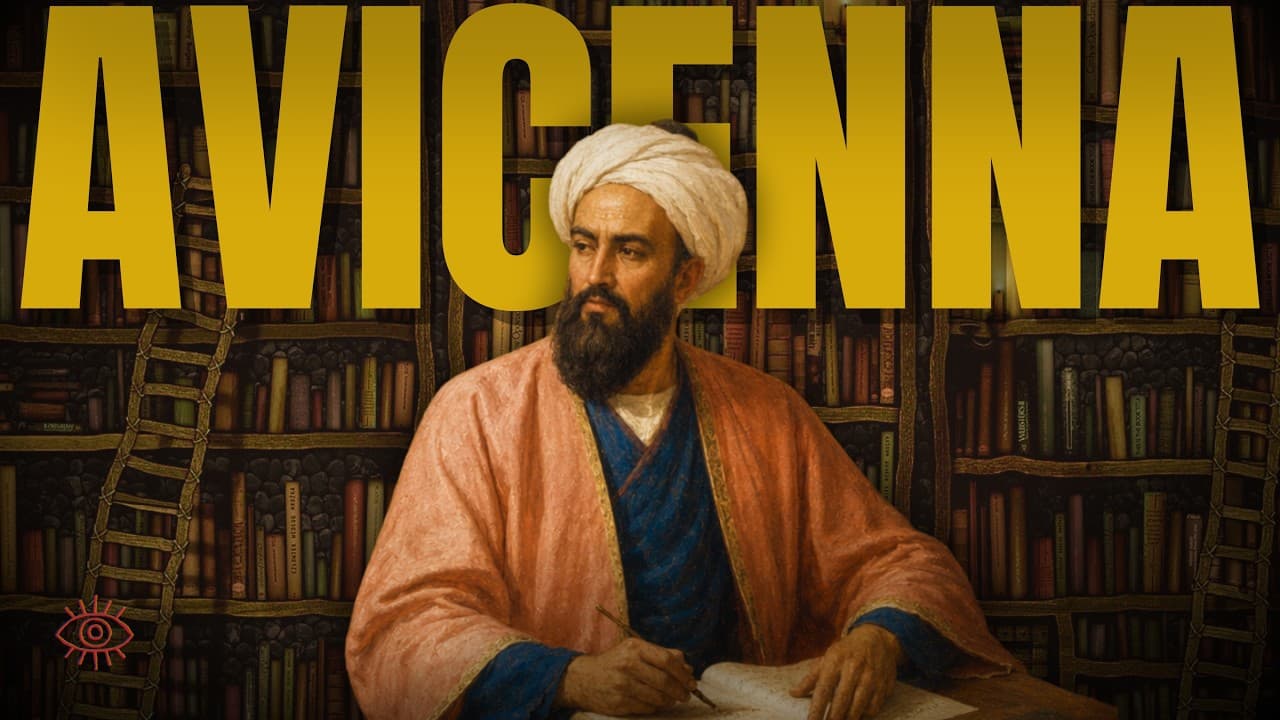
The Philosopher Who United Greek Thought and Islam | Avicenna for Sleep
Avicenna's Complete Philosophy
How did a physician writing by lamplight in a mountain fortress come to shape five centuries of world philosophy?
The philosopher who called himself Avicenna was born in nine hundred and eighty near Bukhara, memorized the Quran at ten, read Aristotle's Metaphysics forty times, and then built a philosophical system so comprehensive that it became, in two separate civilizations, the foundation on which later thought was constructed.
This episode traces his life from the Samanid libraries of his childhood through the courts and prisons of his middle years to the final synthesis he achieved in Isfahan.
We work through his great philosophical encyclopedia, his proof that a necessary being must exist, his famous thought experiment about a soul floating in empty space with no sensory contact of any kind, his account of the inner faculties of the mind, his theory of how prophetic knowledge works, and the three allegorical works that say what the philosophy cannot quite say in argument.
We follow his ideas into the Latin West, where Thomas Aquinas read and transformed them, and through the Islamic tradition, where Suhrawardi and Mulla Sadra built new philosophies on his foundations. One of the great minds of any civilization, examined at full length.
The full episode is on YouTube and Spotify. Please listen only in safe, restful contexts.
Enjoying the episode?
Occasional letters on philosophy, reading, and the examined life. No spam, ever.
By subscribing you consent to receiving occasional emails. Unsubscribe any time via the link in every email or at /unsubscribe.
Timestamps
- 0:00:00Chapter 1: The Life of a Wandering Mind
- 0:15:52Chapter 2: The Inheritance
- 0:25:13Chapter 3: The Book of Healing: An Encyclopedia of Knowledge
- 0:33:10Chapter 4: The New Logic
- 0:40:44Chapter 5: Nature and Causation
- 0:48:07Chapter 6: Essence and Existence
- 0:55:20Chapter 7: The Necessary Existent
- 1:02:26Chapter 8: The Floating Man
- 1:09:17Chapter 9: The Faculties of the Soul
- 1:16:59Chapter 10: Intellect and Illumination
- 1:23:47Chapter 11: The Book of Salvation
- 1:29:31Chapter 12: The Canon of Medicine
- 1:36:44Chapter 13: Medicine as Philosophy
- 1:43:26Chapter 14: Creation by Necessity
- 1:49:59Chapter 15: Prophecy and the Highest Knowing
- 1:56:11Chapter 16: The Visionary Recitals
- 2:01:29Chapter 17: The Book of Pointers and Reminders
- 2:07:24Chapter 18: The Problem of Universals
- 2:13:29Chapter 19: The Self and Consciousness
- 2:19:58Chapter 20: The Imagination and the Soul
- 2:26:16Chapter 21: The Incoherence Controversy
- 2:32:18Chapter 22: Poetry and Inner Life
- 2:36:52Chapter 23: Avicenna in the Latin West
- 2:42:55Chapter 24: Avicenna's Islamic Heirs
- 2:49:06Chapter 25: Legacy
For the record
Full Transcript
Chapter 1: The Life of a Wandering Mind
In the autumn of nine hundred and eighty, in a small village called Afshana near the ancient city of Bukhara, a child was born who would become the most comprehensive philosophical mind of the medieval world, the synthesizer of an entire intellectual tradition and the point from which two later traditions, the Islamic and the Latin, would take their directions. His given name was Abu Ali al-Husayn ibn Abd Allah ibn Sina. The West would know him as Avicenna, a Latinization of a portion of his name that he himself would not have recognized, and it is as Avicenna that he will be called throughout what follows, since that is the name English speakers know and the form that carries no distortion across centuries. He lived through the collapse of a dynasty, served in the courts of several successor states, was imprisoned twice, spent years as a fugitive from a hostile sultan, and wrote his greatest works between the duties of a court physician and the pressures of high politics. That what he produced under these conditions is so systematic, so carefully argued, so vast in its ambitions and so precise in its execution, is one of the stranger facts in the intellectual history of the world.
His father, Abd Allah, was a government official from the Balkh region who had converted to Ismaili Shia Islam, a branch of Islamic thought more inclined toward philosophical speculation and esoteric interpretation than the mainstream Sunni tradition. This inclination shaped the household atmosphere. A child raised in a home where intelligent adults took seriously the idea that the Quran had layers of meaning deeper than the literal, and that philosophy and scripture were in some deep way continuous with each other, was a child who grew up with permission to think. His mother was from Afshana itself. When the boy was still young, the family moved to Bukhara, where Abd Allah had been appointed to a post in the provincial administration, and where the intellectual life of the Samanid capital offered resources that a village could not provide.
Bukhara in the late tenth century was one of the genuinely great cities of the Islamic world. The Samanid dynasty, which governed a large portion of Central Asia from its capital on the Zerafshan River, had made the city a center of Persian literary culture and Islamic learning. The court attracted poets, scholars, jurists, and physicians. The tradition of philosophical and scientific inquiry that had been established in Baghdad under the Abbasid caliphs had spread eastward along the trade routes, and Bukhara received it with energy and confidence. The Persian language, in which the Samanids took particular pride, was becoming, alongside Arabic, a vehicle for sophisticated intellectual prose. It was a city where a brilliant child could find much to read and, more importantly, where the ambient culture took reading seriously as an activity worthy of a serious person.
The boy's education followed the standard path for a child of his class and period: the Quran in its entirety, memorized by age ten; then the disciplines of Islamic learning, jurisprudence and theology and the science of Quranic exegesis; then, under a series of private tutors, the classical Greek curriculum as it had been transmitted through Arabic, working through Porphyry's introduction to Aristotle's logic, then Euclid's geometry, then Ptolemy's account of the heavens, then Aristotle's logical works themselves. What was not standard was the pace and the restlessness. The child consistently outpaced his teachers, arriving at questions they had not anticipated and conclusions they had not reached. This is not merely his own retrospective self-presentation. His biographer Juzjani, who knew him well as a mature man and had no incentive to flatter a dead master beyond what the facts supported, confirms the picture.
A wandering scholar named al-Natili came to Bukhara and took up residence with the family, and under his direction the young Ibn Sina made his first systematic study of Aristotle's philosophical texts. But al-Natili was not, by Avicenna's own account, an especially deep student of what he taught, and more than once in their sessions the student quietly exceeded his teacher. When al-Natili moved on to another city and another patron, the boy continued alone, working through texts with the kind of focused independence that requires both talent and a certain ruthlessness about one's own time.
He turned to medicine in his early teens, not because it was the most philosophically interesting discipline available to him but because it was necessary and because it opened onto the full texture of bodily life. He describes medicine in his autobiographical dictation as a relatively easy subject, one that yielded its principles quickly and rewarded practical application without demanding the sustained difficulty that mathematics and philosophy required. Whether this was genuine ease or the confidence of a mind that found most things manageable is difficult to say. What is clear is that by his mid-teens he was treating patients, and that his reputation spread.
It was his medical reputation that opened the door to the royal library. The Samanid sultan Nuh ibn Mansur fell seriously ill, and the court physicians were unable to help him. The young physician was summoned to the palace. He treated the sultan successfully, or at least relieved his condition sufficiently to earn gratitude, and as a reward he was given access to the royal library in Bukhara. He describes this library in his autobiography with something approaching reverence: rooms full of books, subjects he had never before encountered in a single collection, manuscripts representing accumulated knowledge that had come to Bukhara from Baghdad, from Byzantium, from the ancient seats of learning that the Islamic conquests had absorbed and transformed. He says, with the confidence of a young man who has not yet learned what he does not know, that by the time the library burned in a fire some years later, he had absorbed its essential contents.
There had been one extended difficulty in all of this. He had read Aristotle's Metaphysics forty times without fully understanding it, pressing through a text so compressed, so dependent on the entire scaffolding of Aristotle's philosophy, that even a mind as quick as his could not force it open from the outside. Then one day, browsing in a bookseller's stall in Bukhara, he found a short commentary by al-Farabi, the greatest philosopher of the preceding generation, that organized the Metaphysics's arguments in a way that suddenly made the whole text legible. He says he was so overcome by the experience of sudden comprehension that he went to the mosque and gave alms to the poor in gratitude. Whether or not this detail is precise, it captures something real about how philosophy works: the long period of pressure against a text that will not yield, and the breaking open that comes when the right key is found.
Then the political world moved against him. The Samanid dynasty, which had provided the stable patronage and cultivated atmosphere that made Bukhara's intellectual life possible, began its terminal collapse under military pressure from the Ghaznavid rulers advancing from the east. Nuh ibn Mansur died. The succession was contested and then settled badly. Abd Allah died not long after. The young physician, who had spent his entire life in a city that regarded learning as worthy of support, was now a man of large ambitions in a world being reorganized by force and military loyalty rather than by the older Samanid culture of cultivation. He was in his early twenties. He had no inheritance, no court position, and no city that was stable enough to settle in.
He moved west and north, to the city of Gurganj on the Oxus River, the capital of the state of Khwarazm, where the ruler Ali ibn Mamun had assembled a court of scholars displaced by the same upheavals. In Gurganj Avicenna found something like the intellectual community he needed. The great polymath al-Biruni was there, and several other philosophers and scientists of serious accomplishment, and for a few years the city offered genuine scholarly conversation. But the situation deteriorated. The Ghaznavid sultan Mahmud, who regarded himself as the sovereign patron of Islamic learning as well as of territory, demanded that Ali ibn Mamun send him the scholars of Gurganj. Most of them went. Avicenna did not. He had reasons to fear Mahmud's court, possibly because the Ghaznavid ruler was hostile to the kind of philosophical inquiry that Avicenna practiced, and he disguised himself and fled south and west into the Iranian interior rather than comply.
The decade that followed was the hardest of his life. He passed through Jurjan, on the Caspian coast south of the Oxus delta, where he met the young student Juzjani who would remain his companion and secretary for the rest of his days, and where he began several major works including the early portions of what would become his great medical canon. He moved on to Rayy, briefly in the service of a local Buyid governor, then to Qazvin, then to Hamadan in the Zagros Mountains. He was frequently ill, sometimes impoverished, always moving in response to political conditions he could not control. The Buyid amirs of western Persia were more hospitable to philosophical inquiry than the Ghaznavids, and it was in Hamadan that Avicenna's fortunes finally found a degree of stability.
He treated the Buyid emir Shams al-Dawla successfully for a severe colic, was appointed court physician, and was then elevated to the position of vizier, the chief minister of state, a role that required him to manage the practical affairs of a small but turbulent court while continuing his medical and philosophical work. He served as vizier twice, with an interruption during which the troops mutinied and demanded his arrest, which he evaded by hiding for forty days in the house of a jurist. During these years of court service and political anxiety, he was writing at night, after the day's affairs were done, composing sections of his philosophical encyclopedia from memory and by candlelight, often dictating to Juzjani while students gathered to discuss what had just been set down.
He was imprisoned twice in the Hamadan period, once in the remote fortress of Fardajan in the mountains, and during his confinement there he continued to work. He escaped eventually, disguised as a Sufi, and made his way eastward to Isfahan, where the Buyid ruler Ala al-Dawla received him with genuine appreciation and gave him the permanent position and relative tranquility that had eluded him for thirty years. In Isfahan he revised and completed major works, began new ones, wrote in Persian for the first time, and by Juzjani's account came as close as he ever had to the life he was suited for.
He died in ten thirty-seven, during a march with Ala al-Dawla's army returning toward Hamadan. He had been suffering from a severe abdominal condition for years, had treated it with high doses of a medicine that eventually compounded his difficulties, and in the final weeks, as Juzjani records it, he set aside his self-prescribed remedies and said only that the physician who could not cure himself deserved no further effort. He was fifty-six or fifty-seven years old. Juzjani was present at the end.
The personality that emerges from his biographer's account and from his own autobiographical fragment is not a comfortable one to categorize. He was confident to the edge of arrogance, and he knew it. He drank wine, which Islamic law forbade, as a settled habit rather than an act of defiance, like a man who had simply decided the prohibition did not apply to him. He could be high-handed in political dealings and made enemies among people who respected his intellect. He was also, by every account, a genuinely attentive clinician, one who brought to the treatment of patients not just learning and method but the particular quality of attention that distinguishes the excellent physician from the merely competent. His medical writings are full of clinical observations that no one who had merely read earlier authorities could have made. He noticed people.
These two aspects of him, the philosopher who wanted to contain all knowledge in a single coherent structure and the physician who noticed what was singular about each patient in front of him, are not really paradoxical. For Avicenna, the universal principle and the particular case were not rivals but complementary dimensions of reality. The physician who understood universal principles of nature was better placed, not worse, to see what was individual about each patient. The tension between the system and the case ran through all his work, and it is one of the most humanly revealing things about him.
What he left behind was an intellectual monument on a scale the medieval world had not previously produced: a philosophical encyclopedia of more than a million words, a medical canon that would be taught in European universities for six centuries, three philosophical allegories in a register unlike anything else in Arabic literature, dozens of shorter treatises on logic and mathematics and theology and natural science, and a body of Persian poetry whose longing and grief stand in strange contrast to the certainty of the philosophical prose. He is the philosopher of the Islamic Golden Age who most fully absorbed the Greek tradition, most thoroughly transformed it, and most lastingly shaped both the Islamic intellectual world and the Latin Scholasticism that grew alongside it. The tension in his work between the philosopher's God and the theologian's God, between the eternal world his cosmology described and the created world scripture proclaimed, between the immortal reasoning soul of the philosopher and the resurrected body the believer awaited, was not resolved by him. It was mapped by him with such precision that everyone who came after was obliged to work within his map, whether they meant to or not.
Chapter 2: The Inheritance
The world of ideas that Avicenna entered as a student had been made possible by one of the most remarkable intellectual projects in human history: the systematic translation of Greek philosophy and science into Arabic. Beginning in the late eighth century and intensifying through the ninth, scholars working under Abbasid patronage in Baghdad rendered into Arabic virtually the entire surviving body of Greek philosophical and scientific knowledge. Aristotle's logical treatises, his investigations of the natural world, his account of metaphysics, his ethical writings; Plato's dialogues in summary and selection; Galen's vast medical encyclopedias; Euclid's geometry; Ptolemy's astronomy; the great Neoplatonic commentators who had spent three centuries after Plato elaborating and systematizing Greek thought in Alexandria and Athens. All of this became available in Arabic, and through Arabic available to a civilization that was ready to take it seriously.
The translation movement was not merely an act of preservation. It was an act of philosophical ambition. The caliphs and wealthy patrons who sponsored the translators, and the translators themselves, believed that Greek knowledge was true, that its truths belonged to all rational minds regardless of religion or language, and that a civilization that mastered this knowledge would have access to something of permanent value. This confidence is what distinguishes the Abbasid project from mere copying. The translators were not archivists. They were members of a living civilization that was trying to inherit the full weight of a prior one.
The greatest of the translators was Hunain ibn Ishaq, a Nestorian Christian working in Baghdad in the ninth century, who translated Galen and organized teams of collaborators to work through the remaining Greek scientific corpus. Hunain and his colleagues did not merely translate word for word but worked to understand the Greek texts deeply enough to render their arguments in Arabic prose that could be read and reasoned with, not merely preserved. The translations that resulted were genuinely philosophical documents, and the Arabic-speaking philosophical tradition that grew from them was from the beginning something more than a footnote to Greek thought.
The first philosopher to write systematic philosophy in Arabic was al-Kindi, working in Baghdad in the ninth century, roughly a century before Avicenna's birth. Al-Kindi did not merely reproduce Greek ideas but began the genuinely difficult project of articulating them in the idiom of Islamic intellectual life. He asked what Aristotle's first cause had to do with the God of the Quran, whether the soul of the Greek philosophers was the same soul that would be judged at the resurrection, and whether mathematical knowledge about infinity had implications for the Islamic doctrine of eternal divine power. These were not comfortable questions, and al-Kindi did not fully resolve them. But he had the courage to raise them with clarity, and that clarity was what his successors inherited.
More immediately important to Avicenna than al-Kindi was al-Farabi, who worked in Baghdad and Aleppo in the tenth century and died when Avicenna was still young. Al-Farabi was a philosopher of exceptional range and rigor, and his influence on what followed him is difficult to overstate. He wrote extensive commentaries on Aristotle's logical works and was perhaps the finest Aristotelian logician of his generation. But his most consequential philosophical contribution was a synthesis of a particular and ambitious kind. He argued, in a series of works on the relationship between Plato and Aristotle, that the two great founders of Greek philosophy were not in fundamental conflict, and that their different approaches to philosophy, the Platonic emphasis on political community and mythic narrative, the Aristotelian emphasis on scientific demonstration and systematic argument, were two registers of the same underlying truth. This position required interpretive work that was sometimes strained, but it established a framework within which later philosophers, including Avicenna, could operate: a framework in which the philosophical tradition was unified and progressive, with Aristotle as its scientific backbone and Plato's political and cosmological insights absorbed and reinterpreted within an Aristotelian structure.
Al-Farabi also worked out a detailed theory of the active intellect, drawing on a brief passage in Aristotle's treatise on the soul where Aristotle distinguished between a passive intellect that receives forms and an active intellect that makes the passive intellect capable of knowing. Al-Farabi elaborated this hint into a full cosmological theory: the active intellect was a cosmic entity, a specific intelligence in the hierarchy of being, that illuminated human minds the way the sun illuminated material things, making abstract knowledge possible for creatures who would otherwise be merely material. He connected this cosmic intellect to the God of Islamic theology, and he connected both to a theory of prophecy: the prophet, in al-Farabi's account, was a person of exceptional imaginative and intellectual power who could receive philosophical truths directly, without the laborious process of demonstration, and translate them into images and narratives that ordinary people could understand and live by. This theory of prophecy as the political expression of philosophy was enormously fruitful, and Avicenna would take it up, transform it, and make it central to his own system.
The Neoplatonic element in this tradition requires emphasis, because it entered the Arabic philosophical world through a misattribution that shaped everything that came after it. Two texts, now known as the Theology of Aristotle and the Book of Causes, were believed throughout the medieval period to be works of Aristotle but were in fact drawn from Plotinus and Proclus, the great Neoplatonic philosophers of the third and fifth centuries. The cosmological picture these texts conveyed, a picture of a perfect first principle from which all things emanate in a descending hierarchy of being, was absorbed into the Arabic tradition as Aristotle's own teaching. The synthesis of Aristotelian science with Neoplatonic cosmology that resulted was not, therefore, a conscious philosophical decision but something close to a historical accident, and al-Farabi and Avicenna both believed they were working within a unified Aristotelian system when they were in fact working in a tradition that had already fused two quite different philosophical inheritances.
Avicenna was aware of this complexity to a degree unusual for his time. He recognized which elements of the tradition he had received were genuinely Aristotelian and which were Neoplatonic elaborations, and in several places he assessed the arguments of each tradition on their own terms rather than assuming they were compatible. He also recognized what was missing or unresolved in the tradition he had inherited: there was no fully worked out account of the soul's self-awareness, no satisfying explanation of how the human intellect connected to divine knowledge without collapsing the boundary between them, and no clear resolution of the tension between a God whose absolute simplicity seemed to preclude any knowledge of particular things and a God whose revelation addressed each individual soul. These were the gaps that Avicenna would spend his career trying to fill, and the tradition he inherited both made his work possible and made it necessary.
The moment of illumination he described, when al-Farabi's commentary unlocked Aristotle's Metaphysics after forty readings, was a technical breakthrough in the first instance: it gave him the key to reading a difficult text. But what he did with that key, the philosophy he built from it, went far beyond anything al-Farabi had envisioned. Al-Farabi remained a philosopher within the Aristotelian tradition, a commentator and synthesizer of enormous skill. Avicenna was its completion and its transformation, the moment at which the tradition found the form it would hold for the next four centuries.
Chapter 3: The Book of Healing: An Encyclopedia of Knowledge
The Book of Healing is not about healing in the medical sense. Its title, which translates literally as the book of the remedy or the cure, refers to the healing of the soul through knowledge, the restoration of the intellect to its proper orientation toward truth. It is an encyclopedia of philosophical and scientific knowledge on a scale that had no precedent in Arabic literature, and few in any language. Its four major parts cover logic, the natural sciences, mathematics, and metaphysics. In its complete form it runs to more than a million words. It took Avicenna somewhere between fifteen and twenty years to write, most of those years during his time at Hamadan and then Isfahan, composed in the margins of his duties as court physician and, for two interrupted periods, as vizier.
The ambition of the project was explicitly total. Avicenna intended to map the entire terrain of philosophical knowledge as it had been developed in the Greek tradition, to extend and correct it where his own thinking required, and to present the result as a unified system in which each part supported the others. This was not a matter of collecting and summarizing existing materials. It was a creative and critical act. He disagreed with Aristotle in significant ways, particularly in logic and psychology, and said so. He introduced ideas that had no precedent in earlier Arabic philosophy. And in the metaphysics section, which has always attracted the most scholarly attention, he developed the analysis of essence and existence and the proof of the necessary existent that would shape philosophy in both the Islamic world and the Latin West for the following four centuries.
The project originated, according to Avicenna's own account, in a request from a young jurist named Abu al-Husayn al-Arudi, who asked him to write a comprehensive philosophical work. Avicenna agreed, setting himself the discipline of composing each major section from memory, without consulting earlier texts, working purely from his internalized understanding of the tradition. This claim should probably not be taken as entirely literal, since the resulting text shows detailed knowledge of specific arguments in earlier works. But it indicates the degree to which he had absorbed the tradition and was capable of working from it as from his own thinking rather than from citations. The encyclopedia was not a compilation. It was a performance.
He describes the working conditions with remarkable specificity. In Hamadan, after the day's court duties and medical consultations were concluded, he would sit with students, and they would read together through what he had composed the night before. Each night he would work on the next section, sometimes composing fifty pages of logical or metaphysical argument before setting down his pen. During his imprisonment at the fortress of Fardajan he wrote what is now among the most important parts of the work: the treatment of metaphysics, including the argument for the necessary existent that would be read and debated in European universities from the thirteenth century onward. He composed one section on horseback during a military expedition. The physical conditions of composition, the interrupted nights and political anxieties and constant movement through difficult terrain, seem almost impossible to reconcile with the philosophical precision and systematic clarity of the result.
The structure of the encyclopedia was designed to mirror the structure of knowledge itself. Logic comes first, occupying an enormous opening section that covers not only the standard Aristotelian logical texts but Avicenna's substantial extensions and revisions of them. Logic is the instrument that the mind needs before it can engage with any subject matter reliably, and it must therefore be mastered before the inquiry into the natural world or into metaphysics can begin. The natural sciences come second, covering physics, the study of the heavens, meteorology, mineralogy, botany, zoology, and the study of the soul in sequence, following the Aristotelian curriculum. Mathematics occupies the third part, covering geometry, astronomy in its mathematical aspects, music, and arithmetic. And metaphysics, the study of being as such, comes last, requiring all the others as preparation.
This ordering reflects a conviction that ran through all of Avicenna's work: that the movement of the mind toward truth is a movement from the more particular and familiar to the more general and abstract, from what is closest to sensory experience toward what is furthest from it and most truly real. The natural world gives the mind its starting materials. Logic gives it its tools. Mathematics trains it in abstract reasoning. And metaphysics is the destination, the study of what is most fundamental and therefore most remote from the immediate texture of experience.
The Book of Healing circulated widely in the Islamic world almost immediately upon its completion, and portions of it were translated into Latin within a century of Avicenna's death. The section on logic was of immediate use to Islamic jurists who needed sophisticated tools for legal reasoning. The section on the soul, with its careful account of the inner faculties of the mind, became foundational for Islamic philosophers and theologians of the following generations. The metaphysics section, as translated and discussed in the Latin West from the twelfth century onward, became one of the most-cited philosophical texts of the Scholastic period. Albert the Great read it carefully. Thomas Aquinas engaged with it in detail. Duns Scotus built important parts of his own metaphysics in explicit response to it.
What distinguishes The Book of Healing from the great Aristotelian commentaries that preceded it is not scale alone, though scale is part of it. What distinguishes it is the particular quality of mind at work throughout: an intelligence not primarily interested in reporting or reconciling earlier views but in finding the clearest and most defensible version of each philosophical position. When Avicenna discusses a dispute among earlier thinkers, he typically presents it not as a debate to be observed neutrally but as a problem to be solved, and his solutions, even where they draw on earlier suggestions, have the character of conclusions rather than of tentative glosses. The encyclopedia reads like the work of a man who has decided, after long reflection, what the right answers are and is explaining them with rigorous care. This quality, which some readers have found arrogant and others have found liberating, meant that The Book of Healing became not merely a summary of what had been thought before but a new starting point for what would be thought after. To engage with philosophy after Avicenna was, in very large part, to engage with him.
Chapter 4: The New Logic
Logic, for Avicenna, was not merely a technical discipline for specialists in argumentation. It was the precondition of all knowledge, the instrument that the mind required before it could engage reliably with any subject matter. A philosophy that began with metaphysics before training the mind in logic was, in his view, like a craftsman who went straight to the work without first learning his tools. This is why the logical section of his encyclopedia opens the entire project, and why it occupies a space so substantial that it constitutes something like a complete logical treatise in its own right.
He inherited from Aristotle a system organized around the syllogism, a form of argument in which two premises lead by necessity to a conclusion. The basic syllogism asserts something about a subject and predicate in each premise, and the shared term between the premises drops out to yield the conclusion. Aristotle had worked out in remarkable detail the conditions under which syllogisms of different forms are valid, and the Aristotelian logical texts had been transmitted through the Arabic translation movement largely intact, supplemented by the Neoplatonic commentators who had spent centuries elaborating and refining them.
Avicenna did not simply reproduce this system. He reorganized it, criticized it at specific points, and extended it into territory that Aristotle had not developed. One of his most significant innovations was his treatment of conditional and hypothetical reasoning, arguments whose premises take the form of conditionals rather than simple subject-predicate assertions. Aristotle had discussed these forms briefly but had not integrated them into his syllogistic framework. Avicenna developed a full theory of conditional reasoning, distinguishing between different types of conditional statements and working out the valid inferential patterns for each. This was a genuine extension of the logical tradition.
Even more philosophically significant was his distinction between what he called first and second intentions. A first intention is a concept whose object is a thing in the world: the concept of humanity, for instance, considered as it applies to actual human beings. A second intention is a concept whose object is another concept: the concept of species, or genus, or predicate, which applies to concepts themselves and to the ways concepts relate to one another, rather than to the things those concepts describe. When we say that humanity is a species, we are making a claim about the concept of humanity, not about any particular human being. Species is a second intention.
This distinction clarifies what logic is about. Logic, properly understood, is the science of second intentions: it studies the forms that correct thinking takes, the relationships between concepts, the conditions under which inferences are valid. It does not study the world directly. It studies the structure of thought about the world, and it studies this structure because the same formal patterns of valid reasoning apply regardless of what the thinking is about. A logician who notices that a certain argument form is valid is noticing something about the structure of reasoning as such, not about any particular subject matter.
The distinction between first and second intentions also helped resolve, or at least clarify, longstanding puzzles about universals. When philosophers asked whether universals existed in reality or only in the mind, part of the confusion arose from a failure to distinguish between the universal as a feature of concepts and the universal as a feature of things. Universals in the logical sense, the concepts of species and genus and predicate, are second intentions, features of our conceptual scheme. Whether the natures that these concepts represent exist in things, or only in minds, is a separate question, one that belongs to metaphysics rather than to logic. By distinguishing the logical question from the metaphysical question, Avicenna made it possible to address each of them more precisely.
His treatment of definition was equally careful. Aristotle had held that genuine scientific knowledge required genuine definitions, statements of the essential nature of a thing rather than of its accidental properties, and that a proper definition gave both the genus to which a thing belonged and the specific difference that distinguished it from other things in that genus. Avicenna accepted this framework but pressed hard on the question of what it means for a thing to have an essential nature at all. This inquiry connects directly to his metaphysical theory of essence and existence, because for Avicenna, the essence of a thing, what makes it the kind of thing it is, is logically prior to and independent of its existence, whether it exists or not. Understanding what definitions are, and what they capture, requires understanding this relationship between essence and existence, which is why the logical analysis of definition opens naturally into metaphysics.
In his treatment of modal logic, the branch of logic dealing with necessity, possibility, and contingency, Avicenna also made advances that distinguished him from his predecessors. He worked out with care the different kinds of necessity that can appear in propositions, distinguishing for instance between a proposition that is necessarily true at all times and one that is necessarily true only for as long as its subject exists, and he developed rules for how modal claims behave in syllogistic reasoning. The vocabulary of necessary existence, possible existence, and contingent existence that appears throughout his metaphysics is a logical vocabulary as well as a metaphysical one, and his care in developing it logically was what allowed him to use it metaphysically without confusion.
There is a dimension of Avicenna's logical work that goes beyond technical innovation and touches on his understanding of the philosopher's vocation. He insisted that logic was an instrument and not an end in itself, that the logician who could draw valid inferences but had nothing worth reasoning about was like a craftsman with excellent tools and no worthy material. Logic enables the mind to pursue truth rigorously, to distinguish demonstration from mere assertion and genuine knowledge from plausible opinion. Whether the truths being pursued are worth pursuing is a question that logic alone cannot answer. It belongs to the philosopher who has understood not just how to reason but what is worth reasoning about, and that understanding required, in Avicenna's view, not just logical training but the kind of sustained engagement with metaphysics and the natural sciences that the rest of his encyclopedia was designed to provide.
Chapter 5: Nature and Causation
The section of The Book of Healing devoted to the natural world is, of all the parts of that encyclopedia, the most directly Aristotelian in its framework. Avicenna follows Aristotle in organizing the study of nature around the concept of substance, the analysis of things as combinations of matter and form, and the investigation of causation as the key to explaining why natural things are as they are and behave as they do. The four causes that Aristotle had identified, the material cause or what something is made of, the formal cause or the structure that makes it the thing it is, the efficient cause or what brings it into being, and the final cause or the end toward which it tends, remain the basic explanatory framework throughout.
But Avicenna was not simply reproducing Aristotle, and his departures from the Aristotelian inheritance are in several places philosophically significant. His treatment of matter deserves attention first. For Aristotle, prime matter, the bare substrate that underlies all change and receives all forms, is a purely logical concept and cannot exist independently of form. There is no such thing as matter without some form, no chunk of pure potential lying somewhere awaiting determination. Avicenna broadly accepts this but modifies the account in a way that reflects his Neoplatonic inheritance. He gives to the individual substance, the particular horse or stone or human being, a kind of independent ontological weight that Aristotle's system does not quite assign. The individual thing has its own distinct nature, not merely as an instance of a universal form instantiated in formless matter. This shift matters for his theory of individuation, the question of what makes this particular horse different from that particular horse when both share the same form, a question Aristotle left in some tension.
On causation, Avicenna introduces a distinction that proves crucial for his later metaphysical argument. He separates two kinds of causal relationship that had sometimes been conflated. The first is the temporal series of causes, in which one event follows another in time: this fire was caused by that spark, which was caused by that friction, and so on back through a historical sequence. The second is what we might call the hierarchical or vertical series, in which one thing depends on another not for its coming into being in some past moment but for its continuing to exist right now, at this present instant. A flame depends on oxygen not merely to have come into existence but to continue burning. An image in a mirror depends on the object in front of it not in some historical sense but in the present moment: remove the object and the image ceases immediately.
These two kinds of causal dependence obey different logical principles. The temporal series might, for all logic tells us, extend infinitely into the past: there is no obvious contradiction in the idea of an eternal temporal sequence with no beginning. But the hierarchical series cannot be infinite. If every member of a series of simultaneous dependencies depends on another member for its present existence, and if no member has the resources to exist through itself, then the series as a whole has no ground of existence, and a collection of things that each depend on others but none of which are self-sustaining is a collection that cannot exist at all. The hierarchical causal series must terminate in something that exists through itself, not through another.
This distinction between temporal and hierarchical causation is worked out in the natural philosophy section because it is grounded in the analysis of how actual natural things depend on one another in the world of our experience. It is the philosophical foundation for the argument about the necessary existent that appears later in the metaphysics section. The reader who arrives at that argument already understanding how hierarchical causation works is better placed to follow its steps.
On the question of motion, Avicenna departs from Aristotle in a way that attracted considerable attention from later thinkers. Aristotle's physics held that violent motion, the motion of a thrown projectile for instance, required a continuous external cause: once the thrower's hand released the stone, some continuing force had to explain why the stone kept moving. Aristotle located this continuing force in the medium through which the projectile traveled, arguing that the air was pushed aside and then rushed back to fill the gap, propelling the stone forward. Even in Avicenna's time, this explanation was recognized as strained. Avicenna proposed instead that the moving body acquired an impressed disposition, an internal tendency toward continued motion, from the initial act of throwing. This disposition was not a force in the modern sense, and Avicenna's physics remained qualitative rather than mathematical. But the concept of an acquired tendency toward motion internal to the moving body was an important step away from the Aristotelian requirement that every motion require a continuously present external cause, and it was developed by later medieval thinkers into the concept of impetus that eventually became part of the background against which modern physics emerged.
The natural philosophy also introduces the account of the soul that would receive its fullest development in Avicenna's psychology. He treats the soul, following Aristotle, as the form of a natural body that has the potential for life. But he immediately begins complicating this. The soul's relationship to the body it animates is not the same as the relationship of form to matter in an ordinary physical substance. The sharpness of a knife is the knife's form, and it cannot exist without the knife. But the soul, Avicenna insists, has a kind of independence from the body that the sharpness of a knife does not have from the steel. The soul uses the body as an instrument rather than simply being the body's organization. And the soul has the capacity for self-awareness, an awareness that is not derived from the body's states and does not depend on bodily sensation. These claims, introduced here in the context of natural philosophy, will require philosophical arguments that do not yet exist in this section. They are promissory notes that the psychology sections of the encyclopedia will honor.
Chapter 6: Essence and Existence
Among all the philosophical distinctions that Avicenna introduced or sharpened, none has had a longer or more consequential history than his distinction between essence and existence. It is a distinction that seems almost too simple when first stated, and yet unpacking it fully requires tracing implications that shaped the course of philosophy across two civilizations.
The starting point is a question about concepts. When we define a thing, when we ask what it is rather than whether it is, we are giving its essence: the properties that make it the kind of thing it is, the features that any member of that kind must have, the content of the definition that applies to it. The essence of a triangle is to be a three-sided closed plane figure. The essence of water, in whatever terms the natural philosopher describes it, is those properties that make water water rather than something else. The essence of a human being, in Aristotle's definition, is to be a rational animal. These essences can be understood, examined, and discussed without any reference to whether anything of that kind actually exists. I can work through the geometry of triangles without knowing whether any perfect triangles exist in the physical world. I can define the concept of a phoenix in elaborate detail without settling the question of whether phoenixes are real.
This observation, that essence is logically prior to existence and can be grasped independently of it, leads to what Avicenna considered the crucial implication. Essence is, as he put it, indifferent to existence. It neither includes existence among its defining properties nor excludes it. The essence of a horse does not contain existence as one of its features, the way it contains having four legs or being an animal. If it did, then the mere concept of a horse would guarantee that horses exist, which is clearly false. But the essence of a horse does not contain non-existence either, since horses do in fact exist. So essence is genuinely neutral with respect to existence, neither implying it nor precluding it.
The consequence of this neutrality is precise and significant. If existence is not part of any thing's essence, then for a thing to exist is for something to have been added to its essence, something that did not come from the essence itself. The existing horse has received its existence as something extra, something above and beyond what the essence of horseness supplies. And since this addition does not come from within the essence, it must come from outside, from a cause external to the thing itself. In the formulation that medieval philosophers would repeat for centuries after, existence is accidental to every being whose essence does not include existence.
This claim should not be misunderstood. Avicenna does not mean that existence is a trivial or unimportant property. He means, precisely, that it is a real property, one that must be added to an essence by something outside the essence, and that therefore every existing thing except possibly one requires a cause for its existence. The causal question is unavoidable: why does this thing exist rather than not? Something must account for the existence that has been added to its essence.
The implications ramify in several directions. First and most immediately, this analysis means that all finite or contingent things, all things whose essence does not by itself entail their existence, are genuinely dependent on causes for their being. They do not carry their existence within themselves. They have received it, and in some fundamental sense they are always receiving it, always dependent on what sustains them in being. This is not a claim only about origins, about how things came to be, but a claim about their ongoing condition: the contingent thing exists through another, at every moment.
Second, the analysis raises the question whether there is any being whose essence does include existence, any being for which the question of what it is and the question of whether it is are not separable. If there is such a being, its existence would be self-explanatory: it would exist through its own essence, require no external cause for its existence, and could not fail to exist without a contradiction in terms. Avicenna's answer is yes, and that this being is what we mean by God. But the argument for this conclusion belongs to the following chapter. What matters here is the logical structure that makes the question arise.
The distinction between essence and existence traveled into the Latin West through the translation of Avicenna's metaphysics, and it became a cornerstone of medieval Christian philosophy. Thomas Aquinas adopted the distinction as the philosophical basis for his account of the difference between God and creatures. In God alone, Aquinas argued, essence and existence are identical: God is his own being. In everything else, essence and existence are really distinct, which is what makes everything else genuinely dependent on God as the ground of their being. Aquinas did not take this framework wholesale from Avicenna, and he modified it in ways that reflected his own theological commitments, but he could not have developed it without the tools that Avicenna's analysis provided.
In Islamic philosophy the consequences were equally profound and in some ways more contested. If existence must always be added to essence by a cause, and if God is the ultimate ground of all existence, then Avicenna's metaphysics implies a continuous, necessary dependence of all things on God for their continued being. Some Islamic thinkers found this picture theologically compelling, since it captures the Quranic theme of divine sovereignty and creaturely dependence. Others found it troubling, because the God implied by this analysis seems to create the world not by a free act of will but by a kind of necessary overflow of existence from its source, more like a sun that cannot help but shine than like a craftsman who chooses to make something. This tension, between the philosopher's God who exists necessarily and emanates necessarily and the theologian's God who creates freely and could have chosen otherwise, was one that Avicenna's successors found unavoidable. It is still a live question in philosophical theology.
Chapter 7: The Necessary Existent
The argument for what Avicenna called the necessary existent is developed in the metaphysics section of The Book of Healing with a rigor that remains impressive to engage with. It begins not from the existence of motion or change, as Aristotle's cosmological argument does, but from a more fundamental starting point: the modal structure of existence itself, the distinction between things that exist necessarily and things that exist contingently.
Consider any existing thing. Either its existence is necessary, in the sense that its non-existence would involve a contradiction, or its existence is contingent, in the sense that it could fail to exist without any contradiction arising. A thing whose existence is necessary exists through its own essence: it could not be the thing it is and fail to exist. A thing whose existence is contingent exists through another: there is nothing in its essence that compels or explains its existence, and therefore something outside it must account for why it exists rather than not.
Every thing we encounter in ordinary experience, every stone and tree and human being, is of the second kind. The essence of none of them includes existence, as established in the prior analysis. They are all contingent existents, things that exist through another. Now the question is whether the causal series that explains their existence can extend without end, or whether it must terminate somewhere.
Here Avicenna applies the distinction, developed in the natural philosophy, between the temporal series of causes and the simultaneous hierarchical series. The relevant causal series for this argument is not the temporal one, the sequence of events that produced a thing across time, but the vertical one, the series of things on which a thing depends right now for its continued existence. This series is composed entirely of contingent existents, each requiring the next for its being. And a series in which every member requires something else for its existence, with no member that has existence through itself, is a series with no internal source of being: it cannot explain its own existence from within.
To say that such a series is infinite does not help. An infinite collection of contingent existents is still a collection in which every member lacks existence through itself. However many contingent existents we accumulate, we never accumulate the resources for existence, because existence is precisely what each member lacks through its own essence. The series must therefore terminate in something that is not contingent, something that has existence through its own essence and not through another. This is the necessary existent.
The necessary existent is not the first cause in a temporal sequence. It is the ground of existence as such, the being on which all contingent beings depend at every moment for their continued being. Its necessity is absolute: it could not fail to exist, not because failing to exist would violate some external law, but because its essence is its existence, and to deny its existence would be to deny what it is.
From this foundation Avicenna derives several properties of the necessary existent, each following from the analysis of what necessary existence requires. First, the necessary existent must be absolutely simple, without composition of any kind. If it had parts, or if it were composed of genus and specific difference, or of matter and form, then the question of what unifies those components into a single being would arise, implying a further cause. But the necessary existent has no cause. Therefore it cannot be composite in any way. It is pure, uncomposed being.
Second, the necessary existent must be unique. If there were two necessary existents, some feature would distinguish them, since two things that share all properties are identical and not two things. But any distinguishing feature would be something not entailed by necessary existence alone, implying again an external cause of that feature. Therefore there can be only one necessary existent. The philosophical route to divine unity is through an analysis of what necessary existence requires.
Third, the necessary existent must be pure intellect or intelligence. This derivation is subtler. Intelligence, for Avicenna, is the mode of being in which a thing is most fully itself, most fully present to itself, most fully active rather than merely passive. A stone exists but is not aware of its existence. A mind exists and is present to its own existence. The necessary existent, as the fullest realization of being, as a being that has nothing outside or beneath it, is entirely present to itself, entirely self-knowing, entirely active. It is, in the terminology Avicenna uses, an intellect that thinks only itself, since it has nothing to think but its own being.
This portrait of God as necessarily existing, absolutely simple, unique, and purely self-knowing intelligence is a philosophical portrait with clear Neoplatonic resonances. It corresponds in its broad outlines to Plotinus's account of the first principle, the One, though Avicenna gives it the modal vocabulary of necessity and contingency that the Neoplatonic tradition lacked. It is also recognizably the God of Islamic monotheism in certain respects: unique, absolutely simple, supremely knowing.
But the tensions with religious tradition are visible and were visible to Avicenna's contemporaries. A being that knows only itself has no knowledge of the created world and no concern for any particular creature, which sits awkwardly with the God of scripture who hears prayers and intervenes in human lives. A being that exists necessarily and is the ground of all other existence by the structure of what it is seems to emanate the world by necessity rather than to create it by choice, which sits awkwardly with the doctrine of creation as a free act of divine will. Avicenna addressed these tensions in his treatment of divine knowledge and his theory of how the world proceeds from the necessary existent. But he did not dissolve them, and his critics did not let him pretend that he had.
Chapter 8: The Floating Man
Perhaps the most vivid of all Avicenna's philosophical inventions, and certainly the one most immediately accessible to a reader without extensive technical training in philosophy, is the thought experiment he introduces in several of his works and develops with particular care in his psychological writings. It has come to be known simply as the floating man argument, and its basic structure is deceptively simple.
Imagine a human being created fully adult, in perfect cognitive functioning, brought into existence at a single moment and suspended in empty space. This person is blind from the very first moment of existence, deaf, without smell or taste, unable to feel warmth or cold. And crucially, the limbs of this person are spread apart and do not touch one another, so that even the pressure of one part of the body against another is absent. This person has never had a sensation of any kind, and has no sensation now. There is no experiential contact with the external world and no proprioceptive awareness of the body itself.
Does this person know anything? Does this person have any awareness at all?
Avicenna's answer is yes, and it is the particular content of that awareness that gives the argument its force. The floating person knows, with full certainty and without any inference or sensation, that they exist. They cannot doubt this. They do not need to see or hear or touch anything to establish it. In the complete absence of all sensory content, including all awareness of the body, the awareness of one's own being remains, undeniable and entirely prior to any sensory report.
The argument has two distinct but related targets. Epistemologically, it aims to show that the mind's self-awareness is not derived from bodily sensation, not an inference from sensory data, not a conclusion that the mind draws from observing its own physical states. We do not first feel our bodies and then infer that a self must be present. The awareness of existing is more direct and more certain than any report from the senses, and the floating man strips away all sensory reports entirely to reveal it. What remains is not a body. It is a pure awareness of being, an awareness that the body's absence cannot remove.
Metaphysically, the argument aims to show that the soul is not the body or any bodily organ. If the soul were identical with the brain, or with the collection of the body's organs, then a person deprived of all awareness of the body would lose awareness of the soul entirely, since the soul would be exactly what was not being sensed. But the floating man does not lose awareness of himself. He retains a clear and immediate sense of existing even when nothing bodily is present to awareness. Therefore the soul cannot be identified with the body or with any bodily part or function. The soul is something that can be present to itself without being present to any body.
The parallel with Descartes, who arrived at a structurally similar insight through a very different method six centuries later, has attracted enormous philosophical attention. Descartes reached his famous conclusion, that the thinking thing cannot doubt its own existence as a thinking thing, by a process of systematic doubt: stripping away every belief that could possibly be doubted, on the grounds that it might be false, and discovering that the one thing that could not be doubted even in principle was the existence of the doubting mind itself. Avicenna reaches the same destination by stripping away not beliefs but sensations: removing every source of sensory contact with the world and with the body, and discovering that the awareness of existing remains when everything else is gone. The routes are different, the philosophical contexts are different, and the uses the two thinkers made of the insight were different. But the core discovery is the same: that self-awareness is the most fundamental and certain of all mental facts, and that it cannot be derived from or reduced to anything physical.
What the floating man argument does not establish, and what Avicenna was careful not to claim it established, is the soul's immortality. It shows that the soul is not the body. It does not show that the soul can exist independently of any body, or that it persists after the particular body it inhabits has died. Those are further arguments, requiring further premises, and Avicenna makes them elsewhere on different grounds. The floating man gives him the starting point: the soul is a distinct kind of thing, not identical with any physical substance, whose self-awareness is primitive and irreducible.
The argument also raises a question that Avicenna takes seriously in his psychology. What exactly is this primitive awareness that persists when everything else is stripped away? What is the floating man actually aware of when he is aware that he exists? Avicenna's answer is that what persists is the soul's awareness of its own being as a subject of experience, the constant underlying ground of all experience, what makes a series of mental events over time into the experiences of one person rather than of many. This is not any particular thought or feeling. It is the continuing subject that has thoughts and feelings. And it is present even in dreamless sleep, even in moments when no particular content occupies the mind, because it is the precondition of any content, the background against which any experience occurs.
This analysis makes Avicenna, in the assessment of some historians of philosophy, a forerunner not only of Descartes but of Husserl and the phenomenological tradition: a thinker who recognized that the most fundamental object of philosophical inquiry was not the external world but the structure of consciousness itself, and who approached that structure through careful attention to what could and could not be removed from experience while experience remained.
Chapter 9: The Faculties of the Soul
Avicenna's psychology, his account of the soul and its capacities, is organized around a hierarchy of three distinct kinds of soul, each defined by its characteristic powers. The vegetative soul, which is shared by all living things including plants, governs nutrition, growth, and reproduction: the capacities that sustain individual life and generate new life. The animal soul, shared by animals and human beings, governs sensation and voluntary movement: the capacities that allow the organism to respond to its environment, to pursue what is beneficial and avoid what is harmful. And the rational soul, which distinguishes human beings from other animals, governs rational thought and deliberate action: the capacities that allow the mind to grasp universal truths and to guide conduct by reason rather than by instinct alone.
This three-part structure follows Aristotle closely in its outlines, but Avicenna developed each level with a degree of detail and systematic precision that goes well beyond what Aristotle provided. The part of his psychology that received the most attention from later thinkers, both in the Islamic world and in the Latin West, was his account of the inner senses: a set of five psychological faculties within the animal soul that mediate between the raw data of sensation and the activity of rational thought.
The five outer senses, sight and hearing and touch and taste and smell, receive information from the external world in a way that is tied to the specific organs of sensation and to the physical presence of the object being sensed. But the mind clearly does something with sensory information beyond merely receiving it. It combines information from different senses into a unified experience of a single object. It retains information after the object is no longer present. It combines retained sensory forms in new configurations. It perceives something in animals and objects that is not a sensory quality at all, not a color or a sound or a texture, but a significance or a tendency. And it stores these perceived significances in memory. These are the five inner senses.
The first is the common sense, the faculty that integrates the deliverances of the five outer senses into a single, unified object of experience. When you perceive an apple, you see a red roundness, feel a smooth coolness, smell a faint sweetness: these are the deliverances of separate sense organs. The common sense unifies them into a single experience of one apple, establishing that it is one thing you are perceiving with multiple organs rather than five distinct sensory objects. Avicenna located this faculty in the front ventricle of the brain.
The second inner sense is the retentive imagination, the faculty that preserves sensory forms after the object is no longer present. This is the basis of sensory memory in the ordinary sense: you can recall what an apple looks like when no apple is before you because the retentive imagination has preserved the sensory form. Avicenna also located this in the front ventricle.
The third is the compositive imagination, sometimes called the estimative imagination, which has the power to combine and rearrange the sensory forms that have been stored, producing new configurations that need not correspond to anything ever actually perceived. The person who imagines a mountain of gold, or a horse with a human head, is exercising the compositive imagination. This faculty is not bound by the constraint of faithfully reproducing past experience. It can combine freely. Avicenna located it in the middle ventricle of the brain.
The fourth inner sense is what Avicenna called the estimative faculty, and it is the most philosophically interesting of the five. It is the faculty by which an animal perceives not merely the sensory qualities of objects but what Avicenna called their intentions: properties that are not sensory qualities but that carry significance for the perceiving animal. A sheep perceives the wolf not merely as a particular arrangement of shapes and colors and sounds but as something threatening, something to be fled from. This perception of dangerousness is not a sensory quality: you cannot see or hear threat the way you can see color or hear pitch. It is a kind of significance apprehended directly by the animal without inference or deliberation. Avicenna placed the estimative faculty in the middle ventricle of the brain and regarded it as the animal analog of rational judgment: the capacity for quick, non-inferential assessment of what objects mean for the creature's survival and wellbeing.
The fifth inner sense is memory, which stores not the sensory forms themselves but the intentions perceived by the estimative faculty. You remember not just what the wolf looked like but what it was like to perceive it as dangerous, the significance that the experience carried. Memory in this sense is the storehouse of experiential meaning, not merely of sensory data.
This account of the inner senses is both philosophical and, in Avicenna's own terms, something like a contribution to what we would call cognitive science. He was genuinely interested in the question of how psychological functions were realized in the brain, and he correlated each inner sense with a specific brain region in a way that connected his philosophical psychology to clinical observation. A stroke or injury that affected the front of the brain in certain ways would damage the common sense or the retentive imagination. A lesion in the middle ventricle might impair the estimative faculty. This was not merely speculative anatomy but an attempt to ground the philosophical account in the structure of the physical organ.
The full significance of this psychology becomes clear when we notice the position of the compositive imagination within the system. It is the faculty that bridges the animal and the rational soul. In ordinary human beings, the compositive imagination is governed to some degree by reason, which constrains its free combinations by the norms of truth and logical consistency. But in the person of exceptional gifts, particularly in the prophet, the compositive imagination can receive forms not from the outer senses or from stored sensory memories but from the active intellect, the cosmic intelligence that illuminates human minds. When the compositive imagination operates at this level, it generates not fantasy but revelation, not idle combinations of stored sensory data but images and narratives that convey genuine philosophical truths in a form that can reach and move the minds of ordinary people. The inner sense psychology is not just a psychological theory. It is the basis for Avicenna's account of how religious knowledge reaches humanity.
Chapter 10: Intellect and Illumination
The rational soul in Avicenna's system is the site of what makes human beings distinctively human: the capacity for abstract thought, for grasping universal truths that no amount of sensory experience alone could establish. How this capacity works, how the human mind comes to know things that transcend the particular and the sensory, is one of the central and most difficult questions in his psychology, and his answer depends on a theory of the intellect that is both philosophically rigorous and cosmologically ambitious.
Avicenna distinguishes several stages in the human intellect's development. The material intellect, which he sometimes calls by its potential or dispositional character, is the intellect at its most basic: pure potentiality for thought, the capacity to receive intelligible forms without yet having received any. It is called material by analogy with matter, which is the pure potentiality for taking on physical forms. A mind that has never learned anything, that has no concepts whatsoever, is a material intellect in this sense: not literally made of matter, but occupying the same position in the order of knowledge that matter occupies in the order of physical things.
The intellect in habit is the material intellect that has acquired some intelligible forms, some concepts and principles, and can exercise them at will. This is the intellect of the educated person, the mind that has mastered the first principles of logic and mathematics and the basic concepts of natural science and is ready to use them in reasoning. It has made the transition from mere potentiality to a settled capacity that can be deployed.
The actual intellect is the intellect actively thinking, exercising its acquired concepts in the work of reasoning, demonstration, and inquiry. And the acquired intellect is the highest stage of human intelligence, the intellect that has achieved the fullest possible connection with the active intellect and can therefore exercise the full range of intellectual cognition with a kind of effortless completeness.
The active intellect stands apart from all of these. It is not a stage in any individual human mind's development. It is a separate, cosmic entity: the lowest in the hierarchy of separate intellects that emanate from the necessary existent and govern the cosmic order. Where the higher intellects govern the celestial spheres, the active intellect governs the sublunar world, the world of generation and corruption in which we live, and it is the proximate source of all forms in the natural world as well as the illuminating cause of all human abstract knowledge.
Avicenna develops the light analogy with particular care. The active intellect illuminates human minds the way the sun illuminates the physical world. Just as the sun does not create what it illuminates, but brings it from potential to actual visibility, the active intellect does not create the intelligible forms that human minds grasp, but brings them from mere potentiality in the human intellect to actual knowledge. The person who learns a mathematical truth is not fabricating that truth from within their own mind: the truth is, in some sense, already there in the active intellect, and what learning does is establish the right condition in the human mind for that truth to be received.
This theory places Avicenna in the tradition of illuminationism about abstract knowledge, the view associated with Plato that the mind's knowledge of universal and necessary truths cannot be derived entirely from sensory experience, which only ever gives us particular and contingent data. You cannot, by examining thousands of triangles, establish that the angles of any triangle sum to two right angles, because experience only gives you a finite sample of triangles that could in principle be misleading. The proposition about triangles is known with necessity and universality, which can only be because the mind has access, in some way, to a source of knowledge that goes beyond the particular instances sensory experience provides.
But Avicenna's illuminationism is not Plato's theory of recollection, the view that the soul learned mathematical truths before birth and is now being reminded of them. It is a theory about how the human intellect, as part of the cosmic order, is connected to the higher intelligence that contains all intelligible forms in a way that allows human minds to grasp them when the right conditions are met. Learning is not recollection but contact: the human mind, properly prepared by study and disciplined attention, comes into contact with the active intellect and receives from it the forms that constitute genuine knowledge.
This theory has a striking consequence for the relationship between philosophical knowledge and religious knowledge. If the active intellect is the source of all abstract truth, and if prophetic revelation is a special and perfect form of contact between the human soul and this cosmic intelligence, then philosophy and prophecy are not simply opposed modes of knowing. They are different degrees of the same fundamental relationship. The philosopher arrives at truth by sustained rational effort, working through demonstrations and arguments. The prophet arrives at the same or a higher truth directly, by a kind of cognitive and imaginative perfection that bypasses the laborious route of demonstration. The content of revelation, in this picture, is not alien to philosophical reason. It is philosophical reason expressed in a form appropriate to the capacities and needs of those who cannot follow the philosopher's route.
The consequences of this view for the relationship between Islam and philosophy, and for the relative authority of the philosopher and the prophet in the ordering of human society, are profound and contested. Some later Islamic thinkers found in it a basis for affirming the harmony of religion and philosophy. Others found in it a subordination of religion to philosophy that was intolerable. The active intellect was the hinge on which this enormous debate turned.
Chapter 11: The Book of Salvation
The Book of Salvation was written alongside and partly in response to The Book of Healing, as a condensed treatment of philosophy for readers who needed the essential arguments without the full encyclopedic development. Avicenna describes it in his introduction as a book written to save the author himself, a formulation that suggests it served a personal clarifying function as well as a pedagogical one. In the process of compressing the larger work, he revised and sharpened his positions in ways that made The Book of Salvation not merely a shorter version of The Book of Healing but in some respects a more refined and in places more radical treatment.
The most significant of these refinements appears in the section on the soul and the self-awareness argument. Where The Book of Healing's treatment of the soul is embedded in a long natural-philosophical context, examining the soul as the form of a living body and working through the various faculties in sequence, The Book of Salvation's psychological section proceeds with greater focus and economy. The argument about the soul's self-awareness, which in The Book of Healing is one point among many in a complex discussion, receives in The Book of Salvation a prominence and precision that give it something more like the character of a foundational argument from which other conclusions follow.
The self-awareness argument here is sharpened in a specific way. Avicenna emphasizes that the soul's awareness of itself is not the same kind of awareness as its awareness of external objects. When the soul perceives a tree, it perceives something that presents itself through sensory intermediaries: the tree affects the sense organs, which produce a sensory form, which the mind then processes. The soul does not perceive the tree directly but through a chain of intermediate steps. But when the soul is aware of itself, there are no intermediaries. The soul is present to itself immediately, without any chain of sensory or cognitive processing standing between subject and object. This is why the self-awareness is so certain: there is nothing to go wrong in a perception that has no intermediaries.
This point is philosophically deeper than it might first appear. If all our knowledge of external objects involves intermediary steps, then all our knowledge of external objects is in principle defeasible: we might be mistaken about the object because we might be mistaken about one or more of the intermediary steps. But the soul's knowledge of itself involves no intermediaries and is therefore not subject to the same kind of error. It is, in Avicenna's term, a knowledge that is identical with its object: the knowing soul and the known soul are the same thing, and the knowing and the known cannot come apart the way a perception and its object can come apart.
The Book of Salvation also presents with particular clarity the argument for the soul's unity. The rational soul is a single substance that has all of its faculties as its own capacities, not a collection of separate faculties that happen to coexist in one body. This unity is confirmed by the unity of experience: the person who sees something and hears something and reasons about what they see and hear is one person doing all of these things, not a committee of separate faculties each contributing its part to a result that no single thing experiences as a whole. The unity of the experiencing subject cannot be accounted for by the body, since the body is a composite of many parts and no one part is the locus of all experience. It can only be accounted for by the soul, which is genuinely one.
The section on metaphysics in The Book of Salvation presents the arguments about essence and existence and the necessary existent in a more compact and in some places more streamlined form than the larger work. Scholars who want to follow the argument quickly often turn to The Book of Salvation rather than The Book of Healing, since the same essential content is there but without the extensive surrounding discussion that the encyclopedia format requires. The economy of presentation also makes certain logical connections more visible: the way the distinction between essence and existence flows directly from the account of what definitions are, and the way the proof of the necessary existent follows from the analysis of contingency, are cleaner in the shorter work.
The Book of Salvation circulated widely in the Islamic world and was among the texts through which Avicenna's philosophy reached readers who did not have access to the full encyclopedic treatment. Its comparative brevity made it more portable and more readily absorbed. And the philosophical community that developed in the Islamic world over the following centuries, the commentators and critics and defenders who engaged with Avicenna's system in detail, used both works, turning to The Book of Healing for the full development of an argument and to The Book of Salvation for the essential structure when they needed to present it with economy. Together the two works defined the core of what later thinkers called the Avicennan philosophy, the systematic inheritance that no one who wanted to do serious philosophical work in the Islamic or Latin worlds could afford to ignore.
Chapter 12: The Canon of Medicine
The Canon of Medicine is the longest of Avicenna's works and, measured by its historical influence on actual human lives, probably the most consequential thing he ever wrote. It was taught as the primary medical textbook in European universities from the twelfth century until well into the seventeenth, and in the Islamic world its authority lasted even longer. It organized the medical knowledge of the Greek and Islamic traditions into a systematic treatise of such comprehensiveness and clarity that it superseded virtually every earlier medical text for the purposes of education and clinical practice. Whatever one might say about the philosophical sophistication of its framework or the accuracy of its specific clinical claims, the Canon remains one of the great acts of intellectual organization in the history of knowledge.
The work is organized in five books. The first book, which is in many ways the most philosophically interesting, lays out the general principles of medicine: the definition of medicine as a science, the four elements and four qualities that underlie all physical substances, the four humors that govern the body's composition and condition, the concept of temperament, the principles of health and disease, and the general theory of how drugs and other therapeutic agents affect the body. This is medicine conceived as an applied science, grounded in general philosophical and physical principles, not a collection of empirical observations without theoretical organization.
The four humors, blood, phlegm, yellow bile, and black bile, are not Avicenna's invention: they had been the framework of Mediterranean medicine since Hippocrates and were elaborated by Galen. But Avicenna's treatment of them is more systematic and more clearly connected to the underlying physical theory than anything in the Greek sources. The humors are the specific manifestations in the body of the four elemental qualities, heat and cold and moisture and dryness, which are themselves the fundamental physical qualities. The particular balance of the humors in a body determines its temperament, its characteristic condition, which governs both its physical constitution and its psychological character. A body dominated by blood is warm and moist, inclined to a sanguine temperament. A body dominated by black bile is cold and dry, inclined to a melancholic one. And so on through the other two combinations.
The concept of individual temperament is among the most philosophically interesting aspects of Avicenna's medical theory. He insists that while there is a typical or optimal temperament for each species, the actual temperament of each individual is unique, since it is determined by the particular combination of parental inheritance, geographic location, climate, diet, and life history that no two individuals share in exactly the same way. Medicine, therefore, must always address the particular person, not merely the typical member of the species. The physician who knows the theory of temperament but ignores the individual's specific constitution has not fully understood the theory, because the theory itself requires individual application.
The second and fifth books of the Canon are devoted to materia medica: a systematic account of simple drugs organized alphabetically in Book Two and compound drugs in Book Five. These sections reflect enormous practical knowledge of pharmaceutical substances drawn from the Greek tradition and from the Islamic world's access to the extensive pharmacopoeia of Central Asia, India, and the Arab world. Each entry in Book Two gives the drug's name in several languages, its physical appearance, its elemental qualities in terms of the four qualities, its specific medical properties, and its dosage, indications, and contraindications. The systematic alphabetical organization and the consistent format for each entry made Book Two an indispensable reference for practicing physicians throughout the medieval period.
Books Three and Four cover disease organized by anatomical location, working systematically through the organs and organ systems of the body from head to foot: diseases of the brain and nervous system, diseases of the eye, diseases of the heart and lungs, diseases of the stomach and digestive system, diseases of the reproductive system, and so on. Each section covers the symptoms, causes in terms of the humoral theory, prognosis, and treatment of the relevant diseases. These sections combine theoretical analysis with clinical observation in a way that gave practitioners both a theoretical framework for understanding what they observed and practical guidance for what to do about it.
The Canon's method throughout is explicitly deductive and systematic. Avicenna was applying to medicine the same philosophical conviction that governed his encyclopedic philosophical works: that genuine knowledge requires more than the accumulation of observations, that it requires organizing observations under principles, deriving conclusions by demonstration from those principles, and presenting the result in a form that shows the logical structure of the knowledge it contains. This is why the Canon opens with general principles rather than with cases, and why every subsequent section can in principle be derived from or grounded in those principles. Whether the specific content of the general principles was fully correct by any later standard is a separate question. The methodological commitment to systematic, principled organization of clinical knowledge was genuinely progressive and remained influential even as the specific theoretical content of the humoral system was eventually abandoned.
By the time it was translated into Latin by Gerard of Cremona in the twelfth century, the Canon was already the most comprehensive and systematically organized medical text available. It remained so for longer than any comparable work in the history of Western medicine. Physicians trained in its methods in Bologna and Montpellier and Paris were, whatever their limitations by later standards, working within a framework of systematic medical reasoning that shaped clinical practice, medical education, and the concept of what medicine as a discipline ought to be for three to four centuries after Avicenna's death.
Chapter 13: Medicine as Philosophy
The Canon of Medicine is not merely a technical manual with a philosophical preface. At a deeper level, the medical system and the philosophical system are continuous with each other, and the way Avicenna thinks about disease and health reflects, in material terms, the same vision of reality that appears in the metaphysics and psychology. Medicine for him was a kind of applied philosophy, the investigation of the soul's embodied life and what that life requires to flourish.
The humoral temperament of a body is not simply a medical fact about it. It is the particular way in which a specific individual participates in the universal structure of elemental qualities. The four qualities, heat and cold and moisture and dryness, are the most fundamental physical properties, and the way any particular body combines them determines its characteristic mode of being. An individual's temperament is thus the material signature of who they are, the physical expression of a specific balance that is theirs alone. When Avicenna says that every individual has a unique temperament that differs from every other individual's, he is saying something that follows from the general philosophical principle that the universal is always instantiated in particular ways, and that the particularity of the individual is not an accidental deviation from the type but a genuine dimension of reality.
The concept of vital spirit, the most refined product of the body's physiological processes, is another point where medicine and philosophy interpenetrate. Vital spirit, generated from the finest parts of the blood and circulating through the arteries from the heart, was for Avicenna the material medium through which the soul exercised its governance of the body: the substance through which life force flowed from the soul's activity into the body's organs. It was refined further in the brain into what he called psychic spirit, the most refined of all, through which the faculties of sensation and voluntary motion operated. This hierarchy of spirits, from the natural spirit of the liver governing nutrition to the psychic spirit of the brain governing sensation and thought, is a physiological expression of the psychological hierarchy of vegetative, animal, and rational soul.
The treatment of love in the Canon is one of the most striking places where the intersection of medicine and psychology becomes visible. Avicenna devoted a specific chapter to what he called love sickness, treating it as a recognizable medical condition with physiological symptoms, a distorted preoccupation of the estimative faculty, the inner sense that perceives the significance of objects, that fixes obsessively on one particular person and attributes to that person qualities exceeding what reality can support. The sufferer's digestion deteriorates, their sleep is disturbed, they become thin and their eyes take on a particular hollow quality. The physician's task is both physiological, restoring the balance of the humors, and psychological, redirecting the estimative faculty toward a more accurate assessment of the beloved's actual qualities. Love sickness is a disorder of perception and judgment as much as a disorder of the body, and treating it requires understanding the psychological faculty that has malfunctioned.
The use of music, smell, and emotional suggestion as therapeutic agents in the Canon is another expression of the same integration. Avicenna recognized that states of the soul, emotional conditions, degrees of hope or fear or calm, had direct effects on the body's humoral balance and on its capacity for recovery. A patient who was frightened and despairing recovered worse than one who was hopeful and composed, and the physician who could manage the patient's emotional condition had a therapeutic tool as real as any drug. Music could alter temperament directly, by affecting the balance of the vital spirit. Pleasant smells could stimulate recovery. Positive emotional suggestion could strengthen the body's natural tendency toward health. These were not mystical claims but applications of the general principle that soul and body formed a single system, that changes in one necessarily produced changes in the other, and that the physician who understood only one side of this system was working with half a medicine.
The individual temperament theory had another implication that Avicenna was explicit about: the ideal physician knew not just the general principles of medicine but the particular constitution of each patient. General treatments based on the standard theory of a condition were a starting point, not a conclusion. The physician needed to learn, through observation and questioning, the patient's characteristic balance, their history of illness and recovery, their diet and climate and emotional life, before prescribing. This was labor-intensive and required a kind of sustained attention to the individual that a physician operating purely from theoretical principles might think unnecessary. But for Avicenna it was simply what medicine actually required, because medicine was the care of particular persons, and particular persons were not identical with the types their conditions instantiated.
There is something revealing in the fact that the man who argued for the soul's independence from the body, who built a philosophical psychology around the soul's self-awareness and its capacity to know itself without sensory input, was also the man who insisted most strongly that bodily constitution mattered enormously for health, that emotional life had physiological effects, that the physician needed to know the whole person to treat any part of them. The dualism of soul and body that his philosophy entailed did not lead him to treat the body as philosophically irrelevant. It led him to treat the soul-body relationship as one of the most philosophically interesting and practically important facts about human beings.
Chapter 14: Creation by Necessity
Proving that the necessary existent exists is not the same as explaining how it gives rise to a world of many things, and this gap is one of the most philosophically demanding problems in the whole of Avicenna's system. If the necessary existent is absolutely simple, without composition or parts, without will in the sense of deliberating between alternatives, without knowledge of anything other than itself, then it is not immediately obvious how a world of diverse particular things follows from such a source. Avicenna's answer draws heavily on the Neoplatonic tradition of emanation while giving it a rigorous philosophical structure unlike anything in the Arabic tradition before him.
The key principle is that the necessary existent thinks itself. It is pure self-knowing intelligence, and this self-thinking is the whole of its activity, since it has nothing to think but its own being. But this self-thinking, precisely because it is thinking about a being that is the ground of all possible being, has the character of a fullness that overflows. From the necessary existent, by necessity and not by choice, flows what Avicenna calls the First Intellect: a being that is less perfect than its source, that thinks both itself and the necessary existent from which it emanates, and that is the cause of what follows from it.
The language of overflow or emanation should not be taken too literally. Avicenna is careful to say that the necessary existent does not lose anything by producing the First Intellect, and that the First Intellect does not separate from its source. What he means is that the First Intellect is a consequence of what the necessary existent is, a necessary consequence, the way the necessary existent's being its own essence is a necessary fact about what it is. The world does not come into being through an act of divine choice or through a decision made at some moment in time. It proceeds from the necessary existent eternally, necessarily, and continuously, the way light proceeds from the sun.
The First Intellect, because it thinks three things, its own essence, the necessary existent as what it necessarily is, and the necessary existent as what might not have been the source of the First Intellect, gives rise to three things in turn. From its thinking of the necessary existent comes a second intellect. From its thinking of itself as necessarily existing comes the soul of the outermost celestial sphere. And from its thinking of itself as a possible existent, a thing that exists through another, comes the body of the outermost celestial sphere. Each subsequent intellect in the hierarchy generates in the same way a further intellect, a celestial soul, and a celestial body, corresponding to the spheres of the fixed stars and then the planets as medieval astronomy enumerated them.
This process of emanation continues through ten intellects. The tenth and lowest intellect in the celestial hierarchy is the active intellect, whose domain is the sublunar world, the world of material things in which we live, where things are generated and corrupted, come into being and pass away. The active intellect is the intelligence that governs matter in the sublunar world, providing the forms that natural things instantiate, and it is also, as was established in the psychological theory, the intelligence that illuminates human minds and makes abstract knowledge possible. In the emanation hierarchy, the active intellect sits at the boundary between the eternal, unchanging celestial order and the mutable, material world below, mediating between the two.
The world that proceeds from the necessary existent by this process of emanation has no temporal beginning. It is eternal, in the sense that the process of emanation has always been occurring and will always continue to occur. There was no moment at which the necessary existent existed and the world did not, because the world's dependence on the necessary existent is not a temporal dependence, a matter of the world having been made at some past time, but an ontological dependence, a matter of the world requiring the necessary existent for its existence at every moment. The world is eternal not in the sense of being independent, since it is utterly dependent on the necessary existent for its being, but in the sense that this dependence has no temporal beginning.
This doctrine of the world's eternity was one of the three positions in Avicenna's philosophy that the Islamic theologian al-Ghazali would later identify as incompatible with Islamic orthodoxy, and it remains the aspect of his cosmology most at odds with the standard doctrine of creation from nothing in a past moment. Avicenna was aware of the tension, and he attempted to address it by arguing that his account of the world's dependence on God captured what was theologically essential about creation, namely the creature's complete and ongoing dependence on the creator, even without the temporal beginning that the standard account assumed. His critics found this insufficient, and the debate over the eternity of the world was still being conducted two centuries after his death.
The celestial souls in the emanation hierarchy deserve a brief mention because they introduce a dimension of the cosmological picture that modern readers often find unexpected. Each celestial sphere, in Avicenna's account, has a soul that desires to imitate the intellect above it and produces its sphere's circular motion as the material expression of this desire. The motion of the heavens is not mechanical but expressive: it is the celestial souls' way of approaching, as nearly as a material thing can, the perfect self-contained activity of the intellects above them. The heavens move because they love, not because they are pushed.
Chapter 15: Prophecy and the Highest Knowing
The theory of prophecy occupies a distinctive place in Avicenna's philosophy, not as a topic added for the sake of compatibility with Islamic religious tradition but as a genuine philosophical account of the highest form of human knowing, one that follows necessarily from his theory of the intellect and the soul. For Avicenna, prophecy is not a miraculous interruption of the natural order. It is the natural order operating at its maximum.
The key faculty is what he called intuitive insight: the power to grasp the middle term of a syllogism without working through the steps of the demonstration, to arrive at a conclusion by a kind of direct intellectual apprehension rather than by explicit reasoning. In every demonstration, there is a middle term, the linking concept that connects the two extremes of the argument and makes the conclusion follow. In ordinary rational inquiry, finding the middle term is the work of research, reflection, and often long effort: one works through a problem systematically, considering and discarding possible connections, until the right link is found. The quality of a thinker's intellect is in large part a function of how reliably and how quickly they can find the middle term, because without it demonstration is impossible.
But this capacity for finding the middle term varies enormously across individuals. Some people labor for years to grasp an insight that others achieve in hours. Some people in a lifetime of effort never achieve certain insights at all, while rare individuals seem to perceive them immediately, without apparent effort, as if the conclusion were simply present to them without the intervening steps. Avicenna interprets this variation not as a difference in degree of effort but as reflecting a real difference in the quality of a person's contact with the active intellect, the cosmic intelligence that is the source of all intelligible forms. The more directly and fully a mind is connected to the active intellect, the more readily it receives the intelligible forms, including the middle terms of demonstrations, without laborious inquiry.
This is the natural faculty. In the prophet, this connection is perfect and instantaneous. The prophetic mind receives from the active intellect, in a single moment and without deliberation, the full range of intelligible truths that the philosopher arrives at through years of systematic inquiry. The prophet knows what the philosopher knows, and knows it more quickly and more completely. This is the epistemological superiority of prophecy over ordinary philosophical inquiry: it is not a different kind of knowing but the same kind, operating without the limitations that constrain ordinary knowers.
But the prophet also has a second gift that the philosopher, however brilliant, does not necessarily share: a perfectly developed compositive imagination, the inner faculty that can translate abstract truths into images, stories, and vivid representations that ordinary people can understand and that can move them to action. The philosopher who has grasped an abstract truth about justice or the structure of reality has something of enormous value, but something that most people cannot receive directly in its abstract form. The prophet's imagination translates this abstract truth into the narrative of a revelation, the image of a divine command, the story of a consequence that makes the truth emotionally real and practically compelling for minds that could not follow the philosophical demonstration.
The prophet is therefore not the philosopher's inferior but the philosopher's completion. The philosopher knows what is true. The prophet knows what is true and can communicate it in the form that human society needs to live well. The connection between epistemology and political theory here is deliberate and direct: the prophet is not only the highest knower but the only kind of person who can ground a genuinely just political order, because only the prophet can translate the universal truths that governance requires into the specific laws and narratives and practices that a community can actually live by.
This account of prophecy was enormously influential in later Islamic philosophy, partly because it gave philosophical grounding to the Islamic institution of prophethood without reducing it to mere social convenience. The prophet is not simply a charismatic leader who invents useful rules for social cohesion. The prophet genuinely knows. What differentiates the prophet from the ordinary person is not the content of what they know, which the philosopher also knows, but the speed and completeness with which they know it and the power with which they can communicate it.
The account is also, from a theological standpoint, somewhat double-edged. If prophetic knowledge is the same kind of knowledge as philosophical knowledge, only operating at a higher degree, then in principle the philosopher who has achieved the fullest possible development of intuitive insight approaches the prophetic level of knowing. And if the philosopher's knowledge is, in this sense, a partial anticipation of prophetic knowledge, then the philosopher has an independent access to the truths of revelation that does not require revelation itself. The boundary between prophetic authority and philosophical competence becomes at least somewhat porous. Some later thinkers accepted this implication and found it liberating. Others found it threatening and said so loudly.
Chapter 16: The Visionary Recitals
Alongside his philosophical encyclopedias and his medical canon, Avicenna wrote three short allegorical works that stand apart from everything else in his output in their register, their imagery, and the kind of knowing they seem to require. These works, the tale known as Hayy ibn Yaqzan, a short narrative called The Bird, and a third work whose precise relationship to the others is debated, are not philosophy by argument. They are philosophy by image, and the questions they raise about the limits of systematic reasoning are as philosophically serious as anything in the encyclopedias.
Hayy ibn Yaqzan, whose title means something like Living Son of the Waking, takes the form of a narrative encounter. The narrator meets an old man of striking appearance: his face is young and radiant, his step is vigorous, but he has the evident age and authority of someone who has lived vastly longer than his appearance suggests. This figure identifies himself as having always been alive, as the son of wakefulness. The narrator asks him about his nature and his origin, and the old man describes himself as moving through all the lands and regions of the cosmos, familiar with every aspect of the world, unconstrained by the limitations that bind ordinary travelers. The narrative then becomes an account of the old man's description of the cosmic regions he knows, from the material world below to the celestial spheres above, and finally to the sacred ground that lies beyond them.
Scholars have interpreted the figure of the old man in various ways. He has been identified with the active intellect, the cosmic intelligence at the boundary between the celestial and sublunar worlds, who offers the human soul a guide to the cosmos and the possibility of ascending beyond it. He has been identified with a kind of personified universal reason. He has been read as a figure for the philosophical guide or teacher who can lead the soul toward its proper destination. What is clear is that he represents a kind of knowing that is not the knowing of the systematic philosopher working through demonstrations, and that his luminous appearance and his ancient-youthful paradox locate him at the boundary between the temporal and the eternal, the mutable and the permanent.
The Bird is a shorter and more direct allegory. Souls find themselves captured in the net of material existence, trapped in the body and its concerns. Some souls, with effort, escape the net and begin a journey across difficult terrain toward a high mountain where a king resides. The journey is arduous and the terrain strange. Those who reach the mountain find themselves in the presence of the king, who receives them. The allegorical structure is not difficult to read: the net is the body, the journey is the soul's philosophical and spiritual ascent, and the king at the summit is the good or God toward which the ascending soul moves. But what is philosophically interesting about The Bird is not primarily the allegory itself but the mode in which it works. It does not argue that the soul can ascend toward the good. It allows the reader to imagine it, to feel the ascent as a movement rather than to follow it as a demonstration.
Why did Avicenna write these works? He was not, in his philosophical encyclopedias, a man who reached for images and stories when arguments would do. The encyclopedias are not short of beautiful prose, but they do not substitute imagery for demonstration. The allegorical works seem to reflect a recognition that there are dimensions of philosophical life, aspects of the soul's situation and the soul's journey, that systematic argument cannot reach, not because argument is inadequate to the task of knowing them but because knowing them requires a different kind of participation, a kind of imaginative engagement with possibility that is itself philosophically serious.
The mystical dimension that these works introduce into Avicenna's thought has been interpreted in different ways. Some scholars read the allegorical works as popular presentations of ideas that the encyclopedias contain in technical form, designed to reach readers who could not follow the philosophical arguments. Others read them as evidence of a genuine tension in Avicenna's philosophical vision, a recognition that the systematic account of reality in the encyclopedias, however complete it aimed to be, left something out, some dimension of the soul's experience that could not be fully captured in an account of faculties and intellects and emanations. The soul that is described in the psychology is also the soul that longs, that travels, that seeks a light beyond what reason can illuminate. The allegorical works give this longing a form.
Chapter 17: The Book of Pointers and Reminders
The Book of Pointers and Reminders is the last of Avicenna's major philosophical works and in some respects the most difficult. It was written in Isfahan late in his career, and its style is unlike anything in the earlier encyclopedias: instead of sustained systematic argument, it proceeds through compressed statements that Avicenna calls pointers, each of which encapsulates an insight that the reader is expected to follow, develop, and sit with rather than simply absorb. It is a work that demands more of the reader than The Book of Healing or The Book of Salvation, not because the ideas are more complex, but because the style requires a different kind of engagement, a willingness to work at the edge of what explicit reasoning can reach.
The work is organized in three main sections, covering logic, philosophy, and what Avicenna calls the stations of the knowers. The first two sections cover much of the same ground as the earlier encyclopedias, but in the compressed and allusive style that gives the work its character. The third section introduces something new, and it is this section that has attracted the most attention from later readers.
In the stations of the knowers, Avicenna describes three ascending levels of philosophical and spiritual attainment. The first is the ordinary person of cultivated learning, the student who has mastered the standard curriculum of philosophy and science, who can follow demonstrations and construct arguments and knows the conclusions that philosophy has established. This is the level that the encyclopedias were designed to bring their readers to.
The second level is the figure Avicenna calls the devout, the person who has not only learned the conclusions of philosophy but has allowed them to reshape their relationship to the world and their own desires. The devout person has, through sustained philosophical discipline, loosened the grip of material attachment and desire, not by denying the world but by seeing it clearly, in its dependence and impermanence and contingency, and finding that this clear seeing diminishes the anxiety and grasping that ordinarily dominate human life. This is philosophy as a way of life rather than merely as an intellectual discipline.
The third and highest level is the figure Avicenna calls the gnostic, using a term that deliberately echoes the vocabulary of Islamic mysticism, the Sufis who were his contemporaries and whose practices he regarded with careful attention. The gnostic is the person who has moved beyond the demonstrations and arguments of philosophy toward a direct apprehension of reality that is no longer mediated by the logical machinery of proof. The gnostic knows, but does not need to demonstrate that they know, because their knowing is not the conclusion of an argument but a state of the soul, a condition of being that is itself the evidence.
This is a striking claim from the author of the most systematic philosophical encyclopedias of the medieval world. The man who spent thirty years building an edifice of demonstration, who argued that knowledge required rigor and that rigor required logic, is here pointing to something beyond rigor and logic, a level of knowing that argument prepares for but cannot itself deliver. The pointer style of the work is appropriate to this content: pointers do not demonstrate but indicate, pointing toward something that the reader must find through their own engagement. You cannot be brought to the gnostic level by reading a proof. You can only be pointed toward it.
How this mystical dimension relates to the systematic philosophy of the earlier works has been debated for centuries. Some readers have seen in it a contradiction or a late-career retreat: the systematic philosopher who found that his system could not account for the deepest dimensions of his own experience. Others have read it as the completion of the earlier work, the level toward which the entire philosophical ascent was always pointing. In this reading, the logic and the physics and the metaphysics are not ends in themselves but stages in a journey whose destination is precisely the direct apprehension that no argument can deliver. The philosopher who has genuinely understood the necessary existent and the soul's nature and the structure of the cosmos is being prepared, by this understanding, for something that the understanding alone cannot give.
The Sufi tradition read The Book of Pointers and Reminders with great interest, precisely because it seemed to offer a philosophical legitimation of the mystical path. The figure of the gnostic is recognizable to anyone familiar with the Sufi vocabulary of spiritual states and stations, and Avicenna's careful deployment of this vocabulary, in a work that is otherwise rigorously philosophical, suggested to many readers that the philosopher and the mystic were approaching the same reality from different starting points. The influence of The Book of Pointers and Reminders on later Islamic intellectual life, particularly on the school of Illuminationist philosophy that would emerge a century after Avicenna's death, was accordingly different in character from the influence of the encyclopedias: less systematic, more suggestive, pointing as the title promised toward something that could not be fully said.
Chapter 18: The Problem of Universals
One of the oldest and most persistent debates in the history of philosophy concerns the existence and nature of universals. When we say that two horses share the property of being horses, or that multiple triangles share the property of triangularity, we are invoking something that is common to many individual things. The question is what this shared something is, where it exists, and what kind of being it has. The position called realism holds that universals are genuinely real, that they exist independently of any individual instances and would continue to exist even if all the horses in the world died. The position called nominalism holds that universals are nothing but names, that what exist are only individual things and that universal terms are convenient labels we apply to groups of individuals that resemble one another, with no corresponding reality beyond the individuals themselves.
Both of these positions, at their extremes, face serious difficulties. Strong realism faces the challenge of explaining where universals exist, since they are clearly not located in space the way individual physical things are, and what exactly it means for an individual to instantiate a universal that exists somewhere else. Strong nominalism faces the challenge of explaining why the groupings we make using universal terms are not arbitrary: if there is no universal horseness, on what basis do we correctly call some things horses and others not? There seems to be something about the horses themselves, something they genuinely share, that our use of the word horse tracks.
Avicenna's solution to this problem is elegant and has proven extremely influential. He proposes that the universal nature, horseness or triangularity or humanity, exists in three distinct modes, each of which is real but none of which is the universal in the full sense by itself.
First, the universal nature exists before the many individual instances. In the active intellect, the cosmic intelligence that governs the sublunar world, the intelligible forms of all natural things exist as the patterns according to which those things are made. The horseness that exists in the active intellect is the form that individual horses instantiate when they come into being. In this mode, the universal exists as the divine idea or the intelligible pattern, prior to any individual instance of it.
Second, the universal nature exists in the many: it is instantiated in individual horses, and it is their genuine possession, not something projected onto them from outside. The individual horse is genuinely a horse, genuinely has horseness, and the horseness it has is not a merely nominal or conventional attribution. In this mode, the universal exists as a real property of real individuals.
Third, the universal nature exists after the many: the human mind, confronted with individual horses, abstracts from them the concept of horseness, and this concept is the universal in the mind, the universal as the object of human knowledge. In this mode, the universal exists as a concept, something that has being in the intellectual life of knowers.
What is philosophically decisive in Avicenna's account is that the universal nature itself, considered precisely as what it is, is indifferent to all three of these modes. The nature of horseness, considered in its own right, neither requires the existence of individual horses nor precludes it, neither requires existence in a cosmic intellect nor requires existence in a human mind. It is, in the formulation that would be repeated throughout the Scholastic tradition, neutral as to the way in which it exists. This indifference or neutrality of the universal nature is what Avicenna called the essence considered absolutely: the nature taken in itself, before we ask any questions about the particular way in which it happens to exist.
The concept of the indifferent universal nature traveled into the Latin West through the translation of Avicenna's works, and it became one of the central resources in the debate between realism and nominalism that dominated medieval European philosophy from the twelfth century through the fourteenth. The debate between William of Ockham and his opponents in the fourteenth century, which is sometimes treated as the decisive battle between nominalism and realism, was conducted using conceptual resources that Avicenna had helped create. The distinction between the universal as it exists in things, as it exists in the mind, and as it exists prior to individual instances, is a distinction that the Latin tradition took from the Arabic, and Avicenna is its most systematic source.
The concept of the indifferent essence is also closely connected to the distinction between essence and existence that Avicenna had established in the metaphysics section. The essence considered absolutely is the essence in its indifference to existence, neither existing nor non-existing in itself, receiving existence as something added to it from outside. The connection between the metaphysics and the philosophy of universals is not accidental. They are two aspects of the same underlying analysis of what natures are and how they relate to the existence that individual things have.
Chapter 19: The Self and Consciousness
The floating man established, through its thought experiment, that the soul's self-awareness is primitive and non-bodily, irreducible to any sensory report and present even in the complete absence of all sensory content. But this was a starting point for Avicenna's account of the self, not its conclusion. The fuller account requires asking not merely what the self is not, what it is not identical with, but what it positively is, and how it manages to remain one thing across a lifetime of changing experience.
Consider the temporal dimension of self-awareness. The person who was aware of a particular sensation an hour ago and is now aware of a different sensation is, we ordinarily assume, the same person in both cases. The two experiences belong to the same stream of consciousness, the same continuing self. But why should this be so? The sensation that occurred an hour ago is gone. The sensation occurring now is new. If the self were simply the current state of awareness, then the self of an hour ago and the self of now would have no special relationship: they would both be particular momentary states, and the claim that they are both experiences of one person would be a kind of convention or useful fiction.
Avicenna refuses this reduction. The continuity of personal identity across time is, for him, a genuine fact about the soul, not a convention or a construction. The soul that existed an hour ago and the soul that exists now are genuinely the same soul, and this sameness is not just a matter of memory or of narrative continuity. The soul is genuinely one thing that persists through its experiences, that has those experiences as its own, that is the same subject of awareness at each moment.
This persistent subject is not constituted by any particular mental content. It is not the memory of past experiences, since memories are mental contents that come and go, while the subject that has memories persists whether or not any particular memory is currently active. It is not a current sensation or thought or feeling, since all of these are transient contents of experience, while the subject of experience persists through them. The soul as the persistent subject of experience is more fundamental than any of its contents, the ground on which all mental activity occurs.
This account anticipates in notable ways the debates about personal identity that would occupy European philosophy from the seventeenth century onward. John Locke argued that personal identity consisted in memory, in the psychological continuity of a person's awareness of their own past. This account faces the objection that memory is itself a transient mental content that must be had by someone, and that the someone who has the memory is presupposed rather than constituted by it. Avicenna, working before these debates took their modern form, had already identified the problem: the persistent subject of experience cannot itself be identified with any particular content of experience, because it is the precondition for having any content at all.
The soul's self-awareness, in Avicenna's analysis, is not merely a fact about occasional moments of self-reflection, the moments when one explicitly turns attention to oneself and thinks about oneself. It is a constant background condition of all experience. The soul is always present to itself, even in dreamless sleep, even in moments of complete absorption in something else, even when no explicit thought of oneself is occurring. This constant self-presence is what makes the soul one continuous subject rather than a series of unrelated momentary states.
This is why the floating man's awareness of existing in the complete absence of all sensory content is philosophically informative. It reveals that self-awareness is the constant ground of experience rather than an occasional state of it, and that it persists independently of all sensory and cognitive content. Strip away everything contingent and everything external, and what remains is not nothing but the most fundamental fact of all: that a subject of experience is present to itself.
The unity of consciousness raises a related question that Avicenna addresses with care. When a person simultaneously sees, hears, reasons, and feels, these are not five separate events occurring in five separate places. They are all experienced as aspects of one experience, occurring to one person, at one time. The unity of this experience cannot be accounted for by any bodily organ, since the body is a composite of many parts and no one part is the locus of all experience at once. The unity must come from the soul's own unity as a simple, undivided substance. The soul's being one is not a conclusion it reaches by self-examination but a precondition of its self-examination: it can examine itself because it is already one.
Scholars working in the phenomenological tradition that Husserl founded in the early twentieth century have found in Avicenna a forerunner of several of phenomenology's central themes: the analysis of inner time-consciousness as the basis of personal identity, the priority of the first-person perspective over third-person accounts of mental life, and the recognition that consciousness has a structural unity that cannot be derived from the composition of its contents. The parallels are real, and they suggest that whatever the differences in method and cultural context, certain fundamental features of the mind force themselves on anyone who examines consciousness carefully enough and with sufficient philosophical patience.
Chapter 20: The Imagination and the Soul
Among all the inner faculties that Avicenna enumerated in his psychology, the imagination occupies a philosophically privileged position. It sits at the boundary between the bodily and the rational, between the world of sensory images and the world of intelligible truths, and in this intermediary position it does work that neither pure sensation nor pure reason can do alone. The imagination is the faculty of images, but images in Avicenna's system are not merely reproductions of past sensory experience. They are the medium through which truths that reason grasps in abstract form can be made present to minds that do not operate primarily through abstraction.
The compositive imagination, the inner faculty that combines and rearranges stored sensory forms freely, is in one sense a merely human faculty, the basis of creative fiction, of fantasy, of the construction of scenarios that have never been experienced. A mind that imagines a winged horse is doing nothing philosophically remarkable: it is combining two stored sensory forms, horse-shape and wing-shape, in a new configuration. This kind of imaginative activity may be charming or useful or entertaining, but it is not, in itself, a source of knowledge.
But the imagination can also work in the other direction: it can receive content from above rather than merely recombining content from below. When the active intellect illuminates a human mind, the intelligible forms it transmits are abstract and universal. They can be received in their abstract form by the intellect in people of sufficient rational development. But in most people, and even in the greatest philosophers at certain moments, the abstract intelligible form can be made present to awareness only when it is clothed in an image, translated into a concrete representation that the imagination can hold and work with. The imagination is the faculty that performs this translation, rendering the abstract as the vivid, the universal as the particular, the intelligible as the sensible.
This is why the imagination is central to Avicenna's account of prophetic knowledge. The prophet's compositive imagination is not merely fertile or creative but is perfectly attuned to receive the content that the active intellect transmits, and is capable of translating that content into images of extraordinary power: vivid narratives, dramatic visions, commands with the force of absolute authority, descriptions of consequences that make abstract truths emotionally and motivationally compelling. The Quranic revelations, in this analysis, are not departures from the order of nature but the natural order operating at its maximum: the most refined spiritual faculty receiving the highest available truth and translating it into the most communicatively effective form.
Dreams constitute another domain where the imagination's philosophical importance becomes clear. Avicenna held that during sleep, when the outer senses are at rest and the soul's connection to the sensory world is weakened, the inner faculties operate with less interference from bodily sensation. In this state, the soul is more open than in waking life to contact with the active intellect and to receiving the intelligible forms that the active intellect contains. These forms, received through the sleeping soul's imagination, are translated into the vivid scenes and narratives of dreams, including prophetic dreams that communicate truths about matters that could not have been known through ordinary experience. The dream is the natural image of the mystical vision: a moment when the soul's usual entanglement with sensory reality is loosened and a higher kind of knowing becomes briefly available.
The imagination also plays a crucial role in Avicenna's account of what happens to the soul after death. The soul, having used the body as its instrument for acquiring knowledge and forming its character through choices and habits, continues to exist after the body's death in a condition shaped by what it has become during embodied life. A soul that has cultivated its intellectual faculties and purified its imagination through philosophical and spiritual discipline is, after death, in a condition of expanded awareness: freed from the limitations of sensory perception, it can participate directly in the intelligible order in a way that embodied souls can only approach. But a soul that has cultivated nothing but its sensory imagination, that has filled itself with images without transforming them through understanding, continues after death in the grip of its imagined world: not quite the physical world of embodied life, since the body is gone, but a world of vivid imagination, pleasant or tormented depending on the character that was formed during life.
This account of the afterlife through the imagination sits somewhat uneasily with the bodily resurrection described in Islamic scripture, and it was one of the points at which Avicenna's philosophy came into direct conflict with religious orthodoxy. But it is philosophically coherent within his overall system, and it reflects a serious attempt to think through what the soul's continuation after death actually means, given what the soul is and what the faculties are through which it engages with reality. The imagination is not a lesser faculty to be transcended or discarded. It is the faculty through which the soul, whether embodied or disembodied, inhabits whatever world it inhabits.
Chapter 21: The Incoherence Controversy
The most sustained and philosophically serious attack on Avicenna's philosophy came from the great Islamic theologian and mystic Abu Hamid al-Ghazali, working in the late eleventh century. Al-Ghazali was not an unsophisticated opponent. He had studied the philosophy he intended to refute with great care, and his work The Incoherence of the Philosophers, written around ten ninety-five, remains one of the most technically accomplished works of critical philosophy in the medieval tradition. Its argument is not that philosophy is worthless but that specific philosophical claims, which al-Ghazali identified as having been accepted by the Islamic philosophers and most particularly by Avicenna, were incompatible with Islamic religious teaching and demonstrably incoherent on their own terms.
Al-Ghazali enumerated twenty philosophical positions that he considered problematic. Of these twenty, he declared three to be outright apostasy, departures from the faith so fundamental that they could not be treated as mere theoretical errors. The first was the doctrine of the world's eternity. Avicenna had held, following the logic of his emanation theory, that the world proceeded necessarily and eternally from the necessary existent, with no moment of temporal beginning. The Quran described God's creation of the world as a deliberate act, implying a beginning in time. Al-Ghazali argued that Avicenna's position was both theologically unacceptable and philosophically incoherent: the idea of an eternal, necessary emanation that was also God's creation was a contradiction in terms.
The second charge of apostasy concerned God's knowledge of particulars. Avicenna had argued, as a consequence of his doctrine of divine simplicity, that the necessary existent could not know particular, individual things as such. A being of absolute simplicity, without parts or composition, could not have multiple distinct thoughts about multiple distinct things. Its knowledge was therefore self-knowledge: it knew all things in knowing itself, and what it knew through this self-knowledge were universal forms and principles, not individual particulars. Al-Ghazali found this theologically catastrophic. The God of the Quran knew every leaf that fell and heard every prayer of every individual believer. A God who knew only universals and did not know individual human beings as individuals was not the God of Islam.
The third charge of apostasy concerned the resurrection of the body. Avicenna's account of the soul's continuation after death was framed entirely in terms of the soul's intellectual and imaginative development during embodied life and the condition of expanded or contracted awareness that followed from this development after death. It was, in other words, a spiritual or psychological account of the afterlife, not a physical one. There was no role in it for the resurrection of the body that the Quran explicitly promised. Al-Ghazali argued that Avicenna had effectively replaced the Islamic doctrine of bodily resurrection with a philosopher's substitute that had no scriptural basis and that denied the explicit teaching of revelation.
These three charges, and the seventeen lesser critiques that accompanied them, defined the terms of Islamic philosophical debate for the following century and beyond. Defenders of Avicenna, including the twelfth-century philosopher Averroes working in Andalusia, challenged al-Ghazali's arguments and his reading of the philosophical texts. But Averroes was himself working within the Aristotelian tradition rather than the specifically Avicennan one, and his defense of philosophy against al-Ghazali was not always a defense of Avicenna's specific positions.
What al-Ghazali did, paradoxically, was to establish Avicenna's importance more firmly than anything his defenders had done. By treating three of Avicenna's doctrines as the central cases of philosophical apostasy, he made it impossible for any subsequent Islamic thinker to discuss theology, creation, divine knowledge, or the afterlife without positioning themselves in relation to Avicenna's positions on these questions. The controversy was not resolved. It became the permanent framework of the debate.
There is an irony that al-Ghazali's later readers have sometimes noted: in the works he wrote after The Incoherence of the Philosophers, particularly his great work on the revival of religious sciences and his exploration of Islamic mysticism, al-Ghazali used philosophical concepts that he had derived in large part from Avicenna. His psychology of the soul, his analysis of spiritual states, his account of the faculties of the heart and their moral significance, all showed the marks of an intimate engagement with Avicenna's psychological theory. Al-Ghazali the mystic and religious reformer was, in his conceptual toolkit, substantially Avicennan, even as al-Ghazali the defender of orthodoxy had declared three of Avicenna's positions to be beyond the pale. He attacked the philosopher while borrowing from him. This is, perhaps, the most revealing measure of how indispensable Avicenna's philosophy had become: even those who wanted most to be free of it could not help thinking through it.
Chapter 22: Poetry and Inner Life
Avicenna wrote poetry. This is a fact that tends to be relegated to a footnote in accounts of his philosophy, noted as a biographical curiosity and then set aside in favor of the systematic arguments. But the poems, and the emotional register they inhabit, are a significant part of who he was, and reading them alongside the philosophical prose reveals a tension that the prose alone cannot fully show.
The most celebrated of his poems is an ode on the soul, written in Arabic, which describes the soul's condition in a register utterly unlike the measured, analytical prose of the encyclopedias. The soul in the ode is figured as a dove, or in some manuscripts as a celestial stranger, descended from a high and luminous place into the lowly material world, confused and grieving at its displacement. It does not know exactly why it has descended, what work it came to do, or when it will return to where it came from. It knows only that it is not from here, that the world it inhabits is not its proper home, and that somewhere above, or beyond, or within, is the place to which it belongs.
This figuration of the soul as a displaced exile is not alien to the philosophical system. Avicenna's psychology holds that the rational soul is not material, that its proper activity is the apprehension of intelligible truth, and that its entanglement with the body is a condition from which it gradually liberates itself through philosophical development. The philosophical system contains the idea that the soul does not fully belong to the material world. But the system contains it as a conclusion of arguments, a position arrived at through careful reasoning. The poem presents it as a feeling, an immediate affective condition that is known before it is understood, and that understanding does not dissolve.
This is the distinction that matters. The philosopher who understands, through the floating man argument and the analysis of the soul's faculties and the theory of intellect and illumination, that the soul is immaterial and that its proper activity is abstract cognition has, in some sense, a complete account of the soul's nature and its relationship to its embodied situation. The account is correct. But the account does not tell you what it is like to be the soul in question, what it feels like from the inside to be a rational soul navigating a material world, to have desires and frustrations and moments of clarity and long stretches of confusion. The poem speaks to this, and it speaks to it in a way the system cannot.
The Persian quatrains attributed to Avicenna, if they are genuinely his, show a similar range. Some are philosophical in content, expressing in compressed poetic form ideas that appear also in the prose works. Others are concerned with wine and pleasure and the transience of life, with the enjoyment of what is present because nothing lasts, a tone that is superficially reminiscent of the Persian literary tradition of the quatrain and its cultivation of worldly pleasure as a response to mortality. Whether this tone represents a genuine philosophical position, something like the Epicurean view that pleasure in the present is the appropriate response to the fact of death, or whether it represents a literary convention that Avicenna inhabited without full personal commitment, is impossible to determine with certainty.
What is clear is that the man who built the most systematic philosophical system of his era was also a man who felt the need for a mode of expression that the system could not provide. The systematic philosophy says what the soul is, what it can know, how it relates to the body and to the cosmos. The poetry says what it is like to be the soul, with all the incompleteness and longing and occasional grace that philosophical understanding cannot quite explain away. The systematic philosopher and the poet were not rivals in Avicenna but dimensions of one person, and the fact that they coexisted in the same individual, and the fact that they could not be fully reconciled, is perhaps one of the most philosophically honest things about him.
Chapter 23: Avicenna in the Latin West
The transmission of Avicenna's philosophy into the Latin-speaking West was part of a broader movement of translation that transformed European intellectual life in the twelfth and thirteenth centuries. Across a generation of intensive work, primarily in Toledo in Spain, where Islamic and Christian scholars worked alongside each other in a city recently taken from Muslim rule, the major works of Islamic philosophy and the Greek philosophical texts that the Arabic tradition had preserved and extended were rendered into Latin. The man most responsible for transmitting Avicenna specifically was Gerard of Cremona, an Italian scholar who spent much of his life in Toledo and translated more than seventy works from Arabic, including the Canon of Medicine in its entirety and large sections of The Book of Healing, particularly the logical sections and the metaphysics.
The Canon of Medicine entered the European medical curriculum almost immediately after its translation and remained a central text in medical education at Bologna, Montpellier, Paris, and the other great European medical schools from the late twelfth century through the sixteenth and into the early seventeenth. It was read, commented upon, lectured on, and used as the organizational framework for medical education in a way that had no parallel in the history of any other medical text. Students trained in Avicennan medicine were trained in a framework that organized clinical knowledge under theoretical principles, that connected the treatment of specific conditions to a general account of the body's nature, and that required the physician to understand both the patient's individual constitution and the general principles of the disease in question. The methodological legacy of this training was durable even as the specific theoretical content of the humoral system was eventually abandoned.
The philosophical works had a different but equally profound impact on the Scholastic tradition that was simultaneously developing in the newly founded European universities. Albert the Great, working in Paris and Cologne in the mid-thirteenth century, engaged extensively with Avicenna's works and incorporated large portions of his philosophical analysis, including the theory of the soul, the account of the inner senses, and the treatment of the intellect, into his own massive Aristotelian commentaries. Albert was more receptive to Avicenna than many of his contemporaries, and he made Avicennan ideas available in Latin form to a generation of students, most importantly to his student Thomas Aquinas.
Aquinas's engagement with Avicenna was both more selective and more philosophically creative than Albert's. He adopted the distinction between essence and existence as a cornerstone of his own philosophical theology, using it to ground his account of God as the being in whom essence and existence are identical and creatures as beings in whom they are really distinct. He used the concept of the indifferent universal nature, taking it up from Avicenna's treatment of universals and adapting it to his own purposes. He engaged with the Avicennan theory of the intellect and the active intellect, but he rejected the claim that the active intellect was a separate cosmic entity distinct from individual human minds, arguing instead for a personal active intellect internal to each individual soul, a move that had significant consequences for his account of human intellectual independence and personal immortality.
Duns Scotus, the great Franciscan philosopher working a generation after Aquinas, drew even more heavily on Avicenna in some respects. His concept of the essential or quidditative content of a thing, the nature considered in itself apart from its existence and apart from its mode of universality or particularity, is in direct continuity with Avicenna's essence considered absolutely, and Scotus was explicit about this debt. The formal distinction that Scotus introduced, the idea that two features of a thing can be formally but not really distinct, that is, distinguished in reality though not as separately existing things, draws on the resources that Avicenna's distinction between essence and existence had made available.
Roger Bacon, the thirteenth-century English philosopher and scientist, drew on Avicenna's account of the inner senses and his theory of the imagination in developing his account of knowledge and perception. The concept of the estimative faculty, the inner sense that perceives significances rather than mere sensory qualities, influenced the way Bacon and his contemporaries thought about the relationship between sensation and cognition.
What is remarkable about the Latin reception of Avicenna is how far it extends beyond the technical refinement of individual arguments. The fundamental framework of Scholastic philosophical theology, the understanding of God as necessary being whose essence is existence, the account of creation as the addition of existence to essence by a cause external to the created thing, the analysis of the human soul as a simple, unified substance distinct from the body, these are Avicennan in their essential structure, even when the specific formulations have been modified by Aquinas or Scotus or others. The Latin West did not merely borrow arguments from Avicenna. It thought within a framework that Avicenna had built.
Chapter 24: Avicenna's Islamic Heirs
In the Islamic world, Avicenna's philosophical legacy took a more complex and contested form than his reception in the Latin West. He was not simply absorbed and adapted. He was attacked, defended, transformed, and finally inverted, in a tradition of philosophical engagement that extended for six centuries after his death and produced some of the most original metaphysical thinking in the history of philosophy.
The most philosophically creative of Avicenna's direct heirs was Yahya Suhrawardi, who worked in the twelfth century and died in eleven ninety-one, executed in Aleppo under circumstances that have never been fully clarified. Suhrawardi was an admirer of Avicenna who was also convinced that the Avicennan system, for all its comprehensiveness, had failed to grasp the most fundamental truth about being. What was missing, Suhrawardi argued, was the centrality of light. Light was not merely a useful analogy for how the active intellect illuminated human minds. Light was the fundamental ontological category, the very nature of existence itself. Being and light were the same thing. The necessary existent was not, as Avicenna described it, pure self-knowing intelligence. It was pure light, self-subsisting and self-evident, from which all other lights derived their illumination.
Suhrawardi called his philosophy Illuminationism, and it drew on both Avicenna's systematic framework and the ancient Iranian Zoroastrian tradition of light and darkness, along with Platonic elements that Suhrawardi brought back into prominence. His work represented a genuine creative transformation of the Avicennan inheritance, using Avicenna's concepts and methods to reach conclusions that Avicenna had not drawn. The Book of Pointers and Reminders, with its mystical dimension and its figure of the gnostic who sees beyond argument, was one of the texts Suhrawardi built on. The resulting philosophy was recognizably Avicennan in its structure and profoundly different in its character.
The other major critical voice in the immediate post-Avicenna tradition was Fakhr al-Din al-Razi, who worked in the late twelfth century and was perhaps the most systematic and technically competent critic Avicenna ever had. Al-Razi produced an enormous commentary on The Book of Pointers and Reminders that was essentially a sustained philosophical engagement with Avicenna's positions, sometimes following them, often criticizing them, and always taking them seriously as the most formidable positions available. His criticisms of specific arguments in the Avicennan system, particularly the proof of the necessary existent and the theory of divine knowledge, were technically sharp and forced later defenders of Avicenna to formulate their positions with greater precision. Al-Razi was not trying to destroy the Avicennan tradition but to purify and strengthen it by subjecting it to the most demanding scrutiny he could provide.
Nasir al-Din Tusi, working in the thirteenth century, took up the task of defending Avicenna against al-Razi's criticisms directly. His commentary on The Book of Pointers and Reminders, organized as a response to al-Razi, is one of the great works of medieval philosophical commentary: careful, precise, willing to acknowledge when al-Razi had a genuine point while distinguishing those genuine points from the lines of criticism that Tusi thought could be answered. Tusi's defense established the framework within which later Islamic philosophers understood the Avicennan system, and his own work in logic, mathematics, and astronomy made him one of the most impressive scientific minds of the medieval world.
The most philosophically radical transformation of the Avicennan inheritance came with Mulla Sadra, working in Persia in the early seventeenth century. Sadra took the distinction between essence and existence that was central to Avicenna's metaphysics and turned it completely upside down. Avicenna had held that essence was primary and that existence was added to essence as something extra. Sadra argued for what he called the principiality of existence: it was existence, not essence, that was primary and real. Essence was an abstraction derived from existence, not the other way around. Individual existing things were not instances of essences to which existence had been added. They were modes of existence itself, varying in intensity and degree, from the most tenuous material existence to the pure existence of the necessary existent.
This inversion of Avicenna's fundamental metaphysical thesis was not a rejection of the tradition but a creative development within it, using the same conceptual vocabulary and addressing the same problems while reaching a different answer. Sadra was himself deeply immersed in the Avicennan tradition and engaged with it constantly and intimately. His philosophy of the intensification of being, the idea that existence admits of degrees and that all of reality is a continuum of more and less being, was a transformation of the Avicennan system from within, by a mind that had thoroughly absorbed the system and found in it a point of leverage for a new beginning. That Avicenna generated a tradition capable of producing its own fundamental revision is itself a measure of how generative his philosophy was.
Chapter 25: Legacy
Avicenna died in ten thirty-seven, and the world moved on. The Seljuk Turks swept westward through the Persian-speaking world, the Crusades began, the great centers of Islamic learning were disrupted, and the specific court culture that had made his career possible collapsed within a generation. The Book of Healing was already circulating before he died, and the Canon of Medicine was being copied and studied across the Islamic world. But the full weight of his influence on subsequent thought was something that took centuries to accumulate, and that has still not fully dissipated.
The Canon of Medicine's institutional legacy was perhaps the most concretely measurable. It was taught at Bologna from the late twelfth century and remained a required text in European medical education until well into the seventeenth, when the cumulative evidence of anatomical dissection and the early clinical observations of the modern period finally made its theoretical framework untenable as a guide to practice. But even as the humoral system was abandoned, the methodological commitment that the Canon had modeled, the insistence on organizing clinical knowledge under general principles, on deriving treatment from theory, on attending to the individual patient's constitution rather than treating all cases of a given condition identically, left a lasting mark on the concept of what medicine as a discipline should aim to be. The Canon was not just a medical textbook. It was a model of how to think about medical knowledge.
In philosophy, the influence has been more diffuse but equally persistent. The Scholastic tradition that the Latin translations of Avicenna helped to create shaped European philosophy from the thirteenth century through the seventeenth, and the conceptual framework of that tradition, with its central distinction between essence and existence, its analysis of God as necessary being, and its account of the soul as a simple substance distinct from the body, remained influential even after the Scholastic institutional context dissolved. Descartes, who announced himself as the destroyer of Scholastic philosophy, was working within a conceptual space that Avicenna had helped to create, and the arguments he offered for the soul's distinction from the body and for the certainty of self-awareness are in a tradition that runs directly from Avicenna through the Scholastics to the early modern period.
In contemporary philosophy of mind, the floating man argument and the account of self-awareness that it supports have attracted renewed attention from philosophers working on the problem of consciousness. The question of what makes consciousness irreducible to any physical description, the puzzle of why any physical system should have subjective experience rather than simply processing information without any inner life, is a version of the question that Avicenna was addressing when he insisted that the soul's self-awareness was present even in the complete absence of all bodily sensation. The contemporary debate about qualia, about the felt quality of experience, about the hard problem of consciousness, is conducted in very different terms from Avicenna's, but it is recognizably the same problem.
In Islamic philosophy, the tradition he generated has never stopped. Sadra's philosophy of the intensification of being remains a living intellectual force in the Iranian philosophical tradition. The schools of thought that developed in conversation with the Avicennan system, Illuminationist philosophy, the school of theosophical mysticism, the tradition of rational theology that used Avicennan metaphysics to articulate Islamic theological claims, are still active. The problems Avicenna identified, how the necessary existent can know particulars, how an eternal and necessary God can also be the God of revelation who acts and chooses, how the soul's unity is compatible with its multiple faculties, have not been solved. They have been refined and complicated and developed, but the original formulations remain the starting point.
What is perhaps most remarkable about Avicenna's legacy is not any single doctrine or argument but the scope and coherence of the project he set himself. He wanted to contain all knowledge in a single systematic structure, to show that the natural world and the metaphysical world and the psychological world formed one coherent whole, and that the human mind, in its best exercises, was the point where the whole became transparent to itself. That project could not be fully completed, because no such project can be. But the attempt, made with extraordinary rigor and breadth over a lifetime of interrupted work, produced a body of thought capacious enough to generate five centuries of serious philosophical engagement and precise enough to force that engagement to be serious in return. We are still working within the questions he worked out.