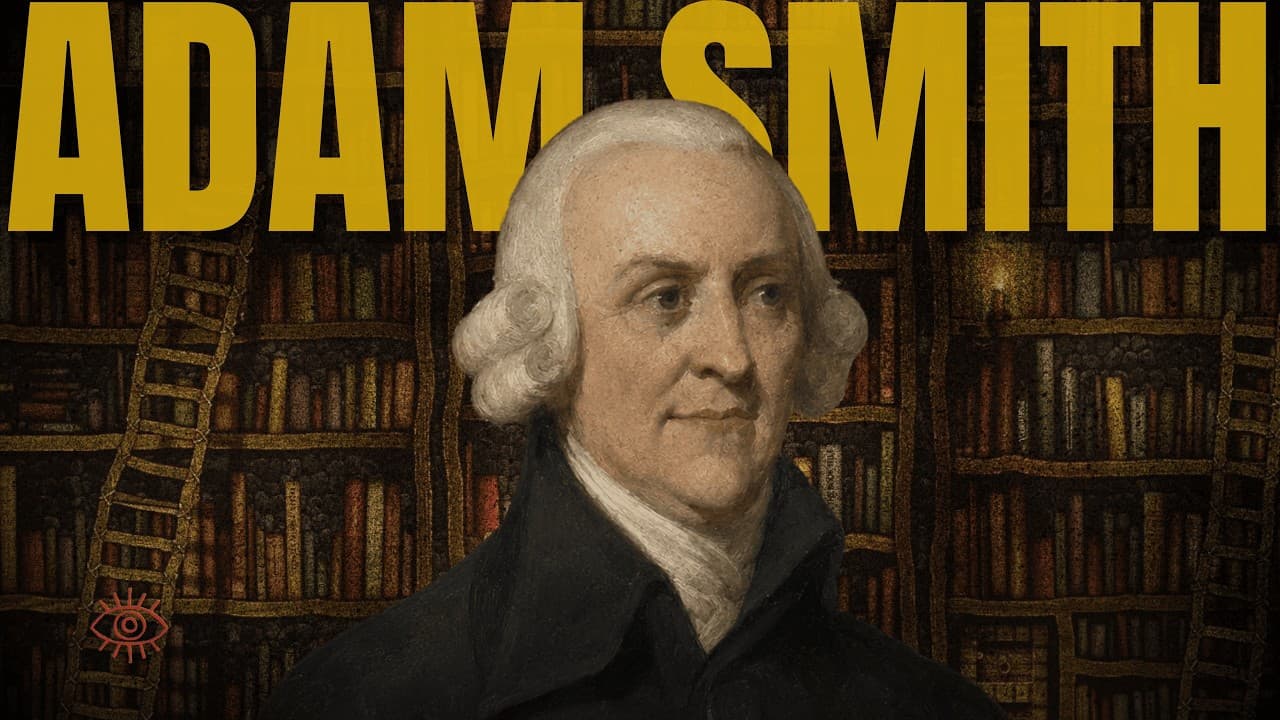
"Led by an Invisible Hand" | Adam Smith Complete Philosophy For Sleep
He wrote the book that built the modern world, then ordered everything else burned.
Adam Smith spent his last days making sure most of his life's work went into the fire. What survived was enough to change the world. This episode follows the quiet son of a Scottish port town through the lecture halls of Glasgow, the salons of Paris, and the long silent decade in which he wrote the Wealth of Nations.
Along the way it restores the half of Smith the modern world forgot, the moral philosopher of sympathy and conscience, the inventor of the impartial spectator, the friend who risked his reputation to defend a dying unbeliever, and the fierce critic of merchants, empires, and slavery. The invisible hand is here too, all three times Smith ever used it, read slowly and in context. Two great books, one unhurried story, told as a serious essay and paced for rest.
The full episode is on YouTube and Spotify. Please listen only in safe, restful contexts.
Enjoying the episode?
Occasional letters on philosophy, reading, and the examined life. No spam, ever.
By subscribing you consent to receiving occasional emails. Unsubscribe any time via the link in every email or at /unsubscribe.
Timestamps
- 0:00:00Chapter 1: The Man Who Burned His Papers
- 0:13:08Chapter 2: Wonder and the Imagination
- 0:19:26Chapter 3: A Nation of Improvers
- 0:28:18Chapter 4: The Mirror of Society
- 0:39:50Chapter 5: The Faculty of Speech
- 0:45:29Chapter 6: The Man Within the Breast
- 0:58:50Chapter 7: The Little Finger and the Earthquake
- 1:04:32Chapter 8: The Corruption of Our Moral Sentiments
- 1:14:38Chapter 9: The Poor Man's Son
- 1:20:51Chapter 10: Justice, the Main Pillar
- 1:29:42Chapter 11: Among the Economists
- 1:41:38Chapter 12: The Year the Banks Fell
- 1:48:02Chapter 13: The Pin Factory
- 2:01:55Chapter 14: The Butcher's Self-Love
- 2:12:03Chapter 15: The Invisible Hand
- 2:24:11Chapter 16: A Conspiracy Against the Public
- 2:29:46Chapter 17: The Golden Dream
- 2:40:07Chapter 18: The Linen Shirt
- 2:46:14Chapter 19: The Duties of the Sovereign
- 2:59:54Chapter 20: The Death of David Hume
- 3:08:03Chapter 21: The Man of System
- 3:13:44Chapter 22: The Uses of Adam Smith
For the record
Full Transcript
Chapter 01: The Man Who Burned His Papers
In a house in Edinburgh, in July of the year 1790, an old man who knows he is dying calls for his two closest friends. They are men of science, the chemist Joseph Black and the geologist James Hutton, and he has asked this of them many times before, gently, persistently, as a thing he could not die in peace without. Now he asks again, and this time they obey. They carry 16 volumes of his manuscripts to the fire, and one after another they feed them into the flames, burning nearly everything he has written that the world has not already seen. The man watching the pages curl and blacken is Adam Smith, author of the most famous book of the age. He wanted most of himself erased.
What was in those volumes? Lectures, drafts, the long labor of decades, whole books he had promised and never finished. He had spent a working life thinking on a scale few minds attempt, and at the end he chose to send the unfinished part of it up the chimney rather than let it survive him imperfect. To understand why a careful and gentle man would do such a thing, we have to go back to the quiet life that produced him, a life so outwardly uneventful that the burning of the papers is nearly the most dramatic act in it.
He was born in a small Scottish port town called Kirkcaldy, on the northern shore of the wide firth that separates it from Edinburgh, and he was baptized there in June of the year 1723. His father, a customs official also named Adam Smith, had died some months before the boy was born, and so the child entered the world already fatherless. He was raised by his mother, Margaret Douglas, and the bond between them became the deepest attachment of his entire life, longer and steadier than any other he would ever form. He never lived far from her for long. He never, in any way that mattered, left her.
The story his first biographer preserved, told by Dugald Stewart who knew him, holds that when Smith was a child of about 3 he was carried off by a band of passing vagrants while his mother visited her family in the country. The alarm was raised, the strangers were pursued and overtaken in a nearby wood, and the wailing boy was recovered within hours and returned unharmed. Stewart set it down as tradition rather than as fact, and so we should take it, a family story passed along and fond, with the gentle observation, which others have made since, that the world might have lost a great philosopher to a roadside accident before he had learned to read. The boy came home, and the slow ordinary education resumed.
At 14 he went to the University of Glasgow, which was an ordinary age then for a clever boy to begin, and there he sat under the lectures of the professor of moral philosophy, Francis Hutcheson, the teacher who would shape him more than any other. Smith fell under the spell of a living mind at work in a lecture room, and the experience set the direction of his own. He was, by every account, an absorbed and serious student, already given to the inward fits of concentration that would mark him to the end of his days.
From Glasgow a scholarship carried him south to England. He won a place called the Snell Exhibition, which sent promising Scots to Balliol College at Oxford, and he arrived there in the year 1740 for what became 6 long years of neglect and boredom. Oxford in that age had grown idle, and a young man was left to educate himself in the college library or not at all. Smith chose the library. There is a tradition that he was caught in his rooms reading a recently published book by a Scotsman named David Hume, a daring work that the college authorities regarded as dangerous, and that the book was taken from him and he was reprimanded for having it. The young Smith was reading forbidden thought in secret, as forbidden things are read, and the man who wrote that book would one day become the closest friend he ever had.
He came home to Scotland in his middle twenties without a profession and without prospects, and he made his own opening. In Edinburgh he gave a series of public lectures, freelance and unattached to any university, on rhetoric and on the art of writing and speaking well. They were a success. They drew an audience of educated men, they earned him a small income and a growing reputation, and they brought his name to the notice of people who could advance him. On the strength of that reputation Glasgow called him back. In the year 1751 he was given the chair of logic, and a year later, in 1752, he moved to the chair he most wanted, the professorship of moral philosophy, the very chair his old teacher had once held. He was not yet 30, and he had come home in triumph to the place that had formed him. He later called these the happiest and most honourable years of his life.
In those Glasgow years the friendship with David Hume ripened into the central human fact of Smith's existence. The two men, the cautious professor and the genial sceptic, were unlike in temperament and alike in mind, and they wrote to each other and visited and argued and laughed together for the rest of Hume's life. It was the closest friendship Smith ever knew, and we will have occasion later to see how it ended. Here it is simply a presence, the one warm constant beside his mother, the friend whose letters could make the careful man drop his guard.
Out of the Glasgow lectures came his first book. In the year 1759 he published a work on the theory of moral sentiments, and it made him famous. We will turn to what is in it many times in the pages ahead. What matters now is what it did to his life. It carried his name far beyond Scotland, into England and onto the Continent, and it brought him an offer that no professor's salary could rival. A wealthy family asked him to give up his chair and become the private tutor and travelling companion of a young nobleman, the Duke of Buccleuch, for 300 pounds a year, paid to him for the rest of his life, roughly double what the university paid him, and guaranteed whether the work continued or not. He resigned the chair he loved and took it.
So in the year 1764 Adam Smith, who had scarcely left Scotland but for those grey Oxford years, set out across France with his young charge. They went first to Toulouse in the south, where they stayed a long while, then on through the country to Geneva and at last to Paris. He met the great minds of the age along the way, and it was in France that he began the second great work of his life, the book that would become the wealth of nations. The journey ended in grief. In Paris, in the year 1766, the duke's younger brother, a young man named Hew Campbell Scott who had joined them abroad, fell suddenly ill and died, and the shaken party broke off the tour and came home.
Then began the strangest and most fruitful stretch of the whole quiet life. Smith went back to Kirkcaldy, to his mother's house and the sea wall and the long firth, and there he settled in to write. For the better part of a decade he stayed in that small town with his books, walking by the water, thinking, drafting, revising, while his friends in London grew impatient and wrote begging him to finish and come out, certain that he was wasting himself on the edge of the world. He would not be hurried. He wrote slowly because he thought slowly and deeply, turning a question for years before he trusted his answer. At last the book was done, and he went to London to see it through the press, and in March of the year 1776 it appeared, an inquiry into the nature and causes of the wealth of nations. We will spend a great deal of time inside that book. For now it is only the second of the two pillars he was building, finished at last after the long patience by the sea.
The fame of the new book changed his circumstances again, though not his habits. In the year 1778 he was appointed a Commissioner of Customs in Edinburgh, the same trade his dead father had served, a comfortable and well-paid post that he held conscientiously to the end of his days. He moved to the city, and his mother and his cousin Janet Douglas came to keep his house. He never married. The two women he lived with, his mother and his cousin, were his whole household, and when his mother died in the year 1784, at a great age, the loss struck him harder than anything else that ever befell him. He had been her son for 60 years, and without her the house and the man both seemed diminished.
It is in these settled later years that the famous stories of his absence of mind gathered around him, the small comic legends of a man so lost in thought that the ordinary world slipped past him unnoticed. They are the kind of tale a town tells about a man it is fond of, half affectionate and half astonished, and they all turn on the same picture, a great mind running so hard on the inside that it forgot to keep an eye on the outside. It was said he once walked straight into a tanning pit while talking his way through some argument, gesturing as he fell, so absorbed in the point he was making that the ground itself took him by surprise. It was said he put bread and butter into a teapot, poured water over it, and then complained, with perfect seriousness, that it was the worst cup of tea he had ever tasted, never once suspecting the fault was his own. The most famous of these tales has him setting out one quiet Sunday morning in his dressing gown, falling into a deep reverie as he walked, and continuing on absorbed for miles toward the town of Dunfermline before the sound of church bells, ringing out across the fields for the morning service, startled him awake to where he was and what he was wearing. The stories are probably half polished by retelling, smoothed and sharpened each time they were told, but they catch something true that no one who knew him seems to have doubted, a mind so habitually turned inward that the body was left to find its own way.
And then the end, the scene with which we began. In the summer of the year 1790, his health failing and his strength nearly gone, he had the 16 volumes brought to the fire and burned, keeping back only a small handful of essays he judged finished enough to survive him. We should picture it plainly. An old man too weak to do the work himself, sitting near the hearth and watching two friends he trusted carry the labor of decades to the flames at his quiet, repeated insistence, the drafts and the lectures and the half-built books going up one volume at a time. He had asked it of them more than once, and they had put him off, and only now, with the end so close, did they consent to do as he wished. Those who were near him reported afterward that what weighed on him at the last was not what he had done but what he had left undone, that he died regretting how little of all he had meant to accomplish he had actually managed to complete. That, in the end, is why the papers burned. A man who held himself to so exacting a standard could not bear to let the unfinished work go out under his name half made, raw and uncorrected, to be read and judged in a state he would never have allowed in life. He died in Edinburgh that July, and they laid him in the churchyard of the Canongate, where his plain stone stands still.
What he allowed to remain was small. Two finished books and a scattering of essays, the wreckage he chose not to throw on the fire. He thought it too little. He was wrong. What he left standing would be enough to change the way the world thinks about morals and money, about what binds people to one another and what drives them apart, about how human beings hold together at all, and the long unfolding of that achievement is everything that follows.
Chapter 02: Wonder and the Imagination
Before Adam Smith wrote a word about money or morals, he wrote about why human beings look at the sky. The essay survives only because it was among the handful of papers he allowed to escape the fire near the end, and it carries a long and exact title concerning the principles that lead and direct philosophical inquiries, illustrated by the history of astronomy. It is the work of a young man, and it is the strangest thing he ever wrote, because its true subject is not the stars at all. Its subject is the mind that watches them. It is a piece about the psychology of inquiry, about what drives a creature to want explanations in the first place.
Smith begins not with knowledge but with feeling. He separates three sentiments that we tend to blur together. There is surprise, which seizes us when something unexpected breaks in upon us, the sudden noise, the figure where we looked for empty space. There is wonder, which is roused by what is new and singular, by a thing so unlike anything we have met that the mind cannot lay it beside any familiar pattern. And there is admiration, which rises before what is great and beautiful, the wide plain, the mountain, objects we may have seen a thousand times and still find magnificent. Surprise comes from the unexpected, wonder from the new, admiration from the grand.
Of the three, wonder is the one that does real work, and Smith describes it almost as a bodily distress. When the imagination meets an object it cannot connect to anything it already holds, it does not rest content. It labours. It feels a kind of giddiness, a vacancy, an unease close to physical discomfort, the same uneasiness a person feels groping for a word that will not come. The mind wants the gap closed. It wants the strange thing folded into the order of things it already understands. Wonder, in this account, is not a pleasure. It is an itch.
From this small and unsettling premise Smith draws a large and surprising conclusion. Philosophy and science, he argues, are not disinterested mirrors held up to nature. They do not begin in a calm love of truth. They begin in discomfort, and they are, before anything else, attempts to soothe the imagination, to quiet that uneasy labouring and restore the mind to its rest. Nature, as it first presents itself, appears to be a chaos of disjointed events, one thing following another with no thread between them. Philosophy is the science of the connecting principles of nature. It works, in Smith's own image, by representing the invisible chains which bind together all these disjointed objects, drawing order out of a chaos of jarring and discordant appearances. The chains are not found in the world. They are thrown across it by the mind that cannot bear the gaps.
This gives Smith one of the most quietly radical ideas in the whole of his work. A system of thought, he says, is an imaginary machine. It is a contrivance invented to connect together in the fancy those different movements and effects which are already, in reality, performed. The heavens turn whether or not anyone explains them. The system is the device we build inside ourselves so that those turnings seem smooth, linked, intelligible, so that one motion appears to call forth the next without a jolt. We judge such a machine not first by whether it is true, but by whether it runs without grinding, whether it carries the imagination from one appearance to the next without that catch of unease.
With this single instrument he then walks through the long succession of pictures men have drawn of the heavens. Each system, in its turn, smoothed the sky into something the mind could follow. Each held its calm for a while. And each, sooner or later, met some new irregularity it could not absorb, some wandering light that would not keep to the appointed track, and the old unease returned, and a new machine had to be built. The story of astronomy becomes, in his hands, a story of the imagination repeatedly settling and repeatedly disturbed, calm and crisis and calm again, across the centuries.
It ends with Newton, and here Smith's admiration becomes something more than respect. Newton's system soothed the imagination so completely, bound so many scattered motions into so few principles, that it became almost impossible not to take it for the very fabric of the world. And then Smith does something remarkable. He catches himself. Even we, he writes, having set out to show that all such systems are mere inventions of the imagination, contrived to connect the otherwise disjointed appearances of nature, have insensibly been drawn in to speak of this one as if its connecting principles were the real chains which Nature herself makes use of. The man who has spent the whole essay insisting that our explanations are machines we build inside our own heads finds, at the last, that the finest machine has seduced even him.
That is the moment to hold onto, because everything that follows grows from it. Here is a thinker whose very first question was not what is true but what makes a restless mind grow quiet, who saw understanding as a kind of consolation. A man who learned, this early, to watch a system working from the outside, to ask what comfort it gives and what irregularity it hides, was already preparing himself to look in the same cool way at far stranger machines than the heavens, at the systems by which we judge one another, and at the systems by which we grow rich.
Chapter 03: A Nation of Improvers
There is a strangeness at the center of Adam Smith's life that no account of the man can fully dissolve. In the middle of the eighteenth century, one of the poorest countries in western Europe, a small nation on the cold northern edge of the continent, produced the most concentrated burst of intellectual genius the age would see. Scotland in those decades had perhaps a tenth the population of France and a fraction of its wealth. Its soil was thin, its winters long, its towns small and smoke-darkened. And yet from those towns, in a single lifetime, came new philosophy, new history, new medicine, new chemistry, new engineering, and the book that would teach Europe how to think about its own prosperity. To understand the man who wrote The Wealth of Nations in 1776, we have first to understand the world that made such a man possible, because everything he later wrote was an answer to questions that world had already posed.
The strangeness deepens when we remember what Scotland had recently lost. By the Union of 1707 the country gave up its own parliament, which moved south to London, and with it a great part of its public life. A proud nation woke to find its statesmen reduced to a handful of members in a foreign capital, its old independence folded into a larger kingdom. It might have sunk into resentment and provincial sleep. Instead it kept three things the Union had not touched. It kept its own church, Presbyterian and stubborn. It kept its own law, distinct from England's to this day. And it kept its universities, four of them, more than England then possessed for many times the people. Into the vacuum left by the missing parliament there poured a strange and powerful energy, the energy of a people who could no longer govern a state and so resolved instead to remake everything else.
They called it improvement, and the word ran through the whole culture like a current. Landlords drained bogs and planted hedges and argued over the rotation of turnips. Merchants in Glasgow grew rich on tobacco shipped from the American colonies and built grave stone houses with the profits. Edinburgh, the old capital, began to spill out of its crowded medieval ridge toward the elegant streets of a planned new town. And the men of the place formed clubs, dozens of them, where the improving spirit found its natural home. Over claret in tavern back rooms, professors and ministers and lawyers and physicians and merchants met of an evening to read papers to one another and argue late. They debated the best method of agriculture and the right principles of trade. They debated the origin of language and the rules of fine writing and the foundations of morals. No subject was too high or too practical for an evening's discussion, and the same man might speak on the price of grain and the nature of beauty within the hour.
Presiding over much of this, in the pulpit and the lecture hall, was a particular kind of clergyman. The moderate party in the Scottish church had grown weary of the older religion of terror, the long sermons on hell and the wrath to come. They preferred politeness to hellfire. They wanted a faith that a reasonable and cultivated man could hold without embarrassment, that sat easily beside good manners, good letters, and the pursuit of useful knowledge. These moderate literati, learned ministers as much at home in a literary club as in a kirk, set the tone of the whole society. Religion did not vanish among them, but it loosened its grip enough to let a free inquiry into human nature breathe. It was in this air, tolerant, sociable, intensely curious, that a young man might come to believe that morality itself could be studied calmly, as a part of the natural world, rather than received trembling from above.
Two teachers above all turned that belief into a method for the young Smith, and their doctrines deserve to be set out plainly, for they are the soil his own thought grew from. The first was Francis Hutcheson, who held the chair of moral philosophy at Glasgow and whom Smith would honor, decades later in a letter, as the never to be forgotten Doctor Hutcheson. Hutcheson did one thing that sounds small and was in fact a quiet revolution. He lectured in English. Before him the learned business of the university had been conducted in Latin, the dead common tongue of European scholarship, and to abandon it for the living speech of his students was to declare that wisdom belonged in the ordinary world and the ordinary mouth. The crowds that filled his hall heard him deliver, with an animation rare among professors, a striking account of how we know right from wrong.
Hutcheson taught that human beings possess a moral sense. Just as the eye perceives color with immediate pleasure and needs no argument to enjoy it, so the mind, he held, perceives virtue with an instant warmth of approval and vice with an instant distaste. We do not reason our way to the goodness of a kind act, any more than we reason our way to the sweetness of honey. We feel it directly, by an inner faculty given us for the purpose. And the heart of what this sense approves is benevolence, the disposition to seek the good of others. The test of any action, for Hutcheson, lay in the happiness it spread, and the best action was the one that procured the greatest happiness for the greatest number. Here was a moral philosophy built not on commandments handed down but on a careful look at what human beings actually feel when they watch one another act.
The second teacher Smith never sat with as a student, but came to know as the closest friend of his life, and from his books absorbed something even more daring. David Hume had published, while still a very young man, his Treatise of Human Nature, the book Smith had once been quietly punished for being caught reading. Its ambition was breathtaking. Hume proposed a science of man. He set out to do for human nature what Newton had done for the heavens, to explain belief and passion and morals from experience and observation alone, tracing each to its causes as an astronomer traces a planet, with no appeal to innate ideas planted in us at birth and no appeal to any divine guarantee standing behind our knowledge. Reason, Hume argued in his cool and unsettling way, does not rule the passions but serves them, finding the means to ends the passions have already chosen. And morality, he insisted, is felt before it is ever reasoned. We approve and condemn from sentiment first, and only afterward dress our feelings in the language of argument.
It is worth weighing what a thoughtful young man took from these two together. From Hutcheson, the conviction that our moral life rests on something we feel, and that this feeling can be examined, described, and understood like any other part of our constitution. From Hume, the bolder conviction that the whole of human nature, belief and passion and the sense of right alike, can be studied as a natural phenomenon, patiently, from the evidence of ordinary life, without leaning on anything beyond what observation can reach. Joined to these came the habit of the clubs, the readiness to bring the closest attention to common things, to the haggling of a market and the manners of a dinner and the small daily exchange of approval and blame among neighbors. What emerges is not yet a system. It is a temperament and a task. The young man had been handed a world that took the study of human beings as seriously as the study of the stars, that trusted observation over dogma, and that believed, with a confidence we can scarcely recover, that everything worth knowing might be improved by being looked at clearly. The questions were already in the air around him. The work of his life would be the long, exact answering of them.
Chapter 04: The Mirror of Society
The Theory of Moral Sentiments, published in 1759, begins not with a rule or a commandment but with an observation about what human beings are already doing. Smith does not tell us how to be good. He looks at how we feel about one another, and he builds everything from there. The whole architecture of the book rests on a single human capacity, the capacity to be moved by what happens to someone else, and the opening sentence states that capacity with a precision that has never been improved upon.
It runs like this. How selfish soever man may be supposed, there are evidently some principles in his nature which interest him in the fortune of others, and render their happiness necessary to him, though he derives nothing from it except the pleasure of seeing it. Listen to what that sentence does. It opens a book about morality by conceding the worst case. Suppose man as selfish as you like, it says, suppose the blackest account of human nature you have ever heard. Even then, even on those terms, look at the actual creature in front of you. He cannot watch another person suffer without flinching. He cannot watch another person flourish without some small warmth of his own. The selfishness was granted at the start, and the fellow-feeling survives it. Smith wins the argument by giving away the premise.
The thing he is pointing at he calls sympathy, and the word needs care, because it has narrowed since his day. We tend now to mean by it a kind of pity, a feeling reserved for the unfortunate, something we extend downward to those worse off than ourselves. Smith means something far wider. Sympathy in his sense is fellow-feeling of any kind whatever, our tendency to feel along with another person regardless of what they feel, their fear, their anger, their delight, their grief. The man who laughs at his neighbour's joke is exercising it. The man who burns with his friend's indignation is exercising it. It is the general capacity to catch another's state, whatever that state happens to be, and not a particular tenderness toward the suffering. Smith builds an entire moral philosophy on a faculty so common that we scarcely notice we are using it, the same faculty at work in the theatre and the courtroom and the sickroom alike.
And here Smith faces a difficulty he states with great honesty. We have no immediate experience of what other men feel. The mind of another person is closed to us absolutely. We cannot enter it, cannot inspect its contents, cannot feel its pains as it feels them. A man is stretched on the rack before us, and his agony is wholly his. Nothing of it crosses into our nerves. So how do we come to feel anything at all? Smith's answer is that we do it by imagination, and only by imagination. We cannot feel what he feels, but we can picture his situation, and we can ask what we ourselves would feel if we were placed in it. We change places with him in fancy. We conceive ourselves enduring what he endures, and out of that imagined exchange of situations there arises in us a copy of his feeling. A copy, Smith is careful to say, weaker than the original, fainter, a shadow of the real thing, but real all the same, and genuinely ours.
The book is full of small proofs that this is how the mechanism actually works, drawn from the ordinary motions of the body. Watch a crowd gathered beneath a rope dancer. As the performer sways and wavers on the line, the people below writhe and twist and balance their own bodies, leaning as he leans, righting themselves as he rights himself, doing with their limbs what they imagine he must do with his. They have changed places with him without knowing it. Or consider something smaller still. When we see a blow aimed at the leg or the arm of another man, we naturally shrink and draw back our own leg or our own arm. The flinch is involuntary. It is the imagination throwing us into his place faster than thought, so that for an instant his danger is our danger and his body is ours.
The mechanism reaches even where one would think it could not follow. It reaches the dead. The dead feel nothing. Whatever has happened to them is over, beyond touch, beyond hurt, sealed away in a quiet that nothing can disturb. And yet we sympathize with them, which on the face of it makes no sense, for there is nothing in them to sympathize with. What Smith sees is that we are not really feeling their feeling, since they have none. We are lodging our own living imagination in their lifeless circumstances. We picture ourselves laid in the cold grave, shut out from the light and the warmth of the world, cut off from everyone we loved and soon to be forgotten by them, and we shudder at a fate that troubles us precisely because it does not trouble them. We feel for the dead what the dead cannot feel for themselves. Smith draws a remarkable conclusion from this. This illusion, this dread of an annihilation that the annihilated will never know, is among the deepest roots of our fear of death. And the fear of death, he says, though it makes the individual miserable, is one of the great guardians of mankind, a restraint upon injustice, since it watches over us all by haunting each of us alone.
So far the picture might seem cold, a matter of mirrors and copies and shadows, a clever piece of mental machinery with no heart in it. But Smith now adds the warmth that holds the whole thing together. There is a positive pleasure, he observes, in fellow-feeling itself, a pleasure quite apart from whatever the feeling is about. Nothing delights us more than to find another person who feels along with us, who shares the very sentiment that moves us at the moment it moves us. We have all known the small disappointment of telling a story that lands flat, the friend who does not laugh where we laughed, who does not warm where we warmed, and the chill that comes over us when our feeling is left standing alone. And we have all known the opposite, the quiet satisfaction of being met exactly, of finding our own emotion answered back to us from another face. When we are gay, the company of someone who answers our gaiety doubles it. When we are heavy with grief, the presence of someone who truly enters into our sorrow lifts a part of the weight from us. Smith puts it almost as an arithmetic of the heart. We are relieved by sharing our sorrow, as if the other person took a portion of it onto himself, so that less of it remained to oppress us. And we are enlivened by sharing our joy, for the joy reflected back to us from another comes home enlarged. Sorrow divided, joy multiplied. This craving for company in our feelings, this longing to be met, is one of the strongest motives Smith finds in us, and it draws us constantly toward one another.
But the two do not balance. This is the asymmetry at the center of the book, and it must be stated plainly here, because it is one of the quietest and most consequential things Smith ever noticed. We sympathize more easily and more fully with joy than with sorrow. To rejoice with the happy costs us almost nothing. Their pleasure is agreeable in itself, and our imagination slides into it without strain, glad to be there. But to grieve with the grieving is harder. Sorrow is a painful sensation even at one remove, and the imagination, left to itself, flinches from a pain it is not compelled to bear. The whole effort of fellow-feeling in sorrow runs uphill. It asks more of us than we readily give. We approach the mourner with a kind of reluctance, and our sympathy, even when sincere, tends to fall short of what the sufferer feels and craves. So there is a standing imbalance built into the very fabric of fellow-feeling. The joyful are met more than halfway. The wretched are met, if at all, with an imagination that has to be coaxed. Smith states this here as a fact of the mechanism. What may be built upon it is another matter, for the consequences run dark, but the fact itself stands first.
All of this comes together in the most beautiful image in the book, the image that gives the social self its origin. Smith asks us to imagine a human creature who somehow grew to manhood in a solitary place, with no communication of any sort with his own kind. Such a being, Smith says, could no more think of his own character, of the beauty or deformity of his own mind, than he could think of the beauty or deformity of his own face. He has no way to see himself. His face is the one face he can never look at directly, and his mind is hidden from him in just the same manner, turned outward, with no instrument for turning back. Then comes the turn. Bring him into society, and he is immediately provided with the mirror which he wanted before. Other people are the glass. We learn what we are by watching how others receive what we do, by seeing our own conduct reflected in their approval and their distaste, their drawing near and their drawing back. The self is not something we possess alone in the dark and then carry out among others. It is something we acquire only by living among others, who hold up to us a likeness we could never have formed by ourselves.
The book made Smith famous very nearly at once. And the most charming proof of that fame is a letter David Hume sent him from London in the spring of 1759, a letter that is one long joke at its author's expense and his friend's. Hume, who had the book and had read it, wrote as though he could hardly bring himself to deliver the verdict. He piled up, by his own telling, a small heap of grave omens and dark forebodings, inventing delays and interruptions, urging his friend to compose himself and prepare for the worst, as one prepares a man for terrible news. Then, having wound the suspense as tight as he could, he reported the melancholy news at last. The book had been most unfortunate, he said, for the public seemed disposed to applaud it extremely. The whole tone is teasing affection. The thing Hume dressed as catastrophe was triumph, and the only danger the book ran, by his account, was the danger of nothing but success.
Chapter 05: The Faculty of Speech
Before Adam Smith ever lectured on wealth he lectured on words, and he came to believe the two subjects were secretly the same. Long before the famous book on nations and their riches, a young man stood in a borrowed room and then for years in a Glasgow classroom and taught his students how to write a clear English sentence. He thought this was not a small matter. He thought that to understand how one person persuades another was to understand a great deal about how human beings live together at all.
The lectures on rhetoric survive by something close to luck. Smith left no manuscript of them, and in old age he had the habit of destroying his own papers. What we have instead is a set of careful notes taken down by students who sat in his lectures in the early 1760s, a bundle of pages that lay unread until the middle of the twentieth century, when a scholar found them at a sale in the north of Scotland. So the doctrine reaches us secondhand, in the handwriting of young men trying to keep up with a teacher they admired. But the doctrine is unmistakable, and it is Smith's own.
It runs against the old rhetoric, the rhetoric of ornament, of figures with names, of the grand flourish meant to dazzle. Against all that, Smith taught the plain style. The perfection of style, he held, consists in expressing the thought in the clearest and simplest manner, so that nothing stands between the mind of the speaker and the mind of the hearer. Communication succeeds, on this account, when the listener is brought to see what the speaker sees and to feel what he feels. This is a quiet but startling move. It takes the same fellow-feeling that lies behind the mirror of society, the imaginative exchange of one person's situation for another's, and turns it loose on language. To write well is to manage a sympathy. A sentence works when the reader's mind comes to occupy the writer's, when the feeling passes across the gap between two people and arrives intact.
And once language is understood that way, as the carrying of one mind's content into another, the boundary between speech and almost everything else begins to dissolve. In his lectures on law, Smith took the deepest step. The disposition to trade and bargain, he suggested, probably grows out of the human faculty of speech and the human wish to persuade. We are, all of us, talkers who want to be agreed with. Everyone, he observed, practises oratory on others through the whole of his life. We argue about the weather and the price of bread and the distant moon. We try to bring others round to our opinion even when nothing whatever hangs on it.
From there the famous example. The offering of a shilling, Smith said, which to us appears to have so plain and simple a meaning, is in reality the offering of an argument. To hold out a coin is to make a case. It says, you would do well to part with this thing, for it is in your own interest to take what I give in return. A purchase is a small completed persuasion. The buyer has been convinced, the seller has been convinced, and the coin changing hands is only the visible sign that the argument has succeeded. What looks like the silent mechanics of money is, underneath, two people reasoning each other into agreement.
The animals make the contrast plain. Smith remarked, and the remark would later find its way into the great book as well, that nobody ever saw a dog make a fair and deliberate exchange of one bone for another with another dog. A dog may fawn, may whine, may fight for the bone, but it cannot offer a bone in order to get a bone, because it cannot say, in any tongue, this is mine and that is yours and I would rather have yours. It has no faculty of persuasion, and so it has no market. The thing we share with no other creature is not the wanting. It is the arguing about who shall have what, the endless attempt to talk one another into a deal.
So commerce, on this view, is a branch of conversation. The market is not first a place of goods and prices. It is a place where human beings persuade one another all day long, where every exchange is a sentence completed, where the whole noisy traffic of buying and selling is the faculty of speech at work on the ordinary business of getting a living. The shopkeeper coaxing, the customer haggling, the wage offered and refused and offered again, all of it is oratory in working clothes.
This is the hidden hinge on which Smith's two great enquiries turn. The man who would one day anatomise the wealth of nations had already decided that economic life is rooted in something more intimate than appetite, rooted in the strange human need to be understood and to bring others over to one's side. When, years later, he came to describe people exchanging the produce of their labour, he was, at bottom, describing talking animals at their oldest game. The butcher and the brewer and all the rest were not merely trading. They were persuading. And persuasion, for Smith, was where the human story always began.
Chapter 06: The Man Within the Breast
Conscience, in Adam Smith's account, is not a voice planted in us before birth but a watcher we assemble from the watching of other people and then carry inside. The theory of moral sentiments, the book he published in 1759, had already shown by its midpoint how we judge our neighbors, through the workings of sympathy. That account is powerful, and it is finished. But it leaves a harder thing unexplained, because it tells us how we judge other people and does not yet tell us how we judge ourselves, especially in the moment when our own verdict stands alone. A man may be praised by everyone he meets and still feel, in some quiet chamber of himself, that he does not deserve it. Another may be condemned on every side and hold, against the noise, that he has done nothing wrong. There is a judgment we sometimes pass upon ourselves that runs clean against the applause of the whole world, and the task is to say where it comes from.
Smith's answer is one of the most original turns in the history of moral thought, and it begins with a simple imaginative act. We cannot see ourselves directly. The eye that looks out cannot look back without some help. So when we want to know whether our own conduct is fair, we do the only thing a sympathetic creature can do. We imagine how we would appear to someone else. Not to any particular someone, not to the friend who flatters us or the rival who resents us, but to a fair and fully informed observer who knows everything relevant to the case and favors no one in it. Smith calls this figure the impartial spectator. We step outside our own skin, take up the position of this third person, and ask what he would feel as he watched us act.
At first this spectator is plainly a borrowed thing, assembled out of all the real watching we have done and undergone since childhood. We learn to see ourselves because others have seen us first. But something happens with habit and repetition. The imagined observer stops being a guest we summon on difficult occasions and moves indoors. He takes up residence. He becomes a standing presence, always there, watching from within, and Smith gives him the name that this whole chapter of his thought turns upon. He becomes the man within the breast, the great judge and arbiter of our conduct. Conscience, on this account, is not a mysterious oracle speaking from some deeper self, and it is not a faculty stamped into us ready-made by heaven. It is society internalized. The regard of the world, once turned upon us from outside, is turned inward and made permanent. We carry the courtroom with us.
And here the picture takes a remarkable turn, because once this inner judge is established he can overrule the very people who created him. The man within does not merely echo the crowd outside. He can contradict it. He knows things the crowd does not. He has heard our excuses and our private reasons, he has seen the whole of the case, and so his verdict can stand against every voice in the street. This gives Smith his pair of tribunals. There is the judgment of the man without, the actual praise and blame of real people, the opinion that surrounds us like weather. And there is the judgment of the man within, who appeals to a higher and better-informed standard, and who can acquit us when the world condemns, or condemn us when the world applauds. The two courts usually agree, and for most of life their agreement is all we ever notice. But the distance between them is the whole drama of the moral life. The man falsely accused, who keeps his composure because some calm authority inside him knows the charge is empty, is appealing past the noise of the crowd to that second court. So is the man who, surrounded by congratulations, cannot bring himself to enjoy them, because the witness within has seen what the witnesses without could not. When the two courts part, the wise man learns which one to trust, and the trusting is the hardest thing he ever does.
This is the ground of one of Smith's deepest claims, and it is best stated in his own framing. Man naturally desires, he writes, not only to be loved but to be lovely. Not only to be praised, but to be praiseworthy. The distinction is everything. To be loved is to be the object of warm feeling in other people. To be lovely is to be the kind of person who is the natural and proper object of such feeling, whether or not the feeling ever arrives. A man wants more than applause. He wants to deserve it. He wants, in Smith's framing, to be that thing which is the proper object of praise though no praise should ever come to him, and he dreads not merely blame but blameworthiness, the state of deserving blame even when no blame can ever reach his door. Imagine a kindness done in secret, witnessed by no one, certain never to be discovered. The man who did it still wants it to have been right. That wanting, aimed at a quality no one will ever see, is the surest sign that the spectator he answers to lives inside him. The same distinction shows itself from the other side, in the discomfort of praise we know we have not earned. A reasonable man takes no pleasure in applause that has settled on him by mistake, for a merit that belongs to someone else or for a virtue he is privately sure he lacks. The compliment that ought to delight him sits uneasily, because the man within has examined the claim and refused to endorse it, and unmerited praise, far from satisfying the desire to be lovely, only sharpens the awareness of falling short. We want the feeling of others to track the truth about us, not to float free of it. Even our vanity, when it grows clear-sighted, reaches past the applause toward the thing the applause is supposed to mark. To rest satisfied with praise alone, knowing it undeserved, is to mistake the shadow for the substance, and Smith thought few people sink so low as to manage it without some inner protest.
So conscience is built, and it is built out of nothing more exotic than people watching one another and learning to watch themselves. But Smith is too honest an observer of human nature to leave the man within in serene command. The inner judge can fail, and he describes with great care the ways he fails. Sometimes the clamor and faction of the world outside grow so loud that the quiet inner voice is simply drowned. Sometimes the violence and injustice of our own selfish passions, in the heat of anger or fear or desire, call the spectator away from his post, the way a furious man stops being able to picture how he looks to a calm witness. And worst of all there is self-deceit, the steady, comfortable corruption of our own sight. We look at our own conduct through flattering lights. We grant ourselves the generous interpretation we would never extend to a stranger. Smith names this plainly. This self-deceit, this fatal weakness of mankind, is the source of half the disorders of human life. If we saw ourselves in the light in which others see us, he adds, a reformation would generally be unavoidable, for we could not otherwise endure the sight.
Picture the most ordinary occasion for it, a quarrel between two people who each believe they are wronged. In the middle of the dispute, neither can find the impartial spectator, because the passions of the moment have shouted him down. Each pleads his own cause to himself and wins. It is only afterward, when the heat has gone out of it, that the fair witness returns and the truth becomes visible, often unwelcome. The trouble is that the moment we most need the inner judge is exactly the moment our passions are best able to silence him.
Nature, Smith argues, has supplied a remedy fitted to this weakness, and it is the origin of moral rules. Because we cannot trust our judgment in the heat of our own case, we do not rely on fresh judgment each time. Out of countless particular observations, our own and other people's, watching what wins approval and what earns disgust, we gradually form general rules of conduct. We notice that ingratitude is hateful wherever it appears, that cruelty disgusts every fair observer, that honesty draws approval, and we lay these findings down as standing maxims. These rules are not handed to us from above. They are distilled from the bottom up, the settled residue of millions of acts of sympathy and judgment. And they serve precisely as handrails for the times when the inner judge is shouted down. When passion clouds the present case, we hold to the rule we formed in calmer hours, the way a man who knows his own temper makes a promise in the morning to bind the version of himself that the evening may produce. Reverence for general rules is, for Smith, what the ordinary decency of most people actually rests on.
At the center of all of this stands the virtue Smith prized above the showier ones, the virtue from which, he says, all the other virtues seem to derive their principal luster. He calls it self-command. It is the capacity to bring the pitch of our own passions down to the level at which a spectator can go along with us. The angry man who masters his anger until it is something a fair witness could share, the grieving man who composes his sorrow so that others can enter into it rather than flee from it, the frightened man who holds his ground, each is performing the same essential act. Each is consulting the man within and lowering his own feeling to meet the standard. Smith did not mean by this the cold suppression of feeling, the man who feels nothing and calls it strength. The passion is real and is felt in full. What self-command governs is its expression, the way a skilled host who has just had terrible news still attends to his guests, not because the news has stopped hurting but because he has brought his outward bearing down to what the room can bear to witness. The discipline lies in that lowering, and Smith thought it the quiet foundation beneath every more visible excellence. Consider how far we stand from that standard by nature. Left to ourselves, our own concerns swell until they fill the whole field of view, and the wants and pains of others shrink to specks at the edge of it, so that a small reverse of our own can weigh more in us than a great misfortune that has fallen on someone we do not know. The impartial spectator sees both at their true size. Self-command is the long labor by which we bring our own estimate closer to his, taking ourselves a little less and others a little more nearly as he would, until the man within can go along with the figure we cut. It is not a single victory but a habit, won and lost and won again across a life, and Smith honored it precisely because it is so unspectacular and so hard.
What Smith has done, when the whole structure stands before us, is to build the entire edifice of conscience out of one material only. There are no innate moral ideas printed on the soul, no special faculty of moral sense delivering verdicts from nowhere, no commandment required to start the machine. There are only human beings, watching one another, learning to be watched, and at last learning to carry the watcher inside. The impartial spectator is assembled from society and then set above society, the creature of our mutual regard who grows strong enough to judge the very crowd that made him. And the striking thing is that this construction is not weaker for resting on so little. It is stronger. A conscience handed down from outside could be doubted, argued with, set aside as someone else's rule. A conscience grown from the universal human business of seeing and being seen is woven into the very fabric of being a person among persons. It cannot be escaped, because to escape it we would have to stop imagining how we appear to anyone at all, and that no one who lives among others has ever managed to do.
Chapter 07: The Little Finger and the Earthquake
There is a single page in the theory of moral sentiments that holds the whole argument of the book in tension, and it begins with a disaster on the far side of the earth. Smith asks us to suppose that the great empire of China, with all its myriads of inhabitants, were suddenly swallowed up by an earthquake. Then he asks how a man of humanity in Europe, a decent man who has no connection to that part of the world and knows no one in it, would receive the news. The honesty of what follows is what gives the page its force. Smith does not flatter us.
The good man, he says, would be moved. He would express his sorrow for the misfortune of so many people. He would reflect, perhaps for a quiet hour, on the precariousness of human life and the vanity of all the labors of men, which could be obliterated in a moment. If he were a man given to such thoughts, he might go further and speculate on the effects this calamity might have upon the commerce of Europe, the trade and the business of the world. And then, all these fine sentiments having been duly expressed, he would pursue his business or his pleasure exactly as before. He would take his repose, and he would snore that night with the most profound security over the ruin of a hundred millions of his brethren. The destruction of that vast multitude would plainly seem to him a thing less interesting than his own small concerns.
Against this Smith sets the smallest possible injury to the self. If that same man were to lose his little finger tomorrow, he would not sleep tonight. The disproportion is grotesque, and Smith means it to be. A scratch on one hand outweighs the annihilation of a hundred million strangers, measured purely by what we feel. From this he draws the bleak verdict that the whole experiment exists to provoke. Our passive feelings, he writes, are almost always so sordid and so selfish. Left to mere feeling, we are creatures who would trade the world for a fingernail.
But Smith does not leave the experiment there, and the turn he makes is the reason the page survives. He changes the question. He no longer asks what the man would feel. He asks what the man would do. Suppose it were genuinely in his power to prevent the loss of his finger by consenting to the death of those hundred million people, none of whom he would ever see. Would he take the bargain? And here the whole calculation reverses with a violence that surprises even the person performing it. Human nature, Smith says, startles with horror at the thought. The world, in its greatest depravity and corruption, never produced such a villain as could be capable of entertaining it. The man who would not lose an hour's sleep over their deaths would not, to save his own finger, lift a hand to cause them.
So a strange gap opens between our feeling and our conduct. We feel almost nothing for the stranger and almost everything for ourselves, yet we would not sacrifice the stranger to ourselves for any price. Something stands between the feeble feeling and the just refusal, and Smith is precise about what it is not. It is not benevolence. It is not the soft power of humanity. It is not, he writes, that feeble spark of benevolence which nature has lighted up in the human heart, that is capable of counteracting the strongest impulses of self-love. That spark is far too weak. Set it against the love of our own little finger and it would lose every time. The thing that holds us is something else entirely.
It is a stronger power, he says, a more forcible motive. It is reason, principle, conscience, the inhabitant of the breast, the man within. That figure does the work warm feeling cannot, and what he says at the moment of temptation is leveling and plain. He tells us that we are but one of the multitude, in no respect better than any other in it. The stranger's finger and our own are worth precisely the same, and the man within will not let us pretend otherwise. The whole weight of the refusal rests on his single, unanswerable reminder that no special exemption attaches to the self.
And behind that voice Smith names a second force, easy to miss because it sounds at first like vanity and is its opposite. It is not the love of our neighbor that finally stays our hand. It is the love of what is honourable and noble, of the grandeur and dignity and superiority of our own characters. We refuse the monstrous bargain because we could not bear to be the kind of creature who would accept it. We would rather lose the finger than lose our standing in our own eyes, before the witness we carry everywhere.
This is the hinge on which the whole moral theory turns. Sympathy, the warm fellow-feeling that the earlier pages built so carefully, turns out to be too thin a thread to hold a person to his duty when his own interest pulls the other way. What holds him is the imagined gaze he cannot escape, and the love of deserving its approval. Morality is rescued, in the end, not by the heart's faint warmth but by the cold, impartial figure who lives inside and will not be lied to.
Chapter 08: The Corruption of Our Moral Sentiments
The same machinery that makes morality possible also corrupts it. This is not an accusation a later critic flung at Adam Smith. It is his own finding, set down in plain words in the theory of moral sentiments, the book of 1759, in a chapter he titled, without softening, on the corruption of our moral sentiments. The faculty that lets one person feel another's situation from the inside, the sympathy that knits a society together, is the very faculty that, left to its natural bias, teaches us to flatter the strong and overlook the weak. Smith does not present this as a flaw in some men. He presents it as a tendency in the design itself.
The bias begins from a tilt already established when Smith mapped the asymmetry of fellow-feeling toward joy and away from sorrow. Building on that uneven foundation, an enormous social consequence follows, and it lands on the difference between the rich and the poor. Mankind are disposed to go along with the rich and the great, because the imagination, looking at their condition, paints it as the very picture of a perfect and happy state, a state it would gladly inhabit and is glad merely to contemplate. And mankind are disposed to turn their eyes away from the poor, whose distress asks of the imagination an effort it does not wish to make. The wealthy man's pleasures cost us nothing to share. The poor man's troubles cost us something, and we decline to pay. The ledger sorts itself with a grim cleanness. The pleasure of admiring the prosperous is free and immediate, requiring no descent into discomfort, while the labor of pitying the wretched is taxed at every step, and most of us, given the choice, will not be taxed. The disposition is not malice. It is economy of feeling, the imagination spending itself where the return is easiest, and the poor are simply the place where it declines to spend.
Smith presses on the experience of being poor with a precision that has little to do with bread or shelter. The poor man, he wrote, is ashamed of his poverty. He feels that it places him out of the sight of mankind, or that, if anyone does notice him, they have scarcely any fellow-feeling with the misery he endures. This is the wound beneath the wound. Hunger is one thing. Invisibility is another. To be unseen, Smith argued, is to be cut off from the most agreeable hope that human nature is capable of conceiving, the hope of being attended to, of being regarded with sympathy and approval. The man of rank and distinction stands in the opposite light. He is observed by all the world. Everybody is eager to look at him, to imagine the pleasure they suppose he must enjoy, and his every gesture, every turn of his expression, becomes an object of public attention.
This explains a thing that puzzles a careful observer of ordinary life. People chase rank and riches far past the point where any bodily need is met. The man with a sound roof and a full table still strains every nerve to rise. Why? Smith answers that what we call bettering our condition is, at bottom, not a matter of comfort at all. The comforts are soon exhausted. What we are really after is to be taken notice of, to be observed with sympathy and complacency and approval. We want the eager eyes of the world turned toward us rather than past us. Wealth is the instrument. The notice is the end. The poor man hides in a crowd, Smith saw, as obscure within the throng as he would be shut up in his own hovel, while the great man performs his life on a lighted stage before an audience that never tires of watching.
Vanity, on this account, is not a petty vice grafted onto an otherwise sound nature. It is the engine of the whole performance, the appetite for being seen that drives the chase for the means of being seen. The man of fashion understands this without ever putting it into words. His dress, his carriage, his ease of manner are arranged for the spectator, and the spectator obliges, attending to him with the ready sympathy that the obscure man can never command. The same gesture that wins the man of fashion a hundred glances earns the unregarded man nothing, because no one is looking, and to be looked at is the prize the whole arrangement has secretly been competing for.
Now comes the sentence the whole chapter is built upon. This disposition to admire, and almost to worship, the rich and the powerful, and to despise, or at least to neglect, persons of poor and mean condition, though necessary both to establish and to maintain the distinction of ranks and the order of society, is at the same time the great and most universal cause of the corruption of our moral sentiments. It rewards slow reading, because everything turns on the joint it contains. The same disposition does two opposite kinds of work at once. It holds society together. Rank and order rest upon it, and Smith did not pretend otherwise. And it rots the moral judgment of nearly everyone, which is why he calls it not a cause but the great and most universal cause. He sharpened this very passage in the last year of his life, adding to it as a dying man returns to the thing that troubles him most. The judgment that keeps the social peace is the same judgment that misfires at the deepest level.
What does the misfire look like in practice? Smith laid it out as a fork in the road. Two different roads, he wrote, lead to the one thing nearly everyone wants, the respect and admiration of the world. One road runs through the study of wisdom and the practice of virtue. The other runs through the acquisition of wealth and greatness. In a clean world these two would coincide, the admired and the admirable would be the same people, and a man could not tell which road he was on, since to be good and to be esteemed would amount to a single journey. But they do not coincide. Wealth and greatness draw the respect and admiration that are properly owed only to wisdom and virtue, while the contempt that belongs only to vice and folly falls, most unjustly, upon poverty and weakness. We salute the wrong objects. We honor the rich for qualities they may not possess and scorn the poor for failings that are not theirs.
The damage is not symmetrical between the two roads either. The road of wisdom and virtue is narrow, slow, and largely unwatched, its rewards mostly inward and often delayed past a lifetime. The road of wealth and greatness is broad, fast, and brilliantly lit, its rewards visible the moment they arrive and visible to everyone at once. A young man of spirit, surveying both, sees the second road thronged with admirers and the first nearly empty, and the conclusion he draws is not stupid. He has read the world correctly. He has merely read a corrupted world, and his clear sight serves to carry him in exactly the wrong direction.
And here Smith refuses the comfortable thought that only the corrupt are corrupted. The great mob of mankind, he wrote, are the admirers and worshippers, and, what may seem more extraordinary, most frequently the disinterested admirers and worshippers, of wealth and greatness. Disinterested. They gain nothing by it. The ordinary man does not flatter the powerful because he expects a coin. He admires them for nothing, freely, as one admires a fine view. This is what makes the corruption so total and so hard to see. It wears no mask of self-interest. It feels like taste, like an honest response to something genuinely splendid, and that is precisely its danger.
The consequence for conduct is severe. A man with talent and ambition, standing at the fork, sees which road the crowd lines to cheer. The candidates for fortune, Smith observed, too frequently abandon the path of virtue, because the path to wealth and the path to esteem run, far too often, the same way, and the world's applause attends success without inquiring how the success was got. The mob worships the result and asks no questions about the means. A society arranged this way does not merely tolerate the abandonment of virtue. It rewards it, and the reward is the very thing every human heart is built to crave, the regard of other human beings.
There is something quietly devastating in where this leaves us, and it grows sharper the longer one sits with it. The thinker remembered as the apostle of getting on in the world, the man whose name is invoked to bless ambition and gain, located the deepest moral danger of commercial life precisely in its admiration of success. Not in poverty, not in greed narrowly understood, but in the honest, disinterested, near universal reflex by which ordinary good people lift their eyes to the fortunate and let them slide past the unregarded. The disease is not in the villains. It is in the audience. And the audience is all of us.
Chapter 09: The Poor Man's Son
In the theory of moral sentiments Adam Smith tells a small story that quietly undoes the dream most people spend their lives chasing. He tells of a poor man's son, whom heaven in its anger has visited with ambition. The boy looks around at the world and admires the condition of the rich. He decides that the cottage he was born in is too small for his comfort, and he imagines that in a great house, with servants at the door and a carriage at the step, he would live with more ease and more tranquility than he has ever known. So he sets out to become that man. And here the story turns from a fable about wanting into a study of what wanting costs.
To pursue the fortune he has fixed his heart on, the son drives himself harder than any poverty could ever have driven him. He submits, Smith writes, in the first year, indeed in the first month of his application, to more fatigue of body and more uneasiness of mind than he could have suffered in his whole life from the simple want of the things he is chasing. He studies a profession he does not love. He pushes into rooms where he is not welcome. He makes his court to all mankind. He serves those whom he hates, and he is obsequious to those whom he despises. The whole machinery of flattery and effort and self-denial runs on, year after year, toward the palace that glitters at the end of the road.
Then comes the bitter arrival. In the last dregs of life, his body wasted with toil and disease, his mind soured by the memory of a thousand injuries and disappointments, the old man at last reaches the wealth he gave everything for. And he discovers that it is nothing. Wealth and greatness, Smith says, turn out to be mere trinkets of frivolous utility, no better fitted for procuring ease of body or tranquility of mind than the little boxes of tweezers and toys that a collector dotes on. The thing pursued was never worth the pursuit.
Smith does not stop at disappointment. He gives the disappointment a shape. Power and riches, he writes, are enormous and elaborate machines, contrived to produce a few trifling conveniences for the body, machines made of the most delicate springs, which must be kept in order at the constant cost of the keeper's attention and the keeper's life. They are forever threatening to burst into pieces and to crush the man who carries them. And for all their bulk and weight, here is what they can actually do. They keep off the summer shower, but not the winter storm. They leave their owner as exposed as he ever was to anxiety, to fear, and to sorrow, to diseases, to danger, and to death. The great house keeps the rain off a person's hat. It does nothing about the things that truly come for that person.
This is a strange thing for a moralist to say, and stranger still that Smith says it without despair. For he immediately doubles his judgment back on itself. In moments of illness and low spirits, when the body aches and the mind is dim, we see this truth plainly, and the whole apparatus of ambition looks like the vanity it is. But let the body recover and the spirits rise, and the deception quietly returns. The palace begins to glitter again. And Smith, having shown us the lie, then defends it. It is well, he writes, that nature imposes upon us in this manner. For it is exactly this deception which rouses and keeps in continual motion the industry of mankind. It is this trick of the imagination which first prompted men to cultivate the ground, to build houses, to found cities and commonwealths, and to invent and improve all the sciences and arts that ennoble and embellish human life.
Consider what that claim means, said plainly. The cleared field, the harbor, the printed book, the cathedral, the long slow climb of human comfort out of the cave, all of it is built on a misunderstanding about where happiness lives. The poor man's son was wrong about the palace, and his being wrong is the engine of the whole world. Civilization runs on a hope that does not pay out. If every person saw clearly that the great house keeps off only the summer shower, the fields might never have been cleared at all.
So what does happiness actually consist in, once the trinket is set aside? Smith's answer is almost embarrassing in its plainness. Ease of body and peace of mind. And in those two things, he says, all the different ranks of life are nearly upon a level. The man in the palace and the man in the cottage breathe the same air, sleep when they are tired, and carry the same fears into the dark. To make the point unforgettable Smith gives us a single figure stretched out in the sun. The beggar, he writes, who suns himself by the side of the highway, possesses that security which kings are fighting for. The beggar already has the thing the king is at war to obtain. The whole striving of courts and armies is a campaign to reach a place the beggar reached by lying down in a warm patch of road.
It is worth holding still over the strangeness of this. The man who wrote these lines would soon write the great book on how nations grow rich, the most influential argument ever made for the production of more, more goods, more trade, more of the very wealth the poor man's son destroyed himself to win. And yet here, years before, the same hand had already written that the goods do not deliver the happiness. He was not confused, and he did not change his mind. He meant both at once. Grow the wealth, because the deception that drives the growing is the maker of everything good in human life. And do not believe, for one waking hour of health, that the wealth at the end of it is the thing the heart was really after.
Chapter 10: Justice, the Main Pillar
A society can do without kindness. It cannot do without justice. This is the claim Smith builds toward in the second part of the Theory of Moral Sentiments, and it gives the warm virtues their place and their limit in one stroke. Generosity, gratitude, friendship, the readiness to put oneself out for another, all of these make life among other people better, richer, more humane. None of them holds society up. Only one cold virtue does that, and it is the one nobody loves.
Begin with the warm virtues, since they are the ones we would rather talk about. Beneficence is free. A man may give freely or withhold freely, and the giving cannot be commanded. We can be grateful or ungrateful, generous or close-fisted, and the law looks on without a word. To fail in generosity is to make oneself less likable, nothing worse. The ungrateful man, the man who never lifts a hand for a friend, exposes himself to dislike, to a cooling of regard, but not to punishment. No magistrate fines a man for being cold. We may resent it, in the loose sense, we may think the less of him, but we do not feel that force may rightly be used to make him warm. Beneficence, Smith says, is the ornament which embellishes, not the foundation which supports the building. It is therefore enough to recommend it. There is no need to enforce it.
Justice is another matter entirely. Its violation does something the violation of kindness never does. It excites resentment, and not the mild resentment of the slighted friend, but the deep, immediate, defensive anger that nature planted in us against harm. When one man strikes another, robs another, breaks faith with another, something rises in the injured party and in every onlooker too, a sense that this must not stand, that the wrong calls for an answer. This is the sentiment nature gave us for our own defense, and it is the root of all punishment. The man who is unjust may be made, by force, to repair what he has broken or to suffer for it, and when he is, every impartial witness approves. The spectator who would never compel a man to be generous nods along when the unjust man is held to account. That difference, the difference between what may be merely wished for and what may rightly be extorted by force, is the whole difference between the two virtues.
From this Smith draws the comparison that gives the chapter its shape. Society can hold together without much kindness in it. He pictures a society of merchants, men bound to one another by no affection at all, dealing from a sense of mutual advantage, each consulting his own interest. Such a society is not lovable, but it stands. Men who feel nothing for one another can still trade, still keep their bargains, still live side by side, so long as they refrain from harming one another. But a society of men who are at all times ready to hurt and injure one another cannot stand for an hour. The moment each hand is turned against the rest, the thing dissolves. Affection is a comfort society can spare. The mere absence of mutual injury it cannot spare. And so justice is the main pillar that upholds the whole edifice. Take it away, Smith writes, and the great, the immense fabric of human society, that fabric which to raise and support seems to have been the peculiar and darling care of nature, must in a moment crumble into atoms.
There is a strange and quiet feature of this most necessary virtue, and Smith does not pass it by. Justice is mostly negative. The warm virtues ask us to act, to give, to go out of our way, and there is no end to how much they can ask. Justice, for the most part, asks only that we not. We may often fulfil all the rules of justice, Smith says, by sitting still and doing nothing. The man who harms no one, takes nothing, breaks no promise, has satisfied justice completely, though he has lifted not a finger for anyone. This is why justice can be written into law and beneficence cannot. A rule against theft can be framed as precise as the rules of grammar. No rule can be framed that commands a man to be generous on a Tuesday in the proper measure. The most necessary virtue turns out to be the most exact, and the most exact because it is the most modest in what it asks.
This account of justice was, for Smith, the doorway to a far larger building he meant to raise and never did. At the close of the Theory of Moral Sentiments he made a promise to his readers. He would give, in another work, an account of the general principles of law and government, and of the different revolutions they have undergone in the different ages and periods of society. Three decades later, an old man preparing the final edition, he repeated the promise in a note at the front of the book, confessing that his advanced age now left him little hope of ever carrying it out. He never did carry it out. The papers went into the fire near the end, and the great work on jurisprudence went with them.
And yet we are not wholly in the dark about what it would have said, because two sets of notes taken down by students at his Glasgow lectures on law and government were discovered long afterward and put into print. From them we can see the frame on which he meant to build, and at its center stands a striking idea about how societies move and change. Smith held that human society passes through four great stages, each with its own way of getting a living, and each with its own forms of property, law, and power. First comes the age of hunters, where men live by the chase, where there is almost nothing that can be called property and almost nothing that can be called government, for where no man has much, no man needs guarding. Then comes the age of shepherds, and here, with the taming of flocks and herds, comes the first great inequality of fortune. One man owns a thousand cattle and another owns none, and at that moment, for the first time, government appears. According to the law lectures' account of its origin, civil government arises in good part to defend the man of property against those who have none, to secure the rich man in his herds against the envy and the hunger of the poor. After the shepherds come the age of agriculture, when men settle the land and divide it, and last the age of commerce, each stage carrying its own law because it carries its own way of holding wealth.
The thought beneath all this is plain and far-reaching. Law and government are not handed down from above, fixed and finished. They grow out of the material conditions of life, out of how men feed and clothe and house themselves, and they change as those conditions change. It was an idea with a long future ahead of it, taken up and turned in directions Smith never saw.
So we are left with the asymmetry, and it is worth resting on. Of all the virtues, the one society cannot survive without is the one we admire least. We praise the generous man, we are warmed by the grateful man, we love the friend who acts without being asked. The just man, the man who simply refrains, who takes nothing that is not his and breaks no faith and harms no one, earns no such warmth. He has done only what was required, and what was required looks, from the outside, like almost nothing. Yet he is the one holding the wall up. Justice is not a friend to society. It is a guardian, standing at the door, unloved and indispensable, and the building stands because it is there.
Chapter 11: Among the Economists
The most important book of the modern economy began as a cure for boredom. In Toulouse, where the tutoring party settled first and where Adam Smith knew almost no one, the days had little to fill them. He had given up his Glasgow chair and his lectures and his crowded hall for the slow life of a foreign town. The local notables were in no hurry to receive a Scottish professor and his young charge, and so the famous talker found himself, for the first time in years, with long quiet hours and no audience. In July of 1764 he wrote to Hume the sentence that historians have treasured ever since. He had begun to write a book, he told his friend, in order to pass away the time. That book, undertaken to fill the empty afternoons of a provincial exile, would become the inquiry into the nature and causes of the wealth of nations.
The man who began it abroad was not the same man who had set out. Travel, for a mind like his, was not sightseeing but evidence, and France laid before him an entire civilization arranged on principles different from the ones he knew. He saw a rich country that was also, in places, miserably poor, a great kingdom whose splendor at the top sat above a peasantry crushed by taxes and custom. He had argued the science of man in tavern back rooms in Edinburgh. Now he could watch a different society at work, and the watching gave the abstractions of his earlier life a body.
It is worth pausing on the strangeness of the beginning, because it tells us something about the man. A book that would reshape how nations understood their own riches was not commissioned, not planned across years, not announced. It was reached for as a way to occupy an idle hand. Smith had carried his learning into a town that had no use for it, and rather than fall into the listless boredom of the unemployed scholar, he turned that learning inward and began to set down, page by patient page, what he thought he knew about how a country grows rich. The boredom was real, and so was the discipline that answered it. A lesser mind would have written letters and waited for invitations. He wrote a system instead.
The party moved in time toward Geneva, and there occurred a meeting that left a deep mark. Smith met Voltaire, then the most celebrated writer alive, the old lion of the European mind keeping his court near the lake. Smith revered him with a warmth he rarely showed for living men. Visitors to his study in his later years remembered a bust of the philosopher standing there, and they recalled his saying, in one form or another, that Voltaire was worth whole generations of ordinary writers, that there was only one Voltaire and no second. The detail comes to us as reported recollection, the kind of remark friends preserve because it reveals the man. What it reveals is that this most careful and guarded of thinkers kept one frank enthusiasm, for the wit who had done more than anyone to drive superstition and cruelty out of fashion.
Then Paris, and the heart of the matter. The Scottish tutor, who spoke French imperfectly and was easily lost in his own thoughts, found himself received in the great drawing rooms where philosophy was the fashion of the hour. In those rooms ideas were the chief entertainment, and a serious foreigner with a serious mind could be welcome. But the encounter that shaped his book was not with fashion. It was with a small and intense circle of men who believed they had discovered the hidden laws of wealth, the circle that gathered around Francois Quesnay.
Quesnay was a physician at the royal court, a doctor before he was a theorist, and Smith came to know him in both characters. When the young duke in his charge fell dangerously ill, it was Quesnay and his colleagues who attended the sickbed. So Smith met the great economic thinker first across a patient's bed and only afterward across a table of argument, and perhaps that double acquaintance is fitting, for Quesnay thought about a nation the way a physician thinks about a body. The men of his school called themselves, plainly, the economists, and they gave their doctrine a deeper name as well, a name that meant the rule of nature. They believed that beneath the confusion of buying and selling and taxing there lay a natural order, fixed and discoverable, and that the whole art of government was to find that order and stop obstructing it.
Their central conviction was strange and powerful. They held that all wealth springs, in the end, from the land. Agriculture alone, they argued, yields a true surplus, a genuine increase, because only the soil gives back more than was put into it. The farmer sows one measure of grain and reaps many. Manufacture and trade, by contrast, however busy and however profitable to the men engaged in them, create nothing new under this account. They only transform and move about what the earth has already produced. The weaver turns flax into linen, the merchant carries the linen to market, but the substance was drawn from the ground, and the craftsman and the trader merely change its shape and its place. Land was the one productive parent. Everything else was, in their cold word for it, sterile.
To make this vision exact, Quesnay the physician did something no one had quite done before. He drew a table, a single page on which the wealth of a whole nation could be watched moving. Money flowed from the farmers to the landlords as rent, from the landlords to the craftsmen and merchants for goods, from the craftsmen back to the farmers for food and raw material, and round again, season after season, the surplus of the soil circulating through the classes of society like blood driven through a body by the beat of a heart. It was the first serious attempt to picture an economy as a single connected system rather than a heap of separate bargains, and the kinship is plain with that older idea of his that systems of thought are imaginary machines, contrivances the mind builds to make a chaos of motions run smooth. Here was such a machine drawn for the body of a nation, every part feeding every other.
From these principles the school drew its famous watchword, the demand that government should leave the economy alone, should let it be. If a natural order governed the flow of wealth, then the meddling of ministers, the web of tariffs and monopolies and prohibitions that hemmed in French trade and bound the peasant to his parish, could only jam the works. Remove the obstructions, they urged, and the natural order would assert itself, and the surplus would grow. The most brilliant man in or near their circle, Turgot, would carry exactly this faith into office as a reforming minister, and would learn there how fiercely an old order defends its obstructions. Smith knew him as an interlocutor in those Paris years, one of the keenest minds at the table, a man who held the school's principles without quite belonging to its inner devotion, who could argue them and qualify them and press them toward practical use. When Turgot at last gained power and tried to free the grain trade and lighten the burdens on the peasantry, the privileged interests he threatened combined against him and brought him down. The lesson would not have been lost on the watchful Scotsman, that knowing the natural order is one thing and clearing away the human obstacles to it quite another, and that the men who profit from obstruction do not surrender it to a correct argument.
Smith sat among these men as a sympathetic critic, and what he took from them was very great. He took the vision itself, the economy seen as a circulating system obeying laws of its own, a thing with a structure that could be traced and understood, not a mere arena of separate appetites. He took the conviction that freedom of trade was not a policy among policies but a consequence of those laws, that to leave commerce alone was simply to stop fighting the nature of the thing. And he took, to rework in his own hands, the distinction between activity that is productive and activity that is not, a distinction he would keep even as he disagreed sharply about where its line should fall.
For there was one thing he could not accept, and his refusal of it is the seed of his whole book. He would not grant that only the land is productive, that the labor of the spinner and the smith and the shipwright adds nothing to the wealth of the world. To Smith this was the school's great error, a brilliant system built on a narrow base. The source of a nation's wealth, he would argue, was not the soil alone but labor in general, human work of every useful kind, the effort of hands and minds across the whole of a society. That single shift is the point of departure for everything he later built, and it belongs to the chapters that follow. Here it is enough to mark the disagreement, the polite Scotsman in the Paris drawing room quietly declining the one premise his hosts held dearest.
His final judgment on them was generous in the way only a rival's judgment can be. The agricultural system, with all its imperfections, he wrote, was perhaps the nearest approximation to the truth that had yet been published upon the subject of political economy. He did not call it true. He called it the closest anyone had come, and coming from a man about to surpass them, that is no small tribute. He honored the reach of the attempt even as he corrected its substance, the way one craftsman honors another whose work he means to better.
There is a last detail, and we owe it to Dugald Stewart, who set down the early account of Smith's life. Stewart reports that had Quesnay only lived, Smith intended to dedicate the wealth of nations to him, to inscribe his masterpiece to the physician who had taught him to see an economy whole. But Quesnay died 2 years before the book appeared, and the dedication was never made, and the testimony survives as Stewart's, a thing remembered and passed down rather than printed on a page. It is a quiet measure of the debt. The student meant to put the teacher's name at the front of the work that would eclipse the teacher's own.
So the great inquiry, begun to pass the empty hours of a foreign town, ripened in the salons and sickrooms of France and crossed the Channel home in a tutor's trunk, a sheaf of notes and arguments carried back to Scotland. What returned was not a finished book but a transformed mind, freighted now with the image of a nation as a living system, with the conviction that wealth has laws and that freedom serves them, and with the single stubborn correction that would turn the rule of nature, as the French had drawn it, into something larger and more durable than they had dreamed.
Chapter 12: The Year the Banks Fell
In the summer of 1772, while Smith sat in Kirkcaldy at the long labor that would become his book on the wealth of nations, the Scottish credit system fell apart. The trouble had a name. Douglas, Heron and Company, the great new bank at Ayr, had opened only 3 years before with a swagger of capital and a conviction that lending could not be too generous. It had spread its notes across the whole country, financing improvements, speculations, half-formed schemes, anything that came to its doors. And then, almost overnight, it could not pay. The Ayr Bank failed, and as it fell it pulled other houses down with it, the way one collapsing wall brings the roof along.
The shock reached Smith from a friend's pen. From Edinburgh, David Hume wrote that they were in a very melancholy situation, continual bankruptcies, a universal loss of credit, and endless suspicions, and then he asked the question that no economist could ignore. Did these events anywise affect Smith's theory? Would they occasion the revisal of any of his chapters? It was half a tease and half a real inquiry, the kind only a close friend can put. The world Smith was patiently explaining on paper had just done something violent outside his window, and Hume wanted to know whether the page would have to be rewritten.
The crash struck close to home in more than theory. Among the great shareholders of the Ayr Bank, bound to make good its enormous debts, was the young Duke of Buccleuch, the very patron whose generosity had freed Smith to write at all. Smith watched a fortune he had reason to care about tangle itself in the wreckage. He was not a distant observer of the panic. He had skin near the fire.
So the banking pages of his book were written partly in the light of that fire, and they are far more careful than his reputation would lead one to expect. Smith begins with praise. Paper money, properly handled, is one of the great economies a nation can practice. Consider the gold and silver that circulates through a country. It is like a highway, he says, which carries all the grass and corn of the land to market and yet produces not a single blade of either itself. The metal is useful only as a road. The judicious operations of banking, by substituting paper for that metal, provide, in his own deliberately violent phrase, a sort of wagon way through the air. The country can then convert a great part of its costly highways into good pastures and corn-fields. The dead weight of coin locked in tills becomes living capital out at work.
But a wagon way through the air is exactly as solid as the confidence that holds it up. Paper is a promise, and a promise rests on belief, and belief can vanish in a morning, as the summer of seventy-two had just demonstrated. A bank that issues paper recklessly does not endanger only itself. It endangers everyone who touches its notes, and everyone who touches the people who touch its notes. This is the lesson Ayr taught in hard coin.
Here the supposed enemy of all regulation does something his admirers two centuries later have found awkward. He calls for restraint. He would forbid the smallest banknotes, the ones that circulate among poor people least able to bear a loss, and he would suppress the most dangerous lending tricks that let weak banks pretend to a strength they did not have. He knew the objection at once. Such rules restrain the natural freedom of a few individuals to do as they like with their own paper. And Smith answered it with an image worth keeping. These rules, he grants, do violate natural liberty in some degree. But so does the law requiring a man to build a party wall between his house and his neighbor's, to stop a fire from leaping along the row. The freedom to do what might burn down the whole street is a freedom that every government, the freest as readily as the most despotic, restrains and ought to restrain. His general rule was to leave men free in their dealings. The party wall marks the place where that rule stops.
Then comes the quieter half of his argument, the part with no storm in it, only patience. Where does the capital that banks set to work actually come from? Not from the air, whatever the wagon way might suggest. It comes from saving. Capitals, Smith writes, are increased by parsimony and diminished by prodigality and misconduct. The frugal man who lays something by does not bury his money in a hole. He lends it, or employs it, and it goes out to feed productive labor, to pay the people who make things that last. The spendthrift consumes today what might have built tomorrow, and worse, he draws others into idleness with him. And so Smith reaches a conclusion that sounds almost like a moral verdict. Every prodigal appears to be a public enemy, and every frugal man a public benefactor. The thrift of a quiet household is a national good.
Underneath this runs the distinction he had reworked from the French economists, between labor that adds to a nation's lasting stock and labor that merely passes the time. It threads through the whole book, the buried beam beneath the visible argument, the reason saving matters more than splendor.
This was not the doctrine of a man dazzled by markets. It was the doctrine of a man who had watched a nation's credit burn from across the water, who had seen confidence prove itself the most flammable thing in the economy, and who had concluded, soberly, that the freest dealing in the world still needs its party walls. The philosopher so often summoned as the patron of letting everything alone earned his caution honestly, in a summer when the banks fell.
Chapter 13: The Pin Factory
In March of 1776, Adam Smith published the book that would carry his name into every later century, an inquiry into the nature and causes of the wealth of nations. It is a vast book, and it ranges across continents and centuries, across treaties and tariffs and the silver mines of Peru. But it does not begin with any of these. It begins inside a small workshop, with a single common object, and it asks how that object comes to exist. The great cause of national wealth, Smith decides at the very outset, is not gold in a treasury or ships in a harbor. It is the division of labor. And to show what the division of labor is, he chooses the humblest possible example.
He chooses the making of a pin. He calls it a trifling manufacture, and he means the word almost as a compliment, for the trade is small enough to take in at a single glance. A great factory, with its thousands of hands, cannot be seen whole. A pin shop can. Consider, Smith says, a workman not educated to this business, and unacquainted with the machinery it uses. Such a man, working alone, could scarce make one pin in a day, and certainly could not make 20. The object in his fingers is almost nothing, a sliver of wire with a point and a head, and yet a single untrained person, beginning from raw metal and finishing with the pin in the paper, would struggle to complete even one.
Now divide the work. The trade of the pinmaker, Smith reports, is broken into about 18 distinct operations. One man draws out the wire. Another straightens it. A third cuts it. A fourth points it. A fifth grinds it at the top to receive the head. The making of the head is itself two or three separate businesses. To put the head on is a peculiar trade of its own, to whiten the pin is another, and even the placing of the finished pins into the paper is a trade by itself. Smith tells us he has seen a small manufactory of this kind, where 10 men, dividing the 18 operations among them, could make among them upwards of 48,000 pins in a day. 10 people, working alone and untrained, might have made perhaps 10 pins between them, perhaps not even one apiece. Working together, with the work divided, each produces, in effect, 4,800. The arithmetic is almost violent in its plainness. It is the whole argument of the book delivered in a single image, and Smith knew it.
Why does dividing the work multiply the product so enormously? Smith answers with three causes, and only three. The first is the increase of dexterity in every particular workman. A man who does one simple thing all day, and nothing else, becomes faster at that one thing than any man who scatters his attention across 20 tasks could ever hope to be. The hand learns its single motion until the motion becomes a kind of instinct, performed without thought, almost without effort. Smith had watched ordinary tradesmen at their benches, and he knew that a boy kept to one operation will soon outpace a grown man who is forever shifting from this task to that. Practice, narrowed to a point, sharpens the body itself.
The second cause is the saving of the time that is commonly lost in passing from one sort of work to another. A man who must move from the forge to the bench to the grinding wheel loses something at every change, a moment of settling, a sauntering of the attention, a small reluctance that gathers each time the work is set down and another taken up. The country weaver who also tends a little farm, Smith remarks, must saunter a little whenever he turns from his loom to his field, and his mind takes time to fasten itself to the new task. Confine a man to one station, and all that quiet leakage of the hours is stopped. The third cause is the invention of machines that shorten labor and let one man do the work of many. And here Smith makes an observation that is easy to miss and worth holding onto. Many of these machines, he says, were invented by ordinary workmen themselves, by men whose whole attention had been narrowed to one operation and who, looking at that one operation day after day, naturally found the easier way to perform it. A boy who wished to be free to play, in one of Smith's own examples, contrived a device to do his tending for him. The division of labor does not only use machines. It breeds them, and it breeds them from the very hands it has narrowed.
Having shown the principle inside the pin shop, Smith widens the lens, and the widening is one of the quiet marvels of the book. He looks at the coarse woolen coat that covers the back of the day laborer, the plainest garment worn by the poorest working man, and he asks how many hands have touched it. The answer fills a long sentence and a long catalogue. The shepherd who tended the sheep. The sorter of the wool, the comber, the dyer, the scribbler, the spinner, the weaver. The fuller who finished the cloth, the tailor who cut and stitched it. And behind these, the merchants and carriers who moved the wool and the cloth from county to county, the shipbuilders and the sailors who carried the dyestuffs across the sea, the men who made the shears and the loom and the very tools the others used. A coat that looks like the product of one poor man's poverty turns out, on inspection, to be the joint produce of a great multitude of laborers, most of whom will never meet, most of whom have never heard the laborer's name. The whole world has clothed him without intending to.
From this Smith draws a conclusion that should have shaken his readers, and in time it did. The accommodation of an industrious and frugal peasant in a commercial country, he says, the ordinary comfort of a hardworking poor man in Europe, exceeds the accommodation of many an African king who is the absolute master over thousands of lives. The comparison is deliberately extreme, and Smith means it to be. He sets the lowest free man in a developed economy against the highest man in an undeveloped one, and he insists that the lowly European is the better provided for, in his bed, his table, his shelter, his clothing, in the thousand small conveniences that surround him without his noticing them. The point is not flattery of Europe and it is not contempt of Africa. The point is the division of labor. A man at the head of a society where labor is not divided, however total his power, commands less real comfort than a humble man embedded in a vast web of cooperating strangers. Power is one thing. Provision is another. And it is cooperation, not command, that provisions a life. The poorest worker in the woolen coat is rich in the labor of others, rich in a way no solitary chieftain can be.
There is a further consequence, and Smith lets it fall almost without emphasis, which only makes it heavier. The difference between the most dissimilar of human characters, he writes, between a philosopher and a common street porter, seems to arise not so much from nature as from habit, custom, and education. When they came into the world, and for the first 6 or 8 years of their lives, the two were perhaps very much alike, and neither their parents nor their playmates could see any remarkable difference. It is the division of labor itself that drives them apart afterward, the philosopher to his books and the porter to his loads, until each can scarcely recognize a common origin in the other. We are accustomed to think that the division of labor follows from our differences, that the clever man becomes the philosopher because he was always clever. Smith reverses it. The division of labor does not merely reflect our differences. It manufactures them. He says it and moves on, and the sentence keeps ringing long after he has gone.
But the division of labor is not unlimited, and the limit Smith names is one of his most fertile ideas. The division of labor, he writes, is limited by the extent of the market. A man can specialize only as far as there are buyers for what he specializes in. There is no use in learning to make nothing but pinheads if no one near enough wants pins in any number. A porter who carries loads for a living can find that living only in a great town, where enough people need things carried every day to keep him busy. Set him down in the scattered farmhouses of the Scottish Highlands, and there is no such work, because there are not enough neighbors to need it. In those lonely places, Smith observes, every farmer must be his own butcher, his own baker, his own brewer, for there is no one nearby to be these things for him. A solitary cottage 20 miles from the next, in a thinly peopled country, must contain within itself nearly every trade a household requires. The thinness of the market forces each man back into being a jack of all trades, and so back into the poverty of doing everything badly.
And because water moves goods so much more cheaply than wagons over roads, a coast or a navigable river opens a far wider market than an inland district can ever reach. A single boat with a few hands aboard can carry, in a week, a weight of goods that would take hundreds of horses and a regiment of drivers to drag the same distance by land. The sea and the river quietly enlarge the circle of every man who lives beside them, gathering distant strangers into his market. This, Smith notes, is why industry and improvement begin along seacoasts and the banks of rivers, and creep only slowly, generations later, into the interior of a country. The market makes the specialist, and water makes the market.
The book met its first readers in the spring of 1776, and they understood at once that something formidable had arrived. From Edinburgh, David Hume wrote almost immediately, opening his letter with a burst of classical cheering, a little shout of applause set down before he could contain himself, the joy of an old friend who had read the thing and found it good. He told Smith he was much pleased with his performance, and that the reading of it had taken him out of a state of great anxiety, for he had waited for the book a long while and feared what it might turn out to be. The fear is worth pausing on. Hume had watched Smith labor over the work for years, through draft after draft, and a friend who has waited that long for a friend's masterpiece dreads, above all, that he will have to lie about it. He did not. It has depth, Hume wrote, and solidity and acuteness, and it is so much illustrated by curious facts that it must at last take the public attention. That last phrase carries a shrewd judgment inside the praise. Hume saw that the curious facts, the 18 operations and the 48,000 pins and the catalogue of hands behind the coat, were not decoration. They were what would carry the argument past the few who read theory and into the attention of the many who do not. Edward Gibbon, then deep in his own great history of Rome and no easy man to impress, wrote of the excellent work with which their common friend had enriched the public, an extensive science compressed into a single book, the most profound ideas expressed in the most clear and lucid language. The two praises agree in a telling way. Both men, masters of long and difficult prose themselves, fastened not on the boldness of the doctrine but on the plainness of its expression, on the rare gift of making a vast and intricate subject lie open and clear. The first edition sold out within months. A book that began among 10 men and a heap of wire had become, almost overnight, a possession of the educated world.
And that is the strangest and most lasting thing about the way the book opens. Smith could have begun with empires. He began with a pin. He understood that the modern world, with its cheap coats and its full markets and its astonishing common comforts, could be explained from a handful of wire drawn out, straightened, cut, pointed, and dropped into a paper, by 10 men who had each learned to do one small thing supremely well. The whole vast inquiry that follows is only the patient unfolding of what is already there, glinting, in that small bright heap on the workshop bench.
Chapter 14: The Butcher's Self-Love
The most quoted sentence Adam Smith ever wrote is usually quoted to mean the reverse of what it says. It appears early in the wealth of nations, published in 1776, in the pages where Smith asks where the division of labor comes from. And the answer he gives is not a sermon in praise of greed. It is a quiet description of how strangers manage to feed one another, and the people in it are not predators. They are neighbors, attending carefully to what the other one needs to hear.
Begin with the foundation. The division of labor, once established, transforms what a society can produce, but Smith insists it was never anyone's design. No single mind looked ahead and planned it. It grows instead from a certain propensity in human nature to truck, barter, and exchange one thing for another. This propensity is not, in his account, a brute appetite. It is bound up with the things that make us human, and Smith elsewhere referred its root to the faculty of speech and persuasion, a connection his lectures had already noted. For the present argument the point is narrower and plainer. A bargain is a thing settled by talk, not by force. To exchange is to make a case, to set out what you can give and what you would take, and to wait for an answer. The whole transaction ends in agreement rather than in surrender, and that is its dignity.
Now the famous passage, in the words Smith used. It is not from the benevolence of the butcher, the brewer, or the baker that we expect our dinner, but from their regard to their own interest. We address ourselves not to their humanity but to their self-love, and never talk to them of our own necessities but of their advantages.
Read slowly, in a quiet room, that sentence says something gentler and stranger than its reputation. It is not a hymn to selfishness. It is an account of how cooperation reaches beyond the people we love. Consider what the day actually requires. The bread on the table passed through the hands of a miller, a farmer, a carter, a baker, none of whom has ever met the person who eats it. In a commercial society every man lives by exchanging, and so each of us stands at all times in need of the cooperation of great multitudes. Yet a whole life is scarcely long enough to gain the friendship of a few persons. The arithmetic does not balance. We need thousands. We can love only a handful.
This is the real subject of the butcher and the baker. Friendship and benevolence still govern the small circle, the family, the table, the few faces we know by name. Smith never doubts that this circle is the warm center of a human life. But you cannot be friends with everyone whose work sustains you. You cannot earn the personal affection of the woman who weaves the cloth or the man who shoes the horse. The market is what carries cooperation past the short reach of love, out to the people we will never know. And it carries it not by force but by persuasion. To address a man's self-love is to give him a reason to help you, a reason rooted in his own good. That is the opposite of compulsion. The butcher is not robbed and the customer is not begging. Two people, each free to walk away, each holding something the other wants, talk until they agree. The passage describes a relationship of mutual regard between equals, each listening for what the other needs.
There is a further turn here that is easy to miss. We never talk to the butcher of our own necessities but of his advantages. This is not cynicism. It is courtesy, and it is realism. To dwell on my hunger is to ask the butcher for charity, which makes him my patron and me his supplicant. To speak instead of what serves him is to meet him as an equal, offering a trade he is glad to take. Self-love, addressed this way, is not a vice to be overcome. It is the common ground on which strangers can stand.
From exchange Smith moves to the harder question that exchange forces upon us. If goods change hands, by what measure? Here he opens a problem that would occupy economists for a century after him. The word value, he observes, carries two meanings that pull apart. There is value in use, the good a thing does its owner, and there is value in exchange, the power a thing has to command other goods. We assume the two march together. They do not. Nothing is more useful than water, Smith writes, but it will purchase scarce anything. A diamond, on the contrary, has scarce any value in use, but a very great quantity of other goods may frequently be had in exchange for it. The most useful thing in the world is nearly free. The most useless is among the dearest. Smith states the paradox plainly and, having stated it, walks away, leaving the door he opened for others to pass through. He does not solve it. He simply makes us feel how odd it is that usefulness and price should drift so far apart. The water that keeps a man alive can be had for nothing at the riverbank, while the stone that keeps no one alive can buy a year of his bread. Whatever governs exchange, then, it is plainly not the bare good a thing does us, and any honest account of price has to reckon with that gap before it goes a single step further.
What he offers instead is a different way of asking what a thing costs. The real price of everything, he writes, what everything really costs to the man who wants to acquire it, is the toil and trouble of acquiring it. Strip away the coins, which are only counters, and what remains is human effort. A thing's price is, at bottom, the labor it would take to get it, or the labor you can escape by buying it ready-made. When a man buys a loaf rather than grow the grain and grind it and bake it himself, what he is really purchasing is the long chain of trouble he is spared. Money measures this, but money is not the substance. The substance is toil and trouble, the hours of a life spent or spared. There is a kind of justice in this way of seeing. It puts effort at the bottom of every bargain, and it quietly reminds us that the man on the other side of the counter has spent his hours too. Behind every cheap thing stands easy labor, and behind every dear thing stands labor that is hard to come by, scarce, or slow. The price tag is a record of human striving, condensed into a number we hand across in an instant.
And prices move. Smith gives us the machinery, and it is a quiet marvel of order built from disorder. He distinguishes the natural price of a thing from its market price. The natural price is the price just sufficient to pay the rent of the land, the wages of the labor, and the profit of the stock employed, each at its ordinary rate for the time and place. It is what the thing costs to bring to market, no more. The market price is the price it actually fetches on a given day, governed by the proportion between the quantity brought to market and the demand of those willing to pay the natural price for it. When too little is offered, the market price climbs above the natural. When too much is offered, it sinks below. Yet it never floats free. The natural price, Smith writes, is, as it were, the central price, to which the prices of all commodities are continually gravitating.
The word is chosen with care. Gravitating. Smith had watched the heavens, and the language of the planets is audible in the sentence. The market price orbits the natural price the way a planet swings around the sun, pulled back whenever it strays, never resting on the line but never escaping it either. No officer of the state sets the figure. No committee decrees what bread shall cost. The price wanders high and low with the harvest and the season, and is forever drawn back toward the cost of making the thing, by the ordinary motions of buyers and sellers each minding their own concerns. Out of countless small decisions, none of them aimed at the result, an order emerges that no one imposed.
This is the picture Smith leaves us with, and it is worth holding still at the end. A society too large for love to organize, knit together instead by exchange. A measure of worth that comes down, in the end, to human effort. A price that drifts and is drawn back, drifts and is drawn back, like a thing in orbit. And underneath it all the butcher and the baker, talking. What Smith found at the foundation of commerce was not a war of all against all, not a jungle where the strong devour the weak. He found a conversation. A vast and ceaseless conversation among strangers, conducted in the language of price, in which each person, attending to his own advantage, is quietly attending to everyone else's as well.
Chapter 15: The Invisible Hand
The most famous three words in economics meant something far smaller and stranger to the man who wrote them than they mean to almost anyone who quotes them now. In the roughly one million published words Adam Smith left behind, across the great book on morals and the great book on wealth and the early essays, he used the phrase the invisible hand exactly three times. Three times in a lifetime of writing. And not once did he use it the way the modern world uses it, as the name for a benign market that turns private greed into public good with no help and no oversight. In his own pages the phrase meant something smaller, stranger, and more interesting, and the honest way to meet it is to take the three appearances in order and see what each one actually says.
The first comes not from economics at all but from the youthful essay on the history of astronomy, the long inquiry into wonder and the soothing of the mind that stands behind everything Smith later wrote. There the invisible hand belongs to a god. Smith is describing how the earliest peoples explained the world, and he notices a pattern. They did not call on their gods to account for the ordinary running of things. Fire burns, and water refreshes, he writes, heavy bodies descend, and lighter substances fly upwards, by the necessity of their own nature, and the invisible hand of Jupiter was never thought to be at work in any of that. It was only the irregular event, the thunder, the storm, the sudden eruption, that sent them reaching for a hidden power behind the curtain. The regular course of nature explained itself. The exceptions needed a god.
The irony sets the tone for everything to follow. The phrase the invisible hand begins its life in Smith's writing as a piece of quiet mockery. It names exactly the kind of explanation a thoughtful person should be suspicious of, a divine agent invoked by people who do not understand causes, dragged in to cover the gaps where real knowledge has not yet reached. Whatever the words came to mean in later centuries, their first owner used them to describe a superstition. There is something almost playful in it, a young writer watching frightened people assign a face to the parts of the world they could not yet read. And the joke contains the seed of a lifelong habit of mind. Smith spent his career looking for the hidden order behind apparent disorder, but he wanted that order to be real, found in the workings of things themselves, not borrowed from a hand reaching in from outside. The invisible hand of Jupiter was the kind of answer he had learned to distrust before he was 30.
The second appearance is the one that matters most, and it sits inside the theory of moral sentiments. Smith turns to a particular kind of man, the proud and unfeeling landlord who surveys his wide fields and, in his imagination, swallows the whole harvest himself. He pictures every sheaf as his own, every loaf as destined for his table. But the man has only one stomach, and his stomach, Smith says drily, bears no proportion to the immensity of his desires. He cannot eat his thousand acres. He cannot drink his lakes. Whatever his imagination claims, his body can take in no more than the smallest peasant, and so the vast surplus, the part he cannot possibly consume, must go somewhere. It goes to the people who plant and reap and bake and build and serve, the thousands whose labour his appetite calls into being. He pays them because he wants them near, wants their attendance, wants the elaborate machinery of his comfort kept running. And in paying them he feeds them.
Here Smith writes the sentence. The rich, he says, are led by an invisible hand to make nearly the same distribution of the necessaries of life which would have been made had the earth been divided into equal portions among all its inhabitants, and thus, without intending it, without knowing it, advance the interest of the society. The sentence rewards a strict reading. The claim is not that the landlord is generous, nor that he is wise, nor that the arrangement is just. The claim is narrower and odder. A man consumed by his own vanity, who thinks of no one but himself, ends up distributing the means of life to multitudes he never considers, simply because his appetite is vast and his stomach is small. The hand is invisible precisely because no one is steering. The landlord is not trying to feed anyone. He is trying to feed himself, and he physically cannot, and the overflow keeps a world alive. The whole result turns on a single brute fact of the body, that one man's hunger has a fixed and modest limit while his vanity has none, and it is the gap between the two that the bread pours through. There is no benevolence in the arrangement and no plan behind it, only a vain man and a small stomach and a surplus that has nowhere else to go.
The larger argument that wraps around this passage in the original belongs to the parable of the poor man's son and need not be unfolded again here. What concerns this chapter is only the hand itself, and what it is doing. It is doing one thing. It is producing a result no one aimed at.
The third appearance, the famous one, comes late in the wealth of nations, in 1776, and it is smaller than its reputation by an enormous margin. It arrives in a narrow technical discussion about why a merchant might keep his money at home rather than send it abroad. Every individual, Smith observes, tries to employ his capital so that its produce will be of the greatest value, and in doing so he intends only his own gain. The merchant prefers to support industry at home rather than industry in some distant country, not from patriotism but from caution, because capital under his own eye feels safer than capital across an ocean. And by this preference, Smith writes, he is led, as in many other cases, by an invisible hand to promote an end which was no part of his intention. By keeping his money near, he strengthens the industry of his own nation, and the nation grows richer for a choice he made entirely for himself.
The modesty of every word is the whole point. He is led in this, as in many other cases. One case among many, not a universal law. The merchant frequently promotes the interest of society more effectually than when he really intends to promote it. Frequently, not always. Smith even pauses to add that it is not always the worse for society that the public good was no part of the man's intention, which is a very long way from saying it is always better. This is not a hymn to the market. It is a careful remark about a cautious investor who keeps his capital at home, and about the curious fact that his private caution happens, in this instance, to serve a public end he never thought about. Strip away the centuries of quotation and that is all the sentence says. There is no general law here, no promise that every act of self-seeking turns out well, no claim that the public can safely stop watching. There is one man, one choice, one fortunate alignment, offered as an example, not as a creed. Smith reaches for the famous phrase the way a careful writer reaches for a vivid image, to light up a single point, and then he moves on.
So what do the three passages share? Not a doctrine about markets. They share a single thought, and it is a deep one. Human actions have systematic consequences that the people performing them neither intend nor foresee, and sometimes those consequences are good. The landlord's vanity feeds the poor. The merchant's caution enriches the nation. The earliest peoples reached for Jupiter to explain the irregular and missed the order that explains itself. In each case there is a pattern in the world that no single mind designed and no single will commands. That, and only that, is the real idea behind the invisible hand. Order without design. Outcomes that look planned and were not.
It is worth being equally clear about what Smith did not say, because the gap between the man and his reputation is wide enough to fall into. He did not say that self-interest always serves the public. He did not say that markets need no laws, no rules, no watching. He did not say, in any words or any spirit, that greed is good. The same Smith who wrote these three sentences also wrote that merchants and manufacturers, left to themselves, will conspire against the public, that their proposals for new laws deserve the most suspicious examination. The landlord of the second passage is not a hero, he is a vain man undone by his own desires and useful by accident. And the man who endorsed firm restraints on reckless banks was no enemy of the regulating hand. The invisible hand never abolished the visible one. Conditions matter, everywhere, in every line he wrote. The hand works within institutions, within laws, within justice, or it does not work at all.
How three words used three times, almost in passing, two of them buried in technical or ironic contexts, came to be carved over the doorway of an entire science, repeated by people who had read none of the surrounding pages, is a story that belongs to the afterlife of his reputation, and it can wait. What the sentences themselves show, read plainly and in the order Smith wrote them, is how much quieter they are than their fame.
What survives, when the slogans are set aside, is the genuine discovery, and it is genuinely strange. A language is the clearest case. No one invented it. No committee assigned meanings to words or drew the borders of grammar, and yet a whole people speaks it with one accord, generation after generation. A footpath worn across a field tells the same story. No surveyor laid it, no authority decreed it, and still it runs exactly where the walking was easiest, the collected wisdom of a thousand feet that never consulted one another. The price of bread in a market town on an ordinary morning belongs to the same family. No one set it. It is simply there, the silent sum of every baker and every buyer, a number no person chose that everyone obeys. The language no one invented, the path no one planned, the price no one decreed. This is the thing Smith glimpsed and named only three times, and named almost by accident. Not a providence that guarantees the good. Only the astonishing fact that human beings, each pursuing ends entirely their own, can without meaning to weave an order none of them ever saw.
Chapter 16: A Conspiracy Against the Public
The man later claimed as the patron saint of business never trusted businessmen. In the inquiry into the wealth of nations of 1776, the merchant and the manufacturer appear again and again, and almost never as heroes. They appear as a standing danger, a class whose private gain may run directly against the common good. A close reading of the book surfaces a hard truth. The friend of free competition was, at the same time, the most penetrating critic of the men who profit from it.
The argument rests on a frame this part of the book builds with great care. The whole annual produce of a country, Smith says, resolves itself into three parts. There is the rent of land, the wages of labor, and the profits of stock. To these three sources of income answer three great orders of society, those who live by rent, those who live by wages, and those who live by profit. The landlords, the laborers, and the masters. It is a simple division, and from it Smith draws a conclusion that should have unsettled every comfortable reader.
The interest of the first two orders, he observes, is bound up with the prosperity of the whole. When the society flourishes, rents rise and wages rise. The landlord and the laborer have, in this sense, no quarrel with the public good. But the third order is different. The interest of the dealers in any particular branch of trade is always in some respects different from, and even opposite to, that of the public. The merchant has an interest to widen the market, which may be fair enough, but also to narrow the competition, which never is. And Smith adds a detail that lingers in the mind. Profit is often highest in countries going fastest to ruin. The prosperity of the men of profit is no proof of the prosperity of the nation.
From this comes the warning, and it is worth hearing in full. The proposal of any new law or regulation of commerce which comes from this order ought always to be listened to with great precaution. It comes, he writes, from an order of men whose interest is never exactly the same with that of the public, who have generally an interest to deceive and even to oppress the public, and who accordingly have, upon many occasions, both deceived and oppressed it. That is not the language of a man handing the keys of policy to merchants. It is the language of a man telling the public to keep its hand on its purse whenever a merchant proposes a law.
The most famous sentence of this kind has outlived almost everything else in the book. People of the same trade, Smith writes, seldom meet together, even for merriment and diversion, but the conversation ends in a conspiracy against the public, or in some contrivance to raise prices. There is the dinner, the candles, the easy talk among men of one trade, and the slow turn of that talk toward the one subject they hold in common, which is the price the rest of us pay. Smith does not call for the meetings to be forbidden. He simply refuses to let anyone pretend they are innocent.
He sees, too, that the danger is lopsided. We hear constantly of the combinations of workmen, the men who band together to push wages up, and we are taught to fear them. We rarely hear of the combinations of masters. But whoever imagines that masters rarely combine, Smith says, is as ignorant of the world as of the subject. Masters are always and everywhere in a sort of tacit, but constant and uniform combination, not to raise the wages of labor above their actual rate. The workmen's combination is loud, public, and punished by law. The masters' combination is quiet, settled, and so much the ordinary state of things that it has no need of meetings at all. The law saw one and was blind to the other.
Behind all of this lies the darkest phrase Smith ever set down. Looking past the merchants of his own day to the powerful of every age, he wrote that all for ourselves, and nothing for other people, seems, in every age of the world, to have been the vile maxim of the masters of mankind. There is no softness in it. It is a judgment on the appetite of the strong wherever they are found, the lords of the old world and the dealers of the new alike, each reaching to consume the whole and leave nothing for the rest.
Here, then, is the man behind the caricature. He trusted markets, but his trust was not innocent and it was not warm. He trusted competition precisely because he did not trust the men who would otherwise rule the market unchecked. Free competition, in his hands, is not a gift bestowed on merchants. It is a discipline imposed on them, the one force that compels the man of profit, against his own clear interest, to serve a public he would just as soon deceive. Without that discipline, the system he later described becomes only another instrument captured by the masters of mankind.
Chapter 17: The Golden Dream
Adam Smith wrote his great book of 1776 to destroy a system. Not a school of philosophy and not a rival theory, but the working orthodoxy of every cabinet in Europe, the body of policy that customs officers enforced at every harbor and that ministers defended in every parliament. He called it the mercantile system, the system of the merchants, the men whose proposals on any commercial law ought always to be heard with the most suspicious attention. The first three books of the inquiry lay out how wealth is made. The fourth book turns to demolition, and the thing it sets out to pull down is the conviction, then nearly universal, that the wealth of a nation consists in its gold.
The confusion was simple and ancient. A rich man has a full purse, and so, it seemed, a rich country must have a full treasury. Money was wealth, and wealth was money, and the two words could be exchanged without anyone noticing the substitution. From that single error the whole edifice followed. If gold is wealth, then a nation grows rich by drawing gold in and keeping it from flowing out. Exports earn gold and are therefore good. Imports spend gold and are therefore bad. The health of a country could be read off a ledger called the balance of trade, the running account of what came in against what went out, and a favorable balance was a victory, an unfavorable one a defeat. Trade became a kind of bloodless war, in which one nation's gain was another nation's loss, and the merchants of every capital taught their governments to guard the treasure as a besieged town guards its grain.
Smith answered the error at its root. The wealth of a nation is not its gold and silver. It is the annual produce of the land and labor of the society, the bread and cloth and iron and timber and ten thousand other things that the people make and use and consume across a year. Money is not the wealth. Money is only the great wheel that circulates the goods, the instrument that moves bread from the baker to the buyer, and a wheel, however bright, is not the cargo it carries. A country crammed with gold and bare of goods would be a country of starving misers, and no one, pressed, would call it rich. Gold and silver are useful tools, and a nation needs no more of them than its commerce requires, just as a kitchen needs only so many pots.
And once wealth is goods rather than gold, the whole picture of trade as war collapses. An exchange happens only because both sides expect to gain. No one hands over what he values for what he values less, and so in every honest bargain each party walks away better off by his own reckoning, or there is no bargain at all. Two nations trading freely are not two armies, each trying to bleed the other of treasure. They are two workshops, each making what it makes best and swapping the surplus, and both of them richer for it at the end of the day. The jealousy of trade, as Smith called the suspicion that one country's prosperity must come at another's expense, was not merely a mistake of the counting house. It was a poison in the relations between peoples, setting nation against nation over a quarrel that rested on a falsehood, foolish in its logic and ruinous in its wars.
If the mercantile system was an error in the ledgers of Europe, it was a tyranny in Europe's colonies. The colony system was mercantilism armed, the doctrine carried across the oceans and backed with fleets. A distant province was valued not for its own people's welfare but as a captive market and a captive supplier, forced to buy from the mother country and to sell to it, its trade fenced about so that the profit ran home to a narrow circle of merchants. The monopoly of the colony trade was the heart of it, and that monopoly, Smith argued, enriched a few while it taxed the whole body of the nation that maintained it. Vast provinces were administered, and armies stationed, and wars fought, for the benefit of men who kept their warehouses in London and Bristol.
All of this Smith published in March of 1776, and within a few months the colonies of British America declared themselves independent. The greatest analysis of empire ever written and the greatest rupture of an empire arrived in the same year, by no design of the author, and the coincidence gives the fourth book a strange weight, as if the argument and the event were answering each other across the Atlantic. Smith wrote of the imperial project while the project was breaking apart in his hands.
His verdict on that project is one of the coldest sentences he ever set down. To found a great empire for the sole purpose of raising up a people of customers may at first sight appear a project fit only for a nation of shopkeepers. It is, he goes on, a project altogether unfit for a nation of shopkeepers, but extremely fit for a nation whose government is influenced by shopkeepers. The sting is in that last turn. A whole people does not gain by ruling distant markets at the point of a bayonet. The cost falls on the many and the profit on the few, and the empire endures not because it serves the nation but because it serves the merchants who have the ear of the ministers.
He saw three ways out, and he laid them down plainly. Grant the colonies representation in proportion to what they were taxed, a union of legislatures across the ocean, so that those who paid had a voice in the spending. Or, if that could not be borne, let the colonies go, peaceably, by an act of will rather than a war of exhaustion, part as friends and trade as friends afterward, since the commerce that did both sides good would continue whether or not a flag flew over it. He had little hope that any of this would be done. The prejudice of the public and the private interest of many individuals stood in the way, and no nation, he wrote, would ever willingly give up dominion over a province, however little profit it drew from it, for the renunciation would wound the pride of the rulers more than any loss of revenue.
The book ends on that note, and its last page is one of the most remarkable closings in the literature of any science. The rulers of Great Britain, Smith writes, have for more than a century amused the people with the imagination that they possessed a great empire on the west side of the Atlantic. But this empire has existed in imagination only. It has hitherto been not an empire but the project of an empire, not a gold mine but the project of a gold mine, a project that has cost and continues to cost immense expense without the prospect of profit. And if the project cannot be brought to completion, it ought to be given up. Great Britain should free herself from a charge she cannot bear, and accommodate her future views and designs to the real mediocrity of her circumstances. With that the book closes, an argument that began with a pin and a coat ending as a request that a powerful nation wake from a golden dream and see the size of itself plainly.
There is one more demolition in these pages, the most human of them, the one Smith never let drop across all his work. He attacked slavery, and he attacked it first on the cold ground his opponents thought was theirs. The work done by free men, he insisted, comes cheaper in the end than the work performed by slaves. A man who can acquire nothing for himself has no interest but to eat as much and to labor as little as he can, for whatever he produces beyond his own keep is taken from him, and what is taken by force is got only by force, grudgingly and ill. The slave is the most expensive laborer on earth, because he has been given every reason to do as little as possible.
Then why does slavery persist, against the very interest of the masters who keep it? Here Smith turned from the ledger to the heart, in his law lectures, and gave an answer that has not aged. The pride of man, he said, makes him love to domineer. Men will pay for the pleasure of commanding other men, will forgo real profit for the satisfaction of having creatures wholly at their will, and so wherever the law permits it, the love of domination outruns the love of gain. The institution rests not on calculation but on a vanity that calculation cannot reach.
And in his book on morals, written against the traffic decades before the cause of abolition became respectable, while the trade still filled the harbors of his own country, Smith let the cold reasoning fall away entirely. There is not a negro from the coast of Africa, he wrote, who does not possess a degree of magnanimity which the soul of his sordid master is too often scarce capable of conceiving. The man in chains carries a greatness of spirit the man who holds the chain cannot even imagine. It was an extraordinary thing to set in print in that hour, and it tells the whole of Smith better than any summary could. The system he wrote to destroy was a system of false wealth and false grandeur, gold mistaken for riches and dominion mistaken for honor, and against all of it he set a single steady measure, the real produce of real labor, and the real worth of a human soul.
Chapter 18: The Linen Shirt
The driest question in all of economics, what counts as a necessity, received from Adam Smith one of the most humane answers ever set down. The wealth of nations, published in 1776, is remembered as a book about how nations grow rich. It is less often remembered that the same book pauses, more than once, to ask who the riches are for, and to insist that a thing is not a luxury merely because the body could survive without it.
Smith draws the line not at survival but at decency. By necessaries, he writes, he understands not only the commodities which are indispensably necessary for the support of life, but whatever the custom of the country renders it indecent for creditable people, even of the lowest order, to be without. Read slowly, the quiet radicalism of that line shows itself. A necessity is not fixed by biology. It is fixed by the shared sense of a particular place and time about what a respectable person cannot be seen without.
His example is a shirt. A linen shirt, he grants, is strictly speaking not a necessary of life. The Greeks and the Romans lived very comfortably without linen. But in Smith's England a creditable day laborer would be ashamed to appear in public without one. Its absence would mark that degree of poverty into which, as he put it, nobody could fall without extreme bad conduct. The same held for leather shoes. Custom in England had made them a necessary too, so that the poorest creditable person of either sex would be ashamed to appear in public without them. The shirt and the shoes do nothing for the body that coarser cloth and bare feet would not do. What they protect is something else. They protect a person from the eyes of the street.
What this quietly establishes is worth dwelling on. Poverty, in Smith's account, is not only an empty stomach or a cold night. It is a social condition, and part of it is measured in shame, in the burning awareness of being unable to stand among one's neighbors without disgrace. The poor man feels not only the want of the shirt but the looking that the want invites. This is an idea centuries ahead of its time. Modern students of poverty still cite these pages, because the man who is supposed to have founded the cold science of markets had already grasped that to be poor is, in large part, to be unable to appear in public without humiliation.
From the definition of need Smith moves to the price of labor, and here he overturns a doctrine that the prosperous of his age held as plain good sense. The old view was that the poor must be kept poor, that low wages were the goad without which the common people would not work at all, that comfort would only breed idleness. Smith answered that the opposite is true. The liberal reward of labor, he wrote, increases the industry of the common people. Pay a man well and he works with more strength and more spirit, not less. He went further, against the grain of those who measured a nation's health by the wealth of its richest men. Wages, he observed, are highest not where countries are already richest, but where they are growing fastest, where the demand for hands is rising and the laborer can ask his price. A rich country standing still may keep its workers low. A poorer country climbing may lift them. The condition of the working poor is the truest sign of whether a nation is rising or sinking.
Then he turned and looked squarely at the men who complained. Our merchants and master manufacturers, he wrote, complain much of the bad effects of high wages in raising the price and lessening the sale of their goods. They say nothing concerning the bad effects of high profits. They are silent with regard to the pernicious effects of their own gains. They complain only of those of other people. The sentence has lost none of its edge in two and a half centuries. The same voices that warn the world about the cost of paying workers a little more fall strangely quiet about the cost of their own returns. Smith, who is so often summoned to defend those voices, here catches them in the act.
And at the center of all of it stands a single sentence, one that deserves to be carved over the whole book. No society can surely be flourishing and happy, Smith wrote, of which the far greater part of the members are poor and miserable. He did not leave it as sentiment. He gave it a reason, and the reason was justice. It is but equity, besides, that they who feed, clothe and lodge the whole body of the people should have such a share of the produce of their own labor as to be themselves tolerably well fed, clothed and lodged. The argument is almost too simple to need stating, which is perhaps why so few before him had bothered to state it. The hands that raise the grain, weave the cloth, and build the houses ought not to be the hands that go hungry, ragged, and unsheltered. That they so often are is not the natural order of things. It is a failure of equity.
There is no flourish at the end of this, and Smith offers none. He has defined a necessity by the look on a neighbor's face, defended the wages of the poor against the men who grudge them, and grounded the whole of it not in pity but in fairness. The shirt on the laborer's back and the share in his pocket are, in the end, the same claim, made twice. A society that denies them is not, by Smith's plain measure, a flourishing one at all.
Chapter 19: The Duties of the Sovereign
Near the end of the inquiry into the wealth of nations, after hundreds of pages spent dismantling the schemes by which states had tried to steer their economies, Adam Smith finally gives his own vision a name. All systems either of preference or of restraint being taken away, he writes, the obvious and simple system of natural liberty establishes itself of its own accord. Every man, as long as he does not violate the laws of justice, is left perfectly free to pursue his own interest his own way. It is a phrase worth holding still for a moment, because it has been so often misheard. Natural liberty is not the absence of a state. It is the removal of one particular kind of meddling.
What the sovereign is released from is a single overwhelming task. Smith calls it the duty of superintending the industry of private people and directing it toward the employments most suitable to the interest of the society. No king, no minister, no board of clever men could ever perform that duty, because no human wisdom or knowledge could ever be sufficient for it. The man who tried it would have to know what a whole nation of butchers and weavers and shipowners each ought to be doing, day by day, better than they know it themselves. Smith does not say the task is wrong. He says it is impossible, beyond any mind that has ever lived. To lay it down is not weakness. It is the only honest thing to do with a burden no one can carry.
But the very same page that discharges the sovereign from that impossible labor turns at once and hands him three duties of great importance. This is the part the caricature forgets. The man so often summoned as the enemy of government wrote, in the plainest terms, a charter of the things government must do, and he wrote it not grudgingly but as the necessary frame inside which natural liberty can stand at all.
The first duty is defense. The sovereign must protect the society from the violence and invasion of other independent societies. Here Smith is entirely without sentiment. A nation undefended is a nation that will not long be free to trade with anyone, and so, he judges flatly, defense is of much more importance than opulence. The richest country on earth is a prize, not a fortress, if it cannot hold its own borders. The wealth he spent a lifetime explaining is, in the end, the second thing. The safety that guards it comes first.
The second duty is the exact administration of justice, protecting, as far as possible, every member of the society from the injustice and oppression of every other member. And here Smith sets down one of the coldest sentences in the whole book, a sentence this chapter will let stand unsoftened, because softening it would betray him. Civil government, he writes, so far as it is instituted for the security of property, is in reality instituted for the defense of the rich against the poor, or of those who have some property against those who have none at all. The line lands with a weight that is hard to set down. The institution so often revered as the guardian of all is, in its origin, a shield held over those who already have, against those who have nothing.
Smith does not write that line as a revolutionary. He writes it as an anatomist, laying open a body to see how it is made. It is description, not denunciation. He is telling us what civil government has been, where property is unequal and resentment is real, so that we may see clearly the standard it has so often failed. The point is not to tear the courts down. The point is exactly the reverse. If government leans by its nature toward the propertied, then the administration of justice must be made exact, impartial, blind to the weight of the purse before it, precisely so that it does more than defend the rich. A man who thought justice naturally fair would have no reason to demand it be made better. Smith demands it be made better because he sees, without flinching, what it tends to be.
The third duty is the largest, and the most quietly modern. The sovereign must take on the work of erecting and maintaining those public works and public institutions which it can never be for the interest of any individual, or any small number of individuals, to erect and maintain. The reason is simple and exact. For such things the profit could never repay the expense to the man who built them, though the benefit to the great society would repay it many times over. Here are the roads and the bridges, the canals and the harbors, the things that enrich everyone who uses them and ruin anyone who tries to own them alone. And here, above all, is education.
It is under this third duty that Smith writes the darkest passage in the entire book, and it cuts straight into the heart of his own grand argument. The wealth of the modern world, he had shown in the workshop where the pins are made, comes from dividing labor into ever smaller motions. Now he turns the same lens around and looks at the man performing those motions. In the progress of the division of labor, he writes, the man whose whole life is spent in performing a few simple operations, of which the effects too are perhaps always the same, has no occasion to exert his understanding. Such a man, Smith says, generally becomes as stupid and ignorant as it is possible for a human creature to become. The torpor of his mind renders him incapable of relishing or bearing a part in any rational conversation, incapable of conceiving any generous, noble, or tender sentiment, and incapable of forming any just judgment concerning even many of the ordinary duties of private life.
That sentence deserves to be weighed slowly, because Smith means every word of it against himself. The same process that made the pin shop a wonder threatens to hollow out the mind of the man at the bench. And this is not the fate of a few. In every improved and civilized society, Smith insists, this is the state into which the laboring poor, that is to say the great body of the people, must necessarily fall, unless government takes some pains to prevent it. The richer the nation grows, the more finely its labor is divided, and the more surely it grinds down the very people whose hands do the work. The engine of prosperity is also, left alone, an engine for mutilating minds.
Unless government takes some pains to prevent it. Everything turns on that clause, and it is the answer to anyone who thinks Smith wanted the state to stand idle and watch. His remedy is public schooling. The public, he writes, can facilitate, can encourage, and can even impose upon almost the whole body of the people the necessity of acquiring the most essential parts of education, which he names plainly as reading, writing, and accounting. He imagines little schools, established in every parish, where the children of the common people might be taught these things for a trifling expense, a sum small enough that no laboring family need be shut out. The state should not merely permit such schooling. It should reach into every district and see that it exists.
And his argument for it is not only tenderness for the poor, though there is that. An educated people, Smith observes, is a freer and a steadier people. The instructed are less liable than the ignorant to the delusions of enthusiasm and superstition, which among nations untaught have so often kindled into terrible disorders. They are more capable of seeing through the interested complaints of faction and sedition, less easily inflamed by the man who would set them against their neighbors for his own ends. A nation that can read is harder to deceive, and a nation harder to deceive is harder to misgovern. The schoolroom in the parish is, in Smith's hands, a pillar of liberty itself.
Then he climbs from the little schools to the universities, and here his pen sharpens to a blade. He had passed years at Oxford, the years the listener already knows, and he had not forgotten them. The trouble, he argues, was never the scholars but the money. Where a college is rich in endowments, the teacher is paid whether he teaches or not, and reward is divorced from work. The result he states with devastating calm. In the university of Oxford, he writes, the greater part of the public professors have, for these many years, given up altogether even the pretense of teaching. He goes further still. Many of the learned societies of Europe, he says, have chosen to remain the sanctuaries in which exploded systems and obsolete prejudices found shelter and protection, long after they had been hunted out of every other corner of the world. The university, meant to carry knowledge forward, had too often become the one place where dead ideas were kept safe. And the cure was the same principle as everywhere else in the book. The best teaching, Smith noticed, happened where teachers were paid by their own pupils, where a man who emptied his lecture hall emptied his purse, and where a living depended on actually being heard.
He carries the same eye to religion. An established church, secure in its revenue and certain of its monopoly, grows lazy and overbearing in just the way an endowed college does. A clergy whose living is fixed by law, whose congregations cannot leave it for a rival, has every reason to grow comfortable and every excuse to grow severe, since neither zeal nor neglect alters its income by a single coin. Smith would rather see many small sects than one established power, the hundreds competing for the souls of the people, each kept reasonable and mild by the simple fact that none can command. Where a great number of sects contend, he reasons, no one of them is strong enough to disturb the public peace, and each must court its hearers by good conduct and plain teaching rather than by force. The very multiplication of churches that an established power dreads is, to Smith, the surest guarantee of their moderation. Competition disciplines the preacher as it disciplines the professor and the merchant, and the principle that runs through the whole book runs through the pulpit too.
Last come the means, for none of these duties is free, and so Smith sets down four plain rules for how a state should raise the money to perform them. A tax, first, should fall upon people in proportion to their ability, each contributing toward the support of the government as nearly as possible in proportion to the revenue he enjoys under its protection. Second, a tax should be certain and not arbitrary, the time, the manner, and the amount all clear and plain to the person who must pay, so that no collector holds a power to threaten or to favor. Third, a tax should be levied at the time and in the manner most convenient for the one who pays it, gathered when he has the money in hand. And fourth, a tax should take as little as possible out of people's pockets beyond what it brings into the public treasury, wasting nothing in a swarm of officers or a tangle of needless trouble. Fairness, plainness, convenience, and economy. There is nothing here of the schemer or the zealot, only the steady wish that a state should take what it needs without cruelty, without trickery, and without waste. They read, even now, like rules a sensible people would be glad to be governed by.
So the system of natural liberty was never a void where government had once stood. That is the deepest misreading of all. It was a government redirected. Smith took the state's hand off the one task it could never perform, the steering of every man's industry, and set it firmly to the tasks it alone could do. To defend the realm. To do justice better than power, left to itself, would ever bother to do. And to build and to teach where no single purse could ever profit, but the whole common life is the richer for it. The market would never raise an army, never hold a court above the reach of wealth, never open a school in a poor parish or a road through an empty country. For those things a nation needs a sovereign, and Smith, who trusted free men to feed and clothe and house one another, never once imagined they could be free without one.
Chapter 20: The Death of David Hume
In the same year the world received his great book on the wealth of nations, 1776, Adam Smith wrote a single sheet of paper that cost him more than the book ever did. The book made him famous across Europe and earned him, in the end, only admiration and argument. The sheet of paper made him hated. It contained no economics, no theory, no system. It was an account of how a man had died, and the man was David Hume, and the trouble was that he had died happy.
That summer Hume was dying of a disorder of the bowels, a slow wasting that he and his physician both understood to be mortal. What struck everyone who came near him was the manner of it. He was dying well. He settled his affairs with care, corrected his works for the editions that would come after him, received his friends, and kept up the easy good humour that had been his all his life. There was no terror in the sickroom, no late scramble toward the comforts of religion, none of the deathbed conversion that the pious half expected and would have welcomed. He was simply cheerful, and he stayed cheerful, and this was the scandal that the cheerfulness would become.
When Smith visited, Hume amused himself by inventing the excuses he might offer to Charon, the grim ferryman of the old Greek stories who rows the dead across the river to the underworld. Hume imagined pleading for a little more time. Good Charon, he would say, I have been correcting my works for a new edition, allow me a little while that I may see how the public receives the alterations. And the ferryman, in Hume's telling, would have none of it. When you have seen the effect of those, the old boatman answers, you will be wanting to make others, there will be no end of such excuses, so step into the boat. The dying man was making jokes about the boundary between life and death, and the jokes were good ones, and Smith carried the scene away and set it down on paper because it told the truth about his friend. Here was a man approaching the last passage without dread, treating the ferryman as one more reasonable acquaintance to be reasoned with, and failing to persuade him, and finding even that funny.
Hume died in August. And then Smith did something quietly radical. He wrote an open letter to their common publisher, William Strahan, to be printed for anyone to read, describing the philosopher's last months. He set down the composure and the good nature, the careful ordering of affairs, the absence of fear. He described a man meeting his end with perfect serenity and no religious consolation whatever, needing none, asking for none. And he closed the letter with a sentence that he must have known would be read as a provocation, though he framed it as the plainest report of long acquaintance. Upon the whole, Smith wrote, I have always considered him, both in his lifetime and since his death, as approaching as nearly to the idea of a perfectly wise and virtuous man as perhaps the nature of human frailty will permit.
The reach of that sentence becomes clear once one weighs what it claimed, and to whom. Hume was the most notorious unbeliever of the age, the philosopher whose name was a byword for impiety, the man whose doubts about miracles and about the arguments for God had made him for many devout readers a kind of public danger. To call this man the very model of wisdom and virtue was startling enough. But Smith had done something sharper. He had described that man dying without fear and without faith, and he had let the two facts sit side by side as though one did not require the other. He had touched the rawest nerve in all of Christendom, the unspoken assurance that the good death belonged to belief, that serenity at the end was the reward of faith and its proof, that the man without God must meet his end in terror. Hume had not. Smith said so in print, calmly, and signed his name.
The storm broke at once. Pamphlets appeared. Clergymen denounced him from the pulpit and in writing. There were demands that he retract, expressions of grief that so respectable a philosopher should have stooped to praise an infidel's painless going, attacks far more personal and far more furious than anything the great book on commerce had drawn. Smith took the measure of it years afterward in a letter, with the dry accounting of a man who had expected trouble from one quarter and received it from another. A single, and as he thought a very harmless sheet of paper, which he happened to write concerning the death of his late friend Mister Hume, had brought upon him ten times more abuse than the very violent attack he had made upon the whole commercial system of Great Britain. He had set out to overturn the trading policy of a nation, and that was forgiven him. He had said that a good man died well without God, and that was not.
The irony cut deeper than Smith perhaps let on, for he was himself the most careful of men in matters of religion. He never published a word of open unbelief. His book on the moral sentiments speaks respectfully throughout of the author of nature, of a wise and benevolent ordering of the world, in language a believer could embrace and a doubter could read past. Scholars have argued ever since about what Smith privately held, whether the respectful phrases were conviction or convention, whether behind the public decorum there stood a faith, a vague theism, or a quiet agnosticism as thoroughgoing as Hume's own. The evidence does not settle it, because Smith arranged that it should not. He kept his own counsel to the end and burned much of what might have told us more.
Which is why the letter for Hume matters so much. It is the closest Smith ever came to showing his hand. And what he chose to defend, when at last he chose to risk something, was not a doctrine. He did not argue against religion, did not contest a single article of faith, did not advance a position one could label and refute. He defended a man. He insisted on the plain fact of how that man had lived and died, and he let the fact carry its own weight. Yet a suggestion lay underneath, unspoken and unmistakable, for anyone who had followed his thought. If virtue is the work of conscience, of the man within the breast judging us by a standard we have built from the regard of others, then virtue stands on its own ground. It needs no reward beyond itself and no sanction from above. Hume, dying serene and good without faith, was the living proof of what Smith's own account of the moral life had quietly implied all along, that a man may be wholly good and wholly unafraid with nothing but his own clear conscience to sustain him.
So the bravest thing Smith ever published was not a defiance and not a creed. It was an act of friendship. He had a friend whom the world called wicked, and the friend had died beautifully, and Smith would not let that beauty be denied or buried or explained away. He told the truth about a death because the truth honoured a life. The courage was real, and the cost was real, and he paid it knowingly. But it did not come to him in the shape of heroism. It came in the shape of loyalty, which is the only shape courage ever takes for a man who would rather have kept quiet, and spoke anyway, because silence would have been a betrayal of someone he loved.
Chapter 21: The Man of System
In the last year of his life, with the Revolution in France only a few months old, Adam Smith completed a sweeping revision of the Theory of Moral Sentiments, the book of his youth. He added an entire new part on the character of virtue, and into it he wrote a warning that reads as though he could see the next two centuries coming. An old man at his desk in Edinburgh, correcting the pages of a book first published more than 30 years before, set down a sentence about a certain kind of reformer that has outlived every regime it was aimed at.
He called him the man of system. The man of system, Smith wrote, is apt to be very wise in his own conceit, and is often so enamoured with the supposed beauty of his own ideal plan of government that he cannot suffer the smallest deviation from any part of it. He seems to imagine that he can arrange the different members of a great society with as much ease as the hand arranges the different pieces upon a chess board.
Then comes the image that holds the whole chapter together. He does not consider, Smith went on, that the pieces upon the chess board have no other principle of motion besides that which the hand impresses upon them. But in the great chess board of human society, every single piece has a principle of motion of its own, altogether different from that which the legislature might choose to impress upon it. If those two principles coincide and act in the same direction, the game of human society goes on easily and harmoniously. If they are opposite or different, the game goes on miserably, and the society must be at all times in the highest degree of disorder.
The figure is exact. A chess player moves a knight, and the knight has no wishes about where it goes. It rests where the hand sets it down. But a person is not a knight. A person has hopes, habits, loyalties, a notion of his own good, a direction he was already moving in before any planner arrived. The reformer who forgets this, who treats the men and women of a country as carved pieces to be lifted and placed according to the beauty of his design, has misunderstood the most basic fact about the thing he means to improve. The pieces push back. They push back because they are alive.
Against the man of system, Smith set another figure, drawn with evident affection. The man of public spirit, whose concern is prompted by humanity and benevolence, will respect the established powers and privileges even of individuals, and still more those of the great orders and societies into which the state is divided. He will accommodate his public arrangements, so far as he can, to the confirmed habits and prejudices of the people. When he cannot establish the best system of laws, he will, like Solon, endeavour to establish the best that the people can bear. Solon, the old Athenian lawgiver, who is said to have given his city not the perfect laws but the best laws it would accept, stands here for a whole temperament, patient, attentive, willing to work with the grain of a people rather than against it.
It would be easy to read this as a counsel of inaction, a polished excuse for leaving every injustice where it sits. It is not. The same man who wrote these pages had spent his life arguing against the cruelties of his age, and in this very revision he sharpened his attack on the disposition to admire the rich and the great and to neglect the poor, the corruption of our moral sentiments. Smith was not telling the world to do nothing. He was describing a temperament, and warning against its opposite. Reform that treats persons as pieces will break them. The reformer who has fallen in love with the beauty of his own plan, who cannot bear the smallest deviation from it, is a moral danger of the first order, all the more dangerous because he believes himself benevolent.
There is a quieter change in the same edition that scholars still discuss. In the sixth edition Smith softened a passage touching the doctrine of atonement, removing language that had earlier seemed to endorse it. It is a small alteration, a handful of words, and much ink has been spilled over what it meant, whether his religious convictions had shifted, whether he was only tidying his thought, whether the change tells us anything at all. The honest answer is that we cannot be certain. It is mentioned here only as a sign of how close the attention was that he paid these pages at the end, weighing single phrases, willing to retract what he could no longer stand behind.
That is the lasting picture of this final labour. An old man, his great works long since finished, the world outside his window beginning to catch fire, bent over the book he had written as a young professor, balancing the system against the pieces. He could have let it stand. Instead he returned to it, line by line, adding the warning that would prove his most prophetic, refusing the comfort of the finished thing. The last work he gave the world was not a new system but a caution against system, a plea on behalf of the living pieces to anyone who would remake the world too confidently, and too soon.
Chapter 22: The Uses of Adam Smith
Few thinkers have been claimed so eagerly by so many enemies of one another. The afterlife of Adam Smith is a strange one, and the history of his reputation is, to a remarkable degree, the history of the modern world's argument with itself. Men who agreed on almost nothing have agreed that he was on their side. Treasuries and revolutionaries, the friends of property and its fiercest critics, have all reached for the same dead Scotsman and found in him a witness for the prosecution and a witness for the defense at once. To follow what later ages did with him is to watch the modern world divide, and to see that the lines along which it divided were already drawn, faintly, inside a single mind.
There is a story long told in Edinburgh, first printed decades after the fact, which catches the early tone of reverence. At a London dinner late in the philosopher's life, the company is said to have risen to their feet when the old man entered the room. He asked them to be seated. The young prime minister, William Pitt, is supposed to have answered that they would remain standing until he was first seated, for they were all his scholars. Whether the words were ever spoken we cannot know. The dinner belongs to tradition, not to record, and traditions of this kind grow more graceful with each retelling. But the deference it dramatizes was real enough. In the House of Commons, in 1792, Pitt did rise to speak of an author of his own times, now unfortunately no more, whose extensive knowledge of detail and depth of philosophical research would furnish the best solution to every question connected with the history of commerce, or with the systems of political economy. That much is on the record. A book published in the year of one revolution had become, within a generation, the working manual of the state.
And here the strange narrowing begins. The book that Pitt praised had outlived its occasion. It was no longer one philosopher's inquiry into the wealth of nations, written against the particular follies of a particular age. It had become the founding text of a new science, a science that would presently forget it had a founder who was a moralist first. The thing about a founding text is that those who build upon it rarely read it as its author wrote it. They quarry it. They take the stones they need and leave the rest in the ground. In the hands of the men who came after, the inquiry hardened into doctrine. Ricardo and Malthus built upon its foundations an economics sterner and narrower than anything its author had written, an economics of iron laws, of rent and wages and the grim arithmetic of population pressing on subsistence. Ricardo took the loose and generous reasoning of his predecessor and tightened it into a machine, deducing iron conclusions from a few spare assumptions, until the discipline learned to prefer the elegance of a model to the untidiness of a fact. Malthus added the bleak suspicion that the poor would always breed faster than the food to feed them, and so turned the hopeful science of national wealth into a study of scarcity and limits. The optimism that ran through the original, its quiet confidence that the wealth of nations might rise and the condition of ordinary men improve along with it, drained slowly out of the work of his heirs, and in its place came the gloom that earned the whole enterprise its lasting reputation as the dismal science. Where Smith had told stories, drawn portraits, paused over a workman's coat or a sovereign's duties, his successors drew curves and stated principles. The warmth went out of it. The street porter and the philosopher, the linen shirt, the whole crowded human texture of the original, thinned into theory. Political economy was becoming a discipline, and a discipline keeps only what it can measure.
And as the new science rose, the moral philosopher who had fathered it quietly disappeared into the economist. His first book, the theory of moral sentiments, the book he had begun his fame with and loved best and laboured over to the last, slipped out of print and out of mind, while the wealth of nations went on to conquer the world. For a long stretch of the nineteenth century an educated man might know the second book by reputation and never suspect the first existed. One half of him became immortal. The other half was nearly forgotten. It is an odd fate for a thinker, to be remembered chiefly for the work he would have placed second, and to be honoured by people who had read only a fraction of what he wrote.
Among those who read him closely in this narrowed century was a man who meant to bury the system Smith described. Karl Marx studied the classical economists with care, and with a kind of respect, the way an anatomist respects the body he is about to open. He did not despise Smith. He honoured him, in his fashion, as the great anatomist of capital, the man who had laid bare the workings of the thing more honestly than its later and more comfortable defenders ever dared to. From the classical school Marx took the standard that measures value by labor, and the habit of seeing society as divided into orders whose interests genuinely conflict. He sharpened both. He turned these instruments against the order that had forged them, and built from them a prophecy of that order's collapse. It is one of the deeper ironies of the reception that the most formidable critic of the commercial world drew his sharpest tools from the workshop of its first great theorist. The friends of the market and its mortal enemy were, in this narrow sense, working from the same drawings.
Then the German scholars made their famous puzzle. In the nineteenth century they gave it a name and treated it as a contradiction at the heart of the man. There were, they observed, two books and seemingly two authors. One book founded morality upon fellow feeling, upon the capacity to enter into the situations of others. The other built an economy upon self-interest, upon each man's pursuit of his own advantage. How could the philosopher of sympathy and the philosopher of self-love be the same person? The two works, it was argued, could not be reconciled, and the man who wrote them must have changed his mind, or contradicted himself, or split somewhere down the middle.
The puzzle dissolves the moment one has actually read both books, which is precisely what its inventors had failed to do. Sympathy, in the moral philosophy, was never the soft thing the puzzle took it for, and self-interest, in the economics, was never the brute thing it imagined either. The first was a faculty of judgment, not a synonym for kindness, and the second moved always inside the same world of justice and impartial regard that the earlier book had mapped. Read by their author's own names for them, the two principles do not pull against each other at all. They are two views of one creature, the social animal seen first from the inside and then in its dealings in the street. The same hand wrote both books. That hand revised the moral one, returning to it, deepening it, until the very year its author died, which is hardly the behaviour of a man who had repudiated it. The supposed contradiction was an artifact of reading one volume without the other, and modern scholars treat it now as the misreading it always was.
But the twentieth century had a use of its own to make of him, and it was the strangest yet. In its later decades Adam Smith became a logo. He was enlisted as the patron saint of markets, the icon of think tanks and treasury officials, his grave face printed upon neckties worn in the offices of Washington in the 1980s as a badge of allegiance. Three words about a hand, a phrase whose real and modest meaning has its own narrow place in his argument and nowhere near the centre of it, were lifted out of the vast body of his work and repeated as though they were the whole of him, the entire content of his thought compressed into a slogan he would scarcely have recognized. The man who had warned, in plain and biting language, against merchants who write the nation's laws to suit themselves, was conscripted as the mascot of merchants writing the nation's laws to suit themselves. Of all the uses to which a thinker has been put, few are stranger than to make a banner of the man who taught his readers to distrust the very people now waving it.
Against this flattening came a recovery, slow and scholarly, in the decades nearest our own. Patient editors gathered his works, his lectures, even the notes students had taken in his classroom, and laid the whole record open. The recovery of those student notes mattered more than it might seem, for they preserved the voice of the teacher working through his system aloud, before either book had set into its final shape, and they showed the same mind ranging across morals and markets and law and language as parts of a single inquiry, never as separate trades. Economists and philosophers went back to the texts and put the two books on the table together at last, and reading them as one continuous body of thought found a far larger figure than the slogans allowed. They found, too, that the questions he had asked were not the ones his partisans had pressed upon him, that he had been interested less in defending the market than in understanding how ordinary men come to cooperate at all, by what slow and partly hidden means a society of strangers holds itself together without a master to command it. Among them Amartya Sen has argued, prominently and at length, that the narrow Smith of the bumper sticker is simply a misreading, that the man cannot be understood without the theorist of sympathy and justice standing beside the theorist of markets, and that those who quote him for the market alone have quietly dropped the conditions he thought a market required. The recovery returned to him whole. Not the economist alone, but the moralist, the friend of education, the defender of decent wages and the dignity of the poor, the analyst of the corruption that follows from admiring the rich, the patient student of how human beings come to judge themselves and one another. The figure that emerged was harder to summarize and far more interesting than either of his factions had wanted him to be.
Why readers keep returning to him is, in the end, the most telling fact about him. They return because he held together, in one steady vision, the things his heirs tore apart. Markets and morals. Liberty and the institutions that make liberty possible. The growth of wealth and the human cost of producing it. A deep suspicion of the planner who would move men about like pieces on a board, set beside an equally deep suspicion of the merchant who would buy the law for his own profit. These pairings are not contradictions to be resolved. They are tensions to be lived with, and he is one of the few who managed to keep both terms of each in view at once, without surrendering either. Each age has come to him having lost one half of this, and has found the half it lost waiting in his pages. The century that worshipped the market rediscovered his conscience. The century that distrusted the market rediscovered his respect for ordinary commerce and ordinary improvement, for the brewer and the weaver going about their honest business. He is inexhaustible because he refused the choice that everyone after him insisted on making, and so there is always, in him, something a given moment needs and has mislaid.
Somewhere on a quiet shelf the two books still stand side by side, the one that conquered the world and the one that explains it, the inquiry into wealth and the inquiry into the heart, each unfinished without the other. And in a narrow burial ground in the Canongate, the plain stone keeps its plain words above a man who was harder to use than any of his users ever guessed. He resists them still. He goes on holding the halves together, patiently, in the dark, while the world that cannot decide what he meant turns over once more and sleeps.
Sources & Works Cited
- 1.Adam Smith. The Theory of Moral Sentiments (Liberty Fund, Glasgow Edition)
- 2.Adam Smith. An Inquiry into the Nature and Causes of the Wealth of Nations (Liberty Fund, Glasgow Edition)
- 3.Adam Smith. Essays on Philosophical Subjects (Liberty Fund, Glasgow Edition)
- 4.Adam Smith. The Correspondence of Adam Smith (Liberty Fund, Glasgow Edition)
- 5.Dugald Stewart. Account of the Life and Writings of Adam Smith (printed with Essays on Philosophical Subjects, Liberty Fund)
- 6.Nicholas Phillipson. Adam Smith: An Enlightened Life (Yale University Press)
- 7.Emma Rothschild. Economic Sentiments: Adam Smith, Condorcet, and the Enlightenment (Harvard University Press)
- 8.Dennis C. Rasmussen. The Infidel and the Professor: David Hume, Adam Smith, and the Friendship That Shaped Modern Thought (Princeton University Press)